EP0038061A1 - Substituted biphenyl-2-carboxaldehydes and a process for preparing them - Google Patents
Substituted biphenyl-2-carboxaldehydes and a process for preparing them Download PDFInfo
- Publication number
- EP0038061A1 EP0038061A1 EP81102810A EP81102810A EP0038061A1 EP 0038061 A1 EP0038061 A1 EP 0038061A1 EP 81102810 A EP81102810 A EP 81102810A EP 81102810 A EP81102810 A EP 81102810A EP 0038061 A1 EP0038061 A1 EP 0038061A1
- Authority
- EP
- European Patent Office
- Prior art keywords
- biphenyl
- carboxaldehyde
- fluoro
- mmole
- triphenylphosphine
- Prior art date
- Legal status (The legal status is an assumption and is not a legal conclusion. Google has not performed a legal analysis and makes no representation as to the accuracy of the status listed.)
- Granted
Links
Classifications
-
- C—CHEMISTRY; METALLURGY
- C07—ORGANIC CHEMISTRY
- C07F—ACYCLIC, CARBOCYCLIC OR HETEROCYCLIC COMPOUNDS CONTAINING ELEMENTS OTHER THAN CARBON, HYDROGEN, HALOGEN, OXYGEN, NITROGEN, SULFUR, SELENIUM OR TELLURIUM
- C07F15/00—Compounds containing elements of Groups 8, 9, 10 or 18 of the Periodic Table
- C07F15/0006—Compounds containing elements of Groups 8, 9, 10 or 18 of the Periodic Table compounds of the platinum group
- C07F15/006—Palladium compounds
-
- C—CHEMISTRY; METALLURGY
- C07—ORGANIC CHEMISTRY
- C07C—ACYCLIC OR CARBOCYCLIC COMPOUNDS
- C07C45/00—Preparation of compounds having >C = O groups bound only to carbon or hydrogen atoms; Preparation of chelates of such compounds
- C07C45/51—Preparation of compounds having >C = O groups bound only to carbon or hydrogen atoms; Preparation of chelates of such compounds by pyrolysis, rearrangement or decomposition
- C07C45/516—Preparation of compounds having >C = O groups bound only to carbon or hydrogen atoms; Preparation of chelates of such compounds by pyrolysis, rearrangement or decomposition involving transformation of nitrogen-containing compounds to >C = O groups
-
- C—CHEMISTRY; METALLURGY
- C07—ORGANIC CHEMISTRY
- C07C—ACYCLIC OR CARBOCYCLIC COMPOUNDS
- C07C47/00—Compounds having —CHO groups
- C07C47/20—Unsaturated compounds having —CHO groups bound to acyclic carbon atoms
- C07C47/24—Unsaturated compounds having —CHO groups bound to acyclic carbon atoms containing halogen
-
- C—CHEMISTRY; METALLURGY
- C07—ORGANIC CHEMISTRY
- C07C—ACYCLIC OR CARBOCYCLIC COMPOUNDS
- C07C47/00—Compounds having —CHO groups
- C07C47/52—Compounds having —CHO groups bound to carbon atoms of six—membered aromatic rings
- C07C47/55—Compounds having —CHO groups bound to carbon atoms of six—membered aromatic rings containing halogen
Definitions
- This invention relates to a small group of substituted biphenyl-2-carboxaldehydes and to a process for preparing certain difficult-to-obtain substituted biphenyl-2-carboxaldehydes which are needed as intermediates for synthetic, in vivo cholesterol synthesis inhibitors.
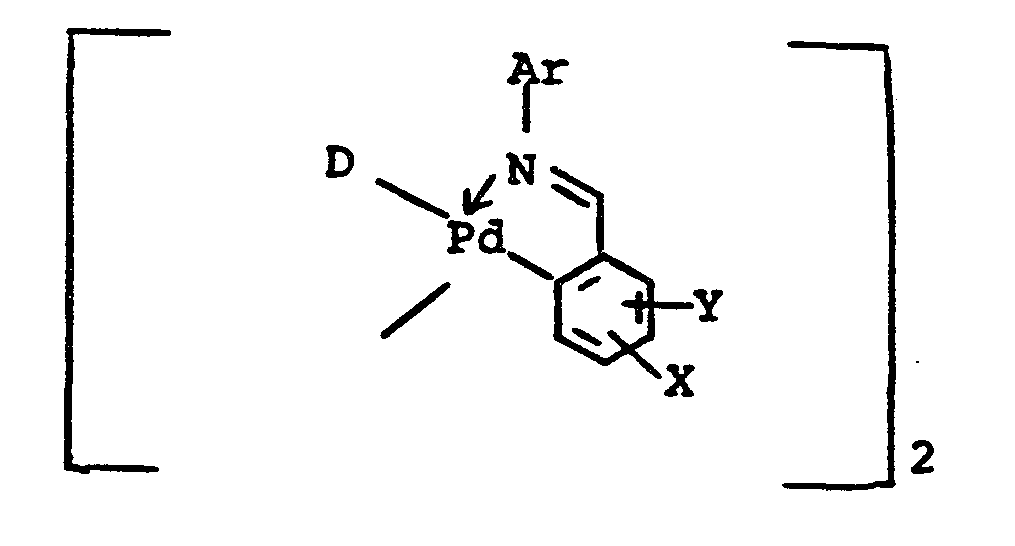
- X, Y, A and B are each hydrogen, C 1-4 alkyl, halo (Cl, F, Br, I), C 1-9 alkoxy or benzyloxy at least one being other than hydrogen which comprises reacting a palladium complex of the structure: in which D is an anion such as acetate and Ar is an aromatic radical with a Grignard reagent of the structure: or the corresponding substituted phenyllithium in the presence of at least six, preferably eight, molar equivalents of triphenylphosphine.
- Willard et al. European application 80 104 807.5, Publication Number 0 024 3408
- Willard et al. described synthetic analogs of Endo's fermentation product whose biological activity closely approximated the natural product.
- the desirable structures were seen to be derived especially from 2,4-dichloro-6-substituted benzaldehydes or 2,4-dimethyl-6-substituted benzaldehydes in which the 6-substituent was a substituted phenyl. Methods of preparation of the substituted biphenyl-2-carboxaldehydes were not readily available.
- the process of this invention therefore comprises preparation, in the same manner as used by Murahashi, of a palladium complex of the structure: and reacting it with a Grignard reagent of structure: or the corresponding substituted phenyllithium in the presence of at least six and preferably eight molar equivalents of triphenylphosphine, using otherwise the procedures described by Murahashi.
- This synthesis is shown in Flow Sheet A. While the above formula describes a Schiff base of aniline, where Ar is phenyl, other aromatic amines having unreactive substituents such as toluidine and xylidine can obviously be used.
- the aldehydes thus produced have the structure: in which A, B, X and Y are each hydrogen, Cl-4 alkyl, halo such as chloro, fluoro, bromo or iodo, C 1-9 alkoxy or benzyloxy, at least one of which is other than hydrogen.
- X and Y independently be chloro or C 1-4 alkyl, preferably methyl, and further preferred that they be in the 3- and 5-positions.
- a and B independently be hydrogen, fluoro, C 1-4 alkyl, preferably methyl, or C 1-9 -alkoxy, preferably methoxy and further that they occupy two positions selected from 3', 4' and 5'.
- Preferred species which form a part of this invention are 3,5-dichloro-4'-fluoro-1,1'-biphenyl-2-carboxaldehyde; 3,5-dimethyl-4'-fluoro-l,l'-biphenyl-2-carboxaldehyde; 3,3',5-trimethyl-4'-fluoro-1,1'-biphenyl-2-carboxaldehyde; and 3,3',5,5'-tetramethyl-1,1'-biphenyl-2-carboxaldehyde.
- biphenylaldehydes produced by the novel process of this invention are useful for the synthesis of compounds of structure X in Flow Sheet B by the process described in Flow Sheet B and the Reactions appended thereto.
- the compounds, X are potent inhibitors of HMG-CoA-reductase and hence useful as antihyperchol- esterolemic agents in the treatment of hypercholesterolemia in human or animal patients.
- a typical human adult dose is between 200 and 2,000 mg/day, which can be administered in a single dose or in divided doses given 1-4 times per day.
- the solution is stirred 15 minutes at 0°C, cooled to -78°C and treated with a solution of 2,4-dichloro-6-(4-fluorophenyl)benzaldehyde (30 mmole) in anhydrous tetrahydrofuran (50 ml).
- the resulting solution is stirred at -78°C for 15 minutes and then at 25°C for 60 minutes.
- the reaction solution is treated with water (200 ml) and extracted with ether (3 x 200 ml). The organic extracts are combined, washed with brine (3 x 100 ml), dried over magnesium sulfate and filtered. The filtrate is evaporated in vacuo, leaving the desired intermediate hydroxyimine as a brown viscous oil.
- Step B Preparation of Methyl (E)-7-[2,4-dichloro-6-(4-fluorophenyl)phenyl]-5-hydroxy-3-oxo-6- heptenoate
- Methyl acetoacetate (9.56 g, 82.3 mmole) is added dropwise to a stirred suspension of sodium hydride (50% oil suspension) (3.95 g, 82.3 mmole) in anhydrous tetrahydrofuran at 0°C under a nitrogen atmosphere.
- the resulting solution is stirred 15 minutes at 0°C and then treated with a 1.6M solution (51.5 ml, 82.3 mmole) of n-butyllithium in hexane over 5 minutes.
- Step C Preparation of Methyl (E)-7-[2,4-Dichloro-6-(4-fluorophenyl)phenyl]-3,5-dihydroxy-6-he p tenoate
- Step D Preparation of (E)-7-[2,4-Dichloro-6-(4-fluorophenyl)phenyl]-3,5-dihydroxy-6-heptenoic acid
- Step E Preparation of (E)-trans-6-[2-(3,5-dichloro-4'-fluoro[1,1'-bipheny]-2-yl)ethenyl]-3,4,5,6-tetrahydro-4-hydroxy-2H-pyran-2-one
- Step F Preparation and Separation of the Diastereomeric Amides (Diastereomers A and B)
- Step G Preparation of (+)-(E)-trans-6-[2-(3,5-dichloro-4'-fluoro[1,1'-biphenyl]-2-yl)ethenyl]-3,4,5,6-tetrahydro-4-hydroxy-2H-pyran-2-one
- Diastereomer A (1.8 mmole) of Step F is dissolved in 95% ethanol (25 ml) containing 1N sodium hydroxide (3.6 ml, 3.6 mmole) and the solution is refluxed for 54 hours. The solvent is removed in vacuo and the residue is suspended in water (100 ml) and acidified with 6N hydrochloric acid. This aqueous mixture is extracted with ether (3 x 75 ml). The ether extracts are combined, washed with brine (2 x 50 ml), dried over magnesium sulfate and filtered. The filtrate is evaporated in vacuo leaving the intermediate acid as an oil.
- Step A Preparation of bis ( ⁇ -(acetato-0:0')bis-13,5-dichloro-2-I(phenylimino)methyl]phenyl-C,N]dipalladium
- the resultant mixture was stirred for 1 hour at ambient temperature. After the addition of 6 NHCl (50 ml) with stirring for 1 hour, the mixture was filtered. The filtrate was diluted with ether (300 ml) and washed with brine (2 x 100 ml). The organic layer was refiltered to remove more yellow solid and the filtrate was washed with brine (2 x 100 ml), dried over MgS04, filtered and evaporated. The residue was chromatographed on a silica column (1000 g). Elution with ether-hexane (1:39, v:v; 5500 ml) provided a forerun which was discarded.
- Step A Preparation of N-[2,4-difluorophenyl)-methylene]benzene amine
- Step B Preparation of bis( ⁇ -(acetato-0:0')bis-[3,5-difluoro-2[(phenylimino)methyl]phenyl-C,Nldipalladium
- Step C Preparation of 3,4',5-trifluoro-l,l'-biphenyl-2-carboxaldehyde
- the 4-fluorophenylmagnesium bromide prepared from 4-bromofluorobenzene (1.92 g, 11 mmole) and magnesium (0.24 g, 10 mmole) in dry ether (25 ml) under N 2 at ambient temperature, was added dropwise to the above solution at such a rate that the internal temperature did not exceed 10°C. After stirring the resultant mixture for one hour at 5°C, 6N HCl (15 ml) was added and the reaction was stirred another hour at 5°C. The reaction solution was then diluted with ether (200 ml) and washed with brine (100 ml).
- Step B Preparation of 5-Chloro-4'-fluoro-3,3'-dimethyl-1,1'-biphenyl-2-carboxaldehyde
- Step A When the procedure of Example 3, Step A, is followed, except that an equimolar quantity of 2-chlorobenzal- dehyde is used in place of 2,4-difluorobenzaldehyde, there is obtained the title compound as a viscous oil.
- Step B Preparation of 3-chloro-4'-fluoro-3'-methyl-1,1'-biphenyl-2-carboxaldehyde
Landscapes
- Chemical & Material Sciences (AREA)
- Organic Chemistry (AREA)
- Organic Low-Molecular-Weight Compounds And Preparation Thereof (AREA)
- Acyclic And Carbocyclic Compounds In Medicinal Compositions (AREA)
- Low-Molecular Organic Synthesis Reactions Using Catalysts (AREA)
Abstract
Description
- This invention relates to a small group of substituted biphenyl-2-carboxaldehydes and to a process for preparing certain difficult-to-obtain substituted biphenyl-2-carboxaldehydes which are needed as intermediates for synthetic, in vivo cholesterol synthesis inhibitors. More specifically it relates to a process for preparing compounds of the structure:


- It is known that certain mevalonate derivatives inhibit the biosynthesis of cholesterol, cf. F.M. Singer et al., Proc. Soc. Exper. Biol. Med., 102 270 (1959) and F.H. Hulcher, Arch. Biochem. Biophys., 146 422 (1971). Nevertheless the activity of the known compounds has not always been found satisfactory, i.e. to have practical application.
- --Recently, Endo et al. reported (U.S. Letters Patent 4,049,495; 4,137,322; and 3,983,140) the production of a fermentation product which was quite active in the inhibition of cholesterol biosynthesis. This natural product, now called compactin, was reported by Brown et al. (J. Chem. Soc. Perkin I, 1165 (1976)) to have a complex mevalono- lactone structure. However, the low rate of production from fermentation broths appears to limit the supply of this natural product.
- More recently, Willard et al. (European application 80 104 807.5, Publication Number 0 024 348) described synthetic analogs of Endo's fermentation product whose biological activity closely approximated the natural product. As the structure-activity relationship within the Willard et al. compounds was developed, the desirable structures were seen to be derived especially from 2,4-dichloro-6-substituted benzaldehydes or 2,4-dimethyl-6-substituted benzaldehydes in which the 6-substituent was a substituted phenyl. Methods of preparation of the substituted biphenyl-2-carboxaldehydes were not readily available.
- Murahashi et al. (J. Org. Chem., 43 4099 (1978) and Tetrahedron Letters 3749 (1974) has described a method of preparing ortho-substituted benzaldehydes which comprises reacting a cyclic palladium complex of benzaldehyde aniline Schiff bases with a Grignard reagent in the presence of four molar equivalents of triphenylphosphine. When this reaction was tried with the substituted benzaldehydes and Grignard reagents having substituents needed for the Willard et al. inhibitors, an unusable mixture of various aldehydes was obtained.
- I have found that when the molar equivalents of triphenylphosphine are increased from the four equivalents used by Murahashi to at least six and preferably eight, the desired biphenyl-2-carboxaldehydes are obtained in 75-85% yields. The process of this invention therefore comprises preparation, in the same manner as used by Murahashi, of a palladium complex of the structure:


- The aldehydes thus produced, have the structure:

- It is preferred that X and Y independently be chloro or C1-4 alkyl, preferably methyl, and further preferred that they be in the 3- and 5-positions.
- It is preferred that A and B independently be hydrogen, fluoro, C1-4 alkyl, preferably methyl, or C1-9-alkoxy, preferably methoxy and further that they occupy two positions selected from 3', 4' and 5'.
- Preferred species which form a part of this invention are 3,5-dichloro-4'-fluoro-1,1'-biphenyl-2-carboxaldehyde; 3,5-dimethyl-4'-fluoro-l,l'-biphenyl-2-carboxaldehyde; 3,3',5-trimethyl-4'-fluoro-1,1'-biphenyl-2-carboxaldehyde; and 3,3',5,5'-tetramethyl-1,1'-biphenyl-2-carboxaldehyde.

- Equivalents - A, B, Y and X as defined D is an anion such as chloride or acetate.
-
- (1) Reaction with aniline or other aromatic amine.
- (2) Reaction with a palladium salt in the presence of an acid, e.g. palladium acetate and acetic acid.
- (3) Reaction with a Grignard reagent:

- The biphenylaldehydes produced by the novel process of this invention are useful for the synthesis of compounds of structure X in Flow Sheet B by the process described in Flow Sheet B and the Reactions appended thereto.
- The compounds, X, are potent inhibitors of HMG-CoA-reductase and hence useful as antihyperchol- esterolemic agents in the treatment of hypercholesterolemia in human or animal patients. A typical human adult dose is between 200 and 2,000 mg/day, which can be administered in a single dose or in divided doses given 1-4 times per day.

-
- (4) Aldol reaction, e.g. either condensation of acetaldehyde with the benzaldehyde, followed by acetylation and thermal elimination of acetic acid, or a directed aldol condensation in which the anion of an N-substituted ethylidenylimine is condensed with the starting aldehyde, followed by dehydration and imine hydrolysis, or by reaction with 2-ethoxyvinyl- lithium followed by rearrangement.
- (5) Reaction with the dianion of acetoacetic ester.
- (6) Reduction with NaBH4 at 0°C.
- (7) Saponification by base, followed by lactonization in toluene.
- (8) Separation of cis- and trans- isomers.
- (9) Resolution.
- A typical synthesis using the above reactions is described here for the preparation of (+)-(E)-trans-6-[2-(3,5-dichloro-4'-fluoro[l,l'-biphenyl]-2-yl)ethenyl]-3,4,5,6-tetrahydro-4-hydroxy-2H-pyran-2-one.
- Step A: Preparation of (E)-2,4-Dichloro-6-(4-fluorophenyl)cinnamaldehyde
- A 1.6M solution (18.8 ml, 30 mmole) of n-butyllithium in hexane is added cautiously to a stirred solution of freshly distilled diisopropylamine (3.0 g, 30 mmole) in anhydrous tetrahydrofuran (200 ml) maintained at 0°C under a nitrogen atmosphere. The resulting solution is stirred at 0°C for 15 minutes and then treated with ethylidenecyclohexylamine (3.75 g, 30 mmole). The solution is stirred 15 minutes at 0°C, cooled to -78°C and treated with a solution of 2,4-dichloro-6-(4-fluorophenyl)benzaldehyde (30 mmole) in anhydrous tetrahydrofuran (50 ml). The resulting solution is stirred at -78°C for 15 minutes and then at 25°C for 60 minutes. The reaction solution is treated with water (200 ml) and extracted with ether (3 x 200 ml). The organic extracts are combined, washed with brine (3 x 100 ml), dried over magnesium sulfate and filtered. The filtrate is evaporated in vacuo, leaving the desired intermediate hydroxyimine as a brown viscous oil.
- A solution of the oily imine in tetrahydrofuran (110 ml) is treated with a solution of oxalic acid dihydrate (11 g, 87.2 mmole) in water(22 ml). The resulting solution is refluxed for 30 minutes, cooled to 25°C and poured into water (500 ml). The resulting mixture is extracted with ether (3 x 200 ml). The organic extracts are combined, washed with brine (3 x 50 ml), dried over magnesium sulfate and filtered. The filtrate is evaporated in vacuo, leaving the title compound as a tan solid. The title compound is purified by recrystallization from cyclohexane.
- Methyl acetoacetate (9.56 g, 82.3 mmole) is added dropwise to a stirred suspension of sodium hydride (50% oil suspension) (3.95 g, 82.3 mmole) in anhydrous tetrahydrofuran at 0°C under a nitrogen atmosphere. The resulting solution is stirred 15 minutes at 0°C and then treated with a 1.6M solution (51.5 ml, 82.3 mmole) of n-butyllithium in hexane over 5 minutes. The resulting solution is stirred 15 minutes at 0°C and then treated with a solution of (E)-2,4-dichloro-6-(4-fluorophenyl)-cinnamaldehyde (82.3 mmole) in anhydrous tetrahydrofuran (150 ml). The resulting orange solution is stirred 15 minutes at 0°C and then quenched by dropwise addition of 12N hydrochloric acid (ca. 20 ml). The reaction mixture is diluted with water (100 ml) and extracted with ether (3 x 300 ml). The organic extracts are combined, washed with brine (3 x 100 ml), dried over magnesium sulfate and filtered. The filtrate is evaporated in vacuo leaving the title compound as an oil.
- Sodium tetrahydridoborate (1.55 g, 41.1 mmole) is added with stirring to a cooled solution (5°C) of methyl (E)-7-(2,4-dichloro-6-(4-fluorophenyl)phenyl)-5-hydroxy-3-oxo-6-heptenoate (82.3 mmole) in ethanol (200 ml) at a rate sufficient to maintain the internal temperature at 15-20°C. The resulting solution is stirred with ice-bath cooling for 15 min. and then acidified with 6N hydrochloric acid. The resulting mixture is diluted with water (500 ml) and extracted with ether (3 x 250 ml). The organic extracts are combined, washed with brine (4 x 100 ml), dried over magnesium sulfate and filtered. The filtrate is evaporated in vacuo, leaving the title compound as an oil.
- A solution of methyl (E)-7-[2,4-dichloro-6-(fluorophenyl)phenyl]-3,5-dihydroxy-6-heptenoate (81.8 mmole), 1N sodium hydroxide (82 ml, 82 mmole) and ethanol (200 ml) is stirred at 25°C for 15 min. The reaction solution is acidified with 6N hydrochloric acid, diluted with water (400 ml) and extracted with ether (3 x 200 ml). The combined organic extracts are washed with brine (3 x 100 ml), dried over magnesium sulfate and filtered. The filtrate is evaporated in vacuo, leaving the title compound as an oil.
- A solution of (E)-7-12,4-dichlorophenyl-6-(4-fluorophenyl)phenyl]-3,5-dihydroxy-6-heptenoic acid (81.3 mmole) in toluene (300 ml) is heated at reflux in a Dean-Stark apparatus. After 2 hours the Dean-Stark ° apparatus is replaced with a soxhlet containing 3A molecular sieves (100 g). The solution is refluxed for an additional 4 hours and then the toluene is removed in vacuo leaving an oil which is a mixture of cis and trans isomers of the title compound. The oil is chromatographed on a silica gel column (900 g). Elution with methylene chloride acetone (9:1, v:v; 4000 ml) provides a forerun which is discarded. Continued elution with the same eluant (500 ml) gives the trans isomer of the title compound, m.p. 121-122°C.
- A solution of (E)-trans-6-[2-(3,5-dichloro-4'-fluoroll,l'-biphenyl]-2-yl)ethenyl]-3,4,5,6-tetrahydro-4-hydroxy-2H-pyran-2-one (68 mmole) and 1-(-)-α-methylbenzylamine (16.5 g, 136 mmole) in tetrahydrofuran (350 ml) is refluxed for 20 hours. The tetrahydrofuran is removed in vacuo and the residue is stirred in ether (500 ml) and the precipitate collected to give diastereomer A which is twice stirred for 15 min. in refluxing ether (500 ml) to yield a colorless solid which melted at 128.5-129°C.
- Diastereomer A (1.8 mmole) of Step F is dissolved in 95% ethanol (25 ml) containing 1N sodium hydroxide (3.6 ml, 3.6 mmole) and the solution is refluxed for 54 hours. The solvent is removed in vacuo and the residue is suspended in water (100 ml) and acidified with 6N hydrochloric acid. This aqueous mixture is extracted with ether (3 x 75 ml). The ether extracts are combined, washed with brine (2 x 50 ml), dried over magnesium sulfate and filtered. The filtrate is evaporated in vacuo leaving the intermediate acid as an oil.
- A solution of the yellow oil in toluene (150 ml) is refluxed through a soxhlet containing 0 molecular sieves (3A) for 5 hours. The solution is evaporated in vacuo leaving the title compound as a solid, [α]25 D = +38. 7° (C, 0.8; chloroform).
- A mixture of N-[(2,4-dichlorophenyl)-methylene]benzene amine (2.5 g, 10 mmole) and palladium (II) acetate (2.24 g, 10 mmole) in acetic acid (50 ml) was heated at reflux for one hour with stirring. The warm turbid solution was filtered and the filtrate was diluted with water (300 ml) to give the title compound as a red solid (3.9 g, 94%). Crystallization from acetic acid-water (7:1, v:v) provided an analytical sample of the title compound, m.p. 203-5°C: pmr (CDCl3)δ 1.73 (3H,s), 6.50 (H,d,J=1.5Hz), 6.97 (2H,m), 7.12 (H,d,J=7.5Hz), 7.33 (3H,m), 8.03 (H,s).
- Analysis Calc. for C30H22Cl2N4O4Pd2 Calc.: C, 43.42 H, 2.67 N, 3.38 Found: C, 43.54 H, 2.59 N, 3.13
- A solution of bis(µ-(acetato-0:0')bis[3,5-dichloro-2-[(phenylimino)methyl]phenyl-C,N]dipalladium (8.29 g, 10 mmole) and triphenylphosphine (21.0 g, 80 mmole) in dry benzene (150 ml) was stirred for 30 minutes at ambient temperature under N2. The 4-fluorophenylmagnesium bromide, prepared from 4-bromofluorobenzene (15.4 g, 88 mmole) and magnesium (1.94 g, 80 mmole) in dry ether (100 ml) under N2 at ambient temperature, was added to the above solution in one portion. The resultant mixture was stirred for 1 hour at ambient temperature. After the addition of 6 NHCl (50 ml) with stirring for 1 hour, the mixture was filtered. The filtrate was diluted with ether (300 ml) and washed with brine (2 x 100 ml). The organic layer was refiltered to remove more yellow solid and the filtrate was washed with brine (2 x 100 ml), dried over MgS04, filtered and evaporated. The residue was chromatographed on a silica column (1000 g). Elution with ether-hexane (1:39, v:v; 5500 ml) provided a forerun which was discarded. Continued elution with ether-hexane (1:9, v:v, 5700 ml) gave the title compound as a yellow solid (4.5 g, 84%), m.p. 73-4°C: pmr (CDC13) δ 7.03-7.40 (5H,m), 7.53 (H,d,J=1.5Hz), 10.13 (H,s).
- Starting with bis(µ-(acetato-0:0')bis[3,5-dichloro-2[(phenylimino)methyl]phenyl-C,N]dipalladium, but substituting equal amounts of the following Grignard reagents for 4-fluorophenylmagnesium bromide in Step B of Example 1 and following the procedure of Step B there was obtained a corresponding amount of the appropriate end products listed below in Table I.


- A solution of 2,4-difluorobenzaldehyde (3.9 g, 27.4 mmole) and aniline (2.5 g, 27.4 mmole) in toluene (100 ml) was refluxed and the water was collected in a Dean-Stark apparatus. After 2 hours, the toluene was removed in vacuo to provide the title compound as a tan liquid (5.8 g, 97%) which was used in Step B without further purification: pmr (CDC13) δ 6.50-7.33(7H,m), 8.00(H,m), 8.49(H,s).
- A mixture of N-[2,4-difluorophenyl)methylene]benzene amine (8.1 g, 37.3 mmole) and palladium (II) acetate (8.4 g, 37.3 mmole) in acetic acid (100 ml) was heated at reflux for 1 hour with stirring. The warm turbid solution was filtered and the filtrate was diluted with water (600 ml) to give the title compound as a yellow solid (13.4 g, 94%), m.p. dec 212-14°C: pmr (CDCl3)δ 1.80(3H,s), 6.00(H,dd,J=8Hz,2Hz), 6.50(H,td,J=8Hz,2Hz), 6.90(2H, m), 7.23(3H,m), 7.92(H,s).
- A solution of bis(µ-(acetato-0:0')bis[3,5-difluoro-2-[(phenylimino)methyl]phenyl-C,N]dipalladium (2.54 g, 3.3 mmole) and triphenylphosphine (5.24 g, 20 mmole) in dry benzene (50 ml) was stirred for 30 minutes at ambient temperature under N2 and then cooled to 5°C (ice bath). The 4-fluorophenylmagnesium bromide, prepared from 4-bromofluorobenzene (1.92 g, 11 mmole) and magnesium (0.24 g, 10 mmole) in dry ether (25 ml) under N2 at ambient temperature, was added dropwise to the above solution at such a rate that the internal temperature did not exceed 10°C. After stirring the resultant mixture for one hour at 5°C, 6N HCl (15 ml) was added and the reaction was stirred another hour at 5°C. The reaction solution was then diluted with ether (200 ml) and washed with brine (100 ml). The organic layer was filtered to remove some yellow solid which precipitated during the brine washing and the filtrate was washed with brine (2 x 100 ml) dried over MgSO4, filtered and evaporated. The residue was chromato- graphed on a 60 mm chromatographic column containing 15 cm of silica gel (234-400 mesh). Elution with methylene chloride-hexane (1:1; v:v; 960 ml) provided a forerun which was discarded. Continued elution (940 ml) gave the title compound as a white solid (1.2 g, 76%), m.p. 69-71°C: pmr (CDCl3) δ 6.82-7.10 (2H,m), 7.16-7.47(4H,m) , 10.0(H,s).
- Analysis Calc. for C 13 H 7 F 3 0

- A mixture of 4-chloro-2-methylbenzaldehyde (3.5 g, 22.6 mmol) and aniline (2.11 g, 22.6 mmol) in toluene (40 ml) was heated at reflux in a Dean-Stark apparatus for 1 hour. The mixture was cooled and evaporated in vacuo to leave an oily residue. The residue was redissolved in ether and washed with 5% sodium bicarbonate solution. The organic phase was separated, dried over MgSO4 and filtered. The filtrate was concentrated in vacuo to afford an oily residue which was purified by distillation via a Kugelrohr apparatus (oven temperature 160°C, 0.5 mm) to provide the title compound (4.0 g, 17.4 mmol, 77%) as a viscous oil; pmr (CDCl3) δ 2.5(3H,s), 6.3-7.5(7H,m), 7.95(H,d), 8.6(H,s).
- By substituting an equimolar amount of N-[(4-chloro-2-methylphenyl)methylene]benzeneamine in place of N-[(2,4-dichlorophenyl)methylene]benzeneamine in Step A of Example 1 and replacing the 4-fluorophenylmagnesium bromide with an equimolar amount of 4-fluoro-3-methyl- phenylmagnesium bromide in Step B of Example 1 and following the procedures described therein, there was obtained a corresponding amount of the title compound; pmr (CDC13)d 2.30(3H,d), 2.60(3H,s), 7.1-7.3(5H,m), 9.9(H,s).
- By substituting an equimolar amount of N-1(2,4-dimethylphenyl)methylene]benzeneamine in place of N-[(2,4-dichlorophenyl)methylene]benzeneamine in Step A of Example 1 and replacing the 4-fluorophenylmagnesium bromide with an equimolar amount of 3,4-dichlorophenylmagnesium bromide in Step B of Example 1 and following the procedures described therein, there was obtained a corresponding amount of the title compound, m.p. 80-81°C; pmr (CDCl3) δ 2.4(3H,s), 2.6(3H,s), 7.0-7.5(5H,m), 10.0(H,s).
- Analysis calc. for C15H12C120: C, 64.54 H, 4.33 Found: C, 64.83 H, 4.45
- Employing the procedure substantially as described in Example 5, but substituting for the 3,4-dichlorophenylmagnesium bromide used therein, an equimolecular amount of the Grignard reagents listed in Table II there were prepared the substituted biphenyl-2-carboxaldehydes, also listed in Table II.

- By substituting an equimolar amount of N-1(2,5-dimethylphenyl)methylene]benzeneamine in place of N-[(2,4-dichlorophenyl)methylene]benzeneamine in Step A of Example 1 and replacing the 4-fluorophenylmagnesium bromide with an equimolar amount of 3,4-dichlorophenylmagnesium bromide in Step B of Example 1 and following the procedures described therein, there was obtained a corresponding amount of the title compound as a pale yellow gum; pmr (CDC13) δ 2.0(3H,s), 2.6(3H,s), 7.0-7.6(5H,m), 9.9(H,s).
- When the procedure of Example 3, Step A, is followed, except that an equimolar quantity of 2-chlorobenzal- dehyde is used in place of 2,4-difluorobenzaldehyde, there is obtained the title compound as a viscous oil.
- Anal. Calc'd for C13H10ClN:
- %C, 72.40; %H, 4.67; %N, 6.49
- Found: %C, 72.35; %H, 5.02; %N, 6.46.
- By substituting an equimolar quantity of N-[(2-chlorophenyl)methylene]benzeneamine in place of N-1(2,4-dichlorophenyl)methylene]benzeneamine in Step A of Example 1 and replacing the 4-fluorophenylmagnesium bromide with an equimolar amount of 4-fluoro-3-methylphenyl- magnesium bromide in Step B of Example 1 and following the procedures described therein, there is obtained the title compound, m.p. 74-79°C.
- Anal. Calc'd for C14H10ClFO: %C, 67.62; %H, 4.05. Found: %C, 67.83; %H, 4.09.
Claims (16)


Priority Applications (1)
| Application Number | Priority Date | Filing Date | Title |
|---|---|---|---|
| AT81102810T ATE11401T1 (en) | 1980-04-14 | 1981-04-13 | SUBSTITUTED BIPHENYL-2-CARBOXALDEHYDE AND PROCESS FOR THEIR PRODUCTION. |
Applications Claiming Priority (2)
| Application Number | Priority Date | Filing Date | Title |
|---|---|---|---|
| US14032180A | 1980-04-14 | 1980-04-14 | |
| US140321 | 1980-04-14 |
Publications (2)
| Publication Number | Publication Date |
|---|---|
| EP0038061A1 true EP0038061A1 (en) | 1981-10-21 |
| EP0038061B1 EP0038061B1 (en) | 1985-01-23 |
Family
ID=22490714
Family Applications (1)
| Application Number | Title | Priority Date | Filing Date |
|---|---|---|---|
| EP81102810A Expired EP0038061B1 (en) | 1980-04-14 | 1981-04-13 | Substituted biphenyl-2-carboxaldehydes and a process for preparing them |
Country Status (9)
| Country | Link |
|---|---|
| EP (1) | EP0038061B1 (en) |
| JP (1) | JPS56161343A (en) |
| AT (1) | ATE11401T1 (en) |
| DE (1) | DE3168434D1 (en) |
| DK (1) | DK167481A (en) |
| ES (1) | ES8300667A1 (en) |
| GR (1) | GR75192B (en) |
| IE (1) | IE51219B1 (en) |
| PT (1) | PT72801B (en) |
Cited By (7)
| Publication number | Priority date | Publication date | Assignee | Title |
|---|---|---|---|---|
| US4613610A (en) * | 1984-06-22 | 1986-09-23 | Sandoz Pharmaceuticals Corp. | Cholesterol biosynthesis inhibiting pyrazole analogs of mevalonolactone and its derivatives |
| US4668794A (en) * | 1985-05-22 | 1987-05-26 | Sandoz Pharm. Corp. | Intermediate imidazole acrolein analogs |
| US4686237A (en) * | 1984-07-24 | 1987-08-11 | Sandoz Pharmaceuticals Corp. | Erythro-(E)-7-[3'-C1-3 alkyl-1'-(3",5"-dimethylphenyl)naphth-2'-yl]-3,5-dihydroxyhept-6-enoic acids and derivatives thereof |
| US4804679A (en) * | 1984-07-24 | 1989-02-14 | Sandoz Pharm. Corp. | Erythro-(E)-7-(3'-C1-3alkyl-1'-(3",5"-dimethylphenyl)naphth-2'-yl)-3,5-dihydroxyhept-6-enoic acids and derivatives thereof |
| WO2002020452A3 (en) * | 2000-09-01 | 2002-07-11 | Milliken & Co | Novel fluorinated and chlorinated benzaldehydes |
| US8536210B2 (en) | 2008-09-11 | 2013-09-17 | Semmelweis Egyetem | Compounds for inhibiting semicarbazide-sensitive amine oxidase (SSAO)/vascular adhesion protein-1 (VAP-1) and uses thereof for treatment and prevention of diseases |
| CN115092909A (en) * | 2022-07-12 | 2022-09-23 | 中南大学 | A kind of high-concentration fluorine-doped carbon dots and preparation method thereof |
Citations (3)
| Publication number | Priority date | Publication date | Assignee | Title |
|---|---|---|---|---|
| DE1156776B (en) * | 1959-04-24 | 1963-11-07 | United States Steel Corp | Process for the preparation of 2,2'-diphenyldicarboxaldehyde |
| GB1499655A (en) * | 1974-01-31 | 1978-02-01 | Allen & Hanburys Ltd | Biphenyl derivatives |
| DE2801887A1 (en) * | 1977-12-20 | 1979-06-21 | Bbc Brown Boveri & Cie | Prepn. of para-substd. benzaldehyde derivs. - by hydrogenating complex formed from substd. benzene, oxalyl chloride and Friedel-Crafts catalyst |
-
1981
- 1981-04-03 PT PT72801A patent/PT72801B/en unknown
- 1981-04-08 GR GR64618A patent/GR75192B/el unknown
- 1981-04-10 ES ES501243A patent/ES8300667A1/en not_active Expired
- 1981-04-10 IE IE818/81A patent/IE51219B1/en unknown
- 1981-04-13 DE DE8181102810T patent/DE3168434D1/en not_active Expired
- 1981-04-13 DK DK167481A patent/DK167481A/en not_active IP Right Cessation
- 1981-04-13 AT AT81102810T patent/ATE11401T1/en not_active IP Right Cessation
- 1981-04-13 EP EP81102810A patent/EP0038061B1/en not_active Expired
- 1981-04-14 JP JP5515881A patent/JPS56161343A/en active Pending
Patent Citations (3)
| Publication number | Priority date | Publication date | Assignee | Title |
|---|---|---|---|---|
| DE1156776B (en) * | 1959-04-24 | 1963-11-07 | United States Steel Corp | Process for the preparation of 2,2'-diphenyldicarboxaldehyde |
| GB1499655A (en) * | 1974-01-31 | 1978-02-01 | Allen & Hanburys Ltd | Biphenyl derivatives |
| DE2801887A1 (en) * | 1977-12-20 | 1979-06-21 | Bbc Brown Boveri & Cie | Prepn. of para-substd. benzaldehyde derivs. - by hydrogenating complex formed from substd. benzene, oxalyl chloride and Friedel-Crafts catalyst |
Cited By (7)
| Publication number | Priority date | Publication date | Assignee | Title |
|---|---|---|---|---|
| US4613610A (en) * | 1984-06-22 | 1986-09-23 | Sandoz Pharmaceuticals Corp. | Cholesterol biosynthesis inhibiting pyrazole analogs of mevalonolactone and its derivatives |
| US4686237A (en) * | 1984-07-24 | 1987-08-11 | Sandoz Pharmaceuticals Corp. | Erythro-(E)-7-[3'-C1-3 alkyl-1'-(3",5"-dimethylphenyl)naphth-2'-yl]-3,5-dihydroxyhept-6-enoic acids and derivatives thereof |
| US4804679A (en) * | 1984-07-24 | 1989-02-14 | Sandoz Pharm. Corp. | Erythro-(E)-7-(3'-C1-3alkyl-1'-(3",5"-dimethylphenyl)naphth-2'-yl)-3,5-dihydroxyhept-6-enoic acids and derivatives thereof |
| US4668794A (en) * | 1985-05-22 | 1987-05-26 | Sandoz Pharm. Corp. | Intermediate imidazole acrolein analogs |
| WO2002020452A3 (en) * | 2000-09-01 | 2002-07-11 | Milliken & Co | Novel fluorinated and chlorinated benzaldehydes |
| US8536210B2 (en) | 2008-09-11 | 2013-09-17 | Semmelweis Egyetem | Compounds for inhibiting semicarbazide-sensitive amine oxidase (SSAO)/vascular adhesion protein-1 (VAP-1) and uses thereof for treatment and prevention of diseases |
| CN115092909A (en) * | 2022-07-12 | 2022-09-23 | 中南大学 | A kind of high-concentration fluorine-doped carbon dots and preparation method thereof |
Also Published As
| Publication number | Publication date |
|---|---|
| JPS56161343A (en) | 1981-12-11 |
| DK167481A (en) | 1981-10-15 |
| ES501243A0 (en) | 1982-11-01 |
| ES8300667A1 (en) | 1982-11-01 |
| PT72801A (en) | 1981-05-01 |
| PT72801B (en) | 1983-01-10 |
| IE51219B1 (en) | 1986-11-12 |
| ATE11401T1 (en) | 1985-02-15 |
| DE3168434D1 (en) | 1985-03-07 |
| GR75192B (en) | 1984-07-13 |
| IE810818L (en) | 1981-10-10 |
| EP0038061B1 (en) | 1985-01-23 |
Similar Documents
| Publication | Publication Date | Title |
|---|---|---|
| US4375475A (en) | Substituted pyranone inhibitors of cholesterol synthesis | |
| Ireland et al. | Enolate Claisen rearrangement of esters from furanoid and pyranoid glycals | |
| US4710513A (en) | Substituted pyranone inhibitors of cholesterol synthesis | |
| US4308378A (en) | Cis/trans isomerization of 6-(substituted-aryl-ethenyl)-3,4,5,6-tetrahydro-4-hydroxy-2H-pyran-2-ones | |
| Piccolo et al. | Zinc salt catalyzed rearrangement of acetals of optically active aryl 1-chloroethyl ketones: synthesis of optically active 2-arylpropionic acids and esters | |
| EP0024348B1 (en) | Substituted 6-phenethyl-and phenylethenyl-3,4,5,6-tetrahydro-4-hydroxytetraydropyran-2-ones in the4-r trans stereoisomeric forms and the corresponding dihydroxy acids, process for preparing and pharmaceutical composition comprising them | |
| US4946841A (en) | Pyridazine 3,5-dihydroxy carboxylic acids and derivatives thereof, the use thereof for hypercholesterolemia | |
| EP0068038B1 (en) | (+)-(4r,6s)-(e)-6-(2-(4'-fluoro-3,3',5-trimethyl-(1,1'-biphenyl)-2-yl)ethenyl)-3,4,5,6-tetrahydro-4-hydroxy-2h-pyran-2-one, a process for preparing and a pharmaceutical composition containing the same | |
| White et al. | Stereoselective synthesis of trisporic acids A and B, their methyl esters, and trisporols A and B, hormones and prohormones of mucoraceous fungi | |
| US4085222A (en) | Pharmaceutical compositions containing 1,3-dioxanes | |
| EP0038061B1 (en) | Substituted biphenyl-2-carboxaldehydes and a process for preparing them | |
| US4322563A (en) | Substituted biphenyl-2-carboxaldehydes | |
| DE19601938A1 (en) | New phosphodiesterase inhibitors | |
| US4812476A (en) | Process for stereosectively preparing optically active compounds | |
| Honda et al. | Diastereoselective aldol condensation of acylsilane silyl enol ethers with acetals | |
| US4970345A (en) | Process for preparing oxocyclopentene derivatives | |
| Moussaoui et al. | Catalyzed Knoevenagel reactions on inorganic solid supports: Application to the synthesis of coumarine compounds | |
| JPH0784413B2 (en) | 3- (Unsubstituted or substituted benzyl) -1-alkyl-2-oxocyclopentanecarboxylic acid alkyl ester derivative, its production method, bactericide and use as intermediate | |
| US4208425A (en) | Novel diketones | |
| US5055484A (en) | 7(1h-pyrrol-3-yl)-substituted 3,5-dihydroxyhept-6-enoic acids, 7-(1h-pyrrol-3-yl)-substituted 3,5-dihyroxyhept-anoic acids, their corresponding delta-lactones and salts, their use as medicaments and pharmaceutical products and intermediates | |
| US4153719A (en) | Aromatic diketones | |
| US5434289A (en) | Process for producing optically active β-hydroxyketone | |
| EP1756027B1 (en) | Process for producing indenol esters or ethers | |
| US4472426A (en) | Antihypercholesterolemic compounds | |
| EP0095835B1 (en) | Preparing 4,7-dialkoxybenzofurans, and intermediates used therein |
Legal Events
| Date | Code | Title | Description |
|---|---|---|---|
| PUAI | Public reference made under article 153(3) epc to a published international application that has entered the european phase |
Free format text: ORIGINAL CODE: 0009012 |
|
| AK | Designated contracting states |
Designated state(s): AT BE CH DE FR GB IT LU NL SE |
|
| ITCL | It: translation for ep claims filed |
Representative=s name: SOCIETA' ITALIANA BREVETTI S.P.A. |
|
| 17P | Request for examination filed |
Effective date: 19811014 |
|
| ITF | It: translation for a ep patent filed | ||
| GRAA | (expected) grant |
Free format text: ORIGINAL CODE: 0009210 |
|
| AK | Designated contracting states |
Designated state(s): AT BE CH DE FR GB IT LI LU NL SE |
|
| REF | Corresponds to: |
Ref document number: 11401 Country of ref document: AT Date of ref document: 19850215 Kind code of ref document: T |
|
| REF | Corresponds to: |
Ref document number: 3168434 Country of ref document: DE Date of ref document: 19850307 |
|
| ET | Fr: translation filed | ||
| PG25 | Lapsed in a contracting state [announced via postgrant information from national office to epo] |
Ref country code: LU Free format text: LAPSE BECAUSE OF NON-PAYMENT OF DUE FEES Effective date: 19850430 |
|
| PLBE | No opposition filed within time limit |
Free format text: ORIGINAL CODE: 0009261 |
|
| STAA | Information on the status of an ep patent application or granted ep patent |
Free format text: STATUS: NO OPPOSITION FILED WITHIN TIME LIMIT |
|
| 26N | No opposition filed | ||
| PGFP | Annual fee paid to national office [announced via postgrant information from national office to epo] |
Ref country code: CH Payment date: 19900313 Year of fee payment: 10 |
|
| PGFP | Annual fee paid to national office [announced via postgrant information from national office to epo] |
Ref country code: BE Payment date: 19900330 Year of fee payment: 10 |
|
| PGFP | Annual fee paid to national office [announced via postgrant information from national office to epo] |
Ref country code: GB Payment date: 19900331 Year of fee payment: 10 |
|
| PGFP | Annual fee paid to national office [announced via postgrant information from national office to epo] |
Ref country code: SE Payment date: 19900404 Year of fee payment: 10 |
|
| PGFP | Annual fee paid to national office [announced via postgrant information from national office to epo] |
Ref country code: AT Payment date: 19900410 Year of fee payment: 10 |
|
| PGFP | Annual fee paid to national office [announced via postgrant information from national office to epo] |
Ref country code: LU Payment date: 19900425 Year of fee payment: 10 |
|
| ITTA | It: last paid annual fee | ||
| PGFP | Annual fee paid to national office [announced via postgrant information from national office to epo] |
Ref country code: NL Payment date: 19900430 Year of fee payment: 10 Ref country code: FR Payment date: 19900430 Year of fee payment: 10 |
|
| PGFP | Annual fee paid to national office [announced via postgrant information from national office to epo] |
Ref country code: DE Payment date: 19900525 Year of fee payment: 10 |
|
| PG25 | Lapsed in a contracting state [announced via postgrant information from national office to epo] |
Ref country code: GB Effective date: 19910413 Ref country code: AT Effective date: 19910413 |
|
| PG25 | Lapsed in a contracting state [announced via postgrant information from national office to epo] |
Ref country code: SE Effective date: 19910414 |
|
| PG25 | Lapsed in a contracting state [announced via postgrant information from national office to epo] |
Ref country code: LI Effective date: 19910430 Ref country code: CH Effective date: 19910430 Ref country code: BE Effective date: 19910430 |
|
| BERE | Be: lapsed |
Owner name: MERCK & CO. INC. Effective date: 19910430 |
|
| PG25 | Lapsed in a contracting state [announced via postgrant information from national office to epo] |
Ref country code: NL Effective date: 19911101 |
|
| GBPC | Gb: european patent ceased through non-payment of renewal fee | ||
| NLV4 | Nl: lapsed or anulled due to non-payment of the annual fee | ||
| PG25 | Lapsed in a contracting state [announced via postgrant information from national office to epo] |
Ref country code: FR Effective date: 19911230 |
|
| REG | Reference to a national code |
Ref country code: CH Ref legal event code: PL |
|
| PG25 | Lapsed in a contracting state [announced via postgrant information from national office to epo] |
Ref country code: DE Effective date: 19920201 |
|
| REG | Reference to a national code |
Ref country code: FR Ref legal event code: ST |
|
| EUG | Se: european patent has lapsed |
Ref document number: 81102810.9 Effective date: 19911108 |