EP0036729A2 - Powder-gel anode and cell employing same - Google Patents
Powder-gel anode and cell employing same Download PDFInfo
- Publication number
- EP0036729A2 EP0036729A2 EP81301056A EP81301056A EP0036729A2 EP 0036729 A2 EP0036729 A2 EP 0036729A2 EP 81301056 A EP81301056 A EP 81301056A EP 81301056 A EP81301056 A EP 81301056A EP 0036729 A2 EP0036729 A2 EP 0036729A2
- Authority
- EP
- European Patent Office
- Prior art keywords
- powder
- anode
- graft copolymer
- gel anode
- gel
- Prior art date
- Legal status (The legal status is an assumption and is not a legal conclusion. Google has not performed a legal analysis and makes no representation as to the accuracy of the status listed.)
- Withdrawn
Links
Classifications
-
- H—ELECTRICITY
- H01—ELECTRIC ELEMENTS
- H01M—PROCESSES OR MEANS, e.g. BATTERIES, FOR THE DIRECT CONVERSION OF CHEMICAL ENERGY INTO ELECTRICAL ENERGY
- H01M4/00—Electrodes
- H01M4/02—Electrodes composed of, or comprising, active material
- H01M4/62—Selection of inactive substances as ingredients for active masses, e.g. binders, fillers
- H01M4/621—Binders
- H01M4/622—Binders being polymers
-
- H—ELECTRICITY
- H01—ELECTRIC ELEMENTS
- H01M—PROCESSES OR MEANS, e.g. BATTERIES, FOR THE DIRECT CONVERSION OF CHEMICAL ENERGY INTO ELECTRICAL ENERGY
- H01M4/00—Electrodes
- H01M4/02—Electrodes composed of, or comprising, active material
- H01M4/06—Electrodes for primary cells
-
- H—ELECTRICITY
- H01—ELECTRIC ELEMENTS
- H01M—PROCESSES OR MEANS, e.g. BATTERIES, FOR THE DIRECT CONVERSION OF CHEMICAL ENERGY INTO ELECTRICAL ENERGY
- H01M4/00—Electrodes
- H01M4/02—Electrodes composed of, or comprising, active material
- H01M4/62—Selection of inactive substances as ingredients for active masses, e.g. binders, fillers
-
- H—ELECTRICITY
- H01—ELECTRIC ELEMENTS
- H01M—PROCESSES OR MEANS, e.g. BATTERIES, FOR THE DIRECT CONVERSION OF CHEMICAL ENERGY INTO ELECTRICAL ENERGY
- H01M6/00—Primary cells; Manufacture thereof
- H01M6/22—Immobilising of electrolyte
-
- H—ELECTRICITY
- H01—ELECTRIC ELEMENTS
- H01M—PROCESSES OR MEANS, e.g. BATTERIES, FOR THE DIRECT CONVERSION OF CHEMICAL ENERGY INTO ELECTRICAL ENERGY
- H01M4/00—Electrodes
- H01M4/02—Electrodes composed of, or comprising, active material
- H01M2004/026—Electrodes composed of, or comprising, active material characterised by the polarity
- H01M2004/027—Negative electrodes
-
- H—ELECTRICITY
- H01—ELECTRIC ELEMENTS
- H01M—PROCESSES OR MEANS, e.g. BATTERIES, FOR THE DIRECT CONVERSION OF CHEMICAL ENERGY INTO ELECTRICAL ENERGY
- H01M2300/00—Electrolytes
- H01M2300/0002—Aqueous electrolytes
- H01M2300/0014—Alkaline electrolytes
-
- H—ELECTRICITY
- H01—ELECTRIC ELEMENTS
- H01M—PROCESSES OR MEANS, e.g. BATTERIES, FOR THE DIRECT CONVERSION OF CHEMICAL ENERGY INTO ELECTRICAL ENERGY
- H01M4/00—Electrodes
- H01M4/02—Electrodes composed of, or comprising, active material
-
- Y—GENERAL TAGGING OF NEW TECHNOLOGICAL DEVELOPMENTS; GENERAL TAGGING OF CROSS-SECTIONAL TECHNOLOGIES SPANNING OVER SEVERAL SECTIONS OF THE IPC; TECHNICAL SUBJECTS COVERED BY FORMER USPC CROSS-REFERENCE ART COLLECTIONS [XRACs] AND DIGESTS
- Y02—TECHNOLOGIES OR APPLICATIONS FOR MITIGATION OR ADAPTATION AGAINST CLIMATE CHANGE
- Y02E—REDUCTION OF GREENHOUSE GAS [GHG] EMISSIONS, RELATED TO ENERGY GENERATION, TRANSMISSION OR DISTRIBUTION
- Y02E60/00—Enabling technologies; Technologies with a potential or indirect contribution to GHG emissions mitigation
- Y02E60/10—Energy storage using batteries
Definitions
- the invention relates to zinc powder-gel anodes for alkaline-MnO 2 cells and specifically to such anodes wherein the gelling agent is starch graft copolymer with or without an additional gelling agent such as sodium carboxymethyl cellulose (CMC), methyl cellulose (MCC), poly-N-vinyl pyrrolidone (P-N-V-P), polymethacrylic acid (PM4) or the like.
- the gelling agent is starch graft copolymer with or without an additional gelling agent such as sodium carboxymethyl cellulose (CMC), methyl cellulose (MCC), poly-N-vinyl pyrrolidone (P-N-V-P), polymethacrylic acid (PM4) or the like.
- a conventional type of alkaline cell employs a cathode comprising predominantly an oxidic depolarizer such as manganese dioxide usually admixed with a binder and conductive material such as graphite, steel wool and the like.
- the anode usually comprises a consumable anodic material such as powder zinc admixed with a gelling agent such as carboxymethyl cellulose, a suitable alkaline electrolyte such as an aqueous potassium hydrox solution and, if desired, mercury.
- the anode gel is then extruded to form a desired shaped electrode materials and their preparation are described in U.S. Patents 2,938,064 and 2,935,547 issued to K. Kordesch and U. S. Patent 2,993,947 issued to E. E. Leger.
- the above electrodes together with conventional separator material can be assembled into an alkaline-MnO 2 /zinc cell.
- U. S. application Serial No. 892,313 discloses a powder-gel anode comprising a major portion of a consumable anode material such as zinc, a minor amount of a gelling agent such as methyl cellulose with or without carboxymethyl cellulose and an aqueous alkaline electrolyte such as an aqueous potassium hydroxide solution.
- U. S. Patent No. 4,175,052 discloses a powder-gel anode comprising a major portion of a consumable anodic material such as zinc, a minor amount of a gelling agent such as poly-N-vinyl .
- a gelling agent that enables a cell to function at a given efficiency with a minimum amount of the gelling agent so that a larger volume of the active com- p onents such as zinc and manganese dioxide can be put in the cell.
- the gelling agent is particularly important for cells intended to operate on high discharge rates such as is required for toys, movie cameras, camera flash units and the like.
- the efficiency of anode utilization (normally the limiting factor in high rate service) is strongly affected by the gelling agent since the gelling agent affects the distribution and availability of electrolyte and the distribution of discharge products.
- it functions to keep the particulate anode material in a suspended state for greater electrolyte availability and better current density distribution. Consequently, the selection of a gelling agent is of primary importance in the fabrication of powder-gel anodes.
- the invention broadly relates to powder-gel anodes comprising a major portion (over 50% by weight) of a consumable anode material such as zinc, a minor amount (less than about 6% by weight) of a gelling agent such as a starch graft copolymer with or without one or more other gelling agent, and an aqueous alkaline electrolyte such as an aqueous potassium hydroxide solution.
- a consumable anode material such as zinc
- a minor amount (less than about 6% by weight) of a gelling agent such as a starch graft copolymer with or without one or more other gelling agent
- an aqueous alkaline electrolyte such as an aqueous potassium hydroxide solution.
- the starch graft copolymer for use in this invention is one in which the copolymer contains carboxylate units preferably acrylate units Suitable starch graft copolymers for this invention can be derived from corn starch and acrylonitrile.
- starch graft copolymers are available under the tradename SGP from Henkel Corporation, Minneapolis, Minnesota, and Stasorb from A.E. Staley Mfg Co. ' Examples of suitable starch graft copolymers would be SGP 145, SGP 502S, SGP 104, and SGP 136 from Henkel Corporation and Stasorb 372 from A. E Staley Manufacturing Company.
- the Stasorb 372 material is made from a mixture of starch and potassium acrylate which is polymerized, grafted and crystallized in a single step to yield a starch-polyacrylate block copolymer.
- a preferred starch graft copolymer for use in this invention is starch grafted with polymerized acrylonitrile and then hydrolyzed with NaOH or KOH to convert polyacrylonitrile blocks to a mixture of acrylamide and sodium (or potassium) acrylate functional groups.
- This type of material can be obtained commercially from Henkel Corporation under the tradename SG P -145. The above material could also be neutralized with HCL to convert sodium acrylate functional groups to acrylic acid groups.
- a surfactant such as a salt of a fatty acid could be added to improve its wettability and dispersability so as to minimize any clumping or mixing problems that may be encountered during anode fabrication.
- a starch graft copolymer is blended with zinc or amalgamated zinc powder and the electrolyte.
- the anode can be fabricated with a major amount of the anode's electrolyte (flowable type anode mix) or with a minor amount of the anode's electrolyte (extrudable type anode mix) whereupon the remainder of the anode's electrolyte would be . added during cell assembly to produce an alkaline cell.
- the amount of the starch graft copolymer to be incorporated in the powder-gel anode can vary between about. 0.7 and about 3.0 per cent by weight of the anodic material such as zinc.
- the starch graft copolymer should be added in an amount between about 0.8 and about 1.2 per cent by weight of the anodic material. Since the amount of the electrolyte to be employed in the powder-gel anode can vary, then the amount of starch graft copolymer to be added could alternatively be based on the total weight of the electrolyte solution and thus vary between about 0.5 per cent and about 5 per cent by weight and preferably between about 1.2 and about 1.8 per cent by weight.
- carboxymethyl cellulose polyacrylamide, methyl cellulose, polyacrylates, hydroxy alkyl cellulose, polymethacrylic acid, poly-N-vinyl pyrrolidone or the like
- carboxymethyl cellulose polyacrylamide, methyl cellulose, polyacrylates, hydroxy alkyl cellulose, polymethacrylic acid, poly-N-vinyl pyrrolidone or the like
- carboxymethyl cellulose one advantage in the use of carboxymethyl cellulose is that it will cause the anode to swell on contact with the cell electrolyte thereby providing good anode-separator-cathode interfaces for optimum cell service.
- the anode of the invention can be appropriately formed and positioned to make good contact against the separator/cathode of the cell before the electrolyte is added, it is within the scope of this invention to use a reduced amount of carboxymethyl cellulose along with a starch graft copolymer in the formation of powder-gel anodes.
- carboxymethyl cellulose along with a starch graft copolymer in the formation of powder-gel anodes.
- normally carboxymethyl cellulose is employed in the powder-gel anodes described in the above identified patents in an amount of about 4 to 6 per cent based on the weight of the zinc, while the amount which can be used along with a starch graft copolymer in accordance with this invention is only about 2 to 3 per cent based on the weight of the zinc.
- the starch graft copolymer can vary between about 0.5 and about 1.5 per cent and the carboxymethyl cellulose can vary between about 2 and about 3 per cent'based on the weight of the, zinc.
- a powder-gel anode was produced employing 83.25% amalgamated (6% Hg) zinc powder, 1.94% carboxymethyl cellulose, 0.71% starch graft copolymer and 14.1% of an aqueous potassium hydroxide electrolyte (0.1 normal). Based on this formulation, the starch graft copolymer was 0.9% by weight of the zinc, and the CMC was 2.4% by weight of the zinc.
- Powder-gel anodes of this type were employed in alkaline-Mn0 2 cells and when compared to similar cells with more CMC and without starch graft copolymer, the cells showed no internal shorting on low-rate discharge testing while the control cells which employed only carboxymethyl cellulose showed internal shorting.
- methyl cellulose is a good non-ionic binder and gelling agent, it could also be mixed along with the starch graft copolymer and carboxymethyl cellulose to produce powder-gel anodes.
- a powder-gel anode was produced employing 85.3%, amalgamated (6% Hg) zinc powder, 0.5% starch graft copolymer, 1.5% carboxymethyl cellulose, 2.5% methyl cellulose and 10.2% of an aqueous potassium hydroxide electrolyte (0.1N). Based on this formulation, the starch graft copolymer was 0.6% by weight, the CMC was 1.9% by weight and the methyl cellulose was 3.1% by weight-based on the weight of the zinc powder. Powder-gel anodes of this type were employed in alkaline-MnO 2 cells and upon testing were found acceptable.
- a starch graft copolymer can beneficially be used as a substitute for the carboxymethyl cellulose . in zinc powder-gel cells.
- the starch graft copolymer-containing cells exhibited longer service life under various loads than the carboxymethyl cellulose-containing cells.
- a starch graft copolymer can beneficially be used as a substitute for some or all of the carboxymethyl cellulose in zinc powder-gel cells.
- the cells containing the starch graft copolymer provide excellent service life under various load conditions and at extremely low temperature conditions.
Landscapes
- Chemical & Material Sciences (AREA)
- Chemical Kinetics & Catalysis (AREA)
- Electrochemistry (AREA)
- General Chemical & Material Sciences (AREA)
- Engineering & Computer Science (AREA)
- Manufacturing & Machinery (AREA)
- Primary Cells (AREA)
- Battery Electrode And Active Subsutance (AREA)
Abstract
There is disclosed an alkaline-Mn0<sub>2</sub> cell employing a powder-gel anode in which the gelling agent is starch graft copolymer with or without one or more other gelling agent such as sodium carboxymethyl cellulose. There is also disclosed an alkaline-MnO<sub>2</sub> cell employing such a powder-gel anode.
Description
- The invention relates to zinc powder-gel anodes for alkaline-MnO2 cells and specifically to such anodes wherein the gelling agent is starch graft copolymer with or without an additional gelling agent such as sodium carboxymethyl cellulose (CMC), methyl cellulose (MCC), poly-N-vinyl pyrrolidone (P-N-V-P), polymethacrylic acid (PM4) or the like.
- A conventional type of alkaline cell employs a cathode comprising predominantly an oxidic depolarizer such as manganese dioxide usually admixed with a binder and conductive material such as graphite, steel wool and the like. The anode usually comprises a consumable anodic material such as powder zinc admixed with a gelling agent such as carboxymethyl cellulose, a suitable alkaline electrolyte such as an aqueous potassium hydrox solution and, if desired, mercury. The anode gel is then extruded to form a desired shaped electrode materials and their preparation are described in U.S. Patents 2,938,064 and 2,935,547 issued to K. Kordesch and U. S. Patent 2,993,947 issued to E. E. Leger. The above electrodes together with conventional separator material can be assembled into an alkaline-MnO2/zinc cell.
- Discharging the above described cell on a microampere drain or on very intermittent discharge has resulted in zinc oxide formation in the separator which can result in internal shorts. Specifically, zinc oxide in contact with metallic zinc is known to be conductive and an internal electronic path is formed between the anode and cathode. An investigation of the internal shorting problem has revealed the carboxymethyl cellulose to be a major contributor to the transporting and precipitating of the zinc oxide throughout the cell. This internal shorting causes wasteful consumption of the components of the cell resulting in lower output capacity.
- In eliminating or reducing carboxymethyl cellulose in powder-gel anodes, U. S. application Serial No. 892,313 discloses a powder-gel anode comprising a major portion of a consumable anode material such as zinc, a minor amount of a gelling agent such as methyl cellulose with or without carboxymethyl cellulose and an aqueous alkaline electrolyte such as an aqueous potassium hydroxide solution. U. S. Patent No. 4,175,052 discloses a powder-gel anode comprising a major portion of a consumable anodic material such as zinc, a minor amount of a gelling agent such as poly-N-vinyl . pyrrolidone and/or polymethacrylic aeid with or without carboxymethyl cellulose and an aqueous alkaline electrolyte such as an aqueous potassium hydroxide solution. Both the '313 application and the '052 patent are incorporated herein by reference.
- Althouph a gelling agent is reauired, it is desirable to utilize a gelling agent that enables a cell to function at a given efficiency with a minimum amount of the gelling agent so that a larger volume of the active com- ponents such as zinc and manganese dioxide can be put in the cell. The gelling agent is particularly important for cells intended to operate on high discharge rates such as is required for toys, movie cameras, camera flash units and the like. The efficiency of anode utilization (normally the limiting factor in high rate service) is strongly affected by the gelling agent since the gelling agent affects the distribution and availability of electrolyte and the distribution of discharge products. In addition, it functions to keep the particulate anode material in a suspended state for greater electrolyte availability and better current density distribution. Consequently, the selection of a gelling agent is of primary importance in the fabrication of powder-gel anodes.
- The invention broadly relates to powder-gel anodes comprising a major portion (over 50% by weight) of a consumable anode material such as zinc, a minor amount (less than about 6% by weight) of a gelling agent such as a starch graft copolymer with or without one or more other gelling agent, and an aqueous alkaline electrolyte such as an aqueous potassium hydroxide solution.
- By use of the present invention there may be provided one or more of the following:-
- (i) an alkaline-MnO2/zinc cell that can be discharged on microampere drains without internally shorting and also on high current drains at effectively high anode utilization.
- (ii)- a powder-gel anode for alkaline-MnO2 cells that requires less of a gelling agent thereby permitting more of the active anodic material to be employed in a given anode mix volume.
- The starch graft copolymer for use in this invention is one in which the copolymer contains carboxylate units preferably acrylate units Suitable starch graft copolymers for this invention can be derived from corn starch and acrylonitrile.
- 10 A commercial starch graft copolymer is starch-g-poly-(acrylamide-co-sodium acrylate) having the formula

- Although the polymer structure shows grafting at the C2 position, grafting at the C3 position would also be suitable. Commercial starch graft copolymers are available under the tradename SGP from Henkel Corporation, Minneapolis, Minnesota, and Stasorb from A.E. Staley Mfg Co.' Examples of suitable starch graft copolymers would be SGP 145, SGP 502S, SGP 104, and SGP 136 from Henkel Corporation and Stasorb 372 from A. E Staley Manufacturing Company. The Stasorb 372 material is made from a mixture of starch and potassium acrylate which is polymerized, grafted and crystallized in a single step to yield a starch-polyacrylate block copolymer.
- A preferred starch graft copolymer for use in this invention is starch grafted with polymerized acrylonitrile and then hydrolyzed with NaOH or KOH to convert polyacrylonitrile blocks to a mixture of acrylamide and sodium (or potassium) acrylate functional groups. This type of material can be obtained commercially from Henkel Corporation under the tradename SGP-145. The above material could also be neutralized with HCL to convert sodium acrylate functional groups to acrylic acid groups. If desired, a surfactant such as a salt of a fatty acid could be added to improve its wettability and dispersability so as to minimize any clumping or mixing problems that may be encountered during anode fabrication.
- In the fabrication of a powder-gel anode in accordance with this invention, a starch graft copolymer is blended with zinc or amalgamated zinc powder and the electrolyte. The anode can be fabricated with a major amount of the anode's electrolyte (flowable type anode mix) or with a minor amount of the anode's electrolyte (extrudable type anode mix) whereupon the remainder of the anode's electrolyte would be . added during cell assembly to produce an alkaline cell.
- The amount of the starch graft copolymer to be incorporated in the powder-gel anode can vary between about. 0.7 and about 3.0 per cent by weight of the anodic material such as zinc. Preferably, the starch graft copolymer should be added in an amount between about 0.8 and about 1.2 per cent by weight of the anodic material. Since the amount of the electrolyte to be employed in the powder-gel anode can vary, then the amount of starch graft copolymer to be added could alternatively be based on the total weight of the electrolyte solution and thus vary between about 0.5 per cent and about 5 per cent by weight and preferably between about 1.2 and about 1.8 per cent by weight.
- It is within the scope of this invention to add other gelling agents such as carboxymethyl cellulose, polyacrylamide, methyl cellulose, polyacrylates, hydroxy alkyl cellulose, polymethacrylic acid, poly-N-vinyl pyrrolidone or the like along with the starch graft copolymer to powder -gel anode formulations. For example, one advantage in the use of carboxymethyl cellulose is that it will cause the anode to swell on contact with the cell electrolyte thereby providing good anode-separator-cathode interfaces for optimum cell service. Although the anode of the invention can be appropriately formed and positioned to make good contact against the separator/cathode of the cell before the electrolyte is added, it is within the scope of this invention to use a reduced amount of carboxymethyl cellulose along with a starch graft copolymer in the formation of powder-gel anodes. Thus the advantage of the swelling characteristics obtained through the use of carboxymethyl cellulose can be utilized without the disadvantage of internal shorting since the amount of carboxymethyl cellulose to be used can be greatly reduced from the amount that would normally be employed. For example, normally carboxymethyl cellulose is employed in the powder-gel anodes described in the above identified patents in an amount of about 4 to 6 per cent based on the weight of the zinc, while the amount which can be used along with a starch graft copolymer in accordance with this invention is only about 2 to 3 per cent based on the weight of the zinc.
- Preferably, the starch graft copolymer can vary between about 0.5 and about 1.5 per cent and the carboxymethyl cellulose can vary between about 2 and about 3 per cent'based on the weight of the, zinc. For example, a powder-gel anode was produced employing 83.25% amalgamated (6% Hg) zinc powder, 1.94% carboxymethyl cellulose, 0.71% starch graft copolymer and 14.1% of an aqueous potassium hydroxide electrolyte (0.1 normal). Based on this formulation, the starch graft copolymer was 0.9% by weight of the zinc, and the CMC was 2.4% by weight of the zinc. Powder-gel anodes of this type were employed in alkaline-Mn02 cells and when compared to similar cells with more CMC and without starch graft copolymer, the cells showed no internal shorting on low-rate discharge testing while the control cells which employed only carboxymethyl cellulose showed internal shorting.
- In addition, since methyl cellulose is a good non-ionic binder and gelling agent, it could also be mixed along with the starch graft copolymer and carboxymethyl cellulose to produce powder-gel anodes. For example, a powder-gel anode was produced employing 85.3%, amalgamated (6% Hg) zinc powder, 0.5% starch graft copolymer, 1.5% carboxymethyl cellulose, 2.5% methyl cellulose and 10.2% of an aqueous potassium hydroxide electrolyte (0.1N). Based on this formulation, the starch graft copolymer was 0.6% by weight, the CMC was 1.9% by weight and the methyl cellulose was 3.1% by weight-based on the weight of the zinc powder. Powder-gel anodes of this type were employed in alkaline-MnO2 cells and upon testing were found acceptable.
- The invention will now be further described by reference to the following Examples.
- Three test lots of alkaline-MnO2 cells were constructed using the following components:
- cathode:

- combined anode/electrolyte:

- The above components, along with a fibrous cellulosic separator, were assembled in a conductive housing and cells from the three test lots were discharged across various loads until various cutoff voltage levels were reached. The average open circuit voltage, flash current and time required to reach the cutoff voltages for each test lot are shown in Table 1.

- As evident from the data shown in Table 1, a starch graft copolymer can beneficially be used as a substitute for the carboxymethyl cellulose . in zinc powder-gel cells. As also shown in the data in Table 1, the starch graft copolymer-containing cells exhibited longer service life under various loads than the carboxymethyl cellulose-containing cells.
- Cells of Test Lots 1, 2 and 3 as described in Example 1 were produced and tested under various loads to various cutoff voltage levels. Some of the cells were tested fresh while others were stored for various periods at different temperatures. The average open circuit voltage and flash current data so obtained are shown in Tables 2 and 3. As evident from the data shown in Table 2 cells containing the starch graft copolymer gave better voltage maintenance, and equivalent net cell bulge, said cell bulge being indicative of gas build up within the cell. As evident from Table 3, the starch graft copolymer-containing cells provided better service life to 0.75 volt cutoff even after the cells were stored at an elevated temperature for three months.


- Five test lots-of alkaline-MnO2 cells (nominal 7.2 ampene hour capacity) were constructed using electrodes formed from the following mixes:
- cathode.:

- anode:

- The above components, along with a fibrous cellulosic separator, moistened with 1 to 4 grams of 40% KOH solution, were assembled in a conductive housing and cells from the five test lots were discharged across various loads until various cutoff voltage levels were reached. The average open circuit voltage and time required to reach the cutoff voltage are shown in Table 4.
- As evident from the data the cells containing the starch graft copolymer provided excellent service life under various load conditions.

- Three test lots of alkaline-Mno2 cells (nominal 2.15 ampere hour capacity) were constructed using electrodes containing the following:
- cathode:

- anode:

- The above components, along with a fibrous cellulosic separator, were assembled in a conductive housing and cells from the three test lots were discharged across various loads until various cutoff voltage levels were reached. The average open circuit voltage and time required to reach the cutoff voltage are shown in Table 5.
- As evident from the data shown in Table 5, a starch graft copolymer can beneficially be used as a substitute for some or all of the carboxymethyl cellulose in zinc powder-gel cells. As evident from the data, the cells containing the starch graft copolymer provide excellent service life under various load conditions and at extremely low temperature conditions.

- Four test lots of alkaline-MnO2/zinc cells were constructed using electrodes formed from the following mixes:
- cathode:

- combined anode/electrolyte

- The above components, along with a separator of a fibrous cellulosic material, were assembled in a conductive housing and then discharged across various loads, and the times it took to reach various cutoff voltages were observed The average open circuit voltage, flash current and discharge times to cutoff data are shown in Table 6. Some of the cells in each test lot were stored at 54°C or 71°C for various time periods and then the average open circuit voltage and current were observed along with the average time it took to reach various cutoff voltages.
The data so obtained are also shown in Table 6.
As evident from the data in Table 6, the starch graft copolymer-containing cells can function well after high temperature storage.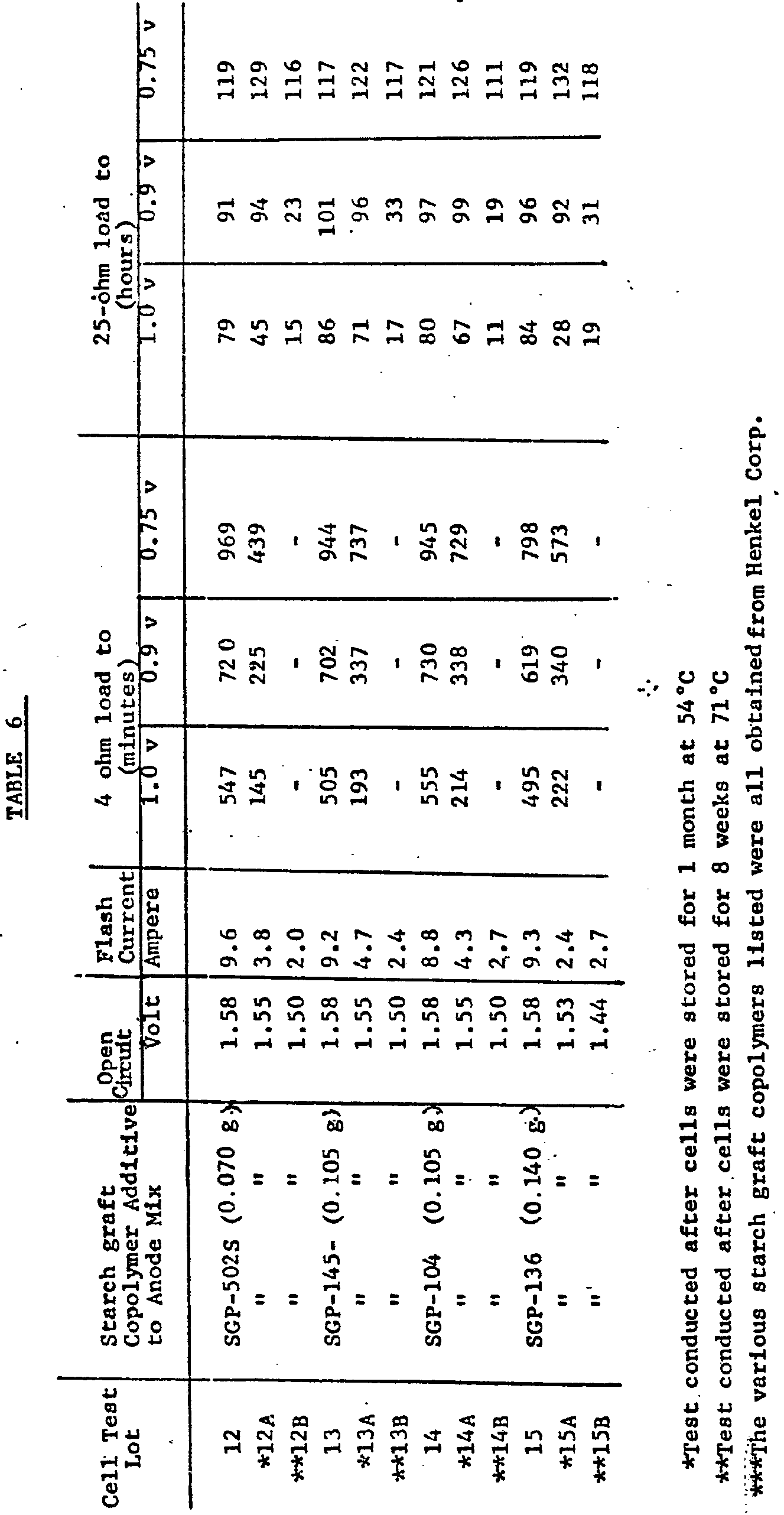
Claims (9)
1, A powder-gel anode characterised in that it comprises a major portion of a consumable anodic material, a minor amount of a starch-graft copolymer in which the copolymer contains carboxylate units, and an aqueous alkaline electrolyte solution.
2. A powder-gel anode as claimed in claim 1 characterised in that the consumable anodic material is zinc powder.
3. A powder-gel anode as claimed in claim 1 or 2, characterised in that the starch graft copolymer is present in an amount between about 0.7 and about 3% by weight of the anodic.material.
4. A powder-gel anode as claimed in claim 3 characterised in that the starch graft copolymer is present in an amount between about 0.8 and about 1.2% by weight of the anodic material.
5. A powder-gel anode as claimed in any one of the preceding claims, characterised in that a minor amount of at least one gelling agent selected from the group consisting of carboxymethyl cellulose, methyl cellulose, polyacrylates, hydroxyl alkyl cellulose, polyacrylamide, polymethacrylic acid and poly-N-vinyl pyrrolidone is contained in the powder-gel anode.
6. A powder-gel anode as claimed in claim 5 characterised in that the starch graft copolymer varies between about 0.5 and about 1.5 per cent and the carboxymethyl cellulose between about 2 and about 3 per cent based on the weight of the zinc.
7. A powder-gel anode as claimed in any one of the preceding claims, characterised in that the electrolyte solution is aqueous potassium hydroxide.
8. An alkaline-MnO2 cell employing an aqueous alkaline electrolyte solution and characterised by employing a powder-gel anode as claimed in any one of the preceding claims.
9. An alkaline-MnO2 cell as claimed in claim 8, characterised in that the starch graft copolymer is present in an amount of about 0.5 to about 5% by weight of the total electrolyte solution.
Applications Claiming Priority (2)
| Application Number | Priority Date | Filing Date | Title |
|---|---|---|---|
| US130368 | 1980-03-14 | ||
| US06/130,368 US4260669A (en) | 1980-03-14 | 1980-03-14 | Alkaline-MnO2 cell having a zinc powder-gel anode containing starch graft copolymer |
Publications (2)
| Publication Number | Publication Date |
|---|---|
| EP0036729A2 true EP0036729A2 (en) | 1981-09-30 |
| EP0036729A3 EP0036729A3 (en) | 1981-11-25 |
Family
ID=22444367
Family Applications (1)
| Application Number | Title | Priority Date | Filing Date |
|---|---|---|---|
| EP81301056A Withdrawn EP0036729A3 (en) | 1980-03-14 | 1981-03-13 | Powder-gel anode and cell employing same |
Country Status (5)
| Country | Link |
|---|---|
| US (1) | US4260669A (en) |
| EP (1) | EP0036729A3 (en) |
| JP (1) | JPS56143666A (en) |
| BR (1) | BR8101402A (en) |
| CA (1) | CA1154081A (en) |
Cited By (1)
| Publication number | Priority date | Publication date | Assignee | Title |
|---|---|---|---|---|
| FR2566189A1 (en) * | 1984-06-18 | 1985-12-20 | Duracell Int | GELLED ANODES AND ELECTROCHEMICAL CELLS COMPRISING THE SAME |
Families Citing this family (23)
| Publication number | Priority date | Publication date | Assignee | Title |
|---|---|---|---|---|
| DE3373595D1 (en) * | 1982-12-15 | 1987-10-15 | Hitachi Maxell | Alkaline cell |
| US4608325A (en) * | 1983-10-06 | 1986-08-26 | Duracell Inc. | Anode binders for electrochemical cells |
| DE69014185T2 (en) * | 1989-09-18 | 1995-03-30 | Toshiba Battery | Secondary nickel metal hydride cell. |
| US5401590A (en) * | 1992-12-07 | 1995-03-28 | Duracell Inc. | Additives for electrochemical cells having zinc anodes |
| US5643994A (en) * | 1994-09-21 | 1997-07-01 | Illinois Tool Works Inc. | Anchoring systems and methods utilizing acrylate compositions |
| US5965635A (en) * | 1995-06-07 | 1999-10-12 | Illinois Tool Works Inc. | Alkylacrylate ester composition for anchoring materials in or to concrete or masonry |
| US6521378B2 (en) | 1997-08-01 | 2003-02-18 | Duracell Inc. | Electrode having multi-modal distribution of zinc-based particles |
| US6472103B1 (en) | 1997-08-01 | 2002-10-29 | The Gillette Company | Zinc-based electrode particle form |
| US5962163A (en) * | 1997-08-27 | 1999-10-05 | Eveready Battery Company, Inc. | Alkaline cell with gel type anode having centrally disposed gelling agent absorbent |
| US6833217B2 (en) * | 1997-12-31 | 2004-12-21 | Duracell Inc. | Battery cathode |
| US6280877B1 (en) * | 1998-05-01 | 2001-08-28 | Eveready Battery Company, Inc. | Method for producing an electrode containing electrolyte-absorbed polymer particles |
| EP1159769A1 (en) | 1999-02-26 | 2001-12-05 | The Gillette Company | High performance alkaline battery |
| US6399246B1 (en) | 2000-05-05 | 2002-06-04 | Eveready Battery Company, Inc. | Latex binder for non-aqueous battery electrodes |
| WO2002013304A1 (en) * | 2000-08-04 | 2002-02-14 | Southern Clay Products, Inc. | Gelled anode or electrolyte solution for an electrochemical cell |
| US7255720B2 (en) * | 2001-03-15 | 2007-08-14 | Powergenix Systems, Inc. | Methods for production of zinc oxide electrodes for alkaline batteries |
| SG104277A1 (en) * | 2001-09-24 | 2004-06-21 | Inst Of Microelectronics | Circuit for measuring changes in capacitor gap using a switched capacitor technique |
| US7083392B2 (en) | 2001-11-26 | 2006-08-01 | Shurflo Pump Manufacturing Company, Inc. | Pump and pump control circuit apparatus and method |
| US7351495B2 (en) * | 2003-04-16 | 2008-04-01 | The Gillette Company | Method of adding electrolyte to a gap between the cathode and separator of an alkaline cell |
| WO2004114442A2 (en) * | 2003-06-17 | 2004-12-29 | The Gillette Company | Anode for battery |
| US20080026294A1 (en) * | 2006-07-26 | 2008-01-31 | Zhiping Jiang | Batteries, electrodes for batteries, and methods of their manufacture |
| US7718319B2 (en) | 2006-09-25 | 2010-05-18 | Board Of Regents, The University Of Texas System | Cation-substituted spinel oxide and oxyfluoride cathodes for lithium ion batteries |
| CN112133916A (en) * | 2020-08-17 | 2020-12-25 | 浙江大学 | A lithium-ion battery silicon-based negative electrode material binder and its preparation method and application |
| CN113445063B (en) * | 2021-06-04 | 2022-02-08 | 广西靖西市一洲锰业有限公司 | Preparation method of electrolytic manganese dioxide |
Family Cites Families (10)
| Publication number | Priority date | Publication date | Assignee | Title |
|---|---|---|---|---|
| US2692904A (en) * | 1951-12-28 | 1954-10-26 | Electric Storage Battery Co | Growth inhibiter for battery electrodes |
| NL113994C (en) * | 1957-10-09 | |||
| US2938064A (en) * | 1958-03-12 | 1960-05-24 | Union Carbide Corp | Air-depolarized cell |
| FR2186741B1 (en) * | 1972-05-30 | 1978-03-03 | Cipel | |
| US3884722A (en) * | 1974-03-18 | 1975-05-20 | Union Carbide Corp | Alkaline galvanic cells |
| JPS50157835A (en) * | 1974-06-11 | 1975-12-20 | ||
| JPS50157833A (en) * | 1974-06-11 | 1975-12-20 | ||
| JPS53129826A (en) * | 1977-04-19 | 1978-11-13 | Hitachi Maxell | Zinc alkali battery |
| JPS5445746A (en) * | 1977-09-17 | 1979-04-11 | Hitachi Maxell | Alkaline battery |
| US4175052A (en) * | 1978-03-31 | 1979-11-20 | Union Carbide Corporation | Alkaline-MnO2 cell having a zinc powder-gel anode containing P-N-V-P or PMA |
-
1980
- 1980-03-14 US US06/130,368 patent/US4260669A/en not_active Expired - Lifetime
-
1981
- 1981-02-03 CA CA000369988A patent/CA1154081A/en not_active Expired
- 1981-03-10 BR BR8101402A patent/BR8101402A/en unknown
- 1981-03-13 EP EP81301056A patent/EP0036729A3/en not_active Withdrawn
- 1981-03-13 JP JP3642781A patent/JPS56143666A/en active Pending
Cited By (1)
| Publication number | Priority date | Publication date | Assignee | Title |
|---|---|---|---|---|
| FR2566189A1 (en) * | 1984-06-18 | 1985-12-20 | Duracell Int | GELLED ANODES AND ELECTROCHEMICAL CELLS COMPRISING THE SAME |
Also Published As
| Publication number | Publication date |
|---|---|
| US4260669A (en) | 1981-04-07 |
| JPS56143666A (en) | 1981-11-09 |
| CA1154081A (en) | 1983-09-20 |
| EP0036729A3 (en) | 1981-11-25 |
| BR8101402A (en) | 1981-09-15 |
Similar Documents
| Publication | Publication Date | Title |
|---|---|---|
| EP0036729A2 (en) | Powder-gel anode and cell employing same | |
| US5342712A (en) | Additives for primary electrochemical cells having manganese dioxide cathodes | |
| US4175052A (en) | Alkaline-MnO2 cell having a zinc powder-gel anode containing P-N-V-P or PMA | |
| US5587254A (en) | Alkaline battery having a gelled negative electrode | |
| US4563404A (en) | Cell gelling agent | |
| US20130126801A1 (en) | Compositions, zinc electrodes, batteries and their methods of manufacture | |
| JP4049811B2 (en) | Primary electrochemical cell | |
| US4288913A (en) | Method of forming in situ gelled anode | |
| US5532085A (en) | Additives for alkaline electrochemical cells having manganese dioxide cathodes | |
| US4209577A (en) | Alkaline-MnO2 cell having a zinc powder-gel anode containing methyl cellulose | |
| JP2003502808A (en) | Alkaline battery with improved anode | |
| EP0617845A1 (en) | Cathodes for zinc manganese dioxide cells having barium additives. | |
| US6927000B2 (en) | Oxazoline surfactant anode additive for alkaline electrochemical cells | |
| US4435488A (en) | Gelling agent for alkaline cells | |
| US4332870A (en) | Cell having a gelled anode containing a polyhydric alcohol | |
| JPS627661B2 (en) | ||
| US4250234A (en) | Divalent silver oxide cell | |
| US5185223A (en) | Nickel-cadmium storage battery with improved electrical properties | |
| JP2538303B2 (en) | Zinc electrode for alkaline storage battery | |
| JPH0628155B2 (en) | Zinc electrode for alkaline storage battery | |
| JPS6376262A (en) | Non-sintered type cadmium anode for alkaline storage battery | |
| JPS62243253A (en) | Alkaline zinc storage battery | |
| KR20040025035A (en) | An electrode composition for lead storage battery |
Legal Events
| Date | Code | Title | Description |
|---|---|---|---|
| PUAI | Public reference made under article 153(3) epc to a published international application that has entered the european phase |
Free format text: ORIGINAL CODE: 0009012 |
|
| PUAL | Search report despatched |
Free format text: ORIGINAL CODE: 0009013 |
|
| AK | Designated contracting states |
Designated state(s): BE CH DE FR GB |
|
| AK | Designated contracting states |
Designated state(s): BE CH DE FR GB |
|
| RAP1 | Party data changed (applicant data changed or rights of an application transferred) |
Owner name: UNION CARBIDE CORPORATION |
|
| 17P | Request for examination filed |
Effective date: 19820402 |
|
| STAA | Information on the status of an ep patent application or granted ep patent |
Free format text: STATUS: THE APPLICATION HAS BEEN WITHDRAWN |
|
| 18W | Application withdrawn |
Withdrawal date: 19830730 |
|
| RIN1 | Information on inventor provided before grant (corrected) |
Inventor name: KERG, CATHERINE ANNE |