EP0036147B1 - Acylnorbornanone acetals, process for preparing the same, and perfume compositions containing the same - Google Patents
Acylnorbornanone acetals, process for preparing the same, and perfume compositions containing the same Download PDFInfo
- Publication number
- EP0036147B1 EP0036147B1 EP81101654A EP81101654A EP0036147B1 EP 0036147 B1 EP0036147 B1 EP 0036147B1 EP 81101654 A EP81101654 A EP 81101654A EP 81101654 A EP81101654 A EP 81101654A EP 0036147 B1 EP0036147 B1 EP 0036147B1
- Authority
- EP
- European Patent Office
- Prior art keywords
- represented
- formula
- norbornane
- acetal
- acylnorbornanone
- Prior art date
- Legal status (The legal status is an assumption and is not a legal conclusion. Google has not performed a legal analysis and makes no representation as to the accuracy of the status listed.)
- Expired
Links
- 0 CC(C(CC(C1)C2)C1C2(O*)OI)=O Chemical compound CC(C(CC(C1)C2)C1C2(O*)OI)=O 0.000 description 6
Classifications
-
- C—CHEMISTRY; METALLURGY
- C07—ORGANIC CHEMISTRY
- C07D—HETEROCYCLIC COMPOUNDS
- C07D317/00—Heterocyclic compounds containing five-membered rings having two oxygen atoms as the only ring hetero atoms
- C07D317/08—Heterocyclic compounds containing five-membered rings having two oxygen atoms as the only ring hetero atoms having the hetero atoms in positions 1 and 3
- C07D317/72—Heterocyclic compounds containing five-membered rings having two oxygen atoms as the only ring hetero atoms having the hetero atoms in positions 1 and 3 spiro-condensed with carbocyclic rings
-
- C—CHEMISTRY; METALLURGY
- C07—ORGANIC CHEMISTRY
- C07D—HETEROCYCLIC COMPOUNDS
- C07D319/00—Heterocyclic compounds containing six-membered rings having two oxygen atoms as the only ring hetero atoms
- C07D319/04—1,3-Dioxanes; Hydrogenated 1,3-dioxanes
- C07D319/08—1,3-Dioxanes; Hydrogenated 1,3-dioxanes condensed with carbocyclic rings or ring systems
-
- C—CHEMISTRY; METALLURGY
- C07—ORGANIC CHEMISTRY
- C07D—HETEROCYCLIC COMPOUNDS
- C07D321/00—Heterocyclic compounds containing rings having two oxygen atoms as the only ring hetero atoms, not provided for by groups C07D317/00 - C07D319/00
-
- C—CHEMISTRY; METALLURGY
- C11—ANIMAL OR VEGETABLE OILS, FATS, FATTY SUBSTANCES OR WAXES; FATTY ACIDS THEREFROM; DETERGENTS; CANDLES
- C11B—PRODUCING, e.g. BY PRESSING RAW MATERIALS OR BY EXTRACTION FROM WASTE MATERIALS, REFINING OR PRESERVING FATS, FATTY SUBSTANCES, e.g. LANOLIN, FATTY OILS OR WAXES; ESSENTIAL OILS; PERFUMES
- C11B9/00—Essential oils; Perfumes
- C11B9/0069—Heterocyclic compounds
- C11B9/0073—Heterocyclic compounds containing only O or S as heteroatoms
- C11B9/0088—Spiro compounds
Definitions
- the present invention relates to novel derivatives of acylnorbornanone acetals, a process for preparing the same, and a perfume composition containing the same.
- the present invention includes acylnorbornanone acetals represented by the following general formula (I): wherein R 1 is a saturated hydrocarbon group having 2 to 7 carbon atoms, the ring containing R 1 being 5- or 6-membered, and R 2 is a hydrogen atom or a hydrocarbon group having 1 to 10 carbon atoms, a process for preparing the same; and a perfume composition containing the same.
- R 1 is a saturated hydrocarbon group having 2 to 7 carbon atoms, the ring containing R 1 being 5- or 6-membered
- R 2 is a hydrogen atom or a hydrocarbon group having 1 to 10 carbon atoms
- the compounds in accordance with the present invention may be prepared by the following reaction scheme;
- the oxidation is conducted under neutral or basic conditions without causing the decomposition of the acetal linkage and collapsing the molecule in the oxidation.
- the ⁇ -hydroxyalkylnorbornanone acetals represented by the above formula (IV) which can be used as raw materials in accordance with the present invention can be prepared by introducing the hydroxyl group into the a-position by means of a reaction such as hydroboration, oxymercuration, oxythallation or epoxidation of alkenylnorbanone acetals represented by the following general formula (V): wherein R 1 is a saturated hydrocarbon group having 2 to 7 carbon atoms, the ring containing R 1 being 5- or 6-membered, and R 2 is a hydrogen atom or a hydrocarbon group having 1 to 10 carbon atoms, and R 3 and R 4 are independently a hydrogen atom or a hydrocarbon group such that the total number of carbon atoms when taken together is between 1 and 9), or alkylidenenorbornanone acetals represented by the following general formula (VI): (wherein R 5 is a hydrogen atom or a hydrocarbon group having 1 to 10 carbon atoms,
- the methods of introducing the hydroxyl group into the a-position of the compound represented by formula (V) or (VI) involve the addition to the unsaturated bond of the compound represented by either of the formulas, reduction and then hydrolysis.
- the methods may include:
- the addition of a mercuric salt such as mercuric acetate, mercuric trifluoroacetate or mercuric nitrate to the alkenylorbornanone acetal is carried out in a solvent such as water or a mixture thereof with tetrahydrofuran, acetonitrile, ethyl ether, methanol or ethanol at a temperature in the range of 5 to 130°C, preferably 15 to 80°C.
- the reaction is usually conducted under ambient pressure, but it may be conducted under a slightly reduced or elevated pressure.
- the amount of the mercuric salt to be used may be in the range of 0.5 to 2.0 moles with respect to one mole of an olefin to be added.
- the reductive elimination of mercury and the concurrent hydrolysis are conducted using sodium boron hydride, sodium hydroxide or sodium-liquid ammonia, thereby giving the a hydroxyalkyl- norbornanone acetal represented by formula (IV).
- the reaction is suitably carried out at a temperature in the range of 0 to 50°C, preferably 0 to 30°C.
- the reaction pressure is usually ambient pressure, although it may be slightly reduced or elevated.
- the method via oxythallation represented as (2) above can be carried out in the same manner as in the method via oxymercuration as set forth hereinabove, with the exception that a thallium salt such as thallium acetate, thallium trifluoroacetate or thallium nitrate is used in place of the mercuric salt.
- a thallium salt such as thallium acetate, thallium trifluoroacetate or thallium nitrate is used in place of the mercuric salt.
- diborane or a substituted boron compound such as diisoamylborane, dicyclohexylborane, thexylborane, diisopinocampheylborane, 9- borabicyclo[3.3.1]nonane or dichloroborane is first added to the alkenyl- or alkylidene-norbornane acetal.
- the amount of the borane compound to be used may range from 0.1 to 1.0 mole for the diborane and from 0.5 to 2.0 moles for the substituted borane compound with respect to one mole of the olefin.
- an ether such as tetrahydrofuran, ethyl ether, dimethylcarbitol or diethylcarbitol.
- the reaction temperature may range from -15 to 230°C, preferably from -5 to 60°C, and the reaction is usually conducted under ambient pressure, although the pressure may be slightly reduced or elevated.
- the oxidative hydrolysis is effected in an aqueous solution or a solution of dimethylcarbitol, diethylcarbitol, tetrahydrofuran or ethyl alcohol containing a hydrogen peroxide-sodium hydroxide or an organic peracid-sodium hydroxide.
- the temperature for this reaction may range from 0 to 80°C, preferably from 5 to 50°C.
- the alkenyl- or alkylidene-norbornanone acetal epoxide is first produced by using a peracid, separated by means of distillation, and then reduced. The resulting product is then hydrolyzed.
- a halogenated hydrocarbon such as chloroform, methylene chloride or carbon tetrachloride; an aromatic hydrocarbon such as benzene, toluene or xylene; an aliphatic hydrocarbon such as hexane, pentane or heptane; an alicyclic hydrocarbon such as cyclopentane, cyclohexane; an ester such as ethyl acetate, ethyl propionate; or an ether such as ethyl ether, tetrahydrofuran.
- a halogenated hydrocarbon such as chloroform, methylene chloride or carbon tetrachloride
- aromatic hydrocarbon such as benzene, toluene or xylene
- an aliphatic hydrocarbon such as hexane, pentane or heptane
- an alicyclic hydrocarbon such as cyclopentane, cyclohexane
- the epoxide can be provided by means of an organic peracid such as peracetic acid, trifluoroperacetic acid, perbenzoic acid, performic acid, m-chloroperbenzoic acid, permaleic acid, perphthalic acid or perlauric acid; an organic peroxide and the oxide of a transition metal such as molybdenum or vanadium; hydrogen peroxide and an organic nitrile or oxygen in the presence of a catalyst of metals of the silver series, thallium series or palladium series.
- the reaction system may be diluted with an inert gas such as nitrogen gas.
- the amount of the organic peracid may range from 0.5 to 2.0 moles with respect to one mole of the olefin.
- the reaction may be carried out at a temperature in the range of -15 to 100°C, preferably -5 to 70°C, and under ambient pressure or under a slightly reduced or elevated pressure.
- the epoxides prepared as hereinabove are then separated by means of distillation, or extraction and subjected to reduction and then hydrolysis.
- the reduction is effected in an ether such as ethyl ether, tetrahydrofuran, dimethylcarbitol or diethylcarbitol; an aromatic hydrocarbon such as benzene, toluene or xylene; or an aliphatic hydrocarbon such as hexane or pentane; and with a variety of metal hydrides such as lithium aluminum hydride, lithium borohydride, sodium borohydride, aluminum hydride, dichloro-aluminum hydride, diisobutyl-aluminum hydride, diborane, cyanosodium borohydride, triethoxylithium aluminum hydride, tri-tertiary-butoxy-aluminum hydride, sodium aluminum hydride or diiso-amylborane.
- an ether
- the reduction is carried out at a temperature in the range of -80 to 100°C, preferably -70 to 50°C.
- the hydrolysis is effected with methanol, ethanol, isopropanol, or water to provide the a-hydroxylalkylnorbornanone acetal.
- a vinylnorbornanone acetal as the alkenylnorbornanone acetal of formula (V) or a ethylidene-norbornanone acetal as the alkylidenenorbornanone acetal of formula (VI) can be produced from a DielsAlder adduct between cyclopentadiene and butadiene according to the following reaction scheme:
- RCOOH may include, for example, formic acid, acetic acid or propionic acid and OH ⁇ R 1 ⁇ OH to be employed for the last-mentioned acetals may include, for example, 1,2-dioi or 1,3-dioi.
- 1,2-diol referred to herein means a compound in which two hydroxyl groups are attached respectively to two adjacent carbon atoms of a saturated hydrocarbon.
- 1,3-diol referred to herein means a compound in which two hydroxyl groups are attached respectively to two carbon atoms of a saturated hydrocarbon, with another carbon atom interposed between the said two carbon atoms.
- 1,2-diois stated hereinabove may be ethylene glycol, 1,2-propanediol, 1,2-butanediol, 1,2-, 2,3- or 3,4-hexanediol, 1,2- or 2,3-pentanediol, 1,2-cyclohexanediol, methylcyclohexane-1,2-diol.
- 1,3-diols may be 1,3-propane diol, 1,3-butanediol, 2,2-dimethyl-1,3-propanediol, 2,2-diethyl-1,3-propanediol, 2-methyl-1,3-propanediol, 2-ethyl-1,3-propanediol, 1,3-cydo- hexanediol, methylcyclohexane-1,3-diol.
- the diols represented hereinabove may be used singly or in a mixture thereof.
- acetals are produced with a 1,2-diol, a 1,3-dioxolane ring is formed, and where the acetals are prepared with a 1,3-diol, a 1,3-dioxane ring is formed.
- the compounds represented by formula (V) or (VI) obtainable from the 5-vinyl- or ethylidene-2-norbornene as the aforesaid alkenyl- or alkylidene-norbornene in the manner as represented hereinabove may be, for example, spiro[1,3-dioxolane-2,2'- or 2,3'-(5'-vinyl- or ethylidene-norbornane)], spiro[4,5-dimethyl-1,3-dioxolane-2,2'- or 2,3'-(5'-vinyl- or ethylidene-norbornane)], spiro[1,3-dioxane-2,2'- or 2,3'-(5'-vinyl- or ethylidene-norbornane], spiro[5,5'-dimethyl-1,3-dioxane-2,2'- or 2,
- the oxidation to be practiced in the present invention should be effected under a neutral or basic condition without decomposing the acetal linkage and causing the cleavage of the molecule by the oxidation.
- the oxidation method to be employed herein may be a method of oxidation with a ketone such as acetone, methyl ethyl ketone or quinone in the presence of an aluminum alkoxide such as aluminum triisopropoxide (Oppenauer oxidation); a method of oxidation using, for example, pyridine-chromic anhydride complex; a method of oxidation with a chromate, a dichromate or a permanganate; a method of oxidation with molecular oxygen in the presence of a copper series catalyst; a method of oxidation with a peroxide in a neutral or basic medium.
- a ketone such as acetone, methyl ethyl ketone or quinone
- an aluminum alkoxide such as aluminum triisopropoxide (Oppenauer oxidation)
- a method of oxidation using, for example, pyridine-chromic anhydride complex a method of oxidation with a
- the Oppenauer oxidation employs an alkali metal alkoxide such as aluminum triisopropoxide, aluminum tri-tertiary-butoxide or aluminum triphenoxide in an amount of 0.25 to 3 moles with respect to one mole of the alcohol in the presence of a large excess of an oxidizing agent such as a ketone, e.g., acetone, cyclohexanone, methyl ethyl ketone, benzophenone or parabenzoquinone.
- the solvent to be employed may be, for example, an aromatic hydrocarbon such as benzene, toluene or xylene.
- the reaction may be carried out at a temperature in the range of 0 to 200°C, preferably 30 to 150°C, for 10 minutes to 68 hours, usually 15 minutes to 24 hours.
- the oxidizing agent such as the ketone, e.g., acetone
- an alcohol such as isopropylalcohol. Accordingly, the oxidation is accomplished in a better yield when it is carried out while distilling off the alcohol formed.
- pyridine-chromic anhydride complex When pyridine-chromic anhydride complex is used for the oxidation, pyridine or a chlorinated hydrocarbon such as methylene chloride, chloroform, carbon tetrachloride or ethylene dichloride may be employed as a solvent.
- the oxidation may be carried out at a temperature ranging from 0 to 80°C, preferably 5 to 50°C, under ambient pressure or a slightly reduced or elevated pressure.
- a method of oxidation with chromic acid which does not exert any influence on the acetal linkage can be carried out in a solvent such as acetic anhydride, acetic acid whose acidity is puffered by an alkali acetate, a benzene-acetic acid mixture, or a weakly basic solvent such as dimethylformamide.
- a solvent such as acetic anhydride, acetic acid whose acidity is puffered by an alkali acetate, a benzene-acetic acid mixture, or a weakly basic solvent such as dimethylformamide.
- the vapor phase or liquid phase oxidation can be effected with molecular oxygen in the presence of a copper series catalyst.
- an inert gas such as nitrogen gas may be .employed as a diluent.
- any arbitrary solvent may be chosen for the oxidation reaction as long as it does not affect the oxidation reaction.
- the solvent is distilled off to leave a residual material which is purified in the usual way to give the acylnorbornanone acetals.
- acylnorbornanone acetals represented by formula (I) above also have two structural isomers as represented respectively by formulas (II) and (III) corresponding to formulas (IVa) and (lVb):
- R 1 is a saturated hydrocarbon group having 2 to 7 carbon atoms.
- the compounds to be represented by the above formula are, for example, spiro[1,3-dioxolane-2,2'- or 2,3'-(5'-acetyl-norbornane)], spiro[4,5-dimethyl-1,3-dioxolane-2,2'- or 2,3'-(5'-acetyl- norbornane)], spiro[1,3-dioxane-2,2'- or 2,3'-(5-acetyl-norbornane)], spire[5,5'-dimethyl-1,3-dioxane-2,2'- or 2,3'-(5'-acetyl-norbornane)], spiro[4-methyl-1,3-dioxane-2,2'- or 2,3'-(5'-acetyl-norbornane)], spiro[5,5-diethyl-1,3-dioxane-2,2'
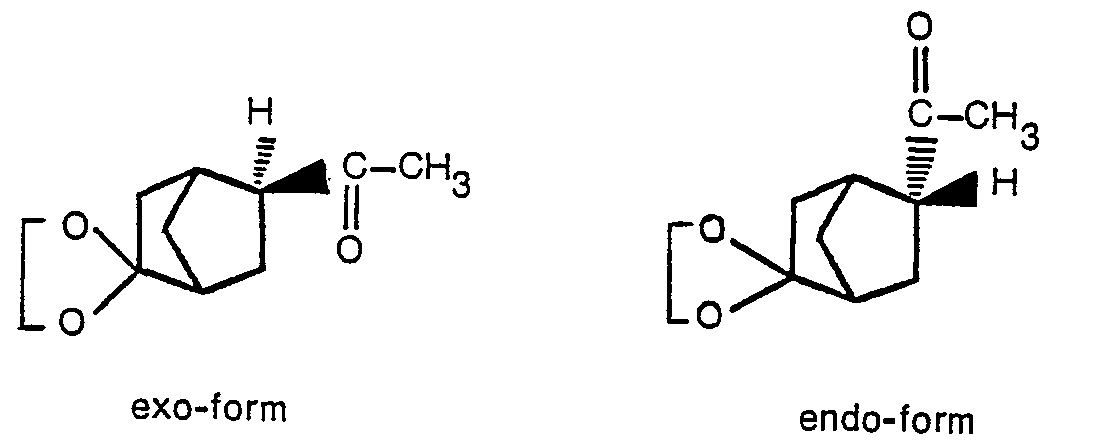
- the compounds represented by formula (I) above which are the compounds in accordance with the present invention have stereoisomers, the endo- and exo-forms, corresponding to each of the structural isomers represented hereinabove. They may be represented for the 5-acetyl-2-norbornanone ethylene acetal or spiro[1,3-dioxolane-2,2'-(5'-acetyl-norbornane)] as follows:
- any of these stereoisomers are effective for perfume compositions. Accordingly, the compounds obtainable in the manner as set forth hereinabove may be employed in a mixture of stereoisomers as fragrance components, or they may naturally be employed as single compounds.
- the compounds represented by formula (I) above are in a colorless, transparent liquid form, favorable in compatibility in any arbitrary amount with a solvent to be usually employed for a perfume, and mix with other solid perfume materials well.
- the compounds as represented by formula (I) above in accordance with the present invention can be employed as compound perfumes useful for general fragrant cosmetics such as soaps, detergents, creams, toilet water and the like, and as fragrance materials for other daily commodities.
- acylonorbornanone acetals represented by formula (I) in accordance with the present invention may be synthesized, in addition to the methods as hereinabove stated, by methods such as:
- the method (A) is a method involving the addition of an acylethylene such as methyl vinyl ketone to cyclopentadiene by means of the Diels-Alder reaction to give the acylnorbornene; the addition thereto of an acid; hydrolysis; oxidation; and acetalization.
- an acylethylene such as methyl vinyl ketone
- the method (B) is one which involves the addition of an acyl halide to a 5-norbornene-2- or 3-one by means of the Friedel-Crafts reaction using a catalyst such as aluminum chloride, and the conversion of the resultant acylnorbornanone to the corresponding acetal.
- the method (C) is a method involving the addition of an organic acid or sulfuric acid to a halogeno-norbornene such as 5-chloro-2-norbornene; hydrolysis; oxidation to give the norbornanone halide which in turn is converted into the norbornanone acetal halide; treatment of the acetal halide with a cadmium halide to give the dialkylcadmium or with an alkyl lithium and a copper halide to give the lithium dialkyl cuprate where the alkyl group mentioned above means a substituted norbornyl group; and then reaction with an acyl halide.
- a halogeno-norbornene such as 5-chloro-2-norbornene
- hydrolysis oxidation to give the norbornanone halide which in turn is converted into the norbornanone acetal halide
- treatment of the acetal halide with a cadmium halide to give the dialkylcadmi
- Spiro [1,3-dioxolane-2,2'- or 2,3'-(5'- ⁇ -hydroxyethyl]-norbornane)] was prepared from spiro [1,3-dioxolane-2,2'- or 2,3'-(5'-vinyl-norbornane)] by means of oxymercuration.
- Example 1 The spirol[1,3-dioxolane-2,2'- or 2,3'-(5'-acetyl-norbornane)] prepared in Example 1 was formulated in the following composition. The formulation was suitable for a perfume base for men in fougere note.
- Example 2 The spiro[4,5-dimethyl-1,3-dioxolane-2,2'- or 2,3'-(5'-acetyl-norbornane)] prepared in Example 2 was formulated into the following composition to provide a perfume composition in muguet note having the fragrance of lily of the valley. This composition was suitable for perfumes in soaps and toiletries.
- Example 3 The spiro[1,3-dioxane-2,2'- or 2,3'-[5'-acetyl-norbornane)] prepared in Example 3 was formulated into the following composition to provide a perfume composition of cypress base in floral bouquet note.
- the composition was suitable for hair oil, hair spray, hand creams and the like.
- Spiro[5,5-dimethyl-1,3-dioxane-2,2'- or 2,3'-(5'-acetyl-norbornane)] was formulated into the composition to provide a citrus fragrance in combination with bergamot aroma.
- This formulation was suitable for a perfume base in toilet water, eau de Cologne and soaps.
Landscapes
- Chemical & Material Sciences (AREA)
- Organic Chemistry (AREA)
- Life Sciences & Earth Sciences (AREA)
- Engineering & Computer Science (AREA)
- Chemical Kinetics & Catalysis (AREA)
- Oil, Petroleum & Natural Gas (AREA)
- Wood Science & Technology (AREA)
- Fats And Perfumes (AREA)
- Organic Low-Molecular-Weight Compounds And Preparation Thereof (AREA)
Description
- The present invention relates to novel derivatives of acylnorbornanone acetals, a process for preparing the same, and a perfume composition containing the same.
- A variety of compounds having the norbornane ring has been heretofore prepared. For example, U.S. Patent No. 3,860, 635 discloses vinyl norbornanones, and U.S. Patent No. 3,748,344 discloses cyclic acetals of norbornanone carboxaldehydes. However, no compounds are known in which the cyclic acetal moiety is linked through a spiro carbon atom with the norbornane ring. In addition, such type of spiro cyclic compounds is unknown which has an acyl group attached to the norbornane ring.
- It has been found during the course of synthesis of compounds having the norbornane ring that a compound having an acyl group and a cyclic acetal linked through the spiro carbon atom with the norbornane ring has a woody fragrance and is useful as a component of perfume compositions. The present invention was completed on the basis of this finding.
- Thus the present invention includes acylnorbornanone acetals represented by the following general formula (I):

- The compounds in accordance with the present invention may be prepared by the following reaction scheme;

- The oxidation is conducted under neutral or basic conditions without causing the decomposition of the acetal linkage and collapsing the molecule in the oxidation.
- The α-hydroxyalkylnorbornanone acetals represented by the above formula (IV) which can be used as raw materials in accordance with the present invention can be prepared by introducing the hydroxyl group into the a-position by means of a reaction such as hydroboration, oxymercuration, oxythallation or epoxidation of alkenylnorbanone acetals represented by the following general formula (V):

or alkylidenenorbornanone acetals represented by the following general formula (VI):
- Thus, the methods of introducing the hydroxyl group into the a-position of the compound represented by formula (V) or (VI) involve the addition to the unsaturated bond of the compound represented by either of the formulas, reduction and then hydrolysis. The methods may include:
- (1) a method via oxymercuration which involves the reaction of a mercuric salt such as mercuric acetate with the compound of formula (V) to thereby add the mercuric salt to the unsaturated bond followed by demercuration and hydrolysis;
- (2) a method via oxythallation which involves the same reaction as represented hereinabove using a thallium salt such as thallium nitrate;
- (3) a method via hydroboration which involves the addition of a borane or the like to the unsaturated bond of the compound as represented by formula (IV) followed by oxidation and hydrolysis; and
- (4) a method via epoxidation which involves the addition of oxygen to the unsaturated bond by use of a peracid, a peroxide or molecular oxygen in the presence of a catalyst, reduction of the resultant epoxide, and hydrolysis.
- These methods allow the selective introduction of the hydroxyl group into the a-position of the double bond in a high yield and minimize side reduction such as isomerization. The methods also cause little decomposition of the acetal moiety of the raw material, norbornanone acetals, because all of the methods are carried out under non-acidic conditions.
- In the method via oxymercuration represented as (1) above, the addition of a mercuric salt such as mercuric acetate, mercuric trifluoroacetate or mercuric nitrate to the alkenylorbornanone acetal is carried out in a solvent such as water or a mixture thereof with tetrahydrofuran, acetonitrile, ethyl ether, methanol or ethanol at a temperature in the range of 5 to 130°C, preferably 15 to 80°C. The reaction is usually conducted under ambient pressure, but it may be conducted under a slightly reduced or elevated pressure. The amount of the mercuric salt to be used may be in the range of 0.5 to 2.0 moles with respect to one mole of an olefin to be added.
- Then, the reductive elimination of mercury and the concurrent hydrolysis are conducted using sodium boron hydride, sodium hydroxide or sodium-liquid ammonia, thereby giving the a hydroxyalkyl- norbornanone acetal represented by formula (IV). The reaction is suitably carried out at a temperature in the range of 0 to 50°C, preferably 0 to 30°C. The reaction pressure is usually ambient pressure, although it may be slightly reduced or elevated.
- The method via oxythallation represented as (2) above can be carried out in the same manner as in the method via oxymercuration as set forth hereinabove, with the exception that a thallium salt such as thallium acetate, thallium trifluoroacetate or thallium nitrate is used in place of the mercuric salt.
- In the method via hydroboration represented as (3) above, diborane or a substituted boron compound such as diisoamylborane, dicyclohexylborane, thexylborane, diisopinocampheylborane, 9- borabicyclo[3.3.1]nonane or dichloroborane is first added to the alkenyl- or alkylidene-norbornane acetal. The amount of the borane compound to be used may range from 0.1 to 1.0 mole for the diborane and from 0.5 to 2.0 moles for the substituted borane compound with respect to one mole of the olefin. As a solvent, an ether may be employed such as tetrahydrofuran, ethyl ether, dimethylcarbitol or diethylcarbitol. The reaction temperature may range from -15 to 230°C, preferably from -5 to 60°C, and the reaction is usually conducted under ambient pressure, although the pressure may be slightly reduced or elevated. Then, the oxidative hydrolysis is effected in an aqueous solution or a solution of dimethylcarbitol, diethylcarbitol, tetrahydrofuran or ethyl alcohol containing a hydrogen peroxide-sodium hydroxide or an organic peracid-sodium hydroxide. The temperature for this reaction may range from 0 to 80°C, preferably from 5 to 50°C.
- In the method via epoxidation represented as (4) above, the alkenyl- or alkylidene-norbornanone acetal epoxide is first produced by using a peracid, separated by means of distillation, and then reduced. The resulting product is then hydrolyzed.
- In the reaction of producing the epoxide, there may be employed as a solvent a halogenated hydrocarbon such as chloroform, methylene chloride or carbon tetrachloride; an aromatic hydrocarbon such as benzene, toluene or xylene; an aliphatic hydrocarbon such as hexane, pentane or heptane; an alicyclic hydrocarbon such as cyclopentane, cyclohexane; an ester such as ethyl acetate, ethyl propionate; or an ether such as ethyl ether, tetrahydrofuran. In these solvents, the epoxide can be provided by means of an organic peracid such as peracetic acid, trifluoroperacetic acid, perbenzoic acid, performic acid, m-chloroperbenzoic acid, permaleic acid, perphthalic acid or perlauric acid; an organic peroxide and the oxide of a transition metal such as molybdenum or vanadium; hydrogen peroxide and an organic nitrile or oxygen in the presence of a catalyst of metals of the silver series, thallium series or palladium series. In the vapor phase reaction where the silver series, thallium series or palladium series metal catalyst is used, the reaction system may be diluted with an inert gas such as nitrogen gas. The amount of the organic peracid may range from 0.5 to 2.0 moles with respect to one mole of the olefin. The reaction may be carried out at a temperature in the range of -15 to 100°C, preferably -5 to 70°C, and under ambient pressure or under a slightly reduced or elevated pressure.
- The epoxides prepared as hereinabove are then separated by means of distillation, or extraction and subjected to reduction and then hydrolysis. The reduction is effected in an ether such as ethyl ether, tetrahydrofuran, dimethylcarbitol or diethylcarbitol; an aromatic hydrocarbon such as benzene, toluene or xylene; or an aliphatic hydrocarbon such as hexane or pentane; and with a variety of metal hydrides such as lithium aluminum hydride, lithium borohydride, sodium borohydride, aluminum hydride, dichloro-aluminum hydride, diisobutyl-aluminum hydride, diborane, cyanosodium borohydride, triethoxylithium aluminum hydride, tri-tertiary-butoxy-aluminum hydride, sodium aluminum hydride or diiso-amylborane.
- The reduction is carried out at a temperature in the range of -80 to 100°C, preferably -70 to 50°C. After reduction, the hydrolysis is effected with methanol, ethanol, isopropanol, or water to provide the a-hydroxylalkylnorbornanone acetal.
- For example, a vinylnorbornanone acetal as the alkenylnorbornanone acetal of formula (V) or a ethylidene-norbornanone acetal as the alkylidenenorbornanone acetal of formula (VI) can be produced from a DielsAlder adduct between cyclopentadiene and butadiene according to the following reaction scheme:

- In the above scheme, RCOOH may include, for example, formic acid, acetic acid or propionic acid and OH―R1―OH to be employed for the last-mentioned acetals may include, for example, 1,2-dioi or 1,3-dioi.
- The term "1,2-diol" referred to herein means a compound in which two hydroxyl groups are attached respectively to two adjacent carbon atoms of a saturated hydrocarbon. The term "1,3-diol" referred to herein means a compound in which two hydroxyl groups are attached respectively to two carbon atoms of a saturated hydrocarbon, with another carbon atom interposed between the said two carbon atoms.
- Representatives of the 1,2-diois stated hereinabove may be ethylene glycol, 1,2-propanediol, 1,2-butanediol, 1,2-, 2,3- or 3,4-hexanediol, 1,2- or 2,3-pentanediol, 1,2-cyclohexanediol, methylcyclohexane-1,2-diol.
- Illustrative of the 1,3-diols may be 1,3-propane diol, 1,3-butanediol, 2,2-dimethyl-1,3-propanediol, 2,2-diethyl-1,3-propanediol, 2-methyl-1,3-propanediol, 2-ethyl-1,3-propanediol, 1,3-cydo- hexanediol, methylcyclohexane-1,3-diol.
- In the reaction in which the corresponding acetals are formed, the diols represented hereinabove may be used singly or in a mixture thereof.
- Where the acetals are produced with a 1,2-diol, a 1,3-dioxolane ring is formed, and where the acetals are prepared with a 1,3-diol, a 1,3-dioxane ring is formed.
- The compounds represented by formula (V) or (VI) obtainable from the 5-vinyl- or ethylidene-2-norbornene as the aforesaid alkenyl- or alkylidene-norbornene in the manner as represented hereinabove, may be, for example, spiro[1,3-dioxolane-2,2'- or 2,3'-(5'-vinyl- or ethylidene-norbornane)], spiro[4,5-dimethyl-1,3-dioxolane-2,2'- or 2,3'-(5'-vinyl- or ethylidene-norbornane)], spiro[1,3-dioxane-2,2'- or 2,3'-(5'-vinyl- or ethylidene-norbornane], spiro[5,5'-dimethyl-1,3-dioxane-2,2'- or 2,3'-(5'-vinyl- or ethylidene-norbornane)], spiro[4-methyl-1,3-dioxane-2,2'- or 2,3'(5'-vinyl- or ethylidene-norbornane], spiro[5,5-diethyi-1,3-dioxane-2,2'-or 2,3'-(5'-vinyl- or ethylidene-norbornane)] and spiro[4,5-tetramethylene-1,3-dioxolane-2,2'- or 2,3'-(5'-vinyl- or ethylidene-norbornane)].
- The oxidation of the a-hydroxylalkylnorbornanone acetals then provides the corresponding acylnorbornanone acetals.
- The oxidation to be practiced in the present invention should be effected under a neutral or basic condition without decomposing the acetal linkage and causing the cleavage of the molecule by the oxidation.
- Accordingly, the oxidation method to be employed herein may be a method of oxidation with a ketone such as acetone, methyl ethyl ketone or quinone in the presence of an aluminum alkoxide such as aluminum triisopropoxide (Oppenauer oxidation); a method of oxidation using, for example, pyridine-chromic anhydride complex; a method of oxidation with a chromate, a dichromate or a permanganate; a method of oxidation with molecular oxygen in the presence of a copper series catalyst; a method of oxidation with a peroxide in a neutral or basic medium.
- Among the methods of oxidation represented hereinabove, the Oppenauer oxidation employs an alkali metal alkoxide such as aluminum triisopropoxide, aluminum tri-tertiary-butoxide or aluminum triphenoxide in an amount of 0.25 to 3 moles with respect to one mole of the alcohol in the presence of a large excess of an oxidizing agent such as a ketone, e.g., acetone, cyclohexanone, methyl ethyl ketone, benzophenone or parabenzoquinone. The solvent to be employed may be, for example, an aromatic hydrocarbon such as benzene, toluene or xylene. The reaction may be carried out at a temperature in the range of 0 to 200°C, preferably 30 to 150°C, for 10 minutes to 68 hours, usually 15 minutes to 24 hours. In the reaction represented hereinabove, the oxidizing agent such as the ketone, e.g., acetone, is converted to an alcohol such as isopropylalcohol. Accordingly, the oxidation is accomplished in a better yield when it is carried out while distilling off the alcohol formed.
- When pyridine-chromic anhydride complex is used for the oxidation, pyridine or a chlorinated hydrocarbon such as methylene chloride, chloroform, carbon tetrachloride or ethylene dichloride may be employed as a solvent. The oxidation may be carried out at a temperature ranging from 0 to 80°C, preferably 5 to 50°C, under ambient pressure or a slightly reduced or elevated pressure.
- A method of oxidation with chromic acid which does not exert any influence on the acetal linkage can be carried out in a solvent such as acetic anhydride, acetic acid whose acidity is puffered by an alkali acetate, a benzene-acetic acid mixture, or a weakly basic solvent such as dimethylformamide.
- The vapor phase or liquid phase oxidation can be effected with molecular oxygen in the presence of a copper series catalyst. In the vapor phase oxidation, an inert gas such as nitrogen gas may be .employed as a diluent.
- In any case, any arbitrary solvent may be chosen for the oxidation reaction as long as it does not affect the oxidation reaction.
- After the oxidation is conducted in the manner as set forth hereinabove, the solvent is distilled off to leave a residual material which is purified in the usual way to give the acylnorbornanone acetals.
- The α-hydroxylalkylnorbornanone acetals in accordance with the present invention as represented by formula (IV) above have two structural isomers represented by the following formula (lVa) or (lVb):


- The acylnorbornanone acetals represented by formula (I) above also have two structural isomers as represented respectively by formulas (II) and (III) corresponding to formulas (IVa) and (lVb):


- In these formulas, the symbol R1 is a saturated hydrocarbon group having 2 to 7 carbon atoms.
- The compounds to be represented by the above formula are, for example, spiro[1,3-dioxolane-2,2'- or 2,3'-(5'-acetyl-norbornane)], spiro[4,5-dimethyl-1,3-dioxolane-2,2'- or 2,3'-(5'-acetyl- norbornane)], spiro[1,3-dioxane-2,2'- or 2,3'-(5-acetyl-norbornane)], spire[5,5'-dimethyl-1,3-dioxane-2,2'- or 2,3'-(5'-acetyl-norbornane)], spiro[4-methyl-1,3-dioxane-2,2'- or 2,3'-(5'-acetyl-norbornane)], spiro[5,5-diethyl-1,3-dioxane-2,2'- or 2,3'-(5'-acety!-norbornane)] and spiro[4,5-tetramethy)ene-1,3-dioxolane-2,2'- or 2,3'-(5'-acetyl-norbornane)].
- The compounds represented by formula (I) above which are the compounds in accordance with the present invention have stereoisomers, the endo- and exo-forms, corresponding to each of the structural isomers represented hereinabove. They may be represented for the 5-acetyl-2-norbornanone ethylene acetal or spiro[1,3-dioxolane-2,2'-(5'-acetyl-norbornane)] as follows:
- In accordance with the present invention, any of these stereoisomers are effective for perfume compositions. Accordingly, the compounds obtainable in the manner as set forth hereinabove may be employed in a mixture of stereoisomers as fragrance components, or they may naturally be employed as single compounds.
- The compounds represented by formula (I) above are in a colorless, transparent liquid form, favorable in compatibility in any arbitrary amount with a solvent to be usually employed for a perfume, and mix with other solid perfume materials well.
- These compounds are stable against oxidation and the like and do not undergo any transformations during storage for a long period of time. They cause no irritation upon contact with the skin and are nontoxic in use.
- As they have the properties as stated hereinabove the compounds as represented by formula (I) above in accordance with the present invention can be employed as compound perfumes useful for general fragrant cosmetics such as soaps, detergents, creams, toilet water and the like, and as fragrance materials for other daily commodities.
- The acylonorbornanone acetals represented by formula (I) in accordance with the present invention may be synthesized, in addition to the methods as hereinabove stated, by methods such as:
- (A) a method utilizing the Diels-Alder reaction;
- (B) a method utilizing the Friedel-Crafts reaction; and
- (C) a method employing a dialkylcadmium, a lithium-dialkylcuprate.
- The method (A) is a method involving the addition of an acylethylene such as methyl vinyl ketone to cyclopentadiene by means of the Diels-Alder reaction to give the acylnorbornene; the addition thereto of an acid; hydrolysis; oxidation; and acetalization.
- The method (B) is one which involves the addition of an acyl halide to a 5-norbornene-2- or 3-one by means of the Friedel-Crafts reaction using a catalyst such as aluminum chloride, and the conversion of the resultant acylnorbornanone to the corresponding acetal.
- The method (C) is a method involving the addition of an organic acid or sulfuric acid to a halogeno-norbornene such as 5-chloro-2-norbornene; hydrolysis; oxidation to give the norbornanone halide which in turn is converted into the norbornanone acetal halide; treatment of the acetal halide with a cadmium halide to give the dialkylcadmium or with an alkyl lithium and a copper halide to give the lithium dialkyl cuprate where the alkyl group mentioned above means a substituted norbornyl group; and then reaction with an acyl halide.
- In order to further explain the technical content of the present invention, it is illustrated by way of a preparation example and working examples as reference examples.
- The following illustrates examples for preparing the compounds represented by the formulas above and embodiments of the present invention by way of the working examples.
- Spiro [1,3-dioxolane-2,2'- or 2,3'-(5'-α-hydroxyethyl]-norbornane)] was prepared from spiro [1,3-dioxolane-2,2'- or 2,3'-(5'-vinyl-norbornane)] by means of oxymercuration.
- For this process, 12.0 g (0.067 mole) of spiro[1,3-dioxolane-2,2'- or 2,3'-(5'-vinyl-norbornane)] was dropwise added at room temperature to a mixture of 21.2 g (0.067 mole) of mercuric acetate, 60 ml of water and 60 ml of tetrahydrofuran. After the dropwise addition was completed, the mixture was stirred for about 10 minutes to give a colorless, clear solution to which was added 65 ml of an aqueous solution containing 8.2 g of sodium hydroxide, and then 65 ml of an aqueous solution of 1.4 g of sodium borohydride and 8.2 g of sodium hydroxide was added. After the mixture was stirred for 1 hour at room temperature, mercury was removed from the reaction mixture and sodium chloride was added thereto to a level of saturation. The resulting solution was extracted three times with a benzene-ether mixture, and the resulting organic layer was washed with a small amount of a sodium chloride saturated aqueous solution to remove the alkali material and dried over anhydrous magnesium sulfate. After the solvent was distilled off, the residual material was distilled under reduced pressure to leave 10.5 g of a colorless viscous liquid (yield, 79.1%; boiling point 104-105°C/0.25 mmHg;

- IR (neat method): - 3,500 cm-1 (stretching vibration of O-H); the stretching vibration of the vinyl group C = C at 1,630 cm-1 disappeared.

-

- 13.3 g (0.067 mole) of spiro[1,3-dioxolane-2,2'- or 2,3'-(5'-a-hydroxyethyl-norbornane)] was dissolved in 250 ml of dry toluene. To this mixture was added 100 ml of freshly distilled cyclohexanone, and 100 ml of a toluene solution of 7.2 g (0.036 mole) of aluminum triisopropoxide was dropwise added thereto. After the dropwise addition was completed, the reaction mixture was heated under reflux for 2 hours, and then cooled to room temperature. Then, the mixture was poured into 100 ml of a sodium potassium tartrate saturated aqueous solution. After the organic layer was separated, the aqueous layer was extracted with a benzene-ether mixture. The extract was then combined with the organic layer previously separated and dried over anhydrous magnesium sulfate. The solvent was distilled off, and the residual material was distilled under reduced pressure to give the title colorless liquid (12.7 g; yield, 96.7%; boiling point 86°C/0.30 mmHg) having a floral woody fragrance. IR (neat method):

- Elemental analysis (as C11H17O3):

- Gas chromatography (filler, Silicone SE-30; column material, stainless steel; column size, 0.25 cm (diameter x 90 m; column temperature, 150°C) revealed that spiro[1,3-dioxolane-2,2'-(5'-acetyl- norbornane)] amounted to 70% of the total, with the remainder being spiro[1,3-dioxolane-2,3'-(5'- acetyl-norbornane)], and that the ratio of the endo-form to the exo-form was about 30:70.
- It was also observed that, in Examples 2 to 4 which follow, gas chromatography revealed substantially the same ratio in the corresponding structural isomers and stereoisomers as in Example 1.
- Spiro[4,5-dimethyl-1,3-dioxolane-2,2'- or 2,3'-(5'-α-hydroxyethyl-norbornane)] was reacted in the same manner as in Example 1 to give the title spiro[4,5-dimethyl-1,3-dioxolane-2,2'- or 2,3'-(5'- acetvl-norbornane)].

- NMR (CDCI3):

- Elemental analysis (as C13H2003):

- Spiro[1,3-dioxane-2,2'- or 2,3'-(5'-α-hydroxyethyl-norbornane)] was reacted in the same manner as in Example 1 to give the title spiro[1,3-dioxane-2,2'- or 2,3'-(5'-acetyl-norbornane)].

- NMR (CDCl3,):

-

- Spiro[5,5-dimethyl-1,3-dixoane-2,2'- or 2,3'-(5'-α-hydroxylethyf-norbornane)] was reacted in the same manner as in Example 1 to given the title spiro [5,5-dimethyl-1,3-dioxane-2,2'- or 2,3'-(5'- acetyl-norbornane)].

-

-

- The spirol[1,3-dioxolane-2,2'- or 2,3'-(5'-acetyl-norbornane)] prepared in Example 1 was formulated in the following composition. The formulation was suitable for a perfume base for men in fougere note.

- The spiro[4,5-dimethyl-1,3-dioxolane-2,2'- or 2,3'-(5'-acetyl-norbornane)] prepared in Example 2 was formulated into the following composition to provide a perfume composition in muguet note having the fragrance of lily of the valley. This composition was suitable for perfumes in soaps and toiletries.

- The spiro[1,3-dioxane-2,2'- or 2,3'-[5'-acetyl-norbornane)] prepared in Example 3 was formulated into the following composition to provide a perfume composition of cypress base in floral bouquet note. The composition was suitable for hair oil, hair spray, hand creams and the like.

- Spiro[5,5-dimethyl-1,3-dioxane-2,2'- or 2,3'-(5'-acetyl-norbornane)] was formulated into the composition to provide a citrus fragrance in combination with bergamot aroma. This formulation was suitable for a perfume base in toilet water, eau de Cologne and soaps.

Claims (10)


Applications Claiming Priority (6)
| Application Number | Priority Date | Filing Date | Title |
|---|---|---|---|
| JP2969480A JPS56142207A (en) | 1980-03-07 | 1980-03-07 | Perfume composition containing acylnorbornanone acetal |
| JP29694/80 | 1980-03-07 | ||
| JP29693/80 | 1980-03-07 | ||
| JP2969380A JPS56142279A (en) | 1980-03-07 | 1980-03-07 | Acylnorbornanone acetal and its preparation |
| JP82593/80 | 1980-06-18 | ||
| JP8259380A JPS579778A (en) | 1980-06-18 | 1980-06-18 | Production of acylnorbornanone acetal |
Publications (2)
| Publication Number | Publication Date |
|---|---|
| EP0036147A1 EP0036147A1 (en) | 1981-09-23 |
| EP0036147B1 true EP0036147B1 (en) | 1984-02-01 |
Family
ID=27286689
Family Applications (1)
| Application Number | Title | Priority Date | Filing Date |
|---|---|---|---|
| EP81101654A Expired EP0036147B1 (en) | 1980-03-07 | 1981-03-06 | Acylnorbornanone acetals, process for preparing the same, and perfume compositions containing the same |
Country Status (3)
| Country | Link |
|---|---|
| US (1) | US4341665A (en) |
| EP (1) | EP0036147B1 (en) |
| DE (1) | DE3162074D1 (en) |
Family Cites Families (4)
| Publication number | Priority date | Publication date | Assignee | Title |
|---|---|---|---|---|
| US3953516A (en) * | 1965-10-14 | 1976-04-27 | Societe Anonyme Roure Bertrand Dupont | Mono-enol ethers of 4-acetyl-3,3,5,5-tetramethylcyclohexanone |
| FR2129873B1 (en) * | 1971-03-18 | 1974-09-06 | Delalande Sa | |
| US3816415A (en) * | 1971-03-18 | 1974-06-11 | Delalande Sa | Derivatives of 1,7,7-trimethyl-2-norbornane-2'-spiro-1',3'-dioxolane |
| US3748344A (en) * | 1971-12-27 | 1973-07-24 | Monsanto Co | Cyclic ketals and acetals of norbornane carboxyaldehyde |
-
1981
- 1981-03-05 US US06/240,953 patent/US4341665A/en not_active Expired - Lifetime
- 1981-03-06 DE DE8181101654T patent/DE3162074D1/en not_active Expired
- 1981-03-06 EP EP81101654A patent/EP0036147B1/en not_active Expired
Also Published As
| Publication number | Publication date |
|---|---|
| DE3162074D1 (en) | 1984-03-08 |
| US4341665A (en) | 1982-07-27 |
| EP0036147A1 (en) | 1981-09-23 |
Similar Documents
| Publication | Publication Date | Title |
|---|---|---|
| Cantrell et al. | Photocycloaddition reactions of some 3-substituted cyclohexenones | |
| Salomon et al. | The peroxide transfer reaction | |
| Dulcere et al. | Allenyl ethers as precursors of. alpha.-methylene-. gamma.-butyrolactones and botryodiplodin derivatives | |
| Ayer et al. | The sterpuric acids: a new type of sesquiterpenoid | |
| Buechi et al. | Total synthesis of fulvoplumierin | |
| LeBel et al. | Bicyclo [3.2. 1] oct-6-en-2-one. Convenient synthesis of bridged polycyclic, homoconjugated ketones | |
| Davies et al. | Rhodium carbenoid mediated cyclisations. Part 4. Synthetic approaches to oxepanes related to zoapatanol | |
| Nakatani et al. | Synthetic studies on the compounds related to neocarzinostatin chromophore. 2. Synthesis of the open-chain (E)-and (Z)-dienediyne systems and its application to the synthesis of a strain-released cyclic analogue | |
| CA1136552A (en) | Acetyl trimethyl bicyclo non-ene as perfume | |
| US3723478A (en) | Monoepoxidized products of dodecatriene | |
| US4341665A (en) | Acylnorbornanone acetals, process for preparing the same, and perfume compositions containing the same | |
| US3754036A (en) | Acyl-cyclododecenes,acyl-cyclododecanes and a process for producing them | |
| US4211674A (en) | Cyclic acetals and ketals and their use in perfume compositions | |
| Weber et al. | The chemistry of 2-alkoxy-3, 4-dihydro-2H-pyrans. 7. Effect of substituents on the reactivity of various alkyl-and phenyl-substituted 3, 4-dihydro-2H-pyrans with tert-butyl hypochlorite | |
| EP0031966B1 (en) | Substituted norbornanone acetals, process for preparing the same, and perfume compositions containing the same | |
| Hikino et al. | Synthesis of Cyperolone and 3-epi-Cyperolone. | |
| Herz et al. | Complete stereochemistry of tenulin. Carbon-13 nuclear magnetic resonance spectra of tenulin derivatives | |
| Avila et al. | Stereoselectivity in the formation and allylic rearrangement of 8a-methyl-and 8a-ethyl-1, 2, 3, 4, 4a, 7, 8, 8a-octahydronaphthalenyl hydroperoxides | |
| CA1042451A (en) | Tricyclic hydrocarbon and process for producing the same | |
| US3929894A (en) | Process for the preparation of isopropenyl-bicyclo{8 4,4,0{9 dec-1-en-3-ones | |
| US4169958A (en) | 3-alkoxy-4-homoisotwistanes | |
| US3870659A (en) | Bicyclic odorants | |
| JPS6321645B2 (en) | ||
| JPS6348846B2 (en) | ||
| EP0078925B1 (en) | (+)- or (-)-7-hydroxymethyl-2,6,6-trimethyltricyclo-(6,2,1,0 1,5) undecane, a process for producing them and a perfume composition |
Legal Events
| Date | Code | Title | Description |
|---|---|---|---|
| PUAI | Public reference made under article 153(3) epc to a published international application that has entered the european phase |
Free format text: ORIGINAL CODE: 0009012 |
|
| AK | Designated contracting states |
Designated state(s): CH DE FR GB LI NL |
|
| 17P | Request for examination filed |
Effective date: 19811027 |
|
| GRAA | (expected) grant |
Free format text: ORIGINAL CODE: 0009210 |
|
| AK | Designated contracting states |
Designated state(s): CH DE FR GB LI NL |
|
| REF | Corresponds to: |
Ref document number: 3162074 Country of ref document: DE Date of ref document: 19840308 |
|
| ET | Fr: translation filed | ||
| PLBE | No opposition filed within time limit |
Free format text: ORIGINAL CODE: 0009261 |
|
| STAA | Information on the status of an ep patent application or granted ep patent |
Free format text: STATUS: NO OPPOSITION FILED WITHIN TIME LIMIT |
|
| 26N | No opposition filed | ||
| PGFP | Annual fee paid to national office [announced via postgrant information from national office to epo] |
Ref country code: GB Payment date: 19930305 Year of fee payment: 13 |
|
| PGFP | Annual fee paid to national office [announced via postgrant information from national office to epo] |
Ref country code: CH Payment date: 19930329 Year of fee payment: 13 |
|
| PGFP | Annual fee paid to national office [announced via postgrant information from national office to epo] |
Ref country code: FR Payment date: 19930330 Year of fee payment: 13 |
|
| PGFP | Annual fee paid to national office [announced via postgrant information from national office to epo] |
Ref country code: NL Payment date: 19930331 Year of fee payment: 13 |
|
| PGFP | Annual fee paid to national office [announced via postgrant information from national office to epo] |
Ref country code: DE Payment date: 19930524 Year of fee payment: 13 |
|
| PG25 | Lapsed in a contracting state [announced via postgrant information from national office to epo] |
Ref country code: GB Effective date: 19940306 |
|
| PG25 | Lapsed in a contracting state [announced via postgrant information from national office to epo] |
Ref country code: LI Effective date: 19940331 Ref country code: CH Effective date: 19940331 |
|
| PG25 | Lapsed in a contracting state [announced via postgrant information from national office to epo] |
Ref country code: NL Effective date: 19941001 |
|
| GBPC | Gb: european patent ceased through non-payment of renewal fee |
Effective date: 19940306 |
|
| NLV4 | Nl: lapsed or anulled due to non-payment of the annual fee | ||
| PG25 | Lapsed in a contracting state [announced via postgrant information from national office to epo] |
Ref country code: FR Effective date: 19941130 |
|
| REG | Reference to a national code |
Ref country code: CH Ref legal event code: PL |
|
| PG25 | Lapsed in a contracting state [announced via postgrant information from national office to epo] |
Ref country code: DE Effective date: 19941201 |
|
| REG | Reference to a national code |
Ref country code: FR Ref legal event code: ST |