EP0035902B1 - 1-(4-aryl-cyclohexyl)piperidine derivatives - Google Patents
1-(4-aryl-cyclohexyl)piperidine derivatives Download PDFInfo
- Publication number
- EP0035902B1 EP0035902B1 EP81300973A EP81300973A EP0035902B1 EP 0035902 B1 EP0035902 B1 EP 0035902B1 EP 81300973 A EP81300973 A EP 81300973A EP 81300973 A EP81300973 A EP 81300973A EP 0035902 B1 EP0035902 B1 EP 0035902B1
- Authority
- EP
- European Patent Office
- Prior art keywords
- radical
- parts
- formula
- alkyl
- fluorophenyl
- Prior art date
- Legal status (The legal status is an assumption and is not a legal conclusion. Google has not performed a legal analysis and makes no representation as to the accuracy of the status listed.)
- Expired
Links
- 150000001875 compounds Chemical class 0.000 claims description 70
- 239000000203 mixture Substances 0.000 claims description 57
- 238000000034 method Methods 0.000 claims description 49
- YXFVVABEGXRONW-UHFFFAOYSA-N Toluene Chemical compound CC1=CC=CC=C1 YXFVVABEGXRONW-UHFFFAOYSA-N 0.000 claims description 44
- 238000003756 stirring Methods 0.000 claims description 43
- LFQSCWFLJHTTHZ-UHFFFAOYSA-N Ethanol Chemical compound CCO LFQSCWFLJHTTHZ-UHFFFAOYSA-N 0.000 claims description 34
- -1 nitrile radical Chemical class 0.000 claims description 32
- 239000002253 acid Substances 0.000 claims description 22
- 229910052739 hydrogen Inorganic materials 0.000 claims description 22
- 239000001257 hydrogen Substances 0.000 claims description 22
- 150000003254 radicals Chemical class 0.000 claims description 22
- 125000003917 carbamoyl group Chemical group [H]N([H])C(*)=O 0.000 claims description 20
- 150000003839 salts Chemical class 0.000 claims description 19
- 125000004169 (C1-C6) alkyl group Chemical group 0.000 claims description 16
- 238000010438 heat treatment Methods 0.000 claims description 16
- 239000002904 solvent Substances 0.000 claims description 15
- 125000004682 aminothiocarbonyl group Chemical group NC(=S)* 0.000 claims description 12
- 150000002825 nitriles Chemical class 0.000 claims description 12
- 239000000376 reactant Substances 0.000 claims description 12
- NQRYJNQNLNOLGT-UHFFFAOYSA-N Piperidine Chemical compound C1CCNCC1 NQRYJNQNLNOLGT-UHFFFAOYSA-N 0.000 claims description 11
- 239000002585 base Substances 0.000 claims description 11
- 230000000506 psychotropic effect Effects 0.000 claims description 11
- 230000002378 acidificating effect Effects 0.000 claims description 10
- 230000003474 anti-emetic effect Effects 0.000 claims description 10
- 125000000113 cyclohexyl group Chemical group [H]C1([H])C([H])([H])C([H])([H])C([H])(*)C([H])([H])C1([H])[H] 0.000 claims description 10
- 125000001997 phenyl group Chemical group [H]C1=C([H])C([H])=C(*)C([H])=C1[H] 0.000 claims description 10
- UFHFLCQGNIYNRP-UHFFFAOYSA-N Hydrogen Chemical compound [H][H] UFHFLCQGNIYNRP-UHFFFAOYSA-N 0.000 claims description 9
- 125000005843 halogen group Chemical group 0.000 claims description 9
- 125000004435 hydrogen atom Chemical group [H]* 0.000 claims description 9
- 239000003054 catalyst Substances 0.000 claims description 8
- JHIVVAPYMSGYDF-UHFFFAOYSA-N cyclohexyloxide Natural products O=C1CCCCC1 JHIVVAPYMSGYDF-UHFFFAOYSA-N 0.000 claims description 8
- 150000002081 enamines Chemical class 0.000 claims description 8
- 239000004480 active ingredient Substances 0.000 claims description 7
- 125000003545 alkoxy group Chemical group 0.000 claims description 7
- 150000002148 esters Chemical class 0.000 claims description 7
- 239000003960 organic solvent Substances 0.000 claims description 7
- 239000008194 pharmaceutical composition Substances 0.000 claims description 7
- 239000002111 antiemetic agent Substances 0.000 claims description 6
- 150000001732 carboxylic acid derivatives Chemical class 0.000 claims description 6
- 239000003937 drug carrier Substances 0.000 claims description 6
- 239000002609 medium Substances 0.000 claims description 6
- 239000012258 stirred mixture Substances 0.000 claims description 6
- 125000004916 (C1-C6) alkylcarbonyl group Chemical group 0.000 claims description 5
- 150000001408 amides Chemical class 0.000 claims description 5
- 239000012736 aqueous medium Substances 0.000 claims description 5
- 125000001246 bromo group Chemical group Br* 0.000 claims description 5
- 239000003795 chemical substances by application Substances 0.000 claims description 5
- 125000001309 chloro group Chemical group Cl* 0.000 claims description 5
- 230000003301 hydrolyzing effect Effects 0.000 claims description 5
- 125000002346 iodo group Chemical group I* 0.000 claims description 5
- 150000003053 piperidines Chemical class 0.000 claims description 5
- 238000006268 reductive amination reaction Methods 0.000 claims description 5
- 206010047700 Vomiting Diseases 0.000 claims description 4
- 150000001412 amines Chemical class 0.000 claims description 4
- 125000004432 carbon atom Chemical group C* 0.000 claims description 4
- 125000002915 carbonyl group Chemical group [*:2]C([*:1])=O 0.000 claims description 4
- 125000003178 carboxy group Chemical group [H]OC(*)=O 0.000 claims description 4
- 239000003153 chemical reaction reagent Substances 0.000 claims description 4
- 125000004093 cyano group Chemical group *C#N 0.000 claims description 4
- 238000006722 reduction reaction Methods 0.000 claims description 4
- 150000003334 secondary amides Chemical class 0.000 claims description 4
- 125000002813 thiocarbonyl group Chemical group *C(*)=S 0.000 claims description 4
- 125000001255 4-fluorophenyl group Chemical group [H]C1=C([H])C(*)=C([H])C([H])=C1F 0.000 claims description 3
- FYYHWMGAXLPEAU-UHFFFAOYSA-N Magnesium Chemical compound [Mg] FYYHWMGAXLPEAU-UHFFFAOYSA-N 0.000 claims description 3
- 238000007259 addition reaction Methods 0.000 claims description 3
- 125000004453 alkoxycarbonyl group Chemical group 0.000 claims description 3
- 125000000217 alkyl group Chemical group 0.000 claims description 3
- 239000003638 chemical reducing agent Substances 0.000 claims description 3
- 125000002485 formyl group Chemical group [H]C(*)=O 0.000 claims description 3
- 125000004997 halocarbonyl group Chemical group 0.000 claims description 3
- 230000002140 halogenating effect Effects 0.000 claims description 3
- 230000002401 inhibitory effect Effects 0.000 claims description 3
- 239000011777 magnesium Substances 0.000 claims description 3
- 229910052749 magnesium Inorganic materials 0.000 claims description 3
- 229910052757 nitrogen Inorganic materials 0.000 claims description 3
- 125000001424 substituent group Chemical group 0.000 claims description 3
- 229910001148 Al-Li alloy Inorganic materials 0.000 claims description 2
- 238000003747 Grignard reaction Methods 0.000 claims description 2
- WHXSMMKQMYFTQS-UHFFFAOYSA-N Lithium Chemical compound [Li] WHXSMMKQMYFTQS-UHFFFAOYSA-N 0.000 claims description 2
- 239000003513 alkali Substances 0.000 claims description 2
- 125000004466 alkoxycarbonylamino group Chemical group 0.000 claims description 2
- 150000001350 alkyl halides Chemical class 0.000 claims description 2
- 239000012298 atmosphere Substances 0.000 claims description 2
- 230000003197 catalytic effect Effects 0.000 claims description 2
- 125000002243 cyclohexanonyl group Chemical class *C1(*)C(=O)C(*)(*)C(*)(*)C(*)(*)C1(*)* 0.000 claims description 2
- 125000001153 fluoro group Chemical group F* 0.000 claims description 2
- 238000005755 formation reaction Methods 0.000 claims description 2
- 239000012458 free base Substances 0.000 claims description 2
- 239000011874 heated mixture Substances 0.000 claims description 2
- 239000012442 inert solvent Substances 0.000 claims description 2
- 239000012280 lithium aluminium hydride Substances 0.000 claims description 2
- 231100000252 nontoxic Toxicity 0.000 claims description 2
- 230000003000 nontoxic effect Effects 0.000 claims description 2
- 150000003140 primary amides Chemical class 0.000 claims description 2
- 208000020016 psychiatric disease Diseases 0.000 claims description 2
- 125000002023 trifluoromethyl group Chemical group FC(F)(F)* 0.000 claims description 2
- 238000004519 manufacturing process Methods 0.000 claims 10
- ORTFAQDWJHRMNX-UHFFFAOYSA-M oxidooxomethyl Chemical compound [O-][C]=O ORTFAQDWJHRMNX-UHFFFAOYSA-M 0.000 claims 7
- 150000002431 hydrogen Chemical group 0.000 claims 4
- 125000004191 (C1-C6) alkoxy group Chemical group 0.000 claims 1
- 125000004454 (C1-C6) alkoxycarbonyl group Chemical group 0.000 claims 1
- VXIVSQZSERGHQP-UHFFFAOYSA-N chloroacetamide Chemical compound NC(=O)CCl VXIVSQZSERGHQP-UHFFFAOYSA-N 0.000 claims 1
- CFHIDWOYWUOIHU-UHFFFAOYSA-N oxomethyl Chemical compound O=[CH] CFHIDWOYWUOIHU-UHFFFAOYSA-N 0.000 claims 1
- OKKJLVBELUTLKV-UHFFFAOYSA-N Methanol Chemical compound OC OKKJLVBELUTLKV-UHFFFAOYSA-N 0.000 description 93
- XLYOFNOQVPJJNP-UHFFFAOYSA-N water Substances O XLYOFNOQVPJJNP-UHFFFAOYSA-N 0.000 description 78
- 239000000243 solution Substances 0.000 description 54
- KFZMGEQAYNKOFK-UHFFFAOYSA-N Isopropanol Chemical compound CC(C)O KFZMGEQAYNKOFK-UHFFFAOYSA-N 0.000 description 36
- 239000011541 reaction mixture Substances 0.000 description 36
- 239000000047 product Substances 0.000 description 33
- HEDRZPFGACZZDS-UHFFFAOYSA-N Chloroform Chemical compound ClC(Cl)Cl HEDRZPFGACZZDS-UHFFFAOYSA-N 0.000 description 32
- 229960001701 chloroform Drugs 0.000 description 32
- HEMHJVSKTPXQMS-UHFFFAOYSA-M Sodium hydroxide Chemical compound [OH-].[Na+] HEMHJVSKTPXQMS-UHFFFAOYSA-M 0.000 description 30
- 238000006243 chemical reaction Methods 0.000 description 22
- 239000003480 eluent Substances 0.000 description 21
- VEXZGXHMUGYJMC-UHFFFAOYSA-N Hydrochloric acid Chemical compound Cl VEXZGXHMUGYJMC-UHFFFAOYSA-N 0.000 description 19
- QTBSBXVTEAMEQO-UHFFFAOYSA-N Acetic acid Chemical compound CC(O)=O QTBSBXVTEAMEQO-UHFFFAOYSA-N 0.000 description 18
- UHOVQNZJYSORNB-UHFFFAOYSA-N Benzene Chemical compound C1=CC=CC=C1 UHOVQNZJYSORNB-UHFFFAOYSA-N 0.000 description 18
- ZMXDDKWLCZADIW-UHFFFAOYSA-N N,N-Dimethylformamide Chemical compound CN(C)C=O ZMXDDKWLCZADIW-UHFFFAOYSA-N 0.000 description 18
- 238000010992 reflux Methods 0.000 description 16
- YMWUJEATGCHHMB-UHFFFAOYSA-N Dichloromethane Chemical compound ClCCl YMWUJEATGCHHMB-UHFFFAOYSA-N 0.000 description 15
- WQDUMFSSJAZKTM-UHFFFAOYSA-N Sodium methoxide Chemical compound [Na+].[O-]C WQDUMFSSJAZKTM-UHFFFAOYSA-N 0.000 description 14
- 238000001816 cooling Methods 0.000 description 13
- 239000000543 intermediate Substances 0.000 description 13
- RTZKZFJDLAIYFH-UHFFFAOYSA-N Diethyl ether Chemical compound CCOCC RTZKZFJDLAIYFH-UHFFFAOYSA-N 0.000 description 12
- KWYUFKZDYYNOTN-UHFFFAOYSA-M Potassium hydroxide Chemical compound [OH-].[K+] KWYUFKZDYYNOTN-UHFFFAOYSA-M 0.000 description 12
- ZAFNJMIOTHYJRJ-UHFFFAOYSA-N Diisopropyl ether Chemical compound CC(C)OC(C)C ZAFNJMIOTHYJRJ-UHFFFAOYSA-N 0.000 description 11
- VYPSYNLAJGMNEJ-UHFFFAOYSA-N Silicium dioxide Chemical compound O=[Si]=O VYPSYNLAJGMNEJ-UHFFFAOYSA-N 0.000 description 10
- SGJSQQLUMMGQOS-UHFFFAOYSA-N cyclohexanecarbonitrile Chemical compound N#C[C]1CCCCC1 SGJSQQLUMMGQOS-UHFFFAOYSA-N 0.000 description 10
- 239000000741 silica gel Substances 0.000 description 10
- 229910002027 silica gel Inorganic materials 0.000 description 10
- WEVYAHXRMPXWCK-UHFFFAOYSA-N Acetonitrile Chemical compound CC#N WEVYAHXRMPXWCK-UHFFFAOYSA-N 0.000 description 9
- 241001465754 Metazoa Species 0.000 description 9
- QAOWNCQODCNURD-UHFFFAOYSA-N Sulfuric acid Chemical compound OS(O)(=O)=O QAOWNCQODCNURD-UHFFFAOYSA-N 0.000 description 9
- 238000004440 column chromatography Methods 0.000 description 9
- 239000007858 starting material Substances 0.000 description 9
- APJYDQYYACXCRM-UHFFFAOYSA-N tryptamine Chemical compound C1=CC=C2C(CCN)=CNC2=C1 APJYDQYYACXCRM-UHFFFAOYSA-N 0.000 description 9
- WYURNTSHIVDZCO-UHFFFAOYSA-N Tetrahydrofuran Chemical compound C1CCOC1 WYURNTSHIVDZCO-UHFFFAOYSA-N 0.000 description 8
- YTPLMLYBLZKORZ-UHFFFAOYSA-N Thiophene Chemical compound C=1C=CSC=1 YTPLMLYBLZKORZ-UHFFFAOYSA-N 0.000 description 8
- 229960004046 apomorphine Drugs 0.000 description 7
- 238000002360 preparation method Methods 0.000 description 7
- RYHBNJHYFVUHQT-UHFFFAOYSA-N 1,4-Dioxane Chemical compound C1COCCO1 RYHBNJHYFVUHQT-UHFFFAOYSA-N 0.000 description 6
- IAZDPXIOMUYVGZ-UHFFFAOYSA-N Dimethylsulphoxide Chemical compound CS(C)=O IAZDPXIOMUYVGZ-UHFFFAOYSA-N 0.000 description 6
- LRHPLDYGYMQRHN-UHFFFAOYSA-N N-Butanol Chemical compound CCCCO LRHPLDYGYMQRHN-UHFFFAOYSA-N 0.000 description 6
- CTQNGGLPUBDAKN-UHFFFAOYSA-N O-Xylene Chemical compound CC1=CC=CC=C1C CTQNGGLPUBDAKN-UHFFFAOYSA-N 0.000 description 6
- VMWNQDUVQKEIOC-CYBMUJFWSA-N apomorphine Chemical compound C([C@H]1N(C)CC2)C3=CC=C(O)C(O)=C3C3=C1C2=CC=C3 VMWNQDUVQKEIOC-CYBMUJFWSA-N 0.000 description 6
- 239000002775 capsule Substances 0.000 description 6
- 239000000706 filtrate Substances 0.000 description 6
- 239000010410 layer Substances 0.000 description 6
- 239000012074 organic phase Substances 0.000 description 6
- 239000003826 tablet Substances 0.000 description 6
- FYSNRJHAOHDILO-UHFFFAOYSA-N thionyl chloride Chemical compound ClS(Cl)=O FYSNRJHAOHDILO-UHFFFAOYSA-N 0.000 description 6
- SFLSHLFXELFNJZ-QMMMGPOBSA-N (-)-norepinephrine Chemical compound NC[C@H](O)C1=CC=C(O)C(O)=C1 SFLSHLFXELFNJZ-QMMMGPOBSA-N 0.000 description 5
- CSCPPACGZOOCGX-UHFFFAOYSA-N Acetone Chemical compound CC(C)=O CSCPPACGZOOCGX-UHFFFAOYSA-N 0.000 description 5
- XDTMQSROBMDMFD-UHFFFAOYSA-N Cyclohexane Chemical compound C1CCCCC1 XDTMQSROBMDMFD-UHFFFAOYSA-N 0.000 description 5
- 150000004945 aromatic hydrocarbons Chemical class 0.000 description 5
- 239000005457 ice water Substances 0.000 description 5
- 229960002748 norepinephrine Drugs 0.000 description 5
- SFLSHLFXELFNJZ-UHFFFAOYSA-N norepinephrine Natural products NCC(O)C1=CC=C(O)C(O)=C1 SFLSHLFXELFNJZ-UHFFFAOYSA-N 0.000 description 5
- JOXIMZWYDAKGHI-UHFFFAOYSA-N toluene-4-sulfonic acid Chemical compound CC1=CC=C(S(O)(=O)=O)C=C1 JOXIMZWYDAKGHI-UHFFFAOYSA-N 0.000 description 5
- 238000006845 Michael addition reaction Methods 0.000 description 4
- KDLHZDBZIXYQEI-UHFFFAOYSA-N Palladium Chemical compound [Pd] KDLHZDBZIXYQEI-UHFFFAOYSA-N 0.000 description 4
- OFBQJSOFQDEBGM-UHFFFAOYSA-N Pentane Chemical compound CCCCC OFBQJSOFQDEBGM-UHFFFAOYSA-N 0.000 description 4
- JUJWROOIHBZHMG-UHFFFAOYSA-N Pyridine Chemical compound C1=CC=NC=C1 JUJWROOIHBZHMG-UHFFFAOYSA-N 0.000 description 4
- CDBYLPFSWZWCQE-UHFFFAOYSA-L Sodium Carbonate Chemical compound [Na+].[Na+].[O-]C([O-])=O CDBYLPFSWZWCQE-UHFFFAOYSA-L 0.000 description 4
- UIIMBOGNXHQVGW-UHFFFAOYSA-M Sodium bicarbonate Chemical compound [Na+].OC([O-])=O UIIMBOGNXHQVGW-UHFFFAOYSA-M 0.000 description 4
- 125000001931 aliphatic group Chemical group 0.000 description 4
- 238000009472 formulation Methods 0.000 description 4
- 125000000524 functional group Chemical group 0.000 description 4
- VLKZOEOYAKHREP-UHFFFAOYSA-N n-Hexane Chemical compound CCCCCC VLKZOEOYAKHREP-UHFFFAOYSA-N 0.000 description 4
- 239000000725 suspension Substances 0.000 description 4
- YLQBMQCUIZJEEH-UHFFFAOYSA-N tetrahydrofuran Natural products C=1C=COC=1 YLQBMQCUIZJEEH-UHFFFAOYSA-N 0.000 description 4
- 229930192474 thiophene Natural products 0.000 description 4
- FNWWTNNFZGBMEM-UHFFFAOYSA-N 1-(4-fluorophenyl)-4-oxocyclohexane-1-carbonitrile Chemical compound C1=CC(F)=CC=C1C1(C#N)CCC(=O)CC1 FNWWTNNFZGBMEM-UHFFFAOYSA-N 0.000 description 3
- BYNBAMHAURJNTR-UHFFFAOYSA-N 3-piperidin-4-yl-1h-benzimidazol-2-one Chemical compound O=C1NC2=CC=CC=C2N1C1CCNCC1 BYNBAMHAURJNTR-UHFFFAOYSA-N 0.000 description 3
- VHYFNPMBLIVWCW-UHFFFAOYSA-N 4-Dimethylaminopyridine Chemical compound CN(C)C1=CC=NC=C1 VHYFNPMBLIVWCW-UHFFFAOYSA-N 0.000 description 3
- WLORNTHJKNBUED-UHFFFAOYSA-N 8-(4-fluorophenyl)-1,4-dioxaspiro[4.5]decane-8-carbonitrile Chemical compound C1=CC(F)=CC=C1C1(C#N)CCC2(OCCO2)CC1 WLORNTHJKNBUED-UHFFFAOYSA-N 0.000 description 3
- 241000282472 Canis lupus familiaris Species 0.000 description 3
- DGAQECJNVWCQMB-PUAWFVPOSA-M Ilexoside XXIX Chemical compound C[C@@H]1CC[C@@]2(CC[C@@]3(C(=CC[C@H]4[C@]3(CC[C@@H]5[C@@]4(CC[C@@H](C5(C)C)OS(=O)(=O)[O-])C)C)[C@@H]2[C@]1(C)O)C)C(=O)O[C@H]6[C@@H]([C@H]([C@@H]([C@H](O6)CO)O)O)O.[Na+] DGAQECJNVWCQMB-PUAWFVPOSA-M 0.000 description 3
- DNIAPMSPPWPWGF-UHFFFAOYSA-N Propylene glycol Chemical compound CC(O)CO DNIAPMSPPWPWGF-UHFFFAOYSA-N 0.000 description 3
- 241000700159 Rattus Species 0.000 description 3
- ZMANZCXQSJIPKH-UHFFFAOYSA-N Triethylamine Chemical compound CCN(CC)CC ZMANZCXQSJIPKH-UHFFFAOYSA-N 0.000 description 3
- OKJPEAGHQZHRQV-UHFFFAOYSA-N Triiodomethane Natural products IC(I)I OKJPEAGHQZHRQV-UHFFFAOYSA-N 0.000 description 3
- 238000009835 boiling Methods 0.000 description 3
- KXZJHVJKXJLBKO-UHFFFAOYSA-N chembl1408157 Chemical compound N=1C2=CC=CC=C2C(C(=O)O)=CC=1C1=CC=C(O)C=C1 KXZJHVJKXJLBKO-UHFFFAOYSA-N 0.000 description 3
- 239000007795 chemical reaction product Substances 0.000 description 3
- HPXRVTGHNJAIIH-PTQBSOBMSA-N cyclohexanol Chemical class O[13CH]1CCCCC1 HPXRVTGHNJAIIH-PTQBSOBMSA-N 0.000 description 3
- NHHBGEDRHALUPZ-UHFFFAOYSA-N ethyl 4-carbamoyl-4-(4-fluoroanilino)piperidine-1-carboxylate Chemical compound C1CN(C(=O)OCC)CCC1(C(N)=O)NC1=CC=C(F)C=C1 NHHBGEDRHALUPZ-UHFFFAOYSA-N 0.000 description 3
- 239000004615 ingredient Substances 0.000 description 3
- INQOMBQAUSQDDS-UHFFFAOYSA-N iodomethane Chemical compound IC INQOMBQAUSQDDS-UHFFFAOYSA-N 0.000 description 3
- 125000002496 methyl group Chemical group [H]C([H])([H])* 0.000 description 3
- 229910052708 sodium Inorganic materials 0.000 description 3
- 239000011734 sodium Substances 0.000 description 3
- 239000012279 sodium borohydride Substances 0.000 description 3
- 229910000033 sodium borohydride Inorganic materials 0.000 description 3
- 239000007787 solid Substances 0.000 description 3
- 238000007910 systemic administration Methods 0.000 description 3
- 230000009466 transformation Effects 0.000 description 3
- OWGPUSUHVJMFLU-UHFFFAOYSA-N 1-(4-chlorophenyl)-4-[4-(2-oxo-3h-benzimidazol-1-yl)piperidin-1-yl]cyclohex-3-ene-1-carbonitrile Chemical compound C1=CC(Cl)=CC=C1C1(C#N)CC=C(N2CCC(CC2)N2C(NC3=CC=CC=C32)=O)CC1 OWGPUSUHVJMFLU-UHFFFAOYSA-N 0.000 description 2
- LOJYDSIJGVNSBD-UHFFFAOYSA-N 1-(4-fluorophenyl)-3-methyl-1,3,8-triazaspiro[4.5]decan-4-one Chemical compound C1CNCCC21C(=O)N(C)CN2C1=CC=C(F)C=C1 LOJYDSIJGVNSBD-UHFFFAOYSA-N 0.000 description 2
- LTNKWPQQEPDIFC-UHFFFAOYSA-N 1-(4-fluorophenyl)-4-oxocyclohexane-1-carboxylic acid Chemical compound C=1C=C(F)C=CC=1C1(C(=O)O)CCC(=O)CC1 LTNKWPQQEPDIFC-UHFFFAOYSA-N 0.000 description 2
- HTQWGIHCFPWKAS-UHFFFAOYSA-N 1-phenyl-1,3,8-triazaspiro[4.5]decan-4-one Chemical class C1CNCCC11C(=O)NCN1C1=CC=CC=C1 HTQWGIHCFPWKAS-UHFFFAOYSA-N 0.000 description 2
- XNWFRZJHXBZDAG-UHFFFAOYSA-N 2-METHOXYETHANOL Chemical compound COCCO XNWFRZJHXBZDAG-UHFFFAOYSA-N 0.000 description 2
- YZYYDYHFZCQBRE-UHFFFAOYSA-N 3-benzyl-1-(4-fluorophenyl)-1,3,8-triazaspiro[4.5]decan-4-one;hydrochloride Chemical compound Cl.C1=CC(F)=CC=C1N1C2(CCNCC2)C(=O)N(CC=2C=CC=CC=2)C1 YZYYDYHFZCQBRE-UHFFFAOYSA-N 0.000 description 2
- QCQCHGYLTSGIGX-GHXANHINSA-N 4-[[(3ar,5ar,5br,7ar,9s,11ar,11br,13as)-5a,5b,8,8,11a-pentamethyl-3a-[(5-methylpyridine-3-carbonyl)amino]-2-oxo-1-propan-2-yl-4,5,6,7,7a,9,10,11,11b,12,13,13a-dodecahydro-3h-cyclopenta[a]chrysen-9-yl]oxy]-2,2-dimethyl-4-oxobutanoic acid Chemical compound N([C@@]12CC[C@@]3(C)[C@]4(C)CC[C@H]5C(C)(C)[C@@H](OC(=O)CC(C)(C)C(O)=O)CC[C@]5(C)[C@H]4CC[C@@H]3C1=C(C(C2)=O)C(C)C)C(=O)C1=CN=CC(C)=C1 QCQCHGYLTSGIGX-GHXANHINSA-N 0.000 description 2
- KRZCOLNOCZKSDF-UHFFFAOYSA-N 4-fluoroaniline Chemical compound NC1=CC=C(F)C=C1 KRZCOLNOCZKSDF-UHFFFAOYSA-N 0.000 description 2
- AYBLLUBIITXCKU-UHFFFAOYSA-N 4-oxo-1-(4-phenylmethoxyphenyl)cyclohexane-1-carbonitrile Chemical compound C1CC(=O)CCC1(C#N)C(C=C1)=CC=C1OCC1=CC=CC=C1 AYBLLUBIITXCKU-UHFFFAOYSA-N 0.000 description 2
- PZFNLQSLQXNSIN-UHFFFAOYSA-N 8-(4-fluorophenyl)-1,4-dioxaspiro[4.5]decane Chemical compound C1=CC(F)=CC=C1C1CCC2(OCCO2)CC1 PZFNLQSLQXNSIN-UHFFFAOYSA-N 0.000 description 2
- PEDRXIMDCUCXPG-UHFFFAOYSA-N 8-(4-fluorophenyl)-1,4-dioxaspiro[4.5]decane-8-carbonyl chloride Chemical compound C1=CC(F)=CC=C1C1(C(Cl)=O)CCC2(OCCO2)CC1 PEDRXIMDCUCXPG-UHFFFAOYSA-N 0.000 description 2
- KGVYVZCZKIDIBH-UHFFFAOYSA-N 8-(4-methoxyphenyl)-1,4-dioxaspiro[4.5]decane-8-carboxylic acid Chemical compound C1=CC(OC)=CC=C1C1(C(O)=O)CCC2(OCCO2)CC1 KGVYVZCZKIDIBH-UHFFFAOYSA-N 0.000 description 2
- WFDIJRYMOXRFFG-UHFFFAOYSA-N Acetic anhydride Chemical compound CC(=O)OC(C)=O WFDIJRYMOXRFFG-UHFFFAOYSA-N 0.000 description 2
- QGZKDVFQNNGYKY-UHFFFAOYSA-N Ammonia Chemical compound N QGZKDVFQNNGYKY-UHFFFAOYSA-N 0.000 description 2
- VHUUQVKOLVNVRT-UHFFFAOYSA-N Ammonium hydroxide Chemical compound [NH4+].[OH-] VHUUQVKOLVNVRT-UHFFFAOYSA-N 0.000 description 2
- 0 CCN(*)C(C(CC1)(C(*)CN1C(CC1)CCC1(C)I)N[Al]*)=O Chemical compound CCN(*)C(C(CC1)(C(*)CN1C(CC1)CCC1(C)I)N[Al]*)=O 0.000 description 2
- ROSDSFDQCJNGOL-UHFFFAOYSA-N Dimethylamine Chemical compound CNC ROSDSFDQCJNGOL-UHFFFAOYSA-N 0.000 description 2
- LYCAIKOWRPUZTN-UHFFFAOYSA-N Ethylene glycol Chemical compound OCCO LYCAIKOWRPUZTN-UHFFFAOYSA-N 0.000 description 2
- 239000001828 Gelatine Substances 0.000 description 2
- WQZGKKKJIJFFOK-GASJEMHNSA-N Glucose Natural products OC[C@H]1OC(O)[C@H](O)[C@@H](O)[C@@H]1O WQZGKKKJIJFFOK-GASJEMHNSA-N 0.000 description 2
- 239000012359 Methanesulfonyl chloride Substances 0.000 description 2
- NTIZESTWPVYFNL-UHFFFAOYSA-N Methyl isobutyl ketone Chemical compound CC(C)CC(C)=O NTIZESTWPVYFNL-UHFFFAOYSA-N 0.000 description 2
- UIHCLUNTQKBZGK-UHFFFAOYSA-N Methyl isobutyl ketone Natural products CCC(C)C(C)=O UIHCLUNTQKBZGK-UHFFFAOYSA-N 0.000 description 2
- LGDSHSYDSCRFAB-UHFFFAOYSA-N Methyl isothiocyanate Chemical compound CN=C=S LGDSHSYDSCRFAB-UHFFFAOYSA-N 0.000 description 2
- 229930040373 Paraformaldehyde Natural products 0.000 description 2
- NBIIXXVUZAFLBC-UHFFFAOYSA-N Phosphoric acid Chemical compound OP(O)(O)=O NBIIXXVUZAFLBC-UHFFFAOYSA-N 0.000 description 2
- KEAYESYHFKHZAL-UHFFFAOYSA-N Sodium Chemical compound [Na] KEAYESYHFKHZAL-UHFFFAOYSA-N 0.000 description 2
- FAPWRFPIFSIZLT-UHFFFAOYSA-M Sodium chloride Chemical compound [Na+].[Cl-] FAPWRFPIFSIZLT-UHFFFAOYSA-M 0.000 description 2
- 229920002472 Starch Polymers 0.000 description 2
- DKGAVHZHDRPRBM-UHFFFAOYSA-N Tert-Butanol Chemical compound CC(C)(C)O DKGAVHZHDRPRBM-UHFFFAOYSA-N 0.000 description 2
- RNOGEBBQHLNTFI-UHFFFAOYSA-N [4-(4-methoxyphenyl)cyclohexyl] methanesulfonate Chemical compound C1=CC(OC)=CC=C1C1CCC(OS(C)(=O)=O)CC1 RNOGEBBQHLNTFI-UHFFFAOYSA-N 0.000 description 2
- 239000000908 ammonium hydroxide Substances 0.000 description 2
- 239000008346 aqueous phase Substances 0.000 description 2
- 239000000440 bentonite Substances 0.000 description 2
- 229910000278 bentonite Inorganic materials 0.000 description 2
- SVPXDRXYRYOSEX-UHFFFAOYSA-N bentoquatam Chemical compound O.O=[Si]=O.O=[Al]O[Al]=O SVPXDRXYRYOSEX-UHFFFAOYSA-N 0.000 description 2
- WQZGKKKJIJFFOK-VFUOTHLCSA-N beta-D-glucose Chemical compound OC[C@H]1O[C@@H](O)[C@H](O)[C@@H](O)[C@@H]1O WQZGKKKJIJFFOK-VFUOTHLCSA-N 0.000 description 2
- 239000000969 carrier Substances 0.000 description 2
- 150000004292 cyclic ethers Chemical class 0.000 description 2
- RHJVIGLEIFVHIJ-UHFFFAOYSA-N cyclohexanecarboxamide Chemical compound NC(=O)C1[CH]CCCC1 RHJVIGLEIFVHIJ-UHFFFAOYSA-N 0.000 description 2
- JKYYRPHHBMGVFR-UHFFFAOYSA-N ethyl 1-(4-fluorophenyl)-3-methyl-4-oxo-1,3,8-triazaspiro[4.5]decane-8-carboxylate Chemical compound C1CN(C(=O)OCC)CCC21C(=O)N(C)CN2C1=CC=C(F)C=C1 JKYYRPHHBMGVFR-UHFFFAOYSA-N 0.000 description 2
- MPLUISYIZALWBE-UHFFFAOYSA-N ethyl 1-(4-fluorophenyl)-4-oxo-1,3,8-triazaspiro[4.5]decane-8-carboxylate Chemical compound C1CN(C(=O)OCC)CCC21C(=O)NCN2C1=CC=C(F)C=C1 MPLUISYIZALWBE-UHFFFAOYSA-N 0.000 description 2
- RVQMEQKLGGYJNQ-UHFFFAOYSA-N ethyl 4-cyano-4-(4-fluoroanilino)piperidine-1-carboxylate Chemical compound C1CN(C(=O)OCC)CCC1(C#N)NC1=CC=C(F)C=C1 RVQMEQKLGGYJNQ-UHFFFAOYSA-N 0.000 description 2
- IEDJVPQYZPJYQV-UHFFFAOYSA-N ethyl 8-(4-fluorophenyl)-1,4-dioxaspiro[4.5]decane-8-carboxylate Chemical compound C1CC(C(=O)OCC)(C=2C=CC(F)=CC=2)CCC21OCCO2 IEDJVPQYZPJYQV-UHFFFAOYSA-N 0.000 description 2
- 229920000159 gelatin Polymers 0.000 description 2
- 235000019322 gelatine Nutrition 0.000 description 2
- 239000008103 glucose Substances 0.000 description 2
- 230000007062 hydrolysis Effects 0.000 description 2
- 238000006460 hydrolysis reaction Methods 0.000 description 2
- 229940102223 injectable solution Drugs 0.000 description 2
- JVTAAEKCZFNVCJ-UHFFFAOYSA-N lactic acid Chemical compound CC(O)C(O)=O JVTAAEKCZFNVCJ-UHFFFAOYSA-N 0.000 description 2
- 239000007788 liquid Substances 0.000 description 2
- QARBMVPHQWIHKH-UHFFFAOYSA-N methanesulfonyl chloride Chemical compound CS(Cl)(=O)=O QARBMVPHQWIHKH-UHFFFAOYSA-N 0.000 description 2
- NAOYUAPEXJZUIW-UHFFFAOYSA-N methyl 4-cyano-4-(4-fluoroanilino)-3-methylpiperidine-1-carboxylate Chemical compound CC1CN(C(=O)OC)CCC1(C#N)NC1=CC=C(F)C=C1 NAOYUAPEXJZUIW-UHFFFAOYSA-N 0.000 description 2
- LQNUZADURLCDLV-UHFFFAOYSA-N nitrobenzene Chemical compound [O-][N+](=O)C1=CC=CC=C1 LQNUZADURLCDLV-UHFFFAOYSA-N 0.000 description 2
- 229940100692 oral suspension Drugs 0.000 description 2
- 229920002866 paraformaldehyde Polymers 0.000 description 2
- 239000012071 phase Substances 0.000 description 2
- XHXFXVLFKHQFAL-UHFFFAOYSA-N phosphoryl trichloride Chemical compound ClP(Cl)(Cl)=O XHXFXVLFKHQFAL-UHFFFAOYSA-N 0.000 description 2
- 239000006187 pill Substances 0.000 description 2
- 125000003386 piperidinyl group Chemical group 0.000 description 2
- SCVFZCLFOSHCOH-UHFFFAOYSA-M potassium acetate Chemical compound [K+].CC([O-])=O SCVFZCLFOSHCOH-UHFFFAOYSA-M 0.000 description 2
- 239000000843 powder Substances 0.000 description 2
- UMJSCPRVCHMLSP-UHFFFAOYSA-N pyridine Natural products COC1=CC=CN=C1 UMJSCPRVCHMLSP-UHFFFAOYSA-N 0.000 description 2
- 238000010956 selective crystallization Methods 0.000 description 2
- ODZPKZBBUMBTMG-UHFFFAOYSA-N sodium amide Chemical compound [NH2-].[Na+] ODZPKZBBUMBTMG-UHFFFAOYSA-N 0.000 description 2
- 229910000030 sodium bicarbonate Inorganic materials 0.000 description 2
- 235000017557 sodium bicarbonate Nutrition 0.000 description 2
- 229910000029 sodium carbonate Inorganic materials 0.000 description 2
- 239000012312 sodium hydride Substances 0.000 description 2
- 229910000104 sodium hydride Inorganic materials 0.000 description 2
- 235000019698 starch Nutrition 0.000 description 2
- SKYZYDSNJIOXRL-BTQNPOSSSA-N (6ar)-6-methyl-5,6,6a,7-tetrahydro-4h-dibenzo[de,g]quinoline-10,11-diol;hydrochloride Chemical compound Cl.C([C@H]1N(C)CC2)C3=CC=C(O)C(O)=C3C3=C1C2=CC=C3 SKYZYDSNJIOXRL-BTQNPOSSSA-N 0.000 description 1
- OHXWXHRQMUXFPG-UHFFFAOYSA-N 1-(4,4-diphenylcyclohexyl)piperidine Chemical class C1CCCCN1C1CCC(C=2C=CC=CC=2)(C=2C=CC=CC=2)CC1 OHXWXHRQMUXFPG-UHFFFAOYSA-N 0.000 description 1
- VULOUAKIEVHPMJ-UHFFFAOYSA-N 1-(4-chlorophenyl)-4-(4-oxo-1-phenyl-1,3,8-triazaspiro[4.5]decan-8-yl)cyclohex-3-ene-1-carbonitrile Chemical compound C1=CC(Cl)=CC=C1C1(C#N)CC=C(N2CCC3(CC2)C(NCN3C=2C=CC=CC=2)=O)CC1 VULOUAKIEVHPMJ-UHFFFAOYSA-N 0.000 description 1
- NJGUBLZYAXVEES-UHFFFAOYSA-N 1-(4-chlorophenyl)-4-[4-(2-oxo-3h-benzimidazol-1-yl)piperidin-1-yl]cyclohexane-1-carbonitrile Chemical compound C1=CC(Cl)=CC=C1C1(C#N)CCC(N2CCC(CC2)N2C(NC3=CC=CC=C32)=O)CC1 NJGUBLZYAXVEES-UHFFFAOYSA-N 0.000 description 1
- IHEGTQKPCYUXBM-UHFFFAOYSA-N 1-(4-chlorophenyl)-n,n-dimethyl-4-[4-(2-oxo-3h-benzimidazol-1-yl)piperidin-1-yl]cyclohex-3-ene-1-carboxamide Chemical compound C1CC(N2CCC(CC2)N2C(NC3=CC=CC=C32)=O)=CCC1(C(=O)N(C)C)C1=CC=C(Cl)C=C1 IHEGTQKPCYUXBM-UHFFFAOYSA-N 0.000 description 1
- BEEPXSBZGLKIOT-UHFFFAOYSA-N 1-(4-fluorophenyl)-1,3,8-triazaspiro[4.5]decan-4-one Chemical compound C1=CC(F)=CC=C1N1C2(CCNCC2)C(=O)NC1 BEEPXSBZGLKIOT-UHFFFAOYSA-N 0.000 description 1
- FQCUDVINCRKXQN-UHFFFAOYSA-N 1-(4-fluorophenyl)-4-(4-oxo-1-phenyl-1,3,8-triazaspiro[4.5]decan-8-yl)cyclohex-3-ene-1-carbonitrile Chemical compound C1=CC(F)=CC=C1C1(C#N)CC=C(N2CCC3(CC2)C(NCN3C=2C=CC=CC=2)=O)CC1 FQCUDVINCRKXQN-UHFFFAOYSA-N 0.000 description 1
- FUANGNFWQSYYGH-UHFFFAOYSA-N 1-(4-fluorophenyl)-4-[4-(2-oxo-3h-benzimidazol-1-yl)piperidin-1-yl]cyclohex-3-ene-1-carbonitrile Chemical compound C1=CC(F)=CC=C1C1(C#N)CC=C(N2CCC(CC2)N2C(NC3=CC=CC=C32)=O)CC1 FUANGNFWQSYYGH-UHFFFAOYSA-N 0.000 description 1
- RKCCOGPMSAQKPV-UHFFFAOYSA-N 1-(4-methoxyphenyl)-4-(4-oxo-1-phenyl-1,3,8-triazaspiro[4.5]decan-8-yl)cyclohex-3-ene-1-carbonitrile Chemical compound C1=CC(OC)=CC=C1C1(C#N)CC=C(N2CCC3(CC2)C(NCN3C=2C=CC=CC=2)=O)CC1 RKCCOGPMSAQKPV-UHFFFAOYSA-N 0.000 description 1
- AFOFFIRSZRCDNN-UHFFFAOYSA-N 1-(4-methoxyphenyl)-n,n-dimethyl-4-oxocyclohexane-1-carboxamide Chemical compound C1=CC(OC)=CC=C1C1(C(=O)N(C)C)CCC(=O)CC1 AFOFFIRSZRCDNN-UHFFFAOYSA-N 0.000 description 1
- OHKMHFCUIFTLRW-UHFFFAOYSA-N 1-[1-(4-fluorophenyl)cyclohexyl]ethanone Chemical compound C=1C=C(F)C=CC=1C1(C(=O)C)CCCCC1 OHKMHFCUIFTLRW-UHFFFAOYSA-N 0.000 description 1
- JHQBLYITVCBGTO-UHFFFAOYSA-N 2-(4-fluorophenyl)acetonitrile Chemical compound FC1=CC=C(CC#N)C=C1 JHQBLYITVCBGTO-UHFFFAOYSA-N 0.000 description 1
- NIXOWILDQLNWCW-UHFFFAOYSA-N 2-Propenoic acid Natural products OC(=O)C=C NIXOWILDQLNWCW-UHFFFAOYSA-N 0.000 description 1
- NJYLCTKZCFQNEP-UHFFFAOYSA-N 2-[1-(4-methoxyphenyl)-4-[4-(2-oxo-3H-benzimidazol-1-yl)piperidin-1-yl]cyclohex-3-en-1-yl]-N,N-dimethylacetamide Chemical compound O=C1NC2=C(N1C1CCN(CC1)C1=CCC(CC1)(CC(=O)N(C)C)C1=CC=C(C=C1)OC)C=CC=C2 NJYLCTKZCFQNEP-UHFFFAOYSA-N 0.000 description 1
- NAMYKGVDVNBCFQ-UHFFFAOYSA-N 2-bromopropane Chemical compound CC(C)Br NAMYKGVDVNBCFQ-UHFFFAOYSA-N 0.000 description 1
- RMGVBCRRPZAEFU-UHFFFAOYSA-N 3-[1-(4-phenylcyclohexen-1-yl)piperidin-4-yl]-1h-benzimidazol-2-one Chemical compound O=C1NC2=CC=CC=C2N1C(CC1)CCN1C(CC1)=CCC1C1=CC=CC=C1 RMGVBCRRPZAEFU-UHFFFAOYSA-N 0.000 description 1
- OQWINQYFJYJOAZ-UHFFFAOYSA-N 3-[1-[4-(4-fluorophenyl)-4-hydroxycyclohexyl]piperidin-4-yl]-1h-benzimidazol-2-one;hydrochloride Chemical compound Cl.C1CC(N2CCC(CC2)N2C(NC3=CC=CC=C32)=O)CCC1(O)C1=CC=C(F)C=C1 OQWINQYFJYJOAZ-UHFFFAOYSA-N 0.000 description 1
- UHNLTKLYMAMTGK-UHFFFAOYSA-N 3-[1-[4-(4-methoxyphenyl)cyclohexyl]piperidin-4-yl]-1H-benzimidazol-2-one Chemical compound COC1=CC=C(C=C1)C1CCC(CC1)N1CCC(CC1)N1C(NC2=C1C=CC=C2)=O UHNLTKLYMAMTGK-UHFFFAOYSA-N 0.000 description 1
- SQCVMHSKIGWHKH-UHFFFAOYSA-N 3-[1-[4-(4-phenylmethoxyphenyl)cyclohexen-1-yl]piperidin-4-yl]-1h-benzimidazol-2-one Chemical compound O=C1NC2=CC=CC=C2N1C(CC1)CCN1C(CC1)=CCC1C(C=C1)=CC=C1OCC1=CC=CC=C1 SQCVMHSKIGWHKH-UHFFFAOYSA-N 0.000 description 1
- ZTNXPEAVOZZOGK-UHFFFAOYSA-N 4-(1,3-benzodioxol-5-yl)cyclohexan-1-one Chemical compound C1CC(=O)CCC1C1=CC=C(OCO2)C2=C1 ZTNXPEAVOZZOGK-UHFFFAOYSA-N 0.000 description 1
- JFJXHTCDSDMHPT-UHFFFAOYSA-N 4-(4-fluorophenyl)-4-hydroxycyclohexan-1-one Chemical compound C=1C=C(F)C=CC=1C1(O)CCC(=O)CC1 JFJXHTCDSDMHPT-UHFFFAOYSA-N 0.000 description 1
- KSQIGHIYGAPXCW-UHFFFAOYSA-N 4-(4-fluorophenyl)cyclohexan-1-one Chemical compound C1=CC(F)=CC=C1C1CCC(=O)CC1 KSQIGHIYGAPXCW-UHFFFAOYSA-N 0.000 description 1
- RYCSQSQCOBUKDB-UHFFFAOYSA-N 4-(4-methoxyphenyl)cyclohexan-1-ol Chemical compound C1=CC(OC)=CC=C1C1CCC(O)CC1 RYCSQSQCOBUKDB-UHFFFAOYSA-N 0.000 description 1
- OXOHDMCHOCACRX-UHFFFAOYSA-N 4-(4-oxo-1-phenyl-1,3,8-triazaspiro[4.5]decan-8-yl)-1-phenylcyclohex-3-ene-1-carbonitrile Chemical compound C1CN(C=2CCC(CC=2)(C#N)C=2C=CC=CC=2)CCC11C(=O)NCN1C1=CC=CC=C1 OXOHDMCHOCACRX-UHFFFAOYSA-N 0.000 description 1
- GMIWLFZQXCZILR-UHFFFAOYSA-N 4-(4-phenylmethoxyphenyl)cyclohexan-1-one Chemical compound C1CC(=O)CCC1C(C=C1)=CC=C1OCC1=CC=CC=C1 GMIWLFZQXCZILR-UHFFFAOYSA-N 0.000 description 1
- MTEJXQUTEXCDKR-UHFFFAOYSA-N 4-amino-1-phenylcyclohexane-1-carbonitrile Chemical class C1CC(N)CCC1(C#N)C1=CC=CC=C1 MTEJXQUTEXCDKR-UHFFFAOYSA-N 0.000 description 1
- WUBBRNOQWQTFEX-UHFFFAOYSA-N 4-aminosalicylic acid Chemical class NC1=CC=C(C(O)=O)C(O)=C1 WUBBRNOQWQTFEX-UHFFFAOYSA-N 0.000 description 1
- XPLMRZGXYDCOCQ-UHFFFAOYSA-N 4-benzoyl-4-(4-fluorophenyl)cyclohexan-1-one Chemical compound C1=CC(F)=CC=C1C1(C(=O)C=2C=CC=CC=2)CCC(=O)CC1 XPLMRZGXYDCOCQ-UHFFFAOYSA-N 0.000 description 1
- GKXOABVSZWCJJK-UHFFFAOYSA-N 4-oxo-1-phenylcyclohexane-1-carbonitrile Chemical compound C1CC(=O)CCC1(C#N)C1=CC=CC=C1 GKXOABVSZWCJJK-UHFFFAOYSA-N 0.000 description 1
- RYGXCMJMVYJVGM-UHFFFAOYSA-N 4-oxo-1-pyridin-2-ylcyclohexane-1-carbonitrile Chemical compound C1CC(=O)CCC1(C#N)C1=CC=CC=N1 RYGXCMJMVYJVGM-UHFFFAOYSA-N 0.000 description 1
- ALRLCKXXSWRJQO-UHFFFAOYSA-N 4-oxo-1-thiophen-2-ylcyclohexane-1-carbonitrile Chemical compound C1CC(=O)CCC1(C#N)C1=CC=CS1 ALRLCKXXSWRJQO-UHFFFAOYSA-N 0.000 description 1
- YKAYMASDSHFOGI-UHFFFAOYSA-N 4-phenylcyclohexan-1-one Chemical compound C1CC(=O)CCC1C1=CC=CC=C1 YKAYMASDSHFOGI-UHFFFAOYSA-N 0.000 description 1
- DCZARRZHQXZDLE-UHFFFAOYSA-N 8-(1,3-benzodioxol-5-yl)-1,4-dioxaspiro[4.5]decane Chemical compound O1CCOC11CCC(C=2C=C3OCOC3=CC=2)CC1 DCZARRZHQXZDLE-UHFFFAOYSA-N 0.000 description 1
- NOTXYRZGJOANSK-UHFFFAOYSA-N 8-(1,3-benzodioxol-5-yl)-1,4-dioxaspiro[4.5]decane-8-carbonitrile Chemical compound C1CC(C#N)(C=2C=C3OCOC3=CC=2)CCC21OCCO2 NOTXYRZGJOANSK-UHFFFAOYSA-N 0.000 description 1
- KCPDEASEGSDFNA-UHFFFAOYSA-N 8-(4-fluorophenyl)-1,4-dioxaspiro[4.5]decane-8-carboxylic acid Chemical compound C1CC(C(=O)O)(C=2C=CC(F)=CC=2)CCC21OCCO2 KCPDEASEGSDFNA-UHFFFAOYSA-N 0.000 description 1
- YGNPNWPILRUJQB-UHFFFAOYSA-N 8-(4-methoxyphenyl)-1,4-dioxaspiro[4.5]decane-8-carbonyl chloride Chemical compound C1=CC(OC)=CC=C1C1(C(Cl)=O)CCC2(OCCO2)CC1 YGNPNWPILRUJQB-UHFFFAOYSA-N 0.000 description 1
- MZPMPBDPWLJDCI-UHFFFAOYSA-N 8-(4-methoxyphenyl)-n,n-dimethyl-1,4-dioxaspiro[4.5]decane-8-carboxamide Chemical compound C1=CC(OC)=CC=C1C1(C(=O)N(C)C)CCC2(OCCO2)CC1 MZPMPBDPWLJDCI-UHFFFAOYSA-N 0.000 description 1
- BPTHMJYLVVSUPG-UHFFFAOYSA-N 8-(4-phenylmethoxyphenyl)-1,4-dioxaspiro[4.5]decane Chemical compound C=1C=CC=CC=1COC(C=C1)=CC=C1C(CC1)CCC21OCCO2 BPTHMJYLVVSUPG-UHFFFAOYSA-N 0.000 description 1
- HBAQYPYDRFILMT-UHFFFAOYSA-N 8-[3-(1-cyclopropylpyrazol-4-yl)-1H-pyrazolo[4,3-d]pyrimidin-5-yl]-3-methyl-3,8-diazabicyclo[3.2.1]octan-2-one Chemical class C1(CC1)N1N=CC(=C1)C1=NNC2=C1N=C(N=C2)N1C2C(N(CC1CC2)C)=O HBAQYPYDRFILMT-UHFFFAOYSA-N 0.000 description 1
- NLHHRLWOUZZQLW-UHFFFAOYSA-N Acrylonitrile Chemical compound C=CC#N NLHHRLWOUZZQLW-UHFFFAOYSA-N 0.000 description 1
- 239000005995 Aluminium silicate Substances 0.000 description 1
- BVKZGUZCCUSVTD-UHFFFAOYSA-M Bicarbonate Chemical compound OC([O-])=O BVKZGUZCCUSVTD-UHFFFAOYSA-M 0.000 description 1
- COVZYZSDYWQREU-UHFFFAOYSA-N Busulfan Chemical compound CS(=O)(=O)OCCCCOS(C)(=O)=O COVZYZSDYWQREU-UHFFFAOYSA-N 0.000 description 1
- 239000004215 Carbon black (E152) Substances 0.000 description 1
- VEXZGXHMUGYJMC-UHFFFAOYSA-M Chloride anion Chemical compound [Cl-] VEXZGXHMUGYJMC-UHFFFAOYSA-M 0.000 description 1
- 206010010904 Convulsion Diseases 0.000 description 1
- UDIPTWFVPPPURJ-UHFFFAOYSA-M Cyclamate Chemical compound [Na+].[O-]S(=O)(=O)NC1CCCCC1 UDIPTWFVPPPURJ-UHFFFAOYSA-M 0.000 description 1
- WSFSSNUMVMOOMR-UHFFFAOYSA-N Formaldehyde Chemical compound O=C WSFSSNUMVMOOMR-UHFFFAOYSA-N 0.000 description 1
- LELOWRISYMNNSU-UHFFFAOYSA-N Hydrocyanic acid Natural products N#C LELOWRISYMNNSU-UHFFFAOYSA-N 0.000 description 1
- 206010022998 Irritability Diseases 0.000 description 1
- KWYHDKDOAIKMQN-UHFFFAOYSA-N N,N,N',N'-tetramethylethylenediamine Chemical compound CN(C)CCN(C)C KWYHDKDOAIKMQN-UHFFFAOYSA-N 0.000 description 1
- 238000007126 N-alkylation reaction Methods 0.000 description 1
- GRYLNZFGIOXLOG-UHFFFAOYSA-N Nitric acid Chemical compound O[N+]([O-])=O GRYLNZFGIOXLOG-UHFFFAOYSA-N 0.000 description 1
- YZCKVEUIGOORGS-IGMARMGPSA-N Protium Chemical compound [1H] YZCKVEUIGOORGS-IGMARMGPSA-N 0.000 description 1
- 241000700157 Rattus norvegicus Species 0.000 description 1
- 229930006000 Sucrose Natural products 0.000 description 1
- CZMRCDWAGMRECN-UGDNZRGBSA-N Sucrose Chemical compound O[C@H]1[C@H](O)[C@@H](CO)O[C@@]1(CO)O[C@@H]1[C@H](O)[C@@H](O)[C@H](O)[C@@H](CO)O1 CZMRCDWAGMRECN-UGDNZRGBSA-N 0.000 description 1
- ULUAUXLGCMPNKK-UHFFFAOYSA-N Sulfobutanedioic acid Chemical compound OC(=O)CC(C(O)=O)S(O)(=O)=O ULUAUXLGCMPNKK-UHFFFAOYSA-N 0.000 description 1
- 206010043994 Tonic convulsion Diseases 0.000 description 1
- ZVQOOHYFBIDMTQ-UHFFFAOYSA-N [methyl(oxido){1-[6-(trifluoromethyl)pyridin-3-yl]ethyl}-lambda(6)-sulfanylidene]cyanamide Chemical compound N#CN=S(C)(=O)C(C)C1=CC=C(C(F)(F)F)N=C1 ZVQOOHYFBIDMTQ-UHFFFAOYSA-N 0.000 description 1
- 150000007513 acids Chemical class 0.000 description 1
- 238000013019 agitation Methods 0.000 description 1
- 150000001298 alcohols Chemical class 0.000 description 1
- 229910000288 alkali metal carbonate Inorganic materials 0.000 description 1
- 150000008041 alkali metal carbonates Chemical class 0.000 description 1
- 229910001516 alkali metal iodide Inorganic materials 0.000 description 1
- 125000004457 alkyl amino carbonyl group Chemical group 0.000 description 1
- 125000004670 alkyl amino thio carbonyl group Chemical group 0.000 description 1
- 229910000147 aluminium phosphate Inorganic materials 0.000 description 1
- 235000012211 aluminium silicate Nutrition 0.000 description 1
- 229910021529 ammonia Inorganic materials 0.000 description 1
- 238000010171 animal model Methods 0.000 description 1
- 230000003354 anti-apomorphinic effect Effects 0.000 description 1
- 239000002518 antifoaming agent Substances 0.000 description 1
- 229960003990 apomorphine hydrochloride Drugs 0.000 description 1
- 239000011260 aqueous acid Substances 0.000 description 1
- 239000007864 aqueous solution Substances 0.000 description 1
- 238000010533 azeotropic distillation Methods 0.000 description 1
- WPYMKLBDIGXBTP-UHFFFAOYSA-N benzoic acid group Chemical group C(C1=CC=CC=C1)(=O)O WPYMKLBDIGXBTP-UHFFFAOYSA-N 0.000 description 1
- NDKBVBUGCNGSJJ-UHFFFAOYSA-M benzyltrimethylammonium hydroxide Chemical compound [OH-].C[N+](C)(C)CC1=CC=CC=C1 NDKBVBUGCNGSJJ-UHFFFAOYSA-M 0.000 description 1
- 230000002146 bilateral effect Effects 0.000 description 1
- 239000011230 binding agent Substances 0.000 description 1
- WKLKAWNXCDVTQU-UHFFFAOYSA-N butyl 1-(4-fluorophenyl)-4-oxocyclohexane-1-carboxylate Chemical compound C=1C=C(F)C=CC=1C1(C(=O)OCCCC)CCC(=O)CC1 WKLKAWNXCDVTQU-UHFFFAOYSA-N 0.000 description 1
- 125000000484 butyl group Chemical group [H]C([*])([H])C([H])([H])C([H])([H])C([H])([H])[H] 0.000 description 1
- 239000003874 central nervous system depressant Substances 0.000 description 1
- 230000001055 chewing effect Effects 0.000 description 1
- 239000000812 cholinergic antagonist Substances 0.000 description 1
- 238000004587 chromatography analysis Methods 0.000 description 1
- KRKNYBCHXYNGOX-UHFFFAOYSA-N citric acid Chemical compound OC(=O)CC(O)(C(O)=O)CC(O)=O KRKNYBCHXYNGOX-UHFFFAOYSA-N 0.000 description 1
- 239000000084 colloidal system Substances 0.000 description 1
- 239000007891 compressed tablet Substances 0.000 description 1
- 239000000625 cyclamic acid and its Na and Ca salt Substances 0.000 description 1
- 125000004122 cyclic group Chemical group 0.000 description 1
- HPXRVTGHNJAIIH-UHFFFAOYSA-N cyclohexanol Chemical compound OC1CCCCC1 HPXRVTGHNJAIIH-UHFFFAOYSA-N 0.000 description 1
- HCAJEUSONLESMK-UHFFFAOYSA-N cyclohexylsulfamic acid Chemical compound OS(=O)(=O)NC1CCCCC1 HCAJEUSONLESMK-UHFFFAOYSA-N 0.000 description 1
- 238000000354 decomposition reaction Methods 0.000 description 1
- 238000007255 decyanation reaction Methods 0.000 description 1
- 150000004683 dihydrates Chemical class 0.000 description 1
- 208000037265 diseases, disorders, signs and symptoms Diseases 0.000 description 1
- 208000035475 disorder Diseases 0.000 description 1
- 239000006185 dispersion Substances 0.000 description 1
- 239000002552 dosage form Substances 0.000 description 1
- 229940079593 drug Drugs 0.000 description 1
- 239000003814 drug Substances 0.000 description 1
- 230000000694 effects Effects 0.000 description 1
- 239000000839 emulsion Substances 0.000 description 1
- 150000002170 ethers Chemical class 0.000 description 1
- BPSJDYPVWCKJBM-UHFFFAOYSA-N ethyl 1-(4-fluorophenyl)-4-oxocyclohexane-1-carboxylate Chemical compound C=1C=C(F)C=CC=1C1(C(=O)OCC)CCC(=O)CC1 BPSJDYPVWCKJBM-UHFFFAOYSA-N 0.000 description 1
- YHQJOAIWKVZKBZ-UHFFFAOYSA-N ethyl 3-benzyl-1-(4-fluorophenyl)-4-oxo-1,3,8-triazaspiro[4.5]decane-8-carboxylate Chemical compound C1CN(C(=O)OCC)CCC21C(=O)N(CC=1C=CC=CC=1)CN2C1=CC=C(F)C=C1 YHQJOAIWKVZKBZ-UHFFFAOYSA-N 0.000 description 1
- LUBGFMZTGFXIIN-UHFFFAOYSA-N ethyl 4-oxopiperidine-1-carboxylate Chemical compound CCOC(=O)N1CCC(=O)CC1 LUBGFMZTGFXIIN-UHFFFAOYSA-N 0.000 description 1
- 125000001495 ethyl group Chemical group [H]C([H])([H])C([H])([H])* 0.000 description 1
- 238000001914 filtration Methods 0.000 description 1
- 239000008098 formaldehyde solution Substances 0.000 description 1
- 229940052308 general anesthetics halogenated hydrocarbons Drugs 0.000 description 1
- 150000002334 glycols Chemical class 0.000 description 1
- 238000005469 granulation Methods 0.000 description 1
- 230000003179 granulation Effects 0.000 description 1
- 150000008282 halocarbons Chemical class 0.000 description 1
- 125000004051 hexyl group Chemical group [H]C([H])([H])C([H])([H])C([H])([H])C([H])([H])C([H])([H])C([H])([H])* 0.000 description 1
- 239000008240 homogeneous mixture Substances 0.000 description 1
- 229930195733 hydrocarbon Natural products 0.000 description 1
- 150000002430 hydrocarbons Chemical class 0.000 description 1
- 238000005984 hydrogenation reaction Methods 0.000 description 1
- 125000002887 hydroxy group Chemical group [H]O* 0.000 description 1
- 238000002347 injection Methods 0.000 description 1
- 239000007924 injection Substances 0.000 description 1
- 238000011835 investigation Methods 0.000 description 1
- XMBWDFGMSWQBCA-UHFFFAOYSA-M iodide Chemical compound [I-] XMBWDFGMSWQBCA-UHFFFAOYSA-M 0.000 description 1
- 125000000959 isobutyl group Chemical group [H]C([H])([H])C([H])(C([H])([H])[H])C([H])([H])* 0.000 description 1
- 125000001449 isopropyl group Chemical group [H]C([H])([H])C([H])(*)C([H])([H])[H] 0.000 description 1
- NLYAJNPCOHFWQQ-UHFFFAOYSA-N kaolin Chemical compound O.O.O=[Al]O[Si](=O)O[Si](=O)O[Al]=O NLYAJNPCOHFWQQ-UHFFFAOYSA-N 0.000 description 1
- 150000002576 ketones Chemical class 0.000 description 1
- 235000014655 lactic acid Nutrition 0.000 description 1
- 230000000670 limiting effect Effects 0.000 description 1
- XMGQYMWWDOXHJM-UHFFFAOYSA-N limonene Chemical compound CC(=C)C1CCC(C)=CC1 XMGQYMWWDOXHJM-UHFFFAOYSA-N 0.000 description 1
- 230000005923 long-lasting effect Effects 0.000 description 1
- 239000006210 lotion Substances 0.000 description 1
- 239000000314 lubricant Substances 0.000 description 1
- 229910052987 metal hydride Inorganic materials 0.000 description 1
- 150000004681 metal hydrides Chemical class 0.000 description 1
- NBTOZLQBSIZIKS-UHFFFAOYSA-N methoxide Chemical compound [O-]C NBTOZLQBSIZIKS-UHFFFAOYSA-N 0.000 description 1
- NCQFIBJQOZPYOI-UHFFFAOYSA-N methyl 1-(4-fluorophenyl)-4-oxocyclohexane-1-carboxylate Chemical compound C=1C=C(F)C=CC=1C1(C(=O)OC)CCC(=O)CC1 NCQFIBJQOZPYOI-UHFFFAOYSA-N 0.000 description 1
- JWXGBLNGCIGLBH-UHFFFAOYSA-N methyl 3-methyl-4-oxopiperidine-1-carboxylate Chemical compound COC(=O)N1CCC(=O)C(C)C1 JWXGBLNGCIGLBH-UHFFFAOYSA-N 0.000 description 1
- 235000010270 methyl p-hydroxybenzoate Nutrition 0.000 description 1
- 150000007522 mineralic acids Chemical class 0.000 description 1
- DAMKZBIMAINNDJ-UHFFFAOYSA-N n,n-dimethyl-4-(4-oxo-1-phenyl-1,3,8-triazaspiro[4.5]decan-8-yl)-1-phenylcyclohex-3-ene-1-carboxamide Chemical compound C=1CC(C(=O)N(C)C)(C=2C=CC=CC=2)CCC=1N(CC1)CCC1(C(NC1)=O)N1C1=CC=CC=C1 DAMKZBIMAINNDJ-UHFFFAOYSA-N 0.000 description 1
- 230000000701 neuroleptic effect Effects 0.000 description 1
- 238000006386 neutralization reaction Methods 0.000 description 1
- 229910017604 nitric acid Inorganic materials 0.000 description 1
- 239000012299 nitrogen atmosphere Substances 0.000 description 1
- 239000003921 oil Substances 0.000 description 1
- 239000006186 oral dosage form Substances 0.000 description 1
- 239000007968 orange flavor Substances 0.000 description 1
- 150000007524 organic acids Chemical class 0.000 description 1
- 150000007530 organic bases Chemical class 0.000 description 1
- 239000012044 organic layer Substances 0.000 description 1
- 229910052760 oxygen Inorganic materials 0.000 description 1
- 125000001147 pentyl group Chemical group C(CCCC)* 0.000 description 1
- 230000000144 pharmacologic effect Effects 0.000 description 1
- DGTNSSLYPYDJGL-UHFFFAOYSA-N phenyl isocyanate Chemical compound O=C=NC1=CC=CC=C1 DGTNSSLYPYDJGL-UHFFFAOYSA-N 0.000 description 1
- QRKVRHZNLKTPGF-UHFFFAOYSA-N phosphorus pentabromide Chemical compound BrP(Br)(Br)(Br)Br QRKVRHZNLKTPGF-UHFFFAOYSA-N 0.000 description 1
- BASFCYQUMIYNBI-UHFFFAOYSA-N platinum Chemical compound [Pt] BASFCYQUMIYNBI-UHFFFAOYSA-N 0.000 description 1
- 239000002574 poison Substances 0.000 description 1
- 235000011056 potassium acetate Nutrition 0.000 description 1
- 125000002924 primary amino group Chemical group [H]N([H])* 0.000 description 1
- PASKMJMHIDOPRM-UHFFFAOYSA-N propyl 1-(4-fluorophenyl)-4-oxocyclohexane-1-carboxylate Chemical compound C=1C=C(F)C=CC=1C1(C(=O)OCCC)CCC(=O)CC1 PASKMJMHIDOPRM-UHFFFAOYSA-N 0.000 description 1
- 235000010232 propyl p-hydroxybenzoate Nutrition 0.000 description 1
- QELSKZZBTMNZEB-UHFFFAOYSA-N propylparaben Chemical class CCCOC(=O)C1=CC=C(O)C=C1 QELSKZZBTMNZEB-UHFFFAOYSA-N 0.000 description 1
- 125000006239 protecting group Chemical group 0.000 description 1
- 230000002829 reductive effect Effects 0.000 description 1
- 229920006395 saturated elastomer Polymers 0.000 description 1
- 229930195734 saturated hydrocarbon Natural products 0.000 description 1
- 238000000926 separation method Methods 0.000 description 1
- 239000011780 sodium chloride Substances 0.000 description 1
- 229960001462 sodium cyclamate Drugs 0.000 description 1
- AYGJDUHQRFKLBG-UHFFFAOYSA-M sodium;1,1-dioxo-1,2-benzothiazol-3-olate;dihydrate Chemical compound O.O.[Na+].C1=CC=C2C(=O)[N-]S(=O)(=O)C2=C1 AYGJDUHQRFKLBG-UHFFFAOYSA-M 0.000 description 1
- 239000012265 solid product Substances 0.000 description 1
- 230000002048 spasmolytic effect Effects 0.000 description 1
- 239000008107 starch Substances 0.000 description 1
- 239000008223 sterile water Substances 0.000 description 1
- 238000007920 subcutaneous administration Methods 0.000 description 1
- 238000006467 substitution reaction Methods 0.000 description 1
- 239000005720 sucrose Substances 0.000 description 1
- 235000000346 sugar Nutrition 0.000 description 1
- 150000008163 sugars Chemical class 0.000 description 1
- 229910052717 sulfur Inorganic materials 0.000 description 1
- 239000000375 suspending agent Substances 0.000 description 1
- 239000006188 syrup Substances 0.000 description 1
- 235000020357 syrup Nutrition 0.000 description 1
- 150000003511 tertiary amides Chemical group 0.000 description 1
- 238000010998 test method Methods 0.000 description 1
- 230000001225 therapeutic effect Effects 0.000 description 1
- 238000000844 transformation Methods 0.000 description 1
- 235000012431 wafers Nutrition 0.000 description 1
Classifications
-
- C—CHEMISTRY; METALLURGY
- C07—ORGANIC CHEMISTRY
- C07D—HETEROCYCLIC COMPOUNDS
- C07D401/00—Heterocyclic compounds containing two or more hetero rings, having nitrogen atoms as the only ring hetero atoms, at least one ring being a six-membered ring with only one nitrogen atom
- C07D401/02—Heterocyclic compounds containing two or more hetero rings, having nitrogen atoms as the only ring hetero atoms, at least one ring being a six-membered ring with only one nitrogen atom containing two hetero rings
- C07D401/04—Heterocyclic compounds containing two or more hetero rings, having nitrogen atoms as the only ring hetero atoms, at least one ring being a six-membered ring with only one nitrogen atom containing two hetero rings directly linked by a ring-member-to-ring-member bond
-
- C—CHEMISTRY; METALLURGY
- C07—ORGANIC CHEMISTRY
- C07D—HETEROCYCLIC COMPOUNDS
- C07D317/00—Heterocyclic compounds containing five-membered rings having two oxygen atoms as the only ring hetero atoms
- C07D317/08—Heterocyclic compounds containing five-membered rings having two oxygen atoms as the only ring hetero atoms having the hetero atoms in positions 1 and 3
- C07D317/72—Heterocyclic compounds containing five-membered rings having two oxygen atoms as the only ring hetero atoms having the hetero atoms in positions 1 and 3 spiro-condensed with carbocyclic rings
-
- A—HUMAN NECESSITIES
- A61—MEDICAL OR VETERINARY SCIENCE; HYGIENE
- A61P—SPECIFIC THERAPEUTIC ACTIVITY OF CHEMICAL COMPOUNDS OR MEDICINAL PREPARATIONS
- A61P1/00—Drugs for disorders of the alimentary tract or the digestive system
- A61P1/08—Drugs for disorders of the alimentary tract or the digestive system for nausea, cinetosis or vertigo; Antiemetics
-
- A—HUMAN NECESSITIES
- A61—MEDICAL OR VETERINARY SCIENCE; HYGIENE
- A61P—SPECIFIC THERAPEUTIC ACTIVITY OF CHEMICAL COMPOUNDS OR MEDICINAL PREPARATIONS
- A61P25/00—Drugs for disorders of the nervous system
- A61P25/20—Hypnotics; Sedatives
-
- A—HUMAN NECESSITIES
- A61—MEDICAL OR VETERINARY SCIENCE; HYGIENE
- A61P—SPECIFIC THERAPEUTIC ACTIVITY OF CHEMICAL COMPOUNDS OR MEDICINAL PREPARATIONS
- A61P25/00—Drugs for disorders of the nervous system
- A61P25/26—Psychostimulants, e.g. nicotine, cocaine
-
- C—CHEMISTRY; METALLURGY
- C07—ORGANIC CHEMISTRY
- C07C—ACYCLIC OR CARBOCYCLIC COMPOUNDS
- C07C45/00—Preparation of compounds having >C = O groups bound only to carbon or hydrogen atoms; Preparation of chelates of such compounds
- C07C45/56—Preparation of compounds having >C = O groups bound only to carbon or hydrogen atoms; Preparation of chelates of such compounds from heterocyclic compounds
- C07C45/57—Preparation of compounds having >C = O groups bound only to carbon or hydrogen atoms; Preparation of chelates of such compounds from heterocyclic compounds with oxygen as the only heteroatom
- C07C45/59—Preparation of compounds having >C = O groups bound only to carbon or hydrogen atoms; Preparation of chelates of such compounds from heterocyclic compounds with oxygen as the only heteroatom in five-membered rings
-
- C—CHEMISTRY; METALLURGY
- C07—ORGANIC CHEMISTRY
- C07C—ACYCLIC OR CARBOCYCLIC COMPOUNDS
- C07C62/00—Compounds having carboxyl groups bound to carbon atoms of rings other than six—membered aromatic rings and containing any of the groups OH, O—metal, —CHO, keto, ether, groups, groups, or groups
- C07C62/30—Unsaturated compounds
- C07C62/38—Unsaturated compounds containing keto groups
-
- C—CHEMISTRY; METALLURGY
- C07—ORGANIC CHEMISTRY
- C07D—HETEROCYCLIC COMPOUNDS
- C07D211/00—Heterocyclic compounds containing hydrogenated pyridine rings, not condensed with other rings
- C07D211/04—Heterocyclic compounds containing hydrogenated pyridine rings, not condensed with other rings with only hydrogen or carbon atoms directly attached to the ring nitrogen atom
- C07D211/06—Heterocyclic compounds containing hydrogenated pyridine rings, not condensed with other rings with only hydrogen or carbon atoms directly attached to the ring nitrogen atom having no double bonds between ring members or between ring members and non-ring members
- C07D211/36—Heterocyclic compounds containing hydrogenated pyridine rings, not condensed with other rings with only hydrogen or carbon atoms directly attached to the ring nitrogen atom having no double bonds between ring members or between ring members and non-ring members with hetero atoms or with carbon atoms having three bonds to hetero atoms with at the most one bond to halogen, e.g. ester or nitrile radicals, directly attached to ring carbon atoms
- C07D211/60—Carbon atoms having three bonds to hetero atoms with at the most one bond to halogen, e.g. ester or nitrile radicals
- C07D211/62—Carbon atoms having three bonds to hetero atoms with at the most one bond to halogen, e.g. ester or nitrile radicals attached in position 4
- C07D211/66—Carbon atoms having three bonds to hetero atoms with at the most one bond to halogen, e.g. ester or nitrile radicals attached in position 4 having a hetero atom as the second substituent in position 4
-
- C—CHEMISTRY; METALLURGY
- C07—ORGANIC CHEMISTRY
- C07D—HETEROCYCLIC COMPOUNDS
- C07D213/00—Heterocyclic compounds containing six-membered rings, not condensed with other rings, with one nitrogen atom as the only ring hetero atom and three or more double bonds between ring members or between ring members and non-ring members
- C07D213/02—Heterocyclic compounds containing six-membered rings, not condensed with other rings, with one nitrogen atom as the only ring hetero atom and three or more double bonds between ring members or between ring members and non-ring members having three double bonds between ring members or between ring members and non-ring members
- C07D213/04—Heterocyclic compounds containing six-membered rings, not condensed with other rings, with one nitrogen atom as the only ring hetero atom and three or more double bonds between ring members or between ring members and non-ring members having three double bonds between ring members or between ring members and non-ring members having no bond between the ring nitrogen atom and a non-ring member or having only hydrogen or carbon atoms directly attached to the ring nitrogen atom
- C07D213/24—Heterocyclic compounds containing six-membered rings, not condensed with other rings, with one nitrogen atom as the only ring hetero atom and three or more double bonds between ring members or between ring members and non-ring members having three double bonds between ring members or between ring members and non-ring members having no bond between the ring nitrogen atom and a non-ring member or having only hydrogen or carbon atoms directly attached to the ring nitrogen atom with substituted hydrocarbon radicals attached to ring carbon atoms
- C07D213/54—Radicals substituted by carbon atoms having three bonds to hetero atoms with at the most one bond to halogen, e.g. ester or nitrile radicals
- C07D213/57—Nitriles
-
- C—CHEMISTRY; METALLURGY
- C07—ORGANIC CHEMISTRY
- C07D—HETEROCYCLIC COMPOUNDS
- C07D317/00—Heterocyclic compounds containing five-membered rings having two oxygen atoms as the only ring hetero atoms
- C07D317/08—Heterocyclic compounds containing five-membered rings having two oxygen atoms as the only ring hetero atoms having the hetero atoms in positions 1 and 3
- C07D317/44—Heterocyclic compounds containing five-membered rings having two oxygen atoms as the only ring hetero atoms having the hetero atoms in positions 1 and 3 ortho- or peri-condensed with carbocyclic rings or ring systems
- C07D317/46—Heterocyclic compounds containing five-membered rings having two oxygen atoms as the only ring hetero atoms having the hetero atoms in positions 1 and 3 ortho- or peri-condensed with carbocyclic rings or ring systems condensed with one six-membered ring
- C07D317/48—Methylenedioxybenzenes or hydrogenated methylenedioxybenzenes, unsubstituted on the hetero ring
- C07D317/50—Methylenedioxybenzenes or hydrogenated methylenedioxybenzenes, unsubstituted on the hetero ring with only hydrogen atoms, hydrocarbon or substituted hydrocarbon radicals, directly attached to atoms of the carbocyclic ring
- C07D317/54—Radicals substituted by oxygen atoms
-
- C—CHEMISTRY; METALLURGY
- C07—ORGANIC CHEMISTRY
- C07D—HETEROCYCLIC COMPOUNDS
- C07D471/00—Heterocyclic compounds containing nitrogen atoms as the only ring hetero atoms in the condensed system, at least one ring being a six-membered ring with one nitrogen atom, not provided for by groups C07D451/00 - C07D463/00
- C07D471/02—Heterocyclic compounds containing nitrogen atoms as the only ring hetero atoms in the condensed system, at least one ring being a six-membered ring with one nitrogen atom, not provided for by groups C07D451/00 - C07D463/00 in which the condensed system contains two hetero rings
- C07D471/10—Spiro-condensed systems
Definitions
- the compounds of the present invention differ from the prior-art compounds by the presence of particular substituents on the cyclohexyl and/or the piperidine ring and/or by their pharmacological activities.
- This invention is concerned with a novel series of 1-(4-arylcyclohexyl)piperidines which may structurally be represented by the formula the pharmaceutically acceptable acid addition salts and the stereochemically isomeric forms thereof, wherein:
- C 1 ⁇ C 6 alkyl are straight or branched chain saturated hydrocarbon radicals such as methyl, ethyl, 1-methylethyl, 1, 1-dimethylethyl propyl, 2-methylpropyl, butyl, pentyl and hexyl.
- the compounds of formula (I) can generally be prepared by the reductive amination-reaction of an appropriately substituted cyclohexanone of formula (II), wherein Ar 1 and R 1 are as previously defined, with an appropriate piperidine derivative of formula (III), wherein A and R are as previously defined.
- Said reductive amination reaction may conveniently be carried out by catalytically hydrogenating a stirred and heated mixture of the reactants in a suitable reaction-inert organic solvent according to art-known catalytically hydrogenating procedures.
- Suitable solvents are water; lower alkanols (e.g., methanol and 2-propanol) cyclic ethers (e.g.
- 1,4-dioxane 1,4-dioxane); halogenated hydrocarbons, (e.g., trichloromethane); N,N-dimethylformamide; dimethyl sulfoxide; or a mixture of 2 or more of such solvents.
- halogenated hydrocarbons e.g., trichloromethane
- N,N-dimethylformamide e.g., dimethylsulfoxide
- a mixture of 2 or more of such solvents e.g., 1,4-dioxane
- halogenated hydrocarbons e.g., trichloromethane
- N,N-dimethylformamide e.g., N,N-dimethylformamide
- dimethyl sulfoxide e.g., a mixture of 2 or more of such solvents.
- an appropriate catalyst-poison e.g., thiophene.
- the compounds of formula (I) may also be prepared by reacting the cyclohexanone (II) with the piperidine (III) and reducing the intermediately formed enamine of formula (IV).
- the enamine formation reaction may be carried out by stirring the reactants together in the presence of a catalytic amount of a strong acid (e.g., 4-methylbenzenesulfonic acid) in a suitable reaction-inert organic solvent such as an aliphatic-, alicyclic- or aromatic hydrocarbon (e.g., n-hexane, cyclohexane or methylbenzene).
- a strong acid e.g., 4-methylbenzenesulfonic acid
- a suitable reaction-inert organic solvent such as an aliphatic-, alicyclic- or aromatic hydrocarbon (e.g., n-hexane, cyclohexane or methylbenzene).
- a strong acid e.g., 4-methylbenzenesulfonic acid
- a suitable reaction-inert organic solvent such as an aliphatic-, alicyclic- or aromatic hydrocarbon (e.g., n-hexane, cyclohexan
- the reduction of the enamine of formula (IV) may, for example, be carried out by stirring the enamine (IV) in a suitable solvent in the presence of an appropriate reducing agent such as a complex metal hydride (e.g., sodium borohydride).
- a complex metal hydride e.g., sodium borohydride
- Suitable solvents are alkanols (e.g. methanol, or 2-propanol); and cyclic ethers (e.g., tetrahydrofuran, or 1,4-dioxane); if desired, in admixture with water. Elevated temperatures may be used to enhance the rate of the reaction.
- alkaline medium e.g., sodium methoxide in methanol, or sodium hydroxide in water.
- the compounds of formula (I) may also be prepared by reacting an appropriate cyclohexane of formula (V), wherein R' and Ar' are as previously described and wherein W represents a reactive leaving group such as halo, preferably chloro, bromo or iodo, or a sulfonyloxy group (e.g., methyl- sulfonyloxy, or 4-methylphenylsulfonyloxy), with an appropriately substituted piperidine of formula (III) following art-known N-alkylating procedures
- Said N-alkylation-reaction is conveniently conducted in an inert organic solvent such as an aromatic hydrocarbon (e.g., benzene, methylbenzene or dimethylbenzene); a lower alkanol (e.g., methanol, ethanol or 1-butanol); a ketone, (e.g., 4-methyl-2-pentanone); an ether (e.g., 1,4-dioxane or 1,1'-oxybisethane); N,N-dimethylformamide; or nitrobenzene.
- aromatic hydrocarbon e.g., benzene, methylbenzene or dimethylbenzene
- a lower alkanol e.g., methanol, ethanol or 1-butanol
- ketone e.g., 4-methyl-2-pentanone
- an ether e.g., 1,4-dioxane or 1,1'-oxybisethane
- an appropriate base such as an alkali metal carbonate or hydrogen carbonate, or an organic base such as N,N-diethylethanamine may be utilized to pick up the acid which is liberated during the course of the reaction.
- an iodide salt preferably an alkali metal iodide, is appropriate. Somewhat elevated temperatures may be used to enhance the reaction rate.
- R a is C 1 ⁇ C 6 alkyl
- R b is hydrogen or C 1 ⁇ C 6 alkyl
- R c is C 1 ⁇ C 6 alkyl
- R d is C 1 ⁇ C 6 alkyl.
- the nitrile function may be converted into a hydrogen radical following art-known reductive decyanation procedures as described, for example, in J. Am. Chem. Soc., 56, 1614-1616 (1934) and J. Am. Chem. Soc., 91, 2059-2062 (1969), by stirring and heating the nitriles with sodium or sodium amide in the presence of a high boiling hydrocarbon (e.g., methylbenzene).
- a high boiling hydrocarbon e.g., methylbenzene
- the nitrile function may also be converted into aminocarbonyl function by hydrolyzing the nitrile in strong acidic medium.
- the thus obtained aminocarbonyl compound may further be hydrolyzed in weak acidic aqueous medium, thus yielding the corresponding carboxylic acid.
- the carboxylic acid may be derived directly from the nitrile by hydrolyzing the latter in weak acidic aqueous medium, while the ester may be derived from the nitrile by alcoholyzing the starting nitrile.
- the carboxylic function may be converted into an ester function, an amide function or a halocarbonyl function following art-known procedures, (e.g., by stirring and, if desired, heating the starting carboxylic acid with an appropriate alcohol, amine or halogenating agent).
- Appropriate halogenating agents are, for example, phosphoryl chloride, phosphorpentabromide or thionyl chloride.
- the carboxylic acid function may also be converted into an ester function by reacting the starting carboxylic acid with an appropriate alkyl halide in the presence of a base (e.g., sodium methoxide).
- the halocarbonyl function may be converted into an amide function or an ester function by stirring and, if desired, heating the starting halocarbonyl compound with an appropriate amine or an appropriate alcohol.
- the ester- and amide function may be converted into a carboxyl function following art-known hydrolyzing procedures (e.g., by stirring and heating the starting ester in acidic or alkaline aqueous medium).
- the secondary and tertiary amide functions may be prepared by N-alkylating a primary amide, or a secondary amide compound, following art-known N-alkylating procedures.
- the cyanide function may be converted into a formyl function following art-known reducing procedures, (e.g. by stirring the starting nitrile compound in the presence of lithium aluminium hydride or lithium triethoxyhydroaluminate in a suitable solvent such as 1,1'-oxybisethane).
- the C 1 ⁇ C 6 alkylcarbonyl functions may be derived from the nitrile function by reacting the starting nitrile with an appropriate C 1 ⁇ C 6 alkyl halide in a presence of magnesium following art-known Grignard reaction procedures.
- the compounds of formula (I-b), wherein R 4-a is as previously described, provided that R 4 does not have a carbonyl or thiocarbonyl group attached to the 3-nitrogen atom, said R 4 -a being represented by R 4-a-1 and said compounds by the formula (I ⁇ b ⁇ 1), can be prepared by reacting an appropriate compound of formula (I-a) with a reagent of formula (VI) following art-known N-alkylating procedures as previously described for the reaction of (V) with (III)
- R 4 -a represents a radical having the formula wherein R 7 , R 8 and R 9 are each independently from each other, hydrogen or lower alkyl, provided that their sum does not exceed 4 carbon atoms, and Z is cyano, C 1 ⁇ C 6 alkyloxy, C 1 ⁇ C 6 alkylcarbonyl, C 1 ⁇ C 6 alkyloxy carbonyl, amino-carbonyl or -thiocarbonyl, mono- or di-C 1 ⁇ C 6 alkylamino-carbonyl or -thiocarbonyl, or C 1 ⁇ C 6 alkyloxycarbonylamino, being represented by the formula (I ⁇ b ⁇ 2), can also be prepared by the 1,4-addition reaction of a reagent of formula (VII) to a compound of formula (I-a).
- the 1,4-addition reaction may generally be carried out by stirring and, preferably, heating the reactants together in a suitable solvent such as an ether (e.g., 1,4-dioxane or tetrahydrofuran), an alcohol, (e.g., methanol or 2-propanol), an aliphatic-, alicyclic- or aromatic hydrocarbon (e.g., cyclohexane, pentane, or methylbenzene), in the presence of a suitable base (e.g., N,N,N-trimethyl- benzenemethanaminium hydroxide).
- a suitable solvent such as an ether (e.g., 1,4-dioxane or tetrahydrofuran), an alcohol, (e.g., methanol or 2-propanol), an aliphatic-, alicyclic- or aromatic hydrocarbon (e.g., cyclohexane, pentane, or methylbenzene),
- the compounds of formula (I-b) wherein R 4 -a represents an amino-carbonyl or -thiocarbonyl or mono- or di-(C 1 ⁇ C 6 alkyl) or-(phenyl) amino-carbonyl or -thio carbonyl radical, said radical being represented by R 5-a and said compounds by the formula (I-b-4), may also be prepared by reacting a compound of formula (I-a) with a reagent of formula (IX) wherein halo is chloro, bromo or iodo, following art-known N-acylating procedures, by stirring and heating the reactants together in the presence of a reaction-inert solvent such as ethers (e.g., 1,4-dioxane or tetrahydrofuran), aliphatic-, alicyclic- and aromatic hydrocarbons, (e.g., pentane, cyclohexane, or methylbenzene).
- ethers e.g., 1,4
- the compounds of formula (I-b) wherein R 4- a represents a radical of formula wherein R 5 is C 1 ⁇ C 6 alkyl or phenyl and X is O or S, said compounds being represented by the formula (I-b-6), may also be prepared by reacting a compound of formula (XI) and (I-a) by stirring and, if desired, heating the reactants together in the presence of a suitable solvent (e.g., methylbenzene), in the presence of an appropriate base (e.g., N,N-dimethyl-4-pyridinamine).
- a suitable solvent e.g., methylbenzene
- an appropriate base e.g., N,N-dimethyl-4-pyridinamine
- the compounds of formula (I) may be converted to the therapeutically active non-toxic acid addition salt forms by treatment with an appropriate acid, such as an inorganic acid, such as hydrohalic acid (e.g., hydrochloric or hydrobromic), sulfuric acid, nitric acid or phosphoric acid; or an organic acid, such as acetic, propanoic, 2-hydroxy-acetic, 2-hydroxypropanoic, 2-oxopropanoic, propanedioic, butanedioic, (Z)-2-butenedioic, (E)-2-butenedioic, 2-hydroxybutanedioc, 2,3-dihydroxybutanedioic, 2-hydroxy-1,2,3-propanetricarboxylic, benzoic, 3-phenyl-2-propenoic, a-hydroxybenzeneacetic, methanesulfonic, ethanesulfonic, benzenesulfonic, 4-methylbenzenesulfonic, cyclohexan
- the sale form can be converted by treatment with alkali into the free base form.
- R represents a lower alkyl radical
- two additional asymmetric carbon atoms are present.
- Each of these chiral centers may be present in a R- and a S-configuration, this R- and S-notation being in correspondance with the rules described by R. S. Cahn, C. Ingold and V. Prelog in Angew. Chem., Int. Ed. Engl., 5, 385,51 (1966).
- Due to the 2 asymmetric carbon atoms the piperidine moiety may be present in a cis- and a trans form.
- Diastereoisomers may be separated by physical separation methods such as selective crystallization and chromatographic techniques (e.g., counter current distribution), and enantiomers may be separated from each other by the selective crystallization of their diastereomeric salts with optically active acids.
- Pure stereochemically isomeric forms may also be derived from the corresponding pure stereochemically isomeric forms of the appropriate starting materials, provided that the reaction occur stereospecifically.
- stereochemical configuration is not experimentally determined. In those cases it is conventionally agreed to designate the stereochemically isomeric form which is first isolated as "A” and the second as “B", without further. reference to the actual stereochemical configuration.
- the suffix p or c indicate the piperidine- or cyclohexyl moiety respectively, the stereochemical notation is related to.
- the intermediates of formula (II) may be prepared by a Michael-addition reaction of an appropriate arylacetonitrile (XII) with a propenoic acid ester (XIII), wherein R11 represents an optionally substituted C l -C 6 alkyl radical, and subsequent hydrolysis of the thus obtained cyclic Michael addition reaction product in acidic medium.
- XII arylacetonitrile
- XIII propenoic acid ester
- Said Michael addition reaction is conveniently conducted by stirring and, if desired, heating the reactants together in a suitable solvent such as an alkanol (e.g., ethanol or 1,1-dimethylethanol); an aliphatic-, alicyclic- or aromatic hydrocarbon (e.g., n-hexane, cyclohexane or methylbenzene); in the presence of an appropriate strong base (e.g., sodium hydride or sodium methoxide), depending upon the solvent used.
- a suitable solvent such as an alkanol (e.g., ethanol or 1,1-dimethylethanol); an aliphatic-, alicyclic- or aromatic hydrocarbon (e.g., n-hexane, cyclohexane or methylbenzene); in the presence of an appropriate strong base (e.g., sodium hydride or sodium methoxide), depending upon the solvent used.
- a strong base e.g., sodium hydride or sodium methoxide
- the hydrolysis is generally carried out by stirring and heating the Michael addition reaction product in aqueous acidic medium (e.g., aqueous hydrochloric acid).
- aqueous acidic medium e.g., aqueous hydrochloric acid
- the intermediates of formula (V) may be prepared by converting the hydroxyl function of an appropriately substituted cyclohexanol (XIV) into an appropriate reactive leaving group W.
- Said conversion of the hydroxylfunction into a leaving group W may, for example, be carried out by stirring the alcohol (XIV) with an appropriate halogenating- or sulfonylating agent (e.g., thionyl chloride, or methanesulfonyl chloride).
- an appropriate halogenating- or sulfonylating agent e.g., thionyl chloride, or methanesulfonyl chloride.
- an appropriate base e.g., pyridine.
- the cyclohexanol (XIV) can be derived from the corresponding cyclohexanone (II) following art-known reducing procedures.
- psychotropic and antiemetic activity is evidenced by the experimental data obtained in at least one of two different test procedures, viz., the combined apomorphine-, tryptamine- and norepinephrine tests in rats and the apomorphine test in dogs. The tests were carried out following the procedures described hereinafter and the experimental data which were obtained are summarized in the tables 1, 2, and 3.
- APO apomorphine hydrochloride
- the tables 1, 2 and 3 give the ED so- values of a number of the compounds under consideration.
- the ED so- value represents the dose which protects 50% of the animals from apomorphine-, tryptamine- or norepinephrine-induced phenomena.
- the tables 1, 2 and 3 give the ED 50 -values of a number of the compounds under consideration.
- the ED 50 -value represents the dose which protects 50% of the animals from emesis.
- the subject compounds may be formulated into various pharmaceutical forms for administration purposes.
- an effective antiemetic or psychotropic amount of the particular compound, in base or acid-addition salt form, as the active ingredient is combined in intimate admixture with a pharmaceutically acceptable carrier, which carrier may take a wide variety of forms depending on the form of preparation desired for administration.
- a pharmaceutically acceptable carrier which carrier may take a wide variety of forms depending on the form of preparation desired for administration.
- These pharmaceutical compositions are desirable in unitary dosage form suitable, preferably, for administration orally, rectally or by parenteral injection.
- any of the usual pharmaceutical media may be employed, such as water, glycols or oils or alcohols in the case of oral liquid preparations such as suspensions, syrups, elixirs and solutions; or solid carriers such as starches, sugars, kaolin, lubricants, binders or disintegrating agents in the case of powders, pills, capsules and tablets. Because of their ease in administration, tablets and capsules represent the most advantageous oral dosage unit form, in which case solid pharmaceutical carriers are obviously employed.
- the carrier will usually comprise sterile water, at least in large part, though other ingredients, for example, to aid solubility, may be included.
- Injectable solutions for example, may be prepared in which the carrier comprises saline solution, glucose solution or a mixture of saline and glucose solution.
- Injectable suspensions may also be prepared in which case appropriate liquid carriers or suspending agents may be employed.
- Acid addition salts of (I) due to their increased water solubility over the corresponding base form, are obviously more suitable in the preparation of aqueous compositions.
- Dosage unit form as used in the specification and claims herein referred to physically discrete units suitable as unitary dosages, each unit containing a predetermined quantity of active ingredient calculated to produce the desired therapeutic effect in association with the required pharmaceutical carrier.
- dosage unit forms are tablets (including scored or coated tablets), capsules, pills, powder packets, wafers, injectable solutions or suspensions, teaspoonfuls or tablespoonfuls and segregated multiples thereof.
- compositions exemplify typical antiemetic and psychotropic pharmaceutical compositions in dosage unit form suitable for systemic administration to animal and human subjects in accordance with the instant invention.
- Oral drop The following formulation provides 10 liters of an oral-drop solution comprising 5 milligrams of (B)-1-(4-fluorophenyl)-4-[1-(4-fluorophenyl)-4-oxo-1,3,8-triazaspiro[4,5]decan-8-yl]-cyclohexane- carbonitrile as the active ingredient per ml.
- the methyl and propyl 4-hydroxybenzoates are dissolved in about 5 liters of boiling pyrogen-free water. After cooling to about 50°C there are added while stirring the 2-hydroxypropanoic acid and thereafter the A.I. The solution is cooled to room temperature and supplemented with pyrogen-free water ad volume. The solution is sterilized by filtration (U.S.P. XVII p. 811) and filled in sterile containers.
- Injectable Solution The oral drop solution described herebefore may be used as an injectable solution.
- Hard gelatine capsules each containing as the active ingredient (A.L) 20 milligrams of (B)-l-(4-fluorophenyl)-4-[l-(4-fluorophenyl)-4-oxo-1,3,8-triazaspiro[4,5]decan-8-yllcyclohexane- carbonitrile, are prepared from the following composition.
- An uniform mixture of the active and supplementary ingredients is prepared and filled into two- piece hard gelatine capsules.
- Tablets 5000 Compressed tablets, each containing as the active ingredient (A.I.) 25 milligrams of (B)-1-(4-fluorophenyl)-4-[1-(4-fluorophenyl)-4-oxo-1,3,8-triazaspiro[4,5]decan-8-yl]cyclohexanecarbonitrile, are prepared from the following formulation.
- the finely powdered ingredients are mixed well and granulated with 10% starch paste. The granulation is dried and compressed into tablets.
- Oral suspension The following formulation provides 5 liters of an oral suspension comprising as an active ingredient (A.I.) 15 milligrams of (B)-1-(4-fluorophenyl)-4-[1-(4-fluorophenyl)-4-oxo-1,3,8-triazaspiro[4,5]decan-8-yl]cyclohexanecarbonitrile per teaspoonfull (5 milliliters).
- the present invention provides a method of inhibiting emesis in warm-blooded animals effected by emesis, by the systemic administration of an effective antiemetic amount of a compound of formula (I) and the pharmaceutically acceptable acid addition salts thereof in admixture with a pharmaceutical carrier.
- the present invention also provides a method of treating mental disorders in warm-blooded animals affected by such disorders, by the systemic administration of an effective psychotropic inhibiting amount of a compound of formula (I) and the pharmaceutically acceptable acid addition salts thereof in admixture with a pharmaceutical carrier.
- a mixture of 27 parts of A-methyl 1-(4-fluorophenyl)-3-(hydroxymethyl)-6-methyl-4-oxo-1,3,8-triazaspiro[4,5]decane-8-carboxylate, 43 parts of potassium hydroxide and 276 parts of 2-propanol is stirred and refluxed for 5.50 hours.
- the reaction mixture is evaporated.
- the residue is dissolved in 250 parts of water.
- the 2-propanol is further evaporated.
- the aqueous solution is stirred at 80°C for 30 minutes at atmospheric pressure. The whole is allowed to cool to room temperature and the product is. extracted with dichloromethane.
- the extract is washed successively with water and a dilute hydrochloric acid solution and decanted from some precipitated tar.
- aqueous acid phase is separated, alkalized with a dilute sodium hydroxide solution and the product is extracted again with dichloromethane.
- the extract is washed with water, dried, filtered and evaporated.
- the oily residue is crystallized from 12 parts of acetonitrile, yielding 7.8 parts of A-1-(4-fluorophenyl)-6-methyl-1,3,8-triazaspiro[4,5]decan-4-one; mp. 156°C.
- the extract is washed successively with a hydrochloric acid solution 5%, a sodium bicarbonate solution 5% and with water, dried, filtered and evaporated, yielding 167 parts of 8-(4-fluorophenyl)-1,4-dioxaspiro[4,5]decane, mp. ⁇ 60°C.
- the residue is purified by column-chromatography over silica gel using a mixture of trichloromethane and methanol (98:2 by volume) as eluent.
- the first fraction (A-isomer) is collected and the eluent is evaporated.
- the residue is crystallized from a mixture of 2,2'-oxybispropane and methanol, yielding 0.5 parts (11 %) of (A)-1-(4-fluorophenyl)-4-[1,(4-fluorophenyl)-3-methyl-4-oxo-1,3,8-triazaspiro[4,5]-dec-8-yl]-cyclohexane- carbonitrile; mp. 187.1°C.
- the second fraction (B-isomer) is collected and the eluent is evaporated.
- the residue is crystallized from a mixture of 2,2'-oxybispropane and methanol, yielding 1.5 parts (33%) of (B)-1-(4-fluorophenyl)-4-[1-(4-fluorophenyl)-3-methyl-4-oxo-1,3,8-triazaspiro[4,5]dec-8-yl]-cyclohexane- carbonitrile; mp. 158.5°C.
- the residue is purified by column-chromatography over silica gel using first a mixture of trichloromethane and methanol (97:3 by volume) and then a mixture of trichloromethane and methanol (90:10 by volume) as eluent.
- the pure fractions are collected and the eluent is evaporated.
- the residue is further purified by column-chromatography over silica gel using a mixture of trichloromethane and methanol (97:3 by volume), saturated with ammonia, as eluent.
- the pure fractions are collected and the eluent is evaporated.
- the residue is converted into the hydrochloride salt in methanol.
Landscapes
- Chemical & Material Sciences (AREA)
- Organic Chemistry (AREA)
- Health & Medical Sciences (AREA)
- Veterinary Medicine (AREA)
- Life Sciences & Earth Sciences (AREA)
- Public Health (AREA)
- General Health & Medical Sciences (AREA)
- Bioinformatics & Cheminformatics (AREA)
- Chemical Kinetics & Catalysis (AREA)
- General Chemical & Material Sciences (AREA)
- Medicinal Chemistry (AREA)
- Nuclear Medicine, Radiotherapy & Molecular Imaging (AREA)
- Engineering & Computer Science (AREA)
- Pharmacology & Pharmacy (AREA)
- Animal Behavior & Ethology (AREA)
- Biomedical Technology (AREA)
- Neurosurgery (AREA)
- Neurology (AREA)
- Psychiatry (AREA)
- Anesthesiology (AREA)
- Hospice & Palliative Care (AREA)
- Otolaryngology (AREA)
- Pharmaceuticals Containing Other Organic And Inorganic Compounds (AREA)
- Plural Heterocyclic Compounds (AREA)
- Hydrogenated Pyridines (AREA)
Description
- In U.S. Patent number 3,759,974 there are described a number of 4-cyano-4-phenyl- cyclohexanamines, displaying spasmolytic and neuroleptic activities.
- In U.S. Patent number 4,076,821 there are described a number of 1-(4,4-diphenylcyclohexyl)-piperidines which exhibit long-lasting psychotropic effects such as anti-apomorphine effect etc.
- In U.S. Patent number 4,051,248 there are described a number of 1-phenyl-1,3,8-triazaspiro[4,5]decan-4-ones which are CNS-depressants and neuroleptics used as tranquillizers.
- The compounds of the present invention differ from the prior-art compounds by the presence of particular substituents on the cyclohexyl and/or the piperidine ring and/or by their pharmacological activities.
- This invention is concerned with a novel series of 1-(4-arylcyclohexyl)piperidines which may structurally be represented by the formula

- R is hydrogen or C1―C6 alkyl;
- R1 is cyano, C1―C6 alkyloxy, C1―C6 alkyl carbonyl, carboxyl, C1―C6 alkyloxy carbonyl, formyl, C1―C6 alkyl carbonyloxy, aminocarbonyl, or mono- or di-(C1―C6 alkyl) aminocarbonyl;
- Ar1 is phenyl or substituted phenyl having from 1 to 3 substituents independently being halo or C1―C6 alkyloxy;
- A is a bivalent radical having either the formula (a)


- Ar2 is phenyl or substituted phenyl having from 1 to 3 halo substituents; and R4 is hydrogen, C1―C6 alkyl phenyl C1―C6 alkyl, cyano C1―C6 alkyl, C1―C6 alkyloxy C1―C6 alkyl, C1―C6 alkylcarbonyl C1―C6 alkyl, C1―C6 alkyloxy carbonyl C1―C6 alkyl, amino-carbonyl or -thiocarbonyl C1―C6 alkyl, mono- or di-(C1―C6 alkyl) amino-carbonyl or -thiocarbonyl C1―C6 alkyl, amino-carbonyl or -thiocarbonyl, mono- or di-(C1―C6 alkyl) or -(phenyl) amino-carbonyl or -thiocarbonyl, or C1―C6 alkyloxycarbonylamino C1―C6 alkyl;
- Included within the term "C1―C6" alkyl are straight or branched chain saturated hydrocarbon radicals such as methyl, ethyl, 1-methylethyl, 1, 1-dimethylethyl propyl, 2-methylpropyl, butyl, pentyl and hexyl.
- The compounds of formula (I) can generally be prepared by the reductive amination-reaction of an appropriately substituted cyclohexanone of formula (II), wherein Ar1 and R1 are as previously defined, with an appropriate piperidine derivative of formula (III), wherein A and R are as previously defined.

- The compounds of formula (I) may also be prepared by reacting the cyclohexanone (II) with the piperidine (III) and reducing the intermediately formed enamine of formula (IV).

- The enamine formation reaction may be carried out by stirring the reactants together in the presence of a catalytic amount of a strong acid (e.g., 4-methylbenzenesulfonic acid) in a suitable reaction-inert organic solvent such as an aliphatic-, alicyclic- or aromatic hydrocarbon (e.g., n-hexane, cyclohexane or methylbenzene). In order to enhance the reaction rate somewhat elevated temperatures are appropriate and preferably the reaction is conducted at the reflux temperature of the reaction mixture. Most preferably the reaction is carried out under azeotropic removal of the water which is formed during the course of the reaction.
- The reduction of the enamine of formula (IV) may, for example, be carried out by stirring the enamine (IV) in a suitable solvent in the presence of an appropriate reducing agent such as a complex metal hydride (e.g., sodium borohydride). Suitable solvents are alkanols (e.g. methanol, or 2-propanol); and cyclic ethers (e.g., tetrahydrofuran, or 1,4-dioxane); if desired, in admixture with water. Elevated temperatures may be used to enhance the rate of the reaction. In order to avoid the undesired decomposition of the reducing agent it may be advantageous to carry out the reaction in alkaline medium (e.g., sodium methoxide in methanol, or sodium hydroxide in water).
- The compounds of formula (I) may also be prepared by reacting an appropriate cyclohexane of formula (V), wherein R' and Ar' are as previously described and wherein W represents a reactive leaving group such as halo, preferably chloro, bromo or iodo, or a sulfonyloxy group (e.g., methyl- sulfonyloxy, or 4-methylphenylsulfonyloxy), with an appropriately substituted piperidine of formula (III) following art-known N-alkylating procedures

- Said N-alkylation-reaction is conveniently conducted in an inert organic solvent such as an aromatic hydrocarbon (e.g., benzene, methylbenzene or dimethylbenzene); a lower alkanol (e.g., methanol, ethanol or 1-butanol); a ketone, (e.g., 4-methyl-2-pentanone); an ether (e.g., 1,4-dioxane or 1,1'-oxybisethane); N,N-dimethylformamide; or nitrobenzene.
- The addition of an appropriate base such as an alkali metal carbonate or hydrogen carbonate, or an organic base such as N,N-diethylethanamine may be utilized to pick up the acid which is liberated during the course of the reaction. In certain cases the addition of an iodide salt, preferably an alkali metal iodide, is appropriate. Somewhat elevated temperatures may be used to enhance the reaction rate.
- Depending upon the nature of R1 the compounds of formula (1) can be converted into each other following art-known procedures of functional group transformation.
Some functional group transformations are illustrated in scheme 1 wherein the radical

- In scheme 1 Ra is C1―C6 alkyl, Rb is hydrogen or C1―C6 alkyl, Rc is C1―C6 alkyl and Rd is C1―C6 alkyl.
- The nitrile function may be converted into a hydrogen radical following art-known reductive decyanation procedures as described, for example, in J. Am. Chem. Soc., 56, 1614-1616 (1934) and J. Am. Chem. Soc., 91, 2059-2062 (1969), by stirring and heating the nitriles with sodium or sodium amide in the presence of a high boiling hydrocarbon (e.g., methylbenzene).
- The nitrile function may also be converted into aminocarbonyl function by hydrolyzing the nitrile in strong acidic medium. The thus obtained aminocarbonyl compound may further be hydrolyzed in weak acidic aqueous medium, thus yielding the corresponding carboxylic acid. The carboxylic acid may be derived directly from the nitrile by hydrolyzing the latter in weak acidic aqueous medium, while the ester may be derived from the nitrile by alcoholyzing the starting nitrile.
- The carboxylic function may be converted into an ester function, an amide function or a halocarbonyl function following art-known procedures, (e.g., by stirring and, if desired, heating the starting carboxylic acid with an appropriate alcohol, amine or halogenating agent). Appropriate halogenating agents are, for example, phosphoryl chloride, phosphorpentabromide or thionyl chloride. The carboxylic acid function may also be converted into an ester function by reacting the starting carboxylic acid with an appropriate alkyl halide in the presence of a base (e.g., sodium methoxide).
- The halocarbonyl function may be converted into an amide function or an ester function by stirring and, if desired, heating the starting halocarbonyl compound with an appropriate amine or an appropriate alcohol. The ester- and amide function may be converted into a carboxyl function following art-known hydrolyzing procedures (e.g., by stirring and heating the starting ester in acidic or alkaline aqueous medium).
- The secondary and tertiary amide functions may be prepared by N-alkylating a primary amide, or a secondary amide compound, following art-known N-alkylating procedures.
- The cyanide function may be converted into a formyl function following art-known reducing procedures, (e.g. by stirring the starting nitrile compound in the presence of lithium aluminium hydride or lithium triethoxyhydroaluminate in a suitable solvent such as 1,1'-oxybisethane).
- The C1―C6 alkylcarbonyl functions may be derived from the nitrile function by reacting the starting nitrile with an appropriate C1―C6 alkyl halide in a presence of magnesium following art-known Grignard reaction procedures.
- The compounds of formula (I) wherein A is the radical (b) and wherein R4 is hydrogen, said compounds being represented by the formula (I-a), can be converted into the compounds of formula (I) wherein A is the radical (b) and wherein R4 is other than hydrogen, said R4 being represented by R4-a and said compounds by the formula (I-b).

- The compounds of formula (I-b), wherein R4-a is as previously described, provided that R4 does not have a carbonyl or thiocarbonyl group attached to the 3-nitrogen atom, said R4-a being represented by R4-a-1 and said compounds by the formula (I―b―1), can be prepared by reacting an appropriate compound of formula (I-a) with a reagent of formula (VI) following art-known N-alkylating procedures as previously described for the reaction of (V) with (III)

- The compounds of formula (I-b) wherein R4-a represents a radical having the formula


- The 1,4-addition reaction may generally be carried out by stirring and, preferably, heating the reactants together in a suitable solvent such as an ether (e.g., 1,4-dioxane or tetrahydrofuran), an alcohol, (e.g., methanol or 2-propanol), an aliphatic-, alicyclic- or aromatic hydrocarbon (e.g., cyclohexane, pentane, or methylbenzene), in the presence of a suitable base (e.g., N,N,N-trimethyl- benzenemethanaminium hydroxide).
- The compounds of formula (I-b) wherein R4-a represents an amino-carbonyl or -thiocarbonyl or mono- or di-(C1―C6 alkyl) or-(phenyl) amino-carbonyl or -thio carbonyl radical, said radical being represented by R5-a and said compounds by the formula (I-b-4), may also be prepared by reacting a compound of formula (I-a) with a reagent of formula (IX) wherein halo is chloro, bromo or iodo, following art-known N-acylating procedures, by stirring and heating the reactants together in the presence of a reaction-inert solvent such as ethers (e.g., 1,4-dioxane or tetrahydrofuran), aliphatic-, alicyclic- and aromatic hydrocarbons, (e.g., pentane, cyclohexane, or methylbenzene).

- The compounds of formula (I-b) wherein R4-a represents a radical of formula
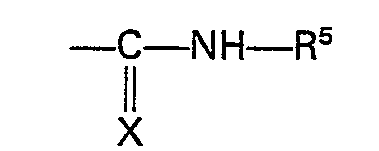

- The compounds of formula (I) may be converted to the therapeutically active non-toxic acid addition salt forms by treatment with an appropriate acid, such as an inorganic acid, such as hydrohalic acid (e.g., hydrochloric or hydrobromic), sulfuric acid, nitric acid or phosphoric acid; or an organic acid, such as acetic, propanoic, 2-hydroxy-acetic, 2-hydroxypropanoic, 2-oxopropanoic, propanedioic, butanedioic, (Z)-2-butenedioic, (E)-2-butenedioic, 2-hydroxybutanedioc, 2,3-dihydroxybutanedioic, 2-hydroxy-1,2,3-propanetricarboxylic, benzoic, 3-phenyl-2-propenoic, a-hydroxybenzeneacetic, methanesulfonic, ethanesulfonic, benzenesulfonic, 4-methylbenzenesulfonic, cyclohexane-sulfamic, 2-hydroxybenzoic or 4-amino-2-hydroxybenzoic acids.
- Conversely the sale form can be converted by treatment with alkali into the free base form.
- It is obvious from formula (I) that the compounds of this invention may exist under different stereochemically isomeric forms.
- Due to the substitution on the cyclohexyl ring said compounds may be present in two different geometrically isomeric forms, namely cis and trans forms.
- Moreover, when R represents a lower alkyl radical, two additional asymmetric carbon atoms are present. Each of these chiral centers may be present in a R- and a S-configuration, this R- and S-notation being in correspondance with the rules described by R. S. Cahn, C. Ingold and V. Prelog in Angew. Chem., Int. Ed. Engl., 5, 385,51 (1966). Due to the 2 asymmetric carbon atoms the piperidine moiety may be present in a cis- and a trans form.
- Pure stereochemically isomeric forms of the compounds of formula (I) may be obtained by the application of art-known procedures. Diastereoisomers may be separated by physical separation methods such as selective crystallization and chromatographic techniques (e.g., counter current distribution), and enantiomers may be separated from each other by the selective crystallization of their diastereomeric salts with optically active acids.
- Pure stereochemically isomeric forms may also be derived from the corresponding pure stereochemically isomeric forms of the appropriate starting materials, provided that the reaction occur stereospecifically.
- In most compounds and starting materials the stereochemical configuration is not experimentally determined. In those cases it is conventionally agreed to designate the stereochemically isomeric form which is first isolated as "A" and the second as "B", without further. reference to the actual stereochemical configuration. The suffix p or c indicate the piperidine- or cyclohexyl moiety respectively, the stereochemical notation is related to.
- Stereochemically isomeric forms of the compounds of formula (I) are naturally intended to be. embraced within the scope of the invention.
- A large number of intermediates and starting materials in the foregoing preparations are known compounds and all of them may be prepared according to art-known methodologies of preparing similar compounds. A number of such preparation methods will be described hereafter in somewhat more detail.
- The intermediates of formula (II) may be prepared by a Michael-addition reaction of an appropriate arylacetonitrile (XII) with a propenoic acid ester (XIII), wherein R11 represents an optionally substituted Cl-C6 alkyl radical, and subsequent hydrolysis of the thus obtained cyclic Michael addition reaction product in acidic medium.
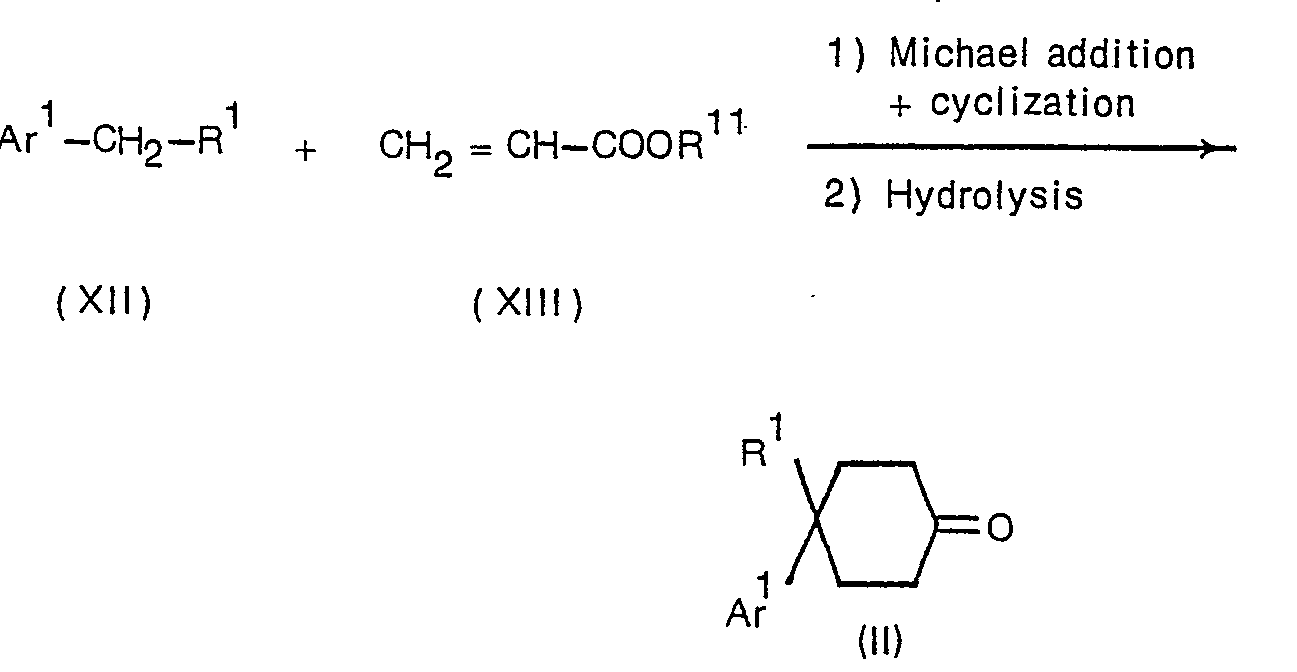
- Said Michael addition reaction is conveniently conducted by stirring and, if desired, heating the reactants together in a suitable solvent such as an alkanol (e.g., ethanol or 1,1-dimethylethanol); an aliphatic-, alicyclic- or aromatic hydrocarbon (e.g., n-hexane, cyclohexane or methylbenzene); in the presence of an appropriate strong base (e.g., sodium hydride or sodium methoxide), depending upon the solvent used. Preferably the reaction is conducted at the reflux temperature of the reaction mixture.
- The hydrolysis is generally carried out by stirring and heating the Michael addition reaction product in aqueous acidic medium (e.g., aqueous hydrochloric acid).
- The intermediates of formula (V) may be prepared by converting the hydroxyl function of an appropriately substituted cyclohexanol (XIV) into an appropriate reactive leaving group W.

- Said conversion of the hydroxylfunction into a leaving group W may, for example, be carried out by stirring the alcohol (XIV) with an appropriate halogenating- or sulfonylating agent (e.g., thionyl chloride, or methanesulfonyl chloride). In order to neutralize the acid which is liberated during the course of the reaction it may be appropriate to add an appropriate base to the reaction mixture or to carry out the reaction in a suitable alkaline organic solvent (e.g., pyridine).
- The cyclohexanol (XIV) can be derived from the corresponding cyclohexanone (II) following art-known reducing procedures.
- Depending upon the nature of RI the intermediates (II) and (V) can be converted into each other following art-known procedures of functional group transformation, as illustrated in scheme 1.
- In some cases it may be advantageous that, before the functional group-transformation is carried out, other functions, which are present in the starting intermediate, are protected and that, afterwards, the protective groups are eliminated.
- A number of intermediates of formula (III) are described in U.S. Patent Nos. 3,929,801 and 3,155,670 and in Helv. Chim. Acta 1960, 1298-1313 and all of them may be prepared following analogous procedures.
- The compounds of formula (I), their pharmaceutically acceptable acid-addition salts and the geometrically isomeric forms thereof possess strong psychotropic antiemetic activity. Such psychotropic and antiemetic activity is evidenced by the experimental data obtained in at least one of two different test procedures, viz., the combined apomorphine-, tryptamine- and norepinephrine tests in rats and the apomorphine test in dogs. The tests were carried out following the procedures described hereinafter and the experimental data which were obtained are summarized in the tables 1, 2, and 3.
- The experimental animals used in this test were adult male Wistar rats (weight 240 ± 10 g). After an overnight fast, the animals were treated subcutaneously (1 ml/100 g) with an aqeuous solution of the compound under investigation (time = zero) and put in isolated observation cages. Thirty minutes thereafter (time = 30 minutes) 1.25 mg/kg of apomorphine hydrochloride (APO) was injected intravenously and the rats were observed over a 1 hour period for the presence or absence of the following apomorphine-induced phenomena: agitation and stereotypic chewing. At the end of this 1 hour period (time = 90 minutes) the same animals were injected intraveneously with 40 mg/kg of tryptamine (TRY) and the presence of the typical tryptamine-induced bilateral tonic seizures was noted. Two hours after pretreatment (time = 120 minutes) finally, the same animals were challenged with 1.25 mg/kg intravenously of norephinephrine (NOR) and possible mortality was looked for up to 60 minutes later.
- The tables 1, 2 and 3 give the EDso-values of a number of the compounds under consideration. As used herein, the EDso-value represents the dose which protects 50% of the animals from apomorphine-, tryptamine- or norepinephrine-induced phenomena.
- The method used is described by P. A. J. Janssen and C. J. E. Niemegeers in Arzneim.-Forsch. (Drug Res), 9, 765-767 (1959).
- The compounds listed in tables 1, 2, and 3 were administered subcutaneously to beagle dogs at different doses and the animals were challenged 1 hour thereafter with a standard dose of 0.31 mg/kg (subcutaneous) of apomorphine.
- The tables 1, 2 and 3 give the ED50-values of a number of the compounds under consideration. As used herein, the ED50-value represents the dose which protects 50% of the animals from emesis.
- It is understood that the compounds shown in the tables 1, 2 and 3 are not listed for the purpose of limiting the invention thereto, but only to exemplify the outstanding antiemetic- and psychotropic properties of all the compounds within the scope of formula (I).


- In view of their antiemetic and psychotropic activity, the subject compounds may be formulated into various pharmaceutical forms for administration purposes. To prepare the pharmaceutical compositions of this invention, an effective antiemetic or psychotropic amount of the particular compound, in base or acid-addition salt form, as the active ingredient is combined in intimate admixture with a pharmaceutically acceptable carrier, which carrier may take a wide variety of forms depending on the form of preparation desired for administration. These pharmaceutical compositions are desirable in unitary dosage form suitable, preferably, for administration orally, rectally or by parenteral injection. For example, in preparing the compositions in oral dosage form, any of the usual pharmaceutical media may be employed, such as water, glycols or oils or alcohols in the case of oral liquid preparations such as suspensions, syrups, elixirs and solutions; or solid carriers such as starches, sugars, kaolin, lubricants, binders or disintegrating agents in the case of powders, pills, capsules and tablets. Because of their ease in administration, tablets and capsules represent the most advantageous oral dosage unit form, in which case solid pharmaceutical carriers are obviously employed. For parenteral compositions, the carrier will usually comprise sterile water, at least in large part, though other ingredients, for example, to aid solubility, may be included. Injectable solutions, for example, may be prepared in which the carrier comprises saline solution, glucose solution or a mixture of saline and glucose solution. Injectable suspensions may also be prepared in which case appropriate liquid carriers or suspending agents may be employed. Acid addition salts of (I), due to their increased water solubility over the corresponding base form, are obviously more suitable in the preparation of aqueous compositions.
- It is especially advantageous to formulate the aforementioned pharmaceutical compositions in dosage unit form for ease of administration and uniformity of dosage. Dosage unit form as used in the specification and claims herein referred to physically discrete units suitable as unitary dosages, each unit containing a predetermined quantity of active ingredient calculated to produce the desired therapeutic effect in association with the required pharmaceutical carrier. Examples of such dosage unit forms are tablets (including scored or coated tablets), capsules, pills, powder packets, wafers, injectable solutions or suspensions, teaspoonfuls or tablespoonfuls and segregated multiples thereof.
- The following formulations exemplify typical antiemetic and psychotropic pharmaceutical compositions in dosage unit form suitable for systemic administration to animal and human subjects in accordance with the instant invention.
- Oral drop: The following formulation provides 10 liters of an oral-drop solution comprising 5 milligrams of (B)-1-(4-fluorophenyl)-4-[1-(4-fluorophenyl)-4-oxo-1,3,8-triazaspiro[4,5]decan-8-yl]-cyclohexane- carbonitrile as the active ingredient per ml.

- The methyl and propyl 4-hydroxybenzoates are dissolved in about 5 liters of boiling pyrogen-free water. After cooling to about 50°C there are added while stirring the 2-hydroxypropanoic acid and thereafter the A.I. The solution is cooled to room temperature and supplemented with pyrogen-free water ad volume. The solution is sterilized by filtration (U.S.P. XVII p. 811) and filled in sterile containers.
- Injectable Solution: The oral drop solution described herebefore may be used as an injectable solution.
- Capsules: 10,000 Hard gelatine capsules, each containing as the active ingredient (A.L) 20 milligrams of (B)-l-(4-fluorophenyl)-4-[l-(4-fluorophenyl)-4-oxo-1,3,8-triazaspiro[4,5]decan-8-yllcyclohexane- carbonitrile, are prepared from the following composition.
-

- An uniform mixture of the active and supplementary ingredients is prepared and filled into two- piece hard gelatine capsules.
- Tablets: 5000 Compressed tablets, each containing as the active ingredient (A.I.) 25 milligrams of (B)-1-(4-fluorophenyl)-4-[1-(4-fluorophenyl)-4-oxo-1,3,8-triazaspiro[4,5]decan-8-yl]cyclohexanecarbonitrile, are prepared from the following formulation.

- The finely powdered ingredients are mixed well and granulated with 10% starch paste. The granulation is dried and compressed into tablets.
- Oral suspension: The following formulation provides 5 liters of an oral suspension comprising as an active ingredient (A.I.) 15 milligrams of (B)-1-(4-fluorophenyl)-4-[1-(4-fluorophenyl)-4-oxo-1,3,8-triazaspiro[4,5]decan-8-yl]cyclohexanecarbonitrile per teaspoonfull (5 milliliters).

- Dissolve the parabens in the propylene glycol and add this solution to a solution of the sodium cyclamate, sodium saccharin and sucrose in half the water. Suspend the bentonite in hot (about 85°C) water and stir for 60 minutes. Add the bentonite solution to the former solution. Dissolve the sulfosuccinate in some water and suspend the A.I. in the resulting solution. Add the Antifoam A.F. Emulsion which has been diluted to a lotion consistency with a minimum amount of water and mix well. Add the latter suspension of A.I. to the former mixture and mix well. Add the FD&C Yellow #5 dissolved in a small amount of water. Add the orange flavor, q.s. to volume with water, and stir to a homogeneous mixture. Pass the mixture through a colloid mill and fill into suitable containers.
- In view of the antiemetic activity of the subject compounds, it is evident that the present invention provides a method of inhibiting emesis in warm-blooded animals effected by emesis, by the systemic administration of an effective antiemetic amount of a compound of formula (I) and the pharmaceutically acceptable acid addition salts thereof in admixture with a pharmaceutical carrier.
- In addition, in view of the psychotropic activity of the subject compounds, the present invention also provides a method of treating mental disorders in warm-blooded animals affected by such disorders, by the systemic administration of an effective psychotropic inhibiting amount of a compound of formula (I) and the pharmaceutically acceptable acid addition salts thereof in admixture with a pharmaceutical carrier.
- The following examples are intended to illustrate but not to limit the scope of the present invention. Unless otherwise stated all parts therein are by weight.
- 75 Parts of ethyl 4-oxo-1-piperidinecarboxylate and 50 parts of 4-fluorobenzeneamine are added dropwise to 220 parts of acetic acid. The whole is stirred for 30 minutes. Then there is added dropwise a solution of 23 parts of sodium cyanide in 65 parts of water at room temperature (exothermic reaction). Upon completion, a second portion of 2 parts of sodium cyanide is added and the whole is stirred overnight. The reaction mixture is poured onto a mixture of 440 parts of water, 440 parts of ammonium hydroxide solution and 525 parts of trichloromethane. The trichloromethane-phase is separated and the aqueous layer is extracted with trichloromethane. The combined organic layers are washed with water, dried and evaporated, yielding 127.5 parts of ethyl 4-cyano-4-(4-fluorophenyl- amino)-1-piperidinecarboxylate as a residue.
- 127.5 parts of ethyl 4-cyano-4-(4-fluorophenylamino)-1-piperidinecarboxylate are added dropwise to 360 parts of concentrated sulfuric acid (exothermic reaction: temperature rises to 50°C). Upon completion, the whole is stirred overnight at room temperature. The reaction mixture is poured onto crushed ice and 250 parts of water are added. The whole is alkalized with sodium hydroxide solution at a temperature of 40-500C, whereupon the product is precipitated. It is filtered off, washed with water and taken up in boiling trichloromethane. The latter is washed twice with water, dried and evaporated, yielding 82.1 parts of less pure ethyl 4-carbamoyl-4-(4-fluorophenylamino)-1-piperidinecarboxylate.
- A sample of 2 parts is crystallized from absolute ethanol, yielding 1 part of ethyl 4-carbamoyl-4-(4-fluorophenylamino)-1-piperidinecarboxylate; mp. 187°C.
- To a solution of 6.9 parts of paraformaldehyde in 100 parts of N,N-dimethylformamide are added portionwise 46.3 parts of ethyl 4-carbamoyl-4-(4-fluorophenylamino)-1-piperidinecarboxylate. The whole is stirred and refluxed for 20 hours. Then 50 parts of the solvent are distilled off (t°: 142-152°C). A second portion of 1 part of paraformaldehyde in 50 parts of N,N-dimethylformamide is added and stirring and refluxing is continued for 48 hours. The N,N-dimethylformamide is distilled off to a volume of about 50 parts and the distillate is poured onto water. The water is decanted and the residue is extracted with trichloromethane. The extract is washed with water, dried, filtered and evaporated. The residue is triturated in 2,2'-oxybispropane..The product is filtered off and crystallized from a mixture of benzene and 2,2'-oxybispropane, yielding 17.5 parts of ethyl 1-(4-fluorophenyl)-4-oxo-1,3,8-triazaspiro[4,5]decane-8-carboxylate; mp. 153°C.
- To a stirred solution of 248 parts of methyl 3-methyl-4-oxo-1-piperidinecarboxylate in 660 parts of acetic acid are added 150 parts of 4-fluorobenzenamine and the whole is stirred for 30 minutes. After cooling with ice-water, a solution of 69 parts of sodium cyanide in 195 parts of water is added dropwise at room temperature. Upon completion, stirring at room temperature is continued over weekend. The solid product is filtered off and washed with 2,2'-oxybispropane and petroleumether, yielding 230 parts of methyl 4-cyano-4-[(4-fluorophenyl)amino]-3-methyl-1-piperidinecarboxylate; mp. 90°C.
- To 1800 parts of concentrated sulfuric acid are added portionwise 320 parts of methyl 4-cyano-4-[(4-fluorophenyl)amino]-3-methyl-1-piperidinecarboxylate, while the temperature is allowed to reach 50°C. Upon completion, stirring is continued first for 5 hours at 50°C and further overnight while the mixture is allowed to cool to room temperature. The reaction mixture is poured onto crushed ice, alkalized with a concentrated ammonium hydroxide solution at a temperature below 40°C, and the product is extracted with trichloromethane. The extract is washed with water, dried, filtered and evaporated. The semi-solid residue is boiled in 400 parts of 2-propanone.
- 1. After cooling to room temperature, the undissolved product is filtered off (the filtrate is set aside) and boiled in 400 parts of acetonitrile. After cooling to room temperature, the product is filtered off and boiled in 1200 parts of 2-propanol. The undissolved part is filtered off and discarded. After cooling the filtrate, the product is precipitated. It is filtered off and dried, yielding 21.3 parts of B-methyl 4-(aminocarbonyl)-4-[(4-fluorophenyl)amino]-3-methyl-1-piperidinecarboxylate; mp. 223.5°C.
- 2. From the filtrate, which was set aside (see sub. 1), a product is precipitated. It is filtered off and crystallized from 160 parts of acetonitrile, yielding 20.5 parts of A-methyl-4-(aminocarbonyl)-4-[(4-fluorophenyl)amino]-3-methyl-1-piperidinecarboxylate; mp. 189.5°C.
- A mixture of 22.3 parts of A-methyl 4-(aminocarbonyl)-4-[(4-fluorophenyl)amino]-3-methyl-1-piperidinecarboxylate, 86 parts of a formaldehyde solution 40% and 47 parts of N,N-dimethylformamide is stirred and refluxed for 3 days. The reaction mixture is evaporated in vacuo. The residue is dissolved in methylbenzene and water. The methylbenzenephase is separated, washed with water, dried, filtered and evaporated, yielding 27 parts of A-methyl 1-(4-fluorophenyl)-3-(hydroxymethyl)-6-methyl-4-oxo-1,3,8-triazaspiro[4,5]decane-8-carboxylate as an oily residue.
- In a similar manner there is also prepared:
- B-methyl 1-(4-fluorophenyl)-3-(hydroxymethyl)-6-methyl-4-oxo-1,3,8-triazaspiro[4,5]decane-8-carboxylate as an oily residue.
- A mixture of 27 parts of A-methyl 1-(4-fluorophenyl)-3-(hydroxymethyl)-6-methyl-4-oxo-1,3,8-triazaspiro[4,5]decane-8-carboxylate, 43 parts of potassium hydroxide and 276 parts of 2-propanol is stirred and refluxed for 5.50 hours. The reaction mixture is evaporated. The residue is dissolved in 250 parts of water. The 2-propanol is further evaporated. The aqueous solution is stirred at 80°C for 30 minutes at atmospheric pressure. The whole is allowed to cool to room temperature and the product is. extracted with dichloromethane. The extract is washed successively with water and a dilute hydrochloric acid solution and decanted from some precipitated tar. The aqueous acid phase is separated, alkalized with a dilute sodium hydroxide solution and the product is extracted again with dichloromethane. The extract is washed with water, dried, filtered and evaporated. The oily residue is crystallized from 12 parts of acetonitrile, yielding 7.8 parts of A-1-(4-fluorophenyl)-6-methyl-1,3,8-triazaspiro[4,5]decan-4-one; mp. 156°C.
- In a similar manner there is also prepared:
- B-1-(4-fluorophenyl)-6-methyl-1,3,8-triazaspiro[4,5]decan-4-one; mp. 172.6°C.
- To a stirred and cooled (below 5°C) mixture of 16 parts of ethyl 1-(4-fluorophenyl)-4-oxo-1,3,8-triazaspiro[4,5]decane-8-carboxylate, 200 parts of dimethyl sulfoxide and 200 parts of benzene are added 3.5 parts of a sodium hydride dispersion 50%. After stirring for 1 hour at a temperature below 5°C, there are added dropwise 10 parts of iodomethane at this temperature. Upon completion, stirring is continued overnight at room temperature. The reaction mixture is poured onto water and the layers are separated. The aqueous phase is extracted with methylbenzene. The extract is washed with water, dried, filtered and evaporated, yielding 14.7 parts (88%) of ethyl 1-(4-fluorophenyl)-3-methyl-4-oxo-1,3,8-triazaspiro[4,5]decane-8-carboxylate as a residue.
- In a similar manner there is also prepared:
- ethyl 1-(4-fluorophenyl)-4-oxo-3-(phenylmethyl)-1,3,8-triazaspiro[4,5]decane-8-carboxylate as a residue.
- A mixture of 14.7 parts of ethyl 1-(4-fluorophenyl)-3-methyl-4-oxo-1,3,8-triazaspiro[4,5]decane-8-carboxylate, 16 parts of sodium hydroxide and 160 parts of 1-butanol is stirred and refluxed for 4 hours. The reaction mixture is evaporated and the residue is taken up in water. The product is extracted with trichloromethane. The extract is washed with water, dried, filtered and evaporated. The residue is crystallized from a mixture of 2,2'-oxybispropane and methanol, yielding 2.7 parts (23%) of 1-(4-fluorophenyl)-3-methyl-1,3,8-triazaspiro[4,5]decan-4-one.
- In a similar manner there are also prepared:
- 1-(4-fluorophenyl)-1,3,8-triazaspiro[4,5]decan-4-one and
- 1-(4-fluorophenyl)-3-(phenylmethyl)-1,3,8-triazaspiro[4,5]-decan-4-one monohydrochloride; mp. 185°C.
- A mixture of 221 parts of 4-fluorobenzeneacetonitrile, 700 parts of sodium methoxide solution 30% and 900 parts of dimethylbenzene is stirred for 5 minutes. Then there are added dropwise 309 parts of methyl 2-propanoate (exothermic reaction: temperature rises to 65°C). Upon completion, stirring is continued overnight at reflux temperature. The methanol is distilled off till an internal temperature of 110°C is reached. After cooling, 1000 parts of a hydrochloric acid solution 6 N are added dropwise and the whole is stirred and refluxed for 5 minutes. Upon cooling, the layers are separated. The organic phase is dried, filtered and evaporated. The residue is stirred and refluxed for 4 hours together with 500 parts of acetic acid, 500 parts of water and 500 parts of a hydrochloric acid solution. After cooling, the product is extracted with trichloromethane. The extract is washed successively with water, with a diluted sodium hydroxide solution and again with water till neutralization, dried, filtered and evaporated. The residue is crystallized from 2-propanol, yielding 134.5 parts of 1-(4-fluorophenyl)-4-oxocyclohexanecarbonitrile; mp. 91.8°C.
- Following the same procedure and using equivalent amounts of the appropriate starting materials there are also prepared:
- 4-oxo-1-[4-(phenylmethoxy)phenyl]-1-cyclohexanecarbonitrile as a residue;
- 4-benzoyl-4-(4-fluorophenyl)cyclohexanone as a residue;
- 1-(2-naphthalenyl)-4-oxycyclohexanecarbonitrile as a residue;
- 4-oxo-1-(2-thienyl)cyclohexanecarbonitrile as a residue; and
- 4-oxo-1-(2-pyridinyl)-1-cyclohexanecarbonitrile; mp. 90.1 °C.
- A mixture of 65 parts of 4-oxo-1-[4-(phenylmethoxy)phenyl)-1-cyclohexanecarbonitrile, 15.7 parts of 1,2-ethanediol, 0.2 parts of 4-methylbenzenesulfonic acid and 360 parts of methylbenzene is stirred and refluxed overnight with water-separator. The reaction mixture is cooled, washed successively with water, with a sodium hydroxide solution 5% and again with water, dried, filtered and evaporated. The residue is crystallized from 2-propanol, yielding 33.5 parts (47%) of 8-[4-(phenyl- methoxy)phenyl] -1,4-dioxaspiro[4,5Jdecane-8-carbonitrile.
- In a similar manner there are also prepared:
- 8-(1,3-benzodioxol-5-yl)-1,4-dioxaspiro[4,5]decane-8-carbonitrile as a residue; and
- 8-(4-fluorophenyl)-1,4-dioxaspiro[4,5]decane-8-carbonitrile; mp. 96.6°C.
- A mixture of 283.5 parts of 8-(4-methoxyphenyl)-1,4-dioxaspiro[4,51-decane-8-carbonitrile, 168 parts of potassium hydroxide and 1100 parts of 1,2-ethanediol is stirred and refluxed for 24 hours. The reaction mixture is cooled, poured onto water and filtered. The filtrate is acidified with a concentrated hydrochloroic acid solution and the product is extracted with trichloromethane. The extract is washed with water, dried, filtered and evaporated. The residue is suspended in 2-propanol. The product is filtered off and dried, yielding 245 parts (83.8%) of 8-(4-methoxyphenyl)-1,4-dioxaspiro[4,5]decane-8-carboxylic acid.
- In a similar manner there is also prepared:
- 8-(4-fluorophenyl)-1,4-dioxaspiro[4,5]decane-8-carboxylic acid as a residue.
- To a stirred sodium methoxide solution, previously prepared starting from 1.3 parts of sodium in 160 parts of methanol, are added 13 parts of 1-(4-fluorophenyl)-4-oxocyclohexanecarboxylic acid and the whole is stirred and refluxed for 1 hour. After cooling to room temperature, 22.8 parts of iodomethane are added dropwise. Upon completion, the whole is heated to reflux and stirring is continued overnight at reflux temperature. The reaction mixture is evaporated and the residue is taken up in trichloromethane. The organic phase is washed successively with water, a 5% sodium hydroxide solution and again with water, dried, filtered and evaporated. The residue is purified by column-chromatography over silica gel using trichloromethane as eluent. The pure fractions are collected and the eluent is evaporated, yielding 5 parts (36%) of methyl 1-(4-fluorophenyl)-4-oxocyclohexane- carboxylate as an oily residue.
- Following the same procedure and using equivalent amounts of the appropriate starting materials there are also prepared:
- butyl 1-(4-fluorophenyl)-4-oxocyclohexanecarboxylate as a residue; and
- propyl 1-(4-fluorophenyl)-4-oxocyclohexanecarboxylate.
- A mixture of 245 parts of 8-(4-methoxyphenyl)-1,4-dioxaspiro[4,5]decane-8-carboxylic acid, 150 parts of thionyl chloride and 1350 parts of benzene is stirred first for 30 minutes at room temperature and further for 4 hours at reflux. The reaction mixture is evaporated, yielding 275 parts of 8-(4-methoxyphenyl)-1,4-dioxaspiro[4,5]decane-8-carbonyl chloride as a residue.
- In a similar manner there is also prepared:
- 8-(4-fluorophenyl)-1,4-dioxaspiro[4,5]decane-8-carbonyl chloride as a residue.
- To a stirred and cooled (<0°C) mixture of 49.5 parts of N-methylmethanamine solution 40%, 93 parts of sodium carbonate and 1000 parts of water is added dropwise a solution of 124 parts of 8-(4-methoxyphenyt)-1,4-dioxaspiro[4,5]decane-8-carbony! chloride in 675 parts of methylbenzene. Upon completion, stirring is continued overnight at room temperature. The layers are separated and the organic phase is washed with water, dried, filtered and evaporated, yielding 128 parts (100%) of 8-(4-methoxyphenyl)-N,N-dimethyl-1,4-dioxaspiro[4,5]decane-8-carboxamide as a residue.
- To 120 parts of absolute ethanol is added dropwise a solution of 102 parts of 8-(4-fluorophenyl)-1,4-dioxaspiro[4,5]decane-8-carbonyl chloride in 270 parts of methylbenzene, while cooling. Upon completion, the whole is stirred for 24 hours at reflux temperature. The reaction mixture is cooled, washed with water, dried, filtered and evaporated, yielding 95 parts (90.6%) of ethyl 8-(4-fluorophenyl)-1,4-dioxaspiro[4,5]decane-8-carboxylate as a residue.
- To a stirred mixture of 7.3 parts of magnesium and 350 parts of 1,1'-oxybisethane are added dropwise 43 parts of iodomethane under nitrogen atmosphere. The reaction is kept at reflux temperature in a water-bath. After refluxing for 30 minutes, 270 parts of benzene are added. The 1,1'- oxybisethane is distilled off till an internal temperature of 74°C. Then there is added a solution of 26 parts of 8-(4-fluorophenyl)-1,4-dioxaspiro[4,5]decane-8-carbonitrile in 45 parts of benzene. The whole is stirred and refluxed overnight. After cooling to room temperature, there is added dropwise a solution of 39 parts of hydrochloric acid in 100 parts of water (strongly exothermic). Upon completion stirring is continued overnight at reflux temperature. The reaction mixture is cooled and the layers are separated. The aqueous phase is extracted with methylbenzene. The combined organic phases are washed withwater, dried, filtered and evaporated. The residue is purified by silica gel using trichloromethane as eluent. The pure fractions are collected and the eluent is evaporated. The oily residue is stirred with 150 parts of a hydrochloric acid solution 6N and 150 parts of acetic acid. The whole is stirred for 24 hours at reflux. After cooling, the product is extracted with trichloromethane. The extract is washed with water, dried, filtered and evaporated. The residue is purified by column-chromatography over silica gel using trichloromethane as eluent. The pure fraction is collected and the eluent is evaporated, yielding 3.5 parts (15%) of 4-acetyl-4-(4-fluorophenyl)-cyclohexane as an oily residue.

- To a stirred and hot (±100°C) mixture of 101 parts of sodium and 450 parts of methylbenzene is added dropwise a solution of 189 parts of 8-(4-fluorophenyl)-1,4-dioxaspiro[4,5]decane-8-carbonitrile in 450 parts of methylbenzene and 100 parts of absolute ethanol (temperature remained at about 90°C). Then there are added successively and dropwise 260 parts of absolute ethanol and 160 parts of methanol. Upon completion, stirring is continued overnight at room temperature. The reaction mixture is poured onto ice-water and the product is extracted with trichloromethane. The extract is washed successively with a hydrochloric acid solution 5%, a sodium bicarbonate solution 5% and with water, dried, filtered and evaporated, yielding 167 parts of 8-(4-fluorophenyl)-1,4-dioxaspiro[4,5]decane, mp. <60°C.
- In a similar manner there is also prepared:
- 8-(1,3-benzodioxol-5-yl)-1,4-dioxaspiro[4,5]decane as a residue.
- To a stirred and heated (±65°C) mixture of 60 parts of sodium amide solution 50% in dimethylbenzene and 315 parts of methylbenzene are added portionwise 33.5 parts of 8-[4-(phenylmethoxy)-phenyll-1,4-dioxaspiro[4,5]decane-8-carbonitrile. Upon completion, stirring is continued for 24 hours at reflux. The reaction mixture is cooled, about 16 parts of methanol are added dropwise and the whole is poured onto ice-water. The product is extracted with trichloromethane. The extract is dried, filtered and evaporated, yielding 27 parts (87%) of 8-[4-(phenylmethoxy)phenyl]-1,4-dioxaspiro[4,5]decane as a residue.
- A mixture of 40 parts of 8-(4-fluorophenyl)-1,4-dioxaspiro[4,51-decane-8-carboxylic acid, 100 parts of a hydrochloric acid solution 6 N and 100 parts of acetic acid is stirred and refluxed overnight. The reaction mixture is cooled and the product is extracted with trichloromethane. The extract is washed three times with water, dried, filtered and evaporated, yielding 17 parts (50%) of 1-(4-fluorophenyl)-4-oxo-cyclohexanecarboxylic acid as a residue.
- A mixture of 95 parts of ethyl 8-(4-fluorophenyl)-1,4-dioxaspiro[4,5]decane-8-carboxylate, 66 parts of acetic acid, 34 parts of water and 180 parts of tetrahydrofuran is stirred and refluxed for 18 hours. The reaction mixture is cooled, poured onto water and the product is extracted with trichloromethane. The extract is washed successively with water, a sodium bicarbonate solution and again with water, dried, filtered and evaporated. The residue is distilled, yielding 11.3 parts (13.9%) of ethyl 1-(4-fluorophenyl)-4-oxocyclohexanecarboxylate; bp. 175-185°C at 2 mm. pressure.
- A mixture of 160 parts of 8-(4-fluorophenyl)-1,4-dioxaspiro[4,5]decane, 72 parts of hydrochloric acid, 800 parts of ethanol and 800 parts of water is stirred and refluxed for 2 h. 30. Then there are added dropwise 72 parts of sulfuric acid. Upon completion, stirring is continued at reflux temperature for one hour. The reaction mixture is cooled, poured onto water and the product is extracted with trichloromethane. The extract is washed with water, dried, filtered and evaporated. The residue is fractionated, yielding 68.5 parts of 4-(4-fluorophenyl)cyclohexanone; bp. 110°C at 1 mm. pressure.
- In a similar manner there are also prepared:
- 4-[4-(phenylmethoxy)phenyl]-1-cyclohexanone as a residue;
- 4-(1,3-benzodioxol-5-yl)-l-cyclohexanone; mp. 102°C and
- 1-(4-methoxyphenyl)-N,N-dimethyl-4-oxo-1-cyclohexanecarboxamide as a residue.
- To a stirred mixture of 75 parts of 4-(4-methoxyphenyl)cyclohexanol and 1000 parts of pyridine are added dropwise 62 parts of methanesulfonyl chloride (exothermic reaction: temperature rises to 40°C). Upon completion, the whole is heated to 65°C and stirring is continued for 2 hours, while meantime the mixture is allowed to cool to room temperature. The reaction mixture is evaporated and 1000 parts of water are added to the residue. The product is extracted with dichloromethane. The extract is washed with water, dried, filtered and evaporated. The residue is crystallized from 2-propanol, yielding 80.5 parts of 4-(4-methoxyphenyl)cyclohexyl methanesulfonate.
- A mixture of 7 parts of 4-phenylcyclohexanone, 8.8 parts of 1-(4-piperidinyl)-2H-benzimidazol-2- one, 0.3 parts of 4-methylbenzenesulfonic acid and 225 parts of methylbenzene is stirred and refluxed for 40 hours with water-separator. The reaction mixture is cooled and the solvent is removed in vacuo, yielding 15 parts of 1-[(4-phenyl-1-cyclohexenyl)-4-piperidinyl]-2H-benzimidazol-2-one as a residue.
- Following the same procedure and using equivalent amounts of the appropriate starting materials there are also prepared:
- 4-[4-(2,3-dihydro-2-oxo-1 H-benzimidazol-1-yl)-1-piperidinyl]-1-(4-fluorophenyl)-3-cyclohexene-1-carbonitrile as a residue;
- 1-(4-chlorophenyl)-4-[4-(2,3-dihydro-2-oxo-1 H-benzimidazol-1-yl)-1-piperidinyl]-3-cyclohexene-1-carbonitrile as a residue;
- 1-(4-chlorophenyl)-4-[4-(2,3-dihydro-2-oxo-1 H-benzimidazol-1-yl)-1-piperidinyl]-N,N-dimethyl-3-cyclohexenecarboxamide as a residue;
- 1,3-dihydro-1-[1-[4-[4-(phenylmethoxy)phenyl]-1-cyclohexenyl]-4-piperidinyl]-2H-benzimidazol-2-one as a residue; and
- 4-[4-(2,3-dihydro-2-oxo-1 H-benzimidazol-1-yl)-1-piperidinyl]-1-(4-methoxyphenyl)-N,N-dimethyl-3-cyclohexenecarboxyamide as a residue.
- A mixture of 5 parts of 4-oxo-1-phenyl-1-cyclohexanecarbonitrile, 5.8 parts of 1-phenyl-1,3,8-triazaspiro[4,5]decan-4-one, 0.1 parts of 4-methylbenzenesulfonic acid and 225 parts of methylbenzene is stirred and refluxed overnight with water-separator. The reaction mixture is cooled and evaporated, yielding 10.35 parts of 4-(4-oxo-1-phenyl-1,3,8-triazaspiro[4,5]dec-8-yl)-1-phenyl-3-cyclohexene-1-carbonitrile as a residue.
- Following the same procedure and using equivalent amounts of the appropriate starting materials there are also prepared:
- 1-phenyl-8-(4-phenyl-l-cyclohexenyl)-1,3,8-triazaspiro[4,51-decan-4-one as a residue;
- 4-(4-oxo-1-phenyl-1,3,8-triazaspiro[4,5]dec-8-yl)-N,N-dimethyl-1-phenyl-3-cyclohexene-1-carboxamide as a residue;
- 1-(4-chlorophenyl)-4-(4-oxo-1-phenyl-1,3,8-triazaspiro[4,5]-dec-8-yl)-3-cyclohexen-1-carbonitrile as a residue;
- 1-(4-fluorophenyl)-4-(4-oxo-1-phenyl-1,3,8-triazaspiro[4,5]-dec-8-yl)-3-cyclohexane-1-carbonitrile as a residue; and
- 1-(4-methoxyphenyl)-4-(4-oxo-1-phenyl-1,3,8-triazaspiro[4,5]-dec-8-yl)-3-cyclohexene-1-carbonitrile as a residue.
- To 1 part of a solution of 2 parts of thiophene in 40 parts of ethanol are added 3.2 parts of 4-(4-fluorophenyl)-4-hydroxy-1-cyclohexanone, 3.3 parts of 1,3-dihydro-1-(4-piperidinyl)-2H-benzimidazol-2-one and 200 parts of methanol. The whole is hydrogenated at normal pressure and at room temperature with 2 parts of palladium-on-charcoal catalyst 10%. After the calculated amount of hydrogen is taken up, the catalyst is filtered off over Hyflo and the filtrate is evaporated. The residue is converted into the hydrochloride salt in 2-propanol, 2,2'-oxybispropane and 2-propanone. The salt is filtered off and dried, yielding 2.8 parts (41.8%) of 1-[1-[4-(4-fluorophenyl)-4-hydroxycyclohexyl]-4-piperidinyl]-1,3-dihydro-2H-benzimidazol-2-one hydrochloride; mp. >300°C.
- Following the same reductive amination procedure and using equivalent amounts of the appropriate starting materials there are also prepared:


- To 1 part of a solution of 2 parts of thiophene in 40 parts of ethanol are added 2.2 parts of 1-(4-fluorophenyl)-4-oxocyclohexanecarbonitrile, 2.7 parts of 1-(4-fluorophenyl)-3-methyl-1,3,8-triazaspiro[4,5]-decan-4-one and 90 parts of 2-methoxyethanol. The whole is hydrogenated at normal pressure and at 50°C with 2 parts of palladium-on-charcoal catalyst 10%. After the calculated amount of hydrogen is taken up, the catalyst is filtered off and the filtrate is evaporated. The residue is purified by column-chromatography over silica gel using a mixture of trichloromethane and methanol (98:2 by volume) as eluent. The first fraction (A-isomer) is collected and the eluent is evaporated. The residue is crystallized from a mixture of 2,2'-oxybispropane and methanol, yielding 0.5 parts (11 %) of (A)-1-(4-fluorophenyl)-4-[1,(4-fluorophenyl)-3-methyl-4-oxo-1,3,8-triazaspiro[4,5]-dec-8-yl]-cyclohexane- carbonitrile; mp. 187.1°C.
- The second fraction (B-isomer) is collected and the eluent is evaporated. The residue is crystallized from a mixture of 2,2'-oxybispropane and methanol, yielding 1.5 parts (33%) of (B)-1-(4-fluorophenyl)-4-[1-(4-fluorophenyl)-3-methyl-4-oxo-1,3,8-triazaspiro[4,5]dec-8-yl]-cyclohexane- carbonitrile; mp. 158.5°C.
- In a similar manner there are also prepared:
- (A)-8-[4-acetyl-4-(4-fluorophenyl)cyclohexyl]-1-(4-fluorophenyl)-1,3,8-triazaspiro[4,5]decan-4- one monohydrochloride; mp. 258.9°C; and
- (B)-8-[4-acetyl-4-(4-fluorophenyl)cyclohexyl]-1-(4-fluorophenyl)-1,3,8-triazaspiro[4,5]decan-4- one monohydrochloride; mp. 286.0°C.
- To 1 part of a solution of 2 parts of thiophene in 40 parts of ethanol are added 4.35 parts of 1-(4-fluorophenyl)-4-oxocyclohexanecarbonitrile. 6.3 parts of 1-(4-fluorophenyl)-3-(phenylmethyl)-1,3,8-triazaspiro[4,5]decan-4-one monohydrochloride, 5 parts of potassium acetate and 100 parts of 2-methoxyethanol. The whole is hydrogenated at normal pressure and at 50°C with 2 parts of palladium-on-charcoal catalyst 10%. After the calculated amount of hydrogen is taken up, the catalyst is filtered off and the filtrated is evaporated. The residue is taken up in water and the whole is alkalized with sodium hydroxide. The product is extracted with trichloromethane. The extract is washed with water, dried, filtered and evaporated. The residue is crystallized from a mixture of 2,2'-oxobispropane and methanol. The product is filtered off and recrystallized from a mixture of 2,2'-oxybispropane and methanol, yielding 4.5 parts (49%) of (B)-1-(4-fluorophenyl)-4-[1-(4-fluorophenyl)-4-oxo-3-(phenylmethyl)-1,3,8-triazaspiro[4,5]-dec-8-yl]cyclohexanecarbonitrile; mp. 131 °C.
- Following the same reductive amination procedure and using equivalent amounts of the appropriate starting materials there are also prepared:


- To a stirred mixture of 11 parts of 1-(4-chlorophenyl)-4-[4-(2,3-dihydro-2-oxo-1H-benzimidazol- 1-yl)-1-piperidinyl]-3-cyclohexene-1-carbonitrile, 5 parts of sodium methoxide solution 30% and 320 parts of methanol are added portionwise 3 parts of sodium borohydride. Upon completion, stirring is continued first for one hour at reflux temperature and further overnight at room temperature. The reaction mixture is poured onto water. The precipitated product is filtered off and boiled in methanol. The product is filtered off and dried, yielding 5.3 parts of 1-(4-chlorophenyl)-4-[4-(2,3-dihydro-2-oxo-1H-benzimidazol-1-yl)-1-piperidinyl]cyclohexanecarbonitrile; mp. 299°C.
- Following the same reduction procedure there are also prepared:


- To a stirred mixture of 10.5 parts of 1-(4-fluorophenyl)-4-(4-oxo-1-phenyl-1,3,8-triazaspiro[4,5]dec-8-yl)-3-cyclohexene-1-carbonitrile, 1 part of sodium methoxide solution 30% and 320 parts of ethanol is added portionwise 1 part of sodium borohydride. Upon completion, stirring at room temperature is continued for 6 hours. The reaction mixture is poured onto water and the product is extracted with trichloromethane. The extract is dried, filtered and evaporated. The residue is purified by column-chromatography over silica gel using a mixture of trichloromethane and 5% of methanol as eluent. The pure fractions are collected and the eluent is evaporated. The residue is crystallized from a mixture of methanol and 2-propaneone, yielding 3.2 parts of 1-(4-fluorophenyl)-4-(4-oxo-1-phenyl-1,3,8-triazaspiro-[4,5]dec-8-yi)cyclohexanecarbonitrile; mp. 236.1 °C.
- Following the same reduction procedure there are also prepared:


- A mixture of 4.34 parts of 1,3-dihydro-1-(4-piperidinyl)-2H-benzimidazol-2-one, 10.6 parts of sodium carbonate and 120 parts of 4-methyl-2-pentanone is distilled azeotropically to dry. Then there are added 6.25 parts of 4-(4-methoxyphenyl)cyclohexanol methanesulfonate and the whole is stirred and refluxed for 72 hours. After cooling, the reaction mixture is poured onto water and the layers are separated. The organic phase is dried, filtered and evaporated. The residue is crystallized twice from 2-propanol, yielding 0.4 parts of 1,3-dihydro-1-[1-[4-(4-methoxyphenyl)cyclohexyl]-4-piperidinyl]-2H-benzimidazol-2-one hemi-2-propanolate; mp. 167.6°C.
- To 27.6 parts of concentrated sulfuric acid are added portionwise 3 parts of (Ac)-1-(4-fluorophenyl)-4-[1-(4-fluorophenyl)-4-oxo-1,3,8-triazaspiro[4,5]decan-8-yl]cyclohexanecarbonitrile (slightly exothermic reaction). Upon completion, stirring is continued overnight at room temperature. The reaction mixture is poured onto ice-water. The precipitated product is filtered off, washed with water and stirred in a 10% sodium hydroxide solution. The product is extracted with trichloromethane. The extract is washed with water, dried, filtered and evaporated. The residue is crystallized from methanol, yielding 2.5 parts (80%) of (A)-1-(4-fluorophenyl)-4-[1-(4-fluorophenyl)-4-oxo-1,3,S-triaza- spiro[4,5]dec-S-yl]cyclohexanecarboxamide methanolate (1:1).
- To 36 parts of a sulfuric acid solution 97% are added portionwise 4.5 parts of (B)-1-(4-fluorophenyl)-4-[1-(4-fluorophenyl)-4-oxo-1,3,8-triazaspiro[4,5]decan-8-yl]cyclohexanecarbonitrile (slightly exothermic reaction). Upon completion, stirring is continued overnight at room temperature. The reaction mixture is poured onto ice-water. The precipitated product is filtered off, washed with water and stirred in a 5% sodium hydroxide solution in water. The product is filtered off and boiled in 200 parts of water. It is filtered off again and suspended in methylbenzene. The whole is evaporated and the residue is boiled in methanol. The product is filtered off and dried, yielding 2.3 parts (49%) of (B)-1-(4-fluorophenyl)-4-[1-(4-fluorophenyl)-4-oxo-1,3,8-triazaspiro[4,5]dec-8-yl]cyclohexanecarboxamide; mp. 271.7°C.
- A mixture of 4.5 parts of (B)-1-(4-fluorophenyl)-4-[1-(4-fluorophenyl)-4-oxo-1,3,8-triaza- spiro[4,5]-decan-8-yl]cyclohexanecarbonitrile, 1 part of 2-propenenitrile, 0.5 parts of N,N,N,-tri- methylbenzenemethanaminium hydroxide solution 40% in methanol and 200 parts of 1,4-dioxane is stirred and heated overnight at 60°C. The reaction mixture is evaporated. The residue is taken up in trichloromethane. The whole is washed with water, dried, filtered and evaporated. The residue is crystallized from methanol. The product is filtered off and dried for 24 hours at 120°C, yielding 4.6 parts (91%) of (B)-8-[4-cyano-4-(4-fluorophenyl)cyclohexyl]-1-(4-fluorophenyl)-4-oxo-1,3,8-triaza- spiro[4,5]decane-3-propanenitrile; mp. 212.1 °C.
- In a similar manner there are also prepared:

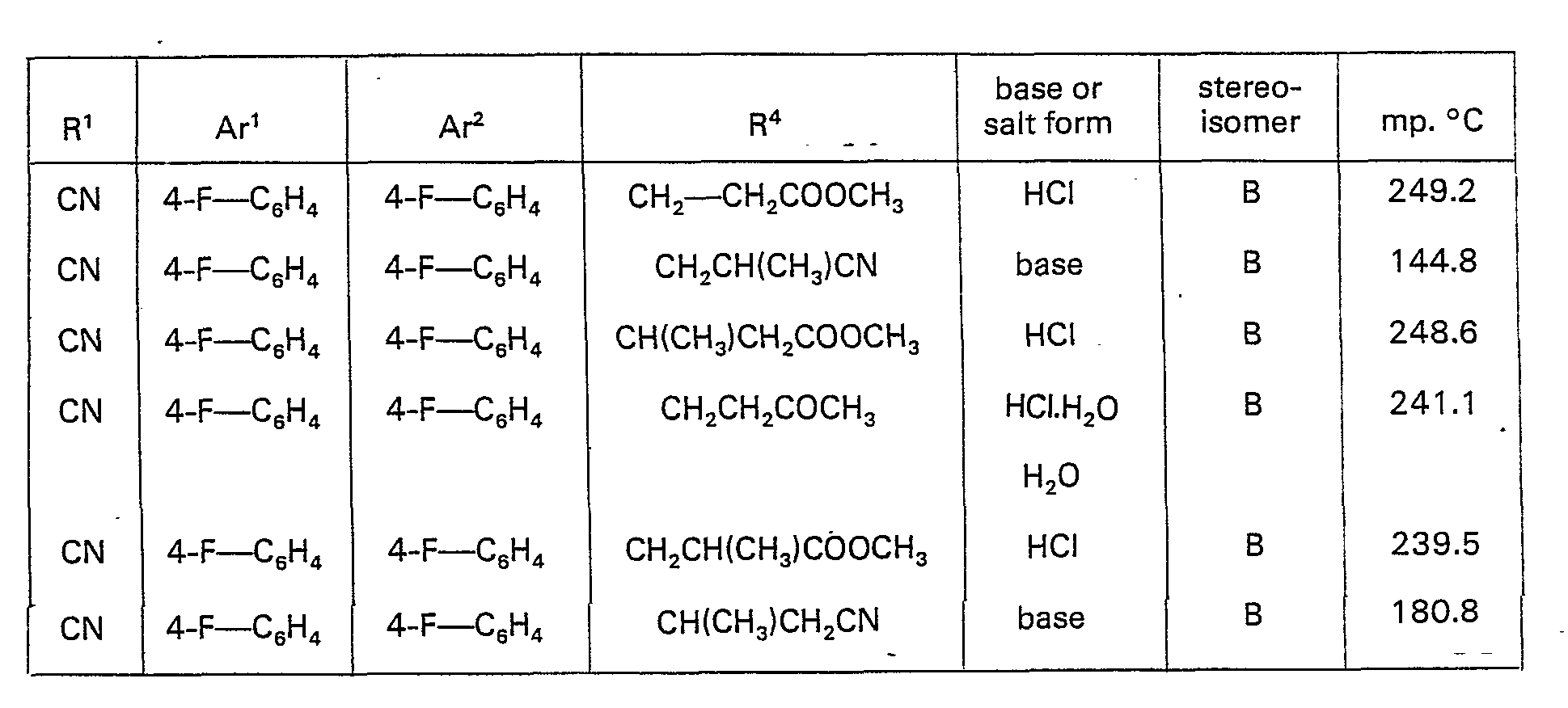
- A mixture of 4.5 parts of (B)-1-(4-fluorophenyll-4-[1-(4-fluorophenyl)-4-oxo-1,3,8-triazaspiro[4,5]decan-8-yl]cyclohexanecarbonitrile, 2.5 parts of 2-bromopropane, 2,25 parts of potassium hydroxide and 100 parts of dimethyl sulfoxide is stirred overnight at room temperature. The reaction mixture is poured onto water. The precipitated product is filtered off, washed with water and dissolved in trichloromethane. The solution is dried, filtered and evaporated. The residue is crystallized from a mixture of 2,2'-oxybispropane and methanol, yielding 1.3 parts (26%) of (B)-1-(4-fluorophenyl)-4-[1-(4-fluorophenyl)-3-(1-methylethyl)-4-oxo-1,3,8-triazaspiro[4,5]dec-8-yl]-cyclohexanecarbonitrile; mp. 157.7°C.
- In a similar manner there are also prepared:


- A mixture of 4.5 parts of (B)-1-(4-fluorophenyl)-4-[1-(4-fluorophenyl)-4-oxo-1,3,8-triaza- spiro[4,5]decan-8-yl]-cyclohexanecarbonitrile, 4 parts of acetic acid anhydride, 0.1 parts of 4-methylbenzenesulfonic acid and 360 parts of methylbenzene is stirred and refluxed for 24 hours. The reaction mixture is evaporated. The residue is purified by column-chromatography over silica gel using a mixture of trichloromethane and methanol (99:1 by volume) as eluent. The pure fractions are collected and the eluent is evaporated. The residue is stirred in 2,2'-oxybispropane. The product is filtered off and dried, yielding 1.6 parts (33%) of (B)-3-acetyl-8-[4-cyano-4-(4-fluorophenyl)-cyclohexyl]-1-(4-fluorophenyl)-1,3,8-triazaspiro[4,5]decan-4-one; mp. 166.4°C.
- A mixture of 4.5 parts of (B)-1-(4-fluorophenyl)-4-[1-(4-fluorophenyl)-4-oxo-1,3,8-triaza- spiro[4,5]decan-8-yl]cyclohexanecarbonitrile, 2.2 parts of isothiocyanatomethane, 1 part of N,N-dimethyl-4-pyridinamine and 360 parts of methylbenzene is stirred and refluxed for 48 hours. The reaction mixture is evaporated. The residue is purified by column-chromatography over silica gel using a mixture of trichloromethane and methanol (99:1 by volume) as eluent. The pure fractions are collected and the eluent is evaporated. The residue is crystallized from 2-propanone, yielding 0.7 parts (13%) of (B)-8-[4-cyano-4-(4-fluorophenyl)-cyclohexyl]-1-(4-fluorophenyl)-N-methyl-4-oxo-1,3,8-triazaspiro[4,5]decane-3-carbothioamide; mp. 187.8°C.
- A mixture of 4.5 parts of (B)-1-(4-fluorophenyl)-4-[1-(4-fluorophenyl)-4-oxo-1,3,8-triazaspiro[4,5]decan-8-yl]cyclohexanecarbonitrile, 3.6 parts of isocyanatobenzene, 1 part of N,N-dimethyl-4-pyridinamine and 195 parts dichloromethane is stirred and refluxed overnight. The reaction mixture is evaporated. The residue is purified by column-chromatography over silica gel using trichloromethane as eluent. The pure fractions are collected and the eluent is evaporated. The residue is crystallized from 2-propanone, yielding 3.5 parts (61%) of (B)-8-[4-cyano-4-(4-fluorophenyl)cyclohexyl]-1-(4-fluorophenyl)-4-oxo-N-phenyl-1,3,8-triazaspiro[4,5]decane-3-carboxamide; mp. 118.8°C.
- A mixture of 5 parts of (B)-ethyl [2-[8-[4-cyano-4-(4-fluorophenyl)cyclohexyl]-1-(4-fluorophenyl)-4-oxo-1,3,8-triazaspiro[4,5]dec-3-yl]ethyl]carbamate, 5.6 parts of potassium hydroxide and 240 parts of ethanol is stirred for 24 hours at reflux temperature. The reaction mixture is evaporated and the residue is stirred with water and dichloromethane. The organic phase is washed with water, dried, filtered and evaporated. The residue is purified by column-chromatography over silica gel using first a mixture of trichloromethane and methanol (97:3 by volume) and then a mixture of trichloromethane and methanol (90:10 by volume) as eluent. The pure fractions are collected and the eluent is evaporated. The residue is further purified by column-chromatography over silica gel using a mixture of trichloromethane and methanol (97:3 by volume), saturated with ammonia, as eluent. The pure fractions are collected and the eluent is evaporated. The residue is converted into the hydrochloride salt in methanol. The salt is filtered off and dried, yielding 1 part (54%) of (B)-4-[3-(2-aminoethyl)-1-(4-fluorophenyl)-4-oxo-1,3,8-triazaspiro[4,5]dec-8-yl]-1-(4-fluorophenyl)cyclohexanecarbonitrile dihydrochloride, dihydrate; mp. 247.8°C.
and halo is fluoro, chloro, bromo or iodo.
Claims (35)


and halo is fluoro, chloro, bromo or iodo.




Priority Applications (1)
| Application Number | Priority Date | Filing Date | Title |
|---|---|---|---|
| AT81300973T ATE10096T1 (en) | 1980-03-10 | 1981-03-09 | 1-(4-ARYL-CYCLOHEXYL)-PIPERIDINE DERIVATES. |
Applications Claiming Priority (6)
| Application Number | Priority Date | Filing Date | Title |
|---|---|---|---|
| US12870580A | 1980-03-10 | 1980-03-10 | |
| US19914280A | 1980-10-22 | 1980-10-22 | |
| US06/222,091 US4329353A (en) | 1980-10-22 | 1981-01-09 | 1-(4-Aryl-cyclohexyl)piperidine derivatives, method of use thereof and pharmaceutical compositions thereof |
| US222091 | 1981-01-09 | ||
| US128705 | 1998-08-04 | ||
| US199142 | 1998-11-24 |
Publications (2)
| Publication Number | Publication Date |
|---|---|
| EP0035902A1 EP0035902A1 (en) | 1981-09-16 |
| EP0035902B1 true EP0035902B1 (en) | 1984-10-31 |
Family
ID=27383775
Family Applications (1)
| Application Number | Title | Priority Date | Filing Date |
|---|---|---|---|
| EP81300973A Expired EP0035902B1 (en) | 1980-03-10 | 1981-03-09 | 1-(4-aryl-cyclohexyl)piperidine derivatives |
Country Status (20)
| Country | Link |
|---|---|
| EP (1) | EP0035902B1 (en) |
| KR (1) | KR850000026B1 (en) |
| AU (1) | AU538147B2 (en) |
| BG (1) | BG35898A3 (en) |
| CA (1) | CA1161438A (en) |
| DE (1) | DE3166892D1 (en) |
| DK (1) | DK107181A (en) |
| ES (1) | ES8300743A1 (en) |
| FI (1) | FI73428C (en) |
| GR (1) | GR73633B (en) |
| HU (1) | HU187362B (en) |
| IE (1) | IE51080B1 (en) |
| IL (1) | IL62320A (en) |
| NO (1) | NO159793C (en) |
| NZ (1) | NZ196441A (en) |
| PH (1) | PH16661A (en) |
| PL (1) | PL130480B1 (en) |
| PT (1) | PT72641B (en) |
| RO (2) | RO85814B (en) |
| YU (1) | YU42236B (en) |
Families Citing this family (10)
| Publication number | Priority date | Publication date | Assignee | Title |
|---|---|---|---|---|
| DK139684A (en) * | 1983-04-11 | 1984-10-12 | Janssen Pharmaceutica Nv | N-aryl-alpha-amino carboxamides |
| US4975445A (en) * | 1989-12-06 | 1990-12-04 | Warner-Lambert Company | Substituted cyclohexenes as central nervous system agents |
| US5047406A (en) * | 1989-12-06 | 1991-09-10 | Warner-Lambert Co. | Substituted cyclohexanols as central nervous system agents |
| ZA929008B (en) * | 1991-12-13 | 1993-05-21 | Bristol Myers Squibb Co | Piperazinyl- and piperidinyl-cyclohexanols. |
| CA2091204C (en) * | 1992-03-11 | 1997-04-08 | Ronald J. Mattson | Antiischemic-piperazinyl and piperidinyl-cyclohexanes |
| CN1047594C (en) * | 1993-01-02 | 1999-12-22 | 布里斯托尔-迈尔斯斯奎布公司 | Piperazinyl or piperidinyl cyclohexanol, its preparation and use |
| EP0921125B1 (en) * | 1997-12-05 | 2002-01-30 | F. Hoffmann-La Roche Ag | 1,3,8-Triazaspiro[4,5]decan-4-on derivatives |
| PT921125E (en) * | 1997-12-05 | 2002-06-28 | Hoffmann La Roche | DERIVATIVES OF 1,38-TRIAZA-ESPIRO 4,5 DECAN-4-ONA |
| WO1999032489A1 (en) * | 1997-12-23 | 1999-07-01 | Alcon Laboratories, Inc. | Muscarinic agents and use thereof to treat glaucoma, myopia and various other conditions |
| AU2206499A (en) * | 1997-12-23 | 1999-07-12 | Alcon Laboratories, Inc. | Muscarinic agents and use thereof to treat glaucoma, myopia, and various other conditions |
Citations (1)
| Publication number | Priority date | Publication date | Assignee | Title |
|---|---|---|---|---|
| US4076821A (en) * | 1976-02-27 | 1978-02-28 | Yoshitomi Pharmaceutical Industries, Ltd. | 4,4-Diphenylcycloalkylpiperidines and psychotropic compositions thereof |
Family Cites Families (4)
| Publication number | Priority date | Publication date | Assignee | Title |
|---|---|---|---|---|
| US3712897A (en) * | 1970-06-10 | 1973-01-23 | Lepetit Spa | Triazaspirodecanedithiones |
| CH572460A5 (en) * | 1972-07-28 | 1976-02-13 | Ciba Geigy Ag | |
| US4048058A (en) * | 1975-08-13 | 1977-09-13 | Standard Oil Company (Indiana) | Methods to be used in reforming processes employing multi-metallic catalysts |
| US4051248A (en) * | 1975-07-14 | 1977-09-27 | E. R. Squibb & Sons, Inc. | 1,3,8-triazaspiro(4.5)decan-4-one derivatives |
-
1981
- 1981-03-03 GR GR64292A patent/GR73633B/el unknown
- 1981-03-04 CA CA000372317A patent/CA1161438A/en not_active Expired
- 1981-03-05 AU AU68092/81A patent/AU538147B2/en not_active Ceased
- 1981-03-06 KR KR1019810000729A patent/KR850000026B1/en not_active Expired
- 1981-03-06 NZ NZ196441A patent/NZ196441A/en unknown
- 1981-03-09 BG BG051147A patent/BG35898A3/en unknown
- 1981-03-09 RO RO110666A patent/RO85814B/en unknown
- 1981-03-09 DE DE8181300973T patent/DE3166892D1/en not_active Expired
- 1981-03-09 DK DK107181A patent/DK107181A/en not_active Application Discontinuation
- 1981-03-09 IE IE506/81A patent/IE51080B1/en unknown
- 1981-03-09 NO NO810793A patent/NO159793C/en unknown
- 1981-03-09 IL IL62320A patent/IL62320A/en unknown
- 1981-03-09 HU HU81581A patent/HU187362B/en not_active IP Right Cessation
- 1981-03-09 RO RO81103622A patent/RO81938A/en unknown
- 1981-03-09 EP EP81300973A patent/EP0035902B1/en not_active Expired
- 1981-03-09 FI FI810727A patent/FI73428C/en not_active IP Right Cessation
- 1981-03-10 YU YU620/81A patent/YU42236B/en unknown
- 1981-03-10 PL PL1981230073A patent/PL130480B1/en unknown
- 1981-03-10 PH PH25341A patent/PH16661A/en unknown
- 1981-03-10 ES ES500251A patent/ES8300743A1/en not_active Expired
- 1981-03-10 PT PT72641A patent/PT72641B/en unknown
Patent Citations (1)
| Publication number | Priority date | Publication date | Assignee | Title |
|---|---|---|---|---|
| US4076821A (en) * | 1976-02-27 | 1978-02-28 | Yoshitomi Pharmaceutical Industries, Ltd. | 4,4-Diphenylcycloalkylpiperidines and psychotropic compositions thereof |
Also Published As
| Publication number | Publication date |
|---|---|
| FI73428C (en) | 1987-10-09 |
| AU538147B2 (en) | 1984-08-02 |
| IL62320A (en) | 1984-06-29 |
| PL230073A1 (en) | 1983-04-11 |
| RO81938B (en) | 1983-05-30 |
| NO159793C (en) | 1989-02-08 |
| IE810506L (en) | 1981-09-10 |
| YU62081A (en) | 1983-12-31 |
| NO810793L (en) | 1981-09-11 |
| PH16661A (en) | 1983-12-13 |
| EP0035902A1 (en) | 1981-09-16 |
| IL62320A0 (en) | 1981-05-20 |
| GR73633B (en) | 1984-03-26 |
| DE3166892D1 (en) | 1984-12-06 |
| FI73428B (en) | 1987-06-30 |
| CA1161438A (en) | 1984-01-31 |
| KR830005200A (en) | 1983-08-03 |
| BG35898A3 (en) | 1984-07-16 |
| FI810727L (en) | 1981-09-11 |
| ES500251A0 (en) | 1982-11-01 |
| KR850000026B1 (en) | 1985-02-11 |
| ES8300743A1 (en) | 1982-11-01 |
| RO85814A (en) | 1984-11-25 |
| PL130480B1 (en) | 1984-08-31 |
| NZ196441A (en) | 1984-07-06 |
| DK107181A (en) | 1981-09-11 |
| AU6809281A (en) | 1981-09-17 |
| YU42236B (en) | 1988-06-30 |
| RO85814B (en) | 1984-11-30 |
| IE51080B1 (en) | 1986-10-01 |
| PT72641B (en) | 1982-11-15 |
| PT72641A (en) | 1981-04-01 |
| NO159793B (en) | 1988-10-31 |
| HU187362B (en) | 1985-12-28 |
| RO81938A (en) | 1983-06-01 |
Similar Documents
| Publication | Publication Date | Title |
|---|---|---|
| US4329353A (en) | 1-(4-Aryl-cyclohexyl)piperidine derivatives, method of use thereof and pharmaceutical compositions thereof | |
| EP0034415B1 (en) | 1-(cyclohexyl or cyclohexenyl)-4-aryl-4-piperidinecarboxylic acid derivatives | |
| EP0110435B1 (en) | Novel ((bis(aryl)methylene)-1-piperidinyl)alkyl-pyrimidinones | |
| EP0037265B1 (en) | 3-(1-piperidinylalkyl)-4h-pyrido(1,2-a)pyrimidin-4-one derivatives | |
| EP0121972B1 (en) | N-aryl-alpha-amino-carboxamides | |
| DE69420579T2 (en) | 9-HYDROXY-PYRIDO [1,2-a] PYRIMIDINE-4-ON-ETHER DERIVATIVES | |
| JPH0680054B2 (en) | Piperidine derivative | |
| EP0037713B1 (en) | Novel 1,3-dihydro-1-((1-piperidinyl)alkyl)-2h-benzimidazol-2-one derivatives | |
| EP0035902A1 (en) | 1-(4-Aryl-cyclohexyl)piperidine derivatives | |
| KR850000412B1 (en) | Method for preparing 3- (1-piperidinylalkyl) -4H-pyrido [1, 2-a] pyrimidin-4-one derivative | |
| JP2830952B2 (en) | 5-HT (3) Use of dimethylbenzofurans and dimethylbenzopyrans as antagonists | |
| KR840002003B1 (en) | Process for preparing 1-(cyccohexyl)-4-aryl-4-piperidine carboxylic acid derivatives | |
| JPS6051466B2 (en) | Pyridine derivatives and their production method | |
| JPH021834B2 (en) | ||
| US4022792A (en) | Methylidenepiperidines | |
| KR850000097B1 (en) | Method for preparing 1- (4-aryl-cyclohexyl) piperidine derivative | |
| KR860001904B1 (en) | Preparation process for n-aryl-alpha-amino-carboxamide | |
| KR860001584B1 (en) | Method for preparing N- (3-hydroxy-4-piperidinyl) benzamide derivative | |
| US3976653A (en) | 3-Piperidine-methanols | |
| HRP930475A2 (en) | Process for the preparation of novel 1-(cyclohexyl)-4-aryl-4-piperidinecarboxylic acid derivatives | |
| EP0024356A1 (en) | Pharmaceutical composition for treating a condition exhibiting pain, fever, and inflammation comprising 2-(substituted piperidinomethyl) propane- and propene nitriles | |
| AU2009221311A1 (en) | Novel 4-benzhydryloxy-tetraalkyl-piperidine derivatives and their use as monoamine neurotransmitter re-uptatke inhibitors |
Legal Events
| Date | Code | Title | Description |
|---|---|---|---|
| PUAI | Public reference made under article 153(3) epc to a published international application that has entered the european phase |
Free format text: ORIGINAL CODE: 0009012 |
|
| AK | Designated contracting states |
Designated state(s): AT BE CH DE FR GB IT LU NL SE |
|
| 17P | Request for examination filed |
Effective date: 19820226 |
|
| ITF | It: translation for a ep patent filed | ||
| GRAA | (expected) grant |
Free format text: ORIGINAL CODE: 0009210 |
|
| AK | Designated contracting states |
Designated state(s): AT BE CH DE FR GB IT LI LU NL SE |
|
| REF | Corresponds to: |
Ref document number: 10096 Country of ref document: AT Date of ref document: 19841115 Kind code of ref document: T |
|
| REF | Corresponds to: |
Ref document number: 3166892 Country of ref document: DE Date of ref document: 19841206 |
|
| ET | Fr: translation filed | ||
| PLBE | No opposition filed within time limit |
Free format text: ORIGINAL CODE: 0009261 |
|
| STAA | Information on the status of an ep patent application or granted ep patent |
Free format text: STATUS: NO OPPOSITION FILED WITHIN TIME LIMIT |
|
| 26N | No opposition filed | ||
| ITTA | It: last paid annual fee | ||
| PGFP | Annual fee paid to national office [announced via postgrant information from national office to epo] |
Ref country code: BE Payment date: 19921214 Year of fee payment: 13 |
|
| PGFP | Annual fee paid to national office [announced via postgrant information from national office to epo] |
Ref country code: GB Payment date: 19930301 Year of fee payment: 13 |
|
| PGFP | Annual fee paid to national office [announced via postgrant information from national office to epo] |
Ref country code: FR Payment date: 19930309 Year of fee payment: 13 |
|
| PGFP | Annual fee paid to national office [announced via postgrant information from national office to epo] |
Ref country code: AT Payment date: 19930311 Year of fee payment: 13 |
|
| PGFP | Annual fee paid to national office [announced via postgrant information from national office to epo] |
Ref country code: SE Payment date: 19930315 Year of fee payment: 13 |
|
| PGFP | Annual fee paid to national office [announced via postgrant information from national office to epo] |
Ref country code: CH Payment date: 19930317 Year of fee payment: 13 |
|
| PGFP | Annual fee paid to national office [announced via postgrant information from national office to epo] |
Ref country code: DE Payment date: 19930319 Year of fee payment: 13 |
|
| PGFP | Annual fee paid to national office [announced via postgrant information from national office to epo] |
Ref country code: NL Payment date: 19930331 Year of fee payment: 13 |
|
| PGFP | Annual fee paid to national office [announced via postgrant information from national office to epo] |
Ref country code: LU Payment date: 19930421 Year of fee payment: 13 |
|
| EPTA | Lu: last paid annual fee | ||
| PG25 | Lapsed in a contracting state [announced via postgrant information from national office to epo] |
Ref country code: LU Free format text: LAPSE BECAUSE OF NON-PAYMENT OF DUE FEES Effective date: 19940309 Ref country code: GB Effective date: 19940309 Ref country code: AT Effective date: 19940309 |
|
| PG25 | Lapsed in a contracting state [announced via postgrant information from national office to epo] |
Ref country code: SE Free format text: LAPSE BECAUSE OF NON-PAYMENT OF DUE FEES Effective date: 19940310 |
|
| PG25 | Lapsed in a contracting state [announced via postgrant information from national office to epo] |
Ref country code: LI Effective date: 19940331 Ref country code: CH Effective date: 19940331 Ref country code: BE Effective date: 19940331 |
|
| BERE | Be: lapsed |
Owner name: JANSSEN PHARMACEUTICA N.V. Effective date: 19940331 |
|
| PG25 | Lapsed in a contracting state [announced via postgrant information from national office to epo] |
Ref country code: NL Effective date: 19941001 |
|
| GBPC | Gb: european patent ceased through non-payment of renewal fee |
Effective date: 19940309 |
|
| NLV4 | Nl: lapsed or anulled due to non-payment of the annual fee | ||
| PG25 | Lapsed in a contracting state [announced via postgrant information from national office to epo] |
Ref country code: FR Effective date: 19941130 |
|
| REG | Reference to a national code |
Ref country code: CH Ref legal event code: PL |
|
| PG25 | Lapsed in a contracting state [announced via postgrant information from national office to epo] |
Ref country code: DE Effective date: 19941201 |
|
| REG | Reference to a national code |
Ref country code: FR Ref legal event code: ST |
|
| EUG | Se: european patent has lapsed |
Ref document number: 81300973.5 Effective date: 19941010 |