EP0035075B1 - Process for producing ethylene glycol mono-t-butyl ether - Google Patents
Process for producing ethylene glycol mono-t-butyl ether Download PDFInfo
- Publication number
- EP0035075B1 EP0035075B1 EP80300623A EP80300623A EP0035075B1 EP 0035075 B1 EP0035075 B1 EP 0035075B1 EP 80300623 A EP80300623 A EP 80300623A EP 80300623 A EP80300623 A EP 80300623A EP 0035075 B1 EP0035075 B1 EP 0035075B1
- Authority
- EP
- European Patent Office
- Prior art keywords
- ethylene glycol
- butyl ether
- reaction
- tert
- mixture
- Prior art date
- Legal status (The legal status is an assumption and is not a legal conclusion. Google has not performed a legal analysis and makes no representation as to the accuracy of the status listed.)
- Expired
Links
Images
Classifications
-
- C—CHEMISTRY; METALLURGY
- C07—ORGANIC CHEMISTRY
- C07C—ACYCLIC OR CARBOCYCLIC COMPOUNDS
- C07C41/00—Preparation of ethers; Preparation of compounds having groups, groups or groups
- C07C41/01—Preparation of ethers
- C07C41/05—Preparation of ethers by addition of compounds to unsaturated compounds
- C07C41/06—Preparation of ethers by addition of compounds to unsaturated compounds by addition of organic compounds only
-
- C—CHEMISTRY; METALLURGY
- C07—ORGANIC CHEMISTRY
- C07C—ACYCLIC OR CARBOCYCLIC COMPOUNDS
- C07C41/00—Preparation of ethers; Preparation of compounds having groups, groups or groups
- C07C41/01—Preparation of ethers
- C07C41/14—Preparation of ethers by exchange of organic parts on the ether-oxygen for other organic parts, e.g. by trans-etherification
Definitions
- the present invention relates to a process for producing ethylene glycol mono-t-butyl ether and particularly, to a process for converting ethylene glycol di-t-butyl ether into ethylene glycol mono-t-butyl ether.
- Ethylene glycol mono-t-butyl ether is a useful substance having excellent properties as a solvent, a dispersing agent and a diluent in the field of coatings, inks, etc. It is well known that ethylene glycol mono-t-butyl ether can be synthesized from isobutylene and ethylene glycol ether can be synthesized from isobutylene and ethylene glycol in the presence of an acid catalyst. It has been further described in U.S. Patents 3,317,483, 3,170,000 and 2,480,940 that, in this synthesis strongly acidic cation-exchange materials are useful as the catalyst.
- ethylene glycol mono-t-butyl ether (abbreviated MBE) from isobutylene and ethylene glycol
- DBE ethylene glycol di-t-butyl ether
- U.S. Patent Nos. 3,317,483, 3,170,000 and 2,480,940 teach that ethylene glycol mono-tert-butyl ether can be synthesized from ethylene glycol and isobutylene.
- U.S. Patent 31700000 relates to a process of producing MBE from an olefin mixture containing isobutylene and alcohol, and selectively separating and recovering tert-olefin by the decomposition of the resulting MBE.
- This patent describes recycling a mixture of alcohol and MBE obtained in the final step to an etherification reactor in the first step.
- 29413/76 describes a process of producing ethylene glycol mono-tert-butyl ether from ethylene glycol and isobutylene by previously adding ethylene glycol mono-tert-butyl ether to the reaction system.
- these processes suffer from the problem of increasing the amount of by-product ethylene glycol di-tert-butyl ether.
- the process of the invention is characterised in that DBE is present as a starting material in the reaction system when the reaction is initiated, that is, the present invention is achieved by adding DBE other than DBE formed automatically as a by-product of the reaction between ethylene glycol and any isobutylene present in the reaction system.
- the invention resides in one aspect in a process for producing ethylene glycol mono-t-butyl ether which comprises contacting a starting mixture or feed materials comprising ethylene glycol di-t-butyl ether and ethylene glycol as starting materials with a strongly acidic cation exchange material to react ethylene glycol di-t-butyl ether in said mixture with ethylene glycol in said mixture in the presence of the strongly acidic cation-exchange material as a catalyst and produce ethylene glycol mono-t-butyl ether.
- the present invention resides in a process for producing ethylene glycol mono-t-butyl ether which comprises contacting a starting mixture comprising ethylene glycol dit-butyl ether, ethylene glycol and at least one member selected from the group consisting of ethylene glycol mono-t-butyl ether, diisobutylene and triisobutylene with a strongly acidic cation exchange material as a catalyst to react the ethylene glycol di-t-butyl ether in said mixture with the ethylene glycol in said mixture and produce ethylene glycol mono-t-butyl ether.
- the present invention resides in a process for producing ethylene glycol mono-t-butyl ether wherein isobutylene is reacted with ethylene glycol in the presence of a strongly acidic cation-exchange material to give ethylene glycol di-t-butyl ether as a by-product, and wherein a starting mixture comprising the ethylene glycol di-t-butyl ether by-product of said reaction and ethylene glycol as starting materials is contacted with a strongly acidic cation-exchange material to react ethylene glycol di-t-butyl ether in said mixture with ethylene glycol in said mixture in the presence of the strongly acid cation exchange material as a catalyst and produce ethylene glycol mono-t-butyl' ether.
- the present invention resides in a process for producing ethylene glycol mono-tert-butyl ether wherein ethylene glycol is reacted with isobutylene in the presence of a strongly acidic cation-exchange material, and wherein an additive comprising ethylene glycol di-tert-butyl ether is previously added to the reaction system and the reaction is conducted at a temperature of about 60 to 130°C.
- the process of the present invention is not substantially interfered with if the product, by products and additives of the reaction for producing ethylene glycol mono-t-butyl ether from isobutylene and ethylene glycol such as diisobutylene, triisobutylene, and ethylene glycol mono-t-butyl ether are present in the reaction mixture.
- the process for producing ethylene glycol mono-t-butyl ether from ethylene glycol and isobutylene is itself disclosed in, for example, U.S. Patent Nos: 3,170,000; 3,317,483 and 2,480,940 which comprises reacting ethylene glycol with isobutylene in the presence of a strongly acidic cation-exchange material as a catalyst.
- the preferred molar ratio of the feed ethylene glycol to the feed isobutylene is about 1:0.05 to 1:20 in these processes.
- the preferred reaction temperature is about 20 to 130°C and particularly 40 to 130°C.
- the reaction may be conducted at either atmospheric pressure or in the presence of an applied pressure, a pressure of about 1 to 50 kg/cm 2 is preferred.
- the reaction may also be carried out as either a batch or a continuous process.
- the reaction mixture comprises isobutylene, diisobutylene, triisobutylene, ethylene glycol, ethylene glycol mono-t-butyl ether, ethylene glycol di-t-butyl ether and the catalyst.
- ethylene glcyol di-t-butyl ether which contains ethylene glycol mono-t-butyl ether may be used, because it is generally easier to separate ethylene glycol di-t-butyl ether and ethylene glycol mono-t-butyl- ether as a mixture from the above described reaction mixture by distillation than to separate only the by-produced ethylene glycol di-t-butyl ether, since the ethylene glycol mono-t-butyl ether and the ethylene glycol di-t-butyl ether form an azeotropic mixture.
- the product obtained by removing isobutylene from the above described reaction mixture and then removing part of all of the ethylene glycol mono-t-butyl ether is composed mainly of ethylene glycol di-t-butyl ether, it is possible to carry out the reaction according to the present invention by adding ethylene glycol or the catalyst (if the catalyst present or ethylene glycol present is insufficient) to convert the ethylene glycol di-t-butyl ether into ethylene glycol mono-t-butyl ether by reaction with the ethylene glycol.
- the feed materials contacted with the catalyst in the process of the present invention may be a mixture of ethylene glycol and ethylene glycol di-t-butyl ether or a mixture comprising at least one member selected from ethylene glycol mono-t-butyl ether, diisobutylene and triisobutylene besides ethylene glycol di-t-butyl ether and ethylene glycol, and particularly, a mixture of ethylene glycol, ethylene glycol di-t-butyl ether and ethylene glycol mono-t-butyl ether.
- Amounts of diisobutylene and triisobutylene should be at most about 10% by weight and generally about 3% by weight or less in the feed materials.
- the composition of the reaction product varies in accordance with the reaction temperature. Particularly, at temperatures higher than 50°C, it is preferred to limit the amount of MBE in the feed materials, because if the ethylene glycol mono-t-butyl ether is present in large amounts conversion of the di-ether into the mono-ether is inhibited.
- the strongly acidic cation-exchange materials used as the catalyst are those which show strong acidity and are water-insoluble, namely, sulfonated materials having sulfonic acid groups (S0 3 H) as functional groups.
- the strongly acidic cation-exchange materials there are styrene sulfonic acid type cation-exchange resins, phenol sulfonic acid type cation-exchange resins, sulfonated asphalt and sulfonated coals.
- the styrene sulfonic acid type cation-exchange resins are those which are prepared by sulfonating resins composed of a copolymer of styrene and an unsaturted polyene compound such as divinylbenzene (which are available as Amberlyst 15, Amberlite IR-1 18 and Amberlite IR-20 manufactured by Rhom & Haas Co. and Dowex 50W-X12 manufactured by Dow Chemical Co., etc.).
- the phenol sulfonic acid type cation-exchange resins are those which are prepared by condensing phenol-sulfonic acid with formaldehyde (which are available as Amberlite IR-1, Amberlite IR-100 and Amberlite IR-105G manufactured by Rohm & Haas Co., etc.).
- the sulfonated coals are those produced by -sulfonating bituminous coal with sulfuric acid (which are available as Nalcite X and Nalcite AX manufactured by Dow Chemical Co. and Zeo-Karb H manufactured by the Permutit Co., Ltd., and Dursarit S manufactured by Acivit N.V., etc.).
- these strongly acidic cation-exchange materials are available as neutral materials such as the sodium salts, they should be activated by processing with a strong inorganic acid such as hydrochloric acid and washing with water prior to use to remove sodium and chloride ions. Further, as the physical structure of these cation-exchange materials, those of gel type and macroporous type materials may be used. A preferred total exchange capacity of these strongly acidic cation-exchange materials is at least about 0.5 meq/g-dry material and particularly about 1.0-7.0 meg/g.-dry material.
- the reaction temperature is too low, the reaction rate is slow. On the other hand, if it is too high, the ion-exchange catalyst can suffer thermal damage. Accordingly the preferred temperature range is about 30 to 130°C and particularly about 50 to 100°C.
- the reaction pressure is not particularly restricted, and the reaction can be carried out under atmospheric pressure or an applied pressure. Generally, a pressure sufficient to keep the reaction mixture at a liquid state is preferred, but a pressure under which a part of the reaction mixture exists as a gas may be used. A conveniently adopted pressure is about to 150 kg/cm 2.
- the molar ratio of ethylene glycol to ethylene glycol di-t-butyl ether is not particularly restricted, an excess of ethylene glycol is generally used. However, when it is not desired to have ethylene glycol in the product during separation and purification of the product, excess di-ether is used. Accordingly, the molar ratio of the feed ethylene glycol to the feed ethylene glycol di-t-butyl ether is generally in the range of about 1:0.01 to 1 :20 and preferably about 1 :0.05 to 1:10.
- the molar ratio of ethylene glycol di-t-butyl ether to ethylene glycol mono-t-butyl ether in the feed material is generally in the range of about 1:0 to 1:20, preferably about 1:0 to 1:10 and particularly about 1:0 to 1:5.
- the reaction temperature is high as described above, for example, 50°C or more, it is particularly preferred that the molar ratio of the di-ether to the mono-ether in the raw material is in the range of about 1:0 to 1 :3, because the conversion of the di-ether into the mono-ether is obstructed, if the mono-ether is present in a large amount in the feed material.
- the amount of the cation-exchange material used as the catalyst is not necessarily limited, it is generally preferred in the range of about 0.5 to 30% and particularly 1 to 15% by weight based on the starting material.
- inert solvents such as hydrocarbons exemplified by n-heptane, n-hexane, benzene, toluene, xylene, or halogenated hydrocarbons exemplified by trichloroethylene, tetrachloroethane and tetrachloromethane may be used.
- the reaction can be carried out by either an agitation type batch process or a continuous process and can also be carried out in a fixed-bed flowing process.
- the reaction time is not restricted, it is preferably in the range of about 5 minutes to 50 hours and particularly about 20 minutes to 10 hours, in the case of the batch process.
- liquid hourly space velocity of the starting material is about 0.1 to 10 hr-1 and particularly 0.5 to 2 hr-1.
- linear velocity of all starting materials passing through the catalyst bed is about 30 cm/hr or more and particularly about 60 cm/hr to 50 m/hr.
- the separation of ethylene glycol mono-t-butyl ether from the reaction product can be carried out by a conventional method such as distillation and/or solvent extraction using a solvent such as water, heptane or alcohol, or an extractive distillation method.
- the ethylene glycol di-tert-butyl ether can be converted into ethylene glycol mono-tert-butyl ether by reacting with ethylene glycol in the presence of the strongly acidic cation-exchange resin as a catalyst, this reaction is applicable to the production of ethylene glycol mono-tert-butyl ether by reacting isobutylene with ethylene glycol in the presence of the strongly acidic cation-exchange resin as a catalyst.
- the ethylene glycol di-tert-butyl ether in the reaction system is converted into ethylene glycol mono-tert-butyl ether by conducting the reaction at 60 to 130°C by previously adding additives such as ethylene glcyol di-tert-butyl ether to the reaction system and, as a result, the net amount of the ethylene glycol di-tert-butyl ether formed as a by-product can be reduced.
- DBE in addition of DBE to the reaction system provides results substantially different from the results provided by the addition of MBE when reaction temperatures are varied and, in the case of adding a mixture of DBE and MBE, the DBE in the mixture is a dominant factor in both the formation of MBE and suppressing the formation of by-product DBE.
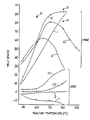
- reaction temperature and yield of MBE can be explained in more detail by referring to the accompanying drawing which is a graph showing reaction temperature plotted against the yield of ethylene glycol mono-tert-butyl ether (MBE) (mol% based on isobutylene) and the amount of the by-product of ethylene glycol di-tert-butyl ether (DBE) (mol%, based on isobutylene) in the reaction between ethylene glycol and isobutylene in the presence of a strongly acidic cation-exchange material catalyst.
- MBE ethylene glycol mono-tert-butyl ether
- DBE ethylene glycol di-tert-butyl ether
- curves 1 and 2 and points 3-5 respectively show the results in Examples 8-12 described below
- curves C1 and C2 respectively show the results in Comparative Examples 1 and 2 described below
- Curve 1 and points 3 and 5 show the results of adding ethylene glycol di-tert-butyl ether to the starting materials of the reaction system
- curve 2 and point 4 show the results of using a mixture of ethylene glycol di-tert-butyl ether and ethylene glycol mono-tert-butyl ether as the additive.
- Curves 1, 2 and point 4 show the result of performing the reaction for 1 hour, point 3 for 3 hours, and point 5 for 4 hours.
- Curve C1 shows the results of using only ethylene glycol mono-tert-butyl ether as the additive
- curve C2 shows the results of using no additives, with the reaction time being 1 hour in both cases.
- the addition of DBE alone (1) provided better yields than that obtained without additives (C2) and substantially the same results as those obtained with the addition of a mixture of MBE and DBE (2), with the yield of MBE reaching about 90%. Additionally, in the case of no additives (C2), the yield of MBE reached a maximum at about 75°C and, as the reaction temperature exceeded 75°C, the yield of MBE sharply decreased, whereas in the case of adding MBE alone (C1), the yield of MBE reached a maximum at about 65 to 70°C and sharply decreased at reaction temperatures higher than that.
- the amount of the by-product DBE it can be effectively suppressed by pre-adding to the reaction system DBE (1) or a mixture of DBE and MBE (2) according to the present invention as compared with the case of pre-adding MBE (C1) or no additives (C2) to the reaction system.
- the process of the present invention of reacting ethylene glycol with isobutylene to produce ethylene glycol mono-tert-butyl ether may be carried out by recycling essentially pure by-product DBE separated from the reaction mixture containing mostly ethylene glycol mono-tert-butyl ether and a slight amount of the by-product ethylene glycol di-tert-butyl ether through distillation, extraction, or like means.
- ethylene glycol di-tert-butyl ether added in the process of the present invention need not be pure and, when a mixture containing MBE is used, the reaction proceeds with the DBE functioning as the dominant factor, thus much better results are obtained.
- separation of ethylene glycol di-tert-butyl ether and ethylene glycol mono-tert-butyl ether as a mixture from the reaction product is generally easier than separation of the by-product of ethylene glycol di-tert-butyl ether alone (because the monoether and the diether form an azeotrope), and hence addition of ethylene glycol di-tert-butyl ether containing ethylene glycol mono-tert-butyl ether to the reaction system is industrially preferable.
- Isobutylene used in the process of the present invention may be isobutylene itself or a C 4 fraction comprising a mixture of hydrocarbons containing four carbon atoms (e.g., a mixture of isobutylene, n-butylene, butanes, etc) obtained by naphtha thermal cracking, catalytic cracking of kerosene and light oil, or the like. In the case of using such mixture, isobutylene reacts selectively.
- reaction temperatures result in a low yield of the MBE end product, whereas too high reaction temperatures (higher than 130°C) thermally damage the catalytic activity of the ion-exchange material. Therefore, in the practice of the present invention, it is suitable to set the lower limit of the reaction temperature at about 60°C, preferablybabout 75°C, and the upper limit at about 130°C in view of heat resistance of the catalyst of ion-exchange material, with about 85 to 110°C being particularly preferable.
- Reaction pressure is preferably high enough to maintain the reaction mixture in a liquid phase, but a reaction pressure permitting part of the reaction mixture to exist in a gas phase may also be employed.
- the reaction can be conducted under ordinary (atmospheric) pressure or an applied pressure. Usually the pressure is about 1 to 50 kg/cm2.
- the molar ratio of the starting ethylene glycol to the starting isobutylene is not particularly limited but is usually about 1 :0.1 to 1:10, particularly about 1:0.3 to 1:5.
- the amount of ethylene glycol di-tert-butyl ether to be added is at least about 10 mol%, particularly preferably about 30 to 80 mol%, based on the ethylene glycol or isobutylene, whichever is less.
- the reaction conducted by adding only MBE to the reaction system results in an increased amount of the by-product of DBE and, when the reaction temperature becomes 60°C or higher, there results a decreased yield of MBE end product as compared with the case of no additives, and hence existance of a large content of MBE in the DBE added to the reaction system is not preferable. Therefore, the ratio of MBE to the DBE in the additive mixture is particularly preferably within the range of not more than about 3 mols of MBE per 1 mol of DEB, though a ratio of about 5 mols of MBE per 1 mol of DBE is still somewhat effective.
- ethylene glycol di-t-butyl ether into ethylene glycol di-t-butyl ether.
- the reaction mechanism of this reaction has not been established, ethylene glycol mono-t-butyl ether is obtained in a good yield under mild conditions.
- the strongly acidic cation-exchange materials used as the catalyst have l a low corrosive property as compared with sulfuric acid, it is unnecessary to line the reactor or conduits with expensive anti-corrosion materials.
- the catalytic ion-exchange material is solid, separation of it from the reaction product is easily carried out and the reaction operation is simple.
- the process of the present invention effectively suppresses formation of the DBE by-product even when high reaction temperatures are employed and, therefore, the reaction can be completed in a short time with a high yield of ethylene glycol mono-tert-butyl ether.
- the net increase in the amount of ethylene glycol di-tert-butyl ether can be made zero by recycling the by-produced ethylene glycol di-tert-butyl ether to the reactor, whereby all the starting materials can be converted to ethylene glycol mono-tert-butyl ether.
- the liquid reaction product was analyzed and it was ascertained that the product comprised 0.565 mol of ethylene glycol, 0.013 mol of diisobutylene, 0.008 mol of ethylene glycol di-t-butyl ether and 0.136 mol of ethylene glycol mono-t-butyl ether.
- the result is shown in Table 1.
- the ethylene glycol di-t-butyl ether was converted into ethylene glycol mono-t-butyl ether notwithstanding ethylene glycol mono-t-butyl ether was contained in the feed material.
- a reaction of ethylene glycol with ethylene glycol di-t-butyl ether was carried out according to Example 1.
- the catalyst used was the styrene sulfonic acid type strongly acidic cation-exchange resin: Amberlite IR-1 18 (manufactured by Rohm & Haas Co., gel type resin, total exchange capacity: 4.4 meq/g-dry resin, specific surface area: 1 m 2 /g or less) in Example 3 and the styrene sulfonic acid type strongly acidic cation-exchange resin: Dowex 50 W-X12 (manufactured by Dow Chemical Co., gel type resin, total exchange capacity: 5.0 meq/g-dry resin, specific surface area: 1 m 2 /g or less) in Example 4. Reaction conditions and results are shown in Table 1.
- a strongly acidic cation-exchange resin (Amberlyst 15) was previously swollen in ethylene glycol, and 100 ml of the swollen resin was put in a stainless steel reaction tube having a 10 mm inside diameter. After the reaction tube was heated to 75°C, 1.500 mol-hr of ethylene glycol and 0.160 mol/hr of ethylene glycol di-t-butyl ether were introduced by means of a micro-pump to carry out the reaction at 75°C. The linear velocity of the entire feed materials was about 150 cm/hr. Further, the pressure of the reaction system was maintained at 20 kg/m 2.
- the reaction was carried out in the same manner as in Example 1 except that a mixture comprising 0.220 mol of ethylene glycol mono-t-butyl ether and small amounts of diisobutylene, triisobutylene and water besides 0.590 mol of ethylene glycol and 0.055 mol of ethylene glycol di-t-butyl ether was used as the feed material.
- the catalyst used was the strongly acidic cation-exchange resin (Amberlyst 15).
- the reaction conditions and the result of analyzing the liquid reaction product are shown in the following table.
- Ethylene glycol mono-tert-butyl ether was produced in a high yield, and the formation of ethylene glycol di-tert-butyl ether was effectively suppressed.
- Example 8 The same procedures as described in Example 8 were conducted except using a mixture of 17.9 g of ethylene glycol di-tert-butyl ether and 24.8 g (0.210 mol) of ethylene glycol mono-tert-butyl ether in' place of 17.9 g of ethylene glycol di-tert-butyl ether to obtain the results shown in Table 6.
- the MBE end product was produced in high yield, and the net amount of DBE produced was zero or slightly minus.
- Example 7 The same procedures as described in Example 8 were conducted except using 24.8 g of ethylene glycol mono-tert-butyl ether in place of 17.9 g of ethylene glycol di-tert-butyl ether to obtain the results shown in Table 7.
- the yield of MBE end product reached a maximum at about 65-70°C. Formation of the by-product of DBE was considerable at about 60°C or above.
- Example 8 The same procedures as in Example 8 were conducted except for using only ethylene glycol and isobutylene to obtain the results shown in Table 8.
- the yield of the end product of MBE reached a maximum at about 75°C.
- Example 8 The same procedures as in Example 8 were conducted using an autoclave (200 ml in content volume) equipped with a stirrer and reacting the starting materials under reaction conditions shown in Table 9. The results thus obtained are shown in Table 9.
- Example 11 the amounts of DBE and MBE added respectively were reduced to about as compared with Example 9. In this Example, too, the effect of preventing formation of the by-product of DBE was observed, though the yield of MBE was slightly less than in Example 9.
- Table 10 shows the results obtained by repeating the procedure of Example 13 except for adding no ethylene glycol di-tert-butyl ether to the starting material. Unlike Example 13, ethylene glycol di-tert-butyl ether was by-produced.
- feed amounts, resulting amounts, and yields in Table 10 are presented as the amounts fed or produced in the unit of mole per 1 hr per 1 ml of the catalyst.
- the reaction was conducted in the same manner as in Example 9 except for using as a catalyst 5.3 g of styrene sulfonic acid type strongly acidic cation-exchange resin, Amberlite IR-1 18 (made by Rohm & Haas Co.; gel type resin; total exchange capacity: 4.4 meq/g/dry resin; specific surface area: not more than 1 m 2 /g) previously well dried at 120°C under reduced pressure. Reaction conditions were 75°C for the reaction temperature and 1 hour for the reaction time. Results of the reaction are shown in Table 11. As shown in Table 11, the end product of ethylene glycol mono-tert-butyl ether was produced in a high yield and the net amount of by-produced ethylene glycol di-tert-butyl ether was zero.
- the reaction was conducted in the same manner as in Example 9 except for using 5.5 g of commercially available sulfonated coal, Dusarit S (made by Activit N.V.) as a catalyst and reacting for 3 hours.
- the reaction temperature was 75°C. Results thus obtained are shown in Table 11.
Landscapes
- Chemical & Material Sciences (AREA)
- Organic Chemistry (AREA)
- Organic Low-Molecular-Weight Compounds And Preparation Thereof (AREA)
- Low-Molecular Organic Synthesis Reactions Using Catalysts (AREA)
Abstract
Description
- The present invention relates to a process for producing ethylene glycol mono-t-butyl ether and particularly, to a process for converting ethylene glycol di-t-butyl ether into ethylene glycol mono-t-butyl ether.
- Ethylene glycol mono-t-butyl ether is a useful substance having excellent properties as a solvent, a dispersing agent and a diluent in the field of coatings, inks, etc. It is well known that ethylene glycol mono-t-butyl ether can be synthesized from isobutylene and ethylene glycol ether can be synthesized from isobutylene and ethylene glycol in the presence of an acid catalyst. It has been further described in U.S. Patents 3,317,483, 3,170,000 and 2,480,940 that, in this synthesis strongly acidic cation-exchange materials are useful as the catalyst. However, in producing ethylene glycol mono-t-butyl ether (abbreviated MBE) from isobutylene and ethylene glycol, it is not possible to avoid producing ethylene glycol di-t-butyl ether (abbreviated DBE) as a by-product, even if a catalyst is used. If ethylene glycol dit-butyl ether is obtained as a by-product, the yield of ethylene glycol mono-t-butyl ether is reduced and this detracts from the economic value of its production. Accordingly, if it were possible to convert the ethylene glycol di-t-butyl ether by-product into the desired ethylene glycol mono-t-butyl ether, considerable advantages would be obtained. However, a satisfactory process for converting ethylene glycol di-t-butyl ether into ethylene glycol mono-t-butyl ether is not presently available.
- Further, no processes have so far been discovered which effectively suppress formation of the by-product of DBE in the etherification between isobutylene and ethylene glycol.
- As indicated above, U.S. Patent Nos. 3,317,483, 3,170,000 and 2,480,940 teach that ethylene glycol mono-tert-butyl ether can be synthesized from ethylene glycol and isobutylene. Of these, U.S. Patent 31700000 relates to a process of producing MBE from an olefin mixture containing isobutylene and alcohol, and selectively separating and recovering tert-olefin by the decomposition of the resulting MBE. This patent describes recycling a mixture of alcohol and MBE obtained in the final step to an etherification reactor in the first step. Also, Japanese Patent Application (OPI) No. 29413/76 describes a process of producing ethylene glycol mono-tert-butyl ether from ethylene glycol and isobutylene by previously adding ethylene glycol mono-tert-butyl ether to the reaction system. However, these processes suffer from the problem of increasing the amount of by-product ethylene glycol di-tert-butyl ether.
- In the conventional processes for producing ethylene glycol mono-t-butyl ether (MBE) by using isobutylene and ethylene glycol as starting materials, the amount of ethylene glycol di-t-butyl ether (DBE) formed as a by-product is increased with the passage of reaction time. The present invention is based on the finding that MBE can be produced from DBE and ethylene glycol. The process of the' present invention cannot be anticipated from the teachings of the prior art and is different from the prior art processes. Thus, the process of the invention is characterised in that DBE is present as a starting material in the reaction system when the reaction is initiated, that is, the present invention is achieved by adding DBE other than DBE formed automatically as a by-product of the reaction between ethylene glycol and any isobutylene present in the reaction system.
- Accordingly, the invention resides in one aspect in a process for producing ethylene glycol mono-t-butyl ether which comprises contacting a starting mixture or feed materials comprising ethylene glycol di-t-butyl ether and ethylene glycol as starting materials with a strongly acidic cation exchange material to react ethylene glycol di-t-butyl ether in said mixture with ethylene glycol in said mixture in the presence of the strongly acidic cation-exchange material as a catalyst and produce ethylene glycol mono-t-butyl ether.
- According to a further aspect, the present invention resides in a process for producing ethylene glycol mono-t-butyl ether which comprises contacting a starting mixture comprising ethylene glycol dit-butyl ether, ethylene glycol and at least one member selected from the group consisting of ethylene glycol mono-t-butyl ether, diisobutylene and triisobutylene with a strongly acidic cation exchange material as a catalyst to react the ethylene glycol di-t-butyl ether in said mixture with the ethylene glycol in said mixture and produce ethylene glycol mono-t-butyl ether.
- According to yet a further aspect, the present invention resides in a process for producing ethylene glycol mono-t-butyl ether wherein isobutylene is reacted with ethylene glycol in the presence of a strongly acidic cation-exchange material to give ethylene glycol di-t-butyl ether as a by-product, and wherein a starting mixture comprising the ethylene glycol di-t-butyl ether by-product of said reaction and ethylene glycol as starting materials is contacted with a strongly acidic cation-exchange material to react ethylene glycol di-t-butyl ether in said mixture with ethylene glycol in said mixture in the presence of the strongly acid cation exchange material as a catalyst and produce ethylene glycol mono-t-butyl' ether.
- According to still yet a further aspect, the present invention resides in a process for producing ethylene glycol mono-tert-butyl ether wherein ethylene glycol is reacted with isobutylene in the presence of a strongly acidic cation-exchange material, and wherein an additive comprising ethylene glycol di-tert-butyl ether is previously added to the reaction system and the reaction is conducted at a temperature of about 60 to 130°C.
- The process of the present invention is .particularly suitable for converting ethylene glycol di-t-butyl ether formed as a by-product in the production of ethylene glycol mono-t-butyl ether from ethylene glycol and isobutylene, into ethylene glycol di-t-butyl ether. However, the ethylene glycol di-t-butyl ether used in the present invention is not necessarily limited to that produced by the reaction of isobutylene and ethylene glycol, so that ethylene glycol di-t-butyl ether produced from other raw materials and by other reactions may be used.
- Further the process of the present invention is not substantially interfered with if the product, by products and additives of the reaction for producing ethylene glycol mono-t-butyl ether from isobutylene and ethylene glycol such as diisobutylene, triisobutylene, and ethylene glycol mono-t-butyl ether are present in the reaction mixture. The process for producing ethylene glycol mono-t-butyl ether from ethylene glycol and isobutylene is itself disclosed in, for example, U.S. Patent Nos: 3,170,000; 3,317,483 and 2,480,940 which comprises reacting ethylene glycol with isobutylene in the presence of a strongly acidic cation-exchange material as a catalyst. Generally, the preferred molar ratio of the feed ethylene glycol to the feed isobutylene is about 1:0.05 to 1:20 in these processes. The preferred reaction temperature is about 20 to 130°C and particularly 40 to 130°C. Although the reaction may be conducted at either atmospheric pressure or in the presence of an applied pressure, a pressure of about 1 to 50 kg/cm2 is preferred. The reaction may also be carried out as either a batch or a continuous process. Typically, the reaction mixture comprises isobutylene, diisobutylene, triisobutylene, ethylene glycol, ethylene glycol mono-t-butyl ether, ethylene glycol di-t-butyl ether and the catalyst.
- As the starting material of the present invention, ethylene glcyol di-t-butyl ether which contains ethylene glycol mono-t-butyl ether may be used, because it is generally easier to separate ethylene glycol di-t-butyl ether and ethylene glycol mono-t-butyl- ether as a mixture from the above described reaction mixture by distillation than to separate only the by-produced ethylene glycol di-t-butyl ether, since the ethylene glycol mono-t-butyl ether and the ethylene glycol di-t-butyl ether form an azeotropic mixture. Further, since the product obtained by removing isobutylene from the above described reaction mixture and then removing part of all of the ethylene glycol mono-t-butyl ether is composed mainly of ethylene glycol di-t-butyl ether, it is possible to carry out the reaction according to the present invention by adding ethylene glycol or the catalyst (if the catalyst present or ethylene glycol present is insufficient) to convert the ethylene glycol di-t-butyl ether into ethylene glycol mono-t-butyl ether by reaction with the ethylene glycol.
- As described above, the feed materials contacted with the catalyst in the process of the present invention may be a mixture of ethylene glycol and ethylene glycol di-t-butyl ether or a mixture comprising at least one member selected from ethylene glycol mono-t-butyl ether, diisobutylene and triisobutylene besides ethylene glycol di-t-butyl ether and ethylene glycol, and particularly, a mixture of ethylene glycol, ethylene glycol di-t-butyl ether and ethylene glycol mono-t-butyl ether. Amounts of diisobutylene and triisobutylene should be at most about 10% by weight and generally about 3% by weight or less in the feed materials.
- In the reaction according to the present invention, the composition of the reaction product varies in accordance with the reaction temperature. Particularly, at temperatures higher than 50°C, it is preferred to limit the amount of MBE in the feed materials, because if the ethylene glycol mono-t-butyl ether is present in large amounts conversion of the di-ether into the mono-ether is inhibited.
- In the present invention, the strongly acidic cation-exchange materials used as the catalyst are those which show strong acidity and are water-insoluble, namely, sulfonated materials having sulfonic acid groups (S03H) as functional groups. As the strongly acidic cation-exchange materials, there are styrene sulfonic acid type cation-exchange resins, phenol sulfonic acid type cation-exchange resins, sulfonated asphalt and sulfonated coals. The styrene sulfonic acid type cation-exchange resins are those which are prepared by sulfonating resins composed of a copolymer of styrene and an unsaturted polyene compound such as divinylbenzene (which are available as Amberlyst 15, Amberlite IR-1 18 and Amberlite IR-20 manufactured by Rhom & Haas Co. and Dowex 50W-X12 manufactured by Dow Chemical Co., etc.). The phenol sulfonic acid type cation-exchange resins are those which are prepared by condensing phenol-sulfonic acid with formaldehyde (which are available as Amberlite IR-1, Amberlite IR-100 and Amberlite IR-105G manufactured by Rohm & Haas Co., etc.). The sulfonated coals are those produced by -sulfonating bituminous coal with sulfuric acid (which are available as Nalcite X and Nalcite AX manufactured by Dow Chemical Co. and Zeo-Karb H manufactured by the Permutit Co., Ltd., and Dursarit S manufactured by Acivit N.V., etc.). Where these strongly acidic cation-exchange materials are available as neutral materials such as the sodium salts, they should be activated by processing with a strong inorganic acid such as hydrochloric acid and washing with water prior to use to remove sodium and chloride ions. Further, as the physical structure of these cation-exchange materials, those of gel type and macroporous type materials may be used. A preferred total exchange capacity of these strongly acidic cation-exchange materials is at least about 0.5 meq/g-dry material and particularly about 1.0-7.0 meg/g.-dry material.
- If the reaction temperature is too low, the reaction rate is slow. On the other hand, if it is too high, the ion-exchange catalyst can suffer thermal damage. Accordingly the preferred temperature range is about 30 to 130°C and particularly about 50 to 100°C. The reaction pressure is not particularly restricted, and the reaction can be carried out under atmospheric pressure or an applied pressure. Generally, a pressure sufficient to keep the reaction mixture at a liquid state is preferred, but a pressure under which a part of the reaction mixture exists as a gas may be used. A conveniently adopted pressure is about to 150 kg/cm2.
- Although the molar ratio of ethylene glycol to ethylene glycol di-t-butyl ether is not particularly restricted, an excess of ethylene glycol is generally used. However, when it is not desired to have ethylene glycol in the product during separation and purification of the product, excess di-ether is used. Accordingly, the molar ratio of the feed ethylene glycol to the feed ethylene glycol di-t-butyl ether is generally in the range of about 1:0.01 to 1 :20 and preferably about 1 :0.05 to 1:10.
- When a mixture comprising ethylene glcyol mono-t-butyl ether is used as the feed material, the molar ratio of ethylene glycol di-t-butyl ether to ethylene glycol mono-t-butyl ether in the feed material is generally in the range of about 1:0 to 1:20, preferably about 1:0 to 1:10 and particularly about 1:0 to 1:5. When the reaction temperature is high as described above, for example, 50°C or more, it is particularly preferred that the molar ratio of the di-ether to the mono-ether in the raw material is in the range of about 1:0 to 1 :3, because the conversion of the di-ether into the mono-ether is obstructed, if the mono-ether is present in a large amount in the feed material. Although the amount of the cation-exchange material used as the catalyst is not necessarily limited, it is generally preferred in the range of about 0.5 to 30% and particularly 1 to 15% by weight based on the starting material. Further, although a solvent is not generally necessary, inert solvents, such as hydrocarbons exemplified by n-heptane, n-hexane, benzene, toluene, xylene, or halogenated hydrocarbons exemplified by trichloroethylene, tetrachloroethane and tetrachloromethane may be used.
- The reaction can be carried out by either an agitation type batch process or a continuous process and can also be carried out in a fixed-bed flowing process. Although the reaction time is not restricted, it is preferably in the range of about 5 minutes to 50 hours and particularly about 20 minutes to 10 hours, in the case of the batch process. In the case of the continuous process, it is preferred that liquid hourly space velocity of the starting material is about 0.1 to 10 hr-1 and particularly 0.5 to 2 hr-1. In case of the flowing process, it is preferred that linear velocity of all starting materials passing through the catalyst bed (flow amount of the materials cm3/hr based on 1 CM 2 of the section area of the reactor, which is represented as a liquid state at room temperature under an increased pressure) is about 30 cm/hr or more and particularly about 60 cm/hr to 50 m/hr.
- The separation of ethylene glycol mono-t-butyl ether from the reaction product can be carried out by a conventional method such as distillation and/or solvent extraction using a solvent such as water, heptane or alcohol, or an extractive distillation method.
- As described above, since the ethylene glycol di-tert-butyl ether can be converted into ethylene glycol mono-tert-butyl ether by reacting with ethylene glycol in the presence of the strongly acidic cation-exchange resin as a catalyst, this reaction is applicable to the production of ethylene glycol mono-tert-butyl ether by reacting isobutylene with ethylene glycol in the presence of the strongly acidic cation-exchange resin as a catalyst. That is, in the latter reaction, the ethylene glycol di-tert-butyl ether in the reaction system is converted into ethylene glycol mono-tert-butyl ether by conducting the reaction at 60 to 130°C by previously adding additives such as ethylene glcyol di-tert-butyl ether to the reaction system and, as a result, the net amount of the ethylene glycol di-tert-butyl ether formed as a by-product can be reduced.
- As a result of detailed investigations of the reaction between ethylene glycol and isobutylene, it has been discovered that the reaction is unexpectedly sensitive to temperature, and that materials copresent in the reaction system influence the reaction in a different manner in a low reaction temperature (not higher than 60°C) than in a high reaction temperature (not lower than 60°C).
- Thus, it has been found that, when the reaction is conducted at various temperatures within the range of 45 to 130°C by pre-adding DBE to the reaction system so as to suppress formation of the DBE by-product, the addition of DBE completely suppressed formation of the by-product of DBE over the entire temperature range. Although the yield of the end product MBE was less in the lower temperature range when adding DBE as compared with the case of not adding the additive, as the temperature increased, addition of DBE served instead to increase the end product MBE as compared with the case of not adding the DBE. In this reaction, however, the net yield of DBE in some cases reaches minus levels, though it depends upon the amount of DBE added, and hence it is sometimes necessary to separately prepare the DBE added.
- When the same tests as described above were conducted by adding a mixture of DBE and MBE so as to remove the above described defect, formation of the by-product DBE was suppressed to almost zero over the entire temperature range, the yield of MBE improved with an increase in reaction temperature.
- As stated above, the addition of DBE alone and the addition of the mixture of DBE and MBE tend to increase the MBE yield, with the latter providing the higher yield of MBE of the two. Thus, it might be expected that addition of MBE would further increase the yield of MBE and suppress the amount of by-produced DBE. With this in mind, the effects of the addition of MBE alone were also tested in the same manner as described above. In this test, however, it was found that the amount of by-produced DBE increased as the reaction temperature increased, the amount of the by-product seriously increased at reaction temperatures of about 60°C or above, the yield of MBE reached a maximum unexpectedly at about 70°C, and at higher reaction temperatures the yield of MBE sharply decreased.
- Thus, in addition of DBE to the reaction system provides results substantially different from the results provided by the addition of MBE when reaction temperatures are varied and, in the case of adding a mixture of DBE and MBE, the DBE in the mixture is a dominant factor in both the formation of MBE and suppressing the formation of by-product DBE.
- The relationship between reaction temperature and yield of MBE can be explained in more detail by referring to the accompanying drawing which is a graph showing reaction temperature plotted against the yield of ethylene glycol mono-tert-butyl ether (MBE) (mol% based on isobutylene) and the amount of the by-product of ethylene glycol di-tert-butyl ether (DBE) (mol%, based on isobutylene) in the reaction between ethylene glycol and isobutylene in the presence of a strongly acidic cation-exchange material catalyst.
- In the drawing,
curves 1 and 2 and points 3-5 respectively show the results in Examples 8-12 described below, and curves C1 and C2 respectively show the results in Comparative Examples 1 and 2 described below. Curve 1 and points 3 and 5 show the results of adding ethylene glycol di-tert-butyl ether to the starting materials of the reaction system, andcurve 2 and point 4 show the results of using a mixture of ethylene glycol di-tert-butyl ether and ethylene glycol mono-tert-butyl ether as the additive.Curves 1, 2 and point 4 show the result of performing the reaction for 1 hour, point 3 for 3 hours, and point 5 for 4 hours. Curve C1 shows the results of using only ethylene glycol mono-tert-butyl ether as the additive, whereas curve C2 shows the results of using no additives, with the reaction time being 1 hour in both cases. - Comparison of the results of
curves 1, 2, C1 and C2, which were conducted under the same reaction conditions except for additives reveals that formation of the by-product of ethylene glycol di-tert-butyl ether was effectively suppressed and the yield of the end product of ethylene glycol mono-tert-butyl ether was maintained at a high level in Examples 8 and 9 accordance with the present invention. - It will be seen from the drawing that the addition of MBE, (C1) provided the best results in the tests where the reaction was conducted for 1 hour at a temperature not higher than 60°C, whereas at a temperature higher than 60°C, the addition of no additives (C2) or the addition of a mixture of DBE and MBE (2) provided results which were better than the addition of MBE alone (C1). The MBE yield in the case of adding DBE alone (1) reached about 40% at about 60°C, which is high enough to make production practical. '
- At 75°C, the MBE yield with the addition of DBE alone (1) reached as high as about 60% and exceeded the yield with the addition of MBE (C1).
- Further, in the tests carried out at about 85°C or above, the addition of DBE alone (1) provided better yields than that obtained without additives (C2) and substantially the same results as those obtained with the addition of a mixture of MBE and DBE (2), with the yield of MBE reaching about 90%. Additionally, in the case of no additives (C2), the yield of MBE reached a maximum at about 75°C and, as the reaction temperature exceeded 75°C, the yield of MBE sharply decreased, whereas in the case of adding MBE alone (C1), the yield of MBE reached a maximum at about 65 to 70°C and sharply decreased at reaction temperatures higher than that.
- As to the amount of the by-product DBE, it can be effectively suppressed by pre-adding to the reaction system DBE (1) or a mixture of DBE and MBE (2) according to the present invention as compared with the case of pre-adding MBE (C1) or no additives (C2) to the reaction system.
- The process of the present invention of reacting ethylene glycol with isobutylene to produce ethylene glycol mono-tert-butyl ether may be carried out by recycling essentially pure by-product DBE separated from the reaction mixture containing mostly ethylene glycol mono-tert-butyl ether and a slight amount of the by-product ethylene glycol di-tert-butyl ether through distillation, extraction, or like means. However, as has been stated before, ethylene glycol di-tert-butyl ether added in the process of the present invention need not be pure and, when a mixture containing MBE is used, the reaction proceeds with the DBE functioning as the dominant factor, thus much better results are obtained. In addition, separation of ethylene glycol di-tert-butyl ether and ethylene glycol mono-tert-butyl ether as a mixture from the reaction product is generally easier than separation of the by-product of ethylene glycol di-tert-butyl ether alone (because the monoether and the diether form an azeotrope), and hence addition of ethylene glycol di-tert-butyl ether containing ethylene glycol mono-tert-butyl ether to the reaction system is industrially preferable.
- Isobutylene used in the process of the present invention may be isobutylene itself or a C4 fraction comprising a mixture of hydrocarbons containing four carbon atoms (e.g., a mixture of isobutylene, n-butylene, butanes, etc) obtained by naphtha thermal cracking, catalytic cracking of kerosene and light oil, or the like. In the case of using such mixture, isobutylene reacts selectively.
- Low reaction temperatures result in a low yield of the MBE end product, whereas too high reaction temperatures (higher than 130°C) thermally damage the catalytic activity of the ion-exchange material. Therefore, in the practice of the present invention, it is suitable to set the lower limit of the reaction temperature at about 60°C, preferablybabout 75°C, and the upper limit at about 130°C in view of heat resistance of the catalyst of ion-exchange material, with about 85 to 110°C being particularly preferable.
- Reaction pressure is preferably high enough to maintain the reaction mixture in a liquid phase, but a reaction pressure permitting part of the reaction mixture to exist in a gas phase may also be employed. The reaction can be conducted under ordinary (atmospheric) pressure or an applied pressure. Usually the pressure is about 1 to 50 kg/cm2.
- The molar ratio of the starting ethylene glycol to the starting isobutylene is not particularly limited but is usually about 1 :0.1 to 1:10, particularly about 1:0.3 to 1:5. The amount of ethylene glycol di-tert-butyl ether to be added is at least about 10 mol%, particularly preferably about 30 to 80 mol%, based on the ethylene glycol or isobutylene, whichever is less.
- As has been described before, in the process of producing ethylene glycol mono-tert-butyl ether from isobutylene and ethylene glycol, the reaction conducted by adding only MBE to the reaction system results in an increased amount of the by-product of DBE and, when the reaction temperature becomes 60°C or higher, there results a decreased yield of MBE end product as compared with the case of no additives, and hence existance of a large content of MBE in the DBE added to the reaction system is not preferable. Therefore, the ratio of MBE to the DBE in the additive mixture is particularly preferably within the range of not more than about 3 mols of MBE per 1 mol of DEB, though a ratio of about 5 mols of MBE per 1 mol of DBE is still somewhat effective.
- According to the process of the present invention, it is possible to convert ethylene glycol di-t-butyl ether into ethylene glycol di-t-butyl ether. Though the reaction mechanism of this reaction has not been established, ethylene glycol mono-t-butyl ether is obtained in a good yield under mild conditions. Further, since the strongly acidic cation-exchange materials used as the catalyst havela low corrosive property as compared with sulfuric acid, it is unnecessary to line the reactor or conduits with expensive anti-corrosion materials. Further, since the catalytic ion-exchange material is solid, separation of it from the reaction product is easily carried out and the reaction operation is simple.
- As previously stated the conversion of ethylene glycol di-tert-butyl ether into ethylene glycol mono-tert-butyl ether by reacting the ethylene glycol di-tert-butyl ether with ethylene glycol is particularly applicable to the reaction of producing ethylene glycol mono-tert-butyl ether by reacting isobutylene with ethylene glycol. That is, when the reaction between ethylene glycol and isobutylene is conducted at high temperatures by adding ethylene glycol di-tert-butyl ether to the reaction system, formation of the by-product of ethylene glycol di-tert-butyl ether can effectively be suppressed and, at the same time, the end product of ethylene glycol mono-tert-butyl ether can be obtained in a bigh yield. In particular, unlike the reaching of U.S. Patent 3,170,000 in which MBE-containing alcohol is fed to an . etherifying reactor which results in an increased amount of the by-product of DBE and a decreased yield of the end product of MBE, the process of the present invention effectively suppresses formation of the DBE by-product even when high reaction temperatures are employed and, therefore, the reaction can be completed in a short time with a high yield of ethylene glycol mono-tert-butyl ether.
- According to the present invention, the net increase in the amount of ethylene glycol di-tert-butyl ether can be made zero by recycling the by-produced ethylene glycol di-tert-butyl ether to the reactor, whereby all the starting materials can be converted to ethylene glycol mono-tert-butyl ether.
- The present invention will now be described in more detail by the following Examples and Comparative Examples which, however, are merely illustrative and should not be construed as limiting the process of the present invention.
- In a stainless steel autoclave having a volume of 100 ml equipped with a stirrer, 5.2 g of a styrene sulfonic acid type strongly acidic cation-exchange resin (Amberlyst 15, manufactured by Rohm & Haas Co., macroporous type resin, total exchange capacity: 4.9 meq./g-dry resin, specific surface area: 40-50 m2/g, average pore size: 200-600 A), 0.565 mol of ethylene glycol and 0.057 mol of ethylene glycol di-t-butyl ether were mixed and a nitrogen gas was introduced thereto. The mixture was subjected to reaction at 75°C for 2 hours. The pressure was 20 kg/cm2. When the liquid reaction product was analyzed, it was ascertained that the product comprised 0.520 mol of ethylene glycol, 0.004 mol of diisobutylene, 0.004 mol of ethylene glycol di-t-butyl ether and 0.098 mol of ethylene glycol mono-t-butyl ether. The result is shown in Table 1. Ethylene glycol di-t-butyl ether was converted into ethylene glycol mono-t-butyl in a good yield.
- In an autoclave having a volume of 100 ml equipped with a stirrer, 5.5 g of a styrene sulfonic acid type strongly acidic cation-exchange resin (Amberlyst 15), 0.590 mol of ethylene glycol, 0.055 mol of ethylene glycol di-t-butyl ether and 0.064 mol of ethylene glycol mono-t-butyl ether were mixed, and nitrogen gas was introduced thereto. The mixture was subjected to reaction ast 90°C for 2 hours. The pressure was 20 kg/cm2. The liquid reaction product was analyzed and it was ascertained that the product comprised 0.565 mol of ethylene glycol, 0.013 mol of diisobutylene, 0.008 mol of ethylene glycol di-t-butyl ether and 0.136 mol of ethylene glycol mono-t-butyl ether. The result is shown in Table 1. In this reaction the ethylene glycol di-t-butyl ether was converted into ethylene glycol mono-t-butyl ether notwithstanding ethylene glycol mono-t-butyl ether was contained in the feed material.
- A reaction of ethylene glycol with ethylene glycol di-t-butyl ether was carried out according to Example 1. The catalyst used was the styrene sulfonic acid type strongly acidic cation-exchange resin: Amberlite IR-1 18 (manufactured by Rohm & Haas Co., gel type resin, total exchange capacity: 4.4 meq/g-dry resin, specific surface area: 1 m2/g or less) in Example 3 and the styrene sulfonic acid type strongly acidic cation-exchange resin: Dowex 50 W-X12 (manufactured by Dow Chemical Co., gel type resin, total exchange capacity: 5.0 meq/g-dry resin, specific surface area: 1 m2/g or less) in Example 4. Reaction conditions and results are shown in Table 1.

- A strongly acidic cation-exchange resin (Amberlyst 15) was previously swollen in ethylene glycol, and 100 ml of the swollen resin was put in a stainless steel reaction tube having a 10 mm inside diameter. After the reaction tube was heated to 75°C, 1.500 mol-hr of ethylene glycol and 0.160 mol/hr of ethylene glycol di-t-butyl ether were introduced by means of a micro-pump to carry out the reaction at 75°C. The linear velocity of the entire feed materials was about 150 cm/hr. Further, the pressure of the reaction system was maintained at 20 kg/m2. When a liquid reaction product which was produced after 5 to 6 hours from beginning the reaction, at which the state of the reaction was normal, was analyzed, the results shown in the following table were obtained. The ethylene glycol di-t-butyl ether was effectively converted into ethylene glycol mono-t-butyl ether.

- The reaction was carried out in the same manner as in Example 1 except that a mixture comprising 0.220 mol of ethylene glycol mono-t-butyl ether and small amounts of diisobutylene, triisobutylene and water besides 0.590 mol of ethylene glycol and 0.055 mol of ethylene glycol di-t-butyl ether was used as the feed material. The catalyst used was the strongly acidic cation-exchange resin (Amberlyst 15). The reaction conditions and the result of analyzing the liquid reaction product are shown in the following table.

- In an autoclave having a 100 ml volume equipped with a stirrer, 5.5 g of sulfonated coal: Dusarit S (manufactured by Activit N.V. Co.), 0.565 mol of ethylene glycol and 0.057 mol of ethylene lycol di-t-butyl ether were mixed, and nitrogen gas was introduced thereto. The mixture was subjected to reaction at 60°C for 4 hours. The pressure was 20 kg/cm2. The result of analyzing the liquid reaction product is shown in the following table. The ethylene glycol di-t-butyl ether was effectively converted into ethylene glycol mono-t-butyl ether.

- 5.25 g of Amberlyst 15 (made by Rohm & Haas Co.; macroporous type resin; total exchange capacity: 4.9 meq/g-dry resin; specific surface area: 40-50 m2/g; average pore size: 200-600 A) as a catalyst and, as starting materials, 35.0 g (0.565 mol) of ethylene glycol, 11.7 g (0.209 mol) of isobutylene, and as an additive 17.9 g (0.103 mol) of ethylene glycol di-tert-butyl ether were charged in an autoclave (200 ml in volume) equipped with a stirrer rotating at 1,300 rpm, followed by charging with nitrogen gas and reacting for 1 hour under a pressure of 20 kg/cm2 at a predetermined reaction temperature. After completion of the reaction, isobutylene was discharged, and the remaining reaction product was analyzed according to gas chromatograph. The results thus obtained are tabluated in Table 5.
- Ethylene glycol mono-tert-butyl ether was produced in a high yield, and the formation of ethylene glycol di-tert-butyl ether was effectively suppressed.

- The same procedures as described in Example 8 were conducted except using a mixture of 17.9 g of ethylene glycol di-tert-butyl ether and 24.8 g (0.210 mol) of ethylene glycol mono-tert-butyl ether in' place of 17.9 g of ethylene glycol di-tert-butyl ether to obtain the results shown in Table 6. The MBE end product was produced in high yield, and the net amount of DBE produced was zero or slightly minus.

- The same procedures as described in Example 8 were conducted except using 24.8 g of ethylene glycol mono-tert-butyl ether in place of 17.9 g of ethylene glycol di-tert-butyl ether to obtain the results shown in Table 7. The yield of MBE end product reached a maximum at about 65-70°C. Formation of the by-product of DBE was considerable at about 60°C or above.

- The same procedures as in Example 8 were conducted except for using only ethylene glycol and isobutylene to obtain the results shown in Table 8. The yield of the end product of MBE reached a maximum at about 75°C.

- The same procedures as in Example 8 were conducted using an autoclave (200 ml in content volume) equipped with a stirrer and reacting the starting materials under reaction conditions shown in Table 9. The results thus obtained are shown in Table 9.

- From the results of Examples 10 and 12, it will be seen that the net amount of by-produced DBE can be maintained zero by adding only DBE and controlling of the DBE amount added, to thereby- obtain MBE in a high yield.
- In Example 11, the amounts of DBE and MBE added respectively were reduced to about

- Yields of MBE and DBE obtained in Examples 8 and 9 and Comparative Examples 1 and 2 and yields of MBE in Examples 10 to 12 are shown in the attached drawing.
- 100 ml of Amberlyst 15 previously swollen with ethylene glycol was charged into a stainless steel-made pressure-resistant pipe type reactor. A C4 fraction obtained by naphtha cracking (isobutylene content: 45.0 wt%), ethylene glycol, and ethylene glycol di-tert-butyl ether were continuously fed to a catalyst bed under the reaction conditions of 75°C, 20 kg-cm2. Linear velocity of the total starting materials and additive was 484 cm/hr. Reaction results of steady state which was attained five hours after initiation of the reaction are shown in Table 10. There was observed reduction in the amount of ethylene glycol di-tert-butyl ether.
- Table 10 shows the results obtained by repeating the procedure of Example 13 except for adding no ethylene glycol di-tert-butyl ether to the starting material. Unlike Example 13, ethylene glycol di-tert-butyl ether was by-produced.
- Additionally, feed amounts, resulting amounts, and yields in Table 10 are presented as the amounts fed or produced in the unit of mole per 1 hr per 1 ml of the catalyst.

- The reaction was conducted in the same manner as in Example 9 except for using as a catalyst 5.3 g of styrene sulfonic acid type strongly acidic cation-exchange resin, Amberlite IR-1 18 (made by Rohm & Haas Co.; gel type resin; total exchange capacity: 4.4 meq/g/dry resin; specific surface area: not more than 1 m2/g) previously well dried at 120°C under reduced pressure. Reaction conditions were 75°C for the reaction temperature and 1 hour for the reaction time. Results of the reaction are shown in Table 11. As shown in Table 11, the end product of ethylene glycol mono-tert-butyl ether was produced in a high yield and the net amount of by-produced ethylene glycol di-tert-butyl ether was zero.
- The reaction was conducted in the same manner as in Example 9 except for using 5.5 g of commercially available sulfonated coal, Dusarit S (made by Activit N.V.) as a catalyst and reacting for 3 hours. The reaction temperature was 75°C. Results thus obtained are shown in Table 11.
- As can be seen from Table 11, the yield of the end product of ethylene glycol mono-tert-butyl ether was high, and the net amount of ethylene glycol di-tert-butyl ether was slightly decreased.

- 35.0 g of ethylene glycol, 9.9 g of DBE and 5.0 g of amberlyst 15 were charged in a stainless autoclave (100 milliliter in volume) followed by conducting the reaction at 60°C. The reaction product was analysed and the changes in the amounts (mol percent) of the components ethylene glycol, MBE and DBE with the passage of time are tabulated in Table 12. The compositions (mol percent) as described in Table 12 are based on the total moles (100 mol percent) of ethylene glycol, MBE and DBE in the reaction product in which the butane, butene and polymer of butene formed as by-product had been removed.
- The results as described in Table 12 show that the amount of each of DBE and ethylene glycol is reduced with the passage of time and the amount of MBE produced is increased with the passage of time. Therefore, it can be appreciated from the results of Table 12 that the reaction of converting DBE into MBE is caused by reaction of DBE with ethylene glycol.

- 11.8 g of isobutylene, 35.0 g of ethylene glycol and 5.0 g of amberlyst 15 were charged in a stainless autoclave (100 milli-liter in volume), followed by conducting the reaction at 60°C. Following analysis of the reaction product in the same way as in Example 16, the changes in the amount (mol percent) of ethylene glycol, MBE and DBE with the passage of time are tabulated in Table 13.
- The results of Table 13 show that the amount of DBE is increased with the passage of time. Further, the amount of the MBE produced reached a maximum at reaction time of about 3 hours, and then gradually reduced. Therefore, it can be appreciated from the results of Table 13 that the reaction comprising producing MBE by reacting ethylene glycol with isobutylene and then producing DBE by reacting the resulting MBE with isobutylene is successively conducted.

Claims (26)
Priority Applications (3)
| Application Number | Priority Date | Filing Date | Title |
|---|---|---|---|
| AT80300623T ATE6147T1 (en) | 1980-02-29 | 1980-02-29 | PROCESS FOR THE PRODUCTION OF ETHYLENE GLYCOL MONO-TERT-BUTYL ETHER. |
| EP80300623A EP0035075B1 (en) | 1980-02-29 | 1980-02-29 | Process for producing ethylene glycol mono-t-butyl ether |
| DE8080300623T DE3066450D1 (en) | 1980-02-29 | 1980-02-29 | Process for producing ethylene glycol mono-t-butyl ether |
Applications Claiming Priority (1)
| Application Number | Priority Date | Filing Date | Title |
|---|---|---|---|
| EP80300623A EP0035075B1 (en) | 1980-02-29 | 1980-02-29 | Process for producing ethylene glycol mono-t-butyl ether |
Publications (2)
| Publication Number | Publication Date |
|---|---|
| EP0035075A1 EP0035075A1 (en) | 1981-09-09 |
| EP0035075B1 true EP0035075B1 (en) | 1984-02-08 |
Family
ID=8187111
Family Applications (1)
| Application Number | Title | Priority Date | Filing Date |
|---|---|---|---|
| EP80300623A Expired EP0035075B1 (en) | 1980-02-29 | 1980-02-29 | Process for producing ethylene glycol mono-t-butyl ether |
Country Status (3)
| Country | Link |
|---|---|
| EP (1) | EP0035075B1 (en) |
| AT (1) | ATE6147T1 (en) |
| DE (1) | DE3066450D1 (en) |
Families Citing this family (7)
| Publication number | Priority date | Publication date | Assignee | Title |
|---|---|---|---|---|
| DE3923292A1 (en) * | 1989-07-14 | 1991-01-24 | Erdoelchemie Gmbh | PROCESS FOR MAKING ETHERS FROM C (ARROW DOWN) 4 (ARROW DOWN) -C (ARROW DOWN) 7 (ARROW DOWN) ALTERNATIVES AND TWO TO SIX-QUALITY ALCOHOLS |
| DE4222183A1 (en) * | 1992-07-06 | 1994-01-13 | Henkel Kgaa | Process for the preparation of polyalkyl ethers |
| DE4445635A1 (en) * | 1994-12-21 | 1996-06-27 | Veba Oel Ag | Process for the preparation of polyol alkyl ethers |
| KR101331551B1 (en) * | 2011-02-22 | 2013-11-20 | 대림산업 주식회사 | Method for preparing glycol mono-tertiary-butyl ether compound |
| CN111269095B (en) * | 2018-12-04 | 2022-08-12 | 湖南中创化工股份有限公司 | Method and system for refining ethylene glycol tert-butyl ether |
| CN111116327B (en) * | 2020-01-21 | 2022-08-26 | 山东玉皇化工有限公司 | Synthesis process of ethylene glycol mono-tert-butyl ether |
| CN115738912B (en) * | 2022-10-31 | 2024-09-10 | 厦门大学 | Device and method for synthesizing triethylene glycol monomethyl ether from triethylene glycol |
Family Cites Families (1)
| Publication number | Priority date | Publication date | Assignee | Title |
|---|---|---|---|---|
| JPS5735687B2 (en) * | 1973-10-26 | 1982-07-30 |
-
1980
- 1980-02-29 EP EP80300623A patent/EP0035075B1/en not_active Expired
- 1980-02-29 AT AT80300623T patent/ATE6147T1/en not_active IP Right Cessation
- 1980-02-29 DE DE8080300623T patent/DE3066450D1/en not_active Expired
Also Published As
| Publication number | Publication date |
|---|---|
| DE3066450D1 (en) | 1984-03-15 |
| ATE6147T1 (en) | 1984-02-15 |
| EP0035075A1 (en) | 1981-09-09 |
Similar Documents
| Publication | Publication Date | Title |
|---|---|---|
| US4579984A (en) | Process for the production of alcohols | |
| CA1334105C (en) | Process for producing gasoline | |
| US4345102A (en) | Process for producing ethylene glycol mono-t-butyl ether | |
| NZ203293A (en) | Production of tert-butyl alkyl ethers in the presence of butadiene | |
| US5324866A (en) | Integrated process for producing diisopropyl ether from isopropyl alcohol | |
| EP0102840B1 (en) | Preparation of ethers and alcohols from olefins and conversion of olefins to ethers and alcohols | |
| EP0035075A1 (en) | Process for producing ethylene glycol mono-t-butyl ether | |
| JP2816300B2 (en) | Method for producing alkyl tertiary alkyl ether compound | |
| US6433238B1 (en) | Process for the production of hydrocarbons with a high octane number by the selective dimerization of isobutene | |
| US5171331A (en) | Process for producing gasoline | |
| US4368337A (en) | Process for converting glycol dialkyl ether | |
| EP0075838A1 (en) | Process for the preparation of methyl tert-butyl ether | |
| EP0266047A2 (en) | Process for the preparation of gasoline components from olefins | |
| US4575566A (en) | Adsorbent regeneration in etherification processes | |
| CA2181950C (en) | Enhanced recovery of alcohol from an ether containing stream | |
| AU8412691A (en) | Reactor quenching for catalytic olefin hydration in ether production | |
| EP0071032B1 (en) | Process for the preparation of ethyl tert-butyl ether | |
| US5011506A (en) | Integrated etherification and alkene hydration process | |
| EP0544790B1 (en) | Aquathermolytic cleavage of ethers | |
| US4327231A (en) | Process for the production of tertiary alcohols | |
| EP0047906B1 (en) | Process for the production of aliphatic ethers | |
| US5146041A (en) | Method of separating isobutylene from a C-4 hydrocarbon fraction using montmorillonite catalysts | |
| CA1129890A (en) | Process for the production of tertiary butyl alcohol | |
| EP0556174B1 (en) | Etherification process | |
| JP2612194B2 (en) | Direct hydration of linear olefins. |
Legal Events
| Date | Code | Title | Description |
|---|---|---|---|
| PUAI | Public reference made under article 153(3) epc to a published international application that has entered the european phase |
Free format text: ORIGINAL CODE: 0009012 |
|
| AK | Designated contracting states |
Designated state(s): AT BE CH DE FR GB IT NL SE |
|
| 17P | Request for examination filed |
Effective date: 19820308 |
|
| RAP1 | Party data changed (applicant data changed or rights of an application transferred) |
Owner name: MARUZEN PETROCHEMICAL CO., LTD. |
|
| ITF | It: translation for a ep patent filed | ||
| GRAA | (expected) grant |
Free format text: ORIGINAL CODE: 0009210 |
|
| AK | Designated contracting states |
Designated state(s): AT BE CH DE FR GB IT NL SE |
|
| REF | Corresponds to: |
Ref document number: 6147 Country of ref document: AT Date of ref document: 19840215 Kind code of ref document: T |
|
| REF | Corresponds to: |
Ref document number: 3066450 Country of ref document: DE Date of ref document: 19840315 |
|
| ET | Fr: translation filed | ||
| PLBI | Opposition filed |
Free format text: ORIGINAL CODE: 0009260 |
|
| 26 | Opposition filed |
Opponent name: BASF AKTIENGESELLSCHAFT Effective date: 19841020 |
|
| PLBN | Opposition rejected |
Free format text: ORIGINAL CODE: 0009273 |
|
| STAA | Information on the status of an ep patent application or granted ep patent |
Free format text: STATUS: OPPOSITION REJECTED |
|
| 27O | Opposition rejected |
Effective date: 19870814 |
|
| NLR2 | Nl: decision of opposition | ||
| ITTA | It: last paid annual fee | ||
| EAL | Se: european patent in force in sweden |
Ref document number: 80300623.8 |
|
| PGFP | Annual fee paid to national office [announced via postgrant information from national office to epo] |
Ref country code: FR Payment date: 19950210 Year of fee payment: 16 |
|
| PGFP | Annual fee paid to national office [announced via postgrant information from national office to epo] |
Ref country code: AT Payment date: 19950214 Year of fee payment: 16 |
|
| PGFP | Annual fee paid to national office [announced via postgrant information from national office to epo] |
Ref country code: SE Payment date: 19950215 Year of fee payment: 16 |
|
| PGFP | Annual fee paid to national office [announced via postgrant information from national office to epo] |
Ref country code: GB Payment date: 19950220 Year of fee payment: 16 |
|
| PGFP | Annual fee paid to national office [announced via postgrant information from national office to epo] |
Ref country code: DE Payment date: 19950222 Year of fee payment: 16 |
|
| PGFP | Annual fee paid to national office [announced via postgrant information from national office to epo] |
Ref country code: CH Payment date: 19950223 Year of fee payment: 16 |
|
| PGFP | Annual fee paid to national office [announced via postgrant information from national office to epo] |
Ref country code: NL Payment date: 19950228 Year of fee payment: 16 |
|
| PGFP | Annual fee paid to national office [announced via postgrant information from national office to epo] |
Ref country code: BE Payment date: 19950410 Year of fee payment: 16 |
|
| PG25 | Lapsed in a contracting state [announced via postgrant information from national office to epo] |
Ref country code: BE Effective date: 19960228 |
|
| PG25 | Lapsed in a contracting state [announced via postgrant information from national office to epo] |
Ref country code: GB Effective date: 19960229 Ref country code: CH Effective date: 19960229 Ref country code: AT Effective date: 19960229 |
|
| PG25 | Lapsed in a contracting state [announced via postgrant information from national office to epo] |
Ref country code: SE Effective date: 19960301 |
|
| BERE | Be: lapsed |
Owner name: MARUZEN PETROCHEMICAL CO. LTD Effective date: 19960228 |
|
| PG25 | Lapsed in a contracting state [announced via postgrant information from national office to epo] |
Ref country code: NL Effective date: 19960901 |
|
| REG | Reference to a national code |
Ref country code: CH Ref legal event code: PL |
|
| GBPC | Gb: european patent ceased through non-payment of renewal fee |
Effective date: 19960229 |
|
| PG25 | Lapsed in a contracting state [announced via postgrant information from national office to epo] |
Ref country code: FR Effective date: 19961031 |
|
| NLV4 | Nl: lapsed or anulled due to non-payment of the annual fee |
Effective date: 19960901 |
|
| PG25 | Lapsed in a contracting state [announced via postgrant information from national office to epo] |
Ref country code: DE Effective date: 19961101 |
|
| EUG | Se: european patent has lapsed |
Ref document number: 80300623.8 |
|
| REG | Reference to a national code |
Ref country code: FR Ref legal event code: ST |