EP0033649B1 - Process for the concentration of fibrous materials - Google Patents
Process for the concentration of fibrous materials Download PDFInfo
- Publication number
- EP0033649B1 EP0033649B1 EP81300414A EP81300414A EP0033649B1 EP 0033649 B1 EP0033649 B1 EP 0033649B1 EP 81300414 A EP81300414 A EP 81300414A EP 81300414 A EP81300414 A EP 81300414A EP 0033649 B1 EP0033649 B1 EP 0033649B1
- Authority
- EP
- European Patent Office
- Prior art keywords
- fibre
- aqueous suspension
- preliminary classification
- submitted
- process according
- Prior art date
- Legal status (The legal status is an assumption and is not a legal conclusion. Google has not performed a legal analysis and makes no representation as to the accuracy of the status listed.)
- Expired
Links
- 238000000034 method Methods 0.000 title claims abstract description 16
- 239000002657 fibrous material Substances 0.000 title claims abstract description 15
- 239000000835 fiber Substances 0.000 claims abstract description 43
- 239000007900 aqueous suspension Substances 0.000 claims abstract description 26
- 239000000203 mixture Substances 0.000 claims abstract description 8
- 239000000463 material Substances 0.000 claims abstract description 5
- 230000015572 biosynthetic process Effects 0.000 claims abstract description 4
- 229910052500 inorganic mineral Inorganic materials 0.000 claims abstract description 4
- 239000011707 mineral Substances 0.000 claims abstract description 4
- 239000000725 suspension Substances 0.000 claims description 10
- 239000007787 solid Substances 0.000 claims description 6
- 230000005484 gravity Effects 0.000 claims description 4
- 239000000289 melt material Substances 0.000 claims 1
- 239000000155 melt Substances 0.000 abstract description 4
- 239000011490 mineral wool Substances 0.000 abstract description 4
- BPQQTUXANYXVAA-UHFFFAOYSA-N Orthosilicate Chemical compound [O-][Si]([O-])([O-])[O-] BPQQTUXANYXVAA-UHFFFAOYSA-N 0.000 abstract description 2
- 239000008187 granular material Substances 0.000 abstract description 2
- 238000013019 agitation Methods 0.000 description 4
- 101100372509 Mus musculus Vat1 gene Proteins 0.000 description 3
- 239000002002 slurry Substances 0.000 description 3
- IJGRMHOSHXDMSA-UHFFFAOYSA-N Atomic nitrogen Chemical compound N#N IJGRMHOSHXDMSA-UHFFFAOYSA-N 0.000 description 2
- 239000007789 gas Substances 0.000 description 2
- 239000003365 glass fiber Substances 0.000 description 2
- 238000004519 manufacturing process Methods 0.000 description 2
- 238000000926 separation method Methods 0.000 description 2
- 238000003756 stirring Methods 0.000 description 2
- 239000004094 surface-active agent Substances 0.000 description 2
- 210000002268 wool Anatomy 0.000 description 2
- 125000000217 alkyl group Chemical group 0.000 description 1
- 239000012736 aqueous medium Substances 0.000 description 1
- 239000008346 aqueous phase Substances 0.000 description 1
- 239000007864 aqueous solution Substances 0.000 description 1
- 230000005540 biological transmission Effects 0.000 description 1
- 125000002091 cationic group Chemical group 0.000 description 1
- 239000011362 coarse particle Substances 0.000 description 1
- 238000010586 diagram Methods 0.000 description 1
- 239000006185 dispersion Substances 0.000 description 1
- 238000001035 drying Methods 0.000 description 1
- 150000002462 imidazolines Chemical class 0.000 description 1
- 229910052757 nitrogen Inorganic materials 0.000 description 1
- 230000002085 persistent effect Effects 0.000 description 1
- 230000000630 rising effect Effects 0.000 description 1
- 238000007493 shaping process Methods 0.000 description 1
- 239000003238 silicate melt Substances 0.000 description 1
- 239000002699 waste material Substances 0.000 description 1
- XLYOFNOQVPJJNP-UHFFFAOYSA-N water Substances O XLYOFNOQVPJJNP-UHFFFAOYSA-N 0.000 description 1
Images
Classifications
-
- C—CHEMISTRY; METALLURGY
- C03—GLASS; MINERAL OR SLAG WOOL
- C03B—MANUFACTURE, SHAPING, OR SUPPLEMENTARY PROCESSES
- C03B37/00—Manufacture or treatment of flakes, fibres, or filaments from softened glass, minerals, or slags
- C03B37/10—Non-chemical treatment
Definitions
- This invention relates to the concentration of fibrous material in a mixture thereof with non-fibrous material.
- Such a mixture is for example formed when a stream of silicate or like mineral melt is disintegrated to form fibres. Not all the melt becomes converted to fibres, and that which does not is present in the product (known as mineral wool) predominantly in the form of granules known as 'shot'. As much as 40% by weight or even more of the product may be constituted by shot; and because shot is abrasive, renders the product unpleasant to handle, and deleteriously affects certain important properties (for example, the capacity of the product to reinforce matrices and to reduce transmission of heat), the product is often treated to reduce its content of shot and thus to increase its concentration of fibre. However, because the density of mineral fibre is substantially the same as that of the associated non-fibrous material, separation of the two forms is a matter of considerable difficulty.
- the aqueous suspension which is admitted to the hydrocyclone is the fibre-enriched fraction which results from a preliminary classification, in which an aqueous suspension of lower fibre; non-fibre ratio, and preferably of solids content not greater than 4% by weight, is submitted to high speed rotary agitation to bring about settling out under ordinary gravitational force of material reduced in fibre content and formation of a fibre-enriched fraction above it.
- the underflow is dewatered, drum-dried and used as feed for the furnace supplying the melt from which the original fibrous material is obtained by disintegration; and the overflow is dewatered, preferably with use of centrifuge, to a solids content in the range 30-70% by weight, in which form it is marketed for direct use in those manufacturing procedures which involve redispersion, shaping, dewatering and drying steps.
- the hydrocyclone underflow produced at an acceptable throughput of suspension in the kind of procedure just described contains, in addition to the non-fibrous material (shot) which it is desired to remove, a significant proportion of valuable fibre; and according to our invention, we avoid the waste of this fibre which is entailed in feeding the dried hydrocyclone underflow back to the melt-producing furnace, by incorporating the underflow in the aqueous suspension which is submitted to the preliminary classification earlier referred to; that is, to flow under conditions which bring about settling out under ordinary gravitational force of material reduced in fibre content and formation of a fibre-enriched fraction above it.
- shots non-fibrous material
- the fibre-enriched fraction which is admitted to the hydrocyclone has a fibre: non-fibre weight ratio in the range 5:1-25:1; and the solids content of the fibre-enriched fraction is preferably in the range 0.25-2.5% by weight.
- upward non-turbulent flow of the aqueous suspension during preliminary classification is produced by allowing the suspension to flow under gravity down a channel at the lower end of which it is diverted so as to flow upwardly around said channel.
- the rate of upward non-turbulent flow of said aqueous suspension is in the range 0.1-2 cm per second.
- gas bubbles are passed upwardly through the aqueous suspension during its upward non- turbulent flow. These bubbles impart only highly localised agitation, and this assists disengagement of granular from fibrous material.
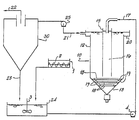
- the plant includes a vessel 10, in which preliminary classification is carried out, and a hydrocyclone 30 of an entirely conventional type fed from the vessel 10 (e.g. a 6-inch (152 mm) diameter Alfa-Laval model Celleco 206).
- a hydrocyclone 30 of an entirely conventional type fed from the vessel 10 e.g. a 6-inch (152 mm) diameter Alfa-Laval model Celleco 206.
- the vessel 10 (suitably of diameter 1.2 m) has a vertical cylindrical wall 12 (height 1.8 m) and a conical bottom 13 (height 1.2 m) from whose extremity shot separated in the preliminary classification can be collected at intervals. Disposed axially within the vessel is a pipe 15 forming a channel 16 for the delivery to the lower part of the vessel of aqueous suspension admitted (as indicated by the arrow) by line 17.
- toroidal tubes 18 by which air or other suitable gas inert to the suspension such as nitrogen can be passed, via holes 19 about 0.5 mm diameter in the tubes, to bubble up through the aqueous suspension which flows upwardly around the channel 16 once the conical bottom 13 of the vessel has been filled.
- a coaxial trough 20 Surrounding the upper rim of vessel 10 is a coaxial trough 20 into which aqueous suspension enriched in fibre following its upward non- turbulent flow in the vessel overflows and from which it is passed via line 21 and pump 25 to hydrocyclone 30.
- the overflow from the hydrocyclone is indicated by 22.
- the underflow 23 from the hydrocyclone is incorporated in the aqueous suspension delivered to vessel 10 for preliminary classification, as will appear later.
- An unopened bale of the wool is crushed in a press (pressure about 1 MPa) to shorten the average fibre length to a value in the range 1-10 mm.
- the bale is then broken up without any substantial further reduction in fibre length, and the resulting material is made into a mobile slurry of solids content 10% by weight by adding it with vigorous stirring to an aqueous solution containing 0.1% by weight of surface-active agent.
- the surfactant is a cationic long- chain alkyl substituted imidazoline such as that which has been used for many years to coat glass fibres to improve their dispersibility in aqueous media during manufacturing processes e.g. when making them up into glass fibre tissue.
- the mobile slurry is prepared in a vat 1 equipped with a ribbon mixer 2 to break down the bulk of any residual fibre of length greater than 10 mm.
- the slurry is transferred from the vat 1 to a tank 24 in which, with continuous stirring by stirrer 3, it is diluted to form an aqueous suspension of solids content 1% by weight and of fibre:non-fibre ratio about 1.25:1.
- This suspension is pumped via pump 4 and line 17 into the upper part of pipe 15 in vessel 10 and allowed to flow under gravity down channel 16 into the conical bottom 13 of the vessel. Having filled the conical bottom of the vessel 10 the aqueous suspension flows upwardly around the channel 16, the rate of feed via line 17 being adjusted so as to produce a rate of upward non- turbulent flow of about 5 mm per second. During this upward flow there are passed upwardly through the suspension air bubbles which issue from the holes 19 in tubes 18.
- the overflow 22 from hydrocyclone 30 is dewatered in the conventional manner e.g. by centrifuge, to about 50% water content. If desired, it can be dried to a moisture content less than 5% by weight.
- the underflow 23 from the hydrocyclone is mixed in tank 24 with fresh aqueous suspension issuing from vat 1, and the mixture incorporating the underflow is submitted to treatment in vessel 10.
Landscapes
- Chemical & Material Sciences (AREA)
- Engineering & Computer Science (AREA)
- Materials Engineering (AREA)
- Geochemistry & Mineralogy (AREA)
- Manufacturing & Machinery (AREA)
- General Life Sciences & Earth Sciences (AREA)
- Life Sciences & Earth Sciences (AREA)
- Organic Chemistry (AREA)
- Paper (AREA)
- Inorganic Fibers (AREA)
- Artificial Filaments (AREA)
- Glass Compositions (AREA)
- Treatment Of Fiber Materials (AREA)
- Crystals, And After-Treatments Of Crystals (AREA)
- Preliminary Treatment Of Fibers (AREA)
Abstract
Description
- This invention relates to the concentration of fibrous material in a mixture thereof with non-fibrous material.
- Such a mixture is for example formed when a stream of silicate or like mineral melt is disintegrated to form fibres. Not all the melt becomes converted to fibres, and that which does not is present in the product (known as mineral wool) predominantly in the form of granules known as 'shot'. As much as 40% by weight or even more of the product may be constituted by shot; and because shot is abrasive, renders the product unpleasant to handle, and deleteriously affects certain important properties (for example, the capacity of the product to reinforce matrices and to reduce transmission of heat), the product is often treated to reduce its content of shot and thus to increase its concentration of fibre. However, because the density of mineral fibre is substantially the same as that of the associated non-fibrous material, separation of the two forms is a matter of considerable difficulty.
- One process of concentrating fibrous material in mineral wool is described in UK patent specification 1,537,117, and in this process an aqueous dispersion (suspension) of the wool is subjected to very high centrifugal force (amounting to at least several tens G) in a hydrocyclone to obtain an overflow enriched in fibre and an underflow of reduced fibre content. The aqueous suspension which is admitted to the hydrocyclone is the fibre-enriched fraction which results from a preliminary classification, in which an aqueous suspension of lower fibre; non-fibre ratio, and preferably of solids content not greater than 4% by weight, is submitted to high speed rotary agitation to bring about settling out under ordinary gravitational force of material reduced in fibre content and formation of a fibre-enriched fraction above it.
- As for the overflow and underflow from the hydrocyclone in the prior art procedure: the underflow is dewatered, drum-dried and used as feed for the furnace supplying the melt from which the original fibrous material is obtained by disintegration; and the overflow is dewatered, preferably with use of centrifuge, to a solids content in the range 30-70% by weight, in which form it is marketed for direct use in those manufacturing procedures which involve redispersion, shaping, dewatering and drying steps.
- We have found that the hydrocyclone underflow produced at an acceptable throughput of suspension in the kind of procedure just described contains, in addition to the non-fibrous material (shot) which it is desired to remove, a significant proportion of valuable fibre; and according to our invention, we avoid the waste of this fibre which is entailed in feeding the dried hydrocyclone underflow back to the melt-producing furnace, by incorporating the underflow in the aqueous suspension which is submitted to the preliminary classification earlier referred to; that is, to flow under conditions which bring about settling out under ordinary gravitational force of material reduced in fibre content and formation of a fibre-enriched fraction above it.
- In the preliminary classification however, we much prefer to avoid the kind of motion of the suspension which results from high speed rotary agitation, and instead to cause substantially nonturbulent upward flow of the suspension as described in our patent application EP-A--0033650 filed with this present application. High speed rotary agitation induces shot suspended in the continuous aqueous phase of the suspension to move in a direction counter to that desired i.e. up instead of down, with consequent loss of efficiency in the separation of fibrous from non-fibrous material.
- Preferably, the fibre-enriched fraction which is admitted to the hydrocyclone has a fibre: non-fibre weight ratio in the range 5:1-25:1; and the solids content of the fibre-enriched fraction is preferably in the range 0.25-2.5% by weight.
- Preferably, upward non-turbulent flow of the aqueous suspension during preliminary classification is produced by allowing the suspension to flow under gravity down a channel at the lower end of which it is diverted so as to flow upwardly around said channel.
- Preferably the rate of upward non-turbulent flow of said aqueous suspension is in the range 0.1-2 cm per second.
- According to a further preferred feature, gas bubbles are passed upwardly through the aqueous suspension during its upward non- turbulent flow. These bubbles impart only highly localised agitation, and this assists disengagement of granular from fibrous material.
- The invention will now be further described with reference to the accompanying drawing, which is a diagram of plant which can be employed in putting the invention into practice.
- The plant includes a
vessel 10, in which preliminary classification is carried out, and ahydrocyclone 30 of an entirely conventional type fed from the vessel 10 (e.g. a 6-inch (152 mm) diameter Alfa-Laval model Celleco 206). - The vessel 10 (suitably of diameter 1.2 m) has a vertical cylindrical wall 12 (height 1.8 m) and a conical bottom 13 (height 1.2 m) from whose extremity shot separated in the preliminary classification can be collected at intervals. Disposed axially within the vessel is a
pipe 15 forming achannel 16 for the delivery to the lower part of the vessel of aqueous suspension admitted (as indicated by the arrow) byline 17. - Within the
conical bottom 13 ofvessel 10 are a number oftoroidal tubes 18 by which air or other suitable gas inert to the suspension such as nitrogen can be passed, viaholes 19 about 0.5 mm diameter in the tubes, to bubble up through the aqueous suspension which flows upwardly around thechannel 16 once theconical bottom 13 of the vessel has been filled. - Surrounding the upper rim of
vessel 10 is acoaxial trough 20 into which aqueous suspension enriched in fibre following its upward non- turbulent flow in the vessel overflows and from which it is passed vialine 21 andpump 25 tohydrocyclone 30. The overflow from the hydrocyclone is indicated by 22. - The
underflow 23 from the hydrocyclone is incorporated in the aqueous suspension delivered tovessel 10 for preliminary classification, as will appear later. - In concentrating the fibre in a typical commercially available mineral wool formed from a silicate melt and containing about 45% by weight of shot, the following procedure can be adopted.
- An unopened bale of the wool is crushed in a press (pressure about 1 MPa) to shorten the average fibre length to a value in the range 1-10 mm.
- The bale is then broken up without any substantial further reduction in fibre length, and the resulting material is made into a mobile slurry of
solids content 10% by weight by adding it with vigorous stirring to an aqueous solution containing 0.1% by weight of surface-active agent. Conveniently, the surfactant is a cationic long- chain alkyl substituted imidazoline such as that which has been used for many years to coat glass fibres to improve their dispersibility in aqueous media during manufacturing processes e.g. when making them up into glass fibre tissue. The mobile slurry is prepared in a vat 1 equipped with aribbon mixer 2 to break down the bulk of any residual fibre of length greater than 10 mm. - The slurry is transferred from the vat 1 to a tank 24 in which, with continuous stirring by
stirrer 3, it is diluted to form an aqueous suspension of solids content 1% by weight and of fibre:non-fibre ratio about 1.25:1. This suspension is pumped via pump 4 andline 17 into the upper part ofpipe 15 invessel 10 and allowed to flow under gravity downchannel 16 into theconical bottom 13 of the vessel. Having filled the conical bottom of thevessel 10 the aqueous suspension flows upwardly around thechannel 16, the rate of feed vialine 17 being adjusted so as to produce a rate of upward non- turbulent flow of about 5 mm per second. During this upward flow there are passed upwardly through the suspension air bubbles which issue from theholes 19 intubes 18. This reduces the tendency for the rising fibres to form persistent clumps as they become progressively disengaged from shot during their upward passage in the vessel. Shot sinking under gravity to the bottom ofvessel 10 can be run off periodically. It is substantially free from fibre and has a preponderance of coarse particles such as would damage a hydrocyclone and associated pump operating at ordinary flow rates. - The
overflow 22 fromhydrocyclone 30 is dewatered in the conventional manner e.g. by centrifuge, to about 50% water content. If desired, it can be dried to a moisture content less than 5% by weight. - The
underflow 23 from the hydrocyclone is mixed in tank 24 with fresh aqueous suspension issuing from vat 1, and the mixture incorporating the underflow is submitted to treatment invessel 10. - In a typical run with
hydrocyclone 30 operating at a flow rate of about 5 litres per second and a pressure drop of 15 psi (100 kPa), the overflow contained 1% by weight of non-fibrous material; shot recovered from the bottom ofvessel 10 contained no significant proportion of fibre. Samples of theunderflow 23 taken at intervals had a fibre:non-fibre ratio of 0.5:1-2:1.
Claims (7)
Priority Applications (1)
| Application Number | Priority Date | Filing Date | Title |
|---|---|---|---|
| AT81300414T ATE3273T1 (en) | 1980-01-31 | 1981-02-02 | PROCESS FOR CONCENTRATING FIBER MATERIALS. |
Applications Claiming Priority (2)
| Application Number | Priority Date | Filing Date | Title |
|---|---|---|---|
| GB8003243A GB2068265B (en) | 1980-01-31 | 1980-01-31 | Process for the concentration of fibrous material |
| GB8003243 | 1980-01-31 |
Publications (3)
| Publication Number | Publication Date |
|---|---|
| EP0033649A2 EP0033649A2 (en) | 1981-08-12 |
| EP0033649A3 EP0033649A3 (en) | 1981-08-26 |
| EP0033649B1 true EP0033649B1 (en) | 1983-05-11 |
Family
ID=10511020
Family Applications (1)
| Application Number | Title | Priority Date | Filing Date |
|---|---|---|---|
| EP81300414A Expired EP0033649B1 (en) | 1980-01-31 | 1981-02-02 | Process for the concentration of fibrous materials |
Country Status (11)
| Country | Link |
|---|---|
| US (1) | US4337863A (en) |
| EP (1) | EP0033649B1 (en) |
| JP (1) | JPS56125237A (en) |
| AT (1) | ATE3273T1 (en) |
| AU (1) | AU539134B2 (en) |
| CA (1) | CA1159020A (en) |
| DE (1) | DE3160239D1 (en) |
| DK (1) | DK41681A (en) |
| ES (1) | ES498964A0 (en) |
| GB (1) | GB2068265B (en) |
| ZA (1) | ZA81403B (en) |
Families Citing this family (1)
| Publication number | Priority date | Publication date | Assignee | Title |
|---|---|---|---|---|
| AT386552B (en) * | 1986-05-28 | 1988-09-12 | Andritz Ag Maschf | METHOD AND SYSTEM FOR SEPARATING LIGHTNING MATERIALS FROM SUBSTRATE MIXTURES |
Family Cites Families (5)
| Publication number | Priority date | Publication date | Assignee | Title |
|---|---|---|---|---|
| US2783884A (en) * | 1950-12-06 | 1957-03-05 | Ruhrchemie Ag | Process and apparatus for the contacting of granular materials with liquids and gases |
| FR84643E (en) * | 1962-12-07 | 1965-03-19 | Grenobloise Etude Appl | Method and apparatus for sorting two or more materials |
| US3865315A (en) * | 1972-12-15 | 1975-02-11 | United States Gypsum Co | Process for separating fibrous material |
| US4039425A (en) * | 1975-12-22 | 1977-08-02 | Exxon Research And Engineering Company | Method for preparing a coal slurry substantially depleted in mineral-rich particles |
| SE401918B (en) * | 1976-01-19 | 1978-06-05 | Rockwool Ab | WAY TO MANUFACTURE A MINERAL FIBER PRODUCT |
-
1980
- 1980-01-31 GB GB8003243A patent/GB2068265B/en not_active Expired
-
1981
- 1981-01-21 ZA ZA00810403A patent/ZA81403B/en unknown
- 1981-01-21 CA CA000368950A patent/CA1159020A/en not_active Expired
- 1981-01-30 US US06/229,851 patent/US4337863A/en not_active Expired - Fee Related
- 1981-01-30 AU AU66803/81A patent/AU539134B2/en not_active Ceased
- 1981-01-30 ES ES498964A patent/ES498964A0/en active Granted
- 1981-01-30 DK DK41681A patent/DK41681A/en not_active Application Discontinuation
- 1981-01-30 JP JP1279481A patent/JPS56125237A/en active Pending
- 1981-02-02 AT AT81300414T patent/ATE3273T1/en not_active IP Right Cessation
- 1981-02-02 EP EP81300414A patent/EP0033649B1/en not_active Expired
- 1981-02-02 DE DE8181300414T patent/DE3160239D1/en not_active Expired
Also Published As
| Publication number | Publication date |
|---|---|
| ATE3273T1 (en) | 1983-05-15 |
| AU539134B2 (en) | 1984-09-13 |
| AU6680381A (en) | 1981-08-06 |
| EP0033649A2 (en) | 1981-08-12 |
| ZA81403B (en) | 1982-02-24 |
| JPS56125237A (en) | 1981-10-01 |
| CA1159020A (en) | 1983-12-20 |
| ES8201110A1 (en) | 1981-12-01 |
| ES498964A0 (en) | 1981-12-01 |
| GB2068265B (en) | 1983-03-30 |
| EP0033649A3 (en) | 1981-08-26 |
| GB2068265A (en) | 1981-08-12 |
| US4337863A (en) | 1982-07-06 |
| DK41681A (en) | 1981-08-01 |
| DE3160239D1 (en) | 1983-06-16 |
Similar Documents
| Publication | Publication Date | Title |
|---|---|---|
| US4676953A (en) | Continous production of sodium silicate solutions | |
| US3017318A (en) | High temperature resistant siliceous compositions | |
| US3665066A (en) | Beneficiation of coals | |
| CN107930838B (en) | grading treatment circulating system for producing ground calcium carbonate | |
| US5215733A (en) | Manufacture of silica gels using shear to reduce the particle size prior to washing with a hydrocyclone | |
| US4252754A (en) | Process for manufacturing glass raw material granular pellets | |
| US2133236A (en) | Glass wool and method and apparatus for making same | |
| CA1099926A (en) | Method of producing a mineral fiber product | |
| US4337863A (en) | Process for the concentration of fibrous material | |
| US3865315A (en) | Process for separating fibrous material | |
| US3935076A (en) | Two stage separation system | |
| CN114133122B (en) | Method for reducing sludge viscosity through sludge pretreatment | |
| EP0033650B1 (en) | Process for the concentration of fibrous materials | |
| KR960003233B1 (en) | Sodium perborate | |
| US5021073A (en) | Method of manufacturing synthetic silica glass | |
| US3162380A (en) | Method of treating asbestos minerals | |
| US3229917A (en) | Process of classifying calcined conditioned titanium dioxide pigment slurries | |
| US3714084A (en) | Bagasse reinforced resin bodies and method of making same | |
| US4524189A (en) | Preparation of chlorinated polyolefins | |
| US3798018A (en) | Glass manufacture | |
| JP3281067B2 (en) | Preparation method of gypsum liquid for sugar beet pulp pressing dewatering aid | |
| JP2607050B2 (en) | Method for producing fine hollow glass sphere | |
| EP0244168B1 (en) | Manufacture of silica gels | |
| US4631175A (en) | Preparation of chlorinated polyolefins | |
| US2564543A (en) | Lime feeding processes and apparatus suitable for water-softening plants |
Legal Events
| Date | Code | Title | Description |
|---|---|---|---|
| PUAI | Public reference made under article 153(3) epc to a published international application that has entered the european phase |
Free format text: ORIGINAL CODE: 0009012 |
|
| PUAL | Search report despatched |
Free format text: ORIGINAL CODE: 0009013 |
|
| AK | Designated contracting states |
Designated state(s): AT BE DE FR GB IT NL SE |
|
| AK | Designated contracting states |
Designated state(s): AT BE DE FR GB IT NL SE |
|
| 17P | Request for examination filed |
Effective date: 19810824 |
|
| RAP1 | Party data changed (applicant data changed or rights of an application transferred) |
Owner name: T&N MATERIALS RESEARCH LIMITED |
|
| ITF | It: translation for a ep patent filed | ||
| GRAA | (expected) grant |
Free format text: ORIGINAL CODE: 0009210 |
|
| AK | Designated contracting states |
Designated state(s): AT BE DE FR GB IT NL SE |
|
| REF | Corresponds to: |
Ref document number: 3273 Country of ref document: AT Date of ref document: 19830515 Kind code of ref document: T |
|
| REF | Corresponds to: |
Ref document number: 3160239 Country of ref document: DE Date of ref document: 19830616 |
|
| ET | Fr: translation filed | ||
| PGFP | Annual fee paid to national office [announced via postgrant information from national office to epo] |
Ref country code: FR Payment date: 19840301 Year of fee payment: 4 |
|
| PLBE | No opposition filed within time limit |
Free format text: ORIGINAL CODE: 0009261 |
|
| STAA | Information on the status of an ep patent application or granted ep patent |
Free format text: STATUS: NO OPPOSITION FILED WITHIN TIME LIMIT |
|
| PGFP | Annual fee paid to national office [announced via postgrant information from national office to epo] |
Ref country code: DE Payment date: 19840321 Year of fee payment: 4 |
|
| PGFP | Annual fee paid to national office [announced via postgrant information from national office to epo] |
Ref country code: SE Payment date: 19840331 Year of fee payment: 4 Ref country code: BE Payment date: 19840331 Year of fee payment: 4 |
|
| 26N | No opposition filed | ||
| PGFP | Annual fee paid to national office [announced via postgrant information from national office to epo] |
Ref country code: AT Payment date: 19860227 Year of fee payment: 6 |
|
| PGFP | Annual fee paid to national office [announced via postgrant information from national office to epo] |
Ref country code: NL Payment date: 19860228 Year of fee payment: 6 |
|
| PG25 | Lapsed in a contracting state [announced via postgrant information from national office to epo] |
Ref country code: AT Effective date: 19870202 |
|
| PG25 | Lapsed in a contracting state [announced via postgrant information from national office to epo] |
Ref country code: SE Effective date: 19870203 |
|
| BERE | Be: lapsed |
Owner name: T&N MATERIALS RESEARCH LTD Effective date: 19870228 |
|
| PG25 | Lapsed in a contracting state [announced via postgrant information from national office to epo] |
Ref country code: NL Effective date: 19870901 |
|
| NLV4 | Nl: lapsed or anulled due to non-payment of the annual fee | ||
| PG25 | Lapsed in a contracting state [announced via postgrant information from national office to epo] |
Ref country code: FR Free format text: LAPSE BECAUSE OF NON-PAYMENT OF DUE FEES Effective date: 19871030 |
|
| PG25 | Lapsed in a contracting state [announced via postgrant information from national office to epo] |
Ref country code: DE Effective date: 19871103 |
|
| REG | Reference to a national code |
Ref country code: FR Ref legal event code: ST |
|
| PG25 | Lapsed in a contracting state [announced via postgrant information from national office to epo] |
Ref country code: BE Effective date: 19890228 |
|
| PGFP | Annual fee paid to national office [announced via postgrant information from national office to epo] |
Ref country code: GB Payment date: 19930119 Year of fee payment: 13 |
|
| PG25 | Lapsed in a contracting state [announced via postgrant information from national office to epo] |
Ref country code: GB Effective date: 19940202 |
|
| GBPC | Gb: european patent ceased through non-payment of renewal fee |
Effective date: 19940202 |
|
| EUG | Se: european patent has lapsed |
Ref document number: 81300414.0 Effective date: 19880215 |