EP0031218B1 - A 2-amino-trifluoromethyl-halogenopyridine compound and a process for producing the same - Google Patents
A 2-amino-trifluoromethyl-halogenopyridine compound and a process for producing the same Download PDFInfo
- Publication number
- EP0031218B1 EP0031218B1 EP80304466A EP80304466A EP0031218B1 EP 0031218 B1 EP0031218 B1 EP 0031218B1 EP 80304466 A EP80304466 A EP 80304466A EP 80304466 A EP80304466 A EP 80304466A EP 0031218 B1 EP0031218 B1 EP 0031218B1
- Authority
- EP
- European Patent Office
- Prior art keywords
- trifluoromethyl
- amino
- halogenopyridine
- formula
- reaction
- Prior art date
- Legal status (The legal status is an assumption and is not a legal conclusion. Google has not performed a legal analysis and makes no representation as to the accuracy of the status listed.)
- Expired
Links
- 238000000034 method Methods 0.000 title claims description 15
- 150000001875 compounds Chemical class 0.000 title claims description 13
- QGZKDVFQNNGYKY-UHFFFAOYSA-N Ammonia Chemical compound N QGZKDVFQNNGYKY-UHFFFAOYSA-N 0.000 claims description 17
- 238000006243 chemical reaction Methods 0.000 claims description 12
- WKBOTKDWSSQWDR-UHFFFAOYSA-N Bromine atom Chemical group [Br] WKBOTKDWSSQWDR-UHFFFAOYSA-N 0.000 claims description 10
- 125000002023 trifluoromethyl group Chemical group FC(F)(F)* 0.000 claims description 8
- 229910052801 chlorine Inorganic materials 0.000 claims description 7
- 229910021529 ammonia Inorganic materials 0.000 claims description 6
- GDTBXPJZTBHREO-UHFFFAOYSA-N bromine Substances BrBr GDTBXPJZTBHREO-UHFFFAOYSA-N 0.000 claims description 6
- 229910052794 bromium Inorganic materials 0.000 claims description 6
- 239000003795 chemical substances by application Substances 0.000 claims description 6
- WXNPZQIRDCDLJD-UHFFFAOYSA-N 3-chloro-5-(trifluoromethyl)pyridin-2-amine Chemical compound NC1=NC=C(C(F)(F)F)C=C1Cl WXNPZQIRDCDLJD-UHFFFAOYSA-N 0.000 claims description 5
- 125000001309 chloro group Chemical group Cl* 0.000 claims description 5
- 230000002140 halogenating effect Effects 0.000 claims description 4
- KZBUYRJDOAKODT-UHFFFAOYSA-N Chlorine Chemical group ClCl KZBUYRJDOAKODT-UHFFFAOYSA-N 0.000 claims description 3
- 125000005843 halogen group Chemical group 0.000 claims description 3
- 125000004435 hydrogen atom Chemical group [H]* 0.000 claims description 3
- WPGLCXZKCAARBY-UHFFFAOYSA-N 5-chloro-3-(trifluoromethyl)pyridin-2-amine Chemical compound NC1=NC=C(Cl)C=C1C(F)(F)F WPGLCXZKCAARBY-UHFFFAOYSA-N 0.000 claims description 2
- 125000001246 bromo group Chemical group Br* 0.000 claims 1
- JUJWROOIHBZHMG-UHFFFAOYSA-N pyridine Substances C1=CC=NC=C1 JUJWROOIHBZHMG-UHFFFAOYSA-N 0.000 description 15
- QTBSBXVTEAMEQO-UHFFFAOYSA-N Acetic acid Chemical compound CC(O)=O QTBSBXVTEAMEQO-UHFFFAOYSA-N 0.000 description 9
- YMWUJEATGCHHMB-UHFFFAOYSA-N Dichloromethane Chemical compound ClCCl YMWUJEATGCHHMB-UHFFFAOYSA-N 0.000 description 9
- 239000000047 product Substances 0.000 description 6
- UMJSCPRVCHMLSP-UHFFFAOYSA-N pyridine Natural products COC1=CC=CN=C1 UMJSCPRVCHMLSP-UHFFFAOYSA-N 0.000 description 6
- 239000007795 chemical reaction product Substances 0.000 description 5
- 238000004519 manufacturing process Methods 0.000 description 5
- VHUUQVKOLVNVRT-UHFFFAOYSA-N Ammonium hydroxide Chemical compound [NH4+].[OH-] VHUUQVKOLVNVRT-UHFFFAOYSA-N 0.000 description 4
- VEXZGXHMUGYJMC-UHFFFAOYSA-N Hydrochloric acid Chemical compound Cl VEXZGXHMUGYJMC-UHFFFAOYSA-N 0.000 description 4
- 239000000543 intermediate Substances 0.000 description 4
- UHOVQNZJYSORNB-UHFFFAOYSA-N Benzene Chemical compound C1=CC=CC=C1 UHOVQNZJYSORNB-UHFFFAOYSA-N 0.000 description 3
- RTZKZFJDLAIYFH-UHFFFAOYSA-N Diethyl ether Chemical compound CCOCC RTZKZFJDLAIYFH-UHFFFAOYSA-N 0.000 description 3
- YXFVVABEGXRONW-UHFFFAOYSA-N Toluene Chemical compound CC1=CC=CC=C1 YXFVVABEGXRONW-UHFFFAOYSA-N 0.000 description 3
- 239000013078 crystal Substances 0.000 description 3
- 239000000203 mixture Substances 0.000 description 3
- 238000002360 preparation method Methods 0.000 description 3
- 239000002904 solvent Substances 0.000 description 3
- XLYOFNOQVPJJNP-UHFFFAOYSA-N water Substances O XLYOFNOQVPJJNP-UHFFFAOYSA-N 0.000 description 3
- BMYNFMYTOJXKLE-UHFFFAOYSA-N 3-azaniumyl-2-hydroxypropanoate Chemical compound NCC(O)C(O)=O BMYNFMYTOJXKLE-UHFFFAOYSA-N 0.000 description 2
- KBNACDZKKVMULE-UHFFFAOYSA-N 3-bromo-5-(trifluoromethyl)pyridin-2-amine Chemical compound NC1=NC=C(C(F)(F)F)C=C1Br KBNACDZKKVMULE-UHFFFAOYSA-N 0.000 description 2
- RSGVKIIEIXOMPY-UHFFFAOYSA-N 5-(trifluoromethyl)pyridin-2-amine Chemical compound NC1=CC=C(C(F)(F)F)C=N1 RSGVKIIEIXOMPY-UHFFFAOYSA-N 0.000 description 2
- ZAMOUSCENKQFHK-UHFFFAOYSA-N Chlorine atom Chemical compound [Cl] ZAMOUSCENKQFHK-UHFFFAOYSA-N 0.000 description 2
- QAOWNCQODCNURD-UHFFFAOYSA-N Sulfuric acid Chemical compound OS(O)(=O)=O QAOWNCQODCNURD-UHFFFAOYSA-N 0.000 description 2
- 239000003905 agrochemical Substances 0.000 description 2
- -1 and thus Substances 0.000 description 2
- 239000007864 aqueous solution Substances 0.000 description 2
- 230000015572 biosynthetic process Effects 0.000 description 2
- 239000000460 chlorine Substances 0.000 description 2
- 239000003814 drug Substances 0.000 description 2
- 229940079593 drug Drugs 0.000 description 2
- 238000000605 extraction Methods 0.000 description 2
- 230000000749 insecticidal effect Effects 0.000 description 2
- 238000002844 melting Methods 0.000 description 2
- 230000008018 melting Effects 0.000 description 2
- VLKZOEOYAKHREP-UHFFFAOYSA-N n-Hexane Chemical compound CCCCCC VLKZOEOYAKHREP-UHFFFAOYSA-N 0.000 description 2
- 230000001766 physiological effect Effects 0.000 description 2
- 239000000243 solution Substances 0.000 description 2
- 239000000126 substance Substances 0.000 description 2
- 238000003786 synthesis reaction Methods 0.000 description 2
- 0 *c(cc1*)cnc1N Chemical compound *c(cc1*)cnc1N 0.000 description 1
- ABNQGNFVSFKJGI-UHFFFAOYSA-N 2,3-dichloro-5-(trifluoromethyl)pyridine Chemical compound FC(F)(F)C1=CN=C(Cl)C(Cl)=C1 ABNQGNFVSFKJGI-UHFFFAOYSA-N 0.000 description 1
- ZRJSABISRHPRSB-UHFFFAOYSA-N 2,6-difluorobenzoyl isocyanate Chemical compound FC1=CC=CC(F)=C1C(=O)N=C=O ZRJSABISRHPRSB-UHFFFAOYSA-N 0.000 description 1
- HABKYPVMMHBOIW-UHFFFAOYSA-N 2-chloro-5-(trifluoromethyl)pyridin-3-amine Chemical compound NC1=CC(C(F)(F)F)=CN=C1Cl HABKYPVMMHBOIW-UHFFFAOYSA-N 0.000 description 1
- YWOWJQMFMXHLQD-UHFFFAOYSA-N 3-(trifluoromethyl)pyridin-2-amine Chemical compound NC1=NC=CC=C1C(F)(F)F YWOWJQMFMXHLQD-UHFFFAOYSA-N 0.000 description 1
- QUYZBNHTYCLZLW-UHFFFAOYSA-N 5-bromo-3-(trifluoromethyl)pyridin-2-amine Chemical compound NC1=NC=C(Br)C=C1C(F)(F)F QUYZBNHTYCLZLW-UHFFFAOYSA-N 0.000 description 1
- XVMSFILGAMDHEY-UHFFFAOYSA-N 6-(4-aminophenyl)sulfonylpyridin-3-amine Chemical compound C1=CC(N)=CC=C1S(=O)(=O)C1=CC=C(N)C=N1 XVMSFILGAMDHEY-UHFFFAOYSA-N 0.000 description 1
- CREQAXQASINAFR-UHFFFAOYSA-N 6-chloro-4-(trifluoromethyl)pyridin-2-amine Chemical compound NC1=CC(C(F)(F)F)=CC(Cl)=N1 CREQAXQASINAFR-UHFFFAOYSA-N 0.000 description 1
- BLHCMGRVFXRYRN-UHFFFAOYSA-N 6-hydroxynicotinic acid Chemical compound OC(=O)C1=CC=C(O)N=C1 BLHCMGRVFXRYRN-UHFFFAOYSA-N 0.000 description 1
- ZCYVEMRRCGMTRW-UHFFFAOYSA-N 7553-56-2 Chemical compound [I] ZCYVEMRRCGMTRW-UHFFFAOYSA-N 0.000 description 1
- PXGOKWXKJXAPGV-UHFFFAOYSA-N Fluorine Chemical compound FF PXGOKWXKJXAPGV-UHFFFAOYSA-N 0.000 description 1
- 241000238631 Hexapoda Species 0.000 description 1
- 241000500437 Plutella xylostella Species 0.000 description 1
- PMZURENOXWZQFD-UHFFFAOYSA-L Sodium Sulfate Chemical compound [Na+].[Na+].[O-]S([O-])(=O)=O PMZURENOXWZQFD-UHFFFAOYSA-L 0.000 description 1
- 241000607479 Yersinia pestis Species 0.000 description 1
- 238000005576 amination reaction Methods 0.000 description 1
- 239000008346 aqueous phase Substances 0.000 description 1
- 230000031709 bromination Effects 0.000 description 1
- 238000005893 bromination reaction Methods 0.000 description 1
- 238000005660 chlorination reaction Methods 0.000 description 1
- 238000001816 cooling Methods 0.000 description 1
- 238000004821 distillation Methods 0.000 description 1
- 229910052731 fluorine Inorganic materials 0.000 description 1
- 239000011737 fluorine Substances 0.000 description 1
- 230000026030 halogenation Effects 0.000 description 1
- 238000005658 halogenation reaction Methods 0.000 description 1
- 230000002363 herbicidal effect Effects 0.000 description 1
- 239000012456 homogeneous solution Substances 0.000 description 1
- 239000005457 ice water Substances 0.000 description 1
- 150000005232 imidazopyridines Chemical class 0.000 description 1
- 239000012535 impurity Substances 0.000 description 1
- 239000012442 inert solvent Substances 0.000 description 1
- 230000002401 inhibitory effect Effects 0.000 description 1
- 229910052740 iodine Inorganic materials 0.000 description 1
- 239000011630 iodine Substances 0.000 description 1
- KLMJARNXWUMZMY-UHFFFAOYSA-N n-[[3-chloro-5-(trifluoromethyl)pyridin-2-yl]carbamoyl]-2,6-difluorobenzamide Chemical compound FC1=CC=CC(F)=C1C(=O)NC(=O)NC1=NC=C(C(F)(F)F)C=C1Cl KLMJARNXWUMZMY-UHFFFAOYSA-N 0.000 description 1
- 230000001473 noxious effect Effects 0.000 description 1
- 150000002894 organic compounds Chemical class 0.000 description 1
- 239000008194 pharmaceutical composition Substances 0.000 description 1
- 150000003222 pyridines Chemical class 0.000 description 1
- 238000010992 reflux Methods 0.000 description 1
- AKHNMLFCWUSKQB-UHFFFAOYSA-L sodium thiosulfate Chemical compound [Na+].[Na+].[O-]S([O-])(=O)=S AKHNMLFCWUSKQB-UHFFFAOYSA-L 0.000 description 1
- 235000019345 sodium thiosulphate Nutrition 0.000 description 1
- 239000007787 solid Substances 0.000 description 1
- 239000007858 starting material Substances 0.000 description 1
- 238000006467 substitution reaction Methods 0.000 description 1
Classifications
-
- C—CHEMISTRY; METALLURGY
- C07—ORGANIC CHEMISTRY
- C07D—HETEROCYCLIC COMPOUNDS
- C07D213/00—Heterocyclic compounds containing six-membered rings, not condensed with other rings, with one nitrogen atom as the only ring hetero atom and three or more double bonds between ring members or between ring members and non-ring members
- C07D213/02—Heterocyclic compounds containing six-membered rings, not condensed with other rings, with one nitrogen atom as the only ring hetero atom and three or more double bonds between ring members or between ring members and non-ring members having three double bonds between ring members or between ring members and non-ring members
- C07D213/04—Heterocyclic compounds containing six-membered rings, not condensed with other rings, with one nitrogen atom as the only ring hetero atom and three or more double bonds between ring members or between ring members and non-ring members having three double bonds between ring members or between ring members and non-ring members having no bond between the ring nitrogen atom and a non-ring member or having only hydrogen or carbon atoms directly attached to the ring nitrogen atom
- C07D213/60—Heterocyclic compounds containing six-membered rings, not condensed with other rings, with one nitrogen atom as the only ring hetero atom and three or more double bonds between ring members or between ring members and non-ring members having three double bonds between ring members or between ring members and non-ring members having no bond between the ring nitrogen atom and a non-ring member or having only hydrogen or carbon atoms directly attached to the ring nitrogen atom with hetero atoms or with carbon atoms having three bonds to hetero atoms with at the most one bond to halogen, e.g. ester or nitrile radicals, directly attached to ring carbon atoms
- C07D213/72—Nitrogen atoms
- C07D213/73—Unsubstituted amino or imino radicals
-
- A—HUMAN NECESSITIES
- A01—AGRICULTURE; FORESTRY; ANIMAL HUSBANDRY; HUNTING; TRAPPING; FISHING
- A01N—PRESERVATION OF BODIES OF HUMANS OR ANIMALS OR PLANTS OR PARTS THEREOF; BIOCIDES, e.g. AS DISINFECTANTS, AS PESTICIDES OR AS HERBICIDES; PEST REPELLANTS OR ATTRACTANTS; PLANT GROWTH REGULATORS
- A01N43/00—Biocides, pest repellants or attractants, or plant growth regulators containing heterocyclic compounds
- A01N43/34—Biocides, pest repellants or attractants, or plant growth regulators containing heterocyclic compounds having rings with one nitrogen atom as the only ring hetero atom
- A01N43/40—Biocides, pest repellants or attractants, or plant growth regulators containing heterocyclic compounds having rings with one nitrogen atom as the only ring hetero atom six-membered rings
-
- C—CHEMISTRY; METALLURGY
- C07—ORGANIC CHEMISTRY
- C07D—HETEROCYCLIC COMPOUNDS
- C07D213/00—Heterocyclic compounds containing six-membered rings, not condensed with other rings, with one nitrogen atom as the only ring hetero atom and three or more double bonds between ring members or between ring members and non-ring members
- C07D213/02—Heterocyclic compounds containing six-membered rings, not condensed with other rings, with one nitrogen atom as the only ring hetero atom and three or more double bonds between ring members or between ring members and non-ring members having three double bonds between ring members or between ring members and non-ring members
- C07D213/04—Heterocyclic compounds containing six-membered rings, not condensed with other rings, with one nitrogen atom as the only ring hetero atom and three or more double bonds between ring members or between ring members and non-ring members having three double bonds between ring members or between ring members and non-ring members having no bond between the ring nitrogen atom and a non-ring member or having only hydrogen or carbon atoms directly attached to the ring nitrogen atom
- C07D213/60—Heterocyclic compounds containing six-membered rings, not condensed with other rings, with one nitrogen atom as the only ring hetero atom and three or more double bonds between ring members or between ring members and non-ring members having three double bonds between ring members or between ring members and non-ring members having no bond between the ring nitrogen atom and a non-ring member or having only hydrogen or carbon atoms directly attached to the ring nitrogen atom with hetero atoms or with carbon atoms having three bonds to hetero atoms with at the most one bond to halogen, e.g. ester or nitrile radicals, directly attached to ring carbon atoms
- C07D213/72—Nitrogen atoms
- C07D213/75—Amino or imino radicals, acylated by carboxylic or carbonic acids, or by sulfur or nitrogen analogues thereof, e.g. carbamates
Definitions
- This invention relates to a 2-amino-trifluoromethyl-halogenopyridine compound and a process for producing the same.
- pyridine derivatives have hitherto been known to be useful intermediates for the production of organic compounds.
- 2-amino-5-trifluoromethylpyridine as a starting material for the production of imidazopyridines and a process for the production thereof from 5-carboxy-2-hydroxypyridine are described in US - A - 3 681 369.
- 2-chloro-3-amino-5-trifluoromethylpyridine and 2-chloro-4-trifluoromethyl-6-aminopyridine are disclosed in EP - A - 0 003 278 and US - A - 3 609 158, respectively, as intermediates useful for the preparation of pharmaceutical compositions and herbicidal compositions, respectively.
- the 2-amino-trifluoromethyl-halogenopyridine compounds of this invention are useful as intermediates in the synthesis of particularly effective agricultural chemicals and medicines.
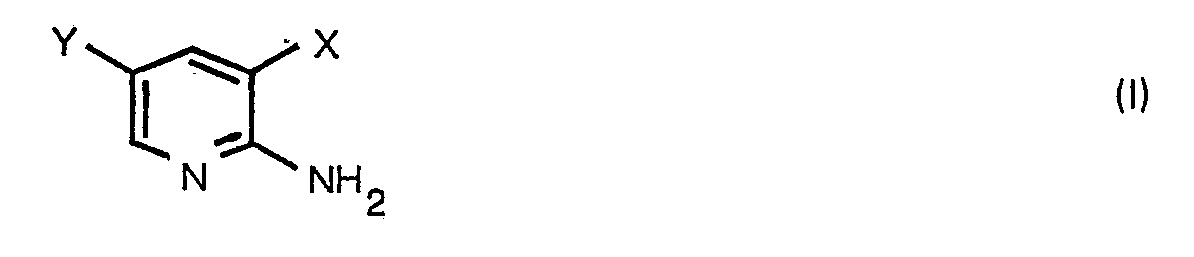
- the invention resides in one aspect in a 2-amino-trifluoromethyl-halogenopyridine compound characterised by the formula (I): wherein either X or Y is a trifluoromethyl group and the other is a chlorine atom or a bromine atom.
- the invention resides in a process for the production of the 2-amino-trifluoromethyl-halogenopyridine compound of the formula (I), characterised by reacting a 2-halogeno-trifluoromethyl-halogeno-pyridine represented by the formula (II): wherein X and Y are the same as defined hereinbefore, and Hal is a halogen atom, with ammonia at a temperature of 50 to 180°C.
- Hal may be fluorine, chlorine, bromine or iodine.
- the invention resides in a process for the production of a 2-amino-trifluoromethyl-halogenopyridine compound represented by the formula (I): wherein either X or Y is a trifluoromethyl group and the other is a chlorine atom or a bromine atom, characterised by reacting a 2-halogeno-trifluoromethylpyridine compound represented by the formula (III) : wherein either X' or Y' is a trifluoromethyl group and the other is a hydrogen atom, with a chlorinating or brominating agent.
- 2-amino-trifluoromethyl-halogenopyridines of this invention include 2-amino-3-chloro-5-trifluoromethylpyridine (m.p. 90-92°C), 2-amino-3-bromo-5-trifluoromethylpyridine (m.p. 99-100°C), 2-amino-3-trifluoromethyl-5-bromopyridine (m.p. 84-86°C) 2-amino-3-trifluoromethyl-5-chloropyridine (m.p. 85-87°C).
- the 2-amino-trifluoromethyl-halogenopyridine of this invention can be usually produced by the following Method (1) or (2).
- a 2-halogeno-trifluoromethyl-halogenopyridine compound of the formula (II) and aqueous ammonia which has previously been prepared by dissolving ammonia in water are placed in a closed vessel, e.g., an autoclave, or liquid ammonia is introduced into the 2-halogeno-trifluoromethyl-halogenopyridine compound, followed by the reaction at a temperature of 50° to 180°C, preferably 100° to 150°C.
- the reaction temperature exceeds the above specified upper limit, the desired product tends to decompose, whereas when it is below the lower limit, the reaction does not proceed sufficiently.
- aqueous ammonia is used as the ammonia
- one having a concentration of 20% or more, preferably 28 to 40% is usually used.
- the pressure during the reaction reaches about 2 to 30 atms. (2.029 x 10- 5 to 3.042 x 10- 6 Pa) due to the temperature increase inside the closed vessel.
- the amount of ammonia used is 1 mol or more, preferably 3 to 10 mols, per mol of the 2- halogeno-trifluoromethyl-halogenopyridine.
- the time of reaction is 3 hours or longer, preferably 3 to 12 hours.
- the reaction product thus obtained is allowed to cool and usually extracted with a solvent, such as methylene chloride, benzene, or diethyl ether.
- a solvent such as methylene chloride, benzene, or diethyl ether.
- the solvent is then evaporated off, and if necessary, usual distillation is carried out to obtain the desired product, 2-amino-trifluoromethyl-halogenopyridine.
- the desired product in the reaction product is obtained as an oily substance or crystals, and thus, impurities can be removed by the above extraction.
- the desired product may be contained in the aqueous phase of the reaction product, but the desired product can sufficiently be recovered by the above extraction.
- 2-Amino-trifluoromethylpyridine which can be prepared by the Method (1) above or equivalent method thereto is reacted with a halogenating agent to form a desired 2-amino-trifluoromethyl- halogeno-pyridine.
- a halogenating agent usually, chlorine gas or bromine
- This reaction is usually carried out by introducing the halogenating agent (usually, chlorine gas or bromine) into a solution prepared by dissolving the above starting pyridine in acetic acid, hydrochloric acid, sulfuric acid or hydrobromic acid, and if necessary, by further adding thereto another inert solvent.
- the starting pyridine is dissolved in a suitable concentration of hydrochloric acid in an amount of 4 to 10 mols per mol of the starting pyridine, and chlorine gas is introduced into the solution thus prepared while maintaining the temperature of the system at 0° to 100°C, preferably 0° to 50°C.
- the amount of the chlorine used is usually 1.1 to 5 mols, preferably 1.5 to 3 mols, per mol of the starting pyridine.
- the starting pyridine is dissolved in an aqueous solution of acetic acid or hydrobromic acid in an amount of 5 to 20 mols per mol of the starting pyridine, and bromine is dropwise added thereto while maintaining the temperature of the system at 10° to 60°C;"preferably 35° to 45°C.
- the amount of the bromine used is usually 1 to 2 mols, preferably 1 to 1.2 mols, per mol of the starting pyridine.
- the reaction is usually completed in 0.5 to 10 hours although it may vary depending upon the reaction conditions.
- substitution reaction of the hydrogen atom by the halogen atom occurs at the P-position of the pyridine nucleus at which no trifluoromethyl group exists.
- the 2-amino-trifluoromethyl-halogenopyridine per se of this invention has no physiological activity, but can be chemically converted into a substance having high physiological activity. It has been confirmed that the 2-amino-trifluoromethyl-halogenopyridine is a useful intermediate for synthesis of agricultural chemicals and medicines.
Landscapes
- Chemical & Material Sciences (AREA)
- Organic Chemistry (AREA)
- Life Sciences & Earth Sciences (AREA)
- Agronomy & Crop Science (AREA)
- Pest Control & Pesticides (AREA)
- Plant Pathology (AREA)
- Health & Medical Sciences (AREA)
- Engineering & Computer Science (AREA)
- Dentistry (AREA)
- General Health & Medical Sciences (AREA)
- Wood Science & Technology (AREA)
- Zoology (AREA)
- Environmental Sciences (AREA)
- Pyridine Compounds (AREA)
- Agricultural Chemicals And Associated Chemicals (AREA)
Description
- This invention relates to a 2-amino-trifluoromethyl-halogenopyridine compound and a process for producing the same.
- A number of pyridine derivatives have hitherto been known to be useful intermediates for the production of organic compounds. For example, 2-amino-5-trifluoromethylpyridine as a starting material for the production of imidazopyridines and a process for the production thereof from 5-carboxy-2-hydroxypyridine are described in US - A - 3 681 369.
- 2-chloro-3-amino-5-trifluoromethylpyridine and 2-chloro-4-trifluoromethyl-6-aminopyridine are disclosed in EP - A - 0 003 278 and US - A - 3 609 158, respectively, as intermediates useful for the preparation of pharmaceutical compositions and herbicidal compositions, respectively.
- The 2-amino-trifluoromethyl-halogenopyridine compounds of this invention are useful as intermediates in the synthesis of particularly effective agricultural chemicals and medicines.
- The invention resides in one aspect in a 2-amino-trifluoromethyl-halogenopyridine compound characterised by the formula (I):

- In a further aspect, the invention resides in a process for the production of the 2-amino-trifluoromethyl-halogenopyridine compound of the formula (I), characterised by reacting a 2-halogeno-trifluoromethyl-halogeno-pyridine represented by the formula (II):

- In formula (II) above, Hal may be fluorine, chlorine, bromine or iodine.
- In yet a further aspect, the invention resides in a process for the production of a 2-amino-trifluoromethyl-halogenopyridine compound represented by the formula (I):


- Examples of 2-amino-trifluoromethyl-halogenopyridines of this invention include 2-amino-3-chloro-5-trifluoromethylpyridine (m.p. 90-92°C), 2-amino-3-bromo-5-trifluoromethylpyridine (m.p. 99-100°C), 2-amino-3-trifluoromethyl-5-bromopyridine (m.p. 84-86°C) 2-amino-3-trifluoromethyl-5-chloropyridine (m.p. 85-87°C).
- The 2-amino-trifluoromethyl-halogenopyridine of this invention can be usually produced by the following Method (1) or (2).
- Method (I): Amination of 2-Halogeno Compound
-

- In the formulae (I) and (11), X, Y and Hal are the same as defined hereinbefore.
- A 2-halogeno-trifluoromethyl-halogenopyridine compound of the formula (II) and aqueous ammonia which has previously been prepared by dissolving ammonia in water are placed in a closed vessel, e.g., an autoclave, or liquid ammonia is introduced into the 2-halogeno-trifluoromethyl-halogenopyridine compound, followed by the reaction at a temperature of 50° to 180°C, preferably 100° to 150°C. When the reaction temperature exceeds the above specified upper limit, the desired product tends to decompose, whereas when it is below the lower limit, the reaction does not proceed sufficiently.
- Where aqueous ammonia is used as the ammonia, one having a concentration of 20% or more, preferably 28 to 40% is usually used. The pressure during the reaction reaches about 2 to 30 atms. (2.029 x 10⁻⁵ to 3.042 x 10⁻⁶ Pa) due to the temperature increase inside the closed vessel.
- The amount of ammonia used is 1 mol or more, preferably 3 to 10 mols, per mol of the 2- halogeno-trifluoromethyl-halogenopyridine. The time of reaction is 3 hours or longer, preferably 3 to 12 hours.
- The reaction product thus obtained is allowed to cool and usually extracted with a solvent, such as methylene chloride, benzene, or diethyl ether. The solvent is then evaporated off, and if necessary, usual distillation is carried out to obtain the desired product, 2-amino-trifluoromethyl-halogenopyridine. The desired product in the reaction product is obtained as an oily substance or crystals, and thus, impurities can be removed by the above extraction.
- Further, in the event that aqueous ammonia is used as the ammonia, the desired product may be contained in the aqueous phase of the reaction product, but the desired product can sufficiently be recovered by the above extraction.
-

- In the formula (III), X' and Y' are the same as defined hereinbefore.
- 2-Amino-trifluoromethylpyridine which can be prepared by the Method (1) above or equivalent method thereto is reacted with a halogenating agent to form a desired 2-amino-trifluoromethyl- halogeno-pyridine. This reaction is usually carried out by introducing the halogenating agent (usually, chlorine gas or bromine) into a solution prepared by dissolving the above starting pyridine in acetic acid, hydrochloric acid, sulfuric acid or hydrobromic acid, and if necessary, by further adding thereto another inert solvent.
- For example, in the case of chlorination, the starting pyridine is dissolved in a suitable concentration of hydrochloric acid in an amount of 4 to 10 mols per mol of the starting pyridine, and chlorine gas is introduced into the solution thus prepared while maintaining the temperature of the system at 0° to 100°C, preferably 0° to 50°C. The amount of the chlorine used is usually 1.1 to 5 mols, preferably 1.5 to 3 mols, per mol of the starting pyridine.
- In the case of bromination, the starting pyridine is dissolved in an aqueous solution of acetic acid or hydrobromic acid in an amount of 5 to 20 mols per mol of the starting pyridine, and bromine is dropwise added thereto while maintaining the temperature of the system at 10° to 60°C;"preferably 35° to 45°C. The amount of the bromine used is usually 1 to 2 mols, preferably 1 to 1.2 mols, per mol of the starting pyridine.
- The reaction is usually completed in 0.5 to 10 hours although it may vary depending upon the reaction conditions.
- The substitution reaction of the hydrogen atom by the halogen atom occurs at the P-position of the pyridine nucleus at which no trifluoromethyl group exists.
- The present invention will be described in detail by reference to the following Examples which, however, do not limit the present invention in any way.
- 6.5 g of 2,3-dichloro-5-trifluoromethylpyridine and 20 ml of 28% aqueous ammonia were placed in a 50 ml autoclave, and the mixture was reacted for 24 hours at 100°C, and further for 5 hours at 125°C (inner pressure: about 2 atms.). After completion of the reaction, the reaction product was allowed to cool to obtain crystals. The thus obtained crystals were then washed with water and dried to obtain 1.5 g of 2-amino-3-chloro-5-trifluoromethylpyridine having a melting point of 90 to 92°C.
- In a 100 ml four necked flask equipped with a thermometer a stirrer and a reflux condensor were placed 3g of 2-amino-5-trifluoromethylpyridine and 30 ml of acetic acid to provide a homogeneous solution. 4.4 g of bromine was dropwise added thereto while cooling the flask with ice water at 10 to 20°C, and after completion of the dropwise addition, the mixture was reacted for 1 hour. The reaction product was poured into 200 ml of water, washed with an aqueous solution of sodium thiosulfate and extracted with methylene chloride. The methylene chloride layer was dried over anhydrous sodium sulfate, and the solvent was evaporated off. The solid thus obtained was washed with n-hexane to obtain 3.5 g of the desired product.
- The 2-amino-trifluoromethyl-halogenopyridine per se of this invention has no physiological activity, but can be chemically converted into a substance having high physiological activity. It has been confirmed that the 2-amino-trifluoromethyl-halogenopyridine is a useful intermediate for synthesis of agricultural chemicals and medicines.
- For example, 2-amino-3-chloro-5-trifluoromethylpyridine is reacted with 2,6-difluorobenzoyl- isocyanate in toluene at 40°C for 30 minutes, whereby N-(2,6-difluorobenzoyl)-N'-(3-chloro-5-trifluoromethyl-2-pyridyl)urea having a melting point of 214 to 217°C can be obtained. This compound is effective in inhibiting and controlling various pests, particularly noxious insects. For example, in the insecticidal testing of the compound in a concentration of 800 ppm against larvae of diamondback moth in 3rd or 4th instar, a 100% insecticidal effect can be obtained.
Claims (10)



Applications Claiming Priority (2)
| Application Number | Priority Date | Filing Date | Title |
|---|---|---|---|
| JP16789679A JPS5690060A (en) | 1979-12-24 | 1979-12-24 | 2-amino-trifluoromethylpyridine derivative and its preparation |
| JP167896/79 | 1979-12-24 |
Publications (2)
| Publication Number | Publication Date |
|---|---|
| EP0031218A1 EP0031218A1 (en) | 1981-07-01 |
| EP0031218B1 true EP0031218B1 (en) | 1983-05-11 |
Family
ID=15858064
Family Applications (1)
| Application Number | Title | Priority Date | Filing Date |
|---|---|---|---|
| EP80304466A Expired EP0031218B1 (en) | 1979-12-24 | 1980-12-11 | A 2-amino-trifluoromethyl-halogenopyridine compound and a process for producing the same |
Country Status (3)
| Country | Link |
|---|---|
| EP (1) | EP0031218B1 (en) |
| JP (1) | JPS5690060A (en) |
| DE (1) | DE3063199D1 (en) |
Families Citing this family (6)
| Publication number | Priority date | Publication date | Assignee | Title |
|---|---|---|---|---|
| EP0370560B1 (en) * | 1988-11-24 | 1994-01-12 | Akzo Nobel N.V. | Pharmaceutical composition containing 1-[mono- or bis (trifluoromethyl)-2-pyridinyl] piperazines |
| DE19530605A1 (en) * | 1995-08-21 | 1997-02-27 | Basf Ag | Substituted trifluoromethylpyridines |
| CN100497310C (en) * | 2006-05-29 | 2009-06-10 | 山东广恒化工有限公司 | Preparation method of 2-chlorin-5-trifluoro picoline |
| CN100497311C (en) * | 2006-05-29 | 2009-06-10 | 山东广恒化工有限公司 | Preparation method of 2-amido-3-5-trifluoro picoline |
| JP2010285368A (en) * | 2009-06-10 | 2010-12-24 | Koei Chem Co Ltd | Method for producing aminopyridines |
| CN111574439A (en) * | 2020-05-13 | 2020-08-25 | 山东汇盟生物科技有限公司 | Method for preparing 2-amino-3 chloro-5-trifluoromethylpyridine |
Citations (3)
| Publication number | Priority date | Publication date | Assignee | Title |
|---|---|---|---|---|
| US3609158A (en) * | 1969-03-17 | 1971-09-28 | Dow Chemical Co | Certain substituted (pyridyl)-oxy acetic acid derivatives |
| GB1417349A (en) * | 1972-10-10 | 1975-12-10 | Dow Chemical Co | Substituted aminohalopyridines |
| EP0003278A1 (en) * | 1978-01-04 | 1979-08-08 | Merck & Co. Inc. | Polysubstituted-2-(3-loweralkylamino-2-R0-propoxy)pyridines, process for preparing the same, and pharmaceutical compositions containing the same |
Family Cites Families (2)
| Publication number | Priority date | Publication date | Assignee | Title |
|---|---|---|---|---|
| EP0001473B1 (en) * | 1977-08-12 | 1988-07-27 | Imperial Chemical Industries Plc | Herbicidal halogenomethyl--pyridyloxy-phenoxy-alkanecarboxylic acids and derivatives, and processes of controlling unwanted plants therewith |
| GB2026865A (en) * | 1978-03-01 | 1980-02-13 | Ici Ltd | Herbicides |
-
1979
- 1979-12-24 JP JP16789679A patent/JPS5690060A/en active Granted
-
1980
- 1980-12-11 EP EP80304466A patent/EP0031218B1/en not_active Expired
- 1980-12-11 DE DE8080304466T patent/DE3063199D1/en not_active Expired
Patent Citations (3)
| Publication number | Priority date | Publication date | Assignee | Title |
|---|---|---|---|---|
| US3609158A (en) * | 1969-03-17 | 1971-09-28 | Dow Chemical Co | Certain substituted (pyridyl)-oxy acetic acid derivatives |
| GB1417349A (en) * | 1972-10-10 | 1975-12-10 | Dow Chemical Co | Substituted aminohalopyridines |
| EP0003278A1 (en) * | 1978-01-04 | 1979-08-08 | Merck & Co. Inc. | Polysubstituted-2-(3-loweralkylamino-2-R0-propoxy)pyridines, process for preparing the same, and pharmaceutical compositions containing the same |
Also Published As
| Publication number | Publication date |
|---|---|
| JPS6338989B2 (en) | 1988-08-03 |
| EP0031218A1 (en) | 1981-07-01 |
| JPS5690060A (en) | 1981-07-21 |
| DE3063199D1 (en) | 1983-06-16 |
Similar Documents
| Publication | Publication Date | Title |
|---|---|---|
| US4546191A (en) | Trifluoromethyl-2-pyridinone or pyridinthione compounds and process for the preparation of the same | |
| US4349681A (en) | 2-Amino-3-chloro-5-trifluoromethylpyridine | |
| JPH01104045A (en) | Manufacture of 2,5-bis(2,2,2-trifluoroethoxy)- n-(2-piperidylmethyl)benzamide | |
| US3564607A (en) | Halogenated aryloxyacetyl cyanamides | |
| EP0031218A1 (en) | A 2-amino-trifluoromethyl-halogenopyridine compound and a process for producing the same | |
| JP2542683B2 (en) | Method for producing benzotrifluoride | |
| US4338473A (en) | Method for removing nitrosation agent(s) from a nitrated aromatic compound | |
| TWI305205B (en) | Catalytic process for the preparation of thiazole derivatives | |
| JPH0390057A (en) | Chlorofluorobenzonitrile and production thereof | |
| US4309554A (en) | 3-(2-Thiophenesulfonyl)-2-halopropanenitriles | |
| JPS649317B2 (en) | ||
| US2784137A (en) | Haloacetylbenzenesulfonazides and use thereof | |
| JPS63297349A (en) | anilide herbicide | |
| JP2759809B2 (en) | Process for producing E-isomer of imidazole derivative | |
| JP3073346B2 (en) | Method for producing p-alkoxyneophyl m-phenoxybenzyl ethers | |
| JPH0481582B2 (en) | ||
| JPH089590B2 (en) | Process for producing 4-alkylsulfonyl-1-alkyl-2-chlorobenzene and said compound | |
| JP3215948B2 (en) | Benzoic acid ester derivatives, intermediates thereof and methods for producing them | |
| KR810000423B1 (en) | Process for the preparation of n-alkyldiphenyl amines | |
| JPH026340B2 (en) | ||
| JPS6377844A (en) | Production of p-bromoanilines | |
| JP3892237B2 (en) | Method for producing triphenylborane / amine complex compound | |
| JPS6248667A (en) | Production of thiocarbamate derivative | |
| HU202193B (en) | Process for producing substituted amides | |
| JPS6039070B2 (en) | Method for producing 3,5-dichloroaniline |
Legal Events
| Date | Code | Title | Description |
|---|---|---|---|
| PUAI | Public reference made under article 153(3) epc to a published international application that has entered the european phase |
Free format text: ORIGINAL CODE: 0009012 |
|
| AK | Designated contracting states |
Designated state(s): BE CH DE FR GB IT NL |
|
| 17P | Request for examination filed |
Effective date: 19810824 |
|
| ITF | It: translation for a ep patent filed | ||
| GRAA | (expected) grant |
Free format text: ORIGINAL CODE: 0009210 |
|
| AK | Designated contracting states |
Designated state(s): BE CH DE FR GB IT LI NL |
|
| REF | Corresponds to: |
Ref document number: 3063199 Country of ref document: DE Date of ref document: 19830616 |
|
| ET | Fr: translation filed | ||
| PLBE | No opposition filed within time limit |
Free format text: ORIGINAL CODE: 0009261 |
|
| STAA | Information on the status of an ep patent application or granted ep patent |
Free format text: STATUS: NO OPPOSITION FILED WITHIN TIME LIMIT |
|
| 26N | No opposition filed | ||
| ITTA | It: last paid annual fee | ||
| PGFP | Annual fee paid to national office [announced via postgrant information from national office to epo] |
Ref country code: GB Payment date: 19991208 Year of fee payment: 20 Ref country code: FR Payment date: 19991208 Year of fee payment: 20 |
|
| PGFP | Annual fee paid to national office [announced via postgrant information from national office to epo] |
Ref country code: DE Payment date: 19991210 Year of fee payment: 20 Ref country code: CH Payment date: 19991210 Year of fee payment: 20 |
|
| PGFP | Annual fee paid to national office [announced via postgrant information from national office to epo] |
Ref country code: NL Payment date: 19991228 Year of fee payment: 20 |
|
| BE20 | Be: patent expired |
Free format text: 20001211 *ISHIHARA SANGYO KAISHA LTD |
|
| PGFP | Annual fee paid to national office [announced via postgrant information from national office to epo] |
Ref country code: BE Payment date: 20000217 Year of fee payment: 20 |
|
| PG25 | Lapsed in a contracting state [announced via postgrant information from national office to epo] |
Ref country code: LI Free format text: LAPSE BECAUSE OF EXPIRATION OF PROTECTION Effective date: 20001210 Ref country code: GB Free format text: LAPSE BECAUSE OF EXPIRATION OF PROTECTION Effective date: 20001210 Ref country code: CH Free format text: LAPSE BECAUSE OF EXPIRATION OF PROTECTION Effective date: 20001210 |
|
| PG25 | Lapsed in a contracting state [announced via postgrant information from national office to epo] |
Ref country code: NL Free format text: LAPSE BECAUSE OF EXPIRATION OF PROTECTION Effective date: 20001211 |
|
| REG | Reference to a national code |
Ref country code: GB Ref legal event code: PE20 Effective date: 20001210 |
|
| REG | Reference to a national code |
Ref country code: CH Ref legal event code: PL |
|
| NLV7 | Nl: ceased due to reaching the maximum lifetime of a patent |
Effective date: 20001211 |