EP0030968B1 - Irradiation of polyacrylate compositions in air - Google Patents
Irradiation of polyacrylate compositions in air Download PDFInfo
- Publication number
- EP0030968B1 EP0030968B1 EP80901347A EP80901347A EP0030968B1 EP 0030968 B1 EP0030968 B1 EP 0030968B1 EP 80901347 A EP80901347 A EP 80901347A EP 80901347 A EP80901347 A EP 80901347A EP 0030968 B1 EP0030968 B1 EP 0030968B1
- Authority
- EP
- European Patent Office
- Prior art keywords
- group
- hydrogen
- formula
- carbon atoms
- independently
- Prior art date
- Legal status (The legal status is an assumption and is not a legal conclusion. Google has not performed a legal analysis and makes no representation as to the accuracy of the status listed.)
- Expired
Links
- 0 CCCC(CC1C2*C1)C2=C Chemical compound CCCC(CC1C2*C1)C2=C 0.000 description 4
Classifications
-
- C—CHEMISTRY; METALLURGY
- C08—ORGANIC MACROMOLECULAR COMPOUNDS; THEIR PREPARATION OR CHEMICAL WORKING-UP; COMPOSITIONS BASED THEREON
- C08F—MACROMOLECULAR COMPOUNDS OBTAINED BY REACTIONS ONLY INVOLVING CARBON-TO-CARBON UNSATURATED BONDS
- C08F2/00—Processes of polymerisation
- C08F2/46—Polymerisation initiated by wave energy or particle radiation
-
- Y—GENERAL TAGGING OF NEW TECHNOLOGICAL DEVELOPMENTS; GENERAL TAGGING OF CROSS-SECTIONAL TECHNOLOGIES SPANNING OVER SEVERAL SECTIONS OF THE IPC; TECHNICAL SUBJECTS COVERED BY FORMER USPC CROSS-REFERENCE ART COLLECTIONS [XRACs] AND DIGESTS
- Y10—TECHNICAL SUBJECTS COVERED BY FORMER USPC
- Y10T—TECHNICAL SUBJECTS COVERED BY FORMER US CLASSIFICATION
- Y10T428/00—Stock material or miscellaneous articles
- Y10T428/31504—Composite [nonstructural laminate]
- Y10T428/31855—Of addition polymer from unsaturated monomers
-
- Y—GENERAL TAGGING OF NEW TECHNOLOGICAL DEVELOPMENTS; GENERAL TAGGING OF CROSS-SECTIONAL TECHNOLOGIES SPANNING OVER SEVERAL SECTIONS OF THE IPC; TECHNICAL SUBJECTS COVERED BY FORMER USPC CROSS-REFERENCE ART COLLECTIONS [XRACs] AND DIGESTS
- Y10—TECHNICAL SUBJECTS COVERED BY FORMER USPC
- Y10T—TECHNICAL SUBJECTS COVERED BY FORMER US CLASSIFICATION
- Y10T428/00—Stock material or miscellaneous articles
- Y10T428/31504—Composite [nonstructural laminate]
- Y10T428/31855—Of addition polymer from unsaturated monomers
- Y10T428/31935—Ester, halide or nitrile of addition polymer
Definitions
- the present invention relates to processes for polymerizing polyacrylate functional compositions and in particular to processes for the curing in air of certain polyacrylate functional materials by irradiation.
- compositions are useful for coatings and inks that can be cured in the presence of oxygen, these compositions are not satisfactory for coatings that are transparent and where discoloration is undesirable since the use of large amounts of photoinitiator leads to yellowing of the cured coating.
- U.S. Patent 3,968,305 describes acrylic compositions comprising an aliphatic compound having three or more methacryloxy groups that can be polymerized to a crosslinked mar resistant coating.
- U.S. Patent 4,014,771 teaches that by the addition of 1) 30 to 95 percent of the adduct of methacrylic acid and 2) either a polyglycidyl ether of an aromatic polyhydric compound or a polyglycidyl ester of an aromatic or aliphatic polycarboxylic acid to a polymethacryloyloxy compound such as that described in U.S. Patent 3,968,305, there is obtained a composition which evidently can be polymerized without the necessity of excluding air during the polymerization.
- U.S. Patent No. 3,821,098 shows certain heterocyclic diacrylates and triacrylates included in the present invention to be polymerizable by irradiation. These are said to be advantageously polymerizable in the absence of oxygen, and all examples are performed in the presence of less than 0.2% oxygen atmospheres.
- U.S. Patent No. 3,808,226 shows certain heterocyclic diacrylates included within the description of the present invention which can be cured by irradiation.
- the only curing conditions shown are those within a metal mold in which the polymerizable mass fills the mold cavity, probably excluding any air.
- heterocyclic polyacrylate materials and compositions can be cured by irradiation in the presence of oxygen, even at normal atmospheric levels, without essential modification of the compositions. Irradiation of these materials and compositions in the presence of at least two percent atmospheric oxygen with substantially complete cure to a solid non-tacky state is surprising for an acrylate material. The fact that these materials and compositions can be so cured in the presence of atmospheric levels of oxygen (21%) is quite remarkable.
- These acrylates are characterized by containing at least one heterocyclic ring (Z) of the formula:
- X is the divalent radical necessary to complete a 5- or 6-membered heterocyclic ring.
- Attached to the at least two ring nitrogen atoms shown in Z are ethylenically unsaturated aliphatic groups, preferably with acryloyloxy or methacryloyloxy unsaturation on the groups, although allyloxy and vinyl unsaturation is also useful.
- the heterocyclic polyacrylate materials useful in the practice of the process of the present invention include both novel compounds and known compounds not heretofore known to be oxygen insensitive for radiation curing.
- the novel compounds useful in the present invention disclosed and claimed in our US ⁇ A ⁇ 4 249 011 entitled "Poly(Ethylenically Unsaturated Alkoxy) Heterocyclic Compounds" can be described by the formula: in which A and A 2 independently are alkoxyalkyl groups having terminal ethylenic unsaturation and having the general formula: in which R-O- is a monovalent residue (formed by removal of the active hydrogen from an -OH group) of an aliphatic terminally unsaturated primary alcohol, ROH, R having the formula:
- R 12 and R 13 each independently represent a hydrogen atom or the methyl group
- R 14 stands for a hydrogen atom, an alkyl group, an alkyl group interrupted by oxygen atoms, or a phenyl group
- R 13 and R 14 together represent a trimethylene or tetramethylene group
- m stands for a whole number from 1 to 30, preferably from 1 to 4
- n denotes the number 2 or 3
- A represents an organic radical containing at least once the grouping: wherein X' represents a divalent radical which is necessary for the completion of a five- or six- membered, unsubstituted or substituted, heterocyclic ring.
- the radical X' in the N-heterocyclic grouping of formula I can be, e.g. a radical of the formulae: wherein R 15 , R 16 , R 17 and R 18 can each independently represent a hydrogen atom or an alkyl group, preferably a lower alkyl group having 1-12 carbon atoms, an alkenyl group, preferably a lower alkylene group having 1-12 carbon atoms, a cycloalkyl group (preferably of 3 to 8 carbon atoms), or an unsubstituted or substituted phenyl group.
- the valence of the nitrogen atom on the last group may be satisfied by hydrogen, aliphatic, or aromatic groups R 19 , preferably of no more than eight carbon atoms.
- the aliphatic groups may be alkyl groups for example, and the aromatic group may be phenyl or alkylphenyl or phenylalkyl groups, for example.
- the materials useful in the process of the present invention also include those of the following formula from U.S. Patent No. 3,808,266: wherein
- R 24 is hydrogen, then e and g are both zero, and f and i are one; and when R 24 is -OR27 at least one of e and g are zero and f is one, or e and g are 1 and f is 1 to 5.
- group is used in the definition of a term (as in alkyl group versus alkyl), the term connotes the possibility of substitution recognized by the act as not affecting the functional nature of the chemical term.
- backbone chains for example, ( ⁇ CH 2 ) ⁇ n -O( ⁇ -CH 2 ) m is recognized as being substantially equivalent to ( ⁇ -CH 2 ) ⁇ m+n and included within the term "alkyl group”.
- terminal groups of the formula ( ⁇ CH 2 ) ⁇ m+n CH 3 are recognized as substantially equivalent to ( ⁇ CH 2 ) ⁇ m O ⁇ CH 2 ⁇ m+1 Q wherein group Q represents moieties substituting for a terminal hydrogen.
- Q might be halogen, amino, nitro, etc., without affecting the functional ability of the compound. This is readily understood by the ordinary skilled artisan.
- the process of the present invention comprises the curing of these materials or the curing of compositions comprising at least 15% by weight of these materials by exposure to radiation within the ultra violet and visible spectral regions and in an atmosphere containing at least 2% oxygen.
- Compositions used in the practice of the present invention preferably comprise at least 30 to 100% by weight of these heterocyclic polyacrylate materials and more preferably comprise from 45 to 85% by weight of these heterocyclic polyacrylate materials. The percent by weight is based upon polymerizable components and does not include essentially inert fillers.
- compositions used in the process of the present invention may be diluted with up to 85% by weight of any ethylenically unsaturated monomer.
- the majority of comonomers are at least diethylenically unsaturated monomers.
- Generic classes include the acrylates, methacrylates, acrylic anhydrides, ethylenically unsaturated anhydrides, olefinic compounds, acrylamides, ethylenically unsaturated amides and urethanes, vinyl esters, vinyl ethers, vinyl halides, vinyl epoxy resins, vinyl silanes and siloxanes, vinyl heterocycles, and prepolymers and polymers these materials.
- Particularly suitable ethylenically unsaturated monomers include methyl methacrylate, ethyl acrylate, 2-ethylhexyl acrylate, cyclohexyl acrylate, styrene, butadiene, 2-chlorostyrene, 2,4-dichlorostyrene, acrylic acid, acrylamide, acrylonitrile, t-butyl acrylate, methyl acrylate, butyl acrylate, N-vinyl pyrrolidone, 2-(N-butylcarbamyl)-ethyl methacrylate and 2-(N-ethylcarbamyl)ethyl methacrylate.
- copolymerizable components Preferably 35 to 80% and most preferably 45 to 60% by weight of copolymerizable components comprise the heterocyclic agents of the present invention.
- Other diluting monomers that can be incorporated into the composition of the invention include 1,4-butylene dimethacrylate or acrylate, ethylene dimethacrylate, hexamethylene diacrylate or dimethacrylate, glyceryl diacrylate or di-methacrylate, glyceryl triacrylate or trimethacrylate, pentaerythritol triacrylate or trimethacrylate, pentaerythritol tetraacrylate or tetramethacrylate, diallyl phthalate, dipentaerythritol pentaacrylate, neopentylglycol triacrylate and 1,3,5-tri(2-methacryloyloxyethyl)-s-triazine.
- Polymerization initiators suitable for use in the compositions of the invention are compounds which liberate or generate a free-radical on addition of energy.
- Such initiators include peroxy, azo, and redox systems each of which are well known and are described frequently in polymerization art, e.g. Chapter II of Photochemistry, by Calvert and Pitts, John Wiley & Sons (1966).
- free-radical initiators include the conventional heat activated initiators such as organic peroxides and organic hydroperoxides; examples are benzoyl peroxide, tertiary-butyl perbenzoate, cumene hydroperoxide, azobis(isobutyronitrile).
- the preferred initiators are photopolymerization initiators which facilitate polymerization when the composition is irradiated. Included among such initiators are acyloin and derivatives thereof, such as benzoin, benzoin methyl ether, benzoin ethyl ether, benzoin isopropyl ether, benzoin isobutyl ether, and a-methylbenzoin; diketones such as benzil and diacetyl, etc.; organic sulfides such as diphenyl monosulfide, diphenyl disulfide, decyl phenyl sulfide, and tetramethylthiuram monosulfide; S-acyl dithiocarbamates, such as S-benzoyl-N,N-dimethyldithiocarbamate; phenones such as acetophenone, ⁇ , ⁇ , ⁇ -tribromoacetophenone, a,a-diethoxyacetophenone, 2,2-
- the initiator is used in amounts ranging from about 0.01 to 5% by weight of the total polymerizable composition. When the quantity is less than 0.01% by weight, the polymerization rate becomes extremely low. If the initiator is used in excess of 5% by weight, no correspondingly improved effect can be expected. Thus, addition of such greater quantity is economically unjustified. Preferably, about 0.25 to 1.0% of initiator is used in the polymerizable compositions.
- compositions used in the process of the present invention can also contain a viscosity modifier or binder.
- a compatible polymer is used.
- the polymer is an acrylic polymer such as poly(acrylic acid), a poly(methacrylic acid), poly(methyl methacrylate), poly(vinyl chloride), poly(vinyl acetate), poly(vinyl butyral) and the like.
- Other polymers include polyethers, polyesters, polylactones, polyamides, polyurethanes, cellulose derivatives, polysiloxanes and the -like. Un.
- compositions used in preparing coatings of the invention can also include a variety of addenda utilized for their known purpose, such as stabilizers, inhibitors, lubricants, flexibilizers, pigments, carbon black, dyes, reinforcing fillers such as finely divided silica, non-reinforcing fillers such as diatomaceous earth, metal oxides, asbestos, fiberglass, glass bubbles, talc, etc.
- Fillers can generally be used in proportions up to 200 percent by weight of the curable components but preferably are used up to 50 percent by weight. Where the polymerizing energy is radiation, it is desirable that the addenda be transparent to the polymerizing radiation.
- compositions used in preparing coatings of the invention are prepared by simply mixing (under "safe light” conditions if the composition is to be sensitized to visible light) the polymerization initiator and sensitizer (where used), the heterocyclic polyacrylate materials, diluting monomers, binders and addenda.
- Inert solvents may be employed if desired when effecting this mixture. Examples of suitable solvents are methanol, ethanol, acetone, acetonitrile and includes any solvent which does not react with the components of the mixture.
- compositions may be applied to the substrates before curing in any conventional fashion. Roller coating, spray coating, knife-edge coating, dip-coating, sputter coating, bar coating and any other conventional process for the application of liquids to substrates may be used.
- the coatings of the present invention find application useful on substantially any solid substrate. Because the coatings of the present invention can be cured by radiation, even highly temperature sensitive substrates can be coated.
- the substrates may be in substantially any form, such as sheets, films, fibers, fabrics and shaped solid objects.
- polymeric resins including both thermoplastic and thermoset resins (e.g., polyesters, polyethers, polyamides, polyurethanes, polycarbonates, polyacrylates, polyolefins, polyvinyls, cellulosesters, epoxy resins, polysiloxanes, etc.), ceramic substrates, including glass, fused ceramic sheeting, and fibers, metals and metallized surfaces, natural cellulosic materials, including wood and paper, natural resins, including rubber and gelatin and other various solid surfaces.
- thermoplastic and thermoset resins e.g., polyesters, polyethers, polyamides, polyurethanes, polycarbonates, polyacrylates, polyolefins, polyvinyls, cellulosesters, epoxy resins, polysiloxanes, etc.
- ceramic substrates including glass, fused ceramic sheeting, and fibers, metals and metallized surfaces, natural cellulosic materials, including wood and paper, natural resins, including rubber and gelatin and other various solid surfaces.
- primer compositions comprising single ingredients or blends of materials, may be used to improve the bond of the coating to the substrate. Texturizing, chemical, or physical treatment of the surface may also be used to improve bonding.
- Particularly useful substrates for application of the coatings of the present invention would be those requiring transparent protective coatings. Finished photographic prints and films, paintings, transparencies, car windshields, painted surfaces, instant film (i.e., film which does not require external application of developing chemistry), photothermographic and thermographic paper and film, photoconductive substances, ophthalmic lenses, motion picture film, street and traffic signs, reflective surfaces, retroreflective surfaces, traffic lights, and many other substrates are usefully coated according to the practice of the present invention.
- the composition can be a composition for in situ curing because of this insensitivity to oxygen.
- the photopolymerizable compositions with at least three acrylate functionalities are particularly suitable for applications in the field of protective coatings and graphic arts because of their superior abrasion-resistance and adhesion to many rigid, resilient and flexible substrates such as metals, metal oxides, plastics, rubber, glass, paper, wood, and ceramics; their excellent resistance to most solvents and chemicals; their excellent flexibility and weatherability; and their capability for forming high resolution images.
- the photopolymerization of the compositions of the invention occurs on exposure of the compositions to any source of radiation emitting actinic radiation at a wavelength within the ultraviolet and visible spectral regions.
- Suitable sources of radiation include mercury, xenon, carbon arc and tungsten filament lamps, sunlight, etc. Exposures may be from less than about 1 second to 10 minutes or more depending upon the amounts of the particular polymerizable materials and photopolymerization initiator being utilized and depending upon the radiation source, distance from the source, and the thickness of the coating to be cured.
- Compound 6 is described in USP 3925349 as photocurable in the presence of air. A film of this material cures at similar rates in the presence or absence of oxygen, but fails to display good mar resistance.
- a solution containing 2.3 g of compound 1 from Example 1, 2.3 g acetone, and 0.033 g diethoxyacetophenone was coated onto a 12 ym polyethylene sheet with a #14 Meyer bar. The layer was dried and placed in a mounting for a Perkin Elmer Model No. 257 infrared spectrophotometer. The absorbances at 1630 cm -1 and 810 cm -1 , characteristic of acrylate unsaturation, were recorded. The mounting was removed from the spectrophotometer and passed through a UV processor as described in Example 1 at 50 ft/min. The mounting was returned to the spectrophotometer and the absorbances at 1630 cm- 1 and 810 cm- 1 were recorded and compared to the initial absorbances.
- One part polyacrylic acid, one part compound 1 from Example 1, five parts water, five parts ethanol and 0.02 parts of 2,2-dimethoxy-2-phenyl-acetophenone were mixed together to form a solution.
- a layer 5.0 ⁇ m in thickness of this solution was coated onto 12 ⁇ m polyester as described in Example 1.
- a patterned template was placed over the layer and exposed by a Hanovia 3D690 mercury arc lamp in air at a distance of 6 cm for two minutes. The exposed sheet was developed with cold water leaving an image having excellent resolution.
- Coatings about 5 ⁇ m thick were prepared by coating using a #20 Meyer bar onto about 12 ⁇ m polyethylene film primed with polyvinylidene chloride 50% solutions in ethyl acetate (other solvents such as ketones and lower alcohols are equally suitable) and drying mixtures of Compound 1 of Example 1, zero to 100% of Compound 2 of Example 1, and pentaerythritol triacrylate (PTA) based on total weight of Compounds 1, 2 and PTA.
- ethyl acetate other solvents such as ketones and lower alcohols are equally suitable
- Table 3 shows that coatings prepared from the hexaacryloyloxyhydantoin, Compound 1, and up to more than 50% of the diacryloyloxyhydantoin, Compound 2, have excellent resistance to abrasion as measured by Taber, falling sand and steel wool procedures. At up to about 30% Compound 2, abrasion resistance is superior. When coatings were prepared as for Examples 3-10 but using photoinitiator concentrations from 0.4 to 3% and tested, similar abrasion resistance and cross-hatch adhesion was obtained.
- reaction flask was heated to 75°C and 55.2 g (0.40 mol epoxy equivalency) 1,3-bis(2,3-epoxy- propyl)-5,5-dimethyl-2,4-imidazolidine- dione in 20 ml chloroform was added dropwise over one hour. After the addition, the reaction flask temperature was raised to 88°C and stirred for 18.0 hours. At this time, titration of an aliquote for unreacted epoxide indicated the reaction was greater than 99% complete.
- the volatiles were removed by vacuum distillation leaving a viscous liquid which contains a mixture of bis(triacryloyl)-, bis(monoacryloyl)-, and the unsymmetrical monoacryloyl-triacryloyl-imidizolidinedione, and impurities, introduced with the pentaerythritol triacrylate.
Landscapes
- Chemical & Material Sciences (AREA)
- Health & Medical Sciences (AREA)
- Chemical Kinetics & Catalysis (AREA)
- Medicinal Chemistry (AREA)
- Polymers & Plastics (AREA)
- Organic Chemistry (AREA)
- Polymerisation Methods In General (AREA)
- Addition Polymer Or Copolymer, Post-Treatments, Or Chemical Modifications (AREA)
- Macromonomer-Based Addition Polymer (AREA)
- Paints Or Removers (AREA)
Abstract
Description
- The present invention relates to processes for polymerizing polyacrylate functional compositions and in particular to processes for the curing in air of certain polyacrylate functional materials by irradiation.
- For many years it has been known that the polymerization of acrylate materials was sensitive to the presence of oxygen. It has been generally necessary for most acrylate polymerization processes to be performed in the absence or reduced presence of oxygen. Otherwise, the oxygen present in air will retard or even prevent polymerization of the acrylic composition so that desired levels of polymerization cannot be achieved. At best, only a tacky, incompletely polymerized resin or a weak, low molecular weight polyacrylate resin can be obtained.
- Curable, oxygen-insensitive acrylic compositions are described in U.S. Patents 3,844,916, 3,914,165 and 3,925,349. These references teach that oxygen inhibition can be avoided by incorporation of a Michael adduct of a polyacrylate and an amine having at least one amino hydrogen into acrylic compositions. The use of such an adduct in acrylic photopolymerizable compositions requires the use of a relatively high concentration of polymerization photoinitiator (3% by weight is disclosed at Col. 3, lines 50-51 of U.S. Patent 3,925,349). Although such compositions are useful for coatings and inks that can be cured in the presence of oxygen, these compositions are not satisfactory for coatings that are transparent and where discoloration is undesirable since the use of large amounts of photoinitiator leads to yellowing of the cured coating.
- Acrylic compositions, containing 0.5 to 10 percent triphenyl phosphine, that can be cured rapidly in an atmosphere containing 300 to 1000 ppm of oxygen are disclosed in U.S. Patent 4,113,893. Since the provision of an atmosphere containing oxygen in any concentration less than that found in air requires use of special equipment, the use of phosphines to obtain rapid curing is also unsatisfactory for many commercial processes.
- U.S. Patent 3,968,305 describes acrylic compositions comprising an aliphatic compound having three or more methacryloxy groups that can be polymerized to a crosslinked mar resistant coating. U.S. Patent 4,014,771 teaches that by the addition of 1) 30 to 95 percent of the adduct of methacrylic acid and 2) either a polyglycidyl ether of an aromatic polyhydric compound or a polyglycidyl ester of an aromatic or aliphatic polycarboxylic acid to a polymethacryloyloxy compound such as that described in U.S. Patent 3,968,305, there is obtained a composition which evidently can be polymerized without the necessity of excluding air during the polymerization.
- Protective coatings produced by irradiation in the absence of air of the adduct of methacrylic acid to N-glycidylheterocyclic compounds are disclosed in U.S. Patents 3,808,226 and 3,847,769.
- U.S. Patent No. 3,821,098 shows certain heterocyclic diacrylates and triacrylates included in the present invention to be polymerizable by irradiation. These are said to be advantageously polymerizable in the absence of oxygen, and all examples are performed in the presence of less than 0.2% oxygen atmospheres.
- U.S. Patent No. 3,808,226 shows certain heterocyclic diacrylates included within the description of the present invention which can be cured by irradiation. The only curing conditions shown are those within a metal mold in which the polymerizable mass fills the mold cavity, probably excluding any air.
- It has been found according to the present invention that heterocyclic polyacrylate materials and compositions can be cured by irradiation in the presence of oxygen, even at normal atmospheric levels, without essential modification of the compositions. Irradiation of these materials and compositions in the presence of at least two percent atmospheric oxygen with substantially complete cure to a solid non-tacky state is surprising for an acrylate material. The fact that these materials and compositions can be so cured in the presence of atmospheric levels of oxygen (21%) is quite remarkable. These acrylates are characterized by containing at least one heterocyclic ring (Z) of the formula:

- Wherein X is the divalent radical necessary to complete a 5- or 6-membered heterocyclic ring.
- Attached to the at least two ring nitrogen atoms shown in Z are ethylenically unsaturated aliphatic groups, preferably with acryloyloxy or methacryloyloxy unsaturation on the groups, although allyloxy and vinyl unsaturation is also useful.
- The heterocyclic polyacrylate materials useful in the practice of the process of the present invention include both novel compounds and known compounds not heretofore known to be oxygen insensitive for radiation curing. The novel compounds useful in the present invention, disclosed and claimed in our US―A―4 249 011 entitled "Poly(Ethylenically Unsaturated Alkoxy) Heterocyclic Compounds" can be described by the formula:


- a and c are independently an integer of 1 to 6,
- b is zero or an integer of 1 to 6,
- R1 and R4 are independently hydrogen or methyl,
- R5 is an aliphatic group having 1 to 15 carbon atoms (preferably alkyl with m+1 hydrogens removed, e.g., alkylene when m=1, of up to 15 carbon atoms) and optionally one to two catenary (i.e., backbone) oxvqen atoms, or

- a valence of m + 1, and
- m is an integer of 1 to 5,
- R2 is preferably hydrogen but can be

- R3 is an alkylene group having 1 to 6 carbon atoms and optionally one catenary oxygen atom; and
- n is 2 or 3; and,
- Z is a heterocyclic group of the formula:

- X is a divalent group which is required to complete a 5- or 6-membered heterocyclic ring, preferably X is

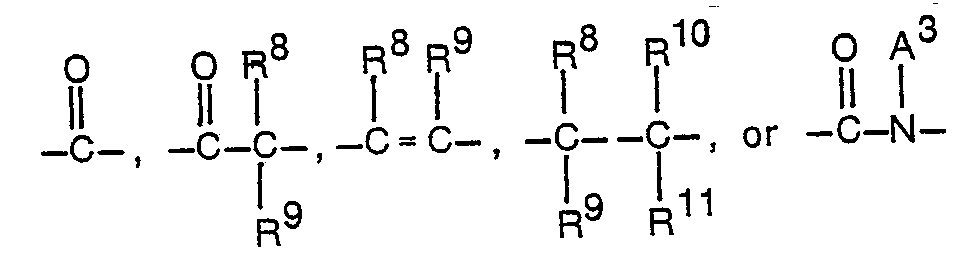
- A1, A2, and A3 are independently preferably (polyacryloyloxy)alkoxy propyl groups of the formula

- R29 is the residue of an aliphatic polyol having (m+ 1) primary hydroxyl groups and containing 1 to 10 carbon atoms (and optionally a catenary oxygen), preferably 1 to 2 quaternary carbon atoms, and a valence of m+1, the residue formed by removal of m+1 hydroxy groups,
- R30 is hydrogen

- R31 is hydrogen or methyl.
- The preferred compounds of Formula I are those wherein E is

- The prior art compounds not heretofore used in an air cure irradiation polymerization process can be represented by the formula given in U.S. Patent No. 3,821,098:


- The radical X' in the N-heterocyclic grouping of formula I can be, e.g. a radical of the formulae:

- The materials useful in the process of the present invention also include those of the following formula from U.S. Patent No. 3,808,266:

- R20 is hydrogen or methyl,
- R21 is hydrogen or methyl,
- n is 2 or 3, and
- A is as defined above for the materials of U.S. Patent No. 3,821,098 which is the same as A above.
- In its broadest scope, the materials of the present invention can be represented by the formula


- R23 is an aliphatic group of 1 to 15 carbon atoms (preferably alkylene group of 1 to 15 carbon atoms) which may have up to 2 non-adjacent catenary oxygen atoms or

- R24 is selected from hydrogen or -OR27 in which R27 is selected from hydrogen,

- R6 and R7 as defined above.
- R26 is an alkylene group of from 1 to 6 carbon atoms and optionally 1 catenary oxygen atom,
- e and g are independently 0 or 1,
- d is always 1 except when e and g are 0 and then d is 0.
- f is an integer of from 1 to 5,
- h is an integer of from 1 to 30 (and preferably 1 to 12), and
- i is either zero or 1, and
- Z is as defined above.
- It is preferred that when R24 is hydrogen, then e and g are both zero, and f and i are one; and when R24 is -OR27 at least one of e and g are zero and f is one, or e and g are 1 and f is 1 to 5.
- Wherever the term "group" is used in the definition of a term (as in alkyl group versus alkyl), the term connotes the possibility of substitution recognized by the act as not affecting the functional nature of the chemical term. With backbone chains, for example, (̵CH2)̵n-O(̵-CH2)m is recognized as being substantially equivalent to (̵-CH2)̵m+n and included within the term "alkyl group". In the same manner, terminal groups of the formula (̵CH2)̵m+nCH3 are recognized as substantially equivalent to (̵CH2)̵mO―CH2―m+1Q wherein group Q represents moieties substituting for a terminal hydrogen. For example, insofar as the functionality of the compound as a whole is concerned, Q might be halogen, amino, nitro, etc., without affecting the functional ability of the compound. This is readily understood by the ordinary skilled artisan.
- The process of the present invention comprises the curing of these materials or the curing of compositions comprising at least 15% by weight of these materials by exposure to radiation within the ultra violet and visible spectral regions and in an atmosphere containing at least 2% oxygen. Compositions used in the practice of the present invention preferably comprise at least 30 to 100% by weight of these heterocyclic polyacrylate materials and more preferably comprise from 45 to 85% by weight of these heterocyclic polyacrylate materials. The percent by weight is based upon polymerizable components and does not include essentially inert fillers.
- The compositions used in the process of the present invention may be diluted with up to 85% by weight of any ethylenically unsaturated monomer. Preferably the majority of comonomers are at least diethylenically unsaturated monomers. Generic classes include the acrylates, methacrylates, acrylic anhydrides, ethylenically unsaturated anhydrides, olefinic compounds, acrylamides, ethylenically unsaturated amides and urethanes, vinyl esters, vinyl ethers, vinyl halides, vinyl epoxy resins, vinyl silanes and siloxanes, vinyl heterocycles, and prepolymers and polymers these materials. Particularly suitable ethylenically unsaturated monomers include methyl methacrylate, ethyl acrylate, 2-ethylhexyl acrylate, cyclohexyl acrylate, styrene, butadiene, 2-chlorostyrene, 2,4-dichlorostyrene, acrylic acid, acrylamide, acrylonitrile, t-butyl acrylate, methyl acrylate, butyl acrylate, N-vinyl pyrrolidone, 2-(N-butylcarbamyl)-ethyl methacrylate and 2-(N-ethylcarbamyl)ethyl methacrylate. Preferably 35 to 80% and most preferably 45 to 60% by weight of copolymerizable components comprise the heterocyclic agents of the present invention. Other diluting monomers that can be incorporated into the composition of the invention include 1,4-butylene dimethacrylate or acrylate, ethylene dimethacrylate, hexamethylene diacrylate or dimethacrylate, glyceryl diacrylate or di-methacrylate, glyceryl triacrylate or trimethacrylate, pentaerythritol triacrylate or trimethacrylate, pentaerythritol tetraacrylate or tetramethacrylate, diallyl phthalate, dipentaerythritol pentaacrylate, neopentylglycol triacrylate and 1,3,5-tri(2-methacryloyloxyethyl)-s-triazine.
- Polymerization initiators suitable for use in the compositions of the invention are compounds which liberate or generate a free-radical on addition of energy. Such initiators include peroxy, azo, and redox systems each of which are well known and are described frequently in polymerization art, e.g. Chapter II of Photochemistry, by Calvert and Pitts, John Wiley & Sons (1966). Included among free-radical initiators are the conventional heat activated initiators such as organic peroxides and organic hydroperoxides; examples are benzoyl peroxide, tertiary-butyl perbenzoate, cumene hydroperoxide, azobis(isobutyronitrile). The preferred initiators are photopolymerization initiators which facilitate polymerization when the composition is irradiated. Included among such initiators are acyloin and derivatives thereof, such as benzoin, benzoin methyl ether, benzoin ethyl ether, benzoin isopropyl ether, benzoin isobutyl ether, and a-methylbenzoin; diketones such as benzil and diacetyl, etc.; organic sulfides such as diphenyl monosulfide, diphenyl disulfide, decyl phenyl sulfide, and tetramethylthiuram monosulfide; S-acyl dithiocarbamates, such as S-benzoyl-N,N-dimethyldithiocarbamate; phenones such as acetophenone, α,α,α-tribromoacetophenone, a,a-diethoxyacetophenone, 2,2-dimethoxy-2-phenylacetophenone, o-nitro-a,a,a-tribromoacetophenone benzophenone, and p,p'-tetramethyl- diaminobenzophenone; aromatic iodonium and aromatic sulfonium salts; sulfonyi halides such as p-toluenesulfonyl chloride, 1-naphthalenesulfonyl chloride, 2-naphthalenesulfonyl chloride, 1,3-benzene- disulfonyl chloride, 2,4-dinitrobenzenesulfonyl bromide and p-acetamidobenzenesulfonyl chloride. Normally the initiator is used in amounts ranging from about 0.01 to 5% by weight of the total polymerizable composition. When the quantity is less than 0.01% by weight, the polymerization rate becomes extremely low. If the initiator is used in excess of 5% by weight, no correspondingly improved effect can be expected. Thus, addition of such greater quantity is economically unjustified. Preferably, about 0.25 to 1.0% of initiator is used in the polymerizable compositions.
- The compositions used in the process of the present invention can also contain a viscosity modifier or binder. Generally, up to about 50 percent by weight of a compatible polymer is used. Preferably, the polymer is an acrylic polymer such as poly(acrylic acid), a poly(methacrylic acid), poly(methyl methacrylate), poly(vinyl chloride), poly(vinyl acetate), poly(vinyl butyral) and the like. Other polymers include polyethers, polyesters, polylactones, polyamides, polyurethanes, cellulose derivatives, polysiloxanes and the -like. Un.
- The compositions used in preparing coatings of the invention can also include a variety of addenda utilized for their known purpose, such as stabilizers, inhibitors, lubricants, flexibilizers, pigments, carbon black, dyes, reinforcing fillers such as finely divided silica, non-reinforcing fillers such as diatomaceous earth, metal oxides, asbestos, fiberglass, glass bubbles, talc, etc. Fillers can generally be used in proportions up to 200 percent by weight of the curable components but preferably are used up to 50 percent by weight. Where the polymerizing energy is radiation, it is desirable that the addenda be transparent to the polymerizing radiation.
- The compositions used in preparing coatings of the invention are prepared by simply mixing (under "safe light" conditions if the composition is to be sensitized to visible light) the polymerization initiator and sensitizer (where used), the heterocyclic polyacrylate materials, diluting monomers, binders and addenda. Inert solvents may be employed if desired when effecting this mixture. Examples of suitable solvents are methanol, ethanol, acetone, acetonitrile and includes any solvent which does not react with the components of the mixture.
- The compositions may be applied to the substrates before curing in any conventional fashion. Roller coating, spray coating, knife-edge coating, dip-coating, sputter coating, bar coating and any other conventional process for the application of liquids to substrates may be used.
- The coatings of the present invention find application useful on substantially any solid substrate. Because the coatings of the present invention can be cured by radiation, even highly temperature sensitive substrates can be coated. The substrates may be in substantially any form, such as sheets, films, fibers, fabrics and shaped solid objects. Amongst the substrates particularly finding advantages with coatings of the present invention are polymeric resins, including both thermoplastic and thermoset resins (e.g., polyesters, polyethers, polyamides, polyurethanes, polycarbonates, polyacrylates, polyolefins, polyvinyls, cellulosesters, epoxy resins, polysiloxanes, etc.), ceramic substrates, including glass, fused ceramic sheeting, and fibers, metals and metallized surfaces, natural cellulosic materials, including wood and paper, natural resins, including rubber and gelatin and other various solid surfaces.
- Where the coating compositions used in the process of this invention are not naturally adherent to the particular substrate selected, primer compositions, comprising single ingredients or blends of materials, may be used to improve the bond of the coating to the substrate. Texturizing, chemical, or physical treatment of the surface may also be used to improve bonding.
- Particularly useful substrates for application of the coatings of the present invention would be those requiring transparent protective coatings. Finished photographic prints and films, paintings, transparencies, car windshields, painted surfaces, instant film (i.e., film which does not require external application of developing chemistry), photothermographic and thermographic paper and film, photoconductive substances, ophthalmic lenses, motion picture film, street and traffic signs, reflective surfaces, retroreflective surfaces, traffic lights, and many other substrates are usefully coated according to the practice of the present invention.
- Where the polymerization catalyst is a photoinitiator, the composition can be a composition for in situ curing because of this insensitivity to oxygen.
- The photopolymerizable compositions with at least three acrylate functionalities are particularly suitable for applications in the field of protective coatings and graphic arts because of their superior abrasion-resistance and adhesion to many rigid, resilient and flexible substrates such as metals, metal oxides, plastics, rubber, glass, paper, wood, and ceramics; their excellent resistance to most solvents and chemicals; their excellent flexibility and weatherability; and their capability for forming high resolution images.
- The photopolymerization of the compositions of the invention occurs on exposure of the compositions to any source of radiation emitting actinic radiation at a wavelength within the ultraviolet and visible spectral regions. Suitable sources of radiation include mercury, xenon, carbon arc and tungsten filament lamps, sunlight, etc. Exposures may be from less than about 1 second to 10 minutes or more depending upon the amounts of the particular polymerizable materials and photopolymerization initiator being utilized and depending upon the radiation source, distance from the source, and the thickness of the coating to be cured.
- Mixtures of compounds 1-6 (of Table 1) and 2% by weight of an appropriate photoinitiator were coated onto 12 µm polyester and dried to provide a 2.5 µm layer. For compounds 1 through 5, 2,2-dimethoxy-2-phenylacetophenone was used as a photoinitiator; for compound 6 benzophenone was used as a photoinitiator, as specified in USP 3925349. The layers were then cured in a UV Processor, Model No. CC 1202 N/A (manufactured by Radiation Polymer Co.). An 80 watt/cm (200 watts/inch) medium pressure mercury arc lamp was used as the radiation source. A film was considered cured when it displayed mar resistance after treatment with ethanol. All films were cured in one pass at a given belt speed unless indicated otherwise.
- The data in Table 1 show that the cure rates in air for compounds 1-3 of this invention are slower only by a factor of from 0.45-0.90 than the corresponding cure rates under a nitrogen atmosphere. This is in marked contrast to the cure rates in air of acrylates 4 and 5 which are slower than their corresponding cure rates under a nitrogen atmosphere by at least a factor of 0.006.
- Compound 6 is described in USP 3925349 as photocurable in the presence of air. A film of this material cures at similar rates in the presence or absence of oxygen, but fails to display good mar resistance.

- A solution containing 2.3 g of compound 1 from Example 1, 2.3 g acetone, and 0.033 g diethoxyacetophenone was coated onto a 12 ym polyethylene sheet with a #14 Meyer bar. The layer was dried and placed in a mounting for a Perkin Elmer Model No. 257 infrared spectrophotometer. The absorbances at 1630 cm-1 and 810 cm-1, characteristic of acrylate unsaturation, were recorded. The mounting was removed from the spectrophotometer and passed through a UV processor as described in Example 1 at 50 ft/min. The mounting was returned to the spectrophotometer and the absorbances at 1630 cm-1 and 810 cm-1 were recorded and compared to the initial absorbances. This experiment showed that 70-80% of the acrylate functionality was consumed under the curing conditions. Five additional passes of this film at 50 ft/min (15.24 m/min) in the UV processor failed to show any significant decrease in the acrylate infrared absorbances.
- The same experiment was repeated, except that the film was cured under a nitrogen atmosphere. Once again 70-80% of the acrylate functionality was consumed in one pass at 50 ft/min (15.24 m/min) with no additional crosslinking being observed with additional curing time.
- The experiments described above indicate that under these curing conditions there is no observable difference in the degree of crosslinking for Compound 1, Example 1, in the presence or absence of atmospheric oxygen.
- Various amounts of Compounds 1 and 2 (from Example 1) with trimethylolpropanetriacrylate (TMPTA) and 2% by weight of 2,2-dimethoxy-2-phenyl acetophenone was added. Each mixture was diluted with an equal weight of acetone and coated onto 12 µm polyester film and dried. The dried coating was 2.5 µm thick. The film was exposed in air at a distance of 6 cm to the irradiation from a 100 watt Hanovia 3D690 lamp and the time was measured at which each became insoluble in acetone. The data obtained is recorded in Table 2.
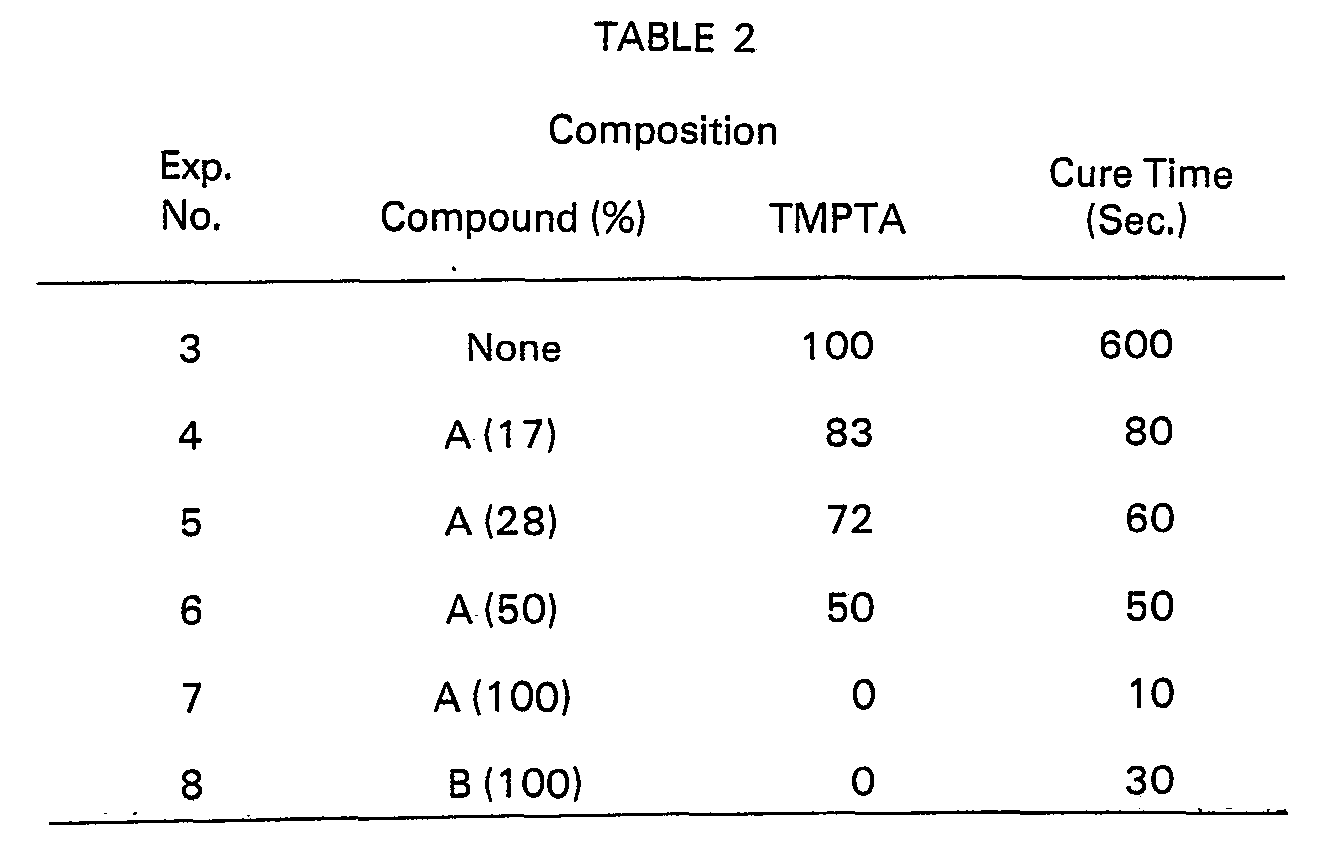
- By reference to Table 2 it can be seen that TMPTA requires 10 minutes to reach insolubility and that with the addition of 17% of Compound 1 (from Example 1) the cure time is reduced to 80 seconds and with increasing amounts of 1, the composition cures faster until at 100% 1, the composition under the stated conditions cures in only 10 seconds. Comparable results can be obtained with Compound 2.
- One part polyacrylic acid, one part compound 1 from Example 1, five parts water, five parts ethanol and 0.02 parts of 2,2-dimethoxy-2-phenyl-acetophenone were mixed together to form a solution. A layer 5.0 µm in thickness of this solution was coated onto 12 µm polyester as described in Example 1. A patterned template was placed over the layer and exposed by a Hanovia 3D690 mercury arc lamp in air at a distance of 6 cm for two minutes. The exposed sheet was developed with cold water leaving an image having excellent resolution.
- Coatings about 5 µm thick were prepared by coating using a #20 Meyer bar onto about 12 µm polyethylene film primed with polyvinylidene chloride 50% solutions in ethyl acetate (other solvents such as ketones and lower alcohols are equally suitable) and drying mixtures of Compound 1 of Example 1, zero to 100% of Compound 2 of Example 1, and pentaerythritol triacrylate (PTA) based on total weight of Compounds 1, 2 and PTA. To each solution had been added, as photoinitiator, 1% of Irgacure 651 (similar results were obtained with a,a-diethoxyacetophenone and benzoin ethyl ether and, as coating aid, 0.01% of a fluorocarbon or silicone surfactant. The dried coatings were then cured by one pass in a Model 1202 AN (PPG) Ultraviolet Processor (manufactured by Radiation Polymer Company) operated at about 12 m/min with an 80 watt/cm medium pressure mercury vapor lamp 15 cm from the surface of the layer without exclusion of air. The cured layer was tested for crosshatch adhesion, Taber wheel abrasion, resistance to steel wool, and falling sand abrasion. The results are recorded in Table 3.
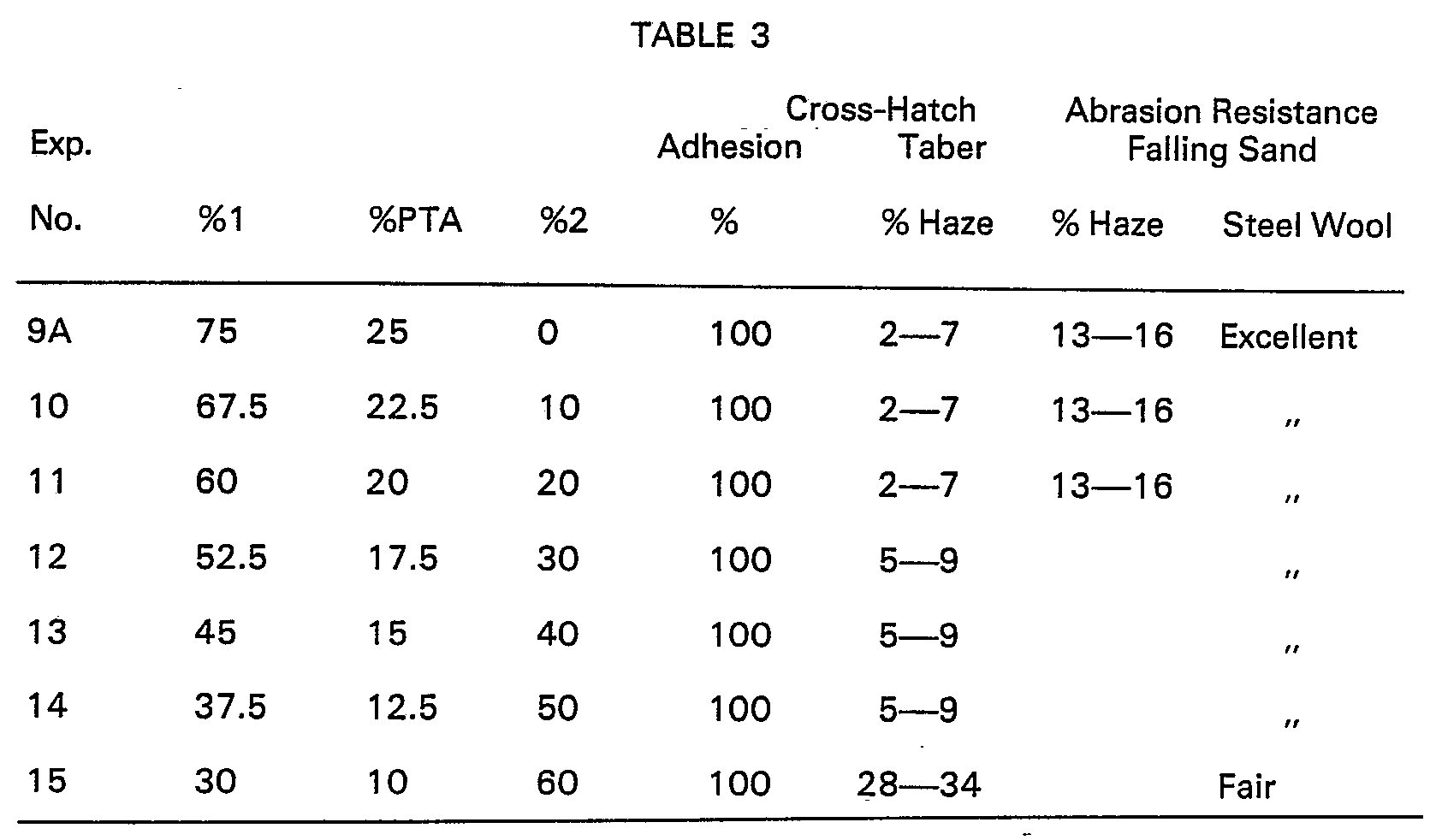
- Table 3 shows that coatings prepared from the hexaacryloyloxyhydantoin, Compound 1, and up to more than 50% of the diacryloyloxyhydantoin, Compound 2, have excellent resistance to abrasion as measured by Taber, falling sand and steel wool procedures. At up to about 30% Compound 2, abrasion resistance is superior. When coatings were prepared as for Examples 3-10 but using photoinitiator concentrations from 0.4 to 3% and tested, similar abrasion resistance and cross-hatch adhesion was obtained.
- Into a 250 ml three-necked round bottom flask equipped with mechanical stirrer, pressure equalizing dropping funnel, reflux condenser, and calcium sulfate drying tube were charged 103.0 g pentaerythritol triacrylate (hydroxy equivalent weight of 515), 23.2 g 2-hydroxyethyl acrylate (0.2 mol), 0.08 g 4-methoxyphenol, and 1.0 g borontrifluoride etherate. The reaction flask was heated to 75°C and 55.2 g (0.40 mol epoxy equivalency) 1,3-bis(2,3-epoxy- propyl)-5,5-dimethyl-2,4-imidazolidine- dione in 20 ml chloroform was added dropwise over one hour. After the addition, the reaction flask temperature was raised to 88°C and stirred for 18.0 hours. At this time, titration of an aliquote for unreacted epoxide indicated the reaction was greater than 99% complete. The volatiles were removed by vacuum distillation leaving a viscous liquid which contains a mixture of bis(triacryloyl)-, bis(monoacryloyl)-, and the unsymmetrical monoacryloyl-triacryloyl-imidizolidinedione, and impurities, introduced with the pentaerythritol triacrylate.
- A layer of the above reaction product prepared to contain 2% Irgacure 651 and cured in air as described for compounds of Example 1, had abrasion and chemical resistance characteristics similar to those of the layers of Example 1.
- The words "Hanovia" and "Irgacure" used herein are registered Trade Marks.
Claims (12)


Applications Claiming Priority (2)
| Application Number | Priority Date | Filing Date | Title |
|---|---|---|---|
| US51888 | 1979-06-25 | ||
| US06/051,888 US4306954A (en) | 1979-06-25 | 1979-06-25 | Process for polymerizing acrylic substituted hydantoins in air |
Publications (3)
| Publication Number | Publication Date |
|---|---|
| EP0030968A1 EP0030968A1 (en) | 1981-07-01 |
| EP0030968A4 EP0030968A4 (en) | 1981-07-09 |
| EP0030968B1 true EP0030968B1 (en) | 1984-03-14 |
Family
ID=21973975
Family Applications (1)
| Application Number | Title | Priority Date | Filing Date |
|---|---|---|---|
| EP80901347A Expired EP0030968B1 (en) | 1979-06-25 | 1981-01-12 | Irradiation of polyacrylate compositions in air |
Country Status (13)
| Country | Link |
|---|---|
| US (1) | US4306954A (en) |
| EP (1) | EP0030968B1 (en) |
| JP (1) | JPH0237923B2 (en) |
| AU (1) | AU543438B2 (en) |
| BE (1) | BE884001A (en) |
| BR (1) | BR8008722A (en) |
| CA (1) | CA1143329A (en) |
| CH (1) | CH663312GA3 (en) |
| DE (1) | DE3066940D1 (en) |
| IT (1) | IT1145377B (en) |
| MX (1) | MX156015A (en) |
| WO (1) | WO1981000012A1 (en) |
| ZA (1) | ZA803751B (en) |
Families Citing this family (21)
| Publication number | Priority date | Publication date | Assignee | Title |
|---|---|---|---|---|
| US4392930A (en) * | 1981-07-09 | 1983-07-12 | Ciba-Geigy Corporation | Photopolymerizable resins |
| US4567073A (en) * | 1982-07-02 | 1986-01-28 | Minnesota Mining And Manufacturing Company | Composite low surface energy liner of perfluoropolyether |
| US4544572A (en) * | 1982-09-07 | 1985-10-01 | Minnesota Mining And Manufacturing Company | Coated ophthalmic lenses and method for coating the same |
| US4758448A (en) * | 1982-09-07 | 1988-07-19 | Signet Armorlite, Inc. | Coated ophthalmic lenses and method for coating the same |
| US4614667A (en) * | 1984-05-21 | 1986-09-30 | Minnesota Mining And Manufacturing Company | Composite low surface energy liner of perfluoropolyether |
| US4963209A (en) * | 1984-12-21 | 1990-10-16 | Minnesota Mining And Manufacturing Company | Method for making stretched surface recording disk |
| US4835647A (en) * | 1984-12-21 | 1989-05-30 | Minnesota Mining And Manufacturing Company | Stretched surface recording medium |
| US4774035A (en) * | 1986-01-14 | 1988-09-27 | Camelot Industries Corporation | Process of coating an ophthalmic lens |
| US6730244B1 (en) | 1986-01-28 | 2004-05-04 | Q2100, Inc. | Plastic lens and method for the production thereof |
| US6201037B1 (en) | 1986-01-28 | 2001-03-13 | Ophthalmic Research Group International, Inc. | Plastic lens composition and method for the production thereof |
| US5415816A (en) | 1986-01-28 | 1995-05-16 | Q2100, Inc. | Method for the production of plastic lenses |
| US4814215A (en) * | 1986-11-07 | 1989-03-21 | The B. F. Goodrich Company | Adhesive composition, process, and product |
| US4965117A (en) * | 1986-11-07 | 1990-10-23 | The B. F. Goodrich Company | Adhesive composition, process, and product |
| US5234730A (en) * | 1986-11-07 | 1993-08-10 | Tremco, Inc. | Adhesive composition, process, and product |
| US4830910A (en) * | 1987-11-18 | 1989-05-16 | Minnesota Mining And Manufacturing Company | Low adhesion compositions of perfluoropolyethers |
| US5514214A (en) * | 1993-09-20 | 1996-05-07 | Q2100, Inc. | Eyeglass lens and mold spin coater |
| US6022498A (en) | 1996-04-19 | 2000-02-08 | Q2100, Inc. | Methods for eyeglass lens curing using ultraviolet light |
| MY143286A (en) * | 1996-05-21 | 2011-04-15 | Panasonic Corp | Thin film, method and apparatus for forming the same, and electronic component incorporating the same |
| US6280171B1 (en) | 1996-06-14 | 2001-08-28 | Q2100, Inc. | El apparatus for eyeglass lens curing using ultraviolet light |
| US6013409A (en) * | 1996-09-10 | 2000-01-11 | 3M Innovative Properties Company | Dry peel-apart imaging process |
| US5856064A (en) * | 1996-09-10 | 1999-01-05 | Minnesota Mining And Manufacturing Company | Dry peel-apart imaging or proofing system |
Family Cites Families (6)
| Publication number | Priority date | Publication date | Assignee | Title |
|---|---|---|---|---|
| US3808226A (en) * | 1971-01-15 | 1974-04-30 | Ciba Geigy Corp | Polyacrylates of n-heterocyclic compounds |
| US3852302A (en) * | 1971-04-16 | 1974-12-03 | Ciba Geigy Corp | Diacrylic acid ester derivatives of hydantoin compounds |
| CH546800A (en) * | 1971-07-09 | 1974-03-15 | Ciba Geigy Ag | PROCESS FOR CURING POLYACRYLATES WITH IONIZING RAYS. |
| US3960824A (en) * | 1971-07-09 | 1976-06-01 | Celanese Coatings & Specialties Company | Mercaptan initiated polymerization process carried out in the presence of oxygen |
| CH546798A (en) * | 1971-08-17 | 1974-03-15 | Ciba Geigy Ag | PROCESS FOR CURING ACRYLIC ACID ESTER DERIVATIVES WITH IONIZING RAYS. |
| US4071477A (en) * | 1976-06-10 | 1978-01-31 | Ciba-Geigy Corporation | Hydantoin diglycidyl compounds |
-
1979
- 1979-06-25 US US06/051,888 patent/US4306954A/en not_active Expired - Lifetime
-
1980
- 1980-05-22 JP JP55501598A patent/JPH0237923B2/ja not_active Expired - Lifetime
- 1980-05-22 DE DE8080901347T patent/DE3066940D1/en not_active Expired
- 1980-05-22 BR BR8008722A patent/BR8008722A/en not_active IP Right Cessation
- 1980-05-22 CH CH127281A patent/CH663312GA3/de unknown
- 1980-05-22 CA CA000352478A patent/CA1143329A/en not_active Expired
- 1980-05-22 AU AU61229/80A patent/AU543438B2/en not_active Ceased
- 1980-05-22 WO PCT/US1980/000611 patent/WO1981000012A1/en not_active Ceased
- 1980-06-24 ZA ZA00803751A patent/ZA803751B/en unknown
- 1980-06-24 IT IT49060/80A patent/IT1145377B/en active
- 1980-06-25 MX MX182914A patent/MX156015A/en unknown
- 1980-06-25 BE BE0/201172A patent/BE884001A/en not_active IP Right Cessation
-
1981
- 1981-01-12 EP EP80901347A patent/EP0030968B1/en not_active Expired
Also Published As
| Publication number | Publication date |
|---|---|
| US4306954A (en) | 1981-12-22 |
| IT1145377B (en) | 1986-11-05 |
| JPH0237923B2 (en) | 1990-08-28 |
| WO1981000012A1 (en) | 1981-01-08 |
| IT8049060A0 (en) | 1980-06-24 |
| DE3066940D1 (en) | 1984-04-19 |
| BE884001A (en) | 1980-12-29 |
| BR8008722A (en) | 1981-04-28 |
| JPS56500747A (en) | 1981-06-04 |
| EP0030968A4 (en) | 1981-07-09 |
| MX156015A (en) | 1988-06-16 |
| AU6122980A (en) | 1981-01-14 |
| ZA803751B (en) | 1982-02-24 |
| CH663312GA3 (en) | 1987-12-15 |
| CA1143329A (en) | 1983-03-22 |
| EP0030968A1 (en) | 1981-07-01 |
| AU543438B2 (en) | 1985-04-18 |
Similar Documents
| Publication | Publication Date | Title |
|---|---|---|
| US4323591A (en) | Irradiation of polyacrylate films in air | |
| CA1145628A (en) | Poly(ethylenically unsaturated alkoxy) heterocyclic protective coatings | |
| US4306954A (en) | Process for polymerizing acrylic substituted hydantoins in air | |
| CA1125285A (en) | Poly(ethylenically unsaturated alkoxy) heterocyclic compounds | |
| US4912185A (en) | Cross-linkable casting compositions | |
| CA1106524A (en) | Radiation curable coating composition comprising an oligomer, and an ultra-violet absorber | |
| WO2013161859A1 (en) | Metal oxide dispersion, metal oxide dispersion-containing polymerizable composition, and polymerized product of same | |
| EP0327906A1 (en) | Hard coating agents | |
| US4024297A (en) | Actinic light polymerizable coating compositions | |
| KR970010748B1 (en) | Oligomeric Benzyl Ketals and Their Uses as Photoinitiators | |
| EP1003796A1 (en) | Radiation curable resin composititon for cast polymerization | |
| JPH089586B2 (en) | Bifunctional acrylate compound and method for producing the same | |
| EP0030969B1 (en) | Poly(ethylenically unsaturated alkoxy)heterocyclic compounds and crosslinked polymeric coatings | |
| US11149157B2 (en) | Photocurable resin composition, ink and coating material | |
| JP2004143344A (en) | Crosslinkable resin composition having ultraviolet light-absorbing ability | |
| Wendling et al. | Irradiation of polyacrylate compositions in air | |
| TW202419488A (en) | Silicone urethane (meth)acrylates and their use in coating compositions | |
| JP2683883B2 (en) | Bifunctional acrylate compound polymer and use thereof | |
| EP0026339B1 (en) | Radiation curable coating composition and process for coating a substrate therewith | |
| JPWO2013146651A1 (en) | Cyclic ether group-containing (meth) acrylate | |
| US5095044A (en) | Oligomeric benzil ketals and their use as photoinitiators | |
| JPH0141649B2 (en) | ||
| KR20180132645A (en) | Active energy ray-curable resin composition for optical articles, cured article and optical sheet | |
| JPS63275639A (en) | Curable composition | |
| JP2005139243A (en) | Maleimide group-containing silicon compound and photosensitive resin composition |
Legal Events
| Date | Code | Title | Description |
|---|---|---|---|
| PUAI | Public reference made under article 153(3) epc to a published international application that has entered the european phase |
Free format text: ORIGINAL CODE: 0009012 |
|
| 17P | Request for examination filed |
Effective date: 19810204 |
|
| AK | Designated contracting states |
Designated state(s): DE FR GB NL |
|
| GRAA | (expected) grant |
Free format text: ORIGINAL CODE: 0009210 |
|
| AK | Designated contracting states |
Designated state(s): DE FR GB NL |
|
| REF | Corresponds to: |
Ref document number: 3066940 Country of ref document: DE Date of ref document: 19840419 |
|
| ET | Fr: translation filed | ||
| PLBE | No opposition filed within time limit |
Free format text: ORIGINAL CODE: 0009261 |
|
| STAA | Information on the status of an ep patent application or granted ep patent |
Free format text: STATUS: NO OPPOSITION FILED WITHIN TIME LIMIT |
|
| 26N | No opposition filed | ||
| REG | Reference to a national code |
Ref country code: GB Ref legal event code: 732 |
|
| PGFP | Annual fee paid to national office [announced via postgrant information from national office to epo] |
Ref country code: NL Payment date: 19950531 Year of fee payment: 16 |
|
| PG25 | Lapsed in a contracting state [announced via postgrant information from national office to epo] |
Ref country code: NL Effective date: 19961201 |
|
| NLV4 | Nl: lapsed or anulled due to non-payment of the annual fee |
Effective date: 19961201 |
|
| PGFP | Annual fee paid to national office [announced via postgrant information from national office to epo] |
Ref country code: FR Payment date: 19970421 Year of fee payment: 18 |
|
| PGFP | Annual fee paid to national office [announced via postgrant information from national office to epo] |
Ref country code: GB Payment date: 19970425 Year of fee payment: 18 |
|
| PGFP | Annual fee paid to national office [announced via postgrant information from national office to epo] |
Ref country code: DE Payment date: 19970428 Year of fee payment: 18 |
|
| PG25 | Lapsed in a contracting state [announced via postgrant information from national office to epo] |
Ref country code: GB Free format text: LAPSE BECAUSE OF NON-PAYMENT OF DUE FEES Effective date: 19980522 |
|
| PG25 | Lapsed in a contracting state [announced via postgrant information from national office to epo] |
Ref country code: FR Free format text: LAPSE BECAUSE OF NON-PAYMENT OF DUE FEES Effective date: 19980531 |
|
| GBPC | Gb: european patent ceased through non-payment of renewal fee |
Effective date: 19980522 |
|
| PG25 | Lapsed in a contracting state [announced via postgrant information from national office to epo] |
Ref country code: DE Free format text: LAPSE BECAUSE OF NON-PAYMENT OF DUE FEES Effective date: 19990302 |
|
| REG | Reference to a national code |
Ref country code: FR Ref legal event code: ST |