EP0028906B1 - 1'-substituted-spiro(imidazolidine-4,3'-indoline)-2,2',5-triones, processes for their manufacture and pharmaceutical compositions thereof - Google Patents
1'-substituted-spiro(imidazolidine-4,3'-indoline)-2,2',5-triones, processes for their manufacture and pharmaceutical compositions thereof Download PDFInfo
- Publication number
- EP0028906B1 EP0028906B1 EP80303890A EP80303890A EP0028906B1 EP 0028906 B1 EP0028906 B1 EP 0028906B1 EP 80303890 A EP80303890 A EP 80303890A EP 80303890 A EP80303890 A EP 80303890A EP 0028906 B1 EP0028906 B1 EP 0028906B1
- Authority
- EP
- European Patent Office
- Prior art keywords
- indoline
- imidazolidine
- compound
- formula
- trione
- Prior art date
- Legal status (The legal status is an assumption and is not a legal conclusion. Google has not performed a legal analysis and makes no representation as to the accuracy of the status listed.)
- Expired
Links
- 0 O=C(*C1(C(*2)=O)c3c2cccc3)*C1=O Chemical compound O=C(*C1(C(*2)=O)c3c2cccc3)*C1=O 0.000 description 4
Classifications
-
- C—CHEMISTRY; METALLURGY
- C07—ORGANIC CHEMISTRY
- C07D—HETEROCYCLIC COMPOUNDS
- C07D487/00—Heterocyclic compounds containing nitrogen atoms as the only ring hetero atoms in the condensed system, not provided for by groups C07D451/00 - C07D477/00
- C07D487/02—Heterocyclic compounds containing nitrogen atoms as the only ring hetero atoms in the condensed system, not provided for by groups C07D451/00 - C07D477/00 in which the condensed system contains two hetero rings
- C07D487/10—Spiro-condensed systems
-
- C—CHEMISTRY; METALLURGY
- C07—ORGANIC CHEMISTRY
- C07D—HETEROCYCLIC COMPOUNDS
- C07D471/00—Heterocyclic compounds containing nitrogen atoms as the only ring hetero atoms in the condensed system, at least one ring being a six-membered ring with one nitrogen atom, not provided for by groups C07D451/00 - C07D463/00
- C07D471/02—Heterocyclic compounds containing nitrogen atoms as the only ring hetero atoms in the condensed system, at least one ring being a six-membered ring with one nitrogen atom, not provided for by groups C07D451/00 - C07D463/00 in which the condensed system contains two hetero rings
- C07D471/10—Spiro-condensed systems
-
- A—HUMAN NECESSITIES
- A61—MEDICAL OR VETERINARY SCIENCE; HYGIENE
- A61P—SPECIFIC THERAPEUTIC ACTIVITY OF CHEMICAL COMPOUNDS OR MEDICINAL PREPARATIONS
- A61P3/00—Drugs for disorders of the metabolism
- A61P3/08—Drugs for disorders of the metabolism for glucose homeostasis
-
- A—HUMAN NECESSITIES
- A61—MEDICAL OR VETERINARY SCIENCE; HYGIENE
- A61P—SPECIFIC THERAPEUTIC ACTIVITY OF CHEMICAL COMPOUNDS OR MEDICINAL PREPARATIONS
- A61P3/00—Drugs for disorders of the metabolism
- A61P3/08—Drugs for disorders of the metabolism for glucose homeostasis
- A61P3/10—Drugs for disorders of the metabolism for glucose homeostasis for hyperglycaemia, e.g. antidiabetics
-
- C—CHEMISTRY; METALLURGY
- C07—ORGANIC CHEMISTRY
- C07D—HETEROCYCLIC COMPOUNDS
- C07D209/00—Heterocyclic compounds containing five-membered rings, condensed with other rings, with one nitrogen atom as the only ring hetero atom
- C07D209/02—Heterocyclic compounds containing five-membered rings, condensed with other rings, with one nitrogen atom as the only ring hetero atom condensed with one carbocyclic ring
- C07D209/04—Indoles; Hydrogenated indoles
- C07D209/30—Indoles; Hydrogenated indoles with hetero atoms or with carbon atoms having three bonds to hetero atoms with at the most one bond to halogen, directly attached to carbon atoms of the hetero ring
- C07D209/32—Oxygen atoms
- C07D209/38—Oxygen atoms in positions 2 and 3, e.g. isatin
Definitions
- This invention concerns novel substituted indoline-2-one derivatives, and more particularly novel 1'-substituted spiro[imidazolidine-4,3'-indoline]-2,2',5-triones, which possess the property of inhibiting the enzyme aldose reductase in vivo.
- the invention also concerns processes for the manufacture of the said substituted indolin-2-one derivatives, pharmaceutical compositions thereof and a method for use thereof in the treatment or prophylaxis of certain complications of protracted diabetes of galactosemia.
- aldose reductase is responsible for the catalytic conversion of aldoses, for example glucose and glactose, to the corresponding alditols, for example sorbitol and galactitol respectively.
- alditols penetrate cell membranes poorly and, once formed, tend to be removed only by further metabolism. As a consequence, alditols tend to accumulate within cells where they are formed, causing a rise in internal osmotic pressure which may in turn be sufficient to destroy or impair the function of the cells themselves.
- raised alditol levels may result in abnormal levels of their metabolites which may themselves impair or damage cellular function.
- the enzyme aldose reductase has a relatively low substrate affinity, that is, it is only effective in the presence of relatively large concentrations of aldose.
- Such large concentrations of aldose are present in the clinical conditions of diabetes (excessive glucose) and galactosemia (excessive galactose).
- inhibitors of the enzyme aldose reductase are useful in the reduction or prevention of the development of those complications of protracted diabetes or galactosemia which may be due in part to the accumulation of sorbitol or galactitol respectively.
- complications are, for example, macular oedema, cataract, retinopathy or impaired neural conduction.
- spiro-linked hydantoins spiro-linked imidazolidine-2,5-diones
- aldose reductase for example the compounds of the general formula:- wherein Z is oxygen, sulphur, sulphinyl, sulphonyl, methylene or a direct bond, and Y stands for various optional substituents described by Sarges in US Patent Serial No. 4,117,230.
- the compounds of formula I are derivatives of spiro[imidazolidine-4,3'-indoline] which is numbered as follows:- This numbering system will be used throughout the present specification.
- the compounds of formula I possess at least one asymmetric carbon atom, namely the spiro-linked carbon atom. They therefore exist, and may be isolated, in racemic and optically-active forms.
- This invention relates to the racemic form of a compound of formula I or to any optically-active form which possesses aldose reductase inhibitory properties, it being well known in the art how to prepare optically active forms by resolution of the racemic form, or by synthesis from optically-active starting materials, and how to determine the aldose reductase inhibitory properties by the standard tests described hereinbelow.
- R 1 when it is a (1 ⁇ 12C) alkyl radical is, for example, a methyl, ethyl, propyl, butyl, pentyl, hexyl, nonyl or decyl radical.
- ring A Particular values for ring A are when it is unsubstituted or bears 4'-chloro, 5'-fluoro, 5'chloro, 5'-bromo, 5'-methyl, 5'-methoxy, 5'-hydroxy, 5'-nitro, 6'-chloro, 7'-fluoro, 7'-chloro, 7'-methyl, 7'-ethyl, 5',6'-difluoro, 5',6'-dichloro, 4',5'-dichloro, 5',6'-dimethyl, 5'-bromo-7'-nitro or 5'-chloro-7'-methyl substituents.
- R 1 Particular values for R 1 are when it is a methyl, n-propyl, n-hexyl, n-nonyl, n-decyl, phenyl, cinnamyl, 3,4-dichlorocinnamyl, naphth-1-ylmethyl, naphth-2-ylmethyl, benzyl, 3,4-dichlorobenzyl, 2-fluoro-4-bromobenzyl, 4-methylbenzyl, 2-fluoro-4-iodobenzyl, 3-chloro-4-bromobenzyl, 4-chlorobenzyl, 4-bromobenzyl, 3,4-dimethoxybenzyl, 3-(trifluoromethyl)benzyl, 2-cyanobenzyl, 4-cyanobenzyl, 2-fluoro-4-bromo-5-nitrobenzyl, 4-nitrobenzyl, 3,5-dichloro-4-bromobenzyl, 2,4-dichlorobenzyl, 4-
- a preferred value for ring A is when it is unsubstituted or bears a halogeno substituent for example a chloro substituent and especially such a substituent located at position 5', 6' or 7'.
- R I is when it is a benzyl radical bearing one or two halogeno radicals, for example when it is a 4-halogeno-, 2,4-dihalogeno-, 3,4-dihalogeno- or 3,5-dihalogeno-benzyl radical, such as a 4-bromo-, 2-fluoro-4-bromo, 2-fluoro-4-iodo, 3,4-dichloro-, 3-chloro-4-bromo or 3,5-dichloro-benzyl radical.
- R 1 is a (1 ⁇ 12C)alkyl or an unsubstituted benzyl radical; and benzene ring A bears at least one halogeno substituent;
- One preferred group of compounds of the invention comprises those compounds of formula I wherein R 1 and benzene ring A have any of the preferred values specifically defined hereinbefore, together with the pharmaceutically acceptable salts thereof.
- a further group of preferred compounds of the invention comprises those compounds of formula I wherein R 1 is a 3,4-dichlorobenzyl, 2-fluoro-4-bromobenzyl, 3-chloro-4-bromobenzyl or 2-fluoro-4-iodobenzyl radical and benzene ring A is unsubstituted or bears 5'-fluoro, 5'-chloro, 5'-bromo, 5',6'-difluoro or 5',6'-dichloro substituents; together with the pharmaceutically acceptable salts thereof.
- Particular pharmaceutically acceptable salts of formula I are, for example, alkali metal or alkaline earth metal salts, such as sodium, potassium, calcium or magnesium salts, aluminium or ammonium salts, or salts with organic bases, such as triethanolamine, which form pharmaceutically acceptable cations.
- alkali metal or alkaline earth metal salts such as sodium, potassium, calcium or magnesium salts, aluminium or ammonium salts, or salts with organic bases, such as triethanolamine, which form pharmaceutically acceptable cations.
- the compounds of formula I may be manufactured by any general procedure known in the art to be applicable to the preparation of chemically analogous heterocyclic compounds. Such analogy processes are provided as a further feature of the invention and are illustrated by the following wherein R' and benzene ring A have the meanings defined hereinbefore:-(a) Reacting an indolin-2,3-dione of the formula:- with an alkalimetal cyanide, and ammonium carbonate or carbamate.
- a suitable alkali metal cyanide is, for example, sodium or potassium cyanide.
- process (a) is an example of the Bucherer-Bergs synthesis of imidazolidine-2,4-diones (hydantoins) which is well known in the art (see E Ware in Chemical Reviews, 1950, 46, 422 ⁇ 425), and that such a reaction may therefore proceed through a hydroxynitrile of the formula:- and/or an amino-nitrile of the formula:- Accordingly, this invention includes carrying out process (a) by separate or in situ manufacture of an intermediate of formula IV (for example by reaction of a compound of formula III with hydrogen cyanide) followed by reaction of the intermediate with ammonium carbonate or carbamate.
- an intermediate of formula IV for example by reaction of a compound of formula III with hydrogen cyanide
- the invention includes carrying our process (a) by separate or in situ manufacture of an intermediate of formula V (for example by reacting a compound of formula III with ammonia and hydrogen cyanide) followed by reaction of the intermediate with carbon dioxide, which may conveniently be provided as: ammonium carbonate or carbamate.
- an intermediate of formula V for example by reacting a compound of formula III with ammonia and hydrogen cyanide
- carbon dioxide which may conveniently be provided as: ammonium carbonate or carbamate.
- the process may be conveniently performed in a solvent or diluent, for example in a (1-4C)alkanol such as methanol or ethanol, or in ethylene glycol or diethylene glycol, preferably containing water, and at a temperature in the range, for example 20 ⁇ 100°C.
- a solvent or diluent for example in a (1-4C)alkanol such as methanol or ethanol, or in ethylene glycol or diethylene glycol, preferably containing water, and at a temperature in the range, for example 20 ⁇ 100°C.
- ammonium carbonate or carbamate may if necessary be formed in situ in conventional manner.
- the starting materials of formula III may be obtained by conventional procedures of indole chemistry.
- those compounds of formula III wherein R' is other than a phenyl radical may be obtained by reacting an indoline-2,3-dione of formula III wherein R 1 is replaced by hydrogen with the appropriate alkyl or aralkyl halide, for example a chloride, bromide or iodide, in the presence of a base such as sodium or potassium hydroxide in dimethyl sulphoxide at a temperature of 20-40°C.
- R 2 has the same meaning as R I other than a phenyl radical and X is a halogeno radical, for example a chloro, bromo or iodo radical, or an aryl or alkylsulphonyloxy radical, for example a toluene p-sulphonyloxy or methylsulphonyloxy radical, in the presence of a suitable base.
- X is a halogeno radical, for example a chloro, bromo or iodo radical, or an aryl or alkylsulphonyloxy radical, for example a toluene p-sulphonyloxy or methylsulphonyloxy radical, in the presence of a suitable base.
- a particularly suitable base is, for example, a strong base, for example in alkali metal hydroxide, carbonate or hydride, such as sodium or potassium hydroxide or carbonate and sodium or potassium hydride.
- the process is preferably performed in a solvent or diluent, for example in a (1-4C)alkanol such as methanol or ethanol or in N,N-dimethylformamide, optionally admixed with water, when an alkali metal hydroxide or carbonate is used, or in a non-aqueous solvent, such as dimethyl sulphoxide or N,N-dimethylformamide, when an alkali metal hydride is used.
- a solvent or diluent for example in a (1-4C)alkanol such as methanol or ethanol or in N,N-dimethylformamide, optionally admixed with water, when an alkali metal hydroxide or carbonate is used, or in a non-aqueous solvent, such as di
- the process is preferably carried out at a temperature of, for example, 20-40°C., and generally for a relatively short reaction time to minimise alkylation of the imidazolidine nitrogen atoms.
- the starting materials of formula VI may be made by standard procedures of organic chemistry well known for the synthesis of analogous compounds, for example as described by Otomasu et alia (Chem. Pharm. Bull., 1975,23, 1431-1435). Thus, they may be obtained by an analogous procedure to process (a) hereinabove, but starting from the appropriate 1-(unsubstituted)-indoline-2,3-dione. The latter compounds are also readily accessible by known procedures of organic chemistry. (c) Reacting a compound of the formula:- wherein R 3 is an acyl or tri-[(1 ⁇ 4C)alkyl]silyl radical with ammonium carbonate or carbamate.
- R 3 when it is an acyl radical is, for example, a (1-6C)alkanoyl radical such as acetyl or propionyl radical, a phenylsulphonyl, toluene p-sulphonyl or benzoyl radical.
- R 3 when it is a tri-(1 ⁇ 4C)alkyl]silyl radical is, for example a trimethylsilyl radical.
- process (c) is a modification of process (a) hereinbefore and consequently similar reaction conditions may be used.
- ammonium carbonate or carbamate may be formed in situ if desired.
- the starting materials of formula VII may be made by conventional procedures. Thus, they may be obtained by reacting a hydroxynitrile of formula IV (itself obtained as described in process (a) by reaction of an indoline-2,3-dione with hydrogen cyanide) with an appropriate acyl or tri-[(l--4C)alkyllsilyl halide, for example acetyl, propionyl, phenylsulphonyl, toluene p-sulphonyl, benzoyl or trimethylsilyl chloride, in conventional manner.
- acyl or tri-[(l--4C)alkyllsilyl halide for example acetyl, propionyl, phenylsulphonyl, toluene p-sulphonyl, benzoyl or trimethylsilyl chloride, in conventional manner.
- those compounds of formula VII wherein R 3 is a tri-[(1 ⁇ 4C-alkyl]silyl radical may be conveniently obtained by reaction of an appropriate indoline-2,3-dione with a tri-[(1-4C)alkyllsilyl cyanide, for example trimethylsilyl cyanide, at a temperature in the range, for example, 1 5 ⁇ 40°C. and in a non-aqueous solvent, for example 1,2-dimethoxyethane.
- the nitration may be carried out under conventional procedures, for example in the presence of sulphuric acid, using nitric acid at a temperature in the range, for example, 0 to 30°C., or using fuming nitric acid at a temperature in the range, for example -20 to 10°C.
- sulphuric acid using nitric acid at a temperature in the range, for example, 0 to 30°C.
- fuming nitric acid at a temperature in the range, for example -20 to 10°C.
- the chlorination or bromination may be carried out using conventional procedures, for example using elemental chlorine or bromine optionally in the presence of a Friedel-Craft's catalyst such as ferric chloride, ferric bromide or iron powder, at a temperature in the range, for example 10 to 100°C. and in a suitable solvent or diluent, for example chloroform, nitrobenzene or acetic acid.
- a Friedel-Craft's catalyst such as ferric chloride, ferric bromide or iron powder
- the chlorination or bromination may be carried out using sulphuryl chloride or bromide optionally in the presence of iodine as catalyst at a temperature in the range, for example 10 to 100°C., and in a suitable solvent or diluent, for example acetic acid or chloroform.
- the dealkylation may be carried out using conventional procedures well known in the art, for example using a mixture of an organic tertiary base, for example pyridine, quinoline or (1--4C)alkyl derivatives thereof, together with a mineral acid, for example hydrochloric or hydrobromic acid, at a temperature in the range for example 80 to 150°C.
- the organic tertiary base may conveniently be used in excess and function as a solvent or diluent.
- a racemic form of the said compound may be reacted with an optically-active form of a suitable organic base, for example brucine, coniine or 2-pipecoline, followed by conventional separation of the diastereoisomeric mixture of salts thus obtained, for example by fractional crystrallisation from a suitable solvent, for example a (1-4C)alkanol, whereafter the optically-active form of the said compound may be liberated by treatment with acid using a conventional procedure, for example using an aqueous mineral acid such as dilute hydrochloric acid.
- a suitable organic base for example brucine, coniine or 2-pipecoline
- the property of inhibiting the enzyme aldose reductase may be demonstrated in the following standard laboratory test.
- rats are made diabetic (as evidenced by severe glucosuria being present) by dosing with streptozotocin.
- the animals are then dosed daily with the test compound for 5 days.
- the animals are then killed and the eye lenses and sciatic nerves are removed.
- the residual sorbitol levels in each tissue are determined by gas liquid chromatography after conversion to the poly-trimethylsilyl derivatives.
- Inhibition of aldose reductase in vivo is then assessed by comparing the residual sorbitol levels in tissues from the dosed diabetic group of rats with those of an undosed group of diabetic rats and an undosed, normal group of rats.
- a modified test may be used in which the streptozotocin induced diabetic rats are dosed daily with test compound for two days. After 2-4 hours from the final dose the animals are killed and the sciatic nerves are removed and assessed for residual sorbitol levels as described above.
- Preferred compounds in either of these tests reduce residual sorbitol levels to levels which are similar to those of normal, undosed rats.
- the compounds of formula I produce significant inhibition of the enzyme aldose reductase at an oral dose of 100 mg/kg or much less.
- 1'-(3,4-dichlorobenzyl)-spiro[imidazolidine-4,3'-indoline]-2,2',5-trione and 1 '-(2-fluoro-4-bromobenzyl)-spiro[imidazolidine-4,3'-indoline]-2,2',5-trione both produce a residual sorbitol level in the sciatic nerve which is approximately 20% of that obtained in control undosed diabetic rats, following oral dosing at 10 mg./kg. for 5 days. No overt toxic or other undesirable effects were detected with compounds of formula I at 100 mg./kg. in the above tests.
- Preferred compounds of formula defined hereinbefore in general reduce the residual sorbitol level in the sciatic nerve to that in normal undosed rats when administered at an oral dose in the range 5 to 20 mg./kg.
- the property of inhibiting the enzyme aldose reductase may also be demonstrated in vitro.
- purified aldose reductase is isolated in known manner from bovine lenses.
- the percentage inhibition of this enzyme's ability in vitro to reduce aldoses to polyhydric alcohols, and particularly to reduce glucose to sorbitol, caused by a test compound is then determined using standard spectrophotometric methods.
- the compounds of formula I in general show significant inhibition of the enzyme aldose reductase at a concentration of about 10- 6 M or much less.
- a compound of the invention When a compound of the invention is used to produce an effect on the enzyme aldose reductase in warm-blooded animals, it may be administered primarily orally at a daily dose of 0.5 to 25 mg./kg., which is equivalent in man to a total daily dose in the range 10 to 750 mg. per man, given in divided doses if necessary.
- the compounds of the invention may be administered in the form of pharmaceutical compositions and according to a further feature of the invention there is provided a pharmaceutical composition which comprises a compound of formula I, or a pharmaceutically acceptable salt thereof, together with a pharmaceutically acceptable diluent or carrier.
- compositions are those which are in a form suitable for oral administration, for example tablets, capsules, suspensions or solutions, which may be obtained by conventional methods and, if desired, may incorporate conventional diluents, carriers or other excipients.
- Other preferred compositions are those which are in a form suitable for parenteral administration, for example sterile injectable aqueous or non-aqueous solutions or suspensions, and for rectal administration, for example suppositories.
- Dosage forms will generally contain from 10 mg. to 250 mg. of a compound of formula I, or an equivalent amount of a pharmaceutically acceptable salt thereof, per dosage unit.
- compositions of the invention may also contain one or more other agents which may have a useful effect in the treatment of diabetes or galactosemia, for example a hypoglycaemic agent such as tolbutamide, chlorpropamide, or glybenclamide.
- a hypoglycaemic agent such as tolbutamide, chlorpropamide, or glybenclamide.
- the starting material was obtained as follows:-
- Fuming nitric acid (0.2 ml.) was added during 10 minutes to a stirred solution of 1'-(3,4-dichlorobenzyl)spiro[imidazolidine-4,3'-indoline]-2,2',5-trione (1.79 g.) in concentrated sulphuric acid (1.5 ml.). maintained at a temperature of 0-5°C.
- the reaction mixture was then stirred at 0-5°C. for 1 hour and finally at 5-20°C for a further 1 hour.
- the solution was then poured onto crushed ice (300 g.) and the mixture which formed was extracted with ethyl acetate.
- Trimethylsilyl cyanide (0.6 g.) was added to a stirred solution of 1-(4-bromo-3,5-dichlorobenzyl)-indoline-2,3-dione (1.2 g.) in dry 1,2-dimethoxyethane (40 mi.). The mixture was stirred for 5 hours to give 1-(4-bromo-3,5-dichlorobenzyl)-3-cyano-3-(trimethylsilyloxy)-indoline-2-one in situ. A solution of ammonium carbonate (6.0 g.) in water (40 mi.) was then added. The subsequent mixture was heated under reflux for 6 hours, cooled and evaporated. The residue was treated with water (100 mi.) and the mixture separated by filtration.
- the compound 1-(4-hydroxybenzyl)-indoline-2,3-dione required as starting material for Example 50 was obtained as follows:-An ethanol solution of potassium hydroxide (16.6 g. in 400 mnl.) was added to a stirred solution of indoline-2,3-dione (isatin) (43.6 g.) in dimethylsulphoxide (400 ml.). After 10 minutes a solution of 4-acetoxybenzyl bromide (76.3 g.) in dimethylsulphoxide (40 ml.) was added. The mixture was stirred for 72 hours and then poured into ice/water ( N 1000 mi.). The gum which first formed slowly crystallised. The solid which formed was recrystallised from methanol (500 ml.) to give 1-(4-acetoxybenzyl)indoline-2,3-dione as a solid, m.p. 159-161 °C.
- the combined extracts were washed with water (3 x 100 ml.), then with brine (saturated sodium chloride solution) (100 ml.), dried (saturated sodium chloride solution) (100 ml.), dried (MgS04) and evaporated.
- the resultant oil was dissolved in ethyl acetate (20 ml.), then with brine (saturated sodium chloride solution) (100 mi.), dried (MgS0 4 ) and evaporated.
- the resultant oil was dissolved in ethyl acetate (20 ml.) and evaporated onto chromatographic silica gel (10 g.), which was then added to the top of a column of the same silica gel (100 g.) made up in toluene.
- tablets containing 10, 20, 50 and 100 mg. of active ingredient may be obtained.
- the starting quaternary ammonium hydroxide solution was obtained by passing an aqueous solution (I)-N,N,N-trimethyl(1-phenylethyl)ammonium iodide (27.8 g.) (I. Angres and H. E. Zieger, J. Org. Chem. 1975, 40, 1457 ⁇ 1460) down a column of anion exchanging resin ('Amberlite' IRA 401, 200 g.) newly converted into the hydroxide form. ('Amberlite' is a trademark).
Landscapes
- Chemical & Material Sciences (AREA)
- Organic Chemistry (AREA)
- Health & Medical Sciences (AREA)
- Diabetes (AREA)
- Nuclear Medicine, Radiotherapy & Molecular Imaging (AREA)
- Life Sciences & Earth Sciences (AREA)
- Hematology (AREA)
- Obesity (AREA)
- Engineering & Computer Science (AREA)
- Chemical Kinetics & Catalysis (AREA)
- General Chemical & Material Sciences (AREA)
- Medicinal Chemistry (AREA)
- Endocrinology (AREA)
- Emergency Medicine (AREA)
- Pharmacology & Pharmacy (AREA)
- Bioinformatics & Cheminformatics (AREA)
- Animal Behavior & Ethology (AREA)
- General Health & Medical Sciences (AREA)
- Public Health (AREA)
- Veterinary Medicine (AREA)
- Pharmaceuticals Containing Other Organic And Inorganic Compounds (AREA)
- Nitrogen Condensed Heterocyclic Rings (AREA)
- Indole Compounds (AREA)
- Plural Heterocyclic Compounds (AREA)
- Nitrogen And Oxygen Or Sulfur-Condensed Heterocyclic Ring Systems (AREA)
Abstract
Description
- This invention concerns novel substituted indoline-2-one derivatives, and more particularly novel 1'-substituted spiro[imidazolidine-4,3'-indoline]-2,2',5-triones, which possess the property of inhibiting the enzyme aldose reductase in vivo. The invention also concerns processes for the manufacture of the said substituted indolin-2-one derivatives, pharmaceutical compositions thereof and a method for use thereof in the treatment or prophylaxis of certain complications of protracted diabetes of galactosemia.
- The enzyme aldose reductase is responsible for the catalytic conversion of aldoses, for example glucose and glactose, to the corresponding alditols, for example sorbitol and galactitol respectively. Alditols penetrate cell membranes poorly and, once formed, tend to be removed only by further metabolism. As a consequence, alditols tend to accumulate within cells where they are formed, causing a rise in internal osmotic pressure which may in turn be sufficient to destroy or impair the function of the cells themselves. In addition, raised alditol levels may result in abnormal levels of their metabolites which may themselves impair or damage cellular function. However, the enzyme aldose reductase has a relatively low substrate affinity, that is, it is only effective in the presence of relatively large concentrations of aldose. Such large concentrations of aldose are present in the clinical conditions of diabetes (excessive glucose) and galactosemia (excessive galactose). As a consequence, inhibitors of the enzyme aldose reductase are useful in the reduction or prevention of the development of those complications of protracted diabetes or galactosemia which may be due in part to the accumulation of sorbitol or galactitol respectively. Such complications are, for example, macular oedema, cataract, retinopathy or impaired neural conduction.
- It is known that certain spiro-linked hydantoins (spiro-linked imidazolidine-2,5-diones) derived from various bicyclic ketones are inhibitors of the enzyme aldose reductase, for example the compounds of the general formula:-

- According to the invention there is provided a 1'-substituted-spiro[imidazolidine-4,3'-indoline]-2,2',5-trione of the formula:-

- The compounds of formula I are derivatives of spiro[imidazolidine-4,3'-indoline] which is numbered as follows:-

- The compounds of formula I possess at least one asymmetric carbon atom, namely the spiro-linked carbon atom. They therefore exist, and may be isolated, in racemic and optically-active forms. This invention relates to the racemic form of a compound of formula I or to any optically-active form which possesses aldose reductase inhibitory properties, it being well known in the art how to prepare optically active forms by resolution of the racemic form, or by synthesis from optically-active starting materials, and how to determine the aldose reductase inhibitory properties by the standard tests described hereinbelow.
- A particular value for R1 when it is a (1―12C) alkyl radical is, for example, a methyl, ethyl, propyl, butyl, pentyl, hexyl, nonyl or decyl radical.
- Particular values for substituents which may be present on benzene ring A or on an aryl moiety in RI as defined above are, by way of example only:-
- for a halogeno, a fluoro, chloro, bromo or iodo radical;
- for a (1-4C)alkyl, a methyl or ethyl radical;
- for a (1-4C)alkoxy radical, a methoxy or ethoxy radical.
- Particular values for ring A are when it is unsubstituted or bears 4'-chloro, 5'-fluoro, 5'chloro, 5'-bromo, 5'-methyl, 5'-methoxy, 5'-hydroxy, 5'-nitro, 6'-chloro, 7'-fluoro, 7'-chloro, 7'-methyl, 7'-ethyl, 5',6'-difluoro, 5',6'-dichloro, 4',5'-dichloro, 5',6'-dimethyl, 5'-bromo-7'-nitro or 5'-chloro-7'-methyl substituents.
- Particular values for R1 are when it is a methyl, n-propyl, n-hexyl, n-nonyl, n-decyl, phenyl, cinnamyl, 3,4-dichlorocinnamyl, naphth-1-ylmethyl, naphth-2-ylmethyl, benzyl, 3,4-dichlorobenzyl, 2-fluoro-4-bromobenzyl, 4-methylbenzyl, 2-fluoro-4-iodobenzyl, 3-chloro-4-bromobenzyl, 4-chlorobenzyl, 4-bromobenzyl, 3,4-dimethoxybenzyl, 3-(trifluoromethyl)benzyl, 2-cyanobenzyl, 4-cyanobenzyl, 2-fluoro-4-bromo-5-nitrobenzyl, 4-nitrobenzyl, 3,5-dichloro-4-bromobenzyl, 2,4-dichlorobenzyl, 4-hydroxybenzyl or 3,5-dichlorobenzyl radical.
- A preferred value for ring A is when it is unsubstituted or bears a halogeno substituent for example a chloro substituent and especially such a substituent located at position 5', 6' or 7'.
- A preferred value for RI is when it is a benzyl radical bearing one or two halogeno radicals, for example when it is a 4-halogeno-, 2,4-dihalogeno-, 3,4-dihalogeno- or 3,5-dihalogeno-benzyl radical, such as a 4-bromo-, 2-fluoro-4-bromo, 2-fluoro-4-iodo, 3,4-dichloro-, 3-chloro-4-bromo or 3,5-dichloro-benzyl radical.
- Particular groups of compounds of the invention are comprised by the following compounds of formula I defined hereinbefore wherein:-(a) R1 is a (1―12C)alkyl or an unsubstituted benzyl radical; and benzene ring A bears at least one halogeno substituent;
- (b) RI is a phenyl, cinnamyl or naphthylmethyl radical the aromatic rings of which optionally bear one or two halogen radicals; and benzene ring A is unsubstituted or bears at least one halogeno substituent; and
- (c) RI is a benzyl radical bearing one, two or three substituents independently selected from halogeno, trifluoromethyl, cyano, hydroxy, nitro, methyl and methoxy radicals; and benzene ring A is unsubstituted or bears one or two substituents as defined hereinbefore; and, in each group, together with the pharmaceutically acceptable salts thereof.
- One preferred group of compounds of the invention comprises those compounds of formula I wherein R1 and benzene ring A have any of the preferred values specifically defined hereinbefore, together with the pharmaceutically acceptable salts thereof.
- A further group of preferred compounds of the invention comprises those compounds of formula I wherein R1 is a 3,4-dichlorobenzyl, 2-fluoro-4-bromobenzyl, 3-chloro-4-bromobenzyl or 2-fluoro-4-iodobenzyl radical and benzene ring A is unsubstituted or bears 5'-fluoro, 5'-chloro, 5'-bromo, 5',6'-difluoro or 5',6'-dichloro substituents; together with the pharmaceutically acceptable salts thereof.
- Specific compounds of the invention are mentioned hereinafter in the Examples. However, of these, the following compounds are of special interest:-
- 1'-(3,4-dichlorobenzyl)-spiro[imidazolidine-4,3'-indoline]-2,2',5-trione,
- 1'-(2-fluoro-4-bromobenzyl)-spiro[imidazolidine-4,3'-indoline]-2,2',5-trione,
- 1'-(3,4-dichlorobenzyl)-5'-fluorospiro[imidazolidine-4;3'-indoline]-2,2',5-trione,
- 1'-(3-chloro-4-bromobenzyl)-spiro[imidazolidine-4,3'-indoline)-2,2',5-trione,
- 1'-(3,4-dichlorobenzyl)-5'-chlorospiro[imidazolidine-4;3'-indoline]-2,2',5-trione,
- 1'-(2-fluoro-4-bromobenzyl)-5'-chlorospiro[imidazolidine-4,3'-indoline]-2,2',5-trione,
- 1'-(3,4-dichlorobenzyl)-5'-bromospiro[imidazolidine-4,3'-indoiine)-2,2',5-trione,
- 1'-(2-fluoro-4-bromobenzyl)-5'-fluorospiro[imidazolidine-4,3'-indoline]-2,2',5-trione, .
- 1'-(3,4-dichlorobenzyl)-5',6'-dichlorospiro[imidazolidine-4,3'-indoline]-2,2',5-trione,
- 1'-(3,4-dichlorobenzyl)-5',6'-difluorospiro[imidazolidine-4,3'-indoline]-2,2',5-trione and
- 1'-(2-fluoro-4-iodobenzyl)-spiro[imidazolidine. 4,3'-indolinel-2,2',5-trione; or a pharmaceutically
- Particular pharmaceutically acceptable salts of formula I are, for example, alkali metal or alkaline earth metal salts, such as sodium, potassium, calcium or magnesium salts, aluminium or ammonium salts, or salts with organic bases, such as triethanolamine, which form pharmaceutically acceptable cations.
- The compounds of formula I may be manufactured by any general procedure known in the art to be applicable to the preparation of chemically analogous heterocyclic compounds. Such analogy processes are provided as a further feature of the invention and are illustrated by the following wherein R' and benzene ring A have the meanings defined hereinbefore:-(a) Reacting an indolin-2,3-dione of the formula:-
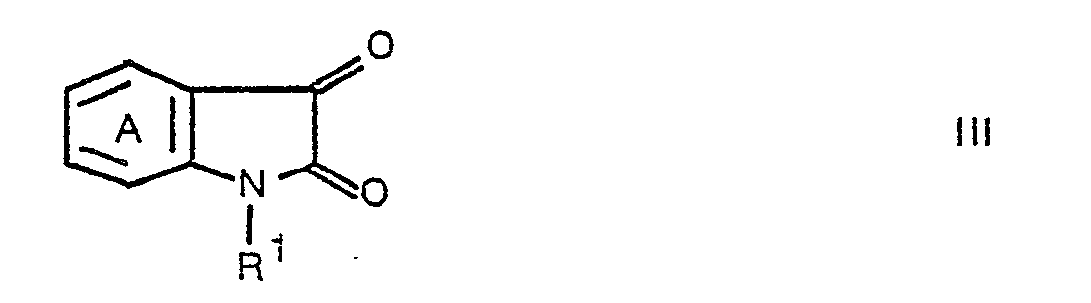
- A suitable alkali metal cyanide is, for example, sodium or potassium cyanide.
- It will be understood that process (a) is an example of the Bucherer-Bergs synthesis of imidazolidine-2,4-diones (hydantoins) which is well known in the art (see E Ware in Chemical Reviews, 1950, 46, 422―425), and that such a reaction may therefore proceed through a hydroxynitrile of the formula:-


- The process may be conveniently performed in a solvent or diluent, for example in a (1-4C)alkanol such as methanol or ethanol, or in ethylene glycol or diethylene glycol, preferably containing water, and at a temperature in the range, for example 20―100°C.
- The ammonium carbonate or carbamate may if necessary be formed in situ in conventional manner.
- The starting materials of formula III may be obtained by conventional procedures of indole chemistry. For example, those compounds of formula III wherein R' is other than a phenyl radical may be obtained by reacting an indoline-2,3-dione of formula III wherein R1 is replaced by hydrogen with the appropriate alkyl or aralkyl halide, for example a chloride, bromide or iodide, in the presence of a base such as sodium or potassium hydroxide in dimethyl sulphoxide at a temperature of 20-40°C.
- Those starting materials of formula III wherein RI is a phenyl radical may be made, for example, by condensation of the appropriate diphenylamine with oxalyl chloride and aluminium chloride, as described in US Patent Serial No. 3,509,149. (b) Reacting a compound of the formula:-

- It will be appreciated that, in general, it is preferable to use approximately three molecular equivalents of base, and one equivalent of the compound of the formula R2.X.
- A particularly suitable base is, for example, a strong base, for example in alkali metal hydroxide, carbonate or hydride, such as sodium or potassium hydroxide or carbonate and sodium or potassium hydride. The process is preferably performed in a solvent or diluent, for example in a (1-4C)alkanol such as methanol or ethanol or in N,N-dimethylformamide, optionally admixed with water, when an alkali metal hydroxide or carbonate is used, or in a non-aqueous solvent, such as dimethyl sulphoxide or N,N-dimethylformamide, when an alkali metal hydride is used.
- The process is preferably carried out at a temperature of, for example, 20-40°C., and generally for a relatively short reaction time to minimise alkylation of the imidazolidine nitrogen atoms.
- The starting materials of formula VI may be made by standard procedures of organic chemistry well known for the synthesis of analogous compounds, for example as described by Otomasu et alia (Chem. Pharm. Bull., 1975,23, 1431-1435). Thus, they may be obtained by an analogous procedure to process (a) hereinabove, but starting from the appropriate 1-(unsubstituted)-indoline-2,3-dione. The latter compounds are also readily accessible by known procedures of organic chemistry. (c) Reacting a compound of the formula:-

- A particular value for R3 when it is an acyl radical is, for example, a (1-6C)alkanoyl radical such as acetyl or propionyl radical, a phenylsulphonyl, toluene p-sulphonyl or benzoyl radical.
- A particular value for R3 when it is a tri-(1―4C)alkyl]silyl radical is, for example a trimethylsilyl radical.
- It will be recognised that process (c) is a modification of process (a) hereinbefore and consequently similar reaction conditions may be used. Similarly the ammonium carbonate or carbamate may be formed in situ if desired.
- The starting materials of formula VII may be made by conventional procedures. Thus, they may be obtained by reacting a hydroxynitrile of formula IV (itself obtained as described in process (a) by reaction of an indoline-2,3-dione with hydrogen cyanide) with an appropriate acyl or tri-[(l--4C)alkyllsilyl halide, for example acetyl, propionyl, phenylsulphonyl, toluene p-sulphonyl, benzoyl or trimethylsilyl chloride, in conventional manner.
- Alternatively, those compounds of formula VII wherein R3 is a tri-[(1―4C-alkyl]silyl radical may be conveniently obtained by reaction of an appropriate indoline-2,3-dione with a tri-[(1-4C)alkyllsilyl cyanide, for example trimethylsilyl cyanide, at a temperature in the range, for example, 1 5―40°C. and in a non-aqueous solvent, for example 1,2-dimethoxyethane.
- (d) For a compound of formula I wherein benzene ring A bears a nitro substituent and/or R1 is a benzyl radical bearing a nitro substituent, nitrating the corresponding compound of formula I in which benzene ring A and/or the radical R1 bear no more than two substituents.
- The nitration may be carried out under conventional procedures, for example in the presence of sulphuric acid, using nitric acid at a temperature in the range, for example, 0 to 30°C., or using fuming nitric acid at a temperature in the range, for example -20 to 10°C. (e) For a compound of formula wherein benzene ring A bears a chloro or bromo substituent, chlorinating or brominating the corresponding compound of formula I in which benzene ring A is unsubstituted.
- The chlorination or bromination may be carried out using conventional procedures, for example using elemental chlorine or bromine optionally in the presence of a Friedel-Craft's catalyst such as ferric chloride, ferric bromide or iron powder, at a temperature in the range, for example 10 to 100°C. and in a suitable solvent or diluent, for example chloroform, nitrobenzene or acetic acid.
- Alternatively, the chlorination or bromination may be carried out using sulphuryl chloride or bromide optionally in the presence of iodine as catalyst at a temperature in the range, for example 10 to 100°C., and in a suitable solvent or diluent, for example acetic acid or chloroform.
- (f) For a compound of formula I wherein benzene ring A and/or R1 bears a hydroxy radical, dealkylating the corresponding compound of formula I wherein benzene ring A and/or RI bears a (1-4C)alkoxy radical.
- The dealkylation may be carried out using conventional procedures well known in the art, for example using a mixture of an organic tertiary base, for example pyridine, quinoline or (1--4C)alkyl derivatives thereof, together with a mineral acid, for example hydrochloric or hydrobromic acid, at a temperature in the range for example 80 to 150°C. The organic tertiary base may conveniently be used in excess and function as a solvent or diluent.
- Whereafter when a pharmaceutically acceptable salt is required, a compound of formula I is reacted with an appropriate base affording a pharmaceutically acceptable cation, using a conventional procedure.
- Further, when an optically active form of a compound of formula I is required, a racemic form of the said compound may be reacted with an optically-active form of a suitable organic base, for example brucine, coniine or 2-pipecoline, followed by conventional separation of the diastereoisomeric mixture of salts thus obtained, for example by fractional crystrallisation from a suitable solvent, for example a (1-4C)alkanol, whereafter the optically-active form of the said compound may be liberated by treatment with acid using a conventional procedure, for example using an aqueous mineral acid such as dilute hydrochloric acid.
- The property of inhibiting the enzyme aldose reductase may be demonstrated in the following standard laboratory test. Thus, rats are made diabetic (as evidenced by severe glucosuria being present) by dosing with streptozotocin. The animals are then dosed daily with the test compound for 5 days. The animals are then killed and the eye lenses and sciatic nerves are removed. After a standard work-up procedure the residual sorbitol levels in each tissue are determined by gas liquid chromatography after conversion to the poly-trimethylsilyl derivatives. Inhibition of aldose reductase in vivo is then assessed by comparing the residual sorbitol levels in tissues from the dosed diabetic group of rats with those of an undosed group of diabetic rats and an undosed, normal group of rats.
- Alternatively, a modified test may be used in which the streptozotocin induced diabetic rats are dosed daily with test compound for two days. After 2-4 hours from the final dose the animals are killed and the sciatic nerves are removed and assessed for residual sorbitol levels as described above.
- Preferred compounds in either of these tests reduce residual sorbitol levels to levels which are similar to those of normal, undosed rats. However, in general the compounds of formula I produce significant inhibition of the enzyme aldose reductase at an oral dose of 100 mg/kg or much less. Thus, by way of illustration, 1'-(3,4-dichlorobenzyl)-spiro[imidazolidine-4,3'-indoline]-2,2',5-trione and 1 '-(2-fluoro-4-bromobenzyl)-spiro[imidazolidine-4,3'-indoline]-2,2',5-trione both produce a residual sorbitol level in the sciatic nerve which is approximately 20% of that obtained in control undosed diabetic rats, following oral dosing at 10 mg./kg. for 5 days. No overt toxic or other undesirable effects were detected with compounds of formula I at 100 mg./kg. in the above tests.
- Preferred compounds of formula defined hereinbefore in general reduce the residual sorbitol level in the sciatic nerve to that in normal undosed rats when administered at an oral dose in the range 5 to 20 mg./kg.
- The property of inhibiting the enzyme aldose reductase may also be demonstrated in vitro. Thus, purified aldose reductase is isolated in known manner from bovine lenses. The percentage inhibition of this enzyme's ability in vitro to reduce aldoses to polyhydric alcohols, and particularly to reduce glucose to sorbitol, caused by a test compound is then determined using standard spectrophotometric methods. In this test the compounds of formula I in general show significant inhibition of the enzyme aldose reductase at a concentration of about 10-6M or much less.
- When a compound of the invention is used to produce an effect on the enzyme aldose reductase in warm-blooded animals, it may be administered primarily orally at a daily dose of 0.5 to 25 mg./kg., which is equivalent in man to a total daily dose in the range 10 to 750 mg. per man, given in divided doses if necessary.
- The compounds of the invention may be administered in the form of pharmaceutical compositions and according to a further feature of the invention there is provided a pharmaceutical composition which comprises a compound of formula I, or a pharmaceutically acceptable salt thereof, together with a pharmaceutically acceptable diluent or carrier.
- Especially preferred pharmaceutical compositions are those which are in a form suitable for oral administration, for example tablets, capsules, suspensions or solutions, which may be obtained by conventional methods and, if desired, may incorporate conventional diluents, carriers or other excipients. Other preferred compositions are those which are in a form suitable for parenteral administration, for example sterile injectable aqueous or non-aqueous solutions or suspensions, and for rectal administration, for example suppositories. Dosage forms will generally contain from 10 mg. to 250 mg. of a compound of formula I, or an equivalent amount of a pharmaceutically acceptable salt thereof, per dosage unit.
- The compositions of the invention may also contain one or more other agents which may have a useful effect in the treatment of diabetes or galactosemia, for example a hypoglycaemic agent such as tolbutamide, chlorpropamide, or glybenclamide.
- The invention will now be illustrated in the following non-limiting Examples in which, unless otherwise stated:-
- (i) all evaporations were carried out by rotary evaporation in vacuo
- (ii) all operations were carried out at room temperature, that is in the range 18-26°C.;
- (iii) petroleum ether (b.p. 60-80°C) is referred to as "petrol 60-80", and other petroleum ether fractions accordingly;
- (iv) all compounds of formula I were fully characterised on the basis of microanalysis and NMR and IR spectroscopy; and
- (v) yields (where given) are for illustration and are not necessarily the maximum attainable.
- A mixture of 1-(3,4-dichlorobenzyl)-indoline-2,3-dione (12.0 g.), ammonium carbonate (36.0 g.) and potassium cyanide (5.2 g.) in methanol (300 ml.) and water (300 ml.) was heated under reflux at 95―100°C. for 3 hours. The dark coloured solution obtained was cooled somewhat and decolourising charcoal (3.0 g.) added. The mixture was then heated at 95-100°C. and all the methanol allowed to distil out. The hot mixture was then separated by filtration and the residue washed with hot water. The filtrate and washings were combined, cooled and acidified with concentrated hydrochloric acid to pH 2. The buf solid which separated was collected, washed with water, air-dried and recrystallised twice from ethyl acetate/petrol 60-80 (4:1 v/v). There was thus obtained 1'-(3,4-dichlorobenzyl)-spiro[imidazolidine-4,3'-indoline]-2,2',5-trione (3.3 g.), m.p. 269-271 °C.
- The starting material was obtained as follows:-
- An ethanol solution of potassium hydroxide (100 ml. of a 1 M solution) was added to a stirred solution of indoline-2,3-dione (isatin) 14.7 g.) in dimethyl sulphoxide (200 ml.). After 10 minutes a solution of 3,4-dichlorobenzyl chloride (21.5 g.) in dimethyl sulphoxide (10 ml.) was added. The mixture was stirred for 72 hours, and then poured into water (600 ml.). The solid which formed was collected, washed with water, air-dried and recrystallised from ethyl acetate/petrol 60-80 (3:2 v/v). There was thus obtained 1-(3,4-dichiorobenzyi)-indotine-2,3-dione (13.8 g.), m.p. 183-184°C.
- Using a similar procedure to that described in Example 1, but starting from the appropriate indoline-2,3-dione of formula III, the following compounds of formula I were obtained:-

- The necessary starting materials of formula III were obtained in an analogous manner to that described for the starting material in Example I, using the appropriate isatin and halide of the formula R1.X. The following properties and yields were obtained:―

- Using a similar procedure to that described in Example 1, but starting from the appropriate indoline-2,3-dione of formula III, the following compounds of formula I were obtained:-

- The necessary starting materials of formula III were in general obtained in an analogous manner to that described for the starting material in Example 1, starting from the appropriate substituted indoline-2,3-dione and halide of the formula R1.X, and had the following properties:

(SiO2): I/I v/v EtOAc/Toluene). - 1-Phenylindoline-2,3-dione (for Example 33) was obtained as a solid, m.p. 138-139°C. (recrystallised from propan-2-ol) in 56% yield by the procedure of U.S. Patent Ser. No. 3,509,149.
- Sulphuryl chloride (16.0 mi.) was added during 10 minutes to a stirred mixture of 1'-(3,4-dichlorobenzyl)spiro[imidazolidine-4,3'-indoline]-2;2',5-trione (28.2 g.) in acetic acid (400 ml.). The mixture obtained was then stirred at 60-65°C for 40 minutes. The clear solution which formed was poured into water (3 1.). The solid which was precipitated was collected by filtration, washed with water and air-dried. Recrystallisation of the crude solid thus obtained from aqueous propan-2-ol gave 1'-(3,4-dichlorobenzyl)-5'-chlorospiro[imidazolidine-4,3'-indoline]-2,2',5-trione (15.4 g.), m.p. 257-259°C.
- Fuming nitric acid (0.2 ml.) was added during 10 minutes to a stirred solution of 1'-(3,4-dichlorobenzyl)spiro[imidazolidine-4,3'-indoline]-2,2',5-trione (1.79 g.) in concentrated sulphuric acid (1.5 ml.). maintained at a temperature of 0-5°C. The reaction mixture was then stirred at 0-5°C. for 1 hour and finally at 5-20°C for a further 1 hour. The solution was then poured onto crushed ice (300 g.) and the mixture which formed was extracted with ethyl acetate. The combined extracts were washed with water (3 x 150 ml.) then with brine (100 ml.) and dried (MgS04). The extracts were evaporated and the residual oil was redissolved in ethyl acetate (20 ml.). The solution was evaporated on to chromatographic silica gel and the solid residue added to the top of a column of the same silica gel made up in toluene. The column was eluted with increasing concentrations of ethyl acetate in toluene (up to 1:1 v/v). The fractions containing the major component [TLC:Rf~0.6 on SiO2:eluant 1:1 v/v EtOAc/toluene] were combined and evaporated. The residue was recrystallised from a mixture of toluene, ethyl acetate and petrol 60―80 to give 1'-(3,4-dichlorobenzyl)-5'-nitrospiro[imidazolidine-4,3'-indoline]-2,2',5-trione (Example 35) (0.46 g.), m.p. 249-251 °C.
- Using a similar procedure, but starting from 1'-(2-fluoro-4-bromobenzyl)spiro[imidazolidine-4,3'- indoline]-2,2',5-trione and 1'-benzyl-5'-bromospiro[imidazolidine-4,3'-indoline]-2,2',5-trione respectively there were obtained: 1'-(2-fluoro-4-bromobenzyl)-5'-nitrospiro[imidazolidine-4,3'- indoline]-2,2'-5-trione (Example 36), m.p. 180-181 °C. (recrystallised from i-PrOH/petrol 60-80) in 36% yield; and 1'-(4-nitrobenzyl)-5'-bromo-7'-nitrospiro[imidazolidine-4,3'-indoline] 2,2',5-trione (Example 37), m.p. 245-246°C. (recrystallised from EtOAc/petrol 60-80) in 7% yield.
- Trimethylsilyl cyanide (0.6 g.) was added to a stirred solution of 1-(4-bromo-3,5-dichlorobenzyl)-indoline-2,3-dione (1.2 g.) in dry 1,2-dimethoxyethane (40 mi.). The mixture was stirred for 5 hours to give 1-(4-bromo-3,5-dichlorobenzyl)-3-cyano-3-(trimethylsilyloxy)-indoline-2-one in situ. A solution of ammonium carbonate (6.0 g.) in water (40 mi.) was then added. The subsequent mixture was heated under reflux for 6 hours, cooled and evaporated. The residue was treated with water (100 mi.) and the mixture separated by filtration. The residue was washed with warm water (2 x 50 ml.). The aqueous filtrate and washings were cooled to 0-5°C. and acidified to pH4 with 2M hydrochloric acid. The solid which separated was collected by filtration, washed with water, air-dried and recrystallised from aqueous N,N-dimethylformamide (DMF) (1:1 v/v) to give 1'-(4-bromo-3,5-dichlorobenzyl)spiro-[imidazolidine-4,3'-indoline]-2,2',5-trione (Example 38) (0.63 g.), m.p. 290-292°C.
- Using a similar procedure, but starting from the appropriate 1-benzyl-indoline-2,3-dione there were obtained the following compounds:-
- (Example 39): 1'-(3,4-dichlorobenzyl)-6'-chlorospiro[imidazolidine-4,3'-indoline]-2,2',5-trione, m.p. 286-287°C (recrystallised from EtOAc/petrol 60-80) in 57% yield.
- (Example 40): 1'-(3,4-dichlorobenzyl)-5',6"-dimethylspiro[imidazolidine-4,3'-indoline]-2,2',5- trione, m.p. 262-263°C. (recrystallised from EtOAc/petrol 60-80) in 10% yield; and
- (Example 41): 1'-(3,4-dichlorobenzyl)-7'-ethylspiro[imidazolidine-4,3'-indoline]-2,2',5-trione, m.p. 232-233.C. (recrystallised from EtOAc/petrol 60-80) in 7% yield.
- The necessary starting materials of formula III were obtained using a similar procedure to that described for the analogous starting material in Example I starting from the appropriate indoline-2,3-dione and halide of the formula R'X and had the following properties:

- Using a similar procedure to that described in Example 1, but starting from the appropriate 1- substituted indoline-2,3-dione of formula III, the following compounds of formula I were obtained:-
-

- The necessary starting materials of formula III were obtained in an analogous manner to that described for the starting material in Example 1 that is by reaction of the appropriate indoline-2,3-dione with a halide of the formula R1.X, and had the following properties:-

- Using a similar procedure to that described in Example 38, but starting from the appropriate 1-benzylindoline-2,3-dione of formula III and with intermediate formation of the corresponding 1-benzyl-3-trimethylsilyloxy-3-cyano-indoline-2-one of the formula VII (R3 = trimethylsilyl), the following compounds of formula I may be obtained:-
-

- The necessary starting materials of formula III were in general obtained in an analogous manner to that described for the starting material in Example 1 that is by reaction of the appropriate indoline-2,3-dione with a halide of the formula R'.X, and had the following properties:-

- The compound 1-(4-hydroxybenzyl)-indoline-2,3-dione required as starting material for Example 50 was obtained as follows:-An ethanol solution of potassium hydroxide (16.6 g. in 400 mnl.) was added to a stirred solution of indoline-2,3-dione (isatin) (43.6 g.) in dimethylsulphoxide (400 ml.). After 10 minutes a solution of 4-acetoxybenzyl bromide (76.3 g.) in dimethylsulphoxide (40 ml.) was added. The mixture was stirred for 72 hours and then poured into ice/water (N1000 mi.). The gum which first formed slowly crystallised. The solid which formed was recrystallised from methanol (500 ml.) to give 1-(4-acetoxybenzyl)indoline-2,3-dione as a solid, m.p. 159-161 °C.
- This solid, together with further material obtained from the motor liquors, was chromatographed on silica (500 g.) using toluene containing an increasing amount of ethyl acetate as eluant (up to 25% v/v). The fractions of eluate collected using eluant containing 20-25% v/v ethyl acetate were' combined and evaporated to give 1-(4-hydroxybenzyl)-indoline-2,3-dione as a low melting solid (m.p. 28-35°C.) after recrystallisation from a mixture of toluene and ethyl acetate.
Note: It will be appreciated that the acetoxy group is hydrolysed to the required hydroxy group during the above chromatography on silica. - A mixture of pyridine (20 ml.) and concentrated hydrochloric acid (20 ml.) was heated at about 180°C. for 20 minutes. 1'-(3,4-Dichlorobenzyl)-5'-methoxyspiro[imidazolidine-4,3'-indoline]-2,2',5- trione (2.0 g.) was then added and the subsequent mixture was further heated for 1 hour at about 180°C. The solution obtained was cooled and poured into water (200 ml.). The aqueous mixture was extracted with ethyl acetate (2 x 200 ml.). The combined extracts were washed with water (3 x 100 ml.), then with brine (saturated sodium chloride solution) (100 ml.), dried (saturated sodium chloride solution) (100 ml.), dried (MgS04) and evaporated. The resultant oil was dissolved in ethyl acetate (20 ml.), then with brine (saturated sodium chloride solution) (100 mi.), dried (MgS04) and evaporated. The resultant oil was dissolved in ethyl acetate (20 ml.) and evaporated onto chromatographic silica gel (10 g.), which was then added to the top of a column of the same silica gel (100 g.) made up in toluene. The column was then eluted with toluene containing an increasing concentration of ethyl acetate (up to 50% v/v). The fractions of eluate collected using eluant containing 50% v/v ethyl acetate were combined and evaporated to give 1'-(3,4-dichlorobenzyl)-5'-hydroxy-spiro[imidazolidine-4,3'-indoline]-2,2',5'-trione (0.7 g.), m.p. 296-298°C. (after recrystallisation from ethyl acetate/petrol 60-80).
- A filtered solution of 1'-(3,4-dichlorobenzyl)spiro[imidazolidine-4,3'-indoline]-2,2',5-trione (3.76 g.) in water (20 ml.) containing sodium hydroxide (0.40 g.) was evaporated, remaining traces of water being removed by azeotropic distillation with toluene. There was thus obtained the corresponding mono-sodium salt in quantitative yield as an amorphous hygroscopic solid having a satisfactory microanalysis.
- Sodium hydride (1.5 g., 50% w/w dispersion in mineral oil) was added continuously to a solution of spiro[imidazolidine-4,3'-indoline]-2,2',5-trione (2.17 g.) in N,N-dimethylformamide (40 ml.) and water (20 mi.). The resultant mixture was stirred for 30 minutes and then a solution of 3,4-dichlorobenzyl chloride (1.95 g.) in tetrahydrofuran (5 ml.) was added dropwise during 10 minutes. The solution obtained was stirred at room temperature for two hours and then poured into water (150 mi.). The mixture was acidified with concentrated hydrochloric acid and then extracted with ether (2 x 100 ml.). The combined extracts were washed with water (3 x 100 ml.), then with saturated sodium chloride solution (100 ml.), dried (MgS04) and evaporated. The residual solid was dissolved in chloroform and purified by chromatography on silica (25 g.) using an increasing concentration of ethyl acetate in cyclohexane as eluant. Evaporation of the ethyl acetate rich fractions gave 1'-(3,4-dichlorobenzyl)-spiro[imidazolidine-4,3'-indoline]-2,2',5-trione identical with that obtained in Example 1.
- A mixture of 1'-(3,4-dichlorobenzyl)-spiro[imidazolidine-4,3'-indoline]-2,2',5-trione (50 parts), lactose (27 parts) and maize starch (20 parts), was stirred thoroughly and a paste formed from maize starch (2 parts) and water (40 parts) was added and thoroughly mixed in. The resultant mass was passed through a 16 mesh screen, then dried at 60°C. and passed through a 20 mesh screen. Magnesium stearate (1 part) was added to the granules obtained, and the whole compressed by conventional means into tablets, containing 10,20, 50 and 100 mg of active ingredient and suitable for oral administration for therapeutic purposes.
- Using a similar procedure, but replacing the active ingredient by any other compound of the invention or a salt thereof, for example as described in any one of the aforegoing Examples, tablets containing 10, 20, 50 and 100 mg. of active ingredient may be obtained.
- (dl)-1'-(3,4-Dichlorobenzyll-spiro[imidazolidine-4,3'-indolino]-2,2-'5-trione (4.4 g.) was added to 61.5 ml of a 0.19M solution of (I)-N,N,N-trimethyl (1-phenylethyl)ammonium hydroxide. The mixture was warmed to facilitate solution and then evaporated. The residue was dissolved in warm propan-2-ol (11 ml.). The solution obtained was cooled to 0°C. for 48 hours. The crystalline solid which formed was collected by filtration, washed with cold propan-2-ol (5 ml.), then with petrol 40-60 (20 mI.) and recrystallised twice from propan-2-ol to give the (d)-diastereoisomeric salt of (I)-N,N,N-trimethyl-(1-phenylethyl)ammonium hydroxide and (d)-1'-(3,4-dichlorobenzyl)-spiro[imidazolidine-4,3'-indoline]-2,2',5-trione (1.6 g.), m.p. 148―150°C.,

- The salt (1.6 g.) was dissolved in water (10 mi.) and methanol (3 ml.) and the solution acidified with concentrated hydrochloric acid (1 ml.). The precipitated solid was collected, washed with water and recrystallised from ethanol to give (d)-1'-(3,4-dichlorobenzyl)-spiro[imidazolidine-4,3'-indoline]-2,2',5-trione, m.p. 199-200°C.,

- The starting quaternary ammonium hydroxide solution was obtained by passing an aqueous solution (I)-N,N,N-trimethyl(1-phenylethyl)ammonium iodide (27.8 g.) (I. Angres and H. E. Zieger, J. Org. Chem. 1975, 40, 1457―1460) down a column of anion exchanging resin ('Amberlite' IRA 401, 200 g.) newly converted into the hydroxide form. ('Amberlite' is a trademark).
- It will be appreciated that other single enantiomers of optically active quaternary ammonium hydroxides, for example of N,N,N-trimethyl-(1-methyl-2-hydroxy-2-phenylethyl)ammonium hydroxide, may also be used to resolve racemic forms of compounds of formula I.
and
acceptable salt thereof.
Claims (14)


Applications Claiming Priority (6)
| Application Number | Priority Date | Filing Date | Title |
|---|---|---|---|
| GB7939235 | 1979-11-13 | ||
| GB7939235 | 1979-11-13 | ||
| GB8026459 | 1980-08-13 | ||
| GB8026459 | 1980-08-13 | ||
| GB8029760 | 1980-09-15 | ||
| GB8029760 | 1980-09-15 |
Publications (2)
| Publication Number | Publication Date |
|---|---|
| EP0028906A1 EP0028906A1 (en) | 1981-05-20 |
| EP0028906B1 true EP0028906B1 (en) | 1984-10-03 |
Family
ID=27260798
Family Applications (1)
| Application Number | Title | Priority Date | Filing Date |
|---|---|---|---|
| EP80303890A Expired EP0028906B1 (en) | 1979-11-13 | 1980-10-31 | 1'-substituted-spiro(imidazolidine-4,3'-indoline)-2,2',5-triones, processes for their manufacture and pharmaceutical compositions thereof |
Country Status (21)
| Country | Link |
|---|---|
| US (1) | US4490381A (en) |
| EP (1) | EP0028906B1 (en) |
| KR (2) | KR840002213B1 (en) |
| AT (1) | ATE9697T1 (en) |
| AU (1) | AU532110B2 (en) |
| CA (1) | CA1161848A (en) |
| DD (1) | DD158401A5 (en) |
| DE (1) | DE3069372D1 (en) |
| DK (1) | DK484880A (en) |
| ES (3) | ES8205803A1 (en) |
| FI (1) | FI70023C (en) |
| GR (1) | GR71855B (en) |
| IE (1) | IE50332B1 (en) |
| IL (1) | IL61426A (en) |
| NO (1) | NO154842C (en) |
| NZ (1) | NZ195446A (en) |
| PH (1) | PH16511A (en) |
| PL (1) | PL129212B1 (en) |
| PT (1) | PT72056B (en) |
| YU (1) | YU289080A (en) |
| ZW (1) | ZW27380A1 (en) |
Families Citing this family (15)
| Publication number | Priority date | Publication date | Assignee | Title |
|---|---|---|---|---|
| IE52879B1 (en) * | 1981-05-12 | 1988-03-30 | Ici Plc | Pharmaceutical spiro-hydantoin derivatives |
| ZA832679B (en) * | 1982-05-07 | 1983-12-28 | Ici Plc | Indoline derivatives |
| AU566869B2 (en) * | 1982-05-11 | 1987-11-05 | Imperial Chemical Industries Plc | Spiro (imidazolidine-4,3'-indoline) 2,2',5-triones |
| GB2119797B (en) * | 1982-05-11 | 1985-09-04 | Ici Plc | Fluoroalkyl derivatives |
| GB8331194D0 (en) * | 1982-12-20 | 1983-12-29 | Ici Plc | Chemical process |
| GB8312379D0 (en) * | 1983-05-05 | 1983-06-08 | Ici Plc | Heterocyclic compounds |
| US4464380A (en) * | 1983-05-25 | 1984-08-07 | Pfizer Inc. | Imidazolidinedione derivatives |
| US4533667A (en) * | 1983-05-25 | 1985-08-06 | Pfizer Inc. | Imidazolidinedione derivatives |
| US4567278A (en) * | 1984-03-26 | 1986-01-28 | Imperial Chemical Industries Plc | Process for racemizing certain spiro compounds |
| US4762839A (en) * | 1985-06-06 | 1988-08-09 | Tanabe Seiyaku Co., Ltd. | Quinazolinone copmpounds useful for the prophyloxis and treatment of diabetic complications |
| JPS63132889A (en) * | 1986-11-21 | 1988-06-04 | Tanabe Seiyaku Co Ltd | Quinazolinone derivative |
| WO1992007830A2 (en) * | 1990-10-29 | 1992-05-14 | Pfizer Inc. | Oxindole peptide antagonists |
| FR2708606B1 (en) * | 1993-07-30 | 1995-10-27 | Sanofi Sa | N-phenylalkylindol-2-one derivatives, their preparation, pharmaceutical compositions containing them. |
| AR059265A1 (en) * | 2006-02-07 | 2008-03-19 | Astrazeneca Ab | ESPIRO COMPOUNDS CONDENSED WITH INHIBITORY ACTIVITY IN THE VANILOID RECEIVER1 (VR1) |
| CN101415713A (en) * | 2006-02-07 | 2009-04-22 | 阿斯利康(瑞典)有限公司 | New spiro [imidazolidine-4, 3'-indole]-2,2',5 (1'H)-trione useful for the treatment of vanilloid receptor 1-related disorders |
Citations (8)
| Publication number | Priority date | Publication date | Assignee | Title |
|---|---|---|---|---|
| US4117230A (en) * | 1976-10-18 | 1978-09-26 | Pfizer Inc. | Hydantoin derivatives as therapeutic agents |
| US4127665A (en) * | 1978-01-18 | 1978-11-28 | Pfizer Inc. | Thienohydantoin derivatives |
| US4130714A (en) * | 1977-05-23 | 1978-12-19 | Pfizer Inc. | Hydantoin therapeutic agents |
| US4147797A (en) * | 1978-08-11 | 1979-04-03 | Pfizer Inc. | Spiro-furanohydantoin derivatives |
| US4176185A (en) * | 1979-01-22 | 1979-11-27 | Pfizer Inc. | Spiro-quinolylhydantoins |
| US4181729A (en) * | 1979-03-21 | 1980-01-01 | Pfizer Inc. | Phenyl or phenoxy substituted spiro-imidazolidinedione derivatives |
| US4181728A (en) * | 1978-11-16 | 1980-01-01 | Pfizer Inc. | Spiro-polycyclicimidazolidinedione derivatives |
| US4193996A (en) * | 1979-04-04 | 1980-03-18 | Pfizer Inc. | Spiro-quinolone hydantoins |
Family Cites Families (5)
| Publication number | Priority date | Publication date | Assignee | Title |
|---|---|---|---|---|
| US2683718A (en) * | 1952-01-11 | 1954-07-13 | Searle & Co | Spiro-[xanthene-9, 4'-imidazolidine]-2, 5-dione |
| JPS50137976A (en) * | 1974-04-23 | 1975-11-01 | ||
| SE422371B (en) * | 1975-12-12 | 1982-03-01 | Aminkemi Ab | SET TO GENERATE A PH FUNCTION FOR ELECTROPHORES USE |
| US4147795A (en) * | 1977-02-11 | 1979-04-03 | Pfizer Inc. | Hydantoin derivatives as therapeutic agents |
| US4248882A (en) * | 1980-02-12 | 1981-02-03 | Pfizer Inc. | Treating diabetes-associated complications with hydantoin amines |
-
1980
- 1980-10-29 AU AU63813/80A patent/AU532110B2/en not_active Ceased
- 1980-10-29 US US06/201,973 patent/US4490381A/en not_active Expired - Lifetime
- 1980-10-29 IE IE2239/80A patent/IE50332B1/en not_active IP Right Cessation
- 1980-10-31 AT AT80303890T patent/ATE9697T1/en active
- 1980-10-31 DE DE8080303890T patent/DE3069372D1/en not_active Expired
- 1980-10-31 EP EP80303890A patent/EP0028906B1/en not_active Expired
- 1980-11-03 GR GR63268A patent/GR71855B/el unknown
- 1980-11-03 NZ NZ195446A patent/NZ195446A/en unknown
- 1980-11-04 CA CA000363966A patent/CA1161848A/en not_active Expired
- 1980-11-06 IL IL61426A patent/IL61426A/en not_active IP Right Cessation
- 1980-11-10 ZW ZW273/80A patent/ZW27380A1/en unknown
- 1980-11-11 PH PH24843A patent/PH16511A/en unknown
- 1980-11-12 NO NO803411A patent/NO154842C/en unknown
- 1980-11-12 FI FI803539A patent/FI70023C/en not_active IP Right Cessation
- 1980-11-12 PL PL1980227789A patent/PL129212B1/en unknown
- 1980-11-12 KR KR1019800004336A patent/KR840002213B1/en not_active Expired
- 1980-11-12 DD DD80225136A patent/DD158401A5/en unknown
- 1980-11-12 YU YU02890/80A patent/YU289080A/en unknown
- 1980-11-13 PT PT72056A patent/PT72056B/en not_active IP Right Cessation
- 1980-11-13 ES ES496811A patent/ES8205803A1/en not_active Expired
- 1980-11-13 DK DK484880A patent/DK484880A/en not_active Application Discontinuation
-
1981
- 1981-12-01 ES ES507616A patent/ES8301992A1/en not_active Expired
- 1981-12-01 ES ES507617A patent/ES507617A0/en active Granted
-
1984
- 1984-07-24 KR KR1019840004392A patent/KR850001228B1/en not_active Expired
Patent Citations (9)
| Publication number | Priority date | Publication date | Assignee | Title |
|---|---|---|---|---|
| US4117230A (en) * | 1976-10-18 | 1978-09-26 | Pfizer Inc. | Hydantoin derivatives as therapeutic agents |
| US4130714A (en) * | 1977-05-23 | 1978-12-19 | Pfizer Inc. | Hydantoin therapeutic agents |
| US4127665A (en) * | 1978-01-18 | 1978-11-28 | Pfizer Inc. | Thienohydantoin derivatives |
| US4147797A (en) * | 1978-08-11 | 1979-04-03 | Pfizer Inc. | Spiro-furanohydantoin derivatives |
| US4181728A (en) * | 1978-11-16 | 1980-01-01 | Pfizer Inc. | Spiro-polycyclicimidazolidinedione derivatives |
| US4176185A (en) * | 1979-01-22 | 1979-11-27 | Pfizer Inc. | Spiro-quinolylhydantoins |
| EP0014079A1 (en) * | 1979-01-22 | 1980-08-06 | Pfizer Inc. | Spiro-quinolylhydantoins, process for their preparation and pharmaceutical compositions thereof |
| US4181729A (en) * | 1979-03-21 | 1980-01-01 | Pfizer Inc. | Phenyl or phenoxy substituted spiro-imidazolidinedione derivatives |
| US4193996A (en) * | 1979-04-04 | 1980-03-18 | Pfizer Inc. | Spiro-quinolone hydantoins |
Also Published As
Similar Documents
| Publication | Publication Date | Title |
|---|---|---|
| EP0065392B1 (en) | Pharmaceutical compositions containing spiro succinimide derivatives | |
| US4490381A (en) | 1'-Substituted spiro[imidazolidine-4,3'-indoline]2,2',5-triones | |
| EP0065407B1 (en) | Pharmaceutical spiro-succinimide derivatives | |
| EP0066378B1 (en) | Pharmaceutical spiro-hydantoin derivatives | |
| EP0065393B1 (en) | Pyrrole derivatives | |
| US4544662A (en) | 1'-Substituted-spiro[oxazolidine-5-3'-indoline]-2,2', 4-trione derivatives | |
| US4581366A (en) | Aldose reductase inhibition by spiro indoline derivatives | |
| EP0168181B1 (en) | Cyclic amides | |
| GB2098212A (en) | Process for preparing 1'-substituted- spiro imidazolidine-4,3'- indoline-2,2',5-triones | |
| PL143290B1 (en) | Process for preparing imidazolydinodionic derivatives | |
| HU198209B (en) | Process for production of derivatives of pirid, pirasole and izotiasole-triazin and medical compositions containing them | |
| US4539329A (en) | 7'-Trifluoromethyl-spiro[imidazolidine-4,3'-indoline]-2,2',5-triones as aldose reductase inhibitors | |
| SU1066462A3 (en) | Process for preparing 1-substituted-spiro(imidazo-lidine-4,3-indoline)-2,2,5-trione or its salts, racemates or optically active isomers | |
| PL128961B1 (en) | Process for preparing novel derivatives of substituted indolin-2-one | |
| GB2119797A (en) | Fluoroalkyl derivatives |
Legal Events
| Date | Code | Title | Description |
|---|---|---|---|
| PUAI | Public reference made under article 153(3) epc to a published international application that has entered the european phase |
Free format text: ORIGINAL CODE: 0009012 |
|
| AK | Designated contracting states |
Designated state(s): AT BE CH DE FR GB IT LI LU NL SE |
|
| 17P | Request for examination filed |
Effective date: 19810414 |
|
| RAP1 | Party data changed (applicant data changed or rights of an application transferred) |
Owner name: IMPERIAL CHEMICAL INDUSTRIES PLC |
|
| ITF | It: translation for a ep patent filed | ||
| GRAA | (expected) grant |
Free format text: ORIGINAL CODE: 0009210 |
|
| AK | Designated contracting states |
Designated state(s): AT BE CH DE FR GB IT LI LU NL SE |
|
| REF | Corresponds to: |
Ref document number: 9697 Country of ref document: AT Date of ref document: 19841015 Kind code of ref document: T |
|
| REF | Corresponds to: |
Ref document number: 3069372 Country of ref document: DE Date of ref document: 19841108 |
|
| ET | Fr: translation filed | ||
| PLBE | No opposition filed within time limit |
Free format text: ORIGINAL CODE: 0009261 |
|
| STAA | Information on the status of an ep patent application or granted ep patent |
Free format text: STATUS: NO OPPOSITION FILED WITHIN TIME LIMIT |
|
| 26N | No opposition filed | ||
| PGFP | Annual fee paid to national office [announced via postgrant information from national office to epo] |
Ref country code: FR Payment date: 19920907 Year of fee payment: 13 |
|
| PGFP | Annual fee paid to national office [announced via postgrant information from national office to epo] |
Ref country code: AT Payment date: 19920910 Year of fee payment: 13 |
|
| PGFP | Annual fee paid to national office [announced via postgrant information from national office to epo] |
Ref country code: SE Payment date: 19920914 Year of fee payment: 13 |
|
| PGFP | Annual fee paid to national office [announced via postgrant information from national office to epo] |
Ref country code: CH Payment date: 19920915 Year of fee payment: 13 |
|
| PGFP | Annual fee paid to national office [announced via postgrant information from national office to epo] |
Ref country code: DE Payment date: 19920919 Year of fee payment: 13 |
|
| PGFP | Annual fee paid to national office [announced via postgrant information from national office to epo] |
Ref country code: BE Payment date: 19920924 Year of fee payment: 13 |
|
| PGFP | Annual fee paid to national office [announced via postgrant information from national office to epo] |
Ref country code: LU Payment date: 19921006 Year of fee payment: 13 |
|
| ITTA | It: last paid annual fee | ||
| PGFP | Annual fee paid to national office [announced via postgrant information from national office to epo] |
Ref country code: NL Payment date: 19921031 Year of fee payment: 13 |
|
| EPTA | Lu: last paid annual fee | ||
| REG | Reference to a national code |
Ref country code: GB Ref legal event code: 732E |
|
| PG25 | Lapsed in a contracting state [announced via postgrant information from national office to epo] |
Ref country code: LU Free format text: LAPSE BECAUSE OF NON-PAYMENT OF DUE FEES Effective date: 19931031 Ref country code: LI Effective date: 19931031 Ref country code: CH Effective date: 19931031 Ref country code: BE Effective date: 19931031 Ref country code: AT Effective date: 19931031 |
|
| PG25 | Lapsed in a contracting state [announced via postgrant information from national office to epo] |
Ref country code: SE Effective date: 19931101 |
|
| BERE | Be: lapsed |
Owner name: IMPERIAL CHEMICAL INDUSTRIES P.L.C. Effective date: 19931031 |
|
| PG25 | Lapsed in a contracting state [announced via postgrant information from national office to epo] |
Ref country code: NL Effective date: 19940501 |
|
| NLV4 | Nl: lapsed or anulled due to non-payment of the annual fee | ||
| PG25 | Lapsed in a contracting state [announced via postgrant information from national office to epo] |
Ref country code: FR Effective date: 19940630 |
|
| REG | Reference to a national code |
Ref country code: CH Ref legal event code: PL |
|
| PG25 | Lapsed in a contracting state [announced via postgrant information from national office to epo] |
Ref country code: DE Effective date: 19940701 |
|
| REG | Reference to a national code |
Ref country code: FR Ref legal event code: ST |
|
| PGFP | Annual fee paid to national office [announced via postgrant information from national office to epo] |
Ref country code: GB Payment date: 19940926 Year of fee payment: 15 |
|
| EUG | Se: european patent has lapsed |
Ref document number: 80303890.0 Effective date: 19940610 |
|
| PG25 | Lapsed in a contracting state [announced via postgrant information from national office to epo] |
Ref country code: GB Effective date: 19951031 |
|
| GBPC | Gb: european patent ceased through non-payment of renewal fee |
Effective date: 19951031 |