EP0028024B1 - Carboxylic acid glycidyl esters, process for their preparation and their use in resin compositions - Google Patents
Carboxylic acid glycidyl esters, process for their preparation and their use in resin compositions Download PDFInfo
- Publication number
- EP0028024B1 EP0028024B1 EP80106543A EP80106543A EP0028024B1 EP 0028024 B1 EP0028024 B1 EP 0028024B1 EP 80106543 A EP80106543 A EP 80106543A EP 80106543 A EP80106543 A EP 80106543A EP 0028024 B1 EP0028024 B1 EP 0028024B1
- Authority
- EP
- European Patent Office
- Prior art keywords
- acid
- compound
- carboxylic acid
- compounds
- epoxy resin
- Prior art date
- Legal status (The legal status is an assumption and is not a legal conclusion. Google has not performed a legal analysis and makes no representation as to the accuracy of the status listed.)
- Expired
Links
- 238000000034 method Methods 0.000 title claims description 15
- 238000002360 preparation method Methods 0.000 title description 11
- 239000011342 resin composition Substances 0.000 title description 3
- 239000000203 mixture Substances 0.000 claims description 42
- 229920000647 polyepoxide Polymers 0.000 claims description 31
- 239000003822 epoxy resin Substances 0.000 claims description 30
- 239000002253 acid Substances 0.000 claims description 23
- 238000006243 chemical reaction Methods 0.000 claims description 11
- BRLQWZUYTZBJKN-UHFFFAOYSA-N Epichlorohydrin Chemical compound ClCC1CO1 BRLQWZUYTZBJKN-UHFFFAOYSA-N 0.000 claims description 10
- ZMANZCXQSJIPKH-UHFFFAOYSA-N Triethylamine Chemical compound CCN(CC)CC ZMANZCXQSJIPKH-UHFFFAOYSA-N 0.000 claims description 9
- -1 carboxylic acid glycidyl ester Chemical class 0.000 claims description 9
- 239000003054 catalyst Substances 0.000 claims description 7
- HTZCNXWZYVXIMZ-UHFFFAOYSA-M benzyl(triethyl)azanium;chloride Chemical compound [Cl-].CC[N+](CC)(CC)CC1=CC=CC=C1 HTZCNXWZYVXIMZ-UHFFFAOYSA-M 0.000 claims description 6
- QGZKDVFQNNGYKY-UHFFFAOYSA-O Ammonium Chemical compound [NH4+] QGZKDVFQNNGYKY-UHFFFAOYSA-O 0.000 claims description 4
- 150000003242 quaternary ammonium salts Chemical class 0.000 claims description 4
- 150000003512 tertiary amines Chemical class 0.000 claims description 4
- GSEJCLTVZPLZKY-UHFFFAOYSA-N Triethanolamine Chemical compound OCCN(CCO)CCO GSEJCLTVZPLZKY-UHFFFAOYSA-N 0.000 claims description 2
- FWYSSOIRLVHQNC-UHFFFAOYSA-M benzyl(trimethyl)azanium;acetate Chemical compound CC([O-])=O.C[N+](C)(C)CC1=CC=CC=C1 FWYSSOIRLVHQNC-UHFFFAOYSA-M 0.000 claims description 2
- KXHPPCXNWTUNSB-UHFFFAOYSA-M benzyl(trimethyl)azanium;chloride Chemical compound [Cl-].C[N+](C)(C)CC1=CC=CC=C1 KXHPPCXNWTUNSB-UHFFFAOYSA-M 0.000 claims description 2
- XXBDWLFCJWSEKW-UHFFFAOYSA-N dimethylbenzylamine Chemical compound CN(C)CC1=CC=CC=C1 XXBDWLFCJWSEKW-UHFFFAOYSA-N 0.000 claims description 2
- 238000004519 manufacturing process Methods 0.000 claims description 2
- NIUZJTWSUGSWJI-UHFFFAOYSA-M triethyl(methyl)azanium;chloride Chemical compound [Cl-].CC[N+](C)(CC)CC NIUZJTWSUGSWJI-UHFFFAOYSA-M 0.000 claims description 2
- YFTHZRPMJXBUME-UHFFFAOYSA-N tripropylamine Chemical compound CCCN(CCC)CCC YFTHZRPMJXBUME-UHFFFAOYSA-N 0.000 claims description 2
- 150000001875 compounds Chemical class 0.000 description 50
- 239000000047 product Substances 0.000 description 27
- 239000000463 material Substances 0.000 description 20
- QAOWNCQODCNURD-UHFFFAOYSA-N Sulfuric acid Chemical compound OS(O)(=O)=O QAOWNCQODCNURD-UHFFFAOYSA-N 0.000 description 16
- PPBRXRYQALVLMV-UHFFFAOYSA-N Styrene Chemical compound C=CC1=CC=CC=C1 PPBRXRYQALVLMV-UHFFFAOYSA-N 0.000 description 14
- 150000002148 esters Chemical class 0.000 description 14
- OKKJLVBELUTLKV-UHFFFAOYSA-N Methanol Chemical compound OC OKKJLVBELUTLKV-UHFFFAOYSA-N 0.000 description 12
- HEMHJVSKTPXQMS-UHFFFAOYSA-M Sodium hydroxide Chemical compound [OH-].[Na+] HEMHJVSKTPXQMS-UHFFFAOYSA-M 0.000 description 12
- YXFVVABEGXRONW-UHFFFAOYSA-N Toluene Chemical compound CC1=CC=CC=C1 YXFVVABEGXRONW-UHFFFAOYSA-N 0.000 description 12
- JHIVVAPYMSGYDF-UHFFFAOYSA-N cyclohexanone Chemical compound O=C1CCCCC1 JHIVVAPYMSGYDF-UHFFFAOYSA-N 0.000 description 12
- 239000004593 Epoxy Substances 0.000 description 11
- XLYOFNOQVPJJNP-UHFFFAOYSA-N water Substances O XLYOFNOQVPJJNP-UHFFFAOYSA-N 0.000 description 11
- 239000003795 chemical substances by application Substances 0.000 description 10
- 229940125782 compound 2 Drugs 0.000 description 10
- LNEPOXFFQSENCJ-UHFFFAOYSA-N haloperidol Chemical compound C1CC(O)(C=2C=CC(Cl)=CC=2)CCN1CCCC(=O)C1=CC=C(F)C=C1 LNEPOXFFQSENCJ-UHFFFAOYSA-N 0.000 description 9
- 238000007127 saponification reaction Methods 0.000 description 8
- LFQSCWFLJHTTHZ-UHFFFAOYSA-N Ethanol Chemical compound CCO LFQSCWFLJHTTHZ-UHFFFAOYSA-N 0.000 description 7
- 235000019441 ethanol Nutrition 0.000 description 7
- 239000011541 reaction mixture Substances 0.000 description 7
- 238000003756 stirring Methods 0.000 description 7
- MHAJPDPJQMAIIY-UHFFFAOYSA-N Hydrogen peroxide Chemical compound OO MHAJPDPJQMAIIY-UHFFFAOYSA-N 0.000 description 6
- FAPWRFPIFSIZLT-UHFFFAOYSA-M Sodium chloride Chemical compound [Na+].[Cl-] FAPWRFPIFSIZLT-UHFFFAOYSA-M 0.000 description 6
- 239000000243 solution Substances 0.000 description 6
- ZCYVEMRRCGMTRW-UHFFFAOYSA-N 7553-56-2 Chemical compound [I] ZCYVEMRRCGMTRW-UHFFFAOYSA-N 0.000 description 5
- VEXZGXHMUGYJMC-UHFFFAOYSA-N Hydrochloric acid Chemical compound Cl VEXZGXHMUGYJMC-UHFFFAOYSA-N 0.000 description 5
- LRHPLDYGYMQRHN-UHFFFAOYSA-N N-Butanol Chemical compound CCCCO LRHPLDYGYMQRHN-UHFFFAOYSA-N 0.000 description 5
- 239000007864 aqueous solution Substances 0.000 description 5
- 238000005452 bending Methods 0.000 description 5
- 230000000052 comparative effect Effects 0.000 description 5
- 229940125904 compound 1 Drugs 0.000 description 5
- 229940125898 compound 5 Drugs 0.000 description 5
- 239000011630 iodine Substances 0.000 description 5
- 229910052740 iodine Inorganic materials 0.000 description 5
- BAUYGSIQEAFULO-UHFFFAOYSA-L iron(2+) sulfate (anhydrous) Chemical compound [Fe+2].[O-]S([O-])(=O)=O BAUYGSIQEAFULO-UHFFFAOYSA-L 0.000 description 5
- SMZOUWXMTYCWNB-UHFFFAOYSA-N 2-(2-methoxy-5-methylphenyl)ethanamine Chemical compound COC1=CC=C(C)C=C1CCN SMZOUWXMTYCWNB-UHFFFAOYSA-N 0.000 description 4
- NIXOWILDQLNWCW-UHFFFAOYSA-N 2-Propenoic acid Natural products OC(=O)C=C NIXOWILDQLNWCW-UHFFFAOYSA-N 0.000 description 4
- 150000008044 alkali metal hydroxides Chemical class 0.000 description 4
- IISBACLAFKSPIT-UHFFFAOYSA-N bisphenol A Chemical compound C=1C=C(O)C=CC=1C(C)(C)C1=CC=C(O)C=C1 IISBACLAFKSPIT-UHFFFAOYSA-N 0.000 description 4
- 150000001732 carboxylic acid derivatives Chemical class 0.000 description 4
- 229940126214 compound 3 Drugs 0.000 description 4
- 125000003055 glycidyl group Chemical group C(C1CO1)* 0.000 description 4
- 150000002978 peroxides Chemical class 0.000 description 4
- 239000000126 substance Substances 0.000 description 4
- KWYUFKZDYYNOTN-UHFFFAOYSA-M Potassium hydroxide Chemical compound [OH-].[K+] KWYUFKZDYYNOTN-UHFFFAOYSA-M 0.000 description 3
- OFOBLEOULBTSOW-UHFFFAOYSA-N Propanedioic acid Natural products OC(=O)CC(O)=O OFOBLEOULBTSOW-UHFFFAOYSA-N 0.000 description 3
- 239000003377 acid catalyst Substances 0.000 description 3
- 150000001298 alcohols Chemical class 0.000 description 3
- 229910001854 alkali hydroxide Inorganic materials 0.000 description 3
- 238000004458 analytical method Methods 0.000 description 3
- 150000001735 carboxylic acids Chemical class 0.000 description 3
- 239000008199 coating composition Substances 0.000 description 3
- 239000011976 maleic acid Substances 0.000 description 3
- BDERNNFJNOPAEC-UHFFFAOYSA-N propan-1-ol Chemical compound CCCO BDERNNFJNOPAEC-UHFFFAOYSA-N 0.000 description 3
- 239000011780 sodium chloride Substances 0.000 description 3
- 238000003860 storage Methods 0.000 description 3
- VXQKSRUWVWJHJZ-UHFFFAOYSA-N tetrakis(oxiran-2-ylmethyl) 7,8-dimethyltetradecane-1,7,8,14-tetracarboxylate Chemical compound C1OC1COC(=O)C(C(C)(CCCCCCC(=O)OCC1OC1)C(=O)OCC1OC1)(C)CCCCCCC(=O)OCC1CO1 VXQKSRUWVWJHJZ-UHFFFAOYSA-N 0.000 description 3
- VZCYOOQTPOCHFL-UHFFFAOYSA-N trans-butenedioic acid Natural products OC(=O)C=CC(O)=O VZCYOOQTPOCHFL-UHFFFAOYSA-N 0.000 description 3
- KUBDPQJOLOUJRM-UHFFFAOYSA-N 2-(chloromethyl)oxirane;4-[2-(4-hydroxyphenyl)propan-2-yl]phenol Chemical compound ClCC1CO1.C=1C=C(O)C=CC=1C(C)(C)C1=CC=C(O)C=C1 KUBDPQJOLOUJRM-UHFFFAOYSA-N 0.000 description 2
- MXOJYOYEIQYFRR-UHFFFAOYSA-N 8,9-diphenylhexadecanedioic acid Chemical compound C=1C=CC=CC=1C(CCCCCCC(=O)O)C(CCCCCCC(O)=O)C1=CC=CC=C1 MXOJYOYEIQYFRR-UHFFFAOYSA-N 0.000 description 2
- QTBSBXVTEAMEQO-UHFFFAOYSA-N Acetic acid Chemical compound CC(O)=O QTBSBXVTEAMEQO-UHFFFAOYSA-N 0.000 description 2
- SOGAXMICEFXMKE-UHFFFAOYSA-N Butylmethacrylate Chemical compound CCCCOC(=O)C(C)=C SOGAXMICEFXMKE-UHFFFAOYSA-N 0.000 description 2
- QIGBRXMKCJKVMJ-UHFFFAOYSA-N Hydroquinone Chemical compound OC1=CC=C(O)C=C1 QIGBRXMKCJKVMJ-UHFFFAOYSA-N 0.000 description 2
- RRHGJUQNOFWUDK-UHFFFAOYSA-N Isoprene Chemical compound CC(=C)C=C RRHGJUQNOFWUDK-UHFFFAOYSA-N 0.000 description 2
- KFZMGEQAYNKOFK-UHFFFAOYSA-N Isopropanol Chemical compound CC(C)O KFZMGEQAYNKOFK-UHFFFAOYSA-N 0.000 description 2
- CERQOIWHTDAKMF-UHFFFAOYSA-N Methacrylic acid Chemical compound CC(=C)C(O)=O CERQOIWHTDAKMF-UHFFFAOYSA-N 0.000 description 2
- BAPJBEWLBFYGME-UHFFFAOYSA-N Methyl acrylate Chemical compound COC(=O)C=C BAPJBEWLBFYGME-UHFFFAOYSA-N 0.000 description 2
- NBIIXXVUZAFLBC-UHFFFAOYSA-N Phosphoric acid Chemical compound OP(O)(O)=O NBIIXXVUZAFLBC-UHFFFAOYSA-N 0.000 description 2
- DKGAVHZHDRPRBM-UHFFFAOYSA-N Tert-Butanol Chemical compound CC(C)(C)O DKGAVHZHDRPRBM-UHFFFAOYSA-N 0.000 description 2
- 150000007513 acids Chemical class 0.000 description 2
- 125000005396 acrylic acid ester group Chemical group 0.000 description 2
- 125000001931 aliphatic group Chemical group 0.000 description 2
- 125000005907 alkyl ester group Chemical group 0.000 description 2
- 239000011248 coating agent Substances 0.000 description 2
- 238000000576 coating method Methods 0.000 description 2
- 239000013078 crystal Substances 0.000 description 2
- 125000000118 dimethyl group Chemical group [H]C([H])([H])* 0.000 description 2
- 239000011790 ferrous sulphate Substances 0.000 description 2
- 235000003891 ferrous sulphate Nutrition 0.000 description 2
- 238000004817 gas chromatography Methods 0.000 description 2
- 238000010438 heat treatment Methods 0.000 description 2
- MUTGBJKUEZFXGO-UHFFFAOYSA-N hexahydrophthalic anhydride Chemical compound C1CCCC2C(=O)OC(=O)C21 MUTGBJKUEZFXGO-UHFFFAOYSA-N 0.000 description 2
- JJOJFIHJIRWASH-UHFFFAOYSA-N icosanedioic acid Chemical compound OC(=O)CCCCCCCCCCCCCCCCCCC(O)=O JJOJFIHJIRWASH-UHFFFAOYSA-N 0.000 description 2
- 239000004615 ingredient Substances 0.000 description 2
- 229910000359 iron(II) sulfate Inorganic materials 0.000 description 2
- VZCYOOQTPOCHFL-UPHRSURJSA-N maleic acid Chemical compound OC(=O)\C=C/C(O)=O VZCYOOQTPOCHFL-UPHRSURJSA-N 0.000 description 2
- 125000005397 methacrylic acid ester group Chemical group 0.000 description 2
- 239000003960 organic solvent Substances 0.000 description 2
- RPQRDASANLAFCM-UHFFFAOYSA-N oxiran-2-ylmethyl prop-2-enoate Chemical class C=CC(=O)OCC1CO1 RPQRDASANLAFCM-UHFFFAOYSA-N 0.000 description 2
- 238000005191 phase separation Methods 0.000 description 2
- 229920005989 resin Polymers 0.000 description 2
- 239000011347 resin Substances 0.000 description 2
- 150000003839 salts Chemical class 0.000 description 2
- 239000007787 solid Substances 0.000 description 2
- 239000002904 solvent Substances 0.000 description 2
- 239000007858 starting material Substances 0.000 description 2
- MUTGBJKUEZFXGO-OLQVQODUSA-N (3as,7ar)-3a,4,5,6,7,7a-hexahydro-2-benzofuran-1,3-dione Chemical compound C1CCC[C@@H]2C(=O)OC(=O)[C@@H]21 MUTGBJKUEZFXGO-OLQVQODUSA-N 0.000 description 1
- WRIDQFICGBMAFQ-UHFFFAOYSA-N (E)-8-Octadecenoic acid Natural products CCCCCCCCCC=CCCCCCCC(O)=O WRIDQFICGBMAFQ-UHFFFAOYSA-N 0.000 description 1
- DKEGCUDAFWNSSO-UHFFFAOYSA-N 1,8-dibromooctane Chemical compound BrCCCCCCCCBr DKEGCUDAFWNSSO-UHFFFAOYSA-N 0.000 description 1
- 229940117900 2,2-bis(4-glycidyloxyphenyl)propane Drugs 0.000 description 1
- LQJBNNIYVWPHFW-UHFFFAOYSA-N 20:1omega9c fatty acid Natural products CCCCCCCCCCC=CCCCCCCCC(O)=O LQJBNNIYVWPHFW-UHFFFAOYSA-N 0.000 description 1
- JIGUICYYOYEXFS-UHFFFAOYSA-N 3-tert-butylbenzene-1,2-diol Chemical compound CC(C)(C)C1=CC=CC(O)=C1O JIGUICYYOYEXFS-UHFFFAOYSA-N 0.000 description 1
- ULKLGIFJWFIQFF-UHFFFAOYSA-N 5K8XI641G3 Chemical compound CCC1=NC=C(C)N1 ULKLGIFJWFIQFF-UHFFFAOYSA-N 0.000 description 1
- HXECLNVMWOKBHJ-UHFFFAOYSA-N 7,8-dimethyltetradecane-1,7,8,14-tetracarboxylic acid Chemical compound OC(=O)CCCCCCC(C)(C(O)=O)C(C)(CCCCCCC(O)=O)C(O)=O HXECLNVMWOKBHJ-UHFFFAOYSA-N 0.000 description 1
- VNXKEQYMBSFLJJ-UHFFFAOYSA-N 8,13-dimethylicosa-8,12-dienedioic acid Chemical compound OC(=O)CCCCCCC(C)=CCCC=C(C)CCCCCCC(O)=O VNXKEQYMBSFLJJ-UHFFFAOYSA-N 0.000 description 1
- QSBYPNXLFMSGKH-UHFFFAOYSA-N 9-Heptadecensaeure Natural products CCCCCCCC=CCCCCCCCC(O)=O QSBYPNXLFMSGKH-UHFFFAOYSA-N 0.000 description 1
- NIXOWILDQLNWCW-UHFFFAOYSA-M Acrylate Chemical compound [O-]C(=O)C=C NIXOWILDQLNWCW-UHFFFAOYSA-M 0.000 description 1
- LCFVJGUPQDGYKZ-UHFFFAOYSA-N Bisphenol A diglycidyl ether Chemical compound C=1C=C(OCC2OC2)C=CC=1C(C)(C)C(C=C1)=CC=C1OCC1CO1 LCFVJGUPQDGYKZ-UHFFFAOYSA-N 0.000 description 1
- 229910001369 Brass Inorganic materials 0.000 description 1
- 0 C*(*(*(*)*NO)O)O Chemical compound C*(*(*(*)*NO)O)O 0.000 description 1
- 229940126062 Compound A Drugs 0.000 description 1
- IEPRKVQEAMIZSS-UHFFFAOYSA-N Di-Et ester-Fumaric acid Natural products CCOC(=O)C=CC(=O)OCC IEPRKVQEAMIZSS-UHFFFAOYSA-N 0.000 description 1
- IEPRKVQEAMIZSS-WAYWQWQTSA-N Diethyl maleate Chemical compound CCOC(=O)\C=C/C(=O)OCC IEPRKVQEAMIZSS-WAYWQWQTSA-N 0.000 description 1
- JIGUQPWFLRLWPJ-UHFFFAOYSA-N Ethyl acrylate Chemical compound CCOC(=O)C=C JIGUQPWFLRLWPJ-UHFFFAOYSA-N 0.000 description 1
- CWYNVVGOOAEACU-UHFFFAOYSA-N Fe2+ Chemical class [Fe+2] CWYNVVGOOAEACU-UHFFFAOYSA-N 0.000 description 1
- 239000004606 Fillers/Extenders Substances 0.000 description 1
- NLDMNSXOCDLTTB-UHFFFAOYSA-N Heterophylliin A Natural products O1C2COC(=O)C3=CC(O)=C(O)C(O)=C3C3=C(O)C(O)=C(O)C=C3C(=O)OC2C(OC(=O)C=2C=C(O)C(O)=C(O)C=2)C(O)C1OC(=O)C1=CC(O)=C(O)C(O)=C1 NLDMNSXOCDLTTB-UHFFFAOYSA-N 0.000 description 1
- OYHQOLUKZRVURQ-HZJYTTRNSA-N Linoleic acid Chemical compound CCCCC\C=C/C\C=C/CCCCCCCC(O)=O OYHQOLUKZRVURQ-HZJYTTRNSA-N 0.000 description 1
- VVQNEPGJFQJSBK-UHFFFAOYSA-N Methyl methacrylate Chemical compound COC(=O)C(C)=C VVQNEPGJFQJSBK-UHFFFAOYSA-N 0.000 description 1
- ZQPPMHVWECSIRJ-UHFFFAOYSA-N Oleic acid Natural products CCCCCCCCC=CCCCCCCCC(O)=O ZQPPMHVWECSIRJ-UHFFFAOYSA-N 0.000 description 1
- 239000005642 Oleic acid Substances 0.000 description 1
- UEKQGZQLUMSLNW-UHFFFAOYSA-N Propyl isome Chemical compound C1=C2C(C(=O)OCCC)C(C(=O)OCCC)C(C)CC2=CC2=C1OCO2 UEKQGZQLUMSLNW-UHFFFAOYSA-N 0.000 description 1
- MCDLETWIOVSGJT-UHFFFAOYSA-N acetic acid;iron Chemical compound [Fe].CC(O)=O.CC(O)=O MCDLETWIOVSGJT-UHFFFAOYSA-N 0.000 description 1
- 150000008065 acid anhydrides Chemical class 0.000 description 1
- 238000007259 addition reaction Methods 0.000 description 1
- 239000000654 additive Substances 0.000 description 1
- 125000000217 alkyl group Chemical group 0.000 description 1
- 229910052782 aluminium Inorganic materials 0.000 description 1
- XAGFODPZIPBFFR-UHFFFAOYSA-N aluminium Chemical compound [Al] XAGFODPZIPBFFR-UHFFFAOYSA-N 0.000 description 1
- 229910000147 aluminium phosphate Inorganic materials 0.000 description 1
- 150000003863 ammonium salts Chemical class 0.000 description 1
- 230000015572 biosynthetic process Effects 0.000 description 1
- IMJMUTYXASIENQ-UHFFFAOYSA-N bis(oxiran-2-ylmethyl) 8,13-dimethylicosa-2,12-dienedioate Chemical compound C(C1CO1)OC(=O)C=CCCCCC(CCCC=C(CCCCCCC(=O)OCC1CO1)C)C IMJMUTYXASIENQ-UHFFFAOYSA-N 0.000 description 1
- ZKJRKMNGNXUJNS-UHFFFAOYSA-N bis(oxiran-2-ylmethyl) 8,13-dimethylicosa-8,12-dienedioate Chemical compound C1OC1COC(=O)CCCCCCC(C)=CCCC=C(C)CCCCCCC(=O)OCC1CO1 ZKJRKMNGNXUJNS-UHFFFAOYSA-N 0.000 description 1
- DFYYNAWRRVNMNU-UHFFFAOYSA-N bis(oxiran-2-ylmethyl) 8,9-diphenylhexadecanedioate Chemical compound C1OC1COC(=O)CCCCCCC(C=1C=CC=CC=1)C(C=1C=CC=CC=1)CCCCCCC(=O)OCC1CO1 DFYYNAWRRVNMNU-UHFFFAOYSA-N 0.000 description 1
- 238000009835 boiling Methods 0.000 description 1
- 239000010951 brass Substances 0.000 description 1
- CQEYYJKEWSMYFG-UHFFFAOYSA-N butyl acrylate Chemical compound CCCCOC(=O)C=C CQEYYJKEWSMYFG-UHFFFAOYSA-N 0.000 description 1
- 125000003178 carboxy group Chemical group [H]OC(*)=O 0.000 description 1
- 150000001733 carboxylic acid esters Chemical class 0.000 description 1
- 230000015556 catabolic process Effects 0.000 description 1
- 239000007795 chemical reaction product Substances 0.000 description 1
- 238000001816 cooling Methods 0.000 description 1
- JBSLOWBPDRZSMB-FPLPWBNLSA-N dibutyl (z)-but-2-enedioate Chemical compound CCCCOC(=O)\C=C/C(=O)OCCCC JBSLOWBPDRZSMB-FPLPWBNLSA-N 0.000 description 1
- 150000005690 diesters Chemical class 0.000 description 1
- 238000007865 diluting Methods 0.000 description 1
- 239000003085 diluting agent Substances 0.000 description 1
- 239000000539 dimer Substances 0.000 description 1
- IFBJUVUYCWIMAM-UHFFFAOYSA-N dimethyl 7-phenyltetradecanedioate Chemical compound COC(=O)CCCCCCC(CCCCCC(=O)OC)C1=CC=CC=C1 IFBJUVUYCWIMAM-UHFFFAOYSA-N 0.000 description 1
- LDCRTTXIJACKKU-ARJAWSKDSA-N dimethyl maleate Chemical compound COC(=O)\C=C/C(=O)OC LDCRTTXIJACKKU-ARJAWSKDSA-N 0.000 description 1
- ZZTCPWRAHWXWCH-UHFFFAOYSA-N diphenylmethanediamine Chemical compound C=1C=CC=CC=1C(N)(N)C1=CC=CC=C1 ZZTCPWRAHWXWCH-UHFFFAOYSA-N 0.000 description 1
- 238000004821 distillation Methods 0.000 description 1
- MSVGHYYKWDQHFV-FPLPWBNLSA-N ditert-butyl (z)-but-2-enedioate Chemical compound CC(C)(C)OC(=O)\C=C/C(=O)OC(C)(C)C MSVGHYYKWDQHFV-FPLPWBNLSA-N 0.000 description 1
- 239000012772 electrical insulation material Substances 0.000 description 1
- 239000003792 electrolyte Substances 0.000 description 1
- 230000032050 esterification Effects 0.000 description 1
- 238000005886 esterification reaction Methods 0.000 description 1
- SUPCQIBBMFXVTL-UHFFFAOYSA-N ethyl 2-methylprop-2-enoate Chemical compound CCOC(=O)C(C)=C SUPCQIBBMFXVTL-UHFFFAOYSA-N 0.000 description 1
- 229960002089 ferrous chloride Drugs 0.000 description 1
- 239000000706 filtrate Substances 0.000 description 1
- 238000001914 filtration Methods 0.000 description 1
- 230000009477 glass transition Effects 0.000 description 1
- DHOAFCHWOBEHBH-UHFFFAOYSA-N hexakis(oxiran-2-ylmethyl) tetradecane-1,6,7,8,9,14-hexacarboxylate Chemical compound C1OC1COC(=O)CCCCCC(C(=O)OCC1OC1)C(C(=O)OCC1OC1)C(C(=O)OCC1OC1)C(C(=O)OCC1OC1)CCCCCC(=O)OCC1CO1 DHOAFCHWOBEHBH-UHFFFAOYSA-N 0.000 description 1
- 230000003301 hydrolyzing effect Effects 0.000 description 1
- 229910052500 inorganic mineral Inorganic materials 0.000 description 1
- 238000009413 insulation Methods 0.000 description 1
- NMCUIPGRVMDVDB-UHFFFAOYSA-L iron dichloride Chemical compound Cl[Fe]Cl NMCUIPGRVMDVDB-UHFFFAOYSA-L 0.000 description 1
- QXJSBBXBKPUZAA-UHFFFAOYSA-N isooleic acid Natural products CCCCCCCC=CCCCCCCCCC(O)=O QXJSBBXBKPUZAA-UHFFFAOYSA-N 0.000 description 1
- 239000002655 kraft paper Substances 0.000 description 1
- OYHQOLUKZRVURQ-IXWMQOLASA-N linoleic acid Natural products CCCCC\C=C/C\C=C\CCCCCCCC(O)=O OYHQOLUKZRVURQ-IXWMQOLASA-N 0.000 description 1
- 235000020778 linoleic acid Nutrition 0.000 description 1
- 239000007788 liquid Substances 0.000 description 1
- 238000011068 loading method Methods 0.000 description 1
- 150000002688 maleic acid derivatives Chemical class 0.000 description 1
- 238000005259 measurement Methods 0.000 description 1
- QSHDDOUJBYECFT-UHFFFAOYSA-N mercury Chemical compound [Hg] QSHDDOUJBYECFT-UHFFFAOYSA-N 0.000 description 1
- 229910052753 mercury Inorganic materials 0.000 description 1
- 150000002734 metacrylic acid derivatives Chemical class 0.000 description 1
- 235000010755 mineral Nutrition 0.000 description 1
- 239000011707 mineral Substances 0.000 description 1
- 150000007522 mineralic acids Chemical class 0.000 description 1
- 238000000465 moulding Methods 0.000 description 1
- 238000006386 neutralization reaction Methods 0.000 description 1
- ZQPPMHVWECSIRJ-KTKRTIGZSA-N oleic acid Chemical compound CCCCCCCC\C=C/CCCCCCCC(O)=O ZQPPMHVWECSIRJ-KTKRTIGZSA-N 0.000 description 1
- 150000007524 organic acids Chemical class 0.000 description 1
- 235000005985 organic acids Nutrition 0.000 description 1
- AICOOMRHRUFYCM-ZRRPKQBOSA-N oxazine, 1 Chemical compound C([C@@H]1[C@H](C(C[C@]2(C)[C@@H]([C@H](C)N(C)C)[C@H](O)C[C@]21C)=O)CC1=CC2)C[C@H]1[C@@]1(C)[C@H]2N=C(C(C)C)OC1 AICOOMRHRUFYCM-ZRRPKQBOSA-N 0.000 description 1
- PNJWIWWMYCMZRO-UHFFFAOYSA-N pent‐4‐en‐2‐one Natural products CC(=O)CC=C PNJWIWWMYCMZRO-UHFFFAOYSA-N 0.000 description 1
- 239000003504 photosensitizing agent Substances 0.000 description 1
- 239000004014 plasticizer Substances 0.000 description 1
- 238000004382 potting Methods 0.000 description 1
- 239000002244 precipitate Substances 0.000 description 1
- NHARPDSAXCBDDR-UHFFFAOYSA-N propyl 2-methylprop-2-enoate Chemical compound CCCOC(=O)C(C)=C NHARPDSAXCBDDR-UHFFFAOYSA-N 0.000 description 1
- PNXMTCDJUBJHQJ-UHFFFAOYSA-N propyl prop-2-enoate Chemical compound CCCOC(=O)C=C PNXMTCDJUBJHQJ-UHFFFAOYSA-N 0.000 description 1
- 238000011084 recovery Methods 0.000 description 1
- 238000001953 recrystallisation Methods 0.000 description 1
- 238000007789 sealing Methods 0.000 description 1
- 238000000638 solvent extraction Methods 0.000 description 1
- RVUXIPACAZKWHU-UHFFFAOYSA-N sulfuric acid;heptahydrate Chemical compound O.O.O.O.O.O.O.OS(O)(=O)=O RVUXIPACAZKWHU-UHFFFAOYSA-N 0.000 description 1
- SJMYWORNLPSJQO-UHFFFAOYSA-N tert-butyl 2-methylprop-2-enoate Chemical compound CC(=C)C(=O)OC(C)(C)C SJMYWORNLPSJQO-UHFFFAOYSA-N 0.000 description 1
- ISXSCDLOGDJUNJ-UHFFFAOYSA-N tert-butyl prop-2-enoate Chemical compound CC(C)(C)OC(=O)C=C ISXSCDLOGDJUNJ-UHFFFAOYSA-N 0.000 description 1
- QETCXRZOYBKFLO-UHFFFAOYSA-N tetradecane-1,6,7,8,9,14-hexacarboxylic acid Chemical compound OC(=O)CCCCCC(C(O)=O)C(C(O)=O)C(C(O)=O)C(C(O)=O)CCCCCC(O)=O QETCXRZOYBKFLO-UHFFFAOYSA-N 0.000 description 1
- UPCYHFUNNFLUNC-UHFFFAOYSA-N tetradecane-1,7,8,14-tetracarboxylic acid Chemical compound OC(=O)CCCCCCC(C(O)=O)C(C(O)=O)CCCCCCC(O)=O UPCYHFUNNFLUNC-UHFFFAOYSA-N 0.000 description 1
- WTNFYPKEPRBPSW-UHFFFAOYSA-N tetrakis(oxiran-2-ylmethyl) tetradecane-1,7,8,14-tetracarboxylate Chemical compound C1OC1COC(=O)CCCCCCC(C(=O)OCC1OC1)C(C(=O)OCC1OC1)CCCCCCC(=O)OCC1CO1 WTNFYPKEPRBPSW-UHFFFAOYSA-N 0.000 description 1
- 229920002803 thermoplastic polyurethane Polymers 0.000 description 1
- 239000005028 tinplate Substances 0.000 description 1
- 238000005406 washing Methods 0.000 description 1
Classifications
-
- C—CHEMISTRY; METALLURGY
- C09—DYES; PAINTS; POLISHES; NATURAL RESINS; ADHESIVES; COMPOSITIONS NOT OTHERWISE PROVIDED FOR; APPLICATIONS OF MATERIALS NOT OTHERWISE PROVIDED FOR
- C09D—COATING COMPOSITIONS, e.g. PAINTS, VARNISHES OR LACQUERS; FILLING PASTES; CHEMICAL PAINT OR INK REMOVERS; INKS; CORRECTING FLUIDS; WOODSTAINS; PASTES OR SOLIDS FOR COLOURING OR PRINTING; USE OF MATERIALS THEREFOR
- C09D163/00—Coating compositions based on epoxy resins; Coating compositions based on derivatives of epoxy resins
-
- C—CHEMISTRY; METALLURGY
- C07—ORGANIC CHEMISTRY
- C07C—ACYCLIC OR CARBOCYCLIC COMPOUNDS
- C07C55/00—Saturated compounds having more than one carboxyl group bound to acyclic carbon atoms
- C07C55/24—Saturated compounds having more than one carboxyl group bound to acyclic carbon atoms containing more than three carboxyl groups
-
- C—CHEMISTRY; METALLURGY
- C07—ORGANIC CHEMISTRY
- C07D—HETEROCYCLIC COMPOUNDS
- C07D303/00—Compounds containing three-membered rings having one oxygen atom as the only ring hetero atom
- C07D303/02—Compounds containing oxirane rings
- C07D303/12—Compounds containing oxirane rings with hydrocarbon radicals, substituted by singly or doubly bound oxygen atoms
- C07D303/16—Compounds containing oxirane rings with hydrocarbon radicals, substituted by singly or doubly bound oxygen atoms by esterified hydroxyl radicals
-
- C—CHEMISTRY; METALLURGY
- C08—ORGANIC MACROMOLECULAR COMPOUNDS; THEIR PREPARATION OR CHEMICAL WORKING-UP; COMPOSITIONS BASED THEREON
- C08G—MACROMOLECULAR COMPOUNDS OBTAINED OTHERWISE THAN BY REACTIONS ONLY INVOLVING UNSATURATED CARBON-TO-CARBON BONDS
- C08G59/00—Polycondensates containing more than one epoxy group per molecule; Macromolecules obtained by polymerising compounds containing more than one epoxy group per molecule using curing agents or catalysts which react with the epoxy groups
- C08G59/14—Polycondensates modified by chemical after-treatment
- C08G59/1433—Polycondensates modified by chemical after-treatment with organic low-molecular-weight compounds
- C08G59/1438—Polycondensates modified by chemical after-treatment with organic low-molecular-weight compounds containing oxygen
- C08G59/1455—Monocarboxylic acids, anhydrides, halides, or low-molecular-weight esters thereof
- C08G59/1461—Unsaturated monoacids
- C08G59/1466—Acrylic or methacrylic acids
-
- C—CHEMISTRY; METALLURGY
- C08—ORGANIC MACROMOLECULAR COMPOUNDS; THEIR PREPARATION OR CHEMICAL WORKING-UP; COMPOSITIONS BASED THEREON
- C08G—MACROMOLECULAR COMPOUNDS OBTAINED OTHERWISE THAN BY REACTIONS ONLY INVOLVING UNSATURATED CARBON-TO-CARBON BONDS
- C08G59/00—Polycondensates containing more than one epoxy group per molecule; Macromolecules obtained by polymerising compounds containing more than one epoxy group per molecule using curing agents or catalysts which react with the epoxy groups
- C08G59/18—Macromolecules obtained by polymerising compounds containing more than one epoxy group per molecule using curing agents or catalysts which react with the epoxy groups ; e.g. general methods of curing
- C08G59/20—Macromolecules obtained by polymerising compounds containing more than one epoxy group per molecule using curing agents or catalysts which react with the epoxy groups ; e.g. general methods of curing characterised by the epoxy compounds used
- C08G59/22—Di-epoxy compounds
Definitions
- This invention relates to novel Carboxylic acid glycidyl esters, to a process for preparing the esters and to their use in resin compositions.
- compositions containing epoxy esters e.g. the solid diglycidyl ester of eicosanedioic acid, together with bituminous materials are known from US-A-3 015 635.
- Diglycidyl esters of substituted alkane dicarboxylic acids known as a component for poolyesters useful as electrical insulation materials are described in FR-A-2 096 281.
- Glycidyl esters of sterically hindered organic acids are already known from US-A-3 629 295, while US-A-3 784 525 deals with long-chain diglycidyl esters to be added to epoxide resins to increase the flexibility of the moulded articles manufactured therefrom.
- Epoxy esters of long-chain acids are likewise described in US ⁇ A ⁇ 2 940 986. All these known glycidyl esters differ in structure from those of the invention which show superior properties over the known compounds as results from the comparative tests given later on.
- polycarboxylic acid glycidyl esters of this invention are novel compounds which have not been disclosed in literature and are represented by the formula I wherein R is
- the carboxylic acid glycidyl esters of the formula (I) can be prepared by various methods, preferably, for example, by reacting a carboxylic acid of the formula II below with epichlorohydrin. wherein ⁇ R'' is
- polycarboxylic acids represented by the formula (II) and useful as materials for preparing the polycarboxylic acid glycidyl esters (I) are shown in Table 2.
- Material Compound 2 is prepared by reacting cyclohexanone with hydrogen peroxide in an alcohol in the presence of an acid catalyst to form an alkoxycyclohexanol peroxide, reacting the peroxide with styrene in the presence of a ferrous salt to obtain the dicarboxylic acid ester, and hydrolyzing the ester.
- Useful acid catalysts are inorganic acids, such as sulfuric acid, phosphoric acid, hydrochloric acid, etc., among which sulfuric acid is preferable.
- the acid catalyst is used in an amount of 0.5 to 10 parts (by weight, the same as hereinafter), preferably 1 to 2 parts, per 100 parts of cyclohexanone.
- Useful alcohols are usually lower alcohols, preferred examples of which are methanol, ethanol, propanol, isopropanol, n-butanol, tert.-butanol, etc.
- reaction is conducted usually at -30 to 30°C, preferably -5 to 5°C, for 5 to 60 minutes, preferably 10 to 20 minutes.
- the alkoxycyclohexanol peroxide thus formed is reacted with styrene in the ratio of 1 to 3 moles, preferably 1.2 to 2.0 moles, of the latter per mole of the former, in the presence of a ferrous salt.
- various ferrous salts are useful, including, for example, ferrous sulfate, ferrous chloride, ferrous acetate, ammonium salt of ferrous sulfate, etc.
- 1 to 2 moles, preferably 1.2 to 2.0 moles. of such ferrous salt is used per mole of the alkoxycyclohexanol peroxide.
- the reaction is conducted usually at -10 to 10°C, preferably -5 to 5°C, for 0.5 to 1 hour.
- a solvent although not always needed, is usable.
- useful solvents are lower alcohols, such as methyl alcohol, ethyl alcohol, n-propyl alcohol, n-butyl alcohol, tert.-butyl alcohol.
- the ester is hydrolyzed to obtain Material Compound 2 in a usual manner, for example, by adding an alkali metal hydroxide to the ester while heating and stirring the ester with water in an amount 1 to 2 times the amount by weight of the ester, and admixing sulfuric acid or like mineral acid.
- Material Compound 3 can be prepared in the same manner as Material Compound 2 with the exception of using a maleic acid ester in place of styrene.
- Useful maleic acid esters are lower alkyl mono- or diesters of maleic acid, especially lower alkyl diesters of maleic acid. Exemplary of such esters are dimethyl maleate, diethyl maleate, di-n-propyl maleate, di-n-butyl maleate, di-tert-butyl maleate.
- Material Compound 4 can be prepared in the same manner as Material Compound 2 except that a methacrylic acid ester is used in place of styrene.
- Material Compound 5 is prepared similarly with the use of an acrylic acid ester in place of styrene.
- Useful methacrylic acid esters are lower alkyl esters of methacrylic acid, such as methyl methacrylate, ethyl methacrylate, n-propyl methacrylate, n-butyl methacrylate, tert-butyl methacrylate.
- Useful acrylic acid esters are lower alkyl esters of acrylic acid, such as methyl acrylate, ethyl acrylate, n-propyl acrylate, n-butyl acrylate, tert-butyl acrylate.
- Material Compound 1 which is a known compound, can be prepared by various known processes. Typically Material Compound 1 is prepared by the following process.
- the carboxylic acids, represented by the formula II and serving as the starting material are reacted with epichlorohydrin using at least one of tertiary amines and quaternary ammonium salts as a catalyst.
- tertiary amines are triethylamine, tri-n-propylamine, benzyldimethylamine, triethanolamine.
- exemplary of useful quaternary ammonium salts are ammonium tetramethylhydroxide, ammonium benzyltrimethylhydroxide, benzyltrimethyl ammonium chloride, benzyltriethyl ammonium chloride, benzyltrimethyl ammonium acetate, methyltriethyl ammonium chloride, etc.
- the catalyst is used in an amount usually of 0.02 to 1.0% by weight, preferably 0.1 to 0.3% by weight, based on the combined amount of the polycarboxylic acid and epichlorohydrin.
- the reaction is conducted usually at 80 to 150°C, preferably at 90 to 110°C for 0.5 to 1 hour.
- the reaction mixture is then neutralized with an alkali hydroxide, such as sodium hydroxide or potassium hydroxide, followed by the removal of hydrochlorid acid in the usual manner, whereby the carboxylic acid glycidyl ester of the formula I can be obtained.
- the desired compound can be isolated and purified by a usual method, for example, by filtration, solvent extraction, washing, distillation or recrystallization.
- the carboxylic acid of the formula II is admixed with epichlorohydrin in an amount of 3 to 10 moles per carboxyl group of the acid.
- a tertiary amine or quaternary ammonium salt catalyst is added to the mixture.
- the resulting mixture is subjected to addition reaction at 80 to 110°C as a first step to obtain the corresponding chlorohydrin ester of carboxylic acid.
- the neutralization value has reduced to not higher than 1, the reaction is discontinued.
- a concentrated aqueous solution of alkali hydroxide (concentration: 40 to 60%) in 5 to 30% excess of the theoretical amount is immediately thereafter added in small portions to the reaction mixture for the removal of hydrochloric acid, and the water added and the water formed are removed as an azeotropic mixture of water and epichlorohydrin.
- the reaction mixture is heated very rapidly to 105°C, whereupon the reaction is discontinued by quickly cooling the mixture to room temperature.
- the precipitate of sodium chloride is filtered off.
- the product was dissolved in an inert organic solvent, and the solution was washed with water to remove the catalyst and traces of sodium chloride.
- the solution is then heated to about 140°C in vacuum for the recovery of the inert organic solvent, affording the desired compound of this invention.
- novel carboxylic acid glycidyl esters of this invention have the following usefulness.
- Compounds 1 to 5 are all liquid and have viscosities of up to 200 cps (2 d Pa.s) at room temperature and are advantageously usable for imparting flexibility to epoxy resins when reacted therewith.
- Conventional epoxy resins, when cured, generally have low flexibility, which is usually increased with use of a flexibility imparting agent.
- a flexibility imparting agent In addition to being capable of giving flexibility to epoxy resins on curing, such agent must fulfill the requirements of being miscible with epoxy resins, having high storage stability when admixed therewith, causing no shrinkage to epoxy resins on curing, and not impairing the properties of the cured product obtained, for example, in respect of mechanical strength, resistance to thermal impact, chemical stability, electrical characteristics, etc.
- Compounds 1 to 5 of this invention all satisfy these requirements.
- these compounds are highly miscible with epoxy resins and can be mixed with an epoxy resin in any ratio, affording a mixture having an exceedingly high storage stability at low temperatures. When stored, for example at 0°C for a long period of time, such mixture will not produce any crystals, nor will it separate into phases.
- the mixture is curable without entailing any shrinkage or deformation, giving a product which is outstanding in mechanical strength, electrical characteristics, resistance to chemicals as well as to heat, and bond strength.
- novel compounds of this invention can be admixed with a wide variety of epoxy resins heretofore known.
- Typical of such resins are bisphenol A type epoxy resins (e.g. EPiKOTE ' R, trade mark, product of Shell Co.).
- the amount of the present compounds to be admixed with such epoxy resin is not particularly limited but is widely variable. Usually 5 to 400 parts, preferably 10 to 150 parts, of the compound is used per 100 parts of the epoxy resin. When used in lesser amounts, the compounds fail to give sufficient flexibility to the cured product, whereas when they are used in exceedingly large amounts, there is the tendency that the cured product will have a reduced heat-resistance.
- Curing agents can be incorporated into compositions of a compound of this invention and a conventional epoxy resin.
- a wide variety of curing agents are usable in varying amounts. Usually curing agents are used approximately in stoichiometrically the same amount as the combined epoxy equivalent weight of the epoxy resin and the present compound.
- curing accelerators, extenders, plasticizers and various other additives can be admixed with such epoxy resin compositions when so desired.
- epoxy resin compositions can be prepared merely by stirring the desired ingredients at room temperature.
- Such epoxy resin compositions are curable under the conditions usually used for curing epoxy resins.
- a suitable curing agent is used in an appropriate amount in accordance with the use of a particular epoxy resin composition, the composition is curable at room temperature to 200°C.
- the epoxy resin compositions are useful for widespread applications, for example, for adhesion, coating, molding, lining, sealing and potting.
- the polycarboxylic acid glycidyl acrylates and/or methacrylates obtained by adducting acrylic acid and/or methacrylic acid with Compounds 1 to 5 of this invention are readily curable with ultraviolet rays, so that the products are advantageously usable for coating compositions and links curable with ultraviolet rays.
- Compounds 1 to 5 are useful as curing agents for urethane resins.
- the lower salt layer is rectified to recover 98 kg of 99% methanol.
- a 50 kg quantity of dimethyl-7,8-dimethyl-1,7,8,14-carboxylic acid ester and 100 kg of water are placed in a reactor equipped with a stirrer, a thermometer and a condenser.
- the mixture is then heated at 90°C with stirring and thereto is added 52 kg of 50% aqueous solution of NaOH. Subsequently the resulting mixture is stirred at 95 to 100°C for 2 hours to undergo saponification.
- 66 kg of 50% aqueous solution of sulfuric acid is added to the saponified mixture with stirring to achieve a pH of 3. The heating is discontinued after stirring for 10 minutes.
- reaction mixture is allowed to stand for about 30 minutes, whereby the mixture is separated into an upper layer and a lower layer.
- the upper layer is washed with warm water (about 80°C) three times, heated up to 150°C at reduced pressure (400 to 666 Pa) and dried to give 43.1 kg of aliphatic polycarboxylic acid (acid value 649.3, saponification value 650.1, color G2-3).
- the aliphatic polycarboxylic acid is subjected to gas chromatography to obtain Material Compound 5.
- the mixture is further refluxed with stirring at the same temperature for 15 minutes, then cooled to room temperature and filtered to remove sodium chloride.
- the epichlorohydrin is recovered in vacuum, the product is dissolved in 1 liter of toluene, and the solution is washed with three 300-ml portions of water.
- the solution is distilled in vacuum (133 Pa) to completely recover the toluene at 140°C and to obtain 7,12-dimethyl-7,11-octadecadiene-1,18-dicarboxylic acid diglycidyl ester.
- Compound 2 is prepared in the same manner as in Example 1 except that 438 parts of 7,8-diphenyl-tetradecane-1,14-dicarboxylic acid is used.
- Compound 3 is prepared in the same manner as in Example 1 except that 462 parts of tetradecane-1,6,7,8,9,14-hexacarboxylic acid is used.
- Compound 4 is prepared in the same manner as in Example 1 except that 462 parts of 7,8-dimethyl-tetradecane-1,7,8,14-tetracarboxylic acid is used.
- Compound 5 is prepared in the same manner as in Example 1 except that 374 parts of tetradecane-1,7,8,14-tetracarbocylic acid is used.
- each of the compounds of this invention listed in Table 3 is admixed, in the amounts also listed in Table 3, with 100-part portions of bisphenol A type resin (trade mark Epikote 828@, 2,2-bis-(4-glycidyl-oxyphenyl)-propane, product of Shell Co.) to prepare uniform solutions.
- the viscosity (in d Pa s) of each resin composition is measured at 25°C with use of a B-type viscosimeter (product of Tokyo Keiki Co., Ltd., Japan). Table 3 shows the results.
- the same procedure is repeated using the following compounds heretofore known as the best diluents or flexibility imparting agents.
- Compound A Epikote 871@ (trade mark for glycidyl ester of dimer acid (reaction product of linoleic acid with oleic acid), having an epoxy equivalent weight of 430 and manufactured by Shell Co.).
- Compound B SB-20@ (trade mark for 6-ethythexadecane-1,16-dicarboxyiic acid diglycidyl ester having an epoxy equivalent weight of 300 and manufactured by Okamura Oil Mill Limited). The results are given also in Table 3.
- Table 3 shows that the compounds 1 and 2 of the invention have lower viscosities and are more excellent in diluting properties than the comparison compounds.
- Epoxy resin compositions are prepared from Epikote 828® and Compounds 1 to 5 of the invention by uniformly dissolving the ingredients in the proportions listed in Tables 4 and 5.
- the compositions are allowed to stand at room temperature for 30 days and then checked for formation of crystals and phase separation.
- Table 4 shows the results.
- the compositions are also allowed to stand at 0°C for 7 days and are then similarly checked.
- Table 5 shows the results.
- the marks listed in these tables have the following meaning.
- compositions marked with “O” or “ ⁇ ” are usable as epoxy resin compositions.
- Tables 4 and 5 reveal that the compounds of the invention are much more miscible with the epoxy resin than the comparison compounds and that the compositions having the present compounds incorporated therein have higher storage stability especially at a low temperature.
- Epikote 828@ a test compound (compound of the invention or comparison compound) and hexahydrophthalic anhydride (hereinafter referred to as "HHPA") are mixed together in the proportions listed in Table 6. The mixture is heated at 80°C for 2 hours, at 120°C for 2 hours and at 1 50°C for 4 hours to obtain a cured product.
- HHPA hexahydrophthalic anhydride
- Epikote 828@ a test compound (compound of the invention or comparison compound), diaminodiphenylmethane (hereinafter referred to as "DDM") are mixed together in the proportions given in Table 7. The mixture is heated at 100°C for 2 hours and at 150°C for 2 hours to obtain a cured product.
- DDM diaminodiphenylmethane
- test pieces 80 x 25 x 3 mm are prepared from the cured products obtained above.
- the test pieces are tested for bending strength and modulus of bending elasticity by a tester "TOM 500" (product of Shinko Tsushin Sha Co., Ltd., Japan) under the conditions of: bending rate 1 mm/min, span 50.8, loading point R 3.17 mm, and temperature 20 ⁇ 2°C.
- Dumbbell No. 1 test pieces are also prepared and then tested for tensile strength and elongation with use of the same tester under the conditions of: pulling rate 5 m/min and temperature 20°C.
- test pieces (63.5 12.7 and 12.7 mm) are prepared and then tested for impact strength (Izod impact value) using "UF Impact Tester” (product of Ueshima Mfg. Co., Ltd., Japan) at a temperature of 23 to 25°C, with a V-notch formed in the test piece. Further according to JIS K-6010, the test pieces are tested for Barcol hardness using 934 I type tester at a temperature of 22 to 25°C. Table 8 shows the test results.
- Table 8 shows that the epoxy resin compositions containing compounds of this invention are comparable or superior in mechanical properties to those containing the comparison compounds. It is seen that the compositions according to this invention and containing DDM have much higher mechanical strength than the one not containing a compound of the invention or comparison compound.
- the cured products are tested for resistance to thermal impact by the flat washer method.
- a flat washer 20 mm in diameter, is placed in an aluminum cup 50 mm in diameter, as supported on a piece of kraft paper, and one of the epoxy resin compositions listed in Tables 6 and 7 is placed into the cup in an amount of 50 g and then cured under the same conditions as in section (1) above.
- five test specimens are prepared for each of the compositions.
- the specimens are subjected to thermal impact cycles shown in Table 9 to calculate a crack resistance index from the following equation.
- Table 10 reveals that when cured with HHPA or DDM, the epoxy resin compositions containing compounds of this invention have much higher thermal impact resistance than the epoxy resin (i.e. Epikote 828®).
- Test pieces (25 x 25 x 3 mm) prepared from the cured products obtained in section (1) above are immersed in 20% sulfuric acid for 6 days, in 20% sodium hydroxide for 6 days, in toluene for 6 days and boiling water for 4 hours individually, and are thereafter checked for appearance and a change in weight. Table 11 shows the results. The change of weight is calculated from the following equation.
- Table 11 shows that the cured products of the epoxy resin compositions containing compounds of this invention are comparable to conventional cured products in resistance to chemicals.
- test pieces 80 x 25 x 3 mm are prepared from the cured products obtained in section (1) above, and tested for volume intrinsic resistivity, surface intrinsic resistivity, dielectric constant, dielectric loss factor, insulation breakdown voltage, tracking resistance and arc resistance at room temperature (23°C).
- the tracking resistance is determined by the IEC method, using 0.1% NH 4 CI for the electrolyte and applying 600 V across brass electrodes. The results are shown in Table 12.
- the acrylate (50 parts), 0.5 part of benzoin isobutyl ether serving as a photosensitizer, 0.1 part of tert.-butyl catechol, and 20 parts of toluene are mixed together to obtain a uniform solution as a coating composition which is curable with ultraviolet rays.
- the composition is applied to a tinplate sheet, 150 x 150 x 0.3 mm, to a thickness of 150 ⁇ m.
- the coating is then illuminated by a 1-kw mercury lamp spaced apart therefrom by 15 cm, at a wavelength of 365 mm, at 40 w/cm 2 for 10 minutes.
- the dryness and flexural strength listed above are determined by the following methods.
- the pencil hardness is measured according to JIS K 5400. Dryness to touch: According to JIS K 5400. Flexural strength: According to JIS K 5400, using bending tester at a radius of curvature of 2 mm and bending angle of 180°.
- Glass transition temperature According to JIS K 6919, Dumbbell No. 1 test pieces are prepared, which are tested by Torsion Pendulum Analyzer at a frequency of 3 Hz while raising the temperature at a rate of 10°C/min.
- Test pieces (80 x 25 x 3 mm) prepared according to JIS K 6911 are tested at 23°C.
- Ignition loss Test pieces (10 x 10 x 1 mm) are heated at 200°C for 1,000 hours, and the resulting reduction in weight is measured.
Landscapes
- Chemical & Material Sciences (AREA)
- Organic Chemistry (AREA)
- Health & Medical Sciences (AREA)
- Polymers & Plastics (AREA)
- Medicinal Chemistry (AREA)
- Chemical Kinetics & Catalysis (AREA)
- General Chemical & Material Sciences (AREA)
- Emergency Medicine (AREA)
- Life Sciences & Earth Sciences (AREA)
- Wood Science & Technology (AREA)
- Materials Engineering (AREA)
- Engineering & Computer Science (AREA)
- Epoxy Compounds (AREA)
- Epoxy Resins (AREA)
- Polyurethanes Or Polyureas (AREA)
- Paints Or Removers (AREA)
- Organic Low-Molecular-Weight Compounds And Preparation Thereof (AREA)
Description
- This invention relates to novel Carboxylic acid glycidyl esters, to a process for preparing the esters and to their use in resin compositions.
- Compositions containing epoxy esters, e.g. the solid diglycidyl ester of eicosanedioic acid, together with bituminous materials are known from US-A-3 015 635. Diglycidyl esters of substituted alkane dicarboxylic acids known as a component for poolyesters useful as electrical insulation materials are described in FR-A-2 096 281. Glycidyl esters of sterically hindered organic acids are already known from US-A-3 629 295, while US-A-3 784 525 deals with long-chain diglycidyl esters to be added to epoxide resins to increase the flexibility of the moulded articles manufactured therefrom. Epoxy esters of long-chain acids are likewise described in US―A―2 940 986. All these known glycidyl esters differ in structure from those of the invention which show superior properties over the known compounds as results from the comparative tests given later on.
- The polycarboxylic acid glycidyl esters of this invention are novel compounds which have not been disclosed in literature and are represented by the formula I


- The claimed carboxylic acid glycidyl esters of the formula (I) are listed in Table 1 below.

- The carboxylic acid glycidyl esters of the formula (I) can be prepared by various methods, preferably, for example, by reacting a carboxylic acid of the formula II below with epichlorohydrin.


- Examples of polycarboxylic acids represented by the formula (II) and useful as materials for preparing the polycarboxylic acid glycidyl esters (I) are shown in Table 2.
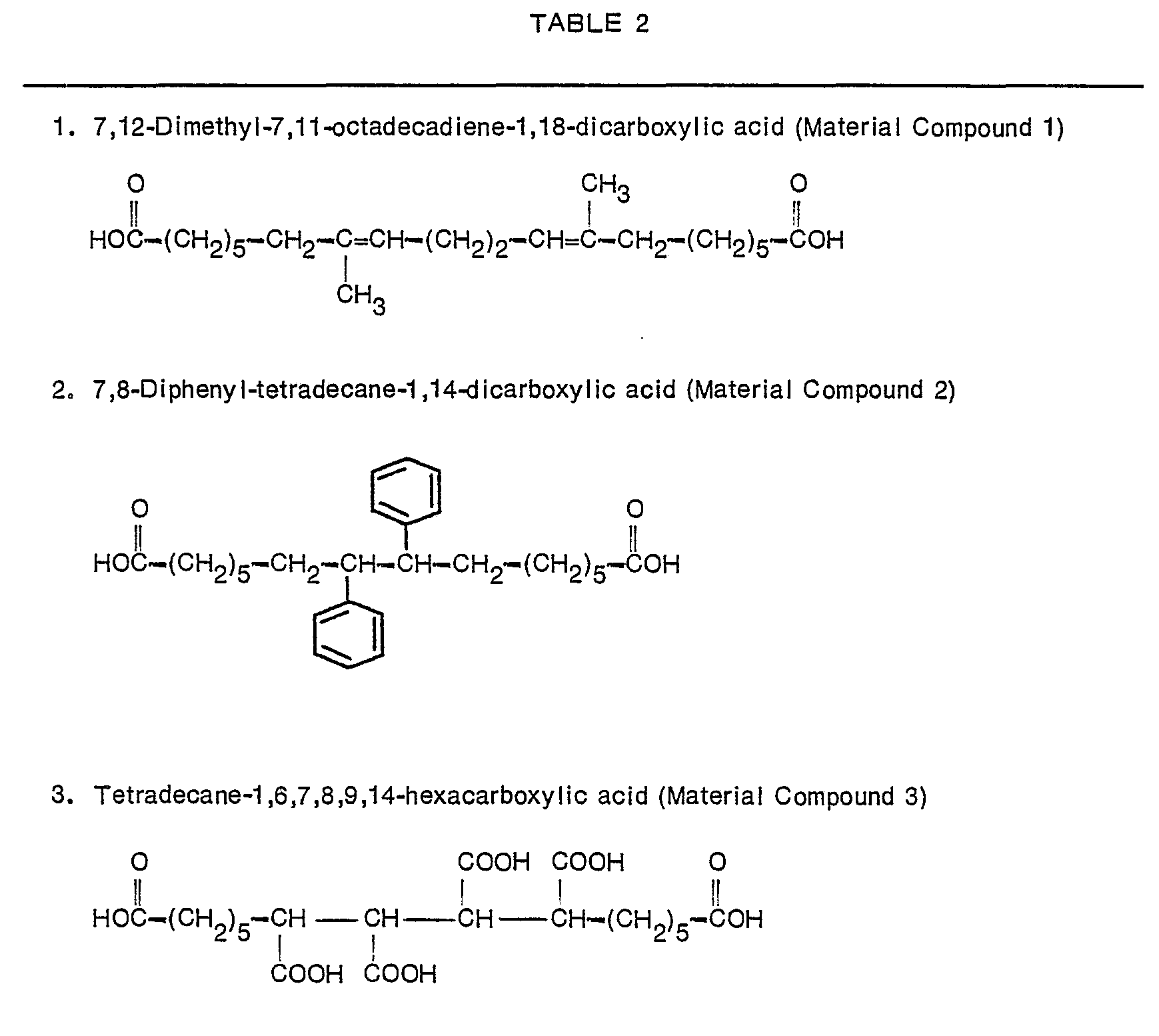

- Of these carboxylic acids of the formula II, Material Compound 1 is known, while Material Compounds 2 to 5 are novel.
- Material Compound 2 is prepared by reacting cyclohexanone with hydrogen peroxide in an alcohol in the presence of an acid catalyst to form an alkoxycyclohexanol peroxide, reacting the peroxide with styrene in the presence of a ferrous salt to obtain the dicarboxylic acid ester, and hydrolyzing the ester.
- For the reaction between cyclohexanone and hydrogen peroxide, usually 0.5 to 2 moles, preferably 1 mole, of the latter is used per mole of the former. Useful acid catalysts are inorganic acids, such as sulfuric acid, phosphoric acid, hydrochloric acid, etc., among which sulfuric acid is preferable. The acid catalyst is used in an amount of 0.5 to 10 parts (by weight, the same as hereinafter), preferably 1 to 2 parts, per 100 parts of cyclohexanone. Useful alcohols are usually lower alcohols, preferred examples of which are methanol, ethanol, propanol, isopropanol, n-butanol, tert.-butanol, etc. Usually 200 to 1,000 parts, preferably 400 to 600 parts, of such alcohol is used per 100 parts of cyclohexanone. The reaction is conducted usually at -30 to 30°C, preferably -5 to 5°C, for 5 to 60 minutes, preferably 10 to 20 minutes.
- The alkoxycyclohexanol peroxide thus formed is reacted with styrene in the ratio of 1 to 3 moles, preferably 1.2 to 2.0 moles, of the latter per mole of the former, in the presence of a ferrous salt. For this reaction, various ferrous salts are useful, including, for example, ferrous sulfate, ferrous chloride, ferrous acetate, ammonium salt of ferrous sulfate, etc. Usually 1 to 2 moles, preferably 1.2 to 2.0 moles. of such ferrous salt is used per mole of the alkoxycyclohexanol peroxide. The reaction is conducted usually at -10 to 10°C, preferably -5 to 5°C, for 0.5 to 1 hour. A solvent, although not always needed, is usable. Examples of useful solvents are lower alcohols, such as methyl alcohol, ethyl alcohol, n-propyl alcohol, n-butyl alcohol, tert.-butyl alcohol. In this way, Material Compound 2 is prepared in the form of an ester. The ester is hydrolyzed to obtain Material Compound 2 in a usual manner, for example, by adding an alkali metal hydroxide to the ester while heating and stirring the ester with water in an amount 1 to 2 times the amount by weight of the ester, and admixing sulfuric acid or like mineral acid.
- Material Compound 3 can be prepared in the same manner as Material Compound 2 with the exception of using a maleic acid ester in place of styrene. Useful maleic acid esters are lower alkyl mono- or diesters of maleic acid, especially lower alkyl diesters of maleic acid. Exemplary of such esters are dimethyl maleate, diethyl maleate, di-n-propyl maleate, di-n-butyl maleate, di-tert-butyl maleate.
- Material Compound 4 can be prepared in the same manner as Material Compound 2 except that a methacrylic acid ester is used in place of styrene. Material Compound 5 is prepared similarly with the use of an acrylic acid ester in place of styrene. Useful methacrylic acid esters are lower alkyl esters of methacrylic acid, such as methyl methacrylate, ethyl methacrylate, n-propyl methacrylate, n-butyl methacrylate, tert-butyl methacrylate. Useful acrylic acid esters are lower alkyl esters of acrylic acid, such as methyl acrylate, ethyl acrylate, n-propyl acrylate, n-butyl acrylate, tert-butyl acrylate.
- Material Compound 1, which is a known compound, can be prepared by various known processes. Typically Material Compound 1 is prepared by the following process.
- The same procedure as in the preparation of Material Compound 2 is repeated with the exception of using isoprene in lieu of styrene to obtain Material Compound 1.
- The carboxylic acids, represented by the formula II and serving as the starting material are reacted with epichlorohydrin using at least one of tertiary amines and quaternary ammonium salts as a catalyst. Examples of useful tertiary amines are triethylamine, tri-n-propylamine, benzyldimethylamine, triethanolamine. Exemplary of useful quaternary ammonium salts are ammonium tetramethylhydroxide, ammonium benzyltrimethylhydroxide, benzyltrimethyl ammonium chloride, benzyltriethyl ammonium chloride, benzyltrimethyl ammonium acetate, methyltriethyl ammonium chloride, etc. The catalyst is used in an amount usually of 0.02 to 1.0% by weight, preferably 0.1 to 0.3% by weight, based on the combined amount of the polycarboxylic acid and epichlorohydrin. The reaction is conducted usually at 80 to 150°C, preferably at 90 to 110°C for 0.5 to 1 hour.
The reaction mixture is then neutralized with an alkali hydroxide, such as sodium hydroxide or potassium hydroxide, followed by the removal of hydrochlorid acid in the usual manner, whereby the carboxylic acid glycidyl ester of the formula I can be obtained. The desired compound can be isolated and purified by a usual method, for example, by filtration, solvent extraction, washing, distillation or recrystallization. - Given below is a preferred mode of reacting the carboxylic acid of the formula II with epichlorohydrin. The carboxylic acid of the formula II is admixed with epichlorohydrin in an amount of 3 to 10 moles per carboxyl group of the acid. Subsequently a tertiary amine or quaternary ammonium salt catalyst is added to the mixture. The resulting mixture is subjected to addition reaction at 80 to 110°C as a first step to obtain the corresponding chlorohydrin ester of carboxylic acid. When the neutralization value has reduced to not higher than 1, the reaction is discontinued. As a second step, a concentrated aqueous solution of alkali hydroxide (concentration: 40 to 60%) in 5 to 30% excess of the theoretical amount is immediately thereafter added in small portions to the reaction mixture for the removal of hydrochloric acid, and the water added and the water formed are removed as an azeotropic mixture of water and epichlorohydrin. After the dropwise addition of the alkali hydroxide, the reaction mixture is heated very rapidly to 105°C, whereupon the reaction is discontinued by quickly cooling the mixture to room temperature. The precipitate of sodium chloride is filtered off. After recovering the epichlorohydrin from the filtrate in vacuum, the product was dissolved in an inert organic solvent, and the solution was washed with water to remove the catalyst and traces of sodium chloride. The solution is then heated to about 140°C in vacuum for the recovery of the inert organic solvent, affording the desired compound of this invention.
- The novel carboxylic acid glycidyl esters of this invention have the following usefulness.
- Compounds 1 to 5 are all liquid and have viscosities of up to 200 cps (2 d Pa.s) at room temperature and are advantageously usable for imparting flexibility to epoxy resins when reacted therewith. Conventional epoxy resins, when cured, generally have low flexibility, which is usually increased with use of a flexibility imparting agent. In addition to being capable of giving flexibility to epoxy resins on curing, such agent must fulfill the requirements of being miscible with epoxy resins, having high storage stability when admixed therewith, causing no shrinkage to epoxy resins on curing, and not impairing the properties of the cured product obtained, for example, in respect of mechanical strength, resistance to thermal impact, chemical stability, electrical characteristics, etc. Compounds 1 to 5 of this invention all satisfy these requirements. Stated more specifically, these compounds are highly miscible with epoxy resins and can be mixed with an epoxy resin in any ratio, affording a mixture having an exceedingly high storage stability at low temperatures. When stored, for example at 0°C for a long period of time, such mixture will not produce any crystals, nor will it separate into phases. The mixture is curable without entailing any shrinkage or deformation, giving a product which is outstanding in mechanical strength, electrical characteristics, resistance to chemicals as well as to heat, and bond strength.
- The use of Compounds 1 to 5 as flexibility imparting agents will be described below in greater detail.
- These novel compounds of this invention can be admixed with a wide variety of epoxy resins heretofore known. Typical of such resins are bisphenol A type epoxy resins (e.g. EPiKOTE'R, trade mark, product of Shell Co.). The amount of the present compounds to be admixed with such epoxy resin is not particularly limited but is widely variable. Usually 5 to 400 parts, preferably 10 to 150 parts, of the compound is used per 100 parts of the epoxy resin. When used in lesser amounts, the compounds fail to give sufficient flexibility to the cured product, whereas when they are used in exceedingly large amounts, there is the tendency that the cured product will have a reduced heat-resistance.
- Curing agents can be incorporated into compositions of a compound of this invention and a conventional epoxy resin. A wide variety of curing agents are usable in varying amounts. Usually curing agents are used approximately in stoichiometrically the same amount as the combined epoxy equivalent weight of the epoxy resin and the present compound. Furthermore, curing accelerators, extenders, plasticizers and various other additives can be admixed with such epoxy resin compositions when so desired.
- Uniform and defoamed epoxy resin compositions can be prepared merely by stirring the desired ingredients at room temperature. Such epoxy resin compositions are curable under the conditions usually used for curing epoxy resins. When a suitable curing agent is used in an appropriate amount in accordance with the use of a particular epoxy resin composition, the composition is curable at room temperature to 200°C. The epoxy resin compositions are useful for widespread applications, for example, for adhesion, coating, molding, lining, sealing and potting.
- The polycarboxylic acid glycidyl acrylates and/or methacrylates obtained by adducting acrylic acid and/or methacrylic acid with Compounds 1 to 5 of this invention are readily curable with ultraviolet rays, so that the products are advantageously usable for coating compositions and links curable with ultraviolet rays. In addition, Compounds 1 to 5 are useful as curing agents for urethane resins.
- Given below are reference examples in which carboxylic acids of the formula (II) are prepared as starting materials for preparing present compounds, and examples of this invention in which compounds of the invention are prepared and used. In the following examples and comparative tests, the parts are all by weight.
- Into a reactor equipped with a stirrer and a condenser are placed 150 kg of anhydrous methanol, 40 kg of cyclohexanone, 40 kg of 35% aqueous solution of hydrogen peroxide, 53 kg of styrene and 1.5 kg of 98% sulfuric acid. The mixture is stirred at 18 to 20°C for 30 minutes for reaction. While maintaining the reaction mixture at -5°C, 120 kg of finely divided sulfate (heptahydrate) is added thereto in small portions for reaction. An 18 kg quantity of 60% sulfuric acid is added to the resulting reaction mixture, which is stirred and thereafter allowed to stand, whereby the mixture is separated into an upper layer of the carboxylic acid ester and a lower layer containing the ferric salt. The acid layer is washed with dilute sulfuric acid and water, and dried to give 80 kg of crude methyl carboxylate. Yield 94.6% (based on the cyclohexanone used).
- The lower salt layer is rectified to recover 98 kg of 99% methanol.
- The following dimethyl esters are separated from the crude methyl carboxylate by gas chromatography.
- (1) Dimethyt-8,9-dipheny!-1,16-hexadecanedioate (ratio: 60.2%)Elementary analysis


- (2) Dimethyl-7-phenyl-1,14-tetradecanedioate (ratio: 21.7%)Elementary analysis


- The dimethyl dicarboxylate (1) thus obtained is hydrolyzed to obtain Material Compound 2.
- A 50 kg quantity of dimethyl-7,8-dimethyl-1,7,8,14-carboxylic acid ester and 100 kg of water are placed in a reactor equipped with a stirrer, a thermometer and a condenser. The mixture is then heated at 90°C with stirring and thereto is added 52 kg of 50% aqueous solution of NaOH. Subsequently the resulting mixture is stirred at 95 to 100°C for 2 hours to undergo saponification. After the completion of the saponification, 66 kg of 50% aqueous solution of sulfuric acid is added to the saponified mixture with stirring to achieve a pH of 3. The heating is discontinued after stirring for 10 minutes. Thereafter the reaction mixture is allowed to stand for about 30 minutes, whereby the mixture is separated into an upper layer and a lower layer. The upper layer is washed with warm water (about 80°C) three times, heated up to 150°C at reduced pressure (400 to 666 Pa) and dried to give 43.1 kg of aliphatic polycarboxylic acid (acid value 649.3, saponification value 650.1, color G2-3).
- The aliphatic polycarboxylic acid is subjected to gas chromatography to obtain Material Compound 5.

-

- Into a four-necked flask equipped with a stirrer, a condenser with a water separator, a thermometer and a separating funnel are placed 366 parts of 7,12-dimethyl-7,1 1-octadecadiene-1,18-dicarboxylic acid, 925 parts of epichlorohydrin and 2 parts of benzyltriethyl ammonium chloride. The mixture is heated to 90 to 100°C and refluxed with stirring for 30 minutes for esterification. At the same temperature, 208 parts of 50% aqueous solution of sodium hydroxide is added dropwise to the mixture over a period of 60 minutes. The mixture is further refluxed with stirring at the same temperature for 15 minutes, then cooled to room temperature and filtered to remove sodium chloride. The epichlorohydrin is recovered in vacuum, the product is dissolved in 1 liter of toluene, and the solution is washed with three 300-ml portions of water. The solution is distilled in vacuum (133 Pa) to completely recover the toluene at 140°C and to obtain 7,12-dimethyl-7,11-octadecadiene-1,18-dicarboxylic acid diglycidyl ester.
- Yield 96.1%, epoxy equivalent weight 270, acid value 0.03, iodine value 98.7, saponification value 215, color G1, viscosity 70 cps (0.7 d Pa.s) (23°C).
- Compound 2 is prepared in the same manner as in Example 1 except that 438 parts of 7,8-diphenyl-tetradecane-1,14-dicarboxylic acid is used.
- Yield 97%, epoxy equivalent 290, acid value 0.02, iodine value 0, saponification value 195, color G1, viscosity 250 cps (2.5 d Pa.s) (23°C).
- Compound 3 is prepared in the same manner as in Example 1 except that 462 parts of tetradecane-1,6,7,8,9,14-hexacarboxylic acid is used.
- Yield 90.5%, epoxy equivalent weight 150.5, acid value 0.03, iodine value 0, saponification value 372, color G1, viscosity 230 cps (2.3 d Pa.s) (23°C).
- Compound 4 is prepared in the same manner as in Example 1 except that 462 parts of 7,8-dimethyl-tetradecane-1,7,8,14-tetracarboxylic acid is used.
- Yield 92%, epoxy equivalent weight 172, acid value 0.03, iodine value 0, saponification value 326.2, color G1, viscosity 226 cps (2.3 d Pa-s) (23°C).
- Compound 5 is prepared in the same manner as in Example 1 except that 374 parts of tetradecane-1,7,8,14-tetracarbocylic acid is used.
- Yield 92%, epoxy equivalent weight 140.5, acid value 0.03, iodine value 0, saponification value 399.3, color G2, viscosity 797 cps (1.9 d Pa.s) (23°C).
- Each of the compounds of this invention listed in Table 3 is admixed, in the amounts also listed in Table 3, with 100-part portions of bisphenol A type resin (trade mark Epikote 828@, 2,2-bis-(4-glycidyl-oxyphenyl)-propane, product of Shell Co.) to prepare uniform solutions. The viscosity (in d Pa s) of each resin composition is measured at 25°C with use of a B-type viscosimeter (product of Tokyo Keiki Co., Ltd., Japan). Table 3 shows the results. For comparison, the same procedure is repeated using the following compounds heretofore known as the best diluents or flexibility imparting agents.
- Compound A: Epikote 871@ (trade mark for glycidyl ester of dimer acid (reaction product of linoleic acid with oleic acid), having an epoxy equivalent weight of 430 and manufactured by Shell Co.).
- Compound B: SB-20@ (trade mark for 6-ethythexadecane-1,16-dicarboxyiic acid diglycidyl ester having an epoxy equivalent weight of 300 and manufactured by Okamura Oil Mill Limited). The results are given also in Table 3.

- Table 3 shows that the compounds 1 and 2 of the invention have lower viscosities and are more excellent in diluting properties than the comparison compounds.
- Epoxy resin compositions are prepared from Epikote 828® and Compounds 1 to 5 of the invention by uniformly dissolving the ingredients in the proportions listed in Tables 4 and 5. The compositions are allowed to stand at room temperature for 30 days and then checked for formation of crystals and phase separation. Table 4 shows the results. The compositions are also allowed to stand at 0°C for 7 days and are then similarly checked. Table 5 shows the results. The marks listed in these tables have the following meaning.
- O: completely transparent.
- △: turbid.
- x: solid with phase separation or turbidity.
- The compositions marked with "O" or "△" are usable as epoxy resin compositions.


- Tables 4 and 5 reveal that the compounds of the invention are much more miscible with the epoxy resin than the comparison compounds and that the compositions having the present compounds incorporated therein have higher storage stability especially at a low temperature.
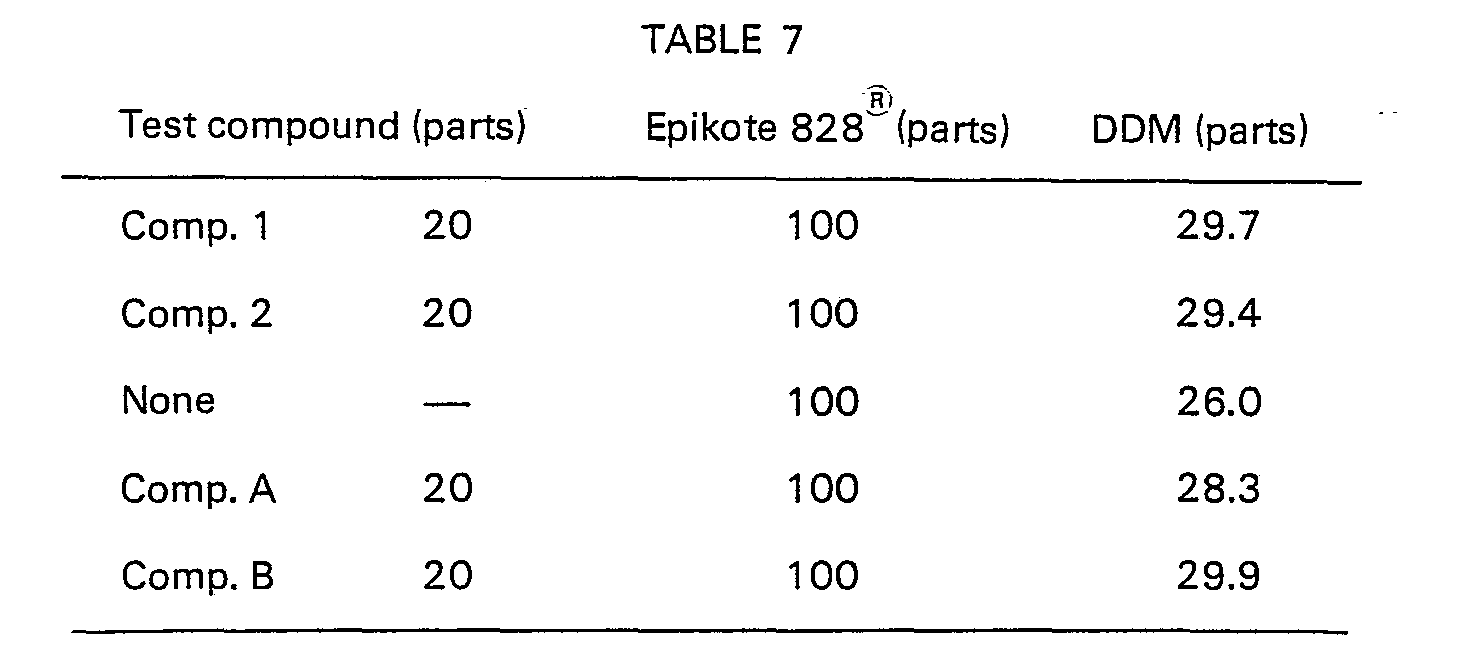
- Epikote 828@, a test compound (compound of the invention or comparison compound) and hexahydrophthalic anhydride (hereinafter referred to as "HHPA") are mixed together in the proportions listed in Table 6. The mixture is heated at 80°C for 2 hours, at 120°C for 2 hours and at 1 50°C for 4 hours to obtain a cured product.
- Furthermore, Epikote 828@, a test compound (compound of the invention or comparison compound), diaminodiphenylmethane (hereinafter referred to as "DDM") are mixed together in the proportions given in Table 7. The mixture is heated at 100°C for 2 hours and at 150°C for 2 hours to obtain a cured product.

- According to JIS K 6919, test pieces (80 x 25 x 3 mm) are prepared from the cured products obtained above. The test pieces are tested for bending strength and modulus of bending elasticity by a tester "TOM 500" (product of Shinko Tsushin Sha Co., Ltd., Japan) under the conditions of: bending rate 1 mm/min, span 50.8, loading point R 3.17 mm, and temperature 20 ± 2°C. Dumbbell No. 1 test pieces are also prepared and then tested for tensile strength and elongation with use of the same tester under the conditions of: pulling rate 5 m/min and temperature 20°C. Further test pieces (63.5 12.7 and 12.7 mm) are prepared and then tested for impact strength (Izod impact value) using "UF Impact Tester" (product of Ueshima Mfg. Co., Ltd., Japan) at a temperature of 23 to 25°C, with a V-notch formed in the test piece. Further according to JIS K-6010, the test pieces are tested for Barcol hardness using 934 I type tester at a temperature of 22 to 25°C. Table 8 shows the test results.
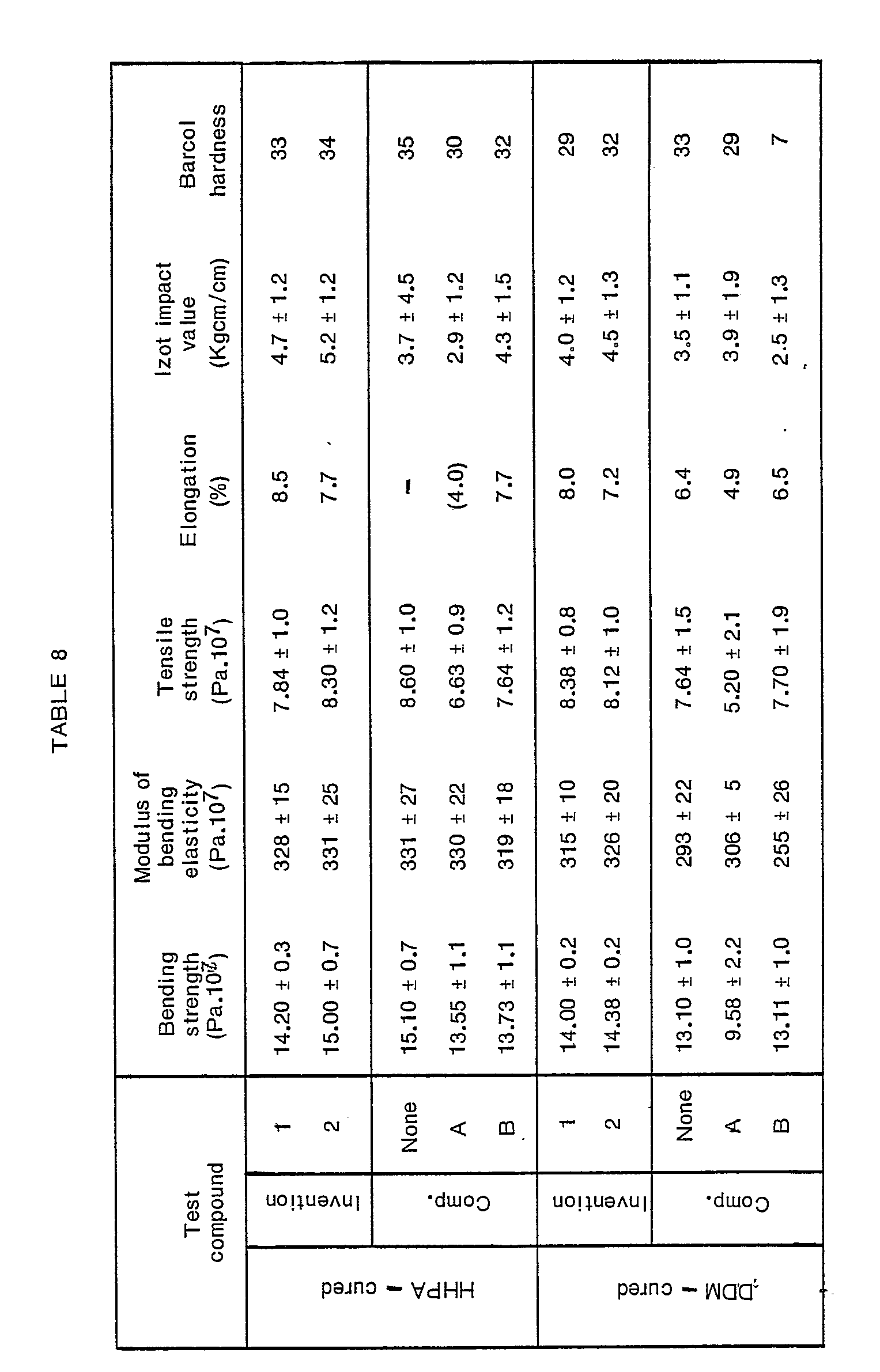
- Table 8 shows that the epoxy resin compositions containing compounds of this invention are comparable or superior in mechanical properties to those containing the comparison compounds. It is seen that the compositions according to this invention and containing DDM have much higher mechanical strength than the one not containing a compound of the invention or comparison compound.
- The cured products are tested for resistance to thermal impact by the flat washer method. A flat washer, 20 mm in diameter, is placed in an aluminum cup 50 mm in diameter, as supported on a piece of kraft paper, and one of the epoxy resin compositions listed in Tables 6 and 7 is placed into the cup in an amount of 50 g and then cured under the same conditions as in section (1) above. In this way, five test specimens are prepared for each of the compositions. The specimens are subjected to thermal impact cycles shown in Table 9 to calculate a crack resistance index from the following equation.

- Table 10 shows the results.


- Table 10 reveals that when cured with HHPA or DDM, the epoxy resin compositions containing compounds of this invention have much higher thermal impact resistance than the epoxy resin (i.e. Epikote 828®).
- Test pieces (25 x 25 x 3 mm) prepared from the cured products obtained in section (1) above are immersed in 20% sulfuric acid for 6 days, in 20% sodium hydroxide for 6 days, in toluene for 6 days and boiling water for 4 hours individually, and are thereafter checked for appearance and a change in weight. Table 11 shows the results. The change of weight is calculated from the following equation.


- Table 11 shows that the cured products of the epoxy resin compositions containing compounds of this invention are comparable to conventional cured products in resistance to chemicals.
- According to JIS K 6911, test pieces (80 x 25 x 3 mm) are prepared from the cured products obtained in section (1) above, and tested for volume intrinsic resistivity, surface intrinsic resistivity, dielectric constant, dielectric loss factor, insulation breakdown voltage, tracking resistance and arc resistance at room temperature (23°C). The tracking resistance is determined by the IEC method, using 0.1% NH4CI for the electrolyte and applying 600 V across brass electrodes. The results are shown in Table 12.

- Compound 1 (100 parts), acrylic acid in an amount of 130% by weight based on the epoxy equivalent weight of the compound, and 1 part of triethylamine and 0.1 part of hydroquinone serving as catalysts are stirred at 100 ± 20°C for 2 hours for reaction. The excess of acrylic acid is recovered from the reaction mixture to obtain a polycarboxylic acid glycidyl acrylate.
- The acrylate (50 parts), 0.5 part of benzoin isobutyl ether serving as a photosensitizer, 0.1 part of tert.-butyl catechol, and 20 parts of toluene are mixed together to obtain a uniform solution as a coating composition which is curable with ultraviolet rays. The composition is applied to a tinplate sheet, 150 x 150 x 0.3 mm, to a thickness of 150µm. The coating is then illuminated by a 1-kw mercury lamp spaced apart therefrom by 15 cm, at a wavelength of 365 mm, at 40 w/cm2 for 10 minutes.
- The same procedure as above is repeated with use of Compounds 2 and 3. Table 13 shows the results.

- The dryness and flexural strength listed above are determined by the following methods. The pencil hardness is measured according to JIS K 5400.
Dryness to touch: According to JIS K 5400.
Flexural strength: According to JIS K 5400, using bending tester at a radius of curvature of 2 mm and bending angle of 180°. - Compound 3 of the invention, Epikote 828tR, an acid anhydride curing agent (trade mark HN―2200®, product of Hitachi Kasei Co., Ltd., Japan) and 2-ethyl-4-methylimidazole (hereinafter referred to as "EMI") are mixed together in the proportions listed in Table 14 below. The mixture is heated at 80°C for 2 hours, then at 130°C for 2 hours and further at 180°C for 2 hours to obtain a cured product. The product is tested for the properties listed in Table 14.
- The same procedure as above is repeated with use of Compounds 4 and 5. The results are given in Table 14.

- The properties listed are determined by the following methods.
- Glass transition temperature: According to JIS K 6919, Dumbbell No. 1 test pieces are prepared, which are tested by Torsion Pendulum Analyzer at a frequency of 3 Hz while raising the temperature at a rate of 10°C/min.
- Volume intrinsic resistivity: Test pieces (80 x 25 x 3 mm) prepared according to JIS K 6911 are tested at 23°C.
- Ignition loss: Test pieces (10 x 10 x 1 mm) are heated at 200°C for 1,000 hours, and the resulting reduction in weight is measured.
Claims (5)


Applications Claiming Priority (2)
| Application Number | Priority Date | Filing Date | Title |
|---|---|---|---|
| JP138935/79 | 1979-10-26 | ||
| JP54138935A JPS6011910B2 (en) | 1979-10-26 | 1979-10-26 | Polycarboxylic acid glycidyl ester |
Publications (2)
| Publication Number | Publication Date |
|---|---|
| EP0028024A1 EP0028024A1 (en) | 1981-05-06 |
| EP0028024B1 true EP0028024B1 (en) | 1984-03-28 |
Family
ID=15233575
Family Applications (1)
| Application Number | Title | Priority Date | Filing Date |
|---|---|---|---|
| EP80106543A Expired EP0028024B1 (en) | 1979-10-26 | 1980-10-24 | Carboxylic acid glycidyl esters, process for their preparation and their use in resin compositions |
Country Status (4)
| Country | Link |
|---|---|
| US (1) | US4362871A (en) |
| EP (1) | EP0028024B1 (en) |
| JP (1) | JPS6011910B2 (en) |
| DE (1) | DE3067284D1 (en) |
Cited By (1)
| Publication number | Priority date | Publication date | Assignee | Title |
|---|---|---|---|---|
| CN103210012A (en) * | 2010-11-15 | 2013-07-17 | 日产化学工业株式会社 | Polyfunctional epoxy compound |
Families Citing this family (12)
| Publication number | Priority date | Publication date | Assignee | Title |
|---|---|---|---|---|
| JPS58210078A (en) * | 1982-05-31 | 1983-12-07 | Kanegafuchi Chem Ind Co Ltd | Novel epoxy resin and its preparation |
| EP0336670A1 (en) * | 1988-04-04 | 1989-10-11 | Hoechst Celanese Corporation | Diglycidyl muconate |
| JPH0473113U (en) * | 1990-11-07 | 1992-06-26 | ||
| US5536855A (en) * | 1994-03-04 | 1996-07-16 | National Starch And Chemical Investment Holding Corporation | Process for preparing glycidyl esters for use in electronics adhesives |
| US5770706A (en) * | 1995-06-07 | 1998-06-23 | National Starch And Chemical Investment Holding Corporation | Snap-cure epoxy adhesives |
| US5717054A (en) * | 1995-06-07 | 1998-02-10 | National Starch & Chemical Investment Holding Corp. | Epoxy resins consisting of flexible chains terminated with glycidyloxyphenyl groups for use in microelectronics adhesives |
| US5646315A (en) * | 1995-06-07 | 1997-07-08 | National Starch And Chemical Investment Holding Corporation | Polyglydicylphenyl ethers of alkyloxy chains for use in microelectronics adhesives |
| AU714033B2 (en) * | 1996-07-19 | 1999-12-16 | Nissan Chemical Industries Ltd. | Method for producing purified epoxy compound |
| US5863886A (en) * | 1997-09-03 | 1999-01-26 | Rhodia Inc. | Nonionic gemini surfactants having multiple hydrophobic and hydrophilic sugar groups |
| US11421069B2 (en) * | 2018-01-19 | 2022-08-23 | Hexion Inc. | Polyester-polyol compositions for polyurethane foam with improved hydrolytic stability |
| KR102665491B1 (en) * | 2020-11-06 | 2024-05-10 | 삼성에스디아이 주식회사 | Epoxy resin composition for encapsulating semiconductor device and semiconductor device encapsulated using the same |
| CN117645585A (en) * | 2023-11-20 | 2024-03-05 | 中国科学院宁波材料技术与工程研究所 | Bio-based epoxy resin precursor, composite insulating material, preparation method and application thereof |
Family Cites Families (11)
| Publication number | Priority date | Publication date | Assignee | Title |
|---|---|---|---|---|
| US3075999A (en) * | 1963-01-29 | Glycidyl esteks | ||
| US2772296A (en) * | 1956-11-27 | Process for preparing epoxy esters | ||
| US2940986A (en) * | 1957-06-17 | 1960-06-14 | Shell Oil Co | Epoxy esters of long chain acids |
| NL227899A (en) * | 1957-05-21 | |||
| US3057809A (en) * | 1959-07-14 | 1962-10-09 | Shell Oil Co | Flexible epoxy resin compositions and cured products |
| CH508614A (en) * | 1968-09-30 | 1971-06-15 | Ciba Geigy Ag | Process for the preparation of new diglycidyl esters of aliphatic dicarboxylic acids and their use in curable mixtures |
| US3629295A (en) * | 1969-05-08 | 1971-12-21 | Celanese Corp | Glycidyl esters of sterically hindered organic acids |
| DE2166545B2 (en) * | 1970-06-09 | 1977-04-07 | Ausscheidung aus: 21 26 280 Hoechst AG, 6000 Frankfurt | STABILIZED, LIQUID, CRYSTAL-FREE MIXTURE OF DIGLYCIDYL ETHERS OF 4,4'-DIHYDROXIDIPHENYLPROPANE (2.2) AND DIGLYCIDYLESTERS OF DICARBONIC ACIDS |
| CH531499A (en) * | 1970-06-09 | 1972-12-15 | Reichhold Albert Chemie Ag | Process for retarding the crystallization of glycidyl ethers of 4,4'-dihydroxidiphenolpropane- (2,2) |
| US3784525A (en) * | 1972-04-12 | 1974-01-08 | Ciba Geigy Corp | Long-chain diglycidyl esters |
| US4859314A (en) * | 1983-05-02 | 1989-08-22 | Uop | Catalytic cracking catalysts and cracking process using non-zeolitic molecular sieves |
-
1979
- 1979-10-26 JP JP54138935A patent/JPS6011910B2/en not_active Expired
-
1980
- 1980-10-21 US US06/199,281 patent/US4362871A/en not_active Expired - Lifetime
- 1980-10-24 EP EP80106543A patent/EP0028024B1/en not_active Expired
- 1980-10-24 DE DE8080106543T patent/DE3067284D1/en not_active Expired
Cited By (1)
| Publication number | Priority date | Publication date | Assignee | Title |
|---|---|---|---|---|
| CN103210012A (en) * | 2010-11-15 | 2013-07-17 | 日产化学工业株式会社 | Polyfunctional epoxy compound |
Also Published As
| Publication number | Publication date |
|---|---|
| JPS5663975A (en) | 1981-05-30 |
| EP0028024A1 (en) | 1981-05-06 |
| JPS6011910B2 (en) | 1985-03-28 |
| DE3067284D1 (en) | 1984-05-03 |
| US4362871A (en) | 1982-12-07 |
Similar Documents
| Publication | Publication Date | Title |
|---|---|---|
| US8802872B2 (en) | Process for preparing glycidyl esters of branched monocarboxylic acids | |
| CA2344450C (en) | Process for the preparation of glycidylesters of branched carboxylic acids | |
| US4362871A (en) | Polycarboxylic acid glycidyl esters and process for preparing the same | |
| JPH05507936A (en) | Production method of cyclic sulfate | |
| EP0458296B1 (en) | Modified epoxy resins having acetylenically unsaturated functions | |
| US2728781A (en) | Acyloxy substituted-glycidyl polyethers of dihydric phenols | |
| TW202500550A (en) | Thiol compounds | |
| JPS6214167B2 (en) | ||
| KR100206530B1 (en) | Process for the preparation of alkylimidazolidone (meth)acrylates | |
| US6570028B1 (en) | Process for the preparation of glycidylesters of branched carboxylic acids | |
| JP4004127B2 (en) | Method for producing vinyl group-containing alicyclic acrylate compound and epoxy group-containing alicyclic acrylate compound | |
| JPH0545606B2 (en) | ||
| US3288789A (en) | Process for the production of hardenable compounds containing epoxide groups | |
| JP3307260B2 (en) | Compound having oxetanyl group and method for producing the same | |
| JPS59175482A (en) | Method for manufacturing polyepoxy compounds | |
| JPH01249747A (en) | Fluorine-containing diallyl isophthalate | |
| US4127497A (en) | Michael adducts of (substituted) cyclopentadiene and esters: a process therefor and derivatives thereof | |
| JPS6143623A (en) | Preparation of polycaprolactone-modified hydroxyalkyl acrylate or methacrylate | |
| JPS6058916B2 (en) | Unsaturated dicarboxylic acid glycidyl ester and its production method | |
| JP3016428B2 (en) | Composition comprising novel alicyclic compound and method for producing the same | |
| JP4775759B2 (en) | Novel alicyclic compound, process for producing the same and polymer of the compound | |
| JPS623168B2 (en) | ||
| JPS63250347A (en) | Novel acrylic acid ester and production thereof | |
| KR20080020777A (en) | Synthesis method of bisphenol type epoxy methacrylate | |
| JPS5933318A (en) | Production of polyepoxy compound |
Legal Events
| Date | Code | Title | Description |
|---|---|---|---|
| PUAI | Public reference made under article 153(3) epc to a published international application that has entered the european phase |
Free format text: ORIGINAL CODE: 0009012 |
|
| AK | Designated contracting states |
Designated state(s): CH DE FR GB IT NL |
|
| 17P | Request for examination filed |
Effective date: 19811014 |
|
| ITF | It: translation for a ep patent filed | ||
| GRAA | (expected) grant |
Free format text: ORIGINAL CODE: 0009210 |
|
| AK | Designated contracting states |
Designated state(s): CH DE FR GB IT LI NL |
|
| REF | Corresponds to: |
Ref document number: 3067284 Country of ref document: DE Date of ref document: 19840503 |
|
| ET | Fr: translation filed | ||
| PLBE | No opposition filed within time limit |
Free format text: ORIGINAL CODE: 0009261 |
|
| STAA | Information on the status of an ep patent application or granted ep patent |
Free format text: STATUS: NO OPPOSITION FILED WITHIN TIME LIMIT |
|
| 26N | No opposition filed | ||
| ITTA | It: last paid annual fee | ||
| PGFP | Annual fee paid to national office [announced via postgrant information from national office to epo] |
Ref country code: FR Payment date: 19910923 Year of fee payment: 12 |
|
| PGFP | Annual fee paid to national office [announced via postgrant information from national office to epo] |
Ref country code: CH Payment date: 19920130 Year of fee payment: 12 |
|
| PG25 | Lapsed in a contracting state [announced via postgrant information from national office to epo] |
Ref country code: LI Effective date: 19921031 Ref country code: CH Effective date: 19921031 |
|
| PG25 | Lapsed in a contracting state [announced via postgrant information from national office to epo] |
Ref country code: FR Effective date: 19930630 |
|
| REG | Reference to a national code |
Ref country code: CH Ref legal event code: PL |
|
| REG | Reference to a national code |
Ref country code: FR Ref legal event code: ST |
|
| PGFP | Annual fee paid to national office [announced via postgrant information from national office to epo] |
Ref country code: DE Payment date: 19960928 Year of fee payment: 17 |
|
| PGFP | Annual fee paid to national office [announced via postgrant information from national office to epo] |
Ref country code: GB Payment date: 19961017 Year of fee payment: 17 |
|
| PGFP | Annual fee paid to national office [announced via postgrant information from national office to epo] |
Ref country code: NL Payment date: 19961031 Year of fee payment: 17 |
|
| PG25 | Lapsed in a contracting state [announced via postgrant information from national office to epo] |
Ref country code: GB Free format text: LAPSE BECAUSE OF NON-PAYMENT OF DUE FEES Effective date: 19971024 |
|
| PG25 | Lapsed in a contracting state [announced via postgrant information from national office to epo] |
Ref country code: NL Free format text: LAPSE BECAUSE OF NON-PAYMENT OF DUE FEES Effective date: 19980501 |
|
| GBPC | Gb: european patent ceased through non-payment of renewal fee |
Effective date: 19971024 |
|
| NLV4 | Nl: lapsed or anulled due to non-payment of the annual fee |
Effective date: 19980501 |
|
| PG25 | Lapsed in a contracting state [announced via postgrant information from national office to epo] |
Ref country code: DE Free format text: LAPSE BECAUSE OF NON-PAYMENT OF DUE FEES Effective date: 19980701 |