EP0025339B1 - Microbicidal sulfones, compositions thereof and methods of preparing them - Google Patents
Microbicidal sulfones, compositions thereof and methods of preparing them Download PDFInfo
- Publication number
- EP0025339B1 EP0025339B1 EP80303077A EP80303077A EP0025339B1 EP 0025339 B1 EP0025339 B1 EP 0025339B1 EP 80303077 A EP80303077 A EP 80303077A EP 80303077 A EP80303077 A EP 80303077A EP 0025339 B1 EP0025339 B1 EP 0025339B1
- Authority
- EP
- European Patent Office
- Prior art keywords
- solution
- sulfide
- mole
- chloro
- ethyl
- Prior art date
- Legal status (The legal status is an assumption and is not a legal conclusion. Google has not performed a legal analysis and makes no representation as to the accuracy of the status listed.)
- Expired
Links
- 230000003641 microbiacidal effect Effects 0.000 title claims description 13
- 150000003457 sulfones Chemical class 0.000 title claims description 13
- 239000000203 mixture Substances 0.000 title claims description 8
- 238000000034 method Methods 0.000 title claims description 6
- 150000001875 compounds Chemical class 0.000 claims description 12
- -1 m-nitrophenyl Chemical group 0.000 claims description 12
- 229910052736 halogen Inorganic materials 0.000 claims description 10
- 150000002367 halogens Chemical class 0.000 claims description 8
- 125000001997 phenyl group Chemical group [H]C1=C([H])C([H])=C(*)C([H])=C1[H] 0.000 claims description 7
- 229910052739 hydrogen Inorganic materials 0.000 claims description 5
- 239000001257 hydrogen Substances 0.000 claims description 5
- 125000004435 hydrogen atom Chemical group [H]* 0.000 claims description 5
- 125000000449 nitro group Chemical group [O-][N+](*)=O 0.000 claims description 5
- 125000001424 substituent group Chemical group 0.000 claims description 4
- 125000004178 (C1-C4) alkyl group Chemical group 0.000 claims description 3
- 125000000113 cyclohexyl group Chemical group [H]C1([H])C([H])([H])C([H])([H])C([H])(*)C([H])([H])C1([H])[H] 0.000 claims description 3
- 125000000217 alkyl group Chemical group 0.000 claims description 2
- 125000005843 halogen group Chemical group 0.000 claims 2
- 125000000590 4-methylphenyl group Chemical group [H]C1=C([H])C(=C([H])C([H])=C1*)C([H])([H])[H] 0.000 claims 1
- 125000001309 chloro group Chemical group Cl* 0.000 claims 1
- 239000003085 diluting agent Substances 0.000 claims 1
- 125000003854 p-chlorophenyl group Chemical group [H]C1=C([H])C(*)=C([H])C([H])=C1Cl 0.000 claims 1
- RTZKZFJDLAIYFH-UHFFFAOYSA-N Diethyl ether Chemical compound CCOCC RTZKZFJDLAIYFH-UHFFFAOYSA-N 0.000 description 31
- 238000002360 preparation method Methods 0.000 description 29
- VZGDMQKNWNREIO-UHFFFAOYSA-N tetrachloromethane Chemical compound ClC(Cl)(Cl)Cl VZGDMQKNWNREIO-UHFFFAOYSA-N 0.000 description 28
- ZMANZCXQSJIPKH-UHFFFAOYSA-N Triethylamine Chemical compound CCN(CC)CC ZMANZCXQSJIPKH-UHFFFAOYSA-N 0.000 description 27
- QTBSBXVTEAMEQO-UHFFFAOYSA-N Acetic acid Chemical compound CC(O)=O QTBSBXVTEAMEQO-UHFFFAOYSA-N 0.000 description 26
- 238000001704 evaporation Methods 0.000 description 21
- 230000008020 evaporation Effects 0.000 description 21
- 239000002904 solvent Substances 0.000 description 19
- WYURNTSHIVDZCO-UHFFFAOYSA-N Tetrahydrofuran Chemical compound C1CCOC1 WYURNTSHIVDZCO-UHFFFAOYSA-N 0.000 description 18
- YXFVVABEGXRONW-UHFFFAOYSA-N Toluene Chemical compound CC1=CC=CC=C1 YXFVVABEGXRONW-UHFFFAOYSA-N 0.000 description 15
- 239000011541 reaction mixture Substances 0.000 description 13
- XEKOWRVHYACXOJ-UHFFFAOYSA-N Ethyl acetate Chemical compound CCOC(C)=O XEKOWRVHYACXOJ-UHFFFAOYSA-N 0.000 description 12
- 238000001914 filtration Methods 0.000 description 12
- 238000001953 recrystallisation Methods 0.000 description 12
- 229960000583 acetic acid Drugs 0.000 description 11
- XLYOFNOQVPJJNP-UHFFFAOYSA-N water Substances O XLYOFNOQVPJJNP-UHFFFAOYSA-N 0.000 description 11
- 239000000706 filtrate Substances 0.000 description 10
- 229940124561 microbicide Drugs 0.000 description 10
- 239000000047 product Substances 0.000 description 9
- YLQBMQCUIZJEEH-UHFFFAOYSA-N tetrahydrofuran Natural products C=1C=COC=1 YLQBMQCUIZJEEH-UHFFFAOYSA-N 0.000 description 9
- ILWRPSCZWQJDMK-UHFFFAOYSA-N triethylazanium;chloride Chemical compound Cl.CCN(CC)CC ILWRPSCZWQJDMK-UHFFFAOYSA-N 0.000 description 9
- LFQSCWFLJHTTHZ-UHFFFAOYSA-N Ethanol Chemical compound CCO LFQSCWFLJHTTHZ-UHFFFAOYSA-N 0.000 description 8
- OFBQJSOFQDEBGM-UHFFFAOYSA-N Pentane Chemical compound CCCCC OFBQJSOFQDEBGM-UHFFFAOYSA-N 0.000 description 8
- 239000012043 crude product Substances 0.000 description 7
- 239000012362 glacial acetic acid Substances 0.000 description 7
- UHOVQNZJYSORNB-UHFFFAOYSA-N Benzene Chemical compound C1=CC=CC=C1 UHOVQNZJYSORNB-UHFFFAOYSA-N 0.000 description 6
- YMWUJEATGCHHMB-UHFFFAOYSA-N Dichloromethane Chemical compound ClCCl YMWUJEATGCHHMB-UHFFFAOYSA-N 0.000 description 6
- UJTPZISIAWDGFF-UHFFFAOYSA-N ethenylsulfonylbenzene Chemical compound C=CS(=O)(=O)C1=CC=CC=C1 UJTPZISIAWDGFF-UHFFFAOYSA-N 0.000 description 6
- JWUKZUIGOJBEPC-UHFFFAOYSA-N phenyl thiohypochlorite Chemical compound ClSC1=CC=CC=C1 JWUKZUIGOJBEPC-UHFFFAOYSA-N 0.000 description 6
- CSCPPACGZOOCGX-UHFFFAOYSA-N Acetone Chemical compound CC(C)=O CSCPPACGZOOCGX-UHFFFAOYSA-N 0.000 description 5
- 239000013078 crystal Substances 0.000 description 5
- 125000001495 ethyl group Chemical group [H]C([H])([H])C([H])([H])* 0.000 description 5
- STDOUHHCZSZDME-UHFFFAOYSA-N (4-bromophenyl) thiohypochlorite Chemical compound ClSC1=CC=C(Br)C=C1 STDOUHHCZSZDME-UHFFFAOYSA-N 0.000 description 4
- IBJGVAOFRSKZPY-UHFFFAOYSA-N 1-chloro-4-ethenylsulfonylbenzene Chemical compound ClC1=CC=C(S(=O)(=O)C=C)C=C1 IBJGVAOFRSKZPY-UHFFFAOYSA-N 0.000 description 4
- VZQFRPMWVXCURA-UHFFFAOYSA-N 1-ethenylsulfonyl-4-methylbenzene Chemical compound CC1=CC=C(S(=O)(=O)C=C)C=C1 VZQFRPMWVXCURA-UHFFFAOYSA-N 0.000 description 4
- VEXZGXHMUGYJMC-UHFFFAOYSA-N Hydrochloric acid Chemical compound Cl VEXZGXHMUGYJMC-UHFFFAOYSA-N 0.000 description 4
- 239000000839 emulsion Substances 0.000 description 4
- QVDYYQXUNAQSNI-UHFFFAOYSA-N ethyl acetate;pentane Chemical compound CCCCC.CCOC(C)=O QVDYYQXUNAQSNI-UHFFFAOYSA-N 0.000 description 4
- 239000003208 petroleum Substances 0.000 description 4
- AOJFQRQNPXYVLM-UHFFFAOYSA-N pyridin-1-ium;chloride Chemical compound [Cl-].C1=CC=[NH+]C=C1 AOJFQRQNPXYVLM-UHFFFAOYSA-N 0.000 description 4
- 239000007787 solid Substances 0.000 description 4
- RYHBNJHYFVUHQT-UHFFFAOYSA-N 1,4-Dioxane Chemical compound C1COCCO1 RYHBNJHYFVUHQT-UHFFFAOYSA-N 0.000 description 3
- CNJPYZBIFBJWFS-UHFFFAOYSA-N 1-ethenylsulfonyl-3-nitrobenzene Chemical compound [O-][N+](=O)C1=CC=CC(S(=O)(=O)C=C)=C1 CNJPYZBIFBJWFS-UHFFFAOYSA-N 0.000 description 3
- KFZMGEQAYNKOFK-UHFFFAOYSA-N Isopropanol Chemical compound CC(C)O KFZMGEQAYNKOFK-UHFFFAOYSA-N 0.000 description 3
- OKKJLVBELUTLKV-UHFFFAOYSA-N Methanol Chemical compound OC OKKJLVBELUTLKV-UHFFFAOYSA-N 0.000 description 3
- ZMXDDKWLCZADIW-UHFFFAOYSA-N N,N-Dimethylformamide Chemical compound CN(C)C=O ZMXDDKWLCZADIW-UHFFFAOYSA-N 0.000 description 3
- LRHPLDYGYMQRHN-UHFFFAOYSA-N N-Butanol Chemical compound CCCCO LRHPLDYGYMQRHN-UHFFFAOYSA-N 0.000 description 3
- AEHWKBXBXYNPCX-UHFFFAOYSA-N ethylsulfanylbenzene Chemical compound CCSC1=CC=CC=C1 AEHWKBXBXYNPCX-UHFFFAOYSA-N 0.000 description 3
- GBIYAVWBYTZRNJ-UHFFFAOYSA-N (3-nitrophenyl) thiohypochlorite Chemical compound [O-][N+](=O)C1=CC=CC(SCl)=C1 GBIYAVWBYTZRNJ-UHFFFAOYSA-N 0.000 description 2
- IAJALEFQCZTQDM-UHFFFAOYSA-N 1-[1-(benzenesulfonyl)-2-chloroethyl]sulfanyl-4-chlorobenzene Chemical compound C=1C=CC=CC=1S(=O)(=O)C(CCl)SC1=CC=C(Cl)C=C1 IAJALEFQCZTQDM-UHFFFAOYSA-N 0.000 description 2
- ZRGLIYSRLRPQDF-UHFFFAOYSA-N 1-[1-(benzenesulfonyl)-2-chloroethyl]sulfanyl-4-tert-butylbenzene Chemical compound C1=CC(C(C)(C)C)=CC=C1SC(CCl)S(=O)(=O)C1=CC=CC=C1 ZRGLIYSRLRPQDF-UHFFFAOYSA-N 0.000 description 2
- VNSXYYAVZSULCZ-UHFFFAOYSA-N 1-bromo-4-[2-chloro-1-(4-chlorophenyl)sulfonylethyl]sulfanylbenzene Chemical compound C=1C=C(Cl)C=CC=1S(=O)(=O)C(CCl)SC1=CC=C(Br)C=C1 VNSXYYAVZSULCZ-UHFFFAOYSA-N 0.000 description 2
- GRMNNUKUDFDMPB-UHFFFAOYSA-N 1-chloro-4-(2-chloro-1-phenylsulfanylethyl)sulfonylbenzene Chemical compound C=1C=C(Cl)C=CC=1S(=O)(=O)C(CCl)SC1=CC=CC=C1 GRMNNUKUDFDMPB-UHFFFAOYSA-N 0.000 description 2
- XAYJWVMHRNYQOX-UHFFFAOYSA-N 1-tert-butyl-4-(2-chloro-1-phenylsulfanylethyl)sulfonylbenzene Chemical compound C1=CC(C(C)(C)C)=CC=C1S(=O)(=O)C(CCl)SC1=CC=CC=C1 XAYJWVMHRNYQOX-UHFFFAOYSA-N 0.000 description 2
- SVPZEQNJJDFQGK-UHFFFAOYSA-N 1-tert-butyl-4-[2-chloro-1-(4-chlorophenyl)sulfonylethyl]sulfanylbenzene Chemical compound C1=CC(C(C)(C)C)=CC=C1SC(CCl)S(=O)(=O)C1=CC=C(Cl)C=C1 SVPZEQNJJDFQGK-UHFFFAOYSA-N 0.000 description 2
- 0 C[C@]1(CCCC2)*22CC(*)CCC1(*)C2 Chemical compound C[C@]1(CCCC2)*22CC(*)CCC1(*)C2 0.000 description 2
- VEXZGXHMUGYJMC-UHFFFAOYSA-M Chloride anion Chemical compound [Cl-] VEXZGXHMUGYJMC-UHFFFAOYSA-M 0.000 description 2
- HEDRZPFGACZZDS-UHFFFAOYSA-N Chloroform Chemical compound ClC(Cl)Cl HEDRZPFGACZZDS-UHFFFAOYSA-N 0.000 description 2
- IAZDPXIOMUYVGZ-UHFFFAOYSA-N Dimethylsulphoxide Chemical compound CS(C)=O IAZDPXIOMUYVGZ-UHFFFAOYSA-N 0.000 description 2
- CSNNHWWHGAXBCP-UHFFFAOYSA-L Magnesium sulfate Chemical compound [Mg+2].[O-][S+2]([O-])([O-])[O-] CSNNHWWHGAXBCP-UHFFFAOYSA-L 0.000 description 2
- BAVYZALUXZFZLV-UHFFFAOYSA-N Methylamine Chemical compound NC BAVYZALUXZFZLV-UHFFFAOYSA-N 0.000 description 2
- JUJWROOIHBZHMG-UHFFFAOYSA-N Pyridine Chemical compound C1=CC=NC=C1 JUJWROOIHBZHMG-UHFFFAOYSA-N 0.000 description 2
- DKGAVHZHDRPRBM-UHFFFAOYSA-N Tert-Butanol Chemical compound CC(C)(C)O DKGAVHZHDRPRBM-UHFFFAOYSA-N 0.000 description 2
- 238000006243 chemical reaction Methods 0.000 description 2
- 239000003153 chemical reaction reagent Substances 0.000 description 2
- 239000012153 distilled water Substances 0.000 description 2
- 238000001035 drying Methods 0.000 description 2
- 239000000463 material Substances 0.000 description 2
- 125000002496 methyl group Chemical group [H]C([H])([H])* 0.000 description 2
- 239000002855 microbicide agent Substances 0.000 description 2
- FWMUJAIKEJWSSY-UHFFFAOYSA-N sulfur dichloride Chemical compound ClSCl FWMUJAIKEJWSSY-UHFFFAOYSA-N 0.000 description 2
- UVIZKKZYBGMXBR-UHFFFAOYSA-N (2-chloro-1-cyclohexylsulfonylethyl)sulfanylbenzene Chemical compound C1CCCCC1S(=O)(=O)C(CCl)SC1=CC=CC=C1 UVIZKKZYBGMXBR-UHFFFAOYSA-N 0.000 description 1
- ZAFDTQJIAOZBAA-UHFFFAOYSA-N (3-methylphenyl) thiohypochlorite Chemical compound CC1=CC=CC(SCl)=C1 ZAFDTQJIAOZBAA-UHFFFAOYSA-N 0.000 description 1
- WVTOJNFZIVWNIY-UHFFFAOYSA-N (4-chlorophenyl) thiohypochlorite Chemical compound ClSC1=CC=C(Cl)C=C1 WVTOJNFZIVWNIY-UHFFFAOYSA-N 0.000 description 1
- QAASGGHXTJRDLJ-UHFFFAOYSA-N (4-tert-butylphenyl) thiohypochlorite Chemical compound CC(C)(C)C1=CC=C(SCl)C=C1 QAASGGHXTJRDLJ-UHFFFAOYSA-N 0.000 description 1
- WSLDOOZREJYCGB-UHFFFAOYSA-N 1,2-Dichloroethane Chemical compound ClCCCl WSLDOOZREJYCGB-UHFFFAOYSA-N 0.000 description 1
- VDDLMNHLOLCHRE-UHFFFAOYSA-N 1-[1-(4-bromophenyl)sulfanyl-2-chloroethyl]sulfonyl-3-nitrobenzene Chemical compound [O-][N+](=O)C1=CC=CC(S(=O)(=O)C(CCl)SC=2C=CC(Br)=CC=2)=C1 VDDLMNHLOLCHRE-UHFFFAOYSA-N 0.000 description 1
- WMBAZWWTACGPQR-UHFFFAOYSA-N 1-[1-(4-bromophenyl)sulfanyl-2-chloroethyl]sulfonyl-3-nitrobenzene;1-[1-(4-bromophenyl)sulfanylethenylsulfonyl]-3-nitrobenzene Chemical compound [O-][N+](=O)C1=CC=CC(S(=O)(=O)C(=C)SC=2C=CC(Br)=CC=2)=C1.[O-][N+](=O)C1=CC=CC(S(=O)(=O)C(CCl)SC=2C=CC(Br)=CC=2)=C1 WMBAZWWTACGPQR-UHFFFAOYSA-N 0.000 description 1
- VBEWLPKASHTJNN-UHFFFAOYSA-N 1-[1-(4-bromophenyl)sulfanyl-2-chloroethyl]sulfonyl-4-methylbenzene Chemical compound C1=CC(C)=CC=C1S(=O)(=O)C(CCl)SC1=CC=C(Br)C=C1 VBEWLPKASHTJNN-UHFFFAOYSA-N 0.000 description 1
- DAKKGNISJUIYLF-UHFFFAOYSA-N 1-[1-(benzenesulfonyl)-2-chloroethyl]sulfanyl-4-bromobenzene Chemical compound C=1C=CC=CC=1S(=O)(=O)C(CCl)SC1=CC=C(Br)C=C1 DAKKGNISJUIYLF-UHFFFAOYSA-N 0.000 description 1
- GFMQUVZZIKSORG-UHFFFAOYSA-N 1-[1-(benzenesulfonyl)ethenylsulfanyl]-4-bromobenzene Chemical compound C1=CC(Br)=CC=C1SC(=C)S(=O)(=O)C1=CC=CC=C1 GFMQUVZZIKSORG-UHFFFAOYSA-N 0.000 description 1
- WLFWIUQEHNHAMH-UHFFFAOYSA-N 1-[2-(benzenesulfonyl)-2-[1-(benzenesulfonyl)-2-(4-chlorophenyl)ethenyl]sulfanylethenyl]-4-chlorobenzene Chemical compound C1=CC(Cl)=CC=C1C=C(S(=O)(=O)C=1C=CC=CC=1)SC(S(=O)(=O)C=1C=CC=CC=1)=CC1=CC=C(Cl)C=C1 WLFWIUQEHNHAMH-UHFFFAOYSA-N 0.000 description 1
- BSBQVLZFZLTVBJ-UHFFFAOYSA-N 1-[2-(benzenesulfonyl)-2-[1-(benzenesulfonyl)-2-(4-tert-butylphenyl)ethenyl]sulfanylethenyl]-4-tert-butylbenzene Chemical compound C1=CC(C(C)(C)C)=CC=C1C=C(S(=O)(=O)C=1C=CC=CC=1)SC(S(=O)(=O)C=1C=CC=CC=1)=CC1=CC=C(C(C)(C)C)C=C1 BSBQVLZFZLTVBJ-UHFFFAOYSA-N 0.000 description 1
- AFGXNIPKFJITGH-UHFFFAOYSA-N 1-bromo-4-[1-(4-chlorophenyl)sulfonylethenylsulfanyl]benzene Chemical compound C1=CC(Cl)=CC=C1S(=O)(=O)C(=C)SC1=CC=C(Br)C=C1 AFGXNIPKFJITGH-UHFFFAOYSA-N 0.000 description 1
- MRASNHJAIDLHAW-UHFFFAOYSA-N 1-chloro-4-(1-phenylsulfanylethenylsulfonyl)benzene Chemical compound C1=CC(Cl)=CC=C1S(=O)(=O)C(=C)SC1=CC=CC=C1 MRASNHJAIDLHAW-UHFFFAOYSA-N 0.000 description 1
- VWFXADVLCNGFNV-UHFFFAOYSA-N 1-methyl-4-(1-phenylsulfanylethenylsulfonyl)benzene Chemical compound C1=CC(C)=CC=C1S(=O)(=O)C(=C)SC1=CC=CC=C1 VWFXADVLCNGFNV-UHFFFAOYSA-N 0.000 description 1
- ODOFDWDUSSFUMN-UHFFFAOYSA-N 1-nitro-3-[(3-nitrophenyl)disulfanyl]benzene Chemical compound [O-][N+](=O)C1=CC=CC(SSC=2C=C(C=CC=2)[N+]([O-])=O)=C1 ODOFDWDUSSFUMN-UHFFFAOYSA-N 0.000 description 1
- ZGHLSRWBBXCOLL-UHFFFAOYSA-N 1-tert-butyl-4-(1-phenylsulfanylethenylsulfonyl)benzene Chemical compound C1=CC(C(C)(C)C)=CC=C1S(=O)(=O)C(=C)SC1=CC=CC=C1 ZGHLSRWBBXCOLL-UHFFFAOYSA-N 0.000 description 1
- ZVPOBQOXHBZJJI-UHFFFAOYSA-N 1-tert-butyl-4-[1-(4-chlorophenyl)sulfonylethenylsulfanyl]benzene Chemical compound C1=CC(C(C)(C)C)=CC=C1SC(=C)S(=O)(=O)C1=CC=C(Cl)C=C1 ZVPOBQOXHBZJJI-UHFFFAOYSA-N 0.000 description 1
- XUCGDKWYZOHBKB-UHFFFAOYSA-N 1-tert-butyl-4-ethenylsulfonylbenzene Chemical compound CC(C)(C)C1=CC=C(S(=O)(=O)C=C)C=C1 XUCGDKWYZOHBKB-UHFFFAOYSA-N 0.000 description 1
- KFPMLWUKHQMEBU-UHFFFAOYSA-N 3-methylbenzenesulfonyl chloride Chemical compound CC1=CC=CC(S(Cl)(=O)=O)=C1 KFPMLWUKHQMEBU-UHFFFAOYSA-N 0.000 description 1
- MWWNNNAOGWPTQY-UHFFFAOYSA-N 3-nitrobenzenesulfonyl chloride Chemical compound [O-][N+](=O)C1=CC=CC(S(Cl)(=O)=O)=C1 MWWNNNAOGWPTQY-UHFFFAOYSA-N 0.000 description 1
- UHPMCKVQTMMPCG-UHFFFAOYSA-N 5,8-dihydroxy-2-methoxy-6-methyl-7-(2-oxopropyl)naphthalene-1,4-dione Chemical compound CC1=C(CC(C)=O)C(O)=C2C(=O)C(OC)=CC(=O)C2=C1O UHPMCKVQTMMPCG-UHFFFAOYSA-N 0.000 description 1
- 241000223600 Alternaria Species 0.000 description 1
- WKBOTKDWSSQWDR-UHFFFAOYSA-N Bromine atom Chemical compound [Br] WKBOTKDWSSQWDR-UHFFFAOYSA-N 0.000 description 1
- WCXPIAKENXAPPI-UHFFFAOYSA-N CC1C(C)=C(C)CCC1 Chemical compound CC1C(C)=C(C)CCC1 WCXPIAKENXAPPI-UHFFFAOYSA-N 0.000 description 1
- GVIGFKPVSSEKHK-UHFFFAOYSA-N CCN(C)[S+](C=C)(=O)=O Chemical compound CCN(C)[S+](C=C)(=O)=O GVIGFKPVSSEKHK-UHFFFAOYSA-N 0.000 description 1
- OKTJSMMVPCPJKN-UHFFFAOYSA-N Carbon Chemical compound [C] OKTJSMMVPCPJKN-UHFFFAOYSA-N 0.000 description 1
- ZAMOUSCENKQFHK-UHFFFAOYSA-N Chlorine atom Chemical compound [Cl] ZAMOUSCENKQFHK-UHFFFAOYSA-N 0.000 description 1
- 241000223218 Fusarium Species 0.000 description 1
- 206010061217 Infestation Diseases 0.000 description 1
- 235000007688 Lycopersicon esculentum Nutrition 0.000 description 1
- SECXISVLQFMRJM-UHFFFAOYSA-N N-Methylpyrrolidone Chemical compound CN1CCCC1=O SECXISVLQFMRJM-UHFFFAOYSA-N 0.000 description 1
- CTQNGGLPUBDAKN-UHFFFAOYSA-N O-Xylene Chemical compound CC1=CC=CC=C1C CTQNGGLPUBDAKN-UHFFFAOYSA-N 0.000 description 1
- 241000233639 Pythium Species 0.000 description 1
- 241001361634 Rhizoctonia Species 0.000 description 1
- 240000003768 Solanum lycopersicum Species 0.000 description 1
- UCKMPCXJQFINFW-UHFFFAOYSA-N Sulphide Chemical compound [S-2] UCKMPCXJQFINFW-UHFFFAOYSA-N 0.000 description 1
- RKDFVVULDZJBNX-UHFFFAOYSA-N [1-[1-(benzenesulfonyl)-2-chloroethyl]sulfanyl-2-chloroethyl]sulfonylbenzene Chemical compound C=1C=CC=CC=1S(=O)(=O)C(CCl)SC(CCl)S(=O)(=O)C1=CC=CC=C1 RKDFVVULDZJBNX-UHFFFAOYSA-N 0.000 description 1
- 239000002253 acid Substances 0.000 description 1
- GDTBXPJZTBHREO-UHFFFAOYSA-N bromine Substances BrBr GDTBXPJZTBHREO-UHFFFAOYSA-N 0.000 description 1
- 229910052794 bromium Inorganic materials 0.000 description 1
- 229910052799 carbon Inorganic materials 0.000 description 1
- 239000007795 chemical reaction product Substances 0.000 description 1
- 229910052801 chlorine Inorganic materials 0.000 description 1
- 239000000460 chlorine Substances 0.000 description 1
- 239000004927 clay Substances 0.000 description 1
- 230000000052 comparative effect Effects 0.000 description 1
- HPXRVTGHNJAIIH-UHFFFAOYSA-N cyclohexanol Chemical compound OC1CCCCC1 HPXRVTGHNJAIIH-UHFFFAOYSA-N 0.000 description 1
- 238000006704 dehydrohalogenation reaction Methods 0.000 description 1
- SWXVUIWOUIDPGS-UHFFFAOYSA-N diacetone alcohol Chemical compound CC(=O)CC(C)(C)O SWXVUIWOUIDPGS-UHFFFAOYSA-N 0.000 description 1
- LTYMSROWYAPPGB-UHFFFAOYSA-N diphenyl sulfide Chemical compound C=1C=CC=CC=1SC1=CC=CC=C1 LTYMSROWYAPPGB-UHFFFAOYSA-N 0.000 description 1
- JHGHTBSOZYDUJC-UHFFFAOYSA-N ethenylsulfonylcyclohexane Chemical compound C=CS(=O)(=O)C1CCCCC1 JHGHTBSOZYDUJC-UHFFFAOYSA-N 0.000 description 1
- 125000000219 ethylidene group Chemical group [H]C(=[*])C([H])([H])[H] 0.000 description 1
- IFYLVUHLOOCYBG-UHFFFAOYSA-N eticyclidine Chemical compound C=1C=CC=CC=1C1(NCC)CCCCC1 IFYLVUHLOOCYBG-UHFFFAOYSA-N 0.000 description 1
- 239000008187 granular material Substances 0.000 description 1
- 238000002156 mixing Methods 0.000 description 1
- 125000000843 phenylene group Chemical group C1(=C(C=CC=C1)*)* 0.000 description 1
- 238000001782 photodegradation Methods 0.000 description 1
- 239000002244 precipitate Substances 0.000 description 1
- UMJSCPRVCHMLSP-UHFFFAOYSA-N pyridine Natural products COC1=CC=CN=C1 UMJSCPRVCHMLSP-UHFFFAOYSA-N 0.000 description 1
- 239000000376 reactant Substances 0.000 description 1
- 238000007790 scraping Methods 0.000 description 1
- 239000012265 solid product Substances 0.000 description 1
- 238000001228 spectrum Methods 0.000 description 1
- 125000000472 sulfonyl group Chemical group *S(*)(=O)=O 0.000 description 1
- 238000001291 vacuum drying Methods 0.000 description 1
- 125000000391 vinyl group Chemical group [H]C([*])=C([H])[H] 0.000 description 1
- 229920002554 vinyl polymer Polymers 0.000 description 1
- 238000005406 washing Methods 0.000 description 1
- 239000008096 xylene Substances 0.000 description 1
Classifications
-
- A—HUMAN NECESSITIES
- A01—AGRICULTURE; FORESTRY; ANIMAL HUSBANDRY; HUNTING; TRAPPING; FISHING
- A01N—PRESERVATION OF BODIES OF HUMANS OR ANIMALS OR PLANTS OR PARTS THEREOF; BIOCIDES, e.g. AS DISINFECTANTS, AS PESTICIDES OR AS HERBICIDES; PEST REPELLANTS OR ATTRACTANTS; PLANT GROWTH REGULATORS
- A01N41/00—Biocides, pest repellants or attractants, or plant growth regulators containing organic compounds containing a sulfur atom bound to a hetero atom
- A01N41/02—Biocides, pest repellants or attractants, or plant growth regulators containing organic compounds containing a sulfur atom bound to a hetero atom containing a sulfur-to-oxygen double bond
- A01N41/10—Sulfones; Sulfoxides
-
- C—CHEMISTRY; METALLURGY
- C07—ORGANIC CHEMISTRY
- C07C—ACYCLIC OR CARBOCYCLIC COMPOUNDS
- C07C321/00—Thiols, sulfides, hydropolysulfides or polysulfides
-
- C—CHEMISTRY; METALLURGY
- C07—ORGANIC CHEMISTRY
- C07C—ACYCLIC OR CARBOCYCLIC COMPOUNDS
- C07C323/00—Thiols, sulfides, hydropolysulfides or polysulfides substituted by halogen, oxygen or nitrogen atoms, or by sulfur atoms not being part of thio groups
Definitions
- This invention relates to sulfones which are useful as microbicides.
- the adduct may be dehydrohalogenated by any suitable means to form the vinyl analog of the general formula wherein W and Y are as previously defined.
- dehydrohalogenation is carried out in tetrahydrofuran solution using methylamine as the acid acceptor. The reaction proceeds at ambient temperatures.
- This vinyl compound exhibits microbicidal effectiveness superior to that of related prior art compounds.
Landscapes
- Organic Chemistry (AREA)
- Chemical & Material Sciences (AREA)
- Life Sciences & Earth Sciences (AREA)
- Health & Medical Sciences (AREA)
- Plant Pathology (AREA)
- Engineering & Computer Science (AREA)
- Dentistry (AREA)
- General Health & Medical Sciences (AREA)
- Wood Science & Technology (AREA)
- Zoology (AREA)
- Environmental Sciences (AREA)
- Pest Control & Pesticides (AREA)
- Agronomy & Crop Science (AREA)
- Organic Low-Molecular-Weight Compounds And Preparation Thereof (AREA)
- Agricultural Chemicals And Associated Chemicals (AREA)
- Polyoxymethylene Polymers And Polymers With Carbon-To-Carbon Bonds (AREA)
Description
- This invention relates to sulfones which are useful as microbicides.
- it is well known that certain sulfones are useful asmicrobicides. For example compounds of the general formula

- Other sulfones are taught in US Patent No. 3,242,041 of the general formula

- According to the present invention there is provided a sulfone characterised in that it has the general formula

- The preferred halogens are chlorine or bromine. The novel sulfones of this invention are prepared by reacting a phenyl vinyl sulfone of the general formula


- The adduct may be dehydrohalogenated by any suitable means to form the vinyl analog of the general formula

- The microbicides of this invention may be applied to the locus under attack by microbes either from solution or water emulsion. Illustrative, non-limiting examples of suitable solvents which may be used in the application of the microbicides of this invention are acetone, methanol, ethanol, isopropyl alcohol, t-butyl alcohol, cyclohexanol, cyclohexamine, n-butyl alcohol, toluene, xylene, dioxane, dimethylformamide, dimethylsulfoxide, ethylene chloride, diacetone, alcohol and n-methylpyrolidone. Water emulsions prepared from these solutions may also be applied to a locus under attack by microbes.
- The microbicides of this invention are generally applied at a rate of (0.1 to 20 pounds per acre) 0.11 to 22.5 kg per Hectare, more preferably (0.3 to 2 pounds per acre) 0.33 to 2.25 kg per Hectare. Where solutions or emulsions are prepared the concentration of microbicide in solution is 0.002 weight percent to 2 weight percent; more preferably 0.02'to 0.2 weight percent.
- The method of preparation and structure of preferred compounds of this invention may be more readily appreciated by reference to the following examples.
- To a solution of 9.0 g (53.5 millimoles) of phenyl vinyl sulfone in 50 ml of glacial acetic acid at 25°C was added 7.8 g (54 millimoles) of benzenesulfenyl chloride. The clear orange solution was allowed to stand 16 hours at 23-25°C in a 250 ml flask protected from atmospheric moisture by a drying tube. During that time the color of the reaction mixture changed to a pale yellow. The solution was poured into 500 ml of distilled water. The mixture was extracted with four 50 ml portions of distilled water and dried over 7 g of anhydrous magnesium sulfate. Removal of the chloroform solvent by evaporation at reduced pressure gave 16.6 g of heavy, pale yellow oil.

- A solution of 31.2 g (0.100 mole) of 2-chloro-1-(phenylsulfonyl)ethyl sulfide in 100 ml of anhydrous ether at 25°C was treated with 8 g (0.1 mole) of reagent pyridine. There was a 4°C exotherm and a crystalline precipitate began to separate from the solution. The reaction mixture was allowed to stand 16 hours. The colorless crystals were separated by filtration, washed with ether and dried to give 11.2 g (98%) of pyridine hydrochloride. The ether solution was washed twice with 100 ml of water, once with 100 ml of 5% hydrochloric acid, twice more with 100 ml portions of water, and then dried over anhydrous magnesium sulfate. Removal of the ether by evaporation under vacuum, first at 30°C (15 mm) (2 x 10⁻² Bar) and then at 76°C (0.01 mm) (1.33 Pascals) gave 24.6 g (89%) of pale tan oil.

- A solution of 36.4 g (0.200 mole) of p-tolyl vinyl sulfone in 200 ml of glacial acetic acid was treated with 29.5 g (0.204 mole) of benzenesulfenyl chloride. The initial temperature of the clear red solution was 21 °C. An exotherm occurred producing a maximum temperature of 28.5°C at 50 minutes after mixing the reactants. The reaction mixture was allowed to stand for 64 hours. Removal of the acetic acid by evaporation at reduced pressure gave a residue of 60 g, m.p. 68-80°C. Recrystallization from 50 ml of dioxane and 25 ml of pentane gave a first crop of 24 g (37%), m.p. 85.0-86.5°C and a second crop of 9.3 g (14%), m.p. 84-86°C.

- Fifty millimoles (16.3 g) of 2-chloro-1-)p-tolysulfonyl)ethyl phenyl sulfide was dissolved in 30 ml of dioxane. The solution became cloudy in two minutes and crystalline solid began to separate in five minutes. Filtration at the end of five hours separated 4.99 g (86%) of pyridine hydrochloride. The filtrate was washed with 25 ml portions of the following: water, water, 10% hydrochloric acid, and water. Evaporation of the solvent under reduced pressure gave 14.5 g (100%) of light tan oil, N20 1.6044,


- The proton magentic resonance spectrum measured in carbon tetrachloride at 25° supports the assigned structure. Peaks were observed for methyl (= 2.93 3 protons), ethylidene (1 = 5.63 and 6.57, 2 protons), phenyl (= 7.16, 5 protons) and phenylene (= 7.26, 2 protons), ortho to methyl (= 7.67, 7.75, 2 protons, ortho to sulfonyl).
- A solution of 33.6 g (0.200 mole) of phenyl vinyl sulfone in 100 ml of glacial acetic acid at 23°C was treated with 34.3 g (0.216 mole) of m-toluenesulfonyl chloride. There was an exotherm to 40°C in five minutes. The reaction mixture was allowed to stand for sixteen hours. The solvent was evaporated at reduced pressure and the residue recrystalized from 100 ml of ethyl acetate-petroleum ether (1:1) to give 28 g (43%) of a first crop, m.p. 77-78°C.

- A solution of 29.4 g (0.145 mole) of p-chlorophenyl vinyl sulfone in 50 ml of carbon tetrachloride at 22°C was treated with 21.0 g (0.145 mole) of benzenesulfenyl chloride. There was an exotherm to 32°C. The solution was removed at reduced pressure and the residue recrystallized from benzene to give product of m.p. 108.5-109.5°C

- In a mixture of 50 ml of glacial acetic acid and 100 ml of carbon tetrachloride at 56°C was dissolved 30.9 g (0.145 mole) of m-nitrophenyl vinyl sulfone. Addition of 21.0 g (0.145 mole) of benzenesulfenyl chloride produced an exotherm to 58°C. The clear solution was allowed to stand for seventy hours. Removal of the solvent by evaporation at reduced pressure and recrystallization of the residue from toluene gave yellow needles, m.p. 125.5-126.5°C.

- A solution of 26.8 g (0.147 mole) of p-tolyl vinyl sulfone in 50 ml of carbon tetrachloride was treated with 32.8 g (0.146 mole) of p-bromobenzenesulfenyl chloride. There was an exotherm from 25° to 29°C in one hour. The mixture was allowed to stand 72 hours. The solvent was removed at reduced pressure and the residue recrystallized from ethyl acetate-prtroleum ether (1:1) to give colorless needles, m.p. 82.5―84.0°C.

- A solution of 24.8 g (0.147 mole) of phenyl vinyl sulfone in 50 ml of carbon tetrachloride and 25 ml of glacial acetic acid at 28°C was treated with 32.8 g (0.146 mole) of p-bromobenzenesulfenyl chloride. A 4°C exotherm occurred. The reaction mixture was allowed to stand for 72 hours. The solvent was removed by evaporation at reduced pressure. The residue was recrystallized from 50 ml of benzene to give colorless needles, m.p. 97.5-98.5°C.

- A solution of 0.642 mole of m-nitrobenzenesulfonyl chloride in enough carbon tetrachloride to make 106 ml was prepared by passing chloride for 6.5 hours into a solution of 99 g (0.321 mole) of bis(m-nitrophenyl)disulfide in 1 liter of carbon tetrachloride at 45°C. One-quarter of this solution (265 ml, equivalent to 0.161 mole of the sulfenyl chloride) was treated with 29.2 g (0.160 moles) of p-tolyl vinyl sulfone. Upon standing for several weeks crystals separated. Filtration gave 18 g (30%) of crude product m.p. 92-101 °C. Recrystallization from 30 ml of ethyl acetate gave pure material m.p. 103.5-104.50C.

- To a solution of 29.8 g (0.146 mole) of p-chlorophenyl vinyl sulfone in 50 ml of carbon tetrochloride at 25°C was added 32.8 g (0.146 moles) of p-bromobenzenesulfenyl chloride. There was an exotherm of 4°C within 52 minutes. The reaction mixture was allowed to stand for three days. Solvent was removed by evaporation at reduced pressure. The residue was recrystallized from 60 ml of ethyl acetate-petroleum ether (1:1) to give colorless needles, m.p. 76-78°C.

- A solution of 31.3 g (0.147 mole) of m-nitrophenyl vinyl sulfone in 50 ml of carbon tetrachloride and 75 ml of acetic acid at 44°C was treated with 32.8 g (0.146 mole) of p-bromobenzenesulfenyl chloride. After three days the solvent was removed by reduced pressure evaporation and the residue was recrystallized from 70 ml of toluene to give light yellow needles, m.p. 137-138°C.

- A solution of 25.2 g (0.150 mole) of phenyl vinyl sulfone in 100 ml of carbon tetrachloride and 30 ml of glacial acetic acid was treated with 30.1 g (0.150 mole) of p-t-butylbenzenesulfenyl chloride. There was an exotherm of 2°C within 10 minutes. The red color of the sulfenyl chloride disappeared within 24 hours. Evaporation of the solvent left 54 g (98%) of crude product m.p. 58-69°C. Recrystallization from 100 ml of ethyl acetate-petroleum ether (1:1) gave 29 g (52%) of colorless crystals, m.p. 67-69°C.

- A solution of 0.161 mole of m-nitrobenzenesulfenyl chloride in enough carbon tetrachloride to make 265 ml was treated with 32.4 g of p-chlorophenyl vinyl sulfone. The reaction mixture was allowed to stand several weeks at room temperature in a closed flask. Off-white granules crystallized out. Filtration, washing with ethyl acetate-petroleum ether, and drying gave a pure product, m.p. 114.5―115.5°C.

- To a solution of 0.161 mole of m-nitrobenzenesulfenyl chloride in enough carbon tetrachloride to make 265 ml was added 34.1 g (0.160 mole) of m-nitrophenyl vinyl sulfone. The reaction mixture was allowed to stand at room temperature in a closed flask for several weeks. Evaporation of the solvent under reduced pressure gave 44 g (68%) of crude product m.p. 98-110°C. Recrystallization from 120 ml of toluene gave 23 g (36%) of pure product, m.p. 105.0―106.5°C.

- p-Tolyl vinyl sulfone (27.3 g. 0.150 mole) was dissolved in 100 ml of reagent carbon tetrachloride to give a clear solution at 32°C. Addition of 27.3 g (0.172 mole) of m-toluenesulfenyl chloride gave a bright red solution. The exothermic reaction raised the temperature to 44°C in ten minutes. The color faded to bright orange in 16 hours. Several weeks' standing at room temperature in a closed flask produced crystals. Filtration gave 19.5 g of crude product m.p. 80-97°C. Recrystallization from 50 ml of ethyl acetatepentane (7:3) gave 13.8 g (27%) of pure product, m.p. 99.5―100.5°C.

- To a solution of 174.3 g (1.00 mole) of cyclohexyl vinyl sulfone in 1000 ml of glacial acetic acid was added, all in one portion, 1 16 ml (144.6 g, 1.00 mole) of benzenesulfenyl chloride. The exotherm raised the temperature of the reaction mixture from 25° to 41 °C. The solution was allowed to stand for 16 hours. Most of the acetic acid was removed by evaporation at reduced pressure. The remaining acetic acid was removed by coevaporation with two 50 ml portions of toluene. The residue was finally dried at 25°C (0.01 mm) (1.33 Pascals) to give a pale yellow oil, N20 1.5760.

- To a solution of 26.1 g (0.129 mole ) of p-chlorophenyl vinyl sulfone in 100 ml of carbon tetrachloride at 25°C was added 25.9 (0.129 mole) of p-t-butylbenzesulfenyl chloride. The reaction mixture was allowed to stand for six days in a closed flask. Removal of the solvent by evaporation gave 55 g (106%) of crude product, m.p. 52-68°C. Recrystallization from 300 ml ethylacetatepentane (1:5) gave 31.5 g (61%) of pure product, m.p. 65-67°C.

- To a solution of 21.0 g (93.7 moles) of p-t-butylphenylvinyl sulfone in 100 ml of methylene chloride at 20°C was added 14.0 ml (17.5 g, 121 mmoles) of benzenesulfenyl chloride. After 75 minutes the initial red color of the solution had changed to orange. In the same time the temperature of the solution rose to 26°C. After three days at 23°C the solvent was removed by evaporation. The semicrystalline residue was recrystallized from ethyl acetatepentane (1 :2) to give a first crop of 18.3 g (53%), m.p. 104.0-105.5°C and subsequent crops of 8.3 and 3.0 g, for a total yield of 86%.

- A solution of 42 g (0.286 mole) of phenyl vinyl sulfone in 200 ml of carbon tetrachloride and 100 ml of methylene chloride was treated with 45 g (0.252 mole) of p-chlorobenzenesulfenyl chloride. The reaction mixture was allowed to stand seven days at 23°C. Filtration through a thin layer a clay removed a small amount of flocculent solid. Evaporation of the filtrate at reduced pressure gave 51.5 g (60%) of crude product, m.p. 60°C. Recrystallization from a mixture of 100 ml of ethyl acetate and 30 ml of pentane gave pure product m.p. 79-81 °C.

- To a solution of 12.7 g (39 mmoles) of 2-chloro-1-(phenylsulfonyl)ethyl m-tolyl sulfide in 50 ml of tetrahydrofuran at 25°C was added 5.4 ml (3.94 g, 39 mmoles) of triethylamine. Colorless crystals began to separate at once and an exotherm to 40°C occurred. Filtation after 20 minutes separated 4.10 g (77%) of triethylamine hydrochloride, m.p. 255-257°C. Evaporation of the filtrate left a residue of 12.4 g of crude solid product which was recrystallized 30 ml of ethanol and 8 ml of water to give 9.5 g (84%) of pure 1-phenyl-sulfonylvinyl m-tolyl sulfide, m.p. 79.5-80.5°C.
- Thirty-five grams (82 moles) of 2-chloro-1-(p-chlorophenylsulfonyl)ethyl p-bromophenyl sulfide was dissolved in 100 ml of tetrahydrofuran and treated with 12 ml (86 moles) of triethylamine. The mixture was diluted with 100 ml of diethyl ether and allowed to stand for 15 minutes. The precipitated triethylamine hydrochloride was separated by filtration. Evaporation of solvent from the filtrate gave 35 g of crude solid m.p. 45-95°C. Recrystallization from 100 ml of ethyl acetate-pentane (45:55) gave 13 g of pure product, m.p. 97―99°C.

- To a solution of 15.0 g (40.7 mmoles) of 2-chloro-1-(phenylsulfonyl)ethyl-p-t-butylphenyl sulfide in 85 ml of tetrahydrofuran was added first 100 ml of diethyl ether and then 5.66 ml (4.13 g, 40.8 moles) of triethylamine. The reaction mixture was allowed to stand for 90 minutes. Filtration removed 5.2 g (93%) of triethylamine hydrochloride, m.p. 255-256°C. Evaporation of the mixed ether solvent left a residue of 13 g (97%) of crude product, m.p. 55-57°C. Recrystallization from 17 ml of ethyl acetate and 28 ml of pentane gave 11.2 g (83%) of pure material, m.p. 57―58°C.

- Preparation of p-bromophenyl 1-(m-nitrophenylsulfonyl)vinyl sulfide 2-Chloro-1-(m-nitrophenylsulfonyl)ethyl p-bromophenyl sulfide (27.1 g, 62.1 moles) was dissolved in 125 ml of tetrahydrofuran, The solution was diluted with 125 ml of diethyl ether and treated with 8.65 ml (6.3 g, 62.3 moles) of triethylamine. After one hour the mixture was filtered to remove 7.52 g (88%) of triethylamine hydrochloride, m.p. 255-258°C. Removal of solvent from the filtrate gave a yellow oil which crystallized upon scraping. Recrystallization from 25 ml of ethyl acetate and 10 ml of pentane gave 12 g (48%) of product m.p. 109―111°C.

- To a solution of 30 g (86.5 moles) of 2-chloro-1-(p-chlorophenylsulfonyl)ethyl phenyl sulfide in 100 ml of tetrahydrofuran was added 12.2 ml (8.88 g, 87.8 moles) of triethylamine. After two hours the reaction mixture was filtered to remove triethylamine hydrochloride. The filtrate was evaporated down under reduced pressure, first at 15 mm (2 x 10³ Pascals) and finally 0.01 ml (1.3 Pascals) (25°C), to give a light yellow oil.

- A solution of 10.2 g (26.1 moles) of 2-chloro-1-(phenylsulfonyl)ethyl p-bromophenyl sulfide in 50 ml of tetrahydrofuran was diluted with 50 ml of diethyl ether and treated with 3.63 ml (2.65 g, 26.2 moles) of triethylamine. After 20 minutes the triethylamine hydrochloride was removed by filtration. The filtrate was freed of solvent by evaporation under reduced pressure to leave a viscous, pale yellow oil of n20 1.6338.

- p-t-Butylphenyl 1-(p-chlorophenylsulfonyl)-2-chloroethyl sulfide (16.12 g, 40.0 moles) was dissolved in 80 ml of tetrahydrofuran at 25°C. The solution was treated with 5.6 ml (4.08 g, 40.3 mmoles) of triethylamine and allowed to stand for 30 minutes. After filtration had separated the triethylamine hydrochloride, the filtrate was freed of solvent by evaporation at reduced pressure. The residue was a colorless solid, m.p. 7479°C. Recrystallization from 25 ml of ethanol gave 12.2 g (84%) of pure product m.p. 79-81 °C.

- To a solution of 12.9 g (35.0 moles) of 2-chloro-1-(p-t-butylphenylsulfonyl)ethyl phenyl sulfide in 50 ml of tetrahydrofuran at 23°C was added 5.5 ml (4.0 g, 39.5 moles) of triethylamine. Filtration after three hours separated 4.5 g, (94%) of triethylamine hydrochloride, m.p. 258°C. Solvent was removed from the filtrate by evaporation at reduced pressure to give 12.1 g of pale yellow oil.

- A solution of 11.5 g (33.2 millimoles) of 2-chloro-1-(phenylsulfonyl)ethyl p-chlorophenyl sulfide in 50 ml of tetrahydrufuran was treated with 6.0 ml (4.37 g, 43.2 millimoles) of triethylamine at 23°C. Filtration after 2.5 hours separated 4.8 g (104%) of triethylamine hydrochloride, m.p. 251 °C. Evaporation of the filtrate gave 9.0 g (87%) of pale yellow oil which after vacuum drying for 16 hours at 23° (0.01 mm) (1.33 Pascals) had n201.6200.

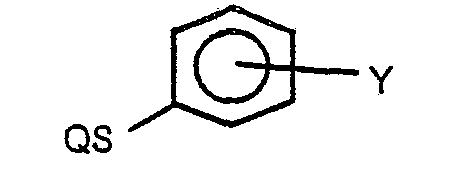
- The microbicides of this invention may be applied prior to infestation or after attack has begun. To evaluate the microbicides of the instant invention they were tested against Tomato Early Blight, Alternaria sp; Pythium sp; Fusarium sp; and Rhizoctonia. The microbicide was applied as an emulsion in water prepared from an acetone at varying concentrations. The results are shown in Table I. In this table X represents the substituent of the phenyl of W. Thus a compound W may be represented as


- The microbicides of this invention were tested against various prior art compounds. These comparative results appear below in Table II


Claims (9)


Applications Claiming Priority (2)
| Application Number | Priority Date | Filing Date | Title |
|---|---|---|---|
| US06/074,271 US4335142A (en) | 1979-09-11 | 1979-09-11 | Aryl (1-arylsulfonyl) vinyl sulfones |
| US74271 | 1979-09-11 |
Publications (2)
| Publication Number | Publication Date |
|---|---|
| EP0025339A1 EP0025339A1 (en) | 1981-03-18 |
| EP0025339B1 true EP0025339B1 (en) | 1984-05-30 |
Family
ID=22118690
Family Applications (1)
| Application Number | Title | Priority Date | Filing Date |
|---|---|---|---|
| EP80303077A Expired EP0025339B1 (en) | 1979-09-11 | 1980-09-03 | Microbicidal sulfones, compositions thereof and methods of preparing them |
Country Status (7)
| Country | Link |
|---|---|
| US (1) | US4335142A (en) |
| EP (1) | EP0025339B1 (en) |
| JP (1) | JPS5699455A (en) |
| CA (1) | CA1123459A (en) |
| DE (1) | DE3068037D1 (en) |
| GR (1) | GR69981B (en) |
| NO (1) | NO802678L (en) |
Families Citing this family (2)
| Publication number | Priority date | Publication date | Assignee | Title |
|---|---|---|---|---|
| EP1055666A4 (en) * | 1998-02-09 | 2005-01-26 | Sumitomo Chemical Co | PROCESS FOR PRODUCING ARYL-VINYL SULFONE SOLUTION AND USE THEREOF |
| US6232503B1 (en) | 1999-03-19 | 2001-05-15 | Lonza Inc. | Alkynyl aryl sulfones |
Family Cites Families (4)
| Publication number | Priority date | Publication date | Assignee | Title |
|---|---|---|---|---|
| US3242041A (en) * | 1964-07-21 | 1966-03-22 | Chemagro Corp | Method for killing fungi with vinyl sulfones |
| US3629438A (en) * | 1969-01-23 | 1971-12-21 | Uniroyal Inc | Benzothiophene-1 1-dioxide derivatives as fungicides and bactericides |
| US3682212A (en) * | 1970-06-01 | 1972-08-08 | Weir Magic Pit Corp | Method of manufacturing wood-siding panels |
| US4031247A (en) * | 1976-02-12 | 1977-06-21 | Chevron Research Company | Fungicidal vinyl 2-substituted-thiovinyl sulfones |
-
1979
- 1979-09-11 US US06/074,271 patent/US4335142A/en not_active Expired - Lifetime
-
1980
- 1980-01-15 CA CA343,744A patent/CA1123459A/en not_active Expired
- 1980-09-03 EP EP80303077A patent/EP0025339B1/en not_active Expired
- 1980-09-03 DE DE8080303077T patent/DE3068037D1/en not_active Expired
- 1980-09-04 GR GR62808A patent/GR69981B/el unknown
- 1980-09-10 NO NO802678A patent/NO802678L/en unknown
- 1980-09-11 JP JP12662480A patent/JPS5699455A/en active Granted
Also Published As
| Publication number | Publication date |
|---|---|
| NO802678L (en) | 1981-03-12 |
| DE3068037D1 (en) | 1984-07-05 |
| JPS5699455A (en) | 1981-08-10 |
| GR69981B (en) | 1982-07-22 |
| CA1123459A (en) | 1982-05-11 |
| EP0025339A1 (en) | 1981-03-18 |
| US4335142A (en) | 1982-06-15 |
| JPS5736276B2 (en) | 1982-08-03 |
Similar Documents
| Publication | Publication Date | Title |
|---|---|---|
| US3326663A (en) | Herbicidal phenylureas | |
| US3957852A (en) | Diphenyl ether compounds | |
| US3849420A (en) | Bis-(alkylthio-and alkylsulfonyl)-pentachloroquinolines | |
| KR960012172B1 (en) | Pyrazole derivative and insecticidal and miticidal composition containing the derivative as active ingredient | |
| US4033754A (en) | Substituted cyclohexene esters | |
| US3234260A (en) | Isopropyl 2, 4-dinitro-6-sec.-butylphenyl carbonate | |
| US3040046A (en) | Quinoxalines and processes for their production | |
| US4164412A (en) | Perfluoroalkylsulfonamidoaryl compounds | |
| US3950534A (en) | Fungicidal composition containing 2-(N-n-butylcarbamoylthio) ethyl N1 -n-butyl-thiocarbamate | |
| US2937202A (en) | Substituted benzenesulfonanilides | |
| US3681386A (en) | Substituted alkanal oximes | |
| US4335142A (en) | Aryl (1-arylsulfonyl) vinyl sulfones | |
| US4358408A (en) | Propane-1,2-dionedioximes, pesticides containing these compounds, and the method for their preparation | |
| US3709936A (en) | Plant growth regulators | |
| US3242041A (en) | Method for killing fungi with vinyl sulfones | |
| US3867449A (en) | Insecticidal phenylhydrazone sulfides | |
| US3140226A (en) | Microorganism toxic alpha-chloro-betacyanoethylaryl sulfones | |
| US3084098A (en) | Aminophenyl carbamates | |
| US3978123A (en) | Herbicidal n-alkylsulfoxymethyl-and-n-alkylsulfonyl-methyl-n-aryl | |
| US3932660A (en) | Insecticidal phenylhydrazone sulfides | |
| JPH0368559A (en) | Oxime derivatives and insecticides | |
| US2567839A (en) | 4 methoxyphenyl ester of 4-chloro-benzene sulfonic acid | |
| DE68916468T2 (en) | 1-Dimethylcarbamoyl-3-substituted-5-substituted-1H-1,2,4-triazoles. | |
| KR820002066B1 (en) | Process for the preparation of benzophenone hydrazone derivatives | |
| US2567008A (en) | Aryl esters of 4-chlorobenzene sulfonic acid |
Legal Events
| Date | Code | Title | Description |
|---|---|---|---|
| PUAI | Public reference made under article 153(3) epc to a published international application that has entered the european phase |
Free format text: ORIGINAL CODE: 0009012 |
|
| AK | Designated contracting states |
Designated state(s): DE FR GB IT |
|
| 17P | Request for examination filed |
Effective date: 19810916 |
|
| ITF | It: translation for a ep patent filed | ||
| GRAA | (expected) grant |
Free format text: ORIGINAL CODE: 0009210 |
|
| AK | Designated contracting states |
Designated state(s): DE FR GB IT |
|
| REF | Corresponds to: |
Ref document number: 3068037 Country of ref document: DE Date of ref document: 19840705 |
|
| ET | Fr: translation filed | ||
| PLBE | No opposition filed within time limit |
Free format text: ORIGINAL CODE: 0009261 |
|
| STAA | Information on the status of an ep patent application or granted ep patent |
Free format text: STATUS: NO OPPOSITION FILED WITHIN TIME LIMIT |
|
| 26N | No opposition filed | ||
| PGFP | Annual fee paid to national office [announced via postgrant information from national office to epo] |
Ref country code: GB Payment date: 19890831 Year of fee payment: 10 |
|
| PGFP | Annual fee paid to national office [announced via postgrant information from national office to epo] |
Ref country code: FR Payment date: 19890911 Year of fee payment: 10 |
|
| ITTA | It: last paid annual fee | ||
| PGFP | Annual fee paid to national office [announced via postgrant information from national office to epo] |
Ref country code: DE Payment date: 19891002 Year of fee payment: 10 |
|
| PG25 | Lapsed in a contracting state [announced via postgrant information from national office to epo] |
Ref country code: GB Effective date: 19900903 |
|
| GBPC | Gb: european patent ceased through non-payment of renewal fee | ||
| PG25 | Lapsed in a contracting state [announced via postgrant information from national office to epo] |
Ref country code: FR Effective date: 19910530 |
|
| PG25 | Lapsed in a contracting state [announced via postgrant information from national office to epo] |
Ref country code: DE Effective date: 19910601 |
|
| REG | Reference to a national code |
Ref country code: FR Ref legal event code: ST |