EP0025272B1 - Isocyanato-terminated polysulfide polymers and processes for their preparation - Google Patents
Isocyanato-terminated polysulfide polymers and processes for their preparation Download PDFInfo
- Publication number
- EP0025272B1 EP0025272B1 EP80302698A EP80302698A EP0025272B1 EP 0025272 B1 EP0025272 B1 EP 0025272B1 EP 80302698 A EP80302698 A EP 80302698A EP 80302698 A EP80302698 A EP 80302698A EP 0025272 B1 EP0025272 B1 EP 0025272B1
- Authority
- EP
- European Patent Office
- Prior art keywords
- terminated
- diisocyanate
- polysulfide
- polymer
- polymers
- Prior art date
- Legal status (The legal status is an assumption and is not a legal conclusion. Google has not performed a legal analysis and makes no representation as to the accuracy of the status listed.)
- Expired
Links
Classifications
-
- C—CHEMISTRY; METALLURGY
- C08—ORGANIC MACROMOLECULAR COMPOUNDS; THEIR PREPARATION OR CHEMICAL WORKING-UP; COMPOSITIONS BASED THEREON
- C08G—MACROMOLECULAR COMPOUNDS OBTAINED OTHERWISE THAN BY REACTIONS ONLY INVOLVING UNSATURATED CARBON-TO-CARBON BONDS
- C08G75/00—Macromolecular compounds obtained by reactions forming a linkage containing sulfur with or without nitrogen, oxygen, or carbon in the main chain of the macromolecule
- C08G75/14—Polysulfides
-
- C—CHEMISTRY; METALLURGY
- C08—ORGANIC MACROMOLECULAR COMPOUNDS; THEIR PREPARATION OR CHEMICAL WORKING-UP; COMPOSITIONS BASED THEREON
- C08G—MACROMOLECULAR COMPOUNDS OBTAINED OTHERWISE THAN BY REACTIONS ONLY INVOLVING UNSATURATED CARBON-TO-CARBON BONDS
- C08G18/00—Polymeric products of isocyanates or isothiocyanates
- C08G18/06—Polymeric products of isocyanates or isothiocyanates with compounds having active hydrogen
- C08G18/28—Polymeric products of isocyanates or isothiocyanates with compounds having active hydrogen characterised by the compounds used containing active hydrogen
- C08G18/40—High-molecular-weight compounds
- C08G18/64—Macromolecular compounds not provided for by groups C08G18/42 - C08G18/63
- C08G18/6453—Macromolecular compounds not provided for by groups C08G18/42 - C08G18/63 having sulfur
Definitions
- This invention relates to the art of polysulfide polymers, processes for thier preparation and cure and methods for their use.
- the high molecular weight polysulfide polymers prepared in the known commercial polysulfide polymer synthesis bear hydroxyl chain terminals. When these high molecular weight polymers are chemically split to form lower molecular weight solids or liquid polysulfide polymers, the resultant macro-molecules are thiol terminated.
- These materials, using presently available cure methods, are quite satisfactory and are commercially successful.
- Alternative cure methods continue to be of interest because such alternative cures hold the potential for even better properties and new uses for the novel products produced thereby.
- the introduction during the intial polysulfide polymer condensation of variously functionized monomers so as to produce moderate molecular weight products amenable to alternative cures has been explored previously.
- US Patent No 3,331,816 illustrates the preparation of alkylamino-terminated polysulfide polymers of the general formula: wherein L is -0- or -S- and R' and R" are the azomethino amino groups wherein R c is an alkylene group having up to 6 carbon atoms, d is 0, 1,2, 3, 4 or 5; each of y and z is 1, 2, 3 or 4; R a and R b are the same or different and are radicals chosen from hydrogen, normal and branched chain alkyl having up to 6 carbon atoms and substituted or unsubstituted alkylene-aromatic, aromatic and alicyclic groups, R is an intervening group and x is a positive integer greater than 1.
- This intervening group R may be a divalent saturated or ethylenically unsaturated aliphatic hydrocarbon group, a saturated aliphatic hydrocarbon group interrupted by one to five oxygen atoms, a sulphur atom or a sulphone group, a divalent alkylarylalkyl group, a divalent alkoxyarylalkyl group or a divalent group derived from an ethylene glycol, propylene glycol or polyethylene glycol diester.
- the intervening group may be a trivalent saturated aliphatic hydrocarbon group which may be interrupted by an oxygen atom or atoms and/or a carboxyl group e.g.
- a glycerol derivative or a trivalent group derived from a triester of pentaerythritol When the intervening group is tetravalent it may be a tetravalent saturated aliphatic hydrocarbon group which may be interrupted by one to six oxygen atoms or a carboxylic group or a tetravalent group derived from a diester of ethylene or butylene glycol or a tetraester of pentaerthritol.
- the amino terminals are introduced subsequent to the initial polysulfide synthesis and desired molecular weight adjustment.
- U.S. Patent No 3,335,201 also illustrates amino-terminated polysulfides of the structure: wherein L is ⁇ O ⁇ or ⁇ S ⁇ and wherein R i and R ii are the phenol amino groups: and/or wherein M, N * and Q may be hydrogen, lower alkyl, and lower alkyl ether or thio ether groups, w is 0, 1, 2, 3, 4, 5 or 6; each of y and z is 1, 2, 3 or 4; R iii and R iv are the same or different and are chosen from normal and branched alkyl radicals, alkyl ether or thio ether radicals, and substituted or unsubstituted aromatic and alicyclic radicals; x is a positive number greater than 1 and R is an intervening polyvalent organic radical.
- the invention provides an isocyanate-terminated polysulfide polymer having the general formula II: in which Ar is an (a + 1) valent radical derived by removal of (a + 1) nuclear hydrogen atoms from a substituted or unsubstituted aryl moiety which is either carbocyclc or heterocyclic and which has 1 or 2 aromatic rings, R is a hydrocarbon, oxahydrocarbon or thiahydrocarbon group: a is 1 or 2; n is from 4 to k x 10 3 wherein k is 1 to 10; x is from 1.8 to 4, Z is and R' is a polyvalent aliphatic, aromatic, or aliphatic aromatic group or, when taken together with the and -NCO moieties, is the residue of an isocyanate-terminated polyurethane prepolymer.
- Ar is an (a + 1) valent radical derived by removal of (a + 1) nuclear hydrogen atoms from a substituted or unsubstituted aryl moiety which is either carb
- Preferred compounds having general formula II are those in which Ar is a group derived from benzene or an alkyl-substituted benzene, a is 1 and n is 4 to 23.
- These compounds are curable with active hydrogen atom-containing polyurethane prepolymer curing agents thus showing their usefulness in preparing films, cast and extruded objects and in formulating sealants having high water and solvent resistance.
- the invention also provides a process for the preparation of an isocyanate-terminated polysulfide having the general formula II which comprises treating an arylamino-terminated polysulfide polymer of the general formula I in which Ar, R, a, n, x and Y are as above defined with a di-isocyanate of the general formula VIII: wherein R' is as defined above.
- the arylamino-terminated polysulfides of general formula I may be prepared by treating a halide of the general formula V in which R is as defined above with sodium polysulfide in a substantially aqueous medium to prepare a glycol of general formula VI: wherein R, n and x are as above defined and n' is sufficient to give a molecular weight value of from 1 x 10 4 to k x 10 5 where k is 1 to 10 and treating the resulting compound of general formula VI with a polyarylamine having the general formula VII: wherein Ar and a are as defined for general formula I hereinabove, in a substantially aqueous environment.
- a liquid amino-phenyl-terminated polysulfide polymer based on bis-(2-chloroethyl) formal having an average sulfur linkage rank of 2.25 and an average molecular weight, exclusive of arylamine terminals, of about 2000 (IX) which is a starting material of general formula I wherein Y is ⁇ S ⁇ Ar ⁇ (NH 2 ) a ; a liquid thiol-terminated polysulfide polyurea block copolymer (X) of the general formula: wherein x' is about 2.25; j and k taken together have values sufficient to give the polysulfide portion of the molecule outside the bracketed portion a molecular weight of substantially 4000; bonding to the tolylene moiety is at the 2, 4- or 2, 6- position; and R" is ⁇ CH 2 CH 2 ⁇ OCH 2 O ⁇ CH 2
- bis-(2-chloroethyl) formal may be treated with sodium polysulfide at elevated temperatures, conveniently from slightly above room temperature to about 90°C, preferably about 85°C, in a polar solvent, conveniently water, in the presence of a strong base, conveniently sodium hydroxide, and in the presence of sufficient soluble magnesium salt to precipitate magnesium hydroxide for nucleating curd formation in the polysulfide latex an alkyl aryl sulfonate dispersing agent, over a short period of time, conveniently about one hour, to form a latex.
- the latex so formed may then by coagulated and the solids separated from the liquid reaction medium by settling and decantation of the supernatant liquid.
- the solid residue may then be washed with water until free from sulfide reaction as shown by lead acetate test paper.
- the washed latex suspended in a suitable reaction medium conveniently water, may be treated with diamino diphenyl disulfide (Vila), conveniently with the aid of a miscible solvent in which the diamino diphenyl disulfide is dissolved, such as methanol, and addition of such solution to the latex suspension at temperatures which may vary from room temperature to about 80°C during the mixing process and then, conveniently, at about 80°C, although one skilled in the art will recognise that the exact temperature is not critical, until a sample of the reaction mixture shows the separation of a second liquid phase with no residual solid upon acidification, conveniently with acetic acid.
- Vila diamino diphenyl disulfide
- the arylamino-terminated polymer (IX) may be treated with a stiochiometric quantity of toluene diisocyanate (Villa), that is 1 isocyanate to 1 amine to prepare a high molecular weight chain extended polsulfide linkages in the usual fashion by treatment with NaSH and Na 2 so 3 to prepare X.
- X may also be prepared starting from a liquid thiol-terminated polysulfide polymer (XII) having the dichloroethyl formal based backbone.
- XII may be treated with (Vila) in a manner similar to that described for the preparation of IX, conveniently in this instance, the ratio of diamino diphenyl disulfide to thiol groups will be 1:2, although it may be a greater whole number multiple if lower molecular weight fragments are desired.
- the resultant product (XIII) will be an arylamino-terminated polysulfide polymer of the general formula I wherein Y is SH.
- IX may be treated with Villa at about 2:1 isocyanate to amine group ratio.
- the reactions described unless otherwise specified, may be performed neat or in the presence of suitable inert solvents or suspending agents for one or more of the reactants.
- the temperature in most cases is also not especially critical and unless otherwise specified, they may be performed at room temperature or at temperatures slightly elevated above that point. In most illustrative examples, it will be understood that solvents, temperatures and reaction times are illustrative and that their valuation will be well within the skill of the ordinary chemist.
- compounds of general formula II wherein Z is may be prepared by treating compounds of general formula I wherein Y is SH with a suitable diisocyanate having a ratio of 2-NCO groups to the total of-NH Z and -SH groups present.
- the arylamino-terminated polysulfide polymer so formed may be split with NaSH and Na 2 S0 3 , or their equivalents, to produce compounds of general formula I wherein Y is -SH.
- the arylamino-terminated polymer so formed may be treated, conveniently at elevated temperature, preferably, but not critically, at about 90°C, with a conventional liquid thiol-terminated polysulfide polymer, conveniently of about the same average molecular weight, to prepare starting materials of general formula I wherein Y is -SH.
- sealant compositions either 2 part using separately packaged curing agents, or 1 part using blocked, dormant, sequestered or encapsulated curing agents may be compounded employing known fillers, plasticizers, adhesive additives and U.V. stabilizers.
- Application of the sealant to the desired substrate may then be by standard methods as by extrusion from an applicator gun after mixing of the 2 part sealant with curing agent or activation of curing agent if necessary for the 1 part sealant.
- the 1 part sealant cure may be activated after or during application by known heat and/or moisture cures.
- Cast or molded objects may be formed by pouring or injecting the compositions including any desired fillers, plasticizers or other adjuvants and allowing cure to take place.
- Conventional polysulfide and/or urethane processing techniques may be employed to produce rigid or flexible foams as well as rigid or elastomeric solids. Reaction injection molding and linear injection molding are among the processes which may be employed.
- Coated objects may also be prepared by standard techniques as, for example, by the use of a roller coater, a curtain coater or application by brush.
- the polymers of the invention having isocyanate terminal groups are curable with polyols and/or polyamines with or without catalysis.
- substituted or unsubstituted aryl moiety having 1 or 2 aromatic rings contemplates aromatic nucleii- containing compounds such as benzene, naphthalene, indene, diphenyl, acenaphthene and fluorene, either unsubstituted or substituted with such substituents as alkyl, alkynyl, aralkyl, aralkenyl, aralkynyl, fluorine, chlorine, bromine, acyl, alkylcarbonylalkyl, which may be exemplified by toluene, methylnaphthalene, dibenzyl, stilbene, indane, ethylbenzene, acetophenone, benzophenone, cumene, cyclo- hexylbenzene, styrene, diphenylmethane and chlorobenzene.
- aromatic nucleii- containing compounds such as benzene, na
- substituted or unsubstituted aryl moiety heterocyclic having one or two aromatic rings means aromatic nucleii having heterocyclic rings such as pyridine, quinoline, isoquinoline, indole, thiophene, furan, pyrrole, thiazole, oxazole, pyrazole, imidazole, benzimidazole, triazole, triazine, thiophene, thianaphthene, benzofuran, indazole, pyridazine, pyrimidine, pyrazine, cinnoline, phthalazine, quinazoline, quinoxaline, chroman, courmarone either unsubstituted or substituted with such substituents as alkyl, alkenyl, alkynyl, aralkl, aralkenyl, aralkynyl, fluorine, chloririe, bromine, acyl, alkylcarbonylal
- hydrocarbon, oxahydrocarbon or thiahydrocarbon radicals as set forth for compounds of formulae I, II, III, V, and VI herein means those well known in the literature as suitable for the preparation of polysulfide polymers.
- U.S. Patent No 1,890,191 sets forth numerous examples of the type of bifunctional organic compounds which may be employed to provide these radicals in a typical polysulfide polymer reaction process.
- polyvalent aliphatic, aromatic, or aliphatic aromatic radical as set forth for compounds of formulae II, III and VIII means those at least difunction radicals commonly understood to be employed in low molecular weight organic polyisocyanates. Illustrative of these polyorganic polyisocyanates.
- isophorone diisocyanate 1-methoxyphenyl-2, 4-diisocyanate, 1-methyl-4-methyloxyphenyl-2, 5-diisocyanate, 1-ethoxyphenyl-2, 4-diisocyanate, 1,3-dimethoxyphenyl-4, 6-diisocyanate, 1,4-dimethoxyphenyl-2, 5-diisocyanate, 1- -2, 4-diisocyanate, 1-isobutoxy-2, 4-diisocyanate, 1,4-diethoxyphenyl-2, 5-di- , toluene-2,4-diisocyanate, toluene-2,6-diisocyanate, diphenylether-2,4-diisocyanate, -1,4-diisocyanate, 1,1'-dinaphthaiene-2,2'-diisocyanate, biphenyl-2,4-diisocyanate,1,4-diisocyanate
- the starting materials for preparing the compounds of the invention are commercially available, well known in the chemical literature or easily synthesized by methods well known to one skilled in the art.
- Natural sodium polysulfide solution (2.43 molar, 2139.9 ml, 5.2 moles), sodium hydroxide solution (50% wt/wt, 25.6 g, 0.32 mole) and nekal BK (alkyl sulfonate, 5% aqueous solution, 20.0 g) are heated to about 85°C under a nitrogen atmosphere.
- Aqueous magnesium chloride (25% MgCI 2' 6H 2 0, 0.16 mole, 130 g) is added and bis-(2-chloroethyl) formal (720.0 g, 4.0 moles) is added over a period of 1 hour while the temperature is held at about 84°C to about 87°C after which the mixture is held at about 100°C for an additional hour while the N 2 blanket is maintained.
- the reaction mixture is then allowed to cool to room temperature, and the solids permitted to settle. After decantation of the supernatant liquid, the solids are washed by decantation until the wash water gives a negative lead acetate test to give the title product 668 grams.
- a dried filter cake of the latex gives the following results:
- Example 2 Following a procedure analogous to that of Example 1 but adding additional free sulfur to adjust the rank of the starting polysulfide solution to 2.25, there is prepared a rank 2.14 polysulfide latex which is held at 100°C to "toughen" the polymer.
- the durometer hardness of a sample prepared from the latex is 50 Shore A.
- a 2.18 rank polysulfide latex is prepared from Na 2 S 2.25 (4.2 moles) Na 2 S (2.3 moles) Sulfur (2.9 moles) and bis (dichloroethyl) formal (5.0 moles) and washed free from sulfide ion to lead acetate: To the latex at 85°C is added 200 g Na ⁇ S0 3 and the mixture is held at 85°C for 1 hour. The stripped latex is then washed by decantation. The sulfur rank found is 1.90. Hardness of cakes prepared from the latex both before and after stripping is 50 Shore A. The latex itself is 33.6% solids.
- the washed latex is treated at 23° to 26°C with 5.2 g of toluene diisocyanate. Hardness of a sample "cake” from the reaction is 70 Shore “A”. % Sulfur found is 34.33%.
- the portion of the latex reserved for reaction with toluene diisocyanate (60.7 g dry solids) is treated with toluene diisocyanate (2.4 g) for 4 hours at .22° to 24°C.
- a durometer hardness cake is then prepared and dried overnight at 70°C.
- the washed liquid polymer (20.0 g) from the major portion of the latex is treated with toluene di- isocyanate (0.824 g) at room temperature then the mixture is divided into 2 parts. 1 part is cured at room temperature (23°C), the other is held at 100°C.
- the room temperature sample is soft cured at 1 hour with a hardness of 35 Shore A falling to 26 in 2 seconds after 24 hours and 52 Shore A falling to 47 after 7 days at room temperature. After 16 hours at 100°C that sample has a hardness of 67 Shore A.
- the latex is allowed to settle and the precipitate is washed 6 times with about 2 liter portions of fresh water by decantation.
- the wash water on the 5th wash is acidified with 50% acetic acid to a pH of between 5 and 6.
- Aryl amine terminated liquid polymers prepared analogousloy to those described in Examples 6 and 7 with the % amines shown are cured using a 1:1 NCO/amine ratio with PAPI 135 (a polymeric [4 isocyanate phenyl] methane having a functionality of about 2.7 and a molecular weight of 135 sold by Upjohn and Co.) using the quantities indicated to obtain cured products within the time shown having the properties shown:
- PAPI 135 a polymeric [4 isocyanate phenyl] methane having a functionality of about 2.7 and a molecular weight of 135 sold by Upjohn and Co.
- Example 8 The aryl amine terminated polymers employed in Example 8 are treated at the temperature indicated with a toluene diisocyanate endcapped polyethylene adipate prepolymer having 3.05% NCO using the quantities shown to obtain cured products with the properties shown:
- the liquid polysulfide polymer (400.0 g) and 4,4'-diaminodiphenyl disulfide (24.8 g) are warmed at 90° to 95°C under N 2 for about 4 hours.
- the material so formed when treated with Pb0 2 gives a soft solid that reverts to liquid overnight.
- to a portion of the reaction mixture (212.4 g) is added toluene diisocyanate (8.71 g), the temperature climbs from 25°C to about 60°C in 1 hour. Application of slight heat raises the temperature to about 77°C.
- the reaction mixture becomes very viscous and gells on cooling.
- a portion cured with PbO 2 before complete gellation gives a hardness of about 55 Shore A.
- Sealant compositions are prepared by blending the ingredients listed in the quantities shown in parts by weight. The work life and physical properties obtained are also listed.
- a 100 g grams of arylamine liquid polymer made by the process described in example 5 is mixed with 100 grams of 4000 molecular weight polysulfide liquid polymer with all thiol terminals and having 0.5% cross linking. This results in a homogeneous solution of one polymer in the other which then is heated to 90°C and is held at that temperature for 10 hours. This treatment results in an interchange of terminal thiol groups with polysulfide groups along the chain forming new polymeric molecules with an average of one thiol terminal and one aryl amine terminal. About 200 grams of product is obtained.
Landscapes
- Chemical & Material Sciences (AREA)
- Health & Medical Sciences (AREA)
- Chemical Kinetics & Catalysis (AREA)
- Medicinal Chemistry (AREA)
- Polymers & Plastics (AREA)
- Organic Chemistry (AREA)
- Polyurethanes Or Polyureas (AREA)
- Polymers With Sulfur, Phosphorus Or Metals In The Main Chain (AREA)
- Epoxy Resins (AREA)
Abstract
Description
- This invention relates to the art of polysulfide polymers, processes for thier preparation and cure and methods for their use.
- The high molecular weight polysulfide polymers prepared in the known commercial polysulfide polymer synthesis bear hydroxyl chain terminals. When these high molecular weight polymers are chemically split to form lower molecular weight solids or liquid polysulfide polymers, the resultant macro-molecules are thiol terminated. These materials, using presently available cure methods, are quite satisfactory and are commercially successful. Alternative cure methods continue to be of interest because such alternative cures hold the potential for even better properties and new uses for the novel products produced thereby. The introduction during the intial polysulfide polymer condensation of variously functionized monomers so as to produce moderate molecular weight products amenable to alternative cures has been explored previously. The introduction of unsaturation, hydroxyl, carboxyl, alkylamino, amide and aldehyde functions has been examined. The cure of the hydroxyl or unsaturation containing polymers has not proven commercially practical. The other groups are reactive with sodium polysulfide and the conditions of the initial polysulfide condensation reaction cause their loss. No direct method of splitting the initially formed, very high molecular weight polysulfide polymers to lower molecular weight products having other than thiol terminals has previously been demonstrated as practical.
- Several methods of converting hydroxyl- or thiol-terminated polysulfide polymers to amino-terminated polysulfide polymers which may then be reacted with epoxy polymers to form cured solid resins have been proposed. US Patent No 3,322,851 illustrates the preparation of compounds of the general formula.


- US Patent No 3,331,816 illustrates the preparation of alkylamino-terminated polysulfide polymers of the general formula:


- This intervening group R may be a divalent saturated or ethylenically unsaturated aliphatic hydrocarbon group, a saturated aliphatic hydrocarbon group interrupted by one to five oxygen atoms, a sulphur atom or a sulphone group, a divalent alkylarylalkyl group, a divalent alkoxyarylalkyl group or a divalent group derived from an ethylene glycol, propylene glycol or polyethylene glycol diester. Alternatively the intervening group may be a trivalent saturated aliphatic hydrocarbon group which may be interrupted by an oxygen atom or atoms and/or a carboxyl group e.g. a glycerol derivative or a trivalent group derived from a triester of pentaerythritol. When the intervening group is tetravalent it may be a tetravalent saturated aliphatic hydrocarbon group which may be interrupted by one to six oxygen atoms or a carboxylic group or a tetravalent group derived from a diester of ethylene or butylene glycol or a tetraester of pentaerthritol. Here again, the amino terminals are introduced subsequent to the initial polysulfide synthesis and desired molecular weight adjustment.
- U.S. Patent No 3,335,201 also illustrates amino-terminated polysulfides of the structure:


- The invention provides an isocyanate-terminated polysulfide polymer having the general formula II:


- Preferred compounds having general formula II are those in which Ar is a group derived from benzene or an alkyl-substituted benzene, a is 1 and n is 4 to 23.
- These compounds are curable with active hydrogen atom-containing polyurethane prepolymer curing agents thus showing their usefulness in preparing films, cast and extruded objects and in formulating sealants having high water and solvent resistance.
- The invention also provides a process for the preparation of an isocyanate-terminated polysulfide having the general formula II which comprises treating an arylamino-terminated polysulfide polymer of the general formula I
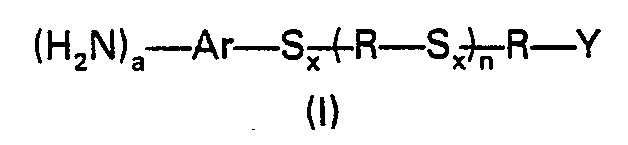

- The arylamino-terminated polysulfides of general formula I may be prepared by treating a halide of the general formula V

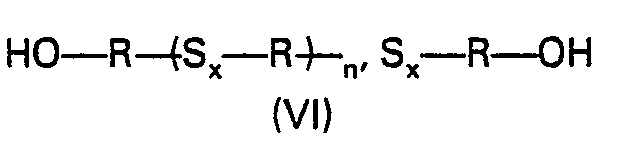

- The preparation of the polysulfides which are starting materials and of the compounds of the present invention will now be described with reference to specific embodiments thereof, namely, a liquid amino-phenyl-terminated polysulfide polymer based on bis-(2-chloroethyl) formal, having an average sulfur linkage rank of 2.25 and an average molecular weight, exclusive of arylamine terminals, of about 2000 (IX) which is a starting material of general formula I wherein Y is ―S―Ar―(NH2)a; a liquid thiol-terminated polysulfide polyurea block copolymer (X) of the general formula:


- To prepare IX, bis-(2-chloroethyl) formal may be treated with sodium polysulfide at elevated temperatures, conveniently from slightly above room temperature to about 90°C, preferably about 85°C, in a polar solvent, conveniently water, in the presence of a strong base, conveniently sodium hydroxide, and in the presence of sufficient soluble magnesium salt to precipitate magnesium hydroxide for nucleating curd formation in the polysulfide latex an alkyl aryl sulfonate dispersing agent, over a short period of time, conveniently about one hour, to form a latex. The latex so formed may then by coagulated and the solids separated from the liquid reaction medium by settling and decantation of the supernatant liquid. The solid residue may then be washed with water until free from sulfide reaction as shown by lead acetate test paper. The washed latex suspended in a suitable reaction medium, conveniently water, may be treated with diamino diphenyl disulfide (Vila), conveniently with the aid of a miscible solvent in which the diamino diphenyl disulfide is dissolved, such as methanol, and addition of such solution to the latex suspension at temperatures which may vary from room temperature to about 80°C during the mixing process and then, conveniently, at about 80°C, although one skilled in the art will recognise that the exact temperature is not critical, until a sample of the reaction mixture shows the separation of a second liquid phase with no residual solid upon acidification, conveniently with acetic acid. If desired, the arylamino-terminated polymer (IX) may be treated with a stiochiometric quantity of toluene diisocyanate (Villa), that is 1 isocyanate to 1 amine to prepare a high molecular weight chain extended polsulfide linkages in the usual fashion by treatment with NaSH and Na2so3 to prepare X. If desired, X may also be prepared starting from a liquid thiol-terminated polysulfide polymer (XII) having the dichloroethyl formal based backbone. XII may be treated with (Vila) in a manner similar to that described for the preparation of IX, conveniently in this instance, the ratio of diamino diphenyl disulfide to thiol groups will be 1:2, although it may be a greater whole number multiple if lower molecular weight fragments are desired. The resultant product (XIII) will be an arylamino-terminated polysulfide polymer of the general formula I wherein Y is SH.
- To prepare XI, IX may be treated with Villa at about 2:1 isocyanate to amine group ratio. The reactions described unless otherwise specified, may be performed neat or in the presence of suitable inert solvents or suspending agents for one or more of the reactants. The temperature in most cases is also not especially critical and unless otherwise specified, they may be performed at room temperature or at temperatures slightly elevated above that point. In most illustrative examples, it will be understood that solvents, temperatures and reaction times are illustrative and that their valuation will be well within the skill of the ordinary chemist. One skilled in the art will also recognise that in addition to the diamino diphenyl disulfide illustrated for the preparation of IX and the various reaction products thereof, one may substitute other diamino substituted diaryl disulfides and obtain analogous compounds. These compounds may then be converted to processes analogous to those described herein to prepare compounds of general formula II. Similarly, it will be recognised that in the reaction of the initially formed high molecular weight polysulfide polymer with diamino diphenyl disulfide, varying the relative proportions of diamino diphenyl disulfide, or, for that matter, any of the diamino diaryl disulfides to that of the polysulfide polymer, will permit control of the molecular weight of the arylamino-terminated polysulfide polymer starting material for the process of the invention.
- Likewise in addition to the toluene diisocyanate Villa illustrated for the preparation of compounds X and XI, other monomeric isocyanates having 2 free isocyanate functions may be employed to prepare analogous compounds of general formula II.
- Similarly, compounds of general formula II wherein Z is

- An alternative synthesis of arylamino-terminated polysulfides of general formula wherein Y is ―Sx―AR(̵NH2)a is to introduce a compound of the general formula IV

- In preparing compositions utilising the compounds of the invention, standard methods of compounding, if desired, and of application and cure are contemplated. If desired, sealant compositions, either 2 part using separately packaged curing agents, or 1 part using blocked, dormant, sequestered or encapsulated curing agents may be compounded employing known fillers, plasticizers, adhesive additives and U.V. stabilizers. Application of the sealant to the desired substrate may then be by standard methods as by extrusion from an applicator gun after mixing of the 2 part sealant with curing agent or activation of curing agent if necessary for the 1 part sealant. Or, if desired, the 1 part sealant cure may be activated after or during application by known heat and/or moisture cures. Cast or molded objects may be formed by pouring or injecting the compositions including any desired fillers, plasticizers or other adjuvants and allowing cure to take place. Conventional polysulfide and/or urethane processing techniques may be employed to produce rigid or flexible foams as well as rigid or elastomeric solids. Reaction injection molding and linear injection molding are among the processes which may be employed. Coated objects may also be prepared by standard techniques as, for example, by the use of a roller coater, a curtain coater or application by brush. The polymers of the invention having isocyanate terminal groups are curable with polyols and/or polyamines with or without catalysis.
- As herein and in the appended claims unless the context clearly requires otherwise the term substituted or unsubstituted aryl moiety having 1 or 2 aromatic rings contemplates aromatic nucleii- containing compounds such as benzene, naphthalene, indene, diphenyl, acenaphthene and fluorene, either unsubstituted or substituted with such substituents as alkyl, alkynyl, aralkyl, aralkenyl, aralkynyl, fluorine, chlorine, bromine, acyl, alkylcarbonylalkyl, which may be exemplified by toluene, methylnaphthalene, dibenzyl, stilbene, indane, ethylbenzene, acetophenone, benzophenone, cumene, cyclo- hexylbenzene, styrene, diphenylmethane and chlorobenzene. The term substituted or unsubstituted aryl moiety heterocyclic having one or two aromatic rings means aromatic nucleii having heterocyclic rings such as pyridine, quinoline, isoquinoline, indole, thiophene, furan, pyrrole, thiazole, oxazole, pyrazole, imidazole, benzimidazole, triazole, triazine, thiophene, thianaphthene, benzofuran, indazole, pyridazine, pyrimidine, pyrazine, cinnoline, phthalazine, quinazoline, quinoxaline, chroman, courmarone either unsubstituted or substituted with such substituents as alkyl, alkenyl, alkynyl, aralkl, aralkenyl, aralkynyl, fluorine, chloririe, bromine, acyl, alkylcarbonylalkyl, or carbonyl which may be exemplified by aceto- thiophene, dimethylpyrrole, dimethyloxazole, picoline, stilbazole, lepidine, furfural and ethyltriazine. The term hydrocarbon, oxahydrocarbon or thiahydrocarbon radicals as set forth for compounds of formulae I, II, III, V, and VI herein means those well known in the literature as suitable for the preparation of polysulfide polymers. U.S. Patent No 1,890,191 sets forth numerous examples of the type of bifunctional organic compounds which may be employed to provide these radicals in a typical polysulfide polymer reaction process. The term polyvalent aliphatic, aromatic, or aliphatic aromatic radical as set forth for compounds of formulae II, III and VIII means those at least difunction radicals commonly understood to be employed in low molecular weight organic polyisocyanates. Illustrative of these polyorganic polyisocyanates. Illustrative of these polyisocyanates and hence of R' are: isophorone diisocyanate, 1-methoxyphenyl-2, 4-diisocyanate, 1-methyl-4-methyloxyphenyl-2, 5-diisocyanate, 1-ethoxyphenyl-2, 4-diisocyanate, 1,3-dimethoxyphenyl-4, 6-diisocyanate, 1,4-dimethoxyphenyl-2, 5-diisocyanate, 1--2, 4-diisocyanate, 1-isobutoxy-2, 4-diisocyanate, 1,4-diethoxyphenyl-2, 5-di-
 , toluene-2,4-diisocyanate, toluene-2,6-diisocyanate, diphenylether-2,4-diisocyanate,
 -1,4-diisocyanate, 1,1'-dinaphthaiene-2,2'-diisocyanate, biphenyl-2,4-diisocyanate 3,3'-dimethylbiphenyl-4,4'-diisocyanate, 3,3'-dimethoxybiphenyl-4,4'-diisocyanate, diphenylmethane-4,4'-diisocyanate, diphenylmethane-2,4'-diisocyanate, diphenyimethane-2,2'-diisocyanate, 3,3'-di- methoxy diphenylmethane-4,4'-diisocyanate, benzophenone-3,3'-diisocyanate, ethylene diisocyanate, propylene diisocyanate, butylene diisocyanate, pentylene diisocyanate, methylbutylene diisocyanate, tetramethylene diisocyanate, pentamethylene diisocyanate, hexamethylene diisocyanate, dipropyl di- isocyanate ether, heptamethylene diisocyanate, 2,2-dimethylpentylene diisocyanate, 3-methoxy-hexamethylene diisocyanate, octamethylene diisocyanate, 2,2,4-trimethylpentylene diisocyanate, 3-butoxy- hexamethylene diisocyanate, 1,3-dimethylbenzene diisocyanate, 1,4-dimethylbenzene diisocyanate, 1,2-dimethylcyclohexane diisocyanate, 1,4-dimethylcyclohexane diisocyanate, 1,4-diethylbenzene di- isocyanate, 1,4-dimethylnaphthalene diisocyanate, 1,5-dimethylnaphthalene diisocyanate, cyclohexane-1,3-diisocyanate, cyclohexane-1.4-diisocyanate, 1-methylcyclohexane-2,4-diisocyanate, 1-methylcyclohexane-2.2-diisocyanate, 1-ethylcyclohexane-2,4-diisocyanate, dicyclohexylmethane-4,4'-diisocyanate, dicydohexylmethylmethane-4,4'-diisocyanate, dicyclohexyldimethylmethane-4,4'-di- isocyanate, 2,2-dimethyldicyclohexylmethane-4,4'-diisocyanate, 3,3',5,5'-tetramethyldicyclohexyl- methane-4,4'-diisocyanate,4,4'-methytenebis (cyclohexylisocyanate), ethylidene diisocyanate, 4,4'-diphenyl diisocyanate, dianisidine diisocyanate, 1,5-naphthalene diisocyanate, m-phenylene di- isocyanate, isopropylidene bis(phenyl or cyclohexyl isocyanate), 1,3-cyclopentylene diisocyanate, 1,2-cyclohexylene diisocyanate, 1,4-cyclohexylene diisocyanate, 4,4',4"-triphenylmethane triisocyanate, 1,3,5-triisocyanatobenzene, phenylethylene diisocyanate, 1-chlorophenyl-2, 4-diisocyanate, 1-nitrophenyl-2,4-diisocyanate, 1,3-dichlorophenyl-4,6-diisocyanate, 1,4-dichlorophenyl-2,5-diisocyanate, 1-chloro-4-methoxyphenyl-2,5-diisocyanate, 3,3'-dichlorodiphenyldimethylmethane-4,4'-diisocyanate, 3-nitrotriphenylmethane-4,4'-diisocyanate, pyrene-3,8-diisocyanate, and chrysene-2,8-diisocyanate.

- The starting materials for preparing the compounds of the invention are commercially available, well known in the chemical literature or easily synthesized by methods well known to one skilled in the art.
- Those skilled in the art will also recognize that, in addition to compounds of the general formula VII illustrated hereinabove, one may employ compounds capable of generating equivalent chemical structures which may conveniently be illustrated as [(H2H).-Ar-S]- under the conditions of processing. Benzothiazole is typical of this class of compound, although many others will be readily apparent to a skilled organic chemist. As used herein compounds of the general formula VII involve the use of such compounds capable of generating equivalent structures as precursors in the process of the invention.
- The following examples further illustrate the best mode known to us for the practice of this invention.
- Natural sodium polysulfide solution (2.43 molar, 2139.9 ml, 5.2 moles), sodium hydroxide solution (50% wt/wt, 25.6 g, 0.32 mole) and nekal BK (alkyl sulfonate, 5% aqueous solution, 20.0 g) are heated to about 85°C under a nitrogen atmosphere. Aqueous magnesium chloride (25% MgCI2'6H20, 0.16 mole, 130 g) is added and bis-(2-chloroethyl) formal (720.0 g, 4.0 moles) is added over a period of 1 hour while the temperature is held at about 84°C to about 87°C after which the mixture is held at about 100°C for an additional hour while the N2 blanket is maintained. The reaction mixture is then allowed to cool to room temperature, and the solids permitted to settle. After decantation of the supernatant liquid, the solids are washed by decantation until the wash water gives a negative lead acetate test to give the title product 668 grams. A dried filter cake of the latex gives the following results:
- Analysis for Sulphur = 38.76%
- Sulfur Rank = 2.16
- ASTM D2240 Hardness (Shore A) = 27 reaching 20 in 2 seconds.
-
- (i) To the above latex product (36.1 % Solids, 277.0 g [100 g dry]) is added 6.23 g 4,4'-diaminodiphenyl disulfide as a powder. The mixture is heated under nitrogen at about 95°C for 7 hours, allowed to stand overnight at room temperature and then treated for an additional 8 hours at about 95°C, then allowed to cool and stand at room temperature for 72 hours. An aliquot sample is taken and made acid by the addition of acetic acid. A second liquid phase separates indicating that splitting of the high molecular weight polymer chains has occurred. Toluene diisocyanate (4.36 g) is added to the reaction mixture and the reaction allowed to proceed for 4 hours at room temperature. During this time an exotherm from 23° to 26.5°C occurs. Acidification of a sample produces a crumb-like solid precipitate indicating reaction back to a high molecular weight polymer. Durometer readings on solid material are variable but exceed 60 Shore A.
- (ii) To the Preceding latex product (36.1 % Solids, 277.0 g [100.0 g dry]) is added 4,4'-diaminodiphenyl disulfide (6.23 g) in toluene (50 g). The mixture is heated under a nitrogen blanket at 78°C for 6 hours, allowed to cool and stand at room temperature overnight, heated for an additional 8 hours at 80°C, allowed to cool and sampled. Acidification of the sample with acetic acid causes separation of a second liquid phase indicating that the original high molecular weight polymer has been split to a lower molecular weight. Toluene diisocyanate (Hylene TM, Du Pont) is added to the remaining reaction mixture. Reaction is allowed to proceed for 4 hours. During this time, a slow exotherm from 24°C to 26°C occurs. Acidification of a sample gives a solid crumb precipitate indicating chain extension to a high molecular weight. After removing the majority of toluene by distillation and washing the solid latex with water, a durometer reading is made on a cake held at 100°C overnight. The cake has a Shore A hardness of 55 dropping to 50 in 2 seconds.
- Following a procedure analogous to that of Example 1 but adding additional free sulfur to adjust the rank of the starting polysulfide solution to 2.25, there is prepared a rank 2.14 polysulfide latex which is held at 100°C to "toughen" the polymer. The durometer hardness of a sample prepared from the latex is 50 Shore A.
- To this latex (33.6% Solids, 2381 g [800 g dry]) there is added 4,4'-diaminodiphenyl disulfide (49.84 g, 1 mole per 22 segment weights of polymer so as to split to average 4000 M. Wt. segments) in absolute methanol (720 g) over a 32 minute period during which time the reaction mixture is heated from an initial 25°C up to ref' sx temperature. The reaction is held at reflux for about 4 hours, allowed to cool and settle and the resi washed with water 5 times by decantation. A sample (115.05 g dry) is washed 10 additional time the same technique, then treated with toluene diisocyanate (4.66 g). After 4 hours, hardness of a sample of the reaction product is 68 (Shore A). The remainingd latex from the diaminodiphenyl disulfide reaction is acidified with acetic acid and washed to about neutrality.
- Following a procedure analogous to that of Examples 1 and 2, a 2.18 rank polysulfide latex is prepared from Na2S 2.25 (4.2 moles) Na2S (2.3 moles) Sulfur (2.9 moles) and bis (dichloroethyl) formal (5.0 moles) and washed free from sulfide ion to lead acetate: To the latex at 85°C is added 200 g NaíS03 and the mixture is held at 85°C for 1 hour. The stripped latex is then washed by decantation. The sulfur rank found is 1.90. Hardness of cakes prepared from the latex both before and after stripping is 50 Shore A. The latex itself is 33.6% solids.
- To the latex (2244.0 g, 754.0 g dry) is added diamino diphenyl disulfide (47.0 g) in methanol (679 g) over a period of 30 minutes while the reaction mixture is being warmed to reflux. Reflux is maintained for 4 hours. At the end of this time, the reaction mixture is allowed to cool and is divided into 2 portions. The first portion, part A, is washed twice by decantation then acidified with acetic acid. The lower layer organic phase which separates is wased 10 times with about equal volume portions of water. Following washing thephase is heated in a rotary evaporator at about 85°C until a constant 1-2 mm Hg vacuum is reached. Viscosity = 2300 poises at 25°C, %N = 0.44% 500 g removed from the original stripped latex, part B, is washed 10 times by decantation with approximately equal volumes of water. Dry solids at this point = 127.7 g.

- The washed latex is treated at 23° to 26°C with 5.2 g of toluene diisocyanate. Hardness of a sample "cake" from the reaction is 70 Shore "A". % Sulfur found is 34.33%.
- To a mixture of Na2S.9H20 (1372.8 g), sulfur (228.6 g) and water (110 g) which has been warmed to 75°C and held at that temperature for about 0.5 hour under a nitrogen blanket is added NaOH (50% w/w in water, 25.6 g) and a sodium alkyl sulfonate (Nekal BX, 20.0 g) after which the mixture is warmed to 85°C and MgC12'6H20 (130.1 g) and p-chloronitrobenzene (54.2 g) are added. A slight warming to 95°C occurs. When the reaction mixture has again been stabilized at 85°C bis-(2-chloroethyl) formal (720.0 g) is added over a period of one hour. After all the formal has been added the reaction mixture is held at 100°C for 7 hours while sampling every hour, including zero time, for 3 hours and then after 5 and 7 hours. Each sample and the final batch of latex is washed clean of sulfide (lead acetate test) a portion of the final washed latex is reserved for reaction with toluene diisocyanate. Each sample and the remainder of the main batch of latex are acidified with 50% aqueous acetic acid then washed free from acid by decantation and dried under vacuum. Viscosity at 25°C = 4700 poises.
- The portion of the latex reserved for reaction with toluene diisocyanate (60.7 g dry solids) is treated with toluene diisocyanate (2.4 g) for 4 hours at .22° to 24°C. A durometer hardness cake is then prepared and dried overnight at 70°C. A solid tough rubber is obtained of 60 Shore A hardness. % Sulfur= 35.5%.
- The washed liquid polymer (20.0 g) from the major portion of the latex is treated with toluene di- isocyanate (0.824 g) at room temperature then the mixture is divided into 2 parts. 1 part is cured at room temperature (23°C), the other is held at 100°C. The room temperature sample is soft cured at 1 hour with a hardness of 35 Shore A falling to 26 in 2 seconds after 24 hours and 52 Shore A falling to 47 after 7 days at room temperature. After 16 hours at 100°C that sample has a hardness of 67 Shore A.
- Analysis of the reaction samples gives the following results.

- To sodium polysulfide (Na2S2,25) (1.94 molar, 1608.0 mls, 3.02 moles) and Nekal BX (20.0 g) at 85°C under nitrogen is added MgCl2·6H2O (0.12 moles, 98.1 g) and p-chloronitrobenzene (0.345 moles, 54.5 g). The reaction mixture is cooled to 85°C and bis-(2-chloroethyl) formal (2.0 moles, 360.0 g) is added over a 1 hour period while the temperature is maintained at 85-90°C. After all the bis-(2-chloroethyl) formal has been added, the reaction mixture is warmed to 100°C and -held at that temperature for 6 hours. After cooling, the latex is allowed to settle and the precipitate is washed 6 times with about 2 liter portions of fresh water by decantation. The wash water on the 5th wash is acidified with 50% acetic acid to a pH of between 5 and 6. After washing, the precipitate is dried on a rotary evaporator at 0.25 mm Hg and 90°C max temperature to give a liquid residue 360.4'g, viscosity 1512.0 poises, N (as amine N) = 0.78% - M.Wt. 4102.6 N (by micro analysis) = 0.83%, S 37.83%. 41.03 g residue is treated with 1.74 g toluene diisocyanate. A solid is obtained in 25 minutes at room temperature. Hardness = 75 Shore A. After 8 days - 80 Shore A.
- Following a procedure analogous to that described in Example 7, there is obtained from 1928.0 ml of 1.94 molar Na2S2.25 409.0 g of the title product as a liquid residue, viscosity 450.0 poises.
- N as amine N = 1.79%
- N total = 1.83%
- Sulfur = 37.43%
- Toluene diisocyanate (3.5 g) and the residue (35.8 g) are mixed. The mixture becomes warm and cures in about 6 minutes. Hardness after 24 hours at room temperature = 90 Shore A.
- To Na2S2.25 solution (1.94 molar, 2.93 moles, 1510 ml) and Nekal BX (20.0 g) heated to 85°C under N2 is added MgCl2·6H2O (92.1 g) and p-chloronitrobenzene (35.2 g) followed by bis-(2-chloroethyl) formal (360.0 g) over a period of 1 hour. After heating at 100°C for 6 hours the reaction is allowed to cool and washed by decantation until a negative lead acetate sulfide test is obtained from the wash water. To the washed latex (20-25% solids) is then added NaSH (8.0 g) and Na2S03 150.0 g and the mixture warmed to 85°C for about 1.5 hours. NaHS03 (50 g) is then added to bring the pH of the mixture to about 7 and the mixture is heated for a further 0.5 hour. The reaction is then allowed to cool and settle. The precipitate is washed by decantation until the wash water is free of S03 by iodine test and then acidified with acetic acid to about pH 5. The residue which separates as a lower layer is partitioned from the aqueous layer and dried in a rotary evaporator at 90°C and 0.5 mm Hg 302.0 g, viscosity 420.0 poises.
- Amine nitrogen = 0.52%
- Total nitrogen = 0.54%
- Sulfur = 34.70%
- SH = 1.49%
- Sulfur rank = 1.81 %
- Treatment of this residue with Pbo2 powder in a manner sufficient to cure all thiol terminated liquid polysulfide polymers does not effect cure. A mixture of residue (30.8 g) and toluene diisocyanate (0.87 g) warms slightly when mixed at room temperature but does not cure to a solid in one hour.
- A mixture of residue (30.8 g), toluene diisocyanate (0.87 g) and Pb02 powder (2.0 g) warms slightly and cures to a solid in 18 minutes. Hardness after 2 hours at room temperature is 25 Shore A with flow. Hardness after 8 days at room temperature is 60 Shore A with slight flow.
- Aryl amine terminated liquid polymers prepared analogousloy to those described in Examples 6 and 7 with the % amines shown are cured using a 1:1 NCO/amine ratio with PAPI 135 (a polymeric [4 isocyanate phenyl] methane having a functionality of about 2.7 and a molecular weight of 135 sold by Upjohn and Co.) using the quantities indicated to obtain cured products within the time shown having the properties shown:

- The aryl amine terminated polymers employed in Example 8 are treated at the temperature indicated with a toluene diisocyanate endcapped polyethylene adipate prepolymer having 3.05% NCO using the quantities shown to obtain cured products with the properties shown:

- The liquid polysulfide polymer (400.0 g) and 4,4'-diaminodiphenyl disulfide (24.8 g) are warmed at 90° to 95°C under N2 for about 4 hours. The material so formed when treated with Pb02 gives a soft solid that reverts to liquid overnight. After cooling, to a portion of the reaction mixture (212.4 g) is added toluene diisocyanate (8.71 g), the temperature climbs from 25°C to about 60°C in 1 hour. Application of slight heat raises the temperature to about 77°C. The reaction mixture becomes very viscous and gells on cooling. A portion cured with PbO2 before complete gellation gives a hardness of about 55 Shore A.
- 4,4'-diaminodiphenyl disulfide (99.7 g) and the thiol terminated polysulfide polymer (1600.0 g) are warmed at 91 ° to 95°C for 4 hours under N2. The product obtained on cooling has SH = 1.71%, N = 0.49%.
- The aryl amine thiol terminated liquid polysulfide polymer prepared as described above (849.6 g) and a liquid polymer prepared by endcapping a 2000 M.Wt. poly(propylene glycol) with toluene di- isocyanate (Hylene TM, Du Pont Co.) to a final NCO content of 3.43% (490.0 g) are held at 85° to 95°C for 2.5 hours. Upon cooling the product is a brown paste. Treatment of a sample with Pb02 results in a solid having 45 Shore A hardness in less than 1 minutes.
- Analysis of the product:
- NCO = 0.035%
- SH = 1.09%
- S = 22.8%
- Sealant compositions are prepared by blending the ingredients listed in the quantities shown in parts by weight. The work life and physical properties obtained are also listed.

- A 100 g grams of arylamine liquid polymer made by the process described in example 5 is mixed with 100 grams of 4000 molecular weight polysulfide liquid polymer with all thiol terminals and having 0.5% cross linking. This results in a homogeneous solution of one polymer in the other which then is heated to 90°C and is held at that temperature for 10 hours. This treatment results in an interchange of terminal thiol groups with polysulfide groups along the chain forming new polymeric molecules with an average of one thiol terminal and one aryl amine terminal. About 200 grams of product is obtained.
- When a sample of this product is treated with PbOz the liquid polymer becomes more viscous but does not cure. Analysis for thiol and aryl amine groups shows that practically no thiol groups are present and that the calculated amount of arylamine groups are still substantially present as the only polymer terminals. When a stoichiometric quantity of toluene diisocyanate is added corresponding to the aryl amine groups the polymer solidifies to a soft solid in about two hours at room temperature.
Claims (4)


Priority Applications (1)
| Application Number | Priority Date | Filing Date | Title |
|---|---|---|---|
| AT80302698T ATE7033T1 (en) | 1979-08-10 | 1980-08-06 | POLYSULFIDE POLYMERS WITH TERMINAL ISOCYANATE GROUPS AND PROCESS FOR THEIR PRODUCTION. |
Applications Claiming Priority (2)
| Application Number | Priority Date | Filing Date | Title |
|---|---|---|---|
| US06/066,214 US4238585A (en) | 1979-08-10 | 1979-08-10 | Aryl amine terminated polysulfide polymers, related compounds and processes for their preparation |
| US66214 | 1998-04-24 |
Publications (2)
| Publication Number | Publication Date |
|---|---|
| EP0025272A1 EP0025272A1 (en) | 1981-03-18 |
| EP0025272B1 true EP0025272B1 (en) | 1984-04-11 |
Family
ID=22068026
Family Applications (1)
| Application Number | Title | Priority Date | Filing Date |
|---|---|---|---|
| EP80302698A Expired EP0025272B1 (en) | 1979-08-10 | 1980-08-06 | Isocyanato-terminated polysulfide polymers and processes for their preparation |
Country Status (6)
| Country | Link |
|---|---|
| US (1) | US4238585A (en) |
| EP (1) | EP0025272B1 (en) |
| JP (3) | JPS5626932A (en) |
| AT (1) | ATE7033T1 (en) |
| CA (1) | CA1131649A (en) |
| DE (1) | DE3067441D1 (en) |
Families Citing this family (25)
| Publication number | Priority date | Publication date | Assignee | Title |
|---|---|---|---|---|
| US4384070A (en) * | 1981-07-02 | 1983-05-17 | Desoto, Inc. | Pigmented, antioxidant-containing solution coating compositions |
| DE3209525A1 (en) * | 1981-07-10 | 1983-01-27 | Siemens AG, 1000 Berlin und 8000 München | STABILIZATION OF POLYPHENYLENE SULFIDE AGAINST CORROSIVE OUTGASING |
| JPH0643489B2 (en) * | 1986-02-14 | 1994-06-08 | 呉羽化学工業株式会社 | Highly stable method for producing poly (arylene thiothioether) |
| JPS63152629A (en) * | 1986-10-27 | 1988-06-25 | ザ ダウ ケミカル カンパニー | Polyol capped by aromatic amine |
| US4820800A (en) * | 1988-02-25 | 1989-04-11 | Phillips Petroleum Company | Arylene sulfide polymers |
| US5264515A (en) * | 1989-04-10 | 1993-11-23 | Rheox, Inc. | Moisture curable compositions and method of curing moisture curable compositions |
| US5039572A (en) * | 1989-07-24 | 1991-08-13 | Phillips Petroleum Company | High strength thermoplastic resin/carbon fiber composites and methods |
| US6322650B1 (en) * | 1999-04-15 | 2001-11-27 | Morton International Inc. | Polysulfide-based polyurethane sealant for insulating glass |
| CN1580283A (en) * | 2003-08-13 | 2005-02-16 | 清华大学 | Method for detecting nucleic acid molecule |
| US8715373B2 (en) * | 2007-07-10 | 2014-05-06 | Afton Chemical Corporation | Fuel composition comprising a nitrogen-containing compound |
| WO2009095739A1 (en) * | 2008-01-29 | 2009-08-06 | Le Joint Francais | Sealant composition based on segmented block co- polymers of mercapto functionalized polymers and isocyanate terminated prepolymers |
| US7875666B2 (en) * | 2008-04-24 | 2011-01-25 | Prc-De Soto International, Inc. | Thioethers, methods for their preparation, and compositions including such thioethers |
| US9306218B2 (en) * | 2011-08-11 | 2016-04-05 | Arizona Board Of Regents On Behalf Of The University Of Arizona | High sulfur content copolymers and composite materials and electrochemical cells and optical elements using them |
| WO2017011533A1 (en) | 2015-07-13 | 2017-01-19 | The Arizona Board Of Regents On Behalf Of The University Of Arizona | Copolymerization of elemental sulfur to synthesize high sulfur content polymeric materials |
| US11015023B2 (en) | 2011-08-11 | 2021-05-25 | Arizona Board Of Regents On Behalf Of The University Of Arizona | Fire retardant compositions utilizing elemental sulfur |
| US10920020B2 (en) | 2011-08-11 | 2021-02-16 | Arizona Board Of Regents On Behalf Of The University Of Arizona | 3D-printing of ultra-high refractive index polymers |
| US11795248B2 (en) | 2011-08-11 | 2023-10-24 | Arizona Board Of Regents On Behalf Of The University Of Arizona | Copolymerization of elemental sulfur and epoxy functional styrenics |
| US9567439B1 (en) * | 2011-08-11 | 2017-02-14 | The Arizona Board Of Regents On Behalf Of The University Of Arizona | Sulfur composites and polymeric materials from elemental sulfur |
| WO2013078112A1 (en) * | 2011-11-21 | 2013-05-30 | Pecora Corporation | High solids content water-based adhesive and sealant compositions |
| CN103788372B (en) * | 2013-12-27 | 2016-01-20 | 北京彤程创展科技有限公司 | A kind of polymkeric substance containing polythiaether structure and preparation method thereof |
| US10894863B2 (en) | 2014-02-14 | 2021-01-19 | Arizona Board Of Regents On Behalf Of The University Of Arizona | Cathode materials for Li—S batteries |
| KR20160122838A (en) * | 2014-02-14 | 2016-10-24 | 더 아리조나 보드 오브 리전츠 온 비해프 오브 더 유니버시티 오브 아리조나 | Sulfur composites and polymeric materials from elemental sulfur |
| US20170008999A1 (en) * | 2014-02-28 | 2017-01-12 | Fundación Cidetec | Self-healing elastomer and process for its preparation |
| WO2018107169A1 (en) | 2016-12-09 | 2018-06-14 | Arizona Board Of Regents On Behalf Of The University Of Arizona | Metallopolymers for catalytic generation of hydrogen |
| WO2018232155A1 (en) | 2017-06-15 | 2018-12-20 | Arizona Board Of Regents On Behalf Of The University Of Arizona | Chalcogenide hybrid inorganic/organic polymer (chip) materials as improved crosslinking agents for vulcanization |
Family Cites Families (15)
| Publication number | Priority date | Publication date | Assignee | Title |
|---|---|---|---|---|
| US2347840A (en) * | 1942-09-23 | 1944-05-02 | Socony Vacuum Oil Co Inc | Condensation of nitro compounds with polysulphides and product thereof |
| US2606173A (en) * | 1951-03-01 | 1952-08-05 | Reconstruction Finance Corp | Polysulfide polymer reaction and product |
| US3386963A (en) * | 1963-10-03 | 1968-06-04 | Thiokol Chemical Corp | Isocyanate-terminated polysulfide polymers |
| US3322851A (en) * | 1964-06-16 | 1967-05-30 | Thiokol Chemical Corp | Novel amino-polysulfide polymers and their reaction products with polyepoxides |
| US3335201A (en) * | 1964-09-09 | 1967-08-08 | Thiokol Chemical Corp | Amino-functional phenol containing polysulfide polymers and their reaction products with polyepoxides |
| US3331816A (en) * | 1964-09-22 | 1967-07-18 | Thiokol Chemical Corp | Amino-functional azomethine containing polysulfide polymers and their reaction products with polyepoxides |
| US3446780A (en) * | 1965-08-31 | 1969-05-27 | Thiokol Chemical Corp | Mercaptan containing polyurethane compositions,process and cured products thereof |
| US3413265A (en) * | 1965-08-31 | 1968-11-26 | Thiokol Chemical Corp | Hydrolytic scission of polymers containing gem dithioether linkages |
| US3440273A (en) * | 1965-10-23 | 1969-04-22 | Thiokol Chemical Corp | Curable liquid polythiopolymercaptan-polyurethane polymers |
| US3763124A (en) * | 1971-06-21 | 1973-10-02 | Phillips Petroleum Co | Treatment of the alkali metal sulfide reactant to reduce impurities and its reaction with a polyhalo substituted aromatic compound |
| AU470338B2 (en) * | 1973-05-04 | 1976-03-11 | Thiokol Corporation | Sh-terminated polysulfide polymer liquid-to-liquid process |
| GB1475115A (en) | 1973-08-27 | 1977-06-01 | Dunlop Australia Ltd | Application of polyurethane emulsions to woo |
| US3966688A (en) * | 1974-12-03 | 1976-06-29 | Phillips Petroleum Company | Arylene sulfide copolymer production |
| US3987016A (en) * | 1975-01-16 | 1976-10-19 | The United States Of America As Represented By The Secretary Of The Air Force | Method for the preparation of polyarylene sulfides containing pendant cyano groups by polymerizing m-benzenedithiol, dibromobenzene, and 2,4-dichlorobenzonitrile |
| US4166874A (en) * | 1978-09-22 | 1979-09-04 | The United States Of America As Represented By The Secretary Of The Army | Crashworthy fuel cell repair |
-
1979
- 1979-08-10 US US06/066,214 patent/US4238585A/en not_active Expired - Lifetime
-
1980
- 1980-05-06 CA CA351,369A patent/CA1131649A/en not_active Expired
- 1980-07-25 JP JP10302180A patent/JPS5626932A/en active Granted
- 1980-08-06 DE DE8080302698T patent/DE3067441D1/en not_active Expired
- 1980-08-06 AT AT80302698T patent/ATE7033T1/en not_active IP Right Cessation
- 1980-08-06 EP EP80302698A patent/EP0025272B1/en not_active Expired
-
1988
- 1988-08-09 JP JP63198774A patent/JPS6485221A/en active Pending
- 1988-08-09 JP JP63198775A patent/JPS6485222A/en active Pending
Also Published As
| Publication number | Publication date |
|---|---|
| DE3067441D1 (en) | 1984-05-17 |
| JPS5626932A (en) | 1981-03-16 |
| JPS6485221A (en) | 1989-03-30 |
| EP0025272A1 (en) | 1981-03-18 |
| ATE7033T1 (en) | 1984-04-15 |
| US4238585A (en) | 1980-12-09 |
| JPS6485222A (en) | 1989-03-30 |
| JPH0128063B2 (en) | 1989-05-31 |
| CA1131649A (en) | 1982-09-14 |
Similar Documents
| Publication | Publication Date | Title |
|---|---|---|
| US4238585A (en) | Aryl amine terminated polysulfide polymers, related compounds and processes for their preparation | |
| US4129741A (en) | Novel polyethers having terminal amino groups, a process for their production and their application | |
| US4153801A (en) | Polyethers having terminal amino groups | |
| JPS6018687B2 (en) | Method for producing mercaptan-terminated polymers | |
| EP0716044A1 (en) | Fullerene polymers | |
| US3948820A (en) | Curable polyphosphazene copolymers and terpolymers | |
| KR100449767B1 (en) | Room Temperature Curing Polyurethane Composition | |
| KR910008318B1 (en) | One-component curing composition | |
| JP2541582B2 (en) | Polythiol | |
| US3386963A (en) | Isocyanate-terminated polysulfide polymers | |
| NO822498L (en) | LINEAR, LIQUID POLYTIOETERS. | |
| US5134207A (en) | Polyarylene ethers and polyarylene sulfides containing phosphine oxide group and modified by reaction with organoamine | |
| US4376193A (en) | Aryl amine terminated polysulfide polymers, related compounds and processes for their preparation | |
| US5084202A (en) | Isocyanate prepolymers and secondary amines from disecondary amines and alkyl diisocyanates | |
| US4119658A (en) | Aromatic isocyanato-polysulphonic acids | |
| US4623731A (en) | Polyisocyanate derivatives wherein the isocyanate group(s) is/are reversibly blocked, by 3-methylpyrazol-1H-yl | |
| US3169119A (en) | Polysulfide polyurethanes | |
| EP0429508A1 (en) | Blends of copoly(arylene sulfide) and poly(arylene sulfide) | |
| US6025029A (en) | Storage stable, humidity curing adhesives | |
| CA1148167A (en) | Aryl amine terminated polysulfide polymers, related compounds and processes for their preparation | |
| JP3516242B2 (en) | Curable composition | |
| JP3544733B2 (en) | Curable composition | |
| Frisch et al. | Isocyanurate-containing polyurethanes | |
| US2919262A (en) | Process for making polysulfide liquid polymers | |
| US4152510A (en) | Polyurethane elastomers and a process for their production |
Legal Events
| Date | Code | Title | Description |
|---|---|---|---|
| PUAI | Public reference made under article 153(3) epc to a published international application that has entered the european phase |
Free format text: ORIGINAL CODE: 0009012 |
|
| AK | Designated contracting states |
Designated state(s): AT BE CH DE FR GB IT NL SE |
|
| 17P | Request for examination filed |
Effective date: 19810908 |
|
| ITF | It: translation for a ep patent filed | ||
| GRAA | (expected) grant |
Free format text: ORIGINAL CODE: 0009210 |
|
| AK | Designated contracting states |
Designated state(s): AT BE CH DE FR GB IT LI NL SE |
|
| REF | Corresponds to: |
Ref document number: 7033 Country of ref document: AT Date of ref document: 19840415 Kind code of ref document: T |
|
| REF | Corresponds to: |
Ref document number: 3067441 Country of ref document: DE Date of ref document: 19840517 |
|
| PGFP | Annual fee paid to national office [announced via postgrant information from national office to epo] |
Ref country code: CH Payment date: 19840716 Year of fee payment: 5 |
|
| ET | Fr: translation filed | ||
| PGFP | Annual fee paid to national office [announced via postgrant information from national office to epo] |
Ref country code: DE Payment date: 19840720 Year of fee payment: 5 |
|
| PGFP | Annual fee paid to national office [announced via postgrant information from national office to epo] |
Ref country code: FR Payment date: 19840911 Year of fee payment: 5 |
|
| PGFP | Annual fee paid to national office [announced via postgrant information from national office to epo] |
Ref country code: SE Payment date: 19840930 Year of fee payment: 5 |
|
| PGFP | Annual fee paid to national office [announced via postgrant information from national office to epo] |
Ref country code: BE Payment date: 19841231 Year of fee payment: 5 |
|
| PLBE | No opposition filed within time limit |
Free format text: ORIGINAL CODE: 0009261 |
|
| STAA | Information on the status of an ep patent application or granted ep patent |
Free format text: STATUS: NO OPPOSITION FILED WITHIN TIME LIMIT |
|
| 26N | No opposition filed | ||
| PGFP | Annual fee paid to national office [announced via postgrant information from national office to epo] |
Ref country code: AT Payment date: 19860707 Year of fee payment: 7 |
|
| PGFP | Annual fee paid to national office [announced via postgrant information from national office to epo] |
Ref country code: NL Payment date: 19870831 Year of fee payment: 8 |
|
| PG25 | Lapsed in a contracting state [announced via postgrant information from national office to epo] |
Ref country code: GB Free format text: LAPSE BECAUSE OF NON-PAYMENT OF DUE FEES Effective date: 19880806 Ref country code: AT Effective date: 19880806 |
|
| PG25 | Lapsed in a contracting state [announced via postgrant information from national office to epo] |
Ref country code: SE Effective date: 19880807 |
|
| PG25 | Lapsed in a contracting state [announced via postgrant information from national office to epo] |
Ref country code: LI Effective date: 19880831 Ref country code: CH Effective date: 19880831 Ref country code: BE Effective date: 19880831 |
|
| BERE | Be: lapsed |
Owner name: THIOKOL CORP. Effective date: 19880831 |
|
| PG25 | Lapsed in a contracting state [announced via postgrant information from national office to epo] |
Ref country code: NL Effective date: 19890301 |
|
| NLV4 | Nl: lapsed or anulled due to non-payment of the annual fee | ||
| PG25 | Lapsed in a contracting state [announced via postgrant information from national office to epo] |
Ref country code: FR Free format text: LAPSE BECAUSE OF NON-PAYMENT OF DUE FEES Effective date: 19890428 |
|
| REG | Reference to a national code |
Ref country code: CH Ref legal event code: PL Ref country code: CH Ref legal event code: AUV Free format text: LE BREVET CI-DESSUS EST TOMBE EN DECHEANCE FAUTE DE PAIEMENT, DE LA 9E ANNUITE. |
|
| PG25 | Lapsed in a contracting state [announced via postgrant information from national office to epo] |
Ref country code: DE Effective date: 19890503 |
|
| GBPC | Gb: european patent ceased through non-payment of renewal fee | ||
| REG | Reference to a national code |
Ref country code: FR Ref legal event code: ST |
|
| EUG | Se: european patent has lapsed |
Ref document number: 80302698.8 Effective date: 19890510 |