EP0024688B1 - Vinyl acetate copolymer emulsions for paint having wet adhesion properties - Google Patents
Vinyl acetate copolymer emulsions for paint having wet adhesion properties Download PDFInfo
- Publication number
- EP0024688B1 EP0024688B1 EP80104954A EP80104954A EP0024688B1 EP 0024688 B1 EP0024688 B1 EP 0024688B1 EP 80104954 A EP80104954 A EP 80104954A EP 80104954 A EP80104954 A EP 80104954A EP 0024688 B1 EP0024688 B1 EP 0024688B1
- Authority
- EP
- European Patent Office
- Prior art keywords
- vinyl acetate
- paint composition
- paint
- resin particles
- wet adhesion
- Prior art date
- Legal status (The legal status is an assumption and is not a legal conclusion. Google has not performed a legal analysis and makes no representation as to the accuracy of the status listed.)
- Expired
Links
- 239000003973 paint Substances 0.000 title claims abstract description 48
- 239000000839 emulsion Substances 0.000 title description 14
- 229920001577 copolymer Polymers 0.000 title description 3
- -1 allylic amine Chemical class 0.000 claims abstract description 37
- 239000000203 mixture Substances 0.000 claims abstract description 35
- XTXRWKRVRITETP-UHFFFAOYSA-N Vinyl acetate Chemical compound CC(=O)OC=C XTXRWKRVRITETP-UHFFFAOYSA-N 0.000 claims abstract description 25
- 229920000126 latex Polymers 0.000 claims abstract description 23
- 239000004816 latex Substances 0.000 claims abstract description 20
- 229920005989 resin Polymers 0.000 claims abstract description 20
- 239000011347 resin Substances 0.000 claims abstract description 20
- 239000002245 particle Substances 0.000 claims abstract description 19
- VGGSQFUCUMXWEO-UHFFFAOYSA-N Ethene Chemical compound C=C VGGSQFUCUMXWEO-UHFFFAOYSA-N 0.000 claims abstract description 9
- 239000005977 Ethylene Substances 0.000 claims abstract description 9
- BZHJMEDXRYGGRV-UHFFFAOYSA-N Vinyl chloride Chemical compound ClC=C BZHJMEDXRYGGRV-UHFFFAOYSA-N 0.000 claims abstract description 6
- 125000005250 alkyl acrylate group Chemical group 0.000 claims abstract description 6
- 125000004435 hydrogen atom Chemical group [H]* 0.000 claims abstract description 6
- CREXVNNSNOKDHW-UHFFFAOYSA-N azaniumylideneazanide Chemical group N[N] CREXVNNSNOKDHW-UHFFFAOYSA-N 0.000 claims abstract description 5
- 125000000746 allylic group Chemical group 0.000 claims abstract description 3
- OAKJQQAXSVQMHS-UHFFFAOYSA-N Hydrazine Chemical compound NN OAKJQQAXSVQMHS-UHFFFAOYSA-N 0.000 claims abstract 2
- 239000000178 monomer Substances 0.000 claims description 28
- XLYOFNOQVPJJNP-UHFFFAOYSA-N water Substances O XLYOFNOQVPJJNP-UHFFFAOYSA-N 0.000 claims description 11
- CQEYYJKEWSMYFG-UHFFFAOYSA-N butyl acrylate Chemical group CCCCOC(=O)C=C CQEYYJKEWSMYFG-UHFFFAOYSA-N 0.000 claims description 9
- 125000000217 alkyl group Chemical group 0.000 claims description 6
- 239000001257 hydrogen Substances 0.000 claims description 6
- 229910052739 hydrogen Inorganic materials 0.000 claims description 6
- GOXQRTZXKQZDDN-UHFFFAOYSA-N 2-Ethylhexyl acrylate Chemical compound CCCCC(CC)COC(=O)C=C GOXQRTZXKQZDDN-UHFFFAOYSA-N 0.000 claims description 4
- UFHFLCQGNIYNRP-UHFFFAOYSA-N Hydrogen Chemical compound [H][H] UFHFLCQGNIYNRP-UHFFFAOYSA-N 0.000 claims description 4
- VVQNEPGJFQJSBK-UHFFFAOYSA-N Methyl methacrylate Chemical compound COC(=O)C(C)=C VVQNEPGJFQJSBK-UHFFFAOYSA-N 0.000 claims description 4
- 125000004432 carbon atom Chemical group C* 0.000 claims description 4
- 125000001997 phenyl group Chemical group [H]C1=C([H])C([H])=C(*)C([H])=C1[H] 0.000 claims description 3
- 239000000049 pigment Substances 0.000 claims description 2
- 239000002562 thickening agent Substances 0.000 claims description 2
- NIXOWILDQLNWCW-UHFFFAOYSA-M Acrylate Chemical compound [O-]C(=O)C=C NIXOWILDQLNWCW-UHFFFAOYSA-M 0.000 claims 1
- 125000000484 butyl group Chemical group [H]C([*])([H])C([H])([H])C([H])([H])C([H])([H])[H] 0.000 claims 1
- 125000002496 methyl group Chemical group [H]C([H])([H])* 0.000 claims 1
- 238000004519 manufacturing process Methods 0.000 abstract description 2
- 238000006116 polymerization reaction Methods 0.000 description 8
- 229920003171 Poly (ethylene oxide) Polymers 0.000 description 7
- 150000001412 amines Chemical class 0.000 description 7
- DYUWTXWIYMHBQS-UHFFFAOYSA-N n-prop-2-enylprop-2-en-1-amine Chemical compound C=CCNCC=C DYUWTXWIYMHBQS-UHFFFAOYSA-N 0.000 description 7
- VVJKKWFAADXIJK-UHFFFAOYSA-N Allylamine Chemical compound NCC=C VVJKKWFAADXIJK-UHFFFAOYSA-N 0.000 description 6
- 239000004094 surface-active agent Substances 0.000 description 5
- 125000000391 vinyl group Chemical group [H]C([*])=C([H])[H] 0.000 description 5
- VEXZGXHMUGYJMC-UHFFFAOYSA-N Hydrochloric acid Chemical compound Cl VEXZGXHMUGYJMC-UHFFFAOYSA-N 0.000 description 4
- NIXOWILDQLNWCW-UHFFFAOYSA-N acrylic acid group Chemical group C(C=C)(=O)O NIXOWILDQLNWCW-UHFFFAOYSA-N 0.000 description 4
- 229920000180 alkyd Polymers 0.000 description 4
- 229920002554 vinyl polymer Polymers 0.000 description 4
- 125000003903 2-propenyl group Chemical group [H]C([*])([H])C([H])=C([H])[H] 0.000 description 3
- HEMHJVSKTPXQMS-UHFFFAOYSA-M Sodium hydroxide Chemical compound [OH-].[Na+] HEMHJVSKTPXQMS-UHFFFAOYSA-M 0.000 description 3
- 239000002253 acid Substances 0.000 description 3
- FXBZWPXBAZFWIY-UHFFFAOYSA-N butyl prop-2-enoate;ethenyl acetate Chemical compound CC(=O)OC=C.CCCCOC(=O)C=C FXBZWPXBAZFWIY-UHFFFAOYSA-N 0.000 description 3
- 239000000084 colloidal system Substances 0.000 description 3
- 238000009472 formulation Methods 0.000 description 3
- 229920000642 polymer Polymers 0.000 description 3
- 230000000379 polymerizing effect Effects 0.000 description 3
- 230000001681 protective effect Effects 0.000 description 3
- SMZOUWXMTYCWNB-UHFFFAOYSA-N 2-(2-methoxy-5-methylphenyl)ethanamine Chemical compound COC1=CC=C(C)C=C1CCN SMZOUWXMTYCWNB-UHFFFAOYSA-N 0.000 description 2
- IJGRMHOSHXDMSA-UHFFFAOYSA-N Atomic nitrogen Chemical compound N#N IJGRMHOSHXDMSA-UHFFFAOYSA-N 0.000 description 2
- LYCAIKOWRPUZTN-UHFFFAOYSA-N Ethylene glycol Chemical compound OCCO LYCAIKOWRPUZTN-UHFFFAOYSA-N 0.000 description 2
- MHAJPDPJQMAIIY-UHFFFAOYSA-N Hydrogen peroxide Chemical compound OO MHAJPDPJQMAIIY-UHFFFAOYSA-N 0.000 description 2
- RVGRUAULSDPKGF-UHFFFAOYSA-N Poloxamer Chemical compound C1CO1.CC1CO1 RVGRUAULSDPKGF-UHFFFAOYSA-N 0.000 description 2
- QAOWNCQODCNURD-UHFFFAOYSA-N Sulfuric acid Chemical compound OS(O)(=O)=O QAOWNCQODCNURD-UHFFFAOYSA-N 0.000 description 2
- 239000012190 activator Substances 0.000 description 2
- 238000007792 addition Methods 0.000 description 2
- 150000001336 alkenes Chemical class 0.000 description 2
- 239000008346 aqueous phase Substances 0.000 description 2
- 239000003638 chemical reducing agent Substances 0.000 description 2
- 239000011248 coating agent Substances 0.000 description 2
- 238000000576 coating method Methods 0.000 description 2
- 150000001875 compounds Chemical class 0.000 description 2
- 210000003298 dental enamel Anatomy 0.000 description 2
- JBSLOWBPDRZSMB-FPLPWBNLSA-N dibutyl (z)-but-2-enedioate Chemical compound CCCCOC(=O)\C=C/C(=O)OCCCC JBSLOWBPDRZSMB-FPLPWBNLSA-N 0.000 description 2
- 239000003995 emulsifying agent Substances 0.000 description 2
- 150000002148 esters Chemical class 0.000 description 2
- MEGHWIAOTJPCHQ-UHFFFAOYSA-N ethenyl butanoate Chemical compound CCCC(=O)OC=C MEGHWIAOTJPCHQ-UHFFFAOYSA-N 0.000 description 2
- UIWXSTHGICQLQT-UHFFFAOYSA-N ethenyl propanoate Chemical compound CCC(=O)OC=C UIWXSTHGICQLQT-UHFFFAOYSA-N 0.000 description 2
- 229910052500 inorganic mineral Inorganic materials 0.000 description 2
- 239000011707 mineral Substances 0.000 description 2
- 229910052757 nitrogen Inorganic materials 0.000 description 2
- 230000001590 oxidative effect Effects 0.000 description 2
- 229920002503 polyoxyethylene-polyoxypropylene Polymers 0.000 description 2
- 238000010526 radical polymerization reaction Methods 0.000 description 2
- 239000002904 solvent Substances 0.000 description 2
- 229920006029 tetra-polymer Polymers 0.000 description 2
- HRPVXLWXLXDGHG-UHFFFAOYSA-N Acrylamide Chemical compound NC(=O)C=C HRPVXLWXLXDGHG-UHFFFAOYSA-N 0.000 description 1
- 235000018783 Dacrycarpus dacrydioides Nutrition 0.000 description 1
- JIGUQPWFLRLWPJ-UHFFFAOYSA-N Ethyl acrylate Chemical compound CCOC(=O)C=C JIGUQPWFLRLWPJ-UHFFFAOYSA-N 0.000 description 1
- 239000004354 Hydroxyethyl cellulose Substances 0.000 description 1
- 229920000663 Hydroxyethyl cellulose Polymers 0.000 description 1
- DGAQECJNVWCQMB-PUAWFVPOSA-M Ilexoside XXIX Chemical compound C[C@@H]1CC[C@@]2(CC[C@@]3(C(=CC[C@H]4[C@]3(CC[C@@H]5[C@@]4(CC[C@@H](C5(C)C)OS(=O)(=O)[O-])C)C)[C@@H]2[C@]1(C)O)C)C(=O)O[C@H]6[C@@H]([C@H]([C@@H]([C@H](O6)CO)O)O)O.[Na+] DGAQECJNVWCQMB-PUAWFVPOSA-M 0.000 description 1
- CERQOIWHTDAKMF-UHFFFAOYSA-N Methacrylic acid Chemical compound CC(=C)C(O)=O CERQOIWHTDAKMF-UHFFFAOYSA-N 0.000 description 1
- GRYLNZFGIOXLOG-UHFFFAOYSA-N Nitric acid Chemical compound O[N+]([O-])=O GRYLNZFGIOXLOG-UHFFFAOYSA-N 0.000 description 1
- 235000008331 Pinus X rigitaeda Nutrition 0.000 description 1
- 235000011613 Pinus brutia Nutrition 0.000 description 1
- 241000018646 Pinus brutia Species 0.000 description 1
- 240000007320 Pinus strobus Species 0.000 description 1
- 235000008578 Pinus strobus Nutrition 0.000 description 1
- 239000004372 Polyvinyl alcohol Substances 0.000 description 1
- 238000005299 abrasion Methods 0.000 description 1
- 150000007513 acids Chemical class 0.000 description 1
- 229920006243 acrylic copolymer Polymers 0.000 description 1
- 238000013019 agitation Methods 0.000 description 1
- 238000003915 air pollution Methods 0.000 description 1
- 125000005907 alkyl ester group Chemical group 0.000 description 1
- 239000012736 aqueous medium Substances 0.000 description 1
- 125000003710 aryl alkyl group Chemical group 0.000 description 1
- 125000001951 carbamoylamino group Chemical group C(N)(=O)N* 0.000 description 1
- 150000001732 carboxylic acid derivatives Chemical class 0.000 description 1
- 239000003054 catalyst Substances 0.000 description 1
- 238000007796 conventional method Methods 0.000 description 1
- 238000004132 cross linking Methods 0.000 description 1
- 239000008367 deionised water Substances 0.000 description 1
- 229910021641 deionized water Inorganic materials 0.000 description 1
- JBSLOWBPDRZSMB-BQYQJAHWSA-N dibutyl (e)-but-2-enedioate Chemical compound CCCCOC(=O)\C=C\C(=O)OCCCC JBSLOWBPDRZSMB-BQYQJAHWSA-N 0.000 description 1
- VPSZKCCWOGZNLS-CFYXSCKTSA-N dibutyl (z)-but-2-enedioate;ethenyl acetate Chemical compound CC(=O)OC=C.CCCCOC(=O)\C=C/C(=O)OCCCC VPSZKCCWOGZNLS-CFYXSCKTSA-N 0.000 description 1
- 150000001991 dicarboxylic acids Chemical class 0.000 description 1
- 238000007720 emulsion polymerization reaction Methods 0.000 description 1
- 239000002320 enamel (paints) Substances 0.000 description 1
- HDERJYVLTPVNRI-UHFFFAOYSA-N ethene;ethenyl acetate Chemical group C=C.CC(=O)OC=C HDERJYVLTPVNRI-UHFFFAOYSA-N 0.000 description 1
- RTZKZFJDLAIYFH-UHFFFAOYSA-N ether Substances CCOCC RTZKZFJDLAIYFH-UHFFFAOYSA-N 0.000 description 1
- 229920001038 ethylene copolymer Polymers 0.000 description 1
- IMBKASBLAKCLEM-UHFFFAOYSA-L ferrous ammonium sulfate (anhydrous) Chemical compound [NH4+].[NH4+].[Fe+2].[O-]S([O-])(=O)=O.[O-]S([O-])(=O)=O IMBKASBLAKCLEM-UHFFFAOYSA-L 0.000 description 1
- 238000010528 free radical solution polymerization reaction Methods 0.000 description 1
- 150000002334 glycols Chemical class 0.000 description 1
- 230000007062 hydrolysis Effects 0.000 description 1
- 238000006460 hydrolysis reaction Methods 0.000 description 1
- WGCNASOHLSPBMP-UHFFFAOYSA-N hydroxyacetaldehyde Natural products OCC=O WGCNASOHLSPBMP-UHFFFAOYSA-N 0.000 description 1
- 235000019447 hydroxyethyl cellulose Nutrition 0.000 description 1
- 239000003999 initiator Substances 0.000 description 1
- 230000000873 masking effect Effects 0.000 description 1
- 239000000463 material Substances 0.000 description 1
- 229910052751 metal Inorganic materials 0.000 description 1
- 239000002184 metal Substances 0.000 description 1
- FQPSGWSUVKBHSU-UHFFFAOYSA-N methacrylamide Chemical compound CC(=C)C(N)=O FQPSGWSUVKBHSU-UHFFFAOYSA-N 0.000 description 1
- 238000000034 method Methods 0.000 description 1
- GBCKRQRXNXQQPW-UHFFFAOYSA-N n,n-dimethylprop-2-en-1-amine Chemical compound CN(C)CC=C GBCKRQRXNXQQPW-UHFFFAOYSA-N 0.000 description 1
- RHUCQDQRNUUMKY-UHFFFAOYSA-N n-benzylprop-2-en-1-amine Chemical compound C=CCNCC1=CC=CC=C1 RHUCQDQRNUUMKY-UHFFFAOYSA-N 0.000 description 1
- IOXXVNYDGIXMIP-UHFFFAOYSA-N n-methylprop-2-en-1-amine Chemical compound CNCC=C IOXXVNYDGIXMIP-UHFFFAOYSA-N 0.000 description 1
- PZNOBXVHZYGUEX-UHFFFAOYSA-N n-prop-2-enylprop-2-en-1-amine;hydrochloride Chemical class Cl.C=CCNCC=C PZNOBXVHZYGUEX-UHFFFAOYSA-N 0.000 description 1
- 229910017604 nitric acid Inorganic materials 0.000 description 1
- 125000004433 nitrogen atom Chemical group N* 0.000 description 1
- 229910017464 nitrogen compound Inorganic materials 0.000 description 1
- 239000002736 nonionic surfactant Substances 0.000 description 1
- JRZJOMJEPLMPRA-UHFFFAOYSA-N olefin Natural products CCCCCCCC=C JRZJOMJEPLMPRA-UHFFFAOYSA-N 0.000 description 1
- 150000007524 organic acids Chemical class 0.000 description 1
- 235000005985 organic acids Nutrition 0.000 description 1
- 239000007800 oxidant agent Substances 0.000 description 1
- IAWXHEPLJXAMSG-UHFFFAOYSA-N pent-2-en-1-amine Chemical compound CCC=CCN IAWXHEPLJXAMSG-UHFFFAOYSA-N 0.000 description 1
- PNJWIWWMYCMZRO-UHFFFAOYSA-N pent‐4‐en‐2‐one Natural products CC(=O)CC=C PNJWIWWMYCMZRO-UHFFFAOYSA-N 0.000 description 1
- 229920001983 poloxamer Polymers 0.000 description 1
- 229920001993 poloxamer 188 Polymers 0.000 description 1
- 229920002451 polyvinyl alcohol Polymers 0.000 description 1
- USHAGKDGDHPEEY-UHFFFAOYSA-L potassium persulfate Chemical compound [K+].[K+].[O-]S(=O)(=O)OOS([O-])(=O)=O USHAGKDGDHPEEY-UHFFFAOYSA-L 0.000 description 1
- 238000002360 preparation method Methods 0.000 description 1
- 238000010926 purge Methods 0.000 description 1
- 150000003254 radicals Chemical class 0.000 description 1
- XWGJFPHUCFXLBL-UHFFFAOYSA-M rongalite Chemical compound [Na+].OCS([O-])=O XWGJFPHUCFXLBL-UHFFFAOYSA-M 0.000 description 1
- 150000003839 salts Chemical group 0.000 description 1
- 238000012216 screening Methods 0.000 description 1
- 229910052708 sodium Inorganic materials 0.000 description 1
- 239000011734 sodium Substances 0.000 description 1
- 239000007787 solid Substances 0.000 description 1
- 229910001220 stainless steel Inorganic materials 0.000 description 1
- 239000010935 stainless steel Substances 0.000 description 1
- 238000003860 storage Methods 0.000 description 1
- 239000000126 substance Substances 0.000 description 1
- 238000006467 substitution reaction Methods 0.000 description 1
- 239000000758 substrate Substances 0.000 description 1
- 239000008399 tap water Substances 0.000 description 1
- 235000020679 tap water Nutrition 0.000 description 1
- FBWNMEQMRUMQSO-UHFFFAOYSA-N tergitol NP-9 Chemical compound CCCCCCCCCC1=CC=C(OCCOCCOCCOCCOCCOCCOCCOCCOCCO)C=C1 FBWNMEQMRUMQSO-UHFFFAOYSA-N 0.000 description 1
- OPQYOFWUFGEMRZ-UHFFFAOYSA-N tert-butyl 2,2-dimethylpropaneperoxoate Chemical compound CC(C)(C)OOC(=O)C(C)(C)C OPQYOFWUFGEMRZ-UHFFFAOYSA-N 0.000 description 1
- 150000003512 tertiary amines Chemical class 0.000 description 1
- CIHOLLKRGTVIJN-UHFFFAOYSA-N tert‐butyl hydroperoxide Chemical compound CC(C)(C)OO CIHOLLKRGTVIJN-UHFFFAOYSA-N 0.000 description 1
- 210000003813 thumb Anatomy 0.000 description 1
- XSQUKJJJFZCRTK-UHFFFAOYSA-N urea group Chemical group NC(=O)N XSQUKJJJFZCRTK-UHFFFAOYSA-N 0.000 description 1
- 229920001567 vinyl ester resin Polymers 0.000 description 1
- CAAIULQYGCAMCD-UHFFFAOYSA-L zinc;hydroxymethanesulfinate Chemical compound [Zn+2].OCS([O-])=O.OCS([O-])=O CAAIULQYGCAMCD-UHFFFAOYSA-L 0.000 description 1
Classifications
-
- C—CHEMISTRY; METALLURGY
- C08—ORGANIC MACROMOLECULAR COMPOUNDS; THEIR PREPARATION OR CHEMICAL WORKING-UP; COMPOSITIONS BASED THEREON
- C08F—MACROMOLECULAR COMPOUNDS OBTAINED BY REACTIONS ONLY INVOLVING CARBON-TO-CARBON UNSATURATED BONDS
- C08F218/00—Copolymers of compounds having one or more unsaturated aliphatic radicals, each having only one carbon-to-carbon double bond, and at least one being terminated by an acyloxy radical of a saturated carboxylic acid, of carbonic acid or of a haloformic acid
- C08F218/02—Esters of monocarboxylic acids
- C08F218/04—Vinyl esters
- C08F218/08—Vinyl acetate
-
- C—CHEMISTRY; METALLURGY
- C09—DYES; PAINTS; POLISHES; NATURAL RESINS; ADHESIVES; COMPOSITIONS NOT OTHERWISE PROVIDED FOR; APPLICATIONS OF MATERIALS NOT OTHERWISE PROVIDED FOR
- C09D—COATING COMPOSITIONS, e.g. PAINTS, VARNISHES OR LACQUERS; FILLING PASTES; CHEMICAL PAINT OR INK REMOVERS; INKS; CORRECTING FLUIDS; WOODSTAINS; PASTES OR SOLIDS FOR COLOURING OR PRINTING; USE OF MATERIALS THEREFOR
- C09D131/00—Coating compositions based on homopolymers or copolymers of compounds having one or more unsaturated aliphatic radicals, each having only one carbon-to-carbon double bond, and at least one being terminated by an acyloxy radical of a saturated carboxylic acid, of carbonic acid, or of a haloformic acid; Coating compositions based on derivatives of such polymers
- C09D131/02—Homopolymers or copolymers of esters of monocarboxylic acids
- C09D131/04—Homopolymers or copolymers of vinyl acetate
-
- Y—GENERAL TAGGING OF NEW TECHNOLOGICAL DEVELOPMENTS; GENERAL TAGGING OF CROSS-SECTIONAL TECHNOLOGIES SPANNING OVER SEVERAL SECTIONS OF THE IPC; TECHNICAL SUBJECTS COVERED BY FORMER USPC CROSS-REFERENCE ART COLLECTIONS [XRACs] AND DIGESTS
- Y10—TECHNICAL SUBJECTS COVERED BY FORMER USPC
- Y10T—TECHNICAL SUBJECTS COVERED BY FORMER US CLASSIFICATION
- Y10T428/00—Stock material or miscellaneous articles
- Y10T428/31504—Composite [nonstructural laminate]
- Y10T428/31855—Of addition polymer from unsaturated monomers
-
- Y—GENERAL TAGGING OF NEW TECHNOLOGICAL DEVELOPMENTS; GENERAL TAGGING OF CROSS-SECTIONAL TECHNOLOGIES SPANNING OVER SEVERAL SECTIONS OF THE IPC; TECHNICAL SUBJECTS COVERED BY FORMER USPC CROSS-REFERENCE ART COLLECTIONS [XRACs] AND DIGESTS
- Y10—TECHNICAL SUBJECTS COVERED BY FORMER USPC
- Y10T—TECHNICAL SUBJECTS COVERED BY FORMER US CLASSIFICATION
- Y10T428/00—Stock material or miscellaneous articles
- Y10T428/31504—Composite [nonstructural laminate]
- Y10T428/31855—Of addition polymer from unsaturated monomers
- Y10T428/31935—Ester, halide or nitrile of addition polymer
Definitions
- This invention relates to paint compositions containing a unique emulsion or vehicle as they are sometimes called, particularly suited for semi-gloss and flat interior paint compositions.
- Latex paint compositions have captured a significant portion of the indoor and outdoor paint market because they have many advantages to solvent based paint products. Three significant advantages are: the paints offer an easy mechanism for cleanup, there is substantially no air pollution, and there is a reduced possibility of fire hazard. On the other hand, the coating properties and storage stability of the latex paints have been somewhat inferior to those of the solvent type, particularly in obtaining desired film thickness and obtaining good adhesion.
- Two types of emulsions commonly used in formulating latex paints include the all acrylic system, e.g.
- the systems using copolymerized methyl methacrylate, butyl acrylate, 2-ethylhexyl acrylate with small proportions of acrylic acid, etc. as may be desired, and vinyl acetate formulations usually in combination with a small proportion of dibutyl maleate or a lower alkyl acrylate, e.g. 2-ethylhexyl acrylate, methyl methacrylate, or butyl acrylate.
- the all acrylic systems have been used in premium quality paints as the emulsions have provided for good water resistance, desired leveling, film hardness, durability, scrubbability, etc.
- the vinyl acetate-acrylic copolymer systems have been utilized in formulating interior flat and semi-gloss paints and exterior house paints, and the vinyl acetate-butyl acrylate latices result in paint films with excellent toughness, scrub resistance and durability, while the vinyl acetate-dibutyl maleate emulsions have good abrasion resistance and flexibility as well as durability.
- wet adhesion i.e. the quality of adhering to the previously, aged surface under wet or moist conditions, has been imparted to both the acrylic systems and vinyl acetate systems by polymerizing a wet adhesion monomer into the copolymer.
- these wet adhesion monomers have terminal olefinic unsaturation at one end and a terminal ureido or urea functionality at the other end of the monomer.
- Allylamine, diallylamine and substituted derivatives thereof have been utilized to produce various polymer systems. Examples of these polymer systems are shown in US - A - 2 628 221 which discloses the solution polymerization of vinyl acetate and a tertiary amino nitrogen compound, e.g. N,N-dimethyl allylamine.
- various monomers could be utilized in the mixture, and these include esters such as vinyl propionate, vinyl butyrate, and the like.
- This invention relates to latex compositions particularly suited for the manufacture of paints, e.g. semi-gloss and interior paint compositions.
- the emulsion contains water and from 40-70% by weight of polymerized resin particles, the resin particles being formed by the polymerization of vinyl acetate, a copolymerizable monomer and a copolymerizable allylic amine having at least one allyl group attached directly to the nitrogen atom and at least one hydrogen atom attached directly to the amino nitrogen atom.
- the vinyl acetate content is at least 25% and preferred latex compositions contain the following proportion of vinyl acetate and ethylene or lower alkyl acrylate, wherein the "lower alkyl" moiety comprises 1 to 8 carbon atoms and, in another sense, a tetrapolymer having a proportion of a 25-65% vinyl chloride, 30-65% vinyl acetate, 10-15% ethylene and 0.5 to 2.5% of the allylic amine.
- the latexes or emulsions suited for forming paint compositions can be referred to as vinyl acetate latices.
- These latices contain polymerized resin particles which will contain at least 25%, and generally from 80-95% vinyl acetate, 5-20% of a comonomer, e.g. a lower alkyl acrylate or olefin and 0.5-10% by weight of the copolymerizable allylic amine as the wet adhesion monomer.
- the particular emulsion system best suited for interior semi-gloss applications is a vinyl acetate-butyl acrylate or vinyl acetate-ethylene copolymer with the wet adhesion allylicamine monomer interpolymerized therein.
- the vinyl acetate content generally is from 80-95% by weight, and preferably 85-95% by weight, the butylacrylate or ethylene content from 4.5-18.5% and the wet adhesion allylic amine monomer at 0.5-10% by weight.
- copolymerizable monomers suited for polymerization with the vinyl acetate include lower alkyl acrylates, e.g. a C1-Ce ester of acrylic or methacrylic acid which includes methylmethacrylate, ethylacrylate, butylacrylate, 2-ethylhexyl acrylate; olefins, e.g. ethylene; alkyl esters of alpha-beta unsaturated dicarboxylic acids, e.g. dibutyl maleate, dibutyl fumarate; vinyl chloride, vinyl esters, e.g. vinyl butyrate, vinyl propionate; and unsaturated carboxylic acid amides, e.g. acrylamide and methacrylamide.
- the butyl acrylate, ethylene monomers are the preferred ones performing the emulsions for use in the paint applications.
- a tetrapolymer containing substantial quantities of vinyl acetate can also be used in forming a latex composition, and in this instance, a composition containing from 25-65% vinyl chloride, 30-65% vinyl acetate, 10-15% ethylene and 0.5-10% weight of the allylic amine wet adhesion monomer is satisfactory.
- the presence of vinyl chloride in the polymerized resin particle greatly enhances the toughness and flexibility of the film and also provides economic factors.
- allylamines within the formulas include allylamine, diallylamine, N-methyl allylamine, N, ethyl allylamine, N-benzyl allylamine and the like. From this list it is readily noted that the amines are primary and secondary allylic amines as the tertiary amines, even though polymerizable with vinyl acetate and other copolymerizable systems, do not provide the desired wet adhesion characteristics in the resulting emulsion. In view of this lack of wet adhesion, the latexes are inferior for use in paints, at least to the extent of not providing wet adhesion. Unsubstituted allylic amines, e.g. generally allyl and diallylamine are preferred as copolymerizability, generally diminishes as the degree of substitution increases.
- the copolymerizable allylic amines represented above are included in the polymerized resin particles in a proportion of from 0.5-10% by weight. In most cases, the percent allylic amine is from 0.75-3% by weight.
- One of the advantages of the allylic amines, and the reason for their use in higher proportions than conventional wet adhesion monomers, is that a fraction of the amines can be crosslinked or reacted with various amine reactive compounds to provide unique properties in the polymer without significantly affecting the wet adhesion characteristics.
- a polymerized resin particle contains levels of approximately 10% by weight of the allylic amine
- 50-75% of the allylic amine can be reacted with various amine reactive compounds leaving a fraction of the amine for purposes of conferring wet adhesion to the paint made from the emulsion.
- the proportion of allylic amine is less than 0.5%, there generally is insufficient functional monomer to provide the desired wet adhesion charcteristics required in the paint composition.
- the polymerization of the allylic amine proceeds by conventional free radical polymerization with the exception that the allylic amines should be converted to the salt form when polymerizing in an aqueous system. It is extremely difficult to polymerize the allylic amines in their salt-free state.
- the amine salts can be formed by simply adding a mineral acid to the aqueous medium, the acid being added in sufficient quantity to reduce the pH to a level of 2-4. Examples of mineral acids which can be added include hydrochloric acid, nitric acid, sulfuric acid, and various organic acids. Of these, hydrochloric acid is preferred.
- Other conventional techniques for polymerizing allylic amines with other comonomers in aqueous systems can be utilized.
- the latex can be stabilized by the use of protective colloids, e.g. a partially hydrolized polyvinyl alcohol such as one containing a hydrolysis value of 80-93%, hydroxyethyl cellulose, and others commonly used in the art.
- protective colloids can be used in conventional amounts, e.g. 0.05-2% by weight of the monomers, preferably 0.8-1.5% by weight of the monomers.
- Surfactants can also be used in preparing the latex compositions, and their use is known in emulsion polyrnerization. Typically, the surfactants are included in a proportion of 0.5-5% by weight of the latex.
- Nonionic emulsifying agents are preferred and these include polyoxyethylene condensates, e.g. polyoxyethylene aliphatic ethers and polyoxyethylene aralkyl ethers.
- Preferred nonionic emulsifying agents are sold under the trademark "PLURONIC” and have the formula: where a, b and c are integers of 1 (or above) and include polyoxyethylene-polyoxypropylene glycols, in which the polyoxypropylene chain has a molecular weight of 1500-1800, and the polyoxyethylene content is from 40-90% of the total weight of the molecule.
- PLURONIC F-68 and PLURONIC L-64 both being a polyoxyethylenepolyoxypropylene glycol, but with F-68 having a polyoxyethylene content of 80-90% and L-64 having a polyoxyethylene content of 40-50% by weight of the molecule.
- nonionic surfactants are sold under the trademark "IGEPAL” and are generally polyoxyethylene aryl-alkyl ether such as polyoxyethylene nonyl phenyl ether.
- IGEPAL polyoxyethylene aryl-alkyl ether
- Two preferred surfactants include IGEPAL CO-630, which has a cloud point between 52-56°C and IGEPAL CO-887, which has a cloud point above 105°C. Both are polyoxyethylene nonyl phenyl ethers.
- the polymerization of the monomer system is a free radical polymerization, and the polymerization is initiated by use of a redox system.
- the redox system as known, comprises an oxidizing agent and a reducing agent.
- the oxidizing and reducing components can be any of those conventionally used in vinyl acetate emulsion polymerization. Examples of preferred oxidizing components are hydrogen peroxide, potassium persulfate, t-butyl peroxypivalate, and preferred reducing agents are ferrous ammonium sulfate and sodium or zinc formaldehyde sulfoxylate.
- the contents in the kettle were heated to 60°C while under constant agitation speed of 120 min -1 and under a nitrogen purge. Two separate monomer feed systems were added to the kettle over a period of 2.5 hours.
- the recipes were as follows:
- the aqueous phase (Feed 2) was prepared by chilling the water-diallylamine mixture and forming the diallylamine HCL salt by adjusting the pH of the aqueous phase to 2.5 with a 50/50 HCL-water solution.
- a 5% activator solution consisting of 90 grams water and 10 grams sodium formaldehyde sulfoxylate was added to the kettle along with the monomer and aqueous additions at a rate to maintain the free vinyl acetate content at 4-5% with a polymerization temperature between 60-65°C.
- the free vinyl acetate in the resulting latex was reduced to below 0.5% by weight by adding a catalyst solution containing 1.5 grams of t-butylhydroperoxide dissolved in 15 grams of deionized water and an excess of the 5% activator solution.
- the pH of the latex was 2.1 and lower from the initial pH of 5.5.
- the pH was increased to 5.5 by addition of 10% sodium hydroxide.
- the polymerized resin particles were calculated to have 85.7% vinyl acetate, 9.52% butylacrylate, and 4.76% N,N-diallylamine concentration.
- the solids content was 56% and the particle size was of uniform monodisperse size.
- Example 1 The procedure of Example 1 was repeated producing several vinyl acetate, butylacrylate, diallylamine and vinyl acetate-butylacrylate-allylamine resin systems. The proportion of diallylamine and allylamine was varied as indicated in Table 1. The results are as follows:
- a standard paint formulation for semi-gloss application containing pigment and thickener was used to compare various emulsions prepared in Example 1, as well as commercial vinyl acetate-lower alkyl acrylate-wet adhesion monomer systems.
- the formulation was as follows:
- a 15 cm by 15 cm piece of clear white pine was first coated with an alkyd enamel paint and then with an alkyd gloss enamel and allowed to dry for a minimum of 3 days.
- the test paints were applied to the alkyd coated pine board in liberal quantity and allowed to dry for 3 days at 24°C and 58% relative humidity.
- a sharp knife or scribe a series of parallel cuts approximately 2,5 mm apart were made and formed into a 100 square pattern.
- a strip of masking tape was applied to the cut section and rubbed with the thumb to insure contact. The tape then was pulled sharply at a 90° angle, and the percent paint removed from the alkyl substrate noted.
- a second series of cuts were made in the top paint film and the board placed face down in tap water. After one hour, the board was removed from water, wiped dry and tape applied to the cross hatched area and pulled. The percent remaining was recorded.
- a low percent removal of paint indicates good wet adhesion and a high removal indicates poor wet adhesion.
- a Leneta metal scrub panel was coated with an alkyd enamel using a 0,18 mm side of a Dow Film Caster and allowed to dry a minimum of three days and maximum of nine days at 24°C at 50% relative humidity.
- Test paints were applied to the panel using a drawdown bar suitable to give a 0,05 mm dry film thickness. The paint was allowed to dry 72 hours at 24°C, 50% relative humidity. A cut was made completely through the surface and down the center of the drawdown of the test paint with the razor blade held at a 45° angle.
- the panel was placed on a Gardner Washability Machine and scrubbed under water with a standard hog bristle brush, presoaked in water. A paint removal of less than 15% is considered "passed".
- Control A is a commercially available vinyl acetate-butyl acrylate system having 0.75% by weight of a wet adhesion monomer. This control is sold under the trademark WAVE 345 by Air Products and Chemicals, Inc. The Run number corresponds to the Run from Table 1.
Landscapes
- Chemical & Material Sciences (AREA)
- Organic Chemistry (AREA)
- Life Sciences & Earth Sciences (AREA)
- Engineering & Computer Science (AREA)
- Materials Engineering (AREA)
- Wood Science & Technology (AREA)
- Health & Medical Sciences (AREA)
- Chemical Kinetics & Catalysis (AREA)
- Medicinal Chemistry (AREA)
- Polymers & Plastics (AREA)
- Paints Or Removers (AREA)
- Addition Polymer Or Copolymer, Post-Treatments, Or Chemical Modifications (AREA)
Abstract
Description
- This invention relates to paint compositions containing a unique emulsion or vehicle as they are sometimes called, particularly suited for semi-gloss and flat interior paint compositions. Latex paint compositions have captured a significant portion of the indoor and outdoor paint market because they have many advantages to solvent based paint products. Three significant advantages are: the paints offer an easy mechanism for cleanup, there is substantially no air pollution, and there is a reduced possibility of fire hazard. On the other hand, the coating properties and storage stability of the latex paints have been somewhat inferior to those of the solvent type, particularly in obtaining desired film thickness and obtaining good adhesion. Two types of emulsions commonly used in formulating latex paints include the all acrylic system, e.g. the systems using copolymerized methyl methacrylate, butyl acrylate, 2-ethylhexyl acrylate with small proportions of acrylic acid, etc. as may be desired, and vinyl acetate formulations usually in combination with a small proportion of dibutyl maleate or a lower alkyl acrylate, e.g. 2-ethylhexyl acrylate, methyl methacrylate, or butyl acrylate. Heretofore, the all acrylic systems have been used in premium quality paints as the emulsions have provided for good water resistance, desired leveling, film hardness, durability, scrubbability, etc. The vinyl acetate-acrylic copolymer systems have been utilized in formulating interior flat and semi-gloss paints and exterior house paints, and the vinyl acetate-butyl acrylate latices result in paint films with excellent toughness, scrub resistance and durability, while the vinyl acetate-dibutyl maleate emulsions have good abrasion resistance and flexibility as well as durability.
- Wet adhesion, i.e. the quality of adhering to the previously, aged surface under wet or moist conditions, has been imparted to both the acrylic systems and vinyl acetate systems by polymerizing a wet adhesion monomer into the copolymer. Typically, these wet adhesion monomers have terminal olefinic unsaturation at one end and a terminal ureido or urea functionality at the other end of the monomer.
- Allylamine, diallylamine and substituted derivatives thereof have been utilized to produce various polymer systems. Examples of these polymer systems are shown in US - A - 2 628 221 which discloses the solution polymerization of vinyl acetate and a tertiary amino nitrogen compound, e.g. N,N-dimethyl allylamine. Optionally, various monomers could be utilized in the mixture, and these include esters such as vinyl propionate, vinyl butyrate, and the like.
- This invention relates to latex compositions particularly suited for the manufacture of paints, e.g. semi-gloss and interior paint compositions. The emulsion contains water and from 40-70% by weight of polymerized resin particles, the resin particles being formed by the polymerization of vinyl acetate, a copolymerizable monomer and a copolymerizable allylic amine having at least one allyl group attached directly to the nitrogen atom and at least one hydrogen atom attached directly to the amino nitrogen atom.
- In the polymerized resin particles, the vinyl acetate content is at least 25% and preferred latex compositions contain the following proportion of vinyl acetate and ethylene or lower alkyl acrylate, wherein the "lower alkyl" moiety comprises 1 to 8 carbon atoms and, in another sense, a tetrapolymer having a proportion of a 25-65% vinyl chloride, 30-65% vinyl acetate, 10-15% ethylene and 0.5 to 2.5% of the allylic amine.
- There are several advantages associated with the latex composition for use in paints, and these include:
- an ability to form a latex composition particularly adapted for forming semi-gloss and interior paints with the resulting paint composition having wet adhesion characteristics;
- an ability to form a latex composition which has functional sites for cross-linking with various materials to provide unique coating characteristics and yet retain wet adhesion properties; and
- an ability to utilize commercially available monomer systems which are economical to produce e.g. low cost vinyl acetate latex compositions for paint use.
- The latexes or emulsions suited for forming paint compositions can be referred to as vinyl acetate latices. These latices contain polymerized resin particles which will contain at least 25%, and generally from 80-95% vinyl acetate, 5-20% of a comonomer, e.g. a lower alkyl acrylate or olefin and 0.5-10% by weight of the copolymerizable allylic amine as the wet adhesion monomer. The particular emulsion system best suited for interior semi-gloss applications is a vinyl acetate-butyl acrylate or vinyl acetate-ethylene copolymer with the wet adhesion allylicamine monomer interpolymerized therein. In that instance, the vinyl acetate content generally is from 80-95% by weight, and preferably 85-95% by weight, the butylacrylate or ethylene content from 4.5-18.5% and the wet adhesion allylic amine monomer at 0.5-10% by weight.
- Other copolymerizable monomers suited for polymerization with the vinyl acetate include lower alkyl acrylates, e.g. a C1-Ce ester of acrylic or methacrylic acid which includes methylmethacrylate, ethylacrylate, butylacrylate, 2-ethylhexyl acrylate; olefins, e.g. ethylene; alkyl esters of alpha-beta unsaturated dicarboxylic acids, e.g. dibutyl maleate, dibutyl fumarate; vinyl chloride, vinyl esters, e.g. vinyl butyrate, vinyl propionate; and unsaturated carboxylic acid amides, e.g. acrylamide and methacrylamide. But, of course, the butyl acrylate, ethylene monomers are the preferred ones performing the emulsions for use in the paint applications.
- A tetrapolymer containing substantial quantities of vinyl acetate can also be used in forming a latex composition, and in this instance, a composition containing from 25-65% vinyl chloride, 30-65% vinyl acetate, 10-15% ethylene and 0.5-10% weight of the allylic amine wet adhesion monomer is satisfactory. The presence of vinyl chloride in the polymerized resin particle greatly enhances the toughness and flexibility of the film and also provides economic factors.
- Wet adhesion in the latex, which is required in most paint applications, is obtained by the interpolymerization of an amine having allylic functionality directly attached to the amino nitrogen atom and at least one hydrogen atom attached directly to the amino nitrogen atom. Typically this amine is represented by the formulas:


- R, and R2 are the lower alkyl groups having from 1-6 carbon atoms in the structure, phenyl groups, and hydrogen;
- R3 is a lower alkyl group having from 1-6 carbon atoms, a phenyl group, and hydrogen.
- Examples of allylamines within the formulas include allylamine, diallylamine, N-methyl allylamine, N, ethyl allylamine, N-benzyl allylamine and the like. From this list it is readily noted that the amines are primary and secondary allylic amines as the tertiary amines, even though polymerizable with vinyl acetate and other copolymerizable systems, do not provide the desired wet adhesion characteristics in the resulting emulsion. In view of this lack of wet adhesion, the latexes are inferior for use in paints, at least to the extent of not providing wet adhesion. Unsubstituted allylic amines, e.g. generally allyl and diallylamine are preferred as copolymerizability, generally diminishes as the degree of substitution increases.
- The copolymerizable allylic amines represented above are included in the polymerized resin particles in a proportion of from 0.5-10% by weight. In most cases, the percent allylic amine is from 0.75-3% by weight. One of the advantages of the allylic amines, and the reason for their use in higher proportions than conventional wet adhesion monomers, is that a fraction of the amines can be crosslinked or reacted with various amine reactive compounds to provide unique properties in the polymer without significantly affecting the wet adhesion characteristics. For example, where a polymerized resin particle contains levels of approximately 10% by weight of the allylic amine, 50-75% of the allylic amine can be reacted with various amine reactive compounds leaving a fraction of the amine for purposes of conferring wet adhesion to the paint made from the emulsion. When the proportion of allylic amine is less than 0.5%, there generally is insufficient functional monomer to provide the desired wet adhesion charcteristics required in the paint composition.
- The polymerization of the allylic amine proceeds by conventional free radical polymerization with the exception that the allylic amines should be converted to the salt form when polymerizing in an aqueous system. It is extremely difficult to polymerize the allylic amines in their salt-free state. The amine salts can be formed by simply adding a mineral acid to the aqueous medium, the acid being added in sufficient quantity to reduce the pH to a level of 2-4. Examples of mineral acids which can be added include hydrochloric acid, nitric acid, sulfuric acid, and various organic acids. Of these, hydrochloric acid is preferred. Other conventional techniques for polymerizing allylic amines with other comonomers in aqueous systems can be utilized.
- The latex can be stabilized by the use of protective colloids, e.g. a partially hydrolized polyvinyl alcohol such as one containing a hydrolysis value of 80-93%, hydroxyethyl cellulose, and others commonly used in the art. These protective colloids can be used in conventional amounts, e.g. 0.05-2% by weight of the monomers, preferably 0.8-1.5% by weight of the monomers.
- Surfactants can also be used in preparing the latex compositions, and their use is known in emulsion polyrnerization. Typically, the surfactants are included in a proportion of 0.5-5% by weight of the latex. Nonionic emulsifying agents are preferred and these include polyoxyethylene condensates, e.g. polyoxyethylene aliphatic ethers and polyoxyethylene aralkyl ethers. Preferred nonionic emulsifying agents are sold under the trademark "PLURONIC" and have the formula:

- Examples of preferred surfactants are PLURONIC F-68 and PLURONIC L-64, both being a polyoxyethylenepolyoxypropylene glycol, but with F-68 having a polyoxyethylene content of 80-90% and L-64 having a polyoxyethylene content of 40-50% by weight of the molecule.
- Another class of nonionic surfactants are sold under the trademark "IGEPAL" and are generally polyoxyethylene aryl-alkyl ether such as polyoxyethylene nonyl phenyl ether. Two preferred surfactants include IGEPAL CO-630, which has a cloud point between 52-56°C and IGEPAL CO-887, which has a cloud point above 105°C. Both are polyoxyethylene nonyl phenyl ethers.
- The polymerization of the monomer system is a free radical polymerization, and the polymerization is initiated by use of a redox system. The redox system, as known, comprises an oxidizing agent and a reducing agent. The oxidizing and reducing components can be any of those conventionally used in vinyl acetate emulsion polymerization. Examples of preferred oxidizing components are hydrogen peroxide, potassium persulfate, t-butyl peroxypivalate, and preferred reducing agents are ferrous ammonium sulfate and sodium or zinc formaldehyde sulfoxylate.
- The following examples are provided to illustrate preferred embodiments of the invention are not intended to restrict the scope thereof.
- The preparation of a vinyl acetate-n-butylacrylate-N,N-diailylamine copolymer latex composition was conducted by carrying out the polymerization in a two liter resin kettle equipped with a stainless steel stirrer, thermometer, condenser and monomer and water inlets. An initial charge of water, protective colloid surfactant and free radical initiator was charged to the vessel, the recipe being as follows:
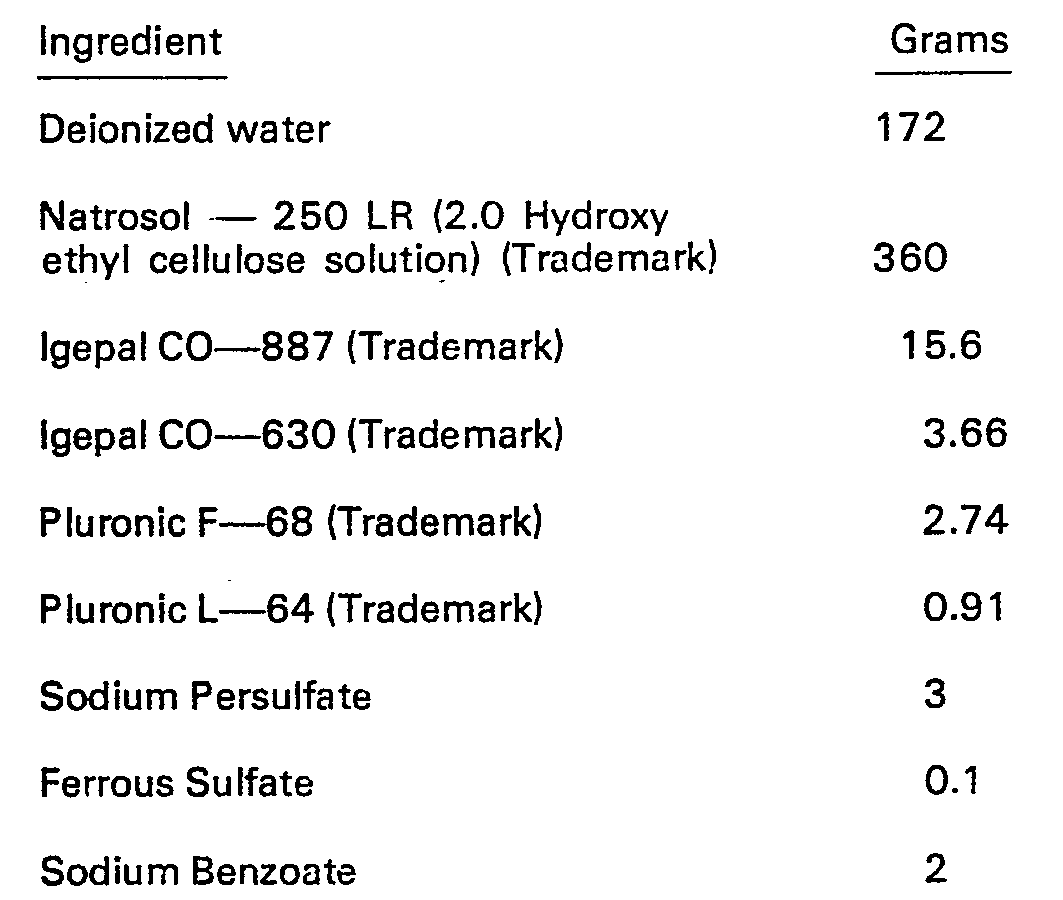
- The contents in the kettle were heated to 60°C while under constant agitation speed of 120 min-1 and under a nitrogen purge. Two separate monomer feed systems were added to the kettle over a period of 2.5 hours. The recipes were as follows:


- The aqueous phase (Feed 2) was prepared by chilling the water-diallylamine mixture and forming the diallylamine HCL salt by adjusting the pH of the aqueous phase to 2.5 with a 50/50 HCL-water solution.
- A 5% activator solution consisting of 90 grams water and 10 grams sodium formaldehyde sulfoxylate was added to the kettle along with the monomer and aqueous additions at a rate to maintain the free vinyl acetate content at 4-5% with a polymerization temperature between 60-65°C. When both monomer and aqueous recipes were completely added, the free vinyl acetate in the resulting latex was reduced to below 0.5% by weight by adding a catalyst solution containing 1.5 grams of t-butylhydroperoxide dissolved in 15 grams of deionized water and an excess of the 5% activator solution. At the end of the polymerisation the pH of the latex was 2.1 and lower from the initial pH of 5.5. After polymerization the pH was increased to 5.5 by addition of 10% sodium hydroxide. The polymerized resin particles were calculated to have 85.7% vinyl acetate, 9.52% butylacrylate, and 4.76% N,N-diallylamine concentration. The solids content was 56% and the particle size was of uniform monodisperse size.
- The procedure of Example 1 was repeated producing several vinyl acetate, butylacrylate, diallylamine and vinyl acetate-butylacrylate-allylamine resin systems. The proportion of diallylamine and allylamine was varied as indicated in Table 1. The results are as follows:

- A standard paint formulation for semi-gloss application containing pigment and thickener was used to compare various emulsions prepared in Example 1, as well as commercial vinyl acetate-lower alkyl acrylate-wet adhesion monomer systems. The formulation was as follows:

- The paint compositions were then tested for floating board test, cut film wet adhesion test. A brief description of each individual test is as follows:
- A 15 cm by 15 cm piece of clear white pine was first coated with an alkyd enamel paint and then with an alkyd gloss enamel and allowed to dry for a minimum of 3 days. The test paints were applied to the alkyd coated pine board in liberal quantity and allowed to dry for 3 days at 24°C and 58% relative humidity. Using a sharp knife or scribe, a series of parallel cuts approximately 2,5 mm apart were made and formed into a 100 square pattern. A strip of masking tape was applied to the cut section and rubbed with the thumb to insure contact. The tape then was pulled sharply at a 90° angle, and the percent paint removed from the alkyl substrate noted. A second series of cuts were made in the top paint film and the board placed face down in tap water. After one hour, the board was removed from water, wiped dry and tape applied to the cross hatched area and pulled. The percent remaining was recorded. A low percent removal of paint indicates good wet adhesion and a high removal indicates poor wet adhesion.
- A Leneta metal scrub panel was coated with an alkyd enamel using a 0,18 mm side of a Dow Film Caster and allowed to dry a minimum of three days and maximum of nine days at 24°C at 50% relative humidity. Test paints were applied to the panel using a drawdown bar suitable to give a 0,05 mm dry film thickness. The paint was allowed to dry 72 hours at 24°C, 50% relative humidity. A cut was made completely through the surface and down the center of the drawdown of the test paint with the razor blade held at a 45° angle. The panel was placed on a Gardner Washability Machine and scrubbed under water with a standard hog bristle brush, presoaked in water. A paint removal of less than 15% is considered "passed".
- The results are shown in Table 2.

- Control A is a commercially available vinyl acetate-butyl acrylate system having 0.75% by weight of a wet adhesion monomer. This control is sold under the trademark WAVE 345 by Air Products and Chemicals, Inc. The Run number corresponds to the Run from Table 1.
- The results in Table 2 show that both allyl and diallylamine impart wet adhesion to a paint system. The results are similar to those obtained with the commercial emulsion system.
Claims (9)


Priority Applications (1)
| Application Number | Priority Date | Filing Date | Title |
|---|---|---|---|
| AT80104954T ATE3874T1 (en) | 1979-08-27 | 1980-08-20 | EMULSIONS OF VINYL ACETATE COPOLYMERS FOR PAINTS WITH WET ADHESION PROPERTIES. |
Applications Claiming Priority (2)
| Application Number | Priority Date | Filing Date | Title |
|---|---|---|---|
| US69644 | 1979-08-27 | ||
| US06/069,644 US4260533A (en) | 1979-08-27 | 1979-08-27 | Vinyl acetate/allylic amine copolymer emulsions for paint having wet adhesion properties |
Publications (2)
| Publication Number | Publication Date |
|---|---|
| EP0024688A1 EP0024688A1 (en) | 1981-03-11 |
| EP0024688B1 true EP0024688B1 (en) | 1983-06-22 |
Family
ID=22090299
Family Applications (1)
| Application Number | Title | Priority Date | Filing Date |
|---|---|---|---|
| EP80104954A Expired EP0024688B1 (en) | 1979-08-27 | 1980-08-20 | Vinyl acetate copolymer emulsions for paint having wet adhesion properties |
Country Status (8)
| Country | Link |
|---|---|
| US (1) | US4260533A (en) |
| EP (1) | EP0024688B1 (en) |
| JP (1) | JPS5634770A (en) |
| AT (1) | ATE3874T1 (en) |
| CA (1) | CA1157980A (en) |
| DE (1) | DE3063895D1 (en) |
| MX (1) | MX6104E (en) |
| ZA (1) | ZA805114B (en) |
Families Citing this family (2)
| Publication number | Priority date | Publication date | Assignee | Title |
|---|---|---|---|---|
| US6166161A (en) * | 1996-06-24 | 2000-12-26 | The Dow Chemical Company | Incorporation of functionalized comonomers in polyolefins |
| WO1998025976A2 (en) * | 1996-12-09 | 1998-06-18 | Rhodia Inc. | Method for making a polyvinyl acetate emulsion of high solids content and the resulting emulsion |
Family Cites Families (19)
| Publication number | Priority date | Publication date | Assignee | Title |
|---|---|---|---|---|
| US2628221A (en) * | 1951-04-03 | 1953-02-10 | Du Pont | Copolymers of vinyl esters and tertiary amino nitrogen-containing compounds and process for producing same |
| US2662875A (en) * | 1952-02-20 | 1953-12-15 | Chemstrand Corp | Terpolymers of acrylonitrile and allyl amines |
| US2727019A (en) * | 1953-04-10 | 1955-12-13 | Rohm & Haas | N-(vinyloxyalkyl)-imidazolidones and hexahydropyrimidones and polymers |
| US2881171A (en) * | 1955-08-18 | 1959-04-07 | Rohm & Haas | New heterocyclic compounds, polymers thereof and methods of making them |
| US3032539A (en) * | 1956-09-27 | 1962-05-01 | American Cyanamid Co | Copolymers of a bis ethylenically unsaturated amine |
| NL109364C (en) * | 1957-08-28 | 1900-01-01 | ||
| US2926161A (en) * | 1958-03-10 | 1960-02-23 | Peninsular Chem Res Inc | Linear homopolymers of diallyl amines |
| US3057833A (en) * | 1958-03-31 | 1962-10-09 | Shell Oil Co | Process for polymerizing allylic amines and resulting products |
| US2980652A (en) * | 1958-09-19 | 1961-04-18 | Rohm & Haas | Unsaturated derivatives of n-(omega-aminoalkyl)-1, 3-cyclodiazolidin-2-ones and copolymers thereof |
| US3043816A (en) * | 1959-07-31 | 1962-07-10 | Monsanto Chemicals | Copolymers of vinyl chloride |
| GB1032367A (en) * | 1962-05-02 | 1966-06-08 | Simoniz Co | Coating composition |
| US3369008A (en) * | 1964-05-26 | 1968-02-13 | Rohm & Haas | N-(cyclic ureidoalkyl) crotonamides and polymers thereof |
| US3366613A (en) * | 1964-08-17 | 1968-01-30 | Rohm & Haas | Monomers and polymers of n-(acryloxyalkyl)acylamides and methods of making them |
| US3356654A (en) * | 1966-02-18 | 1967-12-05 | Desoto Inc | Copolymers of hydroxy derivatives of cyclic unsaturated amino acids |
| US3544491A (en) * | 1967-01-13 | 1970-12-01 | Rohm & Haas | Foamed copolymer of an ethylenically unsaturated monomer and an alkenyl guanamine and process of making same |
| US3509085A (en) * | 1967-11-02 | 1970-04-28 | Desoto Inc | Copolymers of ethylenically unsaturated hydroxy functional cyclic amine ethers |
| US3830761A (en) * | 1971-10-26 | 1974-08-20 | Air Prod & Chem | Vinyl chloride-ethylene-vinyl acetate resin binders |
| US4121986A (en) * | 1975-05-07 | 1978-10-24 | Ici Australia Limited | Process for the polymerization of polyallylamines in the presence of a mineral acid solution |
| US4111877A (en) * | 1976-07-29 | 1978-09-05 | Air Products & Chemicals, Inc. | Allyl esters of n-alkyl-omega-(alkyleneureido) amic acids and their synthesis and use in aqueous emulsion polymer systems |
-
1979
- 1979-08-27 US US06/069,644 patent/US4260533A/en not_active Expired - Lifetime
-
1980
- 1980-08-13 CA CA000357975A patent/CA1157980A/en not_active Expired
- 1980-08-20 EP EP80104954A patent/EP0024688B1/en not_active Expired
- 1980-08-20 AT AT80104954T patent/ATE3874T1/en active
- 1980-08-20 DE DE8080104954T patent/DE3063895D1/en not_active Expired
- 1980-08-20 ZA ZA00805114A patent/ZA805114B/en unknown
- 1980-08-27 JP JP11716680A patent/JPS5634770A/en active Granted
- 1980-08-27 MX MX808997U patent/MX6104E/en unknown
Also Published As
| Publication number | Publication date |
|---|---|
| MX6104E (en) | 1984-11-13 |
| ATE3874T1 (en) | 1983-07-15 |
| JPS5727139B2 (en) | 1982-06-09 |
| CA1157980A (en) | 1983-11-29 |
| JPS5634770A (en) | 1981-04-07 |
| ZA805114B (en) | 1981-08-26 |
| EP0024688A1 (en) | 1981-03-11 |
| DE3063895D1 (en) | 1983-07-28 |
| US4260533A (en) | 1981-04-07 |
Similar Documents
| Publication | Publication Date | Title |
|---|---|---|
| US4219454A (en) | Vinyl acetate copolymer emulsions for paint | |
| US3844990A (en) | Cylindrical hair brush aqueous paint compositions of vinyl acetate-ethylene copolymer latices | |
| US5208285A (en) | Vinyl acetate polymer with wet adhesion | |
| EP0295727B1 (en) | Polymeric products of ethylene and vinyl esters | |
| US3830761A (en) | Vinyl chloride-ethylene-vinyl acetate resin binders | |
| CA2199074C (en) | Vinyl acetate emulsions for high scrub paints | |
| US3635867A (en) | Polymerization process for making aqueous acrylic-containing emulsions | |
| US5227423A (en) | Paints and binders for use therein | |
| US3736287A (en) | Aqueous vinyl acrylic interpolymer emulsion and use thereof in latex paints | |
| US4663384A (en) | Paints and renders containing aqueous dispersions of vinylidene chloride/(meth)acrylate copolymers as binders | |
| US4302375A (en) | Paint compositions having wet adhesion characteristics | |
| US3553116A (en) | Mechanically and freeze-thaw stable aqueous emulsions of iminated carboxylic vinyl acetate/ethylene copolymers and process for preparing same | |
| JPH07207193A (en) | Improved chalk adhesive in outdoor matte paints. | |
| CA1129130A (en) | Plastics dispersion having a high wet adhesion and process for preparing same | |
| EP0629672A2 (en) | Polymerizable imidazolidinones as wet adhesion promoters in aqueous paints | |
| CA1122339A (en) | Aqueous dispersion of polymer | |
| US5157071A (en) | Paints and polymers for use therein | |
| US4260533A (en) | Vinyl acetate/allylic amine copolymer emulsions for paint having wet adhesion properties | |
| US5213901A (en) | Coated articles | |
| EP0029609B1 (en) | Aqueous dispersions of syntmetic materials, process for their preparation and their use | |
| EP0003870B2 (en) | Aqueous polymer resin emulsions and water-based paints and coatings containing such emulsions | |
| JPH04285612A (en) | Copolymer latex from ester of (meth)acrylic acid and vinyl ester of branched chain carboxylic acid | |
| DE19739936A1 (en) | Solvent-free polyvinyl ester dispersions with increased water resistance | |
| JPS6144917A (en) | Aqueous hardenable composition | |
| US5212225A (en) | Binder synthesis process |
Legal Events
| Date | Code | Title | Description |
|---|---|---|---|
| PUAI | Public reference made under article 153(3) epc to a published international application that has entered the european phase |
Free format text: ORIGINAL CODE: 0009012 |
|
| AK | Designated contracting states |
Designated state(s): AT BE CH DE FR GB IT LU NL SE |
|
| 17P | Request for examination filed |
Effective date: 19810421 |
|
| ITF | It: translation for a ep patent filed | ||
| GRAA | (expected) grant |
Free format text: ORIGINAL CODE: 0009210 |
|
| AK | Designated contracting states |
Designated state(s): AT BE CH DE FR GB IT LI LU NL SE |
|
| REF | Corresponds to: |
Ref document number: 3874 Country of ref document: AT Date of ref document: 19830715 Kind code of ref document: T |
|
| REF | Corresponds to: |
Ref document number: 3063895 Country of ref document: DE Date of ref document: 19830728 |
|
| PGFP | Annual fee paid to national office [announced via postgrant information from national office to epo] |
Ref country code: LU Payment date: 19830808 Year of fee payment: 4 |
|
| PG25 | Lapsed in a contracting state [announced via postgrant information from national office to epo] |
Ref country code: LU Free format text: LAPSE BECAUSE OF NON-PAYMENT OF DUE FEES Effective date: 19830831 |
|
| ET | Fr: translation filed | ||
| PLBE | No opposition filed within time limit |
Free format text: ORIGINAL CODE: 0009261 |
|
| STAA | Information on the status of an ep patent application or granted ep patent |
Free format text: STATUS: NO OPPOSITION FILED WITHIN TIME LIMIT |
|
| PGFP | Annual fee paid to national office [announced via postgrant information from national office to epo] |
Ref country code: FR Payment date: 19840626 Year of fee payment: 5 |
|
| 26N | No opposition filed | ||
| PGFP | Annual fee paid to national office [announced via postgrant information from national office to epo] |
Ref country code: BE Payment date: 19840930 Year of fee payment: 5 |
|
| PGFP | Annual fee paid to national office [announced via postgrant information from national office to epo] |
Ref country code: AT Payment date: 19860717 Year of fee payment: 7 |
|
| PGFP | Annual fee paid to national office [announced via postgrant information from national office to epo] |
Ref country code: NL Payment date: 19860831 Year of fee payment: 7 |
|
| PG25 | Lapsed in a contracting state [announced via postgrant information from national office to epo] |
Ref country code: AT Effective date: 19870820 |
|
| BERE | Be: lapsed |
Owner name: AIR PRODUCTS AND CHEMICALS INC. Effective date: 19870831 |
|
| PG25 | Lapsed in a contracting state [announced via postgrant information from national office to epo] |
Ref country code: NL Effective date: 19880301 |
|
| NLV4 | Nl: lapsed or anulled due to non-payment of the annual fee | ||
| PG25 | Lapsed in a contracting state [announced via postgrant information from national office to epo] |
Ref country code: FR Free format text: LAPSE BECAUSE OF NON-PAYMENT OF DUE FEES Effective date: 19880429 |
|
| REG | Reference to a national code |
Ref country code: FR Ref legal event code: ST |
|
| PG25 | Lapsed in a contracting state [announced via postgrant information from national office to epo] |
Ref country code: BE Effective date: 19890831 |
|
| PGFP | Annual fee paid to national office [announced via postgrant information from national office to epo] |
Ref country code: SE Payment date: 19900731 Year of fee payment: 11 |
|
| PGFP | Annual fee paid to national office [announced via postgrant information from national office to epo] |
Ref country code: CH Payment date: 19901024 Year of fee payment: 11 |
|
| PGFP | Annual fee paid to national office [announced via postgrant information from national office to epo] |
Ref country code: GB Payment date: 19910717 Year of fee payment: 12 |
|
| PG25 | Lapsed in a contracting state [announced via postgrant information from national office to epo] |
Ref country code: SE Effective date: 19910821 |
|
| PGFP | Annual fee paid to national office [announced via postgrant information from national office to epo] |
Ref country code: DE Payment date: 19910828 Year of fee payment: 12 |
|
| PG25 | Lapsed in a contracting state [announced via postgrant information from national office to epo] |
Ref country code: LI Effective date: 19910831 Ref country code: CH Effective date: 19910831 |
|
| REG | Reference to a national code |
Ref country code: CH Ref legal event code: PL |
|
| PG25 | Lapsed in a contracting state [announced via postgrant information from national office to epo] |
Ref country code: GB Effective date: 19920820 |
|
| GBPC | Gb: european patent ceased through non-payment of renewal fee |
Effective date: 19920820 |
|
| PG25 | Lapsed in a contracting state [announced via postgrant information from national office to epo] |
Ref country code: DE Effective date: 19930602 |
|
| EUG | Se: european patent has lapsed |
Ref document number: 80104954.5 Effective date: 19920306 |