EP0024510B1 - Phenoxypropyl amine derivatives, process for their preparation, and pharmaceutical compositions containing them - Google Patents
Phenoxypropyl amine derivatives, process for their preparation, and pharmaceutical compositions containing them Download PDFInfo
- Publication number
- EP0024510B1 EP0024510B1 EP80103742A EP80103742A EP0024510B1 EP 0024510 B1 EP0024510 B1 EP 0024510B1 EP 80103742 A EP80103742 A EP 80103742A EP 80103742 A EP80103742 A EP 80103742A EP 0024510 B1 EP0024510 B1 EP 0024510B1
- Authority
- EP
- European Patent Office
- Prior art keywords
- group
- formula
- phenoxy
- carbon atoms
- propyl
- Prior art date
- Legal status (The legal status is an assumption and is not a legal conclusion. Google has not performed a legal analysis and makes no representation as to the accuracy of the status listed.)
- Expired
Links
- 0 CC1(C)C=CC(C)(*)CC1 Chemical compound CC1(C)C=CC(C)(*)CC1 0.000 description 3
Classifications
-
- C—CHEMISTRY; METALLURGY
- C07—ORGANIC CHEMISTRY
- C07D—HETEROCYCLIC COMPOUNDS
- C07D209/00—Heterocyclic compounds containing five-membered rings, condensed with other rings, with one nitrogen atom as the only ring hetero atom
- C07D209/02—Heterocyclic compounds containing five-membered rings, condensed with other rings, with one nitrogen atom as the only ring hetero atom condensed with one carbocyclic ring
- C07D209/44—Iso-indoles; Hydrogenated iso-indoles
- C07D209/48—Iso-indoles; Hydrogenated iso-indoles with oxygen atoms in positions 1 and 3, e.g. phthalimide
-
- C—CHEMISTRY; METALLURGY
- C07—ORGANIC CHEMISTRY
- C07C—ACYCLIC OR CARBOCYCLIC COMPOUNDS
- C07C235/00—Carboxylic acid amides, the carbon skeleton of the acid part being further substituted by oxygen atoms
- C07C235/02—Carboxylic acid amides, the carbon skeleton of the acid part being further substituted by oxygen atoms having carbon atoms of carboxamide groups bound to acyclic carbon atoms and singly-bound oxygen atoms bound to the same carbon skeleton
- C07C235/04—Carboxylic acid amides, the carbon skeleton of the acid part being further substituted by oxygen atoms having carbon atoms of carboxamide groups bound to acyclic carbon atoms and singly-bound oxygen atoms bound to the same carbon skeleton the carbon skeleton being acyclic and saturated
- C07C235/08—Carboxylic acid amides, the carbon skeleton of the acid part being further substituted by oxygen atoms having carbon atoms of carboxamide groups bound to acyclic carbon atoms and singly-bound oxygen atoms bound to the same carbon skeleton the carbon skeleton being acyclic and saturated having the nitrogen atom of at least one of the carboxamide groups bound to an acyclic carbon atom of a hydrocarbon radical substituted by singly-bound oxygen atoms
-
- C—CHEMISTRY; METALLURGY
- C07—ORGANIC CHEMISTRY
- C07D—HETEROCYCLIC COMPOUNDS
- C07D207/00—Heterocyclic compounds containing five-membered rings not condensed with other rings, with one nitrogen atom as the only ring hetero atom
- C07D207/02—Heterocyclic compounds containing five-membered rings not condensed with other rings, with one nitrogen atom as the only ring hetero atom with only hydrogen or carbon atoms directly attached to the ring nitrogen atom
- C07D207/04—Heterocyclic compounds containing five-membered rings not condensed with other rings, with one nitrogen atom as the only ring hetero atom with only hydrogen or carbon atoms directly attached to the ring nitrogen atom having no double bonds between ring members or between ring members and non-ring members
- C07D207/10—Heterocyclic compounds containing five-membered rings not condensed with other rings, with one nitrogen atom as the only ring hetero atom with only hydrogen or carbon atoms directly attached to the ring nitrogen atom having no double bonds between ring members or between ring members and non-ring members with hetero atoms or with carbon atoms having three bonds to hetero atoms with at the most one bond to halogen, e.g. ester or nitrile radicals, directly attached to ring carbon atoms
- C07D207/12—Oxygen or sulfur atoms
-
- C—CHEMISTRY; METALLURGY
- C07—ORGANIC CHEMISTRY
- C07D—HETEROCYCLIC COMPOUNDS
- C07D211/00—Heterocyclic compounds containing hydrogenated pyridine rings, not condensed with other rings
- C07D211/04—Heterocyclic compounds containing hydrogenated pyridine rings, not condensed with other rings with only hydrogen or carbon atoms directly attached to the ring nitrogen atom
- C07D211/06—Heterocyclic compounds containing hydrogenated pyridine rings, not condensed with other rings with only hydrogen or carbon atoms directly attached to the ring nitrogen atom having no double bonds between ring members or between ring members and non-ring members
- C07D211/08—Heterocyclic compounds containing hydrogenated pyridine rings, not condensed with other rings with only hydrogen or carbon atoms directly attached to the ring nitrogen atom having no double bonds between ring members or between ring members and non-ring members with hydrocarbon or substituted hydrocarbon radicals directly attached to ring carbon atoms
- C07D211/18—Heterocyclic compounds containing hydrogenated pyridine rings, not condensed with other rings with only hydrogen or carbon atoms directly attached to the ring nitrogen atom having no double bonds between ring members or between ring members and non-ring members with hydrocarbon or substituted hydrocarbon radicals directly attached to ring carbon atoms with substituted hydrocarbon radicals attached to ring carbon atoms
- C07D211/20—Heterocyclic compounds containing hydrogenated pyridine rings, not condensed with other rings with only hydrogen or carbon atoms directly attached to the ring nitrogen atom having no double bonds between ring members or between ring members and non-ring members with hydrocarbon or substituted hydrocarbon radicals directly attached to ring carbon atoms with substituted hydrocarbon radicals attached to ring carbon atoms with hydrocarbon radicals, substituted by singly bound oxygen or sulphur atoms
- C07D211/22—Heterocyclic compounds containing hydrogenated pyridine rings, not condensed with other rings with only hydrogen or carbon atoms directly attached to the ring nitrogen atom having no double bonds between ring members or between ring members and non-ring members with hydrocarbon or substituted hydrocarbon radicals directly attached to ring carbon atoms with substituted hydrocarbon radicals attached to ring carbon atoms with hydrocarbon radicals, substituted by singly bound oxygen or sulphur atoms by oxygen atoms
-
- C—CHEMISTRY; METALLURGY
- C07—ORGANIC CHEMISTRY
- C07D—HETEROCYCLIC COMPOUNDS
- C07D211/00—Heterocyclic compounds containing hydrogenated pyridine rings, not condensed with other rings
- C07D211/04—Heterocyclic compounds containing hydrogenated pyridine rings, not condensed with other rings with only hydrogen or carbon atoms directly attached to the ring nitrogen atom
- C07D211/06—Heterocyclic compounds containing hydrogenated pyridine rings, not condensed with other rings with only hydrogen or carbon atoms directly attached to the ring nitrogen atom having no double bonds between ring members or between ring members and non-ring members
- C07D211/36—Heterocyclic compounds containing hydrogenated pyridine rings, not condensed with other rings with only hydrogen or carbon atoms directly attached to the ring nitrogen atom having no double bonds between ring members or between ring members and non-ring members with hetero atoms or with carbon atoms having three bonds to hetero atoms with at the most one bond to halogen, e.g. ester or nitrile radicals, directly attached to ring carbon atoms
- C07D211/40—Oxygen atoms
- C07D211/42—Oxygen atoms attached in position 3 or 5
-
- C—CHEMISTRY; METALLURGY
- C07—ORGANIC CHEMISTRY
- C07D—HETEROCYCLIC COMPOUNDS
- C07D211/00—Heterocyclic compounds containing hydrogenated pyridine rings, not condensed with other rings
- C07D211/04—Heterocyclic compounds containing hydrogenated pyridine rings, not condensed with other rings with only hydrogen or carbon atoms directly attached to the ring nitrogen atom
- C07D211/06—Heterocyclic compounds containing hydrogenated pyridine rings, not condensed with other rings with only hydrogen or carbon atoms directly attached to the ring nitrogen atom having no double bonds between ring members or between ring members and non-ring members
- C07D211/36—Heterocyclic compounds containing hydrogenated pyridine rings, not condensed with other rings with only hydrogen or carbon atoms directly attached to the ring nitrogen atom having no double bonds between ring members or between ring members and non-ring members with hetero atoms or with carbon atoms having three bonds to hetero atoms with at the most one bond to halogen, e.g. ester or nitrile radicals, directly attached to ring carbon atoms
- C07D211/40—Oxygen atoms
- C07D211/44—Oxygen atoms attached in position 4
-
- C—CHEMISTRY; METALLURGY
- C07—ORGANIC CHEMISTRY
- C07D—HETEROCYCLIC COMPOUNDS
- C07D295/00—Heterocyclic compounds containing polymethylene-imine rings with at least five ring members, 3-azabicyclo [3.2.2] nonane, piperazine, morpholine or thiomorpholine rings, having only hydrogen atoms directly attached to the ring carbon atoms
- C07D295/04—Heterocyclic compounds containing polymethylene-imine rings with at least five ring members, 3-azabicyclo [3.2.2] nonane, piperazine, morpholine or thiomorpholine rings, having only hydrogen atoms directly attached to the ring carbon atoms with substituted hydrocarbon radicals attached to ring nitrogen atoms
- C07D295/08—Heterocyclic compounds containing polymethylene-imine rings with at least five ring members, 3-azabicyclo [3.2.2] nonane, piperazine, morpholine or thiomorpholine rings, having only hydrogen atoms directly attached to the ring carbon atoms with substituted hydrocarbon radicals attached to ring nitrogen atoms substituted by singly bound oxygen or sulfur atoms
- C07D295/096—Heterocyclic compounds containing polymethylene-imine rings with at least five ring members, 3-azabicyclo [3.2.2] nonane, piperazine, morpholine or thiomorpholine rings, having only hydrogen atoms directly attached to the ring carbon atoms with substituted hydrocarbon radicals attached to ring nitrogen atoms substituted by singly bound oxygen or sulfur atoms with the ring nitrogen atoms and the oxygen or sulfur atoms separated by carbocyclic rings or by carbon chains interrupted by carbocyclic rings
Definitions
- This invention relates to novel phenoxypropylamine derivatives. More specifically, it relates to phenoxypropylamine derivatives of the general formula wherein R, represents a hydrogen atom or a methyl or ethyl group, R and R 3 together form a linear alkylene group having 4 to 7 carbon atoms which may be optionally substituted by a hydroxyl or hydroxymethyl group, and R 4 represents a hydrogen atom or a group of the formula ⁇ R 5 ⁇ Z in which R 5 represents a lower alkylene group, and Z represents a hydrogen atom or an amino, mono- or di-(lower alkyl)-amino, hydroxy lower alkylamino, lower alkanoylamino, hydroxyl, lower alkoxy, lower alkanoyloxy, phenoxy, mono- or di-halophenoxy, benzoyloxy or mono- or di-halobenzoyloxy group, with the proviso that when R 1 represents a hydrogen atom, the moiety is not
- the compounds of general formula (I) provided by the present invention are novel compounds not described in the prior literature. They have an excellent activity of inhibiting secretion of gastric acid based on their antagonistic action against the histamine H 2 receptor, and are useful as new type of antiulcer agents.
- the term "lower" which qualifies groups or compounds means that the group or compounds so qualified have not more than 6 carbon atoms, preferably 1 to 4 carbon atoms.
- lower alkyl groups used in the present application may be linear or branched, and includes, for example, methyl, ethyl, n-propyl, isopropyl, n-butyl, isobutyl, sec-butyl, and tert-butyl.
- mono- or di-(lower alkyl)amino group includes, for example, methylamino, ethylamino, propylamino, isopropylamino, butylamino, dimethylamino, diethylamino, dipropylamino, and dibutylamino.
- hydroxy lower alkylamino group includes hydroxyethylamino, hydroxypropylamino, hydroxybutylamino, etc.
- lower alkanoylamino group includes, for example, acetylamino, propionylamino, and pentanoylamino.
- lower alkoxy group includes methoxy, ethoxy, n-propoxy, isopropoxy, etc.
- lower alkanoyloxy group includes, for example, acetoxy, n-propionyloxy, and isopropionyloxy.
- the "mono- and di-halophenoxy group” and “mono- and di-halobenzoyloxy group” respectively include, for example, 4-chlorophenoxy, 4-bromophenoxy, and 3,4-dichlorobenzoyloxy.
- halogen atom denotes chlorine, bromine, iodine and fluorine atoms, especially chlorine or bromine.
- linear alkylene group having 4 to 7 carbon atoms which may be optionally substituted by a hydroxyl or hydroxymethyl group for R 2 and R 3 taken together in formula (I) means that R 2 and R 3 are bonded together through nitrogen atom to form a 1-pyrrolidinyl, 1-piperidinyl, 1- perhydroazepinyl or 1-perhydroazocinyl group which may optionally be substituted by a hydroxyl or hydroxymethyl group.
- Examples of the moiety in the general formula (I) are 1-pyrrolidinyl group , 1-pipendinyl group (N-), 1-perhydroazepinyl group (N-),and 1-perhydroazocinyl group (N-), and the above groups mono-substituted by a hydroxyl group ( ⁇ OH) or hydroxymethyl group ( ⁇ CH 2 OH), such as Of these, 1-pyrrolidinyl and 1-piperidinyl groups optionally substituted by a hydroxyl group are preferred. Among them are preferred. Especially preferred are 1-pyrrolidinyl and 1-piperidinyl groups. When the above moiety represents a 1-pyrrolidinyl or 1-piperidinyl group, it is desirable from the standpoint of pharmacological effects that R, should represent a hydrogen atom or a methyl group.
- R 4 represents a hydrogen atom or a group of formula ⁇ R 5 ⁇ Z.
- the lower alkylene group for R 5 is, for example, a methylene or ethylene group, especially the methylene group.
- the group Z typically includes, a hydrogen atom, an amino group, an acetamino group, a methylamino group, a dimethylamino group, a hydroxymethylamino group, a hydroxypropylamino group, a hydroxyl group, a methoxy group, an ethoxy group, an acetoxy group, a propionyloxy group, a pivaloyloxy group, a phenoxy group, a 4-chlorophenoxy group, a benzoyloxy group, and 3,4-dichlorobenzoyloxy group.
- Z may represent a hydrogen atom, or an amino, mono- or di-methylamino, hydroxyethylamino, acetylamino, hydroxyl, C 1 ⁇ C 2 alkoxy, or C Z -C 3 alkanoyloxy group.
- R 4 represents a hydrogen atom or a methyl, hydroxyethylaminoethyl, hydroxymethyl, methoxymethyl, ethoxymethyl, acetoxymethyl or propionyloxymethyl group, especially a hydroxymethyl or acetoxymethyl group.
- salts of the compounds of formula I are also provided.
- these salts are inorganic acid salts such as salts of hydrochloric acid, hydrobromic acid, sulfuric acid, nitric acid and phosphoric acid, and organic acid salts such as salts of acetic acid, propionic acid, lactic acid, citric acid, oxalic acid, tartaric acid, and p-toluenesulfonic acid. Those which are pharmaceutically acceptable are suitable.
- the compounds of formula (I) and their salts can be produced by the following various process embodiments.
- the amine compound of formula (II) or its reactive derivative is amidated by the carboxylic acid of formula (III) or its reactive derivative.
- the reactive derivative of the amine compound (II) used as one starting material in the amidation reaction may be any of those which are used to activate the amino group in the field of peptide chemistry.
- Q represents the following and A 1 and A 2 are identical or different, and each represents an alkyl, aryl or aralkyl group, or A 1 and A 2 together form an alkylene group or an o-phenylene group.
- the carboxylic acid formula (III) used as the starting material in the aforesaid amidation reaction is a known compound. Its reactive derivative may be any of those which are used to activate the carboxyl group for amidation reaction in the field of peptide chemistry. Examples of the reactive derivative are shown below.
- an amino group is present as the group Z 1 of the carboxylic acid (III)
- the amino group is desirably protected by a phthaloyl group, and when a hydroxyl group is present therein, the hydroxyl group may be protected by an acyl group.
- These protecting groups can be split off in a customary manner after the amidation reaction, for example by hydrazinolysis or mild hydrolysis.
- amidation reaction between the amine compound (II) or its reactive derivative and the carboxylic acid (iii) or its reactive derivatives may be carried out by various known methods.
- reaction can be performed by direct condensation between the amine compound (II) and the carboxylic acid (III).
- the reaction may be carried out in the absence of solvent.
- an inert organic solvent for example an aromatic hydrocarbon such as benzene, toluene or xylene, an ether such as tetrahydrofuran, dioxane, dimethoxyethane or diglyme, an amide such as dimethylformamide or dimethylacetamide, a halogenated hydrocarbon such as dichloromethane or chloroform, or dimethylsulfoxide.
- the reaction temperature and pressure are not particularly restricted, and can be varied widely depending upon the starting materials, etc.
- the reaction temperature is from about 0°C to the refluxing temperature of the reaction mixture, preferably room temperature to 200°C, and the pressure is advantageously atmospheric pressure.
- the reaction may be carried out in the presence of a condensing agent.
- useful condensing agents are Lewis acids such as silicon tetrachloride, trichlorophenylsilane and titanium tetrachloride, N-ethyl-N'-diethylaminopropylcarbodiimide, N,N'-dicyclohexylcarbodiimide, a combination of a triaryl phosphine and a disulfide, and strong acid-type ion exchange resins such as Amberlite IR-120.
- the amidation in accordance with this invention may also be carried out between the reactive derivative of the amine compound (11) and the free carboxylic acid (III), or between the free amine compound (II) and the reactive derivative of the carboxylic acid (III).
- This amidation can also be performed without a solvent, if required.
- the reaction temperature and pressure are not critical. Usually, the reaction temperature is from about -20°C to the refluxing temperature of the reaction mixture, preferably from 0°C to 180°C.
- the reaction pressure is advantageously atmospheric pressure.
- the amount of the carboxylic acid (III) or its reactive derivative based on the amine (II) or its reactive derivative is not critical, and can be varied widely depending upon the type of the amidating agent. Generally, it is advantageous to use the carboxylic acid (III) or its reactive derivative in an amount of at least 1 mole, preferably 1 to 10 moles, more preferably 1 to 2 moles per mole of the compound (II) or its reactive derivative.
- the compound of formula (II) used as one starting material in the aforesaid amidation reaction is a novel compound not described in the prior literature. It can easily be prepared, for example, by (1) reacting a compound of the following formula wherein R, is as defined hereinabove, with a compound of the following formula wherein R 21 and R 31 each represent a lower alkyl group, or together form a linear alkylene group having 4 to 7 carbon atoms, under reducing conditions, by the method described in German Laid-Open Patent Publication No.
- the resulting compound of formula (II) can be converted into its reactive derivative in a customary manner in the peptide chemistry.
- the reaction between the phenol derivative of formula (IV) and the propylamide derivative of formula (V) in accordance with the process embodiment (b) of this invention can be performed by reacting the phenol derivative (IV) in the form of phenolate with the propylamide derivative (V), or reacting the phenol derivative (IV) with the propylamide derivative (V) in the presence of a base.
- the phenolate of the phenol derivative (IV) is expressed by the following formula wherein R" R 2 and R 3 are as defined hereinabove, and M represents an alkali metal.
- Examples of the base mentioned above include sodium carbonate, potassium carbonate, sodium hydroxide, potassium hydroxide, sodium hydride, sodium azide, and sodium amide.
- the base can be used in an amount of at least 1 equivalent, preferably 1 to 5 equivalents, more preferably 1 to 1.5 equivalents per mole of the phenol derivative (IV).
- the reaction of the phenol derivative (IV) or the phenolate (IV-a) with the propylamide derivative (V) can be performed in the absence of a solvent or in the presence of a solvent or in the presence of an inert solvent, for example water, an alcohol such as methanol, ethanol or butanol, a ketone such as acetone, or methyl ethyl ketone, an aromatic hydrocarbon such as benzene or toluene, an amide such as dimethylformamide or dimethylacetamide, or dimethylsulfoxide.
- the reaction temperature is not critical, and can be varied widely depending upon the type of the starting materials, etc. Generally, the suitable reaction temperature is from room temperature to the refluxing temperature of the reaction mixture, preferably from about 20°C to the refluxing temperature of the reaction mixture.
- the amount of the propylamide derivative (V) based on the phenol derivative (IV) [phenolate of formula (IV-a)] is not critical, and can be varied widely. Generally, the amount of the propylamide derivative (V) is at least 1 mole, preferably 1 to 10 moles, more preferably 1 to 2 moles per mole of the phenol derivative (IV).
- the acid residue for X, in formula (V) includes, for example, halogen atoms (e.g., chlorine, bromine or iodine), and organic sulfonyloxy groups such as methanesulfonyloxy and tosyloxy groups. Of these, the halogen atoms are preferred.
- halogen atoms e.g., chlorine, bromine or iodine
- organic sulfonyloxy groups such as methanesulfonyloxy and tosyloxy groups.
- the halogen atoms are preferred.
- the compound of formula (VI) is reacted with the dihalide compound of formula (VII).
- the reaction of the compound (VI) with the compound (VII) is carried out generally in an inert organic solvent, for example, an ether such as ethyl ether, tetrahydrofuran or dioxane, an aromatic hyrocarbon such as benzene or toluene, an amide such as dimethylformamide or dimethylacetamide, or dimethylsulfoxide, preferably in the presence of an acid binder.
- useful acid binders are aliphatic tertiary amines such as trimethylamine or triethylamine, and inorganic bases such as sodium hydroxide, potassium hydroxide, sodium carbonate and potassium carbonate.
- the acid binder is used in an amount of about 1 to about 3 moles per mole of the compound (VI).
- the amount of the compound (VII) used in the above is generally 1 to 5 moles, preferably 1 to 2 moles per mole of the compound (VI).
- reaction temperature and pressure are not critical, and can be varied widely depending upon the starting materials, the solvent, etc.
- the reaction temperature is from about 0°C to the reflux temperature of the reaction mixture, preferably from room temperature to the refluxing temperature of the reaction mixture. Normal atmospheric pressure is sufficient as the reaction pressure.
- the compound (VI) used as a starting material in the above reaction is also a novel compound not described in the prior literature. It can be prepared, for example, by reacting a compound of the following formula wherein R, is as defined hereinabove, with a compound of the following formula wherein R 43 and X, are as defined hereinabove, under similar conditions to the process embodiment (b) as described hereinabove to form a compound of the following formula wherein R, and R 43 are as defined hereinabove, reacting the resulting compound with hydroxylamine at a relatively low temperature of about 0°C to room temperature in a suitable solvent such as an alcohol (e.g., methanol, ethanol or butanol) to convert it to an oxime of the following formula wherein R, and R 43 are as defined hereinabove, and then catalytically hydrogenating the resulting oxime (XIX) in a customary manner.
- R is as defined hereinabove
- R 43 and X are as defined hereinabove
- the compound of formula (VIII) is etherified or esterified with the compound of formula (IX) or the carboxylic acid of formula (X) or its reactive derivative.
- This etherification or esterification can be performed in accordance with usual methods.
- the etherification of the compound (VIII) with the compound (IX) is usually carried out by reacting the compound (VIII) in the form of an alcoholate with the compound (IX).
- the alcoholate of the compound of formula (VIII) can generally be represented by the following formula wherein R 1 , R Z , R 3 and R 5 are as defined hereinabove, and M represents an alkali metal such as sodium, potassium or lithium.
- the alcoholate of formula (VIII-a) can be produced by reacting the compound (VIII) with a base such as sodium hydride or sodium amide.
- a base such as sodium hydride or sodium amide.
- the alcoholate-forming reaction is usually carried out in an inert organic solvent such as an amide (e.g., dimethylformamide or dimethylacetamide), or dimethylsulfoxide at a temperature of generally from -10°C to room temperature using at least 1 equivalent, preferably 1 to 1.5 equivalents, of the base per mole of the compound of formula (VIII).
- the reaction of the resulting alcoholate (VIII-a) with the compound (IX) can be carried out in the absence of a solvent, or in an inert organic solvent, for example an aromatic hydrocarbon such as benzene or toluene, an amide such as dimethylformamide or dimethylacetamide, or dimethylsulfoxide.
- the reaction temperature is not critical, and can be varied widely depending upon the type of the starting materials, etc. Generally, the suitable reaction temperature is from about -10°C to the refluxing temperature of the reaction mixture, preferably from 0°C to room temperature. Under these reaction conditions, the reaction can be completed in about 5 minutes to about 1 hour.
- the amount of the compound (IX) based on the alcoholate (VIII-a) is not critical, and can be varied widely.
- the compound of formula (IX) is used in an amount of generally at least 1 mole, preferably 1 to 10 moles, more preferably 1 to 2 moles per mole of the alcoholate (VIII-a).
- the acid residue for X z in the compound (IX) used as a starting material includes, for example, halogen atoms (e.g., chlorine, bromine or iodine), and organic sulfonyloxy groups such as methanesulfonyloxy and tosyloxy groups. Of these, the halogen atoms are preferred.
- halogen atoms e.g., chlorine, bromine or iodine
- organic sulfonyloxy groups such as methanesulfonyloxy and tosyloxy groups.
- the halogen atoms are preferred.
- compound (IX) is methyl iodide, ethyl iodide, ethyl bromide and propyl bromide.
- the esterification reaction can be performed by direct condensation between the compound (VIII) and the carboxylic acid (X).
- the reaction is carried out between the compound (VIII) and the reactive derivatives of the carboxylic acid (X).
- the reaction may be carried out in the absence of a solvent.
- the reaction is generally carried out in an inert organic solvent.
- Suitable solvents include amines such as pyridine and triethylamine, aromatic hydrocarbons such as benzene, toluene and xylene, ethers such as tetrahydrofuran, dioxane, dimethoxyethane and diglyme, amides such as dimethylformamide and dimethylacetamide, halogenated hydrocarbons such as dichloromethane and chloroform, and dimethylsulfoxide.
- the reaction temperature and pressure are not critical. Usually, the reaction temperature is from about -20°C to the refluxing temperature of the reaction mixture, preferably from 0°C to 180°C.
- the reaction pressure is advantageously atmospheric pressure.
- the amount of carboxylic acid (X) or its reactive derivative based on the compound (VIII) is neither critical, and can be varied widely depending upon the type of the compound (X) used.
- the amount of the carboxylic acid (X) or its reactive derivative is generally at least 1 mole, preferably 1 to 10 moles, more preferably 1 to 2 moles per mole of the compound (VIII).
- the compound (VIII) used as a starting material in the embodiment (d) is among the compounds of formula (I) of this invention, and can be prepared in accordance with the embodiment (a) or (c) of the process of this invention.
- the compound of formula (XI) is reacted with the amine of formula (XII).
- This reaction is generally carried out in an inert organic solvent, for example an ether such as ethyl ether, tetrahydrofuran or dioxane, an aromatic hydrocarbon such as benzene or toluene, an amide such as dimethylformamide or dimethylacetamide, or dimethylsulfoxide, preferably in the presence of an acid binder of the type exemplified hereinabove with regard to the process embodiment (c).
- the acid binder is used advantageouly in an amount of about 1 to about 3 moles per mole of the compound (XI).
- the amine of formula (XII) is used geneally in an amount of 1 to 50 moles, preferably 3 to 20 moles per mole of the compound (XI).
- the reaction temperature and pressure are not critical, and can be varied widely depending upon the reactants and the solvents used, etc.
- the reaction is advantageously carried out at a temperature of generally from about 0°C to the refluxing temperature of the reaction mixture, preferably from room temperature to the refluxing temperature of the reaction mixture, under normal atmospheric pressure.
- the compound (XI) used as a starting material in embodiment (e) is a novel compound not described in the prior literature. It can be prepared, for example, by the process embodiment (a) using a carboxylic acid corresponding to formula (III) in which Z, is a halogen atom instead of the carboxylic acid (III) used in embodiment (a).
- the compound (I) produced by the process of this invention described hereinabove can be converted to the corresponding salt in accordance with the process embodiment (f).
- the salt-forming reaction can be easily performed in a customary manner by treating the compound (I) with an inorganic or organic acid.
- the compound of formula (I) or its salt obtained by the process of this invention can be isolated from the reaction mixture and/or purified by various known means, such as recrystallization, distillation, column chromatography, and thin-layer chromatography.
- the substituted phenoxypropylamine compounds of formula (I) and the salts thereof have the action of inhibiting secretion of gastric acid based on their antagonistic action against histamine H z receptors, and are useful for treating diseases caused by gastric acid, for example gastric or duodenal ulcers.
- the superior histamine H 2 receptor antagonizing activity of the compounds of formula (I) can be demonstrated by the following animal experiment.
- the contracting motion of the atrium was recorded by a force-displacement transducer, and the number of heart beats was calculated.
- Histamine (used in the form of diphosphate; the same hereinbelow) was cumulatively added to the Magnus tube in a concentration of 1 x 10- 8 M to 1 x 10- 4 M in such an amount that the logarithm of the amount provides an equal interval of 1/2, until a maximum increase in heart beat was obtained.
- the dose-response curve of histamine was obtained.
- the inside of the Magnus tube was washed several times with a Tyrod solution, and the atrium was stabilized for 1 hour. Then, the above procedure was repeated to obtain the dose-responsive curve of histamine again.
- the inside of the Magnus tube was washed several times, and the tissues were stabilized for 50 minutes. Then, a test compound (1 x 10- 5 M) was added to the Magnus tube, and after 20 minutes, the dose-response curve of histamine in the presence of the test compound was obtained.
- the PA 2 value (the negative logarithm of the molar concentration of the test compound required to double the concentration of histamine in the Magnus tube required to induce a certain reaction) was calculated from the dose-response curve of histamine obtained in histamine in the presence of the test compound in accordance with the method of J. M. Van Rossum (Arch. int. Pharmacodyn., 143, 299, 1963). The results are shown in Table 1.
- a 5% Tween 80 suspension of a test compound was orally administered to groups of ddY mice (male: 19-22 g), each consisting of 5 mice, and the animals were observed for 72 hours.
- the LD 50 value of the test compounds calculated by the Litchfield-Wilcoxon method based on the results of the observation were as follows:
- the compound of formula (I) of this invention can be administered as an antiulcer agent orally or parenterally (e.g., intramuscularly, intravenously, subcutaneously, intrarectally, intradermally, etc.) or the treatment and medication of men and other warm-blooded animals.
- parenterally e.g., intramuscularly, intravenously, subcutaneously, intrarectally, intradermally, etc.
- the compound of this invention When used as a drug, it can be formulated into various forms suitable for oral or parenteral administration.
- the compounds of this invention can be formulated by using various non-toxic additives normally used in drugs of this kind, such as excipients, binders, lubricants, disintegrating agents, antiseptics, isotonic agents, stabilizers, dispersing agents, antioxidants, coloring agents, flavoring agents, and buffers.
- these drugs can be prepared into a solid form (e.g., tablets, hard capsules, soft capsules, granules, powders, pellets, pills, trouches, etc.), a semi-solid form (e.g. suppositories, ointment, etc.) and a liquid form (injections, emulsions, suspension, syrups, sprays, etc.).
- a solid form e.g., tablets, hard capsules, soft capsules, granules, powders, pellets, pills, trouches, etc.
- a semi-solid form e.g. suppositories, ointment, etc.
- a liquid form injections, emulsions, suspension, syrups, sprays, etc.
- nontoxic additives include gelatin, starch, glucose, lactose, fructose, maltose, magnesium carbonate, talc, magnesium stearate, methyl cellulose, carboxy methyl celluluse or the salts thereof, gum arabic, polyethylene glycol, alkyl p-hydroxybenzoates, syrup, ethanol, propylene glycol, vaseline, carbowax, glycerol, sodium chloride, sodium sulfite, sodium phosphate, and citric acid.
- the above drugs may also contain other therapeutically effective agents.
- the content of the compound of this invention in the drug differs depending upon its preparation form. Desirably, it is about 5 to 100% by weight in solid and semi-solid formulations, and about 0.1 to 10% by weight in liquid formulation.
- the dosage of the compound of this invention can be varied widely depending upon the subject to which it is to be administered (man or other warm-blooded animals), the route of administration, the condition of the patient, the diagnosis of a physician, etc. Generally, the dosage is 0.2 to 20 mg/kg, preferably 0.5 to 10 mg/kg, per day. Larger or smaller dosages may be possible depending upon the condition of the patient and the diagnosis of a physician. The aforesaid dosage may be administered once or several times a day.
- step (C) The following compounds were produced in the same way as in step (C) using suitable amines.
- Boiling point 155-158°C/0.25 mmHg.
- Crystals N-[3-[3-11-piperidinylmethyl)phenoxy)propyl]acetoxyacetamide hydrochloride are pulverized to less than 70 microns, and lactose and starch are added, followed by thorough mixing. A 10% starch paste was added to the mixed powder, and they were mixed with stirring to prepare granules. After dry granulation, the particle size of the granules was maintained uniform at about 840 microns. Talc and magnesium stearate were mixed with the granules, and tablets were produced from the granules.
- N-[3-[3-(1-Piperidinylmethyllphenoxy]propyl]acetoxyacetamide hydrochloride was finely pulverized, and starch, lactose and magnesium stearate was added to the pulverized product. They were mixed well, and the mixture was filled into No. 5 capsules.
Landscapes
- Chemical & Material Sciences (AREA)
- Organic Chemistry (AREA)
- Organic Low-Molecular-Weight Compounds And Preparation Thereof (AREA)
Description
- This invention relates to novel phenoxypropylamine derivatives. More specifically, it relates to phenoxypropylamine derivatives of the general formula


- One great cause of ulcer formation in the stomach or duodenum is the excessive secretion of gastric acid, and conventional antiulcer agents for controlling hyperchlorhydria are roughly classified into those having the action of neutralizing gastric acid and those having anticholinergic activity. However, the former type is weak and short-lasting in effect, and the latter type produces strong side- effects.
- It is known on the other hand that secretion of gastric acid is stimulated through a histamine Hz receptor. In recent years, some novel type gastric acid secretion inhibitors having an antagonistic action against the histamine H2 receptor have been developed and suggested for practical application (see, for example, British Patent No. 1,338,169, U.S. Patent No. 4,128,658, and West German Laid-Open Patent Publication No. 2,821,410).
- The compounds of general formula (I) provided by the present invention are novel compounds not described in the prior literature. They have an excellent activity of inhibiting secretion of gastric acid based on their antagonistic action against the histamine H2 receptor, and are useful as new type of antiulcer agents.
- In the present specification and the appended claims, the term "lower" which qualifies groups or compounds means that the group or compounds so qualified have not more than 6 carbon atoms, preferably 1 to 4 carbon atoms.
- Thus, in term "lower alkyl groups" used in the present application may be linear or branched, and includes, for example, methyl, ethyl, n-propyl, isopropyl, n-butyl, isobutyl, sec-butyl, and tert-butyl. The term "mono- or di-(lower alkyl)amino group" includes, for example, methylamino, ethylamino, propylamino, isopropylamino, butylamino, dimethylamino, diethylamino, dipropylamino, and dibutylamino. The term "hydroxy lower alkylamino group" includes hydroxyethylamino, hydroxypropylamino, hydroxybutylamino, etc. The term "lower alkanoylamino group" includes, for example, acetylamino, propionylamino, and pentanoylamino. The term "lower alkoxy group" includes methoxy, ethoxy, n-propoxy, isopropoxy, etc. The term "lower alkanoyloxy group" includes, for example, acetoxy, n-propionyloxy, and isopropionyloxy.
- The "mono- and di-halophenoxy group" and "mono- and di-halobenzoyloxy group" respectively include, for example, 4-chlorophenoxy, 4-bromophenoxy, and 3,4-dichlorobenzoyloxy.
- The term "halogen atom", as used in the present application, denotes chlorine, bromine, iodine and fluorine atoms, especially chlorine or bromine.
- The expression "linear alkylene group having 4 to 7 carbon atoms which may be optionally substituted by a hydroxyl or hydroxymethyl group" for R2 and R3 taken together in formula (I) means that R2 and R3 are bonded together through nitrogen atom to form a 1-pyrrolidinyl, 1-piperidinyl, 1- perhydroazepinyl or 1-perhydroazocinyl group which may optionally be substituted by a hydroxyl or hydroxymethyl group.
- Thus, specific examples of the moiety
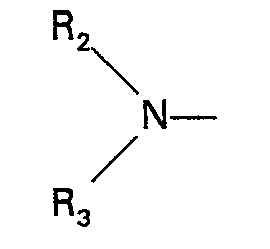


- In formula (I), R4 represents a hydrogen atom or a group of formula ―R5―Z. The lower alkylene group for R5 is, for example, a methylene or ethylene group, especially the methylene group. The group Z typically includes, a hydrogen atom, an amino group, an acetamino group, a methylamino group, a dimethylamino group, a hydroxymethylamino group, a hydroxypropylamino group, a hydroxyl group, a methoxy group, an ethoxy group, an acetoxy group, a propionyloxy group, a pivaloyloxy group, a phenoxy group, a 4-chlorophenoxy group, a benzoyloxy group, and 3,4-dichlorobenzoyloxy group.
- In one preferred group of the compounds of general formula (I), Z may represent a hydrogen atom, or an amino, mono- or di-methylamino, hydroxyethylamino, acetylamino, hydroxyl, C1―C2 alkoxy, or CZ-C3 alkanoyloxy group.
- Thus, in a more preferred class of the compounds of formula (I) of this invention, R4 represents a hydrogen atom or a methyl, hydroxyethylaminoethyl, hydroxymethyl, methoxymethyl, ethoxymethyl, acetoxymethyl or propionyloxymethyl group, especially a hydroxymethyl or acetoxymethyl group.
- Typical examples of the compounds of formula (I) are listed below or described in Examples to be given hereinbelow.
- N-[3-[3-[1-(1-pyrrolidinyl)ethyl]phenoxy]propyl]methoxyacetamide,
- N-[3-[3-[1-(1-pyrrolidinyl)ethyl]phenoxy]propyl] methoxypropionamide,
- N-[3-[3-[1-(1-pyrrolidinyl)ethyl]phenoxy]propyl]acetoxypropionamide,
- N-[3-[3-[1-(1-pyrrolidinyl)propyl]phenoxy]propyl]hydroxyacetamide,
- N-[3-[3-[1-(1-pyrrolidinyl)propyl]phenoxy]propyl]methoxyacetamide,
- N-[3-[3-[1-(1-pyrrolidinyl)propyl]phenoxy]propyl]acetoxyacetamide,
- N-[3-[3-[1-(1-piperidinylmethyl)phenoxy]propyl]propionamide,
- N-(2-hydroxypropionyl)-3-[3-(1-piperidinylmethyl)phenoxy]propylamine,
- N-(3-hydroxypropionyI)-3-[3-(1-piperidinylmethyl)phenoxy]propylamine,
- N-(5-hydroxyvaleryl)-3-[3-(1-piperidinylmethyl)phenoxy]propylamine,
- N-[3-[3-(1-piperdinylmethyl)phenoxy]propyl]ethoxyacetamide,
- N-[3-[3-(1-piperidinylmethyl)phenoxy]propyl]butoxyacetamide,
- N-(4-methoxybutyryl)-3-[3-(1-piperidinylmethyl)phenoxy]propylamine,
- N-(3-acetoxypropionyl)-3-[3-(1-piperidinylmethyl)phenoxy]propylamine,
- N-(3-pivaloyloxypropionyl)-3-[3-(1-piperidinylmethyl]phenoxy]propylamine,
- N-(3-propionylaminopropionyl)-3-[3-(1-piperidinylmethyl]phenoxy]propylamine,
- N-(2-hydroxyethylaminoacetyl)-3-[3-(1-piperidinylmethyf]phenoxy]propylamine,
- N-[5-(2-hydroxyethylamino)valeryl]-3-[3-(1-piperidinylmethyl]phenoxy]propylamine,
- N-(3-diethylaminopropionyl)-3-[3-(1-piperidinylmethyl]phenoxy]propylamine,
- N-(4-dimethylaminobutyryl)-3-[3-(1-piperidinylmethyl]phenoxy]propylamine,
- N-[3-[3-[1-(1-piperidinyl)ethyl]phenoxy]propyl]acetoxyacetamide,
- N-[3-[3-[1-(1-piperidinyl)propyl]phenoxy]propyl]acetamide,
- N-[3-[3-[1-(1-piperidinyl)propyl]phenoxy]propyl]methoxyacetamide,
- N-[3-[3-(1-perhydroazepinylmethyl)phenoxy]propyl]methoxyacetamide,
- N-[3-[3-(1-perhydroazocinylmethyl)phenoxy]propyl]acetoxyacetamide,
- N-(3-aminopropionyl)-3-[3-[1-(3-hydroxy)pyrrolidinylmethyl)phenoxy]propylamine,
- N-[3-[3-[1-[1-(3-hydroxy)pyrrolidinyl]ethyl]phenoxy]propyl]acetoxyacetamide,
- N-[3-[3-[1-(3-hydroxy)piperdinylmethyl]phenoxy]propyl]benzoyloxyacetamide,
- N-[3-[3-[1-(3-hydroxy)piperidinylmethyl]phenoxy]propyl]butyryloxyacetamide,
- N-[3-[3-[1-(4-hydroxy)piperidinylmethyl]phenoxy]propyl]methoxyacetamide,
- N-[3-(3-[1-(4-hydroxymethyl)piperidinylmethyl]phenoxy]propyl]acetoxyacetamide, and
- N-[3-[3-[1-(3-hydroxy)perhydroazepinylmethyl]phenoxy]propyl]formamide.
- According to this invention, salts of the compounds of formula I are also provided. Examples of these salts are inorganic acid salts such as salts of hydrochloric acid, hydrobromic acid, sulfuric acid, nitric acid and phosphoric acid, and organic acid salts such as salts of acetic acid, propionic acid, lactic acid, citric acid, oxalic acid, tartaric acid, and p-toluenesulfonic acid. Those which are pharmaceutically acceptable are suitable.
- In accordance with this invention, the compounds of formula (I) and their salts can be produced by the following various process embodiments.
- (a) When obtaining a compounds of formula (I) wherein R4 represents a hydrogen atom or a group of the formula ―R5―Z in which R5 is as defined hereinabove and Z represents the groups defined hereinabove excepting lower alkanoyloxy, benzoyloxy, and mono- and di-halobenzoyloxy groups, a compound of the following formula


- (b) When obtaining a compound of formula (I) wherein R4 represents a hydrogen atom or a group of the formula ―R5―Z in which R5 is as defined hereinabove and Z represents a hydrogen atom, or a mono- or di-(lower alkyl)amino, lower alkanoylamino, lower alkoxy, phenoxy or mono- or di-halophenoxy group, a phenol derivative of the following formula


- (c) When obtaining a compound of formula (I) wherein R2 and R3 together form a linear alkylene group having 4 to 7 carbon atoms which may be optionally substituted by a hydroxyl or hydroxymethyl group, and R4 represents a hydrogen atom or a group of the formula ―R5―Z in which R5 is as defined hereinabove and Z represents the groups defined hereinabove excepting amino, lower alkanoyloxy, benzoyloxy and mono- and di-halobenzoyloxy groups, a compound of the following formula


- (d) When obtaining a compound of formula (I) wherein R4 represents a group of the formula ―R5―Z in which R5 is as defined hereinabove and Z represents a lower alkoxy, lower alkanoyloxy, benzoyloxy, or mono- or di-halobenzoyloxy group, a compound of the following formula


- (e) When obtaining a compound of formula (I) wherein R4 represents a grop of the formula ―R5―Z in which R5 is as defined hereinabove and Z represents an amino, mono- or di-(lower alkyl)amino, hydroxy lower alkylamino or lower alkylamino group, a compound of the following formula


- (f) If desired, the resulting compound of formula (I) is converted to its salt.
- According to the embodiment (a) of the process of this invention, the amine compound of formula (II) or its reactive derivative is amidated by the carboxylic acid of formula (III) or its reactive derivative.
- The reactive derivative of the amine compound (II) used as one starting material in the amidation reaction may be any of those which are used to activate the amino group in the field of peptide chemistry.
- Examples are listed below.
- (I) Isocyanates (or isothiocyanates)


- (iii) Phosphoramidide compounds

- (iv) Phosphoroamidate compounds

- In each of the above formulae, Q represents the following

- The carboxylic acid formula (III) used as the starting material in the aforesaid amidation reaction is a known compound. Its reactive derivative may be any of those which are used to activate the carboxyl group for amidation reaction in the field of peptide chemistry. Examples of the reactive derivative are shown below. When an amino group is present as the group Z1 of the carboxylic acid (III), the amino group is desirably protected by a phthaloyl group, and when a hydroxyl group is present therein, the hydroxyl group may be protected by an acyl group. These protecting groups can be split off in a customary manner after the amidation reaction, for example by hydrazinolysis or mild hydrolysis.
- (I) Acid naiiaes

- (ii) Esters

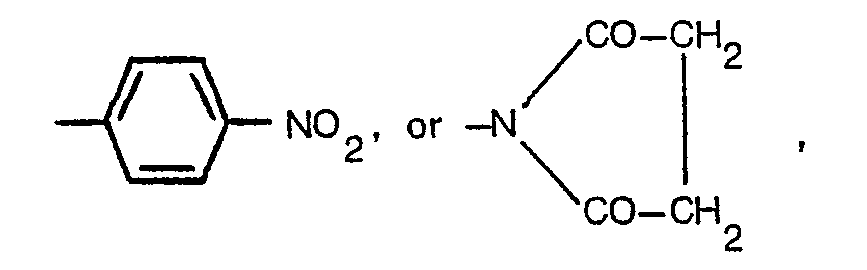
- (iii) Mixed acid anhydrides


- (iv) Active amides

(v) Acid azides
- The amidation reaction between the amine compound (II) or its reactive derivative and the carboxylic acid (iii) or its reactive derivatives may be carried out by various known methods.
- For example, it can be performed by direct condensation between the amine compound (II) and the carboxylic acid (III). The reaction may be carried out in the absence of solvent. Generally, it is preferred to carry out the reaction in an inert organic solvent, for example an aromatic hydrocarbon such as benzene, toluene or xylene, an ether such as tetrahydrofuran, dioxane, dimethoxyethane or diglyme, an amide such as dimethylformamide or dimethylacetamide, a halogenated hydrocarbon such as dichloromethane or chloroform, or dimethylsulfoxide. The reaction temperature and pressure are not particularly restricted, and can be varied widely depending upon the starting materials, etc. Usually, the reaction temperature is from about 0°C to the refluxing temperature of the reaction mixture, preferably room temperature to 200°C, and the pressure is advantageously atmospheric pressure. If desired, the reaction may be carried out in the presence of a condensing agent. Examples of useful condensing agents are Lewis acids such as silicon tetrachloride, trichlorophenylsilane and titanium tetrachloride, N-ethyl-N'-diethylaminopropylcarbodiimide, N,N'-dicyclohexylcarbodiimide, a combination of a triaryl phosphine and a disulfide, and strong acid-type ion exchange resins such as Amberlite IR-120.
- The amidation in accordance with this invention may also be carried out between the reactive derivative of the amine compound (11) and the free carboxylic acid (III), or between the free amine compound (II) and the reactive derivative of the carboxylic acid (III). This amidation can also be performed without a solvent, if required. Usually, it is advantageous to carry out this amidation in an inert organic solvent of the type exemplified hereinabove or in a high-boiling alcohol such as ethylene glycol or glycerol. The reaction temperature and pressure are not critical. Usually, the reaction temperature is from about -20°C to the refluxing temperature of the reaction mixture, preferably from 0°C to 180°C. The reaction pressure is advantageously atmospheric pressure.
- In the aforesaid amidation reaction, the amount of the carboxylic acid (III) or its reactive derivative based on the amine (II) or its reactive derivative is not critical, and can be varied widely depending upon the type of the amidating agent. Generally, it is advantageous to use the carboxylic acid (III) or its reactive derivative in an amount of at least 1 mole, preferably 1 to 10 moles, more preferably 1 to 2 moles per mole of the compound (II) or its reactive derivative.
- The compound of formula (II) used as one starting material in the aforesaid amidation reaction is a novel compound not described in the prior literature. It can easily be prepared, for example, by (1) reacting a compound of the following formula
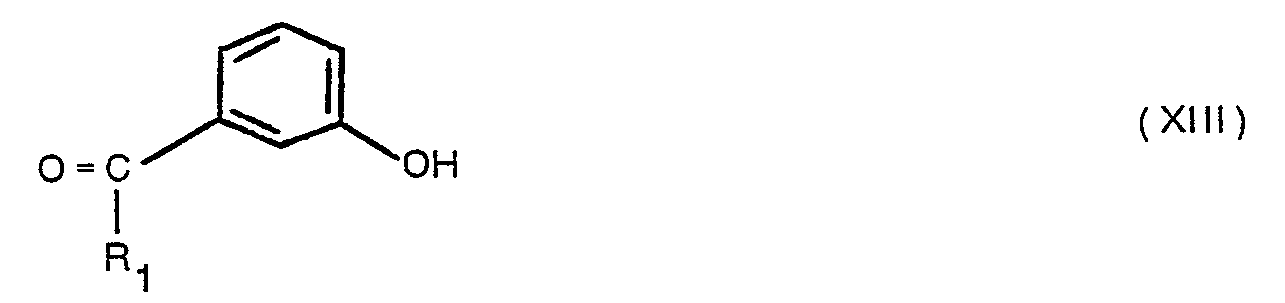


- The resulting compound of formula (II) can be converted into its reactive derivative in a customary manner in the peptide chemistry.
- The reaction between the phenol derivative of formula (IV) and the propylamide derivative of formula (V) in accordance with the process embodiment (b) of this invention can be performed by reacting the phenol derivative (IV) in the form of phenolate with the propylamide derivative (V), or reacting the phenol derivative (IV) with the propylamide derivative (V) in the presence of a base.
- The phenolate of the phenol derivative (IV) is expressed by the following formula

- Examples of the base mentioned above include sodium carbonate, potassium carbonate, sodium hydroxide, potassium hydroxide, sodium hydride, sodium azide, and sodium amide. The base can be used in an amount of at least 1 equivalent, preferably 1 to 5 equivalents, more preferably 1 to 1.5 equivalents per mole of the phenol derivative (IV).
- The reaction of the phenol derivative (IV) or the phenolate (IV-a) with the propylamide derivative (V) can be performed in the absence of a solvent or in the presence of a solvent or in the presence of an inert solvent, for example water, an alcohol such as methanol, ethanol or butanol, a ketone such as acetone, or methyl ethyl ketone, an aromatic hydrocarbon such as benzene or toluene, an amide such as dimethylformamide or dimethylacetamide, or dimethylsulfoxide. The reaction temperature is not critical, and can be varied widely depending upon the type of the starting materials, etc. Generally, the suitable reaction temperature is from room temperature to the refluxing temperature of the reaction mixture, preferably from about 20°C to the refluxing temperature of the reaction mixture.
- The amount of the propylamide derivative (V) based on the phenol derivative (IV) [phenolate of formula (IV-a)] is not critical, and can be varied widely. Generally, the amount of the propylamide derivative (V) is at least 1 mole, preferably 1 to 10 moles, more preferably 1 to 2 moles per mole of the phenol derivative (IV).
- The acid residue for X, in formula (V) includes, for example, halogen atoms (e.g., chlorine, bromine or iodine), and organic sulfonyloxy groups such as methanesulfonyloxy and tosyloxy groups. Of these, the halogen atoms are preferred.
- According to the embodiment (c) of the process of this invention, the compound of formula (VI) is reacted with the dihalide compound of formula (VII).
- The reaction of the compound (VI) with the compound (VII) is carried out generally in an inert organic solvent, for example, an ether such as ethyl ether, tetrahydrofuran or dioxane, an aromatic hyrocarbon such as benzene or toluene, an amide such as dimethylformamide or dimethylacetamide, or dimethylsulfoxide, preferably in the presence of an acid binder. Examples of useful acid binders are aliphatic tertiary amines such as trimethylamine or triethylamine, and inorganic bases such as sodium hydroxide, potassium hydroxide, sodium carbonate and potassium carbonate. Advantageously, the acid binder is used in an amount of about 1 to about 3 moles per mole of the compound (VI).
- The amount of the compound (VII) used in the above is generally 1 to 5 moles, preferably 1 to 2 moles per mole of the compound (VI).
- The reaction temperature and pressure are not critical, and can be varied widely depending upon the starting materials, the solvent, etc. Usually, the reaction temperature is from about 0°C to the reflux temperature of the reaction mixture, preferably from room temperature to the refluxing temperature of the reaction mixture. Normal atmospheric pressure is sufficient as the reaction pressure.
- The compound (VI) used as a starting material in the above reaction is also a novel compound not described in the prior literature. It can be prepared, for example, by reacting a compound of the following formula


- According to the embodiment (d) of the process of this invention, the compound of formula (VIII) is etherified or esterified with the compound of formula (IX) or the carboxylic acid of formula (X) or its reactive derivative. This etherification or esterification can be performed in accordance with usual methods.
- The etherification of the compound (VIII) with the compound (IX) is usually carried out by reacting the compound (VIII) in the form of an alcoholate with the compound (IX).
- The alcoholate of the compound of formula (VIII) can generally be represented by the following formula

- The alcoholate of formula (VIII-a) can be produced by reacting the compound (VIII) with a base such as sodium hydride or sodium amide. The alcoholate-forming reaction is usually carried out in an inert organic solvent such as an amide (e.g., dimethylformamide or dimethylacetamide), or dimethylsulfoxide at a temperature of generally from -10°C to room temperature using at least 1 equivalent, preferably 1 to 1.5 equivalents, of the base per mole of the compound of formula (VIII).
- The reaction of the resulting alcoholate (VIII-a) with the compound (IX) can be carried out in the absence of a solvent, or in an inert organic solvent, for example an aromatic hydrocarbon such as benzene or toluene, an amide such as dimethylformamide or dimethylacetamide, or dimethylsulfoxide. The reaction temperature is not critical, and can be varied widely depending upon the type of the starting materials, etc. Generally, the suitable reaction temperature is from about -10°C to the refluxing temperature of the reaction mixture, preferably from 0°C to room temperature. Under these reaction conditions, the reaction can be completed in about 5 minutes to about 1 hour.
- The amount of the compound (IX) based on the alcoholate (VIII-a) is not critical, and can be varied widely. Advantageously, the compound of formula (IX) is used in an amount of generally at least 1 mole, preferably 1 to 10 moles, more preferably 1 to 2 moles per mole of the alcoholate (VIII-a).
- The acid residue for Xz in the compound (IX) used as a starting material includes, for example, halogen atoms (e.g., chlorine, bromine or iodine), and organic sulfonyloxy groups such as methanesulfonyloxy and tosyloxy groups. Of these, the halogen atoms are preferred.
- Specific examples of the compound (IX) are methyl iodide, ethyl iodide, ethyl bromide and propyl bromide.
- The esterification reaction of the compound (VIII) with the carboxylic acid (X) or its reactive derivative [this reactive derivative includes those exemplified hereinabove with regard to formula (III)] can be carried out in accordance with various known methods.
- For example, the esterification reaction can be performed by direct condensation between the compound (VIII) and the carboxylic acid (X). Preferably, the reaction is carried out between the compound (VIII) and the reactive derivatives of the carboxylic acid (X). The reaction may be carried out in the absence of a solvent. Advantageously, the reaction is generally carried out in an inert organic solvent. Suitable solvents include amines such as pyridine and triethylamine, aromatic hydrocarbons such as benzene, toluene and xylene, ethers such as tetrahydrofuran, dioxane, dimethoxyethane and diglyme, amides such as dimethylformamide and dimethylacetamide, halogenated hydrocarbons such as dichloromethane and chloroform, and dimethylsulfoxide. The reaction temperature and pressure are not critical. Usually, the reaction temperature is from about -20°C to the refluxing temperature of the reaction mixture, preferably from 0°C to 180°C. The reaction pressure is advantageously atmospheric pressure.
- In the above esterification reaction, the amount of carboxylic acid (X) or its reactive derivative based on the compound (VIII) is neither critical, and can be varied widely depending upon the type of the compound (X) used. Advantageously, the amount of the carboxylic acid (X) or its reactive derivative is generally at least 1 mole, preferably 1 to 10 moles, more preferably 1 to 2 moles per mole of the compound (VIII).
- The compound (VIII) used as a starting material in the embodiment (d) is among the compounds of formula (I) of this invention, and can be prepared in accordance with the embodiment (a) or (c) of the process of this invention.
- According to the embodiment (e) of the process of this invention, the compound of formula (XI) is reacted with the amine of formula (XII).
- This reaction is generally carried out in an inert organic solvent, for example an ether such as ethyl ether, tetrahydrofuran or dioxane, an aromatic hydrocarbon such as benzene or toluene, an amide such as dimethylformamide or dimethylacetamide, or dimethylsulfoxide, preferably in the presence of an acid binder of the type exemplified hereinabove with regard to the process embodiment (c). The acid binder is used advantageouly in an amount of about 1 to about 3 moles per mole of the compound (XI).
- In the above reaction, the amine of formula (XII) is used geneally in an amount of 1 to 50 moles, preferably 3 to 20 moles per mole of the compound (XI).
- The reaction temperature and pressure are not critical, and can be varied widely depending upon the reactants and the solvents used, etc. The reaction is advantageously carried out at a temperature of generally from about 0°C to the refluxing temperature of the reaction mixture, preferably from room temperature to the refluxing temperature of the reaction mixture, under normal atmospheric pressure.
- The compound (XI) used as a starting material in embodiment (e) is a novel compound not described in the prior literature. It can be prepared, for example, by the process embodiment (a) using a carboxylic acid corresponding to formula (III) in which Z, is a halogen atom instead of the carboxylic acid (III) used in embodiment (a).
- The compound (I) produced by the process of this invention described hereinabove can be converted to the corresponding salt in accordance with the process embodiment (f). The salt-forming reaction can be easily performed in a customary manner by treating the compound (I) with an inorganic or organic acid.
- Thus, the compound of formula (I) or its salt obtained by the process of this invention can be isolated from the reaction mixture and/or purified by various known means, such as recrystallization, distillation, column chromatography, and thin-layer chromatography.
- The substituted phenoxypropylamine compounds of formula (I) and the salts thereof have the action of inhibiting secretion of gastric acid based on their antagonistic action against histamine Hz receptors, and are useful for treating diseases caused by gastric acid, for example gastric or duodenal ulcers.
- The superior histamine H2 receptor antagonizing activity of the compounds of formula (I) can be demonstrated by the following animal experiment.
- The compounds of this invention used in the following animal experiment are abbreviated as follows:
- A: N-[3-[3-[1-(1-Pyrroiidinyl)ethyl]phenoxy]propyl]formamide.
- B: N-[3-[3-[1-(1-Pyrrolidinyl)propyl]phenoxy]propyl]formamide.
- C: N-[3-[3-[1-(1-Piperidinylmethyl)phenoxy]propyl]formamide.
- D: N-[3-[3-[1-(1-Perhydroazepinyl)ethyl]phenoxy]propyl]formamide.
- E: N-[3-[3-[1(1-Hydroxy)pyrrolidinyl)ethyl]phenoxy]propyl]formamide.
- F: N-[3-[3-[1-(1-Pyrrolidinyl)ethyl]phenoxy]propyl]acetamide.
- G: N-[3-[3-[1-(1-Pyrrolidinyl)propyl]phenoxy]propyl]acetamide.
- H: N-[3-[3-(1-Piperidinylmethyl)]phenoxy]propyl]acetamide.
- t: N-[3-[3-[1-(1-Piperidinyl)ethyl]phenoxy]propyl]acetamide.
- J: N-[3-[3-[1-(1-Pyrrolidinyl)ethyl]phenoxy]propyl]propionamide.
- K: N-[3-[3-[1-(1-Pyrrolidinyl)ethyl]phenoxy]propyl]hydroxyacetamide.
- L: N-[3-[3-(1-Piperidinylmethyl)phenoxy]propyl]hydroxyacetamide.
- M: N-[3-[3-(1-Perhydroazepinylmethyl)phenoxy]propyl]hydroxyacetamide.
- N: N-(3-Aminopropionyl)-3-[3-[1-(1-pyrrolidinyl)ethyl]phenoxy]propylamine.
- 0: N-[3-[3-(1-Piperidinylmethyl)phenoxy]propyl]methoxyacetamide.
- P: N-[3-[3-[1-(1-Pyrrolidinyl)ethyl]phenoxy]propyl]acetoxyamide.
- Q: N-[3-[3-(1-Piperidinylmethyl)]phenoxy]propyl]acetoxyamide.
- R: N-[3-[3-(1-Perhydroazepinylmethyl)phenoxy]propyl]acetoxyacetamide.
- S: N-[3-[3-(1-Piperidinylmethyl)phenoxy]propyl]propionyloxyacetamide.
- T: N-[3-[3-(1-Piperidinylmethyl)]phenoxy]propyl]benzoyloxyaceamide.
- U: N-(3,4-Dichlorobenzoyloxyacetyl)-3-[3-(1-perhydroazepinylmethyl)phenoxy]propylamine.
- A guinea pig, Hartley, (male 400-550 g) was struck at the head to let out blood, and the heart was enucleated. The right atrium was separated in a Tyrod solution saturated with oxygen, and a silk thread was attached to its both ends. Using the silk threads at both ends, the atrium was suspended under a tension of 700 mg in a Magnus tube (25 ml) containing a Tyrod solution maintained at 36°C: through which mixture of 95% of O2 and 5% of CO2 was passed. The contracting motion of the atrium was recorded by a force-displacement transducer, and the number of heart beats was calculated.
- Histamine (used in the form of diphosphate; the same hereinbelow) was cumulatively added to the Magnus tube in a concentration of 1 x 10⁻⁸ M to 1 x 10⁻⁴ M in such an amount that the logarithm of the amount provides an equal interval of 1/2, until a maximum increase in heart beat was obtained. Thus, the dose-response curve of histamine was obtained. The inside of the Magnus tube was washed several times with a Tyrod solution, and the atrium was stabilized for 1 hour. Then, the above procedure was repeated to obtain the dose-responsive curve of histamine again. The inside of the Magnus tube was washed several times, and the tissues were stabilized for 50 minutes. Then, a test compound (1 x 10⁻⁵ M) was added to the Magnus tube, and after 20 minutes, the dose-response curve of histamine in the presence of the test compound was obtained.
- The PA2 value (the negative logarithm of the molar concentration of the test compound required to double the concentration of histamine in the Magnus tube required to induce a certain reaction) was calculated from the dose-response curve of histamine obtained in histamine in the presence of the test compound in accordance with the method of J. M. Van Rossum (Arch. int. Pharmacodyn., 143, 299, 1963). The results are shown in Table 1.

- A 5% Tween 80 suspension of a test compound was orally administered to groups of ddY mice (male: 19-22 g), each consisting of 5 mice, and the animals were observed for 72 hours. The LD50 value of the test compounds calculated by the Litchfield-Wilcoxon method based on the results of the observation were as follows:

- Thus, the compound of formula (I) of this invention can be administered as an antiulcer agent orally or parenterally (e.g., intramuscularly, intravenously, subcutaneously, intrarectally, intradermally, etc.) or the treatment and medication of men and other warm-blooded animals.
- When the compound of this invention is used as a drug, it can be formulated into various forms suitable for oral or parenteral administration. The compounds of this invention can be formulated by using various non-toxic additives normally used in drugs of this kind, such as excipients, binders, lubricants, disintegrating agents, antiseptics, isotonic agents, stabilizers, dispersing agents, antioxidants, coloring agents, flavoring agents, and buffers.
- Depending upon the end uses, these drugs can be prepared into a solid form (e.g., tablets, hard capsules, soft capsules, granules, powders, pellets, pills, trouches, etc.), a semi-solid form (e.g. suppositories, ointment, etc.) and a liquid form (injections, emulsions, suspension, syrups, sprays, etc.). Specific examples of the nontoxic additives include gelatin, starch, glucose, lactose, fructose, maltose, magnesium carbonate, talc, magnesium stearate, methyl cellulose, carboxy methyl celluluse or the salts thereof, gum arabic, polyethylene glycol, alkyl p-hydroxybenzoates, syrup, ethanol, propylene glycol, vaseline, carbowax, glycerol, sodium chloride, sodium sulfite, sodium phosphate, and citric acid.
- The above drugs may also contain other therapeutically effective agents.
- The content of the compound of this invention in the drug differs depending upon its preparation form. Desirably, it is about 5 to 100% by weight in solid and semi-solid formulations, and about 0.1 to 10% by weight in liquid formulation.
- The dosage of the compound of this invention can be varied widely depending upon the subject to which it is to be administered (man or other warm-blooded animals), the route of administration, the condition of the patient, the diagnosis of a physician, etc. Generally, the dosage is 0.2 to 20 mg/kg, preferably 0.5 to 10 mg/kg, per day. Larger or smaller dosages may be possible depending upon the condition of the patient and the diagnosis of a physician. The aforesaid dosage may be administered once or several times a day.
- "Tween", "Vaseline" and "Carbowax" are Trade Marks.
- The following Examples illustrate the present invention more specifically.
- A mixture of 1 g of 3-[3-(1-piperidinylmethyl)-phenoxy]propylamine, 1 g of sodium formate and 3 ml of formic acid was refluxed for 1 hour, and a greater portion of the solvent was distilled off under reduced pressure, and water was added to the residue. The mixture was alkalized with 4% sodium hydroxide solution. The product was extracted with chloroform. The extract was dried over anhydrous magnesium sulfate. The solvent was distilled off, and the residues was separated and purified by thin-layer chromatography (TLC) (developing solvent: chloroform/methanol = 9/1) to afford 436 mg of N-[3-[3-(1-piperidinylmethyl)phenoxy]propyl]formamide as an oil.
- IR(film, cm-'): 3282, 1632.
- NMR(CDCl3, δ): 1.30―1.70 (6H, m.), 2.04 (2H, q., J = 6Hz), 2.30―2.50 (4H, m.), 3.15 ( 1H, s.), 3.43 (2H, s.), 3.53 (2H, t. J = 6Hz), 4.01 (2H, t., J = 6Hz), 6.70-7.30 (4H, m.), 8.13 (1 H, s.).
- The above reaction was repeated using suitable amines to give the following compounds.
- (i) N-[3-[3-(1-(1-Piperidinyl)ethyl]phenoxy]propyl]formamide.
- IR(film, cm-'): 3310, 1670.
- NMR(CDCI3, 8): 1.34 (3H, d., J = 6Hz), 1.35-1.75 (6H, M.), 2.05 (2H, q., J = 6Hz), 2.30-2.55 (4H, m.), 3.04 (1 H, q., J = 7Hz), 3.30-3.70 (3H, m.), 4.40 (2H, t., J = 6Hz), 6.65-7.30 (5H, m.). 8.15 (1 H, broad s.).
- (ii) N-[3-[3-(1-Perhydroazepinylmethyl)phenoxy]propyl]formamide
- IR(film, cm-1): 3800, 1670.
- NMR(CDCl3, δ): 1.4―2.8 (10H, m.), 2.4―2.8 (4H, m.), 3.3―3.7 (2H, m.), 3.59 (2H, s.), 4.02 (2H, t., J = 6Hz), 6.6-7.4 (4H, m.), 8.13 (1 Hs, s.).
- (iii) N-[3-[3-]1-(1-Perhydroazepinyl)ethyl]phenoxy]propyl]formamide
- IR(film, cm-'): 1670.
- NMR(CDCl3, δ): 1.35 (3H, d., J = 7Hz), 1.6 (8H, m.), 2.01 (2H, m., J = 7Hz), 2.68 (4H, m.), 3.3-3.9 (3H, m.), 4.05 (2H, t., J = 7Hz), 6.35 (1 H, broad s.), 6.4-7.4 (4H, m.), 8.18 (1 H, broad s.).
- (iv) N-[3-[3-(1-Perhydroazocinylmethyl)phenoxy]propyl]formamide
- IR(film, cm-'): 1660.
- NMR(CDCl3, δ): 1.62 (10H, m.), 1.99 (2H, m., J = 6Hz), 2.56 (4H, m.), 3.2―3.7 (4H, m.), 4.02 (2H, t., J = 6Hz), 6.3 (1 H, broad s.), 6.4-7.4 (4H, m.), 8.12 (1 H, broad s.).
- (v) N-[3-[3-]1-(1-Perhydroazocinyl)ethyl)phenoxy]propyl]formamide
- IR(film, cm-'): 1670.
- NMR(CDCl3, δ): 1.24 (3H, d., J = 7Hz), 1.6 (10H, m.), 2.00 (2H, m., J = 7Hz), 2.5 (4H, m.), 3.2-3.8 (3H, m.), 4.02 (2H, t., J = 7Hz), 6.4 (1 H, broad s.), 6.4-7.4 (4H, m.), 8.12 (1 H, broad s.).
- (vi) N-[3-[3-]1-(3-Hydroxy)pyrrolidinylmethyl]phenoxy]propyl]formamide IR(film, cm-'): 3300, 1660.
- NMR(CDCl3, δ): 1.6―3.1 (9H, m.), 3.43 (2H, t., J = 6.5Hz), 3.62 (2H, s.), 4.03 (2H, t., J = 6Hz). 4.35 (1 H, m.), 6.6-7.4 (5H, m.), 8.15 (1 H, broad s.).
- (vii) N-[3-[3-[1-[1-(3-Hydroxy)pyrrolidinyl]ethyl]phenoxy]propyl]formamide
- IR(film, cm-'): 3300, 1670.
- NMR(CDCl3, δ): 1.35 (3H, d., J = 7Hz), 1.7―3.0 (8H, m.), 3.1―3.6 (4H, m.), 4.01 (2H, t., J = 6Hz), 4.3 (1 H, m.), 6.4-7.3 (5H, m.), 8.11 (1 H, broad s.).
- (viii) N-[3-[3-[1-(3-Hydroxy)piperidinylmethyl]phenoxy]propyl]formamide
- IR(film, cm-1): 3320, 1675.
- NMR(CDCl3, δ): 1.6 (4H, m.), 1.98 (2H, m., J = 6Hz),2.3―2.6 (4H, m.), 2.88 (1H, broad s.), 3.46 (2H, s.), 3.46 (2H m.), 3.8 (1H, m.), 4.01 (2H, t., J = 6Hz), 6.3 (1H, m.),6.6―7.3 (4H, m.), 8.11 (1H, broad s.).
- (ix) N-[3-[3-[1-(3-Hydroxymethyl)piperidinylmethyl]phenoxy]propyl]formamide
- IR(film, cm-'): 3300, 1670.
- NMR(CDCl3, δ): 1.2―3.0 (12H, m.), 3.48 (2H, s.), 3.3―3.6 (4H, m.), 4.04 (2H, t., J = 6Hz), 6.4 (1 H, m.), 6.7-7.3 (4H, m.), 8.12 (1 H, broad s.).
- (x) N-[3-[3-[1-Pyrrolidinyl)propyl]phenoxy]propyl]formamide
- IR(film, cm-1): 3300, 1670.
- NMR(CDCl3, δ): 0.67 (3H, t., J = 7Hz), 1.60―2.20 (8H, m.), 2.30―2.80 (4H, m.), 2.99 (1H, q., J = 5Hz), 3.3―3.7 (2H, m.), 4.05 (2H, t., J = 6Hz), 6.6―7.4 (4H, m.), 8.16 (1H, s.).
- (xi) N-[3-[3-[1-(1-Pyrrolidinyl)ethyl]phenoxy]propyl]formamide.
- IR(film, cm-'): 1680.
- NMR(CDCl3, δ): 1.36 (3H, d., J = 6Hz), 1.5―2.8 (10H, m.), 3.15 (1H, q., J = 6Hz), 3.50 (2H, q., J = 6Hz), 4.03 (2H, t., J = 6Hz), 6.6-7.4 (4H. m.), 8.15 (1 H, broad s.).
- (xii) N-[3-[3-(1-PyrroHdinyimethyl)phenoxy]propyl]formamide
- IR(film, cm-'): 3300, 1680.
- NMR(CDCl3, δ): 1.50―2.25 (6H, m.), 2.30―2.84 (4H, m.), 3.50 (2H, q., J = 6Hz), 3.58 (2H, s.), 4.03 (2H, t., J = 6Hz), 6.60-7.50 (4H, m.), 8.15 (1 H, s.).
- One gram of 3-[3-(1-piperidinylmethyl)phenoxy]propylamine was dissolved in 1 ml of pyridine, and 0.5 ml of acetic anhydride was added. The mixture was allowed to stand at room temperature for 4 hours. The solvent was distilled off under reduced pressure, and small amounts of water and potassium carbonate were added. The mixture was extracted with chloroform, washed with water, and dried. Then, the solvent was distilled off. The residue was purified by TLC (developing solvent: chloroform/methanol=9/1) to afford 753 mg of N-[3-[3-(1-piperidinylmethyl)phenoxy]propyl] acetamide as an oil.
- IR(film, cm-1): 3285, 1662.
- NMR(CDCl3, δ): 1.40―1.75 (6H, m.), 1.96 (3H, s.), 2.01 (2H, q., J = 6Hz), 2.25―2.50 (4H, m.), 3.42 (2H, s.), 3.48 (2H, t., J = 6Hz), 4.03 (2H, t., J = 6Hz), 6.00 (1H, s.), 6.71―7.32 (4H, m.).
- The following compounds were obtained by repeating the above reaction using suitable amines.
- (i) N-[3-[3-[1-(1-Piperidinyl)ethyl)phenoxy]propyl]acetamide
- IR(film, cm-'): 3300, 1645.
- NMR(CDCl3, δ): 1.36 (3H, d., J = 7Hz), 1.25―1.75 (6H, m.), 1.97 (3H, s.), 2.05 (2H, g., J = 6Hz), 2.30-2.55 (4H, m.), 3.20-3.60 (3H, m.), 4.03 (2H, t., J = 6Hz), 6.38 (1 H, broad s.), 6.60-7.35 (4H. m.).
- (ii) N-[3-[3-[1-(1-Pyrrolidinyl)propyl]phenoxy]propyl]acetamide
- IR(film, cm-'): 3300, 1660.
- NMR(CDCl3, δ): 0.65 (3H, t., J= 7Hz), 1.50―2.20 (8H, m.), 1.96 (3H, s.), 2.23―2.90 (4H, m.), 2.99 (1 H, q., J = 5Hz), 3.2-3.6 (2H, m.), 4.02 (2H, t., J = 6Hz), 6.6-7.4 (4H, m.).
- (iii) N-[3-[3-[1-(1-Pyrrolidinyl)ethyl]phenoxy]propyl]acetamide
- IR(film, cm-1): 1660.
- NMR(CD3OD, δ): 1.36 (3H, d., J = 6Hz), 1.5―2.8 (10H, m.), 1.93 (3H, s.), 3.19 (1H, q., J = 6Hz), 3.34 (2H, t., J = 6Hz), 4.00 (2H, t., J = 6Hz), 6.6-7.4 (4H, m.).
- (iv) N-[3-[3-(1-Pyrrotdinylmethyl)phenoxy]propyl]acetamide IR(film, cm-'): 3300, 1660.
- NMR(CDCl3, δ): 1.60―2.25 (6H, m.), 1.96 (3H, s.), 2.3―2.9 (4H, m.), 3.44 (2H, q., J = 6Hz), 3.58 (2H, s.), 4.03 (2H, t., J = 6Hz), 6.65-7.60 (4H, m.).
- (vi) N-(3-Acetylaminopropionyl)-3- [3-[1-(1-pyrroiidinyl]ethyl]phenoxy]propyiamine
- IR(film, cm-'): 1660.
- NMR(CD3OD, δ): 1.59 (3H, d., J = 6.5Hz), 1.90 (3H, s.), 1.8―2.2 (2H, t., J = 6Hz), 2.7―3.6 (7H, m.), 4.0 (2H, m.), 6.8-7.5 (4H, m.).
- 130 mg of 3-[3-[1-(3-hydroxy)pyrrolidinylmethyl]phenoxy]propylamine was dissolved in 1 ml of pyridine, and 57 mg of acetic anhydride was added. The mixture was refluxed for 30 minutes. Under reduced pressure, the solvent was distilled off, and small amounts of water and potassium carbonate were added. The mixture was extracted with chloroform, and dried over anhydrous magnesium sulfate. The solvent was distilled off. The residue was purified by TLC (developing solvent: chloroform/methanol = 9/1) to afford 52 mg of N-[3-[3-[1-(3-hydroxy)pyrrolidinylmethyl]phenoxy]-propyl] acetamide as an oil.
- IR(film, cm-'): 3300, 1650.
- NMR(CDCl3, δ): 1.96 (3H, s.), 1.6―3.1 (8H, m.), 3.4 (3H, m.), 3.60 (2H, s.), 4.01 (2H, t., J = 6Hz), 4.3 (1 H, m.), 6.4 (1 H, m.), 6.6-7.4 (4H, m.).
- The following compounds were obtained by repeating the above reaction using suitable amines.
- (i) N-[3-[3-[-[1-(3-Hydroxy)pyrrofidinyl]ethyl]phenoxy]propyl]acetamide
IR(film, cm-'): 3300, 1655.
NMR(CDCl3, δ): 1.86 (3H, d., J = 7Hz), 1.97 (3H, s.), 1.70―3.0 (9H, m.), 3.1―3.6 (3H, m.), 4.01 (2H, t.), 4.3 (1 H, m.), 6.1 (1 H, m.), 6.7-7.3 (4H, m.). - (ii) N-[3-[3-[1-(3-Hydroxy)piperidinylmethyl]phenoxy]propyl]acetamide
IR(film, cm-'): 3300, 1660.
NMR(CDCI3, 8): 1.6 (4H, m.), 1.94 (3H, s.), 1.8-2.8 (7H, m.), 3.38 (2H, t., J = 6Hz), 3.47 (2H, s.), 3.8 (1 H, m.), 4.02 (2H, t., J = 6Hz), 6.1 (1 H, m.), 6.7-7.3 (4H, m.). - 211.8 mg of 3-[3-[1-(1-pyrrolidinyl)ethyl]phenoxy]propylamine was dissolved in 2 ml of dry pyridine, and the solution was stirred under ice cooling. A solution of 87 mg of propionyl chloride in 2 ml of dry tetrahydrofuran was added dropwise in small portions. After the addition, the reaction temperature was adjusted to room temperature, and the mixture was stirred for 2 hours. The solvent was distilled off, and 10 ml of water was added. Furthermore, 300 mg of potassium carbonate was added. The precipitated oily product was extracted with 30 ml of chloroform. The extract was dried over anhydrous potassium carbonate, and the solvent was distilled off. The residue was purified by TLC (developing solvent: chloroform/methanol=9/1) to afford 185 mg of N-[3-[3-[1-(1-pyrrolidinyl)-ethyl]phenoxy]propyl] propionamide as an oil.
- IR(film, cm-'): 1680.
- NMR(CDCl3, δ): 1.13 (3H, t., J = 7Hz), 1.39 (3H, d., J = 6Hz), 1.5―2.8 (12H, m.), 3.18 (1H, q., J = 6Hz), 3.44 (2H, q., J = 6Hz), 4.03 (2H, t., J = 6Hz), 6.6-7.4 (4H, m.).
- The following compounds were obtained by repeating the above reaction using suitable amines and acid chlorides.
- (ii) N-[3-[3-[1-(1-Pyrrolidinyl)ethyl]phenoxy]propyl]pivalamide
- IR(film, cm-'): 3360, 2980, 1642.
- NMR(CDCl3, δ): 1.19 (9H, s.), 1.36 (3H, d., J = 7Hz) 1.6-2.7 (10H, m.), 3.15 (1H, t., J = 7Hz), 3.50 (2H, t., J = 6Hz), 4.05 (2H, t., J = 6Hz), 6.2 (1 H, m.), 6.6-7.3 (4H, m.).
- 1.59 g of 3-[3-(1-piperidinylmethyl)phenoxy]propylamine and 536 mg of hydroxyacetic acid were heated at 200°C for 2 hours. The reaction mixture was cooled, and water was added. The mixture was alkalized with aqueous ammonia, and extracted with chloroform. The extract was dried over anhydrous sodium sulfate, and the solvent was distilled off to afford 1.86 g of N-[3-[3-(1-piperidinylmethyl)phenoxy]propyl]hydroxyacetamide.
- Melting point: 170―172°C (oxalate).
- IR(film, cm-'): 3410, 3290, 1660.
- NMR(CDCl3, δ): 1.20―1.75 (6H, m.), 1.84 (2H, q., J = 6Hz), 2.30―2.60 (4H, m.), 3.40 (2H, s.), 3.50 (2H, t., J = 6Hz), 3.98 (2H, s.), 4.00 (2H, t., J = 6Hz), 5.29 (1 H, s.), 6.50-7.30 (5H, m.).
- The following compounds were obtained by repeating the above reaction using suitable amines and acids.
- (i) N-[3-[3-[1-(1-Piperidinyl)ethyl]phenoxy]propyl]hydroxyacetamide
- IR(film, cm-'): 3380, 1654.
- NMR(CDCl3, δ): 1.36 (3H, d., J = 7Hz), 1.20―1.75 (7H, m.), 2.02 (2H, q., J = 6Hz), 2.30―2.60 (4H, m), 3.20-3.75 (3H, m.), 4.03 (2H, s.), 4.04 (2H, t., J = 6Hz), 5.09 (1 H, broad s.), 6.65-7.40 (4H, m.).
- (ii) N-[3-[3-(1-Perhydroazepinylmethyl)phenoxy]propyl]hydroxyacetamide
- IR(film, cm-1): 3400, 3300, 1660.
- NMR(CDCI3, δ): 1.4―2.2 (10H, m.), 2.4―2.8 (4H, m.), 3.3―3.7 (2H, m.), 3.60 (2H, s.), 4.00 (2H, s.), 4.03 (2H, t., J = 6Hz), 4.5-4.9 (1 H, m.), 6.6-7.4 (4H, m.).
- (iii) N-[3-[3-(1-Perhydroazocinylmethyl)phenoxy]propyl]hydroxyacetamide
- IR(film, cm-1): 1660.
- NMR(CDCl3, δ): 1.23 (10H, m.), 2.00 (2H, m., J = 6Hz), 2.6 (4H, m.), 3.3―3.7 (4H, m.), 4.02 (2H, s.), 4.03 (2H, t., J = 6Hz), 6.6-7.4 (4H, m.).
- (iv) N-[3-[3-[1-[1-(3-Hydroxy)pyrrotidinyl]ethyl]phenoxy]propyl]hydroxyacetamide
- IR(film, cm-'): 3360, 1660.
- NMR(CDCl3, δ): 1.36 (3H, d., J = 7Hz), 1.7―3.0 (8H, m.), 3.1―3.7 (3H, m.), 3.82 (2H, s.), 3.8-4.0 (2H, m.), 4.05 (2H, t., J = 6Hz), 4.3 (1 H, m.), 6.7-7.6 (5H, m.).
- (v) N-[3-[3-[1-(1-Hydroxy)piperidinylmethyl]phenoxy]propyl]hydroxyacetamide
- IR(film, cm-'): 3400, 1650.
- NMR(CDCl3, δ): 1.6 (4H, m.), 1.98 (2H, m., J = 6Hz), 2.3―2.6 (4H, m.), 3.49 (2H, s.), 3.8―4.0 (5H, m.), 3.99 (2H, s.), 4.05 (2H, t., J = 6Hz), 6.5-7.3 (5H, m.).
- (vi) N-[3-[3-[1-(4-Hydroxy)piperidinylmethyl]phenoxy]propyl]hydroxyacetamide
- IR(film, cm-'): 3350, 1650.
- NMR(CDCl3, δ): 1.5―2.4 (10H, m.), 2.7 (1H, m.), 3.45 (2H, s.), 3.3―3.7 (4H, m.), 3.99 (2H, s.), 4.05 (2H, t., J = 6Hz), 6.7-7.3 (5H, m.).
- (vii) N-[3-[3-[1-(3-Hydroxymethyl)piperidinylmethyl]phenoxy]propyl]hydroxyacetamide
- IR(film, cm-1): 3400, 1660.
- NMR(CDCl3, δ): 1.2―3.0 (11H, m.), 3.46 (2H, s.), 3.3―3.7 (2H, m.), 3.9 (4H, broad s.), 4.00 (2H, s.), 4.07 (2H, t, J = 6Hz), 6.7―7.5 (5H, m.).
- (viii) N-[3-[3-[1-(1-Pyrrolidinyl)ethyl]phenoxy]propyl]hydroxyacetamide
- IR(film, cm-'): 1660.
- NMR(CDCl3, δ): 1.40 (3H, d., J = 6Hz), 1.5―2.9 (10H, m.), 3.20 (1H, q., J = 6Hz), 3.50 (2H, t., J = 6Hz), 4.06 (2H, s.), 4.06 (2H, t., J = 6Hz), 6.6-7.4 (4H, m.).
- (ix) N-[3-[3-(1-Pyrrolidinylmethyl)phenoxy]propyl]hydroxyacetamide
- IR(film, cm-'): 3380, 3300, 1660.
- NMR(CDCl3, δ): 1.5―2.8 (10H, m.), 3.46 (2H, q., J = 6Hz), 3.57 (2H, s.), 3.94 (2H, s.), 4.02 (2H, t., J = 6Hz), 6.6-7.4 (4H, m.).
- (xi) N-[3-[3-[1-(1-Pyrrolidinyl)ethyl]phenoxy]propyl]phenoxyacetamide
- IR(film, cm-'): 1660.
- NMR(CDCl3, δ): 1.36 (3H, d., J = 7.0Hz), 1.5―2.8 (10H, m.), 3.15 (1H, q., J = 7.0Hz), 3.56 (2H, q., J = 6.0Hz), 4.03 (2H, t., J = 6.0Hz), 4.48 (2H, s.), 6.5-7.5 (9H, m.).
- (xii) N-[3-[3-(1-Piperidinylmethyl)phenoxy]propyl]phenoxyacetamide
- IR(film, cm-'): 3310, 1670.
- NMR(CDCl3, δ): 1.2―1.8 (6H, m.), 2.00 (2H, m., J =6.0Hz), 2.1―2.6 (4H, m.), 3.40 (2H, s.), 3.54 (2H, q., J = 6.0Hz), 4.00 (2H, t., J = 6.0Hz), 4.46 (2H, s.), 6.6-7.5 (9H, m.).
- (xiii) N-(4-Chlorophenoxyacetyl)-3-[3-(1-piperidinylmethyl)phenoxy]propylamine
- IR(film, cm-1): 3300, 1670.
- NMR(CDCl3, δ): 1.2―1.8 (6H, m.), 2.01 (2H, m., J = 6.0Hz), 2.2―2.6 (4H, m.), 3.42 (2H, s.), 3.54 (2H, q., J = 6.0Hz), 4.02 (2H, t., J = 6.0Hz), 4.44 (2H, s.), 6.6-7.5 (8H, m.).
- 240 mg of 3-[3-[1-(1-pyrrolidinyl)ethyl]phenoxy]propylamine was dissolved in 4.5 ml of chloroform, and a solution of 144 mg of 3-hydroxypropionic acid in 0.5 ml of ethanol was added, followed by further addition of 300 mg of dicyclohexylcarbodiimide. The mixture was stirred at room temperature for 6 hours, and the solvent was distilled off under reduced pressure. The residue was purified by TLC (developing solvent: chloroform/methanol = 9/1) to afford 180 mg of N-[3-[3-[1-(1-pyrrolidinyl)ethyl]phenoxy]propyl]hydroxypropionamide as an oil.
- IR(film, cm-1): 1660.
- NMR(CDCl3, δ): 1.36 (3H, t., J = 6Hz), 1.5―2.9 (12H, m.), 3.15 (1H, q., J = 6Hz), 3.3―4.0 (4H, m.), 4.03 (2H, t., J = 6Hz), 6.6-7.4 (4H, m.).
- The following compounds were obtained by repeating the above reaction using suitable acids.
- (i) N-(4-Hydroxybutyryl)-3-[3-[1-(1-pyrrolidinyl)ethyl]phenoxy]propylamine
IR(film, cm-1): 3300, 1650.
NMR(CDCl3, δ): 1.39 (3H, d., J = 6.5Hz), 1.6―2.2 (8H, m.), 2.2―2.8 (6H, m.), 3.17 (1H. q., J = 6.5Hz), 3.43 (2H, q., J = 6Hz), 3.64 (2H, t., J = 6Hz), 4.02 (2H, t., J = 6Hz), 6.6-7.4 (4H, m.). - (ii) N-[3-[3-[1-(1-Pyrrolidinyl)ethyl]phenoxy]propyl]isobutyramide
IR(film, cm-1): 1680.
NMR(CDCl3, δ): 1.13 (6H, d., J = 7Hz), 1.37 (3H, d., J = 6Hz), 1.5―2.8 (10H, m.), 3.18 (1H, q., J = 6Hz), 3.45 (2H, q., J = 6Hz), 4.04 (2H, t., J = 6Hz), 6.6-7.3 (4H, m.). - (iii) N-[3-[3-[1-(1-Pyrrolidinyl)ethyl]phenoxy]propyl]acetylaminoacetamide
IR(film, cm-1): 1650.
NMR(CD3OD, δ): 1.37 (3H, d., J = 6Hz), 1.98 (3H, s.), 1.5―2.8 (10H, m.), 3.22 (1H, q., J = 6Hz), 3.35 (2H, q., J = 6Hz), 3.81 (2H, s.), 4.00 (2H, t., J = 6Hz), 6.6-7.4 (4H, m.). - (A) 180 mg of 3-[3-[1-(1-pyrrolidinyl)ethyl]phenoxy]propylamine, 200 mg of phthaloyl-β-alanine and 240 mg of dicyclohexylacarbodiimide were added to 25 ml of chloroform. The mixture was stirred at room temperature for 4 hours, and the solvent was distilled off under reduced pressure. The residue was separated and purified by TLC (developing solvent: chloroform/methanol = 9/1) to afford 259.3 mg of N-[3-[3-[1-(1-pyrrolidinyl)ethyl]phenoxy]propyl]-3-phthaloyliminopropionamide as an oil.
- NMR(CDCl3, δ): 1.38 (3H, d., J = 6Hz), 1.5―2.8 (12H, m.), 3.19 (1H, q., J = 6Hz), 3.43 (2H, q., J = 6Hz), 3.99 (4H, t., J = 6Hz), 6.5-7.4 (4H, m.), 7.5-7.9 (4H, m.).
- (B) 190 mg of the amide compound obtained by step (A) and 0.5 ml of hydrazine hydrate were added to 6 ml of ethanol. The mixture was stirred at room temperature for 40 minutes. The insoluble matter was removed by filtration, and the solvent was distilled off under reduced pressure. The residue was separated and purified by TLC (developing solvent: chloroform/methanol = 9/1) to afford 120 mg of N-(3-aminopropionyl)-3-[3-[1-(1-pyrrolidinyl)ethyl]phenoxy]propylamine as an oil.
- NMR(CDCl3―D2O, δ): 1.35 (3H, d., J = 6Hz), 1.5―2.8 (12H, m.), 297 (2H, t., J = 6Hz), 3.20 (1H, q., J = 6Hz), 3.41 (2H, t., J = 6Hz), 4.00 (2H, t., J = 6Hz), 6.6-7.4 (4H, m.).
- The following compounds were obtained by performing the above reactions in steps (A) and (B) using suitable amines and protected amino acids.
- (i) N-Aminoacetyl-3-[3-[1-(1-pyrrolidinyl)ethyl]phenoxy]propylamine
IR(film, cm-1): 1680.
NMR(CDCl3―D2O, δ): 1.35 (3H, d., J = 6Hz), 1.5―2.8 (10H, m.), 3.0―3.8 (5H, m.), 4.02 (2H, t., J = 6Hz), 6.6-7.4 (4H, m.). - (ii) N-(3-Aminopropionyl)-3-[3-[1-(1-piperidinyl)ethyl]phenoxy]propylamine
IR(film, cm-'): 3400, 3280, 1650.
NMR(CDCl3, δ): 1.32 (3H, d., J = 7Hz), 1.15―2.70 (16H, m.), 2.80 (1H, q., J = 7Hz), 3.15―3.60 (4H, m.), 4.02 (2H, t., J = 6Hz), 6.70-7.40 (4H, m.). - (iii) N-(3-Aminopropionyl)-3-[3-(1-pyrrolidinylmethyl)phenoxy]propylamine dihydrochloride
NMR(D2O, δ): 1.6―2.9 (6H, m.), 2.5―2.9 (2H, m.), 3.0―3.9 (8H, m.), 4.14 (2H, t.), 4.36 (2H, s.), 6.9-7.7 (4H, m.). - (iv) N-(4-Aminobutyryl)-3-[3-[1-(1-pyrrolidinyl)ethyl]phenoxy]propylamine
IR(film, cm-'): 3300, 1660.
NMR(CDCl3, δ): 1.35 (3H, d., J=6Hz), 1.6―2.7 (16H, m.), 3.0―3.6 (5H, m.), 4.01 (2H, t., J = 6Hz), 6.6-7.3 (4H, m.). - 300 mg of 3-[3-[1-(1-pyrrolidinyl)ethyl]phenoxy]propylamine was dissolved in 4.5 ml of pyridine, and 350 mg of 2-phthaliminopropionyl chloride was added dropwise. The reaction solution was heated under reflux for 30 minutes, and the solvent was distilled off. The residue was purified by TLC (developing solvent: chloroform/methanol = 9/1). The resulting oily product was subjected to hydrazinolysis in the same way as in Example 7 to afford 282 g of N-(2-aminopropionyl)-3-[3-[1-(1-pyrrolidinyl)ethyl]phenoxy]propylamine.
- IR(film, cm-'): 1650.
- NMR(CDCl3, δ): 1.30 (3H, d., J = 6Hz), 1.38 (3H, d., J = 6Hz), 1.6―2.8 (12H, m.), 3.0―3.8 (4H, m.), 4.02 (2H t., J = 6Hz), 6.2-7.8 (5H, m.).
- 150 mg of N-[3-[3-[1-(1-pyrrofidinyl)ethyl]phenoxy]hydroxyacetamide was dissolved in 100 mg of acetic anhydride, and the solution was heated at 100°C for 1 hour. Then, water was added, and the mixture was alkalized with aqueous ammonia. The mixture was extracted with ethyl acetate, and dried over anhydrous magnesium sulfate. The solvent was distilled off, and separated and purified by TLC (developing solvent: chloroform/methanol = 9/1 ) to afford 115mg of N-[3-[3-[1-(1-pyrrolidinyl)ethyl]phenoxy]propyl]acetoxyacetamide.
- IR(film, cm-'): 1755, 1670.
- NMR(CDCl3, δ): 1.37 (3H, d., J = 6.5Hz), 1.6―2.8 (10H, m.), 2.14 (3H, s.), 3.17 (1H, q., J = 6.5Hz), 3.53 (2H, q., J = 6.5Hz), 4.05 (2H, t., J = 6.5Hz), 4.53 (2H, s.), 6.6-7.4 (4H, m.).
- The following compounds were obtained by repeating the above reaction using suitable amides and acid anhydrides.
- (i) N-[3-[3-(1-Pyrrolidinylmethyl)phenoxy]propyl]acetoxyacetamide
IR(film, cm-1): 1755, 1670.
NMR(CDCl3, δ): 1.4―2.8 (10H, m.), 2.13 (3H, s.), 3.54 (2H, q., J = 6.5Hz), 3.61 (2H, s.), 4.06 (2H, t., J = 6.5Hz), 4.54 (2H, s.), 6.6-7.4 (4H, m.). - (ii) N-[3-[3-(1-Piperidinylmethyl)phenoxy]propyl]acetoxyacetamide
m.p.: 59-60°C (free), 145-146°C (HCI salt).
IR(KBr, cm-'): 3300, 1745, 1665.
NMR(CDCI3, 8): 1.2-2.6 (12H, m.), 2.15 (3H, s.), 3.43 (2H, s.), 3.54 (2H, q., J = 6.5Hz), 4.06 (2H, t., J = 6.5Hz), 4.55 (2H, s.), 6.5-7.4 (4H, m.). - (iii) N-[3-[3-(1-Perhydroazepinylmethyl)phenoxy]propyl]acetoxyacetamide
IR(film, cm-'): 3300, 1748, 1665.
NMR(CDCI3, 8): 1.4-2.3 (12H, m.), 2.12 (3H, s.), 2.4-2.8 (4H, m.), 3.51 (2H, q., J = 6Hz), 3.58 (2H, s.), 4.04 (2H, t., J = 6Hz), 4.52 (2H, s.), 6.6-7.3 (4H, m.). - (iv) N-[3-[3-(1-Piperidinylmethyl)phenoxy]propyl]propionyloxyacetamide
m.p.: 38-40°C.
IR(film, cm-'): 1755, 1675.
NMR(CDCl3, δ): 1.12 (3H, t., J = 6.5Hz), 1.3―2.7 (12H, m.), 3.41 (2H, s.), 3.50 (2H, q., J = 6.5Hz), 4.03 (2H, t., J = 6.5Hz), 4.53 (2H, s.), 6.6-7.4 (4H, m.). - (v) N-[3-[3-(1-Piperidinylmethyl)phenoxy]propyl]butyryloxyacetamide
IR(film, cm-'): 3300, 1740, 1660.
NMR(CDCl3, δ): 0.93 (3H, t., J = 7.0Hz), 1.7―2.6 (16H, m.), 3.45 (2H, s.), 3.53 (2H, q., J = 6.0Hz), 4.06 (2H, t., J = 6.0Hz), 4.55 (2H, s.), 6.5―7.4 (4H, m.). - 150 mg of N-[3-[3-(1-piperidinylmethyl)phenoxy]propyl]hydroxyacetamide was dissolved in 0.5 ml of pyridine, and 150 mg of benzoyl chloride was added dropwise to the solution under ice cooling. After the addition, the mixture was stirred at room temperature for 2 hours. The solvent was distilled off and water was added. The mixture was alkalized with aqueous ammonia, and extracted with ethyl acetate. The extract was dried over anhydrous magnesium sulfate, and the solvent was distilled off. The residue was separated and purified by TLC (developing solvent: chloroform/methanol = 19/1) to afford 165 mg of N-[3-[3-(1-piperidinylmethyl)phenoxy]propyl]benzoyloxyacetamide.
- IR(film, cm-'): 1735, 1675.
- NMR(CDCl3, δ): 1.3―2.7 (12H, m.), 3.43 (2H, s.), 3.50 (3H, q., J = 6.5Hz), 4.00 (2H, t., J = 6.5Hz), 4.75 (2H, s.), 6.5-8.2 (9H, m.).
- The following compounds were obtained by repeating the above reaction using suitable amides and acid chlorides.
- (iii) N-(3,4-Dichlorobenzoyloxyacetyl)-3-[3-[1-(1-pyrrolidinyl)ethyl]phenoxy]propylamine
IR(film, cm-'): 3300, 1730, 1660.
NMR(CDCl3, 8): 1.33 (3H, d., J = 7Hz), 1.6―2.0 (4H, m.), 2.2―2.7 (4H, m.), 3.09 (1H, q., J = 7Hzl, 3.54 (2H, q., J = 6.5Hz), 4.05 (2H, t., J = 6.5Hz), 4.79 (2H, s.), 6.5―8.2 (7H, m.). - (iv) N-3,4-Dichlorobenzoyloxyacetyl)-3-[3-(1-perhydroazepinylmethyl)phenoxy]propylamine
m.p.: 75―77°C.
IR(KBr, cm-'): 3280, 1740, 1660.
NMR(CDCl3, 6): 1.4―2.3 (12H, m.), 2.4―2.8 (4H, m.), 3.53 (2H, s.), 3.56 (2H, q., J = 6.5Hz), 4.05 (2H, t., J = 6.5Hz), 4.79 (2H, s.), 6.5-8.1 (7H, m.). - (v) N-[3-[3-(1-Piperidinylmethyl)phenoxy]propyl]pivaloyloxyacetamide
IR(film, cm-'): 1735, 1665.
NMR(CDCl3, δ): 1.21 (9H, s.), 1.4―2.5 (12H, m.), 3.41 (2H, s.), 3.50 (2H, q., J = 6.0Hz), 4.01 (2H, t., J = 6.0Hz), 4.52 (2H, s.), 6.6-7.4 (4H, m.). - A solution of 645 mg of N-[3-[3-(1-piperidinylmethyl)phenoxy]propyl]hydroxyacetamide in 2 ml of N,N-dimethylformamide was added under ice cooling to a suspension of 84.3 mg of sodium hydride in 1 ml of N,N-dimethylformamide, and the mixture was stirred for 5 minutes. Then, a solution of 299.3 mg of methyl iodide in 1 ml of N,N-dimethylformamide was added dropwise under ice cooling, and the mixture was stirred for 10 minutes. After the stirring, water was added, and the mixture was extracted with ethyl acetate. The extract was dried over anhydrous magnesium sulfate, and the solvent was distilled off. The residue was separated and purified by TLC (developing solvent: chloroform/methanol =19/1) to afford 250 mg of N-[3-[3-(1-piperidinylmethyl)phenoxy]propyl]-methoxyacetamide.
- Melting point: 113-115°C (HCI salt).
- IR(film, cm-'): 1670.
- NMR(CDCl3, δ): 1.3―2.5 (12H, m.), 3.41 (3H, s.), 3.43 (2H, s.), 3.51 (2H, q., J = 6.5Hz), 3.89 (2H, s.), 4.05 (2H, t., J = 6.5Hz), 6.6-7.4 (4H, m.).
- The following compound was obtained by repeating the above reaction using a suitable alkylating agent.
- (i) N-[3-[3-[1 -(1 -Pyrroiidinyl)ethyl]phenoxy]propyl]ethoxyacetamide
IR(film, cm-'): 1675.
NMR(CDCl3, δ): 1.22 (3H, t., J=6.5Hz), 1.40 (3H, d., J=6.5Hz), 1.6―2.8 (10H, m.), 3.19 (1H, q., J=6.5Hz), 3.51 (2H, q., J=6.5Hz), 3.56 (2H, q., J=6.5Hz), 3.92 (2H, s.), 4.05 (2H, t., J=6.5Hz), 6.6-7.4 (4H, m.). - 300 mg of N-[3-[3-[1-(3-hydroxy)piperidinylmethyl]phenoxy]propyl]hydroxyacetamide was dissolved in 1 ml of chloroform, and 95 mg of acetic anhydride was added. The mixture was stirred at room temperature for 2 hours. Water and potassium carbonate was added to the reaction mixture and the mixture was extracted with chloroform. After drying, the solvent was distilled off. The residue was purified by TLC (developing solvent: chloroform/methanol=9/1) to afford 170 mg of N-[3-[3-[1-(3-hydroxy)piperidinylmethyl]phenoxy]propyl]acetoxyacetamide.
- IR(film, cm-'): 3320, 1750, 1665.
- NMR(CDCI3, δ): 1.4-2.7 (8H, m.), 2.12 (3H, s.), 3.45 (2H, s.), 3.4-3.7 (5H, m.), 4.01 (2H, t., J=6Hz), 4.50 (2H, s.), 6.7-7.3 (4H, m.).
- (A) 3-[3-[1-(1-Pyrrolidinyl)ethyl]phenoxy]propylamine and bromopropionic acid were reacted in the same way as in Example 6 to afford N-[3-[3-[1-(1-pyrrolidinyl)ethyl]phenoxy]propyl]bromo- propionamide.
- IR(film, cm-1): 1650.
- NMR(CD30D, δ): 1.76 (3H, d., J=6Hz), 1.8-2.4 (6H, m.), 2.78 (2H, t., J=6Hz), 3.0-3.8 (8H, m.), 4.08 (2H, t., J=6Hz), 4.35 (1H, q., J=6Hz), 6.8-7.5 (4H, m.).
- (B) 500 mg of the amide compound obtained in step (A) was heated under reflux for 2 hours in 1 ml of ethanolamine and 1 ml of ethanol. The solvent was distilled off under reduced pressure, and potassium carbonate was added. The mixture was extracted with chloroform. The solvent was distilled off, and the residue was purified by TLC (developing solvent: chloroform/diethylamine=10:1) to afford 355, mg of N-[3-(2-hydroxyethylamino)propionyl]-3-[3-[1-(1-pyrrolidinyl)ethyl]phenoxy]propylamine.
- IR(KBr, cm-'): 3300, 1650.
- NMR(CDCI3, δ): 1.38 (3H, d., J=6Hz), 1.6-2.2 (6H, m.), 2.2-2.9 (10H, m.), 3.0-3.8 (5H, m.), 4.01 (2H, t., J=6Hz), 6.6-7.4 (4H, m.).
- The following compounds were obtained by performing the reactions in steps (A) and (B) using suitable amines.
- (i) N-[3-(2-Hydroxyethylamino)propionyl]-3-[3-(1-piperidinylmethyl)phenoxy]propylamine.
IR(film, cm-'): 3420, 3280, 1650.
NMR(CDCI3, δ: 1.3-1.7 (6H, m.), 2.04 (2H, q., J=6Hz), 2.3-2.6 (6H, m.), 2.6-3.4 (8H, m.), 3.43 (2H, s.), 3.55 (2H, q., J=6Hz), 4.04 (2H, t., J=6Hz), 6.7-7.3 (4H, m.). - (ii) N-[3-(2-Hydroxyethylamino)propionyl]-3-[3-(1-perhydroazocinylmethyl)phenoxy]propylamine
IR(KBr, cm-'): 3320, 1650.
NMR(CDCI3, 8): 1.3-1.8 (8H, m.), 1.98 (2H, m.), 2.2-3.1 (1 OH, m.), 3.2-3.8 (4H, m.), 3.57 (2H; s.), 4.00 (2H, t., J=6Hz), 6.6-7.4 (4H, m.). - (iii) N-[3-(2-Hydroxyethylamino)propionyl]-3-[3-[1-(3-hydroxy)piperidinylmethyl]phenoxy]propylamine propylamine
IR(film, cm-'): 3300, 1650.
NMR(CDCl3, δ): 1.4-3.0 (14H, m.), 3.2-3.7 (7H, m.), 3.44 (2H, s.), 4.00 (2H, t., J=6Hz), 6.7-7.3 (4H, m.). - (iv) N-[3-(2-Hydroxyethylamino)propionyl]-3-[3-(1-(4-hydroxy)piperidinylmethyl]phenoxy]propylamine
IR(film, cm-'): 3280, 1645. NMR(CDCI3, δ): 1.6-3.0 (14H, m.), 3.3-3.7 (7H, m.), 3.43 (2H, s.), 4.02 (2H, t., J=6Hz), 6.7-7.2 (4H, m.). - (v) N-[3-(2-Hydroxyethylamino)propionyl]-3-[3-[1-(3-hydroxymethyl)piperidinylmethyl]phenoxy]-propylamine
IR(film, cm-'): 3420, 3300, 1650.
NMR(CDCI3, 8): 1.5-3.0 (15H, m.), 3.2-3.7 (8H, m.), 3.43 (2H, s.), 4.00 (2H, t., J=6Hz), 6.6-7.3 (4H, m.). -
(vi) N-[3-(3-Hydroxyethylamino)propionyl]-3-[3-(1-(1-pyrrolidinyl)ethyl]phenoxy]propylamine NMR(CDCI3, δ): 1.37 (3H, d., J=6.5Hz), 1.5-2.2 (8H, m.), 2.3-3.0 (1 OH, m.), 3.0-3.8 (5H, m.), 4.01 (2H, t., J=Hz), 6.6-7.4 (4H, m.). - (vii) N-(3-Methyiaminopropionyi)-3-[3-[1-(1-pyrrolidinyl)ethyi]phenoxy]propyiamine
IR(KBr, cm-'): 3280, 1650.
NMR(CDCI3, δ): 1.38 (3H, d., J=7Hz), 1.6-2.2 (6H, m.), 2.40 (3H, s.), 2.3-3.1 (8H, m.), 3.1-3.6 (3H, m.), 4.00 (2H, t., J=6Hz), 6.6-7.4 (4H, m.). - (viii) N-(3-Ethylaminopropionyl)-3-[3-[1-(1-pyrrolidinyl)ethyl]phenoxy]propylamine
IR(KBr, cm-): 3280, 1650.
NMR(CD30D, δ): 1.07 (3H, t., J=7Hz), 1.36 (3H, d., J=6.5Hz), 1.5-2.2 (6H, m.), 2.2-3.0 (1 OH, m), 3.0-3.5 (3H, m.), 4.00 (2H, t, J=6.5Hz), 6.6-7.4 (4H, m.). - (ix) N-(3-Dimethyiaminopropionyi)-3-[3-[1-(-pyrroiidinyi)ethyi]phenoxy]propyiamine hydrobromide
IR(film, cm-'): 3280, 1650.
NMR(CDCI3, 8): 1.55 (3H, d., J=6Hz), 1.7-2.2 (6H, m.), 2.23 (6H, s.), 2.3-3.1 (8H, m.), 3.43 (3H, q., J=6Hz), 4.03 (2H, t., J=6Hz), 6.6-7.4 (4H, m.). - 43 mg of 50% sodium hydride was suspended in 0.5 ml of dry dimethylsulfoxide, and with stirring under ice cooling, a solution of 200 mg of 3-[3-[1-(1-pyrrolidinyl)ethyl]phenoxy]propylamine in 0.5 ml of dimethylsulfoxide was added dropwise. The mixture was stirred at room temperature for 20 minutes. Then, 105 mg of methyl a-hydroxyisobutyrate was added dropwise, and the mixture was stirred at room temperature for 1 hour. Ice water was added to the reaction mixture, and the mixture was extracted with chloroform. The organic layer was washed with water, and dried over anhydrous sodium sulfate. The solvent was distilled off, and the resulting crude oil was separated and purified by TLC (developing solvent: chloroform/methanol=9/1) to afford 71 mg of N-(2-hydroxy-2-methylpropionyl)-3-[3-[1-11-pyrrolidinyl)ethyl]phenoxy]propylamine as an oil.
- IR(film, cm-'): 3400, 3360, 1650.
- NMR(CDCI3, δ): 1.39 (3H, d., J=6Hz), 1.42 (6H, s.), 1.55-2.15 (4H, m.), 2.25-2.75 (4H, m.), 3.00-3.66 (4H, m.), 4.04 (2H, t., J=6Hz), 6.60-7.40 (4H, m.).
- 191 mg of 3-(1-piperidinylmethyl)phenol was dissolved in 10 ml of ethanol, and 116 mg of potassium hydroxide was added. The mixture was heated under reflux, and a solution of 360 mg of 3-acetamino-1-bromopropane in 3 ml of ethanol. The reaction mixture was heated under reflux for 8 hours, and the solvent was distilled off under reduced pressure. Water was added, and the mixture was extracted with chloroform. The organic layer was dried over anhydrous magnesium sulfate, and the solvent was distilled off under reduced pressure. The residue was purified by TLC (developing solvent: chloroform/methanol=9/1) to afford 205 mg of N-[3-[3-(1-piperidinylmethyl)phenoxy]propyl]-acetamide as an oil. The resulting product coincided with the product obtained in Example 2.
- 236 mg of N-[3-[3-(1-aminoethyl)phenoxy]propyl]acetamide and 202 mg of triethylamine were dissolved in 10 ml of tetrahydrofuran, and a solution of 143 mg of 1,4-dichlorobutan-2-ol in 5 ml of tetrahydrofuran was added dropwise with stirring. The mixture was stirred at room temperature for 1 hour, and poured into a dilute aqueous solution of potassium carbonate. The organic layer was extracted with chloroform. The chloroform layer was dried, and the solvent was distilled off. The residue was purified by TLC (developing solvent: chloroform/methanol=9/1) to afford 168 mg of N-[3-[3-[1-[1-(3-hydroxy)-pyrrolidinyl]ethyl]phenoxy]propyl]acetamide as an oil.
- This product coincided with product obtained in Example 3, (i).
- Piperidine (26 g) and 4.7 g of sodium borohydride were added to a solution of 15 g of 3-hydroxybenzaldehyde in 100 ml of ethanol, and the mixture was stirred until a complete solution formed. The solution was allowed to stand overnight at room temperature. Under reduced pressure, the solvent was distilled off, and 200 ml of ice water was added to the residue. The mixture was acidified with hydrochloric acid, and allowed to stand for 1 hour. The raw material was extracted away using ethyl acetate, and the aqueous solution was separated. The aqueous layer was alkalized with aqueous ammonia, and the precipitated oily product was extracted with ethyl acetate. The solvent was distilled off, and the residue was recrystallized from acetone/n-hexane to afford 17.5 g of 3-(1-piperidinylmethyl)phenol.
- Melting point: 135.8-138.0°C.
NMR(CDCI3, δ): 1.30-1.85 (6H, m.), 2.20-2.60 (4H, m.), 3.42 (2H, s.), 6.60-7.20 (4H, m.), 7.43 (1 H, s.). - The following compounds were produced by repeating the above reaction using suitable carbonyl compounds and amines.
- (i) 3-[1-(1-Pyrrolidinyl)ethyl)phenol
b.p.: 166-176°C/6mmHg.
IR(film, cm-1): 1603, 1590.
NMR(CDCI3, 6): 1.39 (3H, d., J=6Hz), 1.55-1.95 (4H, m.), 2.2-2.9 (4H, m.), 3.19 (1H, q., J=6Hz), 6.6-7.3 (4H, m.), 8.44 (1 H, s.). - (ii) 3-[1-(1-Piperidinyl)ethyl]phenol
m.p.: 135.6-140.0°C.
IR(KBr, cm-'): 1613, 1585. NMR(CD3OD, 8): 1.35 (3H, d., J=6Hz), 1.20-1.30 (6H, m), 2.20-2.15 (4H, m.), 3.32 (1 H, q., J=6Hz), 6.5-7.2 (4H, m.). - (iii) 3-[1-(1-Perhydroazepinyl)ethyl]phenol
NMR(CDCl3, δ): 1.35 (3H, d., J=7Hz), 1.57 (8H, m.), 2.70 (4H, m.), 3.69 (1 H, q., J=7Hz), 6.5-7.4 (4H, m.). - (iv) 3-[1-(1-Pyrrolidinyl)propyl]phenol
NMR(CDCI3, 8: 0.64 (3H, t., J=7Hz), 1.4-2.1 (6H, m.), 2.1-2.8 (4H, m.), 2.95 (1 H, q., J=5Hz), 6.6-7.3 (4H, m.), 8.02 (1 H, s.). - 2.74 g of 3-hydroxy-a-methylbenzylamine, 2.9 g of 1,4-dichlorobutan-2-ol, 3.4 g of anhydrous potassium carbonate and 80 ml of dry ethanol were heated under reflux for 24 hours. The reaction mixture was cooled, and the precipitated salt was removed by filtration. The solvent was distilled off. The residue was separated and purified by TLC (developing solvent: chloroform/methanol=9/1) to afford 2.2 g of 3-[1-[1-(3-hydroxy)-pyrrolidinyl]ethyl]phenol as an oil.
- IR(film, cm1): 3300.
- NMR(CDCI3, 8): 1.32 (3H, d., J=6Hz), 1.7-3.4 (7H, m.), 4.3 (1 H, m.), 5.7 (2H, s.), 6.6-7.2 (4H, m.).
- 15 g of 3-(1-piperidinylmethyl)phenol was dissolved in 80 ml of dry dimethylformamide. The solution was gradually added dropwise to a suspension of 3.14 g of 60% sodium hydride in 30 ml of dry dimethylformamide with stirring under ice cooling. After the addition, the mixture was stirred at room temperature for 20 minutes, and 21 g of N-bromopropylphthalimide was added. The mixture was reacted at room temperature for 1 hour, and ice water was added. The mixture was extracted with chloroform, washed with water and dried over anhydrous magnesium sulfate. Distilling off the solvent afforded 28.5 g of N-[3-[3-(1-piperidinylmethyl)phenoxy]propyl]phthalimide as an oil.
- IR(film, cm-'): 1778, 1720.
- NMR(CDCI3, 8): 1.35-1.70 (6H, m.), 2.21 (2H, q., J=6Hz), 3.47 (2H, s.), 3.88 (2H, t., J=6Hz), 3.99 (2H, t., J=6Hz),6.60-7.10 (4H, m.), 7.60-7.90 (4H, m.).
- The following compounds were produced by repeating the above reaction using suitable phenols.
- (i) N-[3-[3-[1-(1-Pyrrolidinyl)ethyl]phenoxy]propyl]phthalimide
- b.p.: 240-2432°C/0.5mmHg.
- IR(film, cm-'): 1780, 1720, 1603, 1590.
- NMR(CDCI3, δ): 1.35 (3H, d., J=6Hz), 1.55-1.95 (4H, m.), 2.0-2.7 (6H, m.), 3.10 (1H, q., J=6Hz), 3.87 (2H, t., J=6Hz), 4.00 (2H, t., J=6Hz), 6.52-7.25 (4H, m.), 7.55-7.94 (4H, m.).
- (ii) N-[3-[3-[1-(1-Piperidinyllethyl]phenoxy]propyl]phthalimide
- IR(film, cm-'): 1772, 1710.
- NMR(CDCI3, δ): 1.30 (3H, d., J=7Hz, 1.25-1.75 (6H, m.), 2.22 (2H, q., J=6Hz), 2.25-2.50 (4H, m.), 3.32 (1 H, q., J=7Hz), 3.90 (2H, t., J=6Hz), 4.02 (2H, t., J=6Hz), 6.60-7.90 (8H, m.).
- (iii) N-[3-[3-[1-(1-Perhydroazepinyl)ethyl]phenoxy]propyl]phthalimide
- NMR(CDCI3, δ): 1.29 (3H, d., J=7Hz), 1.57 (8H, m.), 2.18 (2H, m., J=7Hz), 2.60 (4H, m.), 3.68 (1 H, q., J=7Hz), 3.90 (2H, t., J=7Hz), 4.02 (2H, t., J=Hz), 6.5-8.0 (8H, m.).
- (iv) N-[3-[3-[1-(1-Perhydroazocinyl)ethyl]phenoxy]propyl]phthalimide
- NMR(CDCI3, 8): 1.28 (3H, d., J=7Hz), 1.57 (10H, m.), 2.17 (2H, m., J=7Hz), 2.5 (4H, m.), 3.60 (1 H, q., J=7Hz), 3.90 (2H, t., J=7Hz), 4.02 (2H, t., J=7Hz), 6.5-8.0 (8H, m.).
- (v) N-[3-[3-[1-(1-Pyrrolidinyl)propyl]phenoxy]propyl]phthalimide
- IR(film, cm-'): 1780, 1720.
- NMR(CDCl3, δ): 0.64 (3H, t., J=7Hz), 1.5-2.7 (12H, m), 2.90 (1H, q., J=5Hz), 3.90 (2H, t., J=7Hz), 4.03 (2H, t., J=6Hz), 6.5-7.3 (4H, m.), 7.5-8.0 (4h, m.).
- (vi) N-[3-[3-[ -[1-(3-Hydroxy)pyrrotidinyl]ethyl]phenoxy]propyl]phthaiimide IR(film, cm-'): 3480, 1775, 1710.
- (A) A solution of 2.6 g of 3-hydroxybenzyl alcohol in 10 ml of dry dimethylsulfoxide was added dropwise with stirring under ice cooling to a suspension of 0.88 g of 60% sodium hydride in 5 ml of dry dimethylsulfoxide. After the addition, the mixture was stirred at room temperature for 20 minutes, and 6 g of N-bromopropylphthalimide was added. The mixture was reacted at room temperature for 1 hour, and ice water was added. The mixture was extracted with ether, washed with water, and dried over anhydrous sodium sulfate. The solvent was distilled off, and the residue was crystallized with ether to afford 2.6 g of N-[3-[3-(hydroxymethyl)phenoxy]propyl]phthalimide.
- Melting point: 82.0-83.5°C.
- IR(KBr, cm-'): 3510, 1773, 1705.
- NMR(CDCI3, δ): 2.15 (2H, m., J=7Hz), 3.88 (2H, t., J=7Hz), 4.00 (2H, s.), 4.5-4.7 (3H, m.), 6.6-7.3 (4H, m.), 7.5-7.9 (4H, m.).
- (B) 2.5 g of N-[3-[3-(hydroxymethyl)phenoxy]propyl]phthalimide was dissolved in 12 ml of benzene, and 3 ml of thionyl chloride was added. The mixture was refluxed for 1 hour. The solvent was distilled off under reduced pressure, and the residue was dissolved in ether. The solution was washed twice with a 5% aqueous solution of potassium carbonate, and then rinsed with water. The product was dried over anhydrous sodium sulfate, and the solvent was distilled off to afford 2.8 g of N-[3-[3-(chloromethyl)phenoxy]propyl]phthalimide as an oil.
- NMR(CDCI3, δ: 2.17 (2H, m., J=7Hz), 3.79 (2H, t., J=7Hz), 4.01 (2H, t., J=7Hz), 4.49 (2H, s.), 6.6-7.3 (4H, m.), 7.5-7.9 (4H, m.).
- (C) 1.0 g of N-[3-[3-(chloromethyl)phenoxy]propyl]phthalimide and a solution of 0.5 g of 3-hydroxypyrrolidine in 5 ml of dry tetrahydrofuran were refluxed for 2 hours. The product was cooled, and the precipitated salt was removed by filtration. The solvent was distilled off. The residue was separated and purified by TLC (developing solvent: chloroform/methanol=9/1) to afford 315 mg of N-[3-[3-[1-(3-hydroxylpyrrolidinylmethyl]phenoxy]propyl]phthalimide as an oil.
- IR(film, cm-'): 3420, 1770, 1710.
- NMR(CDCI3, δ): 1.7-2.9 (8H, m.), 3.52 (2H, s.), 3.85 (2H, t., J=6Hz), 4.00 (2H, t., J=6Hz), 4.3 (1 H, m.), 6.6-7.3 (4H, m.), 7.5-7.9 (4H, m.).
- The following compounds were produced in the same way as in step (C) using suitable amines.
- (i) N-[3-[3-(1-Perhydroazepinylmethyl)phenoxy]propyl]phthalimide
IR(film, cm-'): 1780, 1720.
NMR(CDCl3, δ): 1.4-1.9 (8H, m.), 1.9-2.4 (2H, m.), 2.4-2.8 (4H, m.), 3.56 (2H, s.), 3.89 (2H, t., J=6Hz), 6.5-7.3 (4H, m.), 7.5-8.0 (4H, m.). - (ii) N-[3-[3-[1-(3-Hydroxy)piperidinylmethyl]phenoxy]propyl]phthalimide
NMR(CDCl3, δ): 1.6 (4H, m.), 2.0-2.6 (6H, m.), 3.44 (1 H, broad s.), 3.48 (2H, s.), 3.8 (1 H, m.), 3.90 (2H, t., J=7Hz), 4.02 (2H, t., J=7Hz), 6.6-7.3 (4H, m.), 7.6-7.9 (4H, m.). - (iii) N-[3-[3-[1-(4-Hydroxy)piperidinylmethyl]phenoxy]:propyl]phthalimide
NMR(CDCI3, δ): 1.6-2.4 (9H, m.), 2.6-2.9 (2H, m.), 3.4 (1 H, m.), 3.49 (2H, s.), 3.91 (2H, t., J=7Hz), 4.02 (2H, t., J=7Hz), 6.6-7.3 (4H, m.), 7.6-7.9 (4H, m.). - 28 g of N-[3-[3-(1-piperidinylmethyl)phenoxy]propyl]phthalimide was dissolved in 200 ml of ethanol, and 46.2 ml of hydrazine hydrate was added. The mixture was allowed to stand at room temperature for 1 hour. The solvent was distilled off under reduced pressure. Benzene (200 ml) was added, followed by azeotropic distillation. Chloroform (100 ml) was added to the residue, and the insoluble matter was removed by filtration.
- The solvent was distilled off, and the residue was distilled under reduced pressure to afford 13.7 g of 3-[3-(1-piperidinylmethyl)phenoxy]propylamine.
- Boiling point: 155-158°C/0.25 mmHg.
- IR(film, cm-'): 3360, 3295.
- NMR(CDCI3, δ): 1.30-1.70 (6H, m.), 1.95 (2H, q., J=6Hz), 2.23-2.62 (6H, m.), 2.90 (2H, t., J=6Hz), 3.42 (2H, s.), 3.99 (2H, t., J=6Hz), 6.60-7.30 (4H, m.).
- The following compounds were produced by repeating the above reaction using suitable phthalimide compounds.
- (i) N-[3-[3-[1-(1-Pyrrolidinyl)ethyl]phenoxy]propylamine
b.p. 170-176°C/2 mmHg.
IR(film, cm-1: 3400, 1603, 1590.
NMR(CDCI3, δ): 1.36 (3H, d., J=6Hz), 1.55-2.15 (8H, m.), 2.2-2.7 (4H, m.), 2.90 (2H, t., J=6Hz), 3.14 (1H, q., J=6Hz), 4.02 (2H, t., J=6Hz), 6.60-7.34 (4H, m.). - (ii) 3-[3-[1 -(1 -Piperidinyl)ethyl]phenoxy]propyiamine
IR(film, cm-'): 3340, 3290, 1600, 1594.
NMR(CDCI3, δ): 1.41 (3H, d., J=7Hz), 1.35-1.70 (8H, m.), 1.94 (2H, q., J=6Hz), 2.21-2.55 (4H, m.), 2.91 (2H, t., J=6Hz), 3.32 (1H, q., J=7Hz), 4.02 (2H, t., J=6Hz), 6.65-7.30 (4H, m.). - (iii) 3-[3-[1-Pyrrolidinyl)propyl]phenoxy]propylamine
IR(film, cm-'): 3360, 3280.
NMR(CDCl3, δ): 0.66 (3H, t., J=8Hz), 1.4-2.1 (8H, m.), 2.2-2.7 (4H, m.), 2.7-3.1 (3H, m.), 4.02 (2H, t., J=6Hz), 6.6-7.4 (4H, m.). - (iv) 3-[3-[1 -(3-Hydroxy)pyrroiidiny!methyi]phenoxy]propyiamine
IR(film, cm-'): 3320, 1600, 1580. - (v) 3-[3-(1-Perhydroazepinylmethyl)phenoxy]propylamine
IR(film, cm-'): 3360, 3280.
NMR(CDCI3, δ): 1.4-2.2 (10H, m.), 2.4-2.8 (4H, m.), 2.90 (2H, t., J=7Hz), 3.58 (2H, s.), 4.02 (2H, t., J=6Hz), 6.6-7.4 (4H, m.). - (vi) 3-[3-[1-(3-Hydroxy)piperidinylmethyl]phenoxy]propylamine
IR(film, cm-'): 3360, 1603, 1585.
NMR(CDCl3, 8): 1.6 (4H, m.), 1.7-2.6 (9H, m.), 2.88 (2H, t., J=6Hz), 3.45 (2H, s.), 3.7 (1 H, m.), 4.00 (2H, t., J=6Hz), 6.7-7.3 (4H, m.). - (vii) 3-[3-[1 1-(4-Hydroxy)piperidiny)methy!]phenoxy]propyfamine
IR(film, cm-'): 3360, 1605, 1590.
NMR(CDCI3, δ): 1.6-2.5 (11 H, m.), 2.6-2.9 (2H, m.), 2.09 (2H, t., J=6Hz), 3.44 (2H, s.), 3.6 (1 H, m.), 4.01 (2H, t., J=6Hz), 6.7-7.5 (4H, m.). - (viii) 3-[3-[1-1-(3-Hydroxy)pyrrolidinyl]ethyl]phenoxy]propylamine
IR(film, cm-1): 3360, 1600, 1592.
NMR(CDCl3, 6): 1.35 (3H, d., J=7Hz), 1.7-3.3 (14H, m.), 4.02 (2H, t., J=6Hz), 4.3 (1 H, m.), 6.6-7.3 (4H, m.). - Examples of the production of pharmaceutical preparations containing the compound of the present invention are given below.
-
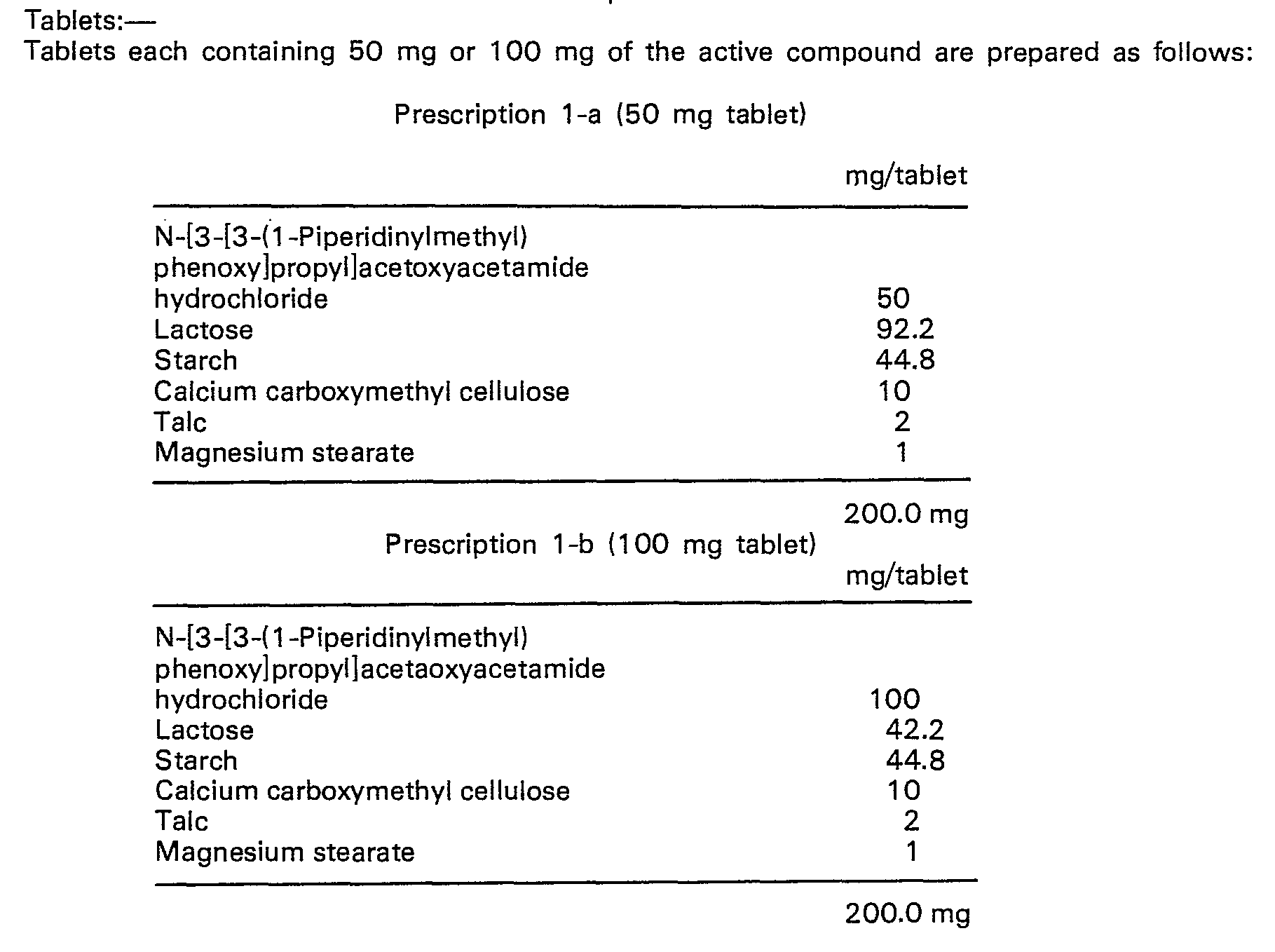
- Crystals N-[3-[3-11-piperidinylmethyl)phenoxy)propyl]acetoxyacetamide hydrochloride are pulverized to less than 70 microns, and lactose and starch are added, followed by thorough mixing. A 10% starch paste was added to the mixed powder, and they were mixed with stirring to prepare granules. After dry granulation, the particle size of the granules was maintained uniform at about 840 microns. Talc and magnesium stearate were mixed with the granules, and tablets were produced from the granules.
-

- N-[3-[3-(1-Piperidinylmethyllphenoxy]propyl]acetoxyacetamide hydrochloride was finely pulverized, and starch, lactose and magnesium stearate was added to the pulverized product. They were mixed well, and the mixture was filled into No. 5 capsules.
Claims (18)


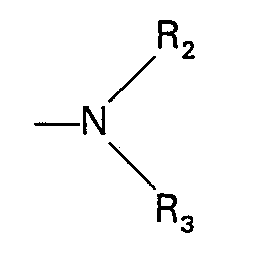


Priority Applications (1)
| Application Number | Priority Date | Filing Date | Title |
|---|---|---|---|
| KE367086A KE3670A (en) | 1979-07-03 | 1986-10-14 | Phenoxypropyl amine derivatives,process for their preparation,and pharmaceutical compositions containing them |
Applications Claiming Priority (4)
| Application Number | Priority Date | Filing Date | Title |
|---|---|---|---|
| JP54083426A JPS609750B2 (en) | 1979-07-03 | 1979-07-03 | Novel N-substituted phenoxypropylamide compounds |
| JP83426/79 | 1979-07-03 | ||
| JP1908880A JPS56115750A (en) | 1980-02-20 | 1980-02-20 | Substituted phenoxypropylamine compound |
| JP19088/80 | 1980-02-20 |
Publications (2)
| Publication Number | Publication Date |
|---|---|
| EP0024510A1 EP0024510A1 (en) | 1981-03-11 |
| EP0024510B1 true EP0024510B1 (en) | 1983-10-19 |
Family
ID=26355891
Family Applications (1)
| Application Number | Title | Priority Date | Filing Date |
|---|---|---|---|
| EP80103742A Expired EP0024510B1 (en) | 1979-07-03 | 1980-07-01 | Phenoxypropyl amine derivatives, process for their preparation, and pharmaceutical compositions containing them |
Country Status (6)
| Country | Link |
|---|---|
| US (1) | US4293557A (en) |
| EP (1) | EP0024510B1 (en) |
| DE (1) | DE3065362D1 (en) |
| HK (1) | HK95386A (en) |
| MY (1) | MY8700563A (en) |
| SG (1) | SG75886G (en) |
Families Citing this family (31)
| Publication number | Priority date | Publication date | Assignee | Title |
|---|---|---|---|---|
| AR228941A1 (en) * | 1978-04-26 | 1983-05-13 | Glaxo Group Ltd | PROCEDURE FOR PREPARING NEW DERIVATIVES OF 3,5-DIAMINO-1,2,4-TRIAZOLE WHICH ARE ACTIVE AGAINST HISTAMINIC RECEPTORS |
| JPS568352A (en) * | 1979-07-03 | 1981-01-28 | Shionogi & Co Ltd | Aminoalkylvenzene derivative |
| GR77847B (en) * | 1981-12-14 | 1984-09-25 | American Home Prod | |
| DE3365869D1 (en) * | 1982-07-30 | 1986-10-09 | Smith Kline French Lab | Amino pyrimidinones and their preparation |
| IL69392A (en) * | 1982-08-13 | 1987-01-30 | Sanofi Sa | N-oxide nicotinamide derivatives,their preparation and pharmaceutical compositions containing them |
| FR2544717B1 (en) * | 1983-04-22 | 1986-03-28 | Sanofi Sa | NICOTINAMIDE L-OXIDE N-SUBSTITUTED, ITS SALTS, PROCESS FOR THEIR PREPARATION AND PHARMACEUTICAL COMPOSITIONS CONTAINING THE SAME |
| FR2531704B1 (en) * | 1982-08-13 | 1985-08-09 | Sanofi Sa | N-SUBSTITUTED AROMATIC ACID (HETERO) AMIDES, THEIR SALTS, PROCESS FOR THEIR PREPARATION AND PHARMACEUTICAL COMPOSITIONS CONTAINING THE SAME |
| US4837316A (en) * | 1985-08-29 | 1989-06-06 | Fujirebio Kabushiki Kaisha | Alkylamide derivatives with H2 -receptor antagonistic and cytoprotective action |
| JPH0639466B2 (en) * | 1987-08-03 | 1994-05-25 | 杏林製薬株式会社 | Urea derivative |
| US4988828A (en) * | 1987-11-27 | 1991-01-29 | Fujirebio Kabushiki Kaisha | Phenoxypropyl derivatives |
| US4874771A (en) * | 1988-09-06 | 1989-10-17 | Ortho Pharmaceutical Corporation | Ethanesulfonamide derivatives |
| US5112866A (en) * | 1988-09-06 | 1992-05-12 | Ortho Pharmaceutical Corporation | Ethanesulfonamide derivatives |
| JPH03148217A (en) * | 1989-11-02 | 1991-06-25 | Terumo Corp | Pheoxypropylamine derivative or salt thereof and antiulcer containing same derivative or salt |
| JPH0692948A (en) * | 1992-03-04 | 1994-04-05 | Snow Brand Milk Prod Co Ltd | Novel acetamide derivative and its use |
| US5294433A (en) * | 1992-04-15 | 1994-03-15 | The Procter & Gamble Company | Use of H-2 antagonists for treatment of gingivitis |
| US5312990A (en) * | 1993-05-28 | 1994-05-17 | Hoechst Celanese Corporation | Di-amino compounds |
| BG61302B1 (en) * | 1993-09-30 | 1997-05-30 | Нихфи Ад | N-/3-/3-/1-piperidineilmethyl/phenoxypropyl hydroxyacetamide 1,2,3-propenetricarboxilate bismuth /3+/ complex and method for its preparation |
| JP2002529503A (en) | 1998-11-17 | 2002-09-10 | ニトロメッド,インク. | Nitrosated and nitrosylated H2 receptor antagonist compounds and compositions and methods of use |
| EP1579862A1 (en) | 2004-03-25 | 2005-09-28 | Boehringer Ingelheim Vetmedica Gmbh | Use of PDE III inhibitors for the reduction of heart size in mammals suffering from heart failure |
| US8980894B2 (en) | 2004-03-25 | 2015-03-17 | Boehringer Ingelheim Vetmedica Gmbh | Use of PDE III inhibitors for the treatment of asymptomatic (occult) heart failure |
| EP1863804A1 (en) * | 2005-04-01 | 2007-12-12 | Methylgene, Inc. | Inhibitors of histone deacetylase |
| EP1920785A1 (en) | 2006-11-07 | 2008-05-14 | Boehringer Ingelheim Vetmedica Gmbh | Liquid preparation comprising a complex of pimobendan and cyclodextrin |
| CN103058958A (en) * | 2011-10-22 | 2013-04-24 | 杭州福斯特药业有限公司 | Synthetic method of roxatidine acetate hydrochloride |
| EP3167876B1 (en) | 2012-03-15 | 2021-09-08 | Boehringer Ingelheim Vetmedica GmbH | Pharmaceutical tablet formulation for the veterinary medical sector, method of production and use thereof |
| DK3021832T3 (en) | 2013-07-19 | 2021-05-25 | Boehringer Ingelheim Vetmedica Gmbh | PRESERVED ETHERIFIED CYCLODEXTRINE DERIVATIVES CONTAINING LIQUID AQUATIC PHARMACEUTICAL COMPOSITION |
| ES2593210T3 (en) | 2013-12-04 | 2016-12-07 | Boehringer Ingelheim Vetmedica Gmbh | Improved pharmaceutical compositions of pimobendan |
| CN104311510A (en) * | 2014-09-18 | 2015-01-28 | 哈药集团三精制药股份有限公司 | Preparation method of key intermediate of roxatidine acetate hydrochloride |
| US10537570B2 (en) | 2016-04-06 | 2020-01-21 | Boehringer Ingelheim Vetmedica Gmbh | Use of pimobendan for the reduction of heart size and/or the delay of onset of clinical symptoms in patients with asymptomatic heart failure due to mitral valve disease |
| CN106883197B (en) * | 2017-02-10 | 2019-01-25 | 哈药集团三精明水药业有限公司 | A kind of hydrochloric acid roxatidine acetate preparation method |
| CN107857743B (en) * | 2017-10-20 | 2020-08-18 | 北京四环制药有限公司 | A kind of method for preparing roxatidine hydrochloride acetate and intermediate |
| EP4196793A1 (en) | 2020-08-11 | 2023-06-21 | Université de Strasbourg | H2 blockers targeting liver macrophages for the prevention and treatment of liver disease and cancer |
Citations (1)
| Publication number | Priority date | Publication date | Assignee | Title |
|---|---|---|---|---|
| EP0023578A1 (en) * | 1979-07-03 | 1981-02-11 | Shionogi & Co., Ltd. | Aminoalkylbenzene derivatives, process for their preparation and pharmaceutical compositions |
Family Cites Families (8)
| Publication number | Priority date | Publication date | Assignee | Title |
|---|---|---|---|---|
| GB1338169A (en) | 1971-03-09 | 1973-11-21 | Smith Kline French Lab | Ureas thioureas and guanidines |
| US3856812A (en) * | 1971-03-15 | 1974-12-24 | Merck Patent Gmbh | Pyrrole phenoxyacetic acid derivatives |
| US3996279A (en) * | 1973-01-02 | 1976-12-07 | Gerot-Pharmazeutika Dr. Walter Otto K.G. | Novel 2-amino methyl-4,6-dihalogenphenol derivatives and methods for the preparation thereof |
| GB1466130A (en) * | 1974-12-06 | 1977-03-02 | Pfizer Ltd | Adamantane derivatives |
| US4134983A (en) * | 1975-03-03 | 1979-01-16 | Merck & Co., Inc. | 3-amino-2-or-propoxyaryl substituted imidazoles |
| GB1565966A (en) * | 1976-08-04 | 1980-04-23 | Allen & Hanburys Ltd | Aminoalkyl furan derivatives |
| IE46886B1 (en) | 1977-05-17 | 1983-10-19 | Allen & Hanburys Ltd | Aminoalkyl-benzene derivatives |
| US4156079A (en) * | 1978-06-19 | 1979-05-22 | E. R. Squibb & Sons, Inc. | Substituted amides having antiinflammatory activity |
-
1980
- 1980-06-30 US US06/164,017 patent/US4293557A/en not_active Expired - Lifetime
- 1980-07-01 EP EP80103742A patent/EP0024510B1/en not_active Expired
- 1980-07-01 DE DE8080103742T patent/DE3065362D1/en not_active Expired
-
1986
- 1986-09-19 SG SG758/86A patent/SG75886G/en unknown
- 1986-12-11 HK HK953/86A patent/HK95386A/en not_active IP Right Cessation
-
1987
- 1987-12-30 MY MY563/87A patent/MY8700563A/en unknown
Patent Citations (1)
| Publication number | Priority date | Publication date | Assignee | Title |
|---|---|---|---|---|
| EP0023578A1 (en) * | 1979-07-03 | 1981-02-11 | Shionogi & Co., Ltd. | Aminoalkylbenzene derivatives, process for their preparation and pharmaceutical compositions |
Also Published As
| Publication number | Publication date |
|---|---|
| MY8700563A (en) | 1987-12-31 |
| US4293557A (en) | 1981-10-06 |
| HK95386A (en) | 1986-12-19 |
| EP0024510A1 (en) | 1981-03-11 |
| SG75886G (en) | 1987-02-27 |
| DE3065362D1 (en) | 1983-11-24 |
Similar Documents
| Publication | Publication Date | Title |
|---|---|---|
| US4293557A (en) | Antiulcer phenoxypropylamine derivatives | |
| US4226878A (en) | Imidazole derivative | |
| AU647068B2 (en) | Substituted 4-phenyl-4-piperidinecarboxamides with both local anaesthetic and analgesic effect as well as processes for their preparation | |
| US4689182A (en) | Benzoic acid and benzoic acid ester derivatives having anti-inflammatory and analgesic activity | |
| US20090088470A1 (en) | Alkyl-, alkenyl- and alkynylcarbamate derivatives, their preparation and their application in therapeutics | |
| EP0146258A2 (en) | Glycerol derivatives | |
| US5318970A (en) | Isoxazole compounds, pharmaceutically acceptable salts thereof and medical uses thereof | |
| GB2127402A (en) | Pharmaceutically active carbostyril derivatives | |
| EP0094586A2 (en) | Glycerol derivatives, process for preparing same and pharmaceutical composition containing same | |
| JPS6193169A (en) | Pyridazinone derivative and its preparation | |
| IE57702B1 (en) | P-oxybenzoic acid derivatives,methods for preparing them and their use for the preparation of medicaments with hypolipemic activity | |
| EP0230020B1 (en) | 1,2,3,4,4a,9b-hexahydro-4a-aminoalkyldibenzofurans, a process for their preparation and their use as medicaments | |
| EP0053434B1 (en) | Compounds and method for treatment or prophylaxis of cardiac disorders | |
| SE452009B (en) | 6-SUBSTITUTED 6H-DIBENSO / B, D / PYRANDY DERIVATIVES, PROCEDURE FOR THEIR PREPARATION AND PHARMACEUTICAL COMPOSITION CONTAINING THESE DERIVATIVES | |
| JPH09328469A (en) | New substituted acetamide compound | |
| AU637670B2 (en) | Piperazine compound, production thereof, and medicinal use thereof | |
| EP1748994B1 (en) | Nitrooxyderivatives of antihypertensive drugs | |
| JPH0148259B2 (en) | ||
| AU610629B2 (en) | Improvements in or relating to leukotriene antagonists | |
| JPH025755B2 (en) | ||
| JPS6148821B2 (en) | ||
| JPH0428695B2 (en) | ||
| EP0133259A2 (en) | Aminoalkyl-substituted benzene derivatives, process for production thereof, and pharmaceutical composition thereof | |
| CA1327200C (en) | Urea derivatives | |
| JPH0140820B2 (en) |
Legal Events
| Date | Code | Title | Description |
|---|---|---|---|
| PUAI | Public reference made under article 153(3) epc to a published international application that has entered the european phase |
Free format text: ORIGINAL CODE: 0009012 |
|
| AK | Designated contracting states |
Designated state(s): DE FR GB IT SE |
|
| 17P | Request for examination filed |
Effective date: 19810716 |
|
| ITF | It: translation for a ep patent filed | ||
| GRAA | (expected) grant |
Free format text: ORIGINAL CODE: 0009210 |
|
| AK | Designated contracting states |
Designated state(s): DE FR GB IT SE |
|
| REF | Corresponds to: |
Ref document number: 3065362 Country of ref document: DE Date of ref document: 19831124 |
|
| ET | Fr: translation filed | ||
| PLBE | No opposition filed within time limit |
Free format text: ORIGINAL CODE: 0009261 |
|
| STAA | Information on the status of an ep patent application or granted ep patent |
Free format text: STATUS: NO OPPOSITION FILED WITHIN TIME LIMIT |
|
| 26N | No opposition filed | ||
| PGFP | Annual fee paid to national office [announced via postgrant information from national office to epo] |
Ref country code: DE Payment date: 19910716 Year of fee payment: 20 |
|
| ITTA | It: last paid annual fee | ||
| MEDD | It: supplementary protection certificate for pharmaceutical products: granted |
Free format text: CCP 251, 19920506; TEIKOKU HORMONE MFG.CO.LTD. |
|
| REG | Reference to a national code |
Ref country code: SE Ref legal event code: SPCF Free format text: 80103742 |
|
| EAL | Se: european patent in force in sweden |
Ref document number: 80103742.5 |
|
| REG | Reference to a national code |
Ref country code: SE Ref legal event code: SPCG Free format text: 9490115, 931230, EXPIRES: 20040821 |
|
| REG | Reference to a national code |
Ref country code: SE Ref legal event code: SPCG Free format text: 9490115, 931230, EXPIRES: 20050701 |
|
| PGFP | Annual fee paid to national office [announced via postgrant information from national office to epo] |
Ref country code: SE Payment date: 19990609 Year of fee payment: 20 |
|
| PGFP | Annual fee paid to national office [announced via postgrant information from national office to epo] |
Ref country code: GB Payment date: 19990630 Year of fee payment: 20 |
|
| PGFP | Annual fee paid to national office [announced via postgrant information from national office to epo] |
Ref country code: FR Payment date: 19990720 Year of fee payment: 20 |
|
| PG25 | Lapsed in a contracting state [announced via postgrant information from national office to epo] |
Ref country code: GB Free format text: LAPSE BECAUSE OF EXPIRATION OF PROTECTION Effective date: 20000630 |
|
| REG | Reference to a national code |
Ref country code: GB Ref legal event code: PE20 Effective date: 20000630 |
|
| PG25 | Lapsed in a contracting state [announced via postgrant information from national office to epo] |
Ref country code: SE Free format text: THE PATENT HAS BEEN ANNULLED BY A DECISION OF A NATIONAL AUTHORITY Effective date: 20000730 |
|
| EUG | Se: european patent has lapsed |
Ref document number: 80103742.5 |