EP0024303B1 - A calculating rule useful for making eyeglasses - Google Patents
A calculating rule useful for making eyeglasses Download PDFInfo
- Publication number
- EP0024303B1 EP0024303B1 EP80104166A EP80104166A EP0024303B1 EP 0024303 B1 EP0024303 B1 EP 0024303B1 EP 80104166 A EP80104166 A EP 80104166A EP 80104166 A EP80104166 A EP 80104166A EP 0024303 B1 EP0024303 B1 EP 0024303B1
- Authority
- EP
- European Patent Office
- Prior art keywords
- scale
- rule
- arrow mark
- distance
- far
- Prior art date
- Legal status (The legal status is an assumption and is not a legal conclusion. Google has not performed a legal analysis and makes no representation as to the accuracy of the status listed.)
- Expired
Links
Images

Classifications
-
- G—PHYSICS
- G06—COMPUTING OR CALCULATING; COUNTING
- G06G—ANALOGUE COMPUTERS
- G06G1/00—Hand-manipulated computing devices
- G06G1/0005—Hand-manipulated computing devices characterised by a specific application
- G06G1/0042—Hand-manipulated computing devices characterised by a specific application for optics, for photography
Definitions
- This invention relates to a calculating rule useful for making eyeglasses meeting the eyes wearing the eyeglasses.
- Making good eyeglasses requires for the maker to master meanings of power of the ametropia, accommodation, near-point, far-point, visual range, and addition, and the relationships thereof, and the calculation for obtaining any value from other values thereof, and to perform the calculation for obtaining a resultant prism-diopter and base-direction from two prisms, each of which is characterized by the respective prism-diopter and base-direction, because heterophoria is ordinally represented by two prisms which have a respective prism-diopter and a respective base-direction, the two base-directions of the two prisms being any pair of orthogonal upward, downward, inward, and outward directions.
- the calculating rule described in this publication comprises a rectangular fixed rule and a rectangular slide rule; the fixed rule having two scales A and D that are apart from each other, the upper scale A being a scale for "accommodation” in dioptric units and the lower scale D being scale for "near-point distance” in centimeter units, and the slide rule that slides between the upper scale A and the lower scale D having a scale B for "power of the ametropia” in dioptric units that is also a scale of "addition” in dioptric units, and a scale C for "far-point distance” in centimeter units, and further, at the left end of the scale C, an arrow mark for indicating the position of "near-point distance” on the scale D.
- This calculating rule enables to master the meanings of power of the ametropia, accommodation, near-point, far-point, visual range,. and addition, and the relationships thereof, and to facilitate the calculation for obtaining any value from other values thereof.
- An object of this invention is to provide an improved calculating rule that can further obtain the addition by which the eyeglasses-wearer can continue his work at the objective working distance with no asthenopia based on accommodation, and simultaneously can obtain the resultant prism-diopter and base-direction of the prism for correcting heterophoria, in addition to the performance of the prior calculating rule.
- a and D are the scales of the fixed rule
- B and C are the scales of the slide rule.
- Scale A is the scale for "accommodation” in dioptric units
- scale D is the scale for "near-point distance” in centimeter units
- objective working distance means the distance from the eyes to the place that the eyeglasses-wearer does the near work actually with no asthenopia based on accommodation.
- Scale B is the scale for "power of the ametropia” in dioptric units, and also “addition” in dioptric units.
- Scale C is the scale for "far-point distance” in centimeter units.
- Scales of A, B, C, and D are graduated as shown in Figure 1. The left half sides of scales A and D are the scales to be used for emmetropia and myopia, and the right half sides of scales A and D are the scales to be used for hyperopia.
- the left half side of scale A is divided into four regions which may be practically discriminated by different colorings, the first region ranges from 0 to 0.50 diopter, the second region ranges from 0.50 to 1.50 diopters, the third region ranges from 1.50 to 2.00 diopters, and the fourth region ranges from 2.00 to 4.00 diopters.
- the slide rule has five arrow marks on the lower edge at the left side of the scale C. Most outside first arrow mark 0 is used for indicating the near-point distance on scale D. Next, first arrow mark (0), the second, third, fourth and fifth arrows marks 1', 2', 3', and 4' are used respectively for indicating the objective working distances in correspondence with the first, second, third, and fourth region on scale A.
- the arrow mark 1' is at the position of 1.2 graduates-distance from arrow mark 0, the arrow mark 2' is at the position of 2.2 graduates-distance from arrow mark 0, the arrow mark 3' is at the position of 2.8 graduates-distance from arrow mark 0, and the arrow mark 4' is at the position of 3.7 graduates-distance from arrow mark 0.
- E is a fixed circular rule
- F is a rotating circular rule.
- Rotating circular rule F is a transparent circular plate which rotates at the axis which is the center of the fixed circular rule E.
- Fixed circular rule E has, on the circle, a counterclockwise angular graduation of 0 to 360, and has a horizontal center-line of 0°-180°, and a vertical center-line of 90°-270°.
- the space of fixed circular rule E is divided into four quadrants, each of which has orthogonal coordinates graduated cross-sectionally 0, 1, 2, 3, 4, 5, 6, 7, 8 from the center 0 toward the circle.
- indications UP, OUT-R-IN, and IN-L-OUT are provided across the vertical center-line 90°-270° on the upper part of the fixed rule.
- UP corresponds to hyper- phoria
- DOWN on the lower part corresponds to hypophoria
- R denotes right eye
- L denotes left eye
- IN corresponds to esophoria
- OUT corresponds to exophoria.
- the far-point distance is indicated as 100 cm of the distance behind the retina on scale C corresponding to 1.00 of scale B
- the near-point distance is indicated as 100 cm of the distance in front of the retina on scale D by the arrow mark 0. If power of the hyperopia is smaller than accommodation, then the far-point appears behind the retina and the near-point appears in front of the retina.
- the arrow mark 0 of the slide rule is stopped at 33 of scale D.
- Power of the ametropia (myopia) is indicated as 1.00 diopter (minus) of scale B corresponding to 100 cm of far-point distance of scale (C).
- Accommodation is indicated as 2.00 diopters corresponding to 1.00 of scale B and 100 of scale C.
- the visual range is 33-100 cm.
- the arrow mark 4 of the slide rule is stopped at 40 cm of scale D or the objective working distance that means the real working distance, because 2.00 of accommodation of scale A belongs to the fourth region, so that the value of scale B corresponding to 2.00 of scale A is read as 1.50 diopters, which is the necessary addition.
- the visual range on 1.50 diopters of addition is 67 cm-29 cm, 67 cm being the far-pont distance on scale C, and 29 cm being the near-point distance on scale D. This means that the eye of 2.00 diopters of accommodation worn by the eyeglasses of 1.50 diopters of addition can do the work at 40 cm of the objective working distance with no asthenopia based on accommodation.
- Degree of heterophoria for distant vision is denoted by units of prism-diopter; one prism-diopter (represented as P 1 ⁇ ) standing for the power of prism that the visual line deviates by 1 cm at the point as much as one meter away from the prism.
- Degree of heterophoria is measured by means of Maddox rod, and is denoted as one or two prisms, each of which has a prism-diopter number and a base at any one direction of four orthogonal directions of upward, downward, inward, and outward.
- the two prism-diopter numbers and two base-directions have to be resulted to one resultant prism-diopter number and one resultant base-direction in order to make the eyeglasses for correcting heterophoria.
- the resultant base-direction is represented by tan -1 y/x
- the resultant prism-diopter number is represented by x 2 +y z , provided x and y are the respective values (prism-diopter, base-direction) of one prism.
- the horizontal prism-diopters are marked at the horizontal center-line of rule E, and then the vertical prism-diopters are marked at the vertical center-line of rule E.
- the cursor line of rule F is coincided at the point consisting of the two marks, so that the value of graduation of the cursor at the point shows the resultant prism-diopters, and the angular degree graduated on the circle of rule E acrossed by the cursor line shows the resultant base-direction.
- Resultant prism-diopters and resultant base-direction of the heterophoric eye consisting of right P 4 ⁇ Base-IN, P 2 ⁇ Base-UP, and left P 4 ⁇ Base-IN, P 2 ⁇ Base-DOWN.
- the first quadrant is used in right eye, because of Base-IN and Base-UP in right eye.
- Cursor line of rule F is stopped at the point (4, 2) of the first quadrant orthogonal - coordinates, because of P 4 ⁇ Base-IN and P 2 Base-UP, so that the scale of cursor line shows, at point (4, 2), 4.5 which is the resultant number of prism-diopters P 4.5 ⁇ , and shows 27° which is the resultant prism base-direction.
- the third quadrant is used in left eye, because of Base-IN and Base-DOWN is left eye.
- Resultant number of prism-diopters P 4.5 ⁇ and resultant prism base-direction 207° are obtained from the cursor line acrossing the point (4, 2) of the third quadrant orthogonal coordinates.
- Cursor line of rule F is stopped at 217°, and then the coordinates of the point 5 of the cursor is read as (4, 3), which shows P 4 ⁇ Base-OUT and P 3 Base-DOWN in right eye, and P 4 ⁇ Base-IN and P 3 Base-DOWN in left eye.
Landscapes
- Physics & Mathematics (AREA)
- Engineering & Computer Science (AREA)
- Theoretical Computer Science (AREA)
- Optics & Photonics (AREA)
- Computer Hardware Design (AREA)
- General Physics & Mathematics (AREA)
- Eyeglasses (AREA)
- Eye Examination Apparatus (AREA)
Description
- This invention relates to a calculating rule useful for making eyeglasses meeting the eyes wearing the eyeglasses.
- Making good eyeglasses requires for the maker to master meanings of power of the ametropia, accommodation, near-point, far-point, visual range, and addition, and the relationships thereof, and the calculation for obtaining any value from other values thereof, and to perform the calculation for obtaining a resultant prism-diopter and base-direction from two prisms, each of which is characterized by the respective prism-diopter and base-direction, because heterophoria is ordinally represented by two prisms which have a respective prism-diopter and a respective base-direction, the two base-directions of the two prisms being any pair of orthogonal upward, downward, inward, and outward directions.
- Mastering said businesses is not so easy for every maker. However, ther has been heretofore no good means for helping master said businesses, except for the calculating rule disclosed by Japanese patent publication No. 7839/1978.
- The calculating rule described in this publication comprises a rectangular fixed rule and a rectangular slide rule; the fixed rule having two scales A and D that are apart from each other, the upper scale A being a scale for "accommodation" in dioptric units and the lower scale D being scale for "near-point distance" in centimeter units, and the slide rule that slides between the upper scale A and the lower scale D having a scale B for "power of the ametropia" in dioptric units that is also a scale of "addition" in dioptric units, and a scale C for "far-point distance" in centimeter units, and further, at the left end of the scale C, an arrow mark for indicating the position of "near-point distance" on the scale D.
- This calculating rule enables to master the meanings of power of the ametropia, accommodation, near-point, far-point, visual range,. and addition, and the relationships thereof, and to facilitate the calculation for obtaining any value from other values thereof.
- An object of this invention is to provide an improved calculating rule that can further obtain the addition by which the eyeglasses-wearer can continue his work at the objective working distance with no asthenopia based on accommodation, and simultaneously can obtain the resultant prism-diopter and base-direction of the prism for correcting heterophoria, in addition to the performance of the prior calculating rule.
- This object is achieved by a calculating rule as claimed.
- According to the calculating rule of this invention,
- (1) Far-point distance and near-point distance can be obtained at once from power of the ametropia and accommodation.
- (2) Addition necessary for doing the near work with no asthenopia based on accommodation can be obtained at once from accommodation and objective working distance.
- (3) Visual range can be obtained at once from accommodation and addition.
- (4) Accommodation, power of the ametropia, visual range and objective working distance can be obtained at once from near-point distance and far-point distance.
- (5) Resultant prism-diopter and base-direction of the prism lens for correcting heterophoria can be obtained at once from the two prisms representing the degree of heterophoria measured by means of Maddox rod. The performances of (2), (4), and (5) are the new ones that the invention of Japanese patent publication No. 7839/1978 could not perform.
- One way of carrying out the invention is described in detail below with reference to drawings which illustrate only one specific embodiment, in which:-
- Figure 1 shows a plan view of the side for ametropia of a calculation rule of this invention.
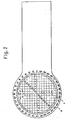
- Figure 2 shows a plan view of the side for heterophoria of a calculation rule of this invention.
- In Figure 1, A and D are the scales of the fixed rule, and B and C are the scales of the slide rule. Scale A is the scale for "accommodation" in dioptric units, and scale D is the scale for "near-point distance" in centimeter units, and is also the scale for "objective working distance". Hence, the objective working distance means the distance from the eyes to the place that the eyeglasses-wearer does the near work actually with no asthenopia based on accommodation.
- Scale B is the scale for "power of the ametropia" in dioptric units, and also "addition" in dioptric units. Scale C is the scale for "far-point distance" in centimeter units. Scales of A, B, C, and D are graduated as shown in Figure 1. The left half sides of scales A and D are the scales to be used for emmetropia and myopia, and the right half sides of scales A and D are the scales to be used for hyperopia.
- The left half side of scale A is divided into four regions which may be practically discriminated by different colorings, the first region ranges from 0 to 0.50 diopter, the second region ranges from 0.50 to 1.50 diopters, the third region ranges from 1.50 to 2.00 diopters, and the fourth region ranges from 2.00 to 4.00 diopters.
- The slide rule has five arrow marks on the lower edge at the left side of the scale C. Most outside first arrow mark 0 is used for indicating the near-point distance on scale D. Next, first arrow mark (0), the second, third, fourth and fifth arrows marks 1', 2', 3', and 4' are used respectively for indicating the objective working distances in correspondence with the first, second, third, and fourth region on scale A. The arrow mark 1' is at the position of 1.2 graduates-distance from arrow mark 0, the arrow mark 2' is at the position of 2.2 graduates-distance from arrow mark 0, the arrow mark 3' is at the position of 2.8 graduates-distance from arrow mark 0, and the arrow mark 4' is at the position of 3.7 graduates-distance from arrow mark 0.
- In Figure 2, E is a fixed circular rule, and F is a rotating circular rule. Rotating circular rule F is a transparent circular plate which rotates at the axis which is the center of the fixed circular rule E. Fixed circular rule E has, on the circle, a counterclockwise angular graduation of 0 to 360, and has a horizontal center-line of 0°-180°, and a vertical center-line of 90°-270°. The space of fixed circular rule E is divided into four quadrants, each of which has orthogonal coordinates graduated cross-sectionally 0, 1, 2, 3, 4, 5, 6, 7, 8 from the center 0 toward the circle. As shown in Figure 2, indications UP, OUT-R-IN, and IN-L-OUT are provided across the vertical center-
line 90°-270° on the upper part of the fixed rule. UP corresponds to hyper- phoria, and DOWN on the lower part corresponds to hypophoria. R denotes right eye, and L denotes left eye. IN corresponds to esophoria, and OUT corresponds to exophoria. - Examples using the rule for ametropia are illustrated as follows:
- If 0 of scale B is stopped at left 2.00 of scale A, the the far-point distance is indicated on scale C as oo cm corresponding to 0 of scale B and the near-point distance is indicated by arrow mark 0 on scale D as 50 cm.
- If 1.00 of scale B is stopped at right 2.00 of scale A, then the far-point distance is indicated as 100 cm of the distance behind the retina on scale C corresponding to 1.00 of scale B, and the near-point distance is indicated as 100 cm of the distance in front of the retina on scale D by the arrow mark 0. If power of the hyperopia is smaller than accommodation, then the far-point appears behind the retina and the near-point appears in front of the retina.
- If 3.00 of scale B is stopped at right 2.00 of scale A, then the far-point distance is indicated as 33 cm of the distance behind the retina on scale C, and the near-point distance is indicated as 100 cm of the distance behind the retina on scale D by near-point arrow mark 0. When power of the hyperopia is larger than accommodation, then both far-point and near-point appear behind the retina.
- If 1.00 of scale B is stopped at left 2.00 of scale A, then the far-point distance is indicated as 100 cm on scale C, and the near-point distance is indicated as 33 cm on scale D by arrow mark 0.
- Arrow mark 2' on the slide rule is stopped at 40 of scale D because 1.00 diopter of scale A is in the second region 0.50-1.50, so that arrow mark 2' is employed. The necessary addition is indicated as 2.00 diopters of scale B corresponding to 1.00 diopter of scale A. Summation of addition and power of the ametropia is the correct-power for doing the near work.
- The arrow mark 0 of the slide rule is stopped at 33 of scale D. Power of the ametropia (myopia) is indicated as 1.00 diopter (minus) of scale B corresponding to 100 cm of far-point distance of scale (C). Accommodation is indicated as 2.00 diopters corresponding to 1.00 of scale B and 100 of scale C. The visual range is 33-100 cm. In this case, the
arrow mark 4 of the slide rule is stopped at 40 cm of scale D or the objective working distance that means the real working distance, because 2.00 of accommodation of scale A belongs to the fourth region, so that the value of scale B corresponding to 2.00 of scale A is read as 1.50 diopters, which is the necessary addition. The visual range on 1.50 diopters of addition is 67 cm-29 cm, 67 cm being the far-pont distance on scale C, and 29 cm being the near-point distance on scale D. This means that the eye of 2.00 diopters of accommodation worn by the eyeglasses of 1.50 diopters of addition can do the work at 40 cm of the objective working distance with no asthenopia based on accommodation. - Degree of heterophoria for distant vision is denoted by units of prism-diopter; one prism-diopter (represented as P1 Δ) standing for the power of prism that the visual line deviates by 1 cm at the point as much as one meter away from the prism. Degree of heterophoria is measured by means of Maddox rod, and is denoted as one or two prisms, each of which has a prism-diopter number and a base at any one direction of four orthogonal directions of upward, downward, inward, and outward. The two prism-diopter numbers and two base-directions have to be resulted to one resultant prism-diopter number and one resultant base-direction in order to make the eyeglasses for correcting heterophoria. The resultant base-direction is represented by tan-1 y/x, and the resultant prism-diopter number is represented by x2+yz, provided x and y are the respective values (prism-diopter, base-direction) of one prism.
- The resultant prism-diopters and resultant base-direction are obtained as follows:
- When the horizontal prism is Base-IN in right eye and Base-OUT in left eye, the right half of rule E is used. When the horizontal prism is Base-OUT in right eye and Base-IN in left eye, the left half of rule E is used. When the vertical prism is Base-UP, the upward half of rule E is used. When the vertical prism is Base-DOWN, the downward half of rule E is used.
- The horizontal prism-diopters are marked at the horizontal center-line of rule E, and then the vertical prism-diopters are marked at the vertical center-line of rule E. The cursor line of rule F is coincided at the point consisting of the two marks, so that the value of graduation of the cursor at the point shows the resultant prism-diopters, and the angular degree graduated on the circle of rule E acrossed by the cursor line shows the resultant base-direction.
- The first quadrant is used in right eye, because of Base-IN and Base-UP in right eye. Cursor line of rule F is stopped at the point (4, 2) of the first quadrant orthogonal - coordinates, because of P4 Δ Base-IN and P 2 Base-UP, so that the scale of cursor line shows, at point (4, 2), 4.5 which is the resultant number of prism-diopters P4.5Δ, and shows 27° which is the resultant prism base-direction.
- The third quadrant is used in left eye, because of Base-IN and Base-DOWN is left eye. Resultant number of prism-diopters P4.5Δ and resultant prism base-direction 207° are obtained from the cursor line acrossing the point (4, 2) of the third quadrant orthogonal coordinates.
- Cursor line of rule F is stopped at 217°, and then the coordinates of the
point 5 of the cursor is read as (4, 3), which shows P4Δ Base-OUT and P 3 Base-DOWN in right eye, and P4 Δ Base-IN and P 3 Base-DOWN in left eye.
Claims (1)
- A calculating rule useful for making eyeglasses which comprises a rule (Fig. 7) for ametropia consisting of a rectangular fixed rule and a rectangular slide rule; the fixed rule having an upper scale (a) and a lower scale (D) that are apart from each other, the upper scale (A) being the scale for accommodation in dioptric units and the lower scale (D) being the scale for near-point distance in centimeter units; the upper scale (A) consisting of a left half scale used for the calculation in the case of both ametropia and myopia and a right half scale used for the calculation in the case of hyperopia, each half scale graduated from the center at 0 to each end at 4.00 and the lower scale (D) consisting of a left half scale which is used for ametropia and myopia and represents the distance values behind the retina, and a right half scale which is used for hyperopia and represents the distance values before the retina; the slide rule that slides between the upper scale (A) and the lower scale (D) of the fixed rule having a scale (B) for power of the ametropia in dioptric units that is also the scale for addition in dioptric units, and a scale (C) for far-point distance in centimeter units, the scale (B) for power of the ametropia and for addition graduated from 0 at the left end to 8.00 at the right end, and the scale (C) for far-point distance graduated from 12.5 at the right end to infinity (oo) at the left end; the slide rule also having, at the left end of both said scales (B, C) respectively for power of the ametropia and for addition and for far-point distance, a first arrow mark (0) for designating the near-point distance on the lower scale (D), characterised in that the rule (Fig. 1) for ametropia further has indicia on the scale (A) for accommodation dividing the left half of this scale (A) into four regions (1), (2), (3), (4), and second (1'), third (2'), fourth (3') and fifth (4') arrow marks disposed to the right of said first arrow mark (0) on scale (C) for far-point distance, corresponding to said four regions (1), (2), (3), (4) each of which designates a respective objective working distance in centimeter units on the lower scale (D) standing for the distance at which the eye having a value of accommodation in a definite region has to see and can continue to see with no asthenopia based on accommodation; wherein said four regions (1), (2), (3), (4) of the left half of the upper scale (A) comprise a first region (1) ranging from 0 to 0.50, a second region (2) ranging from 0.50-1.50, a third region (3) ranging from 1.50 to 2.00, and a fourth region (4) ranging from 2.00 to 4.00, wherein said arrow marks (1', 2', 3', 4') designating objective working distances on the lower scale (D) consist of second arrow mark (1') corresponding to the first region (1), third arrow mark (2') corresponding to the second region (2), fourth arrow mark (3') corresponding to the third region (3), and fifth arrow mark (4') corresponding to the fourth region (4), and wherein second arrow mark (1') is located on scale (C) for far-point distance at 1.2 graduates-distance (0.3 d) from first arrow mark (0), third arrow mark (2') is located on scale (C) for far-point distance at 2.2 graduates-distance (0.55 d) from first arrow mark (0), fourth arrow mark (3') is located on scale (C) for far-point distance at 2.8 graduates-distance (0.7 d) from first arrow mark (0), and fifth arrow mark (4') is located on scale (C) for far-point distance at 3.7 graduates-distance (0.925 d) from first arrow mark (0); and in that said calculating rule further comprises a rule (Fig. 2) for heterophoria consisting of a fixed circular rule (E) and a rotating circular rule (F); the fixed circular rule (E) having a counterclockwise circular scale representing resultant prism base-directions graduated from zero to 360°, in which a horizontal center-line is defined by 0°-180° and a vertical center-line is defined by 90°-270°, and a circular space which is divided by said horizontal center-line and said vertical center-line into four quadrants, each of which is cross-sectionally graduated in orthogonal coordinates representing prism diopter numbers, and labeled UP for the upward first and second quadrants, DOWN for the downward third and fourth quadrants, and further labeled by OUT-R-IN and IN-L-OUT signs which span the vertical center-line, in which R represents right eye, L represents left eye, OUT represents outward (ear-side) and IN represents inward (nose-side); and the rotating circular scale (F2 is a transparent circular plate rotating at the axis that is the centre of the fixed circular rule (E), which has a cursor that is a straight center-line graduated from the center in both directions with the same prism-diopter numbers graduation as the orthogonal coordinates of the fixed circular scale (E).
Applications Claiming Priority (2)
| Application Number | Priority Date | Filing Date | Title |
|---|---|---|---|
| JP1979101444U JPS579866Y2 (en) | 1979-07-23 | 1979-07-23 | |
| JP101444/79U | 1979-07-23 |
Publications (2)
| Publication Number | Publication Date |
|---|---|
| EP0024303A1 EP0024303A1 (en) | 1981-03-04 |
| EP0024303B1 true EP0024303B1 (en) | 1984-12-05 |
Family
ID=14300853
Family Applications (1)
| Application Number | Title | Priority Date | Filing Date |
|---|---|---|---|
| EP80104166A Expired EP0024303B1 (en) | 1979-07-23 | 1980-07-16 | A calculating rule useful for making eyeglasses |
Country Status (7)
| Country | Link |
|---|---|
| US (1) | US4350877A (en) |
| EP (1) | EP0024303B1 (en) |
| JP (1) | JPS579866Y2 (en) |
| AU (1) | AU531926B2 (en) |
| BR (1) | BR8004559A (en) |
| CA (1) | CA1141351A (en) |
| DE (1) | DE3069752D1 (en) |
Families Citing this family (2)
| Publication number | Priority date | Publication date | Assignee | Title |
|---|---|---|---|---|
| US5310995A (en) * | 1992-08-26 | 1994-05-10 | Znr Concept, Inc. | Stairway calculator |
| US5691523A (en) * | 1996-12-03 | 1997-11-25 | Align-It Corporation | Machinery shaft alignment calculator |
Family Cites Families (6)
| Publication number | Priority date | Publication date | Assignee | Title |
|---|---|---|---|---|
| US2193280A (en) * | 1937-12-04 | 1940-03-12 | Gunning Joseph Henry | Mechanical computing device |
| US3377706A (en) * | 1965-10-08 | 1968-04-16 | Charles D. Shrader | Combined computer and plotter for aeronautical, nautical and similar uses |
| US3690547A (en) * | 1971-10-06 | 1972-09-12 | Dollond Aitchison Service | Calculating device |
| JPS5150791A (en) * | 1974-10-28 | 1976-05-04 | Hoya Lens Co Ltd | MEGANECHOSEIYOKEISANJAKU |
| FR2330365A1 (en) * | 1975-06-26 | 1977-06-03 | Vergo | DEVICE FOR DETERMINING THE CONSTRUCTION ANGLE OF CONTACT LENSES FOR ASTIGMATES |
| IT1066709B (en) * | 1975-09-04 | 1985-03-12 | Mecadis | IMPROVEMENT IN THE CALCULATOR RULES IN PARTICULAR FOR CALCULITRIGONOMETRICI |
-
1979
- 1979-07-23 JP JP1979101444U patent/JPS579866Y2/ja not_active Expired
-
1980
- 1980-07-08 CA CA000355718A patent/CA1141351A/en not_active Expired
- 1980-07-16 EP EP80104166A patent/EP0024303B1/en not_active Expired
- 1980-07-16 DE DE8080104166T patent/DE3069752D1/en not_active Expired
- 1980-07-18 US US06/170,252 patent/US4350877A/en not_active Expired - Lifetime
- 1980-07-22 AU AU60680/80A patent/AU531926B2/en not_active Ceased
- 1980-07-22 BR BR8004559A patent/BR8004559A/en unknown
Also Published As
| Publication number | Publication date |
|---|---|
| JPS579866Y2 (en) | 1982-02-25 |
| DE3069752D1 (en) | 1985-01-17 |
| JPS5618916U (en) | 1981-02-19 |
| EP0024303A1 (en) | 1981-03-04 |
| AU531926B2 (en) | 1983-09-08 |
| BR8004559A (en) | 1981-02-03 |
| AU6068080A (en) | 1981-01-29 |
| CA1141351A (en) | 1983-02-15 |
| US4350877A (en) | 1982-09-21 |
Similar Documents
| Publication | Publication Date | Title |
|---|---|---|
| Drasdo et al. | Non-linear projection of the retinal image in a wide-angle schematic eye | |
| US20160306191A1 (en) | Method For Providing To A Wearer A Customized Progressive Spectacle Ophthalmic Lens | |
| US2442849A (en) | Ophthalmic lens | |
| Bennett et al. | What radius does the conventional keratometer measure? | |
| US20030076479A1 (en) | Method for evaluating binocular performance of spectacle lenses, method for displaying binocular performance, and apparatus therefore | |
| US3740857A (en) | Lens blank and frame coordinator and method of using same | |
| US4350877A (en) | Calculating rule useful for making eyeglasses | |
| US4454409A (en) | Bra-size calculator | |
| US5120124A (en) | Devices for determining the crossed cylinder powers and axes for multiple lens sets | |
| US4190331A (en) | Ophthalmic measuring instrument with angle measuring means | |
| Barsky et al. | Gaussian power with cylinder vector field representation for corneal topography maps | |
| Morgan Jr | The Turville infinity binocular balance test | |
| US2266797A (en) | Eye testing instrument | |
| US2136735A (en) | Visualizing dioptermeter | |
| US1588559A (en) | Ophthalmic lens | |
| US7207674B2 (en) | Ophthalmic lens | |
| US2853919A (en) | Method of testing eyes | |
| JPS5947286B2 (en) | Slide rule for preparing oblique glasses | |
| US2696757A (en) | System of lenses for equal magnification | |
| US11474379B2 (en) | Method and apparatus for determining decentration of ophthalmic lenses | |
| Hardy | Clinical use of ophthalmic prisms (metric) | |
| US1659197A (en) | Ophthalmic lens | |
| US2643575A (en) | Alignment target for testing eyes | |
| Royston et al. | An analysis of three meridional keratometric measurement of the anterior corneal surface | |
| Zinnecker et al. | An investigation of the factors affecting the field of fixation through multifocal lenses |
Legal Events
| Date | Code | Title | Description |
|---|---|---|---|
| PUAI | Public reference made under article 153(3) epc to a published international application that has entered the european phase |
Free format text: ORIGINAL CODE: 0009012 |
|
| AK | Designated contracting states |
Designated state(s): DE FR GB IT SE |
|
| 17P | Request for examination filed |
Effective date: 19810220 |
|
| ITF | It: translation for a ep patent filed | ||
| GRAA | (expected) grant |
Free format text: ORIGINAL CODE: 0009210 |
|
| AK | Designated contracting states |
Designated state(s): DE FR GB IT SE |
|
| REF | Corresponds to: |
Ref document number: 3069752 Country of ref document: DE Date of ref document: 19850117 |
|
| ET | Fr: translation filed | ||
| PLBE | No opposition filed within time limit |
Free format text: ORIGINAL CODE: 0009261 |
|
| STAA | Information on the status of an ep patent application or granted ep patent |
Free format text: STATUS: NO OPPOSITION FILED WITHIN TIME LIMIT |
|
| 26N | No opposition filed | ||
| PG25 | Lapsed in a contracting state [announced via postgrant information from national office to epo] |
Ref country code: GB Effective date: 19880716 |
|
| PG25 | Lapsed in a contracting state [announced via postgrant information from national office to epo] |
Ref country code: SE Effective date: 19880717 |
|
| GBPC | Gb: european patent ceased through non-payment of renewal fee | ||
| PG25 | Lapsed in a contracting state [announced via postgrant information from national office to epo] |
Ref country code: FR Free format text: LAPSE BECAUSE OF NON-PAYMENT OF DUE FEES Effective date: 19890331 |
|
| PG25 | Lapsed in a contracting state [announced via postgrant information from national office to epo] |
Ref country code: DE Effective date: 19890401 |
|
| REG | Reference to a national code |
Ref country code: FR Ref legal event code: ST |
|
| ITTA | It: last paid annual fee | ||
| PGFP | Annual fee paid to national office [announced via postgrant information from national office to epo] |
Ref country code: FR Payment date: 19891110 Year of fee payment: 8 |
|
| EUG | Se: european patent has lapsed |
Ref document number: 80104166.6 Effective date: 19890510 |