EP0024202B1 - 2,3,4,5,6-penta-o-acetyl-d-gluconyl isothiocyanate for use in preventing and treating cancer - Google Patents
2,3,4,5,6-penta-o-acetyl-d-gluconyl isothiocyanate for use in preventing and treating cancer Download PDFInfo
- Publication number
- EP0024202B1 EP0024202B1 EP80302800A EP80302800A EP0024202B1 EP 0024202 B1 EP0024202 B1 EP 0024202B1 EP 80302800 A EP80302800 A EP 80302800A EP 80302800 A EP80302800 A EP 80302800A EP 0024202 B1 EP0024202 B1 EP 0024202B1
- Authority
- EP
- European Patent Office
- Prior art keywords
- cancer
- gitc
- isothiocyanate
- acetyl
- gluconyl
- Prior art date
- Legal status (The legal status is an assumption and is not a legal conclusion. Google has not performed a legal analysis and makes no representation as to the accuracy of the status listed.)
- Expired
Links
Classifications
-
- C—CHEMISTRY; METALLURGY
- C07—ORGANIC CHEMISTRY
- C07C—ACYCLIC OR CARBOCYCLIC COMPOUNDS
- C07C331/00—Derivatives of thiocyanic acid or of isothiocyanic acid
- C07C331/16—Isothiocyanates
- C07C331/32—Isothiocyanates having isothiocyanate groups acylated
-
- A—HUMAN NECESSITIES
- A61—MEDICAL OR VETERINARY SCIENCE; HYGIENE
- A61K—PREPARATIONS FOR MEDICAL, DENTAL OR TOILETRY PURPOSES
- A61K31/00—Medicinal preparations containing organic active ingredients
- A61K31/21—Esters, e.g. nitroglycerine, selenocyanates
- A61K31/26—Cyanate or isocyanate esters; Thiocyanate or isothiocyanate esters
-
- A—HUMAN NECESSITIES
- A61—MEDICAL OR VETERINARY SCIENCE; HYGIENE
- A61P—SPECIFIC THERAPEUTIC ACTIVITY OF CHEMICAL COMPOUNDS OR MEDICINAL PREPARATIONS
- A61P35/00—Antineoplastic agents
Definitions
- This invention relates to a compound for preventing and treating cancer, and to a composition containing the same as an active component.
- GITC 2,3,4,5,6-penta-0-acetyl-D-gluconyl isothiocyanate
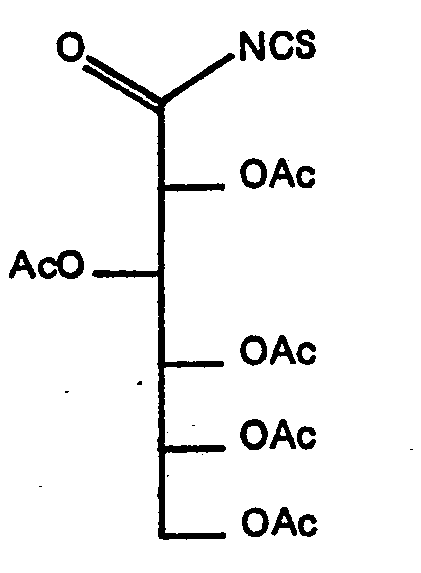
- This invention therefore, provides 2,3,4,5,6-Penta-0-acetyl-D-gluconyl isothiocyanate having the structural formula: for use in preventing and treating cancer.
- This invention also provides a pharmaceutical composition for use in preventing and treating cancer, comprising, as an active component, 2,3,4,5,6-penta-O-acetyl-D-gluconyl isothiocyanate having the structural formula: and a pharmaceutically acceptable carrier.
- 2,3,4,5,6-penta-O-acetyl-D-gluconyl isothiocyanate used in this invention can be produced, for example, by a method which comprises dissolving 2,3,4,5,6-penta-O-acetyl-D-gluconyl chloride in anhydrous xylene, adding silver thiocyanate thereto, and heating the resulting mixture with stirring, as described, for example, in Japanese Patent Application (OPI) No. 105123/77 (the term "OPI" as used herein refers to a "published unexamined Japanese patent application"). The compound produced in this manner is described in the above-mentioned Japanese Patent Application (OPI) No. 105123/77
- GITC has never before been proposed to use the substance for the prevention and treatment of cancer.
- GITC may be administered orally or non-orally and it can be used alone or in combination with other materials, such as extenders. It is preferred that it be used in the form of a capsule, a tablet, a powder, a granule, a vial or an ampoule.
- the dose may vary depending, inter alia, upon the conditions to be treated, the compound used, and the response to the medication, but the daily dose for human adults (average body weight: about 60 kg) usually ranges from about 0.5 g to 1 g in single or multiple dose.
- the GITC compound of this invention is uniquely useful for the prevention and treatment of cancer, as will hereinafter be explained in detail by reference to experiments.
- Example 1 is provided to illustrate in greater detail that the GITC compound of this invention is useful for the treatment of cancer.
- the Himedaka used was one-year-old, each group comprises fifty Himedaka, and the average length and weight thereof were respectively 28 mm and 250 mg.
- the amount of the feed administered is about 800 mg/day per one group being comprised of the fifty Himedaka.
- the GITC compound of the present invention has an excellent cancer treating effect as compared with 5-FU as a conventional cancer treating medicine.
- each group being comprised of fifty Himedaka were raised by administering a feed (CE-2) containing 500 ppm of GITC in the amount of about 800 mg/day per one group of the fifty Himedaka for a long period of time of 10 to 24 weeks.
- the results are shown in Group III (GITC Zone) of Table 2 above. From the results, no adverse effects were observed on the Himedaka. It has thus been found that GITC of this invention has almost no toxicity or markedly low toxicity. Further, it can be seen that GITC compound of the present invention has no toxicity even at 5 times dose of 5-FU as the conventional carcinostatic substance.
- GITC of this invention greatly inhibits the formation of cancer and an excellent effect of treating cancer.
- the GITC of this invention is not only effective for the treatment of cancer of Himedaka, but also has a similar effect for treatment of cancer of mammals generally such as mice and rats.
- This effect can be obtained by 2,3,4,5,6-penta-0-acetyl-D-gluconyl isothiocyanate; similar compounds, such as 2,3,5-tri-O-benzoyl- ⁇ -D-ribofuranoyl isothiocyanate and 2,3,4,6-tetra-0-acetyl-A-D-glucopyranozoyl isothiocyanate, seem to have less effect of treating cancer.
- the medicine of this invention has unique cancer treating effects which are not obtained by using other similar compounds, is sufficiently effective to be administered in relatively small amounts, as compared to most conventional cancer treating medicines, and has almost no toxicity.
- the medicine of this invention is very suitable for the treatment of cancer.
- mice ICR 9, 6-weeks-old were divided into each group being comprised of three mice.
- a low toxic amount (required to cause carcinogenesis as shown in Table 3) of a carcinogenic substance, 2-fluorenyl acetamide (hereinafter referred to as "2-FAA") was added to a feed (CF-2 produced by Japan CLEA) in combination with GITC or the similar compounds 2,3,5-tri-O-benzoyl-A-D-ribofuranoyl isothiocyanate (hereinafter referred to as "4423”) and 2,3,4,6-tetra-O-acetyl- ⁇ -D-glucopyranozoyt isothiocyanate (hereinafter referred to as "3886”), and the thus-prepared feed was orally administered to each mouse in the average amount of about 5 g/one mouse/day.
- 2-FAA 2-fluorenyl acetamide
- the amount (wt96) of each of 2-FAA, 4423, 3886 and GITC contained in the prepared feed is shown in Table 3.
- the amount of the prepared feed supplied to the mice may vary depending upon the weight of mouse. Therefore, the dose of each substance may vary depending upon the weight of mouse.
- the liver disease found in the mice was observed as shown in Table 3.
- GITC medicine according to this invention was continuously administered for 2 weeks in an amount of about 100 mg per killogram of the weight of the mouse via the feed (CE-2) containing 0.05% GITC.
- the amount of the feed containing GITC vary depending upon the weight of the experimental animal, i.e., mouse. No mice died and no change in liver cells was observed as a result. From the results as shown in Group M-III of Table 3, no adverse effects were observed on the mice. It has thus been found that GITC of this invention has almost no toxicity or markedly low toxicity.
- Rats SD type ⁇ , 5-weeks-old were divided into each group being comprised of twelve rats.
- 3'-Methyl-4-dimethylaminoazobenzene (hereinafter referred to as "3'MeDAB") as a carcinogenic substance was added to a feed (CE-2) alone or in combination with GITC, and the thus-prepared feed was orally administered to rats for 23 weeks under the condition as shown in Table 4.
- the CE-2 produced by Japan CLEA was used as a feed supplied to the rats.
- 3'MeDAB and GITC were mixed in the amount of 0.06 wt% and 0.05 wt% in the feed, respectively.
- the average amount of the feed administered to the each rat is about 15 g/one rat/day. However, the administration amount of the prepared feed may vary depending upon the weight of the rat.
- Table 5 The results are shown in Table 5 below. From the results of Table 5, it is thus confirmed that the GITC compound of this invention has the superior cancer preventing and
Landscapes
- Health & Medical Sciences (AREA)
- Chemical & Material Sciences (AREA)
- Organic Chemistry (AREA)
- Veterinary Medicine (AREA)
- General Health & Medical Sciences (AREA)
- Medicinal Chemistry (AREA)
- Public Health (AREA)
- Pharmacology & Pharmacy (AREA)
- Life Sciences & Earth Sciences (AREA)
- Animal Behavior & Ethology (AREA)
- Emergency Medicine (AREA)
- Epidemiology (AREA)
- General Chemical & Material Sciences (AREA)
- Nuclear Medicine, Radiotherapy & Molecular Imaging (AREA)
- Chemical Kinetics & Catalysis (AREA)
- Pharmaceuticals Containing Other Organic And Inorganic Compounds (AREA)
- Acyclic And Carbocyclic Compounds In Medicinal Compositions (AREA)
- Saccharide Compounds (AREA)
Description
- This invention relates to a compound for preventing and treating cancer, and to a composition containing the same as an active component.
- A number of chemical and biochemical medicines for treatment of cancer have hitherto been reported. Many conventional medicines, however, are of limited value, in that the effectiveness in treating the cancer is poor, the toxicity is high, and/or it is necessary to administer large doses, thus, various problems have arisen in making practical use of such medicines.
- It has therefore been the subject of a long and continuing search by those engaged in this field to develop cancer preventing and treating medicines which are free from the above-described problems of the prior art medicines, that is, medicines which exhibit lower toxicity and high effectiveness even when used in small dosages.
- It has now been found according to this invention, that 2,3,4,5,6-penta-0-acetyl-D-gluconyl isothiocyanate (hereinafter referred to as "GITC") significantly inhibits the growth of cancer.
- This invention, therefore, provides 2,3,4,5,6-Penta-0-acetyl-D-gluconyl isothiocyanate having the structural formula:

- This invention also provides a pharmaceutical composition for use in preventing and treating cancer, comprising, as an active component, 2,3,4,5,6-penta-O-acetyl-D-gluconyl isothiocyanate having the structural formula:

- 2,3,4,5,6-penta-O-acetyl-D-gluconyl isothiocyanate used in this invention can be produced, for example, by a method which comprises dissolving 2,3,4,5,6-penta-O-acetyl-D-gluconyl chloride in anhydrous xylene, adding silver thiocyanate thereto, and heating the resulting mixture with stirring, as described, for example, in Japanese Patent Application (OPI) No. 105123/77 (the term "OPI" as used herein refers to a "published unexamined Japanese patent application"). The compound produced in this manner is described in the above-mentioned Japanese Patent Application (OPI) No. 105123/77
- as being in needle crystal form, and as having a melting point of 132°C to 135°C, and the following structural formula:

- Although thus having been described, GITC has never before been proposed to use the substance for the prevention and treatment of cancer.
- GITC may be administered orally or non-orally and it can be used alone or in combination with other materials, such as extenders. It is preferred that it be used in the form of a capsule, a tablet, a powder, a granule, a vial or an ampoule. The dose may vary depending, inter alia, upon the conditions to be treated, the compound used, and the response to the medication, but the daily dose for human adults (average body weight: about 60 kg) usually ranges from about 0.5 g to 1 g in single or multiple dose.
- The GITC compound of this invention is uniquely useful for the prevention and treatment of cancer, as will hereinafter be explained in detail by reference to experiments.
- The following Example 1 is provided to illustrate in greater detail that the GITC compound of this invention is useful for the treatment of cancer.
- In this experiment, cancer was produced in Himedaka (small aquarium fish: Oryzias latipes) by use of a diethyl nitrosamine (hereinafter referred to as "DENA") solution as reported by Ishikawa et al., and the treatment effect was tested.
- It is disclosed in Journal of the National Cancer Institute 55, 909-916 (1975), 59, 1747-1749 (1977) and 60(1 11-18 (1978) that when Himedaka is raised in a solution having a concentration of DENA of 15 to 135 ppm, it suffers from a liver tumor and that Himedaka is highly sensitive to carcinogenic substances. Further, in IARC SCIENTIFIC PUBLICATION, No. 16, pp. 271 to 286 (1977), it is disclosed that the experiment using piscine liver tumors can contribute to a study of the treatment of cancer.
- According to studies conducted in this invention, when Himedaka is raised in a DENA aqueous solution having a concentration of 100 ppm for 4 weeks, a liver tumor is produced therein; many hypertrophic nodules of liver cell are first formed, and with the lapse of time of about 10 to 24 weeks, some of them develop into an adenoma or carcinoma.
- Based upon the above findings, Himedaka was used for examining the carcinostatic or anti-cancer effect of GITC and the experiments were carried out under the conditions as illustrated in Table 1.
- Further, in order to compare the GITC compound of this invention with the 5-fluorouracil (hereinafter referred to as "5-FU") as a conventional carcinostatic substance, the experiments using 5-FU were carried out as Groups V and VI.

- The Himedaka used was one-year-old, each group comprises fifty Himedaka, and the average length and weight thereof were respectively 28 mm and 250 mg. The amount of the feed administered is about 800 mg/day per one group being comprised of the fifty Himedaka.
- After 4 and 10 weeks from the start of the experiment under the above-described conditions, part of the samples were removed and analyzed, and after 24 weeks the remaining samples were analyzed. The samples were killed and then fixed with a Bouins solution (a mixture of 15 ml of saturated aqueous solution of picric acid, 1 ml of glacial acetic acid and 5 ml of formalin), embeded in paraffin, sectioned at 5 µ in thickness, stained with hematoxylin and eosine, and morphological changes of the liver were examined with a microscope. The results are shown in Table 2.

- As can be seen from Table 2, in Groups I and III wherein no DENA solution was used, no liver cell nodule and, of course, no tumors were observed after 10 and 24 weeks. On the other hand, for those of Group II which were raised in the DENA solution for 4 weeks, the liver cell nodule began to be observed in liver, and after 10 weeks no normal livers were observed, the nodule ratio of the liver cells was 62.5% and the tumor ratio (that is, the number of samples exhibiting either adenoma or carcinoma, as a percentage of the total number of samples) was 37.5% (adenoma 25%, carcinoma 12.5%). After 24 weeks, the tumor ratio increased to 46.2%.
- In the case of Group IV, wherein Himedaka were raised in the DENA solution for 4 weeks and after 2 weeks, a feed containing 500 ppm of GITC was provided thereto, the formation of cancer was retarded. Even after 10 weeks, the normal cell was observed at a proportion of 70%, and the nodule ratio and the tumor ratio of the liver cells were, respectively, 20.8% and 9.2%. After 24 weeks, the normal liver constituted 28.6% of the total, and the nodule ratio and the tumor ratio of the liver cells were, respectively 50.4% and 19.0%.
- By comparing the results of Group IV with those of Group II, wherein GITC of this invention was not used, it can be seen that GITC markedly reduces the formation of cancer and has an excellent effect of treating cancer.
- Further, in comparing the results of Groups III and IV with those of Groups V and VI, it can be seen that the GITC compound of the present invention has an excellent cancer treating effect as compared with 5-FU as a conventional cancer treating medicine.
- In Group III of Example 1, in order to examine the toxicity of GITC of this invention, each group being comprised of fifty Himedaka were raised by administering a feed (CE-2) containing 500 ppm of GITC in the amount of about 800 mg/day per one group of the fifty Himedaka for a long period of time of 10 to 24 weeks. The results are shown in Group III (GITC Zone) of Table 2 above. From the results, no adverse effects were observed on the Himedaka. It has thus been found that GITC of this invention has almost no toxicity or markedly low toxicity. Further, it can be seen that GITC compound of the present invention has no toxicity even at 5 times dose of 5-FU as the conventional carcinostatic substance.
- As is apparent from the above explanation, it has been found that GITC of this invention greatly inhibits the formation of cancer and an excellent effect of treating cancer.
- The GITC of this invention is not only effective for the treatment of cancer of Himedaka, but also has a similar effect for treatment of cancer of mammals generally such as mice and rats. This effect can be obtained by 2,3,4,5,6-penta-0-acetyl-D-gluconyl isothiocyanate; similar compounds, such as 2,3,5-tri-O-benzoyl-β-D-ribofuranoyl isothiocyanate and 2,3,4,6-tetra-0-acetyl-A-D-glucopyranozoyl isothiocyanate, seem to have less effect of treating cancer.
- The medicine of this invention has unique cancer treating effects which are not obtained by using other similar compounds, is sufficiently effective to be administered in relatively small amounts, as compared to most conventional cancer treating medicines, and has almost no toxicity. Thus the medicine of this invention is very suitable for the treatment of cancer.
- The following Examples 2 and 3 are provided to illustrate the cancer preventing and treating effects of the GITC compound of this invention as described above in greater detail.
- Mice (ICR 9, 6-weeks-old) were divided into each group being comprised of three mice. A low toxic amount (required to cause carcinogenesis as shown in Table 3) of a carcinogenic substance, 2-fluorenyl acetamide (hereinafter referred to as "2-FAA") was added to a feed (CF-2 produced by Japan CLEA) in combination with GITC or the similar compounds 2,3,5-tri-O-benzoyl-A-D-ribofuranoyl isothiocyanate (hereinafter referred to as "4423") and 2,3,4,6-tetra-O-acetyl-β-D-glucopyranozoyt isothiocyanate (hereinafter referred to as "3886"), and the thus-prepared feed was orally administered to each mouse in the average amount of about 5 g/one mouse/day.
- The amount (wt96) of each of 2-FAA, 4423, 3886 and GITC contained in the prepared feed is shown in Table 3. However, the amount of the prepared feed supplied to the mice may vary depending upon the weight of mouse. Therefore, the dose of each substance may vary depending upon the weight of mouse.
- The liver disease found in the mice was observed as shown in Table 3.

- As can be seen from Table 3, the administration of 2-FAA alone (Group M-V) caused moderate vacuolation (clear cell wateration) of liver cell, which suggest a kind of pre-neoplastic change.
- In Groups M-I (4423) and M-IV (3886) wherein the similar compounds were added, there was observed the moderate or light vacuolation of liver cell, which indicates that both the compounds have no effect of inhibiting cancer. On the other hand, in Group M-II wherein the medicine of this invention was used, almost all of the mice were normal, and it is thus confirmed that the superior cancer treating effect of the compound of this invention.
- In the experiment of Group M-III of Example 2, wherein the toxicity was tested, GITC medicine according to this invention was continuously administered for 2 weeks in an amount of about 100 mg per killogram of the weight of the mouse via the feed (CE-2) containing 0.05% GITC. However, the amount of the feed containing GITC vary depending upon the weight of the experimental animal, i.e., mouse. No mice died and no change in liver cells was observed as a result. From the results as shown in Group M-III of Table 3, no adverse effects were observed on the mice. It has thus been found that GITC of this invention has almost no toxicity or markedly low toxicity.
- Rats (SD type ♂, 5-weeks-old) were divided into each group being comprised of twelve rats. 3'-Methyl-4-dimethylaminoazobenzene (hereinafter referred to as "3'MeDAB") as a carcinogenic substance was added to a feed (CE-2) alone or in combination with GITC, and the thus-prepared feed was orally administered to rats for 23 weeks under the condition as shown in Table 4. The CE-2 produced by Japan CLEA was used as a feed supplied to the rats. 3'MeDAB and GITC were mixed in the amount of 0.06 wt% and 0.05 wt% in the feed, respectively. The average amount of the feed administered to the each rat is about 15 g/one rat/day. However, the administration amount of the prepared feed may vary depending upon the weight of the rat. The results are shown in Table 5 below. From the results of Table 5, it is thus confirmed that the GITC compound of this invention has the superior cancer preventing and treating effects.


Claims (2)

Applications Claiming Priority (2)
| Application Number | Priority Date | Filing Date | Title |
|---|---|---|---|
| JP10409179A JPS5639018A (en) | 1979-08-17 | 1979-08-17 | Remedy for cancer |
| JP104091/79 | 1979-08-17 |
Publications (2)
| Publication Number | Publication Date |
|---|---|
| EP0024202A1 EP0024202A1 (en) | 1981-02-25 |
| EP0024202B1 true EP0024202B1 (en) | 1983-07-20 |
Family
ID=14371445
Family Applications (1)
| Application Number | Title | Priority Date | Filing Date |
|---|---|---|---|
| EP80302800A Expired EP0024202B1 (en) | 1979-08-17 | 1980-08-13 | 2,3,4,5,6-penta-o-acetyl-d-gluconyl isothiocyanate for use in preventing and treating cancer |
Country Status (5)
| Country | Link |
|---|---|
| US (1) | US4357349A (en) |
| EP (1) | EP0024202B1 (en) |
| JP (1) | JPS5639018A (en) |
| CA (1) | CA1152432A (en) |
| DE (1) | DE3064274D1 (en) |
Family Cites Families (1)
| Publication number | Priority date | Publication date | Assignee | Title |
|---|---|---|---|---|
| US4025622A (en) * | 1974-03-06 | 1977-05-24 | Haruo Ogura | Novel sugar ureide and thioureide derivatives |
-
1979
- 1979-08-17 JP JP10409179A patent/JPS5639018A/en active Granted
-
1980
- 1980-08-11 CA CA000357953A patent/CA1152432A/en not_active Expired
- 1980-08-13 EP EP80302800A patent/EP0024202B1/en not_active Expired
- 1980-08-13 DE DE8080302800T patent/DE3064274D1/en not_active Expired
- 1980-08-15 US US06/178,422 patent/US4357349A/en not_active Expired - Lifetime
Also Published As
| Publication number | Publication date |
|---|---|
| US4357349A (en) | 1982-11-02 |
| EP0024202A1 (en) | 1981-02-25 |
| CA1152432A (en) | 1983-08-23 |
| JPS5639018A (en) | 1981-04-14 |
| JPS6328886B2 (en) | 1988-06-10 |
| DE3064274D1 (en) | 1983-08-25 |
Similar Documents
| Publication | Publication Date | Title |
|---|---|---|
| EP0864327B1 (en) | Use of pyrimidin derivatives for the manufacture of a medicament to prevent cancer | |
| DE69733834T2 (en) | THYROXINE ANALOGS WITH NO SIGNIFICANT HORMONAL ACTIVITY FOR THE TREATMENT OF MALICIOUS TUMORS | |
| UA45964C2 (en) | 2,4-DISULPHONYL- <font face = "Symbol"> a </font> -PHENYL-TRET-BUTYLNITRONE (OPTIONS), ITS SALTS (PHARMACEUTICAL COMPOSITION (VARIANTS), SPARITANIES) | |
| CZ2003164A3 (en) | Stable salts of o-acetylsalicylic acid with basic amino acids | |
| JPS62240619A (en) | Anticancer | |
| US5541207A (en) | Anti-neoplastic anti-viral and ribonucleotide reductase activity affecting pharmaceutical compositions and methods of treatment | |
| KR19980703805A (en) | Pharmaceutical compositions containing en-chlorophenylcarbamate, en-chlorophenylthiocarbamate and en-phosphonoglycine derivatives for inhibiting cancer and virus growth in mammals | |
| KR19990036138A (en) | Use of fluconazole to inhibit cancer growth | |
| DE2710327B2 (en) | Use of benzaldehyde | |
| KR100456831B1 (en) | Anticancer drug composition containing salt of meta-arsenite | |
| KR100235893B1 (en) | Composition for the treatment of tumors containing creatine phosphate | |
| CN112898371B (en) | Panaxatriol compounds, preparation method and medical application thereof | |
| US4357349A (en) | Hepatic cancer preventing and treating medicine for lower animals | |
| US4973553A (en) | Salt or organogermanium compound and medicine containing the same | |
| EP0137514B1 (en) | Compounds and compositions for use in preventing and treating obesity | |
| US20200215068A1 (en) | Treatment of type i and type ii diabetes | |
| US3210247A (en) | Anti-epileptic i-cyclohexyl-z-methyl- aiviino propane salt of phenyl ethyl barbituric acid | |
| CN115105603B (en) | Application of MCL-1 inhibitor and BCL-xL inhibitor in preparation of solid tumor treatment drugs | |
| DE1915535B2 (en) | Glyoxaldithiosemicarbazones, processes for their production and pharmaceutical preparations containing them | |
| EP0432630B1 (en) | Antitumor agent | |
| DE2061181C3 (en) | Anti-arthritic drug based on a gold compound | |
| DE2314387A1 (en) | MEDICINAL PRODUCTS FOR TREATMENT OF BOES-LIKE NEW FORMATIONS, PREFERABLY HAEMOBLASTOSIS AND CHORIOUS EPITHELIOMA | |
| JPH0120128B2 (en) | ||
| EP0169785B1 (en) | Use of 1,8,9-triacetoxy-anthracene as the active ingredient in the preparation of an antitumoral pharmaceutical compound | |
| NZ204393A (en) | Pharmaceutical compositions containing polyfluoroalcohols |
Legal Events
| Date | Code | Title | Description |
|---|---|---|---|
| PUAI | Public reference made under article 153(3) epc to a published international application that has entered the european phase |
Free format text: ORIGINAL CODE: 0009012 |
|
| AK | Designated contracting states |
Designated state(s): CH DE FR GB IT |
|
| 17P | Request for examination filed |
Effective date: 19810824 |
|
| ITF | It: translation for a ep patent filed | ||
| GRAA | (expected) grant |
Free format text: ORIGINAL CODE: 0009210 |
|
| AK | Designated contracting states |
Designated state(s): CH DE FR GB IT LI |
|
| REF | Corresponds to: |
Ref document number: 3064274 Country of ref document: DE Date of ref document: 19830825 |
|
| ET | Fr: translation filed | ||
| PLBE | No opposition filed within time limit |
Free format text: ORIGINAL CODE: 0009261 |
|
| STAA | Information on the status of an ep patent application or granted ep patent |
Free format text: STATUS: NO OPPOSITION FILED WITHIN TIME LIMIT |
|
| 26N | No opposition filed | ||
| PGFP | Annual fee paid to national office [announced via postgrant information from national office to epo] |
Ref country code: GB Payment date: 19900731 Year of fee payment: 11 |
|
| PGFP | Annual fee paid to national office [announced via postgrant information from national office to epo] |
Ref country code: FR Payment date: 19900807 Year of fee payment: 11 |
|
| PGFP | Annual fee paid to national office [announced via postgrant information from national office to epo] |
Ref country code: CH Payment date: 19900824 Year of fee payment: 11 |
|
| ITTA | It: last paid annual fee | ||
| PGFP | Annual fee paid to national office [announced via postgrant information from national office to epo] |
Ref country code: DE Payment date: 19900927 Year of fee payment: 11 |
|
| PG25 | Lapsed in a contracting state [announced via postgrant information from national office to epo] |
Ref country code: GB Effective date: 19910813 |
|
| PG25 | Lapsed in a contracting state [announced via postgrant information from national office to epo] |
Ref country code: LI Effective date: 19910831 Ref country code: CH Effective date: 19910831 |
|
| GBPC | Gb: european patent ceased through non-payment of renewal fee | ||
| PG25 | Lapsed in a contracting state [announced via postgrant information from national office to epo] |
Ref country code: FR Effective date: 19920430 |
|
| REG | Reference to a national code |
Ref country code: CH Ref legal event code: PL |
|
| PG25 | Lapsed in a contracting state [announced via postgrant information from national office to epo] |
Ref country code: DE Effective date: 19920501 |
|
| REG | Reference to a national code |
Ref country code: FR Ref legal event code: ST |