EP0022855B1 - Making non-puffing petroleum coke by delayed coking - Google Patents
Making non-puffing petroleum coke by delayed coking Download PDFInfo
- Publication number
- EP0022855B1 EP0022855B1 EP19800900363 EP80900363A EP0022855B1 EP 0022855 B1 EP0022855 B1 EP 0022855B1 EP 19800900363 EP19800900363 EP 19800900363 EP 80900363 A EP80900363 A EP 80900363A EP 0022855 B1 EP0022855 B1 EP 0022855B1
- Authority
- EP
- European Patent Office
- Prior art keywords
- puffing
- feedstock
- inhibitor
- coke
- puffing inhibitor
- Prior art date
- Legal status (The legal status is an assumption and is not a legal conclusion. Google has not performed a legal analysis and makes no representation as to the accuracy of the status listed.)
- Expired
Links
- 230000001007 puffing effect Effects 0.000 title claims abstract description 62
- 238000004939 coking Methods 0.000 title claims abstract description 13
- 230000003111 delayed effect Effects 0.000 title claims abstract description 9
- 239000002006 petroleum coke Substances 0.000 title 1
- UQSXHKLRYXJYBZ-UHFFFAOYSA-N Iron oxide Chemical compound [Fe]=O UQSXHKLRYXJYBZ-UHFFFAOYSA-N 0.000 claims abstract description 16
- NINIDFKCEFEMDL-UHFFFAOYSA-N Sulfur Chemical compound [S] NINIDFKCEFEMDL-UHFFFAOYSA-N 0.000 claims abstract description 16
- 239000011593 sulfur Substances 0.000 claims abstract description 15
- 229910052717 sulfur Inorganic materials 0.000 claims abstract description 15
- 239000003208 petroleum Substances 0.000 claims abstract description 7
- WUKWITHWXAAZEY-UHFFFAOYSA-L calcium difluoride Chemical compound [F-].[F-].[Ca+2] WUKWITHWXAAZEY-UHFFFAOYSA-L 0.000 claims abstract description 6
- 229910001634 calcium fluoride Inorganic materials 0.000 claims abstract description 6
- 239000011331 needle coke Substances 0.000 claims abstract description 5
- 238000010438 heat treatment Methods 0.000 claims abstract description 3
- 239000003112 inhibitor Substances 0.000 claims description 48
- OKTJSMMVPCPJKN-UHFFFAOYSA-N Carbon Chemical compound [C] OKTJSMMVPCPJKN-UHFFFAOYSA-N 0.000 claims description 26
- 239000000203 mixture Substances 0.000 claims description 20
- 239000002245 particle Substances 0.000 claims description 20
- 239000010439 graphite Substances 0.000 claims description 18
- 229910002804 graphite Inorganic materials 0.000 claims description 18
- 238000000034 method Methods 0.000 claims description 11
- 238000004519 manufacturing process Methods 0.000 claims description 6
- 239000006185 dispersion Substances 0.000 claims description 5
- 238000006243 chemical reaction Methods 0.000 claims description 3
- 230000002427 irreversible effect Effects 0.000 claims description 3
- 239000007788 liquid Substances 0.000 claims description 3
- 238000005087 graphitization Methods 0.000 abstract description 6
- 239000010419 fine particle Substances 0.000 abstract description 3
- 239000000571 coke Substances 0.000 description 44
- XEEYBQQBJWHFJM-UHFFFAOYSA-N Iron Chemical compound [Fe] XEEYBQQBJWHFJM-UHFFFAOYSA-N 0.000 description 10
- 238000007792 addition Methods 0.000 description 8
- 229910052799 carbon Inorganic materials 0.000 description 8
- 239000000654 additive Substances 0.000 description 6
- 235000013980 iron oxide Nutrition 0.000 description 6
- 239000011230 binding agent Substances 0.000 description 5
- 229910052742 iron Inorganic materials 0.000 description 5
- 239000000463 material Substances 0.000 description 5
- PXHVJJICTQNCMI-UHFFFAOYSA-N Nickel Chemical compound [Ni] PXHVJJICTQNCMI-UHFFFAOYSA-N 0.000 description 4
- 229910000831 Steel Inorganic materials 0.000 description 4
- 239000010959 steel Substances 0.000 description 4
- 239000011261 inert gas Substances 0.000 description 3
- 239000000047 product Substances 0.000 description 3
- 150000003839 salts Chemical class 0.000 description 3
- OYPRJOBELJOOCE-UHFFFAOYSA-N Calcium Chemical compound [Ca] OYPRJOBELJOOCE-UHFFFAOYSA-N 0.000 description 2
- VYZAMTAEIAYCRO-UHFFFAOYSA-N Chromium Chemical compound [Cr] VYZAMTAEIAYCRO-UHFFFAOYSA-N 0.000 description 2
- RWSOTUBLDIXVET-UHFFFAOYSA-N Dihydrogen sulfide Chemical compound S RWSOTUBLDIXVET-UHFFFAOYSA-N 0.000 description 2
- FYYHWMGAXLPEAU-UHFFFAOYSA-N Magnesium Chemical compound [Mg] FYYHWMGAXLPEAU-UHFFFAOYSA-N 0.000 description 2
- CDBYLPFSWZWCQE-UHFFFAOYSA-L Sodium Carbonate Chemical compound [Na+].[Na+].[O-]C([O-])=O CDBYLPFSWZWCQE-UHFFFAOYSA-L 0.000 description 2
- RTAQQCXQSZGOHL-UHFFFAOYSA-N Titanium Chemical compound [Ti] RTAQQCXQSZGOHL-UHFFFAOYSA-N 0.000 description 2
- 238000013459 approach Methods 0.000 description 2
- 238000001354 calcination Methods 0.000 description 2
- 229910052791 calcium Inorganic materials 0.000 description 2
- 239000011575 calcium Substances 0.000 description 2
- 229910052804 chromium Inorganic materials 0.000 description 2
- 239000011651 chromium Substances 0.000 description 2
- 150000001875 compounds Chemical class 0.000 description 2
- 239000012141 concentrate Substances 0.000 description 2
- 230000007423 decrease Effects 0.000 description 2
- 238000009826 distribution Methods 0.000 description 2
- 230000000694 effects Effects 0.000 description 2
- 229910000037 hydrogen sulfide Inorganic materials 0.000 description 2
- SZVJSHCCFOBDDC-UHFFFAOYSA-N iron(II,III) oxide Inorganic materials O=[Fe]O[Fe]O[Fe]=O SZVJSHCCFOBDDC-UHFFFAOYSA-N 0.000 description 2
- 229910052749 magnesium Inorganic materials 0.000 description 2
- 239000011777 magnesium Substances 0.000 description 2
- 238000002156 mixing Methods 0.000 description 2
- 229910052759 nickel Inorganic materials 0.000 description 2
- 239000000843 powder Substances 0.000 description 2
- 239000000725 suspension Substances 0.000 description 2
- 239000010936 titanium Substances 0.000 description 2
- 229910052719 titanium Inorganic materials 0.000 description 2
- 239000005997 Calcium carbide Substances 0.000 description 1
- RYGMFSIKBFXOCR-UHFFFAOYSA-N Copper Chemical compound [Cu] RYGMFSIKBFXOCR-UHFFFAOYSA-N 0.000 description 1
- CWYNVVGOOAEACU-UHFFFAOYSA-N Fe2+ Chemical compound [Fe+2] CWYNVVGOOAEACU-UHFFFAOYSA-N 0.000 description 1
- UFHFLCQGNIYNRP-UHFFFAOYSA-N Hydrogen Chemical compound [H][H] UFHFLCQGNIYNRP-UHFFFAOYSA-N 0.000 description 1
- DGAQECJNVWCQMB-PUAWFVPOSA-M Ilexoside XXIX Chemical compound C[C@@H]1CC[C@@]2(CC[C@@]3(C(=CC[C@H]4[C@]3(CC[C@@H]5[C@@]4(CC[C@@H](C5(C)C)OS(=O)(=O)[O-])C)C)[C@@H]2[C@]1(C)O)C)C(=O)O[C@H]6[C@@H]([C@H]([C@@H]([C@H](O6)CO)O)O)O.[Na+] DGAQECJNVWCQMB-PUAWFVPOSA-M 0.000 description 1
- NHNBFGGVMKEFGY-UHFFFAOYSA-N Nitrate Chemical compound [O-][N+]([O-])=O NHNBFGGVMKEFGY-UHFFFAOYSA-N 0.000 description 1
- WGLPBDUCMAPZCE-UHFFFAOYSA-N Trioxochromium Chemical compound O=[Cr](=O)=O WGLPBDUCMAPZCE-UHFFFAOYSA-N 0.000 description 1
- QCWXUUIWCKQGHC-UHFFFAOYSA-N Zirconium Chemical compound [Zr] QCWXUUIWCKQGHC-UHFFFAOYSA-N 0.000 description 1
- FGUJWQZQKHUJMW-UHFFFAOYSA-N [AlH3].[B] Chemical compound [AlH3].[B] FGUJWQZQKHUJMW-UHFFFAOYSA-N 0.000 description 1
- 230000000996 additive effect Effects 0.000 description 1
- 229910052788 barium Inorganic materials 0.000 description 1
- DSAJWYNOEDNPEQ-UHFFFAOYSA-N barium atom Chemical compound [Ba] DSAJWYNOEDNPEQ-UHFFFAOYSA-N 0.000 description 1
- OYLGJCQECKOTOL-UHFFFAOYSA-L barium fluoride Chemical class [F-].[F-].[Ba+2] OYLGJCQECKOTOL-UHFFFAOYSA-L 0.000 description 1
- 239000011329 calcined coke Substances 0.000 description 1
- 229940043430 calcium compound Drugs 0.000 description 1
- 150000001674 calcium compounds Chemical class 0.000 description 1
- STRTXDFFNXSZQB-UHFFFAOYSA-N calcium;cyanamide Chemical compound [Ca+2].NC#N STRTXDFFNXSZQB-UHFFFAOYSA-N 0.000 description 1
- 125000004432 carbon atom Chemical group C* 0.000 description 1
- 239000003054 catalyst Substances 0.000 description 1
- 239000003795 chemical substances by application Substances 0.000 description 1
- 229910000423 chromium oxide Inorganic materials 0.000 description 1
- 239000003245 coal Substances 0.000 description 1
- 239000011248 coating agent Substances 0.000 description 1
- 238000000576 coating method Methods 0.000 description 1
- 239000010941 cobalt Substances 0.000 description 1
- 229910017052 cobalt Inorganic materials 0.000 description 1
- GUTLYIVDDKVIGB-UHFFFAOYSA-N cobalt atom Chemical compound [Co] GUTLYIVDDKVIGB-UHFFFAOYSA-N 0.000 description 1
- 239000000084 colloidal system Substances 0.000 description 1
- 229910052802 copper Inorganic materials 0.000 description 1
- 239000010949 copper Substances 0.000 description 1
- 239000013078 crystal Substances 0.000 description 1
- 230000003247 decreasing effect Effects 0.000 description 1
- 230000003009 desulfurizing effect Effects 0.000 description 1
- 230000009977 dual effect Effects 0.000 description 1
- 230000008030 elimination Effects 0.000 description 1
- 238000003379 elimination reaction Methods 0.000 description 1
- 239000012467 final product Substances 0.000 description 1
- 239000007789 gas Substances 0.000 description 1
- 238000000227 grinding Methods 0.000 description 1
- 150000002430 hydrocarbons Chemical group 0.000 description 1
- 229910052739 hydrogen Inorganic materials 0.000 description 1
- 239000001257 hydrogen Substances 0.000 description 1
- 238000005984 hydrogenation reaction Methods 0.000 description 1
- 239000012535 impurity Substances 0.000 description 1
- 230000005764 inhibitory process Effects 0.000 description 1
- 229910052500 inorganic mineral Inorganic materials 0.000 description 1
- VBMVTYDPPZVILR-UHFFFAOYSA-N iron(2+);oxygen(2-) Chemical class [O-2].[Fe+2] VBMVTYDPPZVILR-UHFFFAOYSA-N 0.000 description 1
- RUTXIHLAWFEWGM-UHFFFAOYSA-H iron(3+) sulfate Chemical compound [Fe+3].[Fe+3].[O-]S([O-])(=O)=O.[O-]S([O-])(=O)=O.[O-]S([O-])(=O)=O RUTXIHLAWFEWGM-UHFFFAOYSA-H 0.000 description 1
- VCJMYUPGQJHHFU-UHFFFAOYSA-N iron(III) nitrate Inorganic materials [Fe+3].[O-][N+]([O-])=O.[O-][N+]([O-])=O.[O-][N+]([O-])=O VCJMYUPGQJHHFU-UHFFFAOYSA-N 0.000 description 1
- 229910000360 iron(III) sulfate Inorganic materials 0.000 description 1
- WPBNNNQJVZRUHP-UHFFFAOYSA-L manganese(2+);methyl n-[[2-(methoxycarbonylcarbamothioylamino)phenyl]carbamothioyl]carbamate;n-[2-(sulfidocarbothioylamino)ethyl]carbamodithioate Chemical compound [Mn+2].[S-]C(=S)NCCNC([S-])=S.COC(=O)NC(=S)NC1=CC=CC=C1NC(=S)NC(=O)OC WPBNNNQJVZRUHP-UHFFFAOYSA-L 0.000 description 1
- 229910052960 marcasite Inorganic materials 0.000 description 1
- 238000005259 measurement Methods 0.000 description 1
- 238000002844 melting Methods 0.000 description 1
- 230000008018 melting Effects 0.000 description 1
- 229910052751 metal Inorganic materials 0.000 description 1
- 239000002184 metal Substances 0.000 description 1
- 229910001510 metal chloride Inorganic materials 0.000 description 1
- 150000001455 metallic ions Chemical class 0.000 description 1
- 238000013508 migration Methods 0.000 description 1
- 230000005012 migration Effects 0.000 description 1
- 239000011707 mineral Substances 0.000 description 1
- 238000000465 moulding Methods 0.000 description 1
- 150000002902 organometallic compounds Chemical class 0.000 description 1
- NDLPOXTZKUMGOV-UHFFFAOYSA-N oxo(oxoferriooxy)iron hydrate Chemical compound O.O=[Fe]O[Fe]=O NDLPOXTZKUMGOV-UHFFFAOYSA-N 0.000 description 1
- 229920003217 poly(methylsilsesquioxane) Polymers 0.000 description 1
- NIFIFKQPDTWWGU-UHFFFAOYSA-N pyrite Chemical compound [Fe+2].[S-][S-] NIFIFKQPDTWWGU-UHFFFAOYSA-N 0.000 description 1
- 229910052683 pyrite Inorganic materials 0.000 description 1
- 239000011347 resin Substances 0.000 description 1
- 229920005989 resin Polymers 0.000 description 1
- 230000002000 scavenging effect Effects 0.000 description 1
- 239000002002 slurry Substances 0.000 description 1
- 229910052708 sodium Inorganic materials 0.000 description 1
- 239000011734 sodium Substances 0.000 description 1
- 229910000029 sodium carbonate Inorganic materials 0.000 description 1
- 238000004901 spalling Methods 0.000 description 1
- 229910052712 strontium Inorganic materials 0.000 description 1
- CIOAGBVUUVVLOB-UHFFFAOYSA-N strontium atom Chemical compound [Sr] CIOAGBVUUVVLOB-UHFFFAOYSA-N 0.000 description 1
- 150000003438 strontium compounds Chemical class 0.000 description 1
- 150000004763 sulfides Chemical class 0.000 description 1
- 125000004434 sulfur atom Chemical group 0.000 description 1
- 230000002195 synergetic effect Effects 0.000 description 1
- CLZWAWBPWVRRGI-UHFFFAOYSA-N tert-butyl 2-[2-[2-[2-[bis[2-[(2-methylpropan-2-yl)oxy]-2-oxoethyl]amino]-5-bromophenoxy]ethoxy]-4-methyl-n-[2-[(2-methylpropan-2-yl)oxy]-2-oxoethyl]anilino]acetate Chemical compound CC1=CC=C(N(CC(=O)OC(C)(C)C)CC(=O)OC(C)(C)C)C(OCCOC=2C(=CC=C(Br)C=2)N(CC(=O)OC(C)(C)C)CC(=O)OC(C)(C)C)=C1 CLZWAWBPWVRRGI-UHFFFAOYSA-N 0.000 description 1
- 238000012360 testing method Methods 0.000 description 1
- 229910052726 zirconium Inorganic materials 0.000 description 1
- 150000003755 zirconium compounds Chemical class 0.000 description 1
Images

Classifications
-
- C—CHEMISTRY; METALLURGY
- C10—PETROLEUM, GAS OR COKE INDUSTRIES; TECHNICAL GASES CONTAINING CARBON MONOXIDE; FUELS; LUBRICANTS; PEAT
- C10B—DESTRUCTIVE DISTILLATION OF CARBONACEOUS MATERIALS FOR PRODUCTION OF GAS, COKE, TAR, OR SIMILAR MATERIALS
- C10B57/00—Other carbonising or coking processes; Features of destructive distillation processes in general
- C10B57/04—Other carbonising or coking processes; Features of destructive distillation processes in general using charges of special composition
- C10B57/06—Other carbonising or coking processes; Features of destructive distillation processes in general using charges of special composition containing additives
-
- C—CHEMISTRY; METALLURGY
- C10—PETROLEUM, GAS OR COKE INDUSTRIES; TECHNICAL GASES CONTAINING CARBON MONOXIDE; FUELS; LUBRICANTS; PEAT
- C10B—DESTRUCTIVE DISTILLATION OF CARBONACEOUS MATERIALS FOR PRODUCTION OF GAS, COKE, TAR, OR SIMILAR MATERIALS
- C10B55/00—Coking mineral oils, bitumen, tar, and the like or mixtures thereof with solid carbonaceous material
Definitions
- Electrode grade graphite is manufactured from a commercial grade of coke having an acicular, anisotropic microstructure called needle coke, see U.S.-A-2,775,549, made by delayed coking of certain petroleum residues under specific conditions of heat and pressure.
- To produce graphite from such coke it is necessary to heat it to a temperature in the range of 2000-3000°C, which has the dual function of supplying energy for the conversion of the carbon in the coke to the graphitic crystalline form and of volatilizing impurities.
- carbon bodies made from such cokes are heated at temperatures in the vicinity of 1000-2000 0 C, various sulfur-containing compounds decompose, attended by a rapid and irreversible expansion of the carbon body. This phenomenon is termed "puffing".
- puffing is extremely undesirable as it may destroy the structural integrity of the piece and render it marginal or useless for its intended purpose.
- Puffing of a carbon article made from high sulfur cokes generally starts at about 1500°C, and may result in a volumetric expansion of as much as 25%. It is not simply an elastic expansion but should be characterized as an inelastic, irreversible expansion.
- puffing phenomenon in acicular needle cokes with a relatively large amount of sulfur, sulfur atoms are bonded to carbon atoms by covalent bonds, either in carbon ring structures or linking rings. These bonds are less stable at high temperatures than the carbon-to-carbon bonds. On heating, the carbon-sulfur bonds rupture, the sulfur is freed, then reacts with hydrogen to form hydrogen sulfide. The simultaneous rupture of these bonds and evolution of hydrogen sulfide and other sulfur containing materials causes the physical expansion called puffing.
- additives have usually been added during the mixing stage when various sizes and grades of coke particles are mixed, before being wetted with pitch, formed into the desired shape, baked at an intermediate temperature and graphitized at high temperatures.
- Additives have included primarily metal salts and oxides, as disclosed in GB-A-733,073, FR-A-1,491,497, FR-A-2,035,273, U.S.-A-3,642,962, U.S.-A-3,563,705, U.S.-A-3,842,165, and U.S.-A-3,338,993.
- FR-A-1,491,497 discloses the use of chromium oxide at 0.2-5% in a mixture with coke and a binder as a catalyst, enabling graphitization to occur at temperatures in the range of 1200 0- 2000 0 C.
- FR-A-2,035,273 discloses a low sulfur coke produced by the addition of 0.3-5% of sodium carbonate to the coking stream mixture and subsequent hydrogenation of the coke at high temperature.
- GB-A-733,073 discloses the use of oxides of chromium, iron, copper or nickel incorporated in the grinding stage of coke, mixed with pitch, shaped, baked at 1200°C, and graphitized at 2500°-2800°C.
- U.S.-A-3,563,705 discloses the use of mixtures of iron or calcium compounds with small amounts of titanium or zirconium compounds as puffing inhibitors incorporated into the coke-binder mixture.
- U.S.-A-3,338,993 discloses the use of calcium, magnesium, strontium, and barium fluorides as puffing inhibitors with raw of calcined coke and binder, mixed, shaped, baked and graphitized.
- U.S.-A-3,642,962 discloses the use of 1-3% calcium cyanamid or calcium carbide as desulfurizing agents and puffing inhibitors, mixed wirh raw coke prior to calcining.
- US-A-3 873 427 teaches the combination of a ferruginous material and a metal chloride as a desulfurizer for coal and coke but is silent on the production of a non-puffing coke.
- CTE is also of vital importance in the production of graphite for certain applications. Electrodes for electric furnace melting of steel must have a low CTE to avoid excessive differential expansion at operating temperatures and the resultant spalling,which in turn causes excessive consumption of the electrode and cost in operation. Other applications requiring dimensional stability at high temperatures are well-known although of somewhat less economic importance.
- any foreign material to a graphitizing carbonaceous mix will have, in addition to its desired effect, such as puffing inhibition, the effect of increasing the CTE of the graphite body.
- a needle coke is distinguished by its physical structure when microscopically examined, showing long needle-like acicular particles.
- Such cokes to be suitable for manufacture of graphite electrodes to be used in ultra-high powered electric steel furnaces, should have a graphite CTE characteristic of less than 5 x 10'V°C measured over the range of 0°-50°C.
- Needle cokes for lower powered electric steel furnaces may have a graphite CTE characteristic of as much as 7 x 1 C T V°C over the 0°-50°C range.
- the blends of cokes must be thoroughly mixed to avoid the difficulties present in making uniform homogeneous blends and in thoroughly coating the particles, which are often as much as 7 mm. in diameter, with the puffing inhibitor. Both of these difficulties can lead to non-uniform dispersion of the inhibitor and to puffing, even though there is sufficient inhibitor present in the total mix to prevent puffing.
- the puffing problem is further increased with the rate of graphitization of the carbon bodies.
- Optimum distribution of the inhibitor throughout the structure of the carbon body to be graphitized is .-essential as the degree of puffing for any coke particle blend is highly rate sensitive, being directly related to the rate of temperature increase during the graphitization cycle.
- the figures in certain of the examples given will show a much higher dynamic puffing at a 14°C/min. temperature rise than for a 5°C/min. rise.
- a petroleum coker feedstock which would normally produce a puffing coke due to its high sulfur content is rendered non-puffing by the addition of a small quantity of puffing inhibitor to the feedstock as a fine particle size powder.
- Puffing inhibitors such as iron oxide and/or calcium fluoride may be pre-dispersed in a high concentration in a small quantity of the feedstock (fresh feed or furnace feed), or in compatible material miscible with the feedstock, or dispersed in the total coker stream and added either batchwise to a batch type coker, or continuously to the main stream in a delayed coker.
- a current of inert gas or steam bubbled through the batch type coker during the run aids in keeping the puffing inhibitor in suspension without significantly increasing the CTE of the finished product during batchwise coking.
- this is not essential.
- the present invention involves the use of this type of coking operation.
- Iron oxide is formed when any of numerous iron bearing materials is calcined, including organometallic compounds and salts. Minerals such as magnetite (Fe 3 0 4 ), limonite (2Fe l O 3 .3H 2 0); and pyrites (FeS 2 ) and salts such as ferric sulfate and nitrate when roasted in air are converted to ferric oxide, and may be used to form the oxide.
- Minerals such as magnetite (Fe 3 0 4 ), limonite (2Fe l O 3 .3H 2 0); and pyrites (FeS 2 ) and salts such as ferric sulfate and nitrate when roasted in air are converted to ferric oxide, and may be used to form the oxide.
- the reactive species may be elemental iron, produced by reduction of the Fe 2 0 3 by coke during graphitization.
- Calcium fluoride is also highly effective as an inhibitor with slightly superior performance as compared to iron oxide. Mixtures of the two inhibitors have shown a synergistic result, being more effective than either of the two when used alone.
- inhibitor in this manner produces a coke which is lower puffing and produces a graphite which has a lower CTE than from a coke conventionally inhibited by a dry mix.
- CTE of the graphitized coke was determined by preparing small 1.6 x 12.7 cm (5/8" x 5") electrodes by the procedure disclosed in U.S.-A-2,775,549 (except for calcination of the coke to 1250°C), and measuring their elongation over the temperature range of 0° to 50°C.
- a decant oil the fractionater tower bottoms from a catalytically cracked gas oil fraction, also termed slurry oil, or other equivalent hydrocarbon residue, is conveyed from the fractionater 33 through line 10 and meter 14 to diversion valve 17, where a portion of the feedstock is diverted through valve 13, and meter 15 to disperser 18. Simultaneously a portion of inhibitor 12 is weighed in scale 16- and conveyed to disperser 18 where it is dispersed in the feedstock to a specific concentration by weight. Alternately a compatible liquid and additives from supply 19 are metered through valve 11 to valve 13 and meter 1 to disperser 18.
- the inhibitor is dispersed and discharged through line 22 and meter 23 to mixer 24 where it is mixed with the main portion of the feedstock coming through line 20 and meter 25, to the exact proportion desired.
- the concentrate mixed with the feedstock is pumped by pump 27 through line 26 to furnace 29, then through line 31 to coker drums 28 and 28A, where it is conventionally delay coked.
- the overheads are taken off through line 32 and sent to the fractionater 33.
- the disperser which may be any of several types of equipment well known in the art, preferably a high shear or colloid mill. Alternately, a roller or ball mill could be used.
- the puffing inhibitor dispersion and feedstock are metered into the mixer 24 where they are mixed in the correct proportions to give a concentration of approximately 0.05-0.5 wt. % puffing inhibitor in the feedstock which is then pumped into the coker 28.
- micronized puffing inhibitors calcium fluoride and iron oxide (having approximately the same particle size distribution) were individually mixed with samples of a fresh feed decant oil coker feedstock, at 0.1 wt. % level in a high speed blender for about 5 minutes. The mixtures were coked under identical conditions in 4 liter resin flasks.
- Dynamic puffing of the cokes was then determined in comparison with uninhibited samples, and with samples inhibited in the normal manner with dry-mixed iron oxide.
- the coke samples had 50% ⁇ 0.074 mm. particles and 100% ⁇ 0.088 mm. particles.
- Puffing was measured by taking representative samples by the method of ASTM D346-35, crushing, mixing 100 g coke and 25 g pitch, and molding plugs at 86197.5 k.Pa. (12,500 psi). The plugs were measured by micrometer and placed in a dilatometer. The temperature was raised to 1200°C over a period of 50 ⁇ 10 min., then the test was run at a temperature increase of 5° or 12-16°C/min. over the 1200 0- 2900°C range, with measurements taken every five minutes. The reported DP is the maximum degree of elongation (or shrinkage) measured. All of the DP's below were at 14°C/min. rise except as noted.
- the calcium fluoride was found to be the more effective.
- the addition of either inhibitor to the feedstock significantly decreased puffing of the resulting coke.
- the CTE of the resulting cokes was within the range (under 5 x 10 -7 /°C considered necessary for a needle coke.
- a CTE of the graphite body of as much as 7 x 10 -7 /°C may be acceptable, but for ultra high power electrodes for electric steel furnaces the upper limit is generally 5 x 10 -7 /°C.
- feedstocks may well need and be beneficially treated with inhibitor additions of as much as 0.5%, resulting in a 2% ash level in the final coke.
Landscapes
- Chemical & Material Sciences (AREA)
- Engineering & Computer Science (AREA)
- Oil, Petroleum & Natural Gas (AREA)
- Materials Engineering (AREA)
- Organic Chemistry (AREA)
- Chemical Kinetics & Catalysis (AREA)
- General Chemical & Material Sciences (AREA)
- Carbon And Carbon Compounds (AREA)
- Coke Industry (AREA)
- Production Of Liquid Hydrocarbon Mixture For Refining Petroleum (AREA)
Abstract
Description
- Electrode grade graphite is manufactured from a commercial grade of coke having an acicular, anisotropic microstructure called needle coke, see U.S.-A-2,775,549, made by delayed coking of certain petroleum residues under specific conditions of heat and pressure. To produce graphite from such coke, it is necessary to heat it to a temperature in the range of 2000-3000°C, which has the dual function of supplying energy for the conversion of the carbon in the coke to the graphitic crystalline form and of volatilizing impurities. When carbon bodies made from such cokes are heated at temperatures in the vicinity of 1000-20000C, various sulfur-containing compounds decompose, attended by a rapid and irreversible expansion of the carbon body. This phenomenon is termed "puffing". During the production of graphite articles, particularly high performance graphite electrodes, puffing is extremely undesirable as it may destroy the structural integrity of the piece and render it marginal or useless for its intended purpose.
- Puffing of a carbon article made from high sulfur cokes generally starts at about 1500°C, and may result in a volumetric expansion of as much as 25%. It is not simply an elastic expansion but should be characterized as an inelastic, irreversible expansion.
- The generally accepted explanation of the puffing phenomenon is that in acicular needle cokes with a relatively large amount of sulfur, sulfur atoms are bonded to carbon atoms by covalent bonds, either in carbon ring structures or linking rings. These bonds are less stable at high temperatures than the carbon-to-carbon bonds. On heating, the carbon-sulfur bonds rupture, the sulfur is freed, then reacts with hydrogen to form hydrogen sulfide. The simultaneous rupture of these bonds and evolution of hydrogen sulfide and other sulfur containing materials causes the physical expansion called puffing.
- Puffing has been avoided in the past by using coke made from petroleum residues low in sulfur content. This approach is of only limited utility at present since the principal petroleum crudes currently in use have high sulfur contents, and the cokes made from their residues will normally exhibit an undesirable degree of puffing.
- Another approach to elimination or alleviation of the puffing problem in manufacture of graphite articles has been by the use of additives. These additives have usually been added during the mixing stage when various sizes and grades of coke particles are mixed, before being wetted with pitch, formed into the desired shape, baked at an intermediate temperature and graphitized at high temperatures. Additives have included primarily metal salts and oxides, as disclosed in GB-A-733,073, FR-A-1,491,497, FR-A-2,035,273, U.S.-A-3,642,962, U.S.-A-3,563,705, U.S.-A-3,842,165, and U.S.-A-3,338,993.
- The patents above disclose the use of iron, sodium, chromium, nickel, cobalt, boron aluminum, titanium, calcium, zirconium, manganese, magnesium, barium and strontium compounds as puffing inhibitors. Some compounds of this group are in general usage and of these a choice is naturally made based upon the effectiveness as a puffing inhibitor and upon other properties of the graphite article such as electrical resistivity, tensile strength, modulus of rupture, modulus of elasticity, coefficient of thermal expansion, and cost.
- Of the above, FR-A-1,491,497 discloses the use of chromium oxide at 0.2-5% in a mixture with coke and a binder as a catalyst, enabling graphitization to occur at temperatures in the range of 12000-20000C.
- FR-A-2,035,273 discloses a low sulfur coke produced by the addition of 0.3-5% of sodium carbonate to the coking stream mixture and subsequent hydrogenation of the coke at high temperature.
- GB-A-733,073 discloses the use of oxides of chromium, iron, copper or nickel incorporated in the grinding stage of coke, mixed with pitch, shaped, baked at 1200°C, and graphitized at 2500°-2800°C.
- U.S.-A-3,563,705 discloses the use of mixtures of iron or calcium compounds with small amounts of titanium or zirconium compounds as puffing inhibitors incorporated into the coke-binder mixture.
- U.S.-A-3,338,993 discloses the use of calcium, magnesium, strontium, and barium fluorides as puffing inhibitors with raw of calcined coke and binder, mixed, shaped, baked and graphitized.
- U.S.-A-3,642,962 discloses the use of 1-3% calcium cyanamid or calcium carbide as desulfurizing agents and puffing inhibitors, mixed wirh raw coke prior to calcining.
- US-A-3 873 427 teaches the combination of a ferruginous material and a metal chloride as a desulfurizer for coal and coke but is silent on the production of a non-puffing coke.
- At present, the most common methods of the above are those using iron oxides mixed dry in the coke-pitch binder blend as puffing inhibitors. These are effective puffing inhibitors but must be used with caution, as their use tends to increase the coefficient of thermal expansion or CTE, of the finished product, to an undesirable level.
- CTE is also of vital importance in the production of graphite for certain applications. Electrodes for electric furnace melting of steel must have a low CTE to avoid excessive differential expansion at operating temperatures and the resultant spalling,which in turn causes excessive consumption of the electrode and cost in operation. Other applications requiring dimensional stability at high temperatures are well-known although of somewhat less economic importance.
- In general, the addition of any foreign material to a graphitizing carbonaceous mix will have, in addition to its desired effect, such as puffing inhibition, the effect of increasing the CTE of the graphite body.
- A needle coke is distinguished by its physical structure when microscopically examined, showing long needle-like acicular particles. Such cokes, to be suitable for manufacture of graphite electrodes to be used in ultra-high powered electric steel furnaces, should have a graphite CTE characteristic of less than 5 x 10'V°C measured over the range of 0°-50°C. Needle cokes for lower powered electric steel furnaces may have a graphite CTE characteristic of as much as 7 x 1 CTV°C over the 0°-50°C range.
- The blends of cokes must be thoroughly mixed to avoid the difficulties present in making uniform homogeneous blends and in thoroughly coating the particles, which are often as much as 7 mm. in diameter, with the puffing inhibitor. Both of these difficulties can lead to non-uniform dispersion of the inhibitor and to puffing, even though there is sufficient inhibitor present in the total mix to prevent puffing.
- This non-uniformity is particularly troublesome when operating under the newer type of graphitization processes, which raise the temperature of the carbon bodies (i.e. electrodes) at a much higher rate than the older processes. The combination of high sulfur with high rate of temperature rise exacerbates the problem and requires more stringent treatment to overcome puffing.
- It should be emphasized that overcoming the puffing problem becomes increasingly more difficult in the larger graphite electrode sizes (above 51 cm (20 in.) diam) because in such sizes, larger particles of coke are used. Since the puffing inhibitor only coats the surface of the particles, the coke surface area to inhibitor weight ratio decreases (for a given weight addition ratio), giving a higher concentration of inhibitor on the coke particle surfaces for the larger particle blends. Thus a large amount of the inhibitor is at relatively greater distance from the centers of the coke particles in the larger coke particle mixes as opposed to the smaller particle mixes used in smaller electrodes. Migration of the inhibitor into the centers of the large particles becomes progressively more difficult and less effective as the coke particles increase in size.
- The puffing problem is further increased with the rate of graphitization of the carbon bodies. Optimum distribution of the inhibitor throughout the structure of the carbon body to be graphitized is .-essential as the degree of puffing for any coke particle blend is highly rate sensitive, being directly related to the rate of temperature increase during the graphitization cycle. Thus, the figures in certain of the examples given will show a much higher dynamic puffing at a 14°C/min. temperature rise than for a 5°C/min. rise.
- The amount of puffing for any given coke-inhibitor blend could be expressed as a proportionality in the general form:

- S = sulfur content of coke
- P = mean particle size
- AT = rate of temperature increase
- I = amount of inhibitor
- k = proportionality factor
- Thus it may be seen that increases in sulfur content, particle size, and temperature rise will increase puffing, while an increase in the inhibitor level will decrease puffing.
- A petroleum coker feedstock which would normally produce a puffing coke due to its high sulfur content is rendered non-puffing by the addition of a small quantity of puffing inhibitor to the feedstock as a fine particle size powder.
- Puffing inhibitors such as iron oxide and/or calcium fluoride may be pre-dispersed in a high concentration in a small quantity of the feedstock (fresh feed or furnace feed), or in compatible material miscible with the feedstock, or dispersed in the total coker stream and added either batchwise to a batch type coker, or continuously to the main stream in a delayed coker.
- The use of a fine particle size powder of 100% less than 5 micron diameter, pre-dispersed in a portion of the feedstock, insures that the final product will be a homogeneous coke with puffing inhibitor uniformly distributed throughout.
- A current of inert gas or steam bubbled through the batch type coker during the run aids in keeping the puffing inhibitor in suspension without significantly increasing the CTE of the finished product during batchwise coking. In a commercial delayed coker this is not essential. For a description of delayed coking, reference is made to an article by R. J. Diwoky, Continuous Coking of Residuum by the Delayed Coking Process, Refiner and Natural Gasoline Manufacturer, Vol. 17, No. 11, Nov. 1938. The present invention involves the use of this type of coking operation.
- Iron oxide is formed when any of numerous iron bearing materials is calcined, including organometallic compounds and salts. Minerals such as magnetite (Fe304), limonite (2FelO3.3H20); and pyrites (FeS2) and salts such as ferric sulfate and nitrate when roasted in air are converted to ferric oxide, and may be used to form the oxide.
- The reactive species may be elemental iron, produced by reduction of the Fe203 by coke during graphitization.
- Calcium fluoride is also highly effective as an inhibitor with slightly superior performance as compared to iron oxide. Mixtures of the two inhibitors have shown a synergistic result, being more effective than either of the two when used alone.
- The addition of inhibitor in this manner to the feedstock to the coker produces a coke which is lower puffing and produces a graphite which has a lower CTE than from a coke conventionally inhibited by a dry mix.
- The mode of operation of these puffing inhibitors is probably a scavenging reaction, sulfur reacting with the metallic ions to form the sulfides, then decomposing slowly at higher temperatures to give a controlled evolution of vaporized elemental sulfur.
- In general the use of any of the additives listed above, when added to a coke particle-pitch binder mix, will lower the extent of puffing, but at the same time significantly increase the CTE, of the graphite bodies made from such cokes. I have found that the use of puffing inhibitor dispersed in the coker feedstock in appropriate amounts prior to coking gives an unexpected advantage in that it controls puffing of the coke while increasing the CTE only to a smaller degree (or in some instances not at all), when compared to the CTE of a graphite body in which the puffing has been eliminated by adding the same additive to the electrode mix by the conventional dry-mix practice.
- CTE of the graphitized coke was determined by preparing small 1.6 x 12.7 cm (5/8" x 5") electrodes by the procedure disclosed in U.S.-A-2,775,549 (except for calcination of the coke to 1250°C), and measuring their elongation over the temperature range of 0° to 50°C.
- In figure 1 a decant oil, the fractionater tower bottoms from a catalytically cracked gas oil fraction, also termed slurry oil, or other equivalent hydrocarbon residue, is conveyed from the
fractionater 33 throughline 10 andmeter 14 todiversion valve 17, where a portion of the feedstock is diverted throughvalve 13, andmeter 15 todisperser 18. Simultaneously a portion ofinhibitor 12 is weighed in scale 16- and conveyed to disperser 18 where it is dispersed in the feedstock to a specific concentration by weight. Alternately a compatible liquid and additives fromsupply 19 are metered through valve 11 tovalve 13 and meter 1 todisperser 18. The inhibitor is dispersed and discharged throughline 22 andmeter 23 tomixer 24 where it is mixed with the main portion of the feedstock coming throughline 20 andmeter 25, to the exact proportion desired. The concentrate mixed with the feedstock is pumped bypump 27 throughline 26 tofurnace 29, then throughline 31 tocoker drums 28 and 28A, where it is conventionally delay coked. The overheads are taken off throughline 32 and sent to thefractionater 33. - In the above flowsheet. 18 is the disperser which may be any of several types of equipment well known in the art, preferably a high shear or colloid mill. Alternately, a roller or ball mill could be used.
- In practice, a dispersion of approximately 5-50% by wt. of puffing inhibitor in the feedstock is used as a concentrate.
- The puffing inhibitor dispersion and feedstock are metered into the
mixer 24 where they are mixed in the correct proportions to give a concentration of approximately 0.05-0.5 wt. % puffing inhibitor in the feedstock which is then pumped into thecoker 28. - At the operating temperatures the viscosity of the feedstock is extremely low and some means is necessary to minimize settling and a concentration of the puffing inhibitor in the lower portion of the coker during batchwise coker operation. I have found that by the introduction of a small flow of inert gas bubbled up from the bottom of the coker drum, I can maintain the puffing inhibitor in a uniform suspension without significantly raising the CTE of the finished product or lowering the acicular crystal content of the coke. This is not necessary if the invention is carried out in a commercial delayed coker.
- The following are examples of specific methods of practicing the invention:
- The micronized puffing inhibitors, calcium fluoride and iron oxide (having approximately the same particle size distribution) were individually mixed with samples of a fresh feed decant oil coker feedstock, at 0.1 wt. % level in a high speed blender for about 5 minutes. The mixtures were coked under identical conditions in 4 liter resin flasks.
- In an insulated glass resin flask, an inert gas at the rate of 4.5 1/h/kg (0.16 SCFH/kg) mixture was bubbled up from the bottom of the coking pot to keep the inhibitor uniformly dispersed in feedstock.

- Dynamic puffing of the cokes was then determined in comparison with uninhibited samples, and with samples inhibited in the normal manner with dry-mixed iron oxide. The coke samples had 50% < 0.074 mm. particles and 100% < 0.088 mm. particles.
- Puffing was measured by taking representative samples by the method of ASTM D346-35, crushing, mixing 100 g coke and 25 g pitch, and molding plugs at 86197.5 k.Pa. (12,500 psi). The plugs were measured by micrometer and placed in a dilatometer. The temperature was raised to 1200°C over a period of 50 ± 10 min., then the test was run at a temperature increase of 5° or 12-16°C/min. over the 12000-2900°C range, with measurements taken every five minutes. The reported DP is the maximum degree of elongation (or shrinkage) measured. All of the DP's below were at 14°C/min. rise except as noted.

- Of the two puffing inhibitors, the calcium fluoride was found to be the more effective. The addition of either inhibitor to the feedstock significantly decreased puffing of the resulting coke. The CTE of the resulting cokes was within the range (under 5 x 10⁻⁷/°C considered necessary for a needle coke.
- For less demanding applications, a CTE of the graphite body of as much as 7 x 10⁻⁷/°C may be acceptable, but for ultra high power electrodes for electric steel furnaces the upper limit is generally 5 x 10⁻⁷/°C.
- Another fresh feed sample was tested as in Example 1 using the inhibitors at a higher level of addition, with the following results:
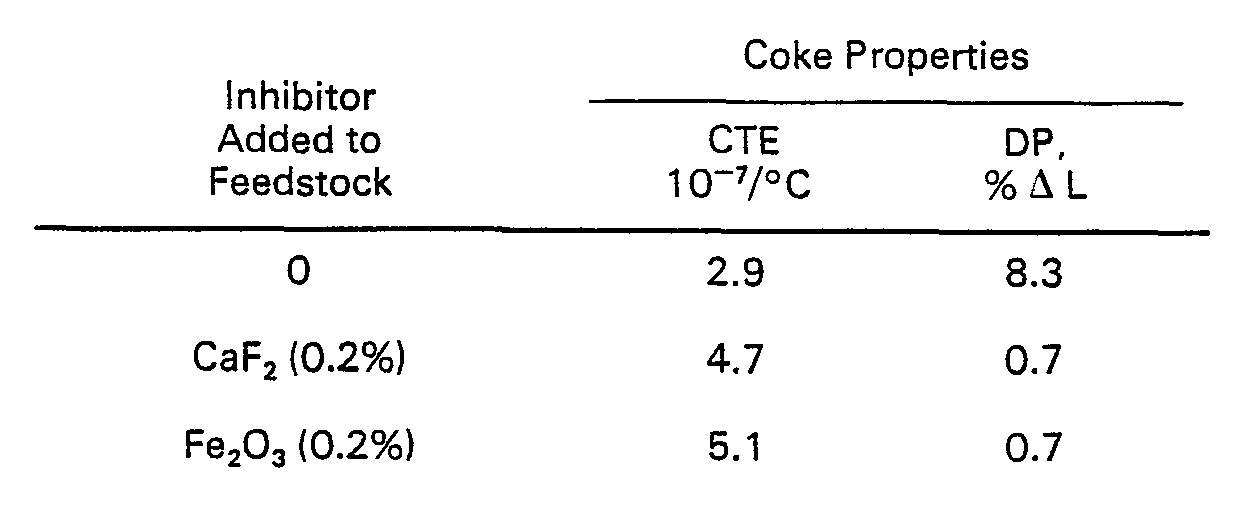
- Some feedstocks may well need and be beneficially treated with inhibitor additions of as much as 0.5%, resulting in a 2% ash level in the final coke.
- The examples above are not shown as limitations but merely samples from the wide variety of petroleum residues currently available.
Claims (4)
Applications Claiming Priority (2)
| Application Number | Priority Date | Filing Date | Title |
|---|---|---|---|
| US883879A | 1979-02-02 | 1979-02-02 | |
| US8838 | 1979-02-02 |
Publications (3)
| Publication Number | Publication Date |
|---|---|
| EP0022855A1 EP0022855A1 (en) | 1981-01-28 |
| EP0022855A4 EP0022855A4 (en) | 1981-08-28 |
| EP0022855B1 true EP0022855B1 (en) | 1983-11-23 |
Family
ID=21733973
Family Applications (1)
| Application Number | Title | Priority Date | Filing Date |
|---|---|---|---|
| EP19800900363 Expired EP0022855B1 (en) | 1979-02-02 | 1980-08-15 | Making non-puffing petroleum coke by delayed coking |
Country Status (5)
| Country | Link |
|---|---|
| EP (1) | EP0022855B1 (en) |
| JP (1) | JPS55501183A (en) |
| CA (1) | CA1132930A (en) |
| DE (1) | DE3065647D1 (en) |
| WO (1) | WO1980001569A1 (en) |
Families Citing this family (3)
| Publication number | Priority date | Publication date | Assignee | Title |
|---|---|---|---|---|
| US5215651A (en) * | 1988-07-29 | 1993-06-01 | Mitsubishi Kasei Corporation | Process for producing coke |
| JP2024056498A (en) * | 2022-10-11 | 2024-04-23 | 三菱ケミカル株式会社 | Raw coke for graphite electrodes and its manufacturing method, needle coke for graphite electrodes and its manufacturing method, and manufacturing method of graphite electrodes |
| JP2024056497A (en) * | 2022-10-11 | 2024-04-23 | 三菱ケミカル株式会社 | Raw material composition for needle coke, raw coke and its manufacturing method, needle coke for graphite electrodes and its manufacturing method, and manufacturing method of graphite electrodes |
Family Cites Families (6)
| Publication number | Priority date | Publication date | Assignee | Title |
|---|---|---|---|---|
| GB733073A (en) * | 1952-04-08 | 1955-07-06 | Nat Res Dev | Improvements in or relating to production of artificial graphite masses |
| US3338993A (en) * | 1964-07-01 | 1967-08-29 | Great Lakes Carbon Corp | Inhibition of coke puffing |
| US3563705A (en) * | 1969-03-17 | 1971-02-16 | Great Lakes Carbon Corp | Method of inhibiting puffing in the manufacture of graphite bodies |
| US3873427A (en) * | 1972-11-24 | 1975-03-25 | Lummus Co | Desulfurizing coke using a ferruginous material and a metal chloride |
| US4043898A (en) * | 1975-08-25 | 1977-08-23 | Continental Oil Company | Control of feedstock for delayed coking |
| US4140623A (en) * | 1977-09-26 | 1979-02-20 | Continental Oil Company | Inhibition of coke puffing |
-
1980
- 1980-01-23 DE DE8080900363T patent/DE3065647D1/en not_active Expired
- 1980-01-23 WO PCT/US1980/000135 patent/WO1980001569A1/en not_active Ceased
- 1980-01-23 JP JP50049480A patent/JPS55501183A/ja active Pending
- 1980-01-30 CA CA344,658A patent/CA1132930A/en not_active Expired
- 1980-08-15 EP EP19800900363 patent/EP0022855B1/en not_active Expired
Also Published As
| Publication number | Publication date |
|---|---|
| CA1132930A (en) | 1982-10-05 |
| DE3065647D1 (en) | 1983-12-29 |
| WO1980001569A1 (en) | 1980-08-07 |
| JPS55501183A (en) | 1980-12-25 |
| EP0022855A4 (en) | 1981-08-28 |
| EP0022855A1 (en) | 1981-01-28 |
Similar Documents
| Publication | Publication Date | Title |
|---|---|---|
| US4312745A (en) | Non-puffing petroleum coke | |
| US4334980A (en) | Non-puffing petroleum coke | |
| US4140623A (en) | Inhibition of coke puffing | |
| US4613375A (en) | Carbon paste and process for its manufacture | |
| US3563705A (en) | Method of inhibiting puffing in the manufacture of graphite bodies | |
| DE3541125A1 (en) | METHOD FOR THE PRODUCTION OF SILICON OR FERROSILICIUM IN AN ELECTRONIC SHELL OVEN AND FOR THE METHOD SUITABLE RAW MATERIALS | |
| EP0022854B1 (en) | Making non-puffing petroleum coke by delayed coking | |
| CA1132930A (en) | Non-puffing petroleum coke | |
| US2764530A (en) | Producing low resistivity carbon for electrodes | |
| DE1929508B2 (en) | Process for the production of basic lining materials for steelmaking furnaces | |
| US4061600A (en) | Graphite electrode and method of making | |
| US3320150A (en) | Molded carbon materials | |
| US2753243A (en) | Production of titanium tetrachloride | |
| GB1586312A (en) | Graphite electrode and method of making same | |
| DE1103292B (en) | Improved fuel mix for making foundry coke | |
| US1694800A (en) | Pitch-coking process and product | |
| JPS60152591A (en) | Coal tar pitch coke and its preparation | |
| US3284373A (en) | Molded carbon bodies | |
| CA1127988A (en) | Inhibition of coke puffing | |
| US2600238A (en) | Method of making steel | |
| SU1034994A1 (en) | Method for preparing coke and pitch composition for making fine-grained graphite products | |
| US3322663A (en) | Fluid coke aggregate and electrode | |
| Rhedey et al. | Carbon raw material effects on aluminum reduction cell anodes | |
| AT222378B (en) | Process for the production of carbon electrodes | |
| GB2042582A (en) | Method of producing premium delayed petroleum coke |
Legal Events
| Date | Code | Title | Description |
|---|---|---|---|
| PUAI | Public reference made under article 153(3) epc to a published international application that has entered the european phase |
Free format text: ORIGINAL CODE: 0009012 |
|
| 17P | Request for examination filed |
Effective date: 19801105 |
|
| AK | Designated contracting states |
Designated state(s): DE GB NL |
|
| RBV | Designated contracting states (corrected) |
Designated state(s): DE GB NL |
|
| GRAA | (expected) grant |
Free format text: ORIGINAL CODE: 0009210 |
|
| AK | Designated contracting states |
Designated state(s): DE GB NL |
|
| REF | Corresponds to: |
Ref document number: 3065647 Country of ref document: DE Date of ref document: 19831229 |
|
| PG25 | Lapsed in a contracting state [announced via postgrant information from national office to epo] |
Ref country code: NL Effective date: 19840801 |
|
| NLV4 | Nl: lapsed or anulled due to non-payment of the annual fee | ||
| PLBE | No opposition filed within time limit |
Free format text: ORIGINAL CODE: 0009261 |
|
| STAA | Information on the status of an ep patent application or granted ep patent |
Free format text: STATUS: NO OPPOSITION FILED WITHIN TIME LIMIT |
|
| PG25 | Lapsed in a contracting state [announced via postgrant information from national office to epo] |
Ref country code: DE Effective date: 19841002 |
|
| 26N | No opposition filed | ||
| GBPC | Gb: european patent ceased through non-payment of renewal fee | ||
| PG25 | Lapsed in a contracting state [announced via postgrant information from national office to epo] |
Ref country code: GB Free format text: LAPSE BECAUSE OF NON-PAYMENT OF DUE FEES Effective date: 19881118 |