EP0021735B1 - Zinc electrode for secondary electrochemical cells and electrochemical cells including said electrode - Google Patents
Zinc electrode for secondary electrochemical cells and electrochemical cells including said electrode Download PDFInfo
- Publication number
- EP0021735B1 EP0021735B1 EP80301981A EP80301981A EP0021735B1 EP 0021735 B1 EP0021735 B1 EP 0021735B1 EP 80301981 A EP80301981 A EP 80301981A EP 80301981 A EP80301981 A EP 80301981A EP 0021735 B1 EP0021735 B1 EP 0021735B1
- Authority
- EP
- European Patent Office
- Prior art keywords
- electrode
- zinc
- carbon
- total weight
- amount
- Prior art date
- Legal status (The legal status is an assumption and is not a legal conclusion. Google has not performed a legal analysis and makes no representation as to the accuracy of the status listed.)
- Expired
Links
- 239000011701 zinc Substances 0.000 title claims description 69
- HCHKCACWOHOZIP-UHFFFAOYSA-N Zinc Chemical compound [Zn] HCHKCACWOHOZIP-UHFFFAOYSA-N 0.000 title claims description 67
- 229910052725 zinc Inorganic materials 0.000 title claims description 67
- OKTJSMMVPCPJKN-UHFFFAOYSA-N Carbon Chemical compound [C] OKTJSMMVPCPJKN-UHFFFAOYSA-N 0.000 claims description 71
- 229910052799 carbon Inorganic materials 0.000 claims description 62
- 239000011230 binding agent Substances 0.000 claims description 17
- -1 polytetrafluoroethylene Polymers 0.000 claims description 12
- UKWHYYKOEPRTIC-UHFFFAOYSA-N mercury(ii) oxide Chemical compound [Hg]=O UKWHYYKOEPRTIC-UHFFFAOYSA-N 0.000 claims description 10
- 229910044991 metal oxide Inorganic materials 0.000 claims description 9
- 150000004706 metal oxides Chemical class 0.000 claims description 9
- 239000002245 particle Substances 0.000 claims description 9
- 239000004810 polytetrafluoroethylene Substances 0.000 claims description 9
- 229920001343 polytetrafluoroethylene Polymers 0.000 claims description 9
- PXHVJJICTQNCMI-UHFFFAOYSA-N Nickel Chemical compound [Ni] PXHVJJICTQNCMI-UHFFFAOYSA-N 0.000 claims description 8
- 229910002804 graphite Inorganic materials 0.000 claims description 8
- 239000010439 graphite Substances 0.000 claims description 8
- 229940101209 mercuric oxide Drugs 0.000 claims description 5
- CXKCTMHTOKXKQT-UHFFFAOYSA-N cadmium oxide Inorganic materials [Cd]=O CXKCTMHTOKXKQT-UHFFFAOYSA-N 0.000 claims description 4
- CFEAAQFZALKQPA-UHFFFAOYSA-N cadmium(2+);oxygen(2-) Chemical compound [O-2].[Cd+2] CFEAAQFZALKQPA-UHFFFAOYSA-N 0.000 claims description 4
- 229910000464 lead oxide Inorganic materials 0.000 claims description 4
- 229910052759 nickel Inorganic materials 0.000 claims description 4
- YEXPOXQUZXUXJW-UHFFFAOYSA-N oxolead Chemical compound [Pb]=O YEXPOXQUZXUXJW-UHFFFAOYSA-N 0.000 claims description 4
- 229910052709 silver Inorganic materials 0.000 claims description 2
- 239000004332 silver Substances 0.000 claims description 2
- XLOMVQKBTHCTTD-UHFFFAOYSA-N Zinc monoxide Chemical compound [Zn]=O XLOMVQKBTHCTTD-UHFFFAOYSA-N 0.000 description 16
- 210000004027 cell Anatomy 0.000 description 11
- 239000000203 mixture Substances 0.000 description 11
- 238000007599 discharging Methods 0.000 description 9
- 239000011787 zinc oxide Substances 0.000 description 8
- 239000011149 active material Substances 0.000 description 4
- 238000007792 addition Methods 0.000 description 4
- 239000013078 crystal Substances 0.000 description 4
- 230000000694 effects Effects 0.000 description 4
- WMFOQBRAJBCJND-UHFFFAOYSA-M Lithium hydroxide Chemical compound [Li+].[OH-] WMFOQBRAJBCJND-UHFFFAOYSA-M 0.000 description 3
- KWYUFKZDYYNOTN-UHFFFAOYSA-M Potassium hydroxide Chemical compound [OH-].[K+] KWYUFKZDYYNOTN-UHFFFAOYSA-M 0.000 description 3
- 239000003814 drug Substances 0.000 description 3
- 229940079593 drug Drugs 0.000 description 3
- 239000003792 electrolyte Substances 0.000 description 3
- XLYOFNOQVPJJNP-UHFFFAOYSA-M hydroxide Chemical compound [OH-] XLYOFNOQVPJJNP-UHFFFAOYSA-M 0.000 description 3
- 239000000463 material Substances 0.000 description 3
- 239000004743 Polypropylene Substances 0.000 description 2
- ATUOYWHBWRKTHZ-UHFFFAOYSA-N Propane Chemical compound CCC ATUOYWHBWRKTHZ-UHFFFAOYSA-N 0.000 description 2
- 230000000052 comparative effect Effects 0.000 description 2
- 239000004020 conductor Substances 0.000 description 2
- 210000001787 dendrite Anatomy 0.000 description 2
- 238000004090 dissolution Methods 0.000 description 2
- 238000000034 method Methods 0.000 description 2
- 238000001000 micrograph Methods 0.000 description 2
- 229920001155 polypropylene Polymers 0.000 description 2
- 229920002134 Carboxymethyl cellulose Polymers 0.000 description 1
- 229920013683 Celanese Polymers 0.000 description 1
- RYGMFSIKBFXOCR-UHFFFAOYSA-N Copper Chemical compound [Cu] RYGMFSIKBFXOCR-UHFFFAOYSA-N 0.000 description 1
- 239000004952 Polyamide Substances 0.000 description 1
- 239000004698 Polyethylene Substances 0.000 description 1
- 239000004372 Polyvinyl alcohol Substances 0.000 description 1
- 229920000297 Rayon Polymers 0.000 description 1
- 229910052770 Uranium Inorganic materials 0.000 description 1
- 239000007900 aqueous suspension Substances 0.000 description 1
- 239000001768 carboxy methyl cellulose Substances 0.000 description 1
- 235000010948 carboxy methyl cellulose Nutrition 0.000 description 1
- 239000008112 carboxymethyl-cellulose Substances 0.000 description 1
- 239000003795 chemical substances by application Substances 0.000 description 1
- 239000011889 copper foil Substances 0.000 description 1
- 230000001351 cycling effect Effects 0.000 description 1
- 230000003247 decreasing effect Effects 0.000 description 1
- 150000002009 diols Chemical class 0.000 description 1
- 239000006185 dispersion Substances 0.000 description 1
- 238000001035 drying Methods 0.000 description 1
- 239000007772 electrode material Substances 0.000 description 1
- 230000001747 exhibiting effect Effects 0.000 description 1
- 230000002209 hydrophobic effect Effects 0.000 description 1
- 238000010348 incorporation Methods 0.000 description 1
- 150000002500 ions Chemical class 0.000 description 1
- 238000011031 large-scale manufacturing process Methods 0.000 description 1
- 238000004519 manufacturing process Methods 0.000 description 1
- 229910052751 metal Inorganic materials 0.000 description 1
- 239000002184 metal Substances 0.000 description 1
- BFDHFSHZJLFAMC-UHFFFAOYSA-L nickel(ii) hydroxide Chemical compound [OH-].[OH-].[Ni+2] BFDHFSHZJLFAMC-UHFFFAOYSA-L 0.000 description 1
- 239000000615 nonconductor Substances 0.000 description 1
- 229920002647 polyamide Polymers 0.000 description 1
- 229920000573 polyethylene Polymers 0.000 description 1
- 229920002451 polyvinyl alcohol Polymers 0.000 description 1
- 239000011148 porous material Substances 0.000 description 1
- 239000000843 powder Substances 0.000 description 1
- 239000001294 propane Substances 0.000 description 1
- 239000002964 rayon Substances 0.000 description 1
- 239000003381 stabilizer Substances 0.000 description 1
- 239000000126 substance Substances 0.000 description 1
- XLYOFNOQVPJJNP-UHFFFAOYSA-N water Substances O XLYOFNOQVPJJNP-UHFFFAOYSA-N 0.000 description 1
- 229910021511 zinc hydroxide Inorganic materials 0.000 description 1
- 229940007718 zinc hydroxide Drugs 0.000 description 1
Images
Classifications
-
- H—ELECTRICITY
- H01—ELECTRIC ELEMENTS
- H01M—PROCESSES OR MEANS, e.g. BATTERIES, FOR THE DIRECT CONVERSION OF CHEMICAL ENERGY INTO ELECTRICAL ENERGY
- H01M4/00—Electrodes
- H01M4/02—Electrodes composed of, or comprising, active material
- H01M4/62—Selection of inactive substances as ingredients for active masses, e.g. binders, fillers
-
- H—ELECTRICITY
- H01—ELECTRIC ELEMENTS
- H01M—PROCESSES OR MEANS, e.g. BATTERIES, FOR THE DIRECT CONVERSION OF CHEMICAL ENERGY INTO ELECTRICAL ENERGY
- H01M4/00—Electrodes
- H01M4/02—Electrodes composed of, or comprising, active material
- H01M4/24—Electrodes for alkaline accumulators
- H01M4/244—Zinc electrodes
-
- Y—GENERAL TAGGING OF NEW TECHNOLOGICAL DEVELOPMENTS; GENERAL TAGGING OF CROSS-SECTIONAL TECHNOLOGIES SPANNING OVER SEVERAL SECTIONS OF THE IPC; TECHNICAL SUBJECTS COVERED BY FORMER USPC CROSS-REFERENCE ART COLLECTIONS [XRACs] AND DIGESTS
- Y02—TECHNOLOGIES OR APPLICATIONS FOR MITIGATION OR ADAPTATION AGAINST CLIMATE CHANGE
- Y02E—REDUCTION OF GREENHOUSE GAS [GHG] EMISSIONS, RELATED TO ENERGY GENERATION, TRANSMISSION OR DISTRIBUTION
- Y02E60/00—Enabling technologies; Technologies with a potential or indirect contribution to GHG emissions mitigation
- Y02E60/10—Energy storage using batteries
Definitions
- This invention relates to secondary electrochemical cells and a zinc electrode therefor.
- French Patent No. 2264401 describes an alternative form of secondary zinc electrode which is produced by applying to a collecting grid a non-hardened mixture containing particulate zinc oxide, a binder such as polytetrafluoroethylene, polyvinyl alcohol, polypropylene, polyethylene or carboxymethyl cellulose and other substances, sch as rayon fibres or metal powders.
- a binder such as polytetrafluoroethylene, polyvinyl alcohol, polypropylene, polyethylene or carboxymethyl cellulose and other substances, sch as rayon fibres or metal powders.
- this electrode still suffers from the problems of dendritic growth and, in particular, shape change or deformation, probably as a result of movement of the electrolyte parallel to the surface of the electrode during the charging and discharging cycles. As a result, the service life of this electrode is very short.
- FR-A-2093264 is concerned with solving the problems of shape change (which are described therein as being due to zinc dissolution) by encapsulating finely divided zinc in a ionic polymeric conductor so as to reduce the solubility of the zinc. Such a technique, however, isolates the zinc particles electrically and lowers the conductivity of the electrode. To overcome this problem, FR-A-2093264 teaches the inclusion of an unspecified quantity of graphite.
- An object of the present invention is therefore to overcome or alleviate the above- mentioned disadvantages experienced with conventional secondary zinc electrodes.
- a nickel/zinc or a silver/zinc electrochemical cell including a pressed, secondary zinc electrode having dispersed therein particulate carbon in an amount between 1 and 50% by weight of the total weight of zinc and carbon, and an organic binder in an amount between 0.5 and 10% by weight of the total weight of zinc and carbon.
- a pressed, secondary zinc electrode having dispersed therein particulate carbon in an amount of about 20% by weight of the total weight of zinc and carbon, and an organic binder in an amount between 0.5 and 10% by weight of the total weight of zinc and carbon.
- the electrode of the present invention is a pressed electrode and hence is relatively compact and strong.
- the applied pressure used to produce the electrode necessarily reduces its porosity (typically to about 50%)
- the dispersed carbon avoids any tendency for the binder to coagulate as a film on the exterior of the electrode so that the problems of shape change and increasing cell resistance are decreased.
- the presence of carbon is found to decrease crystal growth and to improve the efficiency of the electrode and the power density as observed in the discharge voltage profile.
- dispersion of the carbon in the mix used to produce the electrode is readily achieved and is susceptible to large scale production.
- the inclusion of carbon in the mix allows the rapid and controllable production of a fibrous character necessary for good electrode performance.
- An additional advantage arising from the carbon addition is that, as a result of the improved current density distribution across the electrode, dendritic growth is substantially retarded and only effectively occurs after the zinc oxide reservoir within the electrode is consumed during charging. Moreover, growth is even across the face of the electrode and not as massive dendrites concentrated at particular points.
- zinc is converted to zinc oxide, Zn(OH) Z and/or Zn(OH)3-, whereas during charging the zinc oxide and any hydroxide species are converted back to metallic zinc.
- the zinc will normally be present as an oxide or hydroxide.
- the carbon content must be between 1 and 50% based on the total weight of zinc and carbon, since it is found that the improvements resulting from the addition of carbon are negligible below the 1% value.
- the properties improve as the carbon content is increased above the 1% value until a maximum is reached when the zinc electrode contains about 20% carbon based on the total weight of zinc and carbon. This is therefore the preferred value for the carbon content.
- the carbon content is increased above 20%, the improved performance obtained by the use of carbon is more than outweighted by the decrease in the gravimetric and, particularly, the volumetric energy density of the electrode, but nevertheless the properties of the electrodes remain attractive until the 50% upper limit is reached.
- the particle size of the particulate carbon used in the electrode of the invention is not critical, but generally it is found that good results are obtained with powdered carbon having a particle size between 0.5 and 20 micrometres.
- the amount of the organic binder in the electrode is between 0.5 and 10% based on the total weight of zinc and carbon, since below 0.5% there is insufficient binder present for it to achieve its required binding function.
- the binder content is increased above the 10% value, the resultant decrease in the amount of active material leads to a reduction in the volumetric energy density of the electrode without any compensating advantage resulting from the increase binder.
- a desirable value for the amount of the binder is 2.5% based on the total weight of zinc and carbon since, although the cycle life of the electrode can be improved by increasing the content to 5% based on the total weight of zinc and carbon, this is only at the expense of the volumetric energy density of the electrode.
- the organic binder is polytetrafluoroethylene.
- the electrode also contains one or more of the metal oxides, mercuric oxide, cadmium oxide and lead oxide, the or each metal oxide being present in an amount between 0.1 and 10% based on the total weight of zinc and carbon.
- said one or each metal oxide is present in an amount between 1 and 2% based on the total weight of zinc and carbon.
- a secondary zinc electrode is referred to as containing a specified percentage of a given component based on the total weight of zinc and carbon in the electrode
- the weight of zinc in said total weight is the weight of metallic zinc even though the zinc may be present as a zinc oxide or hydroxide.
- the electrode of said one example was produced by mixing the following components in a Winkworth 2 Z blade mixer for fifteen minutes:
- the wrapped electrode was tested in a cell employing a sintered nickel cathode and an aqueous electrolyte containing 30% by weight of potassium hydroxide, 1% by weight of lithium hydroxide to enhance the capacity of the nickel cathode, and 8% by weight of zinc oxide as a stabilizer against dissolution of the zinc anode.
- the cell was subjected to accelerated charging and discharging cycles using a charging current of 2.5 amps for 122.4 minutes to achieve an overcharge of about 2% and a discharge current of 5 amps for about 60 minutes.
- the results of the tests on the electrode of the above example and comparative tests on a similar electrode produced from a mix without carbon are illustrated in Figures 1 and 2 of the accompanying drawings.
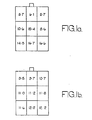
- the electrode of said one example was divided into nine equal segments after 150 charging and discharging cycles and the amount of zinc in each segment was measured as a percentage of the total active material. The same operation was repeated for the comparison electrode, although in this case the electrode was only subject to 140 charging and discharging cycles.
- the results for the comparison electrode are shown in Figure 1 a and for the electrode of said one example in Figure 1 b. From these results it will be seen that the electrode of said one example exhibited considerably less shape change than the comparison electrode.
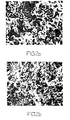
- FIGs 2a and b are photo micrographs at 2500 magnification of the electrode of said one example and the comparison electrode after 30 charging and discharging cycles, it will be seen that the inclusion of carbon in the electrode inhibited crystal growth.
- a carbon-containing electrode having an average particle size after one cycle of 0.3-0.4 micrometres, it was found that the particle size was virtually unchanged after the 30 cycle test.
- the comparison electrode containing no carbon it was found that the particle size had increased to 2-3 micrometres after the 30 cycle test.
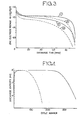
- FIG. 3 the continuous line 1 is the discharge curve for the electrode of said one example after 10 and 100 cycles, whereas the continuous line 2 is the discharge curve for the electrode of said one example after 200 cycles.
- the broken lines 3 and 4 in Figure 3 are the discharge curves for the comparison electrode after 10 and 100 cycles respectively.
- the zinc electrode containing carbon exhibited an improved initial voltage discharge curve than the comparison electrode and that the rate of decay of the discharge characteristics was less in the case of the electrode containing carbon.
- the carbon-containing electrode maintained its discharge capacity over a considerably larger number of cycles than the comparison electrode. Similar effects were observed in the charging characteristics of the electrode and hence the inclusion of carbon produced an electrode having improved power density and efficiency. This in turn led to reduced dendritic growth.
- the mercuric oxide can be replaced by cadmium oxide and/or lead oxide to achieve an electrode exhibiting similar advantageous properties.
Landscapes
- Chemical & Material Sciences (AREA)
- Chemical Kinetics & Catalysis (AREA)
- Electrochemistry (AREA)
- General Chemical & Material Sciences (AREA)
- Battery Electrode And Active Subsutance (AREA)
Description
- This invention relates to secondary electrochemical cells and a zinc electrode therefor.
- To date, zinc electrodes used in rechargeable electrochemical cells have suffered from a number of shortcomings, one of the most serious of which is a tendency for the zinc to migrate from the periphery to the centre of the electrode. This phenomenon, which is generally referred to as "shape change", leads to the edges of the electrode becoming inactive and also reduces the activity at the centre of the electrode by causing the density of the zinc at the centre to increase. A further problem associated with secondary zinc electrodes is that, during charging, metallic zinc produced by ion reduction is deposited on the electrode in the form of dendrites which grow in a direction substantially perpendicular to the electrode. This growth may occur through the separators provided between the positive and negative electrodes in an electrochemical cell and thereby cause internal short circuits.
- Among the solutions which have been proposed to the problem of shape change is the incorporation of an organic binder, particularly polytetrafluoroethylene, in the electrode. However, although the solutions so far proposed have resulted in some reduction in the amount of shape change, they have not proved entirely satisfactory. One particular problem in this context is that, when polytetrafluoroethylene alone is incorporated in the electrode, the polytetrafluoroethylene tends to coagulate as a film on the outside of the electrode during cycling. This not only reduces the useful effect of the binder in avoiding shape change but also increases the resistance of the associated electrochemical cell. Another proposal for reducing the problem of shape change is to produce highly porous (i.e. having at least 60% open pores) zinc electrodes. However, this not only results in an increase in the volume of the electrode and hence a decrease in its volumetric energy density, but also reduces the strength of the electrode.
- French Patent No. 2264401 describes an alternative form of secondary zinc electrode which is produced by applying to a collecting grid a non-hardened mixture containing particulate zinc oxide, a binder such as polytetrafluoroethylene, polyvinyl alcohol, polypropylene, polyethylene or carboxymethyl cellulose and other substances, sch as rayon fibres or metal powders. However, this electrode still suffers from the problems of dendritic growth and, in particular, shape change or deformation, probably as a result of movement of the electrolyte parallel to the surface of the electrode during the charging and discharging cycles. As a result, the service life of this electrode is very short.
- Yet another problem experienced with conventional secondary zinc electrodes is that, with repeated discharging and charging cycles, the crystal size of the zinc increases, which contributes to a rapid decrease in the capacity of the cell.
- It is well known in primary electrodes to make carbon additions in order to improve the conductivity of the electrode. Such a technique is disclosed, however, in US-A-3640772 which is concerned with electrodes for alkaline batteries. In the particular embodiments described in US-A-3640772, graphite powder is used as the conductive material in an electrode containing nickel hydroxide (which is a non-conductor). In US-A-3640772 mention is made of zinc oxide as a possible electrochemically active electrode material, but there is no teaching of the use of any specific quality of graphite in combination with such a material.
- FR-A-2093264 is concerned with solving the problems of shape change (which are described therein as being due to zinc dissolution) by encapsulating finely divided zinc in a ionic polymeric conductor so as to reduce the solubility of the zinc. Such a technique, however, isolates the zinc particles electrically and lowers the conductivity of the electrode. To overcome this problem, FR-A-2093264 teaches the inclusion of an unspecified quantity of graphite.
- Derwent Japanese Patents Report Vol. U, No. 33, 18 September 1973, No. 46900 U discloses a negative electrode of powdered amalgamated zinc having an unspecified amount of carbon mixed therein and containing an unspecified amount of a caking agent. The carbon is added because it is a hydrophobic material (in contrast to the amalgamated zinc which is hydrophilic) in order to promote entrance of electrolyte to the active material reaction sites.
- An object of the present invention is therefore to overcome or alleviate the above- mentioned disadvantages experienced with conventional secondary zinc electrodes.
- According to one aspect of the present invention, there is provided a nickel/zinc or a silver/zinc electrochemical cell including a pressed, secondary zinc electrode having dispersed therein particulate carbon in an amount between 1 and 50% by weight of the total weight of zinc and carbon, and an organic binder in an amount between 0.5 and 10% by weight of the total weight of zinc and carbon.
- According to another aspect of the present invention, there is provided a pressed, secondary zinc electrode having dispersed therein particulate carbon in an amount of about 20% by weight of the total weight of zinc and carbon, and an organic binder in an amount between 0.5 and 10% by weight of the total weight of zinc and carbon.
- The electrode of the present invention is a pressed electrode and hence is relatively compact and strong. However, although the applied pressure used to produce the electrode necessarily reduces its porosity (typically to about 50%), it is found that the dispersed carbon avoids any tendency for the binder to coagulate as a film on the exterior of the electrode so that the problems of shape change and increasing cell resistance are decreased. In addition, the presence of carbon is found to decrease crystal growth and to improve the efficiency of the electrode and the power density as observed in the discharge voltage profile. Further, dispersion of the carbon in the mix used to produce the electrode is readily achieved and is susceptible to large scale production. Moreover, it is found that the inclusion of carbon in the mix allows the rapid and controllable production of a fibrous character necessary for good electrode performance. An additional advantage arising from the carbon addition is that, as a result of the improved current density distribution across the electrode, dendritic growth is substantially retarded and only effectively occurs after the zinc oxide reservoir within the electrode is consumed during charging. Moreover, growth is even across the face of the electrode and not as massive dendrites concentrated at particular points. In this respect, it is to be understood that during discharge of a secondary zinc electrode, zinc is converted to zinc oxide, Zn(OH)Z and/or Zn(OH)3-, whereas during charging the zinc oxide and any hydroxide species are converted back to metallic zinc. Thus, when the electrode is initially produced, the zinc will normally be present as an oxide or hydroxide.
- In the cell of the invention, the carbon content must be between 1 and 50% based on the total weight of zinc and carbon, since it is found that the improvements resulting from the addition of carbon are negligible below the 1% value. The properties improve as the carbon content is increased above the 1% value until a maximum is reached when the zinc electrode contains about 20% carbon based on the total weight of zinc and carbon. This is therefore the preferred value for the carbon content. When the carbon content is increased above 20%, the improved performance obtained by the use of carbon is more than outweighted by the decrease in the gravimetric and, particularly, the volumetric energy density of the electrode, but nevertheless the properties of the electrodes remain attractive until the 50% upper limit is reached.
- The particle size of the particulate carbon used in the electrode of the invention is not critical, but generally it is found that good results are obtained with powdered carbon having a particle size between 0.5 and 20 micrometres.
- The amount of the organic binder in the electrode is between 0.5 and 10% based on the total weight of zinc and carbon, since below 0.5% there is insufficient binder present for it to achieve its required binding function. On the other hand, if the binder content is increased above the 10% value, the resultant decrease in the amount of active material leads to a reduction in the volumetric energy density of the electrode without any compensating advantage resulting from the increase binder. A desirable value for the amount of the binder is 2.5% based on the total weight of zinc and carbon since, although the cycle life of the electrode can be improved by increasing the content to 5% based on the total weight of zinc and carbon, this is only at the expense of the volumetric energy density of the electrode.
- Preferably, the organic binder is polytetrafluoroethylene.
- Preferably, the electrode also contains one or more of the metal oxides, mercuric oxide, cadmium oxide and lead oxide, the or each metal oxide being present in an amount between 0.1 and 10% based on the total weight of zinc and carbon.
- More preferably, said one or each metal oxide is present in an amount between 1 and 2% based on the total weight of zinc and carbon.
- In the instant specification, where a secondary zinc electrode is referred to as containing a specified percentage of a given component based on the total weight of zinc and carbon in the electrode, the weight of zinc in said total weight is the weight of metallic zinc even though the zinc may be present as a zinc oxide or hydroxide.
- In the accompanying drawings,
- Figures 1 a and b illustrate the amounts of shape change exhibited by a conventional secondary zinc electrode (Figure 1a) and an electrode produced according to one example of the invention (Figure 1b),
- Figures 2a and b are photo-micrographs illustrating the crystal structure of a conventional secondary zinc electrode (Figure 2a) and an electrode according to said one example (Figure 2b) after thirty discharging and recharging cycles,
- Figure 3 is a graph comparing the voltage discharge curve of a conventional secondary zinc electrode and the electrode according to said one example, and
- Figure 4 is a graph of discharge capacity against the number of charging and discharging cycles for said conventional electrode and the electrode of said one example.
- Referring to the drawings, the electrode of said one example was produced by mixing the following components in a Winkworth 2 Z blade mixer for fifteen minutes:
- 500 g of analytical grade zinc oxide supplied by Fisons Ltd.,
- 100 g of graphite supplied by Rocol Litd., as Type KS 2.5, and having a particle size of 2.5 micrometres (corresponding to 20% graphite by weight of the total weight of zinc and graphite),
- 5 g of analytical grade red mercuric oxide as supplied by British Drug Houses Limited,
- 12.5 g of polytetrafluoroethylene supplied as a 60% aqueous suspension by I.C.I. Ltd., as type GP 1 (corresponding to 2.5% by weight of polytetrafluoroethylene based on the total weight of zinc and graphite), and
- 600 cc of water.
- Immediately on mixing, it was found that the mix assumed a fibrous character whereas, if the carbon was omitted from the mix, it was found that mixing had to be effected for fifteen minutes before a fibrous character was achieved. After mixing was complete, the composition was removed from the mixer and left to dry overnight in an oven at a temperature of 90°C. The mix was then returned in a dry condition to the mixer and was broken up by operation of the mixer for 5 to 10 minutes. 350 cc of laboratory grade propane 1-2 diol as supplied by British Drugs Houses Ltd., were then added to the mix, whereafter mixing was continued for a further 30 minutes. A dough-like active material was thereby produced and, after removal from the mix, was rolled into strips of the required thickness of about 0.76 mm (about 0.03 inch) which were then returned to the oven for drying.
- Two of the dried strips, each of which conveniently weighed about 23.5 g, were then pressed at 13800 kPa (2000 psi) against opposite sides respectively of a current collector in the form of a sheet of analytical grade copper foil as supplied by British Drug Houses Ltd., the sheet conveniently being 0.1 mm thick, 150 mm long and 92 mm wide. The resultant electrode had a porosity of about 50% and was then wrapped in one layer of a non-woven polyamide material as sold by Carl Freudenberg as Viledon FT2119, and three layers of microporous polypropylene as supplied by Celanese Ltd., (U.S.A.), as Celgard 3400.
- The wrapped electrode was tested in a cell employing a sintered nickel cathode and an aqueous electrolyte containing 30% by weight of potassium hydroxide, 1% by weight of lithium hydroxide to enhance the capacity of the nickel cathode, and 8% by weight of zinc oxide as a stabilizer against dissolution of the zinc anode. The cell was subjected to accelerated charging and discharging cycles using a charging current of 2.5 amps for 122.4 minutes to achieve an overcharge of about 2% and a discharge current of 5 amps for about 60 minutes. The results of the tests on the electrode of the above example and comparative tests on a similar electrode produced from a mix without carbon are illustrated in Figures 1 and 2 of the accompanying drawings.
- Thus, to test the effect of the carbon addition on shape change, the electrode of said one example was divided into nine equal segments after 150 charging and discharging cycles and the amount of zinc in each segment was measured as a percentage of the total active material. The same operation was repeated for the comparison electrode, although in this case the electrode was only subject to 140 charging and discharging cycles. The results for the comparison electrode are shown in Figure 1 a and for the electrode of said one example in Figure 1 b. From these results it will be seen that the electrode of said one example exhibited considerably less shape change than the comparison electrode.
- Turning now to Figures 2a and b which are photo micrographs at 2500 magnification of the electrode of said one example and the comparison electrode after 30 charging and discharging cycles, it will be seen that the inclusion of carbon in the electrode inhibited crystal growth. In particular, with a carbon-containing electrode having an average particle size after one cycle of 0.3-0.4 micrometres, it was found that the particle size was virtually unchanged after the 30 cycle test. In contrast, with the comparison electrode containing no carbon, it was found that the particle size had increased to 2-3 micrometres after the 30 cycle test.
- A further wrapped electrode was produced in the same manner as described above and was tested in the same cell as previously, but now the charging and discharging cycles were carried out using a charging current of 2.5 amps for 195.8 minutes and a discharge current of 5 amps for 96 minutes. The results of these tests and comparative tests on a similar electrode produced from a mix without carbon are illustrated in Figures 3 and 4 of the accompanying drawings. In Figure 3, the
continuous line 1 is the discharge curve for the electrode of said one example after 10 and 100 cycles, whereas thecontinuous line 2 is the discharge curve for the electrode of said one example after 200 cycles. Thebroken lines 3 and 4 in Figure 3 are the discharge curves for the comparison electrode after 10 and 100 cycles respectively. From Figure 3, it will be seen that the zinc electrode containing carbon exhibited an improved initial voltage discharge curve than the comparison electrode and that the rate of decay of the discharge characteristics was less in the case of the electrode containing carbon. As will be seen from Figure 4, in which the solid line represents the carbon-containing electrode and the broken line represents the comparison electrode, the carbon-containing electrode maintained its discharge capacity over a considerably larger number of cycles than the comparison electrode. Similar effects were observed in the charging characteristics of the electrode and hence the inclusion of carbon produced an electrode having improved power density and efficiency. This in turn led to reduced dendritic growth. - As an alternative to the above example, the mercuric oxide can be replaced by cadmium oxide and/or lead oxide to achieve an electrode exhibiting similar advantageous properties.
Claims (14)
Applications Claiming Priority (2)
| Application Number | Priority Date | Filing Date | Title |
|---|---|---|---|
| GB7922176 | 1979-06-26 | ||
| GB7922176 | 1979-06-26 |
Publications (2)
| Publication Number | Publication Date |
|---|---|
| EP0021735A1 EP0021735A1 (en) | 1981-01-07 |
| EP0021735B1 true EP0021735B1 (en) | 1984-12-05 |
Family
ID=10506087
Family Applications (1)
| Application Number | Title | Priority Date | Filing Date |
|---|---|---|---|
| EP80301981A Expired EP0021735B1 (en) | 1979-06-26 | 1980-06-12 | Zinc electrode for secondary electrochemical cells and electrochemical cells including said electrode |
Country Status (5)
| Country | Link |
|---|---|
| US (1) | US4407915A (en) |
| EP (1) | EP0021735B1 (en) |
| JP (1) | JPS566377A (en) |
| DE (1) | DE3069742D1 (en) |
| IN (1) | IN152797B (en) |
Families Citing this family (19)
| Publication number | Priority date | Publication date | Assignee | Title |
|---|---|---|---|---|
| US4332871A (en) * | 1980-09-15 | 1982-06-01 | Energy Research Corporation | Zinc electrode with cement additive |
| JPS58165250A (en) * | 1982-03-26 | 1983-09-30 | Sanyo Electric Co Ltd | Alkali-zinc storage battery |
| CA1186373A (en) * | 1982-03-29 | 1985-04-30 | Duracell International Inc. | Electrochemical cell with compacted cathode containing polyolefin powder additive |
| EP0091238B1 (en) * | 1982-04-06 | 1986-11-12 | LUCAS INDUSTRIES public limited company | Secondary zinc electrode for a secondary electro-chemical cell and a method of manufacturing such an electrode |
| US4649093A (en) * | 1986-03-14 | 1987-03-10 | Sab Nife Inc. | Corrosion resistant mercury-free zinc anode battery |
| US5248572A (en) * | 1990-04-06 | 1993-09-28 | Matsushita Electric Industrial Co., Ltd. | Layered-type manganese dry battery |
| US20040009398A1 (en) * | 2002-06-19 | 2004-01-15 | Dorfman Jay Robert | Zinc polymer thick film composition |
| CN100449823C (en) * | 2005-01-28 | 2009-01-07 | 比亚迪股份有限公司 | Zinc cathode for secondary zinc-nickel battery, preparation method thereof and secondary zinc-nickel battery containing zinc cathode |
| EP1715536A3 (en) * | 2005-04-20 | 2007-10-10 | ReVolt Technology AS | Zinc electrode comprising an organic gelling agent and an organic binder. |
| WO2009120352A1 (en) * | 2008-03-27 | 2009-10-01 | Zpower, Inc. | Improved electrodes and electrochemical cells employing the same |
| US8936775B2 (en) | 2008-10-29 | 2015-01-20 | Zpower, Llc | Cathode active material (higher oxides of silver) |
| JP5638058B2 (en) | 2009-03-27 | 2014-12-10 | ゼットパワー, エルエルシー | Improved cathode |
| WO2011056813A1 (en) | 2009-11-03 | 2011-05-12 | Zpower, Inc. | Novel electrodes and rechargeable batteries |
| US20110136005A1 (en) * | 2009-12-04 | 2011-06-09 | Gregory Scott Callen | Vitamin B12 iron battery |
| WO2012040298A1 (en) | 2010-09-24 | 2012-03-29 | Zpower, Llc | Cathode |
| US8951682B2 (en) | 2010-09-30 | 2015-02-10 | Empire Technology Development Llc | Rechargeable zinc air battery and anode |
| JP2013545242A (en) | 2010-11-03 | 2013-12-19 | ゼットパワー, エルエルシー | New electrodes and rechargeable batteries |
| CA2886154A1 (en) | 2012-09-27 | 2014-04-03 | Zpower, Llc | Cathode |
| US11450847B2 (en) | 2019-01-23 | 2022-09-20 | Energizer Brands, Llc | Alkaline electrochemical cells comprising increased zinc oxide levels |
Citations (1)
| Publication number | Priority date | Publication date | Assignee | Title |
|---|---|---|---|---|
| GB2027260A (en) * | 1978-07-25 | 1980-02-13 | Michelin & Cie | Zinc electrodes |
Family Cites Families (8)
| Publication number | Priority date | Publication date | Assignee | Title |
|---|---|---|---|---|
| US3493434A (en) * | 1968-02-12 | 1970-02-03 | Yardney International Corp | Zinc electrode |
| SE323118B (en) * | 1968-08-21 | 1970-04-27 | Svenska Ackumulator Ab | |
| FR2093264A5 (en) * | 1970-06-08 | 1972-01-28 | Comp Generale Electricite | Alkaline cell electrode - of zinc dispersed in pva |
| JPS5143755B2 (en) * | 1971-08-10 | 1976-11-24 | ||
| JPS5461B2 (en) * | 1973-11-21 | 1979-01-05 | ||
| US3923544A (en) * | 1974-03-11 | 1975-12-02 | Electrochem Inc | Zinc electrode and method of making same |
| GB2027620B (en) * | 1978-08-10 | 1982-07-07 | Access Plant | Method of producing metallic scaffold hooks |
| IL55412A (en) * | 1978-08-23 | 1982-12-31 | Israel State | Negative electrodes for use in zinc based electrochemical cells |
-
1980
- 1980-06-12 EP EP80301981A patent/EP0021735B1/en not_active Expired
- 1980-06-12 DE DE8080301981T patent/DE3069742D1/en not_active Expired
- 1980-06-26 JP JP8600680A patent/JPS566377A/en active Pending
- 1980-08-11 IN IN915/CAL/80A patent/IN152797B/en unknown
-
1981
- 1981-11-12 US US06/320,841 patent/US4407915A/en not_active Expired - Fee Related
Patent Citations (1)
| Publication number | Priority date | Publication date | Assignee | Title |
|---|---|---|---|---|
| GB2027260A (en) * | 1978-07-25 | 1980-02-13 | Michelin & Cie | Zinc electrodes |
Also Published As
| Publication number | Publication date |
|---|---|
| JPS566377A (en) | 1981-01-22 |
| US4407915A (en) | 1983-10-04 |
| IN152797B (en) | 1984-04-07 |
| EP0021735A1 (en) | 1981-01-07 |
| DE3069742D1 (en) | 1985-01-17 |
Similar Documents
| Publication | Publication Date | Title |
|---|---|---|
| US4407915A (en) | Secondary zinc electrode | |
| JP2575840B2 (en) | Dry manufacturing method of hydrogen storage alloy electrode | |
| US5514488A (en) | Electrochemical secondary cell | |
| US8663842B2 (en) | Silver positive electrode for alkaline storage batteries | |
| EP1422773A1 (en) | Metal coated active material particles for battery electrodes | |
| EP0817299A2 (en) | Sealed rechargeable cell comprising a cathode with a hydrogen recombination catalyst | |
| EP0028072B1 (en) | A nickel electrode, a method of producing the nickel electrode and an electrochemical cell employing the nickel electrode | |
| US11094935B2 (en) | Zinc electrode for use in rechargeable batteries | |
| CA1084110A (en) | Zinc electrodes and methods of making same | |
| EP0848441B1 (en) | An electrochemical cell employing a fine carbon material additive | |
| CA1133985A (en) | Zinc electrode having a porous portion | |
| CA1106913A (en) | Mercury-free zinc electrode | |
| CA1158713A (en) | Zinc electrode containing porous calcium silicate | |
| EP0307209B1 (en) | A battery | |
| US4192908A (en) | Mass-transport separator for alkaline nickel-zinc cells and cell | |
| US3288642A (en) | Rechargeable dry cell having gelled electrolyte | |
| JP2512019B2 (en) | Electrochemical battery | |
| US3671319A (en) | Battery electrode and battery embodying same | |
| GB2164484A (en) | Retainer type lead-acid battery | |
| EP3574540A1 (en) | Battery paste and electrolye compositions and electrochemical cell for use therewith | |
| US4000005A (en) | Method for making a nickel positive electrode for an alkaline battery | |
| US3202544A (en) | Alkaline accumulator | |
| CN108666575A (en) | Combined conductive agent and preparation method thereof, Anode and battery | |
| GB2028569A (en) | Improvements in negative electrodes for use in electrochemical cells | |
| CN107403932B (en) | Positive electrode for battery, method for preparing same, and battery having same |
Legal Events
| Date | Code | Title | Description |
|---|---|---|---|
| PUAI | Public reference made under article 153(3) epc to a published international application that has entered the european phase |
Free format text: ORIGINAL CODE: 0009012 |
|
| AK | Designated contracting states |
Designated state(s): DE FR GB IT SE |
|
| 17P | Request for examination filed |
Effective date: 19810626 |
|
| RAP1 | Party data changed (applicant data changed or rights of an application transferred) |
Owner name: LUCAS INDUSTRIES PLC |
|
| ITF | It: translation for a ep patent filed | ||
| GRAA | (expected) grant |
Free format text: ORIGINAL CODE: 0009210 |
|
| AK | Designated contracting states |
Designated state(s): DE FR GB IT SE |
|
| REF | Corresponds to: |
Ref document number: 3069742 Country of ref document: DE Date of ref document: 19850117 |
|
| ET | Fr: translation filed | ||
| PLBE | No opposition filed within time limit |
Free format text: ORIGINAL CODE: 0009261 |
|
| STAA | Information on the status of an ep patent application or granted ep patent |
Free format text: STATUS: NO OPPOSITION FILED WITHIN TIME LIMIT |
|
| 26N | No opposition filed | ||
| PGFP | Annual fee paid to national office [announced via postgrant information from national office to epo] |
Ref country code: GB Payment date: 19900601 Year of fee payment: 11 |
|
| PGFP | Annual fee paid to national office [announced via postgrant information from national office to epo] |
Ref country code: FR Payment date: 19900613 Year of fee payment: 11 |
|
| PGFP | Annual fee paid to national office [announced via postgrant information from national office to epo] |
Ref country code: SE Payment date: 19900615 Year of fee payment: 11 |
|
| PGFP | Annual fee paid to national office [announced via postgrant information from national office to epo] |
Ref country code: DE Payment date: 19900629 Year of fee payment: 11 |
|
| ITTA | It: last paid annual fee | ||
| PG25 | Lapsed in a contracting state [announced via postgrant information from national office to epo] |
Ref country code: GB Effective date: 19910612 |
|
| PG25 | Lapsed in a contracting state [announced via postgrant information from national office to epo] |
Ref country code: SE Effective date: 19910613 |
|
| GBPC | Gb: european patent ceased through non-payment of renewal fee | ||
| PG25 | Lapsed in a contracting state [announced via postgrant information from national office to epo] |
Ref country code: FR Effective date: 19920228 |
|
| PG25 | Lapsed in a contracting state [announced via postgrant information from national office to epo] |
Ref country code: DE Effective date: 19920401 |
|
| REG | Reference to a national code |
Ref country code: FR Ref legal event code: ST |
|
| EUG | Se: european patent has lapsed |
Ref document number: 80301981.9 Effective date: 19920109 |