EP0021616B1 - Catalytic cracking process - Google Patents
Catalytic cracking process Download PDFInfo
- Publication number
- EP0021616B1 EP0021616B1 EP80301774A EP80301774A EP0021616B1 EP 0021616 B1 EP0021616 B1 EP 0021616B1 EP 80301774 A EP80301774 A EP 80301774A EP 80301774 A EP80301774 A EP 80301774A EP 0021616 B1 EP0021616 B1 EP 0021616B1
- Authority
- EP
- European Patent Office
- Prior art keywords
- catalyst
- cracking
- chromite
- oxidation
- vessel
- Prior art date
- Legal status (The legal status is an assumption and is not a legal conclusion. Google has not performed a legal analysis and makes no representation as to the accuracy of the status listed.)
- Expired
Links
Classifications
-
- B—PERFORMING OPERATIONS; TRANSPORTING
- B01—PHYSICAL OR CHEMICAL PROCESSES OR APPARATUS IN GENERAL
- B01J—CHEMICAL OR PHYSICAL PROCESSES, e.g. CATALYSIS OR COLLOID CHEMISTRY; THEIR RELEVANT APPARATUS
- B01J35/00—Catalysts, in general, characterised by their form or physical properties
- B01J35/19—Catalysts containing parts with different compositions
-
- B—PERFORMING OPERATIONS; TRANSPORTING
- B01—PHYSICAL OR CHEMICAL PROCESSES OR APPARATUS IN GENERAL
- B01J—CHEMICAL OR PHYSICAL PROCESSES, e.g. CATALYSIS OR COLLOID CHEMISTRY; THEIR RELEVANT APPARATUS
- B01J21/00—Catalysts comprising the elements, oxides, or hydroxides of magnesium, boron, aluminium, carbon, silicon, titanium, zirconium, or hafnium
- B01J21/20—Regeneration or reactivation
-
- B—PERFORMING OPERATIONS; TRANSPORTING
- B01—PHYSICAL OR CHEMICAL PROCESSES OR APPARATUS IN GENERAL
- B01J—CHEMICAL OR PHYSICAL PROCESSES, e.g. CATALYSIS OR COLLOID CHEMISTRY; THEIR RELEVANT APPARATUS
- B01J23/00—Catalysts comprising metals or metal oxides or hydroxides, not provided for in group B01J21/00
- B01J23/70—Catalysts comprising metals or metal oxides or hydroxides, not provided for in group B01J21/00 of the iron group metals or copper
- B01J23/76—Catalysts comprising metals or metal oxides or hydroxides, not provided for in group B01J21/00 of the iron group metals or copper combined with metals, oxides or hydroxides provided for in groups B01J23/02 - B01J23/36
- B01J23/84—Catalysts comprising metals or metal oxides or hydroxides, not provided for in group B01J21/00 of the iron group metals or copper combined with metals, oxides or hydroxides provided for in groups B01J23/02 - B01J23/36 with arsenic, antimony, bismuth, vanadium, niobium, tantalum, polonium, chromium, molybdenum, tungsten, manganese, technetium or rhenium
- B01J23/85—Chromium, molybdenum or tungsten
- B01J23/86—Chromium
-
- B—PERFORMING OPERATIONS; TRANSPORTING
- B01—PHYSICAL OR CHEMICAL PROCESSES OR APPARATUS IN GENERAL
- B01J—CHEMICAL OR PHYSICAL PROCESSES, e.g. CATALYSIS OR COLLOID CHEMISTRY; THEIR RELEVANT APPARATUS
- B01J23/00—Catalysts comprising metals or metal oxides or hydroxides, not provided for in group B01J21/00
- B01J23/70—Catalysts comprising metals or metal oxides or hydroxides, not provided for in group B01J21/00 of the iron group metals or copper
- B01J23/76—Catalysts comprising metals or metal oxides or hydroxides, not provided for in group B01J21/00 of the iron group metals or copper combined with metals, oxides or hydroxides provided for in groups B01J23/02 - B01J23/36
- B01J23/84—Catalysts comprising metals or metal oxides or hydroxides, not provided for in group B01J21/00 of the iron group metals or copper combined with metals, oxides or hydroxides provided for in groups B01J23/02 - B01J23/36 with arsenic, antimony, bismuth, vanadium, niobium, tantalum, polonium, chromium, molybdenum, tungsten, manganese, technetium or rhenium
- B01J23/85—Chromium, molybdenum or tungsten
- B01J23/86—Chromium
- B01J23/868—Chromium copper and chromium
-
- B—PERFORMING OPERATIONS; TRANSPORTING
- B01—PHYSICAL OR CHEMICAL PROCESSES OR APPARATUS IN GENERAL
- B01J—CHEMICAL OR PHYSICAL PROCESSES, e.g. CATALYSIS OR COLLOID CHEMISTRY; THEIR RELEVANT APPARATUS
- B01J29/00—Catalysts comprising molecular sieves
- B01J29/04—Catalysts comprising molecular sieves having base-exchange properties, e.g. crystalline zeolites
- B01J29/06—Crystalline aluminosilicate zeolites; Isomorphous compounds thereof
- B01J29/08—Crystalline aluminosilicate zeolites; Isomorphous compounds thereof of the faujasite type, e.g. type X or Y
- B01J29/084—Y-type faujasite
-
- B—PERFORMING OPERATIONS; TRANSPORTING
- B01—PHYSICAL OR CHEMICAL PROCESSES OR APPARATUS IN GENERAL
- B01J—CHEMICAL OR PHYSICAL PROCESSES, e.g. CATALYSIS OR COLLOID CHEMISTRY; THEIR RELEVANT APPARATUS
- B01J29/00—Catalysts comprising molecular sieves
- B01J29/90—Regeneration or reactivation
-
- B—PERFORMING OPERATIONS; TRANSPORTING
- B01—PHYSICAL OR CHEMICAL PROCESSES OR APPARATUS IN GENERAL
- B01J—CHEMICAL OR PHYSICAL PROCESSES, e.g. CATALYSIS OR COLLOID CHEMISTRY; THEIR RELEVANT APPARATUS
- B01J38/00—Regeneration or reactivation of catalysts, in general
- B01J38/04—Gas or vapour treating; Treating by using liquids vaporisable upon contacting spent catalyst
- B01J38/12—Treating with free oxygen-containing gas
- B01J38/30—Treating with free oxygen-containing gas in gaseous suspension, e.g. fluidised bed
- B01J38/36—Treating with free oxygen-containing gas in gaseous suspension, e.g. fluidised bed and with substantially complete oxidation of carbon monoxide to carbon dioxide within regeneration zone
-
- C—CHEMISTRY; METALLURGY
- C10—PETROLEUM, GAS OR COKE INDUSTRIES; TECHNICAL GASES CONTAINING CARBON MONOXIDE; FUELS; LUBRICANTS; PEAT
- C10G—CRACKING HYDROCARBON OILS; PRODUCTION OF LIQUID HYDROCARBON MIXTURES, e.g. BY DESTRUCTIVE HYDROGENATION, OLIGOMERISATION, POLYMERISATION; RECOVERY OF HYDROCARBON OILS FROM OIL-SHALE, OIL-SAND, OR GASES; REFINING MIXTURES MAINLY CONSISTING OF HYDROCARBONS; REFORMING OF NAPHTHA; MINERAL WAXES
- C10G11/00—Catalytic cracking, in the absence of hydrogen, of hydrocarbon oils
- C10G11/02—Catalytic cracking, in the absence of hydrogen, of hydrocarbon oils characterised by the catalyst used
- C10G11/04—Oxides
-
- C—CHEMISTRY; METALLURGY
- C10—PETROLEUM, GAS OR COKE INDUSTRIES; TECHNICAL GASES CONTAINING CARBON MONOXIDE; FUELS; LUBRICANTS; PEAT
- C10G—CRACKING HYDROCARBON OILS; PRODUCTION OF LIQUID HYDROCARBON MIXTURES, e.g. BY DESTRUCTIVE HYDROGENATION, OLIGOMERISATION, POLYMERISATION; RECOVERY OF HYDROCARBON OILS FROM OIL-SHALE, OIL-SAND, OR GASES; REFINING MIXTURES MAINLY CONSISTING OF HYDROCARBONS; REFORMING OF NAPHTHA; MINERAL WAXES
- C10G11/00—Catalytic cracking, in the absence of hydrogen, of hydrocarbon oils
- C10G11/02—Catalytic cracking, in the absence of hydrogen, of hydrocarbon oils characterised by the catalyst used
- C10G11/04—Oxides
- C10G11/05—Crystalline alumino-silicates, e.g. molecular sieves
Definitions
- This invention is concerned with the processes for catalytic cracking of hydrocarbon stock to produce hydrocarbons of lower molecular weight, such as gasolines, jet fuels, diesel oils, etc. It is not concerned with hydrocracking.
- Catalytic cracking of gas oils inherently results in the deposition of significant amounts of a carbonaceous material generally referred to as coke on the catalyst, thereby resulting in a decline of activity of said catalyst which must be compensated for by frequent regeneration of the same by burning off said coke at elevated temperatures in a regenerator.
- the art is well aware that among the products resulting from the combustion of coke are carbon monoxide and carbon dioxide.
- the art is also aware that a combustion of the carbon monoxide to carbon dioxide generates more heat which, in turn, may be able to be absorbed by the catalyst being regenerated and introduced back into the cracking reaction. This is particularly important since a cracking reaction is endothermic, whereas a regeneration reaction is exothermic.
- enhancing the CO oxidation in the regenerator can also have benefits with regard to the fact that the catalyst being regenerated can have its residual coke reduced to such a low level that its activity and selectivity for the catalytic cracking of gas oil becomes considerably enhanced.
- the art is also well aware of the so-called afterburning phenomenon wherein too high a concentration of carbon monoxide in the regenerator can cause excessive temperatures which can lead to potential damage of both catalyst and equipment.
- Prior art workers approached the problem of controlling afterburning in a number of ways which can be broadly classified as catalytic techniques and non-catalytic techniques.
- non-catalytic techniques of controlling afterburning one can include such common prior art procedures as utilizing steam injection in order to limit temperature or limiting the amount of carbon monoxide in contact with oxygen such that oxidation of carbon monoxide to carbon dioxide could not take place.
- Catalytic ways of controlling afterburning include the addition of materials known to have catalytic activity for the oxidation of carbon monoxide to carbon dioxide.
- One of the earliest materials utilized was chromium oxide and, in fact, a commercial catalyst utilizing chromium oxide to control afterburning was developed and is disclosed in US-A-2,647,860.
- catalysts useful for the oxidation of carbon monoxide to carbon dioxide are also hydrogenation/dehydrogenation catalysts and, as is well known in the art, it is not desirable to have a hydrogenation/dehydrogenation catalyst in a non-hydro- genative cracking process since these materials usually promote the dehydrogenation of gas oil which leads to excessive coke and hydrogen formation.
- the prior art catalysts represented a compromise between the oxidation function which was desirable in order to enhance the conversion of carbon monoxide to carbon dioxide and hydrogenation/dehydrogenation function which was undesirable.
- the invention is thus based on the discovery that cobalt chromite and copper chromite can function in almost the same manner as the recently discovered platinum containing catalysts above referred to since they possess an extraordinarily high activity for CO oxidation yet can be used in such small amounts that their dehydrogenation activity is substantially minimized, and gasoline yield is maintained without excessive coke and hydrogen make.
- copper chromite and cobalt chromite are not as active as the platinum group metals they do provide an alternative to the use of these materials.
- these catalysts have activities orders of magnitude higher than their individual components: a copper chromite catalyst has activity with regard to CO oxidation which is orders of magnitude higher than either copper oxide or chromium oxide.
- these very active catalysts can be used in such minute amounts such that they will retain their oxidation activity and yet their hydrogenation/dehydrogenation activity can be suppressed so as to not seriously affect the cracking reaction.
- the use of copper chromite, cobalt chromite or mixtures thereof provides flexibility with regard to complying with regulations controlling CO emissions to the atmosphere. Additionally, the use of these catalysts can provide greater flexibility with regard to heat which is capable of being recovered in a regeneration process in connection with controlling the cracking reaction.
- the broad concept of adding copper chromite to the catalyst inventory of a cracking unit is old in the art and is disclosed in US-A-3,926,778.
- the lowest amount of oxidation catalyst which can be added in accordance with the teachings of that Specification is 1/10th weight percent, i.e. 1,000 ppm.
- the novel process of this invention is concerned with adding substantially less chromite to the total catalyst inventory, i.e. no more than 500 ppm and more preferably about 50-150 ppm. It has been discovered that unless the copper chromite concentration in the circulating catalyst inventory of a cracking unit is limited to no more than 500 ppm that unacceptable gas make will occur. It is noted that concentrations of from 1-50 ppm are also desirable, particularly at high regenerator temperatures.
- the catalysts which can be used in the catalytic cracking of gas oil, both by fluidized-bed and moving-bed techniques, are well known in the art and include catalysts containing silica, alumina, magnesia, zirconia, clay and combinations thereof.
- Particularly preferred cracking catalysts are composites of an active crystalline aluminosilicate zeolite having a pore size greater than 0.6 nm in a porous matrix such as a clay-derived matrix.
- Other types of matrix include silica-alumina, magnesia, zirconia, and mixtures thereof.
- Catalysts of these types are known in the art and are disclosed in US-A-3,140,249; 3,140,251; 3,140,252; and 3,140,253.
- a particularly important cracking catalyst comprises rare earth exchanged zeolite Y in a clay matrix, having a sodium content of less than about 1 weight percent.
- the particular method of adding copper chromite, cobalt chromite, or mixtures thereof to the circulating catalysts inventory is not critical.
- the copper and cobalt chromite may be a component of all of the catalyst particles of only some of the catalyst particles. In terms of its concentrations in the entire system, it must be present in a large enough proportion to be able to effect the reaction of carbon monoxide with oxygen to carbon dioxide provided the conditions in the regenerator are otherwise sufficient to support this combustion, i.e. sufficiently high temperature and sufficient air. Yet it must not be present in a proportion so large that it substantially adversely affects the operation on the cracking side of the process.
- the refiner permits the refiner to select the exact amount of heat to be generated in the regenerator as a function of efficient carbon monoxide burning. Because of the inherent advantages stemming from the invention, the refiner is able to increase the regenerator temperature by burning some of the carbon monoxide therein, burning the rest outside the regenerator; for example, in a steam generating CO boiler.
- the preferred embodiments of this invention reside in burning all of the carbon monoxide within the regenerator since this obviates the need of a CO boiler which may be necessary in order to meet the various governmental environmental regulations concerning CO emission to the atmosphere.
- increasing the temperature in the regenerator reduces the residual coke of regenerated catalyst and increases the activity of the regenerated catalyst which is an added advantage in cracking operation.
- a convenient method of adding copper or cobalt chromite to the circulating catalyst inventory of a cracking unit is to form a mixture of copper or cobalt chromite with an inorganic oxide such as alumina and to add the alumina containing the copper or cobalt chromite or mixture thereof either to the cracking catalyst per se or any component thereof prior to introduction of the same into the cracking unit.
- Another method of adding the oxidation catalyst to the cracking unit is to introduce the alumina- containing cobalt or copper chromite directly into a cracking unit which already contains cracking catalyst, such introduction being accomplished either by adding it to the regenerator or to the cracking unit.
- Inorganic oxides other than alumina can of course be used, and the inorganic oxide can either be catalytically active or inactive with regard to the cracking reaction.
- suitable materials include silica-alumina, silica-magnesia, clays, etc.
- copper chromite as used throughout the specification and the claims designates a well known class of compounds whose formula is usually expressed XCuO . Cr 2 0 3 , wherein X is from 0.5 to 2.5. This material is well known in the art and is disclosed in various US-A, such as 3,767,595; 3,374,184; and 3,899,466.
- Copper chromite extrudates containing about 18.6 weight percent copper chromite, balance alumina (9.3 weight percent copper as copper oxide and 9.3 weight percent chromiun as Cr 2 0 3 ) were calcined for three hours in air at 760°C (1400°C) and ground to a fluid size range material, i.e. from 40 to 150 ⁇ m.
- the copper chromite was then blended with commercial fluid cracking catalyst Super D (reg. trademark), manufactured by the Davidson Chemical Division of W. R. Grace Er Company, comprising a 16% rare earth exchanged zeolite Y, balance a clay matrix.
- the commercial fluid cracking catalyst analyzed as follows:
- Both the platinum and the copper chromite are evaluated in the following regeneration process:
- air is introduced in two streams, both from the center side with 7.79 m 3 /s (16,500 c.f.m.) directed upwardly and 6.74 m 3 /s (14,280 c.f.m.) directed downwardly.
- the catalyst is passed down from the top at a rate of 680.75 t/h (670 tons per hour) and it contains about 0.649% by weight of carbon (average).
- the air temperature is 282.3°C (540°F) at each inlet; the outlet temperature is 473.9°C (885°F).
- the cross-sectional area of the kiln is 43.01 m 2 (463 sq. ft.).
- the gas outlets are located at the top of the kiln, just below the plenum area, and at the bottom of the kiln column.
Landscapes
- Chemical & Material Sciences (AREA)
- Engineering & Computer Science (AREA)
- Organic Chemistry (AREA)
- Chemical Kinetics & Catalysis (AREA)
- Materials Engineering (AREA)
- Oil, Petroleum & Natural Gas (AREA)
- Crystallography & Structural Chemistry (AREA)
- General Chemical & Material Sciences (AREA)
- Production Of Liquid Hydrocarbon Mixture For Refining Petroleum (AREA)
- Catalysts (AREA)
Description
- This invention is concerned with the processes for catalytic cracking of hydrocarbon stock to produce hydrocarbons of lower molecular weight, such as gasolines, jet fuels, diesel oils, etc. It is not concerned with hydrocracking. Catalytic cracking of gas oils inherently results in the deposition of significant amounts of a carbonaceous material generally referred to as coke on the catalyst, thereby resulting in a decline of activity of said catalyst which must be compensated for by frequent regeneration of the same by burning off said coke at elevated temperatures in a regenerator. The art is well aware that among the products resulting from the combustion of coke are carbon monoxide and carbon dioxide. The art is also aware that a combustion of the carbon monoxide to carbon dioxide generates more heat which, in turn, may be able to be absorbed by the catalyst being regenerated and introduced back into the cracking reaction. This is particularly important since a cracking reaction is endothermic, whereas a regeneration reaction is exothermic. The art is also aware that enhancing the CO oxidation in the regenerator can also have benefits with regard to the fact that the catalyst being regenerated can have its residual coke reduced to such a low level that its activity and selectivity for the catalytic cracking of gas oil becomes considerably enhanced. The art is also well aware of the so-called afterburning phenomenon wherein too high a concentration of carbon monoxide in the regenerator can cause excessive temperatures which can lead to potential damage of both catalyst and equipment. Prior art workers approached the problem of controlling afterburning in a number of ways which can be broadly classified as catalytic techniques and non-catalytic techniques. As examples of non-catalytic techniques of controlling afterburning, one can include such common prior art procedures as utilizing steam injection in order to limit temperature or limiting the amount of carbon monoxide in contact with oxygen such that oxidation of carbon monoxide to carbon dioxide could not take place. Catalytic ways of controlling afterburning include the addition of materials known to have catalytic activity for the oxidation of carbon monoxide to carbon dioxide. One of the earliest materials utilized was chromium oxide and, in fact, a commercial catalyst utilizing chromium oxide to control afterburning was developed and is disclosed in US-A-2,647,860. However, catalysts useful for the oxidation of carbon monoxide to carbon dioxide are also hydrogenation/dehydrogenation catalysts and, as is well known in the art, it is not desirable to have a hydrogenation/dehydrogenation catalyst in a non-hydro- genative cracking process since these materials usually promote the dehydrogenation of gas oil which leads to excessive coke and hydrogen formation. Thus, until quite recently, the prior art catalysts represented a compromise between the oxidation function which was desirable in order to enhance the conversion of carbon monoxide to carbon dioxide and hydrogenation/dehydrogenation function which was undesirable.
- A dramatic breakthrough in this area has recently been made, involving the use of trace amounts of certain platinum group metals or rhenium. Quite unexpectedly, it was discovered that these Group VIII metals could be used in such low quantities that they would have effective activity for the oxidation of carbon monoxide yet would have little dehydrogenation activity, so as not to seriously affect the cracking reaction. US-A-4,072,600; 4,088,568; and 4,093,535 describe this new technology.
- The invention is thus based on the discovery that cobalt chromite and copper chromite can function in almost the same manner as the recently discovered platinum containing catalysts above referred to since they possess an extraordinarily high activity for CO oxidation yet can be used in such small amounts that their dehydrogenation activity is substantially minimized, and gasoline yield is maintained without excessive coke and hydrogen make. Although copper chromite and cobalt chromite are not as active as the platinum group metals they do provide an alternative to the use of these materials. Additionally, these catalysts have activities orders of magnitude higher than their individual components: a copper chromite catalyst has activity with regard to CO oxidation which is orders of magnitude higher than either copper oxide or chromium oxide. It is surprising that these very active catalysts can be used in such minute amounts such that they will retain their oxidation activity and yet their hydrogenation/dehydrogenation activity can be suppressed so as to not seriously affect the cracking reaction. The use of copper chromite, cobalt chromite or mixtures thereof provides flexibility with regard to complying with regulations controlling CO emissions to the atmosphere. Additionally, the use of these catalysts can provide greater flexibility with regard to heat which is capable of being recovered in a regeneration process in connection with controlling the cracking reaction.
- The broad concept of adding copper chromite to the catalyst inventory of a cracking unit is old in the art and is disclosed in US-A-3,926,778. However, the lowest amount of oxidation catalyst which can be added in accordance with the teachings of that Specification is 1/10th weight percent, i.e. 1,000 ppm. The novel process of this invention is concerned with adding substantially less chromite to the total catalyst inventory, i.e. no more than 500 ppm and more preferably about 50-150 ppm. It has been discovered that unless the copper chromite concentration in the circulating catalyst inventory of a cracking unit is limited to no more than 500 ppm that unacceptable gas make will occur. It is noted that concentrations of from 1-50 ppm are also desirable, particularly at high regenerator temperatures.
- The catalysts which can be used in the catalytic cracking of gas oil, both by fluidized-bed and moving-bed techniques, are well known in the art and include catalysts containing silica, alumina, magnesia, zirconia, clay and combinations thereof. Particularly preferred cracking catalysts are composites of an active crystalline aluminosilicate zeolite having a pore size greater than 0.6 nm in a porous matrix such as a clay-derived matrix. Other types of matrix include silica-alumina, magnesia, zirconia, and mixtures thereof. Catalysts of these types are known in the art and are disclosed in US-A-3,140,249; 3,140,251; 3,140,252; and 3,140,253. A particularly important cracking catalyst comprises rare earth exchanged zeolite Y in a clay matrix, having a sodium content of less than about 1 weight percent.
- The particular method of adding copper chromite, cobalt chromite, or mixtures thereof to the circulating catalysts inventory is not critical. The copper and cobalt chromite may be a component of all of the catalyst particles of only some of the catalyst particles. In terms of its concentrations in the entire system, it must be present in a large enough proportion to be able to effect the reaction of carbon monoxide with oxygen to carbon dioxide provided the conditions in the regenerator are otherwise sufficient to support this combustion, i.e. sufficiently high temperature and sufficient air. Yet it must not be present in a proportion so large that it substantially adversely affects the operation on the cracking side of the process. In this regard, it is important to note that in some instances it may be desirable to cause substantially all of the carbon burned in the regenerator to be oxidized to carbon monoxide. In other instances, it may be desirable to cause only part of the carbon to be oxidized to carbon dioxide and permit some substantial amount to be oxidized only to carbon monoxide. The present invention permits the refiner to select the exact amount of heat to be generated in the regenerator as a function of efficient carbon monoxide burning. Because of the inherent advantages stemming from the invention, the refiner is able to increase the regenerator temperature by burning some of the carbon monoxide therein, burning the rest outside the regenerator; for example, in a steam generating CO boiler. Quite obviously, the preferred embodiments of this invention reside in burning all of the carbon monoxide within the regenerator since this obviates the need of a CO boiler which may be necessary in order to meet the various governmental environmental regulations concerning CO emission to the atmosphere. As has previously been set forth, increasing the temperature in the regenerator reduces the residual coke of regenerated catalyst and increases the activity of the regenerated catalyst which is an added advantage in cracking operation.
- A convenient method of adding copper or cobalt chromite to the circulating catalyst inventory of a cracking unit is to form a mixture of copper or cobalt chromite with an inorganic oxide such as alumina and to add the alumina containing the copper or cobalt chromite or mixture thereof either to the cracking catalyst per se or any component thereof prior to introduction of the same into the cracking unit. Another method of adding the oxidation catalyst to the cracking unit is to introduce the alumina- containing cobalt or copper chromite directly into a cracking unit which already contains cracking catalyst, such introduction being accomplished either by adding it to the regenerator or to the cracking unit. Inorganic oxides other than alumina can of course be used, and the inorganic oxide can either be catalytically active or inactive with regard to the cracking reaction. Other suitable materials include silica-alumina, silica-magnesia, clays, etc.
- The expression copper chromite as used throughout the specification and the claims designates a well known class of compounds whose formula is usually expressed XCuO . Cr203, wherein X is from 0.5 to 2.5. This material is well known in the art and is disclosed in various US-A, such as 3,767,595; 3,374,184; and 3,899,466.
- The following examples will illustrate the novel process of this invention.
- Copper chromite extrudates containing about 18.6 weight percent copper chromite, balance alumina (9.3 weight percent copper as copper oxide and 9.3 weight percent chromiun as Cr203) were calcined for three hours in air at 760°C (1400°C) and ground to a fluid size range material, i.e. from 40 to 150 µm. The copper chromite was then blended with commercial fluid cracking catalyst Super D (reg. trademark), manufactured by the Davidson Chemical Division of W. R. Grace Er Company, comprising a 16% rare earth exchanged zeolite Y, balance a clay matrix. The commercial fluid cracking catalyst analyzed as follows:

- The commercial fluid cracking catalyst was steamed for four hours at 760°C (1400°F) with 100% steam at 101.4 kPa (0 psig) prior to the addition of the copper chromite. The copper chromite was added in sufficient quantities to give two catalysts, one containing 100 ppm copper chromite and the other 1000 ppm of copper chromite. The copper chromite catalyst, together with a blank containing only the commercial cracking catalyst were evaluated for both their catalytic cracking activity and selectivity by using them to crack a wide cut mid-continent gas oil at an initial temperature of 501.7°C (935°F), a catalyst-to-oil ratio of 3 and at 8.33 weight hourly space velocity.
- Following the above cracking test, the catalysts were then evaluated for their CO oxidation activity in accordance with the following procedure.
- The coked catalyst from the cracking runs was blended with clean burnt catalyst of the same type to 0.65 weight percent coke on catalyst and regenerated at 657.3°C (1215°F) with air at a flow rate of 215 ccm per minute. The combustion gases are continuously monitored and an overall carbon dioxide to carbon monoxide ratio is calculated. Additionally, a simulated flue gas containing carbon monoxide, carbon dioxide and excess oxygen was passed over the above at a flow rate of 215 ccm per minute and CO conversion determined.
- The results of the cracking tests and the CO oxidation tests are shown below:
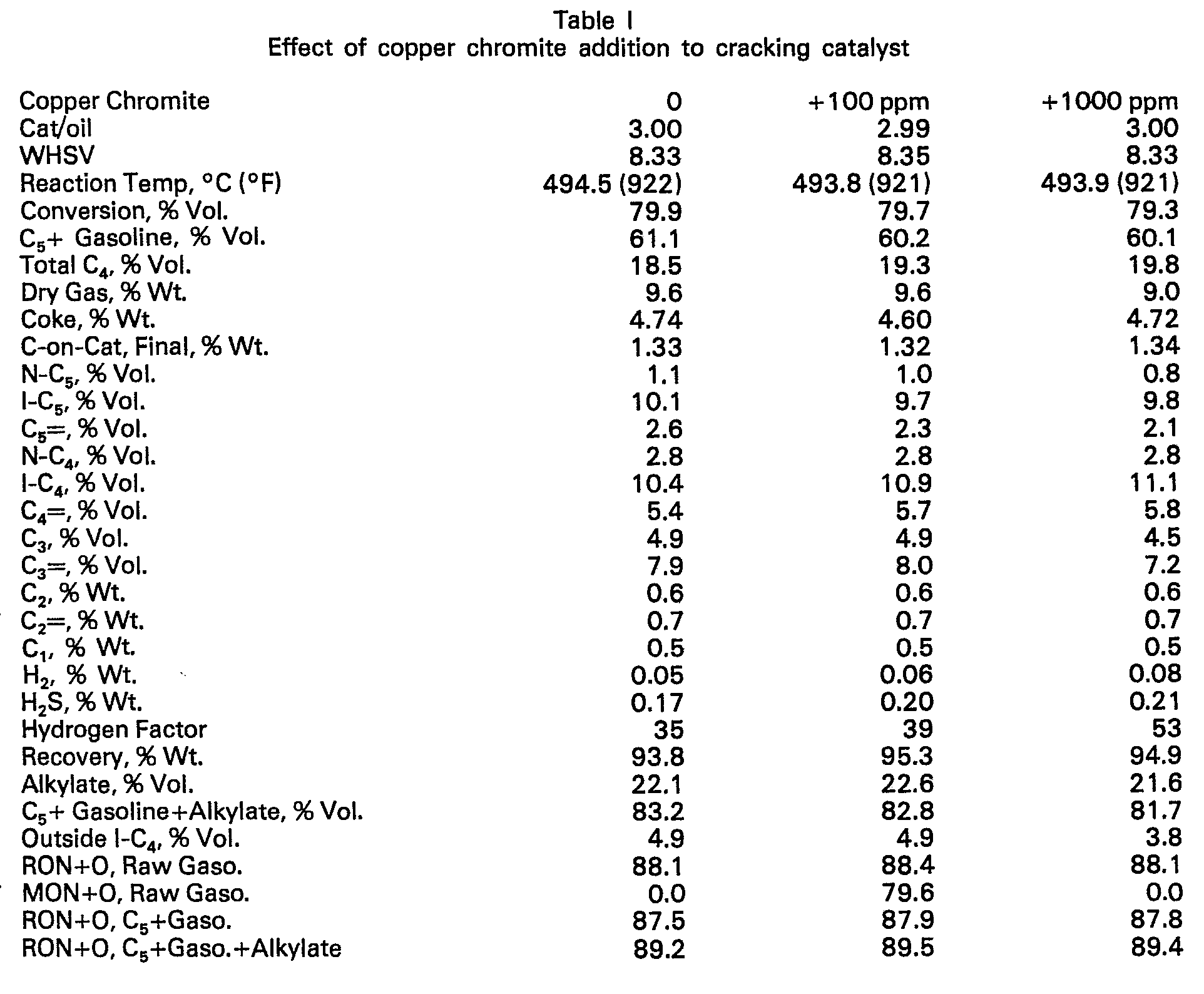
- Reference to Table I will show that the addition of the copper chromite at both 100 and 1000 ppm did not substantially affect the conversion and only decreased the C5+ gasoline make by about 1 volume percent. The hydrogen factor went from only 35 without any copper chromite to 39 with 100 ppm of copper chromite. However, the addition of 1000 ppm of copper chromite resulted in a hydrogen factor of 53-a commercially unacceptable level.
- The CO oxidation results, i.e. Table II, show that at 100 ppm, copper chromite substantially affected the percent of carbon monoxide converted, i.e. from 10% without any copper chromite to 93% with only 100 ppm of copper chromite.

- The following example will show that extremely small amounts of copper chromite are effective to control CO emission. Comparisons are made between a commercial cracking catalyst having no added oxidation promoter and the same commercial catalyst with about 3.3 parts per million of platinum and with 10 parts per million of copper chromite.
- A commercial aluminosilicate zeolite catalyst used in cracking a hydrocarbon charge in a moving bed cracking operation is mixed with alumina beads containing 0.22 weight percent platinum at 0.15% by weight of total catalyst (3.3 ppm platinum) and the mixture is passed through a conventional regenerator used for TCC catalyst regeneration. As a comparison, the same used zeolite catalyst is also mixed with alumina containing 0.5 weight percent copper chromite at concentration of 0.2% by weight (10 ppm copper chromite).
- Both the platinum and the copper chromite are evaluated in the following regeneration process: In a regenerator kiln, air is introduced in two streams, both from the center side with 7.79 m3/s (16,500 c.f.m.) directed upwardly and 6.74 m3/s (14,280 c.f.m.) directed downwardly. The catalyst is passed down from the top at a rate of 680.75 t/h (670 tons per hour) and it contains about 0.649% by weight of carbon (average). The air temperature is 282.3°C (540°F) at each inlet; the outlet temperature is 473.9°C (885°F). The cross-sectional area of the kiln is 43.01 m2 (463 sq. ft.). The gas outlets are located at the top of the kiln, just below the plenum area, and at the bottom of the kiln column.
- The results are shown in the following table:

- The above clearly demonstrates the effectiveness of extremely low amounts of copper chromite, i.e. 10 ppm, in oxidizing carbon monoxide.
Claims (5)
Applications Claiming Priority (2)
| Application Number | Priority Date | Filing Date | Title |
|---|---|---|---|
| US4750379A | 1979-06-11 | 1979-06-11 | |
| US47503 | 2001-10-29 |
Publications (2)
| Publication Number | Publication Date |
|---|---|
| EP0021616A1 EP0021616A1 (en) | 1981-01-07 |
| EP0021616B1 true EP0021616B1 (en) | 1982-06-23 |
Family
ID=21949347
Family Applications (1)
| Application Number | Title | Priority Date | Filing Date |
|---|---|---|---|
| EP80301774A Expired EP0021616B1 (en) | 1979-06-11 | 1980-05-29 | Catalytic cracking process |
Country Status (5)
| Country | Link |
|---|---|
| EP (1) | EP0021616B1 (en) |
| JP (1) | JPS562390A (en) |
| AU (1) | AU534979B2 (en) |
| CA (1) | CA1148888A (en) |
| DE (1) | DE3060583D1 (en) |
Families Citing this family (1)
| Publication number | Priority date | Publication date | Assignee | Title |
|---|---|---|---|---|
| CN102079992B (en) * | 2009-11-26 | 2013-09-25 | 中国石油化工股份有限公司 | Catalytic conversion method for producing high-cetane number light diesel oil and low-olefin gasoline |
Family Cites Families (1)
| Publication number | Priority date | Publication date | Assignee | Title |
|---|---|---|---|---|
| US3926778A (en) * | 1972-12-19 | 1975-12-16 | Mobil Oil Corp | Method and system for controlling the activity of a crystalline zeolite cracking catalyst |
-
1980
- 1980-05-29 DE DE8080301774T patent/DE3060583D1/en not_active Expired
- 1980-05-29 EP EP80301774A patent/EP0021616B1/en not_active Expired
- 1980-06-04 AU AU59048/80A patent/AU534979B2/en not_active Ceased
- 1980-06-05 CA CA000353398A patent/CA1148888A/en not_active Expired
- 1980-06-11 JP JP7792480A patent/JPS562390A/en active Granted
Also Published As
| Publication number | Publication date |
|---|---|
| EP0021616A1 (en) | 1981-01-07 |
| AU5904880A (en) | 1980-12-18 |
| JPS562390A (en) | 1981-01-12 |
| JPS6252788B2 (en) | 1987-11-06 |
| DE3060583D1 (en) | 1982-08-12 |
| AU534979B2 (en) | 1984-02-23 |
| CA1148888A (en) | 1983-06-28 |
Similar Documents
| Publication | Publication Date | Title |
|---|---|---|
| US4093535A (en) | Catalytic cracking process | |
| US4072600A (en) | Catalytic cracking process | |
| US4159239A (en) | Catalytic cracking process | |
| US4280895A (en) | Passivation of cracking catalysts | |
| US3909392A (en) | Fluid catalytic cracking process with substantially complete combustion of carbon monoxide during regeneration of catalyst | |
| CA1048009A (en) | Catalytic cracking with catalyst regeneration and co emission control | |
| US4280896A (en) | Passivation of cracking catalysts | |
| US4851374A (en) | Apparatus and method for regenerating coked fluid cracking catalyst | |
| US5002654A (en) | Reducing NOx emissions with zinc catalyst | |
| EP0074501B1 (en) | Process and catalyst for the conversion of oils that contain carbon precursors and heavy metals | |
| US20040072675A1 (en) | CO oxidation promoters for use in FCC processes | |
| US4457833A (en) | Process and catalyst for the conversion of carbo-metallic containing oils | |
| US5021144A (en) | Process for the reduction of NOX in an FCC regeneration system by select control of CO oxidation promoter in the regeneration zone | |
| EP1879982B1 (en) | Co oxidation promoters for use in fcc processes | |
| US4282084A (en) | Catalytic cracking process | |
| CA1093050A (en) | Catalytic cracking with reduced emission of noxious gases | |
| US4341623A (en) | Catalytic cracking using a mixture of cracking catalyst particles with particles of platinum group metal or rhenium on inert substrates regenerated to up to about 0.1% coke | |
| AU2012202584B2 (en) | A multifunctional catalyst additive composition and process of preparation thereof | |
| US7497942B2 (en) | Catalyst additives for the removal of NH3 and HCN | |
| US5021146A (en) | Reducing NOx emissions with group IIIB compounds | |
| AU648853B2 (en) | Heavy oil catalytic cracking process and apparatus | |
| US4988432A (en) | Reducing NOx emissions with antimony additive | |
| US5382352A (en) | Conversion of NOx in FCC bubbling bed regenerator | |
| US4435282A (en) | Catalytic cracking using a cracking catalyst in admixture with particles of platinum group metal or rhenium on a substrate regenerated to up to about 0.1% coke | |
| US4350615A (en) | Catalytic cracking with reduced emission of noxious gas |
Legal Events
| Date | Code | Title | Description |
|---|---|---|---|
| PUAI | Public reference made under article 153(3) epc to a published international application that has entered the european phase |
Free format text: ORIGINAL CODE: 0009012 |
|
| AK | Designated contracting states |
Designated state(s): DE FR GB NL |
|
| 17P | Request for examination filed |
Effective date: 19810504 |
|
| GRAA | (expected) grant |
Free format text: ORIGINAL CODE: 0009210 |
|
| AK | Designated contracting states |
Designated state(s): DE FR GB NL |
|
| REF | Corresponds to: |
Ref document number: 3060583 Country of ref document: DE Date of ref document: 19820812 |
|
| PGFP | Annual fee paid to national office [announced via postgrant information from national office to epo] |
Ref country code: DE Payment date: 19890316 Year of fee payment: 10 |
|
| PGFP | Annual fee paid to national office [announced via postgrant information from national office to epo] |
Ref country code: GB Payment date: 19890331 Year of fee payment: 10 |
|
| PGFP | Annual fee paid to national office [announced via postgrant information from national office to epo] |
Ref country code: FR Payment date: 19890405 Year of fee payment: 10 |
|
| PGFP | Annual fee paid to national office [announced via postgrant information from national office to epo] |
Ref country code: NL Payment date: 19890531 Year of fee payment: 10 |
|
| PG25 | Lapsed in a contracting state [announced via postgrant information from national office to epo] |
Ref country code: GB Effective date: 19900529 |
|
| PG25 | Lapsed in a contracting state [announced via postgrant information from national office to epo] |
Ref country code: NL Effective date: 19901201 |
|
| NLV4 | Nl: lapsed or anulled due to non-payment of the annual fee | ||
| GBPC | Gb: european patent ceased through non-payment of renewal fee | ||
| PG25 | Lapsed in a contracting state [announced via postgrant information from national office to epo] |
Ref country code: FR Effective date: 19910131 |
|
| PG25 | Lapsed in a contracting state [announced via postgrant information from national office to epo] |
Ref country code: DE Effective date: 19910201 |
|
| REG | Reference to a national code |
Ref country code: FR Ref legal event code: ST |
|
| PLBE | No opposition filed within time limit |
Free format text: ORIGINAL CODE: 0009261 |
|
| STAA | Information on the status of an ep patent application or granted ep patent |
Free format text: STATUS: NO OPPOSITION FILED WITHIN TIME LIMIT |