EP0021552B1 - Hexahydroazepine, piperidine and pyrrolidine derivatives and processes for preparing them - Google Patents
Hexahydroazepine, piperidine and pyrrolidine derivatives and processes for preparing them Download PDFInfo
- Publication number
- EP0021552B1 EP0021552B1 EP80200701A EP80200701A EP0021552B1 EP 0021552 B1 EP0021552 B1 EP 0021552B1 EP 80200701 A EP80200701 A EP 80200701A EP 80200701 A EP80200701 A EP 80200701A EP 0021552 B1 EP0021552 B1 EP 0021552B1
- Authority
- EP
- European Patent Office
- Prior art keywords
- general formula
- hydrogen
- oxocyclohexen
- alkyl
- methyl
- Prior art date
- Legal status (The legal status is an assumption and is not a legal conclusion. Google has not performed a legal analysis and makes no representation as to the accuracy of the status listed.)
- Expired
Links
- 0 CC(C(CCC1)CC1=O)C(I=*)=O Chemical compound CC(C(CCC1)CC1=O)C(I=*)=O 0.000 description 1
- TWEVQGUWCLBRMJ-UHFFFAOYSA-N OC(CCC1)CC1=O Chemical compound OC(CCC1)CC1=O TWEVQGUWCLBRMJ-UHFFFAOYSA-N 0.000 description 1
Classifications
-
- C—CHEMISTRY; METALLURGY
- C07—ORGANIC CHEMISTRY
- C07D—HETEROCYCLIC COMPOUNDS
- C07D207/00—Heterocyclic compounds containing five-membered rings not condensed with other rings, with one nitrogen atom as the only ring hetero atom
- C07D207/02—Heterocyclic compounds containing five-membered rings not condensed with other rings, with one nitrogen atom as the only ring hetero atom with only hydrogen or carbon atoms directly attached to the ring nitrogen atom
- C07D207/18—Heterocyclic compounds containing five-membered rings not condensed with other rings, with one nitrogen atom as the only ring hetero atom with only hydrogen or carbon atoms directly attached to the ring nitrogen atom having one double bond between ring members or between a ring member and a non-ring member
- C07D207/22—Heterocyclic compounds containing five-membered rings not condensed with other rings, with one nitrogen atom as the only ring hetero atom with only hydrogen or carbon atoms directly attached to the ring nitrogen atom having one double bond between ring members or between a ring member and a non-ring member with hetero atoms or with carbon atoms having three bonds to hetero atoms with at the most one bond to halogen, e.g. ester or nitrile radicals, directly attached to ring carbon atoms
- C07D207/24—Oxygen or sulfur atoms
- C07D207/26—2-Pyrrolidones
-
- C—CHEMISTRY; METALLURGY
- C07—ORGANIC CHEMISTRY
- C07D—HETEROCYCLIC COMPOUNDS
- C07D211/00—Heterocyclic compounds containing hydrogenated pyridine rings, not condensed with other rings
- C07D211/04—Heterocyclic compounds containing hydrogenated pyridine rings, not condensed with other rings with only hydrogen or carbon atoms directly attached to the ring nitrogen atom
- C07D211/68—Heterocyclic compounds containing hydrogenated pyridine rings, not condensed with other rings with only hydrogen or carbon atoms directly attached to the ring nitrogen atom having one double bond between ring members or between a ring member and a non-ring member
- C07D211/72—Heterocyclic compounds containing hydrogenated pyridine rings, not condensed with other rings with only hydrogen or carbon atoms directly attached to the ring nitrogen atom having one double bond between ring members or between a ring member and a non-ring member with hetero atoms or with carbon atoms having three bonds to hetero atoms, with at the most one bond to halogen, directly attached to ring carbon atoms
- C07D211/74—Oxygen atoms
- C07D211/76—Oxygen atoms attached in position 2 or 6
-
- C—CHEMISTRY; METALLURGY
- C07—ORGANIC CHEMISTRY
- C07D—HETEROCYCLIC COMPOUNDS
- C07D223/00—Heterocyclic compounds containing seven-membered rings having one nitrogen atom as the only ring hetero atom
- C07D223/02—Heterocyclic compounds containing seven-membered rings having one nitrogen atom as the only ring hetero atom not condensed with other rings
- C07D223/06—Heterocyclic compounds containing seven-membered rings having one nitrogen atom as the only ring hetero atom not condensed with other rings with hetero atoms or with carbon atoms having three bonds to hetero atoms with at the most one bond to halogen, e.g. ester or nitrile radicals, directly attached to ring carbon atoms
- C07D223/08—Oxygen atoms
- C07D223/10—Oxygen atoms attached in position 2
Definitions
- the invention relates to hexahydroazepine, piperidine, and pyrrolidine derivatives. More particularly the invention relates to certain novel 2-oxo-hexahydroazepine, -piperidine and -pyrrolidine derivatives and to a novel process for preparing the novel derivatives.
- Various 3,3-disubstituted hexahydroazepines, -piperidine and -pyrrolidines are known to have pharmacological activity, particularly analgesic activity.
- analgesic 2-unsubstituted-3,3- disubstituted-hexahydroazepines, such as meptazinol are disclosed in U.K. Specification No. 1,285,025.
- Profadol and related 3,3-disubstituted-pyrrolidines are described in J. Med. Chem. 1965, 8, 316 and Belgian Patent Specification No. 850,777 while myfadol and related 3,3-disubstituted- piperidines are described in J. Med.
- novel compounds provided by the invention are 2-oxo-hexahydroazepine, -piperidine and - pyrrolidine derivatives of the general formula (I) wherein n is 2,3 or 4, R is hydrogen, lower alkyl or aryl(lower)alkyl, and R 1 is hydrogen or lower alkyl.
- lower means that the radical referred to contains 1 to 6 carbon atoms.
- the radical preferably contains 1 to 4 carbon atoms.
- R when R is lower alkyl, the radical may be, for example, methyl, ethyl, propyl or butyl.
- R 1 may be, for example, methyl, ethyl, propyl or butyl.
- R is aryi(lower)alkyl
- the radical is preferably a phenyl(lower)alkyl radical such as phenethyl or benzyl; the phenyl group may be substituted by, for example, one or more substituents such as halogen, alkoxy, trifluoromethyl or other substituents common in medicinal chemistry.
- the compounds of general formula (I) may be converted to their aromatised derivatives of general formula (II) where n and R 1 are as defined above, R 2 is hydrogen, lower alkyl or aryi(lower)alkyl and R 3 is hydrogen, lower alkyl, aryl(lower)alkyl, lower alkenyl or lower alkynyl.
- R 3 is lower alkenyl or lower alkynyl it is to be understood that the double or triple bond is not in the 1-position of the alkenyl or alkynyl radical; examples of suitable alkenyl and alkynyl radicals are allyl, propargyl, 3,3-dimethylallyl and 1-methyl-2-propynyl.
- the compounds of general formula (II) may be prepared by aromatising and optionally 0-(lower)alkylating or 0-aryl(lower)alkylating the compounds of general formula (I) to give a compound of general formula (II) in which R 3 is hydrogen, lower alkyl or aryl(lower)alkyl and, if desired N-alkylating, N-arylalkylating, N-alkenylating or N-alkynylating a compound of general formula (II) in which R 3 is hydrogen to give a compound of general formula (II) in which R 3 is lower alkyl, aryi(lower)alkyl, lower alkenyl or lower alkynyl.
- the compounds of general formula (I) can be prepared by a novel process from readily starting materials. Accordingly in a further aspect the invention provides a process for preparing a compound of general formula (I) which comprises reacting a cyclohexene derivative of general formula (IV) where Q is a hydrolysable protecting group such as lower alkoxy (preferably methoxy, ethoxy, or i-propyloxy), benzyloxy, trialkyl-, triaryl- or tri-aralkyl-silyloxy (e.g.
- n and R 1 are as defined above and R 4 is hydrogen, lower alkyl, aryl(lower)alkyl or trialkyl-, triaryl-or triarylalkyl-silyl (e.g. trimethylsilyl) (with the proviso that when R 1 is lower alkyl R 4 is other than hydrogen) and subjecting the product to hydrolysis.
- the lactam of general formula (V) can form its dianion when R 4 is hydrogen and an anion when R 4 is other than hydrogen.
- the anion of the lactam of general formula (V) may be formed in situ by reacting the lactam with an alkyl lithium (e.g. tertiary butyl lithium) or with a compound of general formula MA [where M is -MgX (where X is chlorine, bromine oriodine), sodium, potassium or lithium and A is a secondary amine radical].
- M is sodium, potassium or lithium
- the compound MA is a metal amide and is itself preferably formed in situ by reacting a metal compound MR 5 (where M is sodium potassium or lithium and R 5 is alkyl, aryl or aralkyl) with a secondary amine.
- the secondary amine may be a dialkylamine, e.g. diethylamine, di-isopropylamine, di-tertiarybutylamine, di-n-decylamine, dicyclohexylamine, N-t-amyl-N-t-butylamine, N-isopropyl-N-cyclohexylamine or N-(1'-ethylcyclohexyl)-1,1,3,3-tetramethylbutylamine or a cyclic compound, e.g. piperidine or 2,2,6,6-tetramethylpiperidine.
- a preferred metal amide is lithium diisopropylamine.
- the anion may be prepared by reacting the lactam with a Grignard reagent (preferably isopropylmagnesium bromide) or with a dialkylamino magnesium halide e.g. bromomagnesiumdiisopropylamide.
- a Grignard reagent preferably isopropylmagnesium bromide
- a dialkylamino magnesium halide e.g. bromomagnesiumdiisopropylamide.
- R 4 is hydrogen and R 1 is hydrogen
- the dianion of the lactam may be prepared by reacting the lactam with an alkyl lithium (e.g. tert.butyl lithium or butyl lithium) or with an alkali metal hydride (e.g. sodium hydride) followed by an alkyl lithium (e.g. butyl lithium).
- the product of the reaction of the anion or dianion of the lactam of general formula (V) and the cyclohexene derivative (IV) is preferably not isolated but hydrolysed in situ to give the compound of general formula (I). If R 4 in the compound of general formula (V) is a tri-alkyl-, tri-aryl- or tri-aralkylsilyl group, this group is removed by the hydrolysis to give a compound of general formula (I) in which R is hydrogen.
- the compounds of formula (I) and the derviatives of formula (II) are useful as intermediates for preparing pharmacologically active hexahydroazepine, piperidine and pyrrolidine derivatives as more fully described in European Patent Application No. 78300753.7 (Publication Number 0 003 253).
- n-Butyllithium (1.4M in hexane, 120 ml) was treated at 20°C under dry nitrogen with diisopropylamine (27 ml, 19.2 g) in dry ether (25 ml). The mixture was stirred for 10 minutes at 20°C after completion of the addition and then 1-methyl-2-piperidone (20 g) in ether (25 ml) was added dropwise over 10 minutes. The mixture was stirred for a further 10 minutes, and then 3-isopropoxy-2-cyclohexenone (19.4 g) in ether (25 ml) was added dropwise over 10 minutes.
- the mixture was stirred at 20°C for a further 2 hours and was then hydrolysed by the addition, dropwise at first, of a mixture of conc. hydrochloric acid (50 ml) and (50 ml).
- the mixture was cooled in a water bath during the acidification to moderate the reaction.
- the mixture was cooled to room temperature (from 35°C) and the organic phase was separated and dried (MgS0 4 ). Removal of the solvent left a mobile yellow oil (0.63 g).
- the aqueous phase was extracted exhaustively with chloroform (10 x 40 ml) and the combined extracts were washed with water (100 ml), and saturated aqueous sodium chloride solution (100 ml), and dried (MgS0 4 ).
- n-Butyllithium (1.4 Molar in hexane, 190 ml) was treated dropwise over 10 minutes under dry nitrogen with diisopropylamine (30.3 g) in dry ether (50 ml), with external water cooling to maintain the reaction temperature below 25°C. After a further 10 minutes, freshly distilled dry 1-methyl-2-pyrrolidone (27.72 g) in dry ether (25 ml) was added dropwise over 15 minutes, and the suspension was stirred for a further 20 minutes at 20°C. 3-!sopropoxy-2-cyctohexenone (31 g) in ether (25 ml) was added to the mixture over 15 minutes, the suspended solid dissolving during the addition.
- Lithium diisopropylamide prepared by treating diisopropylamine (45.3 ml) with 1.4M butyl lithium in hexane (231 ml) at -10°C under nitrogen, was treated at -60°C with 1-trimethylsilylhexahydro-2H-azepin-2-one (63.7 g) in dry THF (50 ml). The white suspension was treated after 20 minutes with a solution of 3-methoxy-2-cyciohexenone (40.8 g) in THF (50 ml). The resulting solution was allowed to warm to ambient temperature. After a further 3 hours the cooled solution was treated with concentrated hydrochloric acid (120 ml) and stirred for 18 hours.
- Butyllithium (143 ml of 1.4 molar solution in hexane) was added dropwise to a stirred solution of caprolactam (11.3 g) in dry tetrahydrofuran under nitrogen. After stirring for 50 minutes at 0°, 3-methoxy-2-cyclohexenone (12.6 g) in tetrahydrofuran was added. After a further 30 minutes the reaction was poured onto 5M hydrochloric acid. The organic layer was separated and the aqueous layer was extracted with chloroform. The combined organic layers were dried over magnesium sulphate. Removal of the solvent under reduced pressure left 15 g of a yellow solid. The product was recrystallised from ethyl acetate affording 2.5 g of the title compound identical to that described in Example 6.
Landscapes
- Chemical & Material Sciences (AREA)
- Organic Chemistry (AREA)
- Hydrogenated Pyridines (AREA)
Description
- The invention relates to hexahydroazepine, piperidine, and pyrrolidine derivatives. More particularly the invention relates to certain novel 2-oxo-hexahydroazepine, -piperidine and -pyrrolidine derivatives and to a novel process for preparing the novel derivatives.
- Various 3,3-disubstituted hexahydroazepines, -piperidine and -pyrrolidines are known to have pharmacological activity, particularly analgesic activity. For example, analgesic 2-unsubstituted-3,3- disubstituted-hexahydroazepines, such as meptazinol, are disclosed in U.K. Specification No. 1,285,025. Profadol and related 3,3-disubstituted-pyrrolidines are described in J. Med. Chem. 1965, 8, 316 and Belgian Patent Specification No. 850,777 while myfadol and related 3,3-disubstituted- piperidines are described in J. Med. Chem. 1965, 8, 313. The known processes for preparing the 3,3- disubstituted-hexahydroazepines, -piperidines and -pyrrolidines are expensive and it is an object of the present invention to provide novel intermediates which may be easily prepared by a novel process from readily available starting materials and which can be converted into the desired 3,3-disubstituted- hexahydroazepines, -piperidines and pyrriolidines such that the overall process for preparing the final products is generally more economic than the known processes.
- The novel compounds provided by the invention are 2-oxo-hexahydroazepine, -piperidine and - pyrrolidine derivatives of the general formula (I)

- The term "lower" as used herein means that the radical referred to contains 1 to 6 carbon atoms. The radical preferably contains 1 to 4 carbon atoms. For example when R is lower alkyl, the radical may be, for example, methyl, ethyl, propyl or butyl. Similarly R1 may be, for example, methyl, ethyl, propyl or butyl. When R is aryi(lower)alkyl, the radical is preferably a phenyl(lower)alkyl radical such as phenethyl or benzyl; the phenyl group may be substituted by, for example, one or more substituents such as halogen, alkoxy, trifluoromethyl or other substituents common in medicinal chemistry.
- The compounds of general formula (I) may be converted to their aromatised derivatives of general formula (II)

- Where R3 is lower alkenyl or lower alkynyl it is to be understood that the double or triple bond is not in the 1-position of the alkenyl or alkynyl radical; examples of suitable alkenyl and alkynyl radicals are allyl, propargyl, 3,3-dimethylallyl and 1-methyl-2-propynyl.
- The compounds of general formula (II) may be prepared by aromatising and optionally 0-(lower)alkylating or 0-aryl(lower)alkylating the compounds of general formula (I) to give a compound of general formula (II) in which R3 is hydrogen, lower alkyl or aryl(lower)alkyl and, if desired N-alkylating, N-arylalkylating, N-alkenylating or N-alkynylating a compound of general formula (II) in which R3 is hydrogen to give a compound of general formula (II) in which R3 is lower alkyl, aryi(lower)alkyl, lower alkenyl or lower alkynyl.
- The process for preparing compounds of general formula (II) from the novel compounds of general formula (I) is claimed and more fully described in European Patent Application No. 78300753.7 (Publication Number 0 003 253), from which the present application is divided.
- We have found that the compounds of general formula (I) can be prepared by a novel process from readily starting materials. Accordingly in a further aspect the invention provides a process for preparing a compound of general formula (I) which comprises reacting a cyclohexene derivative of general formula (IV)

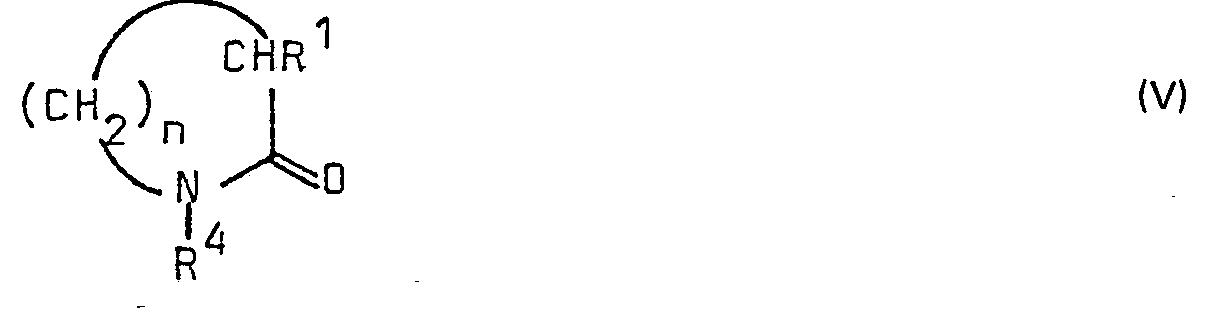
- The product of the reaction of the anion or dianion of the lactam of general formula (V) and the cyclohexene derivative (IV) is preferably not isolated but hydrolysed in situ to give the compound of general formula (I). If R4 in the compound of general formula (V) is a tri-alkyl-, tri-aryl- or tri-aralkylsilyl group, this group is removed by the hydrolysis to give a compound of general formula (I) in which R is hydrogen.
- The compounds of formula (I) and the derviatives of formula (II) are useful as intermediates for preparing pharmacologically active hexahydroazepine, piperidine and pyrrolidine derivatives as more fully described in European Patent Application No. 78300753.7 (Publication Number 0 003 253).
- The following Examples illustrate the invention:
- Diisopropylamine (12.14 g, 17.0 ml) in dry tetrahydrofuran (THF 20 ml) was added dropwise to a stirred cooled (-10°C) solution of butyl lithium (86 ml of 1.4 molar solution in hexane) under nitrogen. After 10 minutes Gilman test was negative. 1-Methyicaproiactam (14.19 g) in THF (20 ml) was added, also at -10°C. The reaction mixture was stirred for 10 minutes at 0°C and 3-methoxy-2-cyclohexenone (12.6 g, 0.1 mole) in THF (20 ml) was added. The mixture was allowed to warm to room temperature and stirred at room temperature for 1.5 hours, then cooled to -10°C and decomposed by addition of 2N HCI (125 ml) rapidly but not allowing temperature for 30 minutes. The aqueous layer was separated and extracted with dichloromethane. The combined organic extracts were dried over anhydrous magnesium sulphate and evaporated to an oil which crystallised from toluene-light petroleum (b.p. 60-80°C) affording the title compound (18.99 g), m.p. 109-110°C.

- n-Butyllithium (1.4M in hexane, 120 ml) was treated at 20°C under dry nitrogen with diisopropylamine (27 ml, 19.2 g) in dry ether (25 ml). The mixture was stirred for 10 minutes at 20°C after completion of the addition and then 1-methyl-2-piperidone (20 g) in ether (25 ml) was added dropwise over 10 minutes. The mixture was stirred for a further 10 minutes, and then 3-isopropoxy-2-cyclohexenone (19.4 g) in ether (25 ml) was added dropwise over 10 minutes. The mixture was stirred at 20°C for a further 2 hours and was then hydrolysed by the addition, dropwise at first, of a mixture of conc. hydrochloric acid (50 ml) and (50 ml). The mixture was cooled in a water bath during the acidification to moderate the reaction. The mixture was cooled to room temperature (from 35°C) and the organic phase was separated and dried (MgS04). Removal of the solvent left a mobile yellow oil (0.63 g). The aqueous phase was extracted exhaustively with chloroform (10 x 40 ml) and the combined extracts were washed with water (100 ml), and saturated aqueous sodium chloride solution (100 ml), and dried (MgS04). Evaporation left a pale green oil (25.79 g). The two fractions were combined and distilled, giving two fractions A, bp < 120°C/1 mm (4.6 g), colourless, mobile liquid; and B, bp 150°C-164°C/0.07mm (14.46 g), yellow oil solidifying to a light yellow mass, mp 41-62°C. Fraction A was identified by IR as slightly impure 1-methyl-2-piperidone (23% recovery), while fraction B was identified by IR and NMR as the title compound.
- A 2 molar solution of isopropylmagnesium bromide in ether (70 ml) was treated with 3-ethyl- hexahydro-1-methyl-2H-azepin-2-one (21.7 g, Aust. J. Chem. 1976,29,2651) in THF (20 ml) and the mixture treated dropwise with diisopropylamine (19.6 ml) (exothermic). The reaction mixture was stirred for 2 hours then treated dropwise with 3-methoxy-2-cyclohexenone (12.6 g) in THF (20 ml). After stirring for 2 hours the reaction mixture was poured onto cold 2N HCI (250 ml). After 10 minutes the mixture was extracted with dichloromethane (2 x 300 ml), the combined organic phases washed with saturated aqueous NaHC03 solution and dried (MgS04). Removal of the solvents under reduced pressure followed by distillation gave the title compound as a viscous oil (Bpt 155-160°C/0.1 mm) (13g). Redistillation (154-158°C/0.07mm) gave analytically pure material.

- 2-Bromopropane (12.3 g) was added to a suspension of magnesium (2.43 g) in ether (50 ml) at such a rate to maintain gentle reflux and the mixture was stirred 30 minutes after addition was complete. Diisopropylamine (14 ml) was then added dropwise and the mixture stirred until the Gilman test showed negative (about 1 hour). N-methylcaprolactam (12.7 g) was added dropwise (exothermic). After addition of the N-methylcaprolactam, stirring became difficult due to separation of a sticky solid, which however redissolved on addition of THF (50 ml). After the addition was complete the reaction mixture was stirred for 30 minutes then treated dropwise with 3-isopropoxy-2-cyclohexenone (16.4 g) (exothermic) and stirred overnight. The reaction mixture was poured onto 2N aq HCI (250 ml) and stirred for 30 minutes. Dichloromethane (300 ml) was added and the layers separated. The aqueous layer was extracted with dichloromethane (2 x 300 ml) and the combined organic phases dried (MgS04). Removal of the solvents under reduced pressure followed by recrystallisation of the residue from ethyl acetate gave the title compound (13.2 g) identical with the product of Example 1.
- n-Butyllithium (1.4 Molar in hexane, 190 ml) was treated dropwise over 10 minutes under dry nitrogen with diisopropylamine (30.3 g) in dry ether (50 ml), with external water cooling to maintain the reaction temperature below 25°C. After a further 10 minutes, freshly distilled dry 1-methyl-2-pyrrolidone (27.72 g) in dry ether (25 ml) was added dropwise over 15 minutes, and the suspension was stirred for a further 20 minutes at 20°C. 3-!sopropoxy-2-cyctohexenone (31 g) in ether (25 ml) was added to the mixture over 15 minutes, the suspended solid dissolving during the addition. The mixture was stirred for a further 2 hours at 20°C and was then cooled in ice and treated, dropwise at first, with a mixture of conc. hydrochloric acid (100 ml) and water (100 ml). After a further 10 minutes the phases were separated and the organic phase was discarded. The aqueous phase was extracted with chloroform (10 x 50 ml) and the combined extracts were washed with water (100 ml) and saturated aqueous sodium chloride solution (100 ml) and dried (MgS04). Evaporation of the solvent gave an initially colourless oil which darkened in air to a clear red colour (37.82 g). Distillation of the oil gave the title compound as a pale yellow liquid which solidified on seeding to a yellow mass (32.75 g), bp 161 °C/0.035 mm - 165°C/0.07 mm, m.p. 42-46°C.
- Lithium diisopropylamide, prepared by treating diisopropylamine (45.3 ml) with 1.4M butyl lithium in hexane (231 ml) at -10°C under nitrogen, was treated at -60°C with 1-trimethylsilylhexahydro-2H-azepin-2-one (63.7 g) in dry THF (50 ml). The white suspension was treated after 20 minutes with a solution of 3-methoxy-2-cyciohexenone (40.8 g) in THF (50 ml). The resulting solution was allowed to warm to ambient temperature. After a further 3 hours the cooled solution was treated with concentrated hydrochloric acid (120 ml) and stirred for 18 hours. The THF layer was combined with several chloroform extracts from the aqueous layer. Evaporation of the solvent gave a yellow solid, which was recrystallised from ethyl acetate to give hexahydro 3-(3-oxocyclohexen-1-yl)-2H-azepin-2-one as an off-white solid (45.5 g) m.p. 159-165°C.

- A solution of hexahydro-1-phenylmethyl-2H-azepin-2-one (5.68 g) in dry THF 'was added at -10°C to lithium diisopropylamide (0.032 m) prepared from diisopropylamine (4.4 ml) and .butyl lithium (22.9 ml) of 1.4M solution in hexane). The mixture was stirred for 30 minutes and then treated with a solution of 3-methoxy-2-cyclohexenone (2.53 g) in THF. After 5 hours at ambient temperature the mixture was poured into ice-cold concentrated hydrochloric acid (100 ml). After vigorously stirring for 12 hours the solution was shaken with several portions of chloroform. The combined chloroform layers were evaporated to give the title compound as an orange oil.
- Butyllithium (143 ml of 1.4 molar solution in hexane) was added dropwise to a stirred solution of caprolactam (11.3 g) in dry tetrahydrofuran under nitrogen. After stirring for 50 minutes at 0°, 3-methoxy-2-cyclohexenone (12.6 g) in tetrahydrofuran was added. After a further 30 minutes the reaction was poured onto 5M hydrochloric acid. The organic layer was separated and the aqueous layer was extracted with chloroform. The combined organic layers were dried over magnesium sulphate. Removal of the solvent under reduced pressure left 15 g of a yellow solid. The product was recrystallised from ethyl acetate affording 2.5 g of the title compound identical to that described in Example 6.
Claims (9)


Applications Claiming Priority (3)
| Application Number | Priority Date | Filing Date | Title |
|---|---|---|---|
| GB5337077 | 1977-12-22 | ||
| GB53370/77A GB1593888A (en) | 1977-12-22 | 1977-12-22 | Hexahydroazepine piperidine and pyrrolidine derivatives |
| EP78300753A EP0003253B1 (en) | 1977-12-22 | 1978-12-06 | Hexahydroazepine, piperidine and pyrrolidine derivatives and processes for making and using them |
Related Parent Applications (1)
| Application Number | Title | Priority Date | Filing Date |
|---|---|---|---|
| EP78300753.7 Division | 1978-12-06 |
Publications (2)
| Publication Number | Publication Date |
|---|---|
| EP0021552A1 EP0021552A1 (en) | 1981-01-07 |
| EP0021552B1 true EP0021552B1 (en) | 1983-01-26 |
Family
ID=26077658
Family Applications (1)
| Application Number | Title | Priority Date | Filing Date |
|---|---|---|---|
| EP80200701A Expired EP0021552B1 (en) | 1977-12-22 | 1978-12-06 | Hexahydroazepine, piperidine and pyrrolidine derivatives and processes for preparing them |
Country Status (2)
| Country | Link |
|---|---|
| EP (1) | EP0021552B1 (en) |
| DE (1) | DE2862170D1 (en) |
Families Citing this family (2)
| Publication number | Priority date | Publication date | Assignee | Title |
|---|---|---|---|---|
| IE54154B1 (en) * | 1981-12-02 | 1989-07-05 | Wyeth John & Brother Ltd | M-hydroxyphenyl substituted compounds |
| FR2653123B1 (en) * | 1989-10-17 | 1992-01-17 | Roussel Uclaf | NEW PYRIDONE DERIVATIVES, THEIR PREPARATION PROCESS, THE NEW INTERMEDIATES OBTAINED, THEIR APPLICATION AS MEDICAMENTS AND THE PHARMACEUTICAL COMPOSITIONS CONTAINING THEM. |
-
1978
- 1978-12-06 DE DE8080200701T patent/DE2862170D1/en not_active Expired
- 1978-12-06 EP EP80200701A patent/EP0021552B1/en not_active Expired
Non-Patent Citations (1)
| Title |
|---|
| None * |
Also Published As
| Publication number | Publication date |
|---|---|
| DE2862170D1 (en) | 1983-03-03 |
| EP0021552A1 (en) | 1981-01-07 |
Similar Documents
| Publication | Publication Date | Title |
|---|---|---|
| US3014911A (en) | Derivatives of dibenzo[a, e]cycloheptatriene | |
| EP0283979A2 (en) | Ethinyl cyclohexene derivatives | |
| HU178532B (en) | Process for producing 1,2,4,5-tetraalkyl-4-aryl-piperidine derivatives | |
| US4197239A (en) | Hexahydroazepine, piperidine and pyrrolidine derivatives | |
| EP0021552A1 (en) | Hexahydroazepine, piperidine and pyrrolidine derivatives and processes for preparing them | |
| US5107057A (en) | Cyano-dienes, halopyridines, intermediates and a process for their preparation | |
| KR820000718B1 (en) | Method for preparing 2-oxo-hexahydro azepine, piperidine and pyrrolidine derivatives | |
| US7414143B2 (en) | Process for the preparation of 4,4-dimethyl-6-ethynylthiochroman | |
| NO131172B (en) | ||
| US4965380A (en) | Process for preparation of asymmetric triorganotin halide | |
| JP4327911B2 (en) | Method for producing imide compound | |
| US4296029A (en) | Process for preparing hexahydroazepine, piperidine and pyrrolidine derivatives | |
| AT373587B (en) | METHOD FOR PRODUCING NEW 2-OXO-HEXAHYDROAZEPIN, -PIPERIDINE AND -PYRROLIDINE DERIVATIVES | |
| JPH05255231A (en) | Preparation of omega-(o-substituted urethano) alkylcarboxylate | |
| US4611080A (en) | Preparation of halogenated aroylacetic acid esters | |
| US4463177A (en) | Process for making m-hydroxyphenyl substituted compounds | |
| NO780100L (en) | PROCEDURES FOR THE PREPARATION OF (1,1-DITIENYL- (3) -1-HYDROXY-PROPYL- (3)) - (1-PHENYL-1-HYDROXY-PROPYL- (2)) - AMIN AND (1., 1- DITIENYL- (3-PROPENE- (1) -YL- (3)) - (1-PHENYL-PROPYL- (2)) - AMIN | |
| EP0013726B1 (en) | Indanyloxamic derivatives, their preparation and pharmaceutical compositions containing them | |
| EP0017264B1 (en) | Bicyclic lactams and a process for their preparation | |
| US4545934A (en) | Process for the producton of 4-substituted acetoacetic acid derivatives | |
| WO2005003125A1 (en) | Process for the preparation of 4,4-dimethyl-6-ethynylthiochroman | |
| AU2946889A (en) | Cyano-dienes, halopyridines, intermediates and a process for their preparation | |
| NZ222517A (en) | 1-benzooxacycloalkylpyridine carboxylic acid derivatives, intermediates, and pharmaceutical compositions | |
| EP0065319A1 (en) | Process for the preparation of an unsaturated macrocyclic ketone | |
| GB2145089A (en) | Pyrrolidones, piperidones and hexahydroazepinones |
Legal Events
| Date | Code | Title | Description |
|---|---|---|---|
| PUAI | Public reference made under article 153(3) epc to a published international application that has entered the european phase |
Free format text: ORIGINAL CODE: 0009012 |
|
| AC | Divisional application: reference to earlier application |
Ref document number: 3253 Country of ref document: EP |
|
| AK | Designated contracting states |
Designated state(s): BE CH DE FR IT LU NL SE |
|
| 17P | Request for examination filed |
Effective date: 19810610 |
|
| ITF | It: translation for a ep patent filed | ||
| GRAA | (expected) grant |
Free format text: ORIGINAL CODE: 0009210 |
|
| AC | Divisional application: reference to earlier application |
Ref document number: 3253 Country of ref document: EP |
|
| AK | Designated contracting states |
Designated state(s): BE CH DE FR IT LU NL SE |
|
| ET | Fr: translation filed | ||
| REF | Corresponds to: |
Ref document number: 2862170 Country of ref document: DE Date of ref document: 19830303 |
|
| ITTA | It: last paid annual fee | ||
| EPTA | Lu: last paid annual fee | ||
| EAL | Se: european patent in force in sweden |
Ref document number: 80200701.3 |
|
| PGFP | Annual fee paid to national office [announced via postgrant information from national office to epo] |
Ref country code: FR Payment date: 19971110 Year of fee payment: 20 |
|
| PGFP | Annual fee paid to national office [announced via postgrant information from national office to epo] |
Ref country code: SE Payment date: 19971117 Year of fee payment: 20 |
|
| PGFP | Annual fee paid to national office [announced via postgrant information from national office to epo] |
Ref country code: DE Payment date: 19971124 Year of fee payment: 20 |
|
| PGFP | Annual fee paid to national office [announced via postgrant information from national office to epo] |
Ref country code: NL Payment date: 19971126 Year of fee payment: 20 |
|
| PGFP | Annual fee paid to national office [announced via postgrant information from national office to epo] |
Ref country code: CH Payment date: 19971201 Year of fee payment: 20 Ref country code: BE Payment date: 19971201 Year of fee payment: 20 |
|
| BE20 | Be: patent expired |
Free format text: 19981206 JOHN *WYETH & BROTHER LTD |
|
| PGFP | Annual fee paid to national office [announced via postgrant information from national office to epo] |
Ref country code: LU Payment date: 19980303 Year of fee payment: 20 |
|
| PG25 | Lapsed in a contracting state [announced via postgrant information from national office to epo] |
Ref country code: CH Free format text: LAPSE BECAUSE OF EXPIRATION OF PROTECTION Effective date: 19981205 |
|
| PG25 | Lapsed in a contracting state [announced via postgrant information from national office to epo] |
Ref country code: NL Free format text: LAPSE BECAUSE OF EXPIRATION OF PROTECTION Effective date: 19981206 Ref country code: LU Free format text: LAPSE BECAUSE OF EXPIRATION OF PROTECTION Effective date: 19981206 |
|
| PG25 | Lapsed in a contracting state [announced via postgrant information from national office to epo] |
Ref country code: SE Free format text: LAPSE BECAUSE OF NON-PAYMENT OF DUE FEES Effective date: 19981207 |
|
| REG | Reference to a national code |
Ref country code: CH Ref legal event code: PL |
|
| NLV7 | Nl: ceased due to reaching the maximum lifetime of a patent |
Effective date: 19981206 |
|
| EUG | Se: european patent has lapsed |
Ref document number: 80200701.3 |
|
| PLBE | No opposition filed within time limit |
Free format text: ORIGINAL CODE: 0009261 |
|
| STAA | Information on the status of an ep patent application or granted ep patent |
Free format text: STATUS: NO OPPOSITION FILED WITHIN TIME LIMIT |