EP0017471B1 - Catalyst component and catalyst for the polymerization of olefins and process for the production of polyolefins using the catalyst system - Google Patents
Catalyst component and catalyst for the polymerization of olefins and process for the production of polyolefins using the catalyst system Download PDFInfo
- Publication number
- EP0017471B1 EP0017471B1 EP80301038A EP80301038A EP0017471B1 EP 0017471 B1 EP0017471 B1 EP 0017471B1 EP 80301038 A EP80301038 A EP 80301038A EP 80301038 A EP80301038 A EP 80301038A EP 0017471 B1 EP0017471 B1 EP 0017471B1
- Authority
- EP
- European Patent Office
- Prior art keywords
- catalyst
- compound
- lewis base
- iii
- phenol
- Prior art date
- Legal status (The legal status is an assumption and is not a legal conclusion. Google has not performed a legal analysis and makes no representation as to the accuracy of the status listed.)
- Expired
Links
Classifications
-
- C—CHEMISTRY; METALLURGY
- C08—ORGANIC MACROMOLECULAR COMPOUNDS; THEIR PREPARATION OR CHEMICAL WORKING-UP; COMPOSITIONS BASED THEREON
- C08F—MACROMOLECULAR COMPOUNDS OBTAINED BY REACTIONS ONLY INVOLVING CARBON-TO-CARBON UNSATURATED BONDS
- C08F10/00—Homopolymers and copolymers of unsaturated aliphatic hydrocarbons having only one carbon-to-carbon double bond
Definitions
- the present invention relates to an improvement of a catalyst useful for the polymerization of olefins and a process for the homopolymerization or copolymerization of olefins using the catalyst.
- a reaction product of an organomagnesium compound and a transition metal compound is used as the catalyst in Japanese Patent Publication (unexamined) No. 72,384/1974 and Japanese Patent Publication No. 495/1960, and a copulverized mixture of a metal alkoxide and a transition metal compound or a reaction product of these compounds is used as the catalyst in Japanese Patent Publication (unexamined) Nos. 2,580/1978 and 119,982/1974 and Japanese Patent Publication No. 42,137/1972.
- a reaction product of water and/or a hydroxy compound, a Grignard reagent, a titanium tetrahalide, and an electron donor is used as the catalyst in French Patent No. 2373565.
- the present inventors have already provided an improved catalyst obtained by the reaction of a solid organomagnesium compound and a transition metal compound, which shows excellent catalytic activity, i.e. not only a high activity per the transition metal compound but also a high activity per the solid catalyst compound and can give a polymer having a high stereoregularity without the need to remove the catalyst residues (cf. Japanese Patent Application No. 11,157/1978).
- the catalyst is prepared by reacting an organic halogen compound and magnesium metal in the presence of iodine in an inert hydrocarbon solvent which does not substantially dissolve an organomagnesium compound, activating the resulting organomagnesium compound particles with a Lewis base and then reacting the resulting solid compound with a transition metal compound.
- the catalyst thus obtained has a high catalytic activity per the transition metal compound and can give the desired polymer having a high stereoregularity.
- this catalyst is still not satisfactory in its activity per the solid catalyst and also in its stereoregularity.
- the present inventors have carried out further studies to obtain a further improved catalyst with good catalytic activity not only per the transition metal compound but also per the solid catalyst, and which can give the desired polyolefins having high stereoregularity.
- the desired catalyst suitable for the production of polyolefins can be obtained by using as a component of the catalyst a reaction product of a phenol, and an organomagnesium compound powder which is obtained by the reaction of an organic halogen compound and magnesium metal in the presence of a Lewis base in an amount of less than 1.5 moles per gram atom of magnesium.
- the invention provides a catalyst component for a catalyst useful for the polymerization of olefins, which comprises a reaction product of (i) a solid organomagnesium compound of the formula: wherein R is a hydrocarbon group having 1 to 20 carbon atoms, X is a halogen atom, D is a Lewis base, I is a number in the range 0 ⁇ i ⁇ 2, and a is a number in the range 0 ⁇ 1.5, (ii) a phenol or thiophenol, (iii) a Lewis base, and (iv) a titanium compound, a vanadium compound or a mixture thereof, except for a reaction product obtained by the direct treatment of (i) with (iii), followed by reaction with components (ii) and (iv).
- the invention includes within its scope a catalyst for the polymerization of olefins, one component of which is that defined above.
- the catalyst of the present invention comprises
- the organometallic compound (A) is preferably an organometallic compound of a typical metal of Groups I, II or III of the Periodic Table, and may preferably be an organo-lithium, -magnesium or -aluminum compound of the formula: R1U, R 2 MgX 1 or wherein R 1 , R 2 and R 3 are each a hydrocarbon group having 1 to 20 carbon atoms, such as an alkyl group having 1 to 20 carbon atoms (e.g.
- X 1 amd X 2 are each hydrogen atom, a halogen atom (e.g.
- chlorine, bromine, iodine or an alkoxy group having 1 to 20 carbon atoms (e.g. methoxy, ethoxy, propoxy, butoxy, isobutoxy, amyloxy), and m is a number in the range of 0 ⁇ m ⁇ 3.
- Suitable examples of the compound are n-butyl-lithium, n-butylmagnesium chloride, triethylaluminum, triisobutylaluminum, diethylaluminum chloride, dibutylaluminum chloride, diphenylaluminum chloride, ethylaluminum sesquichloride, diethylaluminum bromide, dibutylaluminum bromide, diethylaluminum iodide, dibutylaluminum iodide, diethylaluminum hydride, diethylaluminum ethoxide, diethylaluminum methoxide, and mixture of these compounds.
- trialkylaluminums of the formula: AIR3 wherein R 4 is an alkyl group having 1 to 8 carbon atoms, such as triethylaluminum and triisobutylaluminum are preferred compounds.
- Particularly preferred examples of the component (A) are a mixture of the trialkylaluminum as mentioned above and a dialkylaluminum halide of the formula: AIRZX 3 wherein R 5 is an alkyl group having 1 to 8 carbon atoms and X 3 is a halogen atom.
- a suitable mixing ratio of the trialkylaluminum and the dialkylaluminum halide is in the range of 1:4 to 4:1 by mole.
- Suitable examples of the mixture are an equimolar mixture of triethylaluminum and diethylaluminum chloride, or an equimolar mixture of triisobutylaluminium and diethylaluminum chloride.
- the solid organomagnesium compound (i) can be prepared by reacting an organic halogen compound and magnesium metal and optionally a small amount of a Lewis base (i.e. up to 1.5 mole, preferably 0.1 to 1.0 mole, per 1 gram atom of magnesium) in the presence of a catalytic amount of iodine in an inert hydrocarbon solvent ⁇ which does not substantially dissolve the organomagnesium compound.
- a Lewis base i.e. up to 1.5 mole, preferably 0.1 to 1.0 mole, per 1 gram atom of magnesium
- the molar ratio of the organic halogen compound to magnesium is not critical, but the preferred molar ratio is in the range of 1.1:1.0 to 0.01:1.0 (the organic halogen compound:magnesium).
- organomagnesium halide e.g. chlorine, bromine, iodine
- D is a Lewis base
- I is a number in the range of 0 ⁇ l ⁇ 2, preferably 0.005 ⁇ I ⁇ 1.90, more preferably 0.01 ⁇ I ⁇ 1.50
- a is a number in the range of 0:5a ⁇ 1.5, preferably 0 ⁇ 1.0.
- organomagnesium halide is hereinafter referred to as "organomagnesium halide”.
- organomagnesium halide methyl-, ethyl-, butyl-, octyl-, or phenylmagnesium chloride, bromide or iodide, naphthylmagnesium chloride, p-tolylmagnesium chloride or 2,4,6-trimethylphenylmagnesium chloride.
- the inert hydrocarbon solvent used in the preparation of the organomagnesium halides includes n-hexane, n-heptane, cyclohexane, benzene or toluene.
- the Lewis base (D) includes ethers, ketones, carboxylic acid esters, phosphorus compounds, amines or sulfonic acid esters. Suitable examples of the Lewis base are diethyl ether, dibutyl ether, diisoamyl ether, anisole, diphenyl ether, tetrahydrofuran, dioxane, methyl ethyl ketone, acetophenone, diphenyl ketone, ethyl benzoate, ethyl p-anisate, ethyl p-toluylate, ethyl acetate, phenyl acetate, methyl stearate, di-2-ethylhexyl phthalate, di-n-octyl phthalate, dimethyl terephthalate, triphenyl phosphine, triphenyl phosphite, tri-n-butyl phosphite, triphenyl
- the reaction of the halogenated hydrocarbon and magnesium is preferably carried out in the presence of a small amount of Lewis base at a reaction temperature of 20 to 300°C, preferably 40 to 200°C, for 30 minutes to 20 hours, preferably 3 to 10 hours.
- the inert hydrocarbon solvent is used in such an amount that magnesium is contained in the reaction system in the concentration of 0.01 to 0.1 g/ml.
- component (ii) may be a phenol or a thiophenol but the term "phenol” as used hereinafter referring generally to component (ii) includes thiophenols within its scope.
- Suitable examples of the phenol are phenol, o-cresol, m-cresol, p-cresol, o-ethylphenol, m- ethylphenol, p-ethylphenol, o-butylphenyl, m-butylphenol, p-butyphenyl, 2,4,6-trimethylphenol, 2,6-dimethylphenol, 3,5-dimethylphenol, 2,6-di-tert-butyl-4-methylphenol, o-methoxyphenol, m-methoxyphenol, p-methoxyphenol, 2,4,6-trimethoxyphenol, 2,6-dimethoxyphenol, 3,5-dimethoxyphenol, a-naphthol, A-naphthol, hydroquinone, catechol, thiophenol and p-thiocresol.
- the compounds having a phenolic OH group are preferable. These phenols may be used alone or in a combination of two or more thereof.
- the phenol (ii) is used in an amount of 0.01 to 2 moles, preferably 0.5 to 1.5 moles, more preferably 0.5 to 1.0 moles per gram atom of magnesium in the component (i).
- the Lewis base (iii) may be the same as or different from the Lewis base used in the preparation of the organomagnesium compound powder and may be any of the Lewis bases listed above.
- the Lewis base (iii) is used in an amount of 0.01 to 10.0 moles, preferably 0.05 to 1.0 mole, per 1 gram atom of magnesium contained in the component (i).
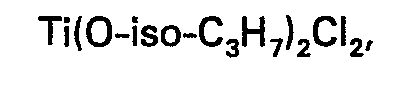
- the titanium compound or vanadium' compound is preferably a compound of the formula: or wherein R 6 , R 7 and R 8 are each a hydrocarbon group having 1 to 20 carbon atoms, such as an alkyl group having 1 to 20 carbon atoms (e.g. methyl, ethyl, propyl, isopropyl, n-butyl, isobutyl, tert-butyl, n-amyl, isoamyl, hexyl, heptyl, octyl, 2-ethylhexyl), or an aryl group having 6 to 20 carbon atoms (e.g.
- halogen atom e.g. chlorine, bromine, iodine
- Suitable examples of these compounds are and These compounds may be used alone or in a mixture thereof, such as a mixture of TiCI 4 and VOCI 3 , TiCI 4 and VC1 4 or VOCI 3 and The compounds may also be in the form of a eutectic mixture with another compound, such as Among these titanium compounds and vanadium compounds, liquid compounds containing a halogen are preferable.
- the titanium compound and vanadium compound (iv) are preferably used in an amount of 1 to 20 moles, more preferably 2 to 10 moles, per 1 gram atom of magnesium contained in the component (i).
- reaction first of component (I) and the component (iv) followed by reaction with component (ii) should be avoided.
- Preferred reaction orders of the four components are as follows.
- All of the above reactions are usually carried out in a hydrocarbon solvent having 3 to 20 carbon atoms, such as pentane, hexane, heptane, cyclohexane, benzene or toluene.
- the reaction temperature is preferably in the range of -20 to 300°C, more preferably 0 to 150°C.
- the reaction period of time is not critical, but is preferably in the range of 5 minutes to 20 hours, more preferably 30 minutes to 10 hours.
- the solid reaction product obtained from the reaction of the components (i), (ii), (iii) and (iv) is isolated from the reaction system by a conventional method such as filtration, followed by washing with an inert hydrocarbon solvent as mentioned above and drying, and then is used for the polymerization reaction.
- reaction product or mixture obtained in each step may be used in the next step after isolation (in the state of a solid product) from the reaction system by a conventional method such as filtration or may be used as it stands, i.e. without isolation.
- the catalyst of the present invention preferably contains the component (A) and the component (B) in the ratio of 1-200 mole of the organometallic compound (A) per 1 gram atom of Ti or V contained in the component (B).
- a Lewis base (C) may optionally be used in the preparation of the catalyst of the present invention.
- the Lewis base (C) may be the same as or different from the Lewis base used in the preparation of the component (B) and is selected from the Lewis bases as listed hereinbefore.
- aromatic carboxylic acid esters such as ethyl benzoate, ethyl p-anisate, di-2-ethylhexyl phthalate, di-n-octyl phthalate or dimethyl terephthalate are preferable as the Lewis base (C).
- This component (C) is used in an amount of up to 1 mole, preferably up to 0.5 mole, per 1 mole of the organometallic compound (A).
- Polymerization of olefins by using the catalyst of the present invention is carried out under similar conditions to those of the polymerization reaction of olefins using a conventional Ziegler catalyst. That is, the reaction is carried out under the condition substantially free from oxygen and water in a gaseous phase or in the form of a suspension or solution in an appropriate inert solvent or liquid monomers.
- the solvent or dispersing agent used in the polymerization reaction includes inert hydrocarbons having 3 to 20 carbon atoms, such as pentane, hexane, heptane, cyclohexane, benzene or toluene.
- the polymerization reaction of olefins is usually carried out at a polymerization temperature of 20 to 300°C, preferably 50 to 200°C, under a pressure of from atmospheric pressure to 100 kg/cm 2 (980.665x10 4 Pa), preferably 2 to 60 kg/cm 2 (17.6133x10° Pa to 588.399x10 4 Pa).
- Molecular weight of the obtained polyolefins may somewhat be controlled by varying the polymerization conditions such as polymerization temperature or ratio of the catalyst components, but is effectively controlled by adding hydrogen to the polymerization reaction system.
- the polymerization process of the present invention can be applied to polymerization of all olefins, to which the conventional Ziegler catalyst is applicable.
- the process of the present invention is preferably used for the homopolymerization of a-olefins such as ethylene, propylene or 1-butene, and for the copolymerization of a combination of a-olefins such as ethylene and propylene; ethylene and 1-butene; propylene and 1-butene; propylene or ethylene and 1-butene.
- the present invention is illustrated by the following Examples but is not limited thereto.
- n-butyl magnesium chloride contains 23.0% by weight of Mg and 58.5% by weight of Cl.
- the resulting reaction product is taken out from the mixture by filtration, and there to is added TiCI 4 (21.0 ml) under cooling at 0°C, and the mixture is reacted at 136°C for 2 hours. After the reaction, the resulting slurry is cooled to about 25°C.
- the reaction product thus obtained is washed with n-heptane until no free TiCI 4 is detected in the washing n-heptane and then dried under reduced pressure.
- the catalyst product thus obtained is in the form of a light reddish brown powder and contains Ti, Mg and CI of 2.4, 21.0 and 66.0% by weight, respectively.
- the unreacted propylene is discharged from the autoclave to give a white powdery polypropylene (27.3 g).
- the catalytic activity R(Y), i.e. a polymer yield, per 1 g of the catalyst component (B) is 1,160 g-pp/g-catalyst
- the catalytic activity R(Ti), i.e. a polymer yield, per 1 g of Ti contained in the catalyst component (B) is 48,400 g-pp/g-Ti.
- the catalyst obtained in the above (2) shows an extremely high catalytic activity.
- the polypropylene thus obtained is extracted with boiling n-heptane for 6 hours, the remaining extraction residue (hereinafter, referred to as "II") is 88% by weight.
- the powdery polymer thus obtained is separated from the slurry with a centrifugal separator and dried at 50°C under reduced pressure to give a powdery polymer (165.7 g) having a bulk density of 0.37 g/ml, and II of 95.5% by weight.
- a powdery polymer (165.7 g) having a bulk density of 0.37 g/ml, and II of 95.5% by weight.
- polypropylene (14.7 g) which is soluble in n-heptane.
- the catalyst shows a catalytic activity R(Y) of 4,120 g-pp/g-catalyst and R(Ti) of 172,000 g-pp/g-Ti, and the yield of the powdery pofymer (hereinafter, referred to as "HIP") is 91.9%.
- the reaction product is taken out from the system by filtration, and thereto is added TiCI 4 (65 ml) at about 0°C, and the mixture is gradually heated up to 136°C and then reacted at 136°C for 2 hours.
- the resulting slurry is cooled to about 25°C, and the reaction product is washed with n-heptane until no free TiCI 4 is detected in the washing n-heptane and dried under reduced pressure.
- the catalyst thus obtained is in the form of powder having a red-brick color.
- the product contains 4.0% by weight of Ti, 17.2% by weight of Mg, 59.2% by weight of Cl, 0.3% by weight of diethyl ether, and 4.8% by weight of ethyl benzoate.
- the polymerization is carried out by using the catalyst component B (51.4 mg) obtained in the above Example 2, (2) for 1 hour.
- the catalyst shows a catalytic activity R(Y) of 6,850 g-pp/g-catalyst, R(Ti) of 171,000 g-pp/g-Ti, and HIP of 97.5%.
- the powdery polymer thus obtained has a bulk density of 0.37 g/ml, an intrinsic viscosity [ ⁇ ] of 1.69 dl/g, a melt index of 7.4 g/minute, and a stiffness of 12,400 kg/cm 2 (121602.46x10 4 Pa).
- the reaction product is dried under reduced pressure to give a powdery catalyst having a reddish brown color.
- the catalyst thus obtained contains 3.5% by weight of Ti, 19.3% by weight of Mg, 60.6% by weight of Cl, 0.1 % by weight of diethyl ether, and 3.7% by weight of ethyl benzoate.
- the polymerization is carried out by using the catalyst component B (49.5 mg) obtained in Example 3, (1) for 1 hour.
- the catalyst shows a catalytic activity R(Y) of 7,030 g-pp/g-catalyst, R(Ti) of 200,000 g-pp/g-Ti, and HIP of 96.8%.
- the powdery polymer has a bulk density of 0.37 g/ml, and a melt index of 7.8 g/10 minute.
- Example 3 (1) is repeated except that various phenols as shown in the following Table 1 are used in an amount of 0.81 mole per 1 gram atom of magnesium contained in n-butylmagnesium chloride instead of phenol, there are obtained the catalyst components B.
- the catalyst components B are used for the polymerization of propylene in the same manner as described in Example 1, (4). The results are shown in the Table.
- Example 3 (1) is repeated except that three aliphatic alcohols as shown in Table 1 are used in an amount of 0.81 mole per 1 gram atom of magnesium contained in n-butylmagnesium chloride instead of phenol or no alcohol is used, there are obtained the catalyst components B.
- the catalyst components B are used for the polymerization of propylene in the same manner as described in Example 1, (4). The results are shown in Table 1.
- the catalyst thus obtained contains 6.7% by weight of V, 17.8% by weight of Mg, and 62.1% by weight of Cl.
- the unreacted ethylene is discharged from the autoclave, and the resulting polyethylene is separated from the polymer slurry and dried to give a powdery polymer (122.5 g) having a bulk density of 0.37 g/ml.
- the catalyst shows a catalytic activity R(Y) of 6,030 g-pe/g-catalyst.
- the above-exemplified catalysts according to the invention have excellent activity not only per the transition metal compound, but also per the solid catalyst, and can give polyolefins having high stereoregularity.
Landscapes
- Chemical & Material Sciences (AREA)
- Health & Medical Sciences (AREA)
- Chemical Kinetics & Catalysis (AREA)
- Medicinal Chemistry (AREA)
- Polymers & Plastics (AREA)
- Organic Chemistry (AREA)
- Transition And Organic Metals Composition Catalysts For Addition Polymerization (AREA)
Description
- The present invention relates to an improvement of a catalyst useful for the polymerization of olefins and a process for the homopolymerization or copolymerization of olefins using the catalyst.
- There have hitherto been proposed some improvements of catalysts for the polymerization of olefins in order to enhance the activity of the catalyst or to obtain polymers having a high stereoregularity. For instance, a reaction product of an organomagnesium compound and a transition metal compound is used as the catalyst in Japanese Patent Publication (unexamined) No. 72,384/1974 and Japanese Patent Publication No. 495/1960, and a copulverized mixture of a metal alkoxide and a transition metal compound or a reaction product of these compounds is used as the catalyst in Japanese Patent Publication (unexamined) Nos. 2,580/1978 and 119,982/1974 and Japanese Patent Publication No. 42,137/1972. A reaction product of water and/or a hydroxy compound, a Grignard reagent, a titanium tetrahalide, and an electron donor is used as the catalyst in French Patent No. 2373565.
- The present inventors have already provided an improved catalyst obtained by the reaction of a solid organomagnesium compound and a transition metal compound, which shows excellent catalytic activity, i.e. not only a high activity per the transition metal compound but also a high activity per the solid catalyst compound and can give a polymer having a high stereoregularity without the need to remove the catalyst residues (cf. Japanese Patent Application No. 11,157/1978). The catalyst is prepared by reacting an organic halogen compound and magnesium metal in the presence of iodine in an inert hydrocarbon solvent which does not substantially dissolve an organomagnesium compound, activating the resulting organomagnesium compound particles with a Lewis base and then reacting the resulting solid compound with a transition metal compound. The catalyst thus obtained has a high catalytic activity per the transition metal compound and can give the desired polymer having a high stereoregularity. However, for the polymerization of olefins, this catalyst is still not satisfactory in its activity per the solid catalyst and also in its stereoregularity.
- The present inventors have carried out further studies to obtain a further improved catalyst with good catalytic activity not only per the transition metal compound but also per the solid catalyst, and which can give the desired polyolefins having high stereoregularity. As a result, it has now been found that the desired catalyst suitable for the production of polyolefins can be obtained by using as a component of the catalyst a reaction product of a phenol, and an organomagnesium compound powder which is obtained by the reaction of an organic halogen compound and magnesium metal in the presence of a Lewis base in an amount of less than 1.5 moles per gram atom of magnesium.
- The invention provides a catalyst component for a catalyst useful for the polymerization of olefins, which comprises a reaction product of (i) a solid organomagnesium compound of the formula:

- The invention includes within its scope a catalyst for the polymerization of olefins, one component of which is that defined above.
- The catalyst of the present invention comprises
- (A) at least one organometallic compound of a metal of group I, II or III of the Periodic table,
- (B) a reaction product of (i) a solid organomagnesium compound of the formula:

- (C) is a Lewis base in an amount of up to 1 mole per mole of component (A).
- The organometallic compound (A) is preferably an organometallic compound of a typical metal of Groups I, II or III of the Periodic Table, and may preferably be an organo-lithium, -magnesium or -aluminum compound of the formula: R1U, R2MgX1 or

- The solid organomagnesium compound (i) can be prepared by reacting an organic halogen compound and magnesium metal and optionally a small amount of a Lewis base (i.e. up to 1.5 mole, preferably 0.1 to 1.0 mole, per 1 gram atom of magnesium) in the presence of a catalytic amount of iodine in an inert hydrocarbon solvent`which does not substantially dissolve the organomagnesium compound. The molar ratio of the organic halogen compound to magnesium is not critical, but the preferred molar ratio is in the range of 1.1:1.0 to 0.01:1.0 (the organic halogen compound:magnesium). When a halogenated hydrocarbon having 1 to 20 carbon atoms and magnesium are used, there is obtained an organomagnesium compound of the formula:

- The inert hydrocarbon solvent used in the preparation of the organomagnesium halides includes n-hexane, n-heptane, cyclohexane, benzene or toluene.
- The Lewis base (D) includes ethers, ketones, carboxylic acid esters, phosphorus compounds, amines or sulfonic acid esters. Suitable examples of the Lewis base are diethyl ether, dibutyl ether, diisoamyl ether, anisole, diphenyl ether, tetrahydrofuran, dioxane, methyl ethyl ketone, acetophenone, diphenyl ketone, ethyl benzoate, ethyl p-anisate, ethyl p-toluylate, ethyl acetate, phenyl acetate, methyl stearate, di-2-ethylhexyl phthalate, di-n-octyl phthalate, dimethyl terephthalate, triphenyl phosphine, triphenyl phosphite, tri-n-butyl phosphite, triphenyl phosphate, hexamethyl phosphoric triamide, triethylamine, diphenylethylamine, phenyldioctylamine, methyl benzenesulfonate, ethyl benzenesulfonate, phenyl benzenesulfonate, methyl p-toluenesulfonate, ethyl p-toluenesulfonate, methyl p-methoxybenzenesulfonate, ethyl p-methoxybenzenesulfonate, methyl n-butylsulfonate and phenyl n-butylsulfonate. Among these compounds, ethers are preferred compounds.
- The reaction of the halogenated hydrocarbon and magnesium is preferably carried out in the presence of a small amount of Lewis base at a reaction temperature of 20 to 300°C, preferably 40 to 200°C, for 30 minutes to 20 hours, preferably 3 to 10 hours. The inert hydrocarbon solvent is used in such an amount that magnesium is contained in the reaction system in the concentration of 0.01 to 0.1 g/ml.
- The component (ii) may be a phenol or a thiophenol but the term "phenol" as used hereinafter referring generally to component (ii) includes thiophenols within its scope.
- Suitable examples of the phenol are phenol, o-cresol, m-cresol, p-cresol, o-ethylphenol, m- ethylphenol, p-ethylphenol, o-butylphenyl, m-butylphenol, p-butyphenyl, 2,4,6-trimethylphenol, 2,6-dimethylphenol, 3,5-dimethylphenol, 2,6-di-tert-butyl-4-methylphenol, o-methoxyphenol, m-methoxyphenol, p-methoxyphenol, 2,4,6-trimethoxyphenol, 2,6-dimethoxyphenol, 3,5-dimethoxyphenol, a-naphthol, A-naphthol, hydroquinone, catechol, thiophenol and p-thiocresol. Among them, the compounds having a phenolic OH group are preferable. These phenols may be used alone or in a combination of two or more thereof. The phenol (ii) is used in an amount of 0.01 to 2 moles, preferably 0.5 to 1.5 moles, more preferably 0.5 to 1.0 moles per gram atom of magnesium in the component (i).
- The Lewis base (iii) may be the same as or different from the Lewis base used in the preparation of the organomagnesium compound powder and may be any of the Lewis bases listed above. The Lewis base (iii) is used in an amount of 0.01 to 10.0 moles, preferably 0.05 to 1.0 mole, per 1 gram atom of magnesium contained in the component (i).
- The titanium compound or vanadium' compound is preferably a compound of the formula:




- These components (i), (ii), (iii) and (iv) are reacted simultaneously or in turn to give the solid catalyst component (B) containing titanium and/or vanadium which is suitable for the polymerization of olefins.
- The reaction first of component (I) and the component (iv) followed by reaction with component (ii) should be avoided. Preferred reaction orders of the four components are as follows.
- (1) An organomagnesium halide fine powder (i) and a phenol compound (ii) are first reacted in an inert hydrocarbon solvent, and the reaction product is reacted with a Lewis base (iii) and then reacted with a titanium compound and/or vanadium compound (iv).
- (2) An organomagnesium halide fine powder (i), a phenol (ii) and a Lewis base (iii) are reacted simultaneously in a slurry state in an inert hydrocarbon solvent, and then the resulting reaction product is reacted with a titanium compound and/or vanadium compound (iv).
- (3) An organomagnesium halide fine powder (i), a phenol (ii), a Lewis base (iii) and a titanium compound and/or vanadium compound (iv) are reacted simultaneously in a slurry state in an inert hydrocarbon solvent.
- (4) A phenol (ii) and a titanium compound and/or vanadium compound (iv) are firstly reacted, and the reaction mixture is reacted with an organomagnesium halide fine powder (i) in a slurry state in an inert hydrocarbon solvent and then with a Lewis base (iii).
- (5) An organomagnesium halide fine powder (i) and a phenol (ii) are reacted, and the reaction product is reacted with a reaction mixture of a Lewis base (iii) and a titanium compound and/or vanadium compound (iv) which are previously reacted.
- All of the above reactions are usually carried out in a hydrocarbon solvent having 3 to 20 carbon atoms, such as pentane, hexane, heptane, cyclohexane, benzene or toluene. The reaction temperature is preferably in the range of -20 to 300°C, more preferably 0 to 150°C. The reaction period of time is not critical, but is preferably in the range of 5 minutes to 20 hours, more preferably 30 minutes to 10 hours.
- The solid reaction product obtained from the reaction of the components (i), (ii), (iii) and (iv) is isolated from the reaction system by a conventional method such as filtration, followed by washing with an inert hydrocarbon solvent as mentioned above and drying, and then is used for the polymerization reaction.
- When the components (i), (ii), (iii) and (iv) are reacted successively in the above-mentioned reaction orders, the reaction product or mixture obtained in each step may be used in the next step after isolation (in the state of a solid product) from the reaction system by a conventional method such as filtration or may be used as it stands, i.e. without isolation.
- The catalyst of the present invention preferably contains the component (A) and the component (B) in the ratio of 1-200 mole of the organometallic compound (A) per 1 gram atom of Ti or V contained in the component (B).
- A Lewis base (C) may optionally be used in the preparation of the catalyst of the present invention. The Lewis base (C) may be the same as or different from the Lewis base used in the preparation of the component (B) and is selected from the Lewis bases as listed hereinbefore. Among these Lewis bases, aromatic carboxylic acid esters such as ethyl benzoate, ethyl p-anisate, di-2-ethylhexyl phthalate, di-n-octyl phthalate or dimethyl terephthalate are preferable as the Lewis base (C). This component (C) is used in an amount of up to 1 mole, preferably up to 0.5 mole, per 1 mole of the organometallic compound (A).
- Polymerization of olefins by using the catalyst of the present invention is carried out under similar conditions to those of the polymerization reaction of olefins using a conventional Ziegler catalyst. That is, the reaction is carried out under the condition substantially free from oxygen and water in a gaseous phase or in the form of a suspension or solution in an appropriate inert solvent or liquid monomers. The solvent or dispersing agent used in the polymerization reaction includes inert hydrocarbons having 3 to 20 carbon atoms, such as pentane, hexane, heptane, cyclohexane, benzene or toluene. The polymerization reaction of olefins is usually carried out at a polymerization temperature of 20 to 300°C, preferably 50 to 200°C, under a pressure of from atmospheric pressure to 100 kg/cm2 (980.665x10⁴ Pa), preferably 2 to 60 kg/cm2 (17.6133x10° Pa to 588.399x10⁴ Pa). Molecular weight of the obtained polyolefins may somewhat be controlled by varying the polymerization conditions such as polymerization temperature or ratio of the catalyst components, but is effectively controlled by adding hydrogen to the polymerization reaction system.
- The polymerization process of the present invention can be applied to polymerization of all olefins, to which the conventional Ziegler catalyst is applicable. For instance, the process of the present invention is preferably used for the homopolymerization of a-olefins such as ethylene, propylene or 1-butene, and for the copolymerization of a combination of a-olefins such as ethylene and propylene; ethylene and 1-butene; propylene and 1-butene; propylene or ethylene and 1-butene.
- The present invention is illustrated by the following Examples but is not limited thereto.
- In a four-necked flask under an atmosphere of nitrogen, dry magnesium turnings (22.4 g) and n-butyl chloride (114.4 ml) are reacted in n-heptane (500 mi) in the presence of iodine (0.02 g) at 90°C for 7 hours to produce white powdery reaction product. After the reaction, the unreacted magnesium is removed from the reaction suspension. The powdery n-butylmagnesium chloride thus obtained is separated from the solvent by filtration and dried under reduced pressure. As a result of analysis of the product, the n-butyl magnesium chloride contains 23.0% by weight of Mg and 58.5% by weight of Cl.
- To a slurry of the white powdery product obtained in the above (1) (5.4 g) in n-heptane (50 ml) is added a solution of phenol (3.2 g) in n-heptane (50 ml), and the mixture is reacted at about 25°C for 1 hour. After the reaction is finished, the solvent is removed by filtration, and to the remaining reaction mixture is added a mixture of diethyl ether (4.3 ml) and n-heptane (100 ml). The mixture is further reacted at about 25°C for 1 hour. The resulting reaction product is taken out from the mixture by filtration, and there to is added TiCI4 (21.0 ml) under cooling at 0°C, and the mixture is reacted at 136°C for 2 hours. After the reaction, the resulting slurry is cooled to about 25°C. The reaction product thus obtained is washed with n-heptane until no free TiCI4 is detected in the washing n-heptane and then dried under reduced pressure. The catalyst product thus obtained is in the form of a light reddish brown powder and contains Ti, Mg and CI of 2.4, 21.0 and 66.0% by weight, respectively.
- Into a 100 ml stainless steel autoclave under an atmosphere of nitrogen are charged triethylaluminum (3 mmole), diethylaluminum chloride (3 mmole), ethyl p-anisate (2 mmole) and the solid catalyst component (23.5 mg) obtained in the above (2) in turn, and thereto is further charged liquid propylene (80 ml), and the mixture is subjected to polymerization at 60°C for 1 hour while stirring with a magnetic stirrer.
- After the polymerization reaction, the unreacted propylene is discharged from the autoclave to give a white powdery polypropylene (27.3 g). The catalytic activity R(Y), i.e. a polymer yield, per 1 g of the catalyst component (B) is 1,160 g-pp/g-catalyst, and the catalytic activity R(Ti), i.e. a polymer yield, per 1 g of Ti contained in the catalyst component (B) is 48,400 g-pp/g-Ti. Thus, the catalyst obtained in the above (2) shows an extremely high catalytic activity. Besides, when the polypropylene thus obtained is extracted with boiling n-heptane for 6 hours, the remaining extraction residue (hereinafter, referred to as "II") is 88% by weight.
- Into a 2.0 liter stainless steel autoclave under an atmosphere of propylene are charged triethylaluminum (4 mmole), diethylaluminum chloride (4 mmole), ethyl p-anisate (2 mmole) and sufficiently dehydrated pure n-heptane (600 ml) and thereto is further charged the solid catalyst component (43.8 mg) obtained in the above (2). To the autoclave is added hydrogen (240 ml at normal state) under pressure, and the inner temperature of the autoclave is raised up to 60°C, and thereafter propylene is polymerized at 70°C for 2 hours while keeping the inner pressure of the autoclave at 10 kg/cm2.G (98.0665x10° Pa) by adding propylene. After the polymerization, the polymerization reaction is stopped by adding n-butanol (3 ml) to the reaction system, and the unreacted propylene is discharged from the autoclave, and the resulting polymer slurry is diluted with n-heptane which is warmed at 60°C. The powdery polymer thus obtained is separated from the slurry with a centrifugal separator and dried at 50°C under reduced pressure to give a powdery polymer (165.7 g) having a bulk density of 0.37 g/ml, and II of 95.5% by weight. By distilling off the solvent from the remaining solution, there is obtained polypropylene (14.7 g) which is soluble in n-heptane. Thus, the catalyst shows a catalytic activity R(Y) of 4,120 g-pp/g-catalyst and R(Ti) of 172,000 g-pp/g-Ti, and the yield of the powdery pofymer (hereinafter, referred to as "HIP") is 91.9%.
- Dry magnesium turnings (12.2 g) and n-butyl chloride (67 ml) are reacted in a mixed solvent of n-heptane (300 ml) and diethyl ether (20 ml) in the presence of iodine (0.01 g) at 50-600C for 4 hours. After the reaction, unreacted magnesium is removed. The white powdery product is separated by filtration and dried under reduced pressure. As a result of analysis of the product, the fine powdery n-butylmagnesium chloride contains 18.1% by weight of Mg, 33.6% by weight of CI and 3.1% by weight of diethyl ether.
- The powdery n-butylmagnesium chloride (15.6 g) obtained in the above Example 2, (1) is suspended into n-heptane (100 ml) and thereto is added dropwise a solution of phenol (8.78 g) in n-heptane (211 ml), and the mixture is reacted at about 25°C for 1 hour. After the reaction is finished, the liquid layer is discharged from the system by filtration, and to the residue is added a mixture of diethyl ether (12.4 mi), ethyl benzoate (1.87 ml) and n-heptane (300 ml), and the mixture is further reacted at about 25°C for 1 hour. After the reaction, the reaction product is taken out from the system by filtration, and thereto is added TiCI4 (65 ml) at about 0°C, and the mixture is gradually heated up to 136°C and then reacted at 136°C for 2 hours. After the reaction, the resulting slurry is cooled to about 25°C, and the reaction product is washed with n-heptane until no free TiCI4 is detected in the washing n-heptane and dried under reduced pressure. The catalyst thus obtained is in the form of powder having a red-brick color. As a result of analysis of the product, it contains 4.0% by weight of Ti, 17.2% by weight of Mg, 59.2% by weight of Cl, 0.3% by weight of diethyl ether, and 4.8% by weight of ethyl benzoate.
- In the same manner as described in Example 1, (4): polymerization B, the polymerization is carried out by using the catalyst component B (51.4 mg) obtained in the above Example 2, (2) for 1 hour. As a result, there are obtained a powdery polymer (343.1 g) and n-heptane- soluble polymer (8.9 g). Thus, the catalyst shows a catalytic activity R(Y) of 6,850 g-pp/g-catalyst, R(Ti) of 171,000 g-pp/g-Ti, and HIP of 97.5%. The powdery polymer thus obtained has a bulk density of 0.37 g/ml, an intrinsic viscosity [η] of 1.69 dl/g, a melt index of 7.4 g/minute, and a stiffness of 12,400 kg/cm2 (121602.46x104Pa).
- Powdery n-butylmagnesium chloride (3.7 g) obtained in the above Example 2, (1) is added to a solution of phenol (2.1 g) and ethyl benzoate (0.44 ml) in n-heptane (73 ml), and the mixture is reacted under reflux of n-heptane for 1 hour. After removal of the solvent by filtration, TiCI4 (15 ml) is added to the residue, and the mixture is reacted at 136°C for 2 hours. The resulting reaction slurry is cooled to about 25°C and the reaction product is washed with n-heptane until no free TiCI4 is detected in the washing n-heptane. After the washing, the reaction product is dried under reduced pressure to give a powdery catalyst having a reddish brown color. The catalyst thus obtained contains 3.5% by weight of Ti, 19.3% by weight of Mg, 60.6% by weight of Cl, 0.1 % by weight of diethyl ether, and 3.7% by weight of ethyl benzoate.
- In the same manner as described in Example 1, (4), the polymerization is carried out by using the catalyst component B (49.5 mg) obtained in Example 3, (1) for 1 hour. As a result, there are obtained a powdery polymer (336.6 g) and n-heptane-soluble polymer (11.3 g). Thus, the catalyst shows a catalytic activity R(Y) of 7,030 g-pp/g-catalyst, R(Ti) of 200,000 g-pp/g-Ti, and HIP of 96.8%. The powdery polymer has a bulk density of 0.37 g/ml, and a melt index of 7.8 g/10 minute.
- Example 3, (1) is repeated except that various phenols as shown in the following Table 1 are used in an amount of 0.81 mole per 1 gram atom of magnesium contained in n-butylmagnesium chloride instead of phenol, there are obtained the catalyst components B. The catalyst components B are used for the polymerization of propylene in the same manner as described in Example 1, (4). The results are shown in the Table.
- Example 3, (1) is repeated except that three aliphatic alcohols as shown in Table 1 are used in an amount of 0.81 mole per 1 gram atom of magnesium contained in n-butylmagnesium chloride instead of phenol or no alcohol is used, there are obtained the catalyst components B. The catalyst components B are used for the polymerization of propylene in the same manner as described in Example 1, (4). The results are shown in Table 1.
- As is clear from the comparison of the data in Reference Examples 1 to 4 and the data in Examples 1 to 7, use of-phenols is very useful for the preparation of the desired catalyst component B.

- Powdery n-butylmagnesium chloride (5.4 g) obtained in Example 2, (1) is added to a solution of phenol (2.5 g) and ethyl benzenesulfonate (0.15 ml) in n-heptane (85 ml), and the mixture is reacted under reflux of n-heptane for 1 hour. After removal of the solvent by filtration, VOCI3 (20 ml) is added to the residue, and the mixture is reacted at 100°C for 2 hours. The resulting reaction slurry is cooled to about 25°C, and the reaction product is washed with n-heptane until no free VOCI3 is detected in the washing n-heptane. After the washing, the reaction product is dried under reduced pressure to give a powdery catalyst. The catalyst thus obtained contains 6.7% by weight of V, 17.8% by weight of Mg, and 62.1% by weight of Cl.
- Into a 2.0 liter stainless steel autoclave under an atmosphere of ethylene are charged triethylaluminum (8 mmole) and n-heptane (600 ml) and there to is added the solid catalyst (20.3 mg) obtained in the above (1). Hydrogen is added to the autoclave until the inner pressure of the autoclave becomes 1.0 kg/cm2. G (9.80665x10⁴ Pa), and then the mixture is heated until the inner temperature of the autoclave becomes 65°C. After starting addition of ethylene, the mixture is polymerized at 70°C under 2.0 kg/cm2. G (17.61330x10⁴ Pa) for 4 hours. After the polymerization, the unreacted ethylene is discharged from the autoclave, and the resulting polyethylene is separated from the polymer slurry and dried to give a powdery polymer (122.5 g) having a bulk density of 0.37 g/ml. The catalyst shows a catalytic activity R(Y) of 6,030 g-pe/g-catalyst.
- The above-exemplified catalysts according to the invention have excellent activity not only per the transition metal compound, but also per the solid catalyst, and can give polyolefins having high stereoregularity.
Claims (14)


Applications Claiming Priority (2)
| Application Number | Priority Date | Filing Date | Title |
|---|---|---|---|
| JP41658/79 | 1979-04-05 | ||
| JP4165879A JPS55133408A (en) | 1979-04-05 | 1979-04-05 | Polymerization of olefin |
Publications (2)
| Publication Number | Publication Date |
|---|---|
| EP0017471A1 EP0017471A1 (en) | 1980-10-15 |
| EP0017471B1 true EP0017471B1 (en) | 1983-05-18 |
Family
ID=12614462
Family Applications (1)
| Application Number | Title | Priority Date | Filing Date |
|---|---|---|---|
| EP80301038A Expired EP0017471B1 (en) | 1979-04-05 | 1980-04-02 | Catalyst component and catalyst for the polymerization of olefins and process for the production of polyolefins using the catalyst system |
Country Status (5)
| Country | Link |
|---|---|
| US (1) | US4350802A (en) |
| EP (1) | EP0017471B1 (en) |
| JP (1) | JPS55133408A (en) |
| CA (1) | CA1148526A (en) |
| DE (1) | DE3063256D1 (en) |
Families Citing this family (8)
| Publication number | Priority date | Publication date | Assignee | Title |
|---|---|---|---|---|
| JPS5827704A (en) * | 1981-08-12 | 1983-02-18 | Sumitomo Chem Co Ltd | Preparation of polyolefin |
| JPS5912906A (en) * | 1982-07-13 | 1984-01-23 | Nissan Chem Ind Ltd | Preparation of polyethylene |
| JPS62267305A (en) * | 1986-05-15 | 1987-11-20 | Sumitomo Chem Co Ltd | Production of olefinic polymer |
| DE3733623A1 (en) * | 1987-10-05 | 1989-04-13 | Bosch Gmbh Robert | DEVICE FOR ADJUSTING THE OPERATING CHARACTERISTICS OF AN INTERNAL COMBUSTION ENGINE |
| US5547675A (en) * | 1989-09-13 | 1996-08-20 | Exxon Chemical Patents Inc. | Modified monocyclopentadienyl transition metal/alumoxane catalyst system for polymerization of olefins |
| US6878659B2 (en) * | 2000-05-24 | 2005-04-12 | Toho Titanium Co., Ltd. | Solid catalyst component for olefin polymerization and catalyst |
| US6566294B2 (en) | 2000-12-21 | 2003-05-20 | Exxonmobil Chemical Patents Inc. | Multi-donor catalyst system for the polymerization of olefins |
| KR100620887B1 (en) * | 2004-07-01 | 2006-09-19 | 삼성토탈 주식회사 | Method for preparing olefin polymer and olefin / α-olefin copolymer using aryloxy olefin (co) polymerization catalyst |
Family Cites Families (9)
| Publication number | Priority date | Publication date | Assignee | Title |
|---|---|---|---|---|
| US4113654A (en) * | 1971-04-20 | 1978-09-12 | Montecatini Edison S.P.A. | Catalysts for the polymerization of olefins |
| JPS52104593A (en) * | 1976-03-01 | 1977-09-02 | Mitsui Petrochem Ind Ltd | Polymerization of olefins |
| JPS5948003B2 (en) * | 1976-06-02 | 1984-11-22 | 三井化学株式会社 | Method for producing polyolefins |
| JPS5373279A (en) * | 1976-12-13 | 1978-06-29 | Mitsubishi Chem Ind Ltd | Preparation of olefin polymer |
| GB1569228A (en) * | 1976-12-13 | 1980-06-11 | Mitsubishi Chem Ind | Process for the polymerisation of olefins and catalyst therefor |
| JPS5385877A (en) * | 1977-01-05 | 1978-07-28 | Mitsubishi Chem Ind Ltd | Production of olefin polymer |
| IT1078995B (en) * | 1977-05-24 | 1985-05-08 | Montedison Spa | CATALYSTS FOR THE POLYMERIZATION OF OLEFINE |
| JPS5418886A (en) * | 1977-07-12 | 1979-02-13 | Mitsubishi Chem Ind Ltd | Production of olefin polymer |
| JPS5418887A (en) * | 1977-12-01 | 1979-02-13 | Mitsubishi Chem Ind Ltd | Preparation of olefin polymer |
-
1979
- 1979-04-05 JP JP4165879A patent/JPS55133408A/en active Pending
-
1980
- 1980-03-28 US US06/135,165 patent/US4350802A/en not_active Expired - Lifetime
- 1980-04-02 EP EP80301038A patent/EP0017471B1/en not_active Expired
- 1980-04-02 CA CA000349065A patent/CA1148526A/en not_active Expired
- 1980-04-02 DE DE8080301038T patent/DE3063256D1/en not_active Expired
Also Published As
| Publication number | Publication date |
|---|---|
| US4350802A (en) | 1982-09-21 |
| CA1148526A (en) | 1983-06-21 |
| DE3063256D1 (en) | 1983-07-07 |
| EP0017471A1 (en) | 1980-10-15 |
| JPS55133408A (en) | 1980-10-17 |
Similar Documents
| Publication | Publication Date | Title |
|---|---|---|
| EP0245854B1 (en) | Process for producing olefin polymer | |
| EP0032294B1 (en) | Solid catalyst component for olefin polymerization | |
| KR940008348B1 (en) | Process for preparing olefin polymer | |
| JPS588686B2 (en) | Method for producing α↓-olefin polymer | |
| NO151661B (en) | PROCEDURE FOR PREPARING PROPYLENE POLYMERS OR COPOLYMERS | |
| US4243552A (en) | Polymerization catalyst and process | |
| US4442225A (en) | Catalytic component for polymerization of α-olefin and method for homo- or co-polymerization of α-olefin | |
| EP0530814A1 (en) | Method for producing a stereospecific polyolefin | |
| EP0055589A1 (en) | Catalyst for polymerization of olefins and polymerization process using the catalyst | |
| GB2029424A (en) | Catalysts for polymerizing -olefins | |
| US4350802A (en) | Catalyst system for polymerization of olefins and process for production of polyolefins using the catalyst system | |
| CA1289545C (en) | Catalyst component for polymerization of olefin | |
| EP0500392A2 (en) | Process for preparing polyolefins | |
| JPS5825362B2 (en) | Method for producing α-olefin polymer | |
| EP0093494B1 (en) | Catalyst component for alpha-olefin polymerization | |
| GB2048906A (en) | Catalyst and process for the production of polymers of olefins or other ethylenically unsaturated hydrocarbons | |
| EP0507574A2 (en) | Process for preparing polyolefins | |
| EP0072035B1 (en) | Process for producing polyolefins | |
| EP0582943A2 (en) | Method for producing a polyolefin | |
| CN112724285A (en) | Alkoxy magnesium particle, and preparation method and application thereof | |
| JPH07121972B2 (en) | Method for producing ethylene / propylene copolymer rubber | |
| GB2028843A (en) | alpha -olefin polymerization, catalysts therefor and components for such catalysts | |
| JP2778130B2 (en) | Method for producing olefin polymer | |
| EP0622382B1 (en) | A process for increased randomness in co-polymerization of olefins | |
| CN113929799B (en) | Catalyst component for olefin polymerization, catalyst system and use |
Legal Events
| Date | Code | Title | Description |
|---|---|---|---|
| PUAI | Public reference made under article 153(3) epc to a published international application that has entered the european phase |
Free format text: ORIGINAL CODE: 0009012 |
|
| AK | Designated contracting states |
Designated state(s): BE DE FR GB IT NL |
|
| 17P | Request for examination filed |
Effective date: 19810330 |
|
| ITF | It: translation for a ep patent filed | ||
| GRAA | (expected) grant |
Free format text: ORIGINAL CODE: 0009210 |
|
| AK | Designated contracting states |
Designated state(s): BE DE FR GB IT NL |
|
| ET | Fr: translation filed | ||
| REF | Corresponds to: |
Ref document number: 3063256 Country of ref document: DE Date of ref document: 19830707 |
|
| PLBE | No opposition filed within time limit |
Free format text: ORIGINAL CODE: 0009261 |
|
| STAA | Information on the status of an ep patent application or granted ep patent |
Free format text: STATUS: NO OPPOSITION FILED WITHIN TIME LIMIT |
|
| 26N | No opposition filed | ||
| PGFP | Annual fee paid to national office [announced via postgrant information from national office to epo] |
Ref country code: GB Payment date: 19890331 Year of fee payment: 10 |
|
| PGFP | Annual fee paid to national office [announced via postgrant information from national office to epo] |
Ref country code: FR Payment date: 19890412 Year of fee payment: 10 |
|
| PGFP | Annual fee paid to national office [announced via postgrant information from national office to epo] |
Ref country code: BE Payment date: 19890428 Year of fee payment: 10 |
|
| ITTA | It: last paid annual fee | ||
| PGFP | Annual fee paid to national office [announced via postgrant information from national office to epo] |
Ref country code: NL Payment date: 19890430 Year of fee payment: 10 |
|
| PGFP | Annual fee paid to national office [announced via postgrant information from national office to epo] |
Ref country code: DE Payment date: 19890502 Year of fee payment: 10 |
|
| PG25 | Lapsed in a contracting state [announced via postgrant information from national office to epo] |
Ref country code: GB Effective date: 19900402 |
|
| PG25 | Lapsed in a contracting state [announced via postgrant information from national office to epo] |
Ref country code: BE Effective date: 19900430 |
|
| BERE | Be: lapsed |
Owner name: SUMITOMO CHEMICAL CY LTD Effective date: 19900430 |
|
| PG25 | Lapsed in a contracting state [announced via postgrant information from national office to epo] |
Ref country code: NL Effective date: 19901101 |
|
| GBPC | Gb: european patent ceased through non-payment of renewal fee | ||
| NLV4 | Nl: lapsed or anulled due to non-payment of the annual fee | ||
| PG25 | Lapsed in a contracting state [announced via postgrant information from national office to epo] |
Ref country code: FR Effective date: 19901228 |
|
| PG25 | Lapsed in a contracting state [announced via postgrant information from national office to epo] |
Ref country code: DE Effective date: 19910101 |
|
| REG | Reference to a national code |
Ref country code: FR Ref legal event code: ST |