EP0017332B1 - Pharmaceutical heterocyclic compounds, processes for their preparation and compositions containing them - Google Patents
Pharmaceutical heterocyclic compounds, processes for their preparation and compositions containing them Download PDFInfo
- Publication number
- EP0017332B1 EP0017332B1 EP80300565A EP80300565A EP0017332B1 EP 0017332 B1 EP0017332 B1 EP 0017332B1 EP 80300565 A EP80300565 A EP 80300565A EP 80300565 A EP80300565 A EP 80300565A EP 0017332 B1 EP0017332 B1 EP 0017332B1
- Authority
- EP
- European Patent Office
- Prior art keywords
- benzopyran
- compound
- oxo
- group
- propyl
- Prior art date
- Legal status (The legal status is an assumption and is not a legal conclusion. Google has not performed a legal analysis and makes no representation as to the accuracy of the status listed.)
- Expired
Links
Classifications
-
- C—CHEMISTRY; METALLURGY
- C07—ORGANIC CHEMISTRY
- C07D—HETEROCYCLIC COMPOUNDS
- C07D311/00—Heterocyclic compounds containing six-membered rings having one oxygen atom as the only hetero atom, condensed with other rings
- C07D311/02—Heterocyclic compounds containing six-membered rings having one oxygen atom as the only hetero atom, condensed with other rings ortho- or peri-condensed with carbocyclic rings or ring systems
- C07D311/04—Benzo[b]pyrans, not hydrogenated in the carbocyclic ring
- C07D311/22—Benzo[b]pyrans, not hydrogenated in the carbocyclic ring with oxygen or sulfur atoms directly attached in position 4
-
- A—HUMAN NECESSITIES
- A61—MEDICAL OR VETERINARY SCIENCE; HYGIENE
- A61P—SPECIFIC THERAPEUTIC ACTIVITY OF CHEMICAL COMPOUNDS OR MEDICINAL PREPARATIONS
- A61P37/00—Drugs for immunological or allergic disorders
- A61P37/08—Antiallergic agents
-
- C—CHEMISTRY; METALLURGY
- C07—ORGANIC CHEMISTRY
- C07C—ACYCLIC OR CARBOCYCLIC COMPOUNDS
- C07C45/00—Preparation of compounds having >C = O groups bound only to carbon or hydrogen atoms; Preparation of chelates of such compounds
- C07C45/45—Preparation of compounds having >C = O groups bound only to carbon or hydrogen atoms; Preparation of chelates of such compounds by condensation
- C07C45/46—Friedel-Crafts reactions
-
- C—CHEMISTRY; METALLURGY
- C07—ORGANIC CHEMISTRY
- C07C—ACYCLIC OR CARBOCYCLIC COMPOUNDS
- C07C45/00—Preparation of compounds having >C = O groups bound only to carbon or hydrogen atoms; Preparation of chelates of such compounds
- C07C45/61—Preparation of compounds having >C = O groups bound only to carbon or hydrogen atoms; Preparation of chelates of such compounds by reactions not involving the formation of >C = O groups
- C07C45/67—Preparation of compounds having >C = O groups bound only to carbon or hydrogen atoms; Preparation of chelates of such compounds by reactions not involving the formation of >C = O groups by isomerisation; by change of size of the carbon skeleton
- C07C45/673—Preparation of compounds having >C = O groups bound only to carbon or hydrogen atoms; Preparation of chelates of such compounds by reactions not involving the formation of >C = O groups by isomerisation; by change of size of the carbon skeleton by change of size of the carbon skeleton
-
- C—CHEMISTRY; METALLURGY
- C07—ORGANIC CHEMISTRY
- C07C—ACYCLIC OR CARBOCYCLIC COMPOUNDS
- C07C45/00—Preparation of compounds having >C = O groups bound only to carbon or hydrogen atoms; Preparation of chelates of such compounds
- C07C45/61—Preparation of compounds having >C = O groups bound only to carbon or hydrogen atoms; Preparation of chelates of such compounds by reactions not involving the formation of >C = O groups
- C07C45/67—Preparation of compounds having >C = O groups bound only to carbon or hydrogen atoms; Preparation of chelates of such compounds by reactions not involving the formation of >C = O groups by isomerisation; by change of size of the carbon skeleton
- C07C45/68—Preparation of compounds having >C = O groups bound only to carbon or hydrogen atoms; Preparation of chelates of such compounds by reactions not involving the formation of >C = O groups by isomerisation; by change of size of the carbon skeleton by increase in the number of carbon atoms
- C07C45/70—Preparation of compounds having >C = O groups bound only to carbon or hydrogen atoms; Preparation of chelates of such compounds by reactions not involving the formation of >C = O groups by isomerisation; by change of size of the carbon skeleton by increase in the number of carbon atoms by reaction with functional groups containing oxygen only in singly bound form
- C07C45/71—Preparation of compounds having >C = O groups bound only to carbon or hydrogen atoms; Preparation of chelates of such compounds by reactions not involving the formation of >C = O groups by isomerisation; by change of size of the carbon skeleton by increase in the number of carbon atoms by reaction with functional groups containing oxygen only in singly bound form being hydroxy groups
-
- C—CHEMISTRY; METALLURGY
- C07—ORGANIC CHEMISTRY
- C07C—ACYCLIC OR CARBOCYCLIC COMPOUNDS
- C07C49/00—Ketones; Ketenes; Dimeric ketenes; Ketonic chelates
- C07C49/76—Ketones containing a keto group bound to a six-membered aromatic ring
- C07C49/84—Ketones containing a keto group bound to a six-membered aromatic ring containing ether groups, groups, groups, or groups
-
- C—CHEMISTRY; METALLURGY
- C07—ORGANIC CHEMISTRY
- C07D—HETEROCYCLIC COMPOUNDS
- C07D303/00—Compounds containing three-membered rings having one oxygen atom as the only ring hetero atom
- C07D303/02—Compounds containing oxirane rings
- C07D303/12—Compounds containing oxirane rings with hydrocarbon radicals, substituted by singly or doubly bound oxygen atoms
- C07D303/18—Compounds containing oxirane rings with hydrocarbon radicals, substituted by singly or doubly bound oxygen atoms by etherified hydroxyl radicals
- C07D303/20—Ethers with hydroxy compounds containing no oxirane rings
- C07D303/24—Ethers with hydroxy compounds containing no oxirane rings with polyhydroxy compounds
- C07D303/26—Ethers with hydroxy compounds containing no oxirane rings with polyhydroxy compounds having one or more free hydroxyl radicals
Definitions
- This invention relates to new compounds, methods for their preparation and compositions containing them.
- United Kingdom patent No. 1484134 discloses, amongst other compounds, benzopyran derivatives which are antagonists of the slow-reacting substance of anaphylaxis. We have now found a novel series of benzopyran derivatives which have improved properties over compounds disclosed in GB-A-1484134.
- R 1 , R 2 , R3, R 4 , R 5 and R 7 represents alkyl or alkoxy, it is preferably of 1 to 4 carbon atoms and is desirably a straight chain alkyl or alkoxy group.
- Specific preferred alkyl groups are methyl, ethyl, n-propyl, n-butyl, and preferred alkoxy groups are the alkoxy equivalents of these, especially methoxy and ethoxy.
- Benzyloxy is a particularly preferred alkoxy group substituted by phenyl.
- At least one of R 1 , R 2 , R 3 and R 7 represents hydroxy.
- a preferred group of compounds of formula I comprises those wherein the -O.X.A- chain is bonded to the chromone nucleus in the 6- or 7-position (particularly in the 7-position).
- a particularly preferred group of compounds comprises those wherein R 1 represents hydrogen or alkanoyl of 2 to 4 carbon atoms, R 2 represents hydrogen or hydroxy, R 3 , R 4 and R 5 each represent hydrogen or alkyl of 1 to 4 carbon atoms, R 7 represents hydrogen, X represents straight chain alkylene of 3 to 7 carbon atoms optionally substituted by a hydroxy group, A represents oxygen, Q represents a straight chain alkylene or alkenylene group of 2 to 6 carbon atoms, and D represents carboxyl, and the salts, esters and amides thereof.
- Salts of the compounds of formula I include the alkali-metal and alkaline-earth metal salts, e.g. the potassium, lithium and calcium salts and, notably the sodium salt. Also included are salts with organic bases, e.g. optionally hydroxy-substituted alkylamines, e.g. methylamine and ethylamine, and bases containing boyh nitrogen and oxygen atoms; specifically salts with alkanolamines, e.g. tri- and di-ethanolamine; hydroxyalkylalkylamines, e.g. tri-(hydroxymethyl)methylamine; 5 or 6 membered nitrogen containing heterocyclic rings, e.g. morpholine; N-alkylamino substituted sugars, e.g. N-methylglucamine; and amino acids, e.g. lysine, ornithine or arginine.
- organic bases e.g. optionally hydroxy-substituted alkylamines,
- Esters within the scope of the invention include alkyl esters, especially of 1 to 6 carbon atoms, e.g. the methyl and ethyl esters.
- reaction may be carried out in the presence of a basic catalyst and in a solvent (which when the solvent is basic may also act as catalyst) for example pyridine, or titanium tetrachloride.
- a basic catalyst for example pyridine, or titanium tetrachloride.
- the reaction is preferably carried out at a temperature of from about 60 to 120°C.
- the metal when Y or Z is a reactive metal the metal may be, for example, an alkali-metal, e.g. sodium or another reactive metal, e.g. thallium.
- the anion forming group may be, for example, a halogen atom, e.g. bromine, or a sulphonate group, e.g. a methyl sulphonate or a p-toluenesulphonate group.
- the reaction may be carried out in the presence of a solvent which is inert under the reaction conditions, e.g. acetone and in the presence of an acid acceptor, e.g. potassium carbonate.
- the reaction is also preferably carried out under anhydrous conditions and in the presence of a suitable catalyst, e.g. KI.
- a suitable catalyst e.g. KI.
- the reaction may be carried out at an elevated temperature in a solvent which is inert under the reaction conditions, e.g. dioxan or dimethylformamide, and in the presence of a suitable catalyst, e.g. trimethylbenzylammonium hydroxide.
- reaction may be carried out at an elevated temperature in a tertiary alcohol, e.g. t-butanol or 1,1-dimethylpropan-1-ol and in the presence of the potassium salt of the alcohol, or in the preseence of an alkali-metal hydroxide in a suitable solvent, e.g. an alkanol such as ethanol.
- a tertiary alcohol e.g. t-butanol or 1,1-dimethylpropan-1-ol
- a suitable solvent e.g. an alkanol such as ethanol.
- the compounds of formula I may be recovered from their reaction mixtures by using conventional techniques.
- the starting materials of formula II for process (b) are either known compounds or may be made from known compounds using conventional techniques known per se.
- the compounds of formula XX may be made from known compounds using processes analogous to processes described above.
- the compounds of formula XXX may be made by reacting a compound corresponding to formula XXX wherein X 1 is acetyl with a compound D'QCOZ where Z is an anionic leaving group (e.g. halogen or alkoxy) in the presence of a suitable base and inert solvent.
- the base may be for example sodium hydride, and suitable solvents include dioxan and dimethylformamide.
- the dosage administered will, of course, vary depending upon the compound employed, mode of administration and treatment desired. However, in general, satisfactory results are obtaied when administered at a daily dosage of from about 1 milligram to about 10 milligrams per kilogram of animal body weight, preferably given in divided doses 2 to 4 times a day or in sustained release form.
- the total daily dosage is in the range of from about 50 milligrams to about 700 milligrams, and dosage forms suitable for administration comprise from about 12 milligrams to about 350 milligrams of the compound admixed with a solid or liquid pharmaceutical carrier or diluent.
- the compounds may be administered during or before the attack of the disorder to be treated.
- the compounds may be administered in admixture with a pharmaceutically acceptable adjuvant, diluent or carrier, the composition used depending on many factors including the disorder to be treated.
- the compounds may be administered parenterally, by inhalation, topically or orally.
- the solid was dissolved in methanol boiling under reflux and gaseous hydrogen chloride was bubbled through the solution for 30 minutes.
- Example 2(b) By a method analogous to that of Example 2(b), the above acid was liberated from the ethyl ester as a solid, mp 175-176°C.
- the sodium salt thereof was prepared by a method analogous to that of Example 1(h). .
- the procedure set out below is used to assess the effectiveness of a compound in antagonising SRS-A.
- the test makes use of the agonist (contractile) effect of SRS-A on isolated guinea-pig ileum.
- SRS-A A satisfactory preparation of SRS-A can be obtained from egg albumen sensitised guinea-pigs. Three weeks after sensitisation, the lungs from such guinea-pigs are removed, perfused free of blood, and chopped. Samples of washed, chopped lung are then challenged with egg albumen (antigen) solution. The * In the preparation of this compound 4-(3-bromophenoxy)-2-hydroxy-3-propylacetophenone was employed instead of an oxiran in the reaction to link the ring nuclei. supernatants collected 15 minutes after addition of antigen contains histamine and SRS-A and can be used, in the presence of an antihistamine, to induce effects due to SRS-A.
- Tyrode solution which contains atropine sulphate 10- 6 M (700 ⁇ g/litre) and mepyramine maleate 10- 6 M (400 ⁇ g/litre).
- Atropine sulphate is included to reduce the spontaneous activity of the ileum preparation and to exclude the effects of possible cholinergic agents.
- Mepyramine maleate is included to exclude the effects of histamine.
- the composition of the Tyrode solution in g/I distilled water is NaCl 8.0, KCI 0.2, CaCl 2 0.2, MgCI 2 0.1, NaHC0 3 1.0, NaH 2 P0 4 2H 2 0 0.05 and dextrose 1.0.
- a 2 ml organ bath is preferred for economy of SRS-A, the tension on the tissue should be about 600 mg and the bathing temperature 37C.
- a dose of unpurified SRS-A is selected which produces similar repetitive sub-maximal contractions of the ileum. Each contraction is recorded for 90 seconds when the tissue is washed to allow relaxation. Five minutes is allowed between doses of SRS-A.
- the compound under test is added to the organ bath 30 seconds before a dose of SRS-A.
- a range of concentrations of the compound is chosen to give a log concentration/inhibitory response graph. From this graph, the concentration of compound which would inhibit the ileum contraction to SRS-A by 50% (lC 50 ) is determined.
Landscapes
- Chemical & Material Sciences (AREA)
- Organic Chemistry (AREA)
- Chemical Kinetics & Catalysis (AREA)
- Health & Medical Sciences (AREA)
- Life Sciences & Earth Sciences (AREA)
- Animal Behavior & Ethology (AREA)
- Bioinformatics & Cheminformatics (AREA)
- General Chemical & Material Sciences (AREA)
- Medicinal Chemistry (AREA)
- Nuclear Medicine, Radiotherapy & Molecular Imaging (AREA)
- Engineering & Computer Science (AREA)
- Pharmacology & Pharmacy (AREA)
- Pulmonology (AREA)
- Immunology (AREA)
- General Health & Medical Sciences (AREA)
- Public Health (AREA)
- Veterinary Medicine (AREA)
- Pharmaceuticals Containing Other Organic And Inorganic Compounds (AREA)
- Plural Heterocyclic Compounds (AREA)
- Pyrane Compounds (AREA)
- Saccharide Compounds (AREA)
- Transition And Organic Metals Composition Catalysts For Addition Polymerization (AREA)
- Medicinal Preparation (AREA)
- Organic Low-Molecular-Weight Compounds And Preparation Thereof (AREA)
Abstract
Description
- This invention relates to new compounds, methods for their preparation and compositions containing them.
- United Kingdom patent No. 1484134 discloses, amongst other compounds, benzopyran derivatives which are antagonists of the slow-reacting substance of anaphylaxis. We have now found a novel series of benzopyran derivatives which have improved properties over compounds disclosed in GB-A-1484134. According to our invention we provide compounds of formula I,

- X is a hydrocarbon chain of 2 to 10 carbon atoms optionally substituted by a hydroxy group,
- A is oxygen or is absent,
- Q represents a straight or branched alkylene, alkenylene or alkynylene group of 2 to 6 carbon atoms, and
- D represents carboxy, 5-tetrazolyl or carboxamido-5-tetrazolyl,
- Where one or more of R1, R2, R3, R4, R5 and R7 represents alkyl or alkoxy, it is preferably of 1 to 4 carbon atoms and is desirably a straight chain alkyl or alkoxy group. Specific preferred alkyl groups are methyl, ethyl, n-propyl, n-butyl, and preferred alkoxy groups are the alkoxy equivalents of these, especially methoxy and ethoxy. Benzyloxy is a particularly preferred alkoxy group substituted by phenyl.
- Preferably, at least one of R4 and R5 and, independently, at least one of R1, R2, R3 and R7 represents an alkyl group.
- When one or more of R1, R2, R3, R4, R5 and R7 represents acyl or acylamino, the acyl moiety is desirably an alkanoyl moiety, especially of 2 to 4 carbon atoms. Acetyl and acetylamino are particularly preferred. Desirably, at least one of R1, R2, R3 and R7 represents acyl.
- Desirably at least one of R1, R2, R3 and R7 represents hydroxy.
- When one or more of R1, R2, R3, R4, R5 and R7 represents alkenyl it is preferably of 2 to 4 carbon atoms, and is especialy vinyl or allyl.
- When one or more of R1, R2, R3, R4, R5, and R7 represents halogen, it may preferably be chlorine, bromine or iodine, chlorine and bromine being especially preferred.
- At least one, and at most three, of R1, R2, R3 and R7 preferably represent hydrogen.
- At least one of R4 and R5 preferably represents hydrogen.
- R4 is preferably in the 6- or 8-position when it represents other than hydrogen.
- The group X is preferably of 3 to 7 carbon atoms, and may be straight or branched. It is preferably a straight chain alkylene group optionally substituted by a hydroxy group. Specific preferred groups which X may represent are 1,2-dimethylene, 1,3-trimethylene and 2-hydroxy-1,3-trimethylene.
- A preferably represents oxygen.
- The group Q is preferably alkylene or alkenylene of 2 to 4 carbon atoms and is desirably a straight chain group, e.g. ethenylene, 1,2-dimethylene or 1,3-trimethylene.
- The group D is preferably a carboxyl group.
- A preferred group of compounds of formula I comprises those wherein the -O.X.A- chain is bonded to the chromone nucleus in the 6- or 7-position (particularly in the 7-position).
- A particularly preferred group of compounds comprises those wherein R1 represents hydrogen or alkanoyl of 2 to 4 carbon atoms, R2 represents hydrogen or hydroxy, R3, R4 and R5 each represent hydrogen or alkyl of 1 to 4 carbon atoms, R7 represents hydrogen, X represents straight chain alkylene of 3 to 7 carbon atoms optionally substituted by a hydroxy group, A represents oxygen, Q represents a straight chain alkylene or alkenylene group of 2 to 6 carbon atoms, and D represents carboxyl, and the salts, esters and amides thereof.
- Salts of the compounds of formula I include the alkali-metal and alkaline-earth metal salts, e.g. the potassium, lithium and calcium salts and, notably the sodium salt. Also included are salts with organic bases, e.g. optionally hydroxy-substituted alkylamines, e.g. methylamine and ethylamine, and bases containing boyh nitrogen and oxygen atoms; specifically salts with alkanolamines, e.g. tri- and di-ethanolamine; hydroxyalkylalkylamines, e.g. tri-(hydroxymethyl)methylamine; 5 or 6 membered nitrogen containing heterocyclic rings, e.g. morpholine; N-alkylamino substituted sugars, e.g. N-methylglucamine; and amino acids, e.g. lysine, ornithine or arginine.
- Esters within the scope of the invention include alkyl esters, especially of 1 to 6 carbon atoms, e.g. the methyl and ethyl esters.
- Specific preferred compounds of the invention are those of the Examples provided hereinafter.
- According to our invention we also provide a process for the production of a compound of formula I, or a pharmaceutically acceptable salt, ester or amide thereof, from a compound of formula:
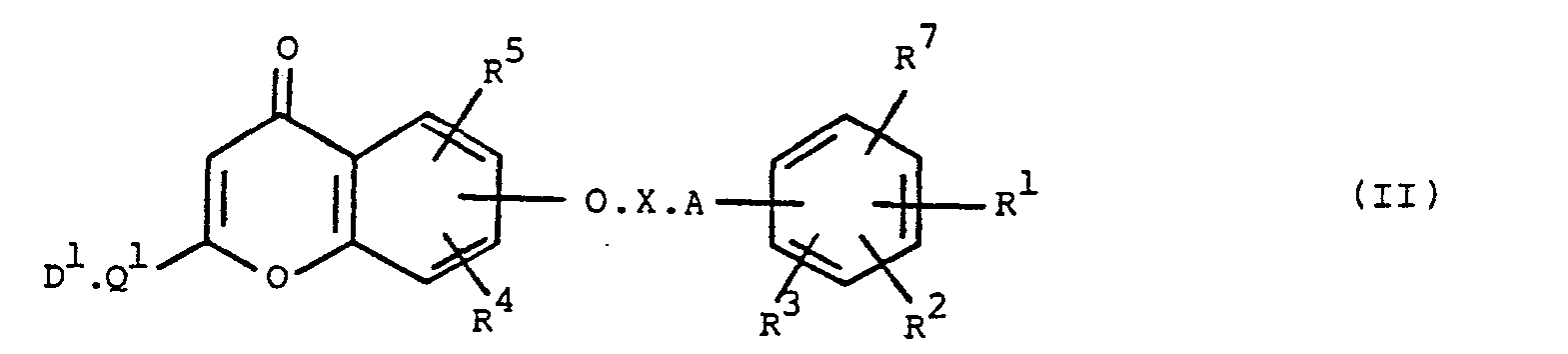
- (a) hydrolysing a compound where Q1 represents a group Q as defined hereinbefore and D1 represents a group hydrolysable to a carboxyl group to give a compound of formula I where D represents carboxyl or a salt thereof, or
- (b) reacting a compound where Q1 is absent or represents a group Q as defined hereinbefore of 2 to 4 carbon atoms and D1 represents -CHO:
- (i) with a compound of formula HOOC-CH=P(R)3 or of formula HOOC-CH2-P(=O)(OR)2 where R represents phenyl or alkyl of 1 to 6 carbon atoms, or an ester or salt of either, or
- (ii) with malonic acid or an ester thereof and hydrolyzing and decarboxylating the product,
to give a compound of formula I where Q represents ―Q1―CH=CH― and D represents -COOH, or - (c) selectively reducing a compound where Q1 represents a group reducible to a group Q and D1 represents a group D as defined hereinbefore or an ester thereof, or
- (d) subjecting to elevated temperature a compound where Q1 is absent or represents a group Q as defined hereinbefore of 2 to 4 carbon atoms and D1 represents―CO.C(COOH)=P(R)3, where R is as defined hereinbefore, or an ester thereof, to give a compound of formula I where Q represents ―Q―C≡C― and D represents -COOH or an ester thereof, or
- (e) subjecting to the action of a base a compound where Q1 is absent and D1 represents ―C(OSO2A1)=C(COOR)2 where R is as defined hereinbefore and A1 represents an aromatic moiety, to give a salt of a compound of formula I where Q represents ―C≡C― and D represents -COOH, or
- (f) salifying, esterifying or amidating a compound where D1 represents a free acidic group to give a salt, ester or amide of a compound of formula I, or converting a compound where D1 represents cyano to the corresponding tetrazole, or converting a compound where D1 represents a free carboxyl group or an acid halide, ester or mixed anhydride thereof to the corresponding carboxamidotetrazole.
- We also provide a process for the preparation of compounds of formula I which comprises reacting a compound of the formula:


- We also provide a process for the preparation of compounds of formula I which comprises cyclising a compound of the formula:

- The cyclisation may conveniently be effected by means of an acid, e.g. a mineral acid, for example a hydrohalic acid such as hydrochloric acid or hydrobromic acid.
- Where D1 represents a salt, ester or amide, this may be converted by the action of the acid to the free acidic group D.
- In process (a) the group D1 may be, for example, an alkoxy (C1 to 10) carbonyl group, a carboxamide group, a mono- or di- alkyl- (C1 to 10) carboxamido group, or an N-phenylcarboxamido group. The hydrolysis may be carried out using conventional techniques, for example under acidic or under alkaline conditions. The reaction may conveniently be carried out in a suitable aqueous solvent, for example an aqueous lower alkanol, at a temperature of from about 20 to 120°C.
- In process (b) (i) the reaction may be carried out in the presence of a non nucleophilic base, e.g. sodium hydride or methyl lithium. The reaction may be carried out in a solvent which is inert under the reaction conditions, for example benzene, dimethylformamide or dimethoxyethane. The reaction may be carried out at a temperature of from about 15 to 150°C.
- In process (b) (ii) the reaction may be carried out in the presence of a basic catalyst and in a solvent (which when the solvent is basic may also act as catalyst) for example pyridine, or titanium tetrachloride. The reaction is preferably carried out at a temperature of from about 60 to 120°C.
- In process (c), the group Q1 preferably represents alkenylene or alkynylene giving, respectively compounds of formula I where Q represents alkylene and alkenylene (which may be further reduced to alkylene if desired). The reduction may be carried out using conventional techniques for the selective reduction of such compounds, e.g. catalytic hydrogenation in a suitable solvent, e.g. ethanol or acetic acid, at atmospheric pressure and using a palladium on charcoal or a palladium on barium sulphate catalyst (Lindlar's catalyst).
- The reaction of process (d) may be carried out at a temperature of from about 200 to 300°C. The reaction is preferably carried out by simply heating the compound of formula II.
- The reaction of process (e) is conveniently effected by means of an alkali-metal hydroxide, e.g. sodium or potassium hydroxide in a suitable solvent medium, e.g. water.
- The cyclisation of the compounds of formula XXX is conveniently effected by heating a solution of the compound of formula XX in an appropriate solvent medium, e.g. an alkanol such as methanol, and by adding the appropriate acid. Desirably the acid is a hydro- halic acid, especially hydrochloric acid, and the reaction is effected by passing the gaseous hydrogen halide through the solution.
- The salts of the present invention may be prepared by treating a compound of formula I, an ester or an amide thereof, or another salt thereof with an appropriate base, e.g. an alkali-metal base, or with an appropriate salt by a metathetical process. The tetrazoles and carboxamidotetrazoles may be prepared from the corresponding carboxylic acids by processes known per se, e.g. via the corresponding acid halides, amides and cyanides.
- In the reaction between compounds of formulae XX and XXI, when Y or Z is a reactive metal the metal may be, for example, an alkali-metal, e.g. sodium or another reactive metal, e.g. thallium. When Y or Z represents a hydrocarbon chain carrying an anion forming group the anion forming group may be, for example, a halogen atom, e.g. bromine, or a sulphonate group, e.g. a methyl sulphonate or a p-toluenesulphonate group. When Y or Z represents a hydrocarbon chain carrying a halogen atom the reaction may be carried out in the presence of a solvent which is inert under the reaction conditions, e.g. acetone and in the presence of an acid acceptor, e.g. potassium carbonate. The reaction is also preferably carried out under anhydrous conditions and in the presence of a suitable catalyst, e.g. KI. When Y or Z represent a hydrocarbon group carrying an epoxide, the reaction may be carried out at an elevated temperature in a solvent which is inert under the reaction conditions, e.g. dioxan or dimethylformamide, and in the presence of a suitable catalyst, e.g. trimethylbenzylammonium hydroxide. Alternatively, the reaction may be carried out at an elevated temperature in a tertiary alcohol, e.g. t-butanol or 1,1-dimethylpropan-1-ol and in the presence of the potassium salt of the alcohol, or in the preseence of an alkali-metal hydroxide in a suitable solvent, e.g. an alkanol such as ethanol.
- The compounds of formula I may be recovered from their reaction mixtures by using conventional techniques.
- The starting materials of formula II for processes (a), (c) and (f) may be made by appropriate processes analogous to the processes (a), (b), (c), (d) or (e), or by converting, e.g. esterifying a corresponding compound of formula I.
- The starting materials of formula II for process (b) are either known compounds or may be made from known compounds using conventional techniques known per se.
- The starting materials of formula II for process (d) may be made by reacting a compound of the formula:

Hal represents halogen
with a compound of the formula HOOC-CH=P(R)3 or an ester thereof. - The starting materials of formula II for process (e) may be prepared by reacting a compound of formula VII with the anion of a dialkyl malonate, and heating the resulting product with an arene sulphonic anhydride.
- The compounds of formula XX may be made from known compounds using processes analogous to processes described above.
- The compounds of formula XXX may be made by reacting a compound corresponding to formula XXX wherein X1 is acetyl with a compound D'QCOZ where Z is an anionic leaving group (e.g. halogen or alkoxy) in the presence of a suitable base and inert solvent. The base may be for example sodium hydride, and suitable solvents include dioxan and dimethylformamide.
- Some of the groups R1 to R7 and X may be affected by the reaction conditions described above. Where necessary or desirable, therefore, the reaction may be carried out using protected derivatives of the reagents.
- The processes described above may produce the compound of formula I or a derivative thereof. It is also within the scope of this invention to treat any derivative so produced to liberate the free compound of formula I, or to convert one derivative into another.
- Those compounds of formula I in which Q represents an alkenylene group may exist as cis or trans isomers.
- The compounds of formula I and their pharmaceutically-acceptable derivatives are useful because they possess pharmacological properties. In particular, the compounds are antagonists of the slow-reacting substance of anaphylaxis (SRS-A), or its pathological effects, as is indicated by their acitivity in the test set out in Example A. The compounds also antagonise the effects of SRS-A obtained during antigen challenge of sensitised human chopped lung on isolated guinea pig ileum as described in Example A. The compounds also have the same utility at the same dosages as the compounds of NL-A1-68,11740.
- The compounds are thus useful in the treatment of disorders in which SRS-A is a factor, for example skin afflictions, hay fever, chronic bronchitis, obstructive airways diseases, e.g. asthma, allergic conditions of the eye and allergic conditions of the gastro-intestinal tract, e.g. food allergies.
- For the above-mentioned uses, the dosage administered will, of course, vary depending upon the compound employed, mode of administration and treatment desired. However, in general, satisfactory results are obtaied when administered at a daily dosage of from about 1 milligram to about 10 milligrams per kilogram of animal body weight, preferably given in divided doses 2 to 4 times a day or in sustained release form. For the larger mammals, the total daily dosage is in the range of from about 50 milligrams to about 700 milligrams, and dosage forms suitable for administration comprise from about 12 milligrams to about 350 milligrams of the compound admixed with a solid or liquid pharmaceutical carrier or diluent. The compounds may be administered during or before the attack of the disorder to be treated.
- The compounds may be administered in admixture with a pharmaceutically acceptable adjuvant, diluent or carrier, the composition used depending on many factors including the disorder to be treated. The compounds may be administered parenterally, by inhalation, topically or orally.
- The invention is illustrated, but in no way limited by the following Examples, in which temperatures are in °C.
- 2,4-Dihydroxy-3-propylacetophenone (48.5 g), benzyl bromide (30 ml), anhydrous potassium carbonate (38 g) and potassium iodide (0.2 g) in butan-2-one (300 ml) were refluxed for 16 hours. The hot mixture was filtered, and the filtrate was evaporated. The residue was dissolved in ethyl acetate and washed with 5% sodium hydroxide solution, and water, dried and evaporated to a solid, which crystallised from cyclohexane to afford the title compound (27.3 g), mp 78°.
- To a stirred mixture of 4-benzyloxy-2-hydroxy-3-propylacetophenone (14.2 g) and sodium hydride (5.3 g of a 50% dispersion in oil) in dry toluene (200 ml) heated under reflux under nitrogen was added dropwise a solution of ethyl diethoxyacetate (7.9 g) in toluene (100 ml). The mixture was refluxed for 4 hours and then the ethanol which had formed was removed by azeotropic distillation. The mixture was evaporated to a sticky solid, which was washed with light petroleum (bp 40―60°), and then dissolved in ether. The ether was washed with dilute hydrochloric acid and brine, dried and evaporated to give the intermediate diethyl β-diketo acetal. This solid (5.0 g) was refluxed in ethanolic hydrogen chloride (200 ml) for 45 minutes. The solution was evaporated, and the residue was triturated with ether and chromatographed on silica gel with chloroform to yield the benzopyran acetal (10.6 g), mp 95―97°.
- 7-Benzyloxy-2-diethoxymethyl-8-propyl-4H-1-benzopyran-4-one (5.0 g) was dissolved in glacial acetic acid (50 ml), and 10% sulphuric acid (25 ml) was added. Steam was passed through the solution for 30 minutes. On cooling the yellow crystals which formed were filtered off, washed with light petroleum (bp 40-60°), chromatographed on silica gel with ether, and then crystallised from ether to give the aldehyde (1.67 g), mp 150°.
- A solution of 7-benzyloxy-4-oxo-8-n-propyl-4H-1-benzopyran-2-carboxaldehyde (1.0 g) in dry benzene (30 ml) was added to a stirred solution of carbethoxymethylene-triphenylphosphorane (1.1 g) in dry benzene (50 ml). After 1 hour the solvent was evaporated and the remaining white solid was extracted several times with ether. The combined and concentrated ether washings were chromatographed over silica gel (100 g). Elution with ether afforded a white solid which was crystallised from ether to yield trans ethyl 3-(7-benzyloxy-4-oxo-8-n-propyl-4H-1-benzopyran-2-yl)acrylate (0.45 g) mp 140°C, a compound of the invention.
- A solution of ethyl 3-(7-benzyloxy-4-oxo-8-n-propyl-4H-1-benzopyran-2-yl)acrylate (6.0 g) in dichloromethane (150 ml) at -60°C was treated with an excess of BCI3. After 3/4 hour the solution was poured onto ice and stirred. After 12 hours the mixture was extracted with ethyl acetate. The organic layer was separated, washed well (water), dried (MgS04) and evaporated to afford a pale yellow solid. The latter was crystallised from aqueous ethanol to yield trans ethyl 3-(7-hydroxy-4-oxo-8-n-propyl-4H-1-benzopyran-2-yl)acrylate (3.2 g) mp 203―204°C.
- 4-(2,3-Epoxy)-n-propyloxy-2-hydroxy-3-n-propylacetophenone (2.75 g) was added to a stirred refluxing solution of trans-ethyl 3-(7-hydroxy-4-oxo-8-n-propyl-4H-1-benzopyran-2-yl)acrylate (3.2 g) and tert-amyl- alkoxide (0.76 g) in tert-amylalcohol (500 ml). After 5 days the solution was poured into water, acidified and extracted with ethyl acetate. The organic layer was extracted (NaHCO3 solution), washed (saturated NaCl solution), dried (MgS04) and evaporated to afford a brown solid. The latter was chromatographed over silica gel (500 g). Elution with ether afforded a white solid which was crystallised from acetone-ether to yield trans - ethyl 3 - [7 - [3 - (4 - acetyl - 3 - hydroxy - 2 - n - propylphenoxy) - 2 - hydroxypropyloxy] - 4 - oxo - 8 - n - propyl - 4H - 1 - benzopyran - 2 - yl]acrylate (1.56 g) mp 125-127°C.
- A solution of trans-ethyl 3 - [7 - [3 - (4 - acetyl - 3 - hydroxy - 2 - n - propylphenoxy) - 2 - hydroxypropyloxy] - 4 - oxo - 8 -n propyl - 4H - 1 - benzopyran - 2 - yl]acrylate (1.56 g) and sodium hydrogen carbonate (1.56 g) in aqueous ethanol was refluxed for 1 hour. Ethanol was removed by distillation and the residual aqueous solution cooled. Acidification afforded a gum which solidified on prolonged treatment with refluxing carbon tetrachloride. Crystallisation from acetone-carbon tetrachloride yielded trans - 3 - [7 - [3 - (4 - acetyl - 3 - hydroxy - 2 - n - propylphenoxy) - 2 - hydroxypropyloxy] - 4 - oxo - 8 - n - propyl - 4H - 1 - benzopyran - 2 - yl]acrylic acid (0.58 g) mp 101―103°C.
- Sodium hydrogen carbonate (0.084 g) was added to a suspension of trans - 3 - [7 - [3 - (4 - acetyl - 3 - hydroxy -2 - n - propylphenoxy) - 2 - hydroxypropyloxy] - 4 - oxo - 8 - n - propyl - 4H - 1 - benzopyran - 2 - yl]acrylic acid (0.58 g) in water (30 ml) and solution effected by heating. The cooled solution was freeze dried to yield trans - sodium - 3 - [7 - [3 - (4 - acetyl - 3 - hydroxy - 2 - n - propyl phenoxy) - 2 - hydroxypropyloxy] - 4 - oxo - 8 - n - propyl - 4H - 1 - benzopyran - 2 - yljacrylate (0.59 g).

- (a) Ethyl 3-[7-[3-(4-acetyl-3-hydroxy-2-n-propylphenoxy)-2-hydroxypropyloxy]-4-oxo-8-n-propyl-4H-1-benzopyran-2-yl]propionate trans - Ethyl 3-[7 - [3 - (4 - acetyl - 3 - hydroxy - 2 -n - propylphenoxy) - 2 - hydroxypropyloxy] - 4 - oxo - 8 - n - propyl - 4H - 1 - benzopyran - 2 - yl]acrylate (1.2 g) in dioxan was hydrogenated, over a palladium-charcoal catalyst, at atmospheric pressure and ambient temperature. The catalyst was removed by filtration and the concentrated filtrate chromatographed over silica-gel (60 g). Elution with ether afforded a white solid which was crystallised from ether-petrol (40―60°) to yield ethyl 3 - [7 - [3 - (4 - acetyl - 3 - hydroxy - 2 - n - propylphenoxy) - 2 - hydroxypropyloxy] - 4 - oxo - 8 - n - propyl - 4H - 1 - benzopyran - 2 - yl]propionate (0.79 g), mp 137―138°C.
- A solution of ethyl 3 - [7 - [3 - (4 - acetyl - 3 - hydroxy - 2 - n - propylphenoxy) - 2 - hydroxypropyloxy] - 4 - oxo - 8 - n - propyl - 4H - 1 - benzopyran - 2 - yl]propionate (0.79 g) and sodium carbonate (0.79 g) in aqueous ethanol was refluxed for 1 hour. Ethanol was removed by distillation and the residual aqueous solution cooled. Acidification afforded a gum which solidified on prolonged treatment with refluxing ether. Crystallisation from acetone-ether yielded 3 - [7 - [3 - (4 - acetyl - 3 - hydroxy - 2 - n - propylphenoxy) - 2 - hydroxypropyloxy] - 4 - oxo - 8 - n - propyl - 4H - 1 - benzopyran - 2 - yl]-propionic acid (0.53 g) mp 79-80°C. The sodium salt was prepared therefrom by the method of Example 1(h).
-

- Sodium hydride (13.2 g of a 50% dispersion in oil) was washed with ether and suspended in dry dimethyl formamide (300 ml). To the suspension at 0° was added 4-benzyloxy-2-hydroxy-3-propyl- acetophenone (61 g) slowly with stirring. When the mixture became clear, 3-methoxy carbonyl propionyl chloride (39 g) in dimethylformamide (100 ml) was added slowly, and the mixture was stirred at room temperature for 48 hours. The mixture was carefully poured onto a slurry of ice and dilute hydrochloric acid. Extraction was effected with ethyl acetate, followed by washing with saturated sodium bicarbonate solution, and water. Drying and evaporation gave 6-acetyl-3-benzyloxy-2-propylphenyl methyl succinate as a dark oil (93 g).
- The oil was slowly added with stirring to a suspension of sodium hydride (24 g of a 50% dispersion in oil) in dry dioxan (200 ml) at 70°. After 30 minutes the mixture was cooled and carefully added to a mixture of ice and dilute hydrochloric acid.
- The mixture was extracted with ethyl acetate, washed well with water and evaporated to yield methyl 6-(4-benzyloxy-2-hydroxy-3-propylphenyl)-4,6-dioxohexanoate (65 g) as a dark solid. Pmr and mass spectra were in accordance with the structure.
- The solid was dissolved in methanol boiling under reflux and gaseous hydrogen chloride was bubbled through the solution for 30 minutes.
- After a further 30 minutes at reflux the mixture was poured onto ice and extracted with ethyl acetate, which was then washed with water and sodium bicarbonate solution, dried and evaporated to a solid (32 g). The solid was chromatographed on silica gel with chloroform, and the relevant fractions were crystallised from cyclohexane to afford the title ester as needles, mp 88-89°.
- Methyl 3-[7-benzyl-4-oxo-8-propyl-4H-1-benzopyran-2-yl]propionate (1.0 g) was refluxed with ethanol (50 ml) containing 10% aqueous sodium carbonate solution (10 ml) for 30 minutes. The mixture was diluted with water, washed with ethyl acetate, and acidified to give a solid, which crystallised from ethanol to give the propionic acid (0.7 g), mp 160―161°.
- 3-[7-Benzyl-4-oxo-8-propyl-4H-1-benzopyran-2-yl]propionic acid was dissolved in ethanol and treated with an equivalent of aqueous sodium bicarbonate and the clear resulting solution was evaporated. The residue was dissolved in water and freeze-dried to afford the sodium salt.
-

- By a process analogous to that of Example 3(a) was prepared ethyl 3-[7-benzyloxy-4-oxo-8-propyl-4H-1-benzopyran-2-yllpropionate. The compound (1.0 g) in dry dichloromethane (30 ml) at -78°C was treated with boron trichloride (2 ml). After 20 minutes, the mixture was poured onto ice and extracted with 10% aqueous sodium carbonate. Acidification gave a solid which crystallised from ethyl acetate to give the desired product (0.35 g), mp 127-128°C.
- 2-n-Butyl-1,3-dimethoxybenzene (27 g) and acetyl chloride (20 ml) in 1,2-dichloroethane (200 ml) at -20° were stirred and treated with titanium tetrachloride (70 ml) slowly over 30 minutes. The red solution was allowed to warm to room temperature over 2 hours, and poured onto ice. The organic phase was wshed with water and evaporated to an oil, which was distilled at 130―132°/0.08 mm.Hg, to afford the acetophenone (26.1 g).
- 3-n-Butyl-2,4-dimethoxyacetophenone (32 g) in dry methylene chloride (200 ml) was cooled to -78° and treated dropwise with boron tribromide (40 ml) over 30 minutes. The mixture was allowed to warm to room temperature, stirred for 30 hours, poured onto ice, and extracted with chloroform, which was then dried and evaporated to a solid (20 g). Distillation at 250° at 0.07 mm gave the dihydroxyacetophenone, mp 85―85.5°.
- 3-n-Butyl-2,4-dihydroxyacetophenone (10 g) and epichlorohydrin (12 ml) in ethanol (100 ml) were refluxed under nitrogen. Potassium hydroxide (2.8 g) was added and the mixture was refluxed for 5.5 hours. The mixture was poured into water, acidified, and extracted with ether, which was washed with 2% sodium hydroxide solution, and water, dried and evaporated to give an oil. The oil was distilled at 230°/ 0.07 mm to give (4-acetyl-2-n-butyl-3-hydroxyphenoxy)methyloxiran as an oil (11 g). The pmr spectrum was consistent with the structure.
- To sodium hydroxide (0.6 g) in ethanol (200 ml) was added (4-acetyl-2-n-butyl-3-hydroxyphenoxy)-methyloxiran (6 g) and ethyl 3-(7-hydroxy-4-oxo-8-propyl-4H-1-benzopyran-2-yl)propionate (4.56 g). The mixture was refluxed for 6 hours, evaporated to 1/3 volume and acidified. Extraction with ethyl acetate and subsequent washing with 10% sodium hydroxide solution, and water, and evaporation gave a red oil which was chromatographed on silica with chloroform: ethyl acetate (12:1) mixture to yield a solid. Recrystallisation from ethyl acetate/cyclohexane mixture afforded the title ester as buff micro needles (2.3 g), mp 118―118.5°.
- By a method analogous to that of Example 2(b), the above acid was liberated from the ethyl ester as a solid, mp 175-176°C. The sodium salt thereof was prepared by a method analogous to that of Example 1(h)..
- By methods analogous to those described in Examples 1-4 the following compounds were prepared:
- 5. 3 - [7 - (3 - (4 - Acetyl - 3 - hydroxy - 2 - n - propylphenoxy) - 2 - hydroxypropoxy - 4 - oxo - 6 - n - propyl - 4H - 1 - benzopyran - 2 - yl]propionic acid, and the ethyl ester and sodium salt thereof.
- Mp (free acid) = 145146°C, mp (ethyl ester) = 105-106°C.
- 6. 4 - [7 - (3 - (4 - Acetyl - 3 - hydroxy - 2 - n - propylphenoxy) - 2 - hydroxypropoxy - 4 - oxo - 8 - n - propyl - 4H - 1 - benzopyran - 2 - yl]butyrate and the methyl ester and sodium salt thereof.
- Mp (free acid) = 107=108°C, mp (methyl ester) = 121-122°C.
- 7.* 3 - [7 - (3 - (4 - Acetyl - 3 - hydroxy - 2 - n - propylphenoxy)propoxy) - 4 - oxo - 8 - n - propyl - 4H - 1 - benzopyran - 2 - yl]propionic acid and the ethyl ester and lysine salt thereof.
- Mp (ethyl ester) = 99-100°C.
- 8. 3 - [7 - (2 - (4 - Acetyl - 3 - hydroxy - 2 - n - propylphenoxy)ethoxy - 4 - oxo - 8 - n - propyl - 4H - 1 - benzopyran - 2 - yl]propionic acid and the ethyl ester and sodium salt thereof.
- Mp (free acid) = 153-154°C.
- 9. 3 - [7 - (3 - (2 - n - propylphenoxy) - 2 - hydroxypropoxy) - 4 - oxo - 8 - n - propyl - 4H - 1 - benzopyran - 2 - yl]propionic acid and the sodium salt thereof.
- Mp (free acid) = 112―114°C.
- 10. 3 - [7 - (3 - (2 - Acetyl - 3 - hydroxyphenoxy)propoxy) - 4 - oxo - 8 - n - propyl - 4H - 1 - benzopyran - 2 - yl]propionic acid and the sodium salt thereof.
- Mp (fre acid) = 173-174°C.
- 11. 3 - [7 - (3 - (4 - Acetyl - 3 - hydroxy - 2 - n - propylphenoxy) - 2 - hydroxypropoxy) - 8 - methyl - 4 - oxo - 4H - 1 - benzopyran - 2 - yl]propionate and the ethyl ester and sodium salt thereof.
- Mp (ethyl ester) = 155―156°C, mp (free acid) = 142―145°C.
- 12. 3-(6-Senzyloxy-4-oxo-4H-1-benzopyran-2-yl)propionic acid, mp (free acid) = 161-163°C.
- 13. 3 - [7 - (2 - Hydroxy - 3 - (4 - methylphenyloxy)propyloxy) - 4 - oxo - 8 - propyl - 4H - 1 - benzopyran - 2 - yl]propionic acid, mp (free acid) = 111-113°C (decomp.).
- 14. 3 - [7 - (6 - (4 - Bromophenyloxy)hexyloxy) - 4 - oxo - 8 - propyl - 4H -1 - benzopyran - 2 - yl]-propionic acid, mp (free acid) = 125-127°C, mp (ethyl ester) = 87-88°C.
- 15. 6 - [7 - (3 - (4 - Acetyl - 3 - hydroxy - 2 - n - propylphenoxy) - 2 - hydroxypropoxy - 4 - oxo - 8 - propyl - 4H - 1 - benzopyran - 2 - yl]hexanoic acid, mp (free acid) = 95―96°C.
- 16. 3 - [4 - Oxo - 7 - (5 - phenylpentyloxy) - 8 - propyl - -4H -1 - benzopyran - 2 - yl]propionic acid, mp (free acid) = 125-126°C.
- 7-Benzyloxy-4-oxo-8-propyl-4H-1-benzopyran-2-carboxaldehyde (3.2 g), from Example 1(c) and malonic acid (1.1 g) were heated in pyridine (15 ml) at 100°C until gas evolution ceased. The mixture was then evaporated and the residue was extracted with sodium bicarbonate. Acidification gave the title acid. The same acid was also prepared by hydrolysis of the product of Example 1(d).
-
- (a) 7-(3-Phenoxypropyloxy)-4-oxo-4H-1-benzopyran-2-carbonyl chloride and two equivalents of carbo- methoxymethylene triphenylphosphorane were stirred overnight in benzene. The precipitate was collected and heated under vacuum at 280° for 1 hour to give the propiolic methyl ester, which was hydrolysed to give the title acid.
- (a') The carbonyl chloride used in part (a) was added to one equivalent of diethyl ethoxymagnesio- malonate in dry 1,2-dichloroethane. The mixture was refluxed for 30 minutes, then treated with dilute acid. Isolation and evaporation of the organic phase gave the acylmalonate which was added to one equivalent of potassium t-butoxide and benzenesulphonic anhydride in t-butanol. The mixture was then refluxed for 2 hours and evaporated. Partitioning the residue between ethyl acetate and dilute sodium hydroxide gave, in the organic phase, the enol sulphonate which was stirred overnight in dioxan containing an excess of aqueous sodium hydroxide to afford, on acidification, the title product.
- 3-[7-(3-Phenoxypropyloxy)-4-oxo-4H-1-benzopyran-2-yl]propionic acid (1 g) in ethanol was hydrogenated at atmospheric pressure in the presence of palladium on barium sulphate poisoned with quinoline. Isolation procedures yielded the title acrylic acid.
- Hydrogenation of the acrylic acid product of stage (a) in ethanol with 5% palladium-charcoal gave, on isolation, the title propionic acid.
- The procedure set out below is used to assess the effectiveness of a compound in antagonising SRS-A. The test makes use of the agonist (contractile) effect of SRS-A on isolated guinea-pig ileum.
- A satisfactory preparation of SRS-A can be obtained from egg albumen sensitised guinea-pigs. Three weeks after sensitisation, the lungs from such guinea-pigs are removed, perfused free of blood, and chopped. Samples of washed, chopped lung are then challenged with egg albumen (antigen) solution. The
* In the preparation of this compound 4-(3-bromophenoxy)-2-hydroxy-3-propylacetophenone was employed instead of an oxiran in the reaction to link the ring nuclei. supernatants collected 15 minutes after addition of antigen contains histamine and SRS-A and can be used, in the presence of an antihistamine, to induce effects due to SRS-A. - An isolated section of the terminal portion of a guinea-pig ileum is suspended in Tyrode solution, which contains atropine sulphate 10-6M (700 µg/litre) and mepyramine maleate 10-6M (400 µg/litre). Atropine sulphate is included to reduce the spontaneous activity of the ileum preparation and to exclude the effects of possible cholinergic agents. Mepyramine maleate is included to exclude the effects of histamine. The composition of the Tyrode solution in g/I distilled water is NaCl 8.0, KCI 0.2, CaCl2 0.2, MgCI2 0.1, NaHC03 1.0, NaH2P042H20 0.05 and dextrose 1.0.
- A 2 ml organ bath is preferred for economy of SRS-A, the tension on the tissue should be about 600 mg and the bathing temperature 37C.
- A dose of unpurified SRS-A is selected which produces similar repetitive sub-maximal contractions of the ileum. Each contraction is recorded for 90 seconds when the tissue is washed to allow relaxation. Five minutes is allowed between doses of SRS-A.
- The compound under test is added to the organ bath 30 seconds before a dose of SRS-A. A range of concentrations of the compound is chosen to give a log concentration/inhibitory response graph. From this graph, the concentration of compound which would inhibit the ileum contraction to SRS-A by 50% (lC50) is determined.
- The compounds of Examples 1 to 19 were tested by this procedure. All gave good results.
and pharmaceutically acceptable salts thereof, and esters and amides of those compounds where D represents carboxy.
Claims (16)

or a pharmaceutically acceptable salt, ester or amide thereof, from a compound of formula:

to give a compound of formula I where Q represents ―Q1―CH=CH― and D represents -COOH, or


pharmaceutically acceptable salt, ester or amide thereof.
Priority Applications (1)
| Application Number | Priority Date | Filing Date | Title |
|---|---|---|---|
| AT80300565T ATE14579T1 (en) | 1979-03-20 | 1980-02-26 | PHARMACEUTICAL HETEROCYCLIC COMPOUNDS, PROCESS FOR THEIR PREPARATION AND COMPOSITIONS CONTAINING THEM. |
Applications Claiming Priority (2)
| Application Number | Priority Date | Filing Date | Title |
|---|---|---|---|
| GB7909835 | 1979-03-20 | ||
| GB7909835 | 1979-03-20 |
Publications (2)
| Publication Number | Publication Date |
|---|---|
| EP0017332A1 EP0017332A1 (en) | 1980-10-15 |
| EP0017332B1 true EP0017332B1 (en) | 1985-07-31 |
Family
ID=10504010
Family Applications (1)
| Application Number | Title | Priority Date | Filing Date |
|---|---|---|---|
| EP80300565A Expired EP0017332B1 (en) | 1979-03-20 | 1980-02-26 | Pharmaceutical heterocyclic compounds, processes for their preparation and compositions containing them |
Country Status (11)
| Country | Link |
|---|---|
| US (1) | US4281008A (en) |
| EP (1) | EP0017332B1 (en) |
| JP (1) | JPS55127384A (en) |
| AT (1) | ATE14579T1 (en) |
| AU (1) | AU515774B2 (en) |
| DE (1) | DE3070912D1 (en) |
| DK (1) | DK116480A (en) |
| FI (1) | FI800823A7 (en) |
| IE (1) | IE50377B1 (en) |
| NO (1) | NO800796L (en) |
| ZA (1) | ZA801543B (en) |
Cited By (9)
| Publication number | Priority date | Publication date | Assignee | Title |
|---|---|---|---|---|
| EP0079637A1 (en) * | 1981-11-12 | 1983-05-25 | FISONS plc | Anti-srs-a carboxylic acid derivatives, processes for their production, and pharmaceutical formulation containing them |
| EP0292977A1 (en) * | 1987-05-29 | 1988-11-30 | G.D. Searle & Co. | Alkoxy-substituted dihydrobenzopyran-2-carboxylate derivatives |
| US5073562A (en) * | 1990-05-10 | 1991-12-17 | G. D. Searle & Co. | Alkoxy-substituted dihydrobenzopyran-2-carboxylic acids and derivatives thereof |
| US5124350A (en) * | 1990-06-28 | 1992-06-23 | G. D. Searle & Co. | Leukotriene b4 antagonists |
| US5149717A (en) * | 1988-03-29 | 1992-09-22 | Ciba-Geigy Corporation | Alkanophenones useful for treating allergies |
| US5192782A (en) * | 1990-05-10 | 1993-03-09 | G. D. Searle & Co. | Alkoxy-substituted dihydrobenzopyran-2-carboxylic acids and derivatives thereof |
| US5212198A (en) * | 1990-05-10 | 1993-05-18 | G. D. Searle & Co. | Alkoxy-substituted dihydrobenzopyran-2-carboxylic acids and derivatives thereof |
| US5380740A (en) * | 1993-04-28 | 1995-01-10 | G. D. Searle & Co. | Anti-inflammatory compounds, compositions and method of use thereof |
| WO1996036608A1 (en) * | 1995-05-18 | 1996-11-21 | Eisai Co., Ltd. | α,β-UNSATURATED KETONE DERIVATIVES |
Families Citing this family (21)
| Publication number | Priority date | Publication date | Assignee | Title |
|---|---|---|---|---|
| US4788214A (en) * | 1983-06-24 | 1988-11-29 | Hoffman-La Roche Inc. | 3,4-dihydro-2H-1-benzopyran derivatives |
| US5105017A (en) * | 1983-07-18 | 1992-04-14 | Eli Lilly And Company | Leukotriene antagonist intermediates |
| US4778903A (en) * | 1983-12-12 | 1988-10-18 | G. D. Searle & Co. | Substituted dihydrobenzopyrans |
| US4888356A (en) * | 1983-08-08 | 1989-12-19 | G. D. Searle And Company | Use of substituted dihydrobenzopyrans for allergy and inflammation |
| US4665203A (en) * | 1983-08-08 | 1987-05-12 | G. D. Searle & Co. | Substituted dihydrobenzopyrans useful as leukotriene D4 inhibitors |
| AU548450B2 (en) * | 1983-08-08 | 1985-12-12 | G.D. Searle & Co. | Substituted dihydrobenzopyrans |
| US4565882A (en) * | 1984-01-06 | 1986-01-21 | G. D. Searle & Co. | Substituted dihydrobenzopyran-2-carboxylates |
| US4546194A (en) * | 1984-05-29 | 1985-10-08 | G. D. Searle & Co. | Substituted chromanon-2-yl alkanols and derivatives thereof |
| US4935529A (en) * | 1986-01-31 | 1990-06-19 | State Of Oregon Acting By And Through The Oregon State Board Of Higher Education On Behalf Of Oregon State University | Cytoxic substances from the marine cyanophyte hormothamnion enteromorphoides grunow |
| US4801616A (en) * | 1986-03-25 | 1989-01-31 | Eli Lilly And Company | Diphenylmethanone compounds and anti-inflammatory use thereof |
| US4874777A (en) * | 1987-04-10 | 1989-10-17 | Eli Lilly And Company | Leukotriene antagonists |
| US4853398A (en) * | 1987-04-13 | 1989-08-01 | Eli Lilly And Company | Leukotriene antagonists and use thereas |
| IL89713A0 (en) * | 1988-03-29 | 1989-09-28 | Ciba Geigy Ag | Novel alkanophenones |
| US5093353A (en) * | 1988-05-20 | 1992-03-03 | G. D. Searle & Co. | 2,2-di-substituted benzopyran leukotriene-D4 antagonists |
| US4950684A (en) * | 1988-05-20 | 1990-08-21 | G. D. Searle & Co. | 2,2-di-substituted benzopyran leukotriene-D4 antagonists |
| US5219883A (en) * | 1988-05-20 | 1993-06-15 | G. D. Searle & Co. | 2,2-di-substituted benzopyran leukotriene-D4 antagonists |
| PH30449A (en) * | 1991-11-25 | 1997-05-28 | Lilly Co Eli | Substituted phenyl phenol leukotriene antagonists |
| US5457124A (en) * | 1993-12-07 | 1995-10-10 | Hoffmann-La Roche Inc. | Carboxylic acid Leukotriene B4 antagonists |
| IT1303688B1 (en) * | 1998-11-02 | 2001-02-23 | Medidom Lab | AROMATIC DERIVATIVES AND THEIR COMPLEX OF FE (III) ACTS AS USED AS STANDARDIZING AGENTS OF THE IRON LEVEL IN THE BODY. |
| US8093253B2 (en) * | 2008-03-06 | 2012-01-10 | Hoffmann-La Roche Inc. | Leukotriene B4 inhibitors |
| CN114437011B (en) * | 2022-01-06 | 2023-11-03 | 中南民族大学 | Chromone compound and preparation method and application thereof |
Family Cites Families (5)
| Publication number | Priority date | Publication date | Assignee | Title |
|---|---|---|---|---|
| US4133889A (en) * | 1971-07-29 | 1979-01-09 | Fisons, Ltd. | 2(5-Tetrazolyl)chromones |
| JPS5118955B2 (en) * | 1972-04-12 | 1976-06-14 | ||
| GB1484134A (en) * | 1973-11-21 | 1977-08-24 | Fisons Ltd | Benzopyran derivatives processes for their preparation and compositions containing them |
| US4033845A (en) * | 1975-11-20 | 1977-07-05 | Warner-Lambert Company | [2-(4-Oxo-4H-1-benzopyran-2-yl)ethenyl]benzonitriles and benzoic acids |
| US4018798A (en) * | 1975-11-20 | 1977-04-19 | Warner-Lambert Company | Substituted (4-oxo-4H-1-benzopyran-2-yl)cyclopropane carboxylic acids and esters |
-
1980
- 1980-02-26 AT AT80300565T patent/ATE14579T1/en not_active IP Right Cessation
- 1980-02-26 EP EP80300565A patent/EP0017332B1/en not_active Expired
- 1980-02-26 DE DE8080300565T patent/DE3070912D1/en not_active Expired
- 1980-03-06 US US06/127,832 patent/US4281008A/en not_active Expired - Lifetime
- 1980-03-17 FI FI800823A patent/FI800823A7/en not_active Application Discontinuation
- 1980-03-17 ZA ZA00801543A patent/ZA801543B/en unknown
- 1980-03-17 AU AU56516/80A patent/AU515774B2/en not_active Ceased
- 1980-03-18 DK DK116480A patent/DK116480A/en not_active Application Discontinuation
- 1980-03-19 NO NO800796A patent/NO800796L/en unknown
- 1980-03-19 JP JP3418680A patent/JPS55127384A/en active Pending
- 1980-03-19 IE IE559/80A patent/IE50377B1/en unknown
Cited By (11)
| Publication number | Priority date | Publication date | Assignee | Title |
|---|---|---|---|---|
| EP0079637A1 (en) * | 1981-11-12 | 1983-05-25 | FISONS plc | Anti-srs-a carboxylic acid derivatives, processes for their production, and pharmaceutical formulation containing them |
| EP0292977A1 (en) * | 1987-05-29 | 1988-11-30 | G.D. Searle & Co. | Alkoxy-substituted dihydrobenzopyran-2-carboxylate derivatives |
| US5149717A (en) * | 1988-03-29 | 1992-09-22 | Ciba-Geigy Corporation | Alkanophenones useful for treating allergies |
| US5073562A (en) * | 1990-05-10 | 1991-12-17 | G. D. Searle & Co. | Alkoxy-substituted dihydrobenzopyran-2-carboxylic acids and derivatives thereof |
| US5192782A (en) * | 1990-05-10 | 1993-03-09 | G. D. Searle & Co. | Alkoxy-substituted dihydrobenzopyran-2-carboxylic acids and derivatives thereof |
| US5212198A (en) * | 1990-05-10 | 1993-05-18 | G. D. Searle & Co. | Alkoxy-substituted dihydrobenzopyran-2-carboxylic acids and derivatives thereof |
| US5124350A (en) * | 1990-06-28 | 1992-06-23 | G. D. Searle & Co. | Leukotriene b4 antagonists |
| US5439937A (en) * | 1990-06-28 | 1995-08-08 | G. D. Searle & Co. | Leukotriene B4 antagonists |
| US5532383A (en) * | 1990-06-28 | 1996-07-02 | G. D. Searle & Co. | Leukotriene B4 antagonists |
| US5380740A (en) * | 1993-04-28 | 1995-01-10 | G. D. Searle & Co. | Anti-inflammatory compounds, compositions and method of use thereof |
| WO1996036608A1 (en) * | 1995-05-18 | 1996-11-21 | Eisai Co., Ltd. | α,β-UNSATURATED KETONE DERIVATIVES |
Also Published As
| Publication number | Publication date |
|---|---|
| US4281008A (en) | 1981-07-28 |
| ATE14579T1 (en) | 1985-08-15 |
| IE800559L (en) | 1980-09-20 |
| AU515774B2 (en) | 1981-04-30 |
| JPS55127384A (en) | 1980-10-02 |
| DE3070912D1 (en) | 1985-09-05 |
| NO800796L (en) | 1980-09-22 |
| AU5651680A (en) | 1980-09-25 |
| IE50377B1 (en) | 1986-04-16 |
| ZA801543B (en) | 1981-03-25 |
| DK116480A (en) | 1980-09-21 |
| EP0017332A1 (en) | 1980-10-15 |
| FI800823A7 (en) | 1980-09-21 |
Similar Documents
| Publication | Publication Date | Title |
|---|---|---|
| US4281008A (en) | Pharmaceutical heterocyclic compounds and compositions | |
| EP0061800B1 (en) | Anti srs-a carboxylic acid derivatives, processes for their production and pharmaceutical formulations containing them | |
| US4474788A (en) | Anti-SRSA quinoline carboxylic acid derivatives | |
| US4826984A (en) | Heteroarotinoid compounds as anticancer agents | |
| CA1213595A (en) | ¬4-oxo-4h-¬|-benzopyran-8-yl| alcanoic acids; salts and derivatives; preparation | |
| AU662382B2 (en) | Novel arylcycloalkyl derivatives their production and their use | |
| US3484445A (en) | Derivatives of chromone-2-carboxylic acid | |
| US4006245A (en) | Chemical compounds | |
| US4966907A (en) | 6-substituted 5-hydroxy-2,3-dihydrobenzofurans as inhibitors of leukotriene biosynthesis | |
| US4705782A (en) | Indene and naphthalene derivatives | |
| US4133889A (en) | 2(5-Tetrazolyl)chromones | |
| US4200577A (en) | Coumarin derivatives | |
| US4057641A (en) | Method of treating inflammation with 2-(2,3-dihydro-2-isopropyl-4-oxo-4H-1-benzopyran-6-yl)propionic acid | |
| EP0342664B1 (en) | 2,2-disubstituted benzopyran leukotriene-D4 antagonists | |
| US4211791A (en) | Indanediones | |
| US4017517A (en) | 2-(Trisubstituted benzoyl)-propionic acid and a method for the production thereof | |
| GB2165841A (en) | Chalcone derivatives | |
| EP0017578B1 (en) | 5-(2-hydroxy-3-thiopropoxy)-chromon-2-carboxylic acids, their salts and esters, process for their preparation and medicines | |
| CH464172A (en) | Process for the preparation of -substituted carboxylic acids | |
| US4831190A (en) | Trifluorohydroxyaromatic acid and preparation thereof | |
| US4136192A (en) | 4-hydroxy-3-nitro (cyano) coumarins | |
| US4207335A (en) | Indan-1,3-diones | |
| US4152449A (en) | 2-Vinyl-chromones and pharmaceuticals therewith | |
| US3948955A (en) | 4'-Carboxy-flavone | |
| CA1247628A (en) | Resorcinol ethers |
Legal Events
| Date | Code | Title | Description |
|---|---|---|---|
| PUAI | Public reference made under article 153(3) epc to a published international application that has entered the european phase |
Free format text: ORIGINAL CODE: 0009012 |
|
| AK | Designated contracting states |
Designated state(s): AT BE CH DE FR GB IT LU NL SE |
|
| 17P | Request for examination filed |
Effective date: 19810327 |
|
| RAP1 | Party data changed (applicant data changed or rights of an application transferred) |
Owner name: FISONS PLC |
|
| ITF | It: translation for a ep patent filed | ||
| ITF | It: translation for a ep patent filed | ||
| GRAA | (expected) grant |
Free format text: ORIGINAL CODE: 0009210 |
|
| AK | Designated contracting states |
Designated state(s): AT BE CH DE FR GB IT LU NL SE |
|
| REF | Corresponds to: |
Ref document number: 14579 Country of ref document: AT Date of ref document: 19850815 Kind code of ref document: T |
|
| REF | Corresponds to: |
Ref document number: 3070912 Country of ref document: DE Date of ref document: 19850905 |
|
| ET | Fr: translation filed | ||
| PG25 | Lapsed in a contracting state [announced via postgrant information from national office to epo] |
Ref country code: LU Free format text: LAPSE BECAUSE OF NON-PAYMENT OF DUE FEES Effective date: 19860228 |
|
| PGFP | Annual fee paid to national office [announced via postgrant information from national office to epo] |
Ref country code: LU Payment date: 19860404 Year of fee payment: 7 |
|
| PLBE | No opposition filed within time limit |
Free format text: ORIGINAL CODE: 0009261 |
|
| STAA | Information on the status of an ep patent application or granted ep patent |
Free format text: STATUS: NO OPPOSITION FILED WITHIN TIME LIMIT |
|
| 26N | No opposition filed | ||
| PGFP | Annual fee paid to national office [announced via postgrant information from national office to epo] |
Ref country code: AT Payment date: 19870225 Year of fee payment: 8 |
|
| PGFP | Annual fee paid to national office [announced via postgrant information from national office to epo] |
Ref country code: NL Payment date: 19870228 Year of fee payment: 8 |
|
| PG25 | Lapsed in a contracting state [announced via postgrant information from national office to epo] |
Ref country code: GB Effective date: 19890226 Ref country code: AT Effective date: 19890226 |
|
| PG25 | Lapsed in a contracting state [announced via postgrant information from national office to epo] |
Ref country code: SE Effective date: 19890227 |
|
| PG25 | Lapsed in a contracting state [announced via postgrant information from national office to epo] |
Ref country code: CH Effective date: 19890228 Ref country code: BE Effective date: 19890228 |
|
| BERE | Be: lapsed |
Owner name: FISONS P.L.C. Effective date: 19890228 |
|
| PG25 | Lapsed in a contracting state [announced via postgrant information from national office to epo] |
Ref country code: NL Effective date: 19890901 |
|
| NLV4 | Nl: lapsed or anulled due to non-payment of the annual fee | ||
| GBPC | Gb: european patent ceased through non-payment of renewal fee | ||
| PG25 | Lapsed in a contracting state [announced via postgrant information from national office to epo] |
Ref country code: FR Free format text: LAPSE BECAUSE OF NON-PAYMENT OF DUE FEES Effective date: 19891027 |
|
| REG | Reference to a national code |
Ref country code: CH Ref legal event code: PL |
|
| PG25 | Lapsed in a contracting state [announced via postgrant information from national office to epo] |
Ref country code: DE Effective date: 19891101 |
|
| REG | Reference to a national code |
Ref country code: FR Ref legal event code: ST |
|
| EUG | Se: european patent has lapsed |
Ref document number: 80300565.1 Effective date: 19900118 |