EP0016124B1 - Plasticized, impact modified polycarbonates - Google Patents
Plasticized, impact modified polycarbonates Download PDFInfo
- Publication number
- EP0016124B1 EP0016124B1 EP79900832A EP79900832A EP0016124B1 EP 0016124 B1 EP0016124 B1 EP 0016124B1 EP 79900832 A EP79900832 A EP 79900832A EP 79900832 A EP79900832 A EP 79900832A EP 0016124 B1 EP0016124 B1 EP 0016124B1
- Authority
- EP
- European Patent Office
- Prior art keywords
- copolymers
- ethylene
- butadiene
- propylene
- polycarbonate
- Prior art date
- Legal status (The legal status is an assumption and is not a legal conclusion. Google has not performed a legal analysis and makes no representation as to the accuracy of the status listed.)
- Expired
Links
- 229920000515 polycarbonate Polymers 0.000 title claims description 22
- 239000004417 polycarbonate Substances 0.000 title claims description 22
- 239000000203 mixture Substances 0.000 claims abstract description 31
- 229920001577 copolymer Polymers 0.000 claims abstract description 22
- 229920000402 bisphenol A polycarbonate polymer Polymers 0.000 claims abstract description 21
- 229920001897 terpolymer Polymers 0.000 claims abstract description 15
- WNLRTRBMVRJNCN-UHFFFAOYSA-N adipic acid Chemical compound OC(=O)CCCCC(O)=O WNLRTRBMVRJNCN-UHFFFAOYSA-N 0.000 claims abstract description 12
- 150000001336 alkenes Chemical class 0.000 claims abstract description 12
- JRZJOMJEPLMPRA-UHFFFAOYSA-N olefin Natural products CCCCCCCC=C JRZJOMJEPLMPRA-UHFFFAOYSA-N 0.000 claims abstract description 12
- -1 such as Polymers 0.000 claims abstract description 11
- 238000009757 thermoplastic moulding Methods 0.000 claims abstract description 11
- 229920002126 Acrylic acid copolymer Polymers 0.000 claims abstract description 6
- LFQSCWFLJHTTHZ-UHFFFAOYSA-N Ethanol Chemical compound CCO LFQSCWFLJHTTHZ-UHFFFAOYSA-N 0.000 claims abstract description 6
- 239000004676 acrylonitrile butadiene styrene Substances 0.000 claims abstract description 6
- 235000011037 adipic acid Nutrition 0.000 claims abstract description 6
- 239000001361 adipic acid Substances 0.000 claims abstract description 6
- 229920006242 ethylene acrylic acid copolymer Polymers 0.000 claims abstract description 6
- 229920001200 poly(ethylene-vinyl acetate) Polymers 0.000 claims abstract description 6
- 229920000098 polyolefin Polymers 0.000 claims abstract description 6
- QTCNKIZNNWURDV-UHFFFAOYSA-N 2,2-dimethylpropane-1,3-diol Chemical compound OCC(C)(C)CO.OCC(C)(C)CO QTCNKIZNNWURDV-UHFFFAOYSA-N 0.000 claims abstract description 5
- XECAHXYUAAWDEL-UHFFFAOYSA-N acrylonitrile butadiene styrene Chemical compound C=CC=C.C=CC#N.C=CC1=CC=CC=C1 XECAHXYUAAWDEL-UHFFFAOYSA-N 0.000 claims abstract description 5
- 229920000122 acrylonitrile butadiene styrene Polymers 0.000 claims abstract description 5
- BZDKYAZTCWRUDZ-UHFFFAOYSA-N buta-1,3-diene;methyl 2-methylprop-2-enoate;prop-2-enenitrile;styrene Chemical compound C=CC=C.C=CC#N.COC(=O)C(C)=C.C=CC1=CC=CC=C1 BZDKYAZTCWRUDZ-UHFFFAOYSA-N 0.000 claims abstract description 5
- 229920012128 methyl methacrylate acrylonitrile butadiene styrene Polymers 0.000 claims abstract description 5
- 229920000728 polyester Polymers 0.000 claims abstract description 5
- 229920006244 ethylene-ethyl acrylate Polymers 0.000 claims abstract description 4
- 125000000843 phenylene group Chemical group C1(=C(C=CC=C1)*)* 0.000 claims description 6
- 239000004215 Carbon black (E152) Substances 0.000 claims description 2
- 125000001931 aliphatic group Chemical group 0.000 claims description 2
- 125000000217 alkyl group Chemical group 0.000 claims description 2
- 125000004429 atom Chemical group 0.000 claims description 2
- 125000004432 carbon atom Chemical group C* 0.000 claims description 2
- 229930195733 hydrocarbon Natural products 0.000 claims description 2
- 229910052739 hydrogen Inorganic materials 0.000 claims description 2
- 239000001257 hydrogen Substances 0.000 claims description 2
- 125000004435 hydrogen atom Chemical class [H]* 0.000 claims description 2
- 239000012757 flame retardant agent Substances 0.000 claims 1
- SLCVBVWXLSEKPL-UHFFFAOYSA-N neopentyl glycol Chemical compound OCC(C)(C)CO SLCVBVWXLSEKPL-UHFFFAOYSA-N 0.000 claims 1
- 239000000463 material Substances 0.000 description 17
- 238000009863 impact test Methods 0.000 description 13
- 239000003795 chemical substances by application Substances 0.000 description 12
- 230000000052 comparative effect Effects 0.000 description 9
- 229920000800 acrylic rubber Polymers 0.000 description 7
- 229920000058 polyacrylate Polymers 0.000 description 7
- 150000002148 esters Chemical class 0.000 description 6
- 239000000126 substance Substances 0.000 description 6
- UYXTWWCETRIEDR-UHFFFAOYSA-N Tributyrin Chemical compound CCCC(=O)OCC(OC(=O)CCC)COC(=O)CCC UYXTWWCETRIEDR-UHFFFAOYSA-N 0.000 description 5
- 229920006226 ethylene-acrylic acid Polymers 0.000 description 4
- 239000004014 plasticizer Substances 0.000 description 4
- YMWUJEATGCHHMB-UHFFFAOYSA-N Dichloromethane Chemical compound ClCCl YMWUJEATGCHHMB-UHFFFAOYSA-N 0.000 description 3
- 239000004609 Impact Modifier Substances 0.000 description 3
- 238000002360 preparation method Methods 0.000 description 3
- VGGSQFUCUMXWEO-UHFFFAOYSA-N Ethene Chemical compound C=C VGGSQFUCUMXWEO-UHFFFAOYSA-N 0.000 description 2
- 239000005977 Ethylene Substances 0.000 description 2
- IISBACLAFKSPIT-UHFFFAOYSA-N bisphenol A Chemical compound C=1C=C(O)C=CC=1C(C)(C)C1=CC=C(O)C=C1 IISBACLAFKSPIT-UHFFFAOYSA-N 0.000 description 2
- 230000000694 effects Effects 0.000 description 2
- 229920001519 homopolymer Polymers 0.000 description 2
- 238000010348 incorporation Methods 0.000 description 2
- 239000000155 melt Substances 0.000 description 2
- 238000000034 method Methods 0.000 description 2
- 239000012778 molding material Substances 0.000 description 2
- 238000000465 moulding Methods 0.000 description 2
- 229920001169 thermoplastic Polymers 0.000 description 2
- 229920002725 thermoplastic elastomer Polymers 0.000 description 2
- 239000004416 thermosoftening plastic Substances 0.000 description 2
- 229920004937 Dexon® Polymers 0.000 description 1
- VVQNEPGJFQJSBK-UHFFFAOYSA-N Methyl methacrylate Chemical compound COC(=O)C(C)=C VVQNEPGJFQJSBK-UHFFFAOYSA-N 0.000 description 1
- 229920003347 Microthene® Polymers 0.000 description 1
- YGYAWVDWMABLBF-UHFFFAOYSA-N Phosgene Chemical compound ClC(Cl)=O YGYAWVDWMABLBF-UHFFFAOYSA-N 0.000 description 1
- 239000002253 acid Substances 0.000 description 1
- 239000002216 antistatic agent Substances 0.000 description 1
- 125000003118 aryl group Chemical group 0.000 description 1
- 229940106691 bisphenol a Drugs 0.000 description 1
- WWNGFHNQODFIEX-UHFFFAOYSA-N buta-1,3-diene;methyl 2-methylprop-2-enoate;styrene Chemical compound C=CC=C.COC(=O)C(C)=C.C=CC1=CC=CC=C1 WWNGFHNQODFIEX-UHFFFAOYSA-N 0.000 description 1
- 150000001875 compounds Chemical class 0.000 description 1
- 239000005038 ethylene vinyl acetate Substances 0.000 description 1
- 229920005676 ethylene-propylene block copolymer Polymers 0.000 description 1
- 239000003063 flame retardant Substances 0.000 description 1
- 238000002844 melting Methods 0.000 description 1
- 230000008018 melting Effects 0.000 description 1
- 238000012986 modification Methods 0.000 description 1
- 230000004048 modification Effects 0.000 description 1
- 239000000049 pigment Substances 0.000 description 1
- 229920003023 plastic Polymers 0.000 description 1
- 239000004033 plastic Substances 0.000 description 1
- 229920005668 polycarbonate resin Polymers 0.000 description 1
- 239000004431 polycarbonate resin Substances 0.000 description 1
- 229920000642 polymer Polymers 0.000 description 1
- 229920001384 propylene homopolymer Polymers 0.000 description 1
- 239000012763 reinforcing filler Substances 0.000 description 1
- 229920005989 resin Polymers 0.000 description 1
- 239000011347 resin Substances 0.000 description 1
- 238000010561 standard procedure Methods 0.000 description 1
- 238000012360 testing method Methods 0.000 description 1
- 239000003017 thermal stabilizer Substances 0.000 description 1
- 239000000326 ultraviolet stabilizing agent Substances 0.000 description 1
- KAKZBPTYRLMSJV-UHFFFAOYSA-N vinyl-ethylene Natural products C=CC=C KAKZBPTYRLMSJV-UHFFFAOYSA-N 0.000 description 1
Classifications
-
- C—CHEMISTRY; METALLURGY
- C08—ORGANIC MACROMOLECULAR COMPOUNDS; THEIR PREPARATION OR CHEMICAL WORKING-UP; COMPOSITIONS BASED THEREON
- C08L—COMPOSITIONS OF MACROMOLECULAR COMPOUNDS
- C08L69/00—Compositions of polycarbonates; Compositions of derivatives of polycarbonates
-
- C—CHEMISTRY; METALLURGY
- C08—ORGANIC MACROMOLECULAR COMPOUNDS; THEIR PREPARATION OR CHEMICAL WORKING-UP; COMPOSITIONS BASED THEREON
- C08K—Use of inorganic or non-macromolecular organic substances as compounding ingredients
- C08K5/00—Use of organic ingredients
- C08K5/04—Oxygen-containing compounds
- C08K5/10—Esters; Ether-esters
-
- C—CHEMISTRY; METALLURGY
- C08—ORGANIC MACROMOLECULAR COMPOUNDS; THEIR PREPARATION OR CHEMICAL WORKING-UP; COMPOSITIONS BASED THEREON
- C08L—COMPOSITIONS OF MACROMOLECULAR COMPOUNDS
- C08L101/00—Compositions of unspecified macromolecular compounds
-
- C—CHEMISTRY; METALLURGY
- C08—ORGANIC MACROMOLECULAR COMPOUNDS; THEIR PREPARATION OR CHEMICAL WORKING-UP; COMPOSITIONS BASED THEREON
- C08L—COMPOSITIONS OF MACROMOLECULAR COMPOUNDS
- C08L23/00—Compositions of homopolymers or copolymers of unsaturated aliphatic hydrocarbons having only one carbon-to-carbon double bond; Compositions of derivatives of such polymers
-
- C—CHEMISTRY; METALLURGY
- C08—ORGANIC MACROMOLECULAR COMPOUNDS; THEIR PREPARATION OR CHEMICAL WORKING-UP; COMPOSITIONS BASED THEREON
- C08L—COMPOSITIONS OF MACROMOLECULAR COMPOUNDS
- C08L25/00—Compositions of, homopolymers or copolymers of compounds having one or more unsaturated aliphatic radicals, each having only one carbon-to-carbon double bond, and at least one being terminated by an aromatic carbocyclic ring; Compositions of derivatives of such polymers
-
- C—CHEMISTRY; METALLURGY
- C08—ORGANIC MACROMOLECULAR COMPOUNDS; THEIR PREPARATION OR CHEMICAL WORKING-UP; COMPOSITIONS BASED THEREON
- C08L—COMPOSITIONS OF MACROMOLECULAR COMPOUNDS
- C08L55/00—Compositions of homopolymers or copolymers, obtained by polymerisation reactions only involving carbon-to-carbon unsaturated bonds, not provided for in groups C08L23/00 - C08L53/00
-
- C—CHEMISTRY; METALLURGY
- C08—ORGANIC MACROMOLECULAR COMPOUNDS; THEIR PREPARATION OR CHEMICAL WORKING-UP; COMPOSITIONS BASED THEREON
- C08L—COMPOSITIONS OF MACROMOLECULAR COMPOUNDS
- C08L67/00—Compositions of polyesters obtained by reactions forming a carboxylic ester link in the main chain; Compositions of derivatives of such polymers
- C08L67/02—Polyesters derived from dicarboxylic acids and dihydroxy compounds
Definitions
- This invention relates to thermoplastic polycarbonate molding compositions having improved processability and notched Izod impact strength.
- Bisphenol-A polycarbonate polymers are excellent molding materials as products made therefrom have relatively high impact strength, toughness, high transparency, wide temperature limits (high impact resistance below -60°C and a UL thermal endurance rating of 115°C with impact), good dimensional stability, high creep resistance and electrical properties which qualify it as sole support for current carrying parts.
- Bisphenol-A polycarbonates are, however, very difficult to fabricate from melts for the reason that melts thereof have exceptionally high viscosities. Attempts to overcome this difficulty by the incorporation into the polycarbonate of materials known to reduce the viscosity of other resins have very generally been unsuccessful. Many standard viscosity control agents appear to have little or no effect on the viscosity of polycarbonates. Some compounds, which are conveniently employed to improve the workability of polymers, produce and embrittling effect on polycarbonates when they are mixed therewith and the mixture is subjected to elevated temperatures as in molding. Still other materials, while satisfactory stiffness modifying agents for other plastics, are too volatile to be incorporated into polycarbonates since polycarbonates have much higher melting points than many other thermoplastics.
- an oligomeric ester plasticizer namely an alcohol terminated oligomeric ester of neopentyl glycol (2,2-dimethyl-1,3-propane-diol) and adipic acid in admixture with either a minor amount of an olefinic impact modifier, namely polyolefins, olefin based copolymers and olefin based terpolymers, such as, ethylene-propylene copolymers, ethylene-butadiene copolymers, propylene-butadiene copolymers, ethylene-propylene butadiene terpolymers, ethylene-acrylic acid copolymers, propylene-acrylic acid copolymers, ethylene-ethyl acrylate copolymers, ethylene-vinyl acetate copolymers and ethylene-propylene acrylic acid terpolymers; or in admixture
- thermoplastic molding composition which comprises
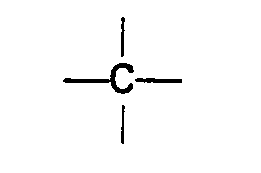
- the polycarbonate consists of recurring units of the formula wherein each -R- is selected from the group consisting of phenylene, halo-substituted phenylene and alkyl substituted phenylene, and X and Y are each selected from the group consisting of hydrogen, hydrocarbon radicals free from aliphatic unsaturation and or radicals which together with the adjoining atom form a cycloalkane radical, the total number of carbon atoms in X and Y being up to 12.
- the preferred polycarbonate resins may be derived from the reaction of bisphenol-A and phosgene. These polycarbonates have from 10 to 400 recurring units of the formula
- the polycarbonates are described in U.S. Patents Nos. 3,028,365; 3,334,154 and 3,915,926.
- the polycarbonate should have an intrinsic viscosity between 0.2 and 1.0, preferably from 0.30 to 0.65 as measured at 20°C in methylene chloride.
- oligomeric ester plasticizers useful in the composition of the present invention will have molecular weights in the range from 200 to 20,000 and preferably from 500 to 5,000.
- the preferred oligomeric ester plasticizer for use in the compositions of the present invention is KODAFLEX® NP-10 manufactured and sold by Eastman Chemical Products.
- KODAFLEX® NP-10 is an alcohol terminated oligomeric ester of neopentyl glycol (2,2-dimethyl-1,3-propane-diol) and adipic acid.
- the oligomeric ester component is present in an amount from 0.1 to 10 weight percent based upon the polycarbonate and preferably will be present in an amount from 1 to 5 weight percent.
- polyolefin copolymers such as ethylene-propylene copolymers
- olefin terpolymers such as ethylene-propylene-butadiene terpolymers
- olefin-acrylic acid copolymers such as ethylene-acrylic acid copolymers
- diolefinacrylic acid terpolymers such as ethylene-propylene-acrylic acid terpolymers
- other olefin based thermoplastic elastomers which may be suitably employed in practicing the present invention are also commercially available products whose preparation is well known, as will be readily apparent to those skilled in the art.
- compositions of the present invention contain from 0.1 to 10 percent by weight of the olefinic impact modifying component(s) described above, based upon the weight of polycarbonate, without taking into account the amount of plasticizer or agents which may be employed, and will preferentially contain from 2 to 6 percent by weight of the olefinic impact modifying component(s).
- the acrylic rubber components such as methyl methacrylate-butadiene-styrene, methyl methacrylate-acrylonitrile-butadiene-styrene and acrylonitrile-butadiene-styrene which may be suitably employed in practicing the present invention are all commercially available products whose preparation is well known.
- the acrylic rubber impact modifying agent is present in an amount from 0.1 to 50 weight percent based upon the polycarbonate and preferably will be present in an amount from 2 to 20 weight percent.
- compositions of the present invention may be prepared by any standard procedure and the particular method employed is not critical.
- compositions of the present invention may also include flame retardants such as those described in U.S. Patent No. 3,915,926.
Landscapes
- Chemical & Material Sciences (AREA)
- Health & Medical Sciences (AREA)
- Chemical Kinetics & Catalysis (AREA)
- Medicinal Chemistry (AREA)
- Polymers & Plastics (AREA)
- Organic Chemistry (AREA)
- Compositions Of Macromolecular Compounds (AREA)
Abstract
Description
- This invention relates to thermoplastic polycarbonate molding compositions having improved processability and notched Izod impact strength.
- Bisphenol-A polycarbonate polymers are excellent molding materials as products made therefrom have relatively high impact strength, toughness, high transparency, wide temperature limits (high impact resistance below -60°C and a UL thermal endurance rating of 115°C with impact), good dimensional stability, high creep resistance and electrical properties which qualify it as sole support for current carrying parts.
- Bisphenol-A polycarbonates are, however, very difficult to fabricate from melts for the reason that melts thereof have exceptionally high viscosities. Attempts to overcome this difficulty by the incorporation into the polycarbonate of materials known to reduce the viscosity of other resins have very generally been unsuccessful. Many standard viscosity control agents appear to have little or no effect on the viscosity of polycarbonates. Some compounds, which are conveniently employed to improve the workability of polymers, produce and embrittling effect on polycarbonates when they are mixed therewith and the mixture is subjected to elevated temperatures as in molding. Still other materials, while satisfactory stiffness modifying agents for other plastics, are too volatile to be incorporated into polycarbonates since polycarbonates have much higher melting points than many other thermoplastics.
- From the US patent 3 864 428 there are known bisphenol-A polycarbonate compositions, which contain considerable amounts of butadiene copolymer and aromatic polyesters.
- It has now been found that the incorporation of a relatively minor amount of an oligomeric ester plasticizer, namely an alcohol terminated oligomeric ester of neopentyl glycol (2,2-dimethyl-1,3-propane-diol) and adipic acid in admixture with either a minor amount of an olefinic impact modifier, namely polyolefins, olefin based copolymers and olefin based terpolymers, such as, ethylene-propylene copolymers, ethylene-butadiene copolymers, propylene-butadiene copolymers, ethylene-propylene butadiene terpolymers, ethylene-acrylic acid copolymers, propylene-acrylic acid copolymers, ethylene-ethyl acrylate copolymers, ethylene-vinyl acetate copolymers and ethylene-propylene acrylic acid terpolymers; or in admixture with an amount of an acrylic rubber impact modifier, namely methyl methacrylate-butadiene-styrene copolymers, methyl methacrylate-acrylonitrile-butadiene styrene copolymers, and acrylonitrile-butadiene-styrene copolymers; into a bisphenol-A polycarbonate will significantly improve the processability of the resultant polycarbonate molding material and, at the same time, provide a material having improved notched Izod impact strength characteristics.
- The present invention provides for a thermoplastic molding composition which comprises
- (a) a bisphenol-A polycarbonate;
- (b) 0.1 to 10 weight percent of an alcohol terminated oligomeric polyester of neopentyl glycol (2,2-dimethyl-1,3-propane-diol) and adipic acid; in admixture with, either
- (c) 0.1 to 10 weight percent of at least one component selected from polyolefins, olefin based copolymers and olefin based terpolymers or
- (d) 0.1 to 50 weight percent of at least one component selected from methyl methacrylate-butadiene-styrene copolymers, methyl methacrylate-acrylonitrile-butadiene-styrene copolymers and acrylonitrile-butadiene-styrene copolymers,
- The polycarbonate consists of recurring units of the formula


- The preferred polycarbonate resins may be derived from the reaction of bisphenol-A and phosgene. These polycarbonates have from 10 to 400 recurring units of the formula

- The polycarbonates are described in U.S. Patents Nos. 3,028,365; 3,334,154 and 3,915,926. The polycarbonate should have an intrinsic viscosity between 0.2 and 1.0, preferably from 0.30 to 0.65 as measured at 20°C in methylene chloride.
- The oligomeric ester plasticizers useful in the composition of the present invention will have molecular weights in the range from 200 to 20,000 and preferably from 500 to 5,000.
- The preferred oligomeric ester plasticizer for use in the compositions of the present invention is KODAFLEX® NP-10 manufactured and sold by Eastman Chemical Products. KODAFLEX® NP-10 is an alcohol terminated oligomeric ester of neopentyl glycol (2,2-dimethyl-1,3-propane-diol) and adipic acid.
- The oligomeric ester component is present in an amount from 0.1 to 10 weight percent based upon the polycarbonate and preferably will be present in an amount from 1 to 5 weight percent.
- The polyolefin copolymers, such as ethylene-propylene copolymers, and olefin terpolymers, such as ethylene-propylene-butadiene terpolymers, which may be suitably employed in practicing the present invention are all commercially available products whose preparation is well known.
- The olefin-acrylic acid copolymers, such as ethylene-acrylic acid copolymers, and diolefinacrylic acid terpolymers, such as ethylene-propylene-acrylic acid terpolymers, and other olefin based thermoplastic elastomers, which may be suitably employed in practicing the present invention are also commercially available products whose preparation is well known, as will be readily apparent to those skilled in the art.
- Exemplary of various commercially available products which may be advantageously employed as olefinic impact modifying agents in practicing the present invention are the following compositions:
- - PROFAX® 6301, PROFAX® 6601, PROFAX® 6701 and PROFAX® 8601, all propylene homopolymers; PROFAX® 7601 and PROFAX® 8601, both ethylene-propylene block copolymer; air of which are manufactured and sold by Hercules, Inc.;
- - USI® LB 342 and USI® LB 703, both ethylene homopolymers, manufactured and sold by USI Chemicals;
- - DOW@ EAA 435, DOW@ EAA 449, DOW@ EAA 455, DOW@ EAA 459, DOW@ XD 2375.28 and DOW@ XD 2375.29; all ethylene-acrylic acid copolymers manufactured and sold by the Dow Chemical Company;
- - MICROTHENEO FN 510, an ethylene homopolymer;
- - MICROTHENE@ FE 532, an ethylene-vinyl acetate copolymer;
- ―VYNATHENE® EY 901, VYNATHENE® EY 902, VYNATHENE® EY 903, VYNATHENE® EY 904, VYNATHENE@ EY 905, all ethylene-vinyl acetate copolymers, manufactured and sold by USI Chemicals;
- - DEXON® 1004, a propylene-acrylic acid copolymer, manufactured and sold by Exxon Chemicals;
- - SOMEL® 401T, SOMEL® 402T and SOMEL® 301G, all olefin based thermoplastic elastomers, manufactured and sold by the DuPont Company; and
- ― EPOLENE@ C―17, an olefin oligomer, manufactured and sold by Eastman Chemical Products.
- The compositions of the present invention contain from 0.1 to 10 percent by weight of the olefinic impact modifying component(s) described above, based upon the weight of polycarbonate, without taking into account the amount of plasticizer or agents which may be employed, and will preferentially contain from 2 to 6 percent by weight of the olefinic impact modifying component(s).
- The acrylic rubber components such as methyl methacrylate-butadiene-styrene, methyl methacrylate-acrylonitrile-butadiene-styrene and acrylonitrile-butadiene-styrene which may be suitably employed in practicing the present invention are all commercially available products whose preparation is well known.
- The acrylic rubber impact modifying agent is present in an amount from 0.1 to 50 weight percent based upon the polycarbonate and preferably will be present in an amount from 2 to 20 weight percent.
- Exemplary of various commercially available products which may be advantageously employed as acrylic rubber impact modifying agents in practicing the present invention are the following compositions:
- - BLENDEX® 111N and BLENDEX® 111 S, both methyl methacrylate-butadiene-styrene copolymers, manufactured and sold by Borg-Warner Corporation;
- - BLENDEX® 436, a methyl methacrylate acrylo-nitrile-butadiene-styrene copolymer, manufactured and sold by Borg-Warner Corporation; and
- - ACRYLOID® KM 611, a methyl methacrylate-butadiene-styrene copolymer, manufactured and sold by Rohm & Haas.
- The compositions of the present invention may be prepared by any standard procedure and the particular method employed is not critical.
- The compositions of the present invention may also include flame retardants such as those described in U.S. Patent No. 3,915,926.
- As will be apparent to one skilled in the art, other materials may also be advantageously employed in admixture with the bisphenol-A polycarbonate compositions of the present invention and include such materials as anti-static agents, pigments, thermal stabilizers, ultraviolet stabilizers, reinforcing fillers and the like.
- The following examples are set forth to further illustrate the present invention and are not to be construed as limiting the invention thereto.
- 100 parts by weight of a bisphenol-A polycarbonate having an IV of 0.51, was prepared, extruded in a twin screw extruder and molded into sample parts of approximately 0.32 cm thickness. The results of melt flow rate test performed according to the procedure set forth in ASTM D-1238, condition 0, and notched Izod impact test performed in accordance with ASTM D-256 on this material are given in Table I.
- Various blends of a bisphenol-A polycarbonate having an IV of 0.51, and varying amounts of KODAFLEX@ NP-10 were prepared, extruded and molded into sample parts in the same manner as was done in Example I. The results of melt flow rate and notched Izod impact test performed on the resultant materials are set forth in Table I.
- 100 parts by weight of a bisphenol-A polycarbonate having an IV of 0.46 was prepared, extruded. and molded into sample parts in the same manner as was done in Example I. The results of melt flow rate and notched Izod impact tests performed are set forth in Table I.
- A blend of 95 parts by weight of a bisphenol-A polycarbonate having an IV of 0.46 and 5 parts by weight of KODAFLEX® NP-10 was prepared, extruded in a twin screw extruder and molded into sample parts in the same manner as was done in the previous examples. The results of melt flow rate and notched Izod impact tests performed on this material are set forth in Table I.

- 100 parts by weight of a bisphenol-A polycarbonate having an IV of 0.51 was prepared, extruded in a twin screw extruder and molded into sample parts of approximately 0.32 cm (1/8 inch) and 0.64 cm (1/4 inch) thickness in the same manner as was done in the previous examples. The results of melt flow rate and notched Izod impact tests performed on the resultant material are set forth in Table II.
- Various blends of a bisphenol-A polycarbonate having an IV of 0.51 and various quantities of different olefinic impact modifiers as set forth in Table II were prepared, extruded and molded into sample parts of 0.32 cm (1/8 inch) and 0.64 cm (1/4 inch) thickness in the same manner as was done in the previous examples. The results of notched Izod impact tests performed on these materials are also set forth in Table II.
- 100 parts by weight of a bisphenol-A polycarbonate having IV of 0.46 was prepared, extruded and molded into sample parts of 0.32 cm (1/8 inch) and 0.64 cm (1/4 inch) thickness in the same manner as was done in the previous examples. The results of melt flow rate and notched Izod impact tests performed on this material are set forth in Table II.
- Various blends of a bisphenol-A polycarbonate having an IV of 0.46 and various amounts of different olefinic impact modifying agents as set forth in Table II were prepared, blended and molded in sample parts of 0.32 cm (1/8 inch) and 0.64 cm (1/4 inch) thickness. The results of melt flow rate and notched Izod impact tests performed on these materials are also set forth in Table II.


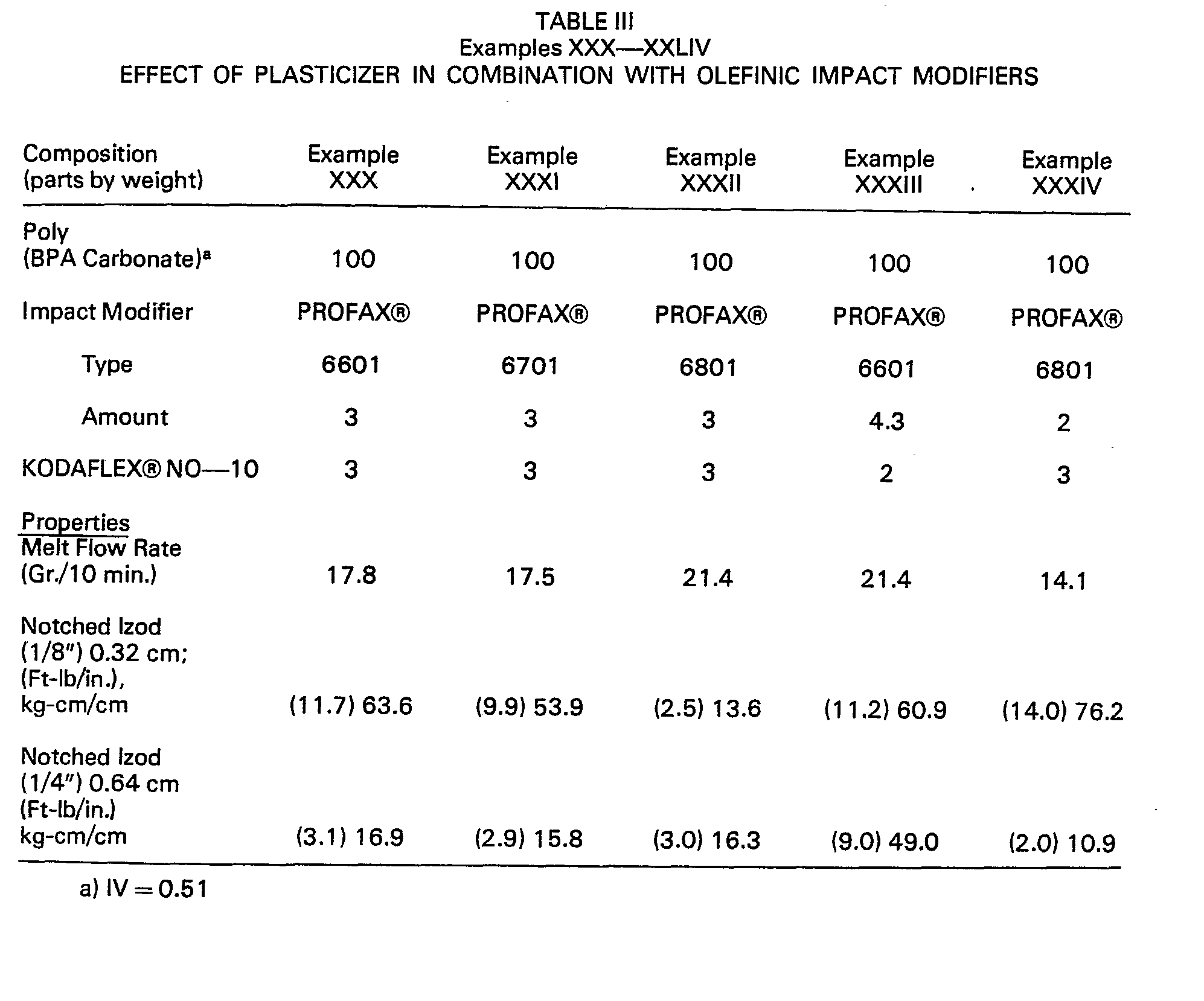
- Various blends of a bisphenol-A polycarbonate having an IV of 0.51 in admixture with various olefinic impact modifying agents in varying amounts together with varying amounts of KODAFLEX@ NP-10 were prepared, extruded and molded into sample parts of 0.32 cm (1/8 inch) and 0.64 cm (1/4 inch) thickness in the same manner as was done in previous examples. The results of melt flow rate and notched Izod impact tests performed on these materials are set forth in Table III.
- Various blends of a bisphenol-A polycarbonate having an IV of 0.46 in admixture with various olefinic impact modifying agents in varying amounts together with varying amounts of KODAFLEX® NP-10 as set forth in Table II were prepared, extruded and molded into sample parts of 0.32 cm (1/8 inch) and 0.64 cm (1/4 inch) thickness in the same manner as was done in the previous examples. The results of melt flow rate and notched Izod impact tests performed on these materials are also set forth in Table III.


- Various blends of bisphenol-A polycarbonate having an IV of 0.51 along with 5 parts by weight of various acrylic rubber modifying agents as set forth in Table IV were prepared, extruded and molded into sample parts of 0.32 cm (1/8 inch) and 0.64 cm (1/4 inch) thickness in the same manner as was done in previous examples. The results of melt flow rate and notched Izod impact tests on these materials is also set forth in Table IV.

- Various blends of a bisphenol-A polycarbonate having an IV of 0.51 in admixture with 5 parts by weight of various acrylic rubber impact modifying agents as set forth in Table V and 5 parts by weight of KODAFLEX@ NP-10 were prepared, extruded and molded into sample parts of 0.32 cm (1/8 inch) and 0.64 cm (1/4 inch) thickness in the same manner as was done in previous examples. The results of melt flow rate and notched Izod impact tests performed on these materials are also set forth in Table V.
- Various blends of bisphenol-A polycarbonate having an IV of 0.46 in admixture with various acrylic rubber impact modifying agents in various amounts together with varying amounts of KODAFLEX® NP-1 0 as set forth in Table V were prepared, extruded and molded into sample parts of 0.32 cm (1.8 inch) and 0.64 cm (1/4 inch) thickness in the same manner as was done in previous examples. The results of melt flow rate and notched Izod impact tests performed on these materials are also set forth in Table V.


- Although the above examples show various modifications of the present invention, other variations are possible in light of the above teachings.
all weight percents being based on the polycarbonate.
Claims (9)
all weight percents being based on the polycarbonate.


Applications Claiming Priority (2)
| Application Number | Priority Date | Filing Date | Title |
|---|---|---|---|
| US922305 | 1978-07-06 | ||
| US05/922,305 US4226950A (en) | 1978-07-06 | 1978-07-06 | Plasticized, impact modified polycarbonates |
Publications (3)
| Publication Number | Publication Date |
|---|---|
| EP0016124A1 EP0016124A1 (en) | 1980-10-01 |
| EP0016124A4 EP0016124A4 (en) | 1980-10-16 |
| EP0016124B1 true EP0016124B1 (en) | 1983-05-11 |
Family
ID=25446863
Family Applications (1)
| Application Number | Title | Priority Date | Filing Date |
|---|---|---|---|
| EP79900832A Expired EP0016124B1 (en) | 1978-07-06 | 1980-02-12 | Plasticized, impact modified polycarbonates |
Country Status (6)
| Country | Link |
|---|---|
| US (1) | US4226950A (en) |
| EP (1) | EP0016124B1 (en) |
| JP (1) | JPS6211027B2 (en) |
| CA (1) | CA1116338A (en) |
| DE (1) | DE2965358D1 (en) |
| WO (1) | WO1980000153A1 (en) |
Families Citing this family (43)
| Publication number | Priority date | Publication date | Assignee | Title |
|---|---|---|---|---|
| DE3027957A1 (en) * | 1979-07-24 | 1981-02-12 | Sumitomo Naugatuck | THERMOPLASTIC RESIN |
| US4340683A (en) * | 1979-08-27 | 1982-07-20 | General Electric Company | Polycarbonate compositions |
| US4539358A (en) * | 1980-03-20 | 1985-09-03 | General Electric Company | Polycarbonate compositions |
| DE3118526A1 (en) * | 1981-05-09 | 1982-12-02 | Bayer Ag, 5090 Leverkusen | "THERMOPLASTIC MOLDS OF POLYCARBONATE, POLYALKYLENE TEREPHTHALATE AND GRAFT POLYMERISATE" |
| JPS5883044A (en) * | 1981-11-12 | 1983-05-18 | Sumitomo Naugatuck Co Ltd | Thermoplastic resin composition |
| DE3248709A1 (en) * | 1982-01-29 | 1983-08-04 | General Electric Co., Schenectady, N.Y. | Thermoplastic moulding composition |
| US4503183A (en) * | 1982-01-29 | 1985-03-05 | Martin B. Barancik | Polycarbonate resin molding composition |
| US4401785A (en) * | 1982-01-29 | 1983-08-30 | General Electric Company | Polyolefin-poly(ester-carbonate) composition |
| US4442251A (en) * | 1982-03-04 | 1984-04-10 | General Electric Company | Impact resistant polyphenylene ether resin compositions |
| IT1199982B (en) * | 1982-03-26 | 1989-01-05 | Anic Spa | POLYCARBONATE-BASED THERMOPLASTIC POLYMERIC ALLOY |
| DE3227029A1 (en) * | 1982-07-20 | 1984-01-26 | Bayer Ag, 5090 Leverkusen | THERMOPLASTIC MOLDS MADE OF POLYCARBONATE, GRAFT POLYMER, ETHYLENE / VINYL ACETATE COPOLYMER AND, optionally, POLYALKYLENE TEREPHTHALATE |
| US4472554A (en) * | 1982-07-26 | 1984-09-18 | Mobay Chemical Corporation | Polycarbonate ABS blends of improved impact strength |
| DE3234174A1 (en) * | 1982-09-15 | 1984-03-15 | Basf Ag, 6700 Ludwigshafen | IMPACT TOE THERMOPLASTIC MOLDS WITH HIGH THERMAL RESISTANCE |
| US4639481A (en) * | 1982-09-27 | 1987-01-27 | General Electric Company | Modified thermoplastic polyester molding compositions and articles molded therefrom |
| EP0105244A1 (en) * | 1982-09-27 | 1984-04-11 | General Electric Company | Modified thermoplastic polyester molding compositions and articles molded therefrom |
| US4522980A (en) * | 1982-12-27 | 1985-06-11 | General Electric Company | Impact modified copolyester carbonate compositions |
| US4532282A (en) * | 1983-03-16 | 1985-07-30 | General Electric Company | Blends of aromatic polycarbonate resin, olefin polymers or copolymers and acrylate- or methacrylate-copolymer resins |
| US4481331A (en) * | 1983-03-22 | 1984-11-06 | Gen Electric | Polycarbonate resin mixture |
| US4487881A (en) * | 1983-10-03 | 1984-12-11 | Mobay Chemical Corporation | Impact improvement of reinforced polycarbonate/ABS blends |
| US4778853A (en) * | 1983-10-03 | 1988-10-18 | General Electric Company | Polycarbonate resin mixtures |
| US4536538A (en) * | 1983-12-19 | 1985-08-20 | General Electric Company | Impact modified polycarbonate composition |
| US4604423A (en) * | 1983-12-19 | 1986-08-05 | General Electric Company | Composition |
| US5171542A (en) * | 1984-03-20 | 1992-12-15 | A. Ahlstrom Corporation | Circulating fluidized bed reactor |
| DE3562256D1 (en) * | 1984-03-23 | 1988-05-26 | Mobay Corp | Thermoplastic compositions having improved mechanical properties |
| US4677148A (en) * | 1984-03-23 | 1987-06-30 | Mobay Corporation | Thermoplastic compositions having improved mechanical properties |
| WO1986000083A1 (en) * | 1984-06-14 | 1986-01-03 | General Electric Company | Polycarbonates exhibiting improved heat resistance |
| US4587295A (en) * | 1985-01-02 | 1986-05-06 | General Electric Company | Polycarbonate composition |
| US4579910A (en) * | 1985-01-02 | 1986-04-01 | General Electric Company | Polycarbonate composition |
| EP0216267A1 (en) * | 1985-09-24 | 1987-04-01 | General Electric Company | Thermoplastic compositions of polycarbonate resin and copolymers of ethylene and acrylic or methacrylic acid |
| JPS6269643U (en) * | 1985-10-22 | 1987-05-01 | ||
| FI86105C (en) * | 1985-11-19 | 1992-07-10 | Ahlstroem Oy | FOERFARANDE OCH ANORDNING FOER REGLERING AV EN VIRVELBAEDDSREAKTORS FUNKTION. |
| EP0311599B1 (en) * | 1985-12-09 | 1990-11-07 | A. Ahlstrom Corporation | A circulating fluidized bed reactor and a method of separating solid material from the flue gases |
| US4737546A (en) * | 1986-08-15 | 1988-04-12 | General Electric Company | Moldable polycarbonate resin and copolyester-carbonate compositions of improved processability |
| US4869207A (en) * | 1987-07-13 | 1989-09-26 | A. Ahlstrom Corporation | Circulating fluidized bed reactor |
| US4812514A (en) * | 1987-12-21 | 1989-03-14 | The Dow Chemical Company | Polymer blends |
| US5216077A (en) * | 1988-01-06 | 1993-06-01 | Kabushiki Kaisha Toshiba | Rubber-modified phenolic resin composition and method of manufacturing the same |
| US4885335A (en) * | 1988-12-27 | 1989-12-05 | General Electric Company | Low gloss thermoplastic blends |
| US4902743A (en) * | 1988-12-27 | 1990-02-20 | General Electric Company | Low gloss thermoplastic blends |
| US4868244A (en) * | 1988-12-27 | 1989-09-19 | General Electric Company | Low-gloss carbonate polymer blends |
| US6408593B1 (en) | 1999-09-01 | 2002-06-25 | Pete Foster | Shingle composition |
| US20070135570A1 (en) * | 2005-12-14 | 2007-06-14 | General Electric Company | Thermoplastic polycarbonate compositions with low gloss, articles made therefrom and method of manufacture |
| CN109370186B (en) * | 2018-11-22 | 2021-01-22 | 安徽汇创新材料有限公司 | Preparation method of low-temperature-resistant environment-friendly glass fiber reinforced plastic septic tank |
| CN113736001B (en) * | 2021-09-03 | 2022-07-01 | 吉林大学 | Application of Lewis base, sorbate polymer and derivative thereof |
Citations (3)
| Publication number | Priority date | Publication date | Assignee | Title |
|---|---|---|---|---|
| US3431224A (en) * | 1962-07-11 | 1969-03-04 | Gen Electric | Polycarbonate resin mixtures |
| DE2729485A1 (en) * | 1976-07-02 | 1978-01-05 | Gen Electric | THERMOPLASTIC COMPRESSION COMPOUND |
| DE1569448B2 (en) * | 1962-07-04 | 1979-09-06 | Teijin Ltd., Osaka (Japan) | Molding, impregnating, adhesive or coating compounds |
Family Cites Families (3)
| Publication number | Priority date | Publication date | Assignee | Title |
|---|---|---|---|---|
| US3372148A (en) * | 1963-02-12 | 1968-03-05 | Goodyear Tire & Rubber | Terephthalic acid-aliphatic acid copolyester resins |
| US3801673A (en) * | 1972-01-03 | 1974-04-02 | Gen Electric | Process for preparing polycarbonate alloys |
| JPS559435B2 (en) * | 1972-08-30 | 1980-03-10 |
-
1978
- 1978-07-06 US US05/922,305 patent/US4226950A/en not_active Expired - Lifetime
-
1979
- 1979-06-22 CA CA000330381A patent/CA1116338A/en not_active Expired
- 1979-07-02 JP JP54501164A patent/JPS6211027B2/ja not_active Expired
- 1979-07-02 WO PCT/US1979/000465 patent/WO1980000153A1/en not_active Ceased
- 1979-07-02 DE DE7979900832T patent/DE2965358D1/en not_active Expired
-
1980
- 1980-02-12 EP EP79900832A patent/EP0016124B1/en not_active Expired
Patent Citations (3)
| Publication number | Priority date | Publication date | Assignee | Title |
|---|---|---|---|---|
| DE1569448B2 (en) * | 1962-07-04 | 1979-09-06 | Teijin Ltd., Osaka (Japan) | Molding, impregnating, adhesive or coating compounds |
| US3431224A (en) * | 1962-07-11 | 1969-03-04 | Gen Electric | Polycarbonate resin mixtures |
| DE2729485A1 (en) * | 1976-07-02 | 1978-01-05 | Gen Electric | THERMOPLASTIC COMPRESSION COMPOUND |
Also Published As
| Publication number | Publication date |
|---|---|
| JPS6211027B2 (en) | 1987-03-10 |
| EP0016124A1 (en) | 1980-10-01 |
| EP0016124A4 (en) | 1980-10-16 |
| US4226950A (en) | 1980-10-07 |
| DE2965358D1 (en) | 1983-06-16 |
| WO1980000153A1 (en) | 1980-02-07 |
| JPS55500483A (en) | 1980-07-31 |
| CA1116338A (en) | 1982-01-12 |
Similar Documents
| Publication | Publication Date | Title |
|---|---|---|
| US4226950A (en) | Plasticized, impact modified polycarbonates | |
| US4123436A (en) | Polycarbonate composition plasticized with esters | |
| CA1309786C (en) | Polyester resin composition | |
| EP0114288B1 (en) | Additive concentrate for polyester compositions and method of addition | |
| JPH02380B2 (en) | ||
| US4093582A (en) | Organo phosphorus ester plasticized polycarbonate composition | |
| EP0013485B1 (en) | Thermoplastic polyglutarimide compositions and methods of making them | |
| US4129546A (en) | Plasticized with a minor amount of an oligomeric polymeric polycarbonate | |
| JPH04363357A (en) | Thermoplastic resin composition excellent in weather resistance | |
| JPH0250947B2 (en) | ||
| US4446272A (en) | Resin composition having nice color tone and high crack-resistance | |
| US4123413A (en) | Polycarbonate composition containing urethane plasticizer | |
| US4148773A (en) | Polycarbonate composition containing siloxane plasticizer | |
| JPS6366261A (en) | Fire-retardant compound and thermoplastic composition containing the same | |
| US4098751A (en) | Organic carbonate plasticized polycarbonate composition | |
| US4145329A (en) | Plasticized polycarbonate composition | |
| WO1980000083A1 (en) | Reinforced impact modified polycarbonates | |
| JPS645068B2 (en) | ||
| US4098750A (en) | Organic oxalate plasticized polycarbonate composition | |
| CA1101580A (en) | Plasticized polycarbonate composition | |
| EP0365841B1 (en) | Blends of polyphenylene ether and modified polyesters | |
| EP0216267A1 (en) | Thermoplastic compositions of polycarbonate resin and copolymers of ethylene and acrylic or methacrylic acid | |
| EP0269027B1 (en) | Blends based on vinyl aromatic polymers having high molding fluidity and thermoresistance | |
| JPH0433305B2 (en) | ||
| JPH0699621B2 (en) | Novel thermoplastic polyester composition containing low molecular weight diepoxide resin with excellent impact behavior |
Legal Events
| Date | Code | Title | Description |
|---|---|---|---|
| PUAI | Public reference made under article 153(3) epc to a published international application that has entered the european phase |
Free format text: ORIGINAL CODE: 0009012 |
|
| AK | Designated contracting states |
Designated state(s): DE FR GB |
|
| 17P | Request for examination filed | ||
| GRAA | (expected) grant |
Free format text: ORIGINAL CODE: 0009210 |
|
| AK | Designated contracting states |
Designated state(s): DE FR GB |
|
| REF | Corresponds to: |
Ref document number: 2965358 Country of ref document: DE Date of ref document: 19830616 |
|
| ET | Fr: translation filed | ||
| PLBI | Opposition filed |
Free format text: ORIGINAL CODE: 0009260 |
|
| 26 | Opposition filed |
Opponent name: BAYER AG, LEVERKUSEN KONZERNVERWALTUNG RP PATENTAB Effective date: 19830110 |
|
| PGFP | Annual fee paid to national office [announced via postgrant information from national office to epo] |
Ref country code: FR Payment date: 19840703 Year of fee payment: 6 |
|
| PGFP | Annual fee paid to national office [announced via postgrant information from national office to epo] |
Ref country code: DE Payment date: 19840723 Year of fee payment: 6 |
|
| RDAG | Patent revoked |
Free format text: ORIGINAL CODE: 0009271 |
|
| STAA | Information on the status of an ep patent application or granted ep patent |
Free format text: STATUS: PATENT REVOKED |
|
| 27W | Patent revoked |
Effective date: 19870817 |
|
| GBPR | Gb: patent revoked under art. 102 of the ep convention designating the uk as contracting state | ||
| REG | Reference to a national code |
Ref country code: FR Ref legal event code: ST |
|
| APAC | Appeal dossier modified |
Free format text: ORIGINAL CODE: EPIDOS NOAPO |
|
| APAC | Appeal dossier modified |
Free format text: ORIGINAL CODE: EPIDOS NOAPO |