EP0015652B1 - 6-chloro-6-deoxy-d-hexitols, their esters, their preparation, fertility control compositions containing them and their use in a contraceptive method - Google Patents
6-chloro-6-deoxy-d-hexitols, their esters, their preparation, fertility control compositions containing them and their use in a contraceptive method Download PDFInfo
- Publication number
- EP0015652B1 EP0015652B1 EP80300366A EP80300366A EP0015652B1 EP 0015652 B1 EP0015652 B1 EP 0015652B1 EP 80300366 A EP80300366 A EP 80300366A EP 80300366 A EP80300366 A EP 80300366A EP 0015652 B1 EP0015652 B1 EP 0015652B1
- Authority
- EP
- European Patent Office
- Prior art keywords
- chloro
- deoxy
- compound
- general formula
- glucitol
- Prior art date
- Legal status (The legal status is an assumption and is not a legal conclusion. Google has not performed a legal analysis and makes no representation as to the accuracy of the status listed.)
- Expired
Links
- 238000000034 method Methods 0.000 title claims description 16
- 230000035558 fertility Effects 0.000 title claims description 12
- 239000000203 mixture Substances 0.000 title claims description 11
- 239000003433 contraceptive agent Substances 0.000 title claims description 4
- 230000002254 contraceptive effect Effects 0.000 title claims description 3
- 150000002148 esters Chemical class 0.000 title description 5
- 150000001875 compounds Chemical class 0.000 claims description 26
- MRGPKZIDNGFPIU-JGWLITMVSA-N (2s,3r,4s,5s)-6-chlorohexane-1,2,3,4,5-pentol Chemical compound OC[C@H](O)[C@@H](O)[C@H](O)[C@H](O)CCl MRGPKZIDNGFPIU-JGWLITMVSA-N 0.000 claims description 12
- MRGPKZIDNGFPIU-KVTDHHQDSA-N (2r,3r,4s,5s)-6-chlorohexane-1,2,3,4,5-pentol Chemical compound OC[C@@H](O)[C@@H](O)[C@H](O)[C@H](O)CCl MRGPKZIDNGFPIU-KVTDHHQDSA-N 0.000 claims description 9
- MRGPKZIDNGFPIU-DPYQTVNSSA-N (2s,3r,4r,5s)-6-chlorohexane-1,2,3,4,5-pentol Chemical compound OC[C@H](O)[C@@H](O)[C@@H](O)[C@H](O)CCl MRGPKZIDNGFPIU-DPYQTVNSSA-N 0.000 claims description 5
- 230000002401 inhibitory effect Effects 0.000 claims description 4
- 239000000546 pharmaceutical excipient Substances 0.000 claims description 4
- 150000001242 acetic acid derivatives Chemical class 0.000 claims description 3
- -1 benzoate ester Chemical class 0.000 claims description 3
- 239000003638 chemical reducing agent Substances 0.000 claims description 3
- MNQZXJOMYWMBOU-UHFFFAOYSA-N glyceraldehyde Chemical compound OCC(O)C=O MNQZXJOMYWMBOU-UHFFFAOYSA-N 0.000 claims description 3
- 229920001223 polyethylene glycol Polymers 0.000 claims description 3
- 150000005846 sugar alcohols Chemical class 0.000 claims description 3
- 229910052783 alkali metal Inorganic materials 0.000 claims description 2
- 150000001340 alkali metals Chemical group 0.000 claims description 2
- 150000001558 benzoic acid derivatives Chemical class 0.000 claims description 2
- 238000006298 dechlorination reaction Methods 0.000 claims description 2
- 239000002552 dosage form Substances 0.000 claims description 2
- 239000003937 drug carrier Substances 0.000 claims description 2
- OKKJLVBELUTLKV-UHFFFAOYSA-N Methanol Chemical compound OC OKKJLVBELUTLKV-UHFFFAOYSA-N 0.000 description 27
- XEKOWRVHYACXOJ-UHFFFAOYSA-N Ethyl acetate Chemical compound CCOC(C)=O XEKOWRVHYACXOJ-UHFFFAOYSA-N 0.000 description 16
- LFQSCWFLJHTTHZ-UHFFFAOYSA-N Ethanol Chemical compound CCO LFQSCWFLJHTTHZ-UHFFFAOYSA-N 0.000 description 15
- XLYOFNOQVPJJNP-UHFFFAOYSA-N water Substances O XLYOFNOQVPJJNP-UHFFFAOYSA-N 0.000 description 11
- QTBSBXVTEAMEQO-UHFFFAOYSA-M Acetate Chemical compound CC([O-])=O QTBSBXVTEAMEQO-UHFFFAOYSA-M 0.000 description 8
- RTZKZFJDLAIYFH-UHFFFAOYSA-N Diethyl ether Chemical compound CCOCC RTZKZFJDLAIYFH-UHFFFAOYSA-N 0.000 description 8
- VYPSYNLAJGMNEJ-UHFFFAOYSA-N Silicium dioxide Chemical compound O=[Si]=O VYPSYNLAJGMNEJ-UHFFFAOYSA-N 0.000 description 8
- 239000000741 silica gel Substances 0.000 description 8
- 229910002027 silica gel Inorganic materials 0.000 description 8
- 241000700159 Rattus Species 0.000 description 7
- WFDIJRYMOXRFFG-UHFFFAOYSA-N Acetic anhydride Chemical compound CC(=O)OC(C)=O WFDIJRYMOXRFFG-UHFFFAOYSA-N 0.000 description 6
- HEDRZPFGACZZDS-UHFFFAOYSA-N Chloroform Chemical compound ClC(Cl)Cl HEDRZPFGACZZDS-UHFFFAOYSA-N 0.000 description 6
- LRHPLDYGYMQRHN-UHFFFAOYSA-N N-Butanol Chemical compound CCCCO LRHPLDYGYMQRHN-UHFFFAOYSA-N 0.000 description 6
- 235000019439 ethyl acetate Nutrition 0.000 description 6
- 239000000047 product Substances 0.000 description 5
- JUJWROOIHBZHMG-UHFFFAOYSA-N Pyridine Chemical compound C1=CC=NC=C1 JUJWROOIHBZHMG-UHFFFAOYSA-N 0.000 description 4
- WQDUMFSSJAZKTM-UHFFFAOYSA-N Sodium methoxide Chemical compound [Na+].[O-]C WQDUMFSSJAZKTM-UHFFFAOYSA-N 0.000 description 4
- 230000009471 action Effects 0.000 description 4
- 239000004480 active ingredient Substances 0.000 description 4
- 235000005911 diet Nutrition 0.000 description 4
- 230000037213 diet Effects 0.000 description 4
- 230000000694 effects Effects 0.000 description 4
- 239000000126 substance Substances 0.000 description 4
- 239000003826 tablet Substances 0.000 description 4
- QTBSBXVTEAMEQO-UHFFFAOYSA-N Acetic acid Chemical compound CC(O)=O QTBSBXVTEAMEQO-UHFFFAOYSA-N 0.000 description 3
- QAOWNCQODCNURD-UHFFFAOYSA-N Sulfuric acid Chemical compound OS(O)(=O)=O QAOWNCQODCNURD-UHFFFAOYSA-N 0.000 description 3
- PIGNIRSKHCKAKR-QKPAOTATSA-N [(2s,3r,4s,5s)-2,3,4,5-tetraacetyloxy-6-chlorohexyl] acetate Chemical compound CC(=O)OC[C@H](OC(C)=O)[C@@H](OC(C)=O)[C@H](OC(C)=O)[C@@H](CCl)OC(C)=O PIGNIRSKHCKAKR-QKPAOTATSA-N 0.000 description 3
- 230000037396 body weight Effects 0.000 description 3
- 150000001720 carbohydrates Chemical class 0.000 description 3
- 235000014633 carbohydrates Nutrition 0.000 description 3
- 210000000918 epididymis Anatomy 0.000 description 3
- 201000010063 epididymitis Diseases 0.000 description 3
- 230000013011 mating Effects 0.000 description 3
- 239000003208 petroleum Substances 0.000 description 3
- 230000009467 reduction Effects 0.000 description 3
- 239000001117 sulphuric acid Substances 0.000 description 3
- 235000011149 sulphuric acid Nutrition 0.000 description 3
- SSZWWUDQMAHNAQ-UHFFFAOYSA-N 3-chloropropane-1,2-diol Chemical compound OCC(O)CCl SSZWWUDQMAHNAQ-UHFFFAOYSA-N 0.000 description 2
- OKKJLVBELUTLKV-MZCSYVLQSA-N Deuterated methanol Chemical compound [2H]OC([2H])([2H])[2H] OKKJLVBELUTLKV-MZCSYVLQSA-N 0.000 description 2
- HEDRZPFGACZZDS-MICDWDOJSA-N Trichloro(2H)methane Chemical compound [2H]C(Cl)(Cl)Cl HEDRZPFGACZZDS-MICDWDOJSA-N 0.000 description 2
- DTQVDTLACAAQTR-UHFFFAOYSA-N Trifluoroacetic acid Chemical compound OC(=O)C(F)(F)F DTQVDTLACAAQTR-UHFFFAOYSA-N 0.000 description 2
- VJMAITQRABEEKP-UHFFFAOYSA-N [6-(phenylmethoxymethyl)-1,4-dioxan-2-yl]methyl acetate Chemical group O1C(COC(=O)C)COCC1COCC1=CC=CC=C1 VJMAITQRABEEKP-UHFFFAOYSA-N 0.000 description 2
- 238000005903 acid hydrolysis reaction Methods 0.000 description 2
- 230000003509 anti-fertility effect Effects 0.000 description 2
- UHOVQNZJYSORNB-MZWXYZOWSA-N benzene-d6 Chemical compound [2H]C1=C([2H])C([2H])=C([2H])C([2H])=C1[2H] UHOVQNZJYSORNB-MZWXYZOWSA-N 0.000 description 2
- 239000002775 capsule Substances 0.000 description 2
- 239000000460 chlorine Substances 0.000 description 2
- 210000002257 embryonic structure Anatomy 0.000 description 2
- 238000001704 evaporation Methods 0.000 description 2
- 230000008020 evaporation Effects 0.000 description 2
- 230000003054 hormonal effect Effects 0.000 description 2
- 230000035800 maturation Effects 0.000 description 2
- 238000006386 neutralization reaction Methods 0.000 description 2
- 230000008569 process Effects 0.000 description 2
- UMJSCPRVCHMLSP-UHFFFAOYSA-N pyridine Natural products COC1=CC=CN=C1 UMJSCPRVCHMLSP-UHFFFAOYSA-N 0.000 description 2
- 238000001953 recrystallisation Methods 0.000 description 2
- 239000012279 sodium borohydride Substances 0.000 description 2
- 229910000033 sodium borohydride Inorganic materials 0.000 description 2
- 239000006188 syrup Substances 0.000 description 2
- 235000020357 syrup Nutrition 0.000 description 2
- 230000009897 systematic effect Effects 0.000 description 2
- VZGDMQKNWNREIO-UHFFFAOYSA-N tetrachloromethane Chemical compound ClC(Cl)(Cl)Cl VZGDMQKNWNREIO-UHFFFAOYSA-N 0.000 description 2
- RIOQSEWOXXDEQQ-UHFFFAOYSA-N triphenylphosphine Chemical compound C1=CC=CC=C1P(C=1C=CC=CC=1)C1=CC=CC=C1 RIOQSEWOXXDEQQ-UHFFFAOYSA-N 0.000 description 2
- ZHVNVPHMOCWHHO-DPYQTVNSSA-N (2r,3s,4r,5s)-6-chloro-2,3,4,5-tetrahydroxyhexanal Chemical compound ClC[C@@H](O)[C@H](O)[C@H](O)[C@@H](O)C=O ZHVNVPHMOCWHHO-DPYQTVNSSA-N 0.000 description 1
- UBEKOKRFIZSPTJ-QRXFDPRISA-N (2r,3s,4s,5s)-6-chloro-2,3,4,5,6-pentahydroxyhexanal Chemical compound OC(Cl)[C@@H](O)[C@@H](O)[C@H](O)[C@@H](O)C=O UBEKOKRFIZSPTJ-QRXFDPRISA-N 0.000 description 1
- ZHVNVPHMOCWHHO-JGWLITMVSA-N (2r,3s,4s,5s)-6-chloro-2,3,4,5-tetrahydroxyhexanal Chemical compound ClC[C@@H](O)[C@@H](O)[C@H](O)[C@@H](O)C=O ZHVNVPHMOCWHHO-JGWLITMVSA-N 0.000 description 1
- ZHVNVPHMOCWHHO-UHFFFAOYSA-N 6-chloro-2,3,4,5-tetrahydroxyhexanal Chemical compound ClCC(O)C(O)C(O)C(O)C=O ZHVNVPHMOCWHHO-UHFFFAOYSA-N 0.000 description 1
- WQZGKKKJIJFFOK-GASJEMHNSA-N Glucose Natural products OC[C@H]1OC(O)[C@H](O)[C@@H](O)[C@@H]1O WQZGKKKJIJFFOK-GASJEMHNSA-N 0.000 description 1
- 241000699670 Mus sp. Species 0.000 description 1
- PIGNIRSKHCKAKR-FXUDXRNXSA-N [(2s,3r,4r,5s)-2,3,4,5-tetraacetyloxy-6-chlorohexyl] acetate Chemical compound CC(=O)OC[C@H](OC(C)=O)[C@@H](OC(C)=O)[C@@H](OC(C)=O)[C@@H](CCl)OC(C)=O PIGNIRSKHCKAKR-FXUDXRNXSA-N 0.000 description 1
- 238000006136 alcoholysis reaction Methods 0.000 description 1
- 125000001931 aliphatic group Chemical group 0.000 description 1
- 238000004458 analytical method Methods 0.000 description 1
- 239000011230 binding agent Substances 0.000 description 1
- 230000008499 blood brain barrier function Effects 0.000 description 1
- 210000001218 blood-brain barrier Anatomy 0.000 description 1
- 210000004556 brain Anatomy 0.000 description 1
- 229910052799 carbon Inorganic materials 0.000 description 1
- 125000004432 carbon atom Chemical group C* 0.000 description 1
- 229920001429 chelating resin Polymers 0.000 description 1
- 238000006243 chemical reaction Methods 0.000 description 1
- 229910052801 chlorine Inorganic materials 0.000 description 1
- 125000001309 chloro group Chemical group Cl* 0.000 description 1
- 238000004440 column chromatography Methods 0.000 description 1
- 210000004246 corpus luteum Anatomy 0.000 description 1
- 239000012043 crude product Substances 0.000 description 1
- 230000000382 dechlorinating effect Effects 0.000 description 1
- 230000000994 depressogenic effect Effects 0.000 description 1
- UHOVQNZJYSORNB-MICDWDOJSA-N deuteriobenzene Chemical compound [2H]C1=CC=CC=C1 UHOVQNZJYSORNB-MICDWDOJSA-N 0.000 description 1
- 239000003085 diluting agent Substances 0.000 description 1
- 238000010828 elution Methods 0.000 description 1
- MDKXBBPLEGPIRI-UHFFFAOYSA-N ethoxyethane;methanol Chemical compound OC.CCOCC MDKXBBPLEGPIRI-UHFFFAOYSA-N 0.000 description 1
- 238000001914 filtration Methods 0.000 description 1
- 238000009472 formulation Methods 0.000 description 1
- 239000007903 gelatin capsule Substances 0.000 description 1
- 239000008103 glucose Substances 0.000 description 1
- 230000006377 glucose transport Effects 0.000 description 1
- FBPFZTCFMRRESA-UHFFFAOYSA-N hexane-1,2,3,4,5,6-hexol Chemical compound OCC(O)C(O)C(O)C(O)CO FBPFZTCFMRRESA-UHFFFAOYSA-N 0.000 description 1
- 239000005556 hormone Substances 0.000 description 1
- 229940088597 hormone Drugs 0.000 description 1
- 125000002887 hydroxy group Chemical group [H]O* 0.000 description 1
- 238000001727 in vivo Methods 0.000 description 1
- 239000000314 lubricant Substances 0.000 description 1
- 238000001819 mass spectrum Methods 0.000 description 1
- 230000010534 mechanism of action Effects 0.000 description 1
- 230000002175 menstrual effect Effects 0.000 description 1
- 230000004899 motility Effects 0.000 description 1
- 235000021590 normal diet Nutrition 0.000 description 1
- 238000000655 nuclear magnetic resonance spectrum Methods 0.000 description 1
- 238000003305 oral gavage Methods 0.000 description 1
- 210000001672 ovary Anatomy 0.000 description 1
- 150000002976 peresters Chemical class 0.000 description 1
- 239000002798 polar solvent Substances 0.000 description 1
- 229920005989 resin Polymers 0.000 description 1
- 239000011347 resin Substances 0.000 description 1
- 238000000926 separation method Methods 0.000 description 1
- 239000007787 solid Substances 0.000 description 1
- 239000007944 soluble tablet Substances 0.000 description 1
- 238000001228 spectrum Methods 0.000 description 1
- 230000019100 sperm motility Effects 0.000 description 1
- 230000021595 spermatogenesis Effects 0.000 description 1
- 238000003756 stirring Methods 0.000 description 1
- 231100000456 subacute toxicity Toxicity 0.000 description 1
- 230000002459 sustained effect Effects 0.000 description 1
- 231100000331 toxic Toxicity 0.000 description 1
- 230000002588 toxic effect Effects 0.000 description 1
- 210000004291 uterus Anatomy 0.000 description 1
Classifications
-
- C—CHEMISTRY; METALLURGY
- C07—ORGANIC CHEMISTRY
- C07C—ACYCLIC OR CARBOCYCLIC COMPOUNDS
- C07C31/00—Saturated compounds having hydroxy or O-metal groups bound to acyclic carbon atoms
- C07C31/34—Halogenated alcohols
- C07C31/42—Polyhydroxylic acyclic alcohols
-
- A—HUMAN NECESSITIES
- A61—MEDICAL OR VETERINARY SCIENCE; HYGIENE
- A61K—PREPARATIONS FOR MEDICAL, DENTAL OR TOILETRY PURPOSES
- A61K31/00—Medicinal preparations containing organic active ingredients
- A61K31/045—Hydroxy compounds, e.g. alcohols; Salts thereof, e.g. alcoholates
- A61K31/047—Hydroxy compounds, e.g. alcohols; Salts thereof, e.g. alcoholates having two or more hydroxy groups, e.g. sorbitol
-
- C—CHEMISTRY; METALLURGY
- C07—ORGANIC CHEMISTRY
- C07C—ACYCLIC OR CARBOCYCLIC COMPOUNDS
- C07C29/00—Preparation of compounds having hydroxy or O-metal groups bound to a carbon atom not belonging to a six-membered aromatic ring
- C07C29/09—Preparation of compounds having hydroxy or O-metal groups bound to a carbon atom not belonging to a six-membered aromatic ring by hydrolysis
- C07C29/10—Preparation of compounds having hydroxy or O-metal groups bound to a carbon atom not belonging to a six-membered aromatic ring by hydrolysis of ethers, including cyclic ethers, e.g. oxiranes
-
- C—CHEMISTRY; METALLURGY
- C07—ORGANIC CHEMISTRY
- C07B—GENERAL METHODS OF ORGANIC CHEMISTRY; APPARATUS THEREFOR
- C07B2200/00—Indexing scheme relating to specific properties of organic compounds
- C07B2200/07—Optical isomers
Definitions
- This invention relates to chemical compositions possessing male fertility-inhibiting action.
- racemic a-chlorohydrin One substance which has previously been of considerable interest is racemic a-chlorohydrin. However this compound has recently been reported to have undesirable side effects and hence interest in racemic a-chlorohydrin has waned.
- a male fertility-inhibiting composition in unit dosage form, containing as an active ingredient a compound of general formula (I) or a physiologically acceptable ester or other bio-labile 0-substituted derivative thereof in association with a pharmacologically acceptable carrier or excipient.
- a male fertility-inhibiting composition containing a 6-chloro-6-deoxy-D-hexitol of the general formula: or a physiologically acceptable esterified or other bio-labile 0-substituted derivative thereof together with a pharmaceutically acceptable carrier or excipient.
- a contraceptive method comprising administering thereto a compound of the formula (I) or a pharmacologically acceptable ester or other bio-labile O-substituted derivative thereof in an amount effective to control fertility.
- the compound formula (I) is preferably a compound of the general formula:
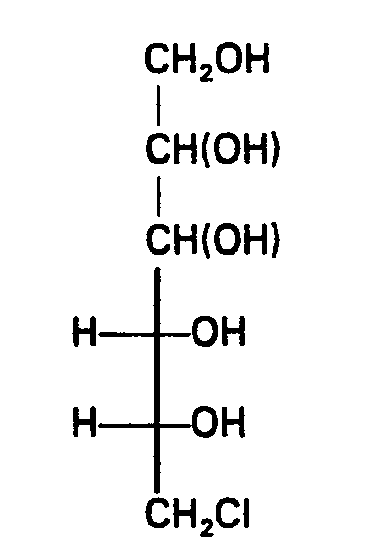
- 6-chloro-6-deoxy-D-glucitol is the same compound as 1-chloro-6-deoxy-L-gulitol:
- 6-Chloro-6-deoxy-D-mannitol is the same as 1-chloro-1-deoxy-D-mannitol:
- 6-chloro-6-deoxy-D-glucitol and 6-chloro-6-deoxy-D-mannitol.
- 6-chloro-6-deoxy-D-allitol while 6-chloro-6-deoxy-D-galactitol is active, but less so.
- the esterified derivatives thereof are preferably esters of aliphatic or aromatic carboxylic acids, e.g. acetates and benzoates.
- Per esters, in which all the hydroxyl groups are esterified i.e. pentaesters
- pentaesters are particularly easily prepared, e.g. pentaacetates and penta- benzoates. Any ester, however, which can give the parent 6-chloro-6-deoxy-D-hexitol in vivo is suitable, as are other biolabile derivatives.
- compositions according to the present invention are preferably presented in a form for oral administration such as tablets, coated tablets, capsules or soluble tablets.
- the presentation is conveniently adapted so that a dose of one or two units per day gives a sufficient level of protection.
- each unit dosage may contain from 0.35 to 4.5 g, suitable for providing a daily dose of up to 60 mg/kg.
- compositions envisaged may include slow-release or depot formulations, containing sufficient active ingredient per unit to suppress fertility for a sustained period.
- the anti-fertility action of the compounds was demonstrated in a fertilisation test using rats according to the following method.
- Groups of 6 or 8 male rats (CD strain, Charles River, Manston, Kent UK. 300-450 g body weight) were given 14 consecutive daily doses of 6-chloro-6-deoxyglucitol (60 or 90 or 120 or 240 p mol/kg/day) or 6-chloro-6-deoxymannitol (300 p, mol/kg/day) or 6-chloro-6-deoxyglucitol pentaacetate (300 p mol/kg/day). Control groups were given water 1 ml/kg/day. 6-Chloro-6-ddoxyglucitol pentaacetate was administered by mixing it with powdered diet (Diet 86 Dixons, Ware, Hertfordshire, UK) which was then re-pelleted. The other components were dissolved in water at concentrations such that the dose given was 1 ml/kg and they were administered by oral gavage.
- the male rats treated with 6-chloro-6-deoxy-glucitol pentaacetate were supplied with the treated diet for at least 8 days. They were then transferred to cages where normal diet was supplied and they were paired with virgin females (CD strain Charles River, Manston, Kent. 180 g body weight) which were in the pro-oestrous stage of the oestrous cycle. Mating was confirmed by the presence of spermatozoa in viginal smears. If mating did not occur after 2 days the male was returned to a cage supplied with treated diet for a further 2 days before a second attempt at mating. The mated females were treated as described below.
- the male rats in the other groups were paired with virgin females (CD strain, 180 g body weight) for the second week of the dosing period.
- the females were killed 10 days after separation from the males and the embryos and resorbing embryos present in their uteri and the corpora lutea present in their ovaries were counted.
- 6-chloro-6-deoxy-D-glucitol showed complete anti-fertility activity at doses of 48, 24 and 18 mg/kg/day.
- the figure of 18 mg/kg/day compares favourably with the 24 mg/kg/day dose required for 6-chloroglucose. After 3 to 6 weeks without dosing, the fertility of the rats had returned.
- 6-Chloro-6-deoxy-D-glucitol possesses a low sub-acute toxicity and apparently does not inhibit glucose transport to the brain across the blood-brain barrier in rats.
- mice showed toxic effects but recovered after the treatment was stopped.
- the 6-chloro-6-deoxy-D-hexitols of Formula I according to the present invention are novel compounds, as are their esterified derivatives, e.g. the acetate, especially the pentaacetates. They can be prepared by reduction of the corresponding 6-chloro-6-deoxy-D-aldose (Evans and Parrish, Methods in Carbohydrate Chemistry, 6, 193, 1972) by any convenient reducing system which will reduce an aldose to an alditol without dechlorinating it.
- a particularly preferred system is an alkali metal borohydride such as sodium borohydride in an inert polar solvent such as an alcohol or water.
- the reduced product is conveniently separated and purified in the form of its pentaacetate, prepared, for example, by treatment of the crude product with acetic anhydride either in pyridine or, preferably, in the presence of conc. sulphuric acid.
- the purified acetate may then be subjected to alcoholysis, for example by treatment with sodium methoxide in methanol, if the free hexitol is required.
- 6-Chloro-6-deoxy-D-mannose was reduced in the same manner as in Example 1 to give the 6-chloro-6-deoxy-D-mannitol.
- 6-chloro-6-deoxy-D-galactose Reduction of 6-chloro-6-deoxy-D-galactose by the method described in Example 1 gave 6-chloro-6-deoxy-D-galactitol, recrystallised from methanol.
- 6-Chloro-6-deoxy-D-glucitol is combined in a conventional manner with conventional tableting binders and lubricants and is pressed into tablets, each containing 2.0 g of the active ingredient.
- 6-Chloro-6-deoxy-D-glucitol is combined with a conventional excipient or diluent and packed into gelatin capsules, each containing 2.0 g of the active ingredient.
Landscapes
- Chemical & Material Sciences (AREA)
- Organic Chemistry (AREA)
- Health & Medical Sciences (AREA)
- Life Sciences & Earth Sciences (AREA)
- Pharmacology & Pharmacy (AREA)
- Epidemiology (AREA)
- Medicinal Chemistry (AREA)
- Animal Behavior & Ethology (AREA)
- General Health & Medical Sciences (AREA)
- Public Health (AREA)
- Veterinary Medicine (AREA)
- Saccharide Compounds (AREA)
- Pharmaceuticals Containing Other Organic And Inorganic Compounds (AREA)
- Organic Low-Molecular-Weight Compounds And Preparation Thereof (AREA)
Description
- This invention relates to chemical compositions possessing male fertility-inhibiting action.
- At present, the only systematic method of fertility control available involves the administration of hormones or hormone-like substances to the female, generally to interfere with the normal menstrual or oestrous cycle. Considerable research has been undertaken to find an equivalent systematic method of fertility control in the male, so far without any real success. This research has generally been concerned with hormone-type action, although more recently attention has turned to the use of chemical substances having no hormonal affect, but instead possessing an entirely local action on the sperm.
- One particular field of activity which is of considerable interest is intervention in the process of sperm maturation in the epididymis. This is an attractive approach to fertility regulation in the male since methods having this mechanism of action would not depress spermatogenesis or libido. Maturation of the sperm in the epididymis requires several days and the passage of the mature sperm through the epididymis lasts seven to twelve days, during which time the motility of the sperm is promoted. Thus, interference with this process can, in theory, produce immotile sperm which are hence non-fertile.
- One substance which has previously been of considerable interest is racemic a-chlorohydrin. However this compound has recently been reported to have undesirable side effects and hence interest in racemic a-chlorohydrin has waned.
- United States Patent Specification No. 4,225,590 describes and claims the use of certain 6-chloro-6-deoxy-saccharides as antifertility agents believed to exert a depressant action on sperm motility.
- We have found that reduced analogues of 6-chloro-6-deoxy sugars possess activity of a similar nature.
- According to the present invention, we provide a compound of the general formula:

- According to the present invention we also provide a male fertility-inhibiting composition, in unit dosage form, containing as an active ingredient a compound of general formula (I) or a physiologically acceptable ester or other bio-labile 0-substituted derivative thereof in association with a pharmacologically acceptable carrier or excipient.
- According to this invention we also provide a method for preparing a compound of the general formula I comprising reacting a 6-chloro-6-deoxy-D-hexose of the general formula:

- We also provide a male fertility-inhibiting composition containing a 6-chloro-6-deoxy-D-hexitol of the general formula:

- We also provide, as a further feature of this invention, a contraceptive method comprising administering thereto a compound of the formula (I) or a pharmacologically acceptable ester or other bio-labile O-substituted derivative thereof in an amount effective to control fertility.
- The compound formula (I) is preferably a compound of the general formula:

- It will be understood that the Fischer projection formulae used herein represent compounds in the D-series.
- According to convention, the bottom carbon atom carrying the chlorine atom constitutes the 6- position and the compound is in the D-series when the 5- hydroxy group is to the right. This corresponds to a 1-chloro substituted compound in the L-series. Thus, for example, 6-chloro-6-deoxy-D-glucitol is the same compound as 1-chloro-6-deoxy-L-gulitol:

- 6-Chloro-6-deoxy-D-mannitol, on the other hand, is the same as 1-chloro-1-deoxy-D-mannitol:

- It is conventional to use the lowest number for the substituted position, i.e. 1-chloro-1-deoxy-D-mannitol, rather than the 6-substituted-D-analogue. For consistency, however, compounds in this invention will be referred to throughout as 6-substituted D-series hexitols.
- Compounds of particular interest are 6-chloro-6-deoxy-D-glucitol and 6-chloro-6-deoxy-D-mannitol. Also of interest is 6-chloro-6-deoxy-D-allitol, while 6-chloro-6-deoxy-D-galactitol is active, but less so.
- The esterified derivatives thereof, according to the present invention, are preferably esters of aliphatic or aromatic carboxylic acids, e.g. acetates and benzoates. Per esters, in which all the hydroxyl groups are esterified (i.e. pentaesters) are particularly easily prepared, e.g. pentaacetates and penta- benzoates. Any ester, however, which can give the parent 6-chloro-6-deoxy-D-hexitol in vivo is suitable, as are other biolabile derivatives.
- Compositions according to the present invention are preferably presented in a form for oral administration such as tablets, coated tablets, capsules or soluble tablets. The presentation is conveniently adapted so that a dose of one or two units per day gives a sufficient level of protection. In general each unit dosage may contain from 0.35 to 4.5 g, suitable for providing a daily dose of up to 60 mg/kg.
- Other forms of administration envisaged may include slow-release or depot formulations, containing sufficient active ingredient per unit to suppress fertility for a sustained period.
- The anti-fertility action of the compounds was demonstrated in a fertilisation test using rats according to the following method.
- Groups of 6 or 8 male rats (CD strain, Charles River, Manston, Kent UK. 300-450 g body weight) were given 14 consecutive daily doses of 6-chloro-6-deoxyglucitol (60 or 90 or 120 or 240 p mol/kg/day) or 6-chloro-6-deoxymannitol (300 p, mol/kg/day) or 6-chloro-6-deoxyglucitol pentaacetate (300 p mol/kg/day). Control groups were given water 1 ml/kg/day. 6-Chloro-6-ddoxyglucitol pentaacetate was administered by mixing it with powdered diet (Diet 86 Dixons, Ware, Hertfordshire, UK) which was then re-pelleted. The other components were dissolved in water at concentrations such that the dose given was 1 ml/kg and they were administered by oral gavage.
- The male rats treated with 6-chloro-6-deoxy-glucitol pentaacetate were supplied with the treated diet for at least 8 days. They were then transferred to cages where normal diet was supplied and they were paired with virgin females (CD strain Charles River, Manston, Kent. 180 g body weight) which were in the pro-oestrous stage of the oestrous cycle. Mating was confirmed by the presence of spermatozoa in viginal smears. If mating did not occur after 2 days the male was returned to a cage supplied with treated diet for a further 2 days before a second attempt at mating. The mated females were treated as described below.
- The male rats in the other groups were paired with virgin females (CD strain, 180 g body weight) for the second week of the dosing period. The females were killed 10 days after separation from the males and the embryos and resorbing embryos present in their uteri and the corpora lutea present in their ovaries were counted.
- Some male rats which had been treated with 6-chloro-6-deoxyglucitol were killed on the day following their final dose and the ability of their spermatozoa to oxidise glucose was assessed as described by Ford and Waites, J. Reprod. Fert. 52, 153-157, (1978).
- The results are summarised in the following Tables:


- Thus 6-chloro-6-deoxy-D-glucitol showed complete anti-fertility activity at doses of 48, 24 and 18 mg/kg/day. The figure of 18 mg/kg/day compares favourably with the 24 mg/kg/day dose required for 6-chloroglucose. After 3 to 6 weeks without dosing, the fertility of the rats had returned.
- 6-Chloro-6-deoxy-D-glucitol possesses a low sub-acute toxicity and apparently does not inhibit glucose transport to the brain across the blood-brain barrier in rats. At doses of 240 mg/kg/day and 480 mg/kg/day for 28 days, mice showed toxic effects but recovered after the treatment was stopped.
- As indicated above, the 6-chloro-6-deoxy-D-hexitols of Formula I according to the present invention are novel compounds, as are their esterified derivatives, e.g. the acetate, especially the pentaacetates. They can be prepared by reduction of the corresponding 6-chloro-6-deoxy-D-aldose (Evans and Parrish, Methods in Carbohydrate Chemistry, 6, 193, 1972) by any convenient reducing system which will reduce an aldose to an alditol without dechlorinating it. A particularly preferred system is an alkali metal borohydride such as sodium borohydride in an inert polar solvent such as an alcohol or water. The reduced product is conveniently separated and purified in the form of its pentaacetate, prepared, for example, by treatment of the crude product with acetic anhydride either in pyridine or, preferably, in the presence of conc. sulphuric acid. The purified acetate may then be subjected to alcoholysis, for example by treatment with sodium methoxide in methanol, if the free hexitol is required.
- The following Examples illustrate the invention.
- To a solution of 6-chloro-6-deoxy-D-glucose (20 g) in water (60 ml) at 5°C was added dropwise, with stirring, a solution of sodium borohydride (4 g) in water (100 ml). The solution was kept at 5°C for one hour, when t.l.c. showed the reduction to be complete. The solution was neutralised with acetic acid and evaporated to dryness (repeatedly with methanol). The residue was acetylated with acetic anhydride (100 ml) and conc. sulphuric acid (1 ml). 6-Chloro-6-deoxy-D-glucitol pentaacetate was obtained as a white crystalline solid (30 g) after recrystallisation from ethanol, m.p. 69°C;

- τ=4.50 (multiplet; 2 protons; H-3,4),
- 4.78 (multiplet; 2 protons; H-2,5),
- 5.54 (quartet; 1 proton; H-1 a),
- 5.88 (quartet; 1 proton; H-1 b),
- 6.20 (quartet; 1 proton; H-6a),
- 6.38 (quartet; 1 proton; H-6b),
- 7.74 (singlet; 3 protons; one acetate group)
- 7.84 (singlet; 12 protons; four acetate groups)
- The pentaacetate was suspended in methanol (100 ml) and sodium methoxide (1M) was added to the cooled (5°C) solution to pH 9. When reaction was complete, the product was isolated by neutralisation with Amberlyst 15H+ resin (Trade Mark), filtration and evaporation to give 6-chloro-6-deoxy-D-glucitol as a colourless syrup (1 1g, 55% overall)

- 6-Chloro-6-deoxy-D-mannose was reduced in the same manner as in Example 1 to give the 6-chloro-6-deoxy-D-mannitol. M.p. 115-116°C;

- The pentaacetate gave the following NMR spectrum (in deuteriobenzene (C6D6) relative to T.M.S.):-
- T=4.38 (multiplet; 2 protons H-3,4)
- 4.72 (multiplet; 2 protons H-2,5)
- 5.70 (quartet; 1 proton H-1 a)
- 5.92 (quartet; 1 proton H-1 b)
- 6.40 (quartet; 1 proton H-6a)
- 6.65 (quartet; 1 proton H6b)
- 8.14 (singlet; 6 protons 2 acetate groups)
- 8.16 (singlet; 3 protons 1 acetate group)
- 8.19 (singlet; 6 protons 2 acetate groups)
- Reduction of 6-chloro-6-deoxy-D-galactose by the method described in Example 1 gave 6-chloro-6-deoxy-D-galactitol, recrystallised from methanol. The product had m.p. 166-167°;


- τ 4.71 (multiplet; 4 protons, H-2,3,4,5)
- 5.73 (quartet; 1 proton, H-1 a)
- 6.21 (quartet; 1 proton, H-1 b)
- 6.56 (multiplet; 2 protons, H-6a,6b)
- 8.01 (singlet; 9 protons, 3 acetate groups)
- 8.04 (singlet; 3 protons, 1 acetate group)
- 8.11 (singlet; 3 protons, 1 acetate group).
- Partial acid hydrolysis of 1,2:5,6-di-O-isopropylidene-α-D-allose (J. D. Stevens, in Methods in Carbohydrate Chemistry, 6, 123, 1972) (12 g) in 0.4% sulphuric acid (70 ml) and methanol (70 ml) overnight at room temperature gave, after neutralisation (Zerolit DM―F H+/CO2 3 -) and evaporation, 1,2-O-isapropylidene-α-D-allose (8 g), recrystallised from methanol-ether, with m.p. 125-128°. 1,2,-0-Isopropylidene-α-D-allose (8 g) was selectively chlorinated (A.K.M. Anisuzzamann and R. L. Whistler, Carbohydrate Research 61, 511, 1978) using triphenylphosphine (18 g) and carbon tetrachloride (5 ml) in pyridine (100 ml) overnight at room temperature to give 6-chloro-6-deoxy-1,2-0-isopropylidene-a-D-allose (5.5 g) after column chromatography on silica gel (elution with ethyl acetate:petroleum ether, 9:1). The product was recrystallised from ether- petroleum ether and had m.p. 106-108°;

- Acid hydrolysis (50 ml of 80% trifluoroacetic acid at room temperature for 15 min) of the 1,2-0-isopropylidene derivative (5 g) yielded 6-chloro-6-deoxy-D-allose (2.9 g) after recrystallisation from ethyl acetate. The product had m.p. 135―136°;

- 6-Chloro-6-deoxy-D-allose was reduced by the method described in Example 1 to give 6-chloro-6-deoxy-D-allitol as a colourless syrup,

- 6-Chloro-6-deoxy-D-glucitol is combined in a conventional manner with conventional tableting binders and lubricants and is pressed into tablets, each containing 2.0 g of the active ingredient.
- 6-Chloro-6-deoxy-D-glucitol is combined with a conventional excipient or diluent and packed into gelatin capsules, each containing 2.0 g of the active ingredient.
Claims (14)




Priority Applications (1)
| Application Number | Priority Date | Filing Date | Title |
|---|---|---|---|
| AT80300366T ATE2263T1 (en) | 1979-02-28 | 1980-02-07 | 6-CHLORINE-6-DESOXY-D-HEXITOLS, THEIR ESTERS, THEIR PREPARATION, THE FERTILITY CONTROL COMPOSITIONS THEY CONTAIN AND THEIR USE IN A CONTRACEPTIVE METHOD. |
Applications Claiming Priority (4)
| Application Number | Priority Date | Filing Date | Title |
|---|---|---|---|
| GB7907089 | 1979-02-28 | ||
| GB7907089 | 1979-02-28 | ||
| GB7908627 | 1979-03-12 | ||
| GB7908627 | 1979-03-12 |
Publications (2)
| Publication Number | Publication Date |
|---|---|
| EP0015652A1 EP0015652A1 (en) | 1980-09-17 |
| EP0015652B1 true EP0015652B1 (en) | 1983-01-19 |
Family
ID=26270727
Family Applications (1)
| Application Number | Title | Priority Date | Filing Date |
|---|---|---|---|
| EP80300366A Expired EP0015652B1 (en) | 1979-02-28 | 1980-02-07 | 6-chloro-6-deoxy-d-hexitols, their esters, their preparation, fertility control compositions containing them and their use in a contraceptive method |
Country Status (7)
| Country | Link |
|---|---|
| US (1) | US4442123A (en) |
| EP (1) | EP0015652B1 (en) |
| AU (1) | AU5572780A (en) |
| CA (1) | CA1142539A (en) |
| DE (1) | DE3061655D1 (en) |
| DK (1) | DK79380A (en) |
| NO (1) | NO800525L (en) |
Families Citing this family (2)
| Publication number | Priority date | Publication date | Assignee | Title |
|---|---|---|---|---|
| EP0015652B1 (en) * | 1979-02-28 | 1983-01-19 | TATE & LYLE PUBLIC LIMITED COMPANY | 6-chloro-6-deoxy-d-hexitols, their esters, their preparation, fertility control compositions containing them and their use in a contraceptive method |
| WO2015141780A1 (en) | 2014-03-19 | 2015-09-24 | ナガセケムテックス株式会社 | Water-absorbing resin crosslinking agent |
Family Cites Families (2)
| Publication number | Priority date | Publication date | Assignee | Title |
|---|---|---|---|---|
| DE2040889A1 (en) * | 1969-09-12 | 1971-04-15 | Chinoin Gyogyszer Es Vegyeszet | Process for the production of new D-sorbitol derivatives |
| EP0015652B1 (en) * | 1979-02-28 | 1983-01-19 | TATE & LYLE PUBLIC LIMITED COMPANY | 6-chloro-6-deoxy-d-hexitols, their esters, their preparation, fertility control compositions containing them and their use in a contraceptive method |
-
1980
- 1980-02-07 EP EP80300366A patent/EP0015652B1/en not_active Expired
- 1980-02-07 DE DE8080300366T patent/DE3061655D1/en not_active Expired
- 1980-02-20 AU AU55727/80A patent/AU5572780A/en not_active Abandoned
- 1980-02-22 DK DK79380A patent/DK79380A/en not_active Application Discontinuation
- 1980-02-26 NO NO800525A patent/NO800525L/en unknown
- 1980-02-27 CA CA000346517A patent/CA1142539A/en not_active Expired
-
1981
- 1981-12-28 US US06/334,550 patent/US4442123A/en not_active Expired - Fee Related
Also Published As
| Publication number | Publication date |
|---|---|
| DK79380A (en) | 1980-08-29 |
| DE3061655D1 (en) | 1983-02-24 |
| US4442123A (en) | 1984-04-10 |
| AU5572780A (en) | 1980-09-04 |
| NO800525L (en) | 1980-08-29 |
| EP0015652A1 (en) | 1980-09-17 |
| CA1142539A (en) | 1983-03-08 |
Similar Documents
| Publication | Publication Date | Title |
|---|---|---|
| US4654370A (en) | Glyceryl valproates | |
| FI69449C (en) | PROCEDURE FOR THE FRAMEWORK OF PHARMACOLOGICAL PRODUCTS GLSEROLDIESTRAR | |
| CA1213284A (en) | Phosphoric acid diesters or their salts and process for producing the same | |
| DE3318989C2 (en) | ß, gamma-dihydropolyprenyl alcohol derivatives and medicaments containing them and their use | |
| AU607100B2 (en) | New androstane 17-carboxylic acid ester, process for their preparation and drugs containing them | |
| US3636120A (en) | Prostaglandin e primary alcohols | |
| EP0133103A1 (en) | Benzyl-phenyl osides, process for their preparation and their use | |
| EP0029247A1 (en) | Alkenyl thienyl alkane carboxylic acids and their derivatives, process for their preparation and medicaments containing them | |
| US4442123A (en) | 6-Chloro-6-deoxy-D-hexitols, compositions containing them and their use in fertility control | |
| SU1050563A3 (en) | Process for preparing derivatives of 3,4,5-trihydroxypiperidine | |
| JPS6246554B2 (en) | ||
| FR2463136A1 (en) | NOVEL ALCOXYBENZOFURAN-2-CARBOXYLIC ACIDS, THEIR SALTS AND ESTERS, PARTICULARLY USEFUL AS HYPOLIPEMIENT AGENTS, AND PROCESS FOR THE PREPARATION THEREOF | |
| FR2518091A1 (en) | 23-DEHYDRO-25-HYDROXYVITAMINE D3, PROCESS FOR PREPARING THE SAME AND PHARMACEUTICAL COMPOSITION COMPRISING THE SAME | |
| GB2044761A (en) | 6-Chloro-6-deoxy-D-hexitols | |
| JPS6341920B2 (en) | ||
| US2524247A (en) | Aqueous solutions of lipoid-soluble vitamins | |
| US4313942A (en) | Activated vitamin D rodenticides | |
| EP0092073B1 (en) | Magnesium salt of chenodeoxycholic acid and ursodeoxycholic acid, the process for its preparation, and therapeutic compositions which contain it as active principle | |
| US3843626A (en) | Anti-inflammatory compositions containing acylated-b-d-glucopyranosides and methods of using them | |
| US3846445A (en) | Dibenzofuranyloxy and carbazolyloyx alkanoic acids and esters | |
| JPH0314030B2 (en) | ||
| US4225590A (en) | Male fertility-inhibiting compositions of 6-chlorodeoxy-saccharides | |
| US4096247A (en) | Gold thio glucopyranoside compounds and method of use | |
| JP3108474B2 (en) | Active vitamin D derivative | |
| CA1111030A (en) | 6-chloro-6-deoxy-mannose |
Legal Events
| Date | Code | Title | Description |
|---|---|---|---|
| PUAI | Public reference made under article 153(3) epc to a published international application that has entered the european phase |
Free format text: ORIGINAL CODE: 0009012 |
|
| AK | Designated contracting states |
Designated state(s): AT BE CH DE FR IT LU NL SE |
|
| 17P | Request for examination filed |
Effective date: 19810219 |
|
| ITF | It: translation for a ep patent filed | ||
| GRAA | (expected) grant |
Free format text: ORIGINAL CODE: 0009210 |
|
| AK | Designated contracting states |
Designated state(s): AT BE CH DE FR IT LU NL SE |
|
| REF | Corresponds to: |
Ref document number: 2263 Country of ref document: AT Date of ref document: 19830215 Kind code of ref document: T |
|
| PGFP | Annual fee paid to national office [announced via postgrant information from national office to epo] |
Ref country code: FR Payment date: 19830125 Year of fee payment: 4 |
|
| PGFP | Annual fee paid to national office [announced via postgrant information from national office to epo] |
Ref country code: LU Payment date: 19830216 Year of fee payment: 4 |
|
| PGFP | Annual fee paid to national office [announced via postgrant information from national office to epo] |
Ref country code: NL Payment date: 19830224 Year of fee payment: 4 |
|
| REF | Corresponds to: |
Ref document number: 3061655 Country of ref document: DE Date of ref document: 19830224 |
|
| PGFP | Annual fee paid to national office [announced via postgrant information from national office to epo] |
Ref country code: AT Payment date: 19830225 Year of fee payment: 4 |
|
| PG25 | Lapsed in a contracting state [announced via postgrant information from national office to epo] |
Ref country code: LU Free format text: LAPSE BECAUSE OF NON-PAYMENT OF DUE FEES Effective date: 19830228 |
|
| PGFP | Annual fee paid to national office [announced via postgrant information from national office to epo] |
Ref country code: SE Payment date: 19830228 Year of fee payment: 4 Ref country code: CH Payment date: 19830228 Year of fee payment: 4 |
|
| PGFP | Annual fee paid to national office [announced via postgrant information from national office to epo] |
Ref country code: DE Payment date: 19830323 Year of fee payment: 4 |
|
| PGFP | Annual fee paid to national office [announced via postgrant information from national office to epo] |
Ref country code: BE Payment date: 19830331 Year of fee payment: 4 |
|
| EN | Fr: translation not filed | ||
| RAP2 | Party data changed (patent owner data changed or rights of a patent transferred) |
Owner name: TATE & LYLE PUBLIC LIMITED COMPANY |
|
| PG25 | Lapsed in a contracting state [announced via postgrant information from national office to epo] |
Ref country code: AT Effective date: 19840207 |
|
| PG25 | Lapsed in a contracting state [announced via postgrant information from national office to epo] |
Ref country code: SE Effective date: 19840208 |
|
| PG25 | Lapsed in a contracting state [announced via postgrant information from national office to epo] |
Ref country code: CH Effective date: 19840229 Ref country code: BE Effective date: 19840229 |
|
| BERE | Be: lapsed |
Owner name: TALRES DEVELOPMENT (N.A.)N.V. Effective date: 19840207 |
|
| PG25 | Lapsed in a contracting state [announced via postgrant information from national office to epo] |
Ref country code: NL Effective date: 19840901 |
|
| PG25 | Lapsed in a contracting state [announced via postgrant information from national office to epo] |
Ref country code: FR Free format text: LAPSE BECAUSE OF NON-PAYMENT OF DUE FEES Effective date: 19841031 |
|
| REG | Reference to a national code |
Ref country code: CH Ref legal event code: PL |
|
| PG25 | Lapsed in a contracting state [announced via postgrant information from national office to epo] |
Ref country code: DE Effective date: 19841101 |
|
| NLV4 | Nl: lapsed or anulled due to non-payment of the annual fee | ||
| REG | Reference to a national code |
Ref country code: FR Ref legal event code: ST |
|
| EUG | Se: european patent has lapsed |
Ref document number: 80300366.4 Effective date: 19850604 |
|
| PLBE | No opposition filed within time limit |
Free format text: ORIGINAL CODE: 0009261 |
|
| STAA | Information on the status of an ep patent application or granted ep patent |
Free format text: STATUS: NO OPPOSITION FILED WITHIN TIME LIMIT |