EP0015412B1 - Unsaturated macrocyclic ketones; their preparation; preparation of saturated macrocyclic ketones; application in perfume and flavour compositions of some unsaturated macrocyclic ketones - Google Patents
Unsaturated macrocyclic ketones; their preparation; preparation of saturated macrocyclic ketones; application in perfume and flavour compositions of some unsaturated macrocyclic ketones Download PDFInfo
- Publication number
- EP0015412B1 EP0015412B1 EP80100709A EP80100709A EP0015412B1 EP 0015412 B1 EP0015412 B1 EP 0015412B1 EP 80100709 A EP80100709 A EP 80100709A EP 80100709 A EP80100709 A EP 80100709A EP 0015412 B1 EP0015412 B1 EP 0015412B1
- Authority
- EP
- European Patent Office
- Prior art keywords
- formula
- compound
- preparation
- stands
- index
- Prior art date
- Legal status (The legal status is an assumption and is not a legal conclusion. Google has not performed a legal analysis and makes no representation as to the accuracy of the status listed.)
- Expired
Links
Classifications
-
- C—CHEMISTRY; METALLURGY
- C11—ANIMAL OR VEGETABLE OILS, FATS, FATTY SUBSTANCES OR WAXES; FATTY ACIDS THEREFROM; DETERGENTS; CANDLES
- C11B—PRODUCING, e.g. BY PRESSING RAW MATERIALS OR BY EXTRACTION FROM WASTE MATERIALS, REFINING OR PRESERVING FATS, FATTY SUBSTANCES, e.g. LANOLIN, FATTY OILS OR WAXES; ESSENTIAL OILS; PERFUMES
- C11B9/00—Essential oils; Perfumes
- C11B9/0026—Essential oils; Perfumes compounds containing an alicyclic ring not condensed with another ring
- C11B9/0038—Essential oils; Perfumes compounds containing an alicyclic ring not condensed with another ring the ring containing more than six carbon atoms
-
- C—CHEMISTRY; METALLURGY
- C07—ORGANIC CHEMISTRY
- C07C—ACYCLIC OR CARBOCYCLIC COMPOUNDS
- C07C41/00—Preparation of ethers; Preparation of compounds having groups, groups or groups
- C07C41/48—Preparation of compounds having groups
-
- C—CHEMISTRY; METALLURGY
- C07—ORGANIC CHEMISTRY
- C07C—ACYCLIC OR CARBOCYCLIC COMPOUNDS
- C07C43/00—Ethers; Compounds having groups, groups or groups
- C07C43/30—Compounds having groups
-
- C—CHEMISTRY; METALLURGY
- C07—ORGANIC CHEMISTRY
- C07C—ACYCLIC OR CARBOCYCLIC COMPOUNDS
- C07C43/00—Ethers; Compounds having groups, groups or groups
- C07C43/30—Compounds having groups
- C07C43/303—Compounds having groups having acetal carbon atoms bound to acyclic carbon atoms
-
- C—CHEMISTRY; METALLURGY
- C07—ORGANIC CHEMISTRY
- C07C—ACYCLIC OR CARBOCYCLIC COMPOUNDS
- C07C43/00—Ethers; Compounds having groups, groups or groups
- C07C43/30—Compounds having groups
- C07C43/315—Compounds having groups containing oxygen atoms singly bound to carbon atoms not being acetal carbon atoms
-
- C—CHEMISTRY; METALLURGY
- C07—ORGANIC CHEMISTRY
- C07C—ACYCLIC OR CARBOCYCLIC COMPOUNDS
- C07C45/00—Preparation of compounds having >C = O groups bound only to carbon or hydrogen atoms; Preparation of chelates of such compounds
- C07C45/40—Preparation of compounds having >C = O groups bound only to carbon or hydrogen atoms; Preparation of chelates of such compounds by oxidation with ozone; by ozonolysis
-
- C—CHEMISTRY; METALLURGY
- C07—ORGANIC CHEMISTRY
- C07C—ACYCLIC OR CARBOCYCLIC COMPOUNDS
- C07C45/00—Preparation of compounds having >C = O groups bound only to carbon or hydrogen atoms; Preparation of chelates of such compounds
- C07C45/51—Preparation of compounds having >C = O groups bound only to carbon or hydrogen atoms; Preparation of chelates of such compounds by pyrolysis, rearrangement or decomposition
- C07C45/511—Preparation of compounds having >C = O groups bound only to carbon or hydrogen atoms; Preparation of chelates of such compounds by pyrolysis, rearrangement or decomposition involving transformation of singly bound oxygen functional groups to >C = O groups
- C07C45/515—Preparation of compounds having >C = O groups bound only to carbon or hydrogen atoms; Preparation of chelates of such compounds by pyrolysis, rearrangement or decomposition involving transformation of singly bound oxygen functional groups to >C = O groups the singly bound functional group being an acetalised, ketalised hemi-acetalised, or hemi-ketalised hydroxyl group
-
- C—CHEMISTRY; METALLURGY
- C07—ORGANIC CHEMISTRY
- C07C—ACYCLIC OR CARBOCYCLIC COMPOUNDS
- C07C45/00—Preparation of compounds having >C = O groups bound only to carbon or hydrogen atoms; Preparation of chelates of such compounds
- C07C45/61—Preparation of compounds having >C = O groups bound only to carbon or hydrogen atoms; Preparation of chelates of such compounds by reactions not involving the formation of >C = O groups
- C07C45/62—Preparation of compounds having >C = O groups bound only to carbon or hydrogen atoms; Preparation of chelates of such compounds by reactions not involving the formation of >C = O groups by hydrogenation of carbon-to-carbon double or triple bonds
-
- C—CHEMISTRY; METALLURGY
- C07—ORGANIC CHEMISTRY
- C07C—ACYCLIC OR CARBOCYCLIC COMPOUNDS
- C07C45/00—Preparation of compounds having >C = O groups bound only to carbon or hydrogen atoms; Preparation of chelates of such compounds
- C07C45/61—Preparation of compounds having >C = O groups bound only to carbon or hydrogen atoms; Preparation of chelates of such compounds by reactions not involving the formation of >C = O groups
- C07C45/67—Preparation of compounds having >C = O groups bound only to carbon or hydrogen atoms; Preparation of chelates of such compounds by reactions not involving the formation of >C = O groups by isomerisation; by change of size of the carbon skeleton
- C07C45/68—Preparation of compounds having >C = O groups bound only to carbon or hydrogen atoms; Preparation of chelates of such compounds by reactions not involving the formation of >C = O groups by isomerisation; by change of size of the carbon skeleton by increase in the number of carbon atoms
- C07C45/69—Preparation of compounds having >C = O groups bound only to carbon or hydrogen atoms; Preparation of chelates of such compounds by reactions not involving the formation of >C = O groups by isomerisation; by change of size of the carbon skeleton by increase in the number of carbon atoms by addition to carbon-to-carbon double or triple bonds
-
- C—CHEMISTRY; METALLURGY
- C07—ORGANIC CHEMISTRY
- C07C—ACYCLIC OR CARBOCYCLIC COMPOUNDS
- C07C45/00—Preparation of compounds having >C = O groups bound only to carbon or hydrogen atoms; Preparation of chelates of such compounds
- C07C45/61—Preparation of compounds having >C = O groups bound only to carbon or hydrogen atoms; Preparation of chelates of such compounds by reactions not involving the formation of >C = O groups
- C07C45/67—Preparation of compounds having >C = O groups bound only to carbon or hydrogen atoms; Preparation of chelates of such compounds by reactions not involving the formation of >C = O groups by isomerisation; by change of size of the carbon skeleton
- C07C45/68—Preparation of compounds having >C = O groups bound only to carbon or hydrogen atoms; Preparation of chelates of such compounds by reactions not involving the formation of >C = O groups by isomerisation; by change of size of the carbon skeleton by increase in the number of carbon atoms
- C07C45/72—Preparation of compounds having >C = O groups bound only to carbon or hydrogen atoms; Preparation of chelates of such compounds by reactions not involving the formation of >C = O groups by isomerisation; by change of size of the carbon skeleton by increase in the number of carbon atoms by reaction of compounds containing >C = O groups with the same or other compounds containing >C = O groups
-
- C—CHEMISTRY; METALLURGY
- C07—ORGANIC CHEMISTRY
- C07C—ACYCLIC OR CARBOCYCLIC COMPOUNDS
- C07C47/00—Compounds having —CHO groups
- C07C47/02—Saturated compounds having —CHO groups bound to acyclic carbon atoms or to hydrogen
- C07C47/198—Saturated compounds having —CHO groups bound to acyclic carbon atoms or to hydrogen containing ether groups, groups, groups, or groups
-
- C—CHEMISTRY; METALLURGY
- C07—ORGANIC CHEMISTRY
- C07C—ACYCLIC OR CARBOCYCLIC COMPOUNDS
- C07C47/00—Compounds having —CHO groups
- C07C47/20—Unsaturated compounds having —CHO groups bound to acyclic carbon atoms
- C07C47/222—Unsaturated compounds having —CHO groups bound to acyclic carbon atoms with only carbon-to-carbon triple bonds as unsaturation
-
- C—CHEMISTRY; METALLURGY
- C07—ORGANIC CHEMISTRY
- C07C—ACYCLIC OR CARBOCYCLIC COMPOUNDS
- C07C49/00—Ketones; Ketenes; Dimeric ketenes; Ketonic chelates
- C07C49/587—Unsaturated compounds containing a keto groups being part of a ring
-
- C—CHEMISTRY; METALLURGY
- C07—ORGANIC CHEMISTRY
- C07F—ACYCLIC, CARBOCYCLIC OR HETEROCYCLIC COMPOUNDS CONTAINING ELEMENTS OTHER THAN CARBON, HYDROGEN, HALOGEN, OXYGEN, NITROGEN, SULFUR, SELENIUM OR TELLURIUM
- C07F9/00—Compounds containing elements of Groups 5 or 15 of the Periodic Table
- C07F9/02—Phosphorus compounds
- C07F9/28—Phosphorus compounds with one or more P—C bonds
- C07F9/38—Phosphonic acids [RP(=O)(OH)2]; Thiophosphonic acids ; [RP(=X1)(X2H)2(X1, X2 are each independently O, S or Se)]
- C07F9/40—Esters thereof
- C07F9/4003—Esters thereof the acid moiety containing a substituent or a structure which is considered as characteristic
- C07F9/4015—Esters of acyclic unsaturated acids
-
- C—CHEMISTRY; METALLURGY
- C07—ORGANIC CHEMISTRY
- C07F—ACYCLIC, CARBOCYCLIC OR HETEROCYCLIC COMPOUNDS CONTAINING ELEMENTS OTHER THAN CARBON, HYDROGEN, HALOGEN, OXYGEN, NITROGEN, SULFUR, SELENIUM OR TELLURIUM
- C07F9/00—Compounds containing elements of Groups 5 or 15 of the Periodic Table
- C07F9/02—Phosphorus compounds
- C07F9/28—Phosphorus compounds with one or more P—C bonds
- C07F9/38—Phosphonic acids [RP(=O)(OH)2]; Thiophosphonic acids ; [RP(=X1)(X2H)2(X1, X2 are each independently O, S or Se)]
- C07F9/40—Esters thereof
- C07F9/4003—Esters thereof the acid moiety containing a substituent or a structure which is considered as characteristic
- C07F9/4025—Esters of poly(thio)phosphonic acids
Definitions
- compounds (I) can occur as stereoisomers of different configuration.
- compounds (I), as prepared in accordance with the process of the invention can occur as isomerically pure compounds or as mixtures of two or more different isomers.
- R in formula (III) represents alkyl radicals, preferably they stand for lower radicals, e.g. methyl or ethyl.
- Compounds (III) can be obtained according to partially known synthetic methods, for instance in accordance with the method illustrated hereinbelow:
- Dialdehydes (II), used as starting material in the process of the invention, can be prepared by mono-ozonisation of the corresponding cyclic olefine, viz. cyclododecene or cyclododecatriene, according to known methods [see e.g.: Swiss Patent No. 577,445 and Japanese Patent No. 75 03292].
- dialkyl-diphosphonate (III) and dialdehyde (II) occurs, according to the invention, in the presence of a basic reagent.
- useful basic reagents include organic or mineral bases. Good yields of final products are obtained by using an alkali metal hydride, carbonate or bicarbonate; sodium hydride or potassium bicarbonate are preferred.
- the reaction is preferably carried out in an inert organic solvent, or aqueous organic solvent, such as an alcohol, e.g. tert.-butanol, or an ether such as tetrahydrofuran or diethylene glycol dimethyl ether.
- the said reaction can be effected either in a single step or as a combined two-step synthesis.
- the first step consists in the formation of a mono-phosphonate which is then converted into the desired ketone by means of a further treatment with a basic reagent.
- the temperature applied to the first reaction step is lower than the limit indicated.
- the subsequent conversion is effected at a temperature of between 50 and 100°C.
- the alkylation of compounds (I) is effected according to usual techniques. Preferably it is promoted by means of organo-copper derivatives such as dimethyl-copper-lithium.
- organo-copper derivatives such as dimethyl-copper-lithium.
- the subsequent reduction is carried out by catalytic hydrogenation, e.g. in the presence of palladium on charcoal.
- R 1 can designate a lower alkyl containing 1 to 3 carbon atoms, preferably it stands for methyl, ethyl or n-propyl, more preferably for a methyl radical.
- compounds of formula (I) or (V) possess interesting odorous properties and consequently they find also an industrial utility as perfuming ingredients. Typically, they develop musky and animal fragrances of elegant and natural character and can find a utility for both find perfumes and technical applications.
- the new compounds of formula (I) include cyciopentadeca-2,6,10,14-tetraen-1- one which compound develops the most prominent musky notes and consequently can find a preferred utilization.
- the compounds of formula (I) or (V) can be used at concentrations varying within a wide range of values, depending on the materials it is desired to perfume and the specific effect it is desired to achieve. For instance, it was observed that concentrations as low as 0.1% (by weight) can already produce odorous effects in perfume compositions; this value however can be as high as 3 or 5%, or even higher.
- the compounds of formula (I) or (V) can be used as such in their isolated form or in admixture with other perfuming coingredients, diluents or carriers.
- Compounds (I) or (V) can find a useful application also in the field of aromas. They develop fatty, green-earthy and animal gustative notes associated with musky characters. A preferred concentration range in these instances is of about 0.05 to 10 parts per million (ppm) by weight based on the weight of the flavoured material.
- flavour modifier or flavour enhancer are very broad; compounds (I) or (V) can in fact be used to flavour foodstuffs in general, beverages and tobacco products.
- a 500 ccm round bottom flask equipped with a magnetic stirrer, reflux condenser and gas inlet tube was charged with 4 g of potassium bicarbonate and 125 ccm aqueous 90% t-butanol.
- the stirred mixture was heated at vigorous reflux under a steady flow of argon, while a solution of 3.10 g (16 mMole) of dodeca-4,8-diene-1,12-dial and 4.40 g (16 mMole) of 1,3-bis(dimethylphosphono)propan-2-one in 25 ccm of 90% aqueous tert.-butanol was added at a constant rate over a period of 4 h.
- reaction mixture was poured into water containing some sodium chloride, to avoid emulsions, extracted with ether, washed with brine, dried over sodium sulphate and evaporated. Distillation of the remaining oil gave 2.15 g (62%) of the desired tetraenone, b.p. 101-105°/6.65 Pa.
- a sample was purified by chromatography on silica gel and showed m.p. 30-37°;
- the reaction was run under a steady flow of nitrogen.
- the reaction flask 250 ccm was charged with 2 g of potassium bicarbonate and 100 ccm of 90% tert.-butanol, while the dilution flask (250 ccm was filled with 90% tert.-butanol.
- 15-(dimethylphosphono)-pentadec-12-en-14-on-1 al 2.0 g, 5.8 mMole
- 10 ccm of 90% tert.-butanol was introduced within 4 h by means of a syringe pump, then refluxing was continued for 2h.
- a base perfume composition was prepared by mixing together the following ingredients (parts by weight):
Landscapes
- Chemical & Material Sciences (AREA)
- Organic Chemistry (AREA)
- Chemical Kinetics & Catalysis (AREA)
- Life Sciences & Earth Sciences (AREA)
- Biochemistry (AREA)
- Molecular Biology (AREA)
- General Health & Medical Sciences (AREA)
- Health & Medical Sciences (AREA)
- Engineering & Computer Science (AREA)
- Wood Science & Technology (AREA)
- Oil, Petroleum & Natural Gas (AREA)
- Organic Low-Molecular-Weight Compounds And Preparation Thereof (AREA)
- Fats And Perfumes (AREA)
Description
- Among the most appreciated musky ingredients known in the art of perfumery, certain macrocyclic ketones such as cyclopentadecanone and its higher methyl homologue, 3-methyl-cyclopentadecanone, better known under the name of EXALTONE® and muscone, respectively, have acquired a special renown.
- A great number of synthetic methods have been proposed in the past for their preparation and a few of them have been applied for industrial production. In spite of this, owing to their high price these macrocyclic ketones have found a rather limited utilization and industry has constantly spent a great deal of efforts for devising more economical processes for their preparation [see e.g. the review in Cosmetics and Perfumery, 88, 67 (1973)]. The present invention provides a new and original solution to this problem.
- It is an object of the present invention to provide a process for the preparation of unsaturated macrocyclic ketones of formula


- the dotted lines and index n have the above given meaning, with a diphosphonate of formula

- each of symbols R represents an alkyl radical.
- It has been surprisingly found that compounds (I) not only are useful intermediates for the preparation of cyclopentadecanone and 3-methyl-cyclopentadecanone, but that they represent useful perfume ingredients in their own right.
- Due to the presence of several olefinic double bonds in their molecule, compounds (I) can occur as stereoisomers of different configuration. Depending upon the nature of starting dialdehyde (11), compounds (I), as prepared in accordance with the process of the invention, can occur as isomerically pure compounds or as mixtures of two or more different isomers.
- As indicated above symbols R in formula (III) represents alkyl radicals, preferably they stand for lower radicals, e.g. methyl or ethyl. Compounds (III) can be obtained according to partially known synthetic methods, for instance in accordance with the method illustrated hereinbelow:
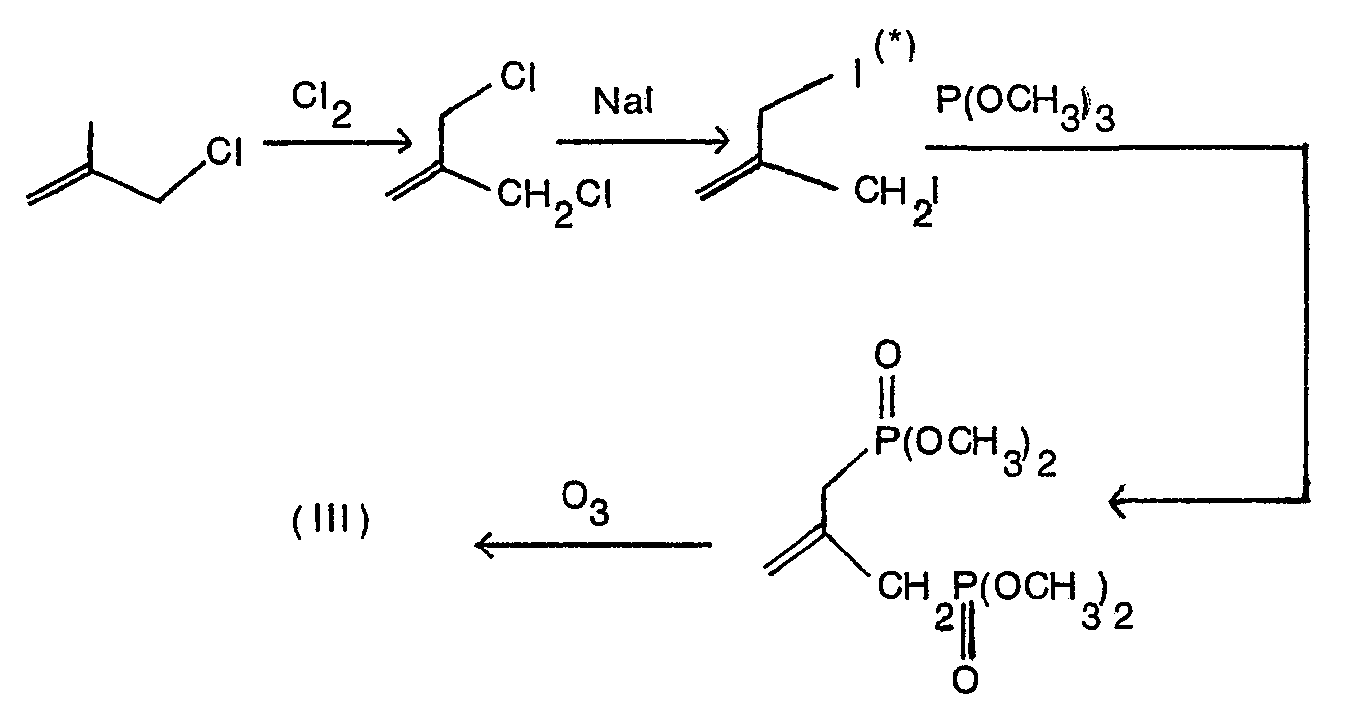
- (*) seeJ. Amer. Chem. Soc., 89, 4688, (1967).
- Dialdehydes (II), used as starting material in the process of the invention, can be prepared by mono-ozonisation of the corresponding cyclic olefine, viz. cyclododecene or cyclododecatriene, according to known methods [see e.g.: Swiss Patent No. 577,445 and Japanese Patent No. 75 03292].
- The reaction between dialkyl-diphosphonate (III) and dialdehyde (II) occurs, according to the invention, in the presence of a basic reagent. Useful basic reagents include organic or mineral bases. Good yields of final products are obtained by using an alkali metal hydride, carbonate or bicarbonate; sodium hydride or potassium bicarbonate are preferred. The reaction is preferably carried out in an inert organic solvent, or aqueous organic solvent, such as an alcohol, e.g. tert.-butanol, or an ether such as tetrahydrofuran or diethylene glycol dimethyl ether.
- The said reaction can be effected either in a single step or as a combined two-step synthesis. In this latter case the first step consists in the formation of a mono-phosphonate which is then converted into the desired ketone by means of a further treatment with a basic reagent. This variant of the process of the invention is illustrated below:

- Though the temperature does not play any major determinant role for the good course of the reaction, it has been found that for economical and practical reasons a temperature of between 50 and 100°C can be satisfactorily applied. In this range of temperatures the formation of by-products is substantially reduced and the reaction times are sufficiently short.
- On the contrary, when the process of the invention is carried out according to the two step variant described above, the temperature applied to the first reaction step is lower than the limit indicated.
- Preferably, it is of 20-30°C, whereas the subsequent conversion is effected at a temperature of between 50 and 100°C.
- Compounds (I) are useful intermediates for the economical preparation of known EXALTONEc and muscone. The process which allows this conversion is illustrated hereinbelow:

- The alkylation of compounds (I) is effected according to usual techniques. Preferably it is promoted by means of organo-copper derivatives such as dimethyl-copper-lithium. The subsequent reduction is carried out by catalytic hydrogenation, e.g. in the presence of palladium on charcoal.
- It is a further object of the present invention to provide a process for the preparation of the macrocyclic ketones of formula

- R1 represents a lower alkyl radical or a hydrogen atom, which comprises
- a. reacting in the presence of a basic reagent a dialdehyde of formula


- each of symbols R represents an alkyl radical, to give an unsaturated macrocyclic ketone of formula

- b. catalytically hydrogenating the thus obtained ketone to give cyclopentadecanone, or
- c. alkylating the ketone obtained sub. letter a. in order to obtain the compound of formula

- RI represents a lower alkyl radical and index n has the above given meaning and
- d. catalytically hydrogenating compound (V) to give an alkylated macrocyclic ketone of formula

- R1 has the above given meaning.
- Symbol R1 can designate a lower alkyl containing 1 to 3 carbon atoms, preferably it stands for methyl, ethyl or n-propyl, more preferably for a methyl radical.
- Compounds of formula (V) are not only useful as intermediates for the preparation of macrocyclic ketones of formula (IV) but they also represent interesting perfume ingredients in their own right.
- As stated above, compounds of formula (I) or (V) possess interesting odorous properties and consequently they find also an industrial utility as perfuming ingredients. Typically, they develop musky and animal fragrances of elegant and natural character and can find a utility for both find perfumes and technical applications. The new compounds of formula (I) include cyciopentadeca-2,6,10,14-tetraen-1- one which compound develops the most prominent musky notes and consequently can find a preferred utilization. It will be appreciated by those skilled in the art that the compounds of formula (I) or (V) can be used at concentrations varying within a wide range of values, depending on the materials it is desired to perfume and the specific effect it is desired to achieve. For instance, it was observed that concentrations as low as 0.1% (by weight) can already produce odorous effects in perfume compositions; this value however can be as high as 3 or 5%, or even higher.
- The compounds of formula (I) or (V) can be used as such in their isolated form or in admixture with other perfuming coingredients, diluents or carriers.
- Compounds (I) or (V) can find a useful application also in the field of aromas. They develop fatty, green-earthy and animal gustative notes associated with musky characters. A preferred concentration range in these instances is of about 0.05 to 10 parts per million (ppm) by weight based on the weight of the flavoured material.
- Their utilization as flavour modifier or flavour enhancer is very broad; compounds (I) or (V) can in fact be used to flavour foodstuffs in general, beverages and tobacco products.
- The invention is better illustrated by but not limited to the following examples wherein the temperatures are indicated in degrees centigrade and the abbreviations have the meaning common in the art.
- A 500 ccm round bottom flask equipped with a magnetic stirrer, reflux condenser and gas inlet tube was charged with 4 g of potassium bicarbonate and 125 ccm aqueous 90% t-butanol. The stirred mixture was heated at vigorous reflux under a steady flow of argon, while a solution of 3.10 g (16 mMole) of dodeca-4,8-diene-1,12-dial and 4.40 g (16 mMole) of 1,3-bis(dimethylphosphono)propan-2-one in 25 ccm of 90% aqueous tert.-butanol was added at a constant rate over a period of 4 h. The reaction mixture was poured into water containing some sodium chloride, to avoid emulsions, extracted with ether, washed with brine, dried over sodium sulphate and evaporated. Distillation of the remaining oil gave 2.15 g (62%) of the desired tetraenone, b.p. 101-105°/6.65 Pa. A sample was purified by chromatography on silica gel and showed m.p. 30-37°;
- IR(CHCI3): 1670, 1645, 1620, 985 cm-1;
- NMR(CCI4): 2.0-2.5 (12H, m); 5..1-5.5 (4H, m); 5.8-6.9 (4H, m) 8 ppm
- MS: M+ = 216 (6); m/e: 41 (100).
- 1,3-Bis(dimethylphosphono)-propan-2-one used as starting material in the hereinabove described process was prepared as follows:
- 400 cm of trimethyl phosphite was placed into a 2-1 flask equipped with an addition funnel, a gas inlet tube, and a Vigreux column with distilling head. The phosphite was heated at reflux, then a solution of 131 g (0.425 Mole) of 2-iodomethyl-3-iodopropene [see J. Amer. Chem. Soc., 89, 4688 (1967)] in 200 ccm of benzene was added dropwise over a period of 2 h, followed by an additional 100 ccm of trimethyl phosphite within 30 min. The reaction was run under nitrogen, and approx. 150 ccm of distillate was allowed to collect. Distillation of the reaction mixture afforded 106 g (92%) of the title compound, b.p. 125-7°/10.64 Pa;
- IR(CHCI3): 1650, 1250, 1050, 900 cm-1;
- NMR(CCi4): 2.75 (4H, d, J=24 Hz); 3.65 (12H, d, J=10 Hz); 5.00 (2H, t, J=5 Hz) δ ppm
- MS: M+ = 272 (6); m/e: 163 (100).
- A solution of 27.2 g (0.10 Mole) of the diphosphonate obtained according to letter a. above in 250 ccm of methanol was ozonized at -10 to -20°. Trimethyl phosphite was then added dropwise at -10° (very exothermic), and the mixture was left overnight at room temperature. The solvent was removed in vacuo, and the residue was distilled to give 24.5 g (90%) of the title compound: b.p. 156-8°/10.64 Pa;
- IR(CHCI3): 1720, 1250, 1050 cm-1;
- NMRICDCl3): 3.35 (4H, d, J=23 Hz); 3.75 (12H, d, J=11 Hz) 8 ppm;
- MS: M+ = 274 (5); m/e: 124 (100).
- A solution of 5 g of potassium bicarbonate in 150 ccm of water was added to a mixture of 8.22 g (30 mMole) of 1,3-bis(dimethylphosphono)propan-2-one and 5.94 g (30 mMole) of dodecan-1,12-dial in 150 ccm of tert.-butanol. After 2h stirring at 27° under nitrogen water was added and the mixture was extracted with ether. The organic layer was separated, washed with brine, dried over sodium sulphate and evaporated. The residue was chromatographed on 150 g of silica gel. Hexane-ethyl acetate 1:1 eluted 2.68 g of unreacted dodecan-1,12-dial and ether diluted 4.38 g (42%, resp. 76% when based on recovered dial) of the title compound as a viscous oil.

- IR(CHCI3): 2740, 1730, 1700, 1670, 1630, 1250, 1050 and 980 cm-1;
- NMR(CCl4): 1.1-1.8 (16H, m); 2.0-2.5 (4H, m); 3.05 (2H, d, J=22 Hz); 3.70 (6H, d, J=11 1 Hz); 6.12 (1 H, d, J=16 Hz); 6.85 (1 H, d of t, J=6.5 and 16 Hz); 9.55 (1 H, t, J=1.5 Hz) 6 ppm;
- MS: M+ = 346 (4); 41 (100).
- The reaction was run under a steady flow of nitrogen. The reaction flask (250 ccm was charged with 2 g of potassium bicarbonate and 100 ccm of 90% tert.-butanol, while the dilution flask (250 ccm was filled with 90% tert.-butanol. 15-(dimethylphosphono)-pentadec-12-en-14-on-1 al (2.0 g, 5.8 mMole) in 10 ccm of 90% tert.-butanol was introduced within 4 h by means of a syringe pump, then refluxing was continued for 2h. The reaction mixture was poured into water, extracted with pentane, washed with water, dried over sodium sulphate, and evaporated. Distillation of the residue gave 0.70 g (55%) of a ca. 9:1 isomeric mixture of cyclopentadeca-2,14-dien-1-one, b.p. 105°/13.3 Pa. Pure samples were obtained by chromatography on silica gel with hexane +5% ethyl acetate as eluant. Cyclopentadeca-2,14-dien-1-one (trans-trans isomer):
- IR(CHCI3): 1670, 1620, 980 cm-1
- NMR(CCl4): 1.2-1.7 (16H, m); 2.1-2.4 (4H, m); 6.15 (2H, d, J=17 Hz); 6.62 (d of t, J=17 and 6.5 Hz) δ ppm;
- MS: M+ = 220; m/e: 41 (100).
- Cyclopentadeca-2,14-dien-1-one (cis-trans isomer)
- IR(CHCl3): 1660, 1620, 980 cm-1;
- NMR(CCI4): 1.1-1.7 (16H, m); 2.1-2.5 (4H, m); 5.76 (1 H, d oft, J=12 and 7 Hz); 6.10 (1 H, d, J=15 Hz); 6.14 (1 H, d, J=12 Hz); 6.75 (1 H, d of t, J=15 and 7 Hz) ⅞ ppm;
- MS: M+ = 220 (2); m/e: 41 (100).
- Ⓑ The above reaction was repeated, but 15-(dimethylphosphono)-pentadec-12-en-14-on-1-al was replaced by a mixture of 0.79 g (4 mMole) of dodecan-1,12-dial and 1.10 g (4 mMole) of 1,3- bis(dimethylphosphono)-propan-2-one in 10 ccm of 90% tert.-butanol. Identical introduction time and work up gave 229 mg (26%) of cyclopentadeca-2,14-dien-1-one in a similar ratio of isomers.
- A solution of 1.00 g (4.55 mMole) of cyclopentadeca-2,14-dien-1-one in 20 ccm of ethanol was hydrogenated in the presence of 50 mg of palladium on charcoal. Hydrogen uptake (230 ccm) was complete after 1 h at 20°. The mixture was filtered, evaporated and distilled to give 0.96 g (94%) of EXALTONE® having b.p. 115°/13.3 Pa; m.p. 65-66°.
- To the Grignard reagent prepared from 72 mg (3 mg-atoms) of magnesium and 0.25 ccm (4 mMole) of iodomethane in 5 ccm of ether was added 50 mg of cuprous iodide, and the mixture was heated at reflux for 5 min. Cyclopentadeca-2,14-dien-1-one (0.44 g; 2 mMole) in 5 ccm of ether was then added over a period of 10 min without cooling, and stirring was continued for 30 min at room temperature. The reaction mixture was poured into cold ammonium chloride solution and extracted with ether. The organic layer was washed with water, dried over sodium sulphate, evaporated and distilled to give 0.33 g (69%) of dehydromuscone having b.p. 110°/13.3 Pa;
- IR(CHCI3): 1680, 1655, 1615, 975 cm-1;
- NMR(CCl4): 1.03 (3H, d, J=6 Hz), 1.1-1.7 (19H, m); 2.0-2.4 (4H, m), 6.07 (1H, d, J=16 Hz); 6.70 (1 H, d of t, J=16 and 7 Hz) 8 ppm;
- MS: M+ = 236 (8); m/e: 41 (100).
- A solution of 0.71 g (3 mMole) of dehydro-muscone in 20 ccm of ethanol was hydrogenated in the presence of 50 mg of palladium on charcoal. Hydrogen absorption ceased after 45 min at 20° (74 ccm). Filtration, evaporation and distillation yielded 0.66 g (92%) of muscone, b.p. 115°/13.3 Pa.
- A solution of 0.89 g (4,1 mMole) of cyclopenta-2,6,10.14-tetraen-1-one in 20 ccm ethanol was hydrogenated in the presence of 0.1 g of 10% palladium on charcoal (75 min, 20°, 10.11 x 10⁴ Pa) Filtration, evaporation and distillation yielded 0.90 g (98%) of EXALTONE® having b.p. 85°/6.65 Pa; m.p. 65-7°.
- To a stirred suspension of 0.86 g (4,5 mMole) of cuprous iodide in 25 ml of anhydrous ether was added 4.7 ccm (9 mMole) of 1.9 M methyllithium in ether at -10° under argon. 0.89 g of cyclopenta-2,6,10,14-tetraen-1-one (4.1 mMole) in 10 ccm of ether were then added at -10° over a period of 10 min and stirring was continued for 30 min at -10° to 0°. The reaction mixture was then poured into dilute, cold sulfuric acid, extracted with ether, washed with water, 5% sodium bicarbonate, and finally dried over sodium sulphate. Evaporation, followed by distillation afforded 0.77 g (81%) of the desired trienone having b.p. 95-8°/6.65 Pa.
- IR(CHCI3): 1690, 1660, 1625 and 970 cm-1;
- NMR(CCI4): 0.7-1.0 (3H); 1.1-2.9 (15H, m); 5.1-5.5 (4H, m); 5.9 (1 H, d, J=17 Hz); 6.5 (1 H, d of t, partially resolved) 8 ppm;
- MS: M+ = 232 (1); m/e: 41 (100).
- A solution of 0.77 g (3.3 mMole) of the obtained trienone - see parag. a. above - in 20 ccm of ethanol was hydrogenated in the presence of 0,1 g of 10% palladium on charcoal (1 h, 20°, 10.11 x 10⁴ Pa) Filtration, evaporation and distillation gave 0.77 g (98%) of muscone having b.p. 95°/6.65 Pa.
- A base perfume composition was prepared by mixing together the following ingredients (parts by weight):

- (*)in diethyl phthalate
- (**)origin: Firmenich SA, Geneva, Switzerland
- By adding to 98 g of the above base 2 g of cyclopentadeca-2,6,10,14-tetraen-1-one there was obtained a novel composition possession a more elegant, and a richer and more tenacious fragrance.
- Analogous olfactive effects were observed when replacing the above compound by either cyclopentadeca-2,14-dien-1-one, 3-methyt-cyc)opentadeca-6,10,14-trien-1-one or 3-methyl-cydopentadec-14-en-1-one.
- 0.1 g of a 0.1% solution of cyclopentadeca-2,6-10,14-tetraen-1-one in 95% ethanol were sprayed onto 100 g of a tobacco mixture of the "american blend" type. The tobacco thus flavoured was then used for the manufacture of "test" cigarettes the smoke of which was subjected to an organoleptic evaluation by a panel of flavour experts. These latter declared that the smoke of the test cigarettes presented a marked musky character when compared to the smoke of the "control" cigarettes the tobacco of which was simply treated with 95% ethanol.
- Analogous gustative effects were observed when replacing the above compound by either cydopentadeca-2,14-dien-1-one, 3-methy)-cyc!opentadeca-6,10,14-trien-1-one or 3-methyl-cyctopentadec-14-en-1-one.
Claims (12)


R' represents a lower alkyl radical or a hydrogen atom, which comprises


each of symbols R represents an alkyl radical, to give an unsaturated macrocyclic ketone of formula


Priority Applications (2)
| Application Number | Priority Date | Filing Date | Title |
|---|---|---|---|
| DE8282105240T DE3069437D1 (en) | 1979-02-12 | 1980-02-12 | Process for the preparation of an unsaturated macrocyclic ketone |
| EP82105240A EP0065319B1 (en) | 1979-02-12 | 1980-02-12 | Process for the preparation of an unsaturated macrocyclic ketone |
Applications Claiming Priority (4)
| Application Number | Priority Date | Filing Date | Title |
|---|---|---|---|
| US1168579A | 1979-02-12 | 1979-02-12 | |
| US11685 | 1979-02-12 | ||
| SA76960 | 1979-09-19 | ||
| US06/076,960 US4302607A (en) | 1979-02-12 | 1979-09-19 | Process for the preparation of novel unsaturated macrocyclic ketones |
Related Child Applications (1)
| Application Number | Title | Priority Date | Filing Date |
|---|---|---|---|
| EP82105240.4 Division-Into | 1980-02-12 |
Publications (3)
| Publication Number | Publication Date |
|---|---|
| EP0015412A2 EP0015412A2 (en) | 1980-09-17 |
| EP0015412A3 EP0015412A3 (en) | 1981-02-11 |
| EP0015412B1 true EP0015412B1 (en) | 1983-05-18 |
Family
ID=26682674
Family Applications (1)
| Application Number | Title | Priority Date | Filing Date |
|---|---|---|---|
| EP80100709A Expired EP0015412B1 (en) | 1979-02-12 | 1980-02-12 | Unsaturated macrocyclic ketones; their preparation; preparation of saturated macrocyclic ketones; application in perfume and flavour compositions of some unsaturated macrocyclic ketones |
Country Status (3)
| Country | Link |
|---|---|
| US (1) | US4302607A (en) |
| EP (1) | EP0015412B1 (en) |
| MX (1) | MX153813A (en) |
Families Citing this family (5)
| Publication number | Priority date | Publication date | Assignee | Title |
|---|---|---|---|---|
| DE3918015A1 (en) * | 1989-06-02 | 1990-12-06 | Basf Ag | METHOD FOR THE PRODUCTION OF MUSCON, INTERMEDIATE PRODUCTS FOR THIS METHOD AND THE PRODUCTION THEREOF |
| DE69314121T2 (en) * | 1992-07-30 | 1998-02-26 | Firmenich & Cie | Use of a cyclopentadecenone as a perfume ingredient |
| US6838810B1 (en) * | 1997-03-21 | 2005-01-04 | Chunghwa Picture Tubes, Ltd. | Flat-panel display mounting system for portable computer |
| GB0705931D0 (en) * | 2007-03-28 | 2007-05-09 | Givaudan Sa | Organic compounds |
| CN102144778B (en) * | 2010-11-25 | 2015-08-05 | 高旌 | A kind of preparation method of mind-refreshing oral liquid |
Family Cites Families (4)
| Publication number | Priority date | Publication date | Assignee | Title |
|---|---|---|---|---|
| NL67882C (en) * | 1947-10-07 | |||
| DE1109671B (en) * | 1958-10-17 | 1961-06-29 | Basf Ag | Process for the production of ª ‡, ª ‰ -unsaturated carboxylic acid esters or the free acids |
| CH503680A (en) * | 1966-12-08 | 1971-02-28 | Firmenich & Cie | Process for the preparation of macrocyclic ketones |
| US3732214A (en) * | 1970-07-16 | 1973-05-08 | Hoffmann La Roche | Method for the synthesis of zeaxanthins,xanthophylls,and 3beta-carotene |
-
1979
- 1979-09-19 US US06/076,960 patent/US4302607A/en not_active Expired - Lifetime
-
1980
- 1980-02-11 MX MX181131A patent/MX153813A/en unknown
- 1980-02-12 EP EP80100709A patent/EP0015412B1/en not_active Expired
Also Published As
| Publication number | Publication date |
|---|---|
| US4302607A (en) | 1981-11-24 |
| EP0015412A3 (en) | 1981-02-11 |
| EP0015412A2 (en) | 1980-09-17 |
| MX153813A (en) | 1987-01-19 |
Similar Documents
| Publication | Publication Date | Title |
|---|---|---|
| US3928402A (en) | Ethyl 2-trans,4-cis-undecadienoate | |
| US3953377A (en) | Ethyl-2-trans-4-cis undecadienoate, ethyl-2-trans-4-cis dodecadienoate and ethyl-2-decadienoate perfume compositions | |
| US5120880A (en) | Preparation of muscone, intermediates for this preparation and preparation of said intermediates | |
| US4162258A (en) | Novel compounds spiro[5-isopropylbicyclo[3.1.0]hexane-2,2'-oxiranes], process for the production of the novel compounds, and process for the production of sabinene hydrates therefrom | |
| US2855441A (en) | Diynic acetals | |
| EP0118817B1 (en) | Process for the preparation of an isomeric composition of 1-(2,6,6-trimethylcyclohexyl)-hexan-3-ol, use of the obtained composition and intermediate carbinols | |
| US4097531A (en) | Substituted cyclopropane process and product | |
| US4302607A (en) | Process for the preparation of novel unsaturated macrocyclic ketones | |
| US4626602A (en) | Aliphatic alcohols, their preparation and use of same as perfuming ingredients | |
| DE2516696B2 (en) | Fragrances of the 3,6,6-trimethyl-l- (but-3-enoyl) cyclohexene series, processes for their production and fragrance compositions containing them | |
| US4179448A (en) | Spirane derivatives useful as perfuming and flavor-modifying ingredients | |
| US3996169A (en) | Perfume uses of tricyclic alcohols and processes | |
| US4346023A (en) | Process for the preparation of novel unsaturated macrocyclic ketones | |
| US3579550A (en) | Oxygenated derivatives of acyclic olefins | |
| US3932516A (en) | Novel oxygenated derivatives of thujopsene | |
| EP0373556B1 (en) | Sandalwood odorants | |
| US5087612A (en) | Oxygenated alicyclic compounds and their use in perfumery | |
| EP0128584B1 (en) | Dihydrofuran derivates useful as aroma chemicals, and process for their preparation | |
| JP4081733B2 (en) | Muscon manufacturing method, novel intermediate compound and perfume composition | |
| US4136119A (en) | M-menthenone and process for its production | |
| US4129569A (en) | Cyclic oxazo derivatives | |
| JPS628109B2 (en) | ||
| JPS6117818B2 (en) | ||
| US2870210A (en) | 6, 10, 12-trimethyl-5, 9-tridecadien-2-one | |
| US4636571A (en) | 4-carbalkoxy-2-ethyl-2,3-dihydrofurans |
Legal Events
| Date | Code | Title | Description |
|---|---|---|---|
| PUAI | Public reference made under article 153(3) epc to a published international application that has entered the european phase |
Free format text: ORIGINAL CODE: 0009012 |
|
| 17P | Request for examination filed | ||
| AK | Designated contracting states |
Designated state(s): CH DE FR GB IT NL SE |
|
| PUAL | Search report despatched |
Free format text: ORIGINAL CODE: 0009013 |
|
| AK | Designated contracting states |
Designated state(s): CH DE FR GB IT NL SE |
|
| GRAA | (expected) grant |
Free format text: ORIGINAL CODE: 0009210 |
|
| AK | Designated contracting states |
Designated state(s): CH DE FR GB IT NL SE |
|
| PG25 | Lapsed in a contracting state [announced via postgrant information from national office to epo] |
Ref country code: SE Effective date: 19830518 Ref country code: IT Free format text: LAPSE BECAUSE OF FAILURE TO SUBMIT A TRANSLATION OF THE DESCRIPTION OR TO PAY THE FEE WITHIN THE PRESCRIBED TIME-LIMIT;WARNING: LAPSES OF ITALIAN PATENTS WITH EFFECTIVE DATE BEFORE 2007 MAY HAVE OCCURRED AT ANY TIME BEFORE 2007. THE CORRECT EFFECTIVE DATE MAY BE DIFFERENT FROM THE ONE RECORDED. Effective date: 19830518 |
|
| REF | Corresponds to: |
Ref document number: 3063227 Country of ref document: DE Date of ref document: 19830707 |
|
| ET | Fr: translation filed | ||
| PGFP | Annual fee paid to national office [announced via postgrant information from national office to epo] |
Ref country code: NL Payment date: 19840229 Year of fee payment: 5 |
|
| PLBE | No opposition filed within time limit |
Free format text: ORIGINAL CODE: 0009261 |
|
| STAA | Information on the status of an ep patent application or granted ep patent |
Free format text: STATUS: NO OPPOSITION FILED WITHIN TIME LIMIT |
|
| 26N | No opposition filed | ||
| PG25 | Lapsed in a contracting state [announced via postgrant information from national office to epo] |
Ref country code: NL Effective date: 19850901 |
|
| NLV4 | Nl: lapsed or anulled due to non-payment of the annual fee | ||
| PGFP | Annual fee paid to national office [announced via postgrant information from national office to epo] |
Ref country code: DE Payment date: 19910129 Year of fee payment: 12 |
|
| PGFP | Annual fee paid to national office [announced via postgrant information from national office to epo] |
Ref country code: FR Payment date: 19920110 Year of fee payment: 13 |
|
| PGFP | Annual fee paid to national office [announced via postgrant information from national office to epo] |
Ref country code: GB Payment date: 19920115 Year of fee payment: 13 |
|
| PGFP | Annual fee paid to national office [announced via postgrant information from national office to epo] |
Ref country code: CH Payment date: 19920129 Year of fee payment: 13 |
|
| PG25 | Lapsed in a contracting state [announced via postgrant information from national office to epo] |
Ref country code: DE Effective date: 19921103 |
|
| PG25 | Lapsed in a contracting state [announced via postgrant information from national office to epo] |
Ref country code: GB Effective date: 19930212 |
|
| PG25 | Lapsed in a contracting state [announced via postgrant information from national office to epo] |
Ref country code: CH Effective date: 19930228 |
|
| GBPC | Gb: european patent ceased through non-payment of renewal fee |
Effective date: 19930212 |
|
| PG25 | Lapsed in a contracting state [announced via postgrant information from national office to epo] |
Ref country code: FR Effective date: 19931029 |
|
| REG | Reference to a national code |
Ref country code: CH Ref legal event code: PL |
|
| REG | Reference to a national code |
Ref country code: FR Ref legal event code: ST |