EP0014866B1 - An immobilized glucose isomerase system and a process for the isomerization of glucose using said system - Google Patents
An immobilized glucose isomerase system and a process for the isomerization of glucose using said system Download PDFInfo
- Publication number
- EP0014866B1 EP0014866B1 EP80100449A EP80100449A EP0014866B1 EP 0014866 B1 EP0014866 B1 EP 0014866B1 EP 80100449 A EP80100449 A EP 80100449A EP 80100449 A EP80100449 A EP 80100449A EP 0014866 B1 EP0014866 B1 EP 0014866B1
- Authority
- EP
- European Patent Office
- Prior art keywords
- glucose
- enzyme
- isomerization
- glucose isomerase
- immobilized
- Prior art date
- Legal status (The legal status is an assumption and is not a legal conclusion. Google has not performed a legal analysis and makes no representation as to the accuracy of the status listed.)
- Expired
Links
- 108700040099 Xylose isomerases Proteins 0.000 title claims description 40
- 238000000034 method Methods 0.000 title claims description 28
- WQZGKKKJIJFFOK-GASJEMHNSA-N Glucose Natural products OC[C@H]1OC(O)[C@H](O)[C@@H](O)[C@@H]1O WQZGKKKJIJFFOK-GASJEMHNSA-N 0.000 title claims description 23
- 239000008103 glucose Substances 0.000 title claims description 19
- 238000006317 isomerization reaction Methods 0.000 title claims description 15
- 102000004190 Enzymes Human genes 0.000 claims description 54
- 108090000790 Enzymes Proteins 0.000 claims description 54
- 229920005989 resin Polymers 0.000 claims description 37
- 239000011347 resin Substances 0.000 claims description 37
- 229920002125 Sokalan® Polymers 0.000 claims description 15
- XLYOFNOQVPJJNP-UHFFFAOYSA-N water Substances O XLYOFNOQVPJJNP-UHFFFAOYSA-N 0.000 claims description 15
- 239000011148 porous material Substances 0.000 claims description 14
- 229920001568 phenolic resin Polymers 0.000 claims description 12
- KXGFMDJXCMQABM-UHFFFAOYSA-N 2-methoxy-6-methylphenol Chemical compound [CH]OC1=CC=CC([CH])=C1O KXGFMDJXCMQABM-UHFFFAOYSA-N 0.000 claims description 11
- 239000005011 phenolic resin Substances 0.000 claims description 10
- 241000187134 Streptomyces olivochromogenes Species 0.000 claims description 5
- 238000005349 anion exchange Methods 0.000 claims description 5
- 238000002474 experimental method Methods 0.000 claims description 4
- 230000008961 swelling Effects 0.000 claims description 3
- 229940088598 enzyme Drugs 0.000 description 53
- HEMHJVSKTPXQMS-UHFFFAOYSA-M Sodium hydroxide Chemical compound [OH-].[Na+] HEMHJVSKTPXQMS-UHFFFAOYSA-M 0.000 description 15
- 239000000243 solution Substances 0.000 description 14
- RFSUNEUAIZKAJO-ARQDHWQXSA-N Fructose Chemical compound OC[C@H]1O[C@](O)(CO)[C@@H](O)[C@@H]1O RFSUNEUAIZKAJO-ARQDHWQXSA-N 0.000 description 12
- 229960002737 fructose Drugs 0.000 description 12
- 239000000413 hydrolysate Substances 0.000 description 9
- TWRXJAOTZQYOKJ-UHFFFAOYSA-L Magnesium chloride Chemical compound [Mg+2].[Cl-].[Cl-] TWRXJAOTZQYOKJ-UHFFFAOYSA-L 0.000 description 8
- 230000000694 effects Effects 0.000 description 8
- 229920002472 Starch Polymers 0.000 description 7
- 239000000969 carrier Substances 0.000 description 7
- 239000008107 starch Substances 0.000 description 7
- 235000019698 starch Nutrition 0.000 description 7
- CSNNHWWHGAXBCP-UHFFFAOYSA-L Magnesium sulfate Chemical compound [Mg+2].[O-][S+2]([O-])([O-])[O-] CSNNHWWHGAXBCP-UHFFFAOYSA-L 0.000 description 6
- YXFVVABEGXRONW-UHFFFAOYSA-N Toluene Chemical compound CC1=CC=CC=C1 YXFVVABEGXRONW-UHFFFAOYSA-N 0.000 description 6
- KRKNYBCHXYNGOX-UHFFFAOYSA-N citric acid Chemical compound OC(=O)CC(O)(C(O)=O)CC(O)=O KRKNYBCHXYNGOX-UHFFFAOYSA-N 0.000 description 6
- 238000006243 chemical reaction Methods 0.000 description 5
- 244000005700 microbiome Species 0.000 description 5
- 239000000047 product Substances 0.000 description 5
- UEGPKNKPLBYCNK-UHFFFAOYSA-L magnesium acetate Chemical compound [Mg+2].CC([O-])=O.CC([O-])=O UEGPKNKPLBYCNK-UHFFFAOYSA-L 0.000 description 4
- 239000011654 magnesium acetate Substances 0.000 description 4
- 235000011285 magnesium acetate Nutrition 0.000 description 4
- 229940069446 magnesium acetate Drugs 0.000 description 4
- 229910001629 magnesium chloride Inorganic materials 0.000 description 4
- 238000002360 preparation method Methods 0.000 description 4
- 235000020357 syrup Nutrition 0.000 description 4
- 239000006188 syrup Substances 0.000 description 4
- 238000005406 washing Methods 0.000 description 4
- 241000196324 Embryophyta Species 0.000 description 3
- KFZMGEQAYNKOFK-UHFFFAOYSA-N Isopropanol Chemical compound CC(C)O KFZMGEQAYNKOFK-UHFFFAOYSA-N 0.000 description 3
- 240000007930 Oxalis acetosella Species 0.000 description 3
- 235000008098 Oxalis acetosella Nutrition 0.000 description 3
- 239000002253 acid Substances 0.000 description 3
- 230000000052 comparative effect Effects 0.000 description 3
- 229910003460 diamond Inorganic materials 0.000 description 3
- 239000010432 diamond Substances 0.000 description 3
- 229910052943 magnesium sulfate Inorganic materials 0.000 description 3
- 235000019341 magnesium sulphate Nutrition 0.000 description 3
- 239000000463 material Substances 0.000 description 3
- 238000005259 measurement Methods 0.000 description 3
- MYRTYDVEIRVNKP-UHFFFAOYSA-N 1,2-Divinylbenzene Chemical compound C=CC1=CC=CC=C1C=C MYRTYDVEIRVNKP-UHFFFAOYSA-N 0.000 description 2
- 229930091371 Fructose Natural products 0.000 description 2
- 239000005715 Fructose Substances 0.000 description 2
- 208000007976 Ketosis Diseases 0.000 description 2
- 239000004793 Polystyrene Substances 0.000 description 2
- PPBRXRYQALVLMV-UHFFFAOYSA-N Styrene Chemical compound C=CC1=CC=CC=C1 PPBRXRYQALVLMV-UHFFFAOYSA-N 0.000 description 2
- PNEYBMLMFCGWSK-UHFFFAOYSA-N aluminium oxide Inorganic materials [O-2].[O-2].[O-2].[Al+3].[Al+3] PNEYBMLMFCGWSK-UHFFFAOYSA-N 0.000 description 2
- 239000003957 anion exchange resin Substances 0.000 description 2
- 238000003556 assay Methods 0.000 description 2
- 239000001913 cellulose Substances 0.000 description 2
- 229920002678 cellulose Polymers 0.000 description 2
- 238000010960 commercial process Methods 0.000 description 2
- 229910052593 corundum Inorganic materials 0.000 description 2
- 239000008121 dextrose Substances 0.000 description 2
- 238000009826 distribution Methods 0.000 description 2
- 230000002255 enzymatic effect Effects 0.000 description 2
- 239000012527 feed solution Substances 0.000 description 2
- 238000011534 incubation Methods 0.000 description 2
- 150000002584 ketoses Chemical class 0.000 description 2
- 238000011068 loading method Methods 0.000 description 2
- QSHDDOUJBYECFT-UHFFFAOYSA-N mercury Chemical compound [Hg] QSHDDOUJBYECFT-UHFFFAOYSA-N 0.000 description 2
- 229910052753 mercury Inorganic materials 0.000 description 2
- VLTRZXGMWDSKGL-UHFFFAOYSA-N perchloric acid Chemical compound OCl(=O)(=O)=O VLTRZXGMWDSKGL-UHFFFAOYSA-N 0.000 description 2
- 150000008442 polyphenolic compounds Chemical class 0.000 description 2
- 235000013824 polyphenols Nutrition 0.000 description 2
- 229920002223 polystyrene Polymers 0.000 description 2
- 239000002244 precipitate Substances 0.000 description 2
- 239000007787 solid Substances 0.000 description 2
- 238000001179 sorption measurement Methods 0.000 description 2
- 239000011550 stock solution Substances 0.000 description 2
- 229910001845 yogo sapphire Inorganic materials 0.000 description 2
- XDIYNQZUNSSENW-UUBOPVPUSA-N (2R,3S,4R,5R)-2,3,4,5,6-pentahydroxyhexanal Chemical compound OC[C@@H](O)[C@@H](O)[C@H](O)[C@@H](O)C=O.OC[C@@H](O)[C@@H](O)[C@H](O)[C@@H](O)C=O XDIYNQZUNSSENW-UUBOPVPUSA-N 0.000 description 1
- 238000004438 BET method Methods 0.000 description 1
- 239000004342 Benzoyl peroxide Substances 0.000 description 1
- OMPJBNCRMGITSC-UHFFFAOYSA-N Benzoylperoxide Chemical compound C=1C=CC=CC=1C(=O)OOC(=O)C1=CC=CC=C1 OMPJBNCRMGITSC-UHFFFAOYSA-N 0.000 description 1
- 229910021580 Cobalt(II) chloride Inorganic materials 0.000 description 1
- 229920002245 Dextrose equivalent Polymers 0.000 description 1
- 108010093096 Immobilized Enzymes Proteins 0.000 description 1
- 108090000769 Isomerases Proteins 0.000 description 1
- 102000004195 Isomerases Human genes 0.000 description 1
- 102000016943 Muramidase Human genes 0.000 description 1
- 108010014251 Muramidase Proteins 0.000 description 1
- 108010062010 N-Acetylmuramoyl-L-alanine Amidase Proteins 0.000 description 1
- DWAQJAXMDSEUJJ-UHFFFAOYSA-M Sodium bisulfite Chemical compound [Na+].OS([O-])=O DWAQJAXMDSEUJJ-UHFFFAOYSA-M 0.000 description 1
- 241000187747 Streptomyces Species 0.000 description 1
- 238000005903 acid hydrolysis reaction Methods 0.000 description 1
- 238000013019 agitation Methods 0.000 description 1
- 125000002947 alkylene group Chemical group 0.000 description 1
- 235000019400 benzoyl peroxide Nutrition 0.000 description 1
- 239000000872 buffer Substances 0.000 description 1
- 239000003054 catalyst Substances 0.000 description 1
- 239000003518 caustics Substances 0.000 description 1
- 230000001413 cellular effect Effects 0.000 description 1
- 238000007265 chloromethylation reaction Methods 0.000 description 1
- 235000008504 concentrate Nutrition 0.000 description 1
- 239000012141 concentrate Substances 0.000 description 1
- 238000010924 continuous production Methods 0.000 description 1
- 230000009089 cytolysis Effects 0.000 description 1
- 238000010908 decantation Methods 0.000 description 1
- 238000000354 decomposition reaction Methods 0.000 description 1
- 230000003247 decreasing effect Effects 0.000 description 1
- 239000008367 deionised water Substances 0.000 description 1
- 229910021641 deionized water Inorganic materials 0.000 description 1
- 238000004925 denaturation Methods 0.000 description 1
- 230000036425 denaturation Effects 0.000 description 1
- ZBCBWPMODOFKDW-UHFFFAOYSA-N diethanolamine Chemical compound OCCNCCO ZBCBWPMODOFKDW-UHFFFAOYSA-N 0.000 description 1
- 238000001035 drying Methods 0.000 description 1
- 238000010828 elution Methods 0.000 description 1
- 230000007071 enzymatic hydrolysis Effects 0.000 description 1
- 238000006047 enzymatic hydrolysis reaction Methods 0.000 description 1
- 239000001963 growth medium Substances 0.000 description 1
- 230000003100 immobilizing effect Effects 0.000 description 1
- 238000009776 industrial production Methods 0.000 description 1
- 230000003834 intracellular effect Effects 0.000 description 1
- 238000005342 ion exchange Methods 0.000 description 1
- 239000003456 ion exchange resin Substances 0.000 description 1
- 229920003303 ion-exchange polymer Polymers 0.000 description 1
- 150000002500 ions Chemical group 0.000 description 1
- 239000007788 liquid Substances 0.000 description 1
- 238000009630 liquid culture Methods 0.000 description 1
- 239000006166 lysate Substances 0.000 description 1
- 229960000274 lysozyme Drugs 0.000 description 1
- 235000010335 lysozyme Nutrition 0.000 description 1
- 239000004325 lysozyme Substances 0.000 description 1
- 238000004519 manufacturing process Methods 0.000 description 1
- 239000011259 mixed solution Substances 0.000 description 1
- 238000010979 pH adjustment Methods 0.000 description 1
- 238000012856 packing Methods 0.000 description 1
- 239000002245 particle Substances 0.000 description 1
- 230000002572 peristaltic effect Effects 0.000 description 1
- 238000000711 polarimetry Methods 0.000 description 1
- 229920000768 polyamine Polymers 0.000 description 1
- 229920000447 polyanionic polymer Polymers 0.000 description 1
- 238000002459 porosimetry Methods 0.000 description 1
- 238000012545 processing Methods 0.000 description 1
- 238000011084 recovery Methods 0.000 description 1
- 230000001105 regulatory effect Effects 0.000 description 1
- 150000003839 salts Chemical class 0.000 description 1
- 239000012047 saturated solution Substances 0.000 description 1
- 235000010267 sodium hydrogen sulphite Nutrition 0.000 description 1
- 238000002798 spectrophotometry method Methods 0.000 description 1
- 239000003381 stabilizer Substances 0.000 description 1
- 238000003756 stirring Methods 0.000 description 1
- 239000006228 supernatant Substances 0.000 description 1
- 238000010557 suspension polymerization reaction Methods 0.000 description 1
- 229920003002 synthetic resin Polymers 0.000 description 1
- 239000000057 synthetic resin Substances 0.000 description 1
- 150000003918 triazines Chemical class 0.000 description 1
Images

Classifications
-
- C—CHEMISTRY; METALLURGY
- C12—BIOCHEMISTRY; BEER; SPIRITS; WINE; VINEGAR; MICROBIOLOGY; ENZYMOLOGY; MUTATION OR GENETIC ENGINEERING
- C12P—FERMENTATION OR ENZYME-USING PROCESSES TO SYNTHESISE A DESIRED CHEMICAL COMPOUND OR COMPOSITION OR TO SEPARATE OPTICAL ISOMERS FROM A RACEMIC MIXTURE
- C12P19/00—Preparation of compounds containing saccharide radicals
- C12P19/24—Preparation of compounds containing saccharide radicals produced by the action of an isomerase, e.g. fructose
-
- C—CHEMISTRY; METALLURGY
- C12—BIOCHEMISTRY; BEER; SPIRITS; WINE; VINEGAR; MICROBIOLOGY; ENZYMOLOGY; MUTATION OR GENETIC ENGINEERING
- C12N—MICROORGANISMS OR ENZYMES; COMPOSITIONS THEREOF; PROPAGATING, PRESERVING, OR MAINTAINING MICROORGANISMS; MUTATION OR GENETIC ENGINEERING; CULTURE MEDIA
- C12N11/00—Carrier-bound or immobilised enzymes; Carrier-bound or immobilised microbial cells; Preparation thereof
- C12N11/02—Enzymes or microbial cells immobilised on or in an organic carrier
- C12N11/08—Enzymes or microbial cells immobilised on or in an organic carrier the carrier being a synthetic polymer
- C12N11/089—Enzymes or microbial cells immobilised on or in an organic carrier the carrier being a synthetic polymer obtained otherwise than by reactions only involving carbon-to-carbon unsaturated bonds
- C12N11/091—Phenol resins; Amino resins
Definitions
- This invention relates to an immobilized glucose isomerase system and to a method of isomerizing glucose.
- Glucose isomerase is the general name for the enzyme class which converts glucose (dextrose) into levulose (fructose). Since glucose isomerase was discovered as a product of microorganisms, the industrial production of levulose-bearing syrup from glucose on an industrial scale has become a major commercial process.
- levulose-bearing syrup can be prepared in a batch system using cells containing glucose isomerase
- immobilized enzymes are preferred because they facilitate continuous as opposed to batch processing.
- methods of immobilizing glucose isomerase on various supports have been proposed and described in the prior art.
- U.S. Patent No. 3,909,354 describes the conversion of glucose to levulose using glucose isomerase bound to either an anion exchange cellulose or a synthetic anion exchange resin.
- U.S. Patent No. 4,078,970 discloses glucose isomerase adsorbed and bound on an anion exchange resin having a porosity of more than 4.5% measured according to an aqueous dextrose solution method and an ion exchange capacity of more than 0.035 meq/ml resin measured according to a polyanion salt decomposition method.
- the resins are prepared by suspension polymerization of styrene, divinyl benzene, polystyrene and toluene in water using benzoyl peroxide as a catalyst, followed by chloromethylation and introduction of anion exchange groups.
- Japanese Specification No. NS80160/74 describes the immobilization of glucose isomerase on specific polyphenol resins
- Japanese Patent Specification No. S48-56770 describes the use of triazine derivatives to bind enzymes to polystyrene, polyphenol, alkylene, polyamine and aliphatic amine ion exchange resins.
- Belgian Patent No. 862,765 a macroporous enzyme support having no ionic characteristics is described.
- this invention is directed to an immobilized glucose isomerase system that includes a glucose isomerase derived from Streptomyces olivochromogenes ATCC Nos. 21.,114; 21,713; 21,714 or 21,715. Deposited strains ATCC Nos. 21,713; 21,714 and 21,715 are mutant strains of Streptomyces olivochromogenes ATCC No. 21,114.
- the glucose isomerase can also be derived from mutant strains of the ATCC No. 21,715 microorganism.
- a commercially available glucose isomerase that is derived from the ATCC No.
- 21,715 microorganism or mutant strains thereof is sold under the name of G-993 by CPC International Inc., International Plaza, Englewood Cliffs, New Jersey, U.S.A.
- the glucose isomerase is immobilized on a porous phenolic resin wherein said resin has a total surface area of 40 to 200 square meters per gram in the range of pores above 30A of which at least 30% of the pores have a radius of 30 to 250A and a water swelling capacity of at least 10% by volume and wherein said system has a binding efficiency of at least 90% when an enzyme load of 500 U/ml carrier is offered or at least 80% when an enzyme load of 1000 U/ml carrier is offered, and an enzyme half-life during isomerization of at least 10 days.
- the porous phenolic resin is an anion exchange type resin.
- Preferred resins are those, in which of the pores having a radius of 30 to 250A at least 50% have a radius of 50 to 150A, and/or at least 20% have a radius of 60 to 90A, and/or at least 20% have a radius of 70 to 80A.
- This invention is directed to a single use system which provides high binding capacity for glucose isomerase, high flow rates, long column lives and low enzyme consumption, thus making it extremely attractive for use in an economical commercial process.
- the Figure is a differential pore radius distribution curve of several carriers, including the carrier of this invention.
- the porous phenolic resin carriers defined in the claims have a porosity profile similar to curve 1 in the Figure.
- This curve was obtained by measuring pore size and volume by mercury porosimetry, plotting an integral curve expressing the relation between the volume condensed in the pores and the radii, and differentiating the integral curve to obtain the more illustrative differential distribution curve which expresses the increment of pore volume corresponding to a differential increase in their radius.
- a detailed description of this measurement together with a description of the measurement of surface area is set forth in "Adsorption On Solids", V. Ponec, et al., Butterworths, 1974, pages 38-39, 540-545 and 552-555.
- phenolic resin having the surface area and porosity defined herein can be used in the practice of this invention, it is preferred to employ a resin having an anion exchange capacity.
- Specific resins found to be useful are Duolite ES-562 and Duolite ES-568. These are phenol-formaldehyde resins available from Diamond Shamrock.
- the specific glucose isomerase enzyme employed in the practice of the invention is derived from Streptomyces olivochomogenes ATCC Nos. 21,114; 21,713; 21,714 or 2 1,715. Deposited strains ATCC Nos. 21,713; 21,714 and 21,715 are mutant strains of Streptomyces olivochromogenes ATCC No. 21,114.
- the glucose isomerase can also be derived from mutant strains of the ATCC No. 21,715 microorganism. As pointed out earlier in this specification, a commercially available glucose isomerase that is derived from the ATCC No.
- one unit is defined as the amount of enzyme which produces one micromole of levulose per minute, in a 0.1 molar solution of glucose at pH 7.5 and 60°C in the presence of 0.01 molar MgCI 2 and 0.001 molar CoCl 2 , using the following assay procedure, involving making a spectrophotometric determination of the ketose produced from a glucose solution under a standardized set of conditions.
- a stock solution is made up in the following manner:
- the enzyme preparation to be assayed is first diluted to contain from 1 to 6 U/ml.
- An enzymatic isomerization is conducted by adding 1 ml of the enzyme preparation to 3 ml of the stock solution, and incubating for 30 minutes at 60°C. At the end of the incubation period, a 1 ml aliquot is taken and quenched in a 9 ml volume of 0.5 N perchloric acid. The quenched aliquot is then diluted to a total volume of 250 ml.
- a glucose blank is also run by substituting 1 ml of water for 1 ml of the enzyme preparation in solution form, at the beginning of the incubation period. The ketose is then determined by a cysteinesulfuric acid method. For the purposes of this assay, one U is defined as the amount of enzyme activity that is required to produce one micromole of levulose per minute under the isomerization conditions described above.
- the porous phenolic resin is mixed with glucose isomerase solution consisting of between about 100 and 1000 units of enzyme solution per ml of dry resin carrier.
- the enzyme preparation is very concentrated and contains from about 1000 to about 2500 Units per ml of enzyme solution.
- the porous resin is first washed, preferably with demineralized water, until it has swollen at least about 10% by weight. Then, the resin is treated to adjust the pH to between 7.0 and 9.0, preferably between 7.5 and 8.5. It is preferred to employ a caustic wash step prior to the final pH adjustment in order to obtain a product pH of close to 8.2, thus optimizing the conversion to levulose.
- the enzyme adsorption step is carried out for at least 20 hours, depending on such factors as enzyme solution concentration and the like. A final wash may be carried out at this point to insure that the pH is still within the desired range.
- the resulting system can be used immediately, or stored either in water or as a moist system until used.
- starch hydrolysate is used to refer to a syrup or dry product that is made by acid and/or enzymatic hydrolysis of starch.
- a preferred type cf starch hydrolysate for use for isomerization in accordance with the present invention is produced by acid or enzyme thinning to a D. E. of 20 or less followed by enzymatic saccharification to a D. E. above 90, preferably about 95.
- D. E.” is an abbreviation of "dextrose equivalent” and refers to the reducing sugar content of the material, calculated as dextrose and expressed as percent of total solids.
- the pH should be in the range between 4.0 and 5.0.
- Various buffers known to those skilled in the art may be used to achieve the desired pH.
- the porous phenolic resin particles are placed in a plugged flow-through column and the enzyme immobilization procedure carried out prior to passing the starch hydrolysate through the column.
- concentration of the starch hydrolysate solution is at least about 30% by weight.
- Flow rate which is referred to as BVH, is adjusted during the process to assure maximum isomerization, e.g., about 45% conversion of the glucose to fructose.
- BVH is the column flow rate in bed volumes per hour.
- ppm of S0 2 is added to the starch hydrolysate supply.
- at least 300 ppm S0 2 is added in order to enhance the stability of the glucose isomerase.
- Streptomyces olivochromogenes (ATCC No. 21,715 was shake-cultured in liquid culture medium at 30°C for about 50 hours. The cultured material was then centrifuged for 20 minutes at 10,000 rpm to collect the cells. The wet cells were weighed and then suspended in ion exchanged water (3 volumes) containing 10 mM MgCl 2 . Next 0.02% of lysozyme (a product of Boehringer-Mannheim Co.) and 1 % toluene by weight of wet cells were added and lysis was carried out for 24 hours at 30°C under gentle stirring. The resulting lysate was then centrifuged for 20 minutes at 10,000 rpm and the cellular debris eliminated.
- lysozyme a product of Boehringer-Mannheim Co.
- Pore size and volume of Duolite ES-562 a phenol formaldehyde resin available from Diamond Shamrock Corp., Painesville, Ohio, was measured using a Mercury Pressure Porosimeter Model 200 available from Carlo Erba Strumentazione, Milan, Italy. The results are represented by curve 1 of the Figure.
- the specific surface area as determined by the BET method was 100 m 2 /gm.
- 10 ml of the resin was washed in a beaker with 100 ml of 0.1 M citric acid (pH 1.5) for one hour under intermittent agitation. The citric acid was removed by decantation.
- the resin was then washed twice with hot demineralized water to remove air bubbles. The same procedure was repeated four times to provide four batches of resin.
- the resin was then washed with 0.1 M magnesium acetate (pH 7.4) for one hour at 4 BVH.
- the previously mentioned glucose isomerase solution was offered at an enzyme load of 480 U/ml carrier to each column and recirculated for 16 hours at a flow rate of 4 BVH in order to immobilize on the resin. Then, the resin was washed with 0.1 M magnesium acetate (pH 7.4) at 4 BVH till a total volume of 40 ml effluent was available for bound enzyme measurement.
- the equations given below were then used to calculate the amount of bound enzyme, that is, the percent of glucose, isomerase bound to the resin and the bound enzyme activity.
- Example 2-9 columns having dimensions of 2.5x30 cm were packed with 100 mls of Duolite ES-562 resin. Then, the resins were washed with demineralized water at 60°C for one hour to remove any entrapped air bubbles. Next, the packed resins were washed with 0.1 M magnesium acetate (pH 7.5) at 25°C for 1.5 hours at a rate of 4 BVH. Then, the glucose isomerase solution described in Example 1, with an enzyme load as indicated, was added to each column at a rate of 4 BVH and recirculated for 24 hours. After that, the resins were washed with 0.1 M magnesium acetate (pH 7.4) at a rate of 4 BVH for 3/4 hour and the effluent collected for bound enzyme determination in accordance with the procedure described in Example 1.
- 0.1 M magnesium acetate pH 7.4
- Example 13 the enzyme was added to the pre-treated resin in amounts as described above but in a batch system and the resulting carrier-enzyme was completely dried at room temperature prior to introduction into the column. It appeared that the drying resulted in partial denaturation of the enzyme.
- Example 20 the feed solution was decalcified but not demineralized.
- Example 22 a saturated solution of sodium bisulfite was added to the feed to provide approximatey 200 ppm S0 2 ) '
- the Duolite ES-562 delivers the same initial BV rate as the Al 2 O 3 ⁇ MgO loaded with 624 U/ml carrier.
Landscapes
- Organic Chemistry (AREA)
- Chemical & Material Sciences (AREA)
- Zoology (AREA)
- Life Sciences & Earth Sciences (AREA)
- Engineering & Computer Science (AREA)
- Wood Science & Technology (AREA)
- Bioinformatics & Cheminformatics (AREA)
- Health & Medical Sciences (AREA)
- Genetics & Genomics (AREA)
- General Engineering & Computer Science (AREA)
- Microbiology (AREA)
- Biochemistry (AREA)
- Biotechnology (AREA)
- General Health & Medical Sciences (AREA)
- Biomedical Technology (AREA)
- Chemical Kinetics & Catalysis (AREA)
- General Chemical & Material Sciences (AREA)
- Immobilizing And Processing Of Enzymes And Microorganisms (AREA)
- Preparation Of Compounds By Using Micro-Organisms (AREA)
Description
- This invention relates to an immobilized glucose isomerase system and to a method of isomerizing glucose.
- Glucose isomerase is the general name for the enzyme class which converts glucose (dextrose) into levulose (fructose). Since glucose isomerase was discovered as a product of microorganisms, the industrial production of levulose-bearing syrup from glucose on an industrial scale has become a major commercial process.
- While levulose-bearing syrup can be prepared in a batch system using cells containing glucose isomerase, immobilized enzymes are preferred because they facilitate continuous as opposed to batch processing. Thus, methods of immobilizing glucose isomerase on various supports have been proposed and described in the prior art.
- For example, immobilization of glucose isomerase on certain inorganic carriers is described in U.S. Patent Nos. 3,556,945 and 3,992,329.
- The use of cellulose derivatives and synthetic resins as supports for glucose isomerase has also been described in the literature. Thus, U.S. Patent No. 3,909,354 describes the conversion of glucose to levulose using glucose isomerase bound to either an anion exchange cellulose or a synthetic anion exchange resin. U.S. Patent No. 4,078,970 discloses glucose isomerase adsorbed and bound on an anion exchange resin having a porosity of more than 4.5% measured according to an aqueous dextrose solution method and an ion exchange capacity of more than 0.035 meq/ml resin measured according to a polyanion salt decomposition method. The resins are prepared by suspension polymerization of styrene, divinyl benzene, polystyrene and toluene in water using benzoyl peroxide as a catalyst, followed by chloromethylation and introduction of anion exchange groups. Japanese Specification No. NS80160/74 describes the immobilization of glucose isomerase on specific polyphenol resins, while Japanese Patent Specification No. S48-56770 describes the use of triazine derivatives to bind enzymes to polystyrene, polyphenol, alkylene, polyamine and aliphatic amine ion exchange resins. In Belgian Patent No. 862,765, a macroporous enzyme support having no ionic characteristics is described.
- While many of the previously described supports for glucose isomerase do function to produce levulose-bearing syrups, they possess certain disadvantages. For example, some carriers result in poor enzyme activity, while other carriers require low throughput. Furthermore, many of these carriers are expensive and some must be regenerated and reused several times, adding to manufacturing costs.
- Notwithstanding the plethora of enzyme supports known in the prior art, it has been discovered that a phenolic resin having a specific porosity profile and water swelling capacity has surprising and unexpected properties when used as a support for a specific glucose isomerase.
- More in detail, this invention is directed to an immobilized glucose isomerase system that includes a glucose isomerase derived from Streptomyces olivochromogenes ATCC Nos. 21.,114; 21,713; 21,714 or 21,715. Deposited strains ATCC Nos. 21,713; 21,714 and 21,715 are mutant strains of Streptomyces olivochromogenes ATCC No. 21,114. The glucose isomerase can also be derived from mutant strains of the ATCC No. 21,715 microorganism. A commercially available glucose isomerase that is derived from the ATCC No. 21,715 microorganism or mutant strains thereof is sold under the name of G-993 by CPC International Inc., International Plaza, Englewood Cliffs, New Jersey, U.S.A. The glucose isomerase is immobilized on a porous phenolic resin wherein said resin has a total surface area of 40 to 200 square meters per gram in the range of pores above 30A of which at least 30% of the pores have a radius of 30 to 250A and a water swelling capacity of at least 10% by volume and wherein said system has a binding efficiency of at least 90% when an enzyme load of 500 U/ml carrier is offered or at least 80% when an enzyme load of 1000 U/ml carrier is offered, and an enzyme half-life during isomerization of at least 10 days.
- Preferably the porous phenolic resin is an anion exchange type resin. Preferred resins are those, in which of the pores having a radius of 30 to 250A at least 50% have a radius of 50 to 150A, and/or at least 20% have a radius of 60 to 90A, and/or at least 20% have a radius of 70 to 80A.
- This invention is directed to a single use system which provides high binding capacity for glucose isomerase, high flow rates, long column lives and low enzyme consumption, thus making it extremely attractive for use in an economical commercial process.
- The Figure is a differential pore radius distribution curve of several carriers, including the carrier of this invention.
- More in detail, the porous phenolic resin carriers defined in the claims have a porosity profile similar to curve 1 in the Figure. This curve was obtained by measuring pore size and volume by mercury porosimetry, plotting an integral curve expressing the relation between the volume condensed in the pores and the radii, and differentiating the integral curve to obtain the more illustrative differential distribution curve which expresses the increment of pore volume corresponding to a differential increase in their radius. A detailed description of this measurement together with a description of the measurement of surface area, is set forth in "Adsorption On Solids", V. Ponec, et al., Butterworths, 1974, pages 38-39, 540-545 and 552-555.
- While any phenolic resin having the surface area and porosity defined herein can be used in the practice of this invention, it is preferred to employ a resin having an anion exchange capacity. Specific resins found to be useful are Duolite ES-562 and Duolite ES-568. These are phenol-formaldehyde resins available from Diamond Shamrock.
- The specific glucose isomerase enzyme employed in the practice of the invention is derived from Streptomyces olivochomogenes ATCC Nos. 21,114; 21,713; 21,714 or 21,715. Deposited strains ATCC Nos. 21,713; 21,714 and 21,715 are mutant strains of Streptomyces olivochromogenes ATCC No. 21,114. The glucose isomerase can also be derived from mutant strains of the ATCC No. 21,715 microorganism. As pointed out earlier in this specification, a commercially available glucose isomerase that is derived from the ATCC No. 21,715 microorganism or mutant strains thereof is sold under the name G-993 by CPC International Inc., International Plaza, Englewood Cliffs, Ne.w Jersey, U.S.A. The liquid enzyme concentrate is made in accordance with the procedure described in U.S. Patent No. 4,077,842. Regarding the activity of the enzyme, one unit (referred to as U) is defined as the amount of enzyme which produces one micromole of levulose per minute, in a 0.1 molar solution of glucose at pH 7.5 and 60°C in the presence of 0.01 molar MgCI2 and 0.001 molar CoCl2, using the following assay procedure, involving making a spectrophotometric determination of the ketose produced from a glucose solution under a standardized set of conditions.
- A stock solution is made up in the following manner:

- The enzyme preparation to be assayed is first diluted to contain from 1 to 6 U/ml.
- An enzymatic isomerization is conducted by adding 1 ml of the enzyme preparation to 3 ml of the stock solution, and incubating for 30 minutes at 60°C. At the end of the incubation period, a 1 ml aliquot is taken and quenched in a 9 ml volume of 0.5 N perchloric acid. The quenched aliquot is then diluted to a total volume of 250 ml. As a control, for comparative purposes, a glucose blank is also run by substituting 1 ml of water for 1 ml of the enzyme preparation in solution form, at the beginning of the incubation period. The ketose is then determined by a cysteinesulfuric acid method. For the purposes of this assay, one U is defined as the amount of enzyme activity that is required to produce one micromole of levulose per minute under the isomerization conditions described above.
- In order to prepare the immobilized system of this invention, the porous phenolic resin is mixed with glucose isomerase solution consisting of between about 100 and 1000 units of enzyme solution per ml of dry resin carrier. Preferably the enzyme preparation is very concentrated and contains from about 1000 to about 2500 Units per ml of enzyme solution. The porous resin is first washed, preferably with demineralized water, until it has swollen at least about 10% by weight. Then, the resin is treated to adjust the pH to between 7.0 and 9.0, preferably between 7.5 and 8.5. It is preferred to employ a caustic wash step prior to the final pH adjustment in order to obtain a product pH of close to 8.2, thus optimizing the conversion to levulose. After the desired pH has been obtained, the enzyme adsorption step is carried out for at least 20 hours, depending on such factors as enzyme solution concentration and the like. A final wash may be carried out at this point to insure that the pH is still within the desired range. Once the enzyme is immobilized, the resulting system can be used immediately, or stored either in water or as a moist system until used.
- In use, the system is reacted with a starch hydrolysate solution. The term "starch hydrolysate" is used to refer to a syrup or dry product that is made by acid and/or enzymatic hydrolysis of starch. A preferred type cf starch hydrolysate for use for isomerization in accordance with the present invention is produced by acid or enzyme thinning to a D. E. of 20 or less followed by enzymatic saccharification to a D. E. above 90, preferably about 95. The term "D. E." is an abbreviation of "dextrose equivalent" and refers to the reducing sugar content of the material, calculated as dextrose and expressed as percent of total solids. During the saccharification process, the pH should be in the range between 4.0 and 5.0. Various buffers known to those skilled in the art may be used to achieve the desired pH.
- In the preferred continuous process, the porous phenolic resin particles are placed in a plugged flow-through column and the enzyme immobilization procedure carried out prior to passing the starch hydrolysate through the column. Preferably the concentration of the starch hydrolysate solution is at least about 30% by weight. Flow rate, which is referred to as BVH, is adjusted during the process to assure maximum isomerization, e.g., about 45% conversion of the glucose to fructose. BVH is the column flow rate in bed volumes per hour.
- In an alternative embodiment of the process of this invention, between 50 to 600 ppm of S02 is added to the starch hydrolysate supply. Preferably at least 300 ppm S02 is added in order to enhance the stability of the glucose isomerase.
- The following examples will serve to illustrate the practice of this invention.
- Streptomyces olivochromogenes (ATCC No. 21,715 was shake-cultured in liquid culture medium at 30°C for about 50 hours. The cultured material was then centrifuged for 20 minutes at 10,000 rpm to collect the cells. The wet cells were weighed and then suspended in ion exchanged water (3 volumes) containing 10 mM MgCl2. Next 0.02% of lysozyme (a product of Boehringer-Mannheim Co.) and 1 % toluene by weight of wet cells were added and lysis was carried out for 24 hours at 30°C under gentle stirring. The resulting lysate was then centrifuged for 20 minutes at 10,000 rpm and the cellular debris eliminated.
- An equal volume of isopropyl alcohol was next added to the supernatant while it was being gently stirred. This mixed solution was further centrifuged and the precipitate collected. The precipitate was then dissolved in a small amount of deionized water containing 10 mM MgCl2. The performance of the above series of operations resulted in a recovery of over 70% of the initial, intracellular glucose isomerase in a soluble form.
- Pore size and volume of Duolite ES-562, a phenol formaldehyde resin available from Diamond Shamrock Corp., Painesville, Ohio, was measured using a Mercury
Pressure Porosimeter Model 200 available from Carlo Erba Strumentazione, Milan, Italy. The results are represented by curve 1 of the Figure. The specific surface area as determined by the BET method was 100 m2/gm. Then 10 ml of the resin was washed in a beaker with 100 ml of 0.1 M citric acid (pH 1.5) for one hour under intermittent agitation. The citric acid was removed by decantation. The resin was then washed twice with hot demineralized water to remove air bubbles. The same procedure was repeated four times to provide four batches of resin. - Four 10 ml columns were filled with 10 ml of treated resin and again the resin was washed downflow with demineralized water at 4 BVH for 2 hours. The four columns were connected to the same waterbath and to one single multi-channel peristaltic pump. Four columns were used to avoid any discrepancies due to variations in temperature and/or flow rate.
- The resin was then washed with 0.1 M magnesium acetate (pH 7.4) for one hour at 4 BVH.
- The previously mentioned glucose isomerase solution was offered at an enzyme load of 480 U/ml carrier to each column and recirculated for 16 hours at a flow rate of 4 BVH in order to immobilize on the resin. Then, the resin was washed with 0.1 M magnesium acetate (pH 7.4) at 4 BVH till a total volume of 40 ml effluent was available for bound enzyme measurement.
- Then, the columns were fed with a pure dextrose solution at 50% d.s. containing 200 ppm Mg++ as magnesium sulfate and adjusted with sodium hydroxide to a pH of 8.4. A constant flow rate of 4 BVH was applied. After one hour, the column temperatures were raised to 60°C. A first sample of isomerized liquor was taken from each column after one hour elution at 60°C and the levulose content was measured by polarimetry. A second sample was taken after 20 hours of continuous isomerization.
- The equations given below were then used to calculate the amount of bound enzyme, that is, the percent of glucose, isomerase bound to the resin and the bound enzyme activity. The bound enzyme activity was measured as BVH 45% after one hour and 20 hours.


- For the four columns, a binding of 96% was determined, with an activity of 3.7 BV after one hour and 7.0 BV after 20 hours, representing outstanding binding capacity and activity.
- In order to confirm the percent binding and the activity of a resin carrier in accordance with this invention, several experiments were carried out in accordance with the following general procedure.
- In Examples 2-9, columns having dimensions of 2.5x30 cm were packed with 100 mls of Duolite ES-562 resin. Then, the resins were washed with demineralized water at 60°C for one hour to remove any entrapped air bubbles. Next, the packed resins were washed with 0.1 M magnesium acetate (pH 7.5) at 25°C for 1.5 hours at a rate of 4 BVH. Then, the glucose isomerase solution described in Example 1, with an enzyme load as indicated, was added to each column at a rate of 4 BVH and recirculated for 24 hours. After that, the resins were washed with 0.1 M magnesium acetate (pH 7.4) at a rate of 4 BVH for 3/4 hour and the effluent collected for bound enzyme determination in accordance with the procedure described in Example 1.
- Then, the columns were fed with a solution containing 97 DE hydrolysate at 50% d.s. and magnesium sulfate at 200 ppm Mg++ buffered with sodium hydroxide to the indicated pH. Some of the feeds contained S02 as a stabilizer for the enzyme. An initial flow rate of 6 BVH was applied. After one hour, the column temperatures were raised to 60°C and the flow rates adjusted to achieve a continuous isomerization rate (isomerization of the dextrose into 42% levulose). TABLE 1 shows the percent binding, the initial BVH rate for 45% conversion, the first and second half-lives, the total bed volumes used and the enzyme consumption. Enzyme consumption is reported in units per gram of dry product (u/g d.s.).
- In Example 13, the enzyme was added to the pre-treated resin in amounts as described above but in a batch system and the resulting carrier-enzyme was completely dried at room temperature prior to introduction into the column. It appeared that the drying resulted in partial denaturation of the enzyme.

- The general procedure of Examples 2-18 was followed using G-993 glucose isomerase with the exception that the columns were half-filled with demineralized water at 60°C prior to packing, and that after the water washing the resin was washed with 2% NaOH at 25°C for 2 hours at a rate of 2 BVH followed by water washing at 25°C for 15 hours at 2 BVH in order to adjust the pH to about 8. Then, the resin was washed with 0.1 M magnesium chloride (pH 7.5) at 25°C for 1-1/2 hours at a rate of 4 BVH. Enzyme loading was carried out as described in Examples 2-18 except that G-993 glucose isomerase was used. This was followed by washing with magnesium chloride at 25°C for 3/4 hour at 4 BVH. The effluent was collected for bound enzyme determination. Then, the feed solution was added as described in Examples 2-18; the results are set forth in TABLE 2. (ln Example 20, the feed solution was decalcified but not demineralized. In Example 22, a saturated solution of sodium bisulfite was added to the feed to provide approximatey 200 ppm S02)'
-

- In order to demonstrate the superior properties of the resin carrier of this invention, experiments were carried out using the Duolite ES-562 and a porous Al2O3―MgO support material having an average pore diameter ranging from 100A to 1000A and made in accordance with the process described in U.S. Patent No. 3,992,329. The equipment and procedure of Example 1 were followed; the results are set forth in TABLE 3 below. These results demonstrate that the carrier of this invention has a higher binding capacity, a higher initial BV rate and a longer column life than the Al2O3―MgO support. Furthermore, these properties result in lower enzyme consumption for the carrier of this invention, the Duolite ES-562 required only 64% of the enzyme consumed by the Al2O3―MgO supporc.

- In order to ascertain the influence of the amount of offered enzyme, various amounts of enzyme were offered to the Duolite ES-562 carrier. The equipment and procedures of Examples 19-22 and the enzyme of Example 1 were employed, varying only the amount of enzyme. The results, as set forth in TABLE 4A, show the high binding capacity of this resin.

- The same procedure was followed using the Al2O3 MgO carrier; the results are set forth below in TABLE 4B. As this comparative data clearly shows, the highest initial BV with this carrier was 7.3, and the enzyme consumption decreased with enzyme load. Also, at a loading of 480 U/ml carrier, the Duolite ES-562 delivers the same initial BV rate as the Al2O3―MgO loaded with 624 U/ml carrier.

- In this example, runs were made under conditions which included adding S02 to the liquor supply in order to increase the stability of the glucose isomerase enzyme. The equipment and procedure of Examples 19-22 and the enzyme of Example 1 were employed with the following changes:
- (a) 400 ppm S02 were added to the feed of 97 DE hydrolysate; .
- (b) 240 U/ml carrier of enzyme were offered to the carrier; and
- (c) the liquor supply was regulated at pH 7.6.
- TABLE 5 shows that although the addition of S02 extends column life for both Duolite ES-562 and the Al2O3 MgO support described in Example 24, the former results in approximately a 29% reduction-of enzyme consumption when compared to the latter.

- In order to demonstrate that the system and process of this invention can be used on a plant scale, runs were made in columns 3 meters high and having a diameter of 50 cm. The previously mentioned glucose isomerase solution based on G-993 glucose isomerase was added to Duolite ES-562, which had been pre-treated with sodium hydroxide in a batch system.
- Each of the columns was then packed with 600 liters of the resulting carrier-enzyme system. Then, the columns were fed with a 97 DE hydrolysate solution at 50% d.s. containing 200 ppm Mg++ as magnesium sulfate and adjusted with sodium hydroxide to a pH of 8.4. The initial column temperature was 53°C. Since a relatively constant throughput was desired, the columns were operated by means of a compromise between a constant temperature and a variable temperature process. Thus, a comparison between lab and plant scale runs are difficult and meaningful half-lives could not be determined. The following results, which are illustrative of the plant scale runs, are given merely to show the feasibility of scaling-up this invention.
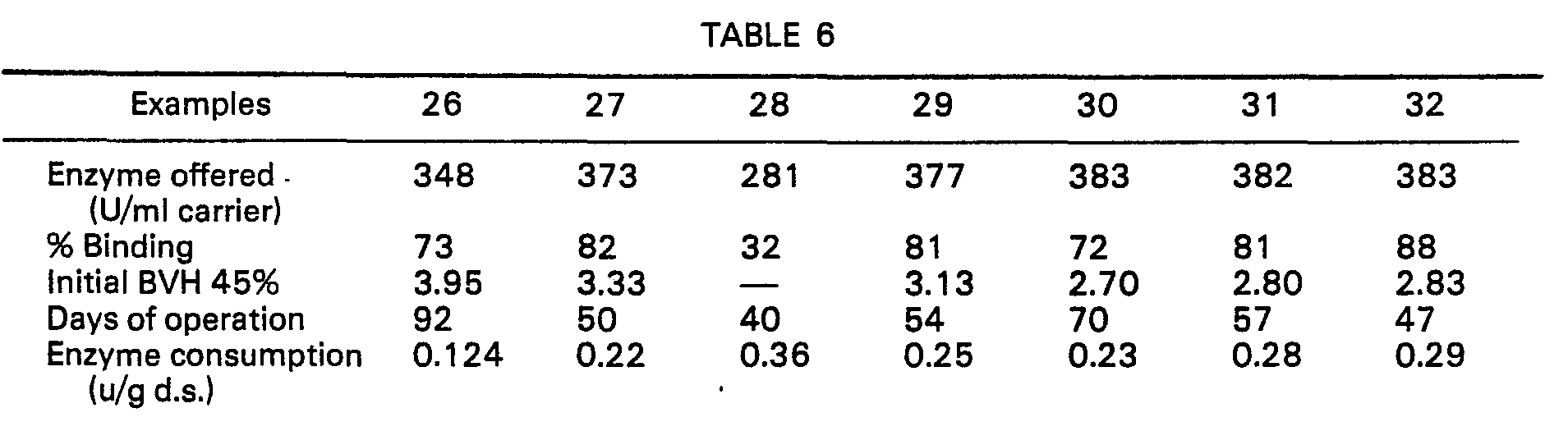
- In order to demonstrate the efficacy of the resin carrier of this invention, experiments were carried out using resins having a porosity profile different from that of the carriers of this invention. These resins were Duolite ES-762, a phenolic resin having the porosity profile represented by 2 in the Figure, and Duolite A-7 Fines, a resin having the porosity profile represented by 3 in the Figure. Both resins are available from Diamond Shamrock Corp. The results are set forth in TABLE 6 below, with the Duolite A-7 Fines resulting in such a low initial BVH 45% that the run was discontinued. The Duolite ES-762 had a poor life and high enzyme consumption. G-993 glucose isomerase was used as the enzyme.

Claims (11)
- A run was also attempted with Duolite A-368/S, but with the BVH so low that the experiment wa discontinued.
- 1. An immobilized glucose isomerase system comprising glucose isomerase derived from Streptomyces olivochromogenes ATCC Nos. 21,114; 21,713; 21,714 or 21,715 or mutants thereof immobilized on a porous phenolic resin wherein said resin has a total surface area of 40 to 200 square meters per gram in the range of pores above 30A of which at least 30% of the pores have a radius of 30 to 250A and a water swelling capacity of at least 10% by volume and wherein said system has a binding efficiency of at least 90% when an enzyme load of 500 U/ml carrier is offered or at least 80% when an enzyme load of 1000 U/ml carrier is offered, and an enzyme half-life during isomerization of at least 10 days.
- 2. The system of claim 1 wherein said porous phenolic resin is an anion exchange type resin.
- 3. The system of claims 1 or 2 wherein at least 50% of the pores having a radius of 30 to 250A have a radius of 50 to 150A.
- 4. The system of one of claim 1-3 wherein at least 20% of the pores having a radius of 30 to 250A have a radius of 60 to 90A.
- 5. The system of one of claims 1-4 wherein at least 20% of the pores having a radius of 30 to 250A have a radius of 70 to 80A.
- 6. A process for the isomerization of glucose comprising contacting a glucose-containing solution with the immobilized glucose isomerase system of claim 1.
- 7. A process for the isomerization of glucose comprising contacting a glucose-containing solution with the immobilized glucose isomerase system of claim 2.
- 8. A process for the isomerization of glucose comprising contacting a glucose-containing solution with the immobilized glucose isomerase system of claim 3.
- 9. A process for the isomerization of glucose comprising contacting a glucose-containing solution with the immobilized glucose isomerase system of claim 4.
- 10. A process for the isomerization of glucose comprising contacting a glucose-containing solution with the immobilized glucose isomerase system of claim 5.
Applications Claiming Priority (2)
| Application Number | Priority Date | Filing Date | Title |
|---|---|---|---|
| US755079A | 1979-01-30 | 1979-01-30 | |
| US7550 | 1979-01-30 |
Publications (3)
| Publication Number | Publication Date |
|---|---|
| EP0014866A2 EP0014866A2 (en) | 1980-09-03 |
| EP0014866A3 EP0014866A3 (en) | 1981-06-03 |
| EP0014866B1 true EP0014866B1 (en) | 1983-01-26 |
Family
ID=21726845
Family Applications (1)
| Application Number | Title | Priority Date | Filing Date |
|---|---|---|---|
| EP80100449A Expired EP0014866B1 (en) | 1979-01-30 | 1980-01-29 | An immobilized glucose isomerase system and a process for the isomerization of glucose using said system |
Country Status (11)
| Country | Link |
|---|---|
| EP (1) | EP0014866B1 (en) |
| JP (1) | JPS55108288A (en) |
| AR (1) | AR224387A1 (en) |
| AU (1) | AU530391B2 (en) |
| CA (1) | CA1134765A (en) |
| DE (1) | DE3061704D1 (en) |
| ES (1) | ES8102075A1 (en) |
| GB (1) | GB2040949B (en) |
| IN (1) | IN152971B (en) |
| MY (1) | MY8400130A (en) |
| NZ (1) | NZ192722A (en) |
Families Citing this family (2)
| Publication number | Priority date | Publication date | Assignee | Title |
|---|---|---|---|---|
| EP0036662B1 (en) * | 1980-03-24 | 1983-11-16 | Cpc International Inc. | An immobilized glucose isomerase system and a process for the isomerization of glucose using said system |
| ZA839115B (en) * | 1982-12-14 | 1984-07-25 | Cpc International Inc | Continuous enzymatic process for producing maltose from starch and starch hydrolysates |
Family Cites Families (5)
| Publication number | Priority date | Publication date | Assignee | Title |
|---|---|---|---|---|
| JPS5535110B2 (en) * | 1972-12-06 | 1980-09-11 | ||
| JPS571997B2 (en) * | 1973-09-13 | 1982-01-13 | ||
| JPS5386085A (en) * | 1976-12-28 | 1978-07-29 | Sumitomo Chem Co Ltd | Immobilization of glucoseisomerase |
| GB1557944A (en) * | 1978-01-30 | 1979-12-19 | Sumitomo Chemical Co | Enzyme immobilization carrier and preparation thereof |
| JPS54147992A (en) * | 1978-05-12 | 1979-11-19 | Cpc International Inc | Production of fixed glucose isomerase |
-
1980
- 1980-01-24 AU AU54937/80A patent/AU530391B2/en not_active Expired
- 1980-01-25 NZ NZ192722A patent/NZ192722A/en unknown
- 1980-01-28 AR AR279765A patent/AR224387A1/en active
- 1980-01-29 DE DE8080100449T patent/DE3061704D1/en not_active Expired
- 1980-01-29 GB GB8002927A patent/GB2040949B/en not_active Expired
- 1980-01-29 EP EP80100449A patent/EP0014866B1/en not_active Expired
- 1980-01-30 JP JP988880A patent/JPS55108288A/en active Granted
- 1980-01-30 CA CA000344652A patent/CA1134765A/en not_active Expired
- 1980-01-30 ES ES488505A patent/ES8102075A1/en not_active Expired
- 1980-02-18 IN IN179/CAL/80A patent/IN152971B/en unknown
-
1984
- 1984-12-30 MY MY130/84A patent/MY8400130A/en unknown
Also Published As
| Publication number | Publication date |
|---|---|
| EP0014866A3 (en) | 1981-06-03 |
| GB2040949B (en) | 1983-01-12 |
| DE3061704D1 (en) | 1983-03-03 |
| GB2040949A (en) | 1980-09-03 |
| AU530391B2 (en) | 1983-07-14 |
| NZ192722A (en) | 1983-03-15 |
| JPH0138474B2 (en) | 1989-08-14 |
| EP0014866A2 (en) | 1980-09-03 |
| ES488505A0 (en) | 1980-12-16 |
| CA1134765A (en) | 1982-11-02 |
| AR224387A1 (en) | 1981-11-30 |
| IN152971B (en) | 1984-05-12 |
| ES8102075A1 (en) | 1980-12-16 |
| MY8400130A (en) | 1984-12-31 |
| JPS55108288A (en) | 1980-08-20 |
| AU5493780A (en) | 1980-08-07 |
Similar Documents
| Publication | Publication Date | Title |
|---|---|---|
| Kim et al. | Hydrolysis of inulin from Jerusalem artichoke by inulinase immobilized on aminoethylcellulose | |
| US3960663A (en) | Process for the continuous isomerization of dextrose | |
| US4304857A (en) | Whole cell enzyme composition containing fumed silica | |
| US3982997A (en) | Immobilized glucose isomerase | |
| US5939294A (en) | Immobilization of microogranisms on weakly basic anion exchange substance for producing isomaltulose | |
| US3847740A (en) | Process for the production of levulose-bearing syrups | |
| US3909354A (en) | Process for isomerizing glucose to fructose | |
| CA1200517A (en) | Continuous enzymatic process for producing maltose from starch and starch hydrolysates | |
| EP0014866A2 (en) | An immobilized glucose isomerase system and a process for the isomerization of glucose using said system | |
| EP0036662B1 (en) | An immobilized glucose isomerase system and a process for the isomerization of glucose using said system | |
| JPS6219835B2 (en) | ||
| US4263400A (en) | Immobilized enzymes | |
| US5177005A (en) | Method for maintaining immobilized glucose isomerase activity during continuous isomerization of glucose to fructose | |
| US3992329A (en) | Support of alumina-magnesia for the adsorption of glucose isomerase enzymes | |
| US4675292A (en) | Stabilization of glucose isomerase | |
| GB2064542A (en) | Process for isomerizing glucose to fructose | |
| US4081327A (en) | Preparation of d-fructose | |
| KR860000306B1 (en) | Isomerization method of glucose | |
| US4078970A (en) | Insolubilized glucose isomerase | |
| CA1127573A (en) | Method using glucoamylase immobilized on porous alumina | |
| US4604354A (en) | Immobilized glucose isomerase containing microbial cells | |
| US5543310A (en) | Immobilized phosphorylase | |
| Hradil et al. | Inversion of sucrose with β-d-fructofuranosidase (invertase) immobilized on bead DEAHP-cellulose: Batch process | |
| EP0118979A1 (en) | Production of immobilised enzymes | |
| CA1045999A (en) | Insolubilized glucose isomerase |
Legal Events
| Date | Code | Title | Description |
|---|---|---|---|
| PUAI | Public reference made under article 153(3) epc to a published international application that has entered the european phase |
Free format text: ORIGINAL CODE: 0009012 |
|
| AK | Designated contracting states |
Designated state(s): DE IT |
|
| PUAL | Search report despatched |
Free format text: ORIGINAL CODE: 0009013 |
|
| AK | Designated contracting states |
Designated state(s): DE IT |
|
| 17P | Request for examination filed |
Effective date: 19811117 |
|
| ITF | It: translation for a ep patent filed | ||
| GRAA | (expected) grant |
Free format text: ORIGINAL CODE: 0009210 |
|
| AK | Designated contracting states |
Designated state(s): DE IT |
|
| REF | Corresponds to: |
Ref document number: 3061704 Country of ref document: DE Date of ref document: 19830303 |
|
| PLBE | No opposition filed within time limit |
Free format text: ORIGINAL CODE: 0009261 |
|
| STAA | Information on the status of an ep patent application or granted ep patent |
Free format text: STATUS: NO OPPOSITION FILED WITHIN TIME LIMIT |
|
| 26N | No opposition filed | ||
| ITTA | It: last paid annual fee | ||
| PGFP | Annual fee paid to national office [announced via postgrant information from national office to epo] |
Ref country code: DE Payment date: 19960109 Year of fee payment: 17 |
|
| PG25 | Lapsed in a contracting state [announced via postgrant information from national office to epo] |
Ref country code: DE Effective date: 19971001 |