EP0013886B1 - Hydrogen peroxide bleach composition - Google Patents
Hydrogen peroxide bleach composition Download PDFInfo
- Publication number
- EP0013886B1 EP0013886B1 EP80100046A EP80100046A EP0013886B1 EP 0013886 B1 EP0013886 B1 EP 0013886B1 EP 80100046 A EP80100046 A EP 80100046A EP 80100046 A EP80100046 A EP 80100046A EP 0013886 B1 EP0013886 B1 EP 0013886B1
- Authority
- EP
- European Patent Office
- Prior art keywords
- acid
- composition
- weight
- hydrogen peroxide
- present
- Prior art date
- Legal status (The legal status is an assumption and is not a legal conclusion. Google has not performed a legal analysis and makes no representation as to the accuracy of the status listed.)
- Expired
Links
- 239000000203 mixture Substances 0.000 title claims description 119
- MHAJPDPJQMAIIY-UHFFFAOYSA-N Hydrogen peroxide Chemical compound OO MHAJPDPJQMAIIY-UHFFFAOYSA-N 0.000 title claims description 98
- 239000007844 bleaching agent Substances 0.000 title claims description 26
- 239000002253 acid Substances 0.000 claims description 24
- -1 nitrogen-containing compound Chemical class 0.000 claims description 18
- 150000007524 organic acids Chemical class 0.000 claims description 15
- 230000003287 optical effect Effects 0.000 claims description 9
- NBIIXXVUZAFLBC-UHFFFAOYSA-N Phosphoric acid Chemical compound OP(O)(O)=O NBIIXXVUZAFLBC-UHFFFAOYSA-N 0.000 claims description 8
- 239000004094 surface-active agent Substances 0.000 claims description 8
- WNLRTRBMVRJNCN-UHFFFAOYSA-N adipic acid Chemical compound OC(=O)CCCCC(O)=O WNLRTRBMVRJNCN-UHFFFAOYSA-N 0.000 claims description 6
- 150000001735 carboxylic acids Chemical class 0.000 claims description 6
- KGBXLFKZBHKPEV-UHFFFAOYSA-N boric acid Chemical compound OB(O)O KGBXLFKZBHKPEV-UHFFFAOYSA-N 0.000 claims description 5
- 239000004327 boric acid Substances 0.000 claims description 5
- 150000001875 compounds Chemical class 0.000 claims description 5
- XLYOFNOQVPJJNP-UHFFFAOYSA-N water Substances O XLYOFNOQVPJJNP-UHFFFAOYSA-N 0.000 claims description 5
- DHMQDGOQFOQNFH-UHFFFAOYSA-N Glycine Chemical compound NCC(O)=O DHMQDGOQFOQNFH-UHFFFAOYSA-N 0.000 claims description 4
- 229910000147 aluminium phosphate Inorganic materials 0.000 claims description 4
- XNGIFLGASWRNHJ-UHFFFAOYSA-N phthalic acid Chemical compound OC(=O)C1=CC=CC=C1C(O)=O XNGIFLGASWRNHJ-UHFFFAOYSA-N 0.000 claims description 4
- 239000001361 adipic acid Substances 0.000 claims description 3
- 235000011037 adipic acid Nutrition 0.000 claims description 3
- 235000008206 alpha-amino acids Nutrition 0.000 claims description 3
- 229930182817 methionine Natural products 0.000 claims description 3
- 239000004471 Glycine Substances 0.000 claims description 2
- FFEARJCKVFRZRR-BYPYZUCNSA-N L-methionine Chemical compound CSCC[C@H](N)C(O)=O FFEARJCKVFRZRR-BYPYZUCNSA-N 0.000 claims description 2
- GSEJCLTVZPLZKY-UHFFFAOYSA-N Triethanolamine Chemical compound OCCN(CCO)CCO GSEJCLTVZPLZKY-UHFFFAOYSA-N 0.000 claims description 2
- 235000001014 amino acid Nutrition 0.000 claims description 2
- 150000001413 amino acids Chemical class 0.000 claims description 2
- JJWLVOIRVHMVIS-UHFFFAOYSA-N isopropylamine Chemical compound CC(C)N JJWLVOIRVHMVIS-UHFFFAOYSA-N 0.000 claims description 2
- 229960004418 trolamine Drugs 0.000 claims description 2
- KRKNYBCHXYNGOX-UHFFFAOYSA-N citric acid Chemical compound OC(=O)CC(O)(C(O)=O)CC(O)=O KRKNYBCHXYNGOX-UHFFFAOYSA-N 0.000 claims 3
- 150000001370 alpha-amino acid derivatives Chemical class 0.000 claims 1
- 238000009472 formulation Methods 0.000 description 40
- 239000002304 perfume Substances 0.000 description 24
- 238000000034 method Methods 0.000 description 17
- 125000004432 carbon atom Chemical group C* 0.000 description 16
- 239000000975 dye Substances 0.000 description 16
- 238000013112 stability test Methods 0.000 description 11
- 125000000217 alkyl group Chemical group 0.000 description 10
- QJGQUHMNIGDVPM-UHFFFAOYSA-N nitrogen group Chemical group [N] QJGQUHMNIGDVPM-UHFFFAOYSA-N 0.000 description 6
- 150000001412 amines Chemical class 0.000 description 5
- 238000004061 bleaching Methods 0.000 description 5
- 229910052739 hydrogen Inorganic materials 0.000 description 5
- 239000001257 hydrogen Substances 0.000 description 5
- 125000004435 hydrogen atom Chemical group [H]* 0.000 description 5
- 239000002736 nonionic surfactant Substances 0.000 description 5
- 239000000523 sample Substances 0.000 description 5
- IJGRMHOSHXDMSA-UHFFFAOYSA-N Atomic nitrogen Chemical compound N#N IJGRMHOSHXDMSA-UHFFFAOYSA-N 0.000 description 4
- 125000004356 hydroxy functional group Chemical group O* 0.000 description 4
- 239000004615 ingredient Substances 0.000 description 4
- 239000007788 liquid Substances 0.000 description 4
- 150000004965 peroxy acids Chemical class 0.000 description 4
- QTBSBXVTEAMEQO-UHFFFAOYSA-N Acetic acid Chemical compound CC(O)=O QTBSBXVTEAMEQO-UHFFFAOYSA-N 0.000 description 3
- UHOVQNZJYSORNB-UHFFFAOYSA-N Benzene Chemical compound C1=CC=CC=C1 UHOVQNZJYSORNB-UHFFFAOYSA-N 0.000 description 3
- MUBZPKHOEPUJKR-UHFFFAOYSA-N Oxalic acid Chemical compound OC(=O)C(O)=O MUBZPKHOEPUJKR-UHFFFAOYSA-N 0.000 description 3
- 238000000354 decomposition reaction Methods 0.000 description 3
- 239000004744 fabric Substances 0.000 description 3
- 125000000547 substituted alkyl group Chemical group 0.000 description 3
- QGZKDVFQNNGYKY-UHFFFAOYSA-N Ammonia Chemical compound N QGZKDVFQNNGYKY-UHFFFAOYSA-N 0.000 description 2
- CIWBSHSKHKDKBQ-JLAZNSOCSA-N Ascorbic acid Chemical compound OC[C@H](O)[C@H]1OC(=O)C(O)=C1O CIWBSHSKHKDKBQ-JLAZNSOCSA-N 0.000 description 2
- SGHZXLIDFTYFHQ-UHFFFAOYSA-L Brilliant Blue Chemical compound [Na+].[Na+].C=1C=C(C(=C2C=CC(C=C2)=[N+](CC)CC=2C=C(C=CC=2)S([O-])(=O)=O)C=2C(=CC=CC=2)S([O-])(=O)=O)C=CC=1N(CC)CC1=CC=CC(S([O-])(=O)=O)=C1 SGHZXLIDFTYFHQ-UHFFFAOYSA-L 0.000 description 2
- RGHNJXZEOKUKBD-SQOUGZDYSA-N D-gluconic acid Chemical compound OC[C@@H](O)[C@@H](O)[C@H](O)[C@@H](O)C(O)=O RGHNJXZEOKUKBD-SQOUGZDYSA-N 0.000 description 2
- IAYPIBMASNFSPL-UHFFFAOYSA-N Ethylene oxide Chemical compound C1CO1 IAYPIBMASNFSPL-UHFFFAOYSA-N 0.000 description 2
- 150000007513 acids Chemical class 0.000 description 2
- 125000005233 alkylalcohol group Chemical group 0.000 description 2
- 150000001371 alpha-amino acids Chemical class 0.000 description 2
- WPYMKLBDIGXBTP-UHFFFAOYSA-N benzoic acid Chemical compound OC(=O)C1=CC=CC=C1 WPYMKLBDIGXBTP-UHFFFAOYSA-N 0.000 description 2
- VVIVVAIHOWVTHB-UHFFFAOYSA-L disodium;3-[[4-amino-9,10-dioxo-3-[2-sulfonato-4-(2,4,4-trimethylpentan-2-yl)phenoxy]anthracen-1-yl]amino]-2,4,6-trimethylbenzenesulfonate Chemical compound [Na+].[Na+].CC1=CC(C)=C(S([O-])(=O)=O)C(C)=C1NC1=CC(OC=2C(=CC(=CC=2)C(C)(C)CC(C)(C)C)S([O-])(=O)=O)=C(N)C2=C1C(=O)C1=CC=CC=C1C2=O VVIVVAIHOWVTHB-UHFFFAOYSA-L 0.000 description 2
- 229940093915 gynecological organic acid Drugs 0.000 description 2
- 238000009897 hydrogen peroxide bleaching Methods 0.000 description 2
- 125000004464 hydroxyphenyl group Chemical group 0.000 description 2
- 239000011872 intimate mixture Substances 0.000 description 2
- JVTAAEKCZFNVCJ-UHFFFAOYSA-N lactic acid Chemical compound CC(O)C(O)=O JVTAAEKCZFNVCJ-UHFFFAOYSA-N 0.000 description 2
- 238000004519 manufacturing process Methods 0.000 description 2
- BDAGIHXWWSANSR-UHFFFAOYSA-N methanoic acid Natural products OC=O BDAGIHXWWSANSR-UHFFFAOYSA-N 0.000 description 2
- 235000006109 methionine Nutrition 0.000 description 2
- 238000002156 mixing Methods 0.000 description 2
- 229910052757 nitrogen Inorganic materials 0.000 description 2
- 235000005985 organic acids Nutrition 0.000 description 2
- 150000003839 salts Chemical class 0.000 description 2
- 125000000446 sulfanediyl group Chemical group *S* 0.000 description 2
- VRVDFJOCCWSFLI-UHFFFAOYSA-K trisodium 3-[[4-[(6-anilino-1-hydroxy-3-sulfonatonaphthalen-2-yl)diazenyl]-5-methoxy-2-methylphenyl]diazenyl]naphthalene-1,5-disulfonate Chemical compound [Na+].[Na+].[Na+].COc1cc(N=Nc2cc(c3cccc(c3c2)S([O-])(=O)=O)S([O-])(=O)=O)c(C)cc1N=Nc1c(O)c2ccc(Nc3ccccc3)cc2cc1S([O-])(=O)=O VRVDFJOCCWSFLI-UHFFFAOYSA-K 0.000 description 2
- HUJVUMPYHGYXDS-UHFFFAOYSA-N 2-(2,5-dimethoxy-n-methylsulfonylanilino)-n-[(4-methylphenyl)methyl]acetamide Chemical compound COC1=CC=C(OC)C(N(CC(=O)NCC=2C=CC(C)=CC=2)S(C)(=O)=O)=C1 HUJVUMPYHGYXDS-UHFFFAOYSA-N 0.000 description 1
- OSWFIVFLDKOXQC-UHFFFAOYSA-N 4-(3-methoxyphenyl)aniline Chemical compound COC1=CC=CC(C=2C=CC(N)=CC=2)=C1 OSWFIVFLDKOXQC-UHFFFAOYSA-N 0.000 description 1
- 239000005711 Benzoic acid Substances 0.000 description 1
- CBOCVOKPQGJKKJ-UHFFFAOYSA-L Calcium formate Chemical compound [Ca+2].[O-]C=O.[O-]C=O CBOCVOKPQGJKKJ-UHFFFAOYSA-L 0.000 description 1
- 229920000742 Cotton Polymers 0.000 description 1
- DSLZVSRJTYRBFB-LLEIAEIESA-N D-glucaric acid Chemical compound OC(=O)[C@@H](O)[C@@H](O)[C@H](O)[C@@H](O)C(O)=O DSLZVSRJTYRBFB-LLEIAEIESA-N 0.000 description 1
- RGHNJXZEOKUKBD-UHFFFAOYSA-N D-gluconic acid Natural products OCC(O)C(O)C(O)C(O)C(O)=O RGHNJXZEOKUKBD-UHFFFAOYSA-N 0.000 description 1
- AEMOLEFTQBMNLQ-AQKNRBDQSA-N D-glucopyranuronic acid Chemical compound OC1O[C@H](C(O)=O)[C@@H](O)[C@H](O)[C@H]1O AEMOLEFTQBMNLQ-AQKNRBDQSA-N 0.000 description 1
- 239000004470 DL Methionine Substances 0.000 description 1
- FEWJPZIEWOKRBE-JCYAYHJZSA-N Dextrotartaric acid Chemical compound OC(=O)[C@H](O)[C@@H](O)C(O)=O FEWJPZIEWOKRBE-JCYAYHJZSA-N 0.000 description 1
- KCXVZYZYPLLWCC-UHFFFAOYSA-N EDTA Chemical group OC(=O)CN(CC(O)=O)CCN(CC(O)=O)CC(O)=O KCXVZYZYPLLWCC-UHFFFAOYSA-N 0.000 description 1
- LFQSCWFLJHTTHZ-UHFFFAOYSA-N Ethanol Chemical compound CCO LFQSCWFLJHTTHZ-UHFFFAOYSA-N 0.000 description 1
- IAJILQKETJEXLJ-UHFFFAOYSA-N Galacturonsaeure Natural products O=CC(O)C(O)C(O)C(O)C(O)=O IAJILQKETJEXLJ-UHFFFAOYSA-N 0.000 description 1
- XUJNEKJLAYXESH-REOHCLBHSA-N L-Cysteine Chemical compound SC[C@H](N)C(O)=O XUJNEKJLAYXESH-REOHCLBHSA-N 0.000 description 1
- QNAYBMKLOCPYGJ-REOHCLBHSA-N L-alanine Chemical compound C[C@H](N)C(O)=O QNAYBMKLOCPYGJ-REOHCLBHSA-N 0.000 description 1
- AGPKZVBTJJNPAG-WHFBIAKZSA-N L-isoleucine Chemical compound CC[C@H](C)[C@H](N)C(O)=O AGPKZVBTJJNPAG-WHFBIAKZSA-N 0.000 description 1
- ROHFNLRQFUQHCH-YFKPBYRVSA-N L-leucine Chemical compound CC(C)C[C@H](N)C(O)=O ROHFNLRQFUQHCH-YFKPBYRVSA-N 0.000 description 1
- COLNVLDHVKWLRT-QMMMGPOBSA-N L-phenylalanine Chemical compound OC(=O)[C@@H](N)CC1=CC=CC=C1 COLNVLDHVKWLRT-QMMMGPOBSA-N 0.000 description 1
- AYFVYJQAPQTCCC-GBXIJSLDSA-N L-threonine Chemical compound C[C@@H](O)[C@H](N)C(O)=O AYFVYJQAPQTCCC-GBXIJSLDSA-N 0.000 description 1
- OUYCCCASQSFEME-QMMMGPOBSA-N L-tyrosine Chemical compound OC(=O)[C@@H](N)CC1=CC=C(O)C=C1 OUYCCCASQSFEME-QMMMGPOBSA-N 0.000 description 1
- KZSNJWFQEVHDMF-BYPYZUCNSA-N L-valine Chemical compound CC(C)[C@H](N)C(O)=O KZSNJWFQEVHDMF-BYPYZUCNSA-N 0.000 description 1
- ROHFNLRQFUQHCH-UHFFFAOYSA-N Leucine Natural products CC(C)CC(N)C(O)=O ROHFNLRQFUQHCH-UHFFFAOYSA-N 0.000 description 1
- QPCDCPDFJACHGM-UHFFFAOYSA-N N,N-bis{2-[bis(carboxymethyl)amino]ethyl}glycine Chemical compound OC(=O)CN(CC(O)=O)CCN(CC(=O)O)CCN(CC(O)=O)CC(O)=O QPCDCPDFJACHGM-UHFFFAOYSA-N 0.000 description 1
- 229920003171 Poly (ethylene oxide) Polymers 0.000 description 1
- 239000004698 Polyethylene Substances 0.000 description 1
- OFOBLEOULBTSOW-UHFFFAOYSA-N Propanedioic acid Natural products OC(=O)CC(O)=O OFOBLEOULBTSOW-UHFFFAOYSA-N 0.000 description 1
- FEWJPZIEWOKRBE-UHFFFAOYSA-N Tartaric acid Natural products [H+].[H+].[O-]C(=O)C(O)C(O)C([O-])=O FEWJPZIEWOKRBE-UHFFFAOYSA-N 0.000 description 1
- AYFVYJQAPQTCCC-UHFFFAOYSA-N Threonine Natural products CC(O)C(N)C(O)=O AYFVYJQAPQTCCC-UHFFFAOYSA-N 0.000 description 1
- 239000004473 Threonine Substances 0.000 description 1
- KZSNJWFQEVHDMF-UHFFFAOYSA-N Valine Natural products CC(C)C(N)C(O)=O KZSNJWFQEVHDMF-UHFFFAOYSA-N 0.000 description 1
- 235000011054 acetic acid Nutrition 0.000 description 1
- 230000002411 adverse Effects 0.000 description 1
- 235000004279 alanine Nutrition 0.000 description 1
- 150000008431 aliphatic amides Chemical class 0.000 description 1
- 229940024606 amino acid Drugs 0.000 description 1
- 125000003277 amino group Chemical group 0.000 description 1
- 229910021529 ammonia Inorganic materials 0.000 description 1
- 239000002280 amphoteric surfactant Substances 0.000 description 1
- 125000000129 anionic group Chemical group 0.000 description 1
- 239000003945 anionic surfactant Substances 0.000 description 1
- 159000000032 aromatic acids Chemical class 0.000 description 1
- 150000008430 aromatic amides Chemical class 0.000 description 1
- 235000010323 ascorbic acid Nutrition 0.000 description 1
- 229960005070 ascorbic acid Drugs 0.000 description 1
- 239000011668 ascorbic acid Substances 0.000 description 1
- 235000010233 benzoic acid Nutrition 0.000 description 1
- 235000012745 brilliant blue FCF Nutrition 0.000 description 1
- 239000004161 brilliant blue FCF Substances 0.000 description 1
- VSGNNIFQASZAOI-UHFFFAOYSA-L calcium acetate Chemical compound [Ca+2].CC([O-])=O.CC([O-])=O VSGNNIFQASZAOI-UHFFFAOYSA-L 0.000 description 1
- 239000001639 calcium acetate Substances 0.000 description 1
- 235000011092 calcium acetate Nutrition 0.000 description 1
- 229960005147 calcium acetate Drugs 0.000 description 1
- 239000004281 calcium formate Substances 0.000 description 1
- 235000019255 calcium formate Nutrition 0.000 description 1
- 229940044172 calcium formate Drugs 0.000 description 1
- KXDHJXZQYSOELW-UHFFFAOYSA-N carbonic acid monoamide Natural products NC(O)=O KXDHJXZQYSOELW-UHFFFAOYSA-N 0.000 description 1
- 125000003178 carboxy group Chemical group [H]OC(*)=O 0.000 description 1
- 150000001732 carboxylic acid derivatives Chemical class 0.000 description 1
- 230000015556 catabolic process Effects 0.000 description 1
- 125000002091 cationic group Chemical group 0.000 description 1
- 239000003093 cationic surfactant Substances 0.000 description 1
- 230000000052 comparative effect Effects 0.000 description 1
- 239000013068 control sample Substances 0.000 description 1
- 235000018417 cysteine Nutrition 0.000 description 1
- XUJNEKJLAYXESH-UHFFFAOYSA-N cysteine Natural products SCC(N)C(O)=O XUJNEKJLAYXESH-UHFFFAOYSA-N 0.000 description 1
- 238000006731 degradation reaction Methods 0.000 description 1
- 239000008367 deionised water Substances 0.000 description 1
- 229910021641 deionized water Inorganic materials 0.000 description 1
- 150000001991 dicarboxylic acids Chemical class 0.000 description 1
- UHXQPQCJDDSMCB-UHFFFAOYSA-L disodium;3-[[9,10-dioxo-4-(2,4,6-trimethyl-3-sulfonatoanilino)anthracen-1-yl]amino]-2,4,6-trimethylbenzenesulfonate Chemical compound [Na+].[Na+].CC1=CC(C)=C(S([O-])(=O)=O)C(C)=C1NC(C=1C(=O)C2=CC=CC=C2C(=O)C=11)=CC=C1NC1=C(C)C=C(C)C(S([O-])(=O)=O)=C1C UHXQPQCJDDSMCB-UHFFFAOYSA-L 0.000 description 1
- FPAYXBWMYIMERV-UHFFFAOYSA-L disodium;5-methyl-2-[[4-(4-methyl-2-sulfonatoanilino)-9,10-dioxoanthracen-1-yl]amino]benzenesulfonate Chemical compound [Na+].[Na+].[O-]S(=O)(=O)C1=CC(C)=CC=C1NC(C=1C(=O)C2=CC=CC=C2C(=O)C=11)=CC=C1NC1=CC=C(C)C=C1S([O-])(=O)=O FPAYXBWMYIMERV-UHFFFAOYSA-L 0.000 description 1
- 229960001484 edetic acid Drugs 0.000 description 1
- 239000000835 fiber Substances 0.000 description 1
- 235000019253 formic acid Nutrition 0.000 description 1
- 229940083124 ganglion-blocking antiadrenergic secondary and tertiary amines Drugs 0.000 description 1
- 239000011521 glass Substances 0.000 description 1
- 239000000174 gluconic acid Substances 0.000 description 1
- 235000012208 gluconic acid Nutrition 0.000 description 1
- 229940097043 glucuronic acid Drugs 0.000 description 1
- 150000002391 heterocyclic compounds Chemical class 0.000 description 1
- 150000002500 ions Chemical class 0.000 description 1
- 229960000310 isoleucine Drugs 0.000 description 1
- AGPKZVBTJJNPAG-UHFFFAOYSA-N isoleucine Natural products CCC(C)C(N)C(O)=O AGPKZVBTJJNPAG-UHFFFAOYSA-N 0.000 description 1
- GCHPUFAZSONQIV-UHFFFAOYSA-N isovaline Chemical compound CCC(C)(N)C(O)=O GCHPUFAZSONQIV-UHFFFAOYSA-N 0.000 description 1
- 239000004310 lactic acid Substances 0.000 description 1
- 235000014655 lactic acid Nutrition 0.000 description 1
- VZCYOOQTPOCHFL-UPHRSURJSA-N maleic acid Chemical compound OC(=O)\C=C/C(O)=O VZCYOOQTPOCHFL-UPHRSURJSA-N 0.000 description 1
- 239000011976 maleic acid Substances 0.000 description 1
- 229910021645 metal ion Inorganic materials 0.000 description 1
- FFEARJCKVFRZRR-UHFFFAOYSA-N methionine Chemical compound CSCCC(N)C(O)=O FFEARJCKVFRZRR-UHFFFAOYSA-N 0.000 description 1
- 125000002496 methyl group Chemical group [H]C([H])([H])* 0.000 description 1
- 150000002763 monocarboxylic acids Chemical class 0.000 description 1
- 235000006408 oxalic acid Nutrition 0.000 description 1
- 229960003330 pentetic acid Drugs 0.000 description 1
- 125000001997 phenyl group Chemical group [H]C1=C([H])C([H])=C(*)C([H])=C1[H] 0.000 description 1
- COLNVLDHVKWLRT-UHFFFAOYSA-N phenylalanine Natural products OC(=O)C(N)CC1=CC=CC=C1 COLNVLDHVKWLRT-UHFFFAOYSA-N 0.000 description 1
- IEQIEDJGQAUEQZ-UHFFFAOYSA-N phthalocyanine Chemical compound N1C(N=C2C3=CC=CC=C3C(N=C3C4=CC=CC=C4C(=N4)N3)=N2)=C(C=CC=C2)C2=C1N=C1C2=CC=CC=C2C4=N1 IEQIEDJGQAUEQZ-UHFFFAOYSA-N 0.000 description 1
- 239000000049 pigment Substances 0.000 description 1
- 239000004033 plastic Substances 0.000 description 1
- 229920003023 plastic Polymers 0.000 description 1
- 229920000573 polyethylene Polymers 0.000 description 1
- 229920006395 saturated elastomer Polymers 0.000 description 1
- WXMKPNITSTVMEF-UHFFFAOYSA-M sodium benzoate Chemical compound [Na+].[O-]C(=O)C1=CC=CC=C1 WXMKPNITSTVMEF-UHFFFAOYSA-M 0.000 description 1
- 239000004299 sodium benzoate Substances 0.000 description 1
- 235000010234 sodium benzoate Nutrition 0.000 description 1
- 229960003885 sodium benzoate Drugs 0.000 description 1
- CKMPIIPZKJISCU-UHFFFAOYSA-M sodium;4,8-diamino-1,5-dihydroxy-9,10-dioxoanthracene-2-sulfonate Chemical compound [Na+].O=C1C2=C(N)C=C(S([O-])(=O)=O)C(O)=C2C(=O)C2=C1C(O)=CC=C2N CKMPIIPZKJISCU-UHFFFAOYSA-M 0.000 description 1
- 239000011975 tartaric acid Substances 0.000 description 1
- 235000002906 tartaric acid Nutrition 0.000 description 1
- 238000012360 testing method Methods 0.000 description 1
- 229940073455 tetraethylammonium hydroxide Drugs 0.000 description 1
- LRGJRHZIDJQFCL-UHFFFAOYSA-M tetraethylazanium;hydroxide Chemical compound [OH-].CC[N+](CC)(CC)CC LRGJRHZIDJQFCL-UHFFFAOYSA-M 0.000 description 1
- 125000003698 tetramethyl group Chemical group [H]C([H])([H])* 0.000 description 1
- 235000008521 threonine Nutrition 0.000 description 1
- KJAMZCVTJDTESW-UHFFFAOYSA-N tiracizine Chemical compound C1CC2=CC=CC=C2N(C(=O)CN(C)C)C2=CC(NC(=O)OCC)=CC=C21 KJAMZCVTJDTESW-UHFFFAOYSA-N 0.000 description 1
- VZCYOOQTPOCHFL-UHFFFAOYSA-N trans-butenedioic acid Natural products OC(=O)C=CC(O)=O VZCYOOQTPOCHFL-UHFFFAOYSA-N 0.000 description 1
- OUYCCCASQSFEME-UHFFFAOYSA-N tyrosine Natural products OC(=O)C(N)CC1=CC=C(O)C=C1 OUYCCCASQSFEME-UHFFFAOYSA-N 0.000 description 1
- 239000004474 valine Substances 0.000 description 1
- 238000013022 venting Methods 0.000 description 1
Classifications
-
- C—CHEMISTRY; METALLURGY
- C11—ANIMAL OR VEGETABLE OILS, FATS, FATTY SUBSTANCES OR WAXES; FATTY ACIDS THEREFROM; DETERGENTS; CANDLES
- C11D—DETERGENT COMPOSITIONS; USE OF SINGLE SUBSTANCES AS DETERGENTS; SOAP OR SOAP-MAKING; RESIN SOAPS; RECOVERY OF GLYCEROL
- C11D3/00—Other compounding ingredients of detergent compositions covered in group C11D1/00
- C11D3/40—Dyes ; Pigments
- C11D3/42—Brightening agents ; Blueing agents
-
- C—CHEMISTRY; METALLURGY
- C11—ANIMAL OR VEGETABLE OILS, FATS, FATTY SUBSTANCES OR WAXES; FATTY ACIDS THEREFROM; DETERGENTS; CANDLES
- C11D—DETERGENT COMPOSITIONS; USE OF SINGLE SUBSTANCES AS DETERGENTS; SOAP OR SOAP-MAKING; RESIN SOAPS; RECOVERY OF GLYCEROL
- C11D3/00—Other compounding ingredients of detergent compositions covered in group C11D1/00
- C11D3/39—Organic or inorganic per-compounds
- C11D3/3902—Organic or inorganic per-compounds combined with specific additives
- C11D3/3937—Stabilising agents
-
- C—CHEMISTRY; METALLURGY
- C11—ANIMAL OR VEGETABLE OILS, FATS, FATTY SUBSTANCES OR WAXES; FATTY ACIDS THEREFROM; DETERGENTS; CANDLES
- C11D—DETERGENT COMPOSITIONS; USE OF SINGLE SUBSTANCES AS DETERGENTS; SOAP OR SOAP-MAKING; RESIN SOAPS; RECOVERY OF GLYCEROL
- C11D3/00—Other compounding ingredients of detergent compositions covered in group C11D1/00
- C11D3/39—Organic or inorganic per-compounds
- C11D3/3947—Liquid compositions
-
- C—CHEMISTRY; METALLURGY
- C11—ANIMAL OR VEGETABLE OILS, FATS, FATTY SUBSTANCES OR WAXES; FATTY ACIDS THEREFROM; DETERGENTS; CANDLES
- C11D—DETERGENT COMPOSITIONS; USE OF SINGLE SUBSTANCES AS DETERGENTS; SOAP OR SOAP-MAKING; RESIN SOAPS; RECOVERY OF GLYCEROL
- C11D3/00—Other compounding ingredients of detergent compositions covered in group C11D1/00
- C11D3/40—Dyes ; Pigments
Definitions
- the present invention relates to a stable aqueous bleach composition.
- Liquid hydrogen peroxide bleaches have been known for a considerable length of time, especially in the industrial processes of treating or bleaching fibers and cloth during manufacture. These stabilized compositions are primarily 35%, 50% or 70% hydrogen peroxide solutions, a commercially available commodity. In order to utilize liquid hydrogen peroxide solutions as a general-purpose home laundry bleach, the concentrated hydrogen peroxide solutions must be diluted to lower strength, i.e. within the range of from 2-12% hydrogen peroxide.
- the present invention therefore provides a stable aqueous bleach composition
- a stable aqueous bleach composition comprising: from 2-12% by weight hydrogen peroxide; from 0 ⁇ 20% by weight of an acid selected from the group consisting of an organic acid, phosphoric acid, boric acid or mixtures thereof, and if the acid is an organic acid then the organic acid is selected from the carboxylic acids wherein the acid functionality predominates over other groups present and the organic acid consists of tetra- or penta-carboxylic amino acids; from 0.05-10.0% by weight of at least one nitrogen-containing compound selected from the group consisting of triethanol amine, isopropyl amine or an alpha-amino monocarboxylic acid; from 0.0001-1% by weight of a compound selected from the group consisting of a dye, an optical brightener or mixtures thereof, and water, the weight ratio of hydrogen peroxide to nitrogen-containing compound is within the range of from 1:0.003-1:1.5 and with the proviso that the composition contains sufficient
- the active bleaching component in the bleaching composition of the present invention is the hydrogen peroxide.
- This hydrogen peroxide may be any commercially available form of hydrogen peroxide which is diluted down to the proper percentage by weight.
- the composition can contain from 2-12% by weight hydrogen peroxide, and it is preferred that the composition contain from 2-8% and most preferred that the composition contain from 2-6% by weight hydrogen peroxide.
- the reason for preferring lower amounts of hydrogen peroxide is not particularly because of stability or performance, but because compositions having these lower percentages of hydrogen peroxide can be sold without special safety venting caps.
- the composition of the present invention may also include an acid selected from the group consisting of organic acid, phosphoric acid, boric acid or mixtures thereof.
- the acid is present in an amount from 0-20% by weight of the composition to control the pH of the composition to within the range of from about 1.8-5.5. It is within this range that the H 2 0 2 is an active bleaching species and when combined with a suitable amine-containing compound the H 2 0 2 is stable for extended storage periods. Occasionally an acid is not required to bring the composition to within the range of 1.8-5.5, however, it is generally necessary and in fact preferred to incorporate at least one acid into the composition.
- organic acid means carboxylic acids wherein the acid functionality predominates over other groups present in the compound. This term does not include alpha-amino monocarboxylic acids but does include tetra and penta carboxylic acids containing some nitrogen.
- Suitable organic acids include various saturated and unsaturated mono-, di-, tri-, tetra-and penta- carboxylic acids, such as acetic acid, oxalic acid, formic acid, adipic acid, maleic acid, tartaric acid, lactic acid, gluconic acid, glucaric acid, glucuronic acid, ascorbic acid; mono- and dicarboxylic acids of benzene such as benzoic acid, phthalic acid and substituted aromatic acids and salts of these carboxylic acids such as sodium benzoate, calcium formate, calcium acetate and the like. Also certain nitrogen-containing acids are suitable for use as the organic acid.
- the acid functionality is more important than the amine functionality.
- the composition contain from 0.1-12% by weight and most preferably from 0.50-8% by weight of the above organic acids, phosphoric acid, boric acid or mixtures thereof.
- the preferred acids are adipic, phthalic, citric, boric or mixtures thereof.
- the most preferred acid is adipic acid.
- the organic acid when the organic acid is present in the composition it must be present in a sufficient amount so that the ratio of hydrogen peroxide to organic acid is within the range of from about 1:0.01-1:4 and preferably within the range of from 1:0.01-1:2.5.
- composition of the present invention must contain from 0.05-10% by weight of at least one nitrogen-containing compound.
- nitrogen-containing compound in this specification and in the attached claims is meant a composition containing amine functionality wherein the amine functionality predominates over other groups present in the molecule.
- Suitable nitrogen-containing compounds include ammonia, amines having the formula wherein R 1 is selected from the group consisting of an alkyl group having from 1-8 carbon atoms, a hydroxy substituted alkyl group having from 1-9 carbon atoms; R 2 is selected from hydrogen, an alkyl group having from 1-8 carbon atoms, and a hydroxy substituted alkyl group having from 1-9 carbon atoms; and R 3 is selected from hydrogen, an alkyl group having from 1-8 carbon atoms, and a hydroxy substituted alkyl group having from 1-9 carbon atoms; water-soluble aromatic primary, secondary and tertiary amines, and salts thereof, tetramethyl and tetraethyl ammonium hydroxide; water-soluble heterocyclic compounds having 5 and 6 membered rings including at least one ring nitrogen.
- water-soluble aliphatic amides having from 2-8 carbon atoms and water-soluble aromatic amides.
- nitrogen-containing compounds are the monocarboxylic alpha-amino acids selected from the group consisting essentially of carbamic acid, wherein R is hydrogen or methyl, R 1 is hydrogen; a lower alkyl group having 1-4 carbon atoms; a phenyl substituted or hydroxyphenyl substituted lower alkyl, i.e., 1-4 carbon atoms, group; a hydroxy or thio substituted lower alkyl, i.e., 1-4 carbon atoms, group; a lower alkyl, i.e., 1-4 carbon atoms; thio substituted lower alkyl, i.e., 1-4 carbon atoms, group; and an amino substituted lower alkyl, i.e.
- R 2 is hydrogen or hydroxyphenyl, and mixtures thereof.
- Representative alpha-amino acids within the above formula are glycine, alanine, valine, leucine, iso- valine, isoleucine, phenylalanine, tyrosine, shrine, threonine, cysteine, and methionine. It is preferred that the nitrogen-containing compound be present in an amount of from 0.1-7.5% by weight, and it is most preferred that the nitrogen-containing compound be present in an amount from 0.5-1.5% by weight.
- the hydrogen peroxide and nitrogen-containing compounds utilized in the composition of the present invention must be present in certain specific ratios relative to each other.
- the ratio of hydrogen peroxide to nitrogen-containing compound must be within the range of from about 1:0.003 to about 1:1.5, and preferably from 1:0.01-1:1.25. It is only within this relative range that the stability of the composition of the present invention is achieved.
- the composition of the present invention also contains from 0.0001-1% by weight of dye and/or optical brighteners.
- the following dyes are suitable: Color Index Direct Violet 9 (#27885), Color Index Acid Blue 127 (#61135), Color Index Direct Violet 48.1, Color Index Direct Blue 199 (phthalocyanine), Color Index Pigment Green 7 ( # 74260), Color Index Acid Blue 127-1, Color Index Acid Red 131, Color Index Acid Blue 80 (#61585), Color Index Acid Violet 48, Pergacid Bond Blue G, Color Index Acid Green 25 (#61570), Color Index Acid Blue 43 (#63000), Color Index Acid Blue 9 (#42090), Color Index Acid Violet 48, Color Index Acid Blue 147 (#42135), Tinolate Brilliant Blue GL23 (Ciba-Geigy) and the like.
- Suitable optical brighteners include: Color Index Fluorescent Brighteners 28, 35, 40, 61, 71, 140 and the like. Mixtures of dyes and mixtures of optical brighteners are also suitable. If desired, the composition can include at least one dye, at least one optical brightener or a mixture of at least one dye and at least one optical brightener.
- the composition of the present invention comprises primarily water.
- the water utilized to prepare the composition of the present invention is deionized water so as to minimize the addition of metal ions which tend to catalyze the decomposition of hydrogen peroxide.
- the composition of the present invention must have a pH within the range of 1.8-5.5. It is within this range that both the product performance and the stability of the composition are at a maximum. Further, the performance of the composition is enhanced over H 2 0 2 at a pH outside the above range because H 2 0 2 forms peracids when combined with carboxylic acids at a pH within the range of from 1.8-5.5. These peracids are more reactive, thereby giving greater bleach performance than H 2 0 2 alone, or the same composition at a more basic pH.
- the composition of the present invention also may optionally contain a bleach-stable surfactant to assist in removing stains.
- a bleach-stable surfactant to assist in removing stains.
- These surfactants reduce the surface tension of the stain and allow the stain to be more readily wet by the bleach.
- the surfactant may be any bleach-stable surfactant including nonionic, anionic, cationic and amphoteric surfactants. These surfactants may be present in an amount of from 0-7% by weight and preferably from 1-5% by weight.
- the preferred class of surfactants, when present, for use in the composition of the present invention are the nonionic surfactants.
- the most preferred surfactants are nonionic surfactants having between 6 and 12 moles of ethylene oxide per mole of alcohol, such as linear alkyl alcohols having 9 to 18 carbon atoms, secondary alkyl alcohols having 9 to 18 carbon atoms, and alkyl aryl alcohols including alkyl phenols, having 8 to 18 carbon atoms in the alkyl group.
- composition can also include other standard optional ingredients which do not adversely affect the stability of the bleach.
- Perfumes can be incorporated. However, care must be exercised in the solution of a perfume as these compositions are mixtures of many compounds, some of which may be susceptible to degradation by the hydrogen peroxide. Generally, less than 1% perfume is used.
- composition of the present invention can be simply prepared by blending the desired ingredients together to form an intimate mixture.
- plastic containers such as polyethylene, since glass containers can produce ions which further catalyze the decomposition of hydrogen peroxide.
- composition of the present invention will now be illustrated by way of the following examples.
- all parts and percentages are by weight and the temperatures are in degrees Centigrade.
- the above formulation is prepared by blending each of the above ingredients together to form an intimate mixture.
- the four dyes conveniently can be dissolved as a 5:1 percent solution and added in this manner.
- This formulation has a pH of 4.2.
- the formulation was heated to 100°C for 24 hours. At the end of this period, the sample was compared to a fresh control sample having the same perfume, dyes, and brighteners. If the perfume changed or degraded or the dye color changed, the sample was considered unstable. Also, the hydrogen peroxide level was determined, a loss of 5% or more of the hydrogen peroxide was determined unacceptable.
- the composition was placed on a piece of white cotton cloth and placed under a UV lamp to determine visually if the brighteners had degraded. This accelerated 24-hour test correlates to about one year shelf stability under normal temperatures. The above formulation did not change or degrade the color or perfume, the brighteners had not degraded and the loss of hydrogen peroxide was less than 5%.
- Example I The above formulation was prepared using the procedure of Example I and had a pH of 4.6. Furthermore, when tested using the accelerated stability test of Example I at a temperature of 100°C, the product has not changed color or degraded the perfume and brightener after 1 day, and the hydrogen peroxide loss was less than 5%, indicating that the shelf stability of the formula will be about 12 months.
- Example I The above formulation was prepared using the procedure of Example I and had a pH of 5.2. Furthermore, when tested using the accelerated stability test of Example I at a temperature of 100°C, the product has not changed color or degraded the perfume and brightener for 1 day, and the hydrogen peroxide loss was less than 5%, indicating that the shelf stability of the formula will be about 12 months.
- Example I The above formulation was prepared. using the procedure of Example I and had a pH of 5.1. Furthermore, when tested using the accelerated stability test of Example I at a temperature of 100°C, the product has not changed color or degraded the perfume and brighteners for 1 day, and the hydrogen peroxide loss was less than 5%, indicating that the shelf stability of the formula will be about 12 months.
- Example I The above formulation was prepared using the procedure of Example I and had a pH of 2.8. Furthermore, when tested using the accelerated stability test of Example I at a temperature of 100°C, the product has not changed color or degraded the perfume and brightener for 1 day, and the hydrogen peroxide loss was less than 5%, indicating that the shelf stability of the formula will be about 12 months.
- Example I The above formulation was prepared using the procedure of Example I and had a pH of 1.9. Furthermore, when tested using the accelerated stability test of Example I at a temperature of 100°C, the product has not changed color or degraded the perfume and brightener for 1 day, and the hydrogen peroxide loss was less than 5%, indicating that the shelf stability of the formula will be about 12 months.
- Example I The above formulation was prepared using the procedure of Example I and had a pH of 4.9. Furthermore, when tested using the accelerated stability test of Example I at a temperature of 100°C, the product has not changed color or degraded the perfume and brightener for 1 day, and the hydrogen peroxide loss was less than 5%, indicating that the shelf stability of the formula will be about 12 months.
- Example I The above formulation was prepared using the procedure of Example I and had a pH of 5.5. Furthermore, when tested using the accelerated stability test of Example I at a temperature of 100°C, the product has not changed color or degraded the perfume and brightener for 1 day, and the hydrogen peroxide loss was less than 5%, indicating that the shelf stability of the formula will be about 12 months.
- Example I The above formulation was prepared using the procedure of Example I and had a pH of 5.4. Furthermore, when tested using the accelerated stability test of Example I at a temperature of 100°C, the product has not changed color or degraded the perfume and brightener for 1 day, and the hydrogen peroxide loss was less than 5%, indicating that the shelf stability of the formula will be about 12 months.
- Example I The above formulation was prepared using the procedure of Example I and had a pH of 4.9. Furthermore, when tested using the accelerated stability test of Example I at a temperature of 100°C, the product has not changed color or degraded the perfume and brightener for 1 day, and the hydrogen peroxide loss was less than 5%, indicating that the shelf stability of the formula will be about 12 months.
- Example I The above formulation was prepared using the procedure of Example I and had a pH of 5.0. Furthermore, when tested using the accelerated stability test of Example I at a temperature of 100°C, the product has not changed color or degraded the perfume and brightener for 1 day, and the hydrogen peroxide loss was less than 5%, indicating that the shelf stability of the formula will be about 12 months.
- Example I The above formulation was prepared using the procedure of Example I and had a pH of 2.2. Furthermore, when tested using the accelerated stability test of Example I at a temperature of 100°C, the product has not changed color or degraded the perfume and brightener for 1 day, and the hydrogen peroxide loss was less than 5%, indicating that the shelf stability of the formula will be about 12 months.
- Example II The above formulation was prepared using the procedure of Example I and had an initial pH of 2.28. When tested for H 2 0 2 content, pH and color after storage at a temperature of 23°C, for one year. The composition had 5.78% H 2 0 2 , a pH of 3.4 and a blue color similar to a fresh sample. Further, the brighteners are still present and the perfume had not degraded.
- Example II The above formulation was prepared using the procedure of Example I and had a pH of 2.3. This formula is stable over a period of 12 months showing little loss of H 2 0 2 or optical brighteners. Also, the perfume had not degraded.
- Example II The above formulation was prepared using the procedure of Example I and had a pH of 2.4. After storage at a temperature of 23°C for one year, the composition showed a less than 5% loss in hydrogen peroxide and had brighteners present. The color and perfume were similar to a freshly prepared sample.
- Example II The above formulation was prepared using the procedure of Example I and had an initial pH of 2.28. After storage at 23°C for one year, the composition contained 5.78% hydrogen peroxide and had a pH of 3.40. Brighteners were still present; however, the color had changed slightly from a freshly prepared sample. Also, the perfume had not degraded.
- Example I The above formulation was prepared using the procedure of Example I and had a pH of 2.28.
- the composition was stored for one year at 23°C.
- the composition had 5.88% hydrogen peroxide and contained brighteners although at a lower level than Example XIII.
- the color had changed to a light pink.
- the perfume had not degraded.
- Example II The above formulation was prepared using the procedure of Example I and had a pH of 2.2. After storage at 23°C for one year, the composition contained 5.85% hydrogen peroxide and contained a reduced, though effective, amount of brighteners. The perfume had not degraded.
- the composition has a pH of 5.0 and is stable on storage the composition does not need added acid because of the amount of DL methionine present in the composition.
- the composition has a pH of 3.2 and is not stable. All dyes and perfumes are degraded within 1 week storage at room temperature.
Landscapes
- Chemical & Material Sciences (AREA)
- Life Sciences & Earth Sciences (AREA)
- Engineering & Computer Science (AREA)
- Chemical Kinetics & Catalysis (AREA)
- Oil, Petroleum & Natural Gas (AREA)
- Wood Science & Technology (AREA)
- Organic Chemistry (AREA)
- Inorganic Chemistry (AREA)
- Detergent Compositions (AREA)
Description
- The present invention relates to a stable aqueous bleach composition.
- Liquid hydrogen peroxide bleaches have been known for a considerable length of time, especially in the industrial processes of treating or bleaching fibers and cloth during manufacture. These stabilized compositions are primarily 35%, 50% or 70% hydrogen peroxide solutions, a commercially available commodity. In order to utilize liquid hydrogen peroxide solutions as a general-purpose home laundry bleach, the concentrated hydrogen peroxide solutions must be diluted to lower strength, i.e. within the range of from 2-12% hydrogen peroxide.
- Because of the nature of the hydrogen peroxide, it tends to be more stable in concentrated solutions than it is in more diluted solutions. There have been numerous attempts to prepare stable dilute liquid hydrogen peroxide bleaching compositions which contain dyes and/or optical brighteners plus other ingredients thought necessary to prepare a commercially acceptable household laundry product. An example is U.S. Patent 3,970,575, which describes a hydrogen peroxide bleaching composition utilizing one specific dye and polyethylene oxide nonionic surfactants. The particular dye described in this U.S. Patent appears particularly stable in the presence of hydrogen peroxide and does not react with hydrogen peroxide or catalyze the decomposition of hydrogen peroxide. As described in this patent, however, the use of this particular dye does create some difficulty since the dye is very substantive to fabrics requiring the use of certain non-ionic surfactants to remove the same so that there is no build-up.
- It is, therefore, the aim of the present invention to prepare stable hydrogen peroxide liquid bleaching compositions containing normally unstable dyes.
- The present invention therefore provides a stable aqueous bleach composition comprising: from 2-12% by weight hydrogen peroxide; from 0―20% by weight of an acid selected from the group consisting of an organic acid, phosphoric acid, boric acid or mixtures thereof, and if the acid is an organic acid then the organic acid is selected from the carboxylic acids wherein the acid functionality predominates over other groups present and the organic acid consists of tetra- or penta-carboxylic amino acids; from 0.05-10.0% by weight of at least one nitrogen-containing compound selected from the group consisting of triethanol amine, isopropyl amine or an alpha-amino monocarboxylic acid; from 0.0001-1% by weight of a compound selected from the group consisting of a dye, an optical brightener or mixtures thereof, and water, the weight ratio of hydrogen peroxide to nitrogen-containing compound is within the range of from 1:0.003-1:1.5 and with the proviso that the composition contains sufficient acid to bring the pH of the composition to within the range of from about 1.8-5.5.
- Other features and advantages of the invention will become apparent from the following, more detailed description. The active bleaching component in the bleaching composition of the present invention is the hydrogen peroxide. This hydrogen peroxide may be any commercially available form of hydrogen peroxide which is diluted down to the proper percentage by weight. The composition can contain from 2-12% by weight hydrogen peroxide, and it is preferred that the composition contain from 2-8% and most preferred that the composition contain from 2-6% by weight hydrogen peroxide. The reason for preferring lower amounts of hydrogen peroxide is not particularly because of stability or performance, but because compositions having these lower percentages of hydrogen peroxide can be sold without special safety venting caps.
- The composition of the present invention may also include an acid selected from the group consisting of organic acid, phosphoric acid, boric acid or mixtures thereof. The acid is present in an amount from 0-20% by weight of the composition to control the pH of the composition to within the range of from about 1.8-5.5. It is within this range that the H202 is an active bleaching species and when combined with a suitable amine-containing compound the H202 is stable for extended storage periods. Occasionally an acid is not required to bring the composition to within the range of 1.8-5.5, however, it is generally necessary and in fact preferred to incorporate at least one acid into the composition.
- As used in this specification and in the attached claims the term "organic acid" means carboxylic acids wherein the acid functionality predominates over other groups present in the compound. This term does not include alpha-amino monocarboxylic acids but does include tetra and penta carboxylic acids containing some nitrogen.
- Suitable organic acids include various saturated and unsaturated mono-, di-, tri-, tetra-and penta- carboxylic acids, such as acetic acid, oxalic acid, formic acid, adipic acid, maleic acid, tartaric acid, lactic acid, gluconic acid, glucaric acid, glucuronic acid, ascorbic acid; mono- and dicarboxylic acids of benzene such as benzoic acid, phthalic acid and substituted aromatic acids and salts of these carboxylic acids such as sodium benzoate, calcium formate, calcium acetate and the like. Also certain nitrogen-containing acids are suitable for use as the organic acid. Generally these are more complex nitrogen-containing compounds with 4 or 5 carboxyl groups such as ethylene diamine tetraacetic acid or diethylene triamine pentaacetic acid. In these acids the acid functionality is more important than the amine functionality. It is preferred that the composition contain from 0.1-12% by weight and most preferably from 0.50-8% by weight of the above organic acids, phosphoric acid, boric acid or mixtures thereof. The preferred acids are adipic, phthalic, citric, boric or mixtures thereof. The most preferred acid is adipic acid. Furthermore, when the organic acid is present in the composition it must be present in a sufficient amount so that the ratio of hydrogen peroxide to organic acid is within the range of from about 1:0.01-1:4 and preferably within the range of from 1:0.01-1:2.5.
- The composition of the present invention must contain from 0.05-10% by weight of at least one nitrogen-containing compound. By the term "nitrogen-containing compound" in this specification and in the attached claims is meant a composition containing amine functionality wherein the amine functionality predominates over other groups present in the molecule. Suitable nitrogen-containing compounds include ammonia, amines having the formula


- The hydrogen peroxide and nitrogen-containing compounds utilized in the composition of the present invention must be present in certain specific ratios relative to each other. The ratio of hydrogen peroxide to nitrogen-containing compound must be within the range of from about 1:0.003 to about 1:1.5, and preferably from 1:0.01-1:1.25. It is only within this relative range that the stability of the composition of the present invention is achieved.
- The composition of the present invention also contains from 0.0001-1% by weight of dye and/or optical brighteners. The following dyes are suitable: Color Index Direct Violet 9 (#27885), Color Index Acid Blue 127 (#61135), Color Index Direct Violet 48.1, Color Index Direct Blue 199 (phthalocyanine), Color Index Pigment Green 7 (#74260), Color Index Acid Blue 127-1, Color Index Acid Red 131, Color Index Acid Blue 80 (#61585), Color Index Acid Violet 48, Pergacid Bond Blue G, Color Index Acid Green 25 (#61570), Color Index Acid Blue 43 (#63000), Color Index Acid Blue 9 (#42090), Color Index Acid Violet 48, Color Index Acid Blue 147 (#42135), Tinolate Brilliant Blue GL23 (Ciba-Geigy) and the like. Suitable optical brighteners include: Color Index Fluorescent Brighteners 28, 35, 40, 61, 71, 140 and the like. Mixtures of dyes and mixtures of optical brighteners are also suitable. If desired, the composition can include at least one dye, at least one optical brightener or a mixture of at least one dye and at least one optical brightener.
- The composition of the present invention comprises primarily water. Preferably the water utilized to prepare the composition of the present invention is deionized water so as to minimize the addition of metal ions which tend to catalyze the decomposition of hydrogen peroxide.
- As noted previously, the composition of the present invention must have a pH within the range of 1.8-5.5. It is within this range that both the product performance and the stability of the composition are at a maximum. Further, the performance of the composition is enhanced over H202 at a pH outside the above range because H202 forms peracids when combined with carboxylic acids at a pH within the range of from 1.8-5.5. These peracids are more reactive, thereby giving greater bleach performance than H202 alone, or the same composition at a more basic pH.
- The final concentration of peracid species must be carefully controlled for a household consumer product, since high peracid concentrations are very reactive and also unstable, which shortens shelf life and could create a dangerous situation. For this reason, the concentration of H202, carboxylic acid and nitrogen-containing compounds are critical to the stability and performance of the composition of the present invention.
- The composition of the present invention also may optionally contain a bleach-stable surfactant to assist in removing stains. These surfactants reduce the surface tension of the stain and allow the stain to be more readily wet by the bleach. The surfactant may be any bleach-stable surfactant including nonionic, anionic, cationic and amphoteric surfactants. These surfactants may be present in an amount of from 0-7% by weight and preferably from 1-5% by weight. The preferred class of surfactants, when present, for use in the composition of the present invention are the nonionic surfactants. The most preferred surfactants are nonionic surfactants having between 6 and 12 moles of ethylene oxide per mole of alcohol, such as linear alkyl alcohols having 9 to 18 carbon atoms, secondary alkyl alcohols having 9 to 18 carbon atoms, and alkyl aryl alcohols including alkyl phenols, having 8 to 18 carbon atoms in the alkyl group.
- The composition can also include other standard optional ingredients which do not adversely affect the stability of the bleach. Perfumes can be incorporated. However, care must be exercised in the solution of a perfume as these compositions are mixtures of many compounds, some of which may be susceptible to degradation by the hydrogen peroxide. Generally, less than 1% perfume is used.
- The composition of the present invention can be simply prepared by blending the desired ingredients together to form an intimate mixture. Generally, it is preferred to package the composition of the present invention in plastic containers, such as polyethylene, since glass containers can produce ions which further catalyze the decomposition of hydrogen peroxide.
- The composition of the present invention will now be illustrated by way of the following examples. In the following examples, all parts and percentages are by weight and the temperatures are in degrees Centigrade. EO=ethylen oxide, qs= quantity sufficient.
- The following bleach formulation was prepared:

- The above formulation is prepared by blending each of the above ingredients together to form an intimate mixture. The four dyes conveniently can be dissolved as a 5:1 percent solution and added in this manner. This formulation has a pH of 4.2. The formulation was heated to 100°C for 24 hours. At the end of this period, the sample was compared to a fresh control sample having the same perfume, dyes, and brighteners. If the perfume changed or degraded or the dye color changed, the sample was considered unstable. Also, the hydrogen peroxide level was determined, a loss of 5% or more of the hydrogen peroxide was determined unacceptable. Lastly, the composition was placed on a piece of white cotton cloth and placed under a UV lamp to determine visually if the brighteners had degraded. This accelerated 24-hour test correlates to about one year shelf stability under normal temperatures. The above formulation did not change or degrade the color or perfume, the brighteners had not degraded and the loss of hydrogen peroxide was less than 5%.
- The following bleach formulation was prepared:

- The above formulation was prepared using the procedure of Example I and had a pH of 4.6. Furthermore, when tested using the accelerated stability test of Example I at a temperature of 100°C, the product has not changed color or degraded the perfume and brightener after 1 day, and the hydrogen peroxide loss was less than 5%, indicating that the shelf stability of the formula will be about 12 months.
- The following bleach formulation was prepared:

- The above formulation was prepared using the procedure of Example I and had a pH of 5.2. Furthermore, when tested using the accelerated stability test of Example I at a temperature of 100°C, the product has not changed color or degraded the perfume and brightener for 1 day, and the hydrogen peroxide loss was less than 5%, indicating that the shelf stability of the formula will be about 12 months.
- The following bleach formulation was prepared:

- The above formulation was prepared. using the procedure of Example I and had a pH of 5.1. Furthermore, when tested using the accelerated stability test of Example I at a temperature of 100°C, the product has not changed color or degraded the perfume and brighteners for 1 day, and the hydrogen peroxide loss was less than 5%, indicating that the shelf stability of the formula will be about 12 months.
- The following bleach formulation was prepared:

- The above formulation was prepared using the procedure of Example I and had a pH of 2.8. Furthermore, when tested using the accelerated stability test of Example I at a temperature of 100°C, the product has not changed color or degraded the perfume and brightener for 1 day, and the hydrogen peroxide loss was less than 5%, indicating that the shelf stability of the formula will be about 12 months.
- The following bleach formulation was prepared:

- The above formulation was prepared using the procedure of Example I and had a pH of 1.9. Furthermore, when tested using the accelerated stability test of Example I at a temperature of 100°C, the product has not changed color or degraded the perfume and brightener for 1 day, and the hydrogen peroxide loss was less than 5%, indicating that the shelf stability of the formula will be about 12 months.
- The following bleach formulation was prepared:

- The above formulation was prepared using the procedure of Example I and had a pH of 4.9. Furthermore, when tested using the accelerated stability test of Example I at a temperature of 100°C, the product has not changed color or degraded the perfume and brightener for 1 day, and the hydrogen peroxide loss was less than 5%, indicating that the shelf stability of the formula will be about 12 months.
- The following bleach formulation was prepared:

- The above formulation was prepared using the procedure of Example I and had a pH of 5.5. Furthermore, when tested using the accelerated stability test of Example I at a temperature of 100°C, the product has not changed color or degraded the perfume and brightener for 1 day, and the hydrogen peroxide loss was less than 5%, indicating that the shelf stability of the formula will be about 12 months.
- The following bleach formulation was prepared:

- The above formulation was prepared using the procedure of Example I and had a pH of 5.4. Furthermore, when tested using the accelerated stability test of Example I at a temperature of 100°C, the product has not changed color or degraded the perfume and brightener for 1 day, and the hydrogen peroxide loss was less than 5%, indicating that the shelf stability of the formula will be about 12 months.
- The following bleach formulation was prepared:

- The above formulation was prepared using the procedure of Example I and had a pH of 4.9. Furthermore, when tested using the accelerated stability test of Example I at a temperature of 100°C, the product has not changed color or degraded the perfume and brightener for 1 day, and the hydrogen peroxide loss was less than 5%, indicating that the shelf stability of the formula will be about 12 months.
- The following bleach formulation was prepared:

- The above formulation was prepared using the procedure of Example I and had a pH of 5.0. Furthermore, when tested using the accelerated stability test of Example I at a temperature of 100°C, the product has not changed color or degraded the perfume and brightener for 1 day, and the hydrogen peroxide loss was less than 5%, indicating that the shelf stability of the formula will be about 12 months.
- The following bleach formulation was prepared:

- The above formulation was prepared using the procedure of Example I and had a pH of 2.2. Furthermore, when tested using the accelerated stability test of Example I at a temperature of 100°C, the product has not changed color or degraded the perfume and brightener for 1 day, and the hydrogen peroxide loss was less than 5%, indicating that the shelf stability of the formula will be about 12 months.
- The following bleach formulation was prepared:

- The above formulation was prepared using the procedure of Example I and had an initial pH of 2.28. When tested for H202 content, pH and color after storage at a temperature of 23°C, for one year. The composition had 5.78% H202, a pH of 3.4 and a blue color similar to a fresh sample. Further, the brighteners are still present and the perfume had not degraded.
- The following bleach formulation was prepared:

- The above formulation was prepared using the procedure of Example I and had a pH of 2.3. This formula is stable over a period of 12 months showing little loss of H202 or optical brighteners. Also, the perfume had not degraded.
- The following bleach formulation was prepared:


- The above formulation was prepared using the procedure of Example I and had a pH of 2.4. After storage at a temperature of 23°C for one year, the composition showed a less than 5% loss in hydrogen peroxide and had brighteners present. The color and perfume were similar to a freshly prepared sample.
- The following bleach formulation was prepared:

- The above formulation was prepared using the procedure of Example I and had an initial pH of 2.28. After storage at 23°C for one year, the composition contained 5.78% hydrogen peroxide and had a pH of 3.40. Brighteners were still present; however, the color had changed slightly from a freshly prepared sample. Also, the perfume had not degraded.
- The following bleach formulation was prepared:

- The above formulation was prepared using the procedure of Example I and had a pH of 2.28. The composition was stored for one year at 23°C. The composition had 5.88% hydrogen peroxide and contained brighteners although at a lower level than Example XIII. The color had changed to a light pink. The perfume had not degraded.
- The following bleach formulation was prepared:
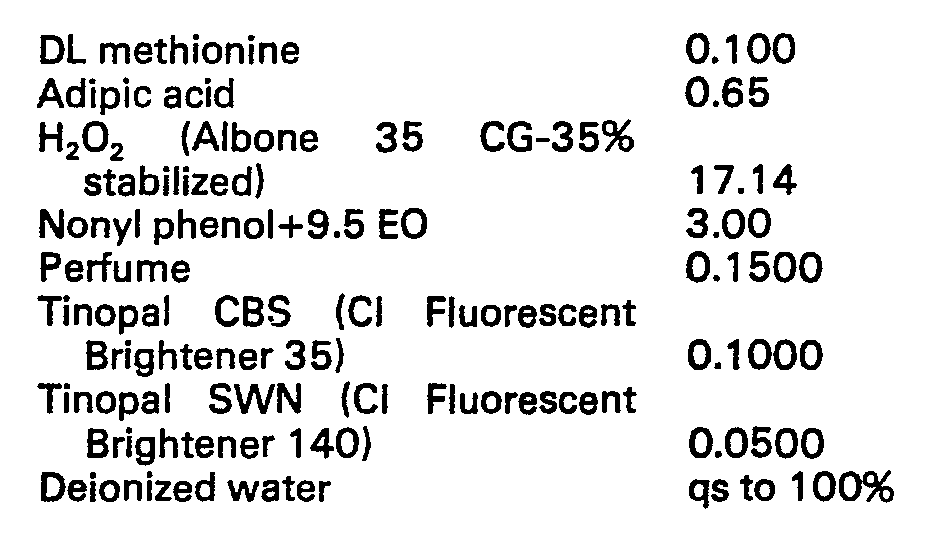
- The above formulation was prepared using the procedure of Example I and had a pH of 2.2. After storage at 23°C for one year, the composition contained 5.85% hydrogen peroxide and contained a reduced, though effective, amount of brighteners. The perfume had not degraded.
- The following formulation was prepared:

- The composition has a pH of 5.0 and is stable on storage the composition does not need added acid because of the amount of DL methionine present in the composition.
- The following formula was prepared:


- The composition has a pH of 3.2 and is not stable. All dyes and perfumes are degraded within 1 week storage at room temperature.
Claims (11)
Applications Claiming Priority (2)
| Application Number | Priority Date | Filing Date | Title |
|---|---|---|---|
| US06/005,127 US4238192A (en) | 1979-01-22 | 1979-01-22 | Hydrogen peroxide bleach composition |
| US5127 | 1979-01-22 |
Publications (2)
| Publication Number | Publication Date |
|---|---|
| EP0013886A1 EP0013886A1 (en) | 1980-08-06 |
| EP0013886B1 true EP0013886B1 (en) | 1982-07-14 |
Family
ID=21714320
Family Applications (1)
| Application Number | Title | Priority Date | Filing Date |
|---|---|---|---|
| EP80100046A Expired EP0013886B1 (en) | 1979-01-22 | 1980-01-04 | Hydrogen peroxide bleach composition |
Country Status (7)
| Country | Link |
|---|---|
| US (1) | US4238192A (en) |
| EP (1) | EP0013886B1 (en) |
| JP (1) | JPS55108500A (en) |
| AR (1) | AR220604A1 (en) |
| AU (1) | AU532553B2 (en) |
| CA (1) | CA1130958A (en) |
| DE (1) | DE3060656D1 (en) |
Families Citing this family (38)
| Publication number | Priority date | Publication date | Assignee | Title |
|---|---|---|---|---|
| CA1156404A (en) * | 1980-04-01 | 1983-11-08 | Eileen Smith | Aqueous bleach compositions |
| US4497725A (en) * | 1980-04-01 | 1985-02-05 | Interox Chemicals Ltd. | Aqueous bleach compositions |
| EP0086511B1 (en) * | 1982-02-03 | 1986-07-02 | THE PROCTER & GAMBLE COMPANY | Oxygen-bleach-containing liquid detergent compositions |
| US4597941A (en) * | 1984-03-28 | 1986-07-01 | The Drackett Company | Toilet cleaning article and method for codispensing disinfectant and dye having resistance to spectral degradation |
| GB8500116D0 (en) * | 1985-01-03 | 1985-02-13 | Unilever Plc | Liquid bleaching compositions |
| GB8508010D0 (en) * | 1985-03-27 | 1985-05-01 | Unilever Plc | Liquid bleaching compositions |
| US4900468A (en) * | 1985-06-17 | 1990-02-13 | The Clorox Company | Stabilized liquid hydrogen peroxide bleach compositions |
| US5180514A (en) * | 1985-06-17 | 1993-01-19 | The Clorox Company | Stabilizing system for liquid hydrogen peroxide compositions |
| US4772290A (en) * | 1986-03-10 | 1988-09-20 | Clorox Company | Liquid hydrogen peroxide/peracid precursor bleach: acidic aqueous medium containing solid peracid precursor activator |
| US4900469A (en) * | 1986-10-21 | 1990-02-13 | The Clorox Company | Thickened peracid precursor compositions |
| US4764302A (en) * | 1986-10-21 | 1988-08-16 | The Clorox Company | Thickening system for incorporating fluorescent whitening agents |
| US5089162A (en) * | 1989-05-08 | 1992-02-18 | Lever Brothers Company, Division Of Conopco, Inc. | Cleaning compositions with bleach-stable colorant |
| JP2688844B2 (en) * | 1989-06-15 | 1997-12-10 | ライオン株式会社 | Liquid bleach composition |
| US5106523A (en) * | 1989-06-16 | 1992-04-21 | The Clorox Company | Thickened acidic liquid composition with amine fwa useful as a bleaching agent vehicle |
| ATE145424T1 (en) * | 1989-11-30 | 1996-12-15 | Clorox Co | STABLE AQUEOUS OXIDATION DETERGENT |
| JP2602563B2 (en) * | 1989-12-15 | 1997-04-23 | 花王株式会社 | Liquid oxygen bleach composition |
| CA2049976C (en) * | 1990-02-01 | 1997-01-14 | William G. Woods | Stabilization of aqueous peroxygen solutions |
| GB2247030B (en) * | 1990-07-03 | 1994-01-12 | Grace W R & Co | The enhancement of fluorescent whitening agents |
| DE4029297A1 (en) * | 1990-09-15 | 1992-03-19 | Huels Chemische Werke Ag | AMINODICARBONIC ACIDS AND THEIR DERIVATIVES AS STABILIZERS FOR THE OXYGEN BLEACH IN TEXTILE LAUNDRY |
| US5180517A (en) * | 1990-11-05 | 1993-01-19 | United States Borax & Chemical Corporation | Stabilized liquid persalt bleach compositions |
| ATE98675T1 (en) * | 1991-06-14 | 1994-01-15 | Procter & Gamble | STABLE BLEACHING COMPOSITIONS CONTAINING HYDROGEN PEROXIDE. |
| US5338475A (en) * | 1991-08-16 | 1994-08-16 | Sterling Drug, Inc. | Carpet cleaning composition with bleach |
| GB9210526D0 (en) * | 1992-05-16 | 1992-07-01 | Laporte Esd Ltd | Compositions |
| US5292449A (en) * | 1992-11-24 | 1994-03-08 | Akzo Nv | Scale inhibiting composition |
| US5905065A (en) * | 1995-06-27 | 1999-05-18 | The Procter & Gamble Company | Carpet cleaning compositions and method for cleaning carpets |
| US5759439A (en) * | 1996-06-14 | 1998-06-02 | The Procter & Gamble Company | Peroxygen bleaching compositions comprising peroxygen bleach and a fabric protection agent suitable for use as a pretreater for fabrics |
| CN1193992A (en) * | 1995-06-27 | 1998-09-23 | 普罗格特-甘布尔公司 | Peroxygen bleaching composition containing fabric protectant |
| US6113654A (en) * | 1996-09-12 | 2000-09-05 | Peterson; David | Carpet cleaning composition |
| US5904734A (en) * | 1996-11-07 | 1999-05-18 | S. C. Johnson & Son, Inc. | Method for bleaching a hard surface using tungsten activated peroxide |
| US5997764A (en) * | 1997-12-04 | 1999-12-07 | The B.F. Goodrich Company | Thickened bleach compositions |
| EP1065263A1 (en) * | 1999-06-29 | 2001-01-03 | The Procter & Gamble Company | Bleaching compositions |
| RU2167191C1 (en) * | 1999-11-12 | 2001-05-20 | Парфенова Татьяна Аркадьевна | Multipurpose liquid washing and cleaning agent |
| DE10028998A1 (en) * | 2000-02-17 | 2001-08-23 | Bode Chemie Gmbh & Co Kg | Cleaning and disinfection systems for medical instruments |
| ITMI20012081A1 (en) * | 2001-10-09 | 2003-04-09 | 3V Sigma Spa | LIQUID COMPOSITIONS OF STABILIZED PEROXIDES |
| GB0314210D0 (en) * | 2003-06-18 | 2003-07-23 | Unilever Plc | Laundry treatment compositions |
| US20090304608A1 (en) * | 2008-06-05 | 2009-12-10 | Innovasource, Llc | Aqueous Hydrogen Peroxide Solution for Use as a Disinfectant or Anti-Microbial Personal Care Product |
| US9149550B2 (en) | 2012-10-02 | 2015-10-06 | Innovasource, Llc | Air and fabric freshener |
| JP7063688B2 (en) * | 2018-04-02 | 2022-05-09 | ライオン株式会社 | Liquid bleach composition |
Family Cites Families (17)
| Publication number | Priority date | Publication date | Assignee | Title |
|---|---|---|---|---|
| BE407008A (en) * | 1933-12-29 | |||
| US2022860A (en) * | 1935-03-13 | 1935-12-03 | Kunz Albert | Stabilized hydrogen peroxide composition |
| DE2047289B2 (en) * | 1970-09-25 | 1974-07-25 | Basf Ag, 6700 Ludwigshafen | Aqueous bleaching liquor |
| JPS5034674B2 (en) * | 1971-03-18 | 1975-11-10 | ||
| US3969257A (en) * | 1971-07-23 | 1976-07-13 | Colgate-Palmolive Company | Washing and bleaching composition containing bleach, activator and a nitrilotricarboxylic acid compound |
| JPS5438678B2 (en) * | 1971-12-24 | 1979-11-22 | ||
| US3811833A (en) * | 1972-06-30 | 1974-05-21 | Du Pont | Stabilized hydrogen peroxide compositions containing ammonium ions,and process for bleaching therewith |
| US3864271A (en) * | 1972-12-04 | 1975-02-04 | Du Pont | Stabilized acidic hydrogen peroxide solutions |
| US4060385A (en) * | 1972-12-06 | 1977-11-29 | Jerome Katz | Method for hydrogen peroxide bleaching in acid or neutral solutions |
| US4059678A (en) * | 1973-02-02 | 1977-11-22 | Fmc Corporation | Stabilization of iron-containing acidic hydrogen peroxide solutions |
| US3970575A (en) * | 1974-02-21 | 1976-07-20 | Purex Corporation | Liquid peroxygen bleach |
| JPS5137086A (en) * | 1974-09-25 | 1976-03-29 | Nippon Peroxide Co Ltd | |
| LU71985A1 (en) * | 1975-03-06 | 1977-01-28 | ||
| GB1565807A (en) * | 1975-12-18 | 1980-04-23 | Uilever Ltd | Process and compositions for cleaning fabrics |
| DE2654164C2 (en) * | 1976-11-30 | 1978-08-10 | Schuelke & Mayr Gmbh, 2000 Norderstedt | Aqueous perglutaric acid solution and its use |
| US4113645A (en) * | 1977-07-26 | 1978-09-12 | Polak's Frutal Works, Inc. | Bleach compositions containing perfume oils |
| JPS608040B2 (en) * | 1977-11-25 | 1985-02-28 | 花王株式会社 | Bleach composition that does not change color or pattern or cause fading |
-
1979
- 1979-01-22 US US06/005,127 patent/US4238192A/en not_active Expired - Lifetime
-
1980
- 1980-01-04 DE DE8080100046T patent/DE3060656D1/en not_active Expired
- 1980-01-04 EP EP80100046A patent/EP0013886B1/en not_active Expired
- 1980-01-08 CA CA343,221A patent/CA1130958A/en not_active Expired
- 1980-01-21 AR AR279701A patent/AR220604A1/en active
- 1980-01-21 JP JP464580A patent/JPS55108500A/en active Pending
- 1980-01-21 AU AU54759/80A patent/AU532553B2/en not_active Ceased
Also Published As
| Publication number | Publication date |
|---|---|
| AU5475980A (en) | 1980-07-31 |
| EP0013886A1 (en) | 1980-08-06 |
| AR220604A1 (en) | 1980-11-14 |
| AU532553B2 (en) | 1983-10-06 |
| JPS55108500A (en) | 1980-08-20 |
| CA1130958A (en) | 1982-09-07 |
| DE3060656D1 (en) | 1982-09-02 |
| US4238192A (en) | 1980-12-09 |
Similar Documents
| Publication | Publication Date | Title |
|---|---|---|
| US4238192A (en) | Hydrogen peroxide bleach composition | |
| JP2523339B2 (en) | Thickening system for wash products containing optical brightener | |
| EP0624640B2 (en) | Translucent, isotropic aqueous liquid bleach composition | |
| GB2297976A (en) | Improvements in or relating to a bleaching process | |
| US20070087954A1 (en) | Liquid detergent formulation with hydrogen peroxide | |
| EP1275708B1 (en) | Two-agent type liquid bleaching compositions | |
| US4497725A (en) | Aqueous bleach compositions | |
| US4822854A (en) | Cleaning compositions containing a colorant stabilized against fading | |
| JPS60144399A (en) | Laundry detergent composition | |
| JPH06508341A (en) | Stable hydrogen peroxide-containing bleaching composition | |
| US4931562A (en) | Piperidines | |
| US5349106A (en) | Process for reducing the residual content of free alkylating agent in aqueous solutions of cationic surfactants | |
| GB2072643A (en) | Aqueous H2O2 bleach compositions | |
| US5466870A (en) | Process for reducing the levels of nitrite contaminants in amine oxide surfactants | |
| US5478554A (en) | Process for reducing the content of free fromaldehyde and formic acid in nonionic and anionic surfactants | |
| US5468884A (en) | Liquid detergent compositions | |
| JPH0245600A (en) | Stabilized system of liquid hydrogen peroxide composition | |
| US5583258A (en) | Process for preparing mono-long chain amine oxide surfactants | |
| JPH0660006B2 (en) | Stabilization of peroxygen solution | |
| US5855622A (en) | Hydrogen peroxide-containing bleach liquor and bleaching method thereby | |
| FR2502170A1 (en) | DEINFECTANT CLEANING REINFORCING DEVICE FOR CHEMICAL CLEANING | |
| FI80914B (en) | FOERFARANDE FOER BLEKNING AV HUSHAOLLSTVAETT I EN TVAETTNINGSCYKEL. | |
| TW202428861A (en) | Liquid detergent products | |
| KR100443313B1 (en) | Stabilizing composition of 3-isothiazolone aqueous solution and method for producing the same | |
| JPH0959675A (en) | Liquid bleach composition |
Legal Events
| Date | Code | Title | Description |
|---|---|---|---|
| PUAI | Public reference made under article 153(3) epc to a published international application that has entered the european phase |
Free format text: ORIGINAL CODE: 0009012 |
|
| AK | Designated contracting states |
Designated state(s): BE DE FR GB IT NL |
|
| 17P | Request for examination filed | ||
| ITF | It: translation for a ep patent filed | ||
| GRAA | (expected) grant |
Free format text: ORIGINAL CODE: 0009210 |
|
| AK | Designated contracting states |
Designated state(s): BE DE FR GB IT NL |
|
| REF | Corresponds to: |
Ref document number: 3060656 Country of ref document: DE Date of ref document: 19820902 |
|
| PGFP | Annual fee paid to national office [announced via postgrant information from national office to epo] |
Ref country code: FR Payment date: 19831215 Year of fee payment: 5 |
|
| PGFP | Annual fee paid to national office [announced via postgrant information from national office to epo] |
Ref country code: BE Payment date: 19831231 Year of fee payment: 5 |
|
| PGFP | Annual fee paid to national office [announced via postgrant information from national office to epo] |
Ref country code: NL Payment date: 19850108 Year of fee payment: 6 |
|
| PGFP | Annual fee paid to national office [announced via postgrant information from national office to epo] |
Ref country code: DE Payment date: 19850109 Year of fee payment: 6 |
|
| PG25 | Lapsed in a contracting state [announced via postgrant information from national office to epo] |
Ref country code: BE Effective date: 19860131 |
|
| BERE | Be: lapsed |
Owner name: S.C. JOHNSON & SON INC. Effective date: 19860131 |
|
| PG25 | Lapsed in a contracting state [announced via postgrant information from national office to epo] |
Ref country code: NL Effective date: 19860801 |
|
| GBPC | Gb: european patent ceased through non-payment of renewal fee | ||
| NLV4 | Nl: lapsed or anulled due to non-payment of the annual fee | ||
| PG25 | Lapsed in a contracting state [announced via postgrant information from national office to epo] |
Ref country code: FR Free format text: LAPSE BECAUSE OF NON-PAYMENT OF DUE FEES Effective date: 19860930 |
|
| PG25 | Lapsed in a contracting state [announced via postgrant information from national office to epo] |
Ref country code: DE Effective date: 19861001 |
|
| REG | Reference to a national code |
Ref country code: FR Ref legal event code: ST |
|
| PG25 | Lapsed in a contracting state [announced via postgrant information from national office to epo] |
Ref country code: GB Effective date: 19881118 |
|
| PLBE | No opposition filed within time limit |
Free format text: ORIGINAL CODE: 0009261 |
|
| STAA | Information on the status of an ep patent application or granted ep patent |
Free format text: STATUS: NO OPPOSITION FILED WITHIN TIME LIMIT |