EP0013837B1 - Process for producing an ethylene copolymer - Google Patents
Process for producing an ethylene copolymer Download PDFInfo
- Publication number
- EP0013837B1 EP0013837B1 EP79303068A EP79303068A EP0013837B1 EP 0013837 B1 EP0013837 B1 EP 0013837B1 EP 79303068 A EP79303068 A EP 79303068A EP 79303068 A EP79303068 A EP 79303068A EP 0013837 B1 EP0013837 B1 EP 0013837B1
- Authority
- EP
- European Patent Office
- Prior art keywords
- titanium
- alpha
- amount
- olefin
- ethylene
- Prior art date
- Legal status (The legal status is an assumption and is not a legal conclusion. Google has not performed a legal analysis and makes no representation as to the accuracy of the status listed.)
- Expired
Links
Classifications
-
- C—CHEMISTRY; METALLURGY
- C08—ORGANIC MACROMOLECULAR COMPOUNDS; THEIR PREPARATION OR CHEMICAL WORKING-UP; COMPOSITIONS BASED THEREON
- C08F—MACROMOLECULAR COMPOUNDS OBTAINED BY REACTIONS ONLY INVOLVING CARBON-TO-CARBON UNSATURATED BONDS
- C08F297/00—Macromolecular compounds obtained by successively polymerising different monomer systems using a catalyst of the ionic or coordination type without deactivating the intermediate polymer
- C08F297/06—Macromolecular compounds obtained by successively polymerising different monomer systems using a catalyst of the ionic or coordination type without deactivating the intermediate polymer using a catalyst of the coordination type
- C08F297/08—Macromolecular compounds obtained by successively polymerising different monomer systems using a catalyst of the ionic or coordination type without deactivating the intermediate polymer using a catalyst of the coordination type polymerising mono-olefins
-
- C—CHEMISTRY; METALLURGY
- C08—ORGANIC MACROMOLECULAR COMPOUNDS; THEIR PREPARATION OR CHEMICAL WORKING-UP; COMPOSITIONS BASED THEREON
- C08F—MACROMOLECULAR COMPOUNDS OBTAINED BY REACTIONS ONLY INVOLVING CARBON-TO-CARBON UNSATURATED BONDS
- C08F210/00—Copolymers of unsaturated aliphatic hydrocarbons having only one carbon-to-carbon double bond
- C08F210/16—Copolymers of ethene with alpha-alkenes, e.g. EP rubbers
-
- Y—GENERAL TAGGING OF NEW TECHNOLOGICAL DEVELOPMENTS; GENERAL TAGGING OF CROSS-SECTIONAL TECHNOLOGIES SPANNING OVER SEVERAL SECTIONS OF THE IPC; TECHNICAL SUBJECTS COVERED BY FORMER USPC CROSS-REFERENCE ART COLLECTIONS [XRACs] AND DIGESTS
- Y10—TECHNICAL SUBJECTS COVERED BY FORMER USPC
- Y10S—TECHNICAL SUBJECTS COVERED BY FORMER USPC CROSS-REFERENCE ART COLLECTIONS [XRACs] AND DIGESTS
- Y10S526/00—Synthetic resins or natural rubbers -- part of the class 520 series
- Y10S526/904—Monomer polymerized in presence of transition metal containing catalyst at least part of which is supported on a polymer, e.g. prepolymerized catalysts
Definitions
- This invention relates to a process for producing an ethylene copolymer composed of a predominant amount of ethylene and a minor amount of an alpha-olefin containing at least 3 carbon atoms which has a high bulk density and a low density.
- the low-density ethylene copolymer is to be obtained by the slurry polymerization which is frequently used in the production of high-density pQlyethylene
- the copolymer is liable to be dissolved in, or swollen with, the polymerization solvent, an the concentration of the slurry cannot be increased because of the increase in the viscosity of the poly er solution, the adhesion of the polymer to the wall of the polymerization vessel, and the reduction of the bulk density of the polymer, and moreover, the operation cannot be performed continuously for a long period of time.
- the quality of the resulting polymer is unsatisfactory because it becomes sticky.
- Japanese Laid-Open Patent Publication No. 52487/76 discloses a process for producing a low-density ethylene copolymer having a high bulk density, which comprises a first step wherein in the presence of a liquid diluent and a catalyst composed of (1) a titanium catalyst component supported on a magnesium compound obtained by copulverizing a titanium compound selected from titanium tetrachloride, titanium trichloride and titanium trichloride compositions, a magnesium halide and an aluminum halide/ether complex, and (2) an organoaluminum compound catalyst component, ethylene is polymerized in an amount of at least 5 g per gram of the titanium catalyst component, the amount of ethylene plolymerized being up to 20% of the amount of the final product of ethylene copolymer formed, and subsequently a second step wherein a predominant amount of ethylene is copolymerized with a minor amount of an alpha-olefin containing at least 3
- Japanese Laid-Open Patent Publication No. 121689/77 discloses a process for producing a low-density polyethylene containing a minor amount of an alpha-olefin containing at least 3 carbon atoms having a density of not more than 0.945 g/cm 3 , which comprises a first step wherein in the presence of a catalyst composed of a titanium catalyst component supported on a magnesium and/or aluminum compound consisting of a magnesium and/or aluminum compound and titanium tetrachloride and an organoaluminum compound, ethylene is polymerized in an amount of 1 to 50 g per gram of the titanium catalyst component, a second step wherein ethylene is copolymerized with an alpha-olefin containing at least 3 carbon atoms so that the proportion of the alpha-olefin is 10 to 80% of the final product of ethylene copolymer formed while in the initial stage it is adjusted to not more than 3% by weight based on the ethylene
- Japanese Laid-Open Patent Publication No. 124089/77 discloses a process, similar to those of the two Publications cited above, for the production of an ethylene copolymer having a density of from 0.925 to 0.950 g/cm 3 composed of a predominant amount of ethylene and a minor amount of an alpha-olefin containing at least 3 carbon atoms, which comprises a first step wherein in the prsence of a catalyst composed of a titanium or vanadium catalyst component supported on a magnesium compound and an organoaluminum compound catalyst component, ethylene is polymerized in an amount of at least 50 g per gram of the titanium or vanadium catalyst component, the amount of ethylene polymerized being adjusted to not more than 20% based on the final product of ethylene copolymer formed, and subsequently a second step wherein a predominant amount of ethylene is copolymerized with a minor amount of an alpha-olefin containing at least 3 carbon atoms at
- a two stage process for producing an ethylene copolymer having a density of from 0.900 to 0.945 g/cm 3 by copolymerizing a predominant amount of ethylene with a minor amount of an alpha-olefin containing at least 3 carbon atoms which process comprises
- the copolymerization of a predominant amount of ethylene with a minor amount of an alpha-olefin containing at least 3 carbon atoms is carried out by a two-stage process involving the stages (i) and (ii) described hereinabove.
- the catalyst used in the process is composed of (A) a titanium catalyst component supported on a magnesium compound and (B) an organoaluminum compound, and also comprises (C) an organic acid ester.
- the organic acid ester may be supported in the component (A), or form a complex with part of the component (B).
- the components (A) and (B) may be separately fed into the polymerization vessel at the time of polymerization instead of mixing them prior to introduction into the polymerization vessel.
- a method which comprises reacting a titanium compound directly with a magnesium compound such as a magnesium halide, an alkoxymagnesium, an aryloxymagnesium, an alkoxymagnesium halide, magnesium oxide, magnesium hydroxide, hydrotalcite or Grignard compounds, and a method which comprises reacting the aforesaid magnesium compound with an electron donor, an organoaluminum compound, a silicon compound, etc., and reacting the resulting product with the titanium compound.
- a magnesium compound such as a magnesium halide, an alkoxymagnesium, an aryloxymagnesium, an alkoxymagnesium halide, magnesium oxide, magnesium hydroxide, hydrotalcite or Grignard compounds
- a method which comprises reacting the aforesaid magnesium compound with an electron donor, an organoaluminum compound, a silicon compound, etc. and reacting the resulting product with the titanium compound.
- the reaction of the magnesium compound with the titanium compound to support the latter on the former can be performed
- the titanium catalyst component (A) preferably contains 0.3 to 12% by weight, particularly 0.6 to 10% by weight, of titanium and has a halogen/titanium atomic ratio of from 4 to 200, particularly from 6 to 100 and a magnesium/titanium atomic ratio of from 2 to 100, particularly from 3 to 50.
- the component (A) has a specific surface area of at least 20 m 2 /g, especially 50 to 800 m 2 /g.
- the catalyst comprises an organic acid ester (C).
- component (C) may be included in the titanium catalyst component (A).
- the mole ratio of organic acid ester/titanium is preferably from 0.1 to 7, especially from 0.2 to 6.
- One example of the production of the component (A) containing the organic acid ester is described in German Laid-Open Patent Publication DE-A-No. 2,739,608.
- the titanium catalyst component (A) has an average particle diameter in the range of 5 to 200 microns.
- the geometric standard deviation U g of its particle size distribution is not more than 2.5, preferably not more than 2.1.
- the preferred shape of the titanium catalyst component (A) is a sphere, ellipse, flake, etc. Suitable methods for the production of a titanium catalyst component of these properties are described, for example, in DE-A-2,346,471, DE-A-2,345,707. DE-A-2,641,960, DE-A-2,839,188 and DE-A-2,735,672. Or it can be obtained by treating a magnesium alkoxyhalide obtained by the reaction of a Grignard compound and a silicic acid ester, with a halogenating agent and/or an organic acid ester, and reacting the product with the titanium compound.
- titanium compound used in the preparation of the titanium catalyst component (A) examples include titanium halides such as titanium tetrachloride, titanium tetrabromide and titanium tetraiodide and titanium alkoxyhalides having a C 1 ⁇ C 8 alkoxy group, for example, alkoxytitanium trihalides such as Ti(OCH 3 )CI 3 , Ti(OC 2 H 5 )Cl 3 , Ti(O N-C 4 H 9 )Cl 3 , Ti(OC 6 H 13 )Cl 3 , Ti(OC 8 H 17 )Cl 3 , Ti(OC 2 H 5 )Br 3 and Ti(O iso-C 4 H 9 )Br 3 ; alkoxytitanium dihalides such as Ti(OCH 3 ) 2 Cl 2 , Ti(OC 2 H 5 ) 2 Cl 2 , Ti(O n-C 4 H 9 ) 2 Cl 2 , and Ti(OC 2 H 5 ) 2 Br 2 ; trialkoxytitan
- organoaluminum compound (B) another constituent element of the catalyst used in the process of this invention, is an organoaluminum compound having at least one AI-carbon bond in the molecule. Examples of such an organoaluminum compound are given below.
- organoaluminum compounds belonging to (T) are trialkyl aluminums such as triethyl aluminum and tributyl aluminum; trialkenyl aluminums such as triisoprenyl aluminum; partially alkoxylated alkyl aluminums, for example, dialkyl aluminum alkoxides such as diethyl aluminum ethoxide and dibutyl aluminum butoxide; alkyl aluminum sesquialkoxides such as ethyl aluminum sesquiethoxide and butyl aluminum sesquibutoxide; compounds having an average composition expressed by Al(OR 2 ) 0.5 ; partially halogenated alkyl aluminums, for example, dialkyl aluminum halides such as diethyl aluminum chloride, dibutyl aluminum chloride and diethyl aluminum bromide; alkyl aluminum sesquihalides such as ethyl aluminum sesquichloride, butyl aluminum sesquichloride and ethyl aluminum sesquibromide; alkyl aluminum dihalides such as
- organoaluminum compounds in which two or more aluminum atoms are bonded through an oxygen or nitroqen atom, as aluminum compounds similar to those of formula (1).
- Specific examples are (C 2 H 5 ) 2 AlOAI(C 2 H 5 ) 2 , (C 4 H 9 ) 2 AlOAI(C 4 H 9 ) 2 and
- Examples of the component (B) belonging to (2) above are LiAl(C 2 H 5 ) 4 and LiAl(C 7 H 15 ) 4 .
- organoaluminum compounds (B) those belonging to (1) above are preferred, and trialkylaluminums and/or alkyl aluminum halides are espeically preferred.
- the catalyst utilized in the present invention further includes an organic acid ester (C).
- the organic acid ester includes, for example, C 2 ⁇ C 20 aliphatic carboxylic acid esters, C 6 ⁇ C 20 alicyclic carboxylic acid esters, C 7 ⁇ C 20 aromatic carboxylic acid esters, C 5 ⁇ C 20 lactones, and C 3 ⁇ C 8 carbonic acid esters.
- organic acid ester (C) examples include aliphatic carboxylic acid esters such as methyl acetate, butyl acetate, vinyl acetate, ethyl propionate, isopropyl butyrate, cyclohexyl acetate, phenyl acetate, benzyl acetate, methyl chloroacetate, methyl methacrylate, methyl laurate, and methyl stearate; alicyclic carboxylic acid esters such as methyl cyclohexanecarboxylate; aromatic carboxylic acid esters such as methyl benzoate, ethyl benzoate, isopropyl benzoate, N-butyl benzoate, vinyl benzoate, cyclohexyl benzoate, phenyl benzoate, methyl toluate, ethyl toluate, methyl anisate, ethyl anisate, dimethyl phthalate and methyl chlorobenzoate; lactones such as alipha
- the first stage (i) (or the pre-polymerization step) and the second stage (ii) are carried out in the presence of the catalyst described above, preferably in an inert hydrocarbon solvent.
- a small amount of an alpha-olefin containing at least 3 carbon atoms is polymerized.
- ethylene in an amount of not more than 10 mole% of ethylene may be copolymerized with the alpha-olefin.
- the amount of alpha-olefin polymerized in the pre-polymerization step (i) is 0.01 to 50 g, preferably 0.05 to 20 g, per gram of the titanium catalyst component (A). If this amount exceeds the upper limit described above fish eyes may occur.
- Examples of the inert hydrocarbon solvent preferably used in the pre-polymerization include aliphatic hydrocarbons such as propane, butane, n-pentane, iso-pentane, n-hexane, n-octane, isooctane, n-decane, n-dodecane and kerosene; alicyclic hydrocarbons such as cyclopentane, methyl cyclopentane, cyclohexane and methylcyclohexane; aromatic hydrocarbons such as benzene, toluene and xylene; and halogenated hydrocarbons such as methylene chloride, ethyl chloride, ethylene chloride and chlorobenzene. Of these, aliphatic hydrocarbons, especially those having 4 to 10 carbon atoms, are preferred.
- the pre-polymerization step (i) it is preferred to use 0.001 to 500 millimoles, especially 0.005 to 200 millimoles, calculated as titanium atom of the titanium catalyst component (A) per liter of the inert hydrocarbon solvent.
- the organoaluminum compound (B) is used in such a proportion that the AIM atomic ratio is from 0.1 to 1000, especially from 0.5 to 500.
- the organic acid ester (C) may be supported on the component (A), or may be used as an adduct with a part of the component (B). Also, it may be added in the free state to the polymerization system. In any case, the amount of the organic acid ester to be present is from 0.1 to 200 moles, especially from 0.2 to 50 moles, per mole of titanium atom.
- Suitable alpha-olefins containing at least 3 carbon atoms used in the pre-polymerization step (i) are those having not more than 18 carbon atoms such as propylene, 1-butene, 1-hexene, 4-methyl-1-pentene, 3-methyl-1-pentene, 1-heptene, 1-octene, 1-decene, 1-dodecene, 1-tetradecene, and 1-octadecene. Those having 3 to 6 carbon atoms are especially preferred.
- These alpha-olefins may be homopolymerized, or copolymersed with each other so long as a crystalline polymer results, or may also be copolymerized with not more than 10 mole% of ethylene as mentioned above.
- the polymerization temperature in the first stage (I) may be selected according to the type of the alpha-olefin or the hydrocarbon solvent, and may, for example, be -40°C to 80°C.
- the suitable polymerization temperature is -40°C to 70°C.
- butene-1 it is -40°C to 40°C; and in the case of 4-methyl-1-pentene, or 3-methyl-1-pentene, it is -40°C to 70°C.
- the prepolymerization in (i) may be carried out in the copresence of hydrogen.
- ethylene and an alpha-olefin containing at least 3 carbon atoms are copolymerized in the presence of the catalyst used in prepolymerizing the alpha-olefin having at least 3 carbon atoms, thereby to produce an ethylene copolymer having a density of 0.900 to 0.945 g/ cm 3 .
- Suitable alpha-olefins having at least 3 carbon atoms used in the second stage (ii) include those having not more than 18 carbon atoms such as propylene, 1-butene, 1-pentene, 1-hexene, 4-methyl-1-pentene, 1-heptene, 1-octene, 1-decene, 1-dodecene, 1-tetradecene, and 1-octadecene.
- the copolymerization step (ii) is carried out at a temperature of not more than 100°C, preferably from 30 to 85°C, under such conditions that the resulting copolymer is not melted.
- the copolymerization in step (ii) is carried out so that the amount of the final copolymer obtained is at least 100, preferably at least 500, more preferably at least 1000, times the amount of the polymer formed in the first step (i).
- the copolymerization in step (ii) may be carried out in slurry, or in the gaseous phase in the absence of a liquid hydrocarbon.
- the present invention exhibits a marked effect when it is applied to slurry polymerization.
- hydrocarbon medium inert hydrocarbons of the types exemplified above with regard to step (i) or alpha-olefins are used.
- Aliphatic hydrocarbons especially those having 3 to 12 carbon atoms, are preferred.
- the great advantage of this invention is that good results can be obtained even when a solvent having a boiling point higher than 40°C is used.
- the concentration of the catalyst in the slurry polymerization is preferably such that the amount of the titanium catalyst component (A) is 0.001 to 1 millimole, more preferably 0.003 to 0.1 millimole, calculated as titanium atom, per liter of the liquid phase, the amount of the organoaluminum compound (B) is such that the AI/titanium atomic ratio is from 2 to 2000, more preferably from 10 to 1000, and the amount of the organic acid ester (C) is 0.1 to 200 moles per mole of titanium atom.
- the amount of the alpha-olefin in the copolymer is limited, for example, to 0.2 to 30% by weight, especially 0.3 to 25% by weight, although it differs depending upon the type of the catalyst or the type of the alpha-olefin.
- the rate of feed of the alpha-olefin is properly selected depending upon the polymerization conditions such as the polymerization temperature and pressure.
- the polymerization pressure is generally from 9.81 x 10 1 to 9 . 81 x 10 3 kPa (1 to 100 kg/cm 3 ),
- a molecular weight controlling agent such as hydrogen may be fed into the polymerization system.
- Various electron donors, and silicon, boron or tin compounds may be added to the catalyst system in order to increase the catalyst activity or regulate the molecular weight distribution of the copolymer.
- the copolymerization of this invention may be carried out in two or more stages in which different conditions are employed.
- the supernatant portion was withdrawn, and 10 moles of titanium tetrachloride was added to the remaining solid portion, and they were reacted at 120°C for 2 hours.
- the titanium tetrachloride was withdrawn, and then under the same conditions as above, titanium tetrachloride was reacted to support Ti. After the reaction, the solid portion was repeatedly washed with hexane. The resulting solid was analyzed for composition. It was found that the solid contained 29 mg of Ti, 205 mg of Mg, 650 mg of Cl, and 87 mg of ethyl benzoate per gram thereof.
- the Ti catalyst component had an average particle diameter of 18.6 microns, a geometric standard deviation ag of particle size distribution of 1.51, and a specific surface area of 230 m 2 /g.
- the titanium catalyst component obtained above was diluted with dehydrated and purified hexane so that the concentration of the catalyst component was 30 millimoles/liter calculated as titanium atom, and 3 millimoles of triethylaluminum and 1 millimole of methyl toluate were added per millimole of titanium atom.
- Propylene was then fed at 30°C under atmospheric pressure, and reacted in an amount of 1.62 g per gram of the solid catalyst, thus pre-treating the catalyst with propylene.
- Ethylene and 1-butene were thus polymerized at 65°C for 2 hours to afford 322 g of an ethylene copolymer having a bulk density of 0.46 g/cm 3 and a melt index of 1.7 and a density of 0.928 g/cm 3 .
- the proportion of the dissolved polymer based on the hexane solvent was 2.9% by weight.
- Example 1 Various runs were conducted using the catalyst prepared by the method of Example 1 in the same way as in Example 1 except that the conditions for pre-treating with the alpha-olefin were changed, the polymerization solvent used in the polymerization of ethylene and the alpha-olefin was changed, or the type of the alpha-olefin was changed, as shown in Tables 1-1 and 1-2. The results obtained are also shown in Table 1-2.
- Catalysts were synthesized in the same way as in Example 1 except that various esters were used instead of the ethyl benzoate, and were pre-treated with propylene in the same way as in Example 1. Then, under the same polymerization conditions as in Example 1, ethylene and 1-butene were copolymerized. The results obtained are shown in Table 2.
- the resulting solid contained 63 mg of Ti, 590 mg of Cl, 185 mg of Mg and 155 mg of the OEt group per gram thereof.
- the solid catalyst had a specific surface area of 225 m 2 /g of solid, an average particle diameter of 16.6 microns and a geometric standard deviation of particle size distribution of 1.69.
- the titanium catalyst component obtained as above was diluted with dehydrated and purified hexane so that the concentration of the catalyst component reached 30 millimoles/liter calculated as titanium atom. Then, 3 millimoles of triethyl aluminum and 1 millimole of methyl p-toluate were added per millimole of titanium atom. Subsequently, propylene was fed at 20°C under atmospheric pressure, and 1.29 g of propylene was reacted per gram of the solid catalyst to pre-treat the catalyst.
- one liter of dehydrated and purified hexane was put into a 2-liter autoclave.
- the inside of the autoclave was sufficiently purged with nitrogen, and 1.0 millimole of triethyl aluminum and 0.01 millimole, calculated as ititanium atom, of the above catalyst pre-treated with propylene were added.
- hydrogen under 98.1 kPa (1 kg/cm 2 ) was charged, and ethylene containing 6.3 mole% of 1-butene was continuously added so that the total pressure in the autoclave reached 392.4 kPa (4 kg/cm 2 ).
- ethylene and 1-butene were copolymerized at 65°C for 2 hours to afford 255 g of an ethylene copolymer having a bulk density of 0.39 g cm 3 and a melt index of 1.3 and a density of 0.932 g/cm 3 .
- the proportion of the dissolved polymer based on the hexane solvent was 3.0% by weight.
- the resulting solid was washed twice with 150 ml of kerosene, and 150 ml of titanium tetrachloride was added. They were reacted at 130°C for 2 hours. The reaction mixture was repeatedly washed with hexane. The solid was analyzed for composition, was found to contain 20 mg of Ti, 310 mg of Cl, 330 mg of Mg and 38 mg of ethyl benzoate. The resulting catalyst had an average particle diameter of 37 microns,a geometric standard deviation of particle size distribution of 1.40, and a specific surface area of 90 m 2 /g.
- the titanium catalyst component obtained as above was diluted with dehydrated and purified hexane so that the concentration of the catalyst component reached 20 millimoles/liter. Then, 3 millimoles of triethyl aluminum and 1 millimole of methyl p-toluate were added per millimole of titanium atom. Subsequently, propylene was fed at 10°C under atmospheric pressure, and propylene was reacted in an amount of 1.40 g per gram of the solid catalyst. The catalyst was pre-treated with propylene.
- ethylene and 1-butene were copolymerized at 60°C for 2 hours to afford 331 g of a copolymer having a bulk density of 0.40 g/cm 2 and a melt index of 0.95 and a density of 0.929 g/cm 3 .
- the proportion of the polymer dissolved in the hexane solvent was 5.1 % by weight.
- anhydrous magnesium chloride (20 g) and 6.0 ml of ethyl benzoate were charged into a stainless steel vessel having a capacity of 800 ml and an inside diameter of 100 mm and containing 100 stainless steel (SUS-302) balls having a diameter of 15 mm in an atmosphere of nitrogen, and copulverized for 50 hours by a vibratory mill device having a power of 7 G.
- the solid treated product obtained was suspended in titanium tetrachloride, and reacted at 100°C for 2 hours. The solid portion was separated by filtration, and repeatedly washed with hexane.
- the resulting solid catalyst component was analyzed for composition, and found to contain 21 mg of Ti, 210 mg of Mg, 670 mg of CI and 88 mg of ethyl benzoate.
- the titanium catalyst component had an average particle diameter of 17.8 microns, a geometric standard deviation of particle size distribution of 2.24, and a specific surface area of 185 m 2 /g.
- Example 2 The same pre-treatment as in Example 1 was performed to polymerize 1.7 g of propylene per gram of the catalyst. Subsequently, ethylene and 1-butene were copolymerized in the same way as in Example 21 to afford 244 g of an ethylene copolymer having a bulk density of 0.35 g/cm 3 and a melt index of 1.1. The ethylene copolymer had a density of 0.931 g/cm 3. The proportion of the dissolved polymer based on the hexane solvent was 3.9% by weight.
- anhydrous magnesium chloride (20 g) was charged into a stainless steel vessel having a capacity of 800 ml and a diameter of 100 mm and containing 100 stainless steel (SUS-302) balls each having a diameter of 15 mm in an atmosphere of nitrogen, and pulverized for 50 hours by a vibratory mill device having a power of 7 G.
- the resulting solid treated product was suspended in titanium tetrachloride, and reacted at 120°C for 2 hours. The solid portion was separated by filtration, and washed repeatedly with hexane.
- the resulting solid catalyst component was analyzed for composition, and it was found that the solid contained 10 mg of Ti, 235 mg of Mg, and 730 mg of CI per gram thereof.
- the resulting titanium catalyst component had an average particle diameter of 12.2 microns, a geometric standard deviation of particle size distribution of 2.31, and a specific surface area of 55 m 2 / g .
- the catalyst was pre-treated with propylene in an amount of 1.43 g per gram of the catalyst. At this time, an electron donor such as methyl p-toluate was absent in the reaction system. Ethylene and 1-butene were copolymerized under the same conditions as in Example 1 using the pre-treated catalyst. There was obtained 115 g of an ethylene copolymer having a bulk density of 0.22 g/cm 3 and a melt index of 1.9. The resulting copolymer had a density of 0.941 g/cm 3 . The proportion of the dissolved polymer based on the hexane solvent was 10.6% by weight. Thus, the bulk density and the yield of the polymer were very poor.
- Example 2 titanium tetrachloride was reacted without reacting ethyl benzoate in the synthesis of the titanium catalyst component. After the reaction, the solid was analyzed for composition, and found to contain 59 mg of Ti, 210 mg of Mg and 690 mg of CI per gram thereof.
- the resulting titanium catalyst component was pre-treated with propylene in an amount of 1.58 g per gram of the solid catalyst. At this time, methyl p-toluate was not added.
- ethylene and 1-butene were copolymerized under the same conditions as in Example 1 in a 2-liter autoclave using the res ting titanium catalyst component. There was obtained 267 g of an ethylene copolymer having a bulk density of 0.31 g/cm 3 and a melt index of 1.8. The resulting copolymer had a density of 0.936 g/cm 3. The proportion of the dissolved polymer based on the hexane solvent was 7.3% by weight.
Landscapes
- Chemical & Material Sciences (AREA)
- Health & Medical Sciences (AREA)
- Chemical Kinetics & Catalysis (AREA)
- Medicinal Chemistry (AREA)
- Polymers & Plastics (AREA)
- Organic Chemistry (AREA)
- Inorganic Chemistry (AREA)
- Transition And Organic Metals Composition Catalysts For Addition Polymerization (AREA)
- Addition Polymer Or Copolymer, Post-Treatments, Or Chemical Modifications (AREA)
- Polymerisation Methods In General (AREA)
Abstract
Description
- This invention relates to a process for producing an ethylene copolymer composed of a predominant amount of ethylene and a minor amount of an alpha-olefin containing at least 3 carbon atoms which has a high bulk density and a low density.
- It is known that copolymerization of ethylene with a minor amount of an alpha-olefin containing at least 3 carbon atoms in the presence of a Ziegler catalyst affords ethylene copolymers having much the same density as high-pressure polyethylene. Generally, it is advantageous to use high-temperature melt polymerization which is carried out at a temperature above the melting point of the copolymer formed using a hydrocarbon solvent, because the polymerization operation of such a method is generally easy. When it is desired to obtain a copolymer having a sufficiently high molecular weight, however, the concentration of the polymer in the solution must be reduced because the viscosity of the polymer solution increases. Accordingly, this causes the defect that the output of the copolymer per unit polymerization vessel is inevitably low.
- On the other hand, when the low-density ethylene copolymer is to be obtained by the slurry polymerization which is frequently used in the production of high-density pQlyethylene, the copolymer is liable to be dissolved in, or swollen with, the polymerization solvent, an the concentration of the slurry cannot be increased because of the increase in the viscosity of the poly er solution, the adhesion of the polymer to the wall of the polymerization vessel, and the reduction of the bulk density of the polymer, and moreover, the operation cannot be performed continuously for a long period of time. Moreover, the quality of the resulting polymer is unsatisfactory because it becomes sticky.
- In an attempt to remove the aforesaid defects associated with the production of a low-density ethylene copolymer composed of a predominant amount of ethylene with a minor amount of an alpha-olefin containing at least 3 carbon atoms, some methods for the multi-step copolymerization of ethylene with a minor amount of an alpha-olefin containing at least 3 carbon atoms have been suggested.
- For example, Japanese Laid-Open Patent Publication No. 52487/76 (laid-open on May 10, 1976) discloses a process for producing a low-density ethylene copolymer having a high bulk density, which comprises a first step wherein in the presence of a liquid diluent and a catalyst composed of (1) a titanium catalyst component supported on a magnesium compound obtained by copulverizing a titanium compound selected from titanium tetrachloride, titanium trichloride and titanium trichloride compositions, a magnesium halide and an aluminum halide/ether complex, and (2) an organoaluminum compound catalyst component, ethylene is polymerized in an amount of at least 5 g per gram of the titanium catalyst component, the amount of ethylene plolymerized being up to 20% of the amount of the final product of ethylene copolymer formed, and subsequently a second step wherein a predominant amount of ethylene is copolymerized with a minor amount of an alpha-olefin containing at least 3 carbon atoms α- a temperature of not over 100°C using a low boiling hydrocarbon having a boiling point of not more than 40°C as a diluent. In this process, it is essential to polymerize a small amount of ethylene in the first step. The Publication does not at all refer to the use of an organic acid ester. Moreover, in this process, the boiling point of the liquid diluent used in the second step is greatly limited.
- Japanese Laid-Open Patent Publication No. 121689/77 (laid-open on October 13, 1977) discloses a process for producing a low-density polyethylene containing a minor amount of an alpha-olefin containing at least 3 carbon atoms having a density of not more than 0.945 g/cm3, which comprises a first step wherein in the presence of a catalyst composed of a titanium catalyst component supported on a magnesium and/or aluminum compound consisting of a magnesium and/or aluminum compound and titanium tetrachloride and an organoaluminum compound, ethylene is polymerized in an amount of 1 to 50 g per gram of the titanium catalyst component, a second step wherein ethylene is copolymerized with an alpha-olefin containing at least 3 carbon atoms so that the proportion of the alpha-olefin is 10 to 80% of the final product of ethylene copolymer formed while in the initial stage it is adjusted to not more than 3% by weight based on the ethylene, and a third step wherein the reaction is completed while the proportion of the alpha-olefin copolymerized is increased to more than that in the second stage and up to 20% by weight based on ethylene, characterized in that the copolymerization is carried out in slurry in a hydrocarbon solvent having a boiling point of not more than 40°C at a temperature of not more than 100°C. In this process, too, the polymerization of a small amount of ethylene in the first step is essential, and the Publication does not at all describe the use of an organic acid ester. Furthermore, the process of this Publication requires three steps, and therefore, is complicated and disadvantageous in operation. Moreover, the boiling point of the liquid diluent used in the copolymerization is greatly restricted.
- Japanese Laid-Open Patent Publication No. 124089/77 (laid open on October 18, 1977) discloses a process, similar to those of the two Publications cited above, for the production of an ethylene copolymer having a density of from 0.925 to 0.950 g/cm3 composed of a predominant amount of ethylene and a minor amount of an alpha-olefin containing at least 3 carbon atoms, which comprises a first step wherein in the prsence of a catalyst composed of a titanium or vanadium catalyst component supported on a magnesium compound and an organoaluminum compound catalyst component, ethylene is polymerized in an amount of at least 50 g per gram of the titanium or vanadium catalyst component, the amount of ethylene polymerized being adjusted to not more than 20% based on the final product of ethylene copolymer formed, and subsequently a second step wherein a predominant amount of ethylene is copolymerized with a minor amount of an alpha-olefin containing at least 3 carbon atoms at a temperature of not more than 100°C using a low boiling hydrocarbon having a boiling point of not more than 40°C as a diluent. In this process, too, it is essential, as in the process of the Publication No. JP-52487/76, to polymerize a small amount of ethylene in the first step. The Publication does not at all refer to the use of an organic acid ester. Moreover, the boiling point of the liquid diluent used in the second step is greatly limited. It has been found that because the amount of ethylene polymerized in the first step is too large, a film prepared from the final product of ethylene copolymer formed has undesirable fish eyes.
- The present inventors have discovered that the defects associated with these prior techniques can be overcome by a two stage process for producing an ethylene copolymer having a density of from 0.900 to 0.945 g/cm3 by copolymerizing a predominant amount of ethylene with a minor amount of an alpha-olefin containing at least 3 carbon atoms, which process comprises
- (i) pretreating a catalyst composed of (A) a titanium catalyst component supported on a magnesium compound, (B) an organoaluminum compound and (C) an organic acid ester with a said alpha-olefin by polymerising the alpha-olefin in the presence of said catalyst until 0.01 to 50 g of the alpha-olefin, per gram of the titanium catalyst component (A) have been polymerized, and
- (ii) copolymerizing the ethylene and a said alpha-olefin in the presence of the pretreated catalyst at a temperature of from room temperature to 100°C and a pressure of from 9.81 x 10' to 9.81 x 10³ kPa (1 to 100 kg/cm2) until more than 100 times the weight of the polymer formed in the first step has been produced.
- It is possible to use relatively high boiling hydrocarbon solvents, such as hexane or heptane, conventionally used in the polymerization or copolymerization of olefins in the process of the invention. By an easy operation, a high quality low-density ethylene copolymer having a high bulk density and being free from fish eyes can be produced in good yields with commercial advantage.
- According to the process of this invention, the copolymerization of a predominant amount of ethylene with a minor amount of an alpha-olefin containing at least 3 carbon atoms is carried out by a two-stage process involving the stages (i) and (ii) described hereinabove.
- The catalyst used in the process is composed of (A) a titanium catalyst component supported on a magnesium compound and (B) an organoaluminum compound, and also comprises (C) an organic acid ester. The organic acid ester may be supported in the component (A), or form a complex with part of the component (B). The components (A) and (B) may be separately fed into the polymerization vessel at the time of polymerization instead of mixing them prior to introduction into the polymerization vessel.
- Numerous methods have been known to produce the component (A). Generally, there are used a method which comprises reacting a titanium compound directly with a magnesium compound such as a magnesium halide, an alkoxymagnesium, an aryloxymagnesium, an alkoxymagnesium halide, magnesium oxide, magnesium hydroxide, hydrotalcite or Grignard compounds, and a method which comprises reacting the aforesaid magnesium compound with an electron donor, an organoaluminum compound, a silicon compound, etc., and reacting the resulting product with the titanium compound. Such methods can also be used in this invention. The reaction of the magnesium compound with the titanium compound to support the latter on the former can be performed by known means, for example by a copulverization method, or by suspending a solid magnesium compound in a liquid titanium compound.
- The titanium catalyst component (A) preferably contains 0.3 to 12% by weight, particularly 0.6 to 10% by weight, of titanium and has a halogen/titanium atomic ratio of from 4 to 200, particularly from 6 to 100 and a magnesium/titanium atomic ratio of from 2 to 100, particularly from 3 to 50. Preferably, the component (A) has a specific surface area of at least 20 m2/g, especially 50 to 800 m2/g.
- In the present invention, the catalyst comprises an organic acid ester (C). As stated above, component (C) may be included in the titanium catalyst component (A). In this case, the mole ratio of organic acid ester/titanium is preferably from 0.1 to 7, especially from 0.2 to 6. One example of the production of the component (A) containing the organic acid ester is described in German Laid-Open Patent Publication DE-A-No. 2,739,608.
- Preferably, the titanium catalyst component (A) has an average particle diameter in the range of 5 to 200 microns. The geometric standard deviation Ug of its particle size distribution is not more than 2.5, preferably not more than 2.1. The preferred shape of the titanium catalyst component (A) is a sphere, ellipse, flake, etc. Suitable methods for the production of a titanium catalyst component of these properties are described, for example, in DE-A-2,346,471, DE-A-2,345,707. DE-A-2,641,960, DE-A-2,839,188 and DE-A-2,735,672. Or it can be obtained by treating a magnesium alkoxyhalide obtained by the reaction of a Grignard compound and a silicic acid ester, with a halogenating agent and/or an organic acid ester, and reacting the product with the titanium compound.
- Examples of the titanium compound used in the preparation of the titanium catalyst component (A) include titanium halides such as titanium tetrachloride, titanium tetrabromide and titanium tetraiodide and titanium alkoxyhalides having a C1―C8 alkoxy group, for example, alkoxytitanium trihalides such as Ti(OCH3)CI3, Ti(OC2H5)Cl3, Ti(O N-C4H9)Cl3, Ti(OC6H13)Cl3, Ti(OC8H17)Cl3, Ti(OC2H5)Br3 and Ti(O iso-C4H9)Br3; alkoxytitanium dihalides such as Ti(OCH3)2Cl2, Ti(OC2H5)2Cl2, Ti(O n-C4H9)2Cl2, and Ti(OC2H5)2Br2; trialkoxytitanium monohalides such as Ti(OCH3)3CI, Ti(OC2H5)3Cl, Ti(O n-C4H9)3Cl and Ti(OC2H5)3Br. Titanium tetrahalides such as titanium tetrachloride are especially preferred.
- An example of the organoaluminum compound (B), another constituent element of the catalyst used in the process of this invention, is an organoaluminum compound having at least one AI-carbon bond in the molecule. Examples of such an organoaluminum compound are given below.
- (1) Organoaluminum compounds of the general formula

- (2) Complex compounds containing AI and an alkali metal and which are expressed by the following general formula

- Examples of the organoaluminum compound (1) are those of the general formula
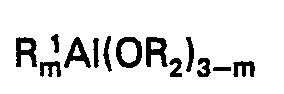


- Specific examples of the organoaluminum compounds belonging to (T) are trialkyl aluminums such as triethyl aluminum and tributyl aluminum; trialkenyl aluminums such as triisoprenyl aluminum; partially alkoxylated alkyl aluminums, for example, dialkyl aluminum alkoxides such as diethyl aluminum ethoxide and dibutyl aluminum butoxide; alkyl aluminum sesquialkoxides such as ethyl aluminum sesquiethoxide and butyl aluminum sesquibutoxide; compounds having an average composition expressed by

- There can also be used organoaluminum compounds in which two or more aluminum atoms are bonded through an oxygen or nitroqen atom, as aluminum compounds similar to those of formula (1). Specific examples are (C2H5)2AlOAI(C2H5)2, (C4H9)2AlOAI(C4H9)2 and

- Examples of the component (B) belonging to (2) above are LiAl(C2H5)4 and LiAl(C7H15)4.
- Of these organoaluminum compounds (B), those belonging to (1) above are preferred, and trialkylaluminums and/or alkyl aluminum halides are espeically preferred.
- The catalyst utilized in the present invention further includes an organic acid ester (C). The organic acid ester includes, for example, C2―C20 aliphatic carboxylic acid esters, C6―C20 alicyclic carboxylic acid esters, C7―C20 aromatic carboxylic acid esters, C5―C20 lactones, and C3―C8 carbonic acid esters.
- Specific examples of the organic acid ester (C) include aliphatic carboxylic acid esters such as methyl acetate, butyl acetate, vinyl acetate, ethyl propionate, isopropyl butyrate, cyclohexyl acetate, phenyl acetate, benzyl acetate, methyl chloroacetate, methyl methacrylate, methyl laurate, and methyl stearate; alicyclic carboxylic acid esters such as methyl cyclohexanecarboxylate; aromatic carboxylic acid esters such as methyl benzoate, ethyl benzoate, isopropyl benzoate, N-butyl benzoate, vinyl benzoate, cyclohexyl benzoate, phenyl benzoate, methyl toluate, ethyl toluate, methyl anisate, ethyl anisate, dimethyl phthalate and methyl chlorobenzoate; lactones such as gamma-butyrolactone, delta- valerolactone, coumarine and phthalide; and carbonic acid esters such as ethylene carbonate.
- According to the process of this invention, the first stage (i) (or the pre-polymerization step) and the second stage (ii) are carried out in the presence of the catalyst described above, preferably in an inert hydrocarbon solvent. In (i), a small amount of an alpha-olefin containing at least 3 carbon atoms is polymerized. In this step, ethylene in an amount of not more than 10 mole% of ethylene may be copolymerized with the alpha-olefin. The amount of alpha-olefin polymerized in the pre-polymerization step (i) is 0.01 to 50 g, preferably 0.05 to 20 g, per gram of the titanium catalyst component (A). If this amount exceeds the upper limit described above fish eyes may occur.
- Examples of the inert hydrocarbon solvent preferably used in the pre-polymerization include aliphatic hydrocarbons such as propane, butane, n-pentane, iso-pentane, n-hexane, n-octane, isooctane, n-decane, n-dodecane and kerosene; alicyclic hydrocarbons such as cyclopentane, methyl cyclopentane, cyclohexane and methylcyclohexane; aromatic hydrocarbons such as benzene, toluene and xylene; and halogenated hydrocarbons such as methylene chloride, ethyl chloride, ethylene chloride and chlorobenzene. Of these, aliphatic hydrocarbons, especially those having 4 to 10 carbon atoms, are preferred.
- In the pre-polymerization step (i), it is preferred to use 0.001 to 500 millimoles, especially 0.005 to 200 millimoles, calculated as titanium atom of the titanium catalyst component (A) per liter of the inert hydrocarbon solvent. Preferably, the organoaluminum compound (B) is used in such a proportion that the AIM atomic ratio is from 0.1 to 1000, especially from 0.5 to 500. The organic acid ester (C) may be supported on the component (A), or may be used as an adduct with a part of the component (B). Also, it may be added in the free state to the polymerization system. In any case, the amount of the organic acid ester to be present is from 0.1 to 200 moles, especially from 0.2 to 50 moles, per mole of titanium atom.
- Suitable alpha-olefins containing at least 3 carbon atoms used in the pre-polymerization step (i) are those having not more than 18 carbon atoms such as propylene, 1-butene, 1-hexene, 4-methyl-1-pentene, 3-methyl-1-pentene, 1-heptene, 1-octene, 1-decene, 1-dodecene, 1-tetradecene, and 1-octadecene. Those having 3 to 6 carbon atoms are especially preferred. These alpha-olefins may be homopolymerized, or copolymersed with each other so long as a crystalline polymer results, or may also be copolymerized with not more than 10 mole% of ethylene as mentioned above.
- The polymerization temperature in the first stage (I) may be selected according to the type of the alpha-olefin or the hydrocarbon solvent, and may, for example, be -40°C to 80°C. For example, when the alpha-olefin is propylene, the suitable polymerization temperature is -40°C to 70°C. In the case of butene-1, it is -40°C to 40°C; and in the case of 4-methyl-1-pentene, or 3-methyl-1-pentene, it is -40°C to 70°C. The prepolymerization in (i) may be carried out in the copresence of hydrogen.
- According to the process of this invention, ethylene and an alpha-olefin containing at least 3 carbon atoms are copolymerized in the presence of the catalyst used in prepolymerizing the alpha-olefin having at least 3 carbon atoms, thereby to produce an ethylene copolymer having a density of 0.900 to 0.945 g/cm 3.
- Suitable alpha-olefins having at least 3 carbon atoms used in the second stage (ii) include those having not more than 18 carbon atoms such as propylene, 1-butene, 1-pentene, 1-hexene, 4-methyl-1-pentene, 1-heptene, 1-octene, 1-decene, 1-dodecene, 1-tetradecene, and 1-octadecene.
- The copolymerization step (ii) is carried out at a temperature of not more than 100°C, preferably from 30 to 85°C, under such conditions that the resulting copolymer is not melted. The copolymerization in step (ii) is carried out so that the amount of the final copolymer obtained is at least 100, preferably at least 500, more preferably at least 1000, times the amount of the polymer formed in the first step (i). The copolymerization in step (ii) may be carried out in slurry, or in the gaseous phase in the absence of a liquid hydrocarbon. The present invention exhibits a marked effect when it is applied to slurry polymerization. As the hydrocarbon medium, inert hydrocarbons of the types exemplified above with regard to step (i) or alpha-olefins are used. Aliphatic hydrocarbons, especially those having 3 to 12 carbon atoms, are preferred. The great advantage of this invention is that good results can be obtained even when a solvent having a boiling point higher than 40°C is used.
- The concentration of the catalyst in the slurry polymerization is preferably such that the amount of the titanium catalyst component (A) is 0.001 to 1 millimole, more preferably 0.003 to 0.1 millimole, calculated as titanium atom, per liter of the liquid phase, the amount of the organoaluminum compound (B) is such that the AI/titanium atomic ratio is from 2 to 2000, more preferably from 10 to 1000, and the amount of the organic acid ester (C) is 0.1 to 200 moles per mole of titanium atom.
- To achieve a density within the aforesaid range, the amount of the alpha-olefin in the copolymer is limited, for example, to 0.2 to 30% by weight, especially 0.3 to 25% by weight, although it differs depending upon the type of the catalyst or the type of the alpha-olefin. For this purpose, the rate of feed of the alpha-olefin is properly selected depending upon the polymerization conditions such as the polymerization temperature and pressure. The polymerization pressure is generally from 9.81 x 101 to 9.81 x 10³ kPa (1 to 100 kg/cm3), To control the molecular weight of the copolymer, a molecular weight controlling agent such as hydrogen may be fed into the polymerization system. Various electron donors, and silicon, boron or tin compounds may be added to the catalyst system in order to increase the catalyst activity or regulate the molecular weight distribution of the copolymer.
- The copolymerization of this invention may be carried out in two or more stages in which different conditions are employed.
- The following examples specifically illustrate the present invention.
- In a stream of nitrogen, 1 mole of commercially available metallic magnesium was added to 500 ml of dehydrated and purified hexane, and 1.1 moles of tetraethoxysilane was further added. With stirring, the mixture was heated to 65°C. Then, small amounts of methyl iodide and iodine were added dropwise, and 1.2 moles of n-butyl chloride was added dropwise over the course of 2 hours. The mixture was stirred at 70°C for 7 hours. After the reaction, the reaction mixture was repeatedly washed with hexane. Subsequently, 0.25 mole of ethyl benzoate was added and they were reacted at 60°C for 1 hour. The supernatant portion was withdrawn, and 10 moles of titanium tetrachloride was added to the remaining solid portion, and they were reacted at 120°C for 2 hours. The titanium tetrachloride was withdrawn, and then under the same conditions as above, titanium tetrachloride was reacted to support Ti. After the reaction, the solid portion was repeatedly washed with hexane. The resulting solid was analyzed for composition. It was found that the solid contained 29 mg of Ti, 205 mg of Mg, 650 mg of Cl, and 87 mg of ethyl benzoate per gram thereof.
- The Ti catalyst component had an average particle diameter of 18.6 microns, a geometric standard deviation ag of particle size distribution of 1.51, and a specific surface area of 230 m2/g.
- The titanium catalyst component obtained above was diluted with dehydrated and purified hexane so that the concentration of the catalyst component was 30 millimoles/liter calculated as titanium atom, and 3 millimoles of triethylaluminum and 1 millimole of methyl toluate were added per millimole of titanium atom. Propylene was then fed at 30°C under atmospheric pressure, and reacted in an amount of 1.62 g per gram of the solid catalyst, thus pre-treating the catalyst with propylene.
- Separately, one liter of dehydrated and purified hexane was put into a 2-liter autoclave. The inside of the autoclave was purged sufficiently with nitrogen. The 1.5 millimoles of triethyl aluminum and 0.01 millimole, calculated as titanium, of the catalyst pre-treated with propylene were added. Then, hydrogen under a pressure of 98.1 kPa (1 kg/cm2) was fed, and ethylene containing 7.5 mole% of 1-butene was continuously added so that the total pressure inside the reactor reached 490.5 kPa (5 kg/cm2). Ethylene and 1-butene were thus polymerized at 65°C for 2 hours to afford 322 g of an ethylene copolymer having a bulk density of 0.46 g/cm3 and a melt index of 1.7 and a density of 0.928 g/cm3. The proportion of the dissolved polymer based on the hexane solvent was 2.9% by weight.
- Various runs were conducted using the catalyst prepared by the method of Example 1 in the same way as in Example 1 except that the conditions for pre-treating with the alpha-olefin were changed, the polymerization solvent used in the polymerization of ethylene and the alpha-olefin was changed, or the type of the alpha-olefin was changed, as shown in Tables 1-1 and 1-2. The results obtained are also shown in Table 1-2.


- Catalysts were synthesized in the same way as in Example 1 except that various esters were used instead of the ethyl benzoate, and were pre-treated with propylene in the same way as in Example 1. Then, under the same polymerization conditions as in Example 1, ethylene and 1-butene were copolymerized. The results obtained are shown in Table 2.


- In a stream of nitrogen, 2 moles of commercially available anhydrous magnesium chloride was suspended in 4 liters of dehydrated and purified hexane, and with stirring, 12 moles of ethanol was added dropwise over the course of 2 hours. The reaction was performed at 70°C for 1 hours. Then, 5.85 moles of diethyl aluminum chloride was added dropwise at room temperature, and stirred for 2 hours. Subsequently, 3 moles of titanium tetrachloride was added dropwise, and the reaction was performed at room temperature for 2 hours. After the reaction, the resulting solid portion was repeatedly washed with hexane. It was found that the resulting solid contained 63 mg of Ti, 590 mg of Cl, 185 mg of Mg and 155 mg of the OEt group per gram thereof. The solid catalyst had a specific surface area of 225 m2/g of solid, an average particle diameter of 16.6 microns and a geometric standard deviation of particle size distribution of 1.69.
- The titanium catalyst component obtained as above was diluted with dehydrated and purified hexane so that the concentration of the catalyst component reached 30 millimoles/liter calculated as titanium atom. Then, 3 millimoles of triethyl aluminum and 1 millimole of methyl p-toluate were added per millimole of titanium atom. Subsequently, propylene was fed at 20°C under atmospheric pressure, and 1.29 g of propylene was reacted per gram of the solid catalyst to pre-treat the catalyst.
- Separately, one liter of dehydrated and purified hexane was put into a 2-liter autoclave. The inside of the autoclave was sufficiently purged with nitrogen, and 1.0 millimole of triethyl aluminum and 0.01 millimole, calculated as ititanium atom, of the above catalyst pre-treated with propylene were added. Subsequently, hydrogen under 98.1 kPa (1 kg/cm2) was charged, and ethylene containing 6.3 mole% of 1-butene was continuously added so that the total pressure in the autoclave reached 392.4 kPa (4 kg/cm2). Thus, ethylene and 1-butene were copolymerized at 65°C for 2 hours to afford 255 g of an ethylene copolymer having a bulk density of 0.39 g cm3 and a melt index of 1.3 and a density of 0.932 g/cm3. The proportion of the dissolved polymer based on the hexane solvent was 3.0% by weight.
- Two kilograms of commercially available magnesium hydroxide having a specific surface area was suspended in 11 liters of water, and the suspension was stirred for 1 hour at a rotating speed of 5000 rpm using a homomixer having a 20-liter turbine stator. Subsequently, the resulting aqueous slurry of magnesium hydroxide was heated to 80°C with stirring, and sprayed with a concurrently flowing hot air at 200°C using a spray drier having two fluid nozzles with a nozzle diameter of 0.254 mm, to obtain spherical particles of magnesium hydroxide. Then, the product was screened to obtain particles having a size of 20 to 63 microns. The treated magnesium hydroxide was spherical and had a specific surface area of 86 m 2/g.
- Thirty grams of the resulting spherical magnesium hydroxide was added to 400 ml of titanium tetrachloride and reacted for 2 hours at 135°C. After the reaction, titanium tetrachloride was withdrawn. The solid portion was repeatedly washed with hexane. The resulting solid was analyzed for composition. It was found that the solid contained 19 mg of Ti, 360 mg of Mg and 290 mg of CI per gram thereof.
- Thirty grams of the solid obtained as above was put into a three-necked flask fully purged with nitrogen, and 150 ml of kerosene was added. Ethyl benzoate was added dropwise in an amount of 4 moles (47.6 millimoles) per mole of the supported Ti at a reaction temperature of 30°C, and the mixture was stirred at 30°C for 1 hour. Then, diethyl aluminum chloride was added dropwise in an amount of 1/2 mole per mole of ethyl benzoate at 30°C, and after the addition, the mixture was stirred at 30°C for 1 hour. The kerosene solvent was then removed by decantation. The resulting solid was washed twice with 150 ml of kerosene, and 150 ml of titanium tetrachloride was added. They were reacted at 130°C for 2 hours. The reaction mixture was repeatedly washed with hexane. The solid was analyzed for composition, was found to contain 20 mg of Ti, 310 mg of Cl, 330 mg of Mg and 38 mg of ethyl benzoate. The resulting catalyst had an average particle diameter of 37 microns,a geometric standard deviation of particle size distribution of 1.40, and a specific surface area of 90 m2/g.
- The titanium catalyst component obtained as above was diluted with dehydrated and purified hexane so that the concentration of the catalyst component reached 20 millimoles/liter. Then, 3 millimoles of triethyl aluminum and 1 millimole of methyl p-toluate were added per millimole of titanium atom. Subsequently, propylene was fed at 10°C under atmospheric pressure, and propylene was reacted in an amount of 1.40 g per gram of the solid catalyst. The catalyst was pre-treated with propylene.
- Separately, the inside of a 2-liter autoclave was purged fully with nitrogen, and 2.0 millimoles of triethyl aluminum, and 0.02 millimole calculated as titanium atom of the pre-treated catalyst were added. Subsequently, hydrogen under 147.1 kPa (1.5 kg/cm2) was charged, and ethylene containing 7.5 mole% of 1-butene was added continuously so that the total pressure in the reactor reached 588.6 kPa - G (6 kg/cml - G). Thus, ethylene and 1-butene were copolymerized at 60°C for 2 hours to afford 331 g of a copolymer having a bulk density of 0.40 g/cm2 and a melt index of 0.95 and a density of 0.929 g/cm3. The proportion of the polymer dissolved in the hexane solvent was 5.1 % by weight.
- Commercially available anhydrous magnesium chloride (20 g) and 6.0 ml of ethyl benzoate were charged into a stainless steel vessel having a capacity of 800 ml and an inside diameter of 100 mm and containing 100 stainless steel (SUS-302) balls having a diameter of 15 mm in an atmosphere of nitrogen, and copulverized for 50 hours by a vibratory mill device having a power of 7 G. The solid treated product obtained was suspended in titanium tetrachloride, and reacted at 100°C for 2 hours. The solid portion was separated by filtration, and repeatedly washed with hexane. The resulting solid catalyst component was analyzed for composition, and found to contain 21 mg of Ti, 210 mg of Mg, 670 mg of CI and 88 mg of ethyl benzoate. The titanium catalyst component had an average particle diameter of 17.8 microns, a geometric standard deviation of particle size distribution of 2.24, and a specific surface area of 185 m2/g.
- The same pre-treatment as in Example 1 was performed to polymerize 1.7 g of propylene per gram of the catalyst. Subsequently, ethylene and 1-butene were copolymerized in the same way as in Example 21 to afford 244 g of an ethylene copolymer having a bulk density of 0.35 g/cm3 and a melt index of 1.1. The ethylene copolymer had a density of 0.931 g/cm3. The proportion of the dissolved polymer based on the hexane solvent was 3.9% by weight.
- Commercially available anhydrous magnesium chloride (20 g) was charged into a stainless steel vessel having a capacity of 800 ml and a diameter of 100 mm and containing 100 stainless steel (SUS-302) balls each having a diameter of 15 mm in an atmosphere of nitrogen, and pulverized for 50 hours by a vibratory mill device having a power of 7 G. The resulting solid treated product was suspended in titanium tetrachloride, and reacted at 120°C for 2 hours. The solid portion was separated by filtration, and washed repeatedly with hexane. The resulting solid catalyst component was analyzed for composition, and it was found that the solid contained 10 mg of Ti, 235 mg of Mg, and 730 mg of CI per gram thereof. The resulting titanium catalyst component had an average particle diameter of 12.2 microns, a geometric standard deviation of particle size distribution of 2.31, and a specific surface area of 55 m2/g.
- In the same way as in Example 1, the catalyst was pre-treated with propylene in an amount of 1.43 g per gram of the catalyst. At this time, an electron donor such as methyl p-toluate was absent in the reaction system. Ethylene and 1-butene were copolymerized under the same conditions as in Example 1 using the pre-treated catalyst. There was obtained 115 g of an ethylene copolymer having a bulk density of 0.22 g/cm3 and a melt index of 1.9. The resulting copolymer had a density of 0.941 g/cm3. The proportion of the dissolved polymer based on the hexane solvent was 10.6% by weight. Thus, the bulk density and the yield of the polymer were very poor.
- In the method of Example 1, titanium tetrachloride was reacted without reacting ethyl benzoate in the synthesis of the titanium catalyst component. After the reaction, the solid was analyzed for composition, and found to contain 59 mg of Ti, 210 mg of Mg and 690 mg of CI per gram thereof.
- The resulting titanium catalyst component was pre-treated with propylene in an amount of 1.58 g per gram of the solid catalyst. At this time, methyl p-toluate was not added.
- Separately, ethylene and 1-butene were copolymerized under the same conditions as in Example 1 in a 2-liter autoclave using the res ting titanium catalyst component. There was obtained 267 g of an ethylene copolymer having a bulk density of 0.31 g/cm3 and a melt index of 1.8. The resulting copolymer had a density of 0.936 g/cm3. The proportion of the dissolved polymer based on the hexane solvent was 7.3% by weight.
Claims (6)


Priority Applications (1)
| Application Number | Priority Date | Filing Date | Title |
|---|---|---|---|
| AT79303068T ATE2959T1 (en) | 1978-12-28 | 1979-12-28 | PROCESS FOR PRODUCTION OF AN AETHYLENE COPOLYMER. |
Applications Claiming Priority (2)
| Application Number | Priority Date | Filing Date | Title |
|---|---|---|---|
| JP161203/78 | 1978-12-28 | ||
| JP53161203A JPS603324B2 (en) | 1978-12-28 | 1978-12-28 | Method for producing ethylene copolymer |
Publications (2)
| Publication Number | Publication Date |
|---|---|
| EP0013837A1 EP0013837A1 (en) | 1980-08-06 |
| EP0013837B1 true EP0013837B1 (en) | 1983-04-06 |
Family
ID=15730547
Family Applications (1)
| Application Number | Title | Priority Date | Filing Date |
|---|---|---|---|
| EP79303068A Expired EP0013837B1 (en) | 1978-12-28 | 1979-12-28 | Process for producing an ethylene copolymer |
Country Status (5)
| Country | Link |
|---|---|
| US (1) | US4298713A (en) |
| EP (1) | EP0013837B1 (en) |
| JP (1) | JPS603324B2 (en) |
| AT (1) | ATE2959T1 (en) |
| DE (1) | DE2965167D1 (en) |
Families Citing this family (33)
| Publication number | Priority date | Publication date | Assignee | Title |
|---|---|---|---|---|
| JPS57105411A (en) * | 1980-12-23 | 1982-06-30 | Mitsubishi Petrochem Co Ltd | Ethylenic copolymer |
| JPS57109809A (en) * | 1980-12-27 | 1982-07-08 | Nissan Chem Ind Ltd | Production of ethylene copolymer |
| US4491652A (en) * | 1981-05-13 | 1985-01-01 | Uniroyal, Inc. | Sequentially prepared thermoplastic elastomer and method of preparing same |
| US5025072A (en) * | 1981-12-04 | 1991-06-18 | Mobil Oil Corporation | Highly active catalyst composition for polymerizing alpha-olefins |
| CA1190996A (en) * | 1982-04-22 | 1985-07-23 | Robert B. Steinert | Linear low density polyethylene process |
| IT1151627B (en) * | 1982-06-10 | 1986-12-24 | Anic Spa | PROCEDURE FOR THE PREPARATION OF ETHYLENE COPOLYMERS WITH LOW DENSITY VALUE |
| DE3366573D1 (en) * | 1982-06-24 | 1986-11-06 | Bp Chimie Sa | Process for the polymerization and copolymerization of alpha-olefins in a fluidized bed |
| JPS59206418A (en) * | 1983-05-11 | 1984-11-22 | Mitsui Petrochem Ind Ltd | Production of 4-methyl-1-pentene polymer |
| JPS60195108A (en) * | 1984-03-16 | 1985-10-03 | Mitsui Petrochem Ind Ltd | Titanium-based catalytic component for olefin polymerization |
| IT8647628A0 (en) * | 1985-02-06 | 1986-02-06 | Dureco Chemicals Inc | PROCEDURE FOR THE PRODUCTION OF ATACTIC OLEFINIC POLYMERS |
| JPH0725860B2 (en) * | 1985-05-23 | 1995-03-22 | 住友化学工業株式会社 | Method for producing α-olefin block copolymer particles and α-olefin block copolymer particles |
| US4644045A (en) * | 1986-03-14 | 1987-02-17 | Crown Zellerbach Corporation | Method of making spunbonded webs from linear low density polyethylene |
| KR920001353B1 (en) * | 1986-08-26 | 1992-02-11 | 미쓰이 세끼유 가가꾸 고오교오 가부시끼가이샤 | Catalyst and Polymerization Method for Polymerization of α-olefins |
| US5654248A (en) * | 1986-08-26 | 1997-08-05 | Mitsui Petrochemical Industries, Ltd. | Catalyst for polymerizing alpha-olefins and process for polymerization |
| DE3881728T3 (en) * | 1987-03-14 | 1998-01-15 | Mitsubishi Chem Ind | Process for producing a propylene-alpha-olefin block copolymer. |
| JP2855875B2 (en) * | 1990-04-16 | 1999-02-10 | 日本油脂株式会社 | Crosslinkable composition of ethylene polymer and crosslinking method |
| JP3044262B2 (en) * | 1991-07-02 | 2000-05-22 | 東ソー株式会社 | Method for producing polyolefin |
| US5180702A (en) * | 1991-12-11 | 1993-01-19 | Phillips Petroleum Company | Metal halide catalyst, method of producing the catalyst, polymerization process employing the catalyst, and polymer produced by the polymerization process |
| IT1254279B (en) * | 1992-03-13 | 1995-09-14 | Montecatini Tecnologie Srl | PROCEDURE FOR THE GAS PHASE POLYMERIZATION OF OLEFINS |
| US6191239B1 (en) | 1998-02-18 | 2001-02-20 | Eastman Chemical Company | Process for producing polyethylene |
| US6228957B1 (en) | 1998-02-18 | 2001-05-08 | Eastman Chemical Company | Process for producing polyethlene |
| US6534613B2 (en) | 1998-02-18 | 2003-03-18 | Eastman Chemical Company | Process for producing polyethylene |
| US6271321B1 (en) | 1998-02-18 | 2001-08-07 | Eastman Chemical Company | Process for producing polyethylene |
| ATE544789T1 (en) | 1998-10-27 | 2012-02-15 | Westlake Longview Corp | METHOD FOR OLEFIN POLYMERIZATION, NEW POLYETHYLENE AND FILMS AND ARTICLES PRODUCED THEREFROM |
| US6291613B1 (en) | 1998-10-27 | 2001-09-18 | Eastman Chemical Company | Process for the polymerization of olefins |
| US6300432B1 (en) | 1999-03-30 | 2001-10-09 | Eastman Chemical Company | Process for producing polyolefins |
| JP2002540265A (en) | 1999-03-30 | 2002-11-26 | イーストマン ケミカル カンパニー | Method for producing polyolefin |
| US6191238B1 (en) | 1999-08-31 | 2001-02-20 | Eastman Chemical Company | Process for producing polyolefins |
| US6696380B2 (en) | 2000-01-12 | 2004-02-24 | Darryl Stephen Williams | Procatalysts, catalyst systems, and use in olefin polymerization |
| US6465383B2 (en) | 2000-01-12 | 2002-10-15 | Eastman Chemical Company | Procatalysts, catalyst systems, and use in olefin polymerization |
| CA2396736A1 (en) | 2000-01-12 | 2001-07-19 | Eastman Chemical Company | Procatalysts comprising bidentate ligands, catalyst systems, and use in olefin polymerization |
| KR100469923B1 (en) * | 2001-12-26 | 2005-02-02 | 호남석유화학 주식회사 | Method for preparing polyalphaolefin having high viscosity index by copolymerizing decene-1 and dodecene-1 |
| US6677266B1 (en) | 2002-07-09 | 2004-01-13 | Eastman Chemical Company | Process for preparing a vanadium/titanium catalyst and use in olefin polymerization |
Family Cites Families (21)
| Publication number | Priority date | Publication date | Assignee | Title |
|---|---|---|---|---|
| JPS5847402B2 (en) * | 1976-02-13 | 1983-10-22 | 三井化学株式会社 | Polymer composition for molding and its manufacturing method |
| US3268624A (en) * | 1962-11-29 | 1966-08-23 | Avisun Corp | Block copolymers of ethylene and propylene |
| NL153555B (en) * | 1968-05-15 | 1977-06-15 | Stamicarbon | PROCESS FOR PREPARING ALKIN POLYMERS. |
| DE2261384C3 (en) * | 1972-12-15 | 1980-08-14 | Chemische Werke Huels Ag, 4370 Marl | Process for the production of a plastic-elastic mass |
| JPS508758A (en) * | 1973-05-29 | 1975-01-29 | ||
| JPS50135191A (en) * | 1974-01-09 | 1975-10-27 | ||
| JPS519187A (en) * | 1974-07-15 | 1976-01-24 | Mitsubishi Petrochemical Co | KETSUSHOSEIO REFUINJUGOTAINO SEIZOHOHO |
| JPS5143391A (en) * | 1974-10-11 | 1976-04-14 | Mitsubishi Chem Ind | |
| JPS5152487A (en) * | 1974-11-01 | 1976-05-10 | Mitsui Toatsu Chemicals | ECHIRENKYOOJUGOTAINO SEIZOHOHO |
| IT1042180B (en) * | 1975-08-29 | 1980-01-30 | Montedison Spa | PROPOLENE CRYSTAL POLYMERS AND COPOLYMERS AND PROCEDURE FOR THEIR PREPARATION |
| JPS6020405B2 (en) * | 1976-04-06 | 1985-05-22 | 三井東圧化学株式会社 | Manufacturing method of low density polyethylene |
| JPS6025444B2 (en) * | 1976-04-13 | 1985-06-18 | 三井東圧化学株式会社 | Manufacturing method of low density polyethylene |
| JPS52139184A (en) * | 1976-05-17 | 1977-11-19 | Mitsui Toatsu Chem Inc | Polymerization of ethylene or alpha-olefin |
| JPS591406B2 (en) * | 1976-08-09 | 1984-01-12 | 昭和電工株式会社 | Method for producing improved olefinic polymers |
| IT1068112B (en) * | 1976-08-09 | 1985-03-21 | Montedison Spa | COMPONENTS OF CATALYSTS FOR THE POLYMERIZATION OF ALPHA OLEFINS AND CATALYSTS FROM THEM OBTAINED |
| JPS5330681A (en) * | 1976-09-02 | 1978-03-23 | Mitsui Petrochem Ind Ltd | Preparation of polyalpha-olefin |
| JPS5378287A (en) * | 1976-12-23 | 1978-07-11 | Showa Yuka Kk | Process for producing improved ethylenic polymer |
| JPS5948525B2 (en) * | 1978-06-30 | 1984-11-27 | 松下電工株式会社 | Plunger type electromagnet device |
| JPS5554308A (en) * | 1978-10-17 | 1980-04-21 | Nippon Oil Co Ltd | Preparation of copolymer |
| JPS5919567B2 (en) * | 1978-11-27 | 1984-05-07 | 昭和電工株式会社 | Improved method for producing ethylene polymers |
| JPS5580413A (en) * | 1978-12-13 | 1980-06-17 | Nippon Oil Co Ltd | Preparation of polyolefin |
-
1978
- 1978-12-28 JP JP53161203A patent/JPS603324B2/en not_active Expired
-
1979
- 1979-12-26 US US06/106,736 patent/US4298713A/en not_active Expired - Lifetime
- 1979-12-28 DE DE7979303068T patent/DE2965167D1/en not_active Expired
- 1979-12-28 AT AT79303068T patent/ATE2959T1/en not_active IP Right Cessation
- 1979-12-28 EP EP79303068A patent/EP0013837B1/en not_active Expired
Also Published As
| Publication number | Publication date |
|---|---|
| JPS603324B2 (en) | 1985-01-28 |
| DE2965167D1 (en) | 1983-05-11 |
| JPS5590515A (en) | 1980-07-09 |
| US4298713A (en) | 1981-11-03 |
| EP0013837A1 (en) | 1980-08-06 |
| ATE2959T1 (en) | 1983-04-15 |
Similar Documents
| Publication | Publication Date | Title |
|---|---|---|
| US4298713A (en) | Process for preparing low density ethylene copolymers | |
| EP0022376B1 (en) | Process for preparing a chemically blended composition of non-elastomeric ethylene resins, and shaped articles of such a composition | |
| US4952649A (en) | Process for producing olefin polymers or copolymers and catalyst components used therefor | |
| US4401589A (en) | Process for producing olefin polymers or copolymers | |
| US6887817B2 (en) | Olefin polymerization catalyst and process for preparing polyolefins using said catalyst | |
| EP0022675B1 (en) | Process for producing olefin polymers | |
| KR860002050B1 (en) | Process for preparing propylene block copolymer composition | |
| US4442276A (en) | Process for polymerizing or copolymerizing olefins | |
| EP0284005B1 (en) | Method of production of polyolefins | |
| US4294948A (en) | Process for preparing olefin polymers or copolymers, and catalyst for use in said process | |
| EP0125910B1 (en) | Process for production of 4-methyl-1-pentene polymer or copolymer | |
| JPS6324001B2 (en) | ||
| CA1081201A (en) | Process for polymerizing -olefins containing at least 3 carbon atoms and catalyst therefor | |
| US4370455A (en) | Process for polymerizing or copolymerizing olefins | |
| US4220745A (en) | Process for polymerization of α-olefins | |
| US6645901B2 (en) | Prepolymerization catalyst for use in gas phase polymerization of olefins and process for producing the same | |
| US4418184A (en) | Process for preparation of ethylene polymer wax | |
| EP0253625B1 (en) | Branched alpha-olefin polymer composition and process for its production | |
| US4530983A (en) | Process for polymerizing ethylene | |
| JPS6026408B2 (en) | Method for producing ethylene copolymer | |
| GB2133020A (en) | Polymerising olefins with an improved Ziegler catalyst | |
| JPS6026407B2 (en) | Method for producing ethylene copolymer | |
| JPH0119406B2 (en) | ||
| CA1116795A (en) | Process for preparing low density ethylene copolymers | |
| EP0052464B1 (en) | A process for preparing ethylene copolymers |
Legal Events
| Date | Code | Title | Description |
|---|---|---|---|
| PUAI | Public reference made under article 153(3) epc to a published international application that has entered the european phase |
Free format text: ORIGINAL CODE: 0009012 |
|
| AK | Designated contracting states |
Designated state(s): AT BE DE FR GB IT NL |
|
| 17P | Request for examination filed |
Effective date: 19801215 |
|
| ITF | It: translation for a ep patent filed | ||
| GRAA | (expected) grant |
Free format text: ORIGINAL CODE: 0009210 |
|
| AK | Designated contracting states |
Designated state(s): AT BE DE FR GB IT NL |
|
| REF | Corresponds to: |
Ref document number: 2959 Country of ref document: AT Date of ref document: 19830415 Kind code of ref document: T |
|
| REF | Corresponds to: |
Ref document number: 2965167 Country of ref document: DE Date of ref document: 19830511 |
|
| ET | Fr: translation filed | ||
| PLBE | No opposition filed within time limit |
Free format text: ORIGINAL CODE: 0009261 |
|
| STAA | Information on the status of an ep patent application or granted ep patent |
Free format text: STATUS: NO OPPOSITION FILED WITHIN TIME LIMIT |
|
| 26N | No opposition filed | ||
| GBPC | Gb: european patent ceased through non-payment of renewal fee | ||
| GBDL | Gb: delete "european patent ceased" from journal |
Free format text: 4979 PAGE 2550 |
|
| GBDL | Gb: delete "european patent ceased" from journal |
Free format text: 4979, PAGE 2550 |
|
| ITTA | It: last paid annual fee | ||
| REG | Reference to a national code |
Ref country code: FR Ref legal event code: CD |
|
| NLT1 | Nl: modifications of names registered in virtue of documents presented to the patent office pursuant to art. 16 a, paragraph 1 |
Owner name: MITSUI CHEMICALS, INC. |
|
| PGFP | Annual fee paid to national office [announced via postgrant information from national office to epo] |
Ref country code: FR Payment date: 19981209 Year of fee payment: 20 |
|
| PGFP | Annual fee paid to national office [announced via postgrant information from national office to epo] |
Ref country code: AT Payment date: 19981214 Year of fee payment: 20 |
|
| PGFP | Annual fee paid to national office [announced via postgrant information from national office to epo] |
Ref country code: NL Payment date: 19981229 Year of fee payment: 20 |
|
| PGFP | Annual fee paid to national office [announced via postgrant information from national office to epo] |
Ref country code: GB Payment date: 19981231 Year of fee payment: 20 |
|
| BE20 | Be: patent expired |
Free format text: 19991228 *MITSUI CHEMICALS INC. |
|
| PGFP | Annual fee paid to national office [announced via postgrant information from national office to epo] |
Ref country code: DE Payment date: 19990107 Year of fee payment: 20 |
|
| PGFP | Annual fee paid to national office [announced via postgrant information from national office to epo] |
Ref country code: BE Payment date: 19990215 Year of fee payment: 20 |
|
| PG25 | Lapsed in a contracting state [announced via postgrant information from national office to epo] |
Ref country code: GB Free format text: LAPSE BECAUSE OF EXPIRATION OF PROTECTION Effective date: 19991227 |
|
| PG25 | Lapsed in a contracting state [announced via postgrant information from national office to epo] |
Ref country code: NL Free format text: LAPSE BECAUSE OF EXPIRATION OF PROTECTION Effective date: 19991228 Ref country code: AT Free format text: LAPSE BECAUSE OF EXPIRATION OF PROTECTION Effective date: 19991228 |
|
| REG | Reference to a national code |
Ref country code: GB Ref legal event code: PE20 Effective date: 19991227 |
|
| NLV7 | Nl: ceased due to reaching the maximum lifetime of a patent |
Effective date: 19991228 |