EP0012855B1 - Overcoated photothermographic element having a dye-precursor retaining layer - Google Patents
Overcoated photothermographic element having a dye-precursor retaining layer Download PDFInfo
- Publication number
- EP0012855B1 EP0012855B1 EP79104668A EP79104668A EP0012855B1 EP 0012855 B1 EP0012855 B1 EP 0012855B1 EP 79104668 A EP79104668 A EP 79104668A EP 79104668 A EP79104668 A EP 79104668A EP 0012855 B1 EP0012855 B1 EP 0012855B1
- Authority
- EP
- European Patent Office
- Prior art keywords
- poly
- acrylamide
- gelatin
- imaging element
- weight
- Prior art date
- Legal status (The legal status is an assumption and is not a legal conclusion. Google has not performed a legal analysis and makes no representation as to the accuracy of the status listed.)
- Expired
Links
Classifications
-
- G—PHYSICS
- G03—PHOTOGRAPHY; CINEMATOGRAPHY; ANALOGOUS TECHNIQUES USING WAVES OTHER THAN OPTICAL WAVES; ELECTROGRAPHY; HOLOGRAPHY
- G03C—PHOTOSENSITIVE MATERIALS FOR PHOTOGRAPHIC PURPOSES; PHOTOGRAPHIC PROCESSES, e.g. CINE, X-RAY, COLOUR, STEREO-PHOTOGRAPHIC PROCESSES; AUXILIARY PROCESSES IN PHOTOGRAPHY
- G03C1/00—Photosensitive materials
- G03C1/67—Compositions containing cobalt salts or cobalt compounds as photosensitive substances
-
- G—PHYSICS
- G03—PHOTOGRAPHY; CINEMATOGRAPHY; ANALOGOUS TECHNIQUES USING WAVES OTHER THAN OPTICAL WAVES; ELECTROGRAPHY; HOLOGRAPHY
- G03C—PHOTOSENSITIVE MATERIALS FOR PHOTOGRAPHIC PURPOSES; PHOTOGRAPHIC PROCESSES, e.g. CINE, X-RAY, COLOUR, STEREO-PHOTOGRAPHIC PROCESSES; AUXILIARY PROCESSES IN PHOTOGRAPHY
- G03C1/00—Photosensitive materials
- G03C1/76—Photosensitive materials characterised by the base or auxiliary layers
- G03C1/7614—Cover layers; Backing layers; Base or auxiliary layers characterised by means for lubricating, for rendering anti-abrasive or for preventing adhesion
Definitions
- This invention relates to an imaging element which contains an aromatic dialdehyde as a dye-forming component of a radiation-responsive image-forming composition. More specifically, an element is provided which includes a layer of a polymer that seals the dialdehyde into the element as a means of increasing the maximum neutral densities available from the imaging element.
- Imaging elements have been devised which rely upon the photodestruction of o-phthalaldehyde which, where not destroyed, forms a dye when suitably developed. Examples are disclosed in U.S. Patent No. 3,102,811 wherein poly(vinylpyrrolidone) and poly(vinyl alcohol) are listed as exemplary. binders for an o-phthalaldehyde image-forming composition. o-Phthalaldehyde is also used as a dye-forming material in imaging elements which rely upon the reduction of cobalt (II) complexes, as described in Research Disclosure, Vol. 158, June, 1977, Publication No. 15874, published by Industrial Opportunities Ltd. Hampshire, United Kingdom.
- II cobalt
- Such imaging elements are susceptible to loss of phthalaldehyde during element formation, due to the high volatility of the compound. Such losses can decrease drastically the amount of dye density available during development.
- One solution to this problem is to use a polysulfonamide as a binder for the image-forming composition.
- the polysulfonamide binder is useful to retain phthalaldehyde in the element.
- Particularly useful polysulfonamide binders which provide superior levels of retention are described in U.S. Patent No. 4,107,155 by Fletcher et al, granted August 15, 1978.
- binders described in the aforesaid patent greatly increase the available dye density in elements using phthalaldehyde as the dye-forming material, some phthalaldehyde is still lost by volatilization during image processing. Particularly, losses occur when the exposed element is heated for image development. Therefore, it is desirable to provide such an element which better retains phthalaldehyde.
- the present invention is an imaging element comprising a support bearing at least one layer of a radiation-sensitive image-forming composition containing an aromatic orthodialdehyde as a dye-forming component, characterized in that superimposed over said layer of image-forming composition there is a layer of a compatible polymeric material selected from gelatin, gelatin grafted with recurring units of acrylonitrile and optionally bisacrylamidoacetic acid or bis(acryloyloxy)acetic acid, or a polymer, or copolymer having at least 50 percent by weight of recurring acrylamide units.
- ком ⁇ онент a polymeric material having other physical properties appropriate to an imaging element, e.g., sufficient adhesion to the radiation-sensitive underlayer, transparency to activating radiation, and freedom from cracking.
- An overcoat layer of an imaging element according to the present invention is prepared preferably by coating with a solution of a compatible polymer as described above at a pH of 3 so as to obtain a coating containing 20 mg/dm 2 of the said polymer.
- a solution of a compatible polymer as described above at a pH of 3 so as to obtain a coating containing 20 mg/dm 2 of the said polymer.
- an imaging element of this invention produces an image having a maximum neutral density at least 10% greater than that produced by an indentically processed, identical element without the overcoat.
- aromatic dialdehydes which are useful as dye-forming materials include, for example, 4-hydroxy-1,2-phthalaldehyde, 4-benzoyloxy-1,2-phthalaldehyde, 4-methacryloyloxy-1,2-phthalaldehyde, 4-t-butyl-1,2-phthalaldehyde and 4-bromo-1,2-phthalaldehyde; 5,6,7,8-tetrahydro-5,5,8,8-tetramethyInaphthalene-2,3-dialdehyde; and 2,3-naphthalenedialdehyde.
- phthalaldehyde is only one component of the radiation-responsive, image-forming composition. It may also contain a material for image-wise-generating a product which can react with phthaldehyde to form a dye.
- a material for image-wise-generating a product which can react with phthaldehyde to form a dye.
- Any composition capable of imagewise-converting phthalaldehyde to a dye can be incorporated into the imaging element of this invention.
- ortho-Phthalaldehyde, herein abbreviated as phthalaldehyde, or PA is a convenient dye-forming material capable of selective reaction with amines to form a black dye.
- amines we refer to ammonia and primary amines.
- the dye reaction sequence in the case of NH 3 , is believed to be as follows:
- the invention employs a layer of an image-forming composition which contains phthaialdehyde, a binder and a material which generates an amine in response to activating radiation. Said amine and phthalaldehyde combine to form the oligomeric dye B noted above.
- improved maximum neutral density values of dye B can be obtained.
- maximum neutral density of an element refers to the density of a point on the characteristic curve plotting developed density against the logarithm of the exposure, at which an increase in exposure produces no increase in density.
- the selection of an exposure level through a 0.15 Log E step table which produces at least three developed steps produces a density in the most exposed step comparable with the maximum neutral density. Actual density comparisons between elements are made at the same level of exposure, in all cases that level is selected to produce at least the three 0.15 log E steps in each element.
- the preferred embodiments feature such superimposed polymers as overcoats, due to the manufacturing convenience resulting therefrom.
- other methods of superposition can be used to achieve the same improvement in maximum neutral densities.
- overcoats of a wide variety of polymers permit an enhancement of the densities achieved from phthalaldehyde-containing imaging elements.
- the maximum neutral density values of the image-forming composition are significantly greater than when using no overcoat, or when using poly(vinylpyrrolidone).
- "significantly greater” means by an amount which is statistically significant, that is, an amount which is more than experimental error, determined to be about 7%.
- a number of compatible polymers have been found which give improvements of about 40% or more. We believe that the superior images are obtained because of the superior retention of phthalaldehyde when developing an exposed phthalaldehyde-containing imaging element.
- Overcoat polymers having the above-noted property of producing increased maximum neutral density values include gelatin, gelatin grafted with recurring units of acrylonitrile and optionally bisacrylamidoacetic acid or bis(acryloyloxy) acetic acid, and polymers or copolymers having at least 50 percent of recurring units of acrylamide.
- Preferred polymers having acrylamide recurring units are represented by the formula: wherein:
- the aforenoted gelatin grafts can have recurring units with the structure: wherein:
- Noninterfering recurring units other than those mentioned can be included in the copolymers useful in the invention.
- the gelatin overcoats can be further improved for handling by crosslinking.
- crosslinking improved the toughness and water resistance of the overcoat.
- Useful crosslinking agents include formaldehyde and a 5 weight percent aqueous solution of hexamethoxymethyl melamine.
- the polymers of formula (I) are prepared by conventional addition polymerization techniques using redox initiator systems, such as persulfate-bisulfite or hydrogen peroxide, or using organic soluble free-radical-generating initiating systems such as 2,2'-azobis(2-methylpropionitrile).
- redox initiator systems such as persulfate-bisulfite or hydrogen peroxide
- organic soluble free-radical-generating initiating systems such as 2,2'-azobis(2-methylpropionitrile).
- the graft polymers of structure (II) are prepared by conventional techniques.
- the resultant viscous polymer solution when diluted to 5.1 % solids with distilled water, had a bulk viscosity of 40 centipoise at room temperature. After dialysis, the polymer had an inherent viscosity, as measured in 1 N NaCi at 0.25 g/dl, of 1.27 at 25°C.
- Gelatin grafted with recurring units of acrylonitrile and bisacrylamidoacetic can be prepared according to the method described in U.S. Patent 3,756,814 except that acrylonitrile and bisacrylamidoacetic acid in the desired proportions are substituted for the vinyl monomers having attached mordant groups according to the patent.
- the molecular weight of the polymer selected for the overcoat does not appear to be critical to the formation of improved maximum neutral density values. Furthermore, the molecular weights are subject to wide variation even within a given class of polymers, depending on the preparation conditions.
- useful terpolymers of acrylamide of the type described above can have molecular weights within and beyond the range evidenced by inherent viscosities from about 0.1 to about 6.0, measured as a 0.25 weight percent solution in dimethylformamide. A preferred range of inherent viscosities is from about 0.5 at about 2.0.
- the image-forming composition preferably comprises, as noted, phthalaldehyde and a binder.
- the binder selected for the image-forming composition is not believed to be critical, inasmuch as even binders which are relatively pervious to phthalaldehyde can be used in such an image-forming composition if the overcoat of the invention is also used.
- the best results are achieved when using as the binder for the image-forming composition one of those disclosed in U.S. Patent No. 4,107,155.
- polysulfonamides such as poly(ethylene - co - 1,4 - cyclohexylenedimethylene - 1 - methyl - 2,4 - benzenedisulfonamide), poly-(ethylene - co - 1,4 - cyclohexylenedimethylene - 1 - chloro - 2,4 - benzenedisulfonamide), poly-(ethylene - co - 1,4 - cyclohexylenedimethylene - 1,2 - dichloro - 3,5 - benzenedisulfonamide), poly-(ethylene - co - 1,4 - cyclohexylenedimethylene - 1 - chloro - 3,5 - benzenedisulfonamide), poly-(ethylene - co - 1,3 - xylylene - 1 - methyl - 2,4 - benzenedisulfonamide), poly(1,4 - cyclohexylenedimethylene -
- Highly useful polymers also include polyacrylonitriles, e.g., poly(methacrylonitrile), poly [N - (4 - methacryloyloxyphenyl)methanesulfonamide], and poly(ethylene - co - hexamethylene - 1 ethyl - 2,4 - benzenedisulfonamide.
- poly(ethylene - co - 1,4 - cyclohexylenedimethylene-1 - methyl - 2,4 - benzenesulfonamide) (50:50) is highly preferred.
- Preparation of the poly(acrylonitriles) proceeds via conventional processes.
- the polysulfonamides can be condensation polymers containing sulfonamide groups in the polymer backbone. Preferably they are prepared by solution polycondensation using aromatic disulfonyl chlorides and diamines in the presence of an acid scavenger. Alternatively, the polysulfonamides can be addition polymers derived from vinyl monomers having pendant groups containing -NR'S0 2 - groups, R' being hydrogen or methyl.
- the image-forming composition also preferably includes an amine-generating material responsive to activating radiation.
- the amine when formed reacts with the phthalaldehyde to form a dye.
- Any amine-generating material can be used.
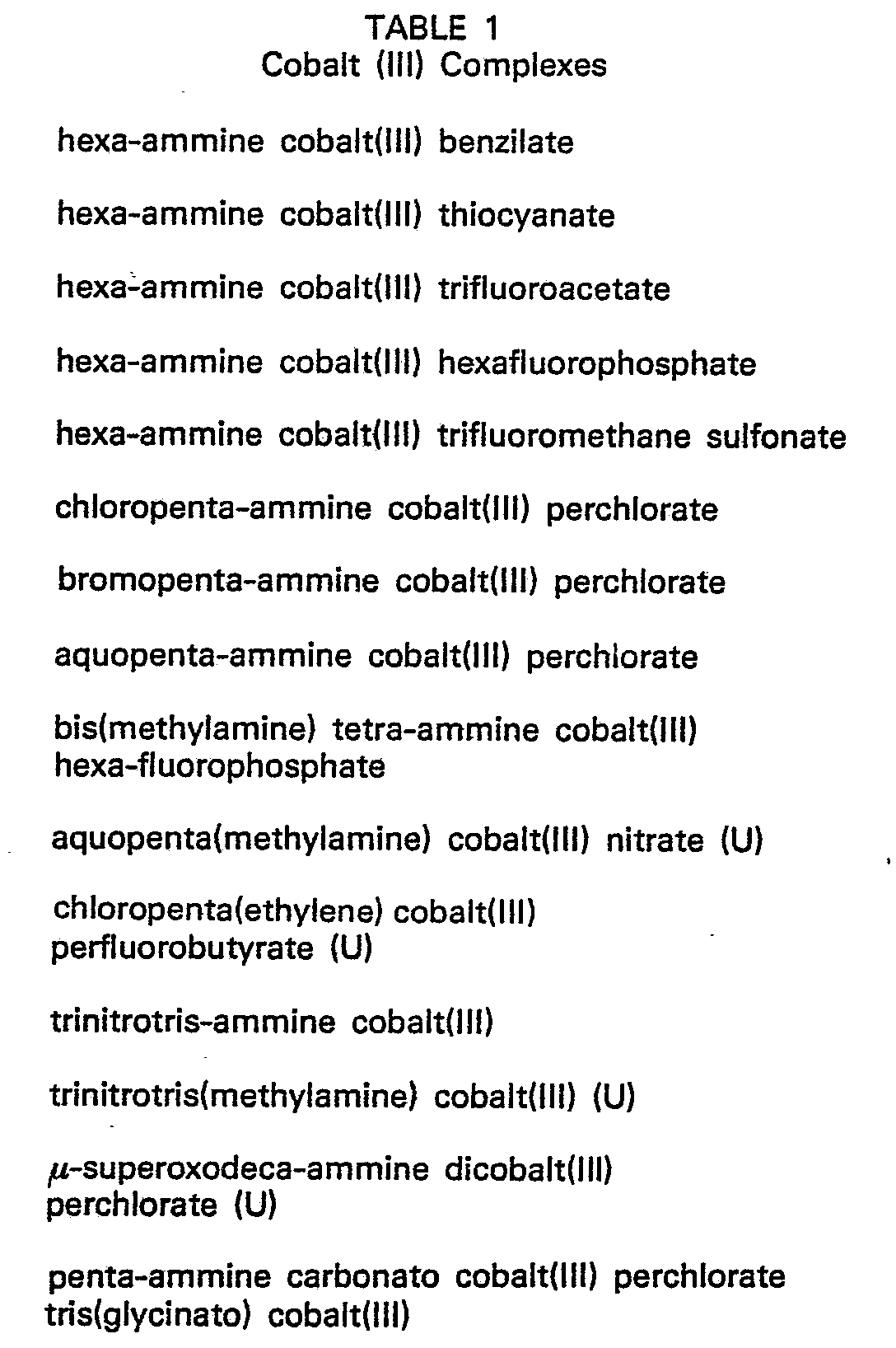
- Preferred materials for generating the amine are the cobalt (III) complexes containing releasable amine ligands with or without a destabilizer, as disclosed in U.S. Patent No. 03,862,842. Examples of useful complexes include those in the following Table 1.
- the suffix (U) designates those which are thermally unstable above about 100°C and which therefore do not require a destabilizer.
- a highly preferred form of the material capable of generating amines is a composition comprising a cobalt(lll) complex that is thermally stable at temperatures slightly above 100°C containing releasable amine ligands and a destabilizer which serves to initiate release of amines from the complex in response to activating radiation.
- Such a destabilizer compound can be a compound responsive to heat, of which the following are examples; organometallics such as ferrocene, 1,1-dimethylferrocene and tricarbonyls such as N,N-dimethylaniline chromium tricarbonyl; and organic materials such as 4-phenylcatechol, sulfon-amidophenols and naphthols, pyrazolidones, ureas such as thiourea, aminimides in polymeric or simple compound form, triazoles, barbiturates and the like.
- organometallics such as ferrocene, 1,1-dimethylferrocene and tricarbonyls such as N,N-dimethylaniline chromium tricarbonyl
- organic materials such as 4-phenylcatechol, sulfon-amidophenols and naphthols, pyrazolidones, ureas such as thiourea, aminimides in polymeric or simple
- the destabilizers can be photoactivators which respond to exposure to light to form a reducing agent for the cobalt(III) complex, whereby cobalt(II) and free amines are formed.
- photoactivators can be spectral sensitizers such as described in Research Disclosure, Vol. 130, Publication No. 13023, the details of which are expressly incorporated herein by reference.
- Preferred photoactivators are photoreductants such as metal carbonyls, e.g., benzene chromium tricarbonyl; p-ketosulfide, e.g. 2-(4-tolylthio)-chromanone; disulfides; diazoanthrones; diazophen- anthrones; aromatic azides; carbazides; diazosulfonates; B-ketosulfides; diketones; carboxylic acid azides; organic benzilates; dipyridinium salts; diazonaphthones; phenazines; and particularly quinone photoreductants.
- metal carbonyls e.g., benzene chromium tricarbonyl
- p-ketosulfide e.g. 2-(4-tolylthio)-chromanone
- disulfides diazoanthrones
- diazophen- anthrones aromatic azides
- carbazides diazosulf
- the quinones which are particularly useful as photoreductants include ortho- and para- benzoquinones and ortho- and para-naphthoquinones, phenanthrenequinones and anthraquinones.
- the quinones may be unsubstituted or incorporate any substituent or combination of substituents which do not interfere with the conversion of the quinone to the corresponding reducing agent.
- substituents include, but are not limited to, primary, secondary and tertiary alkyl, alkenyl and alkynyl, aryl, alkoxy, aryloxy, alkoxyalkyl, acyloxyalkyl, aryloxyalkyl, aroyloxyalkyl, aryloxyalkoxy, alkylcarbonyl, carboxy, primary and secondary amino, aminoalkyl, amidoalkyl, anilino, piperidino, pyrrolidino, morpholino, nitro, halide and other similar substituents.
- Such aryl substituents are preferably phenyl substituents and such alkyl, alkenyl and alkynyl substituents, whether present as sole substituents or present in combination with other atoms, typically incorporate 20 or fewer (preferably 6 or fewer) carbon atoms.
- a highly preferred class of photoreductants is that of internal hydrogen source quinones, that is, quinones incorporating labile hydrogen atoms. These quinones are more easily photoreduced than quinones which do not incorporate labile hydrogen atoms.
- Particularly preferred internal hydrogen source quinones are 5,8-dihydro-1,4-naphthoquinones having at least one hydrogen atom in each of the 5- and 8-ring positions, or those which have a hydrogen atom bonded to a carbon atom to which is also bonded the oxygen atom of an oxy substituent or a nitrogen atom of an amine substituent with the further provision that the carbon-to- hydrogen bond is the third or fourth bond removed from at least one quinone carbonyl double bond.
- the term "amine substituent" is inclusive of amide and imine substituents.
- the quinone photoreductants rely upon a light exposure between about 300 nm and about 700 nm to form the reducing agent which reduces the cobalt(lll) complex. It is noted that heating is not needed after the light exposure to cause the redox reaction to take place. However, an additional thermal exposure can be used as part of the exposure to drive the reaction to a more timely completion. Furthermore, the heat is desirable to form the dye B.
- An imaging element prepared in accordance with the invention preferably comprises the amine-generating material, phthalaldehyde and the binder all mixed together, in a single layer on the support, overcoated with a polymer layer of the type described.
- the material generating the amines in response to the radiation exposure can be associated with a separate phthalaldehyde layer.
- a radiation-exposure layer comprising a cobalt(III) complex, and a destabilizer, without phthalaldehyde, can be simply applied, as by coating over the phthalaidehyde-containing layer to form an integral element.
- the binder for the cobalt(lll) complex layer can be the overcoat of the invention as described above. However, for the best density values, it is preferred that the overcoat of the invention be applied over the cobalt complex layer.
- Still another preferred embodiment is an element prepared by superimposing a second overcoat layer over the first overcoat layer.
- the polymer in the second overcoat layer can be different from the above-described polymers used in the first overcoat.
- Such a technique allows the use of more readily hardenable second overcoat which would not adhere well to the image-forming composition if coated directly.
- a second overcoat layer of poly(acrylamide-co-N-vinyl-2-pyrrolidone-co-2-hydroxyethyl acrylate) (45:45:10) can be applied over a first overcoat layer of gelatin.
- water-soluble cellulose acetate, crosslinked using the above-described melamine can be coated over crosslinked gelatin.
- At least one of the overcoat layers should comprise one of the polymers described above as producing an increased maximum neutral density.
- an amplifier can be included, such as phthalaldehyde; the intermediate productA or reaction (1) serving as a reducing agent for remaining cobalt(III) complex.
- the amplifier can be a compound which will chelate with cobalt(II) to form a reducing agent for remaining cobalt(III) complexes.
- Such chelating compounds contain conjugated bonding systems.
- Typical amplifiers of this class, and necessary restrictions concerning pKa values of the anions which can be used in the cobalt(ill) complex in such circumstances, are described in U.S. Patent No. 4,075,019 issued Feb. 21, 1978, and in Research Disclosure, Vol. 135, July 1975, Publication No. 13505, the details of which are expressly incorporated herein by reference.
- thermally stable cobalt(lll) complexes can be used without a destabilizer.
- examples include compositions and elements containing the complex and a tridentate-chelate-forming amplifier, exposed to a pattern of incident electron radiation as described in Research Disclosure, Vol. 146, Publication No. 14614, June 1976. The_details of that publication are expressly incorporated herein by reference.
- the image-forming composition is preferably coated onto a support, particularly if the coating is not self-supporting.
- Typical supports include transparent supports such as film supports and glass supports, as well as opaque supports such as metal and photographic paper supports.
- the support can be either rigid or flexible.
- the most common photographic supports for most applications are paper, including those with matte finishes, and transparent film supports such as poly(ethylene terephthalate) film.
- Suitable exemplary supports are disclosed in Product Licensing Index, Vol. 92, Dec. 1971, Publication No. 9232, at p 108, and Research Disclosure, Vol. 134, June 1975, Publication No. 13455.
- the support can incorporate one or more subbing layers for the purpose of altering its surface properties so as to enhance the adhesion of the radiation-responsive composition to the support.
- Supports such as poly(ethylene terephthalate) are particularly preferred because they tend to be relatively impervious at most processing temperatures to the volatile aromatic dialdehydes. As a result, phthalaldehyde is not lost through the support during the developmental heating of the exposed element. However, even supports which are not resistant to such a loss can be used, provided they are given a protective coating of one of the polymers described above for the overcoat of the element. In such a case, the result is an image-forming composition sandwiched between two protective layers, each of which comprises a polymer which results in increased maximum neutral densities.
- the aforedescribed image-forming composition, and thereafter the overcoat are successively coated out of a suitable solvent onto the support.
- the coating solvent is a nonaqueous solvent, such as acetone, a mixture of acetone and 2-methoxyethanol, or dimethylformamide, to permit the use of other components such as photoactivators which are soluble in nonaqueous solvents.
- the proportions of the nonbinder reactants comprising the image-forming composition to be coated can vary widely, depending upon which materials are being used. Where cobalt(III) complex is present, the molar amounts for such compositions can be expressed per mole of complex. Thus, if destabilizer materials are incorporated in addition to cobalt(lll) complex, they can vary widely from about 0.004 mole per mole of complex, such as ferrocene, to about 5 moles per mole for succinimide. For example, 5,5-diphenylhydantoin can be present in an amount of between about 0.1 mole and about 2 moles per mole of the complex. With respect to the phthalaldehyde, it can be present in an amount from about 1 to 15 moles per mole of cobalt(III) complex.
- a convenient range of coating coverage of phthalaldehyde is between about 2.5 and about 25 mg/dm 2. Conveniently, the overcoat is applied at a coverage of between about 3 and about 100 mg/dm 2 .
- the total combined thicknesses of a dual overcoat, if used, can be within the range noted above for a single overcoat. Preferably, such dual coverage, when using crosslinked gelatin, is about 20 mg/dm 2 with the gelatin being about 5 mg/dm 2 .
- the solutions are coated by such means as whirler coating, brushing, doctor-blade coating, hopper coating and the like. Thereafter, the solvent is evaporated.
- Other exemplary coating procedures are set forth in Product Licensing Index, Vol. 92, Dec. 1971, Publication No. 9232, at p 109.
- Addenda such as coating aids and plasticizers can be incorporated into the coating composition.
- a particularly useful addendum to the overcoat is one of the conventional matting agents.
- overcoats listed in Table 2 were prepared as aqueous solutions, adjusted to pH 3.0 and applied to give a dry coverage of 21.6 mg/dm 2. Each coating was then dried in the following order: 48 seconds at about 38°C, 2 minutes at about 60°C, 2 minutes at about 70°C, 2 minutes at about 80°C and 2 minutes at about 27°C.
- Examples 1-3 The procedure of Examples 1-3 was repeated, using different overcoat polymers identified in Table 3. For comparative purposes, two other controls, a lower molecular-weight poly(N-vinyl-2-pyrrolidone) and poly(vinyl alcohol) were also tested. The results of Table 3 were measured as described for Examples 1-3, and further included speed results as the number of 0.15 log E steps which were fully developed to a density of greater than 1.0.
- Example 1 To demonstrate the further improvement of the invention over other conventional overcoat materials, the procedure of Example 1 was repeated except the following overcoat materials were applied:
- Example 12 was repeated, except that the overcoat was poly(acrylamide-co-N-vinyl-2-pyrrolidone) (25:75).
- the maximum neutral density produced was 2.76 at three 0.15 log E steps, a result that was not significantly better than Control 2 of Table 2.
- Example 1 was repeated, except that the overcoat was sodium cellulose sulfate.
- the maximum neutral density produced was 2.29 at three 0.15 log E steps.
- Example 17 was repeated, except that the overcoat was 5.4 mg/dm 2 of gelatin subsequently cross-linked that in turn was overcoated with 16.2 mg/dm 2 of water-soluble cellulose acetate having 17.1% acetyl content and crosslinked with hexamethoxymethyl melamine.
- the Dmx was 2.64, considerably less than the 2.9 value for Example 17.
Landscapes
- Chemical & Material Sciences (AREA)
- Engineering & Computer Science (AREA)
- Materials Engineering (AREA)
- Physics & Mathematics (AREA)
- General Physics & Mathematics (AREA)
- Compositions Of Macromolecular Compounds (AREA)
- Heat Sensitive Colour Forming Recording (AREA)
- Non-Silver Salt Photosensitive Materials And Non-Silver Salt Photography (AREA)
Description
- This invention relates to an imaging element which contains an aromatic dialdehyde as a dye-forming component of a radiation-responsive image-forming composition. More specifically, an element is provided which includes a layer of a polymer that seals the dialdehyde into the element as a means of increasing the maximum neutral densities available from the imaging element.
- Imaging elements have been devised which rely upon the photodestruction of o-phthalaldehyde which, where not destroyed, forms a dye when suitably developed. Examples are disclosed in U.S. Patent No. 3,102,811 wherein poly(vinylpyrrolidone) and poly(vinyl alcohol) are listed as exemplary. binders for an o-phthalaldehyde image-forming composition. o-Phthalaldehyde is also used as a dye-forming material in imaging elements which rely upon the reduction of cobalt (II) complexes, as described in Research Disclosure, Vol. 158, June, 1977, Publication No. 15874, published by Industrial Opportunities Ltd. Hampshire, United Kingdom.
- Such imaging elements are susceptible to loss of phthalaldehyde during element formation, due to the high volatility of the compound. Such losses can decrease drastically the amount of dye density available during development. One solution to this problem is to use a polysulfonamide as a binder for the image-forming composition. The polysulfonamide binder is useful to retain phthalaldehyde in the element. Particularly useful polysulfonamide binders which provide superior levels of retention are described in U.S. Patent No. 4,107,155 by Fletcher et al, granted August 15, 1978.
- Although the binders described in the aforesaid patent greatly increase the available dye density in elements using phthalaldehyde as the dye-forming material, some phthalaldehyde is still lost by volatilization during image processing. Particularly, losses occur when the exposed element is heated for image development. Therefore, it is desirable to provide such an element which better retains phthalaldehyde.
- Now, it has been discovered that phthalaldehyde is more effectively retained, as a dye-forming material, in an imaging element when the element is overcoated with a layer of certain polymeric materials. More specifically, the present invention is an imaging element comprising a support bearing at least one layer of a radiation-sensitive image-forming composition containing an aromatic orthodialdehyde as a dye-forming component, characterized in that superimposed over said layer of image-forming composition there is a layer of a compatible polymeric material selected from gelatin, gelatin grafted with recurring units of acrylonitrile and optionally bisacrylamidoacetic acid or bis(acryloyloxy)acetic acid, or a polymer, or copolymer having at least 50 percent by weight of recurring acrylamide units.
- By "compatible" is meant a polymeric material having other physical properties appropriate to an imaging element, e.g., sufficient adhesion to the radiation-sensitive underlayer, transparency to activating radiation, and freedom from cracking.
- An overcoat layer of an imaging element according to the present invention is prepared preferably by coating with a solution of a compatible polymer as described above at a pH of 3 so as to obtain a coating containing 20 mg/dm2 of the said polymer. On exposure for 5 seconds to a 400 watt medium- pressure mercury arc lamp and heat development for 5 seconds at 130°C, an imaging element of this invention produces an image having a maximum neutral density at least 10% greater than that produced by an indentically processed, identical element without the overcoat.
- Although this invention is described in connection with phthalaldehyde as the preferred aromatic dialdehyde, the invention is not limited thereto. Rather, it can be used advantageously with any volatile aromatic orthodialdehyde capable of reacting to form a dye. Other aromatic dialdehydes which are useful as dye-forming materials include, for example, 4-hydroxy-1,2-phthalaldehyde, 4-benzoyloxy-1,2-phthalaldehyde, 4-methacryloyloxy-1,2-phthalaldehyde, 4-t-butyl-1,2-phthalaldehyde and 4-bromo-1,2-phthalaldehyde; 5,6,7,8-tetrahydro-5,5,8,8-tetramethyInaphthalene-2,3-dialdehyde; and 2,3-naphthalenedialdehyde.
- Preferably, phthalaldehyde is only one component of the radiation-responsive, image-forming composition. It may also contain a material for image-wise-generating a product which can react with phthaldehyde to form a dye. Although the preferred embodiments hereinafter disclosed employ materials for generating amines as the reaction product; the invention is not limited to such embodiments. Any composition capable of imagewise-converting phthalaldehyde to a dye can be incorporated into the imaging element of this invention.
ortho-Phthalaldehyde, herein abbreviated as phthalaldehyde, or PA, is a convenient dye-forming material capable of selective reaction with amines to form a black dye. By "amines" we refer to ammonia and primary amines. The dye reaction sequence, in the case of NH3, is believed to be as follows:

- The invention employs a layer of an image-forming composition which contains phthaialdehyde, a binder and a material which generates an amine in response to activating radiation. Said amine and phthalaldehyde combine to form the oligomeric dye B noted above. Through the selection of certain polymers applied in a layer over the image-forming composition layer, improved maximum neutral density values of dye B can be obtained. As used herein, "maximum neutral density" of an element refers to the density of a point on the characteristic curve plotting developed density against the logarithm of the exposure, at which an increase in exposure produces no increase in density. With the present type of imaging element, the selection of an exposure level through a 0.15 Log E step table which produces at least three developed steps produces a density in the most exposed step comparable with the maximum neutral density. Actual density comparisons between elements are made at the same level of exposure, in all cases that level is selected to produce at least the three 0.15 log E steps in each element.
- The preferred embodiments feature such superimposed polymers as overcoats, due to the manufacturing convenience resulting therefrom. However, other methods of superposition can be used to achieve the same improvement in maximum neutral densities.
- Thus, overcoats of a wide variety of polymers permit an enhancement of the densities achieved from phthalaldehyde-containing imaging elements. Specifically, using overcoats of the compatible polymers of this invention, the maximum neutral density values of the image-forming composition are significantly greater than when using no overcoat, or when using poly(vinylpyrrolidone). As used herein, "significantly greater" means by an amount which is statistically significant, that is, an amount which is more than experimental error, determined to be about 7%. A number of compatible polymers have been found which give improvements of about 40% or more. We believe that the superior images are obtained because of the superior retention of phthalaldehyde when developing an exposed phthalaldehyde-containing imaging element.
- Overcoat polymers having the above-noted property of producing increased maximum neutral density values include gelatin, gelatin grafted with recurring units of acrylonitrile and optionally bisacrylamidoacetic acid or bis(acryloyloxy) acetic acid, and polymers or copolymers having at least 50 percent of recurring units of acrylamide. Preferred polymers having acrylamide recurring units are represented by the formula:

- R2 represents an alkylene group containing from 1-3 carbon atoms, such as methylene, propylene and the like;
- R3 represents an alkyl group containing from 1-3 carbon atoms, for example, methyl, ethyl, propyl, isopropyl and the like;
- R' and R4 each independently represents a hydrogen atom or a methyl group;
- G represents hydrogen or an oxo group
- m and n each independently represents 1 or 0;
- D, D' and D" each independently represents -NH- or -0-;
- Z represents the atoms necessary to complete one or more saturated or unsaturated heterocyclic rings containing from 4-9 ring atoms, such as 1-imidazole, 2-pyridine, 4-pyridine, 2-pyrrole, 2-pyrazole and the like;
- x represents from 50 to 90% by weight;
- y represents from 10 to 50% by weight;
- z represents from 0 to 10% by weight; and
- Z 1 represents from 0 to 10% by weight.
- The aforenoted gelatin grafts can have recurring units with the structure:

- GEL represents gelatin;
- D and D' each independently represents -NH- or -0-;
- x" represents from 50 to 90% by weight;
- y" represents from 10 to 50% by weight; and
- z" represents from 0 to 10% by weight.
- Noninterfering recurring units other than those mentioned can be included in the copolymers useful in the invention.
- The gelatin overcoats, or those having recurring units of formula (I) with pendant active methylene

- The polymers of formula (I) are prepared by conventional addition polymerization techniques using redox initiator systems, such as persulfate-bisulfite or hydrogen peroxide, or using organic soluble free-radical-generating initiating systems such as 2,2'-azobis(2-methylpropionitrile). Similarly, the graft polymers of structure (II) are prepared by conventional techniques.
- The following preparation is included by way of illustration:
- Preparation of poly(acrylamide-co-N-vinyl-2-pyrrolidone-co-2-acetoacetoxyethyl methacrylate) (50:45:5)*
- *As used herein, unless otherwise stated, all percentages of recurring units are weight ratios of monomers as starting materials.
- To a 5-liter round-bottom flask, fitted with a stirrer, reflux condenser and nitrogen inlet, were added 3240 ml of distilled water, 360 g of denatured ethanol, 200 g (2.81 mole) of acrylamide, 180 g (1.62 mole) of vinyl-pyrrolidone and 20 g (0.81 mole) of 2-acetoacetoxyethyl methacrylate. The contents were purged with nitrogen for 20 minutes and then the flask was immersed in a 60°C water bath. Nitrogen bubbling and stirring were continued for an additional 10 minutes and then 4.0 g (0.024 mole) of 2,2'-azobis(2-methylpropionitrile) dissolved in 60 ml acetone were added. The solution was stirred under nitrogen for an additional 5 hours at 60°C.
- The resultant viscous polymer solution, when diluted to 5.1 % solids with distilled water, had a bulk viscosity of 40 centipoise at room temperature. After dialysis, the polymer had an inherent viscosity, as measured in 1 N NaCi at 0.25 g/dl, of 1.27 at 25°C.
- Gelatin grafted with recurring units of acrylonitrile and bisacrylamidoacetic (Formula II) can be prepared according to the method described in U.S. Patent 3,756,814 except that acrylonitrile and bisacrylamidoacetic acid in the desired proportions are substituted for the vinyl monomers having attached mordant groups according to the patent.
- The molecular weight of the polymer selected for the overcoat does not appear to be critical to the formation of improved maximum neutral density values. Furthermore, the molecular weights are subject to wide variation even within a given class of polymers, depending on the preparation conditions. For example, useful terpolymers of acrylamide of the type described above can have molecular weights within and beyond the range evidenced by inherent viscosities from about 0.1 to about 6.0, measured as a 0.25 weight percent solution in dimethylformamide. A preferred range of inherent viscosities is from about 0.5 at about 2.0.
- The image-forming composition preferably comprises, as noted, phthalaldehyde and a binder. The binder selected for the image-forming composition is not believed to be critical, inasmuch as even binders which are relatively pervious to phthalaldehyde can be used in such an image-forming composition if the overcoat of the invention is also used. However, the best results are achieved when using as the binder for the image-forming composition one of those disclosed in U.S. Patent No. 4,107,155. Particularly preferred examples of such polymers include polysulfonamides such as poly(ethylene - co - 1,4 - cyclohexylenedimethylene - 1 - methyl - 2,4 - benzenedisulfonamide), poly-(ethylene - co - 1,4 - cyclohexylenedimethylene - 1 - chloro - 2,4 - benzenedisulfonamide), poly-(ethylene - co - 1,4 - cyclohexylenedimethylene - 1,2 - dichloro - 3,5 - benzenedisulfonamide), poly-(ethylene - co - 1,4 - cyclohexylenedimethylene - 1 - chloro - 3,5 - benzenedisulfonamide), poly-(ethylene - co - 1,3 - xylylene - 1 - methyl - 2,4 - benzenedisulfonamide), poly(1,4 - cyclohexylenedimethylene - 1 - methyl - 2,4 - benzenedisulfonamide), and poly(1,3 - xylyene - 1 - methyl - 2,4-benzenedisulfonamide). Highly useful polymers also include polyacrylonitriles, e.g., poly(methacrylonitrile), poly [N - (4 - methacryloyloxyphenyl)methanesulfonamide], and poly(ethylene - co - hexamethylene - 1 ethyl - 2,4 - benzenedisulfonamide. Of these, poly(ethylene - co - 1,4 - cyclohexylenedimethylene-1 - methyl - 2,4 - benzenesulfonamide) (50:50) is highly preferred. Preparation of the poly(acrylonitriles) proceeds via conventional processes. The polysulfonamides can be condensation polymers containing sulfonamide groups in the polymer backbone. Preferably they are prepared by solution polycondensation using aromatic disulfonyl chlorides and diamines in the presence of an acid scavenger. Alternatively, the polysulfonamides can be addition polymers derived from vinyl monomers having pendant groups containing -NR'S02- groups, R' being hydrogen or methyl.
- The image-forming composition also preferably includes an amine-generating material responsive to activating radiation. The amine when formed reacts with the phthalaldehyde to form a dye. Any amine-generating material can be used. Preferred materials for generating the amine are the cobalt (III) complexes containing releasable amine ligands with or without a destabilizer, as disclosed in U.S. Patent No. 03,862,842. Examples of useful complexes include those in the following Table 1. The suffix (U) designates those which are thermally unstable above about 100°C and which therefore do not require a destabilizer.
- A highly preferred form of the material capable of generating amines is a composition comprising a cobalt(lll) complex that is thermally stable at temperatures slightly above 100°C containing releasable amine ligands and a destabilizer which serves to initiate release of amines from the complex in response to activating radiation. Such a destabilizer compound can be a compound responsive to heat, of which the following are examples; organometallics such as ferrocene, 1,1-dimethylferrocene and tricarbonyls such as N,N-dimethylaniline chromium tricarbonyl; and organic materials such as 4-phenylcatechol, sulfon-amidophenols and naphthols, pyrazolidones, ureas such as thiourea, aminimides in polymeric or simple compound form, triazoles, barbiturates and the like.
- Altematively, the destabilizers can be photoactivators which respond to exposure to light to form a reducing agent for the cobalt(III) complex, whereby cobalt(II) and free amines are formed. Such photoactivators can be spectral sensitizers such as described in Research Disclosure, Vol. 130, Publication No. 13023, the details of which are expressly incorporated herein by reference.
- Preferred photoactivators are photoreductants such as metal carbonyls, e.g., benzene chromium tricarbonyl; p-ketosulfide, e.g. 2-(4-tolylthio)-chromanone; disulfides; diazoanthrones; diazophen- anthrones; aromatic azides; carbazides; diazosulfonates; B-ketosulfides; diketones; carboxylic acid azides; organic benzilates; dipyridinium salts; diazonaphthones; phenazines; and particularly quinone photoreductants.
- The quinones which are particularly useful as photoreductants include ortho- and para- benzoquinones and ortho- and para-naphthoquinones, phenanthrenequinones and anthraquinones. The quinones may be unsubstituted or incorporate any substituent or combination of substituents which do not interfere with the conversion of the quinone to the corresponding reducing agent. A variety of such substituents are known in the art and include, but are not limited to, primary, secondary and tertiary alkyl, alkenyl and alkynyl, aryl, alkoxy, aryloxy, alkoxyalkyl, acyloxyalkyl, aryloxyalkyl, aroyloxyalkyl, aryloxyalkoxy, alkylcarbonyl, carboxy, primary and secondary amino, aminoalkyl, amidoalkyl, anilino, piperidino, pyrrolidino, morpholino, nitro, halide and other similar substituents. Such aryl substituents are preferably phenyl substituents and such alkyl, alkenyl and alkynyl substituents, whether present as sole substituents or present in combination with other atoms, typically incorporate 20 or fewer (preferably 6 or fewer) carbon atoms.
- A highly preferred class of photoreductants is that of internal hydrogen source quinones, that is, quinones incorporating labile hydrogen atoms. These quinones are more easily photoreduced than quinones which do not incorporate labile hydrogen atoms.
- Particularly preferred internal hydrogen source quinones are 5,8-dihydro-1,4-naphthoquinones having at least one hydrogen atom in each of the 5- and 8-ring positions, or those which have a hydrogen atom bonded to a carbon atom to which is also bonded the oxygen atom of an oxy substituent or a nitrogen atom of an amine substituent with the further provision that the carbon-to- hydrogen bond is the third or fourth bond removed from at least one quinone carbonyl double bond. As employed in the discussion of photoreductants herein, the term "amine substituent" is inclusive of amide and imine substituents.
- Further details and a list of useful quinone photoreductants of the type described above are set forth in Research Disclosure, Vol. 126, Oct. 1974, Publication No. 12617, the contents of which are hereby expressly incorporated by reference. Still others which can be used include 2-isopropoxy-3-chloro-1,4-naphthoquinone and 2-isopropoxy-1,4-anthraquinone.
- The quinone photoreductants rely upon a light exposure between about 300 nm and about 700 nm to form the reducing agent which reduces the cobalt(lll) complex. It is noted that heating is not needed after the light exposure to cause the redox reaction to take place. However, an additional thermal exposure can be used as part of the exposure to drive the reaction to a more timely completion. Furthermore, the heat is desirable to form the dye B.
- An imaging element prepared in accordance with the invention preferably comprises the amine-generating material, phthalaldehyde and the binder all mixed together, in a single layer on the support, overcoated with a polymer layer of the type described. Alternatively, however, the material generating the amines in response to the radiation exposure can be associated with a separate phthalaldehyde layer. In this case, such a radiation-exposure layer comprising a cobalt(III) complex, and a destabilizer, without phthalaldehyde, can be simply applied, as by coating over the phthalaidehyde-containing layer to form an integral element. To avoid yet another overlayer, the binder for the cobalt(lll) complex layer can be the overcoat of the invention as described above. However, for the best density values, it is preferred that the overcoat of the invention be applied over the cobalt complex layer.
- Still another preferred embodiment is an element prepared by superimposing a second overcoat layer over the first overcoat layer. The polymer in the second overcoat layer can be different from the above-described polymers used in the first overcoat. Such a technique allows the use of more readily hardenable second overcoat which would not adhere well to the image-forming composition if coated directly. For example, a second overcoat layer of poly(acrylamide-co-N-vinyl-2-pyrrolidone-co-2-hydroxyethyl acrylate) (45:45:10) can be applied over a first overcoat layer of gelatin. Alternatively, water-soluble cellulose acetate, crosslinked using the above-described melamine, can be coated over crosslinked gelatin. At least one of the overcoat layers should comprise one of the polymers described above as producing an increased maximum neutral density.
- As yet another alternative, an amplifier can be included, such as phthalaldehyde; the intermediate productA or reaction (1) serving as a reducing agent for remaining cobalt(III) complex. Or the amplifier can be a compound which will chelate with cobalt(II) to form a reducing agent for remaining cobalt(III) complexes. Such chelating compounds contain conjugated bonding systems. Typical amplifiers of this class, and necessary restrictions concerning pKa values of the anions which can be used in the cobalt(ill) complex in such circumstances, are described in U.S. Patent No. 4,075,019 issued Feb. 21, 1978, and in Research Disclosure, Vol. 135, July 1975, Publication No. 13505, the details of which are expressly incorporated herein by reference.
- In some instance, even thermally stable cobalt(lll) complexes can be used without a destabilizer. Examples include compositions and elements containing the complex and a tridentate-chelate-forming amplifier, exposed to a pattern of incident electron radiation as described in Research Disclosure, Vol. 146, Publication No. 14614, June 1976. The_details of that publication are expressly incorporated herein by reference.
- Other layers not particularly effective in enhancing the maximum neutral density, but added for other purposes, can be disposed between the one or more overcoats described herein, and the one or more layers comprising the image-forming composition, without interfering with the function of the overcoat of this invention.
- To form an imaging element, the image-forming composition is preferably coated onto a support, particularly if the coating is not self-supporting. Any conventional photographic support can be used in the practice of this invention. Typical supports include transparent supports such as film supports and glass supports, as well as opaque supports such as metal and photographic paper supports. The support can be either rigid or flexible. The most common photographic supports for most applications are paper, including those with matte finishes, and transparent film supports such as poly(ethylene terephthalate) film. Suitable exemplary supports are disclosed in Product Licensing Index, Vol. 92, Dec. 1971, Publication No. 9232, at p 108, and Research Disclosure, Vol. 134, June 1975, Publication No. 13455. The support can incorporate one or more subbing layers for the purpose of altering its surface properties so as to enhance the adhesion of the radiation-responsive composition to the support.
- Supports such as poly(ethylene terephthalate) are particularly preferred because they tend to be relatively impervious at most processing temperatures to the volatile aromatic dialdehydes. As a result, phthalaldehyde is not lost through the support during the developmental heating of the exposed element. However, even supports which are not resistant to such a loss can be used, provided they are given a protective coating of one of the polymers described above for the overcoat of the element. In such a case, the result is an image-forming composition sandwiched between two protective layers, each of which comprises a polymer which results in increased maximum neutral densities.
- The aforedescribed image-forming composition, and thereafter the overcoat are successively coated out of a suitable solvent onto the support. Preferably, the coating solvent is a nonaqueous solvent, such as acetone, a mixture of acetone and 2-methoxyethanol, or dimethylformamide, to permit the use of other components such as photoactivators which are soluble in nonaqueous solvents.
- The proportions of the nonbinder reactants comprising the image-forming composition to be coated can vary widely, depending upon which materials are being used. Where cobalt(III) complex is present, the molar amounts for such compositions can be expressed per mole of complex. Thus, if destabilizer materials are incorporated in addition to cobalt(lll) complex, they can vary widely from about 0.004 mole per mole of complex, such as ferrocene, to about 5 moles per mole for succinimide. For example, 5,5-diphenylhydantoin can be present in an amount of between about 0.1 mole and about 2 moles per mole of the complex. With respect to the phthalaldehyde, it can be present in an amount from about 1 to 15 moles per mole of cobalt(III) complex.
- A convenient range of coating coverage of phthalaldehyde is between about 2.5 and about 25 mg/dm2. Conveniently, the overcoat is applied at a coverage of between about 3 and about 100 mg/dm2. The total combined thicknesses of a dual overcoat, if used, can be within the range noted above for a single overcoat. Preferably, such dual coverage, when using crosslinked gelatin, is about 20 mg/dm2 with the gelatin being about 5 mg/dm2.
- Typically, the solutions are coated by such means as whirler coating, brushing, doctor-blade coating, hopper coating and the like. Thereafter, the solvent is evaporated. Other exemplary coating procedures are set forth in Product Licensing Index, Vol. 92, Dec. 1971, Publication No. 9232, at p 109. Addenda such as coating aids and plasticizers can be incorporated into the coating composition. A particularly useful addendum to the overcoat is one of the conventional matting agents.
- The following examples further illustrate the invention.
- To demonstrate the manner in which various overcoat polymers affect the maximum neutral density available from a preferred imaging element, the following machine coating was prepared for each of the examples on a subbed poly(ethylene terephthalate) support:

- The overcoats, listed in Table 2 were prepared as aqueous solutions, adjusted to pH 3.0 and applied to give a dry coverage of 21.6 mg/dm2. Each coating was then dried in the following order: 48 seconds at about 38°C, 2 minutes at about 60°C, 2 minutes at about 70°C, 2 minutes at about 80°C and 2 minutes at about 27°C.
- After 10 days of lab keeping at approximately 24°C adn 65% RH, samples of each coating were exposed for 0.5 seconds in an IBM Micromaster Diazo Copier, Model llD, to a 0.15 log E step tablet and processed for 5 seconds, support side to heated surface, on a 130°C hot block. The maximum neutral density was measured and recorded.

- These examples demonstrated that poly(N-vinyl-2-pyrrolidone) of an ave. mole wt. of 350,000 gave a result which was not statistically significant compared with the use of no overcoat at all; that is, the difference was less than the 7% experimental error. On the other hand, the overcoats of the invention gave more than 10% improvement. Therefore, the remaining Examples 4-16 used as the comparative control PVP K-90, which is assumed to be equivalent to no overcoat at all.
- The procedure of Examples 1-3 was repeated, using different overcoat polymers identified in Table 3. For comparative purposes, two other controls, a lower molecular-weight poly(N-vinyl-2-pyrrolidone) and poly(vinyl alcohol) were also tested. The results of Table 3 were measured as described for Examples 1-3, and further included speed results as the number of 0.15 log E steps which were fully developed to a density of greater than 1.0.


- The slightly higher values obtained in tests of these Examples compared with similar overcoats tested in Examples 1-3 are explainable due to the different batches of chemicals and different batches of polymers which were used.
- To demonstrate the further improvement of the invention over other conventional overcoat materials, the procedure of Example 1 was repeated except the following overcoat materials were applied:
- Control 6 *― no overcoat
- Control 7 - poly(ethyl acrylate-co-acrylic acid) (60:40 wt %), coated from a mixture of H20, acetone and propanol.
- Control 8 - poly(styrene-co-butadiene), available from Philips Petroleum under the trademark "KRO-3", coated from toluene without a pH adjustment. See Example 61 of U.S. Patent 4,075,019.
- Control 9 - polystyrene coated from toluene without a pH adjustment. See U.S. Patent 4,075,019, Col. 41, line 44.
- Control 10 - poly(4,4' - isopropylidenediphenylene 1,1,3' - trimethyl - 3 - phenyl - 5,4'-dicarboxylate)coated from toluene without a pH adjustment. See Research Disclosure, Vol. 158, Pub. No. 15874, June 1977, P. 75, bottom of second column.
- Control 11 - poly(vinylidene chloride-co-acrylonitrile-co-acrylic acid) (79.9:14.1: 6.0 wt %).
- Example 17 - poly(acrylamide-co-N-vinyl-2-pyrrolidinone-co-2-acetoacetoxyethyl methacrylate) (50:45:5 wt %).
- Example 18 - poly(N-vinyl-2-pyrrolidone), 2.7 mg/dm2, available from GAF Corp. under the trade name "PVP K-90", overcoated with 99.7% hydrolyzed poly(vinyl alcohol), 18.9 mg/dm2.
- Example 12 was repeated, except that the overcoat was poly(acrylamide-co-N-vinyl-2-pyrrolidone) (25:75). The maximum neutral density produced was 2.76 at three 0.15 log E steps, a result that was not significantly better than Control 2 of Table 2.
- . Example 1 was repeated, except that the overcoat was sodium cellulose sulfate. The maximum neutral density produced was 2.29 at three 0.15 log E steps.
- Example 17 was repeated, except that the overcoat was 5.4 mg/dm2 of gelatin subsequently cross-linked that in turn was overcoated with 16.2 mg/dm2 of water-soluble cellulose acetate having 17.1% acetyl content and crosslinked with hexamethoxymethyl melamine. The Dmx was 2.64, considerably less than the 2.9 value for Example 17.
In this series of tests, the phthalaldehyde had an acid content of 0.004 meq/g, and the maximum neutral density values hereinafter set forth in Table 4 differed from those of the same overcoat test of previous tables for that reason. Lesser values of acid impurity would be expected to produce greater maximum neutral density values.

Claims (8)


Applications Claiming Priority (2)
| Application Number | Priority Date | Filing Date | Title |
|---|---|---|---|
| US97130078A | 1978-12-20 | 1978-12-20 | |
| US971300 | 1978-12-20 |
Publications (2)
| Publication Number | Publication Date |
|---|---|
| EP0012855A1 EP0012855A1 (en) | 1980-07-09 |
| EP0012855B1 true EP0012855B1 (en) | 1983-02-02 |
Family
ID=25518180
Family Applications (1)
| Application Number | Title | Priority Date | Filing Date |
|---|---|---|---|
| EP79104668A Expired EP0012855B1 (en) | 1978-12-20 | 1979-11-23 | Overcoated photothermographic element having a dye-precursor retaining layer |
Country Status (4)
| Country | Link |
|---|---|
| EP (1) | EP0012855B1 (en) |
| JP (1) | JPS5588046A (en) |
| CA (1) | CA1144412A (en) |
| DE (1) | DE2964678D1 (en) |
Families Citing this family (3)
| Publication number | Priority date | Publication date | Assignee | Title |
|---|---|---|---|---|
| US4727008A (en) * | 1986-06-04 | 1988-02-23 | Eastman Kodak Company | Dye-forming electrically activatable recording element and process |
| US4752547A (en) * | 1986-06-04 | 1988-06-21 | Eastman Kodak Company | Dye-forming electrothermographic material and process |
| BR112021000684A2 (en) * | 2018-07-17 | 2021-04-13 | Evonik Operations Gmbh | METACRYLIC ACID ESTERS, COPOLYMER OBTAINABLE BY THE POLYMERIZATION OF A MONOMER MIXTURE, WATER DISPERSION AND ITS USE, AS WELL AS, COATING OBTAINABLE BY THE APPLICATION OF WATER DISPERSION |
Citations (1)
| Publication number | Priority date | Publication date | Assignee | Title |
|---|---|---|---|---|
| EP0003263A1 (en) * | 1977-12-28 | 1979-08-08 | EASTMAN KODAK COMPANY (a New Jersey corporation) | A method of forming an image, and an imaging element for inhibiting image formation with cobalt (III) complexes |
Family Cites Families (6)
| Publication number | Priority date | Publication date | Assignee | Title |
|---|---|---|---|---|
| US3102811A (en) * | 1960-04-07 | 1963-09-03 | Du Pont | Process for producing images, using light sensitive aromatic 1,2-dialdehydes and elements therefor |
| US3756814A (en) * | 1970-07-27 | 1973-09-04 | Polaroid Corp | Olymer wherein the grafted moiety has mordant capability color diffusion transfer image receiving layer comprising a graft cop |
| BE790872A (en) * | 1971-11-08 | 1973-05-03 | Agfa Gevaert Nv | DEVELOPMENT TREATMENT OF PHOTOGRAPHIC SILVER HALOGENIDE MATERIALS AT HIGH TEMPERATURES |
| JPS5411694B2 (en) * | 1972-05-09 | 1979-05-17 | ||
| US3893860A (en) * | 1974-07-16 | 1975-07-08 | Eastman Kodak Co | Photothermographic element and process |
| US4021246A (en) * | 1975-12-15 | 1977-05-03 | Horizons Incorporated, A Division Of Horizons Research Incorporated | Free radical photosensitive compositions containing bis-sulfides or sulfinyl esters as antifoggants |
-
1979
- 1979-03-20 CA CA000323824A patent/CA1144412A/en not_active Expired
- 1979-11-23 DE DE7979104668T patent/DE2964678D1/en not_active Expired
- 1979-11-23 EP EP79104668A patent/EP0012855B1/en not_active Expired
- 1979-12-20 JP JP16496179A patent/JPS5588046A/en active Pending
Patent Citations (1)
| Publication number | Priority date | Publication date | Assignee | Title |
|---|---|---|---|---|
| EP0003263A1 (en) * | 1977-12-28 | 1979-08-08 | EASTMAN KODAK COMPANY (a New Jersey corporation) | A method of forming an image, and an imaging element for inhibiting image formation with cobalt (III) complexes |
Also Published As
| Publication number | Publication date |
|---|---|
| JPS5588046A (en) | 1980-07-03 |
| DE2964678D1 (en) | 1983-03-10 |
| CA1144412A (en) | 1983-04-12 |
| EP0012855A1 (en) | 1980-07-09 |
Similar Documents
| Publication | Publication Date | Title |
|---|---|---|
| EP0022813B1 (en) | Imaging composition featuring aromatic dialdehyde-retaining binders | |
| US3640720A (en) | Nonwandering hardening compounds and their use | |
| US4288531A (en) | Imaging elements | |
| US4081278A (en) | Heat sensitive dye layers comprising a benzopinacol | |
| US4220700A (en) | Continuous-tone dyed diazo imaging elements | |
| EP0012855A1 (en) | Overcoated photothermographic element having a dye-precursor retaining layer | |
| US3671256A (en) | Polymeric hardeners containing aziridinyl units on the side chain | |
| US3859098A (en) | Photoresist composition | |
| US3816129A (en) | Synthetic silver halide emulsion binder | |
| CA1116915A (en) | Inhibition of image formation utilizing cobalt(iii) complexes | |
| EP0044729B1 (en) | Cobalt (iii) complex-containing image-forming compositions | |
| CA1146002A (en) | Photothermographic material and process | |
| US3824103A (en) | Photographic element,composition and process having an s-carbamoyl stabilizer | |
| US3877947A (en) | Photographic element | |
| US3877946A (en) | Photographic element | |
| US4089688A (en) | Polymeric N-alkenyl carbamate silver halide peptizer | |
| JPS6332177B2 (en) | ||
| US3762927A (en) | Silver halide emulsion containing a nonmigratory hardener | |
| US4318977A (en) | Cobalt (III) complex imaging compositions having improved photographic properties | |
| JPS63172264A (en) | Photothermography emulsion | |
| US4017473A (en) | Hardening of proteinaceous materials | |
| GB2183353A (en) | A silver salt diffusion transfer photographic element | |
| US3655380A (en) | Diffusion transfer product and process containing 5-seleno-1,2,3,4-tetrazole | |
| US2753263A (en) | Silver halide emulsion containing a polymeric polyamine as an acid dye mordant | |
| GB2106522A (en) | Radiation-sensitive crosslinking composition |
Legal Events
| Date | Code | Title | Description |
|---|---|---|---|
| PUAI | Public reference made under article 153(3) epc to a published international application that has entered the european phase |
Free format text: ORIGINAL CODE: 0009012 |
|
| AK | Designated contracting states |
Designated state(s): BE DE FR GB |
|
| DET | De: translation of patent claims | ||
| 17P | Request for examination filed |
Effective date: 19801209 |
|
| GRAA | (expected) grant |
Free format text: ORIGINAL CODE: 0009210 |
|
| AK | Designated contracting states |
Designated state(s): BE DE FR GB |
|
| REF | Corresponds to: |
Ref document number: 2964678 Country of ref document: DE Date of ref document: 19830310 |
|
| ET | Fr: translation filed | ||
| PGFP | Annual fee paid to national office [announced via postgrant information from national office to epo] |
Ref country code: DE Payment date: 19841108 Year of fee payment: 6 |
|
| PGFP | Annual fee paid to national office [announced via postgrant information from national office to epo] |
Ref country code: FR Payment date: 19841127 Year of fee payment: 6 |
|
| PGFP | Annual fee paid to national office [announced via postgrant information from national office to epo] |
Ref country code: BE Payment date: 19841231 Year of fee payment: 6 |
|
| PG25 | Lapsed in a contracting state [announced via postgrant information from national office to epo] |
Ref country code: BE Effective date: 19851130 |
|
| BERE | Be: lapsed |
Owner name: EASTMAN KODAK CY Effective date: 19851130 |
|
| GBPC | Gb: european patent ceased through non-payment of renewal fee | ||
| PG25 | Lapsed in a contracting state [announced via postgrant information from national office to epo] |
Ref country code: FR Free format text: LAPSE BECAUSE OF NON-PAYMENT OF DUE FEES Effective date: 19860731 |
|
| PG25 | Lapsed in a contracting state [announced via postgrant information from national office to epo] |
Ref country code: DE Effective date: 19860801 |
|
| REG | Reference to a national code |
Ref country code: FR Ref legal event code: ST |
|
| PG25 | Lapsed in a contracting state [announced via postgrant information from national office to epo] |
Ref country code: GB Effective date: 19881118 |
|
| PLBE | No opposition filed within time limit |
Free format text: ORIGINAL CODE: 0009261 |
|
| STAA | Information on the status of an ep patent application or granted ep patent |
Free format text: STATUS: NO OPPOSITION FILED WITHIN TIME LIMIT |