EP0012020B1 - Dry silver photo-sensitive compositions, dyes for use therein and preparation of such dyes - Google Patents
Dry silver photo-sensitive compositions, dyes for use therein and preparation of such dyes Download PDFInfo
- Publication number
- EP0012020B1 EP0012020B1 EP79302730A EP79302730A EP0012020B1 EP 0012020 B1 EP0012020 B1 EP 0012020B1 EP 79302730 A EP79302730 A EP 79302730A EP 79302730 A EP79302730 A EP 79302730A EP 0012020 B1 EP0012020 B1 EP 0012020B1
- Authority
- EP
- European Patent Office
- Prior art keywords
- carbon atoms
- hydrogen
- alkyl
- group
- dye
- Prior art date
- Legal status (The legal status is an assumption and is not a legal conclusion. Google has not performed a legal analysis and makes no representation as to the accuracy of the status listed.)
- Expired
Links
- 239000000975 dye Substances 0.000 title claims description 92
- 239000000203 mixture Substances 0.000 title claims description 71
- 229910052709 silver Inorganic materials 0.000 title claims description 37
- 239000004332 silver Substances 0.000 title claims description 37
- BQCADISMDOOEFD-UHFFFAOYSA-N Silver Chemical compound [Ag] BQCADISMDOOEFD-UHFFFAOYSA-N 0.000 title description 23
- 238000002360 preparation method Methods 0.000 title description 14
- 125000004432 carbon atom Chemical group C* 0.000 claims description 43
- 150000001875 compounds Chemical class 0.000 claims description 40
- 125000000217 alkyl group Chemical group 0.000 claims description 32
- 229910052739 hydrogen Inorganic materials 0.000 claims description 26
- 239000001257 hydrogen Substances 0.000 claims description 26
- 125000001424 substituent group Chemical group 0.000 claims description 23
- 125000004435 hydrogen atom Chemical group [H]* 0.000 claims description 20
- 125000001997 phenyl group Chemical group [H]C1=C([H])C([H])=C(*)C([H])=C1[H] 0.000 claims description 19
- UFHFLCQGNIYNRP-UHFFFAOYSA-N Hydrogen Chemical compound [H][H] UFHFLCQGNIYNRP-UHFFFAOYSA-N 0.000 claims description 18
- -1 silver halide Chemical class 0.000 claims description 15
- 125000001434 methanylylidene group Chemical group [H]C#[*] 0.000 claims description 10
- 229940100890 silver compound Drugs 0.000 claims description 10
- 150000003379 silver compounds Chemical class 0.000 claims description 10
- 125000003545 alkoxy group Chemical group 0.000 claims description 9
- 239000003638 chemical reducing agent Substances 0.000 claims description 9
- 238000000034 method Methods 0.000 claims description 8
- 125000000623 heterocyclic group Chemical group 0.000 claims description 7
- 239000002253 acid Substances 0.000 claims description 6
- 125000003118 aryl group Chemical group 0.000 claims description 6
- 239000003054 catalyst Substances 0.000 claims description 6
- 238000006243 chemical reaction Methods 0.000 claims description 6
- 125000005843 halogen group Chemical group 0.000 claims description 6
- 125000003342 alkenyl group Chemical group 0.000 claims description 5
- 125000001495 ethyl group Chemical group [H]C([H])([H])C([H])([H])* 0.000 claims description 5
- 125000002496 methyl group Chemical group [H]C([H])([H])* 0.000 claims description 5
- 125000003710 aryl alkyl group Chemical group 0.000 claims description 4
- 239000011230 binding agent Substances 0.000 claims description 4
- 229910052801 chlorine Inorganic materials 0.000 claims description 4
- 239000000460 chlorine Chemical group 0.000 claims description 4
- 229910052736 halogen Inorganic materials 0.000 claims description 4
- 150000002367 halogens Chemical class 0.000 claims description 4
- 239000007787 solid Substances 0.000 claims description 4
- WKBOTKDWSSQWDR-UHFFFAOYSA-N Bromine atom Chemical group [Br] WKBOTKDWSSQWDR-UHFFFAOYSA-N 0.000 claims description 3
- 125000001301 ethoxy group Chemical group [H]C([H])([H])C([H])([H])O* 0.000 claims description 3
- 239000011872 intimate mixture Substances 0.000 claims description 3
- 125000000956 methoxy group Chemical group [H]C([H])([H])O* 0.000 claims description 3
- 125000005010 perfluoroalkyl group Chemical group 0.000 claims description 3
- KZBUYRJDOAKODT-UHFFFAOYSA-N Chlorine Chemical group ClCl KZBUYRJDOAKODT-UHFFFAOYSA-N 0.000 claims description 2
- JCXJVPUVTGWSNB-UHFFFAOYSA-N Nitrogen dioxide Chemical compound O=[N]=O JCXJVPUVTGWSNB-UHFFFAOYSA-N 0.000 claims description 2
- NINIDFKCEFEMDL-UHFFFAOYSA-N Sulfur Chemical compound [S] NINIDFKCEFEMDL-UHFFFAOYSA-N 0.000 claims description 2
- 239000005864 Sulphur Substances 0.000 claims description 2
- 150000001450 anions Chemical class 0.000 claims description 2
- 125000004429 atom Chemical group 0.000 claims description 2
- QVGXLLKOCUKJST-UHFFFAOYSA-N atomic oxygen Chemical compound [O] QVGXLLKOCUKJST-UHFFFAOYSA-N 0.000 claims description 2
- CPRRHERYRRXBRZ-SRVKXCTJSA-N methyl n-[(2s)-1-[[(2s)-1-hydroxy-3-[(3s)-2-oxopyrrolidin-3-yl]propan-2-yl]amino]-4-methyl-1-oxopentan-2-yl]carbamate Chemical compound COC(=O)N[C@@H](CC(C)C)C(=O)N[C@H](CO)C[C@@H]1CCNC1=O CPRRHERYRRXBRZ-SRVKXCTJSA-N 0.000 claims description 2
- 229910052760 oxygen Inorganic materials 0.000 claims description 2
- 239000001301 oxygen Substances 0.000 claims description 2
- 239000002798 polar solvent Substances 0.000 claims description 2
- ANRHNWWPFJCPAZ-UHFFFAOYSA-M thionine Chemical compound [Cl-].C1=CC(N)=CC2=[S+]C3=CC(N)=CC=C3N=C21 ANRHNWWPFJCPAZ-UHFFFAOYSA-M 0.000 claims 4
- SYGWYBOJXOGMRU-UHFFFAOYSA-N chembl233051 Chemical compound C1=CC=C2C3=CC(C(N(CCN(C)C)C4=O)=O)=C5C4=CC=CC5=C3SC2=C1 SYGWYBOJXOGMRU-UHFFFAOYSA-N 0.000 claims 1
- LFQSCWFLJHTTHZ-UHFFFAOYSA-N Ethanol Chemical compound CCO LFQSCWFLJHTTHZ-UHFFFAOYSA-N 0.000 description 27
- YXFVVABEGXRONW-UHFFFAOYSA-N Toluene Chemical compound CC1=CC=CC=C1 YXFVVABEGXRONW-UHFFFAOYSA-N 0.000 description 21
- ZWEHNKRNPOVVGH-UHFFFAOYSA-N 2-Butanone Chemical compound CCC(C)=O ZWEHNKRNPOVVGH-UHFFFAOYSA-N 0.000 description 17
- ZMANZCXQSJIPKH-UHFFFAOYSA-N Triethylamine Chemical compound CCN(CC)CC ZMANZCXQSJIPKH-UHFFFAOYSA-N 0.000 description 16
- QGKMIGUHVLGJBR-UHFFFAOYSA-M (4z)-1-(3-methylbutyl)-4-[[1-(3-methylbutyl)quinolin-1-ium-4-yl]methylidene]quinoline;iodide Chemical compound [I-].C12=CC=CC=C2N(CCC(C)C)C=CC1=CC1=CC=[N+](CCC(C)C)C2=CC=CC=C12 QGKMIGUHVLGJBR-UHFFFAOYSA-M 0.000 description 8
- SECXISVLQFMRJM-UHFFFAOYSA-N N-Methylpyrrolidone Chemical compound CN1CCCC1=O SECXISVLQFMRJM-UHFFFAOYSA-N 0.000 description 7
- 239000000463 material Substances 0.000 description 7
- 238000011161 development Methods 0.000 description 6
- 229920002037 poly(vinyl butyral) polymer Polymers 0.000 description 6
- 239000002904 solvent Substances 0.000 description 6
- 239000006185 dispersion Substances 0.000 description 5
- 238000002844 melting Methods 0.000 description 5
- 230000008018 melting Effects 0.000 description 5
- QIGBRXMKCJKVMJ-UHFFFAOYSA-N Hydroquinone Chemical compound OC1=CC=C(O)C=C1 QIGBRXMKCJKVMJ-UHFFFAOYSA-N 0.000 description 4
- JGFZNNIVVJXRND-UHFFFAOYSA-N N,N-Diisopropylethylamine (DIPEA) Chemical compound CCN(C(C)C)C(C)C JGFZNNIVVJXRND-UHFFFAOYSA-N 0.000 description 4
- 238000000576 coating method Methods 0.000 description 4
- 238000010438 heat treatment Methods 0.000 description 4
- 238000010992 reflux Methods 0.000 description 4
- AQRYNYUOKMNDDV-UHFFFAOYSA-M silver behenate Chemical compound [Ag+].CCCCCCCCCCCCCCCCCCCCCC([O-])=O AQRYNYUOKMNDDV-UHFFFAOYSA-M 0.000 description 4
- OKKJLVBELUTLKV-UHFFFAOYSA-N Methanol Chemical compound OC OKKJLVBELUTLKV-UHFFFAOYSA-N 0.000 description 3
- 239000011248 coating agent Substances 0.000 description 3
- 238000001816 cooling Methods 0.000 description 3
- FTKASJMIPSSXBP-UHFFFAOYSA-N ethyl 2-nitroacetate Chemical compound CCOC(=O)C[N+]([O-])=O FTKASJMIPSSXBP-UHFFFAOYSA-N 0.000 description 3
- DZVCFNFOPIZQKX-LTHRDKTGSA-M merocyanine Chemical compound [Na+].O=C1N(CCCC)C(=O)N(CCCC)C(=O)C1=C\C=C\C=C/1N(CCCS([O-])(=O)=O)C2=CC=CC=C2O\1 DZVCFNFOPIZQKX-LTHRDKTGSA-M 0.000 description 3
- 150000007524 organic acids Chemical class 0.000 description 3
- 238000012545 processing Methods 0.000 description 3
- 239000000047 product Substances 0.000 description 3
- 238000003756 stirring Methods 0.000 description 3
- 238000012360 testing method Methods 0.000 description 3
- LKALLEFLBKHPTQ-UHFFFAOYSA-N 2,6-bis[(3-tert-butyl-2-hydroxy-5-methylphenyl)methyl]-4-methylphenol Chemical compound OC=1C(CC=2C(=C(C=C(C)C=2)C(C)(C)C)O)=CC(C)=CC=1CC1=CC(C)=CC(C(C)(C)C)=C1O LKALLEFLBKHPTQ-UHFFFAOYSA-N 0.000 description 2
- PLIKAWJENQZMHA-UHFFFAOYSA-N 4-aminophenol Chemical compound NC1=CC=C(O)C=C1 PLIKAWJENQZMHA-UHFFFAOYSA-N 0.000 description 2
- BJFHRXLTMWNZRU-UHFFFAOYSA-M 4-methylbenzenesulfonate;1-methyl-4-methylsulfanylquinolin-1-ium Chemical compound CC1=CC=C(S([O-])(=O)=O)C=C1.C1=CC=C2C(SC)=CC=[N+](C)C2=C1 BJFHRXLTMWNZRU-UHFFFAOYSA-M 0.000 description 2
- ZAMOUSCENKQFHK-UHFFFAOYSA-N Chlorine atom Chemical compound [Cl] ZAMOUSCENKQFHK-UHFFFAOYSA-N 0.000 description 2
- BZHJMEDXRYGGRV-UHFFFAOYSA-N Vinyl chloride Chemical compound ClC=C BZHJMEDXRYGGRV-UHFFFAOYSA-N 0.000 description 2
- 238000002835 absorbance Methods 0.000 description 2
- 238000007792 addition Methods 0.000 description 2
- WPYMKLBDIGXBTP-UHFFFAOYSA-N benzoic acid Chemical compound OC(=O)C1=CC=CC=C1 WPYMKLBDIGXBTP-UHFFFAOYSA-N 0.000 description 2
- IOJUPLGTWVMSFF-UHFFFAOYSA-N benzothiazole Chemical compound C1=CC=C2SC=NC2=C1 IOJUPLGTWVMSFF-UHFFFAOYSA-N 0.000 description 2
- 230000015572 biosynthetic process Effects 0.000 description 2
- YCIMNLLNPGFGHC-UHFFFAOYSA-N catechol Chemical compound OC1=CC=CC=C1O YCIMNLLNPGFGHC-UHFFFAOYSA-N 0.000 description 2
- 229920001577 copolymer Polymers 0.000 description 2
- 239000012043 crude product Substances 0.000 description 2
- 239000000839 emulsion Substances 0.000 description 2
- NBVXSUQYWXRMNV-UHFFFAOYSA-N fluoromethane Chemical compound FC NBVXSUQYWXRMNV-UHFFFAOYSA-N 0.000 description 2
- NGYIMTKLQULBOO-UHFFFAOYSA-L mercury dibromide Chemical compound Br[Hg]Br NGYIMTKLQULBOO-UHFFFAOYSA-L 0.000 description 2
- FBSFWRHWHYMIOG-UHFFFAOYSA-N methyl 3,4,5-trihydroxybenzoate Chemical compound COC(=O)C1=CC(O)=C(O)C(O)=C1 FBSFWRHWHYMIOG-UHFFFAOYSA-N 0.000 description 2
- LYGJENNIWJXYER-UHFFFAOYSA-N nitromethane Chemical compound C[N+]([O-])=O LYGJENNIWJXYER-UHFFFAOYSA-N 0.000 description 2
- 230000003287 optical effect Effects 0.000 description 2
- 150000002989 phenols Chemical class 0.000 description 2
- IJAPPYDYQCXOEF-UHFFFAOYSA-N phthalazin-1(2H)-one Chemical compound C1=CC=C2C(=O)NN=CC2=C1 IJAPPYDYQCXOEF-UHFFFAOYSA-N 0.000 description 2
- 229920000728 polyester Polymers 0.000 description 2
- CVHZOJJKTDOEJC-UHFFFAOYSA-N saccharin Chemical compound C1=CC=C2C(=O)NS(=O)(=O)C2=C1 CVHZOJJKTDOEJC-UHFFFAOYSA-N 0.000 description 2
- YGSDEFSMJLZEOE-UHFFFAOYSA-N salicylic acid Chemical compound OC(=O)C1=CC=CC=C1O YGSDEFSMJLZEOE-UHFFFAOYSA-N 0.000 description 2
- GGCZERPQGJTIQP-UHFFFAOYSA-N sodium;9,10-dioxoanthracene-2-sulfonic acid Chemical compound [Na+].C1=CC=C2C(=O)C3=CC(S(=O)(=O)O)=CC=C3C(=O)C2=C1 GGCZERPQGJTIQP-UHFFFAOYSA-N 0.000 description 2
- 230000003595 spectral effect Effects 0.000 description 2
- 239000003381 stabilizer Substances 0.000 description 2
- 239000000725 suspension Substances 0.000 description 2
- 238000003786 synthesis reaction Methods 0.000 description 2
- 238000010345 tape casting Methods 0.000 description 2
- 229940117958 vinyl acetate Drugs 0.000 description 2
- BCMCBBGGLRIHSE-UHFFFAOYSA-N 1,3-benzoxazole Chemical compound C1=CC=C2OC=NC2=C1 BCMCBBGGLRIHSE-UHFFFAOYSA-N 0.000 description 1
- VKKFKIAFZAKWCX-UHFFFAOYSA-N 1-methyl-4-(nitromethylidene)quinoline Chemical compound C1=CC=C2N(C)C=CC(=C[N+]([O-])=O)C2=C1 VKKFKIAFZAKWCX-UHFFFAOYSA-N 0.000 description 1
- PXNJGLAVKOXITN-UHFFFAOYSA-N 2-(4-nitrophenyl)acetonitrile Chemical compound [O-][N+](=O)C1=CC=C(CC#N)C=C1 PXNJGLAVKOXITN-UHFFFAOYSA-N 0.000 description 1
- BMYNFMYTOJXKLE-UHFFFAOYSA-N 3-azaniumyl-2-hydroxypropanoate Chemical compound NCC(O)C(O)=O BMYNFMYTOJXKLE-UHFFFAOYSA-N 0.000 description 1
- MAWCOLFDMMNMNV-UHFFFAOYSA-N 4-(2,4-dinitrophenyl)-1-methyl-2-(nitromethylidene)-3,4-dihydroquinoline Chemical compound [N+](=O)([O-])C1=C(C=CC(=C1)[N+](=O)[O-])C1CC(N(C2=CC=CC=C12)C)=C[N+](=O)[O-] MAWCOLFDMMNMNV-UHFFFAOYSA-N 0.000 description 1
- ZSUDUDXOEGHEJR-UHFFFAOYSA-N 4-methylnaphthalen-1-ol Chemical compound C1=CC=C2C(C)=CC=C(O)C2=C1 ZSUDUDXOEGHEJR-UHFFFAOYSA-N 0.000 description 1
- QQKKFVXSQXUHPI-NBVRZTHBSA-N Acidissiminol epoxide Chemical compound O1C(C)(C)C1CC(O)C(/C)=C/COC(C=C1)=CC=C1CCNC(=O)C1=CC=CC=C1 QQKKFVXSQXUHPI-NBVRZTHBSA-N 0.000 description 1
- 0 B=[N+](C(C1)C1=N)*=C Chemical compound B=[N+](C(C1)C1=N)*=C 0.000 description 1
- 239000005711 Benzoic acid Substances 0.000 description 1
- CPELXLSAUQHCOX-UHFFFAOYSA-M Bromide Chemical compound [Br-] CPELXLSAUQHCOX-UHFFFAOYSA-M 0.000 description 1
- 229920008347 Cellulose acetate propionate Polymers 0.000 description 1
- VEXZGXHMUGYJMC-UHFFFAOYSA-M Chloride anion Chemical compound [Cl-] VEXZGXHMUGYJMC-UHFFFAOYSA-M 0.000 description 1
- XZMCDFZZKTWFGF-UHFFFAOYSA-N Cyanamide Chemical compound NC#N XZMCDFZZKTWFGF-UHFFFAOYSA-N 0.000 description 1
- IMROMDMJAWUWLK-UHFFFAOYSA-N Ethenol Chemical compound OC=C IMROMDMJAWUWLK-UHFFFAOYSA-N 0.000 description 1
- CPELXLSAUQHCOX-UHFFFAOYSA-N Hydrogen bromide Chemical compound Br CPELXLSAUQHCOX-UHFFFAOYSA-N 0.000 description 1
- NTIZESTWPVYFNL-UHFFFAOYSA-N Methyl isobutyl ketone Chemical compound CC(C)CC(C)=O NTIZESTWPVYFNL-UHFFFAOYSA-N 0.000 description 1
- UIHCLUNTQKBZGK-UHFFFAOYSA-N Methyl isobutyl ketone Natural products CCC(C)C(C)=O UIHCLUNTQKBZGK-UHFFFAOYSA-N 0.000 description 1
- 239000004952 Polyamide Substances 0.000 description 1
- FCHAMFUEENBIDH-UHFFFAOYSA-N Severin Natural products CC1CCC2C(C)C3CCC4(O)C(CC5C4CC(O)C6CC(CCC56C)OC(=O)C)C3CN2C1 FCHAMFUEENBIDH-UHFFFAOYSA-N 0.000 description 1
- KDYFGRWQOYBRFD-UHFFFAOYSA-N Succinic acid Natural products OC(=O)CCC(O)=O KDYFGRWQOYBRFD-UHFFFAOYSA-N 0.000 description 1
- XTXRWKRVRITETP-UHFFFAOYSA-N Vinyl acetate Chemical compound CC(=O)OC=C XTXRWKRVRITETP-UHFFFAOYSA-N 0.000 description 1
- 229920002433 Vinyl chloride-vinyl acetate copolymer Polymers 0.000 description 1
- 230000002238 attenuated effect Effects 0.000 description 1
- 235000010233 benzoic acid Nutrition 0.000 description 1
- 238000009835 boiling Methods 0.000 description 1
- GDTBXPJZTBHREO-UHFFFAOYSA-N bromine Substances BrBr GDTBXPJZTBHREO-UHFFFAOYSA-N 0.000 description 1
- 229910052794 bromium Inorganic materials 0.000 description 1
- 125000001246 bromo group Chemical group Br* 0.000 description 1
- KDYFGRWQOYBRFD-NUQCWPJISA-N butanedioic acid Chemical compound O[14C](=O)CC[14C](O)=O KDYFGRWQOYBRFD-NUQCWPJISA-N 0.000 description 1
- 230000003197 catalytic effect Effects 0.000 description 1
- 229920002301 cellulose acetate Polymers 0.000 description 1
- HKQOBOMRSSHSTC-UHFFFAOYSA-N cellulose acetate Chemical compound OC1C(O)C(O)C(CO)OC1OC1C(CO)OC(O)C(O)C1O.CC(=O)OCC1OC(OC(C)=O)C(OC(C)=O)C(OC(C)=O)C1OC1C(OC(C)=O)C(OC(C)=O)C(OC(C)=O)C(COC(C)=O)O1.CCC(=O)OCC1OC(OC(=O)CC)C(OC(=O)CC)C(OC(=O)CC)C1OC1C(OC(=O)CC)C(OC(=O)CC)C(OC(=O)CC)C(COC(=O)CC)O1 HKQOBOMRSSHSTC-UHFFFAOYSA-N 0.000 description 1
- 229920006217 cellulose acetate butyrate Polymers 0.000 description 1
- 239000003153 chemical reaction reagent Substances 0.000 description 1
- 239000013078 crystal Substances 0.000 description 1
- 238000004042 decolorization Methods 0.000 description 1
- 238000000354 decomposition reaction Methods 0.000 description 1
- FJGRBSMBMCJJOM-UHFFFAOYSA-N ethyl 6-(3-ethyl-1,3-benzothiazol-2-ylidene)-2-nitrohexa-2,4-dienoate Chemical compound C1=CC=C2N(CC)C(=CC=CC=C(C(=O)OCC)[N+]([O-])=O)SC2=C1 FJGRBSMBMCJJOM-UHFFFAOYSA-N 0.000 description 1
- 238000011156 evaluation Methods 0.000 description 1
- 238000001704 evaporation Methods 0.000 description 1
- 230000008020 evaporation Effects 0.000 description 1
- 238000001914 filtration Methods 0.000 description 1
- 239000011521 glass Substances 0.000 description 1
- 150000004820 halides Chemical class 0.000 description 1
- XMBWDFGMSWQBCA-UHFFFAOYSA-N hydrogen iodide Chemical compound I XMBWDFGMSWQBCA-UHFFFAOYSA-N 0.000 description 1
- 229940071870 hydroiodic acid Drugs 0.000 description 1
- SMWDFEZZVXVKRB-UHFFFAOYSA-O hydron;quinoline Chemical compound [NH+]1=CC=CC2=CC=CC=C21 SMWDFEZZVXVKRB-UHFFFAOYSA-O 0.000 description 1
- JJIKCECWEYPAGR-UHFFFAOYSA-N icosanoic acid;silver Chemical compound [Ag].CCCCCCCCCCCCCCCCCCCC(O)=O JJIKCECWEYPAGR-UHFFFAOYSA-N 0.000 description 1
- 238000011065 in-situ storage Methods 0.000 description 1
- PNDPGZBMCMUPRI-UHFFFAOYSA-N iodine Chemical compound II PNDPGZBMCMUPRI-UHFFFAOYSA-N 0.000 description 1
- 238000005259 measurement Methods 0.000 description 1
- QSHDDOUJBYECFT-UHFFFAOYSA-N mercury Chemical compound [Hg] QSHDDOUJBYECFT-UHFFFAOYSA-N 0.000 description 1
- 229910052753 mercury Inorganic materials 0.000 description 1
- IBKQQKPQRYUGBJ-UHFFFAOYSA-N methyl gallate Natural products CC(=O)C1=CC(O)=C(O)C(O)=C1 IBKQQKPQRYUGBJ-UHFFFAOYSA-N 0.000 description 1
- 229940043265 methyl isobutyl ketone Drugs 0.000 description 1
- 239000013081 microcrystal Substances 0.000 description 1
- 238000002156 mixing Methods 0.000 description 1
- VLZLOWPYUQHHCG-UHFFFAOYSA-N nitromethylbenzene Chemical compound [O-][N+](=O)CC1=CC=CC=C1 VLZLOWPYUQHHCG-UHFFFAOYSA-N 0.000 description 1
- 239000007800 oxidant agent Substances 0.000 description 1
- 230000033116 oxidation-reduction process Effects 0.000 description 1
- FJKROLUGYXJWQN-UHFFFAOYSA-N papa-hydroxy-benzoic acid Natural products OC(=O)C1=CC=C(O)C=C1 FJKROLUGYXJWQN-UHFFFAOYSA-N 0.000 description 1
- CMCWWLVWPDLCRM-UHFFFAOYSA-N phenidone Chemical compound N1C(=O)CCN1C1=CC=CC=C1 CMCWWLVWPDLCRM-UHFFFAOYSA-N 0.000 description 1
- 150000004986 phenylenediamines Chemical class 0.000 description 1
- 229920003229 poly(methyl methacrylate) Polymers 0.000 description 1
- 229920002647 polyamide Polymers 0.000 description 1
- 229920006149 polyester-amide block copolymer Polymers 0.000 description 1
- 239000004926 polymethyl methacrylate Substances 0.000 description 1
- 229920002689 polyvinyl acetate Polymers 0.000 description 1
- 239000011118 polyvinyl acetate Substances 0.000 description 1
- 239000011541 reaction mixture Substances 0.000 description 1
- 229920005989 resin Polymers 0.000 description 1
- 239000011347 resin Substances 0.000 description 1
- 229960004889 salicylic acid Drugs 0.000 description 1
- 150000003839 salts Chemical group 0.000 description 1
- 230000035945 sensitivity Effects 0.000 description 1
- 230000001235 sensitizing effect Effects 0.000 description 1
- OIZSSBDNMBMYFL-UHFFFAOYSA-M silver;decanoate Chemical compound [Ag+].CCCCCCCCCC([O-])=O OIZSSBDNMBMYFL-UHFFFAOYSA-M 0.000 description 1
- MNMYRUHURLPFQW-UHFFFAOYSA-M silver;dodecanoate Chemical compound [Ag+].CCCCCCCCCCCC([O-])=O MNMYRUHURLPFQW-UHFFFAOYSA-M 0.000 description 1
- LTYHQUJGIQUHMS-UHFFFAOYSA-M silver;hexadecanoate Chemical compound [Ag+].CCCCCCCCCCCCCCCC([O-])=O LTYHQUJGIQUHMS-UHFFFAOYSA-M 0.000 description 1
- ORYURPRSXLUCSS-UHFFFAOYSA-M silver;octadecanoate Chemical compound [Ag+].CCCCCCCCCCCCCCCCCC([O-])=O ORYURPRSXLUCSS-UHFFFAOYSA-M 0.000 description 1
- OHGHHPYRRURLHR-UHFFFAOYSA-M silver;tetradecanoate Chemical compound [Ag+].CCCCCCCCCCCCCC([O-])=O OHGHHPYRRURLHR-UHFFFAOYSA-M 0.000 description 1
- 229910052708 sodium Inorganic materials 0.000 description 1
- 239000011734 sodium Substances 0.000 description 1
- 238000001228 spectrum Methods 0.000 description 1
- 238000003860 storage Methods 0.000 description 1
- 239000000126 substance Substances 0.000 description 1
- 239000000758 substrate Substances 0.000 description 1
- 150000003512 tertiary amines Chemical class 0.000 description 1
- WFKWXMTUELFFGS-UHFFFAOYSA-N tungsten Chemical compound [W] WFKWXMTUELFFGS-UHFFFAOYSA-N 0.000 description 1
- 229910052721 tungsten Inorganic materials 0.000 description 1
- 239000010937 tungsten Substances 0.000 description 1
- XLYOFNOQVPJJNP-UHFFFAOYSA-N water Substances O XLYOFNOQVPJJNP-UHFFFAOYSA-N 0.000 description 1
Classifications
-
- G—PHYSICS
- G03—PHOTOGRAPHY; CINEMATOGRAPHY; ANALOGOUS TECHNIQUES USING WAVES OTHER THAN OPTICAL WAVES; ELECTROGRAPHY; HOLOGRAPHY
- G03C—PHOTOSENSITIVE MATERIALS FOR PHOTOGRAPHIC PURPOSES; PHOTOGRAPHIC PROCESSES, e.g. CINE, X-RAY, COLOUR, STEREO-PHOTOGRAPHIC PROCESSES; AUXILIARY PROCESSES IN PHOTOGRAPHY
- G03C1/00—Photosensitive materials
- G03C1/494—Silver salt compositions other than silver halide emulsions; Photothermographic systems ; Thermographic systems using noble metal compounds
- G03C1/498—Photothermographic systems, e.g. dry silver
- G03C1/49836—Additives
- G03C1/49845—Active additives, e.g. toners, stabilisers, sensitisers
- G03C1/49854—Dyes or precursors of dyes
Definitions
- This invention relates to compounds suitable for use as acutance dyes in photosensitive compositions, to the preparation of such compounds and to photosensitive compositions containing the compounds.
- the invention is particularly concerned with photosensitive compositions of the type known as "dry silver" compositions.
- Dry silver photosensitive compositions comprise an intimate mixture of a light sensitive silver halide and another silver compound such as a silver salt of an organic acid, e.g. silver behenate or silver saccharine, which upon reduction gives a visible change and which is substantially light-insensitive.
- a mixture is usually prepared in suspension and the resulting dispersion spread as a layer on a suitable substrate.
- a reducing agent such as hydroquinone or certain substituted phenols.
- the silver compound can be reduced by heating with the reducing agent, this reduction being catalysed image-wise by the light exposed silver halide.
- the reduction of the silver compound can be catalysed in the light exposed areas to give a visible darkening while any slight reduction which occurs in the non-light exposed areas is insufficient to give a marked change.
- the silver halide acts as a catalyst progenitor, only very small amounts of it can suffice, e.g. 0.1 to 10% by weight of the mixture. However, large amounts, e.g. up to 15 or even 20% may be desirable in some circumstances.
- a dye known as an acutance dye is often incorporated into photosensitive compositions.
- the acutance dye will absorb at the wavelengths at which the photosensitive composition is sensitive. The longer the path length of the light in the layer of light sensitive composition the greater the attenuation. Therefore, scattered light is attenuated or absorbed to a larger extent than light which impinges directly on a light-sensitive crystal. As a result therefore, although the overall speed of the composition is reduced slightly, scattered light and other light rays which are liable to produce a blurred image are preferentially absorbed and so the overall definition and sharpness of images produced in the layer are increased.
- An acutance dye for use in a dry silver composition is preferably heat labile, that is to say, it is destroyed by the heat development of the dry silver composition to one or more compounds which are substantially colour-less.
- French Patent Specification No. 965 555 discloses a range of benzothiazole and benzoxazole cyanine dyes for use in conventional photographic emulsions and Chem. Ber. 101, 2925-30 (1968) discloses several compounds having a methine chain. There is no indication, in either of these references of the use of the compounds in photothermographic systems.
- a light-sensitive composition comprising an intimate mixture of a substantially light-insensitive silver compound which upon reduction gives a visible change and sufficient of a silver halide to catalyse said reduction to give a visible change in those areas where the silver halide has been exposed to light and when the mixture is heated in the presence of a reducing agent, the composition containing an acutance dye, characterised in that the acutance dye is a compound of the general formula: in which R 1 represents an alkyl group containing 1 to 12 carbon atoms,
- the substituents R 3 , R 4 and R 5 independently represent a substituent which, as known in the art, can be present in a cyanine dye type heterocyclic nucleus, defined herein as a "cyanine dye compatible substituent", referring to the broadly art accepted knowledge of substituents. A range of such substituents are disclosed for example in United States Patent Specification No. 2 921 067.
- substituents for R 3 , R 4 and R 5 include hydrogen or halogen, e.g. chlorine, bromine or iodine, an alkyl group containing 1 to 12 carbon atoms, an alkoxy group containing 1 to 4 carbon atoms, an alkenyl group containing 2 to 4 carbon atoms, -(CH 2 ) p COOH where p is 0, 1,2 or 3, ⁇ NO 2 , -NH 2 or -NHCOCH 3 , or any two of R 3 to R 5 together represent the carbon atoms needed to complete a fused on benzene ring.
- at least one, more preferably at least two, of the substituents R 3 to R 5 represent hydrogen atoms.
- the most preferred substituents to be represented by each of R 3 to R 5 are hydrogen, chlorine or bromine atoms, or methyl, ethyl, methoxy or ethoxy groups.
- dry silver compositions containing one of the above described compounds as an acutance dye can give excellent sharp images and that the acutance dye will be rendered considerably lighter in colour or substantially colourless by the heating required to develop the composition. This is surprising in view of the fact that many of these dyes are found not to be decomposed to a colourless state when they are heated on their own to the temperature at which the dry silver compositions are heated for development.
- a further group of preferred dyes are 1-alkyl-4-nitromethylene-quinolanes in which the alkyl substituent contains 1 to 4 carbon atoms, particularly those dyes of the general formula (II): in which R 11 represents an alkyl group containing 1 to 4 carbon atoms, each R 12 independently represents a hydrogen or halogen atom, an alkyl or alkoxy group containing 1 to 4 carbon atoms, an alkenyl group containing 2 to 4 carbon atoms, ⁇ (CH 2 ) p COOH wherein p is 0, 1, 2 or 3, ⁇ NO 2 , ⁇ NH 2 or NHCOCH 3 , or two groups R 12 together represent the carbon atoms required to complete a fused on benzene ring.
- R 11 represents an alkyl group containing 1 to 4 carbon atoms
- each R 12 independently represents a hydrogen or halogen atom, an alkyl or alkoxy group containing 1 to 4 carbon atoms, an alkenyl group containing 2 to 4 carbon
- R" represents a methyl or ethyl group
- at least one group R 12 represents a hydrogen atom and each other R 12 independently represents a hydrogen, chlorine or bromine atom, or a methyl, ethyl, methoxy or ethoxy group.
- a further series of dyes are those of formula (I) in which R 2 represents: in which X, Z and Z' independently represent a hydrogen or halogen atom, NO 2 , CN or perfluoroalkyl of 1 to 4 carbon atoms, with the proviso that at least one of X and Z is N0 2 and R 3 , R 4 and R 5 independently represent a hydrogen or halogen atom, an alkyl or alkoxy of 1 to 4 carbon atoms, alkenyl of 2 to 4 carbon atoms, ⁇ (CH 2 ) P COOH wherein p is 0, 1, 2 or 3, ⁇ NO 2 , -NH 2 or -NHCOCH 3 , or any two of the adjacent groups are the atoms necessary to form a fused on benzene ring.
- Preferred dyes within the group have the general formula (III): in which R' 6 represents an alkyl group of 1 to 8 carbon atoms,
- the acutance dyes can be incorporated into the dry silver compositions of the invention in an amount from 5 x 10- 4 to 0.1 mole of acutance dye per kilogram of total dry solids in the composition. Preferably, however the dyes are incorporated in an amount of from 2 x 10- 3 to 3 x 10- 2 mole of acutance dye per kilogram of dry solids in the composition.
- the light-sensitive compositions of the invention will normally be spread for use on a support, suitable supports including, for example, paper, polyester or polyamide film bases, and glass.
- the composition will normally be prepared as a solution or suspension which is spread as a layer on the support and then the solvent or vehicle is evaporated off to leave a dry photo-sensitive layer.
- a coating aid or binder such as polyvinyl butyral, polymethyl methacrylate, cellulose acetate, polyvinyl acetate, cellulose acetate-propionate and cellulose acetate butyrate, can be incorporated in the light-sensitive mixture.
- the substantially light-insensitive silver compound is suitably a silver salt of an organic acid.
- the organic acid can be a C 12 to C 29 aliphatic acid and is preferably a C 16 to C 25 aliphatic acid. Examples include silver behenate, silver caprate, silver laurate, silver myristate, silver palmitate, silver stearate, silver arachidate and ⁇ silver saccharine.
- the reducing agent for this substantially light-insensitive silver compound can normally be quite mild. Suitable examples include hydroquinone and substituted phenols such as 1-methyl-4-hydroxynaphthalene, methyl gallate, catechol, phenylene diamine, p-amino-phenol and 1-phenyl-3-pyrazolidone.
- the reducing agent can be incorporated into the light-sensitive composition.
- the composition can be placed in contact with the reducing agent after exposure to light.
- a light-sensitive coating can be exposed to a light image, placed in contact with a layer containing the reducing agent and the image then developed by heating.
- the reducing agent is incorporated in the light-sensitive composition before this is spread on the support.
- the storage stability of the composition can be improved by incorporating in the composition a small amount of a stabilizer such as an acid stabilizer, e.g. succinic acid, benzoic acid or salicylic acid.
- the silver halide can be present in amounts of up to 20% by weight of the mixture of silver compounds or can be present in small amounts, e.g. 0.1 to 10% by weight of the mixture of silver compounds. It can be added as such to the substantially light-insensitive compound or formed in situ by adding a soluble halide, e.g. a mercury or sodium halide, to the substantially light-insensitive silver compound.
- a soluble halide e.g. a mercury or sodium halide
- the silver halide can, for example, be chloride, bromide or a mixture of them and/or other silver halides.
- the light-sensitive compositions of the invention can include one or more sensitising dyes to improve their sensitivity to parts of the spectrum other than the shorter wavelengths.
- dye sensitized dry silver compositions of the present invention can contain an additional acutance dye such as one of those described in our copending British Patent Nr. 1 565 593.
- the compounds of general formula (I) may be prepared by a process which comprises reacting a compound of the general formula: wherein X 9 represents an anion,
- Suitable reagents are well known and fully exemplified in the cyanine/merocyanine dye literature.
- the reaction is preferably carried out in the presence of C 2 H 5 OH as a solvent and (C 2 H 5 ) 3 N as both catalyst and acid binder.
- the preparation is analogous to known processes used in the synthesis of merocyanine dyes.
- the acutance dyes of general formula (II) can be prepared by processes which are well known. Thus, they can be prepared in a manner analogous to the synthesis of simple merocyanine dyes as described, for example, in British Patent No. 426 718, by reacting nitromethane with a 1-alkyl-4-alkylthio-quinolinium salt in a solvent in the presence of a basic catalyst.
- the dyes of general formula (III) may also be made according to the following reaction scheme A:
- This method is performed in the presence of a strong tertiary amine such as diisopropylethylamine.
- a strong tertiary amine such as diisopropylethylamine.
- 1,4-dihydro-4-(2,4-dinitrophenyl)-nitromethylene-1-methylquinoline which may also be named 1,4-dihydro-1-methyl-4-( ⁇ ,2,4-trinitrobenzylidene)-quinoline
- a dry silver composition was first prepared. Under room light a 1000 g dispersion containing 12.5 parts of silver behenate in 87.5 parts of solvent which in turn comprised 75 parts butan-2-one and 25 parts toluene was charged to a mixing vessel maintained at 15°C. 20 g of polyvinyl butyral resin (commercially available from Monsanto under the trade mark Butvar, B-76) and 10 g of 1-methyl-2-pyrrolidinone were added and the mixture stirred for 30 minutes.
- polyvinyl butyral resin commercially available from Monsanto under the trade mark Butvar, B-76
- Knife coatings 100 ⁇ m thick on polyester sheets were prepared from each sample and dried 3.5 to 4.0 minutes at 90°C. These dried coatings were overcoated with a solution containing 97 parts butan-2-one and 3 parts vinyl chloride vinyl acetate copolymer available from Union Carbide under the name VYNS with the knife set 50 fl m above the base and dried as before. The performance of these compositions was then evaluated.
- the strips were then processed by heating for 20 seconds in a fluorochemical bath and examined for flare of the image.
- the acutance property of the dyes was classified very good, fair by examining the sharpness of the image with the naked eye.
- the dyes prepared are those having the values of R 11 and one of the substituents R 12 , the remaining substituents R 12 representing hydrogen atoms, as set out in the following Table 2.
- each candidate acutance dye was weighed into separate vessels with 3 ml of methylethylketone to dissolve or disperse the dye.
- 50 g portions of the light-sensitive dispersion formed above were combined with the dye solutions and to portions of methylethylketone alone as a control. All materials were stirred for three minutes. The portions were then allowed to stand at room temperature for 30 minutes, then they were knife coated at 85 pm thickness on polyester and dried for four minutes at 85°C.
- Each sample was top coated with a 50 pm knife coating of a vinylchloride/vinylacetate copolymer as a 5% by weight solution in methylethylketone.
- the produced film samples were exposed at the wavelengths indicated below through a 0.25 mm aperture mask overlaid with a continuous density wedge in a vacuum frame. This permitted an easy comparison of image flare at equivalent optical densities after development for 15 seconds at 127°C in an inert fluorocarbon chemical bath. All dye samples had markedly less flare than the control samples, particularly at an optical density of 2.0. Except for the Compound No. 51, no samples left significant visible stain after processing. The dye of Compound No. 51 left a magenta stain which faded within an hour under room light.
- the dyes used in the tests were as follows:
Landscapes
- Chemical & Material Sciences (AREA)
- Engineering & Computer Science (AREA)
- Materials Engineering (AREA)
- Physics & Mathematics (AREA)
- General Physics & Mathematics (AREA)
- Non-Silver Salt Photosensitive Materials And Non-Silver Salt Photography (AREA)
Description
- This invention relates to compounds suitable for use as acutance dyes in photosensitive compositions, to the preparation of such compounds and to photosensitive compositions containing the compounds. The invention is particularly concerned with photosensitive compositions of the type known as "dry silver" compositions.
- Dry silver photosensitive compositions comprise an intimate mixture of a light sensitive silver halide and another silver compound such as a silver salt of an organic acid, e.g. silver behenate or silver saccharine, which upon reduction gives a visible change and which is substantially light-insensitive. Such a mixture is usually prepared in suspension and the resulting dispersion spread as a layer on a suitable substrate. When dry, the layer is exposed to a light image and thereafter a reproduction of the image can be developed by heating the layer in the presence of a reducing agent such as hydroquinone or certain substituted phenols.
- It is because the exposure and development of the layer occur without using water, that these materials are often referred to as dry silver light-sensitive materials. Such materials in which minor amounts of a photosensitive silver halide catalyst-progenitor are associated in catalytic proximity with major amounts of a heat sensitive oxidation-reduction image forming reaction mixture which reacts more rapidly in the presence of the catalyst resulting upon exposure of the silver halide are well known in the art. Examples of such materials are described in our British Patent No. 1 110 046 and in United States Patent Specification Nos. 3 839 049 and 3 457 075.
- We believe, that when the mixture is exposed to light, a latent image is formed in the silver halide. Thereafter, the silver compound can be reduced by heating with the reducing agent, this reduction being catalysed image-wise by the light exposed silver halide. By a suitable choice of temperature, the reduction of the silver compound can be catalysed in the light exposed areas to give a visible darkening while any slight reduction which occurs in the non-light exposed areas is insufficient to give a marked change. Of course, because the silver halide acts as a catalyst progenitor, only very small amounts of it can suffice, e.g. 0.1 to 10% by weight of the mixture. However, large amounts, e.g. up to 15 or even 20% may be desirable in some circumstances.
- In order to improve the sharpness or definition of photographic images a dye known as an acutance dye is often incorporated into photosensitive compositions. To be effective the acutance dye will absorb at the wavelengths at which the photosensitive composition is sensitive. The longer the path length of the light in the layer of light sensitive composition the greater the attenuation. Therefore, scattered light is attenuated or absorbed to a larger extent than light which impinges directly on a light-sensitive crystal. As a result therefore, although the overall speed of the composition is reduced slightly, scattered light and other light rays which are liable to produce a blurred image are preferentially absorbed and so the overall definition and sharpness of images produced in the layer are increased.
- An acutance dye for use in a dry silver composition is preferably heat labile, that is to say, it is destroyed by the heat development of the dry silver composition to one or more compounds which are substantially colour-less.
- United States Patent Specification Nos. 4 033 948, 3 984 248 and Reissue 29,168 disclose bleachable methine dyes which are photobleachabie or heatbleachable, the dyes are useful in photothermographic materials.
- French Patent Specification No. 965 555 discloses a range of benzothiazole and benzoxazole cyanine dyes for use in conventional photographic emulsions and Chem. Ber. 101, 2925-30 (1968) discloses several compounds having a methine chain. There is no indication, in either of these references of the use of the compounds in photothermographic systems.
- It is an object of this invention to provide dry silver compositions containing acutance dyes, which absorb light at at least some of those wavelengths to which the composition is sensitive and which are rendered colourless upon heat development of the dry silver composition.
- It is also an object of the invention to provide novel compounds suitable for use as acutance dyes in dry silver systems and a method for their preparation.
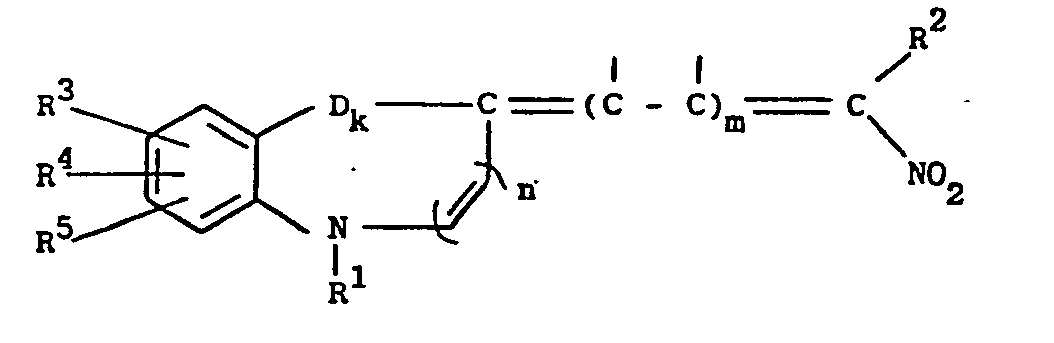
- According to the present invention there is provided a light-sensitive composition comprising an intimate mixture of a substantially light-insensitive silver compound which upon reduction gives a visible change and sufficient of a silver halide to catalyse said reduction to give a visible change in those areas where the silver halide has been exposed to light and when the mixture is heated in the presence of a reducing agent, the composition containing an acutance dye, characterised in that the acutance dye is a compound of the general formula:

- R2 represents a hydrogen atom, an alkyl group of 1 to 4 carbon atoms, a phenyl group, a substituted phenyl group of molecular weight less than 350, -COOR' in which R1 is as defined above, C6H5CO― or R6NH.CO in which R6 represents a hydrogen atom or an alkyl, aryl or aralkyl group,
- R3, R4 and R5 independently represent a hydrogen atom or a substituent which can be present in a cyanine dye type heterocyclic nucleus,
- D represents

- Y represents -CN or ―NO2,
- n is 1 when k is 0 or k is 1 when n is 0, and
- m is 0, 1 or 2,
- The substituents R3, R4 and R5 independently represent a substituent which, as known in the art, can be present in a cyanine dye type heterocyclic nucleus, defined herein as a "cyanine dye compatible substituent", referring to the broadly art accepted knowledge of substituents. A range of such substituents are disclosed for example in United States Patent Specification No. 2 921 067.
- Examples of substituents for R3, R4 and R5 include hydrogen or halogen, e.g. chlorine, bromine or iodine, an alkyl group containing 1 to 12 carbon atoms, an alkoxy group containing 1 to 4 carbon atoms, an alkenyl group containing 2 to 4 carbon atoms, -(CH2)pCOOH where p is 0, 1,2 or 3, ―NO2, -NH2 or -NHCOCH3, or any two of R3 to R5 together represent the carbon atoms needed to complete a fused on benzene ring. Preferably at least one, more preferably at least two, of the substituents R3 to R5 represent hydrogen atoms. The most preferred substituents to be represented by each of R3 to R5 are hydrogen, chlorine or bromine atoms, or methyl, ethyl, methoxy or ethoxy groups.
- It is found that dry silver compositions containing one of the above described compounds as an acutance dye can give excellent sharp images and that the acutance dye will be rendered considerably lighter in colour or substantially colourless by the heating required to develop the composition. This is surprising in view of the fact that many of these dyes are found not to be decomposed to a colourless state when they are heated on their own to the temperature at which the dry silver compositions are heated for development.
- The exact mechanism for this decomposition is not known although the extent of decolourisation has been found to vary when the dry silver systems are altered. Thus a dye may be decomposed to a colourless state when it is present in one particular dry silver system upon development but in a different system the dye may simply be rendered lighter in colour. Thus a compound for use as an acutance dye in a particular dry silver system is selected not only for its efficiency as an acutance dye in that system but also to obtain the desired background after the dry silver composition is developed.
- One preferred group of acutance dyes for use in the invention are those in which k=0, n=1, Y is NO2 and R2 is COOC2H5, C6H5, C1 to C4 alkyl or hydrogen.
- A second preferred group of acutance dyes for use in the invention are those in which m=1, k=1, n=0, Y is NO2, D is oxygen or sulphur and R2 Is COOR1, C6H5, substituted phenyl, C1 to C4 alkyl-or hydrogen.
- A further group of preferred dyes are 1-alkyl-4-nitromethylene-quinolanes in which the alkyl substituent contains 1 to 4 carbon atoms, particularly those dyes of the general formula (II):

- A further series of dyes are those of formula (I) in which R2 represents:

- Preferred dyes within the group have the general formula (III):

- R17 represents alkyl or alkoxy of 1 to 8 carbon atoms, halogen, N02 or aryl, and
- R18 represents hydrogen, alkyl of 1 to 8 carbon atoms or alkoxy of 1 to 8 carbon atoms and X, Z and Z' have the meaning given, above.
- The acutance dyes can be incorporated into the dry silver compositions of the invention in an amount from 5 x 10⁻⁴ to 0.1 mole of acutance dye per kilogram of total dry solids in the composition. Preferably, however the dyes are incorporated in an amount of from 2 x 10⁻³ to 3 x 10⁻² mole of acutance dye per kilogram of dry solids in the composition.
- The light-sensitive compositions of the invention will normally be spread for use on a support, suitable supports including, for example, paper, polyester or polyamide film bases, and glass. The composition will normally be prepared as a solution or suspension which is spread as a layer on the support and then the solvent or vehicle is evaporated off to leave a dry photo-sensitive layer. If desired, a coating aid or binder such as polyvinyl butyral, polymethyl methacrylate, cellulose acetate, polyvinyl acetate, cellulose acetate-propionate and cellulose acetate butyrate, can be incorporated in the light-sensitive mixture.
- The substantially light-insensitive silver compound is suitably a silver salt of an organic acid. The organic acid can be a C12 to C29 aliphatic acid and is preferably a C16 to C25 aliphatic acid. Examples include silver behenate, silver caprate, silver laurate, silver myristate, silver palmitate, silver stearate, silver arachidate and·silver saccharine.
- The reducing agent for this substantially light-insensitive silver compound can normally be quite mild. Suitable examples include hydroquinone and substituted phenols such as 1-methyl-4-hydroxynaphthalene, methyl gallate, catechol, phenylene diamine, p-amino-phenol and 1-phenyl-3-pyrazolidone. The reducing agent can be incorporated into the light-sensitive composition. Alternatively, the composition can be placed in contact with the reducing agent after exposure to light. For example, a light-sensitive coating can be exposed to a light image, placed in contact with a layer containing the reducing agent and the image then developed by heating. Preferably, however, the reducing agent is incorporated in the light-sensitive composition before this is spread on the support. Then the storage stability of the composition can be improved by incorporating in the composition a small amount of a stabilizer such as an acid stabilizer, e.g. succinic acid, benzoic acid or salicylic acid.
- The silver halide can be present in amounts of up to 20% by weight of the mixture of silver compounds or can be present in small amounts, e.g. 0.1 to 10% by weight of the mixture of silver compounds. It can be added as such to the substantially light-insensitive compound or formed in situ by adding a soluble halide, e.g. a mercury or sodium halide, to the substantially light-insensitive silver compound. The silver halide can, for example, be chloride, bromide or a mixture of them and/or other silver halides.
- The light-sensitive compositions of the invention can include one or more sensitising dyes to improve their sensitivity to parts of the spectrum other than the shorter wavelengths. Thus dye sensitized dry silver compositions of the present invention can contain an additional acutance dye such as one of those described in our copending British Patent Nr. 1 565 593.
- The compounds of general formula (I) may be prepared by a process which comprises reacting a compound of the general formula:

- Z3 is selected from the group consisting of SR', wherein R' is as defined above, and


- Suitable reagents are well known and fully exemplified in the cyanine/merocyanine dye literature.
- The reaction is preferably carried out in the presence of C2H5OH as a solvent and (C2H5)3N as both catalyst and acid binder. The preparation is analogous to known processes used in the synthesis of merocyanine dyes.
- The acutance dyes of general formula (II) can be prepared by processes which are well known. Thus, they can be prepared in a manner analogous to the synthesis of simple merocyanine dyes as described, for example, in British Patent No. 426 718, by reacting nitromethane with a 1-alkyl-4-alkylthio-quinolinium salt in a solvent in the presence of a basic catalyst. They are, however, preferably prepared from 1-alkyl-quinolinium salts by the method described by Leonard, DeWalt and Leubuer in J.A.C.S., 73, 3328, in which a quinolinium quaternary salt is heated with nitromethane in the presence of a base, an oxidising agent and a solvent.
- The dyes of general formula (III) may also be made according to the following reaction scheme A:

- This method is performed in the presence of a strong tertiary amine such as diisopropylethylamine. For example, in forming 1,4-dihydro-4-(2,4-dinitrophenyl)-nitromethylene-1-methylquinoline (which may also be named 1,4-dihydro-1-methyl-4-(α,2,4-trinitrobenzylidene)-quinoline), one would react 4-nitromethylene-1-methyl-1,4-dihydroquinoline with 2,4-dinitrofluoro- benzenein diisopropylethylamine.
- Certain of the compounds suitable for use as acutance dyes in the present invention are known. Certain compounds of the above formula in which m=0 are disclosed in J.A.C.S. 74, 2110, C.A. 55 27373g and United States Patent Specification No. 2 411 507 and other compounds in which m=1 are described by Severin & Bohme in Chem Ber. 101 2925-30 (1968). There is no indication in any of the prior art that such compounds would be suitable for use as acutance dyes in silver halide photothermographic emulsions.
- Many of the compounds for use as acutance dyes in accordance with the invention are novel and therefore according to one embodiment of the invention there is provided a compound of the general formula:

- R' represents an alkyl group containing 1 to 12 carbon atoms,
- R3, R4 and R5 are cyanine dyes compatible substituents,
- D represents a member of the group consisting of

- n is 1 when k is 0 or k is 1 when n is 0,
- m is 0, 1 or 2,
- R2 represents an alkyl group of from 1 to 4 carbon atoms, a phenyl group, a substituted phenyl group of molecular weight less than 350, -COOR1 wherein R1 is as defined above, C6H85CO― or R6NH.CO- wherein R6 is a member of the group consisting of a hydrogen atom or an alkyl, aryl or aralkyl group,
- R2 represents R6NH.CO wherein R6 is as defined above, the free bonds in the methine group of the acutance dye being satisfied by hydrogen or substituents conventional in such groups in methine dyes and those free bonds when D is

- The invention will now be illustrated by the following Examples.
- 1-Methyl-4-methylthio-quinolinium toluene-4-sulphonate (1.83 g) was placed in ethanol (20 ml) and 4-nitrophenylacetonitrile (0.81 g) added. The mixture was warmed, triethylamine (0.8 ml) added and the resulting mixture heated under reflux for 15 minutes. The dye which separated from the hot solution was filtered off and the crude compound (1.2 g) was twice crystallised from toluene (200 ml) to give magenta needles (0.9 g) having a melting point of 203 to 204°C. In methanolic solution the dye exhibited E = 2.0 x 10° at A max 495 nm.
- 1-Methyl-4-methylthio-quinolinium toluene-4-sulphonate (1.8 g) and ethyl nitroacetate (1 ml) were placed in ethanol (10 ml) and the mixture warmed. After the addition of triethylamine (0.7 ml) the whole was heated under reflux for 10 minutes. The product crystallised upon cooling and was filtered off. The crude product was purified by boiling with ethanol (70 ml), to give both an undissolved residue (0.8 g) and a crystallised sample (0.25 g). Both samples formed yellow plates with melting point of 203 to 206°C and the recrystallised sample showed ε = 6 x 10³ in methanolic solution at λ max 465 nm. Analvsis:
-

- 2-Acetanilino-3-ethyl-benzothiazolium iodide (4.5 g) was placed in ethanol (25 ml) and phenyl nitromethane (1.4 g) added. The mixture was warmed, triethylamine (1.4 ml) added and the resulting mixture heated under reflux for 20 minutes. Upon cooling, a mixture of product and trimethincyanine dye was deposited. This was filtered off and the product extracted with toluene. The extracted solid was then crystallised from ethanol (350 ml) to give dark green coloured plates (2.4 g) having a melting point of 155°C. In methanolic solution the dye exhibited ε=6.2 x 10⁴ at λ max 523 nm. Analysis:
-

- 2-Acetanilino-3-ethyl-benzoxazolium iodide (2.17 g) was placed in ethanol (10 ml) and ethyl nitroacetate (1.0 ml) added. The mixture was warmed, triethylamine (0.7 ml) added and the resulting mixture heated under reflux for 7 minutes. The dye separated upon cooling and after filtration the crude product (1.2 g) was crystallised from toluene (17 ml) to give yellow needles (1.05 g) having a melting point of 172 to 175°C. In methanolic solution the dye exhibited ε=5.6 x 10⁴ at λ max 452 nm. Analysis:
-

- 2-(4'-Acetanilino-1,3-butadienyl)-3-ethyl benzothiazolium iodide (4.76 g), ethyl nitroacetate (1.2 mi), ethanol (100 ml) and triethylamine were mixed and stirred at room temperature for 15 hours. The whole was then evaporated and the residue extracted with six portions (50 ml) each of toluene at 50°C. The residue obtained by evaporation of the toluene was crystallised from aqueous methanol to give dark microcrystals (0.5 g) with a melting point of 125°C. In methanolic solution the compound showed ε = 4.6 x 10⁴ at λ max 574 nm.
-

- A dry silver composition was first prepared. Under room light a 1000 g dispersion containing 12.5 parts of silver behenate in 87.5 parts of solvent which in turn comprised 75 parts butan-2-one and 25 parts toluene was charged to a mixing vessel maintained at 15°C. 20 g of polyvinyl butyral resin (commercially available from Monsanto under the trade mark Butvar, B-76) and 10 g of 1-methyl-2-pyrrolidinone were added and the mixture stirred for 30 minutes.
- Under Wratten 1A safelight a mixture containing hydrobromic acid (15 ml, 2.0 molar in ethanol), hydroiodic acid (7 ml, 0.1 molar in ethanol), and mercuric bromide (4 ml, 0.5 molar in ethanol) was added with stirring. After 20 minutes an additional 40 g of Butvar B-76 was added, followed after five minutes by 10 g 2,6-bis-(2'-hydroxy-3-tertiary-butyl-5'-methyl-benzyl)-4-methyl-phenol available from American Cyanamide under the name A080 and 6 g phthalazinone. After 20 minutes 12 g of a solution containing 2 mg of the following dye:

- Equimolar amounts of the acutance dyes to be tested were added to appropriate containers and dispersed in 2 ml of butane-2-one. 40 g portions of the light sensitive dispersion prepared above were added to each, the mixture shaken, left to stand 30 minutes, then shaken again prior to coating.
- Knife coatings 100 µm thick on polyester sheets were prepared from each sample and dried 3.5 to 4.0 minutes at 90°C. These dried coatings were overcoated with a solution containing 97 parts butan-2-one and 3 parts vinyl chloride vinyl acetate copolymer available from Union Carbide under the name VYNS with the knife set 50 flm above the base and dried as before. The performance of these compositions was then evaluated.
- A combination of a tungsten source, a narrow band filter at a wavelength closely matching the spectral absorbance of each dye and an aperture target overlaid with a 0 to 4 continuous density wedge in a vacuum frame, was used to make contact exposures at a wavelength closely matching the spectral absorbance maximum of each dye. The strips were then processed by heating for 20 seconds in a fluorochemical bath and examined for flare of the image.
- The acutance property of the dyes was classified very good, fair by examining the sharpness of the image with the naked eye.
- The background before and after processing was observed.
- The following Table 1 reports compounds of the general formula (I) in which the free bonds are satisfied by hydrogen alone.
- The mode of preparation of the compounds is indicated in the final column, in which:
- 1. refers to a preparation disclosed in Chem.Ber. 101 2295,
- 2. refers to a preparation analogous to Example 2,
- 3. refers to a preparation analogous to Example 3,
- 4. refers to a preparation analogous to Example 5.


- A series of dyes of general formula (II) were prepared according to the method described in J.A.C.S. 73, 3328.
- The dyes prepared are those having the values of R11 and one of the substituents R12, the remaining substituents R12 representing hydrogen atoms, as set out in the following Table 2.

- Compounds 36 to 43 were evaluated for use as acutance dyes in a similar manner to those in Example 6. Table 3 summarises the amount of each dye used in the dry silver compositions.

- The acutance properties were measured as in Example 6 with the exception that microdensitometer traces across the width of the image at D = 2.0 (obtained after processing the exposed strips 20 seconds at 127°C in a fluorocarbon oil bath to give reproducible heating for these tests) were used to judge the effectiveness of each dye.
- The widths reported are the measured widths in centimetres of the density profile of each image as obtained from the microdensitometer chart. All measurements were carried out at D = 1.5.
- The results of testing the compositions are given in Table 4.


- As can be seen from these results the presence of a yellow acutance dye in a dry silver composition according to the invention significantly reduces flare as compared with the dry silver composition A not containing any acutance dye.
- The following compounds of general formula (III) reported in Table 5 were prepared In accordance with reaction scheme (A).
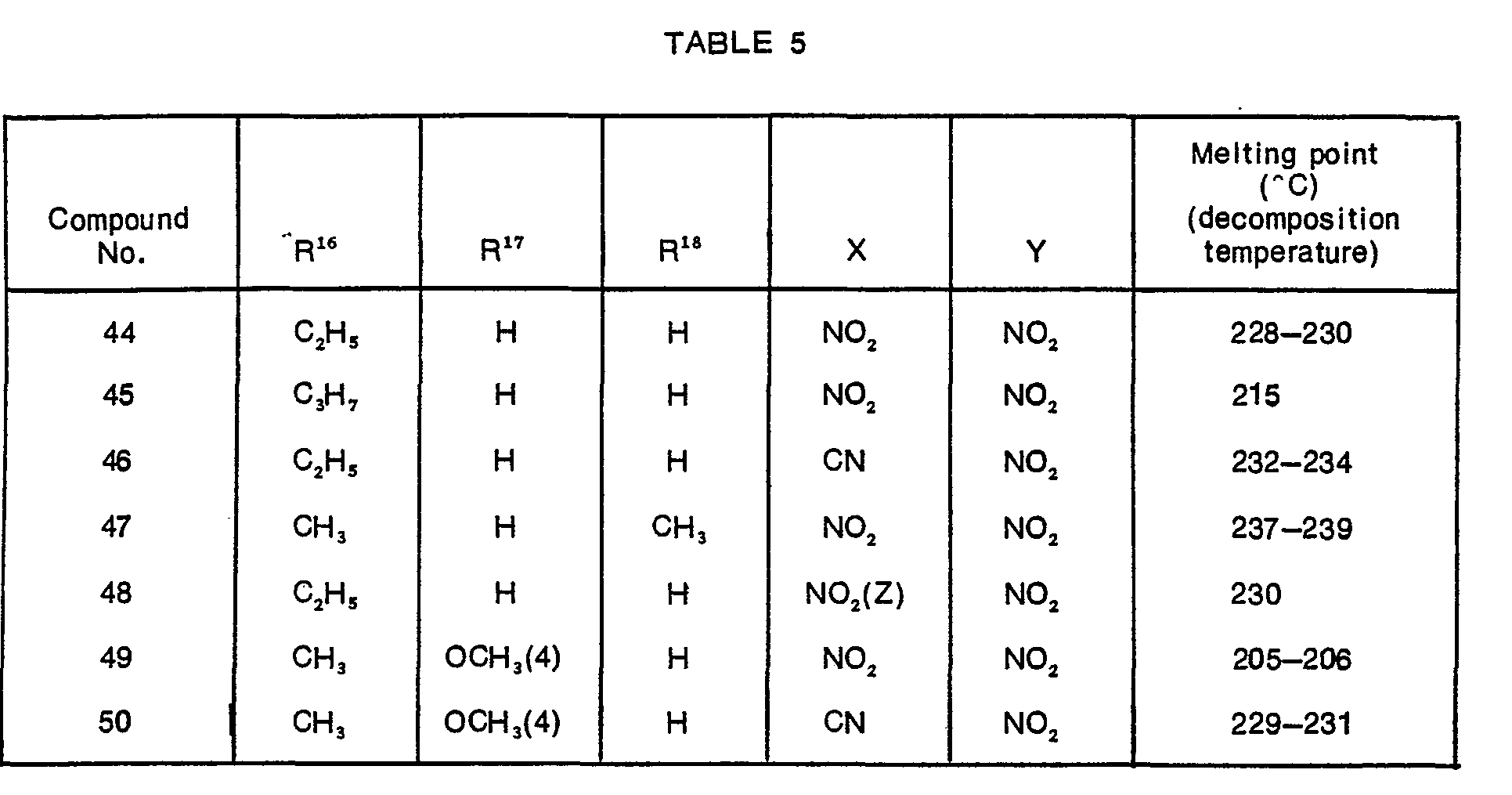
- In Table 5 the numbers in parentheses indicate the position of attachment for particular substituents. Infrared analysis and nucleus magnetic resonance analysis confirmed the structure of each of these dyes.
- Four hundred grams of a dispersion containing 13 parts by weight of silver behenate in 87 parts of a solvent composed of 67 parts by weight methylethylketone, 26 parts by weight toluene, and 7 parts by weight methylisobutylketone was charged to a temperature-controlled stirred reaction vessel at 15°C. Dark room conditions were maintained during all subsequent work.
- The following materials were added sequentially with 20 to 30 minutes of stirring between separate additions.
- A. 2 g of 1-methyl-2-pyrrolidinone in 6 g of polyvinylbutyral,
- B. 8 ml of 2M HBr (in ethanol) and 3.2 ml of 0.1 M HI (in ethanol),
- C. 10 g of a copolymer derived from 91% by weight vinylchloride, 3% vinylacetate, and 6% by weight vinyl alcohol polymerized to a molecular weight of about 23,000, and 24 g of polyvinyl butyral,
- D. 1.8 ml of 0.5M HgBr2 (in ethanol) was added with 5 minutes of stirring,
- E. 5.2 g of phthalazinone and 7.8 g of 2,6-bis-(2'-hydroxy-3'-t-butyl-5'-methylbenzyl)-4-methylphenol,
- F. 2.8 ml of a sensitizer solution having 5 mg/ml of the sensitizer in N-methylpyrrolidone, the sensitizer having the formula:

- 10 mg of each candidate acutance dye was weighed into separate vessels with 3 ml of methylethylketone to dissolve or disperse the dye. 50 g portions of the light-sensitive dispersion formed above were combined with the dye solutions and to portions of methylethylketone alone as a control. All materials were stirred for three minutes. The portions were then allowed to stand at room temperature for 30 minutes, then they were knife coated at 85 pm thickness on polyester and dried for four minutes at 85°C. Each sample was top coated with a 50 pm knife coating of a vinylchloride/vinylacetate copolymer as a 5% by weight solution in methylethylketone.
- The produced film samples were exposed at the wavelengths indicated below through a 0.25 mm aperture mask overlaid with a continuous density wedge in a vacuum frame. This permitted an easy comparison of image flare at equivalent optical densities after development for 15 seconds at 127°C in an inert fluorocarbon chemical bath. All dye samples had markedly less flare than the control samples, particularly at an optical density of 2.0. Except for the Compound No. 51, no samples left significant visible stain after processing. The dye of Compound No. 51 left a magenta stain which faded within an hour under room light. The dyes used in the tests were as follows:
-

-


the free bonds in the methine group of the acutance dye being satisfied by hydrogen or substituents conventional in such groups in methine dyes and those free bonds when D is

when m is 0 or 2:
and when m is 1:
Claims (11)


the free bonds in the methine group of the acutance dye being satisfied by hydrogen or substituents conventional in such groups in methine dyes and those free bonds when D is
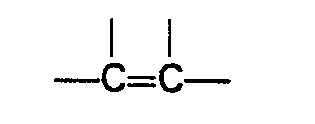



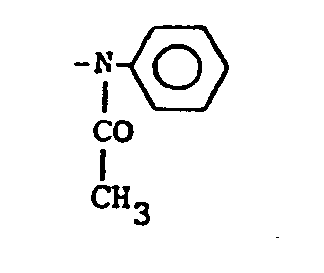
when m is 0 or 2:
and when m is 1



Applications Claiming Priority (6)
| Application Number | Priority Date | Filing Date | Title |
|---|---|---|---|
| US964480 | 1978-11-29 | ||
| US05/964,479 US4197131A (en) | 1978-11-29 | 1978-11-29 | Dry silver photo-sensitive compositions |
| US05/964,480 US4260676A (en) | 1978-11-29 | 1978-11-29 | Photothermographic emulsions containing thermolabile acutance dyes |
| GB7846459 | 1978-11-29 | ||
| GB4645978 | 1978-11-29 | ||
| US964479 | 1978-11-29 |
Publications (2)
| Publication Number | Publication Date |
|---|---|
| EP0012020A1 EP0012020A1 (en) | 1980-06-11 |
| EP0012020B1 true EP0012020B1 (en) | 1983-01-26 |
Family
ID=27260633
Family Applications (1)
| Application Number | Title | Priority Date | Filing Date |
|---|---|---|---|
| EP79302730A Expired EP0012020B1 (en) | 1978-11-29 | 1979-11-29 | Dry silver photo-sensitive compositions, dyes for use therein and preparation of such dyes |
Country Status (5)
| Country | Link |
|---|---|
| EP (1) | EP0012020B1 (en) |
| JP (1) | JPH0140335B2 (en) |
| DE (1) | DE2953375C2 (en) |
| GB (1) | GB2058116B (en) |
| WO (1) | WO1980001213A1 (en) |
Family Cites Families (6)
| Publication number | Priority date | Publication date | Assignee | Title |
|---|---|---|---|---|
| FR965555A (en) * | 1950-09-15 | |||
| GB839020A (en) * | 1956-05-15 | 1960-06-29 | Ilford Ltd | Improvements in or relating to cyanine and merocyanine dyes |
| USRE29168E (en) * | 1968-10-09 | 1977-04-05 | Eastman Kodak Company | Photographic elements with light absorbing layers |
| US3984248A (en) * | 1974-02-19 | 1976-10-05 | Eastman Kodak Company | Photographic polymeric film supports containing photobleachable o-nitroarylidene dyes |
| US4033948A (en) * | 1976-05-17 | 1977-07-05 | Minnesota Mining And Manufacturing Company | Acutance agents for use in thermally-developable photosensitive compositions |
| JPS53133033A (en) * | 1977-04-25 | 1978-11-20 | Fuji Photo Film Co Ltd | Silver halide photographic material |
-
1979
- 1979-11-29 EP EP79302730A patent/EP0012020B1/en not_active Expired
- 1979-11-29 GB GB8022130A patent/GB2058116B/en not_active Expired
- 1979-11-29 WO PCT/GB1979/000203 patent/WO1980001213A1/en not_active Ceased
- 1979-11-29 DE DE2953375T patent/DE2953375C2/en not_active Expired - Fee Related
- 1979-11-29 JP JP54502010A patent/JPH0140335B2/ja not_active Expired
Also Published As
| Publication number | Publication date |
|---|---|
| EP0012020A1 (en) | 1980-06-11 |
| DE2953375C2 (en) | 1996-09-05 |
| GB2058116A (en) | 1981-04-08 |
| GB2058116B (en) | 1983-05-18 |
| WO1980001213A1 (en) | 1980-06-12 |
| JPH0140335B2 (en) | 1989-08-28 |
| JPS55501111A (en) | 1980-12-11 |
| DE2953375T1 (en) | 1980-12-04 |
Similar Documents
| Publication | Publication Date | Title |
|---|---|---|
| US4123274A (en) | Heat developable imaging materials and process | |
| US4088497A (en) | Acutance agents for use in thermally-developable photosensitive compositions | |
| US4271263A (en) | Thermally developable photosensitive compositions containing acutance agents | |
| US4138265A (en) | Antifoggants in certain photographic and photothermographic materials that include silver salts of 3-amino-1,2,4-mercaptotriazole | |
| EP0119831B1 (en) | Heat bleachable dye systems | |
| EP0107093B1 (en) | Photothermographic recording material comprising a substituted triazine stabilizer precursor compound | |
| US4283487A (en) | Thermolabile acutance dyes for dry silver | |
| US4081278A (en) | Heat sensitive dye layers comprising a benzopinacol | |
| EP0350202B1 (en) | Photothermographic elements | |
| US4197131A (en) | Dry silver photo-sensitive compositions | |
| US3753395A (en) | Photo-thermographic recording process with 5-pyrazolane | |
| EP0194026B1 (en) | Photothermographic stabilizers for syringaldazine leuco dyes | |
| US4153463A (en) | Photothermographic emulsions containing magenta acutance dyes | |
| EP0120601B1 (en) | Oxidative imaging | |
| EP0273590B1 (en) | Stabilization of ketazine dyes | |
| US4030930A (en) | Heat-developable light-sensitive material | |
| US4316984A (en) | Thermolabile acutance dyes | |
| EP0012020A1 (en) | Dry silver photo-sensitive compositions, dyes for use therein and preparation of such dyes | |
| US4308379A (en) | Acutance agents for use in thermally developable photosensitive compositions | |
| US5424183A (en) | Ballasted leuco dyes and photothermographic element containing same | |
| US4260676A (en) | Photothermographic emulsions containing thermolabile acutance dyes | |
| JPH10502460A (en) | Blocked leuco dyes for photothermographic elements. | |
| CA1139149A (en) | Dry silver photo-sensitive composition containing a 1-alkyl-4-nitromethylene-quinolane yellow acutance dye | |
| JPH0652387B2 (en) | Photothermographic material | |
| US4535056A (en) | Yellow color formers for use in color photothermographic system |
Legal Events
| Date | Code | Title | Description |
|---|---|---|---|
| PUAI | Public reference made under article 153(3) epc to a published international application that has entered the european phase |
Free format text: ORIGINAL CODE: 0009012 |
|
| AK | Designated contracting states |
Designated state(s): BE FR IT |
|
| 17P | Request for examination filed |
Effective date: 19801204 |
|
| ITF | It: translation for a ep patent filed | ||
| GRAA | (expected) grant |
Free format text: ORIGINAL CODE: 0009210 |
|
| AK | Designated contracting states |
Designated state(s): BE FR IT |
|
| ET | Fr: translation filed | ||
| ITTA | It: last paid annual fee | ||
| PGFP | Annual fee paid to national office [announced via postgrant information from national office to epo] |
Ref country code: BE Payment date: 19961029 Year of fee payment: 18 |
|
| PGFP | Annual fee paid to national office [announced via postgrant information from national office to epo] |
Ref country code: FR Payment date: 19971106 Year of fee payment: 19 |
|
| PG25 | Lapsed in a contracting state [announced via postgrant information from national office to epo] |
Ref country code: BE Free format text: LAPSE BECAUSE OF NON-PAYMENT OF DUE FEES Effective date: 19971130 |
|
| BERE | Be: lapsed |
Owner name: MINNESOTA MINING AND MFG CY Effective date: 19971130 |
|
| PG25 | Lapsed in a contracting state [announced via postgrant information from national office to epo] |
Ref country code: FR Free format text: LAPSE BECAUSE OF NON-PAYMENT OF DUE FEES Effective date: 19990730 |
|
| REG | Reference to a national code |
Ref country code: FR Ref legal event code: ST |
|
| REG | Reference to a national code |
Ref country code: FR Ref legal event code: TP |
|
| PLBE | No opposition filed within time limit |
Free format text: ORIGINAL CODE: 0009261 |
|
| STAA | Information on the status of an ep patent application or granted ep patent |
Free format text: STATUS: NO OPPOSITION FILED WITHIN TIME LIMIT |