EP0012002B1 - Glaze resistor compositions - Google Patents
Glaze resistor compositions Download PDFInfo
- Publication number
- EP0012002B1 EP0012002B1 EP79302692A EP79302692A EP0012002B1 EP 0012002 B1 EP0012002 B1 EP 0012002B1 EP 79302692 A EP79302692 A EP 79302692A EP 79302692 A EP79302692 A EP 79302692A EP 0012002 B1 EP0012002 B1 EP 0012002B1
- Authority
- EP
- European Patent Office
- Prior art keywords
- resistivity
- disilicide
- glaze
- glass frit
- glaze resistor
- Prior art date
- Legal status (The legal status is an assumption and is not a legal conclusion. Google has not performed a legal analysis and makes no representation as to the accuracy of the status listed.)
- Expired
Links
Images


Classifications
-
- H—ELECTRICITY
- H01—ELECTRIC ELEMENTS
- H01B—CABLES; CONDUCTORS; INSULATORS; SELECTION OF MATERIALS FOR THEIR CONDUCTIVE, INSULATING OR DIELECTRIC PROPERTIES
- H01B1/00—Conductors or conductive bodies characterised by the conductive materials; Selection of materials as conductors
- H01B1/14—Conductive material dispersed in non-conductive inorganic material
-
- C—CHEMISTRY; METALLURGY
- C03—GLASS; MINERAL OR SLAG WOOL
- C03C—CHEMICAL COMPOSITION OF GLASSES, GLAZES OR VITREOUS ENAMELS; SURFACE TREATMENT OF GLASS; SURFACE TREATMENT OF FIBRES OR FILAMENTS MADE FROM GLASS, MINERALS OR SLAGS; JOINING GLASS TO GLASS OR OTHER MATERIALS
- C03C3/00—Glass compositions
- C03C3/04—Glass compositions containing silica
- C03C3/076—Glass compositions containing silica with 40% to 90% silica, by weight
- C03C3/097—Glass compositions containing silica with 40% to 90% silica, by weight containing phosphorus, niobium or tantalum
-
- C—CHEMISTRY; METALLURGY
- C03—GLASS; MINERAL OR SLAG WOOL
- C03C—CHEMICAL COMPOSITION OF GLASSES, GLAZES OR VITREOUS ENAMELS; SURFACE TREATMENT OF GLASS; SURFACE TREATMENT OF FIBRES OR FILAMENTS MADE FROM GLASS, MINERALS OR SLAGS; JOINING GLASS TO GLASS OR OTHER MATERIALS
- C03C8/00—Enamels; Glazes; Fusion seal compositions being frit compositions having non-frit additions
- C03C8/02—Frit compositions, i.e. in a powdered or comminuted form
-
- C—CHEMISTRY; METALLURGY
- C03—GLASS; MINERAL OR SLAG WOOL
- C03C—CHEMICAL COMPOSITION OF GLASSES, GLAZES OR VITREOUS ENAMELS; SURFACE TREATMENT OF GLASS; SURFACE TREATMENT OF FIBRES OR FILAMENTS MADE FROM GLASS, MINERALS OR SLAGS; JOINING GLASS TO GLASS OR OTHER MATERIALS
- C03C8/00—Enamels; Glazes; Fusion seal compositions being frit compositions having non-frit additions
- C03C8/14—Glass frit mixtures having non-frit additions, e.g. opacifiers, colorants, mill-additions
-
- H—ELECTRICITY
- H01—ELECTRIC ELEMENTS
- H01C—RESISTORS
- H01C17/00—Apparatus or processes specially adapted for manufacturing resistors
- H01C17/06—Apparatus or processes specially adapted for manufacturing resistors adapted for coating resistive material on a base
- H01C17/065—Apparatus or processes specially adapted for manufacturing resistors adapted for coating resistive material on a base by thick film techniques, e.g. serigraphy
- H01C17/06506—Precursor compositions therefor, e.g. pastes, inks, glass frits or green body
- H01C17/06513—Precursor compositions therefor, e.g. pastes, inks, glass frits or green body characterised by the resistive component
- H01C17/0656—Precursor compositions therefor, e.g. pastes, inks, glass frits or green body characterised by the resistive component composed of silicides
Definitions
- the present invention relates to glaze resistor compositions.
- Glaze resistor compositions suitable for coating heat-resistant substrates and firing in air to form glaze resistors are well known for example, RuO 2 , Ag, and Ag-Pd glaze.
- Glaze resistor compositions comprising mixtures of several silicides are also known, for example, molybdenum disilicide, molybdenum boride and tungsten disilicide (as disclosed in British Patent Specification 1,263,728), or molybdenum disilicide, tantalum disilicide and a glass frit containing alumina (as disclosed in U.S. Patent 3,027,332).
- molybdenum disilicide molybdenum boride and tungsten disilicide
- molybdenum disilicide, tantalum disilicide and a glass frit containing alumina as disclosed in U.S. Patent 3,027,332
- Such compositions have temperature coefficients of resistivity which are too high for many purposes, relatively unstable resistivity, too high current noise and limited resistivity ranges.
- Glaze resistor compositions have been proposed in our British Specification 1,537,645 which consist of at least 50% by weight of a glass frit and up to 50% by weight of a mixture comprising molybdenum disilicide, tantalum disilicide and magnesium silicide. While such compositions have satisfactory temperature coefficients of resistivity, resistivity stability and current noise, it would be desirable to widen the range of resistivity which can be obtained, and, in particular, to enable a resistivity greater than about 40 kQ/sq to be obtained without deterioration of other properties.
- a glaze resistor composition which consists of 95 to 50% by weight of a glass frit and 5 to 50% by weight of a mixture comprising molybdenum disilicide, tantalum disilicide, magnesium silicide and aluminium, the molar ratio of molybdenum disilicide plus tantalum disilicide plus magnesium silicide to aluminium being from 90:10 to 50:50, preferably 85:15 to 65:35.
- aluminium to the mixture comprising molybdenum disilicide, tantalum disilicide and magnesium silicide in the composition according to the invention stabilizes the resistivity of the resulting resistor over a wide range of resistivity and improves the temperature coefficient of resistivity, stability under load and current noise. Resistivities greater than 40 kQ/sq. can be obtained without substantial deterioration of other properties. If the amount of aluminium is greater than that specified above, the resistivity of the resistor increases, but the current noise also increases.
- magnesium silicide is not used in a too large amount, in order to maintain the hydrolytic stability of the composition; it is also preferred that the tantalum disilicide is not used in a too small amount, in order that the homogeneity of a resistor film made from the composition is not impaired by the presence of bubbles therein; and, finally, it is preferred that molybdenum disilicide is not used in a too small amount, in order that the load test stability is not impaired.
- the mixture of silicides and aluminium in the composition according to the invention contains the silicides in amounts such that the molar ratio of molybdenum disilicide plus tantalum disilicide to magnesium silicide is from 30:70 to 80:20, more preferably 50:50 to 80:20 and the molar ratio of molybdenum disilicide:tantalum disilicide is from 90:10 to 70:30.
- the mixture of silicides and aluminium may be made by mixing suitable amounts of molybdenum, tantalum, magnesium, silicon and aluminium, pressing to tablets of a suitable size, firing the tablets at a temperature of 800° to 1300°C in an inert gas such as argon or in an active gas such as hydrogen, then crushing each fired tablet using a crushing machine, and finally grinding into fine granules, having an average particle size of 0.1 micron, by a ball mill.
- any suitable glass frit may be included in the composition according to the invention, but a preferred glass frit is of barium borate glass, especially one containing niobium oxide (Nb 2 O 5 ).
- Preferred barium borate glasses have the following composition, by weight:
- the glass frit is necessary for obtaining superior resistance to humidity and heat, ensuring suitable reaction with conductive powder when firing a resistor made from the composition and ensuring uniform distribution of the conductive mixture therein.
- Si0 2 , Al 2 O 3 , MgO and CaO components in a glass frit improva its resistance to humidity and heat, while Nb 2 O 5 improves the distribution of the conductive mixture in glass (which ensures that the resistor has a higher resistivity and good stability characteristics).
- a suitable material for forming BaO is BaC0 3 , which by firing, is reduced to BaO (and CO).
- a suitable material for forming B 2 0 3 is H 3 BO 3 , which by firing is reduced to B,O, (and HO).
- a suitable material for forming AI 2 0 3 is A1 2 0 3 or aluminium hydroxide Al 2 (OH) 3 , which by firing is reduced to AI 2 0 3 (and H 2 O).
- a suitable material for forming CaO is CaC0 3 , which by firing is reduced to CaO (and C0 2 ).
- SiO,, MgO and Nb 2 0 5 used are generally provided as the respective oxides.
- Respective materials for forming the glass are mixed in a ratio e.g. as follows: BaC0 3 : H 3 BO 3 : Sio 2 : Al 2 O 3 : CaC0 3 : Mg
- the glaze resistor composition including an appropriate amount of glass frit and a suitable organic liquid vehicle (such as terpineol having 10% ethylcellulose dissolved therein) is mixed to a paste.
- a suitable organic liquid vehicle such as terpineol having 10% ethylcellulose dissolved therein
- the paste is applied to a refractory substrate such as a ceramic plate, and is then heated or fired in air in, for example, a tunnel furnace, at a temperature such that the glass frit is adequately fused thereto and to form a stable glaze resistor in the form of a film on the refractory substrate.
- a typical heating temperature is from 750° to 1000°C, more preferably from 800 to 900°C, for a time of from 3 to 30 minutes.
- the liquid vehicle evaporates off or burns off, and does not substantially affect the resistivity or other characteristics of the resultant glaze resistor.
- a mixture of silicides in the form of a powder having an average particle size of 0.2 micron and glass frit was made up in the percentage shown in Table 1 (in which G/M + G represents the percentage, by weight of glass frit, relative to the total weight of the composition).
- the glass frit used had an average particle size of 3 microns, and was composed of a barium borate glass frit.
- the sheet resistivity R ( ⁇ /sq), temperature coefficient of resistivity TCR (ppm/°C), current noise (dB) and load test characteristics (percent change of resistivity after load test) of each of the sixty resistors were measured.
- the load test was carried out by applying an electric power of 625mW/mm 2 to the glaze resistor for 5 seconds at room temperature, and the load characteristics were calculated from the difference between the resistivities of the glaze resistor before and after the load test divided by the resistivity before the load test.
- Example 61 Fifty-six different glaze resistor compositions (Samples 61 to 116) were prepared having the composition shown in Table 2 (in which the column headings have the same meanings as in Table 1). Each composition was made as follows:
Landscapes
- Chemical & Material Sciences (AREA)
- Engineering & Computer Science (AREA)
- Organic Chemistry (AREA)
- Chemical Kinetics & Catalysis (AREA)
- Materials Engineering (AREA)
- Geochemistry & Mineralogy (AREA)
- General Chemical & Material Sciences (AREA)
- Life Sciences & Earth Sciences (AREA)
- Ceramic Engineering (AREA)
- Inorganic Chemistry (AREA)
- Microelectronics & Electronic Packaging (AREA)
- Manufacturing & Machinery (AREA)
- Dispersion Chemistry (AREA)
- Non-Adjustable Resistors (AREA)
- Resistance Heating (AREA)
- Glass Compositions (AREA)
Description
- The present invention relates to glaze resistor compositions.
- Glaze resistor compositions suitable for coating heat-resistant substrates and firing in air to form glaze resistors are well known for example, RuO2, Ag, and Ag-Pd glaze.
- Glaze resistor compositions comprising mixtures of several silicides are also known, for example, molybdenum disilicide, molybdenum boride and tungsten disilicide (as disclosed in British Patent Specification 1,263,728), or molybdenum disilicide, tantalum disilicide and a glass frit containing alumina (as disclosed in U.S. Patent 3,027,332). However, such compositions have temperature coefficients of resistivity which are too high for many purposes, relatively unstable resistivity, too high current noise and limited resistivity ranges.
- We have now developed a glaze resistor composition having a satisfactory temperature coefficient of resistivity, a high resistivity stability and small current noise and which is usable over a wide resistivity range.
- Glaze resistor compositions have been proposed in our British Specification 1,537,645 which consist of at least 50% by weight of a glass frit and up to 50% by weight of a mixture comprising molybdenum disilicide, tantalum disilicide and magnesium silicide. While such compositions have satisfactory temperature coefficients of resistivity, resistivity stability and current noise, it would be desirable to widen the range of resistivity which can be obtained, and, in particular, to enable a resistivity greater than about 40 kQ/sq to be obtained without deterioration of other properties.
- According to the present invention, there is provided a glaze resistor composition which consists of 95 to 50% by weight of a glass frit and 5 to 50% by weight of a mixture comprising molybdenum disilicide, tantalum disilicide, magnesium silicide and aluminium, the molar ratio of molybdenum disilicide plus tantalum disilicide plus magnesium silicide to aluminium being from 90:10 to 50:50, preferably 85:15 to 65:35.
- The addition of aluminium to the mixture comprising molybdenum disilicide, tantalum disilicide and magnesium silicide in the composition according to the invention stabilizes the resistivity of the resulting resistor over a wide range of resistivity and improves the temperature coefficient of resistivity, stability under load and current noise. Resistivities greater than 40 kQ/sq. can be obtained without substantial deterioration of other properties. If the amount of aluminium is greater than that specified above, the resistivity of the resistor increases, but the current noise also increases.
- It is preferred that the magnesium silicide is not used in a too large amount, in order to maintain the hydrolytic stability of the composition; it is also preferred that the tantalum disilicide is not used in a too small amount, in order that the homogeneity of a resistor film made from the composition is not impaired by the presence of bubbles therein; and, finally, it is preferred that molybdenum disilicide is not used in a too small amount, in order that the load test stability is not impaired.
- As a result of such considerations, it is preferred that the mixture of silicides and aluminium in the composition according to the invention contains the silicides in amounts such that the molar ratio of molybdenum disilicide plus tantalum disilicide to magnesium silicide is from 30:70 to 80:20, more preferably 50:50 to 80:20 and the molar ratio of molybdenum disilicide:tantalum disilicide is from 90:10 to 70:30.
- The mixture of silicides and aluminium may be made by mixing suitable amounts of molybdenum, tantalum, magnesium, silicon and aluminium, pressing to tablets of a suitable size, firing the tablets at a temperature of 800° to 1300°C in an inert gas such as argon or in an active gas such as hydrogen, then crushing each fired tablet using a crushing machine, and finally grinding into fine granules, having an average particle size of 0.1 micron, by a ball mill.
- Any suitable glass frit may be included in the composition according to the invention, but a preferred glass frit is of barium borate glass, especially one containing niobium oxide (Nb2O5). Preferred barium borate glasses have the following composition, by weight:

- The glass frit is necessary for obtaining superior resistance to humidity and heat, ensuring suitable reaction with conductive powder when firing a resistor made from the composition and ensuring uniform distribution of the conductive mixture therein. Si02, Al2O3, MgO and CaO components in a glass frit improva its resistance to humidity and heat, while Nb2O5 improves the distribution of the conductive mixture in glass (which ensures that the resistor has a higher resistivity and good stability characteristics).
- Materials suitable for making the glass frits will now be described.
- A suitable material for forming BaO is BaC03, which by firing, is reduced to BaO (and CO). A suitable material for forming B203 is H3BO3, which by firing is reduced to B,O, (and HO). A suitable material for forming AI203 is A1203 or aluminium hydroxide Al2(OH)3, which by firing is reduced to AI203 (and H2O). A suitable material for forming CaO is CaC03, which by firing is reduced to CaO (and C02). SiO,, MgO and Nb205 used are generally provided as the respective oxides. The glass frit may be made as follows: Respective materials for forming the glass are mixed in a ratio e.g. as follows: BaC03: H3BO3: Sio2: Al2O3 : CaC03 : MgO Nb2O5 = 34.2 : 51.3: 3.4: 6.0: 2.15: 2.70: 0.25 (in weight %), and the mixed powders are melted at 1200°C for 30 minutes in air in an alumina crucible, whereby glass is formed and the C02 and H20 generated is evaporated. Next, the molten glass is cooled and coarsely crushed with water, then ground through a screen mesh of 400 mesh, and finally ground by a ball mill into fine granules, having an average particle size of 3 microns.
- A typical method of making a glaze resistor using a glaze resistor composition according to the invention will now be described. The glaze resistor composition including an appropriate amount of glass frit and a suitable organic liquid vehicle (such as terpineol having 10% ethylcellulose dissolved therein) is mixed to a paste. The paste is applied to a refractory substrate such as a ceramic plate, and is then heated or fired in air in, for example, a tunnel furnace, at a temperature such that the glass frit is adequately fused thereto and to form a stable glaze resistor in the form of a film on the refractory substrate.
- A typical heating temperature is from 750° to 1000°C, more preferably from 800 to 900°C, for a time of from 3 to 30 minutes. During the heat treatment, the liquid vehicle evaporates off or burns off, and does not substantially affect the resistivity or other characteristics of the resultant glaze resistor.
- In order that the invention may be more fully understood, the following Examples are given by way of illustration only. In the Examples, reference will be made to the accompanying drawings, in which:
- Figure 1 is a graph showing the relation between the resistivities and temperature. coefficients of resistivity of glaze resistors according to the invention.
- Figure 2 is a graph showing the relation between the resistivities and current noises of glaze resistors according to the invention; and
- Figure 3 is a graph showing the relation between the resistivities and the change of resistivities of glaze resistors according to the invention after a load test.
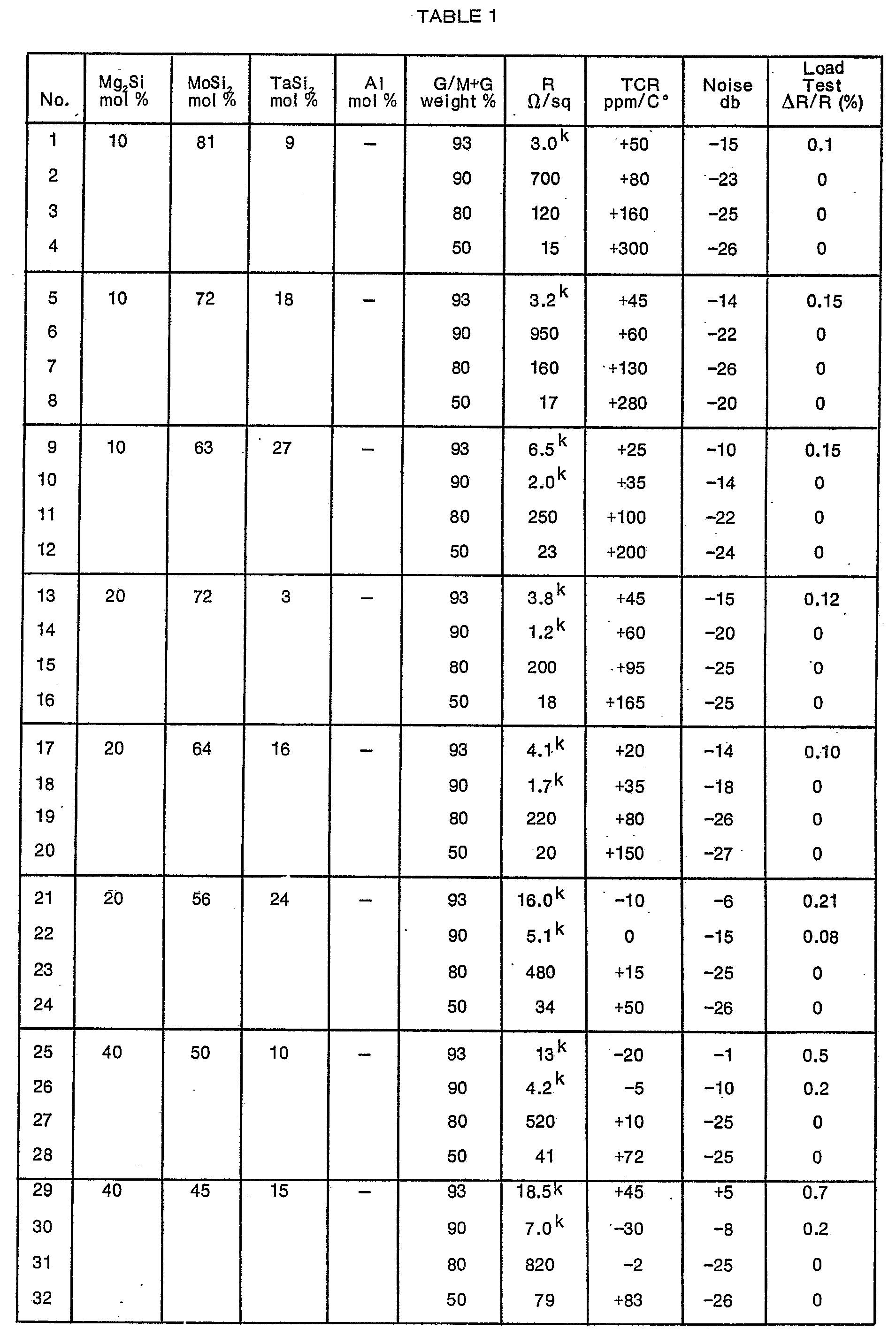
- Sixty different glaze resistor compositions without aluminium (Comparative Samples 1 to 60) were prepared, having the compositions shown in Table 1. Each composition was made as follows:
- A mixture of silicides in the form of a powder having an average particle size of 0.2 micron and glass frit was made up in the percentage shown in Table 1 (in which G/M + G represents the percentage, by weight of glass frit, relative to the total weight of the composition). The glass frit used had an average particle size of 3 microns, and was composed of a barium borate glass frit. Each mixture of silicides and the glass frit as well dispersed in an appropriate amount of liquid vehicle to make a paste suitable for screen printing. Each paste was applied on a ceramic substrate by screen printing and dried, followed by heating in air at a temperature of 850°C for 10 minutes to obtain sixty glaze resistors each in the form of a film.
- The sheet resistivity R (Ω/sq), temperature coefficient of resistivity TCR (ppm/°C), current noise (dB) and load test characteristics (percent change of resistivity after load test) of each of the sixty resistors were measured. The load test was carried out by applying an electric power of 625mW/mm2 to the glaze resistor for 5 seconds at room temperature, and the load characteristics were calculated from the difference between the resistivities of the glaze resistor before and after the load test divided by the resistivity before the load test.
- The results of all these measurements are shown in Table 1. It will be apparent from Table 1 that a wide range of resistivities with small temperature coefficients of resistivity, low current noise and good load test characteristics can be obtained. As the amount of magnesium silicide increases, the resistivity becomes higher, and the temperature coefficient of resistivity increases. However, most of the values of the temperature coefficients of resistivity are less than 200 ppm/°C, except for the case of very low resistivities. The load test characteristics are good, particularly in a lower resistivity range.
- However, a disadvantage of the results of this Example 1 is that a resistivity higher than 40 or. 50 or 100 kQ/sq is difficult to obtain without deteriorating other characteristics.
- Fifty-six different glaze resistor compositions (Samples 61 to 116) were prepared having the composition shown in Table 2 (in which the column headings have the same meanings as in Table 1). Each composition was made as follows:
- A mixture of silicides containing aluminium in the form of a powder, having an average particle size of 0.2 micron, and glass frit the same as the glass frit used in Example 1 was made up in the percentage shown in Table 2. Each mixture of silicides containing aluminium and the glass frit was well dispersed in an appropriate amount of liquid vehicle to make a paste suitable for screen printing. Each paste was applied on a ceramic substrate by screen printing and dried, followed by heating in air at a temperature of 850°C for 10 minutes to obtain fifty-six different glaze resistors each in the form of a film.
- The sheet resistivity, temperature coefficient of resistivity, current noise and load test characteristics of each of fifty-six resistors were measured in the same manner as in Example 1. The results of the measurements are shown in Table 2.
- These measured results are also plotted in Figures 1 to 3.
- It will be apparent from Table 2 and Figures 1 to 3 that various resistivities in a wide resistivity range, particularly to a higher resistivity than those obtained in Example 1, with small temperature coefficients of resistivity, low current noise and good load test characteristics can be obtained according to the invention.


Claims (7)
Applications Claiming Priority (2)
| Application Number | Priority Date | Filing Date | Title |
|---|---|---|---|
| JP53145482A JPS5923442B2 (en) | 1978-11-25 | 1978-11-25 | resistance composition |
| JP145482/78 | 1978-11-25 |
Publications (2)
| Publication Number | Publication Date |
|---|---|
| EP0012002A1 EP0012002A1 (en) | 1980-06-11 |
| EP0012002B1 true EP0012002B1 (en) | 1982-02-24 |
Family
ID=15386267
Family Applications (1)
| Application Number | Title | Priority Date | Filing Date |
|---|---|---|---|
| EP79302692A Expired EP0012002B1 (en) | 1978-11-25 | 1979-11-26 | Glaze resistor compositions |
Country Status (4)
| Country | Link |
|---|---|
| US (1) | US4323484A (en) |
| EP (1) | EP0012002B1 (en) |
| JP (1) | JPS5923442B2 (en) |
| DE (1) | DE2962215D1 (en) |
Families Citing this family (10)
| Publication number | Priority date | Publication date | Assignee | Title |
|---|---|---|---|---|
| US4639391A (en) * | 1985-03-14 | 1987-01-27 | Cts Corporation | Thick film resistive paint and resistors made therefrom |
| JPS6281702A (en) * | 1985-10-04 | 1987-04-15 | 松下電器産業株式会社 | silicide resistance material |
| US4883778A (en) * | 1986-10-30 | 1989-11-28 | Olin Corporation | Products formed of a ceramic-glass-metal composite |
| EP0280819B1 (en) * | 1987-02-28 | 1993-05-05 | Taiyo Yuden Co., Ltd. | Electrical resistors, electrical resistors paste and method for making the same |
| US4985377A (en) * | 1987-12-14 | 1991-01-15 | Matsushita Electric Industrial Co., Ltd. | Glaze resistor |
| US5470506A (en) * | 1988-12-31 | 1995-11-28 | Yamamura Glass Co., Ltd. | Heat-generating composition |
| US4970179A (en) * | 1990-01-09 | 1990-11-13 | The United States Of America As Represented By The United States Department Of Energy | Molybdenum disilicide alloy matrix composite |
| US5637261A (en) * | 1994-11-07 | 1997-06-10 | The Curators Of The University Of Missouri | Aluminum nitride-compatible thick-film binder glass and thick-film paste composition |
| SE520251C2 (en) * | 1999-05-20 | 2003-06-17 | Sandvik Ab | Molybdenum silicon type resistance elements for metal powder sintering |
| CN116189956A (en) * | 2023-03-17 | 2023-05-30 | 杭州麦乐克科技股份有限公司 | Leadless superhigh resistance slurry and preparation method thereof |
Family Cites Families (5)
| Publication number | Priority date | Publication date | Assignee | Title |
|---|---|---|---|---|
| US3027332A (en) * | 1953-06-10 | 1962-03-27 | Kanthal Ab | Heat resisting materials and methods for their manufacture |
| US3119717A (en) * | 1959-11-09 | 1964-01-28 | Owens Illinois Glass Co | Electrically conductive silicate ceramics and method of making the same |
| US4039997A (en) * | 1973-10-25 | 1977-08-02 | Trw Inc. | Resistance material and resistor made therefrom |
| US4119573A (en) * | 1976-11-10 | 1978-10-10 | Matsushita Electric Industrial Co., Ltd. | Glaze resistor composition and method of making the same |
| US4183830A (en) * | 1978-05-30 | 1980-01-15 | General Porcelain Mfg. Co. | Composition of a conductive ceramic glaze and method of forming same |
-
1978
- 1978-11-25 JP JP53145482A patent/JPS5923442B2/en not_active Expired
-
1979
- 1979-11-23 US US06/097,044 patent/US4323484A/en not_active Expired - Lifetime
- 1979-11-26 EP EP79302692A patent/EP0012002B1/en not_active Expired
- 1979-11-26 DE DE7979302692T patent/DE2962215D1/en not_active Expired
Also Published As
| Publication number | Publication date |
|---|---|
| US4323484A (en) | 1982-04-06 |
| DE2962215D1 (en) | 1982-03-25 |
| JPS5572001A (en) | 1980-05-30 |
| EP0012002A1 (en) | 1980-06-11 |
| JPS5923442B2 (en) | 1984-06-02 |
Similar Documents
| Publication | Publication Date | Title |
|---|---|---|
| EP0095775B1 (en) | Compositions for conductive resistor phases and methods for their preparation including a method for doping tin oxide | |
| US4039997A (en) | Resistance material and resistor made therefrom | |
| US5470506A (en) | Heat-generating composition | |
| JPH0764588B2 (en) | Glass composition for coating | |
| US4209764A (en) | Resistor material, resistor made therefrom and method of making the same | |
| WO2009129463A1 (en) | Lead-free resistive compositions having ruthenium oxide | |
| US4657699A (en) | Resistor compositions | |
| JPS645629B2 (en) | ||
| EP0012002A1 (en) | Glaze resistor compositions | |
| US4537703A (en) | Borosilicate glass compositions | |
| EP0146120B1 (en) | Resistor compositions | |
| US4322477A (en) | Electrical resistor material, resistor made therefrom and method of making the same | |
| US4378409A (en) | Electrical resistor material, resistor made therefrom and method of making the same | |
| US4119573A (en) | Glaze resistor composition and method of making the same | |
| EP0185322B1 (en) | Resistor compositions | |
| US4654166A (en) | Resistor compositions | |
| US6989111B2 (en) | Thick film compositions containing pyrochlore-related compounds | |
| US3951672A (en) | Glass frit containing lead ruthenate or lead iridate in relatively uniform dispersion and method to produce same | |
| US4205298A (en) | Resistor material, resistor made therefrom and method of making the same | |
| US4536329A (en) | Borosilicate glass compositions | |
| US4146677A (en) | Resistor material, resistor made therefrom and method of making the same | |
| US4137519A (en) | Resistor material, resistor made therefrom and method of making the same | |
| EP0201362B1 (en) | Base metal resistive paints | |
| JPS5931841B2 (en) | Resistance materials and resistors made from them | |
| US4698265A (en) | Base metal resistor |
Legal Events
| Date | Code | Title | Description |
|---|---|---|---|
| PUAI | Public reference made under article 153(3) epc to a published international application that has entered the european phase |
Free format text: ORIGINAL CODE: 0009012 |
|
| AK | Designated contracting states |
Designated state(s): DE FR GB |
|
| 17P | Request for examination filed | ||
| GRAA | (expected) grant |
Free format text: ORIGINAL CODE: 0009210 |
|
| AK | Designated contracting states |
Designated state(s): DE FR GB |
|
| REF | Corresponds to: |
Ref document number: 2962215 Country of ref document: DE Date of ref document: 19820325 |
|
| PGFP | Annual fee paid to national office [announced via postgrant information from national office to epo] |
Ref country code: FR Payment date: 19931110 Year of fee payment: 15 |
|
| PGFP | Annual fee paid to national office [announced via postgrant information from national office to epo] |
Ref country code: GB Payment date: 19931116 Year of fee payment: 15 |
|
| PGFP | Annual fee paid to national office [announced via postgrant information from national office to epo] |
Ref country code: DE Payment date: 19931123 Year of fee payment: 15 |
|
| PG25 | Lapsed in a contracting state [announced via postgrant information from national office to epo] |
Ref country code: GB Effective date: 19941126 |
|
| GBPC | Gb: european patent ceased through non-payment of renewal fee |
Effective date: 19941126 |
|
| PG25 | Lapsed in a contracting state [announced via postgrant information from national office to epo] |
Ref country code: FR Effective date: 19950731 |
|
| PG25 | Lapsed in a contracting state [announced via postgrant information from national office to epo] |
Ref country code: DE Effective date: 19950801 |
|
| REG | Reference to a national code |
Ref country code: FR Ref legal event code: ST |
|
| PLBE | No opposition filed within time limit |
Free format text: ORIGINAL CODE: 0009261 |
|
| STAA | Information on the status of an ep patent application or granted ep patent |
Free format text: STATUS: NO OPPOSITION FILED WITHIN TIME LIMIT |