EP0009348A2 - Pesticidally active salts and compositions containing them and processes for their manufacture and use - Google Patents
Pesticidally active salts and compositions containing them and processes for their manufacture and use Download PDFInfo
- Publication number
- EP0009348A2 EP0009348A2 EP79301805A EP79301805A EP0009348A2 EP 0009348 A2 EP0009348 A2 EP 0009348A2 EP 79301805 A EP79301805 A EP 79301805A EP 79301805 A EP79301805 A EP 79301805A EP 0009348 A2 EP0009348 A2 EP 0009348A2
- Authority
- EP
- European Patent Office
- Prior art keywords
- formula
- compound
- alkyl
- sodium
- agriculturally acceptable
- Prior art date
- Legal status (The legal status is an assumption and is not a legal conclusion. Google has not performed a legal analysis and makes no representation as to the accuracy of the status listed.)
- Granted
Links
Classifications
-
- C—CHEMISTRY; METALLURGY
- C07—ORGANIC CHEMISTRY
- C07F—ACYCLIC, CARBOCYCLIC OR HETEROCYCLIC COMPOUNDS CONTAINING ELEMENTS OTHER THAN CARBON, HYDROGEN, HALOGEN, OXYGEN, NITROGEN, SULFUR, SELENIUM OR TELLURIUM
- C07F9/00—Compounds containing elements of Groups 5 or 15 of the Periodic Table
- C07F9/02—Phosphorus compounds
- C07F9/547—Heterocyclic compounds, e.g. containing phosphorus as a ring hetero atom
- C07F9/655—Heterocyclic compounds, e.g. containing phosphorus as a ring hetero atom having oxygen atoms, with or without sulfur, selenium, or tellurium atoms, as the only ring hetero atoms
- C07F9/65515—Heterocyclic compounds, e.g. containing phosphorus as a ring hetero atom having oxygen atoms, with or without sulfur, selenium, or tellurium atoms, as the only ring hetero atoms the oxygen atom being part of a five-membered ring
-
- A—HUMAN NECESSITIES
- A01—AGRICULTURE; FORESTRY; ANIMAL HUSBANDRY; HUNTING; TRAPPING; FISHING
- A01N—PRESERVATION OF BODIES OF HUMANS OR ANIMALS OR PLANTS OR PARTS THEREOF; BIOCIDES, e.g. AS DISINFECTANTS, AS PESTICIDES OR AS HERBICIDES; PEST REPELLANTS OR ATTRACTANTS; PLANT GROWTH REGULATORS
- A01N57/00—Biocides, pest repellants or attractants, or plant growth regulators containing organic phosphorus compounds
- A01N57/18—Biocides, pest repellants or attractants, or plant growth regulators containing organic phosphorus compounds having phosphorus-to-carbon bonds
-
- A—HUMAN NECESSITIES
- A01—AGRICULTURE; FORESTRY; ANIMAL HUSBANDRY; HUNTING; TRAPPING; FISHING
- A01N—PRESERVATION OF BODIES OF HUMANS OR ANIMALS OR PLANTS OR PARTS THEREOF; BIOCIDES, e.g. AS DISINFECTANTS, AS PESTICIDES OR AS HERBICIDES; PEST REPELLANTS OR ATTRACTANTS; PLANT GROWTH REGULATORS
- A01N57/00—Biocides, pest repellants or attractants, or plant growth regulators containing organic phosphorus compounds
- A01N57/26—Biocides, pest repellants or attractants, or plant growth regulators containing organic phosphorus compounds having phosphorus-to-nitrogen bonds
-
- C—CHEMISTRY; METALLURGY
- C07—ORGANIC CHEMISTRY
- C07F—ACYCLIC, CARBOCYCLIC OR HETEROCYCLIC COMPOUNDS CONTAINING ELEMENTS OTHER THAN CARBON, HYDROGEN, HALOGEN, OXYGEN, NITROGEN, SULFUR, SELENIUM OR TELLURIUM
- C07F9/00—Compounds containing elements of Groups 5 or 15 of the Periodic Table
- C07F9/02—Phosphorus compounds
- C07F9/28—Phosphorus compounds with one or more P—C bonds
- C07F9/30—Phosphinic acids [R2P(=O)(OH)]; Thiophosphinic acids ; [R2P(=X1)(X2H) (X1, X2 are each independently O, S or Se)]
- C07F9/301—Acyclic saturated acids which can have further substituents on alkyl
-
- C—CHEMISTRY; METALLURGY
- C07—ORGANIC CHEMISTRY
- C07F—ACYCLIC, CARBOCYCLIC OR HETEROCYCLIC COMPOUNDS CONTAINING ELEMENTS OTHER THAN CARBON, HYDROGEN, HALOGEN, OXYGEN, NITROGEN, SULFUR, SELENIUM OR TELLURIUM
- C07F9/00—Compounds containing elements of Groups 5 or 15 of the Periodic Table
- C07F9/02—Phosphorus compounds
- C07F9/28—Phosphorus compounds with one or more P—C bonds
- C07F9/30—Phosphinic acids [R2P(=O)(OH)]; Thiophosphinic acids ; [R2P(=X1)(X2H) (X1, X2 are each independently O, S or Se)]
- C07F9/307—Acids containing the structure -C(=X)-P(=X)(R)(XH) or NC-P(=X)(R)(XH), (X = O, S, Se)
-
- C—CHEMISTRY; METALLURGY
- C07—ORGANIC CHEMISTRY
- C07F—ACYCLIC, CARBOCYCLIC OR HETEROCYCLIC COMPOUNDS CONTAINING ELEMENTS OTHER THAN CARBON, HYDROGEN, HALOGEN, OXYGEN, NITROGEN, SULFUR, SELENIUM OR TELLURIUM
- C07F9/00—Compounds containing elements of Groups 5 or 15 of the Periodic Table
- C07F9/02—Phosphorus compounds
- C07F9/28—Phosphorus compounds with one or more P—C bonds
- C07F9/30—Phosphinic acids [R2P(=O)(OH)]; Thiophosphinic acids ; [R2P(=X1)(X2H) (X1, X2 are each independently O, S or Se)]
- C07F9/32—Esters thereof
- C07F9/3205—Esters thereof the acid moiety containing a substituent or a structure which is considered as characteristic
- C07F9/3211—Esters of acyclic saturated acids which can have further substituents on alkyl
-
- C—CHEMISTRY; METALLURGY
- C07—ORGANIC CHEMISTRY
- C07F—ACYCLIC, CARBOCYCLIC OR HETEROCYCLIC COMPOUNDS CONTAINING ELEMENTS OTHER THAN CARBON, HYDROGEN, HALOGEN, OXYGEN, NITROGEN, SULFUR, SELENIUM OR TELLURIUM
- C07F9/00—Compounds containing elements of Groups 5 or 15 of the Periodic Table
- C07F9/02—Phosphorus compounds
- C07F9/28—Phosphorus compounds with one or more P—C bonds
- C07F9/30—Phosphinic acids [R2P(=O)(OH)]; Thiophosphinic acids ; [R2P(=X1)(X2H) (X1, X2 are each independently O, S or Se)]
- C07F9/32—Esters thereof
- C07F9/3205—Esters thereof the acid moiety containing a substituent or a structure which is considered as characteristic
- C07F9/3247—Esters of acids containing the structure -C(=X)-P(=X)(R)(XH) or NC-P(=X)(R)(XH), (X = O, S, Se)
- C07F9/3252—Esters of acids containing the structure -C(=X)-P(=X)(R)(XH) or NC-P(=X)(R)(XH), (X = O, S, Se) containing the structure -C(=X)-P(=X)(R)(XR), (X = O, S, Se)
-
- C—CHEMISTRY; METALLURGY
- C07—ORGANIC CHEMISTRY
- C07F—ACYCLIC, CARBOCYCLIC OR HETEROCYCLIC COMPOUNDS CONTAINING ELEMENTS OTHER THAN CARBON, HYDROGEN, HALOGEN, OXYGEN, NITROGEN, SULFUR, SELENIUM OR TELLURIUM
- C07F9/00—Compounds containing elements of Groups 5 or 15 of the Periodic Table
- C07F9/02—Phosphorus compounds
- C07F9/28—Phosphorus compounds with one or more P—C bonds
- C07F9/38—Phosphonic acids [RP(=O)(OH)2]; Thiophosphonic acids ; [RP(=X1)(X2H)2(X1, X2 are each independently O, S or Se)]
- C07F9/3804—Phosphonic acids [RP(=O)(OH)2]; Thiophosphonic acids ; [RP(=X1)(X2H)2(X1, X2 are each independently O, S or Se)] not used, see subgroups
- C07F9/3808—Acyclic saturated acids which can have further substituents on alkyl
-
- C—CHEMISTRY; METALLURGY
- C07—ORGANIC CHEMISTRY
- C07F—ACYCLIC, CARBOCYCLIC OR HETEROCYCLIC COMPOUNDS CONTAINING ELEMENTS OTHER THAN CARBON, HYDROGEN, HALOGEN, OXYGEN, NITROGEN, SULFUR, SELENIUM OR TELLURIUM
- C07F9/00—Compounds containing elements of Groups 5 or 15 of the Periodic Table
- C07F9/02—Phosphorus compounds
- C07F9/28—Phosphorus compounds with one or more P—C bonds
- C07F9/38—Phosphonic acids [RP(=O)(OH)2]; Thiophosphonic acids ; [RP(=X1)(X2H)2(X1, X2 are each independently O, S or Se)]
- C07F9/40—Esters thereof
- C07F9/4003—Esters thereof the acid moiety containing a substituent or a structure which is considered as characteristic
- C07F9/4062—Esters of acids containing the structure -C(=X)-P(=X)(XR)2 or NC-P(=X)(XR)2, (X = O, S, Se)
- C07F9/4065—Esters of acids containing the structure -C(=X)-P(=X)(XR)2, (X = O, S, Se)
-
- C—CHEMISTRY; METALLURGY
- C07—ORGANIC CHEMISTRY
- C07F—ACYCLIC, CARBOCYCLIC OR HETEROCYCLIC COMPOUNDS CONTAINING ELEMENTS OTHER THAN CARBON, HYDROGEN, HALOGEN, OXYGEN, NITROGEN, SULFUR, SELENIUM OR TELLURIUM
- C07F9/00—Compounds containing elements of Groups 5 or 15 of the Periodic Table
- C07F9/02—Phosphorus compounds
- C07F9/28—Phosphorus compounds with one or more P—C bonds
- C07F9/46—Phosphinous acids [R2POH], [R2P(= O)H]: Thiophosphinous acids including[R2PSH]; [R2P(=S)H]; Aminophosphines [R2PNH2]; Derivatives thereof
-
- C—CHEMISTRY; METALLURGY
- C07—ORGANIC CHEMISTRY
- C07F—ACYCLIC, CARBOCYCLIC OR HETEROCYCLIC COMPOUNDS CONTAINING ELEMENTS OTHER THAN CARBON, HYDROGEN, HALOGEN, OXYGEN, NITROGEN, SULFUR, SELENIUM OR TELLURIUM
- C07F9/00—Compounds containing elements of Groups 5 or 15 of the Periodic Table
- C07F9/02—Phosphorus compounds
- C07F9/28—Phosphorus compounds with one or more P—C bonds
- C07F9/48—Phosphonous acids [RP(OH)2] including [RHP(=O)(OH)]; Thiophosphonous acids including [RP(SH)2], [RHP(=S)(SH)]; Derivatives thereof
- C07F9/4808—Phosphonous acids [RP(OH)2] including [RHP(=O)(OH)]; Thiophosphonous acids including [RP(SH)2], [RHP(=S)(SH)]; Derivatives thereof the acid moiety containing a substituent or structure which is considered as characteristic
- C07F9/4858—Acids or derivatives containing the structure -C(=X)-P(XR)2 or NC-P(XR)2 (X = O, S, Se)
-
- C—CHEMISTRY; METALLURGY
- C07—ORGANIC CHEMISTRY
- C07F—ACYCLIC, CARBOCYCLIC OR HETEROCYCLIC COMPOUNDS CONTAINING ELEMENTS OTHER THAN CARBON, HYDROGEN, HALOGEN, OXYGEN, NITROGEN, SULFUR, SELENIUM OR TELLURIUM
- C07F9/00—Compounds containing elements of Groups 5 or 15 of the Periodic Table
- C07F9/02—Phosphorus compounds
- C07F9/547—Heterocyclic compounds, e.g. containing phosphorus as a ring hetero atom
- C07F9/645—Heterocyclic compounds, e.g. containing phosphorus as a ring hetero atom having two nitrogen atoms as the only ring hetero atoms
- C07F9/6509—Six-membered rings
- C07F9/6512—Six-membered rings having the nitrogen atoms in positions 1 and 3
-
- C—CHEMISTRY; METALLURGY
- C07—ORGANIC CHEMISTRY
- C07F—ACYCLIC, CARBOCYCLIC OR HETEROCYCLIC COMPOUNDS CONTAINING ELEMENTS OTHER THAN CARBON, HYDROGEN, HALOGEN, OXYGEN, NITROGEN, SULFUR, SELENIUM OR TELLURIUM
- C07F9/00—Compounds containing elements of Groups 5 or 15 of the Periodic Table
- C07F9/02—Phosphorus compounds
- C07F9/547—Heterocyclic compounds, e.g. containing phosphorus as a ring hetero atom
- C07F9/6515—Heterocyclic compounds, e.g. containing phosphorus as a ring hetero atom having three nitrogen atoms as the only ring hetero atoms
- C07F9/6518—Five-membered rings
-
- C—CHEMISTRY; METALLURGY
- C07—ORGANIC CHEMISTRY
- C07F—ACYCLIC, CARBOCYCLIC OR HETEROCYCLIC COMPOUNDS CONTAINING ELEMENTS OTHER THAN CARBON, HYDROGEN, HALOGEN, OXYGEN, NITROGEN, SULFUR, SELENIUM OR TELLURIUM
- C07F9/00—Compounds containing elements of Groups 5 or 15 of the Periodic Table
- C07F9/02—Phosphorus compounds
- C07F9/547—Heterocyclic compounds, e.g. containing phosphorus as a ring hetero atom
- C07F9/6536—Heterocyclic compounds, e.g. containing phosphorus as a ring hetero atom having nitrogen and sulfur atoms with or without oxygen atoms, as the only ring hetero atoms
- C07F9/6539—Five-membered rings
Definitions
- This invention concerns herbicidal, fungicidal or insecticidal compositions, new herbicidally, fungicidally or insecticidally active compounds, and processes for the preparation of such compounds.
- this invention provides a pesticidal composition
- a pesticidal composition comprising one or more compounds of the formula I, in which Ra is a group R 2 or -0R2
- M ⁇ may be a tri-, or preferably a d i- or mono-valent cation.
- M ⁇ may be an alkali metal (e.g. sodium or lithium), an alkaline earth metal (e.g. magnesium or calcium), or the ammonium (NH 4 ⁇ ) cation or a protonated primary, secondary or tertiary-amine (e.g. a primary, secondary or tertary alkylamine in which each alkyl group contains 1 to 16 carbon atoms) or a quaternary (e.g. a auarternary alkyl C 1 to 16) ammonium cation.
- M ⁇ may also be a herbicidally active cation, e.g. the cation of paraquat, difenzoquat or a triazolium compound such as is disclosed in Belgian Patent Specification No 848,615.
- M ⁇ may be sodium.
- Ra is preferably a group R 2 and more preferably is hydrogen or methyl.
- R 1 or R 2 are optionally substituted alkyl, alkenyl or alkynyl they preferably contain up to 10, more preferably up to 6 and most preferably up to and including 3 carbon atoms. When R 1 or R 2 themselves carry a substituent group that group preferably contains up to 6 carbon atoms. When R 1 or R 2 is an aryl group we prefer it to be a phenyl group. We also prefer E to be oxygen. Ry and Rz preferably contain up to 10 and more preferably up to 6 carbon atoms.
- the carboxylic acid may be in the form of an agriculturally acceptable salt, ester or amide thereof.
- Suitable salts include those having a cation M ⁇ as described above.
- Suitable esters include C 1 to 10 esters, e.g. C 1 to 10 alkyl esters, and suitable amides include those derived from ammonia or from a mono- or di-alkyl or aryl-, (e.g. phenyl-) amine.
- R 1 is hydrogen, alkyl C 1 to 3, or -CH 2 CH 2 COOH or a salt or C 1 to 6 alkyl ester thereof
- Ra is hydrogen, alkyl C 1 to 6, phenyl, hydroxy or alkoxy C 1 to 6 and M ⁇ is sodium or lithium.
- R is methyl or -CH 2 CH 2 COOH or a salt or C 1 to 6 alkyl ester thereof
- Ra is methyl and M ⁇ is sodium.
- Example 8 we particularly prefer the compound of Example 8 and the agriculturally acceptable derivatives, and especially the ketals, thereof, e.g. the compounds of Example 17 and 18.
- Agriculturally acceptable derivatives of the compounds of formula I include derivatives of the -CO- group. More particularly there may be mentioned acetals or ketals, e.g. derived from a C 1 to 10, preferably a C 1 to 8, alkanol, such as methanol, ethanol or propanol or from ethylene glycol or from 1,2-dimethyl ethylene glycol, or from an aryl substituted alkanol such as benzyl alcohol; hydrazones, e.g.
- hydrazine or a substituted hydrazine such as a phenylhydrazine especially 2,4-dinitrophenyl hydrazine
- oximes and oxime derivatives such as oxime esters, or ethers, e.g. oxime C 1 to 6 alkyl ethers or the oxime benzyl ether
- bisulphite addition compounds Schiff's bases, cyanohydrins and their derivatives (e.g.
- esters and ethers including trialkyl silyl ethers), semicarbazones, thiosemicarbazones, hemithioketals, thioketals, imidazolidines, oxazolidines, thiazolidines, perhydro-1,3-diazines, perhydro-1,3-thiazines and perhydro-1,3-oxazines.
- a particular group of agriculturally acceptable derivatives of compounds of formula I are those of formula Ia, in which R 1 , E, Ra and R m are as defined above,
- a further group of agriculturally acceptable derivatives of compounds of formula I are the enol ethers, enol esters and enol thioethers of the compounds of formula I, e.g. compounds of formula Ib, in which Ra, E, Ry, Rz and Rmare as defined above,
- -XR 3 and -ZR 4 when they are separate, each to contain up to and including 10, and preferably up to and including 6 carbon atoms.
- R 3 and R 4 together form an optionally substituted alkylene or arylene chain we prefer the combined R 3 and R 4 group to contain up to and including 15, preferably up to and including 8 and more preferably 2, 3 or 4 carbon atoms.
- R 3 and R 4 together form a chain we prefer at least one of X and Z to be a group -NR 5 -.
- the group Q to contain up to and including 10, and more preferably up to and including 6 carbon atoms.
- the reaction of process (a) is preferably carried out in a solvent which is inert under the reaction conditions, e.g. a ketone such as acetone or ethyl methyl ketone.
- the reaction is preferably carried out at an elevated temperature, e.g. of from 50 to 150°C and especially at the reflux temperature of the solvent.
- the reaction of process (a) may be carried out using the compound of formula II itself or a suitable derivative thereof.
- the anion Y to be a good nucleophile, e.g. an iodide, bromide, ethanemercaptide, methanemercaptide or benzenemercaptide anion.
- the anion Y may, in addition to those defined above, be the hydroxy anion, e.g. the compound of formula III may be sodium hydroxide, and the reaction may be carried out in an aqueous medium.
- Suitable derivatives of the compound of formula II include those of formula IIa, in which Ra, Rb, R 1 , R 3 , R4, E, X and Z are as defined above.
- reaction of process (b) may conveniently be carried out by subjecting a solution of the starting material to an elevated temperature, e.g. of from 80 to 120°C, for example in formic acid.
- the cleavage may be effected by means of, for example, lithium iodide.
- the reaction is preferably carried out in a solvent which is inert under the reaction conditions and at a temperature of from about 20° to 150°C.
- Process (d) may be carried out in a solvent which is inert under the reaction conditions or in an excess of the amine HNRyRz.
- the reaction may be carried out at a temperature of from about 0 to 60°C.
- Suitable derivatives for use in this process are those of formula IIa in which -ORb is replaced by Hal.
- Process (e) may comprise conversion of a derivative of a compound of formula I, e.g. a compound of formula Ia, to a compound of formula I.
- a conversion may be effected by hydrolysis, e.g. under acidic conditions, using for example aqueous acetic or formic acid.
- the reaction is preferably carried out at a temperature of from about 0° to 100°C.
- the conversion of a derivative to a compound of formula I according to process (e) may be carried out sequentially with the reaction of process (a), i.e. process (a) in which the compound of formula II is used in the form of a derivative thereof, followed by process (e).
- Process (e) may also comprise conversion of a compound of formula I to an agriculturally acceptable derivative thereof, e.g. to a compound of formula Ia.
- the process may comprise reaction of a compound of formula I with an appropriate alcohol, amine, thiol, malononitrile, an alkoxyamine, an aralkyloxyamine, e.g. benzyloxyamine, hydroxylamine, hydrazine, an optionally substituted phenylhydrazine, semicarbazide, thiosemicarbazide or a cyanide.
- the conversions may be carried out under conditions, and using reagents, which are conventional for the conversion of carbonyl oxygen to the appropriate derivative.
- alkoxy exchange may take place when an alkanol solvent is used.
- use of methoxyamine starting material may yield an 0-ethyloxime product when ethanol is used as solvent.
- facet process (e) may comprise production of an enol ether of formula Ib by methods known per se, e.g. by pyrolysis (for example at 150° to 300°C) of a corresponding ketal of formula IIa in which xR 3 and ZR 4 are both alkoxy, and reaction of the resulting phosphinate ester with a compound of formula III.
- Rx has the same significances as Ra save that it cannot be hydrogen or hydroxy.
- Compounds of formula VI may be made from known compounds using techniques known per se.
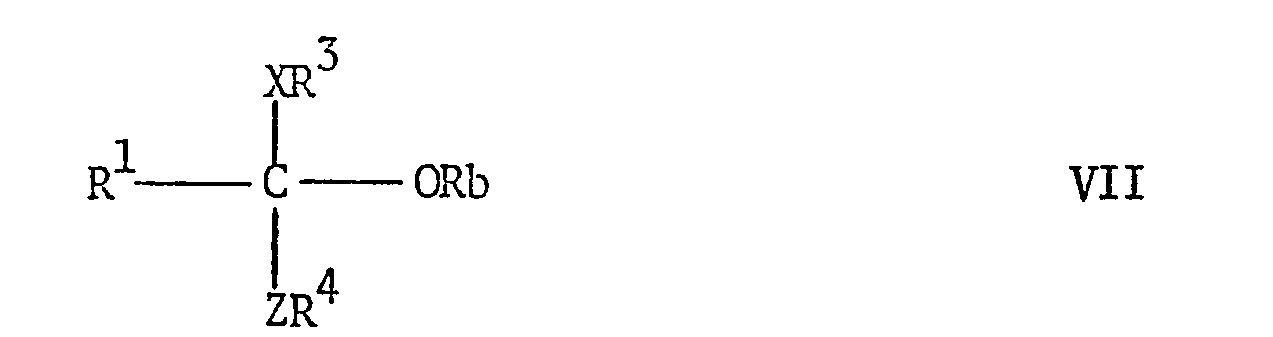
- Compounds of formula IIa may be made by reacting a compound of formula VII, in which R b, R l , R 3 , R 4 , X and Z are as defined above, with PCl 3 or a compound of formula RxPCl 2 , in which Rx is as defined above.
- Compounds of formula VIII may be made using techniques known per se, e.g. conversion of a compound of formula I, or a derivative thereof, in which Rm is -O ⁇ M ⁇ to a corresponding compound in which Rm is -OH, e.g. by column chromatography, and reaction of the -OH compound with, for example, thionyl chloride.
- the compounds and compositions of the invention possess herbicidal and/or plant growth regulant or retardant activity, especially when employed pre- or preferably post-emergence, mainly against grass weeds such as ryegrass (Lolium perenne), black grass (Alopecurus myosuroides), barnyard grass (Echinochloa crus-galli), wild oats (Avena fatua), crabgrass (Digitaria sanguinalis), pig weed (Amaranthus retroflexus), pale persicaria (Polygonum lapathifolium), couch grass (Agropyron repens) purple nutsedge (Cyperus rotundus), yellow nudsedge (Cyperus esculentus) and Johnson grass (Sorghum halepense).
- grass weeds such as ryegrass (Lolium perenne), black grass (Alopecurus myosuroides), barnyard grass (Echinochloa crus-galli), wild oats (Avena fatua
- Peas (Pisum sativum) and some other dicotyledonous crops such as soya beans (Glycine species), alfalfa and beans of the Vicia and Phaseolus genus, are tolerant to doses which are effective against such weeds, and the compounds and compositions are therefore of use in controlling the above weeds in peas and some other dicotyledonous crops.
- the compounds and compositions of the invention are also of use in increasing the tillering of, or producing shorter or stronger stems in, cereals such as wheat (Triticum aestivum) and barley (Hordeum vulgare).
- the compounds and compositions of the invention are also of use in industrial weed control, e.g. on railway tracks, and for directed spray application to high standing crops such as cotton, maize, tobacco, sugar cane orchards, vineyards and in rubber, cocoa, tea, coffee or palm plantations.
- the compounds and compositions of the invention are also active against a range of fungal diseases, particularly those of plants, such as Phytophthora infestans (potato blight), Erysiphe graminis (barley powdery mildew), Puccinia recondita (wheat brown rust), Pyricularia oryzae (rice blast), and Plasmopara viticola (vine downy mildew).
- Phytophthora infestans potato blight
- Erysiphe graminis barley powdery mildew
- Puccinia recondita wheat brown rust
- Pyricularia oryzae rice blast
- Plasmopara viticola vine downy mildew
- the compounds of formula I, and the agriculturally acceptable derivatives thereof, are preferably employed in the form of a composition containing a carrier and/or a surface active agent. When used in pre-emergent treatments the compounds are preferably applied as a surface spray.
- compositions may be prepared by admixing the ingredients.
- the compositions are initially produced in the form of concentrates, e.g. containing 0.5-85% of the present compounds, and these are diluted with water or hydrocarbon, usually water, for application, generally such that the concentration of the compounds is 0.05-5%, percentages and parts in this specification being by weight unless otherwise indicated.
- the carrier may be a liquid, e.g. water (e.g. water used to dilute a concentrate for application). If water is employed as carrier in a concentrate, an organic solvent may also be present as carrier, though this is not usually employed. A surface active agent may advantageously be present.
- Those compounds soluble in water may be used as aqueous solutions with or without a surface active agent.
- the carrier may be a liquid other than water, for example an organic solvent, such as a water immiscible solvent, e.g. a hydrocarbon which boils within the range 130-270°C, in which the compound is dissolved or suspended.
- a concentrate containing a water immiscible solvent suitably also contains a surface active agent so that the concentrate acts as a self-emulsifiable oil on admixture with water.
- the liquid may be a water-miscible solvent e.g. 2-methoxy ethanol, methanol, propylene glycol, ethylene glycol, diethylene glycol, diethylene glycol monoethyl ether, formamide or methylformamide.
- the carrier may be a solid, which may be finely divided.
- suitable solids are limestone, clays, sand, mica, chalk, attapulgite, diatomite, perlite, sepiolite, silicas, silicates, lignosulphonates and solid fertilizers.
- the carrier can be of natural or synthetic origin or can be a modified natural material.
- Wettable powders soluble or dispersible in water may be formed by admixing the compound in particulate form with a particulate carrier or spraying molten compound on to the particulate carrier, admixing a wetting agent and a dispersing agent and finely grinding the whole powder mixture.
- An aerosol composition may be formed by admixing the compound with a propellant e.g. a polyhalogenated alkane such as dichlorodifluoromethane, and suitably also with a solvent.
- a propellant e.g. a polyhalogenated alkane such as dichlorodifluoromethane, and suitably also with a solvent.
- a flowable suspension concentrate may be formed by grinding substantially water insoluble compoundswith water, a wetting agent and a suspending agent.
- the present composition can for example be solid (e.g. dust or granules) and contain a solid carrier or liquid (e.g. an emulsifiable concentrate) and contain a liquid carrier which is a hydrocarbon which boils within the range 130-270°C.
- a solid carrier or liquid e.g. an emulsifiable concentrate
- a liquid carrier which is a hydrocarbon which boils within the range 130-270°C.
- 'surface active agent' is used in the broad sense to include materials variously called emulsifying agents, dispersing agents and wetting agents. Such agents are well known in the art.
- the surface active agents used may comprise anionic surface active agents, for example soaps, mono- or di-esters of phosphoric acid with fatty alcohol ethoxylates or salts of such esters, fatty alcohol sulphates such as sodium dodecyl sulphate, sodium octadecyl sulphate or sodium cetyl sulphate, ethoxylated fatty alcohol sulphates, ethoxylated alkylphenol sulphates, lignin sulphonates, petroleum sulphonates, alkyl-aryl sulphonates such as alkyl-benzene sulphonates or lower alkylnaphthalene sulphonates e.g.
- butyl-naphthalene sulphonate salts of sulphonated naphthal- eneformaldehyde condensates, salts of sulphonated phenol-formaldehyde condensates, or more complex sulphonates such as the amide sulphonates e.g. the sulphonated condensation product of oleic acid and N-methyl taurine or the dialkyl sulphosuccinates e.g. the sodium sulphonate of dioctyl succinate.
- Ionic surface active agents may tend to result in precipitation if employed in some formulations with certain of the compounds of the invention. Any surface active agent should be so chosen of course as to avoid this for any particular formulation envisaged.
- the surface active agents may also comprise non-ionic agents, for example condensation products of fatty acid esters, fatty alcohols, fatty acid amides or fatty-, alkyl- or alkenyl-substituted phenols with ethylene oxide, fatty esters of polyhydric alcohol ethers e.g. sorbitan fatty acid esters, condensation products of such esters with ethylene oxide e.g. polyoxyethylene sorbitan fatty acid esters, block copolymers of ethylene oxide and propylene oxide, acetylenic glycols such as 2,4,7,9-tetramethyl-S-decyn-4,7-diol, or ethoxylated acetylenic glycols.
- non-ionic agents for example condensation products of fatty acid esters, fatty alcohols, fatty acid amides or fatty-, alkyl- or alkenyl-substituted phenols with ethylene oxide
- the surface active agents may also comprise cationic agents, for example alkyl- and/or aryl-substituted quaternary ammonium compounds such as cetyl trimethylammonium bromide or ethoxylated tertiary fatty amines.
- cationic agents for example alkyl- and/or aryl-substituted quaternary ammonium compounds such as cetyl trimethylammonium bromide or ethoxylated tertiary fatty amines.
- Preferred surface active agents include ethoxylated fatty alcohol sulphates, lignin sulphonates, alkyl-aryl sulphonates, salts of sulphonated naphthalene-formaldehyde condensates, salts of sulphonated phenol-formaldehyde condensates, dialkyl sulphosuccinates, alkyl phenol ethoxylates, and fatty alkyl ethoxylates.
- Non-ionic surface active agents are preferred.
- the surface active agent employed to produce this potentiating effect may be selected from those described above. It is preferably a non-ionic surface active agent, especially an alkylsubstituted phenol condensed with ethylene oxide, e.g. tributyl- phenol condensed with 11 moles of ethylene oxide (available under the trade mark Sapogenat T110).
- the potentiating surface active agent may be admixed with the present compound for instance at the point of use, e.g. in a spray tank, or before, e.g. in a concentrate.
- the amount of potentiating surface active agent applied in a spray of the present compound is 0.1-5%, especially 1%.
- the present active compound may be admixed with another pesticide, e.g. herbicide, insecticide or fungicide, or with a plant growth regulant.
- another pesticide e.g. herbicide, insecticide or fungicide
- the invention provides a one pack presentation, in which the present compound is already mixed with another pesticide or plant growth regulant, and also a single package designed to hold the present compound and other pesticide or the plant growth regulant in separate containers, for mixing, e.g. in a spray tank, for application. Particular advantages are obtained with mixtures with another pesticide.
- the present compound may be used sequentially with another pesticide or plant growth regulant particularly with another fungicide or herbicide.
- the herbicide may be for example one or more of a phenoxyaliphatic acid, substituted urea, triazine, phenol, nitrile, bipyridylium compound, substituted benzoic acid, halogenated aliphatic acid, carbamate, thiocarbamate, chloroacetamide, diazine or arsenic herbicide.
- the present compound may be used in admixture with for example a substituted phenoxyaliphatic acid; in respect of selective herbicidal compositions for pre-emergence use, the present compound may be used in admixture with for example a substituted urea, triazine, S-2,3-dichloroallyl di-isopropylthiocarbamate or S-2,3,3-trichloroallyl di-isopropylthiocarbamate.
- the phenoxyaliphatic acid generally comprises allyl and/or halogen substituted phenoxyaliphatic acids, and their salts, for example alkali metal, amine and alkanolamine salts, and ftmctional derivatives, for example esters and amides. These compounds may be of activity such that they are recognised as commercial herbicides, or may be of only slight herbicidal activity.
- substituted phenoxyaliphatic acids examples include 2,4-dichlorophenoxyacetic acid, 2-(2,4-dichloro- phenoxy)propionic acid, 2-methyl-4-chlorophenoxyacetic acid, 2,4,5-trichlorophenoxyacetic acid, gamma-2,4-dichlorophenoxybutyric acid, gamma-2-methyl-4-chloro-phenoxybutyric acid, alpha-2-methyl-4-chlorophenoxypropionic acid, 2-(4-[2,4-dichlorophenoxy] phenoxy)propionic acid and 2-(4-[4-chlorophenoxy]phenoxy) propionic acid.
- the substituted urea generally comprises a tri- or tetra- substituted urea such as N'-(3-chloro-4-methoxyphenyl)-N,N-dimethylurea, N'-(3-chloro-4-methylphenyl)-N,N-dimethylurea, N'-para-chlorophenyl-N,N-dimethylurea, N-butyl-N'- (3,4-dichlorophenyl)-N-methylurea, N'-para-chlorophenyl-O,N,N-trimethylisourea, N'-p-chlorophenyl-N-methoxy-N-methylurea, N,N-dimethyl-N'-phenyl- urea, 3-(4-bromophenyl)-1-methoxy-1-methylurea, 1-(2-benzothiazolyl)-3-methylurea, N,N-dimethyl-N'-(4-[1-
- the triazine herbicide generally comprises 2-chloro-4-(1-cyano-1-methylamino)-6-ethylamino-1,3,5-triazine or 2-isopropyl- amino-4-(3-methoxypropylamino)-6-methylthio-1,3,5-triazine or a compound of the formula:- where T is a halogen atom, OY group or SY group, where Y is an alkyl group, R d and R f are the same or different and are hydrogen or alkyl and R e and R g are the same or different alkyl groups,
- the phenol herbicide generally comprises 4,6-dinitro-o-cresol, 4,6-dinitro-2-sec-butylphenol or pentachlorophenol.
- the nitrile herbicide generally comprises 3,5-diiodo-4-hydroxy-benzonitrile, 3,5-dibromo-4-hydroxybenzonitrile or 2,6-dichlorobenzonitrile.
- the bipyridylium herbicide generally comprises 1,1'-dimethyl-4,4'-bipyridylium dichloride or 1,1'-ethylene-2,2'-bipyridylium dibromide.
- the substituted benzoic acid herbicide generally comprises 2,3,6-trichlorobenzoic acid, 2-methoxy-3,6-dichlorobenzoic acid or N-(1,1-dimethylpropynyl)-3,5-dichlorobenzamide.
- the halogenated aliphatic acid herbicide generally comprises trichloroacetic acid or 2,2-dichloropropionic acid.
- the carbamate herbicide generally comprises isopropyl N-(3-chlorophenyl) carbamate, 4-chloro-2-butynyl N-(3-chlorophenyl)carbamate, methyl 3-(m-tolylcarbamoyloxy)phenylcarbamate or D-N-ethyl-2-(phenyl- carbamoyloxy)propionamide.
- the thiocarbamate herbicide generally comprises S-ethyl N,N-dipropylthiocarbamate, S-ethyl N,N-diisobuty- lthiocarbamate, S-(2,3-dichloroallyl) N,N-diisopropylthiocarbamate, S-ethyl N-ethyl-N-cyclohexylthiocarbamate, S-propyl butylethyl- thiocarbamate or S-(2,3,3-trichloroallyl) N,N-diisopropylthiocarb- amate.
- the chloroacetamide herbicide generally comprises N,N-diallyl-2-chloroacetamide or N-isopropyl-2-chloroacetanilide.
- the diazine herbicide generally comprises 5-bromo-6-methyl-3-sec- butyluracil, 3-cyclohexyl-5,6-trimethyleneuracil, 5-amino-4-chloro-2-phenyl-3-pyridazinone or 1,2-dihydropyridazine-3,6-dione.
- the arsenic herbicide generally comprises a salt of methane arsonic acid or cacodylic acid.
- herbicides which may be used include 1,2-dimethyl-3,5-diphenylprazolium ion, ethyl N-benzoyl-N-(3,4-dichlorophenyl)alanine, N-isobutyl-2-oxo-l-imidazolidine-carboxamide, aminotriazole,2,3-dichloro-1,4-naphthoquinone, 4-amino-3,5,6-trichloropicolinic acid, N,N-dimethyl-2,2-diphenylacetamide, 2,6-dinitro-N,N-dipropyl-4-trifluoromethylaniline, N-butyl-N-ethyl-2,6-dinitro-4-trifluoromethylaniline, S,S,S-tributyl phosphorotrithioate, 2-ethoxy-2,3-dihydro-3,3-dimethyl-5-benzofuranyl methylsulphonate, 4-chloro-2
- the compounds may also be employed in association with a herbicidal antidote (a substance having the property of improving the safety of a herbicide to a crop), e.g. N,N-diallyl-2,2-dichloro- acetamide, 4'-chloro-2-(hydroxyimino)acetanilide, 1,8-naphthalic anhydride, ⁇ -(cyanomethoxyimino)-benzeneacetonitrile or 2,2-dimethyl-3-dichloroacetyloxazolidine.
- a herbicidal antidote a substance having the property of improving the safety of a herbicide to a crop
- a herbicidal antidote e.g. N,N-diallyl-2,2-dichloro- acetamide, 4'-chloro-2-(hydroxyimino)acetanilide, 1,8-naphthalic anhydride, ⁇ -(cyanomethoxyimino)-benzene
- the present compounds may be used in admixture or sequence with a fungicide, for instance one or more of maneb (polymeric manganese ethylenebisdithiocarbamate), zineb (zinc ethylenebisdithiocarbamate), mancozeb (which can be regarded as a mixture of maneb and zineb), thiram (tetramethylthiuram disulphide), ditalimfos (0,0-diethyl phthalimidophosphonothioate), tridemorph (2,6-dimethyl-4-tridecyl- morpholine), fluotrimazole (1-[diphenyl-(3-trifluoromethylphenyl)-methyl]-1,2,4-triazole), ethirimol (5-butyl-2-ethylamino-4-hydroxy-6-methylpyrimidine), triforine (1,4-di[2,2,2-trichloro-1-formamidoethyl]-piperazine),
- the present compounds may be used in admixture or sequence with an insecticide.
- the insecticide ray be for instance one or more of demeton-S-methyl (S-2-ethylthioethyl 0,0-dimethyl phosphorothioate), dimethoate (0,0-dimethyl S-methylcarbamoylmethyl phosphorodithioate), formothion (S-[N-formyl-N-methylcarbamoylmethyl7 0,0-dimethyl phosphorodithioate), oxydemeton-methyl (S-2-ethylsulphinylethyl 0,0-dimethyl phosphorothioate), pirimicarb (2-dimethylamino-5,6-dimethylpyrimidin-4-yl dimethylcarbamate,), thiometon (S-2-ethylthioethyl 0,0-dimethyl phosphorodithioate), BHC (benzene hexachloride), aldrin (1,2,3,
- the ratio of the present compound to the second herbicide may vary over a wide range according to the particular compounds involved and the intended use. In general the ratio of present compound to second herbicide lies in the range 1:0.1 to 1:15.
- the present compounds are usually employed for herbicidal purposes at a rate of from 0.5 to 8 kg per hectare, for example 1 to 4 kg per hectare.
- the present compounds may be applied to plants, the soil, land or aquatic areas.
- the present compounds may be in admixture with non-phytotoxic oils, e.g. Agri-Oil Plus, Sun Oil 11E or Fyzol E.
- non-phytotoxic oils e.g. Agri-Oil Plus, Sun Oil 11E or Fyzol E.
- the compounds may be in admixture with fertilizers.
- the present invention provides a method of controlling or preventing fungal growth which comprises applying to a locus infested or liable to be infested by fungus a compound or composition according to the invention.
- the locus infected or liable to be infected may be plants, animals, the soil, aquatic areas, fabrics, textiles, paper, wood and the like.
- the compound or composition is employed against fungal diseases of plants.
- the plants may be growing or may be seeds, using 'seeds' in the wider sense to include tubers etc.
- the compound or composition can be applied directly to the plants, or can be applied to the medium in which they grow and be taken up by the plants and distributed within the plants, i.e. the compounds show systemic activity.
- the compounds are applied to a locus infested or liable to be infested with fungus at a rate for example of 0.2 to 5 kg per hectare.
- the compounds may be applied in the form of a dust with a solid carrier for instance at the rate of 1-4 e.g. 2 oz of dust per bushel of seed or may be applied in the form of a liquid with a liquid carrier for instance at a rate of 0.75-3 fluid oz of liquid per bushel of seed.
- the compounds of formula I may in certain instances exist in tautomeric or isomeric forms.
- Example 2 The product compound of Example 1 (4.5g, 0.028 mol) was dissolved in the minimum amount of water ( ⁇ 17 ml) and passed down a cation exchange column (H + form, equilibrated with water). Elution with water was continued until the eluent was no longer strongly acid (-38 ml). The eluent was freeze dried to give a yellow oil.
- Methyl acetylphenylphosphinate (5.0g, 0.025 mol) was added to a solution of sodium iodide (3.8g, 0.025 mol) in molecular sieve dried ethyl methyl ketone (50 ml) and the resulting solution was stirred and refluxed for 15 minutes.
- the product was recrystallised twice from methanol/acetone (approximately 1:2).
- Methyl 4-(methoxypentylphosphinyl)-4-oxobutanoate (7.9g) was reacted with sodium iodide (4.5g) in methyl ethyl ketone (80 ml) in the same manner as in Example 12.
- the product, obtained on evaporation, was a pale yellow very deliquescent solid (8.1g). NMR consistent with the required structure.
- Methyl acetylethylphosphinate (6g) was reacted with sodium iodide (6.0g) in ethyl methyl ketone (50 ml) in the same manner as in Example 12. The solution was stirred and refluxed 1.25 hours, cooled and the product filtered off and washed with a little ethyl methyl ketone and dried in vacuo (5.3g). Decomposes 192-4°.
- the phosphinate ester product of Example 16 (220g) was refluxed 2 hr with aqueous sodium hydroxide (2N : 660 ml). The cooled solution was taken to pH 7.0 with conc. hydrochloric acid, evaporated in vacuo and the solid residue was triturated with methanol and insoluble material filtered off. The filtrate was again evaporated to dryness, the residue triturated with methanol and further insoluble material filtered off. The filtrate was finally evaporated to dryness, triturated with acetone and filtered to give the title compound (2.9.2g) mp 258-263°C, identical (ir nmr) with the product from Example 17.
- step (a) The product of step (a) (16.0g) was dissolved in a 0.5M solution of anhydrous lithium iodide in methyl isobutyl ketone (170 ml) and the solution heated under reflux with stirring for 2 hours. After cooling the crude lithium salt was filtered off, washed with acetone and dried. The product (12.0g) was dissolved in methanol (50 ml) and diluted with acetone (500 ml). The precipitated impurities were filtered off and the filtrate was evaporated to dryness to give the title product as a deliquescent, pale yellow solid (9.5g). The salt has no sharp melting point and gradually softens and decomposes above 195°C. Elemental analysis indicates the monohydrate:
- step (a) The product of step (a) (7.7g) was refluxed for 2 hours with IN sodium hydroxide solution (40 ml). The cooled solution was evaporated in vacuo, traces of water were removed with ethanol and the residue triturated with ethanol to give the required sodium salt (7.2g) softens 220°C, darkens but does not melt below 300°C.
- the diethyl ketal of sodium acetylphosphonite (9.8g) was dissolved in a mixture of acetic acid (95 ml) and water (5 ml) and the solution was kept at ambient temperature for 16 hours. The solvent was removed in vacuo and the residue was triturated with acetone to give the crude product. (6.3g). A small sample was dissolved in cold methanol and diluted with acetone. The required ketone crystallised on storage; mp >340°C.
- Hypophosphorous acid (30% w/v) (22ml, 0.1 mol) was evaporated at 0.5 mm Hg at 50° to remove the water.
- Triethyl orthoacetate (40.5g, 0.25 mol) was added to the anhydrous acid under N 2 , and dry HC1 gas was passed into the stirred mixture until it turned cloudy (approx. 10 sec). The resulting mixture was stirred at room temperature under N 2 for 16h.
- the resulting mixture was evacuated at 0.1 mn Hg for 1h at room temperature to remove all volatile material.
- This ester (7.5g) was refluxed with aqueous IN sodium hydroxide (50 ml) until a solution was obtained (1 hour), and then for a further hour. The cooled solution was evaporated in vacuo and the residual water removed with ethanol. The residue was triturated with acetone to give a solid (4.0g). This product was crystallised from ethanol/acetone to give the required sodium salt (1.7g) softens 155°, mp 198-201 0 C (dec).
- 2-Ethoxy-2,4,5-trimethyl-1,3-dioxolane (28g, 0.175 mol) was stirred under a slow stream of nitrogen with a spatula end of SnCl 2 .
- Methanephosphonous dichloride (8.2g, 0.07 mol) was added dropwise, cooling the reaction in a dry ice/acetone bath as necessary to control the exothermic reaction. When addition was complete the mixture was left to stir for 21 ⁇ 2 days.
- the mixture was distilled under high vacuum, the fraction boiling 64-75° (pressure rising from 0.15 to 0.45 mm Hg) contained the desired product, ethyl methyl(2,4,5-trimethyl-1,3-dioxolan-2-yl)phosphinate, 16.9g 95%.
- Methane phosphonous dichloride (5.7 ml, 0.063 mol) was added dropwise at 0° to tripropyl orthoacetate (32.1g, 0.157 mol) stirred under nitrogen with a little SnCl 2 . When the addition was complete the mixture was allowed to warm to room temperature and was stirred overnight. The mixture was distilled under high vacuum to give propyl methyl(1,1-dipropoxyethyl)phosphinate b p 95-100° at 0.3 mm Hg, 14.3g, 85%. This product (14.3g, 0.054 mol) was refluxed in 1N NaOH solution (90 ml, 0.08 mol) and ethanol added until the reaction mixture was homogeneous (approx 100 ml added).
- step (a) A solution of the product of step (a) (0.43g, 2.87 mmol) and oven dried sodium iodide (0.43g, 2.87 mol) in distilled ethyl methyl ketone (6 ml) was stirred and refluxed for 16h.
- Methyl acetylmethylphosphinate (5.4g, 0.04 mol) and ethanethiol (9.9g, 11.7 ml, 0.16 mol) were stirred together in chloroform (40 ml) at room temperature under nitrogen.
- Trimethylsilyl chloride ( 6 .5g, 7.6 ml, 0.06 mol) was added dropwise over 10 min and the mixture then stirred for a further 1 hour.
- the solution was washed with 2.5M NaOH (3 x 50 ml) and with brine, then dried and evaporated giving a yellow liquid, 5.5g. N.m.r showed this to consist mainly of a mixture of the bisthioketal and vinylsulphide derivatives of the starting ester.
- 3-Mercaptopropylamine hydrochloride (2.6g, 0.02 mol) was stirred in ethanol (25 ml) with sodium hydroxide (0.8g, 0.02 mol) for about 11 ⁇ 2 hours and then filtered through Kieselguhr. This solution was added to a stirred slurry of sodium acetylmethylphosphinate (2.9g, 0.02 mol) in ethanol (20 ml) and the mixture stirred overnight. The solution was evaporated under reduced pressure, giving a white foamy solid which was dissolved in ethanol, precipitated with dry ether and filtered. The filtrate was evaporated to a foamed solid, which was dried in vacuo giving 2.5g, 58% of product, mp 155-160°. N.m.r was consistent with the desired product.
- Example 8 The compound of Example 8 (6.3g) and malononitrile (2.0g) were dissolved in ethanol (150 ml) and the solution was allowed to stand for 18 hours, evaporated in vacuo and the residue triturated with ether. The product was filtered off, washed well with ether and dried to give an orange solid (6.0g).
- the product was purified by dissolution in ethanol (250 ml) and dilution of the solution with ethyl acetate (200 ml) to give a pale yellow powder (3.8g). Softens at 100°C begins to decomp at 155°C.
- Example 3 7 Procedure as for Example 3 7 using C 6 H 5 CH 2 ONH 2 HCl (4.797g), sodium hydroxide (1.2037g) and sodium acetylmethylphosphinate (4.331g), except that the benzyl ether is less soluble in ethanol than hydroxylamine hydrochloride and was dissolved in 300 m1 solvent.
- Methoxyamine hydrochloride (1.7g, 0.02 mol) and sodium hydroxide (0.8g, 0.02 mol) were stirred together in methanol (20 ml) until all the NaOH had dissolved (about 1 ⁇ 2hr).
- the solution was filtered through Keiselguhr and added to a stirred solution of sodium acetylmethylphosphinate (2.6g, 0.02 mol) in methanol ( 10m1).
- the mixture was stirred overnight at room temperature, and then evaporated, giving a pale yellow solid. This was recrystallised from methanol/ether giving a white solid, 2.5g, 72% which appears to be mainly one geometrical isomer of the desired product with some of the other (6:1 ratio) by n.m.r. M.P. 230-235 decomp.
- the main crop was crystallised from ethanol to give the hydrazone as orange crystals (5.8g); nmr supports the required structure.
- the compound darkened at 255°C and did not melt below 280°C.
- the product was crystallised from ethanol/acetone and gave 0.5g of the cyanohydrin, softens 130°, decomp. 150°C.
- Methylphosphonous dichloride (10g, 0.855 mol) was added dropwise, with stirring, under N 2 to trimethyl orthoformate (27.2g, 0.256 mol) containing anhydrous SnCl 2 (approx O.lg) maintaining the temperature as near to -20°C as possible. The addition was exothermic and took about 15 min during which time a white suspension was formed. After allowing the temperature to rise to room temperature a clear solution was formed and stirring was continued for 2h.
- step (a) (7.4g) in methyl ethyl ketone (75 ml) was refluxed for 2 hr with sodium iodide (7.0g). The resulting suspension was cooled and the product filtered off, washed and dried (7.4g). The n.m.r spectrum was consistent with the required material.
- Methyl (1,1-dimethoxypropyl) methylphosphinate was prepared from trimethyl ortho-propionate and methylphosphonous dichloride according to the procedure of Example 16. The product boiled at 76°C at 0.5 mm Hg.
- Example 48 The product of Example 48 (13.6g) was dissolved, with warming on the steam bath in acetic acid (100 ml) containing water (3 ml). The solution was left for 16 hrs and was then worked up as in Example 8(a).
- Example 18 The product of Example 18 (3.8g) and dodecylguanidine hydrochloride (5.3g) were dissolved separately in the minimum of ethanol and the solutions mixed. After 16 hrs sodium chloride was filtered off and the filtrate was evaporated in vacuo to give a gummy solid. This was triturated with acetone to give the required salt as an insoluble colourless solid (4.2g), m.p. 123-125°C. The n.m.r spectrur was in agreement with the required structure.
- Example 50 By the procedure of Example 50 the product of Example 18 (3.8g) and isopropylamine hydrochloride (2.0g) were mixed, and after 16 hrs sodium chloride was removed and the filtrate evaporated in vacuo.
- Example 50 By the procedure of Example 50 the product of Example 18 (3.8g) and 1,3,5-tributyl-4-metliylamino-1,2,4-triazolium chloride (5.7g) were mixed and the resulting sodium chloride filtered off. The filtrate was evaporated in vacuo and the residual oil treated with acetone. Unreacted phosphinate (0.3g) was filtered off and the filtrate evaporated in vacuo, finally at the oil pump, to give the required salt as an amber oil (6.0g). The nmr specturm was in agreement with the structure.
- Example 53 By the procedure of Example 53 the product of Example 18 (3.8g) and 1-butyl-4-butylamino-3,5-dipropyl-1,2,4-triazolium chloride (6.0g) were mixed and the reaction worked up to give the required salt as a pale yellow oil (6.5g). The nmr spectrum was in agreement with the required structure.
- the seeds were watered and placed in a controlled environment room at 22°C, 6S-85% relative humidity and 14 hours per day artificial illumination at 13,000 lux. After 14 days the seedlings received foliar sprays of the test compounds formulated as an aqueous suspension or solution containing 1,000 ppm of the wetting agent Lissapol NX.
- the concentrations of active ingredients and volume of application were adjusted so as to give rates of 11.2, 2.8 and 0.7 kg per hectare of active ingredient in 450 litres ner hectare.
- the plants were returned to the controlled environment room. After 21days they were visually assessed for herbicidal effects compared with unsprayed controls. All differences from controls are given as percentage supression in the table below.
- the seeds were watered and placed in a controlled environment room at 22°C, 65-85% relative humidity and 14 hours per day artificial illumination at 17,000 lux. After 21 days the seedlings received foliar sprays of the test compounds formulated as an aqueous solution containing 2,000 ppm of the wetting agent Lissapol NX.
- the compound under test formulated as an attaclay/sand dust was incorporated in John Innes I potting compost at a rate equivalent to 26 parts per million weight/volume of active ingredient to soil and placed in anodised aluminium pans, 19 cm long x 9.5 cm wide x 5.0 cm deep. This rate is approximately equivalent to a soil surface application of 11.2 kg active ingredient/hectare cultivated to a depth of 5 cm. Seeds of Peas, Mustard, Linseed, Maize, Oats and Ryegrass were sewn in the treated soil, watered and placed in a controlled environment room (22°C, 65-85% relative humidity, 14 hours artificial illumination at 1200 foot candles) for 21 days.
- Example B The procedure of Example B was repeated using the compound of Example 17 and with the difference that the plants were assessed after 28 days.
- Aqueous acetone solutions of the compound of Example 15 containing 2000 parts per million (ppm) wt/vol together with 125 ppm of a suitable wetting agent were applied to the soil surrounding the roots and leaves of rice plants having two fully expanded leaves, and wheat plants with one fully expanded leaf.
- the treated plants, together with controls treated with wetting agent alone, were innoculated 24 hours after the chemical application with an aqueous suspension of spores of the disease organisms known as rice blast, Pyricularia oryzae and wheat brown rust, Puccina recondita respectively.
- the plants were then placed in an atmosphere of 100% humidity for the rice plants at 28 0 C until the disease incidence was measured seven days later, and for wheat plants for 24 hours and then transferred to a controlled environment room (18°C and 80-90% RH) until disease incidence was measured after 12 days, when it was found that the treatments had given 90% disease reduction of both diseases in comparison with less than 5% on the controls.
- Aqueous acetone solutions of the compound of Example 1 containing 2000 parts per million (ppm) wt/vol together with 125 ppm of a suitable wetting agent were applied to the foliage and soil surrotunding the roots of potato plants having seven fully expanded leaves and barley plants with one fully expanded leaf.
- the treated plants, together with controls treated with wetting agent alone, were inoculated 24 hours after the chemical application with an aqueous suspension of sporangia and spores respectively of the disease organisms known as potato blight, Phytophthora infestans and barley powdery mildew, Erysiphe graminis.
- the plants were then placed in an atmosphere of 100% humidity for 24 hours and then transferred to a controlled environment room (18°C and 80-90% RH) until disease incidence was measured after five days for potatoes and 10 days for barley when it was found that the treatments had given 80% control of each disease in comparison with less than 5% on the untreated controls.
- Aqueous acetone solutions of the compound of Example 17 containing 2000 and 500 parts per million (ppm) wt/vol together with 125 ppm of a suitable wetting agent were applied to the leaves of barley plants with one fully expanded leaf.
- the plants were then placed in an atmosphere of 100% humidity for 24 hours and then transferred to a controlled environment room (18°C and 80-90% RH) until disease incidence was measured after 10 days when it was found that the treatments at 2000 and 500 ppm had given 95 and 90% disease reduction respectively in comparison with less than 5% on the untreated controls.
- Aqueous acetone solutions of the compound of Example 19 containing 125 parts per million (ppm) wt/vol together with 125 ppm of a suitable wetting agent were applied to the leaves of vine plants having five fully expanded leaves.
- the plants were then placed in an atmosphere of 80% humidity, at 14-18°C until the disease incidence was measured twelve days later when it was found that the treatments at 125 ppm had given 90% control respectively in comparison with less than 5% on the controls.
Landscapes
- Chemical & Material Sciences (AREA)
- Organic Chemistry (AREA)
- Life Sciences & Earth Sciences (AREA)
- Health & Medical Sciences (AREA)
- General Health & Medical Sciences (AREA)
- Biochemistry (AREA)
- Molecular Biology (AREA)
- Crystallography & Structural Chemistry (AREA)
- Agronomy & Crop Science (AREA)
- Pest Control & Pesticides (AREA)
- Plant Pathology (AREA)
- Engineering & Computer Science (AREA)
- Dentistry (AREA)
- Wood Science & Technology (AREA)
- Zoology (AREA)
- Environmental Sciences (AREA)
- Agricultural Chemicals And Associated Chemicals (AREA)
Abstract

- E is oxygen or sulphur,
- Rm is-O⊖M⊕ or -NRyRz,
- M⊕ is one equivalent of an agriculturally acceptable cation,
- R1 and R2, which may be the same or different, each represent hydrogen, alkyl, alkenyl, alkynyl or aryl; the alkyl, alkenyl, alkynyl or aryl optionally being substituted by one or more halogen, alkoxy, nitro, alkyl, -CH3, nitrile, or carboxylic acid or a salt, ester, or amide thereof, and
- Ry and Rz, which may be the same or different, each represent hydrogen or alkyl,
- or an agriculturally acceptable derivative thereof.
Description
- This invention concerns herbicidal, fungicidal or insecticidal compositions, new herbicidally, fungicidally or insecticidally active compounds, and processes for the preparation of such compounds.
- In one aspect, this invention provides a pesticidal composition comprising one or more compounds of the formula I,

- E is oxygen or sulphur,
- Rm is -O⊖N⊕ or -NRyRz,
- M⊕ is one equivalent of an agriculturally acceptable cation, R 1 and R2, which may be the same or different, each represent hydrogen, alkyl, alkenyl, alkynyl or aryl; the alkyl, alkenyl, alkynyl or aryl optionally being substituted by one or more halogen, alkoxy, nitro, alkyl, -CF3, nitrile or carboxylic acid or a salt, ester or amide thereof, and
- Ry and Rz, which may be the same or different, each represent hydrogen or alkyl,
- or an agriculturally acceptable derivative thereof.
- In another aspect this invention provides a method of combating pests, e.g. weeds, fungi or insects, at a locus either infested with pests or liable to infestation therewith, which method comprises applying to the locus a pesticidally effective amount of one or more compounds of formula I, or of an agriculturally acceptable derivative thereof.
- According to the invention we also provide as new compounds the compounds of formula I, and agriculturally acceptable derivatives thereof, with the proviso that when R1 is methyl and Ra is methoxy then M⊕ is other than sodium.
- We prefer Rm to be -O⊖M⊕.
- M⊕ may be a tri-, or preferably a di- or mono-valent cation. We prefer M⊕ to be an alkali metal (e.g. sodium or lithium), an alkaline earth metal (e.g. magnesium or calcium), or the ammonium (NH4 ⊕) cation or a protonated primary, secondary or tertiary-amine (e.g. a primary, secondary or tertary alkylamine in which each alkyl group contains 1 to 16 carbon atoms) or a quaternary (e.g. a auarternary alkyl C 1 to 16) ammonium cation. M⊕ may also be a herbicidally active cation, e.g. the cation of paraquat, difenzoquat or a triazolium compound such as is disclosed in Belgian Patent Specification No 848,615. We particularly prefer M⊕ to be sodium.
- Ra is preferably a group R2 and more preferably is hydrogen or methyl.
- When R1 or R 2 are optionally substituted alkyl, alkenyl or alkynyl they preferably contain up to 10, more preferably up to 6 and most preferably up to and including 3 carbon atoms. When R1 or R2 themselves carry a substituent group that group preferably contains up to 6 carbon atoms. When R1 or R2 is an aryl group we prefer it to be a phenyl group. We also prefer E to be oxygen. Ry and Rz preferably contain up to 10 and more preferably up to 6 carbon atoms.
- When R1or R2 represent a group substituted by a carboxylic acid group, the carboxylic acid may be in the form of an agriculturally acceptable salt, ester or amide thereof. Suitable salts include those having a cation M⊕ as described above. Suitable esters include C 1 to 10 esters, e.g. C 1 to 10 alkyl esters, and suitable amides include those derived from ammonia or from a mono- or di-alkyl or aryl-, (e.g. phenyl-) amine.
- As a specific group of compounds we provide compounds of formula I in which R1 is hydrogen, alkyl C 1 to 3, or -CH2CH2COOH or a salt or C 1 to 6 alkyl ester thereof, Ra is hydrogen, alkyl C 1 to 6, phenyl, hydroxy or alkoxy C 1 to 6 and M⊕ is sodium or lithium. As a further specific group we provide compounds of formula I in which R is methyl or -CH2CH2COOH or a salt or C 1 to 6 alkyl ester thereof, Ra is methyl and M⊕ is sodium.
- We particularly prefer the compound of Example 8 and the agriculturally acceptable derivatives, and especially the ketals, thereof, e.g. the compounds of Example 17 and 18.
- Agriculturally acceptable derivatives of the compounds of formula I include derivatives of the -CO- group. More particularly there may be mentioned acetals or ketals, e.g. derived from a C 1 to 10, preferably a C 1 to 8, alkanol, such as methanol, ethanol or propanol or from ethylene glycol or from 1,2-dimethyl ethylene glycol, or from an aryl substituted alkanol such as benzyl alcohol; hydrazones, e.g. derived from hydrazine or a substituted hydrazine such as a phenylhydrazine especially 2,4-dinitrophenyl hydrazine; oximes and oxime derivatives such as oxime esters, or ethers, e.g. oxime C 1 to 6 alkyl ethers or the oxime benzyl ether; bisulphite addition compounds, Schiff's bases, cyanohydrins and their derivatives (e.g. esters and ethers including trialkyl silyl ethers), semicarbazones, thiosemicarbazones, hemithioketals, thioketals, imidazolidines, oxazolidines, thiazolidines, perhydro-1,3-diazines, perhydro-1,3-thiazines and perhydro-1,3-oxazines.
- A particular group of agriculturally acceptable derivatives of compounds of formula I are those of formula Ia,

- X and Z, which may be the same or different, each represent oxygen, sulphur or a group -NR5-,
- R5 represents hydrogen, alkyl, e.g. containing 1 to 10 carbon atoms or aryl, e.g. phenyl,
- R 3 and R4, which may be the same or different each represent alkyl, or aryl (e.g. phenyl) each of which may optionally be substituted by hydroxy, alkoxy, alkyl, halogen, carbonyl oxygen or alkoxycarbonyl; or R3 and R4 together form alkylene (e.g. propylene, ethylene or 1,2-dimethylethylene), or arylene (e.g. o-phenylene), each of which may optionally be substituted by hydroxy, alkoxy, alkyl, halogen, carbonyl oxygen or alkoxycarbonyl,
- or XR3 and ZR4 together form =C(CN)2 or =NR10 in which R 10 represents alkoxy C 1 to 6, benzyloxy, hydroxy, phenyl, -NH phenyl, -NH-(2,4-dinitrophenyl), -NHCONH2 or -NHCSNH2,
- or one of XR3 and ZR4 is -OH (or esters or ethers thereof) and the other is -CN or -SO3 ⊖M⊕.
- Should XR3 and ZR4 together form carbonyl oxygen the compounds of formula Ia will be compounds of formula I.
- A further group of agriculturally acceptable derivatives of compounds of formula I are the enol ethers, enol esters and enol thioethers of the compounds of formula I, e.g. compounds of formula Ib,

- Q represents a group -OR6 or S(O)nR7,
- n is 0, 1 or 2,
- R 6 is alkyl or acyl, (e.g. alkanoyl), and
- R7 is alkyl or aryl, e.g. phenyl.
- We prefer -XR3 and -ZR4, when they are separate, each to contain up to and including 10, and preferably up to and including 6 carbon atoms. When R3 and R4 together form an optionally substituted alkylene or arylene chain we prefer the combined R3 and R4 group to contain up to and including 15, preferably up to and including 8 and more preferably 2, 3 or 4 carbon atoms. When R3 and R4 together form a chain we prefer at least one of X and Z to be a group -NR5-. We also prefer the group Q to contain up to and including 10, and more preferably up to and including 6 carbon atoms.
- According to the invention we also provide a process for the production of a compound of formula I, and in particular the new compounds of formula I, or an agriculturally acceptable derivative thereof, which comprises
- (a) producing a compound of formula I, or an agriculturally acceptable derivative thereof, in which Rm is -O⊖M⊕ by reacting a compound of formula II.


- (b) producing a compound of formula I, or an agriculturally acceptable derivative thereof, in which Ra is -OH, by replacing with hydrogen a group Rb in a compound of formula IV,

- (c) producing a compound of formula I, or an agriculturally acceptable derivative thereof, in which R1 or R2 represents alkyl, alkenyl, alkynyl or aryl substituted by a carboxylic acid group, by selective cleavage of a corresponding compound of formula I, or a suitable derivative thereof, in which R1 or R2 represents alkyl, alkenyl, alkynyl or aryl substituted by nitrile, a carboxylic acid ester or amide,
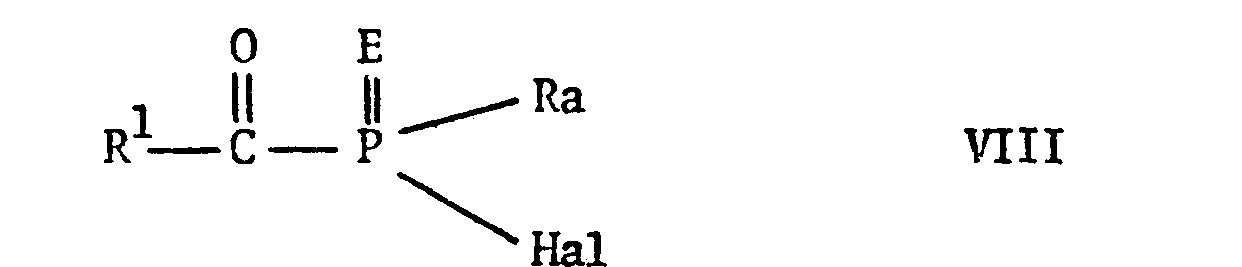
- (d) producing a compound of formula I, or an agriculturally acceptable derivative thereof, in which Rm is -NRyRz by reacting a compound of formula VIII,
- (e) converting a compound of formula I to an agriculturally acceptable derivative thereof, or vice versa, or converting one agriculturally acceptable derivative of a compound of formula I to another.
- The reaction of process (a) is preferably carried out in a solvent which is inert under the reaction conditions, e.g. a ketone such as acetone or ethyl methyl ketone. The reaction is preferably carried out at an elevated temperature, e.g. of from 50 to 150°C and especially at the reflux temperature of the solvent. The reaction of process (a) may be carried out using the compound of formula II itself or a suitable derivative thereof. We prefer the anion Y to be a good nucleophile, e.g. an iodide, bromide, ethanemercaptide, methanemercaptide or benzenemercaptide anion.
- When a derivative, e.g. a ketal, of the compound of formula II is used the anion Y may, in addition to those defined above, be the hydroxy anion, e.g. the compound of formula III may be sodium hydroxide, and the reaction may be carried out in an aqueous medium.
- Suitable derivatives of the compound of formula II include those of formula IIa,

- The reaction of process (b) may conveniently be carried out by subjecting a solution of the starting material to an elevated temperature, e.g. of from 80 to 120°C, for example in formic acid.
- In process (c) care should be taken to ensure that the cleavage does not degrade other parts of the molecule. When an alkyl ester is used as starting material the cleavage may be effected by means of, for example, lithium iodide. The reaction is preferably carried out in a solvent which is inert under the reaction conditions and at a temperature of from about 20° to 150°C.
- Process (d) may be carried out in a solvent which is inert under the reaction conditions or in an excess of the amine HNRyRz. The reaction may be carried out at a temperature of from about 0 to 60°C. Suitable derivatives for use in this process are those of formula IIa in which -ORb is replaced by Hal.
- Process (e) may comprise conversion of a derivative of a compound of formula I, e.g. a compound of formula Ia, to a compound of formula I. Such a conversion may be effected by hydrolysis, e.g. under acidic conditions, using for example aqueous acetic or formic acid. The reaction is preferably carried out at a temperature of from about 0° to 100°C. The conversion of a derivative to a compound of formula I according to process (e) may be carried out sequentially with the reaction of process (a), i.e. process (a) in which the compound of formula II is used in the form of a derivative thereof, followed by process (e).
- Process (e) may also comprise conversion of a compound of formula I to an agriculturally acceptable derivative thereof, e.g. to a compound of formula Ia. Thus the process may comprise reaction of a compound of formula I with an appropriate alcohol, amine, thiol, malononitrile, an alkoxyamine, an aralkyloxyamine, e.g. benzyloxyamine, hydroxylamine, hydrazine, an optionally substituted phenylhydrazine, semicarbazide, thiosemicarbazide or a cyanide. The conversions may be carried out under conditions, and using reagents, which are conventional for the conversion of carbonyl oxygen to the appropriate derivative. When an oxime is to be produced alkoxy exchange may take place when an alkanol solvent is used. Thus use of methoxyamine starting material may yield an 0-ethyloxime product when ethanol is used as solvent.
- As a further facet process (e) may comprise production of an enol ether of formula Ib by methods known per se, e.g. by pyrolysis (for example at 150° to 300°C) of a corresponding ketal of formula IIa in which xR3 and ZR4 are both alkoxy, and reaction of the resulting phosphinate ester with a compound of formula III.
- Compounds of formula II are either known or may be made from known compounds using techniques known per se, e.g. by reaction of a compound of formula V,


- Rx has the same significances as Ra save that it cannot be hydrogen or hydroxy.
- Compounds of formula VI may be made from known compounds using techniques known per se.
- Compounds of formula IIa may be made by reacting a compound of formula VII,
- Compounds of formula VIII may be made using techniques known per se, e.g. conversion of a compound of formula I, or a derivative thereof, in which Rm is -O⊖M⊕ to a corresponding compound in which Rm is -OH, e.g. by column chromatography, and reaction of the -OH compound with, for example, thionyl chloride.
- The compounds and compositions of the invention possess herbicidal and/or plant growth regulant or retardant activity, especially when employed pre- or preferably post-emergence, mainly against grass weeds such as ryegrass (Lolium perenne), black grass (Alopecurus myosuroides), barnyard grass (Echinochloa crus-galli), wild oats (Avena fatua), crabgrass (Digitaria sanguinalis), pig weed (Amaranthus retroflexus), pale persicaria (Polygonum lapathifolium), couch grass (Agropyron repens) purple nutsedge (Cyperus rotundus), yellow nudsedge (Cyperus esculentus) and Johnson grass (Sorghum halepense). Peas (Pisum sativum) and some other dicotyledonous crops such as soya beans (Glycine species), alfalfa and beans of the Vicia and Phaseolus genus, are tolerant to doses which are effective against such weeds, and the compounds and compositions are therefore of use in controlling the above weeds in peas and some other dicotyledonous crops.
- The compounds and compositions of the invention are also of use in increasing the tillering of, or producing shorter or stronger stems in, cereals such as wheat (Triticum aestivum) and barley (Hordeum vulgare).
- The compounds and compositions of the invention are also of use in industrial weed control, e.g. on railway tracks, and for directed spray application to high standing crops such as cotton, maize, tobacco, sugar cane orchards, vineyards and in rubber, cocoa, tea, coffee or palm plantations.
- The compounds and compositions of the invention are also active against a range of fungal diseases, particularly those of plants, such as Phytophthora infestans (potato blight), Erysiphe graminis (barley powdery mildew), Puccinia recondita (wheat brown rust), Pyricularia oryzae (rice blast), and Plasmopara viticola (vine downy mildew).
- The compounds of formula I, and the agriculturally acceptable derivatives thereof, are preferably employed in the form of a composition containing a carrier and/or a surface active agent. When used in pre-emergent treatments the compounds are preferably applied as a surface spray.
- The compositions may be prepared by admixing the ingredients. Usually the compositions are initially produced in the form of concentrates, e.g. containing 0.5-85% of the present compounds, and these are diluted with water or hydrocarbon, usually water, for application, generally such that the concentration of the compounds is 0.05-5%, percentages and parts in this specification being by weight unless otherwise indicated.
- The carrier may be a liquid, e.g. water (e.g. water used to dilute a concentrate for application). If water is employed as carrier in a concentrate, an organic solvent may also be present as carrier, though this is not usually employed. A surface active agent may advantageously be present.
- Those compounds soluble in water may be used as aqueous solutions with or without a surface active agent.
- The carrier may be a liquid other than water, for example an organic solvent, such as a water immiscible solvent, e.g. a hydrocarbon which boils within the range 130-270°C, in which the compound is dissolved or suspended. A concentrate containing a water immiscible solvent suitably also contains a surface active agent so that the concentrate acts as a self-emulsifiable oil on admixture with water. The liquid may be a water-miscible solvent e.g. 2-methoxy ethanol, methanol, propylene glycol, ethylene glycol, diethylene glycol, diethylene glycol monoethyl ether, formamide or methylformamide.
- The carrier may be a solid, which may be finely divided. Examples of suitable solids are limestone, clays, sand, mica, chalk, attapulgite, diatomite, perlite, sepiolite, silicas, silicates, lignosulphonates and solid fertilizers. The carrier can be of natural or synthetic origin or can be a modified natural material.
- Wettable powders soluble or dispersible in water may be formed by admixing the compound in particulate form with a particulate carrier or spraying molten compound on to the particulate carrier, admixing a wetting agent and a dispersing agent and finely grinding the whole powder mixture.
- An aerosol composition may be formed by admixing the compound with a propellant e.g. a polyhalogenated alkane such as dichlorodifluoromethane, and suitably also with a solvent.
- A flowable suspension concentrate may be formed by grinding substantially water insoluble compoundswith water, a wetting agent and a suspending agent.
- Thus the present composition can for example be solid (e.g. dust or granules) and contain a solid carrier or liquid (e.g. an emulsifiable concentrate) and contain a liquid carrier which is a hydrocarbon which boils within the range 130-270°C.
- The term 'surface active agent' is used in the broad sense to include materials variously called emulsifying agents, dispersing agents and wetting agents. Such agents are well known in the art.
- The surface active agents used may comprise anionic surface active agents, for example soaps, mono- or di-esters of phosphoric acid with fatty alcohol ethoxylates or salts of such esters, fatty alcohol sulphates such as sodium dodecyl sulphate, sodium octadecyl sulphate or sodium cetyl sulphate, ethoxylated fatty alcohol sulphates, ethoxylated alkylphenol sulphates, lignin sulphonates, petroleum sulphonates, alkyl-aryl sulphonates such as alkyl-benzene sulphonates or lower alkylnaphthalene sulphonates e.g. butyl-naphthalene sulphonate, salts of sulphonated naphthal- eneformaldehyde condensates, salts of sulphonated phenol-formaldehyde condensates, or more complex sulphonates such as the amide sulphonates e.g. the sulphonated condensation product of oleic acid and N-methyl taurine or the dialkyl sulphosuccinates e.g. the sodium sulphonate of dioctyl succinate. Ionic surface active agents may tend to result in precipitation if employed in some formulations with certain of the compounds of the invention. Any surface active agent should be so chosen of course as to avoid this for any particular formulation envisaged.
- The surface active agents may also comprise non-ionic agents, for example condensation products of fatty acid esters, fatty alcohols, fatty acid amides or fatty-, alkyl- or alkenyl-substituted phenols with ethylene oxide, fatty esters of polyhydric alcohol ethers e.g. sorbitan fatty acid esters, condensation products of such esters with ethylene oxide e.g. polyoxyethylene sorbitan fatty acid esters, block copolymers of ethylene oxide and propylene oxide, acetylenic glycols such as 2,4,7,9-tetramethyl-S-decyn-4,7-diol, or ethoxylated acetylenic glycols.
- The surface active agents may also comprise cationic agents, for example alkyl- and/or aryl-substituted quaternary ammonium compounds such as cetyl trimethylammonium bromide or ethoxylated tertiary fatty amines.
- Preferred surface active agents include ethoxylated fatty alcohol sulphates, lignin sulphonates, alkyl-aryl sulphonates, salts of sulphonated naphthalene-formaldehyde condensates, salts of sulphonated phenol-formaldehyde condensates, dialkyl sulphosuccinates, alkyl phenol ethoxylates, and fatty alkyl ethoxylates.
- Non-ionic surface active agents are preferred.
- Higher quantities of surface active agent, e.g. 5-50% of concentrate, than is normally present in commercial pesticidal or plant growth regulant compositions have been found to increase considerably the activity of the present compounds, even in some cases to several times the original activity.
- The surface active agent employed to produce this potentiating effect may be selected from those described above. It is preferably a non-ionic surface active agent, especially an alkylsubstituted phenol condensed with ethylene oxide, e.g. tributyl- phenol condensed with 11 moles of ethylene oxide (available under the trade mark Sapogenat T110). The potentiating surface active agent may be admixed with the present compound for instance at the point of use, e.g. in a spray tank, or before, e.g. in a concentrate. Preferably the amount of potentiating surface active agent applied in a spray of the present compound is 0.1-5%, especially 1%.
- The present active compound may be admixed with another pesticide, e.g. herbicide, insecticide or fungicide, or with a plant growth regulant. The invention provides a one pack presentation, in which the present compound is already mixed with another pesticide or plant growth regulant, and also a single package designed to hold the present compound and other pesticide or the plant growth regulant in separate containers, for mixing, e.g. in a spray tank, for application. Particular advantages are obtained with mixtures with another pesticide. The present compound may be used sequentially with another pesticide or plant growth regulant particularly with another fungicide or herbicide.
- The herbicide may be for example one or more of a phenoxyaliphatic acid, substituted urea, triazine, phenol, nitrile, bipyridylium compound, substituted benzoic acid, halogenated aliphatic acid, carbamate, thiocarbamate, chloroacetamide, diazine or arsenic herbicide. In respect of selective herbicidal compositions for post-emergence use, the present compound may be used in admixture with for example a substituted phenoxyaliphatic acid; in respect of selective herbicidal compositions for pre-emergence use, the present compound may be used in admixture with for example a substituted urea, triazine, S-2,3-dichloroallyl di-isopropylthiocarbamate or S-2,3,3-trichloroallyl di-isopropylthiocarbamate.
- The phenoxyaliphatic acid generally comprises allyl and/or halogen substituted phenoxyaliphatic acids, and their salts, for example alkali metal, amine and alkanolamine salts, and ftmctional derivatives, for example esters and amides. These compounds may be of activity such that they are recognised as commercial herbicides, or may be of only slight herbicidal activity. Examples of the substituted phenoxyaliphatic acids which may be mentioned include 2,4-dichlorophenoxyacetic acid, 2-(2,4-dichloro- phenoxy)propionic acid, 2-methyl-4-chlorophenoxyacetic acid, 2,4,5-trichlorophenoxyacetic acid, gamma-2,4-dichlorophenoxybutyric acid, gamma-2-methyl-4-chloro-phenoxybutyric acid, alpha-2-methyl-4-chlorophenoxypropionic acid, 2-(4-[2,4-dichlorophenoxy] phenoxy)propionic acid and 2-(4-[4-chlorophenoxy]phenoxy) propionic acid.
- The substituted urea generally comprises a tri- or tetra- substituted urea such as N'-(3-chloro-4-methoxyphenyl)-N,N-dimethylurea, N'-(3-chloro-4-methylphenyl)-N,N-dimethylurea, N'-para-chlorophenyl-N,N-dimethylurea, N-butyl-N'- (3,4-dichlorophenyl)-N-methylurea, N'-para-chlorophenyl-O,N,N-trimethylisourea, N'-p-chlorophenyl-N-methoxy-N-methylurea, N,N-dimethyl-N'-phenyl- urea, 3-(4-bromophenyl)-1-methoxy-1-methylurea, 1-(2-benzothiazolyl)-3-methylurea, N,N-dimethyl-N'-(4-[1-methylethyl]phenyl) urea, N'-(3,4-dichlorophenyl)-N-methoxy-N-methylurea or N,N-dimethyl-N'-[3-(trifluoromethyl)phenyl]urea.
- The triazine herbicide generally comprises 2-chloro-4-(1-cyano-1-methylamino)-6-ethylamino-1,3,5-triazine or 2-isopropyl- amino-4-(3-methoxypropylamino)-6-methylthio-1,3,5-triazine or a compound of the formula:-

- such as 2-chloro-4,6-bisethylamino-1,3,5-triazine, 2-chloro-4-ethylamino-6-diethylamino-1,3,5-triazine, 2-chloro-6-ethylamino-4-isopropylamino-1,3,5-triazine or 2,4-bis(isopropylamino)-6-methylthio-1,3,5-triazine.
- The phenol herbicide generally comprises 4,6-dinitro-o-cresol, 4,6-dinitro-2-sec-butylphenol or pentachlorophenol. The nitrile herbicide generally comprises 3,5-diiodo-4-hydroxy-benzonitrile, 3,5-dibromo-4-hydroxybenzonitrile or 2,6-dichlorobenzonitrile. The bipyridylium herbicide generally comprises 1,1'-dimethyl-4,4'-bipyridylium dichloride or 1,1'-ethylene-2,2'-bipyridylium dibromide. The substituted benzoic acid herbicide generally comprises 2,3,6-trichlorobenzoic acid, 2-methoxy-3,6-dichlorobenzoic acid or N-(1,1-dimethylpropynyl)-3,5-dichlorobenzamide. The halogenated aliphatic acid herbicide generally comprises trichloroacetic acid or 2,2-dichloropropionic acid. The carbamate herbicide generally comprises isopropyl N-(3-chlorophenyl) carbamate, 4-chloro-2-butynyl N-(3-chlorophenyl)carbamate, methyl 3-(m-tolylcarbamoyloxy)phenylcarbamate or D-N-ethyl-2-(phenyl- carbamoyloxy)propionamide. The thiocarbamate herbicide generally comprises S-ethyl N,N-dipropylthiocarbamate, S-ethyl N,N-diisobuty- lthiocarbamate, S-(2,3-dichloroallyl) N,N-diisopropylthiocarbamate, S-ethyl N-ethyl-N-cyclohexylthiocarbamate, S-propyl butylethyl- thiocarbamate or S-(2,3,3-trichloroallyl) N,N-diisopropylthiocarb- amate. The chloroacetamide herbicide generally comprises N,N-diallyl-2-chloroacetamide or N-isopropyl-2-chloroacetanilide. The diazine herbicide generally comprises 5-bromo-6-methyl-3-sec- butyluracil, 3-cyclohexyl-5,6-trimethyleneuracil, 5-amino-4-chloro-2-phenyl-3-pyridazinone or 1,2-dihydropyridazine-3,6-dione. The arsenic herbicide generally comprises a salt of methane arsonic acid or cacodylic acid. Other herbicides which may be used include 1,2-dimethyl-3,5-diphenylprazolium ion, ethyl N-benzoyl-N-(3,4-dichlorophenyl)alanine, N-isobutyl-2-oxo-l-imidazolidine-carboxamide, aminotriazole,2,3-dichloro-1,4-naphthoquinone, 4-amino-3,5,6-trichloropicolinic acid, N,N-dimethyl-2,2-diphenylacetamide, 2,6-dinitro-N,N-dipropyl-4-trifluoromethylaniline, N-butyl-N-ethyl-2,6-dinitro-4-trifluoromethylaniline, S,S,S-tributyl phosphorotrithioate, 2-ethoxy-2,3-dihydro-3,3-dimethyl-5-benzofuranyl methylsulphonate, 4-chloro-2-oxobenzo- thiazolin-3-yl acetic acid, 3-isopropyl-2,1,3-benzothiadiazinon-(4)-2,2-dioxide, 3,5-dibromo-4-hydroxybenzaldehyde, 2,4-dinitro- phenyloxime, methyl 2-chloro-3-(4-chlorophenyl)propionate, 2-chloroethyltrimethylammonium chloride, 4-methylsulphonyloxy-2-butynyl m-chlorocarbanilate, isopropyl 2-(N-benzoyl-3-chloro-4-fluoroanilino)propionate, methyl 2-(N-benzoyl-3-chloro-4-fluoro- anilino)propionate, 2-chloro-N-(1,3-dioxolan-2-ylmethyl)-2',6'-dimethylacetanilide or 2-chloro-1-(3-ethoxy-4-nitraphenoxy)-4-trifluoromethylbenzene.
- The compounds may also be employed in association with a herbicidal antidote (a substance having the property of improving the safety of a herbicide to a crop), e.g. N,N-diallyl-2,2-dichloro- acetamide, 4'-chloro-2-(hydroxyimino)acetanilide, 1,8-naphthalic anhydride, α-(cyanomethoxyimino)-benzeneacetonitrile or 2,2-dimethyl-3-dichloroacetyloxazolidine. Although the antidote may be applied in admixture with active compound, it is preferably applied separately, and especially as a treatment for crop seeds. The ratio by weight of herbicide to antidote is preferably from 1:4 to 4:1.
- The present compounds may be used in admixture or sequence with a fungicide, for instance one or more of maneb (polymeric manganese ethylenebisdithiocarbamate), zineb (zinc ethylenebisdithiocarbamate), mancozeb (which can be regarded as a mixture of maneb and zineb), thiram (tetramethylthiuram disulphide), ditalimfos (0,0-diethyl phthalimidophosphonothioate), tridemorph (2,6-dimethyl-4-tridecyl- morpholine), fluotrimazole (1-[diphenyl-(3-trifluoromethylphenyl)-methyl]-1,2,4-triazole), ethirimol (5-butyl-2-ethylamino-4-hydroxy-6-methylpyrimidine), triforine (1,4-di[2,2,2-trichloro-1-formamidoethyl]-piperazine), pyracarbolid (3,4-dihydro-6-methylpyran-5-carboxanilide), zineb ethylene thiuramdisulphide adduct, carbendazim (methyl benzimidazol-2-ylcarbamate), captafol (3a,4,7,7a-tetrahydro-N-[1,1,2,2-tetrachloroethyanesulphenyl]-phthalimide), thiophanate (1,2-di[3-ethoxycarbonyl-2-thioureido]benzene), proprineb (polymeric zinc propylenebisdithiocarbamate) oxycarboxin (2,3-dihydro-6-methyl-5-phenylcarbamoyl-1,4-oxathiin 4,4-dioxide), quintozene (pentachloronitrobenzene), benomyl (methyl 1-[butylcarbamoyl]benzimidazol-2- ylcarbamate) and benadanil(2-iodobenzanilide).
- The present compounds may be used in admixture or sequence with an insecticide. The insecticide ray be for instance one or more of demeton-S-methyl (S-2-ethylthioethyl 0,0-dimethyl phosphorothioate), dimethoate (0,0-dimethyl S-methylcarbamoylmethyl phosphorodithioate), formothion (S-[N-formyl-N-methylcarbamoylmethyl7 0,0-dimethyl phosphorodithioate), oxydemeton-methyl (S-2-ethylsulphinylethyl 0,0-dimethyl phosphorothioate), pirimicarb (2-dimethylamino-5,6-dimethylpyrimidin-4-yl dimethylcarbamate,), thiometon (S-2-ethylthioethyl 0,0-dimethyl phosphorodithioate), BHC (benzene hexachloride), aldrin (1,2,3,4,10,10-hexachloro-1,4a,4,S,8,8a-hexahydro-exo-1,4-endo-5,8-dimethanonaphthalene), fenitrothion (0,0-dimethyl 0-4-nitro-m-tolyl phosphorothioate), omethoate (0,0-dimethyl S-methylcarbamoylmethyl phosphorothioate), pirimiphos-methyl (0-2-diethylamino-6-methylpyrimidin-4-yl 0,0-dimethyl phosphorothioate) and DDT (1,1,1-trichloro-2,2-di[chlorophenyl]ethane).
- The ratio of the present compound to the second herbicide may vary over a wide range according to the particular compounds involved and the intended use. In general the ratio of present compound to second herbicide lies in the range 1:0.1 to 1:15.
- The present compounds are usually employed for herbicidal purposes at a rate of from 0.5 to 8 kg per hectare, for example 1 to 4 kg per hectare.
- The present compounds may be applied to plants, the soil, land or aquatic areas.
- The present compounds may be in admixture with non-phytotoxic oils, e.g. Agri-Oil Plus, Sun Oil 11E or Fyzol E.
- The compounds may be in admixture with fertilizers.
- As mentioned above, the present invention provides a method of controlling or preventing fungal growth which comprises applying to a locus infested or liable to be infested by fungus a compound or composition according to the invention.
- The locus infected or liable to be infected may be plants, animals, the soil, aquatic areas, fabrics, textiles, paper, wood and the like.
- Preferably the compound or composition is employed against fungal diseases of plants. The plants may be growing or may be seeds, using 'seeds' in the wider sense to include tubers etc.
- The compound or composition can be applied directly to the plants, or can be applied to the medium in which they grow and be taken up by the plants and distributed within the plants, i.e. the compounds show systemic activity.'
- The compounds are applied to a locus infested or liable to be infested with fungus at a rate for example of 0.2 to 5 kg per hectare. For use as a seed dressing, the compounds may be applied in the form of a dust with a solid carrier for instance at the rate of 1-4 e.g. 2 oz of dust per bushel of seed or may be applied in the form of a liquid with a liquid carrier for instance at a rate of 0.75-3 fluid oz of liquid per bushel of seed.
- For fungicidal purposes we prefer to use compounds of formula I in which R1 is -CH2CH2COOH or a salt or ester thereof.
- The compounds of formula I may in certain instances exist in tautomeric or isomeric forms.
- The invention is further described, though only by way of illustration, in the following Examples.
- Dimethyl acetylphosphonate (10g, 0.066 mol) and sodium iodide (15g, 0.1 mol) were dissolved in acetone (80 ml) and the solution was stirred and refluxed for 6 hours. After cooling, the precipitated solid was filtered off, washed with acetone and ether and then air dried. Yield = 9.5g, m.p. decomp >170°. The NMR spectrum was consistent with the proposed structure. Analysis

- Dimethyl (1-oxopropyl)phosphonate (10.Og, 0.060 mol) and sodium iodide (9.0g, 0.060 mol) were dissolved in ethyl methyl ketone (160 ml) and the solution stirred and refluxed for 16 hours.
- After cooling, the solvent was decanted from the wet looking sodio salt, and the latter evaporated to dryness in vacuo. The NMR spectrum was consistent with the proposed structure m.p. 73-4°C. Analysis

- Dimethyl benzoylphosphonate (12.8g, 0.06 mol) and sodium iodide (9.0g, 0.06 mol) were dissolved in ethyl methyl ketone (160 ml) and the solution stirred and refluxed for 16 hours. There was evidence of a precipitation after about 10 minutes refluxing.
- After cooling, the sodio salt was filtered off, washed with fresh ethyl methyl ketone, then ether and finally dried in vacuo over CaCl2. Yield = 12.8g, m.p. 256-7°C. The NMR spectrum was in agreement with the proposed structure.
-

- Dimethyl (1-oxobutyl)phosphonate (10.8g, 0.06 mol) and sodium iodide (9.0g, 0.06 mol) were dissolved in ethyl methyl ketone (160 ml) and the solution stirred and refluxed for 16 hours.
- There was no precipitation until the solution was cooled. The sodio salt was filtered off, washed with fresh ethyl methyl ketone, then ether and finally dried in vacuo over CaCl2. Yield = 9.8g, m.p. 70-1°C. The NMR spectrum was in agreement with proposed structure.

- Dimethyl (2-methyl-1-oxopropyl)phosphonate (10.8g, 0.06 mol) and sodium iodide (9.0g, 0.06 mol) were dissolved in ethyl methyl ketone (160 ml) and the solution stirred and refluxed for 16 hours. There was evidence of a precipitate after about 10 minutes refluxing.
- After cooling the sodio salt was filtered off, washed with ethyl methyl ketone, then ether and finally dried in vacuo over CaCl2. Yield = 10.9g, m.p. 198-200°C. The NMR spectrum was consistent with the proposed structure.

- The product compound of Example 1 (4.5g, 0.028 mol) was dissolved in the minimum amount of water (~17 ml) and passed down a cation exchange column (H+ form, equilibrated with water). Elution with water was continued until the eluent was no longer strongly acid (-38 ml). The eluent was freeze dried to give a yellow oil.
- The oil was then taken up in ethyl methyl ketone (70 ml), sodium iodide (4.2g, 0.028 mol) added and the solution stirred and refluxed. Evidence of precipitation was seen after about 5 minutes, and after 2 hours it was judged to be about quantitative. Hence the reaction was terminated.
- After cooling the precipitate was filtered off, washed with fresh ethyl methyl ketone, then ether and finally the pale yellow solid was dried in vacuo over CaCl2. Yield = 3.3g, m.p. 188-90°C. The IR and NMR spectra were consistent with the proposed structure.

- A solution of diethyl acetylphosphonate (5g, 0.028 mol) and oven-dried sodium iodide (4.2g, 0.028 mol) in molecular sieve dried ethyl methyl ketone (75 ml) was stirred and refluxed for 16 hours.
- After cooling, the deliquescent precipitate was filtered off, washed with ethyl methyl ketone and dried in vacuo over CaCl2. The IR and NMR spectra were consistent with the proposed structure. Yield = 3.2g, m.p. decomp above 90°.

-
- (a) The ketal of Example 17 (44g) was dissolved in acetic acid (250 ml), containing 3% added water, with warming on a steam bath. The dark red solution was allowed to stand for 16 hours. Acetic acid was removed in vacuo, as much of the residual acid as possible was removed with benzene (3 x 100 ml) and the resulting red oil was dissolved in acetone. The required product crystallised on cooling and was filtered off and well washed with acetone. The filtrate was evaporated in vacuo and the above procedure was successively repeated until no more of the product was obtained. The combined yield of these fractions, which were identical by IR and NMR spectra, was 22.Og m.p. (d) 186-188°C.

- (b) A solution of methyl acetylmethylphosphinate (1.5g, approx 0.01 mol) and oven-dried sodium iodide (1.5g, 0.01 ml) in molecular sieve dried ethyl methyl ketone (70 ml) was stirred and refluxed for 1 hour. The yellow precipitate was isolated by decanting and dried in vacuo over anhydrous CaCl2.
- The NMR spectrum showed this to be the required material. Yield = 1.3g.
- A solution of methyl 4-(dimethoxyphosphinyl)-4-oxobutanoate (22.4g, 0.1 mol) and oven-dried sodium iodide (15.0g, 0.1 mol) in molecular sieve dried ethyl methyl ketone (200 ml) was stirred and refluxed for 16 hours.
- On cooling a yellow glass-like solid was precipitated. This was filtered off and dried in vacuo over anhydrous CaCl2. (The product was very deliquescent). Yield = 22.6g. (Theory = 23.2g) m.p. 56-8°.
- The IR and NMR spectra were consistent with the desired structure.

- A solution of the product of Example 9 (5.0g, 0.0215 mol) in formic acid (50 ml) was refluxed for 2½ hours. The solution was evaporated in vacuo. Toluene (~ 25 ml) was added to the residue and was evaporated to dryness. This procedure was repeated twice. The NMR spectrum was consistent with the proposed structure.
- The residue was purified by dissolving it in a small volume of formic acid and diluting carefully with acetone. The precipitate solid was filtered off, washed with acetone and then with ether and dried in vacuo over anhydrous CaCl2. Yield = 1.3g, m.p. decomp >190°C.

- Methyl acetylphenylphosphinate (5.0g, 0.025 mol) was added to a solution of sodium iodide (3.8g, 0.025 mol) in molecular sieve dried ethyl methyl ketone (50 ml) and the resulting solution was stirred and refluxed for 15 minutes.
- The resulting precipitate was filtered off, washed with ethyl methyl ketone and then thoroughly with ether and dried in vacuo over anhydrous CaCl2.
- The NMR spectrum indicated that the required material had been formed.
- The product was recrystallised twice from methanol/acetone (approximately 1:2).
- Yield = 1.2g. m.p. > 300°

- Methyl (l-oxopropyl)pentylphosphinate (6.2g) and sodium iodide (4.5g) were refluxed for 1 hour in methyl ethyl ketone (50 ml). The resulting solution was cooled and evaporated in vacuo to give the crude sodium salt as a very deliquescent pale yellow solid (6.3g). The NMR spectrum confirmed production of the title compound.
- Methyl 4-(hydroxypentylphosphinyl)-4-oxobutanoate sodium salt
- Methyl 4-(methoxypentylphosphinyl)-4-oxobutanoate (7.9g) was reacted with sodium iodide (4.5g) in methyl ethyl ketone (80 ml) in the same manner as in Example 12. The product, obtained on evaporation, was a pale yellow very deliquescent solid (8.1g). NMR consistent with the required structure.

- A solution of methyl acetylpentylphosphinate (5.0g, 0.026 mol) and oven-dried sodium iodide (3.9g, 0.026 mol) in freshly distilled ethyl methyl ketone (50 ml) was refluxed for 1 hour.
- The solvent was evaporated in vacuo and the yellow deliquescent solid was dried in vacuo over CaCl2.
- Yield = 5.0g m.p. 88-90°.
- The IR and NMR spectra were consistent with the desired structure.
- Methyl acetylethylphosphinate (6g) was reacted with sodium iodide (6.0g) in ethyl methyl ketone (50 ml) in the same manner as in Example 12. The solution was stirred and refluxed 1.25 hours, cooled and the product filtered off and washed with a little ethyl methyl ketone and dried in vacuo (5.3g). Decomposes 192-4°.

- Methyl phosphonous dichloride (90g) was added dropwise, with magnetic stirring and cooling to trimethyl ortho-acetate (210.0g) under nitrogen. The temperature of the reaction was kept at -20 to -25°C. The mixture was allowed to warm up overnight, residual orthoacetate was removed at 20 mn/Hg and the residue distilled to give, after a very small forerun the desired ketal b.p. 90-92°/ 2.5 mm/Hg (123.3g=88%). The NMR spectrum was consistent with the required structure.

- The ester product of Example 16 (63.7g) was refluxed for 2 hours under nitrogen with stirring, in ethyl methyl ketone (400 ml) containing sodium iodide (57.5g). After 2 hours the reaction product crystallised and the mixture became impossible to stir.
- The product was filtered off and washed with acetone and crystallised from methanol/acetone as colourless needles (49.1g)
- (Yield from three successive crops). Decomposes 255-7°. IR and NMR consistent with the desired product.
- A sample of the sodium salt was recrystallised from methanol/acetone to give colourless needles m.p. (d) 262-265°.

- The phosphinate ester product of Example 16 (220g) was refluxed 2 hr with aqueous sodium hydroxide (2N : 660 ml). The cooled solution was taken to pH 7.0 with conc. hydrochloric acid, evaporated in vacuo and the solid residue was triturated with methanol and insoluble material filtered off. The filtrate was again evaporated to dryness, the residue triturated with methanol and further insoluble material filtered off. The filtrate was finally evaporated to dryness, triturated with acetone and filtered to give the title compound (2.9.2g) mp 258-263°C, identical (ir nmr) with the product from Example 17.
- A solution of dimethyl methylphosphonite (27.3g) in benzene (300 ml) was added with stirring to a solution of methyl 4-chloro-4-oxobutanoate (37.9g) in benzene (200 ml). The temperature was kept at 25-30°C. After 16 hours the solvent was evaporated off under reduced pressure and the residue distilled to give the sub-title product, boiling point 126°C/0.2 mmHg.
- The product of step (a) (16.0g) was dissolved in a 0.5M solution of anhydrous lithium iodide in methyl isobutyl ketone (170 ml) and the solution heated under reflux with stirring for 2 hours. After cooling the crude lithium salt was filtered off, washed with acetone and dried. The product (12.0g) was dissolved in methanol (50 ml) and diluted with acetone (500 ml). The precipitated impurities were filtered off and the filtrate was evaporated to dryness to give the title product as a deliquescent, pale yellow solid (9.5g). The salt has no sharp melting point and gradually softens and decomposes above 195°C. Elemental analysis indicates the monohydrate:

- A solution of the product of Example 20 (7.0g) in dimethylformamide (30 ml) was added to a 0.5M solution of anhydrous lithium iodide in methyl isobutyl ketone (155 ml). The mixture was heated under reflux with stirring for 6 hours and filtered off to give the crude dilithium salt which was washed with acetone and dried. The crude salt was dissolved in methanol (30 ml), the solution was diluted with acetone (250 ml) and the reprecipitated salt was filtered off, washed with acetone and oven-dried. Yield 5.5g.
-

- This was prepared from 2-ethoxy-2-methyl-1,3-dioxolane (31.0g) and methyl phosphonous dichloride (11.0g). The product distilled at 137-1380 at 27 mmHg. Yield = 13.0g (71%). The i.r. and n.m.r spectra were in agreement with the required structure.

- The product of step (a) (7.7g) was refluxed for 2 hours with IN sodium hydroxide solution (40 ml). The cooled solution was evaporated in vacuo, traces of water were removed with ethanol and the residue triturated with ethanol to give the required sodium salt (7.2g) softens 220°C, darkens but does not melt below 300°C.

- 2-Mercaptoethylamine hydrochloride (2.3g, 0.02 mol) was stirred in ethanol (20 ml) with sodium hydroxide (0.8g, 0.02 mol) for about 40 min, and the cloudy solution then filtered. This solution was added to sodium acetylphosphonite (2.6g, 0.02 mol) stirred in a further 20 ml of ethanol. Stirring was continued overnight, and the mixture then evaporated under reduced pressure giving a slightly gummy white solid. Evaporation from an ethanol-ether mixture gave a fine powder. (3.1g). This material was ground up in ethanol and filtered giving a solid residue. The filtrate was treated with ether when a gummy solid precipitated. The mixture was filtered and the gummy solid residue was ground up in dry ether and collected by filtration. The solid residues were combined, taken up in ethanol, re-evaporated and dried under vacuum giving a cream solid (1.2g, 32%), M.P. (decomp) 310°. N.m.r indicated this was the desired product.

- Sodium acetylphosphinate (2.6g, 0.02 mol) and 1,3-diaminopropane (1.7 ml, 1.5g, 0.02 mol) were stirred together in ethanol (60 ml) for 2½ days, giving a cloudy pale yellow solution. This was evaporated under reduced pressure, giving a sticky hygroscopic yellow solid, which containes ethanol by nmr. The solid was dissolved in ethanol, toluene added and re-evaporated to dryness, giving a yellow foam, mp 144-60, decomp (3.2g, 86%). NMR was consistent with the desired structure.
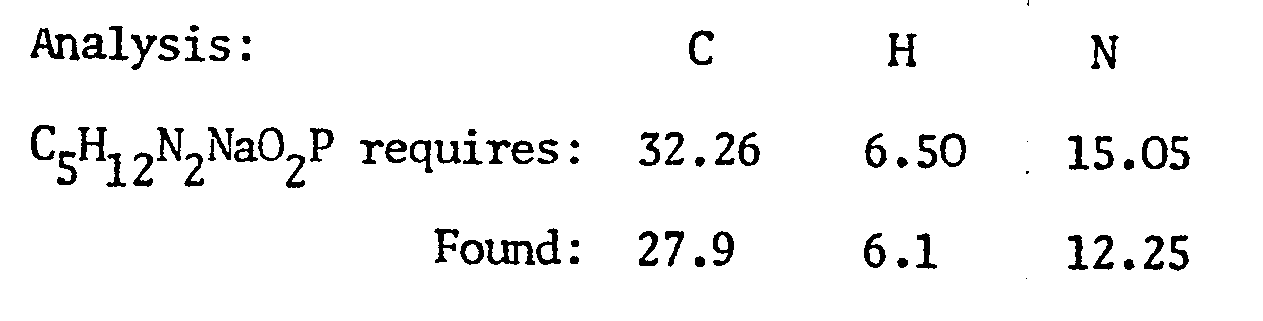
- The diethyl ketal of sodium acetylphosphonite (9.8g) was dissolved in a mixture of acetic acid (95 ml) and water (5 ml) and the solution was kept at ambient temperature for 16 hours. The solvent was removed in vacuo and the residue was triturated with acetone to give the crude product. (6.3g). A small sample was dissolved in cold methanol and diluted with acetone. The required ketone crystallised on storage; mp >340°C.

- Recrystallisation on a large scale led to partial conversion of the ketone to the dimethyl ketal. The ketone then had to be regenerated as above to give the required material (18.g) identical with the above.
- Hypophosphorous acid (30% w/v) (22ml, 0.1 mol) was evaporated at 0.5 mm Hg at 50° to remove the water. Triethyl orthoacetate (40.5g, 0.25 mol) was added to the anhydrous acid under N2, and dry HC1 gas was passed into the stirred mixture until it turned cloudy (approx. 10 sec). The resulting mixture was stirred at room temperature under N2 for 16h.
- The resulting mixture was evacuated at 0.1 mn Hg for 1h at room temperature to remove all volatile material.
- A solution of sodium hydroxide (6g, 0.15 mol) in water (60 ml) (deoxygenated with N2) was added to the residue and the resulting solution was refluxed under N2 for 2h.
- After cooling, the solution was neutralised to pH8 with conc. HCl and the solution was evaporated to dryness. The residue was dissolved in boiling ethanol (125 ml), filtered and the filtrate evaporated to dryness in vacuo.
- Recrystallisation of the residue from ethanol afforded the title compound, yield = 3.0g, mp 165-8° (dec). The i.r and n.m.r spectra were in agreement with the proposed structure.

- The corresponding ethyl ester was made as in Example 16 using triethyl ortho-acetate and methylphosphonous dichloride. It boiled at 126-90C at 23 m Hg.
- This ester (7.5g) was refluxed with aqueous IN sodium hydroxide (50 ml) until a solution was obtained (1 hour), and then for a further hour. The cooled solution was evaporated in vacuo and the residual water removed with ethanol. The residue was triturated with acetone to give a solid (4.0g). This product was crystallised from ethanol/acetone to give the required sodium salt (1.7g) softens 155°, mp 198-2010C (dec).

- 2-Ethoxy-2-methyloxathiolane (24g, 0.16 mol) was stirred under a slow stream of nitrogen with a spatula end of SnCl2. Methane phosphonous dichloride (7.5g, 0.065 mol), was added dropwise, the mixture being cooled to about -5°C with a dry-ice/acetone bath during the addition. The reaction was stirred overnight. The mixture was then distilled under reduced pressure, the main fraction collected distilled at 162-167° at 30 mm Hg, leaving a black residue. The n.m.r was consistent with ethyl methyl(2-methyloxathiolan-2-yl)phosphinate,
- This material (0.44 mol) and 1N NaOH (44 ml, 0.044 mol) were heated together under reflux for 5h, then allowed to stand overnight. The solution was filtered and evaporated to give a pale yellow solid which was recrystallised from ethanol/ether giving 3.6g (41%) of product, n.m.r consistent with desired product. M.P. (decomp) 310° after some charring at 285°.

- 2-Ethoxy-2,4,5-trimethyl-1,3-dioxolane (28g, 0.175 mol) was stirred under a slow stream of nitrogen with a spatula end of SnCl2. Methanephosphonous dichloride (8.2g, 0.07 mol) was added dropwise, cooling the reaction in a dry ice/acetone bath as necessary to control the exothermic reaction. When addition was complete the mixture was left to stir for 2½ days. The mixture was distilled under high vacuum, the fraction boiling 64-75° (pressure rising from 0.15 to 0.45 mm Hg) contained the desired product, ethyl methyl(2,4,5-trimethyl-1,3-dioxolan-2-yl)phosphinate, 16.9g 95%.
- The above ethyl ester (8g, 0.036 mol) was heated at reflux in 1N NaOH (36 ml, 0.036 mol) for 2h, and then allowed to stand overnight at room temperature. The solution was evaporated under reduced pressure giving a white solid which was dried in vacuo. 7.2g, 92% obtained. The n.m.r was consistent with the desired product.
-

- Methane phosphonous dichloride (5.7 ml, 0.063 mol) was added dropwise at 0° to tripropyl orthoacetate (32.1g, 0.157 mol) stirred under nitrogen with a little SnCl2. When the addition was complete the mixture was allowed to warm to room temperature and was stirred overnight. The mixture was distilled under high vacuum to give propyl methyl(1,1-dipropoxyethyl)phosphinate b p 95-100° at 0.3 mm Hg, 14.3g, 85%. This product (14.3g, 0.054 mol) was refluxed in 1N NaOH solution (90 ml, 0.08 mol) and ethanol added until the reaction mixture was homogeneous (approx 100 ml added). The solution was refluxed for 24h, then cooled and evaporated. The residue was taken up in water and neutralised to pH 4.6 with dil. HCl, evaporated three times from water to remove excess HC1 and then taken up in ether and filtered to remove any NaCl. This was repeated 2 or 3 times until there was no inorganic material in the solution, which was evaporated to give a yellow oil which solidified slowly. N.m.r indicated the presence of a little sodium acetyl methyl phosphinate in addition to the desired product.

- A solution of methyl (1,1-dimethoxyethyl)methanephosphinate (8g in dry xylene (40 ml) containing concentrated H2SO4 (8 drops) was refluxed for 4 days.
- The solvent was evaporated in vacuo. Distillation in vacuo afforded (after a small fore-run) a fraction bp 45-50° at 0.1 mm Hg. Yield = 1.8g.
- An n.m.r spectrum showed that this product was the required compound.
- A solution of the product of step (a) (0.43g, 2.87 mmol) and oven dried sodium iodide (0.43g, 2.87 mol) in distilled ethyl methyl ketone (6 ml) was stirred and refluxed for 16h.
- The resulting precipitate was filtered off, washed with fresh ethyl methyl ketone and then ether and dried in vacuo over CaCl2.
- The n.m.r and i.r spectra were consistent with the proposed structure.
- Recrystallisation from ethanol/ether gave the pure compound mp, decomp. above 240° (softening at 230°).

- Example 31
- Methyl acetylmethylphosphinate (5.4g, 0.04 mol) and ethanethiol (9.9g, 11.7 ml, 0.16 mol) were stirred together in chloroform (40 ml) at room temperature under nitrogen. Trimethylsilyl chloride (6.5g, 7.6 ml, 0.06 mol) was added dropwise over 10 min and the mixture then stirred for a further 1 hour. The solution was washed with 2.5M NaOH (3 x 50 ml) and with brine, then dried and evaporated giving a yellow liquid, 5.5g. N.m.r showed this to consist mainly of a mixture of the bisthioketal and vinylsulphide derivatives of the starting ester. A portion of this material (2.7g, ≃0.015 mol) was heated with sodium iodide (2.3g, 0.015 mol) in methyl isobutyl ketone (20 ml) under reflux in a nitrogen atmosphere for 1½h. By the end of this time a considerable precipitate had formed. This was collected by filtration. Some more material precipitated from the liquor on standing and was also collected. The combined precipitates were washed with a little ethyl methyl ketone and dried in vacuo, giving 1.8g product, 64%. N.m.r was consistent with the desired product.
- Sodium acetylmethylphosphinate (2.9g, 0.02 mol) and 1,3-diaminopropane (1.7 ml, 1.5g, 0.02 mol) were stirred together in ethanol (60 ml) for 21 days and then evaporated under reduced pressure. The white solid was dried in vacuo, removing most of the ethanol. No unreacted starting material remained by N.m.r. The purity was estimated as approximately 95% from n.m.r, 4.1g product was obtained.
- 3-Mercaptopropylamine hydrochloride (2.6g, 0.02 mol) was stirred in ethanol (25 ml) with sodium hydroxide (0.8g, 0.02 mol) for about 1½ hours and then filtered through Kieselguhr. This solution was added to a stirred slurry of sodium acetylmethylphosphinate (2.9g, 0.02 mol) in ethanol (20 ml) and the mixture stirred overnight. The solution was evaporated under reduced pressure, giving a white foamy solid which was dissolved in ethanol, precipitated with dry ether and filtered. The filtrate was evaporated to a foamed solid, which was dried in vacuo giving 2.5g, 58% of product, mp 155-160°. N.m.r was consistent with the desired product.

- A solution of sodium acetylmethylphosphinate (2.9g, 0.02 mol) in ethanol was stirred with ethylene diamine (1.2g, 0.02 mol) for 28 hours and then evaporated under reduced pressure, giving a powdery white solid. N.m.r. shaved this contained no unreacted starting material. Drying under vacuum gave 3.1g product (83%), which still contained trapped ethanol, but otherwise appeared virtually pure by n.m.r.
- A solution of sodium acetylmethylphosphinate in ethanol was stirred with a solution of 2-aminoethanethiol in ethanol (prepared from the hydrochloride salt (2.3g, 0.02 mol) and NaOH (0.8g, 0.02 mol) in ethanol, the precipitated NaCl being filtered off) for 3 days. The mixture was then evaporated under reduced pressure giving a pale yellow solid which was precipitated from ethanol with acetone and the residue triturated with acetone giving a yellow solid, 2.2g, 54%. Mp (decomp) 140°.
- N.m.r was consistent with the desired product.

- The compound of Example 8 (6.3g) and malononitrile (2.0g) were dissolved in ethanol (150 ml) and the solution was allowed to stand for 18 hours, evaporated in vacuo and the residue triturated with ether. The product was filtered off, washed well with ether and dried to give an orange solid (6.0g).
- The i.r. spectrum supported the required structure and the nmr spectrum showed that no starting material remained.

- The product was purified by dissolution in ethanol (250 ml) and dilution of the solution with ethyl acetate (200 ml) to give a pale yellow powder (3.8g). Softens at 100°C begins to decomp at 155°C.
- Sodium hydroxide (1 2335g) and hydroxylamine hydrochloride (2.1432g) were dissolved separately in ethanol (75 m1 for each) and the solutions were then mixed and the resulting sodium chloride filtered off. Sodium acetylmethylphosphinate (4.4406g) was dissolved in ethanol (100 ml) and the solution was added to the solution of hydroxylamine prepared above. The mixture was stirred at room temperature and the oxime began to precipitate immediately. After 17 hours the oxime was filtered off, washed with a little ice cold ethanol and dried. Yield 3.6g. The product did not melt below 300°C.

- Procedure as for Example 3 7 using C6H5CH2ONH2HCl (4.797g), sodium hydroxide (1.2037g) and sodium acetylmethylphosphinate (4.331g), except that the benzyl ether is less soluble in ethanol than hydroxylamine hydrochloride and was dissolved in 300 m1 solvent.
- The mixture was allowed to stand for 18 hours (no precipitate appeared) and was then evaporated in vacuo. The residue was triturated with ethanol, a little inorganic material filtered off and the filtrate extracted to give the title compound as a buff coloured deliquiscent solid (7.1g); n.m.r. supports the required structure. The product softens at 40°C, slowly melts to 55°C to give a glass.

- Sodium acetylmethylphosphinate (3.5g, 0.024 mole) was added to a solution of methoxyamine hydrochloride (0.024 mole, 2g) and NaOH (0.96g) in ethanol (20 ml) and filtered to remove the precipitated NaCl.
- The reaction mixture was stirred overnight and the solid precipitate filtered off and dried to yield the title compound, 4.3g, 96%. Mp (dec) 180°. N.m.r was consistent with the desired structure.
- Methoxyamine hydrochloride (1.7g, 0.02 mol) and sodium hydroxide (0.8g, 0.02 mol) were stirred together in methanol (20 ml) until all the NaOH had dissolved (about ½hr). The solution was filtered through Keiselguhr and added to a stirred solution of sodium acetylmethylphosphinate (2.6g, 0.02 mol) in methanol ( 10m1). The mixture was stirred overnight at room temperature, and then evaporated, giving a pale yellow solid. This was recrystallised from methanol/ether giving a white solid, 2.5g, 72% which appears to be mainly one geometrical isomer of the desired product with some of the other (6:1 ratio) by n.m.r. M.P. 230-235 decomp.
-

- The mother liquor from the crystallisation was evaporated giving a yellow solid, 0.8g, 23%. N.m.r showed this to be an approximately 1:1 mixture of geometrical isomers of the title compound.
- A mixture of sodium acetylmethylphosphinate (4.3g) and aniline (3.2 ml) was dissolved in ethanol (200 ml) and allowed to stand for 72 hours over 4A molecular seive. The solution was filtered free of the solid phase, evaporated in vacuo and the residue was triturated with ether to give a pale brown solid (6.1g). The nmr spectrum showed that the crude product contained an aromatic moiety.
- Softens 165°C gradually decomposes with no sharp melting point.

- A solution of sodium acetylmethylphosphonite (4.3g) and phenylhydrazine (4 ml) in ethanol (100 ml) was stirred for 16 hr and then evaporated in vacuo. The residue was triturated with ether and the solid filtered off and dried in vacuo to give the product as a pale brown deliquescent solid (6.8g). NMR spectrum was consistent with the required structure. The product softens at 609C and slowly decomposes but has no sharp melting point.

- Sodium acetylmethylphosphinate (4.3g) and 2,4-dinitrophenylhydrazine (5.9g) were refluxed and stirred in ethanol (150 ml). After 1 hr the hydrazine had disappeared to be replaced by a yellow solid. The mixture was refluxed and stirred a further hour, cooled and the hydrazone filtered off, washed with a little cold ethanol and dried (8.0g). The filtrate on evaporation gave residual material (1.4g).
- The main crop was crystallised from ethanol to give the hydrazone as orange crystals (5.8g); nmr supports the required structure. The compound darkened at 255°C and did not melt below 280°C.

- Semicarbazide hydrochloride (3.6867g) was dissolved in water (20 ml) and the solution was diluted with ethanol (50 ml). Sodium hydroxide (1.3231g) was dissolved in a mixture of ethanol (50 ml) and water (5 ml). The solutions were mixed and a solution of sodium acetylmethylphosphinate (4.7632g) in ethanol (75 ml) was added. The mixture was stirred overnight and, since no precipitate had appeared, it was evaporated in vacuo. The residue was triturated with ethanol and insoluble material was filtered off. The filtrate was evaporated in vacuo to give the crude semicarbazone which was triturated with acetone and filtered off to give an amorphous colourless solid. On heating the compound softens at 1100, and decomposed at 170° and finally melted at 230°. NMR supports the structure.
- Sodium acetylmethylphosphinate (2.9g) was dissolved in water (10 ml) and a solution of sodium cyanide (l.Og) in water (10 ml) was added, followed by sufficient IN acid to reduce the pH to 7.0. The resulting solution was stirred for 18 hr, evaporated in vacuo and the residue was triturated with ethanol. Inorganic material was filtered off and the filtrate evaporated in vacuo,re-triturated with ethanol and the procedure repeated. The final residue was triturated with acetone to give the crude cyanohydrin as a deliquescent solid whose nmr was consistant with that of the required product.
- The product was crystallised from ethanol/acetone and gave 0.5g of the cyanohydrin, softens 130°, decomp. 150°C.

- The filtrate was evaporated in vacuo,dissolved in the minimum of ethanol and ether was gradually added to give a second crop of the title compound (0.7g).
- Methylphosphonous dichloride (10g, 0.855 mol) was added dropwise, with stirring, under N2 to trimethyl orthoformate (27.2g, 0.256 mol) containing anhydrous SnCl2 (approx O.lg) maintaining the temperature as near to -20°C as possible. The addition was exothermic and took about 15 min during which time a white suspension was formed. After allowing the temperature to rise to room temperature a clear solution was formed and stirring was continued for 2h.
- After leaving the solution overnight under N2 it was distilled in vacuo giving (after a small fore-run) a fraction b.p. 124° at 25mm Hg. Yield = 8.9g.
- The. n.m.r spectrum was in agreement with the proposed structure.
- The product of step (a) (7.4g) in methyl ethyl ketone (75 ml) was refluxed for 2 hr with sodium iodide (7.0g). The resulting suspension was cooled and the product filtered off, washed and dried (7.4g). The n.m.r spectrum was consistent with the required material.

- A solution of sodium (dimethoxymethyl)methylphosphinate (15.7g) in formic acid (110 ml) containing water (5.5 ml) was stirred at 40-50° for 36h. Evaporation of the solvent in vacuo afforded a solid which was suspended in toluene and evaporated to remove any excess formic acid. The residue was triturated with dry ether, filtered, and dried in vacuo over anhydrous CaCl2. N.m.r and i.r spectra of the solid shaved it to be the required compound. Yield = 10.0g, m.p 145° (decomp).

- Methyl (1,1-dimethoxypropyl) methylphosphinate was prepared from trimethyl ortho-propionate and methylphosphonous dichloride according to the procedure of Example 16. The product boiled at 76°C at 0.5 mm Hg.
- This ester, (15.7g) was refluxed in methyl ethyl ketone containing sodium iodide (13.2g). No precipitate appeared and after 4 hr the reaction mixture was evaporated to low volume and diluted with ether to give a gummy product. The solvent was decanted, the residue dissolved in a minimum of acetone and the procedure repeated twice. The final glassy product was dissolved in acetone and the solvent removed in vacuo to give the title product as an amorphous white solid which was extremely deliquescent. Yield 16.4g. The n.m.r spectrum was consistent with the required product.
- The product of Example 48 (13.6g) was dissolved, with warming on the steam bath in acetic acid (100 ml) containing water (3 ml). The solution was left for 16 hrs and was then worked up as in Example 8(a).
- The crude oily material was dissolved in acetone and diluted with ether until no more material precipitated. The precipitate was redissolved in acetone and this procedure was repeated three times. Finally the last portion of solvent was decanted, fresh ether was added and the gum scratched until it solidified. This material was filtered off at the aspirator. The moist solid was rapidly transferred to a dessicator and dried in vacuo to give a brown amorphous solid (5.0g). The n.m.r spectrum was in agreement with the required structure. Example 50
- The product of Example 18 (3.8g) and dodecylguanidine hydrochloride (5.3g) were dissolved separately in the minimum of ethanol and the solutions mixed. After 16 hrs sodium chloride was filtered off and the filtrate was evaporated in vacuo to give a gummy solid. This was triturated with acetone to give the required salt as an insoluble colourless solid (4.2g), m.p. 123-125°C. The n.m.r spectrur was in agreement with the required structure.

- By the procedure of Example 50 the product of Example 18 (3.8g) and isopropylamine hydrochloride (2.0g) were mixed, and after 16 hrs sodium chloride was removed and the filtrate evaporated in vacuo.
- The residue was crystallised from acetone to give the isopropylamine salt (1.7g), softens 110°C, melts 123°C. The n.m.r spectrum supports the required structure.

- A mixture of sodium acetylmethylphosphinate (3.5g) and thiosemicarbazide (2.2g) was stirred in ethanol (15 ml) for 4 days. The precipitated hydrazone was filtered off and dried (4.6g). The n.m.r spectrum supports the required structure. The compound slowly decomposes above 125°.
- By the procedure of Example 50 the product of Example 18 (3.8g) and 1,3,5-tributyl-4-metliylamino-1,2,4-triazolium chloride (5.7g) were mixed and the resulting sodium chloride filtered off. The filtrate was evaporated in vacuo and the residual oil treated with acetone. Unreacted phosphinate (0.3g) was filtered off and the filtrate evaporated in vacuo, finally at the oil pump, to give the required salt as an amber oil (6.0g). The nmr specturm was in agreement with the structure.

- By the procedure of Example 53 the product of Example 18 (3.8g) and 1-butyl-4-butylamino-3,5-dipropyl-1,2,4-triazolium chloride (6.0g) were mixed and the reaction worked up to give the required salt as a pale yellow oil (6.5g). The nmr spectrum was in agreement with the required structure.

- Seeds of the following species were sown in John Innes I potting compost contained in modised aluminium pans 190 mm long x 95 mm wide x 50 mm deep:

- The seeds were watered and placed in a controlled environment room at 22°C, 6S-85% relative humidity and 14 hours per day artificial illumination at 13,000 lux. After 14 days the seedlings received foliar sprays of the test compounds formulated as an aqueous suspension or solution containing 1,000 ppm of the wetting agent Lissapol NX.
- The concentrations of active ingredients and volume of application were adjusted so as to give rates of 11.2, 2.8 and 0.7 kg per hectare of active ingredient in 450 litres ner hectare. The plants were returned to the controlled environment room. After 21days they were visually assessed for herbicidal effects compared with unsprayed controls. All differences from controls are given as percentage supression in the table below.
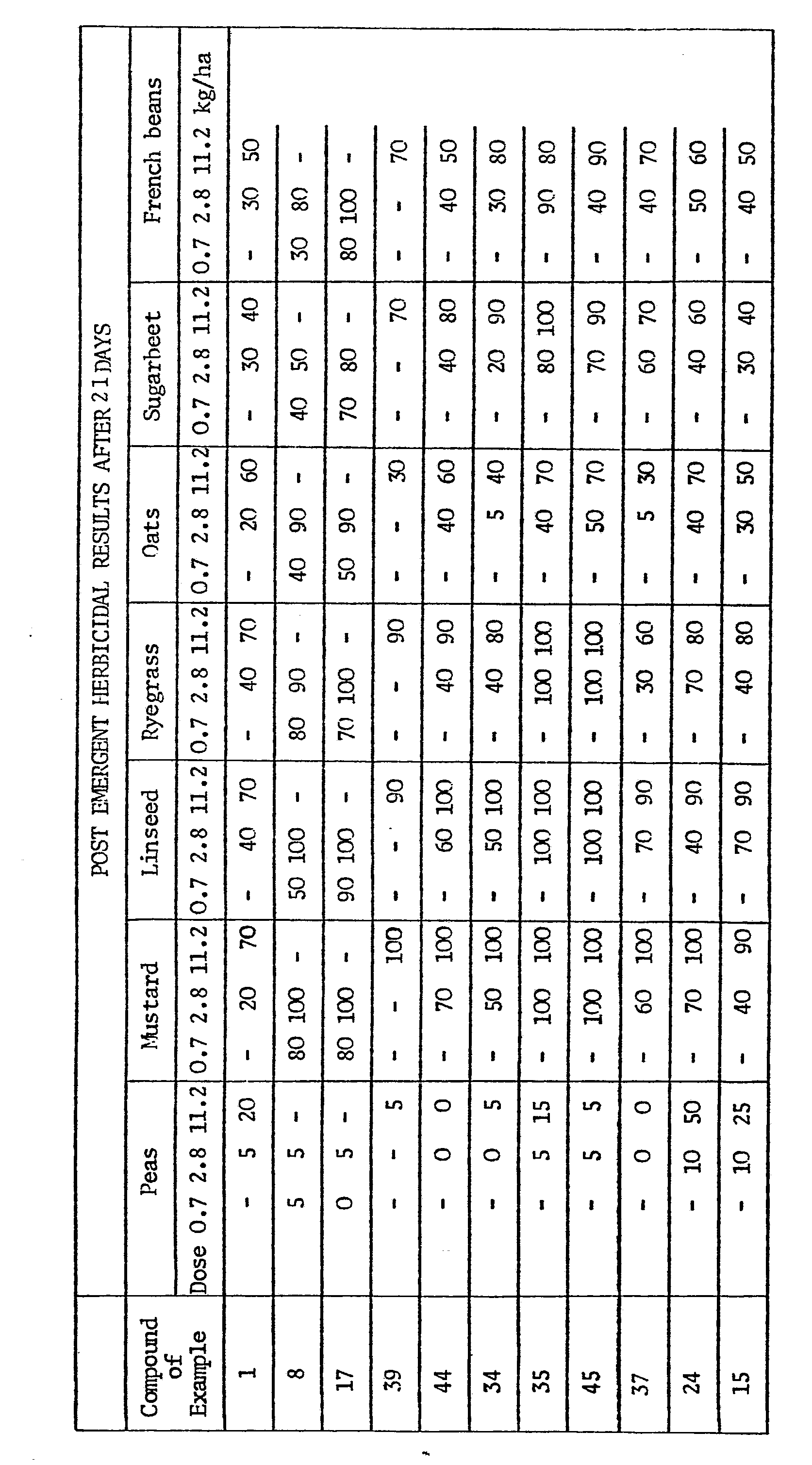
- Seeds of the following species were sown in John Innes I potting compost contained in anodised aluminium pans 190 mn long x 95 mm wide x 50 mn deep:
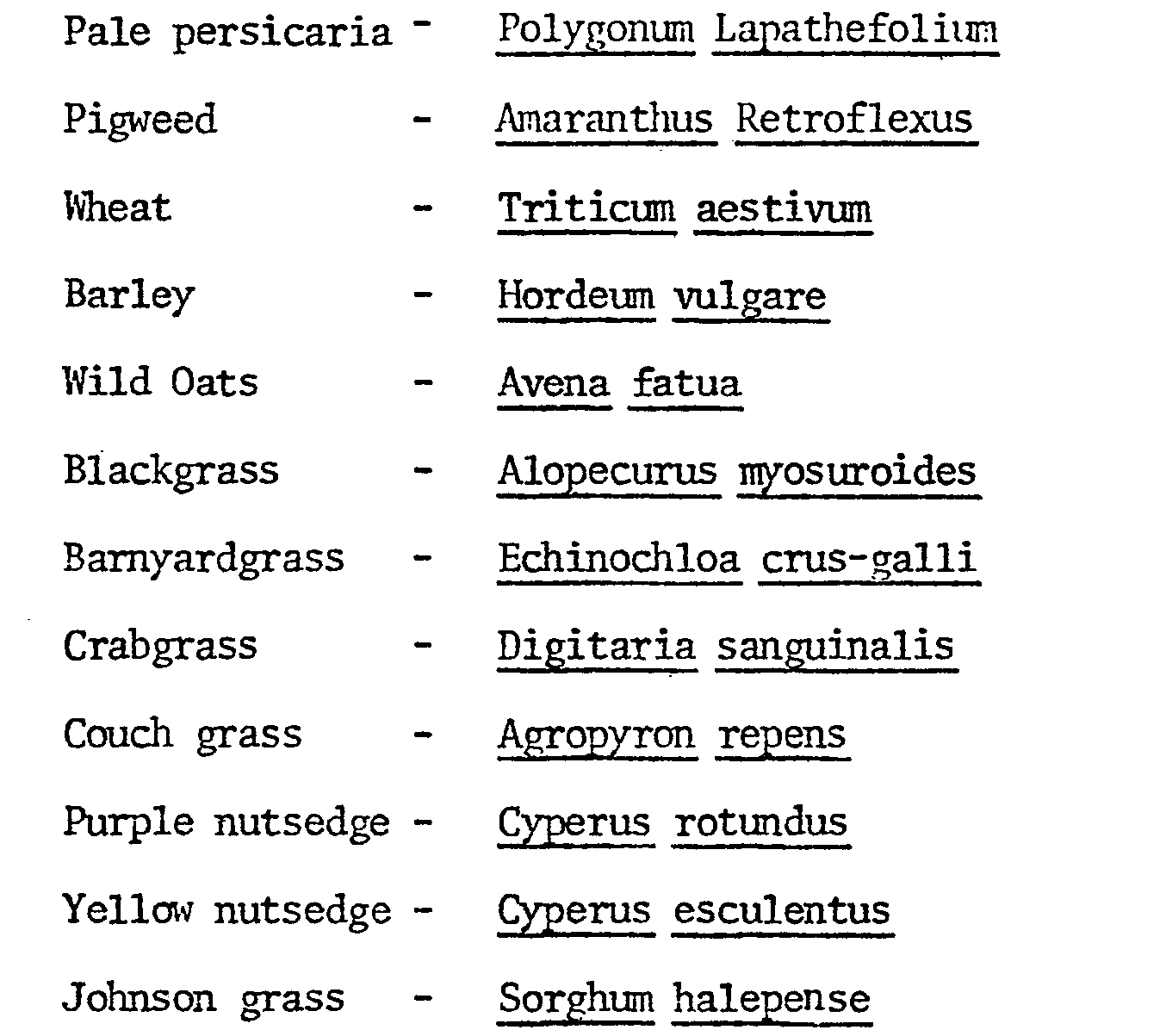
- The seeds were watered and placed in a controlled environment room at 22°C, 65-85% relative humidity and 14 hours per day artificial illumination at 17,000 lux. After 21 days the seedlings received foliar sprays of the test compounds formulated as an aqueous solution containing 2,000 ppm of the wetting agent Lissapol NX.
- The plants were returned to the controlled environment. After 14 days they were visually assessed for herbicidal effects compared with unsprayed controls. All differences from controls were scored in the same way as in Example A. The results are tabulated below:

- The compound under test formulated as an attaclay/sand dust was incorporated in John Innes I potting compost at a rate equivalent to 26 parts per million weight/volume of active ingredient to soil and placed in anodised aluminium pans, 19 cm long x 9.5 cm wide x 5.0 cm deep. This rate is approximately equivalent to a soil surface application of 11.2 kg active ingredient/hectare cultivated to a depth of 5 cm. Seeds of Peas, Mustard, Linseed, Maize, Oats and Ryegrass were sewn in the treated soil, watered and placed in a controlled environment room (22°C, 65-85% relative humidity, 14 hours artificial illumination at 1200 foot candles) for 21 days.
- The plants were then visually assessed for any growth regulatory or herbicidal effects. All differences from an untreated control were scored as in Example A.
- The results relating to compounds of Examples 8, 17 and 45 are summarised in the following table:

- The procedure of Example B was repeated using the compound of Example 17 and with the difference that the plants were assessed after 28 days.
- The results are given below:

- Aqueous acetone solutions of the compound of Example 15 containing 2000 parts per million (ppm) wt/vol together with 125 ppm of a suitable wetting agent were applied to the soil surrounding the roots and leaves of rice plants having two fully expanded leaves, and wheat plants with one fully expanded leaf. The treated plants, together with controls treated with wetting agent alone, were innoculated 24 hours after the chemical application with an aqueous suspension of spores of the disease organisms known as rice blast, Pyricularia oryzae and wheat brown rust, Puccina recondita respectively.
- The plants were then placed in an atmosphere of 100% humidity for the rice plants at 280C until the disease incidence was measured seven days later, and for wheat plants for 24 hours and then transferred to a controlled environment room (18°C and 80-90% RH) until disease incidence was measured after 12 days, when it was found that the treatments had given 90% disease reduction of both diseases in comparison with less than 5% on the controls.
- Aqueous acetone solutions of the compound of Example 1 containing 2000 parts per million (ppm) wt/vol together with 125 ppm of a suitable wetting agent were applied to the foliage and soil surrotunding the roots of potato plants having seven fully expanded leaves and barley plants with one fully expanded leaf. The treated plants, together with controls treated with wetting agent alone, were inoculated 24 hours after the chemical application with an aqueous suspension of sporangia and spores respectively of the disease organisms known as potato blight, Phytophthora infestans and barley powdery mildew, Erysiphe graminis. The plants were then placed in an atmosphere of 100% humidity for 24 hours and then transferred to a controlled environment room (18°C and 80-90% RH) until disease incidence was measured after five days for potatoes and 10 days for barley when it was found that the treatments had given 80% control of each disease in comparison with less than 5% on the untreated controls.
- Aqueous acetone solutions of the compound of Example 17 containing 2000 and 500 parts per million (ppm) wt/vol together with 125 ppm of a suitable wetting agent were applied to the leaves of barley plants with one fully expanded leaf. The treated plants, together with controls treated with wetting agent alone, were inoculated 24 hours after the chemical application with an aqueous suspension of spores of the disease organism known as barley powdery mildew, Erysiphe graminis. The plants were then placed in an atmosphere of 100% humidity for 24 hours and then transferred to a controlled environment room (18°C and 80-90% RH) until disease incidence was measured after 10 days when it was found that the treatments at 2000 and 500 ppm had given 95 and 90% disease reduction respectively in comparison with less than 5% on the untreated controls.
- Aqueous acetone solutions of the compound of Example 19 containing 125 parts per million (ppm) wt/vol together with 125 ppm of a suitable wetting agent were applied to the leaves of vine plants having five fully expanded leaves. The treated plants, together with controls treated with wetting agent alone, were inoculated 24 hours after the chemical application with an aqueous suspension of sporangia of the disease organism known as vine downy mildew, Plasmopara viticola. The plants were then placed in an atmosphere of 80% humidity, at 14-18°C until the disease incidence was measured twelve days later when it was found that the treatments at 125 ppm had given 90% control respectively in comparison with less than 5% on the controls.
Claims (14)


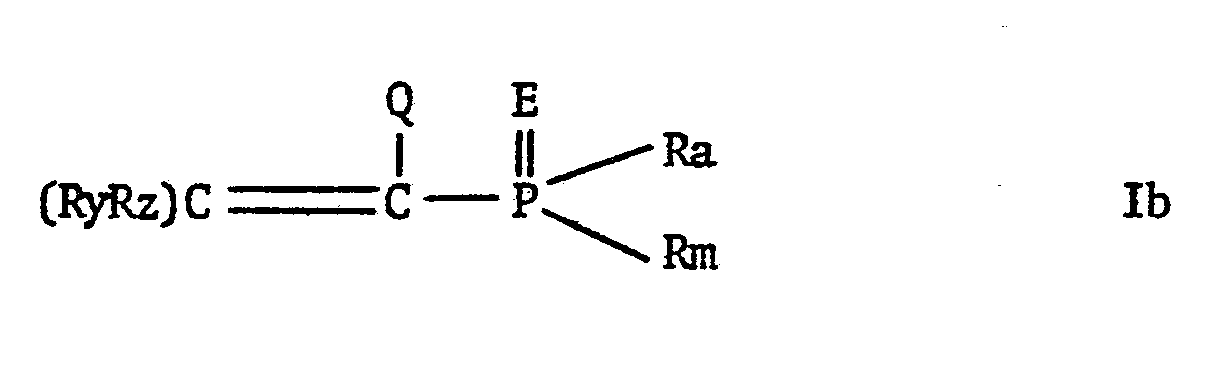


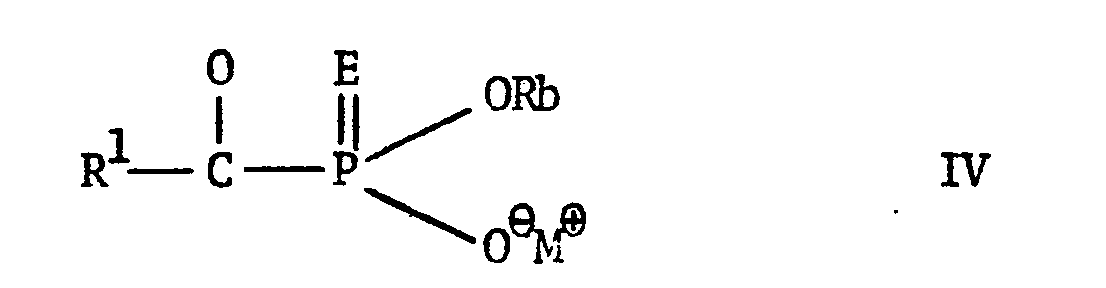

Priority Applications (1)
| Application Number | Priority Date | Filing Date | Title |
|---|---|---|---|
| AT79301805T ATE4158T1 (en) | 1978-09-22 | 1979-09-03 | PESTICIDICALLY ACTIVE SALTS, COMPOSITIONS CONTAINING THEM, PROCESSES FOR THEIR PREPARATION AND USE. |
Applications Claiming Priority (4)
| Application Number | Priority Date | Filing Date | Title |
|---|---|---|---|
| GB7837723 | 1978-09-22 | ||
| GB3772378 | 1978-09-22 | ||
| GB4514078 | 1978-11-18 | ||
| GB7845140 | 1978-11-18 |
Publications (3)
| Publication Number | Publication Date |
|---|---|
| EP0009348A2 true EP0009348A2 (en) | 1980-04-02 |
| EP0009348A3 EP0009348A3 (en) | 1980-10-01 |
| EP0009348B1 EP0009348B1 (en) | 1983-07-20 |
Family
ID=26268931
Family Applications (1)
| Application Number | Title | Priority Date | Filing Date |
|---|---|---|---|
| EP79301805A Expired EP0009348B1 (en) | 1978-09-22 | 1979-09-03 | Pesticidally active salts and compositions containing them and processes for their manufacture and use |
Country Status (5)
| Country | Link |
|---|---|
| US (1) | US4339443A (en) |
| EP (1) | EP0009348B1 (en) |
| BR (1) | BR7905980A (en) |
| CA (1) | CA1140566A (en) |
| DE (1) | DE2965925D1 (en) |
Cited By (26)
| Publication number | Priority date | Publication date | Assignee | Title |
|---|---|---|---|---|
| EP0050778A1 (en) * | 1980-10-23 | 1982-05-05 | Bayer Ag | Process for the preparation of phosphonoformaldehyde-hydrate |
| EP0062839A1 (en) * | 1981-04-09 | 1982-10-20 | BASF Aktiengesellschaft | Acylphosphine compounds and their use |
| US4399287A (en) * | 1979-12-08 | 1983-08-16 | Fbc Limited | Phosphinic acid derivatives |
| EP0181833A1 (en) * | 1984-10-12 | 1986-05-21 | Ciba-Geigy Ag | Substituted propane-phosphonous acid compounds |
| US5190933A (en) * | 1987-12-04 | 1993-03-02 | Ciba-Geigy Corporation | Substituted propane-phosphinic acid compounds |
| US5190934A (en) * | 1989-06-03 | 1993-03-02 | Ciba-Geigy Corporation | P-subsituted propane-phosphinic acid compounds |
| US5229379A (en) * | 1990-06-22 | 1993-07-20 | Ciba-Geigy Corporation | Certain n-substituted-amino-alkane phosphinic acid derivatives having anti-epileptic properties |
| US5243062A (en) * | 1984-10-12 | 1993-09-07 | Ciba-Geigy Corporation | Substituted propane-phosphonous acid compounds |
| US5300679A (en) * | 1987-12-04 | 1994-04-05 | Ciba-Geigy Corporation | Substituted propane-phosphinic acid compounds |
| US5414133A (en) * | 1991-02-27 | 1995-05-09 | Ciba-Geigy Corporation | Protected phosphine oxides |
| WO2008047547A1 (en) | 2006-09-29 | 2008-04-24 | Kuraray Medical Inc. | Novel compound, composition comprising the same, and process for production of polymerizable amide |
| WO2008087979A1 (en) | 2007-01-17 | 2008-07-24 | Kuraray Medical Inc. | Polymerizable monomer-containing composition |
| WO2008114621A1 (en) | 2007-03-20 | 2008-09-25 | Kuraray Medical Inc. | Polymerizable monomer, polymerizable composition and dental material |
| DE112006003798T5 (en) | 2006-03-13 | 2009-04-30 | Kabushiki Kaisha Shofu | Camphorquinone derivative having acylphosphine oxide group, photopolymerization catalyst and photo / chemical polymerization catalyst and curable composition containing this derivative |
| WO2009084586A1 (en) | 2007-12-28 | 2009-07-09 | Kuraray Medical Inc. | Cement for dental applications |
| US8436078B2 (en) | 2008-04-28 | 2013-05-07 | Kuraray Noritake Dental Inc. | Dental composition and composite resin |
| US8440739B2 (en) | 2008-04-28 | 2013-05-14 | Kuraray Noritake Dental Inc. | Dental composition and composite resin |
| US8455564B2 (en) | 2008-04-28 | 2013-06-04 | Kuraray Noritake Dental Inc. | Dental composition and composite resin |
| US8476338B2 (en) | 2009-12-18 | 2013-07-02 | Kuraray Noritake Dental Inc. | Dental curable composition and composite resin using the same |
| US9089482B2 (en) | 2010-09-30 | 2015-07-28 | Kuraray Noritake Dental Inc. | Dental mill blank |
| US9802912B2 (en) | 2013-04-25 | 2017-10-31 | Airbus Operations Limited | Cyclic ortho ester fuel additive |
| WO2019082855A1 (en) | 2017-10-23 | 2019-05-02 | クラレノリタケデンタル株式会社 | Dental composition |
| WO2019117206A1 (en) | 2017-12-13 | 2019-06-20 | クラレノリタケデンタル株式会社 | Dental composition containing platinum nanoparticles |
| WO2019203356A1 (en) | 2018-04-20 | 2019-10-24 | クラレノリタケデンタル株式会社 | Adhesive composition for dental use |
| US10456333B2 (en) | 2015-12-07 | 2019-10-29 | Kuraray Noritake Dental Inc. | Dental adhesive |
| WO2022138974A1 (en) | 2020-12-25 | 2022-06-30 | クラレノリタケデンタル株式会社 | Organosilicon compound and dental composition containing same |
Families Citing this family (12)
| Publication number | Priority date | Publication date | Assignee | Title |
|---|---|---|---|---|
| US5457095A (en) * | 1984-10-12 | 1995-10-10 | Ciba-Geigy Corporation | Substituted propane-phosponous acid compounds |
| US5281747A (en) * | 1989-05-13 | 1994-01-25 | Ciba-Geigy Corporation | Substituted aminoalkylphosphinic acids |
| US5567840A (en) * | 1989-05-13 | 1996-10-22 | Ciba-Geigy Corporation | Substituted aminoalkylphosphinic acids |
| US5234892A (en) * | 1990-10-23 | 1993-08-10 | Dunaway Sr James K | Method of treating lethal yellow in palm trees |
| WO2007051249A1 (en) * | 2005-11-03 | 2007-05-10 | A & C Chemicals Pty Ltd | Seed dressing |
| JP6046604B2 (en) | 2010-04-09 | 2016-12-21 | バイエル・インテレクチュアル・プロパティ・ゲゼルシャフト・ミット・ベシュレンクテル・ハフツングBayer Intellectual Property GmbH | Use of derivatives of (1-cyanocyclopropyl) phenylphosphinic acid, their esters and / or their salts to enhance plant tolerance to abiotic stress |
| US9789031B2 (en) | 2013-10-10 | 2017-10-17 | Kuraray Noritake Dental Inc. | Dental adhesive kit |
| EP3102194A1 (en) | 2014-02-03 | 2016-12-14 | Quadriga Biosciences, Inc. | Beta-substituted gamma-amino acids and analogs as chemotherapeutic agents |
| EP3102195B1 (en) | 2014-02-03 | 2021-10-06 | Quadriga Biosciences, Inc. | Beta-substituted beta-amino acids and analogs as chemotherapeutic agents |
| EP3156033B1 (en) | 2014-06-10 | 2019-12-18 | Kuraray Noritake Dental Inc. | Dental adhesive |
| AR105592A1 (en) | 2015-08-03 | 2017-10-18 | Quadriga Biosciences Inc | b-AMINO ACIDS b-SUBSTITUTES AND ANALOGS AS CHEMOTHERAPEUTIC AGENTS AND USES OF THE SAME |
| US12214061B2 (en) | 2018-12-21 | 2025-02-04 | Kuraray Noritake Dental Inc. | Adhesive composition for dental use |
Family Cites Families (13)
| Publication number | Priority date | Publication date | Assignee | Title |
|---|---|---|---|---|
| US2629731A (en) * | 1951-03-07 | 1953-02-24 | Shell Dev | Esters of phosphonoformic acids and polyhydric alcohols |
| FR1167613A (en) * | 1953-04-13 | 1958-11-27 | Ciba Geigy | Process for the preparation of compounds containing phosphorus and novel products thus obtained |
| NL95664C (en) * | 1955-05-20 | |||
| US2956919A (en) * | 1955-05-23 | 1960-10-18 | Monsanto Chemicals | 1-oxo-2-halo phosphonates |
| DE1010965B (en) * | 1956-05-08 | 1957-06-27 | Henkel & Cie Gmbh | Process for the preparation of acidic esters of acylphosphonic acids or their salts |
| US3053876A (en) * | 1959-10-17 | 1962-09-11 | Bayer Ag | Phosphorus compounds and process for their production |
| US3070490A (en) * | 1960-01-09 | 1962-12-25 | Monsanto Chemicals | Phosphonate nematocide |
| CH471535A (en) * | 1964-12-15 | 1969-04-30 | Ciba Geigy | Pesticides |
| US3577538A (en) * | 1967-10-23 | 1971-05-04 | Monsanto Co | Halogenated phosphonates used for chemosterilizing screw-worm flies |
| US3664822A (en) * | 1970-02-24 | 1972-05-23 | Baychem Corp | Dialkenyl esters of aryloxyacetyl phosphonic acids as herbicides |
| US3826640A (en) * | 1971-08-10 | 1974-07-30 | Mobil Oil Corp | Substituted benzoylphosphonates as herbicides |
| US3894861A (en) * | 1973-05-21 | 1975-07-15 | Procter & Gamble | Grass growth control compositions |
| DE2331187A1 (en) * | 1973-06-19 | 1975-01-09 | Bayer Ag | MEANS OF REGULATING PLANT GROWTH |
-
1979
- 1979-08-28 US US06/070,440 patent/US4339443A/en not_active Expired - Lifetime
- 1979-09-03 EP EP79301805A patent/EP0009348B1/en not_active Expired
- 1979-09-03 DE DE7979301805T patent/DE2965925D1/en not_active Expired
- 1979-09-19 BR BR7905980A patent/BR7905980A/en unknown
- 1979-09-21 CA CA000336145A patent/CA1140566A/en not_active Expired
Cited By (34)
| Publication number | Priority date | Publication date | Assignee | Title |
|---|---|---|---|---|
| US4399287A (en) * | 1979-12-08 | 1983-08-16 | Fbc Limited | Phosphinic acid derivatives |
| EP0050778A1 (en) * | 1980-10-23 | 1982-05-05 | Bayer Ag | Process for the preparation of phosphonoformaldehyde-hydrate |
| US4719297A (en) * | 1981-04-08 | 1988-01-12 | Basf Aktiengesellschaft | Acylphosphine compounds and their use as photoinitiators |
| EP0062839A1 (en) * | 1981-04-09 | 1982-10-20 | BASF Aktiengesellschaft | Acylphosphine compounds and their use |
| US5004826A (en) * | 1984-10-12 | 1991-04-02 | Ciba-Geigy Corporation | Substituted propane-phosphonous acid compounds |
| US4656298A (en) * | 1984-10-12 | 1987-04-07 | Ciba-Geigy Corporation | Substituted propane-phosphonous acid compounds |
| US4772738A (en) * | 1984-10-12 | 1988-09-20 | Ciba-Geigy Corporation | Substituted propane-phosphonuous acid compounds |
| US4908465A (en) * | 1984-10-12 | 1990-03-13 | Ciba-Geigy Corporation | Substituted propane-phosphonous acid compounds |
| US5243062A (en) * | 1984-10-12 | 1993-09-07 | Ciba-Geigy Corporation | Substituted propane-phosphonous acid compounds |
| EP0181833A1 (en) * | 1984-10-12 | 1986-05-21 | Ciba-Geigy Ag | Substituted propane-phosphonous acid compounds |
| US5190933A (en) * | 1987-12-04 | 1993-03-02 | Ciba-Geigy Corporation | Substituted propane-phosphinic acid compounds |
| US5300679A (en) * | 1987-12-04 | 1994-04-05 | Ciba-Geigy Corporation | Substituted propane-phosphinic acid compounds |
| US5190934A (en) * | 1989-06-03 | 1993-03-02 | Ciba-Geigy Corporation | P-subsituted propane-phosphinic acid compounds |
| US5229379A (en) * | 1990-06-22 | 1993-07-20 | Ciba-Geigy Corporation | Certain n-substituted-amino-alkane phosphinic acid derivatives having anti-epileptic properties |
| US5414133A (en) * | 1991-02-27 | 1995-05-09 | Ciba-Geigy Corporation | Protected phosphine oxides |
| DE112006003798T5 (en) | 2006-03-13 | 2009-04-30 | Kabushiki Kaisha Shofu | Camphorquinone derivative having acylphosphine oxide group, photopolymerization catalyst and photo / chemical polymerization catalyst and curable composition containing this derivative |
| WO2008047547A1 (en) | 2006-09-29 | 2008-04-24 | Kuraray Medical Inc. | Novel compound, composition comprising the same, and process for production of polymerizable amide |
| WO2008087979A1 (en) | 2007-01-17 | 2008-07-24 | Kuraray Medical Inc. | Polymerizable monomer-containing composition |
| WO2008087981A1 (en) | 2007-01-17 | 2008-07-24 | Kuraray Medical Inc. | Composition and dental material |
| US7977405B2 (en) | 2007-01-17 | 2011-07-12 | Kurray Medical Inc. | Polymerizable monomer-containing composition |
| WO2008114621A1 (en) | 2007-03-20 | 2008-09-25 | Kuraray Medical Inc. | Polymerizable monomer, polymerizable composition and dental material |
| US7968615B2 (en) | 2007-03-20 | 2011-06-28 | Kuraray Medical Inc. | Polymerizable monomer, polymerizable composition and dental material |
| WO2009084586A1 (en) | 2007-12-28 | 2009-07-09 | Kuraray Medical Inc. | Cement for dental applications |
| US8436078B2 (en) | 2008-04-28 | 2013-05-07 | Kuraray Noritake Dental Inc. | Dental composition and composite resin |
| US8440739B2 (en) | 2008-04-28 | 2013-05-14 | Kuraray Noritake Dental Inc. | Dental composition and composite resin |
| US8455564B2 (en) | 2008-04-28 | 2013-06-04 | Kuraray Noritake Dental Inc. | Dental composition and composite resin |
| US8476338B2 (en) | 2009-12-18 | 2013-07-02 | Kuraray Noritake Dental Inc. | Dental curable composition and composite resin using the same |
| US9089482B2 (en) | 2010-09-30 | 2015-07-28 | Kuraray Noritake Dental Inc. | Dental mill blank |
| US9802912B2 (en) | 2013-04-25 | 2017-10-31 | Airbus Operations Limited | Cyclic ortho ester fuel additive |
| US10456333B2 (en) | 2015-12-07 | 2019-10-29 | Kuraray Noritake Dental Inc. | Dental adhesive |
| WO2019082855A1 (en) | 2017-10-23 | 2019-05-02 | クラレノリタケデンタル株式会社 | Dental composition |
| WO2019117206A1 (en) | 2017-12-13 | 2019-06-20 | クラレノリタケデンタル株式会社 | Dental composition containing platinum nanoparticles |
| WO2019203356A1 (en) | 2018-04-20 | 2019-10-24 | クラレノリタケデンタル株式会社 | Adhesive composition for dental use |
| WO2022138974A1 (en) | 2020-12-25 | 2022-06-30 | クラレノリタケデンタル株式会社 | Organosilicon compound and dental composition containing same |
Also Published As
| Publication number | Publication date |
|---|---|
| DE2965925D1 (en) | 1983-08-25 |
| CA1140566A (en) | 1983-02-01 |
| EP0009348B1 (en) | 1983-07-20 |
| US4339443A (en) | 1982-07-13 |
| BR7905980A (en) | 1980-05-27 |
| EP0009348A3 (en) | 1980-10-01 |
Similar Documents
| Publication | Publication Date | Title |
|---|---|---|
| US4339443A (en) | Compounds and compositions | |
| US4399287A (en) | Phosphinic acid derivatives | |
| CA1135710A (en) | N'-phenyl-n-methylurea derivatives, and their production and use | |
| EP0010396A1 (en) | Fungicidal and herbicidal compositions, certain cyanomethane and cyanoethene derivatives being active agents thereof, the preparation of these derivatives and methods for combating fungi and weeds | |
| EP0002881A1 (en) | 5-Isoxazolylurea derivatives, their preparation, their use and compositions containing them | |
| EP0078536A2 (en) | Phosphinates and phosphonates and their use in the control of weeds | |
| US4284791A (en) | Combating fungi with N-chloroacetyl-N-(2,6-di-substituted phenyl)-alanine esters | |
| SE441091B (en) | SUBSTITUTED DIFENYLETERS, HERBIEIDIC COMPOSITION INCLUDING THESE ASSOCIATIONS AND USE OF THE ASSOCIATIONS FOR CONTROL OF BREEDING GROWTH | |
| US4140774A (en) | Method of combating nematodes using S-(amidocarbonyl)-methyl-O-alkyl-mono(di)thiophosphoric acid ester amides | |
| EP0026034B1 (en) | 5-amino-4-cyano-1-(2,4,6-trichlorophenyl)pyrazole, process for its preparation, herbicidal compositions containing it and their use | |
| EP0038636B1 (en) | Sulfonamide derivatives, compositions containing them and their production and use | |
| US4421547A (en) | 4-Hydroxy-5-isopropyl-2-methylphenyl trimethylammonium, 1-piperidine carboxylate salt of N-phosphonomethylglycine and its use as a herbicide | |
| US3711582A (en) | N-isopropyl-phosphoro-amido-thioates | |
| US4059430A (en) | Organic (thio) phosphoric acid ester compounds and herbicidal compositions | |
| EP0109311B1 (en) | N,n-dialkyl-2-(4'-substituted-1'-naphthoxy)propionamides | |
| US3989525A (en) | H-isopropyl-2-chloroethane-(thiono)-phosphonic acid ester amide compounds and herbicidal compositions | |
| EP0044696B1 (en) | 5-oxo-2,5,-dihydro-1,2,4-triazines, methods for their production, herbicidal compositions comprising them, and their use as herbicides | |
| CA1072551A (en) | (thio)phosphoric acid esters and their use as herbicides | |
| GB1571481A (en) | 1,2,4-triazolium compounds having pesticidal and plant growth regulating properties | |
| US3763288A (en) | O lower alkyl o substituted phenyl s alkoxyethylphosphorothiolates | |
| US3978107A (en) | Novel cyclohexyl carbamates and herbicidal and acaricidal compositions | |
| US4609753A (en) | Diphenyl ethers having herbicidal activity | |
| US3689603A (en) | O-alkyl-o-phenyl-s-alkoxyethyl-phosphoro-thiolates | |
| EP0182407A1 (en) | Alpha-aminooxy C4-alkanoic acids and esters | |
| US4029646A (en) | Benzyl N,N-hexamethylenethiolcarbamate compounds and herbicidal compositions |
Legal Events
| Date | Code | Title | Description |
|---|---|---|---|
| PUAI | Public reference made under article 153(3) epc to a published international application that has entered the european phase |
Free format text: ORIGINAL CODE: 0009012 |
|
| AK | Designated contracting states |
Designated state(s): AT BE CH DE FR GB IT LU NL SE |
|
| PUAL | Search report despatched |
Free format text: ORIGINAL CODE: 0009013 |
|
| AK | Designated contracting states |
Designated state(s): AT BE CH DE FR GB IT LU NL SE |
|
| 17P | Request for examination filed | ||
| ITF | It: translation for a ep patent filed | ||
| GRAA | (expected) grant |
Free format text: ORIGINAL CODE: 0009210 |
|
| AK | Designated contracting states |
Designated state(s): AT BE CH DE FR GB IT LU NL SE |
|
| REF | Corresponds to: |
Ref document number: 4158 Country of ref document: AT Date of ref document: 19830815 Kind code of ref document: T |
|
| REF | Corresponds to: |
Ref document number: 2965925 Country of ref document: DE Date of ref document: 19830825 |
|
| PGFP | Annual fee paid to national office [announced via postgrant information from national office to epo] |
Ref country code: FR Payment date: 19830829 Year of fee payment: 5 |
|
| PGFP | Annual fee paid to national office [announced via postgrant information from national office to epo] |
Ref country code: SE Payment date: 19830831 Year of fee payment: 5 |
|
| PGFP | Annual fee paid to national office [announced via postgrant information from national office to epo] |
Ref country code: CH Payment date: 19830919 Year of fee payment: 5 |
|
| PGFP | Annual fee paid to national office [announced via postgrant information from national office to epo] |
Ref country code: LU Payment date: 19830926 Year of fee payment: 5 |
|
| PGFP | Annual fee paid to national office [announced via postgrant information from national office to epo] |
Ref country code: AT Payment date: 19830928 Year of fee payment: 5 |
|
| PGFP | Annual fee paid to national office [announced via postgrant information from national office to epo] |
Ref country code: NL Payment date: 19830929 Year of fee payment: 5 Ref country code: DE Payment date: 19830929 Year of fee payment: 5 |
|
| PG25 | Lapsed in a contracting state [announced via postgrant information from national office to epo] |
Ref country code: LU Free format text: LAPSE BECAUSE OF NON-PAYMENT OF DUE FEES Effective date: 19830930 |
|
| PGFP | Annual fee paid to national office [announced via postgrant information from national office to epo] |
Ref country code: BE Payment date: 19830930 Year of fee payment: 5 |
|
| ET | Fr: translation filed | ||
| PLBE | No opposition filed within time limit |
Free format text: ORIGINAL CODE: 0009261 |
|
| STAA | Information on the status of an ep patent application or granted ep patent |
Free format text: STATUS: NO OPPOSITION FILED WITHIN TIME LIMIT |
|
| 26N | No opposition filed | ||
| PG25 | Lapsed in a contracting state [announced via postgrant information from national office to epo] |
Ref country code: AT Effective date: 19840903 |
|
| PG25 | Lapsed in a contracting state [announced via postgrant information from national office to epo] |
Ref country code: SE Effective date: 19840904 |
|
| PG25 | Lapsed in a contracting state [announced via postgrant information from national office to epo] |
Ref country code: CH Effective date: 19840930 Ref country code: BE Effective date: 19840930 |
|
| BERE | Be: lapsed |
Owner name: FBC LTD Effective date: 19840903 |
|
| PG25 | Lapsed in a contracting state [announced via postgrant information from national office to epo] |
Ref country code: NL Effective date: 19850401 |
|
| GBPC | Gb: european patent ceased through non-payment of renewal fee | ||
| NLV4 | Nl: lapsed or anulled due to non-payment of the annual fee | ||
| PG25 | Lapsed in a contracting state [announced via postgrant information from national office to epo] |
Ref country code: FR Free format text: LAPSE BECAUSE OF NON-PAYMENT OF DUE FEES Effective date: 19850531 |
|
| REG | Reference to a national code |
Ref country code: CH Ref legal event code: PL |
|
| PG25 | Lapsed in a contracting state [announced via postgrant information from national office to epo] |
Ref country code: DE Effective date: 19850601 |
|
| REG | Reference to a national code |
Ref country code: FR Ref legal event code: ST |
|
| PG25 | Lapsed in a contracting state [announced via postgrant information from national office to epo] |
Ref country code: GB Effective date: 19881118 |
|
| EUG | Se: european patent has lapsed |
Ref document number: 79301805.2 Effective date: 19850617 |