EP0008599B1 - Surfactant and phenolic foam produced therewith - Google Patents
Surfactant and phenolic foam produced therewith Download PDFInfo
- Publication number
- EP0008599B1 EP0008599B1 EP78900129A EP78900129A EP0008599B1 EP 0008599 B1 EP0008599 B1 EP 0008599B1 EP 78900129 A EP78900129 A EP 78900129A EP 78900129 A EP78900129 A EP 78900129A EP 0008599 B1 EP0008599 B1 EP 0008599B1
- Authority
- EP
- European Patent Office
- Prior art keywords
- formula
- surfactant
- foam material
- closed cell
- cell foam
- Prior art date
- Legal status (The legal status is an assumption and is not a legal conclusion. Google has not performed a legal analysis and makes no representation as to the accuracy of the status listed.)
- Expired
Links
- 0 C*(CN(*)*)N(*)* Chemical compound C*(CN(*)*)N(*)* 0.000 description 1
Images

Classifications
-
- C—CHEMISTRY; METALLURGY
- C08—ORGANIC MACROMOLECULAR COMPOUNDS; THEIR PREPARATION OR CHEMICAL WORKING-UP; COMPOSITIONS BASED THEREON
- C08J—WORKING-UP; GENERAL PROCESSES OF COMPOUNDING; AFTER-TREATMENT NOT COVERED BY SUBCLASSES C08B, C08C, C08F, C08G or C08H
- C08J9/00—Working-up of macromolecular substances to porous or cellular articles or materials; After-treatment thereof
- C08J9/0061—Working-up of macromolecular substances to porous or cellular articles or materials; After-treatment thereof characterized by the use of several polymeric components
-
- C—CHEMISTRY; METALLURGY
- C08—ORGANIC MACROMOLECULAR COMPOUNDS; THEIR PREPARATION OR CHEMICAL WORKING-UP; COMPOSITIONS BASED THEREON
- C08F—MACROMOLECULAR COMPOUNDS OBTAINED BY REACTIONS ONLY INVOLVING CARBON-TO-CARBON UNSATURATED BONDS
- C08F283/00—Macromolecular compounds obtained by polymerising monomers on to polymers provided for in subclass C08G
-
- C—CHEMISTRY; METALLURGY
- C08—ORGANIC MACROMOLECULAR COMPOUNDS; THEIR PREPARATION OR CHEMICAL WORKING-UP; COMPOSITIONS BASED THEREON
- C08F—MACROMOLECULAR COMPOUNDS OBTAINED BY REACTIONS ONLY INVOLVING CARBON-TO-CARBON UNSATURATED BONDS
- C08F287/00—Macromolecular compounds obtained by polymerising monomers on to block polymers
-
- C—CHEMISTRY; METALLURGY
- C08—ORGANIC MACROMOLECULAR COMPOUNDS; THEIR PREPARATION OR CHEMICAL WORKING-UP; COMPOSITIONS BASED THEREON
- C08J—WORKING-UP; GENERAL PROCESSES OF COMPOUNDING; AFTER-TREATMENT NOT COVERED BY SUBCLASSES C08B, C08C, C08F, C08G or C08H
- C08J2361/00—Characterised by the use of condensation polymers of aldehydes or ketones; Derivatives of such polymers
- C08J2361/04—Condensation polymers of aldehydes or ketones with phenols only
- C08J2361/06—Condensation polymers of aldehydes or ketones with phenols only of aldehydes with phenols
-
- C—CHEMISTRY; METALLURGY
- C08—ORGANIC MACROMOLECULAR COMPOUNDS; THEIR PREPARATION OR CHEMICAL WORKING-UP; COMPOSITIONS BASED THEREON
- C08J—WORKING-UP; GENERAL PROCESSES OF COMPOUNDING; AFTER-TREATMENT NOT COVERED BY SUBCLASSES C08B, C08C, C08F, C08G or C08H
- C08J2451/00—Characterised by the use of graft polymers in which the grafted component is obtained by reactions only involving carbon-to-carbon unsaturated bonds; Derivatives of such polymers
-
- Y—GENERAL TAGGING OF NEW TECHNOLOGICAL DEVELOPMENTS; GENERAL TAGGING OF CROSS-SECTIONAL TECHNOLOGIES SPANNING OVER SEVERAL SECTIONS OF THE IPC; TECHNICAL SUBJECTS COVERED BY FORMER USPC CROSS-REFERENCE ART COLLECTIONS [XRACs] AND DIGESTS
- Y10—TECHNICAL SUBJECTS COVERED BY FORMER USPC
- Y10S—TECHNICAL SUBJECTS COVERED BY FORMER USPC CROSS-REFERENCE ART COLLECTIONS [XRACs] AND DIGESTS
- Y10S516/00—Colloid systems and wetting agents; subcombinations thereof; processes of
- Y10S516/01—Wetting, emulsifying, dispersing, or stabilizing agents
- Y10S516/06—Protein or carboxylic compound containing
-
- Y—GENERAL TAGGING OF NEW TECHNOLOGICAL DEVELOPMENTS; GENERAL TAGGING OF CROSS-SECTIONAL TECHNOLOGIES SPANNING OVER SEVERAL SECTIONS OF THE IPC; TECHNICAL SUBJECTS COVERED BY FORMER USPC CROSS-REFERENCE ART COLLECTIONS [XRACs] AND DIGESTS
- Y10—TECHNICAL SUBJECTS COVERED BY FORMER USPC
- Y10T—TECHNICAL SUBJECTS COVERED BY FORMER US CLASSIFICATION
- Y10T428/00—Stock material or miscellaneous articles
- Y10T428/249921—Web or sheet containing structurally defined element or component
- Y10T428/249953—Composite having voids in a component [e.g., porous, cellular, etc.]
- Y10T428/249976—Voids specified as closed
- Y10T428/249977—Specified thickness of void-containing component [absolute or relative], numerical cell dimension or density
Definitions
- Phenolic polymers have been known for decades. More recently, there has been increased interest in phenolic polymers which can be formed into cellular materials more commonly referred to as foams. These foams are produced by mixing reactants in the presence of a blowing agent. See for example Thomas et al. U.S. Patent 2,744,875 (1956); Nelson Canadian Patent 674,181 (1963); Dijkstra Canadian Patent 684,388 (1964); Horfels et al. Canadian Patent 866,876 (1971); United Kingdom Specification 598,642 (1948); Australian Patent 128,508 (1945); and Modern Plastics Encyclopedia Volume 52, No. 10a, page 479 (1977). However, most known cellular materials produced from phenolic polymers exhibit an unsatisfactory thermal conductivity initially. Other known cellular materials produced from phenolic polymers exhibit an undesirable increase in thermal conductivity with time.
- Another object is to provide an improved process for producing improved cellular materials employing an improved phenolic polymer, and an improved laminated building panel employing the improved closed cell phenolic-resin foam material.
- a still further object is to provide an improved closed cell phenolic-resin foam material which exhibits a high closed cell content without adversely affecting friability, compressive strength and the low flammability characteristics of the material.
- Yet another object is to produce a closed cell phenolic-resin foam material with high thermal resistance and high insulation properties and a substantially slow increase in thermal conductivity with time.
- a further object is to produce a closed cell phenolic-resin foam material which can be used as building panels which are highly insulating, thermally resistant, low in firability, soundproof and self- supporting.
- an improved surfactant and a closed-cell cellular composition comprising a phenolic resin, blowing agent and a surfactant having hydroxyl number of less than 50 preferably less than 10 by reaction with a capping agent.
- capping functional groups is well known and common agents for masking the functionality of the hydroxyl group are agents which produce esters, urethanes, and ethers.
- Phenolic resin foams are a well known class, phenolaldehyde resin foams being representative and proportions of blowing agent, catalyst and_components are well known in the art.
- Foams of low friability can be obtained by using a preferred phenolic polymer described in Moss U.S. Patent 3,876,620.
- the R 2 ' S are independently selected from the group consisting of lower alkyl, phenyl, benzyl, halo, nitro, and hydrogen.
- the R 3 's are independently selected from the group consisting of hydrogen or a radical in Figure II.
- the R 4 's are independently selected from the group consisting of lower alkyl, hydrogen, phenyl, benzyl, or furyl.
- furyl is meant the radical introduced by the use of furfural.
- x is an integer from 2 to 10 inclusive and is preferably an integer from 3 to 5 inclusive.
- x is less than 2
- a foam produced from such a phenolic polymer tends to have too high a friability.
- x exceeds 10
- the phenolic polymers of the present invention generally have a molecular weight between 334 and 2,000 and preferably have a molecular weight between 334 and 1,500. At lower molecular weights, the resultant foams tend to have too high a friability, whereas at high molecular weights the viscosity of the phenolic polymer, even when a solvent is present, tends to be too high to permit processing.
- a preferred subclass of phenolic polymers are those of Formula III, shown in Figure 3.
- R' is HOCH 2 -, hydrogen, or a radical of Formula IV.
- R 3 's are independently selected from the group consisting of HOCH 2 -1 hydrogen, or a radical of Formula IV, shown in Figure 4.
- At least one of the R 3 's is methylol, i.e., HOCH2--. This is to ensure that there will be cross-linking sites on the phenolic polymer.
- methylol groups or, when the aldehyde is other than formaldehyde, alkylol groups are automatically introduced into the polymer as is well-known in the art by the process described below.
- the phenolic polymer can contain widely varying ratios of the radicals of Formula II or IV e.g. phenol units to ortho-cresol units. However, this ratio is generally from 1:3 to 10:1 and is preferably from 1 :1.5 to 5:1. At higher ratios, i.e., a deficiency of ortho-cresol, the cellular material produced from such a phenolic polymer tends to be too friable. In determining the above ratios, one must include the radicals of Formula II or IV present in Formula I or III respectively.
- the synthesis of phenolic polymers of Formula I through IV is described and claimed in Moss U.S. Patent 3,876,620.
- These phenolic compositions useful in the present invention generally comprise the phenolic polymer of Formula I or Formula III, together with a compound of Formula V.
- the compound of Formula V can be present in the phenolic composition in widely varying ratios of Compound V to polymeric composition but is generally present in a weight ratio of 1:30 to 1:2 and is preferably present in a weight ratio of 1:20 to 1:5.
- suitable compounds of Formula V include among others: m-cresol, m-chlorophenol, m-nitrophenol, 3,5-xylenol, and phenol, i.e., hydroxy benzene. Phenol is the most preferred compound of Formula V because of cost, availability, and reactivity.
- the phenolic block copolymers of Formula I and Formula III are produced according to the present invention by combining certain reactants in a two-step process described in Moss, supra.
- any aldehyde can be employed to produce useful phenolic polymers.
- suitable aldehydes include among others furfural, formaldehyde, benzaldehyde, and acetaldehyde.
- Formaldehyde is the preferred aldehyde.
- Formaldehyde can be employed in widely varying forms such as the 37% aqueous solution widely known as formalin. However, it is generally necessary to remove from the polymeric material the water introduced with the formalin.
- Formaldehyde is preferably employed in the form of paraformaldehyde which contains much less water.
- the cellular material of the present invention is formed by simply reacting the alkylol group containing phenolic polymer of Formula I or Formula III and the compound of Formula V under conditions such that a cellular product will result.
- the reaction can be conducted in the presence of a foaming catalyst, a blowing agent, and a surfactant.
- the reaction can be performed between temperatures of 10-50°C, preferably 15-15°C, and conveniently at atmospheric pressure.
- the cellular materials of the present invention generally have a thermal conductivity, k-factor value, of from 0.052 to 0,155 KJm/m2 h°C and preferably 0,052 to 0,104 KJm/m2h°C (0.1 to 0.3 and preferably 0.1 to 0.2 Btu/hr-°F-sq. ft per inch) as measured at 24°C.
- the k-factor value is measured on a Model 88 machine supplied by the ANACON Company.
- the friability of the cellular material is 20% or less. Friability is the propensity of the foam to break expressed in percent weight loss. This is determined by the ASTM C ⁇ 421 friability test conducted for 10 minutes
- any catalyst which will enhance the cross-linking and foaming reaction can be employed in the present invention.
- the preferred foaming catalysts are aromatic sulfonic acids, examples of which include, among others, benzene sulfonic acid, toluene sulfonic acid, xylene sulfonic acid, and phenol sulfonic acid.
- Phosphoric acid can also be employed either alone or in a mixture with the sulfonic acids.
- the preferred sulfonic acid is a mixture of equal parts by weight of toluene sulfonic acid and xylene sulfonic acid as described in Mausner et al U.S. 3,458,449.
- Another foaming catalyst which has been found to give excellent results is a blend of toluene sulfonic acid, phosphoric acid, and water in a weight ratio of 35-50:50-35:15.
- the catalyst is generally present in the minimum amount that will give the desired cream time of 10 to 50 seconds and firm time of 40 to 500 seconds to the reacting mixture.
- the catalyst generally comprises from 0.5 to 20, and preferably comprises from 1.0 to 15, weight percent based on the weight of the cellular material.
- blowing agent characteristically employed in similar prior art products such as is described in Moss et al, U.S. Patent 3,968,300, can be employed in the composition of the present invention.
- these blowing agents are liquids having an atmospheric pressure boiling point between minus 50 and 100°C and preferably between zero and 50°C.
- the preferred liquids are hydrocarbons or halohydrocarbons.
- suitable blowing agents include, among others, chlorinated and fluorinated hydrocarbons such as trichlorofluoromethane, CCI 2 FCC1 F 2 , CCI z FCF 3 , diethyl ether, isopropyl ether, n-pentane, cyclopentane, and 2-methylbutane.
- blowing agents are employed in an amount sufficient to give the resultant foam the desired bulk density which is generally between 8 and 160 kg/m3, and preferably between 16 and 80 kg/m3.
- the blowing agent generally comprises from 1 to 30, and preferably comprises from 5 to 20 weight percent of the composition.
- the surfactants of the instant invention are hydroxyl containing cell stabilizing surfactants with a branched, non-ionic structure and are used in producing the polymeric foams of the present invention.
- cell stabilizing surfactant is meant one which keeps a foam from collapsing and rupturing.
- the surfactants Prior to capping, the surfactants have hydroxyl numbers in the range of 60 to 100. After capping, the hydroxyl number is reduced to a value of less than 50, and preferably less than 10, by reaction with a suitable capping agent such as organic acid, acid anhydride, acid chloride, acyloxy chloride, alkyl isocyanate or aryl isocyanate. Alcohols can be converted to ethers but this generally does not result in a surfactant that behaves as a cell stabilizer. The hydroxyl number is determined by the ASTM-D1638 test.
- the surfactant of the present invention is the capped reaction product of an alkoxylated amine of Formula VI shown as Figure 6 wherein R 5 is an alkoxylated chain of Formula VII, n is an integer from 2 to 10 inclusive and the ratio p:q is 15:85 to 85:15, which amine has been reacted with a copolymerizable mixture of dialkyl maleate and a member selected from the group consisting of N-vinyl-2-pyrrolidone and N-vinyl caprolactam, the alkyl of the maleate preferably having 1 to 5 carbon atoms.
- the preferred dialkyl maleate is dibutyl maleate.
- the alkoxylation is carried out using a mixture of ethylene oxide and propylene oxide in a ratio of 15:85 to 85:15 and preferably from 20:80 to 60:40.
- the molecular weight of the alkoxylated amine is from 1500 to 6000 and preferably from 1800 to 2800. If the molecular weight of the aloxylated amine is less than 1500, the resultant foam collapses. An alkoxylated amine of molecular weight higher than 6000 is too viscous to be practicable.
- the preferred molar ratio of dibutyl maleate and N-vinyl-2-pyrrolidone is 1:1.
- the mixture of dialkyl maleate and N-vinyl-2-pyrrolidone or N-vinyl caprolactam comprises 5 to 40 weight percent of the reaction mixture, and preferably 20 weight percent of the reaction mixture. If less than 5 percent is used, the surfactant is ineffective, if more than 40 percent is used, the foam collapses.
- N-vinyl-2-pyrrolidone and N-vinyl caprolactam are interchangeable in equivalent quantities, but N-vinyl-2-pyrrolidone is preferred.
- Suitable capping agents include a lower alkyl monocarboxylic acid having 1 to 10 carbon atoms selected from the group consisting of acetic acid, propionic acid, butyric acid, hexanoic acid, octanoic acid, decanoic acid, isomers of these acids, anhydrides of these acids, acid chloride derivatives of these acids and mixtures thereof.
- Acetic anhydride is readily obtainable and convenient to use.
- aromatic acids, anhydrides and chlorides can be employed. Benzoyl chloride and substituted produces of it such as 3,5-dinitrobenzoyl chloride are examples of these.
- Alkyl and aromatic isocyanates can also be employed.
- solubility in the surfactant and the solubility of the capped surfactant with a particular phenolic-resin are considerations of which a practitioner in the art is cognizant in selecting the system which will yield the desired closed cell stabilized foam.
- suitable capping agents are acetic acid, acetic anhydride, acetyl chloride and 3,5-dinitrobenzoyl chloride, reacted so that the surfactant has a hydroxyl value of less than 50, and preferably less than 10.
- the preferred capping agent is acetic anhydride.
- the preferred surfactants useful in the present invention produce a uniform fine-celled foam. Uniformity of cells is determined by visual and microscopic examination. The surfactants must produce a fine celled foam. This property is tested by mixing 2 to 5% of the surfactant with the phenolic composition and producing a foam as described herein. It is interesting to note that a low surface tension of the surfactant in the phenolic-resin is not a prerequisite to obtaining a good foam.
- the average cell size diameter must be less than 0.2 mm and is preferably less than 0.1 mm (ASTM D-2842).
- Fine celled foams can be the means set forth in the invention be rendered closed cells.
- the blowing agent is then trapped in the cells.
- One means of expressing the containment in the cells of the blowing agent is by use of the k-factor drift value. Unfaced cellular materials containing fluorocarbon gas have initial k-factors in the vicinity of 0.052 to 0.104 at 24°C. This low value increases over a period of months or sometimes days. The change is expressed as the k-factor drift.
- the k-factor is measured at a mean temperature of 24°C. The value is redetermined at various time intervals up to about 1000 days.
- a material exhibiting fast k-drift will attain a k-factor (KJm/m z h°C) of at least 0.104 within 25 days.
- a slow k-drift material may require between 200 days and over two years to attain a 0.104 value. Any material which possesses a k-value under 0.104 will provide high thermal resistance. Obviously, the longer this value or a lower value is maintained, the better the efficiency of the insulation.
- the k-factor for the closed cell foam containing only air falls in the range of 0.114-0.135 KJm/m2h°C (0.22-0.26 Btu/hr-oF-ft2 per inch thickness) at 24°C for the 2-3 Ibs/ft 3 density range. Therefore, if a foam exhibits greater than 0.104 k-factor after a short period of time (less than 25 days), then substantially all fluorocarbon has diffused from the foam and has been replaced by air. On the other hand, if k-factor remains below 0.104 for at least 100 days then a substantial amount of fluorocarbon gas remains in the closed cells of the foam in spite of infusion of air.
- capping the surfactant that yields a fine celled foam increases the closed cell content and the initial k-factor is lowered.
- capping and grafting the surfactant yield a fine celled foam with high closed cell content, a low initial k-factor and a low k-drift value.
- the surfactant is employed in a cell stabilizing amount.
- the surfactant comprises from 0.05 to 10, and preferably comprises from 0.1 to 6, weight percent of the composition. Too little surfactant fails to stabilize the foam and too much surfactant is not only wasteful, but also for surfactants having relatively high surface tension (about 35 dynes/cm) may lead to larger cell structure by cell coalescence and the foam may collapse. Branched, non-ionic, capped, grafted surfactants are preferred.
- any of the alkyl, aryl, aralkyl, and/or alkaryl groups can be substituted with one or more groups that do not materially affect the physical or chemical properties of the surfactant compound.
- substituents include, among others, -F, -CI, -Br, -CH 3 , and -N0 2 .
- the structural panel 10 comprises a single facing sheet 11 having thereon a cellular material 12 of the present invention.
- Figure 9 shows a structural panel 20 having two facing sheets 21 and 22 on either side of a cellular material 23.
- Any facing sheet previously employed to produce building panels can be employed in the present invention.
- suitable facing sheets include, among others, those of kraft paper, aluminum, and asphalt impregnated felts, as well as laminates of two or more of the above.
- This example illustrates the synthesis of a phenolic polymer of Formula I useful in the present invention employing a molar ratio of phenol to o-cresol of 2:1.
- Resin B Items A and B are charged to a reaction vessel. Item C is added over a period of fifteen minutes, the temperature rises to 100°C due to an exothermic reaction and is maintained at that level for 1 hour. Items D and E are then added and the temperature maintained at 80°C for four and one-half hours. Item F is then added and the contents of the reaction are termed Resin B.
- Resin B has a viscosity at 25°C of 29,500 cps, a free phenol content of 8.1%, and a free water content of 9.1 %, a free formaldehyde content of 0.6%, and a free o-cresol content of less than 0.1 %.
- This example illustrates the synthesis of a phenolic polymer of Formula I useful in the present invention employing a molar ratio of phenol to orthocresol of 4:1.
- Resin C has a viscosity at 25°C of 24,300 cps, a free phenol content of 8.6%, and a free water content of 10.0%, a free formaldehyde content of 2.3%, and a free o-cresol content of less than 0.1 %.
- This example illustrates the synthesis of a surfactant precursor.
- Item A is placed in a reaction vessel at 90°C.
- Item B is placed in a dropping funnel.
- Items C, D, and E are mixed together and placed in a second dropping funnel.
- the contents of the two dropping funnels are each concurrently added to the reaction vessel over a period of one hour while maintaining the temperature at 90°C.
- the temperature is raised to 140°C for an additional hour to produce a surfactant precursor.
- Item A has a molecular weight of 2600, has a weight ratio of ethylene oxide to propylene oxide of 40:60, and is avaiable from the BASF Wyandotte Corporation, Wyandotte, Michigan, U.S.A., under the tradename "TETRONIC 704."
- This example illustrates the capping of surfactants useful in the present invention.
- Surfactant A a surfactant useful in the present invention
- This example illustrates the synthesis of foaming catalyst useful in the present invention.
- Catalyst B The following quantities of the following ingredients are combined as indicated to produce Catalyst B:
- Ultra TX is a mixture of equal parts by weight of p-toluene sulfonic acid and xylene sulfonic acids available from the Witco Chemical Company.
- This example illustrates the synthesis of a foam based on 2:1 phenol:o-cresol resoles of the present invention.
- Items A through E are mixed in an open vessel for 15 seconds. The mixture is then poured into a square paper box 30.5 cm (twelve inches) by 30.5 cm (twelve inches) by 12.7 cm (five inches) tall. A foaming reaction ensues. After a period of about 240-300 seconds the material is rigid. The box and contents are placed in an oven at 55° to 75°C for a period of ten minutes.
Landscapes
- Chemical & Material Sciences (AREA)
- Health & Medical Sciences (AREA)
- Chemical Kinetics & Catalysis (AREA)
- Medicinal Chemistry (AREA)
- Polymers & Plastics (AREA)
- Organic Chemistry (AREA)
- Engineering & Computer Science (AREA)
- Materials Engineering (AREA)
- Manufacture Of Porous Articles, And Recovery And Treatment Of Waste Products (AREA)
- Polyurethanes Or Polyureas (AREA)
- Compositions Of Macromolecular Compounds (AREA)
- Laminated Bodies (AREA)
Abstract
Description
- Phenolic polymers have been known for decades. More recently, there has been increased interest in phenolic polymers which can be formed into cellular materials more commonly referred to as foams. These foams are produced by mixing reactants in the presence of a blowing agent. See for example Thomas et al. U.S. Patent 2,744,875 (1956); Nelson Canadian Patent 674,181 (1963); Dijkstra Canadian Patent 684,388 (1964); Wissenfels et al. Canadian Patent 866,876 (1971); United Kingdom Specification 598,642 (1948); Australian Patent 128,508 (1945); and Modern Plastics Encyclopedia Volume 52, No. 10a, page 479 (1977). However, most known cellular materials produced from phenolic polymers exhibit an unsatisfactory thermal conductivity initially. Other known cellular materials produced from phenolic polymers exhibit an undesirable increase in thermal conductivity with time.
- Accordingly, it is an object of the present invention to provide an improved surfactant and closed cell phenolic-resin foam material produced therewith substantially free of the disadvantages of prior foams.
- Another object is to provide an improved process for producing improved cellular materials employing an improved phenolic polymer, and an improved laminated building panel employing the improved closed cell phenolic-resin foam material.
- A still further object is to provide an improved closed cell phenolic-resin foam material which exhibits a high closed cell content without adversely affecting friability, compressive strength and the low flammability characteristics of the material.
- Yet another object is to produce a closed cell phenolic-resin foam material with high thermal resistance and high insulation properties and a substantially slow increase in thermal conductivity with time.
- A further object is to produce a closed cell phenolic-resin foam material which can be used as building panels which are highly insulating, thermally resistant, low in firability, soundproof and self- supporting.
- Additional objects and advantages of the present invention will be apparent to those skilled in the art by reference to the following detailed description and drawings wherein:
- Figure 1 is Formula I;
- Figure 2 is Formula II;
- Figure 3 is Formula III;
- Figure 4 is Formula IV;
- Figure 5 is Formula V;
- Figure 6 is Formula VI;
- Figure 7 is Formula VII;
- Figure 8 is a cross-sectional view of a laminated building panel having one facing sheet;
- Figure 9 is a cross-sectional view of a laminated building panel having two facing sheets;
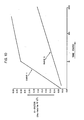
- Figure 10 is a graph showing the relationship between k-factor and time for foams of the present invention. (Btu/hr-ft2°F per inch) x 69.5 = (J/hr-oC-m2 per cm).
- According to the present invention, there is provided an improved surfactant and a closed-cell cellular composition comprising a phenolic resin, blowing agent and a surfactant having hydroxyl number of less than 50 preferably less than 10 by reaction with a capping agent. The process of capping functional groups is well known and common agents for masking the functionality of the hydroxyl group are agents which produce esters, urethanes, and ethers. Phenolic resin foams are a well known class, phenolaldehyde resin foams being representative and proportions of blowing agent, catalyst and_components are well known in the art.
- Foams of low friability can be obtained by using a preferred phenolic polymer described in Moss U.S. Patent 3,876,620. The preferred polymer of Formula I shown in Figure I of the drawings wherein Ri is

- The R2'S are independently selected from the group consisting of lower alkyl, phenyl, benzyl, halo, nitro, and hydrogen. The R3's are independently selected from the group consisting of

- The R4's are independently selected from the group consisting of lower alkyl, hydrogen, phenyl, benzyl, or furyl. By furyl is meant the radical introduced by the use of furfural. In Formula I, x is an integer from 2 to 10 inclusive and is preferably an integer from 3 to 5 inclusive. When x is less than 2, a foam produced from such a phenolic polymer tends to have too high a friability. On the other hand, as x exceeds 10, the viscosity of the polymer increases to the point where it is difficult to produce the foam. The phenolic polymers of the present invention generally have a molecular weight between 334 and 2,000 and preferably have a molecular weight between 334 and 1,500. At lower molecular weights, the resultant foams tend to have too high a friability, whereas at high molecular weights the viscosity of the phenolic polymer, even when a solvent is present, tends to be too high to permit processing.
- A preferred subclass of phenolic polymers are those of Formula III, shown in Figure 3.
- In Formula III, R' is HOCH2-, hydrogen, or a radical of Formula IV.
- The R3's are independently selected from the group consisting of HOCH2-1 hydrogen, or a radical of Formula IV, shown in Figure 4.
- In a preferred embodiment of the present invention, at least one of the R3's is methylol, i.e., HOCH2--. This is to ensure that there will be cross-linking sites on the phenolic polymer. Of course, such methylol groups or, when the aldehyde is other than formaldehyde, alkylol groups, are automatically introduced into the polymer as is well-known in the art by the process described below.
- In the broadest aspects of the present invention, the phenolic polymer can contain widely varying ratios of the radicals of Formula II or IV e.g. phenol units to ortho-cresol units. However, this ratio is generally from 1:3 to 10:1 and is preferably from 1 :1.5 to 5:1. At higher ratios, i.e., a deficiency of ortho-cresol, the cellular material produced from such a phenolic polymer tends to be too friable. In determining the above ratios, one must include the radicals of Formula II or IV present in Formula I or III respectively. The synthesis of phenolic polymers of Formula I through IV is described and claimed in Moss U.S. Patent 3,876,620. These phenolic compositions useful in the present invention generally comprise the phenolic polymer of Formula I or Formula III, together with a compound of Formula V.
- The compound of Formula V can be present in the phenolic composition in widely varying ratios of Compound V to polymeric composition but is generally present in a weight ratio of 1:30 to 1:2 and is preferably present in a weight ratio of 1:20 to 1:5. Examples of suitable compounds of Formula V include among others: m-cresol, m-chlorophenol, m-nitrophenol, 3,5-xylenol, and phenol, i.e., hydroxy benzene. Phenol is the most preferred compound of Formula V because of cost, availability, and reactivity. The phenolic block copolymers of Formula I and Formula III are produced according to the present invention by combining certain reactants in a two-step process described in Moss, supra.
- In the broadest aspects of the present invention, any aldehyde can be employed to produce useful phenolic polymers. Examples of suitable aldehydes include among others furfural, formaldehyde, benzaldehyde, and acetaldehyde. Formaldehyde is the preferred aldehyde. Formaldehyde can be employed in widely varying forms such as the 37% aqueous solution widely known as formalin. However, it is generally necessary to remove from the polymeric material the water introduced with the formalin. Formaldehyde is preferably employed in the form of paraformaldehyde which contains much less water.
- The cellular material of the present invention is formed by simply reacting the alkylol group containing phenolic polymer of Formula I or Formula III and the compound of Formula V under conditions such that a cellular product will result. As is well known in the phenolic foam art, the reaction can be conducted in the presence of a foaming catalyst, a blowing agent, and a surfactant. The reaction can be performed between temperatures of 10-50°C, preferably 15-15°C, and conveniently at atmospheric pressure. The cellular materials of the present invention generally have a thermal conductivity, k-factor value, of from 0.052 to 0,155 KJm/m2 h°C and preferably 0,052 to 0,104 KJm/m2h°C (0.1 to 0.3 and preferably 0.1 to 0.2 Btu/hr-°F-sq. ft per inch) as measured at 24°C. The k-factor value is measured on a Model 88 machine supplied by the ANACON Company. The friability of the cellular material is 20% or less. Friability is the propensity of the foam to break expressed in percent weight loss. This is determined by the ASTM C―421 friability test conducted for 10 minutes
- In the broadest aspects of the present invention, any catalyst which will enhance the cross-linking and foaming reaction can be employed in the present invention. However, the preferred foaming catalysts are aromatic sulfonic acids, examples of which include, among others, benzene sulfonic acid, toluene sulfonic acid, xylene sulfonic acid, and phenol sulfonic acid. Phosphoric acid can also be employed either alone or in a mixture with the sulfonic acids. The preferred sulfonic acid is a mixture of equal parts by weight of toluene sulfonic acid and xylene sulfonic acid as described in Mausner et al U.S. 3,458,449. Another foaming catalyst which has been found to give excellent results is a blend of toluene sulfonic acid, phosphoric acid, and water in a weight ratio of 35-50:50-35:15.
- The catalyst is generally present in the minimum amount that will give the desired cream time of 10 to 50 seconds and firm time of 40 to 500 seconds to the reacting mixture. The catalyst, however, generally comprises from 0.5 to 20, and preferably comprises from 1.0 to 15, weight percent based on the weight of the cellular material.
- Any blowing agent characteristically employed in similar prior art products such as is described in Moss et al, U.S. Patent 3,968,300, can be employed in the composition of the present invention. In general, these blowing agents are liquids having an atmospheric pressure boiling point between
minus 50 and 100°C and preferably between zero and 50°C. The preferred liquids are hydrocarbons or halohydrocarbons. Examples of suitable blowing agents include, among others, chlorinated and fluorinated hydrocarbons such as trichlorofluoromethane, CCI2FCC1 F2, CCIzFCF3, diethyl ether, isopropyl ether, n-pentane, cyclopentane, and 2-methylbutane. Combinations of trichlorofluoromethane plus 1,1,2-trichloro, 1,2,2-trifluoroethane, are the preferred blowing agents. The blowing agents are employed in an amount sufficient to give the resultant foam the desired bulk density which is generally between 8 and 160 kg/m3, and preferably between 16 and 80 kg/m3. The blowing agent generally comprises from 1 to 30, and preferably comprises from 5 to 20 weight percent of the composition. When the blowing agent has a boiling point at or below ambient, it is maintained under pressure until mixed with the other components. Alternatively, it can be maintained at subambient temperatures until mixed with the other components. - The surfactants of the instant invention are hydroxyl containing cell stabilizing surfactants with a branched, non-ionic structure and are used in producing the polymeric foams of the present invention. By cell stabilizing surfactant is meant one which keeps a foam from collapsing and rupturing. Prior to capping, the surfactants have hydroxyl numbers in the range of 60 to 100. After capping, the hydroxyl number is reduced to a value of less than 50, and preferably less than 10, by reaction with a suitable capping agent such as organic acid, acid anhydride, acid chloride, acyloxy chloride, alkyl isocyanate or aryl isocyanate. Alcohols can be converted to ethers but this generally does not result in a surfactant that behaves as a cell stabilizer. The hydroxyl number is determined by the ASTM-D1638 test.
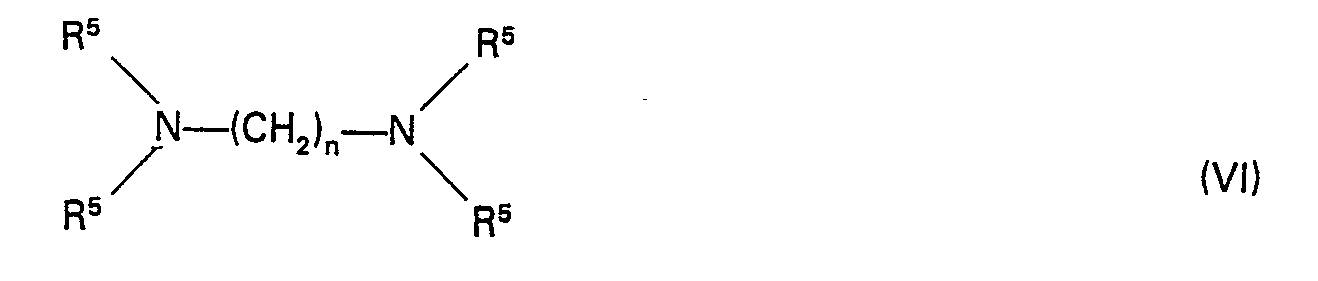
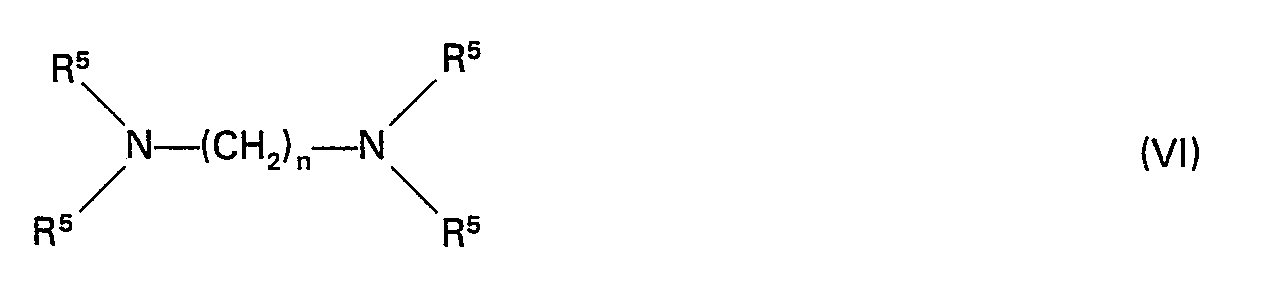
- The surfactant of the present invention is the capped reaction product of an alkoxylated amine of Formula VI shown as Figure 6 wherein R5 is an alkoxylated chain of Formula VII, n is an integer from 2 to 10 inclusive and the ratio p:q is 15:85 to 85:15, which amine has been reacted with a copolymerizable mixture of dialkyl maleate and a member selected from the group consisting of N-vinyl-2-pyrrolidone and N-vinyl caprolactam, the alkyl of the maleate preferably having 1 to 5 carbon atoms. The preferred dialkyl maleate is dibutyl maleate.
- The alkoxylation is carried out using a mixture of ethylene oxide and propylene oxide in a ratio of 15:85 to 85:15 and preferably from 20:80 to 60:40. The molecular weight of the alkoxylated amine is from 1500 to 6000 and preferably from 1800 to 2800. If the molecular weight of the aloxylated amine is less than 1500, the resultant foam collapses. An alkoxylated amine of molecular weight higher than 6000 is too viscous to be practicable.
- The preferred molar ratio of dibutyl maleate and N-vinyl-2-pyrrolidone is 1:1. The mixture of dialkyl maleate and N-vinyl-2-pyrrolidone or N-vinyl caprolactam comprises 5 to 40 weight percent of the reaction mixture, and preferably 20 weight percent of the reaction mixture. If less than 5 percent is used, the surfactant is ineffective, if more than 40 percent is used, the foam collapses. N-vinyl-2-pyrrolidone and N-vinyl caprolactam are interchangeable in equivalent quantities, but N-vinyl-2-pyrrolidone is preferred.
- The capping reaction is carried out with a capping agent. Suitable capping agents include a lower alkyl monocarboxylic acid having 1 to 10 carbon atoms selected from the group consisting of acetic acid, propionic acid, butyric acid, hexanoic acid, octanoic acid, decanoic acid, isomers of these acids, anhydrides of these acids, acid chloride derivatives of these acids and mixtures thereof. Acetic anhydride is readily obtainable and convenient to use. Similarly aromatic acids, anhydrides and chlorides can be employed. Benzoyl chloride and substituted produces of it such as 3,5-dinitrobenzoyl chloride are examples of these. Alkyl and aromatic isocyanates can also be employed. Other factors such as solubility in the surfactant and the solubility of the capped surfactant with a particular phenolic-resin are considerations of which a practitioner in the art is cognizant in selecting the system which will yield the desired closed cell stabilized foam. Examples of suitable capping agents are acetic acid, acetic anhydride, acetyl chloride and 3,5-dinitrobenzoyl chloride, reacted so that the surfactant has a hydroxyl value of less than 50, and preferably less than 10. The preferred capping agent is acetic anhydride.
- The preferred surfactants useful in the present invention produce a uniform fine-celled foam. Uniformity of cells is determined by visual and microscopic examination. The surfactants must produce a fine celled foam. This property is tested by mixing 2 to 5% of the surfactant with the phenolic composition and producing a foam as described herein. It is interesting to note that a low surface tension of the surfactant in the phenolic-resin is not a prerequisite to obtaining a good foam.
- The average cell size diameter must be less than 0.2 mm and is preferably less than 0.1 mm (ASTM D-2842). Fine celled foams can be the means set forth in the invention be rendered closed cells. The blowing agent is then trapped in the cells. One means of expressing the containment in the cells of the blowing agent is by use of the k-factor drift value. Unfaced cellular materials containing fluorocarbon gas have initial k-factors in the vicinity of 0.052 to 0.104 at 24°C. This low value increases over a period of months or sometimes days. The change is expressed as the k-factor drift. The k-factor is measured at a mean temperature of 24°C. The value is redetermined at various time intervals up to about 1000 days. A material exhibiting fast k-drift will attain a k-factor (KJm/mzh°C) of at least 0.104 within 25 days. A slow k-drift material may require between 200 days and over two years to attain a 0.104 value. Any material which possesses a k-value under 0.104 will provide high thermal resistance. Obviously, the longer this value or a lower value is maintained, the better the efficiency of the insulation.
- Ball, Hurd and Walker have published a comprehensive discussion of k-factor changes as a function of time. ("The Thermal Conductivity of Rigid Urethane Foams," J. Cellular Plastics, March/April, 1970, pp 66-78.) F. Norton ("Thermal Conductivity and Life of Polymer Foams," J. Cellular Plastics, January, 1967, pp 23-37) has shown that diffusion of fluorocarbon gases out of unfaced foam and infusion of air into the foam causes an increase in k-factor. A slow k-drift foam is defined as one that attains a k-factor at 24°C of 0.077-0,088 after 200-400 days and then remains below 0.104 k-factor for 5-10 years. Eventually all fluorocarbon diffuses from the foam to leave a closed cell material which contains only air in the cells.
- The k-factor for the closed cell foam containing only air falls in the range of 0.114-0.135 KJm/m2h°C (0.22-0.26 Btu/hr-oF-ft2 per inch thickness) at 24°C for the 2-3 Ibs/ft3 density range. Therefore, if a foam exhibits greater than 0.104 k-factor after a short period of time (less than 25 days), then substantially all fluorocarbon has diffused from the foam and has been replaced by air. On the other hand, if k-factor remains below 0.104 for at least 100 days then a substantial amount of fluorocarbon gas remains in the closed cells of the foam in spite of infusion of air.
- It has been found that capping the surfactant that yields a fine celled foam increases the closed cell content and the initial k-factor is lowered.
- Moreover, capping and grafting the surfactant yield a fine celled foam with high closed cell content, a low initial k-factor and a low k-drift value.
- The surfactant is employed in a cell stabilizing amount. Generally the surfactant comprises from 0.05 to 10, and preferably comprises from 0.1 to 6, weight percent of the composition. Too little surfactant fails to stabilize the foam and too much surfactant is not only wasteful, but also for surfactants having relatively high surface tension (about 35 dynes/cm) may lead to larger cell structure by cell coalescence and the foam may collapse. Branched, non-ionic, capped, grafted surfactants are preferred.
- As used herein any of the alkyl, aryl, aralkyl, and/or alkaryl groups can be substituted with one or more groups that do not materially affect the physical or chemical properties of the surfactant compound. Examples of substituents include, among others, -F, -CI, -Br, -CH3, and -N02.
- Referring now to the drawings, and in particular to Figure 8, there is shown a laminated
structural panel 10 of the present invention. Thestructural panel 10 comprises a single facing sheet 11 having thereon acellular material 12 of the present invention. Figure 9 shows astructural panel 20 having two facingsheets cellular material 23. - Any facing sheet previously employed to produce building panels can be employed in the present invention. Examples of suitable facing sheets include, among others, those of kraft paper, aluminum, and asphalt impregnated felts, as well as laminates of two or more of the above.
- The invention is further illustrated by the following examples in which all parts and percentages are by weight unless otherwise indicated. These non-limiting examples are illustrative of certain embodiments designed to teach those skilled in the art how to practice the invention and to represent the best mode contemplated for carrying out the invention.
- This example illustrates the synthesis of a phenolic polymer of Formula I useful in the present invention employing a molar ratio of phenol to o-cresol of 2:1.

- Items A and B are charged to a reaction vessel. Item C is added over a period of fifteen minutes, the temperature rises to 100°C due to an exothermic reaction and is maintained at that level for 1 hour. Items D and E are then added and the temperature maintained at 80°C for four and one-half hours. Item F is then added and the contents of the reaction are termed Resin B.
- Resin B has a viscosity at 25°C of 29,500 cps, a free phenol content of 8.1%, and a free water content of 9.1 %, a free formaldehyde content of 0.6%, and a free o-cresol content of less than 0.1 %.
- This example illustrates the synthesis of a phenolic polymer of Formula I useful in the present invention employing a molar ratio of phenol to orthocresol of 4:1.
- The following quantities of the following ingredients are combined as indicated.

- Items A and B are charged to a reaction vessel. Item C is added over a period of fifteen minutes, the temperature rises due to the exothermic reaction, to 100°C and is maintained at that level for 1.5 hours. Items D, E, and F are then added and temperature maintained at 80°C for 5 hours. Item G is then added and the contents of the reaction vessel is termed Resin C.
- Resin C has a viscosity at 25°C of 24,300 cps, a free phenol content of 8.6%, and a free water content of 10.0%, a free formaldehyde content of 2.3%, and a free o-cresol content of less than 0.1 %.
- This example illustrates the synthesis of a surfactant precursor.

- Item A is placed in a reaction vessel at 90°C. Item B is placed in a dropping funnel. Items C, D, and E are mixed together and placed in a second dropping funnel. The contents of the two dropping funnels are each concurrently added to the reaction vessel over a period of one hour while maintaining the temperature at 90°C. The temperature is raised to 140°C for an additional hour to produce a surfactant precursor.
- Item A has a molecular weight of 2600, has a weight ratio of ethylene oxide to propylene oxide of 40:60, and is avaiable from the BASF Wyandotte Corporation, Wyandotte, Michigan, U.S.A., under the tradename "TETRONIC 704."
- This example illustrates the capping of surfactants useful in the present invention.
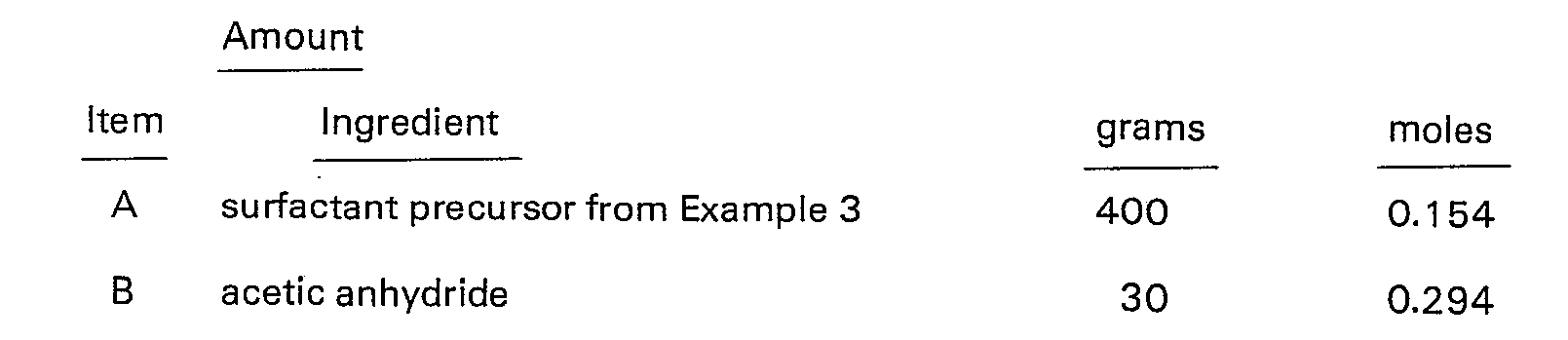
- Items A and B are mixed together at room temperature and heated to 100°C for two hours to produce a surfactant useful in the present invention termed Surfactant A.
- This example illustrates the synthesis of foaming catalyst useful in the present invention.
- The following quantities of the following ingredients are combined as indicated to produce Catalyst A:

- Items A, B, and C are mixed. The resultant composition is termed Catalyst A.
- The following quantities of the following ingredients are combined as indicated to produce Catalyst B:

- Items A and B are mixed. The resultant composition is termed Catalyst B. Ultra TX is a mixture of equal parts by weight of p-toluene sulfonic acid and xylene sulfonic acids available from the Witco Chemical Company.
- This example illustrates the synthesis of a foam based on 2:1 phenol:o-cresol resoles of the present invention.

- Items A through E are mixed in an open vessel for 15 seconds. The mixture is then poured into a square paper box 30.5 cm (twelve inches) by 30.5 cm (twelve inches) by 12.7 cm (five inches) tall. A foaming reaction ensues. After a period of about 240-300 seconds the material is rigid. The box and contents are placed in an oven at 55° to 75°C for a period of ten minutes.
Claims (15)

with



Applications Claiming Priority (2)
| Application Number | Priority Date | Filing Date | Title |
|---|---|---|---|
| US837875 | 1977-09-29 | ||
| US05/837,875 US4140842A (en) | 1977-09-29 | 1977-09-29 | Phenolic foam and surfactant useful therein |
Publications (2)
| Publication Number | Publication Date |
|---|---|
| EP0008599A1 EP0008599A1 (en) | 1980-03-19 |
| EP0008599B1 true EP0008599B1 (en) | 1983-12-14 |
Family
ID=25275681
Family Applications (1)
| Application Number | Title | Priority Date | Filing Date |
|---|---|---|---|
| EP78900129A Expired EP0008599B1 (en) | 1977-09-29 | 1979-04-11 | Surfactant and phenolic foam produced therewith |
Country Status (12)
| Country | Link |
|---|---|
| US (1) | US4140842A (en) |
| EP (1) | EP0008599B1 (en) |
| JP (1) | JPS5461263A (en) |
| BE (1) | BE870875A (en) |
| CA (1) | CA1121950A (en) |
| DK (1) | DK431178A (en) |
| GB (1) | GB2021117B (en) |
| IT (1) | IT1099663B (en) |
| MX (1) | MX152387A (en) |
| NL (1) | NL7809881A (en) |
| SE (2) | SE429867B (en) |
| WO (1) | WO1979000163A1 (en) |
Families Citing this family (27)
| Publication number | Priority date | Publication date | Assignee | Title |
|---|---|---|---|---|
| DE2825295C2 (en) * | 1978-06-09 | 1980-07-17 | Erich Ruehl Chemische Fabrik Und Chemikaliengrosshandel, 6382 Friedrichsdorf | Material and process for its manufacture |
| US4412014A (en) * | 1980-01-21 | 1983-10-25 | The Celotex Corporation | Extraction of polyoxyalkylene surfactants for phenolic foam stabilization |
| US4522877A (en) * | 1980-01-21 | 1985-06-11 | The Celotex Corporation | Extraction of polyoxyalkylene surfactants for phenolic foam stabilization |
| US4546034A (en) * | 1980-01-21 | 1985-10-08 | The Celotex Corporation | Metal catalyzed preparation of polyoxyalkylene surfactants for phenolic foam stabilization |
| US4518719A (en) * | 1980-01-21 | 1985-05-21 | The Celotex Corporation | Metal catalyzed preparation of polyoxyalkylene surfactants for phenolic foam stabilization |
| US4485194A (en) * | 1980-01-21 | 1984-11-27 | The Celotex Corporation | Extraction of polyoxyalkylene surfactants for phenolic foam stabilization |
| US4563499A (en) * | 1980-01-21 | 1986-01-07 | The Celotex Corporation | Extraction of polyoxyalkylene surfactants for phenolic foam stabilization |
| CA1148956A (en) * | 1980-01-21 | 1983-06-28 | Richard L. Frentzel | Metal catalyzed preparation of polyoxyalkylene surfactants for phenolic foam stabilization |
| US4438018A (en) | 1980-01-21 | 1984-03-20 | The Celotex Corporation | Metal catalyzed preparation of polyoxyalkylene surfactants for phenolic foam stabilization |
| US4419460A (en) * | 1980-12-22 | 1983-12-06 | Monsanto Company | Phenolic foams |
| US4900759A (en) * | 1981-05-20 | 1990-02-13 | Monsanto Company | Phenolic foams |
| US4478958A (en) * | 1981-07-10 | 1984-10-23 | Kopper Company, Inc. | Method for preparing phenolic foams using anhydrous aryl sulfonic acid catalysts |
| US4481307A (en) * | 1981-07-10 | 1984-11-06 | The Celotex Corporation | Polyoxyalkylene/unsaturated diester reaction product for cellular foam stabilization |
| US4520140A (en) * | 1981-07-10 | 1985-05-28 | The Celotex Corporation | Polyoxyalkylene/unsaturated diester reaction product for cellular foam stabilization |
| US4555442A (en) * | 1981-07-10 | 1985-11-26 | The Celotex Corporation | Polyoxyalkylene/unsaturated diester reaction product for cellular foam stabilization |
| US4365024A (en) * | 1981-07-10 | 1982-12-21 | The Celotex Corporation | Polyoxyalkylene/unsaturated diester reaction product for cellular foam stabilization |
| US4444912A (en) * | 1981-07-10 | 1984-04-24 | Koppers Company, Inc. | Phenolic foam and composition and method for preparing the same |
| US4729850A (en) * | 1981-07-10 | 1988-03-08 | The Celotex Corporation | Polyoxyalkylene/unsaturated diester reaction product for cellular foam stabilization |
| US4418158A (en) * | 1981-07-10 | 1983-11-29 | The Celotex Corporation | Polyoxyalkylene/unsaturated diester reaction product for cellular foam stabilization |
| JPS58196124U (en) * | 1982-06-24 | 1983-12-27 | 日東紡績株式会社 | composite insulation board |
| US4539338A (en) * | 1982-07-09 | 1985-09-03 | Koppers Company, Inc. | Phenol formaldehyde resoles for making phenolic foam |
| US4572919A (en) * | 1983-05-02 | 1986-02-25 | Jim Walter Resources, Inc. | Unsaturated polyoxyalkylene adduct/fumarate diester reaction product for cellular foam stabilization |
| US4529745A (en) * | 1983-05-02 | 1985-07-16 | Jim Walter Resources, Inc. | Unsaturated polyoxyalkylene adduct/fumarate diester reaction product for cellular foam stabilization |
| US4546119A (en) * | 1984-11-29 | 1985-10-08 | Fiberglas Canada, Inc. | Closed cell phenolic foam |
| US4576972A (en) * | 1984-11-29 | 1986-03-18 | Fiberglas Canada, Inc. | Closed cell phenolic foam |
| CA2286751A1 (en) * | 1997-05-02 | 1998-11-12 | Jiffy Foam, Inc. | Method for making a closed-cell phenolic resin foam |
| US6492432B1 (en) | 1999-11-09 | 2002-12-10 | American Foam Technologies, Inc. | Novolac-epoxy resin foam, foamable composition for making novolac-epoxy resin foam and method of making novolac-epoxy resin foam |
Citations (1)
| Publication number | Priority date | Publication date | Assignee | Title |
|---|---|---|---|---|
| GB1160001A (en) * | 1965-09-06 | 1969-07-30 | Ici Australia Ltd | Foaming Compositions |
Family Cites Families (2)
| Publication number | Priority date | Publication date | Assignee | Title |
|---|---|---|---|---|
| US3876620A (en) * | 1973-04-26 | 1975-04-08 | Celotex Corp | Process of preparing phenolic-aldehyde polymer using o-cresol |
| US4036793A (en) * | 1973-04-26 | 1977-07-19 | The Celotex Corporation | Phenolic polymer, related products and processes thereof |
-
1977
- 1977-09-29 US US05/837,875 patent/US4140842A/en not_active Expired - Lifetime
-
1978
- 1978-09-19 CA CA000311568A patent/CA1121950A/en not_active Expired
- 1978-09-28 MX MX175042A patent/MX152387A/en unknown
- 1978-09-28 DK DK431178A patent/DK431178A/en not_active Application Discontinuation
- 1978-09-29 IT IT28257/78A patent/IT1099663B/en active
- 1978-09-29 BE BE2057320A patent/BE870875A/en not_active IP Right Cessation
- 1978-09-29 GB GB7907818A patent/GB2021117B/en not_active Expired
- 1978-09-29 JP JP12029878A patent/JPS5461263A/en active Pending
- 1978-09-29 WO PCT/US1978/000091 patent/WO1979000163A1/en not_active Ceased
- 1978-09-29 NL NL7809881A patent/NL7809881A/en not_active Application Discontinuation
-
1979
- 1979-04-11 EP EP78900129A patent/EP0008599B1/en not_active Expired
- 1979-05-28 SE SE7904606A patent/SE429867B/en not_active IP Right Cessation
-
1981
- 1981-03-25 SE SE8101911A patent/SE8101911L/en not_active Application Discontinuation
Patent Citations (1)
| Publication number | Priority date | Publication date | Assignee | Title |
|---|---|---|---|---|
| GB1160001A (en) * | 1965-09-06 | 1969-07-30 | Ici Australia Ltd | Foaming Compositions |
Also Published As
| Publication number | Publication date |
|---|---|
| MX152387A (en) | 1985-07-10 |
| JPS5461263A (en) | 1979-05-17 |
| WO1979000163A1 (en) | 1979-04-05 |
| US4140842A (en) | 1979-02-20 |
| SE7904606L (en) | 1979-05-28 |
| IT1099663B (en) | 1985-09-28 |
| EP0008599A1 (en) | 1980-03-19 |
| CA1121950A (en) | 1982-04-13 |
| IT7828257A0 (en) | 1978-09-29 |
| SE429867B (en) | 1983-10-03 |
| GB2021117B (en) | 1982-04-21 |
| SE8101911L (en) | 1981-03-25 |
| BE870875A (en) | 1979-01-15 |
| NL7809881A (en) | 1979-04-02 |
| GB2021117A (en) | 1979-04-05 |
| DK431178A (en) | 1979-03-30 |
Similar Documents
| Publication | Publication Date | Title |
|---|---|---|
| US4140842A (en) | Phenolic foam and surfactant useful therein | |
| US4365024A (en) | Polyoxyalkylene/unsaturated diester reaction product for cellular foam stabilization | |
| US5057546A (en) | Semi-flexible or flexible phenolic foam composition | |
| US4247413A (en) | Phenolic foam and surfactant useful therein | |
| NZ204806A (en) | Phenolic resole compositions and manufacture of foams therefrom | |
| US4204020A (en) | Phenolic foam laminated structural panel | |
| US4956394A (en) | Closed cell phenolic foam containing alkyl glucosides | |
| CA1068049A (en) | Phenolic polymer, related products and processes thereof | |
| US3953645A (en) | Phenolic polymer, related products and processes thereof | |
| CA1105200A (en) | Closed cell phenolic foam | |
| US4418158A (en) | Polyoxyalkylene/unsaturated diester reaction product for cellular foam stabilization | |
| US4036793A (en) | Phenolic polymer, related products and processes thereof | |
| US4555442A (en) | Polyoxyalkylene/unsaturated diester reaction product for cellular foam stabilization | |
| US4563499A (en) | Extraction of polyoxyalkylene surfactants for phenolic foam stabilization | |
| US4481307A (en) | Polyoxyalkylene/unsaturated diester reaction product for cellular foam stabilization | |
| EP0039756B1 (en) | Preparation of polyoxyalkylene surfactants for the stabilisation of phenolic foam, optionally in the presence of a metal catalyst | |
| US4412014A (en) | Extraction of polyoxyalkylene surfactants for phenolic foam stabilization | |
| US4546034A (en) | Metal catalyzed preparation of polyoxyalkylene surfactants for phenolic foam stabilization | |
| US4485194A (en) | Extraction of polyoxyalkylene surfactants for phenolic foam stabilization | |
| US4729850A (en) | Polyoxyalkylene/unsaturated diester reaction product for cellular foam stabilization | |
| KR840000593B1 (en) | Process for preparing polyoxyalkylene surfactant for stabilizing phenolic foam | |
| KR19990044126A (en) | Method for producing phenolic foam | |
| US4522877A (en) | Extraction of polyoxyalkylene surfactants for phenolic foam stabilization | |
| US4490489A (en) | Metal catalyzed preparation of polyoxyalkylene surfactants for phenolic foam stabilization | |
| US4520140A (en) | Polyoxyalkylene/unsaturated diester reaction product for cellular foam stabilization |
Legal Events
| Date | Code | Title | Description |
|---|---|---|---|
| PUAI | Public reference made under article 153(3) epc to a published international application that has entered the european phase |
Free format text: ORIGINAL CODE: 0009012 |
|
| AK | Designated contracting states |
Designated state(s): FR |
|
| 17P | Request for examination filed | ||
| GRAA | (expected) grant |
Free format text: ORIGINAL CODE: 0009210 |
|
| AK | Designated contracting states |
Designated state(s): FR |
|
| ET | Fr: translation filed | ||
| PGFP | Annual fee paid to national office [announced via postgrant information from national office to epo] |
Ref country code: FR Payment date: 19840920 Year of fee payment: 7 |
|
| PLBE | No opposition filed within time limit |
Free format text: ORIGINAL CODE: 0009261 |
|
| STAA | Information on the status of an ep patent application or granted ep patent |
Free format text: STATUS: NO OPPOSITION FILED WITHIN TIME LIMIT |
|
| 26N | No opposition filed | ||
| PG25 | Lapsed in a contracting state [announced via postgrant information from national office to epo] |
Ref country code: FR Free format text: LAPSE BECAUSE OF NON-PAYMENT OF DUE FEES Effective date: 19880531 |
|
| REG | Reference to a national code |
Ref country code: FR Ref legal event code: ST |