EP0007766B1 - Epoxypregnadienes, hydroxypregnatrienes, process for their preparation and process for their conversion to precursors of useful anti-inflammatory agents - Google Patents
Epoxypregnadienes, hydroxypregnatrienes, process for their preparation and process for their conversion to precursors of useful anti-inflammatory agents Download PDFInfo
- Publication number
- EP0007766B1 EP0007766B1 EP19790301411 EP79301411A EP0007766B1 EP 0007766 B1 EP0007766 B1 EP 0007766B1 EP 19790301411 EP19790301411 EP 19790301411 EP 79301411 A EP79301411 A EP 79301411A EP 0007766 B1 EP0007766 B1 EP 0007766B1
- Authority
- EP
- European Patent Office
- Prior art keywords
- compound
- formula
- acid
- mixture
- acetate
- Prior art date
- Legal status (The legal status is an assumption and is not a legal conclusion. Google has not performed a legal analysis and makes no representation as to the accuracy of the status listed.)
- Expired
Links
- 238000000034 method Methods 0.000 title claims description 22
- 230000008569 process Effects 0.000 title claims description 18
- 238000006243 chemical reaction Methods 0.000 title description 14
- 238000002360 preparation method Methods 0.000 title description 7
- 239000002260 anti-inflammatory agent Substances 0.000 title description 4
- 229940121363 anti-inflammatory agent Drugs 0.000 title description 3
- YUYATSUGDVHESB-PNSDOTEBSA-N 2-[(8R,9S,10S,13S)-10,13-dimethyl-2,3,4,5,6,7,8,9,11,12-decahydro-1H-cyclopenta[a]phenanthren-17-yl]ethenol Chemical class C(=CC1=CC=C2[C@@H]3CCC4CCCC[C@]4(C)[C@H]3CC[C@]12C)O YUYATSUGDVHESB-PNSDOTEBSA-N 0.000 title 1
- 239000002243 precursor Substances 0.000 title 1
- 150000001875 compounds Chemical class 0.000 claims description 33
- 150000004965 peroxy acids Chemical class 0.000 claims description 18
- KFSLWBXXFJQRDL-UHFFFAOYSA-N Peracetic acid Chemical compound CC(=O)OO KFSLWBXXFJQRDL-UHFFFAOYSA-N 0.000 claims description 13
- UIIMBOGNXHQVGW-UHFFFAOYSA-M Sodium bicarbonate Chemical compound [Na+].OC([O-])=O UIIMBOGNXHQVGW-UHFFFAOYSA-M 0.000 claims description 10
- 239000002253 acid Substances 0.000 claims description 7
- KWYUFKZDYYNOTN-UHFFFAOYSA-M Potassium hydroxide Chemical compound [OH-].[K+] KWYUFKZDYYNOTN-UHFFFAOYSA-M 0.000 claims description 6
- HEMHJVSKTPXQMS-UHFFFAOYSA-M Sodium hydroxide Chemical compound [OH-].[Na+] HEMHJVSKTPXQMS-UHFFFAOYSA-M 0.000 claims description 6
- 125000002496 methyl group Chemical group [H]C([H])([H])* 0.000 claims description 6
- 229910000030 sodium bicarbonate Inorganic materials 0.000 claims description 5
- 235000017557 sodium bicarbonate Nutrition 0.000 claims description 5
- BMYNFMYTOJXKLE-UHFFFAOYSA-N 3-azaniumyl-2-hydroxypropanoate Chemical compound NCC(O)C(O)=O BMYNFMYTOJXKLE-UHFFFAOYSA-N 0.000 claims description 4
- PXGOKWXKJXAPGV-UHFFFAOYSA-N Fluorine Chemical group FF PXGOKWXKJXAPGV-UHFFFAOYSA-N 0.000 claims description 4
- CDBYLPFSWZWCQE-UHFFFAOYSA-L Sodium Carbonate Chemical compound [Na+].[Na+].[O-]C([O-])=O CDBYLPFSWZWCQE-UHFFFAOYSA-L 0.000 claims description 4
- 239000011737 fluorine Chemical group 0.000 claims description 4
- 229910052731 fluorine Chemical group 0.000 claims description 4
- 238000004519 manufacturing process Methods 0.000 claims description 4
- BWHMMNNQKKPAPP-UHFFFAOYSA-L potassium carbonate Chemical compound [K+].[K+].[O-]C([O-])=O BWHMMNNQKKPAPP-UHFFFAOYSA-L 0.000 claims description 4
- LMBFAGIMSUYTBN-MPZNNTNKSA-N teixobactin Chemical compound C([C@H](C(=O)N[C@@H]([C@@H](C)CC)C(=O)N[C@@H](CO)C(=O)N[C@H](CCC(N)=O)C(=O)N[C@H]([C@@H](C)CC)C(=O)N[C@@H]([C@@H](C)CC)C(=O)N[C@@H](CO)C(=O)N[C@H]1C(N[C@@H](C)C(=O)N[C@@H](C[C@@H]2NC(=N)NC2)C(=O)N[C@H](C(=O)O[C@H]1C)[C@@H](C)CC)=O)NC)C1=CC=CC=C1 LMBFAGIMSUYTBN-MPZNNTNKSA-N 0.000 claims description 4
- NHQDETIJWKXCTC-UHFFFAOYSA-N 3-chloroperbenzoic acid Chemical compound OOC(=O)C1=CC=CC(Cl)=C1 NHQDETIJWKXCTC-UHFFFAOYSA-N 0.000 claims description 3
- VEXZGXHMUGYJMC-UHFFFAOYSA-N Hydrochloric acid Chemical compound Cl VEXZGXHMUGYJMC-UHFFFAOYSA-N 0.000 claims description 3
- 150000001336 alkenes Chemical class 0.000 claims description 3
- 239000001257 hydrogen Substances 0.000 claims description 3
- 229910052739 hydrogen Inorganic materials 0.000 claims description 3
- JRZJOMJEPLMPRA-UHFFFAOYSA-N olefin Natural products CCCCCCCC=C JRZJOMJEPLMPRA-UHFFFAOYSA-N 0.000 claims description 3
- 125000001424 substituent group Chemical group 0.000 claims description 3
- 125000006273 (C1-C3) alkyl group Chemical group 0.000 claims description 2
- YNJSNEKCXVFDKW-UHFFFAOYSA-N 3-(5-amino-1h-indol-3-yl)-2-azaniumylpropanoate Chemical compound C1=C(N)C=C2C(CC(N)C(O)=O)=CNC2=C1 YNJSNEKCXVFDKW-UHFFFAOYSA-N 0.000 claims description 2
- ZAMOUSCENKQFHK-UHFFFAOYSA-N Chlorine atom Chemical compound [Cl] ZAMOUSCENKQFHK-UHFFFAOYSA-N 0.000 claims description 2
- 239000000460 chlorine Substances 0.000 claims description 2
- 229910052801 chlorine Inorganic materials 0.000 claims description 2
- 230000003301 hydrolyzing effect Effects 0.000 claims description 2
- 125000000956 methoxy group Chemical group [H]C([H])([H])O* 0.000 claims description 2
- 125000000449 nitro group Chemical group [O-][N+](*)=O 0.000 claims description 2
- 125000001997 phenyl group Chemical group [H]C1=C([H])C([H])=C(*)C([H])=C1[H] 0.000 claims description 2
- 239000011736 potassium bicarbonate Substances 0.000 claims description 2
- 235000015497 potassium bicarbonate Nutrition 0.000 claims description 2
- 229910000028 potassium bicarbonate Inorganic materials 0.000 claims description 2
- 229910000027 potassium carbonate Inorganic materials 0.000 claims description 2
- 235000011181 potassium carbonates Nutrition 0.000 claims description 2
- TYJJADVDDVDEDZ-UHFFFAOYSA-M potassium hydrogencarbonate Chemical compound [K+].OC([O-])=O TYJJADVDDVDEDZ-UHFFFAOYSA-M 0.000 claims description 2
- 235000011118 potassium hydroxide Nutrition 0.000 claims description 2
- CZPZWMPYEINMCF-UHFFFAOYSA-N propaneperoxoic acid Chemical compound CCC(=O)OO CZPZWMPYEINMCF-UHFFFAOYSA-N 0.000 claims description 2
- 229910000029 sodium carbonate Inorganic materials 0.000 claims description 2
- 235000017550 sodium carbonate Nutrition 0.000 claims description 2
- 235000011121 sodium hydroxide Nutrition 0.000 claims description 2
- 125000004435 hydrogen atom Chemical group [H]* 0.000 claims 1
- 150000004704 methoxides Chemical group 0.000 claims 1
- YMWUJEATGCHHMB-UHFFFAOYSA-N Dichloromethane Chemical compound ClCCl YMWUJEATGCHHMB-UHFFFAOYSA-N 0.000 description 30
- 239000000203 mixture Substances 0.000 description 25
- WYURNTSHIVDZCO-UHFFFAOYSA-N Tetrahydrofuran Chemical compound C1CCOC1 WYURNTSHIVDZCO-UHFFFAOYSA-N 0.000 description 18
- OKKJLVBELUTLKV-UHFFFAOYSA-N Methanol Chemical compound OC OKKJLVBELUTLKV-UHFFFAOYSA-N 0.000 description 12
- CSCPPACGZOOCGX-UHFFFAOYSA-N Acetone Chemical compound CC(C)=O CSCPPACGZOOCGX-UHFFFAOYSA-N 0.000 description 10
- RTZKZFJDLAIYFH-UHFFFAOYSA-N Diethyl ether Chemical compound CCOCC RTZKZFJDLAIYFH-UHFFFAOYSA-N 0.000 description 9
- YLQBMQCUIZJEEH-UHFFFAOYSA-N tetrahydrofuran Natural products C=1C=COC=1 YLQBMQCUIZJEEH-UHFFFAOYSA-N 0.000 description 9
- CPELXLSAUQHCOX-UHFFFAOYSA-N Hydrogen bromide Chemical compound Br CPELXLSAUQHCOX-UHFFFAOYSA-N 0.000 description 8
- 238000006220 Baeyer-Villiger oxidation reaction Methods 0.000 description 7
- HEDRZPFGACZZDS-UHFFFAOYSA-N Chloroform Chemical compound ClC(Cl)Cl HEDRZPFGACZZDS-UHFFFAOYSA-N 0.000 description 6
- 150000002118 epoxides Chemical class 0.000 description 6
- 238000007254 oxidation reaction Methods 0.000 description 6
- 150000003431 steroids Chemical class 0.000 description 6
- 239000000126 substance Substances 0.000 description 6
- FAPWRFPIFSIZLT-UHFFFAOYSA-M Sodium chloride Chemical compound [Na+].[Cl-] FAPWRFPIFSIZLT-UHFFFAOYSA-M 0.000 description 5
- UREBDLICKHMUKA-DVTGEIKXSA-N betamethasone Chemical compound C1CC2=CC(=O)C=C[C@]2(C)[C@]2(F)[C@@H]1[C@@H]1C[C@H](C)[C@@](C(=O)CO)(O)[C@@]1(C)C[C@@H]2O UREBDLICKHMUKA-DVTGEIKXSA-N 0.000 description 5
- 238000006460 hydrolysis reaction Methods 0.000 description 5
- VLKZOEOYAKHREP-UHFFFAOYSA-N n-Hexane Chemical compound CCCCCC VLKZOEOYAKHREP-UHFFFAOYSA-N 0.000 description 5
- 230000003647 oxidation Effects 0.000 description 5
- WQDUMFSSJAZKTM-UHFFFAOYSA-N Sodium methoxide Chemical compound [Na+].[O-]C WQDUMFSSJAZKTM-UHFFFAOYSA-N 0.000 description 4
- 239000011203 carbon fibre reinforced carbon Substances 0.000 description 4
- 229910000042 hydrogen bromide Inorganic materials 0.000 description 4
- 230000007062 hydrolysis Effects 0.000 description 4
- 239000000543 intermediate Substances 0.000 description 4
- 150000002576 ketones Chemical class 0.000 description 4
- 239000002904 solvent Substances 0.000 description 4
- 238000004809 thin layer chromatography Methods 0.000 description 4
- QTBSBXVTEAMEQO-UHFFFAOYSA-N Acetic acid Chemical compound CC(O)=O QTBSBXVTEAMEQO-UHFFFAOYSA-N 0.000 description 3
- XEKOWRVHYACXOJ-UHFFFAOYSA-N Ethyl acetate Chemical compound CCOC(C)=O XEKOWRVHYACXOJ-UHFFFAOYSA-N 0.000 description 3
- CSNNHWWHGAXBCP-UHFFFAOYSA-L Magnesium sulfate Chemical compound [Mg+2].[O-][S+2]([O-])([O-])[O-] CSNNHWWHGAXBCP-UHFFFAOYSA-L 0.000 description 3
- YXFVVABEGXRONW-UHFFFAOYSA-N Toluene Chemical compound CC1=CC=CC=C1 YXFVVABEGXRONW-UHFFFAOYSA-N 0.000 description 3
- 229960002537 betamethasone Drugs 0.000 description 3
- 230000015572 biosynthetic process Effects 0.000 description 3
- 230000000052 comparative effect Effects 0.000 description 3
- 150000002596 lactones Chemical class 0.000 description 3
- 239000011541 reaction mixture Substances 0.000 description 3
- 238000007086 side reaction Methods 0.000 description 3
- AKHNMLFCWUSKQB-UHFFFAOYSA-L sodium thiosulfate Chemical compound [Na+].[Na+].[O-]S([O-])(=O)=S AKHNMLFCWUSKQB-UHFFFAOYSA-L 0.000 description 3
- FIMYJWIQTVIDQB-LEZSPFLNSA-N (8s,9s,10r,11s,13s,14s)-11-hydroxy-17-(2-hydroxyethylidene)-10,13-dimethyl-7,8,9,11,12,14,15,16-octahydro-6h-cyclopenta[a]phenanthren-3-one Chemical compound O=C1C=C[C@]2(C)[C@H]3[C@@H](O)C[C@](C)(C(CC4)=CCO)[C@@H]4[C@@H]3CCC2=C1 FIMYJWIQTVIDQB-LEZSPFLNSA-N 0.000 description 2
- IJGRMHOSHXDMSA-UHFFFAOYSA-N Atomic nitrogen Chemical compound N#N IJGRMHOSHXDMSA-UHFFFAOYSA-N 0.000 description 2
- UHOVQNZJYSORNB-UHFFFAOYSA-N Benzene Chemical compound C1=CC=CC=C1 UHOVQNZJYSORNB-UHFFFAOYSA-N 0.000 description 2
- WHXSMMKQMYFTQS-UHFFFAOYSA-N Lithium Chemical compound [Li] WHXSMMKQMYFTQS-UHFFFAOYSA-N 0.000 description 2
- VMHLLURERBWHNL-UHFFFAOYSA-M Sodium acetate Chemical compound [Na+].CC([O-])=O VMHLLURERBWHNL-UHFFFAOYSA-M 0.000 description 2
- 230000003466 anti-cipated effect Effects 0.000 description 2
- 239000007795 chemical reaction product Substances 0.000 description 2
- 239000003153 chemical reaction reagent Substances 0.000 description 2
- 150000002148 esters Chemical class 0.000 description 2
- 238000010438 heat treatment Methods 0.000 description 2
- 150000002431 hydrogen Chemical group 0.000 description 2
- 125000000468 ketone group Chemical group 0.000 description 2
- 229910052744 lithium Inorganic materials 0.000 description 2
- 239000012074 organic phase Substances 0.000 description 2
- 238000006213 oxygenation reaction Methods 0.000 description 2
- 239000000047 product Substances 0.000 description 2
- 238000010992 reflux Methods 0.000 description 2
- 239000011780 sodium chloride Substances 0.000 description 2
- GEHJYWRUCIMESM-UHFFFAOYSA-L sodium sulfite Chemical compound [Na+].[Na+].[O-]S([O-])=O GEHJYWRUCIMESM-UHFFFAOYSA-L 0.000 description 2
- 235000019345 sodium thiosulphate Nutrition 0.000 description 2
- 239000007787 solid Substances 0.000 description 2
- 239000007858 starting material Substances 0.000 description 2
- 238000003786 synthesis reaction Methods 0.000 description 2
- 230000009466 transformation Effects 0.000 description 2
- 230000001131 transforming effect Effects 0.000 description 2
- XLYOFNOQVPJJNP-UHFFFAOYSA-N water Substances O XLYOFNOQVPJJNP-UHFFFAOYSA-N 0.000 description 2
- XXVHKIWFGYOPKF-SBNILOIZSA-N (8S,9S,10R,13S,14S)-17-(1,2-dihydroxyethyl)-10,13-dimethyl-6,7,8,9,11,12,14,15-octahydrocyclopenta[a]phenanthren-3-one Chemical class OC(CO)C1=CC[C@H]2[C@@H]3CCC4=CC(C=C[C@]4(C)[C@H]3CC[C@]12C)=O XXVHKIWFGYOPKF-SBNILOIZSA-N 0.000 description 1
- CWCUZSWGNIYGDY-FCMAGTKHSA-N (8s,9s,10r,13s,14s)-17-(2-hydroxyethyl)-10,13-dimethyl-6,7,8,9,11,12,14,15-octahydrocyclopenta[a]phenanthren-3-one Chemical compound O=C1C=C[C@]2(C)[C@H]3CC[C@](C)(C(=CC4)CCO)[C@@H]4[C@@H]3CCC2=C1 CWCUZSWGNIYGDY-FCMAGTKHSA-N 0.000 description 1
- TYTKGJVQFMAZBJ-FCMAGTKHSA-N (8s,9s,10r,13s,14s)-17-(2-hydroxyethylidene)-10,13-dimethyl-7,8,9,11,12,14,15,16-octahydro-6h-cyclopenta[a]phenanthren-3-one Chemical compound O=C1C=C[C@]2(C)[C@H]3CC[C@](C)(C(CC4)=CCO)[C@@H]4[C@@H]3CCC2=C1 TYTKGJVQFMAZBJ-FCMAGTKHSA-N 0.000 description 1
- JMAPHBFIBIHSIT-ZBKBXNIDSA-N (8s,9s,10s,13r,14s,17s)-17-ethyl-10,13-dimethyl-1,2,4,5,6,7,8,9,11,12,14,15,16,17-tetradecahydrocyclopenta[a]phenanthren-3-one Chemical class C1CC2CC(=O)CC[C@]2(C)[C@@H]2[C@@H]1[C@@H]1CC[C@H](CC)[C@@]1(C)CC2 JMAPHBFIBIHSIT-ZBKBXNIDSA-N 0.000 description 1
- RYHBNJHYFVUHQT-UHFFFAOYSA-N 1,4-Dioxane Chemical compound C1COCCO1 RYHBNJHYFVUHQT-UHFFFAOYSA-N 0.000 description 1
- XDTMQSROBMDMFD-UHFFFAOYSA-N Cyclohexane Chemical compound C1CCCCC1 XDTMQSROBMDMFD-UHFFFAOYSA-N 0.000 description 1
- LFQSCWFLJHTTHZ-UHFFFAOYSA-N Ethanol Chemical compound CCO LFQSCWFLJHTTHZ-UHFFFAOYSA-N 0.000 description 1
- DGAQECJNVWCQMB-PUAWFVPOSA-M Ilexoside XXIX Chemical compound C[C@@H]1CC[C@@]2(CC[C@@]3(C(=CC[C@H]4[C@]3(CC[C@@H]5[C@@]4(CC[C@@H](C5(C)C)OS(=O)(=O)[O-])C)C)[C@@H]2[C@]1(C)O)C)C(=O)O[C@H]6[C@@H]([C@H]([C@@H]([C@H](O6)CO)O)O)O.[Na+] DGAQECJNVWCQMB-PUAWFVPOSA-M 0.000 description 1
- 239000004133 Sodium thiosulphate Substances 0.000 description 1
- SUFJHQFIKDZJAJ-VQHCNBGJSA-N [(2e)-2-[(8s,9s,10r,11s,13s,14s)-11-hydroxy-10,13-dimethyl-3-oxo-2,6,7,8,9,11,12,14,15,16-decahydro-1h-cyclopenta[a]phenanthren-17-ylidene]ethyl] acetate Chemical compound C1CC2=CC(=O)CC[C@]2(C)[C@@H]2[C@@H]1[C@@H]1CC\C(=C/COC(=O)C)[C@@]1(C)C[C@@H]2O SUFJHQFIKDZJAJ-VQHCNBGJSA-N 0.000 description 1
- 125000000217 alkyl group Chemical group 0.000 description 1
- 230000002152 alkylating effect Effects 0.000 description 1
- YNQLUTRBYVCPMQ-UHFFFAOYSA-N alpha-methyl toluene Natural products CCC1=CC=CC=C1 YNQLUTRBYVCPMQ-UHFFFAOYSA-N 0.000 description 1
- 229940040526 anhydrous sodium acetate Drugs 0.000 description 1
- 239000006227 byproduct Substances 0.000 description 1
- 125000002915 carbonyl group Chemical group [*:2]C([*:1])=O 0.000 description 1
- 230000008859 change Effects 0.000 description 1
- 239000003638 chemical reducing agent Substances 0.000 description 1
- 238000001816 cooling Methods 0.000 description 1
- 239000013078 crystal Substances 0.000 description 1
- 238000002425 crystallisation Methods 0.000 description 1
- 150000003997 cyclic ketones Chemical class 0.000 description 1
- 230000001419 dependent effect Effects 0.000 description 1
- 239000003085 diluting agent Substances 0.000 description 1
- HHFAWKCIHAUFRX-UHFFFAOYSA-N ethoxide Chemical compound CC[O-] HHFAWKCIHAUFRX-UHFFFAOYSA-N 0.000 description 1
- 229910000039 hydrogen halide Inorganic materials 0.000 description 1
- 239000012433 hydrogen halide Substances 0.000 description 1
- XMBWDFGMSWQBCA-UHFFFAOYSA-N hydrogen iodide Chemical compound I XMBWDFGMSWQBCA-UHFFFAOYSA-N 0.000 description 1
- 229910000043 hydrogen iodide Inorganic materials 0.000 description 1
- 239000012535 impurity Substances 0.000 description 1
- 239000007788 liquid Substances 0.000 description 1
- 229910052943 magnesium sulfate Inorganic materials 0.000 description 1
- 235000019341 magnesium sulphate Nutrition 0.000 description 1
- NBTOZLQBSIZIKS-UHFFFAOYSA-N methoxide Chemical compound [O-]C NBTOZLQBSIZIKS-UHFFFAOYSA-N 0.000 description 1
- 230000005012 migration Effects 0.000 description 1
- 238000013508 migration Methods 0.000 description 1
- 229910052757 nitrogen Inorganic materials 0.000 description 1
- 239000012454 non-polar solvent Substances 0.000 description 1
- 230000003287 optical effect Effects 0.000 description 1
- 238000006053 organic reaction Methods 0.000 description 1
- 125000004430 oxygen atom Chemical group O* 0.000 description 1
- 239000002798 polar solvent Substances 0.000 description 1
- 150000003117 prednisolones Chemical class 0.000 description 1
- 239000000376 reactant Substances 0.000 description 1
- 230000035484 reaction time Effects 0.000 description 1
- 230000009467 reduction Effects 0.000 description 1
- 239000011734 sodium Substances 0.000 description 1
- 229910052708 sodium Inorganic materials 0.000 description 1
- 239000001632 sodium acetate Substances 0.000 description 1
- 235000017281 sodium acetate Nutrition 0.000 description 1
- 235000010265 sodium sulphite Nutrition 0.000 description 1
- 238000003756 stirring Methods 0.000 description 1
- 238000010626 work up procedure Methods 0.000 description 1
Classifications
-
- C—CHEMISTRY; METALLURGY
- C07—ORGANIC CHEMISTRY
- C07J—STEROIDS
- C07J21/00—Normal steroids containing carbon, hydrogen, halogen or oxygen having an oxygen-containing hetero ring spiro-condensed with the cyclopenta(a)hydrophenanthrene skeleton
-
- C—CHEMISTRY; METALLURGY
- C07—ORGANIC CHEMISTRY
- C07J—STEROIDS
- C07J13/00—Normal steroids containing carbon, hydrogen, halogen or oxygen having a carbon-to-carbon double bond from or to position 17
- C07J13/005—Normal steroids containing carbon, hydrogen, halogen or oxygen having a carbon-to-carbon double bond from or to position 17 with double bond in position 16 (17)
Definitions
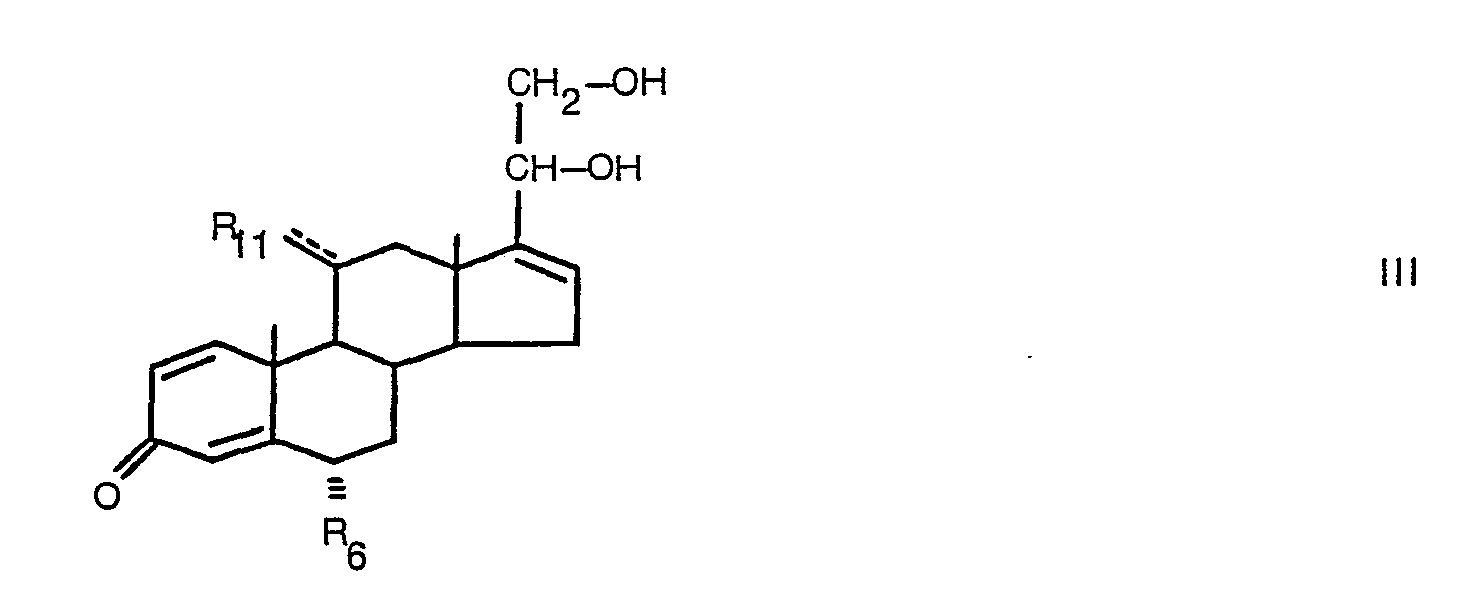
- This invention relates to novel 17a,20a-epoxypregna-1,4-dien-3-one 21-acylates (I), their conversion to 21-hydroxypregna-1,4,16-trien-3-one 21-acylates (II), their preparation from 21-hydroxypregna-1,4,17(20)-trien-3-one 21-acylates (0), and the preparation of 20,21-dihydroxypregna-1,4,16-trien-3-ones (III) by hydrolysis of the formula II compounds.
- the formula III compounds are useful as intermediates in the production of anti-inflammatory agents.
- U.S. Patent Specification No 3,444,216 discloses 11 ⁇ ,21-dihydroxypregna-4-en-3-one.
- U.S. Patent Specification No 3,375,261 discloses 21-acylated steroids having a A l double bond.
- the reaction of a ketone with a peracid is well known in the art and has been termed the Baeyer-Villiger reaction (the oxidation of ketones with peracids).
- the Baeyer-Villiger reaction an oxygen atom is inserted between the carbonyl group and the alkyl portion of the ketone, thereby forming an ester.
- a cyclic ketone such as a 3-keto steroid
- the resulting product is the corresponding A-ring lactone, as is shown in Organic Reactions 9, 73 (1957) and J. Med. Pharm. Chem. 5, 714 (1962).
- Page 79 of the former reference shows the exact problem that may be anticipated when epoxidising a carbon-carbon double bond in a 3-keto steroid while wishing not to affect the A-ring.
- Page 715 of the latter reference discloses the Baeyer-Villiger reaction when the reactant is a A4 - 3-keto steroid. The lactone and subsequent side reaction products are formed. It might therefore be anticipated that a not insignificant amount of Baeyer-Villiger product (lactone) would be obtained when any 3-keto steroid or, more specifically, when a ⁇ 4 -3-keto or a ⁇ 1,4 -3-keto steroid was reacted with a peracid.
- the first 2 steps of the disclosed process comprise the transformation of a 1 1 ⁇ ,21-dihydroxypregna-4,17(20)-dien-3-one to a 11 ⁇ ,20,21-trihydroxypregna-4,16-dien-3-one, using photosensitised oxygenation followed by reduction.
- Example 1 of this specification discloses that, starting with 165.2 g (0.5 mole) of the ⁇ 17(20) compound, 51.1 g (0.15 moles) of the ⁇ 16 -21-ol are obtained, a 30% chemical yield.
- U.S. Patent Specification No. 3,281,415 discloses the transformation of a 17(20)-oiefinic steroid to the corresponding ⁇ 16 -20-keto steroid.
- Claim 20 claims a process of producing compounds of formulae II and III of the present invention using photosensitised oxygenation.
- 11 ⁇ ,20 ⁇ ,21-trihydroxy-1,4,16-pregnatrien-3-one 21-acetate is disclosed as a starting material for the preparation of the corresponding 20-keto compound, but there is no indication of how the starting material might be prepared.
- German Specification No. 1,301,999 discloses a process for transforming a 17a,20a-epoxypregnane to a ⁇ 16 -21-ol in about 90% yield by use of 1.82 equivalents of hydrogen bromide.
- the 10% impurity is the 17 ⁇ -bromide.
- German Specification No. 1,297,604 discloses a process for transforming a ⁇ 17(20) -pregnane into a ⁇ 16 -21-ol by peracid oxidation of the A17(20)-pregnane to the corresponding 17a,20a-epoxide which is then reacted with hydrogen iodide to form a 17 ⁇ -iodide which is then transformed to the ⁇ 16 -21-ol.
- Novel compounds according to the present invention are of formula I: wherein R 6 is hydrogen, methyl or fluorine; R 11 is ⁇ -hydroxy or oxo; and R 21 is C 1-3 alkyl or phenyl optionally substituted by up to 3 substituents independently selected from fluorine, chlorine, methyl, methoxy and nitro.
- a compound of formula I as defined above is prepared by oxidising an olefin of formula 0: wherein R 6 , R 11 and R 21 are as defined above, with at least one molar equivalent of a peracid.
- a compound of formula II wherein R 6 , R 11 and R 21 are as defined above, is prepared by reacting an epoxide of formula I as defined above with hydrochloric or hydrobromic acid.
- a compound of formula III wherein R 6 and R11 are as defined above, is prepared by base hydrolysis of a compound of formula II as defined above.
- the ⁇ bond by which the R 11 substituent is attached to the C ring of the steroids means that there is a single bond when R 11 is A-hydroxy and a double bond when R 11 is oxo.
- the peracid oxidation of the 17(20) olefin of formula 0 to the 17 ⁇ ,20 ⁇ -epoxide of formula I can be performed with virtually any peracid.
- the preferred peracids are peracetic, perpropionic, perbenzoic and m-chloroperbenzoic acid.
- the most preferred peracid is peracetic acid.
- Peracids (especially peracetic acid) are commercially available or may be readily prepared from the corresponding acid by known procedures. At least 1.0 equivalent of the peracid is required. Usually no more than 5.0 equivalents are used and it is preferred that about 1.5 equivalents of the peracid are used.
- the peracid oxidation can be performed in most non-polar solvents, such as methylene chloride, chloroform, toluene, cyclohexane and Skellysolve B (a mixture of isomeric hexanes).
- the reaction can be performed at a temperature of about 0°C to the reflux temperature of the particular solvent utilised. It is preferred that the reaction temperature is 20-25°C. At colder temperatures, the reaction proceeds slowly and, while the reaction proceeds faster at high temperatures, heating is required. At 20-25°C the reaction is complete after stirring overnight.
- an inorganic reducing agent such as sodium thiosulphate or sodium sulphite.
- the epoxide of formula I is opened by reaction with either hydrochloric or, preferably, hydrobromic acid.
- the amount of the acid is usually below 0.5 equivalents; the preferred amount is 0.03-0.05 equivalents. More than 0.05 equivalents of acid can be used but, the greater the amount of acid, the greater the likelihood of hydrolysis of the C 21 ester and formation of the 17 ⁇ -halide.
- the epoxide opening is best performed in polar oxygenated solvents such as tetrahydrofuran (THF), dioxane or diethyl ether; THF is the preferred solvent. It is preferred that the polar oxygenated solvent is dry as less acid is then required. This reaction is preferably performed at 20-25°C although lower or higher temperatures will also work. The acid is best added slowly to the epoxide, in order to avoid side reactions.
- the hydrolysis of the formula II compound is performed utilising a strong base such as sodium hydroxide, potassium hydroxide, a methoxide, an ethoxide, sodium carbonate, potassium carbonate, sodium bicarbonate or potassium bicarbonate.
- a strong base such as sodium hydroxide, potassium hydroxide, a methoxide, an ethoxide, sodium carbonate, potassium carbonate, sodium bicarbonate or potassium bicarbonate.
- the hydrolysis reaction is performed in a polar solvent such as acetone and/or alcohol. At 20-25°C the reaction is complete in about 30 minutes. For weaker bases the reaction time will be a little longer.
- R 6 is preferably hydrogen
- R 11 is preferably ⁇ -hydroxy
- R 21 is preferably methyl.
- the invention is particularly suitable for the preparation of 11 ⁇ ,20,21-trihydroxypregna-1,4,16-trien-3-one (III) via 11 ⁇ ,20,21-trihydroxypregna-1,4,16-trien-3-one 21-acetate (II), 11 ⁇ ,21-dihydroxy-17 ⁇ ,20 ⁇ -epoxypregna-1,4-dien-3-one 21-acetate (I) and 11 ⁇ ,21-dihydroxypregna-1,4,17(20)-trien-3-one 21-acetate (0).
- the preferred compound of formula III is known from U.S. Patent Specification No. 3,725,392.
- the preferred compound of formula (III) is an important intermediate in the synthesis of 9 ⁇ -fluoro-16 ⁇ -methylprednisolone (betamethasone) which is an important anti-inflammatory steroid.
- the compounds of formulae I and II in which R 6 is methyl and R 11 is A-hydroxy are therefore important intermediates in the synthesis of betamethasone.
- TLC refers to thin-layer chromatography
- THF refers to tetrahydrofuran
- SSB refers to a mixture of isomeric hexanes
- saline refers to an aqueous saturated sodium chloride solution
- the mixture is then washed with aqueous sodium bicarbonate solution (6%, 600 ml) and a half-saturated sodium chloride solution (250 ml).
- the mixture is dried over magnesium sulfate and concentrated on a steam bath at 80°C at atmospheric pressure while replacing the methylene chloride with SSB.
- the mixture is concentrated to 250 ml, SSB (500 ml) is added, the mixture is concentrated to 425 ml, SSB (300 ml) is added and the mixture is concentrated to 425 ml at 65°C.
- the mixture is then cooled to 5°C and filtered.
- the methylene chloride is then replaced by SSB by the following procedure: the organic phase is concentrated at atmospheric pressure to about 3.1 I, SSB (4.3 I) is added, the mixture is again concentrated at atmospheric pressure to about 5.3 I, SSB (2.6 I) is added and the mixture once again concentrated to about 5.3 I. The mixture is then cooled and filtered to obtain the title compound, 1.03 kg (98.7% chemical yield).
- the total yield is about 35.81 g or 81.8%.
- the TLC (ethyl acetate/benzene; 45/55 v/v) of the mother liquid shows a substantial amount of a Baeyer-Villiger by-product as might be expected on the basis of what is known about reaction of ketones ( ⁇ °-3-keto function of ring A) with peracids.
- Example 2 11 ⁇ ,21-Dihydroxy-17 ⁇ ,20 ⁇ -epoxypregna-1,4-dien-3-one 21-acetate (Example 2, 1.0 kg) in THF (33 kg) is stirred at 25°C. Hydrogen bromide (48%, 15 ml) in THF (4.4 I) is added over a period of one hour and the mixture is stirred for another hour at 25-30 0 C. The mixture is concentrated under reduced pressure to 2 I, acetone (6.3 kg) is added and the mixture is kept at 20-25°C. The title compound may be isolated, if so desired, by the procedure of Example 3.
- 11 ⁇ ,20,21-Trihydroxypregna-1,4,16-trien-3-one 21-acetate (Example 4, 16.5 g) is dissolved in acetone (170 ml) and stirred at 20-25°C. Methanol (10 ml) and sodium methoxide in methanol (25%, 1.25 ml) are added and the mixture is stirred for 30 minutes. Acetic acid is added to neutralise the base, the mixture is concentrated under reduced pressure with a little heat and the title compound is obtained by crystallisation.
- Example 3 Methanol (0.5 I) and sodium methoxide (25% in methanol, 75 ml) are added to 11 ⁇ ,20,21-trihydroxypregna-1,4,16-trien-3-one 21-acetate (Example 3) in acetone and the mixture is stirred for 30 minutes at 20-25°C.
- the title compound is obtained by the work-up procedure of Example 5.
Landscapes
- Chemical & Material Sciences (AREA)
- Organic Chemistry (AREA)
- Health & Medical Sciences (AREA)
- General Health & Medical Sciences (AREA)
- Steroid Compounds (AREA)
Description
- This invention relates to novel 17a,20a-epoxypregna-1,4-dien-3-one 21-acylates (I), their conversion to 21-hydroxypregna-1,4,16-trien-3-one 21-acylates (II), their preparation from 21-hydroxypregna-1,4,17(20)-trien-3-one 21-acylates (0), and the preparation of 20,21-dihydroxypregna-1,4,16-trien-3-ones (III) by hydrolysis of the formula II compounds. The formula III compounds are useful as intermediates in the production of anti-inflammatory agents.
- It will be appreciated that the preparation of the formula II compounds from the formula 0 compounds via the formula I epoxides involves a change in position of a carbon-carbon double bond.
- U.S. Patent Specification No 3,444,216 discloses 11β,21-dihydroxypregna-4-en-3-one. U.S. Patent Specification No 3,375,261 discloses 21-acylated steroids having a Aldouble bond.
- The reaction of a ketone with a peracid is well known in the art and has been termed the Baeyer-Villiger reaction (the oxidation of ketones with peracids). In the Baeyer-Villiger reaction, an oxygen atom is inserted between the carbonyl group and the alkyl portion of the ketone, thereby forming an ester. In the case of a cyclic ketone, such as a 3-keto steroid, it is well known that the resulting product is the corresponding A-ring lactone, as is shown in Organic Reactions 9, 73 (1957) and J. Med. Pharm. Chem. 5, 714 (1962). Page 79 of the former reference shows the exact problem that may be anticipated when epoxidising a carbon-carbon double bond in a 3-keto steroid while wishing not to affect the A-ring. Page 715 of the latter reference discloses the Baeyer-Villiger reaction when the reactant is a A4-3-keto steroid. The lactone and subsequent side reaction products are formed. It might therefore be anticipated that a not insignificant amount of Baeyer-Villiger product (lactone) would be obtained when any 3-keto steroid or, more specifically, when a Δ4-3-keto or a Δ1,4-3-keto steroid was reacted with a peracid.
- In contrast, the U.S. Patent Specification No. 3,876,633 discloses oxidation of a Δ17(20)-steroid to the corresponding 17α,20α-epoxy-steroid in a 97% yield (weight). This is not unexpected because the steroid used in this process did not have a ketone group in ring A and therefore no side reaction (Baeyer-Villiger reaction) was possible.
- Surprisingly it has been found that, when a compound of formula 0 is reacted with a peracid, a formula I compound is formed and the amount of any Baeyer-Villiger reaction products can be very low.
- It is known that the position of carbon-carbon double bonds in steroids can be changed. For example, U.S. Patent Specification No. 3,725,392 discloses a process for producing various 9a-fluoro-16β-alkylprednisolones, including 9α-fluoro-16β-methylprednisolone (betamethasone), which are known to be highly active anti-inflammatory agents. The prednisolones type steroids have a Δ1,4-3-keto A ring. This specification discloses that the process can be performed on a prednisolone-type compound or on a cortisone-type (Δ4-3-keto) compound, the A' double bond being put in later. The first 2 steps of the disclosed process comprise the transformation of a 1 1β,21-dihydroxypregna-4,17(20)-dien-3-one to a 11β,20,21-trihydroxypregna-4,16-dien-3-one, using photosensitised oxygenation followed by reduction. Example 1 of this specification discloses that, starting with 165.2 g (0.5 mole) of the Δ17(20) compound, 51.1 g (0.15 moles) of the Δ16-21-ol are obtained, a 30% chemical yield.
- U.S. Patent Specification No. 3,281,415 discloses the transformation of a 17(20)-oiefinic steroid to the corresponding Δ16-20-keto steroid. Claim 20 claims a process of producing compounds of formulae II and III of the present invention using photosensitised oxygenation. In column 30, at line 8, 11β,20α,21-trihydroxy-1,4,16-pregnatrien-3-one 21-acetate is disclosed as a starting material for the preparation of the corresponding 20-keto compound, but there is no indication of how the starting material might be prepared.
- German Specification No. 1,301,999 discloses a process for transforming a 17a,20a-epoxypregnane to a Δ16-21-ol in about 90% yield by use of 1.82 equivalents of hydrogen bromide. The 10% impurity is the 17β-bromide.
- German Specification No. 1,297,604 discloses a process for transforming a Δ17(20)-pregnane into a Δ16-21-ol by peracid oxidation of the A17(20)-pregnane to the corresponding 17a,20a-epoxide which is then reacted with hydrogen iodide to form a 17β-iodide which is then transformed to the Δ16-21-ol.
- U.S. Patent Specification No. 4,089,852 discloses the preparation of 21-hydroxypregn-16-3n-20-ones by alkylating a 17-keto steroid with a lithium reagent of the formula LiC(OR4)=CHOR3, thereby introducing, at the 17-position, a β-hydroxy group and a -C(OR4)=CHOR3 group in the a-position, eliminating the 17β-hydroxy and hydrolysing the OR4 group. It is to be noted that this process does not involve the step-wise migration of a carbon-carbon double bond. Further, this process requires an expensive lithium reagent. The claims are limited to the use of 17-keto steroids which do not have any other free keto function and the reaction is therefore apparently inapplicable to 3-ketopregnanes.
- Surprisingly, it has been found that a formula I compound can be reacted to form a formula II compound in good yield, using only a low amount of a hydrogen halide and producing only a small amount of the 17β-halide. apparently without forming that compound as an intermediate.
- Compounds of formula II are disclosed in U.S. Patent Specifications Nos. 3,068,251 and 3,056,807. Both these specifications disclose 11β,20β,21-trihydroxy-1,14,16-pregnatrien-3-one 21-acetate.
- Novel compounds according to the present invention are of formula I:

- According to a first process of the invention, a compound of formula I as defined above is prepared by oxidising an olefin of formula 0:

- According to a second process of the invention, a compound of formula II:

- According to a third process of the invention, a compound of formula III:

- In the formulae in this specification, the ― bond by which the R11 substituent is attached to the C ring of the steroids means that there is a single bond when R11 is A-hydroxy and a double bond when R11 is oxo.
- The peracid oxidation of the 17(20) olefin of formula 0 to the 17α,20α-epoxide of formula I can be performed with virtually any peracid. The preferred peracids are peracetic, perpropionic, perbenzoic and m-chloroperbenzoic acid. The most preferred peracid is peracetic acid. Peracids (especially peracetic acid) are commercially available or may be readily prepared from the corresponding acid by known procedures. At least 1.0 equivalent of the peracid is required. Usually no more than 5.0 equivalents are used and it is preferred that about 1.5 equivalents of the peracid are used. The peracid oxidation can be performed in most non-polar solvents, such as methylene chloride, chloroform, toluene, cyclohexane and Skellysolve B (a mixture of isomeric hexanes). The reaction can be performed at a temperature of about 0°C to the reflux temperature of the particular solvent utilised. It is preferred that the reaction temperature is 20-25°C. At colder temperatures, the reaction proceeds slowly and, while the reaction proceeds faster at high temperatures, heating is required. At 20-25°C the reaction is complete after stirring overnight. When the oxidation reaction is complete as measured by thin layer chromatography, any excess peracid is destroyed by an inorganic reducing agent such as sodium thiosulphate or sodium sulphite.
- The epoxide of formula I is opened by reaction with either hydrochloric or, preferably, hydrobromic acid. The amount of the acid is usually below 0.5 equivalents; the preferred amount is 0.03-0.05 equivalents. More than 0.05 equivalents of acid can be used but, the greater the amount of acid, the greater the likelihood of hydrolysis of the C21 ester and formation of the 17β-halide. The epoxide opening is best performed in polar oxygenated solvents such as tetrahydrofuran (THF), dioxane or diethyl ether; THF is the preferred solvent. It is preferred that the polar oxygenated solvent is dry as less acid is then required. This reaction is preferably performed at 20-25°C although lower or higher temperatures will also work. The acid is best added slowly to the epoxide, in order to avoid side reactions.
- The hydrolysis of the formula II compound is performed utilising a strong base such as sodium hydroxide, potassium hydroxide, a methoxide, an ethoxide, sodium carbonate, potassium carbonate, sodium bicarbonate or potassium bicarbonate. The hydrolysis reaction is performed in a polar solvent such as acetone and/or alcohol. At 20-25°C the reaction is complete in about 30 minutes. For weaker bases the reaction time will be a little longer.
- In the present invention, R6 is preferably hydrogen, R11 is preferably β-hydroxy and R21 is preferably methyl. The invention is particularly suitable for the preparation of 11β,20,21-trihydroxypregna-1,4,16-trien-3-one (III) via 11β,20,21-trihydroxypregna-1,4,16-trien-3-one 21-acetate (II), 11β,21-dihydroxy-17α,20α-epoxypregna-1,4-dien-3-one 21-acetate (I) and 11β,21-dihydroxypregna-1,4,17(20)-trien-3-one 21-acetate (0). The preferred compound of formula III is known from U.S. Patent Specification No. 3,725,392. Therefore the preferred compound of formula (III) is an important intermediate in the synthesis of 9α-fluoro-16β-methylprednisolone (betamethasone) which is an important anti-inflammatory steroid. The compounds of formulae I and II in which R6 is methyl and R11 is A-hydroxy are therefore important intermediates in the synthesis of betamethasone.
- The following Examples illustrate the invention. Comparative Examples are provided for reference. In the Examples, TLC refers to thin-layer chromatography; THF refers to tetrahydrofuran; SSB refers to a mixture of isomeric hexanes; "saline" refers to an aqueous saturated sodium chloride solution;

- 79.5 g of 11β,21-dihydroxypregna-1,4,17(20)-trien-3-one 21-acetate (formula 0 - see U.S. Patent Specification No. 2,842,569), 800 ml of methylene chloride and 9.3 g of anhydrous sodium acetate are stirred under nitrogen at 19°C. Peracetic acid (40%, 55 ml) is added to the mixture over a period of 10 minutes. The reaction mixture is stirred for 20 hours at 20-25°C. Sodium thiosulfate solution (1 5%, 200 ml) is added to destroy the excess peracetic acid. The mixture is then washed with aqueous sodium bicarbonate solution (6%, 600 ml) and a half-saturated sodium chloride solution (250 ml). The mixture is dried over magnesium sulfate and concentrated on a steam bath at 80°C at atmospheric pressure while replacing the methylene chloride with SSB. The mixture is concentrated to 250 ml, SSB (500 ml) is added, the mixture is concentrated to 425 ml, SSB (300 ml) is added and the mixture is concentrated to 425 ml at 65°C. The mixture is then cooled to 5°C and filtered. The solids are washed with SSB and dried under reduced pressure at 70°C to give the title compound, 81.86 g (98.7% chemical yield), m.p. 174-185°C; [a]p5 + 81.8° (chloroform).
- 11f),21-Dihydroxypregna-1,4,17(20)-trien-3-one 21-acetate (1 kg), sodium acetate (117 g) and methylene chloride (10 I) are stirred at 20°C. Peracetic acid (40% 692 ml) is added over a period of an hour and the mixture is stirred overnight at 20°C. The reaction mixture is washed with anhydrous sodium thiosulfate (1 5%, 2.83 I). The organic phase is then washed with aqueous sodium bicarbonate (9%, 6.5 I) followed by a wash with an aqueous sodium chloride solution (13%, 3.1 I). The methylene chloride is then replaced by SSB by the following procedure: the organic phase is concentrated at atmospheric pressure to about 3.1 I, SSB (4.3 I) is added, the mixture is again concentrated at atmospheric pressure to about 5.3 I, SSB (2.6 I) is added and the mixture once again concentrated to about 5.3 I. The mixture is then cooled and filtered to obtain the title compound, 1.03 kg (98.7% chemical yield).
- A solution of 11β,21-dihydroxypregna-4,17(20)-dien-3-one 21-acetate (42.0 g) in methylene chloride (450 ml) is stirred with cooling at 0°C while a mixture of m-chloroperbenzoic acid (26.4 g, 80.2% pure) is added over a period of 13 minutes. The mixture is stirred at 0-5°C for 90 minutes and then at 20-25°C for 16 hours. The reaction mixture is washed with a sodium bicarbonate solution (5%) and then with water. The methylene chloride solution is dried over anhydrous magnesium sulfate and the organic diluent is removed under reduced pressure while heating in a water bath at 50-60°C. The residue is crystallised from acetone to give 17α,20α-epoxy-11β,21-dihydroxypregna-4-en-3-one 21-acetate (34.314 g). A second crop of crystals was obtained (3.0 g) containing about 50% of the desired epoxide.
- The total yield is about 35.81 g or 81.8%. The TLC (ethyl acetate/benzene; 45/55 v/v) of the mother liquid shows a substantial amount of a Baeyer-Villiger by-product as might be expected on the basis of what is known about reaction of ketones (Δ°-3-keto function of ring A) with peracids.
- 11β,21-Dihydroxy-17α,20α-epoxypregna-1,4-dien-3-one 21-acetate (Example 1, 20 g) in THF (700 ml) is stirred at 23.5°C. A solution of hydrogen bromide (48%, 0.31 ml) in THF (100 ml) is added to the mixture over a period of 38 minutes. The reaction temperature increases from 23.5° to 25.5°C during the hydrogen bromide addition. The mixture is stirred for 20 minutes and then concentrated under reduced pressure at 43°C to an oil. The oil is dissolved in methylene chloride (50 ml) at reflux. The mixture is concentrated on a steam bath at atmospheric pressure while replacing the methylene chloride with diethyl ether. When all the methylene chloride is removed the mixture is stirred at 20-25°C for 3 hours and filtered. The solids are washed with diethyl ether and dried under reduced pressure at 70°C to give the title compound, 18.1 g (90.5% chemical yield), m.p. 121.5-135.5°C;(chloroform).

- 11β,21-Dihydroxy-17α,20α-epoxypregna-1,4-dien-3-one 21-acetate (Example 2, 1.0 kg) in THF (33 kg) is stirred at 25°C. Hydrogen bromide (48%, 15 ml) in THF (4.4 I) is added over a period of one hour and the mixture is stirred for another hour at 25-300C. The mixture is concentrated under reduced pressure to 2 I, acetone (6.3 kg) is added and the mixture is kept at 20-25°C. The title compound may be isolated, if so desired, by the procedure of Example 3.
- Following the procedures of Examples 1 and 3, 11β,21-dihydroxypregna-1,4-17(20)-trien-3-one, i.e. the non-acylated compound, was converted to 11β,20,21-trihydroxypregna-1,4,16-trien-3-one, compounds disclosed in U.S. Patent Specification No. 3,725,392, at temperatures of 15°C and 30°C (23.5-25.5°C was used in Example 3 above). At 15°C the overall chemical yield was 49.5% and was 74.2% at 30°C. While the yield is clearly temperature dependent, the overall chemical yield of Example 1 and 3 above was about 89%.
- 11β,20,21-Trihydroxypregna-1,4,16-trien-3-one 21-acetate (Example 4, 16.5 g) is dissolved in acetone (170 ml) and stirred at 20-25°C. Methanol (10 ml) and sodium methoxide in methanol (25%, 1.25 ml) are added and the mixture is stirred for 30 minutes. Acetic acid is added to neutralise the base, the mixture is concentrated under reduced pressure with a little heat and the title compound is obtained by crystallisation.
- Methanol (0.5 I) and sodium methoxide (25% in methanol, 75 ml) are added to 11β,20,21-trihydroxypregna-1,4,16-trien-3-one 21-acetate (Example 3) in acetone and the mixture is stirred for 30 minutes at 20-25°C. The title compound is obtained by the work-up procedure of Example 5.
Claims (8)


Applications Claiming Priority (2)
| Application Number | Priority Date | Filing Date | Title |
|---|---|---|---|
| US92950878A | 1978-07-31 | 1978-07-31 | |
| US929508 | 1978-07-31 |
Publications (3)
| Publication Number | Publication Date |
|---|---|
| EP0007766A2 EP0007766A2 (en) | 1980-02-06 |
| EP0007766A3 EP0007766A3 (en) | 1980-02-20 |
| EP0007766B1 true EP0007766B1 (en) | 1983-12-28 |
Family
ID=25457969
Family Applications (1)
| Application Number | Title | Priority Date | Filing Date |
|---|---|---|---|
| EP19790301411 Expired EP0007766B1 (en) | 1978-07-31 | 1979-07-17 | Epoxypregnadienes, hydroxypregnatrienes, process for their preparation and process for their conversion to precursors of useful anti-inflammatory agents |
Country Status (2)
| Country | Link |
|---|---|
| EP (1) | EP0007766B1 (en) |
| DE (1) | DE2966511D1 (en) |
Families Citing this family (1)
| Publication number | Priority date | Publication date | Assignee | Title |
|---|---|---|---|---|
| HU198736B (en) * | 1986-12-29 | 1989-11-28 | Gyogyszerkutato Intezet | Process for producing 16-dehydro-20-oxopregnane derivatives |
Family Cites Families (4)
| Publication number | Priority date | Publication date | Assignee | Title |
|---|---|---|---|---|
| US2873272A (en) * | 1955-07-13 | 1959-02-10 | Upjohn Co | 11-oxygenated-17alpha, 20alpha-epoxy-4-pregnenes |
| US3068251A (en) * | 1960-01-11 | 1962-12-11 | Upjohn Co | Process for the preparation of 16alpha-hydroxylated steroids and novel intermediates |
| US3056807A (en) * | 1961-10-09 | 1962-10-02 | Upjohn Co | Process for the preparation of fluorosteroids |
| DE1301999B (en) * | 1965-01-29 | 1969-09-25 | Schering Ag | Process for the production of delta 4, 16-pregnadien-20-ol-3-one |
-
1979
- 1979-07-17 EP EP19790301411 patent/EP0007766B1/en not_active Expired
- 1979-07-17 DE DE7979301411T patent/DE2966511D1/en not_active Expired
Also Published As
| Publication number | Publication date |
|---|---|
| EP0007766A3 (en) | 1980-02-20 |
| EP0007766A2 (en) | 1980-02-06 |
| DE2966511D1 (en) | 1984-02-02 |
Similar Documents
| Publication | Publication Date | Title |
|---|---|---|
| US4041055A (en) | Process for the preparation of 17α-hydroxyprogesterones and corticoids from androstenes | |
| KR0132570B1 (en) | Method of the systhesis of 6-methylene derivatives of androsta-1,4-diene-3,17-dione | |
| US4613463A (en) | Process and intermediates for the preparation of 17 alphahydroxyprogesterones and corticoids from an enol steroid | |
| US4189430A (en) | Epoxide process | |
| US5817803A (en) | Process for preparing neuromuscular blocking agents and intermediates useful therefor | |
| EP0187847A1 (en) | PROCESS FOR THE MANUFACTURE OF 6$g(A)-METHYL STEROIDS | |
| EP0007766A2 (en) | Epoxypregnadienes, hydroxypregnatrienes, process for their preparation and process for their conversion to precursors of useful anti-inflammatory agents | |
| US5248773A (en) | 16-methyl-Δ1,4-pregnadiene-3,20-diones | |
| US4451404A (en) | 16β-Methyl steroid process | |
| CS250695B2 (en) | Method of pregnane derivatives production | |
| US7417140B2 (en) | 7α-Hydroxyacetyl and 7α-Hydroperoxyacetyl-substituted steroid compounds | |
| US4046760A (en) | Process for preparing 1-α-hydroxy cholesterol derivatives | |
| HU196430B (en) | Process for producing 17-alpha-ethinyl-17-beta-hydroxy-18-methyl-4,15-estradien-3-one | |
| US4031080A (en) | 16-Alpha-methyl-17 alpha-bromo-1,4-pregnadiene-21-ol-3,20-dione-derivatives | |
| US6787659B2 (en) | Process for the production of oxandrolone | |
| HU203768B (en) | New metilating process for producing 16-alpha-methyl-steroides | |
| DE2237202A1 (en) | PROCESS FOR THE PRODUCTION OF 17 (2-HALOAETHYLIDEN) STEROIDS | |
| HU187382B (en) | Process for producing 17-beta-ethnyl-steroides | |
| US4155923A (en) | Process for the preparation of 17β-hydroxy-20-alkoxypregnane-21-oic acid derivatives | |
| JP2714392B2 (en) | Method for producing steroid derivatives | |
| US4440689A (en) | Acyloxysteroids and process for producing same | |
| HU198736B (en) | Process for producing 16-dehydro-20-oxopregnane derivatives | |
| AU636433B2 (en) | Process for dehydrating corticosteroid intermediates | |
| CA1122591A (en) | .delta. sun15 xx-steroid | |
| WO1991014700A2 (en) | PROCESS FOR 9α-HYDROXY STEROID DEHYDRATION |
Legal Events
| Date | Code | Title | Description |
|---|---|---|---|
| PUAI | Public reference made under article 153(3) epc to a published international application that has entered the european phase |
Free format text: ORIGINAL CODE: 0009012 |
|
| PUAL | Search report despatched |
Free format text: ORIGINAL CODE: 0009013 |
|
| AK | Designated contracting states |
Designated state(s): CH DE FR GB IT NL |
|
| AK | Designated contracting states |
Designated state(s): CH DE FR GB IT NL |
|
| 17P | Request for examination filed | ||
| R17P | Request for examination filed (corrected) | ||
| ITF | It: translation for a ep patent filed | ||
| GRAA | (expected) grant |
Free format text: ORIGINAL CODE: 0009210 |
|
| AK | Designated contracting states |
Designated state(s): CH DE FR GB IT NL |
|
| REF | Corresponds to: |
Ref document number: 2966511 Country of ref document: DE Date of ref document: 19840202 |
|
| ET | Fr: translation filed | ||
| PLBE | No opposition filed within time limit |
Free format text: ORIGINAL CODE: 0009261 |
|
| STAA | Information on the status of an ep patent application or granted ep patent |
Free format text: STATUS: NO OPPOSITION FILED WITHIN TIME LIMIT |
|
| 26N | No opposition filed | ||
| ITTA | It: last paid annual fee | ||
| NLT1 | Nl: modifications of names registered in virtue of documents presented to the patent office pursuant to art. 16 a, paragraph 1 |
Owner name: PHARMACIA & UPJOHN COMPANY |
|
| REG | Reference to a national code |
Ref country code: CH Ref legal event code: PFA Free format text: THE UPJOHN COMPANY TRANSFER- PHARMACIA & UPJOHN COMPANY |
|
| REG | Reference to a national code |
Ref country code: FR Ref legal event code: CD |
|
| PGFP | Annual fee paid to national office [announced via postgrant information from national office to epo] |
Ref country code: NL Payment date: 19980623 Year of fee payment: 20 Ref country code: GB Payment date: 19980623 Year of fee payment: 20 |
|
| PGFP | Annual fee paid to national office [announced via postgrant information from national office to epo] |
Ref country code: FR Payment date: 19980707 Year of fee payment: 20 |
|
| PGFP | Annual fee paid to national office [announced via postgrant information from national office to epo] |
Ref country code: DE Payment date: 19980728 Year of fee payment: 20 |
|
| PGFP | Annual fee paid to national office [announced via postgrant information from national office to epo] |
Ref country code: CH Payment date: 19981013 Year of fee payment: 20 |
|
| PG25 | Lapsed in a contracting state [announced via postgrant information from national office to epo] |
Ref country code: GB Free format text: LAPSE BECAUSE OF NON-PAYMENT OF DUE FEES Effective date: 19990716 Ref country code: CH Free format text: LAPSE BECAUSE OF EXPIRATION OF PROTECTION Effective date: 19990716 |
|
| PG25 | Lapsed in a contracting state [announced via postgrant information from national office to epo] |
Ref country code: NL Free format text: LAPSE BECAUSE OF EXPIRATION OF PROTECTION Effective date: 19990717 |
|
| REG | Reference to a national code |
Ref country code: GB Ref legal event code: PE20 Effective date: 19990716 |
|
| REG | Reference to a national code |
Ref country code: CH Ref legal event code: PL |
|
| NLV7 | Nl: ceased due to reaching the maximum lifetime of a patent |
Effective date: 19990717 |