EP0007639B1 - New metal plastic laminates from polyolefin compositions having high impact resistance and high temperature flow resistance - Google Patents
New metal plastic laminates from polyolefin compositions having high impact resistance and high temperature flow resistance Download PDFInfo
- Publication number
- EP0007639B1 EP0007639B1 EP19790102688 EP79102688A EP0007639B1 EP 0007639 B1 EP0007639 B1 EP 0007639B1 EP 19790102688 EP19790102688 EP 19790102688 EP 79102688 A EP79102688 A EP 79102688A EP 0007639 B1 EP0007639 B1 EP 0007639B1
- Authority
- EP
- European Patent Office
- Prior art keywords
- metal
- polyolefin
- weight percent
- plastic laminate
- propylene
- Prior art date
- Legal status (The legal status is an assumption and is not a legal conclusion. Google has not performed a legal analysis and makes no representation as to the accuracy of the status listed.)
- Expired
Links
Images


Classifications
-
- B—PERFORMING OPERATIONS; TRANSPORTING
- B32—LAYERED PRODUCTS
- B32B—LAYERED PRODUCTS, i.e. PRODUCTS BUILT-UP OF STRATA OF FLAT OR NON-FLAT, e.g. CELLULAR OR HONEYCOMB, FORM
- B32B15/00—Layered products comprising a layer of metal
- B32B15/04—Layered products comprising a layer of metal comprising metal as the main or only constituent of a layer, which is next to another layer of the same or of a different material
- B32B15/08—Layered products comprising a layer of metal comprising metal as the main or only constituent of a layer, which is next to another layer of the same or of a different material of synthetic resin
-
- B—PERFORMING OPERATIONS; TRANSPORTING
- B32—LAYERED PRODUCTS
- B32B—LAYERED PRODUCTS, i.e. PRODUCTS BUILT-UP OF STRATA OF FLAT OR NON-FLAT, e.g. CELLULAR OR HONEYCOMB, FORM
- B32B15/00—Layered products comprising a layer of metal
- B32B15/04—Layered products comprising a layer of metal comprising metal as the main or only constituent of a layer, which is next to another layer of the same or of a different material
- B32B15/08—Layered products comprising a layer of metal comprising metal as the main or only constituent of a layer, which is next to another layer of the same or of a different material of synthetic resin
- B32B15/082—Layered products comprising a layer of metal comprising metal as the main or only constituent of a layer, which is next to another layer of the same or of a different material of synthetic resin comprising vinyl resins; comprising acrylic resins
-
- B—PERFORMING OPERATIONS; TRANSPORTING
- B32—LAYERED PRODUCTS
- B32B—LAYERED PRODUCTS, i.e. PRODUCTS BUILT-UP OF STRATA OF FLAT OR NON-FLAT, e.g. CELLULAR OR HONEYCOMB, FORM
- B32B15/00—Layered products comprising a layer of metal
- B32B15/04—Layered products comprising a layer of metal comprising metal as the main or only constituent of a layer, which is next to another layer of the same or of a different material
- B32B15/08—Layered products comprising a layer of metal comprising metal as the main or only constituent of a layer, which is next to another layer of the same or of a different material of synthetic resin
- B32B15/085—Layered products comprising a layer of metal comprising metal as the main or only constituent of a layer, which is next to another layer of the same or of a different material of synthetic resin comprising polyolefins
-
- B—PERFORMING OPERATIONS; TRANSPORTING
- B32—LAYERED PRODUCTS
- B32B—LAYERED PRODUCTS, i.e. PRODUCTS BUILT-UP OF STRATA OF FLAT OR NON-FLAT, e.g. CELLULAR OR HONEYCOMB, FORM
- B32B15/00—Layered products comprising a layer of metal
- B32B15/18—Layered products comprising a layer of metal comprising iron or steel
-
- B—PERFORMING OPERATIONS; TRANSPORTING
- B32—LAYERED PRODUCTS
- B32B—LAYERED PRODUCTS, i.e. PRODUCTS BUILT-UP OF STRATA OF FLAT OR NON-FLAT, e.g. CELLULAR OR HONEYCOMB, FORM
- B32B27/00—Layered products comprising a layer of synthetic resin
- B32B27/18—Layered products comprising a layer of synthetic resin characterised by the use of special additives
- B32B27/20—Layered products comprising a layer of synthetic resin characterised by the use of special additives using fillers, pigments, thixotroping agents
-
- C—CHEMISTRY; METALLURGY
- C08—ORGANIC MACROMOLECULAR COMPOUNDS; THEIR PREPARATION OR CHEMICAL WORKING-UP; COMPOSITIONS BASED THEREON
- C08K—Use of inorganic or non-macromolecular organic substances as compounding ingredients
- C08K3/00—Use of inorganic substances as compounding ingredients
- C08K3/01—Use of inorganic substances as compounding ingredients characterized by their specific function
- C08K3/013—Fillers, pigments or reinforcing additives
-
- C—CHEMISTRY; METALLURGY
- C08—ORGANIC MACROMOLECULAR COMPOUNDS; THEIR PREPARATION OR CHEMICAL WORKING-UP; COMPOSITIONS BASED THEREON
- C08K—Use of inorganic or non-macromolecular organic substances as compounding ingredients
- C08K3/00—Use of inorganic substances as compounding ingredients
- C08K3/18—Oxygen-containing compounds, e.g. metal carbonyls
- C08K3/24—Acids; Salts thereof
- C08K3/26—Carbonates; Bicarbonates
-
- C—CHEMISTRY; METALLURGY
- C08—ORGANIC MACROMOLECULAR COMPOUNDS; THEIR PREPARATION OR CHEMICAL WORKING-UP; COMPOSITIONS BASED THEREON
- C08K—Use of inorganic or non-macromolecular organic substances as compounding ingredients
- C08K3/00—Use of inorganic substances as compounding ingredients
- C08K3/30—Sulfur-, selenium- or tellurium-containing compounds
-
- C—CHEMISTRY; METALLURGY
- C08—ORGANIC MACROMOLECULAR COMPOUNDS; THEIR PREPARATION OR CHEMICAL WORKING-UP; COMPOSITIONS BASED THEREON
- C08K—Use of inorganic or non-macromolecular organic substances as compounding ingredients
- C08K3/00—Use of inorganic substances as compounding ingredients
- C08K3/34—Silicon-containing compounds
-
- C—CHEMISTRY; METALLURGY
- C08—ORGANIC MACROMOLECULAR COMPOUNDS; THEIR PREPARATION OR CHEMICAL WORKING-UP; COMPOSITIONS BASED THEREON
- C08L—COMPOSITIONS OF MACROMOLECULAR COMPOUNDS
- C08L23/00—Compositions of homopolymers or copolymers of unsaturated aliphatic hydrocarbons having only one carbon-to-carbon double bond; Compositions of derivatives of such polymers
- C08L23/02—Compositions of homopolymers or copolymers of unsaturated aliphatic hydrocarbons having only one carbon-to-carbon double bond; Compositions of derivatives of such polymers not modified by chemical after-treatment
-
- C—CHEMISTRY; METALLURGY
- C08—ORGANIC MACROMOLECULAR COMPOUNDS; THEIR PREPARATION OR CHEMICAL WORKING-UP; COMPOSITIONS BASED THEREON
- C08L—COMPOSITIONS OF MACROMOLECULAR COMPOUNDS
- C08L23/00—Compositions of homopolymers or copolymers of unsaturated aliphatic hydrocarbons having only one carbon-to-carbon double bond; Compositions of derivatives of such polymers
- C08L23/02—Compositions of homopolymers or copolymers of unsaturated aliphatic hydrocarbons having only one carbon-to-carbon double bond; Compositions of derivatives of such polymers not modified by chemical after-treatment
- C08L23/16—Ethylene-propylene or ethylene-propylene-diene copolymers
-
- B—PERFORMING OPERATIONS; TRANSPORTING
- B32—LAYERED PRODUCTS
- B32B—LAYERED PRODUCTS, i.e. PRODUCTS BUILT-UP OF STRATA OF FLAT OR NON-FLAT, e.g. CELLULAR OR HONEYCOMB, FORM
- B32B2307/00—Properties of the layers or laminate
- B32B2307/30—Properties of the layers or laminate having particular thermal properties
- B32B2307/306—Resistant to heat
-
- B—PERFORMING OPERATIONS; TRANSPORTING
- B32—LAYERED PRODUCTS
- B32B—LAYERED PRODUCTS, i.e. PRODUCTS BUILT-UP OF STRATA OF FLAT OR NON-FLAT, e.g. CELLULAR OR HONEYCOMB, FORM
- B32B2311/00—Metals, their alloys or their compounds
- B32B2311/30—Iron, e.g. steel
-
- B—PERFORMING OPERATIONS; TRANSPORTING
- B32—LAYERED PRODUCTS
- B32B—LAYERED PRODUCTS, i.e. PRODUCTS BUILT-UP OF STRATA OF FLAT OR NON-FLAT, e.g. CELLULAR OR HONEYCOMB, FORM
- B32B2323/00—Polyalkenes
- B32B2323/04—Polyethylene
- B32B2323/043—HDPE, i.e. high density polyethylene
-
- B—PERFORMING OPERATIONS; TRANSPORTING
- B32—LAYERED PRODUCTS
- B32B—LAYERED PRODUCTS, i.e. PRODUCTS BUILT-UP OF STRATA OF FLAT OR NON-FLAT, e.g. CELLULAR OR HONEYCOMB, FORM
- B32B2323/00—Polyalkenes
- B32B2323/04—Polyethylene
- B32B2323/046—LDPE, i.e. low density polyethylene
-
- Y—GENERAL TAGGING OF NEW TECHNOLOGICAL DEVELOPMENTS; GENERAL TAGGING OF CROSS-SECTIONAL TECHNOLOGIES SPANNING OVER SEVERAL SECTIONS OF THE IPC; TECHNICAL SUBJECTS COVERED BY FORMER USPC CROSS-REFERENCE ART COLLECTIONS [XRACs] AND DIGESTS
- Y10—TECHNICAL SUBJECTS COVERED BY FORMER USPC
- Y10T—TECHNICAL SUBJECTS COVERED BY FORMER US CLASSIFICATION
- Y10T428/00—Stock material or miscellaneous articles
- Y10T428/31504—Composite [nonstructural laminate]
- Y10T428/31678—Of metal
- Y10T428/31692—Next to addition polymer from unsaturated monomers
-
- Y—GENERAL TAGGING OF NEW TECHNOLOGICAL DEVELOPMENTS; GENERAL TAGGING OF CROSS-SECTIONAL TECHNOLOGIES SPANNING OVER SEVERAL SECTIONS OF THE IPC; TECHNICAL SUBJECTS COVERED BY FORMER USPC CROSS-REFERENCE ART COLLECTIONS [XRACs] AND DIGESTS
- Y10—TECHNICAL SUBJECTS COVERED BY FORMER USPC
- Y10T—TECHNICAL SUBJECTS COVERED BY FORMER US CLASSIFICATION
- Y10T428/00—Stock material or miscellaneous articles
- Y10T428/31504—Composite [nonstructural laminate]
- Y10T428/31678—Of metal
- Y10T428/31692—Next to addition polymer from unsaturated monomers
- Y10T428/31696—Including polyene monomers [e.g., butadiene, etc.]
Definitions
- This invention relates to metal plastic laminates with a core material having a high level of impact resistance and high temperature flow resistance.
- a-olefins can be polymerized to form normally solid polymers possessing widely differing physical properties, such as melt flow, tensile strength, rigidity and impact strength. Depending upon the level of the particular properties, these polymers are utilized in the formation of fibres, films and molded articles. There are occasions, however, when it is desirable to improve one or more of the physical properties of these polymers for a particular purpose. Many materials have been added to the polymers in efforts to achieve such improvements in the properties. While some specific physical property may be improved in the resulting composition, it is usually at the sacrifice of some other property or properties.
- polymers of propylene have been used extensively in the fabrication of molded parts. It is also generally recognized that these polymers are relatively flexible and lack the rigidity required from some end uses, particularly where the fabricated parts are subjected to a relatively high temperature.
- polypropylene would be an inexpensive core material for steel-plastic laminates in the automotive industry, it will not withstand the high temperatures (191 °C) of the paint baking cycle customarily used in fabricating automotive products.
- these polymers of propylene lack impact resistance as shown by their low notched Izod impact values. Because of these deficiencies in impact resistance, it has not been possible to substitute lower cost polypropylene for high cost polymers such as acrylonitrile-butadiene-styrene (ABS).
- ABS acrylonitrile-butadiene-styrene
- the polymer is blended with an elastomer.
- the addition of the elastomer does increase the impact strength of the polymer.
- such addition of elastomer to polymers of propylene result in a lower heat deflection temperature and a loss of rigidity, that is to say the modulus of elasticity is adversely affected.
- additions of different elastomers to the same polymer have varying effects on the strength of the polymer.
- compositions comprising additions of both elastomers and fillers to polyolefins in attempts to utilize, in combination, the ability of the individual additives to augment various properties of the particular polyolefin.
- U.S. Patent 3,572,721 discloses, in general, a blend of rubber and a thermoplastic far use in producing molded play balls, particularly golf balls having good resistance to cutting and producing an acceptable "click" when struck with a golf club.
- the blend comprises a substantially crystalline homopolymer or copolymer of an a-olefin and a rubber in an amount of 5 to.95 percent by weight of the blend but, practicably, a molded play ball is 50 to 90 percent by weight rubber.
- filler material from 30 to 70 percent by weight of the polymer can be added.
- U.S. Patent 3,860,542 describes a particular propylene resin composition that yields moldings claimed to have excellent mechanical properties such as impact strength, flexibility and flame- retardance.
- the propylene resin composition comprises 40 to 5 parts by weight of a propylene polymer and 60 to 95 parts by weight of alumina trihydrate having a gibbsite crystal structure as the filler and 5 to 15 parts by weight, based on 100 parts by weight of the propylene polymer and filler, of one or more high molecular weight organic substances having a softening point below room temperature.
- U.S. Patent 3,963,647 describes an injection moldable, electrostatically paintable polyolefin composition comprising 20-100 parts of a crystalline propylene polymer, 100 parts of an ethylene- higher a-olefin copolymer elastomer and a carbon black filler.
- U.S. Patent 4,002,595 discloses directly electroplatable polypropylene compositions comprising a propylene homopolymer or copolymer, an ethylene homopolymer or copolymer, a low polarity rubber, carbon black filler and, optionally, a silicate mineral additive.
- compositions containing a polyolefin, an elastomer and a filler having various improved properties there nevertheless remains a need for polyolefin resin blends that have exceptional impact resistance over a limited compositional range while incorporating relatively high levels of inexpensive filler.
- the above desired properties can be had with a polyolefin resin blend comprising 30 to 90 weight percent resin and 10 to 70 weight percent filler.
- the resin portion contains greater than 50 to less than 75 weight percent of at least one polyolefin selected from the group consisting of isotactic crystalline polypropylene, high density crystalline polyethylene, low density polyethylene and propylene-ethylene copolymers.
- the propylene-ethylene copolymers are 85-95 weight percent propylene and have a tensile yield elongation no greater than 20%.
- the remainder of the resin portion is comprised of greater than 25 to less than 50 weight percent elastomer.
- the elastomers used in this invention are defined as being those rubber-like, impact modifying materials having a break elongation greater than 200%.
- the filler is preferably an inorganic filler selected from the group consisting of calcium carbonate, talc, clay, silica, quartz, mica and barytes.
- polyolefin resin compositions are particularly useful as the core material in metal-plastic laminates in which the core material must possess high impact resistance and rigidity and good high temperature flow resistance.
- the core material consists essentially of:
- the impact strength of a polyolefin composition exhibits an inverse relationship with the amount of filler added.
- the filler content increases the impact resistance of the polyolefin composition decreases.
- additions of elastomer to a polyolefin result in increasing impact strength.
- increments of elastomers are added to a polyolefin-filler composition, the impact strength of the resulting three component mixture gradually increases as expected.
- the resin portion of the three component composition consisting of the polyolefin and elastomer contains elastomer in excess of 25 weight percent, there is a remarkable, sudden jump in the impact strength of the polyolefin blend.
- the level of impact strength remains extraordinarily high as the elastomer content is gradually and continually increased until at 45 to 50 weight percent elastomer in the resin portion when it suddenly decreases.
- Figure 1 graphically depicts the impact resistance of various polyolefin-elastomer-filler compositions.
- the illustrative compositions all contain polypropylene (PP), ethylene-propylene copolymer (EPM) elastomer and calcium carbonate (CaCO a ) filler in various amounts.
- PP polypropylene
- EPM ethylene-propylene copolymer
- CaCO a calcium carbonate
- the impact strength is plotted as the 23°C Notched Izod (Kgf cm/cm) versus the weight percent of calcium carbonate in the composition.
- the individual curves reflect the impact strength of compositions in which the ratio of polypropylene to the elastomeric copolymer composing the resin portion remains constant while the resin to filler ratio varies.
- the resin portion of any composition falling on line A is 75 percent polypropylene and 25 percent elastomeric copolymer by weight.
- the composition corresponding to point B on line A is 70 percent resin and 30 percent calcium carbonate filler by weight.
- compositions containing other resin-filler weight percentages in which the elastomer content is similarly varied will afford similar "volcano-like" curves. These curves, however, will be displaced further up or down the ordinate axis depending upon the filler content.
- the polyolefin is a high density crystalline polyethylene, a low density polyethylene or a propylene-ethylene copolymer in which propylene is present in 85-95% by weight and has a tensile yield elongation no greater than 20%.
- these polyolefin compositions containing from greater than 25 weight percent to less than 50 weight percent elastomer in the resin portion also exhibit, unexpectedly, good high temperature flow resistance.
- This resistance to flow at high temperatures is of critical concern where the compositions of this invention are to be utilized as the core material in metal-plastic laminates in which the polymer composition is sandwiched between metal sheets, particularly steel-plastic laminates for use in the automotive industry.
- These laminates, after being incorporated into the automotive body, are subjected to about 30 minutes at paint baking temperatures of approximately 191 °C.
- the core material must not soften to the degree where it begins to flow from between the steel sheets.
- those polyolefin compositions having the greatest impact strength namely greater than 25 to less than 50 weight percent elastomer in the resin portion, also have relatively low heat deflection temperatures throughout the range of filler loading.
- these compositions would not be of value as the core material for metal-plastic laminates that will be exposed to high temperatures. Unexpectedly, the contrary is true.
- These compositions while manifesting deflection at relatively low temperatures, do not run at automotive paint baking temperature as do those compositions having higher heat deflection temperatures.
- the property of a composition by which it retains its shape and resists flow by the action of gravitational force on its mass at automotive paint baking temperature is termed high temperature flow resistance.
- Table 1 presents the data obtained from a simple test performed to evaluate the flow resistance of the polyolefin resin-filler compositions at automotive paint baking temperatures.
- the compositions of Table I for the most part, contain polypropylene, ethylene-propylene copolymer elastomer and calcium carbonate filler.
- Several examples contain talc as the filler.
- Others utilize crystalline high density polyethylene as the polyolefin.
- the samples are visually rated on a numerical scale based on the following sets of criteria.
- the heated samples receive the numerical rating for that characterization which best describes it in each of the two categories. In other words, a sample that completely puddled would receive the worse rating in each category, a 1, and an overall flow rating of 2 (1 + 1). On the other hand a sample that retained its precise, definite conformation would be awarded a 5 in each category and the best possible overall flow rating of 10. A flow rating of 6 was considered as the minimum passing level at this temperature. Where lower automotive paint baking temperatures will be encountered in industry, a composition achieving a lower flow resistance rating than the passing score of this test would be acceptable.
- a sample of 100% polypropylene was judged as not minimally acceptable and received a flow rating of 5.5. While the polypropylene sample has a high heat deflection temperature (103°C), the flow resistance test indicates at automotive paint baking temperature it will most probably sag and flow from between the metal skins of a metal-polypropylene laminate.
- the data in Table I shows, in general that those polyolefin resin-filler compositions containing greater than 25 weight percent elastomer in the resin portion and having exceptional impact strength have lower heat deflection temperatures but acceptable high temperature flow resistance.
- the flow rating of these compositions is generally 6 or above. It should be noted that the compositions using talc as a filler exhibited excellent flow resistance when exposed to the automotive paint baking temperatures. Similarly, compositions in which high density polyethylene was used as the polyolefin also had very good flow resistance.
- the resin portion comprises from greater than 50 to less than 75 weight percent polyolefin and from greater than 25 to less than 50 weight percent elastomer.
- the preferred resin-filler content is 35-75 weight percent resin and 25-65 weight percent filler. Most preferred is a composition containing 40-60 weight percent resin and 40-60 weight percent filler.
- the preferred blend of the resin comprises 55-70 weight percent polyolefin and 30-45 weight percent elastomer.
- the polyolefin blended into the composition is at least one polyolefin selected from the group consisting of crystalline isotactic polypropylene, crystalline high density polyethylene, low density polyethylene and a copolymer of propylene and ethylene which is 85-95 weight percent propylene and has a tensile yield elongation no greater than 20%.
- the elastomer of the composition is defined as being a rubber-like polymer material having a break elongation greater than 200%. Examples of such elastomers would be ethylene-propylene copolymers (EPM rubbers) marketed by Exxon Chemical Co.
- the preferred fillers are inorganic fillers selected from the group consisting of calcium carbonate, talc, clay, silica, mica and barytes.
- the materials, which were used in the following examples, are merely illustrative of materials that can be used in the practice of the invention and are listed in Tables II, III and IV which give pertinent physical data.
- compositions having high impact strength and good resistance to flow at high temperatures are exemplary of the invention.
- composition blends were basically prepared according to either of the following two general compounding procedures.
- This general procedure entails the preparation of the composition on a 20x41 cm two-roll mill.
- the power is turned on and the rolls are set in motion (25 rpm).
- Superheated steam 232°C is passed through the rolls for 15-30 minutes.
- the space between the rolls is narrowed and pellets of the polyolefin are added gradually until the polyolefin has sheeted onto the front roll.
- a bank of.polyolefin is maintained between the rolls.
- the elastomer is added gradually and mixing is continued until a homogeneous mix has been obtained.
- the filler is added gradually and is roll-milled until it too has been uniformly incorporated.
- the resultant sheet is removed from the roll and ground in a rotating blade plastic grinder. This ground composition is shaped into test specimens.
- All the materials are dry blended in a 1.1 liter plastic-coated paper cup.
- a 1.90 cm extruder fitted with a 0.476 cm diameter circular die and a two-stage mixing screw is operated at 60 rpm and the desired temperature setting.
- the dry blend is added to the hopper to fill the feed screws.
- the revolutions of the mixing screw are gradually increased to 200 rpm and the temperature is is adjusted to provide a coherent strand which is subsequently passed through a trough of tap water to gradually solidify.
- the solid strand is next pulled on a belt strand puller and then cut to 0.32 cm long pellets by passing the strand through a rotating blade pelletizer.
- the resultant pellets are reprocessed a second time according to the above procedure to afford pellets of a more completely homogenized composition.
- the pellets from the second processing step are shaped into test specimens.
- Tensile specimens were die cut from a 0.76 mm sheet with a die made to ASTM specifications. The sheet was compression molded in a flat platen press at 204°C. Bars for Izod impact tests and heat deflection tests were molded to size on a 28 gram laboratory ram injector.
- the materials were compounded according to Procedure B.
- the temperature settings for the extruder were 145°C for zone 1, 135°C for zone 2 and 155°C for the die.
- the melt temperature on the extruder was 167°C and 2300-2400 meter-grams of torque were being exerted to produce the strand.
- Test specimens provided the following physical data of the composition:
- Example IV demonstrates the relatively low impact resistance of compositions containing less than 25 weight percent elastomer in the resin portion.
- a bowl type 60 cc mixing chamber utilizing a pair of counter-rotating blades was heated to 193°C.
- the blades were rotated at 50 rpm.
- the polypropylene and elastomer were added with agitation until partially melted.
- the combination was mixed for an additional 8 minutes.
- the chamber was partially cooled and the product was stripped from the blades and the walls of the chamber. Multiple runs were needed to provide sufficient material for testing.
- compositions of this invention can also contain various conventional additives depending upon the specific application of the polyolefin compositions such as light, oxygen and heat stabilizers, flame retardants, plasticizers, coloring agents, reinforcing agents and antistatic agents.
- the most attractive use of these novel core materials is in metal-plastic laminates where high impact strength, increased rigidity and good resistance flow at high temperatures are required properties.
- the metal skin of the laminate may be any metal or alloy typically used in such laminates, such as steel, aluminum, copper, brass, titanium, or magnesium.
- a polypropylene base adhesive primer manufactured by Morton Chemical Co. under the trademark Adcote 78LJ6, is applied with a paint brush.
- the adhesive coated steel sheets are placed in a circulating air oven at 204°C for two minutes, the adhesive primer fusing to a continuous, colorless coating.
- the sheets are placed on each side of a 20 cmx20 cm plastic sheet (0.06 cm thickness) with the adhesive primed surfaces against the plastic producing a steel-plastic-steel "sandwich".
- the plastic sheet can be any polyolefin composition within the scope of the invention, preferably the polypropylene composition of Example XIII, that has been converted to a uniform sheet by compression molding on a flat platen press at 193°C for three minutes.
- the sandwich is next placed between the platens of a flat laboratory press heated to 204°C. Shims of 0.1 cm thickness are positioned on either side of the "sandwich" and the press is closed with a pressure of about 2,8 Kg/cm 2 (2.7 bar) for four minutes.
- the hot laminate is cooled in a tray of tap water. Appropriate size test coupons can be cut from the laminate for various physical, impact and forming tests.
- the formability of a laminate containing the compositions of this invention as core material is slightly poorer than the formability of a single skin by itself.
- the stiffness is only slightly less than that of a sheet of cold-rolled steel of the same thickness.
- the tensile strength is about that of two pieces of steel skin alone.
Landscapes
- Chemical & Material Sciences (AREA)
- Health & Medical Sciences (AREA)
- Chemical Kinetics & Catalysis (AREA)
- Medicinal Chemistry (AREA)
- Polymers & Plastics (AREA)
- Organic Chemistry (AREA)
- Compositions Of Macromolecular Compounds (AREA)
- Laminated Bodies (AREA)
Abstract
Description
- This invention relates to metal plastic laminates with a core material having a high level of impact resistance and high temperature flow resistance.
- It is well known in the polymer field that a-olefins can be polymerized to form normally solid polymers possessing widely differing physical properties, such as melt flow, tensile strength, rigidity and impact strength. Depending upon the level of the particular properties, these polymers are utilized in the formation of fibres, films and molded articles. There are occasions, however, when it is desirable to improve one or more of the physical properties of these polymers for a particular purpose. Many materials have been added to the polymers in efforts to achieve such improvements in the properties. While some specific physical property may be improved in the resulting composition, it is usually at the sacrifice of some other property or properties.
- For example, polymers of propylene have been used extensively in the fabrication of molded parts. It is also generally recognized that these polymers are relatively flexible and lack the rigidity required from some end uses, particularly where the fabricated parts are subjected to a relatively high temperature. Specifically, although polypropylene would be an inexpensive core material for steel-plastic laminates in the automotive industry, it will not withstand the high temperatures (191 °C) of the paint baking cycle customarily used in fabricating automotive products. Furthermore, these polymers of propylene lack impact resistance as shown by their low notched Izod impact values. Because of these deficiencies in impact resistance, it has not been possible to substitute lower cost polypropylene for high cost polymers such as acrylonitrile-butadiene-styrene (ABS).
- In order to improve the impact resistance of a polymer such as a propylene homopolymer or propylene copolymers with ethylene and/or other monomers, the polymer is blended with an elastomer. The addition of the elastomer does increase the impact strength of the polymer. However, such addition of elastomer to polymers of propylene result in a lower heat deflection temperature and a loss of rigidity, that is to say the modulus of elasticity is adversely affected. It is also known that additions of different elastomers to the same polymer have varying effects on the strength of the polymer.
- Frequently inexpensive fillers are used in polyolefin resins as an extender to replace volume for volume the relatively more expensive polyolefin. When filler is added to a polyolefin, certain properties such as rigidity and heat deflection temperature may be improved. Again such additives often reduce the impact resistance and adversely affect the level of the other properties of the polyolefin composition such that the composition will no longer make satisfactory products.
- The prior art discloses compositions comprising additions of both elastomers and fillers to polyolefins in attempts to utilize, in combination, the ability of the individual additives to augment various properties of the particular polyolefin. U.S. Patent 3,572,721 discloses, in general, a blend of rubber and a thermoplastic far use in producing molded play balls, particularly golf balls having good resistance to cutting and producing an acceptable "click" when struck with a golf club. Very broadly disclosed, the blend comprises a substantially crystalline homopolymer or copolymer of an a-olefin and a rubber in an amount of 5 to.95 percent by weight of the blend but, practicably, a molded play ball is 50 to 90 percent by weight rubber. Depending on the size and weight of the ball to be produced filler material from 30 to 70 percent by weight of the polymer can be added.
- U.S. Patent 3,860,542 describes a particular propylene resin composition that yields moldings claimed to have excellent mechanical properties such as impact strength, flexibility and flame- retardance. The propylene resin composition comprises 40 to 5 parts by weight of a propylene polymer and 60 to 95 parts by weight of alumina trihydrate having a gibbsite crystal structure as the filler and 5 to 15 parts by weight, based on 100 parts by weight of the propylene polymer and filler, of one or more high molecular weight organic substances having a softening point below room temperature.
- Polypropylene compositions having improved stiffness are revealed in U.S. Patent 3,872,052. This patent discloses that additions of an impact modifier improves the impact resistance and decreases the stiffness of polypropylene compositions and that addition of acicular hydrated sodium aluminum carbonate is superior to other fillers in imparting stiffness.
- U.S. Patent 3,963,647 describes an injection moldable, electrostatically paintable polyolefin composition comprising 20-100 parts of a crystalline propylene polymer, 100 parts of an ethylene- higher a-olefin copolymer elastomer and a carbon black filler. U.S. Patent 4,002,595 discloses directly electroplatable polypropylene compositions comprising a propylene homopolymer or copolymer, an ethylene homopolymer or copolymer, a low polarity rubber, carbon black filler and, optionally, a silicate mineral additive.
- While the art discloses compositions containing a polyolefin, an elastomer and a filler having various improved properties, there nevertheless remains a need for polyolefin resin blends that have exceptional impact resistance over a limited compositional range while incorporating relatively high levels of inexpensive filler.
- There is also a need for polyolefin resin blends that have exceptional impact resistance and good high temperature flow resistance.
- There is a further need for polyolefin resin compositions that offer a cost advantage over the high impact polystyrene resins while affording comparable or superior properties.
- There is a still further need for a polyolefin resin composition that can be used as an inexpensive core material for metal-plastic laminates.
- Specifically, there is a need for polypropylene compositions having high impact strength and good resistance to flow at automotive paint baking temperatures for use in steel-plastic laminates in the automotive industry.
- I have discovered a composition which has a high level of impact resistance and high temperature flow resistance. The above desired properties can be had with a polyolefin resin blend comprising 30 to 90 weight percent resin and 10 to 70 weight percent filler. The resin portion contains greater than 50 to less than 75 weight percent of at least one polyolefin selected from the group consisting of isotactic crystalline polypropylene, high density crystalline polyethylene, low density polyethylene and propylene-ethylene copolymers. The propylene-ethylene copolymers are 85-95 weight percent propylene and have a tensile yield elongation no greater than 20%. The remainder of the resin portion is comprised of greater than 25 to less than 50 weight percent elastomer. The elastomers used in this invention are defined as being those rubber-like, impact modifying materials having a break elongation greater than 200%. The filler is preferably an inorganic filler selected from the group consisting of calcium carbonate, talc, clay, silica, quartz, mica and barytes.
- I have discovered that these polyolefin resin compositions are particularly useful as the core material in metal-plastic laminates in which the core material must possess high impact resistance and rigidity and good high temperature flow resistance.
- I have discovered that the core material consists essentially of:
- (a) 30 to 90 weight percent of a resin containing
- (i) greater than 50 to less than 75 weight percent of at least one polyolefin which is isotactic crystalline polypropylene, high density crystalline polyethylene, low density polyethylene or a propylene-ethylene copolymer in which propylene is present in 85-95% by weight and which has a tensile yield elongation no greater than 20%, and
- (ii) greater than 25 to less than 50 weight percent of elastomer, having a break elongation greater than 200%.
- (b) 10 to 70 weight percent of an inorganic filler which may be calcium carbonate, talc, clay, silica, quartz, mica or barytes.
- Figure 1 graphically represents the impact strength of polyolefin resin-filler compositions in which the resin-filler weight ratio varies but the polyolefin-elastomer ratio of the resin portion remains constant.
- Figure 2 shows the impact strength of polyolefin resin-filler compositions in which the resin-filler weight ratio is constant but the elastomer content of the resin varies.
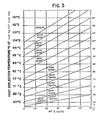
- Figure 3 depicts the heat deflection temperature of resin-filler compositions in which the resin-filler weight ratio varies while the polyolefin-elastomer ratio of the resin portion remains constant.
- Generally, it can be said that the impact strength of a polyolefin composition exhibits an inverse relationship with the amount of filler added. As the filler content increases the impact resistance of the polyolefin composition decreases. In contrast, additions of elastomer to a polyolefin result in increasing impact strength. As increments of elastomers are added to a polyolefin-filler composition, the impact strength of the resulting three component mixture gradually increases as expected. Surprisingly, however, when the resin portion of the three component composition consisting of the polyolefin and elastomer contains elastomer in excess of 25 weight percent, there is a remarkable, sudden jump in the impact strength of the polyolefin blend. The level of impact strength remains extraordinarily high as the elastomer content is gradually and continually increased until at 45 to 50 weight percent elastomer in the resin portion when it suddenly decreases.
- To illustrate the above, Figure 1 graphically depicts the impact resistance of various polyolefin-elastomer-filler compositions. The illustrative compositions all contain polypropylene (PP), ethylene-propylene copolymer (EPM) elastomer and calcium carbonate (CaCOa) filler in various amounts. As can be seen from Figure 1 the impact strength is plotted as the 23°C Notched Izod (Kgf cm/cm) versus the weight percent of calcium carbonate in the composition. The individual curves reflect the impact strength of compositions in which the ratio of polypropylene to the elastomeric copolymer composing the resin portion remains constant while the resin to filler ratio varies. Using line A as an illustration, the resin portion of any composition falling on line A is 75 percent polypropylene and 25 percent elastomeric copolymer by weight. The composition corresponding to point B on line A is 70 percent resin and 30 percent calcium carbonate filler by weight.
- It is readily apparent that as the elastomer content of the resin portion for a given resin-filler ratio is gradually increased in the three component mixture, the impact resistance of the composition increases. As the elastomer exceeds 25 weight percent of the resin portion, the impact resistance rises dramatically as seen by the curve representing 30 weight percent elastomer in the resin portion. Additional increments of elastomer retain this exceptional impact strength until it falls off as demonstrated by the location of point C representing a composition containing 25 weight percent filler and having 60 weight percent elastomer in the resin portion. The curves representing elastomer contents of 40, 45 and 50 weight percent in the resin portion are substantially superimposable and, thus, are shown as a single curve for all three.
- The remarkable impact resistance of compositions containing polypropylene (PP), ethylene-propylene copolymer (EPM) elastomer and calcium carbonate (CaC03) filler, for example, is exemplified in Figure 2. In this representation the impact strength is plotted as -18°C Unnotched Izod values versus the weight percent of the elastomer in the resin. In all instances the compositions contain 74 weight percent resin and 26 weight percent calcium carbonate filler. The discontinuity in the curve indicates that range of elastomer in the resin portion of the composition which yielded a sample that did not break during testing. Above the 25 weight percent level of elastomer in the resin portion the curve sharply rises upward representing exceptional impact strength. The impact strength falls off above 45 weight percent elastomer although it is still comparatively high at 50 weight percent elastomer.
- Compositions containing other resin-filler weight percentages in which the elastomer content is similarly varied will afford similar "volcano-like" curves. These curves, however, will be displaced further up or down the ordinate axis depending upon the filler content. The same can be said for compositions in which the polyolefin is a high density crystalline polyethylene, a low density polyethylene or a propylene-ethylene copolymer in which propylene is present in 85-95% by weight and has a tensile yield elongation no greater than 20%.
- In addition to the remarkable impact resistance possessed by these polyolefin compositions containing from greater than 25 weight percent to less than 50 weight percent elastomer in the resin portion, they also exhibit, unexpectedly, good high temperature flow resistance. This resistance to flow at high temperatures is of critical concern where the compositions of this invention are to be utilized as the core material in metal-plastic laminates in which the polymer composition is sandwiched between metal sheets, particularly steel-plastic laminates for use in the automotive industry. These laminates, after being incorporated into the automotive body, are subjected to about 30 minutes at paint baking temperatures of approximately 191 °C. The core material must not soften to the degree where it begins to flow from between the steel sheets.
- Normally the effect of high temperatures on the deformation of a plastic composition is evaluated by an ASTM testing method (D-648) in which a specimen of the sample in the form of a bar of rectangular cross section is horizontally supported by two support rods while immersed in a heating bath. A load is applied to the test specimen midway between the two support rods. The temperature of the heating bath is gradually increased to a point where the composition of the specimen softens and, due to the force exerted by the load, deflects 0.025 cm. This temperature is known as the heat deflection temperature and is used as a physical description to characterize the composition.
- In Figure 3 one can see that for a given ratio of polypropylene (PP) to ethylene-propylene copolymer (EPM) in the resin portion the heat deflection temperature of a resin-filler composition increases as the proportion of filler content increases. Also readily apparent is the decrease in the heat deflection temperature as the elastomer content is increased for a given resin-filler ratio. Conversely, for a given filler content, the less elastomer in the resin the higher the heat deflection temperature.
- Based on Figure 1, those polyolefin compositions having the greatest impact strength, namely greater than 25 to less than 50 weight percent elastomer in the resin portion, also have relatively low heat deflection temperatures throughout the range of filler loading. Thus one would believe these compositions would not be of value as the core material for metal-plastic laminates that will be exposed to high temperatures. Unexpectedly, the contrary is true. These compositions, while manifesting deflection at relatively low temperatures, do not run at automotive paint baking temperature as do those compositions having higher heat deflection temperatures. The property of a composition by which it retains its shape and resists flow by the action of gravitational force on its mass at automotive paint baking temperature is termed high temperature flow resistance.
- Table 1 presents the data obtained from a simple test performed to evaluate the flow resistance of the polyolefin resin-filler compositions at automotive paint baking temperatures. The compositions of Table I, for the most part, contain polypropylene, ethylene-propylene copolymer elastomer and calcium carbonate filler. Several examples contain talc as the filler. Others utilize crystalline high density polyethylene as the polyolefin.
- Eight 2.5 cm square samples are cut from a sheet of a molded composition which was pressed to a thickness of 0.31 cm on a hot platen press at 193°C. The squares are stacked one on top of the other to form a 2.5 cm cube. The cube is placed on a transite cement-asbestos carrier in a circulating air oven at 196°C for 30 minutes at which time the sample is removed and its shape is observed.
- The samples are visually rated on a numerical scale based on the following sets of criteria.
-
- 1. Cube has flowed to give a thin uniform thickness at least 5 cm in diameter.
- 2. Cube has flowed outwardly with the center higher than the edges and the longest side 5 cm wide.
- 3. Considerable flow has occurred with the center still high and the longest side 3.8 cm wide.
- 4. Some distortion.
- 5. Essentially no change in shape.
-
- 1. No corners, edges or layers are visible.
- 2. No corners, but sheet-like structure is evident.
- 3. Corners are well rounded and sheet structure is evident.
- 4. Corners are slightly rounded and layers are generally diffused, but laminar structure is still visible.
- 5. Essentially sharp, distinctive corners and laminar edges.
- The heated samples receive the numerical rating for that characterization which best describes it in each of the two categories. In other words, a sample that completely puddled would receive the worse rating in each category, a 1, and an overall flow rating of 2 (1 + 1). On the other hand a sample that retained its precise, definite conformation would be awarded a 5 in each category and the best possible overall flow rating of 10. A flow rating of 6 was considered as the minimum passing level at this temperature. Where lower automotive paint baking temperatures will be encountered in industry, a composition achieving a lower flow resistance rating than the passing score of this test would be acceptable.

- A sample of 100% polypropylene was judged as not minimally acceptable and received a flow rating of 5.5. While the polypropylene sample has a high heat deflection temperature (103°C), the flow resistance test indicates at automotive paint baking temperature it will most probably sag and flow from between the metal skins of a metal-polypropylene laminate. The data in Table I shows, in general that those polyolefin resin-filler compositions containing greater than 25 weight percent elastomer in the resin portion and having exceptional impact strength have lower heat deflection temperatures but acceptable high temperature flow resistance. The flow rating of these compositions is generally 6 or above. It should be noted that the compositions using talc as a filler exhibited excellent flow resistance when exposed to the automotive paint baking temperatures. Similarly, compositions in which high density polyethylene was used as the polyolefin also had very good flow resistance.
- From the above analysis of the physical data of the three component compositions it is possible to determine those ranges of polyolefin and elastomer composing the resin portion and the relative percentages of resin and filler that afford a polyolefin composition having both a high level of impact resistance and high temperature flow resistance for use as a core material in metal plastic laminates. By a high level of impact resistance I mean a level at least as high as levels normally encountered in high impact polystyrene plastics. In the polyolefin compositions of this invention composing the core material of the metal plastic laminates the resin portion is 30-90 weight percent and the filler 10-70 weight percent. The resin portion comprises from greater than 50 to less than 75 weight percent polyolefin and from greater than 25 to less than 50 weight percent elastomer. The preferred resin-filler content is 35-75 weight percent resin and 25-65 weight percent filler. Most preferred is a composition containing 40-60 weight percent resin and 40-60 weight percent filler. The preferred blend of the resin comprises 55-70 weight percent polyolefin and 30-45 weight percent elastomer.
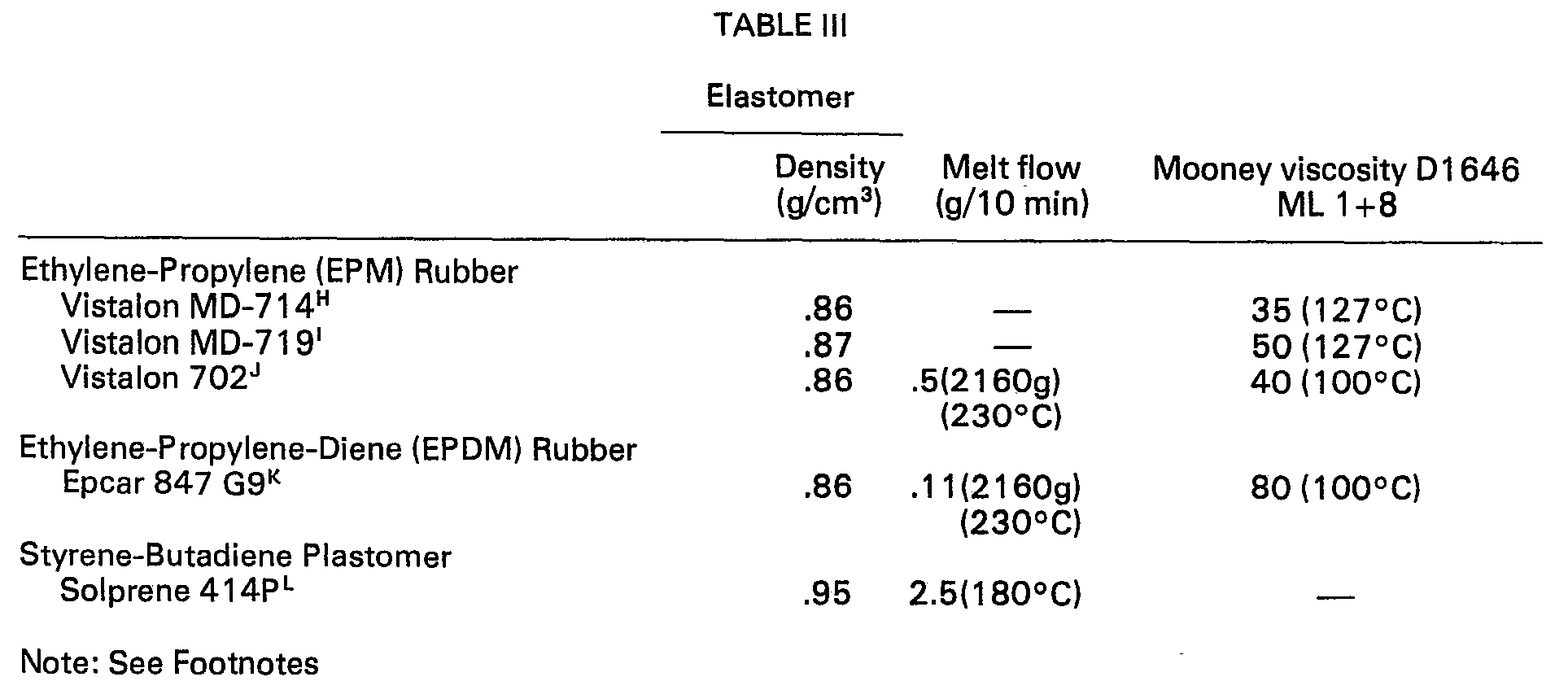
- The polyolefin blended into the composition is at least one polyolefin selected from the group consisting of crystalline isotactic polypropylene, crystalline high density polyethylene, low density polyethylene and a copolymer of propylene and ethylene which is 85-95 weight percent propylene and has a tensile yield elongation no greater than 20%. The elastomer of the composition is defined as being a rubber-like polymer material having a break elongation greater than 200%. Examples of such elastomers would be ethylene-propylene copolymers (EPM rubbers) marketed by Exxon Chemical Co. under the trademarks Vistalon MD-719, Vistalon MD-714, and Vistalon 702; an ethylene-propylene-diene terpolymer (EPDM rubber) sold by B. F. Goodrich Chemical Co. under the trademark Epcar 847 G9 and a radial block styrenebutadiene copolymer sold by Phillips Petroleum Co. under the trademark Solprene 414P. The preferred fillers are inorganic fillers selected from the group consisting of calcium carbonate, talc, clay, silica, mica and barytes. The materials, which were used in the following examples, are merely illustrative of materials that can be used in the practice of the invention and are listed in Tables II, III and IV which give pertinent physical data.


- The following examples of polyolefin compositions having high impact strength and good resistance to flow at high temperatures are exemplary of the invention. Unless otherwide indicated, the composition blends were basically prepared according to either of the following two general compounding procedures.
- This general procedure entails the preparation of the composition on a 20x41 cm two-roll mill. The power is turned on and the rolls are set in motion (25 rpm). Superheated steam 232°C is passed through the rolls for 15-30 minutes. The space between the rolls is narrowed and pellets of the polyolefin are added gradually until the polyolefin has sheeted onto the front roll. A bank of.polyolefin is maintained between the rolls. Next the elastomer is added gradually and mixing is continued until a homogeneous mix has been obtained. Finally the filler is added gradually and is roll-milled until it too has been uniformly incorporated. The resultant sheet is removed from the roll and ground in a rotating blade plastic grinder. This ground composition is shaped into test specimens.
- All the materials are dry blended in a 1.1 liter plastic-coated paper cup. A 1.90 cm extruder fitted with a 0.476 cm diameter circular die and a two-stage mixing screw is operated at 60 rpm and the desired temperature setting. The dry blend is added to the hopper to fill the feed screws. The revolutions of the mixing screw are gradually increased to 200 rpm and the temperature is is adjusted to provide a coherent strand which is subsequently passed through a trough of tap water to gradually solidify. The solid strand is next pulled on a belt strand puller and then cut to 0.32 cm long pellets by passing the strand through a rotating blade pelletizer. The resultant pellets are reprocessed a second time according to the above procedure to afford pellets of a more completely homogenized composition. The pellets from the second processing step are shaped into test specimens.
- On the laboratory scale when adding fine, powdery fillers according to Procedure A or B, it is more convenient and preferable to pre-compound the filler with some of the polyolefin by making a concentrate containing 60-70 weight percent filler in the polyolefin. This concentrate is then added to the resin blend containing the remainder of the polyolefin and the elastomer.
- The data reflecting the physical properties of the various polyolefin compositions of the invention were generated according to the following ASTM standards:

- Tensile specimens were die cut from a 0.76 mm sheet with a die made to ASTM specifications. The sheet was compression molded in a flat platen press at 204°C. Bars for Izod impact tests and heat deflection tests were molded to size on a 28 gram laboratory ram injector.
-

- The materials were compounded according to Procedure B. The temperature settings for the extruder were 145°C for
zone 1, 135°C for zone 2 and 155°C for the die. When the system had equilibriated and a continuous strand was being produced, the melt temperature on the extruder was 167°C and 2300-2400 meter-grams of torque were being exerted to produce the strand. Test specimens provided the following physical data of the composition:
-

- The three materials were compounded on the extruder according to Procedure B and Example I, the temperature settings being the same. Physical data:

-

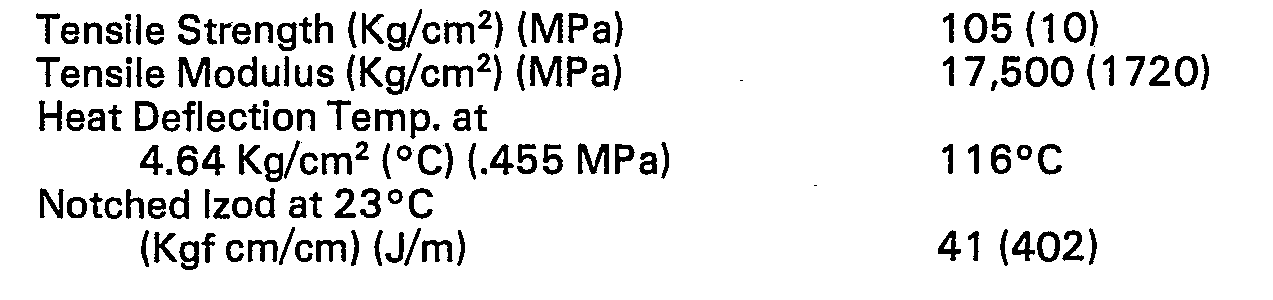
- The ingredients were compounded as described in Procedure B and Example I, the temperature settings being the same. Physical data of the composition:
-

- The three ingredients were compounded as described in Procedure B and Example I, the temperature settings being the same. Physical data of the composition:

- Example IV demonstrates the relatively low impact resistance of compositions containing less than 25 weight percent elastomer in the resin portion.
-

- The three materials were compounded according to Procedure B and Example I, the temperature settings being the same. Physical data of the composition:

-

- The materials were compounded as described in Procedure B and Example I, the temperature settings being the same. Physical data of the composition:

-

- The ingredients were compounded according to Procedure A with total milling time being 20 minutes. Physical data of the composition:

-

- The three materials were compounded as described in Procedure B. and Example I, the temperature settings being the same. Physical data of the composition:

-

- A
bowl type 60 cc mixing chamber utilizing a pair of counter-rotating blades was heated to 193°C. The blades were rotated at 50 rpm. The polypropylene and elastomer were added with agitation until partially melted. After the gradual addition of calcium carbonate, the combination was mixed for an additional 8 minutes. The chamber was partially cooled and the product was stripped from the blades and the walls of the chamber. Multiple runs were needed to provide sufficient material for testing. Physical data of the composition:
-

- The materials were compounded as described in Procedure B and Example I, the temperature settings being the same. Physical data of the composition:

-

- The materials were compounded as described in Procedure B and Example I, the temperature settings being the same. Physical data of the composition:

-

- The ingredients were compounded as described in Procedure B and Example I, the temperature settings being the same. Physical data of the composition:

-

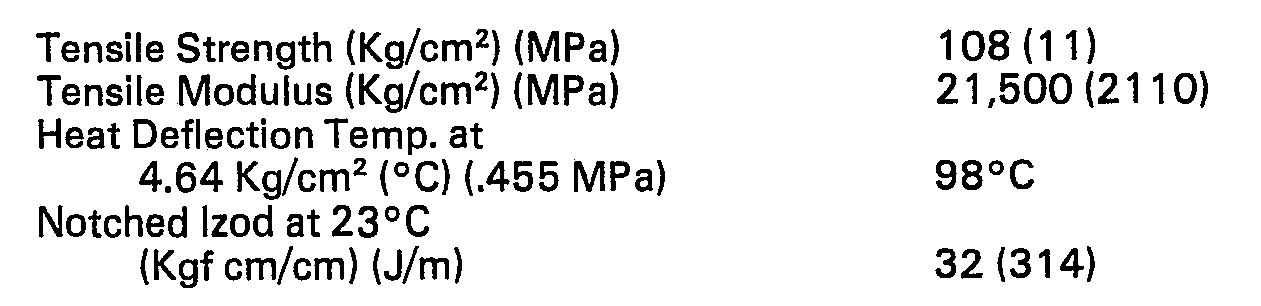
- The materials were compounded in a commercial twin screw extruder at a melt temperature of 165°C with no pre-compounding of the filler with polyolefin. Physical data of the composition:
-

- The materials were compounded as described in Procedure B and Example I, the temperature settings being the same. Physical data of the composition:

-

- The ingredients were compounded as described in Procedure B and Example I, the temperature settings being the same. Physical data of the composition:

-

- The materials were compounded as described in Procedure B and Example I with the temperature settings being 191°C for Zone 1, 195°C for Zone 2 and 200°C for the die. Physical data of the composition:

-

- The materials were compounded as described in Procedure B and Example XVI. Physical data of the composition:

-

- The ingredients were compounded as described in Procedure B and Example I with the temperature settings being 156°C for Zone 1, 146°C for Zone 2 and 156°C for the die. Physical data of the composition:

-

- The materials were compounded as described in Procedure B and Example I with the temperature settings being 130°C for Zone 1, 124°C for Zone 2 and 130°C for the die. Physical data of the composition:

- The compositions of this invention can also contain various conventional additives depending upon the specific application of the polyolefin compositions such as light, oxygen and heat stabilizers, flame retardants, plasticizers, coloring agents, reinforcing agents and antistatic agents.
- The most attractive use of these novel core materials is in metal-plastic laminates where high impact strength, increased rigidity and good resistance flow at high temperatures are required properties. The metal skin of the laminate may be any metal or alloy typically used in such laminates, such as steel, aluminum, copper, brass, titanium, or magnesium.
- The following is an example describing such a laminate and a method for making it. To one surface of each of two 20 cmx20 cm sheets of cold-rolled steel (0.03 cm thickness) a polypropylene base adhesive primer, manufactured by Morton Chemical Co. under the trademark Adcote 78LJ6, is applied with a paint brush. The adhesive coated steel sheets are placed in a circulating air oven at 204°C for two minutes, the adhesive primer fusing to a continuous, colorless coating. After cooling, the sheets are placed on each side of a 20 cmx20 cm plastic sheet (0.06 cm thickness) with the adhesive primed surfaces against the plastic producing a steel-plastic-steel "sandwich". The plastic sheet can be any polyolefin composition within the scope of the invention, preferably the polypropylene composition of Example XIII, that has been converted to a uniform sheet by compression molding on a flat platen press at 193°C for three minutes.
- The sandwich is next placed between the platens of a flat laboratory press heated to 204°C. Shims of 0.1 cm thickness are positioned on either side of the "sandwich" and the press is closed with a pressure of about 2,8 Kg/cm2 (2.7 bar) for four minutes. The hot laminate is cooled in a tray of tap water. Appropriate size test coupons can be cut from the laminate for various physical, impact and forming tests.
- In general, the formability of a laminate containing the compositions of this invention as core material is slightly poorer than the formability of a single skin by itself. The stiffness is only slightly less than that of a sheet of cold-rolled steel of the same thickness. The tensile strength is about that of two pieces of steel skin alone. When placed in an oven at 204°C for one hour in a vertical position, none of the plastic core flowed out from between the steel skins.
- Steel sheets from 0.015 cm to 0.045 cm were used as the skins including cold-rolled steel, galvanized steel, and steel sheets sold by Bethlehem Steel Corporation under the trademarks Galvalume and Duraskin. As to the overall thickness of the laminates, any thickness is possible. Laminates of 0.087 cm to 0.312 cm thickness were actually prepared.
-
- A―Pro-Fax® 6231 polypropylene, Hercules Inc.
- B-Pro-Fax@ 6523 polypropylene, Hercules Inc.
- C-Exxon E@ 117 polypropylene, Exxon Chemical Co.
- D-Exxon@ CD589 polypropylene, Exxon Chemical Co.
- E-Pro-Fax@ 7523 polypropylene copolymer, Hercules Inc.
- F―Alathon@ 7040 high density polyethylene, E. I. duPont de Nemours εt Co., Inc.
- G-Rexene 178 low density polyethylene, Rexene Polymer Co.
- H-Vistalon@ MD-714 ethylene-propylene rubber, Exxon Chemical Co.
- I-Vistalon0 MD-719 ethylene-propylene rubber, Exxon Chemical Co.
- J-Vistalon0 702 ethylene-propylene rubber, Exxon Chemical Co.
- K―Epcar® 847 G9 ethylene-propylene-diene rubber, B. F. Goodrich Chemical Co.
- L-Solprene@ 414P styrene-butadiene rubber, Phillips Petroleum Co.
- M―Hi-
Pflex® 100 calcium carbonate, Pfizer Co. - N-Gama-Sperse 80 calcium carbonate, Georgia Marble Co.
- P-Dix-
Fil 10 calcium carbonate, Dixie Lime and Stone Co. - Q―Taicron® CP-10―40 talc, Pfizer Co.
- R-Talcron@ CP-38-33 talc, Pfizer Co.
- S-
Kaopaque0 30 clay, Georgia Kaolin Co.
Claims (19)
Priority Applications (1)
| Application Number | Priority Date | Filing Date | Title |
|---|---|---|---|
| AT79102688T ATE4724T1 (en) | 1978-07-31 | 1979-07-27 | NEW METAL-PLASTIC LAMINATES MADE OF POLYOLEFIN BLENDS WITH HIGH IMPACT STRENGTH AND HIGH HEAT RESISTANCE. |
Applications Claiming Priority (2)
| Application Number | Priority Date | Filing Date | Title |
|---|---|---|---|
| US05/929,611 US4229504A (en) | 1978-07-31 | 1978-07-31 | Polyolefin composition having high impact resistance and high temperature flow resistance |
| US929611 | 1992-08-13 |
Publications (2)
| Publication Number | Publication Date |
|---|---|
| EP0007639A1 EP0007639A1 (en) | 1980-02-06 |
| EP0007639B1 true EP0007639B1 (en) | 1983-09-21 |
Family
ID=25458150
Family Applications (1)
| Application Number | Title | Priority Date | Filing Date |
|---|---|---|---|
| EP19790102688 Expired EP0007639B1 (en) | 1978-07-31 | 1979-07-27 | New metal plastic laminates from polyolefin compositions having high impact resistance and high temperature flow resistance |
Country Status (6)
| Country | Link |
|---|---|
| US (1) | US4229504A (en) |
| EP (1) | EP0007639B1 (en) |
| JP (1) | JPS5521494A (en) |
| AT (1) | ATE4724T1 (en) |
| CA (1) | CA1137407A (en) |
| DE (1) | DE2966184D1 (en) |
Families Citing this family (57)
| Publication number | Priority date | Publication date | Assignee | Title |
|---|---|---|---|---|
| US4313996A (en) * | 1979-05-21 | 1982-02-02 | The Dow Chemical Company | Formable metal-plastic-metal structural laminates |
| EP0037907A1 (en) * | 1980-03-25 | 1981-10-21 | Hoechst Aktiengesellschaft | Shaped plastic object with a textured surface and method for its manufacture |
| JPS57149A (en) * | 1980-06-02 | 1982-01-05 | Idemitsu Petrochem Co Ltd | Polyolefin resin composition |
| JPS5712046A (en) * | 1980-06-27 | 1982-01-21 | Mitsubishi Petrochem Co Ltd | Propylene polymer composition |
| JPS603420B2 (en) * | 1980-09-22 | 1985-01-28 | 宇部興産株式会社 | Polypropylene composition for bumpers |
| JPS57123231A (en) * | 1981-01-22 | 1982-07-31 | Toyobo Co Ltd | Metal-plated polyamide molded product and preparation of same |
| US4330587A (en) * | 1981-02-23 | 1982-05-18 | Monsanto Company | Metal-thermoplastic-metal laminates |
| JPS57177038A (en) * | 1981-04-23 | 1982-10-30 | Mitsui Toatsu Chem Inc | Polypropylene resin composition |
| JPS57207630A (en) * | 1981-06-15 | 1982-12-20 | Toa Nenryo Kogyo Kk | Thermoplastic resin composition |
| JPS5815544A (en) * | 1981-07-21 | 1983-01-28 | Toa Nenryo Kogyo Kk | Polyolefin composition |
| GB2111071B (en) * | 1981-09-16 | 1985-04-03 | Mitsubishi Petrochemical Co | Moldable composition containing propylene polymer |
| FR2527620B1 (en) * | 1982-05-28 | 1986-02-21 | Rhone Poulenc Spec Chim | COMPOSITION FOR MOLDING BASED ON THERMOPLASTIC POLYMERS REINFORCED BY MINERAL FILLERS |
| JPS5974141A (en) * | 1982-10-19 | 1984-04-26 | Chisso Corp | Flame-retardant resin composition |
| DE3374673D1 (en) * | 1983-01-24 | 1988-01-07 | Sumitomo Metal Ind | Metal-resin-metal sandwich laminates suitable for use in working |
| JPS59217744A (en) * | 1983-05-25 | 1984-12-07 | Kasai Kogyo Co Ltd | Wood-filled composite resin composition |
| JPS59217743A (en) * | 1983-05-25 | 1984-12-07 | Kasai Kogyo Co Ltd | Wood-filled composite resin composition |
| US4599261A (en) * | 1984-02-06 | 1986-07-08 | Shell Oil Company | High heat, sound damping metal-polymer laminate |
| JPS60202144A (en) * | 1984-03-27 | 1985-10-12 | Sumitomo Chem Co Ltd | Polypropylene resin composition |
| JPS60164019U (en) * | 1984-04-09 | 1985-10-31 | 釜屋化学工業株式会社 | Laminate tube |
| JPS60238341A (en) * | 1984-05-10 | 1985-11-27 | Idemitsu Petrochem Co Ltd | Polypropylene resin composition |
| CA1254319A (en) * | 1984-08-16 | 1989-05-16 | Thomas M. Krigas | Polyolefin compositions having improved impact strength |
| US4601941A (en) * | 1984-09-07 | 1986-07-22 | Shell Oil Company | High heat metal-polymer laminate |
| JPH064733B2 (en) * | 1986-02-03 | 1994-01-19 | 日本石油化学株式会社 | Highly rigid and impact resistant polyolefin resin composition |
| US4732926A (en) * | 1986-09-29 | 1988-03-22 | General Motors Corporation | Dry blendable polypropylene composition |
| JPS6395252A (en) * | 1986-10-13 | 1988-04-26 | Mitsui Toatsu Chem Inc | Polypropylene resin composition |
| US5002624A (en) * | 1988-04-22 | 1991-03-26 | Impact Extrusions, Inc. | Method for making composite sheet material |
| US5030488A (en) * | 1988-11-23 | 1991-07-09 | Chemical And Polymer Technology, Inc. | Laminates, panels and means for joining them |
| US5153039A (en) * | 1990-03-20 | 1992-10-06 | Paxon Polymer Company, L.P. | High density polyethylene article with oxygen barrier properties |
| US5286798A (en) * | 1990-10-04 | 1994-02-15 | Bridgestone/Firestone, Inc. | Polymer blends for heat seamable roof sheeting |
| US5143778A (en) * | 1990-10-31 | 1992-09-01 | Shuert Lyle H | Laminate structural plastic material |
| JP2902496B2 (en) * | 1991-03-28 | 1999-06-07 | 宇部興産株式会社 | Resin composition for automobile bumper |
| US5242970A (en) * | 1991-04-24 | 1993-09-07 | Bridgestone Corporation | Rooftop curable heat seamable roof sheeting and method for covering roofs |
| CA2077033A1 (en) * | 1991-08-30 | 1993-03-01 | Ikunori Sakai | Polypropylene resin composition |
| US5256228A (en) * | 1991-12-06 | 1993-10-26 | Bridgestone Corporation | Heat seamable roof sheeting with highly crystalline thermoplasticity promoters and methods for covering roofs |
| EP0593859B1 (en) * | 1992-07-27 | 1997-06-25 | Bridgestone Corporation | Polymer blends for rooftop curable heat seamable roof sheeting and method for covering roofs |
| US5516829A (en) * | 1992-08-10 | 1996-05-14 | Davis; James A. | Heat seamable flame retardant roof sheeting with highly crystalline thermoplasticity promoters and method for covering roofs |
| US5468550A (en) * | 1994-06-06 | 1995-11-21 | Bridgestone/Firestone, Inc. | EPDM roofing membrane with improved burn resistivity |
| EP0736640A1 (en) * | 1995-03-31 | 1996-10-09 | Bridgestone/Firestone, Inc. | Mineral filled EDPM membrane compositions with improved adhesion performance |
| JPH11216833A (en) * | 1998-02-03 | 1999-08-10 | Dainippon Printing Co Ltd | Decorative sheet |
| JP3710080B2 (en) * | 1998-06-18 | 2005-10-26 | ブリヂストンスポーツ株式会社 | Solid golf balls |
| JP3320031B2 (en) * | 1999-03-19 | 2002-09-03 | 日本ポリケム株式会社 | High concentration talc masterbatch |
| FR2804964B1 (en) * | 2000-02-14 | 2006-09-29 | Omya Sa | USE OF VERY HIGH FLUIDITY ISOTACTIC POLYPROPYLENES FOR THE PREPARATION OF CONCENTRATES OF LOADS USED IN OLEFIN-TYPE THERMOPLASTICS, LOAD CONCENTRATES AND THERMOPLASTICS THUS OBTAINED |
| US6828372B2 (en) * | 2001-03-05 | 2004-12-07 | Tie Tek, Inc. | Railroad tie and method for making same |
| US6974622B2 (en) * | 2002-01-16 | 2005-12-13 | Paragon Plastic Sheet, Inc. | Plastic sheets for use in protecting openings in walled structures |
| US6881937B2 (en) | 2002-03-22 | 2005-04-19 | Fort James Corporation | Thermoformed food containers with enhanced rigidity |
| JP2005324468A (en) * | 2004-05-14 | 2005-11-24 | Idemitsu Unitech Co Ltd | MULTILAYER FILM FOR THERMAL LAMINATION, MULTILAYER FILM LAMINATED METAL PLATE, AND METHOD FOR PRODUCING MULTILAYER FILM LAMINATED METAL PLATE |
| US20070254058A1 (en) * | 2006-05-01 | 2007-11-01 | Wade A B | Systems and methods for forming polymeric sheets |
| EP2044147A1 (en) * | 2006-07-25 | 2009-04-08 | E.I. Du Pont De Nemours And Company | Vibration damping material of polyamides and mercaptobenzoimidazoles |
| KR20110048052A (en) | 2008-08-18 | 2011-05-09 | 프로덕티브 리서치 엘엘씨 | Moldable lightweight composite |
| MX2011012777A (en) | 2009-06-08 | 2012-06-08 | Arcelormittal Investigacion Y Desarrollo Sl | Composite metal and polymer part, use in particular in the automotive field. |
| US8796580B2 (en) | 2009-12-28 | 2014-08-05 | Productive Research | Processes for welding composite materials and articles therefrom |
| KR102032405B1 (en) | 2010-02-15 | 2019-10-16 | 프로덕티브 리서치 엘엘씨 | Formable light weight composite material systems and methods |
| US9233526B2 (en) | 2012-08-03 | 2016-01-12 | Productive Research Llc | Composites having improved interlayer adhesion and methods thereof |
| EP3266609B1 (en) | 2016-07-06 | 2019-09-25 | C.R.F. Società Consortile per Azioni | Method for producing components for motor-vehicle structures, having a hybrid structure made of light alloy and plastic material |
| TWI619754B (en) * | 2016-11-01 | 2018-04-01 | Chen Jin Fu | Environmental protection materials and curtain blades made from the environmental protection materials |
| DE102019000975A1 (en) * | 2019-02-11 | 2020-08-13 | Giesecke+Devrient Mobile Security Gmbh | Film made from recycled plastic material for portable data carriers, processes for producing the recycling film and data carriers containing the recycling film |
| US11338552B2 (en) | 2019-02-15 | 2022-05-24 | Productive Research Llc | Composite materials, vehicle applications and methods thereof |
Family Cites Families (13)
| Publication number | Priority date | Publication date | Assignee | Title |
|---|---|---|---|---|
| US3220966A (en) * | 1963-02-28 | 1965-11-30 | Nat Starch Chem Corp | Hot melt adhesive compositions based on an ethylene:propylene copolymer |
| GB1043078A (en) * | 1964-08-13 | 1966-09-21 | Phillips Petroleum Co | Improvements relating to polymeric composition |
| GB1159614A (en) * | 1966-08-20 | 1969-07-30 | Takehara Kasei Kogyo Kabushiki | Method of Laminating Polyolefine with Metal |
| US3539525A (en) * | 1967-11-21 | 1970-11-10 | Standard Oil Co | Sealant composition from ethylene-propylene-diene terpolymer |
| US3565747A (en) * | 1969-06-02 | 1971-02-23 | Dow Chemical Co | Laminates of metal and olefin polymers having finely divided,solid,non-de-formable,organic polymer particles therein |
| DE1943023A1 (en) * | 1969-08-23 | 1971-03-04 | Metallgesellschaft Ag | Process for the production of firmly adhering polyolefin coatings |
| US3700614A (en) * | 1971-05-07 | 1972-10-24 | Dart Ind Inc | High impact polypropylene blends |
| DD126458A3 (en) * | 1972-02-04 | 1977-07-20 | ||
| US3872052A (en) * | 1974-01-25 | 1975-03-18 | Standard Oil Co | Polypropylene composition |
| US4036912A (en) * | 1975-10-06 | 1977-07-19 | The B. F. Goodrich Company | Thermoplastic polymer blends of EP or EPDM polymer with crystalline polypropylene |
| JPS52117941A (en) * | 1976-03-31 | 1977-10-03 | Sumitomo Chem Co Ltd | Polypropylene resin compositions |
| IT1065814B (en) * | 1976-08-06 | 1985-03-04 | Montedison Spa | THERMOPLASTIC COMPOSITIONS BASED ON PROPYLENE COPOLYMERS, EQUIPPED WITH HIGH RESISTANCE TO EMBRAGEMENT AT LOW TEMPERATURES AND A HIGH ELASTIC MODULE |
| DE2657273A1 (en) * | 1976-12-17 | 1978-06-22 | Huels Chemische Werke Ag | THERMOPLASTIC MASS |
-
1978
- 1978-07-31 US US05/929,611 patent/US4229504A/en not_active Ceased
-
1979
- 1979-07-27 DE DE7979102688T patent/DE2966184D1/en not_active Expired
- 1979-07-27 EP EP19790102688 patent/EP0007639B1/en not_active Expired
- 1979-07-27 AT AT79102688T patent/ATE4724T1/en not_active IP Right Cessation
- 1979-07-30 CA CA000332791A patent/CA1137407A/en not_active Expired
- 1979-07-30 JP JP9715879A patent/JPS5521494A/en active Pending
Also Published As
| Publication number | Publication date |
|---|---|
| DE2966184D1 (en) | 1983-10-27 |
| EP0007639A1 (en) | 1980-02-06 |
| US4229504A (en) | 1980-10-21 |
| CA1137407A (en) | 1982-12-14 |
| JPS5521494A (en) | 1980-02-15 |
| ATE4724T1 (en) | 1983-10-15 |
Similar Documents
| Publication | Publication Date | Title |
|---|---|---|
| US4229504A (en) | Polyolefin composition having high impact resistance and high temperature flow resistance | |
| US5091461A (en) | Filled polymeric blend | |
| EP0156072B1 (en) | Thermoplastic composition comprising olefin and styrene polymers and filler | |
| EP0822226B1 (en) | Thermoplastic resin composition containing polytetrafluoroethylene powder mixture | |
| EP0042153B1 (en) | Thermoformable polymer blend composition | |
| JP3409141B2 (en) | Filled carbonate polymer blend composition | |
| EP0872517B1 (en) | Thermoplastic elastomer composition | |
| US6015857A (en) | Propylene resin compositions | |
| BRPI0409027B1 (en) | polymer blends, thermoformed parts, wire and cable caps and processes for making a thermoformed part and to decrease gloss and / or thermoform temperature in a thermoformed part | |
| JPH1129679A (en) | Polytetrafluoroethylene-containing mixed powder, method for producing the same, thermoplastic resin composition containing the same, and molded product thereof | |
| USRE31213E (en) | Polyolefin composition having high impact resistance and high temperature flow resistance | |
| EP0069479A1 (en) | Thermoplastic resin composition | |
| JPH0328288B2 (en) | ||
| EP1940901A1 (en) | Impact modified acrylics having a bimodal distribution of impact modifier sizes | |
| US4693941A (en) | Reinforced poly(ethylene terephthalate) compositions | |
| US4185067A (en) | Method of rotationally molding plastic articles | |
| JPH053832B2 (en) | ||
| WO1996006135A1 (en) | Filled carbonate polymer blend compositions having improved impact resistance | |
| US2779748A (en) | Thermoplastic composition comprising vinyl chloride polymer and diolefindialkyl fumarate copolymer | |
| EP0057495B1 (en) | Reinforced poly(ethylene terephthalate) compositions | |
| JPS6152860B2 (en) | ||
| EP0348115A2 (en) | Silk-like films | |
| KR0152320B1 (en) | Polypropylene resin composition | |
| JPH04277508A (en) | Rubber-modified styrene resin excellent in strength and transparency | |
| EP1644437A4 (en) | Low glow olefin |
Legal Events
| Date | Code | Title | Description |
|---|---|---|---|
| PUAI | Public reference made under article 153(3) epc to a published international application that has entered the european phase |
Free format text: ORIGINAL CODE: 0009012 |
|
| AK | Designated contracting states |
Designated state(s): AT BE CH DE FR GB IT LU NL SE |
|
| 17P | Request for examination filed | ||
| GRAA | (expected) grant |
Free format text: ORIGINAL CODE: 0009210 |
|
| AK | Designated contracting states |
Designated state(s): AT BE CH DE FR GB IT LU NL SE |
|
| PG25 | Lapsed in a contracting state [announced via postgrant information from national office to epo] |
Ref country code: SE Effective date: 19830921 Ref country code: NL Effective date: 19830921 Ref country code: IT Free format text: LAPSE BECAUSE OF FAILURE TO SUBMIT A TRANSLATION OF THE DESCRIPTION OR TO PAY THE FEE WITHIN THE PRESCRIBED TIME-LIMIT;WARNING: LAPSES OF ITALIAN PATENTS WITH EFFECTIVE DATE BEFORE 2007 MAY HAVE OCCURRED AT ANY TIME BEFORE 2007. THE CORRECT EFFECTIVE DATE MAY BE DIFFERENT FROM THE ONE RECORDED. Effective date: 19830921 Ref country code: FR Free format text: THE PATENT HAS BEEN ANNULLED BY A DECISION OF A NATIONAL AUTHORITY Effective date: 19830921 Ref country code: CH Effective date: 19830921 |
|
| REF | Corresponds to: |
Ref document number: 4724 Country of ref document: AT Date of ref document: 19831015 Kind code of ref document: T |
|
| PG25 | Lapsed in a contracting state [announced via postgrant information from national office to epo] |
Ref country code: AT Effective date: 19831001 |
|
| REF | Corresponds to: |
Ref document number: 2966184 Country of ref document: DE Date of ref document: 19831027 |
|
| REG | Reference to a national code |
Ref country code: CH Ref legal event code: PL |
|
| NLV1 | Nl: lapsed or annulled due to failure to fulfill the requirements of art. 29p and 29m of the patents act | ||
| EN | Fr: translation not filed | ||
| PLBE | No opposition filed within time limit |
Free format text: ORIGINAL CODE: 0009261 |
|
| STAA | Information on the status of an ep patent application or granted ep patent |
Free format text: STATUS: NO OPPOSITION FILED WITHIN TIME LIMIT |
|
| PG25 | Lapsed in a contracting state [announced via postgrant information from national office to epo] |
Ref country code: LU Free format text: LAPSE BECAUSE OF NON-PAYMENT OF DUE FEES Effective date: 19840731 Ref country code: BE Effective date: 19840731 |
|
| 26N | No opposition filed | ||
| BERE | Be: lapsed |
Owner name: BETHLEHEM STEEL CORP. Effective date: 19840727 |
|
| GBPC | Gb: european patent ceased through non-payment of renewal fee | ||
| PG25 | Lapsed in a contracting state [announced via postgrant information from national office to epo] |
Ref country code: DE Effective date: 19850402 |
|
| PG25 | Lapsed in a contracting state [announced via postgrant information from national office to epo] |
Ref country code: GB Effective date: 19881118 |