EP0007154B1 - Process for the preparation of cyclopropane derivatives, intermediates in the synthesis of pyrethroid insecticides - Google Patents
Process for the preparation of cyclopropane derivatives, intermediates in the synthesis of pyrethroid insecticides Download PDFInfo
- Publication number
- EP0007154B1 EP0007154B1 EP79300585A EP79300585A EP0007154B1 EP 0007154 B1 EP0007154 B1 EP 0007154B1 EP 79300585 A EP79300585 A EP 79300585A EP 79300585 A EP79300585 A EP 79300585A EP 0007154 B1 EP0007154 B1 EP 0007154B1
- Authority
- EP
- European Patent Office
- Prior art keywords
- parts
- formula
- compound
- volume
- per mole
- Prior art date
- Legal status (The legal status is an assumption and is not a legal conclusion. Google has not performed a legal analysis and makes no representation as to the accuracy of the status listed.)
- Expired
Links
Classifications
-
- C—CHEMISTRY; METALLURGY
- C07—ORGANIC CHEMISTRY
- C07C—ACYCLIC OR CARBOCYCLIC COMPOUNDS
- C07C255/00—Carboxylic acid nitriles
- C07C255/45—Carboxylic acid nitriles having cyano groups bound to carbon atoms of rings other than six-membered aromatic rings
Definitions
- This invention relates to a process for the preparation of cyclopropane derivatives, intermediates in the synthesis of pyrethroid insecticides.
- 3 - (2',2' - dichlorovinyl) - 2,2 - dimethylcyclopropane - 1 - carboxylic acid is an important intermediate in the production of insecticides, including, for example, m - phenoxybenzyl - 3 - (2',2' - dlchlorovinyl) - 2,2 - dimethylcyclo - propane - 1 - carboxylate.
- 3 - (2',2' - dichlorovinyl) - 2,2 - dimethylcyclopropane - 1 - carboxylic acid has been prepared, for example, as described by Farkas et al in Collection Czechoslov. Chem.
- 3-(2',2'-dichlorovinyl)-2,2-dimethylcyclopropane-1-carboxylic acid exists in two isomeric forms, according to whether the dichlorovinyl group and the carboxylic acid group are on the same side (cis) or on opposite sides (trans) of the cyclopropane ring.
- Insecticidal esters for example, the m-phenoxybenzyl ester, of this carboxylic acid, likewise exist in cis- and trans-isomeric forms. These two forms do not have the same insecticidal potency, the cis-isomer being more active than the trans-isomer.
- the present invention provides a process for the preparation of dihalogenovinyl cyclopropane carboxylic acid derivatives which avoids the use of diazoacetic esters and which also gives a high ratio of cis- to trans-isomer.
- the alkyl radical R preferably contains from 1 to 4 carbon atoms.
- Examples of the compounds of formula (II) which may be used are methyl bromocyanoacetate and ethyl bromocyanoacetate.
- At least one alkali or alkaline earth metal salt for example, a lithium, calcium or magnesium salt, in addition to the copper or copper salt and base.
- a lithium, calcium or magnesium salt is especially preferred, although other salts of these metals may also be used.
- Particularly useful salts of lithium, calcium and magnesium are the chlorides.
- a quaternary ammonium salt for example, a tetra-alkyl ammonium halide such as methyl triethyl ammonium chloride, may be used in the place of or in addition to the lithium, calcium or magnesium salt.
- the base which is used is preferably the alkali or alkaline earth metal salt of a weak acid such as carbonic acid or boric acid.
- a weak acid such as carbonic acid or boric acid.
- Specific examples of such bases are potassium carbonate, borax (sodium tetraborate), calcium carbonate and magnesium carbonate.
- Other bases which may be used are alkali metal alkoxides such as sodium methoxide and alkaline earth metal oxides such as magnesium oxide. Less desirable are alkali metal salts of carboxylic acids.
- the amount of base which is used may be from 0.5 to 2.0, preferably 0.5 to 1.0 moles per mole of the compound of formula (III).
- the various metal salts which are used in process variant (A) may be used in the anhydrous or hydrated form.
- cupric acetate and lithium chloride as their monohydrates.
- Calcium halides are preferably employed in the anhydrous form when a non-aqueous medium is used.
- the catalytic amount of copper or copper salt which is used may be, for example, from 0.01 to 0.1 mole per mole of the compound of formula (III).
- the alkali or alkaline earth metal salt which may also be used in process variant (A) may be employed in an amount from 0 to 5 moles per mole of the diene of formula (III). Preferred amounts are from 2 to 3 moles per mole of the diene of formula (III). Increase in alkaline earth halide concentration tends to increase the cis-cyano to trans-cyano ratio in the compound of formula (I).
- Process variant (A) may optionally be carried out in the presence of a solvent or diluent for the reactants, although it may also be conducted in the absence of a solvent or diluent, the reactants themselves being non-viscous liquids although they are not necessarily good solvents for the copper and other salts employed in the process.
- a solvent or diluent when used it may be, for example, a polar aprotic solvent or diluent of the type exemplified by dimethylformamide, dimethylsulphoxide or N,N-dimethylacetamide, or a nitrile such as acetonitrile, or an ester such as ethyl acetate or butyl acetate or a halogenated hydrocarbon such as ethylene dichloride or methylene dichloride.
- Particularly preferred solvents are saturated aliphatic alcohols containing up to six carbon atoms, such as methanol, ethanol, isopropanol and t-butanol.
- An especially preferred solvent is ethanol, optionally denatured with small amounts of methanol as in industrial methylated spirit.
- Water may be used as a diluent for the reaction, particularly when a phase-transfer catalyst such as a quaternary ammonium salt is present.
- quaternary ammonium salts particularly useful for this purpose are tetraalkyl ammonium halides such as tetramethyl ammonium chloride, tetrabutyl ammonium chloride, ethyl trimethyl ammonium bromide, methyl triethylammonium chloride and cetyl trimethylammonium bromide, and benzyl trialkylammonium halides such as benzyltrimethylammonium chloride and lauryl benzyldimethylammonium chloride.
- tetraalkyl ammonium halides such as tetramethyl ammonium chloride, tetrabutyl ammonium chloride, ethyl trimethyl ammonium bromide, methyl triethylammonium chloride and cetyl trimethylammonium bromide
- benzyl trialkylammonium halides such as benzyltrimethylammonium chloride and lauryl benzyldi
- Water may also be used as a diluent in admixture with water-miscible solvents such as methanol or ethanol.
- an alkali or alkaline earth metal halide and a reaction solvent in which the halide has substantial solubility in such amounts that the halide forms an almost saturated solution in the solvent.
- a solution of calcium chloride in ethanol containing approximately 2 moles/litre or a solution of calcium chloride in water containing 4.0 to 5.5 moles/litre.
- Process variant (A) may be carried out by mixing all of the reactants (and the solvent or diluent when used) together and causing or allowing the reaction to take place.
- the compound of formula (II) may be added gradually to the remaining reactants as reaction proceeds.
- Process variant (A) may be conducted at any temperature within the range 0°C to the reflux temperature of the reactants and solvent or diluent (when used). However it has been found that the reactions are accelerated by the application of heat and a preferred temperature range for conducting the process is from about 50°C to about 105°C, although temperatures up to 140°C may be used.
- Process variant (A) may be conducted over a time period of from several minutes to several hours, for example from 30 minutes to 30 hours. A time of about 5 hours is normally sufficient to provide a reasonable yield of product when a temperature in excess of 75°C is employed.
- Certain combinations of copper and other salts are particularly useful in performing process variant (A). These include, (a) the use of a catalytic amount of copper salt in water as solvent together with a phase-transfer catalyst and a base as hereinbefore defined, (b) the use of a catalytic amount of cupric acetate in acetonitrile as solvent and a base as hereinbefore defined, (c) the use of catalytic amounts of cupric acetate, cuprous chloride or cuprous cyanide and bases such as sodium methoxide, calcium carbonate, or magnesium carbonate in methanol as solvent, (d) the use of catalytic amounts of binuclear copper complexes as hereinbefore described and a base such as calcium carbonate or magnesium carbonate, in methanol or ethanol as solvent, and (e) the use of a catalytic amouint of copper salt in ethanol as solvent and in the presence of an alkali or alkaline earth metal halide and a base as hereinbefore defined.
- copper salts examples include cupric chloride, cupric acetate, cuprous chloride and cuprous cyanide. Mixture of copper salts may be used.
- Examples of the compounds of formula (IV) which may be used are methyl cyanoacetate, ethyl cyanoacetate, n-propyl cyanoacetate, isopropyl cyanoacetate, and n-butyl cyanoacetate and malono- nitrile.
- Examples of the compounds of formula (V) which may be used are 1,1,3,4-tetrachloro-4-methyl- pent-1-ene, 1,1-dichloro-3,4-dibromo-4-methylpent-1-ene, 1,1-dibromo-3,4-dichloro-4-methylpent-1-ene and 1,1,3,4-tetrabromo-4-methylpent-l-ene.
- At least one alkali or alkaline earth metal salt for example, a lithium, calcium or magnesium salt, in addition to the copper salt.
- alkali or alkaline earth metal salt for example, a lithium, calcium or magnesium salt
- a lithium, calcium or magnesium salt is especially preferred although other salts of these metals may also be used.
- Particularly useful salts of lithium, calcium and magnesium are the chlorides.
- a quaternary ammonium salt for example, a tetra-alkyl ammonium halide such as methyl triethyl ammonium chloride, may be used in the place of or in addition to the lithium, calcium or magnesium salt.
- a base which is preferably the alkali or alkaline earth metal salt of a weak acid such as carbonic acid, boric acid or a carboxylic acid (for example, acetic acid).
- a weak acid such as carbonic acid, boric acid or a carboxylic acid (for example, acetic acid).
- bases include potassium carbonate, borax (sodium tetraborate), potassium acetate, calcium carbonate and magnesium carbonate.
- Other bases which may be used are alkali metal alkoxides such as sodium methoxide and alkaline earth metal oxides such as magnesium oxide.
- the various metal salts which may be used in process variant (B) may be used in the anhydrous or hydrated form.
- cupric acetate and lithium chloride as their monohydrates.
- Calcium halides are preferably employed in the anhydrous form, when a non-aqueous medium is used.
- the catalytic amount of copper salt which is used may be, for example, from 0.01 to 0.1 mole per mole of the compound of formula (V).
- the alkali or alkaline earth metal salt which is employed in process variant (B) may be used in an amount from 0 to 4 moles per mole of the compound of formula (IV). It is preferred to use from 2 to 3 moles per mole of the compound of formula (IV). It is further preferred to employ together an alkali or alkaline earth metal halide and a reaction solvent as hereinafter defined in which the halide has substantial solubility, in such amounts that the halide forms an almost saturated solution in the solvent. For example, there may be used a solution of calcium chloride in ethanol containing approximately 2 moles/litre, or a solution of calcium chloride in water containing 4.0 to 5.5 moles/litre.
- the amount of base which is also employed in process variant (B) may be used in an amount from 1 to 2 moles per mole of the compound of formula (V). It is preferred to use approximately 2 moles.
- Process variant (B) may optionally be carried out in the presence of a solvent or diluent for the reactants, although it may also be conducted in the absence of a solvent or diluent, the reactants themselves being non-viscous liquids although they are not necessarily good solvents for the copper and other salts employed in the process.
- a solvent or diluent it may be, for example, any of those solvents, and preferred solvents, which are indicated as suitable for use in process variant (A).
- Water may be used as a diluent for the reaction, particularly when a phase transfer catalyst such as a quaternary ammonium salt is present.
- a phase transfer catalyst such as a quaternary ammonium salt
- quaternary ammonium salts particularly useful as phase transfer catalysts are those indicated as suitable for this purpose in process variant (A).
- Water may also be used as a diluent in admixture with water-miscible solvents such as methanol or ethanol.
- process variant (B) is carried out, i.e. temperature and time of reaction, are the same as for process variant (A).
- Certain combinations of copper and other salts are particularly useful in performing process variant (B). These include the use of a catalytic amount of a cuprous salt together with sodium methoxide or magnesium carbonate using 1,1-dichloro-3,4-dibromo-4-methylpent-1-ene and ethyl cyanoacetate as reactants and methanol or ethanol as the solvent or diluent.
- a low boiling solvent such as methylene chloride or carbon tetrachloride
- the product may be purified by distillation but this is not essential. Halogenation can also be carried out in the absence of a solvent, but use of a solvent is preferred.
- the solvent can also be water.
- a mixture of the compound (V) with the corresponding 1,4- addition product may also be used as starting material.
- the direct products of process variants (A) and (B) are compounds of formula (I) as hereinbefore defined.
- X is chlorine, for example, methyl or ethyl 1-cyano-3-(2',2'-dichlorovinyl)-2,2 -dimethylcyclopropane-1-carboxylate.
- the compounds of formula (I) in which Y is not CN obtained by process variants (A) and (B) may readily be converted by hydrolysis and decarboxylation, or preferably by the method described in our German Offenlegungsschrift 2751610, into the corresponding carboxylic acids.
- the latter method can also provide an ester of the carboxylic acid, and enables essentially pure cis- and/or pure trans- isomers to be prepared. In either case the carboxylic acid group in the product takes the place of the original cyano group.
- the compounds of formula (I) in which Y is CN, i.e. the dinitrile, may be converted into the corresponding cis-mononitrile by hydrolysis of the trans-nitrile group only to give the 1-cis-nitrile-1-trans- carboxylic acid followed by decarboxylation of the latter to give the 1-cis-nitrile, which may then be further reacted to give the 1-cis-carboxylic acid or carboxylic acid ester, the decarboxylation and subsequent stage being carried out, for example, as described in our German Offenlegungsschrift 2751610 already referred to.
- the invention is illustrated by the following Examples in which parts and percentages are by weight unless otherwise indicated, and in which the ratio of parts by weight to parts by volume is that of the kilogram to the litre.
- the residue is extracted with a mixture of toluene (100 parts by volume), water (150 parts) and concentrated hydrochloric acid (100 parts by volume), the extract is filtered and the filter cake washed with toluene (2 x 20 parts by volume).
- the filtrate and washings are combined and the toluene layer is separated and extracted twice with a mixture of water (50 parts) and concentrated hydrochloric acid (50 parts by volume) and then washed four times with water (50 parts).
- the toluene layer is evaporated under reduced pressure to remove the solvent.
- a mixture of 1,1-dichloro-4-methylpenta-1,3-diene (15.1 parts) ethylbromocyanoacetate (19.2 parts), copper-containing catalyst (as indicated in the table below), acid binder (as indicated in the table below) in solvent (as indicated in the table below; 100 parts by volume) is heated to the reflux temperature of the mixture if below 90°C, otherwise at a temperature not exceeding 90°C, and held at the reaction temperature for 6 hours. After removal of the solvent by distillation under reduced pressure the residue is extracted with a mixture of toluene (100 parts by volume), water (150 parts) and concentrated hydrochloric acid (100 parts by volume).
- the extract is filtered, the toluene layer is separated, washed with water (4 x 50 parts) and the crude ethyl-1-cyano-3-(2',2'-dichlorovinyl)-2,2-diemethyl- cyclopropane-1-carboxylate is isolated by distilling off the toluene under reduced pressure.
- the yield, strength and composition of the product obtained is given in the table below together with other reaction details.
- the mixture is cooled, water (100 parts), toluene (100 parts by volume) and concentrated hydrochloric acid (100 parts by volume) are added and the mixture is stirred at room temperature for 30 minutes, after which the toluene layer is separated and washed with water (5 x 50 parts).
- the crude ethyl 1-cyano-3-(2' ,2' -dichlorovinyl)-2,2-dimethylcyclopropane-1-carboxylate is isolated by removal of the toluene under reduced pressure.
- the product has a strength of 27.2% and a cis-cyano/trans-cyano ratio of 62.5:37.5. The yield is 30.2%.
- the reaction mixture is cooled and stirred with water (100 parts), butyl acetate (100 parts by volume) and concentrated hydrochloric acid (100 parts by volume).
- the mixture is filtered and the residue is washed with butyl acetate (2 x 20 parts by volume).
- a mixture of 1,1-dichloro-4-methylpenta-1,3-diene (30.2 parts), ethyl bromocyanoacetate (38.4 parts), calcium carbonate (20 parts), cuprous chloride (0.2 part) and calcium chloride (22.2 parts) in ethanol (100 parts by volume) is heated to reflux temperature and held at 78-84°C for 6 hours.
- the ethanol is distilled off under reduced pressure and the residue is stirred with a mixture of toluene (100 parts by volume), water (150 parts) and concentrated hydrochloric acid (100 parts by volume).
- the mixture is filtered from extraneous matter, the residue is washed with toluene and the filtrate and washings are combined.
- the toluene layer is separated and washed with water.
- the crude ethyl 1-cyano-3-(2',2'-dichlorovinyl)-2,2-dimethylcyclopropane-1-carboxylate is isolated by removal of the toluene under reduced pressure.
- the product has a strength of 74.6% and a cis-cyano/trans-cyano ratio of 86.1 :13.9.
- the yield is 68.7%.
- Example 28 The procedure described in Example 28 is repeated except that the ethyl bromocyanoacetate (38.4 parts) is replaced by ethyl chlorocyanoacetate (29.52 parts).
- Example 29 The procedure described in Example 29 is repeated with the addition of potassium bromide (2.38 parts). Ethyl 1-cyano-3-(2',2'-dichlorovinyl)-2,2-dimethylcyclopropane-1-carboxylate having a strength of 72.9% and a cis-cyano/trans-cyano ratio of 70.7:29.3 is obtained in 60.2% yield.
- Example 22 The procedure described in Example 22 is repeated except that the ethyl bromocyanoacetate (38.4 parts) is replaced by ethyl chlorocyanoacetate (29.52 parts).
- a mixture of 1,1-dibromo-4-methylpenta-1,3-diene (24 parts), ethyl bromocyanoacetate (38.4 parts), cuprous chloride (1.0 part) and calcium carbonate (20.0 parts) in ethanol (100 parts by volume) is heated to reflux and held at 77-81 °C for 9.5 hours.
- the ethanol is distilled off under reduced pressure and the residue stirred with a mixture of toluene (100 parts by volume), water (150 parts) and concentrated hydrochloric acid (100 parts by volume), at room temperature for 1.5 hours.
- the mixture is filtered from extraneous matter, the residue is washed with toluene and the combined filtrates and washes are allowed to separate.
- the toluene layer is washed with water (4 x 50 parts) and then distilled under reduced pressure to remove the solvent and yield product (42.0 parts) which is shown to be essentially pure ethyl 1-cyano-3-(2',2'-dibromovinyl)-2,2-dimethylcyclopropane-1-carboxylate, as characterised by GLC and NMR.
- the combined filtrate and washes are distilled under reduced pressure to remove acetonitrile and the residue is extracted with a mixture of toluene (100 parts by volume), water (150 parts by volume) and concentrated hydrochloric acid (100 parts by volume). After filtering from extraneous matter the filtrates are separated and the toluene layer is washed twice with hydrochloric acid (50 parts by volume) diluted with water (50 parts) and finally four times with water (50 parts).
- the toluene is removed by distillation under reduced pressure to yield crude ethyl 1-cyano-3-(2',2'-dichlorovinyl)-2,2-dimethylcyclopropane-1-carboxylate. Details are given in the following table:
- the residue is extracted with a mixture of toluene (100 parts by volume), water (150 parts by volume) and hydrochloric acid (100 parts by volume).
- the extract is filtered from insoluble matter and the filtrate is separated.
- the toluene layer is then washed four times with water (50 parts) and the crude ethyl 1-cyano-3-(2' ,2' -dichlorovinyl)-2,2-dimethylcyclopropane-1-carboxylate is isolated by distilling off the toluene under reduced pressure.
- a yield of 35.8% of product, strength 63.7% and cis-cyano:trans-cyano ratio 69.9:30.1, is obtained.
- the copper salt, metal carbonate and solvent are specified in the following table which also gives the yield, strength and composition of the derived ethyl 1-cyano-3-(2' ,2' -dichlorovinyl)-2,2-dimethylcyclopropane-1-carboxylate.
- a mixture of ethyl cyanoacetate (24.88 parts), 1,1-dichloro-3,4-dibromo-4-methylpent-1-ene (62.2 parts), calcium or magnesium carbonate and metal chloride is heated in water (100 parts) in the presence of a phase transfer catalyst (either cetyl trimethyl ammonium bromide (CTMAB) or methyl triethyl ammonium chloride (MTEAC) and a copper salt as catalyst.
- CTMAB cetyl trimethyl ammonium bromide
- MTEAC methyl triethyl ammonium chloride
- the reaction mass is cooled to room temperature, n-butyl acetate (100 parts by volume) water (100 parts) and hydrochloric acid (100 parts by volume) are added and the mixture is stirred for 30 minutes, filtered from extraneous matter and the filtrates separated.
- the butyl acetate layer is washed with water (4 x 100 parts) and evaporated under reduced pressure to remove the butyl acetate and yield the crude ethyl 1-cyano-3-(2',2'-dich!oro- vinyl)-2,2-dimethylcyclopropane-1-carboxylate.
- the yield, strength and composition of the product is given in the following table, together with other details.
- a mixture of malonitrile (14.52 parts), 1,1-dichloro-3,4-dibromo-4-methylpent-1-ene (62.2 parts), calcium carbonate (40 parts), cupric chloride (2.68 parts) and calcium chloride (44 parts) in ethanol (100 parts by volume) is heated to reflux and held at 78-80°C for 3.3/4 hours.
- the reaction mass is cooled and distilled under reduced pressure to remove ethanol and the residue is extracted with a mixture of toluene (100 parts by volume), water (150 parts) and hydrochloric acid (50 parts by volume).
- the resultant suspension is filtered and the residue is washed with toluene (2 x 50 parts by volume) and water (50 parts).
Landscapes
- Chemical & Material Sciences (AREA)
- Organic Chemistry (AREA)
- Organic Low-Molecular-Weight Compounds And Preparation Thereof (AREA)
Description
- This invention relates to a process for the preparation of cyclopropane derivatives, intermediates in the synthesis of pyrethroid insecticides.
- 3 - (2',2' - dichlorovinyl) - 2,2 - dimethylcyclopropane - 1 - carboxylic acid is an important intermediate in the production of insecticides, including, for example, m - phenoxybenzyl - 3 - (2',2' - dlchlorovinyl) - 2,2 - dimethylcyclo - propane - 1 - carboxylate. 3 - (2',2' - dichlorovinyl) - 2,2 - dimethylcyclopropane - 1 - carboxylic acid has been prepared, for example, as described by Farkas et al in Collection Czechoslov. Chem. Commun., 1959, 24, pages 2230-2236, by the-reaction of ethyl diazoacetate with 1,1-dichloro-4-methyl-1,3-pentadiene followed by hydrolysis of the-resultant ethyl ester. This process is not suitable for large scale preparation of the acid because of the difficulties of working with ethyl diazoacetate, which is a substance which can decompose explosively unless the conditions are rigorously controlled, and which is believed to be a potent carcinogen.
- DE-A-2730755 describes a process for the preparation of cyclopropane compounds which comprises reacting a compound of formula Y-CH2-CN with a diene of formula CX2=CH-CH=C(CH3)2 in the presence of at least one reducible copper salt, preferably in amount of 2 moles per mole of the cyano derivative, X being chlorine or bromine and Y being cyano, alkoxy (C1-C4) carbonyl, benzyloxy carbonyl, phenoxybenzyloxy carbonyl, or 2,2-dichlorovinyloxy benzyloxy carbonyl.
- 3-(2',2'-dichlorovinyl)-2,2-dimethylcyclopropane-1-carboxylic acid exists in two isomeric forms, according to whether the dichlorovinyl group and the carboxylic acid group are on the same side (cis) or on opposite sides (trans) of the cyclopropane ring. Insecticidal esters, for example, the m-phenoxybenzyl ester, of this carboxylic acid, likewise exist in cis- and trans-isomeric forms. These two forms do not have the same insecticidal potency, the cis-isomer being more active than the trans-isomer. Accordingly it is desirable that a method for the preparation of 3-(2',2'-dichlorovinyl)-2,2-dimethylcyclopropane-1-carboxylic acid should give the highest possible ratio of cis-isomer to trans-isomer.
- The present invention provides a process for the preparation of dihalogenovinyl cyclopropane carboxylic acid derivatives which avoids the use of diazoacetic esters and which also gives a high ratio of cis- to trans-isomer.
- According to the present invention there is provided a process for the preparation of a compound of formula:

- (A) a compound of the formula:


- (B) a compound of formula:


- The alkyl radical R preferably contains from 1 to 4 carbon atoms.
- With regard to process variant (A):
- Examples of the copper salts which may be used are cupric chloride, cupric acetate, cuprous chloride and cuprous cyanide. Mixtures of copper salts may be used. Other useful catalysts are binuclear copper complexes, for example, di-p-methoxobis (pentane-2,4-dionato) dicopper and di-p-methoxobis(salicylaldehydato)dicopper.
- Examples of the compounds of formula (II) which may be used are methyl bromocyanoacetate and ethyl bromocyanoacetate.
- It is preferred to carry out process variant (A) in the presence of at least one alkali or alkaline earth metal salt, for example, a lithium, calcium or magnesium salt, in addition to the copper or copper salt and base. Halides of lithium, calcium or magnesium are especially preferred, although other salts of these metals may also be used. Particularly useful salts of lithium, calcium and magnesium are the chlorides. Optionally a quaternary ammonium salt, for example, a tetra-alkyl ammonium halide such as methyl triethyl ammonium chloride, may be used in the place of or in addition to the lithium, calcium or magnesium salt.
- The base which is used is preferably the alkali or alkaline earth metal salt of a weak acid such as carbonic acid or boric acid. Specific examples of such bases are potassium carbonate, borax (sodium tetraborate), calcium carbonate and magnesium carbonate. Other bases which may be used are alkali metal alkoxides such as sodium methoxide and alkaline earth metal oxides such as magnesium oxide. Less desirable are alkali metal salts of carboxylic acids.
- The amount of base which is used may be from 0.5 to 2.0, preferably 0.5 to 1.0 moles per mole of the compound of formula (III).
- The various metal salts which are used in process variant (A) may be used in the anhydrous or hydrated form. Thus, for example, it is convenient to employ cupric acetate and lithium chloride as their monohydrates. Calcium halides are preferably employed in the anhydrous form when a non-aqueous medium is used.
- The catalytic amount of copper or copper salt which is used may be, for example, from 0.01 to 0.1 mole per mole of the compound of formula (III).
- The alkali or alkaline earth metal salt which may also be used in process variant (A) may be employed in an amount from 0 to 5 moles per mole of the diene of formula (III). Preferred amounts are from 2 to 3 moles per mole of the diene of formula (III). Increase in alkaline earth halide concentration tends to increase the cis-cyano to trans-cyano ratio in the compound of formula (I).
- Process variant (A) may optionally be carried out in the presence of a solvent or diluent for the reactants, although it may also be conducted in the absence of a solvent or diluent, the reactants themselves being non-viscous liquids although they are not necessarily good solvents for the copper and other salts employed in the process. When a solvent or diluent is, used it may be, for example, a polar aprotic solvent or diluent of the type exemplified by dimethylformamide, dimethylsulphoxide or N,N-dimethylacetamide, or a nitrile such as acetonitrile, or an ester such as ethyl acetate or butyl acetate or a halogenated hydrocarbon such as ethylene dichloride or methylene dichloride. Particularly preferred solvents are saturated aliphatic alcohols containing up to six carbon atoms, such as methanol, ethanol, isopropanol and t-butanol. An especially preferred solvent is ethanol, optionally denatured with small amounts of methanol as in industrial methylated spirit. Water may be used as a diluent for the reaction, particularly when a phase-transfer catalyst such as a quaternary ammonium salt is present. Examples of quaternary ammonium salts particularly useful for this purpose are tetraalkyl ammonium halides such as tetramethyl ammonium chloride, tetrabutyl ammonium chloride, ethyl trimethyl ammonium bromide, methyl triethylammonium chloride and cetyl trimethylammonium bromide, and benzyl trialkylammonium halides such as benzyltrimethylammonium chloride and lauryl benzyldimethylammonium chloride.
- Water may also be used as a diluent in admixture with water-miscible solvents such as methanol or ethanol.
- It is preferred to employ together an alkali or alkaline earth metal halide and a reaction solvent in which the halide has substantial solubility, in such amounts that the halide forms an almost saturated solution in the solvent. For example, there may be used a solution of calcium chloride in ethanol containing approximately 2 moles/litre, or a solution of calcium chloride in water containing 4.0 to 5.5 moles/litre.
- Process variant (A) may be carried out by mixing all of the reactants (and the solvent or diluent when used) together and causing or allowing the reaction to take place. Alternatively, the compound of formula (II) may be added gradually to the remaining reactants as reaction proceeds.
- Process variant (A) may be conducted at any temperature within the range 0°C to the reflux temperature of the reactants and solvent or diluent (when used). However it has been found that the reactions are accelerated by the application of heat and a preferred temperature range for conducting the process is from about 50°C to about 105°C, although temperatures up to 140°C may be used.
- Process variant (A) may be conducted over a time period of from several minutes to several hours, for example from 30 minutes to 30 hours. A time of about 5 hours is normally sufficient to provide a reasonable yield of product when a temperature in excess of 75°C is employed.
- Certain combinations of copper and other salts are particularly useful in performing process variant (A). These include, (a) the use of a catalytic amount of copper salt in water as solvent together with a phase-transfer catalyst and a base as hereinbefore defined, (b) the use of a catalytic amount of cupric acetate in acetonitrile as solvent and a base as hereinbefore defined, (c) the use of catalytic amounts of cupric acetate, cuprous chloride or cuprous cyanide and bases such as sodium methoxide, calcium carbonate, or magnesium carbonate in methanol as solvent, (d) the use of catalytic amounts of binuclear copper complexes as hereinbefore described and a base such as calcium carbonate or magnesium carbonate, in methanol or ethanol as solvent, and (e) the use of a catalytic amouint of copper salt in ethanol as solvent and in the presence of an alkali or alkaline earth metal halide and a base as hereinbefore defined.
- With regard to process variant (B):
- It is preferred that X' is bromine.
- Examples of the copper salts which may be used are cupric chloride, cupric acetate, cuprous chloride and cuprous cyanide. Mixture of copper salts may be used.
- Examples of the compounds of formula (IV) which may be used are methyl cyanoacetate, ethyl cyanoacetate, n-propyl cyanoacetate, isopropyl cyanoacetate, and n-butyl cyanoacetate and malono- nitrile.
- Examples of the compounds of formula (V) which may be used are 1,1,3,4-tetrachloro-4-methyl- pent-1-ene, 1,1-dichloro-3,4-dibromo-4-methylpent-1-ene, 1,1-dibromo-3,4-dichloro-4-methylpent-1-ene and 1,1,3,4-tetrabromo-4-methylpent-l-ene.
- It is preferred to carry out process variant (B) in the presence of at least one alkali or alkaline earth metal salt, for example, a lithium, calcium or magnesium salt, in addition to the copper salt. Halides of lithium, calcium and magnesium are especially preferred although other salts of these metals may also be used. Particularly useful salts of lithium, calcium and magnesium are the chlorides. Optionally a quaternary ammonium salt, for example, a tetra-alkyl ammonium halide such as methyl triethyl ammonium chloride, may be used in the place of or in addition to the lithium, calcium or magnesium salt.
- It is further preferred to conduct process variant (B) in the presence of a base which is preferably the alkali or alkaline earth metal salt of a weak acid such as carbonic acid, boric acid or a carboxylic acid (for example, acetic acid). Specific examples of such bases are potassium carbonate, borax (sodium tetraborate), potassium acetate, calcium carbonate and magnesium carbonate. Other bases which may be used are alkali metal alkoxides such as sodium methoxide and alkaline earth metal oxides such as magnesium oxide.
- The various metal salts which may be used in process variant (B) may be used in the anhydrous or hydrated form. Thus, for example, it is convenient to employ cupric acetate and lithium chloride as their monohydrates. Calcium halides are preferably employed in the anhydrous form, when a non-aqueous medium is used.
- The catalytic amount of copper salt which is used may be, for example, from 0.01 to 0.1 mole per mole of the compound of formula (V).
- The alkali or alkaline earth metal salt which is employed in process variant (B) may be used in an amount from 0 to 4 moles per mole of the compound of formula (IV). It is preferred to use from 2 to 3 moles per mole of the compound of formula (IV). It is further preferred to employ together an alkali or alkaline earth metal halide and a reaction solvent as hereinafter defined in which the halide has substantial solubility, in such amounts that the halide forms an almost saturated solution in the solvent. For example, there may be used a solution of calcium chloride in ethanol containing approximately 2 moles/litre, or a solution of calcium chloride in water containing 4.0 to 5.5 moles/litre.
- The amount of base which is also employed in process variant (B) may be used in an amount from 1 to 2 moles per mole of the compound of formula (V). It is preferred to use approximately 2 moles.
- Process variant (B) may optionally be carried out in the presence of a solvent or diluent for the reactants, although it may also be conducted in the absence of a solvent or diluent, the reactants themselves being non-viscous liquids although they are not necessarily good solvents for the copper and other salts employed in the process. When a solvent or diluent is used it may be, for example, any of those solvents, and preferred solvents, which are indicated as suitable for use in process variant (A).
- Water may be used as a diluent for the reaction, particularly when a phase transfer catalyst such as a quaternary ammonium salt is present. Examples of quaternary ammonium salts particularly useful as phase transfer catalysts are those indicated as suitable for this purpose in process variant (A).
- Water may also be used as a diluent in admixture with water-miscible solvents such as methanol or ethanol.
- The process conditions under which process variant (B) is carried out, i.e. temperature and time of reaction, are the same as for process variant (A).
- Certain combinations of copper and other salts are particularly useful in performing process variant (B). These include the use of a catalytic amount of a cuprous salt together with sodium methoxide or magnesium carbonate using 1,1-dichloro-3,4-dibromo-4-methylpent-1-ene and ethyl cyanoacetate as reactants and methanol or ethanol as the solvent or diluent.
- The starting materials of formula (V) which are used in process variant (B) may be obtained by addition of chlorine or bromine to a diene of the formula X2C=CH-CH=C(CH3)2' wherein X has the meaning defined above, in a low boiling solvent such as methylene chloride or carbon tetrachloride, followed by evaporation of the solvent. The product may be purified by distillation but this is not essential. Halogenation can also be carried out in the absence of a solvent, but use of a solvent is preferred. The solvent can also be water. A mixture of the compound (V) with the corresponding 1,4- addition product

- The direct products of process variants (A) and (B) are compounds of formula (I) as hereinbefore defined. Of particualr interest are compounds of formula (I) wherein X is chlorine, for example, methyl or ethyl 1-cyano-3-(2',2'-dichlorovinyl)-2,2 -dimethylcyclopropane-1-carboxylate.
- The compounds of formula (I) in which Y is not CN obtained by process variants (A) and (B) may readily be converted by hydrolysis and decarboxylation, or preferably by the method described in our German Offenlegungsschrift 2751610, into the corresponding carboxylic acids. The latter method can also provide an ester of the carboxylic acid, and enables essentially pure cis- and/or pure trans- isomers to be prepared. In either case the carboxylic acid group in the product takes the place of the original cyano group.
- The compounds of formula (I) in which Y is CN, i.e. the dinitrile, may be converted into the corresponding cis-mononitrile by hydrolysis of the trans-nitrile group only to give the 1-cis-nitrile-1-trans- carboxylic acid followed by decarboxylation of the latter to give the 1-cis-nitrile, which may then be further reacted to give the 1-cis-carboxylic acid or carboxylic acid ester, the decarboxylation and subsequent stage being carried out, for example, as described in our German Offenlegungsschrift 2751610 already referred to.
- The invention is illustrated by the following Examples in which parts and percentages are by weight unless otherwise indicated, and in which the ratio of parts by weight to parts by volume is that of the kilogram to the litre.
- A mixture of 1,1-dichloro-4-methylpenta-1,3-diene (15.1 parts), copper-containing catalyst in amount indicated in the table below and methanol (32 parts) is heated to reflux and ethyl bromocyanoacetate (19.2 parts) in methanol (14 parts) is then added at a uniform rate during 6 hours, and the acid-base balance ("pH" as indicated by a pH meter) is maintained at a predetermined value by the addition of a 13% solution of sodium methoxide in methanol. On completion of the ethyl bromocyanoacetate addition, heating at reflux temperature is continued for a further 2 hours, maintaining the desired acid-base balance as necessary. The resulting solution is evaporated under reduced pressure to remove the solvent. The residue is extracted with a mixture of toluene (100 parts by volume), water (150 parts) and concentrated hydrochloric acid (100 parts by volume), the extract is filtered and the filter cake washed with toluene (2 x 20 parts by volume). The filtrate and washings are combined and the toluene layer is separated and extracted twice with a mixture of water (50 parts) and concentrated hydrochloric acid (50 parts by volume) and then washed four times with water (50 parts). The toluene layer is evaporated under reduced pressure to remove the solvent. The yield, strength and composition of the ethyl 1-cyano-3-(2',2'-dichtorovinyi)-2,2-dimethytcyc)opropane-1-carboxytate obtained are given in the following table together with other reaction details. In this and subsequent tables the strength of the product is the sum of the cis- and trans- isomer contents, as determined by gas-liquid chromatographic analysis.
-

- A mixture of 1,1-dichloro-4-methylpenta-1,3-diene (15.1 parts) ethylbromocyanoacetate (19.2 parts), copper-containing catalyst (as indicated in the table below), acid binder (as indicated in the table below) in solvent (as indicated in the table below; 100 parts by volume) is heated to the reflux temperature of the mixture if below 90°C, otherwise at a temperature not exceeding 90°C, and held at the reaction temperature for 6 hours. After removal of the solvent by distillation under reduced pressure the residue is extracted with a mixture of toluene (100 parts by volume), water (150 parts) and concentrated hydrochloric acid (100 parts by volume). The extract is filtered, the toluene layer is separated, washed with water (4 x 50 parts) and the crude ethyl-1-cyano-3-(2',2'-dichlorovinyl)-2,2-diemethyl- cyclopropane-1-carboxylate is isolated by distilling off the toluene under reduced pressure. The yield, strength and composition of the product obtained is given in the table below together with other reaction details.

- A mixture of 1,1-dichloro-4-methylpenta-1,3-diene (30.2 parts) and ethyl bromocyanoacetate (19.2 parts) is heated in ethanol (100 parts by volume) at 77-80°C for 6 hours in the presence of cupric chloride (1.34 parts) and calcium carbonate (10 parts). The crude ethyl 1-cyano-3-(2',2'-dichlorovinyl)-2,2-diemthylcyclopropane-1-carboxylate is isolated as described in Examples 7-18. The product has a strength of 61.0% and a cis-cyano/trans-cyano ratio of 85.2:14.8. The yield is 56.5%.
- A mixture of 1,1-dichloro-4-methylpenta-1,3-diene (15.1 parts), ethyl bromocyanoacetate (19.2 parts), methyl triethyl ammonium chloride (3.0 parts), copper stearate (3.16 parts) in water (50 parts) is heated to 60°C and held at 60-65°C for 6 hours. 2N-Aqueous sodium carbonate solution is added throughout the heating period to maintain the pH at 3.0-3.3 (14.6 parts by volume required). The mixture is cooled, water (100 parts), toluene (100 parts by volume) and concentrated hydrochloric acid (100 parts by volume) are added and the mixture is stirred at room temperature for 30 minutes, after which the toluene layer is separated and washed with water (5 x 50 parts). The crude ethyl 1-cyano-3-(2' ,2' -dichlorovinyl)-2,2-dimethylcyclopropane-1-carboxylate is isolated by removal of the toluene under reduced pressure. The product has a strength of 27.2% and a cis-cyano/trans-cyano ratio of 62.5:37.5. The yield is 30.2%.
- A mixture of 1,1-dichloro-4-methylpenta-1,3-diene (30.2 parts), ethyl bromocyanoacetate (38.4 parts), calcium carbonate (20 parts), copper catalyst, phase transfer catalyst and calcium or sodium chloride (each as indicated in the table below) and water (100 parts) is heated at 80°C and held at 80°C for 6 hours. The reaction mixture is cooled and stirred with water (100 parts), butyl acetate (100 parts by volume) and concentrated hydrochloric acid (100 parts by volume). The mixture is filtered and the residue is washed with butyl acetate (2 x 20 parts by volume). The filtrate and washes are combined and the butyl acetate layer is separated and washed with water (4 x 50 parts). The crude ethyl-1-cyano-3-(2',2'-dichlorovinyl)-2,2-dimethylcyclopropane-1-carboxylate is isolated by removal of the butyl acetate under reduced pressure.
- Details are given in the following table:-

- A mixture of 1,1-dichloro-4-methylpenta-1,3-diene (30.2 parts), ethyl bromocyanoacetate (38.4 parts), calcium carbonate (20 parts), cuprous chloride (0.2 part) and calcium chloride (22.2 parts) in ethanol (100 parts by volume) is heated to reflux temperature and held at 78-84°C for 6 hours. The ethanol is distilled off under reduced pressure and the residue is stirred with a mixture of toluene (100 parts by volume), water (150 parts) and concentrated hydrochloric acid (100 parts by volume). The mixture is filtered from extraneous matter, the residue is washed with toluene and the filtrate and washings are combined. The toluene layer is separated and washed with water. The crude ethyl 1-cyano-3-(2',2'-dichlorovinyl)-2,2-dimethylcyclopropane-1-carboxylate is isolated by removal of the toluene under reduced pressure. The product has a strength of 74.6% and a cis-cyano/trans-cyano ratio of 86.1 :13.9. The yield is 68.7%.
- The procedure described in Example 28 is repeated except that the ethyl bromocyanoacetate (38.4 parts) is replaced by ethyl chlorocyanoacetate (29.52 parts). Ethyl 1-cyano-3-(2',2'-dichloro- vinylJ-2,2-dimethylcyclopropane-1-carboxylate having a strength of 70.5% and a cis-cyanoltrans- cyano ratio of 73.5:26.5 is obtained in 57.9% yield.
- The procedure described in Example 29 is repeated with the addition of potassium bromide (2.38 parts). Ethyl 1-cyano-3-(2',2'-dichlorovinyl)-2,2-dimethylcyclopropane-1-carboxylate having a strength of 72.9% and a cis-cyano/trans-cyano ratio of 70.7:29.3 is obtained in 60.2% yield.
- The procedure described in Example 22 is repeated except that the ethyl bromocyanoacetate (38.4 parts) is replaced by ethyl chlorocyanoacetate (29.52 parts). Ethyl 1-cyano-3-(2' ,2' -dichlorovinyl)-2,2-dimethylcyclopropane-1-carboxylate having a strength of 68.8% and a cis-cyano/trans-cyano ratio of 69.9:30.1 is obtained in 61.9% yield.
- A mixture of 1,1-dibromo-4-methylpenta-1,3-diene (24 parts), ethyl bromocyanoacetate (38.4 parts), cuprous chloride (1.0 part) and calcium carbonate (20.0 parts) in ethanol (100 parts by volume) is heated to reflux and held at 77-81 °C for 9.5 hours. The ethanol is distilled off under reduced pressure and the residue stirred with a mixture of toluene (100 parts by volume), water (150 parts) and concentrated hydrochloric acid (100 parts by volume), at room temperature for 1.5 hours. The mixture is filtered from extraneous matter, the residue is washed with toluene and the combined filtrates and washes are allowed to separate. The toluene layer is washed with water (4 x 50 parts) and then distilled under reduced pressure to remove the solvent and yield product (42.0 parts) which is shown to be essentially pure ethyl 1-cyano-3-(2',2'-dibromovinyl)-2,2-dimethylcyclopropane-1-carboxylate, as characterised by GLC and NMR.
- A mixture of 1,1-dichloro-4-methylpenta-1,3-diene (12.0 parts), bromomalononitrile (11.5 parts) cuprous chloride (0.8 parts), calcium chloride (17.6 parts) and calcium carbonate (15.9 parts) in ethanol (79.4 parts by volume) is heated to reflux and held at 78-80°C for 6 hours. The ethanol is distilled off under reduced pressure and the residue is extracted with a mixture of toluene (100 parts by volume), water (150 parts) and concentrated hydrochloric acid (100 parts by volume).
- The resultant mxiture is filtered and the residue is well washed with toluene. The combined toluene filtrates and washes are separated, washed with water (4 x 50 parts) and distilled under reduced pressure to yield 3-(2',2'-dichlorovinyl)-1,1-dicyano-2,2-dimethylcyclopropane of 90.4% strength in 79.0% yield.
- A mixture of 2-chloro-5-methyl-1,1,1-trifluorohexa-2,4-diene (18.45 parts), ethyl bromocyanoacetate (28.8 parts), cuprous chloride (1.0 part) and calcium carbonate (15 parts) in ethanol (100 parts by volume) is heated to reflux and held at 78-79°C for 11.5 hours. The ethanol is distilled off under reduced pressure and the residue is extracted with a mixture of toluene (100 parts by volume), water (150 parts) and concentrated hydrochloric acid (150 parts by volume). After filtering from extraneous matter the filtrates are allowed to separate and the toluene layer is washed with water (4 x 50 parts). The toluene is removed by distillation under reduced pressure to yield product (24.52 parts) identified by GLC, Mass Spectrum and NMR as ethyl 3-(2-chloro-3,3,3-trifluoropropenyl)-1-cyano-2,2-dimethylcyclopropane-1-carboxylate.
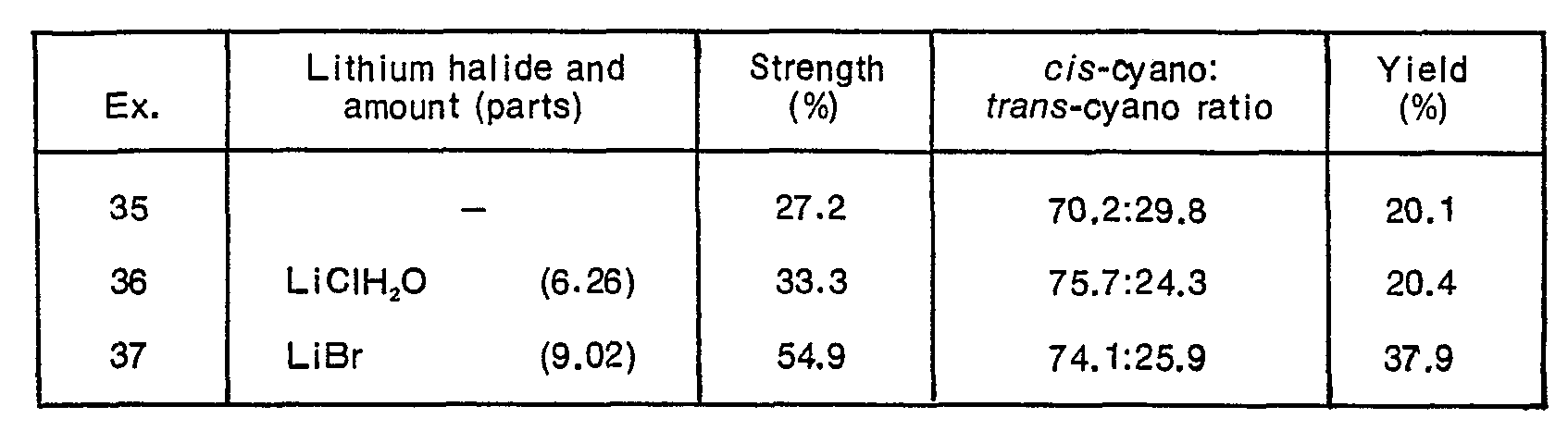
- A mixture of ethyl cyanoacetate (12.44 parts), 1,1,3,4-tetrachioro-4-methyipent-1-ene (11.1 parts), 1,1-dichloro-4-methylpenta-1,3-diene (7.55 parts), cupric acetate H20 (2.0 parts) and in two cases lithium halide, in acetonitrile (100 parts by volume) is heated to reflux and held at 75-80°C for 6 hours. After cooling to room temperature the suspension is filtered and the residue is washed twice with acetonitrile (20 parts by volume). The combined filtrate and washes are distilled under reduced pressure to remove acetonitrile and the residue is extracted with a mixture of toluene (100 parts by volume), water (150 parts by volume) and concentrated hydrochloric acid (100 parts by volume). After filtering from extraneous matter the filtrates are separated and the toluene layer is washed twice with hydrochloric acid (50 parts by volume) diluted with water (50 parts) and finally four times with water (50 parts). The toluene is removed by distillation under reduced pressure to yield crude ethyl 1-cyano-3-(2',2'-dichlorovinyl)-2,2-dimethylcyclopropane-1-carboxylate. Details are given in the following table:
- 1,1-Dichloro-304-dibromo-4-methylpent-1-ene (31.1 parts) cuprous chloride (1 part) and methanol (46 parts by volume) are heated to reflux. Ethylcyanoacetate (12.44 parts) in methanol (36 parts) is added at a uniform rate over 4 hours. 15 minutes after the start of this addition sodium methylate (10.8 parts) in methanol (55 parts by volume) is added at a uniform rate over 5½ hours. The reaction is maintained at reflux for a further 2 hours. After cooling to room temperature the brown solution is filtered from extraneous matter and the filtrate is distilled under reduced pressure to remove methanol. The residue is extracted with a mixture of toluene (100 parts by volume), water (150 parts by volume) and hydrochloric acid (100 parts by volume). The extract is filtered from insoluble matter and the filtrate is separated. The toluene layer is then washed four times with water (50 parts) and the crude ethyl 1-cyano-3-(2' ,2' -dichlorovinyl)-2,2-dimethylcyclopropane-1-carboxylate is isolated by distilling off the toluene under reduced pressure. A yield of 35.8% of product, strength 63.7% and cis-cyano:trans-cyano ratio 69.9:30.1, is obtained.
- A mixture of 1:1-dichloro-3,4-dibromo-4-methylpent-1-ene (31.1 parts), ethylcyanoacetate (12.44 parts), copper salt as catalyst and metal carbonate is heated for 6 hours in a solvent (100 parts by volume). The crude ethyl 1-cyano-3-(2',2'-dichlorovinyl)-2,2-dimethylcyclopropane-1-carboxylate is isolated in a similar manner to Example 38. The copper salt, metal carbonate and solvent are specified in the following table which also gives the yield, strength and composition of the derived ethyl 1-cyano-3-(2' ,2' -dichlorovinyl)-2,2-dimethylcyclopropane-1-carboxylate.

- A mixture of ethylcyanoacetate, 1,1-dichloro-3,4-dibromo-4-methylpent-1-ene and calcium carbonate is heated in ethanol (100 parts by volume) at reflux in the presence of calcium chloride (22.2 parts) and copper salt as catalyst. The crude ethyl 1-cyano-3-(2',2'-dichlorovinyl)-2,2-dimethylcyclopropane-1-carboxylate is isolated as described in Example 77. Details are given in the following table:-

- A mixture of ethyl cyanoacetate (24.88 parts), 1,1-dichloro-3,4-dibromo-4-methylpent-1-ene (62.2 parts), calcium or magnesium carbonate and metal chloride is heated in water (100 parts) in the presence of a phase transfer catalyst (either cetyl trimethyl ammonium bromide (CTMAB) or methyl triethyl ammonium chloride (MTEAC) and a copper salt as catalyst. The reaction mass is cooled to room temperature, n-butyl acetate (100 parts by volume) water (100 parts) and hydrochloric acid (100 parts by volume) are added and the mixture is stirred for 30 minutes, filtered from extraneous matter and the filtrates separated. The butyl acetate layer is washed with water (4 x 100 parts) and evaporated under reduced pressure to remove the butyl acetate and yield the crude ethyl 1-cyano-3-(2',2'-dich!oro- vinyl)-2,2-dimethylcyclopropane-1-carboxylate. The yield, strength and composition of the product is given in the following table, together with other details.

- A mixture of malonitrile (14.52 parts), 1,1-dichloro-3,4-dibromo-4-methylpent-1-ene (62.2 parts), calcium carbonate (40 parts), cupric chloride (2.68 parts) and calcium chloride (44 parts) in ethanol (100 parts by volume) is heated to reflux and held at 78-80°C for 3.3/4 hours. The reaction mass is cooled and distilled under reduced pressure to remove ethanol and the residue is extracted with a mixture of toluene (100 parts by volume), water (150 parts) and hydrochloric acid (50 parts by volume). The resultant suspension is filtered and the residue is washed with toluene (2 x 50 parts by volume) and water (50 parts).
- The residue is dried to give a brown solid (22.1 parts). The filtrates and washes are combined and separated and the toluene layer is washed with water (4 x 50 parts), then distilled under reduced pressure to yield crude product (17.3 parts) containing 1,1-dicyano-3-(2',2'-dichlorovinyl)-2,2-dimethylcyclopropane (14.04 parts). The brown solid (22.1 parts) is extracted at room temperature with toluene (100 parts by volume), then filtered and the residue washed with toluene. The filtrates are distilled under reduced pressure to yield a second crop of pure 1,1-dicyano-3-(2,2-dichlorovinyl)-2,2-dimethylcyclopropane (13.16 parts).
Claims (15)


Applications Claiming Priority (6)
| Application Number | Priority Date | Filing Date | Title |
|---|---|---|---|
| GB1694478 | 1978-04-28 | ||
| GB1694578 | 1978-04-28 | ||
| GB1694378 | 1978-04-28 | ||
| GB1694578 | 1978-04-28 | ||
| GB1694478 | 1978-04-28 | ||
| GB1694378 | 1978-04-28 |
Publications (2)
| Publication Number | Publication Date |
|---|---|
| EP0007154A1 EP0007154A1 (en) | 1980-01-23 |
| EP0007154B1 true EP0007154B1 (en) | 1981-12-30 |
Family
ID=27257434
Family Applications (1)
| Application Number | Title | Priority Date | Filing Date |
|---|---|---|---|
| EP79300585A Expired EP0007154B1 (en) | 1978-04-28 | 1979-04-10 | Process for the preparation of cyclopropane derivatives, intermediates in the synthesis of pyrethroid insecticides |
Country Status (7)
| Country | Link |
|---|---|
| US (1) | US4284582A (en) |
| EP (1) | EP0007154B1 (en) |
| JP (1) | JPS54144342A (en) |
| AU (1) | AU526551B2 (en) |
| DE (1) | DE2961651D1 (en) |
| DK (1) | DK172779A (en) |
| NZ (1) | NZ190168A (en) |
Families Citing this family (5)
| Publication number | Priority date | Publication date | Assignee | Title |
|---|---|---|---|---|
| FR2485004A1 (en) * | 1980-06-20 | 1981-12-24 | Roussel Uclaf | CYCLOPROPANE-1-CARBOXYLIC DERIVATIVES AND THEIR SALTS, THEIR PREPARATION AND THEIR APPLICATION TO THE SYNTHESIS OF INTERMEDIATES OF PYRETHRINOID COMPOUNDS OF CIS CONFIGURATION |
| CA1175065A (en) * | 1981-07-22 | 1984-09-25 | Kingsley Salisbury | Photoisomerisation of trans-cyclopropane-nitriles |
| GB2127012A (en) * | 1982-09-22 | 1984-04-04 | Shell Int Research | Process for the preparation of cyclopropane compounds |
| US4567265A (en) * | 1984-01-16 | 1986-01-28 | Loyola University Of Chicago | Cyclopropanoid cyanoesters and method of making same |
| DE19507822B4 (en) * | 1995-02-21 | 2006-07-20 | Schering Ag | Substituted DTPA monoamides of the central carboxylic acid and its metal complexes, pharmaceutical compositions containing these complexes, their use in diagnostics and therapy, and methods for the preparation of the complexes and agents |
Family Cites Families (11)
| Publication number | Priority date | Publication date | Assignee | Title |
|---|---|---|---|---|
| US3391205A (en) * | 1960-12-09 | 1968-07-02 | Pittsburgh Plate Glass Co | Process of chemical manufacture |
| FR1356949A (en) * | 1962-12-13 | 1964-04-03 | Rhone Poulenc Sa | Process for the preparation of cyclopropanecarboxylic acid derivatives |
| US3267150A (en) * | 1963-08-12 | 1966-08-16 | Shell Oil Co | Sulfone production |
| US3454657A (en) * | 1967-08-24 | 1969-07-08 | Dow Chemical Co | Catalytic synthesis of organic halogen compounds |
| US4000180A (en) * | 1974-08-14 | 1976-12-28 | Imperial Chemical Industries Limited | Process for preparing 2-dihalovinyl-3,3-dimethyl cyclo propane derivatives |
| US3974199A (en) * | 1975-06-16 | 1976-08-10 | The Dow Chemical Company | Process for production of cyclopropylcyanide |
| US4083863A (en) * | 1976-06-01 | 1978-04-11 | American Cyanamid Corporation | Process for the preparation of cyclopropane carboxylic acids and esters |
| GB1578139A (en) * | 1976-07-07 | 1980-11-05 | Ici Ltd | Preparation of alicyclic compounds |
| GB1581340A (en) * | 1976-07-26 | 1980-12-10 | Shell Int Research | Preparation of esters |
| US4154952A (en) * | 1977-01-31 | 1979-05-15 | Schultz Harry W | Process for the production of substituted cyclopropane derivatives |
| US4174348A (en) * | 1978-05-30 | 1979-11-13 | Shell Internationale Research Maatschappij B. V. | Preparation of cyclopropanecarbonitriles |
-
1979
- 1979-04-10 DE DE7979300585T patent/DE2961651D1/en not_active Expired
- 1979-04-10 EP EP79300585A patent/EP0007154B1/en not_active Expired
- 1979-04-11 AU AU46028/79A patent/AU526551B2/en not_active Expired
- 1979-04-11 NZ NZ190168A patent/NZ190168A/en unknown
- 1979-04-23 JP JP4918079A patent/JPS54144342A/en active Pending
- 1979-04-26 DK DK172779A patent/DK172779A/en active IP Right Grant
-
1980
- 1980-08-12 US US06/177,453 patent/US4284582A/en not_active Expired - Lifetime
Also Published As
| Publication number | Publication date |
|---|---|
| EP0007154A1 (en) | 1980-01-23 |
| DE2961651D1 (en) | 1982-02-18 |
| AU526551B2 (en) | 1983-01-20 |
| AU4602879A (en) | 1979-11-01 |
| US4284582A (en) | 1981-08-18 |
| DK172779A (en) | 1979-10-29 |
| JPS54144342A (en) | 1979-11-10 |
| NZ190168A (en) | 1981-01-23 |
Similar Documents
| Publication | Publication Date | Title |
|---|---|---|
| Kaiser et al. | Preparation of some cyclopropanes and stable sulfoxonium ylides from dimethylsulfoxonium methylide | |
| JP2618221B2 (en) | Intermediate for pesticide production | |
| US4118412A (en) | Preparation cyano substituted cyclopropane | |
| US7030283B2 (en) | Process for producing 1,1-difluorovinyl cycloaliphatic compounds | |
| US4377533A (en) | Process for introducing alkyl radicals into carbon chains having a functional group and compounds prepared by said process | |
| JP2001081065A (en) | Method for producing [bis-(trifluoromethyl)-phenyl]- acetic acid, its alkyl ester and dialkyl bis-(trifluoromethyl)-phenyl]-malonate | |
| GB2087886A (en) | Preparing biphenyl compounds by coupling | |
| EP0007154A1 (en) | Process for the preparation of cyclopropane derivatives, intermediates in the synthesis of pyrethroid insecticides | |
| EP0221635B1 (en) | Fluoro alcohols and insecticidal esters thereof | |
| US4415748A (en) | Intermediates for insecticidal synthetic pyrethroids | |
| US4482731A (en) | Process for the preparation of trans-3-(z-2-chloro-2-aryl-vinyl)-2,2-dimethyl-cyclopropane-1-carboxylic acid derivatives, and the use of intermediate products in agents for compating pests | |
| US4198347A (en) | 2(2,2-Dichlorovinyl)-3,3-dimethyl-cyclopropane carboxylates | |
| Fujisawa et al. | One-pot synthesis of ketones from carboxylic acids and grignard reagents using N, N-Diphenyl-p-methoxyphenylchloromethyleniminium chloride | |
| KR100619386B1 (en) | Process for preparing halogenated phenylmalonates | |
| EP0040829B1 (en) | Alkynyl halide compounds and alkenyl acetate compounds therefrom | |
| GB2061925A (en) | Cyclisation of y-chlorocarboxylic acid esters | |
| US5516932A (en) | Halogenated cinnamic acids and esters thereof, processes for the preparation thereof and halogenated aryldiazonium salts | |
| EP0022606B1 (en) | Process for the manufacture of halogenated hydrocarbons | |
| US5095136A (en) | Method for preparing isoprenoid cyclopropane 1,1-dicarboxylates and derivatives thereof and novel intermediates | |
| GB2085000A (en) | An improved process for the preparation of certain cyclopropane pyrethroid intermediates having a high cis-content | |
| US5463111A (en) | Process for preparing dialkyl 2-haloethyl malonates | |
| US4596887A (en) | Process for preparing dihalovinylcyclopropanecarboxylates | |
| US4500733A (en) | Process for preparing dihalovinylcyclopropanecarboxylic acids | |
| EP0022607B1 (en) | Process for the preparation of halogenated hydrocarbons | |
| JP2502936B2 (en) | Novel acetylene derivative |
Legal Events
| Date | Code | Title | Description |
|---|---|---|---|
| PUAI | Public reference made under article 153(3) epc to a published international application that has entered the european phase |
Free format text: ORIGINAL CODE: 0009012 |
|
| AK | Designated contracting states |
Designated state(s): CH DE FR GB IT NL |
|
| 17P | Request for examination filed | ||
| ITF | It: translation for a ep patent filed | ||
| GRAA | (expected) grant |
Free format text: ORIGINAL CODE: 0009210 |
|
| AK | Designated contracting states |
Designated state(s): CH DE FR GB IT NL |
|
| RAP2 | Party data changed (patent owner data changed or rights of a patent transferred) |
Owner name: IMPERIAL CHEMICAL INDUSTRIES PLC |
|
| REF | Corresponds to: |
Ref document number: 2961651 Country of ref document: DE Date of ref document: 19820218 |
|
| ITTA | It: last paid annual fee | ||
| REG | Reference to a national code |
Ref country code: GB Ref legal event code: 732E |
|
| ITPR | It: changes in ownership of a european patent |
Owner name: CESSIONE;ZENECA LIMITED |
|
| NLS | Nl: assignments of ep-patents |
Owner name: ZENECA LIMITED TE LONDEN, GROOT-BRITTANNIE. |
|
| REG | Reference to a national code |
Ref country code: CH Ref legal event code: PUE Owner name: ZENECA LIMITED |
|
| REG | Reference to a national code |
Ref country code: FR Ref legal event code: TP |
|
| PGFP | Annual fee paid to national office [announced via postgrant information from national office to epo] |
Ref country code: GB Payment date: 19970401 Year of fee payment: 19 |
|
| PGFP | Annual fee paid to national office [announced via postgrant information from national office to epo] |
Ref country code: FR Payment date: 19970409 Year of fee payment: 19 |
|
| PGFP | Annual fee paid to national office [announced via postgrant information from national office to epo] |
Ref country code: DE Payment date: 19970418 Year of fee payment: 19 |
|
| PGFP | Annual fee paid to national office [announced via postgrant information from national office to epo] |
Ref country code: CH Payment date: 19970422 Year of fee payment: 19 |
|
| PGFP | Annual fee paid to national office [announced via postgrant information from national office to epo] |
Ref country code: NL Payment date: 19970428 Year of fee payment: 19 |
|
| PG25 | Lapsed in a contracting state [announced via postgrant information from national office to epo] |
Ref country code: GB Free format text: LAPSE BECAUSE OF NON-PAYMENT OF DUE FEES Effective date: 19980410 |
|
| PG25 | Lapsed in a contracting state [announced via postgrant information from national office to epo] |
Ref country code: FR Free format text: THE PATENT HAS BEEN ANNULLED BY A DECISION OF A NATIONAL AUTHORITY Effective date: 19980430 Ref country code: CH Free format text: LAPSE BECAUSE OF NON-PAYMENT OF DUE FEES Effective date: 19980430 |
|
| PG25 | Lapsed in a contracting state [announced via postgrant information from national office to epo] |
Ref country code: NL Free format text: LAPSE BECAUSE OF NON-PAYMENT OF DUE FEES Effective date: 19981101 |
|
| GBPC | Gb: european patent ceased through non-payment of renewal fee |
Effective date: 19980410 |
|
| REG | Reference to a national code |
Ref country code: CH Ref legal event code: PL |
|
| NLV4 | Nl: lapsed or anulled due to non-payment of the annual fee |
Effective date: 19981101 |
|
| PG25 | Lapsed in a contracting state [announced via postgrant information from national office to epo] |
Ref country code: DE Free format text: LAPSE BECAUSE OF NON-PAYMENT OF DUE FEES Effective date: 19990202 |
|
| REG | Reference to a national code |
Ref country code: FR Ref legal event code: ST |
|
| PLBE | No opposition filed within time limit |
Free format text: ORIGINAL CODE: 0009261 |
|
| STAA | Information on the status of an ep patent application or granted ep patent |
Free format text: STATUS: NO OPPOSITION FILED WITHIN TIME LIMIT |