EP0006094B1 - A process for producing orthopedic structures and a thermoplastic linear polyurethane for use in such process - Google Patents
A process for producing orthopedic structures and a thermoplastic linear polyurethane for use in such process Download PDFInfo
- Publication number
- EP0006094B1 EP0006094B1 EP78100201A EP78100201A EP0006094B1 EP 0006094 B1 EP0006094 B1 EP 0006094B1 EP 78100201 A EP78100201 A EP 78100201A EP 78100201 A EP78100201 A EP 78100201A EP 0006094 B1 EP0006094 B1 EP 0006094B1
- Authority
- EP
- European Patent Office
- Prior art keywords
- diisocyanate
- diol
- carrier
- polyurethane
- radicals
- Prior art date
- Legal status (The legal status is an assumption and is not a legal conclusion. Google has not performed a legal analysis and makes no representation as to the accuracy of the status listed.)
- Expired
Links
- 238000000034 method Methods 0.000 title claims description 36
- 230000000399 orthopedic effect Effects 0.000 title claims description 31
- 239000004814 polyurethane Substances 0.000 title claims description 21
- 229920002635 polyurethane Polymers 0.000 title claims description 21
- 229920001169 thermoplastic Polymers 0.000 title claims description 10
- 239000004416 thermosoftening plastic Substances 0.000 title claims description 10
- 229920000642 polymer Polymers 0.000 claims description 43
- 238000006243 chemical reaction Methods 0.000 claims description 35
- 150000002009 diols Chemical class 0.000 claims description 32
- 239000000463 material Substances 0.000 claims description 32
- 239000004744 fabric Substances 0.000 claims description 23
- 125000005442 diisocyanate group Chemical group 0.000 claims description 22
- 239000002904 solvent Substances 0.000 claims description 19
- 150000001875 compounds Chemical class 0.000 claims description 17
- 230000001588 bifunctional effect Effects 0.000 claims description 16
- 239000003054 catalyst Substances 0.000 claims description 13
- 125000004432 carbon atom Chemical group C* 0.000 claims description 11
- IQPQWNKOIGAROB-UHFFFAOYSA-N isocyanate group Chemical group [N-]=C=O IQPQWNKOIGAROB-UHFFFAOYSA-N 0.000 claims description 11
- 239000000945 filler Substances 0.000 claims description 8
- 239000004970 Chain extender Substances 0.000 claims description 5
- 125000001424 substituent group Chemical group 0.000 claims description 5
- 125000000217 alkyl group Chemical group 0.000 claims description 3
- 239000011230 binding agent Substances 0.000 claims description 3
- 125000000753 cycloalkyl group Chemical group 0.000 claims description 3
- RXKJFZQQPQGTFL-UHFFFAOYSA-N dihydroxyacetone Chemical group OCC(=O)CO RXKJFZQQPQGTFL-UHFFFAOYSA-N 0.000 claims description 3
- 239000011810 insulating material Substances 0.000 claims description 3
- 239000003960 organic solvent Substances 0.000 claims description 3
- 125000003118 aryl group Chemical group 0.000 claims description 2
- 125000000113 cyclohexyl group Chemical group [H]C1([H])C([H])([H])C([H])([H])C([H])(*)C([H])([H])C1([H])[H] 0.000 claims description 2
- 230000004927 fusion Effects 0.000 claims description 2
- 125000006527 (C1-C5) alkyl group Chemical group 0.000 claims 1
- 125000004191 (C1-C6) alkoxy group Chemical group 0.000 claims 1
- 125000002947 alkylene group Chemical group 0.000 claims 1
- 125000004430 oxygen atom Chemical group O* 0.000 claims 1
- ZWEHNKRNPOVVGH-UHFFFAOYSA-N 2-Butanone Chemical compound CCC(C)=O ZWEHNKRNPOVVGH-UHFFFAOYSA-N 0.000 description 36
- 239000000203 mixture Substances 0.000 description 27
- UHOVQNZJYSORNB-UHFFFAOYSA-N Benzene Chemical compound C1=CC=CC=C1 UHOVQNZJYSORNB-UHFFFAOYSA-N 0.000 description 18
- GWEVSGVZZGPLCZ-UHFFFAOYSA-N Titan oxide Chemical compound O=[Ti]=O GWEVSGVZZGPLCZ-UHFFFAOYSA-N 0.000 description 18
- 238000002844 melting Methods 0.000 description 17
- 230000008018 melting Effects 0.000 description 17
- -1 aliphatic diols Chemical class 0.000 description 11
- 239000004408 titanium dioxide Substances 0.000 description 9
- UPMLOUAZCHDJJD-UHFFFAOYSA-N 4,4'-Diphenylmethane Diisocyanate Chemical compound C1=CC(N=C=O)=CC=C1CC1=CC=C(N=C=O)C=C1 UPMLOUAZCHDJJD-UHFFFAOYSA-N 0.000 description 7
- PAPBSGBWRJIAAV-UHFFFAOYSA-N ε-Caprolactone Chemical compound O=C1CCCCCO1 PAPBSGBWRJIAAV-UHFFFAOYSA-N 0.000 description 7
- 229920000742 Cotton Polymers 0.000 description 6
- MTHSVFCYNBDYFN-UHFFFAOYSA-N diethylene glycol Chemical compound OCCOCCO MTHSVFCYNBDYFN-UHFFFAOYSA-N 0.000 description 6
- ISWSIDIOOBJBQZ-UHFFFAOYSA-N Phenol Chemical compound OC1=CC=CC=C1 ISWSIDIOOBJBQZ-UHFFFAOYSA-N 0.000 description 5
- 239000012876 carrier material Substances 0.000 description 5
- 238000000576 coating method Methods 0.000 description 5
- 238000005470 impregnation Methods 0.000 description 5
- 239000000049 pigment Substances 0.000 description 5
- 239000011347 resin Substances 0.000 description 5
- 229920005989 resin Polymers 0.000 description 5
- WYURNTSHIVDZCO-UHFFFAOYSA-N Tetrahydrofuran Chemical compound C1CCOC1 WYURNTSHIVDZCO-UHFFFAOYSA-N 0.000 description 4
- 238000004519 manufacturing process Methods 0.000 description 4
- 239000000047 product Substances 0.000 description 4
- XLYOFNOQVPJJNP-UHFFFAOYSA-N water Substances O XLYOFNOQVPJJNP-UHFFFAOYSA-N 0.000 description 4
- PUPZLCDOIYMWBV-UHFFFAOYSA-N (+/-)-1,3-Butanediol Chemical compound CC(O)CCO PUPZLCDOIYMWBV-UHFFFAOYSA-N 0.000 description 3
- YMWUJEATGCHHMB-UHFFFAOYSA-N Dichloromethane Chemical compound ClCCl YMWUJEATGCHHMB-UHFFFAOYSA-N 0.000 description 3
- 239000005057 Hexamethylene diisocyanate Substances 0.000 description 3
- 230000015572 biosynthetic process Effects 0.000 description 3
- CDQSJQSWAWPGKG-UHFFFAOYSA-N butane-1,1-diol Chemical compound CCCC(O)O CDQSJQSWAWPGKG-UHFFFAOYSA-N 0.000 description 3
- 239000003153 chemical reaction reagent Substances 0.000 description 3
- 239000011248 coating agent Substances 0.000 description 3
- 239000002131 composite material Substances 0.000 description 3
- 238000001035 drying Methods 0.000 description 3
- RRAMGCGOFNQTLD-UHFFFAOYSA-N hexamethylene diisocyanate Chemical compound O=C=NCCCCCCN=C=O RRAMGCGOFNQTLD-UHFFFAOYSA-N 0.000 description 3
- ACCCMOQWYVYDOT-UHFFFAOYSA-N hexane-1,1-diol Chemical compound CCCCCC(O)O ACCCMOQWYVYDOT-UHFFFAOYSA-N 0.000 description 3
- 238000002156 mixing Methods 0.000 description 3
- 239000007858 starting material Substances 0.000 description 3
- IJGRMHOSHXDMSA-UHFFFAOYSA-N Atomic nitrogen Chemical compound N#N IJGRMHOSHXDMSA-UHFFFAOYSA-N 0.000 description 2
- LYCAIKOWRPUZTN-UHFFFAOYSA-N Ethylene glycol Chemical compound OCCO LYCAIKOWRPUZTN-UHFFFAOYSA-N 0.000 description 2
- KWYHDKDOAIKMQN-UHFFFAOYSA-N N,N,N',N'-tetramethylethylenediamine Chemical compound CN(C)CCN(C)C KWYHDKDOAIKMQN-UHFFFAOYSA-N 0.000 description 2
- KXBFLNPZHXDQLV-UHFFFAOYSA-N [cyclohexyl(diisocyanato)methyl]cyclohexane Chemical compound C1CCCCC1C(N=C=O)(N=C=O)C1CCCCC1 KXBFLNPZHXDQLV-UHFFFAOYSA-N 0.000 description 2
- UKLDJPRMSDWDSL-UHFFFAOYSA-L [dibutyl(dodecanoyloxy)stannyl] dodecanoate Chemical compound CCCCCCCCCCCC(=O)O[Sn](CCCC)(CCCC)OC(=O)CCCCCCCCCCC UKLDJPRMSDWDSL-UHFFFAOYSA-L 0.000 description 2
- 239000000654 additive Substances 0.000 description 2
- 230000001464 adherent effect Effects 0.000 description 2
- 125000001931 aliphatic group Chemical group 0.000 description 2
- 230000036760 body temperature Effects 0.000 description 2
- 230000002939 deleterious effect Effects 0.000 description 2
- 239000012975 dibutyltin dilaurate Substances 0.000 description 2
- 238000001125 extrusion Methods 0.000 description 2
- 239000000835 fiber Substances 0.000 description 2
- 239000012467 final product Substances 0.000 description 2
- 239000011521 glass Substances 0.000 description 2
- 125000004435 hydrogen atom Chemical group [H]* 0.000 description 2
- 238000007654 immersion Methods 0.000 description 2
- 239000000178 monomer Substances 0.000 description 2
- 230000001473 noxious effect Effects 0.000 description 2
- 239000004014 plasticizer Substances 0.000 description 2
- 238000006116 polymerization reaction Methods 0.000 description 2
- 238000007493 shaping process Methods 0.000 description 2
- 239000000126 substance Substances 0.000 description 2
- 239000000758 substrate Substances 0.000 description 2
- 239000000454 talc Substances 0.000 description 2
- 229910052623 talc Inorganic materials 0.000 description 2
- 150000003512 tertiary amines Chemical class 0.000 description 2
- YLQBMQCUIZJEEH-UHFFFAOYSA-N tetrahydrofuran Natural products C=1C=COC=1 YLQBMQCUIZJEEH-UHFFFAOYSA-N 0.000 description 2
- 229920001187 thermosetting polymer Polymers 0.000 description 2
- 150000003606 tin compounds Chemical class 0.000 description 2
- ZIBGPFATKBEMQZ-UHFFFAOYSA-N triethylene glycol Chemical compound OCCOCCOCCO ZIBGPFATKBEMQZ-UHFFFAOYSA-N 0.000 description 2
- ALQLPWJFHRMHIU-UHFFFAOYSA-N 1,4-diisocyanatobenzene Chemical compound O=C=NC1=CC=C(N=C=O)C=C1 ALQLPWJFHRMHIU-UHFFFAOYSA-N 0.000 description 1
- OVBFMUAFNIIQAL-UHFFFAOYSA-N 1,4-diisocyanatobutane Chemical compound O=C=NCCCCN=C=O OVBFMUAFNIIQAL-UHFFFAOYSA-N 0.000 description 1
- QUPKOUOXSNGVLB-UHFFFAOYSA-N 1,8-diisocyanatooctane Chemical compound O=C=NCCCCCCCCN=C=O QUPKOUOXSNGVLB-UHFFFAOYSA-N 0.000 description 1
- VTYYLEPIZMXCLO-UHFFFAOYSA-L Calcium carbonate Chemical compound [Ca+2].[O-]C([O-])=O VTYYLEPIZMXCLO-UHFFFAOYSA-L 0.000 description 1
- 201000004624 Dermatitis Diseases 0.000 description 1
- BWGNESOTFCXPMA-UHFFFAOYSA-N Dihydrogen disulfide Chemical compound SS BWGNESOTFCXPMA-UHFFFAOYSA-N 0.000 description 1
- PIICEJLVQHRZGT-UHFFFAOYSA-N Ethylenediamine Chemical compound NCCN PIICEJLVQHRZGT-UHFFFAOYSA-N 0.000 description 1
- 239000004677 Nylon Substances 0.000 description 1
- 208000007542 Paresis Diseases 0.000 description 1
- 239000004952 Polyamide Substances 0.000 description 1
- 239000004698 Polyethylene Substances 0.000 description 1
- 208000010040 Sprains and Strains Diseases 0.000 description 1
- 239000004433 Thermoplastic polyurethane Substances 0.000 description 1
- XTXRWKRVRITETP-UHFFFAOYSA-N Vinyl acetate Chemical compound CC(=O)OC=C XTXRWKRVRITETP-UHFFFAOYSA-N 0.000 description 1
- 150000001252 acrylic acid derivatives Chemical class 0.000 description 1
- 150000007933 aliphatic carboxylic acids Chemical class 0.000 description 1
- 125000003545 alkoxy group Chemical group 0.000 description 1
- 239000012298 atmosphere Substances 0.000 description 1
- 239000002981 blocking agent Substances 0.000 description 1
- 230000000903 blocking effect Effects 0.000 description 1
- 210000000988 bone and bone Anatomy 0.000 description 1
- 235000019437 butane-1,3-diol Nutrition 0.000 description 1
- WERYXYBDKMZEQL-UHFFFAOYSA-N butane-1,4-diol Chemical compound OCCCCO WERYXYBDKMZEQL-UHFFFAOYSA-N 0.000 description 1
- 238000005266 casting Methods 0.000 description 1
- 239000003795 chemical substances by application Substances 0.000 description 1
- 238000001816 cooling Methods 0.000 description 1
- 229920001577 copolymer Polymers 0.000 description 1
- 238000005520 cutting process Methods 0.000 description 1
- 238000000113 differential scanning calorimetry Methods 0.000 description 1
- 201000010099 disease Diseases 0.000 description 1
- 208000037265 diseases, disorders, signs and symptoms Diseases 0.000 description 1
- 238000001704 evaporation Methods 0.000 description 1
- 238000011049 filling Methods 0.000 description 1
- 239000003365 glass fiber Substances 0.000 description 1
- XXMIOPMDWAUFGU-UHFFFAOYSA-N hexane-1,6-diol Chemical compound OCCCCCCO XXMIOPMDWAUFGU-UHFFFAOYSA-N 0.000 description 1
- WGCNASOHLSPBMP-UHFFFAOYSA-N hydroxyacetaldehyde Natural products OCC=O WGCNASOHLSPBMP-UHFFFAOYSA-N 0.000 description 1
- 238000011065 in-situ storage Methods 0.000 description 1
- 230000002401 inhibitory effect Effects 0.000 description 1
- 208000014674 injury Diseases 0.000 description 1
- 229910010272 inorganic material Inorganic materials 0.000 description 1
- 239000011147 inorganic material Substances 0.000 description 1
- 239000012212 insulator Substances 0.000 description 1
- 230000007794 irritation Effects 0.000 description 1
- 150000002576 ketones Chemical class 0.000 description 1
- 150000002596 lactones Chemical class 0.000 description 1
- 239000000314 lubricant Substances 0.000 description 1
- 238000002803 maceration Methods 0.000 description 1
- 239000002808 molecular sieve Substances 0.000 description 1
- 238000000465 moulding Methods 0.000 description 1
- 210000003205 muscle Anatomy 0.000 description 1
- 230000003387 muscular Effects 0.000 description 1
- 229910052757 nitrogen Inorganic materials 0.000 description 1
- 229920001778 nylon Polymers 0.000 description 1
- 150000002894 organic compounds Chemical class 0.000 description 1
- 239000011368 organic material Substances 0.000 description 1
- 238000000643 oven drying Methods 0.000 description 1
- 229910052760 oxygen Inorganic materials 0.000 description 1
- 150000003014 phosphoric acid esters Chemical class 0.000 description 1
- 230000000485 pigmenting effect Effects 0.000 description 1
- 229920002647 polyamide Polymers 0.000 description 1
- 229920001610 polycaprolactone Polymers 0.000 description 1
- 239000004632 polycaprolactone Substances 0.000 description 1
- 239000004417 polycarbonate Substances 0.000 description 1
- 229920000515 polycarbonate Polymers 0.000 description 1
- 229920000728 polyester Polymers 0.000 description 1
- 229920000570 polyether Polymers 0.000 description 1
- 229920000573 polyethylene Polymers 0.000 description 1
- 229920001451 polypropylene glycol Polymers 0.000 description 1
- 239000005077 polysulfide Substances 0.000 description 1
- 229920001021 polysulfide Polymers 0.000 description 1
- 150000008117 polysulfides Polymers 0.000 description 1
- 229940088417 precipitated calcium carbonate Drugs 0.000 description 1
- 239000011541 reaction mixture Substances 0.000 description 1
- 238000002407 reforming Methods 0.000 description 1
- 238000003385 ring cleavage reaction Methods 0.000 description 1
- 238000005096 rolling process Methods 0.000 description 1
- 150000003384 small molecules Chemical class 0.000 description 1
- 239000007787 solid Substances 0.000 description 1
- 229910052717 sulfur Inorganic materials 0.000 description 1
- 238000004381 surface treatment Methods 0.000 description 1
- 238000003786 synthesis reaction Methods 0.000 description 1
- 229920002994 synthetic fiber Polymers 0.000 description 1
- 125000000383 tetramethylene group Chemical group [H]C([H])([*:1])C([H])([H])C([H])([H])C([H])([H])[*:2] 0.000 description 1
- 239000004753 textile Substances 0.000 description 1
- 229920002803 thermoplastic polyurethane Polymers 0.000 description 1
- 239000004634 thermosetting polymer Substances 0.000 description 1
- 231100000167 toxic agent Toxicity 0.000 description 1
- 230000001988 toxicity Effects 0.000 description 1
- 231100000419 toxicity Toxicity 0.000 description 1
- 230000008733 trauma Effects 0.000 description 1
- 238000007039 two-step reaction Methods 0.000 description 1
- 238000009736 wetting Methods 0.000 description 1
Images
Classifications
-
- C—CHEMISTRY; METALLURGY
- C08—ORGANIC MACROMOLECULAR COMPOUNDS; THEIR PREPARATION OR CHEMICAL WORKING-UP; COMPOSITIONS BASED THEREON
- C08G—MACROMOLECULAR COMPOUNDS OBTAINED OTHERWISE THAN BY REACTIONS ONLY INVOLVING UNSATURATED CARBON-TO-CARBON BONDS
- C08G18/00—Polymeric products of isocyanates or isothiocyanates
- C08G18/06—Polymeric products of isocyanates or isothiocyanates with compounds having active hydrogen
- C08G18/28—Polymeric products of isocyanates or isothiocyanates with compounds having active hydrogen characterised by the compounds used containing active hydrogen
- C08G18/40—High-molecular-weight compounds
- C08G18/42—Polycondensates having carboxylic or carbonic ester groups in the main chain
- C08G18/4266—Polycondensates having carboxylic or carbonic ester groups in the main chain prepared from hydroxycarboxylic acids and/or lactones
- C08G18/4269—Lactones
-
- A—HUMAN NECESSITIES
- A61—MEDICAL OR VETERINARY SCIENCE; HYGIENE
- A61L—METHODS OR APPARATUS FOR STERILISING MATERIALS OR OBJECTS IN GENERAL; DISINFECTION, STERILISATION OR DEODORISATION OF AIR; CHEMICAL ASPECTS OF BANDAGES, DRESSINGS, ABSORBENT PADS OR SURGICAL ARTICLES; MATERIALS FOR BANDAGES, DRESSINGS, ABSORBENT PADS OR SURGICAL ARTICLES
- A61L15/00—Chemical aspects of, or use of materials for, bandages, dressings or absorbent pads
- A61L15/07—Stiffening bandages
- A61L15/12—Stiffening bandages containing macromolecular materials
-
- Y—GENERAL TAGGING OF NEW TECHNOLOGICAL DEVELOPMENTS; GENERAL TAGGING OF CROSS-SECTIONAL TECHNOLOGIES SPANNING OVER SEVERAL SECTIONS OF THE IPC; TECHNICAL SUBJECTS COVERED BY FORMER USPC CROSS-REFERENCE ART COLLECTIONS [XRACs] AND DIGESTS
- Y10—TECHNICAL SUBJECTS COVERED BY FORMER USPC
- Y10S—TECHNICAL SUBJECTS COVERED BY FORMER USPC CROSS-REFERENCE ART COLLECTIONS [XRACs] AND DIGESTS
- Y10S602/00—Surgery: splint, brace, or bandage
- Y10S602/90—Method of making bandage structure
Definitions
- This invention relates to a process for producing orthopedic structures such as tapes, bandages and supports, and to a new thermoplastic linear polyurethane, ⁇ *h!:h is advantageously used for that process.
- Orthopedic structures are commonly used in the fixation of ruptured bones, the immobilization of inflamed or injured joints, in case of disease or trauma and for the support and immobilization of ligamentous and muscular structures in cases of strains and sprains.
- the immobilized limb may be encased in such rigid structure for long periods of time, frequently as much as six weeks or more.
- Support splints may be used in case of paresis or weakness of muscles and as a correction means for deformities.
- thermoplastic or thermosetting polymers As orthopedic cast materials.
- a polycaprolactone is used as a cast material employing permeable or porous base webs impregnated with the polymer.
- the material should have a reasonable setting time or work life, should be free of offensive or noxious solvents or other chemicals and should set within a relatively short time under mild conditions.
- the cast or orthopedic structure After the cast or orthopedic structure is formed it should be of light weight, so as to minimize the inconvenience to the wearer, should be porous, should have sufficient structural strength and should be water-proof and as x-ray transparent as possible.
- the object of the present invention is therefore a new polymer for the use as an orthopedic cast material, which fulfils the above- mentioned prerequisites.
- a further object of the present invention is a new process for producing orthopedic structures, which may be easily performed in a simple manner by using a highly concentrated solution of the polymer to impregnate the supports for the orthopedic structures.
- the invention relates to a process for producing orthopedic structures, which comprises impregnating a fabric carrier with a solution of a polymer and removing the solvent from the impregnated carrier, which process is characterized in that the fabric carrier is impregnated with a solution in an organic solvent of a prepolymer polyurethane having two isocyanate end groups which has been formed by the reaction of a bifunctional compound reactive with an isocyanate group with a molar excess of a diisocyanate, which solution contains a chain extender and optionally a catalyst for the chain-extending reaction and the impregnated carrier is warmed to remove the solvent and to prepare the final polymer.
- the invention also relates to the prepolymer and the thermoplastic linear polyurethane which is prepared by the above-described polymerisation of the prepolymer in situ in the impregnated fabric carrier.
- the polymer according to the invention is prepared by a two-step chemical synthesis.
- the first step comprises the reaction between a diisocyanate and an organic compound having two reactive hydrogen atoms in its end groups, which is preferably a diol, to form a prepolymer having two isocyanate end groups.
- the second step comprises the chain extension of the prepolymer by means of a usual bifunctional chain-extender.
- the diisocyanate which is used for the first step may be any aromatic, aliphatic or cycloaliphatic diisocyanate, which is usually reacted to form polyurethanes.
- diisocyanate examples include tetramethylene diisocyanate. hexamethylene diisocyanate, p-phenylene diisocyanate, p-toluylene diisocyanate, 4,4'-diphenyl-methane diisocyanate. Preferred are aliphatic and cycloaliphatic diisocyanates, such as hexamethylene diisocyanate, 4,4' -dicyclohexylmethane diisocyanate. If desired the reaction may be performed in the presence of usual catalysts, such as tertiary amines or tin compounds.
- catalysts such as tertiary amines or tin compounds.
- the bifunctional compound used as a starting material for the reaction with the above mentioned diisocyanate may be an oligomer having reactive end groups, such as OH-, NH-, NH z -, COOH- or SH- groups.
- the bifunctional compounds are oligomers having two OH-end groups such as polyethers, for example isotactic polypropylene oxide, polyurethanes, e.g. the oligomer obtained by the reaction of octamethylene diisocyanate and an excess of 1,3-butane diol, polyesters from aliphatic carboxylic acids and an excess of aliphatic diols, e.g. polytetramethylene sebacate, polyhexamethylene adipate.
- bifunctional compounds are polycarbonates, e.g. polytetramethylene carbonate, polyhexamethylene carbonate, polyamides having NH z - or COOH-end groups, polysulfides, such as polytrimethylene disulfide.
- Preferred oligomers are diols.
- the maximum molecular weight of those bifunctional compounds is about 10 000.
- a preferred diol for the first step reaction with the diisocyanate is an oligomer of a cyclic lactone, such as 8-valerolactone or alkyl-substituted 8-valerolactone, E -caprolactone and a mono- or dialkyl- substituted ⁇ -caprolactone, ⁇ -enantolactone etc.
- the cyclic lactone oligomer may be obtained by polymerization of the cyclic lactone in the presence of a usual starter for the ring cleavage of the lactone, such as the bifunctional compound of the general formula HY ⁇ R 2 ⁇ ZH, in which R 2 is a lower alkylene radical, especially with 2 to 6 carbon atoms, and Y and Z are chosen among -S-, -0- and -NH-.
- a usual starter for the ring cleavage of the lactone such as the bifunctional compound of the general formula HY ⁇ R 2 ⁇ ZH, in which R 2 is a lower alkylene radical, especially with 2 to 6 carbon atoms, and Y and Z are chosen among -S-, -0- and -NH-.
- the starter will be an aliphatic diol from glycol to hexamethylene diol.
- the polymerization for forming the oligomer may be performed according to any usual procedure which is known in this field of the technique.
- the oligomeric diol has a molecular weight of about 2000 to 6000.
- the bifunctional compound, especially the diol is chosen in such a way that the final thermoplastic linear polyurethane prepared from the prepolymer has a fusion temperature lower than 80°C.
- n moles of a diol and n+1 moles of a diisocyanate are reacted in order to form the prepolymer.
- n is the number of moles of the bifunctional compound, especially the diol, and may be about 1 to 5 and for the preferred case, where the bifunctional compound is a polylactone, it amounts to about 1 to 3, especially 1
- the prepolymer obtained by the reaction of step 1 has two isocyanate end groups, which may be either free isocyanate groups or blocked isocyanate groups, which are blocked by usual blocking agents, such as phenol.
- the diisocyanate and the bifunctional compound especially the diol, the lower the value of n, the higher the molecular weight of the diol, the maximum of which is about 10 000.
- thermoplastic linear polyurethane by the above-described two-step reaction.
- the first step comprises reacting an oligomer of a cyclic lactone of the formula with a molar excess of a diisocyanate (which is defined above) of the formula OCN-R 3 -NCO forming a prepolymer diisocyanate having recurring units of the formula and two isocyanate end groups.
- a diisocyanate which is defined above
- R represents an alkylene radical having 4 to 6 carbon atoms, preferably 5 carbon atoms, which is unsubstituted or may be substituted with lower alkyl groups, preferably with C, to C ⁇ and in particular with C, to C 4 alkyl groups, cycloalkyl groups, in particular cyclohexyl groups, lower alkoxy groups, in particular with 1 to 6 and preferably with 1 to 4 carbon atoms, the number of substituents being 1 to 3,
- R 2 is a lower alkylene radical having 2 to 6 carbon atoms,
- R 3 is the radical of an aromatic aliphatic or cycloaliphatic diisocyanate, preferably a tetramethylene or hexamethylene radical, R, being identical radicals or mixed radicals, x and y being 0 to about 50, preferably 10 to 20, with the sum of x+y being comprised between about 25 to about 50, preferably 30-40, in particular about 34, x+y being chosen in such a way that
- Z and Y usually are O, S, NH or ⁇ COO ⁇ .
- the second reaction comprises reacting the prepolymer obtained in step 1 with a bifunctional compound having two active hydrogen atoms which are apt to react with the isocyanate end groups of the prepolymer.
- This bifunctional compound may be chosen among the above-mentioned compounds for the first step reaction, preferably among the diols, and is either a low molecular weight compound, i.e. a monomeric compound, as commonly used for chain extension in the reaction of building up a polyurethane, or a higher molecular weight compound provided that it has a rzd.-,-Rd viscosity below 0.3 as defined above, such as the oligomer polylactone used in step 1.
- diols such as butane diol, hexane diol, or the above stated oligomeric polylactone.
- a catalyst which may be a tertiary amine or a tin compound, such as dibutyl tin dilaurate, which is usually known for the chain extension of prepolymer diisocyanates to form polyurethanes.
- This catalyst is used in the usual concentration for this reaction.
- the final thermoplastic linear polyurethane which is formed by the chain-extending reaction between the prepolymeric diisocyanate and the diol, is a material having a molecular weight of about 25 000 to 80 000, usually about 40-45 000.
- thermoplastic polyurethane according to the invention is used for the production of orthopedic cast forming material in the form of a bandage, web, film, tape or sheet
- the second reaction i.e. the reaction of chain extension is performed while the prepolymer, which is in form of a solution in a usual solvent, preferably an aliphatic ketone, is impregnated in a usual fabric carrier for orthopedic tapes or sheets. That means that firstly the fabric carrier is impregnated with a solution in a usual solvent, comprising the prepolymer and the diol, which contains optionally a catalyst, a pigment or dye, and then it is heated at temperatures of from about 50-160°C, whereby the solvent is evaporated and the chain extension takes place to form the final polymer.
- the prepolymer and the diol are mixed with a usual pigment or dye, optionally an inert filler and optionally a catalyst and the mixture is cast into molds or formed by extrusion.
- the orthopedic casts according to the invention may be in the form of sheets, tapes and preformed contour-fitting shapes for the application to the human or animal body.
- a base- or support material as a carrier for the polymer, which may be a flexible fabric web, which has preferably relatively large openings and relatively heavy strands.
- the strands are of a loose weave or knit, so as to be porous and subject to at least partial impregnation by the polymeric material.
- the web carrier serves as a structural element in the final product and is coated with the polymeric composition.
- the carrier material is preferably a flexible large mesh fabric preferably knit defining a lattice or relatively large openings.
- the smallest dimension of the openings may generally be at least 0.097 cm 2 and preferably a minimum of 0.142 cm 2 about 0.219 cm 2 and generally not exceeding 1.613 cm 2 , more usually not exceeding 0.323 cm 2.
- the openings may be of any configuration, such as square, polygonal, or the like. The opening shall be large enough so that in the finished product the polymer composition preferably does not form air impervious windows across the openings.
- the strands of the carrier which define the openings are preferably formed of relatively coarse, bulky, staple, porous, low density and thermal insulating material such as heavy yarn of 5 to 15 twist and having a raw diameter of at least 0.330 mm preferably about 0.381 mm and generally not exceeding 1.016 mm and when including the fluff or fuzz around the yam strands at least 0.762 mm, preferably a minimum of 1.270 mm, about 1.905 mm and generally not exceeding 5.080 mm and more usually not exceeding 2.540 mm.
- Materials which may be used include cellulosic materials, such as cotton, synthetic materials, such as acrylates and nylon, or combinations thereof. For the most part, organic materials are .employed, rather than more thermal conductive inorganic materials, such as glass fibers. Some significant factors concerning the material are that the material be a thermal insulator, that it provide structural stability to the final product, that it allow for molding to form the orthopedic structure, that it is wettable by the polymer composition, and that it is stable under normal usage.
- the low density strands of bulky Raschael type knits formed of staple fibers of cotton and defining naturally occurring multitudinous voids provides a desirable carrier material.
- a knit of the Raschael type inherently provides a highly flexible carrier material.
- the material should be substantially free of additives which may interfere with the bond between the polymer and the fiber.
- Cellulosic materials are preferably scoured to remove any binders or lubricants inhibiting the wetting properties of the polymer or other possibly deleterious additives.
- the polymer composition comprising the prepolymer having two free or blocked isocyanate-end groups, and the chain-extender, preferably a diol, are mixed with an inert, volatile solvent, such as an aliphatic ketone, optionally a pigment or dye which is usually employed for pigmenting of polyurethanes, such as titanium dioxide, and optionally the catalyst.
- an inert, volatile solvent such as an aliphatic ketone
- a pigment or dye which is usually employed for pigmenting of polyurethanes, such as titanium dioxide, and optionally the catalyst.
- a suitable viscosity of the mixture may be set by appropriate choice of the ratio of polymer to solvent.
- the viscosity of the prepolymer according to the invention is low, it is not necessary to use large amounts of solvent for preparing the impregnating solution.
- the pigment may be used in small amounts, generally not exceeding 15% by weight, more usually not exceeding 1096 by weight, and preferably from about 3 to 8% by weight.
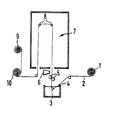
- a roll 1 of the appropriate knitted or loose carrier woven webbing 2 is provided.
- the webbing 2 is passed under tank roller 13 and immersed in coating solution 4.
- the initially coated webbing is then passed between adjustable trunnion rolls 5 and past an air knife 6 and thence circuitously through oven 7 passing over rollers 8 adjacent the upper regions of the oven 7.
- the air knife 6 serves to blow out any polymer windows which may have formed in passing through the wet polymer solution 4, and the air knife also assists in the drying of the polymer applied to the wet carrier 3.
- the webbing in passing through the drying oven 7 is dried at an elevated temperature.
- the fabric As the prepolymer solution, which is used according to the invention for impregnating the fabric, has a relatively low viscosity, the fabric is not only coated, but impregnated with a prepolymer throughout its structure.
- the solvent is evaporated, the blocking groups of the isocyanate groups, if there have been used any, are removed and the reaction of chain extension proceeds to form the final thermoplastic linear polymer within the structure of the webbing.
- a release film of polyethylene or similar material from an unwind roll 9 may be employed in forming the take-up roll 10 of the impregnated web 2 if the roller bandage layers adhere to each other during rolling or when the roll is heated to working temperature prior to its use in the making of an orthopedic cast as more specifically described hereinafter.
- the diameter of the impregnated strands of the web 2 were measured in the range of between approximately 0.254 mm to 6.604 mm and generally between 1.905 mm and 4.064 mm.
- the size of the openings of the impregnated web should generally be in a somewhat lower range of areas than given previously with respect to the dimension of the openings of the unimpregnated carrier material.
- the smallest dimension of the coated opening will generally be at least 0.065 cm 2 , preferably a minimum of 0.129 cm 2 , about 0.168 cm 2 . generally not exceeding 1.613 cm 2 and usually not exceeding 0.323 cm 2 .
- the shape of the opening shown in the impregnated web are disclosed as being in the form of a non-rectangular parallelogram as distinguished from the near square shaped openings of the unimpregnated knit carrier. Such variation in shape between the uncoated and coated carrier may result from the manner in which the carrier is handled during the coating process.
- the orientation during coating is not important and in order to provide an entirely satisfactory bandage it is not necessary that the openings be square or rectangular. It is important, however, that the openings after coating be of substantial area ranging for example between not less than 0.065 cm 2 to not more than 1.613 cm 2 and more preferably between 0.129 cm 2 and 0.323 cm 2 and around 0.168 cm 2 .
- the openings be large enough so that when a cast is formed by spirally wrapping and overlapping the material around the injured limb, that air passages through the thickness of the cast will be maintained to permit the underlying skin of the patient to breathe and to permit volatilization and dissipation of moisture from the interior of the cast.
- the prepolymer having two blocked or free isocyanate-end groups is usually mixed with the chain extending agent, i.e. the above-described diol, and optionally with a pigment or dye, optionally a catalyst for the chain extending reaction and optionally a usual filler, which must be inert and essentially moisture-free.
- the chain extending agent i.e. the above-described diol
- a pigment or dye optionally a catalyst for the chain extending reaction
- a usual filler which must be inert and essentially moisture-free.
- a specific example for such a filler is talc, and other compounds with spherolitic or lamellar structure such as precipitated calcium carbonate or Si0 2 . AI 2 0 3 with or without a usual surface treatment.
- the mixture may be formed by usual shaping processes and equipments, such as by casting or extrusion, provided that there is maintained a residence time and temperature, sufficient for the complete proceeding of the chain-extending reaction.
- the orthopedic cast- or sheet material which has been obtained according to the described procedure, can be formed in rolls which may be warmed above the softening temperature of the resin.
- the thermally softened impregnated fabric becomes highly flexible and pliant and may then be wrapped in multiple layers about the limb to be immobilized.
- the large knit fabric carrier allows for twisting of the fabric, forming and reforming, so as to obtain the desired shape and degree of support.
- the formed orthopedic cast is light and stable under normal usage conditions, is moisture-proof and light-weight.
- the cast is easily removed by utilizing conventional cast-cutting or sawing techniques and equipments.
- a particular advantage of the orthopedic cast material is the fact that the polymer is impregnated throughout the structure of the textile carrier, which in turn causes an improved strength of the product and avoids the filling of the openings of the web by polymer.
- the splints according to the invention are of high strength and stability at room and body temperature and do not release noxious substances.
- the use of the prepolymer according to the invention to impregnate the carrier of the tape or sheet also leads to important advantages compared with the prior techniques.
- the prepolymer has a lower viscosity
- the impregnation of the carrier may be attained with a more concentrated solution and by using a much less amount of solvent, compared with the prior process for impregnating the carrier.
- the concentration of solids in the impregnating solution is higher, a one-step impregnation is sufficient to obtain the required amount of polymer in the final structure.
- the melting points of the polymers stated in the examples have been measured by differential scanning calorimetry.
- the intrinsic viscosities have been measured under the conditions which are explained in example 1.
- MDI 4,4'-diphenylmethane diisocyanate
- the other mixture containing 563.01 gr of the prepolymer solution, 375.38 gr of the same diol as the one used to prepare the prepolymer, 440 gr of dried MEK, 23.4 gr of titanium dioxide had a viscosity of 280 centipoises as measured with a Brookfield viscometer at 40°C. This mixture has been used to impregnate successfully a cotton cloth with wide openings, then hung in the oven at 160°C. The polymer on the substrate had an intrinsic viscosity of 0.58. After immersion in hot water, the resulting composite material is suitable to prepare self adherent bandage that hardens under cooling.
- a prepolymer solution has been made from a reaction mixture containing 775 gr of diol, 131.3 gr of MDI and 454.48 gr of MEK. After complete reaction which took place at 70°C, 47.18 gr of phenol have been added and allowed to react further.
- a mixture has been made with 300 gr of the prepolymer solution, 164.91 gr of the same diol as the one used to prepare the prepolymer, amount representing an equimolar ratio, 82.4 gr of dried MEK. This mixture with a low content of solvent had a viscosity of 600 centipoises at 40°C.
- a prepolymer solution has been made from 78.55 of MDI, 492.86 gr of dried MEK, and 625.28 gr of an epsilon caprolactone oligomeric diol of molecular weight about 4000, reduced viscosity at 0.2 gr in 100 ml of benzene at 30°C of 0.15.
- the reaction took place at 70°C with 2.2 ml of N,N,N',N'-tetramethy)-1,3-diaminobutane as catalyst. After complete reaction, 32.89 gr of phenol have been added and allowed to react further. 1.08 gr of hexane diol has been mixed with 60.45 gr of the prepolymer solution; the mixture cast in the oven at 160°C produced a polymer of melting point 54°C and intrinsic viscosity 0.63.
- a prepolymer solution has been made from 707.70 gr of diol, 88.4 gr of MDI and 555.5 gr of dried MEK. After complete reaction at 60°C, 37.86 gr of phenol have been added and 2.0 ml of N,N,N',N'-tetramethyl-1 :3-diaminobutane thereafter.
- a mixture containing 29.93 gr of the prepolymer solution and 0.40 gr of diethyleneglycol has been cast in the oven at 160°C and produced a polymer of melting point 53°C and intrinsic viscosity 0.49.
- a mixture containing 455.14 gr of the prepolymer solution, 161.71 gr of dried MEK, 231.05 gr of the diol used to prepare the prepolymer and 24.55 gr of titanium dioxide had a viscosity of 650 centipoises at 50°C and has been used successfully to impregnate a cotton cloth with wide openings leading after oven treatment at 160°C to a composite material able to form resistant orthopedic bandages.
- the melting point of the resin on the substrate was 53 ° C.
- a prepolymer solution has been made from 508.69 gr of an epsilon caprolactone oligomeric diol of molecular weight 4000, reduced viscosity at 0.2 gr in 100 ml of benzene at 30°C of 0.15, 276.02 gr of dried MEK and 42.83 gr of hexamethylenediisocyanate 1-6.
- 150.22 gr of the prepolymer solution was added to 2.08 gr of butane diol 1-4, placed in the oven at 140°C to produce a polymer of melting point 58°C and intrinsic viscosity 1.34.
- a prepolymer solution has been made by reaction of 790.73 gr of an epsilon caprolactone oligomeric diol of molecular weight about 4000, reduced viscosity at 0.2 gr in 100 ml of benzene at 30°C of 0.15, with 103.85 gr of dicyclohexylmethane diisocyanate in 625.15 gr of dried MEK.
- 94.62 gr of the prepolymer solution has been mixed with 1.13 gr of butanediol 1-4, cast in the oven at 140°C to produce a polymer of melting point 56°C and intrinsic viscosity of 0.76.
- a continuous increase of the reacting torque was found indicating the formation of the polymer whose final intrinsic viscosity was 1.26.
- a sheet of 3 mm thickness has been molded in the press giving a suitable material for splint application.
- the shear modulus of this material at 23°C is 880 kg/cm 2 and the tensile modulus is 3090 kg/cm 2.
- the three other parts have been mixed respectively with 10, 15, and 20 percent of talc as filler, cast in molds and placed in the oven d t 120°C.
- the fairly low viscosity of the mixture as prepared allows a rapid mixing cf the filler with low energy requirements.
- the polymer formed in the first material had an intrinsic viscosity of 1.31.
- Sheets of 3 mm thickness have been prepared in the press with these materials giving respectively with the increase of filler content: 1274, 1326 and 1394 kg/cm 2 for the shear modulus at 23°C, and 2672, 3553 and 3198 kg/cm 2 for the tensile modulus at the same temperature.
- the increase of shear modulus due to the filler is of interest for splint applications, as well as the fact that the sheet can be shaped after immersion in hot water being then also self adherent.
Landscapes
- Health & Medical Sciences (AREA)
- Chemical & Material Sciences (AREA)
- Chemical Kinetics & Catalysis (AREA)
- Medicinal Chemistry (AREA)
- Polymers & Plastics (AREA)
- Organic Chemistry (AREA)
- Engineering & Computer Science (AREA)
- Materials Engineering (AREA)
- Epidemiology (AREA)
- Life Sciences & Earth Sciences (AREA)
- Animal Behavior & Ethology (AREA)
- General Health & Medical Sciences (AREA)
- Public Health (AREA)
- Veterinary Medicine (AREA)
- Materials For Medical Uses (AREA)
Description
- This invention relates to a process for producing orthopedic structures such as tapes, bandages and supports, and to a new thermoplastic linear polyurethane, <*h!:h is advantageously used for that process.
- Orthopedic structures are commonly used in the fixation of ruptured bones, the immobilization of inflamed or injured joints, in case of disease or trauma and for the support and immobilization of ligamentous and muscular structures in cases of strains and sprains. In these orthopedic uses the immobilized limb may be encased in such rigid structure for long periods of time, frequently as much as six weeks or more.
- Support splints may be used in case of paresis or weakness of muscles and as a correction means for deformities.
- It has been known to use thermoplastic or thermosetting polymers as orthopedic cast materials.
- In the United States
Patent 2 385 879 there is described an orthopedic cast material having strength and rigidity at room temperature and body temperature, which is readily moldable at higher temperature. This material comprises a copolymer of vinyl acetate and organic phosphate esters as a plasticizer. - From United States
Patent 2 853 067 there are known orthopedic casts, which are prepared by using a thermosetting resin, which is mixed with a catalyst and an accelerator. - According to U.S.
Patent 3 692 023 a polycaprolactone is used as a cast material employing permeable or porous base webs impregnated with the polymer. - These prior materials for forming splints, supports or bandages have, however, a number of inherent disadvantages. In some cases they are difficult to handle and discomfort the patient because of their too high shaping temperature. Materials containing toxic compounds such as plasticizers, monomers or catalysts, are liable to cause severe irritation and even inflammation of the skin.
- Most of the prior processes for producing orthopedic structures involve processing of high molecular polymers and therefore the use of highly viscous solutions. As a consequence many process difficulties are caused and it is necessary to use highly diluted solutions and multistep impregnation processes for producing the bandages.
- Concerning the above discussed state of the art a satisfactory cast material for orthopedic structures should be easy to handle and should not have properties which deleteriously affect the limb, particularly the skin.
- The material should have a reasonable setting time or work life, should be free of offensive or noxious solvents or other chemicals and should set within a relatively short time under mild conditions.
- After the cast or orthopedic structure is formed it should be of light weight, so as to minimize the inconvenience to the wearer, should be porous, should have sufficient structural strength and should be water-proof and as x-ray transparent as possible.
- Despite of the characteristics of the cast it is highly desirable that the process for producing the orthopedic cast materials may be conducted in a simple and convenient manner without the necessity of handling highly viscous solutions.
- The object of the present invention is therefore a new polymer for the use as an orthopedic cast material, which fulfils the above- mentioned prerequisites.
- A further object of the present invention is a new process for producing orthopedic structures, which may be easily performed in a simple manner by using a highly concentrated solution of the polymer to impregnate the supports for the orthopedic structures.
- The invention relates to a process for producing orthopedic structures, which comprises impregnating a fabric carrier with a solution of a polymer and removing the solvent from the impregnated carrier, which process is characterized in that the fabric carrier is impregnated with a solution in an organic solvent of a prepolymer polyurethane having two isocyanate end groups which has been formed by the reaction of a bifunctional compound reactive with an isocyanate group with a molar excess of a diisocyanate, which solution contains a chain extender and optionally a catalyst for the chain-extending reaction and the impregnated carrier is warmed to remove the solvent and to prepare the final polymer.
- The invention also relates to the prepolymer and the thermoplastic linear polyurethane which is prepared by the above-described polymerisation of the prepolymer in situ in the impregnated fabric carrier. Regarding the overall procedure starting with the monomers until the formation of the final polymer, the polymer according to the invention is prepared by a two-step chemical synthesis. The first step comprises the reaction between a diisocyanate and an organic compound having two reactive hydrogen atoms in its end groups, which is preferably a diol, to form a prepolymer having two isocyanate end groups. The second step comprises the chain extension of the prepolymer by means of a usual bifunctional chain-extender.
- The diisocyanate which is used for the first step may be any aromatic, aliphatic or cycloaliphatic diisocyanate, which is usually reacted to form polyurethanes.
- Representative examples for the diisocyanate are tetramethylene diisocyanate. hexamethylene diisocyanate, p-phenylene diisocyanate, p-toluylene diisocyanate, 4,4'-diphenyl-methane diisocyanate. Preferred are aliphatic and cycloaliphatic diisocyanates, such as hexamethylene diisocyanate, 4,4' -dicyclohexylmethane diisocyanate. If desired the reaction may be performed in the presence of usual catalysts, such as tertiary amines or tin compounds.
- The bifunctional compound used as a starting material for the reaction with the above mentioned diisocyanate may be an oligomer having reactive end groups, such as OH-, NH-, NHz-, COOH- or SH- groups. Examples for the bifunctional compounds are oligomers having two OH-end groups such as polyethers, for example isotactic polypropylene oxide, polyurethanes, e.g. the oligomer obtained by the reaction of octamethylene diisocyanate and an excess of 1,3-butane diol, polyesters from aliphatic carboxylic acids and an excess of aliphatic diols, e.g. polytetramethylene sebacate, polyhexamethylene adipate. Other bifunctional compounds are polycarbonates, e.g. polytetramethylene carbonate, polyhexamethylene carbonate, polyamides having NHz- or COOH-end groups, polysulfides, such as polytrimethylene disulfide.
- Preferred oligomers are diols. Preferably the maximum molecular weight of those bifunctional compounds is about 10 000.
- A preferred diol for the first step reaction with the diisocyanate is an oligomer of a cyclic lactone, such as 8-valerolactone or alkyl-substituted 8-valerolactone, E-caprolactone and a mono- or dialkyl- substituted ε-caprolactone, ξ-enantolactone etc.
- The cyclic lactone oligomer may be obtained by polymerization of the cyclic lactone in the presence of a usual starter for the ring cleavage of the lactone, such as the bifunctional compound of the general formula HY―R2―ZH, in which R2 is a lower alkylene radical, especially with 2 to 6 carbon atoms, and Y and Z are chosen among -S-, -0- and -NH-.
- Commonly the starter will be an aliphatic diol from glycol to hexamethylene diol. The polymerization for forming the oligomer may be performed according to any usual procedure which is known in this field of the technique.
- Preferably the oligomeric diol has a molecular weight of about 2000 to 6000.
- In any case the bifunctional compound, especially the diol, is chosen in such a way that the final thermoplastic linear polyurethane prepared from the prepolymer has a fusion temperature lower than 80°C. In said first step generally n moles of a diol and n+1 moles of a diisocyanate are reacted in order to form the prepolymer. (n is the number of moles of the bifunctional compound, especially the diol, and may be about 1 to 5 and for the preferred case, where the bifunctional compound is a polylactone, it amounts to about 1 to 3, especially 1
- The prepolymer obtained by the reaction of step 1 has two isocyanate end groups, which may be either free isocyanate groups or blocked isocyanate groups, which are blocked by usual blocking agents, such as phenol. In carrying out the reaction between the diisocyanate and the bifunctional compound, especially the diol, the lower the value of n, the higher the molecular weight of the diol, the maximum of which is about 10 000.
- According to a preferred embodiment of the invention, there is prepared a new thermoplastic linear polyurethane by the above-described two-step reaction.
- The first step comprises reacting an oligomer of a cyclic lactone of the formula


- In the above formula R, represents an alkylene radical having 4 to 6 carbon atoms, preferably 5 carbon atoms, which is unsubstituted or may be substituted with lower alkyl groups, preferably with C, to Cµ and in particular with C, to C4 alkyl groups, cycloalkyl groups, in particular cyclohexyl groups, lower alkoxy groups, in particular with 1 to 6 and preferably with 1 to 4 carbon atoms, the number of substituents being 1 to 3, R2 is a lower alkylene radical having 2 to 6 carbon atoms, R3 is the radical of an aromatic aliphatic or cycloaliphatic diisocyanate, preferably a tetramethylene or hexamethylene radical, R, being identical radicals or mixed radicals, x and y being 0 to about 50, preferably 10 to 20, with the sum of x+y being comprised between about 25 to about 50, preferably 30-40, in particular about 34, x+y being chosen in such a way that the prepolymeric diisocyanate with recurring units of the above formula I has a reduced viscosity of less than 0.3 measured at a concentration of 0.2 g of the prepolymer in 100 ml benzene at 30°C.
- Z and Y usually are O, S, NH or ―COO―.
- The second reaction comprises reacting the prepolymer obtained in step 1 with a bifunctional compound having two active hydrogen atoms which are apt to react with the isocyanate end groups of the prepolymer. This bifunctional compound may be chosen among the above-mentioned compounds for the first step reaction, preferably among the diols, and is either a low molecular weight compound, i.e. a monomeric compound, as commonly used for chain extension in the reaction of building up a polyurethane, or a higher molecular weight compound provided that it has a rzd.-,-Rd viscosity below 0.3 as defined above, such as the oligomer polylactone used in step 1.
- Preferred for the reaction of chain extension are diols, such as butane diol, hexane diol, or the above stated oligomeric polylactone.
- For the second reaction optionally a catalyst is used, which may be a tertiary amine or a tin compound, such as dibutyl tin dilaurate, which is usually known for the chain extension of prepolymer diisocyanates to form polyurethanes. This catalyst is used in the usual concentration for this reaction.
- The final thermoplastic linear polyurethane, which is formed by the chain-extending reaction between the prepolymeric diisocyanate and the diol, is a material having a molecular weight of about 25 000 to 80 000, usually about 40-45 000.
- If the thermoplastic polyurethane according to the invention is used for the production of orthopedic cast forming material in the form of a bandage, web, film, tape or sheet, the second reaction. i.e. the reaction of chain extension is performed while the prepolymer, which is in form of a solution in a usual solvent, preferably an aliphatic ketone, is impregnated in a usual fabric carrier for orthopedic tapes or sheets. That means that firstly the fabric carrier is impregnated with a solution in a usual solvent, comprising the prepolymer and the diol, which contains optionally a catalyst, a pigment or dye, and then it is heated at temperatures of from about 50-160°C, whereby the solvent is evaporated and the chain extension takes place to form the final polymer. If the polymer according to the invention is used for the production of orthopedic splints or supports, the prepolymer and the diol are mixed with a usual pigment or dye, optionally an inert filler and optionally a catalyst and the mixture is cast into molds or formed by extrusion.
- The orthopedic casts according to the invention may be in the form of sheets, tapes and preformed contour-fitting shapes for the application to the human or animal body. In this case, there is used a base- or support material as a carrier for the polymer, which may be a flexible fabric web, which has preferably relatively large openings and relatively heavy strands.
- Preferably the strands are of a loose weave or knit, so as to be porous and subject to at least partial impregnation by the polymeric material. The web carrier serves as a structural element in the final product and is coated with the polymeric composition.
- The carrier material is preferably a flexible large mesh fabric preferably knit defining a lattice or relatively large openings. The smallest dimension of the openings may generally be at least 0.097 cm2 and preferably a minimum of 0.142 cm2 about 0.219 cm2 and generally not exceeding 1.613 cm2, more usually not exceeding 0.323 cm2. The openings may be of any configuration, such as square, polygonal, or the like. The opening shall be large enough so that in the finished product the polymer composition preferably does not form air impervious windows across the openings.
- The strands of the carrier which define the openings are preferably formed of relatively coarse, bulky, staple, porous, low density and thermal insulating material such as heavy yarn of 5 to 15 twist and having a raw diameter of at least 0.330 mm preferably about 0.381 mm and generally not exceeding 1.016 mm and when including the fluff or fuzz around the yam strands at least 0.762 mm, preferably a minimum of 1.270 mm, about 1.905 mm and generally not exceeding 5.080 mm and more usually not exceeding 2.540 mm.
- Materials which may be used include cellulosic materials, such as cotton, synthetic materials, such as acrylates and nylon, or combinations thereof. For the most part, organic materials are .employed, rather than more thermal conductive inorganic materials, such as glass fibers. Some significant factors concerning the material are that the material be a thermal insulator, that it provide structural stability to the final product, that it allow for molding to form the orthopedic structure, that it is wettable by the polymer composition, and that it is stable under normal usage. By way of more specific example, the low density strands of bulky Raschael type knits formed of staple fibers of cotton and defining naturally occurring multitudinous voids provides a desirable carrier material. A knit of the Raschael type inherently provides a highly flexible carrier material.
- Preferably, the material should be substantially free of additives which may interfere with the bond between the polymer and the fiber. Cellulosic materials are preferably scoured to remove any binders or lubricants inhibiting the wetting properties of the polymer or other possibly deleterious additives.
- In the following a practical process for the production of an orthopedic cast-forming bandage will be described in detail. The polymer composition, comprising the prepolymer having two free or blocked isocyanate-end groups, and the chain-extender, preferably a diol, are mixed with an inert, volatile solvent, such as an aliphatic ketone, optionally a pigment or dye which is usually employed for pigmenting of polyurethanes, such as titanium dioxide, and optionally the catalyst.
- A suitable viscosity of the mixture may be set by appropriate choice of the ratio of polymer to solvent.
- As the viscosity of the prepolymer according to the invention is low, it is not necessary to use large amounts of solvent for preparing the impregnating solution.
- The pigment may be used in small amounts, generally not exceeding 15% by weight, more usually not exceeding 1096 by weight, and preferably from about 3 to 8% by weight.
- A preferred embodiment of the process for impregnating the fabric carrier and subsequent reaction of chain extension is now described by reference to the attached figure.
- According to the figure a roll 1 of the appropriate knitted or loose carrier woven
webbing 2 is provided. - The
webbing 2 is passed under tank roller 13 and immersed in coating solution 4. - The initially coated webbing is then passed between adjustable trunnion rolls 5 and past an air knife 6 and thence circuitously through
oven 7 passing over rollers 8 adjacent the upper regions of theoven 7. The air knife 6 serves to blow out any polymer windows which may have formed in passing through the wet polymer solution 4, and the air knife also assists in the drying of the polymer applied to thewet carrier 3. The webbing in passing through the dryingoven 7 is dried at an elevated temperature. - As the prepolymer solution, which is used according to the invention for impregnating the fabric, has a relatively low viscosity, the fabric is not only coated, but impregnated with a prepolymer throughout its structure. During the passage of the webbing through the drying
oven 7 the solvent is evaporated, the blocking groups of the isocyanate groups, if there have been used any, are removed and the reaction of chain extension proceeds to form the final thermoplastic linear polymer within the structure of the webbing. - A release film of polyethylene or similar material from an unwind
roll 9 may be employed in forming the take-up roll 10 of the impregnatedweb 2 if the roller bandage layers adhere to each other during rolling or when the roll is heated to working temperature prior to its use in the making of an orthopedic cast as more specifically described hereinafter. - In the preferred embodiment the diameter of the impregnated strands of the
web 2 were measured in the range of between approximately 0.254 mm to 6.604 mm and generally between 1.905 mm and 4.064 mm. - The size of the openings of the impregnated web should generally be in a somewhat lower range of areas than given previously with respect to the dimension of the openings of the unimpregnated carrier material.
- The smallest dimension of the coated opening will generally be at least 0.065 cm2, preferably a minimum of 0.129 cm2, about 0.168 cm2. generally not exceeding 1.613 cm2 and usually not exceeding 0.323 cm2. The shape of the opening shown in the impregnated web are disclosed as being in the form of a non-rectangular parallelogram as distinguished from the near square shaped openings of the unimpregnated knit carrier. Such variation in shape between the uncoated and coated carrier may result from the manner in which the carrier is handled during the coating process. In manufacturing the impregnated web according to the process described in reference to the figure and without utilizing rather special web tracking and handling equipment, it was found that the web could be better handled through the impregnation and oven drying process by running the fabric with the strands oriented parallel and perpendicular to the line of travel of the material through the equipment. Where the carrier material is originally oriented in a diagonal direction with respect to the strands, it may be desirable to cut the material on a bias and run it through the coating process so that the strands are substantially parallel and perpendicular instead of diagonal to the line of travel. Such an orientation will give a more rectangular finished product.
- However, the orientation during coating is not important and in order to provide an entirely satisfactory bandage it is not necessary that the openings be square or rectangular. It is important, however, that the openings after coating be of substantial area ranging for example between not less than 0.065 cm2 to not more than 1.613 cm2 and more preferably between 0.129 cm2 and 0.323 cm2 and around 0.168 cm2.
- As earlier noted it is important that the openings be large enough so that when a cast is formed by spirally wrapping and overlapping the material around the injured limb, that air passages through the thickness of the cast will be maintained to permit the underlying skin of the patient to breathe and to permit volatilization and dissipation of moisture from the interior of the cast.
- In the process of forming an orthopedic splint or support the prepolymer having two blocked or free isocyanate-end groups is usually mixed with the chain extending agent, i.e. the above-described diol, and optionally with a pigment or dye, optionally a catalyst for the chain extending reaction and optionally a usual filler, which must be inert and essentially moisture-free. A specific example for such a filler is talc, and other compounds with spherolitic or lamellar structure such as precipitated calcium carbonate or Si02 . AI203 with or without a usual surface treatment. The mixture may be formed by usual shaping processes and equipments, such as by casting or extrusion, provided that there is maintained a residence time and temperature, sufficient for the complete proceeding of the chain-extending reaction.
- The orthopedic cast- or sheet material, which has been obtained according to the described procedure, can be formed in rolls which may be warmed above the softening temperature of the resin. The thermally softened impregnated fabric becomes highly flexible and pliant and may then be wrapped in multiple layers about the limb to be immobilized. The large knit fabric carrier allows for twisting of the fabric, forming and reforming, so as to obtain the desired shape and degree of support. The overlapping layers of impregnated fabric bond to each other during wrapping and whereafter the impregnated fabric rapidly cools to a hard structurally stable cast, which is porous so as l= minimize maceration or other deleterious skin conditions from developing.
- The formed orthopedic cast is light and stable under normal usage conditions, is moisture-proof and light-weight. The cast is easily removed by utilizing conventional cast-cutting or sawing techniques and equipments.
- A particular advantage of the orthopedic cast material is the fact that the polymer is impregnated throughout the structure of the textile carrier, which in turn causes an improved strength of the product and avoids the filling of the openings of the web by polymer.
- The splints according to the invention are of high strength and stability at room and body temperature and do not release noxious substances.
- The use of the prepolymer according to the invention to impregnate the carrier of the tape or sheet also leads to important advantages compared with the prior techniques. As the prepolymer has a lower viscosity, the impregnation of the carrier may be attained with a more concentrated solution and by using a much less amount of solvent, compared with the prior process for impregnating the carrier. According to the invention only 1/20 to 1/25 of the amount of the solvent is required. Therefore, there are important savings of solvent and less pollution of the environment when evaporating the solvent. As the concentration of solids in the impregnating solution is higher, a one-step impregnation is sufficient to obtain the required amount of polymer in the final structure.
- Further according to the invention it is possible to use solvents, such as ketones, having lower toxicity, while according to the prior art the use of methylene chloride has been necessary.
- In the following the invention is further explained by examples.
- The melting points of the polymers stated in the examples have been measured by differential scanning calorimetry. The intrinsic viscosities have been measured under the conditions which are explained in example 1.
- 704.1 gr. of a epsilon caprolactone oligomeric diol of molecular weight about 3000. reduced viscosity at 0.2 gr in 100 ml benzene at 30°C of 0.11, has been added to 248.8 gr of methyl ethyl ketone (MEK) previously dried with a 3.10-1 mm (3 angstrom)-molecular sieve, in a 1.5 liter stirred glass reactor. After mixing has been achieved, 119.77 gr of 4,4'-diphenylmethane diisocyanate (MDI) have been added and the reacting mixture maintained under a dried nitrogen blanket. By water circulation in the jacket the temperature has been raised to 60°C and the mixture has been kept under mixing for several hours after what 43.63 gr of phenol have been added to the system maintained at the same temperature. After complete reaction two mixtures have been prepared. One mixture containing 488.36 gr of the prepolymer solution and 9.68 gr of butane diol-1,4 and 11.55 gr of titanium dioxide placed in the oven at 160°C produced a polymer of melting point 49°C and intrinsic viscosity in tetrahydrofuran (THF) at 25°C of 0.775.
- The other mixture containing 563.01 gr of the prepolymer solution, 375.38 gr of the same diol as the one used to prepare the prepolymer, 440 gr of dried MEK, 23.4 gr of titanium dioxide had a viscosity of 280 centipoises as measured with a Brookfield viscometer at 40°C. This mixture has been used to impregnate successfully a cotton cloth with wide openings, then hung in the oven at 160°C. The polymer on the substrate had an intrinsic viscosity of 0.58. After immersion in hot water, the resulting composite material is suitable to prepare self adherent bandage that hardens under cooling.
- Using the same equipment, the same procedure and the same reagents as in example 3, a 1, a prepolymer solution has been made from a reaction mixture containing 775 gr of diol, 131.3 gr of MDI and 454.48 gr of MEK. After complete reaction which took place at 70°C, 47.18 gr of phenol have been added and allowed to react further. A mixture has been made with 300 gr of the prepolymer solution, 164.91 gr of the same diol as the one used to prepare the prepolymer, amount representing an equimolar ratio, 82.4 gr of dried MEK. This mixture with a low content of solvent had a viscosity of 600 centipoises at 40°C. An aliquot cast in the oven at 160°C, produced a polymer of intrinsic viscosity 0.62. An other aliquot to which 3.3 per cent of titanium dioxide had been added was used successfully to impregnate a cotton cloth with wide openings. The resin then produced in the same conditions had a melting point of 53.5°C. Kept four days at 40°C in contact with the atmosphere, the mixture described above had no large increase of viscosity. A cast made after six days in the oven at 160°C still produced a polymer of intrinsic viscosity 0.62.
- Using the same equipment and the same procedure as in example 1, a prepolymer solution has been made from 78.55 of MDI, 492.86 gr of dried MEK, and 625.28 gr of an epsilon caprolactone oligomeric diol of molecular weight about 4000, reduced viscosity at 0.2 gr in 100 ml of benzene at 30°C of 0.15. The reaction took place at 70°C with 2.2 ml of N,N,N',N'-tetramethy)-1,3-diaminobutane as catalyst. After complete reaction, 32.89 gr of phenol have been added and allowed to react further. 1.08 gr of hexane diol has been mixed with 60.45 gr of the prepolymer solution; the mixture cast in the oven at 160°C produced a polymer of melting point 54°C and intrinsic viscosity 0.63.
- Using the same equipment, the same procedure and the same reagents as in example 3, a prepolymer solution has been made from 707.70 gr of diol, 88.4 gr of MDI and 555.5 gr of dried MEK. After complete reaction at 60°C, 37.86 gr of phenol have been added and 2.0 ml of N,N,N',N'-tetramethyl-1 :3-diaminobutane thereafter. A mixture containing 29.93 gr of the prepolymer solution and 0.40 gr of diethyleneglycol has been cast in the oven at 160°C and produced a polymer of melting point 53°C and intrinsic viscosity 0.49. The same mixture containing 3 per cent titanium dioxide produced in the same conditions a polymer with a melting point of 54°C. Another mixture containing 38.76 gr of prepolymer solution and 0.296 gr of ethylenediamine produced in the same conditions, a polymer with a melting point of 56°C, and the latter mixture with 3 per cent of titanium dioxide gave a white product with a melting point of 55°C. A mixture containing 455.14 gr of the prepolymer solution, 161.71 gr of dried MEK, 231.05 gr of the diol used to prepare the prepolymer and 24.55 gr of titanium dioxide had a viscosity of 650 centipoises at 50°C and has been used successfully to impregnate a cotton cloth with wide openings leading after oven treatment at 160°C to a composite material able to form resistant orthopedic bandages. The melting point of the resin on the substrate was 53 ° C.
- Using the same equipment and the same procedure as in example 1 a prepolymer solution has been made from 508.69 gr of an epsilon caprolactone oligomeric diol of molecular weight 4000, reduced viscosity at 0.2 gr in 100 ml of benzene at 30°C of 0.15, 276.02 gr of dried MEK and 42.83 gr of hexamethylenediisocyanate 1-6. After formation of the prepolymer whose reduced viscosity was 0.24, 150.22 gr of the prepolymer solution was added to 2.08 gr of butane diol 1-4, placed in the oven at 140°C to produce a polymer of melting point 58°C and intrinsic viscosity 1.34. 70.69 gr of the prepolymer solution and 1.15 gr of diethyleneglycol were treated in the same way and produced a polymer with a melting point of 57°C and an intrinsic viscosity of 1.15. In the same conditions 61.75 gr of the prepolymer solution and 1.43 gr triethyleneglycol have a polymer of melting point 56.5°C and intrinsic viscosity 1.00, while 71.60 gr of the prepolymer solution and 1.30 gr of hexanediol 1-6 gave a polymer with a melting point of 56°C and an intrinsic viscosity of 1.51.
- Using the same equipment and the same procedure as in example 1 a prepolymer solution has been made by reaction of 790.73 gr of an epsilon caprolactone oligomeric diol of molecular weight about 4000, reduced viscosity at 0.2 gr in 100 ml of benzene at 30°C of 0.15, with 103.85 gr of dicyclohexylmethane diisocyanate in 625.15 gr of dried MEK. After complete reaction 94.62 gr of the prepolymer solution has been mixed with 1.13 gr of butanediol 1-4, cast in the oven at 140°C to produce a polymer of melting point 56°C and intrinsic viscosity of 0.76. The same mixture with 3 per cent of titanium dioxide gave a polymer of melting point 59°C. A mixture made of 92.90 gr of the prepolymer solution and 1.83 gr of triethylene glycol produced in the same conditions a polymer with a melting point of 54°C and an intrinsic viscosity of 0.65.
- Using the same equipment, the same procedure and the same reagents as in example 6, a prepolymer solution has been made with 822.51 gr of diolr 108.03 gr of dicyclohexylmethane- diisocyanate and 654.03 gr of dried MEK, with in addition, 0.2 ml of dibutyltindilaurate as catalyst. After complete reaction, a mixture made of 250.91 gr of the prepolymer solution, 130.50 gr of the same diol as the one used to prepare the prepolymer, 179.03 gr of dried MEK and 13.90 gr of titanium dioxide, having a viscosity of 120 centipoises at 25°C has been used successfully to impregnate a cotton cloth with wide openings. After treatment in the oven at 140°C, the obtained composite material was suitable for orthopedic applications. The melting point of the resin was 52°C and its intrinsic viscosity was 0.84.
- In a one liter glass stirred reactor, 54.5 gr of 4,4'-diphenyl methanediisocyanate have been added, without solvent to 416.71 gr of an epsilon caprolactone oligomeric diol of molecular weight about 4000, reduced viscosity at 0.2 gr in 100 ml benzene at 30°C of 0.15. Water circulation in the jacket allowed to control the reaction temperature at 80°C. After complete reaction, a mixture has been made with 406.1 gr of prepolymer and 359.36 gr of the same diol as the one used to prepare the prepolymer and divided into four parts. One part has been placed in the brabender plastograph acting batchwise in the same way as an extruder would act continuously. A continuous increase of the reacting torque was found indicating the formation of the polymer whose final intrinsic viscosity was 1.26. A sheet of 3 mm thickness has been molded in the press giving a suitable material for splint application. The shear modulus of this material at 23°C is 880 kg/cm2 and the tensile modulus is 3090 kg/cm2. The three other parts have been mixed respectively with 10, 15, and 20 percent of talc as filler, cast in molds and placed in the oven dt 120°C. The fairly low viscosity of the mixture as prepared allows a rapid mixing cf the filler with low energy requirements. The polymer formed in the first material had an intrinsic viscosity of 1.31. Sheets of 3 mm thickness have been prepared in the press with these materials giving respectively with the increase of filler content: 1274, 1326 and 1394 kg/cm2 for the shear modulus at 23°C, and 2672, 3553 and 3198 kg/cm2 for the tensile modulus at the same temperature. The increase of shear modulus due to the filler is of interest for splint applications, as well as the fact that the sheet can be shaped after immersion in hot water being then also self adherent.
Claims (15)


Priority Applications (3)
| Application Number | Priority Date | Filing Date | Title |
|---|---|---|---|
| DE7878100201T DE2862101D1 (en) | 1978-06-19 | 1978-06-19 | A process for producing orthopedic structures and a thermoplastic linear polyurethane for use in such process |
| EP78100201A EP0006094B1 (en) | 1978-06-19 | 1978-06-19 | A process for producing orthopedic structures and a thermoplastic linear polyurethane for use in such process |
| US06/195,370 US4316457A (en) | 1978-06-19 | 1980-10-09 | Process for producing orthopedic structures and a thermoplastic linear polyurethane for use in such process |
Applications Claiming Priority (1)
| Application Number | Priority Date | Filing Date | Title |
|---|---|---|---|
| EP78100201A EP0006094B1 (en) | 1978-06-19 | 1978-06-19 | A process for producing orthopedic structures and a thermoplastic linear polyurethane for use in such process |
Publications (2)
| Publication Number | Publication Date |
|---|---|
| EP0006094A1 EP0006094A1 (en) | 1980-01-09 |
| EP0006094B1 true EP0006094B1 (en) | 1982-10-13 |
Family
ID=8185896
Family Applications (1)
| Application Number | Title | Priority Date | Filing Date |
|---|---|---|---|
| EP78100201A Expired EP0006094B1 (en) | 1978-06-19 | 1978-06-19 | A process for producing orthopedic structures and a thermoplastic linear polyurethane for use in such process |
Country Status (3)
| Country | Link |
|---|---|
| US (1) | US4316457A (en) |
| EP (1) | EP0006094B1 (en) |
| DE (1) | DE2862101D1 (en) |
Families Citing this family (42)
| Publication number | Priority date | Publication date | Assignee | Title |
|---|---|---|---|---|
| EP0057988B1 (en) | 1981-02-09 | 1986-11-26 | Smith and Nephew Associated Companies p.l.c. | Bandages |
| US4427002A (en) | 1981-11-18 | 1984-01-24 | Hexcel Corporation | Cold water curable orthopedic cast |
| US4450833A (en) * | 1981-12-02 | 1984-05-29 | Brooks William R | Method of dimensioning a polyurethane foam bandage |
| US4465064A (en) * | 1982-02-22 | 1984-08-14 | Philip Boone | Orthopedic device and method for supporting and treating portions of the body |
| US4672956A (en) * | 1982-05-06 | 1987-06-16 | Smith And Nephew Associated Companies P.L.C | Bandages, components thereof and use |
| US5110852A (en) * | 1982-07-16 | 1992-05-05 | Rijksuniversiteit Te Groningen | Filament material polylactide mixtures |
| NL8202894A (en) * | 1982-07-16 | 1984-02-16 | Rijksuniversiteit | POLYESTER FILAMENT MATERIAL. |
| US4473671A (en) * | 1983-09-01 | 1984-09-25 | Johnson & Johnson Products, Inc. | Formable orthopedic casts and splints |
| DE3404904C2 (en) * | 1984-02-11 | 1986-01-16 | Kulzer & Co GmbH, 6393 Wehrheim | Process for the manufacture of orthodontic devices and appliances |
| US4784123A (en) * | 1986-01-03 | 1988-11-15 | Union Carbide Corporation | Orthopedic/orthotic splint materials |
| EP0298121B1 (en) * | 1987-01-14 | 1993-04-21 | Vsesojuzny Nauchno-Issledovatelsky I Ispytatelny Institut Meditsinskoi Tekhniki | Biocompatible material for treatment of defects in tissues and organs |
| US4934356A (en) * | 1987-01-15 | 1990-06-19 | Carapace Incorporated | Water-activated orthopedic cast composition having colorant |
| US5005566A (en) * | 1987-01-15 | 1991-04-09 | Carapace, Incorporated | Water-activated orthopedic cast composition having colorant |
| US4800872A (en) * | 1987-01-20 | 1989-01-31 | Johnson & Johnson Orthopaedics, Inc. | Ravel-free orthopaedic casting tapes |
| EP0295031A3 (en) * | 1987-06-12 | 1991-05-08 | SMITH & NEPHEW plc | Orthopaedic splinting material |
| US4945903A (en) * | 1989-04-28 | 1990-08-07 | Max Alper | Anti-itch cast |
| US5273802A (en) * | 1989-07-07 | 1993-12-28 | Minnesota Mining And Manufacturing Company | Orthopedic casting materials having superior lamination characteristics due to napped surface |
| BE1006172A3 (en) * | 1992-09-07 | 1994-05-31 | Liegeois Jean Marie | Combination in the form of composite materials, or flexible rigid or adhesives moldable under the influence of a lower temperature 90 degrees c. |
| EP0693914B1 (en) * | 1993-04-16 | 1998-12-23 | Minnesota Mining And Manufacturing Company | Orthopedic casting materials |
| US5378531A (en) * | 1993-07-09 | 1995-01-03 | Larson; Peter M. | Gamma radiation treated sheet material for use as orthopedic splints and casts and the like |
| US6071833A (en) * | 1997-04-23 | 2000-06-06 | D'alisa; Albert | Method of repairing walls and ceilings |
| US6180178B1 (en) | 1998-10-22 | 2001-01-30 | Milliken & Company | Method of producing support garments by applying polyurethane coatings to specific areas of fabric |
| DE19915932A1 (en) * | 1999-04-09 | 2000-10-19 | Freudenberg Carl Fa | Thermoplastic processable polyurethane molding compound |
| DE60124214T2 (en) * | 2001-02-07 | 2007-03-01 | Runlite S.A. | Thermoplastic molding compounds based on polyurethane for orthopedic purposes |
| US6695801B1 (en) | 2001-12-14 | 2004-02-24 | Russ Toronto | Form-in-place foam orthopedic splint system |
| US20070038206A1 (en) * | 2004-12-09 | 2007-02-15 | Palomar Medical Technologies, Inc. | Photocosmetic device |
| JP5024951B2 (en) * | 2005-02-24 | 2012-09-12 | アルケア株式会社 | Light-curing orthopedic fixation material |
| US8303527B2 (en) | 2007-06-20 | 2012-11-06 | Exos Corporation | Orthopedic system for immobilizing and supporting body parts |
| JP5164686B2 (en) * | 2008-06-25 | 2013-03-21 | ナガセケムテックス株式会社 | Personal protective equipment |
| JP2010005031A (en) * | 2008-06-25 | 2010-01-14 | Nagase Chemtex Corp | Bandage for fixation |
| HUE046825T2 (en) | 2009-02-24 | 2020-03-30 | Exos Llc | A method of making a customized orthopedic product using a composite material |
| WO2011082547A1 (en) | 2010-01-09 | 2011-07-14 | 广州科莱瑞迪医疗器材有限公司 | Low temperature thermoplastic material and preparing method thereof |
| USD663850S1 (en) | 2010-08-18 | 2012-07-17 | Exos Corporation | Long thumb spica brace |
| USD665088S1 (en) | 2010-08-18 | 2012-08-07 | Exos Corporation | Wrist brace |
| USD663851S1 (en) | 2010-08-18 | 2012-07-17 | Exos Corporation | Short thumb spica brace |
| US9295748B2 (en) | 2012-07-31 | 2016-03-29 | Exos Llc | Foam core sandwich splint |
| US9408738B2 (en) | 2012-08-01 | 2016-08-09 | Exos Llc | Orthopedic brace for animals |
| US9655761B2 (en) | 2012-11-12 | 2017-05-23 | Djo, Llc | Orthopedic back brace |
| US20150065932A1 (en) | 2013-08-27 | 2015-03-05 | Peter M. Larson | Moldable splint and method of using same |
| US11944507B2 (en) * | 2018-02-12 | 2024-04-02 | Orfit Industries N.V. | Immobilisation device |
| US20190357992A1 (en) | 2018-05-25 | 2019-11-28 | Klarity Medical Products, LLC | Immobilization system having bite-block stabilization and method of using same |
| DE102018128054A1 (en) * | 2018-11-09 | 2020-05-14 | Karl Otto Braun Gmbh & Co. Kg. | Bandage print |
Family Cites Families (11)
| Publication number | Priority date | Publication date | Assignee | Title |
|---|---|---|---|---|
| FR1418863A (en) * | 1963-06-24 | 1965-11-26 | Union Carbide Corp | Elastic fibers and sheets obtained from an epsilon-caprolactone and process for their production |
| US3551364A (en) * | 1965-10-21 | 1970-12-29 | Usm Corp | Processes for making microporous polyurethane bodies employing non-boiling liquid alkyl ethers or liquid aliphatic hydrocarbons |
| US3631854A (en) * | 1969-05-19 | 1972-01-04 | Robert Howard Fryer | Inflatable medical assemblies |
| US3891785A (en) * | 1973-03-20 | 1975-06-24 | Usm Corp | Process for forming a flexible polyurethane coating |
| US3949742A (en) * | 1974-09-20 | 1976-04-13 | Frigitronics, Inc. | Medical dressing |
| US4020832A (en) * | 1974-12-24 | 1977-05-03 | Reichhold Chemicals, Inc. | Package and method for preparing orthopedic cast-making materials |
| US4052282A (en) * | 1975-10-08 | 1977-10-04 | Mitsubishi Petrochemical Co., Ltd. | Photocurable flexible orthopedic bandage |
| US4143665A (en) * | 1977-01-21 | 1979-03-13 | Griffin Lee E | Machine for shelling beans or peas and for separating particles therefrom |
| US4127124A (en) * | 1977-05-12 | 1978-11-28 | W. R. Grace & Co. | Urethane bioimplant membrane |
| US4156066A (en) * | 1977-06-23 | 1979-05-22 | Tyndale Plains - Hunter Ltd. | Polyurethane polymers characterized by lactone groups and hydroxyl groups in the polymer backbone |
| US4124572A (en) * | 1977-07-05 | 1978-11-07 | Uniroyal, Inc. | Thermoplastic polyurethane elastomer |
-
1978
- 1978-06-19 DE DE7878100201T patent/DE2862101D1/en not_active Expired
- 1978-06-19 EP EP78100201A patent/EP0006094B1/en not_active Expired
-
1980
- 1980-10-09 US US06/195,370 patent/US4316457A/en not_active Expired - Lifetime
Also Published As
| Publication number | Publication date |
|---|---|
| DE2862101D1 (en) | 1982-11-18 |
| EP0006094A1 (en) | 1980-01-09 |
| US4316457A (en) | 1982-02-23 |
Similar Documents
| Publication | Publication Date | Title |
|---|---|---|
| US4316457A (en) | Process for producing orthopedic structures and a thermoplastic linear polyurethane for use in such process | |
| US4572171A (en) | Polyurethane fixed dressings which harden in the presence of moisture | |
| DE69613144T2 (en) | LINEAR BLOCK POLYMER CONTAINING UREA AND URETHANE GROUPS, METHOD FOR PRODUCING LINEAR BLOCK POLYMERS AND USE OF BLOCK POLYMERS AS IMPLANTS | |
| EP0035517B1 (en) | Water-activated casting material | |
| US4427002A (en) | Cold water curable orthopedic cast | |
| US4614787A (en) | Drug dispensing wound dressing | |
| DE69401337T2 (en) | MICROFIBER FIBER FABRICS FOR ORTHOPEDIC RIBBON | |
| DE69620261T2 (en) | ORTHOPEDIC PLASTIC FABRIC WITH HARD AND SOFT AREAS | |
| DE69221482T2 (en) | WOUND COVER MATERIAL | |
| US4273115A (en) | Moldable plastic orthopedic cast | |
| DE69403073T2 (en) | WATER-SOLUBLE FILMS FOR SYNTHETIC ORTHOPEDIC TAPES | |
| US4727868A (en) | Anisotropic wound dressing | |
| EP0326285B2 (en) | Bandages | |
| AU1103583A (en) | Cold water curable orthopedic cast | |
| CA2312944A1 (en) | Orthopedic casting articles containing backings having water soluble binders | |
| US5382445A (en) | Mechanically compacted fabrics for orthopedic casting tapes | |
| DE69422995T2 (en) | WET PRESSURE OF FABRICS FOR ORTHOPEDICALLY REINFORCING BANDAGES | |
| JPS6137165A (en) | Material for fixed gypsum dressing | |
| DE2357931B2 (en) | Curable dressing material | |
| USRE32991E (en) | Drug dispensing wound dressing | |
| DE2409789A1 (en) | POLYURETHANE SOLUTIONS | |
| WO2005065604A1 (en) | Wound dressing | |
| EP0234403B1 (en) | Laminated bandage | |
| DE2353212A1 (en) | Stiffening-hardening medical dressing matl. - consists of flexible base matl. impregnated with substances contg. oxy-carbonyl-isocyanate gps. | |
| US4627424A (en) | Cold water curable orthopedic cast |
Legal Events
| Date | Code | Title | Description |
|---|---|---|---|
| PUAI | Public reference made under article 153(3) epc to a published international application that has entered the european phase |
Free format text: ORIGINAL CODE: 0009012 |
|
| AK | Designated contracting states |
Designated state(s): BE CH DE FR GB LU NL SE |
|
| 17P | Request for examination filed | ||
| GRAA | (expected) grant |
Free format text: ORIGINAL CODE: 0009210 |
|
| AK | Designated contracting states |
Designated state(s): BE CH DE FR GB LU NL SE |
|
| REF | Corresponds to: |
Ref document number: 2862101 Country of ref document: DE Date of ref document: 19821118 |
|
| PGFP | Annual fee paid to national office [announced via postgrant information from national office to epo] |
Ref country code: NL Payment date: 19910630 Year of fee payment: 14 |
|
| PGFP | Annual fee paid to national office [announced via postgrant information from national office to epo] |
Ref country code: GB Payment date: 19910816 Year of fee payment: 14 |
|
| PGFP | Annual fee paid to national office [announced via postgrant information from national office to epo] |
Ref country code: DE Payment date: 19910827 Year of fee payment: 14 |
|
| PGFP | Annual fee paid to national office [announced via postgrant information from national office to epo] |
Ref country code: CH Payment date: 19910828 Year of fee payment: 14 |
|
| PGFP | Annual fee paid to national office [announced via postgrant information from national office to epo] |
Ref country code: FR Payment date: 19911017 Year of fee payment: 14 Ref country code: SE Payment date: 19911017 Year of fee payment: 14 |
|
| PG25 | Lapsed in a contracting state [announced via postgrant information from national office to epo] |
Ref country code: GB Effective date: 19920619 |
|
| PG25 | Lapsed in a contracting state [announced via postgrant information from national office to epo] |
Ref country code: SE Effective date: 19920620 |
|
| PG25 | Lapsed in a contracting state [announced via postgrant information from national office to epo] |
Ref country code: CH Effective date: 19920630 |
|
| PG25 | Lapsed in a contracting state [announced via postgrant information from national office to epo] |
Ref country code: NL Effective date: 19930101 |
|
| NLV4 | Nl: lapsed or anulled due to non-payment of the annual fee | ||
| GBPC | Gb: european patent ceased through non-payment of renewal fee |
Effective date: 19920619 |
|
| PG25 | Lapsed in a contracting state [announced via postgrant information from national office to epo] |
Ref country code: FR Effective date: 19930226 |
|
| REG | Reference to a national code |
Ref country code: CH Ref legal event code: PL |
|
| PG25 | Lapsed in a contracting state [announced via postgrant information from national office to epo] |
Ref country code: DE Effective date: 19930302 |
|
| REG | Reference to a national code |
Ref country code: FR Ref legal event code: ST |
|
| EPTA | Lu: last paid annual fee | ||
| EUG | Se: european patent has lapsed |
Ref document number: 78100201.9 Effective date: 19930109 |
|
| PGFP | Annual fee paid to national office [announced via postgrant information from national office to epo] |
Ref country code: LU Payment date: 19950301 Year of fee payment: 18 |
|
| PG25 | Lapsed in a contracting state [announced via postgrant information from national office to epo] |
Ref country code: LU Free format text: LAPSE BECAUSE OF NON-PAYMENT OF DUE FEES Effective date: 19960619 |
|
| PGFP | Annual fee paid to national office [announced via postgrant information from national office to epo] |
Ref country code: BE Payment date: 19970410 Year of fee payment: 20 |
|
| BE20 | Be: patent expired |
Free format text: 980619 *HEXCEL CORP. |
|
| PLBE | No opposition filed within time limit |
Free format text: ORIGINAL CODE: 0009261 |
|
| STAA | Information on the status of an ep patent application or granted ep patent |
Free format text: STATUS: NO OPPOSITION FILED WITHIN TIME LIMIT |