EP0005909B1 - Isomerisation of alkyl aromatics using a gallium containing aluminosilicate catalyst - Google Patents
Isomerisation of alkyl aromatics using a gallium containing aluminosilicate catalyst Download PDFInfo
- Publication number
- EP0005909B1 EP0005909B1 EP79300731A EP79300731A EP0005909B1 EP 0005909 B1 EP0005909 B1 EP 0005909B1 EP 79300731 A EP79300731 A EP 79300731A EP 79300731 A EP79300731 A EP 79300731A EP 0005909 B1 EP0005909 B1 EP 0005909B1
- Authority
- EP
- European Patent Office
- Prior art keywords
- gallium
- process according
- benzene
- aluminosilicate
- catalyst
- Prior art date
- Legal status (The legal status is an assumption and is not a legal conclusion. Google has not performed a legal analysis and makes no representation as to the accuracy of the status listed.)
- Expired
Links
- 229910052733 gallium Inorganic materials 0.000 title claims description 33
- HNPSIPDUKPIQMN-UHFFFAOYSA-N dioxosilane;oxo(oxoalumanyloxy)alumane Chemical compound O=[Si]=O.O=[Al]O[Al]=O HNPSIPDUKPIQMN-UHFFFAOYSA-N 0.000 title claims description 32
- 239000003054 catalyst Substances 0.000 title claims description 31
- 229910000323 aluminium silicate Inorganic materials 0.000 title claims description 22
- GYHNNYVSQQEPJS-UHFFFAOYSA-N Gallium Chemical compound [Ga] GYHNNYVSQQEPJS-UHFFFAOYSA-N 0.000 title claims description 21
- 125000000217 alkyl group Chemical group 0.000 title claims description 9
- 238000006317 isomerization reaction Methods 0.000 title description 16
- 239000000203 mixture Substances 0.000 claims description 40
- 238000000034 method Methods 0.000 claims description 26
- 239000008096 xylene Substances 0.000 claims description 24
- 150000003738 xylenes Chemical class 0.000 claims description 20
- YNQLUTRBYVCPMQ-UHFFFAOYSA-N Ethylbenzene Chemical compound CCC1=CC=CC=C1 YNQLUTRBYVCPMQ-UHFFFAOYSA-N 0.000 claims description 19
- UHOVQNZJYSORNB-UHFFFAOYSA-N Benzene Chemical compound C1=CC=CC=C1 UHOVQNZJYSORNB-UHFFFAOYSA-N 0.000 claims description 18
- -1 aluminosilicate cations Chemical class 0.000 claims description 18
- 239000001257 hydrogen Substances 0.000 claims description 18
- 229910052739 hydrogen Inorganic materials 0.000 claims description 18
- VYPSYNLAJGMNEJ-UHFFFAOYSA-N Silicium dioxide Chemical compound O=[Si]=O VYPSYNLAJGMNEJ-UHFFFAOYSA-N 0.000 claims description 17
- 239000010457 zeolite Substances 0.000 claims description 17
- UFHFLCQGNIYNRP-UHFFFAOYSA-N Hydrogen Chemical compound [H][H] UFHFLCQGNIYNRP-UHFFFAOYSA-N 0.000 claims description 16
- 229910021536 Zeolite Inorganic materials 0.000 claims description 14
- 238000006243 chemical reaction Methods 0.000 claims description 13
- 229930195733 hydrocarbon Natural products 0.000 claims description 13
- 150000002430 hydrocarbons Chemical class 0.000 claims description 13
- 150000001555 benzenes Chemical class 0.000 claims description 11
- 150000001768 cations Chemical class 0.000 claims description 9
- 229940058172 ethylbenzene Drugs 0.000 claims description 9
- ODLMAHJVESYWTB-UHFFFAOYSA-N propylbenzene Chemical compound CCCC1=CC=CC=C1 ODLMAHJVESYWTB-UHFFFAOYSA-N 0.000 claims description 9
- 239000004215 Carbon black (E152) Substances 0.000 claims description 8
- 150000002500 ions Chemical class 0.000 claims description 8
- 150000002259 gallium compounds Chemical class 0.000 claims description 6
- 150000004996 alkyl benzenes Chemical class 0.000 claims description 5
- PNEYBMLMFCGWSK-UHFFFAOYSA-N aluminium oxide Inorganic materials [O-2].[O-2].[O-2].[Al+3].[Al+3] PNEYBMLMFCGWSK-UHFFFAOYSA-N 0.000 claims description 5
- 229910052680 mordenite Inorganic materials 0.000 claims description 5
- 239000000377 silicon dioxide Substances 0.000 claims description 5
- 239000004411 aluminium Substances 0.000 claims description 4
- 229910052782 aluminium Inorganic materials 0.000 claims description 4
- XAGFODPZIPBFFR-UHFFFAOYSA-N aluminium Chemical compound [Al] XAGFODPZIPBFFR-UHFFFAOYSA-N 0.000 claims description 4
- 239000007789 gas Substances 0.000 claims description 4
- RWRDLPDLKQPQOW-UHFFFAOYSA-N tetrahydropyrrole Natural products C1CCNC1 RWRDLPDLKQPQOW-UHFFFAOYSA-N 0.000 claims description 4
- HYFLWBNQFMXCPA-UHFFFAOYSA-N 1-ethyl-2-methylbenzene Chemical compound CCC1=CC=CC=C1C HYFLWBNQFMXCPA-UHFFFAOYSA-N 0.000 claims description 3
- AJNVQOSZGJRYEI-UHFFFAOYSA-N digallium;oxygen(2-) Chemical compound [O-2].[O-2].[O-2].[Ga+3].[Ga+3] AJNVQOSZGJRYEI-UHFFFAOYSA-N 0.000 claims description 3
- 229910001195 gallium oxide Inorganic materials 0.000 claims description 3
- 229910021645 metal ion Inorganic materials 0.000 claims description 3
- 150000004985 diamines Chemical class 0.000 claims description 2
- 239000000047 product Substances 0.000 description 20
- 239000000243 solution Substances 0.000 description 18
- 239000008367 deionised water Substances 0.000 description 15
- URLKBWYHVLBVBO-UHFFFAOYSA-N Para-Xylene Chemical group CC1=CC=C(C)C=C1 URLKBWYHVLBVBO-UHFFFAOYSA-N 0.000 description 14
- 238000000926 separation method Methods 0.000 description 12
- 238000007792 addition Methods 0.000 description 10
- CHPZKNULDCNCBW-UHFFFAOYSA-N gallium nitrate Chemical compound [Ga+3].[O-][N+]([O-])=O.[O-][N+]([O-])=O.[O-][N+]([O-])=O CHPZKNULDCNCBW-UHFFFAOYSA-N 0.000 description 10
- 238000004458 analytical method Methods 0.000 description 8
- NLXLAEXVIDQMFP-UHFFFAOYSA-N Ammonium chloride Substances [NH4+].[Cl-] NLXLAEXVIDQMFP-UHFFFAOYSA-N 0.000 description 7
- VHUUQVKOLVNVRT-UHFFFAOYSA-N Ammonium hydroxide Chemical compound [NH4+].[OH-] VHUUQVKOLVNVRT-UHFFFAOYSA-N 0.000 description 7
- GRYLNZFGIOXLOG-UHFFFAOYSA-N Nitric acid Chemical compound O[N+]([O-])=O GRYLNZFGIOXLOG-UHFFFAOYSA-N 0.000 description 7
- 235000011114 ammonium hydroxide Nutrition 0.000 description 7
- 229910017604 nitric acid Inorganic materials 0.000 description 7
- 238000010992 reflux Methods 0.000 description 7
- 239000002253 acid Substances 0.000 description 6
- 229910052751 metal Inorganic materials 0.000 description 6
- 239000002184 metal Substances 0.000 description 6
- CTQNGGLPUBDAKN-UHFFFAOYSA-N O-Xylene Chemical compound CC1=CC=CC=C1C CTQNGGLPUBDAKN-UHFFFAOYSA-N 0.000 description 5
- 229910052783 alkali metal Inorganic materials 0.000 description 5
- 239000007864 aqueous solution Substances 0.000 description 5
- 229940044658 gallium nitrate Drugs 0.000 description 5
- 239000007787 solid Substances 0.000 description 5
- 150000001340 alkali metals Chemical class 0.000 description 4
- 238000010438 heat treatment Methods 0.000 description 4
- 125000004435 hydrogen atom Chemical group [H]* 0.000 description 4
- IVSZLXZYQVIEFR-UHFFFAOYSA-N m-xylene Chemical group CC1=CC=CC(C)=C1 IVSZLXZYQVIEFR-UHFFFAOYSA-N 0.000 description 4
- 238000002156 mixing Methods 0.000 description 4
- RMAQACBXLXPBSY-UHFFFAOYSA-N silicic acid Chemical compound O[Si](O)(O)O RMAQACBXLXPBSY-UHFFFAOYSA-N 0.000 description 4
- 239000002002 slurry Substances 0.000 description 4
- YXFVVABEGXRONW-UHFFFAOYSA-N Toluene Chemical compound CC1=CC=CC=C1 YXFVVABEGXRONW-UHFFFAOYSA-N 0.000 description 3
- 238000010306 acid treatment Methods 0.000 description 3
- 230000004913 activation Effects 0.000 description 3
- QGZKDVFQNNGYKY-UHFFFAOYSA-O ammonium group Chemical group [NH4+] QGZKDVFQNNGYKY-UHFFFAOYSA-O 0.000 description 3
- 238000007323 disproportionation reaction Methods 0.000 description 3
- 238000004508 fractional distillation Methods 0.000 description 3
- 238000005470 impregnation Methods 0.000 description 3
- 239000010453 quartz Substances 0.000 description 3
- QGZKDVFQNNGYKY-UHFFFAOYSA-N Ammonia Chemical compound N QGZKDVFQNNGYKY-UHFFFAOYSA-N 0.000 description 2
- IJGRMHOSHXDMSA-UHFFFAOYSA-N Atomic nitrogen Chemical compound N#N IJGRMHOSHXDMSA-UHFFFAOYSA-N 0.000 description 2
- OKTJSMMVPCPJKN-UHFFFAOYSA-N Carbon Chemical compound [C] OKTJSMMVPCPJKN-UHFFFAOYSA-N 0.000 description 2
- 238000010521 absorption reaction Methods 0.000 description 2
- 229910001413 alkali metal ion Inorganic materials 0.000 description 2
- 239000002585 base Substances 0.000 description 2
- 238000009835 boiling Methods 0.000 description 2
- 229910052799 carbon Inorganic materials 0.000 description 2
- 230000003197 catalytic effect Effects 0.000 description 2
- 238000002425 crystallisation Methods 0.000 description 2
- 238000006900 dealkylation reaction Methods 0.000 description 2
- 238000004821 distillation Methods 0.000 description 2
- 125000001495 ethyl group Chemical group [H]C([H])([H])C([H])([H])* 0.000 description 2
- 238000005194 fractionation Methods 0.000 description 2
- 239000012452 mother liquor Substances 0.000 description 2
- 150000002892 organic cations Chemical class 0.000 description 2
- 238000002360 preparation method Methods 0.000 description 2
- DGAQECJNVWCQMB-PUAWFVPOSA-M Ilexoside XXIX Chemical compound C[C@@H]1CC[C@@]2(CC[C@@]3(C(=CC[C@H]4[C@]3(CC[C@@H]5[C@@]4(CC[C@@H](C5(C)C)OS(=O)(=O)[O-])C)C)[C@@H]2[C@]1(C)O)C)C(=O)O[C@H]6[C@@H]([C@H]([C@@H]([C@H](O6)CO)O)O)O.[Na+] DGAQECJNVWCQMB-PUAWFVPOSA-M 0.000 description 1
- QAOWNCQODCNURD-UHFFFAOYSA-L Sulfate Chemical compound [O-]S([O-])(=O)=O QAOWNCQODCNURD-UHFFFAOYSA-L 0.000 description 1
- QAOWNCQODCNURD-UHFFFAOYSA-N Sulfuric acid Chemical class OS(O)(=O)=O QAOWNCQODCNURD-UHFFFAOYSA-N 0.000 description 1
- 150000007513 acids Chemical class 0.000 description 1
- 230000002730 additional effect Effects 0.000 description 1
- 229910001420 alkaline earth metal ion Inorganic materials 0.000 description 1
- 229910021529 ammonia Inorganic materials 0.000 description 1
- 230000000740 bleeding effect Effects 0.000 description 1
- 125000004432 carbon atom Chemical group C* 0.000 description 1
- 238000001833 catalytic reforming Methods 0.000 description 1
- 150000001875 compounds Chemical class 0.000 description 1
- 239000000470 constituent Substances 0.000 description 1
- 239000012084 conversion product Substances 0.000 description 1
- 239000013078 crystal Substances 0.000 description 1
- 230000020335 dealkylation Effects 0.000 description 1
- 238000010908 decantation Methods 0.000 description 1
- 239000003085 diluting agent Substances 0.000 description 1
- 230000007717 exclusion Effects 0.000 description 1
- 238000001914 filtration Methods 0.000 description 1
- 150000002258 gallium Chemical class 0.000 description 1
- UPWPDUACHOATKO-UHFFFAOYSA-K gallium trichloride Chemical compound Cl[Ga](Cl)Cl UPWPDUACHOATKO-UHFFFAOYSA-K 0.000 description 1
- CKHJYUSOUQDYEN-UHFFFAOYSA-N gallium(3+) Chemical compound [Ga+3] CKHJYUSOUQDYEN-UHFFFAOYSA-N 0.000 description 1
- 235000011167 hydrochloric acid Nutrition 0.000 description 1
- 150000002431 hydrogen Chemical class 0.000 description 1
- 239000007788 liquid Substances 0.000 description 1
- 239000012263 liquid product Substances 0.000 description 1
- 239000000463 material Substances 0.000 description 1
- 229910052757 nitrogen Inorganic materials 0.000 description 1
- 229910001414 potassium ion Inorganic materials 0.000 description 1
- 238000011084 recovery Methods 0.000 description 1
- 239000011734 sodium Substances 0.000 description 1
- 229910001415 sodium ion Inorganic materials 0.000 description 1
- 238000003756 stirring Methods 0.000 description 1
- 229910021653 sulphate ion Inorganic materials 0.000 description 1
- 235000011149 sulphuric acid Nutrition 0.000 description 1
- 150000005199 trimethylbenzenes Chemical class 0.000 description 1
Classifications
-
- C—CHEMISTRY; METALLURGY
- C07—ORGANIC CHEMISTRY
- C07C—ACYCLIC OR CARBOCYCLIC COMPOUNDS
- C07C6/00—Preparation of hydrocarbons from hydrocarbons containing a different number of carbon atoms by redistribution reactions
- C07C6/08—Preparation of hydrocarbons from hydrocarbons containing a different number of carbon atoms by redistribution reactions by conversion at a saturated carbon-to-carbon bond
- C07C6/12—Preparation of hydrocarbons from hydrocarbons containing a different number of carbon atoms by redistribution reactions by conversion at a saturated carbon-to-carbon bond of exclusively hydrocarbons containing a six-membered aromatic ring
-
- B—PERFORMING OPERATIONS; TRANSPORTING
- B01—PHYSICAL OR CHEMICAL PROCESSES OR APPARATUS IN GENERAL
- B01J—CHEMICAL OR PHYSICAL PROCESSES, e.g. CATALYSIS OR COLLOID CHEMISTRY; THEIR RELEVANT APPARATUS
- B01J29/00—Catalysts comprising molecular sieves
- B01J29/04—Catalysts comprising molecular sieves having base-exchange properties, e.g. crystalline zeolites
- B01J29/06—Crystalline aluminosilicate zeolites; Isomorphous compounds thereof
- B01J29/18—Crystalline aluminosilicate zeolites; Isomorphous compounds thereof of the mordenite type
- B01J29/185—Crystalline aluminosilicate zeolites; Isomorphous compounds thereof of the mordenite type containing rare earth elements, titanium, zirconium, hafnium, zinc, cadmium, mercury, gallium, indium, thallium, tin or lead
-
- B—PERFORMING OPERATIONS; TRANSPORTING
- B01—PHYSICAL OR CHEMICAL PROCESSES OR APPARATUS IN GENERAL
- B01J—CHEMICAL OR PHYSICAL PROCESSES, e.g. CATALYSIS OR COLLOID CHEMISTRY; THEIR RELEVANT APPARATUS
- B01J29/00—Catalysts comprising molecular sieves
- B01J29/04—Catalysts comprising molecular sieves having base-exchange properties, e.g. crystalline zeolites
- B01J29/06—Crystalline aluminosilicate zeolites; Isomorphous compounds thereof
- B01J29/40—Crystalline aluminosilicate zeolites; Isomorphous compounds thereof of the pentasil type, e.g. types ZSM-5, ZSM-8 or ZSM-11, as exemplified by patent documents US3702886, GB1334243 and US3709979, respectively
- B01J29/405—Crystalline aluminosilicate zeolites; Isomorphous compounds thereof of the pentasil type, e.g. types ZSM-5, ZSM-8 or ZSM-11, as exemplified by patent documents US3702886, GB1334243 and US3709979, respectively containing rare earth elements, titanium, zirconium, hafnium, zinc, cadmium, mercury, gallium, indium, thallium, tin or lead
-
- B—PERFORMING OPERATIONS; TRANSPORTING
- B01—PHYSICAL OR CHEMICAL PROCESSES OR APPARATUS IN GENERAL
- B01J—CHEMICAL OR PHYSICAL PROCESSES, e.g. CATALYSIS OR COLLOID CHEMISTRY; THEIR RELEVANT APPARATUS
- B01J29/00—Catalysts comprising molecular sieves
- B01J29/04—Catalysts comprising molecular sieves having base-exchange properties, e.g. crystalline zeolites
- B01J29/06—Crystalline aluminosilicate zeolites; Isomorphous compounds thereof
- B01J29/50—Crystalline aluminosilicate zeolites; Isomorphous compounds thereof of the erionite or offretite type, e.g. zeolite T, as exemplified by patent document US2950952
- B01J29/505—Crystalline aluminosilicate zeolites; Isomorphous compounds thereof of the erionite or offretite type, e.g. zeolite T, as exemplified by patent document US2950952 containing rare earth elements, titanium, zirconium, hafnium, zinc, cadmium, mercury, gallium, indium, thallium, tin or lead
-
- B—PERFORMING OPERATIONS; TRANSPORTING
- B01—PHYSICAL OR CHEMICAL PROCESSES OR APPARATUS IN GENERAL
- B01J—CHEMICAL OR PHYSICAL PROCESSES, e.g. CATALYSIS OR COLLOID CHEMISTRY; THEIR RELEVANT APPARATUS
- B01J29/00—Catalysts comprising molecular sieves
- B01J29/04—Catalysts comprising molecular sieves having base-exchange properties, e.g. crystalline zeolites
- B01J29/06—Crystalline aluminosilicate zeolites; Isomorphous compounds thereof
- B01J29/70—Crystalline aluminosilicate zeolites; Isomorphous compounds thereof of types characterised by their specific structure not provided for in groups B01J29/08 - B01J29/65
- B01J29/7049—Crystalline aluminosilicate zeolites; Isomorphous compounds thereof of types characterised by their specific structure not provided for in groups B01J29/08 - B01J29/65 containing rare earth elements, titanium, zirconium, hafnium, zinc, cadmium, mercury, gallium, indium, thallium, tin or lead
- B01J29/7057—Zeolite Beta
-
- B—PERFORMING OPERATIONS; TRANSPORTING
- B01—PHYSICAL OR CHEMICAL PROCESSES OR APPARATUS IN GENERAL
- B01J—CHEMICAL OR PHYSICAL PROCESSES, e.g. CATALYSIS OR COLLOID CHEMISTRY; THEIR RELEVANT APPARATUS
- B01J29/00—Catalysts comprising molecular sieves
- B01J29/04—Catalysts comprising molecular sieves having base-exchange properties, e.g. crystalline zeolites
- B01J29/06—Crystalline aluminosilicate zeolites; Isomorphous compounds thereof
- B01J29/70—Crystalline aluminosilicate zeolites; Isomorphous compounds thereof of types characterised by their specific structure not provided for in groups B01J29/08 - B01J29/65
- B01J29/7049—Crystalline aluminosilicate zeolites; Isomorphous compounds thereof of types characterised by their specific structure not provided for in groups B01J29/08 - B01J29/65 containing rare earth elements, titanium, zirconium, hafnium, zinc, cadmium, mercury, gallium, indium, thallium, tin or lead
- B01J29/7061—MAZ-type, e.g. Mazzite, Omega, ZSM-4 or LZ-202
-
- C—CHEMISTRY; METALLURGY
- C07—ORGANIC CHEMISTRY
- C07C—ACYCLIC OR CARBOCYCLIC COMPOUNDS
- C07C4/00—Preparation of hydrocarbons from hydrocarbons containing a larger number of carbon atoms
- C07C4/08—Preparation of hydrocarbons from hydrocarbons containing a larger number of carbon atoms by splitting-off an aliphatic or cycloaliphatic part from the molecule
- C07C4/12—Preparation of hydrocarbons from hydrocarbons containing a larger number of carbon atoms by splitting-off an aliphatic or cycloaliphatic part from the molecule from hydrocarbons containing a six-membered aromatic ring, e.g. propyltoluene to vinyltoluene
-
- C—CHEMISTRY; METALLURGY
- C07—ORGANIC CHEMISTRY
- C07C—ACYCLIC OR CARBOCYCLIC COMPOUNDS
- C07C5/00—Preparation of hydrocarbons from hydrocarbons containing the same number of carbon atoms
- C07C5/22—Preparation of hydrocarbons from hydrocarbons containing the same number of carbon atoms by isomerisation
- C07C5/27—Rearrangement of carbon atoms in the hydrocarbon skeleton
- C07C5/2702—Catalytic processes not covered by C07C5/2732 - C07C5/31; Catalytic processes covered by both C07C5/2732 and C07C5/277 simultaneously
- C07C5/2708—Catalytic processes not covered by C07C5/2732 - C07C5/31; Catalytic processes covered by both C07C5/2732 and C07C5/277 simultaneously with crystalline alumino-silicates, e.g. molecular sieves
-
- C—CHEMISTRY; METALLURGY
- C07—ORGANIC CHEMISTRY
- C07C—ACYCLIC OR CARBOCYCLIC COMPOUNDS
- C07C5/00—Preparation of hydrocarbons from hydrocarbons containing the same number of carbon atoms
- C07C5/22—Preparation of hydrocarbons from hydrocarbons containing the same number of carbon atoms by isomerisation
- C07C5/27—Rearrangement of carbon atoms in the hydrocarbon skeleton
- C07C5/2767—Changing the number of side-chains
- C07C5/277—Catalytic processes
- C07C5/2775—Catalytic processes with crystalline alumino-silicates, e.g. molecular sieves
-
- C—CHEMISTRY; METALLURGY
- C07—ORGANIC CHEMISTRY
- C07C—ACYCLIC OR CARBOCYCLIC COMPOUNDS
- C07C2529/00—Catalysts comprising molecular sieves
- C07C2529/04—Catalysts comprising molecular sieves having base-exchange properties, e.g. crystalline zeolites, pillared clays
- C07C2529/06—Crystalline aluminosilicate zeolites; Isomorphous compounds thereof
-
- C—CHEMISTRY; METALLURGY
- C07—ORGANIC CHEMISTRY
- C07C—ACYCLIC OR CARBOCYCLIC COMPOUNDS
- C07C2529/00—Catalysts comprising molecular sieves
- C07C2529/87—Gallosilicates; Aluminogallosilicates; Galloborosilicates
-
- Y—GENERAL TAGGING OF NEW TECHNOLOGICAL DEVELOPMENTS; GENERAL TAGGING OF CROSS-SECTIONAL TECHNOLOGIES SPANNING OVER SEVERAL SECTIONS OF THE IPC; TECHNICAL SUBJECTS COVERED BY FORMER USPC CROSS-REFERENCE ART COLLECTIONS [XRACs] AND DIGESTS
- Y02—TECHNOLOGIES OR APPLICATIONS FOR MITIGATION OR ADAPTATION AGAINST CLIMATE CHANGE
- Y02P—CLIMATE CHANGE MITIGATION TECHNOLOGIES IN THE PRODUCTION OR PROCESSING OF GOODS
- Y02P20/00—Technologies relating to chemical industry
- Y02P20/50—Improvements relating to the production of bulk chemicals
- Y02P20/52—Improvements relating to the production of bulk chemicals using catalysts, e.g. selective catalysts
Definitions
- the present invention relates to the isomerisation of hydrocarbon mixtures containing alkyl aromatics particularly those containing isomeric mixtures of xylenes.
- Alkyl aromatics containing 8 or 9 carbon atoms are well known petrochemical feedstocks and established processes exist for the separation of mixtures of alkyl aromatics into individual hydrocarbons. Methods of iso- merising alkyl aromatics using aluminosilicates (of the type described in US Patent 3702886) are described in US Patent Nos. 3907914 and 3856871 and in DOS 2558035. If a specific isomer is desired this is separated from its admixture with the unwanted isomers which may then be further isomerised and the isomerised product recycled to the separation unit.
- the present invention is concerned with a process for the isomerisation of alkyl aromatics containing these monoalkyl benzenes in addition to the di-or polymethyl benzenes which simultaneously converts ethyl-, methylethyl- or propyl-benzenes to more readily separable hydrocarbons.
- the present invention is a process for the hydrocatalytic treatment of a hydrocarbon feedstock comprising a mixture of alkyl aromatics containing at least one di- or polymethyl benzene and a monoalkyl benzene selected from ethyl-benzene, methylethyl-benzene and propyl-benzene which process comprises contacting said mixture at a temperature of from 300° to 500°C, a pressure of from 0 to 100 bars gauge and in the presence of hydrogen with a catalyst composition comprising an aluminosilicate having a gallium compound deposited thereon and/or an aluminosilicate in which cations have been exchanged with gallium ions, and recovering a product containing isomerised di- or polymethyl benzenes and a reduced content of the alkyl benzene.
- the feedstock for the process of the present invention is suitably the products of a catalytic reforming process.
- These products comprise mainly a mixture of monoalkyl benzenes, e.g. ethyl and propyl benzenes, and isomeric dimethyl benzenes, i.e. xylenes.
- Feedstocks containing predominantly mixtures of ethyl benzene and isomeric xylenes particularly meta- and/or ortho-xylenes are preferred.
- the preferred temperature is 350°-450°C. Increase of temperature increases the conversion of monoalkyl benzenes but above 450°C the extent of xylene disproportionation occurring will give an increasing loss of xylenes.
- the preferred pressure is 10 to 40 bars gauge. Again increasing pressure not only increases ethyl and propyl benzene conversion but also increases the xylene conversion.
- the space velocity may be in the range 0.1 to 15 v/v/hr, preferably 0.5 to 5 v/v/hr and the hydro- gen/hydrocarbon mole ratio of from 1:1 to 20:1, preferably 2:1 to 8:1.
- the aluminosilicate used in the catalyst compositions of the present invention is suitably a zeolite containing a high silica to alumina ratio and preferably has a molar ratio of silica to alumina of between 10:1 and 100:1, preferably between 20:1 and 70:1.
- the gallium in the catalyst composition may be present as gallium oxide and/or as gallium ions if cations in the aluminosilicate support have been exchanged with gallium ions.
- the aluminosilicates in which such an exchange with gallium ions may be carried out may be selected from mordenite, zeolite- ⁇ and zeolites of the general formula M 2/n O.W 2 O 3 .ySiO 2 zH 2 O wherein M is a cation which is a positively charged ion selected from a metal ion, an organic ion and a proton of valence n, W is either aluminium or mixtures thereof with gallium, y is an integer between 10 and 100 and z is from 0 to 40.
- the metal ion is preferably an alkali metal or alkaline earth metal ion, preferably sodium or potassium ions.
- the organic ions may suitably be represented by the formula R l R 2 R 3 R 4 N' or by an ion derived from the diamine R 1 R 2 N (CH 2 ) x NR 3 R 4 or ⁇ N ⁇ R 1 ⁇ pyrrolidine where R 1 R 2 R 3 and R 4 may be H, CH 3 , C 2 H 5 , C 3 H 7 or C 4 H 9 and x equals 2, 3, 4, 5 or 6.
- the zeolites used are suitably of the ZSM variety, for example ZSM-5 and ZSM-8, and these are extensively described in a number of publications- including US Patent No. 3970544 (Mobil).
- the alkali metal or organic cations normally present in the untreated zeolite may be replaced directly by gallium ions. It is however preferable . to decationise the zeolite prior to the exchange.
- decationisation can be achieved by exchanging of the alkali metal cations with ammonium ions followed by heating at e.g. 250-600 0 C to drive off the ammonia, thus reducing the alkali metal content to less than 0.5% wt.
- the decationised zeolite is sometimes referred to as being in its hydrogen form, it being assumed that the ion balance is maintained by hydrogen ions.
- An alternative method is treatment with an acid to decationise the zeolite directly. Suitable acids are hydrochloric or sulphuric acids. Acid treatment may not remove the alkali metal cations to the same extent as ammonium exchange but this is not necessarily disadvantageous and it is not difficult to reduce the alkali metal content to below 1 % wt. If the acid treatment uses strong acid of from 5-30% wt strength preferably 10-20% wt strength, an additional effect is obtained, in that aluminium is removed from the crystal lattice with a consequent increase in the silica: alumina ratio.
- the normal silica to alumina ratio of mordenite is 9-11:1 and this can be increased to 14:1 or more.
- Increase of time, temperature and acid strength increases the aluminium removal and a convenient acid treatment is with 10-20% wt acid under reflux for 2-12 hours.
- the zeolite is preferably washed to remove excess acid or ammonium exchange solution and is heated to 250-600°C.
- a zeolite containing an organic cation may be simply decationised by heating to 250-600°C to produce the hydrogen form.
- the gallium ion is suitably provided as an aqueous solution of gallium salts such as for instance gallium nitrate, gallium chloride or gallium sulphate.
- gallium salts such as for instance gallium nitrate, gallium chloride or gallium sulphate.
- Such catalysts so produced are subsequently dried.
- an aqueous solution of a gallium compound such as gallium nitrate may be placed in contact with the aluminosilicate at ambient or elevated temperature, e.g. by refluxing.
- the exchanged aluminosilicate is then separated by decantation followed by filtration, washed several times with deionised water and finally dried.
- the process of the present invention may also be carried out using catalysts in which gallium is only impregnated on the surface of the aluminosilicate or is incorporated in the intracrystalline zeolite cavities as a gallium compound which gives rise to gallium oxide during activation of the catalyst prior to contact with the hydrocarbon feedstock.
- a gallium compound is gallium nitrate.
- Conventional impregnation techniques may be used to produce these catalysts.
- the impregnation may be achieved by preparing a solution, suitably an aqueous solution, of a gallium compound such as for example gallium nitrate and adding a conventional aluminosilicate to this aqueous solution with thorough stirring to form a paste.
- a solution suitably an aqueous solution
- a gallium compound such as for example gallium nitrate
- adding a conventional aluminosilicate to this aqueous solution with thorough stirring to form a paste.
- the paste is subsequently dried at an elevated temperature in vacuum.
- the catalyst composition is prepared by using a compound of gallium which ionises in aqueous solution for example gallium nitrate it is inevitable that some of the gallium ions will be exchanged with the cations in the aluminosilicate even if the preparation was directed to impregnation of the aluminosilicate.
- the amount of gallium present in the catalyst compositions may vary for instance between 0.1 and 10%, preferably between 0.5 and 7% by weight of the total aluminosilicate in the catalyst composition.
- the catalyst composition is suitably activated prior to contact with the hydrocarbon feedstock.
- the activation may be carried out by heating the catalyst at a temperature of between 250°C and 600°C, preferably between 350°C and 500°C.
- Activation may be carried out in an atmosphere of hydrogen, air or a gas inert under the reaction conditions such as nitrogen, but most preferably in an atmosphere of hydrogen.
- an alkyl aromatic isomerisation process is generally used in conjunction with a recovery process.
- the isomerised products of the present invention may therefore be recovered by passing the mixture containing di- and polymethyl benzenes and the alkyl benzenes, if necessary after fractionation to remove hydrocarbons of higher and lower carbon number than the isomerisation feedstock to a separation step in which a di- or polymethyl benzene is separated.
- the mixture thus depleted in said di- or polymethyl benzene is then passed to an isomerisation step.
- the catalytic reformate stream used as feedstock may be subjected to a fractional distillation step in which the bulk of the ortho-xylene in the isomeric mixture is removed as a base product.
- the overhead product from this distillation consists mainly of a mixture of meta-xylene, para-xylene and ethyl benzene.
- This mixture is passed to a para-xylene separation step for a conventional separation by crystallisation or absorption to separate para-xylene therefrom.
- the mixture remaining after the separation by crystallisation or absorption is rich in meta-xylene and ethyl benzene.
- This latter mixture is fed into an isomerisation reactor and is isomerised in accordance with the present invention.
- the isomerised products may be wholly combined with the catalytic reformate stream and recycled to the fractional distillation step, or, a part of the isomerised products may be fed directly to the p-xylene separation step along with the base products of the distillation step.
- the isomerised products Prior to recycle of the fractional distillation step or to the p-xylene separation step, the isomerised products may be fractionated, if necessary, to remove hydrocarbons of higher and lower carbon numbers than the feedstock to the isomerisation step. The fractionated isomerised products may then be channelled as before. This sequence of steps may be operated continuously.
- Example 2 15 mls of the catalyst were hydrogen pretreated and tested for xylenes isomerisation as in Example 1.
- the detailed operating conditions and the product analysis are set out in Table 2, and the approach to equilibrium of the xylenes isomers is shown in Table 3.
- Example 2 15 mls of the catalyst were hydrogen pretreated and tested for xylenes isomerisation as in Example 1.
- the detailed operating conditions and the product analysis are set out in Table 2, and the approach to equilibrium of the xylenes isomers is shown in Table 3.
- Example 2 15 mls off the catalyst were hydrogen pretreated and tested for xylenes isomerisation as in Example 1.
- the detailed operating conditions and the product analysis are set out in Table 2, and the approach to equilibrium of the xylenes isomers is shown in Table 3.
- the reactor was split into four zones of volumes 45, 44, 38 and 73 ml from the reactor top to bottom and the catalyst was packed into these zones mixed with a diluent of 8-16 BSS quartz with volume of catalyst to volume of quartz ratios 0.1, 0.26, 0.27 and 0.43 respectively.
- the catalyst was activated by heating to 482°C in a stream of hydrogen, . GHSV 1000, at a pressure of 16.5 bar (g) and held at that temperature for four hours.
- the reactor was allowed to cool to 400°C maintaining hydrogen recycle before the feed, a typical mother liquor from a para-xylene separation process with a component analysis as set out in Table 4, was fed to the reactor at a WHSV of 3.0 whilst maintaining the hydrogen stream.
- the reactor temperature was raised to 427°C with the hydrogen to hydrocarbon molar ratio being maintained at about 5:1 and a recycle gas rate of 10 moles per hour.
- the liquid product was collected and the product analyses are set out in Table 4, and the approach to equilibrium of the xylene is shown in Table 5.
Landscapes
- Chemical & Material Sciences (AREA)
- Organic Chemistry (AREA)
- Chemical Kinetics & Catalysis (AREA)
- Crystallography & Structural Chemistry (AREA)
- Engineering & Computer Science (AREA)
- Materials Engineering (AREA)
- General Chemical & Material Sciences (AREA)
- Oil, Petroleum & Natural Gas (AREA)
- Catalysts (AREA)
- Organic Low-Molecular-Weight Compounds And Preparation Thereof (AREA)
Description
- The present invention relates to the isomerisation of hydrocarbon mixtures containing alkyl aromatics particularly those containing isomeric mixtures of xylenes.
- Alkyl aromatics, containing 8 or 9 carbon atoms are well known petrochemical feedstocks and established processes exist for the separation of mixtures of alkyl aromatics into individual hydrocarbons. Methods of iso- merising alkyl aromatics using aluminosilicates (of the type described in US Patent 3702886) are described in US Patent Nos. 3907914 and 3856871 and in DOS 2558035. If a specific isomer is desired this is separated from its admixture with the unwanted isomers which may then be further isomerised and the isomerised product recycled to the separation unit.
- In the case of fractions containing isomeric mixtures of xylenes, the four main constituents and their boiling points are:

- (1) Fractionation of the feedstock - which is expensive because of the closeness of the boiling points of the components,
- (2) Bleeding off of a portion of the material from the recycle system, which may involve loss of desirable xylenes, and
- (3) The use of a catalyst and process conditions in the isomerisation stage which may convert at least a part of the ethyl-benzene to more readily separable hydrocarbons. Although some of the desired isomers may also be converted and hence lost by this method, the conversion products are themselves valuable and can be recovered.
- Similar considerations apply in the case of Cg alkyl aromatics, where methylethyl- and propyl-benzenes are the problem components in the separation of the trimethyl benzene isomers.
- The present invention is concerned with a process for the isomerisation of alkyl aromatics containing these monoalkyl benzenes in addition to the di-or polymethyl benzenes which simultaneously converts ethyl-, methylethyl- or propyl-benzenes to more readily separable hydrocarbons.
- Accordingly the present invention is a process for the hydrocatalytic treatment of a hydrocarbon feedstock comprising a mixture of alkyl aromatics containing at least one di- or polymethyl benzene and a monoalkyl benzene selected from ethyl-benzene, methylethyl-benzene and propyl-benzene which process comprises contacting said mixture at a temperature of from 300° to 500°C, a pressure of from 0 to 100 bars gauge and in the presence of hydrogen with a catalyst composition comprising an aluminosilicate having a gallium compound deposited thereon and/or an aluminosilicate in which cations have been exchanged with gallium ions, and recovering a product containing isomerised di- or polymethyl benzenes and a reduced content of the alkyl benzene.
- The feedstock for the process of the present invention is suitably the products of a catalytic reforming process. These products comprise mainly a mixture of monoalkyl benzenes, e.g. ethyl and propyl benzenes, and isomeric dimethyl benzenes, i.e. xylenes. Feedstocks containing predominantly mixtures of ethyl benzene and isomeric xylenes particularly meta- and/or ortho-xylenes are preferred.
- Under the reaction conditions each of the alkyl benzenes, xylenes and polymethyl benzenes undergoes a series of competing reactions which include isomerisation, disproportionation and dealkylation reactions.
- Although none of these reactions can be carried out singly to the total exclusion of the others, under the reaction conditions (i) the monoalkyl benzenes mainly undergo isomerisation to form xylenes or polymethyl benzenes and (ii) the xylenes, methylethyl-benzene .or polymethyl benzenes isomerise/disproportion- ate/dealkylate to result principally in a substantially equilibrium mixture of the isomeric ortho-, meta- and para-xylenes at the reaction temperature used. Some of the xylenes however are inevitably lost through dealkylation and disproportionation to benzene and toluene. For ease of reference these competing reactions will hereafter be termed "conversion" reactions.
- The preferred temperature is 350°-450°C. Increase of temperature increases the conversion of monoalkyl benzenes but above 450°C the extent of xylene disproportionation occurring will give an increasing loss of xylenes. The preferred pressure is 10 to 40 bars gauge. Again increasing pressure not only increases ethyl and propyl benzene conversion but also increases the xylene conversion. The space velocity may be in the range 0.1 to 15 v/v/hr, preferably 0.5 to 5 v/v/hr and the hydro- gen/hydrocarbon mole ratio of from 1:1 to 20:1, preferably 2:1 to 8:1.
- The aluminosilicate used in the catalyst compositions of the present invention is suitably a zeolite containing a high silica to alumina ratio and preferably has a molar ratio of silica to alumina of between 10:1 and 100:1, preferably between 20:1 and 70:1.
- The gallium in the catalyst composition may be present as gallium oxide and/or as gallium ions if cations in the aluminosilicate support have been exchanged with gallium ions.
- The aluminosilicates in which such an exchange with gallium ions may be carried out may be selected from mordenite, zeolite-β and zeolites of the general formula M2/nO.W2O3.ySiO2zH2O wherein M is a cation which is a positively charged ion selected from a metal ion, an organic ion and a proton of valence n, W is either aluminium or mixtures thereof with gallium, y is an integer between 10 and 100 and z is from 0 to 40. The metal ion is preferably an alkali metal or alkaline earth metal ion, preferably sodium or potassium ions. The organic ions may suitably be represented by the formula RlR2R3R4N' or by an ion derived from the diamine R1R2N (CH2)xNR3R4 or ―N―R1― pyrrolidine where R1R2R3 and R4 may be H, CH3, C2H5, C3H7 or C4H9 and x equals 2, 3, 4, 5 or 6. The zeolites used are suitably of the ZSM variety, for example ZSM-5 and ZSM-8, and these are extensively described in a number of publications- including US Patent No. 3970544 (Mobil).
- In the case where the cations in the aluminosilicate have been exchanged for gallium ions, the alkali metal or organic cations normally present in the untreated zeolite may be replaced directly by gallium ions. It is however preferable . to decationise the zeolite prior to the exchange. With an aluminosilicate containing alkali metal ions decationisation can be achieved by exchanging of the alkali metal cations with ammonium ions followed by heating at e.g. 250-6000C to drive off the ammonia, thus reducing the alkali metal content to less than 0.5% wt. The decationised zeolite is sometimes referred to as being in its hydrogen form, it being assumed that the ion balance is maintained by hydrogen ions. An alternative method is treatment with an acid to decationise the zeolite directly. Suitable acids are hydrochloric or sulphuric acids. Acid treatment may not remove the alkali metal cations to the same extent as ammonium exchange but this is not necessarily disadvantageous and it is not difficult to reduce the alkali metal content to below 1 % wt. If the acid treatment uses strong acid of from 5-30% wt strength preferably 10-20% wt strength, an additional effect is obtained, in that aluminium is removed from the crystal lattice with a consequent increase in the silica: alumina ratio. For example, the normal silica to alumina ratio of mordenite is 9-11:1 and this can be increased to 14:1 or more. Increase of time, temperature and acid strength increases the aluminium removal and a convenient acid treatment is with 10-20% wt acid under reflux for 2-12 hours.
- After either form of decationisation the zeolite is preferably washed to remove excess acid or ammonium exchange solution and is heated to 250-600°C.
- A zeolite containing an organic cation may be simply decationised by heating to 250-600°C to produce the hydrogen form.
- In the gallium exchange the gallium ion is suitably provided as an aqueous solution of gallium salts such as for instance gallium nitrate, gallium chloride or gallium sulphate. Such catalysts so produced are subsequently dried. For example an aqueous solution of a gallium compound such as gallium nitrate may be placed in contact with the aluminosilicate at ambient or elevated temperature, e.g. by refluxing. The exchanged aluminosilicate is then separated by decantation followed by filtration, washed several times with deionised water and finally dried.
- The process of the present invention may also be carried out using catalysts in which gallium is only impregnated on the surface of the aluminosilicate or is incorporated in the intracrystalline zeolite cavities as a gallium compound which gives rise to gallium oxide during activation of the catalyst prior to contact with the hydrocarbon feedstock. An example of a suitable gallium compound is gallium nitrate. Conventional impregnation techniques may be used to produce these catalysts.
- The impregnation may be achieved by preparing a solution, suitably an aqueous solution, of a gallium compound such as for example gallium nitrate and adding a conventional aluminosilicate to this aqueous solution with thorough stirring to form a paste. The paste is subsequently dried at an elevated temperature in vacuum.
- Where the catalyst composition is prepared by using a compound of gallium which ionises in aqueous solution for example gallium nitrate it is inevitable that some of the gallium ions will be exchanged with the cations in the aluminosilicate even if the preparation was directed to impregnation of the aluminosilicate.
- Whichever method of catalyst preparation is used, the amount of gallium present in the catalyst compositions may vary for instance between 0.1 and 10%, preferably between 0.5 and 7% by weight of the total aluminosilicate in the catalyst composition.
- The catalyst composition is suitably activated prior to contact with the hydrocarbon feedstock. The activation may be carried out by heating the catalyst at a temperature of between 250°C and 600°C, preferably between 350°C and 500°C. Activation may be carried out in an atmosphere of hydrogen, air or a gas inert under the reaction conditions such as nitrogen, but most preferably in an atmosphere of hydrogen.
- As indicated above an alkyl aromatic isomerisation process is generally used in conjunction with a recovery process. The isomerised products of the present invention may therefore be recovered by passing the mixture containing di- and polymethyl benzenes and the alkyl benzenes, if necessary after fractionation to remove hydrocarbons of higher and lower carbon number than the isomerisation feedstock to a separation step in which a di- or polymethyl benzene is separated. The mixture thus depleted in said di- or polymethyl benzene is then passed to an isomerisation step.
- In a particularly preferred embodiment of the present invention, the catalytic reformate stream used as feedstock may be subjected to a fractional distillation step in which the bulk of the ortho-xylene in the isomeric mixture is removed as a base product. The overhead product from this distillation consists mainly of a mixture of meta-xylene, para-xylene and ethyl benzene. This mixture is passed to a para-xylene separation step for a conventional separation by crystallisation or absorption to separate para-xylene therefrom. The mixture remaining after the separation by crystallisation or absorption is rich in meta-xylene and ethyl benzene. This latter mixture is fed into an isomerisation reactor and is isomerised in accordance with the present invention. The isomerised products may be wholly combined with the catalytic reformate stream and recycled to the fractional distillation step, or, a part of the isomerised products may be fed directly to the p-xylene separation step along with the base products of the distillation step. Prior to recycle of the fractional distillation step or to the p-xylene separation step, the isomerised products may be fractionated, if necessary, to remove hydrocarbons of higher and lower carbon numbers than the feedstock to the isomerisation step. The fractionated isomerised products may then be channelled as before. This sequence of steps may be operated continuously.
- The invention as illustrated by the following examples.
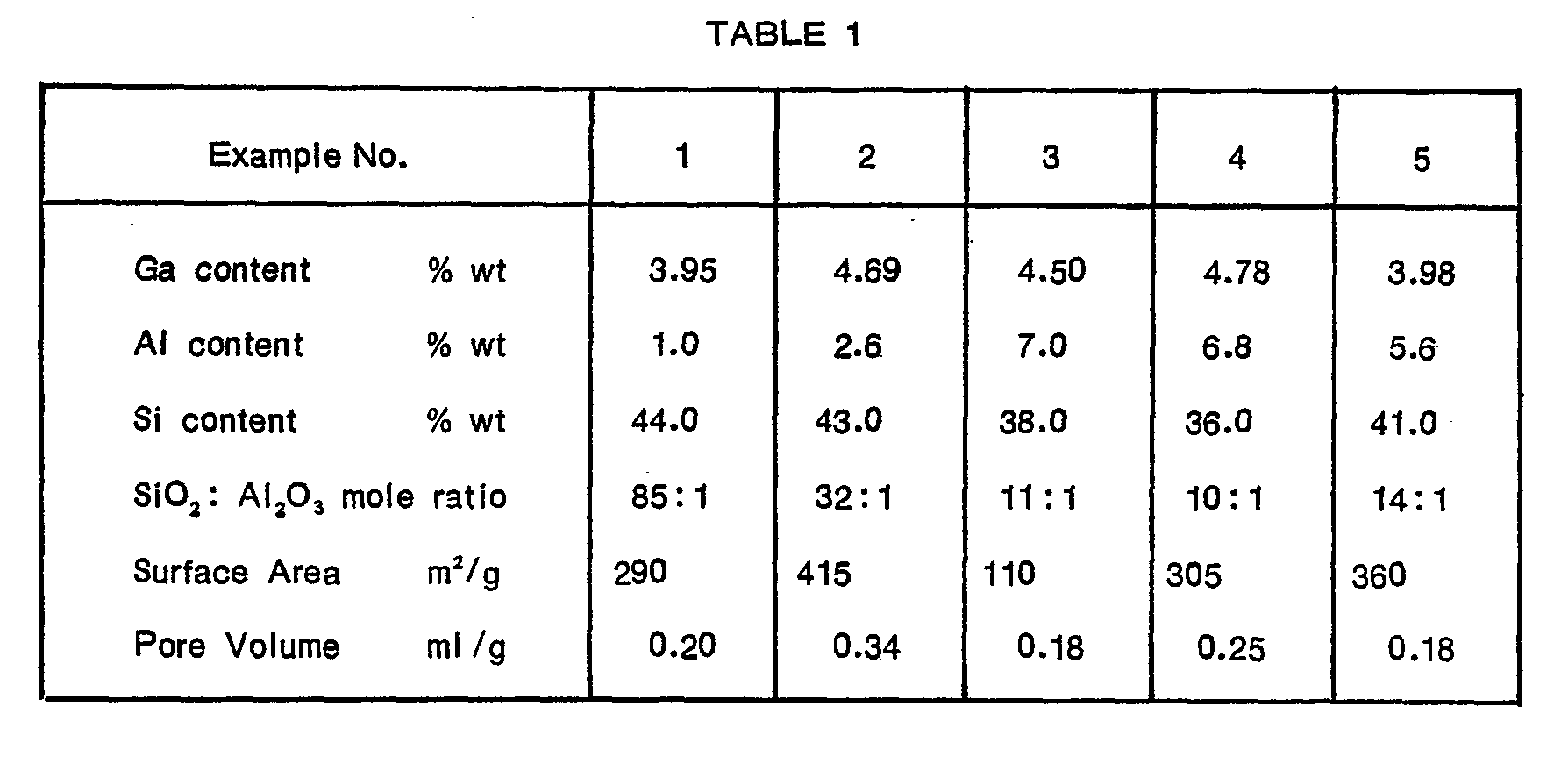
- 5 grams of gallium metal were dissolved in 38 mls concentrated nitric acid. This solution was then diluted to 400 mls by addition of deionised water and an ammonia solution giving a resulting solution with a pH of 3. 100 grams of ZSM-8 were stirred and refluxed with this solution for 48 hours with the pH being adjusted to 3 at intervals by further addition of ammonia solution. After refluxing the solid was filtered and washed thoroughly with deionised water. The resulting gallium exchanged ZSM-8 was then slurried with a silica sol prepared by mixing 59 mls Ludox AS-40 with 41 mls of deionised water. The resulting slurry was dried at 110°C overnight in a vacuum oven and then granulated to 8-30 mesh. It was calcined to 550°C for 4 hours and the composition shown in Table 1 was obtained.
- 15 mis of this catalyst composition was loaded into a quartz reactor and heated at 550°C for 45 minutes in a stream of hydrogen. A C8 aromatics blend made up to represent a typical mother liquor from a para-xylene separation process with a component analysis as set out in Table 2 was fed to the reactor whilst maintaining the hydrogen stream. The product gases were condensed and a liquid sample was taken between 10 and 20 minutes on stream. The detailed operating conditions and the product analysis are set out in Table 2, and the approach to equilibrium of the xvienes is shown in Table 3.
- 5 grams of gallium metal were dissolved in 38 mls concentrated nitric acid. This solution was then diluted to 400 mls by addition of deionised water and an ammonium solution giving a resulting solution with a pH of 3. 100 grams of zeolite beta were stirred and refluxed with this solution for 48 hours with the pH being adjusted to 3 at intervals by small additions of concentrated nitric acid. After refluxing the solid was filtered and washed thoroughly with deionised water. The resulting gallium exchanged zeolite beta was then stirred with a silica sol prepared by mixing 56 Ludox AS-40 with 44 mls of deionised water. The resulting slurry was dried at 110°C overnight in a vacuum oven and then granulated to 8-30 mesh. It was calcined at 550°C for 4 hours and the composition is shown in Table 1.
- 15 mls of the catalyst were hydrogen pretreated and tested for xylenes isomerisation as in Example 1. The detailed operating conditions and the product analysis are set out .in Table 2, and the approach to equilibrium of the xylenes isomers is shown in Table 3.
- 5 grams of gallium metal were dissolved in 38 mls concentrated nitric acid and this solution was diluted to 400 mls by addition of deionised water and an ammonia solution giving a resulting solution with a pH of 3. 117 g of a zeolite omega obtained from Union Carbide in its hydrogen form was stirred and refluxed with this solution for 48 hours, with the pH being adjusted to 3 at intervals by the addition of more ammonia solution. After refluxing the solid was filtered and washed thoroughly with deionised water and dried. The resulting gallium exchanged zeolite omega was then powered and stirred with a silica sol prepared by mixing 60 mls Ludox AS-40 with 40 mls of deionised water. The resulting slurry was dried at 110°C for 48 hours and then granulated to 8-30 mesh. It was calcined at 550°C for 4 hours and the composition is shown in Table 1.
- 15 mls of the catalyst were hydrogen pretreated and tested for xylenes isomerisation as in Example 1. The detailed operating conditions and the product analysis are set out in Table 2, and the approach to equilibrium of the xylenes isomers is shown in Table 3.
- 5 grams of gallium metal were dissolved in 38 mls concentrated nitric acid and this solution was diluted to 400 mls by addition of deionised water and an ammonia solution giving a resulting solution with a pH of 3. 90 grams of offretite (Grace) was stirred and refluxed with this solution for 24 hours with the pH being adjusted to 3 at intervals by the addition of drops of concentrated nitric acid. After refluxing the solid was filtered and washed thoroughly with deionised water. The resulting exchanged. gallium offretite was stirred with a silica sol prepared by mixing 49 mls Ludox AS-40 with 51 mls deionised water. The resulting slurry was dried in a vacuum oven with temperature increased from 50°C to 110°C over 8 hours, and then granulated to 8-30 mesh. It was calcined at 850°C for 4 hours and the composition is shown in Table 1.
- 15 mls of the catalyst were hydrogen pretreated and tested for xylenes isomerisation as in Example 1. The detailed operating conditions and the product analysis are set out in Table 2, and the approach to equilibrium of the xylenes isomers is shown in Table 3.
- 5 grams of gallium metal were dissolved in 38 mls concentrated nitric acid and this solution was diluted to 400 mls by addition of deionised water and an ammonia solution giving a resulting solution with a pH of 3. 145 grams mordenite in its hydrogen form was stirred and refluxed with this solution for 24 hours with the pH being adjusted to 3 at intervals by the addition of more ammonia solution. After refluxing the solid was filtered and washed thoroughly with deionised water. The resulting exchanged gallium mordenite was dried in a vacuum oven with temperature increased from 45°C to 110°C over 8 hours, and then granulated to 8-30 mesh. It was calcined at 550°C for 4 hours and the composition is shown in Table 1.
- 15 mls off the catalyst were hydrogen pretreated and tested for xylenes isomerisation as in Example 1. The detailed operating conditions and the product analysis are set out in Table 2, and the approach to equilibrium of the xylenes isomers is shown in Table 3.
- 30 grams of the catalyst prepared as in Example 1 were packed into a metal reactor in the following manner.
- The reactor was split into four zones of volumes 45, 44, 38 and 73 ml from the reactor top to bottom and the catalyst was packed into these zones mixed with a diluent of 8-16 BSS quartz with volume of catalyst to volume of quartz ratios 0.1, 0.26, 0.27 and 0.43 respectively. The catalyst was activated by heating to 482°C in a stream of hydrogen, . GHSV 1000, at a pressure of 16.5 bar (g) and held at that temperature for four hours. The reactor was allowed to cool to 400°C maintaining hydrogen recycle before the feed, a typical mother liquor from a para-xylene separation process with a component analysis as set out in Table 4, was fed to the reactor at a WHSV of 3.0 whilst maintaining the hydrogen stream. The reactor temperature was raised to 427°C with the hydrogen to hydrocarbon molar ratio being maintained at about 5:1 and a recycle gas rate of 10 moles per hour. The liquid product was collected and the product analyses are set out in Table 4, and the approach to equilibrium of the xylene is shown in Table 5.


Claims (10)


Applications Claiming Priority (2)
| Application Number | Priority Date | Filing Date | Title |
|---|---|---|---|
| GB2629678 | 1978-06-02 | ||
| GB7826296 | 1978-06-02 |
Publications (2)
| Publication Number | Publication Date |
|---|---|
| EP0005909A1 EP0005909A1 (en) | 1979-12-12 |
| EP0005909B1 true EP0005909B1 (en) | 1982-08-04 |
Family
ID=10497842
Family Applications (1)
| Application Number | Title | Priority Date | Filing Date |
|---|---|---|---|
| EP79300731A Expired EP0005909B1 (en) | 1978-06-02 | 1979-04-27 | Isomerisation of alkyl aromatics using a gallium containing aluminosilicate catalyst |
Country Status (5)
| Country | Link |
|---|---|
| US (1) | US4245130A (en) |
| EP (1) | EP0005909B1 (en) |
| JP (1) | JPS54160321A (en) |
| CA (1) | CA1112253A (en) |
| DE (1) | DE2963463D1 (en) |
Families Citing this family (12)
| Publication number | Priority date | Publication date | Assignee | Title |
|---|---|---|---|---|
| CA1128914A (en) * | 1979-09-04 | 1982-08-03 | Clive D. Telford | Method of preparing improved catalysts and use thereof in hydrocarbon conversion reactions |
| US4400572A (en) * | 1980-12-11 | 1983-08-23 | Imperial Chemical Industries Plc | Hydrocarbon conversion |
| DE3172377D1 (en) * | 1980-12-12 | 1985-10-24 | Exxon Research Engineering Co | Composite zeolite |
| US4686312A (en) * | 1981-12-23 | 1987-08-11 | Mobil Oil Corporation | Aromatics production |
| GB8306531D0 (en) * | 1983-03-09 | 1983-04-13 | British Petroleum Co Plc | Catalytic activity of aluminosilicate zeolites |
| GB8306532D0 (en) * | 1983-03-09 | 1983-04-13 | British Petroleum Co Plc | Catalytic activity of aluminosilicate zeolites |
| US4985384A (en) * | 1986-08-25 | 1991-01-15 | W. R. Grace & Co-Conn. | Cracking catalysts having aromatic selectivity |
| US4886927A (en) * | 1987-10-16 | 1989-12-12 | Uop | Process for isomerization of alkylaromatics |
| US5061466A (en) * | 1987-11-16 | 1991-10-29 | Mobil Oil Corporation | Synthesis of large pore zeolites containing gallium |
| US5157187A (en) * | 1991-01-02 | 1992-10-20 | Mobil Oil Corp. | Hydroisomerization process for pour point reduction of long chain alkyl aromatic compounds |
| US5210356A (en) * | 1991-12-16 | 1993-05-11 | Fina Technology, Inc. | Toluene disproportionation employing modified omega zeolite catalyst |
| US20090155142A1 (en) * | 2007-12-12 | 2009-06-18 | Bauer John E | Molecular sieve and catalyst incorporating the sieve |
Family Cites Families (8)
| Publication number | Priority date | Publication date | Assignee | Title |
|---|---|---|---|---|
| US3449456A (en) * | 1968-06-03 | 1969-06-10 | Exxon Research Engineering Co | Startup procedure of isomerizing polymethylbenzene |
| US3702886A (en) * | 1969-10-10 | 1972-11-14 | Mobil Oil Corp | Crystalline zeolite zsm-5 and method of preparing the same |
| US3907914A (en) * | 1971-04-13 | 1975-09-23 | Mobil Oil Corp | Isomerization of aromatic hydrocarbons |
| US3856871A (en) * | 1973-09-13 | 1974-12-24 | Mobil Oil Corp | Xylene isomerization |
| US3970544A (en) * | 1974-05-06 | 1976-07-20 | Mobil Oil Corporation | Hydrocarbon conversion with ZSM-12 |
| US4056575A (en) * | 1975-06-05 | 1977-11-01 | The British Petroleum Company Limited | Chemical process making aromatic hydrocarbons over gallium catalyst |
| DE2558035A1 (en) * | 1975-12-22 | 1977-06-23 | Mobil Oil Corp | Catalytic conversion and thermal dealkylation of alkyl aromatics - using the same reactor and catalyst |
| US4059645A (en) * | 1976-11-10 | 1977-11-22 | Chevron Research Company | Alkylaromatic isomerization process |
-
1979
- 1979-04-18 US US06/031,040 patent/US4245130A/en not_active Expired - Lifetime
- 1979-04-27 DE DE7979300731T patent/DE2963463D1/en not_active Expired
- 1979-04-27 EP EP79300731A patent/EP0005909B1/en not_active Expired
- 1979-05-01 CA CA326,698A patent/CA1112253A/en not_active Expired
- 1979-06-01 JP JP6754179A patent/JPS54160321A/en active Pending
Also Published As
| Publication number | Publication date |
|---|---|
| DE2963463D1 (en) | 1982-09-30 |
| CA1112253A (en) | 1981-11-10 |
| US4245130A (en) | 1981-01-13 |
| EP0005909A1 (en) | 1979-12-12 |
| JPS54160321A (en) | 1979-12-19 |
Similar Documents
| Publication | Publication Date | Title |
|---|---|---|
| EP0439632B2 (en) | Process for the alkylation of benzene | |
| EP0234684B1 (en) | Xylene isomerization process | |
| US4499314A (en) | Methanol conversion to hydrocarbons with zeolites and cocatalysts | |
| US5081323A (en) | Liquid phase alkylation or transalkylation process using zeolite beta | |
| US3856871A (en) | Xylene isomerization | |
| US4312790A (en) | Aromatics processing catalysts | |
| EP0012504B1 (en) | Production of isopropylbenzene | |
| USRE31919E (en) | Aromatics processing catalysts | |
| US4320242A (en) | Process for selective dealkylation of alkyl-substituted aromatic hydrocarbons | |
| US6518472B1 (en) | Stabilized dual bed xylene isomerization catalyst system | |
| US4245130A (en) | Isomerization of alkyl aromatics using a gallium containing aluminosilicate catalyst | |
| EP0087720B2 (en) | Crystalline aluminosilicate zeolite | |
| US3551509A (en) | Moving bed process using sieve catalyst to make xylenes by toluene disproportionation and transalkylation with c9-c10 alkylbenzenes | |
| EP0042754B1 (en) | Conversion of xylenes containing ethyl benzene | |
| EP0138617B1 (en) | Processes for the hydrodealkylation and/or isomerization of alkylaromatic hydrocarbons | |
| EP0054375B1 (en) | Methanol conversion to hydrocarbons with zeolites | |
| JP4757966B2 (en) | Method for producing 2,6-dimethylnaphthalene | |
| US4237329A (en) | Process for the production of alkylbenzenes | |
| EP0434052B1 (en) | Modified crystalline aluminosilicate and method of preparing the same | |
| US4886927A (en) | Process for isomerization of alkylaromatics | |
| US4723051A (en) | Xylene isomerization process | |
| ITMI992171A1 (en) | PROCESS FOR PREPARING 2,6-DIMETHYLNAPHTHALENE | |
| EP3389858B1 (en) | Catalyst composition, its preparation and process using such composition | |
| EP0165470A2 (en) | A method for the preparation of benzene and methyl-substituted benzene derivatives | |
| JPS607604B2 (en) | Selective method for producing para-substituted benzene |
Legal Events
| Date | Code | Title | Description |
|---|---|---|---|
| PUAI | Public reference made under article 153(3) epc to a published international application that has entered the european phase |
Free format text: ORIGINAL CODE: 0009012 |
|
| AK | Designated contracting states |
Designated state(s): BE DE FR GB IT NL |
|
| 17P | Request for examination filed | ||
| ITF | It: translation for a ep patent filed | ||
| GRAA | (expected) grant |
Free format text: ORIGINAL CODE: 0009210 |
|
| AK | Designated contracting states |
Designated state(s): BE DE FR GB IT NL |
|
| REF | Corresponds to: |
Ref document number: 2963463 Country of ref document: DE Date of ref document: 19820930 |
|
| PGFP | Annual fee paid to national office [announced via postgrant information from national office to epo] |
Ref country code: BE Payment date: 19830331 Year of fee payment: 5 |
|
| GBPC | Gb: european patent ceased through non-payment of renewal fee | ||
| PG25 | Lapsed in a contracting state [announced via postgrant information from national office to epo] |
Ref country code: BE Effective date: 19840430 |
|
| BERE | Be: lapsed |
Owner name: THE BRITISH PETROLEUM CY P.L.C. Effective date: 19840427 |
|
| PG25 | Lapsed in a contracting state [announced via postgrant information from national office to epo] |
Ref country code: GB Effective date: 19881118 |
|
| ITTA | It: last paid annual fee | ||
| PGFP | Annual fee paid to national office [announced via postgrant information from national office to epo] |
Ref country code: DE Payment date: 19920221 Year of fee payment: 14 |
|
| PGFP | Annual fee paid to national office [announced via postgrant information from national office to epo] |
Ref country code: FR Payment date: 19920306 Year of fee payment: 14 |
|
| PGFP | Annual fee paid to national office [announced via postgrant information from national office to epo] |
Ref country code: NL Payment date: 19930430 Year of fee payment: 15 |
|
| PG25 | Lapsed in a contracting state [announced via postgrant information from national office to epo] |
Ref country code: FR Effective date: 19931229 |
|
| PG25 | Lapsed in a contracting state [announced via postgrant information from national office to epo] |
Ref country code: DE Effective date: 19940101 |
|
| REG | Reference to a national code |
Ref country code: FR Ref legal event code: ST |
|
| PG25 | Lapsed in a contracting state [announced via postgrant information from national office to epo] |
Ref country code: NL Effective date: 19941101 |
|
| NLV4 | Nl: lapsed or anulled due to non-payment of the annual fee | ||
| PLBE | No opposition filed within time limit |
Free format text: ORIGINAL CODE: 0009261 |
|
| STAA | Information on the status of an ep patent application or granted ep patent |
Free format text: STATUS: NO OPPOSITION FILED WITHIN TIME LIMIT |