EP0005004B1 - Hydroxyalkyl-etherified glycolipid esters and their preparation - Google Patents
Hydroxyalkyl-etherified glycolipid esters and their preparation Download PDFInfo
- Publication number
- EP0005004B1 EP0005004B1 EP79300303A EP79300303A EP0005004B1 EP 0005004 B1 EP0005004 B1 EP 0005004B1 EP 79300303 A EP79300303 A EP 79300303A EP 79300303 A EP79300303 A EP 79300303A EP 0005004 B1 EP0005004 B1 EP 0005004B1
- Authority
- EP
- European Patent Office
- Prior art keywords
- glycolipid
- hydroxyalkyl
- formula
- ester
- integers
- Prior art date
- Legal status (The legal status is an assumption and is not a legal conclusion. Google has not performed a legal analysis and makes no representation as to the accuracy of the status listed.)
- Expired
Links
- HVCOBJNICQPDBP-UHFFFAOYSA-N 3-[3-[3,5-dihydroxy-6-methyl-4-(3,4,5-trihydroxy-6-methyloxan-2-yl)oxyoxan-2-yl]oxydecanoyloxy]decanoic acid;hydrate Chemical class O.OC1C(OC(CC(=O)OC(CCCCCCC)CC(O)=O)CCCCCCC)OC(C)C(O)C1OC1C(O)C(O)C(O)C(C)O1 HVCOBJNICQPDBP-UHFFFAOYSA-N 0.000 title claims description 11
- 238000002360 preparation method Methods 0.000 title description 2
- 229930186217 Glycolipid Natural products 0.000 claims description 35
- -1 glycolipid ester Chemical class 0.000 claims description 34
- 238000006243 chemical reaction Methods 0.000 claims description 25
- KWYUFKZDYYNOTN-UHFFFAOYSA-M Potassium hydroxide Chemical compound [OH-].[K+] KWYUFKZDYYNOTN-UHFFFAOYSA-M 0.000 claims description 21
- IAYPIBMASNFSPL-UHFFFAOYSA-N Ethylene oxide Chemical compound C1CO1 IAYPIBMASNFSPL-UHFFFAOYSA-N 0.000 claims description 16
- 238000000034 method Methods 0.000 claims description 16
- GOOHAUXETOMSMM-UHFFFAOYSA-N Propylene oxide Chemical compound CC1CO1 GOOHAUXETOMSMM-UHFFFAOYSA-N 0.000 claims description 13
- 125000004432 carbon atom Chemical group C* 0.000 claims description 12
- 229920006395 saturated elastomer Polymers 0.000 claims description 12
- 229930195735 unsaturated hydrocarbon Natural products 0.000 claims description 12
- 125000002947 alkylene group Chemical group 0.000 claims description 10
- 125000002496 methyl group Chemical group [H]C([H])([H])* 0.000 claims description 10
- 239000003054 catalyst Substances 0.000 claims description 9
- 125000004435 hydrogen atom Chemical group [H]* 0.000 claims description 8
- HEMHJVSKTPXQMS-UHFFFAOYSA-M Sodium hydroxide Chemical compound [OH-].[Na+] HEMHJVSKTPXQMS-UHFFFAOYSA-M 0.000 claims description 6
- DGAQECJNVWCQMB-PUAWFVPOSA-M Ilexoside XXIX Chemical compound C[C@@H]1CC[C@@]2(CC[C@@]3(C(=CC[C@H]4[C@]3(CC[C@@H]5[C@@]4(CC[C@@H](C5(C)C)OS(=O)(=O)[O-])C)C)[C@@H]2[C@]1(C)O)C)C(=O)O[C@H]6[C@@H]([C@H]([C@@H]([C@H](O6)CO)O)O)O.[Na+] DGAQECJNVWCQMB-PUAWFVPOSA-M 0.000 claims description 5
- ZLMJMSJWJFRBEC-UHFFFAOYSA-N Potassium Chemical compound [K] ZLMJMSJWJFRBEC-UHFFFAOYSA-N 0.000 claims description 5
- 239000011591 potassium Substances 0.000 claims description 5
- 229910052700 potassium Inorganic materials 0.000 claims description 5
- 239000011734 sodium Substances 0.000 claims description 5
- 229910052708 sodium Inorganic materials 0.000 claims description 5
- 229930195734 saturated hydrocarbon Natural products 0.000 claims description 4
- 125000001183 hydrocarbyl group Chemical group 0.000 claims 5
- 239000000203 mixture Substances 0.000 description 33
- OKKJLVBELUTLKV-UHFFFAOYSA-N Methanol Chemical compound OC OKKJLVBELUTLKV-UHFFFAOYSA-N 0.000 description 30
- 239000002253 acid Substances 0.000 description 29
- NBIIXXVUZAFLBC-UHFFFAOYSA-N Phosphoric acid Chemical compound OP(O)(O)=O NBIIXXVUZAFLBC-UHFFFAOYSA-N 0.000 description 12
- 150000002148 esters Chemical class 0.000 description 12
- 229920001451 polypropylene glycol Polymers 0.000 description 11
- LFQSCWFLJHTTHZ-UHFFFAOYSA-N Ethanol Chemical compound CCO LFQSCWFLJHTTHZ-UHFFFAOYSA-N 0.000 description 9
- 150000001875 compounds Chemical class 0.000 description 9
- 239000007789 gas Substances 0.000 description 9
- ZTOKUMPYMPKCFX-CZNUEWPDSA-N (E)-17-[(2R,3R,4S,5S,6R)-6-(acetyloxymethyl)-3-[(2S,3R,4S,5S,6R)-6-(acetyloxymethyl)-3,4,5-trihydroxyoxan-2-yl]oxy-4,5-dihydroxyoxan-2-yl]oxyoctadec-9-enoic acid Chemical compound OC(=O)CCCCCCC/C=C/CCCCCCC(C)O[C@@H]1O[C@H](COC(C)=O)[C@@H](O)[C@H](O)[C@H]1O[C@H]1[C@H](O)[C@@H](O)[C@H](O)[C@@H](COC(C)=O)O1 ZTOKUMPYMPKCFX-CZNUEWPDSA-N 0.000 description 8
- 230000000694 effects Effects 0.000 description 8
- 150000002430 hydrocarbons Chemical class 0.000 description 8
- 238000004440 column chromatography Methods 0.000 description 7
- 125000002887 hydroxy group Chemical group [H]O* 0.000 description 7
- 150000004702 methyl esters Chemical class 0.000 description 7
- VYPSYNLAJGMNEJ-UHFFFAOYSA-N Silicium dioxide Chemical compound O=[Si]=O VYPSYNLAJGMNEJ-UHFFFAOYSA-N 0.000 description 6
- WQDUMFSSJAZKTM-UHFFFAOYSA-N Sodium methoxide Chemical compound [Na+].[O-]C WQDUMFSSJAZKTM-UHFFFAOYSA-N 0.000 description 6
- 229910000147 aluminium phosphate Inorganic materials 0.000 description 6
- 239000000741 silica gel Substances 0.000 description 6
- 229910002027 silica gel Inorganic materials 0.000 description 6
- XLYOFNOQVPJJNP-UHFFFAOYSA-N water Substances O XLYOFNOQVPJJNP-UHFFFAOYSA-N 0.000 description 6
- 239000000047 product Substances 0.000 description 5
- 239000007858 starting material Substances 0.000 description 5
- 239000000126 substance Substances 0.000 description 5
- 239000001993 wax Substances 0.000 description 5
- LYCAIKOWRPUZTN-UHFFFAOYSA-N Ethylene glycol Chemical compound OCCO LYCAIKOWRPUZTN-UHFFFAOYSA-N 0.000 description 4
- 239000004166 Lanolin Substances 0.000 description 4
- RTZKZFJDLAIYFH-UHFFFAOYSA-N ether Substances CCOCC RTZKZFJDLAIYFH-UHFFFAOYSA-N 0.000 description 4
- 235000019388 lanolin Nutrition 0.000 description 4
- 239000003921 oil Substances 0.000 description 4
- 229920003171 Poly (ethylene oxide) Polymers 0.000 description 3
- 239000002537 cosmetic Substances 0.000 description 3
- 239000012043 crude product Substances 0.000 description 3
- 238000000855 fermentation Methods 0.000 description 3
- 230000004151 fermentation Effects 0.000 description 3
- 238000009472 formulation Methods 0.000 description 3
- 239000000463 material Substances 0.000 description 3
- 239000001488 sodium phosphate Substances 0.000 description 3
- 229910000162 sodium phosphate Inorganic materials 0.000 description 3
- 238000003756 stirring Methods 0.000 description 3
- RYFMWSXOAZQYPI-UHFFFAOYSA-K trisodium phosphate Chemical compound [Na+].[Na+].[Na+].[O-]P([O-])([O-])=O RYFMWSXOAZQYPI-UHFFFAOYSA-K 0.000 description 3
- DNIAPMSPPWPWGF-GSVOUGTGSA-N (R)-(-)-Propylene glycol Chemical compound C[C@@H](O)CO DNIAPMSPPWPWGF-GSVOUGTGSA-N 0.000 description 2
- 241000222120 Candida <Saccharomycetales> Species 0.000 description 2
- WQZGKKKJIJFFOK-GASJEMHNSA-N Glucose Natural products OC[C@H]1OC(O)[C@H](O)[C@@H](O)[C@@H]1O WQZGKKKJIJFFOK-GASJEMHNSA-N 0.000 description 2
- KFZMGEQAYNKOFK-UHFFFAOYSA-N Isopropanol Chemical compound CC(C)O KFZMGEQAYNKOFK-UHFFFAOYSA-N 0.000 description 2
- QAOWNCQODCNURD-UHFFFAOYSA-N Sulfuric acid Chemical compound OS(O)(=O)=O QAOWNCQODCNURD-UHFFFAOYSA-N 0.000 description 2
- 238000011161 development Methods 0.000 description 2
- 238000004821 distillation Methods 0.000 description 2
- 239000000706 filtrate Substances 0.000 description 2
- 238000004817 gas chromatography Methods 0.000 description 2
- 229930182478 glucoside Natural products 0.000 description 2
- WGCNASOHLSPBMP-UHFFFAOYSA-N hydroxyacetaldehyde Natural products OCC=O WGCNASOHLSPBMP-UHFFFAOYSA-N 0.000 description 2
- 125000002768 hydroxyalkyl group Chemical group 0.000 description 2
- 229940039717 lanolin Drugs 0.000 description 2
- 239000010985 leather Substances 0.000 description 2
- 239000007788 liquid Substances 0.000 description 2
- 150000004668 long chain fatty acids Chemical class 0.000 description 2
- 239000000314 lubricant Substances 0.000 description 2
- 238000007069 methylation reaction Methods 0.000 description 2
- 239000001117 sulphuric acid Substances 0.000 description 2
- 235000011149 sulphuric acid Nutrition 0.000 description 2
- 239000003760 tallow Substances 0.000 description 2
- LWIHDJKSTIGBAC-UHFFFAOYSA-K tripotassium phosphate Chemical compound [K+].[K+].[K+].[O-]P([O-])([O-])=O LWIHDJKSTIGBAC-UHFFFAOYSA-K 0.000 description 2
- HOVAGTYPODGVJG-UVSYOFPXSA-N (3s,5r)-2-(hydroxymethyl)-6-methoxyoxane-3,4,5-triol Chemical compound COC1OC(CO)[C@@H](O)C(O)[C@H]1O HOVAGTYPODGVJG-UVSYOFPXSA-N 0.000 description 1
- ALSTYHKOOCGGFT-KTKRTIGZSA-N (9Z)-octadecen-1-ol Chemical compound CCCCCCCC\C=C/CCCCCCCCO ALSTYHKOOCGGFT-KTKRTIGZSA-N 0.000 description 1
- KBPLFHHGFOOTCA-UHFFFAOYSA-N 1-Octanol Chemical compound CCCCCCCCO KBPLFHHGFOOTCA-UHFFFAOYSA-N 0.000 description 1
- 0 C[C@]1(COC[C@@](**2O)O*(CO)*C(*)*2O)*(COC(*)*C(O)=O)OC2(CO)O*1*2O Chemical compound C[C@]1(COC[C@@](**2O)O*(CO)*C(*)*2O)*(COC(*)*C(O)=O)OC2(CO)O*1*2O 0.000 description 1
- 241000490229 Eucephalus Species 0.000 description 1
- UFHFLCQGNIYNRP-UHFFFAOYSA-N Hydrogen Chemical compound [H][H] UFHFLCQGNIYNRP-UHFFFAOYSA-N 0.000 description 1
- XBDQKXXYIPTUBI-UHFFFAOYSA-M Propionate Chemical compound CCC([O-])=O XBDQKXXYIPTUBI-UHFFFAOYSA-M 0.000 description 1
- JUJWROOIHBZHMG-UHFFFAOYSA-N Pyridine Chemical compound C1=CC=NC=C1 JUJWROOIHBZHMG-UHFFFAOYSA-N 0.000 description 1
- XUIMIQQOPSSXEZ-UHFFFAOYSA-N Silicon Chemical compound [Si] XUIMIQQOPSSXEZ-UHFFFAOYSA-N 0.000 description 1
- HIWPGCMGAMJNRG-ACCAVRKYSA-N Sophorose Natural products O([C@H]1[C@@H](O)[C@@H](O)[C@@H](CO)O[C@H]1O)[C@H]1[C@H](O)[C@@H](O)[C@@H](O)[C@@H](CO)O1 HIWPGCMGAMJNRG-ACCAVRKYSA-N 0.000 description 1
- KXKVLQRXCPHEJC-UHFFFAOYSA-N acetic acid trimethyl ester Natural products COC(C)=O KXKVLQRXCPHEJC-UHFFFAOYSA-N 0.000 description 1
- VXDSLUMUNWTSDB-UHFFFAOYSA-N acetic acid;chloroform;methanol Chemical compound OC.CC(O)=O.ClC(Cl)Cl VXDSLUMUNWTSDB-UHFFFAOYSA-N 0.000 description 1
- 238000007259 addition reaction Methods 0.000 description 1
- 150000001298 alcohols Chemical class 0.000 description 1
- 150000001336 alkenes Chemical class 0.000 description 1
- 238000004458 analytical method Methods 0.000 description 1
- HIWPGCMGAMJNRG-UHFFFAOYSA-N beta-sophorose Natural products OC1C(O)C(CO)OC(O)C1OC1C(O)C(O)C(O)C(CO)O1 HIWPGCMGAMJNRG-UHFFFAOYSA-N 0.000 description 1
- 229940041514 candida albicans extract Drugs 0.000 description 1
- 238000012512 characterization method Methods 0.000 description 1
- 238000007385 chemical modification Methods 0.000 description 1
- 239000007795 chemical reaction product Substances 0.000 description 1
- 239000003795 chemical substances by application Substances 0.000 description 1
- WORJEOGGNQDSOE-UHFFFAOYSA-N chloroform;methanol Chemical compound OC.ClC(Cl)Cl WORJEOGGNQDSOE-UHFFFAOYSA-N 0.000 description 1
- 238000012258 culturing Methods 0.000 description 1
- 238000010908 decantation Methods 0.000 description 1
- 230000006866 deterioration Effects 0.000 description 1
- 235000014113 dietary fatty acids Nutrition 0.000 description 1
- 150000002016 disaccharides Chemical class 0.000 description 1
- LQZZUXJYWNFBMV-UHFFFAOYSA-N dodecan-1-ol Chemical compound CCCCCCCCCCCCO LQZZUXJYWNFBMV-UHFFFAOYSA-N 0.000 description 1
- 238000010828 elution Methods 0.000 description 1
- 238000004945 emulsification Methods 0.000 description 1
- 239000003995 emulsifying agent Substances 0.000 description 1
- 230000001804 emulsifying effect Effects 0.000 description 1
- 238000001704 evaporation Methods 0.000 description 1
- 230000008020 evaporation Effects 0.000 description 1
- 239000000194 fatty acid Substances 0.000 description 1
- 229930195729 fatty acid Natural products 0.000 description 1
- 235000019387 fatty acid methyl ester Nutrition 0.000 description 1
- 150000004665 fatty acids Chemical class 0.000 description 1
- 238000001914 filtration Methods 0.000 description 1
- 239000011521 glass Substances 0.000 description 1
- 239000008103 glucose Substances 0.000 description 1
- 125000005456 glyceride group Chemical group 0.000 description 1
- 239000001307 helium Substances 0.000 description 1
- 229910052734 helium Inorganic materials 0.000 description 1
- SWQJXJOGLNCZEY-UHFFFAOYSA-N helium atom Chemical compound [He] SWQJXJOGLNCZEY-UHFFFAOYSA-N 0.000 description 1
- 229930195733 hydrocarbon Natural products 0.000 description 1
- 239000001257 hydrogen Substances 0.000 description 1
- 229910052739 hydrogen Inorganic materials 0.000 description 1
- 230000003301 hydrolyzing effect Effects 0.000 description 1
- FUKUFMFMCZIRNT-UHFFFAOYSA-N hydron;methanol;chloride Chemical compound Cl.OC FUKUFMFMCZIRNT-UHFFFAOYSA-N 0.000 description 1
- 230000005764 inhibitory process Effects 0.000 description 1
- 238000011081 inoculation Methods 0.000 description 1
- 238000009413 insulation Methods 0.000 description 1
- JEIPFZHSYJVQDO-UHFFFAOYSA-N iron(III) oxide Inorganic materials O=[Fe]O[Fe]=O JEIPFZHSYJVQDO-UHFFFAOYSA-N 0.000 description 1
- 229910052751 metal Inorganic materials 0.000 description 1
- 239000002184 metal Substances 0.000 description 1
- 238000006140 methanolysis reaction Methods 0.000 description 1
- HOVAGTYPODGVJG-UHFFFAOYSA-N methyl beta-galactoside Natural products COC1OC(CO)C(O)C(O)C1O HOVAGTYPODGVJG-UHFFFAOYSA-N 0.000 description 1
- 244000005700 microbiome Species 0.000 description 1
- 238000012986 modification Methods 0.000 description 1
- 230000004048 modification Effects 0.000 description 1
- 239000002674 ointment Substances 0.000 description 1
- 229940055577 oleyl alcohol Drugs 0.000 description 1
- XMLQWXUVTXCDDL-UHFFFAOYSA-N oleyl alcohol Natural products CCCCCCC=CCCCCCCCCCCO XMLQWXUVTXCDDL-UHFFFAOYSA-N 0.000 description 1
- 239000002245 particle Substances 0.000 description 1
- 235000011837 pasties Nutrition 0.000 description 1
- 229910000160 potassium phosphate Inorganic materials 0.000 description 1
- 235000011009 potassium phosphates Nutrition 0.000 description 1
- OTYBMLCTZGSZBG-UHFFFAOYSA-L potassium sulfate Chemical compound [K+].[K+].[O-]S([O-])(=O)=O OTYBMLCTZGSZBG-UHFFFAOYSA-L 0.000 description 1
- 229910052939 potassium sulfate Inorganic materials 0.000 description 1
- 239000001120 potassium sulphate Substances 0.000 description 1
- 235000011151 potassium sulphates Nutrition 0.000 description 1
- 238000004321 preservation Methods 0.000 description 1
- 238000012545 processing Methods 0.000 description 1
- 238000010992 reflux Methods 0.000 description 1
- 238000007127 saponification reaction Methods 0.000 description 1
- 229910052710 silicon Inorganic materials 0.000 description 1
- 239000010703 silicon Substances 0.000 description 1
- 239000002904 solvent Substances 0.000 description 1
- PZDOWFGHCNHPQD-VNNZMYODSA-N sophorose Chemical compound OC[C@@H](O)[C@@H](O)[C@H](O)[C@H](C=O)O[C@@H]1O[C@H](CO)[C@@H](O)[C@H](O)[C@H]1O PZDOWFGHCNHPQD-VNNZMYODSA-N 0.000 description 1
- 150000003431 steroids Chemical class 0.000 description 1
- 230000007853 structural degeneration Effects 0.000 description 1
- 239000004094 surface-active agent Substances 0.000 description 1
- 238000012360 testing method Methods 0.000 description 1
- 238000004809 thin layer chromatography Methods 0.000 description 1
- 235000021122 unsaturated fatty acids Nutrition 0.000 description 1
- WTHDKMILWLGDKL-UHFFFAOYSA-N urea;hydrate Chemical compound O.NC(N)=O WTHDKMILWLGDKL-UHFFFAOYSA-N 0.000 description 1
- 239000012138 yeast extract Substances 0.000 description 1
Classifications
-
- A—HUMAN NECESSITIES
- A61—MEDICAL OR VETERINARY SCIENCE; HYGIENE
- A61K—PREPARATIONS FOR MEDICAL, DENTAL OR TOILETRY PURPOSES
- A61K8/00—Cosmetics or similar toiletry preparations
- A61K8/18—Cosmetics or similar toiletry preparations characterised by the composition
- A61K8/30—Cosmetics or similar toiletry preparations characterised by the composition containing organic compounds
- A61K8/60—Sugars; Derivatives thereof
-
- A—HUMAN NECESSITIES
- A61—MEDICAL OR VETERINARY SCIENCE; HYGIENE
- A61Q—SPECIFIC USE OF COSMETICS OR SIMILAR TOILETRY PREPARATIONS
- A61Q19/00—Preparations for care of the skin
-
- C—CHEMISTRY; METALLURGY
- C07—ORGANIC CHEMISTRY
- C07H—SUGARS; DERIVATIVES THEREOF; NUCLEOSIDES; NUCLEOTIDES; NUCLEIC ACIDS
- C07H15/00—Compounds containing hydrocarbon or substituted hydrocarbon radicals directly attached to hetero atoms of saccharide radicals
- C07H15/02—Acyclic radicals, not substituted by cyclic structures
- C07H15/04—Acyclic radicals, not substituted by cyclic structures attached to an oxygen atom of the saccharide radical
- C07H15/10—Acyclic radicals, not substituted by cyclic structures attached to an oxygen atom of the saccharide radical containing unsaturated carbon-to-carbon bonds
-
- C—CHEMISTRY; METALLURGY
- C07—ORGANIC CHEMISTRY
- C07H—SUGARS; DERIVATIVES THEREOF; NUCLEOSIDES; NUCLEOTIDES; NUCLEIC ACIDS
- C07H3/00—Compounds containing only hydrogen atoms and saccharide radicals having only carbon, hydrogen, and oxygen atoms
- C07H3/04—Disaccharides
-
- C—CHEMISTRY; METALLURGY
- C12—BIOCHEMISTRY; BEER; SPIRITS; WINE; VINEGAR; MICROBIOLOGY; ENZYMOLOGY; MUTATION OR GENETIC ENGINEERING
- C12P—FERMENTATION OR ENZYME-USING PROCESSES TO SYNTHESISE A DESIRED CHEMICAL COMPOUND OR COMPOSITION OR TO SEPARATE OPTICAL ISOMERS FROM A RACEMIC MIXTURE
- C12P19/00—Preparation of compounds containing saccharide radicals
- C12P19/12—Disaccharides
Definitions
- This invention relates to novel wax-like substances possessing surface activity characteristics, and to a process for producing the same. More particularly, the invention relates to novel hydroxyalkyl-etherified glycolipid esters.
- Known waxes include esters of a long-chain fatty acid and a long-chain aliphatic alcohol, long-chain hydrocarbons, glycerides, lanolin and similar materials.
- the esters have been widely used for various purposes, such as glazing materials and oily substances for leather, in cosmetics and ointments, as lubricants for fibres, in metal processing, machinery, stationery, and printing oils, for rust inhibition and for insulation.
- wax has often been used in emulsified form with a surface active agent in view of its safety and ease of handling.
- formulation techniques of a high quality are required for the emulsification of wax because the wax characteristics depend directly upon the formulation technique used. Only extremely high quality formulation techniques permit wax to exhibit all of its inherent characteristics, but such techniques involve much difficulty.
- Wool wax which is generally known under the name of lanolin, includes in its structure a particular ester bond formed between the long-chain branched fatty acid and the long-chain branched aliphatic alcohol or steroid alcohol, and hence it is a waxy substance having both excellent wax-like properties and an adequate emulsifying ability.
- wool wax is a mysterious, naturally occurring compound and finds no wide application, partly because its combination with other materials requires the use of very advanced techniques and partly because the amounts used are limited due to its peculiar animal smell.
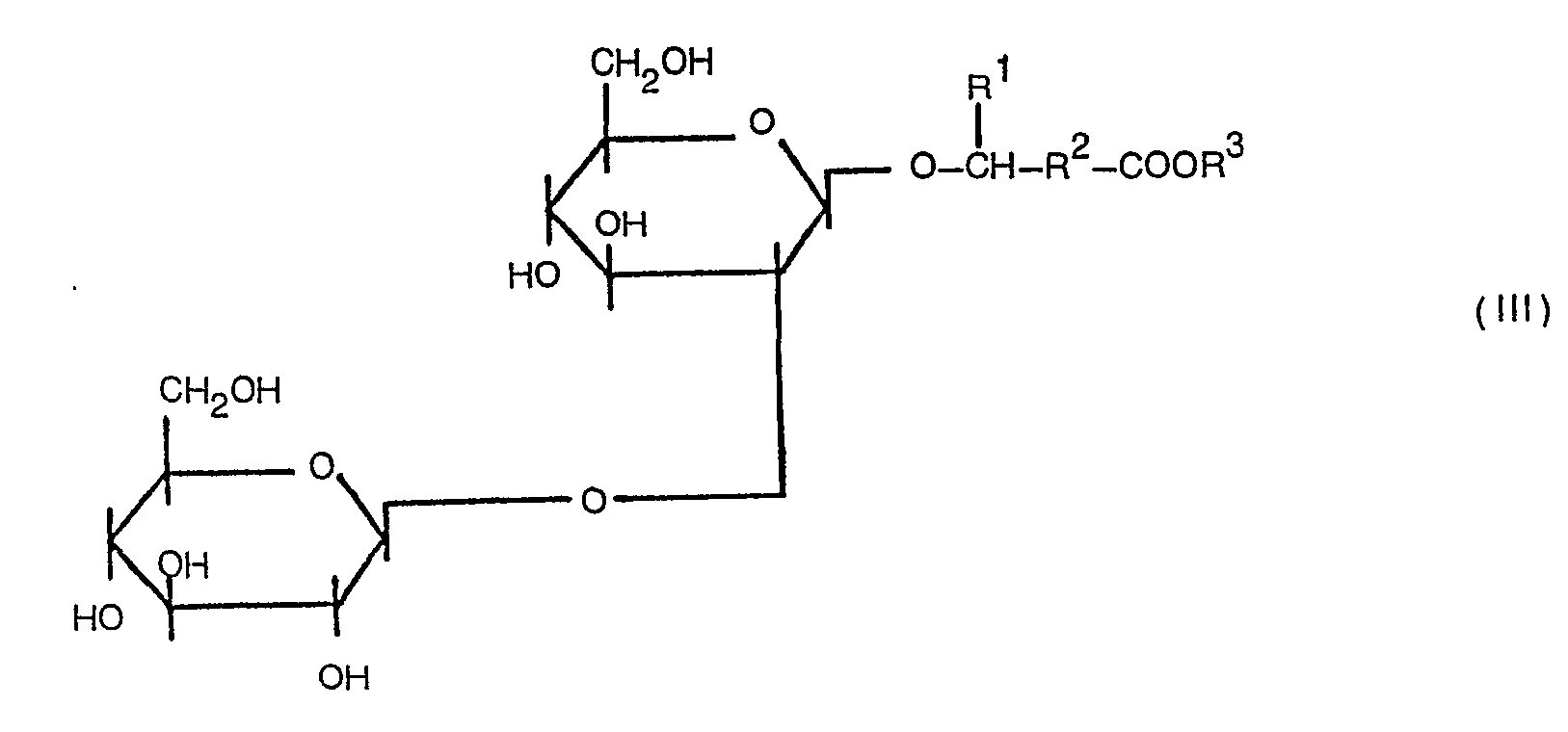
- a glycolipid ester represented by the following formula (III) exhibits the desired activity and properties:- where R' is a methyl group or a hydrogen atom, R 2 is a straight-chain saturated or ethylenically unsaturated hydrocarbon group having 11 to 15 carbon atoms when R' is a methyl group, or R 2 is a straight-chain saturated or ethylenically unsaturated hydrocarbon group having 12 to 16 carbon atoms when R' is a hydrogen atom, and R 3 is a saturated or unsaturated hydrocarbon group having 1 to 20 carbon atoms.
- glycolipid ester of the formula (III) has been found to lack sufficient heat stability at high temperatures and viscosity. The reason is that the hydroxyl.groups of the sugar moiety of the glycolipid ester exist in a free form, thereby resulting in reduced adhesiveness, lubricity, flexibility and plasticity.
- the hydroxyalkyl-etherified glycolipid esters of the formulae (I) and (II) are produced according to the present invention, as shown in the following reaction schemes by reacting a glycolipid ester of the formula (III) or a glycolipid of the formula (IV) respectively with ethylene oxide or 1,2-propylene oxide in the presence of an alkylene oxide addition catalyst.
- R 1 , R 2 , R 3 and A are as in formula (I).
- R 1 , R 2 and A are the same as in formula (II), and s, t, u, v, w, x, y and z represent integers, whose sum ranges from 1 to 60, not all the integers s to y being zero, z not being zero, and not all the integers s to z having the value 1.
- the glycolipid ester starting material having the formula (III) can be produced by a method discovered by the present Applicants. Sophorolipid is first subjected to methanolysis and methylation reactions by reaction with methanol in an acid to produce a glycolipid methyl ester (see Japanese Patent Application No. 1978-17401), which is further converted into other compounds of the formula (III) by an ester interchange reaction with an alcohol of the formula, ROH, where R is a saturated or unsaturated hydrocarbon group having 2 to 20 carbon atoms, (see Japanese Patent Application No. 1978-17400).
- the glycolipid starting material of the formula (IV) is produced by hydrolysing the glycolipid methyl ester.
- Sophorolipid is a mixture of the compounds represented by the formulae (Va) and (Vb), wherein R 1 and R 2 are as defined above and R 4 and R 5 can represent the following combinations of groups:-
- Sophorolipid is a mixture of many glycolipids; its basic structure is that of a [(2'-O- ⁇ -D-glucopyranosyl- ⁇ -D-glucopyranosyl)-oxy]-alkane acid or alkene acid which is formed by a glucoside bond between Sophorose and a long-chain fatty acid having a hydroxy group at the ⁇ or ⁇ -1 position.
- glycolipid esters of the invention are produced by reacting ethylene oxide or 1,2-propylene oxide with the starting materials produced by the above-mentioned processes.
- the compounds of the formulae (III) and (IV) readily react with alkylene oxides under any conditions applicable to normal alkylene oxide addition reaction.
- an alkaline alkylene oxide addition catalyst is preferably used because glucoside bonds of the disaccharide may be cleaved by an acid.
- Suitable alkylene oxide addition catalysts which can be used in the invention include metallic sodium metallic potassium, sodium hydroxide, potassium hydroxide, sodium alcoholates, potassium alcoholates, and the like.
- Suitable alcohols which can be used to prepare the sodium or potassium alcoholates are methanol, ethanol and isopropanol. Any one selected catalyst is preferably used in an amount of from 0.1 to 1.0% by weight of the glycolipid or glycolipid ester.
- the reaction is preferably carried out at a temperature in the range of from 70 to 120°C, especially from 100 to 120°C.
- the catalysts may be used singly or in combination.
- the reaction progress can be observed by measuring the pressure in the reactor or by quantitatively analysing the reaction products so that an adduct having any predetermined addition number can be produced.
- the hydroxyalkyl-etherified glycolipid ester according to the invention thus obtained, did not undergo any structural degeneration or deterioration in a preservation test at 250°C for 48 hours, because the hydroxyl groups in the sugar residues are combined with the hydroxyalkyl groups through stable ether bonds, and thus had increased heat stability as compared with the unetherified ester.
- a variety of substances having both wax-like and hydrophilic properties and surface activities suitable for any desired purposes of application can be produced by varying the type of glycolipid ester used and/or the addition mole number since any addition mole number of the alkylene oxide within the range of 1 to 60 may be specified.
- the compounds of the formula (I) possess an extremely excellent effect when applied as an oil for cosmetics and leather, and as a softening lubricant for fibres. Especially when used in an amount of from 2 to 10% by weight for cosmetics, the compounds serve as emulsifying agents, and impart elasticity and lubricity to the skin because of their affinity therefor.
- reaction solution was neutralised with potassium hydroxide and filtered through filter paper.
- the filtrate was placed in a round-bottom flask equipped with a Liebig condenser, and methanol and methyl acetate were distilled off to give 48 g of a brown pasty mixture which contained 94% of [(2'-O- ⁇ -D-glucopyranosyl- ⁇ -D-glucopyranosyl)-oxy]-alkane acid and -alkene acid methyl esters, and polypropylene glycol.
- This mixture was purified by column-chromatography on silica gel, and there were obtained pure [(2'-O- ⁇ -D-glucopyranosyl- ⁇ -D-glucopyranosyl)oxy]-alkane acid and -alkene acid methyl esters.
- This product was degraded in a 5 N hydrochloric acid-methanol solution to give 2 moles of a methyl glucoside and 1 mole of a hydroxy fatty acid methyl ester, which were quantitatively analysed by gas chromatography.
- This product was purified by column-chromatography on silica gel to remove an ethylene oxide adduct of polypropylene glycol, thereby yielding polyoxyethylene[(2'-O- ⁇ -D-glucopyranosyl- ⁇ -D-glucopyranosyl)oxy]-alkane acid and -alkene acid methyl esters as a pale yellow paste.
- This product was purified by column-chromatography on silica gel to give polyoxypropylene [(2'-O- ⁇ -D-glucopyranosyl- ⁇ -D-glucopyranosyl)oxy]-alkane acid and -alkene acid methyl esters as a pale yellow paste.
- the progress of the reaction was observed by gas-chromatography under the following conditions: glass column; 3% silicon JXR-Chromosorb W having a 60 ⁇ 80 mesh per centimetre particle size; inside diameter 3 mm; height 1 m; column oven temperature of 250 ⁇ 350°C; pressure by helium gas of 0.6 kg/cm 2 ; and hydrogen flame detector used as a detector.
- the reaction state was measured from the peak area ratio of the glycolipid methyl ester and glycolipid octyl ester with a sample picked up from the reaction solution and trimethylsilylated with a trimethylsilylating agent. The reaction was regarded as having been completed when the peak of the glycolipid methyl ester disappeared.
- the mixture was reacted at 100-120°C for 6 hours with ethylene oxide gas in the amounts specified in Table 8, the gas being passed into the reaction mass, to obtain an ethylene oxide adduct.
- the amount of ethylene oxide was varied according to the specified addition mole number as shown in Table 8.
- the mixture was neutralised with phosphoric acid, and sodium phosphate which formed was filtered off under increased pressure.
- the propylene oxide adduct thus obtained was neutralised with phosphoric acid, and sodium phosphate which formed was filtered off under increased pressure.
- 5 g of the sample was purified by column-chromatography under the same conditions as in Example 4 to give polyoxypropylene [(2'-O ⁇ - ⁇ -D-glucopyranosyl- ⁇ -D-glucopyranosyl)oxy]-alkane acid and -alkene acid lauryl ester fractions which amounted to 90 to 93% by weight of the whole sample weight.
Landscapes
- Chemical & Material Sciences (AREA)
- Organic Chemistry (AREA)
- Health & Medical Sciences (AREA)
- Life Sciences & Earth Sciences (AREA)
- General Health & Medical Sciences (AREA)
- Engineering & Computer Science (AREA)
- Genetics & Genomics (AREA)
- Biotechnology (AREA)
- Biochemistry (AREA)
- Veterinary Medicine (AREA)
- Wood Science & Technology (AREA)
- Animal Behavior & Ethology (AREA)
- Public Health (AREA)
- Molecular Biology (AREA)
- Zoology (AREA)
- Bioinformatics & Cheminformatics (AREA)
- Dermatology (AREA)
- Microbiology (AREA)
- Chemical Kinetics & Catalysis (AREA)
- Birds (AREA)
- Epidemiology (AREA)
- General Engineering & Computer Science (AREA)
- General Chemical & Material Sciences (AREA)
- Crystallography & Structural Chemistry (AREA)
- Saccharide Compounds (AREA)
- Emulsifying, Dispersing, Foam-Producing Or Wetting Agents (AREA)
- Medicinal Preparation (AREA)
- Cosmetics (AREA)
- Organic Low-Molecular-Weight Compounds And Preparation Thereof (AREA)
- Low-Molecular Organic Synthesis Reactions Using Catalysts (AREA)
Description
- This invention relates to novel wax-like substances possessing surface activity characteristics, and to a process for producing the same. More particularly, the invention relates to novel hydroxyalkyl-etherified glycolipid esters.
- Known waxes (also in some cases called greases) include esters of a long-chain fatty acid and a long-chain aliphatic alcohol, long-chain hydrocarbons, glycerides, lanolin and similar materials. The esters have been widely used for various purposes, such as glazing materials and oily substances for leather, in cosmetics and ointments, as lubricants for fibres, in metal processing, machinery, stationery, and printing oils, for rust inhibition and for insulation. In recent years, wax has often been used in emulsified form with a surface active agent in view of its safety and ease of handling. However, formulation techniques of a high quality are required for the emulsification of wax because the wax characteristics depend directly upon the formulation technique used. Only extremely high quality formulation techniques permit wax to exhibit all of its inherent characteristics, but such techniques involve much difficulty. Hence, there has been a strong desire for the development of a wax-like substance which itself possesses surface activity.
- Wool wax, which is generally known under the name of lanolin, includes in its structure a particular ester bond formed between the long-chain branched fatty acid and the long-chain branched aliphatic alcohol or steroid alcohol, and hence it is a waxy substance having both excellent wax-like properties and an adequate emulsifying ability. However, wool wax is a mysterious, naturally occurring compound and finds no wide application, partly because its combination with other materials requires the use of very advanced techniques and partly because the amounts used are limited due to its peculiar animal smell.
- In view of this situation, the present Applicants have carried out a wide variety of studies on the development of a compound possessing both surface activity and wax-like properties, and have found that a glycolipid ester represented by the following formula (III) exhibits the desired activity and properties:-

- However, the glycolipid ester of the formula (III) has been found to lack sufficient heat stability at high temperatures and viscosity. The reason is that the hydroxyl.groups of the sugar moiety of the glycolipid ester exist in a free form, thereby resulting in reduced adhesiveness, lubricity, flexibility and plasticity.
- A further study has therefore been made in order to improve the above-mentioned properties arising from the sugar structure, and as a result, various derivatives of the glycolipid ester of the formula (III) have been synthesised by chemical modification of the hydroxyl groups. After investigating the characteristics of these derivatives, it has been found that certain compounds obtained by modification of the hydroxyl groups with hydroxyalkyl groups, possess the above desired characteristics, viz. wax-like properties and surface activity, but with increased heat stability.
- It is, therefore, an object of this invention to provide novel hydroxyalkyl-etherified glycolipid esters possessing excellent surface activity and wax-like properties, but having increased heat stability.
- It is another object of the invention to provide a novel process for producing such esters.
- According to the invention, there are provided novel hydroxyalkyl-etherified glycolipid esters of the Formula (1):-


- The hydroxyalkyl-etherified glycolipid esters of the formulae (I) and (II) are produced according to the present invention, as shown in the following reaction schemes by reacting a glycolipid ester of the formula (III) or a glycolipid of the formula (IV) respectively with ethylene oxide or 1,2-propylene oxide in the presence of an alkylene oxide addition catalyst.


- The glycolipid ester starting material having the formula (III) can be produced by a method discovered by the present Applicants. Sophorolipid is first subjected to methanolysis and methylation reactions by reaction with methanol in an acid to produce a glycolipid methyl ester (see Japanese Patent Application No. 1978-17401), which is further converted into other compounds of the formula (III) by an ester interchange reaction with an alcohol of the formula, ROH, where R is a saturated or unsaturated hydrocarbon group having 2 to 20 carbon atoms, (see Japanese Patent Application No. 1978-17400). The glycolipid starting material of the formula (IV) is produced by hydrolysing the glycolipid methyl ester.
- It has been reported by J. F. T. Spencer et al [Canadian Journal of Chemistry, 39, 846 (1961)] that a great quantity of Sophorolipid is produced by culturing Torulopsis bombicola.
- Sophorolipid is a mixture of the compounds represented by the formulae (Va) and (Vb),


- Va-1 : R4 = R5 = COCH3
- Va-2 : R4 = COCH3, R5 = H
- Va-3 : R4 = H, R5 = COCH3
- Va-4 : R4 = R5 = H
- Vb-1 : R4 = R5 = COCH3
- Vb-2 : R4 = COCH3, R5 = H
- Vb-3 R4 = H, R5 = COCH3
- Vb-4 : R4 = R5 = H.
- As can be seen from the above formulae (Va) and (Vb), Sophorolipid is a mixture of many glycolipids; its basic structure is that of a [(2'-O-β-D-glucopyranosyl-β-D-glucopyranosyl)-oxy]-alkane acid or alkene acid which is formed by a glucoside bond between Sophorose and a long-chain fatty acid having a hydroxy group at the ω or ω-1 position.
- The glycolipid esters of the invention are produced by reacting ethylene oxide or 1,2-propylene oxide with the starting materials produced by the above-mentioned processes.
- In general, the compounds of the formulae (III) and (IV) readily react with alkylene oxides under any conditions applicable to normal alkylene oxide addition reaction. However, an alkaline alkylene oxide addition catalyst is preferably used because glucoside bonds of the disaccharide may be cleaved by an acid.
- Suitable alkylene oxide addition catalysts which can be used in the invention include metallic sodium metallic potassium, sodium hydroxide, potassium hydroxide, sodium alcoholates, potassium alcoholates, and the like. Suitable alcohols which can be used to prepare the sodium or potassium alcoholates are methanol, ethanol and isopropanol. Any one selected catalyst is preferably used in an amount of from 0.1 to 1.0% by weight of the glycolipid or glycolipid ester. The reaction is preferably carried out at a temperature in the range of from 70 to 120°C, especially from 100 to 120°C. The catalysts may be used singly or in combination.
- The reaction progress can be observed by measuring the pressure in the reactor or by quantitatively analysing the reaction products so that an adduct having any predetermined addition number can be produced.
- The hydroxyalkyl-etherified glycolipid ester according to the invention thus obtained, did not undergo any structural degeneration or deterioration in a preservation test at 250°C for 48 hours, because the hydroxyl groups in the sugar residues are combined with the hydroxyalkyl groups through stable ether bonds, and thus had increased heat stability as compared with the unetherified ester. Moreover, a variety of substances having both wax-like and hydrophilic properties and surface activities suitable for any desired purposes of application can be produced by varying the type of glycolipid ester used and/or the addition mole number since any addition mole number of the alkylene oxide within the range of 1 to 60 may be specified.
- The characteristics of some typical compounds of the formulae (I) and (II) are shown in Table 1 below, in which EO and PO denote ethylene oxide and propylene oxide respectively:-


- It is apparent from the above Table that the compounds of the formula (I) possess an extremely excellent effect when applied as an oil for cosmetics and leather, and as a softening lubricant for fibres. Especially when used in an amount of from 2 to 10% by weight for cosmetics, the compounds serve as emulsifying agents, and impart elasticity and lubricity to the skin because of their affinity therefor.
- The present invention is illustrated by the following non-limitative Examples:-
- (i) To a mixture of 1500 g of glucose, 75 g of a yeast extract and 15 g of urea water was added to adjust the whole volume to 15 1, and the resulting mixture was sterilised and used as a fermentation liquid. This liquid was inoculated with Torulopsis bombicola which had been cultured on the same medium as above at 30°C for 48 hours. The fermentation was started with stirring at a speed of 300 rpm and aerated at 0.33 WM at 20°C. The culture was carried on for 24 hours after inoculation of the micro-organism, and 150 g of a tallow oil was added at intervals of 24 hours. The added tallow oil amounted to 900 g. After the final addition, the culture was continued for 24 hours. The total culture time amounted to 168 hours. A Sophorolipid layer which precipitated on the bottom of the fermentation vessel was collected by decantation to give 1300 g of Sophorolipid in paste form at room temperature which had a water content of about 50%.
- (ii) 100 g of the Sophorolipid thus obtained and 2.5 g of polypropylene glycol having an average molecular weight of 200 were placed in a 200 ml round bottom flask equipped with a stirrer and a Liebig condenser. The mixture was evaporated with stirring at 80°C in an oil bath under a reduced pressure of 0.333 bar (250 mmHg) to eliminate water. After evaporation for about 2 hours, water was completely removed by distillation, and the water content was found to be less than 1 %.
- (iii) To the Sophorolipid-polypropylene glycol solution thus obtained, were added 150 g of methanol and then 2.5 g of sulphuric acid. The resulting mixture was maintained at 40°C ± 2°C for 90 minutes. The progress of the methanolysis-methylation reaction was observed by thin layer- chromatography on silica gel [solvent : chloroform-methanol-acetic acid (75 : 20 : 5)], and the reaction was regarded as having reached completion when many spots shown by the starting material or Sophorolipid converged on the thin layer chromatograph.
- After the completion of the reaction, the reaction solution was neutralised with potassium hydroxide and filtered through filter paper. The filtrate was placed in a round-bottom flask equipped with a Liebig condenser, and methanol and methyl acetate were distilled off to give 48 g of a brown pasty mixture which contained 94% of [(2'-O-β-D-glucopyranosyl-β-D-glucopyranosyl)-oxy]-alkane acid and -alkene acid methyl esters, and polypropylene glycol. This mixture was purified by column-chromatography on silica gel, and there were obtained pure [(2'-O-β-D-glucopyranosyl-β-D-glucopyranosyl)oxy]-alkane acid and -alkene acid methyl esters.
- IR (cm-') :

- 1380-3200 (-OH sugar)
- 900-750 (glucopyranose ring)
- NMR [8(pyridine)] : 1.1~1.6 (―CH2―CH2―)
- 3.6 (―O―CH3)
- 3.5~5.0 (sugar)
- 5.5 (-CH=CH- unsaturated fatty acid)
- Oil Characterisation Analyses:
- Acid value : 0
- Hydroxy value : 615
- Saponification value 88
- Ester value : 87.
- This product was degraded in a 5 N hydrochloric acid-methanol solution to give 2 moles of a methyl glucoside and 1 mole of a hydroxy fatty acid methyl ester, which were quantitatively analysed by gas chromatography.
- 100 g of a mixture of [(2'-O-β-D-glucopyranosyl-β-D-glucopyranosyl)oxy]-alkane acid and -alkene acid methyl esters and polypropyleneglycol obtained as in the General Example, was placed in an autoclave together with 0.25 g of potassium hydroxide, and the mixture was reacted at 100-120°C for 6 hours with various amounts of ethylene oxide gas corresponding to the addition mole numbers shown in Table 2 which were passed into the reaction mass. After the completion of the reaction, the mixture was neutralised with phosphoric acid, and potassium phosphate which formed was removed by filtration under increased pressure to obtain a crude product. This product was purified by column-chromatography on silica gel to remove an ethylene oxide adduct of polypropylene glycol, thereby yielding polyoxyethylene[(2'-O-β-D-glucopyranosyl-β-D-glucopyranosyl)oxy]-alkane acid and -alkene acid methyl esters as a pale yellow paste.

- IR (cm-1) : 3380-3200 (-OH)
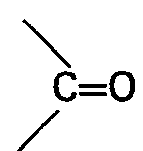
- 1740 (
- 1100 (―O―)
- 100 g of a mixture of [(2'-O-β-D-glucopyranosyl-β-D-glucopyranosyl)oxy]-alkane acid and -alkene acid methyl esters and polypropylene glycol (obtained as in the General Example) was placed in an autoclave, together with 0.25 g of potassium hydroxide, and the mixture was reacted at 100-120°C for 6 hours with amounts of propylene oxide gas corresponding to the addition mole numbers shown in Table 4, which were passed into the reaction mass. After the completion of the reaction, in each case, the mixture was neutralised with phosphoric acid and filtered under increased pressure to obtain a crude product as a brown paste. This product was purified by column-chromatography on silica gel to give polyoxypropylene [(2'-O-β-D-glucopyranosyl-β-D-glucopyranosyl)oxy]-alkane acid and -alkene acid methyl esters as a pale yellow paste.

- IR (cm-1) : 3380~3200 (-OH)
- 1740

- 1100 (-0-)
- (i) 100 g of a mixture of [(2'-O-β-D-glucopyranosyl-β-D-glucopyranosyl)oxy]-alkane acid and -alkene acid methyl esters, and polypropylene glycol (obtained as in the General Example), 30 g of water and 70 g of ethanol were placed in a 500 ml round-bottom flask. The mixture was stirred to obtain a homogenous solution. To this solution was added 9 g of potassium hydroxide, and the resulting mixture was reacted under reflux conditions for 2 hours. After the completion of the reaction, the mixture was neutralised with sulphuric acid, and potassium sulphate which formed was filtered off. The filtrate was placed in a 500 ml three-neck flask equipped with a Liebig condenser and was evaporated under normal pressure to remove methanol and ethanol. Water was then distilled off under reduced pressure to yield [(2'-O-β-D-glucopyranosyl-β-D-glucopyranosyl)oxy]-alkane acid and -alkene acid.
- (ii) The product obtained by process (i) above was placed in an autoclave together with 0.25 g of potassium hydroxide, and the mixture was reacted at 100-120°C for 6 hours with amounts of propylene oxide gas corresponding to the addition mole numbers shown in Table 6 below, which were passed into the reaction mass. After the completion of the reaction, the mixture was neutralised with phosphoric acid and filtered under increased pressure to obtain a brownish viscous crude product. This product was purified-by column-chromatography on silica gel to give polyoxypropylene [(2'-O-β-D-glucopyranosyl-β-D-glucopyranosyl)oxy]-alkane acid and -alkene acid esters as a pale yellow paste.

- IR (cm-1) : 3380-3200 (-OH)
- 1740 (

- 1100 (―O―).
- 20 g of a glycolipid methyl ester-polypropylene glycol mixture was placed in an autoclave, and to this mixture were added 4.2 g of octyl alcohol and 5 g of methanol to obtain a homogenous solution, and then 0.1 g of sodium methylate. The greater part of the methanol was removed by distillation at 70°C, and an ester interchange reaction was carried out while methanol which formed was distilled off with stirring under a reduced pressure of 0.333 bar (250 mmHg). The progress of the reaction was observed by gas-chromatography under the following conditions: glass column; 3% silicon JXR-Chromosorb W having a 60~80 mesh per centimetre particle size; inside diameter 3 mm; height 1 m; column oven temperature of 250~350°C; pressure by helium gas of 0.6 kg/cm2; and hydrogen flame detector used as a detector. The reaction state was measured from the peak area ratio of the glycolipid methyl ester and glycolipid octyl ester with a sample picked up from the reaction solution and trimethylsilylated with a trimethylsilylating agent. The reaction was regarded as having been completed when the peak of the glycolipid methyl ester disappeared. The mixture was reacted at 100-120°C for 6 hours with ethylene oxide gas in the amounts specified in Table 8, the gas being passed into the reaction mass, to obtain an ethylene oxide adduct. The amount of ethylene oxide was varied according to the specified addition mole number as shown in Table 8.

- IR (cm-1) : 3380-3200 (-OH)
- 1740 (

- 1100 (-0- ether)
- 1050 (-OH)
- 20 g of a mixture of glycolipid methyl esterpolypropylene glycol obtained as in the General Example was placed in an autoclave, and to this mixture were added 8.9 g of oleyl alcohol, 5 g of methanol and then 0.1 g of sodium methylate. The reaction conditions for ester interchange and ethylene oxide addition were the same as in Example 4. 21.0 g of an ethylene oxide gas was reacted with the mixture, thereby obtaining an adduct having an average addition number of 15. 29.8 g of the ethylene oxide adduct thus obtained was neutralised with phosphoric acid, and sodium phosphate which formed was filtered off under increased pressure. 5 g of the sample was purified by column-chromatography under the same conditions as in Example 4 to give 4.5 g of polyoxyethylene [(2'-O-A-D-glucopyranosyl-β-D-glucopyranosyl)oxy]-alkane acid and -alkene acid oleyl ester fractions.
- IR (cm-') : 3380-3200 (-OH)
- 1740 (

- 1100 (-0- ether)
- 1050 (-OH)
- 20 g of a mixture of glycolipid methyl esterpolypropylene glycol obtained as in the General Example was placed in an autoclave, and to this mixture were added 6.1 g of lauryl alcohol, 5 g of methanol and then 0.1 got sodium methylate. The method of preparing a glycolipid lauryl ester was the same as in Example 4. After the completion of the ester interchange reaction, the mixture was reacted at 100 to 120°C for 6 hours with a specified amount of a propylene oxide gas which was passed into the reaction mass, to obtain a propylene oxide adduct. The amount of the propylene oxide gas was varied according to the specified addition mole number as shown in Table 11.

- IR (cm-') : 3380~3200 (―0)


Claims (9)



Applications Claiming Priority (2)
| Application Number | Priority Date | Filing Date | Title |
|---|---|---|---|
| JP2430678A JPS55303A (en) | 1978-03-03 | 1978-03-03 | Hydroxyalkyl etherified glycolipid ester and its preparation |
| JP24306/78 | 1978-03-03 |
Publications (2)
| Publication Number | Publication Date |
|---|---|
| EP0005004A1 EP0005004A1 (en) | 1979-10-31 |
| EP0005004B1 true EP0005004B1 (en) | 1983-02-16 |
Family
ID=12134480
Family Applications (1)
| Application Number | Title | Priority Date | Filing Date |
|---|---|---|---|
| EP79300303A Expired EP0005004B1 (en) | 1978-03-03 | 1979-02-28 | Hydroxyalkyl-etherified glycolipid esters and their preparation |
Country Status (5)
| Country | Link |
|---|---|
| US (1) | US4195177A (en) |
| EP (1) | EP0005004B1 (en) |
| JP (1) | JPS55303A (en) |
| DE (1) | DE2964772D1 (en) |
| ES (1) | ES477364A1 (en) |
Families Citing this family (16)
| Publication number | Priority date | Publication date | Assignee | Title |
|---|---|---|---|---|
| US4362720A (en) * | 1977-04-14 | 1982-12-07 | Chembiomed Ltd. | Synthesis of 2-amino-2-deoxyglycoses and 2-amino-2-deoxyglycosides from glycals |
| JPS5428895A (en) * | 1977-08-01 | 1979-03-03 | Kao Corp | Dehydration purification of fermentation products |
| GB2033895B (en) * | 1978-09-22 | 1983-01-19 | Kao Corp | Hydroxypropyletherified glycolipid esters |
| JPS6026364B2 (en) * | 1978-09-29 | 1985-06-24 | 花王株式会社 | skin protection cosmetics |
| JPS5547610A (en) * | 1978-09-29 | 1980-04-04 | Kao Corp | Hair cosmetic |
| JPS6037087B2 (en) * | 1978-09-28 | 1985-08-24 | 花王株式会社 | cosmetics |
| US4870010A (en) * | 1984-10-16 | 1989-09-26 | Petroleum Fermentations N.V. | Bioemulsified-containing personal core products for topical application to dermopathologic conditions of the skin and scalp |
| US4999195A (en) * | 1984-10-16 | 1991-03-12 | Emulsan Biotechnologies Inc. | Personal care products containing bioemulsifiers |
| JPS62113043A (en) * | 1985-11-12 | 1987-05-23 | Toray Ind Inc | Hardness measuring apparatus for web roll objects |
| US5037969A (en) * | 1986-07-03 | 1991-08-06 | Takeda Chemical Industries, Ltd. | Glycosyl derivatives and use thereof |
| US5358656A (en) * | 1991-12-31 | 1994-10-25 | Lever Brothers Company, Division Of Conopco, Inc. | Compositions comprising glyceroglycolipids having an amine linkage as a surfactant or cosurfactant |
| ES2086677T3 (en) * | 1991-12-31 | 1996-07-01 | Unilever Nv | COMPOSITIONS CONTAINING A GLYCEROGLYCOLIPID. |
| CA2086228C (en) * | 1991-12-31 | 1998-09-22 | Robert W. Humphreys | Glycolipid surfactants and compositions containing them |
| US7262178B2 (en) * | 2003-03-24 | 2007-08-28 | Polytechnic University | Treatment of sepsis and septic shock |
| FR2942974B1 (en) * | 2009-03-11 | 2011-03-18 | Agro Ind Rech S Et Dev Ard | EMULSIFYING COMPOSITIONS BASED ON ALKYL POLYGLYCOSIDES AND ESTERS |
| FR2997400B1 (en) * | 2012-10-29 | 2015-07-24 | IFP Energies Nouvelles | PROCESS FOR PRODUCING SOPHOROSE FROM SOPHOROLIPIDES |
Family Cites Families (8)
| Publication number | Priority date | Publication date | Assignee | Title |
|---|---|---|---|---|
| US2652394A (en) * | 1950-02-27 | 1953-09-15 | Petrolite Corp | Certain oxyalkylated derivatives of sucrose |
| US3022335A (en) * | 1955-03-30 | 1962-02-20 | Wyandotte Chemicals Corp | Surface active polyoxyalkylene compounds having a plurality of heteric polyoxypropylene-polyoxyethylene chains |
| US2927919A (en) * | 1957-12-30 | 1960-03-08 | Dow Chemical Co | Ether-esters of sucrose |
| NL292809A (en) * | 1962-05-17 | |||
| NL130291C (en) * | 1964-01-02 | |||
| US3459733A (en) * | 1964-10-15 | 1969-08-05 | Mobil Oil Corp | Monomeric polyesters of polyhydroxy compounds and process for preparing same |
| US3305542A (en) * | 1965-03-25 | 1967-02-21 | Weyerhaeuser Co | Polyethers of levoglucosan |
| JPS5428895A (en) * | 1977-08-01 | 1979-03-03 | Kao Corp | Dehydration purification of fermentation products |
-
1978
- 1978-03-03 JP JP2430678A patent/JPS55303A/en active Granted
- 1978-11-21 US US05/962,664 patent/US4195177A/en not_active Expired - Lifetime
-
1979
- 1979-02-01 ES ES477364A patent/ES477364A1/en not_active Expired
- 1979-02-28 EP EP79300303A patent/EP0005004B1/en not_active Expired
- 1979-02-28 DE DE7979300303T patent/DE2964772D1/en not_active Expired
Also Published As
| Publication number | Publication date |
|---|---|
| DE2964772D1 (en) | 1983-03-24 |
| JPS5623439B2 (en) | 1981-05-30 |
| EP0005004A1 (en) | 1979-10-31 |
| JPS55303A (en) | 1980-01-05 |
| US4195177A (en) | 1980-03-25 |
| ES477364A1 (en) | 1980-10-01 |
Similar Documents
| Publication | Publication Date | Title |
|---|---|---|
| US4195177A (en) | Hydroxyalkyl-etherified glycolipid ester | |
| US3640998A (en) | Alkylene oxide adducts of alkyloligosaccharides and their mixtures with alkylene oxide adducts of bord alkyl glucosides and alkanols | |
| US3637774A (en) | Process for preparation and purification of polyglycerols and esters thereof | |
| JPS62250917A (en) | Mixture used as defoaming agent | |
| US4215213A (en) | Process for producing a glycolipid ester | |
| EP0071019B1 (en) | 2,3-dialkoxypropyl glyceryl ether and its preparation process as well as cosmetic composition containing same | |
| US4309447A (en) | Skin-protecting cosmetic composition | |
| WO1992010462A1 (en) | Guerbet carbonates | |
| CA1177096A (en) | Low-foaming nonionic surfactants | |
| US3719636A (en) | Method for the preparation of biodegradable glycidol surfactants | |
| US4197166A (en) | Dehydrating purification process for a fermentation product | |
| EP0096917A1 (en) | Process for preparation of alkyl glycosides | |
| US4216311A (en) | Process for producing a glycolipid methyl ester | |
| GB2144122A (en) | Triglycerine monosalkyl ethers | |
| GB2053942A (en) | Low-foaming alkoxy-bis(trialkoxysiloxy)-silane surfactans | |
| AU739995B2 (en) | Surfactants | |
| US4305931A (en) | Powdered compressed cosmetic material | |
| US5068382A (en) | Process for the production of organosilicon compounds | |
| CA1248142A (en) | 2-hydroxy-3-methyl-branched-alkoxypropylglyceryl ether and cosmetic composition containing same | |
| US4504418A (en) | Non-ionic surface-active agents coupled with carbonates or carboxylic esters | |
| US4201844A (en) | Process for producing a hydroxyfatty acid ester | |
| Scholnick et al. | Lactose‐derived surfactants (III): Fatty esters of oxyalkylated lactito | |
| US20130053331A1 (en) | Sugar derivatives, methods for preparation thereof, their use as surface-active agents | |
| JP4672849B2 (en) | Method for producing surfactant having carbonate bond | |
| US5171875A (en) | Beta branched borate esters |
Legal Events
| Date | Code | Title | Description |
|---|---|---|---|
| PUAI | Public reference made under article 153(3) epc to a published international application that has entered the european phase |
Free format text: ORIGINAL CODE: 0009012 |
|
| AK | Designated contracting states |
Designated state(s): BE CH DE FR GB IT LU NL SE |
|
| 17P | Request for examination filed | ||
| ITF | It: translation for a ep patent filed | ||
| GRAA | (expected) grant |
Free format text: ORIGINAL CODE: 0009210 |
|
| AK | Designated contracting states |
Designated state(s): BE CH DE FR GB IT LU NL SE |
|
| REF | Corresponds to: |
Ref document number: 2964772 Country of ref document: DE Date of ref document: 19830324 |
|
| ET | Fr: translation filed | ||
| PLBE | No opposition filed within time limit |
Free format text: ORIGINAL CODE: 0009261 |
|
| STAA | Information on the status of an ep patent application or granted ep patent |
Free format text: STATUS: NO OPPOSITION FILED WITHIN TIME LIMIT |
|
| 26N | No opposition filed | ||
| ITTA | It: last paid annual fee | ||
| PGFP | Annual fee paid to national office [announced via postgrant information from national office to epo] |
Ref country code: FR Payment date: 19920211 Year of fee payment: 14 |
|
| PGFP | Annual fee paid to national office [announced via postgrant information from national office to epo] |
Ref country code: SE Payment date: 19920214 Year of fee payment: 14 Ref country code: GB Payment date: 19920214 Year of fee payment: 14 |
|
| PGFP | Annual fee paid to national office [announced via postgrant information from national office to epo] |
Ref country code: CH Payment date: 19920224 Year of fee payment: 14 |
|
| PGFP | Annual fee paid to national office [announced via postgrant information from national office to epo] |
Ref country code: NL Payment date: 19920229 Year of fee payment: 14 |
|
| PGFP | Annual fee paid to national office [announced via postgrant information from national office to epo] |
Ref country code: DE Payment date: 19920331 Year of fee payment: 14 |
|
| PGFP | Annual fee paid to national office [announced via postgrant information from national office to epo] |
Ref country code: BE Payment date: 19920403 Year of fee payment: 14 |
|
| PGFP | Annual fee paid to national office [announced via postgrant information from national office to epo] |
Ref country code: LU Payment date: 19920416 Year of fee payment: 14 |
|
| EPTA | Lu: last paid annual fee | ||
| PG25 | Lapsed in a contracting state [announced via postgrant information from national office to epo] |
Ref country code: LU Free format text: LAPSE BECAUSE OF NON-PAYMENT OF DUE FEES Effective date: 19930228 Ref country code: GB Effective date: 19930228 Ref country code: CH Effective date: 19930228 Ref country code: BE Effective date: 19930228 |
|
| PG25 | Lapsed in a contracting state [announced via postgrant information from national office to epo] |
Ref country code: SE Effective date: 19930301 |
|
| BERE | Be: lapsed |
Owner name: KAO SOAP CY LTD Effective date: 19930228 |
|
| PG25 | Lapsed in a contracting state [announced via postgrant information from national office to epo] |
Ref country code: NL Effective date: 19930901 |
|
| NLV4 | Nl: lapsed or anulled due to non-payment of the annual fee | ||
| GBPC | Gb: european patent ceased through non-payment of renewal fee |
Effective date: 19930228 |
|
| PG25 | Lapsed in a contracting state [announced via postgrant information from national office to epo] |
Ref country code: FR Effective date: 19931029 |
|
| REG | Reference to a national code |
Ref country code: CH Ref legal event code: PL |
|
| PG25 | Lapsed in a contracting state [announced via postgrant information from national office to epo] |
Ref country code: DE Effective date: 19931103 |
|
| REG | Reference to a national code |
Ref country code: FR Ref legal event code: ST |
|
| EUG | Se: european patent has lapsed |
Ref document number: 79300303.9 Effective date: 19931008 |