EP0004774B1 - Preparation of a cationic starch paste - Google Patents
Preparation of a cationic starch paste Download PDFInfo
- Publication number
- EP0004774B1 EP0004774B1 EP79300552A EP79300552A EP0004774B1 EP 0004774 B1 EP0004774 B1 EP 0004774B1 EP 79300552 A EP79300552 A EP 79300552A EP 79300552 A EP79300552 A EP 79300552A EP 0004774 B1 EP0004774 B1 EP 0004774B1
- Authority
- EP
- European Patent Office
- Prior art keywords
- starch
- cationic
- reaction
- cationic reagent
- reagent
- Prior art date
- Legal status (The legal status is an assumption and is not a legal conclusion. Google has not performed a legal analysis and makes no representation as to the accuracy of the status listed.)
- Expired
Links
Classifications
-
- C—CHEMISTRY; METALLURGY
- C08—ORGANIC MACROMOLECULAR COMPOUNDS; THEIR PREPARATION OR CHEMICAL WORKING-UP; COMPOSITIONS BASED THEREON
- C08B—POLYSACCHARIDES; DERIVATIVES THEREOF
- C08B31/00—Preparation of derivatives of starch
- C08B31/08—Ethers
- C08B31/12—Ethers having alkyl or cycloalkyl radicals substituted by heteroatoms, e.g. hydroxyalkyl or carboxyalkyl starch
- C08B31/125—Ethers having alkyl or cycloalkyl radicals substituted by heteroatoms, e.g. hydroxyalkyl or carboxyalkyl starch having a substituent containing at least one nitrogen atom, e.g. cationic starch
Definitions
- This invention relates to the preparation of a cationic starch. More specifically, this invention relates to processes for the on-site preparation of cationic starch pastes for use in papermaking, textile size, waste water treatment, etc., without additional treatment.
- Cationic starches are widely used as wet end additives in the papermaking process to improve fines and filler retention while increasing the strength characteristics of the resultant paper.
- a smaller, but no less important, papermaking application is in the size press and coating areas where cationic starches contribute to the strength and surface characteristics of the finished paper and, in addition, reduce the biological oxygen demand (BOD) contribution of the broke upon repulping.
- BOD biological oxygen demand
- U.S. Patent 3,721,575 describes a process for preparing a cationic starch paste which involves gelatinising and reacting starch with a monofunctional cationic reagent in an aqueous alkaline medium at a temperature of above 100°C.
- British Patent 1,505,243 also describes such a process, again using temperatures of over 100°C.
- U.S. Patent 3,930,877 describes a cationic condensate or polymer for use as a starch additive, which is prepared by condensing eipcholorhydrin with dimethylamine or dimethylamine and ammonia.
- Cationic starches are however almost exclusively marketed as dry, granular, ungelatinized products. In use, the cationic starches must be reslurried in water and then gelatinized to produce a thoroughly dispersed cationic starch paste.
- Granular cationic starches are generally prepared by reacting an alkaline (pH 11-12) starch slurry with a cationic reagent in the presence of a gelatinization inhibitor such as sodium chloride, sodium sulfate, etc. and at a temperature below the gelatinization temperature of the starch. Reaction times are characteristically 12 to 20 hours. Additional operations may be included in the process as required to obtain a product designed for a specific application. In any event, the reaction slurry must be adjusted to a more neutral pH and then washed to remove the gelatinization inhibiting salts.
- a gelatinization inhibitor such as sodium chloride, sodium sulfate, etc.
- the present invention is directed to a process whereby the ultimate user can on-site prepare a cationic starch to meet his specific needs from a single starch starting material.
- the present invention provides a process in which:
- the cationic reagent may for example be a salt of a monomeric tertiary amine containing a haloalkyl or haloalkenyl group of up to 6 carbon atoms, including quaternary ammonium salts of such amines, e.g. CBTC and CHPTA mentioned below.
- the cationic reagent may be 2-diethylaminoethyl chloride hydrochloride (DEAE) or 4-chloro-2-butenyltrimethylammonium chloride (CBTC).
- a particularly preferred cationic reagent is the product obtained by reacting eipichlorohydrin with trimethylamine or one of its salts, said reaction product being substantially free of residual epichlorohydrin and consisting substantially of 3-chloro-2-hydroxypropyltrimethylammonium chloride (CHPTA).
- CHPTA 3-chloro-2-hydroxypropyltrimethylammonium chloride
- the cationic reagent is generally employed in an amount to provide a starch derivative having a degree of substitution of less than about 0.05 and preferably within the range of 0.005 to 0.03.
- the amount of alkali used is 1 to 10 (and preferably 2 to 6) equivalent weights per mole of cationic reagent.
- the reaction temperature is preferably 49°C to 85°C and the reaction time 10 to 80 minutes.
- reaction efficiency is improved significantly when compared with the prior art.
- the alkali also aids in producing a highly dispersed starch paste, inhibits paste retrogradation, and facilitates handling of high solids starch pastes.
- the process may for example be performed by
- a high solids starch slurry is treated with cationic reagent in an amount to produce a derivative having a degree of substitution (D.S.) of 0.005 to 0.03 and continuously pumped to a suitable steam jet or other heating device and substantially simultaneously with gelatinization treated with alkali.
- D.S. degree of substitution
- an aqueous starch slurry containing 10 to 40% starch dry solids is prepared and treated with the cationic reagent, for example, the epichlorohydrintrimethylamine reaction product (the starch-reaction portion being 3-chloro-2-hydroxypropyltrimethylammonium chloride) in a manner to insure adequate mixing and in an amount to yield a cationic starch having a degree of substitution of less than 0.05.
- the starch slurry-cationic reagent mixture- is then pumped to a suitable steam jet or other mixing device and substantially simultaneously treated with alkali sufficient to catalyze the reaction.
- Said alkaline starch slurry-cationic reagent combination is continuously and instantaneously gelatinized at 49°C to 93°C and held in a retention vessel for a period of time to insure a satisfactory reaction efficiency.
- a high solids starch slurry is thermal-chemically (T/C) converted or pasted and subsequently treated with alkali and the cationic reagent in an amount to produce a derivative having a degree of substitution of 0.005 to 0.03.
- T/C thermal-chemically
- a starch slurry containing from 10% to 40% starch dry solids is prepared.
- the starch slurry is cooked or gelatinized by any of many different methods, e.g. live steam injected into the slurry, external heat applied to the slurry, autoclaved, jet cooked, or thermal-chemically converted as described in U.S. Patent No. 3,211,564.
- the paste is adjusted to temperatures between 49°C and 93°C. This may be accomplished by the use of a heat exchanger, dilution water, or other suitable means.
- the alkali and the cationic reagent are then added to the paste.
- the order of addition can be inverted, but it is essential that each is added with thorough mixing. This mode is readily adaptable to the continuous production of cationic starch dispersions by incorporation of continuous stirred tank reaction principles.
- dispersion is commonly used in the art and refers to an aqueous starch suspension which has been hydrated or gelatinized (sometimes referred to as pasted) by any of a number of means known to those skilled in the art.
- starches Any of the commonly used starches can be used in carrying out this invention.
- suitable starches include corn, wheat, rice, tapioca, potato and sago starches as well as starches which have been premodified by various means such as acid modification, oxidation, derivatization and the like.
- Alkali as used herein applies primarily to sodium hydroxide, however, other alkalies, such as potassium hydroxide, calcium hydroxide or oxide, sodium carbonate, trisodium phosphate, etc., can also be used.
- the cationic reagent employed in the following Examples I through XI was the preferred reagent obtained by reacting epichlorohydrin with trimethylamine or one of its salts, said reaction product being substantially free of residual epichlorohydrin and consisting substantially of 3-chloro-2-hydroxypropyltrimethylammonium chloride.
- the cationic reagent employed in the other specific examples was as indicated.
- the resultant 20% dry solids paste was divided into three portions and cooled to: (1) 160°F (71°C), (2) 180°F (82°C), and (3) 200°F (93°C).
- the cationic reagent was used in an amount of 4.5% based on starch on a dry solids basis. Periodically samples were taken and the unreacted reagent removed by precipitating the paste in and washing with methanol. The resulting wet cake was dried for Kjeldahl nitrogen analysis.
- the degree of substitution is the average number of substituents per D-glucose unit.
- reaction efficiency was calculated as follows:
- a 100% reaction efficiency is equivalent to a degree of substitution of 0.0388.
- a starch slurry was thermally-chemically converted using conditions described in Example I.
- the resultant pastes were cooled to 180°F (82°C) and treated with 4.5% of the cationic reagent (on starch dry solids basis) with and without added alkali. Samples were removed after two hours and prepared for assay as described in Example I.
- a starch slurry was thermally-chemically converted using conditions described in Example I.
- the resultant pastes were cooled to 180OF (82°C) and treated with 4.5% of the cationic reagent (on starch dry solids basis) using 3%, 4% or 5% sodium hydroxide (starch dry solids). Samples were withdrawn periodically and worked up as described in Example I.
- a thermally-chemically converted starch paste was prepared as described in Example I and then diluted to 3%, 5% and 10% dry solids using hot water.
- the resultant low solids pastes, as well as the starting high solids paste, were agitated and cooled to and maintained at 180OF (82°C) in a water bath.
- the various pastes were then treated with: (1) the cationic reagent (4.5% on starch dry solids basis), and (2) sodium hydroxide (3% on starch dry solids basis). After two hours at 180°F (82°C), the samples were prepared for assay as described in Example I.
- the resultant starch pastes were immediately neutralized to pH 5-7, thereby terminating the reaction, and then precipitated in and washed with methanol to remove the soluble nitrogen containing materials.
- the resultant wet cake was dried for Kjeldahl nitrogen analysis.
- the resultant cationic starch pastes were prepared for assay as described in Example V.
- Starch pastes were prepared as described in Example II, samples #3 and #4, i.e. reacted with 4.5% active cationic reagent on starch dry solids basis with and without added alkali.
- the resultant alkaline cationic pastes were diluted to 1% dry solids and added to the furnish at the rate of 20 pounds (9.1 kg) starch, dry solids basis, per ton (1016 kg) of pulp.
- the burst factor was calculated as follows:
- Example IX The furnish as described in Example IX was used to prepare additional handsheets.
- Sets #2 and #3 include a thermally-chemically converted corn starch prepared as described in Example I.
- the starch used in Set #2 had not been reacted with cationic reagent whereas starch used in Set #3 had, as is indicated.
- Starches used in sets #5 and #6 are commercially prepared granular cationic products.
- Handsheets were prepared using the Noble and Wood Handsheet Apparatus.
- the stock was a commercial furnish obtained from a manufacturer of fine papers. Fiber included hardwood and softwood kraft, and broke.
- Starches used in Sets #2, #3 and #4 were prepared after thermal-chemically converting as is described in Example I. Starch used in Set #2 had not been treated with the cationic reagent. Starch used in Set #3 had been treated and reacted with the cationic reagent and sodium hydroxide. Starch used in Set #4 was treated with the cationic reagent but no sodium hydroxide.
- aqueous, 23% dry solids, starch slurry was prepared using unmodified corn starch.
- the slurry was thermal-chemically (T/C) converted using the following conditions.
- the resultant paste was divided into portions and cooled to 120°, 140°, 160°, 180° and 200°F (49°, 60°, 71 °, 82° and 93°C, respectively).
- Sodium hydroxide and a cationic reagent in the amounts indicated in Table XII were added and the reaction allowed to continue for 45 minutes.
- the resultant starch pastes were prepared for assay as described in Example V.
- the process of this invention eliminates the need to prepare granular cationic starches which require incorporation of swelling inhibitors and generate high biological oxygen demands in waste water effluents.
- the process offers good reaction efficiencies and permits adjustment of reaction conditions to suit specific needs ranging from low dry solids, high fluidity, size press starches to high dry solids, low fluidity wet end starches.
- the process makes it possible for an end user to prepare on-site cationic starches from a basic starch without maintaining a large inventory of special starches.
Landscapes
- Chemical & Material Sciences (AREA)
- Life Sciences & Earth Sciences (AREA)
- Engineering & Computer Science (AREA)
- Biochemistry (AREA)
- Materials Engineering (AREA)
- Health & Medical Sciences (AREA)
- Chemical Kinetics & Catalysis (AREA)
- Medicinal Chemistry (AREA)
- Polymers & Plastics (AREA)
- Organic Chemistry (AREA)
- Polysaccharides And Polysaccharide Derivatives (AREA)
- Paper (AREA)
Description
- This invention relates to the preparation of a cationic starch. More specifically, this invention relates to processes for the on-site preparation of cationic starch pastes for use in papermaking, textile size, waste water treatment, etc., without additional treatment.
- Cationic starches are widely used as wet end additives in the papermaking process to improve fines and filler retention while increasing the strength characteristics of the resultant paper. A smaller, but no less important, papermaking application is in the size press and coating areas where cationic starches contribute to the strength and surface characteristics of the finished paper and, in addition, reduce the biological oxygen demand (BOD) contribution of the broke upon repulping.
- U.S. Patent 3,721,575 describes a process for preparing a cationic starch paste which involves gelatinising and reacting starch with a monofunctional cationic reagent in an aqueous alkaline medium at a temperature of above 100°C. British Patent 1,505,243 also describes such a process, again using temperatures of over 100°C. U.S. Patent 3,930,877 describes a cationic condensate or polymer for use as a starch additive, which is prepared by condensing eipcholorhydrin with dimethylamine or dimethylamine and ammonia.
- Cationic starches are however almost exclusively marketed as dry, granular, ungelatinized products. In use, the cationic starches must be reslurried in water and then gelatinized to produce a thoroughly dispersed cationic starch paste.
- Granular cationic starches are generally prepared by reacting an alkaline (pH 11-12) starch slurry with a cationic reagent in the presence of a gelatinization inhibitor such as sodium chloride, sodium sulfate, etc. and at a temperature below the gelatinization temperature of the starch. Reaction times are characteristically 12 to 20 hours. Additional operations may be included in the process as required to obtain a product designed for a specific application. In any event, the reaction slurry must be adjusted to a more neutral pH and then washed to remove the gelatinization inhibiting salts.
- These basic procedures, though widely used, entail certain problems. Thus, granule state reactions in aqueous slurries require the addition of gelatinization inhibitors to prevent granule swelling. Because of the need to maintain the starch in granular form reaction temperatures must be low (less than 50°C) to guard against gelatinization. Low reaction temperatures result in long, 12 hours or more, reaction times. The resultant highly alkaline reaction slurries must be neutralized prior to washing and drying and the added gelatinization inhibiting salts removed by washing. The washing operations, however, result in significant losses of both granular and the more highly derivatized, solubilized starch, contributing not only to reduced product yields but also to increased biological oxygen demand (BOD) and suspended solids loads in the waste water streams.
- In addition, the variety of cationic starches commercially available suggests the products are intended for specific use areas and problems. Specialized starches of this type tend to be relatively low volume products and hence must command premium prices which further restrict their usage. This specialization creates inventory problems for the user due to the warehousing of a variety of different cationic starches to meet various requirements.
- With the above problems in mind, the present invention is directed to a process whereby the ultimate user can on-site prepare a cationic starch to meet his specific needs from a single starch starting material.
- The present invention provides a process in which:
- (a) Only one relatively inexpensive starch is required to prepare a variety of cationic products,
- (b) No geiatinization inhibitor is required,
- (c) The reaction temperatures can be increased and as a result reaction times shortened as compared to granular state reactions,
- (d) Highly tailored products can be prepared at will on the use site eliminating the necessity of maintaining several different cationic starches in inventory,
- (e) The starch need not be neutralized, washed, or dried, minimizing losses, and
- (f) The resultant cationic starch is significantly less expensive than a corresponding granular preparation.
- The cationic reagent may for example be a salt of a monomeric tertiary amine containing a haloalkyl or haloalkenyl group of up to 6 carbon atoms, including quaternary ammonium salts of such amines, e.g. CBTC and CHPTA mentioned below. Thus the cationic reagent may be 2-diethylaminoethyl chloride hydrochloride (DEAE) or 4-chloro-2-butenyltrimethylammonium chloride (CBTC). A particularly preferred cationic reagent is the product obtained by reacting eipichlorohydrin with trimethylamine or one of its salts, said reaction product being substantially free of residual epichlorohydrin and consisting substantially of 3-chloro-2-hydroxypropyltrimethylammonium chloride (CHPTA). The cationic reagent is generally employed in an amount to provide a starch derivative having a degree of substitution of less than about 0.05 and preferably within the range of 0.005 to 0.03.
- The amount of alkali used is 1 to 10 (and preferably 2 to 6) equivalent weights per mole of cationic reagent. The reaction temperature is preferably 49°C to 85°C and the reaction time 10 to 80 minutes.
- A surprising discovery is that under these conditions of slurry solids, reaction times and reaction temperatures, the reaction efficiency is improved significantly when compared with the prior art. In addition to promoting the reaction, the alkali also aids in producing a highly dispersed starch paste, inhibits paste retrogradation, and facilitates handling of high solids starch pastes.
- The process may for example be performed by
- a. preparing an aqueous starch slurry containing from 10 to 40% dry solids,
- b. treating said starch slurry with the cationic reagent in an amount to provide a starch derivative having a degree of substitution less than 0.05, and
- c. heating said starch derivative to gelatinize the starch and substantially simultaneously with the gelatinization reacting with the starch derivative from 1 to 10 equivalent weights of an alkali per mole of cationic reagent at a temperature of from 49°C to 93°C for a period of up to two hours.
- Thus in accordance with one preferred embodiment of the present invention (Mode I), a high solids starch slurry is treated with cationic reagent in an amount to produce a derivative having a degree of substitution (D.S.) of 0.005 to 0.03 and continuously pumped to a suitable steam jet or other heating device and substantially simultaneously with gelatinization treated with alkali. Thus, an aqueous starch slurry containing 10 to 40% starch dry solids is prepared and treated with the cationic reagent, for example, the epichlorohydrintrimethylamine reaction product (the starch-reaction portion being 3-chloro-2-hydroxypropyltrimethylammonium chloride) in a manner to insure adequate mixing and in an amount to yield a cationic starch having a degree of substitution of less than 0.05. The starch slurry-cationic reagent mixture-is then pumped to a suitable steam jet or other mixing device and substantially simultaneously treated with alkali sufficient to catalyze the reaction. Said alkaline starch slurry-cationic reagent combination is continuously and instantaneously gelatinized at 49°C to 93°C and held in a retention vessel for a period of time to insure a satisfactory reaction efficiency.
- Alternatively the process may be performed by
- a. preparing an aqueous starch paste having a solids level of from 10% to 40% by weight,
- b. treating said starch paste with the cationic reaction in an amount to provide a starch derivative having a degree of substitution less than 0.05, and
- c. reacting said treated starch with 1 to 10 equivalent weights of an alkali per mole of cationic reagent at a temperature of 49°C to 93°C for a period of up to two hours.
- Thus in accordance with a second preferred embodiment of the present invention (Mode II), a high solids starch slurry is thermal-chemically (T/C) converted or pasted and subsequently treated with alkali and the cationic reagent in an amount to produce a derivative having a degree of substitution of 0.005 to 0.03. Thus, a starch slurry containing from 10% to 40% starch dry solids is prepared. The starch slurry is cooked or gelatinized by any of many different methods, e.g. live steam injected into the slurry, external heat applied to the slurry, autoclaved, jet cooked, or thermal-chemically converted as described in U.S. Patent No. 3,211,564. When the starch has been thoroughly dispersed, the paste is adjusted to temperatures between 49°C and 93°C. This may be accomplished by the use of a heat exchanger, dilution water, or other suitable means. The alkali and the cationic reagent are then added to the paste. The order of addition can be inverted, but it is essential that each is added with thorough mixing. This mode is readily adaptable to the continuous production of cationic starch dispersions by incorporation of continuous stirred tank reaction principles.
- The term dispersion is commonly used in the art and refers to an aqueous starch suspension which has been hydrated or gelatinized (sometimes referred to as pasted) by any of a number of means known to those skilled in the art.
- Any of the commonly used starches can be used in carrying out this invention. Examples of suitable starches include corn, wheat, rice, tapioca, potato and sago starches as well as starches which have been premodified by various means such as acid modification, oxidation, derivatization and the like.
- Alkali as used herein applies primarily to sodium hydroxide, however, other alkalies, such as potassium hydroxide, calcium hydroxide or oxide, sodium carbonate, trisodium phosphate, etc., can also be used.
- The following examples illustrate the advantages of the invention. The cationic reagent employed in the following Examples I through XI was the preferred reagent obtained by reacting epichlorohydrin with trimethylamine or one of its salts, said reaction product being substantially free of residual epichlorohydrin and consisting substantially of 3-chloro-2-hydroxypropyltrimethylammonium chloride. The cationic reagent employed in the other specific examples was as indicated.
- An aqueous 23% dry solids starch slurry was prepared using unmodified corn starch. The slurry was then thermally-chemically converted using the following conditions:

- The resultant 20% dry solids paste was divided into three portions and cooled to: (1) 160°F (71°C), (2) 180°F (82°C), and (3) 200°F (93°C). Sodium hydroxide (4% on starch dry solids basis) and the cationic reagent, substantially 3-chloro-2-hydroxypropyltrimethylammonium chloride, were then added and the reaction allowed to continue for a total of 120 minutes. The cationic reagent was used in an amount of 4.5% based on starch on a dry solids basis. Periodically samples were taken and the unreacted reagent removed by precipitating the paste in and washing with methanol. The resulting wet cake was dried for Kjeldahl nitrogen analysis.
- The degree of substitution (D.S.) is the average number of substituents per D-glucose unit.
- The reaction efficiency was calculated as follows:


- All samples were corrected for parent starch nitrogen content.
- A 100% reaction efficiency is equivalent to a degree of substitution of 0.0388.
- The results summarized in Table I demonstrate that the reaction efficiency is optimized at approximately 180°F (82°C), and the maximum reaction rate was obtained using a reaction temperature of 180°F (82°C).
- A starch slurry was thermally-chemically converted using conditions described in Example I. The resultant pastes were cooled to 180°F (82°C) and treated with 4.5% of the cationic reagent (on starch dry solids basis) with and without added alkali. Samples were removed after two hours and prepared for assay as described in Example I.
- The results (Table II) show that without added alkali there was little if any reaction; however, in the presence of 3% added sodium hydroxide (on starch dry solids basis) the reaction efficiency was approximately 75%. Reaction efficiencies of this magnitude are approximately several times that calculated for the so-called "paste state" reactions described in the prior art.

- A starch slurry was thermally-chemically converted using conditions described in Example I. The resultant pastes were cooled to 180OF (82°C) and treated with 4.5% of the cationic reagent (on starch dry solids basis) using 3%, 4% or 5% sodium hydroxide (starch dry solids). Samples were withdrawn periodically and worked up as described in Example I.

- All samples corrected for parent starch nitrogen content.
- A 100% reaction efficiency is equivalent to a D.S. of 0.0388.
- The results summarized above show that the reaction efficiency and the reaction rate were maximized at a 4% alkali usage (dry solids basis).
- A thermally-chemically converted starch paste was prepared as described in Example I and then diluted to 3%, 5% and 10% dry solids using hot water. The resultant low solids pastes, as well as the starting high solids paste, were agitated and cooled to and maintained at 180OF (82°C) in a water bath. The various pastes were then treated with: (1) the cationic reagent (4.5% on starch dry solids basis), and (2) sodium hydroxide (3% on starch dry solids basis). After two hours at 180°F (82°C), the samples were prepared for assay as described in Example I.
- The results, summarized in Table IV, show that the reaction efficiency is directly related to the dry solids level at which the reaction was conducted. The relatively low reaction temperatures and low reaction times in combination with the high reaction solids account for the high reaction efficiencies when compared to the prior art.

- An aqueous 15% solids slurry was prepared using unmodified corn starch and continuously thermally-chemically converted using the following conditions:
- Cationic reagent: 5% on starch dry solids basis.
- Sodium hydroxide: 4% on starch dry solids basis added, as a solution, just upstream from the steam jet.
- Conversion temperatures: 175°F (79°C), 225°F (107°C) and 300°F (149°C).
- Reaction time: Approximately 16-18 minutes.
- The resultant starch pastes were immediately neutralized to pH 5-7, thereby terminating the reaction, and then precipitated in and washed with methanol to remove the soluble nitrogen containing materials. The resultant wet cake was dried for Kjeldahl nitrogen analysis.
- The results, summarized in Table V, show that at constant sodium hydroxide usage and at a fixed reaction time efficiencies decreased as the reaction temperature increased from 175°F (79°C) to 225°F (107°C) to 300°F (149°C).

- The resultant cationic starch pastes were prepared for assay as described in Example V.
- Under these conditions, the reaction efficiency (Table VI-A) increases with increasing alkali usage:

- The above experiment was repeated except:
- 1. The slurry was prepared at 30% dry solids using a 25 Buel fluidity acid-modified starch, and
- 2. The reaction temperature was increased to 200°F (93°C).
- Under these high solids, thermal-chemical conversion conditions, the reaction efficiency (Table VI-B) was maximized at approximately a 4% NaOH use level (dry solids basis).

- The resultant pastes were prepared for assay using the procedures described in Example V.
- The results, summarized in the following table, show that the reaction efficiency is directly related to the reaction solids level.
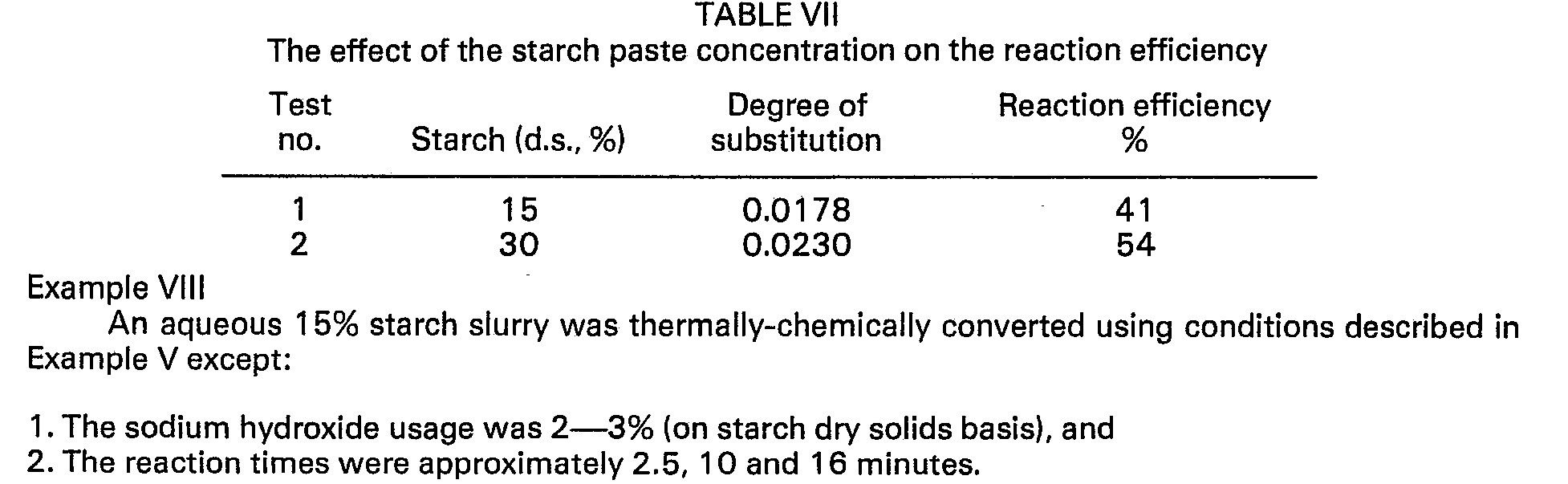
- The resultant pastes were prepared for assay using procedures described in Example V.

- The results, summarized in Table VIII, show that in only 16 minutes reaction efficiencies were greater than prior art "paste state" reactions.
- Starch pastes were prepared as described in Example II, samples #3 and #4, i.e. reacted with 4.5% active cationic reagent on starch dry solids basis with and without added alkali. The resultant alkaline cationic pastes were diluted to 1% dry solids and added to the furnish at the rate of 20 pounds (9.1 kg) starch, dry solids basis, per ton (1016 kg) of pulp.
- Handsheets were prepared using the Noble and Wood Handsheet Apparatus. Stock furnish was as follows:

- The resultant sheets were conditioned and tested according to the following TAPPI standard procedures:

- Scott Bond values were determined using the manufacturer's recommended procedure.
- Filler retention was calculated using the following formula:

- The burst factor was calculated as follows:


- The results summarized in Table IX show that alkali is required to obtain a reasonable reaction efficiency. The results also show that the more highly derivatized cationic starch not only retains more ash in the sheet but also maintains the sheet strength characteristics at a high level in spite of the increased filler loading.
- The results demonstrate that the presence of the cationic reagent is not sufficient to improve functional characteristics of the starch, whereas starch which has been reacted with the cationic reagent significantly improves performance.
- The furnish as described in Example IX was used to prepare additional handsheets.
- Various starches were incorporated into the furnish to compare performance. Sets #2 and #3 include a thermally-chemically converted corn starch prepared as described in Example I. The starch used in Set #2 had not been reacted with cationic reagent whereas starch used in Set #3 had, as is indicated.
- Starch used in Set #4 had been reacted simultaneous with thermal conversion as is described in Example V.
- Starches used in sets #5 and #6 are commercially prepared granular cationic products.
- The results of testing those handsheets as shown in the following table demonstrate the functional characteristics of products prepared by either on-site method.
- Significant increases are noted in filler retention and strength with cationic starch products, while a reduction in filler retention is noted with the unreacted starch product.

- Handsheets were prepared using the Noble and Wood Handsheet Apparatus. The stock was a commercial furnish obtained from a manufacturer of fine papers. Fiber included hardwood and softwood kraft, and broke.
- Starches used in Sets #2, #3 and #4 were prepared after thermal-chemically converting as is described in Example I. Starch used in Set #2 had not been treated with the cationic reagent. Starch used in Set #3 had been treated and reacted with the cationic reagent and sodium hydroxide. Starch used in Set #4 was treated with the cationic reagent but no sodium hydroxide.
- The results demonstrate that the presence of the cationic reagent is not sufficient to improve the functional characteristics of the starch, whereas starch which has been reacted (Set #3) is comparable in performance to commercially prepared granular cationic starches (Sets #5 and #6) as is illustrated by increased ash content and improved strength properties.

- An aqueous, 23% dry solids, starch slurry was prepared using unmodified corn starch. The slurry was thermal-chemically (T/C) converted using the following conditions.

- The resultant paste was divided into portions and cooled to 120°, 140°, 160°, 180° and 200°F (49°, 60°, 71 °, 82° and 93°C, respectively). Sodium hydroxide and a cationic reagent in the amounts indicated in Table XII were added and the reaction allowed to continue for 45 minutes. The resultant starch pastes were prepared for assay as described in Example V.
- The results, summarized in Table XII, show that the efficiency for the starch (1) DEAE reaction decreases as the reaction temperature increases from 120-200°F (49-93°C) and (2) CHPTA and CBTC reaction is maximized at a reaction temperature of 160-170°F (71-82°C). The use of higher reaction temperatures results in a significant loss in reaction efficiency.

- An aqueous, 15% dry solids, starch slurry was prepared using acid-modified corn starch and then thermal-chemically converted using the conditions described below:

- The resultant starch pastes were prepared for assay as described in Example V. The results, summarized in Table XIII, show that the efficiency for the starch (1) DEAE reaction decreases as the reaction temperature increases from 150° up to 300°F (66-149°C) and (2) CBTC reaction is maximized at a temperature of about 175°F (79°C). The use of lower or higher reaction temperatures (especially the latter) would result in a significant loss in reaction efficiency.

- The process of this invention eliminates the need to prepare granular cationic starches which require incorporation of swelling inhibitors and generate high biological oxygen demands in waste water effluents. The process offers good reaction efficiencies and permits adjustment of reaction conditions to suit specific needs ranging from low dry solids, high fluidity, size press starches to high dry solids, low fluidity wet end starches. The process makes it possible for an end user to prepare on-site cationic starches from a basic starch without maintaining a large inventory of special starches.
In general, in our process aqueous starch having a solids level of 10 to 40% by weight is reacted with a cationic reagent in the presence of alkali at a temperature of 49°C (120°F) to 93°C (200°F) for a period of up to 2 hours, either after or during the gelatinisation of the starch. The solids level, the amount of alkali, the temperature and the reaction time are chosen to achieve a reaction efficiency of at least 41 %.
Claims (10)
Applications Claiming Priority (2)
| Application Number | Priority Date | Filing Date | Title |
|---|---|---|---|
| US89351078A | 1978-04-04 | 1978-04-04 | |
| US893510 | 1978-04-04 |
Publications (3)
| Publication Number | Publication Date |
|---|---|
| EP0004774A2 EP0004774A2 (en) | 1979-10-17 |
| EP0004774A3 EP0004774A3 (en) | 1979-10-31 |
| EP0004774B1 true EP0004774B1 (en) | 1984-07-18 |
Family
ID=25401697
Family Applications (1)
| Application Number | Title | Priority Date | Filing Date |
|---|---|---|---|
| EP79300552A Expired EP0004774B1 (en) | 1978-04-04 | 1979-04-03 | Preparation of a cationic starch paste |
Country Status (8)
| Country | Link |
|---|---|
| US (1) | US4554021A (en) |
| EP (1) | EP0004774B1 (en) |
| JP (1) | JPS54143534A (en) |
| AT (1) | AT368525B (en) |
| CA (1) | CA1117259A (en) |
| DE (1) | DE2967114D1 (en) |
| ES (1) | ES479185A1 (en) |
| NO (1) | NO150966C (en) |
Cited By (1)
| Publication number | Priority date | Publication date | Assignee | Title |
|---|---|---|---|---|
| CN104193839A (en) * | 2014-09-05 | 2014-12-10 | 广州天赐高新材料股份有限公司 | Cationic starch as well as preparation method and application of cationic starch |
Families Citing this family (14)
| Publication number | Priority date | Publication date | Assignee | Title |
|---|---|---|---|---|
| JPS6341863Y2 (en) * | 1979-08-06 | 1988-11-02 | ||
| US4281109A (en) * | 1980-03-03 | 1981-07-28 | National Starch And Chemical Corporation | Pollution-free cationization of starch |
| DE3104148A1 (en) * | 1981-02-06 | 1982-11-11 | GfV Gesellschaft für Verfahrenstechnik mbH, 8919 Greifenberg | METHOD FOR PRODUCING CATIONIC STARCH DERIVATIVES |
| CA2132685A1 (en) * | 1994-09-22 | 1996-03-23 | Robert T. Tyler | An aqueous alcoholic alkaline process for cationization of normal, waxy and high amylose starches from legume, cereal, tuber and root |
| FI107160B (en) * | 1998-06-03 | 2001-06-15 | Raisio Chem Oy | Process for the preparation of highly cationic starch solutions |
| US7214806B2 (en) * | 2004-03-05 | 2007-05-08 | Sachem, Inc. | Synthetic multiple quaternary ammonium salts |
| WO2007053235A1 (en) * | 2005-11-04 | 2007-05-10 | Sachem, Inc. | Cation-exchange displacement chromatography process and cationic organic compounds for use as displacer compounds in cation-exchange displacement chromatography process |
| MX365956B (en) | 2011-08-31 | 2019-06-18 | Self Suspending Proppant Llc | Self-suspending proppants for hydraulic fracturing. |
| US9297244B2 (en) | 2011-08-31 | 2016-03-29 | Self-Suspending Proppant Llc | Self-suspending proppants for hydraulic fracturing comprising a coating of hydrogel-forming polymer |
| US9616696B2 (en) * | 2013-10-23 | 2017-04-11 | Ecosynthetix Inc. | Coating for paper adapted for inkjet printing |
| US20180155614A1 (en) | 2016-10-13 | 2018-06-07 | Self-Suspending Proppant Llc | Self-suspending proppants |
| US11118104B2 (en) | 2018-05-10 | 2021-09-14 | David O. Trahan | Clay control additive for wellbore fluids |
| US11713415B2 (en) | 2018-11-21 | 2023-08-01 | Covia Solutions Inc. | Salt-tolerant self-suspending proppants made without extrusion |
| CN121058902A (en) * | 2025-08-04 | 2025-12-05 | 杭州师范大学 | Method for preparing emulsion gel by using phycocyanin nanoparticle-amorphous starch compound |
Family Cites Families (18)
| Publication number | Priority date | Publication date | Assignee | Title |
|---|---|---|---|---|
| US2917506A (en) * | 1956-11-21 | 1959-12-15 | Nat Starch Chem Corp | Cold water soluble amino alkyl ethers of starch |
| US2876217A (en) * | 1956-12-31 | 1959-03-03 | Corn Products Co | Starch ethers containing nitrogen and process for making the same |
| US2995513A (en) * | 1957-12-31 | 1961-08-08 | Corn Products Co | Flocculation by starch ethers |
| US3320080A (en) * | 1964-06-05 | 1967-05-16 | Nat Starch Chem Corp | Water resistant paper coating compositions |
| US3448101A (en) * | 1964-07-11 | 1969-06-03 | Ogilvie Flour Mills Co Ltd | Dry heat process for the preparation of cationic starch ethers |
| US3624070A (en) * | 1966-02-11 | 1971-11-30 | Anheuser Busch | Granular gelatinizable quaternary ammonium starch ethers and process of making same |
| US3532751A (en) * | 1967-01-10 | 1970-10-06 | Dow Chemical Co | Synthesis of 3-chloro-2-hydroxypropyl quaternary ammonium salts |
| US3637656A (en) * | 1968-10-28 | 1972-01-25 | Cpc International Inc | Preparation of starch derivatives |
| US3649616A (en) * | 1970-02-06 | 1972-03-14 | Stein Hall & Co Inc | Process for making starch ethers |
| US3737370A (en) * | 1970-02-27 | 1973-06-05 | Nat Starch Chem Corp | Process for making paper and paper made therefrom using liquid cationic starch derivatives |
| US3842005A (en) * | 1970-07-01 | 1974-10-15 | Staley Mfg Co A E | Process of flocculating aqueous suspensions with cationic starch ethers |
| DE2055046B2 (en) * | 1970-11-09 | 1978-08-03 | Hoffmann's Staerkefabriken Ag, 4902 Bad Salzuflen | Process for the production of non-crosslinked, cation-active starch derivatives |
| US3721575A (en) * | 1971-01-05 | 1973-03-20 | Nat Starch Chem Corp | Continuous process for the preparation of modified starch dispersions |
| CA980766A (en) * | 1972-03-31 | 1975-12-30 | Wadym Jarowenko | Process for preparing novel cationic flocculating agents and paper made therewith |
| US3930877A (en) * | 1973-08-13 | 1976-01-06 | Nalco Chemical Company | Cationic starch and condensates for making the same |
| GB1505243A (en) * | 1975-04-02 | 1978-03-30 | Cpc Ltd | Gelatinisation of starch |
| US4029885A (en) * | 1975-12-31 | 1977-06-14 | Nalco Chemical Company | Cationic starch sizing |
| US4127563A (en) * | 1977-06-29 | 1978-11-28 | The United States Of America As Represented By The Secretary Of Agriculture | Low pH preparation of cationic starches and flours |
-
1979
- 1979-04-02 ES ES479185A patent/ES479185A1/en not_active Expired
- 1979-04-03 NO NO791119A patent/NO150966C/en unknown
- 1979-04-03 EP EP79300552A patent/EP0004774B1/en not_active Expired
- 1979-04-03 JP JP4021879A patent/JPS54143534A/en active Granted
- 1979-04-03 DE DE7979300552T patent/DE2967114D1/en not_active Expired
- 1979-04-04 CA CA000324852A patent/CA1117259A/en not_active Expired
- 1979-04-04 AT AT0251379A patent/AT368525B/en not_active IP Right Cessation
-
1982
- 1982-05-28 US US06/383,253 patent/US4554021A/en not_active Expired - Lifetime
Cited By (2)
| Publication number | Priority date | Publication date | Assignee | Title |
|---|---|---|---|---|
| CN104193839A (en) * | 2014-09-05 | 2014-12-10 | 广州天赐高新材料股份有限公司 | Cationic starch as well as preparation method and application of cationic starch |
| CN104193839B (en) * | 2014-09-05 | 2016-08-17 | 广州天赐高新材料股份有限公司 | Cationic starch and its preparation method and application |
Also Published As
| Publication number | Publication date |
|---|---|
| ES479185A1 (en) | 1980-08-16 |
| NO791119L (en) | 1979-10-05 |
| EP0004774A3 (en) | 1979-10-31 |
| NO150966B (en) | 1984-10-08 |
| NO150966C (en) | 1985-01-16 |
| US4554021A (en) | 1985-11-19 |
| CA1117259A (en) | 1982-02-02 |
| DE2967114D1 (en) | 1984-08-23 |
| ATA251379A (en) | 1982-02-15 |
| EP0004774A2 (en) | 1979-10-17 |
| JPS629121B2 (en) | 1987-02-26 |
| JPS54143534A (en) | 1979-11-08 |
| AT368525B (en) | 1982-10-25 |
Similar Documents
| Publication | Publication Date | Title |
|---|---|---|
| US8304533B2 (en) | Cationic polysaccharide, its preparation and use | |
| US4554021A (en) | Preparation of a cationic starch paste | |
| US4281109A (en) | Pollution-free cationization of starch | |
| US4127563A (en) | Low pH preparation of cationic starches and flours | |
| US6843888B2 (en) | Starches for use in papermaking | |
| US4373099A (en) | Continuous process for preparation of a thinned cationic starch paste | |
| US3930877A (en) | Cationic starch and condensates for making the same | |
| US3912715A (en) | Process for preparing novel cationic flocculating agents and paper made there-with | |
| US3236792A (en) | Water-dispersible form of dialdehyde polysaccharides and process therefor | |
| US4566910A (en) | Starch phosphates and amphoteric starch phosphates | |
| EP0737210A1 (en) | Method for producing of cationic starch | |
| Lim et al. | Cationic oat starch: preparation and effect on paper strength | |
| US3737370A (en) | Process for making paper and paper made therefrom using liquid cationic starch derivatives | |
| EP0200830B1 (en) | Use of amidoximated starch in paper making | |
| EP0170743A1 (en) | A process for making cationic starch | |
| US4330365A (en) | Paper containing cationic starch graft copolymers from starch, N,N'-methylenebisacrylamide, and polyamines | |
| US3336292A (en) | Quaternary ammonium starch ethers and process of preparation | |
| US3269964A (en) | Water dispersible form of dialdehyde polysaccharides and process therefor | |
| JP3543551B2 (en) | Easy-to-disintegrate internal paper strength agent and method for producing easy-to-disintegrate paper or fiber sheet | |
| US6265570B1 (en) | Cold water soluble starch aldehydes and the method of preparation thereof | |
| JP3608650B2 (en) | Amphoteric starch, method for producing the same and method for producing paper or paperboard | |
| CN112266422B (en) | Cationic starch and preparation method thereof | |
| JPS5941646B2 (en) | Method for producing cationic starch | |
| JP4061084B2 (en) | Amphoteric starch with reduced viscosity, method for producing the same and papermaking method | |
| WO1985003710A1 (en) | A process for making cationic starch |
Legal Events
| Date | Code | Title | Description |
|---|---|---|---|
| PUAI | Public reference made under article 153(3) epc to a published international application that has entered the european phase |
Free format text: ORIGINAL CODE: 0009012 |
|
| PUAL | Search report despatched |
Free format text: ORIGINAL CODE: 0009013 |
|
| AK | Designated contracting states |
Designated state(s): BE DE FR GB IT SE |
|
| AK | Designated contracting states |
Designated state(s): BE DE FR GB IT SE |
|
| 17P | Request for examination filed | ||
| ITF | It: translation for a ep patent filed | ||
| GRAA | (expected) grant |
Free format text: ORIGINAL CODE: 0009210 |
|
| AK | Designated contracting states |
Designated state(s): BE DE FR GB IT SE |
|
| REF | Corresponds to: |
Ref document number: 2967114 Country of ref document: DE Date of ref document: 19840823 |
|
| ET | Fr: translation filed | ||
| PLBI | Opposition filed |
Free format text: ORIGINAL CODE: 0009260 |
|
| 26 | Opposition filed |
Opponent name: CPC EUROPE LTD. Effective date: 19850417 |
|
| PGFP | Annual fee paid to national office [announced via postgrant information from national office to epo] |
Ref country code: DE Payment date: 19910411 Year of fee payment: 13 |
|
| PGFP | Annual fee paid to national office [announced via postgrant information from national office to epo] |
Ref country code: SE Payment date: 19910418 Year of fee payment: 13 |
|
| PGFP | Annual fee paid to national office [announced via postgrant information from national office to epo] |
Ref country code: GB Payment date: 19910426 Year of fee payment: 13 |
|
| ITTA | It: last paid annual fee | ||
| RDAG | Patent revoked |
Free format text: ORIGINAL CODE: 0009271 |
|
| STAA | Information on the status of an ep patent application or granted ep patent |
Free format text: STATUS: PATENT REVOKED |
|
| 27W | Patent revoked |
Effective date: 19910613 |
|
| GBPR | Gb: patent revoked under art. 102 of the ep convention designating the uk as contracting state | ||
| PGFP | Annual fee paid to national office [announced via postgrant information from national office to epo] |
Ref country code: FR Payment date: 19920424 Year of fee payment: 14 |
|
| PGFP | Annual fee paid to national office [announced via postgrant information from national office to epo] |
Ref country code: BE Payment date: 19920428 Year of fee payment: 14 |
|
| EUG | Se: european patent has lapsed |
Ref document number: 79300552.1 Effective date: 19910821 |
|
| REG | Reference to a national code |
Ref country code: FR Ref legal event code: RN |
|
| REG | Reference to a national code |
Ref country code: FR Ref legal event code: RN |
|
| APAH | Appeal reference modified |
Free format text: ORIGINAL CODE: EPIDOSCREFNO |