EP0004102B1 - Process for the preparation of a radiation cured adhesive composition - Google Patents
Process for the preparation of a radiation cured adhesive composition Download PDFInfo
- Publication number
- EP0004102B1 EP0004102B1 EP19790200071 EP79200071A EP0004102B1 EP 0004102 B1 EP0004102 B1 EP 0004102B1 EP 19790200071 EP19790200071 EP 19790200071 EP 79200071 A EP79200071 A EP 79200071A EP 0004102 B1 EP0004102 B1 EP 0004102B1
- Authority
- EP
- European Patent Office
- Prior art keywords
- block copolymer
- ester
- polystyrene
- radiation
- weight
- Prior art date
- Legal status (The legal status is an assumption and is not a legal conclusion. Google has not performed a legal analysis and makes no representation as to the accuracy of the status listed.)
- Expired
Links
- 239000000203 mixture Substances 0.000 title claims description 45
- 230000005855 radiation Effects 0.000 title claims description 29
- 239000000853 adhesive Substances 0.000 title claims description 27
- 230000001070 adhesive effect Effects 0.000 title claims description 27
- 238000000034 method Methods 0.000 title claims description 12
- 238000002360 preparation method Methods 0.000 title description 3
- 229920001400 block copolymer Polymers 0.000 claims description 28
- 229920000642 polymer Polymers 0.000 claims description 21
- 150000002148 esters Chemical class 0.000 claims description 20
- 229920005989 resin Polymers 0.000 claims description 16
- 239000011347 resin Substances 0.000 claims description 16
- 239000004793 Polystyrene Substances 0.000 claims description 12
- 229920002223 polystyrene Polymers 0.000 claims description 12
- 150000001993 dienes Chemical class 0.000 claims description 8
- 230000001737 promoting effect Effects 0.000 claims description 6
- 239000000758 substrate Substances 0.000 claims description 6
- 229920001169 thermoplastic Polymers 0.000 claims description 6
- 239000004416 thermosoftening plastic Substances 0.000 claims description 6
- 238000004519 manufacturing process Methods 0.000 claims description 4
- 229910001220 stainless steel Inorganic materials 0.000 claims description 4
- 239000010935 stainless steel Substances 0.000 claims description 4
- DNIAPMSPPWPWGF-GSVOUGTGSA-N (R)-(-)-Propylene glycol Chemical compound C[C@@H](O)CO DNIAPMSPPWPWGF-GSVOUGTGSA-N 0.000 claims description 3
- 239000003795 chemical substances by application Substances 0.000 claims description 3
- SMZOUWXMTYCWNB-UHFFFAOYSA-N 2-(2-methoxy-5-methylphenyl)ethanamine Chemical compound COC1=CC=C(C)C=C1CCN SMZOUWXMTYCWNB-UHFFFAOYSA-N 0.000 claims description 2
- LFQSCWFLJHTTHZ-UHFFFAOYSA-N Ethanol Chemical compound CCO LFQSCWFLJHTTHZ-UHFFFAOYSA-N 0.000 claims description 2
- CERQOIWHTDAKMF-UHFFFAOYSA-N Methacrylic acid Chemical compound CC(=C)C(O)=O CERQOIWHTDAKMF-UHFFFAOYSA-N 0.000 claims description 2
- ZJCCRDAZUWHFQH-UHFFFAOYSA-N Trimethylolpropane Chemical compound CCC(CO)(CO)CO ZJCCRDAZUWHFQH-UHFFFAOYSA-N 0.000 claims description 2
- WXZMFSXDPGVJKK-UHFFFAOYSA-N pentaerythritol Chemical compound OCC(CO)(CO)CO WXZMFSXDPGVJKK-UHFFFAOYSA-N 0.000 claims description 2
- 229920001195 polyisoprene Polymers 0.000 claims 2
- 229940059574 pentaerithrityl Drugs 0.000 claims 1
- YXFVVABEGXRONW-UHFFFAOYSA-N Toluene Chemical compound CC1=CC=CC=C1 YXFVVABEGXRONW-UHFFFAOYSA-N 0.000 description 15
- 238000009472 formulation Methods 0.000 description 15
- 239000002904 solvent Substances 0.000 description 13
- 239000007822 coupling agent Substances 0.000 description 7
- RRHGJUQNOFWUDK-UHFFFAOYSA-N Isoprene Chemical compound CC(=C)C=C RRHGJUQNOFWUDK-UHFFFAOYSA-N 0.000 description 6
- 238000010894 electron beam technology Methods 0.000 description 6
- 230000000694 effects Effects 0.000 description 5
- -1 methacrylate ester Chemical class 0.000 description 5
- 239000003921 oil Substances 0.000 description 5
- 239000003381 stabilizer Substances 0.000 description 5
- BKOOMYPCSUNDGP-UHFFFAOYSA-N 2-methylbut-2-ene Chemical compound CC=C(C)C BKOOMYPCSUNDGP-UHFFFAOYSA-N 0.000 description 4
- 238000004132 cross linking Methods 0.000 description 4
- 239000003504 photosensitizing agent Substances 0.000 description 4
- 239000004014 plasticizer Substances 0.000 description 4
- PMJHHCWVYXUKFD-SNAWJCMRSA-N (E)-1,3-pentadiene Chemical group C\C=C\C=C PMJHHCWVYXUKFD-SNAWJCMRSA-N 0.000 description 3
- ROGIWVXWXZRRMZ-UHFFFAOYSA-N 2-methylbuta-1,3-diene;styrene Chemical compound CC(=C)C=C.C=CC1=CC=CC=C1 ROGIWVXWXZRRMZ-UHFFFAOYSA-N 0.000 description 3
- 239000004820 Pressure-sensitive adhesive Substances 0.000 description 3
- 125000003118 aryl group Chemical group 0.000 description 3
- 238000006243 chemical reaction Methods 0.000 description 3
- 229920001971 elastomer Polymers 0.000 description 3
- 239000004615 ingredient Substances 0.000 description 3
- PMJHHCWVYXUKFD-UHFFFAOYSA-N piperylene Natural products CC=CC=C PMJHHCWVYXUKFD-UHFFFAOYSA-N 0.000 description 3
- 239000005060 rubber Substances 0.000 description 3
- XLYOFNOQVPJJNP-UHFFFAOYSA-N water Substances O XLYOFNOQVPJJNP-UHFFFAOYSA-N 0.000 description 3
- BOXSVZNGTQTENJ-UHFFFAOYSA-L zinc dibutyldithiocarbamate Chemical compound [Zn+2].CCCCN(C([S-])=S)CCCC.CCCCN(C([S-])=S)CCCC BOXSVZNGTQTENJ-UHFFFAOYSA-L 0.000 description 3
- MHNNAWXXUZQSNM-UHFFFAOYSA-N 2-methylbut-1-ene Chemical compound CCC(C)=C MHNNAWXXUZQSNM-UHFFFAOYSA-N 0.000 description 2
- KWOLFJPFCHCOCG-UHFFFAOYSA-N Acetophenone Chemical compound CC(=O)C1=CC=CC=C1 KWOLFJPFCHCOCG-UHFFFAOYSA-N 0.000 description 2
- NIXOWILDQLNWCW-UHFFFAOYSA-M Acrylate Chemical compound [O-]C(=O)C=C NIXOWILDQLNWCW-UHFFFAOYSA-M 0.000 description 2
- IJGRMHOSHXDMSA-UHFFFAOYSA-N Atomic nitrogen Chemical compound N#N IJGRMHOSHXDMSA-UHFFFAOYSA-N 0.000 description 2
- KAKZBPTYRLMSJV-UHFFFAOYSA-N Butadiene Chemical compound C=CC=C KAKZBPTYRLMSJV-UHFFFAOYSA-N 0.000 description 2
- 229920002633 Kraton (polymer) Polymers 0.000 description 2
- MWPLVEDNUUSJAV-UHFFFAOYSA-N anthracene Chemical compound C1=CC=CC2=CC3=CC=CC=C3C=C21 MWPLVEDNUUSJAV-UHFFFAOYSA-N 0.000 description 2
- HUMNYLRZRPPJDN-UHFFFAOYSA-N benzaldehyde Chemical compound O=CC1=CC=CC=C1 HUMNYLRZRPPJDN-UHFFFAOYSA-N 0.000 description 2
- WERYXYBDKMZEQL-UHFFFAOYSA-N butane-1,4-diol Chemical compound OCCCCO WERYXYBDKMZEQL-UHFFFAOYSA-N 0.000 description 2
- 238000000576 coating method Methods 0.000 description 2
- 230000000052 comparative effect Effects 0.000 description 2
- ZSWFCLXCOIISFI-UHFFFAOYSA-N cyclopentadiene Chemical compound C1C=CC=C1 ZSWFCLXCOIISFI-UHFFFAOYSA-N 0.000 description 2
- 238000001704 evaporation Methods 0.000 description 2
- 230000008020 evaporation Effects 0.000 description 2
- 230000005865 ionizing radiation Effects 0.000 description 2
- 239000012939 laminating adhesive Substances 0.000 description 2
- 239000010410 layer Substances 0.000 description 2
- 239000007788 liquid Substances 0.000 description 2
- 230000000873 masking effect Effects 0.000 description 2
- 239000000463 material Substances 0.000 description 2
- QSHDDOUJBYECFT-UHFFFAOYSA-N mercury Chemical compound [Hg] QSHDDOUJBYECFT-UHFFFAOYSA-N 0.000 description 2
- 229910052753 mercury Inorganic materials 0.000 description 2
- 239000003973 paint Substances 0.000 description 2
- 239000002245 particle Substances 0.000 description 2
- 229920001223 polyethylene glycol Polymers 0.000 description 2
- BBEAQIROQSPTKN-UHFFFAOYSA-N pyrene Chemical compound C1=CC=C2C=CC3=CC=CC4=CC=C1C2=C43 BBEAQIROQSPTKN-UHFFFAOYSA-N 0.000 description 2
- 238000010058 rubber compounding Methods 0.000 description 2
- 239000007787 solid Substances 0.000 description 2
- XSAYZAUNJMRRIR-UHFFFAOYSA-N 2-acetylnaphthalene Chemical compound C1=CC=CC2=CC(C(=O)C)=CC=C21 XSAYZAUNJMRRIR-UHFFFAOYSA-N 0.000 description 1
- KXGFMDJXCMQABM-UHFFFAOYSA-N 2-methoxy-6-methylphenol Chemical compound [CH]OC1=CC=CC([CH])=C1O KXGFMDJXCMQABM-UHFFFAOYSA-N 0.000 description 1
- PJKVFARRVXDXAD-UHFFFAOYSA-N 2-naphthaldehyde Chemical compound C1=CC=CC2=CC(C=O)=CC=C21 PJKVFARRVXDXAD-UHFFFAOYSA-N 0.000 description 1
- DXIJHCSGLOHNES-UHFFFAOYSA-N 3,3-dimethylbut-1-enylbenzene Chemical compound CC(C)(C)C=CC1=CC=CC=C1 DXIJHCSGLOHNES-UHFFFAOYSA-N 0.000 description 1
- FIHBHSQYSYVZQE-UHFFFAOYSA-N 6-prop-2-enoyloxyhexyl prop-2-enoate Chemical compound C=CC(=O)OCCCCCCOC(=O)C=C FIHBHSQYSYVZQE-UHFFFAOYSA-N 0.000 description 1
- HUKPVYBUJRAUAG-UHFFFAOYSA-N 7-benzo[a]phenalenone Chemical compound C1=CC(C(=O)C=2C3=CC=CC=2)=C2C3=CC=CC2=C1 HUKPVYBUJRAUAG-UHFFFAOYSA-N 0.000 description 1
- IISBACLAFKSPIT-UHFFFAOYSA-N Bisphenol A Natural products C=1C=C(O)C=CC=1C(C)(C)C1=CC=C(O)C=C1 IISBACLAFKSPIT-UHFFFAOYSA-N 0.000 description 1
- 229920000089 Cyclic olefin copolymer Polymers 0.000 description 1
- 206010073306 Exposure to radiation Diseases 0.000 description 1
- 239000004831 Hot glue Substances 0.000 description 1
- 239000013032 Hydrocarbon resin Substances 0.000 description 1
- 238000004566 IR spectroscopy Methods 0.000 description 1
- 239000002202 Polyethylene glycol Substances 0.000 description 1
- 229920013623 Solprene Polymers 0.000 description 1
- 239000002174 Styrene-butadiene Substances 0.000 description 1
- DAKWPKUUDNSNPN-UHFFFAOYSA-N Trimethylolpropane triacrylate Chemical compound C=CC(=O)OCC(CC)(COC(=O)C=C)COC(=O)C=C DAKWPKUUDNSNPN-UHFFFAOYSA-N 0.000 description 1
- 150000001252 acrylic acid derivatives Chemical class 0.000 description 1
- NIXOWILDQLNWCW-UHFFFAOYSA-N acrylic acid group Chemical group C(C=C)(=O)O NIXOWILDQLNWCW-UHFFFAOYSA-N 0.000 description 1
- 239000012790 adhesive layer Substances 0.000 description 1
- 150000001336 alkenes Chemical class 0.000 description 1
- XYLMUPLGERFSHI-UHFFFAOYSA-N alpha-Methylstyrene Chemical compound CC(=C)C1=CC=CC=C1 XYLMUPLGERFSHI-UHFFFAOYSA-N 0.000 description 1
- PYKYMHQGRFAEBM-UHFFFAOYSA-N anthraquinone Natural products CCC(=O)c1c(O)c2C(=O)C3C(C=CC=C3O)C(=O)c2cc1CC(=O)OC PYKYMHQGRFAEBM-UHFFFAOYSA-N 0.000 description 1
- 150000004056 anthraquinones Chemical class 0.000 description 1
- 150000001491 aromatic compounds Chemical class 0.000 description 1
- 239000012298 atmosphere Substances 0.000 description 1
- WURBFLDFSFBTLW-UHFFFAOYSA-N benzil Chemical compound C=1C=CC=CC=1C(=O)C(=O)C1=CC=CC=C1 WURBFLDFSFBTLW-UHFFFAOYSA-N 0.000 description 1
- RWCCWEUUXYIKHB-UHFFFAOYSA-N benzophenone Chemical compound C=1C=CC=CC=1C(=O)C1=CC=CC=C1 RWCCWEUUXYIKHB-UHFFFAOYSA-N 0.000 description 1
- 239000012965 benzophenone Substances 0.000 description 1
- 238000009835 boiling Methods 0.000 description 1
- MTAZNLWOLGHBHU-UHFFFAOYSA-N butadiene-styrene rubber Chemical compound C=CC=C.C=CC1=CC=CC=C1 MTAZNLWOLGHBHU-UHFFFAOYSA-N 0.000 description 1
- 125000004432 carbon atom Chemical group C* 0.000 description 1
- 238000005266 casting Methods 0.000 description 1
- 239000003054 catalyst Substances 0.000 description 1
- 238000010538 cationic polymerization reaction Methods 0.000 description 1
- 238000013329 compounding Methods 0.000 description 1
- 239000000470 constituent Substances 0.000 description 1
- 229920001577 copolymer Polymers 0.000 description 1
- 230000008878 coupling Effects 0.000 description 1
- 238000010168 coupling process Methods 0.000 description 1
- 238000005859 coupling reaction Methods 0.000 description 1
- 239000003431 cross linking reagent Substances 0.000 description 1
- PJRHFTYXYCVOSJ-UHFFFAOYSA-N cyclopropyl(phenyl)methanone Chemical compound C=1C=CC=CC=1C(=O)C1CC1 PJRHFTYXYCVOSJ-UHFFFAOYSA-N 0.000 description 1
- 238000010586 diagram Methods 0.000 description 1
- 150000005690 diesters Chemical class 0.000 description 1
- 239000000539 dimer Substances 0.000 description 1
- 239000000839 emulsion Substances 0.000 description 1
- TZMFJUDUGYTVRY-UHFFFAOYSA-N ethyl methyl diketone Natural products CCC(=O)C(C)=O TZMFJUDUGYTVRY-UHFFFAOYSA-N 0.000 description 1
- 239000000945 filler Substances 0.000 description 1
- GVEPBJHOBDJJJI-UHFFFAOYSA-N fluoranthrene Natural products C1=CC(C2=CC=CC=C22)=C3C2=CC=CC3=C1 GVEPBJHOBDJJJI-UHFFFAOYSA-N 0.000 description 1
- 238000010438 heat treatment Methods 0.000 description 1
- XXMIOPMDWAUFGU-UHFFFAOYSA-N hexane-1,6-diol Chemical compound OCCCCCCO XXMIOPMDWAUFGU-UHFFFAOYSA-N 0.000 description 1
- 229920006270 hydrocarbon resin Polymers 0.000 description 1
- 239000003112 inhibitor Substances 0.000 description 1
- 230000000977 initiatory effect Effects 0.000 description 1
- 150000002734 metacrylic acid derivatives Chemical class 0.000 description 1
- 125000005395 methacrylic acid group Chemical group 0.000 description 1
- 239000000178 monomer Substances 0.000 description 1
- 238000000465 moulding Methods 0.000 description 1
- SJNXJRVDSTZUFB-UHFFFAOYSA-N naphthalen-2-yl(phenyl)methanone Chemical compound C=1C=C2C=CC=CC2=CC=1C(=O)C1=CC=CC=C1 SJNXJRVDSTZUFB-UHFFFAOYSA-N 0.000 description 1
- 229910052757 nitrogen Inorganic materials 0.000 description 1
- 230000003647 oxidation Effects 0.000 description 1
- 238000007254 oxidation reaction Methods 0.000 description 1
- 238000010525 oxidative degradation reaction Methods 0.000 description 1
- QNGNSVIICDLXHT-UHFFFAOYSA-N para-ethylbenzaldehyde Natural products CCC1=CC=C(C=O)C=C1 QNGNSVIICDLXHT-UHFFFAOYSA-N 0.000 description 1
- 229920001568 phenolic resin Polymers 0.000 description 1
- 239000000049 pigment Substances 0.000 description 1
- 239000004033 plastic Substances 0.000 description 1
- 229920003023 plastic Polymers 0.000 description 1
- 239000002985 plastic film Substances 0.000 description 1
- 229920006255 plastic film Polymers 0.000 description 1
- 229920005672 polyolefin resin Polymers 0.000 description 1
- 150000003097 polyterpenes Chemical class 0.000 description 1
- 239000010734 process oil Substances 0.000 description 1
- KRIOVPPHQSLHCZ-UHFFFAOYSA-N propiophenone Chemical compound CCC(=O)C1=CC=CC=C1 KRIOVPPHQSLHCZ-UHFFFAOYSA-N 0.000 description 1
- 239000011115 styrene butadiene Substances 0.000 description 1
- 229920003048 styrene butadiene rubber Polymers 0.000 description 1
- 150000003440 styrenes Chemical class 0.000 description 1
- 230000000153 supplemental effect Effects 0.000 description 1
- 150000003505 terpenes Chemical class 0.000 description 1
- 235000007586 terpenes Nutrition 0.000 description 1
- 229920002725 thermoplastic elastomer Polymers 0.000 description 1
- 229920006305 unsaturated polyester Polymers 0.000 description 1
Images

Classifications
-
- C—CHEMISTRY; METALLURGY
- C08—ORGANIC MACROMOLECULAR COMPOUNDS; THEIR PREPARATION OR CHEMICAL WORKING-UP; COMPOSITIONS BASED THEREON
- C08F—MACROMOLECULAR COMPOUNDS OBTAINED BY REACTIONS ONLY INVOLVING CARBON-TO-CARBON UNSATURATED BONDS
- C08F287/00—Macromolecular compounds obtained by polymerising monomers on to block polymers
-
- C—CHEMISTRY; METALLURGY
- C09—DYES; PAINTS; POLISHES; NATURAL RESINS; ADHESIVES; COMPOSITIONS NOT OTHERWISE PROVIDED FOR; APPLICATIONS OF MATERIALS NOT OTHERWISE PROVIDED FOR
- C09J—ADHESIVES; NON-MECHANICAL ASPECTS OF ADHESIVE PROCESSES IN GENERAL; ADHESIVE PROCESSES NOT PROVIDED FOR ELSEWHERE; USE OF MATERIALS AS ADHESIVES
- C09J4/00—Adhesives based on organic non-macromolecular compounds having at least one polymerisable carbon-to-carbon unsaturated bond ; adhesives, based on monomers of macromolecular compounds of groups C09J183/00 - C09J183/16
- C09J4/06—Organic non-macromolecular compounds having at least one polymerisable carbon-to-carbon unsaturated bond in combination with a macromolecular compound other than an unsaturated polymer of groups C09J159/00 - C09J187/00
-
- Y—GENERAL TAGGING OF NEW TECHNOLOGICAL DEVELOPMENTS; GENERAL TAGGING OF CROSS-SECTIONAL TECHNOLOGIES SPANNING OVER SEVERAL SECTIONS OF THE IPC; TECHNICAL SUBJECTS COVERED BY FORMER USPC CROSS-REFERENCE ART COLLECTIONS [XRACs] AND DIGESTS
- Y10—TECHNICAL SUBJECTS COVERED BY FORMER USPC
- Y10T—TECHNICAL SUBJECTS COVERED BY FORMER US CLASSIFICATION
- Y10T428/00—Stock material or miscellaneous articles
- Y10T428/31504—Composite [nonstructural laminate]
- Y10T428/31678—Of metal
- Y10T428/31692—Next to addition polymer from unsaturated monomers
-
- Y—GENERAL TAGGING OF NEW TECHNOLOGICAL DEVELOPMENTS; GENERAL TAGGING OF CROSS-SECTIONAL TECHNOLOGIES SPANNING OVER SEVERAL SECTIONS OF THE IPC; TECHNICAL SUBJECTS COVERED BY FORMER USPC CROSS-REFERENCE ART COLLECTIONS [XRACs] AND DIGESTS
- Y10—TECHNICAL SUBJECTS COVERED BY FORMER USPC
- Y10T—TECHNICAL SUBJECTS COVERED BY FORMER US CLASSIFICATION
- Y10T428/00—Stock material or miscellaneous articles
- Y10T428/31504—Composite [nonstructural laminate]
- Y10T428/31786—Of polyester [e.g., alkyd, etc.]
- Y10T428/31797—Next to addition polymer from unsaturated monomers
-
- Y—GENERAL TAGGING OF NEW TECHNOLOGICAL DEVELOPMENTS; GENERAL TAGGING OF CROSS-SECTIONAL TECHNOLOGIES SPANNING OVER SEVERAL SECTIONS OF THE IPC; TECHNICAL SUBJECTS COVERED BY FORMER USPC CROSS-REFERENCE ART COLLECTIONS [XRACs] AND DIGESTS
- Y10—TECHNICAL SUBJECTS COVERED BY FORMER USPC
- Y10T—TECHNICAL SUBJECTS COVERED BY FORMER US CLASSIFICATION
- Y10T428/00—Stock material or miscellaneous articles
- Y10T428/31504—Composite [nonstructural laminate]
- Y10T428/31855—Of addition polymer from unsaturated monomers
- Y10T428/3188—Next to cellulosic
- Y10T428/31884—Regenerated or modified cellulose
-
- Y—GENERAL TAGGING OF NEW TECHNOLOGICAL DEVELOPMENTS; GENERAL TAGGING OF CROSS-SECTIONAL TECHNOLOGIES SPANNING OVER SEVERAL SECTIONS OF THE IPC; TECHNICAL SUBJECTS COVERED BY FORMER USPC CROSS-REFERENCE ART COLLECTIONS [XRACs] AND DIGESTS
- Y10—TECHNICAL SUBJECTS COVERED BY FORMER USPC
- Y10T—TECHNICAL SUBJECTS COVERED BY FORMER US CLASSIFICATION
- Y10T428/00—Stock material or miscellaneous articles
- Y10T428/31504—Composite [nonstructural laminate]
- Y10T428/31855—Of addition polymer from unsaturated monomers
- Y10T428/3188—Next to cellulosic
- Y10T428/31895—Paper or wood
-
- Y—GENERAL TAGGING OF NEW TECHNOLOGICAL DEVELOPMENTS; GENERAL TAGGING OF CROSS-SECTIONAL TECHNOLOGIES SPANNING OVER SEVERAL SECTIONS OF THE IPC; TECHNICAL SUBJECTS COVERED BY FORMER USPC CROSS-REFERENCE ART COLLECTIONS [XRACs] AND DIGESTS
- Y10—TECHNICAL SUBJECTS COVERED BY FORMER USPC
- Y10T—TECHNICAL SUBJECTS COVERED BY FORMER US CLASSIFICATION
- Y10T428/00—Stock material or miscellaneous articles
- Y10T428/31504—Composite [nonstructural laminate]
- Y10T428/31855—Of addition polymer from unsaturated monomers
- Y10T428/31909—Next to second addition polymer from unsaturated monomers
Definitions
- Thermoplastic elastomeric block copolymers have been proposed in the past to produce adhesive compositions, for example U.S.P. 3,239,478 discloses combinations of these block copolymers with tackifying resins and paraffinic extending oils.
- Limitations of these adhesive compositions are their relatively I::w service temperatures and their poor solvent resistance and for a number of applications it would be advantageous to have higher service and better solvent resistance temperatures.
- these adhesives would be useful in paint shops if the masking tapes produced had good solvent resistance and a 1 ⁇ 5- 12 ⁇ °C service temperature. They would also be useful as laminating adhesives in food pouches if they could withstand boiling water temperatures and as furniture laminating adhesives if they could bear moderate loads at 120°C.
- 2176877 discloses elastomeric rubbery compositions comprising 10-50 pbw of a rubbery constituent, 5-60 pbw of an unsaturated polyester, 5-50 pbw of a cross-linking agent and 5-75 pbw of a plastifying agent. These compositions are liquid at ambient temperature in order to facilitate casting or moulding and they can be solidified by cross-linking. The cross-linking action can be initiated or promoted by heating, by means of a catalyst or by exposure to radiation.
- the present invention provides a process for preparing an adhesive composition
- the block copolymers employed in the present composition are thermoplastic elastomers and have at least two monoalkenyl aromatic polymer end blocks A and at least one elastomeric conjugated diene polymer mid block B.
- the number of blocks in the block copolymer is not of special importance and the macromolecular configuration may be linear, graft, radial or star depending upon the method by which the block copolymer is formed Typical block copolymers of the most simple configuration would have the structure polystyrene-polyisoprene-polystyrene and polystyrene-polybutadiene-polystyrene.
- a typical radial or star polymer would comprise one in which the diene block has three to four branches (radial) or five or more branches (star), the tip of each branch being connected to a polystrene block.
- Other useful monoalkenyl aromatic compounds from which the thermoplastic (non-elastomeric) blocks may be formed include alphamethyl styrene, tert-butyl styrene and other ring alkylated styrenes as well as mixtures of the same.
- the conjugated diene monomer preferably has 4 to 5 carbon atoms, such as butadiene and isoprene. A much preferred conjugated diene is isoprene.
- the average molecular weights of each of the blocks may be varied as desired.
- the monoalkenyl-aromatic polymer block preferably have average molecular weights between about 5,000 and 125,000, more preferably between about 7,000 and about 50,000.
- the elastomeric conjugated diene polymer blocks preferably have average molecular weights between about 15,000 and about 250,000, more preferably between about 25,000 and about 150,000.
- the average molecular weights of the polystyrene end blocks are determined by gel permeation chromotography, whereas the polystyrene block content of the polymer is measured by infrared spectroscopy of the finished block polymer.
- the weight percentage of the thermoplastic monoalkenyl aromatic blocks in the finished block polymer should be between 8 and 55%, preferably between 10% and 30% by weight.
- the block copolymer by itself lacks the required adhesion. Therefore, it is necessary to add an adhesion promoting or tackifying resin that is compatible with the elastomeric conjugated diene block.
- a much preferred tackifying resin is a diene-olefin copolymer of piperylene and 2-methyl-2-butene having a softening point of about 95°C. This resin is available commercially under the tradename Wingtack 95, and is prepared by the cationic polymerization of 60% piperylene, 10% isoprene, 5% cyclopentadiene, 15% 2-methyl butene and about 10% dimer, as disclosed in U.S.P 3,577,398.
- tackifying resins of the same general type may be employed in which the resinous copolymer comprises 20-80 weight percent of piperylene and 80-20 weight percent of 2-methyl-2-butene.
- the resins normally have softening points (ring and ball) between about 80°C and about 115°C.
- adhesion promoting resins which may be employed include hydrogenated resins, esters of rosins, polyterpenes, terpenephenol resins, and, polymerized mixed olefins.
- the amount of tackifying resin employed varies from 25 to 200, preferably between 50 to 150 parts by weight per 100 parts of block copolymer.
- the adhesive compositions of the invention also may contain plasticizers such as rubber extending or compounding oils or liquid resins. These rubber compounding oils are well-known in the art and include both high saturates content and high aromatics content oils.
- the amount of rubber compounding oil employed varies from 0 to 100, preferably from 10 to 60 parts by weight per 100 parts of block copolymer.
- An essential component of the present invention is the acrylate or methacrylate ester coupling agent which promotes cross-linking of the block copolymer during exposure to the radiation.
- the coupling agents employed herein are di-, tri-, and tetra-functional acrylic and methacrylic esters of an at least dihydric aliphatic alcohol.
- Preferred esters are at least tri-functional esters of an at least trihydric alcohol.
- the tetracrylic or tetramethacrylic esters of pentaerythritol and the triacrylic or trimethacrylic esters of trimethylolpropane are particularly preferred.
- esters are diesters derived from di-, tri-, tetra or polyethylene glycol, 1,6 hexanediol, 1,4-butanediol, bisphenol A ethoxylated bisphenol A, and 1,3-(2,2-dimethyl)-propanediol.
- the amount of coupling agent employed varies from 1 to 50, preferably from 2 to 25 parts by weight per 100 parts of blockcopolymer.
- compositions of this invention may be modified with supplementary materials including pigments and fillers, as well as stabilizers and oxidation inhibitors.
- the adhesive compositions of the present invention may be applied to the substrate from a solution of up to about 40% weight solids of the ingredients in a solvent such as toluene, the solvent being removed by evaporation prior to curing by exposure to the radiation.
- the ingredients may be mixed in a solvent, the mixture may be emulsified and the solvent evaporated, and the adhesive may be applied to the substrate as a 60-70% weight solids water-based emulsion, the water being removed by evaporation prior to curing.
- Adhesives of the present invention are especially suited for preparation as hot melt adhesives.
- compositions of the present invention have been cured by exposure to high energy radiation such as electron beam radiation or ultraviolet radiation, with electron beam being particularly preferred.
- the electron beam radiation or high energy ionizing radiation which is employed to effect the cross-linking reaction can be obtained from any suitable source such as an atomic pile, a resonant transformer accelerator, a Van de Graaff electron accelerator, an electron accelerator, a betatron, a synchrotron, or a cyclotron. Radiation from these sources will produce ionizing radiation such as electrons, protrons, neutrons, deuterons, gamma rays, X rays, alpha particles, and beta particles.
- the curing reaction is conveniently effected at room temperature, but it can be conducted at lower or higher temperatures if so desired.
- the curing is effected in an inert atmosphere to reduce oxidative degradation of the block copolymer.
- Suitable doses of electron beam radiation include 1 Mrad to 20 Mrads, preferably 2 Mrads to 10 Mrads.
- Suitable UV radiation doses are those received by a 0.04 mm thick adhesive passing under a medium pressure mercury lamp rated at 200 watts per 2.5 cm at line speeds of about 3 to about 24 m per minute, the preferred range being 7.5 to 12 m per minute.
- photosensitizers are benzophenone, propiophenone, cyclopropyl phenyl ketone, acetophenone, 1.3.5-triacetyl benzene, benzaldehyde, thioxanthane, anthraquinone, beta- naphthyl phenyl ketone, beta-naphthaldehyde, beta-acetonaphthone, 2.3-pentanedione, benzil, fluoronone, pyrene, benzanthrone, and anthracene. While most of these are well-known photosensitizers, other photosensitizers would work equally well in the present invention.
- a preferred use of the present formulation is in the preparation of pressure-sensitive adhesive tapes or in the manufacture of labels.
- the pressure-sensitive adhesive tape comprises a flexible backing sheet and a layer of the adhesive composition of the present invention coated on one major surface of the backing sheet.
- the backing sheet may be a plastic film, paper or any other suitable material and the tape may include various other layers or coatings, such as primers, release coatings and the like, which are used in the manufacture of pressure-sensitive adhesive tapes.
- the high temperature cohesive strength of the irradiated adhesive compositions was measured by a Strippability Temperature Limit (STL) test.
- STL is defined as the maximum temperature at which a tape can be rapidly peeled from a hot, stainless steel substrate without leaving an adhesive residue on the panel.
- the test is run by applying a 6 mm wide strip of tape to a stainless steel panel whose temperature is controlled to give a temperature gradient of about 6.5°C per cm between 37 and 230°C. Following a 30 second warm-up, the tape is stripped off manually at high speed and at approximately a 90° angle. The temperature at which cohesive failure occurs is recorded as the STL value.
- the STL test measures whether an automotive masking tape can be removed cleanly when it is stripped from a painted car as it leaves the paint baking ovens.
- Solvent resistance is determined by immersing about 6 cm 2 tape in toluene for 24 hours at room temperature. If the adhesive dissolves, solvent resistance is poor. If it only swells, solvent resistance is good.
- the adhesive composition was prepared in a toluene solution and applied as about a 0.04 mm dry adhesive layer to a 0.025 mm thermoplastic film substrate.
- Electron beam irradiation was accomplished using a 450 mm wide ELECTROCURTAIN@ PROCESSOR manufactured by Energy Sciences, Inc.
- Ultraviolet irradiation was accomplished using a UV Processor (QC 1202 N/A) supplied by Radiation Polymer Co. This unit has two medium pressure mercury lamps, each rated at 200 watts per 2.5 cm.
- the adhesive compositions used in Examples 1-4 are shown in Table 1.
- the polystyrene-polyisoprene-polystyrene block copolymers tested were Shell's KRATON@ 1107 Rubber, a linear (Styrene-isoprene) 2 polymer, Phillips' Solprene 421, a radial (Styrene-isoprene) 4 polymer and an experimental star (Styrene-isoprene) a polymer. All three polymers had about the same molecular weights prior to coupling and all three contain 15%w polystyrene blocks.
- the polystyrene-polybutadiene-polystyrene polymer tested was Shell's KRATON 1102 Rubber, a linear (Styrenebutadiene) 2 polymer of 30%w polystyrene.
- the adhesion promoting tackifying resins used with the polymers were Wingtack 95 Resin, a diene-olefin resin, and Hercules' XPS 502 Resin, a modified terpene hydrocarbon resin, respectively.
- the plasticizer used was SHELLFLEX@ 371, a low aromatic content process oil.
- the stabilizer used was zinc dibutyldithiocarbamate (ZDBC).
- Examples 1-4 adhesive compositions were irradiated under a nitrogen blanket with electron beam radiation at doses of 0, 1, 2, 5 and 10 megarads (Mrad). With ELECTROCURTAIN equipment, radiation doses of 1, 2, 5 and 10 Mrad are equivalent to curing line speeds of about 210, 105, 36 and 21 m per minute, respectively.
- Each of the formulations in Table 1 was tested at four levels (1, 3, 10 and 25 parts per 100 parts of block copolymer) of ester coupling agent.
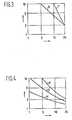
- the vertical axis represents the radiation dose and on the horizontal axis the ester concentrations at 1, 3, 10 and 25 pbw are indicated. Results are represented in terms of contour diagrams of STL on a grid of radiation dose vs. coupling agent concentration.
- esters were evaluated for their effectiveness; two difunctional esters: HDODA and HDODM in formulations D and C respectively, and two trifunctional esters TMPTA and TMPTM in formulations B and A respectively.
- Results in Figure 1 show that both acrylates cure the adhesive more readily than do the methacrylates. That is, a lower radiation dose is required at a given ester concentration or a lower ester concentration is required at a given radiation dose.
- results in Figure 3 comparing Formulations A and F show that an adhesive based on either a polystyrene-polyisoprene-polystyrene or a polystyrene-polybutadiene-polystyrene block copolymer can be electron cured.
- Results in Figure 4 comparing Formulations A, G and H which are based on a linear, a radial and a star coupled polymer, respectively, show that as the number of arms on the polymer used increases, the adhesive can be more readily cured.
Landscapes
- Chemical & Material Sciences (AREA)
- Organic Chemistry (AREA)
- Health & Medical Sciences (AREA)
- Chemical Kinetics & Catalysis (AREA)
- Medicinal Chemistry (AREA)
- Polymers & Plastics (AREA)
- Adhesives Or Adhesive Processes (AREA)
- Compositions Of Macromolecular Compounds (AREA)
Description
- Thermoplastic elastomeric block copolymers have been proposed in the past to produce adhesive compositions, for example U.S.P. 3,239,478 discloses combinations of these block copolymers with tackifying resins and paraffinic extending oils. Limitations of these adhesive compositions are their relatively I::w service temperatures and their poor solvent resistance and for a number of applications it would be advantageous to have higher service and better solvent resistance temperatures. For example, these adhesives would be useful in paint shops if the masking tapes produced had good solvent resistance and a 1µ5- 12µ°C service temperature. They would also be useful as laminating adhesives in food pouches if they could withstand boiling water temperatures and as furniture laminating adhesives if they could bear moderate loads at 120°C.
- One means to improve the service temperature of block copolymer adhesive compositions is to chemically cure the adhesive with a phenol formaldehyde resin and heat as disclosed in U.S.P. 3,625,752. However, this procedure is undesirable because it is a very energy intensive process to heat the adhesive. Also, this process cannot be used for curing pressure sensitive tapes because the plastic backing film would melt at the temperature required for curing. A more energy efficient process is the radiation cure disclosed in U.S.P. 2,956,904. The compositions disclosed therein, however, do not contain a supplemental crosslink promoting ingredient and therefore higher radiation doses are required. French A. 2176877 discloses elastomeric rubbery compositions comprising 10-50 pbw of a rubbery constituent, 5-60 pbw of an unsaturated polyester, 5-50 pbw of a cross-linking agent and 5-75 pbw of a plastifying agent. These compositions are liquid at ambient temperature in order to facilitate casting or moulding and they can be solidified by cross-linking. The cross-linking action can be initiated or promoted by heating, by means of a catalyst or by exposure to radiation.
- The present invention provides a process for preparing an adhesive composition comprising an unsaturated polymerizable agent and a thermoplastic elastomeric block copolymer having at least two monoalkenyl-aromatic polymer end blocks A and at least one elastomeric conjugated diene mid block B, said block A comprising from 8 to 55% by weight of the block copolymer, which composition is cured by radiation, characterized in that a composition is prepared which comprises 100 parts by weight of block copolymer, from 25 to 250 parts by weight of an adhesion promoting resin compatible with block B and from 1 to 50 parts by weight of a di-, tri-, or tetrafunctional ester of acrylic or methacrylic acid and an at least dihydric aliphatic alcohol, which composition is cured by radiation in order to achieve an STL value of at least 205°C, STL being defined as the maximum temperature at which a tape can be rapidly peeled from a hot, stainless steel substrate without leaving an adhesive residue on the panel.
- The block copolymers employed in the present composition are thermoplastic elastomers and have at least two monoalkenyl aromatic polymer end blocks A and at least one elastomeric conjugated diene polymer mid block B. The number of blocks in the block copolymer is not of special importance and the macromolecular configuration may be linear, graft, radial or star depending upon the method by which the block copolymer is formed Typical block copolymers of the most simple configuration would have the structure polystyrene-polyisoprene-polystyrene and polystyrene-polybutadiene-polystyrene. A typical radial or star polymer would comprise one in which the diene block has three to four branches (radial) or five or more branches (star), the tip of each branch being connected to a polystrene block. Other useful monoalkenyl aromatic compounds from which the thermoplastic (non-elastomeric) blocks may be formed include alphamethyl styrene, tert-butyl styrene and other ring alkylated styrenes as well as mixtures of the same. The conjugated diene monomer preferably has 4 to 5 carbon atoms, such as butadiene and isoprene. A much preferred conjugated diene is isoprene.
- The average molecular weights of each of the blocks may be varied as desired. The monoalkenyl-aromatic polymer block preferably have average molecular weights between about 5,000 and 125,000, more preferably between about 7,000 and about 50,000. The elastomeric conjugated diene polymer blocks preferably have average molecular weights between about 15,000 and about 250,000, more preferably between about 25,000 and about 150,000. The average molecular weights of the polystyrene end blocks are determined by gel permeation chromotography, whereas the polystyrene block content of the polymer is measured by infrared spectroscopy of the finished block polymer. The weight percentage of the thermoplastic monoalkenyl aromatic blocks in the finished block polymer should be between 8 and 55%, preferably between 10% and 30% by weight.
- The block copolymer by itself lacks the required adhesion. Therefore, it is necessary to add an adhesion promoting or tackifying resin that is compatible with the elastomeric conjugated diene block. A much preferred tackifying resin is a diene-olefin copolymer of piperylene and 2-methyl-2-butene having a softening point of about 95°C. This resin is available commercially under the tradename Wingtack 95, and is prepared by the cationic polymerization of 60% piperylene, 10% isoprene, 5% cyclopentadiene, 15% 2-methyl butene and about 10% dimer, as disclosed in U.S.P 3,577,398. Other tackifying resins of the same general type may be employed in which the resinous copolymer comprises 20-80 weight percent of piperylene and 80-20 weight percent of 2-methyl-2-butene. The resins normally have softening points (ring and ball) between about 80°C and about 115°C. Other adhesion promoting resins which may be employed include hydrogenated resins, esters of rosins, polyterpenes, terpenephenol resins, and, polymerized mixed olefins.
- The amount of tackifying resin employed varies from 25 to 200, preferably between 50 to 150 parts by weight per 100 parts of block copolymer.
- The adhesive compositions of the invention also may contain plasticizers such as rubber extending or compounding oils or liquid resins. These rubber compounding oils are well-known in the art and include both high saturates content and high aromatics content oils. The amount of rubber compounding oil employed varies from 0 to 100, preferably from 10 to 60 parts by weight per 100 parts of block copolymer.
- An essential component of the present invention is the acrylate or methacrylate ester coupling agent which promotes cross-linking of the block copolymer during exposure to the radiation. The coupling agents employed herein are di-, tri-, and tetra-functional acrylic and methacrylic esters of an at least dihydric aliphatic alcohol.
- Preferred esters are at least tri-functional esters of an at least trihydric alcohol. Of this group the tetracrylic or tetramethacrylic esters of pentaerythritol and the triacrylic or trimethacrylic esters of trimethylolpropane are particularly preferred.
- Other suitable esters are diesters derived from di-, tri-, tetra or polyethylene glycol, 1,6 hexanediol, 1,4-butanediol, bisphenol A ethoxylated bisphenol A, and 1,3-(2,2-dimethyl)-propanediol.
- The amount of coupling agent employed varies from 1 to 50, preferably from 2 to 25 parts by weight per 100 parts of blockcopolymer.
- The compositions of this invention may be modified with supplementary materials including pigments and fillers, as well as stabilizers and oxidation inhibitors.
- The adhesive compositions of the present invention may be applied to the substrate from a solution of up to about 40% weight solids of the ingredients in a solvent such as toluene, the solvent being removed by evaporation prior to curing by exposure to the radiation. Alternatively, the ingredients may be mixed in a solvent, the mixture may be emulsified and the solvent evaporated, and the adhesive may be applied to the substrate as a 60-70% weight solids water-based emulsion, the water being removed by evaporation prior to curing. Adhesives of the present invention are especially suited for preparation as hot melt adhesives.
- The compositions of the present invention have been cured by exposure to high energy radiation such as electron beam radiation or ultraviolet radiation, with electron beam being particularly preferred.
- The electron beam radiation or high energy ionizing radiation which is employed to effect the cross-linking reaction can be obtained from any suitable source such as an atomic pile, a resonant transformer accelerator, a Van de Graaff electron accelerator, an electron accelerator, a betatron, a synchrotron, or a cyclotron. Radiation from these sources will produce ionizing radiation such as electrons, protrons, neutrons, deuterons, gamma rays, X rays, alpha particles, and beta particles.
- The curing reaction is conveniently effected at room temperature, but it can be conducted at lower or higher temperatures if so desired. Preferably, the curing is effected in an inert atmosphere to reduce oxidative degradation of the block copolymer.
- The amount of radiation required depends primarily upon the type and concentration of acrylate or methacrylate ester employed and the level of curing desired. Suitable doses of electron beam radiation include 1 Mrad to 20 Mrads, preferably 2 Mrads to 10 Mrads. Suitable UV radiation doses are those received by a 0.04 mm thick adhesive passing under a medium pressure mercury lamp rated at 200 watts per 2.5 cm at line speeds of about 3 to about 24 m per minute, the preferred range being 7.5 to 12 m per minute.
- When using ultraviolet radiation it is preferred to employ a photosensitizer in order to speed up the curing reaction. Useful photosensitizers are benzophenone, propiophenone, cyclopropyl phenyl ketone, acetophenone, 1.3.5-triacetyl benzene, benzaldehyde, thioxanthane, anthraquinone, beta- naphthyl phenyl ketone, beta-naphthaldehyde, beta-acetonaphthone, 2.3-pentanedione, benzil, fluoronone, pyrene, benzanthrone, and anthracene. While most of these are well-known photosensitizers, other photosensitizers would work equally well in the present invention.
- A preferred use of the present formulation is in the preparation of pressure-sensitive adhesive tapes or in the manufacture of labels. The pressure-sensitive adhesive tape comprises a flexible backing sheet and a layer of the adhesive composition of the present invention coated on one major surface of the backing sheet. The backing sheet may be a plastic film, paper or any other suitable material and the tape may include various other layers or coatings, such as primers, release coatings and the like, which are used in the manufacture of pressure-sensitive adhesive tapes.
- The invention is further illustrated by means of the following Examples.
- In these Examples the high temperature cohesive strength of the irradiated adhesive compositions was measured by a Strippability Temperature Limit (STL) test. STL is defined as the maximum temperature at which a tape can be rapidly peeled from a hot, stainless steel substrate without leaving an adhesive residue on the panel. The test is run by applying a 6 mm wide strip of tape to a stainless steel panel whose temperature is controlled to give a temperature gradient of about 6.5°C per cm between 37 and 230°C. Following a 30 second warm-up, the tape is stripped off manually at high speed and at approximately a 90° angle. The temperature at which cohesive failure occurs is recorded as the STL value. The STL test measures whether an automotive masking tape can be removed cleanly when it is stripped from a painted car as it leaves the paint baking ovens. Solvent resistance is determined by immersing about 6 cm2 tape in toluene for 24 hours at room temperature. If the adhesive dissolves, solvent resistance is poor. If it only swells, solvent resistance is good.
- In all examples, the adhesive composition was prepared in a toluene solution and applied as about a 0.04 mm dry adhesive layer to a 0.025 mm thermoplastic film substrate. Electron beam irradiation was accomplished using a 450 mm wide ELECTROCURTAIN@ PROCESSOR manufactured by Energy Sciences, Inc. Ultraviolet irradiation was accomplished using a UV Processor (QC 1202 N/A) supplied by Radiation Polymer Co. This unit has two medium pressure mercury lamps, each rated at 200 watts per 2.5 cm.
- The adhesive compositions used in Examples 1-4 are shown in Table 1. The polystyrene-polyisoprene-polystyrene block copolymers tested were Shell's KRATON@ 1107 Rubber, a linear (Styrene-isoprene)2 polymer, Phillips' Solprene 421, a radial (Styrene-isoprene)4 polymer and an experimental star (Styrene-isoprene)a polymer. All three polymers had about the same molecular weights prior to coupling and all three contain 15%w polystyrene blocks. The polystyrene-polybutadiene-polystyrene polymer tested was Shell's KRATON 1102 Rubber, a linear (Styrenebutadiene)2 polymer of 30%w polystyrene. The adhesion promoting tackifying resins used with the polymers were Wingtack 95 Resin, a diene-olefin resin, and Hercules' XPS 502 Resin, a modified terpene hydrocarbon resin, respectively. The plasticizer used was SHELLFLEX@ 371, a low aromatic content process oil. The stabilizer used was zinc dibutyldithiocarbamate (ZDBC).

- In Examples 1-4, adhesive compositions were irradiated under a nitrogen blanket with electron beam radiation at doses of 0, 1, 2, 5 and 10 megarads (Mrad). With ELECTROCURTAIN equipment, radiation doses of 1, 2, 5 and 10 Mrad are equivalent to curing line speeds of about 210, 105, 36 and 21 m per minute, respectively. Each of the formulations in Table 1 was tested at four levels (1, 3, 10 and 25 parts per 100 parts of block copolymer) of ester coupling agent. In Figures 1-4 the vertical axis represents the radiation dose and on the horizontal axis the ester concentrations at 1, 3, 10 and 25 pbw are indicated. Results are represented in terms of contour diagrams of STL on a grid of radiation dose vs. coupling agent concentration. An STL value of >205°C was considered to indicate a satisfactory degree of curing. Contour lines in Figures 1-4 indicate combinations of radiation dose and coupling agent concentration which give an acceptable degree of curing. To the left of these contour lines, there was little if any improvement in STL and solvent resistance was poor. To the right of these lines, STL was >205°C and the adhesive would not dissolve in toluene.
- The effect of the choice of ester coupling agent was determined. Four esters were evaluated for their effectiveness; two difunctional esters: HDODA and HDODM in formulations D and C respectively, and two trifunctional esters TMPTA and TMPTM in formulations B and A respectively. Results in Figure 1 show that both acrylates cure the adhesive more readily than do the methacrylates. That is, a lower radiation dose is required at a given ester concentration or a lower ester concentration is required at a given radiation dose.
- The effect of a stabilizer was studied. Results in Figure 2 show that the stabilizer zinc dibutyldithiocarbamate included in formulation A makes curing more difficult, formulation E, with no stabilizer cures easier.
- The effect of block polymer structure on the rate of cure was determined. Results in Figure 3 comparing Formulations A and F show that an adhesive based on either a polystyrene-polyisoprene-polystyrene or a polystyrene-polybutadiene-polystyrene block copolymer can be electron cured. Results in Figure 4 comparing Formulations A, G and H which are based on a linear, a radial and a star coupled polymer, respectively, show that as the number of arms on the polymer used increases, the adhesive can be more readily cured.
- The effect of including a plasticizer in the ahesive composition was investigated. Curing studies on Formulation I in Table 1 showed that its curing characteristics are the same as those of Formulation A shown in Figure 1. That is, the plasticizer did not appreciably slow down the rate of cure.
- The suitability of ultraviolet radiation for initiation of curing was checked. The formulations and results are shown in Table 2. All three formulations, the comparative composition (formulation A) and two compositions of this invention (Formulations B and C), show poor STL and dissolve in toluene before exposure to UV radiation. After exposure to UV radiation, the comparative sample shows some improvement in STL but its solvent resistance remains poor. Formulations B and C, however, show good STL and solvent resistance.

Claims (7)
Applications Claiming Priority (2)
| Application Number | Priority Date | Filing Date | Title |
|---|---|---|---|
| US05/883,118 US4133731A (en) | 1978-03-03 | 1978-03-03 | Radiation cured, high temperature adhesive composition |
| US883118 | 1978-03-03 |
Publications (2)
| Publication Number | Publication Date |
|---|---|
| EP0004102A1 EP0004102A1 (en) | 1979-09-19 |
| EP0004102B1 true EP0004102B1 (en) | 1983-02-09 |
Family
ID=25382027
Family Applications (1)
| Application Number | Title | Priority Date | Filing Date |
|---|---|---|---|
| EP19790200071 Expired EP0004102B1 (en) | 1978-03-03 | 1979-02-09 | Process for the preparation of a radiation cured adhesive composition |
Country Status (9)
| Country | Link |
|---|---|
| US (1) | US4133731A (en) |
| EP (1) | EP0004102B1 (en) |
| JP (1) | JPS54132635A (en) |
| AT (1) | AT366083B (en) |
| AU (1) | AU521700B2 (en) |
| CA (1) | CA1117470A (en) |
| DE (1) | DE2964684D1 (en) |
| DK (1) | DK152513C (en) |
| ES (1) | ES478208A1 (en) |
Families Citing this family (55)
| Publication number | Priority date | Publication date | Assignee | Title |
|---|---|---|---|---|
| US4217263A (en) * | 1978-06-05 | 1980-08-12 | Dennison Manufacturing Company | Chemically-resistant adhesives and labels |
| US4151057A (en) * | 1978-08-14 | 1979-04-24 | Shell Oil Company | High temperature adhesive made by exposure to radiation |
| JPS55150744U (en) * | 1979-04-17 | 1980-10-30 | ||
| US4432848A (en) * | 1981-11-19 | 1984-02-21 | Permacel | Radiation cured, high temperature pressure-sensitive adhesive |
| US4559117A (en) * | 1982-11-12 | 1985-12-17 | The Firestone Tire & Rubber Company | Block copolymers made by radiation crosslinking of miscible mixture of homopolymers |
| US4556464A (en) * | 1983-04-04 | 1985-12-03 | Shell Oil Company | Endblock crosslinked block copolymer adhesive composition |
| US4780367A (en) * | 1983-06-27 | 1988-10-25 | Minnesota Mining And Manufacturing Company | Tackified star block copolymer pressure-sensitive adhesive composition and the sheet materials coated therewith |
| DE3600774C1 (en) * | 1986-01-14 | 1987-05-07 | Du Pont Deutschland | Process for gluing photopolymerizable printing plates or printing forms for flexographic printing |
| US4826891A (en) * | 1987-06-08 | 1989-05-02 | Hoechst Celanese Corporation | Radiation curable copolymers of p-acetoxystyrene with allyl esters of ethylenically unsaturated acids or alkadienes |
| US5104921A (en) * | 1988-02-17 | 1992-04-14 | Shell Oil Company | Radiation cured polymer composition |
| JPH0284343A (en) * | 1988-03-16 | 1990-03-26 | Canon Inc | liquid jet recording head |
| JPH02110118A (en) * | 1988-03-16 | 1990-04-23 | Canon Inc | Novel polymeric substance and novel photopolymerizable resin composition containing the polymeric substance |
| DE3817452A1 (en) * | 1988-05-21 | 1989-11-30 | Basf Ag | MELT-ADHESIVE GLUE ADHESIVE IN THE AIR WITH ULTRAVIOLET RAYS |
| US5399627A (en) * | 1989-08-11 | 1995-03-21 | The Dow Chemical Company | Radial styrene-isoprene-butadiene multi-armed block copolymers and compositions and articles containing block copolymers |
| BR9007087A (en) * | 1989-12-01 | 1991-12-17 | Avery Dennison Corp | ADHESIVES SENSITIVE TO PRESSURE BASED ON OLEFIN POLYMER |
| US5262479A (en) * | 1992-11-24 | 1993-11-16 | National Starch And Chemical Investment Holding Corporation | Plasticizer resisant hot melt pressure sensitive adhesive |
| US5296547A (en) * | 1993-01-28 | 1994-03-22 | Minnesota Mining And Manufacturing Company | Block copolymer having mixed molecular weight endblocks |
| US5412031A (en) * | 1993-05-25 | 1995-05-02 | Minnesota Mining & Manufacturing Company | Multi-arm block copolymers, and pressure sensitive adhesive and tape employing a multi-arm elastomeric block copolymer |
| DE4404955A1 (en) * | 1994-02-17 | 1995-08-24 | Beiersdorf Ag | Adhesive material with post-crosslinking reserve |
| US5750623A (en) * | 1996-05-20 | 1998-05-12 | The Dow Chemical Co. | Hot-melt adhesives for disposable items and articles made therefrom |
| IT1283082B1 (en) * | 1996-05-30 | 1998-04-07 | Hoechst Sara Spa | PROCEDURE FOR THE SYNTHESIS OF RESINS CONTAINING UNSATURAL ZONES OF TYPE (MET) ACRYLIC HARDENABLE BY RADIATION OR HEAT AND |
| US5900444A (en) * | 1996-10-08 | 1999-05-04 | Zamore; Alan | Irradiation conversion of thermoplastic to thermoset polyurethane |
| US7728049B2 (en) * | 1996-10-08 | 2010-06-01 | Zamore Alan M | Irradiation conversion of thermoplastic to thermoset polymers |
| US7749585B2 (en) * | 1996-10-08 | 2010-07-06 | Alan Zamore | Reduced profile medical balloon element |
| US6656550B1 (en) | 1996-10-08 | 2003-12-02 | Alan M. Zamore | Dilatation device of uniform outer diameter |
| DE69732121T2 (en) | 1996-10-08 | 2005-12-01 | Alan Zamore | CONVERSION OF THERMOPLASTIC TO DUROPLASTIC POLYMERS BY IRRADIATION |
| US6348679B1 (en) * | 1998-03-17 | 2002-02-19 | Ameritherm, Inc. | RF active compositions for use in adhesion, bonding and coating |
| US6649888B2 (en) | 1999-09-23 | 2003-11-18 | Codaco, Inc. | Radio frequency (RF) heating system |
| DE20000130U1 (en) * | 2000-01-05 | 2001-05-10 | Coroplast Fritz Müller GmbH & Co. KG, 42279 Wuppertal | Textile tape |
| US6630531B1 (en) * | 2000-02-02 | 2003-10-07 | 3M Innovative Properties Company | Adhesive for bonding to low surface energy surfaces |
| US20030211308A1 (en) * | 2001-02-02 | 2003-11-13 | Khandpur Ashish K | Adhesive for bonding to low surface energy surfaces |
| US6544643B1 (en) | 2000-09-26 | 2003-04-08 | 3M Innovative Properties Company | Pressure sensitive adhesive comprising poly(1-alkene) elastomer and multifunctional (meth)acrylate, articles prepared therefrom and a method of making |
| DE60218773T2 (en) | 2001-05-04 | 2007-12-06 | Rohm And Haas Co. | Method for producing a laminate |
| US6869981B2 (en) * | 2001-09-21 | 2005-03-22 | Corning Incorporated | Optical fiber coatings with pressure sensitive adhesive characteristics |
| US7013818B2 (en) | 2001-10-18 | 2006-03-21 | Guangdong Esquel Textiles Co. Ltd. | Wrinkle free garment and method of manufacture |
| US7147905B2 (en) * | 2001-10-19 | 2006-12-12 | Kuraray Co., Ltd. | Layered product and medical supply comprising the layered product |
| DE10212049A1 (en) * | 2002-03-19 | 2003-10-02 | Tesa Ag | PSA and process for the preparation thereof |
| US20030224166A1 (en) * | 2002-06-04 | 2003-12-04 | Solomon Robert David | Aqueous polymer blend composition |
| EP1517958B1 (en) * | 2002-07-03 | 2009-03-25 | The Procter & Gamble Company | Radiation curable low stress relaxation elastomeric materials |
| BRPI0817501A2 (en) * | 2007-10-09 | 2015-03-24 | Kraton Polymers Us Llc | End-use applications prepared from certain block copolymers |
| DE102008056980A1 (en) | 2008-11-12 | 2010-05-20 | Tesa Se | Radiation crosslinkable, foamed self-adhesive based on vinylaromatic block copolymers |
| KR101393860B1 (en) * | 2011-10-11 | 2014-05-14 | (주)엘지하우시스 | Adhesive tape for automobile |
| DE102012207868A1 (en) | 2012-05-11 | 2013-11-14 | Tesa Se | Pressure-sensitive adhesive composition, useful in single- or double-sided adhesive tape and as a masking tape for temporarily covering a substrate, comprises natural rubber and/or adhesive resins as base polymer, and lignin |
| US9895716B2 (en) | 2013-04-17 | 2018-02-20 | General Electric Company | Repair process and a repaired component |
| KR20150016877A (en) * | 2013-08-05 | 2015-02-13 | 주식회사 엘지화학 | Pressure sensitive adhesive compositions, pressure sensitive adhesive film and encapsulation method of organic electronic device using the same |
| DE102015109659A1 (en) * | 2015-06-17 | 2016-12-22 | Lohmann Gmbh & Co. Kg | adhesive |
| DE102015215247A1 (en) | 2015-08-11 | 2017-02-16 | Tesa Se | Pressure-sensitive adhesive based on acrylonitrile-butadiene rubbers |
| DE102015217376A1 (en) | 2015-09-11 | 2017-03-16 | Tesa Se | Pressure-sensitive adhesive based on EPDM |
| JP6722001B2 (en) * | 2016-03-03 | 2020-07-15 | 東京応化工業株式会社 | Adhesive composition, laminate, and method for producing laminate |
| DE102017006359A1 (en) | 2017-07-06 | 2019-01-10 | Tesa Se | Self-adhesive tape with a split-resistant PET carrier |
| WO2019079391A1 (en) * | 2017-10-17 | 2019-04-25 | Avery Dennison Corporation | Pressure sensitive adhesives including (meth)acrylates and rubber |
| DE102018204594A1 (en) | 2018-03-27 | 2019-10-02 | Tesa Se | Process for the homogeneous incorporation of filler into a, in particular thermally crosslinkable, self-adhesive composition based on non-thermoplastic elastomer |
| DE102018214534A1 (en) | 2018-08-28 | 2020-03-05 | Tesa Se | Adhesive tape especially for oily surfaces |
| DE102018222679A1 (en) | 2018-12-19 | 2020-06-25 | Tesa Se | Process for producing a pressure-sensitive adhesive based on acrylonitrile-butadiene rubber and adhesive tape containing this pressure-sensitive adhesive |
| DE102024130561A1 (en) | 2024-10-21 | 2026-04-23 | Mercedes-Benz Group AG | Punch for closing holes, especially in sheet metal or plastic parts |
Family Cites Families (9)
| Publication number | Priority date | Publication date | Assignee | Title |
|---|---|---|---|---|
| US3113912A (en) * | 1959-07-16 | 1963-12-10 | Phillips Petroleum Co | Preparation of vulcanizates by irradiation of block copolymers |
| FR1295524A (en) * | 1961-04-27 | 1962-06-08 | Centre Nat Rech Scient | Process for obtaining polymers from mesomorphic phases and products obtained |
| US3932328A (en) * | 1971-11-02 | 1976-01-13 | Johnson & Johnson | Hot melt adhesive composition and tape |
| GB1417235A (en) * | 1972-03-18 | 1975-12-10 | Asahi Chemical Ind | Liquid rubber compositions |
| JPS5032115B2 (en) * | 1972-03-18 | 1975-10-17 | ||
| US4006024A (en) * | 1973-02-21 | 1977-02-01 | Asahi Kasei Kogyo Kabushiki Kaisha | Photosensitive compositions comprising a polyester-polyether block polymer |
| US3936365A (en) * | 1974-05-28 | 1976-02-03 | The Dow Chemical Company | Radiation crosslinked block copolymer blends with improved impact resistance |
| US4007311A (en) * | 1975-11-06 | 1977-02-08 | Shell Oil Company | Polyacrylate-grafted block copolymer adhesive compositions |
| DE2558858A1 (en) * | 1975-12-27 | 1977-07-14 | Hoechst Ag | ADHESIVE MIXTURE |
-
1978
- 1978-03-03 US US05/883,118 patent/US4133731A/en not_active Expired - Lifetime
-
1979
- 1979-01-31 CA CA000320604A patent/CA1117470A/en not_active Expired
- 1979-02-09 EP EP19790200071 patent/EP0004102B1/en not_active Expired
- 1979-02-09 DE DE7979200071T patent/DE2964684D1/en not_active Expired
- 1979-03-01 JP JP2262879A patent/JPS54132635A/en active Granted
- 1979-03-01 AU AU44728/79A patent/AU521700B2/en not_active Expired
- 1979-03-01 DK DK88079A patent/DK152513C/en not_active IP Right Cessation
- 1979-03-01 ES ES478208A patent/ES478208A1/en not_active Expired
- 1979-03-01 AT AT157479A patent/AT366083B/en not_active IP Right Cessation
Also Published As
| Publication number | Publication date |
|---|---|
| AT366083B (en) | 1982-03-10 |
| ATA157479A (en) | 1981-07-15 |
| JPS54132635A (en) | 1979-10-15 |
| JPS6239184B2 (en) | 1987-08-21 |
| AU521700B2 (en) | 1982-04-22 |
| CA1117470A (en) | 1982-02-02 |
| AU4472879A (en) | 1979-09-06 |
| DK88079A (en) | 1979-09-04 |
| EP0004102A1 (en) | 1979-09-19 |
| DK152513B (en) | 1988-03-07 |
| ES478208A1 (en) | 1979-11-01 |
| US4133731A (en) | 1979-01-09 |
| DK152513C (en) | 1988-08-01 |
| DE2964684D1 (en) | 1983-03-17 |
Similar Documents
| Publication | Publication Date | Title |
|---|---|---|
| EP0004102A1 (en) | Process for the preparation of a radiation cured adhesive composition | |
| EP0008146B1 (en) | Radiation cured adhesive composition | |
| US4556464A (en) | Endblock crosslinked block copolymer adhesive composition | |
| US4152231A (en) | Radiation cured polydiene based polymer composition | |
| EP0044359B1 (en) | Pressure-sensitive adhesives and process for forming them | |
| FI106558B (en) | Vinyl aromatic block copolymers which are highly sensitive to radiation cure and compositions containing these | |
| JP3386572B2 (en) | Multi-arm block copolymers, pressure sensitive adhesives and tapes | |
| US5104921A (en) | Radiation cured polymer composition | |
| US6210517B1 (en) | Radiation-cured, non-blocking heat activated label adhesive and coatings and method for using same | |
| US6486229B1 (en) | Radiation curable hot melt adhesive | |
| CN101437916B (en) | Acroleic acid hot melt adhesive | |
| CA2036982A1 (en) | Plasticizer resistant pressure sensitive adhesive | |
| KR102477312B1 (en) | adhesive compound | |
| US5135816A (en) | Radiation-reactive phenylbutadiene multiblock copolymers | |
| US5066728A (en) | Radiation-reactive phenylbutadiene multiblock copolymers | |
| US4432848A (en) | Radiation cured, high temperature pressure-sensitive adhesive | |
| JPS6014406B2 (en) | Method for manufacturing magnetic recording tape | |
| CA2047918A1 (en) | Method of chemically crosslinking unsaturated polymers | |
| JPS6229468B2 (en) | ||
| JPH02248469A (en) | Uv-curing, thermoformable protective coating | |
| JPS58145712A (en) | Radiation curable resin composition | |
| CA1339778C (en) | Radiation cured polymer composition | |
| WO2025151972A1 (en) | Adhesive and tape including bio-based components and related processes | |
| WO1992002118A2 (en) | Radiation crosslinked conjugated diene butyl psas | |
| JPS62129364A (en) | Active energy beam-curable resin composition |
Legal Events
| Date | Code | Title | Description |
|---|---|---|---|
| PUAI | Public reference made under article 153(3) epc to a published international application that has entered the european phase |
Free format text: ORIGINAL CODE: 0009012 |
|
| AK | Designated contracting states |
Designated state(s): BE CH DE FR GB IT NL SE |
|
| 17P | Request for examination filed | ||
| ITF | It: translation for a ep patent filed | ||
| GRAA | (expected) grant |
Free format text: ORIGINAL CODE: 0009210 |
|
| AK | Designated contracting states |
Designated state(s): BE CH DE FR GB IT NL SE |
|
| REF | Corresponds to: |
Ref document number: 2964684 Country of ref document: DE Date of ref document: 19830317 |
|
| ET | Fr: translation filed | ||
| REG | Reference to a national code |
Ref country code: FR Ref legal event code: ST |
|
| REG | Reference to a national code |
Ref country code: FR Ref legal event code: RC |
|
| REG | Reference to a national code |
Ref country code: FR Ref legal event code: DA |
|
| ITTA | It: last paid annual fee | ||
| EAL | Se: european patent in force in sweden |
Ref document number: 79200071.3 |
|
| PGFP | Annual fee paid to national office [announced via postgrant information from national office to epo] |
Ref country code: SE Payment date: 19960108 Year of fee payment: 18 |
|
| PGFP | Annual fee paid to national office [announced via postgrant information from national office to epo] |
Ref country code: GB Payment date: 19960115 Year of fee payment: 18 |
|
| PGFP | Annual fee paid to national office [announced via postgrant information from national office to epo] |
Ref country code: BE Payment date: 19960207 Year of fee payment: 18 |
|
| PGFP | Annual fee paid to national office [announced via postgrant information from national office to epo] |
Ref country code: NL Payment date: 19960228 Year of fee payment: 18 |
|
| PGFP | Annual fee paid to national office [announced via postgrant information from national office to epo] |
Ref country code: CH Payment date: 19960501 Year of fee payment: 18 |
|
| PG25 | Lapsed in a contracting state [announced via postgrant information from national office to epo] |
Ref country code: GB Effective date: 19970209 |
|
| PG25 | Lapsed in a contracting state [announced via postgrant information from national office to epo] |
Ref country code: SE Effective date: 19970210 |
|
| PG25 | Lapsed in a contracting state [announced via postgrant information from national office to epo] |
Ref country code: CH Effective date: 19970228 Ref country code: BE Effective date: 19970228 |
|
| BERE | Be: lapsed |
Owner name: SHELL INTERNATIONALE RESEARCH MAATSCHAPPIJ B.V. Effective date: 19970228 |
|
| PG25 | Lapsed in a contracting state [announced via postgrant information from national office to epo] |
Ref country code: NL Effective date: 19970901 |
|
| GBPC | Gb: european patent ceased through non-payment of renewal fee |
Effective date: 19970209 |
|
| REG | Reference to a national code |
Ref country code: CH Ref legal event code: PL |
|
| EUG | Se: european patent has lapsed |
Ref document number: 79200071.3 |
|
| NLV4 | Nl: lapsed or anulled due to non-payment of the annual fee |
Effective date: 19970901 |
|
| PGFP | Annual fee paid to national office [announced via postgrant information from national office to epo] |
Ref country code: FR Payment date: 19971216 Year of fee payment: 20 |
|
| PGFP | Annual fee paid to national office [announced via postgrant information from national office to epo] |
Ref country code: DE Payment date: 19980305 Year of fee payment: 20 |
|
| PLBE | No opposition filed within time limit |
Free format text: ORIGINAL CODE: 0009261 |
|
| STAA | Information on the status of an ep patent application or granted ep patent |
Free format text: STATUS: NO OPPOSITION FILED WITHIN TIME LIMIT |