EP0003550B1 - Process for converting leathery phosphazene polymer to elastomeric phosphazene polymer - Google Patents
Process for converting leathery phosphazene polymer to elastomeric phosphazene polymer Download PDFInfo
- Publication number
- EP0003550B1 EP0003550B1 EP79100265A EP79100265A EP0003550B1 EP 0003550 B1 EP0003550 B1 EP 0003550B1 EP 79100265 A EP79100265 A EP 79100265A EP 79100265 A EP79100265 A EP 79100265A EP 0003550 B1 EP0003550 B1 EP 0003550B1
- Authority
- EP
- European Patent Office
- Prior art keywords
- molecular weight
- polyaryloxyphosphazene
- polyaryloxyphosphazenes
- elastomeric
- weight
- Prior art date
- Legal status (The legal status is an assumption and is not a legal conclusion. Google has not performed a legal analysis and makes no representation as to the accuracy of the status listed.)
- Expired
Links
- 238000000034 method Methods 0.000 title claims description 18
- GKTNLYAAZKKMTQ-UHFFFAOYSA-N n-[bis(dimethylamino)phosphinimyl]-n-methylmethanamine Chemical compound CN(C)P(=N)(N(C)C)N(C)C GKTNLYAAZKKMTQ-UHFFFAOYSA-N 0.000 title claims description 8
- 229920000642 polymer Polymers 0.000 title description 33
- 229920001971 elastomer Polymers 0.000 claims description 6
- 239000000806 elastomer Substances 0.000 claims description 6
- 238000004519 manufacturing process Methods 0.000 claims description 5
- 229910052784 alkaline earth metal Inorganic materials 0.000 claims description 4
- 125000000951 phenoxy group Chemical group [H]C1=C([H])C([H])=C(O*)C([H])=C1[H] 0.000 claims description 4
- 239000002904 solvent Substances 0.000 claims description 3
- 239000003513 alkali Substances 0.000 claims description 2
- 150000001342 alkaline earth metals Chemical class 0.000 claims description 2
- 150000001491 aromatic compounds Chemical class 0.000 claims description 2
- 125000003118 aryl group Chemical group 0.000 claims description 2
- 238000006243 chemical reaction Methods 0.000 claims description 2
- 230000001112 coagulating effect Effects 0.000 claims description 2
- 229910052751 metal Inorganic materials 0.000 claims description 2
- 239000002184 metal Substances 0.000 claims description 2
- 238000002156 mixing Methods 0.000 claims description 2
- 239000003921 oil Substances 0.000 description 20
- 239000000463 material Substances 0.000 description 15
- 239000000047 product Substances 0.000 description 10
- VLKZOEOYAKHREP-UHFFFAOYSA-N n-Hexane Chemical compound CCCCCC VLKZOEOYAKHREP-UHFFFAOYSA-N 0.000 description 9
- WYURNTSHIVDZCO-UHFFFAOYSA-N Tetrahydrofuran Chemical compound C1CCOC1 WYURNTSHIVDZCO-UHFFFAOYSA-N 0.000 description 8
- 125000004122 cyclic group Chemical group 0.000 description 8
- 239000013638 trimer Substances 0.000 description 7
- OKKJLVBELUTLKV-UHFFFAOYSA-N Methanol Chemical compound OC OKKJLVBELUTLKV-UHFFFAOYSA-N 0.000 description 6
- YXFVVABEGXRONW-UHFFFAOYSA-N Toluene Chemical compound CC1=CC=CC=C1 YXFVVABEGXRONW-UHFFFAOYSA-N 0.000 description 6
- 239000000203 mixture Substances 0.000 description 6
- 238000000859 sublimation Methods 0.000 description 6
- 230000008022 sublimation Effects 0.000 description 6
- 125000004104 aryloxy group Chemical group 0.000 description 5
- 238000005345 coagulation Methods 0.000 description 5
- 230000015271 coagulation Effects 0.000 description 5
- -1 poly(aryloxy) Polymers 0.000 description 4
- 229920002627 poly(phosphazenes) Polymers 0.000 description 4
- 238000002360 preparation method Methods 0.000 description 4
- YLQBMQCUIZJEEH-UHFFFAOYSA-N tetrahydrofuran Natural products C=1C=COC=1 YLQBMQCUIZJEEH-UHFFFAOYSA-N 0.000 description 4
- 229920002632 poly(dichlorophosphazene) polymer Polymers 0.000 description 3
- HXDOZKJGKXYMEW-UHFFFAOYSA-N 4-ethylphenol Chemical compound CCC1=CC=C(O)C=C1 HXDOZKJGKXYMEW-UHFFFAOYSA-N 0.000 description 2
- IMNFDUFMRHMDMM-UHFFFAOYSA-N N-Heptane Chemical compound CCCCCCC IMNFDUFMRHMDMM-UHFFFAOYSA-N 0.000 description 2
- 238000001816 cooling Methods 0.000 description 2
- 238000001212 derivatisation Methods 0.000 description 2
- 238000001035 drying Methods 0.000 description 2
- 239000013536 elastomeric material Substances 0.000 description 2
- 239000003063 flame retardant Substances 0.000 description 2
- UBIJTWDKTYCPMQ-UHFFFAOYSA-N hexachlorophosphazene Chemical compound ClP1(Cl)=NP(Cl)(Cl)=NP(Cl)(Cl)=N1 UBIJTWDKTYCPMQ-UHFFFAOYSA-N 0.000 description 2
- 229920006158 high molecular weight polymer Polymers 0.000 description 2
- 238000006116 polymerization reaction Methods 0.000 description 2
- 239000011541 reaction mixture Substances 0.000 description 2
- 239000000779 smoke Substances 0.000 description 2
- XLYOFNOQVPJJNP-UHFFFAOYSA-N water Substances O XLYOFNOQVPJJNP-UHFFFAOYSA-N 0.000 description 2
- RNFJDJUURJAICM-UHFFFAOYSA-N 2,2,4,4,6,6-hexaphenoxy-1,3,5-triaza-2$l^{5},4$l^{5},6$l^{5}-triphosphacyclohexa-1,3,5-triene Chemical compound N=1P(OC=2C=CC=CC=2)(OC=2C=CC=CC=2)=NP(OC=2C=CC=CC=2)(OC=2C=CC=CC=2)=NP=1(OC=1C=CC=CC=1)OC1=CC=CC=C1 RNFJDJUURJAICM-UHFFFAOYSA-N 0.000 description 1
- QIRNGVVZBINFMX-UHFFFAOYSA-N 2-allylphenol Chemical compound OC1=CC=CC=C1CC=C QIRNGVVZBINFMX-UHFFFAOYSA-N 0.000 description 1
- DGAQECJNVWCQMB-PUAWFVPOSA-M Ilexoside XXIX Chemical compound C[C@@H]1CC[C@@]2(CC[C@@]3(C(=CC[C@H]4[C@]3(CC[C@@H]5[C@@]4(CC[C@@H](C5(C)C)OS(=O)(=O)[O-])C)C)[C@@H]2[C@]1(C)O)C)C(=O)O[C@H]6[C@@H]([C@H]([C@@H]([C@H](O6)CO)O)O)O.[Na+] DGAQECJNVWCQMB-PUAWFVPOSA-M 0.000 description 1
- ISWSIDIOOBJBQZ-UHFFFAOYSA-N Phenol Chemical compound OC1=CC=CC=C1 ISWSIDIOOBJBQZ-UHFFFAOYSA-N 0.000 description 1
- KEAYESYHFKHZAL-UHFFFAOYSA-N Sodium Chemical compound [Na] KEAYESYHFKHZAL-UHFFFAOYSA-N 0.000 description 1
- 238000007796 conventional method Methods 0.000 description 1
- 229920001577 copolymer Polymers 0.000 description 1
- 238000004821 distillation Methods 0.000 description 1
- 239000000945 filler Substances 0.000 description 1
- 239000000706 filtrate Substances 0.000 description 1
- 238000001914 filtration Methods 0.000 description 1
- 239000006260 foam Substances 0.000 description 1
- UKJFVOWPUXSBOM-UHFFFAOYSA-N hexane;oxolane Chemical compound C1CCOC1.CCCCCC UKJFVOWPUXSBOM-UHFFFAOYSA-N 0.000 description 1
- 229920001519 homopolymer Polymers 0.000 description 1
- 230000000704 physical effect Effects 0.000 description 1
- 239000004014 plasticizer Substances 0.000 description 1
- 229920002959 polymer blend Polymers 0.000 description 1
- 238000001953 recrystallisation Methods 0.000 description 1
- 238000000926 separation method Methods 0.000 description 1
- 229910052708 sodium Inorganic materials 0.000 description 1
- 239000011734 sodium Substances 0.000 description 1
- 239000007858 starting material Substances 0.000 description 1
- 125000001424 substituent group Chemical group 0.000 description 1
- 238000004073 vulcanization Methods 0.000 description 1
- 238000005406 washing Methods 0.000 description 1
Classifications
-
- C—CHEMISTRY; METALLURGY
- C08—ORGANIC MACROMOLECULAR COMPOUNDS; THEIR PREPARATION OR CHEMICAL WORKING-UP; COMPOSITIONS BASED THEREON
- C08G—MACROMOLECULAR COMPOUNDS OBTAINED OTHERWISE THAN BY REACTIONS ONLY INVOLVING UNSATURATED CARBON-TO-CARBON BONDS
- C08G79/00—Macromolecular compounds obtained by reactions forming a linkage containing atoms other than silicon, sulfur, nitrogen, oxygen, and carbon with or without the latter elements in the main chain of the macromolecule
- C08G79/02—Macromolecular compounds obtained by reactions forming a linkage containing atoms other than silicon, sulfur, nitrogen, oxygen, and carbon with or without the latter elements in the main chain of the macromolecule a linkage containing phosphorus
- C08G79/025—Polyphosphazenes
-
- C—CHEMISTRY; METALLURGY
- C08—ORGANIC MACROMOLECULAR COMPOUNDS; THEIR PREPARATION OR CHEMICAL WORKING-UP; COMPOSITIONS BASED THEREON
- C08L—COMPOSITIONS OF MACROMOLECULAR COMPOUNDS
- C08L85/00—Compositions of macromolecular compounds obtained by reactions forming a linkage in the main chain of the macromolecule containing atoms other than silicon, sulfur, nitrogen, oxygen and carbon; Compositions of derivatives of such polymers
- C08L85/02—Compositions of macromolecular compounds obtained by reactions forming a linkage in the main chain of the macromolecule containing atoms other than silicon, sulfur, nitrogen, oxygen and carbon; Compositions of derivatives of such polymers containing phosphorus
Definitions
- This invention relates to the production of elastomeric polyaryloxyphosphazenes.
- this invention relates to the enhancement of the processability and mechanical properties of poly(aryloxy)phosphazene homopolymers and copolymers, whereby originally leathery polymer which is difficult to process is converted to readily processable elastomeric material.
- fluoroalkoxyphosphazene oils to poly(fluoroalkoxyphosphazene) materials is described in US-A-3,943,088.
- the poly(dichlorophosphazene) is precipitated from solution, i.e. coagulated, by addition of a non-solvent to the solution in which it is present in dissolved form, and is thereafter derivatized.
- US-A-4,064,095 discloses the addition of iow molecular weight polyaryloxyphosphazenes as plasticizers in filled compositions. This publication discloses the use of specific fillers to impart improved flame retardant and smoke suppressant properties to an already elastomeric composition.
- US-A-4,055,520 also discloses polyphosphazene blends and foams which are fire retardant and smoke suppressant.
- Polyfluoroalkoxyphosphazene compositions having improved properties after vulcanization are described in FRA2,259,137.
- the object of the present invention is to convert leathery polyaryloxyphosphazenes to elastomeric polyaryloxyphosphazenes or to provide a process for the production of elastomeric polyaryloxyphosphazenes respectively.
- this object is achieved by a process of converting leathery polyaryloxyphosphazenes to elastomeric polyaryloxyphosphazenes which is characterized by blending between 10 and 70 parts by weight of a low molecular weight polyaryloxyphosphazene oil having a molecular weight of between 700 and 500,000 for each 100 parts by weight of said leathery polyaryloxyphosphazene and recovering the resulting elastomer.
- the polyaryloxyphosphazene is a phenoxy, alkylphenoxyphosphazene.
- a process for the production of elastomeric polyaryloxyphosphazenes comprising reacting a linear poly(dihalophosphazene) represented by the formula (NPHaI 2 ) n in which Hal is either CI or Br and n is an integer between 20 and 50,000, with at least one aromatic compound represented by the formula M(OR) x in which M is an alkali or alkaline earth metal, x is the valence of said metal and R is an aryl group; which is characterized by dissolving the resulting polyaryloxyphosphazene products produced by said reaction; separating the higher molecular weight polyaryloxyphosphazenes from the lower molecular weight polyaryloxyphosphazene by adding a non-solvent for said higher molecular weight polyaryloxyphosphazenes thereby coagulating said higher molecular weight polyaryloxyphosphazenes, separating the solution of lower molecular weight polyaryloxypho
- the properties of the derivatized material appear to depend in part on the nature of the (NPCI 2 ) " polymer which is derivatized to the aryloxy substituted polymer and this in turn appears to depend on the previous history of the (NPCI 2 ) n polymer.
- the oils may be present either as a deliberate addition to the polymer (e.g. similar to the teachings in US-A-3,943,088) or they may be present because the dichlorophosphazene starting material was processed so as to retain them in the material to be derivatized.
- Polydichlorophosphazene was prepared by the classical method in which PCI 5 and NH 4 CI are reacted, e.g. as described in US-A-3,780,1 62 and in the literature noted in the background section of that patent.
- the polydichlorophosphazene product obtained consists principally of low molecular weight cyclic oligomers and when heated under the right conditions these are converted to essentially linear (NPCl 2 ) n polymer in which "n" has a value up to 50,000 or more.
- the (NPCl 2 ) n polymer mixture which results when the (NPCl 2 ) 3 trimer and other cyclic oligomers are thermally polymerized is purified as described in US-A-3,755,537, i.e. by coagulation from solution by addition of hexane or heptane and recovered. This separates the high molecular weight polydichlorophosphazene polymer product from most of the lower molecular weight material including unreacted cyclic trimer and tetramer and other cyclic oligomers or low molecular weight linear polymer.
- the unpolymerized cyclic trimer (NPCl 2 ) 3 was separated from the linear polydichlorophosphazene (NPCl 2 ) n polymer in which n>20 by the coagulation method described in United States Patent 3,755,537.
- the batch of (CI 2 PN) n polymer isolated by sublimation contained a mixture consisting of 60 percent of a high molecular weight material (Tg -65°C) (MW ranges from 600,000 to 5,000,000, as determined by GPC) and 40 percent of a relatively low molecular weight oily material (MW as determined by GPC ranges from 348 to 500,000).
- the total mixture high molecular weight and oil (400 g, 6.88 mole) was dissolved in about 2400 ml of toluene and added to a predried solution of sodium aryloxide.
- the aryloxide was prepared from sodium metal (176 g, 7.65 equiv.) phenol (388 g, 4.13 moles), p-ethylphenol (414.8 g, 3.4 moles) and o-allylphenol (112 g, 0.835 moles) in THF.
- the reaction mixture was then heated to 149°C (300°F) for 24 hours.
- the polymer was isolated by coagulation in a 1:1 ratio of methanol and water (1 I of methanol and 1 I of water).
- the resulting polymer after washing and drying was an elastomer which had a Tg of-19°C and an inherent viscosity (DSV) of 1.21 (Table I-A).
- Example I The batch of (Cl 2 PN) n polymer (400 g, 6.88 moles) isolated by coagulation in Example I was dissolved in about 2400 ml of toluene. Derivatization of this poly(dichlorophosphazene) was performed in accordance with the procedure set forth in Example I(A). The resulting polymer was a leathery material which had a Tg of -20.5°C and an inherent viscosity (DSV) of 1.94 (Table I-B).
- DSV is an abbreviation for Dilute Solution Viscosity and is substantially the same as inherent viscosity.
- Aryloxypolyphosphazenes C and D were prepared utilizing batches of chloropolymer which had been purified by sublimation as described in Example I. These derivatized polymers were prepared substantially in accordance with the procedure set forth in Example I(A) except that during derivatization the ratio of phenoxy to p-ethyl phenoxy groups employed in polymer C was 50/50, while the ratio of phenoxy to p-ethyl phenoxy groups employed in polymer D was 30/70. Both polymers were elastomeric in nature despite this difference in ratios. The polymers were then dissolved in tetrahydrofuran (THF) and coagulated with hexane.
- THF tetrahydrofuran
- the resultant coagulated polymers (designated E and F) were both leathery.
- the low molecular weight oils appeared to remain in solution in the THF hexane solution.
- the dilue solution viscosities (DSV) of the elastomers and leathers are quite different.
- the polyaryloxyphosphazene (30 g) from Example I(A) was dissolved in 400 ml of THF and added to 2000 ml of hexane slowly.
- the high molecular weight polymer was separated from the dissolved low molecular weight oil by means of filtration.
- a leathery polymer G (Table III) was obtained with a weight of 18 g.
- the filtrate was then evaporated down to dryness.
- a brown oily material with a molecular weight of approximately 1400 and a Tg of-23.5°C was obtained (Table III).
- the leathery polymer G (5 g) which was isolated in Example III, was mixed with 1.4 g of oil (from Example III also) on a mill for 30 minutes. A soft elastomer was then obtained with a Tg°C of -19.
- the leathery product can be converted to an elastomeric product with desired physical characteristics.
- the present invention is applicable to a variety of aryloxy phosphazene polymers such as those described in the patents noted above.
Landscapes
- Chemical & Material Sciences (AREA)
- Health & Medical Sciences (AREA)
- Chemical Kinetics & Catalysis (AREA)
- Medicinal Chemistry (AREA)
- Polymers & Plastics (AREA)
- Organic Chemistry (AREA)
- Polymers With Sulfur, Phosphorus Or Metals In The Main Chain (AREA)
- Compositions Of Macromolecular Compounds (AREA)
- Treatment And Processing Of Natural Fur Or Leather (AREA)
Description
- This invention relates to the production of elastomeric polyaryloxyphosphazenes.
- Particularly, this invention relates to the enhancement of the processability and mechanical properties of poly(aryloxy)phosphazene homopolymers and copolymers, whereby originally leathery polymer which is difficult to process is converted to readily processable elastomeric material.
- More particularly it relates to the production of polymer with a small but significant content of low molecular weight phosphazene oils.
- The addition of fluoroalkoxyphosphazene oils to poly(fluoroalkoxyphosphazene) materials is described in US-A-3,943,088.
- As noted in that publication the physical properties of such materials were substantially improved in both compounded and cured polyphosphazene stock, by the addition of between 2 and 50 parts by weight of low molecular weight fluoroalkoxyphosphazene oil per 100 parts of polymer.
- The present invention is directed to the improvement of polyphosphazenes in which the substituents on the -P=N- chain are aryloxy or substituted aryloxy groups, of the types described in US-A-3,856,713.
- In one conventional method of preparing such materials, e.g. as described in Example 3 of US-A-3,370,020 and Example 1 of US-A-3,856,713 the poly(dichlorophosphazene) is precipitated from solution, i.e. coagulated, by addition of a non-solvent to the solution in which it is present in dissolved form, and is thereafter derivatized.
- US-A-4,064,095 discloses the addition of iow molecular weight polyaryloxyphosphazenes as plasticizers in filled compositions. This publication discloses the use of specific fillers to impart improved flame retardant and smoke suppressant properties to an already elastomeric composition.
- US-A-4,055,520 also discloses polyphosphazene blends and foams which are fire retardant and smoke suppressant. Polyfluoroalkoxyphosphazene compositions having improved properties after vulcanization are described in FRA2,259,137.
- The object of the present invention is to convert leathery polyaryloxyphosphazenes to elastomeric polyaryloxyphosphazenes or to provide a process for the production of elastomeric polyaryloxyphosphazenes respectively.
- According to the present invention, this object is achieved by a process of converting leathery polyaryloxyphosphazenes to elastomeric polyaryloxyphosphazenes which is characterized by blending between 10 and 70 parts by weight of a low molecular weight polyaryloxyphosphazene oil having a molecular weight of between 700 and 500,000 for each 100 parts by weight of said leathery polyaryloxyphosphazene and recovering the resulting elastomer.
- According to a preferred embodiment of this process, the polyaryloxyphosphazene is a phenoxy, alkylphenoxyphosphazene.
- The above object is further achieved by a process for the production of elastomeric polyaryloxyphosphazenes comprising reacting a linear poly(dihalophosphazene) represented by the formula (NPHaI2)n in which Hal is either CI or Br and n is an integer between 20 and 50,000, with at least one aromatic compound represented by the formula M(OR)x in which M is an alkali or alkaline earth metal, x is the valence of said metal and R is an aryl group; which is characterized by dissolving the resulting polyaryloxyphosphazene products produced by said reaction; separating the higher molecular weight polyaryloxyphosphazenes from the lower molecular weight polyaryloxyphosphazene by adding a non-solvent for said higher molecular weight polyaryloxyphosphazenes thereby coagulating said higher molecular weight polyaryloxyphosphazenes, separating the solution of lower molecular weight polyaryloxyphosphazene oil from said coagulated higher molcular weight polyaryloxyphosphazene products, separately recovering the lower molecular weight polyaryloxyphosphazene oil and the coagulated higher molecular weight polyaryloxyphosphazene products, and then adding back between 10 and 70 parts by weight of said oil to said higher molecular weight polyaryloxyphosphazene for each 100 parts by weight of said polyaryloxyphosphazene to produce a product with elastomeric properties.
- Thus, according to the present invention it has been found that the properties of the derivatized material appear to depend in part on the nature of the (NPCI2)" polymer which is derivatized to the aryloxy substituted polymer and this in turn appears to depend on the previous history of the (NPCI2)n polymer.
- Briefly, in the present invention it has been found that the presence of between 10 and 70 parts by weight of low molecular weight phosphazene oils (MW=700 to 500,000 as determined by GPC) for each 100 parts by weight of relatively high molecular weight aryloxypolyphosphazene will provide an elastomeric material, while its absence results in a leathery, difficult to process material.
- The oils may be present either as a deliberate addition to the polymer (e.g. similar to the teachings in US-A-3,943,088) or they may be present because the dichlorophosphazene starting material was processed so as to retain them in the material to be derivatized.
- The invention will become apparent from the following examples which are representative of preferred embodiments of the invention.
- Polydichlorophosphazene was prepared by the classical method in which PCI5 and NH4CI are reacted, e.g. as described in US-A-3,780,1 62 and in the literature noted in the background section of that patent. The polydichlorophosphazene product obtained consists principally of low molecular weight cyclic oligomers and when heated under the right conditions these are converted to essentially linear (NPCl2)n polymer in which "n" has a value up to 50,000 or more. The preparation of useful derivatives of the thermally polymerized polydichlorophosphazene is achieved, for instance, by methods described in US-A-3,370,020, 3,515,688, 3,700,629, 3,702,833, 3,853,794, 3,856,712, 3,856,713, 3,883,451 and 3,972,841.
- In one known method the (NPCl2)n polymer mixture which results when the (NPCl2)3 trimer and other cyclic oligomers are thermally polymerized is purified as described in US-A-3,755,537, i.e. by coagulation from solution by addition of hexane or heptane and recovered. This separates the high molecular weight polydichlorophosphazene polymer product from most of the lower molecular weight material including unreacted cyclic trimer and tetramer and other cyclic oligomers or low molecular weight linear polymer.
- In another known method, described in Canadian Patent 965,928 the unreacted cyclic trimer is separated from the polymerization products by sublimation of the trimer. This leaves the high molecular weight polymer together with any low molecular weight oils which are not sublimed with the cyclic trimer.
- One thousand parts of dichlorophosphazene trimer, previously purified by distillation or recrystallization, were degassed and sealed in a suitable, thick-walled vessel and heated to 250°C for 4-8 hours. Polymerization was terminated when the reaction mixture ceased to flow (when the vessel is inverted) at 250°C. Upon cooling, the resulting product was divided into two batches each of which was identical to the other. In one of the batches the unpolymerized cyclic (NPCl2)3 trimer was separated from the linear polydichlorophosphazene (NPCl2)n polymer by sublimation, as described in the above noted Canadian Patent 965,928. In the other batch, the unpolymerized cyclic trimer (NPCl2)3 was separated from the linear polydichlorophosphazene (NPCl2)n polymer in which n>20 by the coagulation method described in United States Patent 3,755,537.
- The batch of (CI2PN)n polymer isolated by sublimation (Example I) contained a mixture consisting of 60 percent of a high molecular weight material (Tg -65°C) (MW ranges from 600,000 to 5,000,000, as determined by GPC) and 40 percent of a relatively low molecular weight oily material (MW as determined by GPC ranges from 348 to 500,000). The total mixture (high molecular weight and oil) (400 g, 6.88 mole) was dissolved in about 2400 ml of toluene and added to a predried solution of sodium aryloxide. The aryloxide was prepared from sodium metal (176 g, 7.65 equiv.) phenol (388 g, 4.13 moles), p-ethylphenol (414.8 g, 3.4 moles) and o-allylphenol (112 g, 0.835 moles) in THF. The reaction mixture was then heated to 149°C (300°F) for 24 hours. Upon cooling, the polymer was isolated by coagulation in a 1:1 ratio of methanol and water (1 I of methanol and 1 I of water). The resulting polymer after washing and drying was an elastomer which had a Tg of-19°C and an inherent viscosity (DSV) of 1.21 (Table I-A).
- The batch of (Cl2PN)n polymer (400 g, 6.88 moles) isolated by coagulation in Example I was dissolved in about 2400 ml of toluene. Derivatization of this poly(dichlorophosphazene) was performed in accordance with the procedure set forth in Example I(A). The resulting polymer was a leathery material which had a Tg of -20.5°C and an inherent viscosity (DSV) of 1.94 (Table I-B).
- It will be apparent that derivatives produced from the coagulated polydichlorophosphazene are markedly different from those produced from the material purified by sublimation as may be seen from the following table, summarizing the results of the above examples.
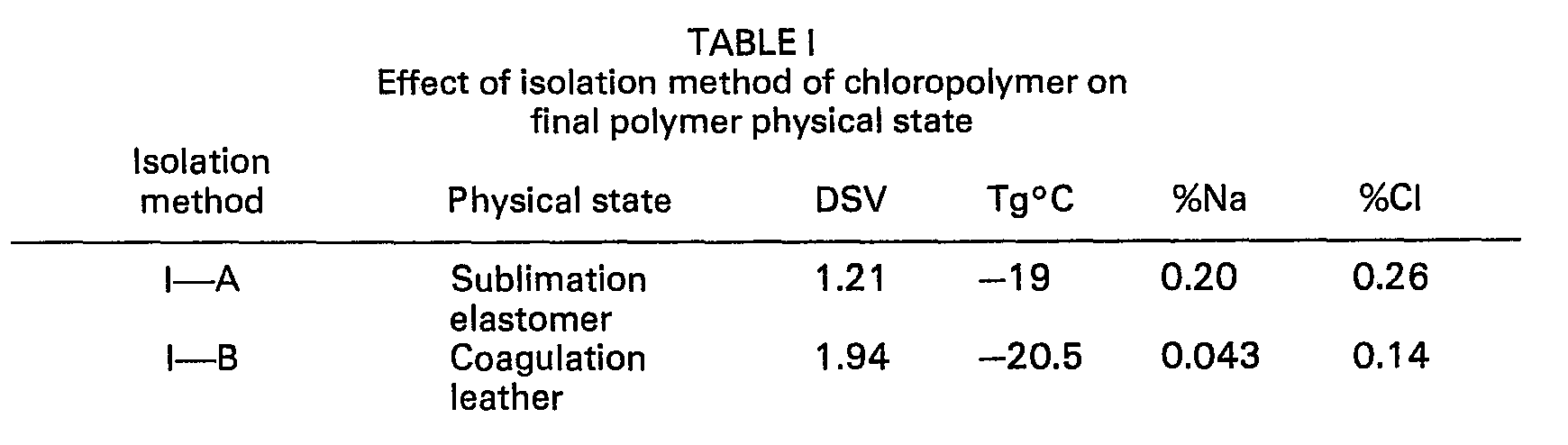
- DSV is an abbreviation for Dilute Solution Viscosity and is substantially the same as inherent viscosity.
- While not wishing to be bound by any specific theoretical explanation, it is believed that during sublimation the low molecular weight oils remain with the linear polyphosphazene and hence do not become separated from the polydichlorophosphazene which is subsequently derivatized, whereas in the coagulation method the low molecular weight oils remain in solution and are not present in the coagulated material which is subsequently derivatized. This view is reinforced by the following examples.
- Aryloxypolyphosphazenes C and D (Table II) were prepared utilizing batches of chloropolymer which had been purified by sublimation as described in Example I. These derivatized polymers were prepared substantially in accordance with the procedure set forth in Example I(A) except that during derivatization the ratio of phenoxy to p-ethyl phenoxy groups employed in polymer C was 50/50, while the ratio of phenoxy to p-ethyl phenoxy groups employed in polymer D was 30/70. Both polymers were elastomeric in nature despite this difference in ratios. The polymers were then dissolved in tetrahydrofuran (THF) and coagulated with hexane. The resultant coagulated polymers (designated E and F) were both leathery. The low molecular weight oils appeared to remain in solution in the THF hexane solution. As can be seen from Table II, the dilue solution viscosities (DSV) of the elastomers and leathers are quite different.

- When low molecular phosphazene oils were mixed on a mill with polymers E and F they were reconverted to elastomeric materials similar to polymers C and D.
- The invention is further illustrated by the following examples which are not intended to limit the invention.
- The polyaryloxyphosphazene (30 g) from Example I(A) was dissolved in 400 ml of THF and added to 2000 ml of hexane slowly. The high molecular weight polymer was separated from the dissolved low molecular weight oil by means of filtration. Upon drying the filtered material, a leathery polymer G (Table III) was obtained with a weight of 18 g. The filtrate was then evaporated down to dryness. A brown oily material with a molecular weight of approximately 1400 and a Tg of-23.5°C was obtained (Table III).
- The leathery polymer G (5 g) which was isolated in Example III, was mixed with 1.4 g of oil (from Example III also) on a mill for 30 minutes. A soft elastomer was then obtained with a Tg°C of -19. In addition, we have also mixed 5 g of the leathery polymer I-B (see Table I) with 1.2 g of oil (from Example III) on a mill. Again, an elastomer was obtained. Both results are shown in Table III.

- By suitably proportioning the amount of oil added back to said leathery high molecular weight polyaryloxyphosphazene, the leathery product can be converted to an elastomeric product with desired physical characteristics.
- As indicated in the above discussion, the present invention is applicable to a variety of aryloxy phosphazene polymers such as those described in the patents noted above.
- These polymers may be represented by the general formula

Claims (3)
Applications Claiming Priority (2)
| Application Number | Priority Date | Filing Date | Title |
|---|---|---|---|
| US876384 | 1978-02-09 | ||
| US05/876,384 US4152314A (en) | 1978-02-09 | 1978-02-09 | Process for converting leathery phosphazene polymer to elastomeric phosphazene polymer |
Publications (2)
| Publication Number | Publication Date |
|---|---|
| EP0003550A1 EP0003550A1 (en) | 1979-08-22 |
| EP0003550B1 true EP0003550B1 (en) | 1983-01-26 |
Family
ID=25367573
Family Applications (1)
| Application Number | Title | Priority Date | Filing Date |
|---|---|---|---|
| EP79100265A Expired EP0003550B1 (en) | 1978-02-09 | 1979-01-30 | Process for converting leathery phosphazene polymer to elastomeric phosphazene polymer |
Country Status (6)
| Country | Link |
|---|---|
| US (1) | US4152314A (en) |
| EP (1) | EP0003550B1 (en) |
| JP (1) | JPS54126300A (en) |
| AU (1) | AU527262B2 (en) |
| CA (1) | CA1126889A (en) |
| DE (1) | DE2964578D1 (en) |
Families Citing this family (1)
| Publication number | Priority date | Publication date | Assignee | Title |
|---|---|---|---|---|
| JPS63173581A (en) * | 1987-01-10 | 1988-07-18 | Kobayashi Seiyaku Kk | Feeding method of mixture component in preparation of culture medium for microorganism |
Family Cites Families (8)
| Publication number | Priority date | Publication date | Assignee | Title |
|---|---|---|---|---|
| US2866773A (en) * | 1954-07-14 | 1958-12-30 | Walker Extract And Chemical Co | Production of inorganic polymeric substances |
| US3370020A (en) * | 1964-09-29 | 1968-02-20 | American Cyanamid Co | Process for the production of phosphonitrilic polymers and polymers produced thereby |
| US3891448A (en) * | 1973-03-05 | 1975-06-24 | Ethyl Corp | Modified phosphazene flame retardant |
| US3869294A (en) * | 1973-03-05 | 1975-03-04 | Ethyl Corp | Phosphonitrile polymer |
| US3891449A (en) * | 1973-03-05 | 1975-06-24 | Ethyl Corp | Modified phosphazene fire retardants |
| US3943088A (en) * | 1974-01-25 | 1976-03-09 | The Firestone Tire & Rubber Company | Poly(fluoroalkoxyphosphazenes) |
| US4055520A (en) * | 1976-07-14 | 1977-10-25 | Armstrong Cork Company | Polyphosphazene blends |
| US4064095A (en) * | 1976-07-15 | 1977-12-20 | The Firestone Tire & Rubber Company | Poly(phosphazene) compositions |
-
1978
- 1978-02-09 US US05/876,384 patent/US4152314A/en not_active Expired - Lifetime
-
1979
- 1979-01-30 DE DE7979100265T patent/DE2964578D1/en not_active Expired
- 1979-01-30 EP EP79100265A patent/EP0003550B1/en not_active Expired
- 1979-02-01 AU AU43835/79A patent/AU527262B2/en not_active Ceased
- 1979-02-08 JP JP1381479A patent/JPS54126300A/en active Granted
- 1979-02-08 CA CA321,096A patent/CA1126889A/en not_active Expired
Also Published As
| Publication number | Publication date |
|---|---|
| CA1126889A (en) | 1982-06-29 |
| DE2964578D1 (en) | 1983-03-03 |
| AU527262B2 (en) | 1983-02-24 |
| AU4383579A (en) | 1979-08-16 |
| JPS54126300A (en) | 1979-10-01 |
| JPS5733293B2 (en) | 1982-07-16 |
| EP0003550A1 (en) | 1979-08-22 |
| US4152314A (en) | 1979-05-01 |
Similar Documents
| Publication | Publication Date | Title |
|---|---|---|
| US3370020A (en) | Process for the production of phosphonitrilic polymers and polymers produced thereby | |
| US3856712A (en) | Poly(alkoxyaryloxyphosphazene) elastomers | |
| US3883451A (en) | Flame-retardant poly (aryloxyphosphazene) copolymers | |
| US3919363A (en) | Process for preparing poly(sulfonyl-phenylene)phenylphosphonate | |
| CA1038545A (en) | Process for the preparation of poly (haloaryloxyphosphazene) homopolymers | |
| EP0008607B1 (en) | Oil-free elastomeric poly(aryloxyphosphazene) copolymers | |
| US4152314A (en) | Process for converting leathery phosphazene polymer to elastomeric phosphazene polymer | |
| US4258173A (en) | Polyphosphazene polymers containing monoetheroxy and polyetheroxy substituents | |
| EP0008795B1 (en) | Polyphosphazene polymers containing monoetheroxy and polyetheroxy substituents | |
| US3896058A (en) | Polyphosphazenes containing the cf' 3'chfcf' 2'ch' 2'o-group | |
| US4665152A (en) | Curable poly(aryloxyphosphazene) copolymers | |
| EP0013695B1 (en) | Polyphosphazene polymers containing cyclic ketal substituents and process for producing them | |
| CA1260192A (en) | Polyphosphazene polymers containing diallylamino substituents | |
| US3817947A (en) | Polysulfide polymers with increased resistance to solvents | |
| EP0014232B1 (en) | Polyphosphazene polymers containing substituents derived from ketoximes and process for producing them | |
| CA1136155A (en) | Polyphosphazene polymers containing substituent groups which are pendently bonded to phosphorus through nitrogen | |
| EP0016917B1 (en) | Polyphosphazene polymers containing substituents derived from thienyl alcohols and a method of curing them | |
| US4225697A (en) | Polyphosphazene polymers containing dialkyl alkylene diamino substituents | |
| EP0016249B1 (en) | Polyphosphazene copolymers containing dialkyl aminoxy substituents, and process for producing them | |
| US3891449A (en) | Modified phosphazene fire retardants | |
| US4175181A (en) | Polyphosphazene polymers containing cyanamido or dicyanamido substituents | |
| EP0011172B1 (en) | Process for preparing poly(organophosphazenes) from poly(dichlorophosphazenes) and active hydrogen-containing compounds in presence of a bicyclic amidine catalyst | |
| US4247680A (en) | Polyphosphazene copolymers containing alkyl borate substituents | |
| US4221898A (en) | Polyphosphazene polymers containing ortho-difunctional phenylene substitutents | |
| US4219637A (en) | Polyphosphazene polymers containing cyclic substituents from 1,2- or 1,3-difunctional compounds |
Legal Events
| Date | Code | Title | Description |
|---|---|---|---|
| PUAI | Public reference made under article 153(3) epc to a published international application that has entered the european phase |
Free format text: ORIGINAL CODE: 0009012 |
|
| AK | Designated contracting states |
Designated state(s): BE DE FR GB IT NL |
|
| 17P | Request for examination filed | ||
| ITF | It: translation for a ep patent filed | ||
| GRAA | (expected) grant |
Free format text: ORIGINAL CODE: 0009210 |
|
| AK | Designated contracting states |
Designated state(s): BE DE FR GB IT NL |
|
| ET | Fr: translation filed | ||
| REF | Corresponds to: |
Ref document number: 2964578 Country of ref document: DE Date of ref document: 19830303 |
|
| PGFP | Annual fee paid to national office [announced via postgrant information from national office to epo] |
Ref country code: GB Payment date: 19921216 Year of fee payment: 15 Ref country code: FR Payment date: 19921216 Year of fee payment: 15 |
|
| PGFP | Annual fee paid to national office [announced via postgrant information from national office to epo] |
Ref country code: DE Payment date: 19930127 Year of fee payment: 15 |
|
| ITTA | It: last paid annual fee | ||
| PGFP | Annual fee paid to national office [announced via postgrant information from national office to epo] |
Ref country code: NL Payment date: 19930131 Year of fee payment: 15 |
|
| PGFP | Annual fee paid to national office [announced via postgrant information from national office to epo] |
Ref country code: BE Payment date: 19930212 Year of fee payment: 15 |
|
| PG25 | Lapsed in a contracting state [announced via postgrant information from national office to epo] |
Ref country code: GB Effective date: 19940130 |
|
| PG25 | Lapsed in a contracting state [announced via postgrant information from national office to epo] |
Ref country code: BE Effective date: 19940131 |
|
| BERE | Be: lapsed |
Owner name: THE FIRESTONE TIRE & RUBBER CY Effective date: 19940131 |
|
| PG25 | Lapsed in a contracting state [announced via postgrant information from national office to epo] |
Ref country code: NL Effective date: 19940801 |
|
| NLV4 | Nl: lapsed or anulled due to non-payment of the annual fee | ||
| GBPC | Gb: european patent ceased through non-payment of renewal fee |
Effective date: 19940130 |
|
| PG25 | Lapsed in a contracting state [announced via postgrant information from national office to epo] |
Ref country code: FR Effective date: 19940930 |
|
| PG25 | Lapsed in a contracting state [announced via postgrant information from national office to epo] |
Ref country code: DE Effective date: 19941001 |
|
| REG | Reference to a national code |
Ref country code: FR Ref legal event code: ST |
|
| PLBE | No opposition filed within time limit |
Free format text: ORIGINAL CODE: 0009261 |
|
| STAA | Information on the status of an ep patent application or granted ep patent |
Free format text: STATUS: NO OPPOSITION FILED WITHIN TIME LIMIT |