EP0002942B1 - Process for producing 3-amino-2-cyclohexenone - Google Patents
Process for producing 3-amino-2-cyclohexenone Download PDFInfo
- Publication number
- EP0002942B1 EP0002942B1 EP78300885A EP78300885A EP0002942B1 EP 0002942 B1 EP0002942 B1 EP 0002942B1 EP 78300885 A EP78300885 A EP 78300885A EP 78300885 A EP78300885 A EP 78300885A EP 0002942 B1 EP0002942 B1 EP 0002942B1
- Authority
- EP
- European Patent Office
- Prior art keywords
- carbon atoms
- oxohexanenitrile
- amino
- cyclohexenone
- process according
- Prior art date
- Legal status (The legal status is an assumption and is not a legal conclusion. Google has not performed a legal analysis and makes no representation as to the accuracy of the status listed.)
- Expired
Links
Classifications
-
- C—CHEMISTRY; METALLURGY
- C07—ORGANIC CHEMISTRY
- C07C—ACYCLIC OR CARBOCYCLIC COMPOUNDS
- C07C221/00—Preparation of compounds containing amino groups and doubly-bound oxygen atoms bound to the same carbon skeleton
-
- C—CHEMISTRY; METALLURGY
- C07—ORGANIC CHEMISTRY
- C07C—ACYCLIC OR CARBOCYCLIC COMPOUNDS
- C07C2601/00—Systems containing only non-condensed rings
- C07C2601/12—Systems containing only non-condensed rings with a six-membered ring
- C07C2601/16—Systems containing only non-condensed rings with a six-membered ring the ring being unsaturated
Definitions
- This invention relates to a process for producing 3-amino-2-cyclohexenone which is useful as an intermediate for the production of m-aminophenol, cyclohexane-1 ,3-dione, resorcinol, etc. Specifically, it relates to a process for producing 3-amino-2-cyclohexenone in superior conversion and selectivity by heat-cyclization of 5-oxohexanenitrile.
- the invention relates to a process for producing 3-amino-2-cyclohexenone of the formula which comprises heating 5-oxohexanenitrile of the formula at a temperature of 160°C to 220°C in the presence of a basic catalyst in an inert organic polar solvent.
- Japanese Laid-Open Patent Publication No. 34859/73 (published on May 22, 1973; corresponding to German OLS 2144169 and 2144170 published on March 8, 1973) discloses a process for preparing substituted cyclohexen-2-ones which comprises reacting a cyanoethylated ketone of the formula wherein R, represents hydrogen or alkyl of 1 to 5, preferably 1 to 3, carbon atoms, and R 2 and R 3 are identical or different and represent hydrogen, alkyl of 1 to 5, preferably 1 to 3, carbon atoms, or A-cyanoethyl, at a temperature of 20 to 150°C in the presence of a basic catalyst such as an alkali metal hydroxide in a polar solvent.
- a basic catalyst such as an alkali metal hydroxide in a polar solvent.
- the present inventors attempted the production of the 3-amino-2-cyclohexenone, which is useful as an intermediate for various useful compounds including m-aminophenol, cyclohexane-1,3-dione and resorcinol, by the cyclization of 5-oxohexanenitrile.
- This attempt led to the discovery that at a temperature of 20 to 150°C recommended by the prior patent literature, the cyclization of 5- oxohexanenitrile with an unsubstituted 4-position to 3-amino-2-cyclohexenone gives much worse results than the cyclization of the aforesaid 4-substituted compound.
- the inventors worked on the cyclization reactivity of the 5-oxohexanenitrile, and found that at the reaction temperatures recommended by the prior art, the reactivity of the 5-oxohexanenitrile with the unsubstituted 4-position is low, and the selectivity of the starting compound for 6-methyl-3,4-dihydro-2-pyridone increases while its selectivity for the desired 3-amino-2-cyclohexenone and the yield of the 3-amino-2-cyclohexenone are low.
- the inventors furthered their investigations in order to overcome the technical disadvantage associated with the above 5-oxohexanenitrile which is not specifically disclosed by the prior art. It has consequently been found that within a temperature range of 160°C to 220°C, preferably 170°C to 200°C, which exceeds the upper limit (150°C) of the reaction temperatures disclosed by the prior art, the conversion of 5-oxohexanenitrile and its selectivity for 3-amino-2-cyclohexenone increase critically, and at temperatures below the lower limit of the above temperature range (i.e., the temperatures suggested heretofore) and above the upper limit of the above temperature range, the selectivity for the by-product 6-methyl-3,4-dihydro-2-pyridone abruptly increases and the selectivity for the desired 3-amino-2-cyclohexenone and its yield are reduced markedly.
- 3-amino-2-cyclohexenone of the formula given hereinabove can be produced in high conversions and selectivities by heating 5-oxohexanenitrile of the formula given hereinabove at 160°C to 220°C, preferably 170°C to 200°C, in the presence of a basic catalyst in an inert organic polar solvent to cyclize the 5-oxohexanenitrile.
- the solvent used in this process include alcohols containing 1 to 6 carbon atoms such as methanol, ethanol, n-propanol, isopropanol, n-butanol, sec-butanol, tert-butanol, pentanol, tert-amyl-alcohol and hexanol; ethers containing 4 to 14 carbon atoms such as diethyl ether, tetrahydrofuran, dioxane, diglyme and triethylene glycol dimethyl ether; nitriles containing 1 to 3 carbon atoms such as acetonitrile and propionitrile; amines containing 3 to 8 carbon atoms such as trimethylamine, triethylamine, pyridine and a-picoline; dialkylformamides with the alkyl group containing 1 or 2 carbon atoms such as dimethylformamide and diethyl formamide; phosphoric acid amides such as hexa
- tertiary alcohols especially tert-butanol
- tertiary alcohols are preferred.
- Mixtures of two or more of these organic polar solvents, and mixtures of them with organic non-polar solvents can also be used.
- the organic non-polar solvents are aliphatic hydrocarbons such as hexane, heptane, octane, nonane and decane; and aromatic hydrocarbons, preferably of 6 to 10 carbon atoms, such as benzene, toluene and p-xylene.
- the amount of the organic polar solvent can be used in an amount such that the weight ratio of it to the 5-oxohexanenitrile is from 1:1 to 1000:1, preferably from 5:1 to 200:1.
- the basic catalyst used in the above process are alkali metal hydroxides such as potassium hydroxide and sodium hydroxide; alkali metal alkoxides such as potassium methoxide, potassium ethoxide, potassium propoxides and potassium butoxides and the corresponding sodium alkoxides; alkali metal amides such as sodium amide and potassium amide; alkali metal hydrides such as sodium hydride; and alkali metals such as sodium and potassium.
- sodium hydroxide, potassium hydroxide, potassium alkoxides, and sodium alkoxides are preferred.
- Potassium hydroxide and potassium alkoxides are especially preferred.
- the amount of the basic catalyst can be varied widely. Usually, it is 0.001 to 1 mole, preferably 0.005 to 0.2 moles, per mole of the starting 5- oxohexanenitrile.
- the heat cyclization reaction is carried out at a temperature of 160 to 220°C, preferably 170 to 200°C. If the heating temperature is lower than about 160°C, the conversion of the 5-oxohexanenitrile decreases, and its selectivity for 6-methyl-3,4-dihydro-2-pyridone, a by-product, increases abruptly, thus causing a reduction in the selectivity for 3-amino-2-cyclohexanone and its yield. On the other hand, if the heating temperature exceeds about 220°C, the selectivity for the by-product 6-methyl-3,4-dihydro-2-pyridone increases, and 3-amino-2-cyclohexenone which has been formed may be consumed by a secondary reaction. Hence, the selectivity for 3-amino-2-cyclohexenone and its yield decrease. By maintaining the heating temperature at 170 to 200°C, the selectivity for 3-amino-2-cyclohexenone and its yield can be increased further.
- the above process can be performed either batchwise, semicontinuously or continuously.
- 5-oxohexanenitrile is fully diluted with a solvent in the aforesaid process, the formation of the by-product 6-methyl-3,4-dihydro-2-pyridone can be inhibited to some extent, and the selectivity for 3-amino-2-' cyclohexenone can be increased. Accordingly, it is preferred to use the solvent in an amount which is as excessive as is commercially permissible.
- reaction be carried out under conditions such that the concentration of the starting 5-oxohexanenitrile in the reaction system does not exceed about 0.5 mole/liter, for example, under such conditions that the concentration of the 5- oxohexanenitrile is 0.1 to 0.5 mole/liter of solvent.
- the reaction time is not critical, either, and may, for example, be 0.5 to 4 hours.
- the selectivity for 3-amino-2-cyclohexenone can thus be increased if 5-oxohexanenitrile is added to the reaction system so that the concentration of the unreacted 5-oxohexanenitrile in the reaction solution does not exceed 0.5 mole/liter.
- reaction mixture is treated in a customary manner such as distillation or crystallization to separate 3-amino-2-cyclohexenone.
- cyclohexane-1,3-dione can be obtained by reacting the 3-amino-2-cyclohexenone with water at a temperature of about 0 to about 200°C in the presence of a basic or acidic catalyst.
- Dehydrogenation of the cyclohexane-1,3-dione in accordance with, for example, British Patent 1,517,726 can afford resorcinol.
- Example 1 was repeated except that the amount of 5-oxohexanenitrile, the catalyst, the solvent and the reaction conditions were changed as shown in Table 2. The results are shown in Table 2.
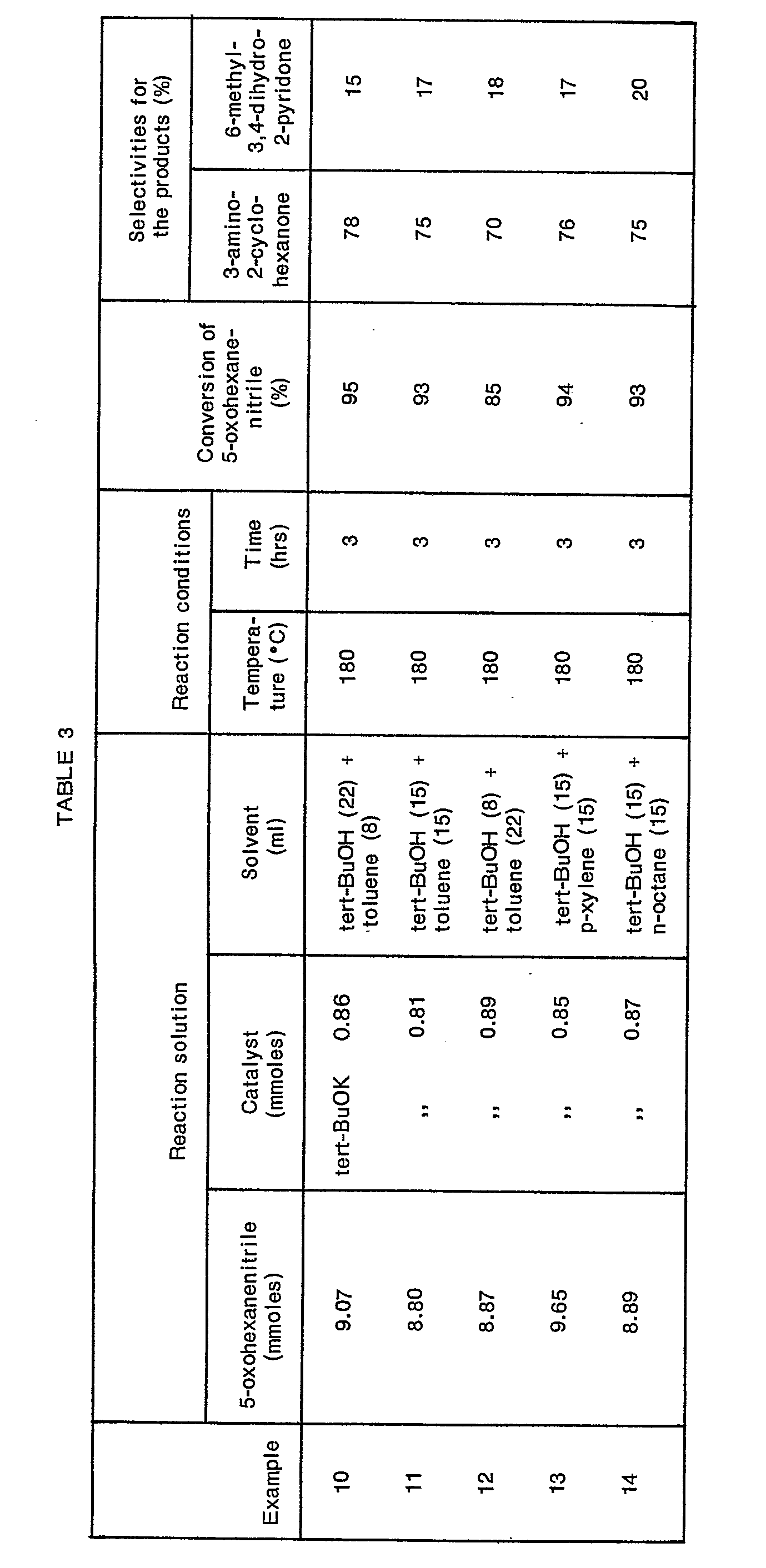
- Example 1 was repeated except that a mixture of tert-butanol and a higher boiling non-polar aliphatic or aromatic hydrocarbon was used as the solvent, the amount of 5-oxohexanenitrile was changed as shown in Table 3, and potassium tert-butoxide in the amounts indicated in Table 3 was used as a catalyst.
- Example 15 was repeated except that the 5-oxohexanenitrile was added all at one time. Specifically, a mixture of 0.40 mmole of potassium tert-butoxide, 9.91 mmoles of 5-oxohexanenitrile and 30 ml of tert-butanol was heated at 180°C for 1.5 hours. The conversion of 5-oxohexanenitrile was 85%, the selectivity for 3-amino-2-cyclohexenone was 77%, and the selectivity for 6-methyl-3,4-dihydro-2-pyridone was 15%.
Landscapes
- Chemical & Material Sciences (AREA)
- Organic Chemistry (AREA)
- Organic Low-Molecular-Weight Compounds And Preparation Thereof (AREA)
- Low-Molecular Organic Synthesis Reactions Using Catalysts (AREA)
Description
- This invention relates to a process for producing 3-amino-2-cyclohexenone which is useful as an intermediate for the production of m-aminophenol, cyclohexane-1 ,3-dione, resorcinol, etc. Specifically, it relates to a process for producing 3-amino-2-cyclohexenone in superior conversion and selectivity by heat-cyclization of 5-oxohexanenitrile.
- More specifically, the invention relates to a process for producing 3-amino-2-cyclohexenone of the formula


- Japanese Laid-Open Patent Publication No. 34859/73 (published on May 22, 1973; corresponding to German OLS 2144169 and 2144170 published on March 8, 1973) discloses a process for preparing substituted cyclohexen-2-ones which comprises reacting a cyanoethylated ketone of the formula
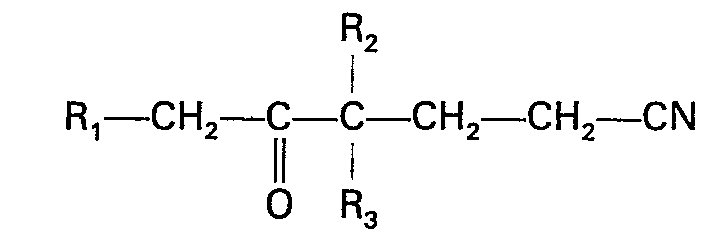
at a temperature of 20 to 150°C in the presence of a basic catalyst such as an alkali metal hydroxide in a polar solvent. - This Japanese Publication does not give a specific disclosure about the production of 3-amino-2-cyclohexenone from 5-oxohexanenitrile which corresponds to a compound of the above formula in which all of R" R2 and R3 are hydrogen. All the working examples in this publication are directed to the production of 3-amino-2-cyclohexenones from 4-substituted 5-oxohexanenitrile in which R2 or R3 is a substituent other than hydrogen, such as alkyl or β-cyanoethyl, and the reaction temperature is limited to about 20 to 150°C.
- The present inventors attempted the production of the 3-amino-2-cyclohexenone, which is useful as an intermediate for various useful compounds including m-aminophenol, cyclohexane-1,3-dione and resorcinol, by the cyclization of 5-oxohexanenitrile. This attempt led to the discovery that at a temperature of 20 to 150°C recommended by the prior patent literature, the cyclization of 5- oxohexanenitrile with an unsubstituted 4-position to 3-amino-2-cyclohexenone gives much worse results than the cyclization of the aforesaid 4-substituted compound. Accordingly, the inventors worked on the cyclization reactivity of the 5-oxohexanenitrile, and found that at the reaction temperatures recommended by the prior art, the reactivity of the 5-oxohexanenitrile with the unsubstituted 4-position is low, and the selectivity of the starting compound for 6-methyl-3,4-dihydro-2-pyridone increases while its selectivity for the desired 3-amino-2-cyclohexenone and the yield of the 3-amino-2-cyclohexenone are low.
- The inventors furthered their investigations in order to overcome the technical disadvantage associated with the above 5-oxohexanenitrile which is not specifically disclosed by the prior art. It has consequently been found that within a temperature range of 160°C to 220°C, preferably 170°C to 200°C, which exceeds the upper limit (150°C) of the reaction temperatures disclosed by the prior art, the conversion of 5-oxohexanenitrile and its selectivity for 3-amino-2-cyclohexenone increase critically, and at temperatures below the lower limit of the above temperature range (i.e., the temperatures suggested heretofore) and above the upper limit of the above temperature range, the selectivity for the by-product 6-methyl-3,4-dihydro-2-pyridone abruptly increases and the selectivity for the desired 3-amino-2-cyclohexenone and its yield are reduced markedly.
- It is an object of this invention therefore to provide a process for producing 3-amino-2-cyclohexenone with commercial advantage by the heat cyclization of 5-oxohexanenitrile.
- The above and other objects and advantages of the invention will become apparent from the following description.
- According to the process of this invention, 3-amino-2-cyclohexenone of the formula given hereinabove can be produced in high conversions and selectivities by heating 5-oxohexanenitrile of the formula given hereinabove at 160°C to 220°C, preferably 170°C to 200°C, in the presence of a basic catalyst in an inert organic polar solvent to cyclize the 5-oxohexanenitrile.
- Specific examples of the solvent used in this process include alcohols containing 1 to 6 carbon atoms such as methanol, ethanol, n-propanol, isopropanol, n-butanol, sec-butanol, tert-butanol, pentanol, tert-amyl-alcohol and hexanol; ethers containing 4 to 14 carbon atoms such as diethyl ether, tetrahydrofuran, dioxane, diglyme and triethylene glycol dimethyl ether; nitriles containing 1 to 3 carbon atoms such as acetonitrile and propionitrile; amines containing 3 to 8 carbon atoms such as trimethylamine, triethylamine, pyridine and a-picoline; dialkylformamides with the alkyl group containing 1 or 2 carbon atoms such as dimethylformamide and diethyl formamide; phosphoric acid amides such as hexamethylphosphoric triamide; and sulfoxides such as dimethyl sulfoxide. Of these, tertiary alcohols, especially tert-butanol, are preferred. Mixtures of two or more of these organic polar solvents, and mixtures of them with organic non-polar solvents can also be used. Examples of the organic non-polar solvents are aliphatic hydrocarbons such as hexane, heptane, octane, nonane and decane; and aromatic hydrocarbons, preferably of 6 to 10 carbon atoms, such as benzene, toluene and p-xylene. The amount of the organic polar solvent can be used in an amount such that the weight ratio of it to the 5-oxohexanenitrile is from 1:1 to 1000:1, preferably from 5:1 to 200:1.
- Specific examples of the basic catalyst used in the above process are alkali metal hydroxides such as potassium hydroxide and sodium hydroxide; alkali metal alkoxides such as potassium methoxide, potassium ethoxide, potassium propoxides and potassium butoxides and the corresponding sodium alkoxides; alkali metal amides such as sodium amide and potassium amide; alkali metal hydrides such as sodium hydride; and alkali metals such as sodium and potassium. Of these basic catalysts, sodium hydroxide, potassium hydroxide, potassium alkoxides, and sodium alkoxides are preferred. Potassium hydroxide and potassium alkoxides are especially preferred. The amount of the basic catalyst can be varied widely. Usually, it is 0.001 to 1 mole, preferably 0.005 to 0.2 moles, per mole of the starting 5- oxohexanenitrile.
- The heat cyclization reaction is carried out at a temperature of 160 to 220°C, preferably 170 to 200°C. If the heating temperature is lower than about 160°C, the conversion of the 5-oxohexanenitrile decreases, and its selectivity for 6-methyl-3,4-dihydro-2-pyridone, a by-product, increases abruptly, thus causing a reduction in the selectivity for 3-amino-2-cyclohexanone and its yield. On the other hand, if the heating temperature exceeds about 220°C, the selectivity for the by-product 6-methyl-3,4-dihydro-2-pyridone increases, and 3-amino-2-cyclohexenone which has been formed may be consumed by a secondary reaction. Hence, the selectivity for 3-amino-2-cyclohexenone and its yield decrease. By maintaining the heating temperature at 170 to 200°C, the selectivity for 3-amino-2-cyclohexenone and its yield can be increased further.
- The above process can be performed either batchwise, semicontinuously or continuously. When 5-oxohexanenitrile is fully diluted with a solvent in the aforesaid process, the formation of the by-product 6-methyl-3,4-dihydro-2-pyridone can be inhibited to some extent, and the selectivity for 3-amino-2-' cyclohexenone can be increased. Accordingly, it is preferred to use the solvent in an amount which is as excessive as is commercially permissible. It is preferred that the reaction be carried out under conditions such that the concentration of the starting 5-oxohexanenitrile in the reaction system does not exceed about 0.5 mole/liter, for example, under such conditions that the concentration of the 5- oxohexanenitrile is 0.1 to 0.5 mole/liter of solvent. The reaction time is not critical, either, and may, for example, be 0.5 to 4 hours.
- The selectivity for 3-amino-2-cyclohexenone can thus be increased if 5-oxohexanenitrile is added to the reaction system so that the concentration of the unreacted 5-oxohexanenitrile in the reaction solution does not exceed 0.5 mole/liter.
- After the reaction, the reaction mixture is treated in a customary manner such as distillation or crystallization to separate 3-amino-2-cyclohexenone.
- Dehydrogenation of the resulting 3-amino-2-cyclohexenone in accordance with British Patent 1,481,573 can yield m-aminophenol. Furthermore, cyclohexane-1,3-dione can be obtained by reacting the 3-amino-2-cyclohexenone with water at a temperature of about 0 to about 200°C in the presence of a basic or acidic catalyst. Dehydrogenation of the cyclohexane-1,3-dione in accordance with, for example, British Patent 1,517,726 can afford resorcinol.
- The process of the invention is specifically illustrated by the following examples.
- An argon-purged 50 ml. stainless steel autoclave was charged with 5-oxohexanenitrile, the catalyst and the solvent shown in Table 1 in the amounts indicated, and the reaction was performed under the conditions shown in Table 1. After the reaction, the reaction mixture was analyzed by gas chromatography, and the conversion of 5-oxohexanenitrile, and its selectivities for 3-amino-2-cyclohexenone and for 6-methyl-3,4-dihydro-2-pyridone were calculated. The results are shown in Table 1.
- Example 1 was repeated except that the amount of 5-oxohexanenitrile, the catalyst, the solvent and the reaction conditions were changed as shown in Table 2. The results are shown in Table 2.


- Example 1 was repeated except that a mixture of tert-butanol and a higher boiling non-polar aliphatic or aromatic hydrocarbon was used as the solvent, the amount of 5-oxohexanenitrile was changed as shown in Table 3, and potassium tert-butoxide in the amounts indicated in Table 3 was used as a catalyst.
- The results are shown in Table 3.
- A 50 ml stainless steel autoclave was charged with 0.41 mmole of potassium tert-butoxide, 3.09 mmoles of 5-oxohexanenitrile and 30 ml of tert-butanol. The mixture was heated at 180°C, and every 30 minutes, 2.81 mmoles of 5-oxohexanenitrile was freshly added. After heating for 1.5 hours, the reaction mixture was analyzed by gas chromatography. It was found that the conversion of 5- oxohexanenitrile was 74%, the selectivity for 3-amino-2-cyclohexenone was 87%, and the selectivity for 6-methyl-3,4-dihydro-2-pyridone was 10%.
- Example 15 was repeated except that the 5-oxohexanenitrile was added all at one time. Specifically, a mixture of 0.40 mmole of potassium tert-butoxide, 9.91 mmoles of 5-oxohexanenitrile and 30 ml of tert-butanol was heated at 180°C for 1.5 hours. The conversion of 5-oxohexanenitrile was 85%, the selectivity for 3-amino-2-cyclohexenone was 77%, and the selectivity for 6-methyl-3,4-dihydro-2-pyridone was 15%.
Claims (7)
Applications Claiming Priority (2)
| Application Number | Priority Date | Filing Date | Title |
|---|---|---|---|
| JP15732677A JPS5492942A (en) | 1977-12-28 | 1977-12-28 | Production of 3-amino-2-cyclohexenone |
| JP157326/77 | 1977-12-28 |
Publications (2)
| Publication Number | Publication Date |
|---|---|
| EP0002942A1 EP0002942A1 (en) | 1979-07-11 |
| EP0002942B1 true EP0002942B1 (en) | 1981-08-12 |
Family
ID=15647241
Family Applications (1)
| Application Number | Title | Priority Date | Filing Date |
|---|---|---|---|
| EP78300885A Expired EP0002942B1 (en) | 1977-12-28 | 1978-12-21 | Process for producing 3-amino-2-cyclohexenone |
Country Status (3)
| Country | Link |
|---|---|
| EP (1) | EP0002942B1 (en) |
| JP (1) | JPS5492942A (en) |
| DE (1) | DE2860968D1 (en) |
Families Citing this family (2)
| Publication number | Priority date | Publication date | Assignee | Title |
|---|---|---|---|---|
| JPH08164444A (en) * | 1994-12-09 | 1996-06-25 | Sintokogio Ltd | Mold making machine |
| CN116178186B (en) * | 2021-11-26 | 2025-06-17 | 联化科技(临海)有限公司 | A preparation process of 3-amino-2-cyclohexene-1-one |
Family Cites Families (3)
| Publication number | Priority date | Publication date | Assignee | Title |
|---|---|---|---|---|
| GB1225699A (en) * | 1968-09-17 | 1971-03-17 | ||
| DE2144169A1 (en) * | 1971-09-03 | 1973-03-08 | Texaco Ag | 3-aminocyclohex-2-enones prepn - by base catalysed cyclisn of cyanoethylated ketones |
| DE2144170C3 (en) * | 1971-09-03 | 1980-06-04 | Deutsche Texaco Ag, 2000 Hamburg | Process for the preparation of optionally alkyl-substituted 3-hydroxycyclohexen <2) -ones |
-
1977
- 1977-12-28 JP JP15732677A patent/JPS5492942A/en active Pending
-
1978
- 1978-12-21 EP EP78300885A patent/EP0002942B1/en not_active Expired
- 1978-12-21 DE DE7878300885T patent/DE2860968D1/en not_active Expired
Also Published As
| Publication number | Publication date |
|---|---|
| DE2860968D1 (en) | 1981-11-12 |
| JPS5492942A (en) | 1979-07-23 |
| EP0002942A1 (en) | 1979-07-11 |
Similar Documents
| Publication | Publication Date | Title |
|---|---|---|
| US2928877A (en) | Process for preparing oxyalkyleneamines | |
| JP2829342B2 (en) | Improved method for producing 3,5,6-trichloropyridin-2-ol | |
| EP1433772B2 (en) | Method for producing 2-(alkyl)cycloalkenone | |
| US4719309A (en) | Preparation of imidazoles | |
| GB2067193A (en) | Process for the preparation of n-cyclo-propylmethyl-n-propylamine | |
| US3940425A (en) | Process for the production of polyunsaturated compounds | |
| EP0002942A1 (en) | Process for producing 3-amino-2-cyclohexenone | |
| Jagdmann Jr et al. | A mild efficient procedure for the conversion of carboxylic acid esters to primary amides using formamide/methanolic sodium methoxide | |
| US6790976B2 (en) | Process for producing aliphatic tricarbonitriles | |
| US4093667A (en) | Preparation of 4-n-hexylresorcinol | |
| US5283377A (en) | Method for producing octadienols | |
| US4927942A (en) | Method for the preparation of imidazoles | |
| US4316994A (en) | Preparation of 4-fluoro-3-phenoxy-toluene | |
| KR100619386B1 (en) | Process for preparing halogenated phenylmalonates | |
| US4713479A (en) | Synthesis of high-purity dialkyl 2-vinylcyclopropane-1,1-dicarboxylate | |
| US4082802A (en) | Process for the preparation of aromatic secondary or tertiary amino compounds | |
| US4537999A (en) | Process for a production of dinitrophenyl ethers | |
| GB1571434A (en) | Unsaturated dicarboxylic acid derivatives | |
| US2802875A (en) | Method for preparing hydroxy-methyl-indanones | |
| EP0378910B1 (en) | Method for the preparation of imidazoles | |
| CN111470954A (en) | Method for synthesizing orthocarboxylic ester | |
| US4532082A (en) | Preparation of 3-cyano-2-alkylalkanals | |
| US4092482A (en) | Process for preparing 6,6,6-trihalo-3,3-dimethyl-4-hexenoates | |
| EP0663394B1 (en) | Process for preparing 5-aminodihydropyrrole, intermediate thereof and process for preparing said intermediate | |
| US7235699B2 (en) | Alkoxy-substituted indanes and the production thereof |
Legal Events
| Date | Code | Title | Description |
|---|---|---|---|
| PUAI | Public reference made under article 153(3) epc to a published international application that has entered the european phase |
Free format text: ORIGINAL CODE: 0009012 |
|
| AK | Designated contracting states |
Designated state(s): DE FR GB NL |
|
| 17P | Request for examination filed | ||
| GRAA | (expected) grant |
Free format text: ORIGINAL CODE: 0009210 |
|
| AK | Designated contracting states |
Designated state(s): DE FR GB NL |
|
| REF | Corresponds to: |
Ref document number: 2860968 Country of ref document: DE Date of ref document: 19811112 |
|
| PGFP | Annual fee paid to national office [announced via postgrant information from national office to epo] |
Ref country code: FR Payment date: 19841207 Year of fee payment: 7 |
|
| PGFP | Annual fee paid to national office [announced via postgrant information from national office to epo] |
Ref country code: DE Payment date: 19841215 Year of fee payment: 7 |
|
| PGFP | Annual fee paid to national office [announced via postgrant information from national office to epo] |
Ref country code: NL Payment date: 19841231 Year of fee payment: 7 |
|
| PG25 | Lapsed in a contracting state [announced via postgrant information from national office to epo] |
Ref country code: NL Effective date: 19860701 |
|
| GBPC | Gb: european patent ceased through non-payment of renewal fee | ||
| NLV4 | Nl: lapsed or anulled due to non-payment of the annual fee | ||
| PG25 | Lapsed in a contracting state [announced via postgrant information from national office to epo] |
Ref country code: FR Free format text: LAPSE BECAUSE OF NON-PAYMENT OF DUE FEES Effective date: 19860829 |
|
| PG25 | Lapsed in a contracting state [announced via postgrant information from national office to epo] |
Ref country code: DE Effective date: 19860902 |
|
| REG | Reference to a national code |
Ref country code: FR Ref legal event code: ST |
|
| PG25 | Lapsed in a contracting state [announced via postgrant information from national office to epo] |
Ref country code: GB Effective date: 19881117 |
|
| PLBE | No opposition filed within time limit |
Free format text: ORIGINAL CODE: 0009261 |
|
| STAA | Information on the status of an ep patent application or granted ep patent |
Free format text: STATUS: NO OPPOSITION FILED WITHIN TIME LIMIT |