EP0002348B1 - Process for the formation of elastomeric blends of a sulfonated elastomeric polymer - Google Patents
Process for the formation of elastomeric blends of a sulfonated elastomeric polymer Download PDFInfo
- Publication number
- EP0002348B1 EP0002348B1 EP78300678A EP78300678A EP0002348B1 EP 0002348 B1 EP0002348 B1 EP 0002348B1 EP 78300678 A EP78300678 A EP 78300678A EP 78300678 A EP78300678 A EP 78300678A EP 0002348 B1 EP0002348 B1 EP 0002348B1
- Authority
- EP
- European Patent Office
- Prior art keywords
- epdm terpolymer
- process according
- sulfonated
- sulphonated
- epdm
- Prior art date
- Legal status (The legal status is an assumption and is not a legal conclusion. Google has not performed a legal analysis and makes no representation as to the accuracy of the status listed.)
- Expired
Links
Classifications
-
- C—CHEMISTRY; METALLURGY
- C08—ORGANIC MACROMOLECULAR COMPOUNDS; THEIR PREPARATION OR CHEMICAL WORKING-UP; COMPOSITIONS BASED THEREON
- C08J—WORKING-UP; GENERAL PROCESSES OF COMPOUNDING; AFTER-TREATMENT NOT COVERED BY SUBCLASSES C08B, C08C, C08F, C08G or C08H
- C08J3/00—Processes of treating or compounding macromolecular substances
- C08J3/20—Compounding polymers with additives, e.g. colouring
- C08J3/205—Compounding polymers with additives, e.g. colouring in the presence of a continuous liquid phase
- C08J3/21—Compounding polymers with additives, e.g. colouring in the presence of a continuous liquid phase the polymer being premixed with a liquid phase
-
- C—CHEMISTRY; METALLURGY
- C08—ORGANIC MACROMOLECULAR COMPOUNDS; THEIR PREPARATION OR CHEMICAL WORKING-UP; COMPOSITIONS BASED THEREON
- C08K—Use of inorganic or non-macromolecular organic substances as compounding ingredients
- C08K5/00—Use of organic ingredients
- C08K5/01—Hydrocarbons
-
- C—CHEMISTRY; METALLURGY
- C08—ORGANIC MACROMOLECULAR COMPOUNDS; THEIR PREPARATION OR CHEMICAL WORKING-UP; COMPOSITIONS BASED THEREON
- C08L—COMPOSITIONS OF MACROMOLECULAR COMPOUNDS
- C08L23/00—Compositions of homopolymers or copolymers of unsaturated aliphatic hydrocarbons having only one carbon-to-carbon double bond; Compositions of derivatives of such polymers
- C08L23/26—Compositions of homopolymers or copolymers of unsaturated aliphatic hydrocarbons having only one carbon-to-carbon double bond; Compositions of derivatives of such polymers modified by chemical after-treatment
- C08L23/32—Compositions of homopolymers or copolymers of unsaturated aliphatic hydrocarbons having only one carbon-to-carbon double bond; Compositions of derivatives of such polymers modified by chemical after-treatment by reaction with compounds containing phosphorus or sulfur
-
- C—CHEMISTRY; METALLURGY
- C08—ORGANIC MACROMOLECULAR COMPOUNDS; THEIR PREPARATION OR CHEMICAL WORKING-UP; COMPOSITIONS BASED THEREON
- C08J—WORKING-UP; GENERAL PROCESSES OF COMPOUNDING; AFTER-TREATMENT NOT COVERED BY SUBCLASSES C08B, C08C, C08F, C08G or C08H
- C08J2323/00—Characterised by the use of homopolymers or copolymers of unsaturated aliphatic hydrocarbons having only one carbon-to-carbon double bond; Derivatives of such polymers
- C08J2323/26—Characterised by the use of homopolymers or copolymers of unsaturated aliphatic hydrocarbons having only one carbon-to-carbon double bond; Derivatives of such polymers modified by chemical after-treatment
- C08J2323/32—Characterised by the use of homopolymers or copolymers of unsaturated aliphatic hydrocarbons having only one carbon-to-carbon double bond; Derivatives of such polymers modified by chemical after-treatment by reaction with phosphorus- or sulfur-containing compounds
Definitions
- This present invention relates to an improved solution process for the incorporation of a process oil into a neutralized sulphonated EPDM terpolymer thereby resulting in blend compositions of the sulphonated EPDM terpolymer and process oil which have unique physical and rheological properties.
- a sulphonated EPDM terpolymer blend having no filler is made by a process comprising:
- EPDM is used in the sense of its definition as found in ASTM D-1418-64 (American Society for Testing and Materials) and means a terpolymer containing ethylene and propylene in the backbone and a diene in the side chain. Illustrative methods for producing these terpolymers are found in US. Patent 3,280,082, British Patent 1,030,289 and French Patent 1,386,600, which are incorporated herein by reference.
- the preferred terpolymers contain 45 to 75 wt. % ethylene and 2 to 10 wt. % of a diene monomer, the balance of the polymer being propylene. More preferably, the polymer contains 50 to 70 wt.
- the EPDM has 0.1 to 10 mole % olefinic unsaturation.
- the diene monomer is preferably a non-conjugated diene.
- the Mn of the terpolymer is preferably 10,000 to 200,000; more preferably 15,000 to 100,000; and most preferably 20,000 to 60,000.
- the Mooney viscosity (ML, 1 +8, 100°C) of the terpolymer is preferably 5 to 90, more preferably 10 to 50 and most preferably 15 to 40, e.g., 20.
- the M v of the EPDM is preferably below 350,000, and more preferably below 300,000, e.g., 270,000.
- the Mw of the EPDM is preferably below 500,000, and more preferably below 350,000, e.g., 343,000.
- Non-conjugated diene monomers which may be used in the EPDM terpolymer are 1,4-hexadiene, dicyclopentadiene, 5-ethylidene-2-norbornene, 5-methylene-2-norbornene, 5-propenyl-2-norbornene and methyl tetrahydroindene.
- a typical EPDM is Vistalon 2504 (Exxon Chemical Co.), a terpolymer having a Mooney viscosity (ML, 1 +8, 100°C) of 40 and having 50 wt. % of ethylene, 45 wt. % of propylene and 5.0 wt.
- Vistalon 2504 can be reprocessed through an extruder to produce a material having a Mooney viscosity of 20.
- Vistalon 3708 (Exxon Chemical Co.) is a terpolymer having a Mooney viscosity (ML, 1 +8, 127°C.) of 45-55 and having 65 wt. % of ethylene, 33 wt. % of propylene and 3.7 wt. % 5-ethylidene-2-norbornene with an Mn of 53,000, an Mw of 343,000 and an Mv of 270,000.
- Mooney viscosity ML, 1 +8, 127°C.
- Vistalon 6505 (Exxon Chemical Co.) is a terpolymer having a Mooney viscosity (ML, 1 +8, 127°C.) of 45-55 and having 53 wt. % of ethylene, 9.0 wt. % of 5-ethylidene-2-norbornene and 38 wt. % of propylene.
- Nordel 1320 is another EPDM terpolymer having a Mooney viscosity (ML, 1 +8, 100°C) of 25 and having 53 wt. % of ethylene, 3.5 wt. % of 1,4-hexadiene and 43.5 wt. % of propylene. ('Nordel' is a Registered Trade Mark at least in the United Kingdom).
- an olefinically unsaturated polymer is sulfonated with a sulfonating agent which is defined as an acyl sulfate, a mixture of sulfuric acid and an acid anhydride, a sulfur trioxide donor complexed with a Lewis base containing oxygen, nitrogen or phosphorus or a mixture of said acyl sulfate and complex.
- a sulfonating agent which is defined as an acyl sulfate, a mixture of sulfuric acid and an acid anhydride, a sulfur trioxide donor complexed with a Lewis base containing oxygen, nitrogen or phosphorus or a mixture of said acyl sulfate and complex.
- sulfur trioxide donor means a compound containing available sulfur trioxide. Illustrative of such sulfur trioxide donors are S0 3 , chlorosulfonic acid, fluorosulfonic acid, sulfuric acid, oleum, etc.
- complexing agent as used in the specification means a Lewis base suitable for use in the practice of this invention, wherein a Lewis base is an electron pair donor. Typical Lewis bases are: dioxane, tetrahydrofuran, tetrahydrothiophene or triethyl phosphate.
- the molar ratio of S0 3 donor to complexing agent may be as high as 15:1; preferably less than 9:1, more preferably 4:1 to 1:1, e.g., 2:1.
- the preferred solvents for preparation of the complexes of sulfur trioxide donor with complexing agents are chlorinated hydrocarbons.
- Illustrative of such chlorinated solvents are carbon tetrachloride, dichloroethane, chloroform, and methylene chloride.
- the complexes may also be prepared by direct addition of reagents if precautions are taken to dissipate evolved heat.
- acyl sulfates which are selected from acetyl, propionyl, butyryl or benzoyl sulfate, in particular acetyl sulfate.
- the acyl sulfate may be produced by reacting concentrated sulfuric acid with an acid anhydride or an acid halide in the presence or the absence of a solvent.
- acetic anhydride may be reacted with sulfuric acid to form acetyl sulfate which may be used to sulfonate the polymers.
- acetic anhydride may be added to a solution of the polymer in a suitable solvent and sulfuric acid subsequently added to form acetyl sulfate in situ.
- acetyl sulfate may be performed by reaction of sulfur trioxide with acetic acid in a nonreactive solvent.
- the polymer to be sulfonated is dissolved in a suitable solvent and reacted with the sulfonating agent.
- the solvent medium must be a neutral one for the rubber and the sulfonating agent.
- the solvent is preferably an aromatic hydrocarbon, an aliphatic hydrocarbon, a cycloaliphatic hydrocarbon, a halogenated aromatic hydrocarbon or mixture thereof. Illustrations of these solvents are: isopentane, pentane, cyclohexane, isohexane, hexane, heptane and homologues thereof, benzene, toluene, chlorobenzene or xylene.
- the preferred solvent is an aliphatic hydrocarbon.
- Sulfonation of the polymer is conducted at a temperature between -10°C and +100°C. Sulfonation occurs when the sulfonating agent is added to the polymer solution.
- the sulfonating agent is dissolved in a suitable solvent, or may be added directly without solvent.
- acetyl sulfate reagent it is most preferred to add acetic anhydride to the polymer cement and then sulfuric acid to prepare the acetyl sulfate reagent in situ.
- Reaction time may be 1 to 60 minutes, more preferably 5 to 45 and most preferably 15 to 30, wherein the product remains soluble throughout the reaction period.
- the acid form of the sulfonated elastomer is quenched with a quenching agent which is water, a liquid aliphatic alcohol such as methanol, ethanol or isopropanol, an aromatic hydroxyl compound such as phenol or a cycloaliphatic alcohol such as cyclohexanol.
- a quenching agent which is water, a liquid aliphatic alcohol such as methanol, ethanol or isopropanol, an aromatic hydroxyl compound such as phenol or a cycloaliphatic alcohol such as cyclohexanol.
- the elastomeric polymer is sulfonated at 10 to 60 meq. S0 3 H/100 g of polymer, more preferably at 15 to 50 meq. S0 3 H/100 g of polymer and most preferably at 20 to 40 meq. S0 3 H/100 g of polymer.
- the sulfonic acid content can be determined by either titration of the polymeric sulfonic acid or Dietert Sulfur analysis. In the titration of the sulfonic acid the polymer is dissolved in solvent consisting of 95 parts by volume of toluene and 5 parts by volume of methanol at a concentration level of 50 grams per liter of solvent. The acid form is titrated with ethanolic sodium hydroxide to an Alizarin Thymolphthalein endpoint.
- Polymers containing unsaturation and sulfonic acid groups have been found to be somewhat deficient in thermostability. Therefore, it is essential to neutralize at least a portion of the sulfonic acid as part of the manufacturing of sulfonated elastomeric polymer. Neutralization further improves the physical properties of the sulfonated polymer.
- sulfonic acid groups are neutralized, though 100% of the acids may be neutralized if desired; more preferably 90 to 100% of the sulfonic acid groups are neutralized; most preferably 95 to 100% are neutralized.
- the neutralizing agents used in the process of the present invention may be basic salts of carboxylic acids, wherein the cation of the basic salt is a metal of Groups IA, IIA, IB or IIB of the Periodic Table of Elements, ammonium, aluminum, lead, iron or antimony or a mixture thereof.
- the Periodic Table which applies in this specification and claims is that adopted by the I.U.P.A.C. (1965 revision).
- ammonia, an amine or salt thereof may be used.
- Suitable monovalent metal ions are Na, K, Li, Cs, Ag, Hg, and Cu.
- Suitable divalent metal ions are Be, Mg, Ca, Sr, Ba, Cu, Cd, Hg, Pb, Fe, Hg and Zn.
- the carboxylate ion of the metallic salt is derived from the following carboxylic acids as illustrated in the present invention; however, other carboxylic acids of the same generic class can be readily employed and are considered within the spirit and scope of the present embodiment.
- carboxylic acids are: acetic, benzoic, lauric, palmitic, myristic, decanoic, octanoic and stearic.
- Neutralization can also be effected with metallic oxides wherein the metallic ion is lead or a metal of Groups IIA or IIB of the Periodic Table of Elements or a mixture thereof.
- metallic oxides wherein the metallic ion is lead or a metal of Groups IIA or IIB of the Periodic Table of Elements or a mixture thereof.
- Illustrative examples are MgO, CaO, BaO, ZnO, Pb0 2 or Pb 3 0 4 and mixtures thereof.
- neutralizing agents are basic salts of hydroxides or alkoxides, wherein the cation is ammonium or a metal of Groups IA or IIA of the Periodic Table of Elements of a mixture thereof.
- Useful examples of hydroxides are NH 4 OH, NaOH, KOH, LiOH, Mg(OH) 2 and Ba(OH) 2 .
- a preferential plasticizer which may be a carboxylic acid or the ammonium or metal salts of these carboxylic acids, wherein the metal cation of the salt of the carboxylic acids is lead, iron, antimony, aluminum or a metal of Groups IA, IIA, IB or IIB of the Periodic Table of Elements thereof.
- the preferential plasticizer preferably incorporated into the neutralized sulfonated EPDM terpolymer at up to 45 parts, more preferably up to 35, and most preferably at up to 25 parts by weight per 100 parts by weight of sulphonated EPDM.
- Plasticizers may be organic esters, alcohols, phosphates, amines, amides or ureas and mixtures thereof).
- the preferred plasticizers are selected from long chain saturated aliphatic carboxylic acids such as stearic acid or the corresponding metallic salts and mixtures thereof.
- oils employed in the present invention are non-polar backbone process oils having less than 2 wt. % polar compounds as measured by molecular type clay gel analysis, preferably less than 0.75 wt. 96, and more preferably less than 0.5 wt. %.
- These oils may be paraffinics ASTM Type 104B as defined in ASTM D-2226-70, aromatics ASTM Type 102 or naphthenics ASTM Type 104A wherein the oil has a flash point by the Cleveland open cup of at least 177°C, a pour point of less than 4.4°C, a viscosity of about 70 to about 3000 s.s.u.'s and a number average molecular weight of 300 to 1000, more preferably 300 to 750.
- non-polar process oils may be used.
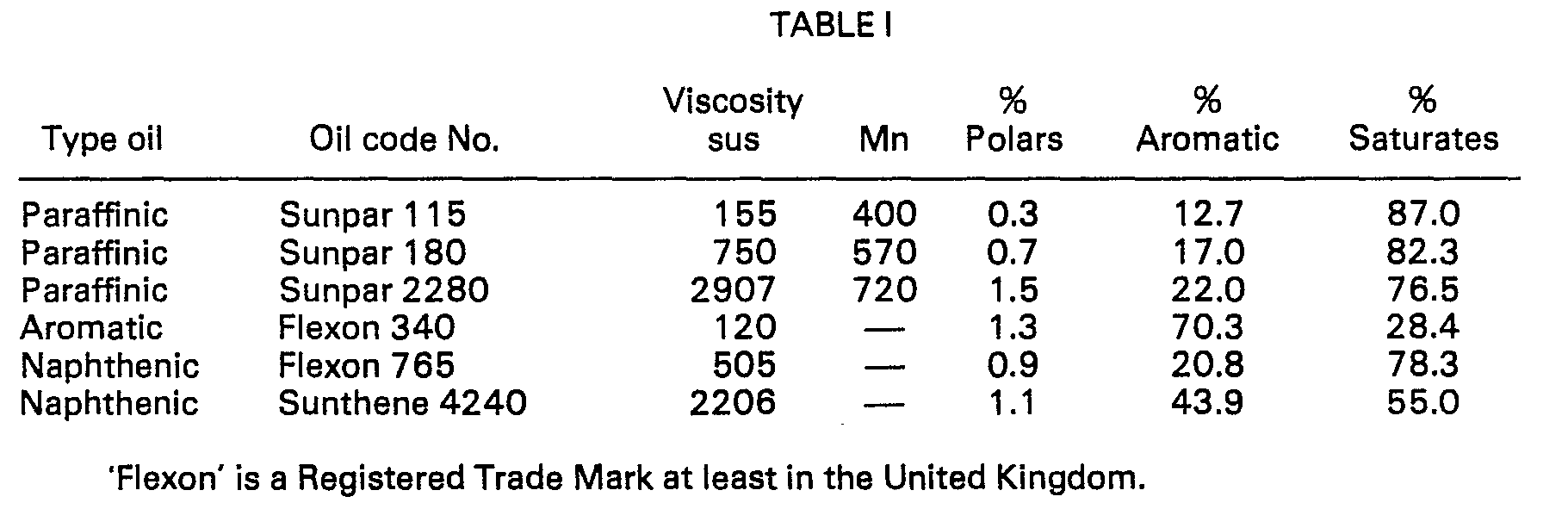
- the preferred process oils are paraffinics. Table I illustrates typical oils encompassed by the scope of this invention.
- the preferred process oil is a paraffinic type having an Mn of at least 300. Improved compression sets are obtained when oils having less than 20 wt. % aromatic constituents are used, more preferably less than 15 wt. % and most preferably less than 10 wt. %.
- the process oil is preferably incorporated into the elastomeric product at less than 200, more preferably at 10 to 150, and most preferably at 25 to 125 parts by weight per 100 parts by weight of the neutralized sulfonated elastomeric polymer.
- the improved solution process for the formation of these sulfonated elastomeric blend compositions of a process oil and the neutralized sulfonated elastomeric polymer comprises dissolving an elastomeric polymer in a solvent to form a cement.
- the polymer in the cement is sulfonated with a sulfonating agent to form an acid form of a sulfonated elastomeric polymer.
- the cement of the acid form of the sulfonated elastomeric polymer is quenched with one of the above-mentioned quenching agents, e.g. an aliphatic alcohol, to form a solution of the acid form of the sulfonated elastomeric polymer.
- the acid form of the sulfonated elastomeric polymer in solution is neutralized with a neutralizing agent to form the neutralized sulfonated elastomeric polymer in solution.
- a process oil is added under agitation to the solution of the neutralized sulfonated elastomeric polymer to form an elastomeric blend of the process oil and the neutralized sulfonated elastomeric polymer in solution.
- the elastomeric blend is recovered from the solution by steam stripping or other suitable recovery techniques.
- the acid form of the sulfonated polymer was analyzed by Dietert Sulfur Analysis to have 33 meq. of S0 3 H groups per 100 grams of polymer.
- a solution of 9.86 grams (90 meq/100 g EPDM) of zinc acetate dihydrate dissolved in 25 ml of distilled water was then added in the cement and the cement stirred for an additional 30 minutes.
- Antioxidant 2246 (0.5 grams) was then added to the cement.
- the sulfonated neutralized polymer in cement will be designated (A).
- Composition (B) was found to be a free flowing polymer crumb.
- the precursor EPDM terpolymer (Vistalon 2504-20) will be designated as (C).
- the resulting composition (D) was extremely soft and tacky and required scraping from the mill. Both compositions C and D were observed to cold flow on a table top under their own weight within minutes.
- compositions A and B were placed in 55 gal (248 litres) drums and examined one month later. Surprisingly, the material at the bottom of the drums exhibited no cold flow behavior and was essentially identical to that at the top. Pre-oil extension of the sulfonated elastomer had not altered its excellent cold flow characteristics.
- a neutralized sulfonated EPDM terpolymer cement was prepared according to composition (A) in Example 1. To the cement was added stearic acid under agitation at a level of 90 meq/100 g of EPDM. The cement was then divided into three aliquots into which were added 0, 25, and 75 grams/100 grams of EPDM of a paraffinic process oil - Sunpar 2280. The resulting compositions were isolated by steam stripping and drying.
- the dried compositions were compression molded at 177°C for 5 minutes.
- Tensile stress-strain measurements were performed on micro-tensile specimens cut from the molded pads. The measurements were made at an elevated temperature, 70°C, in order to examine the expected reduction in physical properties due to oil extension.
- thermal mechanical analysis was performed on the molded pads to investigate the softening behavior due to oil extension. The results of both measurements are shown in Table II.
- Example 2 The compounds described in Example 2 was blended with eight different process oils listed in Table III.
- concentration of oil was 60 parts by weight per 100 parts by weight of sulphonated EPDM. Compression set measurements were made on each of these eight samples as follows.
- Test disks were made from each of the samples by compression molding a 0.06 inch (1.5 mm) thick pad at 350°C. One-half inch (12.7 mm) diameter discs were cut from the pads and plied 4-high to form a test sample which was about 0.24 inches (6 mm) high. These tests were made at room temperature under controlled dry conditions. The test used was the standard ASTM D-395 - Method B, which involves 25% compression of the samples for 22 hrs, followed by 30 minutes recovery after the compressive force is removed.
- Aniline point is generally considered a measure of solvency power, with a low Aniline Point being associated with high solvency. It is conceivable that this high solvency could result in partial solvation of the physical cross-links of the sulfonated EPDM by the oil, thereby increasing compression set.
- the listed Aniline Point data indicate no correlation between Aniline Point and compression set of the sulfonated EPDM compositions. For example, the lowest Aniline Point oil listed is Sunpar 2280 and the highest is Flexon 340, yet these two oils have very close compression set values.
- oils having aromatic contents of less than 10 wt. 96 were obtained with oils having aromatic contents of less than 10 wt. 96.
- the wt. percent polar compounds in the oil differentiates between oils which give improved compression set behavior and oils which give less desirable compression set behavior. Therefore, process oils having polar contents no higher than 0.75 wt. %, and preferably no higher than 0.4 wt. %, and aromatic constituents of less than about 20 wt. %, more preferably less than 15 wt. %, are desirable in the many applications of sulfonated EPDM for which compression set is of crucial importance.
- Example 3 it was demonstrated that the use of low polar content process oils resulted in improved compression set for the compounds.
- three of the compounds of Example 3 are compared in their melt flow rates (processibility) at 190°C and in their room temperature and 70°C tensile properties.
- the compounds in this example employ the oils Sunpar 2280, Shellflex 371, and ECA 6492 (see Table III for their specifications and manufacturers). Test pads were made from these samples by compression molding at 177°C. The procedure was to preheat the empty mold plates in the press for a few minutes, then the material was put in the mold and the mold containing the material was preheated in the press with the mold plates slightly open for two minutes.
- the mold plates were pressed closed under a force of about 20 metric tons for two minutes.
- the samples were cooled in the molds under pressure for two minutes.
- Microtensile pads having a thickness of about 0.6 mm and test regions measuring 2.54 mm in width and 12.7 mm in length were cut from the test pads with a die.
- the samples were stored in closed dry bottles for one or more days prior to tensile testing.
- Tensile strengths of the samples were measured with an Instron TM table model instrument, using a pulling speed of 51 mm per minute. ("Instron” is a Registered Trade Mark at least in the United Kingdom). Measurements were made at room temperature (25°C), and also at a higher temperature to determine the usefulness of the materials at elevated temperature. In the measurements at elevated temperature, after being placed in the testing oven, a 3 minute waiting period was allowed before pulling to enable the sample to equilibrate with the oven temperature. The elevated temperature utilized in most measurements was 70°C.
- melt flow rates for the various materials were determined at 190°C which is in the range of typical processing temperatures for lightly sulfonated EPDM.
- the melt index instrument specified in ASTM 1238-70 was used, with the standard capillary.
- the weight of the probe plus the added weight was 12.5 kilograms. Flow rates were measured electronically as probe displacement per minute, and these results were converted to grams per 10 minutes using a conversion factor.
- compression set may have to be sacrificed for the greater elongation, and a higher polar content oil may be needed.
- high elongations are not required and compression set is more of a concern.
- high elongations are not needed - such as for gaskets, and flexible padding.
- Another major application which does not require high elongations is in flexible tubing. This is an application which requires good compression set in order to maintain secure leak proof seals to the fitting at the end of the hoses.
- the utilization of low polar content oils in sulfonated EPDM compounds to obtain lower compression set should be advantageous in most applications as it causes no significant change in melt flow rate (processibility), or softness. Only in those particular uses where high elongation is a requirement might the use of the low polar content oils not be advisable.
Landscapes
- Chemical & Material Sciences (AREA)
- Health & Medical Sciences (AREA)
- Chemical Kinetics & Catalysis (AREA)
- Medicinal Chemistry (AREA)
- Polymers & Plastics (AREA)
- Organic Chemistry (AREA)
- General Chemical & Material Sciences (AREA)
- Compositions Of Macromolecular Compounds (AREA)
- Addition Polymer Or Copolymer, Post-Treatments, Or Chemical Modifications (AREA)
- Processes Of Treating Macromolecular Substances (AREA)
Description
- This present invention relates to an improved solution process for the incorporation of a process oil into a neutralized sulphonated EPDM terpolymer thereby resulting in blend compositions of the sulphonated EPDM terpolymer and process oil which have unique physical and rheological properties.
- It is already known to incorporate process oil into neutralized sulphonated elastomeric polymers, for example as described in US Patent Specifications 3974240 and 3847854. We have now devised a new method of making blends containing EPDM and process oil in which in contrast to Example 4 of US- 3847854 no filler is present, and in which in contrast to US 3974240 the sulphonated EPDM is quenched with a quenching agent which may be a liquid aliphatic alcohol.
- According to this invention a sulphonated EPDM terpolymer blend having no filler is made by a process comprising:
- (a) dissolving an EPDM terpolymer in a solvent to form a cement;
- (b) sulfonating with a sulphonating agent (as hereinafter defined) at a temperature between -10°C to 100°C, said EPDM terpolymer in said cement to form a sulphonated EPDM terpolymer;
- (c) quenching with a quenching agent (as hereinafter defined) said cement of said sulphonated EPDM terpolymer to form a solution of said sulphonated EPDM terpo!ymer;
- (d) at least partly neutralizing said sulphonated EPDM terpolymer in said solution with a neutralizing agent to form a neutralized sulphonated EPDM terpolymer;
- (e) adding under agitation a non-polar process oil having less than 2 wt.% polar compounds to said solution of said neutralized sulphonated EPDM terpolymer to form a blend of said process oil and said neutralized sulphonated EPDM terpolymer in said solution; and
- (f) recovering said sulphonated EPDM blend from said solution.
- The term "EPDM" is used in the sense of its definition as found in ASTM D-1418-64 (American Society for Testing and Materials) and means a terpolymer containing ethylene and propylene in the backbone and a diene in the side chain. Illustrative methods for producing these terpolymers are found in US. Patent 3,280,082, British Patent 1,030,289 and French Patent 1,386,600, which are incorporated herein by reference. The preferred terpolymers contain 45 to 75 wt. % ethylene and 2 to 10 wt. % of a diene monomer, the balance of the polymer being propylene. More preferably, the polymer contains 50 to 70 wt. % ethylene, e.g., 50 wt. %, and 2.6 to 9.0 wt. % diene monomer, e.g., 5.0 wt. %. In general it is preferred that the EPDM has 0.1 to 10 mole % olefinic unsaturation. The diene monomer is preferably a non-conjugated diene. The Mn of the terpolymer is preferably 10,000 to 200,000; more preferably 15,000 to 100,000; and most preferably 20,000 to 60,000. The Mooney viscosity (ML, 1 +8, 100°C) of the terpolymer is preferably 5 to 90, more preferably 10 to 50 and most preferably 15 to 40, e.g., 20. The
M v of the EPDM is preferably below 350,000, and more preferably below 300,000, e.g., 270,000. The Mw of the EPDM is preferably below 500,000, and more preferably below 350,000, e.g., 343,000. - Illustrative of these non-conjugated diene monomers which may be used in the EPDM terpolymer are 1,4-hexadiene, dicyclopentadiene, 5-ethylidene-2-norbornene, 5-methylene-2-norbornene, 5-propenyl-2-norbornene and methyl tetrahydroindene. A typical EPDM is Vistalon 2504 (Exxon Chemical Co.), a terpolymer having a Mooney viscosity (ML, 1 +8, 100°C) of 40 and having 50 wt. % of ethylene, 45 wt. % of propylene and 5.0 wt. % of 5-ethylidene-2-norbornene with an Mn of 47,000, an Mv of 145,000 and an Mw of 174,000. ("Vistalon is a Registered Trade Mark at least in the United Kingdom). The Vistalon 2504 can be reprocessed through an extruder to produce a material having a Mooney viscosity of 20.
- Vistalon 3708 (Exxon Chemical Co.) is a terpolymer having a Mooney viscosity (ML, 1 +8, 127°C.) of 45-55 and having 65 wt. % of ethylene, 33 wt. % of propylene and 3.7 wt. % 5-ethylidene-2-norbornene with an Mn of 53,000, an Mw of 343,000 and an Mv of 270,000.
- Vistalon 6505 (Exxon Chemical Co.) is a terpolymer having a Mooney viscosity (ML, 1 +8, 127°C.) of 45-55 and having 53 wt. % of ethylene, 9.0 wt. % of 5-ethylidene-2-norbornene and 38 wt. % of propylene.
- Nordel 1320 (duPont) is another EPDM terpolymer having a Mooney viscosity (ML, 1 +8, 100°C) of 25 and having 53 wt. % of ethylene, 3.5 wt. % of 1,4-hexadiene and 43.5 wt. % of propylene. ('Nordel' is a Registered Trade Mark at least in the United Kingdom).
- In carrying out the present invention, an olefinically unsaturated polymer is sulfonated with a sulfonating agent which is defined as an acyl sulfate, a mixture of sulfuric acid and an acid anhydride, a sulfur trioxide donor complexed with a Lewis base containing oxygen, nitrogen or phosphorus or a mixture of said acyl sulfate and complex.
- The term "sulfur trioxide donor" as used in the specification means a compound containing available sulfur trioxide. Illustrative of such sulfur trioxide donors are S03, chlorosulfonic acid, fluorosulfonic acid, sulfuric acid, oleum, etc. The term "complexing agent" as used in the specification means a Lewis base suitable for use in the practice of this invention, wherein a Lewis base is an electron pair donor. Typical Lewis bases are: dioxane, tetrahydrofuran, tetrahydrothiophene or triethyl phosphate.
- The molar ratio of S03 donor to complexing agent may be as high as 15:1; preferably less than 9:1, more preferably 4:1 to 1:1, e.g., 2:1.
- The preferred solvents for preparation of the complexes of sulfur trioxide donor with complexing agents are chlorinated hydrocarbons. Illustrative of such chlorinated solvents are carbon tetrachloride, dichloroethane, chloroform, and methylene chloride. The complexes may also be prepared by direct addition of reagents if precautions are taken to dissipate evolved heat.
- The reactions of ethereal complexes of S03 with the unsaturation of polymer chains has been found to be non-quantitative generally because they are consumed through side reactions with impurities such as water. Therefore, the use of excess complex is desirable to give the required amount of sulfonation.
- Other suitable sulfonating agents are the acyl sulfates, which are selected from acetyl, propionyl, butyryl or benzoyl sulfate, in particular acetyl sulfate. The acyl sulfate may be produced by reacting concentrated sulfuric acid with an acid anhydride or an acid halide in the presence or the absence of a solvent. For example, acetic anhydride may be reacted with sulfuric acid to form acetyl sulfate which may be used to sulfonate the polymers. If desired, acetic anhydride may be added to a solution of the polymer in a suitable solvent and sulfuric acid subsequently added to form acetyl sulfate in situ. Alternatively, acetyl sulfate may be performed by reaction of sulfur trioxide with acetic acid in a nonreactive solvent.
- In the practice of this invention, the polymer to be sulfonated is dissolved in a suitable solvent and reacted with the sulfonating agent. The solvent medium must be a neutral one for the rubber and the sulfonating agent. The solvent is preferably an aromatic hydrocarbon, an aliphatic hydrocarbon, a cycloaliphatic hydrocarbon, a halogenated aromatic hydrocarbon or mixture thereof. Illustrations of these solvents are: isopentane, pentane, cyclohexane, isohexane, hexane, heptane and homologues thereof, benzene, toluene, chlorobenzene or xylene. The preferred solvent is an aliphatic hydrocarbon.
- Sulfonation of the polymer is conducted at a temperature between -10°C and +100°C. Sulfonation occurs when the sulfonating agent is added to the polymer solution. The sulfonating agent is dissolved in a suitable solvent, or may be added directly without solvent. With acetyl sulfate reagent it is most preferred to add acetic anhydride to the polymer cement and then sulfuric acid to prepare the acetyl sulfate reagent in situ. Reaction time may be 1 to 60 minutes, more preferably 5 to 45 and most preferably 15 to 30, wherein the product remains soluble throughout the reaction period. The acid form of the sulfonated elastomer is quenched with a quenching agent which is water, a liquid aliphatic alcohol such as methanol, ethanol or isopropanol, an aromatic hydroxyl compound such as phenol or a cycloaliphatic alcohol such as cyclohexanol.
- The amount of desirable sulfonation depends on the particular application. Preferably, the elastomeric polymer is sulfonated at 10 to 60 meq. S03H/100 g of polymer, more preferably at 15 to 50 meq. S03H/100 g of polymer and most preferably at 20 to 40 meq. S03H/100 g of polymer. The sulfonic acid content can be determined by either titration of the polymeric sulfonic acid or Dietert Sulfur analysis. In the titration of the sulfonic acid the polymer is dissolved in solvent consisting of 95 parts by volume of toluene and 5 parts by volume of methanol at a concentration level of 50 grams per liter of solvent. The acid form is titrated with ethanolic sodium hydroxide to an Alizarin Thymolphthalein endpoint.
- Polymers containing unsaturation and sulfonic acid groups have been found to be somewhat deficient in thermostability. Therefore, it is essential to neutralize at least a portion of the sulfonic acid as part of the manufacturing of sulfonated elastomeric polymer. Neutralization further improves the physical properties of the sulfonated polymer.
- In preparing the ionomer, it is not necessary to neutralize every sulfonic acid group. Preferably, at least 75% of the sulfonic acid groups are neutralized, though 100% of the acids may be neutralized if desired; more preferably 90 to 100% of the sulfonic acid groups are neutralized; most preferably 95 to 100% are neutralized.
- The neutralizing agents used in the process of the present invention may be basic salts of carboxylic acids, wherein the cation of the basic salt is a metal of Groups IA, IIA, IB or IIB of the Periodic Table of Elements, ammonium, aluminum, lead, iron or antimony or a mixture thereof. The Periodic Table which applies in this specification and claims is that adopted by the I.U.P.A.C. (1965 revision). Also, ammonia, an amine or salt thereof may be used.
- Suitable monovalent metal ions are Na, K, Li, Cs, Ag, Hg, and Cu. Suitable divalent metal ions are Be, Mg, Ca, Sr, Ba, Cu, Cd, Hg, Pb, Fe, Hg and Zn.
- The carboxylate ion of the metallic salt is derived from the following carboxylic acids as illustrated in the present invention; however, other carboxylic acids of the same generic class can be readily employed and are considered within the spirit and scope of the present embodiment. These carboxylic acids are: acetic, benzoic, lauric, palmitic, myristic, decanoic, octanoic and stearic.
- Neutralization can also be effected with metallic oxides wherein the metallic ion is lead or a metal of Groups IIA or IIB of the Periodic Table of Elements or a mixture thereof. Illustrative examples are MgO, CaO, BaO, ZnO, Pb02 or Pb304 and mixtures thereof.
- Other neutralizing agents are basic salts of hydroxides or alkoxides, wherein the cation is ammonium or a metal of Groups IA or IIA of the Periodic Table of Elements of a mixture thereof. Useful examples of hydroxides are NH4OH, NaOH, KOH, LiOH, Mg(OH)2 and Ba(OH)2.
- To the neutralized sulfonated terpolymer in solution may be added a preferential plasticizer which may be a carboxylic acid or the ammonium or metal salts of these carboxylic acids, wherein the metal cation of the salt of the carboxylic acids is lead, iron, antimony, aluminum or a metal of Groups IA, IIA, IB or IIB of the Periodic Table of Elements thereof. The preferential plasticizer preferably incorporated into the neutralized sulfonated EPDM terpolymer at up to 45 parts, more preferably up to 35, and most preferably at up to 25 parts by weight per 100 parts by weight of sulphonated EPDM.
- (Alternative preferential plasticizers may be organic esters, alcohols, phosphates, amines, amides or ureas and mixtures thereof). The preferred plasticizers are selected from long chain saturated aliphatic carboxylic acids such as stearic acid or the corresponding metallic salts and mixtures thereof.
- The oils employed in the present invention are non-polar backbone process oils having less than 2 wt. % polar compounds as measured by molecular type clay gel analysis, preferably less than 0.75 wt. 96, and more preferably less than 0.5 wt. %. These oils may be paraffinics ASTM Type 104B as defined in ASTM D-2226-70, aromatics ASTM Type 102 or naphthenics ASTM Type 104A wherein the oil has a flash point by the Cleveland open cup of at least 177°C, a pour point of less than 4.4°C, a viscosity of about 70 to about 3000 s.s.u.'s and a number average molecular weight of 300 to 1000, more preferably 300 to 750. Also mixtures of said non-polar process oils may be used. The preferred process oils are paraffinics. Table I illustrates typical oils encompassed by the scope of this invention. The preferred process oil is a paraffinic type having an Mn of at least 300. Improved compression sets are obtained when oils having less than 20 wt. % aromatic constituents are used, more preferably less than 15 wt. % and most preferably less than 10 wt. %.
- The process oil is preferably incorporated into the elastomeric product at less than 200, more preferably at 10 to 150, and most preferably at 25 to 125 parts by weight per 100 parts by weight of the neutralized sulfonated elastomeric polymer.
- The improved solution process for the formation of these sulfonated elastomeric blend compositions of a process oil and the neutralized sulfonated elastomeric polymer comprises dissolving an elastomeric polymer in a solvent to form a cement. The polymer in the cement is sulfonated with a sulfonating agent to form an acid form of a sulfonated elastomeric polymer.The cement of the acid form of the sulfonated elastomeric polymer is quenched with one of the above-mentioned quenching agents, e.g. an aliphatic alcohol, to form a solution of the acid form of the sulfonated elastomeric polymer. The acid form of the sulfonated elastomeric polymer in solution is neutralized with a neutralizing agent to form the neutralized sulfonated elastomeric polymer in solution. A process oil is added under agitation to the solution of the neutralized sulfonated elastomeric polymer to form an elastomeric blend of the process oil and the neutralized sulfonated elastomeric polymer in solution. The elastomeric blend is recovered from the solution by steam stripping or other suitable recovery techniques.
- The advantages of the improved process of manufacture of these improved elastomeric blends may be more readily appreciated by reference to the following examples.
- One hundred grams of an EPDM terpolymer (Vistalon 2504-20) was dissolved in 1000 ml of n-hexane at 40°C. The EPDM had approximately 50% ethylene, 45% propylene and 5% 5-ethylidene-2-norbornene and a Mooney viscosity (ML, 1 +8, 100°C) of 20. After the cement was cooled to room temperature, 5.74 ml of acetic anhydride (60.75 mmoles) was added. While stirring the mixture, 2.1 ml of 95% HIS04 (37.5 mmoles) was added dropwise. The sulfonated reaction was quenched after 30 minutes with 150 ml of isopropanol. The acid form of the sulfonated polymer was analyzed by Dietert Sulfur Analysis to have 33 meq. of S03H groups per 100 grams of polymer. A solution of 9.86 grams (90 meq/100 g EPDM) of zinc acetate dihydrate dissolved in 25 ml of distilled water was then added in the cement and the cement stirred for an additional 30 minutes. Antioxidant 2246 (0.5 grams) was then added to the cement. The sulfonated neutralized polymer in cement will be designated (A).
- A paraffinic process oil, Sunpar 2280, was next added at a level of 50 grams (50 phr) to the cement. The resulting oil extended neutralized sulfonated EPDM terpolymer (B) was then isolated by steam stripping and forced air drying. Composition (B) was found to be a free flowing polymer crumb.
- The precursor EPDM terpolymer (Vistalon 2504-20) will be designated as (C). To (C) was added 50 phr of Sunpar 2280 on a two roll rubber mill. The resulting composition (D) was extremely soft and tacky and required scraping from the mill. Both compositions C and D were observed to cold flow on a table top under their own weight within minutes.
- Compositions A and B were placed in 55 gal (248 litres) drums and examined one month later. Surprisingly, the material at the bottom of the drums exhibited no cold flow behavior and was essentially identical to that at the top. Pre-oil extension of the sulfonated elastomer had not altered its excellent cold flow characteristics.
- A neutralized sulfonated EPDM terpolymer cement was prepared according to composition (A) in Example 1. To the cement was added stearic acid under agitation at a level of 90 meq/100 g of EPDM. The cement was then divided into three aliquots into which were added 0, 25, and 75 grams/100 grams of EPDM of a paraffinic process oil - Sunpar 2280. The resulting compositions were isolated by steam stripping and drying.
- The dried compositions were compression molded at 177°C for 5 minutes. Tensile stress-strain measurements were performed on micro-tensile specimens cut from the molded pads. The measurements were made at an elevated temperature, 70°C, in order to examine the expected reduction in physical properties due to oil extension. To complement the tensile data, thermal mechanical analysis (TMA) was performed on the molded pads to investigate the softening behavior due to oil extension. The results of both measurements are shown in Table II.

- It is readily apparent from the data above that at these oil levels, the softening points are sufficiently high and that the oil extended gums have considerable resistance to deformation at 70°C and thus have excellent cold flow characteristics. It is observed that there are two inflection points in the TMA curves above room temperature. It is surprisingly observed that both inflection points are not appreciably affected by the incorporation of considerable oil content (75 phr). However, the tensile stress strain behavior indicates that an upper limit of approximately 100 phr of oil for this particular neutralized and plasticized sulfonated EPDM terpolymer is practical. Above this level of oil extension the physical properties would be sufficiently reduced to minimize the excellent properties of oil extended compositions. Thus a practical upper limit has been established and this example has illustrated that below this upper limit the oil extended plasticized and neutralized EPDM terpolymers exhibit surprisingly good tensile properties.
- The compounds described in Example 2 was blended with eight different process oils listed in Table III. The concentration of oil was 60 parts by weight per 100 parts by weight of sulphonated EPDM. Compression set measurements were made on each of these eight samples as follows.
- Test disks were made from each of the samples by compression molding a 0.06 inch (1.5 mm) thick pad at 350°C. One-half inch (12.7 mm) diameter discs were cut from the pads and plied 4-high to form a test sample which was about 0.24 inches (6 mm) high. These tests were made at room temperature under controlled dry conditions. The test used was the standard ASTM D-395 - Method B, which involves 25% compression of the samples for 22 hrs, followed by 30 minutes recovery after the compressive force is removed.
- Results for the compounds containing the various oils are given in Table IV. By comparing the results of this table, with the chemical properties of the various oils which are listed in Table III, it is seen that only the oils with concentrations of polar compounds below 0.4 wt. % give the lowest compression set values for these materials of 20% or less. The oils with higher content of polar compounds give significantly higher compression set values of from 24 to 33. For example, even the best of the oils which have a polar content of over 0.4, the Sunpar 180 oil, has a compression set of 24 which is a fractional increase of over 40% above that of the low polar content Tufflo 6026. ('Tufflo' is a Registered Trade Mark at least in the United Kingdom). Such an increase in compression set is likely to limit the applications for the material since compression set is such a crucial property in many applications. of course, those oils with higher polar contents of above 0.75% have even higher compression set values and will be even more limited in their applications. Various specific applications for articles such as gaskets, and hoses have stringent compression set requirements, such that each increase in compression set for an elastomer will prevent utilization of that elastomer for a certain range of specific applications. Thus, a difference in compression set of 596 can make the difference between utilization or non-utilization of a particular elastomer in a specific application. Therefore, the use of low polar content processing oils will maximize the range of compression-set sensitive applications for which a sulfonated EPDM elastomer can be used.
- It is of interest to consider the other chemical properties which are typically given for process oils; these are listed in Table III. Aniline point is generally considered a measure of solvency power, with a low Aniline Point being associated with high solvency. It is conceivable that this high solvency could result in partial solvation of the physical cross-links of the sulfonated EPDM by the oil, thereby increasing compression set. However, surprisingly, the listed Aniline Point data indicate no correlation between Aniline Point and compression set of the sulfonated EPDM compositions. For example, the lowest Aniline Point oil listed is Sunpar 2280 and the highest is Flexon 340, yet these two oils have very close compression set values. The naphthenic or paraffinic nature of the oil, given in columns 6 and 7 of Table III also seem to have little direct effect on compression set. For example, the compression set of the paraffinic oil Tufflo 6026 is not much different from that of the naphthenic oil Tufflo 6014, whereas the two paraffinic oils Tufflo 6026 and Sunpar 2280 have widely different compression set values. Aromatics content does not appear to have an effect on compression set above about 20 wt. 96 of aromatic constituents since Flexon 340 and Sunpar 2280 have greatly different aromatic content, and yet they both yield compositions having high compression set values. Those oils which give the better compression set values have the lower aromatic contents of less than 20 wt. % and the best compression set values were obtained with oils having aromatic contents of less than 10 wt. 96. In summary, the wt. percent polar compounds in the oil differentiates between oils which give improved compression set behavior and oils which give less desirable compression set behavior. Therefore, process oils having polar contents no higher than 0.75 wt. %, and preferably no higher than 0.4 wt. %, and aromatic constituents of less than about 20 wt. %, more preferably less than 15 wt. %, are desirable in the many applications of sulfonated EPDM for which compression set is of crucial importance.


- In Example 3 it was demonstrated that the use of low polar content process oils resulted in improved compression set for the compounds. In this example, three of the compounds of Example 3 are compared in their melt flow rates (processibility) at 190°C and in their room temperature and 70°C tensile properties. The compounds in this example employ the oils Sunpar 2280, Shellflex 371, and ECA 6492 (see Table III for their specifications and manufacturers). Test pads were made from these samples by compression molding at 177°C. The procedure was to preheat the empty mold plates in the press for a few minutes, then the material was put in the mold and the mold containing the material was preheated in the press with the mold plates slightly open for two minutes. Then the mold plates were pressed closed under a force of about 20 metric tons for two minutes. The samples were cooled in the molds under pressure for two minutes. Microtensile pads having a thickness of about 0.6 mm and test regions measuring 2.54 mm in width and 12.7 mm in length were cut from the test pads with a die. The samples were stored in closed dry bottles for one or more days prior to tensile testing.
- Tensile strengths of the samples were measured with an Instron TM table model instrument, using a pulling speed of 51 mm per minute. ("Instron" is a Registered Trade Mark at least in the United Kingdom). Measurements were made at room temperature (25°C), and also at a higher temperature to determine the usefulness of the materials at elevated temperature. In the measurements at elevated temperature, after being placed in the testing oven, a 3 minute waiting period was allowed before pulling to enable the sample to equilibrate with the oven temperature. The elevated temperature utilized in most measurements was 70°C.
- Melt flow rates for the various materials were determined at 190°C which is in the range of typical processing temperatures for lightly sulfonated EPDM. The melt index instrument specified in ASTM 1238-70 was used, with the standard capillary. The weight of the probe plus the added weight was 12.5 kilograms. Flow rates were measured electronically as probe displacement per minute, and these results were converted to grams per 10 minutes using a conversion factor.
- The melt flow rates and tensile properties for the compounds with the different oils are shown in Table V. From Table IV we saw that the compound containing the more polar Sunpar 2280 oil had a compression set which was far greater than for the compounds containing the low polar content oils Shellflex 371 and ECA 6492. An important question is whether this substantial improvement in compression set behavior is associated with detrimental changes in melt flow rate or tensile properties. From Table V we see that there is negligible difference in melt flow rates. Therefore the improvement in compression set is at no cost to high temperature melt processibility.of the compounds containing the lower polar content oils. Also, at both 25°C and at 70°C we see that the softnesses or stiffnesses as reflected in the initial modulii of the different materials are essentially identical (to within experimental error) for the compounds with the different oils. Only in the elongation of the samples is there a significant difference; and, of course, this difference in elongation is reflected in the maximum tensile strength of the samples. This decrease in elongation for the compounds containing the low polar content oils Shellflex 371 and ECA 6492 is roughly 25%, and results in a decrease in tensile strength of about 10 to 15 percent. Therefore, in applications where high extensions (of well over 200%) are required, compression set may have to be sacrificed for the greater elongation, and a higher polar content oil may be needed. However, in a large range of applications, and probably in the majority of applications, high elongations are not required and compression set is more of a concern. For example, in almost all compressive-mode applications high elongations are not needed - such as for gaskets, and flexible padding. Another major application which does not require high elongations is in flexible tubing. This is an application which requires good compression set in order to maintain secure leak proof seals to the fitting at the end of the hoses. In summary, the utilization of low polar content oils in sulfonated EPDM compounds to obtain lower compression set should be advantageous in most applications as it causes no significant change in melt flow rate (processibility), or softness. Only in those particular uses where high elongation is a requirement might the use of the low polar content oils not be advisable.

Claims (10)
Applications Claiming Priority (4)
| Application Number | Priority Date | Filing Date | Title |
|---|---|---|---|
| US85572677A | 1977-11-29 | 1977-11-29 | |
| US855726 | 1977-11-29 | ||
| US05/855,774 US4187206A (en) | 1977-11-29 | 1977-11-29 | Blend composition of an oil and a neutralized sulfonated elastomeric polymer |
| US855774 | 1997-05-12 |
Publications (2)
| Publication Number | Publication Date |
|---|---|
| EP0002348A1 EP0002348A1 (en) | 1979-06-13 |
| EP0002348B1 true EP0002348B1 (en) | 1982-12-08 |
Family
ID=27127307
Family Applications (1)
| Application Number | Title | Priority Date | Filing Date |
|---|---|---|---|
| EP78300678A Expired EP0002348B1 (en) | 1977-11-29 | 1978-11-28 | Process for the formation of elastomeric blends of a sulfonated elastomeric polymer |
Country Status (4)
| Country | Link |
|---|---|
| EP (1) | EP0002348B1 (en) |
| JP (1) | JPS5490244A (en) |
| DE (1) | DE2862120D1 (en) |
| IT (1) | IT1101629B (en) |
Families Citing this family (3)
| Publication number | Priority date | Publication date | Assignee | Title |
|---|---|---|---|---|
| US4372862A (en) * | 1980-10-10 | 1983-02-08 | Exxon Research & Engineering Co. | Oil-soluble metal containing sulfonated polymers useful as oil additives |
| CA1180850A (en) * | 1980-10-10 | 1985-01-08 | Harold N. Miller | Oil-soluble nitrogen containing sulfonated polymers useful as oil additives |
| JP2663572B2 (en) * | 1988-10-31 | 1997-10-15 | 日本合成ゴム株式会社 | Method for producing sulfonated low molecular weight ethylene-α-olefin copolymer |
Family Cites Families (5)
| Publication number | Priority date | Publication date | Assignee | Title |
|---|---|---|---|---|
| DE1570099B2 (en) * | 1965-05-26 | 1976-07-15 | Bayer Ag, 5090 Leverkusen | PROCESS FOR MANUFACTURING OIL-EXTENDED UNSATURATED ELASTOMERIZED POLYMERIZES |
| US3642728A (en) * | 1968-10-07 | 1972-02-15 | Exxon Research Engineering Co | Sulfonated polymers |
| US3847854A (en) * | 1971-01-04 | 1974-11-12 | Exxon Research Engineering Co | Preferential plasticization of ionometric compounds |
| US3870841A (en) * | 1972-10-02 | 1975-03-11 | Exxon Research Engineering Co | Flexible polymeric compositions comprising a normally plastic polymer sulfonated to about 0.2 to about 10 mole % sulfonate |
| US3974240A (en) * | 1974-11-18 | 1976-08-10 | Exxon Research And Engineering Company | Thermoplastic elastomer compositions |
-
1978
- 1978-11-28 EP EP78300678A patent/EP0002348B1/en not_active Expired
- 1978-11-28 IT IT30294/78A patent/IT1101629B/en active
- 1978-11-28 DE DE7878300678T patent/DE2862120D1/en not_active Expired
- 1978-11-29 JP JP14862378A patent/JPS5490244A/en active Pending
Also Published As
| Publication number | Publication date |
|---|---|
| EP0002348A1 (en) | 1979-06-13 |
| IT1101629B (en) | 1985-10-07 |
| IT7830294A0 (en) | 1978-11-28 |
| JPS5490244A (en) | 1979-07-17 |
| DE2862120D1 (en) | 1983-01-13 |
Similar Documents
| Publication | Publication Date | Title |
|---|---|---|
| EP0009933B1 (en) | Aromatic amide plasticizer for ionic polymers | |
| EP0056005B1 (en) | Low pressure injection moldable elastomeric compositions | |
| CA1041687A (en) | Flexible sulfonated polymers | |
| KR100379729B1 (en) | EPDM, HNBR and Butyl Rubber Compositions Containing Carbon Black Products | |
| US3847854A (en) | Preferential plasticization of ionometric compounds | |
| CA1136845A (en) | Electrically conductive polymeric compositions | |
| EP0002349B1 (en) | Plasticization of neutralized sulfonated elastomeric polymer | |
| US4268552A (en) | Automotive fascia | |
| EP0002351B1 (en) | Plasticisation of neutralised sulfonated elastomers with rosin salts | |
| US4175069A (en) | Plasticization of neutralized sulfonated elastomeric polymer | |
| US4187206A (en) | Blend composition of an oil and a neutralized sulfonated elastomeric polymer | |
| EP0005335B1 (en) | Plasticisation of neutralised sulphonated polymer with organic carbamate | |
| US4179421A (en) | Silica filled vulcanizates | |
| EP0002356B1 (en) | Zinc neutralised sulphonated elastomeric polymer and article formed from this polymer | |
| US4543385A (en) | Blend compositions of sulfo EPDM's having improved compression set properties | |
| DE3230744C2 (en) | Rubber compounds | |
| US4184988A (en) | Process for the sulfonation of an elastomeric polymer | |
| US4277381A (en) | Process for the formation of elastomeric blends of a sulfonated elastomeric polymer | |
| EP0050044B1 (en) | Hot melt adhesive compositions | |
| EP0056003A2 (en) | High impact polypropylene resin | |
| US4131586A (en) | Polymeric hydroxyalkyl sulfonates | |
| EP0002348A1 (en) | Process for the formation of elastomeric blends of a sulfonated elastomeric polymer | |
| EP0587360B1 (en) | Sulfonated unhydrogenated copolymers of styrene and butadiene | |
| US4316828A (en) | Bulk neutralization | |
| EP0002357B1 (en) | Plasticization of neutralized sulfonated elastomeric polymer |
Legal Events
| Date | Code | Title | Description |
|---|---|---|---|
| PUAI | Public reference made under article 153(3) epc to a published international application that has entered the european phase |
Free format text: ORIGINAL CODE: 0009012 |
|
| AK | Designated contracting states |
Designated state(s): BE DE FR GB NL |
|
| 17P | Request for examination filed | ||
| GRAA | (expected) grant |
Free format text: ORIGINAL CODE: 0009210 |
|
| AK | Designated contracting states |
Designated state(s): BE DE FR GB NL |
|
| ET | Fr: translation filed | ||
| REF | Corresponds to: |
Ref document number: 2862120 Country of ref document: DE Date of ref document: 19830113 |
|
| PGFP | Annual fee paid to national office [announced via postgrant information from national office to epo] |
Ref country code: FR Payment date: 19840906 Year of fee payment: 7 |
|
| PGFP | Annual fee paid to national office [announced via postgrant information from national office to epo] |
Ref country code: DE Payment date: 19840911 Year of fee payment: 7 |
|
| PGFP | Annual fee paid to national office [announced via postgrant information from national office to epo] |
Ref country code: BE Payment date: 19840930 Year of fee payment: 7 |
|
| PGFP | Annual fee paid to national office [announced via postgrant information from national office to epo] |
Ref country code: NL Payment date: 19851130 Year of fee payment: 8 |
|
| PG25 | Lapsed in a contracting state [announced via postgrant information from national office to epo] |
Ref country code: BE Effective date: 19861130 |
|
| BERE | Be: lapsed |
Owner name: EXXON RESEARCH AND ENGINEERING CY Effective date: 19861130 |
|
| PG25 | Lapsed in a contracting state [announced via postgrant information from national office to epo] |
Ref country code: NL Effective date: 19870601 |
|
| NLV4 | Nl: lapsed or anulled due to non-payment of the annual fee | ||
| GBPC | Gb: european patent ceased through non-payment of renewal fee | ||
| PG25 | Lapsed in a contracting state [announced via postgrant information from national office to epo] |
Ref country code: FR Free format text: LAPSE BECAUSE OF NON-PAYMENT OF DUE FEES Effective date: 19870731 |
|
| PG25 | Lapsed in a contracting state [announced via postgrant information from national office to epo] |
Ref country code: DE Effective date: 19870801 |
|
| REG | Reference to a national code |
Ref country code: FR Ref legal event code: ST |
|
| PG25 | Lapsed in a contracting state [announced via postgrant information from national office to epo] |
Ref country code: GB Effective date: 19881117 |
|
| PLBE | No opposition filed within time limit |
Free format text: ORIGINAL CODE: 0009261 |
|
| STAA | Information on the status of an ep patent application or granted ep patent |
Free format text: STATUS: NO OPPOSITION FILED WITHIN TIME LIMIT |