EP0002264B1 - Somatostatin analogs, process for their preparation and pharmaceutical composition thereof - Google Patents
Somatostatin analogs, process for their preparation and pharmaceutical composition thereof Download PDFInfo
- Publication number
- EP0002264B1 EP0002264B1 EP78101496A EP78101496A EP0002264B1 EP 0002264 B1 EP0002264 B1 EP 0002264B1 EP 78101496 A EP78101496 A EP 78101496A EP 78101496 A EP78101496 A EP 78101496A EP 0002264 B1 EP0002264 B1 EP 0002264B1
- Authority
- EP
- European Patent Office
- Prior art keywords
- somatostatin
- formula
- acm
- group
- compounds
- Prior art date
- Legal status (The legal status is an assumption and is not a legal conclusion. Google has not performed a legal analysis and makes no representation as to the accuracy of the status listed.)
- Expired
Links
Classifications
-
- C—CHEMISTRY; METALLURGY
- C07—ORGANIC CHEMISTRY
- C07K—PEPTIDES
- C07K14/00—Peptides having more than 20 amino acids; Gastrins; Somatostatins; Melanotropins; Derivatives thereof
- C07K14/435—Peptides having more than 20 amino acids; Gastrins; Somatostatins; Melanotropins; Derivatives thereof from animals; from humans
- C07K14/575—Hormones
- C07K14/655—Somatostatins
- C07K14/6555—Somatostatins at least 1 amino acid in D-form
-
- A—HUMAN NECESSITIES
- A61—MEDICAL OR VETERINARY SCIENCE; HYGIENE
- A61P—SPECIFIC THERAPEUTIC ACTIVITY OF CHEMICAL COMPOUNDS OR MEDICINAL PREPARATIONS
- A61P43/00—Drugs for specific purposes, not provided for in groups A61P1/00-A61P41/00
-
- A—HUMAN NECESSITIES
- A61—MEDICAL OR VETERINARY SCIENCE; HYGIENE
- A61K—PREPARATIONS FOR MEDICAL, DENTAL OR TOILETRY PURPOSES
- A61K38/00—Medicinal preparations containing peptides
-
- Y—GENERAL TAGGING OF NEW TECHNOLOGICAL DEVELOPMENTS; GENERAL TAGGING OF CROSS-SECTIONAL TECHNOLOGIES SPANNING OVER SEVERAL SECTIONS OF THE IPC; TECHNICAL SUBJECTS COVERED BY FORMER USPC CROSS-REFERENCE ART COLLECTIONS [XRACs] AND DIGESTS
- Y10—TECHNICAL SUBJECTS COVERED BY FORMER USPC
- Y10S—TECHNICAL SUBJECTS COVERED BY FORMER USPC CROSS-REFERENCE ART COLLECTIONS [XRACs] AND DIGESTS
- Y10S930/00—Peptide or protein sequence
- Y10S930/01—Peptide or protein sequence
- Y10S930/16—Somatostatin; related peptides
Definitions
- Somatostatin is a tetradecapeptide having the formula
- Somatostatin has the properties of inhibiting the release of growth hormone, inhibiting the release of insulin and glucagon and reducing gastric secretion.
- Somatostatin itself has a short duration of action, because it is inactivated, inter alia, by aminopeptidases and carboxypeptidases present in vivo. This problem of the short duration of action has been partially solved in the prior art by preparing derivatives of somatostatin which have low solubility, thus attaining a slow release on subcutaneous injection. Once dissolved, however, the derivatives are no more stable to inactivation by aminopeptidases and carboxypeptidases than somatostatin itself.
- Cyclic somatostatin disulfid analoges are furthermore described in the USA Patent 3 997 517.
- bicyclic somatostatin analoges in which the one cyclic ring is formed through the sulfur atoms of two Cys, while the other cyclic ring is a peptide ring comprising depending on the value of X 1 a total number of amino acid residues, which is in the range between 14 and 17, including both Cys.
- Said bicyclic structure furthermore does not comprise any sequence of CH 2 groups forming the ring closure.
- the bicyclic inventive somatostatin analogs are selective in their effects on the various pancreatic excretions. While somatostatin in vivo inhibits the release of insulin and glucagon and inhibits a stimulated release of growth hormone, the inventive bicyclic compounds show an substantial inhibition of a release of growth hormone, i.e. they have half the activity of somatostatin, which is a very active substance, they however have a negligible effect with regard to the inhibition of the release of insulin or glucagon. The inventive bicyclic compounds are therefore more useful in the treatment of diabetic retinopathy and acromegaly than somatostatin.
- inventive monocyclic compounds are far less selective than the inventive bicyclic compounds and are therefore mainly used as intermediate product for the preparation of the inventive bicyclic compounds. Nevertheless, they show a substantial effect with regard to the inhibition of the release of growth hormone and the inhibition of the release of insulin, while they have a lower effect, relative to somatostatin, with regard to the inhibition of glucagon.
- the present invention also provides a novel method for preparing said analogs.
- This invention is concerned with novel bicyclic somatostatin analogs having a more selective biological activity than naturally occurring somatostatin and having the structural formula I: and pharmaceutically acceptable non-toxic acid addition salts thereof.
- the present invention is furthermore concerned with corresponding monocyclic somatostatin analogs having the formula II wherein Acm is acetamidomethyl.- Said compounds accordingly differ from the inventive compounds of formula I in that they have instead of the second ring formed by the both sulfur atoms of the cystein corresponding cystein moieties the sulfur atom atom of which is Acm-protected.
- the compounds of formula II can be converted into the compounds of formula I by splitting off the Acm protecting group, maintaining oxydizing conditions in order to oxidize the sulfhydryl group forming the disulfide bond.
- the present invention furthermore concerns the process for preparing the compounds having the formula I and pharmaceutically acceptable non toxic acid addition salts thereof, which comprises:
- the removing of the Acm blocking group and the oxydation of the sulfhydryl group can be accomplished by treating the compound of formula II with iodine in acetic acid, and thereafter the compound of formula I or the acetate thereof is isolated.
- the removing of the Acm blocking group and the oxydation of the sulfhydryl group can also be accomplished by treating the compounds of formula II with mercuric ion, followed by air oxydation.
- the present invention furthermore concerns a composition comprising a therapeutically effective amount of the peptide having the structure I or pharmaceutically acceptable non-toxic acid addition salts thereof. Furthermore, the invention concerns compositions comprising a therapeutically effective amount of the peptide having the structure II wherein Acm is the acetamidomethyl protecting group.
- bicyclic somatostatin analogs of formula I and also the monocyclic somatostatin analogs of formula II differ from somatostatin by virtue of the fact that they have a covalent bond between the side chains of two amino acids within the macrocyclic ring. This novel feature can be illustrated by reference to the structure of somatostatin.
- Somatostatin is a tetradecapeptide having the structure: The portion of somatostatin extending from amino acid Cys 3 to Cy S 14 forms a cyclic dodecapeptide of the following structure: This cyclic dodecapeptide is referred to as the macrocyclic ring of somatostatin.
- the macrocyclic ring of the compounds of the present invention are illustrated by the following structural formula:
- the present invention provides somatostatin analogs wherein positions 3 and 14 are bridged by 7-aminoheptanoic acid. Accordingly, the disulfide atoms of somatostatin have been replaced by the dicarba group, ⁇ CH 2 CH 2 ⁇ .
- the removal of the Acm protecting groups from the Cys amino acids within the macrocyclic ring and by oxidation of the sulfhydryl groups results in formation of Rings II and III.
- Ring II The ring structure formed by amino acids 6 and 9 of Ring I and the side groups of amino acids 5 and 10 joined by a disulfide bond is designated Ring II.
- the amino acids at position 6 to 9 of Ring I are common to both Rings I and II.
- the ring structure formed by the amino acids of Ring I (not commonly shared by Ring I and II) and the side groups of amino acids 5 and 10 joined by a disulfide bond is designated Ring III.
- inventive monocyclic somatostatin analogs of Formula II and bicyclic somatostatin analogs of formula I are decapeptides, i.e. Ala 1 -Gly 2 and furthermore Asn and one of the Thr of somatostatin are missing, and the amino acid sequence of the inventive bicyclic somatostatin analogs and monocyclic somatostatin analogs is different from that of somatostatin. Only the sequence of the Phe 6 until Lys 9 is the same as in somatostatin except that the Trp 8 of the inventive somatostatin analogs instead of L-Trp can be also D-Trp.
- the monocyclic and bicyclic somatostatin analogs of the present invention differ from somatostatin by virtue of the fact that they lack an N-terminal amino group thus eliminating the group involved in enzymic cleavage of the molecule by aminopeptidases. Further stability is attained by the formation of Rings II and III as described above. The presence of these rings increases the rigidity of the molecule and reduces its susceptibility to enzymatic metabolism. Generally, very few peptidases cleave peptides at cystine residues. Therefore, the analogs of the present invention are more resistant to cleavage in vivo than somatostatin and thus have a prolonged duration of action.
- Ring I of the novel bicyclic somatostatin analogs is prepared by cyclizing corresponding linear peptides.
- the linear peptides are prepared by using the solid phase sequential synthesis technique.
- the process for preparing Ring I of the bicyclic somatostatin analogs of the present invention comprises a) preparing a corresponding blocked linear peptide attached to a solid phase resin; b) selectively deblocking the N-terminal amine group; c) removing the linear peptide from the resin; d) treating the linear peptide with a cyclizing agent to obtain Ring I of the bicyclic peptide through the formation of an amide bond.
- Rings II and III are formed by removing the remaining blocking groups and oxidizing the sulfhydryl groups of Cys within the macrocyclic Ring I.
- the bicyclic structure is thereby generated through the formation of the disulfide bond.
- the relative location of the Cys amino acids in Ring I determines the location and size of Rings II and III.
- linear peptide When the linear peptide is prepared on the resin, it is not critical which amino acid is selected to be at the C-terminal position provided only that the sequence of amino acids in the linear peptide corresponds to that in the desired somatostatin analog. Once a linear peptide has been cyclized one can no longer determine which amino acid was at the C-terminus of the linear peptide. As an example to illustrate this, either of the two following linear peptides, when cyclized, will give the identical Ring I of the bicyclic somatostatin analog: or
- the synthesis of the linear peptides by the solid phase technique is conducted in a stepwise manner on chloromethylated resin.
- the resin is composed of fine beads (20-70 microns in diameter) of a synthetic resin prepared by copolymerization of styrene with 1 to 2 percent divinylzene.
- the benzene rings in the resin are chlorometnylated in a Friedel-Crafts reaction with chloromethyl methyl ether and stannic chloride. The Friedel-Crafts reaction is continued until the resin contains 0.5 to 5 mmoles of chlorine per gram of resin.
- the amino acid selected to be the C-terminal amino acid of the linear peptide is converted to its amino protected derivative.
- the carboxyl group of the selected C-terminal amino acid is bound covalently to the insoluble polymeric resin support, as for example, as the carboxylic ester of the resin-bonded benzyl chloride present in chloromethyl-substituted polystyrene-divinylbenzene resin.
- the amino protected derivative of the next amino acid in the sequence is added along with a coupling agent, such as dicyclohexylcarbodiimide.
- the amino acid reactant may be employed in the form of a carboxyl-activated amino acid such as the ONp ester, an amino acid azide, and the like. Deprotection and addition of successive amino acids is performed until the desired linear peptide is formed.
- protecting groups are, in part, dictated by particular coupling conditions; in part by the amino acid and peptide components involved in the reaction.
- Amino-protecting groups ordinarily employed include those which are well known in the art, for example, urethane protecting substituents such as benzyloxycarbonyl(carbobenzoxy), p-methoxy- carbobenzoxy, p-nitrocarbobenzoxy and t-butyloxycarbonyl. It is preferred to utilize t-butyloxycarbonyl (BOC) for protecting the a-amino group in the amino acids undergoing reaction at the carboxyl end of said amino acid.
- BOC t-butyloxycarbonyl
- the BOC protecting group is readily removed following such coupling reaction and prior to the subsequent step by the relatively mild action of acids (i.e., trifluoroacetic acid, or hydrogen chloride in ethyl acetate).
- the -OH group of Thr and Ser can be protected by the Bzl group and the F -amino group of Lys can be protected by the INOC group or the 2-chlorobenzyloxycarbonyl (2-CI-CBZ) group.
- the e-amino group with 2-CI-CBZ group it is preferred to protect the e-amino group with 2-CI-CBZ group as this group is removed simultaneously with the Bzl groups by treatment with HF after the linear peptide has been cyclized.
- the INOC group is not removed by HF and requires an additional treatment with Zn. Neither group is affected by TFA, used for removing BOC protecting groups.
- the sulfhydryl group of Cys is protected by Acm.
- the protective groups such as 2-CI-CBZ and Bzl, are removed by treatment with HF.
- a particular advantage in using the Acm group is that, it is stable to HF and therefore remains intact after the formation of Ring I and before the formation of Rings II and III. This allows the purification of the intermediate monocyclic compound prior to removal of the Acm group and oxidation of the sulfhydryl groups to form Rings II and III.
- the linear peptide may be removed from the resin by a variety of methods which are well known in the art.
- the peptide may be cleaved from the resin with hydrazine and thus directly form the peptide hydrazide which may be subsequently cyclized via the azide to the desired Ring I of the bicyclic peptide.
- the hydrazide is converted to the corresponding azide by reaction with a reagent which furnishes nitrous acid in situ.
- Suitable reagents for this purpose include a lower alkyl nitrite (e.g.
- t-butyl nitrite, isoamyl nitrite) or an alkali metal nitrite salt e.g. sodium nitrite, potassium nitrite
- a strong acid such as hydrochloric, phosphoric, etc.
- This reaction is carried out in the presence of either water and/or a non-aqueous solvent such as dimethylformamide, tetrahydrofuran, dioxane, chloroform, methylene chloride, etc., at a temperature between about -40°C and +20°C.
- the peptide may be removed from the resin by treatment with a lower alcohol such as methanol in the presence of an organic base such as triethylamine, thus resulting in the formation of the corresponding lower alcohol ester of the linear peptide.
- the resulting ester may be converted to the hydrazide which may then be cyclized, via the azide, to the desired Ring I of the bicyclic peptide.
- the preferred method for cleaving the peptide from the resin in the present invention is the use of hydrazine.
- Rings II and III of the bicyclic somatostatin analogs are formed by removing the Acm protecting group from the sulfhydryl groups of Cys and oxidizing the sulfhydryl groups to disulfide. This is accomplished by 1 2 in acetic acic or alternatively by mercuric ion followed by air oxidation.
- one preferred overall procedure for preparing the desired bicyclic peptides of the present invention involves the stepwise synthesis of the linear peptide on a solid phase resin. More specifically, in the process for preparing: the carboxyl end of the N-blocked amino acid phenylalanine is bound covalently to an insoluble polymeric resin support as the carboxylic acid ester of the resin-bonded benzyl chloride. The amino group of Phe is protected by the BOC group. After the attachment of the Phe is completed on the resin, the protecting group BOC is removed by treatment with TFA in CH 2 CI 2 .
- the subsequent amino acids are attached, in the form of BOC-amino acid, using DCCI as the condensing agent or an active ester such as ONp.
- DCCI condensing agent
- an active ester such as ONp.
- the N-terminal amino group is selectively deblocked and the peptide is removed from the resin by treatment with hydrazine.
- the resulting linera peptide hydrazide with the N-terminal amino group deblocked having the amino acid sequence: is treated with isoamyl nitrite in acid pH to form the corresponding azide.
- the azide solution is diluted with solvent and neutralized with an organic base.
- the linear peptide cyclizes to form Ring I, i.e.
- the "pH" is checked and maintained at neutral by the addition of organic base.
- the "pH" in organic solvent is determined by the application of an aliquot of the solution to moistened narrow range pH paper.
- the protective groups, 2-CI-CBZ and Bzl are removed by treatment with HF in the presence of anisole.
- the crude cyclic peptide obtained is purified by chromatography, preferably on Sephadex (trademark) eluted with 50% aqueous acetic acid.
- Ring I Treatment of Ring I with 1 2 in acetic acid results in the removal of the Acm protecting groups from Cys sulfhydryl groups and the formation of Rings II and II by the oxidation of the sulfhydryl groups to form a disulfide bond.
- the final product is purified on Sephadex eluted with 50% aqueous acetic acid and on Sephadex eluted with 2N aqueous acetic acid.
- Chloromethyl resin (2% cross-linked Merrifield resin), 862.0 g (2.37 moles), having 2.75 meq. chlorine/g, and 607.0 g (2.37 moles, 1 equivalent) of BOC-Phe were added to 4320 ml of peroxide-free tetrahydrofuran. The mixture was stirred in an oil bath at 80°C bath temperature for 45 minutes. Triethylamine, 310.0 ml, was added and the reaction mixture stirred at 80°C bath temperature for 70 hours, cooled to 25°C and transferred to a stirred solid phase reaction column with 2000 ml of tetrahydrofuran. After removal of the solvent, the resin was washed using the stirred column with:
- BOC-Phe-O-CH 2 - ⁇ -resin (2.13 g; 2.0 mmole) was carried through the procedures in Tables III and IV using 2 deblockings (2 minutes and 25 minutes) with 25% TFA in methylene chloride in the presence of 1 % ethanedithiol (except when deblocking BOC-Phe-O-CH 2 - ⁇ -resin), and 2.5 equivalents of BOC-amino acid in the required sequence until the desired BOC-undecapeptide-O-CH 2 - ⁇ -resin was obtained.
- DCCI was used as the sole coupling agent in every step except the coupling of BOC-(0-Bzl)Ser to Aha-( ⁇ -2-Cl-CBZ)Lys-(Acm)Cys-Phe-Phe-O-CH 2 - ⁇ -resin in which case the coupling was carried out with DCCI in the presence of 1-hydroxybenzotriazole monohydrate (HBT ⁇ H 2 0).
- HBT ⁇ H 2 0 1-hydroxybenzotriazole monohydrate
- the coupling reactions were carried out in methylene chloride, freshly degassed DMF or a mixture of these two solvents.
- the N-terminal amino group was blocked with a BOC group in each case; the hydroxy group of THR and Ser was blocked with Bzl; the e-amino group of Lys with 2-CI-CBZ and the sulfhydryl group of Cys with Acm.
- Step d obtained by the process set forth in Step d), was dissolved in 5,6 ml anisole and 56 ml hydrogen fluoride-at dry ice-acetone bath temperature. The solution was stirred magnetically at ice-bath temperature for 1 hour. The excess hydrogen fluoride was removed in vacuo at ice-bath temperature. The resulting oily residue was triturated with 35 ml ethyl acetate to give a solid. The solid was collected by centrifugation, washed with 3x35 ml ethyl acetate and dried in vacuo to give 2,39 g of product.
- Fractions 65 to 75 were combined, concentrated to dryness in vacuo and the residue was dissolved in 25 ml 2N acetic acid and charged to a 5 cmx 115 cm column packed with Sephadex G-25 in 2N acetic acid and eluted with 2N acetic acid. The effluent was monitored at 254 nm and 18.7 ml fractions were collected.
- the relative potencies of somatostatin analogs on the lowering of plasma insulin and glucagon are determined by the following method:
- Somatostatin analogs were compared to somatostatin in their ability to inhibit the release of growth hormone in pentobarbital stimulated rats; a modification of the procedure of Brazeau et al. Endocrinology, 94, 184-187 (1974) was employed. Rats were lightly etherized and sodium pentobarbital (17 ml/Kg was injected into the exposed Saphenous vein; somatostatin or analog was simultaneously injected subcutaneously. After 15 minutes the animals were bled via the orbital sinus and blood collected for subsequent growth hormone analysis.
- Rat pituicytes were isolated according to the procedures of Vale and Grant "in vitro Pituitary Hormone Secretion Assay for Hypophysiotropic Substances” in Methods in Enzymology. Vol. XXXVII, eds. O'Malley, B. W. and Hardman, J. G. (Academic Press, Inc., New York) pp. 5-93 (1975).
- the cells were washed and incubated for 4 hours in Dulbecco-modified Eagle's medium in the presence or absence of graded doses of each analog or somatostatin. The medium was then collected for subsequent growth hormone determination by a double antibody radioimmunoassay for rat growth hormone.
- the tested compounds were the compounds la: and the compounds Ila:
- the somatostatin analogs of the present invention and the non-toxic pharmaceutically acceptable salts thereof are useful in humans and animals for inhibiting growth hormone release as in the treatment of acromegaly without affecting the level of gastric secretions or without affecting the level of gastric secretion, insulin and glucagon. These analogs are particularly useful in the treatment of diabetic retinopathy.
- diabetic retinopathy In the treatment of acromegaly and diabetic retinopathy, the number and size of daily doses and the time of administration are determined by an individual study of each subject. The method of determining these factors is known to those skilled in the art.
- the somatostatin analogs described herein may be administered to warm blooded animals, including humans, either intravenously, subcutaneously, intramuscularly or orally.
- the contemplated dose range for oral administration in tablet or capsule form to large mammals is about 0.001 mg to about 7 mg/kg of body weight per day.
- These somatostatin analogs are preferably administered by injection.
- a therapeutically effective amount of an analog is ordinarily supplied at a dosage level of from about 0.001 mg to about 2 mg/kg of body weight.
- the range is from about 0.00142 mg to about 0.428 mg/kg of body weight administered by intravenous infusion or by subcutaneous injection.
- the required dosage will vary with the particular condition being treated, the severity of the condition and the duration of treatment.
- the tablet may contain: a binder such as gum tragacanth, corn starch, gelatin, an excipient such as dicalcium phosphate; a disintegrating agent such as corn starch, and alginic acid; a lubricant such as magnesium stearate; and a sweetening and/or flavoring agent such as sucrose, lactose and wintergreen.
- a binder such as gum tragacanth, corn starch, gelatin, an excipient such as dicalcium phosphate
- a disintegrating agent such as corn starch, and alginic acid
- a lubricant such as magnesium stearate
- a sweetening and/or flavoring agent such as sucrose, lactose and wintergreen.
- suitable liquid carriers for intravenous administration include sterile water, isotonic saline and phosphate buffer solutions or other pharmaceutically acceptable injectable carriers.
Landscapes
- Health & Medical Sciences (AREA)
- Chemical & Material Sciences (AREA)
- Organic Chemistry (AREA)
- Life Sciences & Earth Sciences (AREA)
- General Health & Medical Sciences (AREA)
- Medicinal Chemistry (AREA)
- Biophysics (AREA)
- Gastroenterology & Hepatology (AREA)
- Proteomics, Peptides & Aminoacids (AREA)
- Molecular Biology (AREA)
- Genetics & Genomics (AREA)
- Biochemistry (AREA)
- Toxicology (AREA)
- Zoology (AREA)
- Endocrinology (AREA)
- Animal Behavior & Ethology (AREA)
- Nuclear Medicine, Radiotherapy & Molecular Imaging (AREA)
- Public Health (AREA)
- Engineering & Computer Science (AREA)
- Veterinary Medicine (AREA)
- General Chemical & Material Sciences (AREA)
- Bioinformatics & Cheminformatics (AREA)
- Pharmacology & Pharmacy (AREA)
- Chemical Kinetics & Catalysis (AREA)
- Peptides Or Proteins (AREA)
- Medicines That Contain Protein Lipid Enzymes And Other Medicines (AREA)
Description
- Somatostatin is a tetradecapeptide having the formula

- Somatostatin has the properties of inhibiting the release of growth hormone, inhibiting the release of insulin and glucagon and reducing gastric secretion. Somatostatin itself has a short duration of action, because it is inactivated, inter alia, by aminopeptidases and carboxypeptidases present in vivo. This problem of the short duration of action has been partially solved in the prior art by preparing derivatives of somatostatin which have low solubility, thus attaining a slow release on subcutaneous injection. Once dissolved, however, the derivatives are no more stable to inactivation by aminopeptidases and carboxypeptidases than somatostatin itself.
- In the publication of D. Sarantakis et al. in Biochemical and Biophysical Research Communications, Vol. 75, No. 1, p. 143-148 (1977) there is described a bycyclic tetradecapeptide resulting from a cyclization of somatostatin. Said bycyclic product having the formula

- In the French Patent Publication 2 336 943 there are described monocyclic somatostatin derivatives having the formula:

- Y is Trp or D-Trp, and
- X is {CH2)n-S-(CH2)m' wherein m and n are integers of 1-4.
- In the article of "Somatostatin" in Burger's Medical Chemistry, 4th edition, part II, John Wiley, p. 769-774, reactions in which somatostatin derivatives, e.g. those omitting various amino acid residues or forming bicyclic structures, are described. It is explained on page 769, right column, last paragraph, until page 770, left column, lines 1-5, that somatostatin is very active i.e. already at nano molar concentrations that however in vivo biological half-life is very short, i.e. only 2-4 minutes, which restricts the value of somatostatin as a therapeutic agent.
- Cyclic somatostatin disulfid analoges are furthermore described in the USA Patent 3 997 517. There are described bicyclic somatostatin analoges, in which the one cyclic ring is formed through the sulfur atoms of two Cys, while the other cyclic ring is a peptide ring comprising depending on the value of X1 a total number of amino acid residues, which is in the range between 14 and 17, including both Cys. Said bicyclic structure furthermore does not comprise any sequence of CH2 groups forming the ring closure.
- It was surprisingly found.out that the bicyclic inventive somatostatin analogs are selective in their effects on the various pancreatic excretions. While somatostatin in vivo inhibits the release of insulin and glucagon and inhibits a stimulated release of growth hormone, the inventive bicyclic compounds show an substantial inhibition of a release of growth hormone, i.e. they have half the activity of somatostatin, which is a very active substance, they however have a negligible effect with regard to the inhibition of the release of insulin or glucagon. The inventive bicyclic compounds are therefore more useful in the treatment of diabetic retinopathy and acromegaly than somatostatin. The inventive monocyclic compounds are far less selective than the inventive bicyclic compounds and are therefore mainly used as intermediate product for the preparation of the inventive bicyclic compounds. Nevertheless, they show a substantial effect with regard to the inhibition of the release of growth hormone and the inhibition of the release of insulin, while they have a lower effect, relative to somatostatin, with regard to the inhibition of glucagon.
- The present invention also provides a novel method for preparing said analogs.
- This invention is concerned with novel bicyclic somatostatin analogs having a more selective biological activity than naturally occurring somatostatin and having the structural formula I:


Said compounds accordingly differ from the inventive compounds of formula I in that they have instead of the second ring formed by the both sulfur atoms of the cystein corresponding cystein moieties the sulfur atom atom of which is Acm-protected. - The compounds of formula II can be converted into the compounds of formula I by splitting off the Acm protecting group, maintaining oxydizing conditions in order to oxidize the sulfhydryl group forming the disulfide bond.
- The present invention furthermore concerns the process for preparing the compounds having the formula I

- removing from compounds having the formula II

- The removing of the Acm blocking group and the oxydation of the sulfhydryl group can be accomplished by treating the compound of formula II with iodine in acetic acid, and thereafter the compound of formula I or the acetate thereof is isolated. The removing of the Acm blocking group and the oxydation of the sulfhydryl group can also be accomplished by treating the compounds of formula II with mercuric ion, followed by air oxydation.
- The present invention furthermore concerns a composition comprising a therapeutically effective amount of the peptide having the structure I


- The bicyclic somatostatin analogs of formula I and also the monocyclic somatostatin analogs of formula II differ from somatostatin by virtue of the fact that they have a covalent bond between the side chains of two amino acids within the macrocyclic ring. This novel feature can be illustrated by reference to the structure of somatostatin.
- Somatostatin is a tetradecapeptide having the structure:



- Whereas, in somatostatin positions 3 and 14 are bridged by cystine, the present invention provides somatostatin analogs wherein positions 3 and 14 are bridged by 7-aminoheptanoic acid. Accordingly, the disulfide atoms of somatostatin have been replaced by the dicarba group, ―CH2CH2― . This forms the macrocyclic ring of the bicyclic somatostatin analogs of the present invention which will hereinafter be referred to as Ring I. The removal of the Acm protecting groups from the Cys amino acids within the macrocyclic ring and by oxidation of the sulfhydryl groups results in formation of Rings II and III. The ring structure formed by amino acids 6 and 9 of Ring I and the side groups of amino acids 5 and 10 joined by a disulfide bond is designated Ring II. The amino acids at position 6 to 9 of Ring I are common to both Rings I and II. The ring structure formed by the amino acids of Ring I (not commonly shared by Ring I and II) and the side groups of amino acids 5 and 10 joined by a disulfide bond is designated Ring III.
- The inventive monocyclic somatostatin analogs of Formula II and bicyclic somatostatin analogs of formula I are decapeptides, i.e. Ala1-Gly2 and furthermore Asn and one of the Thr of somatostatin are missing, and the amino acid sequence of the inventive bicyclic somatostatin analogs and monocyclic somatostatin analogs is different from that of somatostatin. Only the sequence of the Phe6 until Lys9 is the same as in somatostatin except that the Trp8 of the inventive somatostatin analogs instead of L-Trp can be also D-Trp.
- The monocyclic and bicyclic somatostatin analogs of the present invention differ from somatostatin by virtue of the fact that they lack an N-terminal amino group thus eliminating the group involved in enzymic cleavage of the molecule by aminopeptidases. Further stability is attained by the formation of Rings II and III as described above. The presence of these rings increases the rigidity of the molecule and reduces its susceptibility to enzymatic metabolism. Generally, very few peptidases cleave peptides at cystine residues. Therefore, the analogs of the present invention are more resistant to cleavage in vivo than somatostatin and thus have a prolonged duration of action.
- The abbreviated designations, which are used herein for the amino acid components, certain preferred protecting groups, reagents and solvents employed in the process of this invention are as follows:

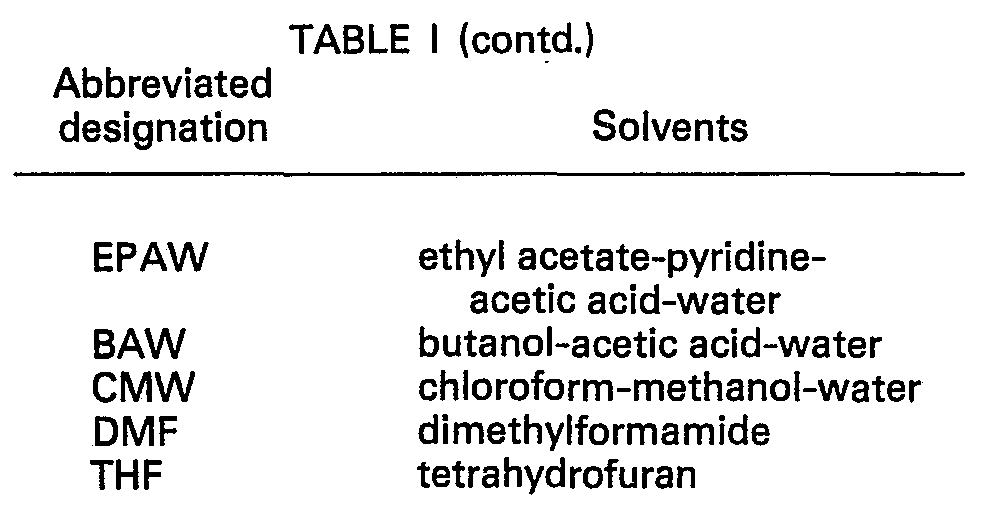
- In accordance with the present invention, Ring I of the novel bicyclic somatostatin analogs is prepared by cyclizing corresponding linear peptides. The linear peptides are prepared by using the solid phase sequential synthesis technique. Accordingly, the process for preparing Ring I of the bicyclic somatostatin analogs of the present invention comprises a) preparing a corresponding blocked linear peptide attached to a solid phase resin; b) selectively deblocking the N-terminal amine group; c) removing the linear peptide from the resin; d) treating the linear peptide with a cyclizing agent to obtain Ring I of the bicyclic peptide through the formation of an amide bond.
- Rings II and III are formed by removing the remaining blocking groups and oxidizing the sulfhydryl groups of Cys within the macrocyclic Ring I. The bicyclic structure is thereby generated through the formation of the disulfide bond. The relative location of the Cys amino acids in Ring I determines the location and size of Rings II and III.
- When the linear peptide is prepared on the resin, it is not critical which amino acid is selected to be at the C-terminal position provided only that the sequence of amino acids in the linear peptide corresponds to that in the desired somatostatin analog. Once a linear peptide has been cyclized one can no longer determine which amino acid was at the C-terminus of the linear peptide. As an example to illustrate this, either of the two following linear peptides, when cyclized, will give the identical Ring I of the bicyclic somatostatin analog:


- It is evident that since the linear peptide is going to be cyclized, it does not matter which amino acid is used to start the chain. Starting with Phe at the carboxyl end, as illustrated in the first of the two examples above, has an advantage over the second example. In the first example, D-Trp, which can react with t-butyl carbonium ions formed when BOC groups are removed, is the N-terminal amino acid and thus will be added last and hence will be subjected to the least amount of exposure to t-butyl carbonium ions.
- The synthesis of the linear peptides by the solid phase technique is conducted in a stepwise manner on chloromethylated resin. The resin is composed of fine beads (20-70 microns in diameter) of a synthetic resin prepared by copolymerization of styrene with 1 to 2 percent divinylzene. The benzene rings in the resin are chlorometnylated in a Friedel-Crafts reaction with chloromethyl methyl ether and stannic chloride. The Friedel-Crafts reaction is continued until the resin contains 0.5 to 5 mmoles of chlorine per gram of resin.
- The amino acid selected to be the C-terminal amino acid of the linear peptide is converted to its amino protected derivative. The carboxyl group of the selected C-terminal amino acid is bound covalently to the insoluble polymeric resin support, as for example, as the carboxylic ester of the resin-bonded benzyl chloride present in chloromethyl-substituted polystyrene-divinylbenzene resin. After the amino protecting group is removed, the amino protected derivative of the next amino acid in the sequence is added along with a coupling agent, such as dicyclohexylcarbodiimide. The amino acid reactant may be employed in the form of a carboxyl-activated amino acid such as the ONp ester, an amino acid azide, and the like. Deprotection and addition of successive amino acids is performed until the desired linear peptide is formed.
- The selection of protecting groups is, in part, dictated by particular coupling conditions; in part by the amino acid and peptide components involved in the reaction.
- Amino-protecting groups ordinarily employed include those which are well known in the art, for example, urethane protecting substituents such as benzyloxycarbonyl(carbobenzoxy), p-methoxy- carbobenzoxy, p-nitrocarbobenzoxy and t-butyloxycarbonyl. It is preferred to utilize t-butyloxycarbonyl (BOC) for protecting the a-amino group in the amino acids undergoing reaction at the carboxyl end of said amino acid. The BOC protecting group is readily removed following such coupling reaction and prior to the subsequent step by the relatively mild action of acids (i.e., trifluoroacetic acid, or hydrogen chloride in ethyl acetate).
- The -OH group of Thr and Ser can be protected by the Bzl group and the F-amino group of Lys can be protected by the INOC group or the 2-chlorobenzyloxycarbonyl (2-CI-CBZ) group. In the case of Lys, it is preferred to protect the e-amino group with 2-CI-CBZ group as this group is removed simultaneously with the Bzl groups by treatment with HF after the linear peptide has been cyclized. The INOC group is not removed by HF and requires an additional treatment with Zn. Neither group is affected by TFA, used for removing BOC protecting groups.
- The sulfhydryl group of Cys is protected by Acm. After the linear peptide is cyclized to form Ring I, the protective groups, such as 2-CI-CBZ and Bzl, are removed by treatment with HF. A particular advantage in using the Acm group is that, it is stable to HF and therefore remains intact after the formation of Ring I and before the formation of Rings II and III. This allows the purification of the intermediate monocyclic compound prior to removal of the Acm group and oxidation of the sulfhydryl groups to form Rings II and III.
- After the linear peptide has been formed on the solid phase resin, it may be removed from the resin by a variety of methods which are well known in the art. For example, the peptide may be cleaved from the resin with hydrazine and thus directly form the peptide hydrazide which may be subsequently cyclized via the azide to the desired Ring I of the bicyclic peptide. The hydrazide is converted to the corresponding azide by reaction with a reagent which furnishes nitrous acid in situ. Suitable reagents for this purpose include a lower alkyl nitrite (e.g. t-butyl nitrite, isoamyl nitrite) or an alkali metal nitrite salt (e.g. sodium nitrite, potassium nitrite) in the presence of a strong acid such as hydrochloric, phosphoric, etc. This reaction is carried out in the presence of either water and/or a non-aqueous solvent such as dimethylformamide, tetrahydrofuran, dioxane, chloroform, methylene chloride, etc., at a temperature between about -40°C and +20°C. Alternatively, the peptide may be removed from the resin by treatment with a lower alcohol such as methanol in the presence of an organic base such as triethylamine, thus resulting in the formation of the corresponding lower alcohol ester of the linear peptide. The resulting ester may be converted to the hydrazide which may then be cyclized, via the azide, to the desired Ring I of the bicyclic peptide. The preferred method for cleaving the peptide from the resin in the present invention is the use of hydrazine.
- Rings II and III of the bicyclic somatostatin analogs are formed by removing the Acm protecting group from the sulfhydryl groups of Cys and oxidizing the sulfhydryl groups to disulfide. This is accomplished by 12 in acetic acic or alternatively by mercuric ion followed by air oxidation.
- As reference to Table II will show, one preferred overall procedure for preparing the desired bicyclic peptides of the present invention involves the stepwise synthesis of the linear peptide on a solid phase resin. More specifically, in the process for preparing:


- After the linear peptide is cyclized to form Ring I, the protective groups, 2-CI-CBZ and Bzl, are removed by treatment with HF in the presence of anisole. The crude cyclic peptide obtained is purified by chromatography, preferably on Sephadex (trademark) eluted with 50% aqueous acetic acid.
- Treatment of Ring I with 12 in acetic acid results in the removal of the Acm protecting groups from Cys sulfhydryl groups and the formation of Rings II and II by the oxidation of the sulfhydryl groups to form a disulfide bond. The final product is purified on Sephadex eluted with 50% aqueous acetic acid and on Sephadex eluted with 2N aqueous acetic acid.
- The following Examples illustrate methods of carrying out the present invention, but is to be understood that these examples are given for purposes of illustration and not of limitation.


- Preparation of

- Chloromethyl resin (2% cross-linked Merrifield resin), 862.0 g (2.37 moles), having 2.75 meq. chlorine/g, and 607.0 g (2.37 moles, 1 equivalent) of BOC-Phe were added to 4320 ml of peroxide-free tetrahydrofuran. The mixture was stirred in an oil bath at 80°C bath temperature for 45 minutes. Triethylamine, 310.0 ml, was added and the reaction mixture stirred at 80°C bath temperature for 70 hours, cooled to 25°C and transferred to a stirred solid phase reaction column with 2000 ml of tetrahydrofuran. After removal of the solvent, the resin was washed using the stirred column with:
- 3x2000 ml of tetrahydrofuran
- 4x5170 ml of ethanol
- 1x5170 ml of acetic acid
- 3x5170 ml of water
- 3x5170 ml of methanol
- 3x5170 ml of chloroform
- BOC-Phe-O-CH2-φ-resin (2.13 g; 2.0 mmole) was carried through the procedures in Tables III and IV using 2 deblockings (2 minutes and 25 minutes) with 25% TFA in methylene chloride in the presence of 1 % ethanedithiol (except when deblocking BOC-Phe-O-CH2-φ-resin), and 2.5 equivalents of BOC-amino acid in the required sequence until the desired BOC-undecapeptide-O-CH2-φ-resin was obtained.
- DCCI was used as the sole coupling agent in every step except the coupling of BOC-(0-Bzl)Ser to Aha-(ε-2-Cl-CBZ)Lys-(Acm)Cys-Phe-Phe-O-CH2-φ-resin in which case the coupling was carried out with DCCI in the presence of 1-hydroxybenzotriazole monohydrate (HBT· H20).
- The coupling of each amino acid proceeded smoothly. Best yields were obtained when the coupling was repeated in each step. When the coupling was repeated, the initial two chloroform washes, the deblocking step and the succeeding three chloroform washes were all omitted and replaced by a single chloroform wash.
- The coupling reactions were carried out in methylene chloride, freshly degassed DMF or a mixture of these two solvents. The N-terminal amino group was blocked with a BOC group in each case; the hydroxy group of THR and Ser was blocked with Bzl; the e-amino group of Lys with 2-CI-CBZ and the sulfhydryl group of Cys with Acm.
- When the desired BOC-undecapeptide -O-CH2-φ-resin was obtained, the N-terminal BOC group was removed by the terminal deblocking procedure set forth in Table V.


- After the procedures of Tables III, IV and V were completed, the blocked undecapeptide-O-CH2-φ-resin was dried overnight in vacuo and weighed 4.80 g.
- To a mixture of 4.62 g D-Trp-(ε-2-Cl-CBZ)Lys-(Acm)Cys-Phe-(O-Bzl)Thr-(O-Bzl)Ser-Aha-(ε-2-Cl-CBZ)Lys-(Acm)Cys-Phe-Phe-O-CH2-φ-resin in 46 ml freshly degassed DMF was added 4.62 ml NH2-NH2. The mixture was magnetically stirred at room temperature for 1 hour. The mixture was filtered to remove the resin. The resin was washed with 4x10 ml DMF. The filtrate and washings were concentrated in vacuo to near dryness. The semi-solid residue was triturated with 50 ml water to obtain a solid. The solid was collected by filtration, slurried with 4x30 ml water and dried in vacuo overnight to yield 2.90 g crude product.
- D-Trp-(ε-2-Cl-CBZ)Lys-(Acm)Cys-Phe-(O-Bzl)Thr-(O-Bzl)Ser-Aha-(ε-2-Cl-CBZ)Lys-(Acm)Cys-Phe-Phe-NH-NH2 (2.88 g, 1.37 mmole), prepared by the process set forth in Step b), was suspended in 29 ml freshly degassed DMF. The suspension was stirred magnetically at -25°C. To the suspension was added 1.3 ml of 5.24N HCI in THF (6.9 mmole, 5 equivalents). To the resulting suspension, "pH" 1.5 to 2.0 was added 280 A isoamyl nitrite (2.09 mmole) and stirring continued until all the starting material dissolved. This solution of D-Trp-(ε-2-Cl-CBZ)Lys-(Acm)Cys-Phe-(O-Bzl)Thr-(O-Bzl)Ser-Aha-(ε-2-Cl-CBZ)Lys-(Acm)Cys-Phe-Phe-N2 was used immediately in step d).
-
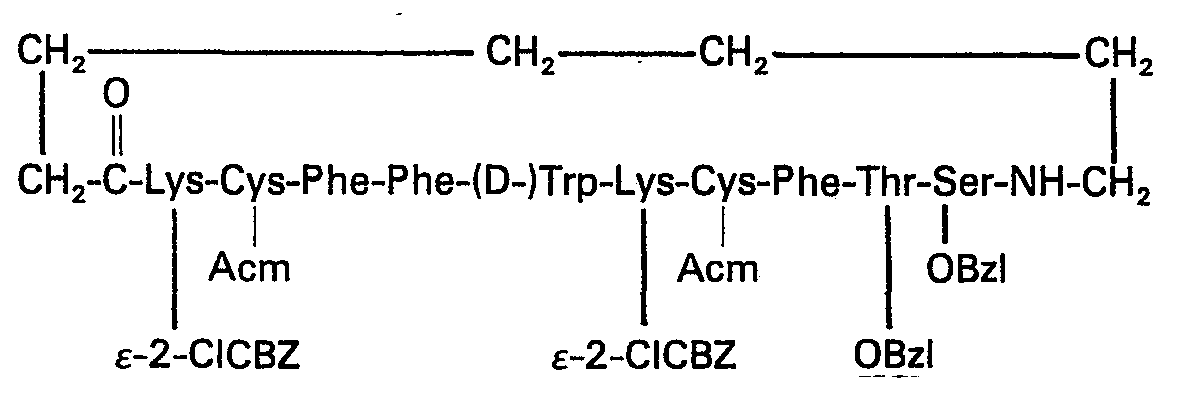
- The solution of D-Trp-(ε-2-Cl-CBZ)Lys-(Acm)-Cys-Phe-(O-Bzl)Thr-(O-Bzl)Ser-Aha-(ε-2-Cl-CBZ)Lys-(Acm)-Cys-Phe-Phe-N3 in DMF, obtained by the process set forth in Step c), was diluted in 2850 ml freshly degassed DMF, precooled to -40°C. The "pH" was adjusted to 7,2 to 7,6 by addition of 6,0 ml N,N-diisopropylethylamine and the solution maintained at -18° for 1 day and at 5°C for 3 days.
- The solution was concentrated in vacuo to near dryness. The residue was triturated with water to give a solid. The solid was collected by filtration, slurried with water (4x20 ml) and dried in vacuo overnight to give 2,81 g of product.
-

-

-

- 2,33 g of the product mentioned in the title as obtained by the process set forth in Step e) were dissolved in 25 ml 50% aqueous acetic acid and charged to a column of Sephadex G-25, (5 cmx115 cm, 2260 ml) packed in 50% aqueous acetic acid. The column was eluted with 50% aqueous acetic acid at the rate of 1 ml/min. Fractions of 18.7 ml were collected. The effluent was monitored at 254 nm.
- Fractions 65 to 83 were combined, concentrated to dryness in vacuo and the residue lyophilized from 30 ml 10% aqueous acetic acid to give 1.6905 g of substantially pure product.
-

- To a solution of 2.19 g 12 in 1000 ml acetic acid was added a solution of 1.0 g (0.646 mmole) product of step f) in 25 ml water and 100 ml acetic acid. The resulting solution was stirred at room temperature for 5 hours. The reaction solution (less 100 ml) was treated with 42 ml 1 N Na2S203 and concentrated in vacuo to near dryness. To the residue was added 30 ml 50% acetic acid and an additional 3 ml 1 N N82S203. The insoluble material was removed by filtration. The filter cake was washed with a total of 20 ml 50% acetic acid. The combined filtrate and washings were charged to a column of Sephadex G-25, (5 cmx 115 cm, 2260 ml) packed in 50% aqueous acetic acid. The column was eluted with 50% aqueous acetic acid and fractions of 18.7 ml were collected. The effluent was monitored at 254 nm.
- Fractions 65 to 75 were combined, concentrated to dryness in vacuo and the residue was dissolved in 25 ml 2N acetic acid and charged to a 5 cmx 115 cm column packed with Sephadex G-25 in 2N acetic acid and eluted with 2N acetic acid. The effluent was monitored at 254 nm and 18.7 ml fractions were collected.
- Fractions 98 to 103 were combined, concentrated to dryness in vacuo and the residue lyophilized from 30 ml 10% aqueous acetic acid to give 257.5 mg of substantially pure product. A 20 hour toluene-sulfonic acid hydrolysate showed the following amino acid analysis:

- The relative potencies of somatostatin analogs on the lowering of plasma insulin and glucagon are determined by the following method:
- Analogs of somatostatin were compared to somatostatin in their ability to lower the levels of portal vein glucagon and insulin in anesthetized rats. Male Sprague-Dawley rats (Charles River CD) (Trademark) weighing 160-200 grams were anesthetized with urethane (150 mg/100 gm). Saline or peptides were administered via the external jugular vein. After 5 minutes the portal vein was exposed and blood was collected via syringes containing 3 mg EDTA and placed in chilled tubes containing 100 µl of Trasylol (obtained from FBA Pharmaceuticlls) for subsequent'hormone analysis. Plasma levels of glucagon were determined by the method of Faloona, G. R., and Unger, R. H. "Glucagon" in Methods of Hormone Radioimmunoassay, eds. Jaffe, B. M. and Behrman, H. R. (Academic Press, Inc., New York) Chap. 18 pp. 317-330 (1974) utilizing glucagon antisera 30K. Plasma levels of insulin were determined by a modification of the procedure of Herbert, V., Lau, K.S. Gottlieb, C. W. and Bleicher, S. J., (J. Clin. Endocrin. and Metab.) 25, 1375-1384 (1965).
- Somatostatin analogs were compared to somatostatin in their ability to inhibit the release of growth hormone in pentobarbital stimulated rats; a modification of the procedure of Brazeau et al. Endocrinology, 94, 184-187 (1974) was employed. Rats were lightly etherized and sodium pentobarbital (17 ml/Kg was injected into the exposed Saphenous vein; somatostatin or analog was simultaneously injected subcutaneously. After 15 minutes the animals were bled via the orbital sinus and blood collected for subsequent growth hormone analysis.
- Rat pituicytes were isolated according to the procedures of Vale and Grant "in vitro Pituitary Hormone Secretion Assay for Hypophysiotropic Substances" in Methods in Enzymology. Vol. XXXVII, eds. O'Malley, B. W. and Hardman, J. G. (Academic Press, Inc., New York) pp. 5-93 (1975).
- After 4 days in culture, the cells were washed and incubated for 4 hours in Dulbecco-modified Eagle's medium in the presence or absence of graded doses of each analog or somatostatin. The medium was then collected for subsequent growth hormone determination by a double antibody radioimmunoassay for rat growth hormone.
- Doses were randomized between groups of animals (6 rats/group). Potency values were determined by four, six, or either point bioassays with somatostatin as the reference standard. Relative potency values were calculated by a relative potency formula for parallel line bioassays as described in Finney, D. J. Statistical Method in Biological Assay (Charles Griffin and Co., Ltd., London) Chap. 4 pp. 99-138 (1964).
- The tested compounds were the compounds la:


- In the following table the results achieved with the above stated compounds la and Ila are stated. In said test report the figures given in brackets refer to the data limits observed during the experiment. That is the numbers observed ranged from the lowest to the highest number and all of the numbers had the average set forth just in front of the parenthetical expression.
- The disparate results observed in some of the data cannot be explained except as experimental variation. As can be seen in the data limits set forth in the parentheticpl expressions, the observed data has wide variations. This variation is inherent in the test and results from variations in the test animals and other factors which cannot be completely controlled. In these tests, animals and tissues from animals have different responses to the same stimulus and such differences are accounted by taking averages and other statistical analyses of many tests.

- In the test results of the table there are set forth the activities of somatostatin and of the both inventive compounds having the formula la and Ila respectively. In each of the tests the activity of somatostatin is given by definition as 1. The first 3 tests are all in vivo and are comparable. They are inhibition of insulin, inhibition of glucagon and inhibition of stimulated growth hormone release. The tests show that the inventive compound la has a substantial effect on growth hormone, i.e. 0,5 relative to somatostatin. Said compound however has only a negligible effect on the release of insulin or glucagon. Somatostatin does not have this characteristic and this selectivity is surprising. Because of this selectivity the bicyclic inventive compound having the formula la is far more useful in the treatment of diabetic retinopathy and acromegaly than somatostatin.
- The effect of somatostatin and its analogs on gastric secretion were determined by the following method:
- Compounds were tested for their ability to inhibit pentagastrin evoked gastric secretion in the chronic fistula dog. Female beagle dogs with a chronic gastric fistula were given pentagastrin (2.5 jug/kg/hour, i.v. from -60 to 120 min) and gastric outputs were collected via the fistula cannula. Samples were analyzed at 30 minute intervals for volume (ml) and titratable acid (mEq/L (titration to pH 7 with 0.01 N NaOH); total acid output (mEq) was calculated as the product of output volume and acid concentration. Test compounds were infused at a constant rate from 0 to 60 minutes. Data have been expressed as percent change of total acid output relative to a placebo trial in the same animals.
- The results are as follows:

- The somatostatin analogs of the present invention and the non-toxic pharmaceutically acceptable salts thereof, are useful in humans and animals for inhibiting growth hormone release as in the treatment of acromegaly without affecting the level of gastric secretions or without affecting the level of gastric secretion, insulin and glucagon. These analogs are particularly useful in the treatment of diabetic retinopathy. In the treatment of acromegaly and diabetic retinopathy, the number and size of daily doses and the time of administration are determined by an individual study of each subject. The method of determining these factors is known to those skilled in the art.
- The somatostatin analogs described herein may be administered to warm blooded animals, including humans, either intravenously, subcutaneously, intramuscularly or orally. The contemplated dose range for oral administration in tablet or capsule form to large mammals is about 0.001 mg to about 7 mg/kg of body weight per day. These somatostatin analogs are preferably administered by injection. A therapeutically effective amount of an analog is ordinarily supplied at a dosage level of from about 0.001 mg to about 2 mg/kg of body weight. Preferably the range is from about 0.00142 mg to about 0.428 mg/kg of body weight administered by intravenous infusion or by subcutaneous injection. The required dosage will vary with the particular condition being treated, the severity of the condition and the duration of treatment.
- If the active ingredient is administered in tablet form, the tablet may contain: a binder such as gum tragacanth, corn starch, gelatin, an excipient such as dicalcium phosphate; a disintegrating agent such as corn starch, and alginic acid; a lubricant such as magnesium stearate; and a sweetening and/or flavoring agent such as sucrose, lactose and wintergreen. Suitable liquid carriers for intravenous administration include sterile water, isotonic saline and phosphate buffer solutions or other pharmaceutically acceptable injectable carriers.
- The following example is included to illustrate the preparation of a representative dose of

-


Said product is a monocyclic decapeptide having from the 4th amino acid until the 13th amino acid the same sequence as somatostatin, except that the 8th amino acid can be also D-Trp and not only Trp. The ring closing group of said monocyclic product however are not the both sulfur atoms of the both Cys of somatostatin but the above described group comprising only one sulfur atom and the -CH2-groups.
the Acm blocking group from Cys and oxydizing the sulfhydryl group to form a bisulfide bond, and isolating the resulting compound of formula I or a pharmaceutically acceptable non toxic acid addition salt.
The BOC-Phe-0-CH2-φ-resin was dried in vacuo at 25°C for 16 hours, giving 1203 g of BOC-Phe-O-CH2-φ-resin containing 0.937 mmole of phenylalanine/g of resin.
Claims (7)






Applications Claiming Priority (2)
| Application Number | Priority Date | Filing Date | Title |
|---|---|---|---|
| US05/856,376 US4140767A (en) | 1977-12-01 | 1977-12-01 | Somatostatin analogs |
| US856376 | 1992-03-23 |
Publications (2)
| Publication Number | Publication Date |
|---|---|
| EP0002264A1 EP0002264A1 (en) | 1979-06-13 |
| EP0002264B1 true EP0002264B1 (en) | 1983-06-22 |
Family
ID=25323459
Family Applications (1)
| Application Number | Title | Priority Date | Filing Date |
|---|---|---|---|
| EP78101496A Expired EP0002264B1 (en) | 1977-12-01 | 1978-12-01 | Somatostatin analogs, process for their preparation and pharmaceutical composition thereof |
Country Status (6)
| Country | Link |
|---|---|
| US (1) | US4140767A (en) |
| EP (1) | EP0002264B1 (en) |
| JP (1) | JPS5484587A (en) |
| DE (1) | DE2862287D1 (en) |
| DK (1) | DK539278A (en) |
| IT (1) | IT1106055B (en) |
Families Citing this family (14)
| Publication number | Priority date | Publication date | Assignee | Title |
|---|---|---|---|---|
| US4191754A (en) * | 1979-02-28 | 1980-03-04 | Merck & Co., Inc. | Bicyclic somatostatin analogs |
| US4190648A (en) * | 1979-03-13 | 1980-02-26 | Merck & Co., Inc. | Peptides having somatostatin activity |
| US4235886A (en) * | 1979-10-31 | 1980-11-25 | Merck & Co., Inc. | Cyclic hexapeptide somatostatin analogs |
| US4310518A (en) * | 1979-10-31 | 1982-01-12 | Merck & Co., Inc. | Cyclic hexapeptide somatostatin analogs |
| DE3062075D1 (en) * | 1979-11-27 | 1983-03-24 | Sandoz Ag | Polypeptides, processes for their production, pharmaceutical compositions comprising said polypeptides and their use |
| US4369179A (en) * | 1979-12-14 | 1983-01-18 | Ciba-Geigy Corporation | Acylpeptides |
| US4659691A (en) * | 1985-02-08 | 1987-04-21 | Merck & Co., Inc. | Novel cyclic Hexapeptide LHRH antagonists |
| US4661472A (en) * | 1985-05-09 | 1987-04-28 | The Salk Institute For Biological Studies | GnRH antagonists IX |
| EP1040837A3 (en) * | 1999-02-26 | 2002-01-02 | Erasmus Universiteit Rotterdam | Medicaments for the treatment of a choroidal neovascularization (CNV) related disorder |
| AU2011348220B2 (en) | 2010-12-22 | 2017-09-07 | The Salk Institute For Biological Studies | Cyclic CRF antagonist peptides |
| WO2025128794A1 (en) | 2023-12-15 | 2025-06-19 | Neurocrine Biosciences, Inc. | Fatty acid conjugated cyclic peptides |
| TW202544027A (en) | 2024-04-19 | 2025-11-16 | 美商紐羅克里生物科學有限公司 | Corticotropin releasing factor receptor 2 (crfr2) agonists |
| WO2026064495A1 (en) | 2024-09-20 | 2026-03-26 | Neurocrine Biosciences, Inc. | Chemically modified peptides and use thereof |
| WO2026064486A1 (en) | 2024-09-20 | 2026-03-26 | Neurocrine Biosciences, Inc. | Chemically modified peptides and use thereof |
Family Cites Families (5)
| Publication number | Priority date | Publication date | Assignee | Title |
|---|---|---|---|---|
| NL6509712A (en) * | 1964-07-27 | 1966-01-28 | ||
| DE2416048A1 (en) * | 1974-04-03 | 1975-10-30 | Hoechst Ag | NEW PEPTIDES WITH BIOLOGICAL EFFECT |
| NL7607987A (en) * | 1975-08-08 | 1977-02-10 | Merck & Co Inc | METHOD FOR PREPARING PEPTIDES. |
| CA1083143A (en) * | 1976-01-02 | 1980-08-05 | Nedumparambil A. Abraham | Carba derivatives of somatostatin and process therefor |
| US3997517A (en) * | 1976-01-30 | 1976-12-14 | American Home Products Corporation | Cyclic somatostatin disulfide analogues |
-
1977
- 1977-12-01 US US05/856,376 patent/US4140767A/en not_active Expired - Lifetime
-
1978
- 1978-11-29 IT IT52120/78A patent/IT1106055B/en active
- 1978-11-30 DK DK539278A patent/DK539278A/en unknown
- 1978-12-01 EP EP78101496A patent/EP0002264B1/en not_active Expired
- 1978-12-01 DE DE7878101496T patent/DE2862287D1/en not_active Expired
- 1978-12-01 JP JP14796378A patent/JPS5484587A/en active Pending
Non-Patent Citations (2)
| Title |
|---|
| Biophys. Biochem. Res. Commun. 75, 143-148(1977) * |
| Burger, Medicinal Chemistry, 4th Ed., Part II, PP.769-774. * |
Also Published As
| Publication number | Publication date |
|---|---|
| IT7852120A0 (en) | 1978-11-29 |
| DK539278A (en) | 1979-06-02 |
| IT1106055B (en) | 1985-11-11 |
| JPS5484587A (en) | 1979-07-05 |
| DE2862287D1 (en) | 1983-07-28 |
| EP0002264A1 (en) | 1979-06-13 |
| US4140767A (en) | 1979-02-20 |
Similar Documents
| Publication | Publication Date | Title |
|---|---|---|
| EP0000053B1 (en) | Somatostatin analogs, process for their preparation and pharmaceutical compositions containing them | |
| US4087390A (en) | Somatostatin analogs and intermediates thereto | |
| US4191754A (en) | Bicyclic somatostatin analogs | |
| US4235886A (en) | Cyclic hexapeptide somatostatin analogs | |
| US4310518A (en) | Cyclic hexapeptide somatostatin analogs | |
| US4093574A (en) | Somatostatin analogs and intermediates thereto | |
| EP0143307B1 (en) | Cyclic hexapeptide somatostatin analogs; process for their preparation and pharmaceutical compositions containing them | |
| EP0063308B1 (en) | Modified d-retro cyclic hexapeptide somatostatin analogs, process for their preparation and pharmaceutical compositions containing them | |
| EP0017746B1 (en) | Peptides having somatostatin activity, compositions comprising them and process for making the peptides | |
| JPS61293997A (en) | Biologically active lisine-containing octapeptide and its preparation | |
| US4140767A (en) | Somatostatin analogs | |
| KR850000415B1 (en) | Process for the preparation of acypeptides | |
| US4486415A (en) | Cyclic hexapeptide somatostatin analogs | |
| EP0000919B1 (en) | Somatostatin analogs, process for their preparation and their use in pharmaceuticals. | |
| US4162248A (en) | Somatostatin analogs | |
| EP0190946A2 (en) | Novel cyclic hexapeptide LHRH antagonists | |
| EP0002262B1 (en) | Somatostatin analogs and process for their preparation | |
| EP0029310B1 (en) | Cyclic hexapeptide somatostatin analogs, process for their preparation and pharmaceutical compositions containing them | |
| EP0113029B1 (en) | Dicyclic hexapeptides, processes for their preparation and pharmaceutical compositions containing them | |
| US4122077A (en) | Somatostatin analogs | |
| US4159263A (en) | (D-Ala5)-somatostatin and analogues thereof | |
| US4012345A (en) | Des-(Ala1, Gly2), Met11 -SRIF and intermediates | |
| US4342671A (en) | Somatostatin analogues | |
| US4182707A (en) | Somatostatin analogues | |
| EP0011366A2 (en) | Synthetic peptides, their preparation, pharmaceutical formulations containing them and intermediates for their preparation |
Legal Events
| Date | Code | Title | Description |
|---|---|---|---|
| PUAI | Public reference made under article 153(3) epc to a published international application that has entered the european phase |
Free format text: ORIGINAL CODE: 0009012 |
|
| AK | Designated contracting states |
Designated state(s): BE CH DE FR GB LU NL SE |
|
| 17P | Request for examination filed | ||
| GRAA | (expected) grant |
Free format text: ORIGINAL CODE: 0009210 |
|
| AK | Designated contracting states |
Designated state(s): BE CH DE FR GB LU NL SE |
|
| PG25 | Lapsed in a contracting state [announced via postgrant information from national office to epo] |
Ref country code: BE Effective date: 19830622 Ref country code: SE Effective date: 19830622 Ref country code: NL Effective date: 19830622 Ref country code: FR Free format text: THE PATENT HAS BEEN ANNULLED BY A DECISION OF A NATIONAL AUTHORITY Effective date: 19830622 |
|
| REF | Corresponds to: |
Ref document number: 2862287 Country of ref document: DE Date of ref document: 19830728 |
|
| NLV1 | Nl: lapsed or annulled due to failure to fulfill the requirements of art. 29p and 29m of the patents act | ||
| PG25 | Lapsed in a contracting state [announced via postgrant information from national office to epo] |
Ref country code: CH Effective date: 19831231 Ref country code: LU Free format text: LAPSE BECAUSE OF NON-PAYMENT OF DUE FEES Effective date: 19831231 |
|
| PLBE | No opposition filed within time limit |
Free format text: ORIGINAL CODE: 0009261 |
|
| STAA | Information on the status of an ep patent application or granted ep patent |
Free format text: STATUS: NO OPPOSITION FILED WITHIN TIME LIMIT |
|
| 26N | No opposition filed | ||
| GBPC | Gb: european patent ceased through non-payment of renewal fee | ||
| REG | Reference to a national code |
Ref country code: CH Ref legal event code: PL |
|
| PG25 | Lapsed in a contracting state [announced via postgrant information from national office to epo] |
Ref country code: DE Effective date: 19840901 |
|
| EN | Fr: translation not filed | ||
| PG25 | Lapsed in a contracting state [announced via postgrant information from national office to epo] |
Ref country code: GB Effective date: 19881117 |