EP0002236B1 - Peptides, their salts, their acid addition salts, pharmaceutical formulations containing them and their use as morphine antagonists and anaesthetics - Google Patents
Peptides, their salts, their acid addition salts, pharmaceutical formulations containing them and their use as morphine antagonists and anaesthetics Download PDFInfo
- Publication number
- EP0002236B1 EP0002236B1 EP78101447A EP78101447A EP0002236B1 EP 0002236 B1 EP0002236 B1 EP 0002236B1 EP 78101447 A EP78101447 A EP 78101447A EP 78101447 A EP78101447 A EP 78101447A EP 0002236 B1 EP0002236 B1 EP 0002236B1
- Authority
- EP
- European Patent Office
- Prior art keywords
- compound
- peptide
- acid addition
- pharmacologically acceptable
- addition salt
- Prior art date
- Legal status (The legal status is an assumption and is not a legal conclusion. Google has not performed a legal analysis and makes no representation as to the accuracy of the status listed.)
- Expired
Links
- 150000003839 salts Chemical class 0.000 title claims description 85
- 108090000765 processed proteins & peptides Proteins 0.000 title claims description 82
- 239000002253 acid Substances 0.000 title claims description 46
- 239000008194 pharmaceutical composition Substances 0.000 title claims description 7
- 102000004196 processed proteins & peptides Human genes 0.000 title description 31
- BQJCRHHNABKAKU-KBQPJGBKSA-N morphine Chemical compound O([C@H]1[C@H](C=C[C@H]23)O)C4=C5[C@@]12CCN(C)[C@@H]3CC5=CC=C4O BQJCRHHNABKAKU-KBQPJGBKSA-N 0.000 title description 20
- 229960005181 morphine Drugs 0.000 title description 10
- 229940124326 anaesthetic agent Drugs 0.000 title description 3
- 230000003444 anaesthetic effect Effects 0.000 title description 3
- 239000005557 antagonist Substances 0.000 title 1
- 150000001875 compounds Chemical class 0.000 claims description 62
- 239000000203 mixture Substances 0.000 claims description 41
- 238000009472 formulation Methods 0.000 claims description 34
- 238000000034 method Methods 0.000 claims description 34
- QTBSBXVTEAMEQO-UHFFFAOYSA-N Acetic acid Chemical compound CC(O)=O QTBSBXVTEAMEQO-UHFFFAOYSA-N 0.000 claims description 32
- -1 carboxylate anion Chemical class 0.000 claims description 23
- 150000003254 radicals Chemical class 0.000 claims description 14
- 150000001413 amino acids Chemical class 0.000 claims description 13
- 238000002360 preparation method Methods 0.000 claims description 13
- 125000000217 alkyl group Chemical group 0.000 claims description 12
- 239000002585 base Substances 0.000 claims description 12
- 125000004432 carbon atom Chemical group C* 0.000 claims description 12
- 150000001768 cations Chemical class 0.000 claims description 12
- 125000000296 D-methionine group Chemical group [H]N([H])[C@@]([H])(C(=O)[*])C([H])([H])C([H])([H])SC([H])([H])[H] 0.000 claims description 11
- 238000006243 chemical reaction Methods 0.000 claims description 11
- 229910052739 hydrogen Inorganic materials 0.000 claims description 11
- 239000001257 hydrogen Substances 0.000 claims description 11
- 125000004435 hydrogen atom Chemical group [H]* 0.000 claims description 11
- 239000000243 solution Substances 0.000 claims description 11
- QGZKDVFQNNGYKY-UHFFFAOYSA-N Ammonia Chemical compound N QGZKDVFQNNGYKY-UHFFFAOYSA-N 0.000 claims description 10
- 125000000174 L-prolyl group Chemical group [H]N1C([H])([H])C([H])([H])C([H])([H])[C@@]1([H])C(*)=O 0.000 claims description 10
- 241000282414 Homo sapiens Species 0.000 claims description 9
- 239000003153 chemical reaction reagent Substances 0.000 claims description 8
- RKGFWMYLTBPZGL-HTQZYQBOSA-N (2r)-2-amino-1-[(2r)-2-amino-4-methylsulfanylbutanoyl]sulfinyl-4-methylsulfanylbutan-1-one Chemical group CSCC[C@@H](N)C(=O)S(=O)C(=O)[C@H](N)CCSC RKGFWMYLTBPZGL-HTQZYQBOSA-N 0.000 claims description 7
- 239000004615 ingredient Substances 0.000 claims description 7
- 239000007924 injection Substances 0.000 claims description 7
- 238000002347 injection Methods 0.000 claims description 7
- 229910021529 ammonia Inorganic materials 0.000 claims description 5
- 229940124537 antidiarrhoeal agent Drugs 0.000 claims description 5
- VEXZGXHMUGYJMC-UHFFFAOYSA-N Hydrochloric acid Chemical compound Cl VEXZGXHMUGYJMC-UHFFFAOYSA-N 0.000 claims description 4
- 230000001142 anti-diarrhea Effects 0.000 claims description 4
- 125000003178 carboxy group Chemical group [H]OC(*)=O 0.000 claims description 4
- 239000002552 dosage form Substances 0.000 claims description 4
- 125000003301 D-leucyl group Chemical group N[C@@H](C(=O)*)CC(C)C 0.000 claims description 3
- 125000000180 D-prolyl group Chemical group N1[C@@H](C(=O)*)CCC1 0.000 claims description 3
- 125000003798 L-tyrosyl group Chemical group [H]N([H])[C@]([H])(C(=O)[*])C([H])([H])C1=C([H])C([H])=C(O[H])C([H])=C1[H] 0.000 claims description 3
- 238000010511 deprotection reaction Methods 0.000 claims description 3
- 230000003647 oxidation Effects 0.000 claims description 3
- 238000007254 oxidation reaction Methods 0.000 claims description 3
- 238000007127 saponification reaction Methods 0.000 claims description 3
- RZTMKPNHKUTQSB-HTQZYQBOSA-N (2r)-2-amino-1-[(2r)-2-amino-4-methylsulfanylbutanoyl]sulfonyl-4-methylsulfanylbutan-1-one Chemical group CSCC[C@@H](N)C(=O)S(=O)(=O)C(=O)[C@H](N)CCSC RZTMKPNHKUTQSB-HTQZYQBOSA-N 0.000 claims description 2
- 239000000730 antalgic agent Substances 0.000 claims description 2
- 230000032050 esterification Effects 0.000 claims description 2
- 238000005886 esterification reaction Methods 0.000 claims description 2
- 238000007911 parenteral administration Methods 0.000 claims description 2
- 238000007493 shaping process Methods 0.000 claims description 2
- 239000000829 suppository Substances 0.000 claims description 2
- 239000003793 antidiarrheal agent Substances 0.000 claims 3
- 239000012736 aqueous medium Substances 0.000 claims 1
- OKKJLVBELUTLKV-UHFFFAOYSA-N Methanol Chemical compound OC OKKJLVBELUTLKV-UHFFFAOYSA-N 0.000 description 30
- 239000004480 active ingredient Substances 0.000 description 17
- 230000000694 effects Effects 0.000 description 17
- 229940024606 amino acid Drugs 0.000 description 15
- HEDRZPFGACZZDS-UHFFFAOYSA-N Chloroform Chemical compound ClC(Cl)Cl HEDRZPFGACZZDS-UHFFFAOYSA-N 0.000 description 10
- 229960000583 acetic acid Drugs 0.000 description 10
- XLYOFNOQVPJJNP-UHFFFAOYSA-N water Substances O XLYOFNOQVPJJNP-UHFFFAOYSA-N 0.000 description 10
- 239000003814 drug Substances 0.000 description 9
- 230000006698 induction Effects 0.000 description 9
- 208000002193 Pain Diseases 0.000 description 8
- 238000005859 coupling reaction Methods 0.000 description 8
- 230000036407 pain Effects 0.000 description 8
- 239000000047 product Substances 0.000 description 8
- 241001465754 Metazoa Species 0.000 description 7
- 230000008878 coupling Effects 0.000 description 7
- 238000010168 coupling process Methods 0.000 description 7
- 230000011514 reflex Effects 0.000 description 7
- 206010002091 Anaesthesia Diseases 0.000 description 6
- 241000699670 Mus sp. Species 0.000 description 6
- 230000037005 anaesthesia Effects 0.000 description 6
- 238000001949 anaesthesia Methods 0.000 description 6
- RDOXTESZEPMUJZ-UHFFFAOYSA-N anisole Chemical compound COC1=CC=CC=C1 RDOXTESZEPMUJZ-UHFFFAOYSA-N 0.000 description 6
- 239000008187 granular material Substances 0.000 description 6
- 239000007788 liquid Substances 0.000 description 6
- 238000012423 maintenance Methods 0.000 description 6
- UZHSEJADLWPNLE-GRGSLBFTSA-N naloxone Chemical compound O=C([C@@H]1O2)CC[C@@]3(O)[C@H]4CC5=CC=C(O)C2=C5[C@@]13CCN4CC=C UZHSEJADLWPNLE-GRGSLBFTSA-N 0.000 description 6
- 230000000144 pharmacologic effect Effects 0.000 description 6
- 239000003826 tablet Substances 0.000 description 6
- 241000700159 Rattus Species 0.000 description 5
- 150000007513 acids Chemical class 0.000 description 5
- 239000000556 agonist Substances 0.000 description 5
- 239000007864 aqueous solution Substances 0.000 description 5
- 239000000969 carrier Substances 0.000 description 5
- 239000003795 chemical substances by application Substances 0.000 description 5
- 239000000843 powder Substances 0.000 description 5
- 125000006239 protecting group Chemical group 0.000 description 5
- DHMQDGOQFOQNFH-UHFFFAOYSA-N Glycine Chemical compound NCC(O)=O DHMQDGOQFOQNFH-UHFFFAOYSA-N 0.000 description 4
- 150000008575 L-amino acids Chemical class 0.000 description 4
- 241000124008 Mammalia Species 0.000 description 4
- LRHPLDYGYMQRHN-UHFFFAOYSA-N N-Butanol Chemical compound CCCCO LRHPLDYGYMQRHN-UHFFFAOYSA-N 0.000 description 4
- 241000906446 Theraps Species 0.000 description 4
- DTQVDTLACAAQTR-UHFFFAOYSA-N Trifluoroacetic acid Chemical compound OC(=O)C(F)(F)F DTQVDTLACAAQTR-UHFFFAOYSA-N 0.000 description 4
- 230000036592 analgesia Effects 0.000 description 4
- IXCSERBJSXMMFS-UHFFFAOYSA-N hydrogen chloride Substances Cl.Cl IXCSERBJSXMMFS-UHFFFAOYSA-N 0.000 description 4
- 229910000041 hydrogen chloride Inorganic materials 0.000 description 4
- HQKMJHAJHXVSDF-UHFFFAOYSA-L magnesium stearate Chemical compound [Mg+2].CCCCCCCCCCCCCCCCCC([O-])=O.CCCCCCCCCCCCCCCCCC([O-])=O HQKMJHAJHXVSDF-UHFFFAOYSA-L 0.000 description 4
- 238000012986 modification Methods 0.000 description 4
- 230000004048 modification Effects 0.000 description 4
- 229960004127 naloxone Drugs 0.000 description 4
- 125000002924 primary amino group Chemical group [H]N([H])* 0.000 description 4
- 230000009467 reduction Effects 0.000 description 4
- 239000000126 substance Substances 0.000 description 4
- 238000012360 testing method Methods 0.000 description 4
- 230000001225 therapeutic effect Effects 0.000 description 4
- QTBSBXVTEAMEQO-UHFFFAOYSA-M Acetate Chemical compound CC([O-])=O QTBSBXVTEAMEQO-UHFFFAOYSA-M 0.000 description 3
- 206010011224 Cough Diseases 0.000 description 3
- LFQSCWFLJHTTHZ-UHFFFAOYSA-N Ethanol Chemical compound CCO LFQSCWFLJHTTHZ-UHFFFAOYSA-N 0.000 description 3
- XEKOWRVHYACXOJ-UHFFFAOYSA-N Ethyl acetate Chemical compound CCOC(C)=O XEKOWRVHYACXOJ-UHFFFAOYSA-N 0.000 description 3
- SJRJJKPEHAURKC-UHFFFAOYSA-N N-Methylmorpholine Chemical compound CN1CCOCC1 SJRJJKPEHAURKC-UHFFFAOYSA-N 0.000 description 3
- HEMHJVSKTPXQMS-UHFFFAOYSA-M Sodium hydroxide Chemical compound [OH-].[Na+] HEMHJVSKTPXQMS-UHFFFAOYSA-M 0.000 description 3
- ZMANZCXQSJIPKH-UHFFFAOYSA-N Triethylamine Chemical compound CCN(CC)CC ZMANZCXQSJIPKH-UHFFFAOYSA-N 0.000 description 3
- 230000000954 anitussive effect Effects 0.000 description 3
- KRKNYBCHXYNGOX-UHFFFAOYSA-N citric acid Chemical compound OC(=O)CC(O)(C(O)=O)CC(O)=O KRKNYBCHXYNGOX-UHFFFAOYSA-N 0.000 description 3
- 230000008602 contraction Effects 0.000 description 3
- 229940079593 drug Drugs 0.000 description 3
- 239000012634 fragment Substances 0.000 description 3
- 238000007327 hydrogenolysis reaction Methods 0.000 description 3
- 238000000185 intracerebroventricular administration Methods 0.000 description 3
- 238000001990 intravenous administration Methods 0.000 description 3
- 239000000314 lubricant Substances 0.000 description 3
- UZKWTJUDCOPSNM-UHFFFAOYSA-N methoxybenzene Substances CCCCOC=C UZKWTJUDCOPSNM-UHFFFAOYSA-N 0.000 description 3
- 239000007787 solid Substances 0.000 description 3
- 238000003786 synthesis reaction Methods 0.000 description 3
- YEDUAINPPJYDJZ-UHFFFAOYSA-N 2-hydroxybenzothiazole Chemical compound C1=CC=C2SC(O)=NC2=C1 YEDUAINPPJYDJZ-UHFFFAOYSA-N 0.000 description 2
- 229920002134 Carboxymethyl cellulose Polymers 0.000 description 2
- 241000700198 Cavia Species 0.000 description 2
- FFEARJCKVFRZRR-SCSAIBSYSA-N D-methionine Chemical compound CSCC[C@@H](N)C(O)=O FFEARJCKVFRZRR-SCSAIBSYSA-N 0.000 description 2
- 206010012735 Diarrhoea Diseases 0.000 description 2
- QOSSAOTZNIDXMA-UHFFFAOYSA-N Dicylcohexylcarbodiimide Chemical compound C1CCCCC1N=C=NC1CCCCC1 QOSSAOTZNIDXMA-UHFFFAOYSA-N 0.000 description 2
- 108010010803 Gelatin Proteins 0.000 description 2
- PEDCQBHIVMGVHV-UHFFFAOYSA-N Glycerine Chemical compound OCC(O)CO PEDCQBHIVMGVHV-UHFFFAOYSA-N 0.000 description 2
- MHAJPDPJQMAIIY-UHFFFAOYSA-N Hydrogen peroxide Chemical compound OO MHAJPDPJQMAIIY-UHFFFAOYSA-N 0.000 description 2
- HXEACLLIILLPRG-YFKPBYRVSA-N L-pipecolic acid Chemical compound [O-]C(=O)[C@@H]1CCCC[NH2+]1 HXEACLLIILLPRG-YFKPBYRVSA-N 0.000 description 2
- GUBGYTABKSRVRQ-QKKXKWKRSA-N Lactose Natural products OC[C@H]1O[C@@H](O[C@H]2[C@H](O)[C@@H](O)C(O)O[C@@H]2CO)[C@H](O)[C@@H](O)[C@H]1O GUBGYTABKSRVRQ-QKKXKWKRSA-N 0.000 description 2
- 235000010643 Leucaena leucocephala Nutrition 0.000 description 2
- 240000007472 Leucaena leucocephala Species 0.000 description 2
- 206010028980 Neoplasm Diseases 0.000 description 2
- KDLHZDBZIXYQEI-UHFFFAOYSA-N Palladium Chemical compound [Pd] KDLHZDBZIXYQEI-UHFFFAOYSA-N 0.000 description 2
- ATTZFSUZZUNHBP-UHFFFAOYSA-N Piperonyl sulfoxide Chemical compound CCCCCCCCS(=O)C(C)CC1=CC=C2OCOC2=C1 ATTZFSUZZUNHBP-UHFFFAOYSA-N 0.000 description 2
- 229930006000 Sucrose Natural products 0.000 description 2
- CZMRCDWAGMRECN-UGDNZRGBSA-N Sucrose Chemical compound O[C@H]1[C@H](O)[C@@H](CO)O[C@@]1(CO)O[C@@H]1[C@H](O)[C@@H](O)[C@H](O)[C@@H](CO)O1 CZMRCDWAGMRECN-UGDNZRGBSA-N 0.000 description 2
- 230000003213 activating effect Effects 0.000 description 2
- 150000001408 amides Chemical class 0.000 description 2
- 150000008064 anhydrides Chemical class 0.000 description 2
- 238000010171 animal model Methods 0.000 description 2
- 229940124584 antitussives Drugs 0.000 description 2
- 125000000637 arginyl group Chemical group N[C@@H](CCCNC(N)=N)C(=O)* 0.000 description 2
- 229940125717 barbiturate Drugs 0.000 description 2
- 239000011230 binding agent Substances 0.000 description 2
- 230000015572 biosynthetic process Effects 0.000 description 2
- 239000008280 blood Substances 0.000 description 2
- 210000004369 blood Anatomy 0.000 description 2
- 239000000872 buffer Substances 0.000 description 2
- 201000011510 cancer Diseases 0.000 description 2
- 235000010948 carboxy methyl cellulose Nutrition 0.000 description 2
- 125000002843 carboxylic acid group Chemical group 0.000 description 2
- 238000003776 cleavage reaction Methods 0.000 description 2
- 229940000425 combination drug Drugs 0.000 description 2
- 230000000295 complement effect Effects 0.000 description 2
- 238000009833 condensation Methods 0.000 description 2
- 230000005494 condensation Effects 0.000 description 2
- AAOVKJBEBIDNHE-UHFFFAOYSA-N diazepam Chemical compound N=1CC(=O)N(C)C2=CC=C(Cl)C=C2C=1C1=CC=CC=C1 AAOVKJBEBIDNHE-UHFFFAOYSA-N 0.000 description 2
- 239000003085 diluting agent Substances 0.000 description 2
- PCHPORCSPXIHLZ-UHFFFAOYSA-N diphenhydramine hydrochloride Chemical compound [Cl-].C=1C=CC=CC=1C(OCC[NH+](C)C)C1=CC=CC=C1 PCHPORCSPXIHLZ-UHFFFAOYSA-N 0.000 description 2
- RMEDXOLNCUSCGS-UHFFFAOYSA-N droperidol Chemical compound C1=CC(F)=CC=C1C(=O)CCCN1CC=C(N2C(NC3=CC=CC=C32)=O)CC1 RMEDXOLNCUSCGS-UHFFFAOYSA-N 0.000 description 2
- 210000000624 ear auricle Anatomy 0.000 description 2
- 239000000839 emulsion Substances 0.000 description 2
- IVLVTNPOHDFFCJ-UHFFFAOYSA-N fentanyl citrate Chemical compound OC(=O)CC(O)(C(O)=O)CC(O)=O.C=1C=CC=CC=1N(C(=O)CC)C(CC1)CCN1CCC1=CC=CC=C1 IVLVTNPOHDFFCJ-UHFFFAOYSA-N 0.000 description 2
- 238000004108 freeze drying Methods 0.000 description 2
- 239000008273 gelatin Substances 0.000 description 2
- 229920000159 gelatin Polymers 0.000 description 2
- 235000019322 gelatine Nutrition 0.000 description 2
- 235000011852 gelatine desserts Nutrition 0.000 description 2
- 239000003193 general anesthetic agent Substances 0.000 description 2
- 239000012362 glacial acetic acid Substances 0.000 description 2
- 150000003840 hydrochlorides Chemical class 0.000 description 2
- NPZTUJOABDZTLV-UHFFFAOYSA-N hydroxybenzotriazole Substances O=C1C=CC=C2NNN=C12 NPZTUJOABDZTLV-UHFFFAOYSA-N 0.000 description 2
- 238000000338 in vitro Methods 0.000 description 2
- 238000001727 in vivo Methods 0.000 description 2
- 230000005764 inhibitory process Effects 0.000 description 2
- 238000007918 intramuscular administration Methods 0.000 description 2
- 239000008101 lactose Substances 0.000 description 2
- 125000003588 lysine group Chemical group [H]N([H])C([H])([H])C([H])([H])C([H])([H])C([H])([H])C([H])(N([H])[H])C(*)=O 0.000 description 2
- 235000019359 magnesium stearate Nutrition 0.000 description 2
- 230000001404 mediated effect Effects 0.000 description 2
- 125000000956 methoxy group Chemical group [H]C([H])([H])O* 0.000 description 2
- 238000000465 moulding Methods 0.000 description 2
- 239000004084 narcotic analgesic agent Substances 0.000 description 2
- 239000003887 narcotic antagonist Substances 0.000 description 2
- AHLPHDHHMVZTML-BYPYZUCNSA-N ornithyl group Chemical group N[C@@H](CCCN)C(=O)O AHLPHDHHMVZTML-BYPYZUCNSA-N 0.000 description 2
- ADIMAYPTOBDMTL-UHFFFAOYSA-N oxazepam Chemical compound C12=CC(Cl)=CC=C2NC(=O)C(O)N=C1C1=CC=CC=C1 ADIMAYPTOBDMTL-UHFFFAOYSA-N 0.000 description 2
- 239000006072 paste Substances 0.000 description 2
- 238000010647 peptide synthesis reaction Methods 0.000 description 2
- 238000000746 purification Methods 0.000 description 2
- 239000002516 radical scavenger Substances 0.000 description 2
- 238000011160 research Methods 0.000 description 2
- 230000028527 righting reflex Effects 0.000 description 2
- 230000007017 scission Effects 0.000 description 2
- 239000007790 solid phase Substances 0.000 description 2
- 238000007920 subcutaneous administration Methods 0.000 description 2
- 239000005720 sucrose Substances 0.000 description 2
- 239000002511 suppository base Substances 0.000 description 2
- 239000004094 surface-active agent Substances 0.000 description 2
- AWLILQARPMWUHA-UHFFFAOYSA-M thiopental sodium Chemical compound [Na+].CCCC(C)C1(CC)C(=O)NC([S-])=NC1=O AWLILQARPMWUHA-UHFFFAOYSA-M 0.000 description 2
- 230000000699 topical effect Effects 0.000 description 2
- 239000008215 water for injection Substances 0.000 description 2
- JNHPUZURWFYYHW-DTUSRQQPSA-N (1R,2S,6R,14R,15R,19R)-19-[(2R)-2-hydroxypentan-2-yl]-15-methoxy-5-methyl-13-oxa-5-azahexacyclo[13.2.2.12,8.01,6.02,14.012,20]icosa-8(20),9,11,16-tetraen-11-ol hydrochloride Chemical compound Cl.O([C@H]1[C@@]2(OC)C=C[C@@]34C[C@@H]2[C@](C)(O)CCC)C2=C5[C@]41CCN(C)[C@@H]3CC5=CC=C2O JNHPUZURWFYYHW-DTUSRQQPSA-N 0.000 description 1
- MTCFGRXMJLQNBG-REOHCLBHSA-N (2S)-2-Amino-3-hydroxypropansäure Chemical compound OC[C@H](N)C(O)=O MTCFGRXMJLQNBG-REOHCLBHSA-N 0.000 description 1
- ZQEBQGAAWMOMAI-ZETCQYMHSA-N (2s)-1-[(2-methylpropan-2-yl)oxycarbonyl]pyrrolidine-2-carboxylic acid Chemical compound CC(C)(C)OC(=O)N1CCC[C@H]1C(O)=O ZQEBQGAAWMOMAI-ZETCQYMHSA-N 0.000 description 1
- GUJAGMICFDYKNR-UHFFFAOYSA-N 1,4-benzodiazepine Chemical compound N1C=CN=CC2=CC=CC=C12 GUJAGMICFDYKNR-UHFFFAOYSA-N 0.000 description 1
- SVUOLADPCWQTTE-UHFFFAOYSA-N 1h-1,2-benzodiazepine Chemical compound N1N=CC=CC2=CC=CC=C12 SVUOLADPCWQTTE-UHFFFAOYSA-N 0.000 description 1
- ZEQCMXZRJAAKCJ-UHFFFAOYSA-N 2,2,2-trichloroethane-1,1-diol Chemical compound OC(O)C(Cl)(Cl)Cl.OC(O)C(Cl)(Cl)Cl ZEQCMXZRJAAKCJ-UHFFFAOYSA-N 0.000 description 1
- ZWEHNKRNPOVVGH-UHFFFAOYSA-N 2-Butanone Chemical compound CCC(C)=O ZWEHNKRNPOVVGH-UHFFFAOYSA-N 0.000 description 1
- ZXGFCPCYAPRWRY-UHFFFAOYSA-N 2-acetamido-3-(4-methylsulfinylphenyl)propanoic acid Chemical compound CC(=O)NC(C(O)=O)CC1=CC=C(S(C)=O)C=C1 ZXGFCPCYAPRWRY-UHFFFAOYSA-N 0.000 description 1
- GAZRNXIMWKZADY-UHFFFAOYSA-N 3,5-dimethylpyrazole-1-carboximidamide Chemical compound CC=1C=C(C)N(C(N)=N)N=1 GAZRNXIMWKZADY-UHFFFAOYSA-N 0.000 description 1
- JLLYLQLDYORLBB-UHFFFAOYSA-N 5-bromo-n-methylthiophene-2-sulfonamide Chemical compound CNS(=O)(=O)C1=CC=C(Br)S1 JLLYLQLDYORLBB-UHFFFAOYSA-N 0.000 description 1
- IKHGUXGNUITLKF-UHFFFAOYSA-N Acetaldehyde Chemical compound CC=O IKHGUXGNUITLKF-UHFFFAOYSA-N 0.000 description 1
- 206010063081 Acute left ventricular failure Diseases 0.000 description 1
- 206010001029 Acute pulmonary oedema Diseases 0.000 description 1
- USFZMSVCRYTOJT-UHFFFAOYSA-N Ammonium acetate Chemical compound N.CC(O)=O USFZMSVCRYTOJT-UHFFFAOYSA-N 0.000 description 1
- 239000005695 Ammonium acetate Substances 0.000 description 1
- VHUUQVKOLVNVRT-UHFFFAOYSA-N Ammonium hydroxide Chemical compound [NH4+].[OH-] VHUUQVKOLVNVRT-UHFFFAOYSA-N 0.000 description 1
- 208000019901 Anxiety disease Diseases 0.000 description 1
- 241000416162 Astragalus gummifer Species 0.000 description 1
- 206010004663 Biliary colic Diseases 0.000 description 1
- 125000001433 C-terminal amino-acid group Chemical group 0.000 description 1
- 241000700199 Cavia porcellus Species 0.000 description 1
- 206010010774 Constipation Diseases 0.000 description 1
- 229920002261 Corn starch Polymers 0.000 description 1
- 206010012335 Dependence Diseases 0.000 description 1
- 208000020401 Depressive disease Diseases 0.000 description 1
- 206010013975 Dyspnoeas Diseases 0.000 description 1
- 241001539473 Euphoria Species 0.000 description 1
- 206010015535 Euphoric mood Diseases 0.000 description 1
- 239000004471 Glycine Substances 0.000 description 1
- 229910004373 HOAc Inorganic materials 0.000 description 1
- 241000282412 Homo Species 0.000 description 1
- DGAQECJNVWCQMB-PUAWFVPOSA-M Ilexoside XXIX Chemical compound C[C@@H]1CC[C@@]2(CC[C@@]3(C(=CC[C@H]4[C@]3(CC[C@@H]5[C@@]4(CC[C@@H](C5(C)C)OS(=O)(=O)[O-])C)C)[C@@H]2[C@]1(C)O)C)C(=O)O[C@H]6[C@@H]([C@H]([C@@H]([C@H](O6)CO)O)O)O.[Na+] DGAQECJNVWCQMB-PUAWFVPOSA-M 0.000 description 1
- 206010021703 Indifference Diseases 0.000 description 1
- AYFVYJQAPQTCCC-GBXIJSLDSA-N L-threonine Chemical compound C[C@@H](O)[C@H](N)C(O)=O AYFVYJQAPQTCCC-GBXIJSLDSA-N 0.000 description 1
- 235000019759 Maize starch Nutrition 0.000 description 1
- 101100108551 Mus musculus Akr1b7 gene Proteins 0.000 description 1
- WHNWPMSKXPGLAX-UHFFFAOYSA-N N-Vinyl-2-pyrrolidone Chemical compound C=CN1CCCC1=O WHNWPMSKXPGLAX-UHFFFAOYSA-N 0.000 description 1
- ZLMJMSJWJFRBEC-UHFFFAOYSA-N Potassium Chemical compound [K] ZLMJMSJWJFRBEC-UHFFFAOYSA-N 0.000 description 1
- 206010038419 Renal colic Diseases 0.000 description 1
- 235000004443 Ricinus communis Nutrition 0.000 description 1
- 206010039897 Sedation Diseases 0.000 description 1
- MTCFGRXMJLQNBG-UHFFFAOYSA-N Serine Natural products OCC(N)C(O)=O MTCFGRXMJLQNBG-UHFFFAOYSA-N 0.000 description 1
- VYPSYNLAJGMNEJ-UHFFFAOYSA-N Silicium dioxide Chemical compound O=[Si]=O VYPSYNLAJGMNEJ-UHFFFAOYSA-N 0.000 description 1
- 208000013738 Sleep Initiation and Maintenance disease Diseases 0.000 description 1
- FAPWRFPIFSIZLT-UHFFFAOYSA-M Sodium chloride Chemical compound [Na+].[Cl-] FAPWRFPIFSIZLT-UHFFFAOYSA-M 0.000 description 1
- 208000005392 Spasm Diseases 0.000 description 1
- 208000007271 Substance Withdrawal Syndrome Diseases 0.000 description 1
- NINIDFKCEFEMDL-UHFFFAOYSA-N Sulfur Chemical compound [S] NINIDFKCEFEMDL-UHFFFAOYSA-N 0.000 description 1
- QAOWNCQODCNURD-UHFFFAOYSA-N Sulfuric acid Chemical class OS(O)(=O)=O QAOWNCQODCNURD-UHFFFAOYSA-N 0.000 description 1
- 239000005864 Sulphur Substances 0.000 description 1
- AYFVYJQAPQTCCC-UHFFFAOYSA-N Threonine Natural products CC(O)C(N)C(O)=O AYFVYJQAPQTCCC-UHFFFAOYSA-N 0.000 description 1
- 239000004473 Threonine Substances 0.000 description 1
- 229920001615 Tragacanth Polymers 0.000 description 1
- HVVNJUAVDAZWCB-YFKPBYRVSA-N [(2s)-pyrrolidin-2-yl]methanol Chemical compound OC[C@@H]1CCCN1 HVVNJUAVDAZWCB-YFKPBYRVSA-N 0.000 description 1
- 229960005054 acepromazine Drugs 0.000 description 1
- NOSIYYJFMPDDSA-UHFFFAOYSA-N acepromazine Chemical compound C1=C(C(C)=O)C=C2N(CCCN(C)C)C3=CC=CC=C3SC2=C1 NOSIYYJFMPDDSA-UHFFFAOYSA-N 0.000 description 1
- 159000000021 acetate salts Chemical class 0.000 description 1
- 230000001154 acute effect Effects 0.000 description 1
- 239000000443 aerosol Substances 0.000 description 1
- 230000001476 alcoholic effect Effects 0.000 description 1
- 229930013930 alkaloid Natural products 0.000 description 1
- 150000003797 alkaloid derivatives Chemical class 0.000 description 1
- 239000004411 aluminium Substances 0.000 description 1
- XAGFODPZIPBFFR-UHFFFAOYSA-N aluminium Chemical compound [Al] XAGFODPZIPBFFR-UHFFFAOYSA-N 0.000 description 1
- 229910052782 aluminium Inorganic materials 0.000 description 1
- 125000003277 amino group Chemical group 0.000 description 1
- 229940043376 ammonium acetate Drugs 0.000 description 1
- 235000019257 ammonium acetate Nutrition 0.000 description 1
- 239000000908 ammonium hydroxide Substances 0.000 description 1
- 230000000202 analgesic effect Effects 0.000 description 1
- 239000003963 antioxidant agent Substances 0.000 description 1
- 235000006708 antioxidants Nutrition 0.000 description 1
- 230000036506 anxiety Effects 0.000 description 1
- HNYOPLTXPVRDBG-UHFFFAOYSA-N barbituric acid Chemical compound O=C1CC(=O)NC(=O)N1 HNYOPLTXPVRDBG-UHFFFAOYSA-N 0.000 description 1
- 150000007656 barbituric acids Chemical class 0.000 description 1
- 229940049706 benzodiazepine Drugs 0.000 description 1
- WPYMKLBDIGXBTP-UHFFFAOYSA-N benzoic acid group Chemical group C(C1=CC=CC=C1)(=O)O WPYMKLBDIGXBTP-UHFFFAOYSA-N 0.000 description 1
- 125000001797 benzyl group Chemical group [H]C1=C([H])C([H])=C(C([H])=C1[H])C([H])([H])* 0.000 description 1
- 125000001584 benzyloxycarbonyl group Chemical group C(=O)(OCC1=CC=CC=C1)* 0.000 description 1
- ADSALMJPJUKESW-UHFFFAOYSA-N beta-Homoproline Chemical compound OC(=O)CC1CCCN1 ADSALMJPJUKESW-UHFFFAOYSA-N 0.000 description 1
- 230000004071 biological effect Effects 0.000 description 1
- 230000037396 body weight Effects 0.000 description 1
- 210000004556 brain Anatomy 0.000 description 1
- 238000013276 bronchoscopy Methods 0.000 description 1
- 125000000484 butyl group Chemical group [H]C([*])([H])C([H])([H])C([H])([H])C([H])([H])[H] 0.000 description 1
- 125000004744 butyloxycarbonyl group Chemical group 0.000 description 1
- 210000004899 c-terminal region Anatomy 0.000 description 1
- 239000002775 capsule Substances 0.000 description 1
- 239000001768 carboxy methyl cellulose Substances 0.000 description 1
- 239000008112 carboxymethyl-cellulose Substances 0.000 description 1
- 239000004359 castor oil Substances 0.000 description 1
- 235000019438 castor oil Nutrition 0.000 description 1
- 229960004782 chlordiazepoxide Drugs 0.000 description 1
- ANTSCNMPPGJYLG-UHFFFAOYSA-N chlordiazepoxide Chemical compound O=N=1CC(NC)=NC2=CC=C(Cl)C=C2C=1C1=CC=CC=C1 ANTSCNMPPGJYLG-UHFFFAOYSA-N 0.000 description 1
- 229940011182 cobalt acetate Drugs 0.000 description 1
- QAHREYKOYSIQPH-UHFFFAOYSA-L cobalt(II) acetate Chemical compound [Co+2].CC([O-])=O.CC([O-])=O QAHREYKOYSIQPH-UHFFFAOYSA-L 0.000 description 1
- 229940110456 cocoa butter Drugs 0.000 description 1
- 235000019868 cocoa butter Nutrition 0.000 description 1
- 239000007891 compressed tablet Substances 0.000 description 1
- 238000007906 compression Methods 0.000 description 1
- 230000006835 compression Effects 0.000 description 1
- 238000007796 conventional method Methods 0.000 description 1
- 230000036461 convulsion Effects 0.000 description 1
- 210000004087 cornea Anatomy 0.000 description 1
- 239000006071 cream Substances 0.000 description 1
- 238000002574 cystoscopy Methods 0.000 description 1
- 230000002939 deleterious effect Effects 0.000 description 1
- 229960003529 diazepam Drugs 0.000 description 1
- 235000014113 dietary fatty acids Nutrition 0.000 description 1
- 239000002270 dispersing agent Substances 0.000 description 1
- 229960000394 droperidol Drugs 0.000 description 1
- 239000000890 drug combination Substances 0.000 description 1
- 208000001848 dysentery Diseases 0.000 description 1
- 229920001971 elastomer Polymers 0.000 description 1
- 238000010828 elution Methods 0.000 description 1
- 230000007613 environmental effect Effects 0.000 description 1
- 150000002148 esters Chemical class 0.000 description 1
- 229940093499 ethyl acetate Drugs 0.000 description 1
- 235000019439 ethyl acetate Nutrition 0.000 description 1
- MIQVDHUBTPSRLH-UHFFFAOYSA-N ethyl carbamate;ethylcarbamic acid Chemical compound CCNC(O)=O.CCOC(N)=O MIQVDHUBTPSRLH-UHFFFAOYSA-N 0.000 description 1
- 125000000031 ethylamino group Chemical group [H]C([H])([H])C([H])([H])N([H])[*] 0.000 description 1
- 230000000763 evoking effect Effects 0.000 description 1
- 210000000744 eyelid Anatomy 0.000 description 1
- 229930195729 fatty acid Natural products 0.000 description 1
- 239000000194 fatty acid Substances 0.000 description 1
- 150000004665 fatty acids Chemical class 0.000 description 1
- 229960004207 fentanyl citrate Drugs 0.000 description 1
- 239000000706 filtrate Substances 0.000 description 1
- 239000000796 flavoring agent Substances 0.000 description 1
- 235000013355 food flavoring agent Nutrition 0.000 description 1
- 239000012458 free base Substances 0.000 description 1
- 238000007429 general method Methods 0.000 description 1
- 239000011521 glass Substances 0.000 description 1
- 235000011187 glycerol Nutrition 0.000 description 1
- ZEMPKEQAKRGZGQ-XOQCFJPHSA-N glycerol triricinoleate Natural products CCCCCC[C@@H](O)CC=CCCCCCCCC(=O)OC[C@@H](COC(=O)CCCCCCCC=CC[C@@H](O)CCCCCC)OC(=O)CCCCCCCC=CC[C@H](O)CCCCCC ZEMPKEQAKRGZGQ-XOQCFJPHSA-N 0.000 description 1
- 229940093915 gynecological organic acid Drugs 0.000 description 1
- 125000000487 histidyl group Chemical group [H]N([H])C(C(=O)O*)C([H])([H])C1=C([H])N([H])C([H])=N1 0.000 description 1
- 238000007455 ileostomy Methods 0.000 description 1
- 210000003405 ileum Anatomy 0.000 description 1
- 238000011065 in-situ storage Methods 0.000 description 1
- 239000003701 inert diluent Substances 0.000 description 1
- 229910052500 inorganic mineral Inorganic materials 0.000 description 1
- 206010022437 insomnia Diseases 0.000 description 1
- 230000000968 intestinal effect Effects 0.000 description 1
- 238000002955 isolation Methods 0.000 description 1
- 231100000636 lethal dose Toxicity 0.000 description 1
- 239000007937 lozenge Substances 0.000 description 1
- 230000001050 lubricating effect Effects 0.000 description 1
- 230000000873 masking effect Effects 0.000 description 1
- 239000012528 membrane Substances 0.000 description 1
- FJQXCDYVZAHXNS-UHFFFAOYSA-N methadone hydrochloride Chemical compound Cl.C=1C=CC=CC=1C(CC(C)N(C)C)(C(=O)CC)C1=CC=CC=C1 FJQXCDYVZAHXNS-UHFFFAOYSA-N 0.000 description 1
- 125000001360 methionine group Chemical group N[C@@H](CCSC)C(=O)* 0.000 description 1
- 229940042053 methotrimeprazine Drugs 0.000 description 1
- VRQVVMDWGGWHTJ-CQSZACIVSA-N methotrimeprazine Chemical compound C1=CC=C2N(C[C@H](C)CN(C)C)C3=CC(OC)=CC=C3SC2=C1 VRQVVMDWGGWHTJ-CQSZACIVSA-N 0.000 description 1
- BLWYXBNNBYXPPL-YFKPBYRVSA-N methyl (2s)-pyrrolidine-2-carboxylate Chemical compound COC(=O)[C@@H]1CCCN1 BLWYXBNNBYXPPL-YFKPBYRVSA-N 0.000 description 1
- 150000004702 methyl esters Chemical class 0.000 description 1
- 239000011707 mineral Substances 0.000 description 1
- 239000007923 nasal drop Substances 0.000 description 1
- 229940100662 nasal drops Drugs 0.000 description 1
- 239000003176 neuroleptic agent Substances 0.000 description 1
- 231100000252 nontoxic Toxicity 0.000 description 1
- 230000003000 nontoxic effect Effects 0.000 description 1
- 239000003921 oil Substances 0.000 description 1
- 230000003287 optical effect Effects 0.000 description 1
- 150000007524 organic acids Chemical class 0.000 description 1
- 235000005985 organic acids Nutrition 0.000 description 1
- 229960004535 oxazepam Drugs 0.000 description 1
- 239000007800 oxidant agent Substances 0.000 description 1
- 239000002245 particle Substances 0.000 description 1
- 235000010603 pastilles Nutrition 0.000 description 1
- VLTRZXGMWDSKGL-UHFFFAOYSA-N perchloric acid Chemical class OCl(=O)(=O)=O VLTRZXGMWDSKGL-UHFFFAOYSA-N 0.000 description 1
- COLNVLDHVKWLRT-QMMMGPOBSA-N phenylalanine group Chemical group N[C@@H](CC1=CC=CC=C1)C(=O)O COLNVLDHVKWLRT-QMMMGPOBSA-N 0.000 description 1
- UYWQUFXKFGHYNT-UHFFFAOYSA-N phenylmethyl ester of formic acid Natural products O=COCC1=CC=CC=C1 UYWQUFXKFGHYNT-UHFFFAOYSA-N 0.000 description 1
- 229920001467 poly(styrenesulfonates) Polymers 0.000 description 1
- 235000013855 polyvinylpyrrolidone Nutrition 0.000 description 1
- 229920000036 polyvinylpyrrolidone Polymers 0.000 description 1
- 239000011148 porous material Substances 0.000 description 1
- 230000002980 postoperative effect Effects 0.000 description 1
- 239000011591 potassium Substances 0.000 description 1
- 229910052700 potassium Inorganic materials 0.000 description 1
- 229940069328 povidone Drugs 0.000 description 1
- 239000003755 preservative agent Substances 0.000 description 1
- 125000001436 propyl group Chemical group [H]C([*])([H])C([H])([H])C([H])([H])[H] 0.000 description 1
- 230000003236 psychic effect Effects 0.000 description 1
- 239000000376 reactant Substances 0.000 description 1
- 238000009877 rendering Methods 0.000 description 1
- 239000011347 resin Substances 0.000 description 1
- 229920005989 resin Polymers 0.000 description 1
- 239000000523 sample Substances 0.000 description 1
- 229920006395 saturated elastomer Polymers 0.000 description 1
- 230000036280 sedation Effects 0.000 description 1
- 239000000741 silica gel Substances 0.000 description 1
- 229910002027 silica gel Inorganic materials 0.000 description 1
- 229960001866 silicon dioxide Drugs 0.000 description 1
- 210000002460 smooth muscle Anatomy 0.000 description 1
- 239000011734 sodium Substances 0.000 description 1
- 229910052708 sodium Inorganic materials 0.000 description 1
- 229910000033 sodium borohydride Inorganic materials 0.000 description 1
- 239000012279 sodium borohydride Substances 0.000 description 1
- 239000002904 solvent Substances 0.000 description 1
- 238000001228 spectrum Methods 0.000 description 1
- 210000000278 spinal cord Anatomy 0.000 description 1
- 239000007921 spray Substances 0.000 description 1
- 238000010561 standard procedure Methods 0.000 description 1
- 230000000638 stimulation Effects 0.000 description 1
- 125000001174 sulfone group Chemical group 0.000 description 1
- 235000011149 sulphuric acid Nutrition 0.000 description 1
- 239000013589 supplement Substances 0.000 description 1
- 230000001629 suppression Effects 0.000 description 1
- 239000000725 suspension Substances 0.000 description 1
- 239000007916 tablet composition Substances 0.000 description 1
- 239000002562 thickening agent Substances 0.000 description 1
- 229960000340 thiopental sodium Drugs 0.000 description 1
- 238000011200 topical administration Methods 0.000 description 1
- 235000010487 tragacanth Nutrition 0.000 description 1
- 239000000196 tragacanth Substances 0.000 description 1
- 229940116362 tragacanth Drugs 0.000 description 1
- 239000003204 tranquilizing agent Substances 0.000 description 1
- 150000003626 triacylglycerols Chemical class 0.000 description 1
- 235000013311 vegetables Nutrition 0.000 description 1
- 238000005406 washing Methods 0.000 description 1
Classifications
-
- C—CHEMISTRY; METALLURGY
- C07—ORGANIC CHEMISTRY
- C07K—PEPTIDES
- C07K7/00—Peptides having 5 to 20 amino acids in a fully defined sequence; Derivatives thereof
- C07K7/04—Linear peptides containing only normal peptide links
- C07K7/06—Linear peptides containing only normal peptide links having 5 to 11 amino acids
-
- C—CHEMISTRY; METALLURGY
- C07—ORGANIC CHEMISTRY
- C07K—PEPTIDES
- C07K14/00—Peptides having more than 20 amino acids; Gastrins; Somatostatins; Melanotropins; Derivatives thereof
- C07K14/435—Peptides having more than 20 amino acids; Gastrins; Somatostatins; Melanotropins; Derivatives thereof from animals; from humans
- C07K14/665—Peptides having more than 20 amino acids; Gastrins; Somatostatins; Melanotropins; Derivatives thereof from animals; from humans derived from pro-opiomelanocortin, pro-enkephalin or pro-dynorphin
- C07K14/675—Beta-endorphins
- C07K14/6755—Beta-endorphins with at least 1 amino acid in D-form
-
- A—HUMAN NECESSITIES
- A61—MEDICAL OR VETERINARY SCIENCE; HYGIENE
- A61P—SPECIFIC THERAPEUTIC ACTIVITY OF CHEMICAL COMPOUNDS OR MEDICINAL PREPARATIONS
- A61P1/00—Drugs for disorders of the alimentary tract or the digestive system
- A61P1/12—Antidiarrhoeals
-
- A—HUMAN NECESSITIES
- A61—MEDICAL OR VETERINARY SCIENCE; HYGIENE
- A61P—SPECIFIC THERAPEUTIC ACTIVITY OF CHEMICAL COMPOUNDS OR MEDICINAL PREPARATIONS
- A61P25/00—Drugs for disorders of the nervous system
-
- A—HUMAN NECESSITIES
- A61—MEDICAL OR VETERINARY SCIENCE; HYGIENE
- A61P—SPECIFIC THERAPEUTIC ACTIVITY OF CHEMICAL COMPOUNDS OR MEDICINAL PREPARATIONS
- A61P25/00—Drugs for disorders of the nervous system
- A61P25/04—Centrally acting analgesics, e.g. opioids
-
- C—CHEMISTRY; METALLURGY
- C07—ORGANIC CHEMISTRY
- C07K—PEPTIDES
- C07K14/00—Peptides having more than 20 amino acids; Gastrins; Somatostatins; Melanotropins; Derivatives thereof
- C07K14/435—Peptides having more than 20 amino acids; Gastrins; Somatostatins; Melanotropins; Derivatives thereof from animals; from humans
- C07K14/665—Peptides having more than 20 amino acids; Gastrins; Somatostatins; Melanotropins; Derivatives thereof from animals; from humans derived from pro-opiomelanocortin, pro-enkephalin or pro-dynorphin
- C07K14/70—Enkephalins
- C07K14/702—Enkephalins with at least 1 amino acid in D-form
-
- A—HUMAN NECESSITIES
- A61—MEDICAL OR VETERINARY SCIENCE; HYGIENE
- A61K—PREPARATIONS FOR MEDICAL, DENTAL OR TOILETRY PURPOSES
- A61K38/00—Medicinal preparations containing peptides
-
- Y—GENERAL TAGGING OF NEW TECHNOLOGICAL DEVELOPMENTS; GENERAL TAGGING OF CROSS-SECTIONAL TECHNOLOGIES SPANNING OVER SEVERAL SECTIONS OF THE IPC; TECHNICAL SUBJECTS COVERED BY FORMER USPC CROSS-REFERENCE ART COLLECTIONS [XRACs] AND DIGESTS
- Y02—TECHNOLOGIES OR APPLICATIONS FOR MITIGATION OR ADAPTATION AGAINST CLIMATE CHANGE
- Y02A—TECHNOLOGIES FOR ADAPTATION TO CLIMATE CHANGE
- Y02A50/00—TECHNOLOGIES FOR ADAPTATION TO CLIMATE CHANGE in human health protection, e.g. against extreme weather
- Y02A50/30—Against vector-borne diseases, e.g. mosquito-borne, fly-borne, tick-borne or waterborne diseases whose impact is exacerbated by climate change
-
- Y—GENERAL TAGGING OF NEW TECHNOLOGICAL DEVELOPMENTS; GENERAL TAGGING OF CROSS-SECTIONAL TECHNOLOGIES SPANNING OVER SEVERAL SECTIONS OF THE IPC; TECHNICAL SUBJECTS COVERED BY FORMER USPC CROSS-REFERENCE ART COLLECTIONS [XRACs] AND DIGESTS
- Y02—TECHNOLOGIES OR APPLICATIONS FOR MITIGATION OR ADAPTATION AGAINST CLIMATE CHANGE
- Y02P—CLIMATE CHANGE MITIGATION TECHNOLOGIES IN THE PRODUCTION OR PROCESSING OF GOODS
- Y02P20/00—Technologies relating to chemical industry
- Y02P20/50—Improvements relating to the production of bulk chemicals
- Y02P20/55—Design of synthesis routes, e.g. reducing the use of auxiliary or protecting groups
Definitions
- This invention relates to peptides and derivatives thereof; to the preparation of such compounds; to formulations containing such compounds and the preparation of such formulations; and to the use of the compounds in human and veterinary medicine.
- a morphine agonist is a compound the biological activity of which mimics that of the natural alkaloid.
- the present invention provides the novel peptides of formula (I): together with their salts (comprising the peptide as the carboxylate anion together with a cation) and acid addition salts, which compounds exhibit morphine agonist activity in both in vitro and in vivo tests.
- amino acids and their radicals are those conventional in the art and may be found in, for example, Biochemistry, 11, 1726 (1972). In the above and throughout the following all references are to the L-amino acids and their radicals except in the case of glycine and unless otherwise stated.
- basic amino acid an amino acid having two basic functions and one carboxyl group
- radicals X' and X 2 may be mentioned lysyl (D and L), homoarginyl (D and L), ornithyl (D and L), histidyl (D and L), a,y-diaminobutyryl (D and L) and arginyl (D and L).
- X 4 may particularly be mentioned the following radicals: together with the corresponding sulphoxide and sulphone.
- the activity resides in the base and the acid is of less importance although for therapeutic purposes it is preferably pharmacologically and pharmaceutically acceptable to the recipient.
- suitable acids include (a) mineral acids: hydrochloric, hydrobromic, phosphoric, metaphosphoric, nitric and sulphuric acids; (b) organic acids: tartaric, acetic, citric, malic, lactic, fumaric, benzoic, glycollic, gluconic, gulonic, succinic and arylsulphonic, for example p-toluenesulphonic, acids.
- the pharmaceutically and pharmacologically acceptable acid addition salts together with those salts which are not so acceptable have utility in isolation and purification of the bases, and of course the unacceptable salts are also valuable in the preparation of the acceptable salts by techniques well known in the art.
- those peptides containing a plurality of free amino groups may be obtained in the form of mono- or poly-acid addition salts, or as mixed salts of a plurality of acids.
- the identity of the cation is of less importance although for therapeutic purposes it is preferably pharmacologically and pharmaceutically acceptable to the recipient.
- suitable cations include sodium and potassium.
- the morphine agonist properties of the peptides of formula (I) and their salts and acid addition salts include the following, which are given solely by way of illustration and should be understood to be non-limiting.
- the compounds exhibit analgesic activity, for example they are effective in mice in the "hot plate” procedure standard in the art when tested by a modification of the method of Eddy, N. B. et al. (J. Pharm. Exp. Therap. 107, 385 (1953), the compounds being administered by intracerebro ventricular injection, and this activity is abolished by naloxone.
- the compounds are effective in reducing acetic acid-induced writhing in mice when tested by a modification of the method of Herdersholt et al. J. Pharm. Exp. Therap. 125 (1959), 237; - the compounds being administered orally and this reduction in writhing is abolished by naloxone.
- the compounds exhibit antitussive activity, for example when tested in guinea-pigs according to the method of Boura et al. Brit. J. Pharmacol., 39, (1970), 225.
- the compounds exhibit antidiarrhoeal activity, for example they are effective in reducing castor oil- induce diarrhoea in rats.
- the peptides of formula (1), their salts and acid addition salts when assessed by a number of standard pharmacological procedures, have also been found both to induce and to maintain anaesthesia in laboratory animals including rats and mice.
- the compounds are effective in this respect when administered by a variety of routes including parenteral, for example by intravenous or intracerebroventricular injection.
- Illustrative of the anaesthetic effects of the compounds are the following, which should be understood to be non-limiting.
- the peptides of formula (I) and their salts and acid addition salts may be prepared by any of the methods known in the art for the preparation of compounds of analogous structure. Thus they may be formed by the sequential coupling of appropriate amino acids using either classical methods of peptide synthesis or solid phase procedures, or by the initial preparation and subsequent coupling of peptide subunits.
- Such reactions may be effected by, for example, activating the carboxylic acid group of the ingoing amino acid and protecting the non-reacting amino and carboxylic acid groups.
- activating and protecting (masking) groups and of suitable reaction conditions giving the minimum of racemisation may be found in the following literature, all of which is incorporated herein by reference hereto, which is given purely by way of exemplification and which is intended to be neither exhaustive nor limiting.
- the peptides of formula (I) are obtained in the form of the free base or as an acid addition salt or salt thereof.
- the acid addition salts may be converted into the free bases or salts of other acids, and the bases may be converted into acid addition salts thereof, by techniques well known in the art.
- the peptides may be converted to salts thereof; and the salts converted to the peptides or to other salts, by well established techniques.
- the peptides of formula (I) and their salts and acid addition salts may thus be prepared (a) by the reaction of a reagent (II) wherein R 1 is defined above and Y 1 is a partial radical sequence identical with the corresponding N-terminal partial radical sequence in formula (I), with a reagent (III) wherein R 2 is as defined above and Y 2 is a partial radical sequence identical with that in the balance of the above defined product compound, the reagents (II) and (III) being optionally protected and/or activated where and as appropriate; followed as appropriate by deprotection of the product; or
- arginyl (D or L) and homoarginyl (Har) (D or L) radicals may not only be incorporated into the peptide chain in the fashion described above but may also be formed in situ in the assembled chain, or in a subunit thereof, by guadination of an ornithyl (D or L) or lysyl (D or L) radical respectively, using a reagent such as 1-guanyl-3,5-dimethylpyrazole.
- the peptides of formula (1) and their pharmacologically and pharmaceutically acceptable salts and acid addition salts may also be used in the fields of both human and veterinary medicine for the induction and/or maintenance of anaesthesia in a mammal.
- a peptide or a salt thereof may be administered either alone as the sole anaesthetic agent or in combination with one or more other substances which may complement and/or supplement its activity. Such additional substances may be administered before, simultaneously with or after administration of the peptide or salt thereof and in the case of simultaneous administration the various agents may be administered either as separate doses or as a combination formulation.
- the peptide or salt thereof may be administered for the maintenance of anaesthesia after this has been initially induced by the previous administration of another anaesthetic agent, for example a barbiturate such as thiopental sodium (sodium 5-ethyl-5-(1-methylbutyl)-2-thio- barbiturate).
- another anaesthetic agent for example a barbiturate such as thiopental sodium (sodium 5-ethyl-5-(1-methylbutyl)-2-thio- barbiturate).
- a particular utility for the peptides of formula (1) and their pharmacologically and pharmaceutically acceptable salts and acid addition salts, within the field of anaesthesia is the induction and/or maintenance of the state referred to as "neuroleptanalgesia", a condition characterised by quiescence, psychic indifference to environmental stimuli, and analgesia (see, for example, Dorland's Illustrated Medical Dictionary, twenty-fifth edition, published by W. B. Saunders, 1974, at page 1041, and "The Pharmacological Basis of Therapeutics", Goodman, L. S. and Gilman, A. eds., fifth edition, published by Macmillan Publishing Co.
- the amount required of the peptide or salt or acid addition salt thereof (hereafter referred to as the active ingredient) will vary with the route of administration and with the nature and required extent of the desired effect, and will ultimately be at the discretion of the physician or veterinarian.
- the dosage will be in the range 0.0025 ⁇ g to 40 mg per kilogram bodyweight of mammal, preferably 0.025 pg to 10.0 mg/kg, more preferably 0.01 pg to 4.0 mg/kg and optimally 0.25 to 400 pg/kg (all dosages calculated with reference to the peptide base).
- an effective oral dose for humans is a 3 mg. single dose given two or three times daily; for anti-tussive use an effective oral doses is 30 mg. single dose given two or three times daily.
- the active ingredients may be administered by any route appropriate to the effect to be achieved, suitable routes including oral, rectal, nasal, topical (buccal), vaginal and parenteral (including subcutaneous, intramuscular and intravenous). It will be appreciated that the preferred route will vary with the effect to be achieved and thus for example in the relief of obstetrical pain administration directly into the spinal cord may be advantageous.
- the active ingredients While it is possible for the active ingredients to be administered as the raw chemical it is preferable to present them as a pharmaceutical formulation preparation.
- the formulations, both veterinary and for human use, of the present invention comprise an active ingredient, as above defined, together with one or more acceptable carriers therefor and optionally other therapeutic ingredients.
- the carrier(s) must be "acceptable” in the sense of being compatible with the other ingredients of the formulation and not deleterious to the recipient thereof. Desirably the formulations should not include oxidising agents and other substances with which peptides are known to be incompatible.
- the formulations include those suitable for oral, rectal, nasal, topical (buccal), vaginal or parenteral (including subcutaneous, intramuscular and intravenous) administration, although the most suitable route in any given case will depend upon for example the active ingredient and the condition to be treated.
- the formulations may conveniently be presented in unit dosage form and may be prepared by any of the methods well known in the art of pharmacy. All methods include the step of bringing into association the active ingredient with the carrier which constitutes one or more accessory ingredients. In general the formulations are prepared by uniformly and intimately bringing into association the active ingredient with liquid carriers or finely divided solid carriers or both, and then, if necessary, shaping the product into the desired formulation.
- Formulations of the present invention suitable for oral administration may be presented as discrete units such as capsules, cachets or tablets each containing a predetermined amount of the active ingredient; as a powder or granules; or as a solution or a suspension in an aqueous liquid or a non-aqueous liquid; or as an oil-in-water liquid emulsion or a water-in-oil liquid emulsion.
- the active ingredient may also be presented as a bolus, electuary or paste.
- a tablet may be made by compression or moulding, optionally with one or more accessory ingredients.
- Compressed tablets may be prepared by compressing in a suitable machine, the active ingredient in a free-flowing form such as a powder or granules, optionally mixed with a binder, lubricant, inert diluent, lubricating, surface active or dispersing agent.
- Moulded tablets may be made by moulding in a suitable machine, a mixture of the powdered compound moistened with an inert liquid diluent.
- Formulations for rectal administration may be presented as a suppository with the usual carriers such as cocoa butter, while a suitable formulation for nasal administration is nasal drops comprising the active ingredient in aqueous or oily solution.
- Formulations suitable for topical administration in the mouth include lozenges comprising the active ingredient in a flavoured basis, usually sucrose and acacia or tragacanth, and pastilles comprising the active ingredient in an inert basis such as gelatin and glycerin, or sucrose and acacia.
- Formulations suitable for vaginal administration may be presented as pessaries, creams, pastes or spray formulations containing in addition to the active ingredient such carriers as are known in the art to be appropriate.
- Formulations suitable for parenteral administration conveniently comprise sterile aqueous solutions of the active ingredient, which solutions are preferably isotonic with the blood of the recipient.
- Such formulations may be conveniently prepared by dissolving solid active ingredient in water to produce an aqueous solution, and rendering said solution sterile and isotonic with the blood of the recipient.
- the formulations may be presented in unit- or in multi-dose containers, for example sealed ampoules or vials.
- Formulations suitable for nasal administration wherein the carrier is a solid include a coarse powder having a particle size for example in the range 20 to 500 microns which is administered in the manner in which snuff is taken, i.e. by rapid inhalation through the nasal passage from a container of the powder held close up to the nose.
- the formulations of this invention may include one or more additional ingredients such as diluents, buffers, flavouring agents, binders, surface active agents, thickeners, lubricants, preservatives (including anti-oxidants) and the like.
- each unit thereof conveniently contains the active ingredient (as above defined) in an amount in the range 0.125 pg. to 2 g., preferably 1.25 ug. to 200 Ilg. and optimally 12.5 pg. to 20 mg. (all weights calculated with reference to the peptide base).
- amino acid compositions of peptide hydrolysates (6N.HCI at 110° for 24 hours in evacuated sealed tubes) were determined with a Beckmar-Spinco Model 120C amino acid analyser or with a Rank Chromostak amino acid analyser.
- the DL amino acids were prepared by the method of colescott et al. J.A.C.S. 79 4232 (1957). The routes are outlined below and the number give to each compound corresponds to that used in the above paper.
- Each of the DL amino acids was acetylated and resolved by the use of hog renal acylase to give the L-amino acid and the D-acetyl amino acid.
- the pH was adjusted to 5.5 by the addition of acetic acid and the solution was passed through a 4 x 30 cm column of Dowex AG 50 x 2 resin. After the column had been washed with water the L-amino acid was eluted with 0.5 m ammonia.
- the L-amino acids were converted to their t-butyloxycarbonyl derivatives and incorporated into the peptide chain by the normal methods of peptide chemistry.
- the general method is shown in the Scheme below.
- the various coupling stages may either be mediated by DCCI/HOBT or carried out by the mixed anhydride procedure.
- the penultimate peptide is therefore:- from which the protecting group is removed by N-hydrogen chloride in glacial acetic acid in the presence of anisole as a scavenger.
- BOC.L-homoPro is then converted via the mixed anhydride procedure outlined above to BOC.L-homoPro.NH 2 . from which L-homoPro.NH 2 HCl is obtained by deprotection with N.CI/HOAc.
- the peptide of Example 21 is prepared in the normal manner from the fragments:-BOC.Tyr-D-Met-Gly and
- the Met residue in position 2 may then be converted to the sulphoxide by treatment with H 2 0 2 .
- Massa Esterinum C is a commercially available suppository base consisting of a mixture of mono, di, and triglycerides of saturated vegetable fatty acids. It is marketed by Henkel International, Dusseldorf.
- Dissolve the compound of formula (1) in the Water for injections Sterilise the solution by passage through a membrane filter, 0.2 ⁇ m pore size, collecting the filtrate in a sterile receiver. Fill into sterile glass vials, 2 ml/vial under aseptic conditions and freeze-dry. Close the vials with sterile rubber closures secured with an aluminium seal.
- the injection is reconstituted prior to administration by the addition of a convenient volume of Water for injections or sterile saline solution.
- the weight of the compound of formula (I) is in each instance calculated with reference to the peptide base.
Landscapes
- Health & Medical Sciences (AREA)
- Chemical & Material Sciences (AREA)
- Organic Chemistry (AREA)
- Life Sciences & Earth Sciences (AREA)
- General Health & Medical Sciences (AREA)
- Medicinal Chemistry (AREA)
- Biophysics (AREA)
- Biochemistry (AREA)
- Molecular Biology (AREA)
- Genetics & Genomics (AREA)
- Proteomics, Peptides & Aminoacids (AREA)
- Toxicology (AREA)
- Zoology (AREA)
- Gastroenterology & Hepatology (AREA)
- Nuclear Medicine, Radiotherapy & Molecular Imaging (AREA)
- General Chemical & Material Sciences (AREA)
- Bioinformatics & Cheminformatics (AREA)
- Engineering & Computer Science (AREA)
- Public Health (AREA)
- Veterinary Medicine (AREA)
- Chemical Kinetics & Catalysis (AREA)
- Pharmacology & Pharmacy (AREA)
- Animal Behavior & Ethology (AREA)
- Biomedical Technology (AREA)
- Neurosurgery (AREA)
- Neurology (AREA)
- Pain & Pain Management (AREA)
- Medicines That Contain Protein Lipid Enzymes And Other Medicines (AREA)
- Peptides Or Proteins (AREA)
- Organic Low-Molecular-Weight Compounds And Preparation Thereof (AREA)
Description
- This invention relates to peptides and derivatives thereof; to the preparation of such compounds; to formulations containing such compounds and the preparation of such formulations; and to the use of the compounds in human and veterinary medicine.
- More particularly the present invention relates to peptides and derivatives thereof which exhibit morphine agonist activity. As generally accepted and as the term is used herein, a morphine agonist is a compound the biological activity of which mimics that of the natural alkaloid.
- The pharmacological properties and therapeutic uses of morphine are well documented in the literature, see for example "The Pharmacological Basis of Therapeutics", Goodman, L. F. and Gilman, A. eds., published by The MacMillan Company, New York, third edition (1965) especially at Chapter 15, pages 247 to 266, and "Martindale: The Extra Pharmacopoeia", Blacow, N. W. ed., published by the Pharmaceutical Press, London, twenty-sixth edition (1972) especially at pages 1100 to 1106, all of which is incorporated herein by reference hereto. As is well known however (Goodman, L. S. et al., loc. cit. Chapter 16) repeated administration of morphine can lead to the recipient developing an addiction to the drug and tolerance to its effects and to his manifesting withdrawal symptoms when administration is discontinued. For many years therefore research has been conducted with the aim of obtaining a compound having the activity spectrum of morphine while lacking its disadvantages.
- The present invention provides the novel peptides of formula (I):

- In formula (I):
- R1 is hydrogen or alkyl (1 to 4 carbon atoms);
- X1 and X2 are the same or different and each is the radical of a basic amino acid having two basic functions and one carboxyl group (D or L);
- X3 is L-tyrosyl optionally NZ-substituted with an alkyl group (1 to 4 carbon atoms);
- X4 is a D-methionyl, D-methionyl sulphoxide of D-methionyl sulphone;
- X6 is L-4-halophenylalanyl, L-4-trifluoromethyl-phenylalanyl or L-4"nitrophenylalanyl;
- X7 is L-prolyl, D-prolyl, D-leucyl or D-methionyl;
- R2 is NH2 or OR5, wherein R5 is hydrogen or alkyl (1 to 4 carbon atoms); arid
- m and n are each selected from 0 and 1.
- The abbreviations used herein for amino acids and their radicals are those conventional in the art and may be found in, for example, Biochemistry, 11, 1726 (1972). In the above and throughout the following all references are to the L-amino acids and their radicals except in the case of glycine and unless otherwise stated.
- By the term "basic amino acid" is herein meant an amino acid having two basic functions and one carboxyl group, and as examples of the radicals X' and X2 may be mentioned lysyl (D and L), homoarginyl (D and L), ornithyl (D and L), histidyl (D and L), a,y-diaminobutyryl (D and L) and arginyl (D and L).
- Amongst the identities for X4 may particularly be mentioned the following radicals:

- In the acid addition salts of the peptides of formula (1) the activity resides in the base and the acid is of less importance although for therapeutic purposes it is preferably pharmacologically and pharmaceutically acceptable to the recipient. Examples of such suitable acids include (a) mineral acids: hydrochloric, hydrobromic, phosphoric, metaphosphoric, nitric and sulphuric acids; (b) organic acids: tartaric, acetic, citric, malic, lactic, fumaric, benzoic, glycollic, gluconic, gulonic, succinic and arylsulphonic, for example p-toluenesulphonic, acids. The pharmaceutically and pharmacologically acceptable acid addition salts together with those salts which are not so acceptable (for example salts of hydrofluoric and perchloric acids) have utility in isolation and purification of the bases, and of course the unacceptable salts are also valuable in the preparation of the acceptable salts by techniques well known in the art. Those peptides containing a plurality of free amino groups may be obtained in the form of mono- or poly-acid addition salts, or as mixed salts of a plurality of acids.
- Likewise in the salts of the peptides (comprising the peptide. as the carboxylate anion together with a cation) the identity of the cation is of less importance although for therapeutic purposes it is preferably pharmacologically and pharmaceutically acceptable to the recipient. Examples of such suitable cations include sodium and potassium.
- The morphine agonist properties of the peptides of formula (I) and their salts and acid addition salts include the following, which are given solely by way of illustration and should be understood to be non-limiting.
-
- (i) Inhibition of neurally evoked contractions of the isolated mouse vas deferens when tested by the method of Hughes et al (Brain Research, 88 (1975) 296) (using pulses at 0.1 Hz), the inhibition being abolished by the known narcotic antagonist naloxone (1-N-allyl-7,8-dihydro-14-hydroxy normorphinone).
- (ii) Reduction of electrically-induced contractions of the isolated guinea-pig ileum when prepared for stimulation after the manner of Paton (Brit. J. Pharmacol)., 12 (1957) 119-127). (Each intestinal segment was impaled by the anode and suspended with a 2-3 g load. Stimulus parameters: frequency: 0.1 Hz; duration: 0.4 ms; voltage (supramaximal) 30-40 V; the contractions were transduced isotonically).
- (i) The compounds exhibit analgesic activity, for example they are effective in mice in the "hot plate" procedure standard in the art when tested by a modification of the method of Eddy, N. B. et al. (J. Pharm. Exp. Therap. 107, 385 (1953), the compounds being administered by intracerebro ventricular injection, and this activity is abolished by naloxone.
- As a further example the compounds are effective in reducing acetic acid-induced writhing in mice when tested by a modification of the method of Herdersholt et al. J. Pharm. Exp. Therap. 125 (1959), 237; - the compounds being administered orally and this reduction in writhing is abolished by naloxone.
- (ii) The compounds exhibit antitussive activity, for example when tested in guinea-pigs according to the method of Boura et al. Brit. J. Pharmacol., 39, (1970), 225.
- (iii) The compounds exhibit antidiarrhoeal activity, for example they are effective in reducing castor oil- induce diarrhoea in rats.
- The peptides of formula (1), their salts and acid addition salts when assessed by a number of standard pharmacological procedures, have also been found both to induce and to maintain anaesthesia in laboratory animals including rats and mice. The compounds are effective in this respect when administered by a variety of routes including parenteral, for example by intravenous or intracerebroventricular injection. Illustrative of the anaesthetic effects of the compounds are the following, which should be understood to be non-limiting.
- (i) Abolition of the righting reflex. This is characteristic of recognisedanaesthetic agents such as chloral hydrate (2,2,2-trichloro-1,1-ethanediol), urethan (ethyl carbamate) and the barbiturates (derivatives of barbituric acid). An animal lacking this reflex does not roll over or attempt to regain its normal posture when placed on its back.
- (ii) Abolition of the pinnal reflex. In this procedure a wire or similar probe is introduced into the ear pinna; in the normal (control) animal there is a resultant reflex twitch or shake of the affected pinna.
- (iii) Abolition of the corneal reflex. In this procedure the cornea is lightly touched with a wire or similar; in the normal (control) animal there is a resultant reflex blink of the eyelids. This reflex is of clinical importance in man in that it is one of the last reflexes to be abolished during the induction of general anaesthesia.
- Each of the foregoing effects (i), (ii) and (iii) may be reversed by administration of the known narcotic antagonist naloxone (1-N-allyl-7,8-dihydro-14-hydroxynormorphinone). However is has been found that morphine itself does not abolish the righting reflex in laboratory animals such as mice when administered by acute bolus injection in up to lethal doses.
- As subclasses of the peptides of formula (I) and their salts and acid addition salts may be mentioned those compounds wherein:
- (i) R1 is hydrogen;
- (ii) m and n are both 0;
- (iii) X3 is L-tyrosyl;
- (iv) X4 is selected from D-methionyl, D-methionyl sulphoxide and D-methionyl suphone, preferable from D-methionyl and D-methionyl suphoxide and is desirably D-methionyl sulphoxide;
- (v) X6 is selected from L-4-halogenphenylalanyl, L-4-trifluoro- and L-methylphenylalanyl and L-4-nitrophenylalanyl and is preferable L-4-nitrophenylalanyl;
- (vi) X7 is selected from L-prolyl, D-prolyl, D-leucyl and D-methionyl and is preferably L-prolyl;
- (vii) R2 is selected from NH2 and -OR5, wherein R5 is preferably hydrogen.
- As a further subclass may be mentioned those peptides and their salts and acid addition salts of the formula:
- H-Tyr-D-Met-Gly-Phe(4.NO2)-Pro-NH2 and
- H-Tyr-D-Met(O)-Gly-Phe(4NO2)-Pro-NH2
- The peptides of formula (I) and their salts and acid addition salts may be prepared by any of the methods known in the art for the preparation of compounds of analogous structure. Thus they may be formed by the sequential coupling of appropriate amino acids using either classical methods of peptide synthesis or solid phase procedures, or by the initial preparation and subsequent coupling of peptide subunits.
- Such reactions may be effected by, for example, activating the carboxylic acid group of the ingoing amino acid and protecting the non-reacting amino and carboxylic acid groups. Such techniques are standard in the peptide art. Details of suitable activating and protecting (masking) groups and of suitable reaction conditions (both for the coupling reactions and for the removal of protecting groups) giving the minimum of racemisation may be found in the following literature, all of which is incorporated herein by reference hereto, which is given purely by way of exemplification and which is intended to be neither exhaustive nor limiting.
- (a) Published United Kingdom patent specifications Nos. 1 042 487; 1 048 086; and 1 281 383.
- (b) Schroder and Luebke, "The Peptides" (Academic Press) (1965).
- (c) Bellean and Malek, J. Am. Chem. Soc., 90, 165 (1968).
- (d) Tilak, Tetrahedron Letters, 849 (1970).
- (e) Beyerman, Helv. Chim. Acta., 56,1729 (1973).
- (f) Stewart and Young, "Solid Phase Peptide Synthesis" (W. H. Freeman and Co.) (1969).
- Depending upon the reaction conditions the peptides of formula (I) are obtained in the form of the free base or as an acid addition salt or salt thereof. The acid addition salts may be converted into the free bases or salts of other acids, and the bases may be converted into acid addition salts thereof, by techniques well known in the art. Likewise the peptides may be converted to salts thereof; and the salts converted to the peptides or to other salts, by well established techniques.
- The peptides of formula (I) and their salts and acid addition salts may thus be prepared (a) by the reaction of a reagent (II)


- (b) where in the compound of formula (I) R2 is NH2, the reaction with ammonia of a corresponding compound of formula (I) wherein R is OR5 wherein R5 is alkyl (1 to 4 carbon atoms); or
- (c) where in the compound of formula (I) R is OR5 wherein R5 is alkyl (1 to 4 carbon atoms), the esterification of the corresponding compound of formula (1) wherein R2 is OR5 wherein R5 is hydrogen; or
- (d) where in the compound of formula (I) R2 is OR5 wherein R5 is hydrogen, the saponification of a corresponding compound of formula (II) wherein R is OR5 where R5 is alkyl (1 to 4 carbon atoms); or
- (e) where in the compound of formula (I) X4 is D-methionyl sulphoxide, the selective oxidation of the corresponding compound of formula (I) wherein X4 is D-methionyl; followed as appropriate by conversion of the product into the base or a salt (comprising the peptide as the carboxylate anion together with a cation) or an acid addition salt thereof.
- It will be appreciated by those skilled in the peptide art that the arginyl (D or L) and homoarginyl (Har) (D or L) radicals may not only be incorporated into the peptide chain in the fashion described above but may also be formed in situ in the assembled chain, or in a subunit thereof, by guadination of an ornithyl (D or L) or lysyl (D or L) radical respectively, using a reagent such as 1-guanyl-3,5-dimethylpyrazole.
- In case of conventional techniques in the peptide art reference may be made to the literature referred to hereinabove for details of reaction conditions and of appropriate protectionldeprotection procedures.
- Because of their morphine agonist activity already alluded to the peptides of formula (1) togetherwith their pharmacologically and pharmaceutically acceptable salts and acid addition salts may be used in the treatment of mammals in the fields of both human and veterinary medicine in any condition where an agent with a morphine-like effect is indicated. Specific utilities that may be mentioned, by way of example, include the following:
- (1) The relief of pain (analgesia), for example pain arising from spasm of smooth muscle as in renal or biliary colic, pain due to terminal illnes such as cancer, pain in the post-operative period, and obstetrical pain.
- (2) Sedation, for example in pre-anaesthetic medication, tranquillization; the induction of sleep, especially where sleeplessness is due to pain or cough; and the relief of anxiety in general.
- (3) The suppression of cough.
- (4) The relief of dyspnoea, for example that of acute left ventricular failure or pulmonary oedema.
- (5) The induction of constipation, for example after ileostomy or colostomy, and the treatment of diarrhoea and dysentery.
- (6) The induction of euphoria and the treatment of depression, for example when allied to the relief of pain in terminal illness such as cancer.
- The peptides of formula (1) and their pharmacologically and pharmaceutically acceptable salts and acid addition salts may also be used in the fields of both human and veterinary medicine for the induction and/or maintenance of anaesthesia in a mammal.
- A peptide or a salt thereof may be administered either alone as the sole anaesthetic agent or in combination with one or more other substances which may complement and/or supplement its activity. Such additional substances may be administered before, simultaneously with or after administration of the peptide or salt thereof and in the case of simultaneous administration the various agents may be administered either as separate doses or as a combination formulation.
- As one possibility the peptide or salt thereof may be administered subsequent to administration of a benzodiazepine tranquillizer such as chlordiazepoxide (7-chloro-2-methylamino-5-phenyl-3H=1,4-benzodiazepine 4-oxide), diazepam (7-chloro-1,3-dihydro-1-methyl-5-phenyl-2H-1,4-benzodiazepin-2-one) and oxazepam (7-chloro-1,3-dihydro-3-hydroxy-5-phenyl-2H-1,4-benzodiazepin-2-one).
- As another possibility the peptide or salt thereof may be administered for the maintenance of anaesthesia after this has been initially induced by the previous administration of another anaesthetic agent, for example a barbiturate such as thiopental sodium (sodium 5-ethyl-5-(1-methylbutyl)-2-thio- barbiturate).
- A particular utility for the peptides of formula (1) and their pharmacologically and pharmaceutically acceptable salts and acid addition salts, within the field of anaesthesia, is the induction and/or maintenance of the state referred to as "neuroleptanalgesia", a condition characterised by quiescence, psychic indifference to environmental stimuli, and analgesia (see, for example, Dorland's Illustrated Medical Dictionary, twenty-fifth edition, published by W. B. Saunders, 1974, at page 1041, and "The Pharmacological Basis of Therapeutics", Goodman, L. S. and Gilman, A. eds., fifth edition, published by Macmillan Publishing Co. Inc., 1975, especially at Chapter 8, pages 97 to 101, all of which is incorporated herein by reference hereto). This condition is recognised by clinicians as desirable for enabling the performance of procedures such as bronchoscopy, X-ray studies, burn dressings and cystoscopy wherein a degree of patient cooperation is of value, and a fixed-dose combination comprising the narcotic analgesic fentanyl citrate (N-(1-phenethyl-4-piperidyl) propionanilide citrate) and the neuroleptic agent droperidol (1- {1-[3-(p-fluorobenzoyl)propyl]-1,2,3,6-tetrahydro-4-pyridyl}-2-benzimidazolinone) has found acceptance for use in such circumstances.
- In veterinary medicine two fixed-dose combinations comprising the narcotic analgesic etorphine hydrochloride (4,5a-epoxy-3-hydroxy-6-methoxy-a,17-dimethyl-a-propyl-6,14-ethenomorphinan-7a(R)-methanol hydrochloride) together with either acepromazine (1-[10-[3-(dimethylamino)propyl]=10H-pheno- thiazin-2-yl] ethanone) or methotrimeprazine (2-methoxy-N,N,Btrimethyi-10H-phenothiazine-10-propanamine) have found acceptance for use in circumstances wherein a neuroleptanalgesic effect is required, for example in fracture reduction, wound stitching and castration.
- Heretofore neuroleptanalgesia has been achievable only upon administration of such a drug combination as above mentioned. The peptides of formula (1) and their acceptable salts and acid addition salts are thus an important clinical advance and valuable addition to the armamentarium of the medical and veterinary professions in alone enabling this result, without any additional medication being required.
- For each of the utilities recited hereinbefore for the peptides of formula (1) and their salts and acid addition salts, that is to say, whether for use for the induction and/or maintenance of anaesthesia (for example the induction and/or maintenance of neuroleptanalgesia) or for use in a condition where an agent with a morphine-like effect is indicated (for example the utilities specifically identified hereinbefore under (1), (2), (3), (4), (5) or (6) the amount required of the peptide or salt or acid addition salt thereof (hereafter referred to as the active ingredient) will vary with the route of administration and with the nature and required extent of the desired effect, and will ultimately be at the discretion of the physician or veterinarian. In general however for each of these utilities the dosage will be in the range 0.0025 µg to 40 mg per kilogram bodyweight of mammal, preferably 0.025 pg to 10.0 mg/kg, more preferably 0.01 pg to 4.0 mg/kg and optimally 0.25 to 400 pg/kg (all dosages calculated with reference to the peptide base). For use as an anti-diarrhoeal, an effective oral dose for humans is a 3 mg. single dose given two or three times daily; for anti-tussive use an effective oral doses is 30 mg. single dose given two or three times daily.
- The active ingredients may be administered by any route appropriate to the effect to be achieved, suitable routes including oral, rectal, nasal, topical (buccal), vaginal and parenteral (including subcutaneous, intramuscular and intravenous). It will be appreciated that the preferred route will vary with the effect to be achieved and thus for example in the relief of obstetrical pain administration directly into the spinal cord may be advantageous.
- While it is possible for the active ingredients to be administered as the raw chemical it is preferable to present them as a pharmaceutical formulation preparation.
- The formulations, both veterinary and for human use, of the present invention comprise an active ingredient, as above defined, together with one or more acceptable carriers therefor and optionally other therapeutic ingredients. The carrier(s) must be "acceptable" in the sense of being compatible with the other ingredients of the formulation and not deleterious to the recipient thereof. Desirably the formulations should not include oxidising agents and other substances with which peptides are known to be incompatible.
- The formulations include those suitable for oral, rectal, nasal, topical (buccal), vaginal or parenteral (including subcutaneous, intramuscular and intravenous) administration, although the most suitable route in any given case will depend upon for example the active ingredient and the condition to be treated. The formulations may conveniently be presented in unit dosage form and may be prepared by any of the methods well known in the art of pharmacy. All methods include the step of bringing into association the active ingredient with the carrier which constitutes one or more accessory ingredients. In general the formulations are prepared by uniformly and intimately bringing into association the active ingredient with liquid carriers or finely divided solid carriers or both, and then, if necessary, shaping the product into the desired formulation.
- Formulations of the present invention suitable for oral administration may be presented as discrete units such as capsules, cachets or tablets each containing a predetermined amount of the active ingredient; as a powder or granules; or as a solution or a suspension in an aqueous liquid or a non-aqueous liquid; or as an oil-in-water liquid emulsion or a water-in-oil liquid emulsion. The active ingredient may also be presented as a bolus, electuary or paste.
- A tablet may be made by compression or moulding, optionally with one or more accessory ingredients. Compressed tablets may be prepared by compressing in a suitable machine, the active ingredient in a free-flowing form such as a powder or granules, optionally mixed with a binder, lubricant, inert diluent, lubricating, surface active or dispersing agent. Moulded tablets may be made by moulding in a suitable machine, a mixture of the powdered compound moistened with an inert liquid diluent.
- Formulations for rectal administration may be presented as a suppository with the usual carriers such as cocoa butter, while a suitable formulation for nasal administration is nasal drops comprising the active ingredient in aqueous or oily solution.
- Formulations suitable for topical administration in the mouth include lozenges comprising the active ingredient in a flavoured basis, usually sucrose and acacia or tragacanth, and pastilles comprising the active ingredient in an inert basis such as gelatin and glycerin, or sucrose and acacia.
- Formulations suitable for vaginal administration may be presented as pessaries, creams, pastes or spray formulations containing in addition to the active ingredient such carriers as are known in the art to be appropriate..
- Formulations suitable for parenteral administration conveniently comprise sterile aqueous solutions of the active ingredient, which solutions are preferably isotonic with the blood of the recipient. Such formulations may be conveniently prepared by dissolving solid active ingredient in water to produce an aqueous solution, and rendering said solution sterile and isotonic with the blood of the recipient. The formulations may be presented in unit- or in multi-dose containers, for example sealed ampoules or vials.
- Formulations suitable for nasal administration wherein the carrier is a solid include a coarse powder having a particle size for example in the range 20 to 500 microns which is administered in the manner in which snuff is taken, i.e. by rapid inhalation through the nasal passage from a container of the powder held close up to the nose.
- It should be understood that in addition to the aforementioned ingredients the formulations of this invention may include one or more additional ingredients such as diluents, buffers, flavouring agents, binders, surface active agents, thickeners, lubricants, preservatives (including anti-oxidants) and the like.
- Where the formulation, for human or for veterinary use, is persented in unit dosage form, for example those unit dosage forms specifically mentioned above, each unit thereof conveniently contains the active ingredient (as above defined) in an amount in the range 0.125 pg. to 2 g., preferably 1.25 ug. to 200 Ilg. and optimally 12.5 pg. to 20 mg. (all weights calculated with reference to the peptide base).
- It will be appreciated from the foregoing that what we will claim may comprise any novel feature described herein, principally and not exclusively, for example:
- (a) The peptides of formula (1) as hereinabove defined together with their salts and acid addition salts.
- (b) Methods as described hereinabove for the preparation of the peptides of formula (1) and their salts and acid addition salts.
- (c) Pharmaceutical formulations comprising a peptide of formula (1), a pharmacologically and pharmaceutically acceptable salt thereof or a pharmacologically and pharmaceutically acceptable acid addition salt therefor together with an acceptable carrier therefor.
- (b) Methods for the preparation of the pharmaceutical formulations defined in (c) above.
- (e) A peptide of formula (I) as hereinabove defined or a pharmacologically acceptable salt (comprising the peptide as the carboxylate anion together with a pharmacologically acceptable cation) or pharmacologically acceptable acid addition salt thereof, for use in the medical treatment of a human being.
- (f) A peptide according to (e) above for the treatment of a condition selected from those specifically identified hereinabove under (1), (2), (3), (4), (5) or (6).
- (g) A peptide according to formula (I) for use as an analgesic agent.
- (h) A peptide of formula (I) in an neuroleptanalgesic-effective, non-toxic amount for the induction and/ or maintenance of neuroleptanalgesia in a mammal.
- The following Example serve to illustrate the present invention but should not be construed as in any way providing a limitation thereof. All temperatures are in degrees Celsius.
- The following abbreviations are used throughout

- Peptides were examined by tlc on Merck silicagel plates with the following solvent systems:
- 1 Methylethylketon
- 2 n.Butanol:acetic acid:water (3:1:1)
- 3 Chloroform:methanol:32% acetic acid (120:90:40)
- 4 Chloroform:methanol:32% ammonia (120:90:40)
- 5 n.Butanol:acetic acid:ethylacetate:water (1:1:1:1)
- 6 Chloroform:methanol (8:1)
- 7 Chloroform:methanol:32% acetic acid (120:90:5)
- 8 Chloroform:methanol:32% ammonia (120:90:5)
- Optical rotations were determined on a Bendix NPL automatic polarimeter.
- The amino acid compositions of peptide hydrolysates (6N.HCI at 110° for 24 hours in evacuated sealed tubes) were determined with a Beckmar-Spinco Model 120C amino acid analyser or with a Rank Chromostak amino acid analyser.
- The following general procedures were used throughout the syntheses of the peptides.
- a) Couplings were carried out in DMF and were mediated by DCCI.
- b) Amino acid ester hydrochlorides were converted to the free esters by addition of a tertiary base, either triethylamine of N-methyl morpholine.
- c) HOBT was added at the coupling stage when fragment condensation involved a peptide having an optically active carboxy terminal amino acid.
- d) Couplings were allowed to proceed for 24 hours in the cold room at +4°C.
- e) After coupling, purification was effected by washing with acid and base to remove unchanged reactants.
- f) Alkaline saponifications were carried out in aqueous methanol with an autotitrator at pH 11.5 to 12.0 with N.NaOH.
- g) Benzyloxycarbonyl protecting groups were removed by hydrogenolysis in methanol/acetic acid with 10% palladium on charcoal.
- h) The resulting acetate salts from the above hydrogenolysis were converted to the corresponding hydrochlorides by an addition of methanolic hydrogen chloride.
- i) Benzyl protecting groups were removed by hydrogenolysis in methanol with 10% palladium on charcoal.
- j) Tertiary butyl and tertiary butyloxycarbonyl protecting groups were removed with N-hydrogen chloride in acetic acid, in the presence of anisole to act as a scavenger. Cleavage was allowed to proceed for 60 to 90 minutes.
- k) OBu protecting groups on the alcoholic functions of threonine and serine were removed with trifluoroacetic acid containing 10% water, cleavage being allowed to proceed for 90 minutes.
- I) The final peptides were isolated as their hydrochlorides and were lyophilised from aqueous solution.
- H. Tyr. D-Met. Gly. Phe(4NO2). Pro.NH2
- This was prepared according to the Scheme set out in Table 1. The product was first isolated as the hydrochloride addition salt and then purified on carboxymethylcellulose (CMC 52) by gradient elution with ammonium acetate buffers (0.001M to 0.5M). After lyophilisation from aqueous solution the acetate addition salt had the following characterising data:
- Rf: 0.522; 0.833; 0.47 8
- [a]D25: +8.1° (C = 0.2 in methanol)
- H. Tyr. D-Met (0). Gly. Phe (4NO2). Pro.NH2
- This was obtained from the acetate addition salt of Example 1 by oxidation with hydrogen peroxide in glacial acetic acid. The product, as the acetate addition salt, had the following characterising data after lyophilisation from aqueous solution:
- Rf; 0.402; 0.68 4
- [a]D 25: +6.1° (C = 0.12 in methanol).
- The following peptides were prepared, with the characterising data respectively shown therefor, according to standard procedures in peptide chemistry analogous to those set out in the foregoing Examples.
- C-Terminal derivatives are indicated according to convention, that is to say:
- -NH2: amide
- -NHEt: ethylamide
- -OMe: methyl ester
- In the C-Terminal residue (Pro.ol, i.e. prolinol) of the compounds of Examples 5 and 6 the 1-carboxyl group of the conventional prolyl radical is replaced by-CH2OH. In the preparation of these compounds the -Pro.ol group was introduced by reacting the appropriate complementary reagent with H.Pro.ol, prepared by reduction of proline methyl ester (H.Pro. OMe) with sodium borohydride. The final intermediate was in each case the corresponding BOC-tyrosyl pentapeptide which was deprotected by reaction with trifluoroacetic acid in the presence of anisole.
- The following procedure illustrates the preparation of analogues of phenylalanine substituted in the para position by the sulphur containing residues CH3.S- CH3.SO- and CH3.S02-

- The DL amino acids were prepared by the method of colescott et al. J.A.C.S. 79 4232 (1957). The routes are outlined below and the number give to each compound corresponds to that used in the above paper.

- Each of the DL amino acids was acetylated and resolved by the use of hog renal acylase to give the L-amino acid and the D-acetyl amino acid. Biochm. Biophys. Acta 148, 414 (1967). Helv. Chim. Acta 59, 2181 (1976).

- The following illustrates the enzymic resolution of N-acetyl-p-methyl sulphinyl-DL-phenylalanine:-
- The acetyl-DL-amino acid (6.75 g, 25 millimoles) was dissolved in 150 mls of water and the pH was adjusted to 7.5 by the addition of N ammonium hydroxide solution. Acylase (50 mg) and cobalt acetate (200 mg) were added and the mixture was stirred gently at 38°C overnight.
- The pH was adjusted to 5.5 by the addition of acetic acid and the solution was passed through a 4 x 30 cm column of Dowex AG 50 x 2 resin. After the column had been washed with water the L-amino acid was eluted with 0.5 m ammonia.
- The L-amino acids were converted to their t-butyloxycarbonyl derivatives and incorporated into the peptide chain by the normal methods of peptide chemistry. The general method is shown in the Scheme below. The various coupling stages may either be mediated by DCCI/HOBT or carried out by the mixed anhydride procedure.

- The following illustrates the preparation of analogue containing L-(-)-pipecolinic acid (L-(-)-hexahydropyridine-2-carboxylic acid):-
- The synthesis of the peptide of Example 12 requires as an intermediate the amide of L-(-)-pipecolinic acid. This was obtained according to the Scheme below:-

- The synthesis of the peptide of Example 12 then proceeds in similar manner to the Scheme already provided and involves the fragment condensation of:-BOC.Tyr-D-Met-Gly.OH and

- The penultimate peptide is therefore:-
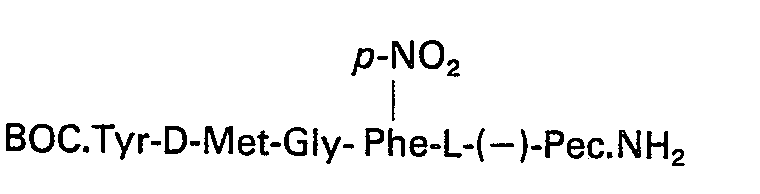
- The following illustrates the preparation of analogues containing (3 - homorproline (pyrrolidine-2-acetic acid):-
- BOC L-proline is homologated as described by M.A. Ondetti and S.L. Engel (J.Med.Chem., 18, 761 (1975)).
- BOC.L-homoPro is then converted via the mixed anhydride procedure outlined above to BOC.L-homoPro.NH2. from which L-homoPro.NH2HCl is obtained by deprotection with N.CI/HOAc.
- The peptide of Example 21, is prepared in the normal manner from the fragments:-BOC.Tyr-D-Met-Gly and

- The Met residue in position 2 may then be converted to the sulphoxide by treatment with H202.


- Peptides of the foregoing Examples were tested for the following activities according to standard pharmacological procedures.
- (A) Analgesia in mice in the hot plate test (modification of the method of Eddy, N.B. et al. J.Pharm. Exp. Therap. (1953) 107, 385, the peptide being administered by intracerebroventricular injection).
- (B) Antidiarrhoeal activity in the rat. In this procedure rats were starved for 24 hours, the peptide then administered either subcutaneously or orally followed after 15 minutes by 1 ml. castor oil per rat given orally.
- (C) For anti-tussive testing, guinea-pigs are subjected to an aerosol containing 20% citric acid, 30 minutes after administration of compound (orally or subcutaneously). The number of coughs during a five minute exposure are counted and meaned for six animals per treatment. The method is that described by Boura, A.L.A., Green, A.F. and Saunders, I.A.Br. J. Pharmac., May 1970, Vol. 39, No. 1, page 225.
- (D) Analgesia in mice in the writhing test (modification of the method of Hendershot et.al. (J. Pharm. Exp. Therap., 125, (1959),237) the peptide being administered orally.
- From the data obtained the respective ED50 figures were calculated (i.e. the dose required to elicit the appropriate effect in 50% of the animals). N.T.: not tested.
-

- Mix together the compound of formula (1), Lactose and Maize Starch. Granulate with a solution of the Gelatin dissolved in water. Dry the granules, add the Magnesium Stearate and compress to produce tablets, 110 mg per tablet.
-

- Melt the suppository base at 40°C. Gradually incorporate the compound of formula (1) in fine powder from and mix until homogenous. Pour into suitable moulds, 2 g per mould, and allow to set.
- Massa Esterinum C is a commercially available suppository base consisting of a mixture of mono, di, and triglycerides of saturated vegetable fatty acids. It is marketed by Henkel International, Dusseldorf.
-

- Mix together the compound of formula (1) and Lactose. Granulate with a solution of Povidone in 50% aqueous ethanol. Dry the granules add the Magnesium Stearate and compress on suitably shaped punches, 415 mg per pessary.
-

- Dissolve the compound of formula (1) in the Water for injections. Sterilise the solution by passage through a membrane filter, 0.2 µm pore size, collecting the filtrate in a sterile receiver. Fill into sterile glass vials, 2 ml/vial under aseptic conditions and freeze-dry. Close the vials with sterile rubber closures secured with an aluminium seal.
- The injection is reconstituted prior to administration by the addition of a convenient volume of Water for injections or sterile saline solution. In the foregoing the weight of the compound of formula (I) is in each instance calculated with reference to the peptide base.

Claims (36)


Applications Claiming Priority (2)
| Application Number | Priority Date | Filing Date | Title |
|---|---|---|---|
| GB48980/77A GB1604850A (en) | 1977-11-24 | 1977-11-24 | Biologically active peptides |
| GB4898077 | 1977-11-24 |
Publications (2)
| Publication Number | Publication Date |
|---|---|
| EP0002236A1 EP0002236A1 (en) | 1979-06-13 |
| EP0002236B1 true EP0002236B1 (en) | 1986-02-05 |
Family
ID=10450679
Family Applications (1)
| Application Number | Title | Priority Date | Filing Date |
|---|---|---|---|
| EP78101447A Expired EP0002236B1 (en) | 1977-11-24 | 1978-11-23 | Peptides, their salts, their acid addition salts, pharmaceutical formulations containing them and their use as morphine antagonists and anaesthetics |
Country Status (20)
| Country | Link |
|---|---|
| US (5) | US4244944A (en) |
| EP (1) | EP0002236B1 (en) |
| JP (1) | JPS5492938A (en) |
| KR (3) | KR860000453B1 (en) |
| AT (1) | AT386211B (en) |
| AU (1) | AU530985B2 (en) |
| CA (1) | CA1197235A (en) |
| DE (1) | DE2862477D1 (en) |
| DK (1) | DK149612C (en) |
| ES (1) | ES475324A1 (en) |
| FI (1) | FI70415C (en) |
| GB (1) | GB1604850A (en) |
| HU (1) | HU186729B (en) |
| IE (1) | IE47517B1 (en) |
| IL (1) | IL56028A (en) |
| IT (1) | IT1106143B (en) |
| MY (1) | MY8500260A (en) |
| PL (1) | PL123797B1 (en) |
| SU (1) | SU1470199A3 (en) |
| ZA (1) | ZA786598B (en) |
Families Citing this family (19)
| Publication number | Priority date | Publication date | Assignee | Title |
|---|---|---|---|---|
| DE2702711A1 (en) | 1976-02-02 | 1977-08-04 | Sandoz Ag | NEW ORGANIC COMPOUNDS, THEIR PRODUCTION AND USE |
| GB1604850A (en) * | 1977-11-24 | 1981-12-16 | Wellcome Found | Biologically active peptides |
| EP0044451B1 (en) * | 1980-07-17 | 1984-04-18 | Sandoz Ag | Novel pentapeptides, processes for their production, pharmaceutical compositions comprising said pentapeptides and their use |
| EP0076557B1 (en) * | 1981-06-22 | 1985-11-13 | Imperial Chemical Industries Plc | Peptides and pseudopeptides in which the n terminus bears two substituents |
| US4380535A (en) * | 1981-09-23 | 1983-04-19 | American Home Products Corporation | Enkephalin degrading enzyme inhibitors |
| US4492779A (en) * | 1981-12-07 | 1985-01-08 | Thiokol Corporation | Aramid polymer and powder filler reinforced elastomeric composition for use as a rocket motor insulation |
| US4489062A (en) * | 1982-02-05 | 1984-12-18 | Lowe Lawrence A | Pharmaceutical compounds, preparation, use and intermediates therefor and their preparation |
| DE3378121D1 (en) * | 1982-10-18 | 1988-11-03 | Ici Plc | PEPTIDE AND PSEUDOPEPTIDE DERIVATIVES |
| JPH0680079B2 (en) * | 1984-11-09 | 1994-10-12 | エーザイ株式会社 | Polypeptide |
| GB8608818D0 (en) * | 1986-04-11 | 1986-05-14 | Reckitt & Colmann Prod Ltd | Pharmaceutical compositions |
| GB8616741D0 (en) * | 1986-07-09 | 1986-08-13 | Wellcome Found | Pharmacologically active compounds |
| US5688519A (en) * | 1987-04-06 | 1997-11-18 | Leonard; Robert J. | Flash-flow fused medicinal implants |
| US5156787A (en) * | 1991-01-29 | 1992-10-20 | Booher Benjamin V | Pultrusion method of making brake linings |
| USRE37548E1 (en) | 1991-08-12 | 2002-02-19 | Bill J. Hays | Clutch design and manufacture |
| US5482772A (en) | 1992-12-28 | 1996-01-09 | Kimberly-Clark Corporation | Polymeric strands including a propylene polymer composition and nonwoven fabric and articles made therewith |
| US6488649B1 (en) | 1998-11-24 | 2002-12-03 | Edward M. Lichten | Implant device |
| IL165365A0 (en) | 2004-11-24 | 2006-01-15 | Q Core Ltd | Finger-type peristaltic pump |
| KR20080110841A (en) * | 2006-04-21 | 2008-12-19 | 루크 라멜렌 운트 쿠프룽스바우 베타일리궁스 카게 | Multi-layer, especially two-layer clutch linings and methods of manufacturing the same |
| US8005603B2 (en) | 2007-09-27 | 2011-08-23 | Continental Controls Corporation | Fuel control system and method for gas engines |
Family Cites Families (16)
| Publication number | Priority date | Publication date | Assignee | Title |
|---|---|---|---|---|
| GB1577115A (en) * | 1976-07-27 | 1980-10-22 | Reckitt & Colmann Prod Ltd | Container closure units |
| NZ183712A (en) * | 1976-04-08 | 1979-10-25 | Ici Ltd | Polypeptide analogues of enkephalins, and pharmaceutical compositions |
| US4028319A (en) * | 1976-05-07 | 1977-06-07 | G. D. Searle & Co. | 2 and 3-substituted enkephalins |
| US4123523A (en) * | 1976-06-21 | 1978-10-31 | Imperial Chemical Industries Limited | Analgesic and sedative polypeptides |
| FR2359817A1 (en) * | 1976-07-27 | 1978-02-24 | Reckitt & Colmann Prod Ltd | Peptide cpds. contg. tyrosine, glycine, phenylalanine and d-amino acid - local anaesthetics, smooth muscle relaxants, adrenergic neutron blockers, beta-stimulants etc. |
| US4092304A (en) * | 1976-08-09 | 1978-05-30 | G. D. Searle & Co. | 4-Substituted enkephalin derivatives |
| PT66982B (en) * | 1976-09-01 | 1979-02-13 | Coy David Howard | Process for preparing novel methionine enkephalin derivatives |
| HU178001B (en) * | 1976-09-16 | 1982-02-28 | Gyogyszekutato Intezet | Process for preparing new pentapeptides with morphine-like activity and derivatives thereof |
| US4128541A (en) * | 1976-12-27 | 1978-12-05 | American Home Products Corporation | Pentapeptide with morphine- like activity |
| DE2819277A1 (en) * | 1977-05-16 | 1978-11-23 | Sandoz Ag | NEW POLYPEPTIDE DERIVATIVES, THEIR PRODUCTION AND USE |
| US4127532A (en) * | 1977-06-16 | 1978-11-28 | Coy David Howard | Novel heptapeptides, intermediates therefor, and compositions and methods employing said heptapeptides |
| US4127531A (en) * | 1977-06-16 | 1978-11-28 | Coy David Howard | Novel hexapeptides, intermediates therefor, and compositions and methods employing said hexapeptides |
| US4127533A (en) * | 1977-06-16 | 1978-11-28 | Coy David Howard | Novel octapeptides, intermediates therefor, and compositions and methods employing said octapeptides |
| US4127523A (en) * | 1977-06-16 | 1978-11-28 | Coy David Howard | Novel undecapeptides, intermediates therefor, and compositions and methods employing said undecapeptides |
| GB1604850A (en) * | 1977-11-24 | 1981-12-16 | Wellcome Found | Biologically active peptides |
| US4103005A (en) * | 1977-10-20 | 1978-07-25 | Hoffmann-La Roche Inc. | Novel-enkephalin analogs |
-
1977
- 1977-11-24 GB GB48980/77A patent/GB1604850A/en not_active Expired
-
1978
- 1978-07-24 US US05/927,271 patent/US4244944A/en not_active Expired - Lifetime
- 1978-11-22 KR KR7803518A patent/KR860000453B1/en not_active Expired
- 1978-11-23 IT IT52041/78A patent/IT1106143B/en active
- 1978-11-23 DE DE7878101447T patent/DE2862477D1/en not_active Expired
- 1978-11-23 EP EP78101447A patent/EP0002236B1/en not_active Expired
- 1978-11-23 DK DK523078A patent/DK149612C/en not_active IP Right Cessation
- 1978-11-23 PL PL1978211164A patent/PL123797B1/en unknown
- 1978-11-23 IE IE2317/78A patent/IE47517B1/en unknown
- 1978-11-23 SU SU782691552A patent/SU1470199A3/en active
- 1978-11-23 FI FI783589A patent/FI70415C/en not_active IP Right Cessation
- 1978-11-23 AU AU41865/78A patent/AU530985B2/en not_active Expired
- 1978-11-23 CA CA000316793A patent/CA1197235A/en not_active Expired
- 1978-11-23 IL IL56028A patent/IL56028A/en unknown
- 1978-11-23 HU HU78WE591A patent/HU186729B/en not_active IP Right Cessation
- 1978-11-23 ES ES475324A patent/ES475324A1/en not_active Expired
- 1978-11-23 AT AT0836278A patent/AT386211B/en not_active IP Right Cessation
- 1978-11-24 JP JP14521278A patent/JPS5492938A/en active Granted
- 1978-11-24 ZA ZA786598A patent/ZA786598B/en unknown
-
1980
- 1980-09-25 US US06/190,704 patent/US4343795A/en not_active Expired - Lifetime
- 1980-09-25 US US06/191,150 patent/US4346083A/en not_active Expired - Lifetime
- 1980-09-28 US US06/192,071 patent/US4362717A/en not_active Expired - Lifetime
- 1980-09-30 US US06/192,292 patent/US4363800A/en not_active Expired - Lifetime
-
1982
- 1982-08-30 KR KR8203912A patent/KR880002609B1/en not_active Expired
- 1982-08-30 KR KR8203911A patent/KR880002608B1/en not_active Expired
-
1985
- 1985-12-30 MY MY260/85A patent/MY8500260A/en unknown
Also Published As
Similar Documents
| Publication | Publication Date | Title |
|---|---|---|
| US4346083A (en) | Biologically active amides | |
| DE68926269T2 (en) | Dermorphin analogs, their manufacturing process, pharmaceutical compositions and method of therapeutic treatment using the analogs | |
| JP3759748B2 (en) | Compound with growth hormone releasing ability | |
| CH644352A5 (en) | Process for the preparation of peptides | |
| EP0125469A1 (en) | Conformationally constrained cyclic enkephalin analogs with delta receptor specificity | |
| US4540682A (en) | Pharmaceutical peptides, preparation, use and intermediates | |
| US4254106A (en) | Biologically active amides | |
| US4162307A (en) | Method for anaesthesia by use of a pentapeptide | |
| EP0000559B1 (en) | Pentapeptide-n-alkylamides and their acid addition salts, methods for preparation of these compounds and pharmaceutical formulations containing them | |
| WO1981000712A1 (en) | Pharmacologically active peptides and medicaments containing them | |
| EP0085963B1 (en) | Pharmaceutical compounds, preparation, use and intermediates therefor and their preparation | |
| EP0053029A1 (en) | Non enkephalin-like peptides, their production, compositions containing them, and their medical and veterinary use | |
| USH810H (en) | Biologically active amides | |
| GB1596535A (en) | Biologically-active peptides | |
| DE2752341A1 (en) | BIOLOGICALLY ACTIVE AMIDES, THE PROCESS FOR THEIR MANUFACTURING AND THE PHARMACEUTICAL FORMULATIONS CONTAINING THEM | |
| EP0200512B1 (en) | Peptides and their use in therapy | |
| JP2513440B2 (en) | New peptide | |
| JP2513439B2 (en) | New peptide | |
| JPH07116234B2 (en) | New peptide | |
| JPS61271300A (en) | Novel peptide |
Legal Events
| Date | Code | Title | Description |
|---|---|---|---|
| PUAI | Public reference made under article 153(3) epc to a published international application that has entered the european phase |
Free format text: ORIGINAL CODE: 0009012 |
|
| AK | Designated contracting states |
Designated state(s): BE CH DE FR GB NL SE |
|
| 17P | Request for examination filed | ||
| GRAA | (expected) grant |
Free format text: ORIGINAL CODE: 0009210 |
|
| AK | Designated contracting states |
Designated state(s): BE CH DE FR GB NL SE |
|
| REF | Corresponds to: |
Ref document number: 2862477 Country of ref document: DE Date of ref document: 19860320 |
|
| ET | Fr: translation filed | ||
| PLBE | No opposition filed within time limit |
Free format text: ORIGINAL CODE: 0009261 |
|
| STAA | Information on the status of an ep patent application or granted ep patent |
Free format text: STATUS: NO OPPOSITION FILED WITHIN TIME LIMIT |
|
| 26N | No opposition filed | ||
| PGFP | Annual fee paid to national office [announced via postgrant information from national office to epo] |
Ref country code: SE Payment date: 19890927 Year of fee payment: 12 |
|
| PGFP | Annual fee paid to national office [announced via postgrant information from national office to epo] |
Ref country code: FR Payment date: 19890928 Year of fee payment: 12 |
|
| PGFP | Annual fee paid to national office [announced via postgrant information from national office to epo] |
Ref country code: GB Payment date: 19890930 Year of fee payment: 12 |
|
| PGFP | Annual fee paid to national office [announced via postgrant information from national office to epo] |
Ref country code: BE Payment date: 19891013 Year of fee payment: 12 |
|
| PGFP | Annual fee paid to national office [announced via postgrant information from national office to epo] |
Ref country code: NL Payment date: 19891130 Year of fee payment: 12 |
|
| PGFP | Annual fee paid to national office [announced via postgrant information from national office to epo] |
Ref country code: DE Payment date: 19891229 Year of fee payment: 12 |
|
| PGFP | Annual fee paid to national office [announced via postgrant information from national office to epo] |
Ref country code: CH Payment date: 19900104 Year of fee payment: 12 |
|
| PG25 | Lapsed in a contracting state [announced via postgrant information from national office to epo] |
Ref country code: GB Effective date: 19901123 |
|
| PG25 | Lapsed in a contracting state [announced via postgrant information from national office to epo] |
Ref country code: SE Effective date: 19901124 |
|
| PG25 | Lapsed in a contracting state [announced via postgrant information from national office to epo] |
Ref country code: CH Effective date: 19901130 Ref country code: BE Effective date: 19901130 |
|
| BERE | Be: lapsed |
Owner name: THE WELLCOME FOUNDATION LTD Effective date: 19901130 |
|
| PG25 | Lapsed in a contracting state [announced via postgrant information from national office to epo] |
Ref country code: NL Effective date: 19910601 |
|
| NLV4 | Nl: lapsed or anulled due to non-payment of the annual fee | ||
| GBPC | Gb: european patent ceased through non-payment of renewal fee | ||
| PG25 | Lapsed in a contracting state [announced via postgrant information from national office to epo] |
Ref country code: FR Effective date: 19910731 |
|
| REG | Reference to a national code |
Ref country code: CH Ref legal event code: PL |
|
| PG25 | Lapsed in a contracting state [announced via postgrant information from national office to epo] |
Ref country code: DE Effective date: 19910801 |
|
| REG | Reference to a national code |
Ref country code: FR Ref legal event code: ST |
|
| EUG | Se: european patent has lapsed |
Ref document number: 78101447.7 Effective date: 19910705 |