EP0002196B1 - Amine terminated block copolymers and processes for their preparation - Google Patents
Amine terminated block copolymers and processes for their preparation Download PDFInfo
- Publication number
- EP0002196B1 EP0002196B1 EP78101318A EP78101318A EP0002196B1 EP 0002196 B1 EP0002196 B1 EP 0002196B1 EP 78101318 A EP78101318 A EP 78101318A EP 78101318 A EP78101318 A EP 78101318A EP 0002196 B1 EP0002196 B1 EP 0002196B1
- Authority
- EP
- European Patent Office
- Prior art keywords
- polymer
- urethane
- carbon atoms
- urea
- amine terminated
- Prior art date
- Legal status (The legal status is an assumption and is not a legal conclusion. Google has not performed a legal analysis and makes no representation as to the accuracy of the status listed.)
- Expired
Links
- 229920001400 block copolymer Polymers 0.000 title claims description 167
- 150000001412 amines Chemical class 0.000 title claims description 159
- 238000000034 method Methods 0.000 title claims description 28
- 230000008569 process Effects 0.000 title claims description 16
- 238000002360 preparation method Methods 0.000 title description 27
- 229920000642 polymer Polymers 0.000 claims description 298
- 239000000470 constituent Substances 0.000 claims description 118
- 125000004432 carbon atom Chemical group C* 0.000 claims description 97
- 239000000178 monomer Substances 0.000 claims description 94
- JOYRKODLDBILNP-UHFFFAOYSA-N Ethyl urethane Chemical compound CCOC(N)=O JOYRKODLDBILNP-UHFFFAOYSA-N 0.000 claims description 87
- VLKZOEOYAKHREP-UHFFFAOYSA-N n-Hexane Chemical compound CCCCCC VLKZOEOYAKHREP-UHFFFAOYSA-N 0.000 claims description 85
- -1 imide compound Chemical class 0.000 claims description 81
- YXFVVABEGXRONW-UHFFFAOYSA-N Toluene Chemical compound CC1=CC=CC=C1 YXFVVABEGXRONW-UHFFFAOYSA-N 0.000 claims description 78
- 229920001577 copolymer Polymers 0.000 claims description 78
- 239000004593 Epoxy Substances 0.000 claims description 63
- XSQUKJJJFZCRTK-UHFFFAOYSA-N Urea Chemical compound NC(N)=O XSQUKJJJFZCRTK-UHFFFAOYSA-N 0.000 claims description 57
- 239000004202 carbamide Substances 0.000 claims description 57
- 150000001875 compounds Chemical class 0.000 claims description 57
- 150000003949 imides Chemical class 0.000 claims description 53
- 239000000203 mixture Substances 0.000 claims description 49
- 238000006243 chemical reaction Methods 0.000 claims description 48
- 229920001778 nylon Polymers 0.000 claims description 44
- XLYOFNOQVPJJNP-UHFFFAOYSA-N water Substances O XLYOFNOQVPJJNP-UHFFFAOYSA-N 0.000 claims description 43
- 125000003118 aryl group Chemical group 0.000 claims description 39
- 150000004985 diamines Chemical class 0.000 claims description 38
- 239000004677 Nylon Substances 0.000 claims description 36
- 239000006260 foam Substances 0.000 claims description 33
- OYQYHJRSHHYEIG-UHFFFAOYSA-N ethyl carbamate;urea Chemical compound NC(N)=O.CCOC(N)=O OYQYHJRSHHYEIG-UHFFFAOYSA-N 0.000 claims description 31
- 229920001228 polyisocyanate Polymers 0.000 claims description 29
- 239000005056 polyisocyanate Substances 0.000 claims description 29
- 229920002554 vinyl polymer Chemical group 0.000 claims description 29
- IJGRMHOSHXDMSA-UHFFFAOYSA-N Atomic nitrogen Chemical compound N#N IJGRMHOSHXDMSA-UHFFFAOYSA-N 0.000 claims description 28
- 125000000391 vinyl group Chemical group [H]C([*])=C([H])[H] 0.000 claims description 26
- 125000000217 alkyl group Chemical group 0.000 claims description 23
- 150000003951 lactams Chemical class 0.000 claims description 23
- GTDPSWPPOUPBNX-UHFFFAOYSA-N ac1mqpva Chemical compound CC12C(=O)OC(=O)C1(C)C1(C)C2(C)C(=O)OC1=O GTDPSWPPOUPBNX-UHFFFAOYSA-N 0.000 claims description 20
- 239000001257 hydrogen Substances 0.000 claims description 20
- 229910052739 hydrogen Inorganic materials 0.000 claims description 20
- 229920005862 polyol Polymers 0.000 claims description 17
- 125000002887 hydroxy group Chemical group [H]O* 0.000 claims description 16
- 239000012948 isocyanate Substances 0.000 claims description 16
- 150000002513 isocyanates Chemical class 0.000 claims description 16
- 239000000463 material Substances 0.000 claims description 16
- 229910052757 nitrogen Inorganic materials 0.000 claims description 15
- 239000004604 Blowing Agent Substances 0.000 claims description 14
- 150000001408 amides Chemical class 0.000 claims description 14
- UFHFLCQGNIYNRP-UHFFFAOYSA-N Hydrogen Chemical compound [H][H] UFHFLCQGNIYNRP-UHFFFAOYSA-N 0.000 claims description 13
- ZMXDDKWLCZADIW-UHFFFAOYSA-N N,N-Dimethylformamide Chemical compound CN(C)C=O ZMXDDKWLCZADIW-UHFFFAOYSA-N 0.000 claims description 13
- 150000001993 dienes Chemical group 0.000 claims description 13
- 150000002009 diols Chemical class 0.000 claims description 13
- UHOVQNZJYSORNB-UHFFFAOYSA-N Benzene Chemical compound C1=CC=CC=C1 UHOVQNZJYSORNB-UHFFFAOYSA-N 0.000 claims description 12
- IMNFDUFMRHMDMM-UHFFFAOYSA-N N-Heptane Chemical compound CCCCCCC IMNFDUFMRHMDMM-UHFFFAOYSA-N 0.000 claims description 12
- 239000004721 Polyphenylene oxide Substances 0.000 claims description 12
- NINIDFKCEFEMDL-UHFFFAOYSA-N Sulfur Chemical group [S] NINIDFKCEFEMDL-UHFFFAOYSA-N 0.000 claims description 12
- 229920000570 polyether Polymers 0.000 claims description 12
- 150000003141 primary amines Chemical class 0.000 claims description 12
- 229910052717 sulfur Chemical group 0.000 claims description 12
- 239000011593 sulfur Chemical group 0.000 claims description 12
- 229910052799 carbon Inorganic materials 0.000 claims description 11
- 150000003077 polyols Chemical class 0.000 claims description 11
- 125000001931 aliphatic group Chemical group 0.000 claims description 10
- 125000003277 amino group Chemical group 0.000 claims description 10
- 125000000753 cycloalkyl group Chemical group 0.000 claims description 10
- LYCAIKOWRPUZTN-UHFFFAOYSA-N Ethylene glycol Chemical compound OCCO LYCAIKOWRPUZTN-UHFFFAOYSA-N 0.000 claims description 9
- PEDCQBHIVMGVHV-UHFFFAOYSA-N Glycerine Chemical compound OCC(O)CO PEDCQBHIVMGVHV-UHFFFAOYSA-N 0.000 claims description 9
- OFBQJSOFQDEBGM-UHFFFAOYSA-N Pentane Chemical compound CCCCC OFBQJSOFQDEBGM-UHFFFAOYSA-N 0.000 claims description 9
- QVGXLLKOCUKJST-UHFFFAOYSA-N atomic oxygen Chemical group [O] QVGXLLKOCUKJST-UHFFFAOYSA-N 0.000 claims description 8
- WERYXYBDKMZEQL-UHFFFAOYSA-N butane-1,4-diol Chemical compound OCCCCO WERYXYBDKMZEQL-UHFFFAOYSA-N 0.000 claims description 8
- 239000001301 oxygen Substances 0.000 claims description 8
- 229910052760 oxygen Inorganic materials 0.000 claims description 8
- 229920000728 polyester Polymers 0.000 claims description 8
- 150000004984 aromatic diamines Chemical class 0.000 claims description 7
- 150000004292 cyclic ethers Chemical class 0.000 claims description 7
- 239000007795 chemical reaction product Substances 0.000 claims description 6
- 150000001298 alcohols Chemical class 0.000 claims description 5
- 150000001491 aromatic compounds Chemical class 0.000 claims description 5
- 150000002540 isothiocyanates Chemical class 0.000 claims description 5
- 150000005846 sugar alcohols Polymers 0.000 claims description 5
- QGZKDVFQNNGYKY-UHFFFAOYSA-N Ammonia Chemical compound N QGZKDVFQNNGYKY-UHFFFAOYSA-N 0.000 claims description 4
- LSNNMFCWUKXFEE-UHFFFAOYSA-M Bisulfite Chemical compound OS([O-])=O LSNNMFCWUKXFEE-UHFFFAOYSA-M 0.000 claims description 4
- IAZDPXIOMUYVGZ-UHFFFAOYSA-N Dimethylsulphoxide Chemical compound CS(C)=O IAZDPXIOMUYVGZ-UHFFFAOYSA-N 0.000 claims description 4
- FXHOOIRPVKKKFG-UHFFFAOYSA-N N,N-Dimethylacetamide Chemical compound CN(C)C(C)=O FXHOOIRPVKKKFG-UHFFFAOYSA-N 0.000 claims description 4
- XYLMUPLGERFSHI-UHFFFAOYSA-N alpha-Methylstyrene Chemical compound CC(=C)C1=CC=CC=C1 XYLMUPLGERFSHI-UHFFFAOYSA-N 0.000 claims description 4
- IISBACLAFKSPIT-UHFFFAOYSA-N bisphenol A Chemical compound C=1C=C(O)C=CC=1C(C)(C)C1=CC=C(O)C=C1 IISBACLAFKSPIT-UHFFFAOYSA-N 0.000 claims description 4
- 150000003839 salts Chemical class 0.000 claims description 4
- 239000004359 castor oil Substances 0.000 claims description 3
- 235000019438 castor oil Nutrition 0.000 claims description 3
- ZEMPKEQAKRGZGQ-XOQCFJPHSA-N glycerol triricinoleate Natural products CCCCCC[C@@H](O)CC=CCCCCCCCC(=O)OC[C@@H](COC(=O)CCCCCCCC=CC[C@@H](O)CCCCCC)OC(=O)CCCCCCCC=CC[C@H](O)CCCCCC ZEMPKEQAKRGZGQ-XOQCFJPHSA-N 0.000 claims description 3
- 150000002431 hydrogen Chemical class 0.000 claims description 3
- 150000002989 phenols Chemical class 0.000 claims description 3
- 239000011877 solvent mixture Substances 0.000 claims description 3
- DNIAPMSPPWPWGF-VKHMYHEASA-N (+)-propylene glycol Chemical compound C[C@H](O)CO DNIAPMSPPWPWGF-VKHMYHEASA-N 0.000 claims description 2
- YPFDHNVEDLHUCE-UHFFFAOYSA-N 1,3-propanediol Substances OCCCO YPFDHNVEDLHUCE-UHFFFAOYSA-N 0.000 claims description 2
- 229910021529 ammonia Inorganic materials 0.000 claims description 2
- 229920000166 polytrimethylene carbonate Polymers 0.000 claims description 2
- 230000000379 polymerizing effect Effects 0.000 claims 6
- 230000005494 condensation Effects 0.000 claims 3
- 238000009833 condensation Methods 0.000 claims 3
- 229920001519 homopolymer Polymers 0.000 claims 3
- TZLVUWBGUNVFES-UHFFFAOYSA-N 2-ethyl-5-methylpyrazol-3-amine Chemical compound CCN1N=C(C)C=C1N TZLVUWBGUNVFES-UHFFFAOYSA-N 0.000 claims 2
- ZFIVKAOQEXOYFY-UHFFFAOYSA-N Diepoxybutane Chemical compound C1OC1C1OC1 ZFIVKAOQEXOYFY-UHFFFAOYSA-N 0.000 claims 2
- QIGBRXMKCJKVMJ-UHFFFAOYSA-N Hydroquinone Chemical compound OC1=CC=C(O)C=C1 QIGBRXMKCJKVMJ-UHFFFAOYSA-N 0.000 claims 2
- SMWDFEZZVXVKRB-UHFFFAOYSA-N anhydrous quinoline Natural products N1=CC=CC2=CC=CC=C21 SMWDFEZZVXVKRB-UHFFFAOYSA-N 0.000 claims 2
- 150000001721 carbon Chemical group 0.000 claims 2
- 150000003841 chloride salts Chemical class 0.000 claims 2
- 229960001760 dimethyl sulfoxide Drugs 0.000 claims 2
- JUJWROOIHBZHMG-UHFFFAOYSA-N pyridine Substances C1=CC=NC=C1 JUJWROOIHBZHMG-UHFFFAOYSA-N 0.000 claims 2
- UMJSCPRVCHMLSP-UHFFFAOYSA-N pyridine Natural products COC1=CC=CN=C1 UMJSCPRVCHMLSP-UHFFFAOYSA-N 0.000 claims 2
- 150000003222 pyridines Chemical class 0.000 claims 2
- 150000003248 quinolines Chemical class 0.000 claims 2
- 239000003549 soybean oil Substances 0.000 claims 2
- 235000012424 soybean oil Nutrition 0.000 claims 2
- 229940035437 1,3-propanediol Drugs 0.000 claims 1
- OKTJSMMVPCPJKN-UHFFFAOYSA-N Carbon Chemical compound [C] OKTJSMMVPCPJKN-UHFFFAOYSA-N 0.000 claims 1
- 150000007945 N-acyl ureas Chemical class 0.000 claims 1
- ISWSIDIOOBJBQZ-UHFFFAOYSA-N Phenol Chemical compound OC1=CC=CC=C1 ISWSIDIOOBJBQZ-UHFFFAOYSA-N 0.000 claims 1
- 150000001299 aldehydes Chemical class 0.000 claims 1
- 229910052783 alkali metal Inorganic materials 0.000 claims 1
- 150000001340 alkali metals Chemical class 0.000 claims 1
- 230000003301 hydrolyzing effect Effects 0.000 claims 1
- 229920003986 novolac Polymers 0.000 claims 1
- 125000000446 sulfanediyl group Chemical group *S* 0.000 claims 1
- KAKZBPTYRLMSJV-UHFFFAOYSA-N Butadiene Chemical compound C=CC=C KAKZBPTYRLMSJV-UHFFFAOYSA-N 0.000 description 37
- 230000015572 biosynthetic process Effects 0.000 description 34
- 150000002978 peroxides Chemical class 0.000 description 32
- 238000006116 polymerization reaction Methods 0.000 description 32
- 239000003054 catalyst Substances 0.000 description 30
- 239000002904 solvent Substances 0.000 description 26
- 229920002589 poly(vinylethylene) polymer Polymers 0.000 description 24
- PPBRXRYQALVLMV-UHFFFAOYSA-N Styrene Chemical compound C=CC1=CC=CC=C1 PPBRXRYQALVLMV-UHFFFAOYSA-N 0.000 description 22
- OKKJLVBELUTLKV-UHFFFAOYSA-N Methanol Chemical compound OC OKKJLVBELUTLKV-UHFFFAOYSA-N 0.000 description 21
- 239000003795 chemical substances by application Substances 0.000 description 20
- JBKVHLHDHHXQEQ-UHFFFAOYSA-N epsilon-caprolactam Chemical compound O=C1CCCCCN1 JBKVHLHDHHXQEQ-UHFFFAOYSA-N 0.000 description 20
- 239000005062 Polybutadiene Substances 0.000 description 19
- 230000000704 physical effect Effects 0.000 description 19
- 229920002857 polybutadiene Polymers 0.000 description 19
- VYPSYNLAJGMNEJ-UHFFFAOYSA-N Silicium dioxide Chemical compound O=[Si]=O VYPSYNLAJGMNEJ-UHFFFAOYSA-N 0.000 description 16
- 229920001971 elastomer Polymers 0.000 description 16
- 229920005989 resin Polymers 0.000 description 16
- 239000011347 resin Substances 0.000 description 16
- WYURNTSHIVDZCO-UHFFFAOYSA-N Tetrahydrofuran Chemical compound C1CCOC1 WYURNTSHIVDZCO-UHFFFAOYSA-N 0.000 description 15
- 239000000243 solution Substances 0.000 description 15
- 238000011065 in-situ storage Methods 0.000 description 14
- 125000005442 diisocyanate group Chemical group 0.000 description 13
- 239000000945 filler Substances 0.000 description 13
- 238000012545 processing Methods 0.000 description 13
- 239000005060 rubber Substances 0.000 description 13
- 229920001169 thermoplastic Polymers 0.000 description 13
- 239000004416 thermosoftening plastic Substances 0.000 description 13
- MZRVEZGGRBJDDB-UHFFFAOYSA-N N-Butyllithium Chemical compound [Li]CCCC MZRVEZGGRBJDDB-UHFFFAOYSA-N 0.000 description 12
- RRHGJUQNOFWUDK-UHFFFAOYSA-N Isoprene Chemical compound CC(=C)C=C RRHGJUQNOFWUDK-UHFFFAOYSA-N 0.000 description 10
- 239000002253 acid Substances 0.000 description 10
- 239000003822 epoxy resin Substances 0.000 description 10
- 238000004519 manufacturing process Methods 0.000 description 10
- 229920000647 polyepoxide Polymers 0.000 description 10
- XMNIXWIUMCBBBL-UHFFFAOYSA-N 2-(2-phenylpropan-2-ylperoxy)propan-2-ylbenzene Chemical compound C=1C=CC=CC=1C(C)(C)OOC(C)(C)C1=CC=CC=C1 XMNIXWIUMCBBBL-UHFFFAOYSA-N 0.000 description 9
- 238000009472 formulation Methods 0.000 description 9
- 238000010438 heat treatment Methods 0.000 description 9
- 239000006269 thermoset foam Substances 0.000 description 9
- DVKJHBMWWAPEIU-UHFFFAOYSA-N toluene 2,4-diisocyanate Chemical compound CC1=CC=C(N=C=O)C=C1N=C=O DVKJHBMWWAPEIU-UHFFFAOYSA-N 0.000 description 9
- 239000004744 fabric Substances 0.000 description 8
- 239000011521 glass Substances 0.000 description 8
- 125000004435 hydrogen atom Chemical group [H]* 0.000 description 8
- 239000000047 product Substances 0.000 description 8
- 239000000377 silicon dioxide Substances 0.000 description 8
- 238000003756 stirring Methods 0.000 description 8
- 229920002396 Polyurea Polymers 0.000 description 7
- 239000004568 cement Substances 0.000 description 7
- 238000004821 distillation Methods 0.000 description 7
- 238000002156 mixing Methods 0.000 description 7
- 150000001451 organic peroxides Chemical class 0.000 description 7
- 238000010992 reflux Methods 0.000 description 7
- 229920003048 styrene butadiene rubber Polymers 0.000 description 7
- YLQBMQCUIZJEEH-UHFFFAOYSA-N tetrahydrofuran Natural products C=1C=COC=1 YLQBMQCUIZJEEH-UHFFFAOYSA-N 0.000 description 7
- 229920001187 thermosetting polymer Polymers 0.000 description 7
- WZCQRUWWHSTZEM-UHFFFAOYSA-N 1,3-phenylenediamine Chemical compound NC1=CC=CC(N)=C1 WZCQRUWWHSTZEM-UHFFFAOYSA-N 0.000 description 6
- XKRFYHLGVUSROY-UHFFFAOYSA-N Argon Chemical compound [Ar] XKRFYHLGVUSROY-UHFFFAOYSA-N 0.000 description 6
- LCGLNKUTAGEVQW-UHFFFAOYSA-N Dimethyl ether Chemical compound COC LCGLNKUTAGEVQW-UHFFFAOYSA-N 0.000 description 6
- 239000012190 activator Substances 0.000 description 6
- 238000004458 analytical method Methods 0.000 description 6
- 238000001816 cooling Methods 0.000 description 6
- 239000003063 flame retardant Substances 0.000 description 6
- NAQMVNRVTILPCV-UHFFFAOYSA-N hexane-1,6-diamine Chemical compound NCCCCCCN NAQMVNRVTILPCV-UHFFFAOYSA-N 0.000 description 6
- HJWLCRVIBGQPNF-UHFFFAOYSA-N prop-2-enylbenzene Chemical compound C=CCC1=CC=CC=C1 HJWLCRVIBGQPNF-UHFFFAOYSA-N 0.000 description 6
- 239000011541 reaction mixture Substances 0.000 description 6
- 239000000126 substance Substances 0.000 description 6
- 239000004094 surface-active agent Substances 0.000 description 6
- QEDJMOONZLUIMC-UHFFFAOYSA-N 1-tert-butyl-4-ethenylbenzene Chemical compound CC(C)(C)C1=CC=C(C=C)C=C1 QEDJMOONZLUIMC-UHFFFAOYSA-N 0.000 description 5
- RTZKZFJDLAIYFH-UHFFFAOYSA-N Diethyl ether Chemical compound CCOCC RTZKZFJDLAIYFH-UHFFFAOYSA-N 0.000 description 5
- UKLDJPRMSDWDSL-UHFFFAOYSA-L [dibutyl(dodecanoyloxy)stannyl] dodecanoate Chemical compound CCCCCCCCCCCC(=O)O[Sn](CCCC)(CCCC)OC(=O)CCCCCCCCCCC UKLDJPRMSDWDSL-UHFFFAOYSA-L 0.000 description 5
- 150000007513 acids Chemical class 0.000 description 5
- 239000000654 additive Substances 0.000 description 5
- 150000008064 anhydrides Chemical class 0.000 description 5
- YDLSUFFXJYEVHW-UHFFFAOYSA-N azonan-2-one Chemical compound O=C1CCCCCCCN1 YDLSUFFXJYEVHW-UHFFFAOYSA-N 0.000 description 5
- 239000002585 base Substances 0.000 description 5
- 239000006227 byproduct Substances 0.000 description 5
- 238000000354 decomposition reaction Methods 0.000 description 5
- 239000012153 distilled water Substances 0.000 description 5
- 238000005227 gel permeation chromatography Methods 0.000 description 5
- 239000012071 phase Substances 0.000 description 5
- 229920000768 polyamine Polymers 0.000 description 5
- VOZKAJLKRJDJLL-UHFFFAOYSA-N 2,4-diaminotoluene Chemical compound CC1=CC=C(N)C=C1N VOZKAJLKRJDJLL-UHFFFAOYSA-N 0.000 description 4
- YBRVSVVVWCFQMG-UHFFFAOYSA-N 4,4'-diaminodiphenylmethane Chemical compound C1=CC(N)=CC=C1CC1=CC=C(N)C=C1 YBRVSVVVWCFQMG-UHFFFAOYSA-N 0.000 description 4
- VQVIHDPBMFABCQ-UHFFFAOYSA-N 5-(1,3-dioxo-2-benzofuran-5-carbonyl)-2-benzofuran-1,3-dione Chemical compound C1=C2C(=O)OC(=O)C2=CC(C(C=2C=C3C(=O)OC(=O)C3=CC=2)=O)=C1 VQVIHDPBMFABCQ-UHFFFAOYSA-N 0.000 description 4
- VEXZGXHMUGYJMC-UHFFFAOYSA-M Chloride anion Chemical compound [Cl-] VEXZGXHMUGYJMC-UHFFFAOYSA-M 0.000 description 4
- 239000002174 Styrene-butadiene Substances 0.000 description 4
- WNLRTRBMVRJNCN-UHFFFAOYSA-N adipic acid Chemical compound OC(=O)CCCCC(O)=O WNLRTRBMVRJNCN-UHFFFAOYSA-N 0.000 description 4
- 239000003963 antioxidant agent Substances 0.000 description 4
- 235000006708 antioxidants Nutrition 0.000 description 4
- 239000012298 atmosphere Substances 0.000 description 4
- 235000013361 beverage Nutrition 0.000 description 4
- 239000006229 carbon black Substances 0.000 description 4
- 239000003086 colorant Substances 0.000 description 4
- 230000008878 coupling Effects 0.000 description 4
- 238000005859 coupling reaction Methods 0.000 description 4
- 239000012975 dibutyltin dilaurate Substances 0.000 description 4
- 150000002483 hydrogen compounds Chemical class 0.000 description 4
- 239000000543 intermediate Substances 0.000 description 4
- IQPQWNKOIGAROB-UHFFFAOYSA-N isocyanate group Chemical group [N-]=C=O IQPQWNKOIGAROB-UHFFFAOYSA-N 0.000 description 4
- 229940018564 m-phenylenediamine Drugs 0.000 description 4
- 239000002808 molecular sieve Substances 0.000 description 4
- 150000003254 radicals Chemical class 0.000 description 4
- URGAHOPLAPQHLN-UHFFFAOYSA-N sodium aluminosilicate Chemical compound [Na+].[Al+3].[O-][Si]([O-])=O.[O-][Si]([O-])=O URGAHOPLAPQHLN-UHFFFAOYSA-N 0.000 description 4
- 239000007787 solid Substances 0.000 description 4
- 238000012360 testing method Methods 0.000 description 4
- 229920005564 urethane-urea copolymer Polymers 0.000 description 4
- CBCKQZAAMUWICA-UHFFFAOYSA-N 1,4-phenylenediamine Chemical compound NC1=CC=C(N)C=C1 CBCKQZAAMUWICA-UHFFFAOYSA-N 0.000 description 3
- VLDPXPPHXDGHEW-UHFFFAOYSA-N 1-chloro-2-dichlorophosphoryloxybenzene Chemical compound ClC1=CC=CC=C1OP(Cl)(Cl)=O VLDPXPPHXDGHEW-UHFFFAOYSA-N 0.000 description 3
- RNFJDJUURJAICM-UHFFFAOYSA-N 2,2,4,4,6,6-hexaphenoxy-1,3,5-triaza-2$l^{5},4$l^{5},6$l^{5}-triphosphacyclohexa-1,3,5-triene Chemical compound N=1P(OC=2C=CC=CC=2)(OC=2C=CC=CC=2)=NP(OC=2C=CC=CC=2)(OC=2C=CC=CC=2)=NP=1(OC=1C=CC=CC=1)OC1=CC=CC=C1 RNFJDJUURJAICM-UHFFFAOYSA-N 0.000 description 3
- UHLDFWTWCNSHLE-UHFFFAOYSA-N 2-(2-cyclohexylpropan-2-ylperoxy)propan-2-ylcyclohexane Chemical compound C1CCCCC1C(C)(C)OOC(C)(C)C1CCCCC1 UHLDFWTWCNSHLE-UHFFFAOYSA-N 0.000 description 3
- LCFVJGUPQDGYKZ-UHFFFAOYSA-N Bisphenol A diglycidyl ether Chemical compound C=1C=C(OCC2OC2)C=CC=1C(C)(C)C(C=C1)=CC=C1OCC1CO1 LCFVJGUPQDGYKZ-UHFFFAOYSA-N 0.000 description 3
- CURLTUGMZLYLDI-UHFFFAOYSA-N Carbon dioxide Chemical compound O=C=O CURLTUGMZLYLDI-UHFFFAOYSA-N 0.000 description 3
- FBPFZTCFMRRESA-KVTDHHQDSA-N D-Mannitol Chemical compound OC[C@@H](O)[C@@H](O)[C@H](O)[C@H](O)CO FBPFZTCFMRRESA-KVTDHHQDSA-N 0.000 description 3
- LFQSCWFLJHTTHZ-UHFFFAOYSA-N Ethanol Chemical compound CCO LFQSCWFLJHTTHZ-UHFFFAOYSA-N 0.000 description 3
- 229930195725 Mannitol Natural products 0.000 description 3
- 229920002292 Nylon 6 Polymers 0.000 description 3
- 239000004642 Polyimide Substances 0.000 description 3
- 238000005299 abrasion Methods 0.000 description 3
- 229910052786 argon Inorganic materials 0.000 description 3
- 229920005601 base polymer Polymers 0.000 description 3
- 230000008901 benefit Effects 0.000 description 3
- 239000004305 biphenyl Substances 0.000 description 3
- 150000001805 chlorine compounds Chemical class 0.000 description 3
- 230000003081 coactivator Effects 0.000 description 3
- 238000010924 continuous production Methods 0.000 description 3
- 238000010168 coupling process Methods 0.000 description 3
- 238000004132 cross linking Methods 0.000 description 3
- NLUNLVTVUDIHFE-UHFFFAOYSA-N cyclooctylcyclooctane Chemical compound C1CCCCCCC1C1CCCCCCC1 NLUNLVTVUDIHFE-UHFFFAOYSA-N 0.000 description 3
- 125000006159 dianhydride group Chemical group 0.000 description 3
- 239000006185 dispersion Substances 0.000 description 3
- 238000001035 drying Methods 0.000 description 3
- 239000000806 elastomer Substances 0.000 description 3
- 150000002118 epoxides Chemical group 0.000 description 3
- 230000002349 favourable effect Effects 0.000 description 3
- 239000000835 fiber Substances 0.000 description 3
- 239000000499 gel Substances 0.000 description 3
- 239000001307 helium Substances 0.000 description 3
- 229910052734 helium Inorganic materials 0.000 description 3
- SWQJXJOGLNCZEY-UHFFFAOYSA-N helium atom Chemical compound [He] SWQJXJOGLNCZEY-UHFFFAOYSA-N 0.000 description 3
- 230000007062 hydrolysis Effects 0.000 description 3
- 238000006460 hydrolysis reaction Methods 0.000 description 3
- 239000012535 impurity Substances 0.000 description 3
- 229910052744 lithium Inorganic materials 0.000 description 3
- 239000000594 mannitol Substances 0.000 description 3
- 235000010355 mannitol Nutrition 0.000 description 3
- 239000000155 melt Substances 0.000 description 3
- 238000002844 melting Methods 0.000 description 3
- 230000008018 melting Effects 0.000 description 3
- 229910052751 metal Inorganic materials 0.000 description 3
- 239000002184 metal Substances 0.000 description 3
- 125000002496 methyl group Chemical group [H]C([H])([H])* 0.000 description 3
- WXZMFSXDPGVJKK-UHFFFAOYSA-N pentaerythritol Chemical compound OCC(CO)(CO)CO WXZMFSXDPGVJKK-UHFFFAOYSA-N 0.000 description 3
- 125000001997 phenyl group Chemical group [H]C1=C([H])C([H])=C(*)C([H])=C1[H] 0.000 description 3
- 229920003023 plastic Polymers 0.000 description 3
- 239000004033 plastic Substances 0.000 description 3
- 229920001721 polyimide Polymers 0.000 description 3
- 239000011414 polymer cement Substances 0.000 description 3
- 229920002635 polyurethane Polymers 0.000 description 3
- 239000004814 polyurethane Substances 0.000 description 3
- 239000000843 powder Substances 0.000 description 3
- 125000002924 primary amino group Chemical group [H]N([H])* 0.000 description 3
- 239000000376 reactant Substances 0.000 description 3
- 239000012744 reinforcing agent Substances 0.000 description 3
- 238000005070 sampling Methods 0.000 description 3
- 239000003381 stabilizer Substances 0.000 description 3
- 150000003464 sulfur compounds Chemical class 0.000 description 3
- 150000003673 urethanes Chemical class 0.000 description 3
- PUPZLCDOIYMWBV-UHFFFAOYSA-N (+/-)-1,3-Butanediol Chemical compound CC(O)CCO PUPZLCDOIYMWBV-UHFFFAOYSA-N 0.000 description 2
- ZWVMLYRJXORSEP-UHFFFAOYSA-N 1,2,6-Hexanetriol Chemical compound OCCCCC(O)CO ZWVMLYRJXORSEP-UHFFFAOYSA-N 0.000 description 2
- RMSGQZDGSZOJMU-UHFFFAOYSA-N 1-butyl-2-phenylbenzene Chemical group CCCCC1=CC=CC=C1C1=CC=CC=C1 RMSGQZDGSZOJMU-UHFFFAOYSA-N 0.000 description 2
- DMWVYCCGCQPJEA-UHFFFAOYSA-N 2,5-bis(tert-butylperoxy)-2,5-dimethylhexane Chemical compound CC(C)(C)OOC(C)(C)CCC(C)(C)OOC(C)(C)C DMWVYCCGCQPJEA-UHFFFAOYSA-N 0.000 description 2
- KUBDPQJOLOUJRM-UHFFFAOYSA-N 2-(chloromethyl)oxirane;4-[2-(4-hydroxyphenyl)propan-2-yl]phenol Chemical compound ClCC1CO1.C=1C=C(O)C=CC=1C(C)(C)C1=CC=C(O)C=C1 KUBDPQJOLOUJRM-UHFFFAOYSA-N 0.000 description 2
- 125000000094 2-phenylethyl group Chemical group [H]C1=C([H])C([H])=C(C([H])=C1[H])C([H])([H])C([H])([H])* 0.000 description 2
- IBOFVQJTBBUKMU-UHFFFAOYSA-N 4,4'-methylene-bis-(2-chloroaniline) Chemical compound C1=C(Cl)C(N)=CC=C1CC1=CC=C(N)C(Cl)=C1 IBOFVQJTBBUKMU-UHFFFAOYSA-N 0.000 description 2
- DLFVBJFMPXGRIB-UHFFFAOYSA-N Acetamide Chemical compound CC(N)=O DLFVBJFMPXGRIB-UHFFFAOYSA-N 0.000 description 2
- KXDAEFPNCMNJSK-UHFFFAOYSA-N Benzamide Chemical compound NC(=O)C1=CC=CC=C1 KXDAEFPNCMNJSK-UHFFFAOYSA-N 0.000 description 2
- FBPFZTCFMRRESA-FSIIMWSLSA-N D-Glucitol Natural products OC[C@H](O)[C@H](O)[C@@H](O)[C@H](O)CO FBPFZTCFMRRESA-FSIIMWSLSA-N 0.000 description 2
- FBPFZTCFMRRESA-JGWLITMVSA-N D-glucitol Chemical compound OC[C@H](O)[C@@H](O)[C@H](O)[C@H](O)CO FBPFZTCFMRRESA-JGWLITMVSA-N 0.000 description 2
- SNRUBQQJIBEYMU-UHFFFAOYSA-N Dodecane Natural products CCCCCCCCCCCC SNRUBQQJIBEYMU-UHFFFAOYSA-N 0.000 description 2
- ZHNUHDYFZUAESO-UHFFFAOYSA-N Formamide Chemical compound NC=O ZHNUHDYFZUAESO-UHFFFAOYSA-N 0.000 description 2
- VEXZGXHMUGYJMC-UHFFFAOYSA-N Hydrochloric acid Chemical compound Cl VEXZGXHMUGYJMC-UHFFFAOYSA-N 0.000 description 2
- KFZMGEQAYNKOFK-UHFFFAOYSA-N Isopropanol Chemical compound CC(C)O KFZMGEQAYNKOFK-UHFFFAOYSA-N 0.000 description 2
- WHXSMMKQMYFTQS-UHFFFAOYSA-N Lithium Chemical compound [Li] WHXSMMKQMYFTQS-UHFFFAOYSA-N 0.000 description 2
- 241001112258 Moca Species 0.000 description 2
- FZERHIULMFGESH-UHFFFAOYSA-N N-phenylacetamide Chemical compound CC(=O)NC1=CC=CC=C1 FZERHIULMFGESH-UHFFFAOYSA-N 0.000 description 2
- LGRFSURHDFAFJT-UHFFFAOYSA-N Phthalic anhydride Natural products C1=CC=C2C(=O)OC(=O)C2=C1 LGRFSURHDFAFJT-UHFFFAOYSA-N 0.000 description 2
- 239000004793 Polystyrene Substances 0.000 description 2
- ZJCCRDAZUWHFQH-UHFFFAOYSA-N Trimethylolpropane Chemical compound CCC(CO)(CO)CO ZJCCRDAZUWHFQH-UHFFFAOYSA-N 0.000 description 2
- 229920001807 Urea-formaldehyde Polymers 0.000 description 2
- NQRKKQWBFLSWPT-UHFFFAOYSA-N [1-(1,1-diphenylethylperoxy)-1-phenylethyl]benzene Chemical compound C=1C=CC=CC=1C(C=1C=CC=CC=1)(C)OOC(C)(C=1C=CC=CC=1)C1=CC=CC=C1 NQRKKQWBFLSWPT-UHFFFAOYSA-N 0.000 description 2
- TUEIURIZJQRMQE-UHFFFAOYSA-N [2-(tert-butylsulfamoyl)phenyl]boronic acid Chemical compound CC(C)(C)NS(=O)(=O)C1=CC=CC=C1B(O)O TUEIURIZJQRMQE-UHFFFAOYSA-N 0.000 description 2
- 235000011037 adipic acid Nutrition 0.000 description 2
- 239000001361 adipic acid Substances 0.000 description 2
- PNEYBMLMFCGWSK-UHFFFAOYSA-N aluminium oxide Inorganic materials [O-2].[O-2].[O-2].[Al+3].[Al+3] PNEYBMLMFCGWSK-UHFFFAOYSA-N 0.000 description 2
- 238000010539 anionic addition polymerization reaction Methods 0.000 description 2
- ADCOVFLJGNWWNZ-UHFFFAOYSA-N antimony trioxide Chemical compound O=[Sb]O[Sb]=O ADCOVFLJGNWWNZ-UHFFFAOYSA-N 0.000 description 2
- 239000007900 aqueous suspension Substances 0.000 description 2
- 239000003849 aromatic solvent Substances 0.000 description 2
- 238000010533 azeotropic distillation Methods 0.000 description 2
- 125000001797 benzyl group Chemical group [H]C1=C([H])C([H])=C(C([H])=C1[H])C([H])([H])* 0.000 description 2
- 238000007664 blowing Methods 0.000 description 2
- 238000009835 boiling Methods 0.000 description 2
- 238000012662 bulk polymerization Methods 0.000 description 2
- JHIWVOJDXOSYLW-UHFFFAOYSA-N butyl 2,2-difluorocyclopropane-1-carboxylate Chemical compound CCCCOC(=O)C1CC1(F)F JHIWVOJDXOSYLW-UHFFFAOYSA-N 0.000 description 2
- 125000000484 butyl group Chemical group [H]C([*])([H])C([H])([H])C([H])([H])C([H])([H])[H] 0.000 description 2
- YMLFYGFCXGNERH-UHFFFAOYSA-K butyltin trichloride Chemical compound CCCC[Sn](Cl)(Cl)Cl YMLFYGFCXGNERH-UHFFFAOYSA-K 0.000 description 2
- VHRGRCVQAFMJIZ-UHFFFAOYSA-N cadaverine Chemical compound NCCCCCN VHRGRCVQAFMJIZ-UHFFFAOYSA-N 0.000 description 2
- 230000003197 catalytic effect Effects 0.000 description 2
- 230000015271 coagulation Effects 0.000 description 2
- 238000005345 coagulation Methods 0.000 description 2
- 238000000576 coating method Methods 0.000 description 2
- 238000013329 compounding Methods 0.000 description 2
- 125000000582 cycloheptyl group Chemical group [H]C1([H])C([H])([H])C([H])([H])C([H])([H])C([H])(*)C([H])([H])C1([H])[H] 0.000 description 2
- 125000000113 cyclohexyl group Chemical group [H]C1([H])C([H])([H])C([H])([H])C([H])(*)C([H])([H])C1([H])[H] 0.000 description 2
- 125000004210 cyclohexylmethyl group Chemical group [H]C([H])(*)C1([H])C([H])([H])C([H])([H])C([H])([H])C([H])([H])C1([H])[H] 0.000 description 2
- WHHGLZMJPXIBIX-UHFFFAOYSA-N decabromodiphenyl ether Chemical compound BrC1=C(Br)C(Br)=C(Br)C(Br)=C1OC1=C(Br)C(Br)=C(Br)C(Br)=C1Br WHHGLZMJPXIBIX-UHFFFAOYSA-N 0.000 description 2
- 230000007423 decrease Effects 0.000 description 2
- 125000002704 decyl group Chemical group [H]C([H])([H])C([H])([H])C([H])([H])C([H])([H])C([H])([H])C([H])([H])C([H])([H])C([H])([H])C([H])([H])C([H])([H])* 0.000 description 2
- 238000011161 development Methods 0.000 description 2
- PKKGKUDPKRTKLJ-UHFFFAOYSA-L dichloro(dimethyl)stannane Chemical compound C[Sn](C)(Cl)Cl PKKGKUDPKRTKLJ-UHFFFAOYSA-L 0.000 description 2
- 229940113088 dimethylacetamide Drugs 0.000 description 2
- 238000009826 distribution Methods 0.000 description 2
- 125000003438 dodecyl group Chemical group [H]C([H])([H])C([H])([H])C([H])([H])C([H])([H])C([H])([H])C([H])([H])C([H])([H])C([H])([H])C([H])([H])C([H])([H])C([H])([H])C([H])([H])* 0.000 description 2
- 125000003700 epoxy group Chemical group 0.000 description 2
- 125000001495 ethyl group Chemical group [H]C([H])([H])C([H])([H])* 0.000 description 2
- 229940093476 ethylene glycol Drugs 0.000 description 2
- 239000007789 gas Substances 0.000 description 2
- 239000003365 glass fiber Substances 0.000 description 2
- 229920000578 graft copolymer Polymers 0.000 description 2
- LNEPOXFFQSENCJ-UHFFFAOYSA-N haloperidol Chemical compound C1CC(O)(C=2C=CC(Cl)=CC=2)CCN1CCCC(=O)C1=CC=C(F)C=C1 LNEPOXFFQSENCJ-UHFFFAOYSA-N 0.000 description 2
- 125000003187 heptyl group Chemical group [H]C([*])([H])C([H])([H])C([H])([H])C([H])([H])C([H])([H])C([H])([H])C([H])([H])[H] 0.000 description 2
- 150000002390 heteroarenes Chemical class 0.000 description 2
- VKYKSIONXSXAKP-UHFFFAOYSA-N hexamethylenetetramine Chemical compound C1N(C2)CN3CN1CN2C3 VKYKSIONXSXAKP-UHFFFAOYSA-N 0.000 description 2
- 125000004051 hexyl group Chemical group [H]C([H])([H])C([H])([H])C([H])([H])C([H])([H])C([H])([H])C([H])([H])* 0.000 description 2
- IXCSERBJSXMMFS-UHFFFAOYSA-N hydrogen chloride Substances Cl.Cl IXCSERBJSXMMFS-UHFFFAOYSA-N 0.000 description 2
- 229910000041 hydrogen chloride Inorganic materials 0.000 description 2
- 150000002596 lactones Chemical class 0.000 description 2
- 238000003801 milling Methods 0.000 description 2
- UXGLSABDGQOSET-UHFFFAOYSA-N n-carbamoylprop-2-enamide Chemical compound NC(=O)NC(=O)C=C UXGLSABDGQOSET-UHFFFAOYSA-N 0.000 description 2
- 125000001624 naphthyl group Chemical group 0.000 description 2
- 125000004998 naphthylethyl group Chemical group C1(=CC=CC2=CC=CC=C12)CC* 0.000 description 2
- 239000012454 non-polar solvent Substances 0.000 description 2
- LYRFLYHAGKPMFH-UHFFFAOYSA-N octadecanamide Chemical compound CCCCCCCCCCCCCCCCCC(N)=O LYRFLYHAGKPMFH-UHFFFAOYSA-N 0.000 description 2
- 125000000864 peroxy group Chemical group O(O*)* 0.000 description 2
- 229920001568 phenolic resin Polymers 0.000 description 2
- 229920001195 polyisoprene Polymers 0.000 description 2
- 229920002223 polystyrene Polymers 0.000 description 2
- 229920000909 polytetrahydrofuran Polymers 0.000 description 2
- 238000001556 precipitation Methods 0.000 description 2
- 230000001737 promoting effect Effects 0.000 description 2
- 125000001436 propyl group Chemical group [H]C([*])([H])C([H])([H])C([H])([H])[H] 0.000 description 2
- KIDHWZJUCRJVML-UHFFFAOYSA-N putrescine Chemical compound NCCCCN KIDHWZJUCRJVML-UHFFFAOYSA-N 0.000 description 2
- 238000011084 recovery Methods 0.000 description 2
- 239000012763 reinforcing filler Substances 0.000 description 2
- 239000000600 sorbitol Substances 0.000 description 2
- 229910001220 stainless steel Inorganic materials 0.000 description 2
- 239000010935 stainless steel Substances 0.000 description 2
- 125000004079 stearyl group Chemical group [H]C([*])([H])C([H])([H])C([H])([H])C([H])([H])C([H])([H])C([H])([H])C([H])([H])C([H])([H])C([H])([H])C([H])([H])C([H])([H])C([H])([H])C([H])([H])C([H])([H])C([H])([H])C([H])([H])C([H])([H])C([H])([H])[H] 0.000 description 2
- 238000000967 suction filtration Methods 0.000 description 2
- 238000010557 suspension polymerization reaction Methods 0.000 description 2
- 150000003512 tertiary amines Chemical class 0.000 description 2
- AFCAKJKUYFLYFK-UHFFFAOYSA-N tetrabutyltin Chemical compound CCCC[Sn](CCCC)(CCCC)CCCC AFCAKJKUYFLYFK-UHFFFAOYSA-N 0.000 description 2
- 125000006158 tetracarboxylic acid group Chemical group 0.000 description 2
- RUELTTOHQODFPA-UHFFFAOYSA-N toluene 2,6-diisocyanate Chemical compound CC1=C(N=C=O)C=CC=C1N=C=O RUELTTOHQODFPA-UHFFFAOYSA-N 0.000 description 2
- 125000003944 tolyl group Chemical group 0.000 description 2
- PWBHRVGYSMBMIO-UHFFFAOYSA-M tributylstannanylium;acetate Chemical compound CCCC[Sn](CCCC)(CCCC)OC(C)=O PWBHRVGYSMBMIO-UHFFFAOYSA-M 0.000 description 2
- IMNIMPAHZVJRPE-UHFFFAOYSA-N triethylenediamine Chemical compound C1CN2CCN1CC2 IMNIMPAHZVJRPE-UHFFFAOYSA-N 0.000 description 2
- 150000004072 triols Chemical class 0.000 description 2
- 239000013585 weight reducing agent Substances 0.000 description 2
- 239000002023 wood Substances 0.000 description 2
- 125000005023 xylyl group Chemical group 0.000 description 2
- PAPBSGBWRJIAAV-UHFFFAOYSA-N ε-Caprolactone Chemical compound O=C1CCCCCO1 PAPBSGBWRJIAAV-UHFFFAOYSA-N 0.000 description 2
- DNIAPMSPPWPWGF-GSVOUGTGSA-N (R)-(-)-Propylene glycol Chemical compound C[C@@H](O)CO DNIAPMSPPWPWGF-GSVOUGTGSA-N 0.000 description 1
- LAWFNIOAOGJKIL-UHFFFAOYSA-N 1,1-diethoxycyclobutane Chemical compound CCOC1(OCC)CCC1 LAWFNIOAOGJKIL-UHFFFAOYSA-N 0.000 description 1
- LLZPXMCHUMPYRH-UHFFFAOYSA-N 1,1-dimethoxycyclobutane Chemical compound COC1(OC)CCC1 LLZPXMCHUMPYRH-UHFFFAOYSA-N 0.000 description 1
- HVCIHTJTCNLLNU-UHFFFAOYSA-N 1,2,3,4-tetrahydronaphthalene-1,3-diol Chemical compound C1=CC=C2CC(O)CC(O)C2=C1 HVCIHTJTCNLLNU-UHFFFAOYSA-N 0.000 description 1
- FTCMTZXWNUAYHT-UHFFFAOYSA-N 1,2,3,4-tetrahydronaphthalene-1,4-diol Chemical compound C1=CC=C2C(O)CCC(O)C2=C1 FTCMTZXWNUAYHT-UHFFFAOYSA-N 0.000 description 1
- GEYOCULIXLDCMW-UHFFFAOYSA-N 1,2-phenylenediamine Chemical compound NC1=CC=CC=C1N GEYOCULIXLDCMW-UHFFFAOYSA-N 0.000 description 1
- RYHBNJHYFVUHQT-UHFFFAOYSA-N 1,4-Dioxane Chemical compound C1COCCO1 RYHBNJHYFVUHQT-UHFFFAOYSA-N 0.000 description 1
- ZMMYZOSYBMIWIR-UHFFFAOYSA-N 2,2,4-trimethyl-4-(2,4,4-trimethylpentan-2-ylperoxy)pentane Chemical compound CC(C)(C)CC(C)(C)OOC(C)(C)CC(C)(C)C ZMMYZOSYBMIWIR-UHFFFAOYSA-N 0.000 description 1
- RLYCRLGLCUXUPO-UHFFFAOYSA-N 2,6-diaminotoluene Chemical compound CC1=C(N)C=CC=C1N RLYCRLGLCUXUPO-UHFFFAOYSA-N 0.000 description 1
- FALRKNHUBBKYCC-UHFFFAOYSA-N 2-(chloromethyl)pyridine-3-carbonitrile Chemical compound ClCC1=NC=CC=C1C#N FALRKNHUBBKYCC-UHFFFAOYSA-N 0.000 description 1
- NGNBDVOYPDDBFK-UHFFFAOYSA-N 2-[2,4-di(pentan-2-yl)phenoxy]acetyl chloride Chemical compound CCCC(C)C1=CC=C(OCC(Cl)=O)C(C(C)CCC)=C1 NGNBDVOYPDDBFK-UHFFFAOYSA-N 0.000 description 1
- AKCRQHGQIJBRMN-UHFFFAOYSA-N 2-chloroaniline Chemical compound NC1=CC=CC=C1Cl AKCRQHGQIJBRMN-UHFFFAOYSA-N 0.000 description 1
- SBYMUDUGTIKLCR-UHFFFAOYSA-N 2-chloroethenylbenzene Chemical compound ClC=CC1=CC=CC=C1 SBYMUDUGTIKLCR-UHFFFAOYSA-N 0.000 description 1
- JJRDRFZYKKFYMO-UHFFFAOYSA-N 2-methyl-2-(2-methylbutan-2-ylperoxy)butane Chemical compound CCC(C)(C)OOC(C)(C)CC JJRDRFZYKKFYMO-UHFFFAOYSA-N 0.000 description 1
- OXYZDRAJMHGSMW-UHFFFAOYSA-N 3-chloropropyl(trimethoxy)silane Chemical compound CO[Si](OC)(OC)CCCCl OXYZDRAJMHGSMW-UHFFFAOYSA-N 0.000 description 1
- ICNFHJVPAJKPHW-UHFFFAOYSA-N 4,4'-Thiodianiline Chemical compound C1=CC(N)=CC=C1SC1=CC=C(N)C=C1 ICNFHJVPAJKPHW-UHFFFAOYSA-N 0.000 description 1
- UITKHKNFVCYWNG-UHFFFAOYSA-N 4-(3,4-dicarboxybenzoyl)phthalic acid Chemical compound C1=C(C(O)=O)C(C(=O)O)=CC=C1C(=O)C1=CC=C(C(O)=O)C(C(O)=O)=C1 UITKHKNFVCYWNG-UHFFFAOYSA-N 0.000 description 1
- HLBLWEWZXPIGSM-UHFFFAOYSA-N 4-Aminophenyl ether Chemical compound C1=CC(N)=CC=C1OC1=CC=C(N)C=C1 HLBLWEWZXPIGSM-UHFFFAOYSA-N 0.000 description 1
- HCFRWBBJISAZNK-UHFFFAOYSA-N 4-Hydroxycyclohexylcarboxylic acid Chemical compound OC1CCC(C(O)=O)CC1 HCFRWBBJISAZNK-UHFFFAOYSA-N 0.000 description 1
- GEYAGBVEAJGCFB-UHFFFAOYSA-N 4-[2-(3,4-dicarboxyphenyl)propan-2-yl]phthalic acid Chemical compound C=1C=C(C(O)=O)C(C(O)=O)=CC=1C(C)(C)C1=CC=C(C(O)=O)C(C(O)=O)=C1 GEYAGBVEAJGCFB-UHFFFAOYSA-N 0.000 description 1
- CNPURSDMOWDNOQ-UHFFFAOYSA-N 4-methoxy-7h-pyrrolo[2,3-d]pyrimidin-2-amine Chemical compound COC1=NC(N)=NC2=C1C=CN2 CNPURSDMOWDNOQ-UHFFFAOYSA-N 0.000 description 1
- QQGYZOYWNCKGEK-UHFFFAOYSA-N 5-[(1,3-dioxo-2-benzofuran-5-yl)oxy]-2-benzofuran-1,3-dione Chemical compound C1=C2C(=O)OC(=O)C2=CC(OC=2C=C3C(=O)OC(C3=CC=2)=O)=C1 QQGYZOYWNCKGEK-UHFFFAOYSA-N 0.000 description 1
- KHBQMWCZKVMBLN-UHFFFAOYSA-N Benzenesulfonamide Chemical compound NS(=O)(=O)C1=CC=CC=C1 KHBQMWCZKVMBLN-UHFFFAOYSA-N 0.000 description 1
- 239000004215 Carbon black (E152) Substances 0.000 description 1
- MQJKPEGWNLWLTK-UHFFFAOYSA-N Dapsone Chemical compound C1=CC(N)=CC=C1S(=O)(=O)C1=CC=C(N)C=C1 MQJKPEGWNLWLTK-UHFFFAOYSA-N 0.000 description 1
- DBAKFASWICGISY-DASCVMRKSA-N Dexchlorpheniramine maleate Chemical compound OC(=O)\C=C/C(O)=O.C1([C@H](CCN(C)C)C=2N=CC=CC=2)=CC=C(Cl)C=C1 DBAKFASWICGISY-DASCVMRKSA-N 0.000 description 1
- 239000005977 Ethylene Substances 0.000 description 1
- IAYPIBMASNFSPL-UHFFFAOYSA-N Ethylene oxide Chemical compound C1CO1 IAYPIBMASNFSPL-UHFFFAOYSA-N 0.000 description 1
- PIICEJLVQHRZGT-UHFFFAOYSA-N Ethylenediamine Chemical compound NCCN PIICEJLVQHRZGT-UHFFFAOYSA-N 0.000 description 1
- DGAQECJNVWCQMB-PUAWFVPOSA-M Ilexoside XXIX Chemical compound C[C@@H]1CC[C@@]2(CC[C@@]3(C(=CC[C@H]4[C@]3(CC[C@@H]5[C@@]4(CC[C@@H](C5(C)C)OS(=O)(=O)[O-])C)C)[C@@H]2[C@]1(C)O)C)C(=O)O[C@H]6[C@@H]([C@H]([C@@H]([C@H](O6)CO)O)O)O.[Na+] DGAQECJNVWCQMB-PUAWFVPOSA-M 0.000 description 1
- 239000002841 Lewis acid Substances 0.000 description 1
- 229920000877 Melamine resin Polymers 0.000 description 1
- KWYHDKDOAIKMQN-UHFFFAOYSA-N N,N,N',N'-tetramethylethylenediamine Chemical compound CN(C)CCN(C)C KWYHDKDOAIKMQN-UHFFFAOYSA-N 0.000 description 1
- 229920002302 Nylon 6,6 Polymers 0.000 description 1
- 239000004687 Nylon copolymer Substances 0.000 description 1
- ALQSHHUCVQOPAS-UHFFFAOYSA-N Pentane-1,5-diol Chemical compound OCCCCCO ALQSHHUCVQOPAS-UHFFFAOYSA-N 0.000 description 1
- 239000004952 Polyamide Substances 0.000 description 1
- 239000004734 Polyphenylene sulfide Substances 0.000 description 1
- 239000004743 Polypropylene Substances 0.000 description 1
- ZLMJMSJWJFRBEC-UHFFFAOYSA-N Potassium Chemical compound [K] ZLMJMSJWJFRBEC-UHFFFAOYSA-N 0.000 description 1
- GOOHAUXETOMSMM-UHFFFAOYSA-N Propylene oxide Chemical compound CC1CO1 GOOHAUXETOMSMM-UHFFFAOYSA-N 0.000 description 1
- 229920000297 Rayon Polymers 0.000 description 1
- 239000006087 Silane Coupling Agent Substances 0.000 description 1
- KEAYESYHFKHZAL-UHFFFAOYSA-N Sodium Chemical compound [Na] KEAYESYHFKHZAL-UHFFFAOYSA-N 0.000 description 1
- AWMVMTVKBNGEAK-UHFFFAOYSA-N Styrene oxide Chemical compound C1OC1C1=CC=CC=C1 AWMVMTVKBNGEAK-UHFFFAOYSA-N 0.000 description 1
- GSEJCLTVZPLZKY-UHFFFAOYSA-N Triethanolamine Chemical compound OCCN(CCO)CCO GSEJCLTVZPLZKY-UHFFFAOYSA-N 0.000 description 1
- KXZRVRQMOLGXGY-UHFFFAOYSA-N [1-cyclohexyl-1-(1,1-dicyclohexylethylperoxy)ethyl]cyclohexane Chemical compound C1CCCCC1C(C1CCCCC1)(C)OOC(C)(C1CCCCC1)C1CCCCC1 KXZRVRQMOLGXGY-UHFFFAOYSA-N 0.000 description 1
- FDLQZKYLHJJBHD-UHFFFAOYSA-N [3-(aminomethyl)phenyl]methanamine Chemical compound NCC1=CC=CC(CN)=C1 FDLQZKYLHJJBHD-UHFFFAOYSA-N 0.000 description 1
- YIMQCDZDWXUDCA-UHFFFAOYSA-N [4-(hydroxymethyl)cyclohexyl]methanol Chemical compound OCC1CCC(CO)CC1 YIMQCDZDWXUDCA-UHFFFAOYSA-N 0.000 description 1
- NOZAQBYNLKNDRT-UHFFFAOYSA-N [diacetyloxy(ethenyl)silyl] acetate Chemical compound CC(=O)O[Si](OC(C)=O)(OC(C)=O)C=C NOZAQBYNLKNDRT-UHFFFAOYSA-N 0.000 description 1
- 238000002835 absorbance Methods 0.000 description 1
- 230000009102 absorption Effects 0.000 description 1
- 238000010521 absorption reaction Methods 0.000 description 1
- 229960001413 acetanilide Drugs 0.000 description 1
- 150000008065 acid anhydrides Chemical class 0.000 description 1
- 239000000853 adhesive Substances 0.000 description 1
- 230000001070 adhesive effect Effects 0.000 description 1
- 238000013019 agitation Methods 0.000 description 1
- 238000007605 air drying Methods 0.000 description 1
- 150000001338 aliphatic hydrocarbons Chemical class 0.000 description 1
- 125000002877 alkyl aryl group Chemical group 0.000 description 1
- 125000002947 alkylene group Chemical group 0.000 description 1
- 125000005263 alkylenediamine group Chemical group 0.000 description 1
- 229910052782 aluminium Inorganic materials 0.000 description 1
- XAGFODPZIPBFFR-UHFFFAOYSA-N aluminium Chemical compound [Al] XAGFODPZIPBFFR-UHFFFAOYSA-N 0.000 description 1
- CEGOLXSVJUTHNZ-UHFFFAOYSA-K aluminium tristearate Chemical compound [Al+3].CCCCCCCCCCCCCCCCCC([O-])=O.CCCCCCCCCCCCCCCCCC([O-])=O.CCCCCCCCCCCCCCCCCC([O-])=O CEGOLXSVJUTHNZ-UHFFFAOYSA-K 0.000 description 1
- 229940063655 aluminum stearate Drugs 0.000 description 1
- 238000012443 analytical study Methods 0.000 description 1
- 125000000129 anionic group Chemical group 0.000 description 1
- GHPGOEFPKIHBNM-UHFFFAOYSA-N antimony(3+);oxygen(2-) Chemical compound [O-2].[O-2].[O-2].[Sb+3].[Sb+3] GHPGOEFPKIHBNM-UHFFFAOYSA-N 0.000 description 1
- 239000000010 aprotic solvent Substances 0.000 description 1
- 150000004945 aromatic hydrocarbons Chemical group 0.000 description 1
- 125000003710 aryl alkyl group Chemical group 0.000 description 1
- ZVSKZLHKADLHSD-UHFFFAOYSA-N benzanilide Chemical compound C=1C=CC=CC=1C(=O)NC1=CC=CC=C1 ZVSKZLHKADLHSD-UHFFFAOYSA-N 0.000 description 1
- 235000010290 biphenyl Nutrition 0.000 description 1
- 125000006267 biphenyl group Chemical group 0.000 description 1
- MTAZNLWOLGHBHU-UHFFFAOYSA-N butadiene-styrene rubber Chemical compound C=CC=C.C=CC1=CC=CC=C1 MTAZNLWOLGHBHU-UHFFFAOYSA-N 0.000 description 1
- 239000001273 butane Substances 0.000 description 1
- BMRWNKZVCUKKSR-UHFFFAOYSA-N butane-1,2-diol Chemical compound CCC(O)CO BMRWNKZVCUKKSR-UHFFFAOYSA-N 0.000 description 1
- 239000001569 carbon dioxide Substances 0.000 description 1
- 229910002092 carbon dioxide Inorganic materials 0.000 description 1
- 235000011089 carbon dioxide Nutrition 0.000 description 1
- 125000003178 carboxy group Chemical group [H]OC(*)=O 0.000 description 1
- 238000005266 casting Methods 0.000 description 1
- 230000015556 catabolic process Effects 0.000 description 1
- PMMYEEVYMWASQN-IMJSIDKUSA-N cis-4-Hydroxy-L-proline Chemical compound O[C@@H]1CN[C@H](C(O)=O)C1 PMMYEEVYMWASQN-IMJSIDKUSA-N 0.000 description 1
- 238000003776 cleavage reaction Methods 0.000 description 1
- 229920006026 co-polymeric resin Polymers 0.000 description 1
- 239000011248 coating agent Substances 0.000 description 1
- 239000002131 composite material Substances 0.000 description 1
- 238000006482 condensation reaction Methods 0.000 description 1
- 239000002826 coolant Substances 0.000 description 1
- 238000005260 corrosion Methods 0.000 description 1
- 230000007797 corrosion Effects 0.000 description 1
- 239000007822 coupling agent Substances 0.000 description 1
- 239000003431 cross linking reagent Substances 0.000 description 1
- 239000011243 crosslinked material Substances 0.000 description 1
- VCVOSERVUCJNPR-UHFFFAOYSA-N cyclopentane-1,2-diol Chemical compound OC1CCCC1O VCVOSERVUCJNPR-UHFFFAOYSA-N 0.000 description 1
- 238000006731 degradation reaction Methods 0.000 description 1
- 230000002939 deleterious effect Effects 0.000 description 1
- 230000001419 dependent effect Effects 0.000 description 1
- LSXWFXONGKSEMY-UHFFFAOYSA-N di-tert-butyl peroxide Chemical compound CC(C)(C)OOC(C)(C)C LSXWFXONGKSEMY-UHFFFAOYSA-N 0.000 description 1
- 229920003244 diene elastomer Polymers 0.000 description 1
- GYZLOYUZLJXAJU-UHFFFAOYSA-N diglycidyl ether Chemical compound C1OC1COCC1CO1 GYZLOYUZLJXAJU-UHFFFAOYSA-N 0.000 description 1
- 239000003085 diluting agent Substances 0.000 description 1
- 238000006471 dimerization reaction Methods 0.000 description 1
- XXBDWLFCJWSEKW-UHFFFAOYSA-N dimethylbenzylamine Chemical compound CN(C)CC1=CC=CC=C1 XXBDWLFCJWSEKW-UHFFFAOYSA-N 0.000 description 1
- ATUOYWHBWRKTHZ-UHFFFAOYSA-N dimethylmethane Natural products CCC ATUOYWHBWRKTHZ-UHFFFAOYSA-N 0.000 description 1
- CZZYITDELCSZES-UHFFFAOYSA-N diphenylmethane Chemical group C=1C=CC=CC=1CC1=CC=CC=C1 CZZYITDELCSZES-UHFFFAOYSA-N 0.000 description 1
- 238000002036 drum drying Methods 0.000 description 1
- 239000000428 dust Substances 0.000 description 1
- 238000005538 encapsulation Methods 0.000 description 1
- 150000002148 esters Chemical class 0.000 description 1
- 125000001033 ether group Chemical group 0.000 description 1
- 238000001914 filtration Methods 0.000 description 1
- 239000012467 final product Substances 0.000 description 1
- 235000013312 flour Nutrition 0.000 description 1
- 238000005187 foaming Methods 0.000 description 1
- SLGWESQGEUXWJQ-UHFFFAOYSA-N formaldehyde;phenol Chemical compound O=C.OC1=CC=CC=C1 SLGWESQGEUXWJQ-UHFFFAOYSA-N 0.000 description 1
- 238000004817 gas chromatography Methods 0.000 description 1
- 150000002334 glycols Chemical class 0.000 description 1
- 150000004820 halides Chemical class 0.000 description 1
- 230000036541 health Effects 0.000 description 1
- 239000008241 heterogeneous mixture Substances 0.000 description 1
- 239000004312 hexamethylene tetramine Substances 0.000 description 1
- 235000010299 hexamethylene tetramine Nutrition 0.000 description 1
- XXMIOPMDWAUFGU-UHFFFAOYSA-N hexane-1,6-diol Chemical compound OCCCCCCO XXMIOPMDWAUFGU-UHFFFAOYSA-N 0.000 description 1
- QCIYAEYRVFUFAP-UHFFFAOYSA-N hexane-2,3-diol Chemical compound CCCC(O)C(C)O QCIYAEYRVFUFAP-UHFFFAOYSA-N 0.000 description 1
- OHMBHFSEKCCCBW-UHFFFAOYSA-N hexane-2,5-diol Chemical compound CC(O)CCC(C)O OHMBHFSEKCCCBW-UHFFFAOYSA-N 0.000 description 1
- POFSNPPXJUQANW-UHFFFAOYSA-N hexane-3,4-diol Chemical compound CCC(O)C(O)CC POFSNPPXJUQANW-UHFFFAOYSA-N 0.000 description 1
- 229930195733 hydrocarbon Natural products 0.000 description 1
- 150000002430 hydrocarbons Chemical class 0.000 description 1
- 125000005462 imide group Chemical group 0.000 description 1
- 230000006872 improvement Effects 0.000 description 1
- 238000010952 in-situ formation Methods 0.000 description 1
- 239000011261 inert gas Substances 0.000 description 1
- 238000002329 infrared spectrum Methods 0.000 description 1
- 239000003999 initiator Substances 0.000 description 1
- 238000002347 injection Methods 0.000 description 1
- 239000007924 injection Substances 0.000 description 1
- 238000010102 injection blow moulding Methods 0.000 description 1
- 238000001746 injection moulding Methods 0.000 description 1
- 238000010030 laminating Methods 0.000 description 1
- 239000010985 leather Substances 0.000 description 1
- 150000007517 lewis acids Chemical class 0.000 description 1
- 150000002641 lithium Chemical class 0.000 description 1
- FPYJFEHAWHCUMM-UHFFFAOYSA-N maleic anhydride Chemical compound O=C1OC(=O)C=C1 FPYJFEHAWHCUMM-UHFFFAOYSA-N 0.000 description 1
- 238000005259 measurement Methods 0.000 description 1
- JDSHMPZPIAZGSV-UHFFFAOYSA-N melamine Chemical compound NC1=NC(N)=NC(N)=N1 JDSHMPZPIAZGSV-UHFFFAOYSA-N 0.000 description 1
- QSHDDOUJBYECFT-UHFFFAOYSA-N mercury Chemical compound [Hg] QSHDDOUJBYECFT-UHFFFAOYSA-N 0.000 description 1
- 229910052753 mercury Inorganic materials 0.000 description 1
- 229960004011 methenamine Drugs 0.000 description 1
- 239000003607 modifier Substances 0.000 description 1
- DNIAPMSPPWPWGF-UHFFFAOYSA-N monopropylene glycol Natural products CC(O)CO DNIAPMSPPWPWGF-UHFFFAOYSA-N 0.000 description 1
- 238000000465 moulding Methods 0.000 description 1
- QBYNWJVTTUAPCT-UHFFFAOYSA-N n,n'-bis(2-chlorophenyl)methanediamine Chemical compound ClC1=CC=CC=C1NCNC1=CC=CC=C1Cl QBYNWJVTTUAPCT-UHFFFAOYSA-N 0.000 description 1
- OBKARQMATMRWQZ-UHFFFAOYSA-N naphthalene-1,2,5,6-tetracarboxylic acid Chemical compound OC(=O)C1=C(C(O)=O)C=CC2=C(C(O)=O)C(C(=O)O)=CC=C21 OBKARQMATMRWQZ-UHFFFAOYSA-N 0.000 description 1
- DOBFTMLCEYUAQC-UHFFFAOYSA-N naphthalene-2,3,6,7-tetracarboxylic acid Chemical compound OC(=O)C1=C(C(O)=O)C=C2C=C(C(O)=O)C(C(=O)O)=CC2=C1 DOBFTMLCEYUAQC-UHFFFAOYSA-N 0.000 description 1
- 125000004433 nitrogen atom Chemical group N* 0.000 description 1
- 239000003921 oil Substances 0.000 description 1
- FATBGEAMYMYZAF-KTKRTIGZSA-N oleamide Chemical group CCCCCCCC\C=C/CCCCCCCC(N)=O FATBGEAMYMYZAF-KTKRTIGZSA-N 0.000 description 1
- FATBGEAMYMYZAF-UHFFFAOYSA-N oleicacidamide-heptaglycolether Natural products CCCCCCCCC=CCCCCCCCC(N)=O FATBGEAMYMYZAF-UHFFFAOYSA-N 0.000 description 1
- 230000003287 optical effect Effects 0.000 description 1
- 230000003647 oxidation Effects 0.000 description 1
- 238000007254 oxidation reaction Methods 0.000 description 1
- 150000002924 oxiranes Chemical group 0.000 description 1
- QUBQYFYWUJJAAK-UHFFFAOYSA-N oxymethurea Chemical compound OCNC(=O)NCO QUBQYFYWUJJAAK-UHFFFAOYSA-N 0.000 description 1
- 229950005308 oxymethurea Drugs 0.000 description 1
- 125000001147 pentyl group Chemical group C(CCCC)* 0.000 description 1
- ZUOUZKKEUPVFJK-UHFFFAOYSA-N phenylbenzene Natural products C1=CC=CC=C1C1=CC=CC=C1 ZUOUZKKEUPVFJK-UHFFFAOYSA-N 0.000 description 1
- 229910052698 phosphorus Inorganic materials 0.000 description 1
- CLYVDMAATCIVBF-UHFFFAOYSA-N pigment red 224 Chemical compound C=12C3=CC=C(C(OC4=O)=O)C2=C4C=CC=1C1=CC=C2C(=O)OC(=O)C4=CC=C3C1=C42 CLYVDMAATCIVBF-UHFFFAOYSA-N 0.000 description 1
- 229920002647 polyamide Polymers 0.000 description 1
- 229920001610 polycaprolactone Polymers 0.000 description 1
- 239000004632 polycaprolactone Substances 0.000 description 1
- 239000004417 polycarbonate Substances 0.000 description 1
- 229920000515 polycarbonate Polymers 0.000 description 1
- 229920002959 polymer blend Polymers 0.000 description 1
- ODGAOXROABLFNM-UHFFFAOYSA-N polynoxylin Chemical compound O=C.NC(N)=O ODGAOXROABLFNM-UHFFFAOYSA-N 0.000 description 1
- 235000013824 polyphenols Nutrition 0.000 description 1
- 229920006380 polyphenylene oxide Polymers 0.000 description 1
- 229920000069 polyphenylene sulfide Polymers 0.000 description 1
- 229920001155 polypropylene Polymers 0.000 description 1
- 229920001296 polysiloxane Polymers 0.000 description 1
- 229920001021 polysulfide Polymers 0.000 description 1
- 239000005077 polysulfide Substances 0.000 description 1
- 150000008117 polysulfides Polymers 0.000 description 1
- 229910052700 potassium Inorganic materials 0.000 description 1
- 239000011591 potassium Substances 0.000 description 1
- 238000004382 potting Methods 0.000 description 1
- 230000001376 precipitating effect Effects 0.000 description 1
- 239000002243 precursor Substances 0.000 description 1
- 239000001294 propane Substances 0.000 description 1
- 235000013772 propylene glycol Nutrition 0.000 description 1
- 238000010926 purge Methods 0.000 description 1
- 239000002964 rayon Substances 0.000 description 1
- 239000012783 reinforcing fiber Substances 0.000 description 1
- 230000000717 retained effect Effects 0.000 description 1
- 238000007363 ring formation reaction Methods 0.000 description 1
- 229910052701 rubidium Inorganic materials 0.000 description 1
- IGLNJRXAVVLDKE-UHFFFAOYSA-N rubidium atom Chemical compound [Rb] IGLNJRXAVVLDKE-UHFFFAOYSA-N 0.000 description 1
- JIYNFFGKZCOPKN-UHFFFAOYSA-N sbb061129 Chemical compound O=C1OC(=O)C2C1C1C=C(C)C2C1 JIYNFFGKZCOPKN-UHFFFAOYSA-N 0.000 description 1
- 230000007017 scission Effects 0.000 description 1
- 150000003335 secondary amines Chemical class 0.000 description 1
- 150000004756 silanes Chemical class 0.000 description 1
- 229910052708 sodium Inorganic materials 0.000 description 1
- 239000011734 sodium Substances 0.000 description 1
- 229910000104 sodium hydride Inorganic materials 0.000 description 1
- 239000012312 sodium hydride Substances 0.000 description 1
- 239000007790 solid phase Substances 0.000 description 1
- 229940037312 stearamide Drugs 0.000 description 1
- 239000011115 styrene butadiene Substances 0.000 description 1
- 125000000547 substituted alkyl group Chemical group 0.000 description 1
- 229940014800 succinic anhydride Drugs 0.000 description 1
- 229940124530 sulfonamide Drugs 0.000 description 1
- 239000000725 suspension Substances 0.000 description 1
- 238000003786 synthesis reaction Methods 0.000 description 1
- LXEJRKJRKIFVNY-UHFFFAOYSA-N terephthaloyl chloride Chemical compound ClC(=O)C1=CC=C(C(Cl)=O)C=C1 LXEJRKJRKIFVNY-UHFFFAOYSA-N 0.000 description 1
- 239000004753 textile Substances 0.000 description 1
- 239000004634 thermosetting polymer Substances 0.000 description 1
- 239000012974 tin catalyst Substances 0.000 description 1
- 238000004448 titration Methods 0.000 description 1
- 150000004684 trihydrates Chemical class 0.000 description 1
- SRPWOOOHEPICQU-UHFFFAOYSA-N trimellitic anhydride Chemical compound OC(=O)C1=CC=C2C(=O)OC(=O)C2=C1 SRPWOOOHEPICQU-UHFFFAOYSA-N 0.000 description 1
- 238000005829 trimerization reaction Methods 0.000 description 1
- BPSIOYPQMFLKFR-UHFFFAOYSA-N trimethoxy-[3-(oxiran-2-ylmethoxy)propyl]silane Chemical compound CO[Si](OC)(OC)CCCOCC1CO1 BPSIOYPQMFLKFR-UHFFFAOYSA-N 0.000 description 1
- QXJQHYBHAIHNGG-UHFFFAOYSA-N trimethylolethane Chemical compound OCC(C)(CO)CO QXJQHYBHAIHNGG-UHFFFAOYSA-N 0.000 description 1
- 238000001291 vacuum drying Methods 0.000 description 1
- 239000011800 void material Substances 0.000 description 1
- 238000005406 washing Methods 0.000 description 1
- 239000008096 xylene Substances 0.000 description 1
Classifications
-
- C—CHEMISTRY; METALLURGY
- C08—ORGANIC MACROMOLECULAR COMPOUNDS; THEIR PREPARATION OR CHEMICAL WORKING-UP; COMPOSITIONS BASED THEREON
- C08G—MACROMOLECULAR COMPOUNDS OBTAINED OTHERWISE THAN BY REACTIONS ONLY INVOLVING UNSATURATED CARBON-TO-CARBON BONDS
- C08G81/00—Macromolecular compounds obtained by interreacting polymers in the absence of monomers, e.g. block polymers
- C08G81/02—Macromolecular compounds obtained by interreacting polymers in the absence of monomers, e.g. block polymers at least one of the polymers being obtained by reactions involving only carbon-to-carbon unsaturated bonds
- C08G81/024—Block or graft polymers containing sequences of polymers of C08C or C08F and of polymers of C08G
- C08G81/028—Block or graft polymers containing sequences of polymers of C08C or C08F and of polymers of C08G containing polyamide sequences
-
- C—CHEMISTRY; METALLURGY
- C08—ORGANIC MACROMOLECULAR COMPOUNDS; THEIR PREPARATION OR CHEMICAL WORKING-UP; COMPOSITIONS BASED THEREON
- C08C—TREATMENT OR CHEMICAL MODIFICATION OF RUBBERS
- C08C19/00—Chemical modification of rubber
- C08C19/30—Addition of a reagent which reacts with a hetero atom or a group containing hetero atoms of the macromolecule
- C08C19/42—Addition of a reagent which reacts with a hetero atom or a group containing hetero atoms of the macromolecule reacting with metals or metal-containing groups
- C08C19/44—Addition of a reagent which reacts with a hetero atom or a group containing hetero atoms of the macromolecule reacting with metals or metal-containing groups of polymers containing metal atoms exclusively at one or both ends of the skeleton
-
- C—CHEMISTRY; METALLURGY
- C08—ORGANIC MACROMOLECULAR COMPOUNDS; THEIR PREPARATION OR CHEMICAL WORKING-UP; COMPOSITIONS BASED THEREON
- C08F—MACROMOLECULAR COMPOUNDS OBTAINED BY REACTIONS ONLY INVOLVING CARBON-TO-CARBON UNSATURATED BONDS
- C08F293/00—Macromolecular compounds obtained by polymerisation on to a macromolecule having groups capable of inducing the formation of new polymer chains bound exclusively at one or both ends of the starting macromolecule
-
- C—CHEMISTRY; METALLURGY
- C08—ORGANIC MACROMOLECULAR COMPOUNDS; THEIR PREPARATION OR CHEMICAL WORKING-UP; COMPOSITIONS BASED THEREON
- C08F—MACROMOLECULAR COMPOUNDS OBTAINED BY REACTIONS ONLY INVOLVING CARBON-TO-CARBON UNSATURATED BONDS
- C08F8/00—Chemical modification by after-treatment
- C08F8/30—Introducing nitrogen atoms or nitrogen-containing groups
-
- C—CHEMISTRY; METALLURGY
- C08—ORGANIC MACROMOLECULAR COMPOUNDS; THEIR PREPARATION OR CHEMICAL WORKING-UP; COMPOSITIONS BASED THEREON
- C08G—MACROMOLECULAR COMPOUNDS OBTAINED OTHERWISE THAN BY REACTIONS ONLY INVOLVING UNSATURATED CARBON-TO-CARBON BONDS
- C08G12/00—Condensation polymers of aldehydes or ketones with only compounds containing hydrogen attached to nitrogen
- C08G12/46—Block or graft polymers prepared by polycondensation of aldehydes or ketones on to macromolecular compounds
-
- C—CHEMISTRY; METALLURGY
- C08—ORGANIC MACROMOLECULAR COMPOUNDS; THEIR PREPARATION OR CHEMICAL WORKING-UP; COMPOSITIONS BASED THEREON
- C08G—MACROMOLECULAR COMPOUNDS OBTAINED OTHERWISE THAN BY REACTIONS ONLY INVOLVING UNSATURATED CARBON-TO-CARBON BONDS
- C08G18/00—Polymeric products of isocyanates or isothiocyanates
- C08G18/06—Polymeric products of isocyanates or isothiocyanates with compounds having active hydrogen
- C08G18/08—Processes
- C08G18/10—Prepolymer processes involving reaction of isocyanates or isothiocyanates with compounds having active hydrogen in a first reaction step
-
- C—CHEMISTRY; METALLURGY
- C08—ORGANIC MACROMOLECULAR COMPOUNDS; THEIR PREPARATION OR CHEMICAL WORKING-UP; COMPOSITIONS BASED THEREON
- C08G—MACROMOLECULAR COMPOUNDS OBTAINED OTHERWISE THAN BY REACTIONS ONLY INVOLVING UNSATURATED CARBON-TO-CARBON BONDS
- C08G18/00—Polymeric products of isocyanates or isothiocyanates
- C08G18/06—Polymeric products of isocyanates or isothiocyanates with compounds having active hydrogen
- C08G18/28—Polymeric products of isocyanates or isothiocyanates with compounds having active hydrogen characterised by the compounds used containing active hydrogen
- C08G18/67—Unsaturated compounds having active hydrogen
- C08G18/69—Polymers of conjugated dienes
-
- C—CHEMISTRY; METALLURGY
- C08—ORGANIC MACROMOLECULAR COMPOUNDS; THEIR PREPARATION OR CHEMICAL WORKING-UP; COMPOSITIONS BASED THEREON
- C08G—MACROMOLECULAR COMPOUNDS OBTAINED OTHERWISE THAN BY REACTIONS ONLY INVOLVING UNSATURATED CARBON-TO-CARBON BONDS
- C08G69/00—Macromolecular compounds obtained by reactions forming a carboxylic amide link in the main chain of the macromolecule
-
- C—CHEMISTRY; METALLURGY
- C08—ORGANIC MACROMOLECULAR COMPOUNDS; THEIR PREPARATION OR CHEMICAL WORKING-UP; COMPOSITIONS BASED THEREON
- C08G—MACROMOLECULAR COMPOUNDS OBTAINED OTHERWISE THAN BY REACTIONS ONLY INVOLVING UNSATURATED CARBON-TO-CARBON BONDS
- C08G8/00—Condensation polymers of aldehydes or ketones with phenols only
- C08G8/38—Block or graft polymers prepared by polycondensation of aldehydes or ketones onto macromolecular compounds
Definitions
- the present invention relates to epoxy, urea, urethane, urethane-urea, nylon and imide copolymer compositions according to the respective preambles of claims 1,3,5, 7, 9 and 11 and the processes for producing these according to the respective preamble of claims 2, 4, 6, 8, 10 and 12.
- the invention clearly demands A-B-A (wherein A is the amine terminated polymer and B the epoxy polymer), P-U-P (wherein P is the amine terminated polymer and U represents the urea, urethane or urea-urethane constituent) and P-I-P (wherein P represents the amine terminated polymer and I the imide polymer constituent) type block copolymers, respectively, which are capable of being cured to give thermosetting resins.
- A-B-A wherein A is the amine terminated polymer and B the epoxy polymer
- P-U-P wherein P is the amine terminated polymer and U represents the urea, urethane or urea-urethane constituent
- P-I-P wherein P represents the amine terminated polymer and I the imide polymer constituent
- the invention necessitates the use of diepoxides as given in the characterizing clause of claim 1 and 2, because mono-epoxides would only yield AB-type polymers.
- the A-B-A type copolymers can be used as glass fabric laminates.
- the invention also overcomes the solubility difficulties with the preparation of the imide copolymers in that a distinct solvent mixture is referred to in claims 11 and 12.
- the invention provides water, pentane, hexane or heptane as blowing agent whereby the resulting thermoset foams can be varied in their characteristics. Furthermore, when a rigid foam is desired without utilizing a coreactive monomer, a curing agent is not required. Further, it is apparent from the examples below that the polymers are not produced individually and then reacted thereafter but 'in situ' (in place) which means the formation of the second polymer in presence of a preformed first polymer and simultaneous attachment of both to give the desired copolymer.
- polyisocyanate or poiyisothiocyanate end capped poiymers of the polymeric composition are further reacted with an amide compound to give an imide-type terminated, anionically prepared polymer.
- amine terminated polymers have been found to be very stable or unreactive to moisture, impurities, and the like, and are stable for extended periods of time such as months and even years. Moreover, such amine terminated polymers can be shipped to various plants and stored before utilization.
- the amine terminated compounds of the present invention are particularly suitable in processes wherein the precise stoichiometric relationship of the amine terminated compounds, with respect to reactant compounds as in the formation of block copolymers, is very important to the production of compounds which possess good physical properties. That is, due to the inherent factors involved in the production of polyisocyanate end capped, anionically prepared polymers such as elastomers, the exact amount of end capped polymers which constitutes further reaction sites are unknown at the time of production and, hence, often in a continuous process cannot be readily determined by chemical analysis until after the next succeeding reaction step has been carried out. Thus, off-grade or poor products are often unintentionally produced and are difficult to avoid in such continuous processes. In the formation of block copolymers, knowledge of the specific amount of end capped or amine terminated polymers is very important when they are reacted with acid halides, imide and urea-forming compounds or polymers.
- the amides are those which, upon reaction with the isocyanate end capped polymer, produce an imide-type structure which can then be hydrolyzed.
- Suitable amides include amides of ammonia or primary amines, lactams, sulfonic acid amides and sultams. Therefore, amides having the formula an amide of a primary amine, wherein R 1 and R 2 are preferably an aliphatic or an aromatic may be utilized along with the less desirable cycloaliphatic, as well as mixtures of aliphatic, cycloaliphatic and aromatic groups wherein R, and R 2 have from 1 to about 20 total carbon atoms and wherein X is oxygen or sulfur.
- a specific and preferred example is oleamide.
- R 1 and R 2 may simply be hydrogen. It is noted that amides of secondary amines, that is, N,N-disubstituted amides cannot be used since they will not react with the isocyanate end capped polymers due to the lack of a hydrogen bonded to the nitrogen atom.
- Specific examples of amide compounds wherein X is an oxygen or a sulfur, R 2 is a hydrogen and R 1 is preferably a hydrogen or an alkyl include formamide, acetamide, stearamide, and the like. Examples wherein R 1 is preferably an alkyl or an aromatic and R z is a hydrogen or an aromatic include acetanilide, benzamide and benzanilide.
- lactams Another and a highly preferred class of amide compounds are the internal or cycloaliphatic amides such as the lactams.
- lactams having from 3 to about 16 total carbon atoms may be utilized.
- Preferred lactams include caprolactam and capryllactam, that is, lactams of primary amino acids.
- the sultams may be utilized.
- the lactams and the sultams must contain an N-H group.
- Additional amide-type compounds can be utilized for the present invention wherein is replaced by an group, for example, the sulfonic acid amides.
- the group may be replaced by to form a sultam of a primary amino sulfonic acid.
- a specific example includes benzene sulfonamide.
- Suitable solvents for the sulfonamide compounds include hexane and tetrahydrofuran.
- the above amide compounds are preferred over the sulfonic acid amide and the sultam compounds.
- an imide-type (or acrylurea type) structure is produced wherein the polymer terminal structure is generally as follows: Polymer where X is oxygen or sulfur and Y is wherein R, R 1 and R 2 are as set forther above.
- Such terminal structure of the polymer for the purpose of the present invention, including the claims, is to be understood as an imide-type (or acrylurea type) structure and is an intermediate in the production of the amine terminated polymer.
- the mole ratio of an amide compound is desirably from about 1.0 to about 10 and preferably about 2 with respect to the unreacted isocyanate groups.
- the amount of polyisocyanate utilized to react with the anionically prepared polymer is generally in excess of an equivalent amount as from 1.1 to about 20 and preferably a mole ratio of about 2 to insure that most all of the anionically prepared polymers are end capped, as well as to insure that a high proportion of such end capped polymers is produced.
- the amount of amide compound to an anionically prepared polymer will be 4 to 1 where diisocyanate compounds are utilized and will be 6 to 1 where triisocyanate compounds are utilized.
- the reacted polymer may be terminated with two amine groups.
- the addition of the amide compound was generally carried out at a temperature range of about -78°C to about 50°C and, preferably at the range of from about 0°C to about 30°C.
- the temperature will generally vary according to the type of amide compound utilized. Generally, at temperatures below the lower broad limit, anionic polymerization becomes unfeasible.
- the addition temperature of the amide is desirable at the molten temperature of the lactam.
- an imide-type terminated polymer After an imide-type terminated polymer is formed, it is hydrolyzed to produce the amine terminated, anionically produced polymer. Hydrolysis, which will generally vary depending upon the type of amide compound, may usually be carried out from -25°C to about 100°C with a temperature of about 15°C generally being preferred, especially when the amide is caprolactam.
- the mole ratio of water to the imide groups is from about 1.0 to about 10 and preferably about 2.
- a mole ratio in excess of or larger than 1.0 is preferred, of course, to insure a large amount of amine terminated polymer and to reduce the amount of coupling occurring during hydrolysis of the imide.
- the mole ratio of diisocyanate utilized is twice that of the expected anionically prepared chains
- the preferred mole ratio of amide compound will be four and the preferred lower amount of water to the number of anionically prepared polymers will be eight. Of course, larger or smaller amounts may be utilized with good results.
- the amide compound Upon hydrolysis, the amide compound is separated from the polymer and carbon dioxide is given off, thus, producing an amine terminated polymer.
- the amount of isocyanate end capped polymers converted to amine terminated polymers is usually a minimum of 60 percent although with the preferred procedure, conversions of greater than 90 percent are usually obtained.
- a clean, dry one-half gallon stainless steel reactor equipped with a paddle-type stirrer was charged with 1 kg of butadiene in hexane (50 wt. percent blend) which had been dried to less than 50 ppm water by circulation through 3A molecular sieves.
- the reaction mixture was cooled to -51,1 °C by circulation of refrigerated isopropanol through the reactor jacket.
- a modifier (15.2 ml of tetramethylethylenediamine) was added to promote the formation of high 1,2-microstructure.
- the polymerization was initiated by the addition of 50.0 ml of 1.62 M n-butyllithium in hexane and the temperature rose to 29,4°C.
- a five hundred gallon stainless steel reactor fitted with a single contour blade turbine conforming to the reactor bottom was employed.
- the reactor was baffled at a level requiring 100-200 gallons of material to be effective.
- the reactor was cooled to approximately -17,8°C by circulating coolant through the jacket.
- the reactor was then charged with 1 63.4 kg of dimethyl ether and 4.3 kg of 15 percent n-butyllithium in hexane.
- the reaction mixture was diluted by the addition of about 90.8 kg of dry hexane, as the dimethyl ether was removed by distillation. Distillation was accomplished by heating the mixture at 104°C. When essentially all of the dimethyl ether and a portion of the hexane had been removed, 1.45 kg of distilled water was added and the reaction mixture was cooled, stabilized with anti-oxidants, and dropped into drums as a 54.5 percent solids cement.
- the amine terminated polymers produced according to the present invention can be generally reacted with polymer forming monomers or actual polymers as cited in claims 1-12 to produce block copolymers which are generally processable at ambient temperatures and yet, upon curing, exhibit physical properties of the added polymer.
- the amine terminated polymers described above can generally be reacted under various conditions with amine reactive monomers and polymers as cited in claims 1-12 to form block or graft copolymers.
- a preferred amine reactive compound is a lactam having from 3 to 15 total carbon atoms.
- Highly preferred lactams include caprolactam and capryllactam.
- lactams When such lactams are polymerized, they will yield a nylon block copolymer which is readily processable at the processing temperature of the amine terminated polymer.
- the processing temperature will be ambient, whereas if amine terminated polystyrene is used, the processing temperature will be approximately 121.1 °C to 204.4°C.
- the butadiene portion of the nylon block copolymer is cured, the copolymer will exhibit physical properties largely representative of the nylon constituent of the block copolymer in contrast to the elastomer constituent.
- the present invention contemplates the production of block copolymers from the amine terminated polymer such as block epoxy copolymers, block urethane copolymers, block urea copolymers, block urethane-urea copolymers and block polyimide copolymers.
- nylon block copolymer foams the elastomeric amine terminated polymers described above are connected to a nylon polymer as formed by the polymerization of lactams or the combination of diacid-chlorides and diamines or prepolymers thereof to give block copolymers which are readily processable and millable at ambient temperatures and possess excellent physical properties upon cure.
- Nylon block copolymers made utilizing nylon monomers and prepolymers are highly preferred since they tend to give better properties and are easier to prepare.
- the polymerization of the nylon constituent is generally via the anionic route and therefore extreme care must be taken to insure that the polymerization environment is substantially free of active hydrogen compounds such as water, alcohols, acids, and the like.
- the required active hydrogen content in the reaction must generally be below 100 parts per million and preferably below 25 parts per million with a content below 5 parts per million being highly preferred, especially with respect to the amount of water in the polymerization system such as a reaction kettle or the like.
- the reaction may be carried out according to bulk or suspension polymerization techniques with bulk polymerization being preferred for lactams and suspension polymerization being preferred for diacid chlorides and diamine.
- the block polymerization process may be carried out well after the formation of the amine terminated polymer, such as for periods of six months, a year, and the like.
- the amine terminated polymer will have to be substantially purified of active hydrogen compounds such as water as by utilizing a nitrogen purge or by heating to 50-100°C under a vacuum of less than about 5 mm of mercury.
- Lactams which may be utilized in the formation of the nylon constituent having from 3 to 15 carbon atoms and preferably from 5 to 12 with caprolactam and capryllactam being highly preferred.
- the temperatures of the polymerization can generally range from about -50°C to about 260°C with a preferred range being from about 120°C to about 180°C.
- Desirable solvents include hexane, toluene and the like so long as they do not contain active hydrogens.
- any diacid chloride and diamine compound may be used as well known to those skilled in the art.
- the acid chloride of adipic acid may be utilized with hexamethylene diamine.
- acid chlorides are the aromatic dicarbonyl chlorides containing from 8 to 16 carbon atoms such as terephthaloyl chloride.
- diamines include aromatic compounds having from 6 to 15 carbon atoms such as m-phenylene diamine, 2,4-toluene diamine, methylene dianiline, and the like.
- the temperature range for copolymer preparation is usually much narrower than when utilizing lactams and generally ranges from about -20°C to about 10°C. Lower temperatures result in the diacid chloride and/or the diamine compound precipitating out of solution whereas higher temperatures than the general range tend to hydrochlorinate the amine terminated polymer constituent such as polybutadiene.
- dipolar aprotic solvents are preferred since they tend to pick up any hydrogen chloride formed during the polymerization.
- Preferred solvents include DMF (dimethylformamide), DMAC (dimethylacetamine) and HMPA (hexamethylphosphoroamide) along with an amount of toluene to maintain the amine terminated polymer in solution.
- the polymerization may be carried out under normal pressure conditions, that is, under the pressure generated by the solvent system at the polymerization temperatures.
- coactivators may also be used.
- Toluene diisocyanat is an example of a specific and preferred coactivator.
- the polyisocyanates and the polyisothiocyanates can serve as activators with diisocyanates or triisocyantes preferred.
- any activator may be utilized as well known to those skilled in the art. Examples of additional activators are set forth in U.S. Patent Nos. 3,017,392 and 3,028,369 which are hereby fully incorporated by reference with respect to such activators.
- the amount of coactivator will generally depend upon the final average nylon molecular weight desirable with smaller amounts of coactivator being utilized to give higher molecular weights.
- a basic catalyst such as sodium hydride, a preferred catalyst.
- any sodium, potassium, rubidium, lithium or alkaline- earth compound capable of forming a metal salt of a lactam may be utilized as well known to those skilled in the art.
- the nylon constituent of the block copolymer may have a molecular weight range of from about 5,000 to about 50,000 with a range of from 10,000 to about 30,000 being preferred.
- the amount of the amine terminated constituent with respect to the nylon constituent ranges from 5 percent to 95 percent and the block copolymer will generally exhibit processing properties of the amine terminated constituent.
- the amine terminated constituent is an elastomer, or more specifically, either 1,2- polybutadiene or 1,4-polybutadiene
- the block copolymer may be processed accordingly.
- the higher the amount of the amine terminated constituent the better are the processing properties with amounts of 20 percent and higher giving very good processing properties.
- a weight range of the nylon polymer constituent of from about 25 percent to about 80 percent is preferred.
- nylon block copolymer foam can be cured, that is, cross-linked through the use of conventional crosslinking agents such as organic peroxides with dicumyl peroxide being an example of a preferred peroxide.
- organic peroxides can be represented by the following formula wherein R represents aryl or alkyl including cycloalkyl, aralkyl, alkaryl, etc., of 1 to 20 carbon atoms, inclusive.
- Typical R groups include methyl, ethyl, propyl, butyl, hexyl, heptyl, decyl, dodecyl, octadecyl, phenyl, tolyl, xylyl, benzyl, phenethyl, naphthyl, methylnaphthyl, naphthylethyl, diphenyl, benzylphenyl, butylphenyl, cyclohexyl, cycloheptyl, cyclohexylmethyl, cycloheptylethyl, methylcycloheptyl, and the like.
- the organic peroxides of the above formula may be diperoxides or mixed peroxides, that is, peroxides which have two different CH 3 C(R) 2 0 . radicals.
- Specific examples include dicumyl peroxide, a preferred peroxide, ditertiarylbutyl peroxide, Vulcup, manufactured by Hercules (a,a',-bis-(t-butyl- peroxy)-diisopropyl benzene),tertiarybutyl-cumyl peroxide, ditertiaryamyl peroxide, tertiarybutyl-tertiaryamyl peroxide, tertiaryamyl-cumyl peroxide, ditertiaryoctyl peroxide, bis(1,1-diphenyl-ethyl)-peroxide, bis(1,1-dicyciohexyi-ethyi)peroxide, bis(1-cyclohexy
- the peroxides used are advantageously those having a reasonably fast rate of decomposition at the temperature employed.
- the nylon block copolymers formed when cured possess good physical properties characteristic of nylon such as impact resistance, high abrasion resistance, tensile strength and toughness, and can therefore generally be used as an engineering or structural plastic having low flammability. Desired end uses, thus, include appliance housings, cabinets, rigid panels, and the like. If the amine terminated polymer is formed from the 1,4-polybutadiene microstructure and the block copolymer has a high nylon content as in excess of 75 percent, the block copolymer may be employed as textile fibers and as tire cord similar to the use of nylon. If the amount of nylon content is lower, the 1,4-polybutadiene-nylon block copolymer can be utilized for hoses, flexible pipes, and the like.
- the block copolymer contains a 1,2-polybutadiene microstructure, it can be used for casters, gears, plastic pipe, and the like.
- various conventional fillers and reinforcing agents may be added such as silica and the like.
- Various fibers such as wood, metal, rayon, etc., may also be added but they tend to greatly reduce the processability of the uncured polymer.
- the 1,2-polybutadiene nylon block copolymers of the present invention have been found to produce good engineering rigid thermoset foams. Moreover, it has been found that such foams may possess excellent flame retardancy by proper compounding. Additional advantages of such rigid foams include the facts that they may be made from putty-like material and therefore are readily processable or moldable, they do not present dust problems, water can readily be used as a blowing agent, thereby reducing health and safety hazards of processing, and that as a thermoset, relatively low processing temperatures such as below 149°C must be utilized.
- thermoplastic foams require a high processing and blowing temperature.
- polycarbonates and polyphenylene oxides require a processing temperature of about 260°C to about 320°C.
- the foaming temperatures of polypropylene generally range from 170°C to 290°C, and for polyphenylene sulfides from 320°C to about 345°C.
- phenolics and urea-formaldehyde tend to be friable and, therefore weak.
- Thermoset foams according to the present invention having good flame retardant properties are formed by utilizing conventional curing agents such as peroxides or with other conventional curatives, for example, various sulfur curatives, as are well known to those skilled in the art, along with suitable and conventional flame retardants, various surfactants to obtain good bubble dispersion and size, various conventional blowing agents, and various fillers or reinforcing agents. Additionally, a coreactive monomer may or may not be added to the block copolymer.
- the block copolymer may generally comprise a diene rubber constituent made from a monomer as set forth above, for example, from a conjugated diene monomer having from 4 to 10 carbon atoms with a preferred rubber constituent including 1,2-polybutadiene; 1,4-polybutadiene; 1,4-polyisoprene; and a copolymer of 1,4-butadiene and styrene.
- the nylon constituent may be made from any nylon-forming monomer as previously set forth, that is, the lactams, and preferably from caprolactam or capryllactam.
- the resulting thermoset foams may vary from rigid to semi-rigid as well as highly flexible, non-rigid foams by variation in the level and type of rubber curatives employed and the block copolymer composition.
- thermoplastic rigid foams may also be prepared from the various block copolymers disclosed hereinabove when the amine terminated polymer portion of the copolymer is made from monomers via an anionic polymerization such as vinyl substituted aromatics or heteroaromatics, as set forth above. Of these various monomers, styrene, alpha-methylstyrene, vinyltoluene and 4-t-butylstyrene are preferred.
- Such thermoplastic block copolymer rigid foams will require high processing and blowing temperatures characteristic of conventional thermoplastic foams.
- the nylon constituent of the rigid foams may be made from any of the above-set forth monomers with caprolactam and capryllactam being preferred.
- the various compounds which may be utilized in the preparation of these rigid thermoplastic foams are the same, such as the flame retardants, the surfactants, the blowing agents, and the like.
- a curing agent such as a peroxide type or a sulfur type is not required.
- the amount of the coreactive monomer for preparation of either the thermoplastic foams or the rigid thermoplastic foams based upon 100 parts by weight of the block copolymer will be zero or nothing if a coreactive monomer is not utilized, or otherwise will range from about 1 to about 150 parts and preferably from about 1 to about 20 parts since the coreactive monomer generally decreases the viscosity of the composition. If too much coreactive monomer is utilized, the foam becomes soft or non-rigid, and exhibits reduced flame retardancy and generally lower physical properties.
- coreactive monomers include styrene, vinyltoluene, chlorostyrene, 4-t-butylstyrene, diallyphthalate, and the like.
- the range of the curing agent is from about 1 to about 40 parts with from about 2 to about 6 parts being preferred.
- any conventional peroxide curing agent may be utilized as well known to those skilled in the art with dicumyl peroxide being preferred. Should Dicup 40 be utilized, a larger overall weight amount is generally utilized due, of course, to the fact that such peroxide contains only about 40 percent dicumyl peroxide by weight.
- any conventional sulfur compound or sulfur cure system known to the art may also be utilized such as the following cure system.
- any conventional flame-retardant compound generally from 0 to 150 parts and preferably from 50 to about 100 parts of any conventional flame-retardant compound may be utilized.
- Specific examples include Thermoguard S 711, M and T Chemical Company (antimony trioxide), Dow FR 300 BA (decabromo diphenyl oxide), and alumina trihydrate.
- amounts at the lower end of the ranges are desired since, otherwise, the density tends to increase and the various physical properties tend to decrease.
- the general range of the surfactants is from 0.1 to about 5 parts with a preferred range of about 0.2 to about 2 parts. These ranges generally provide a good distribution of bubbles as well as bubble size whereas smaller amounts tend to produce a poor dispersion of cell size. On the other hand, excess amounts tend to cause collapse of the bubbles or voids.
- Any conventional surfactant may be utilized either alone or in combination with each other and a specifically preferred surfactant is SF 1034, a silicone surfactant manufactured by General Electric Company.
- the range of the blowing agent to produce the foam is from 0.5 to 50 parts by weight and preferably from 5.0 to about 20 parts per 100 parts of block copolymer. Many conventional blowing agents may be utilized. Generally, for thermoset copolymer foams, high decomposition temperatures for effective gas yield wherein the decomposition temperature is 150°C or over are not preferred and compounds having a decomposition temperature of 175°C and over tend to be incompatible with the process.
- thermoset foams are those which are compatible or dispersible within the resin formulation and do not interfere with the free radical cure of the resin and are; pentane, hexane, heptane or water.
- the physical blowing agents which are preferred for thermoplastic copolymer foams are generally those cited above for thermoset copolymer foams.
- the general range of the fillers or reinforcing agents is from about 0 to about 150 parts and preferably from about 0 to 50 parts. Usually, amounts in excess of these ranges are not desirable since the formulations are rather stiff and do not readily flow under the internal gas pressure to give good foams.
- Various conventional fillers well known to those skilled in the art, may be utilized such as silica, alumina, chopped glass fibers, and the like.
- the flame retardant rigid foam utility of the 1,2-polybutadiene nylon block copolymers will be better understood from the following examples and data.
- the above formulation was thoroughly mixed and 50 g of the formulation was cured in a cylindrical mold under atmospheric pressure.
- the sample was heated at 120°C for 40 min. and then at 177°C for 5 min. to rapidly cure the 1,2-polybutadiene portion.
- the resulting free rise, rigid foam had a density of approximately 0.85 g/cc and floated in toluene.
- a thin slice (0,16 x0,24 cm thick) of the foam would burn when held in the flame of a Meeker burner but self-extinguished upon removal from the flame. The slice did not drip either in the flame or after removal from the flame.
- Example X In a manner similar to Example X, the following formulation was cured at 149°C for 60 min. in a 7,62x2,54xO,635 cm mold.
- the density was approximately 1.1 g/cc.
- the thermoset foam exhibited a Rockwell M hardness of 54, a flexural modulus of 0,3 x 1 05 kp/cm 2 and a flexural strength of 432,4 kp/cm 2 .
- Example XI In a manner similar to Example XI, the following formulation was heated in a 7,62x2,54xO,635 cm mold for 60 min. at 149°C to produce a thermoset foam having a density of approximately 0.62 g/cc. This foam gave a Rockwell R hardness of 40, a flexural modulus of 0,08x10 5 kp/cm 2 and a flexural strength of 159,6 kp/cm 2.
- thermoset foams As apparent from these examples, self-extinguishing or non-burning rigid thermoset foams were produced having good physical properties.
- the above-described amine terminated polymers can be readily reacted with epoxy-forming monomers or prepolymers as cited in claim 1 and 2 to yield block copolymers. That is, if the amine terminated polymers are reacted with solely epoxy-forming monomers or with solely epoxy prepolymers, typically containing epoxide end groups such as acid generated epoxy compounds, the end portion of the amine terminated polymer will react with the epoxide end groups and form a block copolymer, of the ABA-type structure wherein A is the amine terminated polymer.
- the epoxy curing agents add to the epoxy ring generating a hydroxyl group which can then further react with more epoxy groups to extend the molecular weight.
- the presence of poly-epoxy compounds will result in the production of a highly branched and eventually crosslinked material.
- the amine terminated polymer by virtue of its primary amine group, is a curing agent for epoxy compounds and will, thus, be bound to the epoxy resin constituent.
- the resulting composition will contain a mixture of epoxy graft copolymers, epoxy block copolymers, as well as epoxy copolymers which have blocked to at least one end thereof an amine terminated polymer, as well as amine terminated polymers grafted onto at least one point of the epoxy copolymer backbone.
- the amine terminated epoxy polymer compositions are very readily formed simply by adding the amine terminated polymers to epoxy prepolymer resins and mixing at a temperature above the softening temperature of the epoxy resin, as from about ambient temperature to about 200°C, or at room temperature in a solution.
- the epoxy resin may be formed in situ by adding amine terminated polymers to epoxy forming monomers along with any other desirable additives such as epoxy catalysts, epoxy curing agents, and the like.
- the in situ epoxy polymerization, as well as the reaction between the epoxy prepolymers or resins and the amine terminated polymers proceeds at ambient temperatures. Heat may be applied to increase the reaction rate as well as to cure the epoxy polymers.
- a suitable temperature range therefore, extends from ambient temperatures to about 200°C with a preferred range being from about 50°C to about 150°C.
- the amount of epoxy polymer based upon the total weight of the copolymer composition, that is without any crosslinking, may range from as little as 1 percent by weight up to about 95 percent by weight with from about 2 percent to about 75 percent being preferred and is readily controlled simply by adding a desirable amount of epoxy-forming monomers or epoxy copolymer resins of a known equivalent weight to a desired or calculated amount of amine terminated polymer.
- the epoxy copolymers are readily processable at ambient temperatures in that they may be milled, extruded, injection molded, and the like, upon curing, they generally exhibit the physical properties of cured epoxy polymers.
- copolymers having a very low content of epoxy resin therein exhibit good adhesion properties whereas copolymers having a very high amount of epoxy resin, such as 80 or 90 percent, exhibit high impact strength.
- Copolymers having an epoxy content between the values vary accordingly in their physical properties.
- amine terminated polymers made from conjugated dienes having from 4 to 12 carbon atoms and desirably from 4 to 8 carbon atoms are preferred with butadiene and isoprene being highly preferred.
- vinyl substituted aromatic compounds are also preferred with specific preferred examples of monomers being styrene, vinyltoluene, alpha-methylstyrene and 4-t-butylstyrene.
- copolymers made from the conjugated dienes and the vinyl substituted aromatics are also desirable with a highly preferred copolymer being from styrene and butadiene.
- the copolymer cured through the epoxy segments exhibits good impact resistance and flexibility.
- the epoxy copolymer may be cured in both of its constituent phases to give a hard, rigid, thermoset plastic.
- the epoxy copolymer can be cured in the epoxy constituent phase and the resultant cured copolymer will contain thermoplastic domains which will act predominantly as reinforcing fillers at temperatures up to the softening point of the thermoplastic amine terminated polymer.
- suitable amounts of conventional catalysts and curing agents may be utilized.
- a curing agent based upon 100 parts by weight of the epoxy polymer, from 0.1 to 4.0 parts of a curing agent may be used.
- Typical curing agents include polyamides, polysulfides, urea and phenol-formaldehyde, as well as polyamines, and preferably polycarboxylic acids or acid anhydrides. Examples of common or conventional curing agents are set forth in the Handbook of Epoxy Resins by Lee & Neville, Supra., particularly in Chapters 5 through 12 which are hereby fully incorporated by reference.
- Examples of specific and desirable agents include Nadic methylanhydride (methyl-2,3-dicarboxy[1 2 - 2]bicycloheptene anhydride), phthalic anhydride, maleic anhydride, succinic anhydride, pyromellitic dianhydride, benzophenonetetracarboxylic dianhydride, trimellitic anhydride, hexachloro-2,3-dicarboxy[1 .
- xylene diamines polyamines from ethylene imide [e.g., H 2 N ⁇ (CH 2 CH 2 NH) n ⁇ CH 2 CH 2 NH 2 ], where n is 2 to 15, with an n value of 2 to 5 being highly preferred, m-phenylene diamine, 4,4'-methylene dianiline, diaminodiphenylsulfone, hexamethylene tetramine, dimethylol urea, urea-formaldehyda resins, melamine, and phenol-formaldehyde resins.
- the cure as set forth in Lee and Neville, generally occurs through coupling or condensation reactions of any of the hydroxyl groups contained in the backbone of the formed epoxy polymer.
- catalysts may be utilized to promote the in situ polymerization of the epoxy-forming monomers, such as benzyl dimethylamine; 1,4-diaza[2 - 2 - 2]bicyclooctane, tri-n-alkanol amines with triethanolamine [N ⁇ (CH 2 CH 2 OH) 3 ] being highly preferred, Lewis acid and complexes thereof, and complexes of BF 3 (e.g., BF 3 , diethyl ether).
- any of the catalysts may be utilized which are set forth in Lee and Neville, Supra., Chapter 13, which is hereby fully incorporated by reference.
- Various conventional additives may be utilized such as various colorants, diluents, flexibilizers, stabilizers, fillers, and the like.
- Conventional fillers include glass powders, metal powders, various silicas, and fibers to which the epoxy materials have good adhesion and produce composites with excellent physical properties. If desired, carbon black may be added.
- various coupling agents may be used in conjunction with the fillers.
- Examples of specific silanes include N-beta(N-vinylbenzylaminoethyl)-gammaaminopropyltrimethoxysilane hydrogen chloride, 3-chloropropyltrimethoxysilane, 3-glycidoxypropyltrimethoxysilane, N-(2-aminoethyl-N'-2-aminoethyl)-3-propyltrimethoxysilane, and vinyltriacetoxysilane.
- the preparation or addition of the various compounds, curing agents, catalysts, fillers, and the like may take place in a suitable mixing vessel such as a Brabender or the like wherein the various compounds are simply mixed, with the formation of the copolymers being carried out at ambient temperatures, if desirable.
- a suitable mixing vessel such as a Brabender or the like wherein the various compounds are simply mixed, with the formation of the copolymers being carried out at ambient temperatures, if desirable.
- a suitable mixing vessel such as a Brabender or the like wherein the various compounds are simply mixed, with the formation of the copolymers being carried out at ambient temperatures, if desirable.
- a non-polar solvent such as toluene may be utilized.
- the toluene is generally stripped as by heating or applying a vacuum.
- discontinuous phases do exist between the generally polar epoxy portion of the polymer and the generally non-polar amine terminated portions such as a rubber or vinyl compound.
- the compatibility of the two phases is generally good.
- a rubber-type amine terminated polymer In addition to the epoxy cure, common and conventional curing agents may be utilized to crosslink a rubber-type amine terminated polymer.
- sulfur compounds, organic peroxide compounds such as dicumyl peroxide, and the like may be utilized to cure the amine terminated polymer when it is made from the preferred rubber-type monomers.
- a curing agent is selected such that it cures in the same general temperature range as the epoxy curing agent.
- the final product is highly gelled and, hence, is a thermoset resin.
- the epoxy copolymer may generally be used in the same applications as epoxy polymers, such as surface-coating materials, wherein toughness, adhesion and chemical resistance are required, with fillers such as glass fibers to make glass fiber-reinforced articles for electrical insulating items and the like.
- epoxy polymers such as surface-coating materials, wherein toughness, adhesion and chemical resistance are required
- fillers such as glass fibers to make glass fiber-reinforced articles for electrical insulating items and the like.
- the copolymers due to their great ease of processability at ambient temperatures, may also be used for extruding, injection molding, blow molding, and the like.
- a copolymer of an amine terminated 1,2-polybutadieneepoxy resin was prepared by mixing 16 g of Shell Epon 1004 epoxy resin with 100 g of an amine terminated 1,2-polybutadiene (prepared as set forth in Example V) at 90-100°C for 30 mins. Based upon the amine content of the amine terminated 1,2-polybutadiene and the equivalent weight of the Epon 1004, there were two epoxy groups charged for each amine present. This copolymer (Dienoxy A) was then utilized in the formation glass fabric laminates and in the preparation of a 1,2-polybutadiene graft epoxy copolymer.
- a dip was prepared by dissolving the indicated t,2-polybutadiene resin in toluene to give 30 percent solids. The dicumyl peroxide was dissolved at this time. The below-identified silane coupling agent was added and dispersed in the dip by shaking. Strips of glass fabric (Burlington 7781) were cut 7,62 cm wide by 96,52 cm long with the warp threads (strong direction) running across the narrow dimension. The glass fabric strips were weighed, then passed slowly through a shallow trough containing the dip. The excess dip was removed by wiping the impregnated fabric strip with parallel aluminum rods separated by a 0,2 cm gap.
- the stable amine terminated polymer of the present invention can be readily reacted with urea polymers having an active isocyanate end group or with urea forming monomers to produce copolymers of the P-U-P wherein U is the urea polymer constituent and P is the amine terminated polymer constituent.
- Such block copolymers generally exhibit extremely good processable properties at temperatures below the melting temperature of the urea constituent polymer and often times at ambient temperatures.
- the rate of forming the chemical bond between the two constituents of the block can, of course, be readily increased by heating to any suitable temperature such as to approximately 150°C.
- Various urea block copolymers can be tailor-made simply by controlling the amount of the urea-forming monomers or the urea polymer added to the amine terminated polymer.
- urea block copolymer contains from 5 percent to 95 percent by weight of urea based upon the total weight of the block copolymer and preferably from about 25 percent to about 75 percent by weight.
- block copolymers may contain various additives, colorants, fillers, antioxidants, etc., and the like, as well known to those skilled in the art.
- the urea block copolymers may be filled with carbon black, silica, etc.
- the reaction is desirably carried out in any suitable solvent such as toluene, hexane, tetrahydrofuran, and the like.
- the urea constituent of the block copolymer is prepared by reacting a polyisocyanate with a diamine or water.
- the diamines are preferred since reaction with water proceeds at a slower rate and requires the use of a catalyst.
- the polyisocyanate or the polyisothiocyanate has the same formula as set forth above with regard to the formation of the amine terminated polymer and, preferably, in order to avoid crosslinking and the formation of a gel, is a diisocyanate or a diisothiocyanate.
- the alkyl, cycloalkyl, and aromatic-alkyl are preferred.
- Suitable diamines are represented by the formula H z N-R-NH z where R is an aliphatic, preferably an alkyl containing from 2 to about 20 carbon atoms, a cycloaliphatic, preferably a cycloalkyl containing from 4 to about 20 carbon atoms, or an aromatic containing from 6 to about 20 carbon atoms, or combinations thereof.
- R is an aliphatic, preferably an alkyl containing from 2 to about 20 carbon atoms, a cycloaliphatic, preferably a cycloalkyl containing from 4 to about 20 carbon atoms, or an aromatic containing from 6 to about 20 carbon atoms, or combinations thereof.
- specific diamines include ethylenediamine, tetramethylenediamine, pentamethylenediamine, ortho-phenylenediamine, paraphenylenediamine, 2,6-toluenediamine, 4,5-diethyl-ortho-phenyldiamine, and meta-
- Preferred diamines include hexamethylenediamine, meta-phenylenediamine, 2,4-toluenediamine, methylene-bis(ortho- chloroaniline), i.e., MOCA and methylene dianiline.
- the amount of diamine utilized with regard to the polyisocyanate or diisocyanate generally varies on an equivalent basis from about 0.8 to about 1.2, with a preferred range being from about 0.95 to about 1.05. These ranges include any available polymeric amines and polyamines remaining from the amine terminated polymer synthesis. Should the equivalent ratio be below the general range or above it, usually some P-U type area block copolymers will be formed along with free polyurea, especially if the equivalent ratio is greatly above or below.
- the amount of diisocyanate utilized along with the diamine or water can vary so that upon a stoichiometric basis as well as a kinetic basis the molecular weight of the polyurea constituent ranges from 1,000 to 40,000 with the preferred range being from about 5,000 to about 25,000. Since diisocyanate compounds are very reactive, generally the urea polymers formed are formed in situ. In any event, it is important that the formation of the block copolymers be carried out in an environment substantially free from active hydrogens such as alcohols, acids, and the like; and thus an inert atmosphere may be used such as nitrogen, helium, argon, and the like.
- water is generally an active hydrogen compound, it is thus an exception of the foregoing when it is utilized in the formation of the polyurea polymer.
- the diamines are added first in an inert atmosphere followed by the addition of water.
- the temperature range of the polyurea polymerization is generally from 0°C to about 260°C and preferably from about 70°C to about 180°C.
- the reaction when diisocyanates (or polyisocyanates) and diamines are utilized is rapid and does not require a catalyst.
- the urea block copolymer formed is a heterogeneous mixture, the viscosity of the solution will influence the reaction rate such that a catalyst may be desired. Due often to the increase of the viscosity of the system upon polymerization, the urea block copolymer generally exists in a suspension.
- the urea block copolymer may be readily coagulated and precipitated by a compound which is not a solvent for the amine terminated portion of the block copolymer, such as methanol.
- catalysts are often desirable and are well known to those skilled in the art.
- such catalysts are the same as used in the formation of urethane polymers set forth below and include tertiary amines. They are used in proportion to their base strength, except when steric hindrance interferes, and a suitable amount is usually from about 0.01 to about 1.0 parts per 100 parts of urea-forming monomers.
- a preferred catalyst is triethyienediamine(1,4-diazo[2 - 2 - 2]bicyclooctane), which is more powerful than would be predicted from its base strength due probably to its reduced steric hindrance.
- organotins are favored. Specific examples of suitable organotins include tetra-n-butyltin acetate, n-butyltin trichloride, trimethyltin hydroxide, dimethyltin dichloride, and tributyltin acetate. A preferred organotin is dibutyltin dilaurate.
- the polymeric amine constituent of the urea block copolymer may be made from any of the monomers set forth above.
- preferred monomers include the dienes containing from 8 to 12 carbon atoms and preferably from 4 to 8 carbon atoms, vinyl substituted aromatics containing from 8 to 20 carbon atoms, and copolymers made therefrom.
- Preferred monomers of these groups include butadiene, isoprene, vinyltoluene, styrene, and 4-5-butylstyrene, and a copolymer made from butadiene and styrene, that is, SBR or styrene-butadiene rubber.
- the urea block copolymer when the amine terminated polymer constituent is 1,4-polybutadiene, polyisoprene, or the like, the urea block copolymer may be used as tire rubber or as an adhesive for bonding rubber to urethanes. Additionally, such block copolymers can be reinforced with carbon black, silica, and the like.
- the amine terminated polymer constituent is 1,2-polybutadiene
- the copolymer upon cure, yields a hard plastic; however, when the amine terminated polymer constituent is a thermoplastic such as polystyrene, the resulting urea block copolymer acts as a thermoplastic.
- the block copolymers When the amine terminated polymer constituent is rubber, the block copolymers may be cured in any conventional manner utilizing conventional cure systems of the amine terminated constituent and generally have properties similar to a reinforced or filled amine terminated polymer. Typical uses of the urea block copolymers are numerous and the same as those generally for polyureas or filled amine terminated polymers. Additionally, when the amine terminated polymer constituent is rubber, specific uses include tires, belting, hose and molded goods. Regardless of the nature of the base polymer constituent, the block copolymers, as noted, also have remarkably improved processability below the melt temperature of the urea constituent.
- a 500 ml resin kettle was fitted with a paddle stirrer, a nitrogen inlet, a septum, and a condenser, topped by a pressure relief bubbler.
- To 100 g of toluene was added a 60 g portion of 1,2-PBdNH 2 ⁇ Example V).
- the toluene was stirred to dissolve the resin.
- a 0.5 g portion of aluminum stearate (anhydrous) was added and stirred to dissolve.
- 69.3 ml (84.7 g; 0.487 mole) of Hylene TM (80/20 2,4/2,6-toluenediisocyante) was added through the septum via a syringe.
- the amine terminated polymers are readily and easily reacted with urethane polymers, urethane prepolymers, or urethane forming monomers to form urethane block copolymers.
- the stable amine terminated polymer described above may be stored until required and then reacted at ambient temperatures or at temperatures from about 20°C to about 150°C with urethane-forming monomers or the prepolymer to produce an in situ polymerization of the urethane polymer constituent.
- the urethane-forming monomers or prepolymers may be polymerized, and then reacted with the amine terminated polymer within the same temperature range.
- the urethane block copolymer is of the P-U-P type where P represents the amine terminated polymer and U represents the urethane polymer constituent. Additionally, urea-forming monomers may be utilized in association with the urethane polymers or urethane forming monomers and prepolymers to produce urethane-urea copolymers or block copolymers also of the P-U-P type structure.
- the urethane block copolymer, as well as the urethane-urea block copolymer generally exhibits good or improved processability at temperatures below the melt temperature of the urethane constituent or the urethane-urea constituent and may be utilized in a great number of applications as a thermoset upon cure.
- the urethane polymer constituent of the block copolymer generally contains a significant number of urethane groups to impart urethane-type properties to it.
- the urethane constituent is prepared by reacting a polyisocyanate with any of a number of conventional polyhydroxy compounds which contain at least two hydroxyl groups.
- the hydroxyl groups may either be end groups or located on the backbone of the compound.
- the polyisocyanates have the same formula as set forth above with regard to the formation of the amine terminated polymer and, thus, may be a polyisocyanate or a polyisothiocyanate, in which case, a thiourethane block copolymer is formed.
- diisocyanates are preferred in order to avoid gels, and the R group is an alkyl group having from 2 to 20 carbon atoms, a cycloalkyl group having from 4 to 20 carbon atoms, an aromatic having from 6 to 20 carbon atoms, or combinations thereof.
- Preferred diisocyanates for use in the preparation of the urethane polymer constituent or the urethane-urea polymer constituent are the same as those set forth above with regard to the discussion of the urea polymer constituent or for the preparation of the amine terminated polymer.
- polyhydroxy compounds which, of course, generally contain an active hydrogen
- examples of polyhydroxy compounds which, of course, generally contain an active hydrogen include the di- and polyhydric alcohols such as the di- and polyhydric phenols, the polyether polyols such as the polyether diols, the polyester diols, the polylactone diols, the phenol-aldehyde novalacs, and castor oil.
- Compounds containing groups such as amino and carboxyl may be used.
- a typical urethane block copolymer may contain, in addition to the urethane groups in the urethane constituent, aliphatic and aromatic hydrocarbon residues, ester, ether, amide, and urea groups.
- Suitable di- and polyhydric alcohols which may be reacted with polyisocyanates include the conventional alcohols which are commonly used in the formation of urethanes and, in general, the di-and polyhydric alcohols such as the alkylene polyols having from 2 to 30 carbon atoms, the cycloalkyl polyols having from 4 to 30 carbon atoms, and the alkanol or cycloalkanol substituted aromatic compounds having from 8 to 30 carbon atoms.
- Specific examples include a,a'-dihydroxyxylenes, 1,3-dihydroxytetraline, and 1,4-dihydroxytetraline.
- dihydric alcohols or alkylene polyols include primary and secondary alkyl diols having from 2 to 6 carbon atoms such as ethylene glycol; 1,2-propanediol, 1,3-propanediol; 1,2-butanediol; 1,3-butanediol; 1,4-butanediol; 1,5-pentanediol; 1,6-hexanediol; 2,3-hexanediol; 2,5-hexanediol; and 3,4-hexanediol.
- Examples of a specific cycloalkyl alcohol or a cycloalkyl polyol include 1,4-dimethylol cyclohexane; 1,2-cyclopentanediol; 1,4-cyclohexanediol; or 2,2-bis(4-hydroxycyclohexane)propane (hydrogenated bis-phenol A).
- Specific examples of alkylene polyols include glycerol; 1,2,6-hexanetriol; sorbitol; mannitol; pentaerythritol; and 2-ethyl-2-hydroxymethyl-1,3-propanediol.
- any of the polyether polyols such as the polyether diols which are used in the formation of urethanes may be reacted with polyisocyanates to form the urethane polymer constituent of the block copolymer.
- Such compounds include the polyether polyols prepared from cyclic ethers having from 2 to 8 carbon atoms, preferably from 2 to 4 carbon atoms, and the polyether polyols prepared from substituted cyclic ethers having from 2 to 8 carbon atoms in the ring such as the substituted ethylene oxide ethers (formula No. 5), the substituted oxirane ethers (formula No. 7) and the substituted tetrahydrofurans.
- R The substituted "R” group of the above ether ring compounds is the same as set forth with regard to formula 5 and 7, except that the "R” group may contain up to 20 carbon atoms. That is, “R” may be an alkyl having from 1 to 20 carbon atoms, a cycloalkyl having from 4 to 20 carbon atoms, an aromatic ring (i.e., phenyl), or a substituted aromatic ring wherein said substituted group is an alkyl having from 1 to 20 carbon atoms or a cycloalkyl group having from 4 to 20 carbon atoms.
- polyether polyols made from cyclic ethers include compounds preferably derived from propylene oxide and/or ethylene oxide, and to a much lesser extent, those derived from styrene oxide, formula No. 5, and from the above-mentioned alkylene polyols.
- polyether polyols made from the poly(oxypropylene) triols, the polyethers which have greater than three hydroxy groups such as those made from the polyols of mannitol and pentaerythritol, and from the substituted oxirane ring such as 3,3-dimethoxycyclobutane, 3,3-diethyloxycyclobutane, and 3,3-methylethyloxycyclo- butane.
- a highly preferred group of specific polyether diols are the polytetramethyleneoxide glycols which, of course, are prepared by the polymerization of tetrahydrofuran.
- the various polyhydroxy compounds set forth immediately above that is, the various diols and polyols, the di- and polyhydric alcohols, the various polyether polyols such as those prepared from cyclic ethers as well as those prepared from the specifically disclosed cyclic ethers, have an equivalent weight of from about 100 to about 5,000.
- the molecular weight per hydroxy group of the polyhydroxy compound will range from about 200 to about 1,000.
- the polyester diols constitute yet another class of polyhydroxy compounds which may be used to form the urethane polymer constituent of the block copolymer and generally any polyester which is used in the formation of urethane polymers may be utilized.
- Typical monomers used to prepare polyesters for the urethane polymer constituent include adipic acid or phthalic anhydride condensed with any of the alkyl diols listed above having from 2 to 6 carbon atoms.
- triols such as glycerol, 1,2,6-hexanetriol, trimethylolpropane, that is, 2-hydroxymethyl-2-methyl-1,3-propanediol
- various polyols such as sorbitol, mannitol and pentaerythritol.
- polyesters which contain only hydroxyl groups as reactive sites and, hence, polyesters which have very low acid numbers and very low water content are preferred.
- the polylactone diols constitute yet another class of polyhydroxy compounds which may be used to form the urethane polymer constituent of the block copolymer.
- the lactones used in the preparation of the polylactone diols contain at least 3 carbon atoms and generally up to 15. Examples of specific lactones include caprolactone and capryllactone.
- the polylactone diols made from caprolactone are preferred in the present invention.
- the equivalent ratio of the polyisocyanate or polyisothiocyanate compounds which are reacted with the polyhydroxy compounds to form the urethane polymer constituent is from about 0.8 to about 1.2.
- a preferred equivalent ratio is from about 0.95 to about 1.05.
- the isocyanate will also react with the amine group of the amine terminated polymer.
- the number of hydroxyl end groups of the polyhydroxy compounds are large in comparison to the amine groups, these ratios are still valid when based upon the amount of both the hydroxyl end groups and the amine end groups.
- the actual equivalent ratio may vary above these ranges or below them.
- the further away the equivalent ratio is from the desired equivalent ratio the more P-U type block copolymers are formed along with free polyurethane.
- polyisocyanate monomers such as triisocyanates are utilized, the resulting polymeric material will be a gel or a crosslinked entity due to the additional reactive sites provided by the triisocyanates. Since such entities are difficult to process, diisocyanates are preferred.
- the weight percent of the urethane polymer constituent in the block copolymer will be largely controlled by the amount of the urethane-forming monomers utilized in association with the amount of the amine terminated polymers utilized.
- the molecular weight of the urethane or the urethane urea polymer constituent can vary considerably from 1,000 to 100,000.
- urethane block copolymers as well as urethane-urea block copolymers having desirable processing properties, as well as cured properties have been produced wherein the weight percent of the urethane or the urethane-urea constituent is from 5 percent o 95 percent based upon the total weight of the block copolymer and preferably from about 25 percent to about 75 percent.
- Catalysts are often used to promote the formation of the urethane polymer constituent of the block copolymer.
- the catalysts suitable for promoting the formation of urethane polymers are also generally suitable for promoting the formation of the urethane constituent in the present invention and such catalysts are well known to those skilled in the art.
- tertiary amines which are conventional urethane catalysts may be used and generally their catalytic strength is in proportion to their base strength except when steric hindrance interferes.
- An exception is triethylenediamine (1,4-diaza[2 - 2 - 2]bicyclooctane), a preferred catalyst which is much more powerful than would be predicted from its base strength due probably to its complete lack of steric hindrance.
- organotins are favored. Specific examples of suitable organotins include tetra-n-butyltin acetate, n-butyltin trichloride, trimethyltin hydroxide, dimethyltin dichloride and tributyltin acetate. A preferred organotin is di-n-butyltin dilaurate.
- the polymerization temperature of the urethane polymer constituent can range from about ambient to about 100°C and since the reaction of the urethane polymer or urethane-forming monomers with the amine group of the amine terminated polymer occurs easily at ambient temperatures and at a faster rate at elevated temperatures, in situ polymerization of the urethane constituent is preferred.
- the reaction of the urethane can be controlled to a large extent through the selection of temperature as well as the particular polyisocyanate and the polyhydroxy compound, the choice of the catalyst can often give broader control. In fact, the catalytic effect of some catalysts are so powerful that they often override the influences of the reactants and therefore such catalysts are used to control the reaction.
- One group of such catalysts are the aforementioned organotins which contain from 1 to 6 carbon atoms.
- the amine terminated polymer can be made from any of the types of monomers set forth above with regard to the preparation of said polymer and can be made in the exact same manner. Often, the resulting urethane block copolymer will be readily processable at temperatures below the melt temperature of the urethane constituent (or the urethane-urea constituent) but will exhibit properties of the urethane constituent (or the urethane-urea constituent) upon cure. Desirably, the amine terminated polymer is made from conjugated dienes having from 4 to 12 carbon atoms, vinyl substituted aromatic compounds having from 8 to 20 carbon atoms, and copolymers made from combinations thereof. Desirable conjugated dienes contain from 4 to 8 carbon atoms.
- conjugated monomers include butadiene and isoprene
- preferred vinyl substituted aromatic monomers include styrene, vinyltoluene, and 4-t-butylstyrene.
- a preferred copolymer is made from butadiene and styrene monomers, that is, SBR (styrene-butadiene rubber).
- the in situ polymerization of the urethane block copolymers or the urethane-urea block copolymers can generally be carried out in bulk or in a solvent.
- the choice of urethane preparation conditions controls, to an extent, the processing properties of the block copolymer.
- a solvent which is essentially a non-solvent for polyurethane (that is, non-polar solvents such as hexane, heptane, or toluene)
- the resulting urethane block copolymers are millable at room temperature.
- the urethane preparation is carried out in bulk or in solvents of good dissolving power for urethane, such as DMF, DMAC, the urethane block copolymers must be processed at a temperature near or above the softening point of the urethane polymer constituent. Nevertheless, such block copolymers are still readily processable.
- amine terminated polymer Various additives, colorants, reinforcing fillers, stabilizers, and the like may be utilized as are common in the preparation of the amine terminated polymer.
- conventional fillers such as carbon black, silica, oil, and the like may be utilized.
- the amine terminated polymer portion of the block copolymer may be readily cured through the use of conventional curing agents.
- conventional sulfur-containing compounds, organic peroxides, and the like may be utilized at convenient or conventional amounts to produce thermosets.
- the properties of the cured urethane block copolymers generally retain the general properties of urethane such as good abrasion resistance and flexibility.
- the urethane block copolymers may be used for items such as rubber goods, molded goods, and heavy-duty industrial applications where chemical, abrasion, and corrosion resistance are desired as well as for any items wherein rubber is commonly used.
- the amine polymer is a copolymer such as styrene-butadiene
- the resulting urethane block copolymer may generally be used wherever reinforced cured rubbers have been utilized.
- a 1 liter resin kettle fitted with a mechanical stirrer, nitrogen inlet, thermometer and Dean-Stark trap topped with a condenser was charged with 30.0 g of 1,2-PBdNH 2 containing 0.0054 equivalents of NH 2 as a hexane cement (Example V) and 750 ml of toluene.
- the mixture was heated to reflux and remove any water by azeotropic distillation. Distillation was continued to remove the hexane. After the vapor temperature reached 107°C, the heating was stopped and the toluene cement was allowed to cool to about 60°C.
- Adiprene LD 784 (Trademark) prepolymer DuPont polytetramethylene ether glycol reacted with toluene diisocyanate
- 6.32 weight percent NCO 0.0987 equivalents of NCO
- 4.5 ml of 1,4-butanediol (0.102 equivalents of OH) were charged and the reaction was heated at reflux for 1 hr.
- a catalyst 0.05 ml of dibutyltin dilaurate
- the copolymer was recovered by coagulation in methanol and drying in vacuo at 70°C overnight. The copolymer recovery was 93.2 g. A portion of the copolymer was mill compounded with 2.0 pph of 2,5-dimethyl-2,5-bis(t-butylperoxy) hexane and then molded and cured for 2 hrs. at 120°C. The physical properties are given below.
- Example XVIII A 1 liter resin kettle fitted as described in Example XVIII was charged with 30.0 g of 1,2-PBdNH 2 (Example V) containing 0.0054 equivalents of NH 2 as a hexane cement and 750 ml of toluene. The hexane and any water present were removed by azeotropic distillation as described in Example XIV. After cooling the reaction to 60-70°C under nitrogen, 37.7 ml (46.2 g or 0.265 moles) of an 80/20 mixture of 2,4-/2,6-toluenediisocyanate was added and stirred for 30 min.
- a urethane-urea copolymer may be utilized. Otherwise, the preparation as well as the other aspects of the formation of the urethane block copolymer such as catalysts, polymerization method, and the like, are the same.
- polyisocyanates and polyhydroxy compounds and diamines as set out in claim 7 are used.
- Suitable diamine monomers have the formula H Z N-R-NH Z wherein R is the same as set forth above with regard to the discussion of the urea block copolymer.
- specific examples of diamines as well as preferred diamines are the same.
- the urethane-urea block copolymer will have uses very similar to either the urea block copolymer or the urethane block copolymer depending upon the number of urea or urethane groups within the copolymer.
- the equivalent ratio of the polyhydroxy compounds plus the diamine compounds to the polyisocyanate compounds generally ranges from about 0.8 to about 1.2 with a preferred range being from about 0.95 to about 1.05.
- the urethane-urea block copolymers may contain additives, conventional fillers, reinforcing fibers, stabilizers, colorants, and the like, and may be cured with conventional curing agents.
- the polymer-prepolymer mixture was maintained at 70°C while 0.75 g of 2,5-dimethyl-2,5-bis-(t-butyl- peroxy)hexane charged at 1.875 pph 1,2-PBdNH 2 ) was dispersed in the mixture. Then 42.9 g of molten MOCA (methylene-bis-4[2-chloroaniline]) was added to the mixture with rapid stirring. The reaction was permitted to stir vigorously under vacuum for 1 min. and then the mixture was poured into molds and cured for 2 hrs. at 120°C. The physical properties obtained are given below. Imide
- the stable amine terminated polymer can be reacted with imide-forming monomers in situ to produce an imide block copolymer generally of the formula P-I-P where P represents the amine terminated polymer and I represents the imide polymer constituent.
- the resultant imide block copolymers generally exhibit very similar or identical properties to that of conventional imide polymers but also possess greatly improved processability properties in that they are readily millable and moldable at temperatures well below the melting point of conventional imide polymers, and often times even at ambient temperatures. Due to the ease of preparation, an in situ formation is highly desired.
- the imide polymer constituent of the block copolymer is produced by the chemical reaction of an alkyl dianhydride, preferably an aromatic dianhydride, or combinations thereof, with an alkyl diamine, a cycloalkyl diamine, or preferably an aromatic diamine.
- anhydride When the formation is in situ with the amine terminated polymer, the anhydride will readily react with the amine group of the amine terminated polymer.
- the alkyl dianhydrides contain from 8 to 30 carbon atoms with the aromatic dianhydrides containing from 10 to 40 carbon atoms.
- the aromatic dianhydrides may contain substituted alkyl groups such as those connecting aromatic nuclei, or existing as on alkyl side chains, or combinations thereof wherein the total number of carbon atoms in the compound is from 11 to 40 carbon atoms.
- the alkyl diamines contain from 2 to 20 carbon atoms
- the cycloalkyl diamines contain from 4 to 20 carbon atoms
- the aromatic diamines contain from 6 to 20 carbon atoms.
- the aromatic diamines may contain alkyl groups which connect the aromatic nuclei, exist as alkyl side chains, or combinations thereof, wherein the total number of carbon atoms of the substituted aromatic diamine is from 7 to 20 carbon atoms.
- aromatic dianhydrides include pyromellitic dianhydride, 2,3,6,7-naphthalene tetracarboxylic dianhydride; 3,3', 4,4'-diphenyl tetracarboxylic dianhydride; 1,2,5,6-naphthalene tetracarboxylic dianhydride; 2,2',3,3'-diphenyl tetracarboxylic dianhydride; 2,2-bis(3,4-dicarboxyphenyl) propane dianhydride; 2,2'-bis(3,4-dicarboxyphenyl) sulfone dianhydride; 3,4,9,10-perylene tetracarboxylic acid dianhydride; bis(3,4-dicarboxyphenyl) ether dianhydride; 3,3',4,4'-benzophenone tetracarboxylic dianhydride; ethyleneglycol bistrimellitate dianhydride and a dianhydride having the following formula
- R 3 and R 4 are identical.
- R 5 is an alkyl having from 2 to 12 carbon atoms or a cycloalkyl having from 4 to 15 carbon atoms.
- Highly preferred dianhydrides include pyromellitic dianhydride and benzophenone tetracarboxylic dianhydride.
- Examples of preferred diamines include alkylenediamines having from 2 through 8 carbon atoms such as hexamethylenediamine; m-phenylenediamine; p-phenylenediamine; toluenediamine; and diamines having the formula: where R s is one of the divalent radicals selected from the group consisting of C, through C 3 alkylene; Preferred diamines include bis(4-aminophenyl)ether, bis(4-aminophenyl)sulfide, meta-phenylenediamine, methylene dianiline, and para-phenylenediamine.
- the amount of dianhydride and diamines utilized can vary depending upon the generally desired molecular weight of the imide polymer constituent although as understood by those skilled in the art, the molecular weight will also be dependent upon the reaction temperature as well as various kinetic ramifications. Desirably, the equivalent ratio of the diamine to the dianhydride ranges from about 1.10 to about 0.80 with a preferred equivalent ratio being 1.05 to about 0.90. Should only small amounts of the imide-forming monomers be added, some of the amine terminated polymers will not form a block copolymer in that there is not a sufficient amount of the monomers present.
- an amount of the imide-forming monomers is added to that at least 5 percent and preferably at least 25 percent of the amine terminated polymers are reacted to form imide block copolymers.
- the reaction of the amine group of the amine terminated polymer with a dianhydride occurs quite readily and, generally the efficiency or the reaction with the dianhydrides is very high and often can, for example, be 100 percent.
- the weight of the imide polymer constituent may vary from 10 percent to 75 percent by weight with 25 percent to 75 percent being preferred and 50 percent to about 75 percent being highly preferred, based upon the total weight of the block copolymer. Additionally, an amount of imide-forming monomers is generally used so that a desirable molecular weight of the imide constituent is between 5,000 and 35,000 and preferably between 10,000 and 35,000.
- the dianhydride monomer is generally added in an amount which is slightly in excess of that of the diamine. Reaction with both the amine group of the amine terminated polymer and the polymerization of the imide-forming monomers readily occurs at room temperature although heat may be applied to increase the reaction rate. Generally, both reactions occur in a temperature range of from about 0°C to about 200°C. Hence, catalysts are usually not required.
- the amine terminated polymer is prepared in a solvent.
- An imide solvent which is dimethyl formamide, dimethyl acetamide or dimethyl sulfoxide is added to the reaction vessel before any in situ polymerization occurs and the solvent of the amine terminated polymer removed by distillation. Then, the diamine is added followed by a preferred excess of dianhydride with a fairly rapid exothermic reaction occurring. Since the formation of the imide polymer constituent is extremely moisture sensitive, it is very important that substantially all traces of moisture such as that contained in any of the solvents be removed from the reaction vessel so that polymerization is not retarded. The formation of the imide polymer constituent involves a ring-closing reaction whereby water is the by-product.
- the imide block copolymer may be cured in any conventional manner with the exception of a block copolymer wherein the polymer of the amine terminated portion tends to degrade upon curing such as the polymers made from the various vinyl aromatic monomers.
- a block copolymer wherein the polymer of the amine terminated portion tends to degrade upon curing
- conventional sulfur compounds, organic peroxide compounds, and the like may be utilized.
- R groups include methyl, ethyl, propyl, butyl, pentyl, hexyl, heptyl, decyl, dodecyl, octadecyl, phenyl, tolyl, xylyl, benzyl, phenethyl, naphthyl, methylnaphthyl, naphthylethyl, diphenyl benzylphenyl, butylphenyl, cyclohexyl, cycloheptyl, cyclohexylmethyl, cycloheptylethyl, methylcycloheptyl, and the like.
- the organic peroxides of the above formula may be diperoxides or mixed peroxides, that is, peroxides which have two different CH 3 C(R) 2 0. radicals.
- Specific examples include dicumyl peroxide, a preferred peroxide, ditertiarybutyl peroxide, tertiarybutyl-cumyl peroxide, di-tertiaryamyl peroxide, tertiarybutyl-tertiaryamyl peroxide, tertiaryamyl-cumyl peroxide, di-tertiaryoctyl peroxide, bis(1,1-diphenyl-ethyl) peroxide, bis(1,1-dicyclohexyl-ethyl) peroxide, bis(l-cyclohexyl-l-methyl-ethyl) peroxide, also known as bis(2-cyclohexyl-2-propyl) peroxide, bis(1-phenyi-1-
- the peroxides used are advantageously those having a reasonably fast rate of decomposition at the temperature employed.
- the various imide block copolymers possess properties generally exhibited by conventional imide polymers in that they are usually very strong and very light. Due to the preparation, they are generally void free. Furthermore, the molecular weight reduction, due to cleavage or degradation upon heating to 600°C, is usually much lower for the imide block copolymers of the present invention when compared to the weight reduction of conventional imide polymers. Another advantage is that the imide block copolymers can be processed by cold milling and molding at low temperatures such as about 150°C when compared to temperatures of approximately 600°C required by conventional imide polymers.
- the imide block copolymers possess a greater plasticity that is more processable than comparable block copolymers made from a rubber isocyanate terminated-base polymer process.
- the high plasticity allows many of the imide block copolymers to be compounded with silica, for example, 100 parts of silica per 100 parts of rubber amine terminated polyimide copolymer (which gave improved flexural and impact properties when compared to the unfilled samples).
- the imide block copolymers of the present invention can be utilized in applications wherever conventional imide polymers are utilized such as valve seals, retaining rings, compressor vanes, piston and bearing retaining rings, electrical relay activators, hose and tubing, and various electrical equipment where a high temperature is required such as wire and cable wraps, coil wrap, and the like. Moreover, due to their ease of processability, the imide block copolymers can also be utilized as solids such as in molds and as coatings.
- the polymer of the amine terminated polymer constituent may be made from any of the monomers set forth above, generally, rubber-type polymers are preferred. That is, preferred monomers include the conjugated dienes having from 4 to 12 carbon atoms and preferably from 4 to 8 carbon atoms may be utilized. Additionally, vinyl substituted aromatic monomers having from 8 to 20 carbon atoms are desired. Copolymers of these two types of monomers are also desired. Highly preferred monomers include butadiene, isoprene, vinyltoluene, styrene, 4-t-butylstyrene and a copolymer of butadiene and styrene, that is SBR (styrene-butadiene rubber).
- SBR styrene-butadiene rubber
- the resulting block copolymer will not be as flexible nor have the impact strength as a low vinyl polymer such as 1,4-polybutadiene.
- the reaction mixture was transferred to a 2 liter resin kettle containing 500 ml of dry dimethyl acetamide (DMAC). After the THR was removed by distillation, 200 ml of dry toluene and 16.71 g (0.155 moles) of m-phenylene diene was added. To this solution at 100°C was added 49.77 g (0.155 moles) of benzophenone tetracarboxylic acid dianhydride (BTDA). A Dean-Stark trap was installed and the temperature was raised such that smooth boiling occurred (130-135°C). Overnight, a total of 12.9 cc of toluene insolubles were collected in the trap. Analysis by gas chromatography shows this to be mainly water with some DMAC present.
- DMAC dry dimethyl acetamide
Landscapes
- Chemical & Material Sciences (AREA)
- Health & Medical Sciences (AREA)
- Chemical Kinetics & Catalysis (AREA)
- Medicinal Chemistry (AREA)
- Polymers & Plastics (AREA)
- Organic Chemistry (AREA)
- General Chemical & Material Sciences (AREA)
- Polyurethanes Or Polyureas (AREA)
- Manufacture Of Porous Articles, And Recovery And Treatment Of Waste Products (AREA)
- Polymers With Sulfur, Phosphorus Or Metals In The Main Chain (AREA)
- Macromolecular Compounds Obtained By Forming Nitrogen-Containing Linkages In General (AREA)
- Addition Polymer Or Copolymer, Post-Treatments, Or Chemical Modifications (AREA)
Description
- The present invention relates to epoxy, urea, urethane, urethane-urea, nylon and imide copolymer compositions according to the respective preambles of claims 1,3,5, 7, 9 and 11 and the processes for producing these according to the respective preamble of claims 2, 4, 6, 8, 10 and 12.
- In prior art U.S. Patent No. 3,838,108, the formation of various block copolymers is disclosed. However, the block copolymers disclosed there generally had to be made in one continuous process, since the anionically polymerized polymer with isocyanate or polyisocyanate end caps tended to be unstable and could not be stored for any appreciable period of time. That is, moisture or active hydrogen-containing impurities would react with the highly reactive isocyanate, forming by-products and would prevent the formation of the desired block copolymer. Moreover, in the absence of active hydrogen compounds, trimerization or dimerization of the isocyanate or isothiocyanate may occur. The requirement of a continuous polymerization is at times uneconomical and impractical, especially when tailor-made products are desired. Moreover, another disadvantage of the continuous formation of the block copolymer is that due to various parameters involved, the precise percentage of a polyolefin-type polymer end capped by an isothiocyanate or isocyanate would vary from time to time and generally was very difficult to control or to determine immediately. Such variation tended to produce block copolymers of less than optimum and sometimes undesirable properties in the situation wherein a precise stoichiometric amount of monomer or polymer was required, as in the formation of a polyimide block copolymer.
- Protected amino-functional initiators and amino-terminated diene polymers and their production are already known from prior art U.S. Patent 4,015,061. With respect to amine-terminated polybutadiene polymers it is mentioned that they are useful precursors to polybutadiene-Nylon 6 block copolymers which are useful as high-impact resins. The products described there are useful intermediates for that purpose. It is also mentioned there that the amine polymers have stability and therefore can be stored and transported.
- Furthermore, Applicant's U.S. Patent No. 4,070,344 (published January 24, 1978) relates to amine terminated polymers and the formation of various block copolymers which was the starting- point for the development of the present invention.
- With regard to the epoxy, urea, urethane, urethane-urea and imide copolymers, however, no data concerning the specific constituents, endproducts and their utilization was indicated there. Thus, during the development, various difficulties were encountered which can be attributed to different reaction parameters, e.g. solubility behaviour etc. of the starting products and their choice.
- Apart from this, the preparation conditions for the nylon block copolymers were insufficient in regarding the blowing agents to be used and the characteristics of the foams which can be produced therewith.
- Further, it turned out to be disadvantageous that no structural details about the above copolymers and their starting products were known.
- Therefore, it is the object of the present invention to avoid and solve the above mentioned problems and to make block copolymers from amine terminated polymers and other monomer types which possess desirable properties of both polymer blocks and make them in a way which minimizes by product and instability problems of isocyanate terminated polymer intermediate.
- It is yet another object of the present invention to produce amine terminated polymers, as above, which can be reacted with a precise and accurate amount of monomers or polymers to form tailor-made block copolymers as mentioned above of very high physical properties.
- These objects are solved on one hand by the epoxy, urea, urethane, urethane-urea, nylon and imide block copolymers as defined in claims 1, 3, 5, 7, 9, and 11 and on the other hand by their respective process of production as described in succeeding claims 2, 4, 6, 8, 10 and 12.
- From the structural view-point, the invention clearly demands A-B-A (wherein A is the amine terminated polymer and B the epoxy polymer), P-U-P (wherein P is the amine terminated polymer and U represents the urea, urethane or urea-urethane constituent) and P-I-P (wherein P represents the amine terminated polymer and I the imide polymer constituent) type block copolymers, respectively, which are capable of being cured to give thermosetting resins.
- With respect to the A-B-A epoxy copolymers the invention necessitates the use of diepoxides as given in the characterizing clause of claim 1 and 2, because mono-epoxides would only yield AB-type polymers. Surprisingly, only the A-B-A type copolymers can be used as glass fabric laminates.
- With respect to the other copolymers P-U-P and P-I-P structures as well as specific compounds and data are claimed. The copolymer end products according to the invention then show extremely good processable properties at temperatures below the melting point of urea and urethane, respectively. The P-I-P types require the use of dianhydrides as described in the characterizing part of claims 11 and 12.
- The invention also overcomes the solubility difficulties with the preparation of the imide copolymers in that a distinct solvent mixture is referred to in claims 11 and 12.
- With respect to the nylon copolymer foam compositions and their process for production the invention provides water, pentane, hexane or heptane as blowing agent whereby the resulting thermoset foams can be varied in their characteristics. Furthermore, when a rigid foam is desired without utilizing a coreactive monomer, a curing agent is not required. Further, it is apparent from the examples below that the polymers are not produced individually and then reacted thereafter but 'in situ' (in place) which means the formation of the second polymer in presence of a preformed first polymer and simultaneous attachment of both to give the desired copolymer.
- Apart from this, the additional isocyanate to amine interconversion step interposed leads to the outstanding stability of the present amine-terminated polymers which represents a great advance over the isocyanate-terminated polymer of U.S. Patent 3,838,108. Also the field of use is greatly enhanced in comparison to the teaching of U.S. Patent No. 4,015,061 because there the amine terminated polymers are only described in connexion with nylon 6. Now the amine-terminated polymers can be stored before use, with or without other components. Their reactions are more easily controlled and yield less by-products. In turn, this means superior copolymer properties are more easily achieved.
- This has been varified by the invention at least for the copolymers as mentioned in the claims.
- The preparation of the end capped, anionically produced polymers will be more fully understood by referring to the following examples.
- 1,2-Polybutadiene
- To a clean, dry, nitrogen purged, 828 cm3 beverage bottle was added 600 cc of purified tetrahydrofuran and 77.6 g of butadiene. After cooling to -20°C, 1.52 cc of 1.64 molar (2.49x 1 0-3 moles) n-butyllithium in a hexane solution was added and held at -20°C for 4 hrs., until the butadiene had polymerized. To this lithium polybutadiene, which was 85 percent 1,2-microstructure, was rapidly added 5.92 cc of a 1.22 molar (7.21 x 10⁻³ moles) toluene diisocyanate solution in toluene. The resulting polymer had an average molecular weight of 31,000.
- 1,4-Polybutadiene
- To a clean, dry, 828 cm3 beverage bottle was added 500-600 cc of purified toluene, 98.1 g of butadiene and 1.43 cc of 1.75 molar (2.5x10⁻³ moles) n-butyllithium in a hexane solution. The bottle was stirred magnetically overnight at 25°C. before rapidly adding 2.52 cc of 0.995 molar toluene diisocyanate (2.5x 10⁻³ moles). This solution was stirred for 1 hr. and the product was precipitated with methanol. The resulting 1,4-polybutadiene had a viscosity average molecular weight of 56,000 g/mole and a vinyl content of about 10 percent.
- The above-described polyisocyanate or poiyisothiocyanate end capped poiymers of the polymeric composition, according to the concepts of the present invention, are further reacted with an amide compound to give an imide-type terminated, anionically prepared polymer. Such amine terminated polymers have been found to be very stable or unreactive to moisture, impurities, and the like, and are stable for extended periods of time such as months and even years. Moreover, such amine terminated polymers can be shipped to various plants and stored before utilization. Additionally, the amine terminated compounds of the present invention are particularly suitable in processes wherein the precise stoichiometric relationship of the amine terminated compounds, with respect to reactant compounds as in the formation of block copolymers, is very important to the production of compounds which possess good physical properties. That is, due to the inherent factors involved in the production of polyisocyanate end capped, anionically prepared polymers such as elastomers, the exact amount of end capped polymers which constitutes further reaction sites are unknown at the time of production and, hence, often in a continuous process cannot be readily determined by chemical analysis until after the next succeeding reaction step has been carried out. Thus, off-grade or poor products are often unintentionally produced and are difficult to avoid in such continuous processes. In the formation of block copolymers, knowledge of the specific amount of end capped or amine terminated polymers is very important when they are reacted with acid halides, imide and urea-forming compounds or polymers.
- The amides are those which, upon reaction with the isocyanate end capped polymer, produce an imide-type structure which can then be hydrolyzed. Suitable amides include amides of ammonia or primary amines, lactams, sulfonic acid amides and sultams. Therefore, amides having the formula

- Additional amide-type compounds can be utilized for the present invention wherein


- Upon reaction of the amide-type compounds with the isocyanate or isothiocyanate end capped polymer, i.e. polymer


- To insure that many or most of the end capped, anionically prepared polymers are eventually converted to amine terminated polymers, generally, the mole ratio of an amide compound is desirably from about 1.0 to about 10 and preferably about 2 with respect to the unreacted isocyanate groups. The amount of polyisocyanate utilized to react with the anionically prepared polymer is generally in excess of an equivalent amount as from 1.1 to about 20 and preferably a mole ratio of about 2 to insure that most all of the anionically prepared polymers are end capped, as well as to insure that a high proportion of such end capped polymers is produced. Thus, in the case of the preferred mole ratio, the amount of amide compound to an anionically prepared polymer will be 4 to 1 where diisocyanate compounds are utilized and will be 6 to 1 where triisocyanate compounds are utilized. Thus, when a triisocyanate is utilized, the reacted polymer may be terminated with two amine groups.
- The addition of the amide compound was generally carried out at a temperature range of about -78°C to about 50°C and, preferably at the range of from about 0°C to about 30°C. Of course, the temperature will generally vary according to the type of amide compound utilized. Generally, at temperatures below the lower broad limit, anionic polymerization becomes unfeasible. In the case where the particular type of amide compound is a lactam, the addition temperature of the amide is desirable at the molten temperature of the lactam.
- After an imide-type terminated polymer is formed, it is hydrolyzed to produce the amine terminated, anionically produced polymer. Hydrolysis, which will generally vary depending upon the type of amide compound, may usually be carried out from -25°C to about 100°C with a temperature of about 15°C generally being preferred, especially when the amide is caprolactam.
- The mole ratio of water to the imide groups is from about 1.0 to about 10 and preferably about 2. A mole ratio in excess of or larger than 1.0 is preferred, of course, to insure a large amount of amine terminated polymer and to reduce the amount of coupling occurring during hydrolysis of the imide. Thus, if the mole ratio of diisocyanate utilized is twice that of the expected anionically prepared chains, the preferred mole ratio of amide compound will be four and the preferred lower amount of water to the number of anionically prepared polymers will be eight. Of course, larger or smaller amounts may be utilized with good results. Upon hydrolysis, the amide compound is separated from the polymer and carbon dioxide is given off, thus, producing an amine terminated polymer. Generally, if the above ranges of amide compound and water are utilized, the amount of isocyanate end capped polymers converted to amine terminated polymers is usually a minimum of 60 percent although with the preferred procedure, conversions of greater than 90 percent are usually obtained.
- When an excess of polyisocyanate material is employed, there will exist excess or free polyamine materials. The presence of such polyamines is usually deleterious to the properties of some of the copolymers, as for example, 1,2-polybutadiene/nylon-6 block copolymer, while in other situations, its presence may be corrected by an additional amount of reactant, as for example, additional diacid chloride when diacid chlorides and diamines are added to make nylons (in order to form the desired block copolymer). These are some of the reasons why it is generally undesirable to utilize a large excess of polyisocyanate, that is, above the preferred amount for the formation of the amine terminated polymers.
- The invention will be better understood by reference to the following examples.
- A clean, dry one-half gallon reactor fitted with a paddle-type stirrer was charged with 1500 g of butadiene-hexane blend (25 wt. percent butadiene) which had been dried to less than 50 ppm water by circulation through 3A molecular sieves. The temperature was controlled at 80°F by circulating water in the reactor jacket. Polymerization was initiated by addition of 25.0 ml of 1.55 M n-butyllithium in hexane. After a short period of exothermic heating, the reaction temperature was maintained at 80°F for 16 hrs. A sample was taken for analysis, then 10.7 ml of Hylene T (DuPont 2,4-toluene diisocyanate) was added with rapid stirring. Aliquots (300 ml of cement) were charged into five dry, nitrogen purged, 28 oz. beverage bottles containing 100' ml of dry distilled tetrahydrofuran and samples of various amides (see Table I). The polymer mixture remaining in the reactor was reacted with 5.7 g of molten caprolactam for 30 min. at 80°F and then 10 ml of distilled water was added. The polymer cement from the reactor was stabilized with antioxidants and characterized as described below. The five bottle samples were placed in the 50°C polymerization bath for the indicated times (see Table I). Completion of reaction of the amide with the isocyanate was taken to be a value of less than or equal to 0.1 for the ratio of the optical densities of the infra red absorptions for NCO (approximately 2260 cm-1) to CH2 (approximately 2850 cm-1). The intermediate imides were then hydrolyzed by addition of 4 ml of distilled water. The overall coupling results from GPC measurements are given in Table I.

- A clean, dry one-half gallon stainless steel reactor equipped with a paddle-type stirrer was charged with 1 kg of butadiene in hexane (50 wt. percent blend) which had been dried to less than 50 ppm water by circulation through 3A molecular sieves. The reaction mixture was cooled to -51,1 °C by circulation of refrigerated isopropanol through the reactor jacket. A modifier (15.2 ml of tetramethylethylenediamine) was added to promote the formation of high 1,2-microstructure. The polymerization was initiated by the addition of 50.0 ml of 1.62 M n-butyllithium in hexane and the temperature rose to 29,4°C. Cooling was maintained and the reaction temperature was held at -28.9°C for 4.5 hr. A sample was taken for analysis of the polybutadiene (87 percent 1,2-microstructure, intrinsic viscosity of 0.205 at 25°C in toluene). Then 14.3 ml of Hylene (Trade Mark of DuPont 80/20 2,4-/2,6-toluene diisocyanate) was added rapidly with good agitation. A sample was taken for analysis and then 23.7 g of caprolactam in 125 ml of dry toluene was rapidly added. The reaction was stirred for 15 min. at -28,9°C then 30 min. at 82°C. After cooling to 10°C, 20 ml of distilled water was added followed by antioxidants. The gel permeation chromatography analysis indicated 38 percent of the polymer was coupled or 62 percent amine terminated 1,2-polybutadiene present in the product.
- Pilot plant preparation of 1,2-amine terminated polybutadiene
- A five hundred gallon stainless steel reactor fitted with a single contour blade turbine conforming to the reactor bottom was employed. The reactor was baffled at a level requiring 100-200 gallons of material to be effective. The reactor was cooled to approximately -17,8°C by circulating coolant through the jacket. The reactor was then charged with 1 63.4 kg of dimethyl ether and 4.3 kg of 15 percent n-butyllithium in hexane. A butadiene monomer, dried to less than 50 ppm water by circulation through a column packed with 3A molecular sieves, was metered into the reactor at a rate such that the temperature was maintained at 4,4°C. After an initial exotherm to 9°C, the desired temperature was maintained and a total of 90.8 kg. of butadiene was charged over 8 hrs. A sample taken after completion of the butadiene addition showed 1,2-polybutadiene of greater than 97 percent 1,2-microstructure and a dilute solution viscosity of 0.20 dl/g on a 0.5 percent solution in toluene at 25°C. To the active lithium polymer cement was added 3.6 kg of Hylene T (DuPont 2,4-toluene diisocyanate) over 2.3 min. with maximum stirring. After sampling for analytical study, 18.2 kg of 25 wt. percent caprolactam in benzene dried to less than 50 ppm water by circulation through 3A molecular sieves was charged over 5 min. The reaction mixture was diluted by the addition of about 90.8 kg of dry hexane, as the dimethyl ether was removed by distillation. Distillation was accomplished by heating the mixture at 104°C. When essentially all of the dimethyl ether and a portion of the hexane had been removed, 1.45 kg of distilled water was added and the reaction mixture was cooled, stabilized with anti-oxidants, and dropped into drums as a 54.5 percent solids cement.
- Titration of the polymeric base indicated that 49.5 percent of the material was amine terminated, in good agreement with the value of 51 percent non-coupled material measured by gel permeation chromatography.
- Comparison of wood flour filled, 1,2-poly-Bd and amine terminated 1,2-poly-Bd
- Samples of resin were compounded in hexane solution (40-60 percent resin solids) as indicated below. The mixing was done in a Kitchen Aid Mixer. Solvent was removed by drying in a vacuum at 50°C. Test specimens were cured 10' at 350°F in preheated molds. The physical properties measured are tabulated below:

- A significant improvement in flexural strength was noted in the samples prepared with amine terminated 1,2-polybutadiene.
- The amine terminated polymers produced according to the present invention can be generally reacted with polymer forming monomers or actual polymers as cited in claims 1-12 to produce block copolymers which are generally processable at ambient temperatures and yet, upon curing, exhibit physical properties of the added polymer.
- According to the concepts of the present invention, the amine terminated polymers described above can generally be reacted under various conditions with amine reactive monomers and polymers as cited in claims 1-12 to form block or graft copolymers.
- A preferred amine reactive compound is a lactam having from 3 to 15 total carbon atoms. Highly preferred lactams include caprolactam and capryllactam. When such lactams are polymerized, they will yield a nylon block copolymer which is readily processable at the processing temperature of the amine terminated polymer. Thus, when amine terminated 1,2- or 1,4- polybutadiene is used, the processing temperature will be ambient, whereas if amine terminated polystyrene is used, the processing temperature will be approximately 121.1 °C to 204.4°C. However, when the butadiene portion of the nylon block copolymer is cured, the copolymer will exhibit physical properties largely representative of the nylon constituent of the block copolymer in contrast to the elastomer constituent.
- Generally, the present invention contemplates the production of block copolymers from the amine terminated polymer such as block epoxy copolymers, block urethane copolymers, block urea copolymers, block urethane-urea copolymers and block polyimide copolymers.
- In the production of nylon block copolymer foams, the elastomeric amine terminated polymers described above are connected to a nylon polymer as formed by the polymerization of lactams or the combination of diacid-chlorides and diamines or prepolymers thereof to give block copolymers which are readily processable and millable at ambient temperatures and possess excellent physical properties upon cure. Nylon block copolymers made utilizing nylon monomers and prepolymers are highly preferred since they tend to give better properties and are easier to prepare. The polymerization of the nylon constituent is generally via the anionic route and therefore extreme care must be taken to insure that the polymerization environment is substantially free of active hydrogen compounds such as water, alcohols, acids, and the like. Therefore, an inert atmosphere such as nitrogen is highly desirable. The required active hydrogen content in the reaction must generally be below 100 parts per million and preferably below 25 parts per million with a content below 5 parts per million being highly preferred, especially with respect to the amount of water in the polymerization system such as a reaction kettle or the like. The reaction may be carried out according to bulk or suspension polymerization techniques with bulk polymerization being preferred for lactams and suspension polymerization being preferred for diacid chlorides and diamine. Moreover, since the amine terminated polymers described above tend to be very stable with respect to moisture, impurities and the like, the block polymerization process may be carried out well after the formation of the amine terminated polymer, such as for periods of six months, a year, and the like. Of course, before the block polymerization process can be commenced, the amine terminated polymer will have to be substantially purified of active hydrogen compounds such as water as by utilizing a nitrogen purge or by heating to 50-100°C under a vacuum of less than about 5 mm of mercury.
- Lactams which may be utilized in the formation of the nylon constituent having from 3 to 15 carbon atoms and preferably from 5 to 12 with caprolactam and capryllactam being highly preferred. The temperatures of the polymerization can generally range from about -50°C to about 260°C with a preferred range being from about 120°C to about 180°C. Usually, no pressure need be applied to the system and the pressure of the system will be determined by the solvent system used as well as the polymerization temperature. Desirable solvents include hexane, toluene and the like so long as they do not contain active hydrogens.
- Considering the use of diacid chloride and diamines, or salts of diacids and diamines to give a nylon constituent such as nylon 6,6; 6,10; or 6,T, generally any diacid chloride and diamine compound may be used as well known to those skilled in the art. For example, the acid chloride of adipic acid may be utilized with hexamethylene diamine. Other preferred examples of acid chlorides are the aromatic dicarbonyl chlorides containing from 8 to 16 carbon atoms such as terephthaloyl chloride. Preferred examples of diamines include aromatic compounds having from 6 to 15 carbon atoms such as m-phenylene diamine, 2,4-toluene diamine, methylene dianiline, and the like. The temperature range for copolymer preparation is usually much narrower than when utilizing lactams and generally ranges from about -20°C to about 10°C. Lower temperatures result in the diacid chloride and/or the diamine compound precipitating out of solution whereas higher temperatures than the general range tend to hydrochlorinate the amine terminated polymer constituent such as polybutadiene. Although various non-active hydrogen solvents may be utilized, dipolar aprotic solvents are preferred since they tend to pick up any hydrogen chloride formed during the polymerization. Preferred solvents include DMF (dimethylformamide), DMAC (dimethylacetamine) and HMPA (hexamethylphosphoroamide) along with an amount of toluene to maintain the amine terminated polymer in solution. The polymerization may be carried out under normal pressure conditions, that is, under the pressure generated by the solvent system at the polymerization temperatures.
- Although the polymerization of lactams can be carried out with just the amine terminated polymers and monomers since the amine terminated portion of the polymer tends to act as an activator, coactivators may also be used. Toluene diisocyanat is an example of a specific and preferred coactivator. Usually, the polyisocyanates and the polyisothiocyanates can serve as activators with diisocyanates or triisocyantes preferred. Generally, any activator may be utilized as well known to those skilled in the art. Examples of additional activators are set forth in U.S. Patent Nos. 3,017,392 and 3,028,369 which are hereby fully incorporated by reference with respect to such activators. The amount of coactivator will generally depend upon the final average nylon molecular weight desirable with smaller amounts of coactivator being utilized to give higher molecular weights.
- To promote polymerization of the lactams to the nylon compound, a basic catalyst is utilized such as sodium hydride, a preferred catalyst. Generally, any sodium, potassium, rubidium, lithium or alkaline- earth compound capable of forming a metal salt of a lactam may be utilized as well known to those skilled in the art.
- The nylon constituent of the block copolymer may have a molecular weight range of from about 5,000 to about 50,000 with a range of from 10,000 to about 30,000 being preferred. The amount of the amine terminated constituent with respect to the nylon constituent ranges from 5 percent to 95 percent and the block copolymer will generally exhibit processing properties of the amine terminated constituent. Thus, if the amine terminated constituent is an elastomer, or more specifically, either 1,2- polybutadiene or 1,4-polybutadiene, the block copolymer may be processed accordingly. Generally, the higher the amount of the amine terminated constituent, the better are the processing properties with amounts of 20 percent and higher giving very good processing properties. A weight range of the nylon polymer constituent of from about 25 percent to about 80 percent is preferred.
- The nylon block copolymer foam can be cured, that is, cross-linked through the use of conventional crosslinking agents such as organic peroxides with dicumyl peroxide being an example of a preferred peroxide.
- It has been found that when a particular class of organic peroxides is used to cure the nylon block copolymers, the copolymers exhibit even further improved properties, especially when the base polymer or polybutadiene constituent has a high vinyl content. These organic peroxides can be represented by the following formula
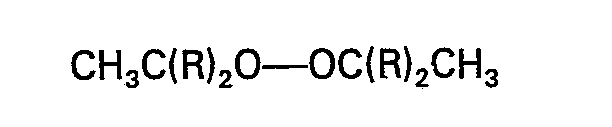
- The organic peroxides of the above formula may be diperoxides or mixed peroxides, that is, peroxides which have two different CH3C(R)20 . radicals. Specific examples include dicumyl peroxide, a preferred peroxide, ditertiarylbutyl peroxide, Vulcup, manufactured by Hercules (a,a',-bis-(t-butyl- peroxy)-diisopropyl benzene),tertiarybutyl-cumyl peroxide, ditertiaryamyl peroxide, tertiarybutyl-tertiaryamyl peroxide, tertiaryamyl-cumyl peroxide, ditertiaryoctyl peroxide, bis(1,1-diphenyl-ethyl)-peroxide, bis(1,1-dicyciohexyi-ethyi)peroxide, bis(1-cyclohexyl-1-methyl-ethyl)peroxide [also known as bis(2-cyclohexyl-2-propyllperoxide], bis(1-phenyi-1-ethyi-ethy))peroxide [also known as bis-2(2-phenylbutyl)peroxide], and the like. The symmetrical peroxides which have identical groups on each side of the peroxy oxygens are generally more available and therefore are preferred. However, mixed peroxides, when available, can be used very satisfactorily.
- Whether mixed peroxides or diperoxides of the above class are used to impart to the block copolymers' improved properties, which are generally more favorable than if ordinary peroxides other than the above class were used, the peroxides used are advantageously those having a reasonably fast rate of decomposition at the temperature employed.
- The nylon block copolymers formed when cured possess good physical properties characteristic of nylon such as impact resistance, high abrasion resistance, tensile strength and toughness, and can therefore generally be used as an engineering or structural plastic having low flammability. Desired end uses, thus, include appliance housings, cabinets, rigid panels, and the like. If the amine terminated polymer is formed from the 1,4-polybutadiene microstructure and the block copolymer has a high nylon content as in excess of 75 percent, the block copolymer may be employed as textile fibers and as tire cord similar to the use of nylon. If the amount of nylon content is lower, the 1,4-polybutadiene-nylon block copolymer can be utilized for hoses, flexible pipes, and the like. If the block copolymer contains a 1,2-polybutadiene microstructure, it can be used for casters, gears, plastic pipe, and the like. Moreover, as with nylon polymers, various conventional fillers and reinforcing agents may be added such as silica and the like. Various fibers such as wood, metal, rayon, etc., may also be added but they tend to greatly reduce the processability of the uncured polymer.
- The invention will be more fully understood by reference to the following examples which describe the preparation of various polybutadiene-nylon block copolymers.
- The 1,2-polybutadiene nylon block copolymers of the present invention have been found to produce good engineering rigid thermoset foams. Moreover, it has been found that such foams may possess excellent flame retardancy by proper compounding. Additional advantages of such rigid foams include the facts that they may be made from putty-like material and therefore are readily processable or moldable, they do not present dust problems, water can readily be used as a blowing agent, thereby reducing health and safety hazards of processing, and that as a thermoset, relatively low processing temperatures such as below 149°C must be utilized.
- In contrast, generally all conventional thermoplastic foams require a high processing and blowing temperature. For example, polycarbonates and polyphenylene oxides require a processing temperature of about 260°C to about 320°C. Considering thermoplastics which constitute the largest class of foams utilized, the foaming temperatures of polypropylene generally range from 170°C to 290°C, and for polyphenylene sulfides from 320°C to about 345°C. Considering the strength of various thermoset foams, phenolics and urea-formaldehyde tend to be friable and, therefore weak.
- Thermoset foams according to the present invention having good flame retardant properties are formed by utilizing conventional curing agents such as peroxides or with other conventional curatives, for example, various sulfur curatives, as are well known to those skilled in the art, along with suitable and conventional flame retardants, various surfactants to obtain good bubble dispersion and size, various conventional blowing agents, and various fillers or reinforcing agents. Additionally, a coreactive monomer may or may not be added to the block copolymer. The block copolymer may generally comprise a diene rubber constituent made from a monomer as set forth above, for example, from a conjugated diene monomer having from 4 to 10 carbon atoms with a preferred rubber constituent including 1,2-polybutadiene; 1,4-polybutadiene; 1,4-polyisoprene; and a copolymer of 1,4-butadiene and styrene. The nylon constituent may be made from any nylon-forming monomer as previously set forth, that is, the lactams, and preferably from caprolactam or capryllactam. The resulting thermoset foams may vary from rigid to semi-rigid as well as highly flexible, non-rigid foams by variation in the level and type of rubber curatives employed and the block copolymer composition.
- Additionally, thermoplastic rigid foams may also be prepared from the various block copolymers disclosed hereinabove when the amine terminated polymer portion of the copolymer is made from monomers via an anionic polymerization such as vinyl substituted aromatics or heteroaromatics, as set forth above. Of these various monomers, styrene, alpha-methylstyrene, vinyltoluene and 4-t-butylstyrene are preferred. Such thermoplastic block copolymer rigid foams will require high processing and blowing temperatures characteristic of conventional thermoplastic foams. The nylon constituent of the rigid foams may be made from any of the above-set forth monomers with caprolactam and capryllactam being preferred. Moreover, the various compounds which may be utilized in the preparation of these rigid thermoplastic foams are the same, such as the flame retardants, the surfactants, the blowing agents, and the like. However, when a rigid foam is prepared without utilizing a coreactive monomer, a curing agent such as a peroxide type or a sulfur type is not required.
- The amount of the coreactive monomer for preparation of either the thermoplastic foams or the rigid thermoplastic foams based upon 100 parts by weight of the block copolymer will be zero or nothing if a coreactive monomer is not utilized, or otherwise will range from about 1 to about 150 parts and preferably from about 1 to about 20 parts since the coreactive monomer generally decreases the viscosity of the composition. If too much coreactive monomer is utilized, the foam becomes soft or non-rigid, and exhibits reduced flame retardancy and generally lower physical properties. Specific examples of coreactive monomers include styrene, vinyltoluene, chlorostyrene, 4-t-butylstyrene, diallyphthalate, and the like.
- The range of the curing agent, be it peroxide or a sulfur-type curative, is from about 1 to about 40 parts with from about 2 to about 6 parts being preferred. In general, any conventional peroxide curing agent may be utilized as well known to those skilled in the art with dicumyl peroxide being preferred. Should Dicup 40 be utilized, a larger overall weight amount is generally utilized due, of course, to the fact that such peroxide contains only about 40 percent dicumyl peroxide by weight. Similarly, any conventional sulfur compound or sulfur cure system known to the art may also be utilized such as the following cure system.

- Considering the flame retardant, generally from 0 to 150 parts and preferably from 50 to about 100 parts of any conventional flame-retardant compound may be utilized. Specific examples include Thermoguard S 711, M and T Chemical Company (antimony trioxide), Dow FR 300 BA (decabromo diphenyl oxide), and alumina trihydrate. Generally, amounts at the lower end of the ranges are desired since, otherwise, the density tends to increase and the various physical properties tend to decrease.
- The general range of the surfactants is from 0.1 to about 5 parts with a preferred range of about 0.2 to about 2 parts. These ranges generally provide a good distribution of bubbles as well as bubble size whereas smaller amounts tend to produce a poor dispersion of cell size. On the other hand, excess amounts tend to cause collapse of the bubbles or voids. Any conventional surfactant may be utilized either alone or in combination with each other and a specifically preferred surfactant is SF 1034, a silicone surfactant manufactured by General Electric Company.
- The range of the blowing agent to produce the foam is from 0.5 to 50 parts by weight and preferably from 5.0 to about 20 parts per 100 parts of block copolymer. Many conventional blowing agents may be utilized. Generally, for thermoset copolymer foams, high decomposition temperatures for effective gas yield wherein the decomposition temperature is 150°C or over are not preferred and compounds having a decomposition temperature of 175°C and over tend to be incompatible with the process.
- Generally the physical blowing agents which are used for thermoset foams are those which are compatible or dispersible within the resin formulation and do not interfere with the free radical cure of the resin and are; pentane, hexane, heptane or water. The physical blowing agents which are preferred for thermoplastic copolymer foams are generally those cited above for thermoset copolymer foams.
- The general range of the fillers or reinforcing agents is from about 0 to about 150 parts and preferably from about 0 to 50 parts. Usually, amounts in excess of these ranges are not desirable since the formulations are rather stiff and do not readily flow under the internal gas pressure to give good foams. Various conventional fillers, well known to those skilled in the art, may be utilized such as silica, alumina, chopped glass fibers, and the like.
- The flame retardant rigid foam utility of the 1,2-polybutadiene nylon block copolymers will be better understood from the following examples and data.

- The above formulation was thoroughly mixed and 50 g of the formulation was cured in a cylindrical mold under atmospheric pressure. The sample was heated at 120°C for 40 min. and then at 177°C for 5 min. to rapidly cure the 1,2-polybutadiene portion. The resulting free rise, rigid foam had a density of approximately 0.85 g/cc and floated in toluene. A thin slice (0,16 x0,24 cm thick) of the foam would burn when held in the flame of a Meeker burner but self-extinguished upon removal from the flame. The slice did not drip either in the flame or after removal from the flame.
- In a similar formulation, wherein an amount of the block copolymer containing an equilibrium concentration of water, was compounded 2 parts of Dicup R. A 40 g sample was heated in a cylindrical mold for 2 hrs. at 149°C. The resultant foam had a density of approximately 0.8 g/cc and contained an even distribution of fine cells.
- In a manner similar to Example X, the following formulation was cured at 149°C for 60 min. in a 7,62x2,54xO,635 cm mold.

- The density was approximately 1.1 g/cc. The thermoset foam exhibited a Rockwell M hardness of 54, a flexural modulus of 0,3 x 1 05 kp/cm2 and a flexural strength of 432,4 kp/cm2.
- In a manner similar to Example XI, the following formulation was heated in a 7,62x2,54xO,635 cm mold for 60 min. at 149°C to produce a thermoset foam having a density of approximately 0.62 g/cc. This foam gave a Rockwell R hardness of 40, a flexural modulus of 0,08x10⁵ kp/cm2 and a flexural strength of 159,6 kp/cm2.
- The formulation was as follows:

- As apparent from these examples, self-extinguishing or non-burning rigid thermoset foams were produced having good physical properties.
- As previously noted, the above-described amine terminated polymers can be readily reacted with epoxy-forming monomers or prepolymers as cited in claim 1 and 2 to yield block copolymers. That is, if the amine terminated polymers are reacted with solely epoxy-forming monomers or with solely epoxy prepolymers, typically containing epoxide end groups such as acid generated epoxy compounds, the end portion of the amine terminated polymer will react with the epoxide end groups and form a block copolymer, of the ABA-type structure wherein A is the amine terminated polymer. As well known to those skilled in the art, the epoxy curing agents add to the epoxy ring generating a hydroxyl group which can then further react with more epoxy groups to extend the molecular weight. Of course, the presence of poly-epoxy compounds will result in the production of a highly branched and eventually crosslinked material. The amine terminated polymer, by virtue of its primary amine group, is a curing agent for epoxy compounds and will, thus, be bound to the epoxy resin constituent. Generally, unless exceedingly large amounts of an epoxy curing agent are utilized, the resulting composition will contain a mixture of epoxy graft copolymers, epoxy block copolymers, as well as epoxy copolymers which have blocked to at least one end thereof an amine terminated polymer, as well as amine terminated polymers grafted onto at least one point of the epoxy copolymer backbone.
- The amine terminated epoxy polymer compositions, whether block, graft, or mixtures thereof, are very readily formed simply by adding the amine terminated polymers to epoxy prepolymer resins and mixing at a temperature above the softening temperature of the epoxy resin, as from about ambient temperature to about 200°C, or at room temperature in a solution. Alternatively, the epoxy resin may be formed in situ by adding amine terminated polymers to epoxy forming monomers along with any other desirable additives such as epoxy catalysts, epoxy curing agents, and the like. Generally, the in situ epoxy polymerization, as well as the reaction between the epoxy prepolymers or resins and the amine terminated polymers, proceeds at ambient temperatures. Heat may be applied to increase the reaction rate as well as to cure the epoxy polymers. A suitable temperature range, therefore, extends from ambient temperatures to about 200°C with a preferred range being from about 50°C to about 150°C. The amount of epoxy polymer based upon the total weight of the copolymer composition, that is without any crosslinking, may range from as little as 1 percent by weight up to about 95 percent by weight with from about 2 percent to about 75 percent being preferred and is readily controlled simply by adding a desirable amount of epoxy-forming monomers or epoxy copolymer resins of a known equivalent weight to a desired or calculated amount of amine terminated polymer. Although the epoxy copolymers are readily processable at ambient temperatures in that they may be milled, extruded, injection molded, and the like, upon curing, they generally exhibit the physical properties of cured epoxy polymers. Thus, copolymers having a very low content of epoxy resin therein, such as 1 percent or more, exhibit good adhesion properties whereas copolymers having a very high amount of epoxy resin, such as 80 or 90 percent, exhibit high impact strength. Copolymers having an epoxy content between the values, vary accordingly in their physical properties.
- The properties will also tend to vary a bit with regard to the polymer constituent of the amine terminated polymer. Although any of the polymers may be utilized as set forth above, amine terminated polymers made from conjugated dienes having from 4 to 12 carbon atoms and desirably from 4 to 8 carbon atoms are preferred with butadiene and isoprene being highly preferred. Additionally, vinyl substituted aromatic compounds are also preferred with specific preferred examples of monomers being styrene, vinyltoluene, alpha-methylstyrene and 4-t-butylstyrene. Additionally, copolymers made from the conjugated dienes and the vinyl substituted aromatics are also desirable with a highly preferred copolymer being from styrene and butadiene. When a flexible amine terminated polymer is utilized such as 1,4-polybutadiene with a high amount of epoxy resin constituent such as 75-95 percent, the copolymer cured through the epoxy segments exhibits good impact resistance and flexibility. In contrast, when the amine terminated polymer constituent is easily cured to a rigid network such as 1,2-polybutadiene, the epoxy copolymer may be cured in both of its constituent phases to give a hard, rigid, thermoset plastic. If the amine terminated polymer constituent is prepared from thermoplastic-type monomers, such as vinyl substituted aromatics and vinyl substituted heteroaromatics, the epoxy copolymer can be cured in the epoxy constituent phase and the resultant cured copolymer will contain thermoplastic domains which will act predominantly as reinforcing fillers at temperatures up to the softening point of the thermoplastic amine terminated polymer.
- If the epoxy constituent of the copolymer is formed in situ, suitable amounts of conventional catalysts and curing agents may be utilized. For example, based upon 100 parts by weight of the epoxy polymer, from 0.1 to 4.0 parts of a curing agent may be used. Typical curing agents include polyamides, polysulfides, urea and phenol-formaldehyde, as well as polyamines, and preferably polycarboxylic acids or acid anhydrides. Examples of common or conventional curing agents are set forth in the Handbook of Epoxy Resins by Lee & Neville, Supra., particularly in Chapters 5 through 12 which are hereby fully incorporated by reference. Examples of specific and desirable agents include Nadic methylanhydride (methyl-2,3-dicarboxy[1 2 - 2]bicycloheptene anhydride), phthalic anhydride, maleic anhydride, succinic anhydride, pyromellitic dianhydride, benzophenonetetracarboxylic dianhydride, trimellitic anhydride, hexachloro-2,3-dicarboxy[1 . 2 - 2]bicycloheptane anhydride; the polymethylene diamines [e.g., H2N―(CH2)n―NH2], wherein n is 2 to 15 and preferably 2 to 6: xylene diamines: polyamines from ethylene imide [e.g., H2N―(CH2CH2NH)n―CH2CH2NH2], where n is 2 to 15, with an n value of 2 to 5 being highly preferred, m-phenylene diamine, 4,4'-methylene dianiline, diaminodiphenylsulfone, hexamethylene tetramine, dimethylol urea, urea-formaldehyda resins, melamine, and phenol-formaldehyde resins. The cure, as set forth in Lee and Neville, generally occurs through coupling or condensation reactions of any of the hydroxyl groups contained in the backbone of the formed epoxy polymer.
- Conventional catalysts may be utilized to promote the in situ polymerization of the epoxy-forming monomers, such as benzyl dimethylamine; 1,4-diaza[2 - 2 - 2]bicyclooctane, tri-n-alkanol amines with triethanolamine [N―(CH2CH2OH)3] being highly preferred, Lewis acid and complexes thereof, and complexes of BF3 (e.g., BF3, diethyl ether). Moreover, any of the catalysts may be utilized which are set forth in Lee and Neville, Supra., Chapter 13, which is hereby fully incorporated by reference. Various conventional additives may be utilized such as various colorants, diluents, flexibilizers, stabilizers, fillers, and the like. Conventional fillers include glass powders, metal powders, various silicas, and fibers to which the epoxy materials have good adhesion and produce composites with excellent physical properties. If desired, carbon black may be added. Moreover, various coupling agents may be used in conjunction with the fillers. Examples of specific silanes include N-beta(N-vinylbenzylaminoethyl)-gammaaminopropyltrimethoxysilane hydrogen chloride, 3-chloropropyltrimethoxysilane, 3-glycidoxypropyltrimethoxysilane, N-(2-aminoethyl-N'-2-aminoethyl)-3-propyltrimethoxysilane, and vinyltriacetoxysilane.
- Generally, the preparation or addition of the various compounds, curing agents, catalysts, fillers, and the like, may take place in a suitable mixing vessel such as a Brabender or the like wherein the various compounds are simply mixed, with the formation of the copolymers being carried out at ambient temperatures, if desirable. In accordance with generally accepted procedures for the preparation of epoxy polymers, there is no need for solvents although, if desired, a non-polar solvent such as toluene may be utilized. After mixing, the toluene is generally stripped as by heating or applying a vacuum.
- Although a chemical bond between the amine group and the epoxide group is formed during the preparation of the copolymers, discontinuous phases do exist between the generally polar epoxy portion of the polymer and the generally non-polar amine terminated portions such as a rubber or vinyl compound. However, the compatibility of the two phases is generally good.
- In addition to the epoxy cure, common and conventional curing agents may be utilized to crosslink a rubber-type amine terminated polymer. Thus, sulfur compounds, organic peroxide compounds such as dicumyl peroxide, and the like, may be utilized to cure the amine terminated polymer when it is made from the preferred rubber-type monomers. Generally, a curing agent is selected such that it cures in the same general temperature range as the epoxy curing agent. Of course, due to the highly crosslinking nature of the epoxy copolymers with crosslinks establishing through both the amine polymer as well as the epoxy polymers, the final product is highly gelled and, hence, is a thermoset resin.
- The epoxy copolymer may generally be used in the same applications as epoxy polymers, such as surface-coating materials, wherein toughness, adhesion and chemical resistance are required, with fillers such as glass fibers to make glass fiber-reinforced articles for electrical insulating items and the like. In addition to casting, potting, encapsulation and embedment techniques as practiced with epoxy resins, the copolymers, due to their great ease of processability at ambient temperatures, may also be used for extruding, injection molding, blow molding, and the like.
- The invention will be better understood by the following examples.
- A copolymer of an amine terminated 1,2-polybutadieneepoxy resin was prepared by mixing 16 g of Shell Epon 1004 epoxy resin with 100 g of an amine terminated 1,2-polybutadiene (prepared as set forth in Example V) at 90-100°C for 30 mins. Based upon the amine content of the amine terminated 1,2-polybutadiene and the equivalent weight of the Epon 1004, there were two epoxy groups charged for each amine present. This copolymer (Dienoxy A) was then utilized in the formation glass fabric laminates and in the preparation of a 1,2-polybutadiene graft epoxy copolymer.
- The following procedure was utilized to prepare glass fabric laminates.
- A dip was prepared by dissolving the indicated t,2-polybutadiene resin in toluene to give 30 percent solids. The dicumyl peroxide was dissolved at this time. The below-identified silane coupling agent was added and dispersed in the dip by shaking. Strips of glass fabric (Burlington 7781) were cut 7,62 cm wide by 96,52 cm long with the warp threads (strong direction) running across the narrow dimension. The glass fabric strips were weighed, then passed slowly through a shallow trough containing the dip. The excess dip was removed by wiping the impregnated fabric strip with parallel aluminum rods separated by a 0,2 cm gap. After air drying to remove most of the solvent, the impregnated fabric strips were dried in vacuo at room temperature for 3 hrs. Test specimens were molded by laminating ten plies of "prepreg" with all warp threads laid in parallel. The samples were cured 6 min. at 177°C in a preheated positive pressure mold. The flexural test samples were cut from the cured laminate such that the warp direction ran the length of the sample.

- By use of the Dienoxy A copolymer described above, a 1,2-polybutadiene epoxy copolymer composition of approximately 33/67 composition was prepared and both the epoxy constituent and the polybutadiene constituent were cured. It should be noted that the blend of Dienoxy A copolymer with the additional diglycidylether of bisphenol A (DGEBA) and the anhydride curative system formed a stable dispersion while a blend of 1,2-polybutadiene with DGEBA and the anhydride curative system rapidly separated into two phases.
- The indicated quantites of Dienoxy A and DGEBA were mixed together at 95-1 100C using a Cowles dissolver. After cooling to 75-80°C, the required Dicumyl peroxide and anhydride curatives were mixed in again using the Cowles dissolver. Mixing time, after the addition of the curatives, was less than 15 min. Samples were cured 4 hrs. at 85°C followed by 16.5 hrs. at 145°C to insure cure of both constituents.


- The stable amine terminated polymer of the present invention can be readily reacted with urea polymers having an active isocyanate end group or with urea forming monomers to produce copolymers of the P-U-P wherein U is the urea polymer constituent and P is the amine terminated polymer constituent. Such block copolymers generally exhibit extremely good processable properties at temperatures below the melting temperature of the urea constituent polymer and often times at ambient temperatures.
- The reaction between the amine end group of the amine terminated polymer and the isocyanate group of either the urea forming monomers or the urea polymer having a free isocyanate end group thereon, generally occurs spontaneously and at room temperature. The rate of forming the chemical bond between the two constituents of the block can, of course, be readily increased by heating to any suitable temperature such as to approximately 150°C. Various urea block copolymers can be tailor-made simply by controlling the amount of the urea-forming monomers or the urea polymer added to the amine terminated polymer. Generally, suitable polymers are produced wherein the urea block copolymer contains from 5 percent to 95 percent by weight of urea based upon the total weight of the block copolymer and preferably from about 25 percent to about 75 percent by weight. In such block copolymers, the favorable properties of polyurea such as high modulus are usually retained. Such block copolymers may contain various additives, colorants, fillers, antioxidants, etc., and the like, as well known to those skilled in the art. For example, the urea block copolymers may be filled with carbon black, silica, etc. The reaction is desirably carried out in any suitable solvent such as toluene, hexane, tetrahydrofuran, and the like.
- The urea constituent of the block copolymer is prepared by reacting a polyisocyanate with a diamine or water. Generally, the diamines are preferred since reaction with water proceeds at a slower rate and requires the use of a catalyst. The polyisocyanate or the polyisothiocyanate has the same formula as set forth above with regard to the formation of the amine terminated polymer and, preferably, in order to avoid crosslinking and the formation of a gel, is a diisocyanate or a diisothiocyanate. Of the various aliphatic types of diisocyanates, the alkyl, cycloalkyl, and aromatic-alkyl are preferred. Suitable diamines are represented by the formula HzN-R-NHz where R is an aliphatic, preferably an alkyl containing from 2 to about 20 carbon atoms, a cycloaliphatic, preferably a cycloalkyl containing from 4 to about 20 carbon atoms, or an aromatic containing from 6 to about 20 carbon atoms, or combinations thereof. Examples of specific diamines include ethylenediamine, tetramethylenediamine, pentamethylenediamine, ortho-phenylenediamine, paraphenylenediamine, 2,6-toluenediamine, 4,5-diethyl-ortho-phenyldiamine, and meta-xylylenediamine. Preferred diamines include hexamethylenediamine, meta-phenylenediamine, 2,4-toluenediamine, methylene-bis(ortho- chloroaniline), i.e., MOCA and methylene dianiline.
- The amount of diamine utilized with regard to the polyisocyanate or diisocyanate generally varies on an equivalent basis from about 0.8 to about 1.2, with a preferred range being from about 0.95 to about 1.05. These ranges include any available polymeric amines and polyamines remaining from the amine terminated polymer synthesis. Should the equivalent ratio be below the general range or above it, usually some P-U type area block copolymers will be formed along with free polyurea, especially if the equivalent ratio is greatly above or below. Of course, the amount of diisocyanate utilized along with the diamine or water can vary so that upon a stoichiometric basis as well as a kinetic basis the molecular weight of the polyurea constituent ranges from 1,000 to 40,000 with the preferred range being from about 5,000 to about 25,000. Since diisocyanate compounds are very reactive, generally the urea polymers formed are formed in situ. In any event, it is important that the formation of the block copolymers be carried out in an environment substantially free from active hydrogens such as alcohols, acids, and the like; and thus an inert atmosphere may be used such as nitrogen, helium, argon, and the like. Of course, since water is generally an active hydrogen compound, it is thus an exception of the foregoing when it is utilized in the formation of the polyurea polymer. Should diamines be utilized as well as water, the diamines are added first in an inert atmosphere followed by the addition of water.
- The temperature range of the polyurea polymerization is generally from 0°C to about 260°C and preferably from about 70°C to about 180°C. The reaction when diisocyanates (or polyisocyanates) and diamines are utilized is rapid and does not require a catalyst. However, since the urea block copolymer formed is a heterogeneous mixture, the viscosity of the solution will influence the reaction rate such that a catalyst may be desired. Due often to the increase of the viscosity of the system upon polymerization, the urea block copolymer generally exists in a suspension. The urea block copolymer, however, may be readily coagulated and precipitated by a compound which is not a solvent for the amine terminated portion of the block copolymer, such as methanol.
- When water is utilized in the formation of the polyurea constituent, catalysts are often desirable and are well known to those skilled in the art. Generally, such catalysts are the same as used in the formation of urethane polymers set forth below and include tertiary amines. They are used in proportion to their base strength, except when steric hindrance interferes, and a suitable amount is usually from about 0.01 to about 1.0 parts per 100 parts of urea-forming monomers. A preferred catalyst is triethyienediamine(1,4-diazo[2 - 2 - 2]bicyclooctane), which is more powerful than would be predicted from its base strength due probably to its reduced steric hindrance. Another class of catalysts are the metallic compounds which generally are powerful enough as the catalyst to promote a "one-shot" process. Of the various members of this class, the organotins are favored. Specific examples of suitable organotins include tetra-n-butyltin acetate, n-butyltin trichloride, trimethyltin hydroxide, dimethyltin dichloride, and tributyltin acetate. A preferred organotin is dibutyltin dilaurate.
- The polymeric amine constituent of the urea block copolymer may be made from any of the monomers set forth above. However, preferred monomers include the dienes containing from 8 to 12 carbon atoms and preferably from 4 to 8 carbon atoms, vinyl substituted aromatics containing from 8 to 20 carbon atoms, and copolymers made therefrom. Preferred monomers of these groups include butadiene, isoprene, vinyltoluene, styrene, and 4-5-butylstyrene, and a copolymer made from butadiene and styrene, that is, SBR or styrene-butadiene rubber. Thus, when the amine terminated polymer constituent is 1,4-polybutadiene, polyisoprene, or the like, the urea block copolymer may be used as tire rubber or as an adhesive for bonding rubber to urethanes. Additionally, such block copolymers can be reinforced with carbon black, silica, and the like. When the amine terminated polymer constituent is 1,2-polybutadiene, the copolymer, upon cure, yields a hard plastic; however, when the amine terminated polymer constituent is a thermoplastic such as polystyrene, the resulting urea block copolymer acts as a thermoplastic. When the amine terminated polymer constituent is rubber, the block copolymers may be cured in any conventional manner utilizing conventional cure systems of the amine terminated constituent and generally have properties similar to a reinforced or filled amine terminated polymer. Typical uses of the urea block copolymers are numerous and the same as those generally for polyureas or filled amine terminated polymers. Additionally, when the amine terminated polymer constituent is rubber, specific uses include tires, belting, hose and molded goods. Regardless of the nature of the base polymer constituent, the block copolymers, as noted, also have remarkably improved processability below the melt temperature of the urea constituent.
- The invention will be more fully understood by reference to the following examples.
- A 500 ml resin kettle was fitted with a paddle stirrer, a nitrogen inlet, a septum, and a condenser, topped by a pressure relief bubbler. To 100 g of toluene was added a 60 g portion of 1,2-PBdNH2 {Example V). The toluene was stirred to dissolve the resin. A 0.5 g portion of aluminum stearate (anhydrous) was added and stirred to dissolve. Then, 69.3 ml (84.7 g; 0.487 mole) of Hylene TM (80/20 2,4/2,6-toluenediisocyante) was added through the septum via a syringe. A 0.1 ml portion of dibutyltin dilaurate was added as a catalyst for urea formation. Urea formation occurred rapidly upon the addition of 50.0 ml (55.0 g; 0.509 mole) of molten (100°C) m-phenylene diamine. Stirring was continued for 5-10 seconds when the entire mixture solidified. Reaction in the solid phase was permitted to continue for 72 hrs. at ambient temperatures. The material was dried in vacuum to give 205.0 g of crumbly, tannish powder which darkened upon exposure to air (oxidation of excess amine). The material was sheeted out on a two-roll mill. The resulting polymer was pliable and had a glossy surface. A portion of the milled polymer was compounded on the mill according to the formulation given below. Even with 150 phr of silica, the copolymer remained pliable (like tough leather) and smooth surfaced.
- The samples were cured 20 min. at 177°C the physical properties are given below.


- The amine terminated polymers are readily and easily reacted with urethane polymers, urethane prepolymers, or urethane forming monomers to form urethane block copolymers. Thus, the stable amine terminated polymer described above may be stored until required and then reacted at ambient temperatures or at temperatures from about 20°C to about 150°C with urethane-forming monomers or the prepolymer to produce an in situ polymerization of the urethane polymer constituent. Alternatively and less desirably, the urethane-forming monomers or prepolymers may be polymerized, and then reacted with the amine terminated polymer within the same temperature range. The urethane block copolymer is of the P-U-P type where P represents the amine terminated polymer and U represents the urethane polymer constituent. Additionally, urea-forming monomers may be utilized in association with the urethane polymers or urethane forming monomers and prepolymers to produce urethane-urea copolymers or block copolymers also of the P-U-P type structure. The urethane block copolymer, as well as the urethane-urea block copolymer, generally exhibits good or improved processability at temperatures below the melt temperature of the urethane constituent or the urethane-urea constituent and may be utilized in a great number of applications as a thermoset upon cure.
- The urethane polymer constituent of the block copolymer generally contains a significant number of urethane groups to impart urethane-type properties to it. Generally, the urethane constituent is prepared by reacting a polyisocyanate with any of a number of conventional polyhydroxy compounds which contain at least two hydroxyl groups. Of course, the hydroxyl groups may either be end groups or located on the backbone of the compound. The polyisocyanates have the same formula as set forth above with regard to the formation of the amine terminated polymer and, thus, may be a polyisocyanate or a polyisothiocyanate, in which case, a thiourethane block copolymer is formed. As in the description of the preparation of the urea polymer constituent, diisocyanates are preferred in order to avoid gels, and the R group is an alkyl group having from 2 to 20 carbon atoms, a cycloalkyl group having from 4 to 20 carbon atoms, an aromatic having from 6 to 20 carbon atoms, or combinations thereof. Preferred diisocyanates for use in the preparation of the urethane polymer constituent or the urethane-urea polymer constituent are the same as those set forth above with regard to the discussion of the urea polymer constituent or for the preparation of the amine terminated polymer.
- Examples of polyhydroxy compounds which, of course, generally contain an active hydrogen include the di- and polyhydric alcohols such as the di- and polyhydric phenols, the polyether polyols such as the polyether diols, the polyester diols, the polylactone diols, the phenol-aldehyde novalacs, and castor oil. Compounds containing groups such as amino and carboxyl may be used. Thus, a typical urethane block copolymer may contain, in addition to the urethane groups in the urethane constituent, aliphatic and aromatic hydrocarbon residues, ester, ether, amide, and urea groups.
- Suitable di- and polyhydric alcohols which may be reacted with polyisocyanates include the conventional alcohols which are commonly used in the formation of urethanes and, in general, the di-and polyhydric alcohols such as the alkylene polyols having from 2 to 30 carbon atoms, the cycloalkyl polyols having from 4 to 30 carbon atoms, and the alkanol or cycloalkanol substituted aromatic compounds having from 8 to 30 carbon atoms. Specific examples include a,a'-dihydroxyxylenes, 1,3-dihydroxytetraline, and 1,4-dihydroxytetraline. Specific examples of dihydric alcohols or alkylene polyols include primary and secondary alkyl diols having from 2 to 6 carbon atoms such as ethylene glycol; 1,2-propanediol, 1,3-propanediol; 1,2-butanediol; 1,3-butanediol; 1,4-butanediol; 1,5-pentanediol; 1,6-hexanediol; 2,3-hexanediol; 2,5-hexanediol; and 3,4-hexanediol. Examples of a specific cycloalkyl alcohol or a cycloalkyl polyol include 1,4-dimethylol cyclohexane; 1,2-cyclopentanediol; 1,4-cyclohexanediol; or 2,2-bis(4-hydroxycyclohexane)propane (hydrogenated bis-phenol A). Specific examples of alkylene polyols include glycerol; 1,2,6-hexanetriol; sorbitol; mannitol; pentaerythritol; and 2-ethyl-2-hydroxymethyl-1,3-propanediol.
- Generally, any of the polyether polyols such as the polyether diols which are used in the formation of urethanes may be reacted with polyisocyanates to form the urethane polymer constituent of the block copolymer. Such compounds include the polyether polyols prepared from cyclic ethers having from 2 to 8 carbon atoms, preferably from 2 to 4 carbon atoms, and the polyether polyols prepared from substituted cyclic ethers having from 2 to 8 carbon atoms in the ring such as the substituted ethylene oxide ethers (formula No. 5), the substituted oxirane ethers (formula No. 7) and the substituted tetrahydrofurans. The substituted "R" group of the above ether ring compounds is the same as set forth with regard to formula 5 and 7, except that the "R" group may contain up to 20 carbon atoms. That is, "R" may be an alkyl having from 1 to 20 carbon atoms, a cycloalkyl having from 4 to 20 carbon atoms, an aromatic ring (i.e., phenyl), or a substituted aromatic ring wherein said substituted group is an alkyl having from 1 to 20 carbon atoms or a cycloalkyl group having from 4 to 20 carbon atoms. Examples of polyether polyols made from cyclic ethers include compounds preferably derived from propylene oxide and/or ethylene oxide, and to a much lesser extent, those derived from styrene oxide, formula No. 5, and from the above-mentioned alkylene polyols. Additional examples include the polyether polyols made from the poly(oxypropylene) triols, the polyethers which have greater than three hydroxy groups such as those made from the polyols of mannitol and pentaerythritol, and from the substituted oxirane ring such as 3,3-dimethoxycyclobutane, 3,3-diethyloxycyclobutane, and 3,3-methylethyloxycyclo- butane. A highly preferred group of specific polyether diols are the polytetramethyleneoxide glycols which, of course, are prepared by the polymerization of tetrahydrofuran.
- Generally, the various polyhydroxy compounds set forth immediately above, that is, the various diols and polyols, the di- and polyhydric alcohols, the various polyether polyols such as those prepared from cyclic ethers as well as those prepared from the specifically disclosed cyclic ethers, have an equivalent weight of from about 100 to about 5,000. Preferably, the molecular weight per hydroxy group of the polyhydroxy compound will range from about 200 to about 1,000.
- The polyester diols constitute yet another class of polyhydroxy compounds which may be used to form the urethane polymer constituent of the block copolymer and generally any polyester which is used in the formation of urethane polymers may be utilized. Typical monomers used to prepare polyesters for the urethane polymer constituent include adipic acid or phthalic anhydride condensed with any of the alkyl diols listed above having from 2 to 6 carbon atoms. For the preparation of branched polyesters, triols such as glycerol, 1,2,6-hexanetriol, trimethylolpropane, that is, 2-hydroxymethyl-2-methyl-1,3-propanediol, may be used; and to a lesser extent, the various polyols such as sorbitol, mannitol and pentaerythritol. As apparent to one skilled in the art, it is desirable to use polyesters which contain only hydroxyl groups as reactive sites and, hence, polyesters which have very low acid numbers and very low water content are preferred.
- The polylactone diols constitute yet another class of polyhydroxy compounds which may be used to form the urethane polymer constituent of the block copolymer. The lactones used in the preparation of the polylactone diols contain at least 3 carbon atoms and generally up to 15. Examples of specific lactones include caprolactone and capryllactone. The polylactone diols made from caprolactone are preferred in the present invention.
- Generally, the equivalent ratio of the polyisocyanate or polyisothiocyanate compounds which are reacted with the polyhydroxy compounds to form the urethane polymer constituent is from about 0.8 to about 1.2. A preferred equivalent ratio is from about 0.95 to about 1.05. Of course, the isocyanate will also react with the amine group of the amine terminated polymer. However, since the number of hydroxyl end groups of the polyhydroxy compounds are large in comparison to the amine groups, these ratios are still valid when based upon the amount of both the hydroxyl end groups and the amine end groups. The actual equivalent ratio may vary above these ranges or below them. Generally, the further away the equivalent ratio is from the desired equivalent ratio, the more P-U type block copolymers are formed along with free polyurethane. On the other hand, if polyisocyanate monomers such as triisocyanates are utilized, the resulting polymeric material will be a gel or a crosslinked entity due to the additional reactive sites provided by the triisocyanates. Since such entities are difficult to process, diisocyanates are preferred. Of course, the weight percent of the urethane polymer constituent in the block copolymer will be largely controlled by the amount of the urethane-forming monomers utilized in association with the amount of the amine terminated polymers utilized. That is, the molecular weight of the urethane or the urethane urea polymer constituent can vary considerably from 1,000 to 100,000. Generally, urethane block copolymers as well as urethane-urea block copolymers having desirable processing properties, as well as cured properties have been produced wherein the weight percent of the urethane or the urethane-urea constituent is from 5 percent o 95 percent based upon the total weight of the block copolymer and preferably from about 25 percent to about 75 percent.
- In order that the in situ polymerization of the urethane polymer or the urethane-urea copolymers, wherein diamines are utilized, do not react with compounds containing active hydrogens such as water, alcohol, acids, etc., it is generally important that such polymerization is carried out in an environment- substantially free from active hydrogens as in an inert atmosphere such as nitrogen, helium, argon, and the like. However, it is to be understood that a small amount of active hydrogen compounds may be present provided that a sufficient number of urethane polymers or urethane-urea polymers may be formed from the amine group of the amine terminated polymer.
- Catalysts are often used to promote the formation of the urethane polymer constituent of the block copolymer. The catalysts suitable for promoting the formation of urethane polymers are also generally suitable for promoting the formation of the urethane constituent in the present invention and such catalysts are well known to those skilled in the art. For example, tertiary amines which are conventional urethane catalysts may be used and generally their catalytic strength is in proportion to their base strength except when steric hindrance interferes. An exception is triethylenediamine (1,4-diaza[2 - 2 - 2]bicyclooctane), a preferred catalyst which is much more powerful than would be predicted from its base strength due probably to its complete lack of steric hindrance. A large number of metallic compounds constitute another class of catalysts and generally these catalysts are powerful enough to promote "one-shot" processes. Of the various members of this class, the organotins are favored. Specific examples of suitable organotins include tetra-n-butyltin acetate, n-butyltin trichloride, trimethyltin hydroxide, dimethyltin dichloride and tributyltin acetate. A preferred organotin is di-n-butyltin dilaurate.
- Since the polymerization temperature of the urethane polymer constituent can range from about ambient to about 100°C and since the reaction of the urethane polymer or urethane-forming monomers with the amine group of the amine terminated polymer occurs easily at ambient temperatures and at a faster rate at elevated temperatures, in situ polymerization of the urethane constituent is preferred. Although the reaction of the urethane can be controlled to a large extent through the selection of temperature as well as the particular polyisocyanate and the polyhydroxy compound, the choice of the catalyst can often give broader control. In fact, the catalytic effect of some catalysts are so powerful that they often override the influences of the reactants and therefore such catalysts are used to control the reaction. One group of such catalysts, as well known to those skilled in the art, are the aforementioned organotins which contain from 1 to 6 carbon atoms.
- The amine terminated polymer can be made from any of the types of monomers set forth above with regard to the preparation of said polymer and can be made in the exact same manner. Often, the resulting urethane block copolymer will be readily processable at temperatures below the melt temperature of the urethane constituent (or the urethane-urea constituent) but will exhibit properties of the urethane constituent (or the urethane-urea constituent) upon cure. Desirably, the amine terminated polymer is made from conjugated dienes having from 4 to 12 carbon atoms, vinyl substituted aromatic compounds having from 8 to 20 carbon atoms, and copolymers made from combinations thereof. Desirable conjugated dienes contain from 4 to 8 carbon atoms. Specifically preferred conjugated monomers include butadiene and isoprene, whereas preferred vinyl substituted aromatic monomers include styrene, vinyltoluene, and 4-t-butylstyrene. A preferred copolymer is made from butadiene and styrene monomers, that is, SBR (styrene-butadiene rubber).
- The in situ polymerization of the urethane block copolymers or the urethane-urea block copolymers can generally be carried out in bulk or in a solvent.
- Generally, the choice of urethane preparation conditions (that is, in bulk or in a solvent) controls, to an extent, the processing properties of the block copolymer. When the polyurethane portion is prepared in a solvent, which is essentially a non-solvent for polyurethane (that is, non-polar solvents such as hexane, heptane, or toluene), the resulting urethane block copolymers are millable at room temperature. However, when the urethane preparation is carried out in bulk or in solvents of good dissolving power for urethane, such as DMF, DMAC, the urethane block copolymers must be processed at a temperature near or above the softening point of the urethane polymer constituent. Nevertheless, such block copolymers are still readily processable.
- Various additives, colorants, reinforcing fillers, stabilizers, and the like may be utilized as are common in the preparation of the amine terminated polymer. Thus, when utilizing a conjugated diene such as butadiene or isoprene in preparing the amine terminated polymer, conventional fillers such as carbon black, silica, oil, and the like may be utilized. Additionally, the amine terminated polymer portion of the block copolymer may be readily cured through the use of conventional curing agents. Thus, for rubber-type amine terminated polymers, conventional sulfur-containing compounds, organic peroxides, and the like may be utilized at convenient or conventional amounts to produce thermosets. The properties of the cured urethane block copolymers generally retain the general properties of urethane such as good abrasion resistance and flexibility. Thus, the urethane block copolymers may be used for items such as rubber goods, molded goods, and heavy-duty industrial applications where chemical, abrasion, and corrosion resistance are desired as well as for any items wherein rubber is commonly used. When the amine polymer is a copolymer such as styrene-butadiene, the resulting urethane block copolymer may generally be used wherever reinforced cured rubbers have been utilized.
- A 1 liter resin kettle fitted with a mechanical stirrer, nitrogen inlet, thermometer and Dean-Stark trap topped with a condenser was charged with 30.0 g of 1,2-PBdNH2 containing 0.0054 equivalents of NH2 as a hexane cement (Example V) and 750 ml of toluene. The mixture was heated to reflux and remove any water by azeotropic distillation. Distillation was continued to remove the hexane. After the vapor temperature reached 107°C, the heating was stopped and the toluene cement was allowed to cool to about 60°C. Then, 65.6 g of Adiprene LD 784 (Trademark) prepolymer (DuPont polytetramethylene ether glycol reacted with toluene diisocyanate) with 6.32 weight percent NCO (0.0987 equivalents of NCO) was added and mixed well while heating the reaction to 85-90°C. After 15 min. of mixing, 4.5 ml of 1,4-butanediol (0.102 equivalents of OH) were charged and the reaction was heated at reflux for 1 hr. A catalyst (0.05 ml of dibutyltin dilaurate) was then added and reflux was continued for an additional 15 hrs. After this period of reaction, there was no detectable NCO absorbance in the IR spectrum indicating complete reaction. The copolymer was recovered by coagulation in methanol and drying in vacuo at 70°C overnight. The copolymer recovery was 93.2 g. A portion of the copolymer was mill compounded with 2.0 pph of 2,5-dimethyl-2,5-bis(t-butylperoxy) hexane and then molded and cured for 2 hrs. at 120°C. The physical properties are given below.

- A 1 liter resin kettle fitted as described in Example XVIII was charged with 30.0 g of 1,2-PBdNH2 (Example V) containing 0.0054 equivalents of NH2 as a hexane cement and 750 ml of toluene. The hexane and any water present were removed by azeotropic distillation as described in Example XIV. After cooling the reaction to 60-70°C under nitrogen, 37.7 ml (46.2 g or 0.265 moles) of an 80/20 mixture of 2,4-/2,6-toluenediisocyanate was added and stirred for 30 min. before 24.7 ml (25.2 g or 0.278 moles) of 1,4-butanediol and 0.05 ml of dibutyltin dilaurate were added. The reaction mixture was heated at reflux for 6 hrs. and then allowed to cool and stir under nitrogen for 16 hrs. The copolymer was precipitated in methanol, collected by suction filtration and dried in vacuo at 50°C. Copolymer recovery was 79.2 g. A portion of the copolymer was compounded on a two roll mill, cured and tested as indicated below.


- As previously noted, in lieu of a purely urethane polymer constituent, a urethane-urea copolymer may be utilized. Otherwise, the preparation as well as the other aspects of the formation of the urethane block copolymer such as catalysts, polymerization method, and the like, are the same. In order to form the urethane-urea type block copolymers polyisocyanates and polyhydroxy compounds and diamines as set out in claim 7 are used. Suitable diamine monomers have the formula HZN-R-NHZ wherein R is the same as set forth above with regard to the discussion of the urea block copolymer. Similarly, specific examples of diamines as well as preferred diamines are the same. Generally, the urethane-urea block copolymer will have uses very similar to either the urea block copolymer or the urethane block copolymer depending upon the number of urea or urethane groups within the copolymer. In any event, the equivalent ratio of the polyhydroxy compounds plus the diamine compounds to the polyisocyanate compounds generally ranges from about 0.8 to about 1.2 with a preferred range being from about 0.95 to about 1.05. As with the urea block copolymers or the urethane block copolymers, the urethane-urea block copolymers may contain additives, conventional fillers, reinforcing fibers, stabilizers, colorants, and the like, and may be cured with conventional curing agents.
- To a 1 liter, 3 necked flask fitted with a mechanical stirrer, nitrogen inlet, thermometer and a distillation head, the indicated quantities of amine terminated 1,2-polybutadiene (1,2-PBdNH2,) of 24,600 viscosity average molecular weight were charged as hexane cement. The indicated quantities of hydrocarbon solvent were added and the mixture heated to distill off the hexane and any water. When the vapor temperature had reached 95°C in the heptane example, or 107°C in the toluene example, the mixture was cooled under nitrogen to below the boiling point of the solvent and the distillation head was replaced by a reflux condenser. The indicated quantities of an isocyanate terminated polycaprolactone diol prepolymer were added to the flask and dispersed by stirring. The required quantity of a solution of 2,4-toluenediamine in dioxane was added to each reaction mixture and after addition of tin catalyst, the entire mixture was heated at reflux to generate the urethane-urea block polybutadiene copolymer. The product was recovered by precipitation in alcohol followed by suction filtration and drying in vacuo overnight. Samples of each preparation were compounded as indicated below on a two-roll mill. Test pieces were molded and cured 20 mins. at 177°C. The physical properties are listed below.
-


- To a 1 liter, three-necked flask fitted with a thermometer mechanical stirrer and vacuum take-off was charged 200 g of a 20 percent hexane cement of amine terminated 1,2-polybutadiene (1,2-PBdNH2). The hexane was stripped under vacuum to remove traces of water, then the 1 ,2-PBdNH2 was redissolved in 300 ml of dry hexane. To this polymer cement was added 200 g of Adiprene L-167 (6.5 percent NCO) (DuPont polytetramethylene ether glycol diisocyanate terminated polymer) which was dispersed by vigorous stirring while the hexane was removed under heat and vacuum. The polymer-prepolymer mixture was maintained at 70°C while 0.75 g of 2,5-dimethyl-2,5-bis-(t-butyl- peroxy)hexane charged at 1.875 pph 1,2-PBdNH2) was dispersed in the mixture. Then 42.9 g of molten MOCA (methylene-bis-4[2-chloroaniline]) was added to the mixture with rapid stirring. The reaction was permitted to stir vigorously under vacuum for 1 min. and then the mixture was poured into molds and cured for 2 hrs. at 120°C. The physical properties obtained are given below.

- The stable amine terminated polymer can be reacted with imide-forming monomers in situ to produce an imide block copolymer generally of the formula P-I-P where P represents the amine terminated polymer and I represents the imide polymer constituent. The resultant imide block copolymers generally exhibit very similar or identical properties to that of conventional imide polymers but also possess greatly improved processability properties in that they are readily millable and moldable at temperatures well below the melting point of conventional imide polymers, and often times even at ambient temperatures. Due to the ease of preparation, an in situ formation is highly desired.
- The imide polymer constituent of the block copolymer is produced by the chemical reaction of an alkyl dianhydride, preferably an aromatic dianhydride, or combinations thereof, with an alkyl diamine, a cycloalkyl diamine, or preferably an aromatic diamine. When the formation is in situ with the amine terminated polymer, the anhydride will readily react with the amine group of the amine terminated polymer. The alkyl dianhydrides contain from 8 to 30 carbon atoms with the aromatic dianhydrides containing from 10 to 40 carbon atoms. Naturally, the aromatic dianhydrides may contain substituted alkyl groups such as those connecting aromatic nuclei, or existing as on alkyl side chains, or combinations thereof wherein the total number of carbon atoms in the compound is from 11 to 40 carbon atoms. The alkyl diamines contain from 2 to 20 carbon atoms, the cycloalkyl diamines contain from 4 to 20 carbon atoms, and the aromatic diamines contain from 6 to 20 carbon atoms. Similarly, the aromatic diamines may contain alkyl groups which connect the aromatic nuclei, exist as alkyl side chains, or combinations thereof, wherein the total number of carbon atoms of the substituted aromatic diamine is from 7 to 20 carbon atoms. Examples of aromatic dianhydrides include pyromellitic dianhydride, 2,3,6,7-naphthalene tetracarboxylic dianhydride; 3,3', 4,4'-diphenyl tetracarboxylic dianhydride; 1,2,5,6-naphthalene tetracarboxylic dianhydride; 2,2',3,3'-diphenyl tetracarboxylic dianhydride; 2,2-bis(3,4-dicarboxyphenyl) propane dianhydride; 2,2'-bis(3,4-dicarboxyphenyl) sulfone dianhydride; 3,4,9,10-perylene tetracarboxylic acid dianhydride; bis(3,4-dicarboxyphenyl) ether dianhydride; 3,3',4,4'-benzophenone tetracarboxylic dianhydride; ethyleneglycol bistrimellitate dianhydride and a dianhydride having the following formula


- Examples of preferred diamines include alkylenediamines having from 2 through 8 carbon atoms such as hexamethylenediamine; m-phenylenediamine; p-phenylenediamine; toluenediamine; and diamines having the formula:


- The amount of dianhydride and diamines utilized can vary depending upon the generally desired molecular weight of the imide polymer constituent although as understood by those skilled in the art, the molecular weight will also be dependent upon the reaction temperature as well as various kinetic ramifications. Desirably, the equivalent ratio of the diamine to the dianhydride ranges from about 1.10 to about 0.80 with a preferred equivalent ratio being 1.05 to about 0.90. Should only small amounts of the imide-forming monomers be added, some of the amine terminated polymers will not form a block copolymer in that there is not a sufficient amount of the monomers present. Desirably, an amount of the imide-forming monomers is added to that at least 5 percent and preferably at least 25 percent of the amine terminated polymers are reacted to form imide block copolymers. The reaction of the amine group of the amine terminated polymer with a dianhydride occurs quite readily and, generally the efficiency or the reaction with the dianhydrides is very high and often can, for example, be 100 percent. The weight of the imide polymer constituent may vary from 10 percent to 75 percent by weight with 25 percent to 75 percent being preferred and 50 percent to about 75 percent being highly preferred, based upon the total weight of the block copolymer. Additionally, an amount of imide-forming monomers is generally used so that a desirable molecular weight of the imide constituent is between 5,000 and 35,000 and preferably between 10,000 and 35,000.
- As before with the other various block copolymers, it is necessary that the in situ reaction as well as any reaction of an amine terminated polymer with an imide polymer containing an unreacted anhydride group thereon, be carried out in an environment substantially free from active hydrogens such as water, alcohol, acids, or the like. Therefore, inert gases or atmospheres such as nitrogen, argon, or helium may be utilized. It is to be understood that a very small amount of active hydrogen may be present provided that a sufficient number of amine terminated polymers are reacted to produce the imide block copolymer having desirable properties. In the preparation of the imide block copolymer, the amine monomer is usually added to the amine terminated polymer. Then, the dianhydride monomer is generally added in an amount which is slightly in excess of that of the diamine. Reaction with both the amine group of the amine terminated polymer and the polymerization of the imide-forming monomers readily occurs at room temperature although heat may be applied to increase the reaction rate. Generally, both reactions occur in a temperature range of from about 0°C to about 200°C. Hence, catalysts are usually not required.
- As previously noted, the amine terminated polymer is prepared in a solvent. An imide solvent which is dimethyl formamide, dimethyl acetamide or dimethyl sulfoxide is added to the reaction vessel before any in situ polymerization occurs and the solvent of the amine terminated polymer removed by distillation. Then, the diamine is added followed by a preferred excess of dianhydride with a fairly rapid exothermic reaction occurring. Since the formation of the imide polymer constituent is extremely moisture sensitive, it is very important that substantially all traces of moisture such as that contained in any of the solvents be removed from the reaction vessel so that polymerization is not retarded. The formation of the imide polymer constituent involves a ring-closing reaction whereby water is the by-product. Since it is difficult to distill the water from the imide constituent in the reaction vessel an azeotropic forming solvent which is toluene or benzene is added to the reaction vessel. The by-product water is then removed by heating the vessel and condensing the water and aromatic solvent vapors. A Dean-Stark type trap may be utilized to separate the condensed vapors. Since the water is heavier than the aromatic solvent, it will accumulate in the bottom of the trap with the solvent overflowing from the upper portion back into the reaction vessel. Naturally, the reflux temperature of the vessel is determined by the type of azeotropic solvent utilized. The reaction is continued generally until completion, with the block copolymer formed existing in a non-aqueous suspension which can be readily separated as by drum drying or by precipitation with any non-solvent with respect to the amine terminated portion of the block copolymer.
- The imide block copolymer may be cured in any conventional manner with the exception of a block copolymer wherein the polymer of the amine terminated portion tends to degrade upon curing such as the polymers made from the various vinyl aromatic monomers. Thus, conventional sulfur compounds, organic peroxide compounds, and the like may be utilized. It has been found that improved physical properties of cured imide block copolymers may be obtained, especially when the polymer of the amine terminated polymer portion has a high vinyl content, when a particular class of organic peroxides having the formula CH3(R)2 OC(R)ZCH3 is used wherein R represents an alkyl having from 1 to 20 carbon atoms, a cycloalkyl having from 4 to 20 carbon atoms, an aromatic, or combinations thereof, containing from 6 to 20 carbon atoms. Examples of typical R groups include methyl, ethyl, propyl, butyl, pentyl, hexyl, heptyl, decyl, dodecyl, octadecyl, phenyl, tolyl, xylyl, benzyl, phenethyl, naphthyl, methylnaphthyl, naphthylethyl, diphenyl benzylphenyl, butylphenyl, cyclohexyl, cycloheptyl, cyclohexylmethyl, cycloheptylethyl, methylcycloheptyl, and the like.
- The organic peroxides of the above formula may be diperoxides or mixed peroxides, that is, peroxides which have two different CH3C(R)20. radicals. Specific examples include dicumyl peroxide, a preferred peroxide, ditertiarybutyl peroxide, tertiarybutyl-cumyl peroxide, di-tertiaryamyl peroxide, tertiarybutyl-tertiaryamyl peroxide, tertiaryamyl-cumyl peroxide, di-tertiaryoctyl peroxide, bis(1,1-diphenyl-ethyl) peroxide, bis(1,1-dicyclohexyl-ethyl) peroxide, bis(l-cyclohexyl-l-methyl-ethyl) peroxide, also known as bis(2-cyclohexyl-2-propyl) peroxide, bis(1-phenyi-1-ethy!-ethyi) peroxide, also known as bis[2-(2-phenylbutyl) peroxide], and the like. The symmetrical peroxides which have identical groups on each side of the peroxy oxygens are generally more available and therefore are preferred. However, mixed peroxides, when available, can be used very satisfactorily.
- Whether mixed peroxides or diperoxides of the above class are used to impart to the block copolymers improved properties which are generally more favorable than if ordinary peroxides other than the above class were used, the peroxides used are advantageously those having a reasonably fast rate of decomposition at the temperature employed.
- The various imide block copolymers possess properties generally exhibited by conventional imide polymers in that they are usually very strong and very light. Due to the preparation, they are generally void free. Furthermore, the molecular weight reduction, due to cleavage or degradation upon heating to 600°C, is usually much lower for the imide block copolymers of the present invention when compared to the weight reduction of conventional imide polymers. Another advantage is that the imide block copolymers can be processed by cold milling and molding at low temperatures such as about 150°C when compared to temperatures of approximately 600°C required by conventional imide polymers. Yet another advantage is that the imide block copolymers possess a greater plasticity that is more processable than comparable block copolymers made from a rubber isocyanate terminated-base polymer process. The high plasticity allows many of the imide block copolymers to be compounded with silica, for example, 100 parts of silica per 100 parts of rubber amine terminated polyimide copolymer (which gave improved flexural and impact properties when compared to the unfilled samples).
- The imide block copolymers of the present invention can be utilized in applications wherever conventional imide polymers are utilized such as valve seals, retaining rings, compressor vanes, piston and bearing retaining rings, electrical relay activators, hose and tubing, and various electrical equipment where a high temperature is required such as wire and cable wraps, coil wrap, and the like. Moreover, due to their ease of processability, the imide block copolymers can also be utilized as solids such as in molds and as coatings.
- Although the polymer of the amine terminated polymer constituent may be made from any of the monomers set forth above, generally, rubber-type polymers are preferred. That is, preferred monomers include the conjugated dienes having from 4 to 12 carbon atoms and preferably from 4 to 8 carbon atoms may be utilized. Additionally, vinyl substituted aromatic monomers having from 8 to 20 carbon atoms are desired. Copolymers of these two types of monomers are also desired. Highly preferred monomers include butadiene, isoprene, vinyltoluene, styrene, 4-t-butylstyrene and a copolymer of butadiene and styrene, that is SBR (styrene-butadiene rubber). As with the other block copolymers, whenever a high vinyl rubber polymer is utilized such as 1,2-polybutadiene, the resulting block copolymer will not be as flexible nor have the impact strength as a low vinyl polymer such as 1,4-polybutadiene.
- The invention will be better understood by the following examples.
- To a clean, dry, nitrogen-purged beverage bottle was added 50 ml of dry tetrahydrofuran (THF), 72.0 g of butadiene and after cooling to -25°C in a CCI4 dry ice bath, 4.70 ml of 1.57 M n-butyl lithium (7.2 m mol) in hexane. After 4 hrs., a sample was taken and was shown by NMR to be 90 percent 1,2- polybutadiene with a 17,000 molecular weight by GPC. To this solution was added 14.0 ml of 1.034 M TDI (14.5 m mol) in toluene. Sampling after 5 min. showed 25 percent coupling by GPC. Immediately after sampling, 5 ml of molten dry caprolactam (44.2 mmol) was then added, followed by 1.0 ml of distilled water (55.5 m mol). A portion of this mixture was coagulated in methanol, dried and was titrated to give 0.118 milliequivalents of amine per gram.
- The reaction mixture was transferred to a 2 liter resin kettle containing 500 ml of dry dimethyl acetamide (DMAC). After the THR was removed by distillation, 200 ml of dry toluene and 16.71 g (0.155 moles) of m-phenylene diene was added. To this solution at 100°C was added 49.77 g (0.155 moles) of benzophenone tetracarboxylic acid dianhydride (BTDA). A Dean-Stark trap was installed and the temperature was raised such that smooth boiling occurred (130-135°C). Overnight, a total of 12.9 cc of toluene insolubles were collected in the trap. Analysis by gas chromatography shows this to be mainly water with some DMAC present. The clear solution during this time became a fine non-aqueous suspension in the DMAC/toluene mixture. Coagulation in excess methanol followed by methanol washing, filtering, and vacuum drying, gave 115 g of copolymer. Milling on a cold mill was used to introduce the fillers and curatives. Samples were cured for 20 mins. at 177°C.
- Additional copolymers with variations in polybutadiene vinyl content, molecular weight and content were prepared by the general procedure of Example XVIII. The pertinent data on copolymer composition, compounding, and physical properties is tabulated below.

Claims (12)



Applications Claiming Priority (2)
| Application Number | Priority Date | Filing Date | Title |
|---|---|---|---|
| US848962 | 1977-11-07 | ||
| US05/848,962 US4151222A (en) | 1975-05-05 | 1977-11-07 | Amine terminated polymers and the formation of block copolymers |
Publications (2)
| Publication Number | Publication Date |
|---|---|
| EP0002196A1 EP0002196A1 (en) | 1979-06-13 |
| EP0002196B1 true EP0002196B1 (en) | 1984-07-04 |
Family
ID=25304729
Family Applications (1)
| Application Number | Title | Priority Date | Filing Date |
|---|---|---|---|
| EP78101318A Expired EP0002196B1 (en) | 1977-11-07 | 1978-11-07 | Amine terminated block copolymers and processes for their preparation |
Country Status (5)
| Country | Link |
|---|---|
| EP (1) | EP0002196B1 (en) |
| JP (1) | JPS5474867A (en) |
| CA (1) | CA1123992A (en) |
| DE (1) | DE2862425D1 (en) |
| IT (1) | IT1160042B (en) |
Families Citing this family (2)
| Publication number | Priority date | Publication date | Assignee | Title |
|---|---|---|---|---|
| GB8918888D0 (en) * | 1989-08-18 | 1989-09-27 | Lrc Products | Production of thin walled hollow polymeric articles and polymeric coatings on substrates |
| JP2008063678A (en) * | 2006-09-05 | 2008-03-21 | Obu Unity Kk | Apparatus for impregnating cloth with resin |
Family Cites Families (3)
| Publication number | Priority date | Publication date | Assignee | Title |
|---|---|---|---|---|
| BE794209A (en) * | 1972-01-19 | 1973-07-18 | Firestone Tire & Rubber Co | POLYMERS ENDED BY ISOCYANATE GROUPS AND FORMATION OF BLOCK COPOLYMERS |
| US4015061A (en) * | 1975-02-14 | 1977-03-29 | The Firestone Tire & Rubber Company | Protected amino-functional initiators and amino-terminated polymers and their production |
| US4070344A (en) * | 1975-05-05 | 1978-01-24 | The Firestone Tire And Rubber Company | Amine terminated polymers and the formation of block copolymers |
-
1978
- 1978-11-02 JP JP13470278A patent/JPS5474867A/en active Granted
- 1978-11-06 CA CA315,858A patent/CA1123992A/en not_active Expired
- 1978-11-06 IT IT29460/78A patent/IT1160042B/en active
- 1978-11-07 DE DE7878101318T patent/DE2862425D1/en not_active Expired
- 1978-11-07 EP EP78101318A patent/EP0002196B1/en not_active Expired
Also Published As
| Publication number | Publication date |
|---|---|
| DE2862425D1 (en) | 1984-08-09 |
| JPS6346093B2 (en) | 1988-09-13 |
| CA1123992A (en) | 1982-05-18 |
| JPS5474867A (en) | 1979-06-15 |
| EP0002196A1 (en) | 1979-06-13 |
| IT7829460A0 (en) | 1978-11-06 |
| IT1160042B (en) | 1987-03-04 |
Similar Documents
| Publication | Publication Date | Title |
|---|---|---|
| US4316967A (en) | Amine terminated polymers and the formation of block copolymers | |
| US3838108A (en) | Isocyanate extended polymers and the formation of block copolymers | |
| US3436359A (en) | Polyether polyprimary polyamines and elastomeric products thereof | |
| US2929800A (en) | Polytetramethylene ether polyurethane polymers | |
| US4151222A (en) | Amine terminated polymers and the formation of block copolymers | |
| US4066628A (en) | Oxazolidone catalyst | |
| US4070344A (en) | Amine terminated polymers and the formation of block copolymers | |
| KR100468548B1 (en) | Aqueous Polyurethane Dispersions Based on 1-Methyl-2,4-and/or-2,6-Diisocyanatocyclohexane and Their Use as Binders for Glass Fiber Sizings | |
| US3859382A (en) | Method of making nylon constituent block copolymers of predetermined pliability at low temperatures | |
| US4298707A (en) | Amine terminated polymers and the formation of block copolymers | |
| US4247677A (en) | Novel polyethers having terminal amino groups and plastic materials made therefrom | |
| US3905925A (en) | Process for preparing polyurethane products | |
| US4157430A (en) | Amine terminated polymers and the formation of block copolymers | |
| EP0077174A2 (en) | Compositions for forming poly(oxazolidone/urethane)thermosets | |
| US4299932A (en) | Amine terminated polymers and the formation of block copolymers | |
| US4239860A (en) | Amine terminated polymers and the formation of block copolymers | |
| EP0077175B1 (en) | Compositions for forming poly(oxazolidone/urethane) thermosets and products therefrom | |
| US4157429A (en) | Amine terminated polymers and the formation of block copolymers | |
| EP0067695B1 (en) | Process for the preparaton of nylon block polymers | |
| US3377322A (en) | Thermoplastic polyurethane elastomers suitable for injection molding | |
| EP0161549B1 (en) | Acid halide functional materials | |
| US4235979A (en) | Amine terminated polymers and the formation of block copolymers | |
| US4154913A (en) | Amine terminated polymers and the formation of blocked copolymers | |
| US5132129A (en) | Production of thin walled hollow polyurethane articles and polyurethane coatings on substrates | |
| US4155947A (en) | Amine terminated polymers and the formation of blocked copolymers |
Legal Events
| Date | Code | Title | Description |
|---|---|---|---|
| PUAI | Public reference made under article 153(3) epc to a published international application that has entered the european phase |
Free format text: ORIGINAL CODE: 0009012 |
|
| AK | Designated contracting states |
Designated state(s): BE DE FR GB NL |
|
| 17P | Request for examination filed | ||
| GRAA | (expected) grant |
Free format text: ORIGINAL CODE: 0009210 |
|
| AK | Designated contracting states |
Designated state(s): BE DE FR GB NL |
|
| REF | Corresponds to: |
Ref document number: 2862425 Country of ref document: DE Date of ref document: 19840809 |
|
| ET | Fr: translation filed | ||
| PLBE | No opposition filed within time limit |
Free format text: ORIGINAL CODE: 0009261 |
|
| STAA | Information on the status of an ep patent application or granted ep patent |
Free format text: STATUS: NO OPPOSITION FILED WITHIN TIME LIMIT |
|
| 26N | No opposition filed | ||
| PGFP | Annual fee paid to national office [announced via postgrant information from national office to epo] |
Ref country code: GB Payment date: 19911017 Year of fee payment: 14 |
|
| PGFP | Annual fee paid to national office [announced via postgrant information from national office to epo] |
Ref country code: DE Payment date: 19911128 Year of fee payment: 14 |
|
| PGFP | Annual fee paid to national office [announced via postgrant information from national office to epo] |
Ref country code: NL Payment date: 19911130 Year of fee payment: 14 |
|
| PGFP | Annual fee paid to national office [announced via postgrant information from national office to epo] |
Ref country code: BE Payment date: 19911217 Year of fee payment: 14 |
|
| PGFP | Annual fee paid to national office [announced via postgrant information from national office to epo] |
Ref country code: FR Payment date: 19920520 Year of fee payment: 14 |
|
| PG25 | Lapsed in a contracting state [announced via postgrant information from national office to epo] |
Ref country code: GB Effective date: 19921107 |
|
| PG25 | Lapsed in a contracting state [announced via postgrant information from national office to epo] |
Ref country code: BE Effective date: 19921130 |
|
| BERE | Be: lapsed |
Owner name: THE FIRESTONE TIRE & RUBBER CY Effective date: 19921130 |
|
| PG25 | Lapsed in a contracting state [announced via postgrant information from national office to epo] |
Ref country code: NL Effective date: 19930601 |
|
| GBPC | Gb: european patent ceased through non-payment of renewal fee |
Effective date: 19921107 |
|
| NLV4 | Nl: lapsed or anulled due to non-payment of the annual fee | ||
| PG25 | Lapsed in a contracting state [announced via postgrant information from national office to epo] |
Ref country code: FR Effective date: 19930730 |
|
| PG25 | Lapsed in a contracting state [announced via postgrant information from national office to epo] |
Ref country code: DE Effective date: 19930803 |
|
| REG | Reference to a national code |
Ref country code: FR Ref legal event code: ST |