EP0001497B1 - Thermoplastic hot melt compositions and use thereof - Google Patents
Thermoplastic hot melt compositions and use thereof Download PDFInfo
- Publication number
- EP0001497B1 EP0001497B1 EP19780300444 EP78300444A EP0001497B1 EP 0001497 B1 EP0001497 B1 EP 0001497B1 EP 19780300444 EP19780300444 EP 19780300444 EP 78300444 A EP78300444 A EP 78300444A EP 0001497 B1 EP0001497 B1 EP 0001497B1
- Authority
- EP
- European Patent Office
- Prior art keywords
- composition
- weight
- composition according
- workpiece
- acid
- Prior art date
- Legal status (The legal status is an assumption and is not a legal conclusion. Google has not performed a legal analysis and makes no representation as to the accuracy of the status listed.)
- Expired
Links
- 239000000203 mixture Substances 0.000 title claims description 97
- 239000012943 hotmelt Substances 0.000 title claims description 8
- 229920001169 thermoplastic Polymers 0.000 title claims description 7
- 239000004416 thermosoftening plastic Substances 0.000 title claims description 7
- PNEYBMLMFCGWSK-UHFFFAOYSA-N Alumina Chemical group [O-2].[O-2].[O-2].[Al+3].[Al+3] PNEYBMLMFCGWSK-UHFFFAOYSA-N 0.000 claims description 35
- 238000000034 method Methods 0.000 claims description 21
- 229920000642 polymer Polymers 0.000 claims description 20
- 239000011256 inorganic filler Substances 0.000 claims description 16
- 229910003475 inorganic filler Inorganic materials 0.000 claims description 16
- 125000004432 carbon atom Chemical group C* 0.000 claims description 11
- 150000004945 aromatic hydrocarbons Chemical class 0.000 claims description 9
- 229930195733 hydrocarbon Natural products 0.000 claims description 9
- 150000002430 hydrocarbons Chemical class 0.000 claims description 9
- 239000002253 acid Substances 0.000 claims description 8
- 150000003097 polyterpenes Chemical class 0.000 claims description 8
- 238000010791 quenching Methods 0.000 claims description 8
- 230000000171 quenching effect Effects 0.000 claims description 7
- 239000000919 ceramic Substances 0.000 claims description 6
- 235000014113 dietary fatty acids Nutrition 0.000 claims description 6
- 239000000194 fatty acid Substances 0.000 claims description 6
- 229930195729 fatty acid Natural products 0.000 claims description 6
- 150000004665 fatty acids Chemical class 0.000 claims description 6
- 150000002763 monocarboxylic acids Chemical class 0.000 claims description 6
- 239000001913 cellulose Substances 0.000 claims description 5
- 229920002678 cellulose Polymers 0.000 claims description 5
- 239000002245 particle Substances 0.000 claims description 5
- 239000000049 pigment Substances 0.000 claims description 5
- OFOBLEOULBTSOW-UHFFFAOYSA-N Malonic acid Chemical compound OC(=O)CC(O)=O OFOBLEOULBTSOW-UHFFFAOYSA-N 0.000 claims description 4
- 150000005215 alkyl ethers Chemical class 0.000 claims description 3
- 239000001856 Ethyl cellulose Substances 0.000 claims description 2
- ZZSNKZQZMQGXPY-UHFFFAOYSA-N Ethyl cellulose Chemical group CCOCC1OC(OC)C(OCC)C(OCC)C1OC1C(O)C(O)C(OC)C(CO)O1 ZZSNKZQZMQGXPY-UHFFFAOYSA-N 0.000 claims description 2
- OYHQOLUKZRVURQ-HZJYTTRNSA-N Linoleic acid Chemical compound CCCCC\C=C/C\C=C/CCCCCCCC(O)=O OYHQOLUKZRVURQ-HZJYTTRNSA-N 0.000 claims description 2
- 125000000217 alkyl group Chemical group 0.000 claims description 2
- 229920001249 ethyl cellulose Polymers 0.000 claims description 2
- 235000019325 ethyl cellulose Nutrition 0.000 claims description 2
- 235000020778 linoleic acid Nutrition 0.000 claims description 2
- OYHQOLUKZRVURQ-IXWMQOLASA-N linoleic acid Natural products CCCCC\C=C/C\C=C\CCCCCCCC(O)=O OYHQOLUKZRVURQ-IXWMQOLASA-N 0.000 claims description 2
- 238000007127 saponification reaction Methods 0.000 claims description 2
- 238000004382 potting Methods 0.000 description 25
- 239000011159 matrix material Substances 0.000 description 12
- 239000000945 filler Substances 0.000 description 11
- 239000004615 ingredient Substances 0.000 description 11
- XLYOFNOQVPJJNP-UHFFFAOYSA-N water Substances O XLYOFNOQVPJJNP-UHFFFAOYSA-N 0.000 description 8
- 238000001816 cooling Methods 0.000 description 7
- 238000005538 encapsulation Methods 0.000 description 7
- YXFVVABEGXRONW-UHFFFAOYSA-N Toluene Chemical compound CC1=CC=CC=C1 YXFVVABEGXRONW-UHFFFAOYSA-N 0.000 description 6
- 150000001875 compounds Chemical class 0.000 description 6
- 239000000463 material Substances 0.000 description 5
- 239000011347 resin Substances 0.000 description 5
- 229920005989 resin Polymers 0.000 description 5
- VTYYLEPIZMXCLO-UHFFFAOYSA-L Calcium carbonate Chemical compound [Ca+2].[O-]C([O-])=O VTYYLEPIZMXCLO-UHFFFAOYSA-L 0.000 description 4
- VYPSYNLAJGMNEJ-UHFFFAOYSA-N Silicium dioxide Chemical compound O=[Si]=O VYPSYNLAJGMNEJ-UHFFFAOYSA-N 0.000 description 4
- 239000008393 encapsulating agent Substances 0.000 description 4
- 229920003086 cellulose ether Polymers 0.000 description 3
- 239000000539 dimer Substances 0.000 description 3
- 239000011521 glass Substances 0.000 description 3
- 239000000155 melt Substances 0.000 description 3
- 229910052751 metal Inorganic materials 0.000 description 3
- 239000002184 metal Substances 0.000 description 3
- 238000002156 mixing Methods 0.000 description 3
- 239000003973 paint Substances 0.000 description 3
- 239000002904 solvent Substances 0.000 description 3
- 239000001993 wax Substances 0.000 description 3
- BKOOMYPCSUNDGP-UHFFFAOYSA-N 2-methylbut-2-ene Chemical compound CC=C(C)C BKOOMYPCSUNDGP-UHFFFAOYSA-N 0.000 description 2
- LQJBNNIYVWPHFW-UHFFFAOYSA-N 20:1omega9c fatty acid Natural products CCCCCCCCCCC=CCCCCCCCC(O)=O LQJBNNIYVWPHFW-UHFFFAOYSA-N 0.000 description 2
- -1 4,4'-methylene Chemical group 0.000 description 2
- LTPBRCUWZOMYOC-UHFFFAOYSA-N Beryllium oxide Chemical compound O=[Be] LTPBRCUWZOMYOC-UHFFFAOYSA-N 0.000 description 2
- 239000004215 Carbon black (E152) Substances 0.000 description 2
- XEEYBQQBJWHFJM-UHFFFAOYSA-N Iron Chemical compound [Fe] XEEYBQQBJWHFJM-UHFFFAOYSA-N 0.000 description 2
- UQSXHKLRYXJYBZ-UHFFFAOYSA-N Iron oxide Chemical compound [Fe]=O UQSXHKLRYXJYBZ-UHFFFAOYSA-N 0.000 description 2
- CSNNHWWHGAXBCP-UHFFFAOYSA-L Magnesium sulfate Chemical compound [Mg+2].[O-][S+2]([O-])([O-])[O-] CSNNHWWHGAXBCP-UHFFFAOYSA-L 0.000 description 2
- MCMNRKCIXSYSNV-UHFFFAOYSA-N Zirconium dioxide Chemical compound O=[Zr]=O MCMNRKCIXSYSNV-UHFFFAOYSA-N 0.000 description 2
- 150000007513 acids Chemical class 0.000 description 2
- AYJRCSIUFZENHW-UHFFFAOYSA-L barium carbonate Chemical compound [Ba+2].[O-]C([O-])=O AYJRCSIUFZENHW-UHFFFAOYSA-L 0.000 description 2
- TZCXTZWJZNENPQ-UHFFFAOYSA-L barium sulfate Chemical compound [Ba+2].[O-]S([O-])(=O)=O TZCXTZWJZNENPQ-UHFFFAOYSA-L 0.000 description 2
- 229910000019 calcium carbonate Inorganic materials 0.000 description 2
- OSGAYBCDTDRGGQ-UHFFFAOYSA-L calcium sulfate Chemical compound [Ca+2].[O-]S([O-])(=O)=O OSGAYBCDTDRGGQ-UHFFFAOYSA-L 0.000 description 2
- 238000005266 casting Methods 0.000 description 2
- 238000000576 coating method Methods 0.000 description 2
- 230000008602 contraction Effects 0.000 description 2
- 239000002826 coolant Substances 0.000 description 2
- 239000000498 cooling water Substances 0.000 description 2
- 230000006378 damage Effects 0.000 description 2
- 238000006471 dimerization reaction Methods 0.000 description 2
- POULHZVOKOAJMA-UHFFFAOYSA-N dodecanoic acid Chemical compound CCCCCCCCCCCC(O)=O POULHZVOKOAJMA-UHFFFAOYSA-N 0.000 description 2
- 238000011049 filling Methods 0.000 description 2
- 229910000743 fusible alloy Inorganic materials 0.000 description 2
- IPCSVZSSVZVIGE-UHFFFAOYSA-N hexadecanoic acid Chemical compound CCCCCCCCCCCCCCCC(O)=O IPCSVZSSVZVIGE-UHFFFAOYSA-N 0.000 description 2
- VKOBVWXKNCXXDE-UHFFFAOYSA-N icosanoic acid Chemical compound CCCCCCCCCCCCCCCCCCCC(O)=O VKOBVWXKNCXXDE-UHFFFAOYSA-N 0.000 description 2
- 238000001746 injection moulding Methods 0.000 description 2
- 238000003754 machining Methods 0.000 description 2
- 239000004014 plasticizer Substances 0.000 description 2
- 239000000843 powder Substances 0.000 description 2
- 239000000377 silicon dioxide Substances 0.000 description 2
- 239000007921 spray Substances 0.000 description 2
- CUXYLFPMQMFGPL-UHFFFAOYSA-N (9Z,11E,13E)-9,11,13-Octadecatrienoic acid Natural products CCCCC=CC=CC=CCCCCCCCC(O)=O CUXYLFPMQMFGPL-UHFFFAOYSA-N 0.000 description 1
- OYHQOLUKZRVURQ-NTGFUMLPSA-N (9Z,12Z)-9,10,12,13-tetratritiooctadeca-9,12-dienoic acid Chemical compound C(CCCCCCC\C(=C(/C\C(=C(/CCCCC)\[3H])\[3H])\[3H])\[3H])(=O)O OYHQOLUKZRVURQ-NTGFUMLPSA-N 0.000 description 1
- PMJHHCWVYXUKFD-SNAWJCMRSA-N (E)-1,3-pentadiene Chemical compound C\C=C\C=C PMJHHCWVYXUKFD-SNAWJCMRSA-N 0.000 description 1
- WRIDQFICGBMAFQ-UHFFFAOYSA-N (E)-8-Octadecenoic acid Natural products CCCCCCCCCC=CCCCCCCC(O)=O WRIDQFICGBMAFQ-UHFFFAOYSA-N 0.000 description 1
- RCJMVGJKROQDCB-UHFFFAOYSA-N 1,3-dimethyl-1,3-butadiene Natural products CC=CC(C)=C RCJMVGJKROQDCB-UHFFFAOYSA-N 0.000 description 1
- GYSCBCSGKXNZRH-UHFFFAOYSA-N 1-benzothiophene-2-carboxamide Chemical compound C1=CC=C2SC(C(=O)N)=CC2=C1 GYSCBCSGKXNZRH-UHFFFAOYSA-N 0.000 description 1
- DKCPKDPYUFEZCP-UHFFFAOYSA-N 2,6-di-tert-butylphenol Chemical compound CC(C)(C)C1=CC=CC(C(C)(C)C)=C1O DKCPKDPYUFEZCP-UHFFFAOYSA-N 0.000 description 1
- QSBYPNXLFMSGKH-UHFFFAOYSA-N 9-Heptadecensaeure Natural products CCCCCCCC=CCCCCCCCC(O)=O QSBYPNXLFMSGKH-UHFFFAOYSA-N 0.000 description 1
- 239000005995 Aluminium silicate Substances 0.000 description 1
- 229910001018 Cast iron Inorganic materials 0.000 description 1
- RYGMFSIKBFXOCR-UHFFFAOYSA-N Copper Chemical compound [Cu] RYGMFSIKBFXOCR-UHFFFAOYSA-N 0.000 description 1
- GHVNFZFCNZKVNT-UHFFFAOYSA-N Decanoic acid Natural products CCCCCCCCCC(O)=O GHVNFZFCNZKVNT-UHFFFAOYSA-N 0.000 description 1
- 239000005639 Lauric acid Substances 0.000 description 1
- 239000005642 Oleic acid Substances 0.000 description 1
- ZQPPMHVWECSIRJ-UHFFFAOYSA-N Oleic acid Natural products CCCCCCCCC=CCCCCCCCC(O)=O ZQPPMHVWECSIRJ-UHFFFAOYSA-N 0.000 description 1
- 235000021314 Palmitic acid Nutrition 0.000 description 1
- 235000021355 Stearic acid Nutrition 0.000 description 1
- 229910000831 Steel Inorganic materials 0.000 description 1
- 208000027418 Wounds and injury Diseases 0.000 description 1
- CUXYLFPMQMFGPL-SUTYWZMXSA-N all-trans-octadeca-9,11,13-trienoic acid Chemical compound CCCC\C=C\C=C\C=C\CCCCCCCC(O)=O CUXYLFPMQMFGPL-SUTYWZMXSA-N 0.000 description 1
- 239000004411 aluminium Substances 0.000 description 1
- 229910052782 aluminium Inorganic materials 0.000 description 1
- XAGFODPZIPBFFR-UHFFFAOYSA-N aluminium Chemical compound [Al] XAGFODPZIPBFFR-UHFFFAOYSA-N 0.000 description 1
- PZZYQPZGQPZBDN-UHFFFAOYSA-N aluminium silicate Chemical compound O=[Al]O[Si](=O)O[Al]=O PZZYQPZGQPZBDN-UHFFFAOYSA-N 0.000 description 1
- 235000012211 aluminium silicate Nutrition 0.000 description 1
- 229910000323 aluminium silicate Inorganic materials 0.000 description 1
- 238000004458 analytical method Methods 0.000 description 1
- 239000003963 antioxidant agent Substances 0.000 description 1
- 239000010425 asbestos Substances 0.000 description 1
- 125000004429 atom Chemical group 0.000 description 1
- 229960000892 attapulgite Drugs 0.000 description 1
- 230000005587 bubbling Effects 0.000 description 1
- IRHSMHDWGTWASK-UHFFFAOYSA-N calcium barium(2+) oxygen(2-) Chemical compound [O--].[O--].[Ca++].[Ba++] IRHSMHDWGTWASK-UHFFFAOYSA-N 0.000 description 1
- 239000000378 calcium silicate Substances 0.000 description 1
- 229910052918 calcium silicate Inorganic materials 0.000 description 1
- 239000001175 calcium sulphate Substances 0.000 description 1
- 235000011132 calcium sulphate Nutrition 0.000 description 1
- OYACROKNLOSFPA-UHFFFAOYSA-N calcium;dioxido(oxo)silane Chemical compound [Ca+2].[O-][Si]([O-])=O OYACROKNLOSFPA-UHFFFAOYSA-N 0.000 description 1
- 150000004649 carbonic acid derivatives Chemical class 0.000 description 1
- 230000003197 catalytic effect Effects 0.000 description 1
- 239000003795 chemical substances by application Substances 0.000 description 1
- 239000004927 clay Substances 0.000 description 1
- 230000001427 coherent effect Effects 0.000 description 1
- 238000011109 contamination Methods 0.000 description 1
- 238000010411 cooking Methods 0.000 description 1
- 229920001577 copolymer Polymers 0.000 description 1
- 239000010949 copper Substances 0.000 description 1
- 229910052802 copper Inorganic materials 0.000 description 1
- 230000001419 dependent effect Effects 0.000 description 1
- VJZWIFWPGRIJSN-XRHABHTOSA-N dilinoleic acid Chemical compound CCCCC\C=C/C\C=C/CCCCCCCC(O)=O.CCCCC\C=C/C\C=C/CCCCCCCC(O)=O VJZWIFWPGRIJSN-XRHABHTOSA-N 0.000 description 1
- 238000005553 drilling Methods 0.000 description 1
- 238000001035 drying Methods 0.000 description 1
- 230000000694 effects Effects 0.000 description 1
- 238000005516 engineering process Methods 0.000 description 1
- 238000005187 foaming Methods 0.000 description 1
- LQJBNNIYVWPHFW-QXMHVHEDSA-N gadoleic acid Chemical compound CCCCCCCCCC\C=C/CCCCCCCC(O)=O LQJBNNIYVWPHFW-QXMHVHEDSA-N 0.000 description 1
- 239000003365 glass fiber Substances 0.000 description 1
- 238000000227 grinding Methods 0.000 description 1
- 238000010438 heat treatment Methods 0.000 description 1
- 230000002706 hydrostatic effect Effects 0.000 description 1
- 208000014674 injury Diseases 0.000 description 1
- 229910052742 iron Inorganic materials 0.000 description 1
- QXJSBBXBKPUZAA-UHFFFAOYSA-N isooleic acid Natural products CCCCCCCC=CCCCCCCCCC(O)=O QXJSBBXBKPUZAA-UHFFFAOYSA-N 0.000 description 1
- 125000001449 isopropyl group Chemical group [H]C([H])([H])C([H])(*)C([H])([H])[H] 0.000 description 1
- NLYAJNPCOHFWQQ-UHFFFAOYSA-N kaolin Chemical compound O.O.O=[Al]O[Si](=O)O[Si](=O)O[Al]=O NLYAJNPCOHFWQQ-UHFFFAOYSA-N 0.000 description 1
- ZLNQQNXFFQJAID-UHFFFAOYSA-L magnesium carbonate Chemical compound [Mg+2].[O-]C([O-])=O ZLNQQNXFFQJAID-UHFFFAOYSA-L 0.000 description 1
- 239000001095 magnesium carbonate Substances 0.000 description 1
- 229910000021 magnesium carbonate Inorganic materials 0.000 description 1
- HCWCAKKEBCNQJP-UHFFFAOYSA-N magnesium orthosilicate Chemical compound [Mg+2].[Mg+2].[O-][Si]([O-])([O-])[O-] HCWCAKKEBCNQJP-UHFFFAOYSA-N 0.000 description 1
- 239000000395 magnesium oxide Substances 0.000 description 1
- CPLXHLVBOLITMK-UHFFFAOYSA-N magnesium oxide Inorganic materials [Mg]=O CPLXHLVBOLITMK-UHFFFAOYSA-N 0.000 description 1
- 239000000391 magnesium silicate Substances 0.000 description 1
- 229910052919 magnesium silicate Inorganic materials 0.000 description 1
- 235000019792 magnesium silicate Nutrition 0.000 description 1
- 229910052943 magnesium sulfate Inorganic materials 0.000 description 1
- 235000019341 magnesium sulphate Nutrition 0.000 description 1
- AXZKOIWUVFPNLO-UHFFFAOYSA-N magnesium;oxygen(2-) Chemical compound [O-2].[Mg+2] AXZKOIWUVFPNLO-UHFFFAOYSA-N 0.000 description 1
- 238000012423 maintenance Methods 0.000 description 1
- 238000004519 manufacturing process Methods 0.000 description 1
- 238000010907 mechanical stirring Methods 0.000 description 1
- 238000002844 melting Methods 0.000 description 1
- 230000008018 melting Effects 0.000 description 1
- 229910044991 metal oxide Inorganic materials 0.000 description 1
- 150000004706 metal oxides Chemical class 0.000 description 1
- 229920000609 methyl cellulose Polymers 0.000 description 1
- 239000001923 methylcellulose Substances 0.000 description 1
- 235000010981 methylcellulose Nutrition 0.000 description 1
- 238000003801 milling Methods 0.000 description 1
- 239000000178 monomer Substances 0.000 description 1
- WQEPLUUGTLDZJY-UHFFFAOYSA-N n-Pentadecanoic acid Natural products CCCCCCCCCCCCCCC(O)=O WQEPLUUGTLDZJY-UHFFFAOYSA-N 0.000 description 1
- 125000004123 n-propyl group Chemical group [H]C([H])([H])C([H])([H])C([H])([H])* 0.000 description 1
- 231100000252 nontoxic Toxicity 0.000 description 1
- 230000003000 nontoxic effect Effects 0.000 description 1
- QIQXTHQIDYTFRH-UHFFFAOYSA-N octadecanoic acid Chemical compound CCCCCCCCCCCCCCCCCC(O)=O QIQXTHQIDYTFRH-UHFFFAOYSA-N 0.000 description 1
- OQCDKBAXFALNLD-UHFFFAOYSA-N octadecanoic acid Natural products CCCCCCCC(C)CCCCCCCCC(O)=O OQCDKBAXFALNLD-UHFFFAOYSA-N 0.000 description 1
- 239000003921 oil Substances 0.000 description 1
- ZQPPMHVWECSIRJ-KTKRTIGZSA-N oleic acid Chemical compound CCCCCCCC\C=C/CCCCCCCC(O)=O ZQPPMHVWECSIRJ-KTKRTIGZSA-N 0.000 description 1
- RVTZCBVAJQQJTK-UHFFFAOYSA-N oxygen(2-);zirconium(4+) Chemical compound [O-2].[O-2].[Zr+4] RVTZCBVAJQQJTK-UHFFFAOYSA-N 0.000 description 1
- 229910052625 palygorskite Inorganic materials 0.000 description 1
- 239000003208 petroleum Substances 0.000 description 1
- 239000004810 polytetrafluoroethylene Substances 0.000 description 1
- 229920001343 polytetrafluoroethylene Polymers 0.000 description 1
- 239000012260 resinous material Substances 0.000 description 1
- 229910052895 riebeckite Inorganic materials 0.000 description 1
- 229920006395 saturated elastomer Polymers 0.000 description 1
- 150000004760 silicates Chemical class 0.000 description 1
- 235000012239 silicon dioxide Nutrition 0.000 description 1
- 239000007787 solid Substances 0.000 description 1
- 238000007711 solidification Methods 0.000 description 1
- 230000008023 solidification Effects 0.000 description 1
- 239000000243 solution Substances 0.000 description 1
- 230000002269 spontaneous effect Effects 0.000 description 1
- 239000008117 stearic acid Substances 0.000 description 1
- 239000010959 steel Substances 0.000 description 1
- 238000003756 stirring Methods 0.000 description 1
- 150000003467 sulfuric acid derivatives Chemical class 0.000 description 1
- TUNFSRHWOTWDNC-HKGQFRNVSA-N tetradecanoic acid Chemical compound CCCCCCCCCCCCC[14C](O)=O TUNFSRHWOTWDNC-HKGQFRNVSA-N 0.000 description 1
- 239000002966 varnish Substances 0.000 description 1
- 238000005406 washing Methods 0.000 description 1
- 229910001928 zirconium oxide Inorganic materials 0.000 description 1
Images

Classifications
-
- C—CHEMISTRY; METALLURGY
- C08—ORGANIC MACROMOLECULAR COMPOUNDS; THEIR PREPARATION OR CHEMICAL WORKING-UP; COMPOSITIONS BASED THEREON
- C08L—COMPOSITIONS OF MACROMOLECULAR COMPOUNDS
- C08L25/00—Compositions of, homopolymers or copolymers of compounds having one or more unsaturated aliphatic radicals, each having only one carbon-to-carbon double bond, and at least one being terminated by an aromatic carbocyclic ring; Compositions of derivatives of such polymers
-
- B—PERFORMING OPERATIONS; TRANSPORTING
- B23—MACHINE TOOLS; METAL-WORKING NOT OTHERWISE PROVIDED FOR
- B23Q—DETAILS, COMPONENTS, OR ACCESSORIES FOR MACHINE TOOLS, e.g. ARRANGEMENTS FOR COPYING OR CONTROLLING; MACHINE TOOLS IN GENERAL CHARACTERISED BY THE CONSTRUCTION OF PARTICULAR DETAILS OR COMPONENTS; COMBINATIONS OR ASSOCIATIONS OF METAL-WORKING MACHINES, NOT DIRECTED TO A PARTICULAR RESULT
- B23Q3/00—Devices holding, supporting, or positioning work or tools, of a kind normally removable from the machine
- B23Q3/02—Devices holding, supporting, or positioning work or tools, of a kind normally removable from the machine for mounting on a work-table, tool-slide, or analogous part
- B23Q3/06—Work-clamping means
- B23Q3/08—Work-clamping means other than mechanically-actuated
-
- C—CHEMISTRY; METALLURGY
- C08—ORGANIC MACROMOLECULAR COMPOUNDS; THEIR PREPARATION OR CHEMICAL WORKING-UP; COMPOSITIONS BASED THEREON
- C08L—COMPOSITIONS OF MACROMOLECULAR COMPOUNDS
- C08L23/00—Compositions of homopolymers or copolymers of unsaturated aliphatic hydrocarbons having only one carbon-to-carbon double bond; Compositions of derivatives of such polymers
- C08L23/02—Compositions of homopolymers or copolymers of unsaturated aliphatic hydrocarbons having only one carbon-to-carbon double bond; Compositions of derivatives of such polymers not modified by chemical after-treatment
- C08L23/18—Homopolymers or copolymers of hydrocarbons having four or more carbon atoms
- C08L23/20—Homopolymers or copolymers of hydrocarbons having four or more carbon atoms having four to nine carbon atoms
-
- C—CHEMISTRY; METALLURGY
- C09—DYES; PAINTS; POLISHES; NATURAL RESINS; ADHESIVES; COMPOSITIONS NOT OTHERWISE PROVIDED FOR; APPLICATIONS OF MATERIALS NOT OTHERWISE PROVIDED FOR
- C09J—ADHESIVES; NON-MECHANICAL ASPECTS OF ADHESIVE PROCESSES IN GENERAL; ADHESIVE PROCESSES NOT PROVIDED FOR ELSEWHERE; USE OF MATERIALS AS ADHESIVES
- C09J165/00—Adhesives based on macromolecular compounds obtained by reactions forming a carbon-to-carbon link in the main chain; Adhesives based on derivatives of such polymers
Definitions
- the present invention is concerned with thermoplastic hot melt compositions and with a method of holding a workpiece in workholder using hot melt composition.
- a workpiece such as a jet-engine airfoil or blade
- machining the workpiece by drilling, grinding, lapping, milling or tuning, for example
- Two such methods are encapsulation and potting of the workpiece.
- the entire workpiece is surrounded by encapsulant, such that as the workpiece is machined, some of the encapsulant is also machined away.
- only selected parts of the workpiece are surrounded by potting compound in the latter method, such that the workpiece can be machined without the tool engaging the potting compound.
- composition suitable for potting or encapsulation of jet engine blades should have the following properties:
- compositions which have been proposed for potting or encapsulating workpieces are low-melting alloys (as disclosed in U.S. Patents 3790152 and 3982430) and compositions based on organic waxes or thermoplastics (as disclosed in U.S. Patent 3897535).
- the process of holding a workpiece in a workholder using an organic wax or thermoplastic composition disclosed in the above-mentioned U.S. Patent 3897535 comprises disposing ceramic stones or glass balls of substantial diameter (1/8 to 1/5 of an inch, or 3 to 5 mm) in the workholder, pouring molten organix wax or thermoplastic composition around the workpiece and quenching the resulting assembly at a temperature of 40°F to 73°F (1. to 23°C).
- This process has a number of disadvantages: in particular, it is inconvenient that separate operations are necessary to fill the workholder cavity with ceramic stones or glass balls and then to recover the stones or balls from the encapsulant or potting composition. Furthermore, it is inconvenient to have to handle very hot stones or balls (at temperatures of about 800°F, or about 400°C. for example).
- the time needed for quenching the workholder and the encapsulant or potting composition is relatively high (5 to 10 minutes). It would be advantageous to reduce this time as much as possible, for example to 2 to 3 minutes.
- thermoplastic hot melt composition characterised in that it comprises:
- the dicarboxylic acid which functions as a plasticiser for the composition and improves the adhesion and cohesion thereof, making the composition less friable, is preferably a dimeric fatty acid of at least one unsaturated monocarboxylic fatty acid having from 16 to 20 atoms, such as linoleic acid.
- Preferred such dimeric fatty acids are dilinoleic acid and a dimerization product of mixed polyunsaturated - ⁇ - 2 cids having 16 to 18 carbon atoms (which dimerization product will be referred to herein as "C, 6 to C, 8 dimer acids").
- the polymer of olefinic hydrocarbons is preferably formed from a mixture of mono- and polyunsaturated hydrocarbons having 5 to 6 carbon atoms, such as a copolymer comprising 2-methyl-2-butene and 1,3-pentadiene.
- Such polymers are known as polyterpenes: the polyterpene preferably has a molecular weight of 1000 to 1400 (more preferably, about 1200) and a ring and ball softening point of 95 to 120°C (more preferably, about 100°C).
- Such polyterpenes are non-polar and tacky and enhance the cohesion of the hot melt composition, and have good heat stability.
- the polyterpene preferably has a low acid number (less than 1.0) and a very low ash content (not more than 0.1 % by weight).
- the non-polar aromatic hydrocarbon polymer is preferably derived from petroleum hydrocarbons, for example, by known catalytic polymerisation methods. These polymers are generally cornmercially available as solid flake materials.
- the polymer preferably has a Gardner-Holt viscosity as a 70% solution in toluene at 25°C of R-U; a suitable polymer is commercially available under the Trade Mark "Picco-6100".
- the aromatic hydrocarbon polymer preferably has a ring and ball softening point of 98 to 102°C, an acid number of less than 1 and a saponification number of less than 1.
- the hot melt composition according to the invention preferably contains substantially equal numbers of parts by weight of the aromatic hydrocarbon polymer and of the polymer of olefinic hydrocarbons.
- composition according to the invention when it is to be used for encapsulation, it preferably contains an alkyl ether of cellulose having 1 to 3 carbon atoms in the alkyl group and at least one monocarboxylic acid having 10 to 20 carbon atoms.
- alkyl ether of cellulose having 1 to 3 carbon atoms in the alkyl group
- monocarboxylic acid having 10 to 20 carbon atoms.
- the cellulose ether (for example, methyl cellulose, n-propyl cellulose, iso-propyl cellulose or ethyl cellulose, the latter being preferred) is preferably present in the composition in an amount of 2.5 to 8 parts by weight, more preferably 4 to 5 parts by weight.
- the monocarboxylic acid may be, for example, a saturated acid, such as decanoic acid, lauric acid, myristic acid, stearic acid, palmitic acid or arachidic acid and/or an unsaturated acid, such as oleic acid, linoleic acid, eleostearic acid or gadoleic acid.
- the monocarboxylic acid is preferably present in the composition in an amount of from 2 to 5 parts by weight.
- composition according to the invention may contain other organic ingredients, such as bodying agents, plasticisers or antioxidants, the latter being in an amount of up to 0.5 part by weight, preferably 0.05 to 0.4 part by weight, for example, about 0.1 part by weight of 4,4'-methylene bis (2,6-di-tert.-butylphenol).
- the composition according to the invention contains 5 to 70%, preferably 50 to 70%, based on the weight of the composition, of a finely divided inorganic filler having a particle size such that at least 95% thereof passes through a 200 mesh (U.S. Series) screen, preferably such that at least 95% passes through a 325 mesh (U.S. Series) screen.
- the upper limit of the concentration of the filler is critical for the integrity of the composition; if too much filler is included, then there is insufficient resinous material to bind the composition.
- This critical upper limit is known as the "Critical Pigment Volume Concentration" (CPVC) a term which is used in paint technology when referring to a pigment in a drying oil vehicle.
- CPVC Crohn's disease
- the CPVC for a filler can he readily determined by those skilled in the art.
- the CPVC is dependent upon a number of factors including the nature of the resin, the particle size of the filler, and the crystalline form of the filler. For more details of CPVC.
- the lower limit of concentration of the filler is not critical, although at least 5% by weight thereof is required before significant advantage in quench time and in shrinkage characteristic is realised. Best results are secured when the weight % of the inorganic filler is in the range of 50% to 70% of the entire composition for inorganic fillers having a density of 2 to 6. This corresponds to a volume ratio of filler to resin in the range of 20% to about 40% for materials such as aluminium oxide.
- any finely divided inert inorganic filler material may be used in the compositions according to the invention in an amount up to its CPVC as described above.
- inorganic filler materials include metal oxides such as aluminium oxide, zirconium oxide, silicon dioxide, iron oxide, barium oxide calcium oxide or magnesium oxide; carbonates such as calcium carbonate, magnesium carbonate or barium carbonate; sulphates such as magnesium sulphate, barium sulphate, calcium sulphate; silicates such as calcium silicate, hydrous aluminium silicate, magnesium silicate; asbestos powder or glass fibres: metal powders, e.g. aluminium, iron, steel or copper; clays, such as Fuller's earth, china clay or attapulgite clay.
- inorganic filler Mixtures of two or more fillers may be used if desired.
- the nature of the workpiece and its susceptibility to contamination will dictate the kind of inorganic filler used.
- Aluminium oxide for example, is particularly satisfactory for use when the composition is used for potting jet engine blades.
- Preferred inorganic fillers are finely divided ceramic oxides, e.g. aluminium oxide, beryllia, zirconia or calcium carbonate.
- the inorganic filler has three main effects in compositions according to the invention, i.e. to reduce the cool time when the compositions are used for potting and encapsulation; to reduce the cost of the composition and to minimise shrinkage of the resin.
- the organic ingredients are preferably added separately at elevated temperatures followed by mechanical stirring in of the inorganic filler over a relatively long period.
- the dimer acid is generally heated and stirred in a suitable cooking vessel to about 250°F (121 °C); the polyterpene is then added and stirred in and the temperature raised to 300°F (149°C); the aromatic hydrocarbon polymer is then added and stirred and the temperature elevated to 350°F (177°C). Some foaming or bubbling may be experienced at this point.
- the cellulose ether and monocarboxylic acid, if used, may then be added. Thereafter, the finely divided inorganic filler is added with stirring while the temperature is held between about 345° to 355°F (1740-1800C) for a period of 4 to 5 hours.
- the composition according to the invention may be used for holding a workpiece in a workholder; a preferred process comprises introducing the composition in a molten state (preferably at 120 to 150°C) into a cavity between the workpiece and the workholder so as to surround at least part of the workpiece, and quenching the workpiece, workholder and composition so as to solidify the composition. The workpiece may then be machined as desired.
- a molten state preferably at 120 to 150°C
- composition can be recovered after use by remelting (and, preferably washing the workpiece); it is not necessary to recover the filler separately.
- the molten composition can be introduced into the cavity by casting or by injection moulding; conventional apparatus may be used.
- a potting or matrix box 12 (which may be of cast iron, for example) having opposed openings 14 and 16 of sufficient dimension to allow at least one end of a workpiece 10 to pass freely therethrough.
- the box 12 is provided with ground flats, e.g. flats 18 and 20, for proper location on a fixturing table 22, and with an inlet opening 24 for admitting a potting composition 25 as described below.
- End closures 26 and 28, which are designated “scissors" for reasons whch will become apparent, are provided to close the openings 14 and 16 and accommodate the projectng ends of the workpiece 10. Suitable clamps, not shown. hold the scissors closures 26 and 28 in place.
- the workpiece is supported on suitable fixturing mounts or pedestals 30 and 32 diagrammatically shown in Figure 1 a for maintenance of proper location of the workpiece 10 in the matrix box 12 during the potting operation.
- the apparatus is completed with a PTFE collar 34 to facilitate removal of a sprue 36. and a filler pipe 38 to aid in introducing the potting composition 25.
- Pipe 38 also provides a reservoir for additional composition 25 as may be required during shrinkage in cooling as described below.
- the workpiece 10 e.g. a jet engine turbine blade or airfoil
- Both the workpiece 10 and the matrix box 12 are preferably preheated to a temperature of from about 115°F to about 130°F (46-55°C) and mounted in a fixturing assembly to properly locate the workpiece 10 relative to the matrix box 12.
- the preheat temperature should not be too high, in order to avoid injury to operators.
- the end closures 26 and 28 or "scissors" such as shown in Figures 3 and 4 are put in place and clamped to close the openings 14 and 16 and contain the hot resinous melt in the matrix box 12.
- the collar 34 is placed around the opening 24 and the preferably preheated metal inlet pipe 38 superposed.
- the function of the pipe 38 is to contain a volume of the potting composition 25 in excess of that required to fill the matrix box 12 with the workpiece in place. This excess provides a hydrostatic head for urging flow of the hot melt composition to all portions of the box 12 and to provide an additional volume to keep the box filled during contraction of the composition 25 which occurs upon cooling.
- composition which flows at elevated temperatures in the range of 250°F to 300°F (120-1 50°C), is poured preferably at from 250°F-270°F (120-132°C) into the preheated box 12 to fully pot the workpiece (until pipe 38 is nearly full), and is set by quenching the box 12 and the projecting portion or portions of the workpiece 10 with water.
- Water quenching may be accomplished either by immersing the entire assembly in cold water, or flooding the apparatus with water by means of a drenching spray system generally indicated 40 ( Figure 1 b) or a combination of both simultaneously or sequentially carried out.
- Application of cooling water to the pipe 38 should be avoided during the filling operation and until set is achieved.
- the potted part 10 must remain in the fixturing device 20, 30 and 32, for example until cooled sufficiently that the potted part 10 will not move as a result of melt contraction during subsequent cooling.
- the water coolant should be preferably at a temperature of from 45° to 55°F (7°-13°C).
- the composition sets hard so that no movement of the workpiece 10 relative to the box 12 occurs, the "scissors" 26 and 28 are released, the filler pipe 38 knocked off, and the cooled potted workpiece 10 and box 12 assembly removed from the fixturing device for acceptance of a succeeding assembly in the fixturing device.
- the residence time in the fixturing device is controlled by the set time of the composition 25 and this time should not exceed 2-3 minutes. Otherwise, there is a severe limitation imposed on production, the cost of which is, of course, substantial.
- the filled organic resinous composition has a substantially greater shrinkage thus continuously drawing in additional amounts of melt from the reservoir pipe 38. As the entire system warms back to room temperature, the expansion of both the workpiece 10 and the organic resinous composition causes pressure contact of the composition with the tool 10 and the box 12.
- preheating of the box 12 and the workpiece 10 is not required, it does promote adhesion of the organic resinous composition to the metal surface. It also allows a lowering of the melt casting temperature.
- the temperature of the preheat should not be so high as to unduly increase the subsequent cool down time from the referred 2-3 minutes to solidification. A temperature of 115-130°F (46°-55°C) is usually sufficient and the parts at these temperatures can be handled without gloves.
- composition was made of the following ingredients:
- composition was prepared by the sequential melt blending of the organic ingredients in the order given, to produce a homogeneous and compatible molten mass.
- the aluminium oxide was then added over 4 to 5 hours while maintaining the melt temperature 174 to 179°C (345 to 355°F) so as to obtain a viscosity conductive to good mixing and pourability. Volatilisation of any solvent unreacted monomer, depolymerisation products or water may have occurred during heating while blending the hydrocarbon polymers.
- the resulting composition had a pour temperature in the range of 250-260°F (120° ⁇ 127°C) and a breaking load of about 5000 Ibs (about 2.25 tonnes).
- a cool down time to set of 2-3 minutes was obtained after which removal from the fixturing jib can be done with further spontaneous or forced cooling.
- the amount of aluminium oxide is just below the CPVC for the system.
- Example 1 was repeated, using the following ingredients:
- This example is illustrative of about the maximum amount of aluminium oxide which can be used satisfactorily in the particular resin combination. At over 70% concentration of aluminium oxide, the composition is too weak for satisfactory potting. This latter concentration corresponds to a CPVC of about 32%.
- Example 1 was repeated, using the following ingredients:
- This composition was satisfactory as a fixturing compound, but is somewhat more expensive than the composition of Example 2 above.
- the amount of alumina is below the CPVC for the system.
- Example 1 was repeated using the following ingredients:
- This composition was satisfactory as a potting compound but is expensive and requires cooling water at about 35° to 38°F (about 1.5 to 3°C) to obtain a satisfactorily short cooling time. Higher concentrations of aluminium oxide provide shorter cooling times and reduce the cost of the fixturing composition.
- the amount of alumina is well below the CPVC of the system.
- Example 1 was repeated, using the following ingredients
- the resulting composition was suitable for encapsulating jet engine airfoils.
- Example 1 was repeated using the following ingredients:
- the resulting composition was satisfactory for use as an encapsulating compound.
- Example 1 was repeated, using the following ingredients:
- the resulting composition was satisfactory as an encapsulating compound, somewhat more expensive than the composition of Example 5.
- the amount of silica is below the CPVC for the system.
- the airfoil 10 and matrix box 12 are degreased by a known procedure, and each preheated to 125°F to 130°F (51.7 to 54.4°C) in a suitable electric oven.
- the removable inlet pipe 38 is similarly preheated.
- the composition of any of the foregoing Examples e.g. Example 1 is heated to 255°F (124°C) in a suitable agitated pot. It is desirable also to preheat the spigot on the melt pot to at least 200°F (93°C).
- the airfoil 10 and matrix box 12 are clamped in a suitable locating holder, closure scissors 26. 28 attached to the collar 34 and inlet pipe 38 put into place, and composition 25 flowed into the box 12 until the inlet pipe 38 is nearly full.
- the water spray units 40 are operated at about 55°F (about 13°C) after filling.
- the matrix box 12 with the airfoil 10 and composition after removing scissors is then immediately immersed in cold water at about 60°F (about 1 5.5°C) where it remains for 3 minutes.
- F 121 to 149°C
Landscapes
- Chemical & Material Sciences (AREA)
- Chemical Kinetics & Catalysis (AREA)
- Organic Chemistry (AREA)
- Health & Medical Sciences (AREA)
- Medicinal Chemistry (AREA)
- Polymers & Plastics (AREA)
- Engineering & Computer Science (AREA)
- Mechanical Engineering (AREA)
- Compositions Of Macromolecular Compounds (AREA)
Description
- The present invention is concerned with thermoplastic hot melt compositions and with a method of holding a workpiece in workholder using hot melt composition.
- Several methods of holding a workpiece (such as a jet-engine airfoil or blade) in a workholder. for machining the workpiece (by drilling, grinding, lapping, milling or tuning, for example) are known. Two such methods are encapsulation and potting of the workpiece. In the former method, the entire workpiece is surrounded by encapsulant, such that as the workpiece is machined, some of the encapsulant is also machined away. In contrast, only selected parts of the workpiece are surrounded by potting compound in the latter method, such that the workpiece can be machined without the tool engaging the potting compound.
- It follows that an encapsulating composition is subject to greater stress in use, so that a compo- sition suitable for potting is not necessarily suitable for encapsulation, but a composition suitable for encapsulation is inevitably suitable for potting.
- Ideally, a composition suitable for potting or encapsulation of jet engine blades should have the following properties:
- (1) the composition should have the rigidity of lead at room temperature or below;
- (2) the composition should be injectable and have a set up time of about 2-3 minutes:
- (3) the composition should have minimum shrinkage and not be appreciably soluble in machining coolants;
- (4) the composition should be easily removable from machined parts in such a manner as not to damage the parts (any residual composition should not attack the parts or workpieces or coatings thereon at temperatures as high as 2000°F, or about 11 OOOC);
- (5) the composition should be nontoxic, nonflammable and relatively odourless;
- (6) the composition should be relatively inexpensive and reusable;
- (7) the composition should have good shelf life and a pot life at application temperature: and
- (8) the composition should be capable of forming a sequentially cast coherent body.
- Compositions which have been proposed for potting or encapsulating workpieces are low-melting alloys (as disclosed in U.S. Patents 3790152 and 3982430) and compositions based on organic waxes or thermoplastics (as disclosed in U.S. Patent 3897535).
- Low-melting alloys often present problems because of their weight and because they tend to contaminate workpieces; they are also very expensive.
- The process of holding a workpiece in a workholder using an organic wax or thermoplastic composition disclosed in the above-mentioned U.S. Patent 3897535 comprises disposing ceramic stones or glass balls of substantial diameter (1/8 to 1/5 of an inch, or 3 to 5 mm) in the workholder, pouring molten organix wax or thermoplastic composition around the workpiece and quenching the resulting assembly at a temperature of 40°F to 73°F (1. to 23°C).
- This process has a number of disadvantages: in particular, it is inconvenient that separate operations are necessary to fill the workholder cavity with ceramic stones or glass balls and then to recover the stones or balls from the encapsulant or potting composition. Furthermore, it is inconvenient to have to handle very hot stones or balls (at temperatures of about 800°F, or about 400°C. for example).
- Furthermore, because relatively large balls or stones are used in the prior art method and because relatively large sections of resin of low thermal conductivity are used, the time needed for quenching the workholder and the encapsulant or potting composition is relatively high (5 to 10 minutes). It would be advantageous to reduce this time as much as possible, for example to 2 to 3 minutes.
- We have now developed an improved composition which may be used for the encapsulation or potting of workpieces without it being necessary to preheat the workholder and the workpiece with ceramic stones or glass balls, and which enables the quenching time to be substantially reduced in comparison with the prior art method.
- According to the invention, there is provided a thermoplastic hot melt composition, characterised in that it comprises:
- (a) 5 to 20 parts by weight of dicarboxylic acid having 32 to 40 carbon atoms:
- (b) 10 to 20 parts by weight of a polymer of olefinic hydrocarbons having 5 to 6 carbon atoms;
- (c) 10 to 20 parts by weight of a non-polar aromatic hydrocarbon polymer having a softening point (as measured by the ring and ball method) in the range 98 to 115°C; and
- (d) a finely divided inorganic filler having a particle size such that at least 95% by weight thereof passes through a 200 mesh (U.S. Series) screen (preferably such that at least 95% by weight thereof passes through a 325 mesh (U.S. Series) screen), the amount of the inorganic filler being in the range 5 to 70% (preferably 50 to 70%) based on the weight of the composition, and being less than tne Critical Pigment Volume Concentration (as defined hereinafter).
- The dicarboxylic acid, which functions as a plasticiser for the composition and improves the adhesion and cohesion thereof, making the composition less friable, is preferably a dimeric fatty acid of at least one unsaturated monocarboxylic fatty acid having from 16 to 20 atoms, such as linoleic acid. Preferred such dimeric fatty acids are dilinoleic acid and a dimerization product of mixed polyunsaturated -γ- 2cids having 16 to 18 carbon atoms (which dimerization product will be referred to herein as "C,6 to C,8 dimer acids").
- The polymer of olefinic hydrocarbons is preferably formed from a mixture of mono- and polyunsaturated hydrocarbons having 5 to 6 carbon atoms, such as a copolymer comprising 2-methyl-2-butene and 1,3-pentadiene. Such polymers are known as polyterpenes: the polyterpene preferably has a molecular weight of 1000 to 1400 (more preferably, about 1200) and a ring and ball softening point of 95 to 120°C (more preferably, about 100°C). Such polyterpenes are non-polar and tacky and enhance the cohesion of the hot melt composition, and have good heat stability. The polyterpene preferably has a low acid number (less than 1.0) and a very low ash content (not more than 0.1 % by weight).
- An example of a suitable polyterpene is commercially available under the Trade Mark "Wingtack". This latter polyterpene has the following analysis:
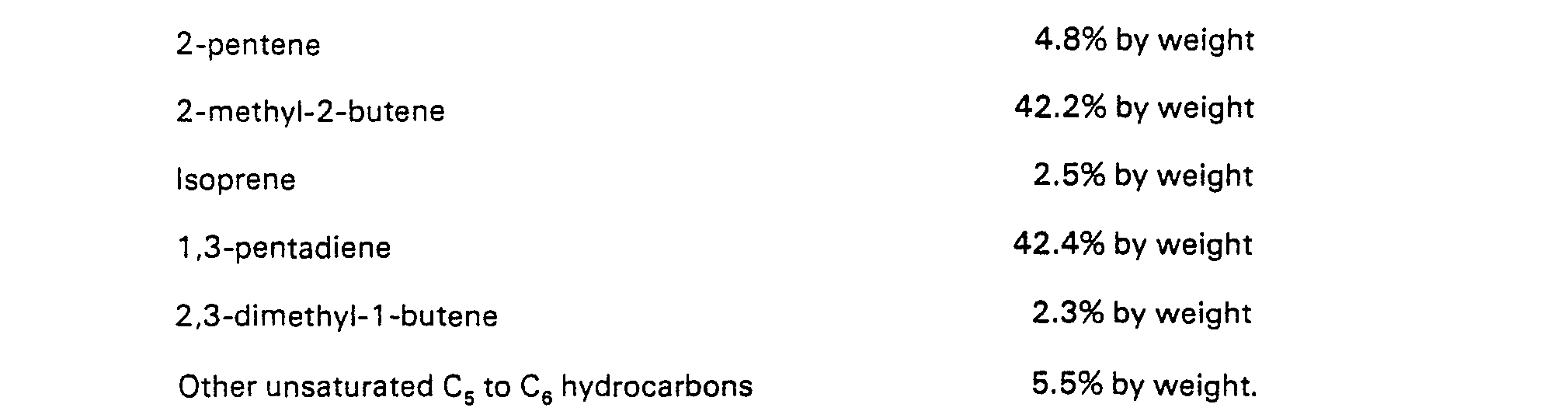
- The non-polar aromatic hydrocarbon polymer is preferably derived from petroleum hydrocarbons, for example, by known catalytic polymerisation methods. These polymers are generally cornmercially available as solid flake materials. The polymer preferably has a Gardner-Holt viscosity as a 70% solution in toluene at 25°C of R-U; a suitable polymer is commercially available under the Trade Mark "Picco-6100".
- The aromatic hydrocarbon polymer preferably has a ring and ball softening point of 98 to 102°C, an acid number of less than 1 and a saponification number of less than 1.
- The hot melt composition according to the invention preferably contains substantially equal numbers of parts by weight of the aromatic hydrocarbon polymer and of the polymer of olefinic hydrocarbons.
- Particularly when the composition according to the invention is to be used for encapsulation, it preferably contains an alkyl ether of cellulose having 1 to 3 carbon atoms in the alkyl group and at least one monocarboxylic acid having 10 to 20 carbon atoms. The inclusion of these ingredients improves the injection moulding characteristics of the composition; the monocarboxylic acid serves as a solubilizer for the cellulose ether.
- The cellulose ether (for example, methyl cellulose, n-propyl cellulose, iso-propyl cellulose or ethyl cellulose, the latter being preferred) is preferably present in the composition in an amount of 2.5 to 8 parts by weight, more preferably 4 to 5 parts by weight.
- The monocarboxylic acid may be, for example, a saturated acid, such as decanoic acid, lauric acid, myristic acid, stearic acid, palmitic acid or arachidic acid and/or an unsaturated acid, such as oleic acid, linoleic acid, eleostearic acid or gadoleic acid. The monocarboxylic acid is preferably present in the composition in an amount of from 2 to 5 parts by weight.
- The composition according to the invention may contain other organic ingredients, such as bodying agents, plasticisers or antioxidants, the latter being in an amount of up to 0.5 part by weight, preferably 0.05 to 0.4 part by weight, for example, about 0.1 part by weight of 4,4'-methylene bis (2,6-di-tert.-butylphenol).
- As mentioned above, the composition according to the invention contains 5 to 70%, preferably 50 to 70%, based on the weight of the composition, of a finely divided inorganic filler having a particle size such that at least 95% thereof passes through a 200 mesh (U.S. Series) screen, preferably such that at least 95% passes through a 325 mesh (U.S. Series) screen.
- The upper limit of the concentration of the filler is critical for the integrity of the composition; if too much filler is included, then there is insufficient resinous material to bind the composition. This critical upper limit is known as the "Critical Pigment Volume Concentration" (CPVC) a term which is used in paint technology when referring to a pigment in a drying oil vehicle. The CPVC for a filler can he readily determined by those skilled in the art. The CPVC is dependent upon a number of factors including the nature of the resin, the particle size of the filler, and the crystalline form of the filler. For more details of CPVC. reference is made to the paper by Van Loo delivered at the Mattiello Lecture in 1956 and published in the December 1956 issue of the Official Digest of Paint and Varnish Clubs and entitled "Physical Chemistry of Paint Coatings, a Constant Search - Critical Pigment Volume Concentration", Asbeck et al. & E. Chem. vol. 41, page 1470, 1949 and U.S. Pat. No. 2,751,782.
- The lower limit of concentration of the filler is not critical, although at least 5% by weight thereof is required before significant advantage in quench time and in shrinkage characteristic is realised. Best results are secured when the weight % of the inorganic filler is in the range of 50% to 70% of the entire composition for inorganic fillers having a density of 2 to 6. This corresponds to a volume ratio of filler to resin in the range of 20% to about 40% for materials such as aluminium oxide.
- Any finely divided inert inorganic filler material may be used in the compositions according to the invention in an amount up to its CPVC as described above. Specific examples of inorganic filler materials include metal oxides such as aluminium oxide, zirconium oxide, silicon dioxide, iron oxide, barium oxide calcium oxide or magnesium oxide; carbonates such as calcium carbonate, magnesium carbonate or barium carbonate; sulphates such as magnesium sulphate, barium sulphate, calcium sulphate; silicates such as calcium silicate, hydrous aluminium silicate, magnesium silicate; asbestos powder or glass fibres: metal powders, e.g. aluminium, iron, steel or copper; clays, such as Fuller's earth, china clay or attapulgite clay. Mixtures of two or more fillers may be used if desired. The nature of the workpiece and its susceptibility to contamination will dictate the kind of inorganic filler used. Aluminium oxide. for example, is particularly satisfactory for use when the composition is used for potting jet engine blades. Preferred inorganic fillers are finely divided ceramic oxides, e.g. aluminium oxide, beryllia, zirconia or calcium carbonate.
- The inorganic filler has three main effects in compositions according to the invention, i.e. to reduce the cool time when the compositions are used for potting and encapsulation; to reduce the cost of the composition and to minimise shrinkage of the resin.
- In making the potting compositions of the present invention, the organic ingredients are preferably added separately at elevated temperatures followed by mechanical stirring in of the inorganic filler over a relatively long period. For example, in a preferred procedure, the dimer acid is generally heated and stirred in a suitable cooking vessel to about 250°F (121 °C); the polyterpene is then added and stirred in and the temperature raised to 300°F (149°C); the aromatic hydrocarbon polymer is then added and stirred and the temperature elevated to 350°F (177°C). Some foaming or bubbling may be experienced at this point. The cellulose ether and monocarboxylic acid, if used, may then be added. Thereafter, the finely divided inorganic filler is added with stirring while the temperature is held between about 345° to 355°F (1740-1800C) for a period of 4 to 5 hours.
- As mentioned above, the composition according to the invention may be used for holding a workpiece in a workholder; a preferred process comprises introducing the composition in a molten state (preferably at 120 to 150°C) into a cavity between the workpiece and the workholder so as to surround at least part of the workpiece, and quenching the workpiece, workholder and composition so as to solidify the composition. The workpiece may then be machined as desired.
- The composition can be recovered after use by remelting (and, preferably washing the workpiece); it is not necessary to recover the filler separately.
- The molten composition can be introduced into the cavity by casting or by injection moulding; conventional apparatus may be used.
- The method of holding a workpiece using a composition according to the invention will be described in more detail with reference to the accompanying drawings, in which:
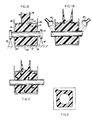
- Figures 1 a, 16 and 1 are diagrammatic and schematic illustrations of successive stages in an example of the method of the present invention;
- Figure 2 is an end view in cross section of a workpiece which has been potted according to the invention with the "scissors" and sprue removed;
- Figure 3 represents a "scissors" closure for a potting box adapted for a cylindrical workpiece; and
- Figure 4 represents a "scissors" closure for a potting box adapted for an airfoil for a jet engine.
- Referring to Figure 1 a, there is shown in diagrammatic form a potting or matrix box 12 (which may be of cast iron, for example) having opposed
openings workpiece 10 to pass freely therethrough. Thebox 12 is provided with ground flats,e.g. flats 18 and 20, for proper location on a fixturing table 22, and with aninlet opening 24 for admitting apotting composition 25 as described below.End closures 26 and 28, which are designated "scissors" for reasons whch will become apparent, are provided to close theopenings workpiece 10. Suitable clamps, not shown. hold thescissors closures 26 and 28 in place. - The workpiece is supported on suitable fixturing mounts or pedestals 30 and 32 diagrammatically shown in Figure 1 a for maintenance of proper location of the
workpiece 10 in thematrix box 12 during the potting operation. - The apparatus is completed with a
PTFE collar 34 to facilitate removal of asprue 36. and afiller pipe 38 to aid in introducing thepotting composition 25.Pipe 38 also provides a reservoir foradditional composition 25 as may be required during shrinkage in cooling as described below. - In practice, the
workpiece 10, e.g. a jet engine turbine blade or airfoil, is inserted through theopenings matrix box 12. Both theworkpiece 10 and thematrix box 12 are preferably preheated to a temperature of from about 115°F to about 130°F (46-55°C) and mounted in a fixturing assembly to properly locate theworkpiece 10 relative to thematrix box 12. The preheat temperature should not be too high, in order to avoid injury to operators. Theend closures 26 and 28 or "scissors" such as shown in Figures 3 and 4 are put in place and clamped to close theopenings matrix box 12. Thecollar 34 is placed around theopening 24 and the preferably preheatedmetal inlet pipe 38 superposed. The function of thepipe 38 is to contain a volume of thepotting composition 25 in excess of that required to fill thematrix box 12 with the workpiece in place. This excess provides a hydrostatic head for urging flow of the hot melt composition to all portions of thebox 12 and to provide an additional volume to keep the box filled during contraction of thecomposition 25 which occurs upon cooling. - The composition, which flows at elevated temperatures in the range of 250°F to 300°F (120-1 50°C), is poured preferably at from 250°F-270°F (120-132°C) into the
preheated box 12 to fully pot the workpiece (untilpipe 38 is nearly full), and is set by quenching thebox 12 and the projecting portion or portions of theworkpiece 10 with water. - Water quenching may be accomplished either by immersing the entire assembly in cold water, or flooding the apparatus with water by means of a drenching spray system generally indicated 40 (Figure 1 b) or a combination of both simultaneously or sequentially carried out. Application of cooling water to the
pipe 38 should be avoided during the filling operation and until set is achieved. Thepotted part 10 must remain in thefixturing device 20, 30 and 32, for example until cooled sufficiently that thepotted part 10 will not move as a result of melt contraction during subsequent cooling. The water coolant should be preferably at a temperature of from 45° to 55°F (7°-13°C). After the composition sets hard so that no movement of theworkpiece 10 relative to thebox 12 occurs, the "scissors" 26 and 28 are released, thefiller pipe 38 knocked off, and the cooledpotted workpiece 10 andbox 12 assembly removed from the fixturing device for acceptance of a succeeding assembly in the fixturing device. The residence time in the fixturing device is controlled by the set time of thecomposition 25 and this time should not exceed 2-3 minutes. Otherwise, there is a severe limitation imposed on production, the cost of which is, of course, substantial. - Cooling of the
box 12 and theworkpiece 10 after potting causes a slight shrinkage of theseparts reservoir pipe 38. As the entire system warms back to room temperature, the expansion of both theworkpiece 10 and the organic resinous composition causes pressure contact of the composition with thetool 10 and thebox 12. - Although preheating of the
box 12 and theworkpiece 10 is not required, it does promote adhesion of the organic resinous composition to the metal surface. It also allows a lowering of the melt casting temperature. The temperature of the preheat should not be so high as to unduly increase the subsequent cool down time from the referred 2-3 minutes to solidification. A temperature of 115-130°F (46°-55°C) is usually sufficient and the parts at these temperatures can be handled without gloves. - In order that the invention may be more fully understood, the following Examples are given by way of illustration only.
- A composition was made of the following ingredients:

- The composition was prepared by the sequential melt blending of the organic ingredients in the order given, to produce a homogeneous and compatible molten mass. The aluminium oxide was then added over 4 to 5 hours while maintaining the melt temperature 174 to 179°C (345 to 355°F) so as to obtain a viscosity conductive to good mixing and pourability. Volatilisation of any solvent unreacted monomer, depolymerisation products or water may have occurred during heating while blending the hydrocarbon polymers.
- The resulting composition had a pour temperature in the range of 250-260°F (120°―127°C) and a breaking load of about 5000 Ibs (about 2.25 tonnes). For fixturing a jet engine blade, a cool down time to set of 2-3 minutes was obtained after which removal from the fixturing jib can be done with further spontaneous or forced cooling. The amount of aluminium oxide is just below the CPVC for the system.
- Example 1 was repeated, using the following ingredients:
- Material Parts by weight
- C16-C18 dimer acids 9
- Cgterpene hydrocarbon polymer (Wingtack 95) 11 1
- Picco-6100 (aromatic hydrocarbon polymer) 12
- Aluminium oxide (-325 mesh) 68
- This example is illustrative of about the maximum amount of aluminium oxide which can be used satisfactorily in the particular resin combination. At over 70% concentration of aluminium oxide, the composition is too weak for satisfactory potting. This latter concentration corresponds to a CPVC of about 32%.
- Example 1 was repeated, using the following ingredients:

- This composition was satisfactory as a fixturing compound, but is somewhat more expensive than the composition of Example 2 above. The amount of alumina is below the CPVC for the system.
- Example 1 was repeated using the following ingredients:

- This composition was satisfactory as a potting compound but is expensive and requires cooling water at about 35° to 38°F (about 1.5 to 3°C) to obtain a satisfactorily short cooling time. Higher concentrations of aluminium oxide provide shorter cooling times and reduce the cost of the fixturing composition. The amount of alumina is well below the CPVC of the system.
- Example 1 was repeated, using the following ingredients

- The resulting composition was suitable for encapsulating jet engine airfoils.
- Example 1 was repeated using the following ingredients:

- The resulting composition was satisfactory for use as an encapsulating compound.
- Example 1 was repeated, using the following ingredients:

- The resulting composition was satisfactory as an encapsulating compound, somewhat more expensive than the composition of Example 5. The amount of silica is below the CPVC for the system.
- An example of a method of potting jet engine airfoils, using the apparatus shown in Figures 1 , 2 and 3 will now be described. The
airfoil 10 andmatrix box 12 are degreased by a known procedure, and each preheated to 125°F to 130°F (51.7 to 54.4°C) in a suitable electric oven. Theremovable inlet pipe 38 is similarly preheated. The composition of any of the foregoing Examples (e.g. Example 1 is heated to 255°F (124°C) in a suitable agitated pot. It is desirable also to preheat the spigot on the melt pot to at least 200°F (93°C). - The
airfoil 10 andmatrix box 12 are clamped in a suitable locating holder,closure scissors 26. 28 attached to thecollar 34 andinlet pipe 38 put into place, andcomposition 25 flowed into thebox 12 until theinlet pipe 38 is nearly full. Thewater spray units 40 are operated at about 55°F (about 13°C) after filling. Thematrix box 12 with theairfoil 10 and composition after removing scissors is then immediately immersed in cold water at about 60°F (about 1 5.5°C) where it remains for 3 minutes. - Thereafter the
removable pipe 38 and thecollar 34 are removed and the assembly dried and gauged for location of the workpiece in the matrix. The potted airfoil and matrix is then set aside to regain room temperature. The workpiece can then be machined. - When completed, the fixtured part assembly may be reheated to about 250°F-300=F (121 to 149°C) the
workpiece 10 recovered and washed with a suitable solvent (toluene), and the potting composition returned to the melting pot for re-use.
Claims (11)
Applications Claiming Priority (4)
| Application Number | Priority Date | Filing Date | Title |
|---|---|---|---|
| US05/838,488 US4132689A (en) | 1977-10-03 | 1977-10-03 | Thermoplastic workholding composition and method of holding a workpiece |
| US838488 | 1977-10-03 | ||
| US05/838,481 US4132685A (en) | 1977-10-03 | 1977-10-03 | Filled, thermoplastic workholding composition including a dicarboxylic acid, an alkylene hydrocarbon polymer, and an aromatic hydrocarbon polymer |
| US838481 | 1977-10-03 |
Publications (2)
| Publication Number | Publication Date |
|---|---|
| EP0001497A1 EP0001497A1 (en) | 1979-04-18 |
| EP0001497B1 true EP0001497B1 (en) | 1981-08-05 |
Family
ID=27126031
Family Applications (1)
| Application Number | Title | Priority Date | Filing Date |
|---|---|---|---|
| EP19780300444 Expired EP0001497B1 (en) | 1977-10-03 | 1978-10-02 | Thermoplastic hot melt compositions and use thereof |
Country Status (5)
| Country | Link |
|---|---|
| EP (1) | EP0001497B1 (en) |
| JP (1) | JPS5463146A (en) |
| CA (1) | CA1130941A (en) |
| DE (1) | DE2860910D1 (en) |
| IL (1) | IL55531A (en) |
Families Citing this family (3)
| Publication number | Priority date | Publication date | Assignee | Title |
|---|---|---|---|---|
| RU2381876C2 (en) * | 2008-03-11 | 2010-02-20 | Открытое акционерное общество "Московское машиностроительное предприятие им. В.В. Чернышева" | Manner of fastening in device of blades of gas turbine engines for turning of its lock on lathe |
| JP5470605B2 (en) * | 2009-09-30 | 2014-04-16 | 株式会社ナサダ | Resin filled solidification method of blade, resin filled solidification method of blade, resin filled solidification processing device of long blade, resin filled solidification method of long blade |
| CN107030455B (en) * | 2017-06-21 | 2023-06-02 | 西安蜂鸟精密机械有限公司 | Processing method of part filled with phenolic glass fiber molding compound series materials |
Family Cites Families (2)
| Publication number | Priority date | Publication date | Assignee | Title |
|---|---|---|---|---|
| LU64144A1 (en) * | 1971-10-22 | 1972-12-05 | ||
| JPS4938014A (en) * | 1972-08-22 | 1974-04-09 |
-
1978
- 1978-09-07 IL IL5553178A patent/IL55531A/en unknown
- 1978-09-21 CA CA311,750A patent/CA1130941A/en not_active Expired
- 1978-10-02 DE DE7878300444T patent/DE2860910D1/en not_active Expired
- 1978-10-02 JP JP12142678A patent/JPS5463146A/en active Granted
- 1978-10-02 EP EP19780300444 patent/EP0001497B1/en not_active Expired
Also Published As
| Publication number | Publication date |
|---|---|
| DE2860910D1 (en) | 1981-11-05 |
| JPS6226350B2 (en) | 1987-06-08 |
| CA1130941A (en) | 1982-08-31 |
| JPS5463146A (en) | 1979-05-21 |
| IL55531A (en) | 1982-04-30 |
| EP0001497A1 (en) | 1979-04-18 |
Similar Documents
| Publication | Publication Date | Title |
|---|---|---|
| US4202523A (en) | Boron nitride/elastomeric polymer composition for coating steel casting dies | |
| US4529028A (en) | Coating for molds and expendable cores | |
| CA1328033C (en) | Ceramic core for investment casting and method for preparation | |
| WO1994025199A1 (en) | Methods for fabricating shapes by use of organometallic, ceramic precursor binders | |
| US4132689A (en) | Thermoplastic workholding composition and method of holding a workpiece | |
| CA1211884A (en) | Titanic acid ester-containing binder for coating materials and refractory shaped bodies as well as process for the production of these binders | |
| US3263286A (en) | Process and material for precision investment casting | |
| GB2162166A (en) | Method of making injection moulded refractory shaped articles | |
| EP0001497A1 (en) | Thermoplastic hot melt compositions and use thereof | |
| JP5455322B2 (en) | Metallocene-catalyzed polyolefins in wax formulations and their use for precision casting / lost wax processes | |
| US4195002A (en) | Water-dispersible coatings containing boron nitride for steel casting dies | |
| US4132685A (en) | Filled, thermoplastic workholding composition including a dicarboxylic acid, an alkylene hydrocarbon polymer, and an aromatic hydrocarbon polymer | |
| US4681904A (en) | Epoxy resin composition | |
| US4264052A (en) | Water-dispersible coatings containing boron nitride for steel casting dies | |
| US3925576A (en) | Bituminous coating system and articles produced thereby | |
| US3802063A (en) | Process for casting material under pressure | |
| US3389743A (en) | Method of making resinous shell molds | |
| US3430679A (en) | Method of vacuum casting employing a high temperature sealing composition | |
| CA1205987A (en) | Manufacturing room temperature cured furnace bricks of magnesia and organic resin | |
| RU2109715C1 (en) | Method for restoration of refractory body on the base of oxide and powdery mixture for restoration | |
| EP0215783B1 (en) | Coating for molds and expendable cores | |
| US3912669A (en) | Bituminous coating system and articles produced thereby | |
| Calvert | An investment mold for titanium casting | |
| US1777975A (en) | Method of making molds | |
| CA2031087A1 (en) | Refractory ceramic moulding and a method of producing it |
Legal Events
| Date | Code | Title | Description |
|---|---|---|---|
| PUAI | Public reference made under article 153(3) epc to a published international application that has entered the european phase |
Free format text: ORIGINAL CODE: 0009012 |
|
| AK | Designated contracting states |
Designated state(s): BE DE FR GB SE |
|
| 17P | Request for examination filed | ||
| GRAA | (expected) grant |
Free format text: ORIGINAL CODE: 0009210 |
|
| AK | Designated contracting states |
Designated state(s): BE DE FR GB SE |
|
| PG25 | Lapsed in a contracting state [announced via postgrant information from national office to epo] |
Ref country code: BE Effective date: 19811002 |
|
| PG25 | Lapsed in a contracting state [announced via postgrant information from national office to epo] |
Ref country code: SE Effective date: 19811003 |
|
| REF | Corresponds to: |
Ref document number: 2860910 Country of ref document: DE Date of ref document: 19811105 |
|
| PG25 | Lapsed in a contracting state [announced via postgrant information from national office to epo] |
Ref country code: FR Free format text: LAPSE BECAUSE OF NON-PAYMENT OF DUE FEES Effective date: 19820630 |
|
| PGFP | Annual fee paid to national office [announced via postgrant information from national office to epo] |
Ref country code: SE Payment date: 19830930 Year of fee payment: 6 |
|
| PGFP | Annual fee paid to national office [announced via postgrant information from national office to epo] |
Ref country code: FR Payment date: 19841016 Year of fee payment: 7 |
|
| PGFP | Annual fee paid to national office [announced via postgrant information from national office to epo] |
Ref country code: DE Payment date: 19841123 Year of fee payment: 7 |
|
| GBPC | Gb: european patent ceased through non-payment of renewal fee | ||
| PG25 | Lapsed in a contracting state [announced via postgrant information from national office to epo] |
Ref country code: DE Effective date: 19880701 |
|
| PG25 | Lapsed in a contracting state [announced via postgrant information from national office to epo] |
Ref country code: GB Effective date: 19881117 |
|
| EUG | Se: european patent has lapsed |
Ref document number: 78300444.3 Effective date: 19820505 |
|
| PLBE | No opposition filed within time limit |
Free format text: ORIGINAL CODE: 0009261 |
|
| STAA | Information on the status of an ep patent application or granted ep patent |
Free format text: STATUS: NO OPPOSITION FILED WITHIN TIME LIMIT |