EP0001489B1 - Preparation of sterically stabilised aqueous polymer dispersions - Google Patents
Preparation of sterically stabilised aqueous polymer dispersions Download PDFInfo
- Publication number
- EP0001489B1 EP0001489B1 EP78300419A EP78300419A EP0001489B1 EP 0001489 B1 EP0001489 B1 EP 0001489B1 EP 78300419 A EP78300419 A EP 78300419A EP 78300419 A EP78300419 A EP 78300419A EP 0001489 B1 EP0001489 B1 EP 0001489B1
- Authority
- EP
- European Patent Office
- Prior art keywords
- polymer
- particles
- monomers
- aqueous liquid
- aqueous
- Prior art date
- Legal status (The legal status is an assumption and is not a legal conclusion. Google has not performed a legal analysis and makes no representation as to the accuracy of the status listed.)
- Expired
Links
Classifications
-
- C—CHEMISTRY; METALLURGY
- C08—ORGANIC MACROMOLECULAR COMPOUNDS; THEIR PREPARATION OR CHEMICAL WORKING-UP; COMPOSITIONS BASED THEREON
- C08F—MACROMOLECULAR COMPOUNDS OBTAINED BY REACTIONS ONLY INVOLVING CARBON-TO-CARBON UNSATURATED BONDS
- C08F291/00—Macromolecular compounds obtained by polymerising monomers on to macromolecular compounds according to more than one of the groups C08F251/00 - C08F289/00
-
- C—CHEMISTRY; METALLURGY
- C08—ORGANIC MACROMOLECULAR COMPOUNDS; THEIR PREPARATION OR CHEMICAL WORKING-UP; COMPOSITIONS BASED THEREON
- C08F—MACROMOLECULAR COMPOUNDS OBTAINED BY REACTIONS ONLY INVOLVING CARBON-TO-CARBON UNSATURATED BONDS
- C08F2/00—Processes of polymerisation
- C08F2/12—Polymerisation in non-solvents
- C08F2/14—Organic medium
Definitions
- This invention relates to the preparation of dispersions of polymer particles in aqueous media, in which the particles are stabilised against flocculation.
- a method of preparing a stable dispersion in an aqueous medium of particles of polymer comprising the steps of:-
- the first step of the process thus defined may be carried out by any of the procedures which are well known in the art for making sterically stabilised non-aqueous dispersions of polymers.
- Three such procedures may be distinguished: (a) the re-dispersion in the non-aqueous liquid, in the presence dissolved therein of the steric stabiliser, of previously formed particles of polymer of collodial dimensions; (b) the precipitation of the polymer in the non-aqueous liquid, again in the presence of the steric stabiliser, from a solution of the polymer in a suitable solvent; (c) the polymerisation in the non-aqueous liquid, in the presence of the steric stabiliser, of one or more monomers which are soluble in that liquid but give rise to a polymer which is insoluble therein.
- procedure (c) is to be preferred for convenience of operation.
- procedure (c) can be carried out, the first involving the use of steric stabiliser which is preformed and the second involving the production of the stabiliser in situ simultaneously with the formation of the disperse polymer.
- the most commonly employed type of polymer is an acrylic polymer derived principally from one or more lower alkyl esters of acrylic or methacrylic acids in which the alkyl group contains from 1 to 8 carbon atoms, such as methyl methacrylate, ethyl methacrylate, butyl methacrylate, ethyl acrylate, butyl acrylate and 2-ethylhexylacrylate.
- a convenient class of non-aqueous liquids in which such a polymer is insoluble consists of the aliphatic hydrocarbons, such as hexane and heptane and commercially available mixtures of higher homologues, optionally containing more proportions of aromatic hyrocarbons. Such liquids are also good solvents for the monomers in question and have relatively low boiling points. They are, therefore, a first general choice as dispersion liquids for any of the procedures mentioned above.
- step (i) In those cases where the monomers being polymerised in step (i) are capable of forming a crosslinked polymer, it does not necessarily follow that the whole of the first polymer so produced is crosslinked; since the crosslinking monomer will normally be present in a minor proportion of the total monomers, reaction statistics will result in some non-crosslinked polymer being produced.
- the mode of stabilisation of the particles of first polymer in the non-aqueous liquid is, however, the same whether a particle consists entirely of crosslinked polymer or partly of crosslinked polymer and partly of non-crosslinked polymer.
- the polymer of the dispersion formed in step (i) should be insoluble in the non-aqueous liquid, it is also necessary that this polymer should be insoluble in water.
- the chemical composition of the polymer may be such that it is inherently insoluble in water, which is the case with the polymers derived from the acrylic and methacrylic ester monomers mentioned above.
- the polymer may be one which is inherently soluble in water but is rendered insoluble by being crosslinked.
- a copolymer of one of the ester monomers just referred to with a substantial porportion of a hydrophilic monomer such as a monoester of acrylic acid or methacrylic acid with a polyglycol (e.g. polyethylene glycol), or vinyl pyrrolidone
- a polyglycol e.g. polyethylene glycol
- vinyl pyrrolidone may be actually soluble in water, but by also including a minor proportion of a polyfunctional monomer such as ethylene glycol dimethacrylate the copolymer may be caused to be lightly crosslinked and it will then be insoluble in water, as indeed in non-aqueous liquids also.
- a water-soluble polymer may be prepared by copolymerising an acrylic or methacrylic ester monomer with a moderate proportion (e.g. about 15% by weight) of acrylic acid or methacrylic acid and treating this with an aqueous solution of a strong base at about pH 8.
- a corresponding crosslinked, and hence water-insoluble, polymer may be obtained by incorporating also a small proportion of an epoxide group-bearing monomer, such as glycidyl methacrylate, which will react during the copolymerisation with some of the carboxyl groups present.
- an epoxide group-bearing monomer such as glycidyl methacrylate
- a water-soluble polymer of the opposite ionic type may be made by using diethylaminoethyl methacrylate as comonomer, and then neutralising the basic groups so introduced by treatment with an aqueous solution of an acid.
- the preparation of dispersions in aqueous media of particles consisting predominantly of such water-insoluble but water-swellable polymers is particularly facilitated by the present invention.
- step (i) of the method examples include those derived from vinyl esters such as vinyl acetate, vinyl propionate and vinyl chloroacetate. Like the acrylic polymers, these are generally insoluble in aliphatic hydrocarbons or aliphatic/aromatic hydrocarbon mixtures and, in the absence of hydrophilic comonomers, they are also insoluble in water; the monomers are, however, soluble in the hydrocarbons mentioned.
- Polymers derived wholly from vinlyaromatic monomers such as styrene or vinyltoluene are rather less suitable as the disperse phase material, since they tend to have an appreciable solubility in hydrocarbon liquids, but these monomers may be used as comonomers along with the acrylic esters or vinyl esters.
- the stabiliser is a substance which contains in the molecule two functional components.
- One component is a polymer chain which is solvatable by the non-aqueous liquid in which the particles of the first polymer are to be dispersed, in the sense that, if that component were an independent polymer molecule, it would actually be soluble in the liquid.
- the other component is a grouping which is capable of becoming associated with the disperse phase polymer.
- each polymer particle becomes surrounded by the solvated chains of the stabiliser which, being in an extended configuration, form a steric barrier around the particle whereby adjacent particles are prevented from flocculating or aggregating.
- a type of steric stabiliser which is of wide utility is that of a block or graft copolymer, in which one polymeric component is solvatable by the non-aqueous liquid as described above and another polymeric component performs the associating function by virtue of not being solvatable by that liquid.
- this second component can be identical in chemical composition with the disperse polymer itself, and there then arises the possibility, referred to earlier, of making such a stabiliser in situ during dispersion polymerisation of monomer to form that polymer. This is done by carrying out that polymerisation in the presence, dissolved in the non-aqueous liquid, of a "precursor" compound containing in the molecule a polymer chain solvatable by that liquid, from which the solvatable component of the stabiliser is to be derived, and one or more groups which can copolymerise with, or undergo grafting by, the monomers being polymerised.
- the dispersion to be made in step (i) consists essentially of poly(methyl methacrylate) dispersed in aliphatic hydrocarbon
- a suitable precursor that is soluble in the hydrocarbon is poly(lauryl methacrylate).
- a suitable preformed stabiliser is a copolymer formed by reacting poly(12-hydroxystearic acid) (which is soluble in aliphatic hydrocarbon with glycidyl methacrylate to introduce terminal unsaturated groupings on to the chains, and then to copolymerise the product with methyl methacrylate, or with a mixture of methyl methacrylate and methacrylic acid or acrylic acid if it is desired to accentuate the insolubility in the hydrocarbon of the acrylic backbone polymer thus formed.
- poly(12-hydroxystearic acid) which is soluble in aliphatic hydrocarbon with glycidyl methacrylate to introduce terminal unsaturated groupings on to the chains, and then to copolymerise the product with methyl methacrylate, or with a mixture of methyl methacrylate and methacrylic acid or acrylic acid if it is desired to accentuate the insolubility in the hydrocarbon of the acrylic backbone polymer thus formed.
- a dispersion polymerisation of monomer is the preferred procedure for forming the disperse particles in step (i), but the re-dispersion or precipitation techniques are practical alternatives where this is desired.
- the previously formed colloidal particles of polymer may have been formed by the milling or grinding of coarser particles, or by the aqueous emulsion polymerisation of monomer followed by evaporation of the aqueous phase.
- Polymer which is precipitated from solution in order to form the disperse particles may have been formed by bulk polymerisation of monomer followed by dissolution in a suitable solvent, or by solution polymerisation in that solvent; the polymer solution so obtained is then added to an excess of the non-aqueous liquid in which the dispersion is to be formed, the liquid already having dissolved therein a suitable steric stabiliser.
- the second step of the method of the invention is in effect also dispersion polymerisation of monomer as discussed above, with the differences that the dispersion liquid contains, in addition to the steric stabiliser, the disperse particles of the first polymer, and that the monomers now polymerised are such as to give a second polymer which is of a hydrophilic character so as to be capable of dissolving in the aqueous medium in which the final dispersion is to be formed, at an appropriate pH.
- Monomers which are suitable for use in this second step are the hydrophilic monomers which have been mentioned above in connection with the production in step (i) of a polymer which is inherently soluble in water but is rendered insoluble by crosslinking, bearing in mind, of course, that in the case of step (ii) the polymer is not crosslinked.
- a hydroxyalkyl ester of acrylic acid or methacrylic acid a monoacrylic or monomethacrylic ester of a polyglycol such as polyethylene glycol, a monovinyl ether of such a polyglycol, or vinyl pyrrolidone, optionally in admixture with smaller proportions of non- hydrophilic monomers such as methyl methacrylate, butyl acrylate, vinyl acetate or styrene, as already mentioned.
- the required solubility in the aqueous medium can be achieved by using as a major monomer constituent an acrylic ester containing basic groups, for example dimethylaminoethyl methacrylate or diethylaminoethyl methacrylate, these groups being subsequently converted to salt groups by reaction with a suitable acid, for example lactic acid, dissolved in the aqueous medium.
- the second polymer may be derived from comonomers containing a substantial proportion of a polymerisable carboxylic acid, such as acrylic acid or methacrylic acid, and is then capable of dissolving in an aqueous medium containing a dissolved base, such as dimethylaminoethanol.
- the second polymer may be non-ionic, anionic or cationic in character.
- the second polymer must, as already emphasised, be soluble in the chosen aqueous medium in which the final dispersion is to be formed. It will normally follow from this that the second polymer will be insoluble or of low solubility in the non-aqueous liquid of step (i), since the latter will usually be of a non-polar nature. However, it is acceptable if the second polymer has a limited solubility in the non-aqueous liquid, so that during the formation of that polymer a minor proportion of it passes into solution in that liquid whilst a major proportion becomes associated with the polymer particles formed in step (i). Evidently, the second polymer should not be so soluble in the non-aqueous liquid that only a small proportion of it becomes associated with the particles.
- association can come about as the consequence of one or more of the following processes; firstly, by some grafting of the monomers from which the second polymer is formed on to the first polymer, under the conditions of free radical- initiated polymerisation; secondly, through reaction of chemically reactive groups in the second polymer with complementary reactive groups in the first polymer; thirdly, by physical entanglement of the molecules of the second polymer with those of the first polymer.
- step (ii) of the process will normally be the same as that employed in step (i), and indeed this second step is most straightforwardly carried out simply by continuing the dispersion polymerisation process with the appropriate monomer or mixture of monomers immediately after completion of the polymerisation of the monomer or monomers of step (i).
- the resulting stable dispersion is then contacted with the chosen aqueous medium and the non-aqueous liquid removed to the degree necessary to yield a stable dispersion of particles in the aqueous medium. It may be possible for there to be no removal of the non-aqueous liquid at all, or part-removal, or complete removal. This transfer of the particles may be effected in various ways, e.g.
- step (i) by adding the non-aqueous dispersion from step (ii) to the aqueous medium and heating the mixture to displace the non-aqueous liquid by distillation; (ii) by adding a suitable water-miscible co-solvent to the non-aqueous dispersion, distilling off the non-aqueous liquid and then adding the aqueous medium; or (iii) by adding water, optionally with a water-miscible co-solvent, to the non-aqueous dispersion and distilling off the non-aqueous liquid.
- the aqueous medium may consist of water alone, or it may consist of water in admixture with a water-miscible organic co-solvent such as methanol or ethylene glycol monobutyl ether; the aqueous medium may also contain a water-soluble acid or base for the purpose of neutralising basic or acidic groups present in the second polymer.
- a neutralising agent may be chosen so as to bring the final aqueous dispersion to some predetermined pH value.
- the stability against flocculation of the dispersions so obtained is principally attributable to the attachment to the particles, probably by one or more of the mechanisms suggested earlier, of chains of the second polymer which are solvated by the aqueous medium and so form a steric barrier around the particles.
- this steric stabilisation will be supplemented by some degree of charge stabilisation.
- the polymer dispersions in aqueous media which are obtained according to the present invention may be employed as film-forming materials in their own right or as additives to other film-forming polymers in either dispersion or solution in an aqueous medium.
- the dispersions of the invention may be cationic, anionic or non-ionic in character as desired, so that the stabilising function may accordingly involve, or not involve (as the case may be), electrically charged molecular species.
- the method of the invention has the advantage, however, that where stabilisation by electrical charges is involved, the use of strong and/or low molecular weight acids or bases, or their salts as the stabilising species, such as is commonly the case in aqueous emulsion polymerisation techniques, may be avoided.
- the monomers which are polymerised to form the water-insoluble first polymer, of which the disperse particles chiefly consist may include water-soluble monomers such as monoesters of acrylic acid or methacrylic acid with a polyglycol, or vinyl pyrrolidone, without incurring difficulties which are usually encountered when employing such monomers in an emulsion polymerisation procedure.
- water-soluble monomers such as monoesters of acrylic acid or methacrylic acid with a polyglycol, or vinyl pyrrolidone
- the method of the invention enables the degree of swelling of the particles by the aqueous medium and the molecular weight of the second polymer formed in step (ii) to be controlled so as to secure the optimum effect in any given system.
- reaction mixture is held at reflux temperature (100°C) for a further 2 hours, when complete conversion of monomer to polymer has taken place to give a fine dispersion of solids content 37-39%.
- the content of insoluble, crosslinked polymer gel is 23-24%.
- reaction mixture is held at reflux temperature for a further 4 hours to bring about full conversion of monomer to polymer, and the product is a stable dispersion of solids content 47-48%.
- reaction mixture is held at reflux temperature (100°C) for a further 2 hours, until polymerisation is complete, to give a dispersion having a solids content of 38-39%, and an insoluble polymer gel content of 16.6%.
- reaction mixture is held at reflux temperature for a further 2 hours until polymerisation is complete, and the product is a stable dispersion of solids content of 45%.
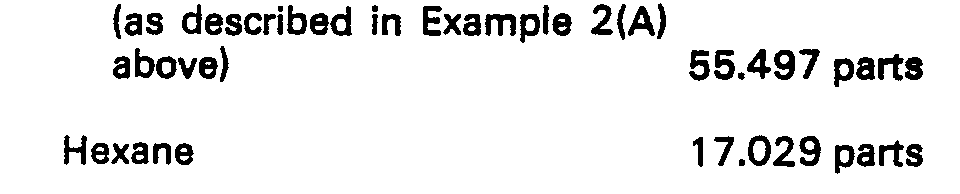
- reaction mixture is heated under reflux for a further 2 hours, to give a stable dispersion having a total solids content of 45% and an insoluble polymer gel content of 19-20%.
Landscapes
- Chemical & Material Sciences (AREA)
- Health & Medical Sciences (AREA)
- Chemical Kinetics & Catalysis (AREA)
- Medicinal Chemistry (AREA)
- Polymers & Plastics (AREA)
- Organic Chemistry (AREA)
- Processes Of Treating Macromolecular Substances (AREA)
- Addition Polymer Or Copolymer, Post-Treatments, Or Chemical Modifications (AREA)
- Compositions Of Macromolecular Compounds (AREA)
- Polymerisation Methods In General (AREA)
Description
- This invention relates to the preparation of dispersions of polymer particles in aqueous media, in which the particles are stabilised against flocculation.
- It is well known to prepare such dispersions by the conventional, so-called emulsion polymerisation techniques in which a monomer is emulsified in water with the aid of a low molecular weight, ionic or non-ionic, water-soluble surfactant and is polymerised in that state under the influence of a water-soluble initiator which is usually ionic in nature. As a result of these procedures, the particles of polymer which constitute the disperse phase are at least in considerable measure stabilised against flocculation by virtue of their carrying on their surfaces electrically charged molecular species derived from the initiator and/or the surfactant. Whilst dispersions made in this way have become well established in commercial use, particularly as the basis of coating compositions, the emulsion polymerisation procedure does suffer from certain limitations. One of these is the difficulty of applying it to the polymerisation of water-soluble monomers, even when the latter are employed in admixture with major proportions of water-insoluble monomers. The incorporation of water-soluble monomers may be desirable for various reasons, for example with the object of obtaining polymer particles in dispersion which, although not soluble in the aqueous medium, are nevertheless substantially swollen by that medium.
- Another drawback associated with aqueous emulsion polymerisation is the fact that the presence of the electrically charged species mainly responsible for the stabilisation of the resulting dispersion may limit the range of properties which can be attained in coating compositions based upon it; for example, it is often difficult to obtain films of high durability from such compositions.
- It is therefore a matter of practical interest to be able to prepare aqueous polymer dispersions by a route which is equally applicable to water-insoluble and water-soluble monomers and which enables charge-stabilisation of the particles of the disperse phase to be supplanted either completely or substantially by a stabilisation mechanism not requiring the presence of electrically charged species.
- According to the present invention there is provided a method of preparing a stable dispersion in an aqueous medium of particles of polymer, the method comprising the steps of:-
- (i) forming a stable dispersion of particles of a first polymer in a non-aqueous liquid in the presence of a steric stabiliser for the particles, the first polymer being insoluble both in the non-aqueous liquid and in water;
- (ii) polymerising in the same non-aqueous liquid, in the presence of the particles of the first polymer and of a steric stabiliser, one or more monomers capable of giving rise to a second polymer which is soluble in the chosen aqueous medium;
- (iii) contacting the stable dispersion from (ii) with the said aqueous medium and removing the non-aqueous liquid to the degree necessary to yield a stable dispersion of particles in the aqueous medium.
- The first step of the process thus defined may be carried out by any of the procedures which are well known in the art for making sterically stabilised non-aqueous dispersions of polymers. Three such procedures may be distinguished: (a) the re-dispersion in the non-aqueous liquid, in the presence dissolved therein of the steric stabiliser, of previously formed particles of polymer of collodial dimensions; (b) the precipitation of the polymer in the non-aqueous liquid, again in the presence of the steric stabiliser, from a solution of the polymer in a suitable solvent; (c) the polymerisation in the non-aqueous liquid, in the presence of the steric stabiliser, of one or more monomers which are soluble in that liquid but give rise to a polymer which is insoluble therein. Of these three procedures, the dispersion polymerisation technique of (c) is to be preferred for convenience of operation. There are, however, two different ways in which procedure (c) can be carried out, the first involving the use of steric stabiliser which is preformed and the second involving the production of the stabiliser in situ simultaneously with the formation of the disperse polymer.
- All the procedures outlined above are fully described in the patent and technical literature. Reference may be made to British Patents Nos. 941,305; 1,052,241; 1,122,397; 1,123,611; 1,143,404; and to "Dispersion Polymerisation in Organic Media", ed. K.E.J.Barrett (John Wiley, 1975). One of the aspects dealt with in these descriptions is the choice of a suitable dispersion liquid, or continuous phase, such that the polymer which is to be the disperse phase is insoluble therein, and furthermore, in the case of procedure (c), such that the monomers from which the disperse polymer is derived are soluble in that liquid. The most commonly employed type of polymer, as described in the foregoing references, is an acrylic polymer derived principally from one or more lower alkyl esters of acrylic or methacrylic acids in which the alkyl group contains from 1 to 8 carbon atoms, such as methyl methacrylate, ethyl methacrylate, butyl methacrylate, ethyl acrylate, butyl acrylate and 2-ethylhexylacrylate. A convenient class of non-aqueous liquids in which such a polymer is insoluble consists of the aliphatic hydrocarbons, such as hexane and heptane and commercially available mixtures of higher homologues, optionally containing more proportions of aromatic hyrocarbons. Such liquids are also good solvents for the monomers in question and have relatively low boiling points. They are, therefore, a first general choice as dispersion liquids for any of the procedures mentioned above.
- In those cases where the monomers being polymerised in step (i) are capable of forming a crosslinked polymer, it does not necessarily follow that the whole of the first polymer so produced is crosslinked; since the crosslinking monomer will normally be present in a minor proportion of the total monomers, reaction statistics will result in some non-crosslinked polymer being produced. The mode of stabilisation of the particles of first polymer in the non-aqueous liquid is, however, the same whether a particle consists entirely of crosslinked polymer or partly of crosslinked polymer and partly of non-crosslinked polymer.
- In addition ot the requirement that the polymer of the dispersion formed in step (i) should be insoluble in the non-aqueous liquid, it is also necessary that this polymer should be insoluble in water. This further condition may be satisfied in either of two ways. Firstly, the chemical composition of the polymer may be such that it is inherently insoluble in water, which is the case with the polymers derived from the acrylic and methacrylic ester monomers mentioned above. Secondly and alternatively, the polymer may be one which is inherently soluble in water but is rendered insoluble by being crosslinked. For example, a copolymer of one of the ester monomers just referred to with a substantial porportion of a hydrophilic monomer, such as a monoester of acrylic acid or methacrylic acid with a polyglycol (e.g. polyethylene glycol), or vinyl pyrrolidone, may be actually soluble in water, but by also including a minor proportion of a polyfunctional monomer such as ethylene glycol dimethacrylate the copolymer may be caused to be lightly crosslinked and it will then be insoluble in water, as indeed in non-aqueous liquids also. However, such a polymer may well be quite substantially swollen by contact with water or a non-aqueous medium; nevertheless it will remain as a discrete particle, having a clear phase boundary between itself and the aqueous medium. Again, a water-soluble polymer may be prepared by copolymerising an acrylic or methacrylic ester monomer with a moderate proportion (e.g. about 15% by weight) of acrylic acid or methacrylic acid and treating this with an aqueous solution of a strong base at about pH 8. A corresponding crosslinked, and hence water-insoluble, polymer may be obtained by incorporating also a small proportion of an epoxide group-bearing monomer, such as glycidyl methacrylate, which will react during the copolymerisation with some of the carboxyl groups present. Alternatively, a water-soluble polymer of the opposite ionic type may be made by using diethylaminoethyl methacrylate as comonomer, and then neutralising the basic groups so introduced by treatment with an aqueous solution of an acid. As will be discussed below, the preparation of dispersions in aqueous media of particles consisting predominantly of such water-insoluble but water-swellable polymers is particularly facilitated by the present invention.
- Besides the esters of acrylic and methacrylic acids which have been discussed above, other polymers which may be employed in step (i) of the method include those derived from vinyl esters such as vinyl acetate, vinyl propionate and vinyl chloroacetate. Like the acrylic polymers, these are generally insoluble in aliphatic hydrocarbons or aliphatic/aromatic hydrocarbon mixtures and, in the absence of hydrophilic comonomers, they are also insoluble in water; the monomers are, however, soluble in the hydrocarbons mentioned. Polymers derived wholly from vinlyaromatic monomers such as styrene or vinyltoluene are rather less suitable as the disperse phase material, since they tend to have an appreciable solubility in hydrocarbon liquids, but these monomers may be used as comonomers along with the acrylic esters or vinyl esters.
- The nature of the steric stabilisers employed in step (i) is also very fully discussed in the publications mentioned above. Broadly, the stabiliser is a substance which contains in the molecule two functional components. One component is a polymer chain which is solvatable by the non-aqueous liquid in which the particles of the first polymer are to be dispersed, in the sense that, if that component were an independent polymer molecule, it would actually be soluble in the liquid. The other component is a grouping which is capable of becoming associated with the disperse phase polymer. As a result of this association, each polymer particle becomes surrounded by the solvated chains of the stabiliser which, being in an extended configuration, form a steric barrier around the particle whereby adjacent particles are prevented from flocculating or aggregating. A type of steric stabiliser which is of wide utility is that of a block or graft copolymer, in which one polymeric component is solvatable by the non-aqueous liquid as described above and another polymeric component performs the associating function by virtue of not being solvatable by that liquid. In the simplest case, this second component can be identical in chemical composition with the disperse polymer itself, and there then arises the possibility, referred to earlier, of making such a stabiliser in situ during dispersion polymerisation of monomer to form that polymer. This is done by carrying out that polymerisation in the presence, dissolved in the non-aqueous liquid, of a "precursor" compound containing in the molecule a polymer chain solvatable by that liquid, from which the solvatable component of the stabiliser is to be derived, and one or more groups which can copolymerise with, or undergo grafting by, the monomers being polymerised. For example, where the dispersion to be made in step (i) consists essentially of poly(methyl methacrylate) dispersed in aliphatic hydrocarbon, a suitable precursor that is soluble in the hydrocarbon is poly(lauryl methacrylate). Generally, however, it is preferred to use a preformed steric stabiliser, since this gives a greater flexibility of choice of its composition and better control over the concentration of it which is present during a dispersion polymerisation process. In the instance just given, a suitable preformed stabiliser is a copolymer formed by reacting poly(12-hydroxystearic acid) (which is soluble in aliphatic hydrocarbon with glycidyl methacrylate to introduce terminal unsaturated groupings on to the chains, and then to copolymerise the product with methyl methacrylate, or with a mixture of methyl methacrylate and methacrylic acid or acrylic acid if it is desired to accentuate the insolubility in the hydrocarbon of the acrylic backbone polymer thus formed.
- Again, further details of these stabilisers and their preparation may be obtained by reference to the patent and literature sources stated earlier, and stabilisers appropriate for any given choice of disperse polymer and non-aqueous liquid may readily be selected by those skilled in the art.
- As already stated, a dispersion polymerisation of monomer is the preferred procedure for forming the disperse particles in step (i), but the re-dispersion or precipitation techniques are practical alternatives where this is desired. In the re-dispersion procedure, the previously formed colloidal particles of polymer may have been formed by the milling or grinding of coarser particles, or by the aqueous emulsion polymerisation of monomer followed by evaporation of the aqueous phase. Polymer which is precipitated from solution in order to form the disperse particles may have been formed by bulk polymerisation of monomer followed by dissolution in a suitable solvent, or by solution polymerisation in that solvent; the polymer solution so obtained is then added to an excess of the non-aqueous liquid in which the dispersion is to be formed, the liquid already having dissolved therein a suitable steric stabiliser.
- The second step of the method of the invention is in effect also dispersion polymerisation of monomer as discussed above, with the differences that the dispersion liquid contains, in addition to the steric stabiliser, the disperse particles of the first polymer, and that the monomers now polymerised are such as to give a second polymer which is of a hydrophilic character so as to be capable of dissolving in the aqueous medium in which the final dispersion is to be formed, at an appropriate pH. Monomers which are suitable for use in this second step are the hydrophilic monomers which have been mentioned above in connection with the production in step (i) of a polymer which is inherently soluble in water but is rendered insoluble by crosslinking, bearing in mind, of course, that in the case of step (ii) the polymer is not crosslinked. Thus, one may employ a hydroxyalkyl ester of acrylic acid or methacrylic acid, a monoacrylic or monomethacrylic ester of a polyglycol such as polyethylene glycol, a monovinyl ether of such a polyglycol, or vinyl pyrrolidone, optionally in admixture with smaller proportions of non- hydrophilic monomers such as methyl methacrylate, butyl acrylate, vinyl acetate or styrene, as already mentioned. Alternatively, or additionally, the required solubility in the aqueous medium can be achieved by using as a major monomer constituent an acrylic ester containing basic groups, for example dimethylaminoethyl methacrylate or diethylaminoethyl methacrylate, these groups being subsequently converted to salt groups by reaction with a suitable acid, for example lactic acid, dissolved in the aqueous medium. Yet again, the second polymer may be derived from comonomers containing a substantial proportion of a polymerisable carboxylic acid, such as acrylic acid or methacrylic acid, and is then capable of dissolving in an aqueous medium containing a dissolved base, such as dimethylaminoethanol. In general, therefore, the second polymer may be non-ionic, anionic or cationic in character.
- The second polymer must, as already emphasised, be soluble in the chosen aqueous medium in which the final dispersion is to be formed. It will normally follow from this that the second polymer will be insoluble or of low solubility in the non-aqueous liquid of step (i), since the latter will usually be of a non-polar nature. However, it is acceptable if the second polymer has a limited solubility in the non-aqueous liquid, so that during the formation of that polymer a minor proportion of it passes into solution in that liquid whilst a major proportion becomes associated with the polymer particles formed in step (i). Evidently, the second polymer should not be so soluble in the non-aqueous liquid that only a small proportion of it becomes associated with the particles. The manner in which the second poiymer is associated with the particles is not known with certainty. The scope of the present invention is, therefore, not to be considered limited by any theory or explanation of the mechanism of association, but it may be suggested that association can come about as the consequence of one or more of the following processes; firstly, by some grafting of the monomers from which the second polymer is formed on to the first polymer, under the conditions of free radical- initiated polymerisation; secondly, through reaction of chemically reactive groups in the second polymer with complementary reactive groups in the first polymer; thirdly, by physical entanglement of the molecules of the second polymer with those of the first polymer.
- The steric stabiliser employed in step (ii) of the process will normally be the same as that employed in step (i), and indeed this second step is most straightforwardly carried out simply by continuing the dispersion polymerisation process with the appropriate monomer or mixture of monomers immediately after completion of the polymerisation of the monomer or monomers of step (i).
- When the polymerisation leading to the formation of the second polymer is complete, the resulting stable dispersion is then contacted with the chosen aqueous medium and the non-aqueous liquid removed to the degree necessary to yield a stable dispersion of particles in the aqueous medium. It may be possible for there to be no removal of the non-aqueous liquid at all, or part-removal, or complete removal. This transfer of the particles may be effected in various ways, e.g. (i) by adding the non-aqueous dispersion from step (ii) to the aqueous medium and heating the mixture to displace the non-aqueous liquid by distillation; (ii) by adding a suitable water-miscible co-solvent to the non-aqueous dispersion, distilling off the non-aqueous liquid and then adding the aqueous medium; or (iii) by adding water, optionally with a water-miscible co-solvent, to the non-aqueous dispersion and distilling off the non-aqueous liquid. The particular method of transfer used will depend upon the ease of handling the materials involved; for example, in some cases, method (ii) may result in the transient production of rather thick emulsions and method (i) is then to be preferred. As already indicated, the aqueous medium may consist of water alone, or it may consist of water in admixture with a water-miscible organic co-solvent such as methanol or ethylene glycol monobutyl ether; the aqueous medium may also contain a water-soluble acid or base for the purpose of neutralising basic or acidic groups present in the second polymer. The proportion present of such a neutralising agent may be chosen so as to bring the final aqueous dispersion to some predetermined pH value.
- The stability against flocculation of the dispersions so obtained is principally attributable to the attachment to the particles, probably by one or more of the mechanisms suggested earlier, of chains of the second polymer which are solvated by the aqueous medium and so form a steric barrier around the particles. In cases where acidic or basic groups present in the second polymer are neutralised as described above, this steric stabilisation will be supplemented by some degree of charge stabilisation.
- The polymer dispersions in aqueous media which are obtained according to the present invention may be employed as film-forming materials in their own right or as additives to other film-forming polymers in either dispersion or solution in an aqueous medium. As already mentioned, the dispersions of the invention may be cationic, anionic or non-ionic in character as desired, so that the stabilising function may accordingly involve, or not involve (as the case may be), electrically charged molecular species. The method of the invention has the advantage, however, that where stabilisation by electrical charges is involved, the use of strong and/or low molecular weight acids or bases, or their salts as the stabilising species, such as is commonly the case in aqueous emulsion polymerisation techniques, may be avoided. It is thereby possible to overcome some of the difficulties which arise from the use of these conventional materials, for example the deleterious effect of an alkyl-sulphate or alkylsulphonate upon the weathering properties of a film or upon the stability of a thermosetting paint composition containing a melamine-formaldehyde resin curing of which is catalysed by acids.
- A principal other advantage of the invention is that, as already indicated, the monomers which are polymerised to form the water-insoluble first polymer, of which the disperse particles chiefly consist, may include water-soluble monomers such as monoesters of acrylic acid or methacrylic acid with a polyglycol, or vinyl pyrrolidone, without incurring difficulties which are usually encountered when employing such monomers in an emulsion polymerisation procedure. Thus it is possible according to the invention to obtain aqueous dispersions which are valuable as additives to other water-based film-forming systems by reason of the fact that the polymer particles are swollen by the aqueous medium. This imparts rheological properties to the dispersion, such as a high degree of thixotropy, which make them useful, for example, in the control of flow of aqueous paints to be applied by spray or by brush. The method of the invention enables the degree of swelling of the particles by the aqueous medium and the molecular weight of the second polymer formed in step (ii) to be controlled so as to secure the optimum effect in any given system.
- The invention is illustrated but not limited by the following Examples, in which parts and percentages are by weight:-
- To a vessel fitted with stirrer, thermometer and reflux condenser are added:-


- The mixture is heated to reflux temperature and the following mixture of ingredients is then added:-


- The reaction mixture is held at reflux temperature (100°C) for a further 2 hours, when complete conversion of monomer to polymer has taken place to give a fine dispersion of solids content 37-39%. The content of insoluble, crosslinked polymer gel is 23-24%.
- The solution of copolymer stabiliser used in the above procedure is obtained as follows:
-

- There is then added:

-


- To a vessel fitted as described in (A) above is charged and heated to reflux temperature:-
- (as described in (A) above) 78.939 parts
- The following pre-mixed ingredients are added at a constant rate over 3 hours, into the hydrocarbon reflux stream:-


- The reaction mixture is held at reflux temperature for a further 4 hours to bring about full conversion of monomer to polymer, and the product is a stable dispersion of solids content 47-48%.
- To a vessel fitted as described in (A) above is charged:-

- This mixture is heated to 90°C, and there is then added slowly over a period of 1-2 hours:-
- Dispersion from (B) above 38.806 parts at the same time removing distillate (23.881 parts) consisting of aliphatic hydrocarbon and water.
- On cooling, the pH of the product is finally adjusted with further dimethylaminoethanol to a value of 7.8, giving a stable aqueous dispersion of polymer particles having a solids content of 24.2%
- To a vessel fitted with stirrer, thermometer and reflux condenser are added:-

- The mixture is heated to reflux temperature and the following pre-mixed ingredients are added:-


- After formation of a "seed" polymer dispersion, the following previously mixed ingredients are added at a constant rate over 3 hours, into the hydrocarbon reflux stream:-

- The reaction mixture is held at reflux temperature (100°C) for a further 2 hours, until polymerisation is complete, to give a dispersion having a solids content of 38-39%, and an insoluble polymer gel content of 16.6%.
- To a vessel fitted as described in (A) above is charged and heated to reflux temperature:-
- (as described in Example 2(A) above) 76.811 parts
- The following premixed ingredients are added at a constant rate over 3 hours, into the hydrocarbon reflux stream:-

- The reaction mixture is held at reflux temperature for a further 2 hours until polymerisation is complete, and the product is a stable dispersion of solids content of 45%.
- To a vessel fitted as described in (A) above is charged:-

- The mixture is heated to 100-120°C and distillate (30.000 parts) is removed. On cooling to 100°C, there is added:-

- The procedure described in Example 2(A) is repeated.
- To a vessel fitted with stirrer, thermometer and reflux condenser there are charged:
-

- The reaction mixture is heated under reflux for a further 2 hours, to give a stable dispersion having a total solids content of 45% and an insoluble polymer gel content of 19-20%.
- To a vessel fitted as described in (B) above there are added:-

- The mixture is heated to 90-97°C and there is added slowly over 1 hour the following mixture:-
- Dispersion from Example 3(B) 43.435 parts with the removal of distillate (39.0 parts). After addition of butoxyethanol (3.015 parts) to the residue, there was obtained a dispersion of solids content 32%.
Claims (11)
Applications Claiming Priority (2)
| Application Number | Priority Date | Filing Date | Title |
|---|---|---|---|
| GB4245777 | 1977-10-12 | ||
| GB4245777 | 1977-10-12 |
Publications (3)
| Publication Number | Publication Date |
|---|---|
| EP0001489A2 EP0001489A2 (en) | 1979-04-18 |
| EP0001489A3 EP0001489A3 (en) | 1979-06-13 |
| EP0001489B1 true EP0001489B1 (en) | 1981-04-29 |
Family
ID=10424520
Family Applications (1)
| Application Number | Title | Priority Date | Filing Date |
|---|---|---|---|
| EP78300419A Expired EP0001489B1 (en) | 1977-10-12 | 1978-09-26 | Preparation of sterically stabilised aqueous polymer dispersions |
Country Status (11)
| Country | Link |
|---|---|
| US (1) | US4209435A (en) |
| EP (1) | EP0001489B1 (en) |
| JP (1) | JPS5466949A (en) |
| AU (1) | AU523187B2 (en) |
| CA (1) | CA1118128A (en) |
| DE (1) | DE2860661D1 (en) |
| ES (1) | ES474132A1 (en) |
| GB (1) | GB2006229B (en) |
| IT (1) | IT1099706B (en) |
| NZ (1) | NZ188587A (en) |
| ZA (1) | ZA785597B (en) |
Families Citing this family (15)
| Publication number | Priority date | Publication date | Assignee | Title |
|---|---|---|---|---|
| EP0030439B1 (en) * | 1979-12-06 | 1984-04-18 | Imperial Chemical Industries Plc | Polymerisation process for preparation of non-aqueous dispersions of microparticles and coating compositions containing said microparticles |
| EP0030440B1 (en) * | 1979-12-06 | 1984-01-25 | Imperial Chemical Industries Plc | Polymerisation process for preparation of non-aqueous dispersions of microparticles and coating compositions containing said microparticles |
| DE3166673D1 (en) * | 1980-04-14 | 1984-11-22 | Ici Plc | Multi-layer coating process involving use of aqueous basecoat composition containing crosslinked polymer microparticles and having a pseudoplastic or thixotropic character |
| US4540740A (en) * | 1983-04-04 | 1985-09-10 | Ppg Industries, Inc. | Cross-linked polymeric microgel prepared from polymerizing epoxy-containing monomer in the presence of an acid |
| GB8530025D0 (en) * | 1985-12-05 | 1986-01-15 | Ici Plc | Coating compositions |
| DE3628125A1 (en) * | 1986-08-19 | 1988-03-03 | Herberts Gmbh | AQUEOUS COATING AGENT, METHOD FOR THE PRODUCTION THEREOF AND THE USE THEREOF |
| DE3722005A1 (en) * | 1987-07-03 | 1989-01-12 | Herberts Gmbh | METHOD FOR PRODUCING A MULTI-LAYER COATING AND AQUEOUS AQUEOUS COATING AGENT THEREFOR |
| JP2512757B2 (en) * | 1987-07-28 | 1996-07-03 | 関西ペイント株式会社 | Dispersion of reactive polymer particles |
| JP2576586B2 (en) * | 1987-08-12 | 1997-01-29 | 日本油脂株式会社 | Method for producing polymer non-aqueous dispersion, polymer non-aqueous dispersion and coating composition |
| JP2559599B2 (en) * | 1987-10-12 | 1996-12-04 | 関西ペイント株式会社 | Method for producing aqueous dispersion |
| US5071904A (en) * | 1989-05-30 | 1991-12-10 | Ppg Industries, Inc. | Waterborne coating compositions for automotive applications |
| JP2525694Y2 (en) * | 1990-03-23 | 1997-02-12 | 応研精工株式会社 | Small pump |
| US5726244A (en) * | 1995-08-10 | 1998-03-10 | Basf Corporation | Aqueous coating compositions for environmental etch resistant coatings |
| US5830928A (en) * | 1996-02-20 | 1998-11-03 | Ppg Industries, Inc. | Waterborne coating compositions |
| CN113307918B (en) * | 2021-06-07 | 2022-04-15 | 东莞长联新材料科技股份有限公司 | Vegetable oil-based polyacrylate nonionic emulsion and preparation method and application thereof |
Family Cites Families (9)
| Publication number | Priority date | Publication date | Assignee | Title |
|---|---|---|---|---|
| NL295759A (en) * | 1958-11-05 | 1900-01-01 | ||
| GB1095288A (en) | 1963-08-01 | 1967-12-13 | Ici Ltd | Polymer dispersions |
| GB1122397A (en) * | 1964-08-04 | 1968-08-07 | Ici Ltd | Polymer dispersion and dispersants |
| GB1123611A (en) | 1964-08-04 | 1968-08-14 | Ici Ltd | Polymer dispersions |
| GB1198052A (en) * | 1965-02-12 | 1970-07-08 | Ici Ltd | Polymer Dispersions |
| GB1143404A (en) | 1965-02-12 | 1969-02-19 | Ici Ltd | Polymer dispersion |
| GB1354698A (en) * | 1970-08-10 | 1974-06-05 | Ici Ltd | Process of making heterogeneous polymer particles |
| GB1403794A (en) * | 1972-04-14 | 1975-08-28 | Ici Ltd | Polymer manufacture |
| DE2322883A1 (en) * | 1973-05-07 | 1974-11-28 | Roehm Gmbh | WATER-SOLUBLE POLYMERIZES |
-
1978
- 1978-09-26 DE DE7878300419T patent/DE2860661D1/en not_active Expired
- 1978-09-26 GB GB7838181A patent/GB2006229B/en not_active Expired
- 1978-09-26 EP EP78300419A patent/EP0001489B1/en not_active Expired
- 1978-10-02 US US05/947,405 patent/US4209435A/en not_active Expired - Lifetime
- 1978-10-04 ZA ZA00785597A patent/ZA785597B/en unknown
- 1978-10-04 AU AU40395/78A patent/AU523187B2/en not_active Expired
- 1978-10-05 NZ NZ188587A patent/NZ188587A/en unknown
- 1978-10-10 CA CA000312996A patent/CA1118128A/en not_active Expired
- 1978-10-11 ES ES474132A patent/ES474132A1/en not_active Expired
- 1978-10-12 IT IT28703/78A patent/IT1099706B/en active
- 1978-10-12 JP JP12473978A patent/JPS5466949A/en active Granted
Also Published As
| Publication number | Publication date |
|---|---|
| IT1099706B (en) | 1985-09-28 |
| EP0001489A3 (en) | 1979-06-13 |
| ES474132A1 (en) | 1980-12-16 |
| JPS5466949A (en) | 1979-05-29 |
| DE2860661D1 (en) | 1981-08-06 |
| IT7828703A0 (en) | 1978-10-12 |
| EP0001489A2 (en) | 1979-04-18 |
| GB2006229B (en) | 1982-01-27 |
| NZ188587A (en) | 1980-10-08 |
| GB2006229A (en) | 1979-05-02 |
| AU4039578A (en) | 1980-04-17 |
| US4209435A (en) | 1980-06-24 |
| JPS6365690B2 (en) | 1988-12-16 |
| AU523187B2 (en) | 1982-07-15 |
| ZA785597B (en) | 1979-09-26 |
| CA1118128A (en) | 1982-02-09 |
Similar Documents
| Publication | Publication Date | Title |
|---|---|---|
| US4209435A (en) | Dispersion preparation | |
| US4839413A (en) | Resin-fortified emulsion polymers and methods of preparing the same | |
| EP0094386B1 (en) | Stable aqueous film-forming dispersions | |
| US4820762A (en) | Resin-fortified emulsion polymers and methods of preparing the same | |
| US3392155A (en) | Low molecular weight maleic compound copolymers partially esterified with monohydric polyether alcohols | |
| AU594931B2 (en) | Composite resin particles, its preparation and resinous composition for coating use containing the same | |
| EP0450452B1 (en) | Emulsion polymers and coating compositions prepared therefrom | |
| US4110291A (en) | Copolymer emulsions for thickening acrylic polymer latices | |
| US5006617A (en) | Emulsion polymers free from emulsifiers and protective colloids, a process for their preparation and their use | |
| US3257340A (en) | Dispersion polymerisation of monomer in presence of alkyl mercaptan | |
| US4616058A (en) | Process for preparing a stable dispersion in an aqueous medium of particles of polymer | |
| EP0257567B2 (en) | Resin-fortified emulsion polymers and methods of preparing the same | |
| JPH01501485A (en) | Aqueous polymer dispersion for use in automotive base coats under solvent clear coats | |
| JP3128628B2 (en) | Method for producing high polymerization degree polyacrylic acid | |
| US3808169A (en) | Process for the preparation of polymer solutions | |
| US3925329A (en) | Production of polymers in powdered form which contain carboxylic acid or carboxylic anhydride groups | |
| KR100609870B1 (en) | Process for preparing aqueous resin dispersion | |
| CS220328B2 (en) | Method of producing microparticles of crosslinked additive polymers | |
| JPWO2001004163A1 (en) | Method for producing aqueous resin dispersion | |
| US3025253A (en) | Vinyl acetate copolymer compositions | |
| PT77126A (en) | Polymerisation process to obtain aueous dispersions of polymers derivated from ethylenic unsaturated monomers | |
| CA1042582A (en) | Producing self-stabilizing polymer dispersions in hydrocarbon liquids | |
| EP0333499B1 (en) | Polymerisation processes and products obtained from these | |
| US4420586A (en) | Non-aqueous dispersion polymerization of vinyl monomers | |
| EP0004308B1 (en) | Graft polymers containing (meth)acrylic acids or esters thereof and method for their preparation |
Legal Events
| Date | Code | Title | Description |
|---|---|---|---|
| PUAI | Public reference made under article 153(3) epc to a published international application that has entered the european phase |
Free format text: ORIGINAL CODE: 0009012 |
|
| PUAL | Search report despatched |
Free format text: ORIGINAL CODE: 0009013 |
|
| AK | Designated contracting states |
Designated state(s): BE DE FR GB NL SE |
|
| AK | Designated contracting states |
Designated state(s): BE DE FR GB NL SE |
|
| 17P | Request for examination filed | ||
| GRAA | (expected) grant |
Free format text: ORIGINAL CODE: 0009210 |
|
| AK | Designated contracting states |
Designated state(s): BE DE FR GB NL SE |
|
| REF | Corresponds to: |
Ref document number: 2860661 Country of ref document: DE Date of ref document: 19810806 |
|
| RAP2 | Party data changed (patent owner data changed or rights of a patent transferred) |
Owner name: IMPERIAL CHEMICAL INDUSTRIES PLC |
|
| PGFP | Annual fee paid to national office [announced via postgrant information from national office to epo] |
Ref country code: BE Payment date: 19840930 Year of fee payment: 7 |
|
| PGFP | Annual fee paid to national office [announced via postgrant information from national office to epo] |
Ref country code: NL Payment date: 19870930 Year of fee payment: 10 |
|
| PG25 | Lapsed in a contracting state [announced via postgrant information from national office to epo] |
Ref country code: BE Effective date: 19890930 |
|
| BERE | Be: lapsed |
Owner name: IMPERIAL CHEMICAL INDUSTRIES LTD Effective date: 19890930 |
|
| PG25 | Lapsed in a contracting state [announced via postgrant information from national office to epo] |
Ref country code: NL Effective date: 19900401 |
|
| NLV4 | Nl: lapsed or anulled due to non-payment of the annual fee | ||
| PGFP | Annual fee paid to national office [announced via postgrant information from national office to epo] |
Ref country code: FR Payment date: 19930809 Year of fee payment: 16 |
|
| PGFP | Annual fee paid to national office [announced via postgrant information from national office to epo] |
Ref country code: SE Payment date: 19930813 Year of fee payment: 16 Ref country code: DE Payment date: 19930813 Year of fee payment: 16 |
|
| PGFP | Annual fee paid to national office [announced via postgrant information from national office to epo] |
Ref country code: GB Payment date: 19940819 Year of fee payment: 17 |
|
| PG25 | Lapsed in a contracting state [announced via postgrant information from national office to epo] |
Ref country code: SE Effective date: 19940927 |
|
| EAL | Se: european patent in force in sweden |
Ref document number: 78300419.5 |
|
| PG25 | Lapsed in a contracting state [announced via postgrant information from national office to epo] |
Ref country code: FR Effective date: 19950531 |
|
| PG25 | Lapsed in a contracting state [announced via postgrant information from national office to epo] |
Ref country code: DE Effective date: 19950601 |
|
| EUG | Se: european patent has lapsed |
Ref document number: 78300419.5 |
|
| REG | Reference to a national code |
Ref country code: FR Ref legal event code: ST |
|
| PG25 | Lapsed in a contracting state [announced via postgrant information from national office to epo] |
Ref country code: GB Effective date: 19950926 |
|
| GBPC | Gb: european patent ceased through non-payment of renewal fee |
Effective date: 19950926 |
|
| PLBE | No opposition filed within time limit |
Free format text: ORIGINAL CODE: 0009261 |
|
| STAA | Information on the status of an ep patent application or granted ep patent |
Free format text: STATUS: NO OPPOSITION FILED WITHIN TIME LIMIT |