EP0001290B1 - Substituted 2,3-dihydrobenz-(d)-isothiazole-1,1-dioxides and 2,3-dihydronaphtho-(1,8-de)-1,2-thiazine-1,1-dioxides - Google Patents
Substituted 2,3-dihydrobenz-(d)-isothiazole-1,1-dioxides and 2,3-dihydronaphtho-(1,8-de)-1,2-thiazine-1,1-dioxides Download PDFInfo
- Publication number
- EP0001290B1 EP0001290B1 EP78100969A EP78100969A EP0001290B1 EP 0001290 B1 EP0001290 B1 EP 0001290B1 EP 78100969 A EP78100969 A EP 78100969A EP 78100969 A EP78100969 A EP 78100969A EP 0001290 B1 EP0001290 B1 EP 0001290B1
- Authority
- EP
- European Patent Office
- Prior art keywords
- substituted
- hydrogen
- alkyl
- phenyl
- compound
- Prior art date
- Legal status (The legal status is an assumption and is not a legal conclusion. Google has not performed a legal analysis and makes no representation as to the accuracy of the status listed.)
- Expired
Links
- GVYVHZKTSVDMNT-UHFFFAOYSA-N 2,3-dihydro-1,2-benzothiazole 1,1-dioxide Chemical class C1=CC=C2S(=O)(=O)NCC2=C1 GVYVHZKTSVDMNT-UHFFFAOYSA-N 0.000 title claims description 9
- CLKOIXVYMZQRKA-UHFFFAOYSA-N ak165123 Chemical class C1=CC(S(=O)(=O)NC2)=C3C2=CC=CC3=C1 CLKOIXVYMZQRKA-UHFFFAOYSA-N 0.000 title claims description 7
- 150000001875 compounds Chemical class 0.000 claims description 87
- -1 dimethyl-t-butyl-silyl Chemical group 0.000 claims description 50
- 125000000217 alkyl group Chemical group 0.000 claims description 30
- 239000003153 chemical reaction reagent Substances 0.000 claims description 30
- 239000001257 hydrogen Substances 0.000 claims description 28
- 229910052739 hydrogen Inorganic materials 0.000 claims description 28
- 125000001997 phenyl group Chemical group [H]C1=C([H])C([H])=C(*)C([H])=C1[H] 0.000 claims description 28
- 125000003545 alkoxy group Chemical group 0.000 claims description 23
- 125000001309 chloro group Chemical group Cl* 0.000 claims description 21
- 125000006239 protecting group Chemical group 0.000 claims description 21
- 229910052744 lithium Inorganic materials 0.000 claims description 20
- 125000001424 substituent group Chemical group 0.000 claims description 18
- 125000001246 bromo group Chemical group Br* 0.000 claims description 17
- 125000004432 carbon atom Chemical group C* 0.000 claims description 17
- WHXSMMKQMYFTQS-UHFFFAOYSA-N Lithium Chemical compound [Li] WHXSMMKQMYFTQS-UHFFFAOYSA-N 0.000 claims description 16
- 125000002524 organometallic group Chemical group 0.000 claims description 14
- 125000006575 electron-withdrawing group Chemical group 0.000 claims description 13
- 125000002496 methyl group Chemical group [H]C([H])([H])* 0.000 claims description 13
- 125000001153 fluoro group Chemical group F* 0.000 claims description 12
- 229910052783 alkali metal Inorganic materials 0.000 claims description 11
- 125000004429 atom Chemical group 0.000 claims description 11
- 125000004435 hydrogen atom Chemical group [H]* 0.000 claims description 9
- 125000004184 methoxymethyl group Chemical group [H]C([H])([H])OC([H])([H])* 0.000 claims description 9
- 125000005843 halogen group Chemical group 0.000 claims description 8
- 239000011734 sodium Substances 0.000 claims description 7
- UFHFLCQGNIYNRP-UHFFFAOYSA-N Hydrogen Chemical compound [H][H] UFHFLCQGNIYNRP-UHFFFAOYSA-N 0.000 claims description 6
- 150000001340 alkali metals Chemical class 0.000 claims description 6
- GOJUJUVQIVIZAV-UHFFFAOYSA-N 2-amino-4,6-dichloropyrimidine-5-carbaldehyde Chemical group NC1=NC(Cl)=C(C=O)C(Cl)=N1 GOJUJUVQIVIZAV-UHFFFAOYSA-N 0.000 claims description 5
- DGAQECJNVWCQMB-PUAWFVPOSA-M Ilexoside XXIX Chemical compound C[C@@H]1CC[C@@]2(CC[C@@]3(C(=CC[C@H]4[C@]3(CC[C@@H]5[C@@]4(CC[C@@H](C5(C)C)OS(=O)(=O)[O-])C)C)[C@@H]2[C@]1(C)O)C)C(=O)O[C@H]6[C@@H]([C@H]([C@@H]([C@H](O6)CO)O)O)O.[Na+] DGAQECJNVWCQMB-PUAWFVPOSA-M 0.000 claims description 5
- ZLMJMSJWJFRBEC-UHFFFAOYSA-N Potassium Chemical compound [K] ZLMJMSJWJFRBEC-UHFFFAOYSA-N 0.000 claims description 5
- 125000001624 naphthyl group Chemical group 0.000 claims description 5
- 229910052700 potassium Inorganic materials 0.000 claims description 5
- 239000011591 potassium Substances 0.000 claims description 5
- 229910052708 sodium Inorganic materials 0.000 claims description 5
- 125000002915 carbonyl group Chemical group [*:2]C([*:1])=O 0.000 claims description 4
- 125000002924 primary amino group Chemical group [H]N([H])* 0.000 claims description 4
- LJPZHJUSICYOIX-UHFFFAOYSA-N quinolizidine Chemical group C1CCCC2CCCCN21 LJPZHJUSICYOIX-UHFFFAOYSA-N 0.000 claims description 4
- 125000004433 nitrogen atom Chemical group N* 0.000 claims description 3
- 125000000956 methoxy group Chemical group [H]C([H])([H])O* 0.000 claims 2
- 125000004573 morpholin-4-yl group Chemical group N1(CCOCC1)* 0.000 claims 1
- 125000002112 pyrrolidino group Chemical group [*]N1C([H])([H])C([H])([H])C([H])([H])C1([H])[H] 0.000 claims 1
- RTZKZFJDLAIYFH-UHFFFAOYSA-N Diethyl ether Chemical compound CCOCC RTZKZFJDLAIYFH-UHFFFAOYSA-N 0.000 description 101
- 239000000243 solution Substances 0.000 description 90
- IJGRMHOSHXDMSA-UHFFFAOYSA-N Atomic nitrogen Chemical compound N#N IJGRMHOSHXDMSA-UHFFFAOYSA-N 0.000 description 60
- WYURNTSHIVDZCO-UHFFFAOYSA-N Tetrahydrofuran Chemical compound C1CCOC1 WYURNTSHIVDZCO-UHFFFAOYSA-N 0.000 description 56
- 239000007787 solid Substances 0.000 description 50
- OKKJLVBELUTLKV-UHFFFAOYSA-N Methanol Chemical compound OC OKKJLVBELUTLKV-UHFFFAOYSA-N 0.000 description 36
- 238000006243 chemical reaction Methods 0.000 description 33
- VLKZOEOYAKHREP-UHFFFAOYSA-N n-Hexane Chemical compound CCCCCC VLKZOEOYAKHREP-UHFFFAOYSA-N 0.000 description 33
- 229910052757 nitrogen Inorganic materials 0.000 description 30
- XLYOFNOQVPJJNP-UHFFFAOYSA-N water Substances O XLYOFNOQVPJJNP-UHFFFAOYSA-N 0.000 description 30
- HEDRZPFGACZZDS-UHFFFAOYSA-N Chloroform Chemical compound ClC(Cl)Cl HEDRZPFGACZZDS-UHFFFAOYSA-N 0.000 description 28
- 239000011541 reaction mixture Substances 0.000 description 28
- YLQBMQCUIZJEEH-UHFFFAOYSA-N tetrahydrofuran Natural products C=1C=COC=1 YLQBMQCUIZJEEH-UHFFFAOYSA-N 0.000 description 28
- MZRVEZGGRBJDDB-UHFFFAOYSA-N N-Butyllithium Chemical compound [Li]CCCC MZRVEZGGRBJDDB-UHFFFAOYSA-N 0.000 description 26
- JUJWROOIHBZHMG-UHFFFAOYSA-N Pyridine Chemical compound C1=CC=NC=C1 JUJWROOIHBZHMG-UHFFFAOYSA-N 0.000 description 16
- UHOVQNZJYSORNB-UHFFFAOYSA-N Benzene Chemical compound C1=CC=CC=C1 UHOVQNZJYSORNB-UHFFFAOYSA-N 0.000 description 15
- 238000003756 stirring Methods 0.000 description 15
- KFZMGEQAYNKOFK-UHFFFAOYSA-N Isopropanol Chemical compound CC(C)O KFZMGEQAYNKOFK-UHFFFAOYSA-N 0.000 description 14
- VYPSYNLAJGMNEJ-UHFFFAOYSA-N Silicium dioxide Chemical compound O=[Si]=O VYPSYNLAJGMNEJ-UHFFFAOYSA-N 0.000 description 14
- 239000002244 precipitate Substances 0.000 description 14
- 238000002360 preparation method Methods 0.000 description 14
- VEXZGXHMUGYJMC-UHFFFAOYSA-N Hydrochloric acid Chemical compound Cl VEXZGXHMUGYJMC-UHFFFAOYSA-N 0.000 description 13
- 150000002431 hydrogen Chemical group 0.000 description 13
- LFQSCWFLJHTTHZ-UHFFFAOYSA-N Ethanol Chemical compound CCO LFQSCWFLJHTTHZ-UHFFFAOYSA-N 0.000 description 12
- 238000000034 method Methods 0.000 description 12
- 239000000741 silica gel Substances 0.000 description 12
- 229910002027 silica gel Inorganic materials 0.000 description 12
- ISWSIDIOOBJBQZ-UHFFFAOYSA-N Phenol Chemical compound OC1=CC=CC=C1 ISWSIDIOOBJBQZ-UHFFFAOYSA-N 0.000 description 11
- 239000003921 oil Substances 0.000 description 11
- KJCVRFUGPWSIIH-UHFFFAOYSA-N 1-naphthol Chemical compound C1=CC=C2C(O)=CC=CC2=C1 KJCVRFUGPWSIIH-UHFFFAOYSA-N 0.000 description 10
- HEMHJVSKTPXQMS-UHFFFAOYSA-M Sodium hydroxide Chemical compound [OH-].[Na+] HEMHJVSKTPXQMS-UHFFFAOYSA-M 0.000 description 10
- 239000002253 acid Substances 0.000 description 10
- 239000003795 chemical substances by application Substances 0.000 description 10
- 239000013078 crystal Substances 0.000 description 10
- 238000004809 thin layer chromatography Methods 0.000 description 10
- 0 *C(c1ccc(*)cc1)(c(cc1)c(cccc2)c2c1OC1OCCCC1)c1ccccc1S(=O)=O Chemical compound *C(c1ccc(*)cc1)(c(cc1)c(cccc2)c2c1OC1OCCCC1)c1ccccc1S(=O)=O 0.000 description 9
- BTNAZHHYONIOIV-UHFFFAOYSA-N 1,2-benzothiazole 1,1-dioxide Chemical class C1=CC=C2S(=O)(=O)N=CC2=C1 BTNAZHHYONIOIV-UHFFFAOYSA-N 0.000 description 9
- VBEJRJPHNPIURV-UHFFFAOYSA-N 3-chloro-1,2-benzothiazole 1,1-dioxide Chemical compound C1=CC=C2C(Cl)=NS(=O)(=O)C2=C1 VBEJRJPHNPIURV-UHFFFAOYSA-N 0.000 description 9
- PMZURENOXWZQFD-UHFFFAOYSA-L Sodium Sulfate Chemical compound [Na+].[Na+].[O-]S([O-])(=O)=O PMZURENOXWZQFD-UHFFFAOYSA-L 0.000 description 9
- 125000002887 hydroxy group Chemical group [H]O* 0.000 description 9
- CSCPPACGZOOCGX-UHFFFAOYSA-N Acetone Chemical compound CC(C)=O CSCPPACGZOOCGX-UHFFFAOYSA-N 0.000 description 8
- 239000003208 petroleum Substances 0.000 description 8
- UMJSCPRVCHMLSP-UHFFFAOYSA-N pyridine Natural products COC1=CC=CN=C1 UMJSCPRVCHMLSP-UHFFFAOYSA-N 0.000 description 8
- CVHZOJJKTDOEJC-UHFFFAOYSA-N saccharin Chemical compound C1=CC=C2C(=O)NS(=O)(=O)C2=C1 CVHZOJJKTDOEJC-UHFFFAOYSA-N 0.000 description 8
- 229940081974 saccharin Drugs 0.000 description 8
- 235000019204 saccharin Nutrition 0.000 description 8
- 239000000901 saccharin and its Na,K and Ca salt Substances 0.000 description 8
- 239000002904 solvent Substances 0.000 description 8
- FYYHWMGAXLPEAU-UHFFFAOYSA-N Magnesium Chemical compound [Mg] FYYHWMGAXLPEAU-UHFFFAOYSA-N 0.000 description 7
- 238000009835 boiling Methods 0.000 description 7
- 239000006185 dispersion Substances 0.000 description 7
- 229960004592 isopropanol Drugs 0.000 description 7
- BDERNNFJNOPAEC-UHFFFAOYSA-N propan-1-ol Chemical compound CCCO BDERNNFJNOPAEC-UHFFFAOYSA-N 0.000 description 7
- 229910052938 sodium sulfate Inorganic materials 0.000 description 7
- RYHBNJHYFVUHQT-UHFFFAOYSA-N 1,4-Dioxane Chemical compound C1COCCO1 RYHBNJHYFVUHQT-UHFFFAOYSA-N 0.000 description 6
- NLXLAEXVIDQMFP-UHFFFAOYSA-N Ammonia chloride Chemical compound [NH4+].[Cl-] NLXLAEXVIDQMFP-UHFFFAOYSA-N 0.000 description 6
- YMWUJEATGCHHMB-UHFFFAOYSA-N Dichloromethane Chemical compound ClCCl YMWUJEATGCHHMB-UHFFFAOYSA-N 0.000 description 6
- 230000002378 acidificating effect Effects 0.000 description 6
- 238000001914 filtration Methods 0.000 description 6
- 238000010438 heat treatment Methods 0.000 description 6
- RAXXELZNTBOGNW-UHFFFAOYSA-N imidazole Natural products C1=CNC=N1 RAXXELZNTBOGNW-UHFFFAOYSA-N 0.000 description 6
- 239000000543 intermediate Substances 0.000 description 6
- 239000000203 mixture Substances 0.000 description 6
- 229910000104 sodium hydride Inorganic materials 0.000 description 6
- 239000008346 aqueous phase Substances 0.000 description 5
- 125000003118 aryl group Chemical group 0.000 description 5
- 238000001035 drying Methods 0.000 description 5
- 150000004820 halides Chemical class 0.000 description 5
- 239000005457 ice water Substances 0.000 description 5
- 125000002346 iodo group Chemical group I* 0.000 description 5
- 229910003002 lithium salt Inorganic materials 0.000 description 5
- 238000002844 melting Methods 0.000 description 5
- 230000008018 melting Effects 0.000 description 5
- 239000000047 product Substances 0.000 description 5
- 238000010992 reflux Methods 0.000 description 5
- OUNQUWORSXHSJN-UHFFFAOYSA-N 4-bromonaphthalen-1-ol Chemical compound C1=CC=C2C(O)=CC=C(Br)C2=C1 OUNQUWORSXHSJN-UHFFFAOYSA-N 0.000 description 4
- PAYRUJLWNCNPSJ-UHFFFAOYSA-N Aniline Chemical compound NC1=CC=CC=C1 PAYRUJLWNCNPSJ-UHFFFAOYSA-N 0.000 description 4
- PCLIMKBDDGJMGD-UHFFFAOYSA-N N-bromosuccinimide Chemical compound BrN1C(=O)CCC1=O PCLIMKBDDGJMGD-UHFFFAOYSA-N 0.000 description 4
- QAOWNCQODCNURD-UHFFFAOYSA-N Sulfuric acid Chemical compound OS(O)(=O)=O QAOWNCQODCNURD-UHFFFAOYSA-N 0.000 description 4
- 125000002877 alkyl aryl group Chemical group 0.000 description 4
- 239000012230 colorless oil Substances 0.000 description 4
- 239000011777 magnesium Substances 0.000 description 4
- 229910052749 magnesium Inorganic materials 0.000 description 4
- 239000004533 oil dispersion Substances 0.000 description 4
- DLYUQMMRRRQYAE-UHFFFAOYSA-N phosphorus pentoxide Inorganic materials O1P(O2)(=O)OP3(=O)OP1(=O)OP2(=O)O3 DLYUQMMRRRQYAE-UHFFFAOYSA-N 0.000 description 4
- 235000011152 sodium sulphate Nutrition 0.000 description 4
- 238000005708 tetrahydropyranylation reaction Methods 0.000 description 4
- PSPNKIYCRMBLSK-UHFFFAOYSA-N 1-bromo-4-(4-bromo-3-ethenoxy-2,6-dimethylphenoxy)-2-ethenoxy-3,5-dimethylbenzene Chemical compound CC1=CC(Br)=C(OC=C)C(C)=C1OC1=C(C)C=C(Br)C(OC=C)=C1C PSPNKIYCRMBLSK-UHFFFAOYSA-N 0.000 description 3
- UJTKZWNRUPTHSB-UHFFFAOYSA-N 4-(4-bromophenyl)morpholine Chemical compound C1=CC(Br)=CC=C1N1CCOCC1 UJTKZWNRUPTHSB-UHFFFAOYSA-N 0.000 description 3
- QTBSBXVTEAMEQO-UHFFFAOYSA-N Acetic acid Chemical compound CC(O)=O QTBSBXVTEAMEQO-UHFFFAOYSA-N 0.000 description 3
- 229940126062 Compound A Drugs 0.000 description 3
- NLDMNSXOCDLTTB-UHFFFAOYSA-N Heterophylliin A Natural products O1C2COC(=O)C3=CC(O)=C(O)C(O)=C3C3=C(O)C(O)=C(O)C=C3C(=O)OC2C(OC(=O)C=2C=C(O)C(O)=C(O)C=2)C(O)C1OC(=O)C1=CC(O)=C(O)C(O)=C1 NLDMNSXOCDLTTB-UHFFFAOYSA-N 0.000 description 3
- ZMXDDKWLCZADIW-UHFFFAOYSA-N N,N-Dimethylformamide Chemical compound CN(C)C=O ZMXDDKWLCZADIW-UHFFFAOYSA-N 0.000 description 3
- 239000007832 Na2SO4 Substances 0.000 description 3
- YGYAWVDWMABLBF-UHFFFAOYSA-N Phosgene Chemical compound ClC(Cl)=O YGYAWVDWMABLBF-UHFFFAOYSA-N 0.000 description 3
- KEAYESYHFKHZAL-UHFFFAOYSA-N Sodium Chemical compound [Na] KEAYESYHFKHZAL-UHFFFAOYSA-N 0.000 description 3
- YXFVVABEGXRONW-UHFFFAOYSA-N Toluene Chemical compound CC1=CC=CC=C1 YXFVVABEGXRONW-UHFFFAOYSA-N 0.000 description 3
- 238000005917 acylation reaction Methods 0.000 description 3
- 235000019270 ammonium chloride Nutrition 0.000 description 3
- 238000004458 analytical method Methods 0.000 description 3
- 125000003710 aryl alkyl group Chemical group 0.000 description 3
- 230000015572 biosynthetic process Effects 0.000 description 3
- 230000000903 blocking effect Effects 0.000 description 3
- YWEUIGNSBFLMFL-UHFFFAOYSA-N diphosphonate Chemical compound O=P(=O)OP(=O)=O YWEUIGNSBFLMFL-UHFFFAOYSA-N 0.000 description 3
- 229940035423 ethyl ether Drugs 0.000 description 3
- 150000004795 grignard reagents Chemical class 0.000 description 3
- 239000010410 layer Substances 0.000 description 3
- 238000005667 methoxymethylation reaction Methods 0.000 description 3
- 239000003960 organic solvent Substances 0.000 description 3
- 150000002989 phenols Chemical class 0.000 description 3
- 239000012312 sodium hydride Substances 0.000 description 3
- 238000003786 synthesis reaction Methods 0.000 description 3
- ZLZNKWMMKBKUFK-UHFFFAOYSA-N 1-bromo-4-(4-bromo-3-ethenoxy-2,6-dimethoxyphenoxy)-2-ethenoxy-3,5-dimethoxybenzene Chemical compound COC1=CC(Br)=C(OC=C)C(OC)=C1OC1=C(OC)C=C(Br)C(OC=C)=C1OC ZLZNKWMMKBKUFK-UHFFFAOYSA-N 0.000 description 2
- VKXCKVRDDDEQOG-UHFFFAOYSA-N 4-bromo-2,6-dimethoxyphenol Chemical compound COC1=CC(Br)=CC(OC)=C1O VKXCKVRDDDEQOG-UHFFFAOYSA-N 0.000 description 2
- GZFGOTFRPZRKDS-UHFFFAOYSA-N 4-bromophenol Chemical compound OC1=CC=C(Br)C=C1 GZFGOTFRPZRKDS-UHFFFAOYSA-N 0.000 description 2
- BUDQDWGNQVEFAC-UHFFFAOYSA-N Dihydropyran Chemical compound C1COC=CC1 BUDQDWGNQVEFAC-UHFFFAOYSA-N 0.000 description 2
- 239000007818 Grignard reagent Substances 0.000 description 2
- CSNNHWWHGAXBCP-UHFFFAOYSA-L Magnesium sulfate Chemical compound [Mg+2].[O-][S+2]([O-])([O-])[O-] CSNNHWWHGAXBCP-UHFFFAOYSA-L 0.000 description 2
- JLTDJTHDQAWBAV-UHFFFAOYSA-N N,N-dimethylaniline Chemical compound CN(C)C1=CC=CC=C1 JLTDJTHDQAWBAV-UHFFFAOYSA-N 0.000 description 2
- LRHPLDYGYMQRHN-UHFFFAOYSA-N N-Butanol Chemical compound CCCCO LRHPLDYGYMQRHN-UHFFFAOYSA-N 0.000 description 2
- DTQVDTLACAAQTR-UHFFFAOYSA-N Trifluoroacetic acid Chemical compound OC(=O)C(F)(F)F DTQVDTLACAAQTR-UHFFFAOYSA-N 0.000 description 2
- 125000002252 acyl group Chemical group 0.000 description 2
- 230000010933 acylation Effects 0.000 description 2
- 125000004397 aminosulfonyl group Chemical group NS(=O)(=O)* 0.000 description 2
- 229940095564 anhydrous calcium sulfate Drugs 0.000 description 2
- 239000007864 aqueous solution Substances 0.000 description 2
- OSGAYBCDTDRGGQ-UHFFFAOYSA-L calcium sulfate Chemical compound [Ca+2].[O-]S([O-])(=O)=O OSGAYBCDTDRGGQ-UHFFFAOYSA-L 0.000 description 2
- RBHJBMIOOPYDBQ-UHFFFAOYSA-N carbon dioxide;propan-2-one Chemical compound O=C=O.CC(C)=O RBHJBMIOOPYDBQ-UHFFFAOYSA-N 0.000 description 2
- 238000001816 cooling Methods 0.000 description 2
- 239000002178 crystalline material Substances 0.000 description 2
- NKDDWNXOKDWJAK-UHFFFAOYSA-N dimethoxymethane Chemical compound COCOC NKDDWNXOKDWJAK-UHFFFAOYSA-N 0.000 description 2
- USIUVYZYUHIAEV-UHFFFAOYSA-N diphenyl ether Chemical compound C=1C=CC=CC=1OC1=CC=CC=C1 USIUVYZYUHIAEV-UHFFFAOYSA-N 0.000 description 2
- 239000000975 dye Substances 0.000 description 2
- 125000001495 ethyl group Chemical group [H]C([H])([H])C([H])([H])* 0.000 description 2
- 239000007789 gas Substances 0.000 description 2
- 125000000623 heterocyclic group Chemical group 0.000 description 2
- 125000001449 isopropyl group Chemical group [H]C([H])([H])C([H])(*)C([H])([H])[H] 0.000 description 2
- 150000007522 mineralic acids Chemical class 0.000 description 2
- 125000004108 n-butyl group Chemical group [H]C([H])([H])C([H])([H])C([H])([H])C([H])([H])* 0.000 description 2
- 150000007524 organic acids Chemical class 0.000 description 2
- 239000012071 phase Substances 0.000 description 2
- NHKJPPKXDNZFBJ-UHFFFAOYSA-N phenyllithium Chemical compound [Li]C1=CC=CC=C1 NHKJPPKXDNZFBJ-UHFFFAOYSA-N 0.000 description 2
- UHZYTMXLRWXGPK-UHFFFAOYSA-N phosphorus pentachloride Chemical compound ClP(Cl)(Cl)(Cl)Cl UHZYTMXLRWXGPK-UHFFFAOYSA-N 0.000 description 2
- BWHMMNNQKKPAPP-UHFFFAOYSA-L potassium carbonate Chemical compound [K+].[K+].[O-]C([O-])=O BWHMMNNQKKPAPP-UHFFFAOYSA-L 0.000 description 2
- 238000001556 precipitation Methods 0.000 description 2
- 239000002243 precursor Substances 0.000 description 2
- 238000012746 preparative thin layer chromatography Methods 0.000 description 2
- 239000003586 protic polar solvent Substances 0.000 description 2
- 239000011369 resultant mixture Substances 0.000 description 2
- 239000002002 slurry Substances 0.000 description 2
- 239000007858 starting material Substances 0.000 description 2
- KZNICNPSHKQLFF-UHFFFAOYSA-N succinimide Chemical compound O=C1CCC(=O)N1 KZNICNPSHKQLFF-UHFFFAOYSA-N 0.000 description 2
- 125000000999 tert-butyl group Chemical group [H]C([H])([H])C(*)(C([H])([H])[H])C([H])([H])[H] 0.000 description 2
- BCNZYOJHNLTNEZ-UHFFFAOYSA-N tert-butyldimethylsilyl chloride Chemical compound CC(C)(C)[Si](C)(C)Cl BCNZYOJHNLTNEZ-UHFFFAOYSA-N 0.000 description 2
- VZGDMQKNWNREIO-UHFFFAOYSA-N tetrachloromethane Chemical compound ClC(Cl)(Cl)Cl VZGDMQKNWNREIO-UHFFFAOYSA-N 0.000 description 2
- FYSNRJHAOHDILO-UHFFFAOYSA-N thionyl chloride Chemical compound ClS(Cl)=O FYSNRJHAOHDILO-UHFFFAOYSA-N 0.000 description 2
- LQQOYEOPMKPHJR-UHFFFAOYSA-N (4-bromonaphthalen-1-yl)oxy-tert-butyl-dimethylsilane Chemical compound C1=CC=C2C(O[Si](C)(C)C(C)(C)C)=CC=C(Br)C2=C1 LQQOYEOPMKPHJR-UHFFFAOYSA-N 0.000 description 1
- WSLDOOZREJYCGB-UHFFFAOYSA-N 1,2-Dichloroethane Chemical compound ClCCCl WSLDOOZREJYCGB-UHFFFAOYSA-N 0.000 description 1
- CSNIZNHTOVFARY-UHFFFAOYSA-N 1,2-benzothiazole Chemical group C1=CC=C2C=NSC2=C1 CSNIZNHTOVFARY-UHFFFAOYSA-N 0.000 description 1
- DLBPTOMGZXBZOX-UHFFFAOYSA-N 1,2-thiazole 1,1-dioxide Chemical compound O=S1(=O)C=CC=N1 DLBPTOMGZXBZOX-UHFFFAOYSA-N 0.000 description 1
- YAWIAFUBXXPJMQ-UHFFFAOYSA-N 1-bromo-4-(4-bromophenoxy)benzene Chemical compound C1=CC(Br)=CC=C1OC1=CC=C(Br)C=C1 YAWIAFUBXXPJMQ-UHFFFAOYSA-N 0.000 description 1
- 150000004782 1-naphthols Chemical class 0.000 description 1
- PQNNKEVFENCIPW-UHFFFAOYSA-N 2-[4-bromo-n-(2-hydroxyethyl)anilino]ethanol Chemical compound OCCN(CCO)C1=CC=C(Br)C=C1 PQNNKEVFENCIPW-UHFFFAOYSA-N 0.000 description 1
- 229940058020 2-amino-2-methyl-1-propanol Drugs 0.000 description 1
- UOVYYGAZYYVWHT-UHFFFAOYSA-N 2-cyanoethyl carbonochloridate Chemical compound ClC(=O)OCCC#N UOVYYGAZYYVWHT-UHFFFAOYSA-N 0.000 description 1
- JCAWJXHKUQJXHT-UHFFFAOYSA-N 2-hydroxyprop-2-enenitrile Chemical compound OC(=C)C#N JCAWJXHKUQJXHT-UHFFFAOYSA-N 0.000 description 1
- FHFFZVZTZMJKHC-UHFFFAOYSA-N 3,3-bis(4-methoxyphenyl)-2h-1,2-benzothiazole 1,1-dioxide Chemical compound C1=CC(OC)=CC=C1C1(C=2C=CC(OC)=CC=2)C2=CC=CC=C2S(=O)(=O)N1 FHFFZVZTZMJKHC-UHFFFAOYSA-N 0.000 description 1
- MIDXCONKKJTLDX-UHFFFAOYSA-N 3,5-dimethylcyclopentane-1,2-dione Chemical compound CC1CC(C)C(=O)C1=O MIDXCONKKJTLDX-UHFFFAOYSA-N 0.000 description 1
- ZLVFYUORUHNMBO-UHFFFAOYSA-N 4-bromo-2,6-dimethylphenol Chemical compound CC1=CC(Br)=CC(C)=C1O ZLVFYUORUHNMBO-UHFFFAOYSA-N 0.000 description 1
- SQTLUXJWUCHKMT-UHFFFAOYSA-N 4-bromo-n,n-diphenylaniline Chemical compound C1=CC(Br)=CC=C1N(C=1C=CC=CC=1)C1=CC=CC=C1 SQTLUXJWUCHKMT-UHFFFAOYSA-N 0.000 description 1
- FHQRDEDZJIFJAL-UHFFFAOYSA-N 4-phenylmorpholine Chemical compound C1COCCN1C1=CC=CC=C1 FHQRDEDZJIFJAL-UHFFFAOYSA-N 0.000 description 1
- SKUQZRMWNACBLW-UHFFFAOYSA-N 4h-1,3,6-dioxazocine Chemical compound C1OCC=NC=CO1 SKUQZRMWNACBLW-UHFFFAOYSA-N 0.000 description 1
- QCVGEOXPDFCNHA-UHFFFAOYSA-N 5,5-dimethyl-2,4-dioxo-1,3-oxazolidine-3-carboxamide Chemical compound CC1(C)OC(=O)N(C(N)=O)C1=O QCVGEOXPDFCNHA-UHFFFAOYSA-N 0.000 description 1
- WKBOTKDWSSQWDR-UHFFFAOYSA-N Bromine atom Chemical compound [Br] WKBOTKDWSSQWDR-UHFFFAOYSA-N 0.000 description 1
- OSNMRWURXNWCGA-UHFFFAOYSA-N Cc(c(OC)c1)ccc1OC Chemical compound Cc(c(OC)c1)ccc1OC OSNMRWURXNWCGA-UHFFFAOYSA-N 0.000 description 1
- QCIFLGSATTWUQJ-UHFFFAOYSA-N Cc(cc1)ccc1NC Chemical compound Cc(cc1)ccc1NC QCIFLGSATTWUQJ-UHFFFAOYSA-N 0.000 description 1
- CJJLEUQMMMLOFI-UHFFFAOYSA-N Cc(cc1OC)ccc1N Chemical compound Cc(cc1OC)ccc1N CJJLEUQMMMLOFI-UHFFFAOYSA-N 0.000 description 1
- BGKLFAQCHHCZRZ-UHFFFAOYSA-N Cc1cc(I)ccc1N Chemical compound Cc1cc(I)ccc1N BGKLFAQCHHCZRZ-UHFFFAOYSA-N 0.000 description 1
- ZAMOUSCENKQFHK-UHFFFAOYSA-N Chlorine atom Chemical compound [Cl] ZAMOUSCENKQFHK-UHFFFAOYSA-N 0.000 description 1
- SNRUBQQJIBEYMU-UHFFFAOYSA-N Dodecane Natural products CCCCCCCCCCCC SNRUBQQJIBEYMU-UHFFFAOYSA-N 0.000 description 1
- 102000002322 Egg Proteins Human genes 0.000 description 1
- 108010000912 Egg Proteins Proteins 0.000 description 1
- QZRGKCOWNLSUDK-UHFFFAOYSA-N Iodochlorine Chemical compound ICl QZRGKCOWNLSUDK-UHFFFAOYSA-N 0.000 description 1
- HBBGRARXTFLTSG-UHFFFAOYSA-N Lithium ion Chemical group [Li+] HBBGRARXTFLTSG-UHFFFAOYSA-N 0.000 description 1
- 230000006181 N-acylation Effects 0.000 description 1
- VLVCDUSVTXIWGW-UHFFFAOYSA-N Nc(cc1)ccc1I Chemical compound Nc(cc1)ccc1I VLVCDUSVTXIWGW-UHFFFAOYSA-N 0.000 description 1
- HOJZKVQJAHBSFM-UHFFFAOYSA-N O=S(c1ccccc11)(NC1(c(cc1)ccc1OC1OCCCC1)c(cc1)ccc1OC1OCCCC1)=O Chemical compound O=S(c1ccccc11)(NC1(c(cc1)ccc1OC1OCCCC1)c(cc1)ccc1OC1OCCCC1)=O HOJZKVQJAHBSFM-UHFFFAOYSA-N 0.000 description 1
- OIULFECHVSUDJV-UHFFFAOYSA-N ON(CC1=CC=CC2=CC=CC3=C12)S3=O Chemical group ON(CC1=CC=CC2=CC=CC3=C12)S3=O OIULFECHVSUDJV-UHFFFAOYSA-N 0.000 description 1
- 230000002411 adverse Effects 0.000 description 1
- JIBDPKQMYWLNGM-UHFFFAOYSA-N ak165122 Chemical compound C1=CC(C(=O)NS2(=O)=O)=C3C2=CC=CC3=C1 JIBDPKQMYWLNGM-UHFFFAOYSA-N 0.000 description 1
- 229910000102 alkali metal hydride Inorganic materials 0.000 description 1
- 150000008046 alkali metal hydrides Chemical class 0.000 description 1
- 150000008044 alkali metal hydroxides Chemical class 0.000 description 1
- 125000004183 alkoxy alkyl group Chemical group 0.000 description 1
- CBTVGIZVANVGBH-UHFFFAOYSA-N aminomethyl propanol Chemical compound CC(C)(N)CO CBTVGIZVANVGBH-UHFFFAOYSA-N 0.000 description 1
- 229910052925 anhydrite Inorganic materials 0.000 description 1
- 125000001204 arachidyl group Chemical group [H]C([*])([H])C([H])([H])C([H])([H])C([H])([H])C([H])([H])C([H])([H])C([H])([H])C([H])([H])C([H])([H])C([H])([H])C([H])([H])C([H])([H])C([H])([H])C([H])([H])C([H])([H])C([H])([H])C([H])([H])C([H])([H])C([H])([H])C([H])([H])[H] 0.000 description 1
- 125000004104 aryloxy group Chemical group 0.000 description 1
- 125000001797 benzyl group Chemical group [H]C1=C([H])C([H])=C(C([H])=C1[H])C([H])([H])* 0.000 description 1
- GDTBXPJZTBHREO-UHFFFAOYSA-N bromine Substances BrBr GDTBXPJZTBHREO-UHFFFAOYSA-N 0.000 description 1
- 229910052794 bromium Inorganic materials 0.000 description 1
- 125000004106 butoxy group Chemical group [*]OC([H])([H])C([H])([H])C(C([H])([H])[H])([H])[H] 0.000 description 1
- 229940095672 calcium sulfate Drugs 0.000 description 1
- 235000013736 caramel Nutrition 0.000 description 1
- 239000006229 carbon black Substances 0.000 description 1
- 125000003178 carboxy group Chemical group [H]OC(*)=O 0.000 description 1
- 150000001732 carboxylic acid derivatives Chemical class 0.000 description 1
- 239000003054 catalyst Substances 0.000 description 1
- 239000000460 chlorine Substances 0.000 description 1
- 229910052801 chlorine Inorganic materials 0.000 description 1
- 239000002026 chloroform extract Substances 0.000 description 1
- 238000004440 column chromatography Methods 0.000 description 1
- 239000012043 crude product Substances 0.000 description 1
- 238000002425 crystallisation Methods 0.000 description 1
- 230000008025 crystallization Effects 0.000 description 1
- 125000004093 cyano group Chemical group *C#N 0.000 description 1
- 125000003438 dodecyl group Chemical group [H]C([H])([H])C([H])([H])C([H])([H])C([H])([H])C([H])([H])C([H])([H])C([H])([H])C([H])([H])C([H])([H])C([H])([H])C([H])([H])C([H])([H])* 0.000 description 1
- 239000003814 drug Substances 0.000 description 1
- 210000000969 egg white Anatomy 0.000 description 1
- 235000014103 egg white Nutrition 0.000 description 1
- SRCZQMGIVIYBBJ-UHFFFAOYSA-N ethoxyethane;ethyl acetate Chemical compound CCOCC.CCOC(C)=O SRCZQMGIVIYBBJ-UHFFFAOYSA-N 0.000 description 1
- CHDFNIZLAAFFPX-UHFFFAOYSA-N ethoxyethane;oxolane Chemical compound CCOCC.C1CCOC1 CHDFNIZLAAFFPX-UHFFFAOYSA-N 0.000 description 1
- 125000005745 ethoxymethyl group Chemical group [H]C([H])([H])C([H])([H])OC([H])([H])* 0.000 description 1
- RIFGWPKJUGCATF-UHFFFAOYSA-N ethyl chloroformate Chemical compound CCOC(Cl)=O RIFGWPKJUGCATF-UHFFFAOYSA-N 0.000 description 1
- 238000011156 evaluation Methods 0.000 description 1
- 239000000706 filtrate Substances 0.000 description 1
- 239000011521 glass Substances 0.000 description 1
- 230000026030 halogenation Effects 0.000 description 1
- 238000005658 halogenation reaction Methods 0.000 description 1
- 239000008241 heterogeneous mixture Substances 0.000 description 1
- 239000002035 hexane extract Substances 0.000 description 1
- 125000004051 hexyl group Chemical group [H]C([H])([H])C([H])([H])C([H])([H])C([H])([H])C([H])([H])C([H])([H])* 0.000 description 1
- 239000012535 impurity Substances 0.000 description 1
- 239000003456 ion exchange resin Substances 0.000 description 1
- 229920003303 ion-exchange polymer Polymers 0.000 description 1
- 229910001416 lithium ion Inorganic materials 0.000 description 1
- 159000000002 lithium salts Chemical class 0.000 description 1
- OTCKOJUMXQWKQG-UHFFFAOYSA-L magnesium bromide Chemical compound [Mg+2].[Br-].[Br-] OTCKOJUMXQWKQG-UHFFFAOYSA-L 0.000 description 1
- 229910001623 magnesium bromide Inorganic materials 0.000 description 1
- 229910052943 magnesium sulfate Inorganic materials 0.000 description 1
- 235000019341 magnesium sulphate Nutrition 0.000 description 1
- GBMDVOWEEQVZKZ-UHFFFAOYSA-N methanol;hydrate Chemical compound O.OC GBMDVOWEEQVZKZ-UHFFFAOYSA-N 0.000 description 1
- NSPJNIDYTSSIIY-UHFFFAOYSA-N methoxy(methoxymethoxy)methane Chemical compound COCOCOC NSPJNIDYTSSIIY-UHFFFAOYSA-N 0.000 description 1
- 239000004570 mortar (masonry) Substances 0.000 description 1
- 239000012452 mother liquor Substances 0.000 description 1
- 125000004123 n-propyl group Chemical group [H]C([H])([H])C([H])([H])C([H])([H])* 0.000 description 1
- 230000007935 neutral effect Effects 0.000 description 1
- 125000000449 nitro group Chemical group [O-][N+](*)=O 0.000 description 1
- 125000002347 octyl group Chemical group [H]C([*])([H])C([H])([H])C([H])([H])C([H])([H])C([H])([H])C([H])([H])C([H])([H])C([H])([H])[H] 0.000 description 1
- 230000003287 optical effect Effects 0.000 description 1
- 239000012044 organic layer Substances 0.000 description 1
- 125000001979 organolithium group Chemical group 0.000 description 1
- 125000000913 palmityl group Chemical group [H]C([*])([H])C([H])([H])C([H])([H])C([H])([H])C([H])([H])C([H])([H])C([H])([H])C([H])([H])C([H])([H])C([H])([H])C([H])([H])C([H])([H])C([H])([H])C([H])([H])C([H])([H])C([H])([H])[H] 0.000 description 1
- 239000012450 pharmaceutical intermediate Substances 0.000 description 1
- FAIAAWCVCHQXDN-UHFFFAOYSA-N phosphorus trichloride Chemical compound ClP(Cl)Cl FAIAAWCVCHQXDN-UHFFFAOYSA-N 0.000 description 1
- 229910000027 potassium carbonate Inorganic materials 0.000 description 1
- 239000000843 powder Substances 0.000 description 1
- 150000003242 quaternary ammonium salts Chemical class 0.000 description 1
- 239000000376 reactant Substances 0.000 description 1
- 230000008929 regeneration Effects 0.000 description 1
- 238000011069 regeneration method Methods 0.000 description 1
- 229920006395 saturated elastomer Polymers 0.000 description 1
- 239000000377 silicon dioxide Substances 0.000 description 1
- 125000004079 stearyl group Chemical group [H]C([*])([H])C([H])([H])C([H])([H])C([H])([H])C([H])([H])C([H])([H])C([H])([H])C([H])([H])C([H])([H])C([H])([H])C([H])([H])C([H])([H])C([H])([H])C([H])([H])C([H])([H])C([H])([H])C([H])([H])C([H])([H])[H] 0.000 description 1
- 238000006467 substitution reaction Methods 0.000 description 1
- 229960002317 succinimide Drugs 0.000 description 1
- 125000000020 sulfo group Chemical group O=S(=O)([*])O[H] 0.000 description 1
- 125000005420 sulfonamido group Chemical group S(=O)(=O)(N*)* 0.000 description 1
- 230000002194 synthesizing effect Effects 0.000 description 1
- FGTJJHCZWOVVNH-UHFFFAOYSA-N tert-butyl-[tert-butyl(dimethyl)silyl]oxy-dimethylsilane Chemical compound CC(C)(C)[Si](C)(C)O[Si](C)(C)C(C)(C)C FGTJJHCZWOVVNH-UHFFFAOYSA-N 0.000 description 1
- 125000001412 tetrahydropyranyl group Chemical group 0.000 description 1
- 125000003396 thiol group Chemical group [H]S* 0.000 description 1
- 125000003866 trichloromethyl group Chemical group ClC(Cl)(Cl)* 0.000 description 1
- 125000002023 trifluoromethyl group Chemical group FC(F)(F)* 0.000 description 1
- 125000004953 trihalomethyl group Chemical group 0.000 description 1
Classifications
-
- C—CHEMISTRY; METALLURGY
- C07—ORGANIC CHEMISTRY
- C07D—HETEROCYCLIC COMPOUNDS
- C07D275/00—Heterocyclic compounds containing 1,2-thiazole or hydrogenated 1,2-thiazole rings
- C07D275/04—Heterocyclic compounds containing 1,2-thiazole or hydrogenated 1,2-thiazole rings condensed with carbocyclic rings or ring systems
- C07D275/06—Heterocyclic compounds containing 1,2-thiazole or hydrogenated 1,2-thiazole rings condensed with carbocyclic rings or ring systems with hetero atoms directly attached to the ring sulfur atom
-
- C—CHEMISTRY; METALLURGY
- C07—ORGANIC CHEMISTRY
- C07C—ACYCLIC OR CARBOCYCLIC COMPOUNDS
- C07C255/00—Carboxylic acid nitriles
-
- C—CHEMISTRY; METALLURGY
- C07—ORGANIC CHEMISTRY
- C07C—ACYCLIC OR CARBOCYCLIC COMPOUNDS
- C07C43/00—Ethers; Compounds having groups, groups or groups
- C07C43/02—Ethers
- C07C43/20—Ethers having an ether-oxygen atom bound to a carbon atom of a six-membered aromatic ring
- C07C43/225—Ethers having an ether-oxygen atom bound to a carbon atom of a six-membered aromatic ring containing halogen
-
- C—CHEMISTRY; METALLURGY
- C07—ORGANIC CHEMISTRY
- C07D—HETEROCYCLIC COMPOUNDS
- C07D279/00—Heterocyclic compounds containing six-membered rings having one nitrogen atom and one sulfur atom as the only ring hetero atoms
- C07D279/02—1,2-Thiazines; Hydrogenated 1,2-thiazines
-
- C—CHEMISTRY; METALLURGY
- C07—ORGANIC CHEMISTRY
- C07D—HETEROCYCLIC COMPOUNDS
- C07D295/00—Heterocyclic compounds containing polymethylene-imine rings with at least five ring members, 3-azabicyclo [3.2.2] nonane, piperazine, morpholine or thiomorpholine rings, having only hydrogen atoms directly attached to the ring carbon atoms
- C07D295/04—Heterocyclic compounds containing polymethylene-imine rings with at least five ring members, 3-azabicyclo [3.2.2] nonane, piperazine, morpholine or thiomorpholine rings, having only hydrogen atoms directly attached to the ring carbon atoms with substituted hydrocarbon radicals attached to ring nitrogen atoms
- C07D295/06—Heterocyclic compounds containing polymethylene-imine rings with at least five ring members, 3-azabicyclo [3.2.2] nonane, piperazine, morpholine or thiomorpholine rings, having only hydrogen atoms directly attached to the ring carbon atoms with substituted hydrocarbon radicals attached to ring nitrogen atoms substituted by halogen atoms or nitro radicals
- C07D295/073—Heterocyclic compounds containing polymethylene-imine rings with at least five ring members, 3-azabicyclo [3.2.2] nonane, piperazine, morpholine or thiomorpholine rings, having only hydrogen atoms directly attached to the ring carbon atoms with substituted hydrocarbon radicals attached to ring nitrogen atoms substituted by halogen atoms or nitro radicals with the ring nitrogen atoms and the substituents separated by carbocyclic rings or by carbon chains interrupted by carbocyclic rings
-
- C—CHEMISTRY; METALLURGY
- C07—ORGANIC CHEMISTRY
- C07D—HETEROCYCLIC COMPOUNDS
- C07D309/00—Heterocyclic compounds containing six-membered rings having one oxygen atom as the only ring hetero atom, not condensed with other rings
- C07D309/02—Heterocyclic compounds containing six-membered rings having one oxygen atom as the only ring hetero atom, not condensed with other rings having no double bonds between ring members or between ring members and non-ring members
- C07D309/08—Heterocyclic compounds containing six-membered rings having one oxygen atom as the only ring hetero atom, not condensed with other rings having no double bonds between ring members or between ring members and non-ring members with hetero atoms or with carbon atoms having three bonds to hetero atoms with at the most one bond to halogen, e.g. ester or nitrile radicals, directly attached to ring carbon atoms
- C07D309/10—Oxygen atoms
- C07D309/12—Oxygen atoms only hydrogen atoms and one oxygen atom directly attached to ring carbon atoms, e.g. tetrahydropyranyl ethers
-
- C—CHEMISTRY; METALLURGY
- C07—ORGANIC CHEMISTRY
- C07D—HETEROCYCLIC COMPOUNDS
- C07D455/00—Heterocyclic compounds containing quinolizine ring systems, e.g. emetine alkaloids, protoberberine; Alkylenedioxy derivatives of dibenzo [a, g] quinolizines, e.g. berberine
- C07D455/03—Heterocyclic compounds containing quinolizine ring systems, e.g. emetine alkaloids, protoberberine; Alkylenedioxy derivatives of dibenzo [a, g] quinolizines, e.g. berberine containing quinolizine ring systems directly condensed with at least one six-membered carbocyclic ring, e.g. protoberberine; Alkylenedioxy derivatives of dibenzo [a, g] quinolizines, e.g. berberine
- C07D455/04—Heterocyclic compounds containing quinolizine ring systems, e.g. emetine alkaloids, protoberberine; Alkylenedioxy derivatives of dibenzo [a, g] quinolizines, e.g. berberine containing quinolizine ring systems directly condensed with at least one six-membered carbocyclic ring, e.g. protoberberine; Alkylenedioxy derivatives of dibenzo [a, g] quinolizines, e.g. berberine containing a quinolizine ring system condensed with only one six-membered carbocyclic ring, e.g. julolidine
-
- C—CHEMISTRY; METALLURGY
- C07—ORGANIC CHEMISTRY
- C07F—ACYCLIC, CARBOCYCLIC OR HETEROCYCLIC COMPOUNDS CONTAINING ELEMENTS OTHER THAN CARBON, HYDROGEN, HALOGEN, OXYGEN, NITROGEN, SULFUR, SELENIUM OR TELLURIUM
- C07F7/00—Compounds containing elements of Groups 4 or 14 of the Periodic Table
- C07F7/02—Silicon compounds
- C07F7/08—Compounds having one or more C—Si linkages
- C07F7/18—Compounds having one or more C—Si linkages as well as one or more C—O—Si linkages
- C07F7/1804—Compounds having Si-O-C linkages
-
- C—CHEMISTRY; METALLURGY
- C09—DYES; PAINTS; POLISHES; NATURAL RESINS; ADHESIVES; COMPOSITIONS NOT OTHERWISE PROVIDED FOR; APPLICATIONS OF MATERIALS NOT OTHERWISE PROVIDED FOR
- C09B—ORGANIC DYES OR CLOSELY-RELATED COMPOUNDS FOR PRODUCING DYES, e.g. PIGMENTS; MORDANTS; LAKES
- C09B11/00—Diaryl- or thriarylmethane dyes
- C09B11/04—Diaryl- or thriarylmethane dyes derived from triarylmethanes, i.e. central C-atom is substituted by amino, cyano, alkyl
-
- G—PHYSICS
- G03—PHOTOGRAPHY; CINEMATOGRAPHY; ANALOGOUS TECHNIQUES USING WAVES OTHER THAN OPTICAL WAVES; ELECTROGRAPHY; HOLOGRAPHY
- G03C—PHOTOSENSITIVE MATERIALS FOR PHOTOGRAPHIC PURPOSES; PHOTOGRAPHIC PROCESSES, e.g. CINE, X-RAY, COLOUR, STEREO-PHOTOGRAPHIC PROCESSES; AUXILIARY PROCESSES IN PHOTOGRAPHY
- G03C8/00—Diffusion transfer processes or agents therefor; Photosensitive materials for such processes
- G03C8/42—Structural details
- G03C8/44—Integral units, i.e. the image-forming section not being separated from the image-receiving section
- G03C8/48—Integral units, i.e. the image-forming section not being separated from the image-receiving section characterised by substances used for masking the image-forming section
-
- Y—GENERAL TAGGING OF NEW TECHNOLOGICAL DEVELOPMENTS; GENERAL TAGGING OF CROSS-SECTIONAL TECHNOLOGIES SPANNING OVER SEVERAL SECTIONS OF THE IPC; TECHNICAL SUBJECTS COVERED BY FORMER USPC CROSS-REFERENCE ART COLLECTIONS [XRACs] AND DIGESTS
- Y02—TECHNOLOGIES OR APPLICATIONS FOR MITIGATION OR ADAPTATION AGAINST CLIMATE CHANGE
- Y02P—CLIMATE CHANGE MITIGATION TECHNOLOGIES IN THE PRODUCTION OR PROCESSING OF GOODS
- Y02P20/00—Technologies relating to chemical industry
- Y02P20/50—Improvements relating to the production of bulk chemicals
- Y02P20/55—Design of synthesis routes, e.g. reducing the use of auxiliary or protecting groups
Definitions
- the present invention is directed to novel substituted 2,3-dihydrobenz-[d]-isothiazole-1,1-dioxides and 2,3-dihydronaphtho-[1,8-de]-1,2-thiazine-1,1-dioxides which are useful as intermediates in the synthesis of certain 3,3-disubstituted-2,3-dihydrobenz[d]isothiazoie-1,1-dioxides possessing a carbonyl group in the 2-position.
- Such compounds may be selected for use as classical pH-sensitive indicator dyes or as photographic optical filter agents and filter agent precursors depending upon the 2-substituent of the benz[d]-isothiazole ring.
- novel compounds of the present invention may be represented by the formula wherein A' is a 4'-OP-1'-phenyl moiety, unsubstituted or substituted with one or more substituents compatible with organometallic reagents, the same or different, or a 4'-OP-1'-naphthyl moiety, unsubstituted or substituted with one or more substituents compatible with organometallic reagents, the same or different; B is a phenyl moiety, unsubstituted or substituted with one or more substituents compatible with organometallic reagents, the same or different, or a naphthyl moiety, unsubstituted or substituted with one or more substituents compatible with organometallic reagents, the same or different; P is a protecting group selected from 2'-tetrahydropyranyl, methoxymethyl and dimethyl-t-butyl-silyl; X' represents the atoms necessary to complete a 2,
- novel intermediates of the present invention may be represented by the formula wherein P is a protecting group selected from 2'-tetrahydropyranyl, methoxymethyl and dimethyl-t-butyl-silyl; R 1 and R 2 are selected from hydrogen, alkyl, alkoxy, chloro and fluoro; R 3 is hydrogen, alkyl, alkoxy, or -OP; or R 2 and R 3 taken together represent the carbon atoms necessary to complete a fused benzene ring; R 4 and R 6 each are selected from hydrogen, alkyl, alkoxy, chloro and fluoro; R 5 is hydrogen, alkyl, alkoxy, -OP' wherein P' has the same meaning as P, -N,N-(dialkyl)-amino, -N,N-(W-R 8 alkyl) 2 -amino wherein R 8 is halo or -OP II wherein P II has the same meaning as P, -NHCOCH 3 , pipe
- the 3-(4'-OP-1'-phenyl/4'-OP-1'-naphthyl)-3-(phenyl/naphthyl)-2,3-dihydrobenz[dlisothiazole-1,1-dioxides of this invention, i.e. those compounds of Formula (I) where R is hydrogen may be synthesized by reacting a 3-(4'-OP-1'-phenyl/4'-OP-1'-naphthyl)benz[d]-isothiazole-1,1-dioxide and a phenyllithium or a naphthyllithium reagent.
- the 3-(4'-OP-1'-phenyl/4'-OP-1'-naphthyl)-benz[d]isothiazoie-1,1-dioxides are prepared by blocking the functional hydroxy group and any substituent group (s), as may be appropriate, of the selected 4-halophenol or 4-halo-1-naphthol and converting the blocked phenol or 1-naphthol to the corresponding Grignard or lithium reagent which is then reacted with a saccharin reagent.
- the 4-halo substituent may be chloro, bromo or iodo when the lithium reagent is prepared by reacting the blocked phenol or blocked 1-naphthol with lithium metal and is either bromo or iodo when the lithium reagent is made via a lithium ion exchange resin using, for example, n-butyllithium.
- the 4-halo substituent may be chloro, bromo or iodo.
- the Grignard or lithium reagent thus prepared is then reacted with saccharin, the N-lithium salt of saccharin or saccharin pseudo-chloride to yield the corresponding 3-(4'-OP-1'-phenyl/4'-OP-1'-naphthyl)benz[d]-isothiazole-1,1-dioxide.
- the Grignard reagent is reacted with the pseudo-chloride, and the lithium reagent is reacted with the N-lithium salt.
- the 3-(4'-OP-1'-phenyl/4'-OP-1'-naphthyl))-naphtho[1,8-de]-1,2-thiazine-1,1-dioxides may be prepared in a similar manner by reacting the Grignard or lithium reagent with 2,3-dihydro-3-oxo-naphtho[1,8-de]-1,2-thiazine-1,1-dioxide, its pseudochloride or the N-lithium derivative thereof.
- the 3-(4'-OP-1 '-phenyi/4'-OP-1'-naphthyi)-3-(phenyi/naphthyi)-2,3-dihydrobenz[d]-isothiazole-1,1-dioxides the 3-(4'-OP-1'-phenyl/4'-OP-1'naphthyl)benz[d]-isothiazole-1,1-dioxide is reacted with at least one molar equivalent of a phenyllithium or a naphthyllithium reagent in an inert organic solvent, such, as benzene, diethyl ether, dioxane, hexane, toluene, petroleum ether or tetrahydrofuran.
- an inert organic solvent such, as benzene, diethyl ether, dioxane, hexane, toluene, petroleum ether or tetrahydr
- the reaction temperature may vary over a relatively wide range from about -80° to 50°C as may be readily determined for the particular reactants.
- the reaction generally is conducted at a temperature below about 0°C and preferably between about -65°C and -25°C.
- the phenyl- or naphthyllithium reagent ultimately forming the B moiety of the subject compounds and the ultimate products may be substituted or unsubstituted and may be prepared from the corresponding halo-substituted compound.
- N,N-dimethylaniline may be halogenated to give the 4-halo compound which, in turn, is reacted with lithium metal or n-butyllithium to yield the 4- lithium compound.
- Halogenation may be carried out in a conventional manner using either chlorine or bromine, with or without a catalyst, or using N-bromosuccinimide or iodinemonochloride.
- the halo substituent may be chloro, bromo or iodo and is either bromo or iodo when a lithium exchange reaction is employed. If substituents, such as, hydroxy, are present, they should be blocked with the appropriate protecting group to render them compatible with organometallic reagents prior to conversion to the 4-lithium compound.
- the protecting groups should be removable under mildly acidic conditions so that the substituents on the aryl moiety forming the B moiety can be regenerated simultaneously with the regeneration of the functional -OH group of the phenolic or naphtholic moiety, i.e. the A moiety.
- the groups selected for protecting the functional phenolic or naphtholic hydroxy group and other hydroxy groups that may be present in the phenol or 1-naphthol should be stable to and compatible with organolithium and Grignard reagents and should protect the hydroxy group(s) against reaction under the conditions encountered in the synthesis of the aforesaid compounds and in the subsequent N-acylation step.
- the protecting group selected should be capable of being easily removed under weakly acid conditions to regenerate the hydroxy group(s) without the removal of or adversely affecting the N-carbonyl moiety or other substituents that may be present.
- Such protecting groups are selected from methoxymethyl, 2'-tetrahydropyranyl or dimethyl-t-butylsilyl.
- the blocked phenols and 1-naphthols employing these protecting groups may be prepared by methoxymethylation as described, for example, by Kaoru Fuji et al, Synthesis, 4, pp. 276-277 (1975), by tetrahydropyranylation as described, for example, by William E. Parham et al, J.Amer.Chem.Soc., 70, pp. 4187-4189 (1948) or by silylating with dimethyl-t-butylsilyl chloride in the presence of imidazole as described by E. J. Corey et al., J.Amer.Chem.Soc., 94, pp. 6190-6191 (1972).
- hydroxy groups in addition to the functional -OH of the phenol and 1-naphthol may be blocked simultaneously with the functional hydroxy group, for example, by tetrahydropyranylation or methoxymethylation.
- Groups other than hydroxy that sould be protected may be blocked prior to or subsequent to the blocking of the functional -OH.
- carboxy group(s) may be protected by reacting a carboxy-substituted 4-halophenol (or 4-halo-1-naphthol) with 2-amino-2-methyl-1-propanol followed by blocking of the functional -OH.
- Sulphonamido (-NH-SO 2 -R°) and sulfamoyl (-SO -NH-R°) substituents may be protected by a t-butyl group (R° is alkyl, aryl, alkaryl or aralkyll.
- reaction temperature ranges between about 0° and 100°C, and preferably, the reaction is conducted in an inert atmosphere, for example, under nitrogen.
- the acylation step may be carried out by first reacting the isothiazoie-1,1-dioxide with a molar equivalent and usually a slight excess of about 0,1 mole of an alkali metal hydride in an inert organic solvent at a temperature between about 0° and 100°C, preferably in an inert atmosphere, and then reacting the N-alkali metal salt thus formed with the said carboxylic acid halide,
- the acid halide is added to the reaction mixture containing the N-alkali metal salt.
- the N-alkali metal salt may be isolated prior to reaction with the acid halide, if desired.
- Solvents suitable for use in the alternate method of forming the compound include dioxane, tetrahydrofuran, ethylether and benzene.
- the alkali metal like the pyridine, affords substitution of the ring nitrogen of the ring-closing moiety in the acylation reaction.
- Carboxylic acid halides are well known and may be prepared in a conventional manner, for example, by reacting the selected carboxylic acid, R 9 COOH, with phosphorus trichloride, phosphorus pentachloride or thionyl chloride to give the corresponding R 9 COCI, or by reacting the selected R 9 0H with phosgene to give the corresponding CICOOR 9 .
- the protecting group P is removed from the functional -OH by treating with acid having a pH between about 0.1 and 5.0 at a temperature between about 20° and 100°C.
- the acid may be an inorganic acid, such as, hydrochloric acid or sulfuric acid in a protic solvent, e.g., water, alkanol, such as, methanol or ethanol, or aqueous alkanol, or the acid may be an organic acid, such as acetic acid or trifluoroacetic acid alone or in a protic solvent, such as those mentioned above.
- a protic solvent e.g., water, alkanol, such as, methanol or ethanol, or aqueous alkanol
- any other protecting groups that may be present are removed simultaneously with the protecting group on the functional -OH.
- N-(p-bromophenyl)morpholine (0.4 g.) was added to 20 ml. of tetrahydrofuran (THF) and the solution cooled to -65°C.
- THF tetrahydrofuran
- 0.69 ml. of 2.4 M. butyllithium in hexane was added to this solution.
- step (b) The compound prepared in step (a) (0.7 g.) was placed in 20 ml. of pyridine under nitrogen and 0.15 ml. of ⁇ -cyanoethylchloroformate (ClCO 2 CH 2 CH 2 CN) was added to the pyridine solution. The resulting reaction solution was stirred 1 hour, warmed gently and then poured into 100 mi. of water and extracted with chloroform.
- the chloroform was dried over Na Z S0 4 , evaporated and the solid that formed was extracted with ligroin (boiling range 30-60°C).
- the solid obtained was the N-acylated compound, 3 - (3', 5' - dimethyl - 4' - methoxymethoxy - 1' - phenyl) - 3 - (4" - N - morpholinyl - 1" - phenyl) - 2 - ( ⁇ - cyanocarbethoxy) - 2,3 - dihydrobenz[d]isothiazole - 1,1 - dioxide having the formula: (c)
- the compound obtained in step (b) was then dissolved in methanol, made acidic with conc.
- the solid was recrystallized twice from 1-propanol, washed with a 60:40% mixture of petroleum ether-tetrahydrofuran and dried under vacuum to give 68.0 g. of the title compound as a white, crystalline solid.
- N-(p-bromophenyl)morpholine having the formula used in step (a) above was prepared as follows:
- N-phenylmorpholine 25 g. was dissolved in 200 ml. of carbon tetrachloride and stirred well. To this was added all at once 27.2 g. of N-bromosuccinimide. There was an exotherm to 45°C. The reaction solution was stirred until the temperature began to decrease and then was heated to reflux for 3 hours. TLC on silica gel with 3/2 petroleum ether/ether indicated that the reaction was complete. The reaction solution was then cooled, the succinimide removed by filtration and the solution evaporated to yield a yellow solid. The solid was dissolved in 250 ml of ethanol and cooled to give 22 g. of the title compound as white crystals.
- step (a) the 3-(3',5'-dimethyl-4'-methoxymethoxy-1'-phenyl)benz[d]isothiazole-1,1-dioxide was reacted with the appropriate lithium reagent, namely, and the 2'-tetrahydropyranyl groups were removed from the protected N,N-di( ⁇ -hydroxyethyl)anilino moiety of Example 7 in step (c) simultaneously with the 4'-methoxymethyl protecting group.
- N-(p-Li-phenyl)tetrahydro-2H,4H-1,3,6-dioxazocine may be prepared by reacting the corresponding p-halophenyl compound with n-butyllithium.
- the N-(p-halophenyl)tetrahydro-2H,4H-1,3,6-dioxazocines are prepared by reacting p-halo-N,N-di( ⁇ -hydroxyethyl)aniline with certain dihalomethanes in the presence of a solid alkali metal hydroxide or concentrated aqueous solution thereof and a quaternary ammonium salt.
- the corresponding 4-Li compound was prepared by dissolving 4-bromo-N,N-di( ⁇ -2'-tetrahydropyranyloxyethyl)aniline (10.0 g.) in 100 ml. of tetrahydrofuran, cooling the solution to -65°C and adding 10 ml. of n-butyllithium (2.4 M in hexane) under nitrogen at a rate to maintain the temperature at -65°C.
- step (a) the 3-(3',5'-dimethyl-4'-methoxymethoxy-1'-phenyl)benz[d]isothiazole-1,1-dioxide was reacted with the appropriate lithium reagent namely, respectively, and the 2'-tetrahydropyranyl groups were removed from the -N,N-di( ⁇ -hydroxyethyl)anilino moiety simultaneously with the methoxymethyl-protecting group in step (c).
- step (a) The compound prepared in step (a) was sequentially reacted with NaH and the appropriate acylating agents, namely, respectively, and then the protecting groups were removed by treating the N-acylated compounds with 10% HCI solution to yield the title compounds.
- the compounds having the formulae: were prepared by reacting 3-(3',5'-dimethyl-4'-methoxymethoxy-1'-phenyl)benz[d]isothiazole-1,1-dioxide with the selected aryl lithium reagent as described in step (a) of Example 21 above to give the corresponding 3,3-disubstituted-2,3-dihydrobenz[d]isothiazole-1,1-dioxide.
- the lithium reagents employed were and respectively.
- the aqueous phase was decanted leaving a gummy residue.
- Treatment of the residue with iso- propanol and aqueous HCI (pH 3) was repeated and the final residue was dissolved in 250 ml. of iso- propanol. 3% HCI was added until precipitation ceased.
- the solution was allowed to stand for 10 min., the solvent decanted and water added to the gummy precipitate which on standing became crystalline.
- the precipitate was filtered and airdried over the weekend to give 15.55 g. of the title compound.
- the dimethyl-t-butylsilyl ether of 4-bromo-1-naphthol was prepared as follows: 4-Bromo-1-naphthol (22.1 g.) and dimethyl-t-butylsilyl chloride (18.1 g.) were dissolved in 50 ml. of dimethylformamide at room temperature. The resulting solution was cooled in an ice bath and. imidazole (17.0 g.) added under nitrogen. (A slight exotherm was observed). A solid precipitated and the reaction mixture was stirred overnight.
- the reaction mixture remaining was poured into 1500 ml. of water at about 20°C with stirring.
- the isopropanol solution was filtered while hot and then cooled slowly to room temperature. Crystals began to form and after standing at room temperature overnight, the solution was cooled in an ice water bath for 1 hour and filtered.
- the solid collected was washed with small amounts of isopropanol, air-dried briefly and then dried in vacuo for 2 hours to give 24.3 g. of the title compound (melting range 70°-73°C).
- the methoxymethyl ether and 2'-tetrahydropyranyl ether of 4-bromo-1-naphthol were prepared according to the procedures described above and the methoxymethyl and 2'-tetrahydropyranyl ethers of 4-bromo-1-naphthol were converted to the corresponding 4-lithium derivatives by reaction with n-butyllithium according to the procedures described above.
- Typical of the sulfam(na)phthaleins that may be prepared from the novel compounds of the present invention are those represented by the following formula: wherein
- A is a 4'-hydroxy-l'-phenyl moiety, unsubstituted or substituted with one or more substituents compatible with organometallic reagents, the same or different, or a 4'-hydroxy-1'-naphthyl moiety, unsubstituted or substituted with one or more substituents compatible with organometallic reagents, the same or different;
- B is a phenyl moiety, unsubstituted or substituted with one or more substituents compatible with organometallic reagents, the same or different, or a naphthyl moiety, unsubstituted or substituted with one or more substituents compatible with organometallic reagents, the same or different;
- X represents the carbon atoms necessary to complete a 2,3-dihydrobenz[d]isothiazoie-1,1-dioxide moiety or a 2,3-dihydronaphtho[1,8-de]-1
- Typical substituents compatible with or capable of being protected to be compatible with organometallic reagents include branched or straight chain alkyl, such as, methyl, ethyl, isopropyl, n-butyl, t-butyl, hexyl, octyl, dodecyl, hexadecyl, octadecyl and eicosanyl; aryl, such as phenyl and naphthyl; alkaryl and aralkyl, preferably, alkyl-substituted phenyl and phenyl-substituted alkyl, such as p-ethylphenyl, p-octylphenyl, p-dodecylphenyl, benzyl, phenylhexyl and phenyldodecyl; alkoxy, such as, methoxy, ethoxy, butoxy, o
- the method of synthesizing N-substituted sulfam(na)phthaleins comprises (1 a) reacting (a) a compound of the formula wherein
- P is a protecting group selected from 2'-tetrahydropyranyl, methoxymethyl and dimethyl-t-butylsilyl;
- R 1 and R 2 are selected from hydrogen, alkyl, alkoxy, chloro and fluoro;
- R 3 is hydrogen, alkyl, alkoxy, or -OP;
- R 2 and R 3 taken together represent the carbon atoms necessary to complete a fused benzene ring;
- R 4 and R 6 each are selected from hydrogen, alkyl, alkoxy, chloro and fluoro;
- R 5 is hydrogen, alkyl, alkoxy, ⁇ OP I wherein P I has the same meaning as P, ⁇ N,N ⁇ (dialkyl) ⁇ amino, ⁇ N,N-( ⁇ -R 8 alkyl) 2 - amino wherein R 8 is halo or -OP" wherein P" has the same meaning as P, -NHCOCH 3 , piperidino, pyrrolidino, N-methylpipe
- the alkyl and the alkoxy substitutents comprising R 1 , R 2 , R 3 , R 4 , R 5 , R 6 and R 7 are lower alkyl having 1 to 4 carbon atoms, such as, methyl, ethyl, n-propyl, isopropyl and n-butyl and lower alkoxy having 1 to 4 carbon atoms, such as, methoxy, ethoxy, propoxy and butoxy.
- alkyl groups of the ⁇ N,N-(dialkyl)amino and ⁇ N,N ⁇ ( ⁇ -R 8 alkyl) 2 -amino substituents usually are lower alkyl groups include fluoro, chloro and bromo; nitro; cyano;
- X represents the atoms necessary to complete 2,3-dihydrobenz[d]isothiazole-1,1-dioxide.
Landscapes
- Chemical & Material Sciences (AREA)
- Organic Chemistry (AREA)
- Engineering & Computer Science (AREA)
- Architecture (AREA)
- Structural Engineering (AREA)
- Physics & Mathematics (AREA)
- General Physics & Mathematics (AREA)
- Thiazole And Isothizaole Compounds (AREA)
- Plural Heterocyclic Compounds (AREA)
- Pharmaceuticals Containing Other Organic And Inorganic Compounds (AREA)
Description
- The present invention is directed to novel substituted 2,3-dihydrobenz-[d]-isothiazole-1,1-dioxides and 2,3-dihydronaphtho-[1,8-de]-1,2-thiazine-1,1-dioxides which are useful as intermediates in the synthesis of certain 3,3-disubstituted-2,3-dihydrobenz[d]isothiazoie-1,1-dioxides possessing a carbonyl group in the 2-position.
- Such compounds may be selected for use as classical pH-sensitive indicator dyes or as photographic optical filter agents and filter agent precursors depending upon the 2-substituent of the benz[d]-isothiazole ring.
- 3-Monoaryi-substituted benzisothiazole-1,1-dioxides and their 3-dehydro derivatives are known from DE-A-21 05 580. These compounds are not suitable as indicator dye precursors but are said to be useful as pharmaceuticals and pharmaceutical intermediates.
- Abramovitch et al, J. C. S. Perkin I, 1974, No. 22, pages 2589 to 2594 describe the preparation of 3-(p-methoxyphenyl)-2,3-benz[d]isothiazole-1,1-dioxide and disclose the structure for 3,3-di(p-methoxyphenyl)-2,3-dihydrobenz[d]isothiazole-1,1-dioxide. However, they are silent with regard to protecting groups for phenolic compounds. There is no suggestion that the methoxyphenyl substituent is intended to be a hydroxyphenyl substituent protected with a methyl group that would ultimately be removed to give the free hydroxy substituent. Also, there is no disclosure or suggestion of 3,3-bis- substituted-2,3-dihydrobenz[d]isothiazole-1,1-dioxides wherein the bis 3-substituents are phenyl moieties with p-2'-tetrahydropyranyl, p-methoxymethyl or p-dimethyl-t-butylsilyl ether groups.
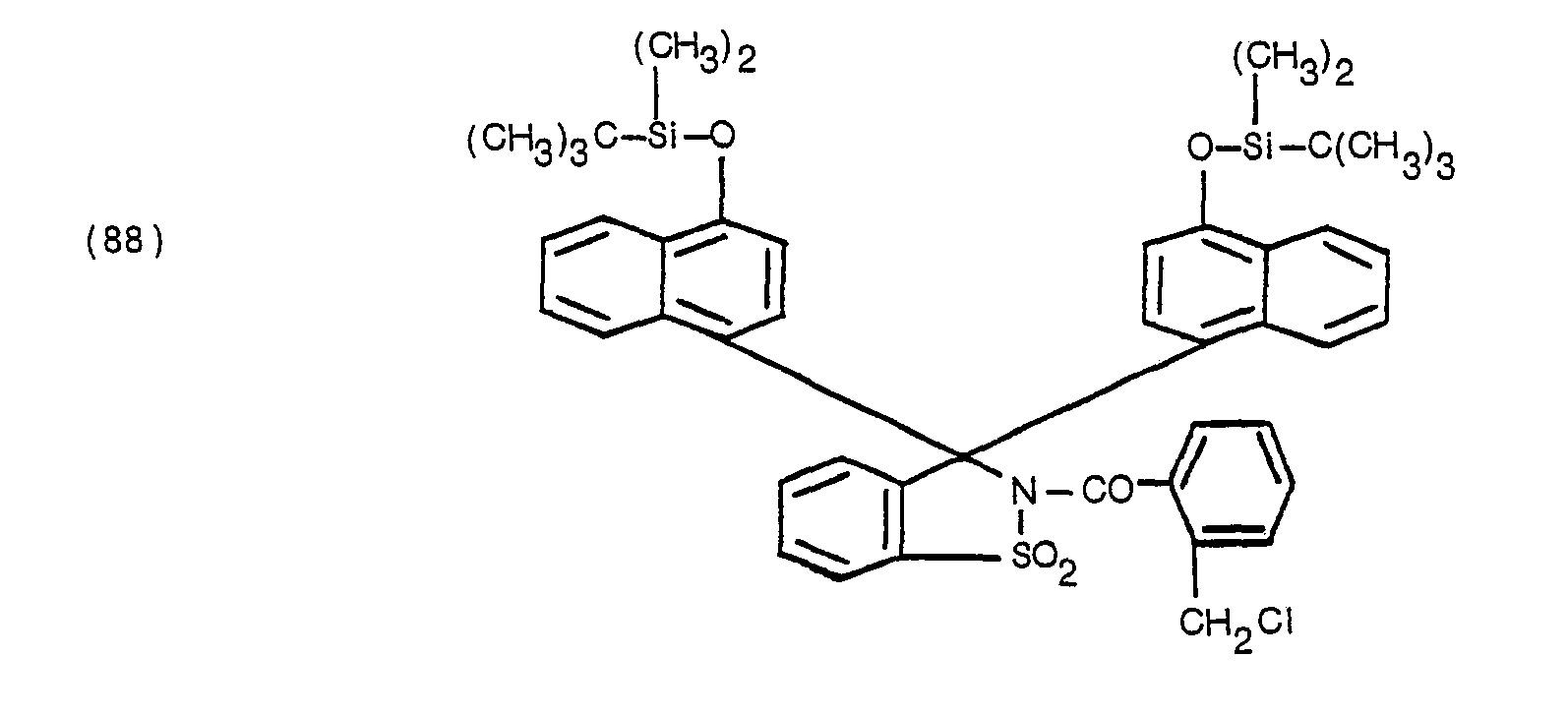
- The novel compounds of the present invention may be represented by the formula

- In a preferred embodiment, the novel intermediates of the present invention may be represented by the formula


- Illustrative compounds are as follows:


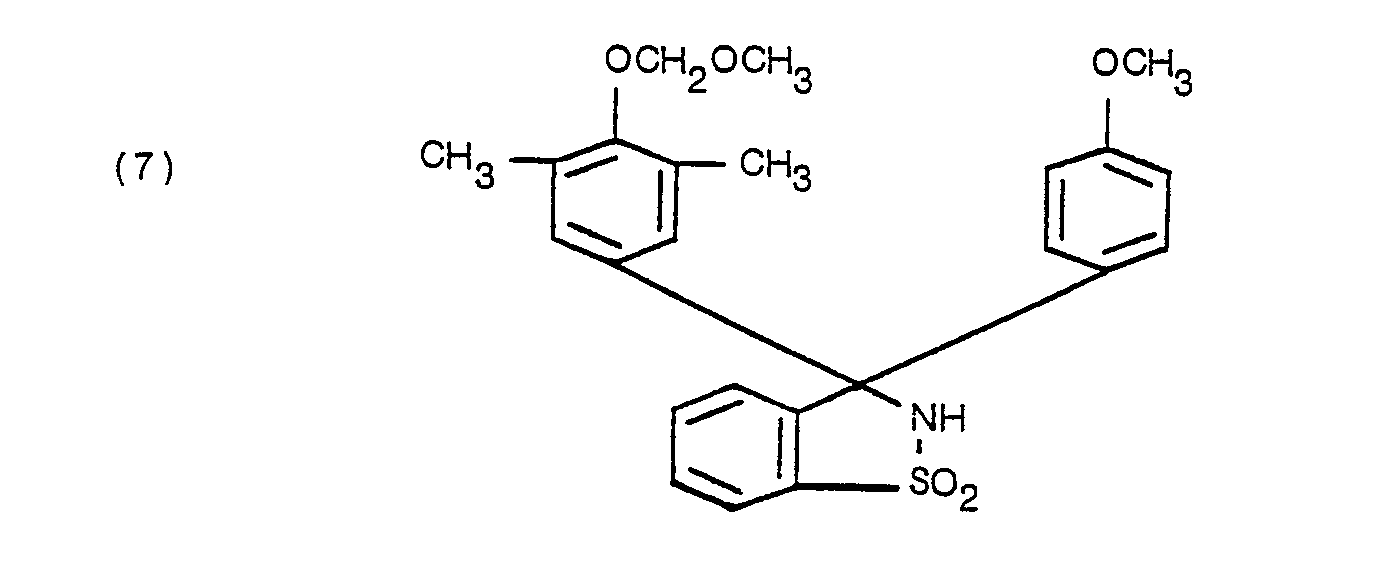


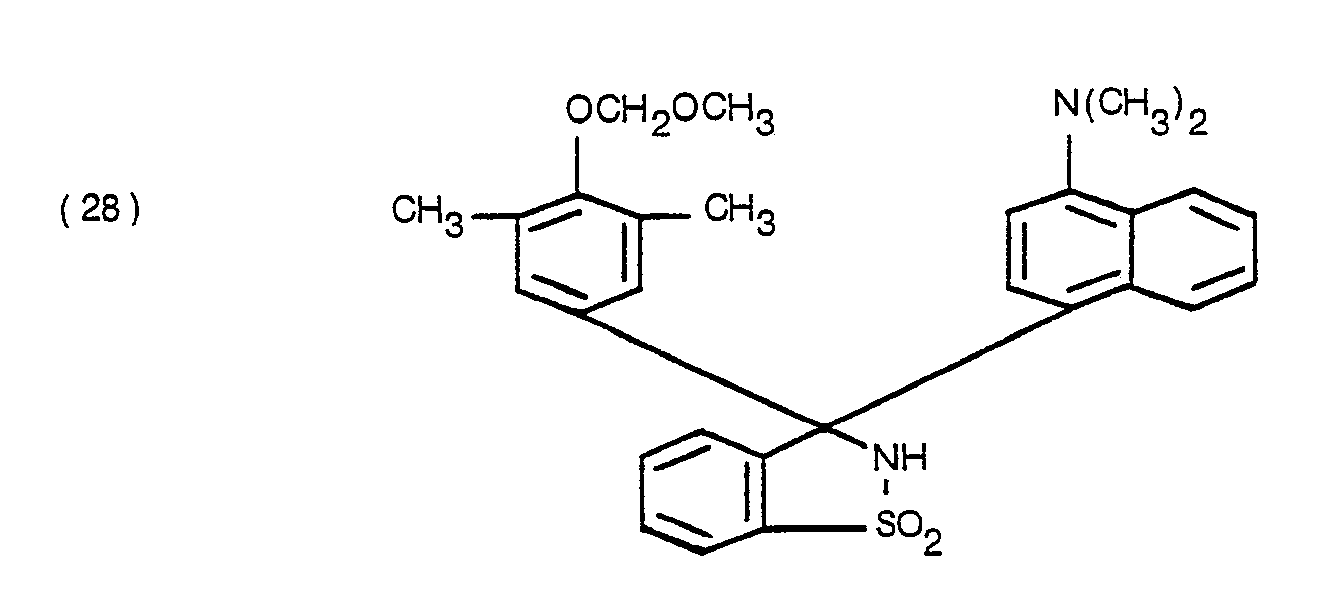


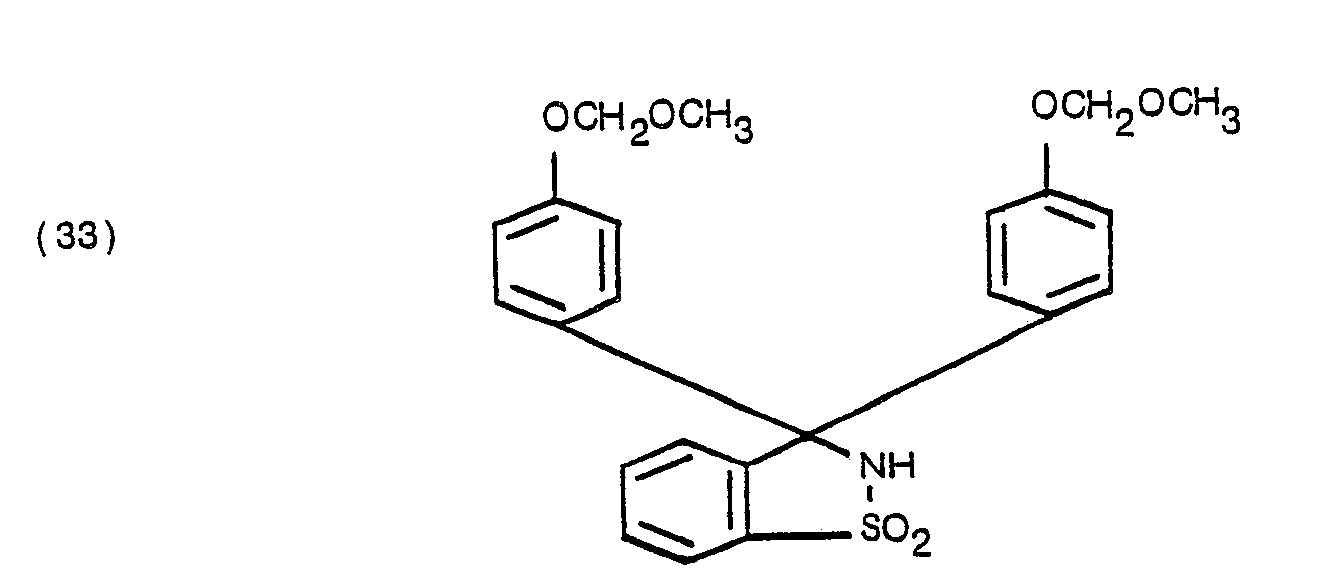


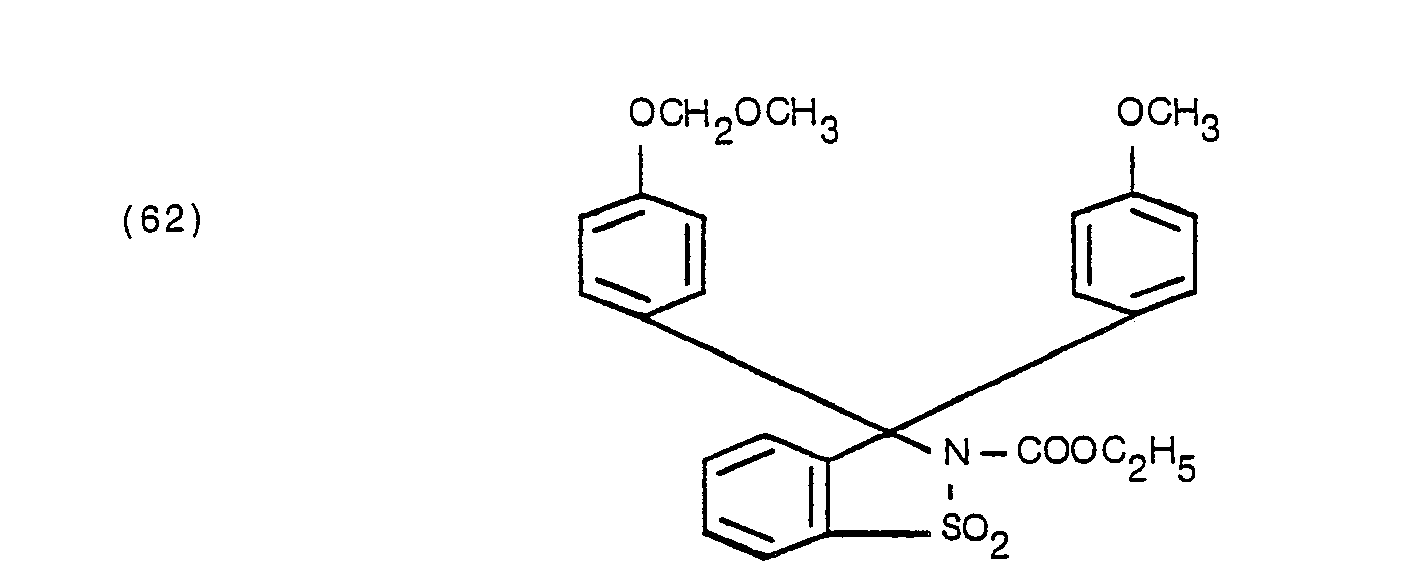


- The 3-(4'-OP-1'-phenyl/4'-OP-1'-naphthyl)-3-(phenyl/naphthyl)-2,3-dihydrobenz[dlisothiazole-1,1-dioxides of this invention, i.e. those compounds of Formula (I) where R is hydrogen may be synthesized by reacting a 3-(4'-OP-1'-phenyl/4'-OP-1'-naphthyl)benz[d]-isothiazole-1,1-dioxide and a phenyllithium or a naphthyllithium reagent. Specifically, the 3-(4'-OP-1'-phenyl/4'-OP-1'-naphthyl)-benz[d]isothiazoie-1,1-dioxides are prepared by blocking the functional hydroxy group and any substituent group (s), as may be appropriate, of the selected 4-halophenol or 4-halo-1-naphthol and converting the blocked phenol or 1-naphthol to the corresponding Grignard or lithium reagent which is then reacted with a saccharin reagent. The 4-halo substituent may be chloro, bromo or iodo when the lithium reagent is prepared by reacting the blocked phenol or blocked 1-naphthol with lithium metal and is either bromo or iodo when the lithium reagent is made via a lithium ion exchange resin using, for example, n-butyllithium. In preparing the Grignard reagent by reacting the blocked phenol or 1-naphthol with magnesium metal, the 4-halo substituent may be chloro, bromo or iodo. The Grignard or lithium reagent thus prepared is then reacted with saccharin, the N-lithium salt of saccharin or saccharin pseudo-chloride to yield the corresponding 3-(4'-OP-1'-phenyl/4'-OP-1'-naphthyl)benz[d]-isothiazole-1,1-dioxide. Generally, the Grignard reagent is reacted with the pseudo-chloride, and the lithium reagent is reacted with the N-lithium salt. The 3-(4'-OP-1'-phenyl/4'-OP-1'-naphthyl))-naphtho[1,8-de]-1,2-thiazine-1,1-dioxides may be prepared in a similar manner by reacting the Grignard or lithium reagent with 2,3-dihydro-3-oxo-naphtho[1,8-de]-1,2-thiazine-1,1-dioxide, its pseudochloride or the N-lithium derivative thereof.
- To prepare the 3-(4'-OP-1 '-phenyi/4'-OP-1'-naphthyi)-3-(phenyi/naphthyi)-2,3-dihydrobenz[d]-isothiazole-1,1-dioxides, the 3-(4'-OP-1'-phenyl/4'-OP-1'naphthyl)benz[d]-isothiazole-1,1-dioxide is reacted with at least one molar equivalent of a phenyllithium or a naphthyllithium reagent in an inert organic solvent, such, as benzene, diethyl ether, dioxane, hexane, toluene, petroleum ether or tetrahydrofuran. The reaction temperature may vary over a relatively wide range from about -80° to 50°C as may be readily determined for the particular reactants. For achieving maximum yields, the reaction generally is conducted at a temperature below about 0°C and preferably between about -65°C and -25°C.
- The phenyl- or naphthyllithium reagent ultimately forming the B moiety of the subject compounds and the ultimate products may be substituted or unsubstituted and may be prepared from the corresponding halo-substituted compound. For example, N,N-dimethylaniline may be halogenated to give the 4-halo compound which, in turn, is reacted with lithium metal or n-butyllithium to yield the 4- lithium compound. Halogenation may be carried out in a conventional manner using either chlorine or bromine, with or without a catalyst, or using N-bromosuccinimide or iodinemonochloride. When lithium metal is employed in the preparation of the 4-lithium compound, the halo substituent may be chloro, bromo or iodo and is either bromo or iodo when a lithium exchange reaction is employed. If substituents, such as, hydroxy, are present, they should be blocked with the appropriate protecting group to render them compatible with organometallic reagents prior to conversion to the 4-lithium compound. The protecting groups, of course, should be removable under mildly acidic conditions so that the substituents on the aryl moiety forming the B moiety can be regenerated simultaneously with the regeneration of the functional -OH group of the phenolic or naphtholic moiety, i.e. the A moiety.
- The groups selected for protecting the functional phenolic or naphtholic hydroxy group and other hydroxy groups that may be present in the phenol or 1-naphthol should be stable to and compatible with organolithium and Grignard reagents and should protect the hydroxy group(s) against reaction under the conditions encountered in the synthesis of the aforesaid compounds and in the subsequent N-acylation step. In addition, the protecting group selected should be capable of being easily removed under weakly acid conditions to regenerate the hydroxy group(s) without the removal of or adversely affecting the N-carbonyl moiety or other substituents that may be present. Such protecting groups are selected from methoxymethyl, 2'-tetrahydropyranyl or dimethyl-t-butylsilyl. The blocked phenols and 1-naphthols employing these protecting groups may be prepared by methoxymethylation as described, for example, by Kaoru Fuji et al, Synthesis, 4, pp. 276-277 (1975), by tetrahydropyranylation as described, for example, by William E. Parham et al, J.Amer.Chem.Soc., 70, pp. 4187-4189 (1948) or by silylating with dimethyl-t-butylsilyl chloride in the presence of imidazole as described by E. J. Corey et al., J.Amer.Chem.Soc., 94, pp. 6190-6191 (1972).
- As noted above, hydroxy groups in addition to the functional -OH of the phenol and 1-naphthol may be blocked simultaneously with the functional hydroxy group, for example, by tetrahydropyranylation or methoxymethylation. Groups other than hydroxy that sould be protected may be blocked prior to or subsequent to the blocking of the functional -OH. For example, carboxy group(s) may be protected by reacting a carboxy-substituted 4-halophenol (or 4-halo-1-naphthol) with 2-amino-2-methyl-1-propanol followed by blocking of the functional -OH. Sulphonamido (-NH-SO2-R°) and sulfamoyl (-SO -NH-R°) substituents may be protected by a t-butyl group (R° is alkyl, aryl, alkaryl or aralkyll.
- The 3-(4'-OP-1'-phenyl/4'-OP-1'-naphthyll-3-phenyl/naphthyl)-2,3-dihydrobenz[d]isothiazole-1,1-dioxides prepared as described above are reacted with a carboxylic acid halide,


- Optionally, the acylation step may be carried out by first reacting the isothiazoie-1,1-dioxide with a molar equivalent and usually a slight excess of about 0,1 mole of an alkali metal hydride in an inert organic solvent at a temperature between about 0° and 100°C, preferably in an inert atmosphere, and then reacting the N-alkali metal salt thus formed with the said carboxylic acid halide,

- Usually, the acid halide is added to the reaction mixture containing the N-alkali metal salt. However, the N-alkali metal salt may be isolated prior to reaction with the acid halide, if desired. Solvents suitable for use in the alternate method of forming the

- Carboxylic acid halides are well known and may be prepared in a conventional manner, for example, by reacting the selected carboxylic acid, R9COOH, with phosphorus trichloride, phosphorus pentachloride or thionyl chloride to give the corresponding R9COCI, or by reacting the selected R90H with phosgene to give the corresponding CICOOR9.
- Subsequent to the acylation step, the protecting group P is removed from the functional -OH by treating with acid having a pH between about 0.1 and 5.0 at a temperature between about 20° and 100°C. The acid may be an inorganic acid, such as, hydrochloric acid or sulfuric acid in a protic solvent, e.g., water, alkanol, such as, methanol or ethanol, or aqueous alkanol, or the acid may be an organic acid, such as acetic acid or trifluoroacetic acid alone or in a protic solvent, such as those mentioned above. As indicated previously, any other protecting groups that may be present are removed simultaneously with the protecting group on the functional -OH.
- The following examples are given to further illustrate the present invention and are not intended to limit the scope thereof. The examples also show how the intermediates comprising protected -OH groups which are the compounds according to the present invention, can be converted into compounds comprising functional -OH groups which from the subject matter of other applications.
- Preparation of the compound having the formula:


- The 3-(3'-,5'-dimethyl-4'-methoxymethoxy-1'-phenyl)-benz[d]isothiazole-1,1-dioxide having the formula:

- (I) Into a 2 liter three neck flask, fitted with a mechanical stirrer, nitrogen inlet and a dropping funnel, was placed 700 ml. of dry chloroform. The flask was immersed in an ice-water bath. Powdered phosphorus pentoxide (300.0 g.) was added to the vigorously stirred, cold chloroform. To this mixture was added over a 1 hour period a solution of 4-bromo-2,6-dimethylphenol (201.0 g.) in 400 ml. of dry dimethoxymethane. During this time the phosphorus pentoxide powder fused into an amorphous mass and stirring became difficult. TLC analysis (9:1 petroleum ether-ethyl acetate on silica gel) indicated that much unreacted starting phenol was still present. The temperature of the reaction mixture was allowed to rise to about 25°C. Additional 50 g. increments of phosphorus pentoxide were added to the stirred reaction mixture every 30-45 minutes until TLC analysis indicated the absence of starting phenol. The organic layer was decanted, washed with two 250 ml. portions of aqueous 10% sodium hydroxide and dried over calcium sulfate. The solvent was removed under reduced pressure leaving a pale yellow oil which was distilled from 25 g. of anhydrous potassium carbonate to give 220.0 g. of 4-bromo-2,6-dimethyl-methylenemethoxyphenyl ether as a colorless oil [boiling point 112°C and 0.67 millibars (0.5 mm Hg)].
- (ii) 4-Bromo-2,6-dimethyl-methylenemethoxyphenyl ether (85.04 g; 0.347 mole) was dissolved in approximately 800 ml of tetrahydrofuran. The solution was cooled to -75°C under a nitrogen blanket, and 2.4M n-butyllithium in hexane (144.8 ml; 0.346 mole) was added dropwise. Addition was completed within a 2 hour period giving a white slurry.
- (iii) Saccharin (61.2 g; 0.334 mole) was dissolved in 600 ml. of dry tetrahydrofuran, and the solution was cooled to approximately -75°C. 2.4M n-butyllithium in hexane (130.4 ml; 0.311 mole) was slowly added dropwise to the cooled solution under a nitrogen blanket. The temperature was not allowed to rise above -70°C. Addition was completed in about 90 minutes, giving a clear, very pale yellow solution.
- (iv) The yellow solution obtained in step (iii) was slowly added (over a 3 hour period) to the white slurry obtained in step (ii) while keeping the temperature at -70°C. During this time the solids disappear giving a clear, caramel colored reaction mixture that first tends to darken whith time and then gradually lightens. The reaction mixture was allowed to come to room temperature overnight and then was treated with 36.0 g. of ammonium chloride in 250 ml. of water, while cooling in an ice-water bath. The organic portion was decanted and dried over anhydrous calcium sulfate. The solvent was removed under reduced pressure to give a pink colored oil that became solid on standing in open air.
- The solid was recrystallized twice from 1-propanol, washed with a 60:40% mixture of petroleum ether-tetrahydrofuran and dried under vacuum to give 68.0 g. of the title compound as a white, crystalline solid.
- 3-(3',5'-dimethyl-4'-methoxyethoxy-1'-phenyl)-benz[d]isothiazole-1,1-dioxide also was prepared as follows:
- Dry tetrahydrofuran (10-15 ml.) was added to magnesium turnings (0.20 g.) under nitrogen. A solution of 4-bromo-2,6-dimethyl-methylenemethoxyphenyl ether (2.0 g.) in tetrahydrofuran (30 ml.) was added gradually to the magnesium turnings with stirring and heating. After about twenty minutes of external heating to reflux, a self-sustaining reaction was observed. The remaining solution of phenyl ether was then added at a rate to maintain a comfortable reaction. Refluxing with external heating was continued after addition was complete and after one hour, the solution was cooled to room temperature and held under nitrogen. A solution of saccharin pseudochloride (1.89 g.) in tetrahydrofuran (40 ml.) was cooled to -78°C and the previously prepared solution of magnesium bromide reagent was added dropwise to the pseudo-chloride solution under nitrogen. The resulting reaction mixture was stirred cold for about 2 hours and then stirred at room temperature overnight. The reaction mixture was then cooled in an ice water bath and treated with saturated aqueous ammonium chloride solution. The aqueous solution was extracted with chloroform several times and the combined chloroform extracts washed with water and dried over anhydrous sodium sulfate followed by drying over anhydrous calcium sulfate. Upon removing the chloroform, a colorless oil was obtained which was extracted several times with small portions of light petroleum ether to leave behind a pale yellow tacky tar. The yellow tar was treated with ether leaving behind an off-white solid. The off-white solid was dissolved in a small amount of chloroform, treated with carbon black and filtered through a silica filter aid. Upon removing the solvent, the title compound was obtained as an off-white solid which was dried under vacuum in the presence of PZOS. Yield 0.520 g.
- 3-chlorobenz[d]isothiazole-1,1-dioxide (saccharin pseudochloride) was prepared as follows:
- 35 g. of saccharin and 43.7 g of PCl5 were heated at 170°C for 1 1/2 hours during which time complete solution occurred and POC13 began to reflux. The POC13 was removed at reduced pressure to leave a crystalline residue. Di-ethyl ether was added to the crystalline residue and stirred well. The title compound was recovered as white crystals, 12.5 g. (melting range 146°-147°C).
- The N-(p-bromophenyl)morpholine having the formula

- 25 g. of N-phenylmorpholine was dissolved in 200 ml. of carbon tetrachloride and stirred well. To this was added all at once 27.2 g. of N-bromosuccinimide. There was an exotherm to 45°C. The reaction solution was stirred until the temperature began to decrease and then was heated to reflux for 3 hours. TLC on silica gel with 3/2 petroleum ether/ether indicated that the reaction was complete. The reaction solution was then cooled, the succinimide removed by filtration and the solution evaporated to yield a yellow solid. The solid was dissolved in 250 ml of ethanol and cooled to give 22 g. of the title compound as white crystals.
- The {3-cyanoethylchloroformate having the formula (CNCH2CH2COOCI) used in step (b) above was prepared as follows:
- To 100 ml of dry benzene, cooled in an ice bath, was added phosgene gas until 34.0 g. was collected. Hydroxyacrylonitrile (20.2 g.) was added to the cooled phosgene solution. (The temperature rose slightly to approximately 8°C). The resulting heterogeneous mixture was cooled to 3°C with stirring, and pyridine (22.6 g.) in 25 mls. of benzene was added dropwise. Heat was evolved, and the temperature was not allowed to rise above 10°C. Very vigorous stirring was maintained until solid began to form. After about 1 hour, the reaction mixture was stirred at approximately 5°C for 15 minutes, then allowed to come to 15°C-20°C and stirred for another 15 minutes. The reaction mixture was then cooled to 5°C and 26 ml. of ice water was added in increments. The solids dissolved with liberation of heat and evolution of gas. The temperature was not allowed to rise above 15°C over the next 15-20 minutes. The reaction mixture was then stirred at room temperature for 2 hours, the benzene layer decanted and dried over anhydrous NaZS04, followed by drying over anhydrous CaS04. The solvent was removed under reduced pressure to yield an almost colorless oil which was redistilled under vacuum at a boiling range of 68.5°-70.5°C (pot temperature 98-103°C) to yield 18.2 g. of the title compound as a colorless oil.
- The compounds having the formulas


- Preparation of the compound having the formula

- (a) 55 g. of 4-bromo-2,6-dimethoxy-methylenemethoxyphenyl ether was dissolved in 300 ml. of anhydrous tetrahydrofuran under a stream of nitrogen. The solution was cooled to -65°C during which time some of the phenyl ether precipitated. To this was added 79 ml of butyl-lithium (2.4M in hexane) at a range to keep the temperature below -50°C. The resulting solution was cooled to -65°C and was stirred for 30 minutes. To this solution was added 19 g. of sacharin pseudo-chloride in two portions so as to keep the temperature below -40°C. The reaction solution was cooled to -65°C and was stirred for 40 minutes. TLC showed one main spot on silica gel with 10 ml. ether/2 drops methanol. The reaction solution was poured into 2000 ml. of water and made acidic to pH 6. The mixture changed color from orange to yellow at this pH. The mixture was extracted two times with ether (2 liters) and the ether washed with water. The ether was dried over sodium sulfate and evaporated to leave a light yellow solid. the solid was recrystallized from 450 ml. of n-propanol to give 42 g. of 3,3-di(3',5'-dimethoxy-4'-methoxymethoxy-1'-phenyt)-2,3-dihydrobenz[d]isothiazo)e-1,1-dioxide as off-white crystals (melting range 151.5°-152.5°C).
- (b) The compound prepared in step (a) (27.0 g) was dissolved in 125 ml. of dioxane at room temperature under nitrogen. To this solution was added 2.50 g. of NaH (57% oil dispersion) and the resulting dispersion stirred for 45 minutes. (Evolution of hydrogen was observed.) Then 8.0 ml. of CICOOOCH2CH2CN was added and an exotherm resulted. The resulting reaction mixture was stirred for 3 hours. The initial yellow color disappeared and a white dispersion formed. The dispersion was poured into 2 liters of water, made neutral with dilute HCI and extracted with chloroform. The chloroform was washed with water, separated, dried over sodium sulfate, and evaporated to yield a white solid. The solid was stirred with ethyl ether, isolated by filtration, dried in vacuo, and crystallized from methanol. The needles that formed were recovered by filtration to give the >N-COOCH2CH2CN derivative of 3,3-di(3',5'-dimethoxy-4'-methoxymethoxy-1 '-phenyt)-2,3-dihydrobenz[d]isothiazote-1,1-dioxide.
- (c) 3.7 g. of 3,3-di(3',5'-dimethoxy-4'-methoxy-methoxy-1'-phenyl)-2-β-cyanocarbethoxy-2,3-di- hydrobenz[d]-isothiazoie-1,1-dioxide prepared as in step (b) above was placed in 200 ml. of methanol and 2 drops of HCI were added. The resulting solution was refluxed and the reaction was followed by TLC on silica gel with ether. When TLC indicated that no more blocked compound remained, the reaction was discontinued and the methanol removed in vacuo to leave an egg-white solid (3.2 g). This was dissolved in 80 mi. of 1,2-dichloroethane with heating and 80 ml. of petroleum ether was added with swirling. The solution was cooled and the light beige crystals that formed were collected and dissolved in 175 ml. of ethanol at reflux. The ethanol solution was allowed to cool in the refrigerator overnight and 2.7 g. of the title compound was collected as white needles (melting range 191°―193°C).
- The methoxymethylation of 4-bromo-2,6-dimethoxy-phenol used in step (a) above was carried out as follows:
- To a 3 liter flask was added 300 g. of P205 under nitrogen and 800 ml. of chloroform (previously dried over Pz05). The mixture was cooled to -15°C with a dry-ice acetone bath and then 50 g. of 4-bromo-2,6-dimethoxyphenol in 800 ml of dimethoxymethane was added over a 25 minute period while maintaining the temperature at -15°C or below. To the resulting reaction mixture was added 1 ml. of conc. sulfuric acid and then the temperature was allowed to come to room temperature. During this time, a tacky mass of P20, developed. The reaction mixture was stirred for 3 hours. TLC indicated that the reaction was complete. The chloroform was then decanted into 400 ml. of 10% aqueous sodium hyroxide, stirred well and the chloroform layer separated, washed with water, dried over Na2SO4 and evaporated to leave light tan crystals. n-Propanol was added to the crystalline residue, stirred and filtered to give 32.7 g. of the title compound as white crystals (melting range 98°―100°C).
- The compounds having the formulas


- The 3-(3',5'-dimethoxy-4'-methoxymethoxy-1'-phenyl)-benz[d]isothiazole-1,1-dioxide used in step (a) above was prepared as follows:
- (i) Using an 18 gauge needle-syringe, 20.0 mls. of n-butyllithium (2.4M in hexane) was added dropwise over 1 hour to a solution of 9.16 g. of saccharin (previously dried overnight at 80°C in vacuo) in 250 mls. of dry tetrahydrofuran under nitrogen at -75°C to -73°C with rapid stirring. The reaction solution comprising the N-lithium salt of saccharin in tetrahydrofuran was used directly in step (iii) without isolating the lithium salt.
- (ii) In a dried 1 I. flask, 13.86 g. of 4-bromo-2,6-dimethoxy-methylenemethoxyphenyl ether was dissolved in 300 mls. of dry tetrahydrofuran under nitrogen, and 20.83 mls of n-butyllithium (2.4M in hexane) was added dropwise with stirring at -75°C. After addition was complete, the reaction solution was stirred at -75°C for about 30 minutes.
- (iii) The solution of saccharin lithium salt prepared in step (i) was transferred to an addition funnel using a double-tip needle under nitrogen pressure and added to the solution of 4-Li-2,6-dimethoxy- methylenemethoxyphenyl ether prepared in step (ii) over about 15 minutes with stirring at a temperature of -75°C to -70°C. The reaction mixture was stirred for about 2 hours at -75°C and then warmed to 0°C during an hour.
- (iv) A solution of 5.2 g. of ammonium chloride in 175 mls. of water was added dropwise to the reaction mixture of step (iii) and the reaction mixture was transferred to a 1 I. separatory funnel. After the two phases separated, the aqueous phase was removed and the pH was lowered from about 11 to about 6-7 by the dropwise addition of aqueous 5% hydrochloric acid solution. (A color change from yellow to colorless was observed). The aqueous phase was returned to the separatory funnel, partitioned and the aqueous phase again separated and then extracted with fresh ether (100 mls.). The ether and tetra- hydrofuran/hexane extracts were combined, dried over magnesium sulfate overnight, filtered and the solvent removed to leave a yellow oil which crystallized. Ether (100 mls.) was added to the crystalline material and the crystalline material was ground under ether in a mortar, filtered, washed with more ether followed by petroleum ether and air dried. A second crop was collected from the filtrate to give a total yield of 13.0 g. of the title compound.
- The compounds having the formulas:


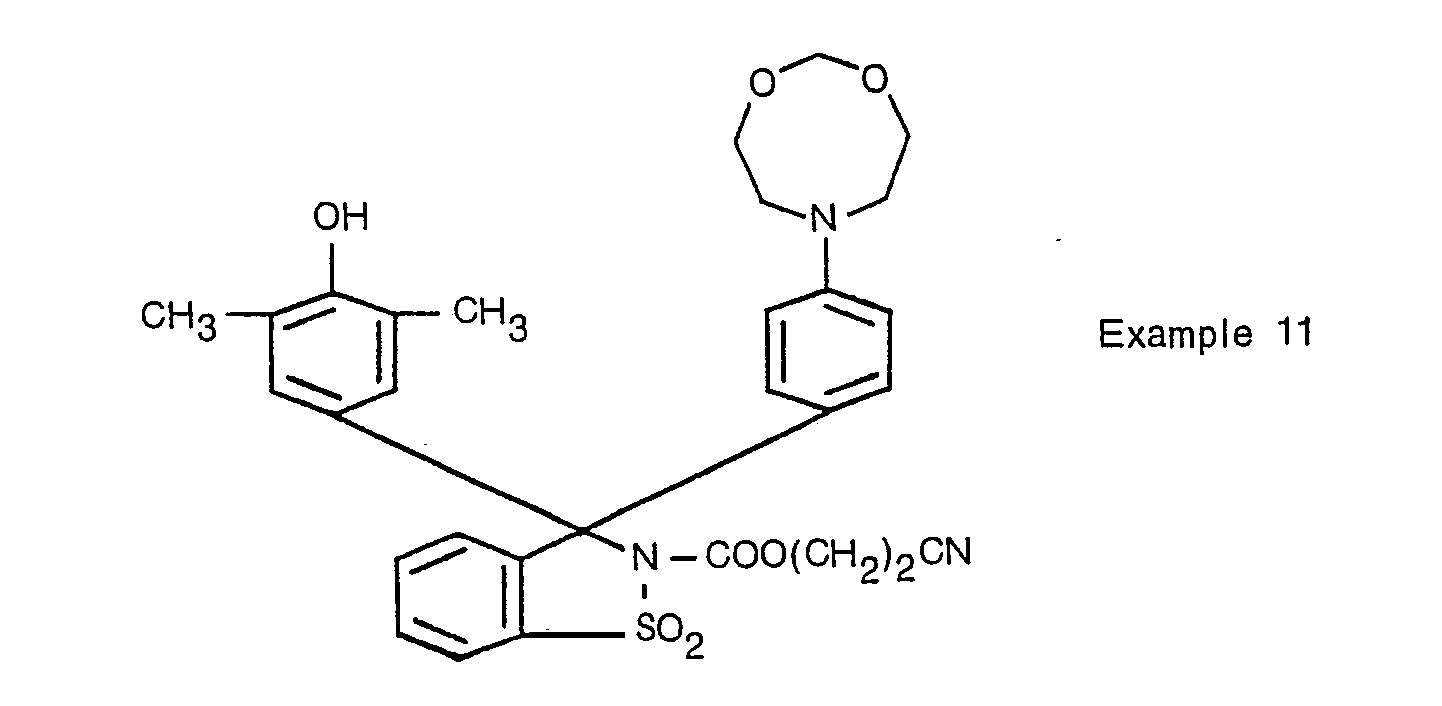


- N-(p-Li-phenyl)tetrahydro-2H,4H-1,3,6-dioxazocine may be prepared by reacting the corresponding p-halophenyl compound with n-butyllithium. The N-(p-halophenyl)tetrahydro-2H,4H-1,3,6-dioxazocines are prepared by reacting p-halo-N,N-di(β-hydroxyethyl)aniline with certain dihalomethanes in the presence of a solid alkali metal hydroxide or concentrated aqueous solution thereof and a quaternary ammonium salt.
- Tetrahydropyranylation of p-Br-N,N-di(B-hydroxyethyl)aniline was carried out as follows:
- p-Br-N,N-di(β-hydroxyethyl)aniline (20.0 g.) was dissolved in 475 ml. of dichloromethane containing 60 ml. of dihydropyran. To this solution was added 1 ml. of conc. HCI, and the reaction solution was stirred for about 5.5 hours. The solution was then washed with water containing enough sodium hydroxide to neutralize any acid present. The dichloromethane was separated, dried over anhydrous sodium sulfate and evaporated under reduced pressure with a steam bath (aspirator) leaving an oil. The oil was heated to 1 15°C at 0.13 millibars (0.1 mm Hg) to distill off impurities leaving 33.0 g. of the title compound.
- The corresponding 4-Li compound was prepared by dissolving 4-bromo-N,N-di(β-2'-tetrahydropyranyloxyethyl)aniline (10.0 g.) in 100 ml. of tetrahydrofuran, cooling the solution to -65°C and adding 10 ml. of n-butyllithium (2.4 M in hexane) under nitrogen at a rate to maintain the temperature at -65°C.
- The compounds having the formulas


- Preparation of the compound having the formula:

- (a) 2'-tetrahydropyranyl 4-bromophenyl ether (9.0 g.) in 20 ml. of tetrahydrofuran was added dropwise to 0.85 g. of magnesium in 20 ml. of tetrahydrofuran under nitrogen. After addition was complete, the dispersion was refluxed for 2 hours and then saccharin pseudo-chloride (3.5 g.) was added portionwise. An exotherm was observed, and the green solution that formed turned yellow-brown. The reaction solution was stirred overnight and then slowly added to 500 ml. of water. The precipitate that formed was slowly filtered and the solid obtained was dissolved in ether, dried and evaporated to yield 8.5 g. of light yellow solid having the formula:

- (b) Compound A as prepared in step (a) (10.0 g.) was placed in 100 ml. of dioxane and 0.88 g. of sodium hydride (as 57% oil dispersion) was added at room temperature under nitrogen (hydrogen evolution was observed). The resultant mixture comprising the N-sodium salt of the above compound was stirred 1 hour and then 2.4 ml. of CICOOCH2CH2CN was added. A white precipitate formed immediately. The reaction mixture was stirred overnight then poured into 200 ml. water. The aqueous mixture was extracted with three 250 ml. portions of ether, which were combined and dried over sodium sulfate. The ether was removed in vacuo and the resulting solid washed with petroleum ether. Upon drying, 10.5 g. of the crude N-acylated derivative was obtained. The N-acylated compound has the formula

- (c) Compound B (5.0 g.) as prepared in step (b) was dissolved in 50 ml.of warm methanol which contained two drops of conc. HCI. This solution was allowed to stand at room temperature for 30 min. at which time the analysis indicated both tetrahydropyranyl protecting groups had been removed. The methanol and HCI were removed in vacuo leaving 5.0 g. of a light yellow solid which was fractionated via column chromatography (silica gel; ether) to give a pure sample of the title compound.
- Tetrahydropyranylation of p-bromo-phenol used in the preparation of compound A was carried out as follows:
- To 10.5 ml. of dihydropyran containing 2 drops of conc. HCI was added 10.0 g. of p-bromophenol. (The reaction was exothermic; temperature rose to 35°C). After the addition was completed, the colorless solution obtained was heated to 50°C and allowed to cool with stirring for 1 hour. The solution was extracted with 20 ml. of ether and 10 ml. of 10% NaOH. The ether layer was dried over anhydrous Na2S04 and evaporated under reduced pressure to leave an oil. 80 mi. of ethanol was added to the oil and the resulting ethanol solution was allowed to stand. The white crystals that formed were recovered by filtration and dried under vacuum to yield 7.3 g of the blocked phenol. The mother liquor was concentrated to one-half its original volume and cooled. More crystals formed which were isolated to yield an additional 2.1 g. of blocked phenol.
- Preparation of the compound having the formula:

- (a) 2'-tetrahydropyranyl 4-bromophenyl ether (9.0 g.) in 20 ml. of tetrahydrofuran was added dropwise to 0.85 g. of magnesium in 20 ml. of tetrahydrofuran under nitrogen. After addition was complete, the dispersion was refluxed for 2 hours and then saccharin pseudo-chloride (3.5 g.) was added portionwise. An exotherm was observed, and the green solution that formed turned yellow-brown. The reaction solution was stirred overnight and then slowly added to 500 ml. of water. The precipitate that formed was slowly filtered and the solid obtained was dissolved in ether, dried and evaporated to yield 8.5 g. of light yellow solid having the formula:
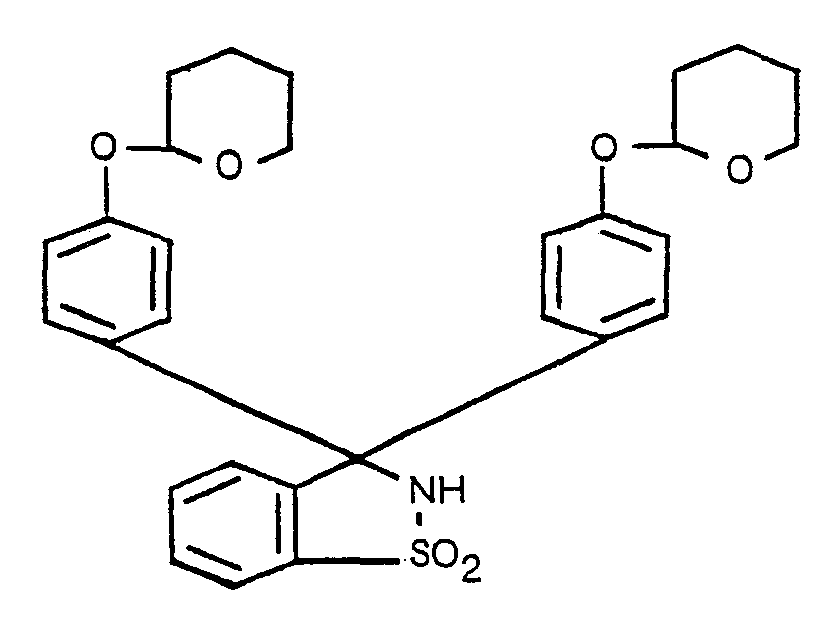
- (b) 1.0 g. of the compound prepared in step (a) was placed in 15 mi. of dioxane and 0.08 g. of sodium hydride (as 57% oil dispersion) was added at room temperature under nitrogen (Hydrogen evaluation was observed). The resultant mixture comprising the N-sodium salt of the above compound was stirred for 1 hour and then 0.342 g. of


- (c) To remove the 2'-tetrahydropyranyl protecting groups and obtain the product, 20 mls. of 10% HCI solution was added to the solid and the orange solid obtained was filtered and dried. A second crop of precipitate was recovered from the water precipitation which was filtered and treated with 10% HCI to give an additional 0.5 g. of solid. The solids were combined and fractionated via preparative TLC (silica gel/ether) to give a pure sample of the title compound.
- Preparation of the compound having the formula

- The title compound was prepared according to the procedure of Example 16 except that

- Preparation of the compound having the formula:

- (a) 2'-tetrahydropyranyl 4-bromophenyl ether (9.0 g.) in 20 ml. of tetrahydrofuran was added dropwise to 0.85 g. of magnesium in 20 mi. of tetrahydrofuran under nitrogen. After addition was complete, the dispersion was refluxed for 2 hours and then saccharin pseudo-chloride (3.5 g.) was added portionwise. An exotherm was observed, and the green solution that formed turned yellow-brown. The reaction solution was stirred overnight and then slowly added to 500 ml. of water. The precipitate that formed was slowly filtered and the solid obtained was dissolved in ether, dried and evaporated to yield 8.5 g. of light yellow solid having the formula:

- (b) The compound as prepared in step (a) (1.0 g.) was placed in 10 ml. of dioxane and 0.08 g. of sodium hydride (as 57% oil dispersion) was added at room temperature under nitrogen (Hydrogen evolution was slow). The solution went from light yellow to greenish then to yellow. The reaction was accelerated by heating to about 50°C and then allowing the solution to cool to room temperature, about 1 hour. To the remaining solution comprising the N-sodium salt of Compound A was added 0.18 ml. of ethylchloroformate and the reaction mixture was stirred over the weekend.
- (c) To remove the protecting groups, the solution was poured into 20 ml. of conc. HCI. After stirring for 15 minutes, the solution went from pink-red to brown. The precipitate that formed was filtered and dried under vacuum. Crystallization from 1:1 methanol-water gave 0.5 g. of the title compound as a white solid.
- Preparation of the compounds having the formula:

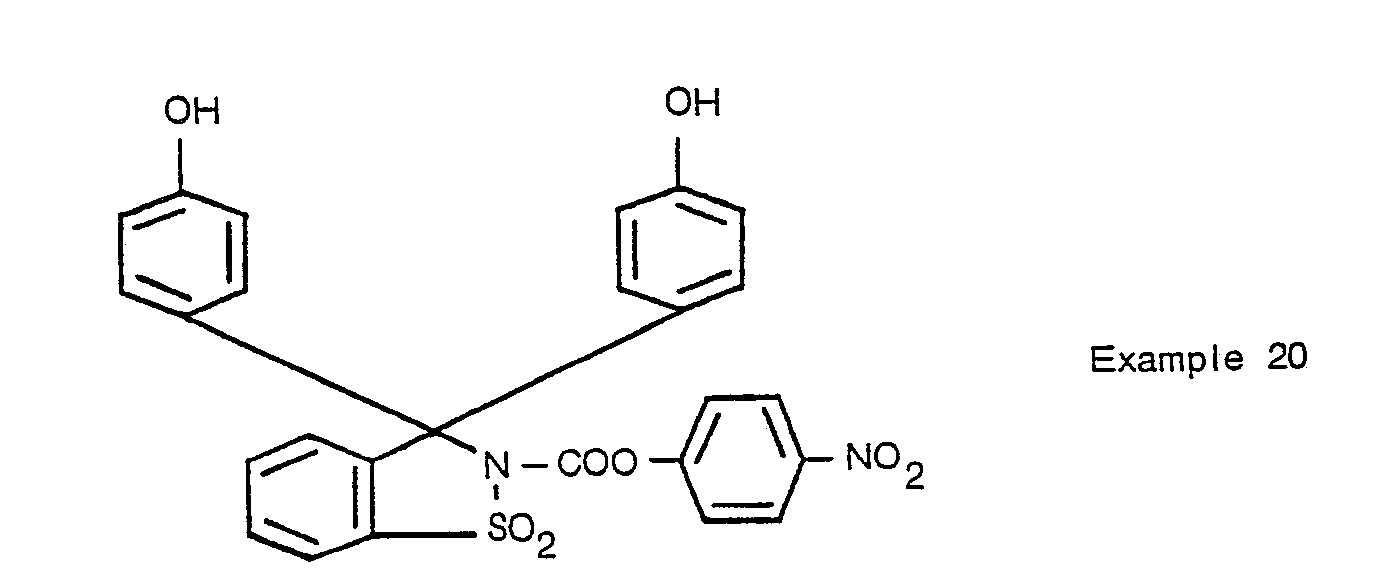
- The title compounds were prepared according to the procedure described in Example 18 above except that the acylating agents employed in step (b) were

- Preparation of the compound having the formula:

- (a) N-(-p-bromophenyl)morpholine (0.4 g.) was added to 20 ml. of tetrahydrofuran (THF) and the solution cooled to -65°C. To the solution was added 0.69 ml. of 2.4 M butyllithium in hexane with stirring and stirring was continued for 1 hour. (After 15 minutes the solution became cloudy and a white precipitate formed). To this solution was added 0.5 g. of 3-(3',5'-dimethyi-4'-methoxymethoxy-1 '-phenyi) benz[d]-isothiazole-1,1-dioxide in 2 ml. THF at >65°C under nitrogen. The resulting reaction mixture was a clear orange-yellow solution. The reaction mixture was stirred for 1 hour, poured into 100 ml of water, made acidic with conc. hydrochloric acid (pH 6), and extracted with ether. The ether was dried over Na2SO4 and evaporated leaving an oil. The oil was taken up in ligroin (boiling range 30-600C) and refluxed for 1 hour. The white solid that formed was collected to give 0.7 g. of 3-(3',5'-dimethyl - 4' - methoxymethoxy - 1' - phenyl) - 3 - (4" - N - morpholinyl - 1" - phenyl) - 2,3 - dihydro- benz[d] - isothiazole - 1,1 - dioxide having the formula:

- (b) The compound prepared in step (a) (0.7 g.) was dissolved in 15 ml. of pyridine under nitrogen and 0.11 ml. of


- (c) The compound obtained in step (b) was then dissolved in 25 ml. of methanol, made acidic with conc. hydrochloric acid and refluxed 2 hours. The solution was evaporated leaving a tan solid. TLC of a sample on silica gel 1000 with ether gave a dark band on drying. The dark band was removed, washed with acetone and the acetone removed after filtering to yield a gum. Ether was added to the gum and the resulting solution refluxed to give a white solid that was isolated to give the title compound.
- The compounds having the formulae


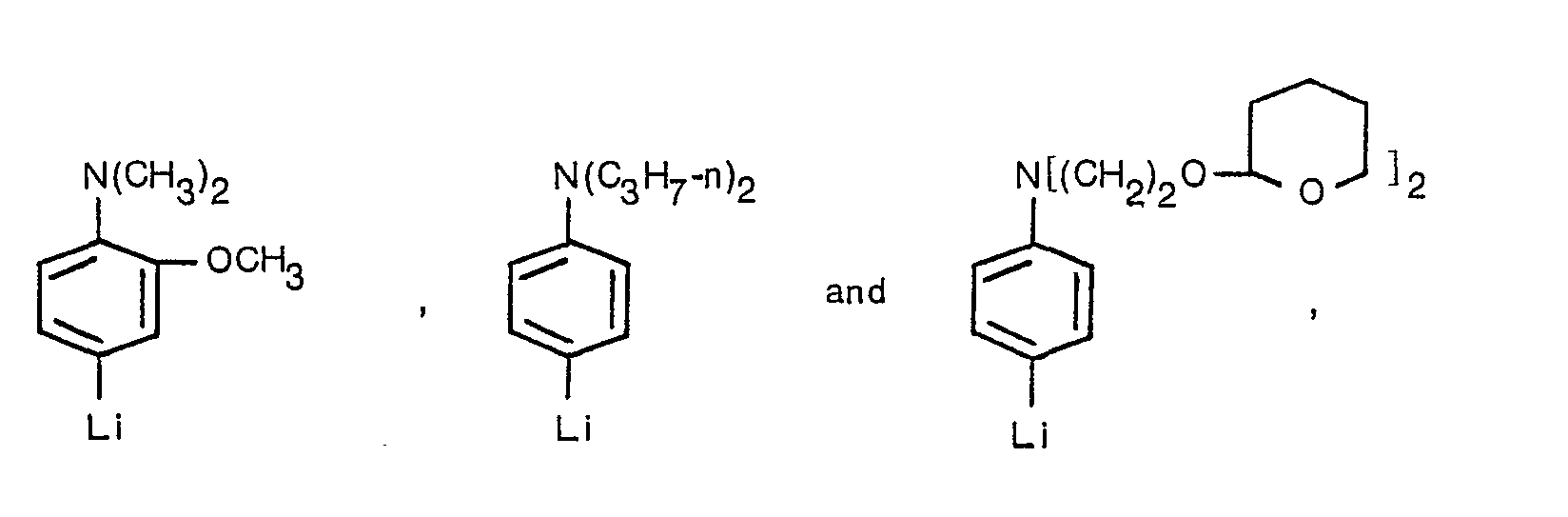
- The compounds having the formulae


- Preparation of the compounds having the formulae:


- (a) 2'-tetrahydropyrany! 4-bromophenyl ether (9.0 g.) in 20 ml. of tetrahydrofuran was added dropwise to 0.85 g. of magnesium in 20 ml. of tetrahydrofuran under nitrogen. After addition was complete, the dispersion was refluxed for 2 hours and then saccharin pseudo-chloride (3.5 g.) was added portionwise. An exotherm was observed, and the green solution that formed turned yellow-brown. The reaction solution was stirred overnight and then slowly added to 500 ml. of water. The precipitate that formed was slowly filtered and the solid obtained was dissolved in ether, dried and evaporated to yield 8.5 g. of light yellow solid having the formula:

- The compound prepared in step (a) was sequentially reacted with NaH and the appropriate acylating agents, namely,

- Preparation of the compound having the formula:

- The title compound was prepared according to the procedure described in Examples 27 and 28 above except that the acylating agent employed was

- The compounds having the formulae:


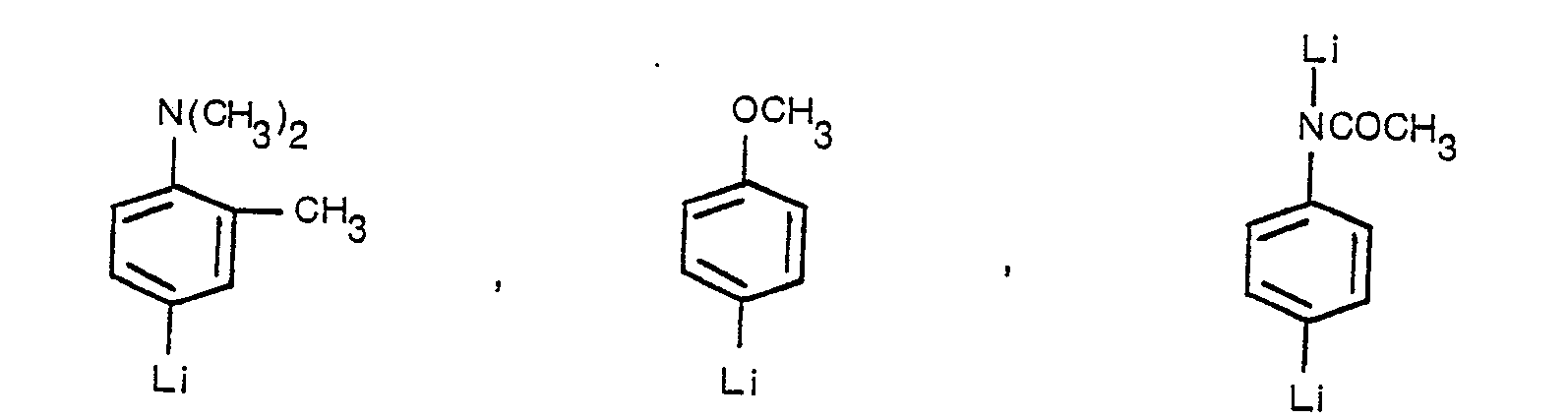

- The 3,3 - disubstituted - 2,3 - dihydrobenz[d]isothiazole- 1,1 - dioxides obtained were then sequentially reacted with NaH and


- The compound having the formula


- Preparation of the compound having the formula:

- (a) To a solution of 168 mg. of t-potassium butoxide in 5 ml. of dry tetrahydrofuran was added 834 mg. of 3,3-di[4'-(2"-tetrahydropyranyloxy)-1'-naphthyl]-2,3-dihydrobenz[d] isothiazole-1,1-dioxide in several small portions under nitrogen. The yellow-brown solution obtained was stirred for 2 hours at room temperature and then cooled in an ice bath.
- (b) To the cooled solution of step (a) was added dropwise 267 mg. of A-cyanoethylchloroformate. (The color changed to light yellow). The resulting solution was stirred over the weekend at room temperature under nitrogen during which time most of the solvent had evaporated leaving yellow-orange solids comprising the title compound and deblocked starting material.
- (c) The yellow-orange solids were taken up in 25 mi. of ether and the ether solution concentrated to about 10 ml. The crystals that formed were filtered, washed with ether and the orange and yellow components separated by preparative TLC on (silica gel/ether). The orange component was removed by eluting with n-butanol and the yellow component was removed by eluting with methanol. The methanol was then evaporated to give the title compound.
- The intermediate having the formula
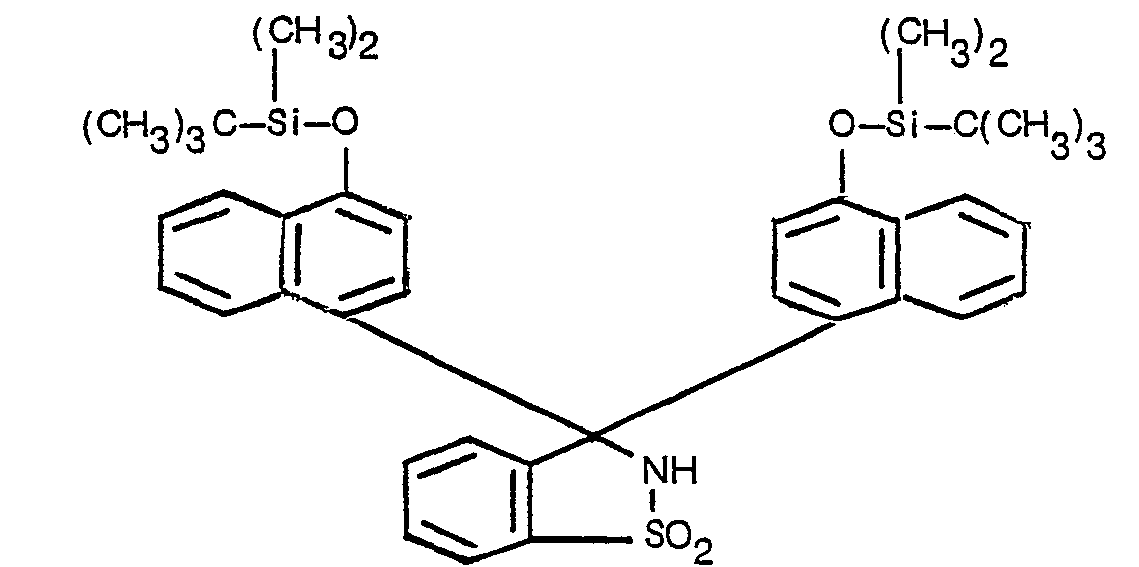
- (a) 16.87 g. of 4-bromonaphthyl dimethyl-t-butylsilyl ether was dissolved in 60 ml. of anhydrous ethyl ether under nitrogen, and the solution then cooled to -60°C in a dry ice-acetone bath. 20.8 ml. of 2.4 N n-butyllithium in hexane was added to the cooled solution dropwise over a period of 15-20 minutes. The reaction mixture was stirred for 30 minutes and allowed to come to 15°C over 45 minutes.
- (b) The solution of step (a) was then cooled back to -40°C, and 4.63 g. of saccharin pseudo- chloride was added portionwise. After addition was complete, the reaction mixture was allowed to warm to room temperature, stirred at room temperature overnight and cooled. 50 ml. of cold water was added followed by the addition of dilute HCI until the pH reached 3-4. The ether phase was separated, and the aqueous phase was extracted with 50 ml. of ether. The ether portions were combined, washed with 100 ml. of water, dried over sodium sulfate, filtered and evaporated under reduced pressure. The residue was dissolved in iso-propanol and the iso-propanol solution slowly poured into 1 liter aqueous HCI solution having a pH of 3.
- The aqueous phase was decanted leaving a gummy residue. Treatment of the residue with iso- propanol and aqueous HCI (pH 3) was repeated and the final residue was dissolved in 250 ml. of iso- propanol. 3% HCI was added until precipitation ceased. The solution was allowed to stand for 10 min., the solvent decanted and water added to the gummy precipitate which on standing became crystalline. The precipitate was filtered and airdried over the weekend to give 15.55 g. of the title compound.
- The dimethyl-t-butylsilyl ether of 4-bromo-1-naphthol was prepared as follows: 4-Bromo-1-naphthol (22.1 g.) and dimethyl-t-butylsilyl chloride (18.1 g.) were dissolved in 50 ml. of dimethylformamide at room temperature. The resulting solution was cooled in an ice bath and. imidazole (17.0 g.) added under nitrogen. (A slight exotherm was observed). A solid precipitated and the reaction mixture was stirred overnight.
- A small sample of the crude product was treated with water adjusted to a pH of about 4-5 with dilute HCI and the solids isolated and dried. TLC on silica gel using hexane showed the product but no starting material.
- The reaction mixture remaining was poured into 1500 ml. of water at about 20°C with stirring. The pH was adjusted to 4-5 with dilute HCI, and the solids were filtered, washed with water, and air- dried for 2 hours and dissolved in 150 ml. of boiling isopropanol. The isopropanol solution was filtered while hot and then cooled slowly to room temperature. Crystals began to form and after standing at room temperature overnight, the solution was cooled in an ice water bath for 1 hour and filtered. The solid collected was washed with small amounts of isopropanol, air-dried briefly and then dried in vacuo for 2 hours to give 24.3 g. of the title compound (melting range 70°-73°C).
- The 3,3-di[4'-(2"-tetrahydropyranyioxy)-1 '-phenyl]-2,3-dihydrobenz[d]isothiazole-1,1 1-dioxide having the formula 0-0 0-0 was prepared in the same manner as the phenol analog described in part (a) of Examples 15, 16,18,27 and 28. The methoxymethyl ether and 2'-tetrahydropyranyl ether of 4-bromo-1-naphthol were prepared according to the procedures described above and the methoxymethyl and 2'-tetrahydropyranyl ethers of 4-bromo-1-naphthol were converted to the corresponding 4-lithium derivatives by reaction with n-butyllithium according to the procedures described above.
- Typical of the sulfam(na)phthaleins that may be prepared from the novel compounds of the present invention are those represented by the following formula:

- A is a 4'-hydroxy-l'-phenyl moiety, unsubstituted or substituted with one or more substituents compatible with organometallic reagents, the same or different, or a 4'-hydroxy-1'-naphthyl moiety, unsubstituted or substituted with one or more substituents compatible with organometallic reagents, the same or different; B is a phenyl moiety, unsubstituted or substituted with one or more substituents compatible with organometallic reagents, the same or different, or a naphthyl moiety, unsubstituted or substituted with one or more substituents compatible with organometallic reagents, the same or different; X represents the carbon atoms necessary to complete a 2,3-dihydrobenz[d]isothiazoie-1,1-dioxide moiety or a 2,3-dihydronaphtho[1,8-de]-1,2-thiazine-1,2-dioxide moiety; and Z represents a carbonyl moiety containing a

- Typical substituents compatible with or capable of being protected to be compatible with organometallic reagents include branched or straight chain alkyl, such as, methyl, ethyl, isopropyl, n-butyl, t-butyl, hexyl, octyl, dodecyl, hexadecyl, octadecyl and eicosanyl; aryl, such as phenyl and naphthyl; alkaryl and aralkyl, preferably, alkyl-substituted phenyl and phenyl-substituted alkyl, such as p-ethylphenyl, p-octylphenyl, p-dodecylphenyl, benzyl, phenylhexyl and phenyldodecyl; alkoxy, such as, methoxy, ethoxy, butoxy, octadecyloxy, 1-ethoxy-2-(A-ethoxyethoxy); aryloxy, such as, phenoxy, benzyloxy and naphthoxy; alkoxyalkyl, such as, methoxymethyl, ethoxymethyl, and dodecyloxyethyl; halo, such as fluoro, bromo and chloro; trihalomethyl, such as trifluoromethyl and trichloromethyl; sulfonamido (―NH―SO2Ro wherein R° is alkyl, aryl, alkaryl or aralkyl); sulfamoyl (―SO2―NH―R° wherein R° has the same meaning given above); acyl

- R° has the meaning given above); sulfanyl (―SO2―R° wherein R° has the same meaning given above); sulfo; cyano, carboxy, hydroxy; and amino including mono- and disubstituted amino (-NR'R" wherein R' and R" each are hydrogen, alkyl, aryl, alkaryl or aralkyl or R' and R" taken together represent the atoms necessary to complete a saturated heterocyclic ring, such as piperidino, pyrrolidino, N-lower alkylpiperazino, morpholino, thiomorpholino and tetrahydro-2H,4H-1,3,6-dioxazocino or a fused heterocyclic ring system, e.g., quinolizidine).
- In a preferred embodiment of the present invention, the method of synthesizing N-substituted sulfam(na)phthaleins comprises (1 a) reacting (a) a compound of the formula

- P is a protecting group selected from 2'-tetrahydropyranyl, methoxymethyl and dimethyl-t-butylsilyl; R1 and R2 are selected from hydrogen, alkyl, alkoxy, chloro and fluoro; R3 is hydrogen, alkyl, alkoxy, or -OP; R2 and R3 taken together represent the carbon atoms necessary to complete a fused benzene ring; R4 and R6 each are selected from hydrogen, alkyl, alkoxy, chloro and fluoro; R5 is hydrogen, alkyl, alkoxy, ―OPI wherein PI has the same meaning as P, ―N,N―(dialkyl)―amino, ―N,N-(ω-R8 alkyl)2- amino wherein R8 is halo or -OP" wherein P" has the same meaning as P, -NHCOCH3, piperidino, pyrrolidino, N-methylpiperazino, morpholino, thiomorpholino or tetrahydro-2H,4H-1,3,6-dioxazocino; R7 is hydrogen, alkyl, alkoxy or―OPIII wherein PIII has the same meaning as P; R6 and R7 taken together represent the carbon atoms necessary to complete a fused benzene ring; R4, R5 and R6 taken together represent the atoms necessary to complete a fused [ij] quinolizidine ring; and X represents the atoms necessary to complete 2,3-dihydrobenz[d]isothiazole-1,1-dioxide or 2,3-dihydronaphtho[1,8-de]-1,2-thiazine-1,1-dioxide with (b) an acid halide of the formula

- W is chloro or bromo and wherein R9 is selected from methyl, methyl substituted with at least one halogen group selected from chloro, bromo and fluoro, alkoxy having 1 to 4 carbon atoms, phenyl, phenyl substituted in the para position with alkyl having 1 to 4 carbon atoms or -N,N-(dialkyl)-amino, phenyl substituted with at least one electron-withdrawing group, phenoxy, phenoxy substituted with at least one electron-withdrawing group, ―O(CH2)2Y wherein Y is an electron-withdrawing group and phenyl substituted in the ortho position with -CH2R10 wherein R10 is chloro or bromo in pyridine at a temperature between about 0° and 100°C to yield (c) the corresponding N-acylated compound of the formula:

- P, R1, R2, R3, R4, R5, R6, R7, R9 and X have the same meaning given above; or (1 b) sequentially reacting said compound (a) with MH wherein M is an alkali metal selected from lithium, sodium and potassium in an inert organic solvent at a temperature between about 0° and 100°C to give the corresponding N-alkali metal salt having the formula

- P, R1, R2, R3, R4, R5, R6, R7, X and M have the same meaning given above and then reacting said N-alkali metal salt with said acid halide (b) to give the said N-acylated compound (c); and
- (2) treating said compound (c) between about 20°C and 100°C with an organic or inorganic acid at a pH between about 0.1 and 5 to yield the product having the formula

- R1, R2, R3, R4, R5, R6, R7, R9 and X have the same meaning given above except that said -OP of R3, said ―OPI and ―OPII of R5, and said ―OPIII of R7 each are ―OH. By electron-withdrawing group is intended "a group with a positive sigma value as defined by Hammett's Equation".
- Usually, the alkyl and the alkoxy substitutents comprising R1, R2, R3, R4, R5, R6 and R7 are lower alkyl having 1 to 4 carbon atoms, such as, methyl, ethyl, n-propyl, isopropyl and n-butyl and lower alkoxy having 1 to 4 carbon atoms, such as, methoxy, ethoxy, propoxy and butoxy. Also the alkyl groups of the ―N,N-(dialkyl)amino and ―N,N―(ω-R8alkyl)2-amino substituents usually are lower alkyl groups include fluoro, chloro and bromo; nitro; cyano;

- The value for these and other groups have been reported by Eugen Müller, Methoden Der Organischen Chemie, Georg Thieme Verlag, Stuttgart, 1970, p. 78.
- In a particularly preferred embodiment, X represents the atoms necessary to complete 2,3-dihydrobenz[d]isothiazole-1,1-dioxide.
- Specific examples of compounds that may be prepared from the novel compounds of the present invention are as follows:


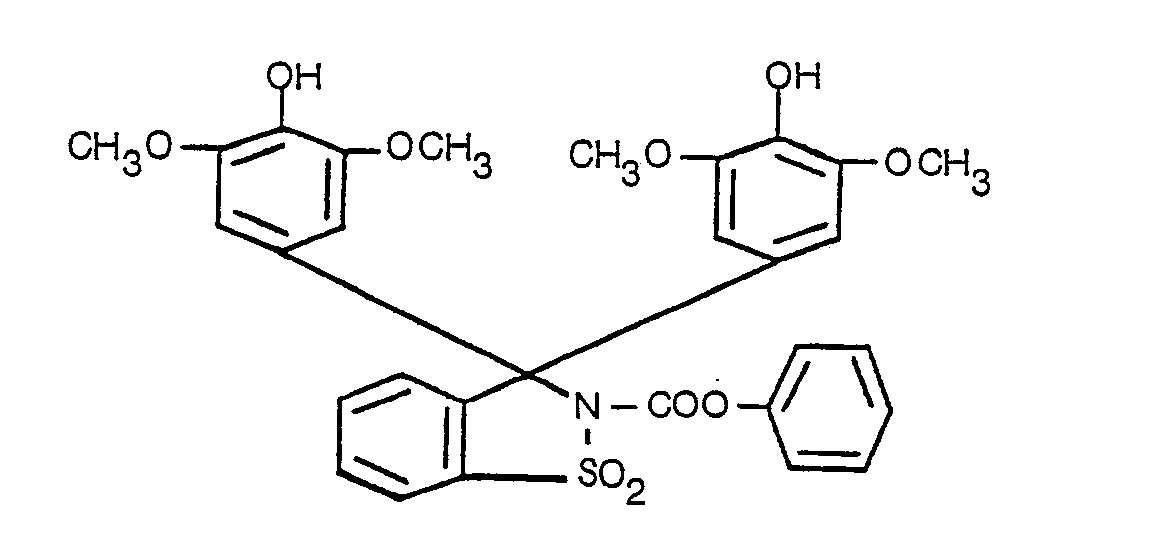


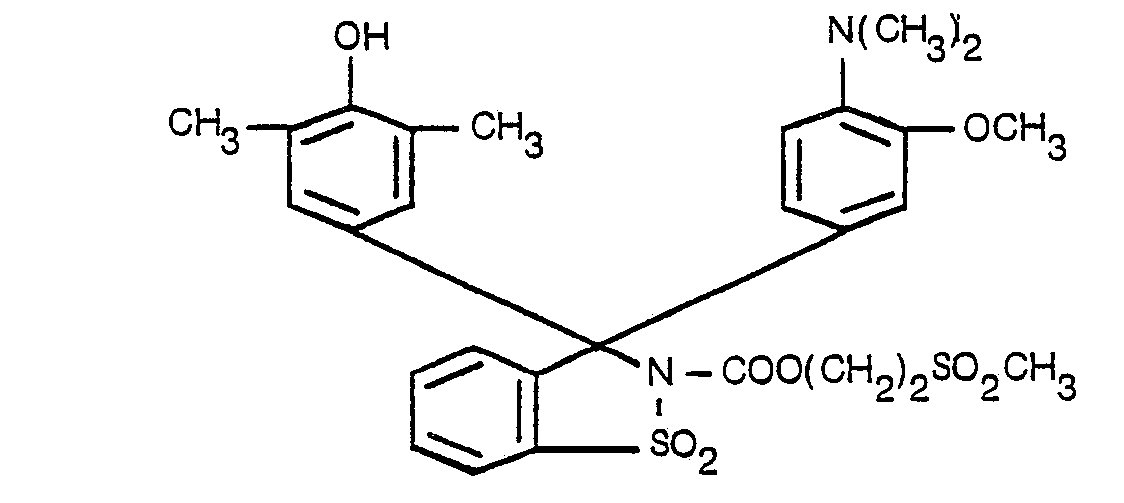


Claims (5)


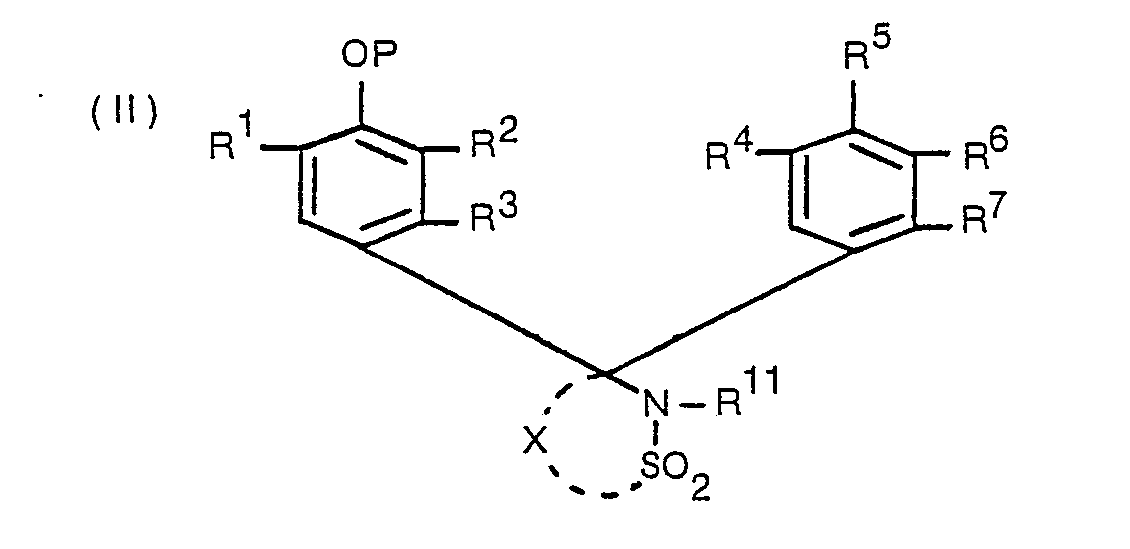

Applications Claiming Priority (6)
| Application Number | Priority Date | Filing Date | Title |
|---|---|---|---|
| US83601077A | 1977-09-23 | 1977-09-23 | |
| US83600877A | 1977-09-23 | 1977-09-23 | |
| US836008 | 1977-09-23 | ||
| US836004 | 1977-09-23 | ||
| US05/836,004 US4191689A (en) | 1977-09-23 | 1977-09-23 | Benzisothiazole-1,1-dioxide and naphtho-1,2-thiazine-1,1-dioxide compounds |
| US836010 | 2004-04-29 |
Publications (2)
| Publication Number | Publication Date |
|---|---|
| EP0001290A1 EP0001290A1 (en) | 1979-04-04 |
| EP0001290B1 true EP0001290B1 (en) | 1984-06-27 |
Family
ID=27420256
Family Applications (1)
| Application Number | Title | Priority Date | Filing Date |
|---|---|---|---|
| EP78100969A Expired EP0001290B1 (en) | 1977-09-23 | 1978-09-22 | Substituted 2,3-dihydrobenz-(d)-isothiazole-1,1-dioxides and 2,3-dihydronaphtho-(1,8-de)-1,2-thiazine-1,1-dioxides |
Country Status (4)
| Country | Link |
|---|---|
| EP (1) | EP0001290B1 (en) |
| JP (1) | JPS5470267A (en) |
| AU (1) | AU522876B2 (en) |
| DE (1) | DE2862422D1 (en) |
Family Cites Families (5)
| Publication number | Priority date | Publication date | Assignee | Title |
|---|---|---|---|---|
| DE100779C (en) * | ||||
| DE100780C (en) * | ||||
| US3833614A (en) * | 1970-06-05 | 1974-09-03 | Polaroid Corp | Phthalides and naphthalides |
| DE2105580A1 (en) * | 1970-08-22 | 1972-09-07 | 3-aryl-benzisothiazole 1,1-dioxide derivs - which ar e non -hyperglycaemic hypotensives | |
| JPS5338621B1 (en) * | 1971-03-08 | 1978-10-17 |
-
1978
- 1978-09-21 AU AU40049/78A patent/AU522876B2/en not_active Expired
- 1978-09-22 JP JP11740378A patent/JPS5470267A/en active Pending
- 1978-09-22 EP EP78100969A patent/EP0001290B1/en not_active Expired
- 1978-09-22 DE DE7878100969T patent/DE2862422D1/en not_active Expired
Also Published As
| Publication number | Publication date |
|---|---|
| EP0001290A1 (en) | 1979-04-04 |
| JPS5470267A (en) | 1979-06-05 |
| AU522876B2 (en) | 1982-07-01 |
| DE2862422D1 (en) | 1984-08-02 |
| AU4004978A (en) | 1980-03-27 |
Similar Documents
| Publication | Publication Date | Title |
|---|---|---|
| Tachikawa et al. | Anxiolytic sedatives. 1. Synthesis and pharmacology of benzo [6, 7]-1, 4-diazepino [5, 4-b] oxazole derivatives and analogs | |
| US4178446A (en) | Sulfam(na)phthaleins | |
| US4178447A (en) | Novel synthesis of 3,3-substituted dihydrobenzisothiazole-1,1-dioxides and -2,3-dihydronaphtho-1,2-thiazine-1,1-dioxides | |
| CA1110239A (en) | Synthesis | |
| US4359574A (en) | Thiazine-1,1-dioxide and isothiazole-1,1-dioxide derivatives | |
| US4191689A (en) | Benzisothiazole-1,1-dioxide and naphtho-1,2-thiazine-1,1-dioxide compounds | |
| EP0001290A1 (en) | Substituted 2,3-dihydrobenz-(d)-isothiazole-1,1-dioxides and 2,3-dihydronaphtho-(1,8-de)-1,2-thiazine-1,1-dioxides | |
| US4311839A (en) | Benzisothiazole and naphtho-1,2-thiazine compounds | |
| CA1110237A (en) | Synthesis of new sulfamphthaleins | |
| US4181660A (en) | 3-Substituted benz[d]isothiazole-1,1-dioxides | |
| US4259498A (en) | Process for preparing benzisothiazole-1,1-dioxide and naphtho-1,2-thiazine-1,1-dioxide compounds | |
| US4204061A (en) | Sulfam(na)phthaleins | |
| US4283537A (en) | Thiazine-1,1-dioxide and isothiazole-1,1-dioxide derivatives and process for preparation | |
| US4140689A (en) | 3-(Julolidinyl)-benz[d]isothiazole-1,1-dioxide | |
| US4255578A (en) | Synthesis of perhalomethylcarbinol-substituted phenol and naphthol sulfamphthalein dyes from the corresponding triacylated derivatives | |
| US4210752A (en) | Synthesis of substituted sulfam(na)phthaleins | |
| US4228075A (en) | Novel sulfam(na)phthaleins | |
| US4231929A (en) | Sulfam(na)phthaleins | |
| US3718656A (en) | Pyrazolo(1.5-a) pyridine derivatives | |
| CA1109068A (en) | Sulfam(na)phthaleins | |
| US3772339A (en) | Preparation of naphthalides | |
| GB2067990A (en) | Cinnamyl moranoline derivatives | |
| Hojo et al. | Isolation and Reaction of New Aromatic Dications. 4-Thioniapyridinium Dications: 2-aryl-(or 2-alkyl-) 4-methyl-3-oxo-2H-1, 4-thiazin-2-ylium Tetrafluoroborates | |
| US3331859A (en) | 3-aroyl-(2-arylmethyl)chromones | |
| US4172083A (en) | Carbocyclic aryl compounds substituted with a tetrahydro-2H,4H-1,3,6-dioxazocino moiety |
Legal Events
| Date | Code | Title | Description |
|---|---|---|---|
| PUAI | Public reference made under article 153(3) epc to a published international application that has entered the european phase |
Free format text: ORIGINAL CODE: 0009012 |
|
| AK | Designated contracting states |
Designated state(s): DE FR GB NL |
|
| 17P | Request for examination filed | ||
| GRAA | (expected) grant |
Free format text: ORIGINAL CODE: 0009210 |
|
| AK | Designated contracting states |
Designated state(s): DE FR GB NL |
|
| REF | Corresponds to: |
Ref document number: 2862422 Country of ref document: DE Date of ref document: 19840802 |
|
| ET | Fr: translation filed | ||
| PLBE | No opposition filed within time limit |
Free format text: ORIGINAL CODE: 0009261 |
|
| STAA | Information on the status of an ep patent application or granted ep patent |
Free format text: STATUS: NO OPPOSITION FILED WITHIN TIME LIMIT |
|
| 26N | No opposition filed | ||
| PGFP | Annual fee paid to national office [announced via postgrant information from national office to epo] |
Ref country code: FR Payment date: 19910812 Year of fee payment: 14 |
|
| PGFP | Annual fee paid to national office [announced via postgrant information from national office to epo] |
Ref country code: GB Payment date: 19910814 Year of fee payment: 14 |
|
| PGFP | Annual fee paid to national office [announced via postgrant information from national office to epo] |
Ref country code: DE Payment date: 19910828 Year of fee payment: 14 |
|
| PGFP | Annual fee paid to national office [announced via postgrant information from national office to epo] |
Ref country code: NL Payment date: 19910930 Year of fee payment: 14 |
|
| PG25 | Lapsed in a contracting state [announced via postgrant information from national office to epo] |
Ref country code: GB Effective date: 19920922 |
|
| PG25 | Lapsed in a contracting state [announced via postgrant information from national office to epo] |
Ref country code: NL Effective date: 19930401 |
|
| NLV4 | Nl: lapsed or anulled due to non-payment of the annual fee | ||
| GBPC | Gb: european patent ceased through non-payment of renewal fee |
Effective date: 19920922 |
|
| PG25 | Lapsed in a contracting state [announced via postgrant information from national office to epo] |
Ref country code: FR Effective date: 19930528 |
|
| PG25 | Lapsed in a contracting state [announced via postgrant information from national office to epo] |
Ref country code: DE Effective date: 19930602 |
|
| REG | Reference to a national code |
Ref country code: FR Ref legal event code: ST |